Easter Myths

Originally published in three parts in March 2013

  1. Myth: The resurrection occurred on Easter Sunday
  2. Myth: The crucifixion occurred on Passover, Nisan 14
  3. Myth: Jesus died at the very instant that the High Priest plunged his knife into the heart of the Passover Lamb
  4. Myth: The crucifixion actually took place on a Wednesday
  5. Myth: By dying on Passover, Jesus became our Passover Lamb
  6. Myth: As our Passover Lamb, Jesus brought salvation to the world
  7. Myth: Peter accidentally cut off Malchus’ ear while taking a wild swing with his sword in an effort to protect Jesus

If you think I’m about to say that the resurrection is a myth, forget it! The resurrection of Jesus is central to my life and theology. I’d have no reason to exist without it. This is about “other stuff.”

Myth: The resurrection occurred on Easter Sunday

This won’t come as a shock. We all know that Easter is a Christian commemoration of the event, not a celebration of the exact day of the year. But why do we do it that way? In the early centuries of Christianity, many churches in the Roman Empire began to object to celebration on the traditional date, considering it to be a “humiliating subjection to the Synagogue.” During the 2nd Century, many of those churches had begun celebrating Easter on a Sunday, regardless of the Biblical calendar. For a clue to the mindset, there’s this ancient text: “Sunday commemorates the resurrection of the lord, the victory over the Jews.” (Emphasis mine)

In AD 325, Emperor Constantine convened the Council of Nicaea to discuss two major issues in the church. One of those was “the Passover Controversy”, the disagreement between churches that commemorated the resurrection on the Jewish feast day and those that did not. Constantine’s view, of course, won out. He wrote,

It seemed to every one a most unworthy thing that we should follow the custom of the Jews in the celebration of this most holy solemnity, who, polluted wretches! Having stained their hands with a nefarious crime, are justly blinded in their minds.

It is fit, therefore, that, rejecting the practice of this people, we should perpetuate to all future ages the celebration of this rite, in a more legitimate order, which we have kept from the first day of our Lord’s passion even to the present times. Let us then have nothing in common with the most hostile rabble of the Jews. … In pursuing this course with a unanimous consent, let us withdraw ourselves, my much honored brethren, from that most odious fellowship. … [I urge you] to use every means, that the purity of your minds may not be affected by a conformity in any thing with the customs of the vilest of mankind. … As it is necessary that this fault should be so amended that we may have nothing in common with the usage of these parricides and murderers of our Lord.

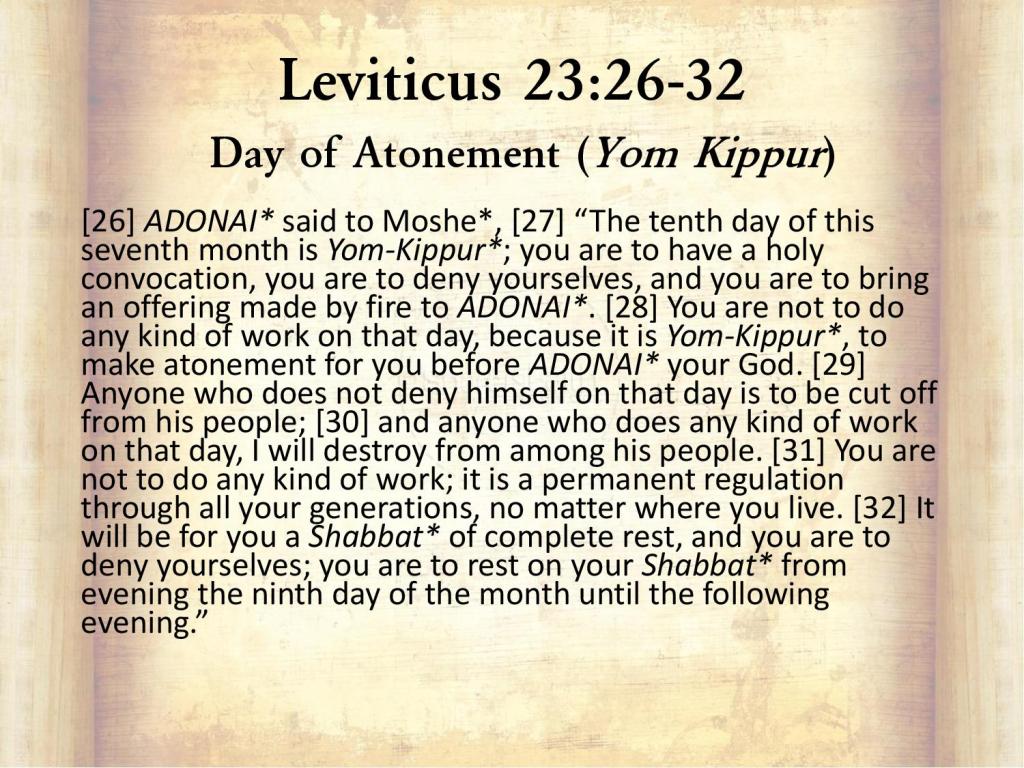
The date for Jewish celebration of the Passover season Feasts is tied by Divine Ordinance to specific dates on the Hebrew calendar (see Leviticus 23). Non-Jews are released from such ordinances, so I don’t care on what day we celebrate the Resurrection. But you should be aware that the name, “Easter”, and most of the secular traditions tied to the holiday are pagan in origin, and that the Nicene Council separated it from Passover for blatantly anti-Semitic reasons.

Myth: The crucifixion occurred on Passover, Nisan 14

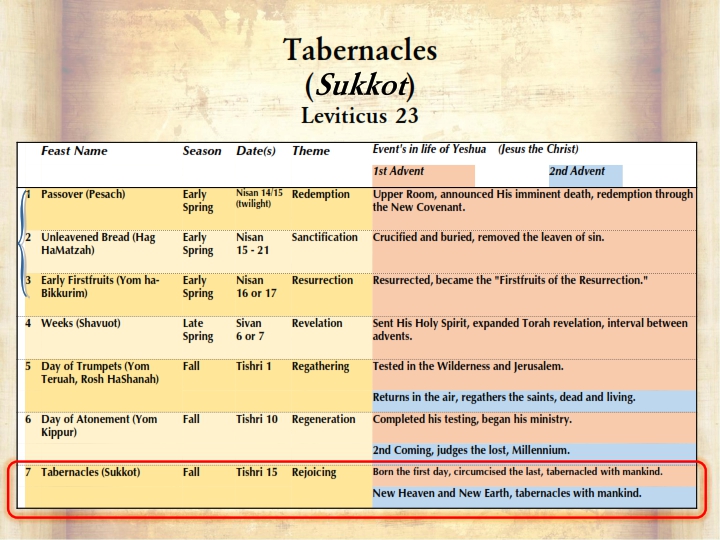
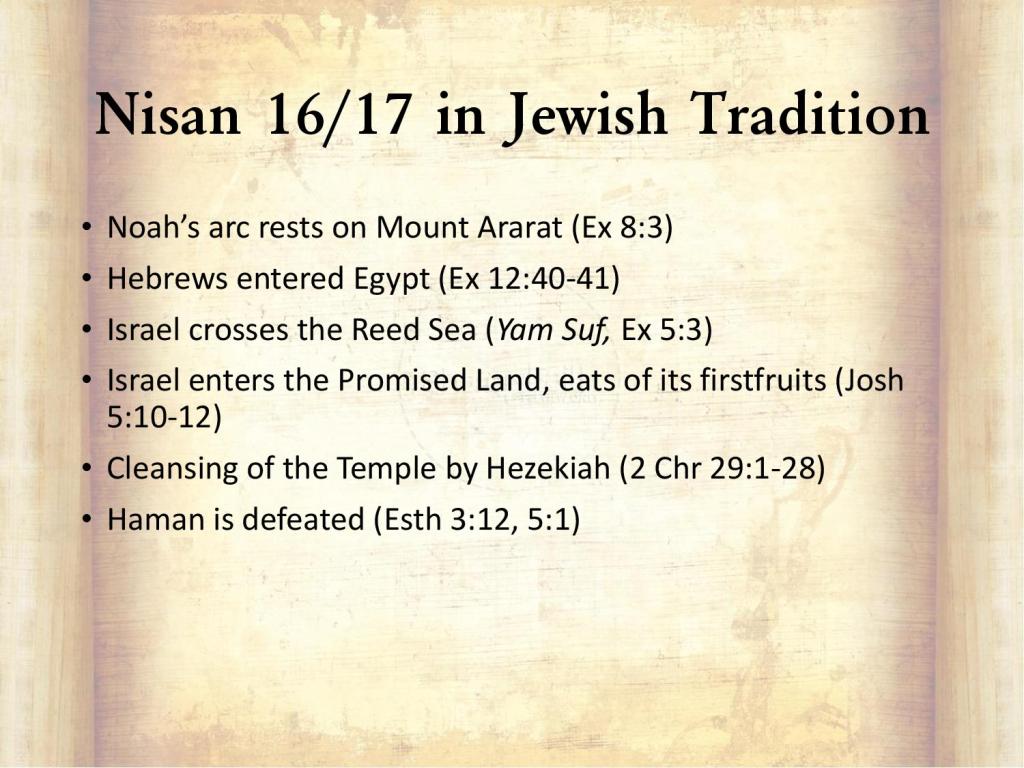
Well, yes and no. The crucifixion happened on Nisan 15, after the sacrifices and after the official Passover as specified in Torah. It became customary, even within the pages of the New Testament, to refer to the three spring feasts together as “Passover.” Technically, Passover is just the short period of twilight between Nisan 14 and 15, on the Jewish calendar (see Part 2 of this series). Immediately after this interval, the 7-day Feast of Unleavened Bread begins—on Nisan 15. And in the middle of this 7-day period, there is the Feast of Early Firstfruits. Jesus’ Last Supper was a Passover Seder. That meal always begins during that twilight period, true Passover, and ends around midnight on Nisan 15, when celebrants adjourn to the streets and rooftops to sing the Hallel Psalms together. The crucifixion, therefore, occurred on Nisan 15, the first day of the Feast of Unleavened Bread.

Myth: Jesus died at the very instant that the High Priest plunged his knife into the heart of the Passover Lamb

I’ve heard this one even from Ray Vander Laan, a man I consider to be an expert on Israel and its customs, in his series of videos for Focus on the Family. But it’s wrong on so many levels! First, the sacrifices occurred during the day before the Seder, on Nisan 14; the crucifixion was the next day, Nisan 15. Second, there wasn’t just one lamb; there was a lamb for approximately every ten people celebrating. Perhaps 100,000 lambs, killed over a period of hours! Which one are they talking about? Third, the High Priest killed only his own lamb, and that much earlier in the day, before the Temple gates were opened. All the other lambs had to be killed by their owners, not by a priest. Fourth, each lamb was killed by a quick slash of its throat, as specified by scripture. A knife to its heart would be considered cruelty, and in the context of the Feast, could get one stoned. Sometimes, the melodrama in the pulpit is just crazy!

©Ron Thompson, based on my own calculation, using Scripture, Jewish customs, and available scientific New Moon tables.

Myth: The crucifixion actually took place on a Wednesday

For two thousand years, most Biblical historians and scholars have held to a Friday crucifixion. More recently, though, many evangelicals have begun to teach that Jesus died on a Wednesday or Thursday. At the heart of this matter is Jesus’ statement in Matthew 12:39–40:

But he answered them, “An evil and adulterous generation seeks for a sign, but no sign will be given to it except the sign of the prophet Jonah.
For just as Jonah was three days and three nights in the belly of the great fish, so will the Son of Man be three days and three nights in the heart of the earth.
—Matthew 12:39–40 ESV

For some reason, it’s hard for some folks to see how you can find three nights between Friday and Sunday! I’m going to present the actual timeline (below, but see also the first chart, above), as I see it, and then I’ll explain several important concepts:

©Ron Thompson

As most Biblically educated people know, prophets often used the word “day” (Heb. yom) to indicate a long or indeterminate period of time, rather than a literal 24-hour solar day. The key to understanding the timing issue here lies in Hebrew idiom—figures of speech. Where there was a likelihood of confusion, ancient Hebrew writers used terms like “three days and three nights” and “the evening and the morning were the first day” to emphasize that true solar days or portions of literal days were in view, not a longer prophetic period of time.

In the Matthew 12 passage quoted above, Jesus was prophesying. Many of His listeners believed in a coming resurrection of the dead in the acharit hyamim, or end times, so it was necessary for Him to emphasize that He was speaking of something that He would personally experience, and that it would be of short duration. Paraphrased, He was saying, “In a little while, I’m outta’ here, but I’ll be back before you know it, on the third calendar day.”

In both spoken and written Hebrew, references to literal solar “days” or “days and nights” did not necessarily imply that complete 24-hour periods were meant. “Three days and three nights” meant “some part of one solar day, all of a second, and some part of a third.” On the first line of the second timeline chart above, “Day 1” was Friday. Recall that Jewish days last from evening twilight until the subsequent evening twilight (see the third chart, below). Jesus died around 3 PM and was entombed before twilight, so at most He was dead only around three hours on this day. He remained in the tomb all through the night and day of Saturday, “Day 2”. His resurrection was sometime on Sunday morning, “Day 3”, before His tomb was found open. The total period was thus composed of a little more than one full period of daylight and at most two full periods of dark. “Three days and three nights” by traditional Hebrew reckoning.

Many conservatives refuse to believe this non-literal interpretation of Jesus’ words and insist on exactly 72 hours, but the hermeneutic employed by me and many conservative, Evangelical scholars allows for a non-literal (but not random!) interpretation of various obvious (to those who understand Hebrew literary techniques) figures of speech.

Many well-meant attempts to rescue the Friday crucifixion tradition resort to various forms of Greek linguistic gymnastics, trying to prove that “in the heart of the earth” doesn’t really mean buried, but could, for example, mean the period from Jesus’ betrayal to His resurrection. I urge caution in using Greek to understand Hebrew concepts. Hebrew idiom does not always translate well into Greek.

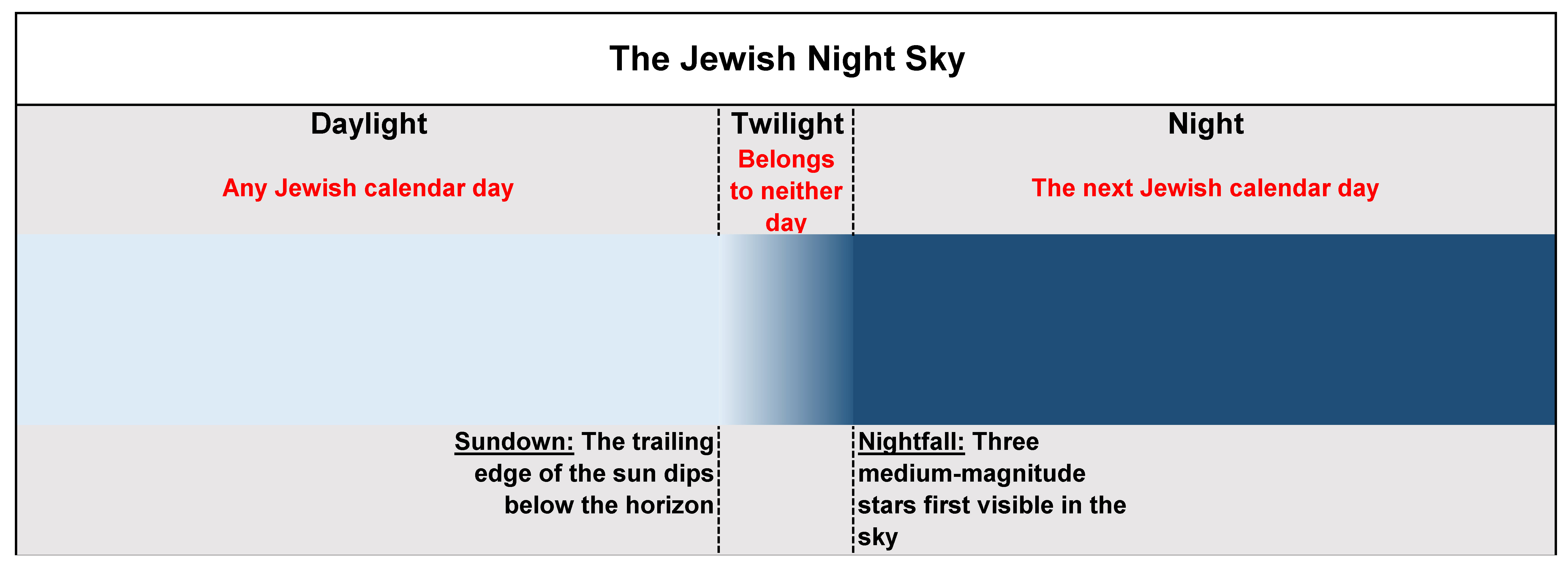
Each Jewish day begins at nightfall and lasts until the following sundown. The twilight period between any two days technically does not belong exclusively to either day, or in another sense, it can be viewed as belonging to both days. The Seder supper always begins during this twilight period between Nisan 14 and Nisan 15 (see Lev 23:5). Note that the lambs are sacrificed on Nisan 14, before the Seder and thus before, not during, the traditional weeklong Feast of Passover.
©Ron Thompson

Every Sabbath is preceded by a Day of Preparation, when meals are prepared, candles lit, and other chores performed that are unlawful on the Sabbath itself. Many arguments against a Friday crucifixion focus on misunderstandings of John 19:31 and its parallels:

Since it was the day of Preparation, and so that the bodies would not remain on the cross on the Sabbath (for that Sabbath was a high day), the Jews asked Pilate that their legs might be broken and that they might be taken away.
—John 19:31 ESV

The argument is that Friday was the first day of the Feast of Unleavened Bread, so it could not have been the previous day of preparation. It is true that the first and last days of the Feast of Unleavened Bread are important Sabbaths. But in Jewish custom, the regular weekly Sabbath that occurs during the Passover week is the most important of all the 7th-day Sabbaths.

So, in that particular year, there was a Feast Day Sabbath on Friday and a weekly Sabbath the following day, on Saturday. Confusion arises because many non-Jewish scholars believe, incorrectly, that it was unlawful to ever cook or make other preparations on any Sabbath. In fact, Jewish law makes an exception when two successive days are Sabbaths. Preparations for each are permissible on the preceding day, whether or not it, too, is a Sabbath.

Some confusion also arises due to a failure to recognize that the “First day of unleavened bread” is one day prior to the first day of the Feast by that name.

Then came the day of Unleavened Bread, on which the Passover lamb had to be sacrificed.
So Jesus sent Peter and John, saying, “Go and prepare the Passover for us, that we may eat it.”
—Luke 22:7–8 ESV

On Nisan 14, the day of the sacrifices, all hametz (leaven) must be removed or destroyed so that none at all is present during the entire week of the Feast.

Another verse that leads to confusion about the timing is John 18:28:

Then they led Jesus from the house of Caiaphas to the governor’s headquarters. It was early morning. They themselves did not enter the governor’s headquarters, so that they would not be defiled, but could eat the Passover.
—John 18:28 ESV

To most, this seems to imply that Jesus’ trial and crucifixion came on the day before the Seder, implying that the Last Supper was something entirely different. Not so—the Last Supper was a traditional Passover Seder. Any ritual defilement caused by entering Pilate’s presence would only last until sundown, so it would have no effect on eating the Seder meal. But it isn’t talking about the Seder. Instead, this refers to the chagigah (festival sacrifice) which was eaten with much celebration and joy in the afternoon following the Seder.

You may ask how the Wednesday crucifixion proponents manage to get “three days and three nights” out of a Wednesday to Sunday entombment. Mostly, there are two schools of thought. Some actually place the resurrection on Saturday and justify this by misinterpreting the passages about the women at the tomb. Others say that while Jesus was crucified on Wednesday, he was not placed in the tomb until evening, which would be early Thursday on the Jewish calendar. In that case, a resurrection early Sunday (on our Saturday evening) would meet the requirement.

A less prevalent theory is that the crucifixion was on Thursday. I believe that there are severe problems reconciling Sabbaths, preparation days, and calendar days if this approach is taken, but I will not cover it here.

Myth: By dying on Passover, Jesus became our Passover Lamb

I touched on this above. I suspect that the vast majority of Christian theologians would say that, at the very least, it is foundational that Jesus died on the same day as the Passover lamb or lambs, because He had to be seen as the fulfillment of the prophetic purposes of the Feast. If that were the case, then I ask why His throat wasn’t slit inside the Temple precincts and His blood splashed on the altar as required by Torah? How is it permissible that He died in a completely different manner, nailed to a Roman cross way over on the other side of the Tyropoeon Valley?

Sheep grazing near Jerusalem. Source unknown.

My contention is that Jesus did not die on the same day or the same time as “the Passover Lamb”, of which there were many thousands. In fact, I think that it was theologically necessary that Jesus did not die on the same day or in the same way as the Passover lamb! Had He done so, would He not have linked Himself prophetically to that sacrifice alone, to the exclusion of all others? The truth is that Jesus was the prophetic fulfillment of all of the sacrifices! And in terms of Soteriology, Passover is less important by far than, say, Yom Kippur!

Myth: As our Passover Lamb, Jesus brought salvation to the world

In a word, no! But didn’t Yochanan the Immerser—John the Baptizer—tell his followers to “Behold the Lamb of God, who takes away the sin of the world” (John 1:29)? And what about Paul, who called Him “Christ, our Passover” (1 Cor. 5:7). Those are accurately reported sayings but mind the context! John was urging immersion as part of a ritual of repentance, connected, I’m sure, to the onset of the extended Days of Awe on that very day and extending to Yom Kippur, 40 days in the future. He was making no claim to offer salvation! Instead, he was pointing to the Messiah, often referred to in Scripture as “the Lamb of God”, or just “the Lamb.” Jesus didn’t die until some 3½ years later. And Paul was not talking about salvation at all, but rather separation of the Corinthian Church from the “leaven of sin.”

Yes, Jesus died on the cross to save us from our sins, but His sacrifice encompassed and surpassed all of the daily and seasonal sacrifices, not just the Passover lamb.

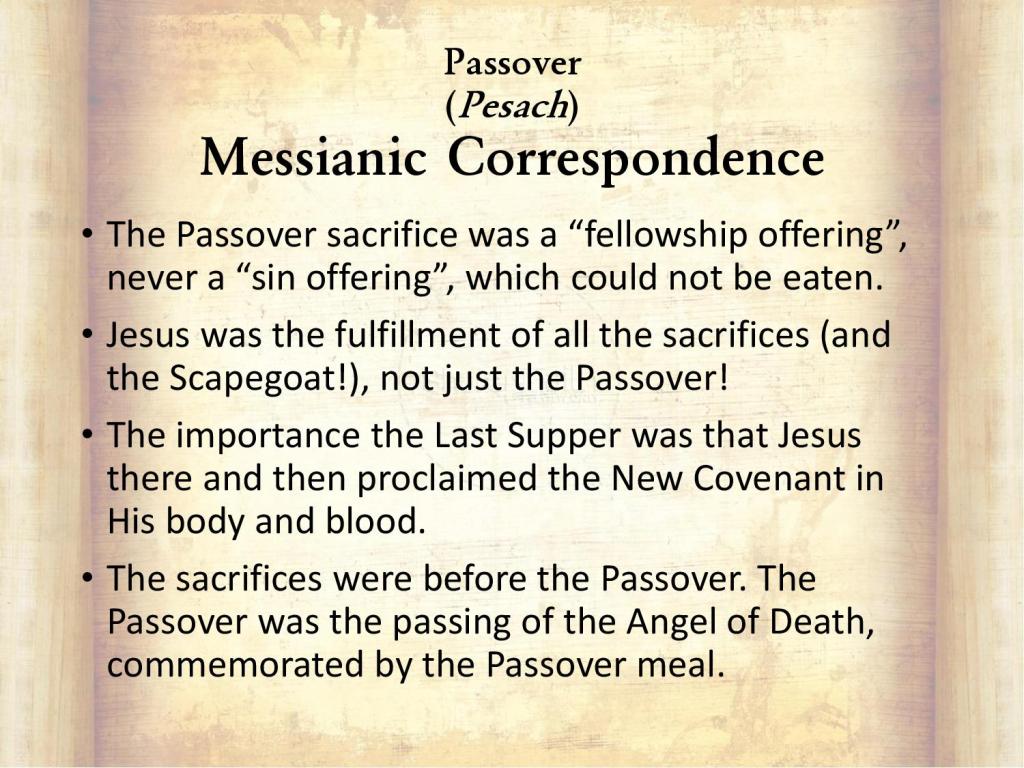
The Passover sacrifice was not even a sin offering! It was a type of fellowship offering. Sin offerings could not be consumed by the people, but they were required to eat their Passover sacrifice to symbolize their freedom from the bondage of sin and the resulting right to sup at God’s table, in fellowship with Him.

The Yom Kippur sacrifices were far more to the point of salvation, but even sin offerings only deal with incidental sin—not deliberate, malicious, God-defying sin. There was only one hope for that. Not a specific blood sacrifice, but simply the Grace of God, as symbolized at Yom Kippur by the Scapegoat, which wasn’t even killed! (Well, it was, but not as part of the ceremony; it was driven over a cliff in the wilderness so that it couldn’t come wandering back to town with the sins of the people.)

It was, then, as a goat—the Scapegoat—that “the Lamb of God” took away the sin of the world!

Myth: Peter accidentally cut off Malchus’ ear while taking a wild swing with his sword in an effort to protect Jesus

(Note: I have expanded on this subject in a separate post, Malchus’ Ear.)

The following quote from the Complete Jewish Bible, my personal favorite translation, sets the stage:

Then Shim‘on Kefa [Simon Peter], who had a sword, drew it and struck the slave of the cohen hagadol [high priest], cutting off his right ear; the slave’s name was Melekh [Malchus].
—John 18:10 CJB

Short sword similar to what Peter would have used to maim Malchus.

First, it is unlikely that Peter was carrying a military sword that night after the Seder. Neither he, nor Malchus, was a soldier. Peter was a fisherman by trade and would be accustomed to carrying a knife for tending nets and lines, and for gutting fish. The Greek term here is machaira, which was probably a double-edged knife or dirk, a shorter version of a sword design that had been introduced into Israel by the Phoenician Sea Peoples. Nor do I think Peter was a trained fighter. We know he was impetuous, but was he an idiot? Did he think he could mow down a band of trained Roman soldiers and Temple guards? Was he distraught and attempting to commit “suicide by Roman soldier”? I think that if he had attempted a frontal assault in Jesus’ protection, he would have been reflexively cut to pieces before he drew a drop of blood, and quite likely the slaughter would have extended to the other apostles present, as well.

What I think really happened was that Peter took advantage of the soldiers’ preoccupation with Jesus, slipped around behind Malchus—his intended target—and deliberately sliced off his ear. Why Malchus? Because Malchus was the High Priest’s servant and right-hand man. The High Priest was probably not present, and Malchus was presiding. At any rate, harming the High Priest, had he been there, would have resulted in quick execution. By taking Malchus out, Peter would be insulting and effectively crippling the High Priest and, to some extent, the Sanhedrin. But then, why an ear, of all things? Because Peter wasn’t a killer, and taking an ear did the job! Priests, Levites and all other Temple officials were required to be more or less physically perfect. With a missing ear, he would be considered deformed and unfit for Temple service.

Yes, Peter was impulsive. But he was also smart.

For a complete series on the Principle Jewish Feasts, as specified in Leviticus 23, please see The Jewish Feasts–The Back of My Mind.


Pharisees

Posted on:

Modified on:

  1. Pharisee History
  2. Sect, or Order?
  3. Torah
    1. Torah Shebichtav, the Written Torah
    2. Torah Sheba’al Peh, the Oral Torah
  4. The Sanhedrin
  5. Pharisees as Sanhedrin Agents
  6. Core Beliefs of the Pharisees
  7. Jesus’ Debates with Pharisees
  8. How did the Pharisees See Themselves?
  9. My Conclusions

Christianity has traditionally viewed the Pharisees as a uniformly treacherous and hateful group of hypocrites.

There is a marked tendency among some to despise Judaism as a whole for producing such a “reprobate” sect. An Internet search for “Pharisees” turns up almost exclusively sites that range from mildly to bitterly critical. The Merriam-Webster dictionary defines “pharisaical” as an adjective meaning, “marked by hypocritical censorious self-righteousness.” Their Collegiate Thesaurus lists the synonyms, “hypocritical, canting, Pecksniffian [look it up], pharisaic, sanctimonious, [and] self-righteous.” But do they deserve the bad rep?

Personally, I don’t think so!

Pharisee History

According to Josephus, there were only about 6,000 Pharisees during the reign of Herod the Great, and that is unlikely to have changed much during Jesus’ lifetime.

The name “Pharisee” comes from the Hebrew Parush (pl. P’rushim), meaning “separated.” This term refers to their opposition to “the mingling”, that is, the mixing of Greek ideas into Biblical Judaism (which, incidentally, has also been the scourge of Christianity). It is believed by many scholars that the Pharisees were spiritual descendants of the Chasidim (“pious ones”), a devout group of scribes dedicated to the preservation of the written and oral Torah during and after the Babylonian Captivity.

Dura-Europos Synagogue – Dura-Europos, Syria – AD circa 101-300. One of the oldest intact (but inactive) synagogues in the world. Note that the representational art does not break the 2nd Commandment, which is specifically a prohibition against making idols to house the foreign gods prohibited by the 1st Commandment. The structure at the center of the wall is the Holy Ark, the closet for housing the synagogue’s Torah scrolls. The Ark is always on the west wall, opposite the door to the chamber and facing east. Photo from BreakingMatzo.com.

The first clear historical references to the Pharisees occurred in the Intertestamental period (between the Old and New Testament writings), during the reign of John Hyrcanus (134–104 BC). By then, they had formed into an elite religious society, or order, with limited membership and strict rules of conduct. They had gained wide popular support due to their opposition to Hellenism (Greek culture), the rise of the corrupt Sadducees, and the illegal high priesthood of the Hasmonean monarchs. Despite their popularity in the synagogues, their political influence was very limited at first.

Accused of fostering revolt, as many as 800 Pharisees were crucified by Alexander Jannaeus (108–76 BC). During the reign of Queen Alexandra Salome (76–67 BC), whose brother was a Pharisee, they finally gained considerable power. Unlike the Sadducees, they never welcomed Roman rule, but they were able to maintain some influence, only because they were willing to cooperate in order to maintain peace and stability.

During the Roman period, spanning the life of Herod the Great and the 1st Century AD up to the destruction of the Temple in AD 70, the Pharisees were highly influential with the populace as a whole, though it was the Sadducees who controlled the Temple and its ritual.

After the destruction of Jerusalem and the Temple in AD 70, most Jewish sectarian orders disappeared, but many of the Pharisees were allowed to relocate to Jamnia (Yavneh), on the coast west of Jerusalem, where they formed the nucleus of the great Rabbinic movement of the following centuries.

Sect, or Order?

It is common to call the Pharisees a sect, but that term is misleading.

By definition, a sect is an offshoot of a larger religion, or a group sharing distinctive political and/or religious beliefs.

I would term the Pharisees, Sadducees, Essenes, and others as orders. An order is a formal group set apart within their religion by adherence to a particular rule or set of principles. The scribes, on the other hand, were not a religious order. As professionals, they probably belonged to a guild.

1st Century Judaism, as today, was highly sectarian. A majority of the Jewish population of Judea and Galilee probably would have said that they were followers of the Pharisees, that is, adherents of the Pharisee belief system, but to actually be a Pharisee—a member of the Order—required a difficult period of training, and then a formal ordination.

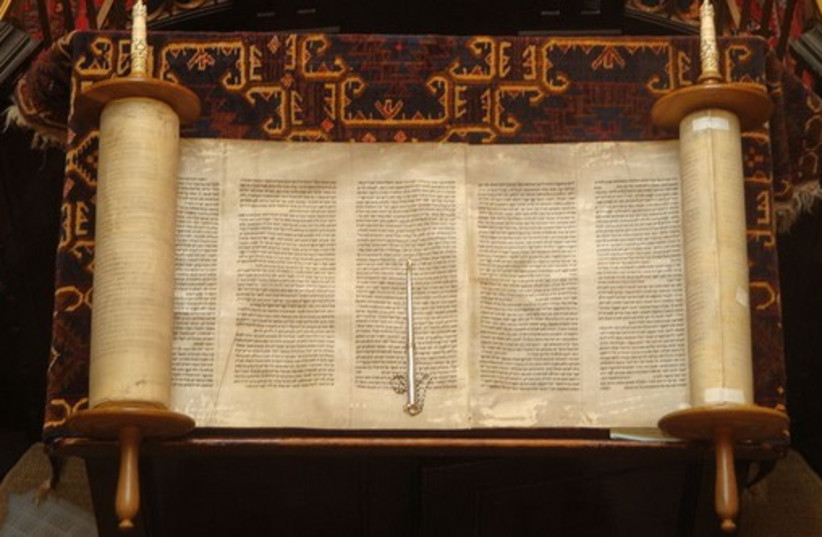
Torah Scroll, Wikimedia Commons
Torah

The Hebrew term Torah rightly translated means, not “law”, but “teachings.” The teachings of Torah do include legal precepts, of course, but those precepts are more about the nature and will of God than about legislation. Even to a Pharisee!

The Pharisees, like Rabbinic Judaism for the last 2,000 years, believed that Torah has two parts: written and oral.

Torah Shebichtav, the Written Torah

The written Torah itself is embodied in books or scrolls. The term primarily applies to the five Books of Moses. These writings individually or collectively are sometimes referred to by Jews as the Chumash (“one fifth”). I personally avoid the Greek term, “Pentateuch.”

To the Sadducees, only the five Books of Moses were Scripture. The Pharisees regarded as holy the entire Tanakh (the OT), consisting of Torah, Nevi’im (the Prophets) and Ketuvim (Writings, sometimes referred to by Jesus simply as the Psalms).

[44] Yeshua said to them, “This is what I meant when I was still with you and told you that everything written about me in the Torah of Moshe, the Prophets and the Psalms had to be fulfilled.” [45] Then he opened their minds, so that they could understand the Tanakh
—Luke 24:44–45 (CJB)

Torah Sheba’al Peh, the Oral Torah

The “Written Torah” was transcribed by Moses “from the mouth of the Almighty” and is contained within the Torah scroll. The “Oral Torah” incorporates the traditions handed down from Sinai but not (initially) put in writing, as well as the interpretations and rulings formulated by the sages of each generation.
—TheRebbe.org

The Pharisees taught that Moses received additional teachings on Mt. Sinai that he was not told to write down. Originally this “Oral Torah” was transmitted from father to son and from teacher to disciple. It consisted of additional instructions and rulings to clarify and quantify the written Torah; principles for exegesis of Torah; and authorization for the rabbis to protect the word of the Torah through making Gezayrot, or edicts, as conditions warrant.

Aside from famously criticizing “traditions of the Elders” that contradicted the letter or the spirit of the Written Torah, Jesus never spoke against the Oral Torah as a whole, and in fact He and His disciples were meticulous about obeying the precepts of both Written and Oral Torah. The formal right of the Scribes and Pharisees to administer Torah through interpretations and edicts (see above) was known as “binding and loosing” (prohibiting and permitting) and was believed to have the blessing of God and His Divine Council in heaven. Shortly before his crucifixion, Jesus endorsed this practice when He extended it to His apostles:

[18] Truly, I say to you, whatever you bind on earth shall be bound in heaven, and whatever you loose on earth shall be loosed in heaven.
—Matthew 18:18 (ESV)

Approximately 1800 years ago, Rabbi Judah the Prince concluded that because of all the “travails of Exile”, the Oral Torah would be forgotten if it was not recorded on paper. He therefore assembled the scholars of his generation and compiled the Mishnah, a written collection of all the oral teachings.

The Sanhedrin

The Biblical basis for the Sanhedrin was:

[18] “You are to appoint judges and officers for all your gates [in the cities ADONAI your God is giving you, tribe by tribe; and they are to judge the people with righteous judgment. [19] You are not to distort justice or show favoritism, and you are not to accept a bribe, for a gift blinds the eyes of the wise and twists the words of even the upright. [20] Justice, only justice, you must pursue; so that you will live and inherit the land ADONAI your God is giving you.
—Deuteronomy 16:18–20 (CJB)

Each major city was ruled by its own political and judicial “Lesser Sanhedrin” of 23 members. Under the monarchy, a “Greater Sanhedrin” was established at Jerusalem to serve as high court of justice and supreme governmental council.

This council at Jerusalem consisted of 71 members, of which the presiding member was the nasi (“prince”, or president), often the High Priest. Membership was appointed, with theological scholarship nominally the basic requirement—but in Roman times, politics effected all major appointments.

During Jesus’ Day, The Sanhedrin met in the “Chamber of Hewn Stone. Later they began meeting in the Royal Portico, which spanned the South side of the Temple Mount above and behind the Double and Triple Gates. Diagram ©Leen Ritmeyer, red box added by me.

According to the synoptic Gospels, Sanhedrin membership consisted of “chief priests, elders, and scribes.” Although there was overlap between those three groups, the chief priests were high ranking Temple priests, mainly members of the Sadducee order; the elders were most likely prestigious Pharisees; and the scribes were respected professionals who might have belonged to any particular order, or to none at all. The Gospel of John mentions only Pharisees and scribes from the Sanhedrin, but when John wrote, probably around AD 80, the Sadducees, the Sanhedrin and the Temple were long gone and a distant memory to his readers.

Pharisees as Sanhedrin Agents

The Pharisees in Jesus’ day were scattered throughout Judea and Galilee, with concentrations in the cities. Many were attached to specific synagogues, while others adopted the life of itinerant teachers, doing much the same things as Jesus. Many of these, perhaps a large majority, were no doubt still Godly men like the first Pharisees, out of the spotlight and unconcerned with politics and wealth. Certainly, when Jesus crossed paths with these men, there were discussions and perhaps even confrontations. I have witnessed brash conversations between Jewish intellectuals in my own day, and I don’t think that it would have been any different then than now.

But what about the Pharisees and scribes that followed Jesus around from town to town? The late David Stern, translator of the Complete Jewish Bible, wrote frequently in his own books and commentaries that these men were probably on assignment from the Sanhedrin. One of the duties of that body was to investigate not only claims of heresy, but also claims of messiahship. Since priests and Levites on the council were mostly Sadducees, who did not believe in a coming messiah, this duty would naturally fall to Pharisees and their scribes. Some would have been belligerent, others merely inquisitive.

Some members of the Sanhedrin were Godly men (e.g., Nicodemus and Gamaliel), but many others were corrupt—collaborators, greedy for wealth and power, and jealous of their position. I believe that the “committee” following Jesus probably consisted of both types. Perhaps it was the same handful of men that we see Jesus arguing with over and over again. Can it be that whenever Jesus blasted the Pharisees, it was “those Pharisees from the Sanhedrin” that He was speaking of—not all Pharisees in General?

Core Beliefs of the Pharisees

Despite the impressions one often receives in reading of Jesus’ frequent confrontations with the Pharisees, He seldom disputed with them on points of doctrine. The Pharisees revered God’s Holy Word and were strongly committed to daily application and observance of its precepts.

They believed in resurrection, immortality, divine judgment, angels, and spirits. They looked for a coming messiah and took responsibility for evaluating claimants. They believed in God’s intervention in human affairs. Many things, they believed, are predestined; human will has only limited freedom within the sovereign will of God.

In Mt 23:1-3 (see below), Jesus is telling the followers of the Pharisees, in effect, “Do what they say, but not what they do.” The reference to “Moses’ seat” speaks literally of the customary seats in the synagogues that were occupied by the teacher during formal Torah studies, but I think it also implies an acknowledgement by Jesus of their historical authority to teach the truths of Torah.

Remains of the Moses Seat in an ancient Persian synagogue.
Jesus’ Debates with Pharisees

I am sure that you have heard it said that Jesus “turned the ancient world upside down with His new commandments and interpretations of scripture.” Certainly, He provided many new insights in the area of prophetic interpretation and fulfillment, but in my opinion He actually presented little or nothing new in the way of doctrine, because the doctrine He taught was already imbedded in the Tanach; rather, He set the record straight on issues that had been clouded by denominationalism, and He turned the clock back on corrupt, or at best legalistic trends that had developed within Jewish society.

Though the great sages of the Pharisees were in substantial agreement with each other on most doctrinal issues, they did, however, often disagree on certain points of interpretation or application. When we see Jesus arguing with a Pharisee, what He is doing most often is simply taking sides in these disagreements. For example, the issues discussed in the so-called “antitheses” of Mt 5:21–48 had been the subject of hot debate among the sages, particularly the rival houses, Beit Hillel and Beit Shammai. Jesus was not presenting new doctrine, but rather pronouncing on these issues from the perspective of His divine authority.

If one can believe the Jewish literature of the Rabbinic age (and I think that most of it is trustworthy), almost everything that Jesus said had been previously said in some form by earlier Jewish sages. Some Christian scholars would claim that the rabbis plagiarized Jesus’ remarks, falsely attributing them to their own heroes. Of course, “critical scholarship” would say it was Jesus who plagiarized. My take is this: God’s truths are timeless and unchanging. God always has a remnant on the scene to expound that truth.

Because of God’s love and grace, He always “prepares the ground” ahead of the sower. Jesus did not arrive on the scene with a Gospel that was radically new and unacceptable to his Father’s chosen people. His path had been prepared in advance by the Pharisees, though ultimately most rejected Him.

As an engineer, I was taught that a good technical paper should have three parts: (a) tell ‘em what you’re going to tell ‘em; (b) tell it to ‘em; and (c) tell ‘em what you told ‘em. In this case, the Pharisees did (a), Jesus did (b) and the New Testament writers did (c).

How did the Pharisees See Themselves?

The Rabbinical descendants of the Pharisees tackled this question in both versions (Babylonian and Jerusalem) of the Talmud. Both list the following Seven Kinds of a Pharisee, in very similar terms:

  1. The “shoulder” Pharisee, who wears his good deeds on his shoulders and obeys the precept of the Law, not from principle, but from expediency.
  2. The “wait-a-little” Pharisee, who begs for time in order to perform a meritorious action.
  3. The “bleeding” Pharisee, who in his eagerness to avoid looking on a woman shuts his eyes and so bruises himself to bleeding by stumbling against a wall.
  4. The “painted” Pharisee, who advertises his holiness lest anyone should touch him so that he should be defiled.
  5. The “reckoning” Pharisee, who is always saying “What duty must I do to balance any unpalatable duty which I have neglected?”
  6. The “fearing” Pharisee, whose relation to God is one merely of trembling awe.
  7. The Pharisee from “love.”
    International Standard Bible Encyclopedia

Certainly, one can find examples of each type of Pharisee in scripture. Note that only the “Pharisee from love” was considered by the later Rabbis to be a truly Godly man.

My Conclusions

Unfortunately, by Jesus’ day, many (but certainly not all, and probably not a majority) of the Pharisees and scribes had in fact succumbed to a legalistic form of worship. Where before they had kept Torah out of a deep zeal to obey God’s commands, now many began to define their spirituality not by their love but by a prideful tally of their good deeds.

[23:1] Then Jesus said to the crowds and to his disciples, [2] “The scribes and the Pharisees sit on Moses’ seat, [3] so do and observe whatever they tell you, but not the works they do. For they preach, but do not practice.
—Matthew 23:1–3 (ESV) emphasis mine

What I am suggesting here is that you reconsider your attitude towards the Pharisees—to see them not as an evil cult that brought on the ruination of the Jewish people, but rather as a powerful spiritual force that bridged the gap between Ezra, Nehemiah and the latter prophets, and the arrival of Messiah.


The Roots of Christian Prayer

Posted on:

Modified on:


  1. Early Synagogues
  2. From Synagogue to Church
    1. Let me emphasize, for a third time:
  3. Prayer in Synagogue and Church
    1. Informal Prayer
    2. Formal Prayer
    3. Corporate Prayer
    4. Kavanah
    5. The Disciples’ Prayer
    6. Grace After Meals
    7. Blessings
    8. Daily Prayers
    9. The Sh’ma
    10. The Amidah
    11. Conclusion

New Covenant Believers, whether Christian or Jew, have access to God through the indwelling Holy Spirit. The common Christian belief that Old Testament Jews had no personal access to God aside from the Cohanim, or Priesthood, is a misunderstanding, if not a slander on both God and His People. God considers Israel to be His wife—does a wife have no way to approach her husband?

While it is true that the OT emphasis was on God’s relationship with corporate Israel, it was never the case that individual Jews were without access to God by means of prayer, sacrifice and Temple worship. Many instances are recorded in Scripture of Jews offering personal prayer directly to God. Think of Hannah, for example, praying daily for a son and in her old age finally being blessed with Samuel. David was King, but had no priestly privileges, yet he was evidently the most prolific prayer warrior of ancient Israel. Solomon, David’s son, offered an elegant prayer in dedication of the new Temple that he built. Daniel, Hananiah, Mishael, and Azariah were all from the tribe of Judah, and God honored their individual prayers in Babylon and Persia. Every Jewish family was required to send a family representative to the Jerusalem Temple on 14 Nisan every year to personally, by his own hand, sacrifice a lamb or kid at the foot of the altar. Jews of any tribe, including women, could enter the inner Court of Israel to bring a sacrifice to the altar when they felt the need. Biblical Ezra himself was instrumental in bringing synagogues, houses of prayer for common folks, to Jerusalem.

It is also not uncommon to hear devout Christian criticism of “Jewish prayer“, usually because it is viewed as “ritualistic” and thus, “Surely it can’t be heartfelt.” I beg to differ. This article is an introduction to Jewish and early Christian prayer life.

Early Synagogues

After successive Babylonian conquests of Judah, most of the Jews who were subsequently resettled in Babylonia were allowed to establish enclaves and worship as they saw fit. Daniel describes life in captivity only as it pertained to a select few from Jewish nobility who were housed in the royal palace and trained to serve in the King’s administration.

Since the Bible is mostly silent about the rest of the captives, Christian tradition tends to forget about all but Daniel, Hananiah, Mishael and Azariah. Many scholars believe that Godly Jewish exiles began congregating in homes, and in all probability that custom morphed into a synagogue system in captivity.

The later development of synagogues within Israel is probably related to Ezra and the events and edicts recorded in Nehemiah 8 – 12. Whatever their true origins, synagogues were eventually built throughout Israel and the Diaspora as a supplement to the rebuilt Temple in Jerusalem.

By around 150 BC, Judaism had splintered into numerous sects. Politically, the Pharisees held a large minority of seats on the Sanhedrin, but otherwise they had little influence within the Temple and its ritual. They were, however, the most popular sect with the common people. They controlled most of the synagogues, and therefore most of Jewish adult education.

Like Christian denominations today, the Pharisees were not monolithic in all their views or practice, yet they were all fundamentally alike in their reverence for the Tanakh (that is, the Torah, the Prophets and the Writings, which together comprise the Old Testament). I will have more to say about Pharisees in a future post (I did—see here), but for now, my stress is on the fact that the synagogues of Jesus’ day and beyond were tied to the teachings of the Pharisees, as is Orthodox Judaism today.

Jesus undoubtedly grew up worshiping in His local synagogue and learning not only from His father, but from sages of the Scribes and Pharisees. Apart from the facts of His own deity, the worldview that He taught after His baptism by John was in all important respects, the worldview of the Pharisees and the Synagogues.

Jesus’ ministry was to “the House of Israel.” He and His followers worshipped in the same ways as other Jews. After His resurrection and ascension, His followers were still Jewish and still met in the synagogues along with their “non-Messianic” Jewish brothers. At the close of Sabbath services, at sundown (in other words, after Saturday turned into Sunday!), the Messianic believers left the synagogues and adjourned to nearby homes to celebrate the Messiah. I agree with Messianic scholar Arthur Fruchtenbaum (Israelology: The Missing Link in Systematic Theology) that this practice is the likely true reason for Christian Sunday worship. The sharing of services in the synagogues continued until the “followers of the Nazarene” were gradually expelled.

Historians generally credit shared Jewish tradition as the single factor that enabled Judaism to persist as a recognizable ethnic culture through conquest, scattering, and thousands of years of persecution and genocide. Jewish prayer is the backbone of that tradition, and it is almost unchanged in Orthodox Judaism today from what it was in the synagogues of Jesus’ day and earlier.

From Synagogue to Church

Jesus and his apostles, including Paul, not only worshipped in the synagogues, but they frequently taught in the synagogues. As mentioned above, the early Christians worshipped as Jews alongside their Jewish friends and families at the synagogue, on Shabbat, then after sundown they adjourned to Christian homes to worship as followers of the Messiah.

Where did they go in the years after they were expelled from the synagogues? They started their own Messianic synagogues! The early “local churches” were patterned, both physically and organizationally, on the Jewish synagogues of the day. Having no Christian Bible, they worshipped from the same Jewish Bible that their Rabbi, Yeshua (Jesus), had taught from. Apart from recognizing the deity of their Rabbi, and meeting on Sunday in order to avoid profanation of the Sabbath, the ritual of their congregational meetings would not have differed substantially from what they had always practiced.

Modern Christians for the most part, lay or otherwise, know almost nothing about prayer or worship customs in general in the 1st Century AD, in the synagogues of either the non-Messianic or the Messianic congregations.

Let me emphasize, for a third time:

The early Church was 100% Jewish and grew out of the synagogues of Judaism, worshiped the Jewish Messiah, and was ultimately taught by a devout and unapologetic Jewish Pharisee named Sha’ul (names like “Paul” and “Peter” were Greek names for Jewish men who often ministered to the Greek-speaking world). The local churches certainly followed the customs and rituals of Judaism, including its prayer structure.

Until, that is, the Church itself cast off its charter members and their customs! When the non-Jews began to outnumber the Jews, arrogance on both sides caused a rift that still exits.

Prayer in Synagogue and Church

Prayer in the synagogues was mostly ritualized and recited from memory. Jewish believers in the first churches would have certainly continued to pray the same prayers that they had prayed all their lives, plus some new ones, specific to Worship of their newly revealed Messiah.

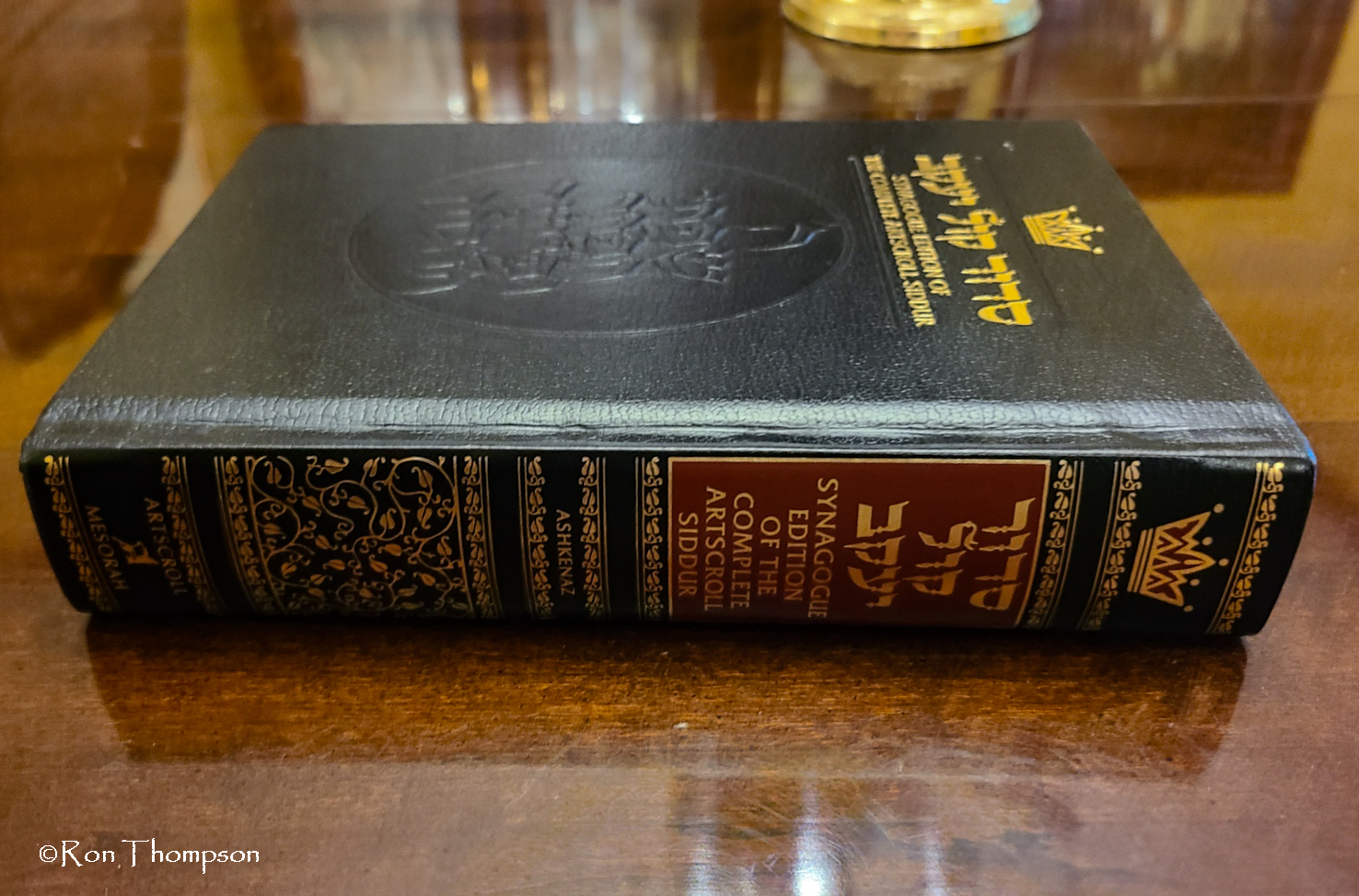
A Jewish prayer book, or Siddur. Published by ArtScroll® Me’sorah Publications, Ltd. Photo ©Ron Thompson. Because Hebrew is written right to left and back to front, this book has the front cover to the left of the spine, even though it contains both English and Hebrew text.
Informal Prayer

Like faithful modern Christians, faithful Jews also pray often, individually and spontaneously, “from my lips to God’s ears.” That’s not to say without ritual. Sometimes that means wearing a tallit, or prayer shawl, draped over the head like a hood. Sometimes wearing tefilah, ritual boxes on the forehead and the back of one hand. Sometimes shuckling, or rocking forward and backward (there are several reasons for this custom, but think of the flame of a candle). Usually facing towards Jerusalem and the Temple Mount. And always while davening, i.e., moving the lips.

Formal Prayer

Jews from the time of Moses until late in the 2nd Century AD carefully memorized and verbally passed down all aspects of Jewish custom, including worship practices. This was an obligation of every family and school, and though not all were faithful, many did participate. Because so many were memorizing the same things in parallel settings and “comparing notes” with each other, there was little chance for error to creep into the memorized material over all the generations.

When the oral process began to fail after the Roman dispersion, Jewish scholars began a written compilation, the Mishnah, and later the two compilations (Babylonian and Jerusalem) of the Talmud, plus countless additional Rabbinic writings. Because of these meticulous records, we can be very explicit about how the early Jews prayed and how those prayers have changed over the millennia.

Because of the meticulous record-keeping within Judaism, I am confident that Jews today pray much as they did in Jesus’ day, and because early Messianic Judaism was still Judaism and still associated with the synagogue, I am confident that their prayer was much the same.

In the remainder of this post, I’ll be addressing categories of formal prayer that I believe were practiced by 1st Century Jews and Christians.

Memorization of spoken ritual was required of non-messianic and messianic Jews in the 1st Century. While some modern Orthodox Jews still memorize vast amounts of information, most now rely on prayer books, or Siddurim (sing. Siddur). Pictured above is an English/Hebrew Siddur prepared for use in English-speaking synagogues. Most Orthodox Jews learn Hebrew, “the holy tongue”, but not all people who attend will understand that language, so Siddurim are often bilingual, with the vernacular either in parallel columns or interlinear.

Corporate Prayer

In today’s Church, corporate prayer usually means one person praying out loud while everyone else in attendance either listens and silently “agrees”—or thinks about other things. Honestly, I’ve never had the focus to follow along very effectively, and I’m too self-conscious to lead. I suppose that’s bad on me, but I’ve adjusted to the reality.

Am I alone? Maybe, but I fear being the hypocrite in:

[5] “When you pray, don’t be like the hypocrites, who love to pray standing in the synagogues and on street corners, so that people can see them. Yes! I tell you, they have their reward already! [6] But you, when you pray, go into your room, close the door, and pray to your Father in secret. Your Father, who sees what is done in secret, will reward you.
—Matthew 6:5–6 (CJB)

All Jews and all synagogues are not alike, but my own experience with the Orthodox is that they don’t like to be “prayed over” in public or even one-on-one prayer. Prayer in the synagogues is focused on praising Hashem (“the Name”, God) and trusting Him to know their needs. To that end, a Rabbi, reader or “cantor” reads from the Siddur and the rest of the congregation lip-syncs or else quietly (moving lips and whispering) reads a responsive portion.

Kavanah

Yes, Jewish religious life is ritualized, but you have only to read the Tanakh (Old Testament) to see that God Himself commanded a great deal of ritual. People being what they are, nobody (including Jews) would deny that for many the recitations become mechanical and devoid of meaning; but this itself is a violation of Jewish law. Before any ritual, a faithful Jew must stop whatever he is doing and center his concentration and desire on God in “awe, fear, trembling and quaking.” The words he recites must represent to him Kavanah, or the “true desire of his heart.”

The Disciples’ Prayer

Was Jesus opposed to ritual prayer? Consider:

[7] “And when you pray, don’t babble on and on like the pagans, who think God will hear them better if they talk a lot. [8] Don’t be like them, because your Father knows what you need before you ask him.
—Matthew 6:7–8 (CJB)

The classic example of this is Elijah’s contest with the priests of Ba’al, who babbled to their god for hours, to no effect (1 Kings 18:26). Jesus’ exhortation to avoid “meaningless repetition” in prayer is certainly not referring to formalized (ritual, if you will) prayer. With His very next breath, He did as many of His contemporary rabbis did: He instituted a ritual prayer specifically for His own followers:

[9] Pray then like this:

“Our Father in heaven,
hallowed be your name.
[10] Your kingdom come,
your will be done,
on earth as it is in heaven.
[11] Give us this day our daily bread,
[12] and forgive us our debts,
as we also have forgiven our debtors.
[13] And lead us not into temptation,
but deliver us from evil.
—Matthew 6:9–13 (ESV)

Most evangelicals look on “The Lord’s Prayer” as merely a pattern, or template, to show the things that are proper in a prayer. That’s fine, I don’t think it need be an important issue for us, but my view is that Jesus’ disciples recited this prayer whenever they met, sort of on the lines of a “Pledge of Allegiance.” Most likely, it is a shortened version of the Amidah (see below).

Grace After Meals

Evangelical Christians are horrified if one of their number hosts a meal without “saying grace” before everyone digs in. If one eats a meal without first saying grace, he or she is “eating like a heathen“. Technically, there is absolutely no Biblical precedent for this Christian tradition. But wait! “Didn’t Jesus bless the food before His Last Supper and before feeding the 5,000?” See the next sections for more on blessings and what Jesus actually did before meals. Grace is a prayer said after eating, to thank God for the sustenance that He has just blessed you with.

Like all other formal Jewish and, I’m confident, early Christian prayer, the format and words for the Grace After Meals (Birkat Hamazon) has a usual, fixed format and wording.

Usual, because there are variations for special meals or for certain days, such as sabbaths, new moons, and feast days. There are also differences based on whether you are Sephardic or Ashkenazi, and slight variations for different sized groups.

Fixed, because the wording for all variations of all formal prayers is read from Siddurim.

Blessings

The prayers that most people associate with Judaism are the “blessings” (Hebrew b’rakhot, sing. b’rakhah). These are short, formulaic, often one-sentence prayers or benedictions that accompany almost anything that a faithful “observant” (practicing) Jew does or consumes during a day. Many begin with all or part of the phrase, “Barukh attah Adonai Eloheynu Melekh-ha‘olam…”, meaning “Blessed are you, Lord our God, King of the Universe…”.

These prayers have a single purpose, to praise God for His provision and watch-care. I’m sure that God honors our prayers, even when we fumble the terminology. And we do! But to ask someone at table to “bless the food” is meaningless. The blessings before eating were not intended to confer holiness or some special property on what we are going to consume. Nor are we asking God to regulate our metabolism to more favorably assimilate the nutrients. Food and drink are what they are, good or bad, and they do what they do, favorable or not. God has already seen to all that. That is why, whenever Jesus broke bread, for example, He said, “Blessed are you, Lord our god, King of the universe, for bringing forth bread from the ground.” We are praising God for what He has already done!

Blessings over food and fragrances. Photo ©Ron Thompson. The meal would begin with circulation of a pot of water (in ancient times) after the senior family member first saying the blessing over washing. After all diners had washed, the leader would then survey the table and, one after the other, would say all the blessings appropriate to the meal, usually in this order. For a formal meal with staged courses, the blessings would come before each course.

There are b’rakhot (blessings) for everything that a faithful Jew encounters in life, good or bad, minor or of great importance. Don’t believe me?

“Blessed is God who has formed the human body in wisdom and created many orifices and cavities. It is obvious and known before You that if one of them were to be opened or closed incorrectly, it would be impossible to survive and stand before You at all. Blessed is God, who heals all flesh and does wonders.”
—The Asher Yatzar, the “bathroom blessing”

Note the following example from the “Last Supper”, and find the two relevant blessings in the photo above:

[26] While they were eating, Yeshua [Jesus] took a piece of matzah [unleavened bread], made the b’rakhah [blessing], broke it, gave it to the talmidim [disciples] … [27] Also he took a cup of wine, made the b’rakhah, and gave it to them…
—Matthew 26:26–27 (CJB)

Daily Prayers

Jewish law obligates the Orthodox to pray at least three times a day. Many choose to gather at the synagogues for this as often as practical. The three formal prayer times are frequently referred to in Scripture. They consist of the morning (shacharit) prayers, the afternoon (minchah) prayers, and the evening (arvith or maariv) prayers.

The Sh’ma

The Sh’ma is the central affirmation of Judaism, and is cited twice a day, at the morning and afternoon prayers. Hopefully most Christians will recognize the preamble, as translated, “Hear, O Israel, God is our Lord, God is One.” The full text of the Sh’ma consists of three passages:  Deuteronomy 6:4–9, Deuteronomy 11:13–21 and Numbers 15:37–41.

The Amidah

Another prayer that is obligatory, in some format, at all three daily services, and more often on some Holy Days, is the Amidah (lit., “standing”); also known as the “Standing Prayer”; also called the Shemoneh Esrei (“Eighteen”), because it originally consisted of 18 “benedictions”. During the Roman period, sometime after AD 70, a 19th benediction was inserted near the middle, as number 12 (highlighted in the “table of contents” below).

Outline of the Amidah’s 18 benedictions

The added benediction is interesting, because it was in part added to “put a hex” on Christianity. One form, quoted in the Jerusalem Talmud, Benediction 12, the so-called Birkat haMinim (lit., “Blessing on the heretics”, though in reality it is a curse), reads as follows:

For the apostates (meshumaddim) let there be no hope,
and uproot the kingdom of arrogance (malkhut zadon), speedily and in our days.
May the Nazarenes (ha-naẓarim/noṣrim/notzrim) and the sectarians (minim) perish as in a moment.
Let them be blotted out of the book of life, and not be written together with the righteous.
You are praised, O Lord, who subdues the arrogant.

My personal opinion is that it is unlikely that this was added before the Bar Kochba Revolt of AD  132–136. During the First Jewish/Roman War (AD 66–73) and the Kitos War (AD 115–117), Christians joined forces with their non-Messianic brothers to fight the hated Romans. But when Simeon Bar Kochba (Simon Bar Koseba) led Jewish forces against the Romans in a third rebellion, the sage Rabbi Akiva proclaimed him to be the Messiah. This posed an insoluble moral dilemma to the Christians, who then chose to stand down. The result was that prior decades of deteriorating relations suddenly became a decisive split.

Israel under Simeon Bar Kochba (shown in blue). By Rh0809 – Own work, CC BY-SA 4.0, wikimedia.
Conclusion

This is just a smattering of information about a vast subject—the Jewish foundations of Christianity. Though my own interests vary widely, my principal goal during much of my life as an adult Christian has been to illuminate the debt that Christianity owes to its Jewish beginnings.

I am not advocating that Christian churches should go back to 1st Century ways of worshipping! I simply want to point out our beginnings and caution against judging ancient Jewish customs by anachronistic standards.


Is There a Photo of Jesus?

Posted on:

Modified on:

  1. Description of the Shroud
  2. A murky provenance
    1. The Sudarium of Oviedo
  3. Forensics—findings and objections
  4. Biblical Considerations
    1. “Linen wrappings”, or a shroud?
    2. Is there any other Scripture that might verify my interpretation?
    3. In conclusion

Maybe.

Of course, I’m talking about the Shroud of Turin here—this “Catholic relic” appears to some to be the burial shroud of Jesus, and as such it seems made to order for Protestant scorn, and it is so startling that even the Vatican has been reluctant to display it over the centuries. But frankly, it’s been subjected to every kind of scientific test you can imagine over the last 45 years or so, and, despite occasional claims to the contrary, nobody has yet proved it a hoax. Personally, I am not a dogmatic supporter of the Shroud’s authenticity, but I find it intriguing, and I don’t believe that the Bible rules it out.

Enhanced photo of the Shroud of Turin.

There are a number of good (and quite a few bad) books on the subject, so I haven’t been tempted to take it up myself before now. I finally decided to write about it in response to a negative article on creation.com that I just ran across. I will describe the Shroud and its history below, discuss the forensic evidence in its favor, then propose a scenario for its authenticity that I think accurately accounts for the culture of Jesus’ day without breaking Scripture.

Description of the Shroud

The Shroud of Turin is a single, fire-damaged sheet of linen about 14 feet long and 3.5 feet wide (more precisely, 8 x 2 Royal Cubits, where the Royal, or Long, Cubit is 20.67 inches). On one face of the sheet is a faint image of the ventral and dorsal (front and back) sides of a dead, naked, adult male, lying flat and with hands covering groin. It appears that the cloth was laid flat, and a body laid on it with the feet close to one end. Then the other end of the cloth was folded in half lengthwise over the top of the head and down to cover the feet, staining the cloth with blood. The image, apparently that of a crucifixion victim, appeared on, or was applied to, the cloth at some time after the blood staining.

Contrary to this paining, the image is on the inside of the fold. Illustration from history.com, “The Shroud of Turin: 7 Intriguing Facts”.

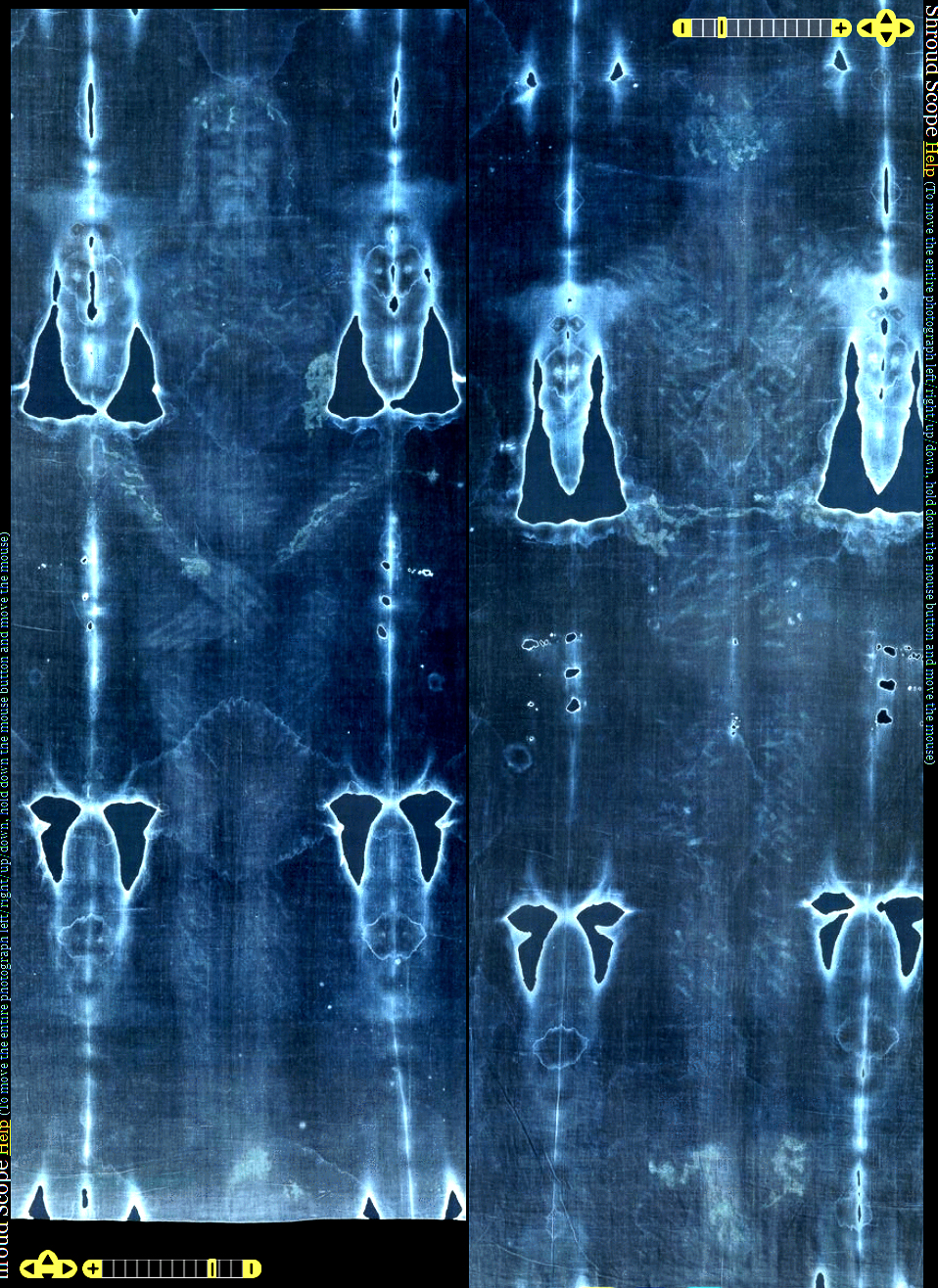
To the naked eye, the Shroud is a faint yellow monochrome, with the image appearing as a photographic negative. Enhanced photos of the Shroud are printed as photo negatives of the negative image that is on the cloth itself.

On top, the Shroud as photographed. On the bottom, a photonegative of the top image. From pensarte-asanchezgil.blogspot.com, UNA NAVE ESPACIAL LLAMADA TIERRA Capitulo XXXVIII Sindone 5

The intensity range of the image, rather than representing color as in a black and white photograph, records the varying distance between the draped cloth and the surface of the body.

3-dimensional cardboard carving of the head imaged on the Shroud, using relief data generated by a BK VP-8 Image Analyzer™. From National Geographic Magazine, June 1980.
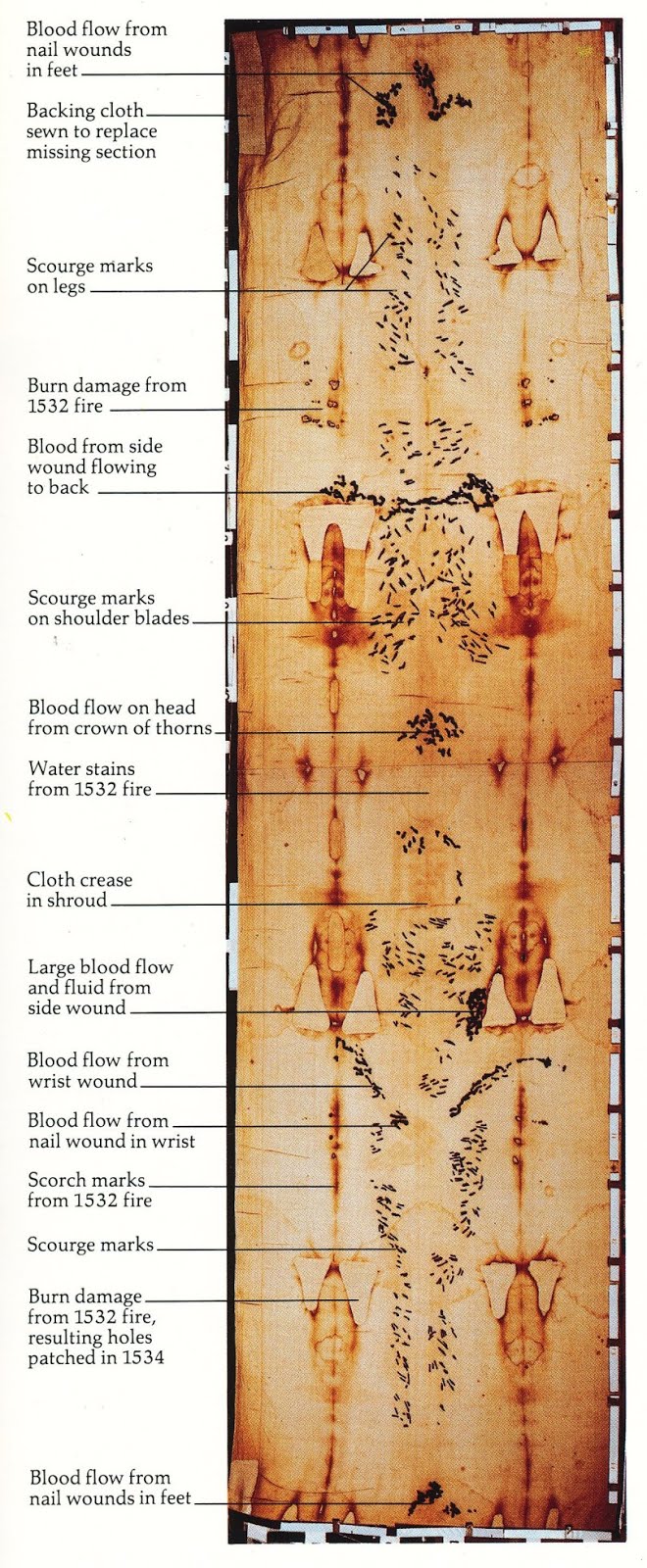
The wounds, bloodstains and other marks on the Shroud of Turin, theshroudofturin.blogspot.com, “The Shroud of Turin: 2.4. The wounds”

In contrast to the human image, which is confined to an extremely thin layer on one side of the cloth, blood residue deposited on and within the weave of the cloth formed a fluid stain penetrating into the fibers. These stains are consistent with contact between the wounded body and the cloth, and between corresponding locations on the two lengthwise halves of the cloth.

I first learned about the Shroud when National Geographic published an article about it in their June 1980 issue. The thrust of that article was that a large team of American Scientists of various specialties, with lots of expensive equipment, had travelled to Turin, Italy, where the Shroud is kept, and done a lot of very intricate testing. They found a great deal of evidence supporting its validity, and none proving it a hoax. Nobody has ever been able to figure out how in the world it was made. The one hope of the research team was that a carbon 14 (C14) test would either prove it genuine or show that it is a recent forgery, but since the test sample is always destroyed during carbon dating, the church at that time would not let them damage the cloth to test it. By 1988, the Vatican did give permission to test a small sample, and the carbon test was finally done. With a big sigh of relief by doubters, the date obtained was 14th Century, AD. Case closed, right?

A murky provenance

Not so fast! The indisputable chain of custody only goes back to the 1350’s, more or less matching the carbon date, but there is also anecdotal evidence that it might have been around much longer.

Supposed travels of the Shroud. This is from a PowerPoint slide presented by The Shroud Center of Southern California. The appearance of the annotated dates were edited by me here for clarity.

Earlier provenance is based on sketchy data from sources that cannot be verified with certainty. Purportedly, a disciple of Jesus’ (not one of the 12) named Thaddaeus salvaged the cloth and took it to Edessa (the site now known as Urfa, Turkey). Edessa was Seleucid originally but became a Roman vassal city in the early 3rd Century. In the early 7th Century, it passed to Persian (Sassanian), and shortly thereafter, Muslim control.

Medieval legend holds that the Shroud remained in that city and was secreted behind a tile inside a city gate during parts of those years of conquest. The image on the cloth was mentioned in several apocryphal documents, and the cloth itself came to be called the Mandylion. That term is from a Greek word meaning a towel or tablecloth, and it referred to a loose military garment, open at the sides, that was draped over Medieval armor, more or less resembling a serape). In AD 943, the Byzantine Emperor (presumably Constantine VII) ransomed the Mandylion from the emir of Edessa and took it to Constantinople, where it was kept in the Blachernae Church. In AD 1204, it disappeared after Constantinople was sacked by Christian crusaders during the 4th Crusade. Legend holds that it was thereafter in the custody of the Knights Templar until the 1350’s, when it is known to have been exhibited a number of times in Lirey, France.

Pilgrim badge commemorating the so-called “Shroud of Lirey”. Drawn by Arthur Forgeais, 1865, from an original artifact. The heads of the two pilgrims are missing from the artifact.

Archaeological evidence is scant. The coin shown below is from the 7th Century and seems to me to tie the Mandylion to the Shroud of Turin fairly convincingly.

Byzantine coin, minted AD 692. The image stamped on this coin seems to me to be indisputably based on the Shroud image, unless somehow the Shroud was based on the coin!
The Sudarium of Oviedo

There is a funerary face cloth called the Sudarium of Oviedo that is believed by many to be the cloth mentioned in John 20:7 “also the cloth that had been around his head, lying not with the sheets but in a separate place and still folded up.” This is an ancient linen cloth with bloodstains, but no mysterious image. Documentation for this cloth goes back to at least the 7th Century, since it has remained in one place for all that time. According to photoofjesus.com,

A 1999 study by the Spanish Center for Sindonology, investigated the relationship between the two cloths. Based on history, forensic pathology, blood chemistry (both the Shroud and the Sudarium have type AB blood stains), and the blood stain patterns being exactly similar and congruent on both cloths, they concluded that the two cloths covered the same head at two distinct, but nearly contemporaneous, moments of time.

If the Shroud is genuine, then I think it probable that the Sudarium is, as well, but that isn’t my subject here. What is germane to this discussion will be mentioned below.

The Sudarium should not be confused with another legendary cloth allegedly connected with the crucifixion, the Veil of Saint Veronica (Berenike).

The Sudarium of Oviedo, from mysticsofthechurch.com, “THE SUDARIUM OF OVIEDO AND THE SHROUD OF TURIN

Forensics—findings and objections

Carbon 14 dating is known to be very accurate, to within a predictable range, so the stories from before the 14th Century can’t be true, can they? Well, unfortunately, in this case there are a couple serious problems with the dating. One is that the Shroud has allegedly been exposed to centuries of contamination by extraneous carbon from multiple surroundings, making it virtually impossible to accurately calibrate the test. Another is that repairs have been made to the Shroud on at least two occasions. One was after it was damaged by molten silver during a fire in 1532, but the patches sewn on in that case were sufficiently clumsy that it was easy to avoid them. An earlier repair, though, was so skillfully patched, by expert interweaving of threads, that the newer linen of the patch was undetected until years after the 1988 carbon testing—and of course it turned out that it was apparently the fabric of that patch that was tested, not the original fabric which theoretically still could date to the 1st Century. Subsequent non-radiometric dating methods have reportedly raised the probability of an early origin.

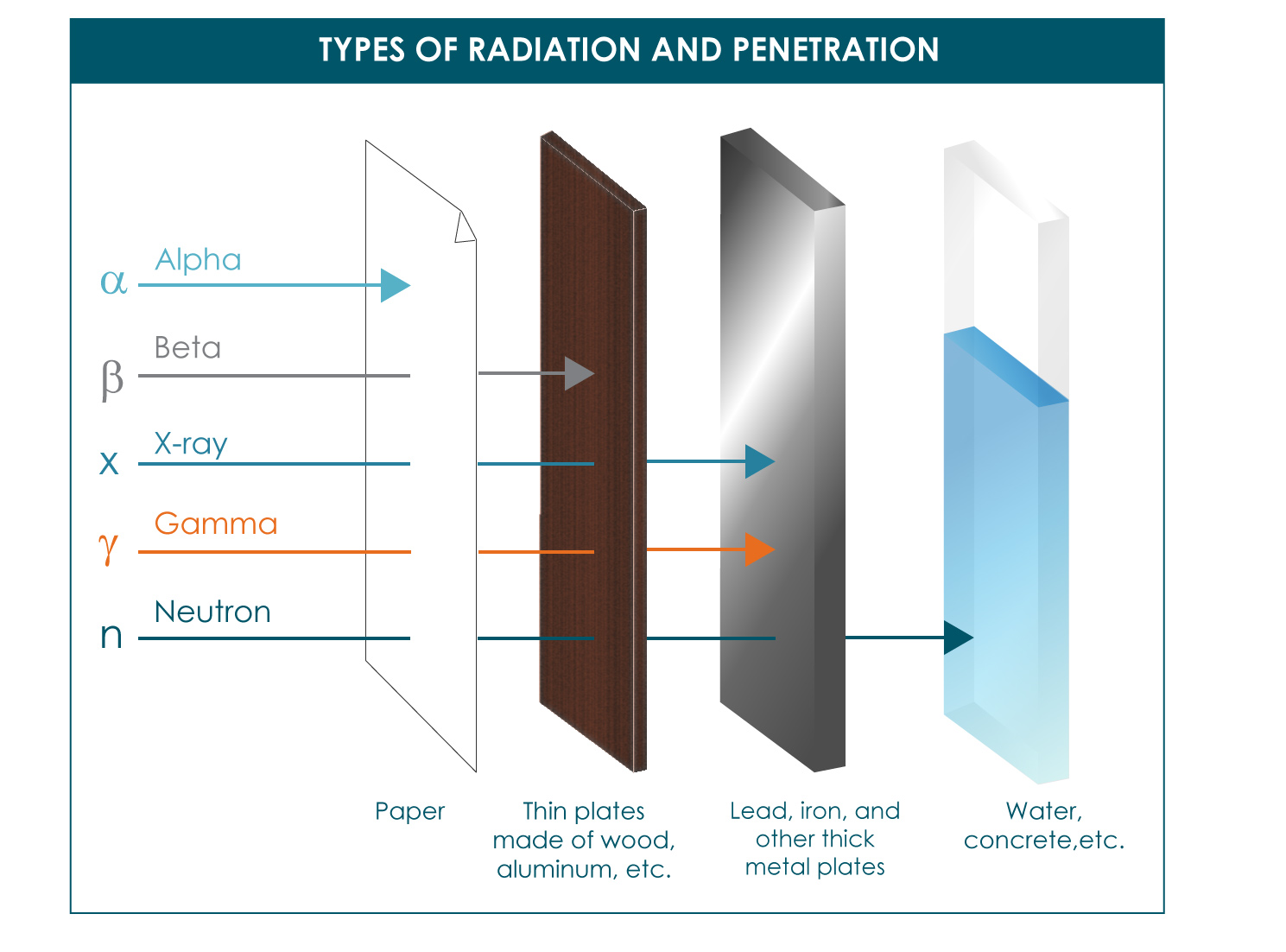
The image on the cloth is not painted, nor is it dyed, or inked or otherwise applied. It has the appearance of the cloth itself being scorched, but not at high temperatures. Modern science cannot say with certainty how this scorching occurred, though some sort of radiation is probably the cause. Neutron radiation has been proposed, but since the image penetrates the cloth only to a very small percentage of its thickness, then anything more energetic than an alpha particle beam (Helium-4 nuclei) makes no sense to me.

From kennedy-science.weebly.com


The effects of various electromagnetic radiation types (light wavelengths less energetic than those on the chart) on textiles have been studied. From a layman’s point of view, I think that what makes the most sense is a pulse in the ultraviolet range, which is known to cause cellular damage to the surface layers in fabric. Shroud researcher John P. Jackson proposed that vertical exposure to UV as the Shroud collapsed into a vacuum after Jesus “dematerialized” beneath it, could account for the image, in all respects. I’m not qualified to critique his work other than to say, “It makes sense to me”, in a general fashion. To be clear, if He dematerialized, then He immediately rematerialized at some other location. Biblical precedent for this is seen in Philip’s departure from the Ethiopian road and materialization in Azotus , on the way to Antioch, and in Jesus’ appearance before “Doubting Thomas” after His resurrection.

The blood stains on the cloth have an unnatural appearance, particularly on the enhanced views, because they penetrate the weave and are not part of the “scorched” image. Furthermore, they fluoresce in views like the right pane of the following photo. Creation.com is confused by these views, thinking that the blood is floating above the skin and hair, where it should be a crust or pool on the skin and should be beneath the outer layers of hair. In reality, what we see here is a contact transfer of blood to the cloth. Forensics show that the blood was on the cloth before the image was deposited. If this is Jesus’ authentic funeral shroud, then the blood on the cloth is from shortly after His death, when it was only partly coagulated. The image, on the other hand, is from a later time, presumably at the instant of His resurrection.

Positive (left) and negative of the face on the Shroud. Free image from metapicture.blogspot.com

Creation.com also questions the drooping hair on the image, thinking that it should be collapsed to the surface Jesus was lying on, not hanging as if He were standing up. I don’t agree. Scripture says that He was beat over the head with a stick while wearing the crown of thorns:

17 They dressed him in purple and wove thorn branches into a crown, which they put on him.
18 Then they began to salute him, “Hail to the King of the Jews!”
19 They hit him on the head with a stick, spat on him and kneeled in mock worship of him.
—Mark 15:17–19 CJB

As I can personally attest, head wounds bleed profusely. Jesus was savagely beaten over the head while wearing a crown of thorns, so he bled heavily through His hair before even going to the cross. By the time He came down from the cross, some 9 hours later, most of that blood would have hardened like hair spray.

Bloodstained forehead. Cropped photograph of the Shroud, from Stephen E. Jones, “My position on the Shroud: The Shroud of Turin: The Burial Sheet of Jesus! #7”

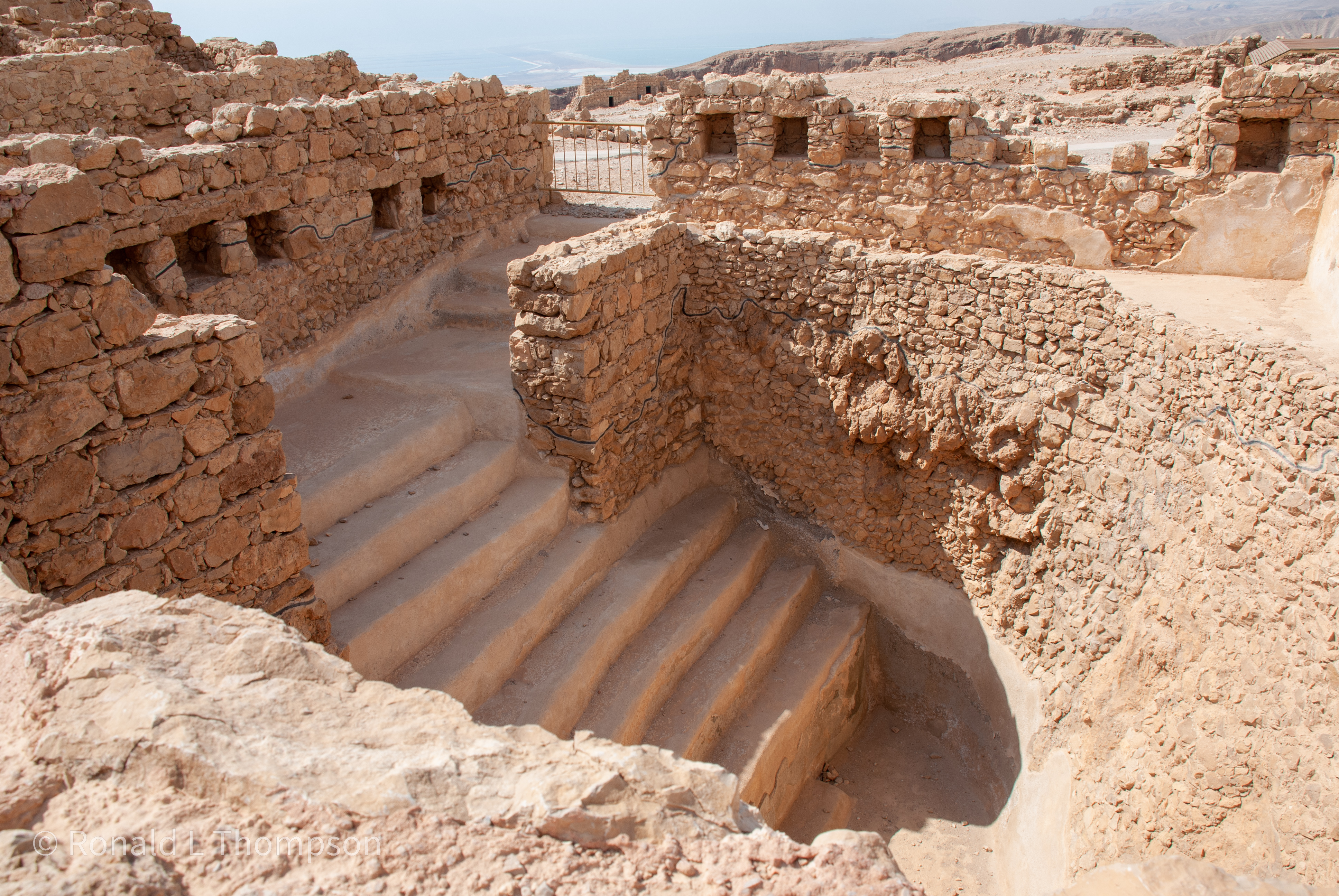
The cloth of the Shroud is not the cheap material used for menstrual rags, burial wrappings, or even middle-class clothing, but rather a high-grade cloth used for upper-class clothing and tapestries, very rare and expensive at the time. The weave was a herringbone twill, with threads composed of 70 to 120 fibrils of flax. Expert examination indicates that it was hand-spun, bleached, woven by hand, then washed with soapweed. These were characteristics of 1st Century linen weaving (in Medieval times, bleaching was commonly done after weaving of the cloth). This weaving technique was practiced by Syrian weavers, and remnants of such cloth were found at Masada, dating from no later than AD 70. Some folks object that this cloth isn’t really a luxury product because better fabrics from the time were composed of linen/wool blends. That was not an option in Judea, because:

¶ “‘Observe my regulations.
“‘Don’t let your livestock mate with those of another kind, don’t sow your field with two different kinds of grain, and don’t wear a garment of cloth made with two different kinds of thread.
—Leviticus 19:19 CJB

The blood-like deposits on the Shroud have been verified to be aged blood. It is red, more like fresh blood, because it contains high concentrations of bilirubin, along with creatinine, ferritin and myoglobulin, all of which, in the concentrations found, are proteins characteristic of blood shed under tremendous physical trauma, like that of torture. Washing with soapweed also helps to preserve the hemoglobin color.

Blood-stained cloth from the Shroud., from Stephen E. Jones, “The Shroud of Turin: 2.5. The bloodstains”.
Fossilized heel bone of a crucifixion victim, with spike. The heels were nailed into the sides of the upright.
Roman flagrum from Herculaneum (modern Ercolano) near Pompeii, from Stephen E. Jones, “The Shroud of Turin: 2.4. The wounds”.

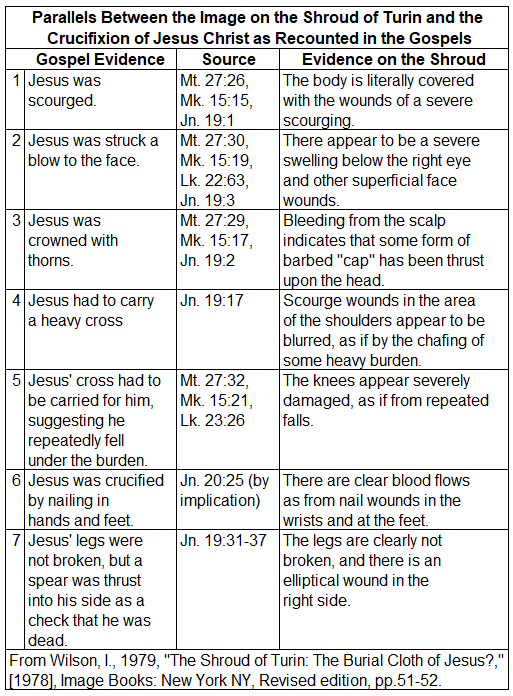
Blood staining of the cloth and bruising on the image is consistent in all respects with the testimony of Scripture. There is blood on the wrists and feet, from the nails. The Greek allows for extension of “hand” to include the wrists, as would be anatomically required to hold a grown man to a cross with nails. There is blood on the side, from the Roman spear. UV studies reveal a halo of fluorescence around this blood. Serum separated from the blood accounts for that and matches scripture describing “blood and water” from the wound. There is blood on the head from the crown of thorns and the beatings. There are bloody, dumbbell-shaped marks all over the body due to 130 lashes with a Roman flagrum. There are swollen cheeks and a broken nose from beatings. There are abrasions on knees and shoulders from stumbling from the Praetorium to Golgotha (Gulgolta).

Creation.com criticized what they considered to be blood flow patterns inconsistent with gravity, but my own examination of photo evidence doesn’t bear that out.

Various types of pollen were found on the Shroud. Concentrated around the head region, in particular, there is a large amount of pollen from the thistle Gundelia tournefortii, a spiny plant common in the Jerusalem area that blooms (and pollinates) in the spring. The “crown of thorns?”

Crown of Thorns exhibit, “Helmet” of thorns in the permanent exhibition of the Shroud of Turin in the Pontifical Institute Notre Dame of Jerusalem Center. Contrary to popular images, a “helmet” style of crown was more appropriate than a Greek “wreath” for a Middle Eastern king. Blood patterns on the Shroud suggest a helmet.

Creation.com also criticizes the proportions of the body on the Shroud. First, they are concerned that the image shows a man about 5 ft. 10 in. in height, which they think, probably correctly, is taller than most 1st Century Jews. Yet, people of all ethnicities vary in height, and that would not make Him a freak among His own people. Perhaps they were obliquely referring to Isaiah’s prophecy:

He was not well-formed or especially handsome;
we saw him, but his appearance did not attract us.
—Isaiah 53:2 CJB

I think that is saying that Messiah will not be a heartthrob who attracts people by His physical charisma. Other detractors have claimed that it also implies that He will not stand out in a crowd because of His height. I am not convinced. Being a bit taller than average would help Him speak to crowds.

Creation.com also sees distortions in the lengths of the image’s limbs, the thickness of one leg and the size of the head. Once again, I’m not convinced. The image appears to be a vertical projection onto a cloth that is draped over a real three-dimensional person, and thus not perpendicular to the cloth at all locations. This would be expected to cause apparent foreshortening of perspective in places.

Is the head disproportionately small for the body? Perhaps. That has been explained by some as rigor mortis, freezing the head in a downward tilt from hanging on the cross (but see my next paragraph). I think it is more likely that His Head was resting on something in the tomb; perhaps he was still wearing the crown of thorns.

Creation.com thinks it is ridiculous to believe that Jesus’ hands could be over His groin, because they believe He would have gone into rigor mortis on the cross, with His arms frozen at an upwards slant. But that is a ridiculous suggestion, and they should know better—rigor mortis is part of the decay process, and Jesus didn’t decay! Acts 13:37 (ESV) ” but he whom God raised up did not see corruption.”

Many detractors are convinced that the image should not show a beard, because:

I offered my back to those who struck me,
my cheeks to those who plucked out my beard;
I did not hide my face
from insult and spitting.
—Isaiah 50:6 CJB

I wear a beard. I don’t think it could be plucked out aside from small amounts at a time. They tried. This is Hebrew poetic hyperbole. It emphasizes a point using exaggeration. Not uncommon in the Psalms and Prophets. Looking at the Shroud image, it appears that the beard is forked, and in fact, that was noticed and incorporated into the commemorative coin shown above. That was either His style, or the plucking was partially successful.

Others don’t think that there is enough damage to Jesus, per:

Just as many were appalled at him,
because he was so disfigured
that he didn’t even seem human
and simply no longer looked like a man,
—Isaiah 52:14 CJB

Again, this is poetic hyperbole. I’ll bet that if you were to find even just a severed and mangled human hand on the ground, you would recognize it as human remains!

Biblical Considerations

Okay, here’s where I start the fun part.


The writers on creation.com are, I’m sure, good Christian folks, but I often disagree with their interpretations of Scripture, and more often with their analyses of science and history. Regarding their treatment of the Shroud of Turin, I certainly do agree, unequivocally, that the Shroud is completely unnecessary as proof of Jesus’ existence, His crucifixion, His resurrection, or His deity. However, I don’t think they have a good understanding of 1st Century Jewish burial practices. Here I will challenge their perceptions of how the Shroud appears to contradict Scripture.

The primary objection of creation.com was that the person in the Shroud evidently was not given the entire customary treatment. They suggest, in part, that Jesus could not have been entombed in a one-piece linen shroud because Lazarus was not—Lazarus’ body was washed, then slathered with aloe and wrapped with aloe-impregnated linen strips (plural) before entombment:

44 The man who had died came out, his hands and feet bound with linen strips, and his face wrapped with a cloth. Jesus said to them, “Unbind him, and let him go.”
—John 11:44 ESV

The truth is that even in Judea, with all its customs, there wasn’t just one way to be buried, because the legal precepts of Torah didn’t speak about it all that much. If you were rich or a king, you got the plush treatment, coffin and all. The indigent sometimes got tossed out the Dung Gate and put in a pauper’s grave. That’s evidently how landowners Chananyah and Shappira (Ananias and Sapphira) ended up.

1 But a man named Ananias, with his wife Sapphira, sold a piece of property,
2 and with his wife’s knowledge he kept back for himself some of the proceeds and brought only a part of it and laid it at the apostles’ feet.

5 When Ananias heard these words, he fell down and breathed his last. And great fear came upon all who heard of it.
6 The young men rose and wrapped him up and carried him out and buried him.
7 ¶ After an interval of about three hours his wife came in, not knowing what had happened.

10 Immediately she fell down at his feet and breathed her last. When the young men came in they found her dead, and they carried her out and buried her beside her husband.
—Acts 5:1–10 ESV

I submit here that Jesus and Lazarus were handled in different manners because the circumstances of their deaths were different. Jesus’ was as a convicted felon. Lazarus died at his home at a time more suitable for “standard practice.” Because Lazarus was in good legal standing, there was not a hard and fast requirement for him to be buried the same day, though that was the ideal. He would have been taken to his family tomb as soon as practical, dressed in normal clothes. Then, at some time during the days of mourning, probably soon after rigor mortis broke some 36 hours after death, he would be prepped for his long sleep. This included wrapping him in multiple strips of linen that were smeared in spices (usually myrrh and sticky aloe) in order both to bind the cloths to each other and to the body, and to mask odor. A separate small piece of linen (a facecloth) was also provided to cover or wrap the head.

When Jesus was brought down from the cross, burial on the same day as death was required from:

22 “And if a man has committed a crime punishable by death and he is put to death, and you hang him on a tree,
23 his body shall not remain all night on the tree, but you shall bury him the same day, for a hanged man is cursed by God. You shall not defile your land that the LORD your God is giving you for an inheritance.
—Deuteronomy 21:22–23 ESV

But clearly there was simply no time for the normal burial customs to take place before the sun set. I think that Joseph or one of the others climbed up and wrapped the facecloth around His face and the crown of thorns. Jesus was then taken down and laid on a bier, most likely on top of the shroud brought by Joseph, so that His shame could be covered. His clothes had been plundered by the Roman soldiers, so he was naked.

The evidence of the Shroud shows Jesus’ torture and death just as described in Scripture, when understood in its cultural context. The events surrounding His final words and His death are described plainly in Matthew 27:45–56 and the parallels. His crucifixion began at around 9:00 am (e.g., Mark 15:25 “It was nine in the morning when they nailed him to the stake.”), and the darkness began around noon. He died at “about the ninth hour” which, by Jewish counting, was somewhere around 3:00 pm. Evidently His dead body remained on the cross for most of the rest of the afternoon because, while Luke is silent on the timing, the other three Gospels are united in placing the approach of Joseph of Arimathea to Pilate at “around evening.”

Nisan 14–17 timeline, simplified, ©Ron Thompson. The Gregorian dates presented here are my own calculations, from NOAA lunar phase charts.

I will propose a likely scenario for what followed, harmonized with John 19:38–42, since that is the version stressed by creation.com and others:

38 After these things Joseph of Arimathea, who was a disciple of Jesus, but secretly for fear of the Jews, asked Pilate that he might take away the body of Jesus, and Pilate gave him permission. So he came and took away his body.
39 Nicodemus also, who earlier had come to Jesus by night, came bringing a mixture of myrrh and aloes, about seventy-five pounds in weight.
40 So they took the body of Jesus and bound it in linen cloths with the spices, as is the burial custom of the Jews.
41 Now in the place where he was crucified there was a garden, and in the garden a new tomb in which no one had yet been laid.
42 So because of the Jewish day of Preparation, since the tomb was close at hand, they laid Jesus there.
—John 19:38–42 ESV emphasis added; see below for discussion

The crucifixion was on Friday, Nisan 15. Jesus had celebrated His last Passover Seder the night before, and it was now the 1st day of the Feast of Unleavened Bread, which was, in Jewish law, a Sabbath (Heb. Shabbat). The next day was to be the 7th day weekly Shabbat. Restrictions for the two days were similar, except that the mid-Passover weekly Shabbat was always considered to be particularly important. In the case of consecutive Shabbatot, it was permissible to prepare for the second one on the day of the first one.

So, when Joseph spoke to Pilate, dusk and the start of the Saturday Shabbat were rapidly approaching, as emphasized in Mark, using a Jewish English translation:

42 Since it was Preparation Day (that is, the day before a Shabbat), as evening approached,
43 Yosef of Ramatayim, a prominent member of the Sanhedrin who himself was also looking forward to the Kingdom of God, went boldly to Pilate and asked for Yeshua’s body.
—Mark 15:42–43 CJB emphasis added

There was a delay, because Pilate needed to check precedent, then once Joseph had permission, he barely had time to do what absolutely had to be done before the Temple shofarim (ram’s horn trumpets) signaled that the sun had sunk below the horizon and Shabbat had begun. First, he must walk quickly from the Praetorium (probably Herod the Great’s palace) to the nearby crucifixion site at Gulgolta (I believe that to be the site under the Church of the Holy Sepulcher, just outside the city wall of that day). Then with the help of Nicodemus and the Disciples, he had to lower Jesus to the ground, remove the nails from His wrists and heels, place Him on the bier, and carry Him the short distance to the tomb.

“Linen wrappings”, or a shroud?

John 19:40 says “wrappings”, plural othonion (Gr. ὀθονίοις), which may refer to the customary saturated linen strips, but I think it meant, simply, the Shroud and the headcloth. Since Biblical Greek has no punctuation, I suggest that for comparison with the synoptics, vs 40b should be translated “bound it in linen cloths, with the spices”. In other words, the binding strips and the spices were stored in the tomb for later processing, as soon as ritually permitted. There simply could not have been enough time that day!

The three synoptic Gospels all refer to “a linen sheet”, singular sindoni (Gr. σινδόνι a different Greek term probably referring to the fineness of the cloth).

Mark 15:46 says “Yosef purchased a linen sheet; and after taking Yeshua down, he wrapped him in the linen sheet (σινδόνι), laid him in a tomb which had been cut out of the rock, and rolled a stone against the entrance to the tomb.

Matthew 27:59 uses the same singular, sindoni, as Mark, “Yosef took the body, wrapped it in a clean linen sheet, (σινδόνι) 60 and laid it in his own tomb, which he had recently had cut out of the rock.”

Likewise, Luke 23:53 “He took it down, wrapped it in a linen sheet (σινδόνι), and placed it in a tomb cut into the rock, that had never been used.”

Is there any other Scripture that might verify my interpretation?

Yes!

The Jewish custom was to seal a tomb, then come back in a year to pick up the dry bones and put them in an ossuary or a family niche. I can think of no reason why it would be necessary to open up a tomb two days later to renew spices already applied, yet that is what creation.com suggests was going on early that Sunday morning:

1 When the Sabbath was past, Mary Magdalene, Mary the mother of James, and Salome bought spices, so that they might go and anoint him.
2 And very early on the first day of the week, when the sun had risen, they went to the tomb.
3 And they were saying to one another, “Who will roll away the stone for us from the entrance of the tomb?”
—Mark 16:1–3 ESV

Joseph was not able to complete the customary preparation of the body because it was the Sabbath, and an even more important Sabbath was about to start. He did what could be done quickly, then he left Jesus wrapped in the shroud he had brought, rolled the stone into place, and notified Jesus’ mother that she would need to complete the process—which was really the family’s job in the first place. Washing the body, then applying the cloth strips and spices was a job that it would have probably taken them at least two or three hours to complete.

In conclusion

Creation.com approached this subject much as they do in their creation articles. They started out their story the way I do, by reading key books and articles on the subject. But they were looking for talking points, not for real issues. Their minds were made up going in. This shows up in several places. For one, they were quick to comment on the “floating blood” on the image’s head. Yes, that’s what it looks like, but “looks like” isn’t always enough. If they had read in depth, they would have learned that those big blobs were contact stains in the cloth, not part of the image on the cloth. In the picture, those stains fluoresced, like white teeth under black light at a party.

Another very major fault with the creation.com approach is that most Hermeneutics don’t allow you to make theological decisions based on a single passage. The creation.com article shows why. Their case was built on John’s account of the burial, but John contradicts all three of the synoptic gospels. By “contradictions”, I’m not implying error. The four Gospel writers viewed events from four different directions, and each had a point he was trying to make. Think about the old saw about the blind men and the elephant. The exegete’s responsibility is to study the Scriptures together to find the harmony that is there!

A third fault in the post is that they were so sure of the end result they were going to get that they rushed into the fight with wild punches. Rigor mortis is part of the decay process. Do they really think that Jesus began to decay? I don’t think so!

A fourth, and the last I will mention, is that they wrote from a shallow understanding of 1st Century Jewish culture. The Bible is God’s autobiography. It touches on other things, but it’s not a self-help book, it’s not a science text, it’s not a history, and it’s not a civics book. To fully understand the cultural context of Judea, you have to go beyond Scripture and examine extra-Biblical sources. Creation.com’s understanding of 1st Century burial practices is superficial.

Nobody will ever be able to prove that the Shroud is authentic. Some folks think that an artistic genius like Leonardo DaVinci could have pulled off a hoax like this, but why would he? Besides, yes, he did conceive of helicopters back in his day, but he didn’t build one! To successfully produce what the technology of his day could not allow him even to see boggles my mind.

Frankly, I would like for the Shroud to be genuine. Prior to the incarnation, God in all three persons was spirit. Whenever he materialized to a physical form, it was transient. Until Jesus took on flesh. I’d like to think that there is a commemoration of that flesh, here on earth!


A Theology of Baptism


Baptists, unlike many other denominations, believe in baptism by immersion rather than by “sprinkling” or “pouring.” Three reasons that I know of are commonly cited:

  • The Greek word baptizo literally means to “immerse” or “submerge.”
  • The symbology of baptism as generally recognized is burial and resurrection, which is not adequately pictured by sprinkling or pouring.
  • The oldest known paintings of baptisms seem to depict immersions.

For me, personally, I must go by what I know from many years of studying the rich Jewish background of Christianity. If Scripture isn’t explicit about how to do something it commands us to do, then that is usually because when the Scripture was written, there was no ambiguity. The church started out 100% Jewish, and in fact “The Way”, as we were often called in the 1st Century, was regarded within and without as a Jewish sect. Another common name was “The Sect of the Nazarene”. Ritual purification by total immersion in “living waters” (a natural stream or one of thousands of constructed Jewish mikvot, or baptisteries), was required as a personal response to sin, and to prepare for almost any ritual event. I believe that Christian baptism following salvation and prior to admission to membership in a local assembly mirrors the Jewish practice of requiring a person to be ritually submerged prior to recognition of his or her conversion to Judaism.

Several years ago, one of my granddaughters was dating a boy who was a member of a Reformed congregation. She wanted to attend catechism classes with him. I agreed, with the stipulation that I would read a copy of the text for myself and review it with her. On at least two occasions I had lunch with the pastor of that church. He was teaching the classes, and we had some very friendly, but of course inconclusive, conversations about the doctrine he was teaching.

The text was Louis Berkhof, Manual of Christian Doctrine. Here are my responses to specific statements made in the chapter on Christian Baptism:

  1. Berkhof said, “We maintain that the mode is quite immaterial, as long as the fundamental idea of purification finds expression in the rite…It is perfectly evident from several passages that baptism symbolizes spiritual cleansing or purification” as opposed to death, burial and resurrection. We’ll start this list with a point of agreement. Berkhof lists a number of Scriptural references, but I will stick with just one of those here:

    1Pet 3:20-21. (CJB) [20] to those who were disobedient long ago, in the days of Noach, when God waited patiently during the building of the ark, in which a few people—to be specific, eight—were delivered by means of water. [21] This also prefigures what delivers us now, the water of immersion, which is not the removal of dirt from the body, but one’s pledge to keep a good conscience toward God, through the resurrection of Yeshua the Messiah.

    The concept that Christian baptism represents Jesus’ death, burial and resurrection came into use early, and was supported by Paul, himself, in Col 2:12, but that was not the original intent of the rite.
  2. “Jesus did not prescribe a certain mode of baptism, and the Bible never stresses any particular mode.” That is true precisely because it was not a new concept that needed to be explained. Christian baptism is patterned on the Jewish rites for ritual purification of new converts. The original writers of the Bible and their audiences, both in Israel and the Diaspora, were all intimately familiar with the Jewish purification rites, and there could have been no ambiguity on the forms required.
  3. “The word employed by [Greek translations of Jesus’ words] does not necessarily mean ‘to immerse,’ but may also mean ‘to purify by washing’.” To purify by washing is one application of the term. So is the process of dying a cloth. But both practically and linguistically, the method of doing either was by dipping something completely. Strong defines the root, bapto, as a verb meaning “to overwhelm, i.e., cover wholly with a fluid”, “to moisten” or “to dip”, and baptizo as “to make overwhelmed, or fully wet.” Thayer adds, “submerge” and “immerge” (immerse) and Vine illustrates all of these meanings. Linguistically, it is possible to derive a translation that includes something less than total submergence, but to do so in this instance ignores the cultural context under which the word was written and how it would have been understood by the two imminent Jewish theologians, Jesus and Paul.
  4. “From earliest times it was customary to baptize by sprinkling and pouring as well as by immersion. Purification was frequently, if not generally, effected by sprinkling during Old Testament times” (emphasis added). This is a true statement about ritual cleansing, but inapplicable to the subject of Christian baptism or the Jewish customs at its root. Berkhof is referring here to the purification of objects, and rituals like the washing of hands. There were many different types of purification rite specified in the Old Testament. Each type of purification had its own specified mode. Berkhof gives numerous scriptural examples, but in each case, the mode demonstrated was as commanded by God for the specific situation. Purification for the purpose of human conversion and for many types of personal defilement required complete submersion, down to the last hair on the head. In particular, purification by complete submersion was required for conversion to Judaism, so I’m very sure that for “conversion” to Christianity, that is what they, too, did.
  5. “The baptism with the Spirit certainly did not take place by immersion…” That’s a weak argument for the question of water baptism, and I don’t even think it’s true for spiritual! I’m very sure that Holy Spirit baptism requires metaphorically complete immersion in the Holy Spirit. If sprinkling with “tongues of fire” on the head (“sprinkling of the Holy Spirit”?) is what Berkhof had in mind, then where is my tongue of fire? I think I really have been “immersed” in the Spirit!
  6. “…nor did other baptisms mentioned in Scripture.” He gave three examples here that I think are instructive:

    (a) Lk 11:37-38, (CJB) [37] As Yeshua spoke, a Parush [Pharisee] asked him to eat dinner with him; so he went in and took his place at the table; [38] and the Parush was surprised that he didn’t begin by doing n’tilat yadayim [ritual handwashing] before the meal.

    (b) Lk 12:49-51, (CJB) [49] “I have come to set fire to the earth! And how I wish it were already kindled! [50] I have an immersion to undergo—how pressured I feel till it’s over! [51] Do you think that I have come to bring peace in the Land? Not peace, I tell you, but division! Jesus is speaking here of His coming ordeal, His crucifixion and the ultimate division that that will cause in the final judgement. His “baptism of fire”, so to speak.

    And (c) 1Cor 10:1-2 (CJB) [1] For, brothers, I don’t want you to miss the significance of what happened to our fathers. All of them were guided by the pillar of cloud, and they all passed through the sea, [2] and in connection with the cloud and with the sea they all immersed themselves into Moshe [Moses]. Jesus is speaking metaphorically about the Reed Sea crossing by the Israelites. Of course, they, unlike the Egyptians behind them, were not literally immersed.
  7. “Neither does it seem that this mode was followed in the cases mentioned in Acts.” Berkhof here provides several references: Saul’s immersion after his road to Damascus encounter; the Gentile conversions at the house of Cornelius; and the Philippian jailer and his family. Nowhere do these verses mention the mode followed. They just say, in effect, “they were baptized.” I think that Berkhof is here assuming that there simply was no place handy for a complete immersion. He’s wrong. Every synagogue in every town with 10 or more male Jews had its own mikvah. Where there was no mikvah, there was a river or stream that could be used as it was or dredged or dammed to form a deep enough pool.


    A Jewish mikvah at Qumran, ©2008, Ron Thompson
  8. “Spiritual renewal is sometimes said to have been effected by sprinkling.” Where sprinkling is mentioned in the Old Testament, it is usually blood or oil, sprinkled in specific places for specific reasons. Water is sprinkled, literally, in only two contexts, where the vast amounts of water that would be required for full immersion were impractical: (a) The initial consecration of the Levites—all of them—at the “commissioning” of the tabernacle. And (b) at red heifer ceremonies, when many objects and people were to be cleansed more or less simultaneously. The one Old Testament example given by Berkhof was

    Ez 36:24-26 (CJB)
    [24] For I will take you from among the nations,
    gather you from all the countries,
    and return you to your own soil.
    [25] Then I will sprinkle clean water on you,
    and you will be clean;
    I will cleanse you from all your uncleanness
    and from all your idols.
    [26] I will give you a new heart
    and put a new spirit inside you;
    I will take the stony heart out of your flesh
    and give you a heart of flesh.


    This was, of course, poetic language referring to the New Covenant and to the Olam HaBa (the end-time world to come), and not at all meant to be taken literally. God was speaking, through Ezekiel, about what He will do, not to an individual, but to the entire Nation of Israel. If it was meant to be taken literally, God is also promising to rip out their old hearts and spirits and replace them with new!

    Berkhof also inserts a New Testament example here:

    Heb 10:22 (CJB)
    [22] Therefore, let us approach the Holiest Place with a sincere heart, in the full assurance that comes from [faith]—with our hearts sprinkled clean from a bad conscience and our bodies washed with pure water.


    In this event, hearts are metaphorically sprinkled (since you can’t do that literally, let alone completely immerse it), but bodies are literally immersed.

Note the important point that salvation was never a result of ritual. Even in Temple days, Jewish salvation was by God’s grace, as a result of the individual’s faith in God. All ritual was an obedient response by a believing heart. Inevitably, many Church customs have evolved over the millennia. God’s grace will not condemn a “sprinkler”, but I prefer to do it right.


Jesus and Hebrew Wedding Imagery

Posted on:

Modified on:

This is a February 2022 rewrite and expansion of a post I wrote in January 2013, entitled “The Bride of Messiah”.

  1. Symbolism as Illustration
  2. Symbolism in Marriage Customs

Symbolism as Illustration

I grew up in a fundamentalist, “King James only”, Baptist denomination, in churches in New Mexico, Texas and Florida. I love my old pastors and my fellow church members, and I still agree with them on most fundamental issues. Not everything, but I’m not going to mention their name and insult them. These days I rarely use the King James, because I think there are more reliable translations, but that’s not the question here, and I will use it for this post.

I’m going to concentrate here on one particular issue. I consider myself to be a Biblical literalist, but I think that there are many places in scripture that aren’t meant to be read literally. Hebrew writers often used poetic imagery and symbolism to convey truth about God: His attributes, His will, His promises (positive and negative) and yes, His wrath. A consistent and realistic Hermeneutic (principles of Biblical interpretation) must be used to differentiate between the literal and the figurative. Most conservative Biblical scholars and knowledgeable students of Scripture understand this, but few over the last 2,000 years are really equipped to apply the understanding. This is largely due to the way Jews and their writings have been marginalized in the Church.

As a somewhat trivial example of this lack of understanding, many years ago when I was a young associate pastor at a church in Texas, my Senior Pastor and I had an ongoing, friendly argument about Biblical anthropopathism. His view was that, despite the fact that God is a Spirit, “Scripture clearly states that God has hands…

Luke 23:46 (KJV)
[46] And when Jesus had cried with a loud voice, he said, Father, into thy hands I commend my spirit: and having said thus, he gave up the ghost.

…and wings.”

Ruth 2:12 (KJV)
[12] The LORD recompense thy work, and a full reward be given thee of the LORD God of Israel, under whose wings thou art come to trust.

My own view is that God and His angels have no bodily form at all, and that such scriptures are illustrations of God’s loving and tender care for His people. When they heard these sayings, ancient Jews, immersed in the cultural milieu of their society, would not misunderstand the symbolic content. For 21st Century Christians, misled by centuries of antipathy towards Judaism, it’s not so simple!

Another example of Biblical symbolism is found in the parables (sing. mashal, Heb. and parabole, Gr.) told by Old Testament prophets, by New Testament-era sages, and by Jesus Himself. These stories were not themselves true but were illustrations of truth told in ways that could not be misunderstood by the hearers—or, in many cases could be understood only by “insiders” in the audience.

Symbolism in Marriage Customs

A form of implicit (not explained, but obvious to the hearers) symbolism that I want to discuss here was used by Jesus over and over again in His discussions with His Disciples about what we today refer to as the Rapture, and the Marriage Supper of the Lamb: Jewish wedding imagery.

The Old Testament often depicts God as the husband of His wife, Israel. Similarly, the New Testament depicts Jesus as a groom, and the Church as His betrothed bride. Betrothal was much different among 1st Century and earlier Jews than it is among American Christians. To us it is a proposal to enter into a contract at a later date. To them, it was the contract itself. What we today call a “wedding ceremony” was to them simply the last stage of a process that often lasted for months. Jesus often referred to steps in this process to symbolically illustrate His mystical relationship with the Church:

Shopping for a bride. Today in The West, we regard an ideal marriage as an emotional union between a mutually attracted couple. In traditional Judaism, and in most of the non-Jewish Eastern world, even today, it was a financial transaction between families, often made when the couple were small children. In some cultures, a dowery was paid by the bride’s family. Sometimes this amounted to, “I’ll pay you to take this useless female off my hands”, but mostly it was a realistic understanding that a healthy adult female was of more practical value to a good husband than to her birth family. In the Jewish culture, wives were highly valued, and money or goods flowed the other way. A “bride price” was paid by the groom’s family to acquire a coveted prize for their son and to compensate her family for the loss of a valuable and beloved asset. I have read many Christian opinions that Jewish men despise their women, but that is not and never was a true generalization, despite suggestions of “proof” to the contrary. Perhaps a subject for a future post…

A Jewish man’s marriage was usually arranged by his father, in negotiation (called the shidduch) with the prospective bride’s father. Sometimes other family members, including the subject children themselves, were included. In later history, a professional matchmaker (a shadchan) was sometimes employed as a go-between, as illustrated in the movie Fiddler on the Roof. Usually, both fathers wanted nothing as much as the happiness of their children. After the exchange of a generous bride price, the families would cooperate, sometimes for years, in preparing the two young people for their eventual life together.

Jesus’ father arranged His marriage in eternity past. He paid a heavy bride price for us—we were bought with the most precious coin on earth, the groom’s own blood. Having been chosen, our entire lives from the time we were formed in our mothers’ wombs has been preparation for our marriage to the Lamb of God.

The betrothal, or erusin. When the time came for betrothal, the two families would gather in the house of the bride’s father. The groom would bring the ketubah, an ornate written marriage contract, and his father would bring a flask of wine. The father would pour a cup and hand it to his son. The son would then hold it out to the bride, saying, “By offering this cup, I vow that I am willing to give my life for you.” Then, it was up to the bride. She could refuse the cup, and if so, the wedding agreement was canceled, and the bride price refunded. If she took the cup and drank, she was signifying that she in turn was willing to give her life for him. The betrothal was thus sealed. Once sealed, the two lived apart for a time, but were considered to be legally married and only a death or legal divorce could dissolve the ketubah. When Mary was “found to be with child”, it was grounds for divorce. Joseph’s thought to “put her away privily” (Mt 1:19, KJV) simply meant that he planned to divorce her privately, rather than to denounce her and shame her in public.

When Yeshua offered the cup of redemption at His final Passover Seder, He was telling us that He was willing to give His life for us. We who have accepted that cup have said in return that we are willing to give our own lives for Him. Our betrothal has been sealed, and God’s Torah is our ketubah.

Building the bridal suite. A Jewish house was often a large compound built around a central courtyard. This housing compound, called in Greek an insula, was home to the patriarchal extended family, often with several generations of sons in residence. The central living area was the quarters of the family patriarch and his wife. As each young man of the household was betrothed, he would simply build another room on to the house for his own new family. Once the betrothal cup was accepted, the groom would recite to his newly betrothed traditional words to the effect that

John 14:2-3 (KJV)
[2] In my Father’s house are many mansions [Gr. mone: more often rooms, abodes, or dwelling places]… I go to prepare a place for you.
[3] And if I go and prepare a place for you, I will come again, and receive you unto myself; that where I am, there ye may be also.

Upper class Judean family homes, or insulae, as depicted in a model of First Century Jerusalem, on Mt. Hertzl, Jerusalem. Photo ©2008, Ron Thompson.

It is an interpretive mistake to picture Jesus as honing up His carpentry skills in heaven and building a physical house, let alone a mansion, for each of His followers. He was simply using the poetic beauty of the ritual to stress the surety that He will return for His bride, the Church!

Progress on the new home. Each day between the betrothal and the marriage supper, the groom’s father would inspect his progress on the dwelling, and eventually he, not his son, would set a date for the wedding. If you were to ask the toiling groom when his wedding was scheduled to occur, he could not give you an answer.

Matthew 24:3-4,36 (KJV)
[3] And as he sat upon the mount of Olives, the disciples came unto him privately, saying, Tell us, when shall these things be? and what shall be the sign of thy coming, and of the end of the world? [4] And Jesus answered and said unto them, Take heed that no man deceive you…
[36] But of that day and hour knoweth no man, no, not the angels of heaven, but my Father only.

Each of Jesus’ hearers, being well-schooled in the important customs of the day, would have recognized the symbolism in verse 36. Once again this is ritual language, and therefore not necessarily a literal warning that it is completely useless to propose a date for the Rapture. I don’t know the year of the Rapture, but I firmly believe it will take place on some not-too-distant Day of Trumpets! (See also The Fall Feasts and the Rapture.)

Waiting for a summons by the groom. Meanwhile, the bride would wait expectantly, always prepared for the groom’s return, but not knowing on what day to expect him. Her attendants would stay with her each night, for weeks or even months. When the groom came with his own attendants to “kidnap” the bride and her attendants and take them from her home to his, he would arrive around midnight, with no advance warning. It would be a major scandal if the bride or any of her attendants were caught unprepared. This is what we see depicted in Jesus’ Parable of the Ten Virgins:

Matthew 25:1-13 (KJV)
[25:1] Then shall the kingdom of heaven be likened unto ten virgins, which took their lamps, and went forth to meet the bridegroom.
[2] And five of them were wise, and five were foolish.
[3] They that were foolish took their lamps, and took no oil with them:
[4] But the wise took oil in their vessels with their lamps.
[5] While the bridegroom tarried, they all slumbered and slept.
[6] And at midnight there was a cry made, Behold, the bridegroom cometh; go ye out to meet him.
[7] Then all those virgins arose, and trimmed their lamps.
[8] And the foolish said unto the wise, Give us of your oil; for our lamps are gone out.
[9] But the wise answered, saying, Not so; lest there be not enough for us and you: but go ye rather to them that sell, and buy for yourselves.
[10] And while they went to buy, the bridegroom came; and they that were ready went in with him to the marriage: and the door was shut.
[11] Afterward came also the other virgins, saying, Lord, Lord, open to us.
[12] But he answered and said, Verily I say unto you, I know you not.
[13] Watch therefore, for ye know neither the day nor the hour wherein the Son of man cometh.

The bridal procession and the consummation. As soon as the procession reached the groom’s home that night, the bride and groom would retreat immediately to the privacy of their new quarters. The guests would wait expectantly while the groom’s chief attendant stood outside the door and listened for the voice of the groom, announcing consummation of the marriage. This would signal the beginning of the week-long “marriage supper.” Jesus referred to this celebration of great joy in

John 3:29 (KJV)
[29] He that hath the bride is the bridegroom: but the friend of the bridegroom, which standeth and heareth him, rejoiceth greatly because of the bridegroom’s voice: this my joy therefore is fulfilled.

The wedding supper, or nissuin. This joyous, but to us uncomfortable, custom of celebrating a consummated marriage by pigging out at a 7-day party—was exemplified in the Gospels by the wedding feast in Cana, where Jesus turned water into wine. It also symbolically represents the 7-year Wedding Supper of the Lamb, a celebration to be held in heaven while on earth the Tribulation is in progress.

Revelation 19:7-9 (KJV)
[7] Let us be glad and rejoice, and give honour to him: for the marriage of the Lamb is come, and his wife hath made herself ready.
[8] And to her was granted that she should be arrayed in fine linen, clean and white: for the fine linen is the righteousness of saints.
[9] And he saith unto me, Write, Blessed are they which are called unto the marriage supper of the Lamb. And he saith unto me, These are the true sayings of God.


Sometimes traditional Christian interpretations of scripture suffer from an ignorance of the customs that underlie them. Honest theology requires an attempt to understand the Jewish origins of our faith. Many times, those seemingly ambiguous or “strange” references in the Biblical narrative become clear once the culture is understood.


Paul to Colossae, on Syncretism


Colosse in Asia Minor, in relation to Laodicea and Hierapolis.

In his letter to the Colossian Assembly, Paul addressed three types of “Gnostic” heresy that were evidently being taught there:

  1. Greek Dualism, which cast doubts on Jesus because of claims that he was fully human as well as divine. Plato, whose philosophy was revered in much of the Greek world, held that the spiritual realm was “good”, but anything physical, including any human, was intrinsically evil.
  2. Pagan Pantheism, which held that all physical objects were inhabited by so-called “elemental sprits” that were either good or evil.
  3. Judaistic practices being urged on non-Jews in the Church.

It is the last issue, above, that I wish to address here. I believe that it included two main sub-issues:

  • Either requiring or suggesting conversion to Judaism was viewed by some as a precursor to possession of the “secret things” of Christianity.
  • Urging participation in celebrations of Jewish tradition for possession of that Gnostic “knowledge”.

The first of these sub-issues was dealt with primarily in

Colossians 2:11-14 (ESV)
[11] In him also you were circumcised with a circumcision made without hands, by putting off the body of the flesh, by the circumcision of Christ, [12]  having been buried with him in baptism, in which you were also raised with him through faith in the powerful working of God, who raised him from the dead. [13]  And you, who were dead in your trespasses and the uncircumcision of your flesh, God made alive together with him, having forgiven us all our trespasses, [14] by canceling the record of debt that stood against us with its legal demands. This he set aside, nailing it to the cross.

Prior to AD 70, conversion to Judaism was a threefold process requiring circumcision; ritual cleansing (immersion, i.e., baptism, in either open water or in one of the thousands of mikvot, or baptisteries, in Israel and the Diaspora); and an atoning sacrifice in the Temple.

In verse 11, above, Paul explains that circumcision is not required of non-Jewish believers, because our circumcision is a spiritual “circumcision of the heart“, a “stripping away [of the] old nature’s control over the body” (CJB translation).

In verse 12, he identifies baptism as a symbolic death, burial and resurrection along with Messiah.

And in verse 14, he states that our sin-debt is cancelled by the cross. Without digging too deeply into Old and New Testament theology, Jesus’ death cancelled all our sins, past present and future, whereas the Old Testament sin offerings were merely a symbolic atonement, or “covering over“, for specific infractions over specific time frames.

Regarding the Jewish Traditions, refer to

Colossians 2:16-17 (CJB)
[16] So don’t let anyone pass judgment on you in connection with eating and drinking, or in regard to a Jewish festival or Rosh-Hodesh or Shabbat. [17] These are a shadow of things that are coming, but the body is of the Messiah.

Rosh-Hodesh (“head of the month”) was the lunar new moon celebration held each month to recognize the coming civil, agricultural and religious cycle. Shabbat, of course, is the Jewish “day of rest”, either the weekly Sabbath or a Sabbath associated with another Jewish festival.

Note that Paul is not condemning these traditional celebrations, which have tremendous prophetic and memorial significance to Christians and Jews alike; rather, he is condemning those who shame others in the church who choose to either celebrate them or to not celebrate them.


The Jewish Feasts: Part 14, Tabernacles

After leaving Egypt, the Israelites lived in tents in the desert  for 40 years. Despite the hardships, God was living among them and protecting them from the ravages of the desert and from foes around them. God’s Divine Presence (Heb. Sh’khinah) was both spiritual and physical. He was constantly with them in the Tabernacle, and in the pillar of smoke and fire, but His Presence was and is not confined to those places; Sh’khinah, refers to any place where God dwells with His people, whether in a tent, a building, or in any other context. Other visible examples would include the burning bush, the fire atop Mt. Sinai, and clearly, the Incarnate Son, Jesus!

The 7-day Feast of Tabernacles (Heb. Sukkoth) commemorates this 40 year period of God dwelling with His people during their wilderness wandering. He is said during this period to have “tabernacled with His people.” Coming on the heels of the somber Days of Awe, this feast is the consummate time of rejoicing for all Jews. Leviticus 23 also mentions an eighth day, called Shemini Atzeret (“Eighth Day of Assembly“) which signifies the firstfruits of the fruit and vegetable harvest, and the end of the agricultural year. This eighth day is also called Simchat Torah (“Rejoicing with or of the Torah“), and as such it signifies the end of one annual public Torah-reading cycle and the beginning of another. Both the first and the eighth day of Sukkoth are Sabbaths, and the first day is one of the three days of the annual regalim, or Pilgrim Festivals, where attendance in Jerusalem is required of all adult Jewish males.

Example of a canvas sukkah, ©Chabad.org

Sukkoth is marked by daily festivities and sacrifices and, with there no longer being a possibility for the latter, especially by the commandment to build and live in Sukkoth for seven days. A sukkah (singular) is a small booth, or hut, set up outside, with at least three closed sides and a roof. The walls can be of any material, but the roof must be of made of vegetal material (lumber is permissible). To emphasize the temporary nature of the booth, the roof must be of loose enough construction that stars are visible through it on a clear night. Once built, the sukkah is decorated by real or simulated fruit tied to the structure with string. The sukkah must be large enough for at least one person and a table for meals. Typically, it is not necessary to sleep in the sukkah, though many do, but it is best to eat at least part of every meal there.

The Hebrew term Sh’khinah does not occur in the Old Testament, but the concept of God’s Devine Presence occurs in many places. In the New Testament, we see Jesus’ incarnation described by the Greek skenoo, “to reside or dwell, as God did in the Tabernacle of old“. The connection between the Hebrew and Greek concepts is explicit, for example, in

John 1:14 (CJB)
[14] The Word became a human being and lived [skenoo] with us,
and we saw his Sh’khinah*,
the Sh’khinah* of the Father’s only Son,
full of grace and truth.

I believe that Sukkoth, with its theme of Rejoicing in God’s dwelling with the Israelites, is prophetic of God again coming to dwell with his people during the First Advent of Jesus. As with all the other feasts, I believe that the prophecy specifies not only an event in Jesus’ life, but the very day, on the Jewish calendar, that the event was to occur. I conclude that Jesus was born on the first day of Sukkoth, Tishri 15, and was circumcised on the last day of the 8-day festival, Tishri 22

Christians celebrate Jesus’ birthday on December 25 with pagan décor and anachronistic legends; however, the only birthdays celebrated prior to Jesus’ crucifixion appear to have been those of pagan gods, including self-proclaimed god-kings. The traditional December date for Jesus’ birth was, I believe, chosen to corresponds to the pagan Saturnalia celebration. What is the evidence of Jesus’ birth on Sukkoth, instead?

  • First, the lack of evidence for a December birth must be noted.
  • According to early Jewish writing, sheep were not in fields during the winter months. From about November through February, they were usually brought in to “sheepfolds”, either a cave or a corral structure protected from the weather.
  • The Roman custom of recalling people to their places of origin is known to have generally been facilitated by scheduling around dates that were convenient to the inhabitants. Rather than expect people to travel during exceptionally hot or cold seasons, it makes more sense that in Israel they would have taken advantage of a festival. The pilgrim festival of Sukkoth would have been an ideal time for the census, when diaspora Jews were gathered within Israel.
  • Since so many events in Jesus’ life happened on feast days, His birth most likely did as well.
  • Unlike any other feast, Sukkoth lasted not one, not seven, but eight days. I think that Jesus was born on the first day of Sukkoth and was circumcised, under Jewish law, on the 8th day.

But Sukkot also speaks of events in Jesus’ Second Advent, and I believe this can be seen best in

Revelation 21:1-3 (CJB)
[21:1] Then I saw a new heaven and a new earth, for the old heaven and the old earth had passed away, and the sea was no longer there. [2] Also I saw the holy city, New Yerushalayim*, coming down out of heaven from God, prepared like a bride beautifully dressed for her husband. [3] I heard a loud voice from the throne say, “See! God’s Sh’khinah* is with mankind, and he will live with them. They will be his people, and he himself, God-with-them, will be their God.

Table of Contents: The Jewish Feasts
Start of Series: The Jewish Feasts: Part 1, Chapter Introduction
Previous in Series:
The Jewish Feasts: Part 13, Yom Kippur Factoids

The Jewish Feasts: Part 13, Yom Kippur Factoids

Cross section of Herod’s Temple, looking south. ©2012 Bristol Works, Inc. Rose Publishing Inc.

Interesting Facts and Misconceptions:

Where is the Ark of the Covenant now?

Based primarily on research done by Dr. Randall Price (Searching for the Ark of the Covenant and The Lost Ark and the Last Days: In Search of Temple Treasures) I believe that the Ark is in a cave beneath the Temple Mount. It was accessible and possibly seen after the 1967 “6-Day War” prior to the sealing of Warren’s Gate by the Jordanian Waqf.

When was the Ark ever in Herod’s Temple?

Never! Leviticus 16 describes God’s commandments for Yom Kippur in the Tabernacle. These were followed with appropriate modifications in the days of Solomon’s Temple, but when that Temple was destroyed by Nebuchadnezzar, the Ark disappeared. Old Jewish traditions hold that Jeremiah hid it somewhere before the destruction.

How did Yom Kippur work without an Ark?

The problem was bigger than that: not only was the Ark gone, but as prophesied in Ezekiel 9 and 10, so was God’s Sh’khinah (Divine Presence), and even the two large cherubim statues were missing. There was nothing in there except haShetiya, the Foundation Stone on which the Ark sat. What was sprinkled with blood? Just the stone. There is, to this day, a shallow niche carved into the stone that is the exact dimension, location and orientation to have supported the Ark, so that is where the High Priest’s attention was focused.

How did it work with no Temple at all?

Some Jewish congregations still attempt to offer a blood sacrifice by wringing the neck of a chicken, but this is a minority practice. In the late 1st century, rabbis decided that the Temple ritual could be replaced by Tefilah (prayer), Teshuva (repentance), and Tzedakah (charity). Those are all good things, surely, but one might say, “Why not just accept your own Messiah?” What about the interval of the Babylonian Captivity, when there was also no Temple? I would ask you to remember that salvation was never a result of sacrifice! Sacrifice was a response of faith in a gracious God!

How did the High Priest accomplish so much in the Holy of Holies on Yom Kippur if he could enter only once a year?

It is not true that the High Priest went into the Holy of Holies only once a year. He went only on Yom Kippur, but on that day he went in four times: (1) He entered to lay coals from the altar, and to burn incense. (2) He entered again to sprinkle the bull’s blood for his own atonement. (3) He entered yet again to sprinkle the goat’s blood for the people’s atonement. (4) Finally, he entered to remove the spent coals at the close of the ceremony.

Given the unrighteousness of many High Priests, how many were struck dead entering the Holy of Holies?

None, as far a we know. But righteousness was not required, or none would have survived; only “ritual cleanness” kept them alive. There was a long process that was required to achieve this ceremonial virtue. It began four days earlier, and involved many washings, immersions, and changes of attire. Part of this procedure was Biblical, part was traditional.

Was a rope really tied to the High Priest’s leg so that he could be pulled out if his attendants quit hearing the tinkling of his bells and pomegranates?

Pure myth! To begin with, there were no bells and pomegranates, because Scripture required him to enter in pure white linens, with no decoration. In the second place, during the key moments of his entry, no other humans were allowed into even the inner Temple courts, let along into the Temple itself. Thirdly, it would have been impossible to pull him through the veil in any case. It was not one veil, it was actually two very heavy veils stretching from side to side and ceiling to floor, with no space on any side. There was a space of one cubit separating the two veils. The outer one was pinned to the left doorpost and the inner to the right doorpost so that they might never reveal what lay beyond. When entering the Holy of Holies, the Priest would pass below the pin on the left side of the outer curtain, walk between the curtains, pass beneath the pin on the right side of the inner curtain, and then walk beside that curtain until he reached the Ark. To exit, he reversed the route. It is impossible for me to conceive of a rope with a body attached being pulled through that circuitous route. Nor would this have been needed; see below regarding cleaning of the Holy of Holies.

Are the scarlet thread stories true?

I have heard two versions. One holds that a scarlet thread was attached to the wall beside the outer veil. If by the next day the thread was found to have turned snow white, then God had accepted the sacrifice. Otherwise, the sacrifice had been rejected and Israel’s sins were unforgiven. The continuation of this story holds that after Jesus’ crucifixion, and up to the AD 70 destruction of the Temple, the thread never changed color. This isn’t absurd on its face, like the rope theory, but if it were true, we would find volumes of lamentations over those 40 years of rejection. This would be known as the greatest national calamity ever to strike Israel. I think even more so than the Temples’ destruction. The second version is the same, except that the thread was attached to a horn of the Scapegoat. I reject this version as well. I think that this one is probably a corruption of a story in rabbinical literature which records that a scarlet strand of some sort was tied across both horns of the goat and used to secure a heavy rock so that the sure-footed goat would be pulled over the cliff to its destruction.

How far out of the Temple was the goat taken?

According to rabbinical sources, 90 ris. After five separate unit conversions, I worked this out to about 7 miles. Watchers were stationed at key locations between Temple and cliff so that successful completion of the goat’s assassination could be signaled back by means of flags, and the next steps of the ceremony begun.

Would the Ark with its poles even have fit into the Holy of Holies?

Very astute question! We know the dimensions of the room, of the Ark, and even of the poles. Yet almost every depiction of these things shows the Ark oriented with its poles parallel to the veil, which cannot be! In reality, the Ark went in like a car into a garage. And on either side of it stood a very large statue of a stylized cherub.

How was the Holy of Holies kept clean, or did it never get dirty?

Of course, it got dirty! Hundreds of years of dust bunnies, charcoal dust, incense smoke, insects, and mouse droppings, not to mention hundreds of years of bullock and goat blood! And, potentially, dead High Priests. Before you ask, no, the High Priest didn’t do the cleaning. Above the Holy of Holies was a “drop ceiling” consisting of wooden rectangular tiles set into a framework. Referring to the attached diagram, there was a large chamber over the Holy of Holies, and the ceiling below could be accessed from there. Workmen could, after suitable cleansing, be lowered on ropes to work using tools with long handles. The rules prevented them from touching anything in the room with their own bodies, nor were they allowed to dally or “sight-see”.

Table of Contents: The Jewish Feasts
Start of Series: The Jewish Feasts: Part 1, Chapter Introduction
Previous in Series: The Jewish Feasts: Part 12, Atonement
Next in Series: The Jewish Feasts: Part 14, Tabernacles

The Jewish Feasts: Part 12, Atonement

Yom Kippur, not Passover, is the most important of the Jewish Feasts!

The Days of Awe are the most somber period of the Jewish Year, and Yom Kippur, the Day of Atonement, is the capstone of the Days of Awe. The correct form of the Feast name is Yom HaKippurim, (the Day of Coverings); but Yom Kippur is the more common name.

I have heard it said many times that Passover is the most important Jewish Feast. That is simply not true. With no Temple to worship in, Passover has certainly become the most well known and faithfully celebrated of the Feasts, but for sheer spiritual impact, Yom Kippur is by far the most vital. it is a recognition of personal and national sin, and a plea for salvation.

 Christians celebrate Easter as a salvation event, and rightly so, because Easter celebrates specifically the time and actuality of Jesus’ death, burial and resurrection. Jews celebrate Passover at roughly the same time as Easter, but not at all as a salvation event. As stated in earlier parts of this series, Passover is a celebration of redemption from slavery and resurrection as a people.

©Ron Thompson 2020

 In AD 325, Emperor Constantine and the Council of Nicaea officially severed Easter from Passover. This was unfortunately done for explicitly anti-Semitic reasons; however, given the salvation emphasis placed on Easter by non-Jews, it was probably best to do so.

Recall that the ten Days of Awe are all about repentance and reconciliation. On the final day, on Yom Kippur, one’s deeds will be judged by God, and his or her state of salvation determined for the coming year. As you can see from Leviticus 23, above, the day is a Sabbath. Not only that, but the phrases “you are to deny yourselves” (stated twice) and “Anyone who does not deny himself on that day is to be cut off from his people” are regarded as a command to fast, on pain of excommunication. The Hebrew terms used here literally mean to “humble, or afflict one’s soul”. Traditionally they are taken to include fasting, abstinence from sex, and refraining from personal grooming. Yom Kippur is the only Biblically mandated fast day, though rabbinic Judaism does recognize certain other somber days as fast days, and Zechariah 8:19 mentions several months when ancient fasts were practiced.

The Temple Precincts

The ritual of Yom Kippur for Tabernacle observance is described in more detail in Leviticus 16. It is quite complicated. More so in Temple days, and still more after the addition of Oral Traditions. There are very strict and detailed regulations regarding the attire of the High Priest (Heb. Cohen HaGadol), his multiple cleansings, and who and at what times other people could enter the Temple precincts. The actual Temple/Tabernacle observance included the following, in brief:

  • The High Priest would cast lots over two male goats: one, designated as Chatat, was to be sacrificed; the other was to set aside “for Azazel”; this one would be “brought before the people” so that their sins would symbolically be laid upon him.
  • The Priest would sacrifice a young bull to atone for, or “cover”, his own sin and that of his household, and the sacrificial goat, to atone for the sins of the people.
  • Under smoke from incense, blood from these sacrifices was to be sprinkled, with his finger, inside the Holy of Holies, on the Mercy Seat, the front of the Ark, and “toward the east”, that is, between the Ark and the Veil.
  • Outside the Holy of Holies, blood was also to be sprinkled on the Horns of the Altar.
  • Having completed these actions, the High Priest was to lay his hands on the head of the live goat and “confess over it all the transgressions, crimes and sins of the people of Isra’el” (CJB). This, the “Scapegoat” now carrying all the sins of the people, was then to be led out of the city to an uninhabited area about 7 miles away, by a fit man appointed to the task. Ostensibly, this goat was to be released, but in practice, it was usually pushed off a cliff to prevent it from wandering back with the people’s sins. Accomplishment of this task was then signaled back to the Temple.
  • The bullock and the goat were then cut open; the fat and fatty organs were burned on the altar, and the rest of the carcass taken out and burned (on the Mount of Olives in Temple times).
  • The High Priest would then read from Torah in the Court of Prayer (aka, the Court of women).
  • Next, the Priest would sacrifice his ram, the ram for the people and seven additional rams.
  • Finally, he would remove the incense pan and ladle from the Holy of Holies.

For a really good description of the Temple ritual, derived from rabbinical documents, refer to this excellent article by a knowledgeable rabbi: The Service of the High Priest

Important Concepts

  • As seen previously, the Passover Lamb or Kid was a fellowship offering, to be killed and shared as a meal between friends or family.
  • The bull and goat sacrificed on Yom Kippur were sin offerings. As such, they could atone for (temporarily cover over), but not permanently remove, the sins of the people. Sin offerings had to be completely burned, not eaten. You don’t want to re-ingest your sins!
  • The rams were burnt offerings. They were consumed completely in fire, with the rising smoke symbolizing righteous prayer and thanksgiving.
  • The goat for Azazel was symbolically innocent, vicariously taking on itself the sins of the people and carrying them away. Its killing was not a sacrifice; it was merely a disposal.

Note especially: Hebrews 9:22 says thataccording to the Torah, almost everything is purified with blood (CJB, emphasis mine). The context is speaking specifically about ritual vessels and implements, but the same is true with people. The Torah provides atonement through sacrifice for “unintentional sin”, i.e., for sins committed thoughtlessly, accidentally, negligently, or perhaps even in passion. No place in the entire Bible do we ever find a sacrifice for intentional disobedience or rebellion against God! There is no atonement for intentional sin! The theme of Yom Kippur is “regeneration”, that is, salvation. So how is any human being saved? Under Torah, it is by God’s grace, through faith–as pictured in the Scapegoat. Under the New Covenant, by God’s grace, through faith–as delivered for all times past or future by Jesus, the antitype of the Scapegoat!

Table of Contents: The Jewish Feasts
Start of Series: The Jewish Feasts: Part 1, Chapter Introduction
Previous in Series: The Jewish Feasts: Part 11, Trumpets
Next in Series: The Jewish Feasts: Part 13, Yom Kippur Factoids


The Jewish Feasts: Part 11, Trumpets

The Fall Feasts start on Tishri 1, a date which in modern times is generally called Rosh Ha-Shana (or Rosh Hashanah, “Head of the Year”). This is Israel’s, and Judaism’s, civil New Year. Celebrating the holiday as the start of a new year makes sense, because Yom Kippur on Tishri 10 does bring a new beginning to the land; however, of far more Biblical significance is the Leviticus Feast, the Day of Trumpets (Heb. Yom Teruah, literally, Day of Soundings).

In Jewish Eschatology, in the Olam HaBa (“the World to Come”), Messiah will one day climb the Mt. of Olives and angels will fly around the world, blowing trumpets and summoning all Israel back to the Land. Alive and dead alike will fly instantaneously to Jerusalem, where they will repent and, on Yom Kippur, be forever saved. Sound somewhat familiar?

Metal trumpets were used on many formal occasions in Israel, but rams’ horns (Heb. shofar, pl. shofarim) were used to warn of enemy attacks, to rally Israelite forces, to signal the calling of an assembly, and at other times when immediate corporate regathering was required. The ritual of Yom Teruah required that only shofarim be used. Typically, four types of “note” were blown in the morning, around the morning (Shacharit) prayer time, as described on the slide below.

I am a Premillennial, Pretribulational, Evangelical Christian. I believe that there will be a Rapture of the Church, followed by (not necessarily immediately by) a period of Tribulation on Earth, and then a “Millennial Reign” of Jesus from a throne in Jerusalem. Given that background and the fact that I believe the Feasts to be prophetical, perhaps you see why I find the Day of Trumpets tradition described above to be so interesting! Note also the congruent language of the following two New Testament scriptures:

1 Thessalonians 4:16-18 (ESV)
[16] For the Lord himself will descend from heaven with a cry of command [shout – KJV], with the voice of an archangel, and with the sound of the trumpet of God. And the dead in Christ will rise first. [17] Then we who are alive, who are left, will be caught up together with them in the clouds to meet the Lord in the air, and so we will always be with the Lord. [18] Therefore encourage one another with these words.

1 Corinthians 15:51 (ESV)
[51] Behold! I tell you a mystery. We shall not all sleep, but we shall all be changed, [52] in a moment, in the twinkling of an eye, at the last trumpet. For the trumpet will sound, and the dead will be raised imperishable, and we shall be changed. [53] For this perishable body must put on the imperishable, and this mortal body must put on immortality.

At this point, I will shock many of you by stating that, as with all of the other Feasts, I believe that the day of this Feast, on the Jewish calendar, is the actual day that the prophesied event occurred during Jesus First Advent or will occur during His Second. You say, how can you possibly reconcile that view with

Matthew 24:30,36 (ESV)
[30] Then will appear in heaven the sign of the Son of Man, and then all the tribes of the earth will mourn, and they will see the Son of Man coming on the clouds of heaven with power and great glory.

[36] “But concerning that day and hour no one knows, not even the angels of heaven, nor the Son, but the Father only.

My response is that Jesus is here comparing Himself to a bridegroom and quoting Jewish traditional wedding language. After betrothal, the groom would return with his father to the family home and begin adding to it living quarters for the new couple (“In my father’s home are many rooms…”). The groom would do the work, under his father’s supervision, and only his father could make the decision that enough progress had been made. There would be no advance warning. At some point, father would say to son, “Okay, that’s enough”, and that night the son and his attendants would go to collect the bride and her attendants. Jesus’ statement therefore is not a direct answer to the question posed and cannot be definitively said to preclude any effort to predict the date.

©Ron Thompson 2020, from my personal collection

I am not claiming to make a prediction of the date of the Rapture! It could be this Saturday (Yom Teruah, in AD 2020), or it may not happen for many years. I also don’t know what time of day it might occur, though I would guess sometime near morning prayers in Jerusalem. What I do think, is that the Rapture is likely to occur on Yom Teruah some year in the not too distant future.

For more on Jesus’ use of marriage metaphor, see: Jesus and Hebrew Wedding Imagery.

Table of Contents: The Jewish Feasts
Start of Series: The Jewish Feasts: Part 1, Chapter Introduction
Previous in Series: The Jewish Feasts: Part 10, The Days of Awe
Next in Series: The Jewish Feasts: Part 12, Atonement

The Jewish Feasts: Part 10, The Days of Awe

Posted on:

Modified on:


©Ron Thompson 2020

As Israel’s hot summer months come to a close, we enter the Fall Feast season. The first two of these Feasts define the most solemn days of the Jewish year, and the final one, the most joyous. The first two are intimately connected: Yom Teruah, the Day of Trumpets (also known as Rosh Ha-Shanah, Head of the Year, the Jewish secular New Year), on Tishri 1, and Yom Kippur, the Day of Atonement on Tishri 10. These two days and the intervening eight days are called, collectively, the Days of Awe (Heb. Yamim Noraim). The entire 10-day period is devoted to intense personal, individual repentance, prayer and righteous deeds (Heb. T’shuvah, tefilla, and tzedakah) and to acts of reconciliation. Joyous celebrations such as weddings and bar and bat mitzvahs do not take place during these days.

The “Book(s) of Life” are a concept that most Christian denominations don’t give much attention to, though there are quite a few somewhat obscure scriptures about them. There are mentions in Exodus, 1 Samuel, Daniel, Psalms, Isaiah, Jeremiah, Malachi, Luke, Romans, 1 Corinthians, Philippians, Hebrews, and of course, Revelation. Plus several Apocryphal and Pseudepigraphal books. I won’t go into the Christian theology here, but I must talk about the Jewish, because it is extremely relevant to the Days of Awe.

The Book of Life (or Book of the Living, Heb. Sefer Hayyim) have taken on huge significance in the writings of Rabbi Akiva, and the Jewish Talmud states that,

 “Three books are opened in Heaven on Rosh Ha-Shanah, one for the thoroughly wicked, one for the thoroughly righteous, and one for the intermediate. The thoroughly righteous are forthwith inscribed in the Book of Life, and the thoroughly wicked in the Book of Death, while the fate of the intermediate is suspended until the Day of Atonement.”

Most people would certainly have considered themselves among the intermediate, but who really knows, so pretty much everyone must consider themselves as such. Thus, the 10-day span of the Days of Awe are marked by ritual cleansing (immersion), prayer and fasting, intense introspection, acts of repentance and, frankly, fear. But wait; the consequences are so dire for those not written in the Book of Life, that the rabbis very early decided than 10 days was not enough, and the tradition grew of starting a month early, on Elul 1.

©Ron Thompson 1008. On Masada, a typical Jewish baptistry (Heb. mikvah).

So here is what the period looked like: On Elul 1, all Jews went to the most convenient mikvah (ritual baptistery), spring or river for immersion and cleansing from sin, then, for 40 days, the process of virtual self-flagellation would proceed, culminating in the Pilgrim Festival of Yom Kippur, to be covered in Part 12. Of course, all intervening Sabbaths and the Day of Trumpets/Rosh Ha-Shanah Feast were scrupulously observed. At the conclusion of the 40 days, Jews from around Israel and the Diaspora convened at the Temple Mount for the most important Feast of the year.

The Parapet of the Temple, adapted from Rose Guide to the Temple,
© Copyright 2012 Bristol Works, Inc.

Consider now a late summer in AD 29. It is Elul 1, and John the Baptizer is standing by the water near the village of Bethany Beyond the Jordan, not too far from Jericho (Luke 3). He is baptizing devout Jewish men and women from the district, and chastising those simply obeying their legalistic impulses. He raises his head and sees, walking towards him, his cousin Jesus of Nazareth, who some 33 years earlier had caused him to jump in his mother’s womb. Jesus speaks to John, then steps into the water and is baptized, not for His own sin, but in order to conform to the ritual necessities expected of Him, and to receive the blessing given Him by Father and Spirit that day.

Following His baptism, Jesus is led by the Spirit into the wilderness for the requisite 40 days of prayer and fasting. At the end of this time, on Yom Kippur, Satan appears to Him and tests Him in three ways:

Luke 4:1-12 (CJB)
[4:1] Then Yeshua*, filled with the Ruach HaKodesh* [Holy Spirit], returned from the Yarden* [Jordan] and was led by the Spirit in the wilderness [2] for forty days of testing by the Adversary. During that time he ate nothing, and afterwards he was hungry. [3] The Adversary said to him, “If you are the Son of God, order this stone to become bread.” [4] Yeshua* answered him, “The Tanakh* [Old Testament] says, ‘Man does not live on bread alone.’

[5] The Adversary took him up, showed him in an instant all the kingdoms of the world, [6] and said to him, “I will give you all this power and glory. It has been handed over to me, and I can give it to whomever I choose. [7] So if you will worship me, it will all be yours.” [8] Yeshua* answered him, “The Tanakh* says, ‘Worship ADONAI* your God and serve him only.’”

[9] Then he took him to Yerushalayim*, set him on the highest point of the Temple and said to him, “If you are the Son of God, jump from here! [10] For the Tanakh* says,

‘He will order his angels
to be responsible for you and to protect you.
[11] They will support you with their hands,
so that you will not hurt your feet on the stones.’”

[12] Yeshua* answered him, “It also says, ‘Do not put ADONAI* your God to the test.’”

The Gospels differ in the order presented, but I think that Luke is most likely chronologically correct by putting Him last on the “highest point of the Temple“, the parapet on the southeastern corner of Solomon’s Porch (see diagram). Yom Kippur being a required Pilgrim Festival, as many as a million people would have been below him in the Temple courts, the Plaza outside, or down in the City of David or its surroundings. Many would have only to raise their eyes to see the drama if Jesus had failed this test.

The Temptation of Jesus does not get the attention it deserves! It is, in my opinion, one of the key events in all of human history.

Jesus, just like Adam, was placed on earth without a sin nature, meaning that they did not have the innate propensity to challenge God’s will. But both were human, and both could be persuaded by temptation. Adam and his mate were tempted by Satan in three ways that we have come to call, The Lust of the Flesh, The Lust of the Eyes, and The Pride of Life. They failed this test and condemned all their descendants to a life of sin. Jesus was tempted in the same fashion and resisted on all counts! He passed all three tests. Had He not done so, we would have no Savior!

Table of Contents: The Jewish Feasts
Start of Series: The Jewish Feasts: Part 1, Chapter Introduction
Previous in Series: The Jewish Feasts: Part 9, Weeks
Next in Series: The Jewish Feasts: Part 11, Trumpets

The Jewish Feasts: Part 9, Weeks

Shavuot, also known as Late Firstfruits, or by its Greek equivalent, Pentecost, is another agricultural festival, this time marking the beginning of the late spring wheat harvest. Also, it celebrates the fact that the Israelites reached Mt. Sinai “in the third month”, Sivan, traditionally on the date Sivan 1. Also by tradition (probably true) the 10 Commandments and “Rulings”, Israel’s Torah, were given to Moses on Sivan 6 or 7, 50 days after crossing the Reed Sea. That date is therefore associated with revelation and revival. Assuming, as I do, that Nisan 17 is the correct date of the Early Firstfruits celebration (see Part 8), then Sivan 7 is the correct date for Late Firstfruits.

Leviticus 23 establishes precisely that Shavuot is to be celebrated on the 49th week and a day, i.e., the 50th day, counting from Day #1 on Early Firstfruits. Traditionally, the days are counted off formally; this is known as the Counting of the Omer. An omer is a measure of dry produce volume, about the amount of barley or wheat that can be held by one person without tying, or bundling; a “sheaf”.

©Ron Thompson 2020

In terms of typology, as mentioned above, and in previous parts:

  1. Passover looks back at Israel’s Redemption from slavery to Egypt by the Death Angel, and, by Jesus’ proclamation of the New Covenant on the actual evening of the Feast, forward to all believers’ Redemption from slavery to sin .
  2. Unleavened Bread looks back at Israel’s Sanctification by removal of the stain of slavery, and, by Jesus’ death on the actual day of the Feast (not on the sacrifice day), forward to all believers’ Sanctification by removal of the stain of sin.
  3. Early Firstfruits looks back at Israel’s Resurrection as a people as they cross the Reed Sea, and, by Jesus, the Firstfruit of Resurrection, on the actual day of the Feast, forward to all believers’ Resurrection.

In the same pattern, Shavuot looks back to Israel’s Revelation in God’s Torah delivered at Sinai, and, by Jesus’ delivery of the Holy Spirit (Heb. Ruach HaKodesh) on the actual day of the Feast, forward to all believers’ Revelation in New Testament Torah. John 14:26 (ESV), [26] But the Helper, the Holy Spirit, whom the Father will send in my name, he will teach you all things and bring to your remembrance all that I have said to you.

Notice also that, unlike the previous feasts, Shavuot bread must contain leaven! Why is this? Because it represents the sin that we enter with on the Feast day. The required animal sacrifices then cover that sin, so that the worshippers leave ritually clean.

Shavuot is another of the three regalim, or pilgrim feasts, a Shabbat which all adult males in Israel or the Diaspora must attend annually, if they are physically able.

This is a good place for a parenthetical slide. Leviticus 23:22 seems to hang line a non sequitur between Shavuot and the Fall Feasts. Is there something we can learn from it? I think it bears a very important truth! We are living in a parenthetical time. All other verses in the Chapter represent historical events in the life of Israel, but with prophetic themes that benefit both Israel and the New Testament church. In this verse, the command for Israel is pretty much, “Step aside and leave the gleanings to ‘the poor and the foreigner (non-Jew)'”. Days after Jesus’ Ascension, on and after Shavuot (Pentecost), the Holy Spirit was imparted to all Believers. It is now the so-called “church age” when we, both Jew and non-Jew, glean from what Israel planted. The Spirit will, by the Theology I follow, depart again at the Rapture of the Church, which we will talk about more in the next Part of this Series.

Table of Contents: The Jewish Feasts
Start of Series: The Jewish Feasts: Part 1, Chapter Introduction
Previous in Series: The Jewish Feasts: Part 8, Early Firstfruits
Next in Series: The Jewish Feasts: Part 10, The Days of Awe

The Jewish Feasts: Part 8, Early Firstfruits

The next and last of the Spring Feasts is Yom ha-Bikkurim, the Day of Early Firstfruits. This is considered an agricultural festival; a celebration of the beginning of the spring barley harvest. It was commanded at Mt. Sinai, but was not to take effect until the Israelites were in the Promised Land, planting their own crops. The timing corresponds to the day that the redeemed slaves miraculously crossed the Red Sea (actually, the Yam Suf, or Sea of Reeds–I personally believe this is a reference to the upper reaches of the Gulf of Suez, near the town of Suez, where I think that papyrus and other reedy swamp plants would have washed down from the Bitter Lakes region at the ebb tides; but there is much scholarly disagreement on this). The theme of Resurrection attaches to this Feast because it is seen to commemorate both their resurrection from sure death at the hands of Pharaoh’s army, and more particularly, their resurrection as a people who essentially lost their national existence when they were enslaved.

©Ron Thompson 2020

I don’t think it needs to be said that Jesus’ resurrection took place on this, the third day after His death and burial! I do not want to spend much time here arguing the exegesis of Matthew 12:40 (ESV), were Jesus said, [40] For just as Jonah was three days and three nights in the belly of the great fish, so will the Son of Man be three days and three nights in the heart of the earth. Some well-meaning conservative Christians have argued on this basis that the Crucifixion must have taken place on a Wednesday; however, this is well-attested Hebrew idiom, and my preferred hermeneutic requires that figures of speech must be considered (see Zuck, Roy B., Basic Bible Interpretation) in translating and properly understanding Scripture. In my view, both Scripture and ancient traditions force the acceptance of a Friday Crucifixion.

©Ron Thompson 2020

Please study closely the slide above, where I have laid out the timeline, as I believe it to be, for the Jewish Spring Feasts, beginning with Jesus’ Triumphal Entry into Jerusalem on Palm Sunday. Note that I have enumerated each day during the period Nisan 10 through 21. Note, too, that I have placed the Lamb Sacrifices and the “First day of Unleavened Bread” on Thursday, Nisan 14, the day before the start of the traditional “Passover Week”,  as I have previously explained. Next, see that I have placed the Day of Early Firstfruits, on Sunday, Nisan 17, the same as the third day of the 7-day Feast of Unleavened Bread.

 More on this timing below, but first, look closely at the three heading lines, colored blue on the slide. The middle line shows an equivalent Gregorian date for each of the days covered. I have often been curious about where the Crucifixion and Resurrection would fit on our modern Gregorian calendar.  You can find a lot of conflicting—guesses—on the Internet. Finally, I determined to figure it out for myself. Most attempts that I have seen place them in the period AD 30 – 33, which make sense from a historical point of view. Another vital clue is that every Jewish month, by definition, begins on a New Moon. With some searching, I was able to find charts showing calculated new moon dates going back much farther than I needed. Assuming the Crucifixion was indeed on a Friday, it turns out that it is somewhat rare for Nisan 15 to fall on a Friday, and that fact led me to decide that it must have occurred on Friday, April 5, 0030.

Other historical events corresponding to the Feast Day. I waffled here on whether to the Feast was on Nisan 16 or 17. In reality, I am convinced it was Nisan 17, as explained below, and here.

Although I am personally convinced that the Resurrection had to have been on Sunday, Nisan 17, you may have noticed that in the second and forth slide, I have shown it as Nisan 16 or 17. This is a nod to conflicting opinions based on Leviticus 23:11 (CJB) [11] He is to wave the sheaf before ADONAI*, so that you will be accepted; the Cohen* is to wave it on the day after the Shabbat*. A Biblical “wave offering” is a ritual waving of an agricultural product by a Priest (Heb. Cohen) in an up/down left/right, in out pattern–sort of like a 3D genuflection. The question about this verse that has puzzled the sages from antiquity is, what Shabbat does this verse refer to–the Nisan 15 Shabbat, as the Pharisees believed, or the included Saturday Shabbat, as the Sadducees believed? Modern scholars tend to favor the former because they suppose that (a) the Pharisees were more powerful, and (b) the Nisan 15 Shabbat was more important. Both of those suppositions are wrong! The Saturday Sabbath is more important, and the Pharisees, while most popular with the am ha-aretz, or common people, had little actual power. The Sadducees had almost total control over the Temple and its ritual.

Table of Contents: The Jewish Feasts
Start of Series: The Jewish Feasts: Part 1, Chapter Introduction
Previous in Series: The Jewish Feasts: Part 7, Unleavened Bread
Next in Series: The Jewish Feasts: Part 9, Weeks

The Jewish Feasts: Part 7, Unleavened Bread

My last two blog entries dealt with the Jewish Feast of Passover, its preparation (including the sacrifices) during the preceding days, the actual Biblical Feast, lasting only through the twilight time between Nisan 14 and 15, and it’s correct relationship to Biblical Soteriology. Today I’m moving on to the second Feast, Unleavened Bread.

Unleavened Bread is the second of the Spring Feasts, and in fact it spans the entire seven days now traditionally called “Passover“. The first and last days of the feast are “convocations”, or Sabbaths, no matter on which day of the week they occur. The Saturday Sabbath within this seven-day span is considered an “especially holy Sabbath”, particularly if it falls on Nisan 15. If the Saturday Sabbath and either of the holiday Sabbaths occur on consecutive days, then cooking and other related Sabbath prohibitions are relaxed during the first of the two days.

Deuteronomy 16:16-17 (ESV) designates three days each year as regalim, or “pilgrim festivals“, which all ritually clean adult males (13 and above) are required to attend:

[16] “Three times a year all your males shall appear before the LORD your God at the place that he will choose: at the Feast of Unleavened Bread, at the Feast of Weeks, and at the Feast of Booths. They shall not appear before the LORD empty-handed. [17] Every man shall give as he is able, according to the blessing of the LORD your God that he has given you.

In practice, attendance during Unleavened Bread is only required until the end of the first full day. In fact, many Jews started home on Nisan 16, though many stayed for the entire week. I am confident that an early return to Nazareth was the context in which Jesus’ family left him behind as recorded in

Luke 2:41-47 (CJB)
[41] Every year Yeshua’s* parents went to Yerushalayim* for the festival of Pesach*. [42] When he was twelve years old, they went up for the festival, as custom required. [43] But after the festival was over, when his parents returned, Yeshua* remained in Yerushalayim*. They didn’t realize this; [44] supposing that he was somewhere in the caravan, they spent a whole day on the road before they began searching for him among their relatives and friends. [45] Failing to find him, they returned to Yerushalayim* to look for him. [46] On the third day they found him—he was sitting in the Temple court among the rabbis*, not only listening to them but questioning what they said; [47] and everyone who heard him was astonished at his insight and his responses
.

Adapted from Rose Guide to the Temple,
© Copyright 2012 Bristol Works, Inc.

Where in Jerusalem was Jesus most likely “sitting … among the rabbis? Most likely on these stone steps (on the Temple diagram) or on the porch at their top (the Hel). The rabbis mentioned were probably Pharisee members of the Sanhedrin, who at that time regularly convened in the Chamber of Hewn Stone (below the arrow). During times like this they would often walk out to the porch to talk to worshippers and answer theological questions.

Historically, Exodus 12:39 (CJB) records that the Israelites prepared unleavened dough for their flight from Egypt: [39] They baked matzah* loaves from the dough they had brought out of Egypt, since it was unleavened; because they had been driven out of Egypt without time to prepare supplies for themselves. Leaven later came to prefigure sin to Israel, so that the removal of leaven from the Land during this feast symbolized the removal of sin—i.e., sanctification.

By His crucifixion, Jesus bought our salvation, in all its aspects. His crucifixion is seen in all of the Feasts, and each Feast prefigures at least one of those aspects. It turns out that important events in either Jesus’ first or second advent have evidently occurred or are scheduled to occur on Feast days relevant in some way to the events themselves. So far:

  1. Passover symbolized redemption from slavery (to Egypt/to Sin), and it was precisely on the Feast of Passover (during the Seder) that Jesus proclaimed the New Covenant as foretold in Jeremiah 31:32 (CJB),: [32] (33)“For this is the covenant I will make with the house of Isra’el* after those days,” says ADONAI*: “I will put my Torah* within them and write it on their hearts; I will be their God, and they will be my people.
  2.  Unleavened Bread symbolized Sanctification, or removal from Israel (of Egypt/of Sin), and it was precisely on the first day of the Feast of Unleavened Bread that Jesus was crucified to provide salvation, including payment for, and sanctification from, sin.

Table of Contents: The Jewish Feasts
Start of Series: The Jewish Feasts: Part 1, Chapter Introduction
Previous in Series: The Jewish Feasts: Part 6, The Lamb of God
Next in Series: The Jewish Feasts: Part 8, Early Firstfruits

The Jewish Feasts: Part 6, The Lamb of God

“Theology” is the study of God, and “Soteriology” is the study of, or theology of, salvation.

As an Evangelical Christian, I believe that Salvation is by God’s Grace, through Faith implanted by God and acting in us. I believe that Salvation has always been by Grace, through Faith. In Temple times, yes, certainly there were many Jewish legalists, but the sages always understood that the sacrifices were a response of faith to Salvation, not a means of it. And if not, were Jews of the Babylonian Captivity forever lost because they had no Temple and therefore no sacrifices? No, they had their faith and a gracious God!

We understand that Salvation is, in one sense, a process (personal conviction of sin), culminating in an event. Not, I think, a result of following some yellow brick road through random verses in Romans with a well-meaning friend or stranger, and then repeating back a magic prayer. The best statement I know of to explain salvation is:

Hebrews 11:6 (ESV)
[6] And without faith it is impossible to please him, for whoever would draw near to God must believe that he exists and that he rewards those who seek him.

While the Salvation event is a jewel to be sought, it is in reality a jewel with many separate facets (see slide, below): It gathers us into fellowship with likeminded believers; in fact, usually, God brings people into contact with believers in order to introduce them to the reality of His existence. The key facet is regeneration, replacement of our old nature by the new. This results in short- and long-term joy. It also brings redemption from slavery to sin. As we live among God’s people and learn God’s will, we experience sanctification, a turning from sin towards a purer life. Eventually, we all die, but we look forward to ultimate resurrection, followed by revelation of all truth.

So, these facets of Salvation are typified by the recognized themes of the Jewish Feasts! The order is precisely that of the feasts, on Israel’s civil calendar beginning in the fall.

It is important, and the reason for this article, that you recognize that

Jesus is not just the archetype of the Passover Lamb; He is also typified by, and fulfills the prophetic vision of, all Biblical Jewish Feasts and Sacrifices.

In1 Peter 1:18-19 (ESV), the Apostle tells us, “You were ransomed … with the precious blood of Christ, like that of a lamb… without blemish or spot” The emphasis on “like” is mine, and I removed a comma that is not in the Greek. Peter is here comparing Jesus with, really, all of the efficacious sacrificial animals, not just the Passover Lamb.

John the Baptizer, in John 1:29 (ESV), said, “Behold, the Lamb of God, who takes away the sin of the world.”  But, what does it mean to call Him “The Lamb of God“? Was John prophesying that Jesus would be crucified during the Passover Feast, some 3-1/2 years in the future? The people hearing John in that day, in that place, would have missed that point and immediately known that John was pointing out to them the person who he believed to be the promised Messiah!

Prior to Jesus’ appearance, the Jewish rabbis taught that personifications of “the Lamb” in the Old Testament were speaking of the coming Messiah. Take, for example,

Isaiah 53:7 (ESV)
[7] He was oppressed, and he was afflicted,
yet he opened not his mouth;
like a lamb that is led to the slaughter,
and like a sheep that before its shearers is silent,
so he opened not his mouth.

At the bottom of Part 4, I mentioned some reasons that many theologians mistakenly think that the Gospel of John conflicts with the synoptics, and thus proves that the Last Supper could not have been a Passover Seder. Part of their belief is that Jesus must have been crucified at the exact same time as the Passover sacrifices because “He was the Passover Lamb of God who took away the sins of the world.” That, too, is a misreading of John.

Here is a list of some things that I think make it impossible for Jesus to have died on Nisan 14, at the same time as the sacrifices:

  • Most importantly, a proper understanding of the scriptures and the cultural traditions make the narrative of the four Gospels clear and consistent. The sacrifices were on Nisan 14, the Crucifixion on Nisan 15.
  • In Exodus, the killing of the sacrifice was of little importance; what mattered is what happened in the home that night—the smearing of the blood on the doorposts and the sharing of the final meal in slavery. Followed, of course by the passing over by the angel of death. In the commemoration, the sacrifice was governed by ritual, but it was still not a holiday occurrence—the meal was now the essential feature and made more-so by Jesus. During that one, all-important twilight, at the Passover Seder, Jesus proclaimed for all time the New Covenant in His body and blood!
  • If Jesus had died alongside the Passover sacrifices, His death would have been forever connected with that one sacrifice alone. In fact, His death represented every other sacrifice as well!

The key take-home from this lesson is that, while Jesus was certainly the ultimate Passover Lamb, it was not as the Passover Lamb that He saved us! Passover lambs were never sin offerings. A sin offering became a symbolic receptacle for the sins of the people, and could not be eaten, because one would be symbolically re-ingesting the same sins. The Passover lambs were a type of fellowship offering, a remembrance of redemption from slavery, and a celebratory meal between family and/or friends. It not only could be eaten, but it must be eaten.

So, where did salvation truly lie? In Jesus, the Scapegoat of Yom Kippur!
Stay tuned for a future instalment.

Table of Contents: The Jewish Feasts
Start of Series: The Jewish Feasts: Part 1, Chapter Introduction
Previous in Series: The Jewish Feasts: Part 5, Passover
Next in Series: The Jewish Feasts: Part 7, Unleavened Bread

The Jewish Feasts: Part 5, Passover

Leviticus 23:5 
Passover (Pesach) 
[5] '"In the first month, on the fourteenth day of the 
month, between sundown and complete darkness, 
comes Pesach* for ADONAI*.

Passover—as commanded in Lev 23—is the only major Jewish feast that lasts less than a day. It spans, in fact, only the relatively short amount of time “between sundown and complete darkness“. Ring a bell? This is the period between Jewish days, as explained in Part 2 of this series. The annual Passover dinner, the Seder, begins during this time span, but ends around midnight. The passage below, from Exodus, describes the original Passover, in Egypt, and the preparation days in advance of it.

Exodus 12:1 (CJB)
Chapter 12
[12:1] ADONAI* spoke to Moshe* and Aharon* in the land of Egypt; he said, [2] “You are to begin your calendar with this month; it will be the first month of the year for you. [3] Speak to all the assembly of Isra’el* and say, ‘On the tenth day of this month, each man is to take a lamb or kid for his family, one per household—[4] except that if the household is too small for a whole lamb or kid, then he and his next-door neighbor should share one, dividing it in proportion to the number of people eating it. [5] Your animal must be without defect, a male in its first year, and you may choose it from either the sheep or the goats.
[6] “‘You are to keep it until the fourteenth day of the month, and then the entire assembly of the community of Isra’el* will slaughter it at dusk. [7] They are to take some of the blood and smear it on the two sides and top of the door-frame at the entrance of the house in which they eat it. [8] That night, they are to eat the meat, roasted in the fire; they are to eat it with matzah* and maror*. [9] Don’t eat it raw or boiled, but roasted in the fire, with its head, the lower parts of its legs and its inner organs. [10] Let nothing of it remain till morning; if any of it does remain, burn it up completely.
[11] “‘Here is how you are to eat it: with your belt fastened, your shoes on your feet and your staff in your hand; and you are to eat it hurriedly. It is ADONAI‘s* Pesach* [Passover]. [12] For that night, I will pass through the land of Egypt and kill all the firstborn in the land of Egypt, both men and animals; and I will execute judgment against all the gods of Egypt; I am ADONAI*. [13] The blood will serve you as a sign marking the houses where you are; when I see the blood, I will pass over [Hebrew: pasach*] you—when I strike the land of Egypt, the death blow will not strike you.
[14] “‘This will be a day for you to remember and celebrate as a festival to ADONAI*; from generation to generation you are to celebrate it by a perpetual regulation.

The passage above was the command given by God to the Israelite slaves after Pharaoh refused to let them leave following the ninth plague on Egypt. The Israelites obeyed, the Egyptians scoffed, and that night (Nisan 15) at midnight, God killed the firstborn children and livestock of any family in the land that did not have the blood smeared on their doorposts. The next morning, Pharaoh let the Israelites leave, and they began their trek to the Promised Land.

Some 50 days after the exodus from Egypt, Moses halted the Israelites at Mt. Sinai, where God delivered the Torah (the “teachings”, commonly called “the Law”) to them. Leviticus 23 is part of that Torah, and the Spring Feasts are annual commemorations of the Exodus.

The celebrations in following years and centuries are somewhat of a reenactment. They have always differed from the original events, and in years with no Tabernacle or Temple, they are in some ways quite different—but there are noted similarities.

Verse 2 of Exodus 12 defines Nisan as the starting month for the religious, or ecclesiastical, not the civil, calendar. Nisan is a borrowed Akkadian name; in Moses’ day it was called Aviv.

Verses 3 through 5 were followed as long as there was a Temple. The purpose of the time span between selection and sacrifice was twofold. First, to allow time for inspection and observation of the animal, to ensure that it met the standards of verse 5. Second, in so doing it would allow the owners to become emotionally invested in the animal; it isn’t an offering, it’s a sacrifice—with a cost. Unlike other sacrifices where a pigeon or grain product could be substituted by a poor family, in this case it had to be a lamb or kid, but the expense could be divided between the participants.

In Egypt, animals were sacrificed at individual homes, without priestly supervision, during the dusk period. In Temple times, all sacrifices had to be done in the Temple, and because there were so many they were done before dusk and before the actual Feast days. In Egypt, the blood was smeared around the doors, but in Tabernacle and Temple, it was splashed on the altar base. In Egypt and later years, the animal was roasted (no other method of cooking was permitted), then fully consumed that night, with unleavened bread (Heb. matzah, symbolizing sinlessness) and bitter herbs (Heb. maror, symbolizing the bitterness of slavery).

In the absence of a Temple, there are of course no sacrifices. Different Jewish sects modify the traditions in ways they judge are appropriate. The Seder generally includes some sort of roast meat, and there are generally shank bones from a lamb on each plate.

The table ritual of verse 11 was specified in Egypt, but not thereafter. Traditionally the Passover meal, or Seder, begins at sundown and the ritual portions are finished by complete darkness; then the remainder of the time until midnight is spent in table fellowship. In Egypt, the entire animal was spitted and roasted; in later ritual, the animal was butchered in advance, and only edible meats were roasted. In both Egypt and later tradition, none of the meat could be left for morning; if it was, it had to be burned.

The Passover Seder Plate, from the Chabad.org Haggadah

Verses 11 – 13 only applied in Egypt, of course. At midnight, in tradition, guests break from the table and stream out to the streets and rooftops to sing the hallel (“praise” songs, Psalm 113 – 118) together—an entire city in choir!

More on this next time, but the Passover was not a sin offering, and you had to already be ritually sinless to partake of it. The theme of the Feast is Redemption from slavery, not salvation or regeneration. Though there were rigid requirements for the animal being sacrificed, it was the meat that was ultimately important, not the actual act of sacrifice. To clarify this important point, I plan to dedicate the entire next article to the actual meaning we should attach to Passover, in terms of Christian soteriology, or salvation theology.

Passover Plate and Coasters, from my personal Judaica collection. ©Ron Thompson 2020

Table of Contents: The Jewish Feasts
Start of Series: The Jewish Feasts: Part 1, Chapter Introduction
Previous in Series: The Jewish Feasts: Part 4, Spring Feasts
Next in Series: The Jewish Feasts: Part 6, Lamb of God

The Jewish Feasts: Part 4, Spring Feasts

©Ron Thompson 2020

Technically, there are three Feasts in the spring month of Nisan, as bracketed in the slide above; but because they are contiguous (even overlapping) and so closely related, it became traditional practice to lump them together as a single Feast, which was called Passover (Heb. Pesach). I will present details of each component Feast in future posts, but for now I want to provide, in narrative form, a description of the events that preceded a typical Passover week, with notes about Jesus’ last Passover.

Since all bar mitzvah (Son of Commandment) Jewish males, age 13 and over, were required to be in Jerusalem for this Feast, nearby roads, bridges, wells and mikvoth (ritual baths, baptistries) were repaired well in advance and the city cleaned up for hordes of out-of-town visitors. Groups of roughly 7 to 12 people would share one lamb or kid, sized so that no meat would be left over after the upcoming Seder. Usually these groups were families, so that’s how I will refer to them here, but frequently small families or more loosely related groups would combine.

Selection of the animals had to be done no later than Nisan 10, so that was the date that most families would begin arriving. Jesus arrived that day (which we now refer to as “Palm Sunday”) on a donkey colt, with Peter and John who appear to have shared the preparation duties in the following days.

Though the Passover Week would not start until the Seder meal during the period of dusk between Nisan 14 and 15, the sacrifices had to be completed during the day on Nisan 14. This day was also called “the first day of unleavened bread”, because all leaven had to be consumed, sold to Gentiles or destroyed before the Seder and the following week-long Feast of Unleavened Bread.

There were usually as many as a million people in Jerusalem for Passover, so around a hundred thousand animals had to be sacrificed in a single day! All 12 courses (rotations) of priests and as many Levites as possible would be on duty. Typically, one or two representatives from each family, with their animal, would gather around the Temple Mount, on its top, and in the outer courts and the Court of Prayer (also known as the Court of Women, or the Treasury). As quickly as possible, these worshippers would be led in groups through the Nicanor Gate separating the Court of Prayer from the Court of Israel. Two lines of priests would be stationed in the slaying area on the north side of the altar, each priest holding a gold or silver bowl as shown below.

Property of the Temple Institute, Jerusalem

The function of the family representatives in this ceremony was to bring the animal and the slaying knife, to kneel in front of one of the priests, and to tenderly hold the animal as a way of identifying with it, emotionally and spiritually. The representative, not the priest, would then slit its throat quickly and humanely. The blood would be drained into the priest’s bowl and passed down the line of priests to be splashed at the base of the altar, near a drain that would channel much of it down into the Kidron Valley, below. After finishing with the slaying, the representatives would carry their dead animals to an adjacent area where they would hang it from one of several posts provided for the purpose and quickly cut out portions of meat dedicated to the temple personnel, and parts forbidden for consumption. The forbidden parts would be carried by priests up a ramp onto the altar and tossed into a fire. The representatives would skin the rest of the offering and cut it up for cooking. The meat would be wrapped in the skins and taken back into the city to be roasted on a spit in ovens constructed for that purpose.

The reason I spent so much energy describing the above process is that it can’t be understood from the Bible alone, and probably 98% of what you read on the Internet is flawed. Many Christians say that there had to have been two Seders, or the Last Supper must have been some other meal. There are three main reasons for this confusion:

  1. First, many believe that Jesus was crucified “on Passover”, at the same time the lamb (singular) was sacrificed. For historical and theological reasons that I will go into in future posts, the Crucifixion absolutely could not have been on Passover, and it could not have been on the same day as the sacrifices (plural). Jesus was crucified during traditional Passover week, but not until after the Biblical Passover Feast, the one and only Seder. There were not two Seders.
  2. There is also confusion about terminology–the Preparation Day was on the first day of unleavened bread, but that is the day before the first day of The Feast of Unleavened Bread.
  3. Also, in John 18:28, when the Pharisees refused to go into Pilate’s headquarters with Jesus in the morning lest they be defiled and unable to “eat the Passover” (ESV), the meal they were concerned about could not have been the Seder, because defilement from entering a Gentile home only lasted until sundown! Instead, it had to refer to the important chagigah meal at noon following the Seder. More on all these issues later.

Table of Contents: The Jewish Feasts
Start of Series: The Jewish Feasts: Part 1, Chapter Introduction
Previous in Series: The Jewish Feasts: Part 3, An Overview
Next in Series: The Jewish Feasts: Part 5, Passover

The Jewish Feasts: Part 3, An Overview

The Jewish calendar year is divided into 12 lunar months, each beginning on a new moon. In seven out of every 13 years, an additional lunar month is added to keep the seasons in their proper time frames; think of these extra months as “leap months”. For most of its history, Israel has actually used two separate calendars that differ only in their starting months. The civil calendar starts in the month of Tishri, and it is this calendar that you will see used most often today. The religious calendar begins seven months later, in the month of Nisan. The Bible primarily uses the religious calendar, and in particular, “the first month of the year”, Nisan, is the proper time for the Spring Feasts, and “the seventh month of the year”, Tishri, is the time for the Fall Feasts. What about the Gregorian calendar, used by most of the world in modern times? Well, of course modern Israel uses that, too, but only for international dealings.

In addition to Shabbat, we will be looking at seven Major Feasts spread over three Festival Seasons:

  1. The Spring Feasts take place in Nisan, the first month of the religious calendar. There are three feasts in quick succession, related, for our purposes, to Israel’s past and to Jesus’ first advent.
  2. The Interval Feast is in Sivan, the third month of the religious calendar. There is one feast, relating to the present age and the time between Jesus’ advents.
  3. The Fall Feasts take place in Tishri, the seventh month of the religious calendar. Three feasts that relate to Israel’s future and to Jesus’ second advent.

As we progress through the Feasts, I’ll show that each has both historical and prophetic significance, and that, in particular, each speaks volumes about the Messiah, Jesus. Additionally, there are agricultural aspects to each feast, but those have more significance to Israel’s history than to us. Finally, the rituals of the feasts hold a lot of significance with respect to a believer’s walk, but my emphasis here is more theological, and not on the ritual, so that will be a bit out of our scope.

Given the fact that I’m limiting my scope, both to increase the probability that I can accomplish what I’ve set out to do, and to avoid boring anyone by actually trying to cover all 69 slides that I started out with… I’ve just presented you with a comprehensive list of study topics related to the feasts, but I’m going to leave gaps going forward, and I encourage you to study some on your own.

©Ron Thompson 2020

This is a slide you will see over and over, with various parts emphasized. Please look it over now, and yes, before you ask, I am going to claim that the events listed in the final column are not only pictured by the related Feast, but took place, or will take place, on the actual Feast days.

Next time, I will delve into the Spring Feasts.

Table of Contents: The Jewish Feasts
Start of Series: The Jewish Feasts: Part 1, Chapter Introduction
Previous in Series: The Jewish Feasts: Part 2, On Sabbaths and Days
Next in Series: The Jewish Feasts: Part 4, Spring Feasts

The Jewish Feasts: Part 2, On Sabbaths and Days

Before proceeding to discussions of the seven annual Principal Feasts in the remainder of Lev 23, verse 3 emphasizes, by its placement in the chapter, the equal or greater importance of the regular, weekly, Saturday Sabbath. As we will see, there are Sabbath days embedded within some of the Feasts. These days are in addition to the weekly Sabbaths. If a Feast Day Sabbath falls on a Saturday, the rituals for the two, already fairly similar, are combined into one.

In the Bible, the term “Sabbath” (Heb. Shabbat, Shabbos, or Shabbes) means “rest“, or “ease“. A Sabbath Day, therefore, is a “day of rest or ease.” As a child, I was taught that “Sabbath” means “seventh.” That is a myth! Sabbath and its Hebrew equivalents aren’t even close to meaning seventh; nevertheless, the weekly Sabbath is always on Saturday. The concept of a “Christian Sabbath” on Sunday has no Biblical support and is merely a product of the heretical theology that claims that Israel permanently forfeited God’s Promises and was subsequently replaced in God’s Kingdom by the Church.

The Jewish Change of Day: 
The Twilight 
Daylight 
Any Jewish calendar day 
Sundown: The 
trailing edge of the 
sun dips below the 
horizon 
Twilight 
Belongs 
to both 
da s 
Night 
The next Jewish calendar day 
Nightfall: Three 
medium-magnitude 
stars first visible in 
the sky
©Ron Thompson 2020

This is a good time to introduce the Jewish concept of “days“, which we’ll need to understand going forward. Most Christians understand that the Jewish day starts and ends somewhere around the evening hours. It is actually much more complicated than that, and I have tried to illustrate it in the above slide.

Every Jewish day officially ends at sundown, which is defined by ancient Jewish law as the instant that a priest standing on the Temple ramparts signals that the last sliver of the sun has dipped below the western horizon. If for weather or other reasons (like, there is no Temple!) that instant could not be observed, then estimation was allowed. In present days, it’s all determined by computer, with latitude, longitude and altitude all taken into account.

Here is where it starts to get strange! It turns out that the next day doesn’t start when the previous day ends. It doesn’t start until nightfall, officially the instant at which a priest, standing in the same location, can first distinguish three “medium-magnitude” stars in the sky. Try doing that in a modern, brightly lit city sky! As to how one defines a star’s magnitude, that’s obviously very subjective. But again… computers to the rescue.

So, what do we do with the twilight period between sundown and nightfall? Technically, it belongs to both days–or to neither of them. Let me give an example: Right now, as I sit here at the keyboard, it is not quite 5 pm on a Friday evening where I am. Today, where I am (based on my latitude, longitude and height above standard sea level), will formally end at Sunset (Shkia), 6:54 pm local time. The twilight, or dusk, period (Tzait Hakochavim) will last 72 minutes, and end at 8:06 pm.

Tomorrow is Shabbat. Anything that is illegal for a Jew to do on Shabbat, must be completed by 6:54 pm today, at the absolute latest. Tomorrow, dusk ends at 8:05 pm. Anything illegal for a Shabbat must not begin until that time or later. Thus, the twilight time acts as a safety factor to make sure one does not violate Shabbat! This is part of what we call “building walls around Torah.” We will run across this twilight thing again…

Table of Contents: The Jewish Feasts
Start of Series: The Jewish Feasts: Part 1, Chapter Introduction
Next in Series: The Jewish Feasts: Part 3, An Overview