Survey: The Sermon on the Mount

Posted on:

Modified on:


  1. Introduction
    1. What and where
    2. The audience
  2. Matthew’s Version, 5:3–7:29
    1. The Beatitudes, Mt 5:3-12
    2. Salt and Light, Mt 5:13-16
    3. Endorsement of Torah and the Mosaic Covenant, Mt 5:17-19
    4. Righteousness, Mt 5:20
    5. The Six Antithises, Mt 5:21-48
    6. Ostentatious Giving, Mt 6:1-4
    7. Ostentatious Prayer, Mt 6:5-8
    8. The Lord’s Prayer, Mt 6:9–15
    9. Forgiveness, Mt 6:14–15
    10. Ostentatious Fasting, Mt 6:16-18
    11. Greed, Mt 6:19-24
    12. Anxiety, Mt 6:25-34
    13. Judgementalism, Mt 7:1-5
    14. Dogs and Pigs, Mt 7:6
    15. Prayer and Relationships, Mt 7:7-11
    16. The Golden Rule Mt 7:12
    17. The Narrow Gate, Mt 7:13-14
    18. False Prophets, Mt 7:15-23
    19. Wisdom, Mt 7:24-27
  3. Luke’s Version, 6:20–49
    1. Blessings and curses, Lk 6:20–26
    2. Miscellaneous discourses, Lk 6:27–49
    3. The Lord’s Prayer, Lk 11:1–4

Introduction

Ruins of Capernaum, on the north shore of Lake Kinneret, in Galilee. The black stone used in construction is volcanic basalt. The building on the left is a later synagogue, possibly 4th century, built of imported limestone on top of the original basalt synagogue, mentioned in Mark. ©Ron Thompson 2008

Pretty much everyone who has been attending church for any length of time is at least somewhat familiar with Jesus’ “Sermon on the Mount“, recorded by Matthew in 5:3–7:29, and with His so-called “Sermon on the Plain”, recorded by Luke, mostly in verses 6:20–49. I’ll explain below why I think these are the same event. Much of the two passages is fairly well understood, but at the same time, I think there is a lot of misunderstanding, as well. In this post I want to go through both passages and discuss some things that I think need clarification for modern readers. My concentration will be mostly on the Matthew account, since it is more complete and better organized.

Since this is intended to be a survey, I will try to resist my normal tendency to comment on each verse. Instead, I’ll concentrate on pointing out where I think there may be common misunderstanding.

What and where

The events discussed here occurred very early in Jesus’ public ministry, possibly as early as three or four months after His baptism.

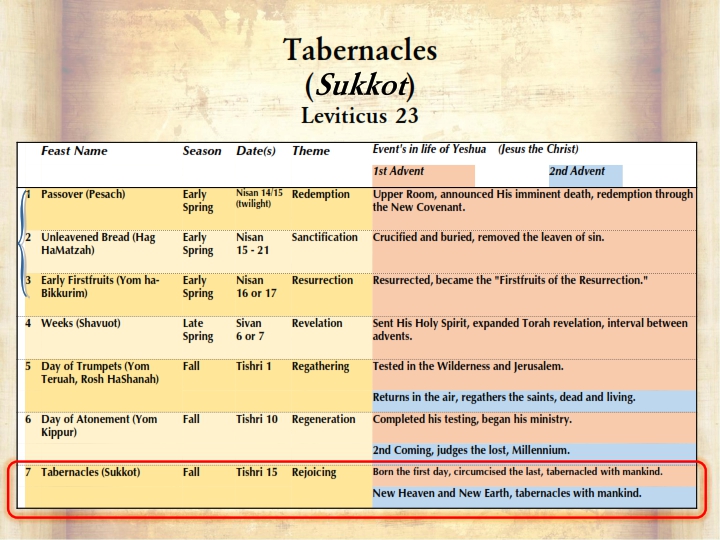
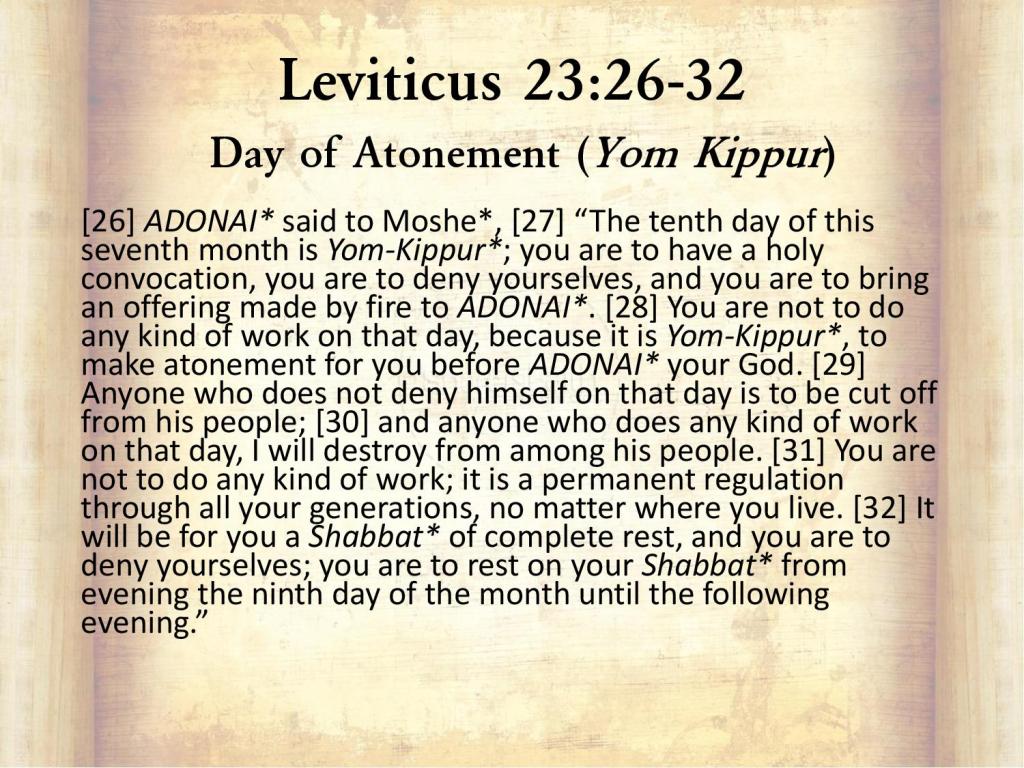
Jesus began His ministry, not at His baptism as is commonly taught, but at Yom Kippur at the conclusion of His Wilderness testing. This event is mostly ignored in Christian churches.

In 2020 rewrites of my early articles on The Jewish Feasts, I was able to date all of the crucial events of Jesus’ first advent. His baptism occurred in the early fall, on the Hebrew Date Elul 1, in the Julian/Gregorian year AD 26. Elul 1 was the day each year when Jews around the world would gather around streams and mikvoth (baptistries) for ritual immersion and cleansing from sin. This prepared them for 40 days of prayer, fasting, introspection, repentance, and restitution where appropriate. It was necessary for the Messiah to demonstrate His Jewishness by participating in this important annual act of faith.

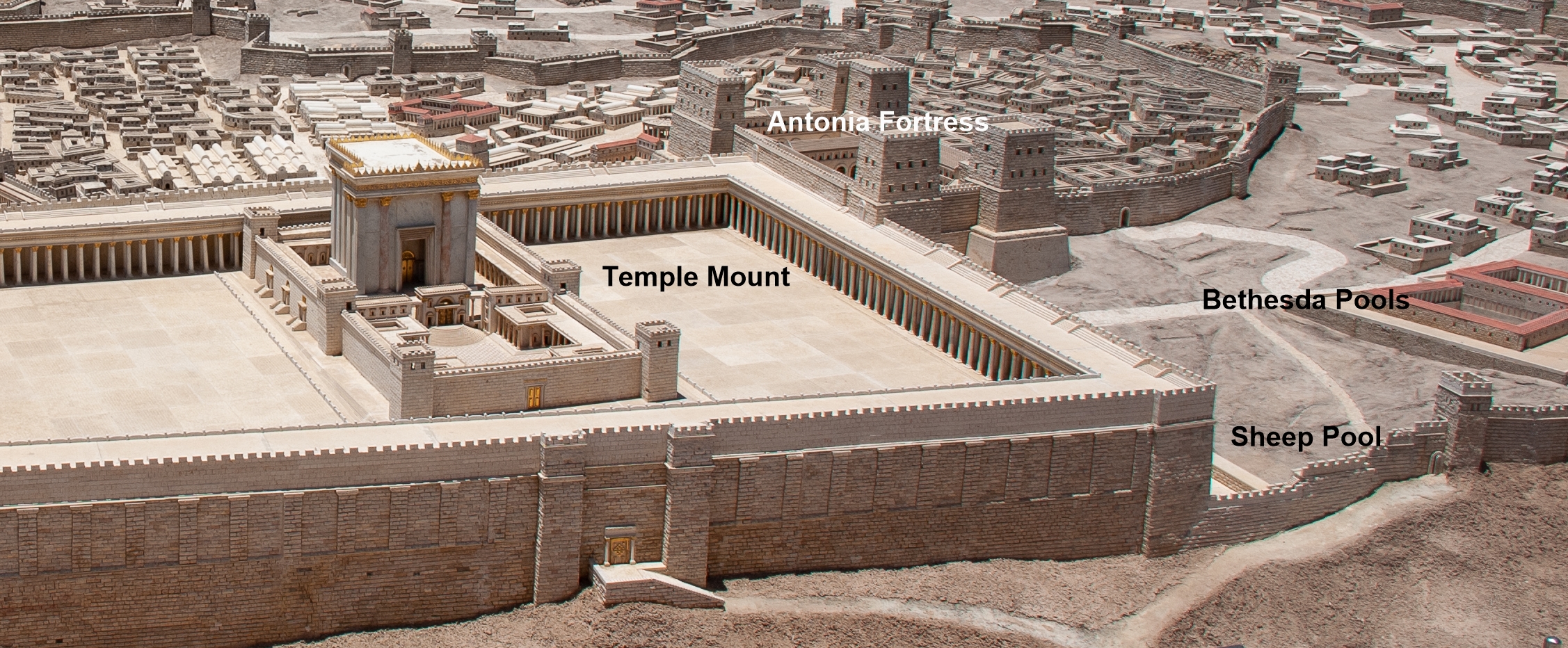
Jesus, of course, spent His own 40 days in the Wilderness. This culminated, I believe, with His testing by Satan on the final day, Tishri 10, which is Yom Kippur. Please read my short post, The Two Adams, where I discuss the background, timing, and crucial theological importance of this testing. Recall that one of the three temptations, probably the final one, took Jesus to the Pinnacle of the Temple, probably the Place of Trumpeting, near the western corner of the southern retaining wall, where thousands of holiday pilgrims would see His failure if He took Satan’s dare and jumped.

Jesus then began His ministry in Jerusalem during Sukkoth, the joyous week of the Feast of Tabernacles. During this time, He began healing and teaching, and He picked up the first few of His twelve closest disciples.

After a short period in Jerusalem, Jesus returned to Nazareth, then lived for a while in Capernaum, on the north shore of Lake Kinneret (the Sea of Galilee). Evidently, the “Sermon on the Mount” was delivered shortly thereafter, and in that region. Given its purpose (see below), I think that an early winter date is likely. The Galilee daily temperature range for December is currently around 50–60 °F (10–16 °C)
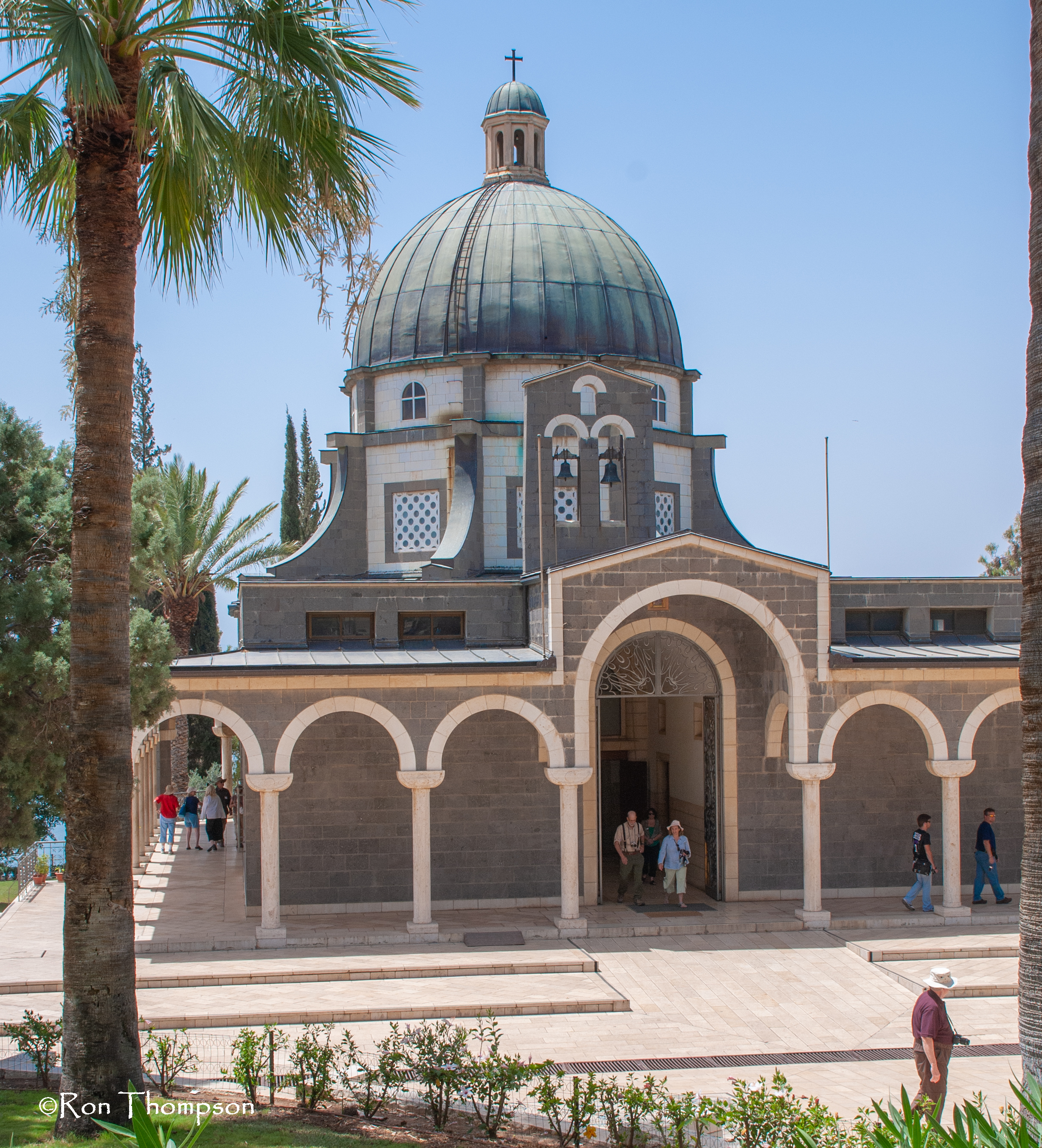
Church of the Beatitudes, part of a sprawling Franciscan monastery complex on the Mount of the Beatitudes. ©Ron Thompson 2008

Luke records a similar “sermon”, but due to differences in the text and to Luke’s apparent description of it as occurring on a “flat place”, most people seem to assume that these were separate events. In my opinion, it’s just one event. In support of that view:

  • Differences in text between gospels is not at all unusual. 1st century literary standards did not require exact quotation—paraphrasing was fine, as long as it did not materially change the argument(s) being made. With the same proviso, even loose chronological ordering was permissible.
  • Matthew was present at the event, and much later (probably 10 to 25 years later) he wrote down his impressions of what he, himself, witnessed. Inerrancy requires only that the substance of his report is correct, not that every word is faithfully repeated, and in the correct order, unless, as stated above, it alters the message intended. Luke, on the other hand, was not present and recorded only what he got, second-hand, from other sources. Of course, he must be held to the same standards of inerrancy, so his report may be assumed to be less accurate in the telling, but just as accurate in substance.
  • Matthew was born a Jew, and though he was first mentioned as a hated tax collector, he was steeped in Jewish tradition and Messianic hopes. His other recorded name, Levi (pronounced Lev-EE), indicates that he was from the tribe of Levi, and therefore even more immersed in Torah training in his home. Jesus’ teaching and miracles were central to Matthew’s gospel. Luke is the only Biblical author thought to be from a gentile heritage, but he is also thought to have legally converted to Judaism. His knowledge of Scripture and Jewish tradition would of course have been less complete than Matthew’s, and his gospel reflects more of Jesus’ humanity and details of His ministerial travels. It’s not surprising that he was silent about some of the more Jewish themes that were important to Matthew.
  • The passage in Luke is called the “Sermon on the Plain” because it mentions a “flat place”. I believe that this discrepancy can be resolved by harmonizing the two passages, thus:
  1. Jesus traveled to Capernaum. Mt 4:12–16; Lk 4:31.
  2. He then began teaching in or around Capernaum. Mt 4:17; Lk 4:32–44.

    Note: The ESV translates Lk 4:44 as, “And he was preaching in the synagogues of Judea.” Other translations say, “He kept on preaching…”, or something similar. The problem I see here is that the previous and following verses all clearly have Jesus in the Capernaum area. But the Greek Ἰουδαίας (Ioudaios) is a tricky word to translate. Very similar forms of the word can mean, “Jews”, “Judeans”, “Judea”, “tribe of Judah”, “land of the Jews”, and so on. Thayer’s Greek Lexicon, which provides a lot of supporting evidence, translates this particular form as “Jewish“, or more precisely, when joined with a noun as “belonging to the Jewish race.” I would comfortably contend, then, that Jesus is not here reported as going back to Judea at this time, but rather, “he was preaching in the synagogues of the Jews.”

  3. He collected a following, the disciples and other groups, some locals, some following from other regions, and of course the ever-present “scribes and Pharisees”, who I believe to have been agents from the Sanhedrin. Mt 4:18–23; Lk 4:45–6:11.
  4. One evening, He “went out to the mountain”, presumably a hill near Capernaum, and spent the night in prayer. In the morning, He called for His new disciples to join Him. Lk 6:12–16.
  5. After they joined for the traditional Shacharit (morning) prayers, the group then went down off the mountain to a “level place”, perhaps a valley floor or the lake shore, and ministered to a very large group of people from all over Galilee and the surrounding regions: from the Mediterranean coast to the west, Jerusalem to the south, and Decapolis and Transjordan to the east. Mt 4:24–25; Lk 6:17–19.
  6. Tiring of dealing with the crowd, Jesus walked back up the hill, with His disciples following Him. He sat down, and the others drew in to listen. He then began teaching, what we now call the “Sermon”. Mt 5:1–2.

The audience

I conclude from the above that Matthew and Luke describe the same event. Aside from that, it also tells me that the event was not a sermon at all, but rather an intimate teaching event, with Jesus sitting on the ground, and his disciples sitting in front of him.

Jesus had begun gathering a group of talmidim (disciples), beginning with a few in Jerusalem after His testing, and adding more in Galilee. It is impossible to say how many there were, and how many stuck with Him, but in Luke 6:13, he selected 12 of them to be ἀποστόλους (apostolous, emissaries, ambassadors). Some of those culled may have continued following Him but were not included in His inner circle.

Though the apostles were with Him during His first forays among the people, I think that the “Sermon” was probably the first formal teaching session they received from Him.

Who was included in the audience? Certainly the 12. Possibly additional, non-apostolic, disciples. Meanwhile, other people may have tagged along from the crowds on the flat area and still more may have come later. By the time He was done speaking, a crown had gathered, Mt 7:28.

Matthew’s Version, 5:3–7:29

View from the so-called “Mount of the Beatitudes”, near Capernaum. This gorgeous flower garden is modern, and courtesy of the Franciscan monks who dominate the hilltop. ©Ron Thompson 2008

What Jesus taught those assembled on the mount was specifically Jewish, and beyond that, specifically for the disciples. If the final audience (including late arrivals) included gentiles, say from Tyre, Sidon or Decapolis, the message was not intended for them.

The Beatitudes, Mt 5:3-12

Whether you’re reading Matthew’s list or Luke’s, the way almost everyone reads the Beatitudes is as cause followed by effect: Because you are poor in spirit—by one interpretation, spiritually depressed, or by another, spiritually bankrupt—the Kingdom of Heaven is yours! The blessing is because of, or in compensation for, the suffering.

Not so! That may fit with the popular (but wrong) idea that people have to be convinced of their sin before they can be saved. Why wrong? Because salvation, throughout all of human history, has been by grace alone through faith alone. By “calling on the name of the Lord”, which is another way of saying, by trusting faith, as illustrated in Hebrews 11 and elsewhere. One may be driven to faith through “conviction of sin”, or through witnessing God’s healing, or something else that has grabbed his or her attention. My own faith dates from my childhood, before I understood the sin concept. I became acquainted with Jesus through the children’s Bible stories, and I’ve never doubted Him since I was around 8 years old.

No, it is the other way around. Those who have been and perhaps still are the poor in spirit are blessed because the Kingdom of Heaven is theirs. Once they arrive, their spirits will certainly no longer be poor. The plain old poor are blessed because the Kingdom of God is theirs, and they will no longer by needy in any way. In fact, this is expressed plainly in Luke 12:22–32.

Because He is talking specifically to His disciples, particularly the 12 who will take the Gospel to the world, I have to believe that each of the Beatitudes expresses either, “this is how you are” or “this is how I expect my apostles to be.”

I have read that each of the Beatitudes is a New Testament expression of an Old Testament promise. For this survey, I’ll not take the time to research that, but I do want to comment on Mt 5:5:

Most translations say that “the meek … will inherit the earth.” This is absolutely a bad translation! The Greek γῆν (gēn) is usually translated as “earth”, meaning specifically the solid part of the entire planet. But it can also be translated as “land”, meaning a region or country. In this case, “land” is the only possible translation, because the verse is a quotation of

Psalms 37:11 (CJB)
[11] But the meek will inherit the land
and delight themselves in abundant peace.

David’s theme in Psalm 37 is, “Don’t be upset by evildoers or envious of those who do wrong”, because they will wither like grass, while those (Jews) who do good will “settle in the [Promised] land, and feed on faithfulness.” Israel’s meek and oppressed Jews will one day experience God’s shalom (peace, wellness, prosperity, etc.) in the Land He has given them to possess.

In Mt 5:9, “those who make peace … will be called sons of God”: “Sons of God“, huios Theos in Greek and bene haElohim in Hebrew, technically refers to the Heavenly Host (angels) who have not rebelled, but it will also refer to those humans who ultimately abide in Heaven with God. Another word for Sons of God is “saints.” Yes, the good angels are saints, too.

Salt and Light, Mt 5:13-16

This and the following section do not appear in Luke’s account because they are of exclusively Jewish application. Even though Luke was a Jewish proselyte, his background was gentile and secular. His two books, Luke and Acts, were written to a man who went by the Greek name, Theophilus, who is thought to have been either a gentile foreigner, maybe in Alexandria, or possibly the Sadducee, High Priest Theophilus ben Ananus, who served from AD 37 to 41. Whoever he was, Pharisaic Jewish detail was probably not among his interests.

In this section of His message, Jesus is commissioning His disciples to first, be a preservative influence on the believing Jews of Israel (salt), and second, lead those Jews into the surrounding world as evangelists to the lost (light). Two completely separate functions. Proper application to the church is (a) discipleship, teaching, fellowship, etc. within the Church (salt), and (b) evangelism of the lost (light). I cringe when I hear Christians say, “We are called to be salt and light to the world.” That’s just not the right concept!

Since I have previously written on this subject in depth, I would ask you to review it in “Light Yes, But Why Salt?“.

Endorsement of Torah and the Mosaic Covenant, Mt 5:17-19

He then reminds them that nothing He will teach or that they are to teach must ever detract from Jewish reverence to “the Law”, which will endure until the end of time. Again, this is Jewish teaching, for Jews!

I have also, more recently, written an in-depth discussion of this subject in, “Fulfilling the Law: Matthew 5:17–19“.

Righteousness, Mt 5:20

English translations like ESV that insert section headings tend to lump Matthew 5:20 with the previous verses, 17–19. This very much serves to reinforce the badly mistaken view, held by a majority of Christians, that because Jesus fulfilled the Law (and the prophets?), they are no longer valid. No, no, a thousand times no!!!

In reality, verse 20 is prologue for what follows! The next 28 verses (see my next section), in particular, discuss legalistic interpretations of Torah, not as taught, but as practiced by many (not all) of the Pharisees.

There is an interesting play on words in this verse—a “Hebraism”. In Hebrew, which was probably the language Jesus was speaking to His disciples, the word for “righteousness” is צֶדֶק (tsedeq; The Greek equivalent is δικαιοσύνη, dikaiosune).

Every Scribe (the academics) and Pharisee (the sectarians) strove to achieve a reputation for tsedeq by living his life as a just, honest, and compassionate man, ethically superior in all respects. Of course, the “easy” way to achieve this was by obedience to the 613 mitzvoth—by checking boxes. One of the most visible acts of righteousness was almsgiving. To say that one was a tsedeq was essentially to say that he was a generous almsgiver.

But Jesus was implying here that almsgiving isn’t enough to be considered truly righteous. True righteousness demands true faith.

Matthew 5:20 (ESV) additions mine
[20] For I tell you, unless your righteousness [your faith] exceeds that of the scribes and Pharisees [their almsgiving], you will never enter the kingdom of heaven.

Every Jew present would immediately have also understood the term tsedeq as an expression of one of God’s primary attributes—none is more important than His righteousness. In fact, one of His many names is Yhvh Tsidqenu: The LORD Our Righteousness.

In His personal life to that point and in His ministry to follow, Jesus faithfully kept the commandments of Torah, but His teachings were primarily about faith and the Kingdom of Heaven. Paul also emphasized the righteousness of faith.

The Six Antithises, Mt 5:21-48

I have heard and read many claims that Jesus was here contradicting the Torah commandments, or else deprecating or radically amending them. I believe that Jesus’ endorsement of Torah, above, was deliberate prologue to this section. There should be no doubt that He was engaging in commentary (Hebrew midrash), not revision!

Some of these are from the “Decalogue“, or 10 Commandments, and some were from other portions of the Levitical commandments dealing with relationships between Jews. The subjects in order, are:

  1. Murder, vs 21–26.
  2. Adultery, vs 27–30.
  3. Divorce, vs 31–32.
  4. Breaking an oath, vs 33–37.
  5. Vengeance, vs 38–42.
  6. Hatred, vs 43–48.

In each case, Jesus did not advocate disobedience to the commandments, but rather He told His followers to take them in the spirit God intended and to apply that same spirit to analogous situations that were more common to most people.

In fact, much of this was not even originally Jesus’ words. In those days, the two most powerful rabbinic schools of interpretation were the House of Hillel and the House of Shammai. Shammai’s interpretations were always harsh and legalistic, while Hillel’s were more nuanced and humanitarian.

Jesus was essentially, as always, taking Hillel’s side in an ongoing argument. It may sound like Jesus was advocating tougher rules. But think about them from a victimhood perspective: The brother who is hated or berated; the sexually harassed woman; the unjustly divorced wife; the person victimized by a broken oath, and so on.

Ostentatious Giving, Mt 6:1-4

Right after His snide comment about the “righteousness of the Pharisees”, Jesus first (by Matthew’s account) listed a number of commandments (the “antitheses”) for which box-checking obedience falls short of spiritual understanding, and then He turned to several very specific examples of ways in which many Pharisees demonstrated a deficiency in their own righteousness.

Verse 1 of this chapter is an introduction to several passages dealing with the hypocrisy of “practicing your righteousness before other people in order to be seen by them”.

First on this list was the propensity of many to turn their almsgiving into bragging rights (as discussed above). Almsgiving for public recognition qualifies as hypocrisy.

Ostentatious Prayer, Mt 6:5-8

Next, Jesus addresses the similar issue of those who pray flowery public prayers in order to impress other humans.

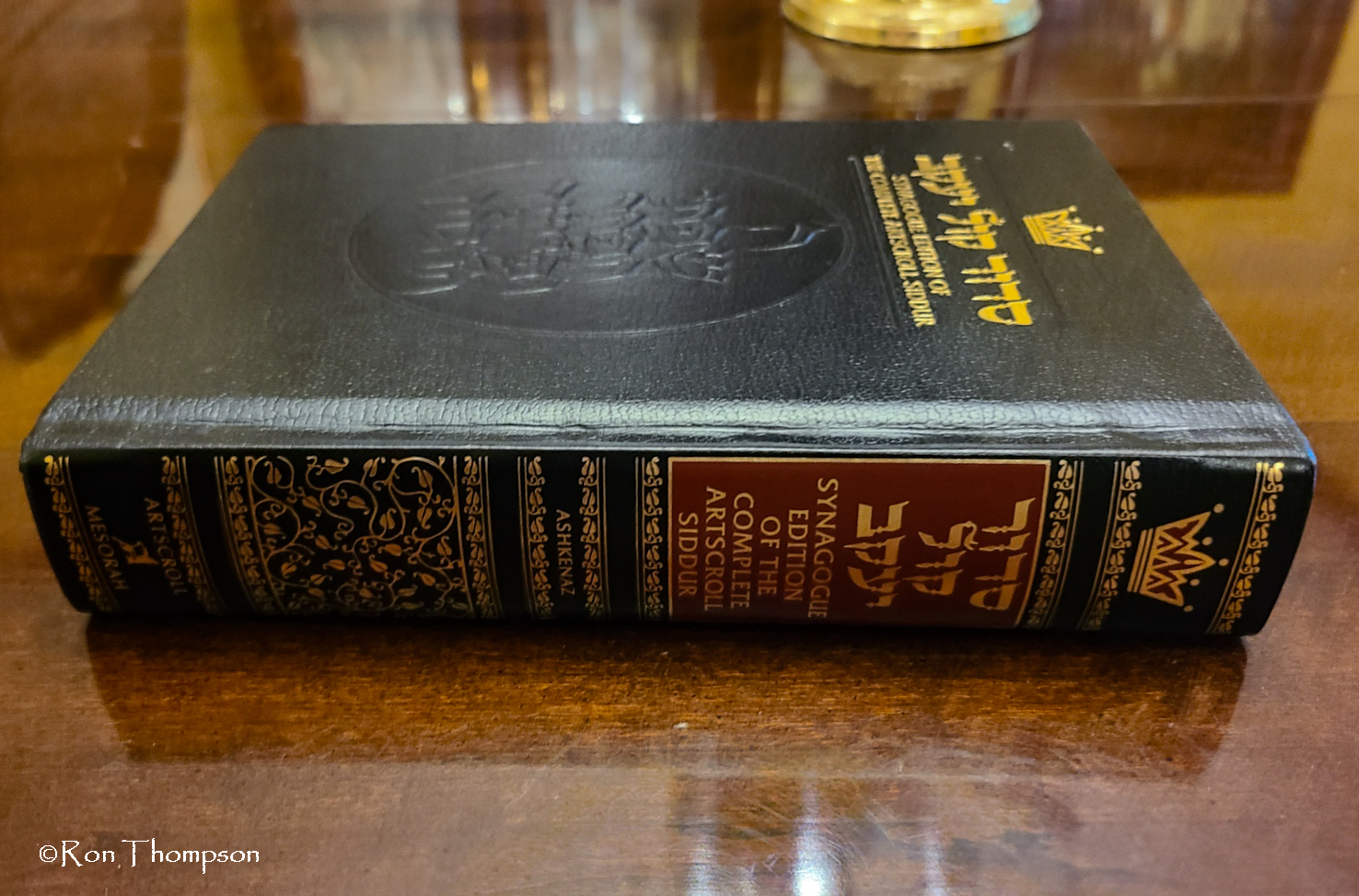
The Bible has a lot to say about prayer—but little about spontaneous prayer, which appears to be what this passage has in view. There is nothing I’m aware of that actually indicates that spontaneous prayer should be verbal. From at least the Babylonian captivity, and most likely as far back as the early Monarchy, until today, most verbalized Jewish prayer has been memorized or later, read from a Siddur (prayer book). For most of the last two millennia, where Jews have prayed spontaneously in group sessions, it has been by “davening” (quietly moving the lips), not by speaking out loud. For way more on this subject, see The Roots of Christian Prayer.

On a personal note: I am a decent writer, but a horrible public speaker. I'm aware that the secret to public prayer is to forget there are humans listening and to direct my words to God. Unfortunately, at 77 years old and having been in church since I was a toddler, awareness and performance have never come together. Every time I have been roped into "leading prayer", I've found myself addressing those around me, not Him within me. So, to avoid feeling like the Pharisee on the street corner, I refuse to be roped in again!

The Lord’s Prayer, Mt 6:9–15

Having condemned self-aggrandizing public prayer, Jesus then digresses to teach his disciples a prayer that I believe was meant to be an anthem to set them apart from other rabbinical schools, not a model form of prayer as most people today assume.

Whether it was meant to be recited in unison, davened, or sung, I can’t say for sure. I’m doubtful that there was unison recitation at all in the synagogues or Temple. Davening was certainly possible, with the leader reciting aloud and the others moving their lips. But Biblical Judaism was full of songs. The Psalms were probably all intended for song. We can only speculate on how singing was done. Most scholars seem to think it was antiphonal, either chant or melody.

The following is how I envision it:

Matthew 6:9b–13 (CJB) with voices added

— Cantor:
[9b] Our Father in heaven!
May your Name be kept holy.
— Congregation:
[10] May your Kingdom come,
your will be done on earth as in heaven.
— Cantor:
[11] Give us the food we need today.
— Congregation:
[12] Forgive us what we have done wrong,
as we too have forgiven those who have wronged us.
— Cantor:
[13] And do not lead us into hard testing,
but keep us safe from the Evil One.
— Congregation:
For kingship, power and glory are yours forever.
Amen.

Forgiveness, Mt 6:14–15

The ESV and CJB, among others, have translated the compound particle that begins verse 14 as if these two verses were a commentary on verse 12, and since ESV has grouped them under the same heading as the prayer, that is obviously the way they view it.

It may be that, or it may be a completely separate brief statement about forgiveness, in which case the particle should probably have been rendered as something like “provided that” or “if” (you forgive).

What is to be forgiven in verse 12 is ὀφείλημα (opheiléma), any kind of debt or obligation, either monetary or otherwise, where something is owed. Verse 14 uses a noun with a narrower scope: παράπτωμα (paraptóma), meaning a fault or offense that has been committed. Though some form of restitution or penalty may be owed, it seems to me a stretch to connect the two terms like this.

Ostentatious Fasting, Mt 6:16-18

Once again, Jesus calls out hypocritical worship. Fasting was a frequent requirement under Oral Torah, i.e., the “traditions of the Jews”, though Scripture only specifies one day a year for fasting (Yom Kippur, on 10 Tishri), and it says nothing about how long one should fast on that day or what, if anything can still be consumed.

Greed, Mt 6:19-24

This section contains the infamous “single eye” reference (verses 21 and 22) that almost nobody in all of Christianity understands. Even the “Cultural and Historical Background” given by Strong’s is inapplicable. That’s because this is a Jewish idiomatic usage of the Greek word.

The simplest way to explain it is to quote it from the one translation I’m aware of that gets it right:

Matthew 6:22 (CJB) the bracketed text is the translator’s
[22] ‘The eye is the lamp of the body.’ So if you have a ‘good eye’ [that is, if you are generous] your whole body will be full of light; [23] but if you have an ‘evil eye’ [if you are stingy] your whole body will be full of darkness. If, then, the light in you is darkness, how great is that darkness!

Anxiety, Mt 6:25-34

This passage on faith in the face of anxiety is about as clear as it gets.

Judgementalism, Mt 7:1-5

Again, I don’t think there is very much to this passage that needs explanation, except to say that it does not, as many think, say that it is never proper to judge the actions of others. Verse 5 makes it clear that judgement is acceptable, provided that one first deals with his or her own sin.

Dogs and Pigs, Mt 7:6

Matthew presents this verse without explanation. It is most likely a proverb that was known and understood by the Jews in attendance. If “dogs” and “pigs” are humans, then Jesus is warning His followers not to entrust that which is holy to people who are unholy. In that case, it is probably connected to the previous passage, since to recognize one requires judgement.

Was Jesus, then, engaging in racism? Please, that concept is anachronistic.

Christianity didn’t yet exist. Biblically, there were two classes of people: Jews and goyim (gentiles). Ideally, Jews worshipped Yahweh. Gentiles mostly worshipped pagan gods. Gentiles living in Israel (the ger, or “stranger”, “sojourner”) could convert to Judaism and worship Yahweh, and Jews were to treat those proselytes as other Jews. Gentiles living in Israel who did not convert were required to live righteously and were to be treated well by Jews if they did so.

Though most Godly Jews did distrust, dislike, or even hate gentiles because of their paganism, calling them dogs or pigs didn’t necessarily carry the same animas as racial epithets today. Uncircumcised gentiles were considered ritually unclean, just like dogs and pigs. It was a description, not an epithet.

Since pigs were commonly used for food in gentile lands, comparing a gentile to a pig was probably an especially poignant image to a Jew.

Dogs were also ritually unclean, but since they weren’t commonly eaten by the gentiles, they weren’t as reviled as pigs. In fact, they were sometimes Jewish pets, especially as puppies.

Saying, “Do not give dogs what is holy” was probably an expression based on:

Exodus 22:31 (ESV) emphasis mine
[31] “You shall be consecrated to me. Therefore you shall not eat any flesh that is torn by beasts in the field; you shall throw it to the dogs.

A number of commentaries speculate that Jesus is saying, “You can throw carrion to the dogs, but not meat sacrificed to God.” My guess is that He was saying that any clean (and therefore holy) object, not just sacrificial meat, should not be offered to unholy gentiles.

Other possible interpretations could be gleaned from the observation that the same Greek word translated as “dogs” was sometimes rendered as “prostitutes”:

Philippians 3:2 (ESV) emphasis mine
[2] Look out for the dogs, look out for the evildoers, look out for those who mutilate the flesh.

Prayer and Relationships, Mt 7:7-11

This passage is, of course, about prayer. From the context, “ask”, “seek”, and “knock” are all talking about prayer. With that in mind, interpretation is fairly easy.

However, caution is in order. Prosperity gospel will say that this is a firm promise, and if you don’t get what nyou ask for it’s because you are somehow at fault. Perhaps there is sin in your life, or maybe you asked in an improper spirit.

I may be accused of heresy for this, but passages like this aren’t promises, they are rules of thumb, so to speak. God is not obligated to give even the Godliest person everything requested every time. God has His own agenda, which is not necessarily for us to know.

There are many examples of these “general principles”. To name just two: “Train up a child in the way he should go; and when he is old, he will not depart from it.” “The days of our years are threescore years and ten.”

The Golden Rule Mt 7:12

I mentioned above that parts of the Sermon on the Mount were Jesus’ restatements of principles already recognized in Judaism. That should not be a surprise. He did not come to overthrow Torah, in any sense. God is the author of Torah, and Israel was His elect people, tasked with transmitting, interpreting and managing Torah. These supervisory functions were, in fact, what Jesus was referring to at Caesaria Phillippi when He later granted the same rights to His apostles:

Matthew 16:19 (ESV)
[19] I will give you the keys of the kingdom of heaven, and whatever you bind on earth shall be bound in heaven, and whatever you loose on earth shall be loosed in heaven.”

What I believe was Jesus’ goal in this first lecture to His new band of apostles was to sort out the good from the bad that had developed in the ranks of the theologians of Israel.

The Golden Rule actually wasn’t even a “Jewish invention.” Every ancient civilization had a similar saying, going back at least as far as early Egypt. In Judaism it appeared as early as the Apocryphal book of Tobit, written in the 3rd century BC:

Tobit 4:15 (NRSV) emphasis mine
[15] And what you hate, do not do to anyone. Do not drink wine to excess or let drunkenness go with you on your way.

In the 1st century it was, once again, couched in terms of the disputes between the humanist, Hillel and the legalist, Shammai:

From Shabbat 31A (emphasis mine):
A. There was another case of a gentile who came before Shammai. He said to him, “Convert me on the stipulation that you teach me the entire Torah while I am standing on one foot.” He drove him off with the building cubit [a measuring rod] that he had in his hand.
B. He came before Hillel: “Convert me.”
C. He said to him, “‘What is hateful to you, to your fellow don’t do.’ That’s the entirety of the Torah; everything else is elaboration. So go, study.
— Neusner, Jacob, ed., The Babylonian Talmud: A Translation and Commentary. Accordance Electronic edition, version 1.6. Peabody: Hendrickson Publishers, 2005.

The Narrow Gate, Mt 7:13-14

This passage is self-explanatory.

Bonus material: Speaking of narrow gates, you’ve probably heard the following explained by reference to an obscure Temple gate called the “Needle’s Eye”:

Matthew 19:24 (ESV), also Mark 10:25; Luke 18:25
[24] Again I tell you, it is easier for a camel to go through the eye of a needle than for a rich person to enter the kingdom of God.”

There is no such gate! But nothing is impossible for God.

False Prophets, Mt 7:15-23

The two passages that ESV titles “A Tree and Its Fruit” (15–20) and “I Never Knew You” (21–23) form a single united theme, in my opinion. That theme is about recognition of false prophets.

I don’t believe that true prophets, in the Biblical sense, still exist today, but application can be found in the evaluation of anyone who claims to have special knowledge imparted by God that is not available to anyone else.

While judgementalism is condemned in some portions of the Bible, that can’t be considered a blanket prohibition. If we are to recognize false teaching and avoid victimization, certainly we must be free to evaluate others on the basis of results, as Jesus warns in verse 15.

Wisdom, Mt 7:24-27

I assume that children today are taught the lesson of the wise man and the foolish man, as I was way back in the day.

Luke’s Version, 6:20–49

The golden plot down the hill is one possible location of the “flat place” of Luke’s report, but of course the area may have been graded for farming in modern times. I took this photo from the Church of the Beatitudes. The field below is an easy hike from the traditional location of the Sermon on the Mount, perhaps 50 yards to my left. At worst, this photo is an illustration of the scenario I’m paining here. ©Ron Thompson 2008.

While Matthew’s version is “very Jewish“, with frequent references to Old Testament theology, Luke’s version includes little, if anything, that is applicable specifically to the Jewish culture, though he is describing the same event.

Also, Luke apparently was not scrupulous about keeping all of his comments about the Sermon grouped in one place.

I’m not going to attempt even a complete survey of Luke’s Sermon on the Plain. Just random comments.

Blessings and curses, Lk 6:20–26

Where Matthew gives a list of blessings (the Beatitudes), Luke lists both blessings and curses.

The blessings are basically a subset of the promises in Matthew’s list.

In verse 20, Luke’s version would seem to be saying that because you are poor (lacking money), the Kingdom of God is yours. I can’t see any interpretation that would rescue that logic! Nor will you be blessed with financial riches once you arrive in the Kingdom of God. There is no “mansion over the hilltop”. If the streets are gold, it won’t belong to you. What you will possess is relief from suffering you may undergo now because you lack resources on earth.

After his abbreviated list of blessings, Luke listed four woes, traits that He won’t tolerate in His disciples: “I don’t want you to be rich, sated, frivolous, or fawning”. Temporal worldly gain may cost you in eternity.

Miscellaneous discourses, Lk 6:27–49

The rest of the chapter could be a continuation of the “Sermon” but could just as well be later lessons. Most of it consists of discourses on confrontational ethics.

This section begins with a discussion of loving one’s enemies 6:27–36, which is analogous to Matthew’s 6th Antithesis. Of the six, this is the only one that is strictly related to an attitude, as opposed to a Torah commandment, though it is mentioned in Leviticus in relation to vengeance. If this is still part of the Sermon, omitting the first five is consistent with Luke speaking to a gentile audience.

Being accepted as a disciple under a respected Rabbi entailed exceptional responsibility and required total obedience to the Master. Without question these were rules that Jesus expected His disciples to obey scrupulously, as they already presumably did with respect to the 613 Torah commandments.

Yet the passage, especially as expressed in Luke 6:27–30, contains exhortations that most of us have a difficult time obeying: “Love your enemies”, “bless those who curse you”, “turn the other cheek”, “let people rip you off”, and “give more than requested”. I don’t want to encourage bad behavior, but I have to put this in perspective, as I see it.

As gentile believers in the New Testament Church, good behavior is expected of us, too, but given our frailty in the face of challenging circumstances, I don’t recommend excessive judgementalism…

And, low and behold, the next topic on Luke’s agenda here is judgementalism, verses 37–42.

In verses 43–45, we see, as in Matthew, that judgement precedes “fruit inspection”, or recognizing false prophets by their fruit.

I suspect that the end of the chapter, verses 46–49 may be for a subsequent discussion with the disciples, because verse 46 implies a longer history together than is likely from this early teaching session, virtually right after Jesus commissioned His apostles.

The Lord’s Prayer, Lk 11:1–4

Luke’s report on the prayer is in chapter 11, and clearly out of chronological order.

Verse 1 adds credence to my contention (not my own idea but garnered from the book Jesus and the Victory of God, by N.T. Wright) that it was a rabbinic anthem, since John the Baptizer had previously taught a similar prayer to his own disciples.

In any case, the suggestion that Jesus’ disciples didn’t know how to pray in general and were asking Him to teach them is ludicrous. They lived in a praying culture and certainly learned how to pray no later than toddling.


Yetzer, Yotzer and “The Law” in Romans 7:1–6

Posted on:

Modified on:


  1. Jewish sin nature concepts
    1. Yetzer and the “Old Man”
    2. Yotzer and the “new Man”
    3. Yetzer vs. Yotzer
  2. Background
    1. The Epistle addressees
    2. The roots of gentile unrighteousness
    3. The Value of the Law to gentiles
    4. Exposition of Romans 7:1–6
      1. Verse 1:
      2. Verse 2:
      3. Verse 3:
      4. Verse 4:
      5. Précis of Chapter 6:
      6. Verse 4 continued:
      7. Verse 5:
      8. Verse 6:
  3. Law and Grace summarized
  4. Torah observance in the Church

This post has a dual purpose:

  1. To discuss the Jewish concepts of yetzer (human inclinations) and their antagonist, Yotzer (Godly influence), which Paul alluded to over and over again in his epistles.
  2. To examine the use of those concepts in Paul’s defense of “the Law” in Romans 7. I chose this example as a follow-up to my last post, Fulfilling the Law: Matthew 5:17–19.

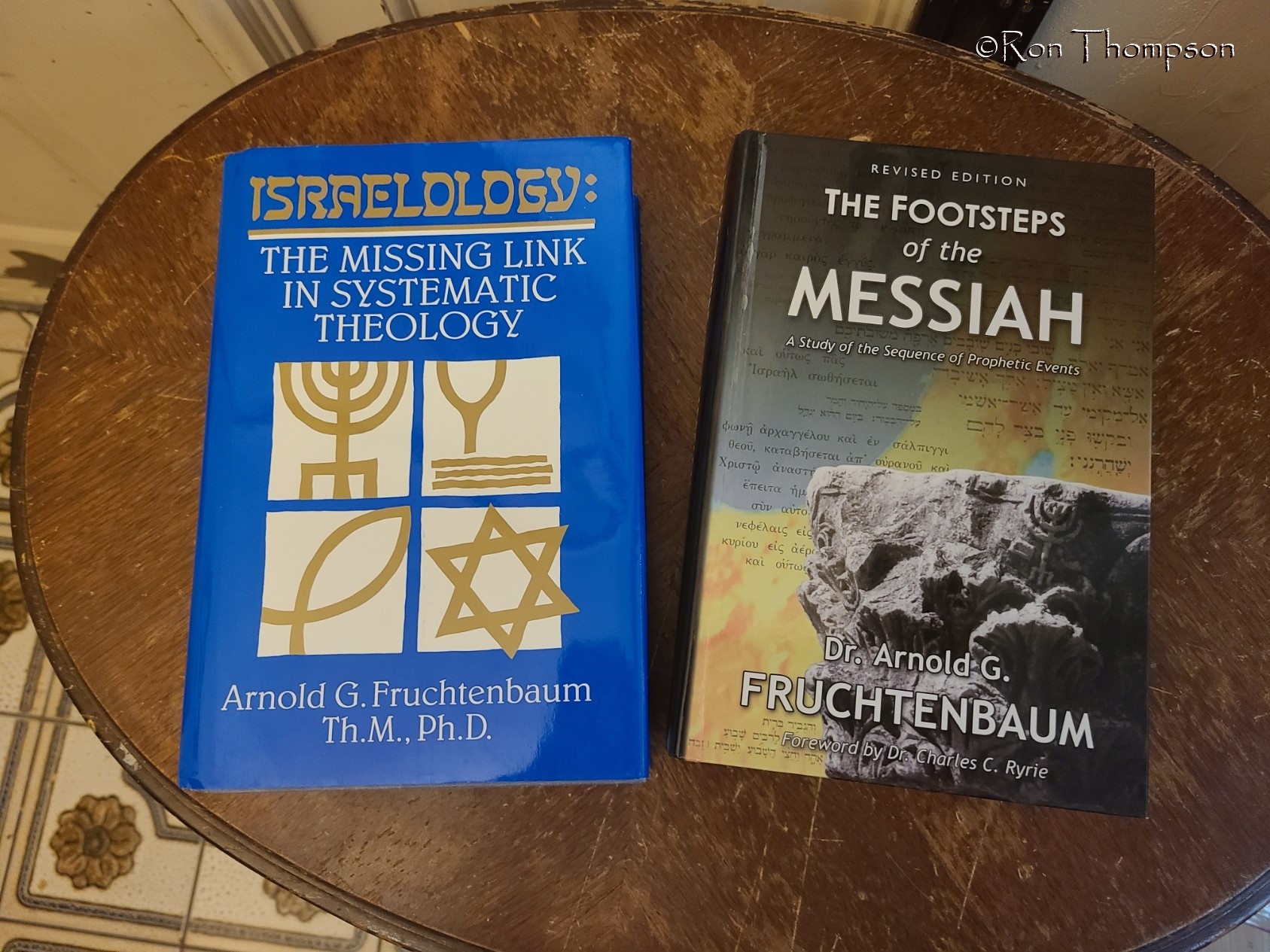
In his important book, Israelology, the Missing Link in Systematic Theology, Messianic scholar Dr. Arnold G. Fruchtenbaum takes the position that, “The Law of Moses has indeed been rendered inoperative.” In Appendix II, on page 908 of the 2001 edition, he cites a number of passages to prove his point—to which I disagree!

Books in my library written by Dr. Arnold G. Fruchtenbaum. The one on the left is one of my resources for this post.

I want to be clear that on most issues I like Dr. Fruchtenbaum very much. In particular, his Israelology is easily the best source I have found describing the ubiquitous Dispensational and Covenant theologies. I also thoroughly enjoyed his book, The Footsteps of the Messiah: A Study of the Sequence of Prophetic Events.

Jewish sin nature concepts

Contrary to the myths of liberal Christianity, Paul did not invent the New Testament Church. But neither did he learn it from Jesus’ disciples, who he initially avoided. Instead, I believe his training came directly at the hands of God (ala Moses) and/or angels (ala Daniel), during his post-Damascus sojourn in Arabia (discussed here).

But his ministry was also heavily informed by his extensive knowledge of Jewish theology, gained as a Pharisee and a student of the great rabbi, Gamaliel the Elder, who was himself a Nasi (President) of the Great Sanhedrin and the grandson of Hillel the Elder, one of the era’s three greatest Jewish sages. These facts are pertinent to this topic.

Yetzer and the “Old Man”

The concept of human “inclination of mind” is well established in ancient Judaism. The Hebrew term is יֵצֶר, transliterated as yetzer, yetser, yatsar, or something similar. Since Hebrew uses an alphabet (actually, an aleph-bet) without vowels, the spellings of transliterated words are mostly unimportant.

Pronunciation is determined by local custom, especially with respect to whether one’s Diaspora heritage is Ashkenazi (European) or Sephardi (Middle Eastern). I’ll go with Strong’s phonetic spelling of yay’-tser, here.

In Jewish thinking, every child, male or female, is conceived with an inclination to do evil, yetzer hara (“the evil inclination”), and an inclination to do good, yetzer hatov (“the good inclination”). The evil inclination is “born” with the child, but the good inclination is not born until adolescence. Both persist for the remainder of life. Note that both of these inclinations are innate characteristics, and common to all humans.

Prior to the birth of yetzer hatov, it is the parents’ responsibility to teach the child right and wrong and to maintain discipline. As the child enters adolescence, around the age of 13 (boys) or 12 (girls), yetzer hatov is born and begins to grow and combat yetzer hara. The adolescent thus gains an internal maturity and sense of responsibility that begins to replace childish self-absorption and expedience.

Note that yetzer hatov has no influence on the child prior to its birth at the child’s puberty. At its birth in the young adolescent, being itself some 13 years “younger” than yetzer hara, it is always at a disadvantage, which explains why even mature adults continue to struggle with sin.

Paul, in his writings, apparently considers this unbalanced set of hypothetical inclinations to be what he calls the “old man” or the “old nature.” We would call it “the conscience.”

Yotzer and the “new Man”

Another Jewish concept that is applicable here is that of God as the Yotzer Ohr (“Creator of light”). This title, of course, reflects His first creative act in Genesis 1. Each day, during the morning (shacharit) prayers, before reciting the Shema, two blessings are said. One of those is the Birkat Yotzer Ohr, “Blessed are you, LORD our God, King of the universe, who forms light and creates darkness, who makes peace and creates all things… Blessed are you, LORD, who forms light.”

Paul, as we all know, presents the New Covenant believer, indwelled by the Holy Spirit, as having a new, Godly inclination, which he calls the “new man” or the “new nature.” He is clearly equating this godly inclination with the Yotzer Ohr concept.

Yetzer vs. Yotzer

Thus, the continual struggle between the old nature and the new nature. In good Hebrew fashion, many Messianic Jewish believers have latched onto the poetic similarity in the two words, yetzer and Yotzer, to describe that tension as yetzer verses Yotzer. I like that!

In the remainder of this post, I will be illustrating Paul’s application of yetzer vs Yotzer in his discourse on the Law and the continuity of the Mosaic Covenant in Romans 7:1–6.

Background

The Epistle addressees

Who was Romans written to? Unlike most of the epistles, Romans was not written to “the church [at Rome].” Romans 1:7a tells us that he addressed it to “all those in Rome who are loved by God and called to be saints.” Rome was a big city and probably had several local churches. We know from later chapters that some of the Roman believers were Jewish, but since the city was overwhelmingly Gentile, it’s likely that most of the believers there were Gentile.

That likelihood is reinforced by a look at the date of writing. Estimates mostly place it in the range of AD 56–58. Although the earliest Christians in Rome were probably Jewish, Emperor Claudius expelled all Jews from the City in AD 49. When the expulsion was ended after Claudius’ death in AD 54, those Jews who returned found that Gentile Christians had taken over their synagogues.

When Paul wrote his epistle, I think that the Jewish minority in the churches of Rome was small, and resentment was high.

That gentiles were intended to be Paul’s primary recipients is plainly stated in the letter’s opening:

Romans 1:13 (CJB)
[13] Brothers, I want you to know that although I have been prevented from visiting you until now, I have often planned to do so, in order that I might have some fruit among you, just as I have among the other [λοιπός, loipos, other, remaining, rest of the] Gentiles.

Nevertheless, some passages in the epistle were clearly intended for Jewish believers, as he implied in verse 7:1a (CJB): “Surely you know, brothers—for I am speaking to those who understand the Torah…”

The roots of gentile unrighteousness

In Romans 1:18–32, Paul sets the stage by explaining the reasons for, and the results of, Gentile unrighteousness. In the ancient, postdiluvian world, all humans were descended from four men and four women. All eight had seen the flood, which I believe was global, and all of them had seen the evil that led to the flood. The Tower of Babel was built just four generations later, and in those days before writing was invented, when troubadours abounded and stories were spread verbally, you can bet that tales of creation, flood and tower were still fresh.

The fact that every culture ended up with creation stories and flood stories proves that knowledge persisted, and Romans 1:20 bears that out:

Romans 1:20 (ESV)
[20] For his invisible attributes, namely, his eternal power and divine nature, have been clearly perceived, ever since the creation of the world, in the things that have been made. So they are without excuse.

From verse 24, the rest of Romans 1 reveals the final result of the Tower of Babel incident, which I will discuss more fully in a future post. Briefly, God gave them up to “the lusts of their hearts”, verse 24. That is yet another name for yetser hara, the evil inclination.

Out of this milieu, God chose one man, Abram of Ur, to father a people that He would call His own, Israel.

The Value of the Law to gentiles

Romans 2 continues the theme of unrighteousness, particularly as it relates to Gentiles, and begins a discussion on the value (or not) of Gentiles adopting Torah.

Romans 2:12,14–15 (ESV) alterations mine
[12] For all who have sinned without the law will also perish without the law, and all who have sinned under the law will be judged by the law.

[14] For when Gentiles … who do not have the law, by nature do what the law requires, they are a law to themselves, even though they do not have the law. [15] They show that the work of the law is written on their hearts, while their conscience also bears witness, and their conflicting thoughts accuse or even excuse them[.]

In the above quotation, I removed a comma after the word “Gentiles” in verse 14. Biblical Greek was written without punctuation, so the comma is interpretive and not part of the inspired text. Inclusion of the comma implies that what follows is comparing gentiles with Jews, but verse 12 sets the correct context, gentiles who have not chosen circumcision. This chapter is contrasting Gentiles who adopt Torah (the Law) with those who don’t. I think the comma is in error.

Gentiles without the Law (i.e., those who have not officially become Jewish proselytes) who are living righteously, as if they are Jews, demonstrate that indeed, the New Covenant is written on the heart. Also, like righteous Jews, their balance of yetser hara and yetser hatov either condemns or excuses them. But unrighteousness dulls the conscience.

Verse 25 is an important statement regarding the value of Gentile conversion to Judaism:

Romans 2:25 (ESV)
[25] For circumcision indeed is of value if you obey the law, but if you break the law, your circumcision becomes uncircumcision.

Quite simply, if Gentile proselytes to Judaism obey the precepts of Torah, then yes, it is a tremendous spiritual and social value to them, as it is to obedient ethnic Jews; otherwise, they have only joined a club with stringent requirements and no lasting benefits. Not to mention significant physical pain for males.

Although this chapter (Romans 2) applies only to Gentiles, it is worth noting that Paul in other places makes a similar point to Jews: if you don’t obey the dictates of your own Jewish laws, then you might as well not be Jews.

Exposition of Romans 7:1–6

Since this is the heart of my argument in this post, I have been researching it carefully. As I’ve mentioned elsewhere, I have an extensive library of Bible texts, commentaries, language resources and other materials. For Romans, in particular, I have a favorite commentary: A commentary on the Jewish Roots of Romans, by Joseph Baruch Shulam, Director of Netivyah Bible Instruction Ministry in Jerusalem.

Recommended commentary on the book of Romans.

Here is the text we will be analyzing, with a goal of understanding, in particular, the meaning of verse 6:

Romans 7:1–6 (ESV) emphasis mine
[7:1] Or do you not know, brothers —for I am speaking to those who know the law—that the law is binding on a person only as long as he lives? [2] For a married woman is bound by law to her husband while he lives, but if her husband dies she is released from the law of marriage. [3] Accordingly, she will be called an adulteress if she lives with another man while her husband is alive. But if her husband dies, she is free from that law, and if she marries another man she is not an adulteress.

[4] Likewise, my brothers, you also have died to the law through the body of Christ, so that you may belong to another, to him who has been raised from the dead, in order that we may bear fruit for God. [5] For while we were living in the flesh, our sinful passions, aroused by the law, were at work in our members to bear fruit for death. [6] But now we are released from the law, having died to that which held us captive, so that we serve in the new way of the Spirit and not in the old way of the written code.

Verse 1:

First, note that that this section is addressed specifically to Jews in the Roman churches: brothers … those who know the law. What Paul is doing here is reminding them of something that they are already well aware of, that the law is binding on a person only as long as he lives.

That’s pretty logical—you can’t sacrifice, recite the Shema, attend prayers, teach your children to be Torah observant, or do anything else, once you have died!

Why do I spend time here on something so obvious? Because it was a matter of formal consideration by the scholars of the day, who wanted to understand the reason for everything that God had to say. In considering

Psalms 115:17 (ESV)
[17] The dead do not praise the LORD,
nor do any who go down into silence.

The Babylonian Talmud records the words of Rabbi Yohanan, an ancient sage:

Talmud Shabbat 30a
That which David said: “The dead praise not the Lord,” this is what he is saying: A person should always engage in Torah and mitzvot before he dies, as once he is dead he is idle from Torah and mitzvot and there is no praise for the Holy One, Blessed be He, from him. And that is what Rabbi Yohanan said: What is the meaning of that which is written: “Set free among the dead, like the slain that lie in the grave, whom You remember no more” (Psalms 88:6)? When a person dies he then becomes free of Torah and mitzvot.

Verse 2:

Paul then draws an analogy from common Jewish case law to support the point he is about to make, that the Law ceases to rule not only the obligations of the dead, but also obligations towards the dead. Verse 1 made the obvious point that once a person is dead, he or she is no longer obligated to observe, i.e., to keep or obey, the tenets of Torah. Certainly, a dead husband is no longer required to meet the terms of the ketubah, or marriage contract. Likewise, the living wife of the dead husband is released from her obligations under the ketubah.

This is not a trivial point. She could of course remain celibate for the rest of her life, and some might say that she should. Why? Because Torah is silent on the issue. It mentions only divorce as freeing the wife.

What the Old Testament says on the subject of divorce (aside from prophetic texts concerning Israel as God’s wife) is found only in Deuteronomy 24:1–4. What is pertinent for this discussion is:

Deuteronomy 24:1 (CJB)
[24:1] “Suppose a man marries a woman and consummates the marriage but later finds her displeasing, because he has found her offensive in some respect. He writes her a divorce document [called a “Get“], gives it to her and sends her away from his house.

On what authority, then, can a woman be freed by the death of her husband? Talmud Kiddushin 13a records:

A woman is acquired by, i.e., becomes betrothed to, a man to be his wife in three ways, and she acquires herself, i.e., she terminates her marriage, in two ways. The Mishna elaborates: She is acquired through money, through a document, and through sexual intercourse.

A woman acquires herself through a bill of divorce or through the death of the husband. The Gemara [a collection of rabbinical analyses and commentaries on the Mishnah] asks: Granted, this is the halakha with regard to a bill of divorce, as it is written explicitly in the Torah: “And he writes for her a scroll of severance, and gives it in her hand, and sends her out of his house; and she departs out of his house and she goes and becomes another man’s wife” (Deuteronomy 24:1–2). This indicates that a bill of divorce enables a woman to marry whomever she wishes after the divorce.

But from where do we derive that the death of the husband also enables a woman to remarry? The Gemara answers: This is based on logical reasoning: He, the husband, rendered her forbidden to every man, and he has permitted her [implicitly, by his death]. Since the husband is no longer alive, there is no one who renders her forbidden.

Verse 3:

In verse 3a, “Accordingly, she will be called an adulteress if she lives with another man while her husband is alive”, Paul sums up the Torah’s indictment of an adulterous woman, from:

Leviticus 18:20 (CJB)
[20] You are not to go to bed with your neighbor’s wife and thus become unclean with her.

Leviticus 20:10 (CJB)
[10] “‘If a man commits adultery with another man’s wife, that is, with the wife of a fellow countryman, both the adulterer and the adulteress must be put to death.

Deuteronomy 22:22 (CJB)
[22] “If a man is found sleeping with a woman who has a husband, both of them must die—the man who went to bed with the woman and the woman too. In this way you will expel such wickedness from Isra’el.

In 3b, “But if her husband dies, she is free from that law, and if she marries another man she is not an adulteress”, Paul is reminding the Roman Jews again of the case law (Oral Torah) extension of “release by divorce” to “release by death”, and applying that extension to contemporary interpretations of Deuteronomy 24:2, “She leaves his house [after receiving the divorce decree and being sent away], goes and becomes another man’s wife”, which held that this implies the right of a divorced wife to remarry without prejudice.

Verse 4:

We now come to a key crossroads for our understanding. Verse 7:4 begins with the Greek “consecutive particle”, ὥστε (hōste), which has a wide range of translations in the Bible. In this verse, many versions render it as “therefore”, which is one of those ubiquitous words that make Bible teachers say you should ask yourselves, “what is it there for?”.

The ESV has it as “likewise”, which I think makes better sense in the context. In this case, though, you still have to ask, “like what?” Most commentators, including Shulam, tie it to 7:1–3, but that raises a conundrum: in that passage, Paul has reminded his Jewish readers that, with respect to marriage commitments, the Law is “dead” to the Jewish widow. But in verse 4, it’s the other way around: you also have died to the law through the body of [Messiah]”. Shulam says, “[Paul] then conflates the position of the married woman and her husband.”

That may be a fair statement, but whether “we Jews” are dead to the Law, or the Law is dead to “us”, we still don’t know what that means. In the case of the widow, clearly it is only that one provision of Torah that is “dead”, and it is “dead” only to her and other Jewish widows. Is verse 4 making a blanket statement that the Law is completely abrogated for Jews, or that Jews are no longer bound by the Law in any fashion?

If that’s what Paul is saying, then he is contradicting Jesus’ clear statement in Matthew 5:17–19. That, He would not and could not do! To borrow one of Paul’s favorite phrases, “μή γένοιτο (mé genoito, may it never be!)”

I am proposing that “likewise” in verse 4 refers, not to the parenthetic analogy in verses 1–3, but rather to the parallel discussion in the previous chapter, addressed to gentile believers.

Not only does that make more sense from a contextual standpoint, but it can be demonstrated from a translational standpoint, as well. I pointed out above that Biblical Greek had no punctuation, and I then removed a comma in the English to clarify the translation of Romans 2:14. In the same way, Paul’s epistles were not divided into chapters and verses, so those, too, are uninspired.

I believe that verses 7:1–3 are a deliberate segue between the chapter 6 discussion of gentiles and the Law, and the chapter 7 parallel discussion of Jews and the Law.

Précis of Chapter 6:

Exegesis of chapter 6 is not my task here, but we clearly need at least a summary…

In Romans 6, Paul presented to gentile believers the concept of salvation as a state of being “dead to sin.

He introduced this idea in verse 2 by asking the question, “How can we who died to sin still live in it?”

The answer began in verse 3 with another question, “Don’t you know that all of us who have been baptized into [Messiah] Jesus were baptized into his death?” He then amplified in the following two verses:

Romans 6:4 (ESV)
[4] We were buried therefore with him by baptism into death, in order that, just as [Messiah] was raised from the dead by the glory of the Father, we too might walk in newness of life.
[5] For if we have been united with him in a death like his, we shall certainly be united with him in a resurrection like his.

Literally dead? Of course not. In the next verse, he makes that explicit by introducing them to the Jewish concept of yetzer hara, the evil inclination:

Romans 6:6 (ESV) emphasis mine
[6] We know that our old self [yetzer hara] was crucified with him in order that the body of sin might be brought to nothing, so that we would no longer be enslaved to sin.

It’s not that their hearts, lungs and nervous systems had ceased functioning, but rather that their evil inclinations had been freed from slavery to sin, just as the Jewish widow in the illustration of 7:1–3 was free from bondage to her deceased husband under Jewish case law.

In the remainder of chapter 6, Paul explained the spiritual consequences of this death to sin, and their obligation to rein in their mortal bodies and not obey the carnal passions.

In verse 14, Paul closes his discussion with the Roman gentile believers by telling them that, “…sin will have no dominion over you, since you are not under law but under grace.” I’ll have more to say about that at the end of this post!

Verse 4 continued:

If one understands that Romans 6 is about the disempowerment of the gentile evil inclination and new life in Jesus, and Romans 7 is about the disempowerment of the Jewish evil inclination and new life in Jesus, then the “likewise” of 7:4 is explained. The parallelism in the two passages can be plainly seen in the following, for example:

Romans 6:4–5, 7:4 (ESV)
[6:4] We were buried therefore with him by baptism into death, in order that, just as Christ was raised from the dead by the glory of the Father, we too might walk in newness of life. [5] For if we have been united with him in a death like his, we shall certainly be united with him in a resurrection like his.

[7:4] Likewise, my brothers, you also have died to the law through the body of Christ, so that you may belong to another, to him who has been raised from the dead, in order that we may bear fruit for God.

On “we may bear fruit for God”, Shulam writes, “Having put his evil inclination to death and died to sin, the believer is enabled to perform God’s will in keeping his commandments, and so to serve God in the ‘newness of (eternal) life.'”

Verse 5:

In contrast to the Godly life lived in conformance to Yotzer, or Godly inclinations, the fleshly life lived in conformance to yetzer hara, or evil inclinations, results in “our members” bearing “fruit for death.”

The effect of Torah, the Law, on unbelieving Jews who have not been freed from bondage to yetzer hara is to arouse the sinful passions by its provocative prohibitions.

Verse 6:

The statement, “…now we are released from the Law” is problematic because most Christians who read it conclude that it is clearly pronouncing an end to, at least, the Mosaic Covenant.

That’s not the way I read it!

That interpretation ignores the conjunctive phrase, “But now”, at the beginning of the verse. The Greek νυνί δέ (nyni de) translates more directly as “Now, however.”

Given the conjunction, I would paraphrase verses 5 and 6, combined, to “While we were living in the flesh and controlled by yetzer hara, our sinful passions were aroused by the Law; but now however, with yetzer hara subdued by Yotzer Ohr, the Law no longer has that power over us.”

Law and Grace summarized

In times past, yetzer hara (the evil inclination) dominated yetzer hatov (the good inclination). The contest was so unequal that God first brought the Flood, then after Babel, He “deglobalized” the earth and “gave them [the new nations] up in the lusts of their hearts to impurity, to the dishonoring of their bodies among themselves…”, Romans 1:24. Then, He called Abram out of Ur…

The Mosaic Covenant reveals God’s will for Abraham, Isaac, Jacob, and all of Jacob’s descendants, to mark them as a special people set apart (that is, “holy”) for Him in the face of gentile hostility. Torah is a huge blessing for Jews because of the rewards it offers, but “to whom much was given, of him much will be required”, Luke 12:48. God’s requirements for Old Testament gentiles were far less stringent, and based mostly on “natural law“, i.e., the conscience. Because human conscience (good inclinations, yetzer hatov) is much weaker than human rebellion (evil inclinations, yetzer hara), sin proliferated among the gentiles.

The Covenant codified a set of 613 inspired commandments for Jewish observance (never for the gentiles!), and Oral Torah (later recorded in the Mishna, then the Talmuds), though not inspired and thus not always strictly in accordance with God’s will, provided for administration, interpretation and case law. The Prophetic books and Wisdom literature (inspired but sometimes theologically obscure) provided more content to educate and motivate Israel and to warn her enemies.

I believe that the inspired New Covenant works in concert with the Mosaic Covenant, rather than replacing it. The Church, “the Jew first and also … the Greek [gentile]”, Romans 1:16, is blessed by the indwelling Holy Spirit, and thus the Yotzer Ohr (I call it the Godly inclination), which supplements the innate yetzer hatov (the good inclination, or conscience).

Together (but primarily by the power of the Yotzer Ohr), these two now dominate yetzer hara. That is not to say the yetzer hara is now absent, but its power to dominate has been put to death.

As a result of the indwelling Spirit, gentiles now partake in the blessings of the Jews, though not in God’s promises to them. As coparticipants with Israel in the New Covenant, what are the provisions of the Law “written in our hearts?”

I believe that the New Covenant Halakhah (“way of walking”, see “An Expanded View of Torah/Nomos“) consists in a Spirit-guided obedience to Godly principles, not in the legalistic observance of mitzvoth (Torah commandments).

This was clearly stated early in the epistle:

Romans 3:9a (ESV)
[9b] … we have already charged that all, both Jews and Greeks [gentiles], are under [controlled by] sin…

Romans 3:20 (ESV)
[20] For by works of the law no human being will be justified in his sight, since through the law comes knowledge of sin.

Romans 3:28–31(ESV)
[28] For we hold that one is justified by faith apart from works of the law. [29] Or is God the God of Jews only? Is he not the God of Gentiles also? Yes, of Gentiles also, [30] since God is one—who will justify the circumcised by faith and the uncircumcised through faith. [31] Do we then overthrow the law by this faith? By no means! On the contrary, we uphold the law.

According to verse 31, even though salvation is by faith, not works, Paul is making it clear that the Law is still alive and fully valid!

I’m now going to quote that last passage and a few others in a Jewish translation that paraphrases a few things with a bit more clarity:

Romans 3:28–31 (CJB)
[28] Therefore, we hold the view that a person comes to be considered righteous by God on the ground of [faith], which has nothing to do with legalistic observance of Torah commands.
[29] Or is God the God of the Jews only? Isn’t he also the God of the Gentiles? Yes, he is indeed the God of the Gentiles; [30] because, as you will admit, God is one. Therefore, he will consider righteous the circumcised on the ground of [faith] and the uncircumcised through that same [faith]. [31] Does it follow that we abolish Torah by this [faith]? Heaven forbid! On the contrary, we confirm Torah.

The following passages make it clear that “salvation by grace through faith” is not a New Testament invention—that has always been the way of salvation!

Romans 4:3 (CJB)
[3] For what does the Tanakh [Old Testament] say? “Avraham put his trust in God, and it was credited to his account as righteousness.” (Genesis 15:6) [4] Now the account of someone who is working is credited not on the ground of grace but on the ground of what is owed him. [5] However, in the case of one who is not working but rather is trusting in him who makes ungodly people righteous, his [faith] is credited to him as righteousness.

Romans 4:11–12 (CJB)
[11] In fact, he [Abraham] received circumcision as a sign, as a seal of the righteousness he had been credited with on the ground of the [faith] he had while he was still uncircumcised. This happened so that he could be the father of every uncircumcised person who trusts and thus has righteousness credited to him, [12] and at the same time be the father of every circumcised person who not only has had a b’rit-milah [the rite of circumcision], but also follows in the footsteps of the [faith] which Avraham avinu [Abraham our father] had when he was still uncircumcised.

Torah observance in the Church

The first church council, at Jerusalem, recorded in Acts 15, settled the issue of whether or not gentiles in the church need to become Jewish proselytes and obey the dictates of Torah’s commandments. The answer is “No”, except for a few key issues necessary for fellowship with their Jewish brethren.

Neither the council, nor anything else in scripture, absolved Jews from Torah faithfulness! Does that mean that Jewish Christians in non-Jewish churches or Messianic synagogues are required to be “observant”? Perhaps not, but I think that at the very least, a nonobservant Jew forfeits Jewish promises in the present and coming age.


Fulfilling the Law: Matthew 5:17–19

Posted on:

Modified on:

  1. Exposition of the text
    1. What is “The Law”?
      1. Using a concordance
      2. Torah to a Jew
      3. Nomos to a Jew
      4. An expanded view of Torah/Nomos
      5. What it isn’t
    2. “The Law and the Prophets”
    3. Other New Testament Uses of “Fulfill”
    4. A warning
    5. What about verse 20?
  2. The conditionality of the Mosaic Covenant?
    1. What triggered the supposed annulment of the Mosaic Covenant?
    2. Old Testament references to the New Covenant

Matthew 5:17 (ESV)
[17] “Do not think that I have come to abolish the Law or the Prophets; I have not come to abolish them but to fulfill them.

Most of us have been taught that “the Law” was a good thing in its time, but by “fulfilling” it, Jesus rendered it obsolete. He didn’t abolish it, but because it was a foreshadowing of His life, death and resurrection, it no longer has any function other than as a tutor, to teach us about sin. To most, more like an artifact in a museum.

But if “the Law” is obsolete, then so are other things based on it.

Judaism as an ethnic group goes back to Abraham, of course, but the one thing God gave them that allowed them to survive 2000 years of Diaspora was their distinctive identity as a people with an elaborate cultural heritage. If “the Law” is obsolete, then so is the heritage, and so, too, is the people. What then, is the purpose of the modern state of Israel? The late R.C. Sproul (who I nevertheless liked) echoed the sentiments of Reformed churches around the world in saying that it has no purpose whatsoever!

Exposition of the text

In this post I’m going to provide exegesis of the following passage, then discuss some of the consequences.

Matthew 5:17–19 (ESV)
[17] “Do not think that I have come to abolish the Law or the Prophets; I have not come to abolish them but to fulfill them. [18] For truly, I say to you, until heaven and earth pass away, not an iota, not a dot, will pass from the Law until all is accomplished. [19] Therefore whoever relaxes one of the least of these commandments and teaches others to do the same will be called least in the kingdom of heaven, but whoever does them and teaches them will be called great in the kingdom of heaven.

Most conservative Evangelical theologians, and almost all Dispensationalists, believe that the Mosaic Covenant, the “Law of Moses”, was conditioned on Israel’s continuous keeping of “the Law“. They say that when Israel rejected their Messiah, they forfeited this particular Covenant. One of the chief passages in the Bible used to support that opinion is Matthew 5:17, taken out of context and carelessly translated. Yet I think that, taken in context, it says the opposite.

In a recent exchange on Facebook with a person who is clearly a sophisticated student of the Bible (and a new friend of mine, as well), I responded to this statement:

In Matthew 5:17, Jesus says, “Do not think that I have come to abolish the Law or the Prophets; I have not come to abolish them but to fulfill them.” This statement indicates that Jesus’ mission was not to discard the Law but to bring it to its intended purpose. The Greek word used for “fulfill” (πληρόω, plēroō) suggests completion or bringing to full expression. Jesus lived in perfect obedience to the Law, thus fulfilling it in a way no one else could.

Mostly, that analysis is on track, but the final sentence reveals a fundamental misunderstanding of Jesus’ mission. It hinges on what is meant by “the Law” and is also a misstatement of what verse 17 actually says.

What is “The Law”?

I recall a weekday Men’s Bible study teacher asking the group what book of the Bible we would like for him to teach through next. I suggested Leviticus and got a kick out of all the dropped jaws and glazed eyes.

To most Christians, the idea of even reading Leviticus is daunting, let alone discussing its content in tedious detail. Leviticus is just… it’s…


…A cumbersome jumble of miscellaneous rules and regulations designed to show us the unmitigated evil of the human heart, and how ungrateful and hypocritical a people can be despite all God does for them.

But before we can “decode” our text, we need to agree on what “the Law” really is. When you see that term in the Old Testament, it is a translation of the Hebrew “Torah.” In the New Testament, it is a translation of the Greek “nomos.” Both words refer to the same thing. the problem is that the English word “law” doesn’t fit either of these foreign words very well.

Using a concordance

If you don’t speak Hebrew or Greek and you run across a word in one of these languages in the Bible, then the chances are you might look it up in a concordance. In the modern age, the best known and most used of these, for both languages, is Strong’s Exhaustive Concordance, but there are a number of others available. Strong’s introduced index numbers for the root form of each word found in the King James version. Newer concordances mostly use Strong’s index numbers, though there are additional numbering systems available.

Most concordances list English translations of the original word. In doing so, they may purport to serve the purpose of a dictionary, but it is important to realize that they are not dictionaries—they are indices! So, if Strong’s lists, for example, 25 uses of a single root word, it will generally break those down by the different ways that word has been translated. It isn’t telling you how it should be translated, but rather how it has been translated.

Fortunately, there are a number of actual translational dictionaries available, and many of those cross-reference the Strong’s index numbers.

Torah to a Jew

The Strong’s entry for Torah, H8451 on Biblehub.com, says “direction, instruction, or law.” A different edition of Strong’s, incorporated with the PocketBible Bible Study App, lists: “a precept or statute, especially, the Decalogue or Pentateuch—law.”

But to the faithful Jew, the “law” part of it is just a to-do list for living an orderly and God-pleasing life. “The 613 Habits of Highly Effective People“, so to speak. Torah to a Hebrew-speaking Jew means “teaching“—Instruction about who God is and what God does; and direction for how to lead family and community in the path God has paved.

But what specifically is “The Torah?”

That question has a lot of answers to a Jew, depending on context:

  • First of all, it is of course the Five Books of Moses, called the Chumash (the five) by Jews and the Pentateuch by Hellenized Christianity.
  • Oral Torah” refers to a body of tradition handed down from generation to generation, beginning ostensibly with Moses. These are the “traditions of the elders” which Jesus condemned, but only to the extent that they occasionally conflicted with written Torah. Without question, Jesus and His disciples kept most of these customs themselves. These include ways of celebrating the Biblical feasts, celebration of additional, extrabiblical feast days, ritual washing customs, the entire body of blessings before meals and other activities, and much, much more. After AD 70, Pharisees and scribes assembled at Jamnia (Yavneh, modern Rehovot, between Tel Aviv and Ashdod) began the arduous task of writing down these previously oral-only traditions. The result is the Mishnah, and later two competing versions (“Babylonian” and “Jerusalem”) of the Talmud.
  • In a much broader sense, anything that records the Word of God is also considered Torah. This includes the rest of the canonical Tanakh, or Old Testament. Messianic Jews, believers in Messiah Jesus, also include the New Testament in Torah.

But regardless of the dictionary definition, to a devout Jew, Torah reflects the way things are, not the way things are supposed to be.

Nomos to a Jew

Regarding the term “Law”, the New Testament uses the Greek nomos, following the lead of the Septuagint (LXX), the 2nd century BC Greek translation of the Old Testament that Paul used when taking his ministry to the Greek world. The LXX uses nomos for the Hebrew Torah because that was as close as the translators could come, grammatically.

Strong’s and NAS both define nomos as, “that which is assigned, hence usage, law.”

Thayer’s, as usual, gives a much more complete analysis:

(νέμω, nemo, to divide, distribute, apportion), in secular authors from Hesiod down, anything established, anything received by usage, a custom, usage, law.

Vine’s, my favorite language resource, says,

(νόμος, nomos), akin to nemo, “to divide out, distribute,” primarily meant “that which is assigned”; hence, “usage, custom,” and then, “law, law as prescribed by custom, or by statute.

An expanded view of Torah/Nomos

There is no denying that a significant part of Torah consists of legal precepts. In fact, by official Jewish count, there are 613 separate mitzvoth, or commandments, in the Five Books of Moses. These are contained in portions of Torah that are called Halachah, or “the way of walking.” As Paul would describe it, the part defining the proper “walk” of a Godly Jew.

The rest of Torah is called Aggadah, and it is the narrative part of Scripture. If Halachah is about expected behavior, Aggadah provides the rationale and motivation for that expectation. As expressed very eloquently by myjewishlearning.com, Jewish life is defined, not by “Law” or Halachah, but by the interplay between Halachah and Aggadah. “The interrelationship of Halakhah and Aggadah is the very heart of Judaism. Halakhah without Aggadah is dead, Aggadah without Halakhah is wild.”

My conclusion is that it’s only because of the legalism of 2nd Temple and Rabbinic Judaism and defensive translation/commentary by mostly antipathetic gentile scholars that both the Hebrew and Greek terms became associated exclusively with the strictly legal term, “law.”

What it isn’t

Starting probably with Augustine of Hippo, the Church developed a theory, now firmly entrenched in both Catholic and Protestant tradition, that “the Law” was composed of three parts: Moral Law, Civil Law, and Ceremonial Law. Supposedly, the Moral Law is still in force, but the Civil and Ceremonial Law have been annulled.

That tradition has absolutely no Biblical support and was never a part of prior Jewish belief. Furthermore, the view is theologically untenable, on several important levels. The Torah, or more accurately, Halachah, is a unified whole. To fail with respect to a single minor mitzvah is to fail with respect to all of Torah, no matter how you parse it. For more on this subject, see The Transfiguration and “Jewish Law”.

“The Law and the Prophets”

But Matthew 5:17 isn’t speaking about Torah alone, and certainly not Halachah alone. It mentions not just “the Law”, but rather, “the Law or the Prophets”, which was a common shorthand expression indicating the entire, Tanakh, or Old Testament. The Prophets didn’t establish any law. They proclaimed God’s judgements and revealed His plans for Israel and the World.

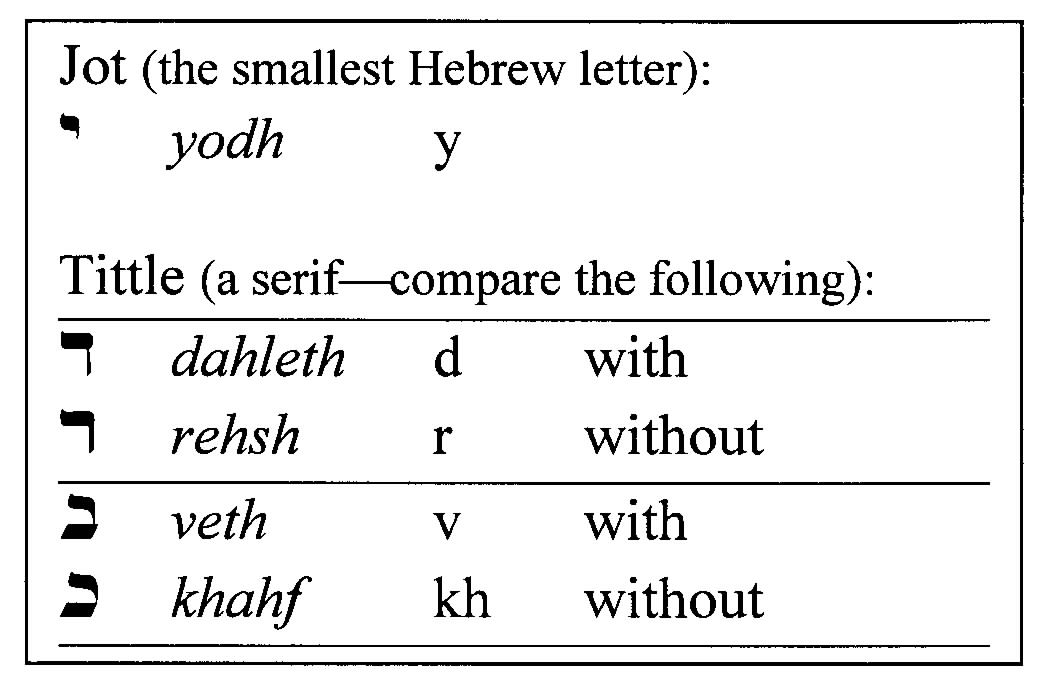
So, fully understood, verse 17 could not possibly be saying that Jesus “fulfilled the Law and the Prophets” merely by living in complete obedience to Halachah. Indeed, Jesus’ meaning is made perfectly clear by the very next verse: “[18] For truly, I say to you, until heaven and earth pass away, not an iota, not a dot [“jot and tittle” in KJV; “yodh or stroke” in the Hebrew alphabet], will pass from the Law until all is accomplished.

The “jot and tittle”, ©Ron Thompson

As I sit here and gaze out my office window, I can clearly see that heaven and earth have not yet passed away. So, is God’s “Law” of less effect today than when Jesus spoke His Sermon on the Mount?

It happens to be Thursday as I start this paragraph, but I was sitting here typing last Saturday, too. I was violating the Jewish Sabbath in a number of ways. But I’m not Jewish, and I’m not bound by Jewish law. The Mosaic Covenant was between God and Israel, not between God and the Church (sorry, Reformed friends, they’re not the same), not between God and goyische God-Fearers (I just added a stub for a future post on non-Jewish pre-Christian believers), and not between God and all humanity. Has it passed away for Israel (whether they realize it or not)? I just checked again: the sun is still shining, the wind is still blowing, and squirrels are still running up and down the oak tree.

In case verse 18a was not enough, 18b adds even more punch: not the tiniest portion of “the Law” will pass until “all is accomplished“! All of what? All that is written in “the Law and the Prophets”. Aggadah as well as Halachah. All of God’s plans as revealed in the Old Testament. Some have, some have not. Jesus’ first advent has come and gone, but there is still a lot of prophecy unfulfilled. Some of my readers don’t believe in a Millennial Reign, but most believe in a coming final judgement. That is surely yet to come. Unfulfilled! The Law. The Covenants. None of that has passed away!

Other New Testament Uses of “Fulfill”

About the same time that I was participating in this discussion of Matthew 5:17–19 on Facebook, another man was independently taking the same stance as mine on another thread about the same subject. This man’s name is Dalton Mauldin, and he is the author of a book titled Finding the Way: A Scripture-Guided Journey to Break through Tradition to Find Truth, Faith, and a Closer Walk with God.

I am reading the book, and while Dalton and I aren’t on the same page on everything, we’re close enough to be Christian friends. In order not to reinvent the wheel, I have obtained his permission to quote him here as he discusses other instances of the term “fulfill” in the New Testament. This is an excerpt from his Chapter VIII:

“Then Jesus came from Galilee to the Jordan to be baptized by John. But John tried to deter him, saying, “I need to be baptized by you, and do you come to me?” Jesus replied, “Let it be so now; it is proper for us to do this to fulfill all righteousness.” Then John consented. (NIV)”

Did Jesus mean to “put an end to all righteousness”? Of course not! In this instance, “fulfill” was a translation of the same Greek word “pleroo.” It is clear in this usage that it does not mean “to put an end to” all righteousness, but more likely to demonstrate righteousness. It should also be noted that this is the same author, Matthew, who would likely use the word fulfill in the same way two chapters later. 

In Romans 15:13, it says: “May the God of hope fill you with all joy and peace as you trust in him, so that you may overflow with hope by the power of the Holy Spirit. (NIV)”

In this instance, “fill” was translated from “pleroo” as well. It is clear in this usage that it does not mean “to put an end to”, but “to make full.”

In Colossians 1:25, Paul states: “I have become its servant by the commission God gave me to present to you the word of God in its fullness. (NIV)”

In this instance, “fullness” was translated from “pleroo” as well. It is clear in this usage that it does not mean “to put an end to” but means “in its entirety.”

In James 2:23 it says: “And the scripture was fulfilled that says, ‘Abraham believed God, and it was credited to him as righteousness,’ and he was called God’s friend. (NIV)”

In this instance, “fulfilled” was translated in the past tense of the word – you guessed it – “pleroo”. It is clear in this usage that it does not mean “to put an end to”, but to mean “brought into reality”.

In fact, there is no instance of “pleroo” translated as “to put an end to” or any similar meaning. Thus, “fulfill” cannot possibly mean anything that might resemble “put an end to.”  Having eliminated the possibility of any meaning of “pleroo” that indicates an “end”, let’s look at the others: “to complete, to make full, to verify, to accomplish, to satisfy, and to preach fully”

A warning

If there is still any doubt about the permanence of “the Law”, Jesus then adds a stern warning for those who in any way would relax their observance of Torah:

Matthew 5:19 (CJB)
[19] So whoever disobeys [λύω, loo’-o, to relax, loosen, untie, break up, destroy, dissolve, melt, put off, contravene, annul] the least of these mitzvot and teaches others to do so will be called the least in the Kingdom of Heaven. But whoever obeys them and so teaches will be called great in the Kingdom of Heaven.

What about verse 20?

Matthew 5:20 (ESV)
[20] For I tell you, unless your righteousness exceeds that of the scribes and Pharisees, you will never enter the kingdom of heaven.

The ESV, NIV, NCV, NKJV and some other translations lump Matthew 5:17–20 under one subheading, such as “Christ Came to Fulfill the Law” in ESV. Others include the Salt and Light verses, 13–16 under the same subhead.

I think that it is bad exegesis to include verse 20 with the preceding verses, because rightfully verse 20 is an introductory verse to what follows, specifically Jesus’ discourse on the spirit of the 10 Commandments.

Regarding “the righteousness of the scribes and Pharisees,” this is a Hebrew play on words. צִדְקָה (tsidqah) is a noun that means “righteousness.” Jesus is teaching that righteousness means both the letter and spirit of Torah. Many scribes and Pharisees, though, had cheapened the term by using it to indicate simply “almsgiving alone.”

“Look at how righteous I am—I faithfully donate a shekel or two to widows and orphans.”

The conditionality of the Mosaic Covenant?

In my post, A Perspective on Biblical Covenants and Dispensations, I state my opinion that, despite contrary views, none of the Covenants with Israel were conditional—that each new Covenant built onto all of the previous Covenants. The Mosaic Covenant is still operative!

Matthew 5:17, is part of the justification for the disastrously mistaken idea that God is “done with the Jews”, either forever or until the Tribulation period. Do you think that’s a minority view among Christians? Wrong! It is a prominent teaching of the Catholic and Orthodox churches which dominate most of the world, as well as Reformed Protestant denominations, including Anglican, Presbyterian (my dad’s heritage), Lutheran (my mom’s heritage), and many denominations around the globe, many of which have the word “Reformed” in their name.

But even Dispensational denominations, which refuse to permanently write off Israel’s place in God’s plans for the last days, uniformly hold that the Mosaic Covenant is dead, because it was conditional.

There are two ways one can think of covenant “conditionality”:

  • First, one can call a covenant “unconditional” if it makes promises (positive and/or negative) that one party is bound to keep no matter what the other party does or does not do, and “conditional” if the promises it makes are contingent on the actions of the other. In that sense, yes, the Mosaic Covenant is indeed conditional.
  • But that is not what most Bible teachers mean when they say the Mosaic Covenant is conditional. They mean that its validity is conditional. “If you obey, I’ll bless you, if you disobey, I’ll curse you…” [That much is true—Deuteronomy 28 says it in no uncertain terms!] “…and if you keep disobeying, I’ll take my ball and go home!”

What triggered the supposed annulment of the Mosaic Covenant?

Many Dispensationalists will say that God cancelled the Mosaic Covenant when Israel, in the person of the Pharisees harassing Jesus (no doubt at the instigation of leadership in the Great Sanhedrin) rejected Jesus as messiah and blasphemed the Holy Spirit by attributing His miracles to Satan. This rejection, they say, is recorded in Matthew 12:

Matthew 12:22–25,30–32 (ESV)
[22] Then a demon-oppressed man who was blind and mute was brought to him, and he healed him, so that the man spoke and saw. [23] And all the people were amazed, and said, “Can this be the Son of David?” [24] But when the Pharisees heard it, they said, “It is only by Beelzebul, the prince of demons, that this man casts out demons.” [25] Knowing their thoughts, he said to them, “Every kingdom divided against itself is laid waste, and no city or house divided against itself will stand.

[30] Whoever is not with me is against me, and whoever does not gather with me scatters. [31] Therefore I tell you, every sin and blasphemy will be forgiven people, but the blasphemy against the Spirit will not be forgiven. [32] And whoever speaks a word against the Son of Man will be forgiven, but whoever speaks against the Holy Spirit will not be forgiven, either in this age or in the age to come.

The Dispensational scenario suggests that Jesus, at the beginning of his ministry, was actively preaching, demonstrating His power, and proclaiming his Messiahship, with the ultimate intention to rally the Land and establish the prophesied Messianic Kingdom. Paradoxically, the same people who teach this are also prone to teach that Jesus’ first advent was specifically intended to present Him as a suffering servant, not a military leader. As a result of the Pharisees’ rejection in Matthew 12, Jesus, in verse 32, (again in this scenario) announced that the scribes and Pharisees as representatives of Israel had committed an unpardonable national sin, so the Kingdom would be indefinitely delayed. From that day on, Jesus would no longer seek to win over the current generation but rather would concentrate on training His disciples and by extension their successors to carry His message to a far future generation. As a result, His miracles were henceforth done in relative privacy, His messages were delivered in parables that could only be understood by His “insiders”, and on His death, the Mosaic Covenant was cancelled and replaced by the New Covenant. Some say that “it is finished” uttered on the cross marks the instant of replacement.

I find that scenario to be deeply flawed and insupportable.

In my Covenants and Dispensations post, I point out that Christianity is more or less divided into two camps:

  • The Covenantalists, who believe that Jewish Old Testament Israel was the original “Church”, and that the mostly gentile New Testament Church is the current and forevermore “Spiritual Israel”, and that there will be no Rapture or Millennial Reign.
  • The Dispensationalists, who believe that Israel and the Church are distinct entities, and that the Church will be Raptured followed by a Millennial Reign during which Israel will finally accept their Messiah.

Almost all Christian denominations and local churches fall into one of those two camps. You can more or less recognize them by whether they practice infant baptism (Covenant), or believer’s baptism (Dispensational). Personally, I totally reject the majority Covenantal viewpoint. I do hold to the Dispensational views as shown by the bullet above, but I reject the concept of “dispensations” and the Dispensational belief that the Mosaic Covenant is dead.

Old Testament references to the New Covenant

That the New Covenant would replace the Old is not stated anywhere in the Old Testament. Several references do indeed predict that the “New Covenant” will be better than the “Old Covenant”, i.e., the Mosaic:

  • Moses himself, in Deuteronomy 29:[4] (CJB), said, “to this day ADONAI has not given you a heart to understand, eyes to see or ears to hear!”. Though he does not mention a New Covenant, he goes on, in chapter 30, to describe times of apostacy and exile for Israel, followed by, in chapter 31, promises of restoration. Notable in this passage is,

Deuteronomy 30:5–8 (ESV) emphasis mine
[5] And the LORD your God will bring you into the land that your fathers possessed, that you may possess it. And he will make you more prosperous and numerous than your fathers. [6] And the LORD your God will circumcise your heart and the heart of your offspring, so that you will love the LORD your God with all your heart and with all your soul, that you may live. [7] And the LORD your God will put all these curses on your foes and enemies who persecuted you. [8] And you shall again obey the voice of the LORD and keep all his commandments that I command you today.

Only verse 5 here yet been fulfilled for the nation of Israel. Note that verse 6 concerning Israel’s heart is language characteristic of the New Covenant, but if the New cancels the Old, then why is it that that Israel will still “keep all His commandments that I command you today”—clearly speaking of “the Law of Moses.”

I have written a post recently dealing with Paul’s writings on this subject, in his epistle to the Romans: Yetzer, Yotzer and “The Law” in Romans 7:1–6.

  • The best known of the New Covenant prophecies is found in,

Jeremiah 31:31–34 (ESV) emphasis mine
[31] “Behold, the days are coming, declares the LORD, when I will make a new covenant with the house of Israel and the house of Judah, [32] not like the covenant that I made with their fathers on the day when I took them by the hand to bring them out of the land of Egypt, my covenant that they broke, though I was their husband, declares the LORD. [33] For this is the covenant that I will make with the house of Israel after those days, declares the LORD: I will put my law within them, and I will write it on their hearts. And I will be their God, and they shall be my people. [34] And no longer shall each one teach his neighbor and each his brother, saying, ‘Know the LORD,’ for they shall all know me, from the least of them to the greatest, declares the LORD. For I will forgive their iniquity, and I will remember their sin no more.”

But this also is a Covenant with “the house of Israel and the house of Judah” and it too, in its context (read the entire chapter!), speaks of the acharit hayamim, the “end of days.” At least as it applies to national Israel.

  • Ezekiel also repeats the prophecy, and once again the context places it firmly in the future, yet to be fulfilled.

Ezekiel 36:24–28 (ESV)
[24] I will take you from the nations and gather you from all the countries and bring you into your own land. [25] I will sprinkle clean water on you, and you shall be clean from all your uncleannesses, and from all your idols I will cleanse you. [26] And I will give you a new heart, and a new spirit I will put within you. And I will remove the heart of stone from your flesh and give you a heart of flesh. [27] And I will put my Spirit within you, and cause you to walk in my statutes [בְּחֻקַּי֙, bə·ḥuq·qay, “in my statutes”] and be careful to obey my rules [וּמִשְׁפָּטַ֥י, ū·miš·pā·ṭay, “and my ordinances/judgements”]. [28] You shall dwell in the land that I gave to your fathers, and you shall be my people, and I will be your God.

Once again, the New Covenant will ultimately renew Israel’s faithfulness to the Old Covenant, not replace it.


Easter Myths

Originally published in three parts in March 2013

  1. Myth: The resurrection occurred on Easter Sunday
  2. Myth: The crucifixion occurred on Passover, Nisan 14
  3. Myth: Jesus died at the very instant that the High Priest plunged his knife into the heart of the Passover Lamb
  4. Myth: The crucifixion actually took place on a Wednesday
  5. Myth: By dying on Passover, Jesus became our Passover Lamb
  6. Myth: As our Passover Lamb, Jesus brought salvation to the world
  7. Myth: Peter accidentally cut off Malchus’ ear while taking a wild swing with his sword in an effort to protect Jesus

If you think I’m about to say that the resurrection is a myth, forget it! The resurrection of Jesus is central to my life and theology. I’d have no reason to exist without it. This is about “other stuff.”

Myth: The resurrection occurred on Easter Sunday

This won’t come as a shock. We all know that Easter is a Christian commemoration of the event, not a celebration of the exact day of the year. But why do we do it that way? In the early centuries of Christianity, many churches in the Roman Empire began to object to celebration on the traditional date, considering it to be a “humiliating subjection to the Synagogue.” During the 2nd Century, many of those churches had begun celebrating Easter on a Sunday, regardless of the Biblical calendar. For a clue to the mindset, there’s this ancient text: “Sunday commemorates the resurrection of the lord, the victory over the Jews.” (Emphasis mine)

In AD 325, Emperor Constantine convened the Council of Nicaea to discuss two major issues in the church. One of those was “the Passover Controversy”, the disagreement between churches that commemorated the resurrection on the Jewish feast day and those that did not. Constantine’s view, of course, won out. He wrote,

It seemed to every one a most unworthy thing that we should follow the custom of the Jews in the celebration of this most holy solemnity, who, polluted wretches! Having stained their hands with a nefarious crime, are justly blinded in their minds.

It is fit, therefore, that, rejecting the practice of this people, we should perpetuate to all future ages the celebration of this rite, in a more legitimate order, which we have kept from the first day of our Lord’s passion even to the present times. Let us then have nothing in common with the most hostile rabble of the Jews. … In pursuing this course with a unanimous consent, let us withdraw ourselves, my much honored brethren, from that most odious fellowship. … [I urge you] to use every means, that the purity of your minds may not be affected by a conformity in any thing with the customs of the vilest of mankind. … As it is necessary that this fault should be so amended that we may have nothing in common with the usage of these parricides and murderers of our Lord.

The date for Jewish celebration of the Passover season Feasts is tied by Divine Ordinance to specific dates on the Hebrew calendar (see Leviticus 23). Non-Jews are released from such ordinances, so I don’t care on what day we celebrate the Resurrection. But you should be aware that the name, “Easter”, and most of the secular traditions tied to the holiday are pagan in origin, and that the Nicene Council separated it from Passover for blatantly anti-Semitic reasons.

Myth: The crucifixion occurred on Passover, Nisan 14

Well, yes and no. The crucifixion happened on Nisan 15, after the sacrifices and after the official Passover as specified in Torah. It became customary, even within the pages of the New Testament, to refer to the three spring feasts together as “Passover.” Technically, Passover is just the short period of twilight between Nisan 14 and 15, on the Jewish calendar (see Part 2 of this series). Immediately after this interval, the 7-day Feast of Unleavened Bread begins—on Nisan 15. And in the middle of this 7-day period, there is the Feast of Early Firstfruits. Jesus’ Last Supper was a Passover Seder. That meal always begins during that twilight period, true Passover, and ends around midnight on Nisan 15, when celebrants adjourn to the streets and rooftops to sing the Hallel Psalms together. The crucifixion, therefore, occurred on Nisan 15, the first day of the Feast of Unleavened Bread.

Myth: Jesus died at the very instant that the High Priest plunged his knife into the heart of the Passover Lamb

I’ve heard this one even from Ray Vander Laan, a man I consider to be an expert on Israel and its customs, in his series of videos for Focus on the Family. But it’s wrong on so many levels! First, the sacrifices occurred during the day before the Seder, on Nisan 14; the crucifixion was the next day, Nisan 15. Second, there wasn’t just one lamb; there was a lamb for approximately every ten people celebrating. Perhaps 100,000 lambs, killed over a period of hours! Which one are they talking about? Third, the High Priest killed only his own lamb, and that much earlier in the day, before the Temple gates were opened. All the other lambs had to be killed by their owners, not by a priest. Fourth, each lamb was killed by a quick slash of its throat, as specified by scripture. A knife to its heart would be considered cruelty, and in the context of the Feast, could get one stoned. Sometimes, the melodrama in the pulpit is just crazy!

©Ron Thompson, based on my own calculation, using Scripture, Jewish customs, and available scientific New Moon tables.

Myth: The crucifixion actually took place on a Wednesday

For two thousand years, most Biblical historians and scholars have held to a Friday crucifixion. More recently, though, many evangelicals have begun to teach that Jesus died on a Wednesday or Thursday. At the heart of this matter is Jesus’ statement in Matthew 12:39–40:

But he answered them, “An evil and adulterous generation seeks for a sign, but no sign will be given to it except the sign of the prophet Jonah.
For just as Jonah was three days and three nights in the belly of the great fish, so will the Son of Man be three days and three nights in the heart of the earth.
—Matthew 12:39–40 ESV

For some reason, it’s hard for some folks to see how you can find three nights between Friday and Sunday! I’m going to present the actual timeline (below, but see also the first chart, above), as I see it, and then I’ll explain several important concepts:

©Ron Thompson

As most Biblically educated people know, prophets often used the word “day” (Heb. yom) to indicate a long or indeterminate period of time, rather than a literal 24-hour solar day. The key to understanding the timing issue here lies in Hebrew idiom—figures of speech. Where there was a likelihood of confusion, ancient Hebrew writers used terms like “three days and three nights” and “the evening and the morning were the first day” to emphasize that true solar days or portions of literal days were in view, not a longer prophetic period of time.

In the Matthew 12 passage quoted above, Jesus was prophesying. Many of His listeners believed in a coming resurrection of the dead in the acharit hyamim, or end times, so it was necessary for Him to emphasize that He was speaking of something that He would personally experience, and that it would be of short duration. Paraphrased, He was saying, “In a little while, I’m outta’ here, but I’ll be back before you know it, on the third calendar day.”

In both spoken and written Hebrew, references to literal solar “days” or “days and nights” did not necessarily imply that complete 24-hour periods were meant. “Three days and three nights” meant “some part of one solar day, all of a second, and some part of a third.” On the first line of the second timeline chart above, “Day 1” was Friday. Recall that Jewish days last from evening twilight until the subsequent evening twilight (see the third chart, below). Jesus died around 3 PM and was entombed before twilight, so at most He was dead only around three hours on this day. He remained in the tomb all through the night and day of Saturday, “Day 2”. His resurrection was sometime on Sunday morning, “Day 3”, before His tomb was found open. The total period was thus composed of a little more than one full period of daylight and at most two full periods of dark. “Three days and three nights” by traditional Hebrew reckoning.

Many conservatives refuse to believe this non-literal interpretation of Jesus’ words and insist on exactly 72 hours, but the hermeneutic employed by me and many conservative, Evangelical scholars allows for a non-literal (but not random!) interpretation of various obvious (to those who understand Hebrew literary techniques) figures of speech.

Many well-meant attempts to rescue the Friday crucifixion tradition resort to various forms of Greek linguistic gymnastics, trying to prove that “in the heart of the earth” doesn’t really mean buried, but could, for example, mean the period from Jesus’ betrayal to His resurrection. I urge caution in using Greek to understand Hebrew concepts. Hebrew idiom does not always translate well into Greek.

Each Jewish day begins at nightfall and lasts until the following sundown. The twilight period between any two days technically does not belong exclusively to either day, or in another sense, it can be viewed as belonging to both days. The Seder supper always begins during this twilight period between Nisan 14 and Nisan 15 (see Lev 23:5). Note that the lambs are sacrificed on Nisan 14, before the Seder and thus before, not during, the traditional weeklong Feast of Passover.

©Ron Thompson

Every Sabbath is preceded by a Day of Preparation, when meals are prepared, candles lit, and other chores performed that are unlawful on the Sabbath itself. Many arguments against a Friday crucifixion focus on misunderstandings of John 19:31 and its parallels:

Since it was the day of Preparation, and so that the bodies would not remain on the cross on the Sabbath (for that Sabbath was a high day), the Jews asked Pilate that their legs might be broken and that they might be taken away.
—John 19:31 ESV

The argument is that Friday was the first day of the Feast of Unleavened Bread, so it could not have been the previous day of preparation. It is true that the first and last days of the Feast of Unleavened Bread are important Sabbaths. But in Jewish custom, the regular weekly Sabbath that occurs during the Passover week is the most important of all the 7th-day Sabbaths.

So, in that particular year, there was a Feast Day Sabbath on Friday and a weekly Sabbath the following day, on Saturday. Confusion arises because many non-Jewish scholars believe, incorrectly, that it was unlawful to ever cook or make other preparations on any Sabbath. In fact, Jewish law makes an exception when two successive days are Sabbaths. Preparations for each are permissible on the preceding day, whether or not it, too, is a Sabbath.

Some confusion also arises due to a failure to recognize that the “First day of unleavened bread” is one day prior to the first day of the Feast by that name.

Then came the day of Unleavened Bread, on which the Passover lamb had to be sacrificed.
So Jesus sent Peter and John, saying, “Go and prepare the Passover for us, that we may eat it.”
—Luke 22:7–8 ESV

On Nisan 14, the day of the sacrifices, all hametz (leaven) must be removed or destroyed so that none at all is present during the entire week of the Feast.

Another verse that leads to confusion about the timing is John 18:28:

Then they led Jesus from the house of Caiaphas to the governor’s headquarters. It was early morning. They themselves did not enter the governor’s headquarters, so that they would not be defiled, but could eat the Passover.
—John 18:28 ESV

To most, this seems to imply that Jesus’ trial and crucifixion came on the day before the Seder, implying that the Last Supper was something entirely different. Not so—the Last Supper was a traditional Passover Seder. Any ritual defilement caused by entering Pilate’s presence would only last until sundown, so it would have no effect on eating the Seder meal. But it isn’t talking about the Seder. Instead, this refers to the chagigah (festival sacrifice) which was eaten with much celebration and joy in the afternoon following the Seder.

You may ask how the Wednesday crucifixion proponents manage to get “three days and three nights” out of a Wednesday to Sunday entombment. Mostly, there are two schools of thought. Some actually place the resurrection on Saturday and justify this by misinterpreting the passages about the women at the tomb. Others say that while Jesus was crucified on Wednesday, he was not placed in the tomb until evening, which would be early Thursday on the Jewish calendar. In that case, a resurrection early Sunday (on our Saturday evening) would meet the requirement.

A less prevalent theory is that the crucifixion was on Thursday. I believe that there are severe problems reconciling Sabbaths, preparation days, and calendar days if this approach is taken, but I will not cover it here.

Myth: By dying on Passover, Jesus became our Passover Lamb

I touched on this above. I suspect that the vast majority of Christian theologians would say that, at the very least, it is foundational that Jesus died on the same day as the Passover lamb or lambs, because He had to be seen as the fulfillment of the prophetic purposes of the Feast. If that were the case, then I ask why His throat wasn’t slit inside the Temple precincts and His blood splashed on the altar as required by Torah? How is it permissible that He died in a completely different manner, nailed to a Roman cross way over on the other side of the Tyropoeon Valley?

Sheep grazing near Jerusalem. Source unknown.

My contention is that Jesus did not die on the same day or the same time as “the Passover Lamb”, of which there were many thousands. In fact, I think that it was theologically necessary that Jesus did not die on the same day or in the same way as the Passover lamb! Had He done so, would He not have linked Himself prophetically to that sacrifice alone, to the exclusion of all others? The truth is that Jesus was the prophetic fulfillment of all of the sacrifices! And in terms of Soteriology, Passover is less important by far than, say, Yom Kippur!

Myth: As our Passover Lamb, Jesus brought salvation to the world

In a word, no! But didn’t Yochanan the Immerser—John the Baptizer—tell his followers to “Behold the Lamb of God, who takes away the sin of the world” (John 1:29)? And what about Paul, who called Him “Christ, our Passover” (1 Cor. 5:7). Those are accurately reported sayings but mind the context! John was urging immersion as part of a ritual of repentance, connected, I’m sure, to the onset of the extended Days of Awe on that very day and extending to Yom Kippur, 40 days in the future. He was making no claim to offer salvation! Instead, he was pointing to the Messiah, often referred to in Scripture as “the Lamb of God”, or just “the Lamb.” Jesus didn’t die until some 3½ years later. And Paul was not talking about salvation at all, but rather separation of the Corinthian Church from the “leaven of sin.”

Yes, Jesus died on the cross to save us from our sins, but His sacrifice encompassed and surpassed all of the daily and seasonal sacrifices, not just the Passover lamb.

The Passover sacrifice was not even a sin offering! It was a type of fellowship offering. Sin offerings could not be consumed by the people, but they were required to eat their Passover sacrifice to symbolize their freedom from the bondage of sin and the resulting right to sup at God’s table, in fellowship with Him.

The Yom Kippur sacrifices were far more to the point of salvation, but even sin offerings only deal with incidental sin—not deliberate, malicious, God-defying sin. There was only one hope for that. Not a specific blood sacrifice, but simply the Grace of God, as symbolized at Yom Kippur by the Scapegoat, which wasn’t even killed! (Well, it was, but not as part of the ceremony; it was driven over a cliff in the wilderness so that it couldn’t come wandering back to town with the sins of the people.)

It was, then, as a goat—the Scapegoat—that “the Lamb of God” took away the sin of the world!

Myth: Peter accidentally cut off Malchus’ ear while taking a wild swing with his sword in an effort to protect Jesus

(Note: I have expanded on this subject in a separate post, Malchus’ Ear.)

The following quote from the Complete Jewish Bible, my personal favorite translation, sets the stage:

Then Shim‘on Kefa [Simon Peter], who had a sword, drew it and struck the slave of the cohen hagadol [high priest], cutting off his right ear; the slave’s name was Melekh [Malchus].
—John 18:10 CJB

Short sword similar to what Peter would have used to maim Malchus.

First, it is unlikely that Peter was carrying a military sword that night after the Seder. Neither he, nor Malchus, was a soldier. Peter was a fisherman by trade and would be accustomed to carrying a knife for tending nets and lines, and for gutting fish. The Greek term here is machaira, which was probably a double-edged knife or dirk, a shorter version of a sword design that had been introduced into Israel by the Phoenician Sea Peoples. Nor do I think Peter was a trained fighter. We know he was impetuous, but was he an idiot? Did he think he could mow down a band of trained Roman soldiers and Temple guards? Was he distraught and attempting to commit “suicide by Roman soldier”? I think that if he had attempted a frontal assault in Jesus’ protection, he would have been reflexively cut to pieces before he drew a drop of blood, and quite likely the slaughter would have extended to the other apostles present, as well.

What I think really happened was that Peter took advantage of the soldiers’ preoccupation with Jesus, slipped around behind Malchus—his intended target—and deliberately sliced off his ear. Why Malchus? Because Malchus was the High Priest’s servant and right-hand man. The High Priest was probably not present, and Malchus was presiding. At any rate, harming the High Priest, had he been there, would have resulted in quick execution. By taking Malchus out, Peter would be insulting and effectively crippling the High Priest and, to some extent, the Sanhedrin. But then, why an ear, of all things? Because Peter wasn’t a killer, and taking an ear did the job! Priests, Levites and all other Temple officials were required to be more or less physically perfect. With a missing ear, he would be considered deformed and unfit for Temple service.

Yes, Peter was impulsive. But he was also smart.

For a complete series on the Principle Jewish Feasts, as specified in Leviticus 23, please see The Jewish Feasts–The Back of My Mind.


Natural Law and Biblical Ethics

This post is inspired by a recent, very brief, Sunday School discussion of Joseph’s Godly response to Potiphar’s wife, long before Mt. Sinai and “The Law.” The sense that I took from some of the comments was, “Joseph was a very special man to even know that adultery was sinful, since ‘The Law’ had not yet been given to Moses.”

“Joseph Receives His Father and Brothers”, by Jan de Bray, 1627–1697. Bray specialized in painting historical figures dressed as contemporary figures; hence, the Dutch Renaissance attire.

I wholeheartedly agree that Joseph was special, but not for that reason. I would submit that all human beings have an innate understanding of sin. Potiphar’s wife knew that adultery is sinful but tried to force it on Joseph anyway. The fact that she was able to frame him for the crime of attempted rape shows that she, her husband, and other Egyptians in the story all had moral compunctions about it.

“The Law” as teacher

I suspect that confusion about this issue goes back to the King James translation of Galatians 3:24, which most of us seniors raised in church are probably familiar with:

[23] But before faith came, we were kept under the law, shut up unto the faith which should afterwards be revealed.
[24] Wherefore the law was our schoolmaster to bring us unto Christ, that we might be justified by faith.
[25] But after that faith is come, we are no longer under a schoolmaster.
—Galatians 3:22–25 (KJV) emphasis mine

We were traditionally taught that, as a “schoolmaster“, the job of “The Law” was no more than to teach Israel what God required of faithful servants. Under the “Old Covenant”, those teachings were rigorously applied by God and the Jewish authorities, and in fact, according to old-school Dispensationalism, salvation came to those, both Jew and Gentile, who either “kept ‘The Law'” or who made atonement for their failures by making an appropriate blood sacrifice.

[Boy… my intention going into this was to keep it brief, but my brain keeps running down all kinds of rabbit trails. There are many directions I could take that last paragraph, but I’m going to back down and stick to “schoolmaster.” Anyhow, see A Perspective on Biblical Covenants and Dispensations, where I’ve already covered part of it]

The term that KJV translates as “schoolmaster“, and NAS as “tutor” is the Greek paidagogos (παιδαγωγός), which literally means “boy-leader”. Historically, in ancient Greece, it referred to a slave whose job it was to conduct children to and from school in safety. In other words, a “guardian” (ESV) or “custodian” (CJB), with no teaching function whatsoever.

If you look up paidagogos (G3807) in Strong’s, you’ll see that it does in fact mention “tutor”, “instructor” and “schoolmaster”, but Strong’s doesn’t determine how a word should be translated—it reflects the way its compilers have seen it translated. In this case it is legitimating an erroneous KJV translation. For that reason, I am reticent to use Strong’s on its own, without reference to other, better, resources. See, for instance, from Vine’s:

“Thus understood, paidagogos is appropriately used with ‘kept in ward’ and ‘shut up,’ whereas to understand it as equivalent to ‘teacher’ introduces an idea entirely foreign to the passage, and throws the Apostle’s argument into confusion.”
—Vine’s Complete Expository Dictionary of Old and New Testament Words

A better translation of the passage quoted above is therefore,

[23] Now before faith came, we were held captive under the law, imprisoned until the coming faith would be revealed. [24] So then, the law was our guardian until Christ came, in order that we might be justified by faith. [25] But now that faith has come, we are no longer under a guardian,
—Galatians 3:23–25 (ESV)

Or the much wordier paraphrase,

[23] Now before the time for this trusting faithfulness came, we were imprisoned in subjection to the system which results from perverting the Torah into legalism, kept under guard until this yet-to-come trusting faithfulness would be revealed. [24] Accordingly, the Torah functioned as a custodian until the Messiah came, so that we might be declared righteous on the ground of trusting and being faithful. [25] But now that the time for this trusting faithfulness has come, we are no longer under a custodian.
—Galatians 3:23–25 (CJB)

Three kinds of “Law”?

You may have noted that I put “The Law” in quotes every time I mentioned it above. That is because the term itself is faulty. The Hebrew term “Torah” means “teaching”, not “law”. The Torah does contain many legal precepts (613 by Jewish counting), but that is only part of the whole. The translators of the Hebrew scriptures into the Greek Septuagint (LXX), lacking a better term, rendered Torah as nomos, which correctly translates to “that which is assigned, or distributed”, as, for example, troop rations or animal feed. That’s not a bad way to look at “teaching” (parceling out knowledge), but since the Jews were becoming increasingly legalistic in their worship, it came to take on the meaning, “law.”

Jesus refused to “abolish the [Mosaic] Law”:

[17] “Don’t think that I have come to abolish the Torah or the Prophets. I have come not to abolish but to complete. [18] Yes indeed! I tell you that until heaven and earth pass away, not so much as a yud* or a stroke will pass from the Torah—not until everything that must happen has happened. [19] So whoever disobeys the least of these mitzvot and teaches others to do so will be called the least in the Kingdom of Heaven. But whoever obeys them and so teaches will be called great in the Kingdom of Heaven.
—Matthew 5:17–19 (CJB)

Christian theologians have attempted to compromise by downgrading parts of Torah while keeping the parts that they can’t bring themselves to discard. I have written about this before:

[There is] a theory I have come across many times since I was a young man—that “Jewish Law” is composed of three categories of commandments: “Moral Law“, “Civil Law“, and “Ceremonial Law“. There are hints of this in Augustine of Hippo, but I think the idea was fleshed out mostly by Thomas Aquinas, so it became a Roman Catholic and Orthodox view. It was later bequeathed to Protestant Reformed theology by John Calvin in his Institutes of the Christian Religion; and many subsequent non-Reformed Protestant denominations and individual pastors have adopted the idea as well. The impetus for these teachings was probably an effort to justify claims that Christians are not bound by Civil and ceremonial Law, while at the same time holding that the Moral Law is somehow “still in effect”.
—Ron Thompson, The Transfiguration and “Jewish Law

As I mentioned in the above-referenced post, this 3-fold division of Torah is entirely fictitious! I suspect that some would attempt to justify the idea by guessing at the meanings of three technical terms used to categorize the legal precepts in verses such as Deuteronomy 6:1,

Now these are the commandments, the statutes, and the judgments, which the LORD your God commanded to teach you, that ye might do them in the land whither ye go to possess it:
Deuteronomy 6:1 (KJV)

Correctly understood, those terms mean enacted laws, regulations, and court rulings, as shown below,

“Now this is the mitzvah [commandment; law; ordnance; or precept], the choqim [statutes; enactments; or decrees] and mishpatim [rulings; judgements; sentences; or findings] which ADONAI your God ordered me to teach you for you to obey in the land you are crossing over to possess…
Deuteronomy 6:1 (CJB, modified by me)

Why we don’t need “moral law” either now

If you think Joseph was anticipating the Mosaic “Law” when he rebuffed Potiphar’s wife, then what was the source of his ethics? I don’t discount that it could have been prophetic forethought, but then why did the Egyptians have the same qualms over adultery? Put another way, what was the source of pagan ethics, and what is the source of atheistic ethics in our own day? Sure, pagan religion was corrupt because the gods were corrupt (see Gods and Demons), but evidently, even in pagan cultures, sleeping with a temple prostitute was not at all the same as sleeping with a neighbor’s spouse. The former was expected, the latter soundly condemned and likely to get you killed.

The answer is that human beings are endowed by God with an innate, though frequently ignored, sense of right and wrong. Those who study it call it “natural law.” We know implicitly, without having to be told, that adultery, murder, theft and such things as those, are wrong.

So, what is the source of that natural law? It is genetic, certainly, so maybe it was part of our original creation as a species. In my own opinion, it was probably the essence of what happened after Adam and Eve ate from that tree.

“Jacob Blessing the Children of Joseph”, by Rembrandt van Rijn, 1606–1669. More strange clothing.

Pharisees

Posted on:

Modified on:

  1. Pharisee History
  2. Sect, or Order?
  3. Torah
    1. Torah Shebichtav, the Written Torah
    2. Torah Sheba’al Peh, the Oral Torah
  4. The Sanhedrin
  5. Pharisees as Sanhedrin Agents
  6. Core Beliefs of the Pharisees
  7. Jesus’ Debates with Pharisees
  8. How did the Pharisees See Themselves?
  9. My Conclusions

Christianity has traditionally viewed the Pharisees as a uniformly treacherous and hateful group of hypocrites.

There is a marked tendency among some to despise Judaism as a whole for producing such a “reprobate” sect. An Internet search for “Pharisees” turns up almost exclusively sites that range from mildly to bitterly critical. The Merriam-Webster dictionary defines “pharisaical” as an adjective meaning, “marked by hypocritical censorious self-righteousness.” Their Collegiate Thesaurus lists the synonyms, “hypocritical, canting, Pecksniffian [look it up], pharisaic, sanctimonious, [and] self-righteous.” But do they deserve the bad rep?

Personally, I don’t think so!

Pharisee History

According to Josephus, there were only about 6,000 Pharisees during the reign of Herod the Great, and that is unlikely to have changed much during Jesus’ lifetime.

The name “Pharisee” comes from the Hebrew Parush (pl. P’rushim), meaning “separated.” This term refers to their opposition to “the mingling”, that is, the mixing of Greek ideas into Biblical Judaism (which, incidentally, has also been the scourge of Christianity). It is believed by many scholars that the Pharisees were spiritual descendants of the Chasidim (“pious ones”), a devout group of scribes dedicated to the preservation of the written and oral Torah during and after the Babylonian Captivity.

Dura-Europos Synagogue – Dura-Europos, Syria – AD circa 101-300. One of the oldest intact (but inactive) synagogues in the world. Note that the representational art does not break the 2nd Commandment, which is specifically a prohibition against making idols to house the foreign gods prohibited by the 1st Commandment. The structure at the center of the wall is the Holy Ark, the closet for housing the synagogue’s Torah scrolls. The Ark is always on the west wall, opposite the door to the chamber and facing east. Photo from BreakingMatzo.com.

The first clear historical references to the Pharisees occurred in the Intertestamental period (between the Old and New Testament writings), during the reign of John Hyrcanus (134–104 BC). By then, they had formed into an elite religious society, or order, with limited membership and strict rules of conduct. They had gained wide popular support due to their opposition to Hellenism (Greek culture), the rise of the corrupt Sadducees, and the illegal high priesthood of the Hasmonean monarchs. Despite their popularity in the synagogues, their political influence was very limited at first.

Accused of fostering revolt, as many as 800 Pharisees were crucified by Alexander Jannaeus (108–76 BC). During the reign of Queen Alexandra Salome (76–67 BC), whose brother was a Pharisee, they finally gained considerable power. Unlike the Sadducees, they never welcomed Roman rule, but they were able to maintain some influence, only because they were willing to cooperate in order to maintain peace and stability.

During the Roman period, spanning the life of Herod the Great and the 1st Century AD up to the destruction of the Temple in AD 70, the Pharisees were highly influential with the populace as a whole, though it was the Sadducees who controlled the Temple and its ritual.

After the destruction of Jerusalem and the Temple in AD 70, most Jewish sectarian orders disappeared, but many of the Pharisees were allowed to relocate to Jamnia (Yavneh), on the coast west of Jerusalem, where they formed the nucleus of the great Rabbinic movement of the following centuries.

Sect, or Order?

It is common to call the Pharisees a sect, but that term is misleading.

By definition, a sect is an offshoot of a larger religion, or a group sharing distinctive political and/or religious beliefs.

I would term the Pharisees, Sadducees, Essenes, and others as orders. An order is a formal group set apart within their religion by adherence to a particular rule or set of principles. The scribes, on the other hand, were not a religious order. As professionals, they probably belonged to a guild.

1st Century Judaism, as today, was highly sectarian. A majority of the Jewish population of Judea and Galilee probably would have said that they were followers of the Pharisees, that is, adherents of the Pharisee belief system, but to actually be a Pharisee—a member of the Order—required a difficult period of training, and then a formal ordination.

Torah Scroll, Wikimedia Commons
Torah

The Hebrew term Torah rightly translated means, not “law”, but “teachings.” The teachings of Torah do include legal precepts, of course, but those precepts are more about the nature and will of God than about legislation. Even to a Pharisee!

The Pharisees, like Rabbinic Judaism for the last 2,000 years, believed that Torah has two parts: written and oral.

Torah Shebichtav, the Written Torah

The written Torah itself is embodied in books or scrolls. The term primarily applies to the five Books of Moses. These writings individually or collectively are sometimes referred to by Jews as the Chumash (“one fifth”). I personally avoid the Greek term, “Pentateuch.”

To the Sadducees, only the five Books of Moses were Scripture. The Pharisees regarded as holy the entire Tanakh (the OT), consisting of Torah, Nevi’im (the Prophets) and Ketuvim (Writings, sometimes referred to by Jesus simply as the Psalms).

[44] Yeshua said to them, “This is what I meant when I was still with you and told you that everything written about me in the Torah of Moshe, the Prophets and the Psalms had to be fulfilled.” [45] Then he opened their minds, so that they could understand the Tanakh
—Luke 24:44–45 (CJB)

Torah Sheba’al Peh, the Oral Torah

The “Written Torah” was transcribed by Moses “from the mouth of the Almighty” and is contained within the Torah scroll. The “Oral Torah” incorporates the traditions handed down from Sinai but not (initially) put in writing, as well as the interpretations and rulings formulated by the sages of each generation.
—TheRebbe.org

The Pharisees taught that Moses received additional teachings on Mt. Sinai that he was not told to write down. Originally this “Oral Torah” was transmitted from father to son and from teacher to disciple. It consisted of additional instructions and rulings to clarify and quantify the written Torah; principles for exegesis of Torah; and authorization for the rabbis to protect the word of the Torah through making Gezayrot, or edicts, as conditions warrant.

Aside from famously criticizing “traditions of the Elders” that contradicted the letter or the spirit of the Written Torah, Jesus never spoke against the Oral Torah as a whole, and in fact He and His disciples were meticulous about obeying the precepts of both Written and Oral Torah. The formal right of the Scribes and Pharisees to administer Torah through interpretations and edicts (see above) was known as “binding and loosing” (prohibiting and permitting) and was believed to have the blessing of God and His Divine Council in heaven. Shortly before his crucifixion, Jesus endorsed this practice when He extended it to His apostles:

[18] Truly, I say to you, whatever you bind on earth shall be bound in heaven, and whatever you loose on earth shall be loosed in heaven.
—Matthew 18:18 (ESV)

Approximately 1800 years ago, Rabbi Judah the Prince concluded that because of all the “travails of Exile”, the Oral Torah would be forgotten if it was not recorded on paper. He therefore assembled the scholars of his generation and compiled the Mishnah, a written collection of all the oral teachings.

The Sanhedrin

The Biblical basis for the Sanhedrin was:

[18] “You are to appoint judges and officers for all your gates [in the cities ADONAI your God is giving you, tribe by tribe; and they are to judge the people with righteous judgment. [19] You are not to distort justice or show favoritism, and you are not to accept a bribe, for a gift blinds the eyes of the wise and twists the words of even the upright. [20] Justice, only justice, you must pursue; so that you will live and inherit the land ADONAI your God is giving you.
—Deuteronomy 16:18–20 (CJB)

Each major city was ruled by its own political and judicial “Lesser Sanhedrin” of 23 members. Under the monarchy, a “Greater Sanhedrin” was established at Jerusalem to serve as high court of justice and supreme governmental council.

This council at Jerusalem consisted of 71 members, of which the presiding member was the nasi (“prince”, or president), often the High Priest. Membership was appointed, with theological scholarship nominally the basic requirement—but in Roman times, politics effected all major appointments.

During Jesus’ Day, The Sanhedrin met in the “Chamber of Hewn Stone. Later they began meeting in the Royal Portico, which spanned the South side of the Temple Mount above and behind the Double and Triple Gates. Diagram ©Leen Ritmeyer, red box added by me.

According to the synoptic Gospels, Sanhedrin membership consisted of “chief priests, elders, and scribes.” Although there was overlap between those three groups, the chief priests were high ranking Temple priests, mainly members of the Sadducee order; the elders were most likely prestigious Pharisees; and the scribes were respected professionals who might have belonged to any particular order, or to none at all. The Gospel of John mentions only Pharisees and scribes from the Sanhedrin, but when John wrote, probably around AD 80, the Sadducees, the Sanhedrin and the Temple were long gone and a distant memory to his readers.

Pharisees as Sanhedrin Agents

The Pharisees in Jesus’ day were scattered throughout Judea and Galilee, with concentrations in the cities. Many were attached to specific synagogues, while others adopted the life of itinerant teachers, doing much the same things as Jesus. Many of these, perhaps a large majority, were no doubt still Godly men like the first Pharisees, out of the spotlight and unconcerned with politics and wealth. Certainly, when Jesus crossed paths with these men, there were discussions and perhaps even confrontations. I have witnessed brash conversations between Jewish intellectuals in my own day, and I don’t think that it would have been any different then than now.

But what about the Pharisees and scribes that followed Jesus around from town to town? The late David Stern, translator of the Complete Jewish Bible, wrote frequently in his own books and commentaries that these men were probably on assignment from the Sanhedrin. One of the duties of that body was to investigate not only claims of heresy, but also claims of messiahship. Since priests and Levites on the council were mostly Sadducees, who did not believe in a coming messiah, this duty would naturally fall to Pharisees and their scribes. Some would have been belligerent, others merely inquisitive.

Some members of the Sanhedrin were Godly men (e.g., Nicodemus and Gamaliel), but many others were corrupt—collaborators, greedy for wealth and power, and jealous of their position. I believe that the “committee” following Jesus probably consisted of both types. Perhaps it was the same handful of men that we see Jesus arguing with over and over again. Can it be that whenever Jesus blasted the Pharisees, it was “those Pharisees from the Sanhedrin” that He was speaking of—not all Pharisees in General?

Core Beliefs of the Pharisees

Despite the impressions one often receives in reading of Jesus’ frequent confrontations with the Pharisees, He seldom disputed with them on points of doctrine. The Pharisees revered God’s Holy Word and were strongly committed to daily application and observance of its precepts.

They believed in resurrection, immortality, divine judgment, angels, and spirits. They looked for a coming messiah and took responsibility for evaluating claimants. They believed in God’s intervention in human affairs. Many things, they believed, are predestined; human will has only limited freedom within the sovereign will of God.

In Mt 23:1-3 (see below), Jesus is telling the followers of the Pharisees, in effect, “Do what they say, but not what they do.” The reference to “Moses’ seat” speaks literally of the customary seats in the synagogues that were occupied by the teacher during formal Torah studies, but I think it also implies an acknowledgement by Jesus of their historical authority to teach the truths of Torah.

Remains of the Moses Seat in an ancient Persian synagogue.
Jesus’ Debates with Pharisees

I am sure that you have heard it said that Jesus “turned the ancient world upside down with His new commandments and interpretations of scripture.” Certainly, He provided many new insights in the area of prophetic interpretation and fulfillment, but in my opinion He actually presented little or nothing new in the way of doctrine, because the doctrine He taught was already imbedded in the Tanach; rather, He set the record straight on issues that had been clouded by denominationalism, and He turned the clock back on corrupt, or at best legalistic trends that had developed within Jewish society.

Though the great sages of the Pharisees were in substantial agreement with each other on most doctrinal issues, they did, however, often disagree on certain points of interpretation or application. When we see Jesus arguing with a Pharisee, what He is doing most often is simply taking sides in these disagreements. For example, the issues discussed in the so-called “antitheses” of Mt 5:21–48 had been the subject of hot debate among the sages, particularly the rival houses, Beit Hillel and Beit Shammai. Jesus was not presenting new doctrine, but rather pronouncing on these issues from the perspective of His divine authority.

If one can believe the Jewish literature of the Rabbinic age (and I think that most of it is trustworthy), almost everything that Jesus said had been previously said in some form by earlier Jewish sages. Some Christian scholars would claim that the rabbis plagiarized Jesus’ remarks, falsely attributing them to their own heroes. Of course, “critical scholarship” would say it was Jesus who plagiarized. My take is this: God’s truths are timeless and unchanging. God always has a remnant on the scene to expound that truth.

Because of God’s love and grace, He always “prepares the ground” ahead of the sower. Jesus did not arrive on the scene with a Gospel that was radically new and unacceptable to his Father’s chosen people. His path had been prepared in advance by the Pharisees, though ultimately most rejected Him.

As an engineer, I was taught that a good technical paper should have three parts: (a) tell ‘em what you’re going to tell ‘em; (b) tell it to ‘em; and (c) tell ‘em what you told ‘em. In this case, the Pharisees did (a), Jesus did (b) and the New Testament writers did (c).

How did the Pharisees See Themselves?

The Rabbinical descendants of the Pharisees tackled this question in both versions (Babylonian and Jerusalem) of the Talmud. Both list the following Seven Kinds of a Pharisee, in very similar terms:

  1. The “shoulder” Pharisee, who wears his good deeds on his shoulders and obeys the precept of the Law, not from principle, but from expediency.
  2. The “wait-a-little” Pharisee, who begs for time in order to perform a meritorious action.
  3. The “bleeding” Pharisee, who in his eagerness to avoid looking on a woman shuts his eyes and so bruises himself to bleeding by stumbling against a wall.
  4. The “painted” Pharisee, who advertises his holiness lest anyone should touch him so that he should be defiled.
  5. The “reckoning” Pharisee, who is always saying “What duty must I do to balance any unpalatable duty which I have neglected?”
  6. The “fearing” Pharisee, whose relation to God is one merely of trembling awe.
  7. The Pharisee from “love.”
    International Standard Bible Encyclopedia

Certainly, one can find examples of each type of Pharisee in scripture. Note that only the “Pharisee from love” was considered by the later Rabbis to be a truly Godly man.

My Conclusions

Unfortunately, by Jesus’ day, many (but certainly not all, and probably not a majority) of the Pharisees and scribes had in fact succumbed to a legalistic form of worship. Where before they had kept Torah out of a deep zeal to obey God’s commands, now many began to define their spirituality not by their love but by a prideful tally of their good deeds.

[23:1] Then Jesus said to the crowds and to his disciples, [2] “The scribes and the Pharisees sit on Moses’ seat, [3] so do and observe whatever they tell you, but not the works they do. For they preach, but do not practice.
—Matthew 23:1–3 (ESV) emphasis mine

What I am suggesting here is that you reconsider your attitude towards the Pharisees—to see them not as an evil cult that brought on the ruination of the Jewish people, but rather as a powerful spiritual force that bridged the gap between Ezra, Nehemiah and the latter prophets, and the arrival of Messiah.


The Roots of Christian Prayer

Posted on:

Modified on:


  1. Early Synagogues
  2. From Synagogue to Church
    1. Let me emphasize, for a third time:
  3. Prayer in Synagogue and Church
    1. Informal Prayer
    2. Formal Prayer
    3. Corporate Prayer
    4. Kavanah
    5. The Disciples’ Prayer
    6. Grace After Meals
    7. Blessings
    8. Daily Prayers
    9. The Sh’ma
    10. The Amidah
    11. Conclusion

New Covenant Believers, whether Christian or Jew, have access to God through the indwelling Holy Spirit. The common Christian belief that Old Testament Jews had no personal access to God aside from the Cohanim, or Priesthood, is a misunderstanding, if not a slander on both God and His People. God considers Israel to be His wife—does a wife have no way to approach her husband?

While it is true that the OT emphasis was on God’s relationship with corporate Israel, it was never the case that individual Jews were without access to God by means of prayer, sacrifice and Temple worship. Many instances are recorded in Scripture of Jews offering personal prayer directly to God. Think of Hannah, for example, praying daily for a son and in her old age finally being blessed with Samuel. David was King, but had no priestly privileges, yet he was evidently the most prolific prayer warrior of ancient Israel. Solomon, David’s son, offered an elegant prayer in dedication of the new Temple that he built. Daniel, Hananiah, Mishael, and Azariah were all from the tribe of Judah, and God honored their individual prayers in Babylon and Persia. Every Jewish family was required to send a family representative to the Jerusalem Temple on 14 Nisan every year to personally, by his own hand, sacrifice a lamb or kid at the foot of the altar. Jews of any tribe, including women, could enter the inner Court of Israel to bring a sacrifice to the altar when they felt the need. Biblical Ezra himself was instrumental in bringing synagogues, houses of prayer for common folks, to Jerusalem.

It is also not uncommon to hear devout Christian criticism of “Jewish prayer“, usually because it is viewed as “ritualistic” and thus, “Surely it can’t be heartfelt.” I beg to differ. This article is an introduction to Jewish and early Christian prayer life.

Early Synagogues

After successive Babylonian conquests of Judah, most of the Jews who were subsequently resettled in Babylonia were allowed to establish enclaves and worship as they saw fit. Daniel describes life in captivity only as it pertained to a select few from Jewish nobility who were housed in the royal palace and trained to serve in the King’s administration.

Since the Bible is mostly silent about the rest of the captives, Christian tradition tends to forget about all but Daniel, Hananiah, Mishael and Azariah. Many scholars believe that Godly Jewish exiles began congregating in homes, and in all probability that custom morphed into a synagogue system in captivity.

The later development of synagogues within Israel is probably related to Ezra and the events and edicts recorded in Nehemiah 8 – 12. Whatever their true origins, synagogues were eventually built throughout Israel and the Diaspora as a supplement to the rebuilt Temple in Jerusalem.

By around 150 BC, Judaism had splintered into numerous sects. Politically, the Pharisees held a large minority of seats on the Sanhedrin, but otherwise they had little influence within the Temple and its ritual. They were, however, the most popular sect with the common people. They controlled most of the synagogues, and therefore most of Jewish adult education.

Like Christian denominations today, the Pharisees were not monolithic in all their views or practice, yet they were all fundamentally alike in their reverence for the Tanakh (that is, the Torah, the Prophets and the Writings, which together comprise the Old Testament). I will have more to say about Pharisees in a future post (I did—see here), but for now, my stress is on the fact that the synagogues of Jesus’ day and beyond were tied to the teachings of the Pharisees, as is Orthodox Judaism today.

Jesus undoubtedly grew up worshiping in His local synagogue and learning not only from His father, but from sages of the Scribes and Pharisees. Apart from the facts of His own deity, the worldview that He taught after His baptism by John was in all important respects, the worldview of the Pharisees and the Synagogues.

Jesus’ ministry was to “the House of Israel.” He and His followers worshipped in the same ways as other Jews. After His resurrection and ascension, His followers were still Jewish and still met in the synagogues along with their “non-Messianic” Jewish brothers. At the close of Sabbath services, at sundown (in other words, after Saturday turned into Sunday!), the Messianic believers left the synagogues and adjourned to nearby homes to celebrate the Messiah. I agree with Messianic scholar Arthur Fruchtenbaum (Israelology: The Missing Link in Systematic Theology) that this practice is the likely true reason for Christian Sunday worship. The sharing of services in the synagogues continued until the “followers of the Nazarene” were gradually expelled.

Historians generally credit shared Jewish tradition as the single factor that enabled Judaism to persist as a recognizable ethnic culture through conquest, scattering, and thousands of years of persecution and genocide. Jewish prayer is the backbone of that tradition, and it is almost unchanged in Orthodox Judaism today from what it was in the synagogues of Jesus’ day and earlier.

From Synagogue to Church

Jesus and his apostles, including Paul, not only worshipped in the synagogues, but they frequently taught in the synagogues. As mentioned above, the early Christians worshipped as Jews alongside their Jewish friends and families at the synagogue, on Shabbat, then after sundown they adjourned to Christian homes to worship as followers of the Messiah.

Where did they go in the years after they were expelled from the synagogues? They started their own Messianic synagogues! The early “local churches” were patterned, both physically and organizationally, on the Jewish synagogues of the day. Having no Christian Bible, they worshipped from the same Jewish Bible that their Rabbi, Yeshua (Jesus), had taught from. Apart from recognizing the deity of their Rabbi, and meeting on Sunday in order to avoid profanation of the Sabbath, the ritual of their congregational meetings would not have differed substantially from what they had always practiced.

Modern Christians for the most part, lay or otherwise, know almost nothing about prayer or worship customs in general in the 1st Century AD, in the synagogues of either the non-Messianic or the Messianic congregations.

Let me emphasize, for a third time:

The early Church was 100% Jewish and grew out of the synagogues of Judaism, worshiped the Jewish Messiah, and was ultimately taught by a devout and unapologetic Jewish Pharisee named Sha’ul (names like “Paul” and “Peter” were Greek names for Jewish men who often ministered to the Greek-speaking world). The local churches certainly followed the customs and rituals of Judaism, including its prayer structure.

Until, that is, the Church itself cast off its charter members and their customs! When the non-Jews began to outnumber the Jews, arrogance on both sides caused a rift that still exits.

Prayer in Synagogue and Church

Prayer in the synagogues was mostly ritualized and recited from memory. Jewish believers in the first churches would have certainly continued to pray the same prayers that they had prayed all their lives, plus some new ones, specific to Worship of their newly revealed Messiah.

A Jewish prayer book, or Siddur. Published by ArtScroll® Me’sorah Publications, Ltd. Photo ©Ron Thompson. Because Hebrew is written right to left and back to front, this book has the front cover to the left of the spine, even though it contains both English and Hebrew text.
Informal Prayer

Like faithful modern Christians, faithful Jews also pray often, individually and spontaneously, “from my lips to God’s ears.” That’s not to say without ritual. Sometimes that means wearing a tallit, or prayer shawl, draped over the head like a hood. Sometimes wearing tefilah, ritual boxes on the forehead and the back of one hand. Sometimes shuckling, or rocking forward and backward (there are several reasons for this custom, but think of the flame of a candle). Usually facing towards Jerusalem and the Temple Mount. And always while davening, i.e., moving the lips.

Formal Prayer

Jews from the time of Moses until late in the 2nd Century AD carefully memorized and verbally passed down all aspects of Jewish custom, including worship practices. This was an obligation of every family and school, and though not all were faithful, many did participate. Because so many were memorizing the same things in parallel settings and “comparing notes” with each other, there was little chance for error to creep into the memorized material over all the generations.

When the oral process began to fail after the Roman dispersion, Jewish scholars began a written compilation, the Mishnah, and later the two compilations (Babylonian and Jerusalem) of the Talmud, plus countless additional Rabbinic writings. Because of these meticulous records, we can be very explicit about how the early Jews prayed and how those prayers have changed over the millennia.

Because of the meticulous record-keeping within Judaism, I am confident that Jews today pray much as they did in Jesus’ day, and because early Messianic Judaism was still Judaism and still associated with the synagogue, I am confident that their prayer was much the same.

In the remainder of this post, I’ll be addressing categories of formal prayer that I believe were practiced by 1st Century Jews and Christians.

Memorization of spoken ritual was required of non-messianic and messianic Jews in the 1st Century. While some modern Orthodox Jews still memorize vast amounts of information, most now rely on prayer books, or Siddurim (sing. Siddur). Pictured above is an English/Hebrew Siddur prepared for use in English-speaking synagogues. Most Orthodox Jews learn Hebrew, “the holy tongue”, but not all people who attend will understand that language, so Siddurim are often bilingual, with the vernacular either in parallel columns or interlinear.

Corporate Prayer

In today’s Church, corporate prayer usually means one person praying out loud while everyone else in attendance either listens and silently “agrees”—or thinks about other things. Honestly, I’ve never had the focus to follow along very effectively, and I’m too self-conscious to lead. I suppose that’s bad on me, but I’ve adjusted to the reality.

Am I alone? Maybe, but I fear being the hypocrite in:

[5] “When you pray, don’t be like the hypocrites, who love to pray standing in the synagogues and on street corners, so that people can see them. Yes! I tell you, they have their reward already! [6] But you, when you pray, go into your room, close the door, and pray to your Father in secret. Your Father, who sees what is done in secret, will reward you.
—Matthew 6:5–6 (CJB)

All Jews and all synagogues are not alike, but my own experience with the Orthodox is that they don’t like to be “prayed over” in public or even one-on-one prayer. Prayer in the synagogues is focused on praising Hashem (“the Name”, God) and trusting Him to know their needs. To that end, a Rabbi, reader or “cantor” reads from the Siddur and the rest of the congregation lip-syncs or else quietly (moving lips and whispering) reads a responsive portion.

Kavanah

Yes, Jewish religious life is ritualized, but you have only to read the Tanakh (Old Testament) to see that God Himself commanded a great deal of ritual. People being what they are, nobody (including Jews) would deny that for many the recitations become mechanical and devoid of meaning; but this itself is a violation of Jewish law. Before any ritual, a faithful Jew must stop whatever he is doing and center his concentration and desire on God in “awe, fear, trembling and quaking.” The words he recites must represent to him Kavanah, or the “true desire of his heart.”

The Disciples’ Prayer

Was Jesus opposed to ritual prayer? Consider:

[7] “And when you pray, don’t babble on and on like the pagans, who think God will hear them better if they talk a lot. [8] Don’t be like them, because your Father knows what you need before you ask him.
—Matthew 6:7–8 (CJB)

The classic example of this is Elijah’s contest with the priests of Ba’al, who babbled to their god for hours, to no effect (1 Kings 18:26). Jesus’ exhortation to avoid “meaningless repetition” in prayer is certainly not referring to formalized (ritual, if you will) prayer. With His very next breath, He did as many of His contemporary rabbis did: He instituted a ritual prayer specifically for His own followers:

[9] Pray then like this:

“Our Father in heaven,
hallowed be your name.
[10] Your kingdom come,
your will be done,
on earth as it is in heaven.
[11] Give us this day our daily bread,
[12] and forgive us our debts,
as we also have forgiven our debtors.
[13] And lead us not into temptation,
but deliver us from evil.
—Matthew 6:9–13 (ESV)

Most evangelicals look on “The Lord’s Prayer” as merely a pattern, or template, to show the things that are proper in a prayer. That’s fine, I don’t think it need be an important issue for us, but my view is that Jesus’ disciples recited this prayer whenever they met, sort of on the lines of a “Pledge of Allegiance.” Most likely, it is a shortened version of the Amidah (see below).

Grace After Meals

Evangelical Christians are horrified if one of their number hosts a meal without “saying grace” before everyone digs in. If one eats a meal without first saying grace, he or she is “eating like a heathen“. Technically, there is absolutely no Biblical precedent for this Christian tradition. But wait! “Didn’t Jesus bless the food before His Last Supper and before feeding the 5,000?” See the next sections for more on blessings and what Jesus actually did before meals. Grace is a prayer said after eating, to thank God for the sustenance that He has just blessed you with.

Like all other formal Jewish and, I’m confident, early Christian prayer, the format and words for the Grace After Meals (Birkat Hamazon) has a usual, fixed format and wording.

Usual, because there are variations for special meals or for certain days, such as sabbaths, new moons, and feast days. There are also differences based on whether you are Sephardic or Ashkenazi, and slight variations for different sized groups.

Fixed, because the wording for all variations of all formal prayers is read from Siddurim.

Blessings

The prayers that most people associate with Judaism are the “blessings” (Hebrew b’rakhot, sing. b’rakhah). These are short, formulaic, often one-sentence prayers or benedictions that accompany almost anything that a faithful “observant” (practicing) Jew does or consumes during a day. Many begin with all or part of the phrase, “Barukh attah Adonai Eloheynu Melekh-ha‘olam…”, meaning “Blessed are you, Lord our God, King of the Universe…”.

These prayers have a single purpose, to praise God for His provision and watch-care. I’m sure that God honors our prayers, even when we fumble the terminology. And we do! But to ask someone at table to “bless the food” is meaningless. The blessings before eating were not intended to confer holiness or some special property on what we are going to consume. Nor are we asking God to regulate our metabolism to more favorably assimilate the nutrients. Food and drink are what they are, good or bad, and they do what they do, favorable or not. God has already seen to all that. That is why, whenever Jesus broke bread, for example, He said, “Blessed are you, Lord our god, King of the universe, for bringing forth bread from the ground.” We are praising God for what He has already done!

Blessings over food and fragrances. Photo ©Ron Thompson. The meal would begin with circulation of a pot of water (in ancient times) after the senior family member first saying the blessing over washing. After all diners had washed, the leader would then survey the table and, one after the other, would say all the blessings appropriate to the meal, usually in this order. For a formal meal with staged courses, the blessings would come before each course.

There are b’rakhot (blessings) for everything that a faithful Jew encounters in life, good or bad, minor or of great importance. Don’t believe me?

“Blessed is God who has formed the human body in wisdom and created many orifices and cavities. It is obvious and known before You that if one of them were to be opened or closed incorrectly, it would be impossible to survive and stand before You at all. Blessed is God, who heals all flesh and does wonders.”
—The Asher Yatzar, the “bathroom blessing”

Note the following example from the “Last Supper”, and find the two relevant blessings in the photo above:

[26] While they were eating, Yeshua [Jesus] took a piece of matzah [unleavened bread], made the b’rakhah [blessing], broke it, gave it to the talmidim [disciples] … [27] Also he took a cup of wine, made the b’rakhah, and gave it to them…
—Matthew 26:26–27 (CJB)

Daily Prayers

Jewish law obligates the Orthodox to pray at least three times a day. Many choose to gather at the synagogues for this as often as practical. The three formal prayer times are frequently referred to in Scripture. They consist of the morning (shacharit) prayers, the afternoon (minchah) prayers, and the evening (arvith or maariv) prayers.

The Sh’ma

The Sh’ma is the central affirmation of Judaism, and is cited twice a day, at the morning and afternoon prayers. Hopefully most Christians will recognize the preamble, as translated, “Hear, O Israel, God is our Lord, God is One.” The full text of the Sh’ma consists of three passages:  Deuteronomy 6:4–9, Deuteronomy 11:13–21 and Numbers 15:37–41.

The Amidah

Another prayer that is obligatory, in some format, at all three daily services, and more often on some Holy Days, is the Amidah (lit., “standing”); also known as the “Standing Prayer”; also called the Shemoneh Esrei (“Eighteen”), because it originally consisted of 18 “benedictions”. During the Roman period, sometime after AD 70, a 19th benediction was inserted near the middle, as number 12 (highlighted in the “table of contents” below).

Outline of the Amidah’s 18 benedictions

The added benediction is interesting, because it was in part added to “put a hex” on Christianity. One form, quoted in the Jerusalem Talmud, Benediction 12, the so-called Birkat haMinim (lit., “Blessing on the heretics”, though in reality it is a curse), reads as follows:

For the apostates (meshumaddim) let there be no hope,
and uproot the kingdom of arrogance (malkhut zadon), speedily and in our days.
May the Nazarenes (ha-naẓarim/noṣrim/notzrim) and the sectarians (minim) perish as in a moment.
Let them be blotted out of the book of life, and not be written together with the righteous.
You are praised, O Lord, who subdues the arrogant.

My personal opinion is that it is unlikely that this was added before the Bar Kochba Revolt of AD  132–136. During the First Jewish/Roman War (AD 66–73) and the Kitos War (AD 115–117), Christians joined forces with their non-Messianic brothers to fight the hated Romans. But when Simeon Bar Kochba (Simon Bar Koseba) led Jewish forces against the Romans in a third rebellion, the sage Rabbi Akiva proclaimed him to be the Messiah. This posed an insoluble moral dilemma to the Christians, who then chose to stand down. The result was that prior decades of deteriorating relations suddenly became a decisive split.

Israel under Simeon Bar Kochba (shown in blue). By Rh0809 – Own work, CC BY-SA 4.0, wikimedia.
Conclusion

This is just a smattering of information about a vast subject—the Jewish foundations of Christianity. Though my own interests vary widely, my principal goal during much of my life as an adult Christian has been to illuminate the debt that Christianity owes to its Jewish beginnings.

I am not advocating that Christian churches should go back to 1st Century ways of worshipping! I simply want to point out our beginnings and caution against judging ancient Jewish customs by anachronistic standards.


Malchus’ Ear

Posted April 2023, updated June 2024.

This is a brief and partial commentary on the events of John 18 up to the arrest of Jesus on the Mount of Olives. My focus here is on interpreting the historical and cultural context, not so much on discussing theology. Much of this is copied verbatim from a post I published in April 2013 and updated as late as September 2022 (Easter Myths, part 3). I would suggest you read it both places, for maximum context on Jesus’ arrest.

From the Sacrifices to the Garden

1 After Yeshua had said all this [the prayer of John 17], he went out with his talmidim [disciples] across the stream that flows in winter through the Kidron Valley, to a spot where there was a grove of trees; and he and his talmidim went into it.
—John 18:1 CJB

This is the early morning hours of Friday, Nisan 15.

On the previous day (Nisan 14, before Passover), many thousands of sheep and goats (lambs and kids, in fact) had been sacrificed in the Temple. Two of Jesus’ disciples (probably Peter and John) had been sent into town as representatives of the group. Their first task was to rent a banquet facility (“The Upper Room”). Then they took the lamb that they had selected days earlier to the Temple. When their turn came, they were led to the “Killing floor” in the inner temple court—the “Court of Israel”. After a “laying on of hands”, one of them held the lamb while the other slit its throat and drained its blood into a gold or silver bowl held by a priest who was overseeing them. After the sacrifice was complete, they carried the lamb to an adjacent butchering area north of the altar. It had to be skinned and cut into parts. Certain parts were given to the Priests and Levites. Some waste pieces were thrown onto the altar for burning. The remainder of the good meat was wrapped in the skins and carried off to be cooked for the Seder that evening.

The Passover sacrifices in progress. ©The Temple Institute

The Seder meals began in houses and meeting places all over Jerusalem after the arrival of sundown was announced by a shofar (ram’s horn) blast from the “Place of Trumpeting” on the southwest corner of the Royal Porch, where the Muslim Al-Aqsa Mosque stands today. Many of Jesus’ last words to His disciples were spoken at His final Seder and are recorded in John 13–16. The individual Seders generally lasted until around midnight, when all the celebrants would gather on the streets and rooftops to sing the Hallel psalms (Ps. 113–118) together. Finishing this, Jesus and His disciples walked out of the city gate, crossed the Kidron Valley and gathered on the Mount of Olives, at “a place called Gat-shemanim” (Gethsemane, “pressing of oils”), probably the cave with the olive presses, not the associated garden (or “cultivated area”, see below).

The Place and the Threat

2 Now Y’hudah, who was betraying him, also knew the place; because Yeshua had often met there with his talmidim.
3 So Y’hudah went there, taking with him a detachment of Roman soldiers and some Temple guards provided by the head cohanim and the P’rushim; they carried weapons, lanterns and torches.
4 Yeshua, who knew everything that was going to happen to him, went out and asked them, “Whom do you want?”
5 “Yeshua from Natzeret,” they answered. He said to them, “I AM.” Also standing with them was Y’hudah, the one who was betraying him.
6 When he said, “I AM,” they went backward from him and fell to the ground.
7 So he inquired of them once more, “Whom do you want?” and they said, “Yeshua from Natzeret.”
8 “I told you, ‘I AM,’” answered Yeshua, “so if I’m the one you want, let these others go.”
9 This happened so that what he had said might be fulfilled, “I have not lost one of those you gave me.”
—John 18:2–9 CJB

Many commentators take the term “detachment of Roman Soldiers” to refer to a full cohort of 420 or 600 soldiers. The Greek (σπεῖραν) allows this meaning, but more generally, it can refer to an indeterminately sized band of men organized for some purpose. Given the total situation, it makes no military sense to me to assume that it was more than what we would term a “squad”, a handful of soldiers detailed in support of the Temple guards that the Sanhedrin dispatched to collect Jesus. My reasoning is as follows:

First, it was Passover night! There were as many as a million Jews in Jerusalem for the occasion, they’d just had a long, grueling day of milling around the Temple and getting ready for the week, including the sacrifices earlier in the day, and more sacrifices ahead on each day of the week; family ceremonies such as the formal elimination of hametz (leaven) from all Jewish homes that day; and elaborate preparations for the meals, feasts and ceremonies ahead. The Seders themselves adjourned late at night, and most folks were by then exhausted and anxious to go to bed and be ready for the next day of celebration.

The Roman garrison had been beefed up for the occasion. All hands were on deck, because there had been, in fact, unrest all over Israel, and many men would potentially be drunk and boisterous that night. Jesus was not the only threat. The Roman leaders were concerned about open rebellion, not about Jewish accusations of blasphemy.

Then consider Gat-shemanim (Gethsemane); it wasn’t a forest, it was an olive oil facility, consisting of a cultivated olive garden, a cave with one or possibly two presses, and probably storage areas and paths for moving around on foot or on carts. In the garden, trees were spaced out for sunlight and maintenance, and underbrush kept to a minimum. There is a full moon every Nisan 15, so the garden is well lit, and surely any people in the garden had torches, as well. What went on that night was in full view of the city and Temple walls. A large number of civilians congregating in the garden would have dictated a need for more troops, but the troops were at hand and could be easily summoned. Later that day, Pilate, the Governor, would show little alarm concerning the Nazarene and His band. The Roman military hierarchy there reporting to him would be cautious but would have no reason to make a “show of force”, and reacting to a popular rabbi in such a way would have been an unwise irritant to the people of the city.

Garden of Gethsemane, ©Ron Thompson

No, the show belonged to the Sanhedrin, and between them and Judas, they had a good idea what to expect. The High Priest sent a detachment of Jewish Temple guards, and he himself was probably only represented by his servant, Melekh (Malchus). The Romans were a small but professional escort delegation, probably more concerned with making sure the Temple guards didn’t overstep. It was probably Malchus or a senior guard who spoke to Jesus, and the Romans probably never drew their swords, even after the minor scuffle that followed.

The Scuffle

10 ¶ Then Shim‘on Kefa, who had a sword, drew it and struck the slave of the cohen hagadol, cutting off his right ear; the slave’s name was Melekh.
11 Yeshua said to Kefa, “Put your sword back in its scabbard! This is the cup the Father has given me; am I not to drink it?”
—John 18:10–11 CJB

Short sword similar to what Peter would have used to maim Malchus.

According to Luke 22:38, two of the disciples were carrying “swords” that night. One of them obviously was Peter, the other probably his brother Andrew. It is unlikely that either was carrying a military sword; both were fishermen by trade and would be accustomed to carrying knives for tending nets and lines, and for gutting fish. The Greek term used here is machaira, which probably designated a double-edged knife or dirk, a shorter version of a sword design that had been introduced into Israel by the Phoenician Sea Peoples.

Nor do I think Peter was a trained fighter. We know he was impetuous, but was he an idiot? Did he think he could mow down a band of trained Roman soldiers and Temple guards? Was he distraught and attempting to commit “suicide by Roman soldier”? I think that if he had attempted a frontal assault in Jesus’ protection, he would have been reflexively cut to pieces before he drew a drop of blood, and quite likely the slaughter would have extended to the other apostles present, as well. Indeed, there is no textual evidence that any of the soldiers found it expedient to bare their blades.

What I think really happened was that Peter took advantage of the soldiers’ preoccupation with Jesus, slipped around behind Malchus—his intended target—and deliberately sliced off his ear. Why Malchus? Because he was the High Priest’s servant and right-hand man, and the leader of the delegation. The High Priest, if he was even there, was protected by bodyguards, but likely nobody was concerned for Malchus. Harming the High Priest would have resulted in quick execution. By merely defacing Malchus, though, Peter was insulting and effectively crippling the High Priest and, to some extent, the Sanhedrin. Why an ear, of all things? Because Peter wasn’t a killer, and taking an ear did the job! Priests, Levites and all other Temple officials were required to be more or less physically perfect. With a missing ear, he would be considered deformed and unfit for Temple service.

Yes, Peter was impulsive. But he was also smart.

And Finally

So the detachment of Roman soldiers and their captain, together with the Temple Guard of the Judeans, arrested Yeshua, …
—John 18:12 CJB

Jesus’ last steps. ©Leen & Kathleen Ritmeyer, from Jerusalem at the Time of Jesus. Annotated by me.

John 12: Preface to Jesus’ Last Passover

First posted March 2023. Updated June 2024.

Outline:
Prologue
People
Timeline
In Memoriam

Along with many other Southern Baptist churches, the one I now attend is in the middle of a series of Bible Study lessons on the Book of John. We are covering John 12 over a two-week span. It is a particularly important chapter for me because it records the transition from Jesus’ itinerant ministry in and around Judah and Galilee, to His crucifixion and the aftermath.

Prologue

John 10

The events leading up to Jesus’ final Passover began with the previous Hanukkah, as recorded in John 10:22–39. Hanukkah is a Jewish celebration not mentioned in Scripture, but celebrated, nevertheless, by Jesus, His followers, and Jews everywhere. It is an 8-day festival, starting on the Jewish date Kislev 25, which usually corresponds with mid to late December. It is also called the Festival of Lights, or the Feast of Dedication, and it celebrates the Maccabean victory over Syria in 165 BC, and reconsecration of the Temple after its desecration by Antiochus IV and his successors.

During that Hanukkah, Jesus was confronted in Solomon’s Porch, the Collonade inside the eastern wall of the Temple Mount and challenged to state plainly if He was the expected Messiah. He responded that He had already answered that question and went on to say explicitly that He and [God] the Father are one, and that He, Himself, has power to grant eternal life. His accusers then threatened first to stone Him and then to arrest Him because He, being a man, was making Himself out to be God.

The Temple Mount, cropped from a drawing by Dan Bahat. Solomon’s Porch (or Portico) annotated on the east side of the Mount.

His response to that was to quote from Psalm 82, thereby invoking the entire Psalm and turning the accusations back on His accusers, before slipping away from them supernaturally.

Psalm 82 is difficult to understand today, because modern commentators have almost uniformly ignored what would have been perfectly clear to the average 1st Century Israelite.

[82:1] God [Elohim] has taken his place in the divine council;
in the midst of the gods [elohim] he holds judgment:
[2] “How long will you judge unjustly
and show partiality to the wicked? Selah
[3] [You should] Give justice to the weak and the fatherless;
maintain the right of the afflicted and the destitute.
[4] Rescue the weak and the needy;
deliver them from the hand of the wicked.”
[5] They [those victimized in v. 3–4] have neither knowledge
nor understanding, they walk about in darkness;
all the foundations of the earth are shaken.
—Psalm 82:1–5 ESV

The Hebrew Elohim, meaning God in many contexts, can in other contexts also mean “angels” (in the New Testament, this term refers to all ranks of the Heavenly Host, as explained in Gods and Demons), “judges“, or “masters“. When God scattered the nations from Babel (Gen. 11:8–9), He put those rebellious humans under the supervision of equally rebellious angels (the “Sons of God”, Deut. 32:8–9), who became their capricious gods. This understanding is supported by the verses following:

[6] I said, “You are gods [elohim],
sons of the Most High, all of you;
[7] nevertheless, like men you shall die,
and fall like any prince.”
[8] Arise, O God [Elohim], judge the earth;
for you shall inherit all the nations!
—Psalm 82:6–8 ESV

The Psalm itself is a pun, a play on the word elohim. God is effectively saying that He is the judge of the judges. When Jesus quotes v. 6,

[34] Jesus answered them, “Is it not written in your Law, ‘I said, you are gods’?
—John 10:34 (ESV)

He was making a rabbinic kal v’chomer (lesser to greater) argument: “If the pagan gods, doing evil works and judging unjustly, are elohim, how much more am I, who does good works and judges fairly, Elohim? And if the angelic gods are ‘sons of the Host High’, how much more does the description ‘Son of God’ apply to me”?

After Jesus disappeared from the Temple, He was next seen in Bethany Beyond Jordan, the area where He and John the Baptizer had met earlier in the Book.

John 11

The confrontation in Solomon’s Porch recorded in John 10 occurred in December, and the Crucifixion was in Early April, so the raising of El’azar (Lazarus) had to have occurred in the intervening span of around three months. Many people, both friend and foe of Jesus, witnessed Lazarus’ resurrection. Subsequent plots against Jesus led Him to retreat to the town of Efrayim, in northeast Judah. When He returned to Jerusalem, possibly only weeks later, the miracle was still no doubt fresh in people’s minds.

Since the raising of Lazarus was a completely unprecedented event, it was probably totally shocking to everyone. We know of five resurrections prior to Lazarus: one brought about by Elijah; one by Elisha while he lived; one by contact with Elisha’s corpse; and two previous by Jesus. Lazarus was the only recorded resurrection of someone three or more days after death. A number of commentaries note that three days in the grave were considered to be the maximum time for any hope of an apparently dead body to be capable of resuscitation; for example, The Net Bible Commentary references, “a rabbinic belief that the soul hovered near the body of the deceased for three days, hoping to be able to return to the body.” I think that this was probably a recognition that significant, irreversible signs of decomposition generally appear two to three days after death. Rigor mortis begins within a few hours of death, and fades after two or three days. Lividity becomes quickly evident but does not lock into place for about three days. Putrefaction begins immediately at the cellular level, but dependent on circumstances may not be externally evident for several days.

For a comparison of Lazarus’ resurrection with Jesus’ own, see Biblical Considerations in Is There a Photo of Jesus?

People

Unfortunately, almost nobody understands the various sects of Jesus’ day. The Gospel writers had no need to teach an in-depth course, because everyone in their day knew the players. Since pretty much every contact between Jesus and the sectarians was confrontational, that makes them all look like villains. But that is a skewed generalization! When someone was referred to in Scripture as a Pharisee, that was usually referring to a trained and ordained rabbi, but there weren’t all that many of those. Estimates for 1st Century Judea are about 6,000 Pharisees, 4,000 Essenes, substantially fewer Sadducees, and just pockets of anything else. Here is a very brief summary:

Sanhedrin

This, of course, was not a sect, but a system of governing courts, or councils. Every city had a Lesser Sanhedrin of 23 members, which answered to the Great Sanhedrin in Jerusalem. The latter consisted of 71 appointed members. The Cohen HaGadol, or High Priest, functioned as the Nasi, (Prince, President, Chief Justice, or Chairman of the Board, so to speak). Ideally around half of the remaining 70 were Pharisees and half Sadducees. In Jesus’ day they met daily in the Chamber of Hewn Stone, in the Temple complex (see diagram). Around the time of the Crucifixion, they moved into the nave of the Royal Portico, which was a grand basilica constructed parallel to the southern wall of the Temple Mount, where the Al Aqsa Mosque presently sits.

The Temple complex in Jesus’ day. The Chamber of Hewn Stone is a large room midway down the left side, adjacent to the ramp of the altar. The terrace above that on the drawing is where young Jeshua (Jesus) spoke to members of the Sanhedrin on His first recorded Passover (Luke 2:41–46). ©Leen Ritmeyer.

One of the official functions of the Sanhedrin was to evaluate anyone who claimed to be the Messiah. In the Synoptic Gospels, when you read of “chief priests and scribes” or “scribes and Pharisees” apparently harassing Jesus, I think that most likely they were officially tasked by the Sanhedrin to follow and question. Given the politicization of the Sanhedrin under Roman rule, some of these were undoubtedly hostile, but others were probably merely conscientiously concerned. Nicodemus and Gamaliel were surely members of the Council and were certainly not evil men. Joseph of Arimathea and Paul were probably both also members. With one exception, the book of John mentions only the Pharisees among those following the crowds with Jesus, but that should not be taken to mean anything other than the normal agents of the Sanhedrin. John wrote probably a decade after the destruction of the Temple and the priesthood. By that time, the Sadducees were a distant memory to his readers, and the Temple had been replaced in their lives by the synagogues. Banishment from the synagogue had become the worst punishment possible, short of death to some and worse than death to others.

High Priest

Under Mosaic Law, the High Priest was required to be a direct descendent of Aaron, as were all priests and Levites. King David replaced a corrupt High Priest with Zadoc, who was himself an Aaronic descendent. Subsequently, all high priests (but not other priests or the Levites) were to be from Zadoc’s lineage. From at least Hasmonean times, the office was corrupt to the extent that many high priests were illegitimate. Under Roman rule, appointments were made by the regent or governor, and the office became more political than religious.

Chief Priests

As the title suggests, these were high ranking priests in the Jerusalem hierarchy. Most, if not all, were probably members of the Sanhedrin. Most were Sadducees.

Sadducees

This is the first actual sect I will discuss. These men were considered the “priestly caste” in Judea. It consisted not only of priests, but also aristocratic “hangers on”. By no means were all priests Sadducees; in fact, many were Pharisees, though most were unaffiliated with either sect. Officially, the Sadducees rejected all scripture but the Five Books of Moses (the Chumash), and in particular, rejected the concept of resurrection. Though only a small sect, the Sadducees were wealthy, and thus powerful. They controlled the priesthood, the Levites, the Temple, and the festivals. After AD 70, they disappeared from history.

Pharisees

This sect had more popular support than any others in Jesus’ day, though they weren’t in control, either of the nation or the Temple. They did lead the synagogues, for the most part. They probably had their origins with holy elders in the Babylonia captivity but evolved into a cohesive sect alongside the Sadducees in the Hasmonean Kingdom of the 1st and 2nd Centuries, BC. The two sects were in open warfare with each other during the reign of Alexander Jannaeus, the second Hasmonean King, and hundreds of Pharisees were killed.

Doctrinally, the Pharisees treasured the entire canon of the Tanach (Old Testament) and believed in resurrection. They were the popularizers of the “Oral Torah“, or so-called “traditions of the elders.” After the destruction of the Temple, only this sect survived, and they are the ones, humanly speaking, who God used to preserve a Jewish remnant for 2,000+ years.

Contrary to the assumptions of most Christians, the Pharisee sect was not monumental. Above, I mentioned four members of the Sanhedrin that we would not call evil. All of those were Pharisees. Paul was a Pharisee both before and after Damascus. In Acts 23:6 (ESV), he declared, “Brothers, I am [present tense] a Pharisee, a son of Pharisees.” It was Pharisees who wrote the Talmud, and I think they accurately analyzed their own shortcomings and eccentricities:

Talmudic Classification of the Pharisees:

(1) the “shoulder” Pharisee, who wears his good deeds on his shoulders and obeys the precept of the Law, not from principle, but from expediency;

(2) the “wait-a-little” Pharisee, who begs for time in order to perform a meritorious action;

(3) the “bleeding” Pharisee, who in his eagerness to avoid looking on a woman shuts his eyes and so bruises himself to bleeding by stumbling against a wall;

(4) the “painted” Pharisee, who advertises his holiness lest any one should touch him so that he should be defiled;

(5) the “reckoning” Pharisee, who is always saying “What duty must I do to balance any unpalatable duty which I have neglected?”;

(6) the “fearing” Pharisee, whose relation to God is one merely of trembling awe;

(7) the Pharisee from “love.”

The International Standard Bible Encyclopedia, 1915 Edition
Scribes

The scribes were not a sect, but rather a profession. They were, as you would expect, the educated readers and writers of Israel. Many of them were Pharisees. Some were Sadducees or members of another sect, or of none at all. Many were members of the Sanhedrin.

Essenes

Little is said about the sect of the Essenes in the Bible, because they were ultrareligious outsiders who pretty much kept to themselves. Claims that John the Baptizer or Jesus were Essenes are completely wrong.

Yahad

The Yahad are the sect of Qumran and the Dead Sea Scrolls. Many think that they were Essenes, but there were radical doctrinal differences between the two groups. My friend, Dr. Randall Price, wrote what I consider the definitive book on the subject, Secrets of the Dead Sea Scrolls.

Am Ha’aretz

These were the common “people of the land”, those without power or wealth. Jesus’ ministry was primarily to this group, who were members of no sect, but mostly listened to the Pharisees.

Herodians

This was a political party, not a true sect. They were supporters of the Herodian Dynasty and were a small minority of the population.

Timeline

Verses 1,2

Jesus returned to Bethany “six days before the Passover”, which by my own calculations (see table, below) was March 30, 0030. The 30th was a Sabbath, so He had to have arrived no later than Friday afternoon. The dinner in His honor was, according to Mark, at the home of Simon the Leper, who we know nothing else about. The meal would have been prepared before sundown, and served after dark, on the new day. The account makes perfect sense, because Sabbath dinners were always festive and joyous occasions. Perfect for welcoming a distinguished friend and guest!

The Gregorian dates shown here are my own calculations based on NOAA lunar tables going back much farther even than that. ©Ron Thompson
Verses 3–8

The text says that Miryam washed Jesus’ feet with spikenard that she had obtained for His burial. (Could it be that she was the only one paying attention to what He had been saying?) We know from previous scripture that her family was important and well off, so her possession of the pure nard oil was not surprising. It was an expensive perfume imported from India in alabaster containers, and a pint of it would have cost about a year’s wages for a common laborer of the am Ha’aretz. The Southern Baptist quarterly mentions that respectable 1st Century Jewish women kept their hair concealed. That was true then, and it’s still true among the pious Orthodox. Using a headscarf like a Muslim woman is acceptable, but in Western cultures it is more common to wear a wig.

Jesus’ comment about the poor should not be taken as insensitive. He was making reference explicitly to Deuteronomy 15:11, and saying, in effect, that this is a drop in the bucket and will make little difference to the poor, who will always be around.

[11] for there will always be poor people in the land. That is why I am giving you this order, ‘You must open your hand to your poor and needy brother in your land.’
Deuteronomy 15:11 (CJB)

Verses 9–11

We see here yet another example of the Sanhedrin plotting against Jesus, and in this case also against Lazarus. I would not wish to paint them as blameless, but I think they weren’t as bad as many believe. Yes, there were corrupt men on the Council, but on balance, I don’t think they were as worried about losing their personal influence as they were of goading the Romans into just what finally did happen in AD 70. Paul himself gives them an excuse of sorts:

1 Brothers, my heart’s desire and prayer to God for them is that they may be saved.
2 For I bear them witness that they have a zeal for God, but not according to knowledge.
3 For, being ignorant of the righteousness of God, and seeking to establish their own, they did not submit to God’s righteousness.
—Romans 10:1–3 ESV

Verses 12–19

The Triumphal Entry. It was the day after the feast at Simon’s house. Sunday, Nisan 10 of the year 3790, or by our reckoning, March 31, 0030. Jesus went from Bethany to Jerusalem. Rather than walk this time, He had to ride a donkey’s colt into the city in order to fulfill the prophecies of Psalm 118:25–26 and Zechariah 9:9. Actually, did you catch the oddity in Matthew 21:2? He actually rode two donkeys—a mare and her colt. Evidently, he rode the mare part way and then transferred to the colt for the last part of the ride. Bible trivia!

Another mistake that many people make is to think that the people glorifying Jesus as He rode into town are the same people that days later insisted that Pilate put Him to death and release Barrabas. The people waving palm fronds on Sunday were home in bed on Friday when Jesus was on trial. The only people present for that were Jesus’ enemies.

Verses 20–26

The quarterly, and some of my favorite commentators as well, interpret “some Greeks” as referring either to Greek nationals or to God-fearing gentiles visiting the city from outside Judea. I disagree. I think that the context here, and more clearly in John 5:35, is the same as that in Acts 6:1. It is referring to Greek-speaking Jews from the Jewish Diaspora.

What did they want? The quarterly is wrong to say that “John gave no indication”, but that it “triggered something in Jesus.” Verse 23 clearly states that what it triggered was a response; evidently what they wanted was to request that He visit their countries next, which would explain why His answer, that He was about to die and couldn’t go, was directly to the point. As was verse 26, where He effectively told them that, instead of Him following them home, they could ultimately follow Him home.

Verses 27–36

My purpose in writing a blog is not to regurgitate things that most of my readers already know, nor is it to find fault with Sunday School quarterlies, though I’m not above doing that from time to time. Though I don’t agree with anybody about everything, I really think that Dr. Howell has done a fine job with his commentary in this quarter’s booklet. The reason for my blog posts in general is that for decades I’ve tried to understand Scripture not only from conventional, traditional, points of view, but from my own historical and cultural perspectives and from observations of God’s design of the universe and its physical laws.

The reason I bring this up now is because, while this whole passage is extremely interesting and vitally important, I have only one thing to add to what Dr. Howell has said. He interprets God’s voice in verse 28 as a “thunderous response.” I’m pretty sure he is picturing an earsplitting clap of thunder from lightning striking a tree in his backyard. On the contrary, my own vision is of a gently rolling murmur of distant thunder, as carried by the wind. The Complete Jewish Bible translates it as,

[28] ‘Father, glorify your name!’” At this a bat-kol came out of heaven, “I have glorified it before, and I will glorify it again!”
—John 12:28 (CJB) Emphasis mine

I’ve written about the bat-kol, or “daughter of a voice”, before. It is the “low whisper”, or “still, small voice” that Elijah heard in I Kings 19:12ff. When God spoke to His prophets audibly, I think that it was in this soothing, intimate fashion, not like a scary Zeus or Thor figure would blare out to his minions. This whisper voice is the way it was depicted in ancient Jewish literature, as described by the 2nd or 3rd Century Rabbis who compiled it:

“After the death of Haggai, Zechariah and Malachi,
the last of the prophets, the Holy Spirit ceased from
Israel; nevertheless they received communications
from God through the medium of the bat-kol.”
—Tosefta Sotah 13:2

Verses 37–50

In the same spirit as with the previous section, I am going to comment on only two thoughts:

First, in verse 38 John quotes Isaiah 53:1. Something that you should remember when reading the New Testament is that most Jews were taught Scripture from a very early age, in their homes and then, in some cases, in a beit midrash (house of study”, an arm of the local synagogue. For this reason, speakers like the rabbis and Jesus referred to entire passages of the Old Testament by merely quoting a key sentence or phrase. Thus, by quoting this one verse, Jesus was effectively applying Isaiah 53, in its entirety, to Himself. I repeat it here:

1 Who believes our report?
To whom is the arm of ADONAI revealed?
2 For before him he grew up like a young plant,
like a root out of dry ground.
He was not well-formed or especially handsome;
we saw him, but his appearance did not attract us.
3 People despised and avoided him,
a man of pains, well acquainted with illness.
Like someone from whom people turn their faces,
he was despised; we did not value him.
4 ¶ In fact, it was our diseases he bore,
our pains from which he suffered;
yet we regarded him as punished,
stricken and afflicted by God.
5 But he was wounded because of our crimes,
crushed because of our sins;
the disciplining that makes us whole fell on him,
and by his bruises* we are healed.
6 ¶ We all, like sheep, went astray;
we turned, each one, to his own way;
yet ADONAI laid on him
the guilt of all of us.
7 ¶ Though mistreated, he was submissive –
he did not open his mouth.
Like a lamb led to be slaughtered,
like a sheep silent before its shearers,
he did not open his mouth.
8 After forcible arrest and sentencing,
he was taken away;
and none of his generation protested
his being cut off from the land of the living
for the crimes of my people,
who deserved the punishment themselves.
9 He was given a grave among the wicked;
in his death he was with a rich man.
¶ Although he had done no violence
and had said nothing deceptive,
10 yet it pleased ADONAI to crush him with illness,
to see if he would present himself as a guilt offering.
If he does, he will see his offspring;
and he will prolong his days;
and at his hand ADONAI’s desire
will be accomplished.
11 After this ordeal, he will see satisfaction.
“By his knowing [pain and sacrifice],
my righteous servant makes many righteous;
it is for their sins that he suffers.
12 Therefore I will assign him a share with the great,
he will divide the spoil with the mighty,
for having exposed himself to death
and being counted among the sinners,
while actually bearing the sin of many
and interceding for the offenders.”
—Isaiah 53:1–12 CJB

Finally, John 12:40 was another Isaiah quote. In its Old Testament context:

8 ¶ Then I heard the voice of Adonai saying,
¶ “Whom should I send?
Who will go for us?”
¶ I answered, “I’m here, send me!”
9 He said, “Go and tell this people:
¶ ‘Yes, you hear, but you don’t understand.
You certainly see, but you don’t get the point!’
10 ¶ “Make the heart of this people [sluggish with] fat,
stop up their ears, and shut their eyes.
Otherwise, seeing with their eyes,
and hearing with their ears,
then understanding with their hearts,
they might repent and be healed!”
11 ¶ I asked, “Adonai, how long?” and he answered,
¶ “Until cities become uninhabited ruins,
houses without human presence,
the land utterly wasted;
12 until ADONAI drives the people far away,
and the land is one vast desolation.
13 If even a tenth [of the people] remain,
it will again be devoured.
¶ “But like a pistachio tree or an oak,
whose trunk remains alive
after its leaves fall off,
the holy seed will be its trunk.”
—Isaiah 6:8–13 CJB

Jesus is explaining, by this reference, why so many of His hearers could not see the truth, despite His signs and wonders. Just as God hardened Pharaoh’s heart after Pharaoh had several times hardened his own heart, He has hardened the hearts of many Jews who have repeatedly rejected Him. That doesn’t mean that Jews can’t be saved, obviously, nor does it mean that God has rejected the people as a whole. They are still “God’s chosen people”, natural branches of the olive tree to which we believers who are not Jews have merely been grafted.

How is this hardening even fair? Because God chose them for His own, revealed Himself to them, in particular, and gave them all the advantages of a special relationship. When the hardening ends, at the close of the Great Tribulation, all that remain alive, and I think their numbers will be vast, will be saved. Every last one of them, I believe!


A Perspective on Biblical Covenants and Dispensations

Posted on:

Modified on:

  1. The two major Evangelical theological systems
    1. Covenant Theology is named for three particular Covenants that they embrace:
    2. Dispensational Theology rejects the above and originally believed that history is divided into seven periods during which God dispensed salvation according to different sets of standards:
  2. The Biblical Covenants, and how some think they relate to Dispensations
    1. The First Covenant
    2. The Adamic Covenant
    3. The Noahic Covenant
    4. The Abrahamic Covenant
    5. The Mosaic/Sinaitic Covenant
    6. The Davidic Covenant
    7. The New Covenant
    8. The Millennial Reign of Messiah

The two major Evangelical theological systems

Evangelical Protestant theologians for the most part fall into one of two categories: Covenentalists or Dispensationalists. Both groups talk about “Biblical Covenants”, but they differ sharply on the definitions and theological implications of these covenants, and how Salvation History (Soteriology) should be understood.

Most Christians that run in my circles have at least a passing knowledge of the Biblical “Covenants.” I am not going to go into detail here on the form and function of Ancient Near East (ANE) covenants and treaties. Rather, my limited goal in this post is to briefly discuss Covenant Theology, which I firmly reject, and then list the well-known Covenants between God and Israel and point out their loose relationships with the Dispensations that most of my Evangelical friends hold dear. I must point out that I am closer to the Dispensational Theology camp than to Covenentalists, but I don’t share the Dispensational tent either. Allow me to simply beg off of accepting either of those labels.

Typical outline of an Ancient Near East Covenant or Law Code, from the Holman Book of Biblical Charts, Maps and Reconstructions, © Copyright 1993 Broadman & Holman Publishers
Covenant Theology is named for three particular Covenants that they embrace:
  • A “Covenant of Works“, aka, the Edenic Covenant. God said to Adam (paraphrased), “I’m giving you all this stuff, but if you do this sin, then I’m taking it away again.”
  • A “Covenant of Redemption“. When Adam sinned and relinquished the benefits of the Edenic Covenant, the three persons of the Trinity, Father, Son and Holy Spirit, established this Covenant among Themselves wherein the Son would come to earth, live a totally sinless life, and then die a substitutionary death. Thus, it was a covenant of Jesus’ works, not of man’s.
  • A “Covenant of Grace“. All of subsequent human history falls under this Covenant.

So far, that all sounds pretty reasonable, but the devil is in the details, so to speak…

The Covenant of Redemption is a problem for me because Jesus always gave His Father executive credit. Nowhere in Scripture do I see Son or Spirit questioning, disagreeing with, or asking for a say in the Father’s decisions.

I fundamentally agree that all of humanity since the Fall has been dependent on God’s grace, but Covenant Theology goes on to erase the distinction between Israel and the Church, which I will dispute to my dying breath. They claim that the Israel of promise was not the physical “seed of Abraham”, but rather consisted only of elect individuals. They say that this “Spiritual Israel” of the Old Testament Jews and the Church of the New Testament are one and the same entity. The promises of God “to Israel” applied only and always to this entity. Through a process way beyond the scope of this brief study, many Old Testament “laws” and “customs” have been replaced and subsumed by New Testament upgrades (e.g., male circumcision has now become, thanks to interpretive magic, infant baptism), and things that were important to Physical Israel alone have now been abandoned (e.g., a Promised Land in the Lavant, which they insist is no longer relevant). Another consequence, which I will not explain here, is that Covenant Theology is in general amillennial, and rejects the possibility of a future Rapture of the Church, as well as a Millennial Kingdom.

Dispensational Theology rejects the above and originally believed that history is divided into seven periods during which God dispensed salvation according to different sets of standards:
  1. innocence (Gen 1:1–3:7),
  2. conscience (Gen 3:8–8:22),
  3. human government (Gen 9:1–11:32),
  4. promise (Gen 12:1–Ex 19:25),
  5. law (Ex 20:1–Acts 2:4),
  6. grace (Acts 2:4–Rev 20:3), and
  7. the millennial kingdom (Rev 20:4-6)

I don’t think that most Dispensationalists today take those seven Dispensations to outline different requirements for salvation, because most now recognize that salvation is and always has been by grace, through faith. Rather, they view the Dispensations as progressive revelation of God’s will for man’s behavior and for right fellowship with God. Most Dispensationalists believe that Israel and the Church are entirely separate institutions, and most recognize that Israel will once again take center stage after a literal end-times Rapture of the Church—points with which I am in complete agreement.

The Biblical Covenants, and how some think they relate to Dispensations

If one feels the need to categorize history into Dispensations, have at it. Personally, I think that such lists are contrived and artificial. History is already pretty well categorized by Covenants that God made with mankind in general, and then with Israel in particular. I’m going to show below that the list of Dispensations above roughly corresponds to periods punctuated by the Covenants.

Most of these Covenants are clearly defined by one or more passages of Scripture. Bear in mind that any promise made by God has the force of a covenant, because what God promises, He delivers. I’m restricting the conversation below to major Covenants recognized by most theologians.

That said, some are a little less clearcut than others. For example, Tim LaHaye and Thomas Ice, in their book Charting the End Times, ©2001 and 2021, list the first two Covenants as (a) Edenic, Gen 1:28-30, 2:15-17; and (b) Adamic, Gen 3:14-19. The Dispensational online source CompellingTruth.org (CEO S. Michael Houdmann), on the other hand, lists Gen 1:26-30, 2:16-17 and 3:15 under the single umbrella of the Adamic Covenant. My own approach to these Scriptural references, as shown below, differs from both these approaches.

Unlike most published theologians, I take a contrarian position that all of the Covenants listed below are unilateral, unconditional and unending:

  • Unilateral, in the sense that God set the terms and laid out the requirements. He didn’t say, “if you want”, He said, “I will”.
  • Unconditional, in the sense that God knew that His creation is morally incapable of meeting His standards. He set standards and consequences, but no possible failure on the part of His people could permanently cancel the ultimate promises.
  • Unending, in the sense that early Covenants are not replaced by later ones. Each and every one builds on the previous.

Although salvation has always been by Grace, through Faith, the details of the relationship between saved humanity and God has been governed by the Covenants I will discuss below.

The First Covenant

(Gen 1:26-30) Most would call this the Edenic, or perhaps the Adamic, Covenant, but at this point, Day 6 in Genesis 1, both Eden and Adam have yet to be mentioned. By His one-sided pronouncements, God here gave to man dominion over the earth and its life; and to men and animals, He gave the right to a vegetable diet. He also here gives to man the first commandment mentioned in Scripture, to “be fruitful, multiply, fill the earth and subdue it”. Because it was first, many orthodox rabbis consider this to be the most important of all commandments. Note that God’s pronouncements here are unilateral (no response asked for or given). Some would say they are conditional because Adam was banished from the garden, but what is expressed in Genisis 1 evidently pertains to the earth in general, not to the Garden in particular. Again, neither Adam nor the Garden are mentioned in Gen 1.

Dispensationalists associate the “Dispensation of Innocence” with the period from Adam’s creation on “the sixth day” to his Fall. Some place the Fall on the 33rd year of Adam’s life, in parallel with the start of Jesus’ ministry on the 33rd year of His life. This is possible, but wholly without Biblical evidence. My view is that Adam, with no knowledge of good and evil until the Fall, had no propensity to willfully sin, i.e., he had no “sin nature”; nevertheless, he was “suggestible” because he also had no propensity to take God at His word. Therefore, I conclude that he was not truly an “innocent”!

The Adamic Covenant

(Gen 2:15-17) Here God put Adam in the Garden, gave him permission to eat freely from vegetation specifically in the Garden, but listed one exception and a curse for violation of that one prohibition. This is, again, a unilateral Covenant (no response asked for or given).

Many would insist that the Adamic Covenant is conditional and came to an end with the expulsion from Eden. Not so! In this Covenant, God promised blessings and a provisional curse. Eden is lost, but mankind is still under the curse and will be until we enter The Eternal State. Paradise lost; Paradise regained. Since God’s plan for earth flowed from Adam, through Noah and the patriarchs to Jesus, I consider the Adamic Covenant to be an essential and unconditional early paragraph in all of God’s Covenant history.

Some scholars include Gen 3:14-19 in the Adamic Covenant, but I would say that these verses simply describe the effects that came from imposition of the curse of 2:17. Specifically, the passage contains curses directed at the serpent (14-15), Eve (16), and Adam (17-19), respectively.

On the other hand, the curse on Satan found in 3:15 “he will bruise your head and you will bruise his heel”, is also a promise of blessing for God’s elect. I would perhaps regard this as a third, and separate Covenant, but I don’t have a name for it.

The period between the Fall and the Flood are considered by some to be “The Dispensation of Conscience“, but again I find fault with this idea. Human conscience is informed by so-called “natural law“, common-sense principles of morality and interpersonal ethics endowed by our Creator (see Natural Law and Biblical Ethics). Since the non-Jewish Church is not bound by Mosaic Law (see below), and since salvation has always been by God’s grace, we are essentially under the same system now as then, though with more knowledge at our disposal.

Peak of Mt. Ararat, iStock, from The ESV Archaeology Study Bible, ESV® Bible
Copyright © 2017 by Crossway.

The Noahic Covenant

(Gen 9:8-17); some would include with this Gen 8:20-9:17). The first use of the Hebrew term for “covenant” (בְּרִית, b’riyt) is in Gen 6:18, where God promises to establish His Covenant with Noah after the flood. In Gen 9:1ff, God blesses Noah’s family and repeats the commandment to “be fruitful, multiply and fill the earth”. He then expands their food supply to include animals, so long as their blood is not consumed, and he cursed those who shed human blood—this is not, in my view, a commandment regarding capital punishment, but merely a promise that God will judge and avenge. Finally, He promised to never again destroy the earth with a flood and designated the rainbow as a reminder of that pledge. This is, again, a unilateral Covenant. Noah was given no choice in the matter. It was also clearly unconditional.

The rules established in verses 1-7 are known to Judaism as the “Noachide Laws“, which govern all of mankind. They have been expressed in slightly different terms over the millennia and were interpreted by James in Acts 15:28-29 as the minimum requirements that Jews in the Church would expect of non-Jews in order for the two groups to have mutual fellowship.

By the way, the sign of this Covenant was not a color pattern; it was a specific class of physical phenomena related to light refraction through mists, so there is really no reason to waste time on anger against “misappropriation of the rainbow sign.” Condemn the sin, but just ignore the flags.

Also, I contend that God did not here create rainbows. Rainbows are a consequence of physical laws that God created along with the universe. Light diffracted through a mist naturally produces rainbows under the right conditions. What God did here is tell mankind that from here on out, every time a rainbow is seen, it should remind us of His promise.

The period from the flood to Abraham is said by some to be “The Dispensation of Human Government“, because they believe that the command to execute killers implies a call to self-government; but as mentioned above, I think that Gen 9:5-6 is a curse, not a command. The scattering from Babel, Gen 11:1-9, is in one sense, an indictment on human government, as is God’s warning to Israel in 1 Sam 8 that they would not be happy if they were ruled by a king. The fact that human government always ends up repressing Godly worship should be a warning against enthusiasm for any human government.

The Abrahamic Covenant

Patriarchal Canaan, from Bible Knowledge Commentary

(Gen 12:1-3 and numerous other references: 17:4-8; 22:15-18; 26:3-4; 28:13-15) With this Covenant, God established Israel as His Holy People. The “contract” was described to Abram (later called Abraham) by God and then was formalized by Him in the manner of ancient treaties (Gen 15). Years later, the terms of the Covenant were repeated and expanded, and Abraham responded by circumcising himself and the male members of his household (Gen 17). Still later, it was ratified with Isaac (Gen 26) and Jacob (Gen 28). One more restatement and clarification of the Abrahamic Covenant was delivered through Moses (Deut 30). In this important passage, God ties the Abrahamic and Mosaic Covenants together and states that Israel’s enjoyment of the Abrahamic promises will ebb and flow insofar as they incur the blessings and curses of the previous chapters of Deuteronomy.

It is important to note that the Abrahamic Covenant did not apply to Isaac’s siblings, nor to Jacob’s, but it did apply to Jacob’s 12 sons and all their physical descendants. There is pretty much unanimous agreement outside of Covenant Theology that this is an unconditional and unilateral Covenant between God and Abraham, Isaac, Jacob, and Jacob’s descendants.

The period from Abraham to the Exodus is said by some to be “The Dispensation of Promise“, in which man’s relationship with God was supposedly governed by man’s faithfulness in living up to God’s behavioral expectations in light of the promises made to the Patriarchs. This is perhaps expressed in Gen 18:19 (CJB) “For I have made myself known to him [Abraham], so that he will give orders to his children and to his household after him to keep the way of ADONAI and to do what is right and just, so that ADONAI may bring about for Avraham what he has promised him.” Yet, I think that this brief parenthetical passage is meant merely to explain God’s rationale for giving Abraham the opportunity to intercede for Lot and his family.

The Mosaic/Sinaitic Covenant

Jebel Musa, the traditional site of Mt. Sinai. ©2017 Oak Tree Software

(Ex 20 and, by extension, most of Exodus through Deuteronomy) This is the most widely known of the Old Testament Covenants, but at the same time it is one of the most misunderstood, for several reasons. In brief:

  • The Covenant was not set up to enslave the Israelites or make their lives difficult, but rather to give them a sense of purpose and unity and to set them apart from other peoples, in a special relationship with God.
  • Christians tend to think of this as a works-based Covenant, and over the ages there have indeed been many Jews who have followed its precepts legalistically, but Scripture does not support that view. Salvation has always been by God’s grace.
  • The Hebrew word Torah means “teachings“. The Greek nomos indicates “that which is assigned or parceled out” What the Covenant dispenses is a fuller understanding of the nature and will of God, and the conduct that He demands from His elect people, Israel to set them apart from other peoples.
  • Orthodox rabbis count 613 commandments in Torah. Observance of these mitzvoth is a response of faith, never a means of salvation.
  • Deuteronomy” is from a Greek term meaning “Second Law”, but that is not what it is. The Hebrew name of the book is D’varim, meaning “words”, or “matters”. As with other books of the Torah, it is derived from the first sentence, in this case, “These are the words that Moses Spoke…Exodus through Numbers provided history about and guidance for the Israelites as pastoral nomads in the period between the Exodus and the Conquest. Deuteronomy is reinforcement, and adjustments for a settled, agrarian lifestyle in the Promised Land.
  • Christian statements like “we were once under Law but are now under Grace” and “we are bound by the moral law, but not the civil or ceremonial” are meaningless, because non-Jews were never bound by the Mosaic Covenant. When Paul said, “you are not under Law but under Grace”, he was speaking to non-Jewish Believers who were never bound by the legalism of Torah observance.
  • Like each of the other Covenants, it is unilateral.
  • Also, like each of the others, it is unconditional. Disobedience forfeits blessings and brings on curses, but it doesn’t cancel promises (see Deut 20 and nearly all of the Prophetic Books)! Like every other Biblical Covenant, the Mosaic is still effective for the people to whom it was addressed.

The period from Moses to Jesus is said by many to be “The Dispensation of Law“. Both classical and modern Dispensationalists—in fact I think most Christian theologians—believe that the Mosaic Covenant was conditional, and that it was cancelled by God because “the Jews refused to recognize their Messiah.” Many Dispensationalists localize this nullification to Mt 12, especially vs 24, where some Pharisees accused Jesus of being Satan, thus committing the “unpardonable sin.” Others place it at Jn 19:30, when Jesus, on the Cross, said, “It is finished.”

The Davidic Covenant

(2Sam 7:11-16) Though at first glance this is a Covenant with the House of David alone, God told David, “Your house and your kingdom will be made secure forever before you” in verse 16. My conclusion is that it therefore falls into line with all the other Covenants I am covering here in being unilateral, unconditional, and unending.

Dispensationalists, in general, don’t see a new dispensation here.

The New Covenant

(Jer 31:31-34 and elsewhere). As stated very clearly in vs 31, this Covenant is with the two kingdoms of Judah and Israel. It is not a Church Covenant, though the Church also benefits.

Note well: The Mosaic Covenant was never a failure! It did no less—and no more—than God intended. Without the internalization of the Holy Spirit there was never a chance that God’s people could live up to His demands and standards, but it taught them His nature, and what those demands and standards look like.

What the New Covenant added for Israel includes an internalized Holy Spirit; national regeneration; universal Jewish salvation ate the end of Tribulation; regathering to the Land; restoration of the Kingdom; and a return of God’s Sh’kinah to a glorious Millennial temple. Plus, a breaking down of barriers between Messianic Jews and non-Jews in the Church.

For Israel, the New Covenant is, like the others, unilateral, unconditional, and unending. For believing non-Jews, the benefit is a grafting into Israel, as part of God’s New Testament Church.

The period between the Acts 2 Pentecost and the Rapture is considered by Dispensationalists to be the Dispensation of Grace. This term is an obsolete holdover from the days when most Christian theologians considered the Church to be “under grace” and pre-Christian believers to be “under law”. Paul did frequently mention being “under law”, but he was most surely not talking about people being saved by keeping “the Law”. Rather, the precepts, or commandments, of the Mosaic Covenant were to be a response of obedience by a righteous Jew. Keeping the Law to appear righteous was, and is, hypocrisy. Some Dispensationalists are now calling the present age the Dispensation of the Church.

The Millennial Reign of Messiah

This period is not defined by another Covenant but is instead the culmination and combination of all the Covenants. Since there will be a new Temple, as described by Ezekiel, and since there will be sacrifices in that Temple, some theologians assume that the Mosaic Covenant will be reinstated during this thousand-year period. My own belief is that the Mosaic Covenant never came to an end and is still in effect today. I believe that ethnic Jews, even as members of Christian churches or Messianic Congregations, should be “observant”, or “keeping the Law.” Few are, and since this doctrine is basically unknown today, I’m not critical of righteous Jews who ignore it.

To Dispensationalists, the seventh and final dispensation is appropriately called, the Kingdom Dispensation, or alternatively, the Messianic Dispensation.


John 5 and the Bethesda Pool


The Pools of Bethesda were dual Roman baths (Figures 1 and 2) that are mentioned prominently in John 5. There is some confusion of place names. Bezetha (Heb. Beitzata, probably meaning “house of olives”) is a mountain ridge trending southeast from above the top center of the map to just northeast of the Pools. The valley stream that feeds water to the Pools is also named Bezetha. That name was later applied to a broader area that became a suburban community also known as “the New City“, north of Biblical Jerusalem. The name Bethesda (Heb. BeitHisda, meaning “house of mercy”) appears in some manuscripts, and applies only to the Pools.

Archaeologists, including Dan Bahat, author of this map in Figure 1, for long equated the Bethesda Pools with the “Sheep Pool“, where animals were washed prior to sacrifice, but I was skeptical of that from the day I first laid eyes on it, and in fact scholarship now equates the Sheep Pool with the Pool of Israel, just outside the Sheep Gate in the Northern wall of the Temple Mount. Why my skepticism? First, I couldn’t conceive of a possibility that the Romans would share their healing pool with Jewish livestock. Just as obvious to me was an observation that the Bethesda pools looked way too deep and steep-sided to dip and extract thousands of animals quickly enough, or even at all, on feast days (Figure 3). At the same time, the Pool of Israel, right outside the gate used for sacrificial animals, was ideally shaped for the purpose, with a shallow end and sloped bottom, and was clearly not suited for ritual cleansing of humans.

Figure 1: ©2007 Holman Bible Publishers. Problems with this map: Pool of Bethesda incorrectly identified also as Sheep’s Pool; Gordon’s Calvary (the Garden Tomb) incorrectly identified as Golgotha; Struthion Pool mislocated; pinnacle of the Temple mislocated; Upper Room mislocated.
Figure 2: Bethesda Pools, on Jerusalem model, Mt. Hertzl. Photo ©2008 Ron Thompson

Although Bethesda may have originally been a Jewish pool, by the 1st Century AD it was a thoroughly Roman facility. It had a two-pool bath house, either built or upgraded by Herod, for the use of soldiers stationed in the nearby Antonia Fortress (Figure 2). Almost certainly, it was an Asclepeion, a shrine to the Greek God of Medicine, Asclepius (Figure 4). Water flowing down the Bezetha Valley was collected in the upper pool and flowed across a weir into the lower pool, before spilling off into the Kidron Valley. Bathing in the pools would presumably bring healing.

Figure 3: Bethesda Pool excavation. Photo ©2008 Ron Thompson.
Figure 4: Asclepius, James Sands Elliott – Public Domain

John 5:1-9 (ESV)
The Healing at the Pool on the Sabbath
[5:1] After this there was a feast of the Jews, and Jesus went up to Jerusalem.
[2] Now there is in Jerusalem by the Sheep Gate a pool, in Aramaic called Bethesda, which has five roofed colonnades. [3] In these lay a multitude of invalids—blind, lame, and paralyzed. [5] One man was there who had been an invalid for thirty-eight years. [6] When Jesus saw him lying there and knew that he had already been there a long time, he said to him, “Do you want to be healed?” [7] The sick man answered him, “Sir, I have no one to put me into the pool when the water is stirred up, and while I am going another steps down before me.” [8] Jesus said to him, “Get up, take up your bed, and walk.” [9] And at once the man was healed, and he took up his bed and walked.
Now that day was the Sabbath.

Most translations do not include the famous verses 3b – 4 because this wording is not present in “the best” manuscripts. Encyclopedia Judaica calls it a later gloss, but states that excavations reveal that “a health rite took place there during the Roman period.”

John 5:3-4 (KJV)
[3] In these lay a great multitude of impotent folk, of blind, halt, withered, waiting for the moving of the water.
[4] For an angel went down at a certain season into the pool, and troubled the water: whosoever then first after the troubling of the water stepped in was made whole of whatsoever disease he had.

If these words are legitimate, it would help explain vs 7. Though the pools were intended for Roman use, this was during the days right before Passover, and it makes sense that Jews might have been given an annual privilege in its honor. It is inconceivable, though, that devout Jews would have expected a medical miracle at a pagan shrine dedicated to healing by a pagan deity! The story about an angel appearing in a pagan pool would have likewise been pure superstition, possibly explained by roiling of the water when attendants opened a sluice gate to move water from the stream, or from pool to pool.

To answer one more frequent question, based on verse 6, when Jesus asked the paralytic if he wanted to be healed: No, I don’t think He was really asking him if he wanted to have his sins forgiven. Nowhere in the chapter is it indicated that the paralytic had any interest in salvation. Jesus never explicitly offered him forgiveness, He just gave him a warning, after which he ratted Jesus out!

John 5:14-16 (ESV)
[14] Afterward Jesus found him in the temple and said to him, “See, you are well! Sin no more, that nothing worse may happen to you.” [15] The man went away and told the Jews that it was Jesus who had healed him. [16] And this was why the Jews were persecuting Jesus, because he was doing these things on the Sabbath.

Figure 5: For comparison, a reproduction of a 1st century Roman bath, in Bath, UK. From the column bases down, it is original construction from AD 60 – 70. From an online tourism promotion.

Jesus and Hebrew Wedding Imagery

Posted on:

Modified on:

This is a February 2022 rewrite and expansion of a post I wrote in January 2013, entitled “The Bride of Messiah”.

  1. Symbolism as Illustration
  2. Symbolism in Marriage Customs

Symbolism as Illustration

I grew up in a fundamentalist, “King James only”, Baptist denomination, in churches in New Mexico, Texas and Florida. I love my old pastors and my fellow church members, and I still agree with them on most fundamental issues. Not everything, but I’m not going to mention their name and insult them. These days I rarely use the King James, because I think there are more reliable translations, but that’s not the question here, and I will use it for this post.

I’m going to concentrate here on one particular issue. I consider myself to be a Biblical literalist, but I think that there are many places in scripture that aren’t meant to be read literally. Hebrew writers often used poetic imagery and symbolism to convey truth about God: His attributes, His will, His promises (positive and negative) and yes, His wrath. A consistent and realistic Hermeneutic (principles of Biblical interpretation) must be used to differentiate between the literal and the figurative. Most conservative Biblical scholars and knowledgeable students of Scripture understand this, but few over the last 2,000 years are really equipped to apply the understanding. This is largely due to the way Jews and their writings have been marginalized in the Church.

As a somewhat trivial example of this lack of understanding, many years ago when I was a young associate pastor at a church in Texas, my Senior Pastor and I had an ongoing, friendly argument about Biblical anthropopathism. His view was that, despite the fact that God is a Spirit, “Scripture clearly states that God has hands…

Luke 23:46 (KJV)
[46] And when Jesus had cried with a loud voice, he said, Father, into thy hands I commend my spirit: and having said thus, he gave up the ghost.

…and wings.”

Ruth 2:12 (KJV)
[12] The LORD recompense thy work, and a full reward be given thee of the LORD God of Israel, under whose wings thou art come to trust.

My own view is that God and His angels have no bodily form at all, and that such scriptures are illustrations of God’s loving and tender care for His people. When they heard these sayings, ancient Jews, immersed in the cultural milieu of their society, would not misunderstand the symbolic content. For 21st Century Christians, misled by centuries of antipathy towards Judaism, it’s not so simple!

Another example of Biblical symbolism is found in the parables (sing. mashal, Heb. and parabole, Gr.) told by Old Testament prophets, by New Testament-era sages, and by Jesus Himself. These stories were not themselves true but were illustrations of truth told in ways that could not be misunderstood by the hearers—or, in many cases could be understood only by “insiders” in the audience.

Symbolism in Marriage Customs

A form of implicit (not explained, but obvious to the hearers) symbolism that I want to discuss here was used by Jesus over and over again in His discussions with His Disciples about what we today refer to as the Rapture, and the Marriage Supper of the Lamb: Jewish wedding imagery.

The Old Testament often depicts God as the husband of His wife, Israel. Similarly, the New Testament depicts Jesus as a groom, and the Church as His betrothed bride. Betrothal was much different among 1st Century and earlier Jews than it is among American Christians. To us it is a proposal to enter into a contract at a later date. To them, it was the contract itself. What we today call a “wedding ceremony” was to them simply the last stage of a process that often lasted for months. Jesus often referred to steps in this process to symbolically illustrate His mystical relationship with the Church:

Shopping for a bride. Today in The West, we regard an ideal marriage as an emotional union between a mutually attracted couple. In traditional Judaism, and in most of the non-Jewish Eastern world, even today, it was a financial transaction between families, often made when the couple were small children. In some cultures, a dowery was paid by the bride’s family. Sometimes this amounted to, “I’ll pay you to take this useless female off my hands”, but mostly it was a realistic understanding that a healthy adult female was of more practical value to a good husband than to her birth family. In the Jewish culture, wives were highly valued, and money or goods flowed the other way. A “bride price” was paid by the groom’s family to acquire a coveted prize for their son and to compensate her family for the loss of a valuable and beloved asset. I have read many Christian opinions that Jewish men despise their women, but that is not and never was a true generalization, despite suggestions of “proof” to the contrary. Perhaps a subject for a future post…

A Jewish man’s marriage was usually arranged by his father, in negotiation (called the shidduch) with the prospective bride’s father. Sometimes other family members, including the subject children themselves, were included. In later history, a professional matchmaker (a shadchan) was sometimes employed as a go-between, as illustrated in the movie Fiddler on the Roof. Usually, both fathers wanted nothing as much as the happiness of their children. After the exchange of a generous bride price, the families would cooperate, sometimes for years, in preparing the two young people for their eventual life together.

Jesus’ father arranged His marriage in eternity past. He paid a heavy bride price for us—we were bought with the most precious coin on earth, the groom’s own blood. Having been chosen, our entire lives from the time we were formed in our mothers’ wombs has been preparation for our marriage to the Lamb of God.

The betrothal, or erusin. When the time came for betrothal, the two families would gather in the house of the bride’s father. The groom would bring the ketubah, an ornate written marriage contract, and his father would bring a flask of wine. The father would pour a cup and hand it to his son. The son would then hold it out to the bride, saying, “By offering this cup, I vow that I am willing to give my life for you.” Then, it was up to the bride. She could refuse the cup, and if so, the wedding agreement was canceled, and the bride price refunded. If she took the cup and drank, she was signifying that she in turn was willing to give her life for him. The betrothal was thus sealed. Once sealed, the two lived apart for a time, but were considered to be legally married and only a death or legal divorce could dissolve the ketubah. When Mary was “found to be with child”, it was grounds for divorce. Joseph’s thought to “put her away privily” (Mt 1:19, KJV) simply meant that he planned to divorce her privately, rather than to denounce her and shame her in public.

When Yeshua offered the cup of redemption at His final Passover Seder, He was telling us that He was willing to give His life for us. We who have accepted that cup have said in return that we are willing to give our own lives for Him. Our betrothal has been sealed, and God’s Torah is our ketubah.

Building the bridal suite. A Jewish house was often a large compound built around a central courtyard. This housing compound, called in Greek an insula, was home to the patriarchal extended family, often with several generations of sons in residence. The central living area was the quarters of the family patriarch and his wife. As each young man of the household was betrothed, he would simply build another room on to the house for his own new family. Once the betrothal cup was accepted, the groom would recite to his newly betrothed traditional words to the effect that

John 14:2-3 (KJV)
[2] In my Father’s house are many mansions [Gr. mone: more often rooms, abodes, or dwelling places]… I go to prepare a place for you.
[3] And if I go and prepare a place for you, I will come again, and receive you unto myself; that where I am, there ye may be also.

Upper class Judean family homes, or insulae, as depicted in a model of First Century Jerusalem, on Mt. Hertzl, Jerusalem. Photo ©2008, Ron Thompson.

It is an interpretive mistake to picture Jesus as honing up His carpentry skills in heaven and building a physical house, let alone a mansion, for each of His followers. He was simply using the poetic beauty of the ritual to stress the surety that He will return for His bride, the Church!

Progress on the new home. Each day between the betrothal and the marriage supper, the groom’s father would inspect his progress on the dwelling, and eventually he, not his son, would set a date for the wedding. If you were to ask the toiling groom when his wedding was scheduled to occur, he could not give you an answer.

Matthew 24:3-4,36 (KJV)
[3] And as he sat upon the mount of Olives, the disciples came unto him privately, saying, Tell us, when shall these things be? and what shall be the sign of thy coming, and of the end of the world? [4] And Jesus answered and said unto them, Take heed that no man deceive you…
[36] But of that day and hour knoweth no man, no, not the angels of heaven, but my Father only.

Each of Jesus’ hearers, being well-schooled in the important customs of the day, would have recognized the symbolism in verse 36. Once again this is ritual language, and therefore not necessarily a literal warning that it is completely useless to propose a date for the Rapture. I don’t know the year of the Rapture, but I firmly believe it will take place on some not-too-distant Day of Trumpets! (See also The Fall Feasts and the Rapture.)

Waiting for a summons by the groom. Meanwhile, the bride would wait expectantly, always prepared for the groom’s return, but not knowing on what day to expect him. Her attendants would stay with her each night, for weeks or even months. When the groom came with his own attendants to “kidnap” the bride and her attendants and take them from her home to his, he would arrive around midnight, with no advance warning. It would be a major scandal if the bride or any of her attendants were caught unprepared. This is what we see depicted in Jesus’ Parable of the Ten Virgins:

Matthew 25:1-13 (KJV)
[25:1] Then shall the kingdom of heaven be likened unto ten virgins, which took their lamps, and went forth to meet the bridegroom.
[2] And five of them were wise, and five were foolish.
[3] They that were foolish took their lamps, and took no oil with them:
[4] But the wise took oil in their vessels with their lamps.
[5] While the bridegroom tarried, they all slumbered and slept.
[6] And at midnight there was a cry made, Behold, the bridegroom cometh; go ye out to meet him.
[7] Then all those virgins arose, and trimmed their lamps.
[8] And the foolish said unto the wise, Give us of your oil; for our lamps are gone out.
[9] But the wise answered, saying, Not so; lest there be not enough for us and you: but go ye rather to them that sell, and buy for yourselves.
[10] And while they went to buy, the bridegroom came; and they that were ready went in with him to the marriage: and the door was shut.
[11] Afterward came also the other virgins, saying, Lord, Lord, open to us.
[12] But he answered and said, Verily I say unto you, I know you not.
[13] Watch therefore, for ye know neither the day nor the hour wherein the Son of man cometh.

The bridal procession and the consummation. As soon as the procession reached the groom’s home that night, the bride and groom would retreat immediately to the privacy of their new quarters. The guests would wait expectantly while the groom’s chief attendant stood outside the door and listened for the voice of the groom, announcing consummation of the marriage. This would signal the beginning of the week-long “marriage supper.” Jesus referred to this celebration of great joy in

John 3:29 (KJV)
[29] He that hath the bride is the bridegroom: but the friend of the bridegroom, which standeth and heareth him, rejoiceth greatly because of the bridegroom’s voice: this my joy therefore is fulfilled.

The wedding supper, or nissuin. This joyous, but to us uncomfortable, custom of celebrating a consummated marriage by pigging out at a 7-day party—was exemplified in the Gospels by the wedding feast in Cana, where Jesus turned water into wine. It also symbolically represents the 7-year Wedding Supper of the Lamb, a celebration to be held in heaven while on earth the Tribulation is in progress.

Revelation 19:7-9 (KJV)
[7] Let us be glad and rejoice, and give honour to him: for the marriage of the Lamb is come, and his wife hath made herself ready.
[8] And to her was granted that she should be arrayed in fine linen, clean and white: for the fine linen is the righteousness of saints.
[9] And he saith unto me, Write, Blessed are they which are called unto the marriage supper of the Lamb. And he saith unto me, These are the true sayings of God.


Sometimes traditional Christian interpretations of scripture suffer from an ignorance of the customs that underlie them. Honest theology requires an attempt to understand the Jewish origins of our faith. Many times, those seemingly ambiguous or “strange” references in the Biblical narrative become clear once the culture is understood.


The Transfiguration and “Jewish Law”

Posted on:

Modified on:

  1. First Fallacy: Trichotomous Law
  2. Second Fallacy: Jesus “did away” with the Law by Fulfilling it
  3. Third Fallacy: “It is finished” on the cross referred to the Ceremonial Law
  4. Fourth Fallacy: Jesus literally absorbed Moses and Elijah

Several Sundays ago, my wife and I attended a church in our area that we hadn’t visited in many years. The sermon was delivered by a stand-in—a naïve young associate pastor. He preached on the Transfiguration, Matthew 17:1-13. Being a Baptist, his main point was that salvation is by God’s grace, through faith in Jesus. That much was fine, of course, but at least half of his sermon was designed to show that the purpose of the Transfiguration was to demonstrate that Judaism is dead, not only in the soteriological sense, but in its entirety.

I want here to comment on four points he made that I regard as theologically ridiculous. I’ll spend quite a bit of my space on the first two, because they are common misconceptions in Christianity. The last two, I don’t believe to be commonly held interpretations, so I’ll do little more than mention them.

First Fallacy: Trichotomous Law

The young pastor repeated a theory I have come across many times since I was a young man—that “Jewish Law” is composed of three categories of commandments: “Moral Law“, “Civil Law“, and “Ceremonial Law“. There are hints of this in Augustine of Hippo, but I think the idea was fleshed out mostly by Thomas Aquinas, so it became a Roman Catholic and Orthodox view. It was later bequeathed to Protestant Reformed theology by John Calvin in his Institutes of the Christian Religion; and many subsequent non-Reformed Protestant denominations and individual pastors have adopted the idea as well. The impetus for these teachings was probably an effort to justify claims that Christians are not bound by Civil and ceremonial Law, while at the same time holding that the Moral Law is somehow “still in effect”.

I categorically reject this idea! It is a Christian misinterpretation of Jewish concepts that are difficult to understand without a more than cursory acquaintance with Hebrew cultural nuances. For example, a proof text used relies on the differentiation between terms in Deuteronomy 6:1 and similar verses, which do indicate a threefold differentiation—that is, shades of meaning—within the 613 commandments listed in Scripture; however, these categorizations are not between the moral, the civil and the ceremonial, but rather between what we might term enacted laws, regulations, and court rulings:

Chapter 6 (CJB)
[6:1] “Now this is the mitzvah [commandment; law; ordnance; or precept], the choqim [statutes; enactments; or decrees] and mishpatim [rulings; judgements; sentences; or findings] which ADONAI your God ordered me to teach you for you to obey in the land you are crossing over to possess…

With very few exceptions, Jewish scholarship going back to Talmudic days does not differentiate categories of “Law” in the way this young pastor presented them. The sages did not and do not recognize these categories, only a unified whole of written Biblical Law, plus an entirely separate body of oral tradition.

What does the Bible actually say to us, as Christians? Well, first of all, it never told non-Jews to follow Jewish Law or observe Jewish customs! Torah was given to those under the Abrahamic Covenant in order to set a people, the Jews, apart from non-Covenant peoples. It is said that “we used to be under Law, but now we’re under Grace”, but “we”, the non-Jewish, were never under Law, and salvation has always been by God’s grace, through faith. Law-keeping, even the sacrifices, never saved a Jew from God’s judgement—those were, and in fact were recognized by the Jews as, acts of obedience, and contrition for sin.

So, why do we Christians keep some of these “Laws” but not others? Because we are moral, spirit-directed individuals, and the moral principles we follow are common sense, even to most non-religious folks—”Natural Law”, if you please.

The New Testament halachic (legal—see below) requirement for the Church was decided at the First Church Council, at Jerusalem, as recorded in

Acts 15:19-21 (ESV):
[19] Therefore my [James’] judgment is that we should not trouble those of the Gentiles who turn to God, [20] but should write to them to abstain from the things polluted by idols, and from sexual immorality, and from what has been strangled, and from blood. [21] For from ancient generations Moses has had in every city those who proclaim him, for he is read every Sabbath in the synagogues.

These four prohibitions are similar to, and encompass, the Noachide Laws—six commandments given to Adam in the Garden, plus a seventh added after the flood. The principles given address practices that are abominable to Jews and are regarded by the Rabbis as the minimum prohibitions necessary for Jewish fellowship with non-Jewish believers.

Second Fallacy: Jesus “did away” with the Law by Fulfilling it

He also repeated the interpretation that “The Law” was simply a picture of what Jesus would accomplish on the cross, and that by His crucifixion, He “fulfilled the Law”, and thus did away with it, i.e., “The Law”, having been “fulfilled” has “passed away”; but, just the Civil and Ceremonial portions, not the Moral Law, which is “still in effect, because God, after all, obviously still demands morality.” This, he bases on

Matthew 5:17 (ESV):
[17] “Do not think that I have come to abolish the Law or the Prophets; I have not come to abolish them but to fulfill them.”

“The Greek term translated “abolish” above is kataluo [to demolish, halt, destroy, dissolve, come to naught, overthrow, or throw down]. But isn’t that what the book of Hebrews says happened? No, what it says is that Jesus is an intrinsically better mediator than the High Priest and a better expiation than the sacrifices. Both of these, it says, are “passing away”, and in fact, that is exactly what happened in AD 70 when Titus destroyed the Temple. But Jewish Law is far more than just the high priesthood and the sacrifices.

So how does that differ from “fulfill” if Jesus replaced the whole system of Judaism by “fulfilling the Law”? But that is not what “fulfill” implies here, in Matthew 5:17! The Greek for that concept is pleroo [to satisfy, execute, finish/complete, verify, accomplish, fulfill, carry out to the full, fill up, fully preach, or perfect]. So evidently Jesus did not replace “The Law or the Prophets”, but rather explained and strengthened them.

Nomos vs. “the Law or the Prophets”: Throughout the New Testament, nomos is understood to be a translation of the Hebrew Torah, and most English translations then render nomos as “law”. Vines defines nomos as that which is “divided out”, “distributed”, or (primarily) “assigned”, which is a bit ambiguous. Strong’s generally defines the term based on its prior translations in Scripture, i.e., “the law of Moses”. but he does include “parceled out”, which is closer to Vine.

To understand it more correctly, let’s go right to “the horse’s mouth”: the Hebrew term “Torah“. English translations of this word in Scripture generally depend heavily on the translators’ Hellenized understanding of nomos, so once again, we get “law”. In a very narrow sense, legal principles can be included, but Jewish speakers and Jewish literature render the term as “teachings“; in other words, “principles” in the sense of imparted knowledge about God, His Creation, His Will, and anything else He wishes us to know. Legal tenets, whether Scriptural or traditional, would be distinguished as “halacha“, which translates literally as a “way of walking” (compare Paul’s discussions of our “Christian Walk”).

Torah, like many Hebrew words, can have many shades of meaning, which can only be distinguished by context and customary usage. Sometimes it refers to all of God’s teachings. Often it specifically means the chumash, or Five Books of Moses; often it includes all books of the Tanach (Old Testament), and Messianic Jews often include the Brit Hadasha (New Testament), as well. Indeed, Jesus Himself is the very embodiment of Torah (John 1:1).

Much of the confusion here arises because a large portion of Christianity has arrogantly decided that Judaism failed God, so God took back his Covenant promises to Israel and conferred them on the Church instead; therefore, if the Old Testament has any meaning to us in the Church, it is only metaphorical, or symbolic. For example, to Reformed Christianity, God’s commandment to circumcise male children becomes a commandment to baptize infants!

Here is what Jesus said would result from any attempt to “throw out the Law”:

Matthew 5:18-19 (CJB)
[18] Yes indeed! I tell you that until heaven and earth pass away, not so much as a yud [jot, yodh] or a stroke [serif, tittle] will pass from the Torah—not until everything that must happen has happened. [19] So whoever disobeys the least of these mitzvot and teaches others to do so will be called the least in the Kingdom of Heaven. But whoever obeys them and so teaches will be called great in the Kingdom of Heaven.

 To me, that’s pretty clear!

Third Fallacy: “It is finished” on the cross referred to the Ceremonial Law

Jesus’ last words, “It is finished” referred to the “Ceremonial Law”. Some Dispensationalists believe that these words were spoken by Jesus to pronounce a renunciation of the Mosaic Covenant and the end of the so-called “Dispensation of Law”. What Jesus “finished” (brought to its fullness, not ended!) was His ministry on earth, laying the soteriological foundation for the New Covenant and the Kingdom of God.

Fourth Fallacy: Jesus literally absorbed Moses and Elijah

Bizarrely, he stated that when the three apostles looked back up and saw Jesus alone, He had literally “absorbed” Moses and Elijah, to show that the OT system of Judaism was no more.

Matthew 17:8 (CJB)
[8] So they opened their eyes, looked up and saw only Yeshua by himself.

No. They simply left!


The Jewish Feasts: Part 14, Tabernacles

After leaving Egypt, the Israelites lived in tents in the desert  for 40 years. Despite the hardships, God was living among them and protecting them from the ravages of the desert and from foes around them. God’s Divine Presence (Heb. Sh’khinah) was both spiritual and physical. He was constantly with them in the Tabernacle, and in the pillar of smoke and fire, but His Presence was and is not confined to those places; Sh’khinah, refers to any place where God dwells with His people, whether in a tent, a building, or in any other context. Other visible examples would include the burning bush, the fire atop Mt. Sinai, and clearly, the Incarnate Son, Jesus!

The 7-day Feast of Tabernacles (Heb. Sukkoth) commemorates this 40 year period of God dwelling with His people during their wilderness wandering. He is said during this period to have “tabernacled with His people.” Coming on the heels of the somber Days of Awe, this feast is the consummate time of rejoicing for all Jews. Leviticus 23 also mentions an eighth day, called Shemini Atzeret (“Eighth Day of Assembly“) which signifies the firstfruits of the fruit and vegetable harvest, and the end of the agricultural year. This eighth day is also called Simchat Torah (“Rejoicing with or of the Torah“), and as such it signifies the end of one annual public Torah-reading cycle and the beginning of another. Both the first and the eighth day of Sukkoth are Sabbaths, and the first day is one of the three days of the annual regalim, or Pilgrim Festivals, where attendance in Jerusalem is required of all adult Jewish males.

Example of a canvas sukkah, ©Chabad.org

Sukkoth is marked by daily festivities and sacrifices and, with there no longer being a possibility for the latter, especially by the commandment to build and live in Sukkoth for seven days. A sukkah (singular) is a small booth, or hut, set up outside, with at least three closed sides and a roof. The walls can be of any material, but the roof must be of made of vegetal material (lumber is permissible). To emphasize the temporary nature of the booth, the roof must be of loose enough construction that stars are visible through it on a clear night. Once built, the sukkah is decorated by real or simulated fruit tied to the structure with string. The sukkah must be large enough for at least one person and a table for meals. Typically, it is not necessary to sleep in the sukkah, though many do, but it is best to eat at least part of every meal there.

The Hebrew term Sh’khinah does not occur in the Old Testament, but the concept of God’s Devine Presence occurs in many places. In the New Testament, we see Jesus’ incarnation described by the Greek skenoo, “to reside or dwell, as God did in the Tabernacle of old“. The connection between the Hebrew and Greek concepts is explicit, for example, in

John 1:14 (CJB)
[14] The Word became a human being and lived [skenoo] with us,
and we saw his Sh’khinah*,
the Sh’khinah* of the Father’s only Son,
full of grace and truth.

I believe that Sukkoth, with its theme of Rejoicing in God’s dwelling with the Israelites, is prophetic of God again coming to dwell with his people during the First Advent of Jesus. As with all the other feasts, I believe that the prophecy specifies not only an event in Jesus’ life, but the very day, on the Jewish calendar, that the event was to occur. I conclude that Jesus was born on the first day of Sukkoth, Tishri 15, and was circumcised on the last day of the 8-day festival, Tishri 22

Christians celebrate Jesus’ birthday on December 25 with pagan décor and anachronistic legends; however, the only birthdays celebrated prior to Jesus’ crucifixion appear to have been those of pagan gods, including self-proclaimed god-kings. The traditional December date for Jesus’ birth was, I believe, chosen to corresponds to the pagan Saturnalia celebration. What is the evidence of Jesus’ birth on Sukkoth, instead?

  • First, the lack of evidence for a December birth must be noted.
  • According to early Jewish writing, sheep were not in fields during the winter months. From about November through February, they were usually brought in to “sheepfolds”, either a cave or a corral structure protected from the weather.
  • The Roman custom of recalling people to their places of origin is known to have generally been facilitated by scheduling around dates that were convenient to the inhabitants. Rather than expect people to travel during exceptionally hot or cold seasons, it makes more sense that in Israel they would have taken advantage of a festival. The pilgrim festival of Sukkoth would have been an ideal time for the census, when diaspora Jews were gathered within Israel.
  • Since so many events in Jesus’ life happened on feast days, His birth most likely did as well.
  • Unlike any other feast, Sukkoth lasted not one, not seven, but eight days. I think that Jesus was born on the first day of Sukkoth and was circumcised, under Jewish law, on the 8th day.

But Sukkot also speaks of events in Jesus’ Second Advent, and I believe this can be seen best in

Revelation 21:1-3 (CJB)
[21:1] Then I saw a new heaven and a new earth, for the old heaven and the old earth had passed away, and the sea was no longer there. [2] Also I saw the holy city, New Yerushalayim*, coming down out of heaven from God, prepared like a bride beautifully dressed for her husband. [3] I heard a loud voice from the throne say, “See! God’s Sh’khinah* is with mankind, and he will live with them. They will be his people, and he himself, God-with-them, will be their God.

Table of Contents: The Jewish Feasts
Start of Series: The Jewish Feasts: Part 1, Chapter Introduction
Previous in Series:
The Jewish Feasts: Part 13, Yom Kippur Factoids

The Jewish Feasts: Part 13, Yom Kippur Factoids

Cross section of Herod’s Temple, looking south. ©2012 Bristol Works, Inc. Rose Publishing Inc.

Interesting Facts and Misconceptions:

Where is the Ark of the Covenant now?

Based primarily on research done by Dr. Randall Price (Searching for the Ark of the Covenant and The Lost Ark and the Last Days: In Search of Temple Treasures) I believe that the Ark is in a cave beneath the Temple Mount. It was accessible and possibly seen after the 1967 “6-Day War” prior to the sealing of Warren’s Gate by the Jordanian Waqf.

When was the Ark ever in Herod’s Temple?

Never! Leviticus 16 describes God’s commandments for Yom Kippur in the Tabernacle. These were followed with appropriate modifications in the days of Solomon’s Temple, but when that Temple was destroyed by Nebuchadnezzar, the Ark disappeared. Old Jewish traditions hold that Jeremiah hid it somewhere before the destruction.

How did Yom Kippur work without an Ark?

The problem was bigger than that: not only was the Ark gone, but as prophesied in Ezekiel 9 and 10, so was God’s Sh’khinah (Divine Presence), and even the two large cherubim statues were missing. There was nothing in there except haShetiya, the Foundation Stone on which the Ark sat. What was sprinkled with blood? Just the stone. There is, to this day, a shallow niche carved into the stone that is the exact dimension, location and orientation to have supported the Ark, so that is where the High Priest’s attention was focused.

How did it work with no Temple at all?

Some Jewish congregations still attempt to offer a blood sacrifice by wringing the neck of a chicken, but this is a minority practice. In the late 1st century, rabbis decided that the Temple ritual could be replaced by Tefilah (prayer), Teshuva (repentance), and Tzedakah (charity). Those are all good things, surely, but one might say, “Why not just accept your own Messiah?” What about the interval of the Babylonian Captivity, when there was also no Temple? I would ask you to remember that salvation was never a result of sacrifice! Sacrifice was a response of faith in a gracious God!

How did the High Priest accomplish so much in the Holy of Holies on Yom Kippur if he could enter only once a year?

It is not true that the High Priest went into the Holy of Holies only once a year. He went only on Yom Kippur, but on that day he went in four times: (1) He entered to lay coals from the altar, and to burn incense. (2) He entered again to sprinkle the bull’s blood for his own atonement. (3) He entered yet again to sprinkle the goat’s blood for the people’s atonement. (4) Finally, he entered to remove the spent coals at the close of the ceremony.

Given the unrighteousness of many High Priests, how many were struck dead entering the Holy of Holies?

None, as far a we know. But righteousness was not required, or none would have survived; only “ritual cleanness” kept them alive. There was a long process that was required to achieve this ceremonial virtue. It began four days earlier, and involved many washings, immersions, and changes of attire. Part of this procedure was Biblical, part was traditional.

Was a rope really tied to the High Priest’s leg so that he could be pulled out if his attendants quit hearing the tinkling of his bells and pomegranates?

Pure myth! To begin with, there were no bells and pomegranates, because Scripture required him to enter in pure white linens, with no decoration. In the second place, during the key moments of his entry, no other humans were allowed into even the inner Temple courts, let along into the Temple itself. Thirdly, it would have been impossible to pull him through the veil in any case. It was not one veil, it was actually two very heavy veils stretching from side to side and ceiling to floor, with no space on any side. There was a space of one cubit separating the two veils. The outer one was pinned to the left doorpost and the inner to the right doorpost so that they might never reveal what lay beyond. When entering the Holy of Holies, the Priest would pass below the pin on the left side of the outer curtain, walk between the curtains, pass beneath the pin on the right side of the inner curtain, and then walk beside that curtain until he reached the Ark. To exit, he reversed the route. It is impossible for me to conceive of a rope with a body attached being pulled through that circuitous route. Nor would this have been needed; see below regarding cleaning of the Holy of Holies.

Are the scarlet thread stories true?

I have heard two versions. One holds that a scarlet thread was attached to the wall beside the outer veil. If by the next day the thread was found to have turned snow white, then God had accepted the sacrifice. Otherwise, the sacrifice had been rejected and Israel’s sins were unforgiven. The continuation of this story holds that after Jesus’ crucifixion, and up to the AD 70 destruction of the Temple, the thread never changed color. This isn’t absurd on its face, like the rope theory, but if it were true, we would find volumes of lamentations over those 40 years of rejection. This would be known as the greatest national calamity ever to strike Israel. I think even more so than the Temples’ destruction. The second version is the same, except that the thread was attached to a horn of the Scapegoat. I reject this version as well. I think that this one is probably a corruption of a story in rabbinical literature which records that a scarlet strand of some sort was tied across both horns of the goat and used to secure a heavy rock so that the sure-footed goat would be pulled over the cliff to its destruction.

How far out of the Temple was the goat taken?

According to rabbinical sources, 90 ris. After five separate unit conversions, I worked this out to about 7 miles. Watchers were stationed at key locations between Temple and cliff so that successful completion of the goat’s assassination could be signaled back by means of flags, and the next steps of the ceremony begun.

Would the Ark with its poles even have fit into the Holy of Holies?

Very astute question! We know the dimensions of the room, of the Ark, and even of the poles. Yet almost every depiction of these things shows the Ark oriented with its poles parallel to the veil, which cannot be! In reality, the Ark went in like a car into a garage. And on either side of it stood a very large statue of a stylized cherub.

How was the Holy of Holies kept clean, or did it never get dirty?

Of course, it got dirty! Hundreds of years of dust bunnies, charcoal dust, incense smoke, insects, and mouse droppings, not to mention hundreds of years of bullock and goat blood! And, potentially, dead High Priests. Before you ask, no, the High Priest didn’t do the cleaning. Above the Holy of Holies was a “drop ceiling” consisting of wooden rectangular tiles set into a framework. Referring to the attached diagram, there was a large chamber over the Holy of Holies, and the ceiling below could be accessed from there. Workmen could, after suitable cleansing, be lowered on ropes to work using tools with long handles. The rules prevented them from touching anything in the room with their own bodies, nor were they allowed to dally or “sight-see”.

Table of Contents: The Jewish Feasts
Start of Series: The Jewish Feasts: Part 1, Chapter Introduction
Previous in Series: The Jewish Feasts: Part 12, Atonement
Next in Series: The Jewish Feasts: Part 14, Tabernacles

The Jewish Feasts: Part 12, Atonement

Yom Kippur, not Passover, is the most important of the Jewish Feasts!

The Days of Awe are the most somber period of the Jewish Year, and Yom Kippur, the Day of Atonement, is the capstone of the Days of Awe. The correct form of the Feast name is Yom HaKippurim, (the Day of Coverings); but Yom Kippur is the more common name.

I have heard it said many times that Passover is the most important Jewish Feast. That is simply not true. With no Temple to worship in, Passover has certainly become the most well known and faithfully celebrated of the Feasts, but for sheer spiritual impact, Yom Kippur is by far the most vital. it is a recognition of personal and national sin, and a plea for salvation.

 Christians celebrate Easter as a salvation event, and rightly so, because Easter celebrates specifically the time and actuality of Jesus’ death, burial and resurrection. Jews celebrate Passover at roughly the same time as Easter, but not at all as a salvation event. As stated in earlier parts of this series, Passover is a celebration of redemption from slavery and resurrection as a people.

©Ron Thompson 2020

 In AD 325, Emperor Constantine and the Council of Nicaea officially severed Easter from Passover. This was unfortunately done for explicitly anti-Semitic reasons; however, given the salvation emphasis placed on Easter by non-Jews, it was probably best to do so.

Recall that the ten Days of Awe are all about repentance and reconciliation. On the final day, on Yom Kippur, one’s deeds will be judged by God, and his or her state of salvation determined for the coming year. As you can see from Leviticus 23, above, the day is a Sabbath. Not only that, but the phrases “you are to deny yourselves” (stated twice) and “Anyone who does not deny himself on that day is to be cut off from his people” are regarded as a command to fast, on pain of excommunication. The Hebrew terms used here literally mean to “humble, or afflict one’s soul”. Traditionally they are taken to include fasting, abstinence from sex, and refraining from personal grooming. Yom Kippur is the only Biblically mandated fast day, though rabbinic Judaism does recognize certain other somber days as fast days, and Zechariah 8:19 mentions several months when ancient fasts were practiced.

The Temple Precincts

The ritual of Yom Kippur for Tabernacle observance is described in more detail in Leviticus 16. It is quite complicated. More so in Temple days, and still more after the addition of Oral Traditions. There are very strict and detailed regulations regarding the attire of the High Priest (Heb. Cohen HaGadol), his multiple cleansings, and who and at what times other people could enter the Temple precincts. The actual Temple/Tabernacle observance included the following, in brief:

  • The High Priest would cast lots over two male goats: one, designated as Chatat, was to be sacrificed; the other was to set aside “for Azazel”; this one would be “brought before the people” so that their sins would symbolically be laid upon him.
  • The Priest would sacrifice a young bull to atone for, or “cover”, his own sin and that of his household, and the sacrificial goat, to atone for the sins of the people.
  • Under smoke from incense, blood from these sacrifices was to be sprinkled, with his finger, inside the Holy of Holies, on the Mercy Seat, the front of the Ark, and “toward the east”, that is, between the Ark and the Veil.
  • Outside the Holy of Holies, blood was also to be sprinkled on the Horns of the Altar.
  • Having completed these actions, the High Priest was to lay his hands on the head of the live goat and “confess over it all the transgressions, crimes and sins of the people of Isra’el” (CJB). This, the “Scapegoat” now carrying all the sins of the people, was then to be led out of the city to an uninhabited area about 7 miles away, by a fit man appointed to the task. Ostensibly, this goat was to be released, but in practice, it was usually pushed off a cliff to prevent it from wandering back with the people’s sins. Accomplishment of this task was then signaled back to the Temple.
  • The bullock and the goat were then cut open; the fat and fatty organs were burned on the altar, and the rest of the carcass taken out and burned (on the Mount of Olives in Temple times).
  • The High Priest would then read from Torah in the Court of Prayer (aka, the Court of women).
  • Next, the Priest would sacrifice his ram, the ram for the people and seven additional rams.
  • Finally, he would remove the incense pan and ladle from the Holy of Holies.

For a really good description of the Temple ritual, derived from rabbinical documents, refer to this excellent article by a knowledgeable rabbi: The Service of the High Priest

Important Concepts

  • As seen previously, the Passover Lamb or Kid was a fellowship offering, to be killed and shared as a meal between friends or family.
  • The bull and goat sacrificed on Yom Kippur were sin offerings. As such, they could atone for (temporarily cover over), but not permanently remove, the sins of the people. Sin offerings had to be completely burned, not eaten. You don’t want to re-ingest your sins!
  • The rams were burnt offerings. They were consumed completely in fire, with the rising smoke symbolizing righteous prayer and thanksgiving.
  • The goat for Azazel was symbolically innocent, vicariously taking on itself the sins of the people and carrying them away. Its killing was not a sacrifice; it was merely a disposal.

Note especially: Hebrews 9:22 says thataccording to the Torah, almost everything is purified with blood (CJB, emphasis mine). The context is speaking specifically about ritual vessels and implements, but the same is true with people. The Torah provides atonement through sacrifice for “unintentional sin”, i.e., for sins committed thoughtlessly, accidentally, negligently, or perhaps even in passion. No place in the entire Bible do we ever find a sacrifice for intentional disobedience or rebellion against God! There is no atonement for intentional sin! The theme of Yom Kippur is “regeneration”, that is, salvation. So how is any human being saved? Under Torah, it is by God’s grace, through faith–as pictured in the Scapegoat. Under the New Covenant, by God’s grace, through faith–as delivered for all times past or future by Jesus, the antitype of the Scapegoat!

Table of Contents: The Jewish Feasts
Start of Series: The Jewish Feasts: Part 1, Chapter Introduction
Previous in Series: The Jewish Feasts: Part 11, Trumpets
Next in Series: The Jewish Feasts: Part 13, Yom Kippur Factoids


The Jewish Feasts: Part 11, Trumpets

The Fall Feasts start on Tishri 1, a date which in modern times is generally called Rosh Ha-Shana (or Rosh Hashanah, “Head of the Year”). This is Israel’s, and Judaism’s, civil New Year. Celebrating the holiday as the start of a new year makes sense, because Yom Kippur on Tishri 10 does bring a new beginning to the land; however, of far more Biblical significance is the Leviticus Feast, the Day of Trumpets (Heb. Yom Teruah, literally, Day of Soundings).

In Jewish Eschatology, in the Olam HaBa (“the World to Come”), Messiah will one day climb the Mt. of Olives and angels will fly around the world, blowing trumpets and summoning all Israel back to the Land. Alive and dead alike will fly instantaneously to Jerusalem, where they will repent and, on Yom Kippur, be forever saved. Sound somewhat familiar?

Metal trumpets were used on many formal occasions in Israel, but rams’ horns (Heb. shofar, pl. shofarim) were used to warn of enemy attacks, to rally Israelite forces, to signal the calling of an assembly, and at other times when immediate corporate regathering was required. The ritual of Yom Teruah required that only shofarim be used. Typically, four types of “note” were blown in the morning, around the morning (Shacharit) prayer time, as described on the slide below.

I am a Premillennial, Pretribulational, Evangelical Christian. I believe that there will be a Rapture of the Church, followed by (not necessarily immediately by) a period of Tribulation on Earth, and then a “Millennial Reign” of Jesus from a throne in Jerusalem. Given that background and the fact that I believe the Feasts to be prophetical, perhaps you see why I find the Day of Trumpets tradition described above to be so interesting! Note also the congruent language of the following two New Testament scriptures:

1 Thessalonians 4:16-18 (ESV)
[16] For the Lord himself will descend from heaven with a cry of command [shout – KJV], with the voice of an archangel, and with the sound of the trumpet of God. And the dead in Christ will rise first. [17] Then we who are alive, who are left, will be caught up together with them in the clouds to meet the Lord in the air, and so we will always be with the Lord. [18] Therefore encourage one another with these words.

1 Corinthians 15:51 (ESV)
[51] Behold! I tell you a mystery. We shall not all sleep, but we shall all be changed, [52] in a moment, in the twinkling of an eye, at the last trumpet. For the trumpet will sound, and the dead will be raised imperishable, and we shall be changed. [53] For this perishable body must put on the imperishable, and this mortal body must put on immortality.

At this point, I will shock many of you by stating that, as with all of the other Feasts, I believe that the day of this Feast, on the Jewish calendar, is the actual day that the prophesied event occurred during Jesus First Advent or will occur during His Second. You say, how can you possibly reconcile that view with

Matthew 24:30,36 (ESV)
[30] Then will appear in heaven the sign of the Son of Man, and then all the tribes of the earth will mourn, and they will see the Son of Man coming on the clouds of heaven with power and great glory.

[36] “But concerning that day and hour no one knows, not even the angels of heaven, nor the Son, but the Father only.

My response is that Jesus is here comparing Himself to a bridegroom and quoting Jewish traditional wedding language. After betrothal, the groom would return with his father to the family home and begin adding to it living quarters for the new couple (“In my father’s home are many rooms…”). The groom would do the work, under his father’s supervision, and only his father could make the decision that enough progress had been made. There would be no advance warning. At some point, father would say to son, “Okay, that’s enough”, and that night the son and his attendants would go to collect the bride and her attendants. Jesus’ statement therefore is not a direct answer to the question posed and cannot be definitively said to preclude any effort to predict the date.

©Ron Thompson 2020, from my personal collection

I am not claiming to make a prediction of the date of the Rapture! It could be this Saturday (Yom Teruah, in AD 2020), or it may not happen for many years. I also don’t know what time of day it might occur, though I would guess sometime near morning prayers in Jerusalem. What I do think, is that the Rapture is likely to occur on Yom Teruah some year in the not too distant future.

For more on Jesus’ use of marriage metaphor, see: Jesus and Hebrew Wedding Imagery.

Table of Contents: The Jewish Feasts
Start of Series: The Jewish Feasts: Part 1, Chapter Introduction
Previous in Series: The Jewish Feasts: Part 10, The Days of Awe
Next in Series: The Jewish Feasts: Part 12, Atonement

The Jewish Feasts: Part 10, The Days of Awe

Posted on:

Modified on:


©Ron Thompson 2020

As Israel’s hot summer months come to a close, we enter the Fall Feast season. The first two of these Feasts define the most solemn days of the Jewish year, and the final one, the most joyous. The first two are intimately connected: Yom Teruah, the Day of Trumpets (also known as Rosh Ha-Shanah, Head of the Year, the Jewish secular New Year), on Tishri 1, and Yom Kippur, the Day of Atonement on Tishri 10. These two days and the intervening eight days are called, collectively, the Days of Awe (Heb. Yamim Noraim). The entire 10-day period is devoted to intense personal, individual repentance, prayer and righteous deeds (Heb. T’shuvah, tefilla, and tzedakah) and to acts of reconciliation. Joyous celebrations such as weddings and bar and bat mitzvahs do not take place during these days.

The “Book(s) of Life” are a concept that most Christian denominations don’t give much attention to, though there are quite a few somewhat obscure scriptures about them. There are mentions in Exodus, 1 Samuel, Daniel, Psalms, Isaiah, Jeremiah, Malachi, Luke, Romans, 1 Corinthians, Philippians, Hebrews, and of course, Revelation. Plus several Apocryphal and Pseudepigraphal books. I won’t go into the Christian theology here, but I must talk about the Jewish, because it is extremely relevant to the Days of Awe.

The Book of Life (or Book of the Living, Heb. Sefer Hayyim) have taken on huge significance in the writings of Rabbi Akiva, and the Jewish Talmud states that,

 “Three books are opened in Heaven on Rosh Ha-Shanah, one for the thoroughly wicked, one for the thoroughly righteous, and one for the intermediate. The thoroughly righteous are forthwith inscribed in the Book of Life, and the thoroughly wicked in the Book of Death, while the fate of the intermediate is suspended until the Day of Atonement.”

Most people would certainly have considered themselves among the intermediate, but who really knows, so pretty much everyone must consider themselves as such. Thus, the 10-day span of the Days of Awe are marked by ritual cleansing (immersion), prayer and fasting, intense introspection, acts of repentance and, frankly, fear. But wait; the consequences are so dire for those not written in the Book of Life, that the rabbis very early decided than 10 days was not enough, and the tradition grew of starting a month early, on Elul 1.

©Ron Thompson 1008. On Masada, a typical Jewish baptistry (Heb. mikvah).

So here is what the period looked like: On Elul 1, all Jews went to the most convenient mikvah (ritual baptistery), spring or river for immersion and cleansing from sin, then, for 40 days, the process of virtual self-flagellation would proceed, culminating in the Pilgrim Festival of Yom Kippur, to be covered in Part 12. Of course, all intervening Sabbaths and the Day of Trumpets/Rosh Ha-Shanah Feast were scrupulously observed. At the conclusion of the 40 days, Jews from around Israel and the Diaspora convened at the Temple Mount for the most important Feast of the year.

The Parapet of the Temple, adapted from Rose Guide to the Temple,
© Copyright 2012 Bristol Works, Inc.

Consider now a late summer in AD 29. It is Elul 1, and John the Baptizer is standing by the water near the village of Bethany Beyond the Jordan, not too far from Jericho (Luke 3). He is baptizing devout Jewish men and women from the district, and chastising those simply obeying their legalistic impulses. He raises his head and sees, walking towards him, his cousin Jesus of Nazareth, who some 33 years earlier had caused him to jump in his mother’s womb. Jesus speaks to John, then steps into the water and is baptized, not for His own sin, but in order to conform to the ritual necessities expected of Him, and to receive the blessing given Him by Father and Spirit that day.

Following His baptism, Jesus is led by the Spirit into the wilderness for the requisite 40 days of prayer and fasting. At the end of this time, on Yom Kippur, Satan appears to Him and tests Him in three ways:

Luke 4:1-12 (CJB)
[4:1] Then Yeshua*, filled with the Ruach HaKodesh* [Holy Spirit], returned from the Yarden* [Jordan] and was led by the Spirit in the wilderness [2] for forty days of testing by the Adversary. During that time he ate nothing, and afterwards he was hungry. [3] The Adversary said to him, “If you are the Son of God, order this stone to become bread.” [4] Yeshua* answered him, “The Tanakh* [Old Testament] says, ‘Man does not live on bread alone.’

[5] The Adversary took him up, showed him in an instant all the kingdoms of the world, [6] and said to him, “I will give you all this power and glory. It has been handed over to me, and I can give it to whomever I choose. [7] So if you will worship me, it will all be yours.” [8] Yeshua* answered him, “The Tanakh* says, ‘Worship ADONAI* your God and serve him only.’”

[9] Then he took him to Yerushalayim*, set him on the highest point of the Temple and said to him, “If you are the Son of God, jump from here! [10] For the Tanakh* says,

‘He will order his angels
to be responsible for you and to protect you.
[11] They will support you with their hands,
so that you will not hurt your feet on the stones.’”

[12] Yeshua* answered him, “It also says, ‘Do not put ADONAI* your God to the test.’”

The Gospels differ in the order presented, but I think that Luke is most likely chronologically correct by putting Him last on the “highest point of the Temple“, the parapet on the southeastern corner of Solomon’s Porch (see diagram). Yom Kippur being a required Pilgrim Festival, as many as a million people would have been below him in the Temple courts, the Plaza outside, or down in the City of David or its surroundings. Many would have only to raise their eyes to see the drama if Jesus had failed this test.

The Temptation of Jesus does not get the attention it deserves! It is, in my opinion, one of the key events in all of human history.

Jesus, just like Adam, was placed on earth without a sin nature, meaning that they did not have the innate propensity to challenge God’s will. But both were human, and both could be persuaded by temptation. Adam and his mate were tempted by Satan in three ways that we have come to call, The Lust of the Flesh, The Lust of the Eyes, and The Pride of Life. They failed this test and condemned all their descendants to a life of sin. Jesus was tempted in the same fashion and resisted on all counts! He passed all three tests. Had He not done so, we would have no Savior!

Table of Contents: The Jewish Feasts
Start of Series: The Jewish Feasts: Part 1, Chapter Introduction
Previous in Series: The Jewish Feasts: Part 9, Weeks
Next in Series: The Jewish Feasts: Part 11, Trumpets

The Jewish Feasts: Part 9, Weeks

Shavuot, also known as Late Firstfruits, or by its Greek equivalent, Pentecost, is another agricultural festival, this time marking the beginning of the late spring wheat harvest. Also, it celebrates the fact that the Israelites reached Mt. Sinai “in the third month”, Sivan, traditionally on the date Sivan 1. Also by tradition (probably true) the 10 Commandments and “Rulings”, Israel’s Torah, were given to Moses on Sivan 6 or 7, 50 days after crossing the Reed Sea. That date is therefore associated with revelation and revival. Assuming, as I do, that Nisan 17 is the correct date of the Early Firstfruits celebration (see Part 8), then Sivan 7 is the correct date for Late Firstfruits.

Leviticus 23 establishes precisely that Shavuot is to be celebrated on the 49th week and a day, i.e., the 50th day, counting from Day #1 on Early Firstfruits. Traditionally, the days are counted off formally; this is known as the Counting of the Omer. An omer is a measure of dry produce volume, about the amount of barley or wheat that can be held by one person without tying, or bundling; a “sheaf”.

©Ron Thompson 2020

In terms of typology, as mentioned above, and in previous parts:

  1. Passover looks back at Israel’s Redemption from slavery to Egypt by the Death Angel, and, by Jesus’ proclamation of the New Covenant on the actual evening of the Feast, forward to all believers’ Redemption from slavery to sin .
  2. Unleavened Bread looks back at Israel’s Sanctification by removal of the stain of slavery, and, by Jesus’ death on the actual day of the Feast (not on the sacrifice day), forward to all believers’ Sanctification by removal of the stain of sin.
  3. Early Firstfruits looks back at Israel’s Resurrection as a people as they cross the Reed Sea, and, by Jesus, the Firstfruit of Resurrection, on the actual day of the Feast, forward to all believers’ Resurrection.

In the same pattern, Shavuot looks back to Israel’s Revelation in God’s Torah delivered at Sinai, and, by Jesus’ delivery of the Holy Spirit (Heb. Ruach HaKodesh) on the actual day of the Feast, forward to all believers’ Revelation in New Testament Torah. John 14:26 (ESV), [26] But the Helper, the Holy Spirit, whom the Father will send in my name, he will teach you all things and bring to your remembrance all that I have said to you.

Notice also that, unlike the previous feasts, Shavuot bread must contain leaven! Why is this? Because it represents the sin that we enter with on the Feast day. The required animal sacrifices then cover that sin, so that the worshippers leave ritually clean.

Shavuot is another of the three regalim, or pilgrim feasts, a Shabbat which all adult males in Israel or the Diaspora must attend annually, if they are physically able.

This is a good place for a parenthetical slide. Leviticus 23:22 seems to hang line a non sequitur between Shavuot and the Fall Feasts. Is there something we can learn from it? I think it bears a very important truth! We are living in a parenthetical time. All other verses in the Chapter represent historical events in the life of Israel, but with prophetic themes that benefit both Israel and the New Testament church. In this verse, the command for Israel is pretty much, “Step aside and leave the gleanings to ‘the poor and the foreigner (non-Jew)'”. Days after Jesus’ Ascension, on and after Shavuot (Pentecost), the Holy Spirit was imparted to all Believers. It is now the so-called “church age” when we, both Jew and non-Jew, glean from what Israel planted. The Spirit will, by the Theology I follow, depart again at the Rapture of the Church, which we will talk about more in the next Part of this Series.

Table of Contents: The Jewish Feasts
Start of Series: The Jewish Feasts: Part 1, Chapter Introduction
Previous in Series: The Jewish Feasts: Part 8, Early Firstfruits
Next in Series: The Jewish Feasts: Part 10, The Days of Awe

The Jewish Feasts: Part 8, Early Firstfruits

The next and last of the Spring Feasts is Yom ha-Bikkurim, the Day of Early Firstfruits. This is considered an agricultural festival; a celebration of the beginning of the spring barley harvest. It was commanded at Mt. Sinai, but was not to take effect until the Israelites were in the Promised Land, planting their own crops. The timing corresponds to the day that the redeemed slaves miraculously crossed the Red Sea (actually, the Yam Suf, or Sea of Reeds–I personally believe this is a reference to the upper reaches of the Gulf of Suez, near the town of Suez, where I think that papyrus and other reedy swamp plants would have washed down from the Bitter Lakes region at the ebb tides; but there is much scholarly disagreement on this). The theme of Resurrection attaches to this Feast because it is seen to commemorate both their resurrection from sure death at the hands of Pharaoh’s army, and more particularly, their resurrection as a people who essentially lost their national existence when they were enslaved.

©Ron Thompson 2020

I don’t think it needs to be said that Jesus’ resurrection took place on this, the third day after His death and burial! I do not want to spend much time here arguing the exegesis of Matthew 12:40 (ESV), were Jesus said, [40] For just as Jonah was three days and three nights in the belly of the great fish, so will the Son of Man be three days and three nights in the heart of the earth. Some well-meaning conservative Christians have argued on this basis that the Crucifixion must have taken place on a Wednesday; however, this is well-attested Hebrew idiom, and my preferred hermeneutic requires that figures of speech must be considered (see Zuck, Roy B., Basic Bible Interpretation) in translating and properly understanding Scripture. In my view, both Scripture and ancient traditions force the acceptance of a Friday Crucifixion.

©Ron Thompson 2020

Please study closely the slide above, where I have laid out the timeline, as I believe it to be, for the Jewish Spring Feasts, beginning with Jesus’ Triumphal Entry into Jerusalem on Palm Sunday. Note that I have enumerated each day during the period Nisan 10 through 21. Note, too, that I have placed the Lamb Sacrifices and the “First day of Unleavened Bread” on Thursday, Nisan 14, the day before the start of the traditional “Passover Week”,  as I have previously explained. Next, see that I have placed the Day of Early Firstfruits, on Sunday, Nisan 17, the same as the third day of the 7-day Feast of Unleavened Bread.

 More on this timing below, but first, look closely at the three heading lines, colored blue on the slide. The middle line shows an equivalent Gregorian date for each of the days covered. I have often been curious about where the Crucifixion and Resurrection would fit on our modern Gregorian calendar.  You can find a lot of conflicting—guesses—on the Internet. Finally, I determined to figure it out for myself. Most attempts that I have seen place them in the period AD 30 – 33, which make sense from a historical point of view. Another vital clue is that every Jewish month, by definition, begins on a New Moon. With some searching, I was able to find charts showing calculated new moon dates going back much farther than I needed. Assuming the Crucifixion was indeed on a Friday, it turns out that it is somewhat rare for Nisan 15 to fall on a Friday, and that fact led me to decide that it must have occurred on Friday, April 5, 0030.

Other historical events corresponding to the Feast Day. I waffled here on whether to the Feast was on Nisan 16 or 17. In reality, I am convinced it was Nisan 17, as explained below, and here.

Although I am personally convinced that the Resurrection had to have been on Sunday, Nisan 17, you may have noticed that in the second and forth slide, I have shown it as Nisan 16 or 17. This is a nod to conflicting opinions based on Leviticus 23:11 (CJB) [11] He is to wave the sheaf before ADONAI*, so that you will be accepted; the Cohen* is to wave it on the day after the Shabbat*. A Biblical “wave offering” is a ritual waving of an agricultural product by a Priest (Heb. Cohen) in an up/down left/right, in out pattern–sort of like a 3D genuflection. The question about this verse that has puzzled the sages from antiquity is, what Shabbat does this verse refer to–the Nisan 15 Shabbat, as the Pharisees believed, or the included Saturday Shabbat, as the Sadducees believed? Modern scholars tend to favor the former because they suppose that (a) the Pharisees were more powerful, and (b) the Nisan 15 Shabbat was more important. Both of those suppositions are wrong! The Saturday Sabbath is more important, and the Pharisees, while most popular with the am ha-aretz, or common people, had little actual power. The Sadducees had almost total control over the Temple and its ritual.

Table of Contents: The Jewish Feasts
Start of Series: The Jewish Feasts: Part 1, Chapter Introduction
Previous in Series: The Jewish Feasts: Part 7, Unleavened Bread
Next in Series: The Jewish Feasts: Part 9, Weeks