Easter Myths

Originally published in three parts in March 2013

  1. Myth: The resurrection occurred on Easter Sunday
  2. Myth: The crucifixion occurred on Passover, Nisan 14
  3. Myth: Jesus died at the very instant that the High Priest plunged his knife into the heart of the Passover Lamb
  4. Myth: The crucifixion actually took place on a Wednesday
  5. Myth: By dying on Passover, Jesus became our Passover Lamb
  6. Myth: As our Passover Lamb, Jesus brought salvation to the world
  7. Myth: Peter accidentally cut off Malchus’ ear while taking a wild swing with his sword in an effort to protect Jesus

If you think I’m about to say that the resurrection is a myth, forget it! The resurrection of Jesus is central to my life and theology. I’d have no reason to exist without it. This is about “other stuff.”

Myth: The resurrection occurred on Easter Sunday

This won’t come as a shock. We all know that Easter is a Christian commemoration of the event, not a celebration of the exact day of the year. But why do we do it that way? In the early centuries of Christianity, many churches in the Roman Empire began to object to celebration on the traditional date, considering it to be a “humiliating subjection to the Synagogue.” During the 2nd Century, many of those churches had begun celebrating Easter on a Sunday, regardless of the Biblical calendar. For a clue to the mindset, there’s this ancient text: “Sunday commemorates the resurrection of the lord, the victory over the Jews.” (Emphasis mine)

In AD 325, Emperor Constantine convened the Council of Nicaea to discuss two major issues in the church. One of those was “the Passover Controversy”, the disagreement between churches that commemorated the resurrection on the Jewish feast day and those that did not. Constantine’s view, of course, won out. He wrote,

It seemed to every one a most unworthy thing that we should follow the custom of the Jews in the celebration of this most holy solemnity, who, polluted wretches! Having stained their hands with a nefarious crime, are justly blinded in their minds.

It is fit, therefore, that, rejecting the practice of this people, we should perpetuate to all future ages the celebration of this rite, in a more legitimate order, which we have kept from the first day of our Lord’s passion even to the present times. Let us then have nothing in common with the most hostile rabble of the Jews. … In pursuing this course with a unanimous consent, let us withdraw ourselves, my much honored brethren, from that most odious fellowship. … [I urge you] to use every means, that the purity of your minds may not be affected by a conformity in any thing with the customs of the vilest of mankind. … As it is necessary that this fault should be so amended that we may have nothing in common with the usage of these parricides and murderers of our Lord.

The date for Jewish celebration of the Passover season Feasts is tied by Divine Ordinance to specific dates on the Hebrew calendar (see Leviticus 23). Non-Jews are released from such ordinances, so I don’t care on what day we celebrate the Resurrection. But you should be aware that the name, “Easter”, and most of the secular traditions tied to the holiday are pagan in origin, and that the Nicene Council separated it from Passover for blatantly anti-Semitic reasons.

Myth: The crucifixion occurred on Passover, Nisan 14

Well, yes and no. The crucifixion happened on Nisan 15, after the sacrifices and after the official Passover as specified in Torah. It became customary, even within the pages of the New Testament, to refer to the three spring feasts together as “Passover.” Technically, Passover is just the short period of twilight between Nisan 14 and 15, on the Jewish calendar (see Part 2 of this series). Immediately after this interval, the 7-day Feast of Unleavened Bread begins—on Nisan 15. And in the middle of this 7-day period, there is the Feast of Early Firstfruits. Jesus’ Last Supper was a Passover Seder. That meal always begins during that twilight period, true Passover, and ends around midnight on Nisan 15, when celebrants adjourn to the streets and rooftops to sing the Hallel Psalms together. The crucifixion, therefore, occurred on Nisan 15, the first day of the Feast of Unleavened Bread.

Myth: Jesus died at the very instant that the High Priest plunged his knife into the heart of the Passover Lamb

I’ve heard this one even from Ray Vander Laan, a man I consider to be an expert on Israel and its customs, in his series of videos for Focus on the Family. But it’s wrong on so many levels! First, the sacrifices occurred during the day before the Seder, on Nisan 14; the crucifixion was the next day, Nisan 15. Second, there wasn’t just one lamb; there was a lamb for approximately every ten people celebrating. Perhaps 100,000 lambs, killed over a period of hours! Which one are they talking about? Third, the High Priest killed only his own lamb, and that much earlier in the day, before the Temple gates were opened. All the other lambs had to be killed by their owners, not by a priest. Fourth, each lamb was killed by a quick slash of its throat, as specified by scripture. A knife to its heart would be considered cruelty, and in the context of the Feast, could get one stoned. Sometimes, the melodrama in the pulpit is just crazy!

©Ron Thompson, based on my own calculation, using Scripture, Jewish customs, and available scientific New Moon tables.

Myth: The crucifixion actually took place on a Wednesday

For two thousand years, most Biblical historians and scholars have held to a Friday crucifixion. More recently, though, many evangelicals have begun to teach that Jesus died on a Wednesday or Thursday. At the heart of this matter is Jesus’ statement in Matthew 12:39–40:

But he answered them, “An evil and adulterous generation seeks for a sign, but no sign will be given to it except the sign of the prophet Jonah.
For just as Jonah was three days and three nights in the belly of the great fish, so will the Son of Man be three days and three nights in the heart of the earth.
—Matthew 12:39–40 ESV

For some reason, it’s hard for some folks to see how you can find three nights between Friday and Sunday! I’m going to present the actual timeline (below, but see also the first chart, above), as I see it, and then I’ll explain several important concepts:

©Ron Thompson

As most Biblically educated people know, prophets often used the word “day” (Heb. yom) to indicate a long or indeterminate period of time, rather than a literal 24-hour solar day. The key to understanding the timing issue here lies in Hebrew idiom—figures of speech. Where there was a likelihood of confusion, ancient Hebrew writers used terms like “three days and three nights” and “the evening and the morning were the first day” to emphasize that true solar days or portions of literal days were in view, not a longer prophetic period of time.

In the Matthew 12 passage quoted above, Jesus was prophesying. Many of His listeners believed in a coming resurrection of the dead in the acharit hyamim, or end times, so it was necessary for Him to emphasize that He was speaking of something that He would personally experience, and that it would be of short duration. Paraphrased, He was saying, “In a little while, I’m outta’ here, but I’ll be back before you know it, on the third calendar day.”

In both spoken and written Hebrew, references to literal solar “days” or “days and nights” did not necessarily imply that complete 24-hour periods were meant. “Three days and three nights” meant “some part of one solar day, all of a second, and some part of a third.” On the first line of the second timeline chart above, “Day 1” was Friday. Recall that Jewish days last from evening twilight until the subsequent evening twilight (see the third chart, below). Jesus died around 3 PM and was entombed before twilight, so at most He was dead only around three hours on this day. He remained in the tomb all through the night and day of Saturday, “Day 2”. His resurrection was sometime on Sunday morning, “Day 3”, before His tomb was found open. The total period was thus composed of a little more than one full period of daylight and at most two full periods of dark. “Three days and three nights” by traditional Hebrew reckoning.

Many conservatives refuse to believe this non-literal interpretation of Jesus’ words and insist on exactly 72 hours, but the hermeneutic employed by me and many conservative, Evangelical scholars allows for a non-literal (but not random!) interpretation of various obvious (to those who understand Hebrew literary techniques) figures of speech.

Many well-meant attempts to rescue the Friday crucifixion tradition resort to various forms of Greek linguistic gymnastics, trying to prove that “in the heart of the earth” doesn’t really mean buried, but could, for example, mean the period from Jesus’ betrayal to His resurrection. I urge caution in using Greek to understand Hebrew concepts. Hebrew idiom does not always translate well into Greek.

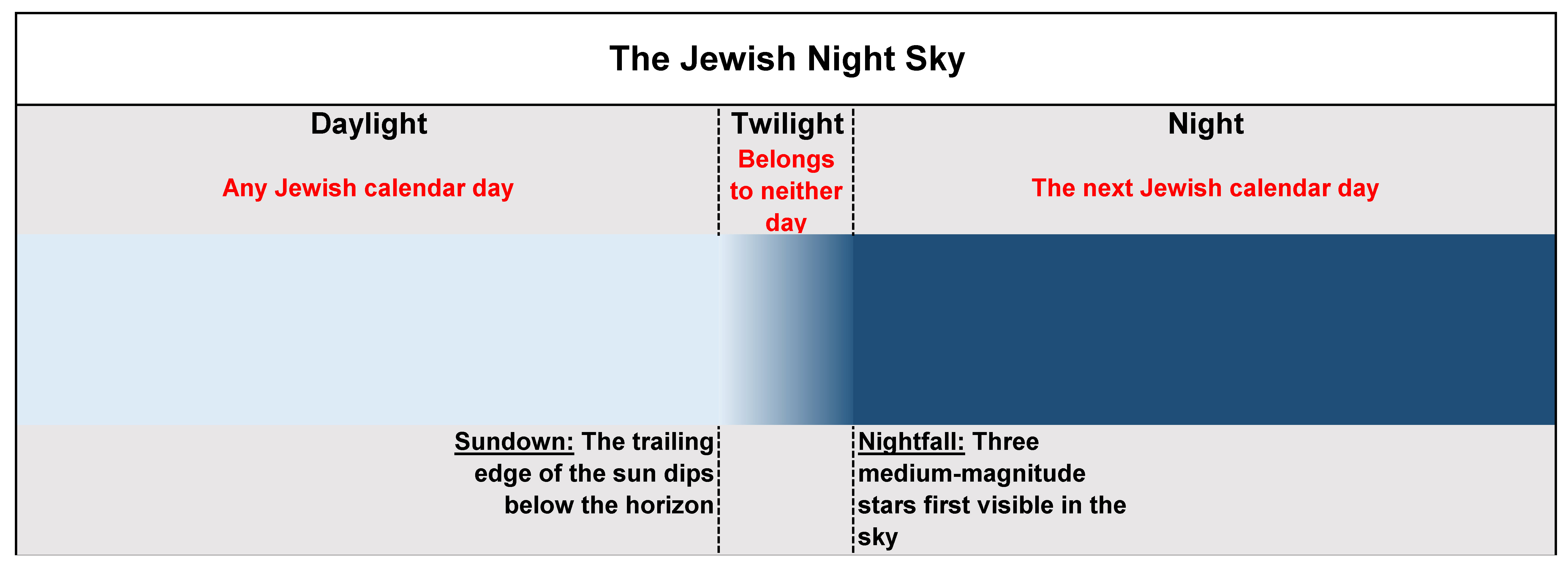
Each Jewish day begins at nightfall and lasts until the following sundown. The twilight period between any two days technically does not belong exclusively to either day, or in another sense, it can be viewed as belonging to both days. The Seder supper always begins during this twilight period between Nisan 14 and Nisan 15 (see Lev 23:5). Note that the lambs are sacrificed on Nisan 14, before the Seder and thus before, not during, the traditional weeklong Feast of Passover.
©Ron Thompson

Every Sabbath is preceded by a Day of Preparation, when meals are prepared, candles lit, and other chores performed that are unlawful on the Sabbath itself. Many arguments against a Friday crucifixion focus on misunderstandings of John 19:31 and its parallels:

Since it was the day of Preparation, and so that the bodies would not remain on the cross on the Sabbath (for that Sabbath was a high day), the Jews asked Pilate that their legs might be broken and that they might be taken away.
—John 19:31 ESV

The argument is that Friday was the first day of the Feast of Unleavened Bread, so it could not have been the previous day of preparation. It is true that the first and last days of the Feast of Unleavened Bread are important Sabbaths. But in Jewish custom, the regular weekly Sabbath that occurs during the Passover week is the most important of all the 7th-day Sabbaths.

So, in that particular year, there was a Feast Day Sabbath on Friday and a weekly Sabbath the following day, on Saturday. Confusion arises because many non-Jewish scholars believe, incorrectly, that it was unlawful to ever cook or make other preparations on any Sabbath. In fact, Jewish law makes an exception when two successive days are Sabbaths. Preparations for each are permissible on the preceding day, whether or not it, too, is a Sabbath.

Some confusion also arises due to a failure to recognize that the “First day of unleavened bread” is one day prior to the first day of the Feast by that name.

Then came the day of Unleavened Bread, on which the Passover lamb had to be sacrificed.
So Jesus sent Peter and John, saying, “Go and prepare the Passover for us, that we may eat it.”
—Luke 22:7–8 ESV

On Nisan 14, the day of the sacrifices, all hametz (leaven) must be removed or destroyed so that none at all is present during the entire week of the Feast.

Another verse that leads to confusion about the timing is John 18:28:

Then they led Jesus from the house of Caiaphas to the governor’s headquarters. It was early morning. They themselves did not enter the governor’s headquarters, so that they would not be defiled, but could eat the Passover.
—John 18:28 ESV

To most, this seems to imply that Jesus’ trial and crucifixion came on the day before the Seder, implying that the Last Supper was something entirely different. Not so—the Last Supper was a traditional Passover Seder. Any ritual defilement caused by entering Pilate’s presence would only last until sundown, so it would have no effect on eating the Seder meal. But it isn’t talking about the Seder. Instead, this refers to the chagigah (festival sacrifice) which was eaten with much celebration and joy in the afternoon following the Seder.

You may ask how the Wednesday crucifixion proponents manage to get “three days and three nights” out of a Wednesday to Sunday entombment. Mostly, there are two schools of thought. Some actually place the resurrection on Saturday and justify this by misinterpreting the passages about the women at the tomb. Others say that while Jesus was crucified on Wednesday, he was not placed in the tomb until evening, which would be early Thursday on the Jewish calendar. In that case, a resurrection early Sunday (on our Saturday evening) would meet the requirement.

A less prevalent theory is that the crucifixion was on Thursday. I believe that there are severe problems reconciling Sabbaths, preparation days, and calendar days if this approach is taken, but I will not cover it here.

Myth: By dying on Passover, Jesus became our Passover Lamb

I touched on this above. I suspect that the vast majority of Christian theologians would say that, at the very least, it is foundational that Jesus died on the same day as the Passover lamb or lambs, because He had to be seen as the fulfillment of the prophetic purposes of the Feast. If that were the case, then I ask why His throat wasn’t slit inside the Temple precincts and His blood splashed on the altar as required by Torah? How is it permissible that He died in a completely different manner, nailed to a Roman cross way over on the other side of the Tyropoeon Valley?

Sheep grazing near Jerusalem. Source unknown.

My contention is that Jesus did not die on the same day or the same time as “the Passover Lamb”, of which there were many thousands. In fact, I think that it was theologically necessary that Jesus did not die on the same day or in the same way as the Passover lamb! Had He done so, would He not have linked Himself prophetically to that sacrifice alone, to the exclusion of all others? The truth is that Jesus was the prophetic fulfillment of all of the sacrifices! And in terms of Soteriology, Passover is less important by far than, say, Yom Kippur!

Myth: As our Passover Lamb, Jesus brought salvation to the world

In a word, no! But didn’t Yochanan the Immerser—John the Baptizer—tell his followers to “Behold the Lamb of God, who takes away the sin of the world” (John 1:29)? And what about Paul, who called Him “Christ, our Passover” (1 Cor. 5:7). Those are accurately reported sayings but mind the context! John was urging immersion as part of a ritual of repentance, connected, I’m sure, to the onset of the extended Days of Awe on that very day and extending to Yom Kippur, 40 days in the future. He was making no claim to offer salvation! Instead, he was pointing to the Messiah, often referred to in Scripture as “the Lamb of God”, or just “the Lamb.” Jesus didn’t die until some 3½ years later. And Paul was not talking about salvation at all, but rather separation of the Corinthian Church from the “leaven of sin.”

Yes, Jesus died on the cross to save us from our sins, but His sacrifice encompassed and surpassed all of the daily and seasonal sacrifices, not just the Passover lamb.

The Passover sacrifice was not even a sin offering! It was a type of fellowship offering. Sin offerings could not be consumed by the people, but they were required to eat their Passover sacrifice to symbolize their freedom from the bondage of sin and the resulting right to sup at God’s table, in fellowship with Him.

The Yom Kippur sacrifices were far more to the point of salvation, but even sin offerings only deal with incidental sin—not deliberate, malicious, God-defying sin. There was only one hope for that. Not a specific blood sacrifice, but simply the Grace of God, as symbolized at Yom Kippur by the Scapegoat, which wasn’t even killed! (Well, it was, but not as part of the ceremony; it was driven over a cliff in the wilderness so that it couldn’t come wandering back to town with the sins of the people.)

It was, then, as a goat—the Scapegoat—that “the Lamb of God” took away the sin of the world!

Myth: Peter accidentally cut off Malchus’ ear while taking a wild swing with his sword in an effort to protect Jesus

(Note: I have expanded on this subject in a separate post, Malchus’ Ear.)

The following quote from the Complete Jewish Bible, my personal favorite translation, sets the stage:

Then Shim‘on Kefa [Simon Peter], who had a sword, drew it and struck the slave of the cohen hagadol [high priest], cutting off his right ear; the slave’s name was Melekh [Malchus].
—John 18:10 CJB

Short sword similar to what Peter would have used to maim Malchus.

First, it is unlikely that Peter was carrying a military sword that night after the Seder. Neither he, nor Malchus, was a soldier. Peter was a fisherman by trade and would be accustomed to carrying a knife for tending nets and lines, and for gutting fish. The Greek term here is machaira, which was probably a double-edged knife or dirk, a shorter version of a sword design that had been introduced into Israel by the Phoenician Sea Peoples. Nor do I think Peter was a trained fighter. We know he was impetuous, but was he an idiot? Did he think he could mow down a band of trained Roman soldiers and Temple guards? Was he distraught and attempting to commit “suicide by Roman soldier”? I think that if he had attempted a frontal assault in Jesus’ protection, he would have been reflexively cut to pieces before he drew a drop of blood, and quite likely the slaughter would have extended to the other apostles present, as well.

What I think really happened was that Peter took advantage of the soldiers’ preoccupation with Jesus, slipped around behind Malchus—his intended target—and deliberately sliced off his ear. Why Malchus? Because Malchus was the High Priest’s servant and right-hand man. The High Priest was probably not present, and Malchus was presiding. At any rate, harming the High Priest, had he been there, would have resulted in quick execution. By taking Malchus out, Peter would be insulting and effectively crippling the High Priest and, to some extent, the Sanhedrin. But then, why an ear, of all things? Because Peter wasn’t a killer, and taking an ear did the job! Priests, Levites and all other Temple officials were required to be more or less physically perfect. With a missing ear, he would be considered deformed and unfit for Temple service.

Yes, Peter was impulsive. But he was also smart.

For a complete series on the Principle Jewish Feasts, as specified in Leviticus 23, please see The Jewish Feasts–The Back of My Mind.


The Jewish Feasts: Part 13, Yom Kippur Factoids

Cross section of Herod’s Temple, looking south. ©2012 Bristol Works, Inc. Rose Publishing Inc.

Interesting Facts and Misconceptions:

Where is the Ark of the Covenant now?

Based primarily on research done by Dr. Randall Price (Searching for the Ark of the Covenant and The Lost Ark and the Last Days: In Search of Temple Treasures) I believe that the Ark is in a cave beneath the Temple Mount. It was accessible and possibly seen after the 1967 “6-Day War” prior to the sealing of Warren’s Gate by the Jordanian Waqf.

When was the Ark ever in Herod’s Temple?

Never! Leviticus 16 describes God’s commandments for Yom Kippur in the Tabernacle. These were followed with appropriate modifications in the days of Solomon’s Temple, but when that Temple was destroyed by Nebuchadnezzar, the Ark disappeared. Old Jewish traditions hold that Jeremiah hid it somewhere before the destruction.

How did Yom Kippur work without an Ark?

The problem was bigger than that: not only was the Ark gone, but as prophesied in Ezekiel 9 and 10, so was God’s Sh’khinah (Divine Presence), and even the two large cherubim statues were missing. There was nothing in there except haShetiya, the Foundation Stone on which the Ark sat. What was sprinkled with blood? Just the stone. There is, to this day, a shallow niche carved into the stone that is the exact dimension, location and orientation to have supported the Ark, so that is where the High Priest’s attention was focused.

How did it work with no Temple at all?

Some Jewish congregations still attempt to offer a blood sacrifice by wringing the neck of a chicken, but this is a minority practice. In the late 1st century, rabbis decided that the Temple ritual could be replaced by Tefilah (prayer), Teshuva (repentance), and Tzedakah (charity). Those are all good things, surely, but one might say, “Why not just accept your own Messiah?” What about the interval of the Babylonian Captivity, when there was also no Temple? I would ask you to remember that salvation was never a result of sacrifice! Sacrifice was a response of faith in a gracious God!

How did the High Priest accomplish so much in the Holy of Holies on Yom Kippur if he could enter only once a year?

It is not true that the High Priest went into the Holy of Holies only once a year. He went only on Yom Kippur, but on that day he went in four times: (1) He entered to lay coals from the altar, and to burn incense. (2) He entered again to sprinkle the bull’s blood for his own atonement. (3) He entered yet again to sprinkle the goat’s blood for the people’s atonement. (4) Finally, he entered to remove the spent coals at the close of the ceremony.

Given the unrighteousness of many High Priests, how many were struck dead entering the Holy of Holies?

None, as far a we know. But righteousness was not required, or none would have survived; only “ritual cleanness” kept them alive. There was a long process that was required to achieve this ceremonial virtue. It began four days earlier, and involved many washings, immersions, and changes of attire. Part of this procedure was Biblical, part was traditional.

Was a rope really tied to the High Priest’s leg so that he could be pulled out if his attendants quit hearing the tinkling of his bells and pomegranates?

Pure myth! To begin with, there were no bells and pomegranates, because Scripture required him to enter in pure white linens, with no decoration. In the second place, during the key moments of his entry, no other humans were allowed into even the inner Temple courts, let along into the Temple itself. Thirdly, it would have been impossible to pull him through the veil in any case. It was not one veil, it was actually two very heavy veils stretching from side to side and ceiling to floor, with no space on any side. There was a space of one cubit separating the two veils. The outer one was pinned to the left doorpost and the inner to the right doorpost so that they might never reveal what lay beyond. When entering the Holy of Holies, the Priest would pass below the pin on the left side of the outer curtain, walk between the curtains, pass beneath the pin on the right side of the inner curtain, and then walk beside that curtain until he reached the Ark. To exit, he reversed the route. It is impossible for me to conceive of a rope with a body attached being pulled through that circuitous route. Nor would this have been needed; see below regarding cleaning of the Holy of Holies.

Are the scarlet thread stories true?

I have heard two versions. One holds that a scarlet thread was attached to the wall beside the outer veil. If by the next day the thread was found to have turned snow white, then God had accepted the sacrifice. Otherwise, the sacrifice had been rejected and Israel’s sins were unforgiven. The continuation of this story holds that after Jesus’ crucifixion, and up to the AD 70 destruction of the Temple, the thread never changed color. This isn’t absurd on its face, like the rope theory, but if it were true, we would find volumes of lamentations over those 40 years of rejection. This would be known as the greatest national calamity ever to strike Israel. I think even more so than the Temples’ destruction. The second version is the same, except that the thread was attached to a horn of the Scapegoat. I reject this version as well. I think that this one is probably a corruption of a story in rabbinical literature which records that a scarlet strand of some sort was tied across both horns of the goat and used to secure a heavy rock so that the sure-footed goat would be pulled over the cliff to its destruction.

How far out of the Temple was the goat taken?

According to rabbinical sources, 90 ris. After five separate unit conversions, I worked this out to about 7 miles. Watchers were stationed at key locations between Temple and cliff so that successful completion of the goat’s assassination could be signaled back by means of flags, and the next steps of the ceremony begun.

Would the Ark with its poles even have fit into the Holy of Holies?

Very astute question! We know the dimensions of the room, of the Ark, and even of the poles. Yet almost every depiction of these things shows the Ark oriented with its poles parallel to the veil, which cannot be! In reality, the Ark went in like a car into a garage. And on either side of it stood a very large statue of a stylized cherub.

How was the Holy of Holies kept clean, or did it never get dirty?

Of course, it got dirty! Hundreds of years of dust bunnies, charcoal dust, incense smoke, insects, and mouse droppings, not to mention hundreds of years of bullock and goat blood! And, potentially, dead High Priests. Before you ask, no, the High Priest didn’t do the cleaning. Above the Holy of Holies was a “drop ceiling” consisting of wooden rectangular tiles set into a framework. Referring to the attached diagram, there was a large chamber over the Holy of Holies, and the ceiling below could be accessed from there. Workmen could, after suitable cleansing, be lowered on ropes to work using tools with long handles. The rules prevented them from touching anything in the room with their own bodies, nor were they allowed to dally or “sight-see”.

Table of Contents: The Jewish Feasts
Start of Series: The Jewish Feasts: Part 1, Chapter Introduction
Previous in Series: The Jewish Feasts: Part 12, Atonement
Next in Series: The Jewish Feasts: Part 14, Tabernacles

The Jewish Feasts: Part 12, Atonement

Yom Kippur, not Passover, is the most important of the Jewish Feasts!

The Days of Awe are the most somber period of the Jewish Year, and Yom Kippur, the Day of Atonement, is the capstone of the Days of Awe. The correct form of the Feast name is Yom HaKippurim, (the Day of Coverings); but Yom Kippur is the more common name.

I have heard it said many times that Passover is the most important Jewish Feast. That is simply not true. With no Temple to worship in, Passover has certainly become the most well known and faithfully celebrated of the Feasts, but for sheer spiritual impact, Yom Kippur is by far the most vital. it is a recognition of personal and national sin, and a plea for salvation.

 Christians celebrate Easter as a salvation event, and rightly so, because Easter celebrates specifically the time and actuality of Jesus’ death, burial and resurrection. Jews celebrate Passover at roughly the same time as Easter, but not at all as a salvation event. As stated in earlier parts of this series, Passover is a celebration of redemption from slavery and resurrection as a people.

©Ron Thompson 2020

 In AD 325, Emperor Constantine and the Council of Nicaea officially severed Easter from Passover. This was unfortunately done for explicitly anti-Semitic reasons; however, given the salvation emphasis placed on Easter by non-Jews, it was probably best to do so.

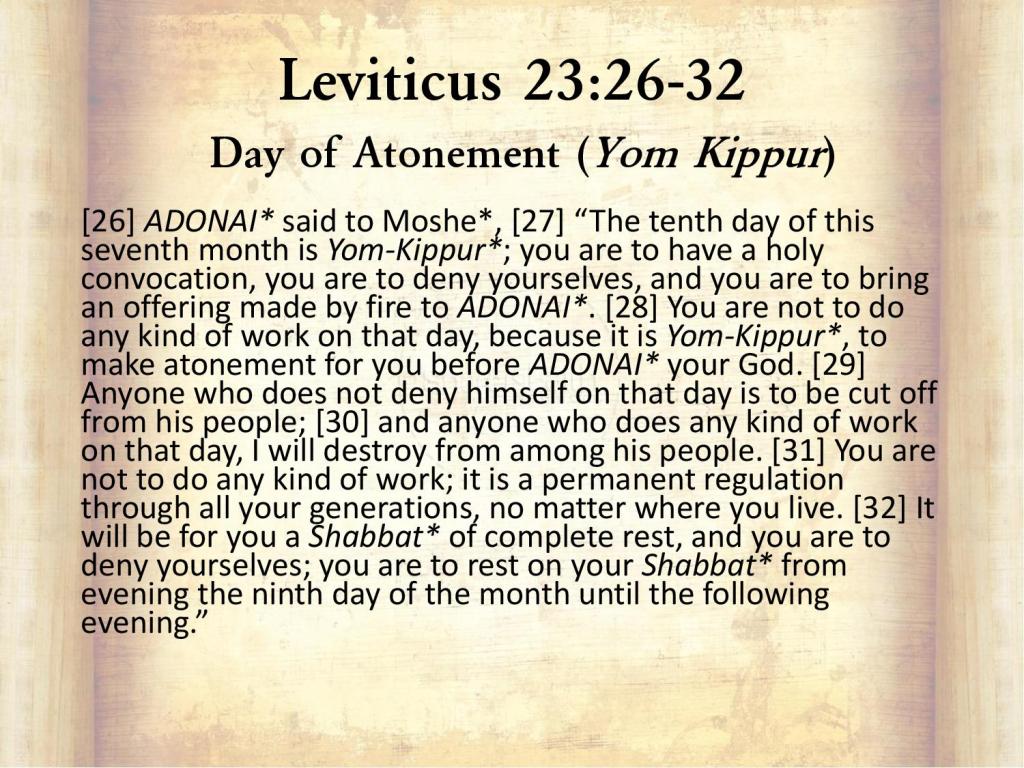
Recall that the ten Days of Awe are all about repentance and reconciliation. On the final day, on Yom Kippur, one’s deeds will be judged by God, and his or her state of salvation determined for the coming year. As you can see from Leviticus 23, above, the day is a Sabbath. Not only that, but the phrases “you are to deny yourselves” (stated twice) and “Anyone who does not deny himself on that day is to be cut off from his people” are regarded as a command to fast, on pain of excommunication. The Hebrew terms used here literally mean to “humble, or afflict one’s soul”. Traditionally they are taken to include fasting, abstinence from sex, and refraining from personal grooming. Yom Kippur is the only Biblically mandated fast day, though rabbinic Judaism does recognize certain other somber days as fast days, and Zechariah 8:19 mentions several months when ancient fasts were practiced.

The Temple Precincts

The ritual of Yom Kippur for Tabernacle observance is described in more detail in Leviticus 16. It is quite complicated. More so in Temple days, and still more after the addition of Oral Traditions. There are very strict and detailed regulations regarding the attire of the High Priest (Heb. Cohen HaGadol), his multiple cleansings, and who and at what times other people could enter the Temple precincts. The actual Temple/Tabernacle observance included the following, in brief:

  • The High Priest would cast lots over two male goats: one, designated as Chatat, was to be sacrificed; the other was to set aside “for Azazel”; this one would be “brought before the people” so that their sins would symbolically be laid upon him.
  • The Priest would sacrifice a young bull to atone for, or “cover”, his own sin and that of his household, and the sacrificial goat, to atone for the sins of the people.
  • Under smoke from incense, blood from these sacrifices was to be sprinkled, with his finger, inside the Holy of Holies, on the Mercy Seat, the front of the Ark, and “toward the east”, that is, between the Ark and the Veil.
  • Outside the Holy of Holies, blood was also to be sprinkled on the Horns of the Altar.
  • Having completed these actions, the High Priest was to lay his hands on the head of the live goat and “confess over it all the transgressions, crimes and sins of the people of Isra’el” (CJB). This, the “Scapegoat” now carrying all the sins of the people, was then to be led out of the city to an uninhabited area about 7 miles away, by a fit man appointed to the task. Ostensibly, this goat was to be released, but in practice, it was usually pushed off a cliff to prevent it from wandering back with the people’s sins. Accomplishment of this task was then signaled back to the Temple.
  • The bullock and the goat were then cut open; the fat and fatty organs were burned on the altar, and the rest of the carcass taken out and burned (on the Mount of Olives in Temple times).
  • The High Priest would then read from Torah in the Court of Prayer (aka, the Court of women).
  • Next, the Priest would sacrifice his ram, the ram for the people and seven additional rams.
  • Finally, he would remove the incense pan and ladle from the Holy of Holies.

For a really good description of the Temple ritual, derived from rabbinical documents, refer to this excellent article by a knowledgeable rabbi: The Service of the High Priest

Important Concepts

  • As seen previously, the Passover Lamb or Kid was a fellowship offering, to be killed and shared as a meal between friends or family.
  • The bull and goat sacrificed on Yom Kippur were sin offerings. As such, they could atone for (temporarily cover over), but not permanently remove, the sins of the people. Sin offerings had to be completely burned, not eaten. You don’t want to re-ingest your sins!
  • The rams were burnt offerings. They were consumed completely in fire, with the rising smoke symbolizing righteous prayer and thanksgiving.
  • The goat for Azazel was symbolically innocent, vicariously taking on itself the sins of the people and carrying them away. Its killing was not a sacrifice; it was merely a disposal.

Note especially: Hebrews 9:22 says thataccording to the Torah, almost everything is purified with blood (CJB, emphasis mine). The context is speaking specifically about ritual vessels and implements, but the same is true with people. The Torah provides atonement through sacrifice for “unintentional sin”, i.e., for sins committed thoughtlessly, accidentally, negligently, or perhaps even in passion. No place in the entire Bible do we ever find a sacrifice for intentional disobedience or rebellion against God! There is no atonement for intentional sin! The theme of Yom Kippur is “regeneration”, that is, salvation. So how is any human being saved? Under Torah, it is by God’s grace, through faith–as pictured in the Scapegoat. Under the New Covenant, by God’s grace, through faith–as delivered for all times past or future by Jesus, the antitype of the Scapegoat!

Table of Contents: The Jewish Feasts
Start of Series: The Jewish Feasts: Part 1, Chapter Introduction
Previous in Series: The Jewish Feasts: Part 11, Trumpets
Next in Series: The Jewish Feasts: Part 13, Yom Kippur Factoids


Atonement vs Expiation

Posted on:

Modified on:


The term “atonement” is used over and over in the Old Testament to describe the purpose for and result of the Sinaitic (or Mosaic) sacrificial system. Many Christian theologians extrapolate the Old Testament concept into the New Testament setting and speak of the “atoning work of Christ on the cross.” This usage, however, obscures the very real difference between Old Testament atonement and New Testament expiation, propitiation and reconciliation. Atonement, in the Biblical sense, is a temporary covering up of sin, or guilt. A “stay of execution”, so to speak. Expiation means “to extinguish guilt incurred.” Propitiation is roughly the same, but with the additional dimension of appeasement of anger. Reconciliation means to “reestablish a close relationship” between two entities or concepts. Expiation and propitiation accurately describe what the death of Messiah did, while reconciliation, an accounting term, describes the result: our relationship with God is brought into balance. Cause and effect. Sin is paid for in full and permanently expunged from the record, God is appeased, and our relationship with Him is restored.

Model of the Ark of the Covenant. ©Leen Ritmeyer

The Hebrew terms for “atonement” are variations from the root kaphar, which all carry the idea of “covering”; for example, covering a ship’s hull with bitumen to prevent leakage, or covering a stain in a hardwood floor with a rug. Orthodox Jewish males today cover their heads with kippot, the skullcaps or yarmulkes (Yiddish) that we have all seen. The “lid” of the Arc of the Covenant was called the kapporah, and it, too, is a covering. Atonement for sin, then, becomes a means of covering, or obscuring, it from sight, without actually expunging or removing it. The guilt remains, but God has provided a means of temporarily “sweeping it under the rug” pending permanent expungement by means of Messiah’s crucifixion.

Aside from references to the Jewish feast, the Day of Atonement, the words atone, or atonement appear seldom or not at all in most translations of the New Testament. In the Septuagint (LXX, the Greek translation of the Old Testament used by Paul, translated, apparently, by 70 Jewish scholars in Elephantine, Egypt in the 2nd Century, BC), the word “atonement” is rendered as hilasterion, because there apparently was not a Greek equivalent for “atonement”. Where the feast day is intended, the Greek hilasterion is thus also used in the New Testament for “atonement”, or even for “Mercy Seat”, referring to the covering of the Ark of the Covenant; otherwise, hilasterion is correctly translated as expiation or propitiation. Where the Greek katallagē is used, the proper translation is reconciliation.

Though most New Testament translations are generally okay in this respect, Christian writers and speakers continue to refer to phrases like, “the atoning blood of Christ”, which is a theological non-sequitur. Atonement is decidedly not what His crucifixion accomplished! The confusion arises because most Christians believe that the sacrifices were means of salvation under the Jewish Torah. But this is taught nowhere in scripture. Atonement by means of the sacrificial system is never said to make anybody “at one with Christ” or with God. Atonement is not “at-one-ment” as many have claimed. Salvation is permanent, whereas atonement is only temporary.

In discussing the superior sacrifice of Jesus, Heb 10:4 states that

Hebrews 10:4 (CJB)
[4] …it is impossible that the blood of bulls and goats should take away sins.

Many passages in the Tanach (Old Testament) also discuss the inadequacy of sacrifice in the presence of a sinful heart. For example

1 Samuel 15:22 (CJB)
[22] Sh’mu’el [Samuel]said,
“Does ADONAI take as much pleasure
in burnt offerings and sacrifices
as in obeying what ADONAI says?
Surely obeying is better than sacrifice,
and heeding orders than the fat of rams.

Psalms 40:7 (CJB)
7 Sacrifices and grain offerings you don’t want;
burnt offerings and sin offerings you don’t demand.
Instead, you have given me open ears;

Psalms 51:18 (CJB)
18 For you don’t want sacrifices, or I would give them;
you don’t take pleasure in burnt offerings.

Proverbs 15:8 (CJB)
[8] ADONAI detests the sacrifices of the wicked
but delights in the prayers of the upright.

Isaiah 1:11 (CJB)
[11] “Why are all those sacrifices
offered to me?” asks ADONAI.
“I’m fed up with burnt offerings of rams
and the fat of fattened animals!
I get no pleasure from the blood of bulls,
lambs and goats!

Jeremiah 6:20 (CJB)
[20] What do I care about incense from Sh’va [Sheba]
or sweet cane from a distant land?
Your burnt offerings are unacceptable,
your sacrifices don’t please me.”

Hosea 6:6 (CJB)
[6] For what I desire is mercy, not sacrifices,
knowledge of God more than burnt offerings.

Hosea 8:13 (CJB)
[13] They offer me sacrifices of flesh and eat them,
but ADONAI does not accept them.
Now he will recall their crimes and punish their sins—
they will return to Egypt.

Hosea 9:4 (CJB)
[4] They will not pour out wine offerings to ADONAI;
they will not be pleasing to him.
Their sacrifices will be for them like mourners’ food—
everyone eating it will be polluted.
For their food will be merely to satisfy their appetite;
it will not come into the house of ADONAI.

Why did God not want the sacrifices that He, Himself, had demanded? Just as we believe that baptism and the Lord’s Supper are a response of obedience by someone already saved, and useless to the unsaved, so were the sacrifices a response of obedience. Salvation then, as now, was “by grace through faith.” Sacrifice had no efficacy except to those who were already the recipients of God’s saving grace. The purpose of the sacrifices was to ritually “cover”, or hide from God’s eyes, the guilt of the sinner who, by his obedient sacrifice, was “making amends.”

But notice this:

Every single one of the atoning sacrifices was for incidental, or unintentional, sin; in other words, for sins committed in ignorance, accidentally, or under duress. There was absolutely no means of sacrificial atonement for willful sin—except for God’s grace! On Yom Kippur, the “Day of Atonement” the Cohen HaGadol (high priest) would sacrifice a bull for his own incidental sin and a goat for the incidental sin of the people. Once the problem of incidental sin had been covered up, he would then lay his hands on the forehead of another goat, the scapegoat, symbolically transferring to it all further, willful, sin. The scapegoat would be led “outside the camp”, i.e., away from the people and out of God’s presence. Thus, the nation’s sin was allegorically returned to Azazel, the chief of demons.