Easter Myths

Originally published in three parts in March 2013

  1. Myth: The resurrection occurred on Easter Sunday
  2. Myth: The crucifixion occurred on Passover, Nisan 14
  3. Myth: Jesus died at the very instant that the High Priest plunged his knife into the heart of the Passover Lamb
  4. Myth: The crucifixion actually took place on a Wednesday
  5. Myth: By dying on Passover, Jesus became our Passover Lamb
  6. Myth: As our Passover Lamb, Jesus brought salvation to the world
  7. Myth: Peter accidentally cut off Malchus’ ear while taking a wild swing with his sword in an effort to protect Jesus

If you think I’m about to say that the resurrection is a myth, forget it! The resurrection of Jesus is central to my life and theology. I’d have no reason to exist without it. This is about “other stuff.”

Myth: The resurrection occurred on Easter Sunday

This won’t come as a shock. We all know that Easter is a Christian commemoration of the event, not a celebration of the exact day of the year. But why do we do it that way? In the early centuries of Christianity, many churches in the Roman Empire began to object to celebration on the traditional date, considering it to be a “humiliating subjection to the Synagogue.” During the 2nd Century, many of those churches had begun celebrating Easter on a Sunday, regardless of the Biblical calendar. For a clue to the mindset, there’s this ancient text: “Sunday commemorates the resurrection of the lord, the victory over the Jews.” (Emphasis mine)

In AD 325, Emperor Constantine convened the Council of Nicaea to discuss two major issues in the church. One of those was “the Passover Controversy”, the disagreement between churches that commemorated the resurrection on the Jewish feast day and those that did not. Constantine’s view, of course, won out. He wrote,

It seemed to every one a most unworthy thing that we should follow the custom of the Jews in the celebration of this most holy solemnity, who, polluted wretches! Having stained their hands with a nefarious crime, are justly blinded in their minds.

It is fit, therefore, that, rejecting the practice of this people, we should perpetuate to all future ages the celebration of this rite, in a more legitimate order, which we have kept from the first day of our Lord’s passion even to the present times. Let us then have nothing in common with the most hostile rabble of the Jews. … In pursuing this course with a unanimous consent, let us withdraw ourselves, my much honored brethren, from that most odious fellowship. … [I urge you] to use every means, that the purity of your minds may not be affected by a conformity in any thing with the customs of the vilest of mankind. … As it is necessary that this fault should be so amended that we may have nothing in common with the usage of these parricides and murderers of our Lord.

The date for Jewish celebration of the Passover season Feasts is tied by Divine Ordinance to specific dates on the Hebrew calendar (see Leviticus 23). Non-Jews are released from such ordinances, so I don’t care on what day we celebrate the Resurrection. But you should be aware that the name, “Easter”, and most of the secular traditions tied to the holiday are pagan in origin, and that the Nicene Council separated it from Passover for blatantly anti-Semitic reasons.

Myth: The crucifixion occurred on Passover, Nisan 14

Well, yes and no. The crucifixion happened on Nisan 15, after the sacrifices and after the official Passover as specified in Torah. It became customary, even within the pages of the New Testament, to refer to the three spring feasts together as “Passover.” Technically, Passover is just the short period of twilight between Nisan 14 and 15, on the Jewish calendar (see Part 2 of this series). Immediately after this interval, the 7-day Feast of Unleavened Bread begins—on Nisan 15. And in the middle of this 7-day period, there is the Feast of Early Firstfruits. Jesus’ Last Supper was a Passover Seder. That meal always begins during that twilight period, true Passover, and ends around midnight on Nisan 15, when celebrants adjourn to the streets and rooftops to sing the Hallel Psalms together. The crucifixion, therefore, occurred on Nisan 15, the first day of the Feast of Unleavened Bread.

Myth: Jesus died at the very instant that the High Priest plunged his knife into the heart of the Passover Lamb

I’ve heard this one even from Ray Vander Laan, a man I consider to be an expert on Israel and its customs, in his series of videos for Focus on the Family. But it’s wrong on so many levels! First, the sacrifices occurred during the day before the Seder, on Nisan 14; the crucifixion was the next day, Nisan 15. Second, there wasn’t just one lamb; there was a lamb for approximately every ten people celebrating. Perhaps 100,000 lambs, killed over a period of hours! Which one are they talking about? Third, the High Priest killed only his own lamb, and that much earlier in the day, before the Temple gates were opened. All the other lambs had to be killed by their owners, not by a priest. Fourth, each lamb was killed by a quick slash of its throat, as specified by scripture. A knife to its heart would be considered cruelty, and in the context of the Feast, could get one stoned. Sometimes, the melodrama in the pulpit is just crazy!

©Ron Thompson, based on my own calculation, using Scripture, Jewish customs, and available scientific New Moon tables.

Myth: The crucifixion actually took place on a Wednesday

For two thousand years, most Biblical historians and scholars have held to a Friday crucifixion. More recently, though, many evangelicals have begun to teach that Jesus died on a Wednesday or Thursday. At the heart of this matter is Jesus’ statement in Matthew 12:39–40:

But he answered them, “An evil and adulterous generation seeks for a sign, but no sign will be given to it except the sign of the prophet Jonah.
For just as Jonah was three days and three nights in the belly of the great fish, so will the Son of Man be three days and three nights in the heart of the earth.
—Matthew 12:39–40 ESV

For some reason, it’s hard for some folks to see how you can find three nights between Friday and Sunday! I’m going to present the actual timeline (below, but see also the first chart, above), as I see it, and then I’ll explain several important concepts:

©Ron Thompson

As most Biblically educated people know, prophets often used the word “day” (Heb. yom) to indicate a long or indeterminate period of time, rather than a literal 24-hour solar day. The key to understanding the timing issue here lies in Hebrew idiom—figures of speech. Where there was a likelihood of confusion, ancient Hebrew writers used terms like “three days and three nights” and “the evening and the morning were the first day” to emphasize that true solar days or portions of literal days were in view, not a longer prophetic period of time.

In the Matthew 12 passage quoted above, Jesus was prophesying. Many of His listeners believed in a coming resurrection of the dead in the acharit hyamim, or end times, so it was necessary for Him to emphasize that He was speaking of something that He would personally experience, and that it would be of short duration. Paraphrased, He was saying, “In a little while, I’m outta’ here, but I’ll be back before you know it, on the third calendar day.”

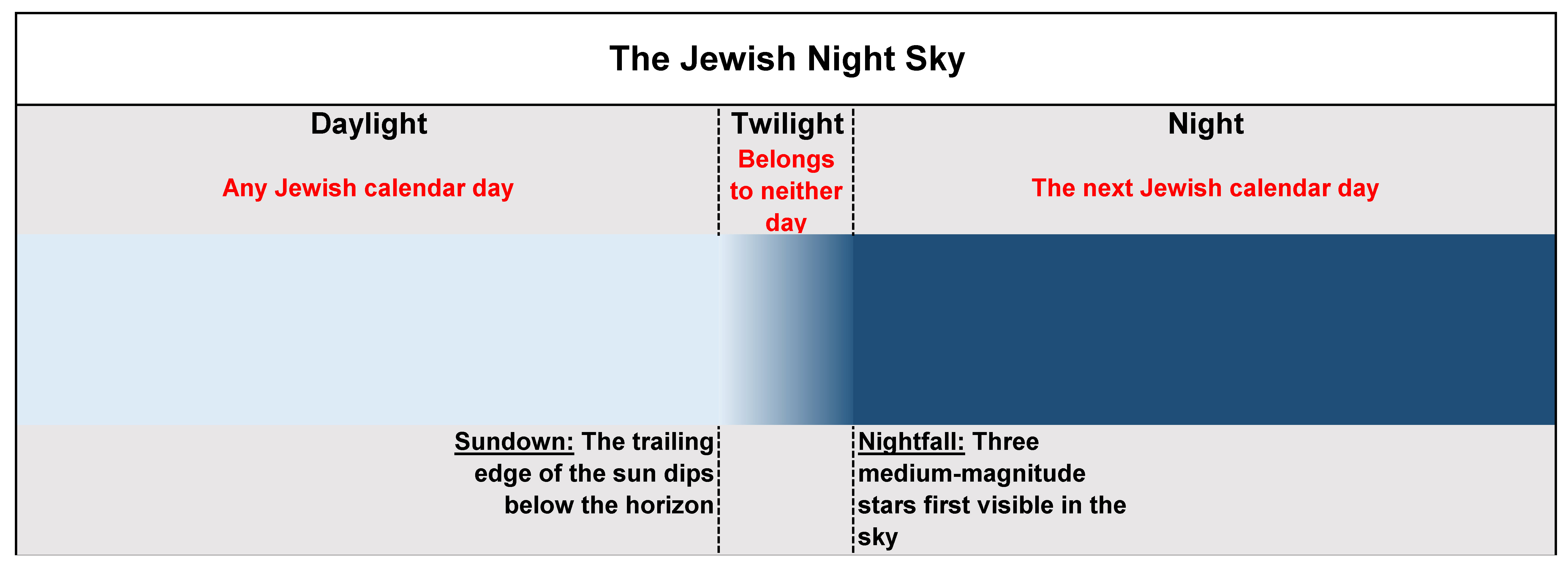
In both spoken and written Hebrew, references to literal solar “days” or “days and nights” did not necessarily imply that complete 24-hour periods were meant. “Three days and three nights” meant “some part of one solar day, all of a second, and some part of a third.” On the first line of the second timeline chart above, “Day 1” was Friday. Recall that Jewish days last from evening twilight until the subsequent evening twilight (see the third chart, below). Jesus died around 3 PM and was entombed before twilight, so at most He was dead only around three hours on this day. He remained in the tomb all through the night and day of Saturday, “Day 2”. His resurrection was sometime on Sunday morning, “Day 3”, before His tomb was found open. The total period was thus composed of a little more than one full period of daylight and at most two full periods of dark. “Three days and three nights” by traditional Hebrew reckoning.

Many conservatives refuse to believe this non-literal interpretation of Jesus’ words and insist on exactly 72 hours, but the hermeneutic employed by me and many conservative, Evangelical scholars allows for a non-literal (but not random!) interpretation of various obvious (to those who understand Hebrew literary techniques) figures of speech.

Many well-meant attempts to rescue the Friday crucifixion tradition resort to various forms of Greek linguistic gymnastics, trying to prove that “in the heart of the earth” doesn’t really mean buried, but could, for example, mean the period from Jesus’ betrayal to His resurrection. I urge caution in using Greek to understand Hebrew concepts. Hebrew idiom does not always translate well into Greek.

Each Jewish day begins at nightfall and lasts until the following sundown. The twilight period between any two days technically does not belong exclusively to either day, or in another sense, it can be viewed as belonging to both days. The Seder supper always begins during this twilight period between Nisan 14 and Nisan 15 (see Lev 23:5). Note that the lambs are sacrificed on Nisan 14, before the Seder and thus before, not during, the traditional weeklong Feast of Passover.
©Ron Thompson

Every Sabbath is preceded by a Day of Preparation, when meals are prepared, candles lit, and other chores performed that are unlawful on the Sabbath itself. Many arguments against a Friday crucifixion focus on misunderstandings of John 19:31 and its parallels:

Since it was the day of Preparation, and so that the bodies would not remain on the cross on the Sabbath (for that Sabbath was a high day), the Jews asked Pilate that their legs might be broken and that they might be taken away.
—John 19:31 ESV

The argument is that Friday was the first day of the Feast of Unleavened Bread, so it could not have been the previous day of preparation. It is true that the first and last days of the Feast of Unleavened Bread are important Sabbaths. But in Jewish custom, the regular weekly Sabbath that occurs during the Passover week is the most important of all the 7th-day Sabbaths.

So, in that particular year, there was a Feast Day Sabbath on Friday and a weekly Sabbath the following day, on Saturday. Confusion arises because many non-Jewish scholars believe, incorrectly, that it was unlawful to ever cook or make other preparations on any Sabbath. In fact, Jewish law makes an exception when two successive days are Sabbaths. Preparations for each are permissible on the preceding day, whether or not it, too, is a Sabbath.

Some confusion also arises due to a failure to recognize that the “First day of unleavened bread” is one day prior to the first day of the Feast by that name.

Then came the day of Unleavened Bread, on which the Passover lamb had to be sacrificed.
So Jesus sent Peter and John, saying, “Go and prepare the Passover for us, that we may eat it.”
—Luke 22:7–8 ESV

On Nisan 14, the day of the sacrifices, all hametz (leaven) must be removed or destroyed so that none at all is present during the entire week of the Feast.

Another verse that leads to confusion about the timing is John 18:28:

Then they led Jesus from the house of Caiaphas to the governor’s headquarters. It was early morning. They themselves did not enter the governor’s headquarters, so that they would not be defiled, but could eat the Passover.
—John 18:28 ESV

To most, this seems to imply that Jesus’ trial and crucifixion came on the day before the Seder, implying that the Last Supper was something entirely different. Not so—the Last Supper was a traditional Passover Seder. Any ritual defilement caused by entering Pilate’s presence would only last until sundown, so it would have no effect on eating the Seder meal. But it isn’t talking about the Seder. Instead, this refers to the chagigah (festival sacrifice) which was eaten with much celebration and joy in the afternoon following the Seder.

You may ask how the Wednesday crucifixion proponents manage to get “three days and three nights” out of a Wednesday to Sunday entombment. Mostly, there are two schools of thought. Some actually place the resurrection on Saturday and justify this by misinterpreting the passages about the women at the tomb. Others say that while Jesus was crucified on Wednesday, he was not placed in the tomb until evening, which would be early Thursday on the Jewish calendar. In that case, a resurrection early Sunday (on our Saturday evening) would meet the requirement.

A less prevalent theory is that the crucifixion was on Thursday. I believe that there are severe problems reconciling Sabbaths, preparation days, and calendar days if this approach is taken, but I will not cover it here.

Myth: By dying on Passover, Jesus became our Passover Lamb

I touched on this above. I suspect that the vast majority of Christian theologians would say that, at the very least, it is foundational that Jesus died on the same day as the Passover lamb or lambs, because He had to be seen as the fulfillment of the prophetic purposes of the Feast. If that were the case, then I ask why His throat wasn’t slit inside the Temple precincts and His blood splashed on the altar as required by Torah? How is it permissible that He died in a completely different manner, nailed to a Roman cross way over on the other side of the Tyropoeon Valley?

Sheep grazing near Jerusalem. Source unknown.

My contention is that Jesus did not die on the same day or the same time as “the Passover Lamb”, of which there were many thousands. In fact, I think that it was theologically necessary that Jesus did not die on the same day or in the same way as the Passover lamb! Had He done so, would He not have linked Himself prophetically to that sacrifice alone, to the exclusion of all others? The truth is that Jesus was the prophetic fulfillment of all of the sacrifices! And in terms of Soteriology, Passover is less important by far than, say, Yom Kippur!

Myth: As our Passover Lamb, Jesus brought salvation to the world

In a word, no! But didn’t Yochanan the Immerser—John the Baptizer—tell his followers to “Behold the Lamb of God, who takes away the sin of the world” (John 1:29)? And what about Paul, who called Him “Christ, our Passover” (1 Cor. 5:7). Those are accurately reported sayings but mind the context! John was urging immersion as part of a ritual of repentance, connected, I’m sure, to the onset of the extended Days of Awe on that very day and extending to Yom Kippur, 40 days in the future. He was making no claim to offer salvation! Instead, he was pointing to the Messiah, often referred to in Scripture as “the Lamb of God”, or just “the Lamb.” Jesus didn’t die until some 3½ years later. And Paul was not talking about salvation at all, but rather separation of the Corinthian Church from the “leaven of sin.”

Yes, Jesus died on the cross to save us from our sins, but His sacrifice encompassed and surpassed all of the daily and seasonal sacrifices, not just the Passover lamb.

The Passover sacrifice was not even a sin offering! It was a type of fellowship offering. Sin offerings could not be consumed by the people, but they were required to eat their Passover sacrifice to symbolize their freedom from the bondage of sin and the resulting right to sup at God’s table, in fellowship with Him.

The Yom Kippur sacrifices were far more to the point of salvation, but even sin offerings only deal with incidental sin—not deliberate, malicious, God-defying sin. There was only one hope for that. Not a specific blood sacrifice, but simply the Grace of God, as symbolized at Yom Kippur by the Scapegoat, which wasn’t even killed! (Well, it was, but not as part of the ceremony; it was driven over a cliff in the wilderness so that it couldn’t come wandering back to town with the sins of the people.)

It was, then, as a goat—the Scapegoat—that “the Lamb of God” took away the sin of the world!

Myth: Peter accidentally cut off Malchus’ ear while taking a wild swing with his sword in an effort to protect Jesus

(Note: I have expanded on this subject in a separate post, Malchus’ Ear.)

The following quote from the Complete Jewish Bible, my personal favorite translation, sets the stage:

Then Shim‘on Kefa [Simon Peter], who had a sword, drew it and struck the slave of the cohen hagadol [high priest], cutting off his right ear; the slave’s name was Melekh [Malchus].
—John 18:10 CJB

Short sword similar to what Peter would have used to maim Malchus.

First, it is unlikely that Peter was carrying a military sword that night after the Seder. Neither he, nor Malchus, was a soldier. Peter was a fisherman by trade and would be accustomed to carrying a knife for tending nets and lines, and for gutting fish. The Greek term here is machaira, which was probably a double-edged knife or dirk, a shorter version of a sword design that had been introduced into Israel by the Phoenician Sea Peoples. Nor do I think Peter was a trained fighter. We know he was impetuous, but was he an idiot? Did he think he could mow down a band of trained Roman soldiers and Temple guards? Was he distraught and attempting to commit “suicide by Roman soldier”? I think that if he had attempted a frontal assault in Jesus’ protection, he would have been reflexively cut to pieces before he drew a drop of blood, and quite likely the slaughter would have extended to the other apostles present, as well.

What I think really happened was that Peter took advantage of the soldiers’ preoccupation with Jesus, slipped around behind Malchus—his intended target—and deliberately sliced off his ear. Why Malchus? Because Malchus was the High Priest’s servant and right-hand man. The High Priest was probably not present, and Malchus was presiding. At any rate, harming the High Priest, had he been there, would have resulted in quick execution. By taking Malchus out, Peter would be insulting and effectively crippling the High Priest and, to some extent, the Sanhedrin. But then, why an ear, of all things? Because Peter wasn’t a killer, and taking an ear did the job! Priests, Levites and all other Temple officials were required to be more or less physically perfect. With a missing ear, he would be considered deformed and unfit for Temple service.

Yes, Peter was impulsive. But he was also smart.

For a complete series on the Principle Jewish Feasts, as specified in Leviticus 23, please see The Jewish Feasts–The Back of My Mind.

John 12: Preface to Jesus’ Last Passover

First posted March 2023. Updated June 2024.

Outline:
Prologue
People
Timeline
In Memoriam

Along with many other Southern Baptist churches, the one I now attend is in the middle of a series of Bible Study lessons on the Book of John. We are covering John 12 over a two-week span. It is a particularly important chapter for me because it records the transition from Jesus’ itinerant ministry in and around Judah and Galilee, to His crucifixion and the aftermath.

Prologue

John 10

The events leading up to Jesus’ final Passover began with the previous Hanukkah, as recorded in John 10:22–39. Hanukkah is a Jewish celebration not mentioned in Scripture, but celebrated, nevertheless, by Jesus, His followers, and Jews everywhere. It is an 8-day festival, starting on the Jewish date Kislev 25, which usually corresponds with mid to late December. It is also called the Festival of Lights, or the Feast of Dedication, and it celebrates the Maccabean victory over Syria in 165 BC, and reconsecration of the Temple after its desecration by Antiochus IV and his successors.

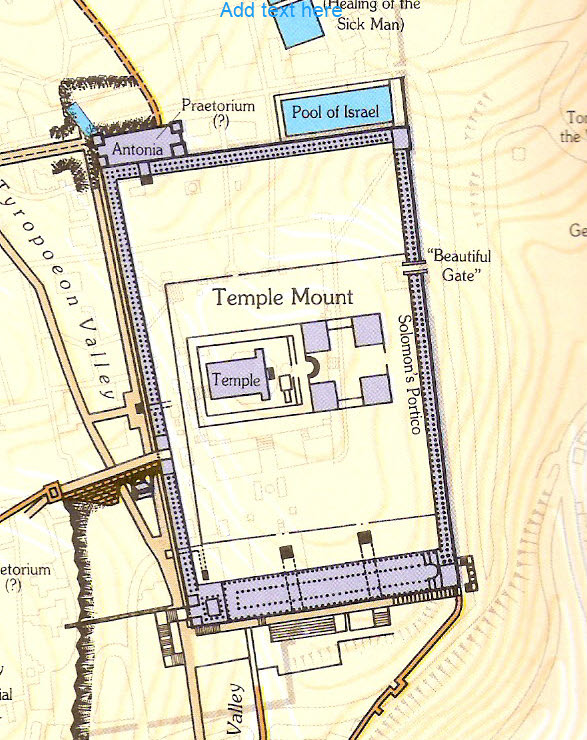
During that Hanukkah, Jesus was confronted in Solomon’s Porch, the Collonade inside the eastern wall of the Temple Mount and challenged to state plainly if He was the expected Messiah. He responded that He had already answered that question and went on to say explicitly that He and [God] the Father are one, and that He, Himself, has power to grant eternal life. His accusers then threatened first to stone Him and then to arrest Him because He, being a man, was making Himself out to be God.

The Temple Mount, cropped from a drawing by Dan Bahat. Solomon’s Porch (or Portico) annotated on the east side of the Mount.

His response to that was to quote from Psalm 82, thereby invoking the entire Psalm and turning the accusations back on His accusers, before slipping away from them supernaturally.

Psalm 82 is difficult to understand today, because modern commentators have almost uniformly ignored what would have been perfectly clear to the average 1st Century Israelite.

[82:1] God [Elohim] has taken his place in the divine council;
in the midst of the gods [elohim] he holds judgment:
[2] “How long will you judge unjustly
and show partiality to the wicked? Selah
[3] [You should] Give justice to the weak and the fatherless;
maintain the right of the afflicted and the destitute.
[4] Rescue the weak and the needy;
deliver them from the hand of the wicked.”
[5] They [those victimized in v. 3–4] have neither knowledge
nor understanding, they walk about in darkness;
all the foundations of the earth are shaken.
—Psalm 82:1–5 ESV

The Hebrew Elohim, meaning God in many contexts, can in other contexts also mean “angels” (in the New Testament, this term refers to all ranks of the Heavenly Host, as explained in Gods and Demons), “judges“, or “masters“. When God scattered the nations from Babel (Gen. 11:8–9), He put those rebellious humans under the supervision of equally rebellious angels (the “Sons of God”, Deut. 32:8–9), who became their capricious gods. This understanding is supported by the verses following:

[6] I said, “You are gods [elohim],
sons of the Most High, all of you;
[7] nevertheless, like men you shall die,
and fall like any prince.”
[8] Arise, O God [Elohim], judge the earth;
for you shall inherit all the nations!
—Psalm 82:6–8 ESV

The Psalm itself is a pun, a play on the word elohim. God is effectively saying that He is the judge of the judges. When Jesus quotes v. 6,

[34] Jesus answered them, “Is it not written in your Law, ‘I said, you are gods’?
—John 10:34 (ESV)

He was making a rabbinic kal v’chomer (lesser to greater) argument: “If the pagan gods, doing evil works and judging unjustly, are elohim, how much more am I, who does good works and judges fairly, Elohim? And if the angelic gods are ‘sons of the Host High’, how much more does the description ‘Son of God’ apply to me”?

After Jesus disappeared from the Temple, He was next seen in Bethany Beyond Jordan, the area where He and John the Baptizer had met earlier in the Book.

John 11

The confrontation in Solomon’s Porch recorded in John 10 occurred in December, and the Crucifixion was in Early April, so the raising of El’azar (Lazarus) had to have occurred in the intervening span of around three months. Many people, both friend and foe of Jesus, witnessed Lazarus’ resurrection. Subsequent plots against Jesus led Him to retreat to the town of Efrayim, in northeast Judah. When He returned to Jerusalem, possibly only weeks later, the miracle was still no doubt fresh in people’s minds.

Since the raising of Lazarus was a completely unprecedented event, it was probably totally shocking to everyone. We know of five resurrections prior to Lazarus: one brought about by Elijah; one by Elisha while he lived; one by contact with Elisha’s corpse; and two previous by Jesus. Lazarus was the only recorded resurrection of someone three or more days after death. A number of commentaries note that three days in the grave were considered to be the maximum time for any hope of an apparently dead body to be capable of resuscitation; for example, The Net Bible Commentary references, “a rabbinic belief that the soul hovered near the body of the deceased for three days, hoping to be able to return to the body.” I think that this was probably a recognition that significant, irreversible signs of decomposition generally appear two to three days after death. Rigor mortis begins within a few hours of death, and fades after two or three days. Lividity becomes quickly evident but does not lock into place for about three days. Putrefaction begins immediately at the cellular level, but dependent on circumstances may not be externally evident for several days.

For a comparison of Lazarus’ resurrection with Jesus’ own, see Biblical Considerations in Is There a Photo of Jesus?

People

Unfortunately, almost nobody understands the various sects of Jesus’ day. The Gospel writers had no need to teach an in-depth course, because everyone in their day knew the players. Since pretty much every contact between Jesus and the sectarians was confrontational, that makes them all look like villains. But that is a skewed generalization! When someone was referred to in Scripture as a Pharisee, that was usually referring to a trained and ordained rabbi, but there weren’t all that many of those. Estimates for 1st Century Judea are about 6,000 Pharisees, 4,000 Essenes, substantially fewer Sadducees, and just pockets of anything else. Here is a very brief summary:

Sanhedrin

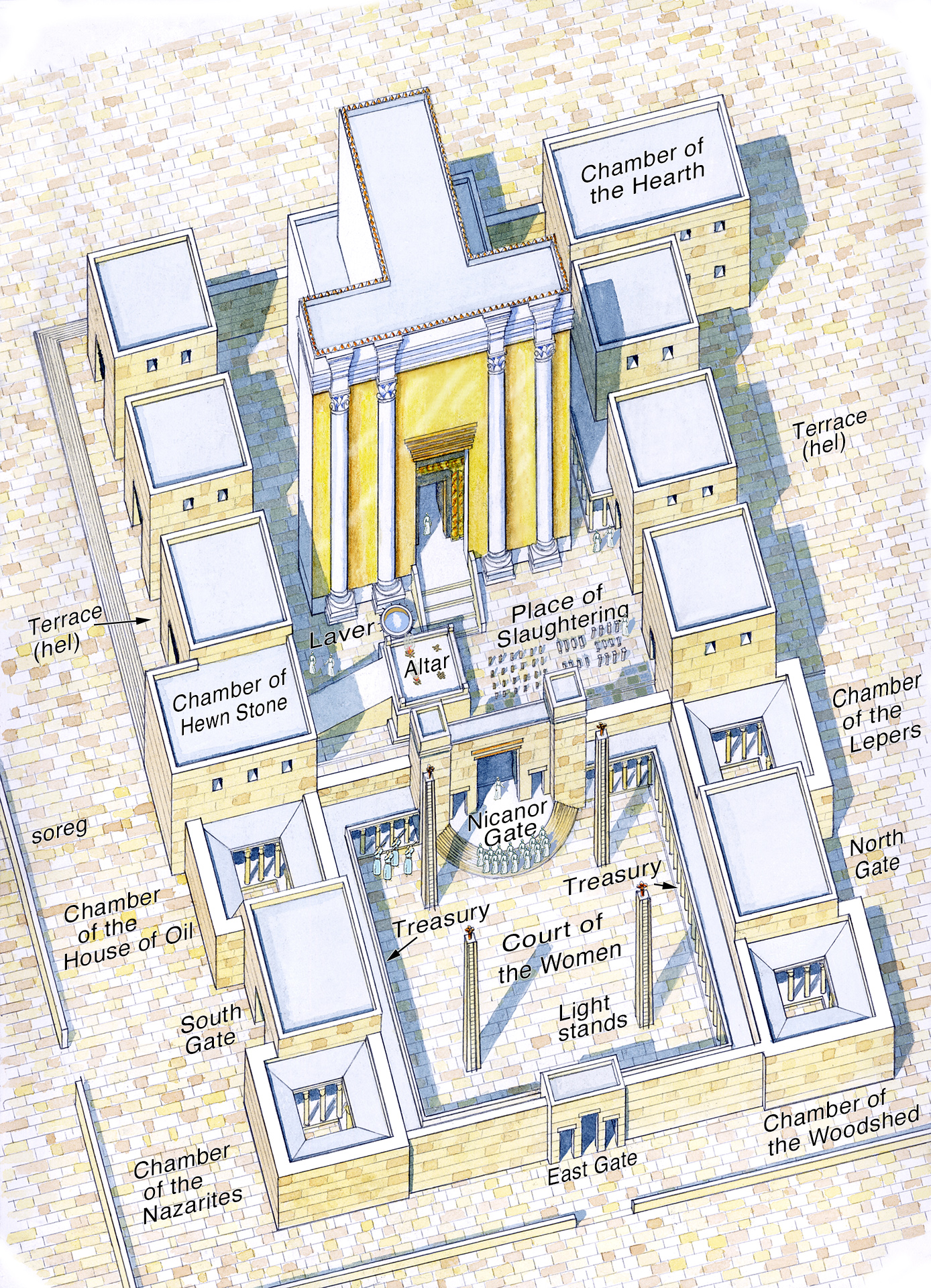
This, of course, was not a sect, but a system of governing courts, or councils. Every city had a Lesser Sanhedrin of 23 members, which answered to the Great Sanhedrin in Jerusalem. The latter consisted of 71 appointed members. The Cohen HaGadol, or High Priest, functioned as the Nasi, (Prince, President, Chief Justice, or Chairman of the Board, so to speak). Ideally around half of the remaining 70 were Pharisees and half Sadducees. In Jesus’ day they met daily in the Chamber of Hewn Stone, in the Temple complex (see diagram). Around the time of the Crucifixion, they moved into the nave of the Royal Portico, which was a grand basilica constructed parallel to the southern wall of the Temple Mount, where the Al Aqsa Mosque presently sits.

The Temple complex in Jesus’ day. The Chamber of Hewn Stone is a large room midway down the left side, adjacent to the ramp of the altar. The terrace above that on the drawing is where young Jeshua (Jesus) spoke to members of the Sanhedrin on His first recorded Passover (Luke 2:41–46). ©Leen Ritmeyer.

One of the official functions of the Sanhedrin was to evaluate anyone who claimed to be the Messiah. In the Synoptic Gospels, when you read of “chief priests and scribes” or “scribes and Pharisees” apparently harassing Jesus, I think that most likely they were officially tasked by the Sanhedrin to follow and question. Given the politicization of the Sanhedrin under Roman rule, some of these were undoubtedly hostile, but others were probably merely conscientiously concerned. Nicodemus and Gamaliel were surely members of the Council and were certainly not evil men. Joseph of Arimathea and Paul were probably both also members. With one exception, the book of John mentions only the Pharisees among those following the crowds with Jesus, but that should not be taken to mean anything other than the normal agents of the Sanhedrin. John wrote probably a decade after the destruction of the Temple and the priesthood. By that time, the Sadducees were a distant memory to his readers, and the Temple had been replaced in their lives by the synagogues. Banishment from the synagogue had become the worst punishment possible, short of death to some and worse than death to others.

High Priest

Under Mosaic Law, the High Priest was required to be a direct descendent of Aaron, as were all priests and Levites. King David replaced a corrupt High Priest with Zadoc, who was himself an Aaronic descendent. Subsequently, all high priests (but not other priests or the Levites) were to be from Zadoc’s lineage. From at least Hasmonean times, the office was corrupt to the extent that many high priests were illegitimate. Under Roman rule, appointments were made by the regent or governor, and the office became more political than religious.

Chief Priests

As the title suggests, these were high ranking priests in the Jerusalem hierarchy. Most, if not all, were probably members of the Sanhedrin. Most were Sadducees.

Sadducees

This is the first actual sect I will discuss. These men were considered the “priestly caste” in Judea. It consisted not only of priests, but also aristocratic “hangers on”. By no means were all priests Sadducees; in fact, many were Pharisees, though most were unaffiliated with either sect. Officially, the Sadducees rejected all scripture but the Five Books of Moses (the Chumash), and in particular, rejected the concept of resurrection. Though only a small sect, the Sadducees were wealthy, and thus powerful. They controlled the priesthood, the Levites, the Temple, and the festivals. After AD 70, they disappeared from history.

Pharisees

This sect had more popular support than any others in Jesus’ day, though they weren’t in control, either of the nation or the Temple. They did lead the synagogues, for the most part. They probably had their origins with holy elders in the Babylonia captivity but evolved into a cohesive sect alongside the Sadducees in the Hasmonean Kingdom of the 1st and 2nd Centuries, BC. The two sects were in open warfare with each other during the reign of Alexander Jannaeus, the second Hasmonean King, and hundreds of Pharisees were killed.

Doctrinally, the Pharisees treasured the entire canon of the Tanach (Old Testament) and believed in resurrection. They were the popularizers of the “Oral Torah“, or so-called “traditions of the elders.” After the destruction of the Temple, only this sect survived, and they are the ones, humanly speaking, who God used to preserve a Jewish remnant for 2,000+ years.

Contrary to the assumptions of most Christians, the Pharisee sect was not monumental. Above, I mentioned four members of the Sanhedrin that we would not call evil. All of those were Pharisees. Paul was a Pharisee both before and after Damascus. In Acts 23:6 (ESV), he declared, “Brothers, I am [present tense] a Pharisee, a son of Pharisees.” It was Pharisees who wrote the Talmud, and I think they accurately analyzed their own shortcomings and eccentricities:

Talmudic Classification of the Pharisees:

(1) the “shoulder” Pharisee, who wears his good deeds on his shoulders and obeys the precept of the Law, not from principle, but from expediency;

(2) the “wait-a-little” Pharisee, who begs for time in order to perform a meritorious action;

(3) the “bleeding” Pharisee, who in his eagerness to avoid looking on a woman shuts his eyes and so bruises himself to bleeding by stumbling against a wall;

(4) the “painted” Pharisee, who advertises his holiness lest any one should touch him so that he should be defiled;

(5) the “reckoning” Pharisee, who is always saying “What duty must I do to balance any unpalatable duty which I have neglected?”;

(6) the “fearing” Pharisee, whose relation to God is one merely of trembling awe;

(7) the Pharisee from “love.”

The International Standard Bible Encyclopedia, 1915 Edition
Scribes

The scribes were not a sect, but rather a profession. They were, as you would expect, the educated readers and writers of Israel. Many of them were Pharisees. Some were Sadducees or members of another sect, or of none at all. Many were members of the Sanhedrin.

Essenes

Little is said about the sect of the Essenes in the Bible, because they were ultrareligious outsiders who pretty much kept to themselves. Claims that John the Baptizer or Jesus were Essenes are completely wrong.

Yahad

The Yahad are the sect of Qumran and the Dead Sea Scrolls. Many think that they were Essenes, but there were radical doctrinal differences between the two groups. My friend, Dr. Randall Price, wrote what I consider the definitive book on the subject, Secrets of the Dead Sea Scrolls.

Am Ha’aretz

These were the common “people of the land”, those without power or wealth. Jesus’ ministry was primarily to this group, who were members of no sect, but mostly listened to the Pharisees.

Herodians

This was a political party, not a true sect. They were supporters of the Herodian Dynasty and were a small minority of the population.

Timeline

Verses 1,2

Jesus returned to Bethany “six days before the Passover”, which by my own calculations (see table, below) was March 30, 0030. The 30th was a Sabbath, so He had to have arrived no later than Friday afternoon. The dinner in His honor was, according to Mark, at the home of Simon the Leper, who we know nothing else about. The meal would have been prepared before sundown, and served after dark, on the new day. The account makes perfect sense, because Sabbath dinners were always festive and joyous occasions. Perfect for welcoming a distinguished friend and guest!

The Gregorian dates shown here are my own calculations based on NOAA lunar tables going back much farther even than that. ©Ron Thompson
Verses 3–8

The text says that Miryam washed Jesus’ feet with spikenard that she had obtained for His burial. (Could it be that she was the only one paying attention to what He had been saying?) We know from previous scripture that her family was important and well off, so her possession of the pure nard oil was not surprising. It was an expensive perfume imported from India in alabaster containers, and a pint of it would have cost about a year’s wages for a common laborer of the am Ha’aretz. The Southern Baptist quarterly mentions that respectable 1st Century Jewish women kept their hair concealed. That was true then, and it’s still true among the pious Orthodox. Using a headscarf like a Muslim woman is acceptable, but in Western cultures it is more common to wear a wig.

Jesus’ comment about the poor should not be taken as insensitive. He was making reference explicitly to Deuteronomy 15:11, and saying, in effect, that this is a drop in the bucket and will make little difference to the poor, who will always be around.

[11] for there will always be poor people in the land. That is why I am giving you this order, ‘You must open your hand to your poor and needy brother in your land.’
Deuteronomy 15:11 (CJB)

Verses 9–11

We see here yet another example of the Sanhedrin plotting against Jesus, and in this case also against Lazarus. I would not wish to paint them as blameless, but I think they weren’t as bad as many believe. Yes, there were corrupt men on the Council, but on balance, I don’t think they were as worried about losing their personal influence as they were of goading the Romans into just what finally did happen in AD 70. Paul himself gives them an excuse of sorts:

1 Brothers, my heart’s desire and prayer to God for them is that they may be saved.
2 For I bear them witness that they have a zeal for God, but not according to knowledge.
3 For, being ignorant of the righteousness of God, and seeking to establish their own, they did not submit to God’s righteousness.
—Romans 10:1–3 ESV

Verses 12–19

The Triumphal Entry. It was the day after the feast at Simon’s house. Sunday, Nisan 10 of the year 3790, or by our reckoning, March 31, 0030. Jesus went from Bethany to Jerusalem. Rather than walk this time, He had to ride a donkey’s colt into the city in order to fulfill the prophecies of Psalm 118:25–26 and Zechariah 9:9. Actually, did you catch the oddity in Matthew 21:2? He actually rode two donkeys—a mare and her colt. Evidently, he rode the mare part way and then transferred to the colt for the last part of the ride. Bible trivia!

Another mistake that many people make is to think that the people glorifying Jesus as He rode into town are the same people that days later insisted that Pilate put Him to death and release Barrabas. The people waving palm fronds on Sunday were home in bed on Friday when Jesus was on trial. The only people present for that were Jesus’ enemies.

Verses 20–26

The quarterly, and some of my favorite commentators as well, interpret “some Greeks” as referring either to Greek nationals or to God-fearing gentiles visiting the city from outside Judea. I disagree. I think that the context here, and more clearly in John 5:35, is the same as that in Acts 6:1. It is referring to Greek-speaking Jews from the Jewish Diaspora.

What did they want? The quarterly is wrong to say that “John gave no indication”, but that it “triggered something in Jesus.” Verse 23 clearly states that what it triggered was a response; evidently what they wanted was to request that He visit their countries next, which would explain why His answer, that He was about to die and couldn’t go, was directly to the point. As was verse 26, where He effectively told them that, instead of Him following them home, they could ultimately follow Him home.

Verses 27–36

My purpose in writing a blog is not to regurgitate things that most of my readers already know, nor is it to find fault with Sunday School quarterlies, though I’m not above doing that from time to time. Though I don’t agree with anybody about everything, I really think that Dr. Howell has done a fine job with his commentary in this quarter’s booklet. The reason for my blog posts in general is that for decades I’ve tried to understand Scripture not only from conventional, traditional, points of view, but from my own historical and cultural perspectives and from observations of God’s design of the universe and its physical laws.

The reason I bring this up now is because, while this whole passage is extremely interesting and vitally important, I have only one thing to add to what Dr. Howell has said. He interprets God’s voice in verse 28 as a “thunderous response.” I’m pretty sure he is picturing an earsplitting clap of thunder from lightning striking a tree in his backyard. On the contrary, my own vision is of a gently rolling murmur of distant thunder, as carried by the wind. The Complete Jewish Bible translates it as,

[28] ‘Father, glorify your name!’” At this a bat-kol came out of heaven, “I have glorified it before, and I will glorify it again!”
—John 12:28 (CJB) Emphasis mine

I’ve written about the bat-kol, or “daughter of a voice”, before. It is the “low whisper”, or “still, small voice” that Elijah heard in I Kings 19:12ff. When God spoke to His prophets audibly, I think that it was in this soothing, intimate fashion, not like a scary Zeus or Thor figure would blare out to his minions. This whisper voice is the way it was depicted in ancient Jewish literature, as described by the 2nd or 3rd Century Rabbis who compiled it:

“After the death of Haggai, Zechariah and Malachi,
the last of the prophets, the Holy Spirit ceased from
Israel; nevertheless they received communications
from God through the medium of the bat-kol.”
—Tosefta Sotah 13:2

Verses 37–50

In the same spirit as with the previous section, I am going to comment on only two thoughts:

First, in verse 38 John quotes Isaiah 53:1. Something that you should remember when reading the New Testament is that most Jews were taught Scripture from a very early age, in their homes and then, in some cases, in a beit midrash (house of study”, an arm of the local synagogue. For this reason, speakers like the rabbis and Jesus referred to entire passages of the Old Testament by merely quoting a key sentence or phrase. Thus, by quoting this one verse, Jesus was effectively applying Isaiah 53, in its entirety, to Himself. I repeat it here:

1 Who believes our report?
To whom is the arm of ADONAI revealed?
2 For before him he grew up like a young plant,
like a root out of dry ground.
He was not well-formed or especially handsome;
we saw him, but his appearance did not attract us.
3 People despised and avoided him,
a man of pains, well acquainted with illness.
Like someone from whom people turn their faces,
he was despised; we did not value him.
4 ¶ In fact, it was our diseases he bore,
our pains from which he suffered;
yet we regarded him as punished,
stricken and afflicted by God.
5 But he was wounded because of our crimes,
crushed because of our sins;
the disciplining that makes us whole fell on him,
and by his bruises* we are healed.
6 ¶ We all, like sheep, went astray;
we turned, each one, to his own way;
yet ADONAI laid on him
the guilt of all of us.
7 ¶ Though mistreated, he was submissive –
he did not open his mouth.
Like a lamb led to be slaughtered,
like a sheep silent before its shearers,
he did not open his mouth.
8 After forcible arrest and sentencing,
he was taken away;
and none of his generation protested
his being cut off from the land of the living
for the crimes of my people,
who deserved the punishment themselves.
9 He was given a grave among the wicked;
in his death he was with a rich man.
¶ Although he had done no violence
and had said nothing deceptive,
10 yet it pleased ADONAI to crush him with illness,
to see if he would present himself as a guilt offering.
If he does, he will see his offspring;
and he will prolong his days;
and at his hand ADONAI’s desire
will be accomplished.
11 After this ordeal, he will see satisfaction.
“By his knowing [pain and sacrifice],
my righteous servant makes many righteous;
it is for their sins that he suffers.
12 Therefore I will assign him a share with the great,
he will divide the spoil with the mighty,
for having exposed himself to death
and being counted among the sinners,
while actually bearing the sin of many
and interceding for the offenders.”
—Isaiah 53:1–12 CJB

Finally, John 12:40 was another Isaiah quote. In its Old Testament context:

8 ¶ Then I heard the voice of Adonai saying,
¶ “Whom should I send?
Who will go for us?”
¶ I answered, “I’m here, send me!”
9 He said, “Go and tell this people:
¶ ‘Yes, you hear, but you don’t understand.
You certainly see, but you don’t get the point!’
10 ¶ “Make the heart of this people [sluggish with] fat,
stop up their ears, and shut their eyes.
Otherwise, seeing with their eyes,
and hearing with their ears,
then understanding with their hearts,
they might repent and be healed!”
11 ¶ I asked, “Adonai, how long?” and he answered,
¶ “Until cities become uninhabited ruins,
houses without human presence,
the land utterly wasted;
12 until ADONAI drives the people far away,
and the land is one vast desolation.
13 If even a tenth [of the people] remain,
it will again be devoured.
¶ “But like a pistachio tree or an oak,
whose trunk remains alive
after its leaves fall off,
the holy seed will be its trunk.”
—Isaiah 6:8–13 CJB

Jesus is explaining, by this reference, why so many of His hearers could not see the truth, despite His signs and wonders. Just as God hardened Pharaoh’s heart after Pharaoh had several times hardened his own heart, He has hardened the hearts of many Jews who have repeatedly rejected Him. That doesn’t mean that Jews can’t be saved, obviously, nor does it mean that God has rejected the people as a whole. They are still “God’s chosen people”, natural branches of the olive tree to which we believers who are not Jews have merely been grafted.

How is this hardening even fair? Because God chose them for His own, revealed Himself to them, in particular, and gave them all the advantages of a special relationship. When the hardening ends, at the close of the Great Tribulation, all that remain alive, and I think their numbers will be vast, will be saved. Every last one of them, I believe!


The Jewish Feasts: Part 8, Early Firstfruits

The next and last of the Spring Feasts is Yom ha-Bikkurim, the Day of Early Firstfruits. This is considered an agricultural festival; a celebration of the beginning of the spring barley harvest. It was commanded at Mt. Sinai, but was not to take effect until the Israelites were in the Promised Land, planting their own crops. The timing corresponds to the day that the redeemed slaves miraculously crossed the Red Sea (actually, the Yam Suf, or Sea of Reeds–I personally believe this is a reference to the upper reaches of the Gulf of Suez, near the town of Suez, where I think that papyrus and other reedy swamp plants would have washed down from the Bitter Lakes region at the ebb tides; but there is much scholarly disagreement on this). The theme of Resurrection attaches to this Feast because it is seen to commemorate both their resurrection from sure death at the hands of Pharaoh’s army, and more particularly, their resurrection as a people who essentially lost their national existence when they were enslaved.

©Ron Thompson 2020

I don’t think it needs to be said that Jesus’ resurrection took place on this, the third day after His death and burial! I do not want to spend much time here arguing the exegesis of Matthew 12:40 (ESV), were Jesus said, [40] For just as Jonah was three days and three nights in the belly of the great fish, so will the Son of Man be three days and three nights in the heart of the earth. Some well-meaning conservative Christians have argued on this basis that the Crucifixion must have taken place on a Wednesday; however, this is well-attested Hebrew idiom, and my preferred hermeneutic requires that figures of speech must be considered (see Zuck, Roy B., Basic Bible Interpretation) in translating and properly understanding Scripture. In my view, both Scripture and ancient traditions force the acceptance of a Friday Crucifixion.

©Ron Thompson 2020

Please study closely the slide above, where I have laid out the timeline, as I believe it to be, for the Jewish Spring Feasts, beginning with Jesus’ Triumphal Entry into Jerusalem on Palm Sunday. Note that I have enumerated each day during the period Nisan 10 through 21. Note, too, that I have placed the Lamb Sacrifices and the “First day of Unleavened Bread” on Thursday, Nisan 14, the day before the start of the traditional “Passover Week”,  as I have previously explained. Next, see that I have placed the Day of Early Firstfruits, on Sunday, Nisan 17, the same as the third day of the 7-day Feast of Unleavened Bread.

 More on this timing below, but first, look closely at the three heading lines, colored blue on the slide. The middle line shows an equivalent Gregorian date for each of the days covered. I have often been curious about where the Crucifixion and Resurrection would fit on our modern Gregorian calendar.  You can find a lot of conflicting—guesses—on the Internet. Finally, I determined to figure it out for myself. Most attempts that I have seen place them in the period AD 30 – 33, which make sense from a historical point of view. Another vital clue is that every Jewish month, by definition, begins on a New Moon. With some searching, I was able to find charts showing calculated new moon dates going back much farther than I needed. Assuming the Crucifixion was indeed on a Friday, it turns out that it is somewhat rare for Nisan 15 to fall on a Friday, and that fact led me to decide that it must have occurred on Friday, April 5, 0030.

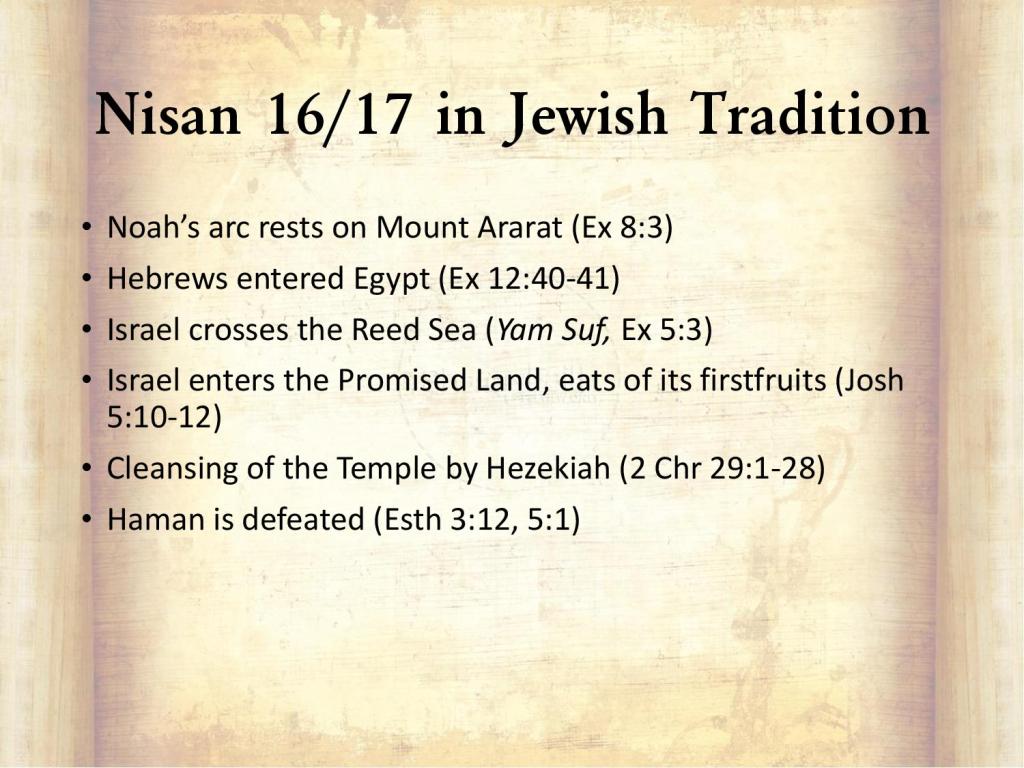
Other historical events corresponding to the Feast Day. I waffled here on whether to the Feast was on Nisan 16 or 17. In reality, I am convinced it was Nisan 17, as explained below, and here.

Although I am personally convinced that the Resurrection had to have been on Sunday, Nisan 17, you may have noticed that in the second and forth slide, I have shown it as Nisan 16 or 17. This is a nod to conflicting opinions based on Leviticus 23:11 (CJB) [11] He is to wave the sheaf before ADONAI*, so that you will be accepted; the Cohen* is to wave it on the day after the Shabbat*. A Biblical “wave offering” is a ritual waving of an agricultural product by a Priest (Heb. Cohen) in an up/down left/right, in out pattern–sort of like a 3D genuflection. The question about this verse that has puzzled the sages from antiquity is, what Shabbat does this verse refer to–the Nisan 15 Shabbat, as the Pharisees believed, or the included Saturday Shabbat, as the Sadducees believed? Modern scholars tend to favor the former because they suppose that (a) the Pharisees were more powerful, and (b) the Nisan 15 Shabbat was more important. Both of those suppositions are wrong! The Saturday Sabbath is more important, and the Pharisees, while most popular with the am ha-aretz, or common people, had little actual power. The Sadducees had almost total control over the Temple and its ritual.

Table of Contents: The Jewish Feasts
Start of Series: The Jewish Feasts: Part 1, Chapter Introduction
Previous in Series: The Jewish Feasts: Part 7, Unleavened Bread
Next in Series: The Jewish Feasts: Part 9, Weeks