Leviticus 23 provides a convenient outline for a discussion of the eight principal Feasts of Israel, including the weekly Sabbath observance.
The first two verses of the chapter set the theme for the rest, and perhaps require some explanation for non-Jewish readers:
In most English translations of the Bible, we see “lord”, in lower or mixed case, used to indicate a functional title for a ruler, and “LORD”, spelled in all-caps, as a reverent substitution for the “Covenant Name”, or “Divine Name” יהוה, yud-heh-vav-heh, YHVH, Yahweh, Jehovah, etc. “Adonai” and “ADONAI” are equivalent Hebrew substitutions for “the lord” and “the LORD”, respectively.
“Moshe” is an English transliteration of the Hebrew name that has come to our standard English versions in its Anglo-Saxon rendering as “Moses”. In this and future slides, transliterations are indicated by a following asterisk.
One other term on this slide requires explanation: A “convocation” (Heb., miqra) is “a sacred assembly, calling, or reading.” Though translations of the term in Lev. 23:1 appear at first glance to refer to the feasts themselves, the context of the remaining verses in the chapter clearly indicate that the “convocations” are here the associated Sabbaths, or days when ordinary work is not permitted.
The purpose of any study of biblical tithing should never be to justify stinginess, because this is clearly not the heart of God! Even if we find that the principle of tithing has no direct applicability to the Church, the study will nevertheless show that God surely desires a spirit of generosity and sacrificial giving.
That being said, I will show that if you wish to dogmatically insist on tithing Biblically, then you have quite a chore in front of you. During two out of every seven years, you must give 22.5% of gross. During roughly four years of every seven, you only owe 12.5%, but you must take another 10% with you to Jerusalem and consume it there. During the sabbatical and Jubilee years, you don’t owe any tithes or offerings at all, but you also can’t earn any money!
Tithing, as taught by scripture, may be summarized as follows:
Technically speaking, tithing applies only to agricultural increase, because virtually all the people of ancient Israel depended on agriculture for their living. In practice, Judaism has always applied the principles to any form of personal increase. Of course, this broadening of application, though done in a spirit of Godly generosity, can be categorized as a “tradition of man.”
The central understanding of tithing is that God is the real owner of everything; therefore, tithes and offerings are not ours to give! When a Jew “brings his tithes to the storehouse”, he is to do so humbly, realizing that he is merely conveying to God that which belongs to Him. Of course, there is always some ritual involved, but the ritual comes, not with the giving, but with the separating. In recognition of Gods bounty, blessings are always said at the time that the tithe is separated from the portion that God has graciously allowed the “giver” to keep for his own sustenance.
Scripture does not demand just one tithe; rather, there are at least two separate tithes, and a smaller preliminary offering. We will not consider here the complex system of offerings (most of which were scripturally obligatory in Temple days) or taxes for the upkeep of the Temple itself.
Before the larger tithes were given, one was to separate out the terumah gedolah, 1/40 of all his increase. This was not a “tithe” (ma’aser, or tenth), but a mandatory “offering” (terumah). Like the tithes, this was required from the “firstfruits”; in other words, “gross”, not “net.” The terumah gedolah was given to the cohanim (priests).
After setting aside the terumah gedolah, one must then set aside the ma’aser rishon, or “first tithe.” This amount is a full ten percent of the gross, which in ancient days was given to the l’vi’im (Levites). Ten percent of this amount, the terumas ma’aser, was in turn parceled out to the cohanim.
After setting aside the terumah gedolah and the ma’aser rishon, a “second tithe” was required. This tithe was a full ten percent of the firstfruits. Its disposition depended on the year. The produce of the third and sixth year of the shemittah cycle (the seven-year sabbatical cycle) was to be given to the poor. This was known as the ma’aser sheni. The produce of the first, second, fourth and fifth years was separated out and blessed, but was not to be given away—rather, it was to be brought to Yerushalayim (Jerusalem) and consumed there. This was the ma’aser ani.
During every seventh year of the shemittah cycle, and during every 49th and 50th year of the Jubilee cycle, no tithes or offerings whatsoever were required. This is of course because no work was allowed during those years.
As gentile Christians, we should realize that every mention of tithing in the Bible refers to practices mandated specifically by what we call the Mosaic Law—that is, the system of legal principles contained within the structure of the Mosaic, or Sinaiatic, Covenant. The covenants of the Tanakh (Old Testament scriptures), including the Mosaic Covenant, were covenants between God and Israel. The Mosaic Law was intended to set Israel apart from other nations and was never meant to be applied to believers of other nations.
The New Testament principle is that God’s people of the gentile nations should give cheerfully as God has prospered them. Though no amount can be legalistically demanded of others, I believe personally that if you don’t set a personal standard for giving that is sacrificial, you are in violation of God’s trust, just as much as if you were a Jew who withheld his tithes and offerings.
So, then, what is the “storehouse” to which tithes were to be brought?
Malachi 3:10 (ESV) [10] Bring the full tithe into the storehouse, that there may be food in my house. And thereby put me to the test, says the LORD of hosts, if I will not open the windows of heaven for you and pour down for you a blessing until there is no more need
The storehouse is technically the Temple Treasury, more commonly known as the Court of Prayer, and more commonly still as the Court of Women. I don’t like the final term, because it is not true that women were never allowed to go farther into the Temple compound, and in point of fact, non-Levitical men rarely went beyond this court, either. The passage directly separating the Court of Prayer from the Court of Israel and the Court of Priests, where sacrifices were offered, was called the Nicanor Gate. Women were not allowed to pass through this gate, but when it was appropriate for them to move within, there was a separate door, the Gate of Offering Women, in the north wall of the inner Temple court.
Within the Court of Prayer, there were thirteen offering boxes, designated for contributions towards different tithes and offerings. It was into one of these that Jesus observed a widow dropping two small coins, Mk 12:42.
This post was first published over 10 years ago but recently got a major overhaul. First, because my own style has changed a bit over the years; but also, because I’ve changed my mind about one related issue, which I’ll discuss below. This is a good time for an update because it is now the middle of the Hebrew month Elul, and that is the temporal setting of my main topic here, the Fall Feasts.
I started this edit by setting a time frame for Jesus’ First Advent, which I date in the following short table. Here I have used the Gregorian calendar for the year, because that is more identifiable to most of us, but I’m taking the month and day from the Hebrew calendar, because annual events are Biblically fixed according to that standard and are different every year by the Gregorian and earlier Julian calendars.
Event
Age
Hebrew Date
Gregorian Year
Birth
–
Tishri 15
4 BC
Baptism
about 30 years
Elul 1
AD 26
Crucifixion
about 33 yrs., 6 mos.
Nisan 14
AD 30
Here are some of the factors I considered in composing this table:
The Biblical feast days commemorate important Jewish historical events, celebrate the annual agricultural cycle, and prophesy about Messiah’s life on earth, in both of His advents.
I am convinced that the Jewish principal feasts, as commanded in Leviticus 23, provide a totally reliable outline of important events in Jesus’ life, as shown in the last column of Figure 1, above. Events highlighted there in peach occurred during His first advent, on the actual feast days shown. Events highlighted in blue will occur during His second advent, again on the actual feast days shown.
I’m very confident that Jesus’ birth was on Tishri 15, the first day of the Feast of Tabernacles, Sukkoth. Not in December, on a date with absolutely no Scriptural support (but with a pagan connotation!); but rather in a September/October timeframe corresponding to Jewish celebration of the time that God previously “tabernacled” with His people during their 40 years of wilderness wandering. With Jesus’ birth, once again God was living among His people.
The year of Jesus’ birth has been disputed during my entire lifetime. There are always unresolved arguments about when Herod died, when Quirinus was governor of Cilicia/Syria, and what year a lunar eclipse hit the region, all of which are applicable. The most commonly cited estimates that I’ve seen place Jesus’ birth in 4 BC, though dates ranging from 1 through 6 BC are also commonly mentioned. I’m sticking with 4 BC here, because it fits well with the other two dates in my table.
Luke 3:23 states that Jesus was “about thirty years of age” when He began His ministry. Fall of AD 26 is about thirty years after the autumn of 4 BC. In fact, if His ministry began on Yom Kippur (see below), and that was the last day of His 40-day “wilderness fast and temptation”, then He was just five days shy of 30 years old.
His baptism by John was 40 days before Tishri 10, which is the Day of Atonement, Yom Kippur. I’ll explain the 40-day offset below, but it culminates with Jesus on the pinnacle of the Temple, defying Satan, on Yom Kippur, in full view of many thousands of worshippers on the plaza below.
Fig. 2: The late Alec Garrard, facing “south”, posing in his backyard shed model of Herod’s Temple. The parapet in the lower right corner overlooks the Kidron Valley, and as the highest point on the Temple Mount walls, it is thought by many to be the “pinnacle” mentioned in Scripture. I personally suspect that the somewhat lower parapet to the left, more commonly known as the Place of Trumpeting, might be the actual pinnacle of Scripture, since it is far more visible from the streets below. Photo from The Miniature Engineering Craftsmanship Museum.
His crucifixion was on Nisan 15, the first day of the Feast of Unleavened Bread, Yom ha-Bikkurim, not on Nisan 14, the day of the sacrifices.
The year of Jesus’ crucifixion, shown here as AD 30, was calculated by me, using NOAA (National Oceanic and Atmospheric Association) New Moon Tables, which were prepared with historic ocean tides in mind. Every published Biblical chronology that I’m aware of puts the crucifixion in AD 33, but they are all based on an incorrect interpretation that insists He was crucified on Nisan 14. With a correct understanding of the timings of Passover Week which (thanks to my traditional presuppositions) it frankly took me many years to achieve, it is clear that Jesus was crucified on Nisan 15.
9/5/2023 addition:
1 In the fifteenth year of the reign of Tiberius Caesar, Pontius Pilate being governor of Judea, and Herod being tetrarch of Galilee, and his brother Philip tetrarch of the region of Ituraea and Trachonitis, and Lysanias tetrarch of Abilene, 2 during the high priesthood of Annas and Caiaphas, the word of God came to John the son of Zechariah in the wilderness. —Luke 3:1-2 ESV
Leaving Tiberias until last, here are the tenure years of the leaders mentioned (all are 1st Century AD): Pilate, 26–36; Herod (Antipas), 4–39; Philip, 4–34; Lysanius, unknown; and Caiaphas, 18–37. Annas was High Priest during the period 6–15 but was the real power in the Temple during the tenure of Caiaphas, his son-in-law, 18–37.
For the purpose of dating the text, only Tiberias‘ rule is useful. Many historians and Biblical commentators date Tiberias’ accession to the time of Augustus’ death. That puts the timing of Jesus’ baptism in the year AD 29, which would pose a problem for my proposed dating. I don’t think AD 29 is correct, because it was common for many, possibly most, ancient rulers and their chroniclers to ambitiously include years of coregency in citing tenure of rule. Tiberias was coregent with Augustus starting in either AD 11 or 12. AD 11 fits perfectly with my AD 26 date for Jesus’ baptism.
I find that I am not alone in recognizing this discrepancy. The well-respected commentary Jamieson, Faucett & Brown, for example, states that:
the fifteenth year of Tiberius — reckoning from the period when he was admitted, three years before Augustus’ death, to a share of the empire [results in a date for the events of Matthew 3:1 of] about the end of the year of Rome 779, or about four years before the usual reckoning.
“The usual reckoning” is AD 30. The traditional date for the founding of Rome was 753 BC, which makes “the year of Rome 779” equivalent to AD 26.
Please refer to Figures 3 and 4, above. The Passover sacrifices were killed on Nisan 14, then consumed during the Seder, which began that evening at dusk. Jesus and His 12 apostles celebrated the Seder until late, as customary, then joined with the Hallel singing outside at midnight. Following that, they walked to Gethsemane, where Jesus was arrested. His trials were conducted during the early morning of Nisan 15, and He was crucified and buried that day. That was on a Friday, and the only year within a reasonable range with a Friday on Nisan 15 was AD 30. I am very confident that this scenario is correct!
Fig. 5: An April 2024 calendar showing parallel Hebrew dates on the right. This clearly demonstrates that the 8-day Passover celebration (7 days in Israel) begins on Nisan 15. Jewish Time®, by Calendar Maven
Most scholars think that Jesus’ ministry lasted around 3½ years, based on the number of Passovers He seems to have attended during that time. I agree.
This month shall be to you the head of the months; to you it shall be the first of the months of the year. —Exodus 12:2 (The Complete Jewish Tanach)
Nisan 1, in the Spring, is the Jewish religious New Year. Jews today, though, celebrate the civil new year, Rosh Hashanah, which is six months later, on Tishri 1.
Most of the modern world celebrates the new year with revelry. Not so among devout Jews in 1st Century Judea, because Tishri 1 is also the date of Yom Teruah, the Day of Trumpets. This important feast day heralds God’s judgment of His chosen people for their deeds, both good and bad, committed during the preceding year.
As such, the mood during the entire ten-day period through Yom Kippur, the Day of Atonement, on Tishri 10, is somber and introspective. There is prayer, fasting, ritual immersion (baptism for purification), and general spiritual misery and mourning. No weddings or other celebrations are permitted.
Once Yom Kippur has passed, the mood shifts. There is spiritual relief, and a 5-day period of relaxed preparation, followed by the joyous eight-day celebration of Sukkoth, the Feast of Tabernacles.
In the rest of this post, I will concentrate on two of the fall feasts in particular: The Day of Trumpets and the Day of Atonement. These two feasts, and the 10-day span of time connecting them, is known as Yamim Noraim, the ten “Days of Awe”. This somber period, as described above, is devoted to sincere individual and national confession of sins, and to t’shuvah, or repentance.
Rosh Hashanah, also known as Yom Teruah (The Day of Trumpets), is the Jewish day for regathering. Jews believed that, on this day every year, God divided His people into three groups according to their faithfulness over the preceding year. One group was the “wholly righteous”, whose names would certainly be written in the Book of Life. A second group was the “wholly wicked”, who would be written into the Book of Death. The final group was comprised of “those in between”, whose fate would be sealed by the quality of their t’shuvah over the next ten days, with their final judgment reserved until Yom Kippur.
In the original version of this post, I said of the above viewpoint, “this doctrine is certainly not Biblical”; however, I have mostly changed my mind about the books, though I think that the Jewish perspective on them may be a bit skewed. I have recently been introduced to the works of Michael S. Heiser, and what he called the “Deuteronomy 32 worldview” (see Gods and Demons). He addressed this subject in ways that I had not previously considered.
There are, in fact, eight New Testament references, mostly in Revelation, to the “book of life“, and many Old Testament and intertestamental references to heavenly “books” and “tablets” that are clearly connected. I assume that these conceptual records are metaphorical, considering that God is God, and doesn’t need a physical database to remember what He needs to remember. Heiser makes sense when he suggests that our sins are recorded in one book, and our salvation in another. If (and only if) we are not listed in the second, then we will be judged by what is recorded in the first. There may be a “book of death“, too, that renders some ineligible for salvation. Regarding the latter, see, for example:
[31] Therefore I tell you, every sin and blasphemy will be forgiven people, but the blasphemy against the Spirit will not be forgiven. —Matthew 12:31 (ESV)
Whether or not the doctrine of these books is valid, the fact that the holiday recognizes a separation of people from people is very significant since it prophetically depicts the regathering of God’s people on the coming day of Rapture:
[16] For the Lord himself shall descend from heaven with a shout, with the voice of the archangel, and with the trump of God: and the dead in Christ shall rise first… —1 Thessalonians 4:16 (KJV)
In light of 1 Thes 4:16, the blowing of the trumpet (actually, a shofar, or ram’s horn) on Yom Teruah is particularly interesting. The shofar (accompanied by metallic trumpets in Temple days) was blown at mid-morning after the morning (Shacharit) prayers, in three series of four distinctive notes: tekia (“blast”); shevarim (“broken notes”); teruah (“shout”—thought of as “the shout of an archangel”); and tekia gedolah (the “great blast”). The first series is tekia, shevarim, teruah, tekia, repeated three times. The second is tekia, shevarim, tekia, repeated three times. The final series is tekia, teruah, tekia, repeated three times, followed immediately by tekia gedolah, referred to in 1 Cor 15:52 as “the last trumpet”.
[52] in a moment, in the twinkling of an eye, at the last trumpet. For the trumpet will sound, and the dead will be raised imperishable, and we shall be changed. —1 Corinthians 15:52 (ESV) emphasis mine
Since long before Jesus’ day, the Days of Awe have, in practice, begun thirty days beforeYom Teruah, on the first day of the Jewish month Elul. T’shuvah (repentance) is much too important to put off until the last minute, so the Rabbis decided that forty full days should be devoted to it, rather than the ten required by Torah.
On Elul 1, Jews would flock to the mikvot (baptisteries) of the Temple and synagogues, and to the “living waters” of streams and rivers like the Yarden (Jordan), to immerse themselves for ritual purification. That would then be followed by forty days of prayer, fasting and introspection. In the years preceding AD 30, it seems that many had become preoccupied with the politics and woes of the Roman occupation, and such customs were being neglected. Into this scene stepped Yochanan, who we now call John the Baptizer, calling Jews to baptism and t’shuvah.
[13] Then Jesus came from Galilee to the Jordan to John, to be baptized by him. [14] John would have prevented him, saying, “I need to be baptized by you, and do you come to me?” [15] But Jesus answered him, “Let it be so now, for thus it is fitting for us to fulfill all righteousness.” Then he consented. [16] And when Jesus was baptized, immediately he went up from the water, and behold, the heavens were opened to him, and he saw the Spirit of God descending like a dove and coming to rest on him; [17] and behold, a voice from heaven said, “This is my beloved Son, with whom I am well pleased.” —Matthew 3:13–17 (ESV)
I believe that the events of Mt 3:13-17, describing Jesus’ baptism and anointing by the Holy Spirit, took place on Elul 1, conforming to the current tradition. As to the year, I lean towards AD 26, as stated above. If that year is off, I’m still 100 percent sure of the Hebrew month and day.
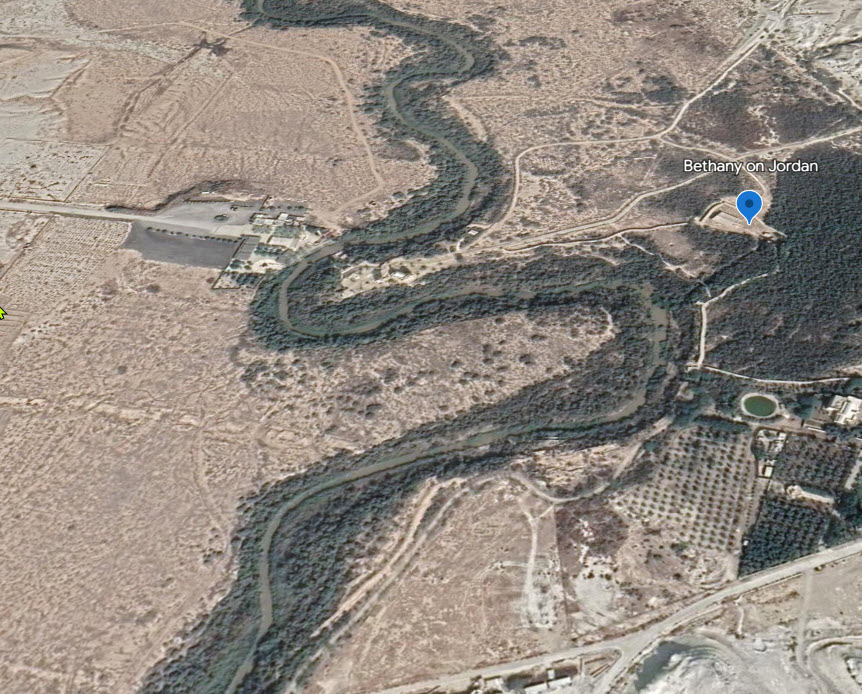
Fig. 8: The Jordan River today, due east of Jerico. Scripture places Jesus’ baptism at Bethany on Jordan, no doubt referring to the east bank of the oxbow, close to the village. From Google Earth.
Though of course He was sinless, His baptism, followed by forty days of prayer and fasting, were consistent with and required by the customs of the season.
More importantly, the temptation and His response were theologically vital. Jesus was “the Second Adam” (see The Two Adams). The first was created sinless, but when tempted by the “lust of the flesh, the lust of the eyes, and the pride of life”, failed and brought sin to the world. The same tempter and same temptations came to Jesus in the wilderness: lust of the flesh (stones to bread); lust of the eyes (the kingdoms of the world); and pride of life (rescue by angels in the sight of all Israel). Jesus did not fail, and brought redemption to the world.
Matthew presents a different order for the temptation, which is not a problem because chronological order was not strictly important in the literature of the day. In any case, all three temptations most likely occurred on the same day.
Interestingly, that placed Jesus on the Pinnacle of the Temple on Yom Kippur:
[9] Then he [the devil] took him to Yerushalayim, set him on the highest point [Greek pterugion, literally, a “wing” or “turret”] of the Temple and said to him, “If you are the Son of God, jump from here! [10] For the Tanakh [Old Testament] says [Psalm 91:11–12],
‘He will order his angels to be responsible for you and to protect you. [11] They will support you with their hands, so that you will not hurt your feet on the stones.’”
[12] Yeshua [Jesus] answered him, “It also says, ‘Do not put ADONAI your God to the test.’” [13] When the Adversary [Greek diabolos, literally, “accuser”] had ended all his testings, he let him alone until an opportune time. —Luke 4:9–13 (CJB)
While the Temple still stood, on Yom Kippurall the people gathered on the Temple Mount for the ritual sacrifices that would roll the sins of the truly repentant back for another year. Since there is no longer a Temple, and thus no legitimate place for blood sacrifices, the gatherings are now in the synagogues, and what is offered are “sacrifices of prayer.”
Most translations render pterugion as “pinnacle”, following the KJV. This is traditionally interpreted as the highest point on the Temple Mount or its surrounding walls, but I don’t think that this is warranted. It seems to me most likely that this is referring to the “place of trumpeting” (see Figure 2) which, by inference, was probably the parapet, or observation platform, from which the priests monitored the ritually vital sunrise and sunset every day. This high overlook was visible from the exterior streets below. If Jesus had accepted Satan’s temptation to throw Himself off and allow the angels to catch Him, all the Jewish world would have witnessed the destruction of His public ministry on the very day it began! Certainly, this was Satan’s plan!
I am forever thrilled at the beauty of God’s timing! I believe that many of the events connected with Jesus’ First and Second Advents actually occurred or will occur on the precise day of the Feast that pictures the event. Could it be that He will return for his Church at the exact moment of the “Last Trump” on the Feast of Trumpets (as God indeed said He would!), which is prophetic of the Rapture? Is it possible that He will return in judgment at the end of Tribulation on the Day of Atonement, the very day when God is thought to seal His judgment of His people? I am convinced it is so!

![Leviticus 23:1-2
Chapter Theme
[23:1] ADONAI* said to Moshe* , [2] "Tell the people
of Isra'el*: 'The designated times of ADONAI* which
you are to proclaim as holy convocations are my
designated times.
All passages quoted from The Complete Jewish Bible,
ODavid H. Stern.
* Indicates transliterated Hebrew names and terms](https://gpront.blog/wp-content/uploads/2020/09/image.jpeg?w=1024)




 The Back of My Mind