Jesus and Hebrew Wedding Imagery

Posted on:

Modified on:

This is a February 2022 rewrite and expansion of a post I wrote in January 2013, entitled “The Bride of Messiah”.

  1. Symbolism as Illustration
  2. Symbolism in Marriage Customs

Symbolism as Illustration

I grew up in a fundamentalist, “King James only”, Baptist denomination, in churches in New Mexico, Texas and Florida. I love my old pastors and my fellow church members, and I still agree with them on most fundamental issues. Not everything, but I’m not going to mention their name and insult them. These days I rarely use the King James, because I think there are more reliable translations, but that’s not the question here, and I will use it for this post.

I’m going to concentrate here on one particular issue. I consider myself to be a Biblical literalist, but I think that there are many places in scripture that aren’t meant to be read literally. Hebrew writers often used poetic imagery and symbolism to convey truth about God: His attributes, His will, His promises (positive and negative) and yes, His wrath. A consistent and realistic Hermeneutic (principles of Biblical interpretation) must be used to differentiate between the literal and the figurative. Most conservative Biblical scholars and knowledgeable students of Scripture understand this, but few over the last 2,000 years are really equipped to apply the understanding. This is largely due to the way Jews and their writings have been marginalized in the Church.

As a somewhat trivial example of this lack of understanding, many years ago when I was a young associate pastor at a church in Texas, my Senior Pastor and I had an ongoing, friendly argument about Biblical anthropopathism. His view was that, despite the fact that God is a Spirit, “Scripture clearly states that God has hands…

Luke 23:46 (KJV)
[46] And when Jesus had cried with a loud voice, he said, Father, into thy hands I commend my spirit: and having said thus, he gave up the ghost.

…and wings.”

Ruth 2:12 (KJV)
[12] The LORD recompense thy work, and a full reward be given thee of the LORD God of Israel, under whose wings thou art come to trust.

My own view is that God and His angels have no bodily form at all, and that such scriptures are illustrations of God’s loving and tender care for His people. When they heard these sayings, ancient Jews, immersed in the cultural milieu of their society, would not misunderstand the symbolic content. For 21st Century Christians, misled by centuries of antipathy towards Judaism, it’s not so simple!

Another example of Biblical symbolism is found in the parables (sing. mashal, Heb. and parabole, Gr.) told by Old Testament prophets, by New Testament-era sages, and by Jesus Himself. These stories were not themselves true but were illustrations of truth told in ways that could not be misunderstood by the hearers—or, in many cases could be understood only by “insiders” in the audience.

Symbolism in Marriage Customs

A form of implicit (not explained, but obvious to the hearers) symbolism that I want to discuss here was used by Jesus over and over again in His discussions with His Disciples about what we today refer to as the Rapture, and the Marriage Supper of the Lamb: Jewish wedding imagery.

The Old Testament often depicts God as the husband of His wife, Israel. Similarly, the New Testament depicts Jesus as a groom, and the Church as His betrothed bride. Betrothal was much different among 1st Century and earlier Jews than it is among American Christians. To us it is a proposal to enter into a contract at a later date. To them, it was the contract itself. What we today call a “wedding ceremony” was to them simply the last stage of a process that often lasted for months. Jesus often referred to steps in this process to symbolically illustrate His mystical relationship with the Church:

Shopping for a bride. Today in The West, we regard an ideal marriage as an emotional union between a mutually attracted couple. In traditional Judaism, and in most of the non-Jewish Eastern world, even today, it was a financial transaction between families, often made when the couple were small children. In some cultures, a dowery was paid by the bride’s family. Sometimes this amounted to, “I’ll pay you to take this useless female off my hands”, but mostly it was a realistic understanding that a healthy adult female was of more practical value to a good husband than to her birth family. In the Jewish culture, wives were highly valued, and money or goods flowed the other way. A “bride price” was paid by the groom’s family to acquire a coveted prize for their son and to compensate her family for the loss of a valuable and beloved asset. I have read many Christian opinions that Jewish men despise their women, but that is not and never was a true generalization, despite suggestions of “proof” to the contrary. Perhaps a subject for a future post…

A Jewish man’s marriage was usually arranged by his father, in negotiation (called the shidduch) with the prospective bride’s father. Sometimes other family members, including the subject children themselves, were included. In later history, a professional matchmaker (a shadchan) was sometimes employed as a go-between, as illustrated in the movie Fiddler on the Roof. Usually, both fathers wanted nothing as much as the happiness of their children. After the exchange of a generous bride price, the families would cooperate, sometimes for years, in preparing the two young people for their eventual life together.

Jesus’ father arranged His marriage in eternity past. He paid a heavy bride price for us—we were bought with the most precious coin on earth, the groom’s own blood. Having been chosen, our entire lives from the time we were formed in our mothers’ wombs has been preparation for our marriage to the Lamb of God.

The betrothal, or erusin. When the time came for betrothal, the two families would gather in the house of the bride’s father. The groom would bring the ketubah, an ornate written marriage contract, and his father would bring a flask of wine. The father would pour a cup and hand it to his son. The son would then hold it out to the bride, saying, “By offering this cup, I vow that I am willing to give my life for you.” Then, it was up to the bride. She could refuse the cup, and if so, the wedding agreement was canceled, and the bride price refunded. If she took the cup and drank, she was signifying that she in turn was willing to give her life for him. The betrothal was thus sealed. Once sealed, the two lived apart for a time, but were considered to be legally married and only a death or legal divorce could dissolve the ketubah. When Mary was “found to be with child”, it was grounds for divorce. Joseph’s thought to “put her away privily” (Mt 1:19, KJV) simply meant that he planned to divorce her privately, rather than to denounce her and shame her in public.

When Yeshua offered the cup of redemption at His final Passover Seder, He was telling us that He was willing to give His life for us. We who have accepted that cup have said in return that we are willing to give our own lives for Him. Our betrothal has been sealed, and God’s Torah is our ketubah.

Building the bridal suite. A Jewish house was often a large compound built around a central courtyard. This housing compound, called in Greek an insula, was home to the patriarchal extended family, often with several generations of sons in residence. The central living area was the quarters of the family patriarch and his wife. As each young man of the household was betrothed, he would simply build another room on to the house for his own new family. Once the betrothal cup was accepted, the groom would recite to his newly betrothed traditional words to the effect that

John 14:2-3 (KJV)
[2] In my Father’s house are many mansions [Gr. mone: more often rooms, abodes, or dwelling places]… I go to prepare a place for you.
[3] And if I go and prepare a place for you, I will come again, and receive you unto myself; that where I am, there ye may be also.

Upper class Judean family homes, or insulae, as depicted in a model of First Century Jerusalem, on Mt. Hertzl, Jerusalem. Photo ©2008, Ron Thompson.

It is an interpretive mistake to picture Jesus as honing up His carpentry skills in heaven and building a physical house, let alone a mansion, for each of His followers. He was simply using the poetic beauty of the ritual to stress the surety that He will return for His bride, the Church!

Progress on the new home. Each day between the betrothal and the marriage supper, the groom’s father would inspect his progress on the dwelling, and eventually he, not his son, would set a date for the wedding. If you were to ask the toiling groom when his wedding was scheduled to occur, he could not give you an answer.

Matthew 24:3-4,36 (KJV)
[3] And as he sat upon the mount of Olives, the disciples came unto him privately, saying, Tell us, when shall these things be? and what shall be the sign of thy coming, and of the end of the world? [4] And Jesus answered and said unto them, Take heed that no man deceive you…
[36] But of that day and hour knoweth no man, no, not the angels of heaven, but my Father only.

Each of Jesus’ hearers, being well-schooled in the important customs of the day, would have recognized the symbolism in verse 36. Once again this is ritual language, and therefore not necessarily a literal warning that it is completely useless to propose a date for the Rapture. I don’t know the year of the Rapture, but I firmly believe it will take place on some not-too-distant Day of Trumpets! (See also The Fall Feasts and the Rapture.)

Waiting for a summons by the groom. Meanwhile, the bride would wait expectantly, always prepared for the groom’s return, but not knowing on what day to expect him. Her attendants would stay with her each night, for weeks or even months. When the groom came with his own attendants to “kidnap” the bride and her attendants and take them from her home to his, he would arrive around midnight, with no advance warning. It would be a major scandal if the bride or any of her attendants were caught unprepared. This is what we see depicted in Jesus’ Parable of the Ten Virgins:

Matthew 25:1-13 (KJV)
[25:1] Then shall the kingdom of heaven be likened unto ten virgins, which took their lamps, and went forth to meet the bridegroom.
[2] And five of them were wise, and five were foolish.
[3] They that were foolish took their lamps, and took no oil with them:
[4] But the wise took oil in their vessels with their lamps.
[5] While the bridegroom tarried, they all slumbered and slept.
[6] And at midnight there was a cry made, Behold, the bridegroom cometh; go ye out to meet him.
[7] Then all those virgins arose, and trimmed their lamps.
[8] And the foolish said unto the wise, Give us of your oil; for our lamps are gone out.
[9] But the wise answered, saying, Not so; lest there be not enough for us and you: but go ye rather to them that sell, and buy for yourselves.
[10] And while they went to buy, the bridegroom came; and they that were ready went in with him to the marriage: and the door was shut.
[11] Afterward came also the other virgins, saying, Lord, Lord, open to us.
[12] But he answered and said, Verily I say unto you, I know you not.
[13] Watch therefore, for ye know neither the day nor the hour wherein the Son of man cometh.

The bridal procession and the consummation. As soon as the procession reached the groom’s home that night, the bride and groom would retreat immediately to the privacy of their new quarters. The guests would wait expectantly while the groom’s chief attendant stood outside the door and listened for the voice of the groom, announcing consummation of the marriage. This would signal the beginning of the week-long “marriage supper.” Jesus referred to this celebration of great joy in

John 3:29 (KJV)
[29] He that hath the bride is the bridegroom: but the friend of the bridegroom, which standeth and heareth him, rejoiceth greatly because of the bridegroom’s voice: this my joy therefore is fulfilled.

The wedding supper, or nissuin. This joyous, but to us uncomfortable, custom of celebrating a consummated marriage by pigging out at a 7-day party—was exemplified in the Gospels by the wedding feast in Cana, where Jesus turned water into wine. It also symbolically represents the 7-year Wedding Supper of the Lamb, a celebration to be held in heaven while on earth the Tribulation is in progress.

Revelation 19:7-9 (KJV)
[7] Let us be glad and rejoice, and give honour to him: for the marriage of the Lamb is come, and his wife hath made herself ready.
[8] And to her was granted that she should be arrayed in fine linen, clean and white: for the fine linen is the righteousness of saints.
[9] And he saith unto me, Write, Blessed are they which are called unto the marriage supper of the Lamb. And he saith unto me, These are the true sayings of God.


Sometimes traditional Christian interpretations of scripture suffer from an ignorance of the customs that underlie them. Honest theology requires an attempt to understand the Jewish origins of our faith. Many times, those seemingly ambiguous or “strange” references in the Biblical narrative become clear once the culture is understood.


The Jewish Feasts: Part 11, Trumpets

The Fall Feasts start on Tishri 1, a date which in modern times is generally called Rosh Ha-Shana (or Rosh Hashanah, “Head of the Year”). This is Israel’s, and Judaism’s, civil New Year. Celebrating the holiday as the start of a new year makes sense, because Yom Kippur on Tishri 10 does bring a new beginning to the land; however, of far more Biblical significance is the Leviticus Feast, the Day of Trumpets (Heb. Yom Teruah, literally, Day of Soundings).

In Jewish Eschatology, in the Olam HaBa (“the World to Come”), Messiah will one day climb the Mt. of Olives and angels will fly around the world, blowing trumpets and summoning all Israel back to the Land. Alive and dead alike will fly instantaneously to Jerusalem, where they will repent and, on Yom Kippur, be forever saved. Sound somewhat familiar?

Metal trumpets were used on many formal occasions in Israel, but rams’ horns (Heb. shofar, pl. shofarim) were used to warn of enemy attacks, to rally Israelite forces, to signal the calling of an assembly, and at other times when immediate corporate regathering was required. The ritual of Yom Teruah required that only shofarim be used. Typically, four types of “note” were blown in the morning, around the morning (Shacharit) prayer time, as described on the slide below.

I am a Premillennial, Pretribulational, Evangelical Christian. I believe that there will be a Rapture of the Church, followed by (not necessarily immediately by) a period of Tribulation on Earth, and then a “Millennial Reign” of Jesus from a throne in Jerusalem. Given that background and the fact that I believe the Feasts to be prophetical, perhaps you see why I find the Day of Trumpets tradition described above to be so interesting! Note also the congruent language of the following two New Testament scriptures:

1 Thessalonians 4:16-18 (ESV)
[16] For the Lord himself will descend from heaven with a cry of command [shout – KJV], with the voice of an archangel, and with the sound of the trumpet of God. And the dead in Christ will rise first. [17] Then we who are alive, who are left, will be caught up together with them in the clouds to meet the Lord in the air, and so we will always be with the Lord. [18] Therefore encourage one another with these words.

1 Corinthians 15:51 (ESV)
[51] Behold! I tell you a mystery. We shall not all sleep, but we shall all be changed, [52] in a moment, in the twinkling of an eye, at the last trumpet. For the trumpet will sound, and the dead will be raised imperishable, and we shall be changed. [53] For this perishable body must put on the imperishable, and this mortal body must put on immortality.

At this point, I will shock many of you by stating that, as with all of the other Feasts, I believe that the day of this Feast, on the Jewish calendar, is the actual day that the prophesied event occurred during Jesus First Advent or will occur during His Second. You say, how can you possibly reconcile that view with

Matthew 24:30,36 (ESV)
[30] Then will appear in heaven the sign of the Son of Man, and then all the tribes of the earth will mourn, and they will see the Son of Man coming on the clouds of heaven with power and great glory.

[36] “But concerning that day and hour no one knows, not even the angels of heaven, nor the Son, but the Father only.

My response is that Jesus is here comparing Himself to a bridegroom and quoting Jewish traditional wedding language. After betrothal, the groom would return with his father to the family home and begin adding to it living quarters for the new couple (“In my father’s home are many rooms…”). The groom would do the work, under his father’s supervision, and only his father could make the decision that enough progress had been made. There would be no advance warning. At some point, father would say to son, “Okay, that’s enough”, and that night the son and his attendants would go to collect the bride and her attendants. Jesus’ statement therefore is not a direct answer to the question posed and cannot be definitively said to preclude any effort to predict the date.

©Ron Thompson 2020, from my personal collection

I am not claiming to make a prediction of the date of the Rapture! It could be this Saturday (Yom Teruah, in AD 2020), or it may not happen for many years. I also don’t know what time of day it might occur, though I would guess sometime near morning prayers in Jerusalem. What I do think, is that the Rapture is likely to occur on Yom Teruah some year in the not too distant future.

For more on Jesus’ use of marriage metaphor, see: Jesus and Hebrew Wedding Imagery.

Table of Contents: The Jewish Feasts
Start of Series: The Jewish Feasts: Part 1, Chapter Introduction
Previous in Series: The Jewish Feasts: Part 10, The Days of Awe
Next in Series: The Jewish Feasts: Part 12, Atonement

The Jewish Feasts: Part 10, The Days of Awe

Posted on:

Modified on:


©Ron Thompson 2020

As Israel’s hot summer months come to a close, we enter the Fall Feast season. The first two of these Feasts define the most solemn days of the Jewish year, and the final one, the most joyous. The first two are intimately connected: Yom Teruah, the Day of Trumpets (also known as Rosh Ha-Shanah, Head of the Year, the Jewish secular New Year), on Tishri 1, and Yom Kippur, the Day of Atonement on Tishri 10. These two days and the intervening eight days are called, collectively, the Days of Awe (Heb. Yamim Noraim). The entire 10-day period is devoted to intense personal, individual repentance, prayer and righteous deeds (Heb. T’shuvah, tefilla, and tzedakah) and to acts of reconciliation. Joyous celebrations such as weddings and bar and bat mitzvahs do not take place during these days.

The “Book(s) of Life” are a concept that most Christian denominations don’t give much attention to, though there are quite a few somewhat obscure scriptures about them. There are mentions in Exodus, 1 Samuel, Daniel, Psalms, Isaiah, Jeremiah, Malachi, Luke, Romans, 1 Corinthians, Philippians, Hebrews, and of course, Revelation. Plus several Apocryphal and Pseudepigraphal books. I won’t go into the Christian theology here, but I must talk about the Jewish, because it is extremely relevant to the Days of Awe.

The Book of Life (or Book of the Living, Heb. Sefer Hayyim) have taken on huge significance in the writings of Rabbi Akiva, and the Jewish Talmud states that,

 “Three books are opened in Heaven on Rosh Ha-Shanah, one for the thoroughly wicked, one for the thoroughly righteous, and one for the intermediate. The thoroughly righteous are forthwith inscribed in the Book of Life, and the thoroughly wicked in the Book of Death, while the fate of the intermediate is suspended until the Day of Atonement.”

Most people would certainly have considered themselves among the intermediate, but who really knows, so pretty much everyone must consider themselves as such. Thus, the 10-day span of the Days of Awe are marked by ritual cleansing (immersion), prayer and fasting, intense introspection, acts of repentance and, frankly, fear. But wait; the consequences are so dire for those not written in the Book of Life, that the rabbis very early decided than 10 days was not enough, and the tradition grew of starting a month early, on Elul 1.

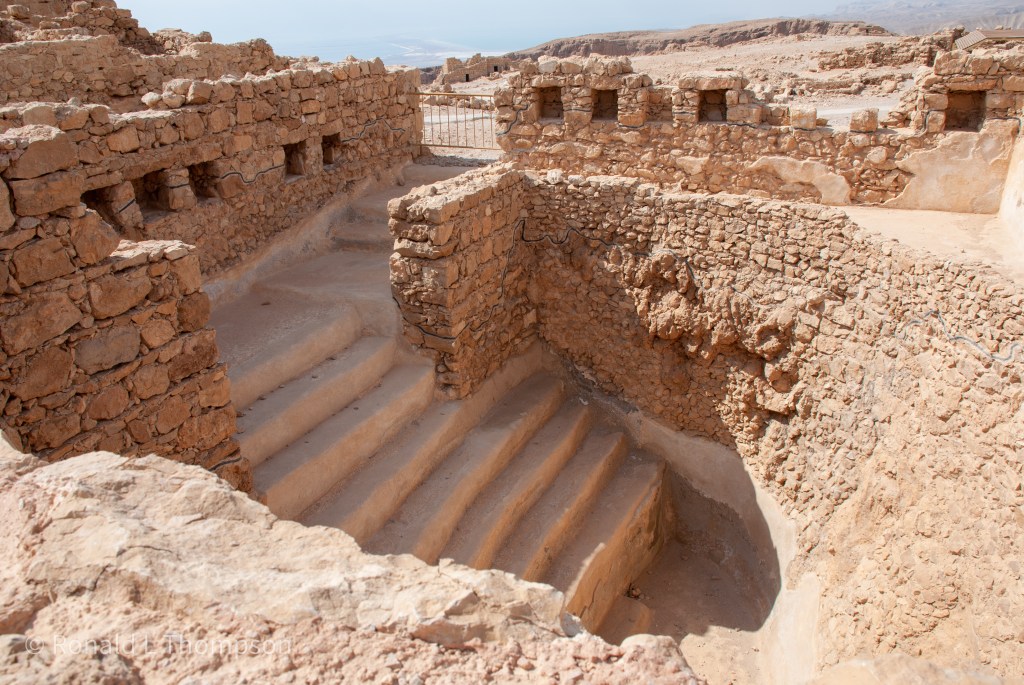
©Ron Thompson 1008. On Masada, a typical Jewish baptistry (Heb. mikvah).

So here is what the period looked like: On Elul 1, all Jews went to the most convenient mikvah (ritual baptistery), spring or river for immersion and cleansing from sin, then, for 40 days, the process of virtual self-flagellation would proceed, culminating in the Pilgrim Festival of Yom Kippur, to be covered in Part 12. Of course, all intervening Sabbaths and the Day of Trumpets/Rosh Ha-Shanah Feast were scrupulously observed. At the conclusion of the 40 days, Jews from around Israel and the Diaspora convened at the Temple Mount for the most important Feast of the year.

The Parapet of the Temple, adapted from Rose Guide to the Temple,
© Copyright 2012 Bristol Works, Inc.

Consider now a late summer in AD 29. It is Elul 1, and John the Baptizer is standing by the water near the village of Bethany Beyond the Jordan, not too far from Jericho (Luke 3). He is baptizing devout Jewish men and women from the district, and chastising those simply obeying their legalistic impulses. He raises his head and sees, walking towards him, his cousin Jesus of Nazareth, who some 33 years earlier had caused him to jump in his mother’s womb. Jesus speaks to John, then steps into the water and is baptized, not for His own sin, but in order to conform to the ritual necessities expected of Him, and to receive the blessing given Him by Father and Spirit that day.

Following His baptism, Jesus is led by the Spirit into the wilderness for the requisite 40 days of prayer and fasting. At the end of this time, on Yom Kippur, Satan appears to Him and tests Him in three ways:

Luke 4:1-12 (CJB)
[4:1] Then Yeshua*, filled with the Ruach HaKodesh* [Holy Spirit], returned from the Yarden* [Jordan] and was led by the Spirit in the wilderness [2] for forty days of testing by the Adversary. During that time he ate nothing, and afterwards he was hungry. [3] The Adversary said to him, “If you are the Son of God, order this stone to become bread.” [4] Yeshua* answered him, “The Tanakh* [Old Testament] says, ‘Man does not live on bread alone.’

[5] The Adversary took him up, showed him in an instant all the kingdoms of the world, [6] and said to him, “I will give you all this power and glory. It has been handed over to me, and I can give it to whomever I choose. [7] So if you will worship me, it will all be yours.” [8] Yeshua* answered him, “The Tanakh* says, ‘Worship ADONAI* your God and serve him only.’”

[9] Then he took him to Yerushalayim*, set him on the highest point of the Temple and said to him, “If you are the Son of God, jump from here! [10] For the Tanakh* says,

‘He will order his angels
to be responsible for you and to protect you.
[11] They will support you with their hands,
so that you will not hurt your feet on the stones.’”

[12] Yeshua* answered him, “It also says, ‘Do not put ADONAI* your God to the test.’”

The Gospels differ in the order presented, but I think that Luke is most likely chronologically correct by putting Him last on the “highest point of the Temple“, the parapet on the southeastern corner of Solomon’s Porch (see diagram). Yom Kippur being a required Pilgrim Festival, as many as a million people would have been below him in the Temple courts, the Plaza outside, or down in the City of David or its surroundings. Many would have only to raise their eyes to see the drama if Jesus had failed this test.

The Temptation of Jesus does not get the attention it deserves! It is, in my opinion, one of the key events in all of human history.

Jesus, just like Adam, was placed on earth without a sin nature, meaning that they did not have the innate propensity to challenge God’s will. But both were human, and both could be persuaded by temptation. Adam and his mate were tempted by Satan in three ways that we have come to call, The Lust of the Flesh, The Lust of the Eyes, and The Pride of Life. They failed this test and condemned all their descendants to a life of sin. Jesus was tempted in the same fashion and resisted on all counts! He passed all three tests. Had He not done so, we would have no Savior!

Table of Contents: The Jewish Feasts
Start of Series: The Jewish Feasts: Part 1, Chapter Introduction
Previous in Series: The Jewish Feasts: Part 9, Weeks
Next in Series: The Jewish Feasts: Part 11, Trumpets

The Fall Feasts and the Rapture

Posted on:

Modified on:

  1. Dating Three Key Events in Jesus’ Life
  2. The Fall Feasts
  3. The Days of Awe
  4. The Day of Trumpets
  5. Extension of the Days of Awe
  6. The Baptism and Temptation of Jesus
  7. The Day of Atonement
  8. Conclusion

This post was first published over 10 years ago but recently got a major overhaul. First, because my own style has changed a bit over the years; but also, because I’ve changed my mind about one related issue, which I’ll discuss below. This is a good time for an update because it is now the middle of the Hebrew month Elul, and that is the temporal setting of my main topic here, the Fall Feasts.

Fig. 1: The Seven Principal Feasts, as outlined in Leviticus 23, ©Ron Thompson

To Top

Dating Three Key Events in Jesus’ Life

I started this edit by setting a time frame for Jesus’ First Advent, which I date in the following short table. Here I have used the Gregorian calendar for the year, because that is more identifiable to most of us, but I’m taking the month and day from the Hebrew calendar, because annual events are Biblically fixed according to that standard and are different every year by the Gregorian and earlier Julian calendars.

EventAgeHebrew DateGregorian Year
BirthTishri 154 BC
Baptismabout 30 yearsElul 1AD 26
Crucifixionabout 33 yrs., 6 mos.Nisan 14AD 30

Here are some of the factors I considered in composing this table:

  • The Biblical feast days commemorate important Jewish historical events, celebrate the annual agricultural cycle, and prophesy about Messiah’s life on earth, in both of His advents.
  • I am convinced that the Jewish principal feasts, as commanded in Leviticus 23, provide a totally reliable outline of important events in Jesus’ life, as shown in the last column of Figure 1, above. Events highlighted there in peach occurred during His first advent, on the actual feast days shown. Events highlighted in blue will occur during His second advent, again on the actual feast days shown.
  • I’m very confident that Jesus’ birth was on Tishri 15, the first day of the Feast of Tabernacles, Sukkoth. Not in December, on a date with absolutely no Scriptural support (but with a pagan connotation!); but rather in a September/October timeframe corresponding to Jewish celebration of the time that God previously “tabernacled” with His people during their 40 years of wilderness wandering. With Jesus’ birth, once again God was living among His people.
  • The year of Jesus’ birth has been disputed during my entire lifetime. There are always unresolved arguments about when Herod died, when Quirinus was governor of Cilicia/Syria, and what year a lunar eclipse hit the region, all of which are applicable. The most commonly cited estimates that I’ve seen place Jesus’ birth in 4 BC, though dates ranging from 1 through 6 BC are also commonly mentioned. I’m sticking with 4 BC here, because it fits well with the other two dates in my table.
  • Luke 3:23 states that Jesus was “about thirty years of age” when He began His ministry. Fall of AD 26 is about thirty years after the autumn of 4 BC. In fact, if His ministry began on Yom Kippur (see below), and that was the last day of His 40-day “wilderness fast and temptation”, then He was just five days shy of 30 years old.
  • His baptism by John was 40 days before Tishri 10, which is the Day of Atonement, Yom Kippur. I’ll explain the 40-day offset below, but it culminates with Jesus on the pinnacle of the Temple, defying Satan, on Yom Kippur, in full view of many thousands of worshippers on the plaza below.
Fig. 2: The late Alec Garrard, facing “south”, posing in his backyard shed model of Herod’s Temple. The parapet in the lower right corner overlooks the Kidron Valley, and as the highest point on the Temple Mount walls, it is thought by many to be the “pinnacle” mentioned in Scripture. I personally suspect that the somewhat lower parapet to the left, more commonly known as the Place of Trumpeting, might be the actual pinnacle of Scripture, since it is far more visible from the streets below. Photo from The Miniature Engineering Craftsmanship Museum.
  • His crucifixion was on Nisan 15, the first day of the Feast of Unleavened Bread, Yom ha-Bikkurim, not on Nisan 14, the day of the sacrifices.
Fig. 3: Jesus’ Crucifixion Timeline, showing in green what I consider to be the correct dates for each phase, on both the Jewish and Gregorian calendars. The vertical gray bars (not to scale) represent the evening twilight periods between Jewish dates (see Fig. 4). ©Ron Thompson
  • The year of Jesus’ crucifixion, shown here as AD 30, was calculated by me, using NOAA (National Oceanic and Atmospheric Association) New Moon Tables, which were prepared with historic ocean tides in mind. Every published Biblical chronology that I’m aware of puts the crucifixion in AD 33, but they are all based on an incorrect interpretation that insists He was crucified on Nisan 14. With a correct understanding of the timings of Passover Week which (thanks to my traditional presuppositions) it frankly took me many years to achieve, it is clear that Jesus was crucified on Nisan 15.

9/5/2023 addition – When I was working on my August update last week, I completely forgot to add one other crucial piece of evidence:

1 In the fifteenth year of the reign of Tiberius Caesar, Pontius Pilate being governor of Judea, and Herod being tetrarch of Galilee, and his brother Philip tetrarch of the region of Ituraea and Trachonitis, and Lysanias tetrarch of Abilene,
2 during the high priesthood of Annas and Caiaphas, the word of God came to John the son of Zechariah in the wilderness.
—Luke 3:1-2 ESV

Leaving Tiberias until last, here are the tenure years of the leaders mentioned (all are 1st Century AD): Pilate, 26–36; Herod (Antipas), 4–39; Philip, 4–34; Lysanius, unknown; and Caiaphas, 18–37. Annas was High Priest during the period 6–15 but was the real power in the Temple during the tenure of Caiaphas, his son-in-law, 18–37.

For the purpose of dating the text, only Tiberias‘ rule is useful. Many historians and Biblical commentators date Tiberias’ accession to the time of Augustus’ death. That puts the timing of Jesus’ baptism in the year AD 29, which would pose a problem for my proposed dating. I don’t think AD 29 is correct, because it was common for many, possibly most, ancient rulers and their chroniclers to ambitiously include years of coregency in citing tenure of rule. Tiberias was coregent with Augustus starting in either AD 11 or 12. AD 11 fits perfectly with my AD 26 date for Jesus’ baptism.

I find that I am not alone in recognizing this discrepancy. The well-respected commentary Jamieson, Faucett & Brown, for example, states that:

the fifteenth year of Tiberius — reckoning from the period when he was admitted, three years before Augustus’ death, to a share of the empire [results in a date for the events of Matthew 3:1 of] about the end of the year of Rome 779, or about four years before the usual reckoning.

“The usual reckoning” is AD 30. The traditional date for the founding of Rome was 753 BC, which makes “the year of Rome 779” equivalent to AD 26.

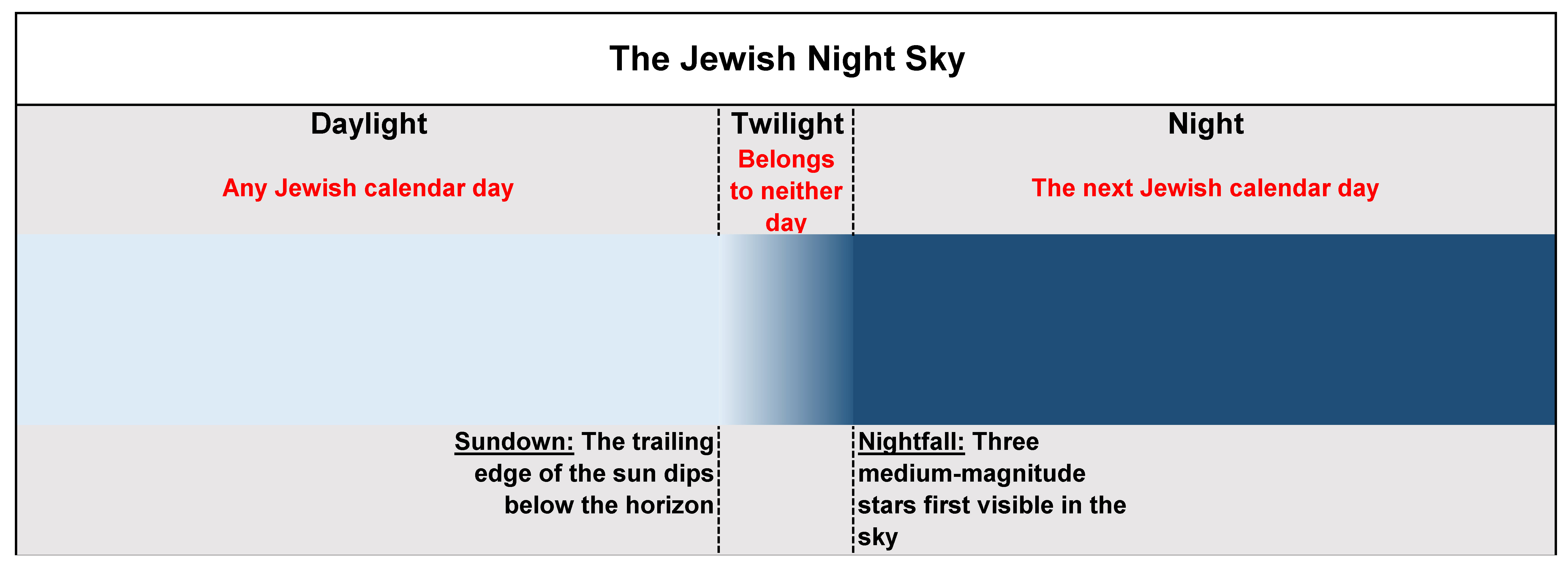
Fig. 4: Explanation of how Jewish days traditionally begin and end. ©Ron Thompson

Please refer to Figures 3 and 4, above. The Passover sacrifices were killed on Nisan 14, then consumed during the Seder, which began that evening at dusk. Jesus and His 12 apostles celebrated the Seder until late, as customary, then joined with the Hallel singing outside at midnight, and afterwards walked to Gethsemane, where Jesus was arrested. His trials were conducted during the early morning of Nisan 15, and He was crucified and buried that day. That was on a Friday, and the only year within a reasonable range with a Friday on Nisan 15 was AD 30. I am very confident that this scenario is correct!

Fig. 5: An April 2024 calendar showing parallel Hebrew dates on the right. This clearly demonstrates that the 8-day Passover celebration (7 days in Israel) begins on Nisan 15. Jewish Time®, by Calendar Maven
  • Most scholars think that Jesus’ ministry lasted around 3½ years, based on the number of Passovers He seems to have attended during that time. I agree.

To Top

The Fall Feasts

This month shall be to you the head of the months; to you it shall be the first of the months of the year.
—Exodus 12:2 (The Complete Jewish Tanach)

Nisan 1, in the Spring, is the Jewish religious New Year. Jews today, though, celebrate the civil new year, Rosh Hashanah, which is six months later, on Tishri 1.

Most of the modern world celebrates the new year with revelry. Not so among devout Jews in 1st Century Judea, because Tishri 1 is also the date of Yom Teruah, the Day of Trumpets. This important feast day heralds God’s judgment of His chosen people for their deeds, both good and bad, committed during the preceding year.

As such, the mood during the entire ten-day period through Yom Kippur, the Day of Atonement, on Tishri 10, is somber and introspective. There is prayer, fasting, ritual immersion (baptism for purification), and general spiritual misery and mourning. No weddings or other celebrations are permitted.

Once Yom Kippur has passed, the mood shifts. There is spiritual relief, and a 5-day period of relaxed preparation, followed by the joyous eight-day celebration of Sukkoth, the Feast of Tabernacles.

To Top

The Days of Awe

In the rest of this post, I will concentrate on two of the fall feasts in particular: The Day of Trumpets and the Day of Atonement. These two feasts, and the 10-day span of time connecting them, is known as Yamim Noraim, the ten “Days of Awe”. This somber period, as described above, is devoted to sincere individual and national confession of sins, and to t’shuvah, or repentance.

Fig. 6: The Days of Awe, Yamim Noraim. ©Ron Thompson

To Top

The Day of Trumpets

Rosh Hashanah, also known as Yom Teruah (The Day of Trumpets), is the Jewish day for regathering. Jews believed that, on this day every year, God divided His people into three groups according to their faithfulness over the preceding year. One group was the “wholly righteous”, whose names would certainly be written in the Book of Life. A second group was the “wholly wicked”, who would be written into the Book of Death. The final group was comprised of “those in between”, whose fate would be sealed by the quality of their t’shuvah over the next ten days, with their final judgment reserved until Yom Kippur.

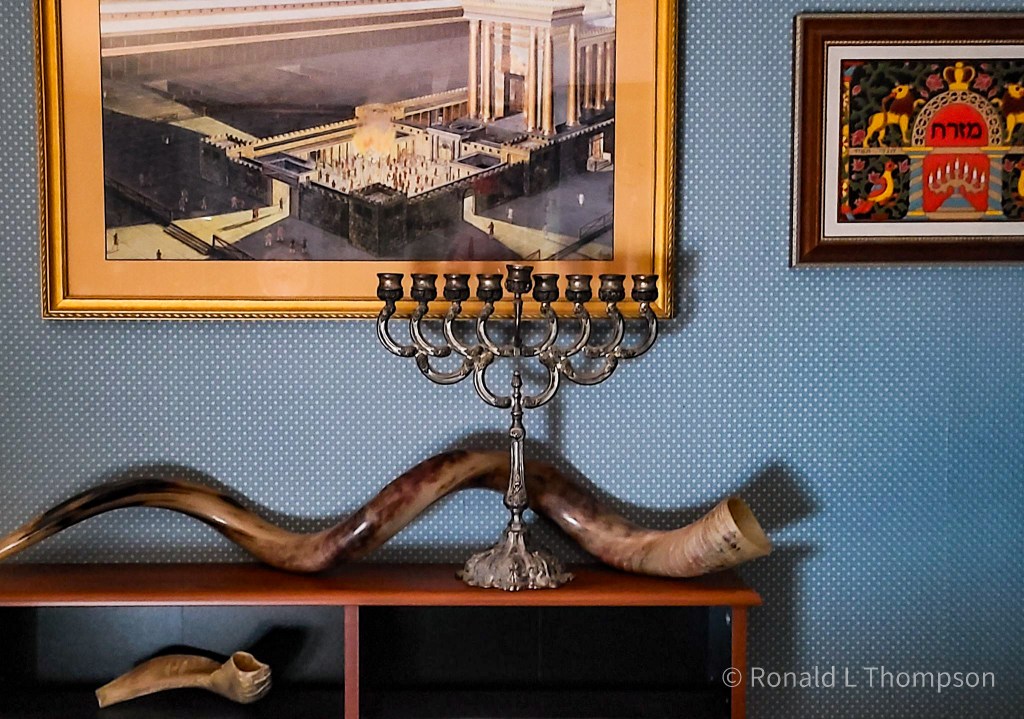
Fig. 7: My Judaica wall. The small shofar is from a traditional ram’s horn, used mainly in mobile situations. The large one is Yemenite, a Kudu horn. Kudu is a species of antelope found in eastern and southern Africa. Large shofarim like this are favored for fixed locations, like the Temples of Israel, or modern synagogues. The lampstand is a hanukkiah, used ceremonially in Hanukah celebrations, which require 9 candles. If it had only 7 branches, it would be a menorah. Photo ©Ron Thompson

What prompted me to revise this post was that, in the original version, I said of the above viewpoint, “this doctrine is certainly not Biblical”; however, I have mostly changed my mind about the books, though I think that the Jewish perspective on them may be a bit skewed. I have recently been introduced to the works of Michael S. Heiser, and what he called the “Deuteronomy 32 worldview” (see Gods and Demons). He addressed this subject in ways that I had not previously considered.

There are, in fact, eight New Testament references, mostly in Revelation, to the “book of life“, and many Old Testament and intertestamental references to heavenly “books” and “tablets” that are clearly connected. I assume that these conceptual records are metaphorical, considering that God is God, and doesn’t need a physical database to remember what He needs to remember. Heiser makes sense when he suggests that our sins are recorded in one book, and our salvation in another. If (and only if) we are not listed in the second, then we will be judged by what is recorded in the first. There may be a “book of death“, too, that renders some ineligible for salvation. Regarding the latter, see, for example:

[31] Therefore I tell you, every sin and blasphemy will be forgiven people, but the blasphemy against the Spirit will not be forgiven.
—Matthew 12:31 (ESV)

Whether or not the doctrine of these books is valid, the fact that the holiday recognizes a separation of people from people is very significant since it prophetically depicts the regathering of God’s people on the coming day of Rapture:

[16] For the Lord himself shall descend from heaven with a shout, with the voice of the archangel, and with the trump of God: and the dead in Christ shall rise first…
—1 Thessalonians 4:16 (KJV)

In light of 1 Thes 4:16, the blowing of the trumpet (actually, a shofar, or ram’s horn) on Yom Teruah is particularly interesting. The shofar (accompanied by metallic trumpets in Temple days) was blown at mid-morning after the morning (Shacharit) prayers, in three series of four distinctive notes: tekia (“blast”); shevarim (“broken notes”); teruah (“shout”—thought of as “the shout of an archangel”); and tekia gedolah (the “great blast”). The first series is tekia, shevarim, teruah, tekia, repeated three times. The second is tekia, shevarim, tekia, repeated three times. The final series is tekia, teruah, tekia, repeated three times, followed immediately by tekia gedolah, referred to in 1 Cor 15:52 as “the last trumpet”.

[52] in a moment, in the twinkling of an eye, at the last trumpet. For the trumpet will sound, and the dead will be raised imperishable, and we shall be changed.
—1 Corinthians 15:52 (ESV) emphasis mine

To Top

Extension of the Days of Awe

Since long before Jesus’ day, the Days of Awe have, in practice, begun thirty days before Yom Teruah, on the first day of the Jewish month Elul. T’shuvah (repentance) is much too important to put off until the last minute, so the Rabbis decided that forty full days should be devoted to it, rather than the ten required by Torah.

On Elul 1, Jews would flock to the mikvot (baptisteries) of the Temple and synagogues, and to the “living waters” of streams and rivers like the Yarden (Jordan), to immerse themselves for ritual purification. That would then be followed by forty days of prayer, fasting and introspection. In the years preceding AD 30, it seems that many had become preoccupied with the politics and woes of the Roman occupation, and such customs were being neglected. Into this scene stepped Yochanan, who we now call John the Baptizer, calling Jews to baptism and t’shuvah.

To Top

The Baptism and Temptation of Jesus

[13] Then Jesus came from Galilee to the Jordan to John, to be baptized by him. [14] John would have prevented him, saying, “I need to be baptized by you, and do you come to me?” [15] But Jesus answered him, “Let it be so now, for thus it is fitting for us to fulfill all righteousness.” Then he consented. [16] And when Jesus was baptized, immediately he went up from the water, and behold, the heavens were opened to him, and he saw the Spirit of God descending like a dove and coming to rest on him; [17] and behold, a voice from heaven said, “This is my beloved Son, with whom I am well pleased.”
—Matthew 3:13–17 (ESV)

I believe that the events of Mt 3:13-17, describing Jesus’ baptism and anointing by the Holy Spirit, took place on Elul 1, conforming to the current tradition. As to the year, I lean towards AD 26, as stated above. If that year is off, I’m still 100 percent sure of the Hebrew month and day.

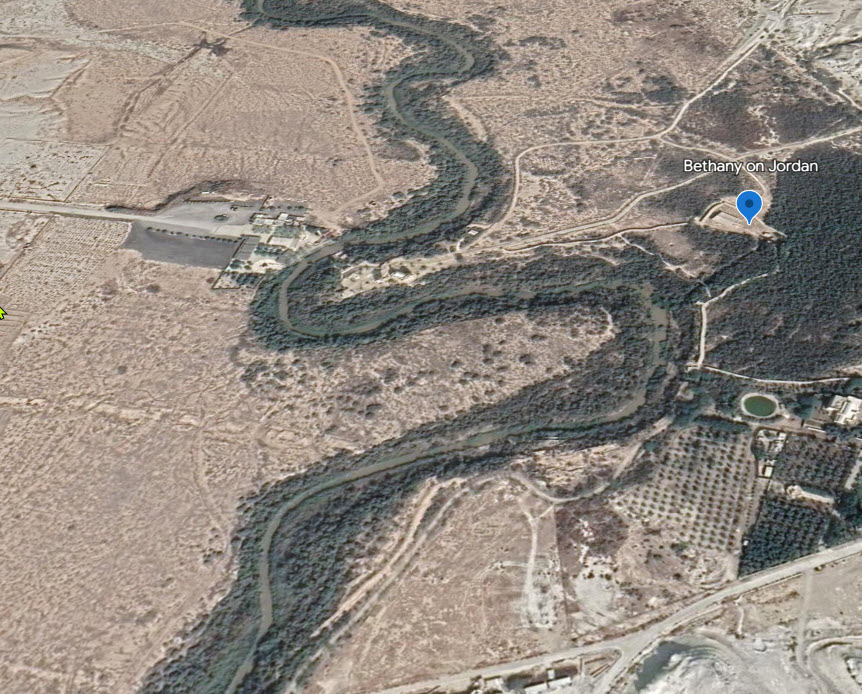
Fig. 8: The Jordan River today, due east of Jerico. Scripture places Jesus’ baptism at Bethany on Jordan, no doubt referring to the east bank of the oxbow, close to the village. From Google Earth.

Though of course He was sinless, His baptism, followed by forty days of prayer and fasting, were consistent with and required by the customs of the season.

More importantly, the temptation and His response were theologically vital. Jesus was “the Second Adam” (see The Two Adams). The first was created sinless, but when tempted by the “lust of the flesh, the lust of the eyes, and the pride of life”, failed and brought sin to the world. The same tempter and same temptations came to Jesus in the wilderness: lust of the flesh (stones to bread); lust of the eyes (the kingdoms of the world); and pride of life (rescue by angels in the sight of all Israel). Jesus did not fail, and brought redemption to the world.

Matthew presents a different order for the temptation, which is not a problem because chronological order was not strictly important in the literature of the day, but I’m certain that “pride” was last in real time, as listed by Luke.

Interestingly, that placed Jesus on the Pinnacle of the Temple on Yom Kippur:

[9] Then he [the devil] took him to Yerushalayim, set him on the highest point [Greek pterugion, literally, a “wing” or “turret”] of the Temple and said to him, “If you are the Son of God, jump from here! [10] For the Tanakh [Old Testament] says [Psalm 91:11–12],

‘He will order his angels
to be responsible for you and to protect you.
[11] They will support you with their hands,
so that you will not hurt your feet on the stones.’”

[12] Yeshua [Jesus] answered him, “It also says, ‘Do not put ADONAI your God to the test.’” [13] When the Adversary [Greek diabolos, literally, “accuser”] had ended all his testings, he let him alone until an opportune time.
—Luke 4:9–13 (CJB)

To Top

The Day of Atonement

While the Temple still stood, on Yom Kippur all the people gathered on the Temple Mount for the ritual sacrifices that would roll the sins of the truly repentant back for another year. Since there is no longer a Temple, and thus no legitimate place for blood sacrifices, the gatherings are now in the synagogues, and what is offered are “sacrifices of prayer.”

Most translations render pterugion as “pinnacle”, following the KJV. This is traditionally interpreted as the highest point on the Temple Mount or its surrounding walls, but I don’t think that this is warranted. It seems to me most likely that this is referring to the “place of trumpeting” (see Figure 2) which, by inference, was probably the parapet, or observation platform, from which the priests monitored the ritually vital sunrise and sunset every day. This high overlook was visible from the exterior streets below. If Jesus had accepted Satan’s temptation to throw Himself off and allow the angels to catch Him, all the Jewish world would have witnessed the destruction of His public ministry on the very day it began! Certainly, this was Satan’s plan!

To Top

Conclusion

I am forever thrilled at the beauty of God’s timing! I believe that many of the events connected with Jesus’ First and Second Advents actually occurred or will occur on the precise day of the Feast that pictures the event. Could it be that He will return for his Church at the exact moment of the “Last Trump” on the Feast of Trumpets (as God indeed said He would!), which is prophetic of the Rapture? Is it possible that He will return in judgment at the end of Tribulation on the Day of Atonement, the very day when God is thought to seal His judgment of His people? I am convinced it is so!

To Top