Based primarily on research done by Dr. Randall Price (Searching for the Ark of the Covenant and The Lost Ark and the Last Days: In Search of Temple Treasures) I believe that the Ark is in a cave beneath the Temple Mount. It was accessible and possibly seen after the 1967 “6-Day War” prior to the sealing of Warren’s Gate by the Jordanian Waqf.
When was the Ark ever in Herod’s Temple?
Never! Leviticus 16 describes God’s commandments for Yom Kippur in the Tabernacle. These were followed with appropriate modifications in the days of Solomon’s Temple, but when that Temple was destroyed by Nebuchadnezzar, the Ark disappeared. Old Jewish traditions hold that Jeremiah hid it somewhere before the destruction.
How did Yom Kippurwork without an Ark?
The problem was bigger than that: not only was the Ark gone, but as prophesied in Ezekiel 9 and 10, so was God’s Sh’khinah(Divine Presence), and even the two large cherubim statues were missing. There was nothing in there except haShetiya, the Foundation Stone on which the Ark sat. What was sprinkled with blood? Just the stone. There is, to this day, a shallow niche carved into the stone that is the exact dimension, location and orientation to have supported the Ark, so that is where the High Priest’s attention was focused.
How did it work with no Temple at all?
Some Jewish congregations still attempt to offer a blood sacrifice by wringing the neck of a chicken, but this is a minority practice. In the late 1st century, rabbis decided that the Temple ritual could be replaced by Tefilah (prayer), Teshuva (repentance), and Tzedakah (charity). Those are all good things, surely, but one might say, “Why not just accept your own Messiah?” What about the interval of the Babylonian Captivity, when there was also no Temple? I would ask you to remember that salvation was never a result of sacrifice! Sacrifice was a response of faith in a gracious God!
How did the High Priest accomplish so much in the Holy of Holies on Yom Kippur if he could enter only once a year?
It is not true that the High Priest went into the Holy of Holies only once a year. He went only on Yom Kippur, but on that day he went in four times: (1) He entered to lay coals from the altar, and to burn incense. (2) He entered again to sprinkle the bull’s blood for his own atonement. (3) He entered yet again to sprinkle the goat’s blood for the people’s atonement. (4) Finally, he entered to remove the spent coals at the close of the ceremony.
Given the unrighteousness of many High Priests, how many were struck dead entering the Holy of Holies?
None, as far a we know. But righteousness was not required, or none would have survived; only “ritual cleanness” kept them alive. There was a long process that was required to achieve this ceremonial virtue. It began four days earlier, and involved many washings, immersions, and changes of attire. Part of this procedure was Biblical, part was traditional.
Was a rope really tied to the High Priest’s leg so that he could be pulled out if his attendants quit hearing the tinkling of his bells and pomegranates?
Pure myth! To begin with, there were no bells and pomegranates, because Scripture required him to enter in pure white linens, with no decoration. In the second place, during the key moments of his entry, no other humans were allowed into even the inner Temple courts, let along into the Temple itself. Thirdly, it would have been impossible to pull him through the veil in any case. It was not one veil, it was actually two very heavy veils stretching from side to side and ceiling to floor, with no space on any side. There was a space of one cubit separating the two veils. The outer one was pinned to the left doorpost and the inner to the right doorpost so that they might never reveal what lay beyond. When entering the Holy of Holies, the Priest would pass below the pin on the left side of the outer curtain, walk between the curtains, pass beneath the pin on the right side of the inner curtain, and then walk beside that curtain until he reached the Ark. To exit, he reversed the route. It is impossible for me to conceive of a rope with a body attached being pulled through that circuitous route. Nor would this have been needed; see below regarding cleaning of the Holy of Holies.
Are the scarlet thread stories true?
I have heard two versions. One holds that a scarlet thread was attached to the wall beside the outer veil. If by the next day the thread was found to have turned snow white, then God had accepted the sacrifice. Otherwise, the sacrifice had been rejected and Israel’s sins were unforgiven. The continuation of this story holds that after Jesus’ crucifixion, and up to the AD 70 destruction of the Temple, the thread never changed color. This isn’t absurd on its face, like the rope theory, but if it were true, we would find volumes of lamentations over those 40 years of rejection. This would be known as the greatest national calamity ever to strike Israel. I think even more so than the Temples’ destruction. The second version is the same, except that the thread was attached to a horn of the Scapegoat. I reject this version as well. I think that this one is probably a corruption of a story in rabbinical literature which records that a scarlet strand of some sort was tied across both horns of the goat and used to secure a heavy rock so that the sure-footed goat would be pulled over the cliff to its destruction.
How far out of the Temple was the goat taken?
According to rabbinical sources, 90 ris. After five separate unit conversions, I worked this out to about 7 miles. Watchers were stationed at key locations between Temple and cliff so that successful completion of the goat’s assassination could be signaled back by means of flags, and the next steps of the ceremony begun.
Would the Ark with its poles even have fit into the Holy of Holies?
Very astute question! We know the dimensions of the room, of the Ark, and even of the poles. Yet almost every depiction of these things shows the Ark oriented with its poles parallel to the veil, which cannot be! In reality, the Ark went in like a car into a garage. And on either side of it stood a very large statue of a stylized cherub.
How was the Holy of Holies kept clean, or did it never get dirty?
Of course, it got dirty! Hundreds of years of dust bunnies, charcoal dust, incense smoke, insects, and mouse droppings, not to mention hundreds of years of bullock and goat blood! And, potentially, dead High Priests. Before you ask, no, the High Priest didn’t do the cleaning. Above the Holy of Holies was a “drop ceiling” consisting of wooden rectangular tiles set into a framework. Referring to the attached diagram, there was a large chamber over the Holy of Holies, and the ceiling below could be accessed from there. Workmen could, after suitable cleansing, be lowered on ropes to work using tools with long handles. The rules prevented them from touching anything in the room with their own bodies, nor were they allowed to dally or “sight-see”.
Yom Kippur, not Passover, is the most important of the Jewish Feasts!
The Days of Awe are the most somber period of the Jewish Year, and Yom Kippur, the Day of Atonement, is the capstone of the Days of Awe. The correct form of the Feast name is Yom HaKippurim, (the Day of Coverings); but Yom Kippur is the more common name.
I have heard it said many times that Passover is the most important Jewish Feast. That is simply not true. With no Temple to worship in, Passover has certainly become the most well known and faithfully celebrated of the Feasts, but for sheer spiritual impact, Yom Kippur is by far the most vital. it is a recognition of personal and national sin, and a plea for salvation.
Christians celebrate Easter as a salvation event, and rightly so, because Easter celebrates specifically the time and actuality of Jesus’ death, burial and resurrection. Jews celebrate Passover at roughly the same time as Easter, but not at all as a salvation event. As stated in earlier parts of this series, Passover is a celebration of redemption from slavery and resurrection as a people.
In AD 325, Emperor Constantine and the Council of Nicaea officially severed Easter from Passover. This was unfortunately done for explicitly anti-Semitic reasons; however, given the salvation emphasis placed on Easter by non-Jews, it was probably best to do so.
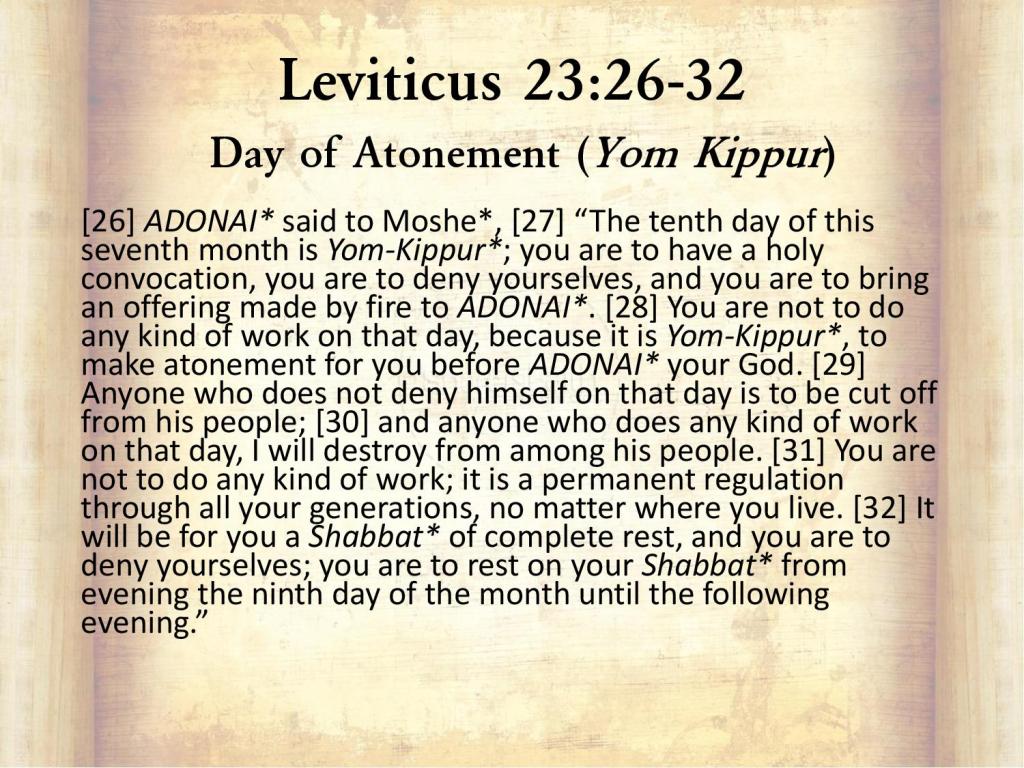
Recall that the ten Days of Awe are all about repentance and reconciliation. On the final day, on Yom Kippur, one’s deeds will be judged by God, and his or her state of salvation determined for the coming year. As you can see from Leviticus 23, above, the day is a Sabbath. Not only that, but the phrases “you are to deny yourselves” (stated twice) and “Anyone who does not deny himself on that day is to be cut off from his people” are regarded as a command to fast, on pain of excommunication. The Hebrew terms used here literally mean to “humble, or afflict one’s soul”. Traditionally they are taken to include fasting, abstinence from sex, and refraining from personal grooming. Yom Kippur is the only Biblically mandated fast day, though rabbinic Judaism does recognize certain other somber days as fast days, and Zechariah 8:19 mentions several months when ancient fasts were practiced.
The Temple Precincts
The ritual of Yom Kippur for Tabernacle observance is described in more detail in Leviticus 16. It is quite complicated. More so in Temple days, and still more after the addition of Oral Traditions. There are very strict and detailed regulations regarding the attire of the High Priest (Heb. Cohen HaGadol), his multiple cleansings, and who and at what times other people could enter the Temple precincts. The actual Temple/Tabernacle observance included the following, in brief:
The High Priest would cast lots over two male goats: one, designated as Chatat, was to be sacrificed; the other was to set aside “for Azazel”; this one would be “brought before the people” so that their sins would symbolically be laid upon him.
The Priest would sacrifice a young bull to atone for, or “cover”, his own sin and that of his household, and the sacrificial goat, to atone for the sins of the people.
Under smoke from incense, blood from these sacrifices was to be sprinkled, with his finger, inside the Holy of Holies, on the Mercy Seat, the front of the Ark, and “toward the east”, that is, between the Ark and the Veil.
Outside the Holy of Holies, blood was also to be sprinkled on the Horns of the Altar.
Having completed these actions, the High Priest was to lay his hands on the head of the live goat and “confess over it all the transgressions, crimes and sins of the people of Isra’el” (CJB). This, the “Scapegoat” now carrying all the sins of the people, was then to be led out of the city to an uninhabited area about 7 miles away, by a fit man appointed to the task. Ostensibly, this goat was to be released, but in practice, it was usually pushed off a cliff to prevent it from wandering back with the people’s sins. Accomplishment of this task was then signaled back to the Temple.
The bullock and the goat were then cut open; the fat and fatty organs were burned on the altar, and the rest of the carcass taken out and burned (on the Mount of Olives in Temple times).
The High Priest would then read from Torah in the Court of Prayer (aka, the Court of women).
Next, the Priest would sacrifice his ram, the ram for the people and seven additional rams.
Finally, he would remove the incense pan and ladle from the Holy of Holies.
For a really good description of the Temple ritual, derived from rabbinical documents, refer to this excellent article by a knowledgeable rabbi: The Service of the High Priest
Important Concepts
As seen previously, the Passover Lamb or Kid was a fellowship offering, to be killed and shared as a meal between friends or family.
The bull and goat sacrificed on Yom Kippur were sin offerings. As such, they could atone for (temporarily cover over), but not permanently remove, the sins of the people. Sin offerings had to be completely burned, not eaten. You don’t want to re-ingest your sins!
The rams were burnt offerings. They were consumed completely in fire, with the rising smoke symbolizing righteous prayer and thanksgiving.
The goat for Azazel was symbolically innocent, vicariously taking on itself the sins of the people and carrying them away. Its killing was not a sacrifice; it was merely a disposal.
Note especially: Hebrews 9:22 says that “according to the Torah, almost everything is purified with blood“ (CJB, emphasis mine). The context is speaking specifically about ritual vessels and implements, but the same is true with people. The Torah provides atonement through sacrifice for “unintentional sin”, i.e., for sins committed thoughtlessly, accidentally, negligently, or perhaps even in passion. No place in the entire Bible do we ever find a sacrifice for intentional disobedience or rebellion against God! There is no atonement for intentional sin! The theme of Yom Kippur is “regeneration”, that is, salvation. So how is any human being saved? Under Torah, it is by God’s grace, through faith–as pictured in the Scapegoat. Under the New Covenant, by God’s grace, through faith–as delivered for all times past or future by Jesus, the antitype of the Scapegoat!
“Theology” is the study of God, and “Soteriology” is the study of, or theology of, salvation.
As an Evangelical Christian, I believe that Salvation is by God’s Grace, through Faith implanted by God and acting in us. I believe that Salvation has always been by Grace, through Faith. In Temple times, yes, certainly there were many Jewish legalists, but the sages always understood that the sacrifices were a response of faith to Salvation, not a means of it. And if not, were Jews of the Babylonian Captivity forever lost because they had no Temple and therefore no sacrifices? No, they had their faith and a gracious God!
We understand that Salvation is, in one sense, a process (personal conviction of sin), culminating in an event. Not, I think, a result of following some yellow brick road through random verses in Romans with a well-meaning friend or stranger, and then repeating back a magic prayer. The best statement I know of to explain salvation is:
Hebrews 11:6 (ESV) [6] And without faith it is impossible to please him, for whoever would draw near to God must believe that he exists and that he rewards those who seek him.
While the Salvation event is a jewel to be sought, it is in reality a jewel with many separate facets (see slide, below): It gathers us into fellowship with likeminded believers; in fact, usually, God brings people into contact with believers in order to introduce them to the reality of His existence. The key facet is regeneration, replacement of our old nature by the new. This results in short- and long-term joy. It also brings redemption from slavery to sin. As we live among God’s people and learn God’s will, we experience sanctification, a turning from sin towards a purer life. Eventually, we all die, but we look forward to ultimate resurrection, followed by revelation of all truth.
So, these facets of Salvation are typified by the recognized themes of the Jewish Feasts! The order is precisely that of the feasts, on Israel’s civil calendar beginning in the fall.
It is important, and the reason for this article, that you recognize that
Jesus is not just the archetype of the Passover Lamb; He is also typified by, and fulfills the prophetic vision of, all Biblical Jewish Feasts and Sacrifices.
In1 Peter 1:18-19 (ESV), the Apostle tells us, “You were ransomed … with the precious blood of Christ, like that of a lamb… without blemish or spot” The emphasis on “like” is mine, and I removed a comma that is not in the Greek. Peter is here comparing Jesus with, really, all of the efficacious sacrificial animals, not just the Passover Lamb.
John the Baptizer, in John 1:29 (ESV), said, “Behold, the Lamb of God, who takes away the sin of the world.” But, what does it mean to call Him “The Lamb of God“? Was John prophesying that Jesus would be crucified during the Passover Feast, some 3-1/2 years in the future? The people hearing John in that day, in that place, would have missed that point and immediately known that John was pointing out to them the person who he believed to be the promised Messiah!
Prior to Jesus’ appearance, the Jewish rabbis taught that personifications of “the Lamb” in the Old Testament were speaking of the coming Messiah. Take, for example,
Isaiah 53:7 (ESV) [7] He was oppressed, and he was afflicted, yet he opened not his mouth; like a lamb that is led to the slaughter, and like a sheep that before its shearers is silent, so he opened not his mouth.
At the bottom of Part 4, I mentioned some reasons that many theologians mistakenly think that the Gospel of John conflicts with the synoptics, and thus proves that the Last Supper could not have been a Passover Seder. Part of their belief is that Jesus must have been crucified at the exact same time as the Passover sacrifices because “He was the Passover Lamb of God who took away the sins of the world.” That, too, is a misreading of John.
Here is a list of some things that I think make it impossible for Jesus to have died on Nisan 14, at the same time as the sacrifices:
Most importantly, a proper understanding of the scriptures and the cultural traditions make the narrative of the four Gospels clear and consistent. The sacrifices were on Nisan 14, the Crucifixion on Nisan 15.
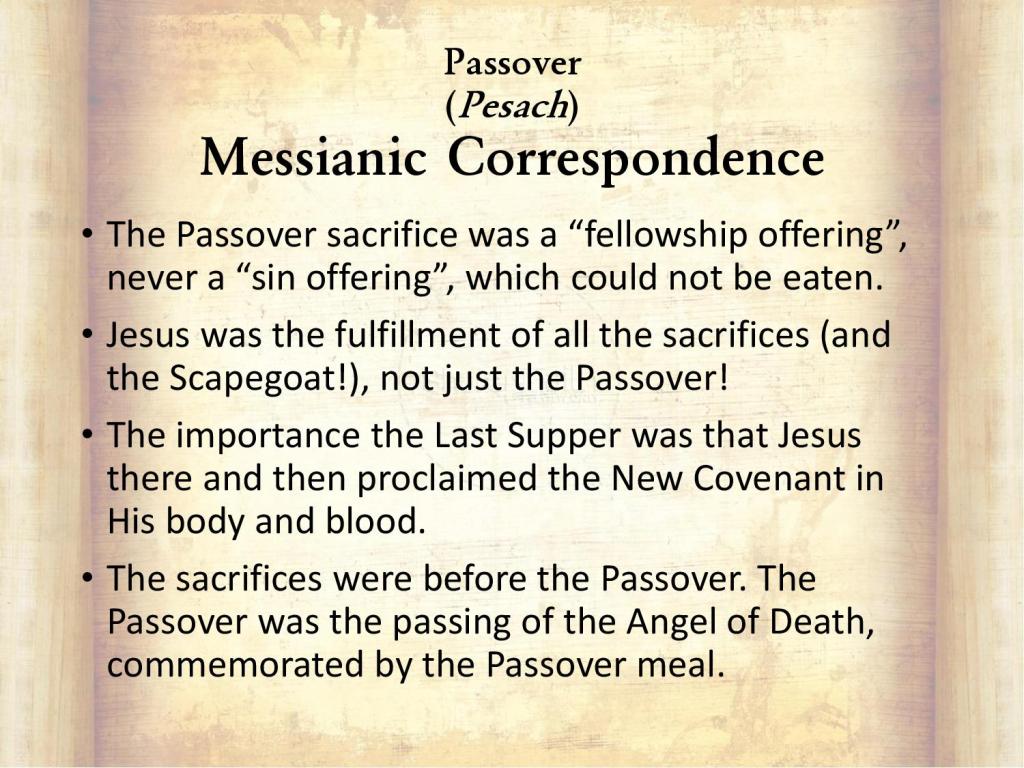
In Exodus, the killing of the sacrifice was of little importance; what mattered is what happened in the home that night—the smearing of the blood on the doorposts and the sharing of the final meal in slavery. Followed, of course by the passing over by the angel of death. In the commemoration, the sacrifice was governed by ritual, but it was still not a holiday occurrence—the meal was now the essential feature and made more-so by Jesus. During that one, all-important twilight, at the Passover Seder, Jesus proclaimed for all time the New Covenant in His body and blood!
If Jesus had died alongside the Passover sacrifices, His death would have been forever connected with that one sacrifice alone. In fact, His death represented every other sacrifice as well!
The key take-home from this lesson is that, while Jesus was certainly the ultimate Passover Lamb, it was not as the Passover Lamb that He saved us! Passover lambs were never sin offerings. A sin offering became a symbolic receptacle for the sins of the people, and could not be eaten, because one would be symbolically re-ingesting the same sins. The Passover lambs were a type of fellowship offering, a remembrance of redemption from slavery, and a celebratory meal between family and/or friends. It not only could be eaten, but it must be eaten. So, where did salvation truly lie? In Jesus, the Scapegoat of Yom Kippur!Stay tuned for a future instalment.
This post was first published over 10 years ago but recently got a major overhaul. First, because my own style has changed a bit over the years; but also, because I’ve changed my mind about one related issue, which I’ll discuss below. This is a good time for an update because it is now the middle of the Hebrew month Elul, and that is the temporal setting of my main topic here, the Fall Feasts.
I started this edit by setting a time frame for Jesus’ First Advent, which I date in the following short table. Here I have used the Gregorian calendar for the year, because that is more identifiable to most of us, but I’m taking the month and day from the Hebrew calendar, because annual events are Biblically fixed according to that standard and are different every year by the Gregorian and earlier Julian calendars.
Event
Age
Hebrew Date
Gregorian Year
Birth
–
Tishri 15
4 BC
Baptism
about 30 years
Elul 1
AD 26
Crucifixion
about 33 yrs., 6 mos.
Nisan 14
AD 30
Here are some of the factors I considered in composing this table:
The Biblical feast days commemorate important Jewish historical events, celebrate the annual agricultural cycle, and prophesy about Messiah’s life on earth, in both of His advents.
I am convinced that the Jewish principal feasts, as commanded in Leviticus 23, provide a totally reliable outline of important events in Jesus’ life, as shown in the last column of Figure 1, above. Events highlighted there in peach occurred during His first advent, on the actual feast days shown. Events highlighted in blue will occur during His second advent, again on the actual feast days shown.
I’m very confident that Jesus’ birth was on Tishri 15, the first day of the Feast of Tabernacles, Sukkoth. Not in December, on a date with absolutely no Scriptural support (but with a pagan connotation!); but rather in a September/October timeframe corresponding to Jewish celebration of the time that God previously “tabernacled” with His people during their 40 years of wilderness wandering. With Jesus’ birth, once again God was living among His people.
The year of Jesus’ birth has been disputed during my entire lifetime. There are always unresolved arguments about when Herod died, when Quirinus was governor of Cilicia/Syria, and what year a lunar eclipse hit the region, all of which are applicable. The most commonly cited estimates that I’ve seen place Jesus’ birth in 4 BC, though dates ranging from 1 through 6 BC are also commonly mentioned. I’m sticking with 4 BC here, because it fits well with the other two dates in my table.
Luke 3:23 states that Jesus was “about thirty years of age” when He began His ministry. Fall of AD 26 is about thirty years after the autumn of 4 BC. In fact, if His ministry began on Yom Kippur (see below), and that was the last day of His 40-day “wilderness fast and temptation”, then He was just five days shy of 30 years old.
His baptism by John was 40 days before Tishri 10, which is the Day of Atonement, Yom Kippur. I’ll explain the 40-day offset below, but it culminates with Jesus on the pinnacle of the Temple, defying Satan, on Yom Kippur, in full view of many thousands of worshippers on the plaza below.
Fig. 2: The late Alec Garrard, facing “south”, posing in his backyard shed model of Herod’s Temple. The parapet in the lower right corner overlooks the Kidron Valley, and as the highest point on the Temple Mount walls, it is thought by many to be the “pinnacle” mentioned in Scripture. I personally suspect that the somewhat lower parapet to the left, more commonly known as the Place of Trumpeting, might be the actual pinnacle of Scripture, since it is far more visible from the streets below. Photo from The Miniature Engineering Craftsmanship Museum.
His crucifixion was on Nisan 15, the first day of the Feast of Unleavened Bread, Yom ha-Bikkurim, not on Nisan 14, the day of the sacrifices.
The year of Jesus’ crucifixion, shown here as AD 30, was calculated by me, using NOAA (National Oceanic and Atmospheric Association) New Moon Tables, which were prepared with historic ocean tides in mind. Every published Biblical chronology that I’m aware of puts the crucifixion in AD 33, but they are all based on an incorrect interpretation that insists He was crucified on Nisan 14. With a correct understanding of the timings of Passover Week which (thanks to my traditional presuppositions) it frankly took me many years to achieve, it is clear that Jesus was crucified on Nisan 15.
9/5/2023 addition:
1 In the fifteenth year of the reign of Tiberius Caesar, Pontius Pilate being governor of Judea, and Herod being tetrarch of Galilee, and his brother Philip tetrarch of the region of Ituraea and Trachonitis, and Lysanias tetrarch of Abilene, 2 during the high priesthood of Annas and Caiaphas, the word of God came to John the son of Zechariah in the wilderness. —Luke 3:1-2 ESV
Leaving Tiberias until last, here are the tenure years of the leaders mentioned (all are 1st Century AD): Pilate, 26–36; Herod (Antipas), 4–39; Philip, 4–34; Lysanius, unknown; and Caiaphas, 18–37. Annas was High Priest during the period 6–15 but was the real power in the Temple during the tenure of Caiaphas, his son-in-law, 18–37.
For the purpose of dating the text, only Tiberias‘ rule is useful. Many historians and Biblical commentators date Tiberias’ accession to the time of Augustus’ death. That puts the timing of Jesus’ baptism in the year AD 29, which would pose a problem for my proposed dating. I don’t think AD 29 is correct, because it was common for many, possibly most, ancient rulers and their chroniclers to ambitiously include years of coregency in citing tenure of rule. Tiberias was coregent with Augustus starting in either AD 11 or 12. AD 11 fits perfectly with my AD 26 date for Jesus’ baptism.
I find that I am not alone in recognizing this discrepancy. The well-respected commentary Jamieson, Faucett & Brown, for example, states that:
the fifteenth year of Tiberius — reckoning from the period when he was admitted, three years before Augustus’ death, to a share of the empire [results in a date for the events of Matthew 3:1 of] about the end of the year of Rome 779, or about four years before the usual reckoning.
“The usual reckoning” is AD 30. The traditional date for the founding of Rome was 753 BC, which makes “the year of Rome 779” equivalent to AD 26.
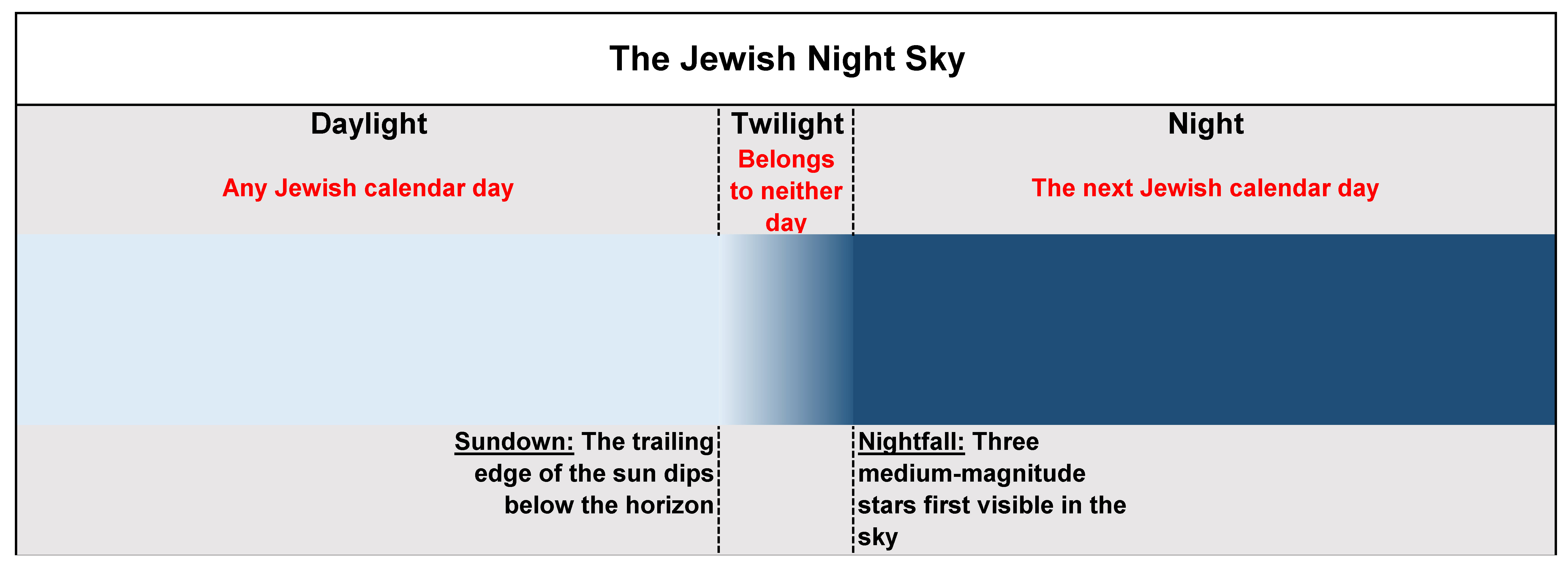
Please refer to Figures 3 and 4, above. The Passover sacrifices were killed on Nisan 14, then consumed during the Seder, which began that evening at dusk. Jesus and His 12 apostles celebrated the Seder until late, as customary, then joined with the Hallel singing outside at midnight. Following that, they walked to Gethsemane, where Jesus was arrested. His trials were conducted during the early morning of Nisan 15, and He was crucified and buried that day. That was on a Friday, and the only year within a reasonable range with a Friday on Nisan 15 was AD 30. I am very confident that this scenario is correct!
Fig. 5: An April 2024 calendar showing parallel Hebrew dates on the right. This clearly demonstrates that the 8-day Passover celebration (7 days in Israel) begins on Nisan 15. Jewish Time®, by Calendar Maven
Most scholars think that Jesus’ ministry lasted around 3½ years, based on the number of Passovers He seems to have attended during that time. I agree.
This month shall be to you the head of the months; to you it shall be the first of the months of the year. —Exodus 12:2 (The Complete Jewish Tanach)
Nisan 1, in the Spring, is the Jewish religious New Year. Jews today, though, celebrate the civil new year, Rosh Hashanah, which is six months later, on Tishri 1.
Most of the modern world celebrates the new year with revelry. Not so among devout Jews in 1st Century Judea, because Tishri 1 is also the date of Yom Teruah, the Day of Trumpets. This important feast day heralds God’s judgment of His chosen people for their deeds, both good and bad, committed during the preceding year.
As such, the mood during the entire ten-day period through Yom Kippur, the Day of Atonement, on Tishri 10, is somber and introspective. There is prayer, fasting, ritual immersion (baptism for purification), and general spiritual misery and mourning. No weddings or other celebrations are permitted.
Once Yom Kippur has passed, the mood shifts. There is spiritual relief, and a 5-day period of relaxed preparation, followed by the joyous eight-day celebration of Sukkoth, the Feast of Tabernacles.
In the rest of this post, I will concentrate on two of the fall feasts in particular: The Day of Trumpets and the Day of Atonement. These two feasts, and the 10-day span of time connecting them, is known as Yamim Noraim, the ten “Days of Awe”. This somber period, as described above, is devoted to sincere individual and national confession of sins, and to t’shuvah, or repentance.
Rosh Hashanah, also known as Yom Teruah (The Day of Trumpets), is the Jewish day for regathering. Jews believed that, on this day every year, God divided His people into three groups according to their faithfulness over the preceding year. One group was the “wholly righteous”, whose names would certainly be written in the Book of Life. A second group was the “wholly wicked”, who would be written into the Book of Death. The final group was comprised of “those in between”, whose fate would be sealed by the quality of their t’shuvah over the next ten days, with their final judgment reserved until Yom Kippur.
In the original version of this post, I said of the above viewpoint, “this doctrine is certainly not Biblical”; however, I have mostly changed my mind about the books, though I think that the Jewish perspective on them may be a bit skewed. I have recently been introduced to the works of Michael S. Heiser, and what he called the “Deuteronomy 32 worldview” (see Gods and Demons). He addressed this subject in ways that I had not previously considered.
There are, in fact, eight New Testament references, mostly in Revelation, to the “book of life“, and many Old Testament and intertestamental references to heavenly “books” and “tablets” that are clearly connected. I assume that these conceptual records are metaphorical, considering that God is God, and doesn’t need a physical database to remember what He needs to remember. Heiser makes sense when he suggests that our sins are recorded in one book, and our salvation in another. If (and only if) we are not listed in the second, then we will be judged by what is recorded in the first. There may be a “book of death“, too, that renders some ineligible for salvation. Regarding the latter, see, for example:
[31] Therefore I tell you, every sin and blasphemy will be forgiven people, but the blasphemy against the Spirit will not be forgiven. —Matthew 12:31 (ESV)
Whether or not the doctrine of these books is valid, the fact that the holiday recognizes a separation of people from people is very significant since it prophetically depicts the regathering of God’s people on the coming day of Rapture:
[16] For the Lord himself shall descend from heaven with a shout, with the voice of the archangel, and with the trump of God: and the dead in Christ shall rise first… —1 Thessalonians 4:16 (KJV)
In light of 1 Thes 4:16, the blowing of the trumpet (actually, a shofar, or ram’s horn) on Yom Teruah is particularly interesting. The shofar (accompanied by metallic trumpets in Temple days) was blown at mid-morning after the morning (Shacharit) prayers, in three series of four distinctive notes: tekia (“blast”); shevarim (“broken notes”); teruah (“shout”—thought of as “the shout of an archangel”); and tekia gedolah (the “great blast”). The first series is tekia, shevarim, teruah, tekia, repeated three times. The second is tekia, shevarim, tekia, repeated three times. The final series is tekia, teruah, tekia, repeated three times, followed immediately by tekia gedolah, referred to in 1 Cor 15:52 as “the last trumpet”.
[52] in a moment, in the twinkling of an eye, at the last trumpet. For the trumpet will sound, and the dead will be raised imperishable, and we shall be changed. —1 Corinthians 15:52 (ESV) emphasis mine
Since long before Jesus’ day, the Days of Awe have, in practice, begun thirty days beforeYom Teruah, on the first day of the Jewish month Elul. T’shuvah (repentance) is much too important to put off until the last minute, so the Rabbis decided that forty full days should be devoted to it, rather than the ten required by Torah.
On Elul 1, Jews would flock to the mikvot (baptisteries) of the Temple and synagogues, and to the “living waters” of streams and rivers like the Yarden (Jordan), to immerse themselves for ritual purification. That would then be followed by forty days of prayer, fasting and introspection. In the years preceding AD 30, it seems that many had become preoccupied with the politics and woes of the Roman occupation, and such customs were being neglected. Into this scene stepped Yochanan, who we now call John the Baptizer, calling Jews to baptism and t’shuvah.
[13] Then Jesus came from Galilee to the Jordan to John, to be baptized by him. [14] John would have prevented him, saying, “I need to be baptized by you, and do you come to me?” [15] But Jesus answered him, “Let it be so now, for thus it is fitting for us to fulfill all righteousness.” Then he consented. [16] And when Jesus was baptized, immediately he went up from the water, and behold, the heavens were opened to him, and he saw the Spirit of God descending like a dove and coming to rest on him; [17] and behold, a voice from heaven said, “This is my beloved Son, with whom I am well pleased.” —Matthew 3:13–17 (ESV)
I believe that the events of Mt 3:13-17, describing Jesus’ baptism and anointing by the Holy Spirit, took place on Elul 1, conforming to the current tradition. As to the year, I lean towards AD 26, as stated above. If that year is off, I’m still 100 percent sure of the Hebrew month and day.
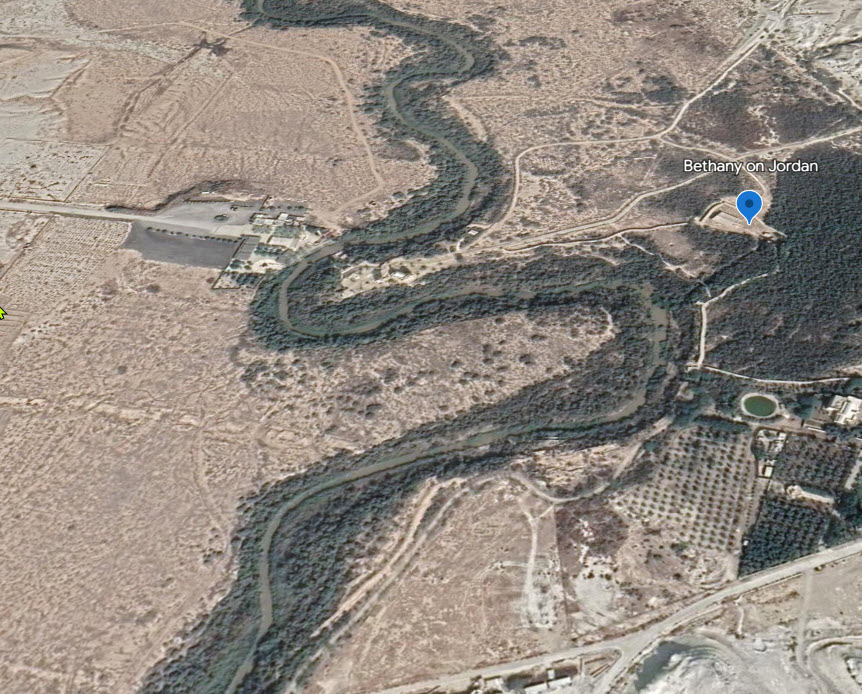
Fig. 8: The Jordan River today, due east of Jerico. Scripture places Jesus’ baptism at Bethany on Jordan, no doubt referring to the east bank of the oxbow, close to the village. From Google Earth.
Though of course He was sinless, His baptism, followed by forty days of prayer and fasting, were consistent with and required by the customs of the season.
More importantly, the temptation and His response were theologically vital. Jesus was “the Second Adam” (see The Two Adams). The first was created sinless, but when tempted by the “lust of the flesh, the lust of the eyes, and the pride of life”, failed and brought sin to the world. The same tempter and same temptations came to Jesus in the wilderness: lust of the flesh (stones to bread); lust of the eyes (the kingdoms of the world); and pride of life (rescue by angels in the sight of all Israel). Jesus did not fail, and brought redemption to the world.
Matthew presents a different order for the temptation, which is not a problem because chronological order was not strictly important in the literature of the day. In any case, all three temptations most likely occurred on the same day.
Interestingly, that placed Jesus on the Pinnacle of the Temple on Yom Kippur:
[9] Then he [the devil] took him to Yerushalayim, set him on the highest point [Greek pterugion, literally, a “wing” or “turret”] of the Temple and said to him, “If you are the Son of God, jump from here! [10] For the Tanakh [Old Testament] says [Psalm 91:11–12],
‘He will order his angels to be responsible for you and to protect you. [11] They will support you with their hands, so that you will not hurt your feet on the stones.’”
[12] Yeshua [Jesus] answered him, “It also says, ‘Do not put ADONAI your God to the test.’” [13] When the Adversary [Greek diabolos, literally, “accuser”] had ended all his testings, he let him alone until an opportune time. —Luke 4:9–13 (CJB)
While the Temple still stood, on Yom Kippurall the people gathered on the Temple Mount for the ritual sacrifices that would roll the sins of the truly repentant back for another year. Since there is no longer a Temple, and thus no legitimate place for blood sacrifices, the gatherings are now in the synagogues, and what is offered are “sacrifices of prayer.”
Most translations render pterugion as “pinnacle”, following the KJV. This is traditionally interpreted as the highest point on the Temple Mount or its surrounding walls, but I don’t think that this is warranted. It seems to me most likely that this is referring to the “place of trumpeting” (see Figure 2) which, by inference, was probably the parapet, or observation platform, from which the priests monitored the ritually vital sunrise and sunset every day. This high overlook was visible from the exterior streets below. If Jesus had accepted Satan’s temptation to throw Himself off and allow the angels to catch Him, all the Jewish world would have witnessed the destruction of His public ministry on the very day it began! Certainly, this was Satan’s plan!
I am forever thrilled at the beauty of God’s timing! I believe that many of the events connected with Jesus’ First and Second Advents actually occurred or will occur on the precise day of the Feast that pictures the event. Could it be that He will return for his Church at the exact moment of the “Last Trump” on the Feast of Trumpets (as God indeed said He would!), which is prophetic of the Rapture? Is it possible that He will return in judgment at the end of Tribulation on the Day of Atonement, the very day when God is thought to seal His judgment of His people? I am convinced it is so!








 The Back of My Mind