“Behold, I am coming soon, bringing my recompense with me, to repay each one for what he has done. —Revelation 22:12 ESV
This past Sunday, late in Bible class, someone raised the subject of “The Judgement Seat of Christ“, “crowns“, the “Bema” and so on. There was no time for me to put in my own two cents, but it is a subject that touches me personally. I was raised in a very legalistic fundamentalist church, and the whole question troubled me at the time more deeply than any other doctrinal issue. If “Jesus paid it all“, “not of works, lest any should boast“, and heaven is the carefree paradise we’ve been led to believe, then how is it that the first thing that happens after the Rapture is that we face judgement, possible humiliation in front of our peers, and maybe worse still, potential forfeiture of a fancy, jeweled crown to wear in our new mansion over the hilltop? And what’s the point of working hard for a crown if we have to give it right back, by “casting it at Jesus’ feet“?
This is a diversion from what I’ve been working on, a discourse on God’s omnipresence in space and time, and what that implies about creation, so I’m not going to do an exhaustive study of this subject. I’d be reinventing the wheel anyhow, because the late J. Hampton Keathley III, Th.M., did an excellent job of nailing it down in an article, The Doctrine of Rewards: The Judgment Seat (Bema) of Christ. Below is a short summary of aspects that I have pondered over the last few days:
The Judgement Seat of Christ
The term “judgements” is used many times in Scripture, mostly regarding punishment. I am limiting this discussion to the major formal judicial reviews of the End Times recognized by many conservative theologians. There are variations in terminology, and some count three or five but for this purpose, I’m going with the diagram below, which lists four. In general, I think that the source book shown in the caption is pretty good, though I question LaHaye’s own previous judgement, in view of the terrible theology in his Left Behind series.
One view of the end-time major judgements, from Charting the End Times, by Tim LaHaye and Thomas Ice, ®2001.
The “Judgement Seat of Christ” is the most common name used by Christian theologians for the evaluation of Christians that occurs after the Rapture. The diagram shows the Rapture occurring simultaneously with the beginning of the seven-year Tribulation period. I strongly believe in a “Pre-Trib” Rapture, but I don’t think that Scripture requires the Tribulation to happen immediately after the Rapture. I personally think that there will be a time of major geopolitical developments on earth between the removal of the Holy Spirit and all Christian influence, on the one hand, and the beginning of Tribulation on the other. The war of Ezekiel 38 and 39 may be one of them (see The Coming World War: Gog and Magog).
Purpose of the Judgement Seat
This is emphatically not a judgement for sin, because Jesus’ crucifixion paid that cost, but rather an evaluation of the quality of our service. I think for a twofold purpose: (1) for recognition and kudos; and (2) for handing out of assignments. As discussed in Keathley’s article, the Scriptures imply that the Raptured Church will function administratively during the Millennial Kingdom. I don’t know that I can definitively back this up from Scripture, but my personal impression is that our individual responsibilities in the Kingdom will be based on our aptitudes and attitudes shown during our mortal lives. Although without sin, our glorified selves will still be recognizable, both physically and by non-physical personal traits.
Timing of the Judgement Seat
Many scholars (e.g., Keathley) show it at the beginning of Tribulation, others (e.g., LaHaye and Ice) show it as taking place during the entire seven-year span. I would say the beginning, and not the entire span. Why? First, because of its connection with Rosh Ha-Shanna, coming up in late October this year (see below), and also because I think that the Marriage Supper of the Lamb will be the focus in heaven during the period. Christian scholars tend to ignore Jewish cultural analogs when interpreting Jewish Scripture. Even though all Scripture is Jewish! Jesus (Yeshua ben Yosef) and most of the Gospel protagonists were thoroughly Jewish, and all but one of the canonical writers was Jewish. The exception being Luke, who I think was a Jewish convert. Jewish wedding customs in the 1st Century clearly pictured Jesus’ relationship with the Church, His bride (see Jesus and Hebrew Wedding Imagery). The Jewish wedding supper was a seven-day feast, so I think there is ample reason to think that the heavenly marriage supper might span seven prophetic days.
How could all of that “evaluation”, of all the Church saints from two Millenia of Church history, be accomplished virtually instantaneously? That is something I’m already working on for my next post: In God’s “native” realm, there is no such thing as “time”, or even “space”. He is independent of both and unbound by both. He exists simultaneously everywhere and everywhen. In 2 Peter 3:8, the apostle is paraphrasing Psalm 90:4 when he says that, to God, a day is as a thousand years. That is poetic language, not literal. The truth is, he could have said a million, or a billion, or trillions and trillions. Or conversely, a femtosecond (10-15 seconds), for example, is no more obscure to Him as a day.
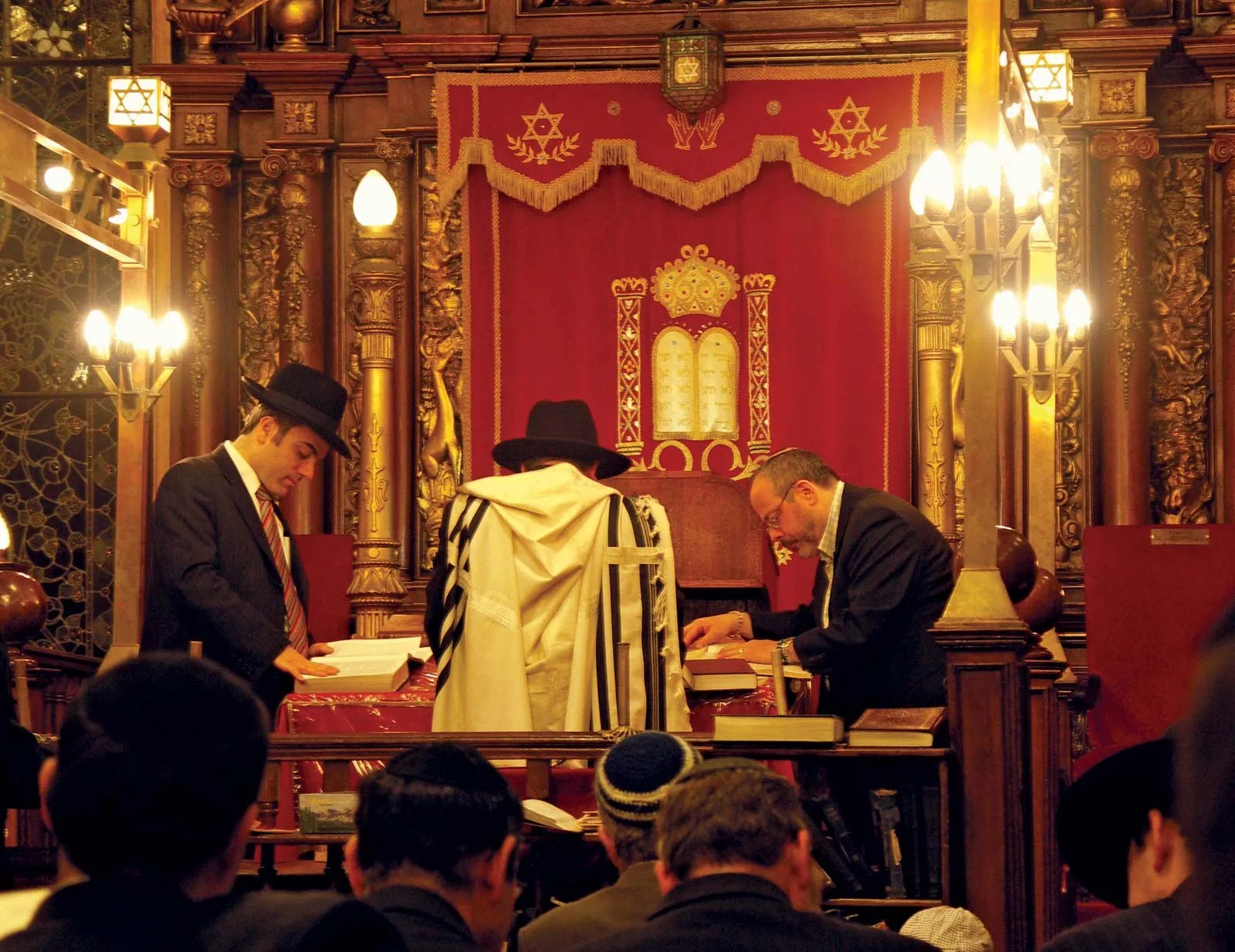
The Bimah—Jewish, too, not just a Greek concept!
Here is where I depart from Keathley and other Christian scholars.
The Greek term béma (βεμα, pronounced BAY-muh) is defined by Strong’s as “a platform to which someone [ascended] to receive judgment; (figuratively) the administration of justice – literally, given from “a tribunal-chair” (throne) where rewards and punishments are meted out.”
The Hebrew term bimah (מִמַּה, pronounced BEE-muh) is no doubt related, and has a similar meaning in general, but, for our purposes here, there is a much more specific meaning, attested as early as Neamiah’s time, in the Persian era. According to Encyclopaedia Judaica, the word means an “elevated place“, more specifically a “platform in the synagogue on which stands the desk from which the Torah is read. Occasionally the rabbi delivers his sermon from the bimah, and on Rosh Ha-Shanah the shofar [ram’s horn] is blown there.” The reading desk is also often referred to as a bimah. Significantly, I believe that the Rapture will occur on a Rosh Ha-Shanah (also known as Yom Teruah, The Day of Trumpets; see The Jewish Feasts: Part 11, Trumpets)!
Parenthetic notes on the photos...
Above: The photo above shows three men standing at the bimah table in a small synagogue in Lower East-Side Manhattan. The synagogue is never called a "temple" by orthodox Jews, but it nevertheless serves many of the Temple's functions in the post-Temple world. The bimah stands near the center of the room, just as the altar stood in the center of the Court of Priests. The man seen in this photo in his woolen tallit (prayer shawl) is standing at the table with his face to the aron HaKodesh (the Holy Ark, a cabinet in which one or more Torah scrolls is stored. In this synagogue, the Ark is behind the red tapestry. Most likely the reader is not the rabbi, but rather a congregant who has been invited to "make aliya", or "go up" onto the bimah to read assigned passages from the Torah. Typically, when the Torah is taken out to be read before the community, one person reads the Torah, and that person is surrounded on either side with two gabbaim (as here) who ensure that the Torah is being read and treated respectfully and accurately.
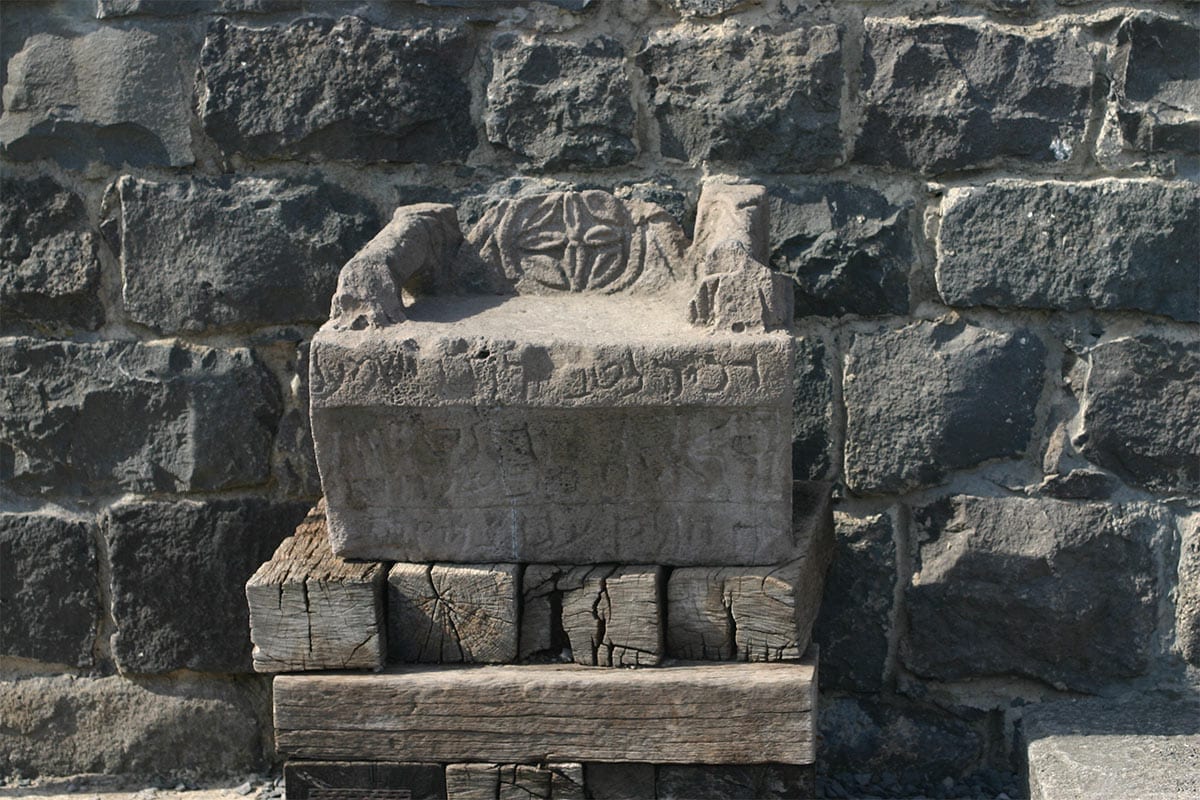
Below: The photo below shows another feature of early synagogues, associated with the bimah, that I think is germane to this discussion—the "Seat of Moses".
The restored “Moses Seat” in the synagogue of Korazin, in Galilee.
The Bimah Seat
Also associated with the bimah platform was “the seat of Moses”. This seat was used by a scribe or other authoritative interpreter of scripture. Today it would be the rabbi. In Matthew 23, Jesus validated the authority of the interpretations made from the seat of Moses, even though, in the same breath, He said, effectively, “Do as they say, not as they do.”
Then Jesus said to the crowds and to his disciples, “The scribes and the Pharisees sit on Moses’ seat, so do and observe whatever they tell you, but not the works they do. For they preach, but do not practice. —Matthew 23:1–3 ESV
I think that, to understand the concept of the Judgement Seat of Messiah, you have to consider the Jewish concept and not just the Greek. We will be evaluated in the heavenly realm, not for sin, but for our performance in light of God’s expectations for His people as expressed in Scripture. Jesus will be the one, sitting on a heavenly bimah seat of Moses, who will be evaluating us and handing out crowns.
Crowns
Sad to say, even as a young adult, my vision of kingdoms and crowns was informed mostly by Walt Disney. So, I pictured literal golden streets and pearly gates in heaven, my home a palace, and on my head a jewel-encrusted crown. I think now that the glitz and bling is meant to convey a sense of beauty and purity, not to arouse materialistic jealousy and greed. The crowns may not be literal headwear but are certainly meant to convey the Greek and oriental picture of the victor’s laurel wreath.
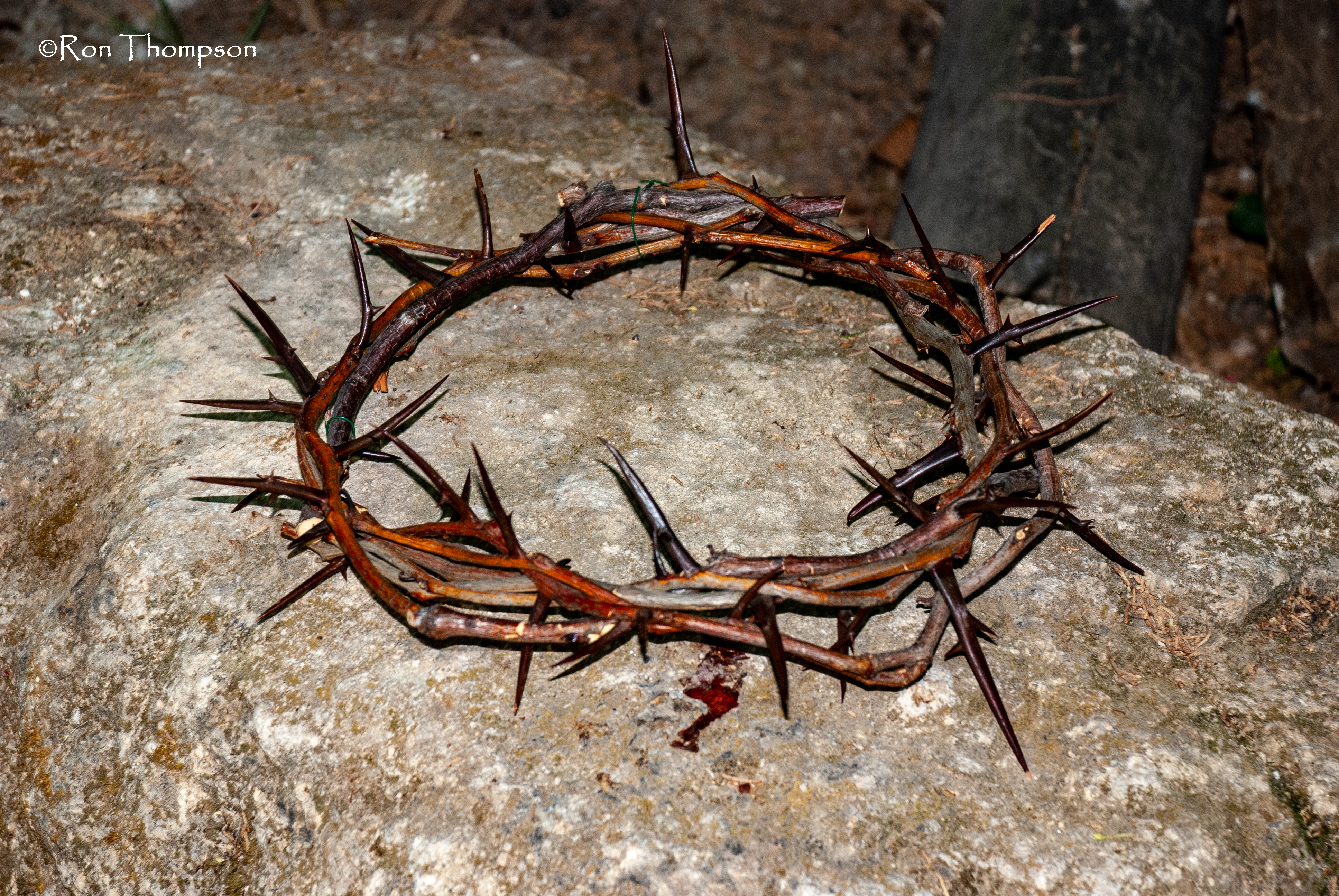
In every case, the Greek word for these “crowns” is stephanos, for which the proper translation is “wreath”, i.e., a chaplet worn as a badge of royalty, honor or victory. The royal crown is always a diadem. Jesus’ crown of thorns was a stephanos, so it was most likely an ironic insult from the Roman soldiers, not something ordered up by Pilate as a complement to his sign of indictment nailed on the cross.
A common Christian tradition says that at some point after receiving crowns at the bimah, we will cast them back at Jesus’ feet in adoration. This appears to be a corruption of Revelation 4:10–11, where 24 elders sitting in a circle of thrones stand and cast their own stephanos in front of the central throne, occupied, apparently, by Yahveh, the Father, not the Son:
10 the 24 elders fall down before the One sitting on the throne, who lives forever and ever, and worship him. They throw their crowns in front of the throne and say,
11 “You are worthy, ADONAI Eloheinu, to have glory, honor and power, because you created all things — yes, because of your will they were created and came into being!” —Revelation 4:10–11 CJB
Over the last several months, I have adopted a new favorite author. His name is John C. Lennox. Among other things, he is a Cambridge-educated Emeritus Professor of Mathematics at the University of Oxford, and he has written a number of books on subjects that have interested me for many years.
Author, Educator, Mathematician and Philosopher, John C Lennox. BBC Photo.
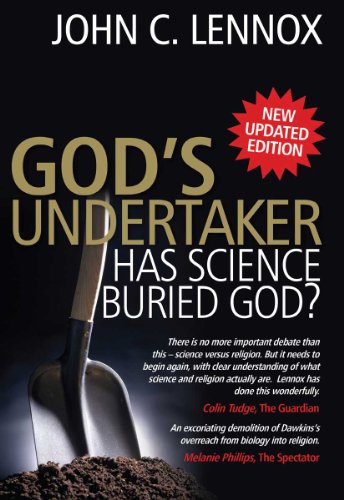
Most of his opinions on the intersection of theology and science seem to match my own very closely. In particular, a point from his book, God’s Undertaker: Has Science Buried God?, particularly resonates with me.
Conservative Christian scholars have mostly agreed that God miraculously created the universe, that humans descended from a real Adam and Eve, that the Genesis Flood was real, and that science does not trump Scripture!
I agree with all that!
But not all of those are “Young Earth” Creationists, and not all believe the theory, stated nowhere in Scripture, that the universe’s appearance of vast age is due to the Genesis Flood. Now, unfortunately, according to Professor Lennox (and my own observation), you are no longer free to reject that view.
Today, if you say you are not specifically a “young earth” creationist, then you will automatically be viewed by most of your Christian peers as a denier of Scriptural inerrancy and an “Evolutionist“.
Henry M. Morris
A large percentage of conservative Christianity, including major influencers like John MacArthur Jr, who I greatly admire, accept Henry Morris’ flood theory more or less uncritically.
Book: The Genesis Flood
The so-called “flood theory” was popularized by Morris in 1961 in a book that he co-authored with theologian John C. Whitcomb Jr, titled The Genesis Flood. I recall first reading the book in the late 70’s or early 80’s. It was formatted into two sections, one being a theological treatment by Whitcomb, and the other a mechanistic approach by Morris, laying out his theory that the apparent age of the earth was caused by rapid erosion and redeposition of silt due to earth-rending, catastrophic flooding, accompanied by massive earthquakes and tsunami surges. After reading Whitcomb’s exposition on the Biblical evidence for a worldwide flood, I was an enthusiastic fan of the book. That enthusiasm faded when I read Morris’ section. I found his grasp of fundamental geology and physics to be highly flawed, and his argumentative style (e.g., “any fool can plainly see…”) to be arrogant and insulting.
1976 edition of The Genesis Flood
The believability of The Genesis Flood was greatly enhanced by a Foreword (not included in the latest edition) written by an eminent geologist, John C. McCampell, PhD, of the University of Southwestern Louisiana. Unfortunately, book Forewords don’t always get read with the same concentration as the body. Dr. McCampbell did notendorse the theory! What he endorsed was Morris’ Christian worldview, fairness and independent thinking! The appliable paragraph read:
"From the [Foreword] writer's viewpoint, as a professional geologist, these explanations and contentions are difficult to accept. For the present at least, although quite ready to recognize the inadequacies of Lyellian uniformitarianism, I would prefer to hope that some other means of harmonization of religion and geology, which retains the essential structure of modern historical geology, could be found."
Morris’ Qualifications
Morris billed himself as a “hydrologist“. To me, the term “hydrology” implies much more than what Morris apparently did in his professional life. The US Geological Survey discusses the field broadly here. Wiktionary provides a more succinct definition, which I think works well:
Hydrology: Noun
1. The science of the properties, distribution, and effects of water on a planet's surface, in the soil and underlying rocks, and in the atmosphere.
2. The properties, distribution, and flows of water in a specific locale; the hydrological characteristics of a particular place or region.
But let’s examine Dr. Morris’ qualifications: (this section updated on 1/10/2024)
In a 2006 Washington Post obituary, quoted by Wikipedia, Morris was hailed as the “father of modern creation science”, and his book as the “founding document of the creationist movement.” Yet Morris himself had only a dim understanding of the principles he invoked in the book.
His early education was at Rice University, where he earned a BS in Civil Engineering. Undergraduate CE courses focus primarily on basic physics and chemistry, math, engineering economics and design, structural analysis, strength of materials, soil mechanics, environmental issues, engineering computations, and fluid mechanics.
Leaving Rice with his BSCE degree, Morris took a three-year educational gap during which he was employed as a “hydraulic engineer”, apparently in the Rio Grande Valley monitoring sand wash in the border waters. With his rudimentary background, his job would have consisted mainly in recording flood levels and monitoring bank erosion. As far as I can determine, that is the extent of his practical hydrological experience.
After his stint “in the field”, Morris returned to Rice for a few years as, apparently, a graduate teaching assistant in civil engineering. He then moved on to the University of Minnesota, where he earned a master’s degree in hydraulics and a PhD in hydraulic engineering (a sub-field of civil engineering, where the focus is on dams, manufactured waterways, and static forces from groundwater on structural foundations).
The remainder of his career, until he departed to focus on creationism, was spent in academia, as a teacher of civil engineering and applied science. Speaking for myself, after earning an MS in Petroleum Engineering, I enraged my supervising professor by refusing to stay for a doctorate. My reason was that engineering PhDs are geared towards academic careers, not towards real-world experience and productivity. And, frankly, the real world pays way more than academia.
Morris’ career certainly did not qualify him in any way as an expert on the issues he addressed in The Genesis Flood. His theories defy the realities of geological science, and his frequent references to the second law of thermodynamics (entropy) and uniformitarianism demonstrated a poor understanding of both concepts.
My own background
I must now establish my own credentials for entering into this critique of Young Earth Creationism in general, and the Flood Theory in particular.
My undergraduate studies at the University of Texas were in math and physics. My intention was to do my postgraduate studies in astrophysics, but after a 2-year Naval tour, practical considerations induced me to accept a graduate fellowship in Petroleum Engineering at Texas, instead.
Part of the apparatus for my Rock Mechanics thesis, 1975
For many years after college, my professional career was as a petroleum engineer. I started as a field production engineer for a major integrated oil corporation in Oklahoma, absorbing the hands-on, nuts and bolts of equipment and procedure in a very large working oil field. With proficiency came the desire to be more than a small cog in a big, cumbersome, money machine, so I left Big Oil to spend most of my career in more responsible positions with smaller “independent oil and gas companies”.
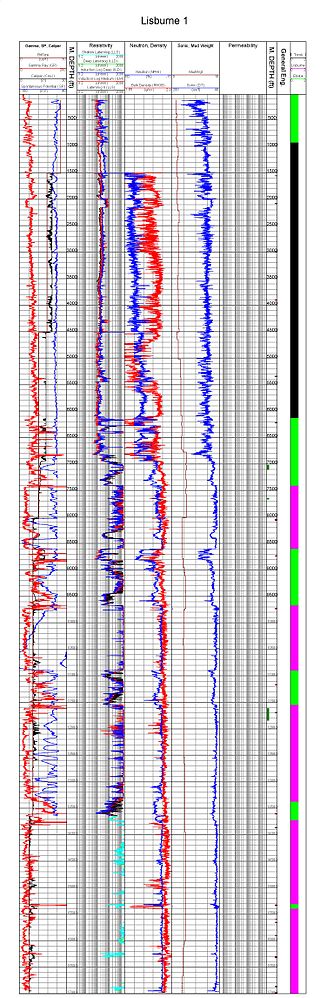
Typical well log suite, downloaded from USGS
Though I have worked in all phases of the industry (except for refineries) my main specialty was reservoir engineering. I had some of the same civil engineering training as Morris (dams, weirs and channels), but most of my education and years of professional experience were more geological in scope. I dealt with almost anything relating to sedimentary rocks and stratigraphy: where the constituent particles originated; how they were weathered, transported by erosion, deposited, cemented, chemically modified, saturated and disrupted by viscous fluid flow within their pore space or fractures; and how they were subsequently modified by folding, fracturing, compressing, uplifting, and sometimes being exposed at the surface or under the sea, and beginning the cycle all over again. I collected and analyzed cores, drill cuttings, fluid samples, pressure profiles, and electrical resistivity and radiation data. From all that, I had to make reasonable estimates of how much, if any, and what types of hydrocarbons were deep underground, who owned the mineral rights in the drainage area, whether it could be profitably retrieved, by what means and how fast, and ultimately, how much profit was to be expected. I was answerable to my employers, clients, government agencies, royalty owners, and/or financial lenders. Sometimes I worked closely with geologists and legal folks, but mostly I worked for small companies and had to do pretty much all of the geology myself.
Alternate theories
Here I will discuss alternate Christian theories to account for the apparent vast age of the universe.
I will have more to say on Morris, the Genesis Flood, and my own views on creation (both the science and the theology) in future posts. Some I wrote years ago, but I plan to rework and repost them. The rest of this post will be a discussion of the Conservative traditions that current “creation culture” now considers to be unacceptable.
In his book, No Final Conflict, Francis Schaeffer lists several areas where, in his judgment, there is room for disagreement among Christians who believe in Creationism and the total truthfulness of Scripture:
1. There is a possibility that God created a “grown-up” universe.
2. There is a possibility of a break between Genesis 1:1 and 1:2 or between 1:2 and 1:3.
3. There is a possibility of a long day in Genesis 1.
4. There is a possibility that the flood affected the geological data.
5. The use of the word “kinds” in Genesis 1 may be quite broad.
6. There is a possibility of the death of animals before the fall.
7. Where the Hebrew word bārāʾ is not used, there is the possibility of sequence from previously existing things.
Millard Erickson’sChristian Theology (the text used at Calvary Bible College in Belton, MO when I attended classes there) lists the following Conservative theories, which mostly fit into the scope of Schaeffer’s comments, above:
The gap theory holds that there was an original, quite complete creation of the earth perhaps billions of years ago (the creation mentioned in Gen. 1:1). Some sort of catastrophe occurred, however, so that the creation became empty and unformed (1:2). God then re-created the earth a few thousand years ago in a period of six days, populating it with all the species. This creation is described in Genesis 1:3–27. The apparent age of the earth and the fossil records showing development over long periods of time are to be attributed to the first creation. The catastrophe is often linked to the fall of Satan (Lucifer). Creation then lay in ruins for a long period of time before God rehabilitated or restored it.
The flood theory views the earth as only a few thousand years old. At the time of Noah, the earth was covered by a tremendous flood, with huge waves with a velocity of a thousand miles an hour. These waves picked up various forms of life; the mud in which these forms were eventually deposited was solidified into rock under the tremendous pressure of the waves. The various rock strata represent various waves of the flood. These unusual forces accomplished in a short period what geologists believe would ordinarily require three billion years to accomplish.
The ideal-time theory says that God created the world in a six-day period a relatively short time ago, but that he made it as if it were billions of years old. This is a genuinely novel and ingenious view. Adam, of course, did not begin his life as a newborn baby. At any point in his life he must have had an apparent (or ideal) age many years older than his actual age (i.e., the number of years since his creation). The ideal-time theory extends this principle. If God created trees, rather than merely tree seeds, they presumably had rings indicating an ideal age rather than their real age. Thus, each element of creation must have begun somewhere in the life cycle.
The age-day theory is based upon the fact that the Hebrew word יוֹם (yom), while it most frequently means a twenty-four-hour period, is not limited to that meaning. It can also mean epochs or long periods of time, and that is how it should be understood in this context. This view holds that God created in a series of acts over long periods of time. The geological and fossil records correspond to the days of his creative acts.
The pictorial-day (or literary-framework) theory regards the days of creation as more a matter of logical structuring than of chronological order. The author arranged the material in a logical grouping that took the form of six periods. While there may be some chronological dimension to the ordering, it is to be thought of as primarily logical. The account is arranged in two groups of three—days one through three and days four through six. Parallels can be seen between the first and fourth, the second and fifth, and the third and sixth days of creation.
The revelatory-day theory. The days were not successive days on which God did the creation, but days on which the story of creation was revealed. So the truth of the account took place in six twenty-four-hour periods, but the actual creation may have taken much longer than that.
Erickson himself favors the ideal-time theory, as you might guess from the wording of paragraph 3 above. He states that it is “in many ways irrefutable both scientifically and exegetically but presents the theological problem that it makes God an apparent deceiver.” I would agree that any theory that does not incorporate an assumption of vast actual age would have to include this form of apparent age in order to account for function via the known physical laws. In fact, I would compare it to a movie started in the middle. Virtually everything about the universe appears very much to be aged, and in fact would have to do so. I am more concerned with the suggestion of deception than Erickson is, in view of the following, which tells me I should be able to trust my senses:
For his invisible attributes, namely, his eternal power and divine nature, have been clearly perceived, ever since the creation of the world, in the things that have been made. —Romans 1:20 ESV
Grudem’s Systematic Theology, Wayne Grudem, lists more or less the same group of theories, and goes into much more detail on all questions of creation.
Grudem sums up his opinion as follows: “My strong encouragement to the entire Christian community is that both old earth and young earth viewpoints should be acceptable for leaders in evangelical churches and evangelical parachurch organizations.”
Ryrie’s Basic Theology, Charles Ryrie, presents a subset of the above, but without specific names. He is far more concerned about the creation of Man, specifically, than the Universe in general.
Ryrie is somewhat non-committal regarding the Universe but does seem to favor a young earth. He is staunchly against biological evolution.
Some combination of the pictorial-day and revelatory-day theories seem to be favored by another contrarian, John Walton. I like Walton very much and think that he is on track.
Like many Christians of my age, I grew up with a Schofield Reference Bible, and I liked Schofield’s favorite, the gap theory for many years. I no longer hold that view. Based on extensive reading on Ancient Near East History and Culture, and with a better grasp of Biblical poetry, I now believe…
Evangelical Protestant theologians for the most part fall into one of two categories: Covenentalists or Dispensationalists. Both groups talk about “Biblical Covenants”, but they differ sharply on the definitions and theological implications of these covenants, and how Salvation History (Soteriology) should be understood.
Most Christians that run in my circles have at least a passing knowledge of the Biblical “Covenants.” I am not going to go into detail here on the form and function of Ancient Near East (ANE) covenants and treaties. Rather, my limited goal in this post is to briefly discuss Covenant Theology, which I firmly reject, and then list the well-known Covenants between God and Israel and point out their loose relationships with the Dispensations that most of my Evangelical friends hold dear. I must point out that I am closer to the Dispensational Theology camp than to Covenentalists, but I don’t share the Dispensational tent either. Allow me to simply beg off of accepting either of those labels.
Covenant Theology is named for three particular Covenants that they embrace:
A “Covenant of Works“, aka, the Edenic Covenant. God said to Adam (paraphrased), “I’m giving you all this stuff, but if you do this sin, then I’m taking it away again.”
A “Covenant of Redemption“. When Adam sinned and relinquished the benefits of the Edenic Covenant, the three persons of the Trinity, Father, Son and Holy Spirit, established this Covenant among Themselves wherein the Son would come to earth, live a totally sinless life, and then die a substitutionary death. Thus, it was a covenant of Jesus’ works, not of man’s.
A “Covenant of Grace“. All of subsequent human history falls under this Covenant.
So far, that all sounds pretty reasonable, but the devil is in the details, so to speak…
The Covenant of Redemption is a problem for me because Jesus always gave His Father executive credit. Nowhere in Scripture do I see Son or Spirit questioning, disagreeing with, or asking for a say in the Father’s decisions.
I fundamentally agree that all of humanity since the Fall has been dependent on God’s grace, but Covenant Theology goes on to erase the distinction between Israel and the Church, which I will dispute to my dying breath. They claim that the Israel of promise was not the physical “seed of Abraham”, but rather consisted only of elect individuals. They say that this “Spiritual Israel” of the Old Testament Jews and the Church of the New Testament are one and the same entity. The promises of God “to Israel” applied only and always to this entity. Through a process way beyond the scope of this brief study, many Old Testament “laws” and “customs” have been replaced and subsumed by New Testament upgrades (e.g., male circumcision has now become, thanks to interpretive magic, infant baptism), and things that were important to Physical Israel alone have now been abandoned (e.g., a Promised Land in the Lavant, which they insist is no longer relevant). Another consequence, which I will not explain here, is that Covenant Theology is in general amillennial, and rejects the possibility of a future Rapture of the Church, as well as a Millennial Kingdom.
Dispensational Theology rejects the above and originally believed that history is divided into seven periods during which God dispensed salvation according to different sets of standards:
innocence (Gen 1:1–3:7),
conscience (Gen 3:8–8:22),
human government (Gen 9:1–11:32),
promise (Gen 12:1–Ex 19:25),
law (Ex 20:1–Acts 2:4),
grace (Acts 2:4–Rev 20:3), and
the millennial kingdom (Rev 20:4-6)
I don’t think that most Dispensationalists today take those seven Dispensations to outline different requirements for salvation, because most now recognize that salvation is and always has been by grace, through faith. Rather, they view the Dispensations as progressive revelation of God’s will for man’s behavior and for right fellowship with God. Most Dispensationalists believe that Israel and the Church are entirely separate institutions, and most recognize that Israel will once again take center stage after a literal end-times Rapture of the Church—points with which I am in complete agreement.
The Biblical Covenants, and how some think they relate to Dispensations
If one feels the need to categorize history into Dispensations, have at it. Personally, I think that such lists are contrived and artificial. History is already pretty well categorized by Covenants that God made with mankind in general, and then with Israel in particular. I’m going to show below that the list of Dispensations above roughly corresponds to periods punctuated by the Covenants.
Most of these Covenants are clearly defined by one or more passages of Scripture. Bear in mind that any promise made by God has the force of a covenant, because what God promises, He delivers. I’m restricting the conversation below to major Covenants recognized by most theologians.
Unlike most published theologians, I take a contrarian position that all of the Covenants listed below are unilateral, unconditional and unending:
Unilateral, in the sense that God set the terms and laid out the requirements. He didn’t say, “if you want”, He said, “I will”.
Unconditional, in the sense that God knew that His creation is morally incapable of meeting His standards. He set standards and consequences, but no possible failure on the part of His people could permanently cancel the ultimate promises.
Unending, in the sense that early Covenants are not replaced by later ones. Each and every one builds on the previous.
Although salvation has always been by Grace, through Faith, the details of the relationship between saved humanity and God has been governed by the Covenants I will discuss below.
The First Covenant
(Gen 1:26-30) Most would call this the Edenic, or perhaps the Adamic, Covenant, but at this point, Day 6 in Genesis 1, both Eden and Adam have yet to be mentioned. By His one-sided pronouncements, God here gave to man dominion over the earth and its life; and to men and animals, He gave the right to a vegetable diet. He also here gives to man the first commandment mentioned in Scripture, to “be fruitful, multiply, fill the earth and subdue it”. Because it was first, many orthodox rabbis consider this to be the most important of all commandments. Note that God’s pronouncements here are unilateral (no response asked for or given). Some would say they are conditional because Adam was banished from the garden, but what is expressed in Genisis 1 evidently pertains to the earth in general, not to the Garden in particular. Again, neither Adam nor the Garden are mentioned in Gen 1.
Dispensationalists associate the “Dispensation of Innocence” with the period from Adam’s creation on “the sixth day” to his Fall. Some place the Fall on the 33rd year of Adam’s life, in parallel with the start of Jesus’ ministry on the 33rd year of His life. This is possible, but wholly without Biblical evidence. My view is that Adam, with no knowledge of good and evil until the Fall, had no propensity to willfully sin, i.e., he had no “sin nature”; nevertheless, he was “suggestible” because he also had no propensity to take God at His word. Therefore, I conclude that he was not truly an “innocent”!
The Adamic Covenant
(Gen 2:15-17) Here God put Adam in the Garden, gave him permission to eat freely from vegetation specifically in the Garden, but listed one exception and a curse for violation of that one prohibition. This is, again, a unilateral Covenant (no response asked for or given).
Many would insist that the Adamic Covenant is conditional and came to an end with the expulsion from Eden. Not so! In this Covenant, God promised blessings and a provisional curse. Eden is lost, but mankind is still under the curse and will be until we enter The Eternal State. Paradise lost; Paradise regained. Since God’s plan for earth flowed from Adam, through Noah and the patriarchs to Jesus, I consider the Adamic Covenant to be an essential and unconditional early paragraph in all of God’s Covenant history.
Some scholars include Gen 3:14-19 in the Adamic Covenant, but I would say that these verses simply describe the effects that came from imposition of the curse of 2:17. Specifically, the passage contains curses directed at the serpent (14-15), Eve (16), and Adam (17-19), respectively.
On the other hand, the curse on Satan found in 3:15“he will bruise your head and you will bruise his heel”, is also a promise of blessing for God’s elect. I would perhaps regard this as a third, and separate Covenant, but I don’t have a name for it.
The period between the Fall and the Flood are considered by some to be “The Dispensation of Conscience“, but again I find fault with this idea. Human conscience is informed by so-called “natural law“, common-sense principles of morality and interpersonal ethics endowed by our Creator (see Natural Law and Biblical Ethics). Since the non-Jewish Church is not bound by Mosaic Law (see below), and since salvation has always been by God’s grace, we are essentially under the same system now as then, though with more knowledge at our disposal.
(Gen 9:8-17); some would include with this Gen 8:20-9:17). The first use of the Hebrew term for “covenant” (בְּרִית, b’riyt) is in Gen 6:18, where God promises to establish His Covenant with Noah after the flood. In Gen 9:1ff, God blesses Noah’s family and repeats the commandment to “be fruitful, multiply and fill the earth”. He then expands their food supply to include animals, so long as their blood is not consumed, and he cursed those who shed human blood—this is not, in my view, a commandment regarding capital punishment, but merely a promise that God will judge and avenge. Finally, He promised to never again destroy the earth with a flood and designated the rainbow as a reminder of that pledge. This is, again, a unilateral Covenant. Noah was given no choice in the matter. It was also clearly unconditional.
The rules established in verses 1-7 are known to Judaism as the “Noachide Laws“, which govern all of mankind. They have been expressed in slightly different terms over the millennia and were interpreted by James in Acts 15:28-29 as the minimum requirements that Jews in the Church would expect of non-Jews in order for the two groups to have mutual fellowship.
By the way, the sign of this Covenant was not a color pattern; it was a specific class of physical phenomena related to light refraction through mists, so there is really no reason to waste time on anger against “misappropriation of the rainbow sign.” Condemn the sin, but just ignore the flags.
Also, I contend that God did not here create rainbows. Rainbows are a consequence of physical laws that God created along with the universe. Light diffracted through a mist naturally produces rainbows under the right conditions. What God did here is tell mankind that from here on out, every time a rainbow is seen, it should remind us of His promise.
The period from the flood to Abraham is said by some to be “The Dispensation of Human Government“, because they believe that the command to execute killers implies a call to self-government; but as mentioned above, I think that Gen 9:5-6 is a curse, not a command. The scattering from Babel, Gen 11:1-9, is in one sense, an indictment on human government, as is God’s warning to Israel in 1 Sam 8 that they would not be happy if they were ruled by a king. The fact that human government always ends up repressing Godly worship should be a warning against enthusiasm for any human government.
The Abrahamic Covenant
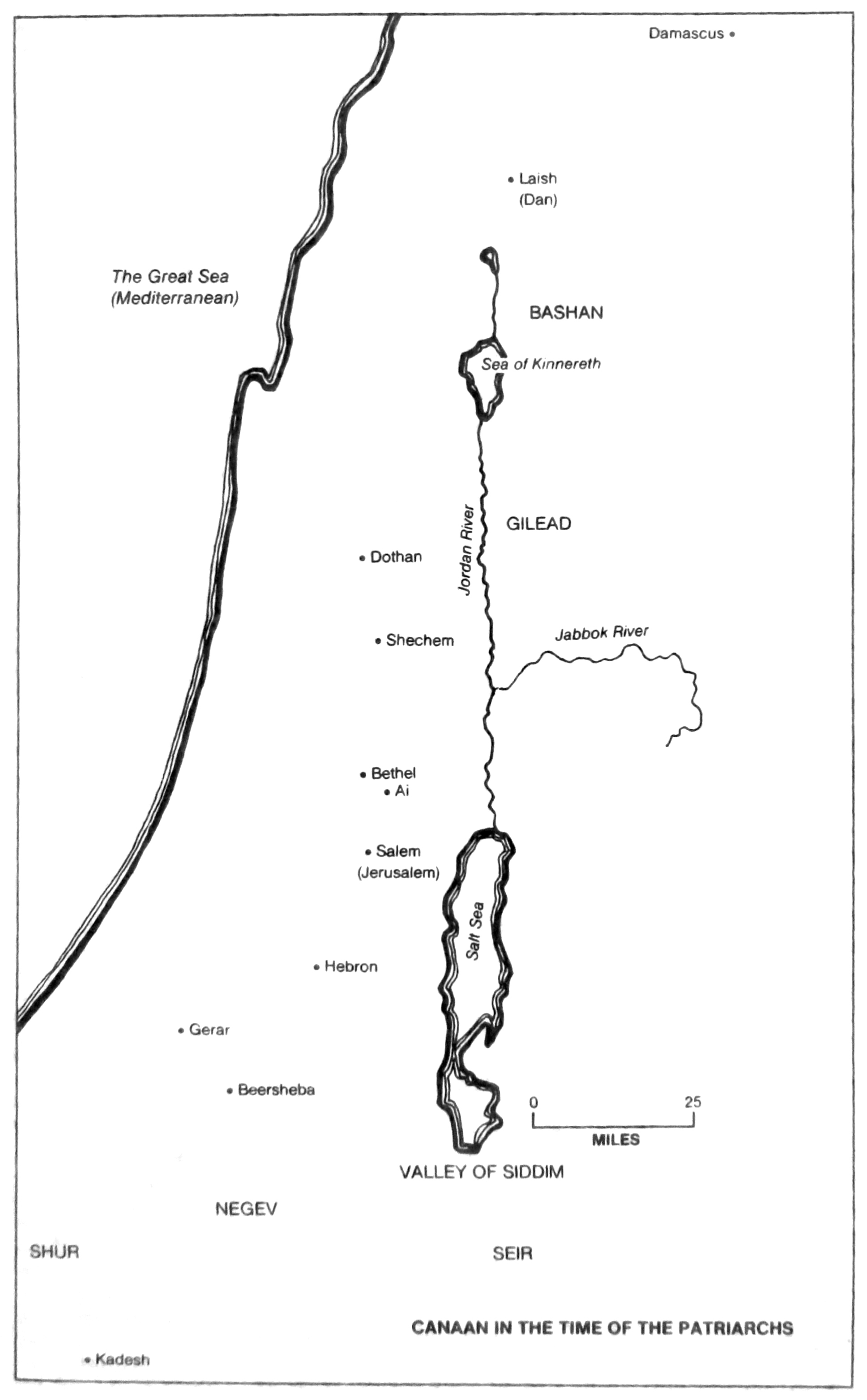
Patriarchal Canaan, from Bible Knowledge Commentary
(Gen 12:1-3 and numerous other references: 17:4-8; 22:15-18; 26:3-4; 28:13-15) With this Covenant, God established Israel as His Holy People. The “contract” was described to Abram (later called Abraham) by God and then was formalized by Him in the manner of ancient treaties (Gen 15). Years later, the terms of the Covenant were repeated and expanded, and Abraham responded by circumcising himself and the male members of his household (Gen 17). Still later, it was ratified with Isaac (Gen 26) and Jacob (Gen 28). One more restatement and clarification of the Abrahamic Covenant was delivered through Moses (Deut 30). In this important passage, God ties the Abrahamic and Mosaic Covenants together and states that Israel’s enjoyment of the Abrahamic promises will ebb and flow insofar as they incur the blessings and curses of the previous chapters of Deuteronomy.
It is important to note that the Abrahamic Covenant did not apply to Isaac’s siblings, nor to Jacob’s, but it did apply to Jacob’s 12 sons and all their physical descendants. There is pretty much unanimous agreement outside of Covenant Theology that this is an unconditional and unilateral Covenant between God and Abraham, Isaac, Jacob, and Jacob’s descendants.
The period from Abraham to the Exodus is said by some to be “The Dispensation of Promise“, in which man’s relationship with God was supposedly governed by man’s faithfulness in living up to God’s behavioral expectations in light of the promises made to the Patriarchs. This is perhaps expressed in Gen 18:19 (CJB) “For I have made myself known to him [Abraham], so that he will give orders to his children and to his household after him to keep the way of ADONAI and to do what is right and just, so that ADONAI may bring about for Avraham what he has promised him.” Yet, I think that this brief parenthetical passage is meant merely to explain God’s rationale for giving Abraham the opportunity to intercede for Lot and his family.
(Ex 20 and, by extension, most of Exodus through Deuteronomy) This is the most widely known of the Old Testament Covenants, but at the same time it is one of the most misunderstood, for several reasons. In brief:
The Covenant was not set up to enslave the Israelites or make their lives difficult, but rather to give them a sense of purpose and unity and to set them apart from other peoples, in a special relationship with God.
Christians tend to think of this as a works-based Covenant, and over the ages there have indeed been many Jews who have followed its precepts legalistically, but Scripture does not support that view. Salvation has always been by God’s grace.
The Hebrew word Torah means “teachings“. The Greek nomos indicates “that which is assigned or parceled out” What the Covenant dispenses is a fuller understanding of the nature and will of God, and the conduct that He demands from His elect people, Israel to set them apart from other peoples.
Orthodox rabbis count 613 commandments in Torah. Observance of these mitzvoth is a response of faith, never a means of salvation.
“Deuteronomy” is from a Greek term meaning “Second Law”, but that is not what it is. The Hebrew name of the book is D’varim, meaning “words”, or “matters”. As with other books of the Torah, it is derived from the first sentence, in this case, “These are the words that Moses Spoke…” Exodus through Numbers provided history about and guidance for the Israelites as pastoral nomads in the period between the Exodus and the Conquest. Deuteronomy is reinforcement, and adjustments for a settled, agrarian lifestyle in the Promised Land.
Christian statements like “we were once under Law but are now under Grace” and “we are bound by the moral law, but not the civil or ceremonial” are meaningless, because non-Jews were never bound by the Mosaic Covenant. When Paul said, “you are not under Law but under Grace”, he was speaking to non-Jewish Believers who were never bound by the legalism of Torah observance.
Like each of the other Covenants, it is unilateral.
Also, like each of the others, it is unconditional. Disobedience forfeits blessings and brings on curses, but it doesn’t cancel promises(see Deut 20 and nearly all of the Prophetic Books)! Like every other Biblical Covenant, the Mosaic is still effective for the people to whom it was addressed.
The period from Moses to Jesus is said by many to be “The Dispensation of Law“. Both classical and modern Dispensationalists—in fact I think most Christian theologians—believe that the Mosaic Covenant was conditional, and that it was cancelled by God because “the Jews refused to recognize their Messiah.” Many Dispensationalists localize this nullification to Mt 12, especially vs 24, where some Pharisees accused Jesus of being Satan, thus committing the “unpardonable sin.” Others place it at Jn 19:30, when Jesus, on the Cross, said, “It is finished.”
The Davidic Covenant
(2Sam 7:11-16) Though at first glance this is a Covenant with the House of David alone, God told David, “Your house and your kingdom will be made secure forever before you” in verse 16. My conclusion is that it therefore falls into line with all the other Covenants I am covering here in being unilateral, unconditional, and unending.
Dispensationalists, in general, don’t see a new dispensation here.
The New Covenant
(Jer 31:31-34 and elsewhere). As stated very clearly in vs 31, this Covenant is with the two kingdoms of Judah and Israel. It is not a Church Covenant, though the Church also benefits.
Note well: The Mosaic Covenant was never a failure! It did no less—and no more—than God intended. Without the internalization of the Holy Spirit there was never a chance that God’s people could live up to His demands and standards, but it taught them His nature, and what those demands and standards look like.
What the New Covenant added for Israel includes an internalized Holy Spirit; national regeneration; universal Jewish salvation ate the end of Tribulation; regathering to the Land; restoration of the Kingdom; and a return of God’s Sh’kinah to a glorious Millennial temple. Plus, a breaking down of barriers between Messianic Jews and non-Jews in the Church.
For Israel, the New Covenant is, like the others, unilateral, unconditional, and unending. For believing non-Jews, the benefit is a grafting into Israel, as part of God’s New Testament Church.
The period between the Acts 2 Pentecost and the Rapture is considered by Dispensationalists to be the Dispensation of Grace. This term is an obsolete holdover from the days when most Christian theologians considered the Church to be “under grace” and pre-Christian believers to be “under law”. Paul did frequently mention being “under law”, but he was most surely not talking about people being saved by keeping “the Law”. Rather, the precepts, or commandments, of the Mosaic Covenant were to be a response of obedience by a righteous Jew. Keeping the Law to appear righteous was, and is, hypocrisy. Some Dispensationalists are now calling the present age the Dispensation of the Church.
The Millennial Reign of Messiah
This period is not defined by another Covenant but is instead the culmination and combination of all the Covenants. Since there will be a new Temple, as described by Ezekiel, and since there will be sacrifices in that Temple, some theologians assume that the Mosaic Covenant will be reinstated during this thousand-year period. My own belief is that the Mosaic Covenant never came to an end and is still in effect today. I believe that ethnic Jews, even as members of Christian churches or Messianic Congregations, should be “observant”, or “keeping the Law.” Few are, and since this doctrine is basically unknown today, I’m not critical of righteous Jews who ignore it.
To Dispensationalists, the seventh and final dispensation is appropriately called, the Kingdom Dispensation, or alternatively, the Messianic Dispensation.
Many amateur archaeology enthusiasts now believe that the “true” Mt. Sinai is the volcanic peak Jebel al Lawz, in northwest Saudi Arabia. This view was popularized by another amateur, Ron Wyatt, who left his day job as a nurse anesthetist in Tennessee, traveled to the Middle East, and fraudulently proclaimed himself to be an “archaeologist”. Most of the “proofs” for this location are in the nature of superficial visual appearance, not scientific investigation and analysis. But that’s a story for another day.
Sinai in Arabia?
In this post, I want to concentrate on Biblical statements regarding Arabia and Midian that Wyatt enthusiasts, and even some doubters, regard as indisputable proof. The most common that I’ve heard, one that is supposed to quash all dissent, is
Now Hagar is Mount Sinai in Arabia; she corresponds to the present Jerusalem, for she is in slavery with her children. —Galatians 4:25 ESV (emphasis added)
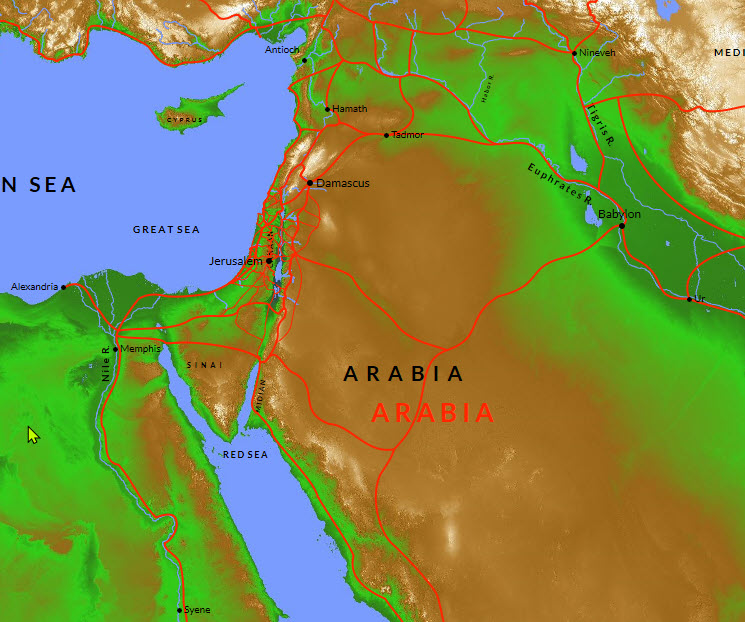
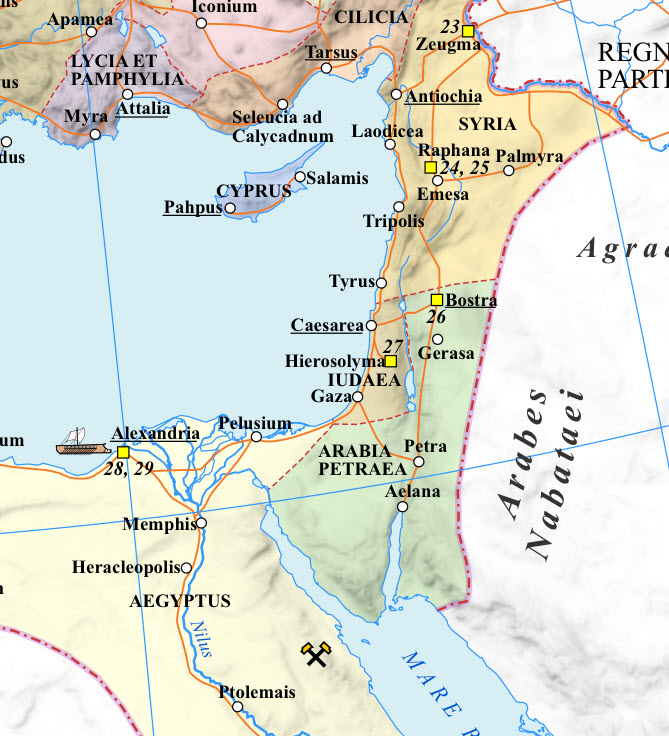
The theological context of this verse is beyond my scope here, but we have to ask what Paul meant by “Arabia” in that verse, and in Gal 1:17, where he speaks of going away to Arabia. If you think he meant “Saudi Arabia” then think again, because that country did not exist until the 20th Century. Nor do I think that the concepts of “Arabian Peninsula” or “Arabian sub-continent” were known in Biblical times. Mentions of Arabia and Arabian Kings in the Old Testament and contemporary writings refer to scattered independent petty sheikdoms and bands of nomads inhabiting the desert areas shown in brown on the map below. No borders are shown on the map because neither Arabia nor Midian, which I’ll discuss below, were unified political entities.
What originally made the region Arabia was not a political, or even a geographical connection, but rather the fact that it was populated predominantly by Arabs. The Arabs are a genealogically diverse mixture of largely Ishmaelite tribes. Some historians tie the term “Ishmaelite” specifically to Arabs that lived around the Hijaz, or western coast of the subcontinent, but I use it here to refer to all descendants of Abraham’s son, Ishmael. The term, “Arab“, is derived from a Hebrew root ערב (‘arab), meaning “to crisscross or traverse”, referring probably to their nomadic movement from place to place. As herdsmen and traders, they ranged throughout regions encompassing today’s western Arabia, certainly, and up into modern Jordan, Syria, eastern and southern Sinai and the Negev in Israel.
in the context of the New Testament, the most likely meaning of “Arabia”, is the area then known as the Nabataean Kingdom, shown below roughly outlined in orange, consisting of the modern northwest corner of Saudi Arabia, most of modern Jordan, and all of the Sinai Peninsula east of the present Suez Canal. Note that this area contains both Jebel Musa (the traditional site in Sinai) and Jebel al Lawz (Wyatt’s site east of the Gulf of Aqaba).
Nabataea became a formal kingdom at around the middle of the 3rd Century BC. In general, it was friendly to Hasmonean Judea. Nabataean independence ended when they were finally conquered by Rome, under Trajan, in AD 106. Under Roman administration, they were split into two districts, Arabia Petraea in the west And Arabes Nabataei in the East (see next map, below). Both Jebel Musa and Jebel al Laws are located in Arabia Petraea.
After Paul’s “road to Damascus” encounter, he went to Arabia for some unstated reason and duration. Perhaps he “camped out” in the Wilderness to pray and commune with God. Perhaps he lived for a while with Bedouins to learn the tent-making skills that provided his financial support during his missionary journeys.
But when he who had set me apart before I was born, and who called me by his grace, was pleased to reveal his Son to me, in order that I might preach him among the Gentiles, I did not immediately consult with anyone; nor did I go up to Jerusalem to those who were apostles before me, but I went away into Arabia, and returned again to Damascus. —Galatians 1:15–17 ESV (emphasis added)
The wording of the passage quoted above implies to me that he purposely avoided the apostles for the time being. My assumption is that he wanted his instructions to come directly from God, since God had chosen him to reveal the mysteries of the new Church. Some commentators suggest that he traveled to Petra for some type of religious or geographic training, but I think his knowledge in those areas needed no further enhancement. If he spent time in any city during this period, I think that Philadelphia (ancient Rabbath Ammon and modern Amman, Jordan) was more likely.
Philadelphia in the time of the Apostle, Paul. By Nichalp – Own work, CC BY-SA 2.5
Moses in Midian?
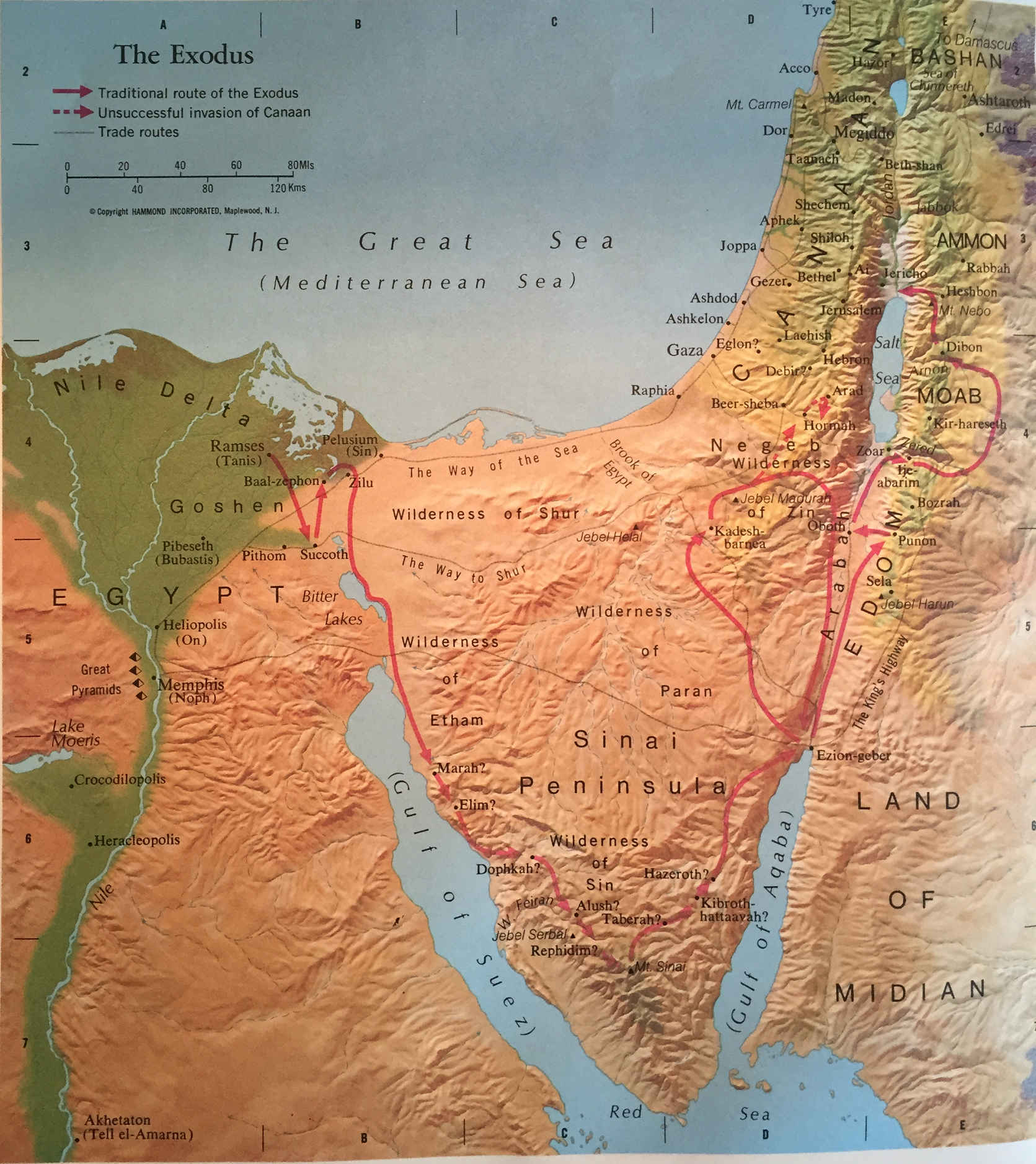
The Midianites were a nomadic tribe descended from Midian, a son of Abraham by his wife Keturah. They were a warlike people who engaged in herding, trade, and banditry. Like Arabia, Midian is a region, not a formal geographic or political entity. Most maps of Midian will show it as in the map below—east of the Gulf of Aqaba, but with no borders. Archaeology has little to say about the location. There is some sparse artifactual evidence, mainly pottery, in the area shown and north of that region, in the southern Lavant. Some literary evidence indicates a Midianite presence also in eastern and southern Sinai. This “rural spread” makes perfect sense. The entire region was arid. Nomadic herders tended to establish temporary homes that could be moved from place to place as pastures become depleted by overgrazing. There were also caravan routes connecting the furthest extents of the region (see the first map, above), an obvious enhancement to both trade and banditry.
Sinai and Midian, per Atlas of the Bible Lands
Many of Wyatt’s supporters will say that the Sinai Peninsula could not have been used by Midianite herdsmen because it was part of Egypt. Once again, borders were fluid in ancient times, where they existed at all. Egypt’s interests were primarily along the Nile. Their interest in the Sinai was limited. The roads in and out, especially the Way of the Sea, were fortified and patrolled for defensive purposes. Otherwise, only the mining areas along the Gulf of Suez coast were of significant value to them.
What is the best way to lead people to salvation in this modern age? I don’t want to offend folks in the churches I attended for years, but my opinion has changed as I’ve aged. I have come to agree with those who say that a scripted approach, using a recipe of verses pulled out of context and a magic, “follow after me” prayer, is not the most effective solution.
When I was in college, some of my Christian friends were handing out “Four Spiritual Laws” tracts and using those as talking points during personal evangelism.
Before that, as a teen, and for many years thereafter, I was taught to “witness” using the “Romans Road to Salvation“.
There is nothing wrong with these tracts or using them for talking points. They are certainly well-intentioned, and they present legitimate Scripture. But I’m an old guy now, and looking back on my life, I don’t know for sure if I ever won a single convert with these methods. I heard professions of faith, certainly, but my efforts to disciple these people were always rebuffed. I don’t think I can name or even picture a single one who demonstrated Biblical salvation afterwards.
What did show positive results was driving busloads of kids to church every week and simply chatting with them about Jesus. That makes sense in light of my own experience as a child. I was taught all the “Bible stories” by Godly parents and teachers, and I have never doubted them. By the time I was eight I belonged to God.
Even as a youth, though, I often wondered why God, in His infinite wisdom, would hide the recipe for salvation by scattering it around Romans like that. Why not just come out and say it? Well, He did, actually! For example, from the “faith” chapter:
“And without faith it is impossible to please him, for whoever would draw near to God must believe that he exists and that he rewards those who seek him.” (Hebrews 11:6 ESV)
I didn’t need a cookbook to find Jesus. God drew me to Himself and put me in an environment where I would learn about right and wrong, repentance, and Jesus.
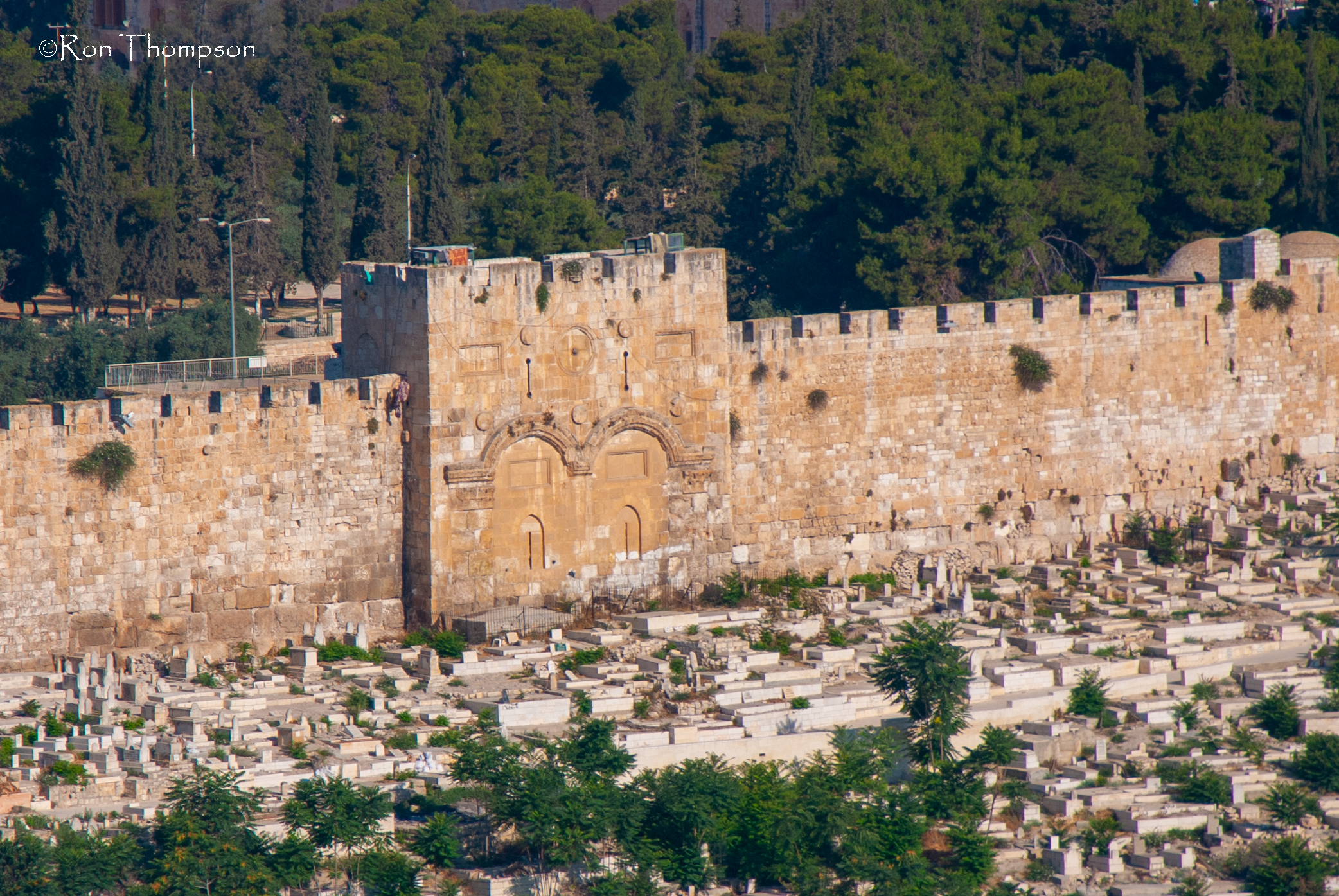
In the various Facebook Archaeological groups that I frequent, there are often discussions about the Eastern, or “Golden Gate”, on the Temple Mount in Jerusalem. Most tourists are probably introduced to the Mount by way of the overlook on the Mount of Olives. From that viewpoint, you get a wonderful, panoramic view of the eastern wall. The first three features of that wall that you notice are the Dome of the Rock and the Al Aqsa Mosque on top and the grand gate in the wall—The Golden Gate. Oddly, it turns out that almost everybody is hugely impressed by the gate, but almost nobody comes away from Jerusalem understanding its history or its prophesied future.
By one way of thinking, there have been four Jewish Temples on Mt. Moriah, with two more coming in the future. Two of the historical Temples have simply been extensive upgrades due to declining physical condition, so they aren’t considered to be separate new Temples.
Although there are important variations in the construction from one Temple to the next, many important details are the same for all, because the specifications for those are either Biblical or were unalterably decided by the rabbis and codified in Jewish law.
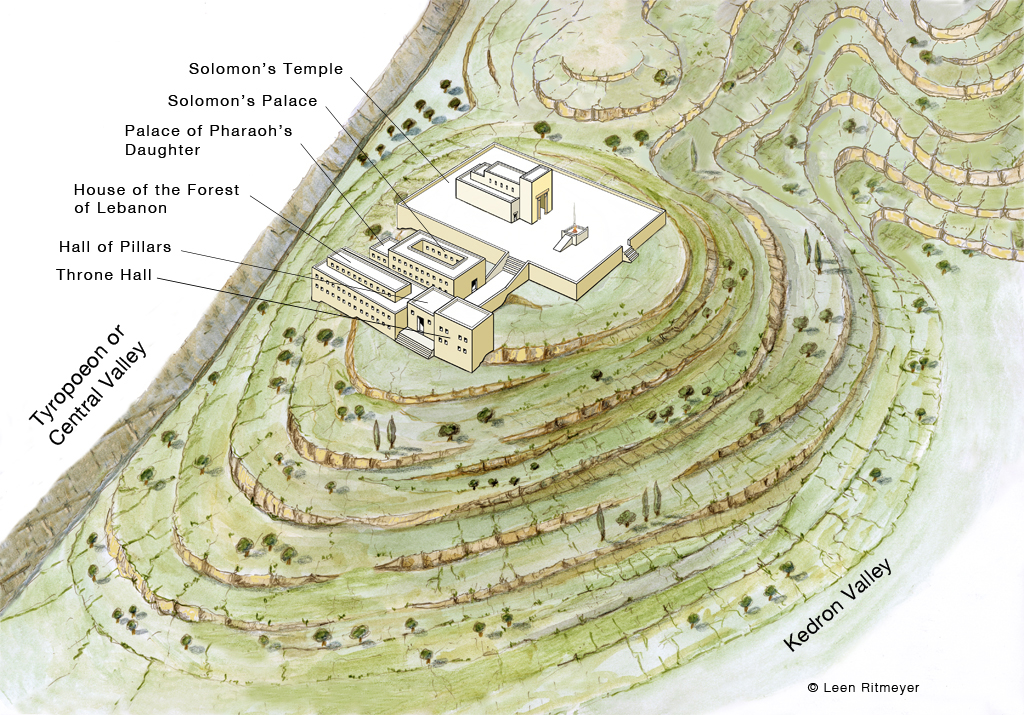
Solomon’s original Temple complex, shown below, was ornate, but relatively small. The Temple itself was built on a small platform erected on the threshing floor purchased by King David from Araunah the Jebusite. Solomon built a large palace for himself adjacent to the Temple platform and connected to it by a stairway.
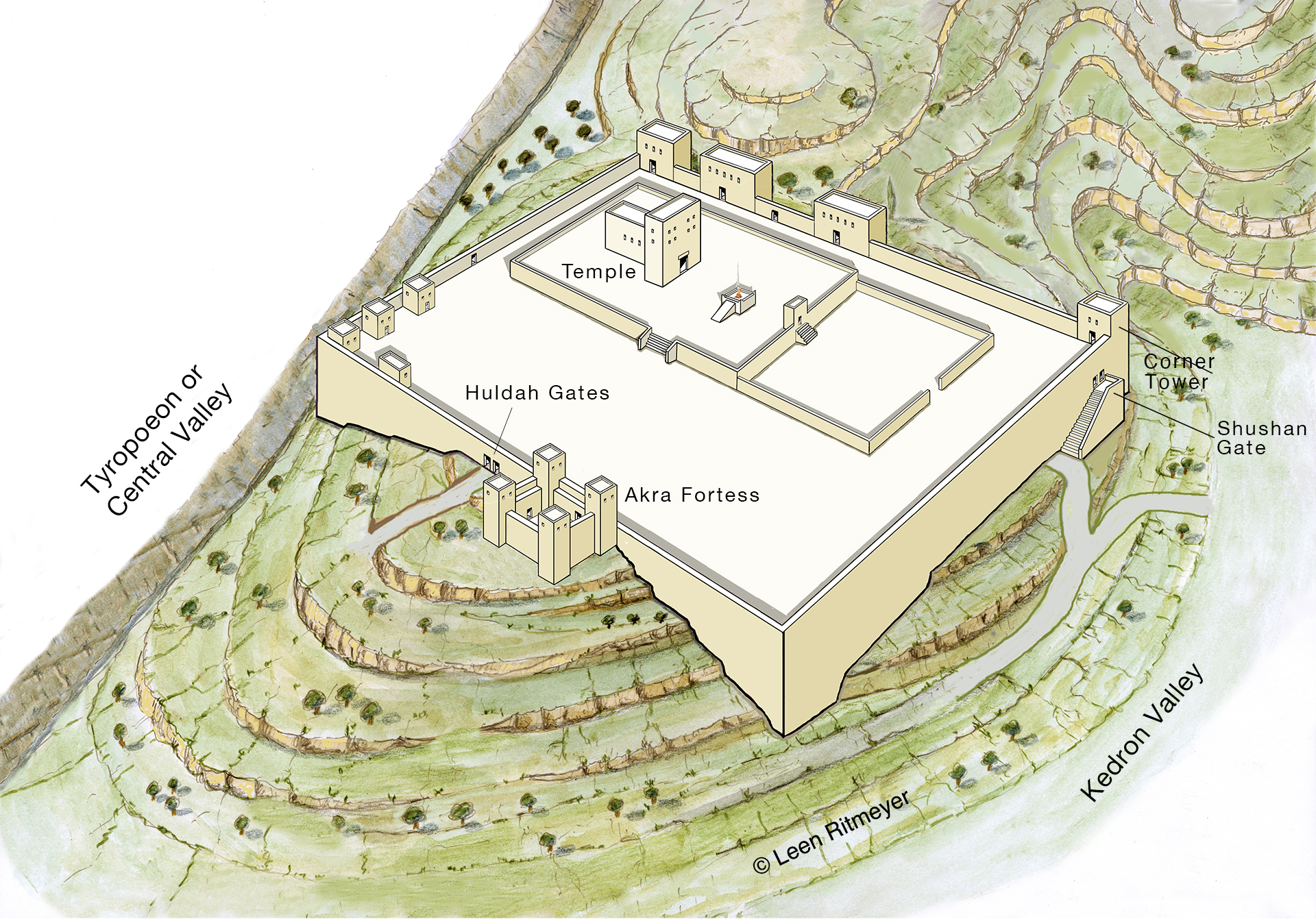
Over the following 400 years, both edifices crumbled from age. Various kings made repairs and upgrades. Hezekiah in particular, demolished much of what remained and built a new Temple on the site, much as Herod did in Second Temple days. Hezekiah’s Temple, shown in the next diagram, was built on a much larger platform, a square, 500 cubits (around 875′) on each side. As with all renditions of the Temple, the doors leading to the Temple porch and antechambers faced east towards the Mount of Olives. A separate eastern gate named, appropriately, the East Gate was set into the eastern retaining wall, near the northeast corner and recessed below the level of the platform.
In 586 BC, Hezekiah’s Temple was destroyed by the Babylonian army, and the 3rd and final deportation of Judeans into captivity began. The retaining walls were damaged, but not totally destroyed. When Jews returned decades later under King Zerubbabel to rebuild the temple, the surviving 500-cubit by 500-cubit platform was reused. The East Gate was repaired. It was renamed the Shushan Gate, because a memorial picture of the Palace of Shushan (Susa) was portrayed on it.
As for Zerubbabel’s Temple itself, it was built along similar lines as before, but was a pale imitation of what Solomon’s craftsmen had produced.
In 168 BC, under Seleucid rule, a fortress called the Akra was built adjacent to the south wall for the purpose of controlling the Hulda Gates, where most Jews entered and left the Temple Mount.
In 141 BC, Simon Maccabaeus expelled the Seleucids and demolished the Akra. He leveled the hill on which it stood and upgraded the platform, extending it to the south.
After the Romans conquered Judea, their appointed puppet ruler, King Herod, gutted the entire edifice, rebuilt the structures (but again based on the same general plan), and again extended the platform, this time to the north, south and west. The Shushan Gate remained in its previous location.
Of course, there has been no Jewish Temple in Jerusalem since Herod’s Temple was destroyed by the Romans in AD 70. I believe that some time before the Tribulation period, the Gog and Magog war prophesied in Ezek 38 and 39 will result in the complete incapacitation of the Israeli and Arab militaries, setting the stage for a peace agreement to be administered by the Antichrist. I believe that part of the agreement will enable Israel to hastily build a very short-lived Temple that will function during the first half of the Tribulation; but this is only my opinion, and beyond the scope of this post. [Autor’s note, 8/16/2024: As the October 7 War continues to escalate and with Iran on the verge of completing their first nuclear bomb, I think there is an excellent chance that this is the early stage of God and Magog. “Even so, Lord Jesus…”]
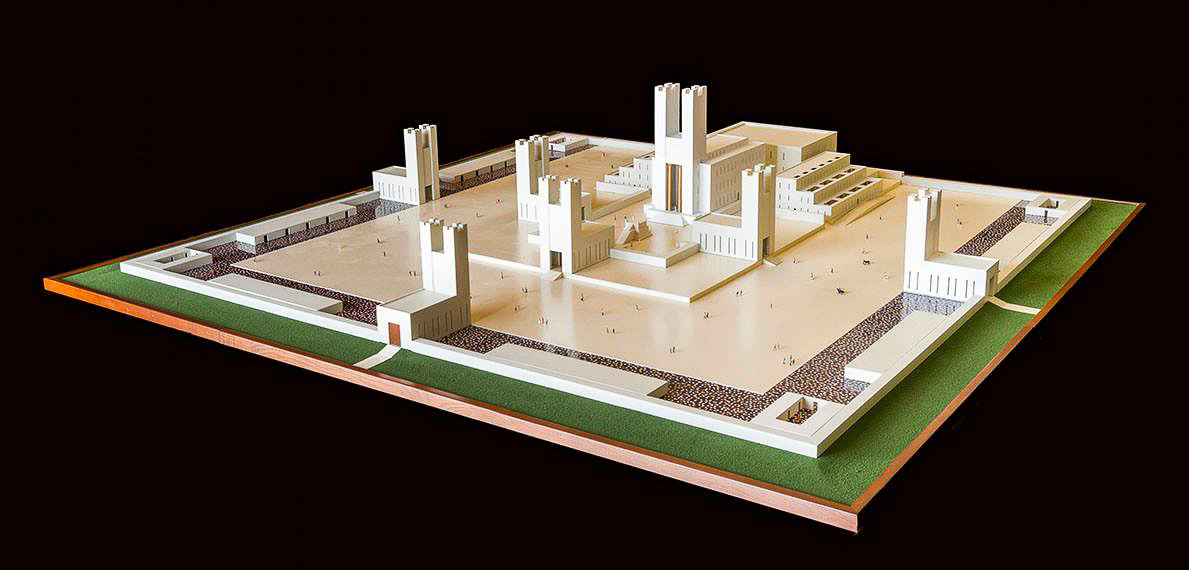
In 573 BC, Ezekiel was given a vision of a new Temple to be built in Jerusalem. He records that vision in great detail in chapters 40 and following of his prophetic book. In an excellent 20th century book entitled Messiah’s Coming Temple, John W. Schmitt and J. Carl Laney, analyze both the design of this temple and the use to which it will be put. It bears a superficial resemblance to previous Temples, but is by far the largest, and in even some of the “essential characteristics”, it differs from them in ways that do not correspond to Jewish law. This is because its purpose will be different in many respects, as outlined in the Schmitt/Laney book. The three outer gates on the model pictured below are, from the right, the north, east and south gates. By the time this Temple is built, I believe there will be no trace left of the present Temple platform or the Golden Gate.
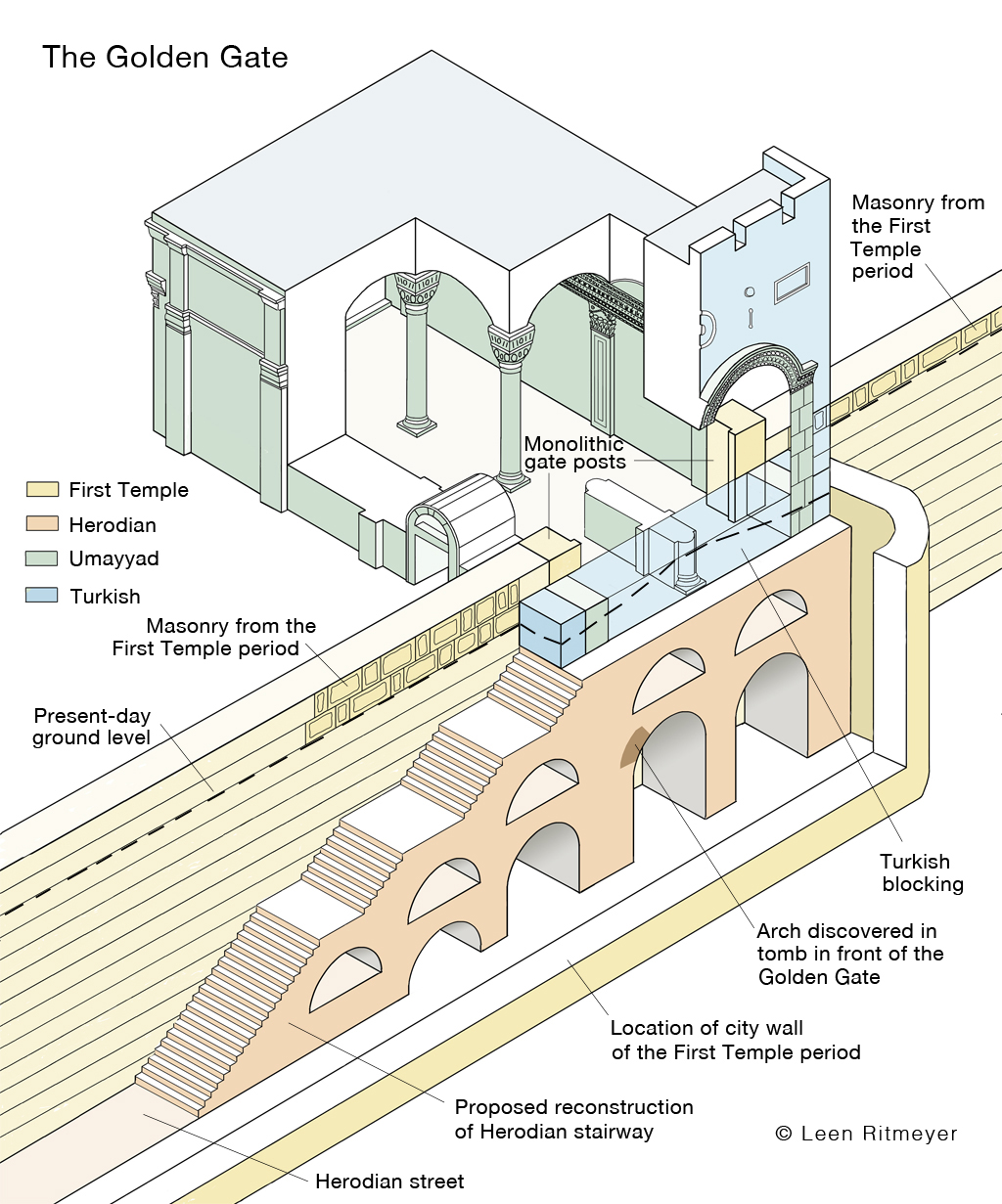
All versions of the Temple faced east, with an eastern door, or gate. All were surrounded by one or more courtyards, and each of those had an east-facing gate. The preexilic East Gate, the postexilic Shushan Gate, and the present Golden Gate are all apparently at the same location in the eastern wall. The “monolithic gate posts” shown in Ritmeyer’s diagram, below, were most likely the lentils of the Shushan Gate so, though somewhat elevated, the Golden Gate, probably built in the 7th Century under Umayyad rule, incorporates the earlier gates. An arch covering a mass grave was discovered below the gate in 1969, and for a time it was thought to be the actual Shushan Gate arch. Instead, it appears that it was part of a staircase connecting the elevated gate with the ground level below.
To the best of my ability, I will now respond to the list of questions mentioned at the top of this post.
Is the Eastern Gate the same as the Beautiful Gate of the Gospels?
And a man lame from birth was being carried, whom they laid daily at the gate of the temple that is called the Beautiful Gate to ask alms of those entering the temple. —Acts 3:2 ESV
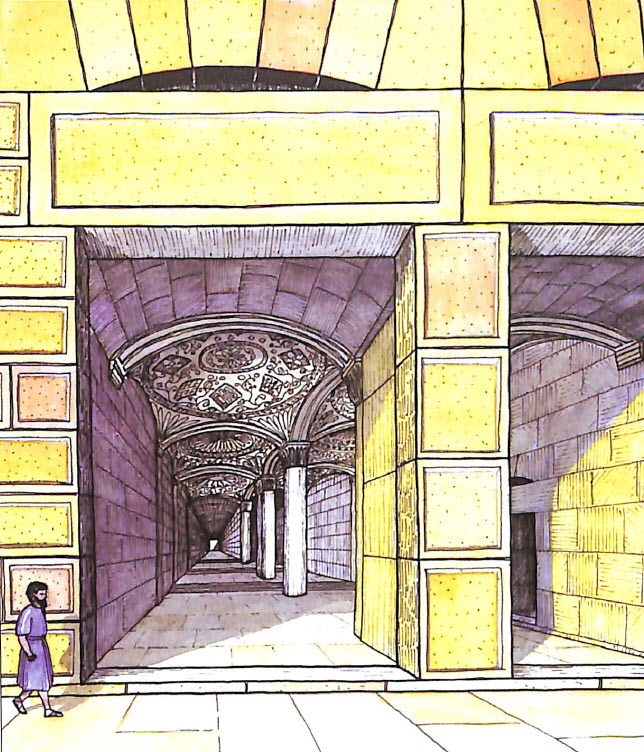
It is not credible that beggars would seek alms at a gate that was used only by priests, and that only rarely. Nor is it likely that the Beautiful Gate was the ornate, nearby Gate of the Pure and Just, the eastern gate of the Court of Women; that gate was only for VIPs, and we know that they tended to be stingy. I believe, along with many, that it is the Double Gate on the south side of the Mount, with its beautiful domed passage through to the interior Hulda Gate. That gate would see not only the largest crowd, but probably the most generous.
Is it true that Muslims sealed the gate and established the cemetery in front of it in order to prevent the Jewish Messiah from entering through it?
More or less. When the Ottoman Sultan, Suleiman I, learned that Jews and Christians expected the Jewish Messiah to be led onto the Temple Mount by the Prophet Elijah, he ordered that it be permanently sealed, in AD 1541. Knowing that Elijah would not defile himself by passing through a cemetery, he ordered that one be established outside the Gate. Later, plague victims were buried in a mass grave at the foot of the Gate.
Is it true that Jesus entered Jerusalem through this gate on the first Palm Sunday?
The answer is, no, in part because the Shushan (Susa) Gate was never open to the general public. The sages of the Mishnah pretty much ignored Herod’s extensions to the Temple Mount, so when they wrote about the gates, they were referring only to the gates giving access to the 500-cubit square platform. According to them, the Temple Mount gates were used as follows:
A. Five gates were in the [wall of the] Temple mount: B. two Hulda gates at the south, serving for entry and exit; C. Qiponos [Kiponus] gate on the west, serving for entry and exit; D. Tadi gate on the north, serving no purpose at all; E. the Eastern Gate— F. on it is a picture of the Walled City of Shushan— G. through which the high priest who burns the red cow, and the cow, and all who assist in its rite, go forth to the Mount of Olives [M. Par. 4:11.] —Middot 1:3 MISH-N
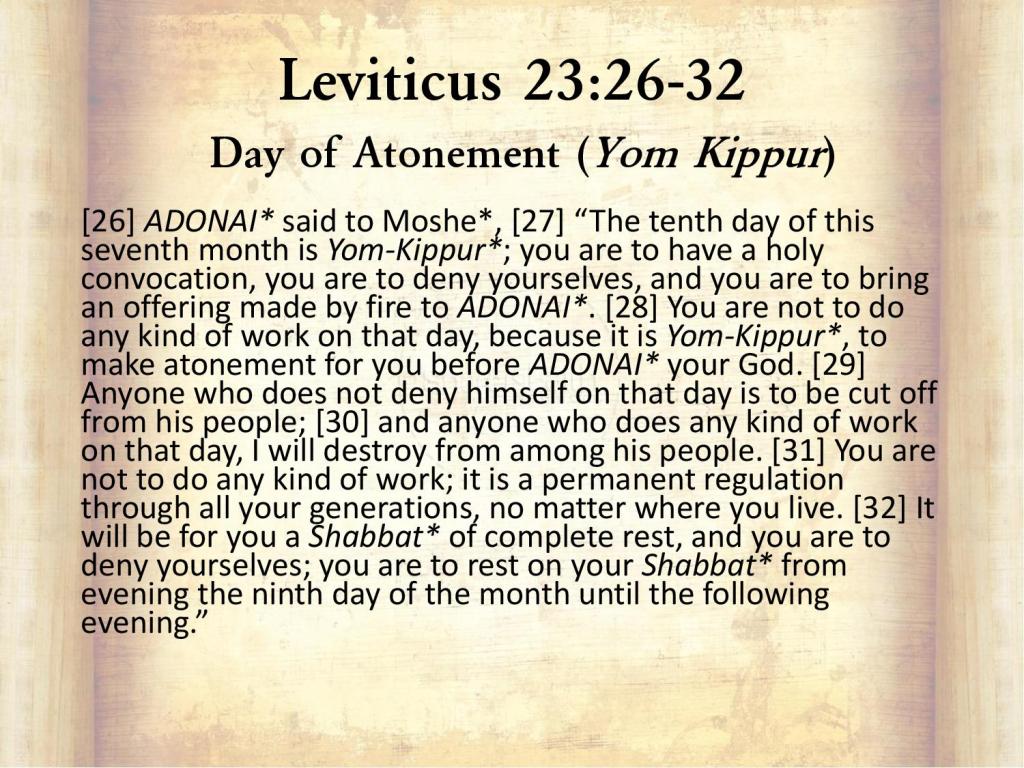
Another Mishnah tractate indicates that the scapegoat, (the goat for Azazel, the devil), was also led through this gate each year, on Yom Kippur.
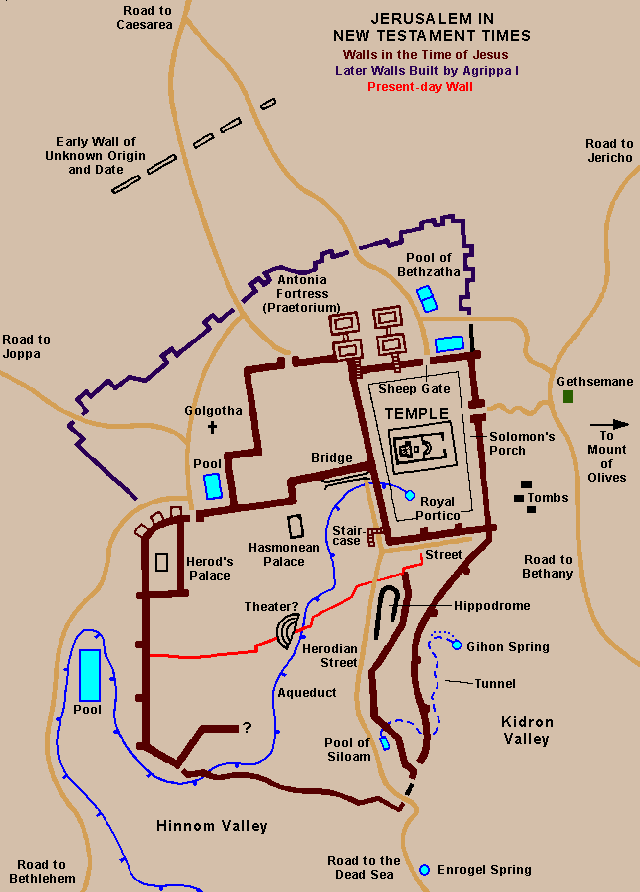
Most Internet maps showing Jerusalem in Jesus’ day indicate a switchback road from the Kidron Wadi, ascending to the eastern gate. If that road existed at all, I think it would have been for ceremonial or maintenance use only. Yet another tractate indicates that an arched causeway crossed the Kidron between the gate and the Mount of Olives where the red heifer ceremony was conducted. In any case, the Shushan Gate would have been inappropriate for access to the city, because pack animals and ridden animals would have to be led up the stairway to the gate, and once on the Temple Mount, they would have to pass through the outer courts and exit through another Temple gate to get to the city.
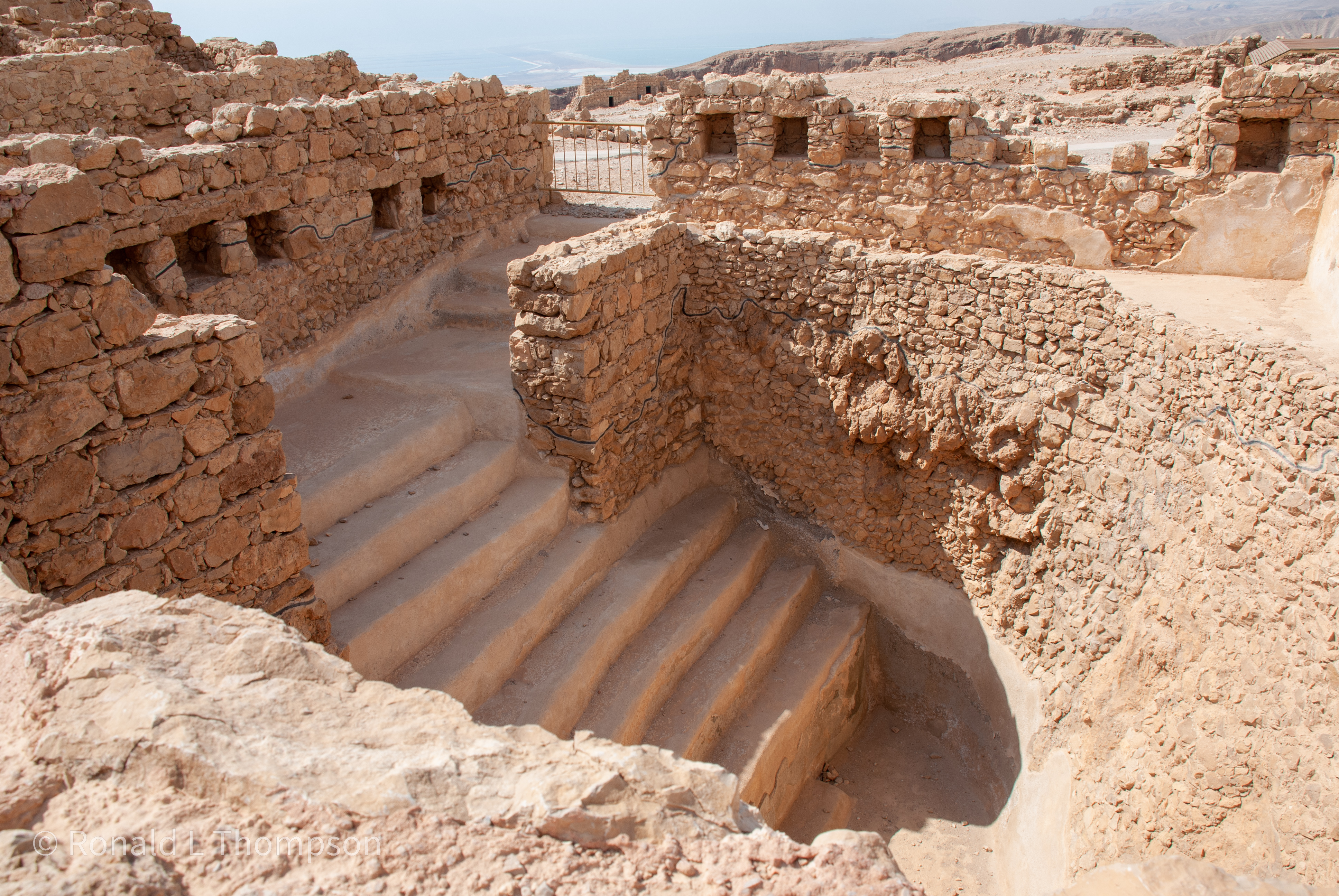
This is unthinkable! First, neither human nor animal could enter the outer gates in an unclean state. Humans had a choice of numerous mikvoth, or ritual baths, on all but the east side. Second, animals entering the court for sacrifice also needed cleansing in water, and that was done in the Sheep Pool, also known as the Pool of Israel, outside the northern wall, with no access to the Eastern Gate. Finally, the common pack and ridden animals were donkey, horse, camel, ox, and occasionally cow. Of those, only the ox and cow could even be cleansed. Donkeys, horses and camels are Biblically unclean, irrespective of washing. They could never be allowed on the Temple Mount.
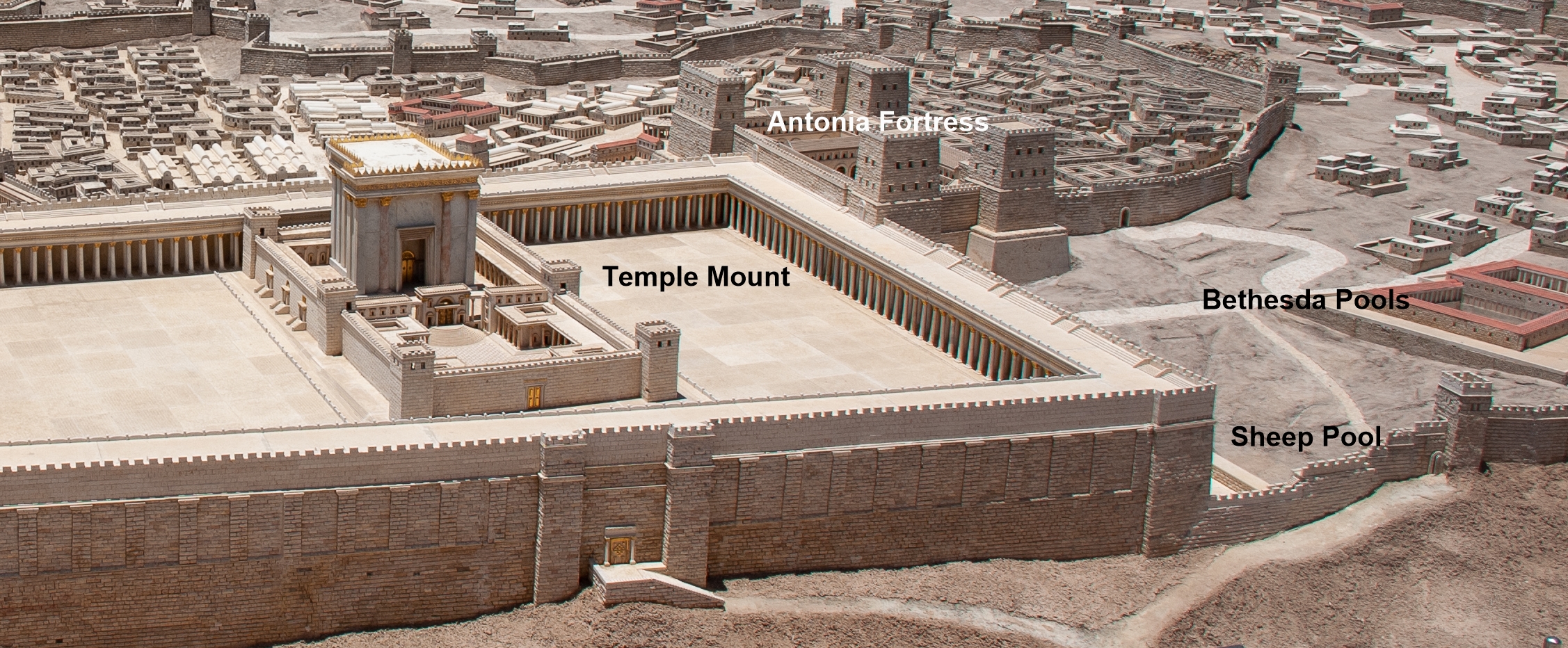
How, then, did Jesus enter the city? There were probably two routes in from Bethany. The map below shows the dubious switchback road, and a road to Jericho that may or may not be correct. Other maps say that Jericho travelers came in through Bethany on the road shown here. The exact location of Bethphage is unknown, but it was probably somewhere on the east slope of the Mount of Olives, roughly east of Gethsemane. I believe that another, more tortuous road, probably came around the south slope of the Mount of Offense, at the southeast corner of the map (not shown), and divided, with a branch going up the Kidron Valley to connect with the other road, and other branches leading to the southern gates to the city. If Jesus came in past Gethsemane, He would have most likely entered through the gate north of the Temple mount and passed the Pool of Bethesda and the Antonia Fortress. City streets are not shown on this map, so He would have had multiple choices once in the city. When He entered the Temple, He could have gone through the Sheep Gate on the north side or used the more traditional route of the Double Gate on the south side of the Mount.
First Century roads and gates around Jerusalem. I don’t know the source of this map, but I have little confidence in the accuracy of the roads on any similar map that I have. However, other features on this map correspond well with my understanding of the city at that time.
Whichever road He took from Bethany to Jerusalem, I think He was expected by the populace, and the crowd was alerted and waiting for Him on the west slope of the Olivet chain of hills.
Many prophecy enthusiasts point to the sealed Golden Gate as proof that Jesus entered the city by that route:
Then he brought me back to the outer gate of the sanctuary, which faces east. And it was shut. And the LORD said to me, “This gate shall remain shut; it shall not be opened, and no one shall enter by it, for the LORD, the God of Israel, has entered by it. —Ezekiel 44:1–2 ESV
But this prophesy refers to the eastern gate of Ezekiel’s Temple, described in Ezek 40 and following. That Temple has not been built yet and will not be built until the Millennium. More to the point, that prophecy does not point to Jesus (see below). Also, the Shushan Gate was destroyed or at least damaged in AD 70, and the Golden Gate not built on top of it until hundreds of years later. Once built, it was later sealed, then opened, then sealed permanently, but not until AD 1541!
Is it true that this is the “Eastern Gate” through which the Divine Presence left the Temple, as prophesied in Ezekiel chapters 10 and 11?
Then the glory of the LORD went out from the threshold of the house, and stood over the cherubim. And the cherubim lifted up their wings and mounted up from the earth before my eyes as they went out, with the wheels beside them. And they stood at the entrance of the east gate of the house of the LORD, and the glory of the God of Israel was over them. —Ezekiel 10:18–19 ESV
Then the cherubim lifted up their wings, with the wheels beside them, and the glory of the God of Israel was over them. And the glory of the LORD went up from the midst of the city and stood on the mountain that is on the east side of the city. —Ezekiel 11:22–23 ESV
God is omnipresent, both in space and in time. As our infinite, Almighty God, He can’t be contained in a tent or a building. But because He chose to deal with humanity, as represented by the primitive Israelites, He picked a form in which to appear to them. An “interface”, so to speak. In the desert, it was “a pillar of cloud by day and a pillar of fire by night.” In the Tabernacle, and later the Temple, His “Divine Presence” was in the Holy of Holies, above the Mercy Seat of the Ark.
Chapters 8 through 11 of Ezekiel record a vision that came to him while he was sitting in his house with “the leaders of Judah”. In the vision, he was taken to the Temple in Jerusalem and shown men in leadership positions performing “disgusting” idolatrous religious rites in the Temple precincts. God then ordered a scribe to pass through the city and put a seal on the foreheads of innocents, while six other presumably angelic beings followed him and executed anyone not so sealed. The six beings were then told to set fire to the city. After the return of the scribe, God’s Sh’kinah Presence left the Temple, rose above its threshold, paused for a bit over the “east gate of the Lord’s house” (this could be the gate of an interior courtyard, or it could be the Shushan Gate), and then “stood” over the mountain on the east side of the city (no doubt the Mount of Olives).
It doesn’t matter what gate, or what mountain, because it was a vision. It was not real, and the Divine Presence left by air, not through any gate. Yet it was prophecy of something that was real, which came very soon thereafter. God withdrew His protection from the city and the Temple, and both were sacked and burned by Nebuchadrezzar’s army.
Is it true that Jesus will one day enter the Temple through this same Eastern Gate, per Ezekiel chapters 43 and 44?
Then he led me to the gate, the gate facing east. And behold, the glory of the God of Israel was coming from the east. And the sound of his coming was like the sound of many waters, and the earth shone with his glory. And the vision I saw was just like the vision that I had seen when he came to destroy the city, and just like the vision that I had seen by the Chebar canal. And I fell on my face. As the glory of the LORD entered the temple by the gate facing east, the Spirit lifted me up and brought me into the inner court; and behold, the glory of the LORD filled the temple. —Ezekiel 43:1–5 ESV
Beginning in chapter 40, Ezekiel has been once again taken to Jerusalem in a vision, but this was to show him events far in the future, at the start of the Millennial Reign. The vision shows him a new Temple, to be built presumably at the start of the Reign. In chapter 43, suddenly God’s Glory returns to the Temple, but this time through the gate facing east, not above it. The assumption that many people make is that “God’s Glory” here refers to Jesus. That is possible, but the parallels between this and the earlier vision indicate it is God’s Sh’kinahreturning. The Father, not the son.
The sequence in chapter 43 is as follows: God’s Glory returns, through the “gate facing east.” God goes into the Temple itself and fills it with His Glory. Ezekiel is standing outside the Temple with the angel who has been showing him around. God calls out from inside, saying that He will now dwell with His people forever, and never again will they defile His house.
So, if it wasn’t Messiah entering through the eastern gate, is Jesus “the prince“, who is mentioned several times in the prophecy? Clearly, He is not! The prince, whoever he is and whatever his function, has sins to atone for, and evidently, he has children.
We know from other prophecies that Jesus will reign from Zion. But nowhere does scripture clearly say that He entered through the eastern gate. And incidentally, there does not seem to be a throne room in Ezekiel’s Temple.
Recall that in 1Kings 19, the Prophet Elijah has fled from the irate Queen Jezebel and is hiding in a cave near Mt. Horeb (Sinai). He is moaning about his fate, and God drops in to confront him:
And he [God] said, “Go out and stand on the mount before the LORD.” And behold, the LORD passed by, and a great and strong wind tore the mountains and broke in pieces the rocks before the LORD, but the LORD was not in the wind. And after the wind an earthquake, but the LORD was not in the earthquake. And after the earthquake a fire, but the LORD was not in the fire. And after the fire the sound of a low whisper. —1 Kings 19:11–12 ESV
Two interpretive issues stand out here for me. The first is God’s demonstration for Elijah’s benefit of His power to control events, including even the forces of nature. That will be the subject of most of this post.
The second is an interesting side issue: how does God normally communicate with humans? Over the years I have heard many pastors and teachers refer to the inward prodding and conviction of the Holy Spirit as “God’s still, small voice.” That is a distortion of theology going back, I think, to the early church fathers. The ancient Jewish Rabbis taught that God most often spoke to His people in post-prophetic (intertestamental and following) times audibly but quietly, in a low, soothing whisper. This has been termed, in Aramaic, the bat kol, or “daughter voice”, and you can read one description of that here.
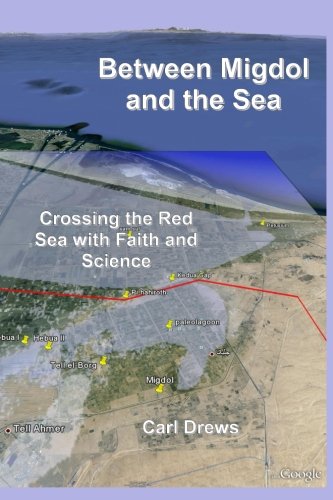
Some time back I read a book titled Between Migdol and the Sea: Crossing the Red Sea with Faith and Science, by Carl Drews. Drews is, like me, a self-taught amateur theologian with a technological background. He is also, again like me, passionately interested in the Egyptian sojourn, the Red Sea Crossing, the years of wandering, and the conquest of Canaan. The main difference between us is that I am a Conservative Evangelical who believes in the Divine inspiration and inerrancy of Scripture, while Drews takes a “Higher Critical” approach to Scripture.
The central reason for Drews’ book is to provide an engineering analysis of the following verse in order to discover the most likely site of the Red Sea (Sea of Suf) crossing:
Then Moses stretched out his hand over the sea, and the LORD drove the sea back by a strong east wind all night and made the sea dry land, and the waters were divided. —Exodus 14:21 ESV
Drews is an expert on mathematical modeling, i.e., using computers to simulate real-world conditions. For example, meteorologists use mathematical models to provide fairly accurate weather forecasts and to predict storm movements. Astrophysicists use them to study how stars and galaxies form and interact. In my own field of petroleum engineering, I have used (and even designed) them to predict reservoir responses, such as oil and gas flow in rocks and pipelines, and depletion of reservoir pressure.
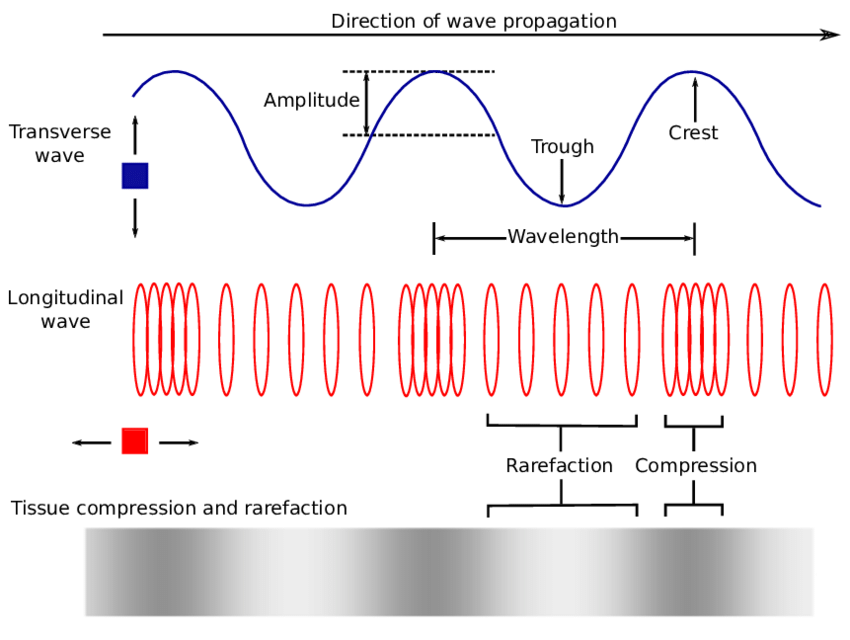
Drews used computer modeling to study “wind setdown” at various supposed locations of the Israelite crossing of the Red Sea. Setdown is a form of storm surge. Where high winds blow across an expanse of open water, shear forces can move the surface waters, piling them up on beaches and exposing shallow beds that are normally flooded. Drews proved, conclusively I think (but see below), that wind blowing across any body of water in the Egypt/Sinai/Arabia area, with one exception, would have to blow so hard to achieve the necessary setdown effect that no human could survive the crossing. Not the currently favored Bitter Lakes area on the present-day Suez Canal; not the current fad choices, at Nuweiba Beach in the Gulf of Aqaba or the Timor Straits area at the southwest extremity of Aqaba; and not the traditional (my own preferred) area in the northern Gulf of Suez, south of Suez City.
The one exception found by Drews is the shallow Lake of Tanis in the Nile Delta. He states that a strong easterly wind has been historically known to drive the water off the shallows from time to time, and that at those times the lake can be traversed by foot. His premise is that the Exodus miracle is in the timing, not in the actual moving of the water.
But consider that the crossing of the Red Sea, wherever that may have occurred, was the definitive, miraculous demonstration of God’s awesome power, whereby He showed His people, for all time to come, that He is worthy of all praise, glory and undying worship!
We know that God transcends time and place. He sees everything, everywhere and everywhen! So, Drews is asking us to see God checking His Weather Channel listing for the next hundred years or so, finding a convenient windstorm predicted for the time period, and deciding, “Yeah that would be a good time to send Moses to get my folks out of Dodge.”
I don’t buy it! What God came up with was something way, way more spectacular!
If you have heard many sermons on the Ten Plagues of Egypt, then you have probably heard that each plague was a challenge to one or more of Egypt’s pagan gods. In each case, the True God bested the pagan deity at his or her own specialty. Time and time again throughout Scripture, you see God delivering judgement, warnings or promises through or while accompanied by natural forces. This is partly a demonstration of His awesome power, and partly a polemic against the pagan deities that His people tended to fear or follow. Sometimes the accompaniment is a small thing, like a bush that burned without being consumed, or a gourd that withered and died in a hot wind. Sometimes much more, like fire and smoke over Mt. Sinai.
Read again the passage I quoted to start this post. Elijah was waiting to hear from God. When he felt a mighty wind, he thought it was the arrival of God. When he felt an earthquake, he thought, “Surely this is God…”. When he saw a fire, he probably remembered that it was right there on Mt. Sinai where God had appeared to the Israelites in fire and smoke. Surely God brought all of those things along to remind Elijah what He could do, but in this case, Elijah needed also to hear a tender voice.
I’m going to concentrate the rest of this discussion on the wind, because this is a particular idea that I have been exploring recently. Pagan wind deities tended to be particularly important in the ancient world because wind is almost always with us, and some of the most powerful natural phenomena are related to wind. In particular, this was true in Egypt, and therefore front and center in Israelite memory and lore. By the time of Moses, Egyptian mythology had merged the Sun God, Ra, with the God of Wind and Air, Amun, to produce the chief deity of that age, Amun-Ra.
Hebrew is a language that is rich in homonyms, or words with multiple meanings. The word רוּחַ, or ruach, is one of these. Depending on the context, ruach can mean “breath“, “spirit“, or “wind“. Sometimes there are specific clues in the context, like in Gen 1:2, where it appears as “the Spirit (Ruach) of God”, evidently referring to the Holy Spirit (Ruach ha-Kodesh). Very often, God’s miraculous works are accompanied by ruach. Bible translators have their reasons for choosing a particular meaning for a Hebrew term, but in some of those cases I have begun to wonder, “Is this interpretation cast in stone, or was it an assumption that has become ingrained as an unquestioned tradition?” Is it Spirit, is it literally wind, or is it perhaps both? I think that, perhaps, the idea of “both” has been underappreciated!
Take, for example, the following:
The festival of Shavu‘ot (Pentecost) arrived, and the believers all gathered together in one place. Suddenly there came a sound from the sky like the roar of a violent wind, and it filled the whole house where they were sitting. Then they saw what looked like tongues of fire, which separated and came to rest on each one of them. —Acts 2:1–3 CJB (emphasis added)
Here we see a great spiritual miracle, the imparting of the indwelling Holy Spirit, accompanied by two physical phenomena: the sound of wind in the sky above them, probably indicating that wind was in fact blowing; and “tongues of fire” over the individual recipients.
What about “the strong east wind”that we observed in Ex 14:21? The verb in the phrase translated as “drove the sea back” (ESV, NIV, et al) or “caused the sea to go back” (CJB, KJV, et al) has the Hebrew root הָלַךְ (halakh, to walk, or go). It is described by Strong’s as having, “a great variety of applications, literal and figurative”. The specific form of the verb appearing here, וַיּ֣וֹלֶךְ, is syntactically a Hiphil, which I’m told makes the passage read more like “caused the sea to go [back]”. What is clear to me is that it was God who moved the waters. I don’t believe that you can say definitively from the Text whether the wind was His agency or was simply an accompanying phenomenon as seen elsewhere in Scripture. Since I am theologically convinced that the event required more than a minor “miracle of timing”, then I believe it is fair to say that Drews’ research proves scientifically that wind could not have been the agency. God miraculously parted the waters, while announcing His presence with a strong but less than lethal wind. For me, that’s a satisfying answer that makes any of the candidate crossing sites tenable!
Though he may flourish among his brothers, the east wind, the wind of the LORD, shall come, rising from the wilderness, and his fountain shall dry up; his spring shall be parched; it shall strip his treasury of every precious thing. —Hosea 13:15 ESV
Is there any significance to the easterly wind direction? Absolutely! The prevailing wind direction in the northern temperate regions is westerly. In the Eastern Mediterranean region around Anatolia, the Lavant and Egypt, these winds bring ashore relatively cool, moist sea air. But during certain seasons there is sometimes a dry, hot wind blowing out of the deserts to the east and southeast, raising temperatures and withering crops. This is the beruakh qadim (“east wind”), or sometimes for brevity, just the qadim (“easterlies”), of Scripture. A more modern term for these winds is the Hebrew, sharav, or in Arabic hamsin winds. If the rain is God’s blessing on the Land, then the east winds are surely His curse. It is easy to see why the east wind appears over and over in Scripture, especially in prophecy, to symbolize and accompany God’s judgement.
Many creationists believe that Earth’s present topology is mostly the result of upheavals caused by the Flood itself. At the time represented by Genesis 8:1 (after the flood itself, when things had calmed down), one would thus expect that the peak of Mt. Ararat was close to its current height of over 16,000 feet above sea level. Wind alone could not have dropped the water level over 3 miles! Only the power of God could have caused the flood, and only the power of God could have ended it! My conclusion is that either the wind was there as God’s signature, or ruach should have been translated as “Spirit” here, as it was in the similar scenario of Gen 1:2.
God remembered Noach, every living thing and all the livestock with him in the ark; so God caused a wind [ruach] to pass over the earth, and the water began to go down … It was after 150 days that the water went down. —Genesis 8:1–3 CJB
I opened with Elijah in a cave, expecting God to appear to him in wind, an earthquake, or fire. I’ll close with a parallel text, with another prophet looking to the end times.
But the multitude of your foreign foes shall be like small dust, and the multitude of the ruthless like passing chaff. And in an instant, suddenly, you will be visited by the LORD of hosts with thunder and with earthquake and great noise, with whirlwind and tempest, and the flame of a devouring fire. And the multitude of all the nations that fight against Ariel [possibly meaning “altar hearth”, but referring here to Zion], all that fight against her and her stronghold and distress her, shall be like a dream, a vision of the night. —Isaiah 29:5–7 ESV (emphasis added)
Baptists, unlike many other denominations, believe in baptism by immersion rather than by “sprinkling” or “pouring.” Three reasons that I know of are commonly cited:
The Greek word baptizo literally means to “immerse” or “submerge.”
The symbology of baptism as generally recognized is burial and resurrection, which is not adequately pictured by sprinkling or pouring.
The oldest known paintings of baptisms seem to depict immersions.
For me, personally, I must go by what I know from many years of studying the rich Jewish background of Christianity. If Scripture isn’t explicit about how to do something it commands us to do, then that is usually because when the Scripture was written, there was no ambiguity. The church started out 100% Jewish, and in fact “The Way”, as we were often called in the 1st Century, was regarded within and without as a Jewish sect. Another common name was “The Sect of the Nazarene”. Ritual purification by total immersion in “living waters” (a natural stream or one of thousands of constructed Jewish mikvot, or baptisteries), was required as a personal response to sin, and to prepare for almost any ritual event. I believe that Christian baptism following salvation and prior to admission to membership in a local assembly mirrors the Jewish practice of requiring a person to be ritually submerged prior to recognition of his or her conversion to Judaism.
Several years ago, one of my granddaughters was dating a boy who was a member of a Reformed congregation. She wanted to attend catechism classes with him. I agreed, with the stipulation that I would read a copy of the text for myself and review it with her. On at least two occasions I had lunch with the pastor of that church. He was teaching the classes, and we had some very friendly, but of course inconclusive, conversations about the doctrine he was teaching.
The text was Louis Berkhof, Manual of Christian Doctrine. Here are my responses to specific statements made in the chapter on Christian Baptism:
Berkhof said, “We maintain that the mode is quite immaterial, as long as the fundamental idea of purification finds expression in the rite…It is perfectly evident from several passages that baptism symbolizes spiritual cleansing or purification” as opposed to death, burial and resurrection. We’ll start this list with a point of agreement. Berkhof lists a number of Scriptural references, but I will stick with just one of those here:
1Pet 3:20-21. (CJB) [20] to those who were disobedient long ago, in the days of Noach, when God waited patiently during the building of the ark, in which a few people—to be specific, eight—were delivered by means of water. [21] This also prefigures what delivers us now, the water of immersion, which is not the removal of dirt from the body, but one’s pledge to keep a good conscience toward God, through the resurrection of Yeshua the Messiah.
The concept that Christian baptism represents Jesus’ death, burial and resurrection came into use early, and was supported by Paul, himself, in Col 2:12, but that was not the original intent of the rite.
“Jesus did not prescribe a certain mode of baptism, and the Bible never stresses any particular mode.” That is true precisely because it was not a new concept that needed to be explained. Christian baptism is patterned on the Jewish rites for ritual purification of new converts. The original writers of the Bible and their audiences, both in Israel and the Diaspora, were all intimately familiar with the Jewish purification rites, and there could have been no ambiguity on the forms required.
“The word employed by [Greek translations of Jesus’ words] does not necessarily mean ‘to immerse,’ but may also mean ‘to purify by washing’.” To purify by washing is one application of the term. So is the process of dying a cloth. But both practically and linguistically, the method of doing either was by dipping something completely. Strong defines the root, bapto, as a verb meaning “to overwhelm, i.e., cover wholly with a fluid”, “to moisten” or “to dip”, and baptizo as “to make overwhelmed, or fully wet.” Thayer adds, “submerge” and “immerge” (immerse) and Vine illustrates all of these meanings. Linguistically, it is possible to derive a translation that includes something less than total submergence, but to do so in this instance ignores the cultural context under which the word was written and how it would have been understood by the two imminent Jewish theologians, Jesus and Paul.
“From earliest times it was customary to baptize by sprinkling and pouring as well as by immersion. Purification was frequently, if not generally, effected by sprinkling during Old Testament times” (emphasis added). This is a true statement about ritual cleansing, but inapplicable to the subject of Christian baptism or the Jewish customs at its root. Berkhof is referring here to the purification of objects, and rituals like the washing of hands. There were many different types of purification rite specified in the Old Testament. Each type of purification had its own specified mode. Berkhof gives numerous scriptural examples, but in each case, the mode demonstrated was as commanded by God for the specific situation. Purification for the purpose of human conversion and for many types of personal defilement required complete submersion, down to the last hair on the head. In particular, purification by complete submersion was required for conversion to Judaism, so I’m very sure that for “conversion” to Christianity, that is what they, too, did.
“The baptism with the Spirit certainly did not take place by immersion…” That’s a weak argument for the question of water baptism, and I don’t even think it’s true for spiritual! I’m very sure that Holy Spirit baptism requires metaphorically complete immersion in the Holy Spirit. If sprinkling with “tongues of fire” on the head (“sprinkling of the Holy Spirit”?) is what Berkhof had in mind, then where is my tongue of fire? I think I really have been “immersed” in the Spirit!
“…nor did other baptisms mentioned in Scripture.” He gave three examples here that I think are instructive:
(a) Lk 11:37-38, (CJB) [37] As Yeshua spoke, a Parush [Pharisee] asked him to eat dinner with him; so he went in and took his place at the table; [38] and the Parush was surprised that he didn’t begin by doing n’tilat yadayim [ritual handwashing] before the meal.
(b) Lk 12:49-51, (CJB) [49] “I have come to set fire to the earth! And how I wish it were already kindled! [50] I have an immersion to undergo—how pressured I feel till it’s over! [51] Do you think that I have come to bring peace in the Land? Not peace, I tell you, but division!“ Jesus is speaking here of His coming ordeal, His crucifixion and the ultimate division that that will cause in the final judgement. His “baptism of fire”, so to speak.
And (c) 1Cor 10:1-2 (CJB) [1] For, brothers, I don’t want you to miss the significance of what happened to our fathers. All of them were guided by the pillar of cloud, and they all passed through the sea, [2] and in connection with the cloud and with the sea they all immersed themselves into Moshe [Moses]. Jesus is speaking metaphorically about the Reed Sea crossing by the Israelites. Of course, they, unlike the Egyptians behind them, were not literally immersed.
“Neither does it seem that this mode was followed in the cases mentioned in Acts.” Berkhof here provides several references: Saul’s immersion after his road to Damascus encounter; the Gentile conversions at the house of Cornelius; and the Philippian jailer and his family. Nowhere do these verses mention the mode followed. They just say, in effect, “they were baptized.” I think that Berkhof is here assuming that there simply was no place handy for a complete immersion. He’s wrong. Every synagogue in every town with 10 or more male Jews had its own mikvah. Where there was no mikvah, there was a river or stream that could be used as it was or dredged or dammed to form a deep enough pool.
“Spiritual renewal is sometimes said to have been effected by sprinkling.” Where sprinkling is mentioned in the Old Testament, it is usually blood or oil, sprinkled in specific places for specific reasons. Water is sprinkled, literally, in only two contexts, where the vast amounts of water that would be required for full immersion were impractical: (a) The initial consecration of the Levites—all of them—at the “commissioning” of the tabernacle. And (b) at red heifer ceremonies, when many objects and people were to be cleansed more or less simultaneously. The one Old Testament example given by Berkhof was
Ez 36:24-26 (CJB) [24] For I will take you from among the nations, gather you from all the countries, and return you to your own soil. [25] Then I will sprinkle clean water on you, and you will be clean; I will cleanse you from all your uncleanness and from all your idols. [26] I will give you a new heart and put a new spirit inside you; I will take the stony heart out of your flesh and give you a heart of flesh.
This was, of course, poetic language referring to the New Covenant and to the Olam HaBa (the end-time world to come), and not at all meant to be taken literally. God was speaking, through Ezekiel, about what He will do, not to an individual, but to the entire Nation of Israel. If it was meant to be taken literally, God is also promising to rip out their old hearts and spirits and replace them with new!
Berkhof also inserts a New Testament example here:
Heb 10:22 (CJB) [22] Therefore, let us approach the Holiest Place with a sincere heart, in the full assurance that comes from [faith]—with our hearts sprinkled clean from a bad conscience and our bodies washed with pure water.
In this event, hearts are metaphorically sprinkled (since you can’t do that literally, let alone completely immerse it), but bodies are literally immersed.
Note the important point that salvation was never a result of ritual. Even in Temple days, Jewish salvation was by God’s grace, as a result of the individual’s faith in God. All ritual was an obedient response by a believing heart. Inevitably, many Church customs have evolved over the millennia. God’s grace will not condemn a “sprinkler”, but I prefer to do it right.
I know, this is far from the most important theological question most of us will face in our lives, but I’ll bet that most of us are at least a little bit interested. What Exactly is an “ark”? Answers in Genesis (AiG), parent ministry of the Ark Encounter theme park, who I frequently agree with and frequently disagree with, says, “Noah’s Ark was a ship; therefore, it likely had features that ships would commonly have.” No, and no…
My purpose here is not to question their motives or their overall theological purity, but rather to point out where my opinions and theirs differ on some textual interpretations and scientific/nautical engineering principles.
Artist’s conception: Noah’s Ark, somewhat as I envision it.
Linguistics
“Ark”
Nowhere does Scripture say the Ark was a ship! All that floats is not a ship. I did a search in several English translations to get a sense of the Biblical usage, concentrating mostly on KJV, NKJV, ESV, NIV and CJB. I found that the Hebrew “Oniy“ or the related “Oniyah” is translated as “ship(s)”, “boat(s)”, “sailing vessel(s)”, or “watercraft” in the Old Testament. The word can also refer to a fleet (of ships), a Navy, or seamen. Another Hebrew term, Tsiy is translated variously as “ships“, “boats” or “vessels (of papyrus reeds)”.
There are three contexts in which the term “ark” occurs in English translations of the OT. When referring to Noah’s Ark and the basket into which Moses was placed to escape Pharaoh’s attack on Israelite children, the Hebrew is “tebah“, which literally means “a box or chest“. When referring to the Ark of the Covenant, the Hebrew is “aron“, meaning “a box, chest or coffin“.
What is the difference in meaning between these words? AiG suggests that tebah is related to the Egyptian word for “coffin”, and comments that being sealed in the Ark would be like “being sealed in a coffin.” Their post says nothing at all about aron.
Ancient Hebrew and Egyptian were both Semitic languages of the Afro-Asiatic language family. It is possible, but not proven, that the Hebrew term is a loan-word from their Egyptian sojourn. The Hebrew alphabet, especially in its ancient form, is an “abjad“, meaning that it contains no vowels. “Tebah“, then, as transliterated to English, becomes “t-b-h“. The Middle Kingdom Egyptian hieroglyphs included a full set of phonetic glyphs. When using only these glyphs for writing, the similar word is transliterated as “t-b-t“, and according to the Brown-Driver-Briggs concordance, which I consider to be better than Strong’s, it does, in fact mean “chest, or coffin”. Nevertheless, the leap to comparing Noah’s Ark to a coffin is a total (and absurd) shot in the dark!
Based on my own survey of Jewish sources, I believe that tebah refers to containers for the “common“, while aron refers to boxes, chests, and cabinets dedicated to sacred objects.
Regarding the latter,
The Ark of the Testimony (Aron HaEdut) was “home” to God’s Sh’kinah, and contained, for a time, a jar of manna, Aaron’s staff that budded, and the stone tablets of the covenant. All of those are Jewish sacred objects.
For most of their history, the most sacred object associated with any Jewish synagogue has been their Torah scroll, and the second most sacred has been their Holy ark (aron HaKodesh) in which the scrolls are stored. These arks are cabinets, usually ornate, that stand against the synagogue wall most nearly facing Jerusalem and the Holy Mount (the west wall in Europe and the Americas).
When the Israelites left Egypt with Moses, they took with them, in an aron, the revered body of Joseph:
Genesis 50:26 (CJB) [26] So Yosef died at the age of 110, and they embalmed him and put him in a coffin [aron] in Egypt.
“Gopher wood”
Some translations render it as “gofer wood” a direct transliteration from the Hebrew) and many as “cypress wood“. The actual meaning is obscure and may refer to a type of tree or a type of wood, for example.
Calling it “cypress wood” is only a guess, but not unreasonable, since cypress is water and rot resistant, pliable and toolable. Even today it is widely used in outdoor furniture and boat construction. Its growth is fairly ubiquitous in northern temperate regions, especially in warm climates that are periodically dry (for seed germination) and swampy (for subsequent growth). In Iraq, trees of any kind are scarce today, but in Noah’s day cypress was probably plentiful in the lower Tigris and Euphrates region.
Brown-Driver-Briggs suggests that “gofer wood” should be translated as “pitch-wood” since the Hebrew gofrith, meaning “brimstone” is from the same Hebrew root. This may still designate cypress, since it could refer to the oily sap that gives that species its water and rot resistance.
“Roof”
There are a number of ways to interpret Genesis 6:16a. I think JPS says it best:
“Hebrew tsohar is another unique word. It is either the “window” of 8:6, or it means “a roof.” Depending on which meaning is adopted, the unclear directive to “terminate it within a cubit of the top” (lit. “from above”) could variously mean that a space of one cubit is to be left between the top of the window and the roof, that the window itself is to be a cubit in height, or that the slanting roof should project one cubit beyond the side of the ark. — Sarna, Nahum M. Genesis. The JPS Torah Commentary. Accordance electronic edition, version 3.2. Philadelphia: Jewish Publication Society, 1989.
Perhaps it is important that, in addition to “roof” or “window”, tsohar can also, depending on context, mean “midday” or “noon”. I suspect that this is why some translators render verse 16a as, “Make a skylight in the Ark, within a cubit of the top you shall finish it…” (Alter, The Hebrew Bible“); or “You are to make an opening for daylight in the ark eighteen inches below its roof.” (Stern, The Complete Jewish Bible“). Emphasis mine in both cases.
Note that the “window” (Hebrew challon) of Gen 8:6 is capable of being closed, presumably by a shutter or shutters.
Because challon is not used in 6:16, and with an eye towards watertightness, I lean towards the interpretation that it is speaking of a roof with 18-inch eaves, providing shelter for some type of opening or openings for both light and ventilation. This may have been the shuttered window(s) of 8:6.
The high winds and torrential rainfall postulated by AiG would be incompatible with any type of open skylight or window. Even the shutters of 8:6 would be difficult to make watertight in ancient times. It took God, Himself to seal the door. The mechanism I propose in Fountains of the Deep would produce heavy global rains, but without heavy winds associated with hurricanes or other destructive forces caused by large pressure gradients.
Boat vs. Float
Ships, boats and barges, in all their myriads of varieties, generally have one thing in common: they are designed to transport people and/or other objects from one location to another, on or under the water. By “transport”, I mean to actively move them, using some form of energy, be it wind (in a sail), machine, or muscle. The term “ships” generally refers to relatively large vessels designed to withstand the rigors of navigating the open sea or large rivers and lakes. The term “boats” can include “ships” as a subset, but more commonly it refers to relatively smaller watercraft. A “barge” is usually a box-like vessel designed to be pulled or pushed by some external means, including ships, boats, or even oxen or powered vehicles alongside a river or canal.
By contrast, a vessel or platform, or even an air-filled vest, of any kind that is designed, not to navigate under any kind of propulsion, but simply to float on water and go wherever the forces of nature takes it, is called—well—a “float“! Noah’s Ark was not a ship; it was a float. God said, “Build this, get in it with a herd of critters, and let it float you to wherever I send it by means of the forces at my command.” If it was a float and not a ship or boat, then it doesn’t need to have had “features that ships would commonly have.”
Wind and Waves
The design on AiG’s Ark Encounter, in fact the basis of much of their flood theology, depends on an assumption that the Great Flood would have included catastrophic winds, waves and consequent destruction.
However, I think the argument is faulty. I see nothing in scripture to indicate that wind factored into the Genesis Flood in any significant way, so neither wind nor wave would have been an issue. According to Gen 7:11, “all the fountains of the great deep were broken up, and the windows of the sky were opened.” I don’t believe that this event can be compared in any way to a modern storm. I have discussed a likely mechanism for the flood in Fountains of the Deep. In that post I suggest that the vast majority of the flood water was miraculously brought up from earth’s mantle transition layer, primarily through volcanic eruptions in the mid-oceanic ridges. This would have perhaps generated tsunamis on coastlines, but tsunamis cause very little disturbance in deep water, and even on shore, the damage to the coast itself (as opposed to structures and life) tends to be superficial except for erosion of coastal sands. Widespread volcanism generates huge amounts of ash, as well as CO2 and water vapor that would spawn torrential rain but could quell pressure gradients and suppress the worst of the winds.
The only mention of wind in the Flood text is in Gen 8:1b,”God caused a wind [ruach] to pass over the earth, and the water began to go down.” The Hebrew ruach can mean wind, breath, or any of a number of related English terms, but most often in the Bible, it means “spirit“, as in Gen 1:2b, “and the Spirit [Ruach] of God hovered over the surface of the water.” No amount of physical and literal wind could dry up that much water in the time allowed by Scripture; the waters of the deep were miraculously returned to their home in earth’s mantle through the power of the Ruach HaKodesh (Holy Spirit). I suggest that “wind” in Gen 8:1 is more akin to “God’s breath” than to a meteorological phenomenon. For more on God’s use of wind (see God with the Wind).
Architecture
As a Naval Officer back in the day, I put in a lot of both formal and informal time studying subjects related to my job. Not that I could ever build a ship “from the keel up”, but I do have training in naval architecture, both technical and historic. The small “n” in “naval” means both military and civilian watercraft.
AiG has tried to justify their design of a ship-like Ark at Ark Encounter, as opposed to a parallelepiped (rectilinear solid), box-like float of the same overall dimensions, by appealing to model studies in wave pools. I can tell you from personal experience and my knowledge of physics that because of their inertial characteristics, massive ships won’t perform anything like small models in either wind or waves. Not … even … close!
I have been at sea on a minesweeper (off Alaska), a destroyer (off California), a battleship (off California), and, for long periods, an aircraft carrier (in the North and South Atlantic, the North Sea and the Mediterranean). On all but the battleship, I have served on the “bridge” (a ship’s navigational control center) while under way, and experienced “heavy seas” (storm conditions). On the minesweeper and the carrier, I periodically “had the con“, meaning I had command over the vessel’s engines and rudders, as well as the bridge crew, engine and steerage crews, lookouts and other underway personnel. In Navy parlance, a minesweeper is a boat, and designed for operations in littoral, i.e., coastal, waters, though able to transit oceans if necessary. My other “rides” were smallish, large and very large ships, respectively.
My destroyer, the USS O’Brien, DD-725, was about 80% the size of the Ark, so it gives me a good basis for comparison. We definitely felt the waves, but when under power, it was easy to control our direction of advance. If we cut our speed to “all stop“, or “zero turns on the ship’s screw“, we would fairly quickly lose our forward motion (go “dead-in-the-water“), and eventually the forces on the hull would drag us around until we were parallel to the swells (that’s the proper term for deep-water waves). Once so “broached“, there is a tendency for any vessel to roll side to side. This isn’t comfortable, especially on smaller vessels, but sailors are used to it and prepared for it. Even in rough seas, very few ships will capsize from it, though, because buoyancy and inertia limit the magnitude of the roll. A box with the same dimensions as the ship will have less tendency to roll than a ship with a curved hull, given proper weight distribution aboard the two.
Water Wave Physics
Elsewhere in the AiG documentation, they state that waves would have driven the Ark forward. But that could happen only in near-shore surf where wind shear pushes surface water onto the shallows.
In deep waters, waves are propagated in a horizontal direction, but the only water movement is near the surface where molecules simply bob up and down in tight elliptical cycles. It is the bobbing action that moves along the surface, not the water itself.
Wave motion in open waters.
In the diagram above, the motion of individual water molecules is depicted in red. In deep water, waves “propagate” away from their source (wind or a surface disturbance), but the water itself moves mostly in vertical directions. A solid object like a boat or a bottle will bob upwards on wave crests and downwards on wave troughs. As a crest approaches, the object will tend to move forward in the direction of the advancing wave as it slides down the wavefront, but then it will slide in the opposite direction after the crest passes. Winds above the waves or currents below the waves may push the object, but the waves themselves impart little or no net horizontal movement, either longitudinal or lateral.
As waves encroach into shallow water, on the other hand, the solid seafloor begins to disrupt the elliptical motion of the water molecules at the bottom of their cyclic movement. As a result, the peaks tend to overtake the troughs, and the wave tumbles forward. This causes the constituent water molecules to wash towards the shore at and near the surface, but then to rush back towards the open water near the floor. The return part of this cycle is the dreaded “rip tide.”
Features of the AiG Design
In several blog posts, AiG explains why, from a sea-worthiness perspective, they think that the Ark needed to be a ship-like vessel, rather than a box. They use this diagram to illustrate:
Noah’s Ark, per Anwers in Genesis™
“Noah could have added a fixed ‘sail’ on the upper bow of the Ark so the wind could turn the ship into the rough waves.”
The idea here is that the raised bow fin would act like a weathervane, causing the Ark to pivot and turn end-on to the wind. But, just as a weathervane turns itself so that the “sail” is downwind, the AiG description makes no sense from a mariner’s perspective. Swells propagate in the direction the wind is blowing; that is, a wind blowing towards the east would cause waves that also “move” toward the east. “Into the rough waves” therefore implies that the fin would turn the Ark in such a way that the wind would be blowing bow to stern, but if the fin worked at all, it would cause the bow to turn away from (not “into”) the oncoming waves.
Functionally, the object of either “tuning into” or, the opposite, “following” the waves is to keep the Ark from broaching or turning broadside to the wind and waves. Facing either bow or stern into the waves is very much preferable, but unlike a light model, this fin design would not be workable with a massive ship. It would take a very large force against the fin to overcome the angular momentum of the massive Ark and its contents. Also, enough wind to push on the fin would push even more on the windward hull of the ship, resisting any pivot. A longitudinal sail in the bow of a ship like AiG’s Ark would make steering into the wind very difficult, if it had any effect at all.
“Noah could have added a fixed ‘rudder’ at the lower stern of the Ark to keep the ship turned into the rough waves.”
This is another statement that makes no sense. A fixed rudder, more commonly known as a “skeg“, is an underwater fin or projection that can be used to stabilize the motion of a powered watercraft. There is no reason to suppose that Noah, or God, provided the Ark with a propulsion mechanism, so the most that a skeg would have accomplished was a slight reduction of rocking. It would have no effect at all on the orientation of the Ark with respect to waves, since ocean swells involve no sideways motion beneath the surface (see above).
“A ship’s keel is a structure built along the bottom of the ship’s hull to support the main body of the ship. In some cases, the keel is extended downward to function as a stabilizer for the ship. Noah’s Ark, as described in Genesis 6, may have had a keel since it seems to have been an essential piece for the ship to survive the wind and waves.”
If the Ark was a ship, then given its size, a keel might have been necessary to anchor ribs (the curved side-to-side cross-pieces in the Jesus Boat, below, for example) and strakes (the fore to aft planks forming the hull of the Jesus boat). If the Ark was a box, then no such structure would have been necessary, since structural stability would be adequate using only rails (horizontal members of a frame), stiles (vertical member of a frame) and cross-braces (diagonals to prevent torquing of the frame).
There is no evidence from literature or archaeological findings that keels ever existed before they were invented by the Vikings in the 8th Century AD. Early ships and boats, including those built by the Egyptians and the Phoenician “Sea Peoples” were built by lashing or pegging planking (strakes) to bent or shaped ribs that ran perpendicular to the length of the craft. The 2,000-year-old “Jesus Boat” on display at Kibbutz Ginosar, Israel, was modeled on Phoenician boats from earlier centuries.
Earlier structures positionally related to keels did exist in ancient times. Egyptian vessels, for instance, featured what is now called a “plank-keel.” This was not a true keel, but rather a wide strake (hull plank) at the very bottom of the hull where keels would later be located. The function was primarily to give the boat a stable base while beached.
Another device that appeared frequently in ancient ships (and is still often used) is a “keelson“, which is a structural beam or cleat in the bilge area, but not extending outside the hull. It was used mainly to help support masts in sail-powered boats, but often did add strength to the hull. Neither of these features would function on an Ark. The Roman ship shown below, built prior to the invention of a keel, includes a short keelson spanning two ribs. The rectangular hole in the forward part of this keelson is most likely a mortise, made to hold a tenon at the base of a mast. Mortise and tenon joints (as in, “insert tab A into slot B”) have been used by craftsmen from ancient times to join perpendicular wooden or stone structural members.
Roman ship, sunk around AD 190.
“The box-like Ark is not entirely disqualified as a safe option, but sharp edges are more vulnerable to damage during launch and landing.”
Among many avocations, I have been a cabinet maker during my lifetime, and I still have a completely furnished cabinet and general woodworking shop in my basement. My opinion is that square corners (“sharp edges”) are vulnerable to dings and dents but are sturdier and more puncture-proof than a rounded wooden surface.
“Blunt ends would also produce a rougher ride and allow the vessel to be more easily thrown around”
A minor effect. Most ships and small boats have a “sharp” bow for “cutting through” the water, but the vast majority have a “blunt” stern, and many larger ships have “blunt” vertical sides, as well. How much a vessel is “thrown around” is more a function of its mass and how deep it sits in the water (its “draught“). And, of course, a flat bottom is much less prone to broach or roll than a ship’s curved hull.
“While many designs could work, the possibility shown here reflects the high stems which were a hallmark of ancient ships.”
Though I couldn’t find more explanation of what precisely this statement means, I assume it is referencing raised prows and sterns on many ancient ships. In the case of Egyptian vessels, these were carved, stylized papyrus umbels (flat-topped or rounded flower clusters). The Egyptians used the stem of papyrus plants to make sails, cloth, mats, cords, and paper, so these plants were appropriate decorative symbols of the realm. Other civilizations decorated their ships in the same manner with religious totems.
“Noah was 500–600 years old and knew better than to make a simple box that would have had significant issues in a global Flood (e.g., forces on the sharp corners would be too destructive, it could capsize if it is not facing into the wind and waves, and so on).”
This is yet more speculation by a writer with no technical expertise. If Noah had any training in shipbuilding, naval architecture or engineering dynamics, it isn’t mentioned in Scripture, and he sure would not have learned from practical experience. God may have coached him or given him engineering drawings or advanced physics training, but this is also unmentioned.
It is worth mentioning that most large ships today do incorporate a rough box shape, though with rounded corners and keels, because flat bottoms are intrinsically more stable and less prone to grounding, while vertical sides are more efficient for loading capacity. This is true for large military vessels, cargo ships, and even ocean liners. Not to mention…
Ark Encounter Noah’s Ark mock-up.
In any case, Noah built an Ark, not a ship!
And yes, I’m quite willing to be dogmatic about this.
The Pools of Bethesda were dual Roman baths (Figures 1 and 2) that are mentioned prominently in John 5. There is some confusion of place names. Bezetha (Heb. Beitzata, probably meaning “house of olives”) is a mountain ridge trending southeast from above the top center of the map to just northeast of the Pools. The valley stream that feeds water to the Pools is also named Bezetha. That name was later applied to a broader area that became a suburban community also known as “the New City“, north of Biblical Jerusalem. The name Bethesda (Heb. BeitHisda, meaning “house of mercy”) appears in some manuscripts, and applies only to the Pools.
Archaeologists, including Dan Bahat, author of this map in Figure 1, for long equated the Bethesda Pools with the “Sheep Pool“, where animals were washed prior to sacrifice, but I was skeptical of that from the day I first laid eyes on it, and in fact scholarship now equates the Sheep Pool with the Pool of Israel, just outside the Sheep Gate in the Northern wall of the Temple Mount. Why my skepticism? First, I couldn’t conceive of a possibility that the Romans would share their healing pool with Jewish livestock. Just as obvious to me was an observation that the Bethesda pools looked way too deep and steep-sided to dip and extract thousands of animals quickly enough, or even at all, on feast days (Figure 3). At the same time, the Pool of Israel, right outside the gate used for sacrificial animals, was ideally shaped for the purpose, with a shallow end and sloped bottom, and was clearly not suited for ritual cleansing of humans.
Although Bethesda may have originally been a Jewish pool, by the 1st Century AD it was a thoroughly Roman facility. It had a two-pool bath house, either built or upgraded by Herod, for the use of soldiers stationed in the nearby Antonia Fortress (Figure 2). Almost certainly, it was an Asclepeion, a shrine to the Greek God of Medicine, Asclepius (Figure 4). Water flowing down the Bezetha Valley was collected in the upper pool and flowed across a weir into the lower pool, before spilling off into the Kidron Valley. Bathing in the pools would presumably bring healing.
Figure 4: Asclepius, James Sands Elliott – Public Domain
John 5:1-9 (ESV) The Healing at the Pool on the Sabbath [5:1] After this there was a feast of the Jews, and Jesus went up to Jerusalem. [2] Now there is in Jerusalem by the Sheep Gate a pool, in Aramaic called Bethesda, which has five roofed colonnades. [3] In these lay a multitude of invalids—blind, lame, and paralyzed. [5] One man was there who had been an invalid for thirty-eight years. [6] When Jesus saw him lying there and knew that he had already been there a long time, he said to him, “Do you want to be healed?” [7] The sick man answered him, “Sir, I have no one to put me into the pool when the water is stirred up, and while I am going another steps down before me.” [8] Jesus said to him, “Get up, take up your bed, and walk.” [9] And at once the man was healed, and he took up his bed and walked. Now that day was the Sabbath.
Most translations do not include the famous verses 3b – 4 because this wording is not present in “the best” manuscripts. Encyclopedia Judaica calls it a later gloss, but states that excavations reveal that “a health rite took place there during the Roman period.”
John 5:3-4 (KJV) [3] In these lay a great multitude of impotent folk, of blind, halt, withered, waiting for the moving of the water. [4] For an angel went down at a certain season into the pool, and troubled the water: whosoever then first after the troubling of the water stepped in was made whole of whatsoever disease he had.
If these words are legitimate, it would help explain vs 7. Though the pools were intended for Roman use, this was during the days right before Passover, and it makes sense that Jews might have been given an annual privilege in its honor. It is inconceivable, though, that devout Jews would have expected a medical miracle at a pagan shrine dedicated to healing by a pagan deity! The story about an angel appearing in a pagan pool would have likewise been pure superstition, possibly explained by roiling of the water when attendants opened a sluice gate to move water from the stream, or from pool to pool.
To answer one more frequent question, based on verse 6, when Jesus asked the paralytic if he wanted to be healed: No, I don’t think He was really asking him if he wanted to have his sins forgiven. Nowhere in the chapter is it indicated that the paralytic had any interest in salvation. Jesus never explicitly offered him forgiveness, He just gave him a warning, after which he ratted Jesus out!
John 5:14-16 (ESV) [14] Afterward Jesus found him in the temple and said to him, “See, you are well! Sin no more, that nothing worse may happen to you.” [15] The man went away and told the Jews that it was Jesus who had healed him. [16] And this was why the Jews were persecuting Jesus, because he was doing these things on the Sabbath.
Figure 5: For comparison, a reproduction of a 1st century Roman bath, in Bath, UK. From the column bases down, it is original construction from AD 60 – 70. From an online tourism promotion.
I grew up in a fundamentalist, “King James only”, Baptist denomination, in churches in New Mexico, Texas and Florida. I love my old pastors and my fellow church members, and I still agree with them on most fundamental issues. Not everything, but I’m not going to mention their name and insult them. These days I rarely use the King James, because I think there are more reliable translations, but that’s not the question here, and I will use it for this post.
I’m going to concentrate here on one particular issue. I consider myself to be a Biblical literalist, but I think that there are many places in scripture that aren’t meant to be read literally. Hebrew writers often used poetic imagery and symbolism to convey truth about God: His attributes, His will, His promises (positive and negative) and yes, His wrath. A consistent and realistic Hermeneutic (principles of Biblical interpretation) must be used to differentiate between the literal and the figurative. Most conservative Biblical scholars and knowledgeable students of Scripture understand this, but few over the last 2,000 years are really equipped to apply the understanding. This is largely due to the way Jews and their writings have been marginalized in the Church.
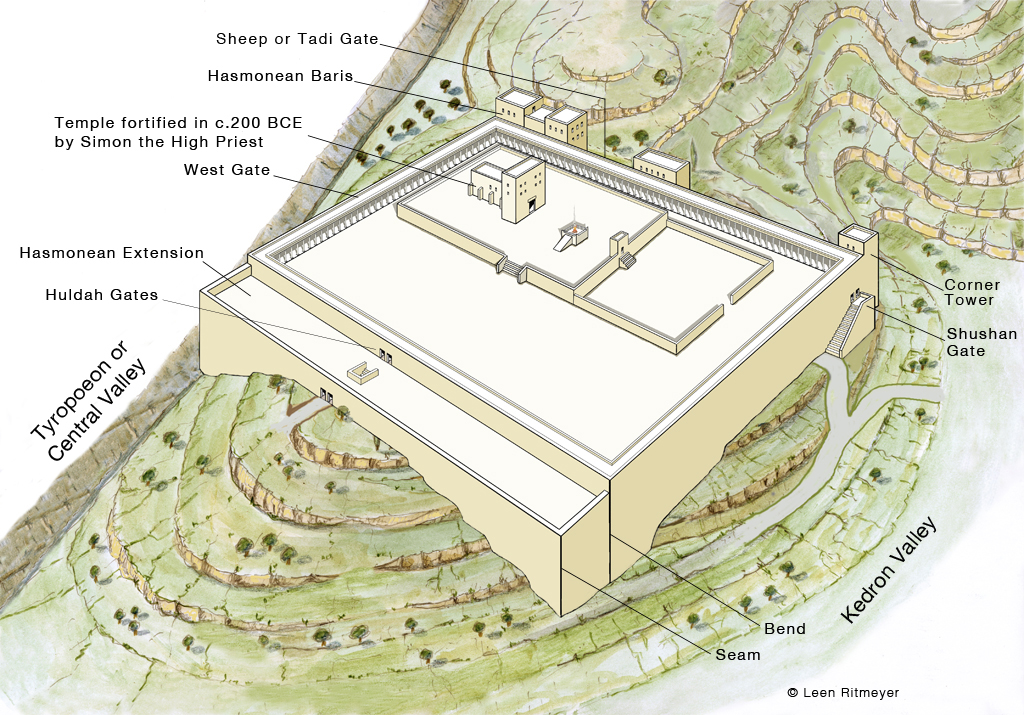
As a somewhat trivial example of this lack of understanding, many years ago when I was a young associate pastor at a church in Texas, my Senior Pastor and I had an ongoing, friendly argument about Biblical anthropopathism. His view was that, despite the fact that God is a Spirit, “Scripture clearly states that God has hands…
Luke 23:46 (KJV) [46] And when Jesus had cried with a loud voice, he said, Father, into thy hands I commend my spirit: and having said thus, he gave up the ghost.
…and wings.”
Ruth 2:12 (KJV) [12] The LORD recompense thy work, and a full reward be given thee of the LORD God of Israel, under whose wings thou art come to trust.
My own view is that God and His angels have no bodily form at all, and that such scriptures are illustrations of God’s loving and tender care for His people. When they heard these sayings, ancient Jews, immersed in the cultural milieu of their society, would not misunderstand the symbolic content. For 21st Century Christians, misled by centuries of antipathy towards Judaism, it’s not so simple!
Another example of Biblicalsymbolism is found in the parables (sing. mashal, Heb. and parabole, Gr.) told by Old Testament prophets, by New Testament-era sages, and by Jesus Himself. These stories were not themselves true but were illustrations of truth told in ways that could not be misunderstood by the hearers—or, in many cases could be understood only by “insiders” in the audience.
Symbolism in Marriage Customs
A form of implicit (not explained, but obvious to the hearers) symbolism that I want to discuss here was used by Jesus over and over again in His discussions with His Disciples about what we today refer to as the Rapture, and the Marriage Supper of the Lamb: Jewish wedding imagery.
The Old Testament often depicts God as the husband of His wife, Israel. Similarly, the New Testament depicts Jesus as a groom, and the Church as His betrothed bride. Betrothal was much different among 1st Century and earlier Jews than it is among American Christians. To us it is a proposal to enter into a contract at a later date. To them, it was the contract itself. What we today call a “wedding ceremony” was to them simply the last stage of a process that often lasted for months. Jesus often referred to steps in this process to symbolically illustrate His mystical relationship with the Church:
Shopping for a bride. Today in The West, we regard an ideal marriage as an emotional union between a mutually attracted couple. In traditional Judaism, and in most of the non-Jewish Eastern world, even today, it was a financial transaction between families, often made when the couple were small children. In some cultures, a dowery was paid by the bride’s family. Sometimes this amounted to, “I’ll pay you to take this useless female off my hands”, but mostly it was a realistic understanding that a healthy adult female was of more practical value to a good husband than to her birth family. In the Jewish culture, wives were highly valued, and money or goods flowed the other way. A “bride price” was paid by the groom’s family to acquire a coveted prize for their son and to compensate her family for the loss of a valuable and beloved asset. I have read many Christian opinions that Jewish men despise their women, but that is not and never was a true generalization, despite suggestions of “proof” to the contrary. Perhaps a subject for a future post…
A Jewish man’s marriage was usually arranged by his father, in negotiation (called the shidduch) with the prospective bride’s father. Sometimes other family members, including the subject children themselves, were included. In later history, a professional matchmaker (a shadchan) was sometimes employed as a go-between, as illustrated in the movie Fiddler on the Roof. Usually, both fathers wanted nothing as much as the happiness of their children. After the exchange of a generous bride price, the families would cooperate, sometimes for years, in preparing the two young people for their eventual life together.
Jesus’ father arranged His marriage in eternity past. He paid a heavy bride price for us—we were bought with the most precious coin on earth, the groom’s own blood. Having been chosen, our entire lives from the time we were formed in our mothers’ wombs has been preparation for our marriage to the Lamb of God.
The betrothal, or erusin. When the time came for betrothal, the two families would gather in the house of the bride’s father. The groom would bring the ketubah, an ornate written marriage contract, and his father would bring a flask of wine. The father would pour a cup and hand it to his son. The son would then hold it out to the bride, saying, “By offering this cup, I vow that I am willing to give my life for you.” Then, it was up to the bride. She could refuse the cup, and if so, the wedding agreement was canceled, and the bride price refunded. If she took the cup and drank, she was signifying that she in turn was willing to give her life for him. The betrothal was thus sealed. Once sealed, the two lived apart for a time, but were considered to be legally married and only a death or legal divorce could dissolve the ketubah. When Mary was “found to be with child”, it was grounds for divorce. Joseph’s thought to “put her away privily” (Mt 1:19, KJV) simply meant that he planned to divorce her privately, rather than to denounce her and shame her in public.
When Yeshua offered the cup of redemption at His final Passover Seder, He was telling us that He was willing to give His life for us. We who have accepted that cup have said in return that we are willing to give our own lives for Him. Our betrothal has been sealed, and God’s Torah is our ketubah.
Building the bridal suite. A Jewish house was often a large compound built around a central courtyard. This housing compound, called in Greek an insula, was home to the patriarchal extended family, often with several generations of sons in residence. The central living area was the quarters of the family patriarch and his wife. As each young man of the household was betrothed, he would simply build another room on to the house for his own new family. Once the betrothal cup was accepted, the groom would recite to his newly betrothed traditional words to the effect that
John 14:2-3 (KJV) [2] In my Father’s house are many mansions[Gr. mone: more often rooms, abodes, or dwelling places]… I go to prepare a place for you. [3] And if I go and prepare a place for you, I will come again, and receive you unto myself; that where I am, there ye may be also.
It is an interpretive mistake to picture Jesus as honing up His carpentry skills in heaven and building a physical house, let alone a mansion, for each of His followers. He was simply using the poetic beauty of the ritual to stress the surety that He will return for His bride, the Church!
Progress on the new home. Each day between the betrothal and the marriage supper, the groom’s father would inspect his progress on the dwelling, and eventually he, not his son, would set a date for the wedding. If you were to ask the toiling groom when his wedding was scheduled to occur, he could not give you an answer.
Matthew 24:3-4,36 (KJV) [3] And as he sat upon the mount of Olives, the disciples came unto him privately, saying, Tell us, when shall these things be? and what shall be the sign of thy coming, and of the end of the world? [4] And Jesus answered and said unto them, Take heed that no man deceive you… [36] But of that day and hour knoweth no man, no, not the angels of heaven, but my Father only.
Each of Jesus’ hearers, being well-schooled in the important customs of the day, would have recognized the symbolism in verse 36. Once again this is ritual language, and therefore not necessarily a literal warning that it is completely useless to propose a date for the Rapture. I don’t know the year of the Rapture, but I firmly believe it will take place on some not-too-distant Day of Trumpets! (See also The Fall Feasts and the Rapture.)
Waiting for a summons by the groom. Meanwhile, the bride would wait expectantly, always prepared for the groom’s return, but not knowing on what day to expect him. Her attendants would stay with her each night, for weeks or even months. When the groom came with his own attendants to “kidnap” the bride and her attendants and take them from her home to his, he would arrive around midnight, with no advance warning. It would be a major scandal if the bride or any of her attendants were caught unprepared. This is what we see depicted in Jesus’ Parable of the Ten Virgins:
Matthew 25:1-13 (KJV) [25:1] Then shall the kingdom of heaven be likened unto ten virgins, which took their lamps, and went forth to meet the bridegroom. [2] And five of them were wise, and five were foolish. [3] They that were foolish took their lamps, and took no oil with them: [4] But the wise took oil in their vessels with their lamps. [5] While the bridegroom tarried, they all slumbered and slept. [6] And at midnight there was a cry made, Behold, the bridegroom cometh; go ye out to meet him. [7] Then all those virgins arose, and trimmed their lamps. [8] And the foolish said unto the wise, Give us of your oil; for our lamps are gone out. [9] But the wise answered, saying, Not so; lest there be not enough for us and you: but go ye rather to them that sell, and buy for yourselves. [10] And while they went to buy, the bridegroom came; and they that were ready went in with him to the marriage: and the door was shut. [11] Afterward came also the other virgins, saying, Lord, Lord, open to us. [12] But he answered and said, Verily I say unto you, I know you not. [13] Watch therefore, for ye know neither the day nor the hour wherein the Son of man cometh.
The bridal procession and the consummation. As soon as the procession reached the groom’s home that night, the bride and groom would retreat immediately to the privacy of their new quarters. The guests would wait expectantly while the groom’s chief attendant stood outside the door and listened for the voice of the groom, announcing consummation of the marriage. This would signal the beginning of the week-long “marriage supper.” Jesus referred to this celebration of great joy in
John 3:29 (KJV) [29] He that hath the bride is the bridegroom: but the friend of the bridegroom, which standeth and heareth him, rejoiceth greatly because of the bridegroom’s voice: this my joy therefore is fulfilled.
The wedding supper, or nissuin. This joyous, but to us uncomfortable, custom of celebrating a consummated marriage by pigging out at a 7-day party—was exemplified in the Gospels by the wedding feast in Cana, where Jesus turned water into wine. It also symbolically represents the 7-yearWedding Supper of the Lamb, a celebration to be held in heaven while on earth the Tribulation is in progress.
Revelation 19:7-9 (KJV) [7] Let us be glad and rejoice, and give honour to him: for the marriage of the Lamb is come, and his wife hath made herself ready. [8] And to her was granted that she should be arrayed in fine linen, clean and white: for the fine linen is the righteousness of saints. [9] And he saith unto me, Write, Blessed are they which are called unto the marriage supper of the Lamb. And he saith unto me, These are the true sayings of God.
Sometimes traditional Christian interpretations of scripture suffer from an ignorance of the customs that underlie them. Honest theology requires an attempt to understand the Jewish origins of our faith. Many times, those seemingly ambiguous or “strange” references in the Biblical narrative become clear once the culture is understood.
Several Sundays ago, my wife and I attended a church in our area that we hadn’t visited in many years. The sermon was delivered by a stand-in—a naïve young associate pastor. He preached on the Transfiguration, Matthew 17:1-13. Being a Baptist, his main point was that salvation is by God’s grace, through faith in Jesus. That much was fine, of course, but at least half of his sermon was designed to show that the purpose of the Transfiguration was to demonstrate that Judaism is dead, not only in the soteriological sense, but in its entirety.
I want here to comment on four points he made that I regard as theologically ridiculous. I’ll spend quite a bit of my space on the first two, because they are common misconceptions in Christianity. The last two, I don’t believe to be commonly held interpretations, so I’ll do little more than mention them.
First Fallacy: Trichotomous Law
The young pastor repeated a theory I have come across many times since I was a young man—that “Jewish Law” is composed of three categories of commandments: “Moral Law“, “Civil Law“, and “Ceremonial Law“. There are hints of this in Augustine of Hippo, but I think the idea was fleshed out mostly by Thomas Aquinas, so it became a Roman Catholic and Orthodox view. It was later bequeathed to Protestant Reformed theology by John Calvin in his Institutes of the Christian Religion; and many subsequent non-Reformed Protestant denominations and individual pastors have adopted the idea as well. The impetus for these teachings was probably an effort to justify claims that Christians are not bound by Civil and ceremonial Law, while at the same time holding that the Moral Law is somehow “still in effect”.
I categorically reject this idea! It is a Christian misinterpretation of Jewish concepts that are difficult to understand without a more than cursory acquaintance with Hebrew cultural nuances. For example, a proof text used relies on the differentiation between terms in Deuteronomy 6:1 and similar verses, which do indicate a threefold differentiation—that is, shades of meaning—within the 613 commandments listed in Scripture; however, these categorizations are not between the moral, the civil and the ceremonial, but rather between what we might term enacted laws, regulations, and court rulings:
Chapter 6 (CJB) [6:1] “Now this is the mitzvah [commandment; law; ordnance; or precept], the choqim [statutes; enactments; or decrees] and mishpatim [rulings; judgements; sentences; or findings] which ADONAI your God ordered me to teach you for you to obey in the land you are crossing over to possess…“
With very few exceptions, Jewish scholarship going back to Talmudic days does not differentiate categories of “Law” in the way this young pastor presented them. The sages did not and do not recognize these categories, only a unified whole of written Biblical Law, plus an entirely separate body of oral tradition.
What does the Bible actually say to us, as Christians? Well, first of all, it never told non-Jews to follow Jewish Law or observe Jewish customs! Torah was given to those under the Abrahamic Covenant in order to set a people, the Jews, apart from non-Covenant peoples. It is said that “we used to be under Law, but now we’re under Grace”, but “we”, the non-Jewish, were never under Law, and salvation has always been by God’s grace, through faith. Law-keeping, even the sacrifices, never saved a Jew from God’s judgement—those were, and in fact were recognized by the Jews as, acts of obedience, and contrition for sin.
So, why do we Christians keep some of these “Laws” but not others? Because we are moral, spirit-directed individuals, and the moral principles we follow are common sense, even to most non-religious folks—”Natural Law”, if you please.
The New Testament halachic (legal—see below) requirement for the Church was decided at the First Church Council, at Jerusalem, as recorded in
Acts 15:19-21 (ESV): [19] Therefore my [James’] judgment is that we should not trouble those of the Gentiles who turn to God, [20] but should write to them to abstain from the things polluted by idols, and from sexual immorality, and from what has been strangled, and from blood. [21] For from ancient generations Moses has had in every city those who proclaim him, for he is read every Sabbath in the synagogues.
These four prohibitions are similar to, and encompass, the Noachide Laws—six commandments given to Adam in the Garden, plus a seventh added after the flood. The principles given address practices that are abominable to Jews and are regarded by the Rabbis as the minimum prohibitions necessary for Jewish fellowship with non-Jewish believers.
Second Fallacy: Jesus “did away” with the Law by Fulfilling it
He also repeated the interpretation that “The Law” was simply a picture of what Jesus would accomplish on the cross, and that by His crucifixion, He “fulfilled the Law”, and thus did away with it, i.e., “The Law”, having been “fulfilled” has “passed away”; but, just the Civil and Ceremonial portions, not the Moral Law, which is “still in effect, because God, after all, obviously still demands morality.” This, he bases on
Matthew 5:17 (ESV): [17] “Do not think that I have come to abolish the Law or the Prophets; I have not come to abolish them but to fulfill them.”
“The Greek term translated “abolish” above is kataluo [to demolish, halt, destroy, dissolve, come to naught, overthrow, or throw down]. But isn’t that what the book of Hebrews says happened? No, what it says is that Jesus is an intrinsically better mediator than the High Priest and a better expiation than the sacrifices. Both of these, it says, are “passing away”, and in fact, that is exactly what happened in AD 70 when Titus destroyed the Temple. But Jewish Law is far more than just the high priesthood and the sacrifices.
So how does that differ from “fulfill” if Jesus replaced the whole system of Judaism by “fulfilling the Law”? But that is not what “fulfill” implies here, in Matthew 5:17! The Greek for that concept is pleroo [to satisfy, execute, finish/complete, verify, accomplish, fulfill, carry out to the full, fill up, fully preach, or perfect]. So evidently Jesus did not replace “The Law or the Prophets”, but rather explained and strengthened them.
Nomos vs. “the Law or the Prophets”: Throughout the New Testament, nomos is understood to be a translation of the Hebrew Torah, and most English translations then render nomos as “law”. Vines defines nomos as that which is “divided out”, “distributed”, or (primarily) “assigned”, which is a bit ambiguous. Strong’s generally defines the term based on its prior translations in Scripture, i.e., “the law of Moses”. but he does include “parceled out”, which is closer to Vine.
To understand it more correctly, let’s go right to “the horse’s mouth”: the Hebrew term “Torah“. English translations of this word in Scripture generally depend heavily on the translators’ Hellenized understanding of nomos, so once again, we get “law”. In a very narrow sense, legal principles can be included, but Jewish speakers and Jewish literature render the term as “teachings“; in other words, “principles” in the sense of imparted knowledge about God, His Creation, His Will, and anything else He wishes us to know. Legal tenets, whether Scriptural or traditional, would be distinguished as “halacha“, which translates literally as a “way of walking” (compare Paul’s discussions of our “Christian Walk”).
Torah, like many Hebrew words, can have many shades of meaning, which can only be distinguished by context and customary usage. Sometimes it refers to all of God’s teachings. Often it specifically means the chumash, or Five Books of Moses; often it includes all books of the Tanach (Old Testament), and Messianic Jews often include the Brit Hadasha (New Testament), as well. Indeed, Jesus Himself is the very embodiment of Torah (John 1:1).
Much of the confusion here arises because a large portion of Christianity has arrogantly decided that Judaism failed God, so God took back his Covenant promises to Israel and conferred them on the Church instead; therefore, if the Old Testament has any meaning to us in the Church, it is only metaphorical, or symbolic. For example, to Reformed Christianity, God’s commandment to circumcise male children becomes a commandment to baptize infants!
Here is what Jesus said would result from any attempt to “throw out the Law”:
Matthew 5:18-19 (CJB) [18] Yes indeed! I tell you that until heaven and earth pass away, not so much as a yud [jot, yodh] or a stroke [serif, tittle] will pass from the Torah—not until everything that must happen has happened. [19] So whoever disobeys the least of these mitzvot and teaches others to do so will be called the least in the Kingdom of Heaven. But whoever obeys them and so teaches will be called great in the Kingdom of Heaven.
To me, that’s pretty clear!
Third Fallacy: “It is finished” on the cross referred to the Ceremonial Law
Jesus’ last words, “It is finished” referred to the “Ceremonial Law”. Some Dispensationalists believe that these words were spoken by Jesus to pronounce a renunciation of the Mosaic Covenant and the end of the so-called “Dispensation of Law”. What Jesus “finished” (brought to its fullness, not ended!) was His ministry on earth, laying the soteriological foundation for the New Covenant and the Kingdom of God.
Fourth Fallacy: Jesus literally absorbed Moses and Elijah
Bizarrely, he stated that when the three apostles looked back up and saw Jesus alone, He had literally “absorbed” Moses and Elijah, to show that the OT system of Judaism was no more.
Matthew 17:8 (CJB) [8] So they opened their eyes, looked up and saw only Yeshua by himself.
Colosse in Asia Minor, in relation to Laodicea and Hierapolis.
In his letter to the Colossian Assembly, Paul addressed three types of “Gnostic” heresy that were evidently being taught there:
Greek Dualism, which cast doubts on Jesus because of claims that he was fully human as well as divine. Plato, whose philosophy was revered in much of the Greek world, held that the spiritual realm was “good”, but anything physical, including any human, was intrinsically evil.
Pagan Pantheism, which held that all physical objects were inhabited by so-called “elemental sprits” that were either good or evil.
Judaistic practices being urged on non-Jews in the Church.
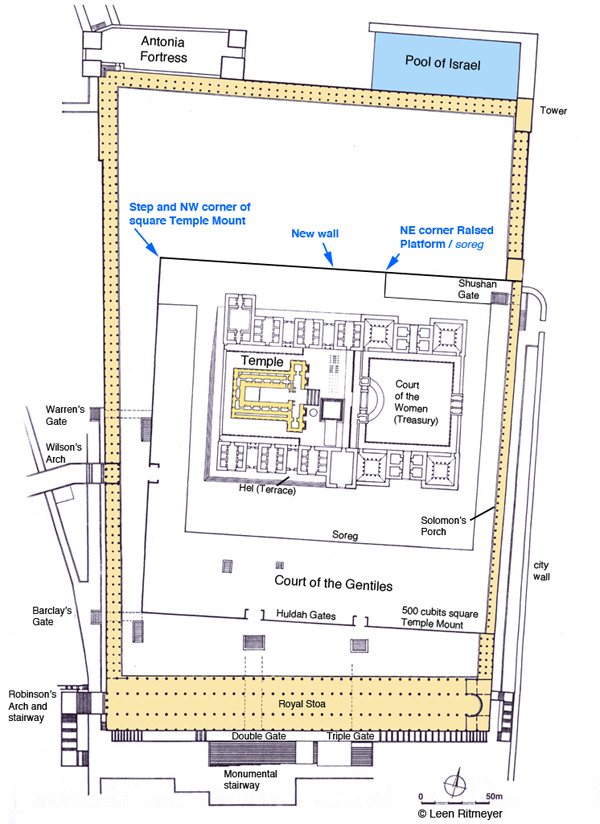
It is the last issue, above, that I wish to address here. I believe that it included two main sub-issues:
Either requiring or suggesting conversion to Judaism was viewed by some as a precursor to possession of the “secret things” of Christianity.
Urging participation in celebrations of Jewish tradition for possession of that Gnostic “knowledge”.
The first of these sub-issues was dealt with primarily in
Colossians 2:11-14 (ESV) [11] In him also you were circumcised with a circumcision made without hands, by putting off the body of the flesh, by the circumcision of Christ, [12] having been buried with him in baptism, in which you were also raised with him through faith in the powerful working of God, who raised him from the dead. [13] And you, who were dead in your trespasses and the uncircumcision of your flesh, God made alive together with him, having forgiven us all our trespasses, [14] by canceling the record of debt that stood against us with its legal demands. This he set aside, nailing it to the cross.
Prior to AD 70, conversion to Judaism was a threefold process requiring circumcision; ritual cleansing (immersion, i.e., baptism, in either open water or in one of the thousands of mikvot, or baptisteries, in Israel and the Diaspora); and an atoning sacrifice in the Temple.
In verse 11, above, Paul explains that circumcision is not required of non-Jewish believers, because our circumcision is a spiritual “circumcision of the heart“, a “stripping away [of the] old nature’s control over the body” (CJB translation).
In verse 12, he identifies baptism as a symbolic death, burial and resurrection along with Messiah.
And in verse 14, he states that our sin-debt is cancelled by the cross. Without digging too deeply into Old and New Testament theology, Jesus’ death cancelled all our sins, past present and future, whereas the Old Testament sin offerings were merely a symbolic atonement, or “covering over“, for specific infractions over specific time frames.
Regarding the Jewish Traditions, refer to
Colossians 2:16-17 (CJB) [16] So don’t let anyone pass judgment on you in connection with eating and drinking, or in regard to a Jewish festival or Rosh-Hodesh or Shabbat. [17] These are a shadow of things that are coming, but the body is of the Messiah.
Rosh-Hodesh (“head of the month”) was the lunar new moon celebration held each month to recognize the coming civil, agricultural and religious cycle. Shabbat, of course, is the Jewish “day of rest”, either the weekly Sabbath or a Sabbath associated with another Jewish festival.
Note that Paul is not condemning these traditional celebrations, which have tremendous prophetic and memorial significance to Christians and Jews alike; rather, he is condemning those who shame others in the church who choose to either celebrate them or to not celebrate them.
I lived in Oklahoma for a while, and I don’t love the state. My antipathy has nothing to do with politics, though. I don’t know if it will stand, but I fully support this effort:
On the whole I think this Newsweek article is balanced and fair. I do take issue with their wording of one particular paragraph:
“The 10th Amendment says powers not delegated to the federal government are reserved to the states. However, the U.S. Constitution’s Supremacy Clause also states that federal law generally takes precedence over state laws and even state constitutions.” What they are saying, is, in effect, “The states reserve all rights that are not granted in Article I, Section 8 (The Enumerated Powers), unless the Federal Government passes a law usurping that right! But the 10th Amendment expressly prohibits such Federal laws!
Contrary to what you may have heard, the Constitution of the United States is clear and simple. You may have to look up a word or phrase here and there (e.g., habeas corpus, or Bill of Attainder), but once you’ve done that, you don’t have to have a Harvard law degree to know what it means! The Constitution is the supreme law of our land. If Congress passes a law that violates the 10th Amendment, then that law is by definition invalid! If the President attempts to enforce that law, then he is in violation of the Constitution, and the states can and should defend their Constitutional rights! If the courts, including the Supreme Court, uphold such a law, it is still unconstitutional, because it is absurd to think that an office created by the Constitution can userp the Constitution!
What Oklahoma is trying to do is yet another of many historical attempts by states to nullify unconstitutional Federal laws and actions. Yes, it has been tried before, with little or no success. The concept goes back at least to Thomas Jefferson. In 1791, as Secretary of State, he wrote an opinion letter to President George Washington regarding proper remedies for an unconstitutional law coming out of the US Congress:
“The … shield provided by the Constitution to protect against the invasions of the legislature: 1. The right of the Executive. 2. Of the Judiciary. 3. Of the States and State legislatures. The present is the case of a right remaining exclusively with the States, and consequently one of those intended by the Constitution to be placed under its protection.”
In other words Jefferson defends nullification by means of: (1) Presidential Veto; (2) Judicial Review; and, if all else fails, (3) Nullification by the states.
The Oklahoma House Minority Leader says, “It’s interesting to me that the States’ Rights Committee only seems to exist when there’s a Democrat in the White House, and that these issues only come up when there’s a Democrat in the White House”. She’s right, of course. Unfortunately, that is the way American politics functions these days. We don’t tend to do what is correct and just, we do what is expedient, and only argue when it suits our particular ends. Sad.
Oklahoma is right in this instance, and yes, it is right no matter which party is in power!
Everyone has heard the jokes about an apprentice mechanic being sent to fetch a “left-handed monkey wrench”. I’m sure that has happened many times in the military, in real life. I saw my share of such practical jokes when I was in the Navy. Some were way crueler than the monkey wrench standby. Most were pretty harmless.
One that I personally observed comes to mind from a 1969 Naval cruise. I was a midshipman (an officer recruit) at the time, doing a 2-week cruise on a destroyer, the USS O’Brien, DD-725, which was based in Long Beach at the time.
A typical small Combat Information Center.
Late one night I was in CIC (the Combat Information Center where all the radar and sonar operators worked), and we were just transiting from one place to another, with nothing else going on. That’s when a lot of the housekeeping chores are done. The guys that do most of that are new enlisted recruits—and “strikers“. Strikers are the guys who have started training for a specialty, or “rating“. Some recruits strike right out of boot camp; others go to the fleet for a while as “unrated seamen” (or “airmen” in the flying Navy).
That night a radarman striker was put to work cleaning the faces of radar scopes. Well, there happened to be a Chief Petty Officer on duty, and he says, “Hey, striker, if you’re going to do that, do it right. Tonight, give them a good steam cleaning.”
“Sure, Chief. Where do I get steam?”
The Chief, looking totally disgusted, says “How long have you been in the Navy, striker? Where do you think you get steam on a Navy ship? The boiler room!”
Big, non-nuclear ships burn NSFO (Naval Special Fuel Oil, which is barely refined crude oil) which heats the boilers, to make steam, to turn the turbines, to spin the propellers and the power generators. So, the striker goes down to the boiler room in the depths of the ship. Meanwhile, the Chief calls his counterpart in the boiler room, on the ship’s telephone, and tells him what’s going down. When the striker gets below, the boiler crew gives him a hard time about not bringing a container to put the steam in; then they find an old bucket, open a steam cock and blow steam into the open bucket.
The guy comes back up to CIC carrying this open bucket, which of course is empty, steam being a gas. The Chief puts his hand in, then pulls it out, with nothing in it. He gives the striker a cold stare and says, “It all leaked out, idiot; don’t you know enough to put a lid on it?”
The striker goes back below with the bucket, and a boilerman looks around, can’t find a lid, but comes back with an old pair of dungarees they’ve been using for a rag. He fills the bucket, this time with hot water that hasn’t yet boiled away, as well as steam, and he wraps the dungarees around it to “close the bucket.”
The guy comes back up to CIC, where the Chief takes the bucket, carefully peeks under the wrapping, then peels it off and thrusts the bucket back to the striker. Poking his fingers into the now warm water and rubbing them together under his nose. “That’s DEAD steam! Finish the job the way you were doing it, and we’ll find someone with a brain to do the steam cleaning next time.”
After leaving Egypt, the Israelites lived in tents in the desert for 40 years. Despite the hardships, God was living among them and protecting them from the ravages of the desert and from foes around them. God’s Divine Presence (Heb. Sh’khinah) was both spiritual and physical. He was constantly with them in the Tabernacle, and in the pillar of smoke and fire, but His Presence was and is not confined to those places; Sh’khinah, refers to any place where God dwells with His people, whether in a tent, a building, or in any other context. Other visible examples would include the burning bush, the fire atop Mt. Sinai, and clearly, the Incarnate Son, Jesus!
The 7-day Feast of Tabernacles (Heb. Sukkoth) commemorates this 40 year period of God dwelling with His people during their wilderness wandering. He is said during this period to have “tabernacled with His people.” Coming on the heels of the somber Days of Awe, this feast is the consummate time of rejoicing for all Jews. Leviticus 23 also mentions an eighth day, called Shemini Atzeret (“Eighth Day of Assembly“) which signifies the firstfruits of the fruit and vegetable harvest, and the end of the agricultural year. This eighth day is also called Simchat Torah (“Rejoicing with or of the Torah“), and as such it signifies the end of one annual public Torah-reading cycle and the beginning of another. Both the first and the eighth day of Sukkoth are Sabbaths, and the first day is one of the three days of the annual regalim, or Pilgrim Festivals, where attendance in Jerusalem is required of all adult Jewish males.
Sukkoth is marked by daily festivities and sacrifices and, with there no longer being a possibility for the latter, especially by the commandment to build and live inSukkoth for seven days. A sukkah (singular) is a small booth, or hut, set up outside, with at least three closed sides and a roof. The walls can be of any material, but the roof must be of made of vegetal material (lumber is permissible). To emphasize the temporary nature of the booth, the roof must be of loose enough construction that stars are visible through it on a clear night. Once built, the sukkah is decorated by real or simulated fruit tied to the structure with string. The sukkah must be large enough for at least one person and a table for meals. Typically, it is not necessary to sleep in the sukkah, though many do, but it is best to eat at least part of every meal there.
The Hebrew term Sh’khinah does not occur in the Old Testament, but the concept of God’s Devine Presence occurs in many places. In the New Testament, we see Jesus’ incarnation described by the Greek skenoo, “to reside or dwell, as God did in the Tabernacle of old“. The connection between the Hebrew and Greek concepts is explicit, for example, in
John 1:14 (CJB) [14] The Word became a human being and lived [skenoo] with us, and we saw his Sh’khinah*, the Sh’khinah* of the Father’s only Son, full of grace and truth.
I believe that Sukkoth, with its theme of Rejoicing in God’s dwelling with the Israelites, is prophetic of God again coming to dwell with his people during the First Advent of Jesus. As with all the other feasts, I believe that the prophecy specifies not only an event in Jesus’ life, but the very day, on the Jewish calendar, that the event was to occur. I conclude that Jesus was born on the first day of Sukkoth, Tishri 15, and was circumcised on the last day of the 8-day festival, Tishri 22
Christians celebrate Jesus’ birthday on December 25 with pagan décor and anachronistic legends; however, the only birthdays celebrated prior to Jesus’ crucifixion appear to have been those of pagan gods, including self-proclaimed god-kings. The traditional December date for Jesus’ birth was, I believe, chosen to corresponds to the pagan Saturnalia celebration. What is the evidence of Jesus’ birth on Sukkoth, instead?
First, the lack of evidence for a December birth must be noted.
According to early Jewish writing, sheep were not in fields during the winter months. From about November through February, they were usually brought in to “sheepfolds”, either a cave or a corral structure protected from the weather.
The Roman custom of recalling people to their places of origin is known to have generally been facilitated by scheduling around dates that were convenient to the inhabitants. Rather than expect people to travel during exceptionally hot or cold seasons, it makes more sense that in Israel they would have taken advantage of a festival. The pilgrim festival of Sukkoth would have been an ideal time for the census, when diaspora Jews were gathered within Israel.
Since so many events in Jesus’ life happened on feast days, His birth most likely did as well.
Unlike any other feast, Sukkoth lasted not one, not seven, but eight days. I think that Jesus was born on the first day of Sukkoth and was circumcised, under Jewish law, on the 8th day.
But Sukkot also speaks of events in Jesus’ Second Advent, and I believe this can be seen best in
Revelation 21:1-3 (CJB) [21:1] Then I saw a new heaven and a new earth, for the old heaven and the old earth had passed away, and the sea was no longer there. [2] Also I saw the holy city, New Yerushalayim*, coming down out of heaven from God, prepared like a bride beautifully dressed for her husband. [3] I heard a loud voice from the throne say, “See! God’s Sh’khinah* is with mankind, and he will live with them. They will be his people, and he himself, God-with-them, will be their God.
Based primarily on research done by Dr. Randall Price (Searching for the Ark of the Covenant and The Lost Ark and the Last Days: In Search of Temple Treasures) I believe that the Ark is in a cave beneath the Temple Mount. It was accessible and possibly seen after the 1967 “6-Day War” prior to the sealing of Warren’s Gate by the Jordanian Waqf.
When was the Ark ever in Herod’s Temple?
Never! Leviticus 16 describes God’s commandments for Yom Kippur in the Tabernacle. These were followed with appropriate modifications in the days of Solomon’s Temple, but when that Temple was destroyed by Nebuchadnezzar, the Ark disappeared. Old Jewish traditions hold that Jeremiah hid it somewhere before the destruction.
How did Yom Kippurwork without an Ark?
The problem was bigger than that: not only was the Ark gone, but as prophesied in Ezekiel 9 and 10, so was God’s Sh’khinah(Divine Presence), and even the two large cherubim statues were missing. There was nothing in there except haShetiya, the Foundation Stone on which the Ark sat. What was sprinkled with blood? Just the stone. There is, to this day, a shallow niche carved into the stone that is the exact dimension, location and orientation to have supported the Ark, so that is where the High Priest’s attention was focused.
How did it work with no Temple at all?
Some Jewish congregations still attempt to offer a blood sacrifice by wringing the neck of a chicken, but this is a minority practice. In the late 1st century, rabbis decided that the Temple ritual could be replaced by Tefilah (prayer), Teshuva (repentance), and Tzedakah (charity). Those are all good things, surely, but one might say, “Why not just accept your own Messiah?” What about the interval of the Babylonian Captivity, when there was also no Temple? I would ask you to remember that salvation was never a result of sacrifice! Sacrifice was a response of faith in a gracious God!
How did the High Priest accomplish so much in the Holy of Holies on Yom Kippur if he could enter only once a year?
It is not true that the High Priest went into the Holy of Holies only once a year. He went only on Yom Kippur, but on that day he went in four times: (1) He entered to lay coals from the altar, and to burn incense. (2) He entered again to sprinkle the bull’s blood for his own atonement. (3) He entered yet again to sprinkle the goat’s blood for the people’s atonement. (4) Finally, he entered to remove the spent coals at the close of the ceremony.
Given the unrighteousness of many High Priests, how many were struck dead entering the Holy of Holies?
None, as far a we know. But righteousness was not required, or none would have survived; only “ritual cleanness” kept them alive. There was a long process that was required to achieve this ceremonial virtue. It began four days earlier, and involved many washings, immersions, and changes of attire. Part of this procedure was Biblical, part was traditional.
Was a rope really tied to the High Priest’s leg so that he could be pulled out if his attendants quit hearing the tinkling of his bells and pomegranates?
Pure myth! To begin with, there were no bells and pomegranates, because Scripture required him to enter in pure white linens, with no decoration. In the second place, during the key moments of his entry, no other humans were allowed into even the inner Temple courts, let along into the Temple itself. Thirdly, it would have been impossible to pull him through the veil in any case. It was not one veil, it was actually two very heavy veils stretching from side to side and ceiling to floor, with no space on any side. There was a space of one cubit separating the two veils. The outer one was pinned to the left doorpost and the inner to the right doorpost so that they might never reveal what lay beyond. When entering the Holy of Holies, the Priest would pass below the pin on the left side of the outer curtain, walk between the curtains, pass beneath the pin on the right side of the inner curtain, and then walk beside that curtain until he reached the Ark. To exit, he reversed the route. It is impossible for me to conceive of a rope with a body attached being pulled through that circuitous route. Nor would this have been needed; see below regarding cleaning of the Holy of Holies.
Are the scarlet thread stories true?
I have heard two versions. One holds that a scarlet thread was attached to the wall beside the outer veil. If by the next day the thread was found to have turned snow white, then God had accepted the sacrifice. Otherwise, the sacrifice had been rejected and Israel’s sins were unforgiven. The continuation of this story holds that after Jesus’ crucifixion, and up to the AD 70 destruction of the Temple, the thread never changed color. This isn’t absurd on its face, like the rope theory, but if it were true, we would find volumes of lamentations over those 40 years of rejection. This would be known as the greatest national calamity ever to strike Israel. I think even more so than the Temples’ destruction. The second version is the same, except that the thread was attached to a horn of the Scapegoat. I reject this version as well. I think that this one is probably a corruption of a story in rabbinical literature which records that a scarlet strand of some sort was tied across both horns of the goat and used to secure a heavy rock so that the sure-footed goat would be pulled over the cliff to its destruction.
How far out of the Temple was the goat taken?
According to rabbinical sources, 90 ris. After five separate unit conversions, I worked this out to about 7 miles. Watchers were stationed at key locations between Temple and cliff so that successful completion of the goat’s assassination could be signaled back by means of flags, and the next steps of the ceremony begun.
Would the Ark with its poles even have fit into the Holy of Holies?
Very astute question! We know the dimensions of the room, of the Ark, and even of the poles. Yet almost every depiction of these things shows the Ark oriented with its poles parallel to the veil, which cannot be! In reality, the Ark went in like a car into a garage. And on either side of it stood a very large statue of a stylized cherub.
How was the Holy of Holies kept clean, or did it never get dirty?
Of course, it got dirty! Hundreds of years of dust bunnies, charcoal dust, incense smoke, insects, and mouse droppings, not to mention hundreds of years of bullock and goat blood! And, potentially, dead High Priests. Before you ask, no, the High Priest didn’t do the cleaning. Above the Holy of Holies was a “drop ceiling” consisting of wooden rectangular tiles set into a framework. Referring to the attached diagram, there was a large chamber over the Holy of Holies, and the ceiling below could be accessed from there. Workmen could, after suitable cleansing, be lowered on ropes to work using tools with long handles. The rules prevented them from touching anything in the room with their own bodies, nor were they allowed to dally or “sight-see”.
Yom Kippur, not Passover, is the most important of the Jewish Feasts!
The Days of Awe are the most somber period of the Jewish Year, and Yom Kippur, the Day of Atonement, is the capstone of the Days of Awe. The correct form of the Feast name is Yom HaKippurim, (the Day of Coverings); but Yom Kippur is the more common name.
I have heard it said many times that Passover is the most important Jewish Feast. That is simply not true. With no Temple to worship in, Passover has certainly become the most well known and faithfully celebrated of the Feasts, but for sheer spiritual impact, Yom Kippur is by far the most vital. it is a recognition of personal and national sin, and a plea for salvation.
Christians celebrate Easter as a salvation event, and rightly so, because Easter celebrates specifically the time and actuality of Jesus’ death, burial and resurrection. Jews celebrate Passover at roughly the same time as Easter, but not at all as a salvation event. As stated in earlier parts of this series, Passover is a celebration of redemption from slavery and resurrection as a people.
In AD 325, Emperor Constantine and the Council of Nicaea officially severed Easter from Passover. This was unfortunately done for explicitly anti-Semitic reasons; however, given the salvation emphasis placed on Easter by non-Jews, it was probably best to do so.
Recall that the ten Days of Awe are all about repentance and reconciliation. On the final day, on Yom Kippur, one’s deeds will be judged by God, and his or her state of salvation determined for the coming year. As you can see from Leviticus 23, above, the day is a Sabbath. Not only that, but the phrases “you are to deny yourselves” (stated twice) and “Anyone who does not deny himself on that day is to be cut off from his people” are regarded as a command to fast, on pain of excommunication. The Hebrew terms used here literally mean to “humble, or afflict one’s soul”. Traditionally they are taken to include fasting, abstinence from sex, and refraining from personal grooming. Yom Kippur is the only Biblically mandated fast day, though rabbinic Judaism does recognize certain other somber days as fast days, and Zechariah 8:19 mentions several months when ancient fasts were practiced.
The Temple Precincts
The ritual of Yom Kippur for Tabernacle observance is described in more detail in Leviticus 16. It is quite complicated. More so in Temple days, and still more after the addition of Oral Traditions. There are very strict and detailed regulations regarding the attire of the High Priest (Heb. Cohen HaGadol), his multiple cleansings, and who and at what times other people could enter the Temple precincts. The actual Temple/Tabernacle observance included the following, in brief:
The High Priest would cast lots over two male goats: one, designated as Chatat, was to be sacrificed; the other was to set aside “for Azazel”; this one would be “brought before the people” so that their sins would symbolically be laid upon him.
The Priest would sacrifice a young bull to atone for, or “cover”, his own sin and that of his household, and the sacrificial goat, to atone for the sins of the people.
Under smoke from incense, blood from these sacrifices was to be sprinkled, with his finger, inside the Holy of Holies, on the Mercy Seat, the front of the Ark, and “toward the east”, that is, between the Ark and the Veil.
Outside the Holy of Holies, blood was also to be sprinkled on the Horns of the Altar.
Having completed these actions, the High Priest was to lay his hands on the head of the live goat and “confess over it all the transgressions, crimes and sins of the people of Isra’el” (CJB). This, the “Scapegoat” now carrying all the sins of the people, was then to be led out of the city to an uninhabited area about 7 miles away, by a fit man appointed to the task. Ostensibly, this goat was to be released, but in practice, it was usually pushed off a cliff to prevent it from wandering back with the people’s sins. Accomplishment of this task was then signaled back to the Temple.
The bullock and the goat were then cut open; the fat and fatty organs were burned on the altar, and the rest of the carcass taken out and burned (on the Mount of Olives in Temple times).
The High Priest would then read from Torah in the Court of Prayer (aka, the Court of women).
Next, the Priest would sacrifice his ram, the ram for the people and seven additional rams.
Finally, he would remove the incense pan and ladle from the Holy of Holies.
For a really good description of the Temple ritual, derived from rabbinical documents, refer to this excellent article by a knowledgeable rabbi: The Service of the High Priest
Important Concepts
As seen previously, the Passover Lamb or Kid was a fellowship offering, to be killed and shared as a meal between friends or family.
The bull and goat sacrificed on Yom Kippur were sin offerings. As such, they could atone for (temporarily cover over), but not permanently remove, the sins of the people. Sin offerings had to be completely burned, not eaten. You don’t want to re-ingest your sins!
The rams were burnt offerings. They were consumed completely in fire, with the rising smoke symbolizing righteous prayer and thanksgiving.
The goat for Azazel was symbolically innocent, vicariously taking on itself the sins of the people and carrying them away. Its killing was not a sacrifice; it was merely a disposal.
Note especially: Hebrews 9:22 says that “according to the Torah, almost everything is purified with blood“ (CJB, emphasis mine). The context is speaking specifically about ritual vessels and implements, but the same is true with people. The Torah provides atonement through sacrifice for “unintentional sin”, i.e., for sins committed thoughtlessly, accidentally, negligently, or perhaps even in passion. No place in the entire Bible do we ever find a sacrifice for intentional disobedience or rebellion against God! There is no atonement for intentional sin! The theme of Yom Kippur is “regeneration”, that is, salvation. So how is any human being saved? Under Torah, it is by God’s grace, through faith–as pictured in the Scapegoat. Under the New Covenant, by God’s grace, through faith–as delivered for all times past or future by Jesus, the antitype of the Scapegoat!
The Fall Feasts start on Tishri 1, a date which in modern times is generally called Rosh Ha-Shana (or Rosh Hashanah, “Head of the Year”). This is Israel’s, and Judaism’s, civil New Year. Celebrating the holiday as the start of a new year makes sense, because Yom Kippur on Tishri 10 does bring a new beginning to the land; however, of far more Biblical significance is the Leviticus Feast, the Day of Trumpets (Heb. Yom Teruah, literally, Day of Soundings).
In Jewish Eschatology, in the Olam HaBa (“the World to Come”), Messiah will one day climb the Mt. of Olives and angels will fly around the world, blowing trumpets and summoning all Israel back to the Land. Alive and dead alike will fly instantaneously to Jerusalem, where they will repent and, on Yom Kippur, be forever saved. Sound somewhat familiar?
Metal trumpets were used on many formal occasions in Israel, but rams’ horns (Heb. shofar, pl. shofarim) were used to warn of enemy attacks, to rally Israelite forces, to signal the calling of an assembly, and at other times when immediate corporate regathering was required. The ritual of Yom Teruah required that only shofarim be used. Typically, four types of “note” were blown in the morning, around the morning (Shacharit) prayer time, as described on the slide below.
I am a Premillennial, Pretribulational, Evangelical Christian. I believe that there will be a Rapture of the Church, followed by (not necessarily immediately by) a period of Tribulation on Earth, and then a “Millennial Reign” of Jesus from a throne in Jerusalem. Given that background and the fact that I believe the Feasts to be prophetical, perhaps you see why I find the Day of Trumpets tradition described above to be so interesting! Note also the congruent language of the following two New Testament scriptures:
1 Thessalonians 4:16-18 (ESV) [16] For the Lord himself will descend from heaven with a cry of command [shout – KJV], with the voice of an archangel, and with the sound of the trumpet of God. And the dead in Christ will rise first. [17] Then we who are alive, who are left, will be caught up together with them in the clouds to meet the Lord in the air, and so we will always be with the Lord. [18] Therefore encourage one another with these words.
1 Corinthians 15:51 (ESV) [51] Behold! I tell you a mystery. We shall not all sleep, but we shall all be changed, [52] in a moment, in the twinkling of an eye, at the last trumpet. For the trumpet will sound, and the dead will be raised imperishable, and we shall be changed. [53] For this perishable body must put on the imperishable, and this mortal body must put on immortality.
At this point, I will shock many of you by stating that, as with all of the other Feasts, I believe that the day of this Feast, on the Jewish calendar, is the actual day that the prophesied event occurred during Jesus First Advent or will occur during His Second. You say, how can you possibly reconcile that view with
Matthew 24:30,36 (ESV) [30] Then will appear in heaven the sign of the Son of Man, and then all the tribes of the earth will mourn, and they will see the Son of Man coming on the clouds of heaven with power and great glory. … [36] “But concerning that day and hour no one knows, not even the angels of heaven, nor the Son, but the Father only.
My response is that Jesus is here comparing Himself to a bridegroom and quoting Jewish traditional wedding language. After betrothal, the groom would return with his father to the family home and begin adding to it living quarters for the new couple (“In my father’s home are many rooms…”). The groom would do the work, under his father’s supervision, and only his father could make the decision that enough progress had been made. There would be no advance warning. At some point, father would say to son, “Okay, that’s enough”, and that night the son and his attendants would go to collect the bride and her attendants. Jesus’ statement therefore is not a direct answer to the question posed and cannot be definitively said to preclude any effort to predict the date.
I am not claiming to make a prediction of the date of the Rapture! It could be this Saturday (Yom Teruah, in AD 2020), or it may not happen for many years. I also don’t know what time of day it might occur, though I would guess sometime near morning prayers in Jerusalem. What I do think, is that the Rapture is likely to occur on Yom Teruah some year in the not too distant future.
As Israel’s hot summer months come to a close, we enter the Fall Feast season. The first two of these Feasts define the most solemn days of the Jewish year, and the final one, the most joyous. The first two are intimately connected: Yom Teruah, the Day of Trumpets (also known as Rosh Ha-Shanah, Head of the Year, the Jewish secular New Year), on Tishri 1, and Yom Kippur, the Day of Atonement on Tishri 10. These two days and the intervening eight days are called, collectively, the Days of Awe (Heb. Yamim Noraim). The entire 10-day period is devoted to intense personal, individual repentance, prayer and righteous deeds (Heb. T’shuvah, tefilla, and tzedakah) and to acts of reconciliation. Joyous celebrations such as weddings and bar and bat mitzvahs do not take place during these days.
The “Book(s) of Life” are a concept that most Christian denominations don’t give much attention to, though there are quite a few somewhat obscure scriptures about them. There are mentions in Exodus, 1 Samuel, Daniel, Psalms, Isaiah, Jeremiah, Malachi, Luke, Romans, 1 Corinthians, Philippians, Hebrews, and of course, Revelation. Plus several Apocryphal and Pseudepigraphal books. I won’t go into the Christian theology here, but I must talk about the Jewish, because it is extremely relevant to the Days of Awe.
The Book of Life (or Book of the Living, Heb. Sefer Hayyim) have taken on huge significance in the writings of Rabbi Akiva, and the Jewish Talmud states that,
“Three books are opened in Heaven on Rosh Ha-Shanah, one for the thoroughly wicked, one for the thoroughly righteous, and one for the intermediate. The thoroughly righteous are forthwith inscribed in the Book of Life, and the thoroughly wicked in the Book of Death, while the fate of the intermediate is suspended until the Day of Atonement.”
Most people would certainly have considered themselves among the intermediate, but who really knows, so pretty much everyone must consider themselves as such. Thus, the 10-day span of the Days of Awe are marked by ritual cleansing (immersion), prayer and fasting, intense introspection, acts of repentance and, frankly, fear. But wait; the consequences are so dire for those not written in the Book of Life, that the rabbis very early decided than 10 days was not enough, and the tradition grew of starting a month early, on Elul 1.
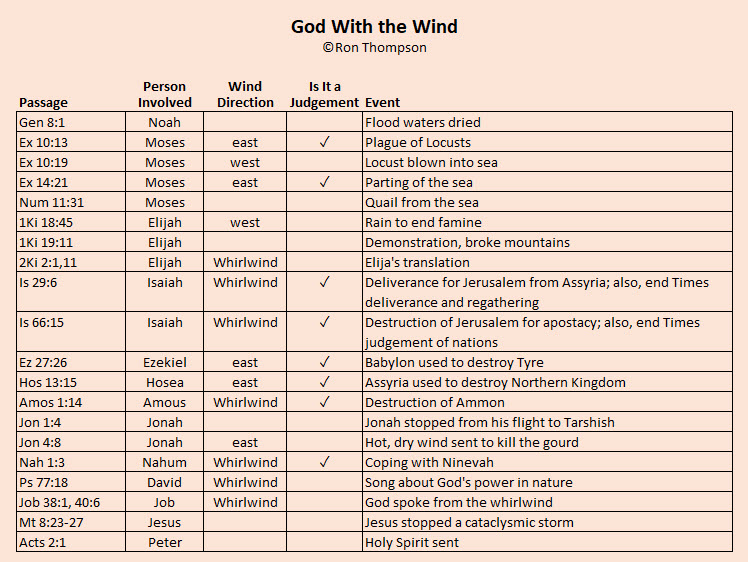

So here is what the period looked like: On Elul 1, all Jews went to the most convenient mikvah (ritual baptistery), spring or river for immersion and cleansing from sin, then, for 40 days, the process of virtual self-flagellation would proceed, culminating in the Pilgrim Festival of Yom Kippur, to be covered in Part 12. Of course, all intervening Sabbaths and the Day of Trumpets/Rosh Ha-Shanah Feast were scrupulously observed. At the conclusion of the 40 days, Jews from around Israel and the Diaspora convened at the Temple Mount for the most important Feast of the year.
Consider now a late summer in AD 29. It is Elul 1, and John the Baptizer is standing by the water near the village of Bethany Beyond the Jordan, not too far from Jericho (Luke 3). He is baptizing devout Jewish men and women from the district, and chastising those simply obeying their legalistic impulses. He raises his head and sees, walking towards him, his cousin Jesus of Nazareth, who some 33 years earlier had caused him to jump in his mother’s womb. Jesus speaks to John, then steps into the water and is baptized, not for His own sin, but in order to conform to the ritual necessities expected of Him, and to receive the blessing given Him by Father and Spirit that day.
Following His baptism, Jesus is led by the Spirit into the wilderness for the requisite 40 days of prayer and fasting. At the end of this time, on Yom Kippur, Satan appears to Him and tests Him in three ways:
Luke 4:1-12 (CJB) [4:1] Then Yeshua*, filled with the Ruach HaKodesh* [Holy Spirit], returned from the Yarden* [Jordan] and was led by the Spirit in the wilderness [2] for forty days of testing by the Adversary. During that time he ate nothing, and afterwards he was hungry. [3] The Adversary said to him, “If you are the Son of God, order this stone to become bread.” [4] Yeshua* answered him, “The Tanakh* [Old Testament] says, ‘Man does not live on bread alone.’”
[5] The Adversary took him up, showed him in an instant all the kingdoms of the world, [6] and said to him, “I will give you all this power and glory. It has been handed over to me, and I can give it to whomever I choose. [7] So if you will worship me, it will all be yours.” [8] Yeshua* answered him, “The Tanakh* says, ‘Worship ADONAI* your God and serve him only.’”
[9] Then he took him to Yerushalayim*, set him on the highest point of the Temple and said to him, “If you are the Son of God, jump from here! [10] For the Tanakh* says,
‘He will order his angels to be responsible for you and to protect you. [11] They will support you with their hands, so that you will not hurt your feet on the stones.’”
[12] Yeshua* answered him, “It also says, ‘Do not put ADONAI* your God to the test.’”
The Gospels differ in the order presented, but I think that Luke is most likely chronologically correct by putting Him last on the “highest point of the Temple“, the parapet on the southeastern corner of Solomon’s Porch (see diagram). Yom Kippur being a required Pilgrim Festival, as many as a million people would have been below him in the Temple courts, the Plaza outside, or down in the City of David or its surroundings. Many would have only to raise their eyes to see the drama if Jesus had failed this test.
The Temptation of Jesus does not get the attention it deserves! It is, in my opinion, one of the key events in all of human history.
Jesus, just like Adam, was placed on earth without a sin nature, meaning that they did not have the innate propensity to challenge God’s will. But both were human, and both could be persuaded by temptation. Adam and his mate were tempted by Satan in three ways that we have come to call, The Lust of the Flesh, The Lust of the Eyes, and The Pride of Life. They failed this test and condemned all their descendants to a life of sin. Jesus was tempted in the same fashion and resisted on all counts! He passed all three tests. Had He not done so, we would have no Savior!