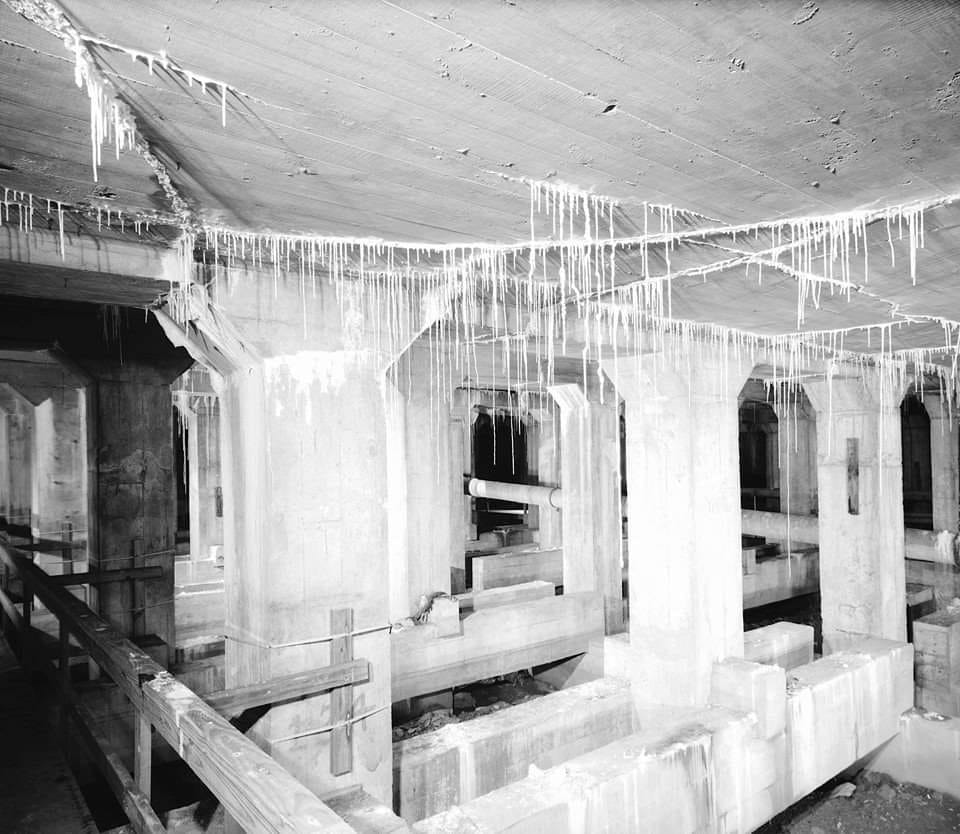
The following photo of the substructure of the Lincoln Memorial was posted on January 16, 2023, by an Admin on the Facebook page, Biblical Creation:
Fig. 1: The substructure of the Lincoln Memorial, on the National Mall in Washington, D.C. As posted by Biblical Creation.
Here is the text they posted with it:
Anyone who has ever visited a cave has heard the evolutionist claim that stalactites and stalagmites growing in the cave take, on the average, a full century to grow only one inch and grow to be 40 feet or so only after several thousand years. Or so evolutionists once thought. For those who believe this along with millions of cave visitors each year, hundreds of thousands of years of Earth’s history begin to become a reality before their eyes. But the question is, does it really take a century to grow one inch of stalactite?
When the Lincoln Memorial was built during the 1930s, the engineers sank steel cylinders into the bedrock to anchor the monument. The base of the memorial is set high above ground, leaving a cavernous basement beneath the floor. Rainwater seeping through the marble floor has formed stalactites up to five feet long on the basement ceiling! This growth is an inch per year, not per century! The Earth is not millions of years old or even hundreds of thousands of years. We know from Biblical history and geneaologies [sic] that God created the Earth just thousands of years ago. Biblical truth always trumps man’s scientific theories.
As an old earth creationist, I believe that Genesis 1:1 happened much earlier than 4004 BC, but that God Almighty did, literally, through His awesome and limitless power, create the universe in its entirety. But, according to these people, whether I believe in evolution or not (and I don’t!) I am an “evolutionist”.
According to the above, evolutionists evidently no longer believe that it takes thousands of years, on average, for a stalactite to form, because the Lincoln Memorial proves otherwise. But what does the picture actually show?
To begin with, most of the Memorial, including all of the structure seen here, is concrete. The statue of Lincoln and the surfaces in the chamber surrounding it are in fact marble. Marble is calcium carbonate rock, just like caves with speleothems—stalactites and stalagmites. But the caves and the speleothems are native limestone. Marble is limestone that has been modified (metamorphosed) by the temperatures and pressures caused by thick overburden sediments. Both are water soluble, but the solubility is measurable, and yes, it normally takes a long time. Fig. 2, below, is a photo that I took of a marble and limestone structure that has been standing out in the open for around 2400 years. It has been damaged by human wear and tear, by earthquakes, and even by a 17th Century Venetian bomb, but for the most part, rainwater has had minimal effect on the stone itself.
At any rate, seepage between quarried and assembled blocks of marble or limestone can’t in any way be compared to seepage through the pores of native limestone! I can show you buildups of calcium carbonate in the water pipes in my house, too, but that has no bearing on the age of the earth. As usual with young earth creationists, there is no actual scientific analysis presented to back up the claims associated with their photo. My assumption is that the so-called “stalactites” are leeched salt, not calcite at all!
Atheists who attempt to use theology they don’t understand to disprove the Bible are fools. Christian apologists who try to use scientific principles or findings they don’t understand to shame science are also fools, and this “gotcha” post is very foolish.
As a devout Christian engineer retired from a geological field, I have a foot in both camps. I agree that Biblical truth always trumps scientific theory, but when there is a real conflict between the two, one must at least consider the possibility that traditional interpretations of Scripture might be flawed. It has happened before.
Over the last several months, I have adopted a new favorite author. His name is John C. Lennox. Among other things, he is a Cambridge-educated Emeritus Professor of Mathematics at the University of Oxford, and he has written a number of books on subjects that have interested me for many years.
Author, Educator, Mathematician and Philosopher, John C Lennox. BBC Photo.
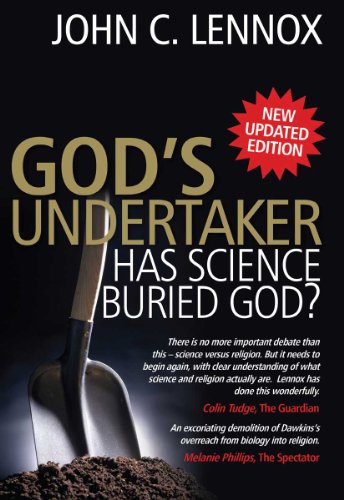
Most of his opinions on the intersection of theology and science seem to match my own very closely. In particular, a point from his book, God’s Undertaker: Has Science Buried God?, particularly resonates with me.
Conservative Christian scholars have mostly agreed that God miraculously created the universe, that humans descended from a real Adam and Eve, that the Genesis Flood was real, and that science does not trump Scripture!
I agree with all that!
But not all of those are “Young Earth” Creationists, and not all believe the theory, stated nowhere in Scripture, that the universe’s appearance of vast age is due to the Genesis Flood. Now, unfortunately, according to Professor Lennox (and my own observation), you are no longer free to reject that view.
Today, if you say you are not specifically a “young earth” creationist, then you will automatically be viewed by most of your Christian peers as a denier of Scriptural inerrancy and an “Evolutionist“.
Henry M. Morris
A large percentage of conservative Christianity, including major influencers like John MacArthur Jr, who I greatly admire, accept Henry Morris’ flood theory more or less uncritically.
Book: The Genesis Flood
The so-called “flood theory” was popularized by Morris in 1961 in a book that he co-authored with theologian John C. Whitcomb Jr, titled The Genesis Flood. I recall first reading the book in the late 70’s or early 80’s. It was formatted into two sections, one being a theological treatment by Whitcomb, and the other a mechanistic approach by Morris, laying out his theory that the apparent age of the earth was caused by rapid erosion and redeposition of silt due to earth-rending, catastrophic flooding, accompanied by massive earthquakes and tsunami surges. After reading Whitcomb’s exposition on the Biblical evidence for a worldwide flood, I was an enthusiastic fan of the book. That enthusiasm faded when I read Morris’ section. I found his grasp of fundamental geology and physics to be highly flawed, and his argumentative style (e.g., “any fool can plainly see…”) to be arrogant and insulting.
1976 edition of The Genesis Flood
The believability of The Genesis Flood was greatly enhanced by a Foreword (not included in the latest edition) written by an eminent geologist, John C. McCampell, PhD, of the University of Southwestern Louisiana. Unfortunately, book Forewords don’t always get read with the same concentration as the body. Dr. McCampbell did notendorse the theory! What he endorsed was Morris’ Christian worldview, fairness and independent thinking! The appliable paragraph read:
"From the [Foreword] writer's viewpoint, as a professional geologist, these explanations and contentions are difficult to accept. For the present at least, although quite ready to recognize the inadequacies of Lyellian uniformitarianism, I would prefer to hope that some other means of harmonization of religion and geology, which retains the essential structure of modern historical geology, could be found."
Morris’ Qualifications
Morris billed himself as a “hydrologist“. To me, the term “hydrology” implies much more than what Morris apparently did in his professional life. The US Geological Survey discusses the field broadly here. Wiktionary provides a more succinct definition, which I think works well:
Hydrology: Noun
1. The science of the properties, distribution, and effects of water on a planet's surface, in the soil and underlying rocks, and in the atmosphere.
2. The properties, distribution, and flows of water in a specific locale; the hydrological characteristics of a particular place or region.
But let’s examine Dr. Morris’ qualifications: (this section updated on 1/10/2024)
In a 2006 Washington Post obituary, quoted by Wikipedia, Morris was hailed as the “father of modern creation science”, and his book as the “founding document of the creationist movement.” Yet Morris himself had only a dim understanding of the principles he invoked in the book.
His early education was at Rice University, where he earned a BS in Civil Engineering. Undergraduate CE courses focus primarily on basic physics and chemistry, math, engineering economics and design, structural analysis, strength of materials, soil mechanics, environmental issues, engineering computations, and fluid mechanics.
Leaving Rice with his BSCE degree, Morris took a three-year educational gap during which he was employed as a “hydraulic engineer”, apparently in the Rio Grande Valley monitoring sand wash in the border waters. With his rudimentary background, his job would have consisted mainly in recording flood levels and monitoring bank erosion. As far as I can determine, that is the extent of his practical hydrological experience.
After his stint “in the field”, Morris returned to Rice for a few years as, apparently, a graduate teaching assistant in civil engineering. He then moved on to the University of Minnesota, where he earned a master’s degree in hydraulics and a PhD in hydraulic engineering (a sub-field of civil engineering, where the focus is on dams, manufactured waterways, and static forces from groundwater on structural foundations).
The remainder of his career, until he departed to focus on creationism, was spent in academia, as a teacher of civil engineering and applied science. Speaking for myself, after earning an MS in Petroleum Engineering, I enraged my supervising professor by refusing to stay for a doctorate. My reason was that engineering PhDs are geared towards academic careers, not towards real-world experience and productivity. And, frankly, the real world pays way more than academia.
Morris’ career certainly did not qualify him in any way as an expert on the issues he addressed in The Genesis Flood. His theories defy the realities of geological science, and his frequent references to the second law of thermodynamics (entropy) and uniformitarianism demonstrated a poor understanding of both concepts.
My own background
I must now establish my own credentials for entering into this critique of Young Earth Creationism in general, and the Flood Theory in particular.
My undergraduate studies at the University of Texas were in math and physics. My intention was to do my postgraduate studies in astrophysics, but after a 2-year Naval tour, practical considerations induced me to accept a graduate fellowship in Petroleum Engineering at Texas, instead.
Part of the apparatus for my Rock Mechanics thesis, 1975
For many years after college, my professional career was as a petroleum engineer. I started as a field production engineer for a major integrated oil corporation in Oklahoma, absorbing the hands-on, nuts and bolts of equipment and procedure in a very large working oil field. With proficiency came the desire to be more than a small cog in a big, cumbersome, money machine, so I left Big Oil to spend most of my career in more responsible positions with smaller “independent oil and gas companies”.
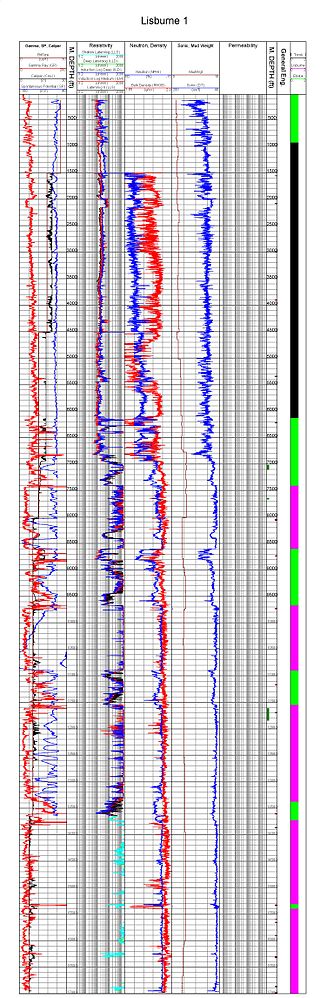
Typical well log suite, downloaded from USGS
Though I have worked in all phases of the industry (except for refineries) my main specialty was reservoir engineering. I had some of the same civil engineering training as Morris (dams, weirs and channels), but most of my education and years of professional experience were more geological in scope. I dealt with almost anything relating to sedimentary rocks and stratigraphy: where the constituent particles originated; how they were weathered, transported by erosion, deposited, cemented, chemically modified, saturated and disrupted by viscous fluid flow within their pore space or fractures; and how they were subsequently modified by folding, fracturing, compressing, uplifting, and sometimes being exposed at the surface or under the sea, and beginning the cycle all over again. I collected and analyzed cores, drill cuttings, fluid samples, pressure profiles, and electrical resistivity and radiation data. From all that, I had to make reasonable estimates of how much, if any, and what types of hydrocarbons were deep underground, who owned the mineral rights in the drainage area, whether it could be profitably retrieved, by what means and how fast, and ultimately, how much profit was to be expected. I was answerable to my employers, clients, government agencies, royalty owners, and/or financial lenders. Sometimes I worked closely with geologists and legal folks, but mostly I worked for small companies and had to do pretty much all of the geology myself.
Alternate theories
Here I will discuss alternate Christian theories to account for the apparent vast age of the universe.
I will have more to say on Morris, the Genesis Flood, and my own views on creation (both the science and the theology) in future posts. Some I wrote years ago, but I plan to rework and repost them. The rest of this post will be a discussion of the Conservative traditions that current “creation culture” now considers to be unacceptable.
In his book, No Final Conflict, Francis Schaeffer lists several areas where, in his judgment, there is room for disagreement among Christians who believe in Creationism and the total truthfulness of Scripture:
1. There is a possibility that God created a “grown-up” universe.
2. There is a possibility of a break between Genesis 1:1 and 1:2 or between 1:2 and 1:3.
3. There is a possibility of a long day in Genesis 1.
4. There is a possibility that the flood affected the geological data.
5. The use of the word “kinds” in Genesis 1 may be quite broad.
6. There is a possibility of the death of animals before the fall.
7. Where the Hebrew word bārāʾ is not used, there is the possibility of sequence from previously existing things.
Millard Erickson’sChristian Theology (the text used at Calvary Bible College in Belton, MO when I attended classes there) lists the following Conservative theories, which mostly fit into the scope of Schaeffer’s comments, above:
The gap theory holds that there was an original, quite complete creation of the earth perhaps billions of years ago (the creation mentioned in Gen. 1:1). Some sort of catastrophe occurred, however, so that the creation became empty and unformed (1:2). God then re-created the earth a few thousand years ago in a period of six days, populating it with all the species. This creation is described in Genesis 1:3–27. The apparent age of the earth and the fossil records showing development over long periods of time are to be attributed to the first creation. The catastrophe is often linked to the fall of Satan (Lucifer). Creation then lay in ruins for a long period of time before God rehabilitated or restored it.
The flood theory views the earth as only a few thousand years old. At the time of Noah, the earth was covered by a tremendous flood, with huge waves with a velocity of a thousand miles an hour. These waves picked up various forms of life; the mud in which these forms were eventually deposited was solidified into rock under the tremendous pressure of the waves. The various rock strata represent various waves of the flood. These unusual forces accomplished in a short period what geologists believe would ordinarily require three billion years to accomplish.
The ideal-time theory says that God created the world in a six-day period a relatively short time ago, but that he made it as if it were billions of years old. This is a genuinely novel and ingenious view. Adam, of course, did not begin his life as a newborn baby. At any point in his life he must have had an apparent (or ideal) age many years older than his actual age (i.e., the number of years since his creation). The ideal-time theory extends this principle. If God created trees, rather than merely tree seeds, they presumably had rings indicating an ideal age rather than their real age. Thus, each element of creation must have begun somewhere in the life cycle.
The age-day theory is based upon the fact that the Hebrew word יוֹם (yom), while it most frequently means a twenty-four-hour period, is not limited to that meaning. It can also mean epochs or long periods of time, and that is how it should be understood in this context. This view holds that God created in a series of acts over long periods of time. The geological and fossil records correspond to the days of his creative acts.
The pictorial-day (or literary-framework) theory regards the days of creation as more a matter of logical structuring than of chronological order. The author arranged the material in a logical grouping that took the form of six periods. While there may be some chronological dimension to the ordering, it is to be thought of as primarily logical. The account is arranged in two groups of three—days one through three and days four through six. Parallels can be seen between the first and fourth, the second and fifth, and the third and sixth days of creation.
The revelatory-day theory. The days were not successive days on which God did the creation, but days on which the story of creation was revealed. So the truth of the account took place in six twenty-four-hour periods, but the actual creation may have taken much longer than that.
Erickson himself favors the ideal-time theory, as you might guess from the wording of paragraph 3 above. He states that it is “in many ways irrefutable both scientifically and exegetically but presents the theological problem that it makes God an apparent deceiver.” I would agree that any theory that does not incorporate an assumption of vast actual age would have to include this form of apparent age in order to account for function via the known physical laws. In fact, I would compare it to a movie started in the middle. Virtually everything about the universe appears very much to be aged, and in fact would have to do so. I am more concerned with the suggestion of deception than Erickson is, in view of the following, which tells me I should be able to trust my senses:
For his invisible attributes, namely, his eternal power and divine nature, have been clearly perceived, ever since the creation of the world, in the things that have been made.
—Romans 1:20 ESV
Grudem’s Systematic Theology, Wayne Grudem, lists more or less the same group of theories, and goes into much more detail on all questions of creation.
Grudem sums up his opinion as follows: “My strong encouragement to the entire Christian community is that both old earth and young earth viewpoints should be acceptable for leaders in evangelical churches and evangelical parachurch organizations.”
Ryrie’s Basic Theology, Charles Ryrie, presents a subset of the above, but without specific names. He is far more concerned about the creation of Man, specifically, than the Universe in general.
Ryrie is somewhat non-committal regarding the Universe but does seem to favor a young earth. He is staunchly against biological evolution.
Some combination of the pictorial-day and revelatory-day theories seem to be favored by another contrarian, John Walton. I like Walton very much and think that he is on track.
Like many Christians of my age, I grew up with a Schofield Reference Bible, and I liked Schofield’s favorite, the gap theory for many years. I no longer hold that view. Based on extensive reading on Ancient Near East History and Culture, and with a better grasp of Biblical poetry, I now believe…
In ancient times, the peoples of the Middle East held a deep-seated, superstitious awe for the oceans and other large bodies of water. To them, the deep-water basins were abyssal, bottomless pits, full of monsters and evil spirits or demons. The continents floated on the ocean waters, which were also the common source of springs and subterranean rivers, so these source waters, too, were infested with evil spirits. Take, for example, the river Banias, which today flows from between rock strata down-slope from the famous cave at Caesarea Philippi. In Jesus’ day, the river flowed from the mouth of the cave. The pagans of Decapolis named the cave “The Gates of Hell” and surrounded its exterior with shrines to the god Pan.
The same ancient peoples who feared the deep waters also recognized that they were the source of life, providing fresh drinking water for humans and animals alike, water for the fields, and an abundance of fish, the staple of life for many civilizations.
The Hebrew word most often used in the Bible to refer to this interconnected reservoir of water, either in whole or in part, is tehom, usually translated as “the deep.” Exactly what elements are included in any particular reference to tehom must be inferred from the context or modifiers. In Gen 1:2, most would agree that it referred to an all-encompassing ocean, prior to the formation of dry land surfaces. In Gen 49:25, Jacob is giving his deathbed blessing to Joseph, speaking of “the Almighty, who shall bless thee with blessings of heaven above, blessings of the deep [tehom] that lieth under…”(KJV) I believe that he is, here and in the parallel passage, Deut 33:13, referring to the entire, composite water system lying beneath the canopy of “heaven above.” In Job 28:14, in his discourse on Wisdom, Job defines his own usage of the term by means of the poetic doublet, “The deep says, ‘It isn’t in me,’ and the sea says, ‘It isn’t with me.’” (CJB) In Isaiah 63:13, tehom refers to the Red (or Reed) Sea, opened up for Moses and the Israelites.
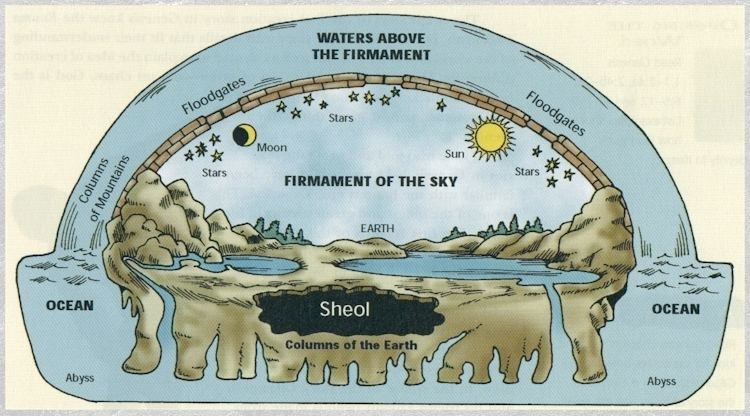
This diagram shows the cosmos as visualized by Moses, and by the people of virtually every culture in the Ancient Near East. Oceans, lakes, springs, and even the waters above the firmament were believed to be interconnected and were often collectively referred to as “the Deep.” Terrestrial waters rose to the surface of the land through fountains. Water falling from the sky was released by spirit beings through floodgates in the dome of the firmament.
Gen 7:11 – “In the six hundredth year of Noah’s life, in the second month, the seventeenth day of the month, the same day were all the fountains of the great deep broken up, and the windows of heaven were opened.” (KJV)
Gen 8:2 – “The fountains also of the deep and the windows of heaven were stopped, and the rain from heaven was restrained;”(KJV)
What, then, are “the fountains of the deep”, or ma’yenot tehom, as mentioned in the Flood story? Ma’yenow (singular) denotes a spring, fountain, or source. Can this be taken literally, like a spring in the desert, or is it poetically descriptive of the fact that water from “the deep” was gushing freely from some aperture or region? When considered in parallel with “the windows of heaven”, wa’rubot (chimneys or windows) ha-shamayim (the heavens, or elsewhere, “firmament”), my own opinion is that the “fountains” and “windows” must both be poetic terms, whereas the water and the flood were most certainly literal!
Young Earth Creationists often take the view that “the fountains of the great deep” refers to continental springs, geysers, fissures, Artesian wells, and other surface openings that God miraculously ripped open and caused to spout abnormally great volumes of water from natural aquifers deep in the earth’s crust. This rending and subsequent flow, they say, caused cataclysmic changes in the topography, including newly up-thrust mountain ranges, massive erosion, and even the division of large supercontinents into the smaller continents we know today.
A fairly traditional view.
Others take the view that God caused volcanoes to sprout across the continents and spew water and, presumably, lava (since that’s what volcanoes do).
I can’t resist mentioning still another view that I ran across proclaiming, presumably with a straight face, that the unprecedented heavy rain was associated with a drop in barometric pressure so severe that water under the earth’s crust for some unspecified reason “pushed up and out … to come to the surface”, evidently causing the crust to pop like a balloon! Incredible, since the normal barometric pressure at sea level is typically below 15 psi, which is pretty much the same pressure that my own bare feet exert on earth’s crust when I stand on it!
An incredibly naive view.
My view is that the term “fountains of the deep” describes features of the ocean floor. Opening of these “fountains” may have caused some shifting of the tectonic plates and therefore some near-shore damage on the continents, but the main effect was a sudden simple rising of the sea level. I will discuss a probable mechanismbelow, but first I would like to present some brief arguments against continental “fountains”:
Scripture nowhere states that the flood caused catastrophic changes in Earth’s geology. This isn’t even a long-standing tradition. It is a theory that was proposed in my lifetime, and there is no valid scientific evidence that either the topography or the stratigraphy of the earth was greatly influenced by a single massive flood. The idea that the Genesis Flood accounts for the apparent old age of the earth is simply an assumption made in an effort to explain something that the Bible itself made no effort to explain. It is a defensive theology aimed at those scientists and others who deny scripture. Since it is in no way backed by scripture, it must meet the objections of science and of common observation, and it simply fails to do so. In a separate post, Geology a Flood Cannot Explain, I presented a substantial list of geological phenomena that to my personal knowledge cannot possibly be explained by the Genesis Flood. I also presented my credentials for addressing the various issues discussed.
Crustal aquifers exist, not in caverns, but in porous and permeable rock formations. While sometimes quite large, they are limited in their areal extent and thickness. Many thousands of deep oil and gas wells (including a number that I was involved in drilling and evaluating) and countless geophysical studies have shown no evidence of permeable rock formations in continental crust large enough to contain the enormous volumes of water that would be necessary to cover the highest mountains, even if they were much lower than they are today. And were they? Possibly a bit; the Himalayas, for example, are demonstrably rising even now as a result of plate tectonics and the ongoing collision of the Indian Plate with the Eurasian Plate. But consider Mt. Ararat:after God closed the windows of heaven and stopped up the fountains of the deep, Ararat, at Over 16,000 feet above the normal sea level, was still under the receding water!
Sufficient quantities of sub-continental water would most certainly have had to come from deep within Earth’s mantle unless they were created by God, on the spot (which I acknowledge to be theologically possible, but not necessary). Any continental aperture of sufficient depth to reach these depths and sufficient width to handle the volume of water necessary would, I think, have to be fairly humongous. Why are there no traces of anything like this?
Continental volcanoes might account for a large volume of deep-sourced water, but I don’t think there is evidence of enough continental volcanism to provide that much.
Finally, I think that Gen 7:11 provides an important clue. This passage states that it was the “fountains of the Great Deep” (tehom rabaah) that God opened to start the rising flood. That terminology in Scripture normally refers only to the abyssal ocean basins, not to continental features.
There are two likely mechanisms, that I can see, that God might have used to bring that much water up from the deep, and then to store it again once He was done with it:
First, he could have simply created it on the spot, flooded the earth with it, and then de-created it again when he was done with it.
It seems to me, though, that His modus operandi as described in scripture is normally to wrap what He has already created in some sort of miracle when He wants to make a major power statement. I think that He “foreknew” what He was going to do and incorporated that plan into His original design.
Every school child since before my day has known that the earth has an upper “crust”, a central “mantle”, and a lower “core”. Geophysicists now believe that the mantle consists primarily of different forms, or “phases” of the mineral Olivine, which is a “magnesium iron silicate.” The simple Olivine of the upper mantle, under the heat and pressure of lower depths is converted to a phase called Perovskite in the lower mantle. Between the two regions is a transition zone consisting of Olivine phases called Wadsleyite and Ringwoodite. Both of these mineral phases can be very heavily hydrated and are now thought to contain as much as 3.5 times as much water as in all the earth’s oceans. Many young-earth creationists, as well as ancient-earth creationists like me, speculate that this is the primary source of the water that God used to flood the earth in Noah’s day.
Schematic cross-section of earth. The oceanic crust, riding on the plastic mantle rock beneath it, is welling up at the “mid-oceanic ridges” and sliding toward the continents at a rate of 1–2 inches a year. At the continental margin, this migrating crust then sinks back below the surface and circulates back to where it started, moving on great convection currents. Even in normal times, prodigious amounts of water are carried along with this cycle.
Most people probably think of the deep regions of the earth as simply dead, stagnant, unmoving rock. In reality, the earth is a dynamic, “living” system from surface to center. We have all been taught about the “water cycle”, where ocean water evaporates, clouds form, rain falls on the continents, and streams and aquifers return the same water back to the oceans. There is also a water cycle involving the mantle transition zone: ocean water is dragged, in prodigious quantities, into the depths of the mantle by the “subduction” of Earth’s oceanic tectonic plates. This water charges the transition zone, and much later is returned to the ocean through the agency of deep-ocean “smokers” (hydrothermal vents) and volcanism along the Mid-Oceanic Ridges; in the Island-Arc and Continental-Arc volcanoes near subduction zones; and in “hot spot” volcanoes like the Hawaiian volcanos and the Yellowstone super-volcano.
It turns out, paradoxically, that water itself is what spawns volcanic activity, because the melting point of rock is drastically lowered in the presence of water. There is, in fact, an intriguing theory that there should be a sheet of molten rock at the upper surface of the transition zone. From my own knowledge of petrology and fluid flow in rock, that makes me think that conditions in such a region could be right, under certain circumstances (like a gentle push from the Hand of God!) for water-laden, low viscosity, basaltic magma to suddenly channel rapidly through this discontinuity into the Mid-Oceanic ridges, causing a subsequent rise in sea level that could be described poetically as the “fountains of the great deep” opening up.
If this superheated and thus buoyant water were to bubble quickly to the ocean surfaces (or be injected directly into the atmosphere), I would expect it to quickly rise through the cooler air near the surface, and to spread out and rapidly cool near the stratosphere, setting off a global rain event. Since no pressure front would be active in forming this rain, I would not expect serious damaging winds such as are postulated by followers of Henry Morris.
Regarding the return of the flood waters to the transition zone: in my view, the text implies a direct miracle.
Gen 8:1 – “God remembered Noach, every living thing and all the livestock with him in the ark; so God caused a wind [ruach] to pass over the earth, and the water began to go down.” (CJB)
The Hebrew ruach can mean “wind” in scripture, but it often is translated as “spirit”. In Genesis 1:2, the Ruach of God hovered over the surface of the water. In 8:1, God caused His Ruach to hover over the face of the water-covered earth! In both cases, the earth was covered with an unbroken expanse of water, and God sent His Ruach HaKodesh (Holy Spirit) to deal with it! For more on the “wind of God”, see God with the Wind.








 The Back of My Mind