
Posted on:
Modified on:
As most of my friends know, I am a fervent Creationist, though not a “Young Earth” creationist. I am totally convinced that the universe we live in was created ex nihilo (out of nothing, whatsoever) by the one, true, almighty and utterly magnificent Creator, the God of Israel.
I’ve stated it elsewhere, and I’ll state it again below: Genesis 1:1 tells me all I need to know about the origin of the universe. I can drive a car without understanding how an internal combustion engine or a lithium-ion battery is built. But I’m an academic at heart… so I seek.
The five books of Moses were written during Israel’s 40 years of wandering. He didn’t write for 21st century readers, he wrote for the Israelites, leaving behind one pagan culture and preparing to invade another with similar technologies and traditions.
The first several chapters of Genesis are where God sets the perspective for them: “Your beliefs about the form and function of the cosmos is unimportant—but it’s absolutely vital that you understand that I made everything that exists, it belongs to me, and it is me alone that keeps it running.”
My purpose in writing this particular post is fairly one-dimensional: To discuss the language used by Moses (and other OT writers) to describe God’s actions in the creation process.

Introduction
To paraphrase Merriam-Webster, to “create” is to “bring something new into existence” or to “design and/or produce something new through imagination and skill.” If, as a woodworker, I build a chair, I’m not doing something earthshattering, though I may earn kudos for my craftsmanship. If I “create” a new chair design, I could become famous. If I create an antigravity chair, I’m more than a designer and craftsman, I’m also an inventor, which is a much bigger deal. If I somehow manage to do any of those things without any raw materials—i.e., if I pop a chair into existence out of complete nothingness—then I have “created ex nihilo“, and I am God. To do so (assuming no trickery) requires a violation of the “conservation of energy”, which only God can do! He can do things like that because He is the creator of the laws of physics that govern the universe and because His existence transcends the universe.
Perhaps I should define the term “universe”. By longstanding convention, that means everything that exists. I would modify that to specify “everything created that exists”. Possibly not the “third heaven”, the divine realm, above the atmosphere (the “first heaven”) and outside the celestial realm (the “second heaven”). Some modern cosmologists are now talking about a “multiverse”, but that is just a theoretical device to explain away the existence of God. A topic for the future, maybe. There is one, and only one, universe!
In this post, I am going to focus on the language of creation, as I personally see it reflected in Hebrew references to the created universe.
I am not a linguist, though I have a working knowledge of Biblical Hebrew, but at this moment, I have at my disposal, either on shelves or on software, 22 commentaries, 7 study Bibles, 5 Hebrew grammars, and 5 other miscellaneous books that are relevant for this discussion. Most of this material is relatively recent; that is, less than 100 or so years. Some older, from as long ago as the Reformation or even the Patristic Age (the age of the “Church Fathers”). Typically, before I post opinions on my blog, I review them against everything I have or can find on the Internet. What is ultimately posted is my own opinion, based as much as possible on research.

Four words for “Create”
Where the verb “create” appears in the Old Testament, it is almost always one of four Hebrew words:
- bara’, to create or make. Only this verb includes ex nihilo.
- ‘asah, to make, build, accomplish, achieve, or simply to do.
- yatsar, to form or fashion with the hands, as a potter.
- kun, to establish, appoint, or prepare.
When used in a narrative sense, as in Genesis 1 and 2, I think it is important to view these verbs strictly in accordance with their primary meanings. However, when used in poetic writings where the language is designed to be more flowery and embellished, shades of meaning are not so clear-cut. For that reason, I don’t think it is wise to base any theology solely on poetic passages.
In Isaiah 41 and 43 we see examples of poetic mixing of terms.
In 41:17–20, God is promising through the Prophet that eventually, in the latter days, He will show compassion on His people, who have been scattered across desert regions and who are thirsty, poor and needy. He will gather them back into their land, and that land, even the parched Arabah in the south, will become a garden.
Verse 20, below, consists of a pair of classic Hebrew poetic doublets, where a first line makes a statement, and a second line restates it in alternative and usually exaggerated terms: the people will “see and know”, that is, they will “observe and understand” that God “has done this”, that is, He has “created it.”
Then the people will see and know,
together observe and understand
that the hand of ADONAI has done [‘asah] this,
that the Holy One of Isra’el created [bara’] it.
— Isaiah 41:20 (CJB)
The creative act in view here may have been ex nihilo, but the poetic usage of bara’ doesn’t require that interpretation. In fact, the process of Israel’s regathering is well underway as I write. It appears that God’s mechanism so far has been in blessing the labor of His people since their regathering began in 1948. In his 1869 travel book, Innocents Abroad, Mark Twain wrote, “Palestine sits in sackcloth and ashes…. desolate and unlovely.” It’s certainly not that way today!
In 43:1b and 7, God is speaking of His creation, Israel. Did God create Israel, the people, ex nihilo? I don’t think so. When I say that “God is my Creator”, I mean that He created the first human beings, and at that time He endowed them with the ability to procreate. Each act of procreation by any creature, human or otherwise, is a biological process that certainly allows, but probably does not require, any further intervention by Him. That doesn’t negate the fact that our creation, ultimately, was at His hand.
But now this is what ADONAI says,
he who created [bara’] you, Ya‘akov,
he who formed [‘asah] you, Isra’el:
…
everyone who bears my name,
whom I created [‘asah] for my glory —
I formed [‘asah] him, yes, I made him.’”
— Isaiah 43:1b,7 (CJB)
In the following poetic verse all four verbs are used in a single sentence. It happens that in this case the KJV translators realized that Isaiah’s intention was to emphasize how all-encompassing God’s creative act was, and they did an excellent job of parsing the intended meanings of each verb instance.
For thus saith the Lord that created [bara’] the heavens; God himself that formed [yatsar] the earth and made [‘asah] it; he hath established [kun] it, he created [bara’] it not in vain [i.e., not to be in chaos], he formed [yatsar] it to be inhabited:
—Isaiah 45:18 (KJV)
The verb bara’
In the beginning God created [bara’] the heavens and the earth.
—Genesis 1:1 CJB
According to Vine,
bara’ (בָּרָא, 1254), “to create, make.” This verb is of profound theological significance, since it has only God as its subject. Only God can “create” in the sense implied by bara’. The verb expresses creation out of nothing, an idea seen clearly in passages having to do with creation on a cosmic scale: “In the beginning God created the heaven and the earth” (Gen. 1:1; cf. Gen. 2:3; Isa. 40:26; 42:5). All other verbs for “creating” allow a much broader range of meaning; they have both divine and human subjects … and are used in contexts where bringing something or someone into existence is not the issue.
—Vine’s Expository Dictionary (emphasis added)
According to the above, only God can “create” (bara’). The New Testament clarifies that in this case the term, “God” (Elohim), refers to the triune God. For example,
[15] He [Jesus] is the visible image of the invisible God. He is supreme over all creation, [16] because in connection with him were created all things—in heaven and on earth, visible and invisible, whether thrones, lordships, rulers or authorities—they have all been created through him and for him. [17] He existed before all things, and he holds everything together.
—Colossians 1:15–17 (CJB) (emphasis added)
(Note what Paul is stressing: The “invisible” here (thrones, lordships, rulers and authorities) refers to the pagan gods, which were themselves created entities. See Gods and Demons.)
Other Hebrew grammars suggest that bara’ does not always mean ex nihilo creation; however, where it refers to original creation, logic dictates that it must. God preexisted all else that exists, including all the mass and energy building blocks from which everything in the universe was assembled. This is clear from the Colossians quotation above, and
[1] In the beginning was the Word, and the Word was with God, and the Word was God. [2] The same was in the beginning with God. [3] All things were made by him; and without him was not any thing made that was made.
—John 1:1–3 (KJV) (emphasis added)
The Bible, Old Testament and New, is God’s description of Himself and of how He chooses to interact with Adam’s race. The sacred writings of every other religion attempt at length to explain the origins of the gods, the universe, and humanity. The God of Israel is eternal and therefore has no need to explain His own existence.
As expressed by a leading Jewish commentary:
The traditional English translation reads: “In the beginning God created the heaven and the earth.” This rendering construes the verse as an independent sentence complete in itself [that] makes a momentous assertion about the nature of God: that He is wholly outside of time, just as He is outside of space, both of which He proceeds to create. In other words, for the first time in the religious history of the Near East, God is conceived as being entirely free of temporal and spatial dimensions.
…
Unlike the pagan cosmologies, Genesis exhibits no interest in the question of God’s origins. His existence prior to the world is taken as axiomatic and does not even require assertion, let alone proof.
…
The use here of a merism [“heaven and earth”], the combination of opposites, expresses the totality of cosmic phenomena, for which there is no single word in biblical Hebrew.
—The JPS Torah Commentary (emphasis added)
Bara‘ appears in Genesis 1, in verses:
- 1, where it describes the creation of “the heavens and the earth”;
- 21, regarding the creation of “sea creatures”, “creeping things” and “winged birds”; and
- 27, regarding the creation of “humankind”.
In my view, Genesis 1:1 is the defining statement of the origin of the universe and all that it contains. Any other mention of that origin in the Bible is merely a reference back to that single, powerful verse.
The verb ‘asah
6 God said, “Let there be [yə·hî, see below] a dome in the middle of the water; let it divide the water from the water.” 7 God made [‘asah] the dome and divided the water under the dome from the water above the dome; that is how it was, 8 and God called the dome Sky. So there was evening, and there was morning, a second day.
— Genesis 1:6-8 (CJB)
The quote here is from The Complete Jewish Bible (CJB), a Messianic Jewish translation by David H. Stern. His use of the term “dome” may seem strange to you. The Hebrew is רָקִיעַ (raqia), which Brown-Driver-Briggs (BDB) defines as “an extended, solid surface” or a flat “expanse”, both of which certainly suggest the concept of a dome. Furthermore, raqia is a derivative of the Hebrew verb, רָקַע (raqa), a root which means “to beat, stamp, beat out, spread out” (BDB) or “to expand (by hammering) … to overlay (with thin sheets of metal” (Strong’s).
KJV, of course, uses the term “firmament” here, which is derived from the Vulgate’s Latin, firmāmentum, which indicates a “prop, or support.” The Latin was a direct translation of the Septuagint’s Greek, στερέωμα (stereóma), meaning “a solid body, or support structure” (Strong’s), or “that which furnishes a foundation; on which a thing rests firmly” (Thayer’s Greek Lexicon).
A number of the commentaries in my library, written by thoughtful and devout Christian scholars, define “firmament” as simply a space between the waters below (ocean) and the waters above (vapor). In other words, the sky or atmosphere. There is absolutely no Biblical or linguistic support for this!
The job of a Bible scholar is exegesis. Exegesis is defined as critical analysis and explanation of Scriptural text. What these obviously well-intentioned scholars have done is to look at the passage and say, “Well, I don’t see anywhere else in Scripture or in extrabiblical sources that raqia can mean atmosphere between oceans and clouds, or a space between any two solid or liquid collections, but I know what God created, so that must just be Moses’ odd way of describing it.”
That is absolutely not allowed! That sort of “analysis” has a name: eisegesis. Eisegesis means reading your own ideas, traditions, or prejudices back into Scripture. In other words, instead of letting Scripture inform you, you are informing Scripture! Eisegesis accounts for a ton of bad theology, sectarian error, and downright heresy.
I point out all of the linguistic information on the “dome” in verse 7 to demonstrate that the language of Genesis 1 supports the diagram below, which is a schematic diagram of what in ancient times was universally believed to be the structure of the cosmos. The Babylonians saw it this way, as did the Persians, the Egyptians, the Greeks, the Romans, the Hebrews, and yes, the 1st Century Christians. And that’s the way Moses described it!
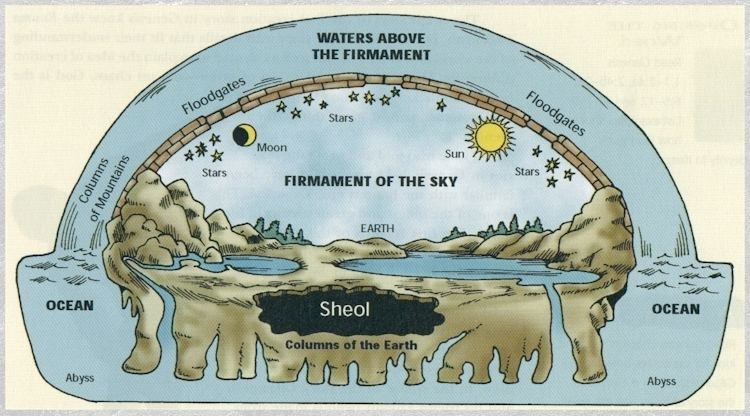
We know that picture is not right, but it does conform with Genesis 1. So, either God is using the description for His own purposes without explicitly endorsing the details, or Genesis 1 is talking about something completely different—for example, Schofield’s famous gap cataclysm. I used to think the latter; now I think the former.
Back on topic…
Though the Hebrew ‘asah in Genesis 1:7 does mean a type of creation, that term, by itself, doesn’t imply ex nihilo creation. Having described how the ancients understood the “dome”, or “firmament”, it makes sense that they would have thought of it not so much as a “creation” as a “construction“, like a dam or a roof. I don’t believe that this picture of the cosmos is even vaguely correct, but generations of belief made it an unbreakable tradition. In Genesis 1:1, God took full credit for creating the entire cosmos. In the rest of the chapter, He said, “this is the way you understand it to be made—that’s fine for now, but give the credit to me, not to Marduk, or Amun, or Baal, or Zeus, or any other regional creator-god.”
Also in Genesis 1, God made (‘asah) the sun and moon in verse 16 and the land-dwelling animals in verse 25. In verse 26 He proposed “make[ing] [‘asah] man in our image”—the image of God, Himself, and the angelic Divine Council, who I believe He was conversing with—which He then did (“So God created [bara’] man in His own image”) in verse 27. In verse 31, He looked on “all that He had made (‘asah)“.
The same term, ‘asah, is used for another form of creation in verses 11 and 12:
11 And God said, “Let the earth sprout vegetation, plants yielding seed, and fruit trees bearing fruit in which is their seed, each according to its kind, on the earth.” And it was so. 12 The earth brought forth vegetation, plants yielding seed according to their own kinds, and trees bearing [‘asah] fruit in which is their seed, each according to its kind…
— Genesis 1:11-12 (ESV)
This makes reproduction a type of “making“. Of the Hebrew terms the Bible uses for creating, only ‘bara is restricted to God alone.
The verb yatsar
The term yatsar is used in chapter 2:
Then ADONAI, God, formed [yatsar] a person [Hebrew: adam] from the dust of the ground [Hebrew: adamah] and breathed into his nostrils the breath of life, so that he became a living being.
—Genesis 2:7 CJB
Adam was evidently not created ex nihilo like the “humankind” of Genesis 1:27, but rather was formed from dust, like a potter’s earthenware, and then endowed with life by God’s breathing into his nostrils. I’ll speak more about this in a future post.
Though it is poetry, and thus a genre that often obscures the precise meanings of some Hebrew terms, Amos 4:13 seems to me to do a good job of illustrating the differences between bara’, ‘asah, and yatsar:
For behold, he who forms [yatsar] the mountains
and creates [bara’] the wind,
and declares to man what is his thought,
who makes [‘asah] the morning darkness,
and treads on the heights of the earth—
the LORD, the God of hosts, is his name!
— Amos 4:13 (ESV)
The verb kun
Kun is not used in the creation account of Genesis, but it occurs elsewhere in Genesis:
Why was the dream doubled for Pharaoh? Because the matter has been fixed [kun, established or assured] by God, and God will shortly cause it to happen.
— Genesis 41:32 (CJB)
God has taken something unsure and made it inevitable.
When Yosef saw Binyamin with them, he said to his household manager, “Take the men inside the house, kill the animals and prepare [kun] the meat. These men will dine with me at noon.”
— Genesis 43:16 (CJB)
Joseph commanded the steward to make ready the meat. I know, that’s a fairly weak form of making something.
“Let there be light!”
The terms “Let there be (yə·hî)”: light, in verse 3, expanse, dome, or firmament in verse 6, and lights in the expanse in verse 14; and “Let it (wî·hî)”: the firmament in verse 6, are forms of “creative command.”
The concept here is a grammatical feature of Hebrew. It’s a device called a Hiphil Stem, and becommingjewish.org expresses it this way: “The Hiphil Stem can be used to express a causative type of action with an active voice.” That’s kind of technical, but what it amounts to is that a prefix “stem” is added to a Hebrew word to change it from a simple active verb form like “he loved” to a causative active form like “he caused to love“.
To make that even simpler by example, in Genesis 1:3, the Hiphil changes “the light is on” to “turn on the light”. It becomes a command, and when God commands, the universe obeys!
Food for thought
Genesis 1 and 2 were written for Moses’ Israelite followers, but there is wisdom in there for us in the 21st century.
The following passage is Wisdom anthropomorphized. All the rules for interpretation of poetry must be observed. It isn’t a real person speaking, but it could surely have been spoken by Solomon himself. For that matter, I can easily read myself into the poem!
I am there. I am speaking. God made me among the “first of his ancient works.” God planned all of it, including me, before He programmed the physical laws of the universe so that they would make it happen, and before He created from nothing the primordial singularity. Before He allowed it to expand and coalesce first into undifferentiated energy, then into forces, then particles, then ions, atoms, stars and galaxies. The atheist Carl Sagan was fond of saying that we are made of “star-stuff.” He thought he was second-guessing God!
22 “ADONAI made me as the beginning of his way,
the first of his ancient works.
23 I was appointed before the world,
before the start, before the earth’s beginnings.
24 When I was brought forth, there were no ocean depths,
no springs brimming with water.
25 I was brought forth before the hills,
before the mountains had settled in place;
26 he had not yet made [‘asah] the earth, the fields,
or even the earth’s first grains of dust.
27 When he established [kun] the heavens, I was there.
When he drew the horizon’s circle on the deep,
28 when he set the skies above in place,
when the fountains of the deep poured forth,
29 when he prescribed boundaries for the sea,
so that its water would not transgress his command,
when he marked out the foundations of the earth,
30 I was with him as someone he could trust.
For me, every day was pure delight,
as I played in his presence all the time,
31 playing everywhere on his earth,
and delighting to be with humankind.
—Proverbs 8:22–31 CJB
Next in series: Genesis 1:1–5, Day 1
 The Back of My Mind