
Created in God’s Image


Posted on:

Modified on:

  1. The language of Image and Likeness
    1. Image
    2. Likeness
  2. The nature and attributes of God
    1. Does God have a body?
    2. God as a spirit
    3. God’s attributes
  3. Defining “God’s Image and Likeness”
    1. Attributes as image
      1. Physical attributes
      2. Intellectual attributes
      3. Family resemblance
      4. Body/Spirit
      5. Trinity vs body/soul/spirit
    2. Image as function
      1. Analysis of Genesis 1:26–28
      2. Evidence from the Hebrew
      3. The commission
    3. Another functional Model

So, what does that term, image, even mean? Here’s a paraphrase of Merriam-Webster® as it applies to an image of a person (or a being like a god or angel):

  1. A reproduction or imitation of the form of a person; especially, an imitation in solid form (a statue).
  2. A visual representation of someone captured by an optical or photographic device of some sort.
  3. A person that is an exact likeness or close duplicate of someone else.
  4. An incarnation or apparition of someone.
  5. A mental picture, impression, or conception of a person held in common by members of a group.
  6. A vivid or graphic representation or description of a person.
  7. A popular conception or caricature of a person.

Well, that’s a start, but we have to be careful when we impose English translations on another language, especially a language as spoken 2,000 years ago and before.

The language of Image and Likeness

The Bible claims that man was created in the image and likeness of God. We are all aware of that, but there is wide disagreement about what it means. Here are the relevant Scriptures:

26 Then God said, “Let us make man in our image, after our likeness. And let them have dominion over the fish of the sea and over the birds of the heavens and over the livestock and over all the earth and over every creeping thing that creeps on the earth.”

27 So God created man in his own image,
in the image of God
he created him;
male and female he created them.
— Genesis 1:26-27 (ESV)

1 This is the book of the generations of Adam. When God created man, he made him in the likeness of God. 2 Male and female he created them, and he blessed them and named them Man when they were created.
— Genesis 5:1-2 (ESV)

6 Whoever sheds the blood of man,
by man shall his blood be shed,
for God made man in his own image.
— Genesis 9:6 (ESV)

Image

I found 15 Hebrew words in the Old Testament (OT), categorized by 15 different Strong’s numbers, that are sometimes or always translated as “image.” Almost all of those refer specifically to idols, either in general or by category, or sometimes descriptively, as “abomination.”

However, I will concentrate here on the one word for “image” that appears in the above verses:

צֶלֶם, tselem (H6454), per Strong’s Exhaustive Concordance, “From an unused root meaning to shade; a phantom, i.e. (figuratively) illusion, resemblance; hence, a representative figure, especially an idol — image, vain show.”

Elsewhere, this particular word is used:

  • In Genesis 5:3, to describe Seth as a son of Adam.
  • In Numbers, 1 Samuel, 2 Kings, Ezekiel, and Amos, in reference to various types of idol.
  • In Psalms, to refer to a man’s shadow or his phantom.

Likeness

“Likeness” is a translation of the Hebrew,

דְּמוּת, dmuwth, per Strong’s Lexicon, “Likeness, resemblance, similitude.” Note that “likeness” and “resemblance” refer to similarities in appearance or other traits. “Similitude” includes the above meanings, but also more general comparisons, like similes, analogies, caricatures, patterns, correspondences between abstractions, or modern concepts like photographs.

In Genesis 1:26, it refers to Seth’s likeness to Adam, but elsewhere in the OT it usually refers to prophetic visions, as in Ezekiel 8:2, “Then I looked, and behold, a form that had the appearance of a man.”

The nature and attributes of God

When reading in the Bible that God created humankind in His image, there is an almost overwhelming tendency to assume something from the list of 7 definitions for “image” at the top of this article. But what all seven of those definitions have in common is that they all pertain to the physical substance of a person or being. But does God have any physical features that can be visualized, i.e., “imaged?”

Does God have a body?

When many unsophisticated people, Christian or not, visualize God, they probably see something like this digital artwork:

Artist’s conception of God. ©Gabriel Magalhães

It’s true that the Bible does sometimes speak of God in human terms, describing Him as having eyes, ears, mouth, hands and arms. But almost all theologians recognize these as anthropomorphisms, which are common in the literature of Israel and the Ancient Near East in general.

According to literarydevices.net anthropomorphism is “a technique in which a writer ascribes human traits, ambitions, emotions, or entire behaviors to animals, non-human beings, natural phenomena, or objects.”

©Bill Watterson

The Bible also describes God as having wings and feathers:

He will cover you with His feathers,
and under His wings you will find refuge.
His faithfulness is body armor and shield.
— Psalm 91:4 (TLV)

As a young man, one of my most cherished pastors fervently believed that God has a humanoid body. He took the position on all things Biblical that, “The Bible says it, I believe it, and it’s so!” Well, in general that’s a good approach, but the Psalms are poetry and songs, and that genre of Scripture in particular (along with prophecy) contains a lot of figurative language. No, God is not a bird. Or even an angel.

God as a spirit

The overwhelming evidence of Scripture is that God is a spirit.

Be careful here. When we read about “the spirit of God” or the “Holy Spirit“, that is a different subject, which you can read about in Monotheism and the Trinity. I won’t get into that here.

One verse makes the spiritual essence of God more or less explicit:

23 But the hour is coming, and is now here, when the true worshipers will worship the Father in spirit and truth, for the Father is seeking such people to worship him. 24 God is spirit, and those who worship him must worship in spirit and truth.”
— John 4:23-24 (ESV)

Once again, caution is necessary. Nobody with a theological background ever said the Bible is crystal clear from cover to cover. The subject of this verse is, “those who worship him must worship in spirit and truth.” The independent clause, “God is spirit”, is a little ambiguous without further definition.

Other verses imply the same thing by pointing out that He is immortal and invisible, both of which are not characteristics of corporeal beings. For example:

To the King of the ages, immortal, invisible, the only God, be honor and glory forever and ever. Amen.
— 1 Timothy 1:17 (ESV)

15 He [Jesus] is the image of the invisible God, the firstborn of all creation.
— Colossians 1:15 (ESV)

The contrast drawn in the poetic doublet that starts Isaiah 31:3 suggests the same:

Now Egyptians are men and not God,
and their horses are flesh, not spirit.
— Isaiah 31:3a (TLV)

But above all, to my mind, God’s omnipresence and eternality necessitate His incorporeal nature. You can’t span all of the universe and all of time if you are encumbered by a physical body. Please read about this in detail in another previous post, Implications of God’s Omnipresence and Eternity in Space-Time.

God’s attributes

Theologians recognize a number of characteristics, or attributes, of God. Some of these, called the noncommunicable attributes of God, are characteristics of God and God alone. No other creature in the universe, including mankind or the Heavenly Host, can possess these attributes. We will never be omniscient or omnipotent, for example. Even our eternal life is not quite the same. God is “from everlasting to everlasting.” The best we can be is “from now to everlasting.” And even that is not ours by default; it is ours at God’s direction and at His pleasure.

By contrast, God’s so-called communicable attributes are shared to a lesser degree with angels, humans, and to a very small degree, animals. These attributes include:

  • Sentience
  • Consciousness
  • Intelligence
  • Ability to communicate
  • Rationality
  • Curiosity
  • Emotionality
  • Willfulness
  • Conscience
  • Religiosity

Defining “God’s Image and Likeness”

The Bible doesn’t explicitly state, in terms that are clear to the modern world, what it means to be “created in God’s image and likeness“, which is why there are so many opinions on the subject. We’ll examine some of these opinions, simplifying somewhat by treating image and likeness as nearly synonymous.

Attributes as image

Most proposals for understanding how mankind is an image of God hold that man is somehow a copy, though necessarily inferior, of some aspect of God Himself. Stated another way, that mankind has inherited from God, via creation, some arbitrary set of His attributes.

But if that is the case, we have to consider what particular aspect or aspects of God we could possibly possess that might in any way correspond to any part of Him.

Which of our human attributes, in other words, clearly mark us as an image Almighty God?

Physical attributes

I’ve already expressed the view that God has no physical body. That seems obvious to me, but it isn’t to everyone, and possibly not to anyone at all in the ancient world. Let’s examine here,


Why humans are or have been presumed by some to “look like God”

Because of common origins in the pagan culture of Babel, Biblical Israel and the surrounding nations shared many customs and conceptions. Their understanding of the nature of the universe is one example.

The Genesis 1 version of our universe. Obviously, this is very similar to diagrams I’ve previously posted of the cosmos as visualized by other Ancient Near East Cultures.

Another commonality you will see in pagan literature is that almost all peoples visualized the gods as having humanoid bodies, with perhaps animalistic features thrown onto some. I suggest that there is good reason for this:

8 And they heard the sound of the LORD God walking in the garden in the cool of the day, and the man and his wife hid themselves from the presence of the LORD God among the trees of the garden. 9 But the LORD God called to the man and said to him, “Where are you?” 10 And he said, “I heard the sound of you in the garden, and I was afraid, because I was naked, and I hid myself.”
— Genesis 3:8-10 (ESV)

The wording of this passage implies that the LORD God was walking in the garden in some tangible form, perhaps rustling leaves, disturbing stones and breaking twigs in passing. The fact that they recognized the sound indicates that He had probably done so in the past. In other Biblical theophanies, the form was apparently always humanoid, so as to soothe the fears of those He confronted. Angels who materialized in front of humans at God’s behest also did so in human form.

I would suggest (you’ll need to read on for an explanation of this startling idea) that the pagan gods (bad angels) on occasion did the same, often with some sort of “enhancement” to their form for the purpose of conveying the image, fierce, soothing, or whatever else that they wished for their people to see.

Bible readers often form the impression that the pagan peoples of the ANE (Ancient Near East) worshipped lifeless idols, and in fact that was a charge frequently leveled by the prophets to insult the worshippers. The fact is, though, that the idols were constructed as a “housing”, or focal point, for an invisible God or goddess who inhabited it. Who were those “gods”, and were they real?

According to the following passage, when God scattered the nations from Babel and “confounded their languages,” He assigned angelic overseers to each nation that resulted. Perhaps these particular angels were already corrupt, but if not, they eventually became corrupt and claimed to be gods.

8 When the Most High divided the nations, when he separated the sons of Adam, he set the bounds of the nations according to the number of the angels of God.
9 And his people Jacob became the portion of the Lord, Israel was the line of his inheritance.
—Deuteronomy 32:8–9 LXX-B (emphasis mine)

Ur, from which Abraham emerged, was probably inhabited by descendants of Shem’s son, Arphaxad. Verse 9, above, refers to the time when God, Himself, selected Abram/Abraham from the Ur2 culture and claimed His own portion, the family of Abraham’s grandson, Jacob.

The Table of Nations, per GotQuestions.org

For confirmation of this theory, read Daniel 10, where an angel sent to aid Daniel stated that he was delayed because “the prince of the kingdom of Persia” resisted him for 21 days until the angel Michael came to his rescue. Also, consider:

For we do not wrestle against flesh and blood, but against the rulers, against the authorities, against the cosmic powers over this present darkness, against the spiritual forces of evil in the heavenly places.
— Ephesians 6:12 (ESV)


Since God is clearly, in my view, a disembodied spirit, it is just as clear to me that we can’t look to His physical attributes to understand how we are His image.

He did not create us to look like Him!

Intellectual attributes

The communicable attributes of God are listed above, in part. I think of them primarily as intellectual attributes, because all of them involve mental capacity on some level. All originate in the brain.

Many folks think that we are God’s intellectual image and likeness. The following quotation, plus an evening spent reading through Job, should put that idea to rest!

8 “For my thoughts are not your thoughts,
and my ways are not your ways,” says ADONAI.
9 “As high as the sky is above the earth
are my ways higher than your ways,
and my thoughts than your thoughts.
— Isaiah 55:8-9 (CJB)

But in case it doesn’t, consider that virtually all animals think, on some level. Some species have less intelligence than others, but that doesn’t mean they have no intelligence at all. Yet, animals are nowhere said to be created in God’s image.

Furthermore, God’s image is a property imparted to all humans at creation. The corollary is that any child of a human that doesn’t possess all, or is missing even some, of the characteristics of God’s image, whatever it is, is not in fact human. If the intellectual attributes are what define God’s image, then unborn human babies, some of the disabled, or the comatose, would be excluded. On the flip side, my cat possesses all of those characteristics to some small degree. She thinks she’s human, but most of you would disagree with her self-assessment.

Family resemblance

Another view is that we are God’s image in the sense that a son is his father’s image. This view comes from,

1 This is the book of the generations of Adam. When God created man, he made him in the likeness of God.

3 When Adam had lived 130 years, he fathered a son in his own likeness, after his image, and named him Seth.
— Genesis 5:1, 3 (ESV)

While this doesn’t constitute proof, I first want to point out that while verse 3 uses the term “image” (tselem), verse 1 does not. The term “likeness” (dmuwth) is used in both verses and precedes “image” in verse 3. Recall that both terms can be used metaphorically, but that is much more frequently the case with “likeness” than with “image.”

I would suggest that the reason this argument from the wording is pertinent is the following:

The “family resemblance” argument for image is invoked, at least where I have heard it, because elsewhere in Scripture, redeemed humans are called “Sons of God” (Mt 5:9; Lk 20:36; Rom 8:14,19; Gal 3:26), just as the Heavenly Host (“angels”, aggelos in the NT) are called “Sons of God” throughout the Bible. But that is a statement of our standing before God, and our heavenly inheritance—not a claim that we are literally, genetically, sons!

The “likeness” here is a general similitude, an analogy of sorts. The father/son relationship is not in itself what constitutes the image of God. Yet the child does image the parent in many attributes, because of genetics.

Body/Spirit

Some see the image of God in the fact that we have a spirit like His. This is a confusing argument. It can be viewed in two ways:

First, if it is talking about the Holy Spirit, then that is no comparison at all. Yes, we have a spirit, but in no sense is it a separate entity. It is part of us, and inseparable from our body until death. The Holy Spirit on the other hand is an individual intellect, part of the Trinity, but with its own existence in some fashion not clear to mere humans.

On the other hand, if the argument is that we as humans have a spirit of our own, just like God does, then that is a fallacy because we have a spirit where God is a spirit. We could turn that around and say that we are a spirit with a body, where God is a spirit without a body.

Yet somatically (if that tangible terminology can be used intangibly), our spirit can be viewed (another misnomer) as similar in some ways to God Himself. That is a very rough similarity, though. The spirits of a human will always be bounded in space and limited to the current time in its “inertial frame of reference” (this is physics, don’t worry about it—just think of your current time as “now”), whereas God is infinite in scope and knows no boundaries in either space or time.

Trinity vs body/soul/spirit

This is a very popular choice with many, who argue that we are created in God’s image and likeness in that we, too, are a trinity—of body, soul and spirit! It boggles my mind that proponents of this view are often so dogmatic about it.

The only similitude between those two things is that they both can be said to be three-in-ones. But so is my house, which is two stories plus a basement.

I’ve already written about this comparison. Recently. It is one section of my post titled Monotheism and the Trinity, where I argue that a “trichotomous” human is not even a good analogy for the Holy Trinity. Because of its importance in this discussion, I repeat most of that section here:


Human as image

Another very common analogy that many Christians cherish is that of mankind as a “triune body/soul/spirit.”

This one is convincing to many because they see that arrangement as precisely what constitutes “the image of God.” I disagree for several reasons:

  • A body/soul/spirit analogy assumes that we are God’s image ontologically. Ontology is the study of the nature and essential properties of something that exists.

But physically, we bear no resemblance to God whatsoever.

Intellectually, it may appear that we are similar (though inferior) to God, but I would argue that God, being unencumbered by a flesh and blood brain or even a computer chip, is intellectually more alien than anything we could possibly imagine. He is intimately connected to every facet of His creation in ways that are completely incomprehensible to us. That we know and understand an infinitesimal portion of what He does is only because He gave us the ability to observe and learn, using our vastly inferior senses.

  • Furthermore, the body/soul/spirit analogy breaks down for me because I don’t think there is Scriptural support for this traditional trichotomous view of human ontology.

Yes, trichotomy (“division into three parts”) is suggested by:

1 Thessalonians 5:23 (ESV) emphasis mine
[23] Now may the God of peace himself sanctify you completely, and may your whole spirit and soul and body be kept blameless at the coming of our Lord Jesus Christ.

I don’t think there are any other passages that clearly list all three of these elements (and no others) in one place. There are many references that, taken alone, would support a dichotomous view (body/spirit), and even one that supports a tetrachotom0us view (heart/soul/mind/strength (where strength = body):

Mark 12:30 (KJV)
[30] And thou shalt love the Lord thy God with all thy heart, and with all thy soul, and with all thy mind, and with all thy strength: this is the first commandment.

In view of modern understanding that thoughts, emotions, behaviors, feelings, memory, and so much more are all housed in the brain, it makes most sense to me to believe that man is a soul, composed of a physical part that is fairly well understood and a spiritual part that is beyond our understanding.

Genesis 2:7 (KJV) additions mine
[7] And the LORD God formed man [the body] of the dust of the ground, and breathed into his nostrils the breath of life [spirit]; and man became a living soul.

  • As an analogy for understanding the Trinity, I don’t think the body/soul/spirit view comes close, because the components that make up a human aren’t in any sense at all separate personalities. The body can of course “tell” the “spirit,” “I’m hungry” by growling its stomach, but where is the exchange of conscious intelligence in that?

Image as function

Personally, I agree with theologians like Michael S. Heiser and John H. Walton, who understand God’s image to be functional rather than ontological. We were created to function as His representatives, administrators of Earth.

Analysis of Genesis 1:26–28

We were created as human beings in order to represent Him on earth, for purposes set out in:

26 Then God said, “Let us make man [as] our image [agent; representative], after our likeness. And [as such] let them have dominion over the fish of the sea and over the birds of the heavens and over the livestock and over all the earth and over every creeping thing that creeps on the earth.”

27 So God created man [as] his own image,
[As] the image of God
he created him;
male and female he created them.

[28] And God blessed them. And God said to them, “Be fruitful and multiply and fill the earth and subdue it, and have dominion over the fish of the sea and over the birds of the heavens and over every living thing that moves on the earth.”

— Genesis 1:26–28 (ESV) paraphrasing mine; see below for “as” in place of “in”

Genesis 1 was most likely, in my view, delivered to Moses as a prophetic (preterist) vision.

Verse 26 is written as prose and when shown as I have paraphrased it above, tells us what we are (26a) and what our function as “Imagers”, representatives, or administrators, is to be (26b). It is a stewardship over animal life on Earth.

In contrast, verse 27 is written as poetry. In the manner of most Hebrew poetry, the first two lines are a couplet, with the second line restating and thus amplifying the first. The added third line obviously isn’t telling us that our “image-ness” is in our being male and female—that surely in no way is a “likeness of God.” Rather, it seems to me, it is emphasizing something about the way we are created that enables us to accomplish our function as Imagers.

Verse 27 is a return to prose, that then tells us something more about our function as imagers: In order to take dominion over the living things of earth, we must use that male/female relationship to populate the planet with more of our kind.

Evidence from the Hebrew

When one looks up a Strong’s number for a Hebrew or Greek meaning, the entry found is not usually for the exact word found in the text. What is given is the “lemma”, or “uninflected” form of the word. The word found in the text itself is comprised of the lemma, modified by various prefixes and/or suffixes that define its actual intended usage in that particular location.

In Genesis 1:26–27, “image” is Strong’s H6754. The “H” stands for “Hebrew”, in case the same number, 6754 is also used for a Greek word in the NT. That entry in the Lexicon, whether Strong’s or another one that uses Strong’s numbers, shows meanings for the lemma, צֶלֶם, tselem (H6454), which I gave above.

But in the verse itself, the actual Hebrew is בְּצַלְמֵ֖נוּ, bə·ṣal·mê·nū represents the entire translated prepositional phrase, “in our image.” The prefix (Hebrew, including individual words, is written right to left, so a prefix is on the right side of the word) is בְּ, pronounced “bə.”

According to Hebrew and ANE scholar Heiser:

The preposition “in” should be understood as meaning “as” or “in the capacity of.” Humanity was created “as” the image of God. The concept can be conveyed if we think of “image” as a verb: Humans
are created as God’s imagers—they function in the capacity of God’s representatives. The image of God is not a quality within human beings; it is what humans are. Clines summarizes: “What makes man the image of God is not that corporeal man stands as an analogy of a corporeal God; for the image does not primarily mean similarity, but the representation of the one who is imaged in a place where he is not.… According to Gen 1:26ff, man is set on earth in order to be the representative there of the absent God who is nevertheless present by His image (Clines, ‘The Image of God in Man’)”
—Michael S. Heiser, The Lexham Bible Dictionary, “IMAGE OF GOD”

By this definition, which I find compelling, every Human is created to be an imager (representative) of God and the Eternal Realm on earth and eventually beyond, and that is not dependent on his or her stage of development, race, health, financial resources, location, or any other circumstance.

The commission

The first commission God gave to his Imagers was:

And God blessed them. And God said to them, “Be fruitful and multiply and fill the earth and subdue it, and have dominion over the fish of the sea and over the birds of the heavens and over every living thing that moves on the earth.”
— Genesis 1:28 (ESV)

He repeated this commission to Noah, on debarkation from the Ark:

And you, be fruitful and multiply, increase greatly on the earth and multiply in it.”
— Genesis 9:7 (ESV)

Again, to Jacob:

11 And God said to him [Jacob], “I am God Almighty: be fruitful and multiply. A nation and a company of nations shall come from you, and kings shall come from your own body.
— Genesis 35:11 (ESV)

Jeremiah predicted its eventual accomplishment:

3 Then I will gather the remnant of my flock out of all the countries where I have driven them, and I will bring them back to their fold, and they shall be fruitful and multiply.
— Jeremiah 23:3 (ESV)

And yet again: The “Great Commission.”

Another functional Model

I have been convinced for some time that our Image-hood is unlikely to be attribute-based. If God created us to resemble Him in any way, I can’t see it. Humans fall too short, in all ways that I can think of and in all ways I’ve heard suggested. We are commanded to try and be “Christlike”, but even that is a goal that I think nobody has ever achieved. Jesus is one of a kind!

Up until I undertook this project, I was considering another functional model: that perhaps we were created to be an analog of the pagan stone, wood or clay idols, a visible, external housing for God within.

On reflection, that seems to me now to be a very bad idea.

An idol supposedly concentrates attention on the location where “god” can be approached. The closest the One True God has come to that is designating one, and only one, Temple for that purpose. Inside the Temple, attention was in times past further drawn to the Holy of Holies, and within that to the Ark of the Covenant. But never was God said to inhabit the Ark. Instead, He was standing above it, using it as a “footstool.” With no question of God inhabiting the Ark, it could never become an idol.

The golden cherubim flanking the Ark were never going to be worshipped. Cherubim and Seraphim are angelic orders created for the express purpose of symbolic guarding of God’s throne. Occasionally their guardian roles are more than symbolic. Recall that cherubim (that’s a plural noun, so there was no doubt more than one) were stationed to guard the Garden after the Fall.
Monotheism and the Trinity

Posted on:

Modified on:


  1. Biblical references to the Trinity
    1. Old Testament references
      1. Elohim
      2. “Let us make”
      3. Echad
      4. Other references in the Tanakh (OT)
    2. New Testament references
  2. Characterizing the Trinity
    1. Attempted analogies
      1. Egg
      2. Human as image
      3. Multiprocessor computer
      4. Distributed AI
      5. Light
      6. The electroweak force
      7. Strange physics
    2. Ontology of the Trinity
      1. Spirit
      2. Locality
      3. How important is monotheism?
      4. Eternality
      5. Relationships
      6. Appearance in Heaven
  3. Conclusion

Biblical references to the Trinity

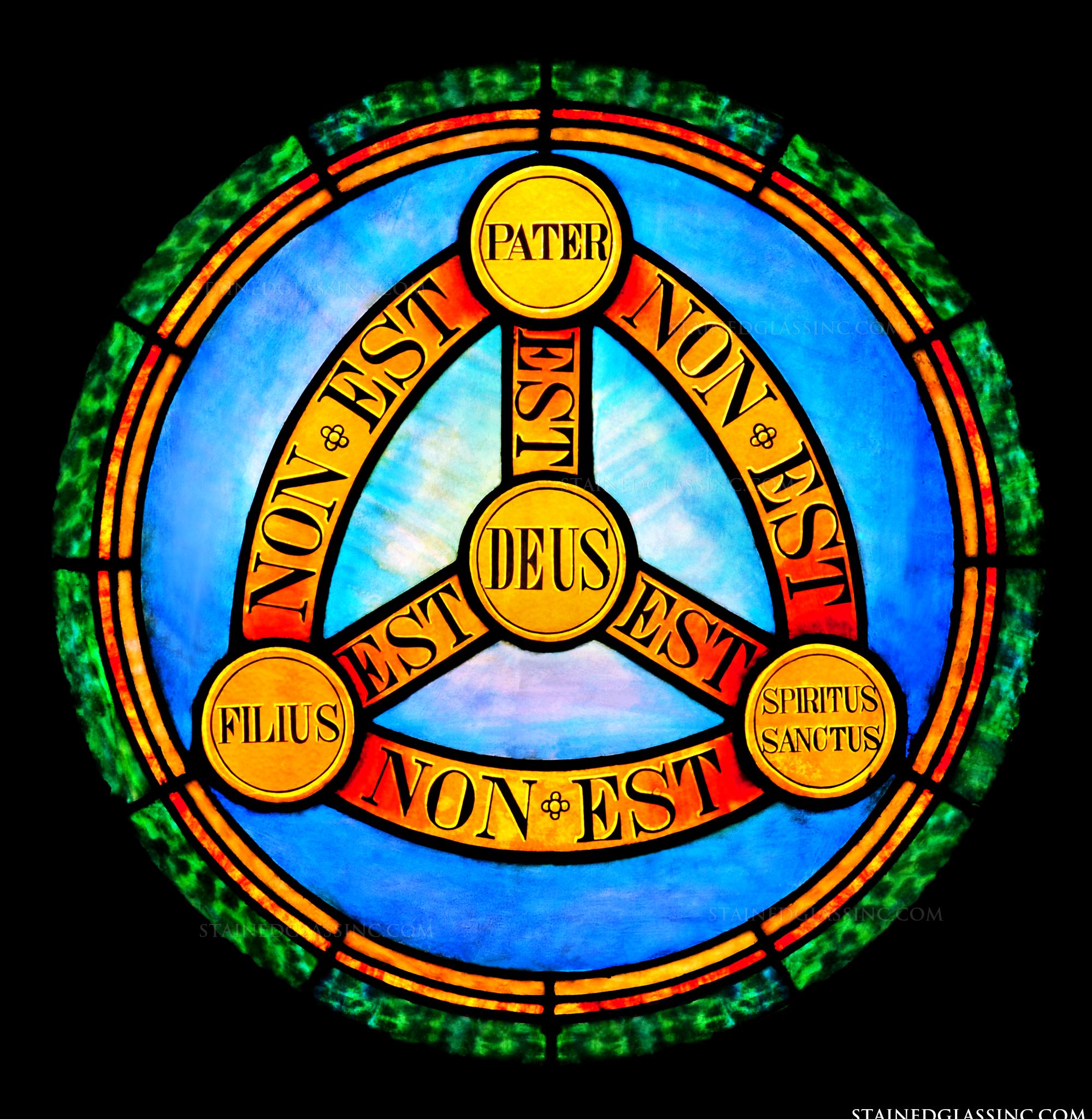
Common illustration of the Trinity relationship. From stainedglassinc.com

Well… there aren’t any instances in the Bible where the Trinity is named as such, which is why some Christians and pretty much everyone else deny its existence.

The Trinity of Father, Son and Holy Spirit can only be inferred from hints scattered throughout Scripture.

Even the term “Godhead” in the KJV, which at least sounds somewhat Trinitarian, is merely an infrequent translation of the Greek θεότης, (theotes), which actually means something like “the essence of being a deity.” In the ancient world, the term was primarily applied to human leaders who claimed for themselves or were proclaimed by others to be divine. In Colossians, Paul used the term as a polemic against gnostic “elementary principles of the world,” probably referring to principles of Greek philosophical argumentation.

Old Testament references

Yet even attempts to find hints of the Trinity in the Old Testament mostly fail.

Elohim

The Hebrew אלהים, transliterated as elohim, is a masculine plural noun, usually meaning “gods,” “angels,” or sometimes “princes” or “judges,” etc. But sometimes it refers to the name of God, Himself, in which case the English transliteration is capitalized: Elohim.

If we are referring to the singular “One True God,” then why retain the plural ending? There definitely is a singular term corresponding to the plural elohim, and that is eloah. But that would be a reference to one of those generic gods, angels, etc. mentioned in the previous paragraph. Deuteronomy 32:17, for example, speaks of “demons [shedim], who were not [a] god [eloah]

Could it be, then, that Elohim is a sneaky way of speaking of the Trinity? No, that would be a blatant admission that He is three separate gods, a polytheism.

The solution to this difficulty is that Hebrew plurals aren’t always well-behaved.

For example, while most Hebrew nouns are “regular,” there is a class called, logically, “irregular plural nouns” that don’t follow the usual rules. We have those in English, too: the plural of “goose” is not “gooses,” and the plural of “foot” is not “foots” (as my petulant spell checker is now informing me)!

More to the point, the way I’ve heard it explained by a Jewish Hebrew scholar is that Elohim is part of a small class of objects that are themselves complex and everchanging. For example,

מים – mayim – ‘water’ (exhibiting tides, waves, ripples, surges, currents, solutes, etc.)
שמים – shamayim – ‘sky, Heaven’ (exhibiting clouds, storms, dust, fog, birds, lights, etc.)
פנים – panim – ‘face’ (exhibiting expression, complexion, hair, health, etc.)
חיים – chayyim – ‘life’ (exhibiting birth, growth, health, age, death, blinks, smiles, etc.)

Just like water, the sky, a face, or our life – God [Elohim] is something which cannot be captured strictly in the singular. Like these other concepts, Hebrew conveys to us that God is not stagnant and not stable, but is a fluid, intangible reality. 
—Adam Zagoria-Moffet, article on stateofformation.org

To me, the bottom line on the question of whether or not the plural ending on Elohim can be used as an argument for the Trinity is this: English does not have singular and plural forms of verbs, but Hebrew does. Elohim, as a name of God, always appears with singular verbs.

Finally, it must be said that the plural ending on Hebrew names is not uncommon, for example, Efrayim (the son of Joseph), Yerushalayim (the holy city) and, from the genealogy in Genesis 10, Kitim, Dodanim, and Mitzrayim.

“Let us make”

What about the first chapters of Genesis, where Elohim says, “let us make…” or “let there be…”? Is this the Father speaking to the Son and Spirit? Inconceivable! If the “one” part of “three-in-one” is literal, then what one knows and thinks, the others know and think. But more fundamental than that is the definition of omniscience. Surely all three are omniscient, not just The Father. What one knows, all three know, instantaneously. That has surely got to be implicit in the whole concept of “tri-unity.” The only exception to this might be with the “kenosis,” when the Son emptied Himself and became incarnate.

Philippians 2:6 (ESV)
[6] who, though he was in the form of God, did not count equality with God a thing to be grasped, [7] but emptied himself, by taking the form of a servant, being born in the likeness of men.

Evidently, taking on flesh meant losing or weakening of some of that intimate connection.

I absolutely don’t believe that this is God talking to Himself. To my mind, the most probable alternative is the following:

In Gods and Demons, I reviewed the theology of the late Michael Heiser, who I was undecided about at the time, but have come to like very much. He presented a great deal of both Biblical and extrabiblical evidence to show that the Heavenly Host, collectively called “angels” (aggelos) in the New Testament, were created to perform the same supervisory functions in the non-living cosmos that mankind was later created to perform with respect to all life-forms on earth.

Genesis 1:26–28 (CJB) emphasis mine
[26] Then God said, “Let us make humankind in our image, in the likeness of ourselves; and let them rule over the fish in the sea, the birds in the air, the animals, and over all the earth, and over every crawling creature that crawls on the earth.
[27] So God created humankind in his own image;
in the image of God he created him:
male and female he created them.
[28] God blessed them: God said to them, “Be fruitful, multiply, fill the earth and subdue it. Rule over the fish in the sea, the birds in the air and every living creature that crawls on the earth.”

In their supervisory role, the angels occupy a heavenly hierarchy, with the highest ranking serving as a council (the “Divine Council”) that serves and reports to Elohim. Heiser makes a very good case that “let us” in the context of creation is the triune God (all three members in accord) speaking to this Divine Council.

Echad

Another claim of linguistic evidence for the Trinity is use of the composite plural verb echad in the Shema, Israel’s most important confession of faith. I view this as more promising, but still not definitive.

Deuteronomy 6:4 (CJB)
[4] “Sh’ma, Yisra’el! ADONAI Eloheinu, ADONAI echad.”
[Hear, Isra’el! ADONAI our God, ADONAI is one]

Or, in our vernacular, “Hey, listen up, people! There is only one God; and He is our God!”

There are basically just two Hebrew words for the number “one”: One of them is yachid, which means just “one.” Only one. One by itself, not part of any composite whole. The other is echad, which means “one, a composite unit, composed of a multiple of something.” One English alphabet composed of 26 letters. One banana bunch composed of a bunch of bananas. One nation composed of 50 states. Or perhaps, one God composed of three Persons.

As important as monotheism came to be, why isn’t the Shema worded as, “Sh’ma, Yisra’el! ADONAI Eloheinu, ADONAI yachid“?

The Shema as written seems to give Trinitarians a bit of breathing room, because instead of clearly saying that there is only one undivided God, it leaves open the door for saying He might be a set of something. A Trinity? To combat that notion, the late head of the worldwide orthodox Lubavitcher movement, himself reputed by some of his followers to be the long-awaited Messiah, had this to say:

G‑d did not have to create a world to be yachid. He was singularly and exclusively one before the world was created, and remains so after the fact. It was to express His echad-ness that He created the world, created man, granted him freedom of choice, and commanded him the Torah. He created existences that, at least in their own perception, are distinct of Him, and gave them the tools to bring their lives into utter harmony with His will. When a diverse and plural world chooses, by its own initiative, to unite with Him, the divine oneness assumes a new, deeper expression: G‑d is echad.”
—Rabbi Menachem Mendel Schneerson

It seems to me that the Rebbe’s argument is grasping at straws. Nevertheless, I’m also not convinced that the Shema is sufficient proof of a Trinity on its own. It depends on what a “Trinity” actually is, which I’ll explore below.

Other references in the Tanakh (OT)

Christian scholars also point to a number of Tanakh (Old Testament) references to “a son of God” and “the Holy Spirit”) as proof of the Trinity. In hindsight, we can certainly look back and legitimately say, “Oh, yes…,” but that’s only in light of New Testament revelation. Since the only revelations God chose to give ancient Israel were the Tanach, His visible creation, and an occasional theophany, I think that the above can only be used as evidence, not as stand-alone proof.

New Testament references

The New Testament doesn’t specifically say, “God is 3-in-1” or “God is a Trinity.” Yet, to me, the evidence is compelling. First, if we believe that Jesus is God, as we surely must, then why did He consistently refer to YHWH as His Father, and who did He pray to? Second, why are there so many references to the Holy Spirit as a living entity?

But we can site other Scripture, as well (emphasis mine):

Matthew 3:16–17 (ESV)
[16] And when Jesus was baptized, immediately he went up from the water, and behold, the heavens were opened to him, and he saw the Spirit of God descending like a dove and coming to rest on him; [17] and behold, a voice from heaven said, “This is my beloved Son, with whom I am well pleased.”

Matthew 28:19 (ESV)
[19] Go therefore and make disciples of all nations, baptizing them in the name of the Father and of the Son and of the Holy Spirit,

John 1:1–2 (ESV)
[Jn 1:1] In the beginning was the Word, and the Word was with God, and the Word was God. [2] He was in the beginning with God.

John 1:14 (ESV)
[14] And the Word became flesh and dwelt among us, and we have seen his glory, glory as of the only Son from the Father, full of grace and truth.

Acts 5:3–4 (ESV)
[3] But Peter said, “Ananias, why has Satan filled your heart to lie to the Holy Spirit … You have not lied to man but to God.”

Romans 9:5 (ESV)
[5] To them belong the patriarchs, and from their race, according to the flesh, is the Christ, who is God over all, blessed forever. Amen.

2 Corinthians 13:14 (ESV)
[14] The grace of the Lord Jesus Christ and the love of God and the fellowship of the Holy Spirit be with you all.

1 Peter 1:2 (ESV)
[2] according to the foreknowledge of God the Father, in the sanctification of the Spirit, for obedience to Jesus Christ and for sprinkling with his blood:

Characterizing the Trinity

Why is there no specific Biblical mention of the Trinity? Well, perhaps it is because the ancient world had no scientific or linguistic tools sufficient for the task. Explaining the Trinity is beyond the ability of even 21st Century Theologians.

Attempted analogies

The Trinity is usually defined as “one God, three Persons.” Essentially, we’re saying, “one equals three,” which is a paradox, a seemingly unexplainable contradiction. Lacking an explanation for the Trinity, most Christians eventually end up seeking an analogy to at least make the concept more palatable. But philosophically, I think that the only analogy to a paradox would have to be another paradox. In this case, it would have to be something like, “TRUE equals FALSE,” or a Boolean “A equals NOT A.” What have we gained? Nothing but more confusion.

God is like nothing else in the entire universe. There is absolutely nothing else in all of creation that is similar in either form or function. He is unique and incomparable!

There is no possible analog that can help us understand the Trinity. Nevertheless, people continue to try:

Egg

The common egg analogy that we’ve all heard is way, way, off base.

For one thing, an egg doesn’t communicate. An egg yolk doesn’t say to its shell, “Okay, you hold things together, I’ve got a chicken embryo that I’m feeding, and we aren’t ready to hatch yet.”

An egg also doesn’t think, plan, design, perceive, or communicate, and it sure doesn’t create!

Human as image

Another very common analogy that many Christians cherish is that of mankind as a “triune body/soul/spirit.”

This one is convincing to many because they see that arrangement as precisely what constitutes “the image of God.” I disagree for several reasons:

  • A body/soul/spirit analogy assumes that we are God’s image ontologically. Ontology is the study of the nature and essential properties of something that exists.

But physically, we bear no resemblance to God whatsoever.

Intellectually, it may appear that we are similar (though inferior) to God, but I would argue that God, being unencumbered by a flesh and blood brain or even a computer chip, is intellectually more alien than anything we could possibly imagine. He is intimately connected to every facet of His creation in ways that are completely incomprehensible to us. That we know and understand an infinitesimal portion of what He does is only because He gave us the ability to observe and learn, using our vastly inferior senses.

Personally, I agree with theologians like Michael S. Heiser and John H. Walton, who understand God’s image to be functional rather than ontological. We were created as human beings in order to represent Him on earth, for purposes set out in

Genesis 1:28 (ESV)
[28] And God blessed them. And God said to them, “Be fruitful and multiply and fill the earth and subdue it, and have dominion over the fish of the sea and over the birds of the heavens and over every living thing that moves on the earth.”

  • Furthermore, the body/soul/spirit analogy breaks down for me because I don’t think there is Scriptural support for this traditional trichotomous view of human ontology.

Yes, trichotomy (“division into three parts”) is suggested by:

1 Thessalonians 5:23 (ESV) emphasis mine
[23] Now may the God of peace himself sanctify you completely, and may your whole spirit and soul and body be kept blameless at the coming of our Lord Jesus Christ.

I don’t think there are any other passages that clearly list all three of these elements (and no others) in one place. There are many references that, taken alone, would support a dichotomous view (body/spirit), and even one that supports a tetrachotom0us view (heart/soul/mind/strength (where strength = body):

Mark 12:30 (KJV)
[30] And thou shalt love the Lord thy God with all thy heart, and with all thy soul, and with all thy mind, and with all thy strength: this is the first commandment.

In view of modern understanding that thoughts, emotions, behaviors, feelings, memory, and so much more are all housed in the brain, it makes most sense to me to believe that man is a soul, composed of a physical part that is fairly well understood and a spiritual part that is beyond our understanding.

Genesis 2:7 (KJV) additions mine
[7] And the LORD God formed man [the body] of the dust of the ground, and breathed into his nostrils the breath of life [spirit]; and man became a living soul.

  • As an analogy for understanding the Trinity, I don’t think the body/soul/spirit view comes close, because the components that make up a human aren’t in any sense at all separate personalities. The body can of course “tell” the “spirit,” “I’m hungry” by growling its stomach, but where is the exchange of conscious intelligence in that?
Multiprocessor computer

My main home office computer is one machine containing eight separate microprocessor cores. Eight “brains,” so to speak. An “octity”? Frankly this analogy isn’t very exciting. Computers don’t think, they compute, by electronically emulating, not neural activity, but mechanical switches.

Distributed AI

This disturbing analogy anticipates the coming future when the Internet will be an autonomous network of interconnected Artificial Intelligence nodes. But no matter how powerful these nodes become, compared to God they will still be hugely limited both in intelligence and in ability to interface with humanity. They will always be machines, with hardware and software, but never with a spirit component.

Light

Although I don’t believe that any analogy can do justice to the Trinity, I suspect that some philosophical paradox might be at least closer to the truth.

Here is a conundrum that consumed the world of physics for a hundred years: is “light” a particle or a wave? If a particle (a “photon”), then you should be able to bounce two photons off each other. If a wave, then when they collide, they don’t bounce, they “interfere,” meaning that their “amplitudes” combine, either constructively or destructively.

Since the particle and wave theories would appear to be mutually exclusive, which one is true? Both of them! Both theories have been individually proven in many different ways. Perhaps what will tie these contradictory theories together will be Quantum Field Theory, which is way beyond the scope of my blog.

The point of mentioning the particle/wave nature of light is only to stress that it is a relationship that for a long time was disbelieved entirely, then was believed by most, but understood by nobody. A paradox not quite solved to this day. The Trinity is at least that counterintuitive!

The electroweak force

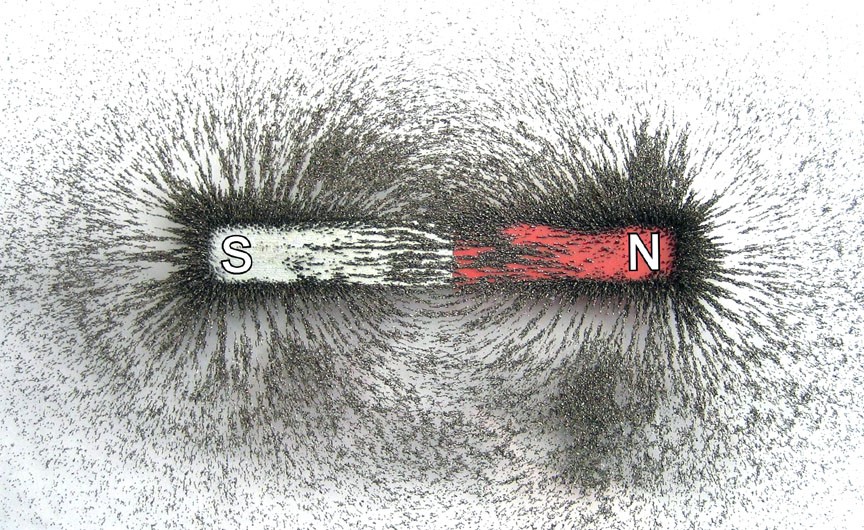
Most of you have probably seen a demonstration in school of a magnetic field. The teacher sets a bar magnet on a sheet of white paper, then sprinkles iron filings over that. The filings quickly align with the invisible lines of force associated with the magnet.

Demonstration of magnetic lines of force around a bar magnet. From etcourse.com

What this demo doesn’t show is that there are also invisible electrical lines of force, oriented orthogonally (at right angles) to the magnetic field lines. Theoretically, the fields generated by any source, in this case a simple bar magnet, extend for an infinite distance, but since their strength attenuates rapidly, it can only be detected for a relatively short distance.

In addition to the combined, two-part “electromagnetic” field, there is a third field connected to the electric field and the magnetic field: this is associated with the so-called “weak force,” which plays a part in nuclear decay.

The three interrelated fields discussed here are collectively called the “electroweak” field. This 3-part unified field might also lend itself to discussions of Trinity analogs, but like all others, it falls short of doing justice to God.

Like other attempted analogies from science, the principal usefulness of this one is to demonstrate, simply, the uselessness of trying to understand one impossible-to-understand phenomenon by comparison with something that is equally impossible to understand.

Strange physics

Physics is full of phenomena that are demonstrable, but definitely “stranger than fiction,” and from which an imaginative Christian physicist might try to come up with a Trinity analog. For example, who would ever have thought that:

  • The faster you move through space, the slower you move through time.
  • The closer you are to massive objects, the slower you move through time.
  • Time and space are completely interdependent.
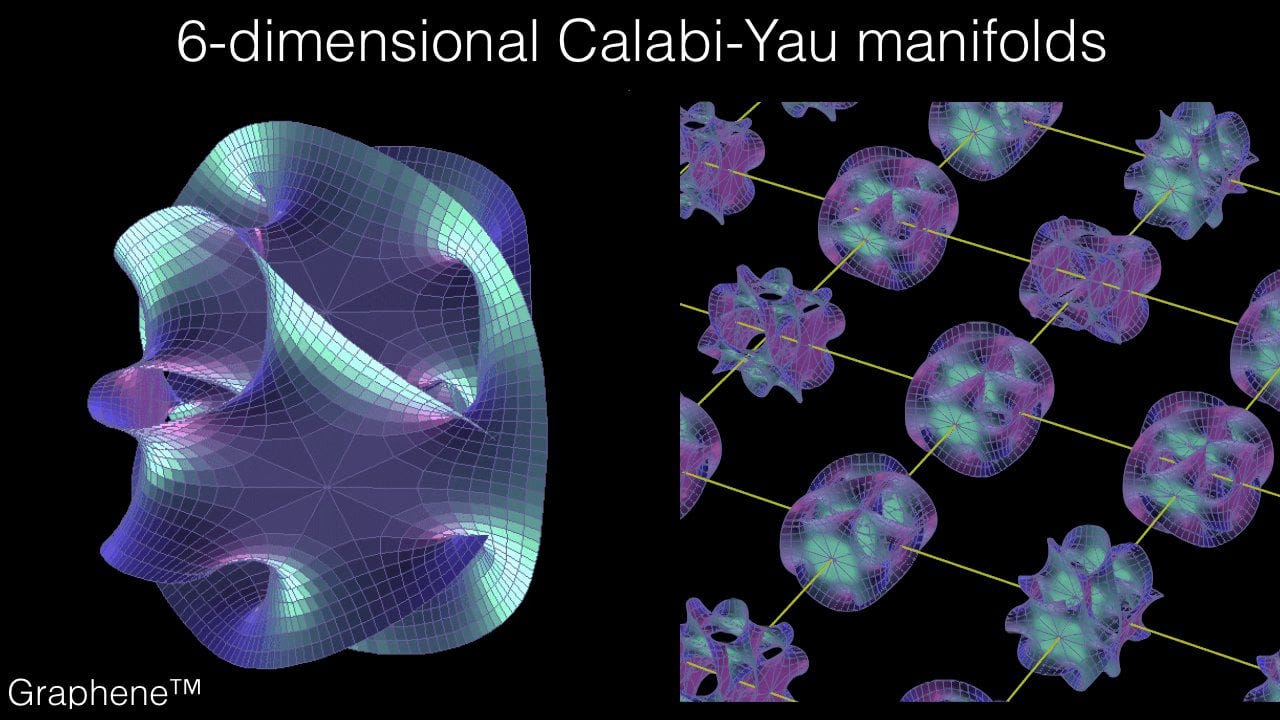
  • Though we only see three dimensions of space (up/down, right/left, forward/back), there may be many more that we can’t see and that challenge our intuition (see illustration below).
  • The universe is fully digital! Despite what your math teacher taught you about points on a line, there is a very small but finite distance, called the Planck Length which defines a lower limit to size of or distance between objects. There is also a corresponding Planck Interval of time.
  • Despite the proven fact that nothing can travel through space at faster than the speed of light, two particles, even quadrillions of miles apart, can be “coupled” such that each of them instantaneously “knows” if the other changes states. Albert Einstein himself, one of the founders of Quantum Mechanics, never fully believed this well-demonstrated quantum mechanical phenomenon, and called it “spooky action at a distance.”
6-dimentional Calabi-Yau manifolds. One of the weird things I’m interested in. The odd structure on the left is one of a great many possible configurations of a mathematical model of what six extra dimensions of space would look like. The grid on the right shows one plane of normal 3-dimensional space, with a Calabi-Yau manifold at each possible location, that is, spaced about 10(-35) meters, the Planck Distance, apart. This is about one ten-trillionth the diameter of an electron. String Theory, the subject of decades of international research, postulates that, though we can only see three of them, there must be a total of at least nine dimensions of space in our universe. From nieuwsgierigheid

Ontology of the Trinity

As much as most Christians crave an analogy to help explain the Trinity, my contention is that the uniqueness of God and the inexplicability of “spirit” and “spirit beings” makes meaningful analogy fundamentally impossible. Furthermore, because God is complex and analogies are by design simple, any attempted analogy can do nothing, in my view, but trivialize God!

Now, abandoning any further attempt to analogize, I’m going to ponder the “ontology,” or metaphysical essence of the Triune God.

Spirit

It seems to me that the tri-unity of God must be viewed in the context of His existence as a disembodied spirit.

There could be no other lifeform in the universe even remotely like God. Even the terminology of biology is meaningless. God’s substance is “spirit.” That is something beyond the realm of science.

“Spirit” is something that science can’t detect or explain, yet if our faith is founded on reality, it exists, since God, His angelic host, and the immaterial part of a human are all composed of spirit. Conscious spirit, unencumbered by the limitations of physical mass and energy, or any other component of the physical universe, is limited only by the will and power of a superior spirit. Created spirits are limited only by the will of their creator.

Scripture seems to say that God is both immanent (fully in touch with all aspects of His creation) and transcendent (in all ways possible, above and beyond His creation). In Implications of God’s Omnipresence and Eternity in Space-Time, I explain that this duality is what we call “omnipresence.” It means that He is constantly present and aware, at all points in both space and time. This implies that He both permeates and envelops the entire universe. Which further implies that His “omniscience” is not limited to seeing all but extends to personally experiencing all.

I have heard it said, many times, that God needed to experience the same temptations as us in order to empathize with us. In view of the above, I think this is a logical fallacy. The senses and consciousness of all creatures are an open book to Him. The incarnation was not for His education, it was for our faith! So that we can empathize with Him! Seeing Him take on flesh and become like one of us, we see His sacrifice and suffering.

When you really think about it, it seems that life as a bodyless spirit would be impossible. With no body to support, I can see where most biological organs would be unnecessary, e.g., entire systems for digestion, respiration, circulation, skin and skeleton, reproduction, etc.

But intelligence, communication, and empathy, for example require some complex cognitive mechanism beyond a computer core in order to function. Since I don’t question the existence of God, or that He indeed is spirit, the only conclusion I can draw is that there is physics that is still beyond our grasp. Big shock, eh?

Think of some of the “higher-level functions” that only God could perform:

  • God alone preexisted everything else that exists.
  • God alone created everything else that exists.
  • God’s intellect and abilities exceed those of all that He created.
  • God commands all the forces of creation.

God created the universe and all of its animate and inanimate contents with an ability to function—in my view independently of His constant oversight and control—in accordance with physical laws of His design, but subject, at His sole discretion, to His override, either in whole or in part.

There is another interesting ability held by spirit beings, including individual members of the Trinity, angels, demons and even humans (like the shade of Samuel at En-Dor 1 Samuel 28): They can take on physical substance. With respect to the Trinity:

  • The Father occasionally manifested Himself at specific locations, e.g., the burning bush, the fire above Mt. Sinai, and the shekinah over the Mercy Seat.
  • The Spirit manifested as tongues of fire at Pentecost.
  • Above all, we note the incarnation of the Son.

For more on this subject, see Gods and Demons.

Locality

Three spirits, or three intellects in one spirit?

My concept of an omnipresent Triune God implies that all three members of the Trinity must occupy the same space, simultaneously. Because I don’t know what “spirit” is, I can’t define what that statement actually means. Does it mean like the smoke of three cigarettes commingling in space, or that literally every infinitesimal iota of space and time contains all three. The first implies tritheism, so I lean towards the second, and indeed, the orthodox definition of the Trinity is “one God, three Persons,” or “personalities.”

Orthodox Christianity has defined the Trinity as three complete personalities within a single entity composed entirely of spirit. In a quantum mechanical sense, that maybe starts to make a little sense, but no physicist really understands the quantum universe, and the Creator is certainly more complex and mysterious than His creation.

How important is monotheism?

So, is the orthodox definition true, and does it even make a difference?

Undoubtedly, monotheism is an important subject in modern religion, but it has not always been that way. Today, “monotheism” means belief in one God. In ancient times, even as late as the 1st century, “monotheism” meant worship of one God.

Christianity claims to be monotheistic, but so do its two biggest rivals, Judaism and Islam, and both of them charge Trinitarians with being blatantly tritheistic, worshipping three separate gods. The Qur’an states over and over again, “There is only one God: He is Allah, and he does not have a son!” The Rabbi at an orthodox Lubavitcher-Chabad Jewish synagogue within walking distance of my house says, “We Jews might have accepted Yeshua as our Messiah if he hadn’t claimed to be God.”

Certainly, Biblical Israel, like the rest of the world, believed in multiple Gods. Whether they were right or not depends on how you define the term, “god.” Merriam Webster today defines “god” as

The supreme or ultimate reality: such as the being perfect in power, wisdom, and goodness who is worshipped (as in Judaism, Christianity, Islam, and Hinduism) as creator and ruler of the universe.

or less commonly a being or object that is worshipped as having more than natural attributes and powers’

While modern Christians and Jews alike would agree on the first definition, the second was not at all “less common” in Biblical times. If an angel, good or bad, is worshipped, then he meets the second definition. Though they were polemicized by the prophets as “gods made by human hands,” inanimate idols were normally worshipped, not for themselves, but rather for the spirit beings who inhabited them. I have long believed that the pagan gods were real, evil, spirit beings—after all, they were able to duplicate for the Egyptian magicians the first miraculous signs that Moses was told to use as proof that his God was present. Human beings, on their own, don’t have magical powers!

It wasn’t until Jesus claimed to be God that the Jewish sages refined their definition of monotheism, changing it from “belief in” to “worship of.”

Thus, while I don’t personally think the Trinity amounts to polytheism, I do think that the question is historically moot. By the time of the Patristic Church fathers, polytheism of any sort was viscerally unacceptable in the Judeo-Christian world. Though I’m not quite 100% convinced, I’m more than willing to stick with a monotheistic definition because, even though I think there is no unambiguous Scriptural proof one way or another, I am well enough accustomed to the paradoxes of physics that the concept “goes down easy.”

Eternality

No part of the Trinity is created. Does that mean that they have always existed, from eternity past? Neither the Hebrew nor the Greek Scriptures actually make that clear, in that they do not unambiguously explain what the term “in the beginning” is referring to, other than that it is when “the heavens and the earth” were created. What is clear is that all three preexisted everything else that exists.

Most cosmologists and astrophysicists are unwilling to believe in an eternal Creator, so they instead believe in an eternal creation. Either alternative is unfathomable to the human mind, but so is the concept of either God or the universe popping up from nothingness.

Relationships

if Jesus is Yahweh’s son in the same sense that I am Harold’s son, then we’re faced with all sorts of unanswerable questions that make no sense at all in the context of a spirit being with no material substance. I can’t fathom a mother-God or spirit-DNA. Obviously to me, the father/son terminology has to be functional, not biological.

Scriptural context indicates that there is a hierarchy between the three. Jesus clearly stated that He always does the will of the Father, and at the same time He implied that the Holy Spirit does His bidding.

Because God is a spirit, not tied to any physical body; because He claims to be omniscient and omnipresent; and because both time and space are a property of the universe He created, I conclude, as mentioned above, that He must both occupy and extend beyond the bounds of the universe and be free from any dependence on them whatsoever.

Appearance in Heaven

The Bible reports several very explicit prophetic visions of God seated on a throne in heaven: Isaiah 6, Ezekiel 1 and 10, Daniel 7, and Revelation 4 being most striking. I don’t think that these visions can be reconciled with God as an omnipresent spirit. Instead, I think that what the prophets are “seeing” are representations of preconceptions popularly held by ancient peoples. Visions, not reality! This is more or less how the pagan deities would have been visualized in contemporary surrounding cultures. If 21st century American Christians can’t visualize the Christian Trinity, how much less would primitive denizens of the Ancient Near East be able to set aside their ingrained preconceptions? And how important could it have been to ask them to do so? In my opinion, not very!

Conclusion

I don’t recommend that anyone try to interpret or understand the visions listed in the previous paragraph. Or, for that matter, other visions described in the Bible, like those interpreted by Joseph or Daniel, or experienced by Peter. Visions spoke truth to those to whom God gave an interpretation. They are not for our interpretation or understanding. Other than as recreational exercises, if that’s what rings your bell.

Similarly, I don’t recommend trying to untangle the ultimate explanation of the Trinity. God has not chosen to clarify it for us yet.