Fulfilling the Law: Matthew 5:17–19

Posted on:

Modified on:

  1. Exposition of the text
    1. What is “The Law”?
      1. Using a concordance
      2. Torah to a Jew
      3. Nomos to a Jew
      4. An expanded view of Torah/Nomos
      5. What it isn’t
    2. “The Law and the Prophets”
    3. Other New Testament Uses of “Fulfill”
    4. A warning
    5. What about verse 20?
  2. The conditionality of the Mosaic Covenant?
    1. What triggered the supposed annulment of the Mosaic Covenant?
    2. Old Testament references to the New Covenant

Matthew 5:17 (ESV)
[17] “Do not think that I have come to abolish the Law or the Prophets; I have not come to abolish them but to fulfill them.

Most of us have been taught that “the Law” was a good thing in its time, but by “fulfilling” it, Jesus rendered it obsolete. He didn’t abolish it, but because it was a foreshadowing of His life, death and resurrection, it no longer has any function other than as a tutor, to teach us about sin. To most, more like an artifact in a museum.

But if “the Law” is obsolete, then so are other things based on it.

Judaism as an ethnic group goes back to Abraham, of course, but the one thing God gave them that allowed them to survive 2000 years of Diaspora was their distinctive identity as a people with an elaborate cultural heritage. If “the Law” is obsolete, then so is the heritage, and so, too, is the people. What then, is the purpose of the modern state of Israel? The late R.C. Sproul (who I nevertheless liked) echoed the sentiments of Reformed churches around the world in saying that it has no purpose whatsoever!

Exposition of the text

In this post I’m going to provide exegesis of the following passage, then discuss some of the consequences.

Matthew 5:17–19 (ESV)
[17] “Do not think that I have come to abolish the Law or the Prophets; I have not come to abolish them but to fulfill them. [18] For truly, I say to you, until heaven and earth pass away, not an iota, not a dot, will pass from the Law until all is accomplished. [19] Therefore whoever relaxes one of the least of these commandments and teaches others to do the same will be called least in the kingdom of heaven, but whoever does them and teaches them will be called great in the kingdom of heaven.

Most conservative Evangelical theologians, and almost all Dispensationalists, believe that the Mosaic Covenant, the “Law of Moses”, was conditioned on Israel’s continuous keeping of “the Law“. They say that when Israel rejected their Messiah, they forfeited this particular Covenant. One of the chief passages in the Bible used to support that opinion is Matthew 5:17, taken out of context and carelessly translated. Yet I think that, taken in context, it says the opposite.

In a recent exchange on Facebook with a person who is clearly a sophisticated student of the Bible (and a new friend of mine, as well), I responded to this statement:

In Matthew 5:17, Jesus says, “Do not think that I have come to abolish the Law or the Prophets; I have not come to abolish them but to fulfill them.” This statement indicates that Jesus’ mission was not to discard the Law but to bring it to its intended purpose. The Greek word used for “fulfill” (πληρόω, plēroō) suggests completion or bringing to full expression. Jesus lived in perfect obedience to the Law, thus fulfilling it in a way no one else could.

Mostly, that analysis is on track, but the final sentence reveals a fundamental misunderstanding of Jesus’ mission. It hinges on what is meant by “the Law” and is also a misstatement of what verse 17 actually says.

What is “The Law”?

I recall a weekday Men’s Bible study teacher asking the group what book of the Bible we would like for him to teach through next. I suggested Leviticus and got a kick out of all the dropped jaws and glazed eyes.

To most Christians, the idea of even reading Leviticus is daunting, let alone discussing its content in tedious detail. Leviticus is just… it’s…


…A cumbersome jumble of miscellaneous rules and regulations designed to show us the unmitigated evil of the human heart, and how ungrateful and hypocritical a people can be despite all God does for them.

But before we can “decode” our text, we need to agree on what “the Law” really is. When you see that term in the Old Testament, it is a translation of the Hebrew “Torah.” In the New Testament, it is a translation of the Greek “nomos.” Both words refer to the same thing. the problem is that the English word “law” doesn’t fit either of these foreign words very well.

Using a concordance

If you don’t speak Hebrew or Greek and you run across a word in one of these languages in the Bible, then the chances are you might look it up in a concordance. In the modern age, the best known and most used of these, for both languages, is Strong’s Exhaustive Concordance, but there are a number of others available. Strong’s introduced index numbers for the root form of each word found in the King James version. Newer concordances mostly use Strong’s index numbers, though there are additional numbering systems available.

Most concordances list English translations of the original word. In doing so, they may purport to serve the purpose of a dictionary, but it is important to realize that they are not dictionaries—they are indices! So, if Strong’s lists, for example, 25 uses of a single root word, it will generally break those down by the different ways that word has been translated. It isn’t telling you how it should be translated, but rather how it has been translated.

Fortunately, there are a number of actual translational dictionaries available, and many of those cross-reference the Strong’s index numbers.

Torah to a Jew

The Strong’s entry for Torah, H8451 on Biblehub.com, says “direction, instruction, or law.” A different edition of Strong’s, incorporated with the PocketBible Bible Study App, lists: “a precept or statute, especially, the Decalogue or Pentateuch—law.”

But to the faithful Jew, the “law” part of it is just a to-do list for living an orderly and God-pleasing life. “The 613 Habits of Highly Effective People“, so to speak. Torah to a Hebrew-speaking Jew means “teaching“—Instruction about who God is and what God does; and direction for how to lead family and community in the path God has paved.

But what specifically is “The Torah?”

That question has a lot of answers to a Jew, depending on context:

  • First of all, it is of course the Five Books of Moses, called the Chumash (the five) by Jews and the Pentateuch by Hellenized Christianity.
  • Oral Torah” refers to a body of tradition handed down from generation to generation, beginning ostensibly with Moses. These are the “traditions of the elders” which Jesus condemned, but only to the extent that they occasionally conflicted with written Torah. Without question, Jesus and His disciples kept most of these customs themselves. These include ways of celebrating the Biblical feasts, celebration of additional, extrabiblical feast days, ritual washing customs, the entire body of blessings before meals and other activities, and much, much more. After AD 70, Pharisees and scribes assembled at Jamnia (Yavneh, modern Rehovot, between Tel Aviv and Ashdod) began the arduous task of writing down these previously oral-only traditions. The result is the Mishnah, and later two competing versions (“Babylonian” and “Jerusalem”) of the Talmud.
  • In a much broader sense, anything that records the Word of God is also considered Torah. This includes the rest of the canonical Tanakh, or Old Testament. Messianic Jews, believers in Messiah Jesus, also include the New Testament in Torah.

But regardless of the dictionary definition, to a devout Jew, Torah reflects the way things are, not the way things are supposed to be.

Nomos to a Jew

Regarding the term “Law”, the New Testament uses the Greek nomos, following the lead of the Septuagint (LXX), the 2nd century BC Greek translation of the Old Testament that Paul used when taking his ministry to the Greek world. The LXX uses nomos for the Hebrew Torah because that was as close as the translators could come, grammatically.

Strong’s and NAS both define nomos as, “that which is assigned, hence usage, law.”

Thayer’s, as usual, gives a much more complete analysis:

(νέμω, nemo, to divide, distribute, apportion), in secular authors from Hesiod down, anything established, anything received by usage, a custom, usage, law.

Vine’s, my favorite language resource, says,

(νόμος, nomos), akin to nemo, “to divide out, distribute,” primarily meant “that which is assigned”; hence, “usage, custom,” and then, “law, law as prescribed by custom, or by statute.

An expanded view of Torah/Nomos

There is no denying that a significant part of Torah consists of legal precepts. In fact, by official Jewish count, there are 613 separate mitzvoth, or commandments, in the Five Books of Moses. These are contained in portions of Torah that are called Halachah, or “the way of walking.” As Paul would describe it, the part defining the proper “walk” of a Godly Jew.

The rest of Torah is called Aggadah, and it is the narrative part of Scripture. If Halachah is about expected behavior, Aggadah provides the rationale and motivation for that expectation. As expressed very eloquently by myjewishlearning.com, Jewish life is defined, not by “Law” or Halachah, but by the interplay between Halachah and Aggadah. “The interrelationship of Halakhah and Aggadah is the very heart of Judaism. Halakhah without Aggadah is dead, Aggadah without Halakhah is wild.”

My conclusion is that it’s only because of the legalism of 2nd Temple and Rabbinic Judaism and defensive translation/commentary by mostly antipathetic gentile scholars that both the Hebrew and Greek terms became associated exclusively with the strictly legal term, “law.”

What it isn’t

Starting probably with Augustine of Hippo, the Church developed a theory, now firmly entrenched in both Catholic and Protestant tradition, that “the Law” was composed of three parts: Moral Law, Civil Law, and Ceremonial Law. Supposedly, the Moral Law is still in force, but the Civil and Ceremonial Law have been annulled.

That tradition has absolutely no Biblical support and was never a part of prior Jewish belief. Furthermore, the view is theologically untenable, on several important levels. The Torah, or more accurately, Halachah, is a unified whole. To fail with respect to a single minor mitzvah is to fail with respect to all of Torah, no matter how you parse it. For more on this subject, see The Transfiguration and “Jewish Law”.

“The Law and the Prophets”

But Matthew 5:17 isn’t speaking about Torah alone, and certainly not Halachah alone. It mentions not just “the Law”, but rather, “the Law or the Prophets”, which was a common shorthand expression indicating the entire, Tanakh, or Old Testament. The Prophets didn’t establish any law. They proclaimed God’s judgements and revealed His plans for Israel and the World.

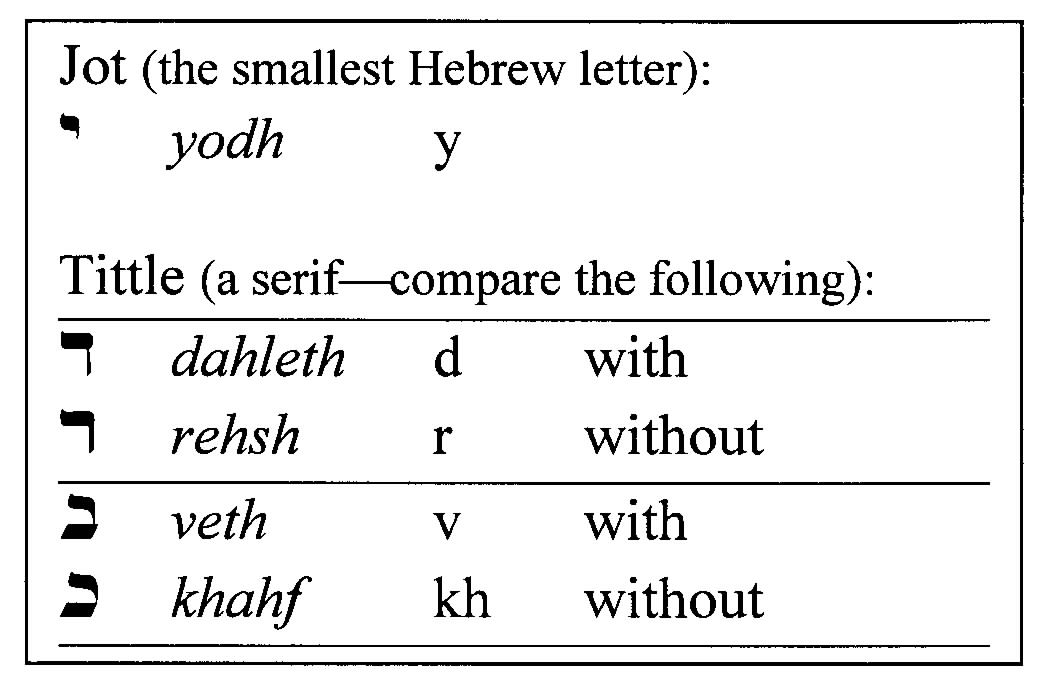
So, fully understood, verse 17 could not possibly be saying that Jesus “fulfilled the Law and the Prophets” merely by living in complete obedience to Halachah. Indeed, Jesus’ meaning is made perfectly clear by the very next verse: “[18] For truly, I say to you, until heaven and earth pass away, not an iota, not a dot [“jot and tittle” in KJV; “yodh or stroke” in the Hebrew alphabet], will pass from the Law until all is accomplished.

The “jot and tittle”, ©Ron Thompson

As I sit here and gaze out my office window, I can clearly see that heaven and earth have not yet passed away. So, is God’s “Law” of less effect today than when Jesus spoke His Sermon on the Mount?

It happens to be Thursday as I start this paragraph, but I was sitting here typing last Saturday, too. I was violating the Jewish Sabbath in a number of ways. But I’m not Jewish, and I’m not bound by Jewish law. The Mosaic Covenant was between God and Israel, not between God and the Church (sorry, Reformed friends, they’re not the same), not between God and goyische God-Fearers (I just added a stub for a future post on non-Jewish pre-Christian believers), and not between God and all humanity. Has it passed away for Israel (whether they realize it or not)? I just checked again: the sun is still shining, the wind is still blowing, and squirrels are still running up and down the oak tree.

In case verse 18a was not enough, 18b adds even more punch: not the tiniest portion of “the Law” will pass until “all is accomplished“! All of what? All that is written in “the Law and the Prophets”. Aggadah as well as Halachah. All of God’s plans as revealed in the Old Testament. Some have, some have not. Jesus’ first advent has come and gone, but there is still a lot of prophecy unfulfilled. Some of my readers don’t believe in a Millennial Reign, but most believe in a coming final judgement. That is surely yet to come. Unfulfilled! The Law. The Covenants. None of that has passed away!

Other New Testament Uses of “Fulfill”

About the same time that I was participating in this discussion of Matthew 5:17–19 on Facebook, another man was independently taking the same stance as mine on another thread about the same subject. This man’s name is Dalton Mauldin, and he is the author of a book titled Finding the Way: A Scripture-Guided Journey to Break through Tradition to Find Truth, Faith, and a Closer Walk with God.

I am reading the book, and while Dalton and I aren’t on the same page on everything, we’re close enough to be Christian friends. In order not to reinvent the wheel, I have obtained his permission to quote him here as he discusses other instances of the term “fulfill” in the New Testament. This is an excerpt from his Chapter VIII:

“Then Jesus came from Galilee to the Jordan to be baptized by John. But John tried to deter him, saying, “I need to be baptized by you, and do you come to me?” Jesus replied, “Let it be so now; it is proper for us to do this to fulfill all righteousness.” Then John consented. (NIV)”

Did Jesus mean to “put an end to all righteousness”? Of course not! In this instance, “fulfill” was a translation of the same Greek word “pleroo.” It is clear in this usage that it does not mean “to put an end to” all righteousness, but more likely to demonstrate righteousness. It should also be noted that this is the same author, Matthew, who would likely use the word fulfill in the same way two chapters later. 

In Romans 15:13, it says: “May the God of hope fill you with all joy and peace as you trust in him, so that you may overflow with hope by the power of the Holy Spirit. (NIV)”

In this instance, “fill” was translated from “pleroo” as well. It is clear in this usage that it does not mean “to put an end to”, but “to make full.”

In Colossians 1:25, Paul states: “I have become its servant by the commission God gave me to present to you the word of God in its fullness. (NIV)”

In this instance, “fullness” was translated from “pleroo” as well. It is clear in this usage that it does not mean “to put an end to” but means “in its entirety.”

In James 2:23 it says: “And the scripture was fulfilled that says, ‘Abraham believed God, and it was credited to him as righteousness,’ and he was called God’s friend. (NIV)”

In this instance, “fulfilled” was translated in the past tense of the word – you guessed it – “pleroo”. It is clear in this usage that it does not mean “to put an end to”, but to mean “brought into reality”.

In fact, there is no instance of “pleroo” translated as “to put an end to” or any similar meaning. Thus, “fulfill” cannot possibly mean anything that might resemble “put an end to.”  Having eliminated the possibility of any meaning of “pleroo” that indicates an “end”, let’s look at the others: “to complete, to make full, to verify, to accomplish, to satisfy, and to preach fully”

A warning

If there is still any doubt about the permanence of “the Law”, Jesus then adds a stern warning for those who in any way would relax their observance of Torah:

Matthew 5:19 (CJB)
[19] So whoever disobeys [λύω, loo’-o, to relax, loosen, untie, break up, destroy, dissolve, melt, put off, contravene, annul] the least of these mitzvot and teaches others to do so will be called the least in the Kingdom of Heaven. But whoever obeys them and so teaches will be called great in the Kingdom of Heaven.

What about verse 20?

Matthew 5:20 (ESV)
[20] For I tell you, unless your righteousness exceeds that of the scribes and Pharisees, you will never enter the kingdom of heaven.

The ESV, NIV, NCV, NKJV and some other translations lump Matthew 5:17–20 under one subheading, such as “Christ Came to Fulfill the Law” in ESV. Others include the Salt and Light verses, 13–16 under the same subhead.

I think that it is bad exegesis to include verse 20 with the preceding verses, because rightfully verse 20 is an introductory verse to what follows, specifically Jesus’ discourse on the spirit of the 10 Commandments.

Regarding “the righteousness of the scribes and Pharisees,” this is a Hebrew play on words. צִדְקָה (tsidqah) is a noun that means “righteousness.” Jesus is teaching that righteousness means both the letter and spirit of Torah. Many scribes and Pharisees, though, had cheapened the term by using it to indicate simply “almsgiving alone.”

“Look at how righteous I am—I faithfully donate a shekel or two to widows and orphans.”

The conditionality of the Mosaic Covenant?

In my post, A Perspective on Biblical Covenants and Dispensations, I state my opinion that, despite contrary views, none of the Covenants with Israel were conditional—that each new Covenant built onto all of the previous Covenants. The Mosaic Covenant is still operative!

Matthew 5:17, is part of the justification for the disastrously mistaken idea that God is “done with the Jews”, either forever or until the Tribulation period. Do you think that’s a minority view among Christians? Wrong! It is a prominent teaching of the Catholic and Orthodox churches which dominate most of the world, as well as Reformed Protestant denominations, including Anglican, Presbyterian (my dad’s heritage), Lutheran (my mom’s heritage), and many denominations around the globe, many of which have the word “Reformed” in their name.

But even Dispensational denominations, which refuse to permanently write off Israel’s place in God’s plans for the last days, uniformly hold that the Mosaic Covenant is dead, because it was conditional.

There are two ways one can think of covenant “conditionality”:

  • First, one can call a covenant “unconditional” if it makes promises (positive and/or negative) that one party is bound to keep no matter what the other party does or does not do, and “conditional” if the promises it makes are contingent on the actions of the other. In that sense, yes, the Mosaic Covenant is indeed conditional.
  • But that is not what most Bible teachers mean when they say the Mosaic Covenant is conditional. They mean that its validity is conditional. “If you obey, I’ll bless you, if you disobey, I’ll curse you…” [That much is true—Deuteronomy 28 says it in no uncertain terms!] “…and if you keep disobeying, I’ll take my ball and go home!”

What triggered the supposed annulment of the Mosaic Covenant?

Many Dispensationalists will say that God cancelled the Mosaic Covenant when Israel, in the person of the Pharisees harassing Jesus (no doubt at the instigation of leadership in the Great Sanhedrin) rejected Jesus as messiah and blasphemed the Holy Spirit by attributing His miracles to Satan. This rejection, they say, is recorded in Matthew 12:

Matthew 12:22–25,30–32 (ESV)
[22] Then a demon-oppressed man who was blind and mute was brought to him, and he healed him, so that the man spoke and saw. [23] And all the people were amazed, and said, “Can this be the Son of David?” [24] But when the Pharisees heard it, they said, “It is only by Beelzebul, the prince of demons, that this man casts out demons.” [25] Knowing their thoughts, he said to them, “Every kingdom divided against itself is laid waste, and no city or house divided against itself will stand.

[30] Whoever is not with me is against me, and whoever does not gather with me scatters. [31] Therefore I tell you, every sin and blasphemy will be forgiven people, but the blasphemy against the Spirit will not be forgiven. [32] And whoever speaks a word against the Son of Man will be forgiven, but whoever speaks against the Holy Spirit will not be forgiven, either in this age or in the age to come.

The Dispensational scenario suggests that Jesus, at the beginning of his ministry, was actively preaching, demonstrating His power, and proclaiming his Messiahship, with the ultimate intention to rally the Land and establish the prophesied Messianic Kingdom. Paradoxically, the same people who teach this are also prone to teach that Jesus’ first advent was specifically intended to present Him as a suffering servant, not a military leader. As a result of the Pharisees’ rejection in Matthew 12, Jesus, in verse 32, (again in this scenario) announced that the scribes and Pharisees as representatives of Israel had committed an unpardonable national sin, so the Kingdom would be indefinitely delayed. From that day on, Jesus would no longer seek to win over the current generation but rather would concentrate on training His disciples and by extension their successors to carry His message to a far future generation. As a result, His miracles were henceforth done in relative privacy, His messages were delivered in parables that could only be understood by His “insiders”, and on His death, the Mosaic Covenant was cancelled and replaced by the New Covenant. Some say that “it is finished” uttered on the cross marks the instant of replacement.

I find that scenario to be deeply flawed and insupportable.

In my Covenants and Dispensations post, I point out that Christianity is more or less divided into two camps:

  • The Covenantalists, who believe that Jewish Old Testament Israel was the original “Church”, and that the mostly gentile New Testament Church is the current and forevermore “Spiritual Israel”, and that there will be no Rapture or Millennial Reign.
  • The Dispensationalists, who believe that Israel and the Church are distinct entities, and that the Church will be Raptured followed by a Millennial Reign during which Israel will finally accept their Messiah.

Almost all Christian denominations and local churches fall into one of those two camps. You can more or less recognize them by whether they practice infant baptism (Covenant), or believer’s baptism (Dispensational). Personally, I totally reject the majority Covenantal viewpoint. I do hold to the Dispensational views as shown by the bullet above, but I reject the concept of “dispensations” and the Dispensational belief that the Mosaic Covenant is dead.

Old Testament references to the New Covenant

That the New Covenant would replace the Old is not stated anywhere in the Old Testament. Several references do indeed predict that the “New Covenant” will be better than the “Old Covenant”, i.e., the Mosaic:

  • Moses himself, in Deuteronomy 29:[4] (CJB), said, “to this day ADONAI has not given you a heart to understand, eyes to see or ears to hear!”. Though he does not mention a New Covenant, he goes on, in chapter 30, to describe times of apostacy and exile for Israel, followed by, in chapter 31, promises of restoration. Notable in this passage is,

Deuteronomy 30:5–8 (ESV) emphasis mine
[5] And the LORD your God will bring you into the land that your fathers possessed, that you may possess it. And he will make you more prosperous and numerous than your fathers. [6] And the LORD your God will circumcise your heart and the heart of your offspring, so that you will love the LORD your God with all your heart and with all your soul, that you may live. [7] And the LORD your God will put all these curses on your foes and enemies who persecuted you. [8] And you shall again obey the voice of the LORD and keep all his commandments that I command you today.

Only verse 5 here yet been fulfilled for the nation of Israel. Note that verse 6 concerning Israel’s heart is language characteristic of the New Covenant, but if the New cancels the Old, then why is it that that Israel will still “keep all His commandments that I command you today”—clearly speaking of “the Law of Moses.”

I have written a post recently dealing with Paul’s writings on this subject, in his epistle to the Romans: Yetzer, Yotzer and “The Law” in Romans 7:1–6.

  • The best known of the New Covenant prophecies is found in,

Jeremiah 31:31–34 (ESV) emphasis mine
[31] “Behold, the days are coming, declares the LORD, when I will make a new covenant with the house of Israel and the house of Judah, [32] not like the covenant that I made with their fathers on the day when I took them by the hand to bring them out of the land of Egypt, my covenant that they broke, though I was their husband, declares the LORD. [33] For this is the covenant that I will make with the house of Israel after those days, declares the LORD: I will put my law within them, and I will write it on their hearts. And I will be their God, and they shall be my people. [34] And no longer shall each one teach his neighbor and each his brother, saying, ‘Know the LORD,’ for they shall all know me, from the least of them to the greatest, declares the LORD. For I will forgive their iniquity, and I will remember their sin no more.”

But this also is a Covenant with “the house of Israel and the house of Judah” and it too, in its context (read the entire chapter!), speaks of the acharit hayamim, the “end of days.” At least as it applies to national Israel.

  • Ezekiel also repeats the prophecy, and once again the context places it firmly in the future, yet to be fulfilled.

Ezekiel 36:24–28 (ESV)
[24] I will take you from the nations and gather you from all the countries and bring you into your own land. [25] I will sprinkle clean water on you, and you shall be clean from all your uncleannesses, and from all your idols I will cleanse you. [26] And I will give you a new heart, and a new spirit I will put within you. And I will remove the heart of stone from your flesh and give you a heart of flesh. [27] And I will put my Spirit within you, and cause you to walk in my statutes [בְּחֻקַּי֙, bə·ḥuq·qay, “in my statutes”] and be careful to obey my rules [וּמִשְׁפָּטַ֥י, ū·miš·pā·ṭay, “and my ordinances/judgements”]. [28] You shall dwell in the land that I gave to your fathers, and you shall be my people, and I will be your God.

Once again, the New Covenant will ultimately renew Israel’s faithfulness to the Old Covenant, not replace it.


Natural Law and Biblical Ethics

This post is inspired by a recent, very brief, Sunday School discussion of Joseph’s Godly response to Potiphar’s wife, long before Mt. Sinai and “The Law.” The sense that I took from some of the comments was, “Joseph was a very special man to even know that adultery was sinful, since ‘The Law’ had not yet been given to Moses.”

“Joseph Receives His Father and Brothers”, by Jan de Bray, 1627–1697. Bray specialized in painting historical figures dressed as contemporary figures; hence, the Dutch Renaissance attire.

I wholeheartedly agree that Joseph was special, but not for that reason. I would submit that all human beings have an innate understanding of sin. Potiphar’s wife knew that adultery is sinful but tried to force it on Joseph anyway. The fact that she was able to frame him for the crime of attempted rape shows that she, her husband, and other Egyptians in the story all had moral compunctions about it.

“The Law” as teacher

I suspect that confusion about this issue goes back to the King James translation of Galatians 3:24, which most of us seniors raised in church are probably familiar with:

[23] But before faith came, we were kept under the law, shut up unto the faith which should afterwards be revealed.
[24] Wherefore the law was our schoolmaster to bring us unto Christ, that we might be justified by faith.
[25] But after that faith is come, we are no longer under a schoolmaster.
—Galatians 3:22–25 (KJV) emphasis mine

We were traditionally taught that, as a “schoolmaster“, the job of “The Law” was no more than to teach Israel what God required of faithful servants. Under the “Old Covenant”, those teachings were rigorously applied by God and the Jewish authorities, and in fact, according to old-school Dispensationalism, salvation came to those, both Jew and Gentile, who either “kept ‘The Law'” or who made atonement for their failures by making an appropriate blood sacrifice.

[Boy… my intention going into this was to keep it brief, but my brain keeps running down all kinds of rabbit trails. There are many directions I could take that last paragraph, but I’m going to back down and stick to “schoolmaster.” Anyhow, see A Perspective on Biblical Covenants and Dispensations, where I’ve already covered part of it]

The term that KJV translates as “schoolmaster“, and NAS as “tutor” is the Greek paidagogos (παιδαγωγός), which literally means “boy-leader”. Historically, in ancient Greece, it referred to a slave whose job it was to conduct children to and from school in safety. In other words, a “guardian” (ESV) or “custodian” (CJB), with no teaching function whatsoever.

If you look up paidagogos (G3807) in Strong’s, you’ll see that it does in fact mention “tutor”, “instructor” and “schoolmaster”, but Strong’s doesn’t determine how a word should be translated—it reflects the way its compilers have seen it translated. In this case it is legitimating an erroneous KJV translation. For that reason, I am reticent to use Strong’s on its own, without reference to other, better, resources. See, for instance, from Vine’s:

“Thus understood, paidagogos is appropriately used with ‘kept in ward’ and ‘shut up,’ whereas to understand it as equivalent to ‘teacher’ introduces an idea entirely foreign to the passage, and throws the Apostle’s argument into confusion.”
—Vine’s Complete Expository Dictionary of Old and New Testament Words

A better translation of the passage quoted above is therefore,

[23] Now before faith came, we were held captive under the law, imprisoned until the coming faith would be revealed. [24] So then, the law was our guardian until Christ came, in order that we might be justified by faith. [25] But now that faith has come, we are no longer under a guardian,
—Galatians 3:23–25 (ESV)

Or the much wordier paraphrase,

[23] Now before the time for this trusting faithfulness came, we were imprisoned in subjection to the system which results from perverting the Torah into legalism, kept under guard until this yet-to-come trusting faithfulness would be revealed. [24] Accordingly, the Torah functioned as a custodian until the Messiah came, so that we might be declared righteous on the ground of trusting and being faithful. [25] But now that the time for this trusting faithfulness has come, we are no longer under a custodian.
—Galatians 3:23–25 (CJB)

Three kinds of “Law”?

You may have noted that I put “The Law” in quotes every time I mentioned it above. That is because the term itself is faulty. The Hebrew term “Torah” means “teaching”, not “law”. The Torah does contain many legal precepts (613 by Jewish counting), but that is only part of the whole. The translators of the Hebrew scriptures into the Greek Septuagint (LXX), lacking a better term, rendered Torah as nomos, which correctly translates to “that which is assigned, or distributed”, as, for example, troop rations or animal feed. That’s not a bad way to look at “teaching” (parceling out knowledge), but since the Jews were becoming increasingly legalistic in their worship, it came to take on the meaning, “law.”

Jesus refused to “abolish the [Mosaic] Law”:

[17] “Don’t think that I have come to abolish the Torah or the Prophets. I have come not to abolish but to complete. [18] Yes indeed! I tell you that until heaven and earth pass away, not so much as a yud* or a stroke will pass from the Torah—not until everything that must happen has happened. [19] So whoever disobeys the least of these mitzvot and teaches others to do so will be called the least in the Kingdom of Heaven. But whoever obeys them and so teaches will be called great in the Kingdom of Heaven.
—Matthew 5:17–19 (CJB)

Christian theologians have attempted to compromise by downgrading parts of Torah while keeping the parts that they can’t bring themselves to discard. I have written about this before:

[There is] a theory I have come across many times since I was a young man—that “Jewish Law” is composed of three categories of commandments: “Moral Law“, “Civil Law“, and “Ceremonial Law“. There are hints of this in Augustine of Hippo, but I think the idea was fleshed out mostly by Thomas Aquinas, so it became a Roman Catholic and Orthodox view. It was later bequeathed to Protestant Reformed theology by John Calvin in his Institutes of the Christian Religion; and many subsequent non-Reformed Protestant denominations and individual pastors have adopted the idea as well. The impetus for these teachings was probably an effort to justify claims that Christians are not bound by Civil and ceremonial Law, while at the same time holding that the Moral Law is somehow “still in effect”.
—Ron Thompson, The Transfiguration and “Jewish Law

As I mentioned in the above-referenced post, this 3-fold division of Torah is entirely fictitious! I suspect that some would attempt to justify the idea by guessing at the meanings of three technical terms used to categorize the legal precepts in verses such as Deuteronomy 6:1,

Now these are the commandments, the statutes, and the judgments, which the LORD your God commanded to teach you, that ye might do them in the land whither ye go to possess it:
Deuteronomy 6:1 (KJV)

Correctly understood, those terms mean enacted laws, regulations, and court rulings, as shown below,

“Now this is the mitzvah [commandment; law; ordnance; or precept], the choqim [statutes; enactments; or decrees] and mishpatim [rulings; judgements; sentences; or findings] which ADONAI your God ordered me to teach you for you to obey in the land you are crossing over to possess…
Deuteronomy 6:1 (CJB, modified by me)

Why we don’t need “moral law” either now

If you think Joseph was anticipating the Mosaic “Law” when he rebuffed Potiphar’s wife, then what was the source of his ethics? I don’t discount that it could have been prophetic forethought, but then why did the Egyptians have the same qualms over adultery? Put another way, what was the source of pagan ethics, and what is the source of atheistic ethics in our own day? Sure, pagan religion was corrupt because the gods were corrupt (see Gods and Demons), but evidently, even in pagan cultures, sleeping with a temple prostitute was not at all the same as sleeping with a neighbor’s spouse. The former was expected, the latter soundly condemned and likely to get you killed.

The answer is that human beings are endowed by God with an innate, though frequently ignored, sense of right and wrong. Those who study it call it “natural law.” We know implicitly, without having to be told, that adultery, murder, theft and such things as those, are wrong.

So, what is the source of that natural law? It is genetic, certainly, so maybe it was part of our original creation as a species. In my own opinion, it was probably the essence of what happened after Adam and Eve ate from that tree.

“Jacob Blessing the Children of Joseph”, by Rembrandt van Rijn, 1606–1669. More strange clothing.

Pharisees

Posted on:

Modified on:

  1. Pharisee History
  2. Sect, or Order?
  3. Torah
    1. Torah Shebichtav, the Written Torah
    2. Torah Sheba’al Peh, the Oral Torah
  4. The Sanhedrin
  5. Pharisees as Sanhedrin Agents
  6. Core Beliefs of the Pharisees
  7. Jesus’ Debates with Pharisees
  8. How did the Pharisees See Themselves?
  9. My Conclusions

Christianity has traditionally viewed the Pharisees as a uniformly treacherous and hateful group of hypocrites.

There is a marked tendency among some to despise Judaism as a whole for producing such a “reprobate” sect. An Internet search for “Pharisees” turns up almost exclusively sites that range from mildly to bitterly critical. The Merriam-Webster dictionary defines “pharisaical” as an adjective meaning, “marked by hypocritical censorious self-righteousness.” Their Collegiate Thesaurus lists the synonyms, “hypocritical, canting, Pecksniffian [look it up], pharisaic, sanctimonious, [and] self-righteous.” But do they deserve the bad rep?

Personally, I don’t think so!

Pharisee History

According to Josephus, there were only about 6,000 Pharisees during the reign of Herod the Great, and that is unlikely to have changed much during Jesus’ lifetime.

The name “Pharisee” comes from the Hebrew Parush (pl. P’rushim), meaning “separated.” This term refers to their opposition to “the mingling”, that is, the mixing of Greek ideas into Biblical Judaism (which, incidentally, has also been the scourge of Christianity). It is believed by many scholars that the Pharisees were spiritual descendants of the Chasidim (“pious ones”), a devout group of scribes dedicated to the preservation of the written and oral Torah during and after the Babylonian Captivity.

Dura-Europos Synagogue – Dura-Europos, Syria – AD circa 101-300. One of the oldest intact (but inactive) synagogues in the world. Note that the representational art does not break the 2nd Commandment, which is specifically a prohibition against making idols to house the foreign gods prohibited by the 1st Commandment. The structure at the center of the wall is the Holy Ark, the closet for housing the synagogue’s Torah scrolls. The Ark is always on the west wall, opposite the door to the chamber and facing east. Photo from BreakingMatzo.com.

The first clear historical references to the Pharisees occurred in the Intertestamental period (between the Old and New Testament writings), during the reign of John Hyrcanus (134–104 BC). By then, they had formed into an elite religious society, or order, with limited membership and strict rules of conduct. They had gained wide popular support due to their opposition to Hellenism (Greek culture), the rise of the corrupt Sadducees, and the illegal high priesthood of the Hasmonean monarchs. Despite their popularity in the synagogues, their political influence was very limited at first.

Accused of fostering revolt, as many as 800 Pharisees were crucified by Alexander Jannaeus (108–76 BC). During the reign of Queen Alexandra Salome (76–67 BC), whose brother was a Pharisee, they finally gained considerable power. Unlike the Sadducees, they never welcomed Roman rule, but they were able to maintain some influence, only because they were willing to cooperate in order to maintain peace and stability.

During the Roman period, spanning the life of Herod the Great and the 1st Century AD up to the destruction of the Temple in AD 70, the Pharisees were highly influential with the populace as a whole, though it was the Sadducees who controlled the Temple and its ritual.

After the destruction of Jerusalem and the Temple in AD 70, most Jewish sectarian orders disappeared, but many of the Pharisees were allowed to relocate to Jamnia (Yavneh), on the coast west of Jerusalem, where they formed the nucleus of the great Rabbinic movement of the following centuries.

Sect, or Order?

It is common to call the Pharisees a sect, but that term is misleading.

By definition, a sect is an offshoot of a larger religion, or a group sharing distinctive political and/or religious beliefs.

I would term the Pharisees, Sadducees, Essenes, and others as orders. An order is a formal group set apart within their religion by adherence to a particular rule or set of principles. The scribes, on the other hand, were not a religious order. As professionals, they probably belonged to a guild.

1st Century Judaism, as today, was highly sectarian. A majority of the Jewish population of Judea and Galilee probably would have said that they were followers of the Pharisees, that is, adherents of the Pharisee belief system, but to actually be a Pharisee—a member of the Order—required a difficult period of training, and then a formal ordination.

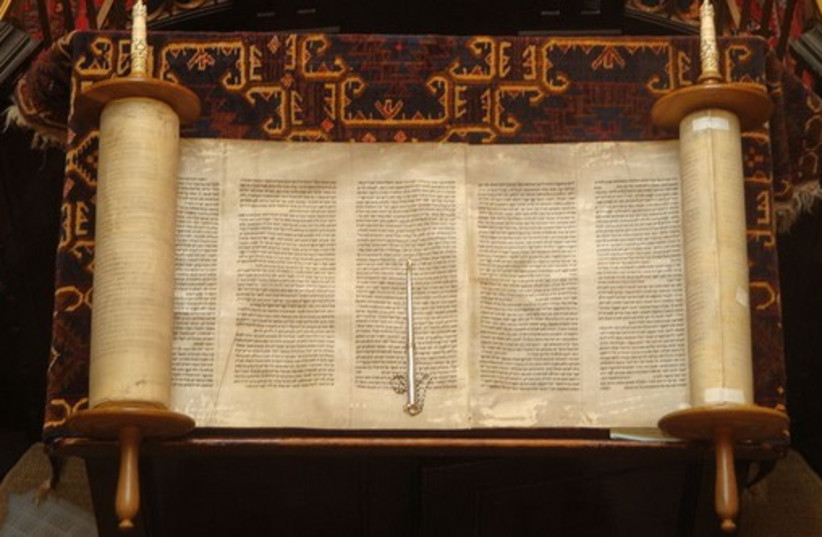
Torah Scroll, Wikimedia Commons
Torah

The Hebrew term Torah rightly translated means, not “law”, but “teachings.” The teachings of Torah do include legal precepts, of course, but those precepts are more about the nature and will of God than about legislation. Even to a Pharisee!

The Pharisees, like Rabbinic Judaism for the last 2,000 years, believed that Torah has two parts: written and oral.

Torah Shebichtav, the Written Torah

The written Torah itself is embodied in books or scrolls. The term primarily applies to the five Books of Moses. These writings individually or collectively are sometimes referred to by Jews as the Chumash (“one fifth”). I personally avoid the Greek term, “Pentateuch.”

To the Sadducees, only the five Books of Moses were Scripture. The Pharisees regarded as holy the entire Tanakh (the OT), consisting of Torah, Nevi’im (the Prophets) and Ketuvim (Writings, sometimes referred to by Jesus simply as the Psalms).

[44] Yeshua said to them, “This is what I meant when I was still with you and told you that everything written about me in the Torah of Moshe, the Prophets and the Psalms had to be fulfilled.” [45] Then he opened their minds, so that they could understand the Tanakh
—Luke 24:44–45 (CJB)

Torah Sheba’al Peh, the Oral Torah

The “Written Torah” was transcribed by Moses “from the mouth of the Almighty” and is contained within the Torah scroll. The “Oral Torah” incorporates the traditions handed down from Sinai but not (initially) put in writing, as well as the interpretations and rulings formulated by the sages of each generation.
—TheRebbe.org

The Pharisees taught that Moses received additional teachings on Mt. Sinai that he was not told to write down. Originally this “Oral Torah” was transmitted from father to son and from teacher to disciple. It consisted of additional instructions and rulings to clarify and quantify the written Torah; principles for exegesis of Torah; and authorization for the rabbis to protect the word of the Torah through making Gezayrot, or edicts, as conditions warrant.

Aside from famously criticizing “traditions of the Elders” that contradicted the letter or the spirit of the Written Torah, Jesus never spoke against the Oral Torah as a whole, and in fact He and His disciples were meticulous about obeying the precepts of both Written and Oral Torah. The formal right of the Scribes and Pharisees to administer Torah through interpretations and edicts (see above) was known as “binding and loosing” (prohibiting and permitting) and was believed to have the blessing of God and His Divine Council in heaven. Shortly before his crucifixion, Jesus endorsed this practice when He extended it to His apostles:

[18] Truly, I say to you, whatever you bind on earth shall be bound in heaven, and whatever you loose on earth shall be loosed in heaven.
—Matthew 18:18 (ESV)

Approximately 1800 years ago, Rabbi Judah the Prince concluded that because of all the “travails of Exile”, the Oral Torah would be forgotten if it was not recorded on paper. He therefore assembled the scholars of his generation and compiled the Mishnah, a written collection of all the oral teachings.

The Sanhedrin

The Biblical basis for the Sanhedrin was:

[18] “You are to appoint judges and officers for all your gates [in the cities ADONAI your God is giving you, tribe by tribe; and they are to judge the people with righteous judgment. [19] You are not to distort justice or show favoritism, and you are not to accept a bribe, for a gift blinds the eyes of the wise and twists the words of even the upright. [20] Justice, only justice, you must pursue; so that you will live and inherit the land ADONAI your God is giving you.
—Deuteronomy 16:18–20 (CJB)

Each major city was ruled by its own political and judicial “Lesser Sanhedrin” of 23 members. Under the monarchy, a “Greater Sanhedrin” was established at Jerusalem to serve as high court of justice and supreme governmental council.

This council at Jerusalem consisted of 71 members, of which the presiding member was the nasi (“prince”, or president), often the High Priest. Membership was appointed, with theological scholarship nominally the basic requirement—but in Roman times, politics effected all major appointments.

During Jesus’ Day, The Sanhedrin met in the “Chamber of Hewn Stone. Later they began meeting in the Royal Portico, which spanned the South side of the Temple Mount above and behind the Double and Triple Gates. Diagram ©Leen Ritmeyer, red box added by me.

According to the synoptic Gospels, Sanhedrin membership consisted of “chief priests, elders, and scribes.” Although there was overlap between those three groups, the chief priests were high ranking Temple priests, mainly members of the Sadducee order; the elders were most likely prestigious Pharisees; and the scribes were respected professionals who might have belonged to any particular order, or to none at all. The Gospel of John mentions only Pharisees and scribes from the Sanhedrin, but when John wrote, probably around AD 80, the Sadducees, the Sanhedrin and the Temple were long gone and a distant memory to his readers.

Pharisees as Sanhedrin Agents

The Pharisees in Jesus’ day were scattered throughout Judea and Galilee, with concentrations in the cities. Many were attached to specific synagogues, while others adopted the life of itinerant teachers, doing much the same things as Jesus. Many of these, perhaps a large majority, were no doubt still Godly men like the first Pharisees, out of the spotlight and unconcerned with politics and wealth. Certainly, when Jesus crossed paths with these men, there were discussions and perhaps even confrontations. I have witnessed brash conversations between Jewish intellectuals in my own day, and I don’t think that it would have been any different then than now.

But what about the Pharisees and scribes that followed Jesus around from town to town? The late David Stern, translator of the Complete Jewish Bible, wrote frequently in his own books and commentaries that these men were probably on assignment from the Sanhedrin. One of the duties of that body was to investigate not only claims of heresy, but also claims of messiahship. Since priests and Levites on the council were mostly Sadducees, who did not believe in a coming messiah, this duty would naturally fall to Pharisees and their scribes. Some would have been belligerent, others merely inquisitive.

Some members of the Sanhedrin were Godly men (e.g., Nicodemus and Gamaliel), but many others were corrupt—collaborators, greedy for wealth and power, and jealous of their position. I believe that the “committee” following Jesus probably consisted of both types. Perhaps it was the same handful of men that we see Jesus arguing with over and over again. Can it be that whenever Jesus blasted the Pharisees, it was “those Pharisees from the Sanhedrin” that He was speaking of—not all Pharisees in General?

Core Beliefs of the Pharisees

Despite the impressions one often receives in reading of Jesus’ frequent confrontations with the Pharisees, He seldom disputed with them on points of doctrine. The Pharisees revered God’s Holy Word and were strongly committed to daily application and observance of its precepts.

They believed in resurrection, immortality, divine judgment, angels, and spirits. They looked for a coming messiah and took responsibility for evaluating claimants. They believed in God’s intervention in human affairs. Many things, they believed, are predestined; human will has only limited freedom within the sovereign will of God.

In Mt 23:1-3 (see below), Jesus is telling the followers of the Pharisees, in effect, “Do what they say, but not what they do.” The reference to “Moses’ seat” speaks literally of the customary seats in the synagogues that were occupied by the teacher during formal Torah studies, but I think it also implies an acknowledgement by Jesus of their historical authority to teach the truths of Torah.

Remains of the Moses Seat in an ancient Persian synagogue.
Jesus’ Debates with Pharisees

I am sure that you have heard it said that Jesus “turned the ancient world upside down with His new commandments and interpretations of scripture.” Certainly, He provided many new insights in the area of prophetic interpretation and fulfillment, but in my opinion He actually presented little or nothing new in the way of doctrine, because the doctrine He taught was already imbedded in the Tanach; rather, He set the record straight on issues that had been clouded by denominationalism, and He turned the clock back on corrupt, or at best legalistic trends that had developed within Jewish society.

Though the great sages of the Pharisees were in substantial agreement with each other on most doctrinal issues, they did, however, often disagree on certain points of interpretation or application. When we see Jesus arguing with a Pharisee, what He is doing most often is simply taking sides in these disagreements. For example, the issues discussed in the so-called “antitheses” of Mt 5:21–48 had been the subject of hot debate among the sages, particularly the rival houses, Beit Hillel and Beit Shammai. Jesus was not presenting new doctrine, but rather pronouncing on these issues from the perspective of His divine authority.

If one can believe the Jewish literature of the Rabbinic age (and I think that most of it is trustworthy), almost everything that Jesus said had been previously said in some form by earlier Jewish sages. Some Christian scholars would claim that the rabbis plagiarized Jesus’ remarks, falsely attributing them to their own heroes. Of course, “critical scholarship” would say it was Jesus who plagiarized. My take is this: God’s truths are timeless and unchanging. God always has a remnant on the scene to expound that truth.

Because of God’s love and grace, He always “prepares the ground” ahead of the sower. Jesus did not arrive on the scene with a Gospel that was radically new and unacceptable to his Father’s chosen people. His path had been prepared in advance by the Pharisees, though ultimately most rejected Him.

As an engineer, I was taught that a good technical paper should have three parts: (a) tell ‘em what you’re going to tell ‘em; (b) tell it to ‘em; and (c) tell ‘em what you told ‘em. In this case, the Pharisees did (a), Jesus did (b) and the New Testament writers did (c).

How did the Pharisees See Themselves?

The Rabbinical descendants of the Pharisees tackled this question in both versions (Babylonian and Jerusalem) of the Talmud. Both list the following Seven Kinds of a Pharisee, in very similar terms:

  1. The “shoulder” Pharisee, who wears his good deeds on his shoulders and obeys the precept of the Law, not from principle, but from expediency.
  2. The “wait-a-little” Pharisee, who begs for time in order to perform a meritorious action.
  3. The “bleeding” Pharisee, who in his eagerness to avoid looking on a woman shuts his eyes and so bruises himself to bleeding by stumbling against a wall.
  4. The “painted” Pharisee, who advertises his holiness lest anyone should touch him so that he should be defiled.
  5. The “reckoning” Pharisee, who is always saying “What duty must I do to balance any unpalatable duty which I have neglected?”
  6. The “fearing” Pharisee, whose relation to God is one merely of trembling awe.
  7. The Pharisee from “love.”
    International Standard Bible Encyclopedia

Certainly, one can find examples of each type of Pharisee in scripture. Note that only the “Pharisee from love” was considered by the later Rabbis to be a truly Godly man.

My Conclusions

Unfortunately, by Jesus’ day, many (but certainly not all, and probably not a majority) of the Pharisees and scribes had in fact succumbed to a legalistic form of worship. Where before they had kept Torah out of a deep zeal to obey God’s commands, now many began to define their spirituality not by their love but by a prideful tally of their good deeds.

[23:1] Then Jesus said to the crowds and to his disciples, [2] “The scribes and the Pharisees sit on Moses’ seat, [3] so do and observe whatever they tell you, but not the works they do. For they preach, but do not practice.
—Matthew 23:1–3 (ESV) emphasis mine

What I am suggesting here is that you reconsider your attitude towards the Pharisees—to see them not as an evil cult that brought on the ruination of the Jewish people, but rather as a powerful spiritual force that bridged the gap between Ezra, Nehemiah and the latter prophets, and the arrival of Messiah.


A Perspective on Biblical Covenants and Dispensations

Posted on:

Modified on:

  1. The two major Evangelical theological systems
    1. Covenant Theology is named for three particular Covenants that they embrace:
    2. Dispensational Theology rejects the above and originally believed that history is divided into seven periods during which God dispensed salvation according to different sets of standards:
  2. The Biblical Covenants, and how some think they relate to Dispensations
    1. The First Covenant
    2. The Adamic Covenant
    3. The Noahic Covenant
    4. The Abrahamic Covenant
    5. The Mosaic/Sinaitic Covenant
    6. The Davidic Covenant
    7. The New Covenant
    8. The Millennial Reign of Messiah

The two major Evangelical theological systems

Evangelical Protestant theologians for the most part fall into one of two categories: Covenentalists or Dispensationalists. Both groups talk about “Biblical Covenants”, but they differ sharply on the definitions and theological implications of these covenants, and how Salvation History (Soteriology) should be understood.

Most Christians that run in my circles have at least a passing knowledge of the Biblical “Covenants.” I am not going to go into detail here on the form and function of Ancient Near East (ANE) covenants and treaties. Rather, my limited goal in this post is to briefly discuss Covenant Theology, which I firmly reject, and then list the well-known Covenants between God and Israel and point out their loose relationships with the Dispensations that most of my Evangelical friends hold dear. I must point out that I am closer to the Dispensational Theology camp than to Covenentalists, but I don’t share the Dispensational tent either. Allow me to simply beg off of accepting either of those labels.

Typical outline of an Ancient Near East Covenant or Law Code, from the Holman Book of Biblical Charts, Maps and Reconstructions, © Copyright 1993 Broadman & Holman Publishers
Covenant Theology is named for three particular Covenants that they embrace:
  • A “Covenant of Works“, aka, the Edenic Covenant. God said to Adam (paraphrased), “I’m giving you all this stuff, but if you do this sin, then I’m taking it away again.”
  • A “Covenant of Redemption“. When Adam sinned and relinquished the benefits of the Edenic Covenant, the three persons of the Trinity, Father, Son and Holy Spirit, established this Covenant among Themselves wherein the Son would come to earth, live a totally sinless life, and then die a substitutionary death. Thus, it was a covenant of Jesus’ works, not of man’s.
  • A “Covenant of Grace“. All of subsequent human history falls under this Covenant.

So far, that all sounds pretty reasonable, but the devil is in the details, so to speak…

The Covenant of Redemption is a problem for me because Jesus always gave His Father executive credit. Nowhere in Scripture do I see Son or Spirit questioning, disagreeing with, or asking for a say in the Father’s decisions.

I fundamentally agree that all of humanity since the Fall has been dependent on God’s grace, but Covenant Theology goes on to erase the distinction between Israel and the Church, which I will dispute to my dying breath. They claim that the Israel of promise was not the physical “seed of Abraham”, but rather consisted only of elect individuals. They say that this “Spiritual Israel” of the Old Testament Jews and the Church of the New Testament are one and the same entity. The promises of God “to Israel” applied only and always to this entity. Through a process way beyond the scope of this brief study, many Old Testament “laws” and “customs” have been replaced and subsumed by New Testament upgrades (e.g., male circumcision has now become, thanks to interpretive magic, infant baptism), and things that were important to Physical Israel alone have now been abandoned (e.g., a Promised Land in the Lavant, which they insist is no longer relevant). Another consequence, which I will not explain here, is that Covenant Theology is in general amillennial, and rejects the possibility of a future Rapture of the Church, as well as a Millennial Kingdom.

Dispensational Theology rejects the above and originally believed that history is divided into seven periods during which God dispensed salvation according to different sets of standards:
  1. innocence (Gen 1:1–3:7),
  2. conscience (Gen 3:8–8:22),
  3. human government (Gen 9:1–11:32),
  4. promise (Gen 12:1–Ex 19:25),
  5. law (Ex 20:1–Acts 2:4),
  6. grace (Acts 2:4–Rev 20:3), and
  7. the millennial kingdom (Rev 20:4-6)

I don’t think that most Dispensationalists today take those seven Dispensations to outline different requirements for salvation, because most now recognize that salvation is and always has been by grace, through faith. Rather, they view the Dispensations as progressive revelation of God’s will for man’s behavior and for right fellowship with God. Most Dispensationalists believe that Israel and the Church are entirely separate institutions, and most recognize that Israel will once again take center stage after a literal end-times Rapture of the Church—points with which I am in complete agreement.

The Biblical Covenants, and how some think they relate to Dispensations

If one feels the need to categorize history into Dispensations, have at it. Personally, I think that such lists are contrived and artificial. History is already pretty well categorized by Covenants that God made with mankind in general, and then with Israel in particular. I’m going to show below that the list of Dispensations above roughly corresponds to periods punctuated by the Covenants.

Most of these Covenants are clearly defined by one or more passages of Scripture. Bear in mind that any promise made by God has the force of a covenant, because what God promises, He delivers. I’m restricting the conversation below to major Covenants recognized by most theologians.

That said, some are a little less clearcut than others. For example, Tim LaHaye and Thomas Ice, in their book Charting the End Times, ©2001 and 2021, list the first two Covenants as (a) Edenic, Gen 1:28-30, 2:15-17; and (b) Adamic, Gen 3:14-19. The Dispensational online source CompellingTruth.org (CEO S. Michael Houdmann), on the other hand, lists Gen 1:26-30, 2:16-17 and 3:15 under the single umbrella of the Adamic Covenant. My own approach to these Scriptural references, as shown below, differs from both these approaches.

Unlike most published theologians, I take a contrarian position that all of the Covenants listed below are unilateral, unconditional and unending:

  • Unilateral, in the sense that God set the terms and laid out the requirements. He didn’t say, “if you want”, He said, “I will”.
  • Unconditional, in the sense that God knew that His creation is morally incapable of meeting His standards. He set standards and consequences, but no possible failure on the part of His people could permanently cancel the ultimate promises.
  • Unending, in the sense that early Covenants are not replaced by later ones. Each and every one builds on the previous.

Although salvation has always been by Grace, through Faith, the details of the relationship between saved humanity and God has been governed by the Covenants I will discuss below.

The First Covenant

(Gen 1:26-30) Most would call this the Edenic, or perhaps the Adamic, Covenant, but at this point, Day 6 in Genesis 1, both Eden and Adam have yet to be mentioned. By His one-sided pronouncements, God here gave to man dominion over the earth and its life; and to men and animals, He gave the right to a vegetable diet. He also here gives to man the first commandment mentioned in Scripture, to “be fruitful, multiply, fill the earth and subdue it”. Because it was first, many orthodox rabbis consider this to be the most important of all commandments. Note that God’s pronouncements here are unilateral (no response asked for or given). Some would say they are conditional because Adam was banished from the garden, but what is expressed in Genisis 1 evidently pertains to the earth in general, not to the Garden in particular. Again, neither Adam nor the Garden are mentioned in Gen 1.

Dispensationalists associate the “Dispensation of Innocence” with the period from Adam’s creation on “the sixth day” to his Fall. Some place the Fall on the 33rd year of Adam’s life, in parallel with the start of Jesus’ ministry on the 33rd year of His life. This is possible, but wholly without Biblical evidence. My view is that Adam, with no knowledge of good and evil until the Fall, had no propensity to willfully sin, i.e., he had no “sin nature”; nevertheless, he was “suggestible” because he also had no propensity to take God at His word. Therefore, I conclude that he was not truly an “innocent”!

The Adamic Covenant

(Gen 2:15-17) Here God put Adam in the Garden, gave him permission to eat freely from vegetation specifically in the Garden, but listed one exception and a curse for violation of that one prohibition. This is, again, a unilateral Covenant (no response asked for or given).

Many would insist that the Adamic Covenant is conditional and came to an end with the expulsion from Eden. Not so! In this Covenant, God promised blessings and a provisional curse. Eden is lost, but mankind is still under the curse and will be until we enter The Eternal State. Paradise lost; Paradise regained. Since God’s plan for earth flowed from Adam, through Noah and the patriarchs to Jesus, I consider the Adamic Covenant to be an essential and unconditional early paragraph in all of God’s Covenant history.

Some scholars include Gen 3:14-19 in the Adamic Covenant, but I would say that these verses simply describe the effects that came from imposition of the curse of 2:17. Specifically, the passage contains curses directed at the serpent (14-15), Eve (16), and Adam (17-19), respectively.

On the other hand, the curse on Satan found in 3:15 “he will bruise your head and you will bruise his heel”, is also a promise of blessing for God’s elect. I would perhaps regard this as a third, and separate Covenant, but I don’t have a name for it.

The period between the Fall and the Flood are considered by some to be “The Dispensation of Conscience“, but again I find fault with this idea. Human conscience is informed by so-called “natural law“, common-sense principles of morality and interpersonal ethics endowed by our Creator (see Natural Law and Biblical Ethics). Since the non-Jewish Church is not bound by Mosaic Law (see below), and since salvation has always been by God’s grace, we are essentially under the same system now as then, though with more knowledge at our disposal.

Peak of Mt. Ararat, iStock, from The ESV Archaeology Study Bible, ESV® Bible
Copyright © 2017 by Crossway.

The Noahic Covenant

(Gen 9:8-17); some would include with this Gen 8:20-9:17). The first use of the Hebrew term for “covenant” (בְּרִית, b’riyt) is in Gen 6:18, where God promises to establish His Covenant with Noah after the flood. In Gen 9:1ff, God blesses Noah’s family and repeats the commandment to “be fruitful, multiply and fill the earth”. He then expands their food supply to include animals, so long as their blood is not consumed, and he cursed those who shed human blood—this is not, in my view, a commandment regarding capital punishment, but merely a promise that God will judge and avenge. Finally, He promised to never again destroy the earth with a flood and designated the rainbow as a reminder of that pledge. This is, again, a unilateral Covenant. Noah was given no choice in the matter. It was also clearly unconditional.

The rules established in verses 1-7 are known to Judaism as the “Noachide Laws“, which govern all of mankind. They have been expressed in slightly different terms over the millennia and were interpreted by James in Acts 15:28-29 as the minimum requirements that Jews in the Church would expect of non-Jews in order for the two groups to have mutual fellowship.

By the way, the sign of this Covenant was not a color pattern; it was a specific class of physical phenomena related to light refraction through mists, so there is really no reason to waste time on anger against “misappropriation of the rainbow sign.” Condemn the sin, but just ignore the flags.

Also, I contend that God did not here create rainbows. Rainbows are a consequence of physical laws that God created along with the universe. Light diffracted through a mist naturally produces rainbows under the right conditions. What God did here is tell mankind that from here on out, every time a rainbow is seen, it should remind us of His promise.

The period from the flood to Abraham is said by some to be “The Dispensation of Human Government“, because they believe that the command to execute killers implies a call to self-government; but as mentioned above, I think that Gen 9:5-6 is a curse, not a command. The scattering from Babel, Gen 11:1-9, is in one sense, an indictment on human government, as is God’s warning to Israel in 1 Sam 8 that they would not be happy if they were ruled by a king. The fact that human government always ends up repressing Godly worship should be a warning against enthusiasm for any human government.

The Abrahamic Covenant

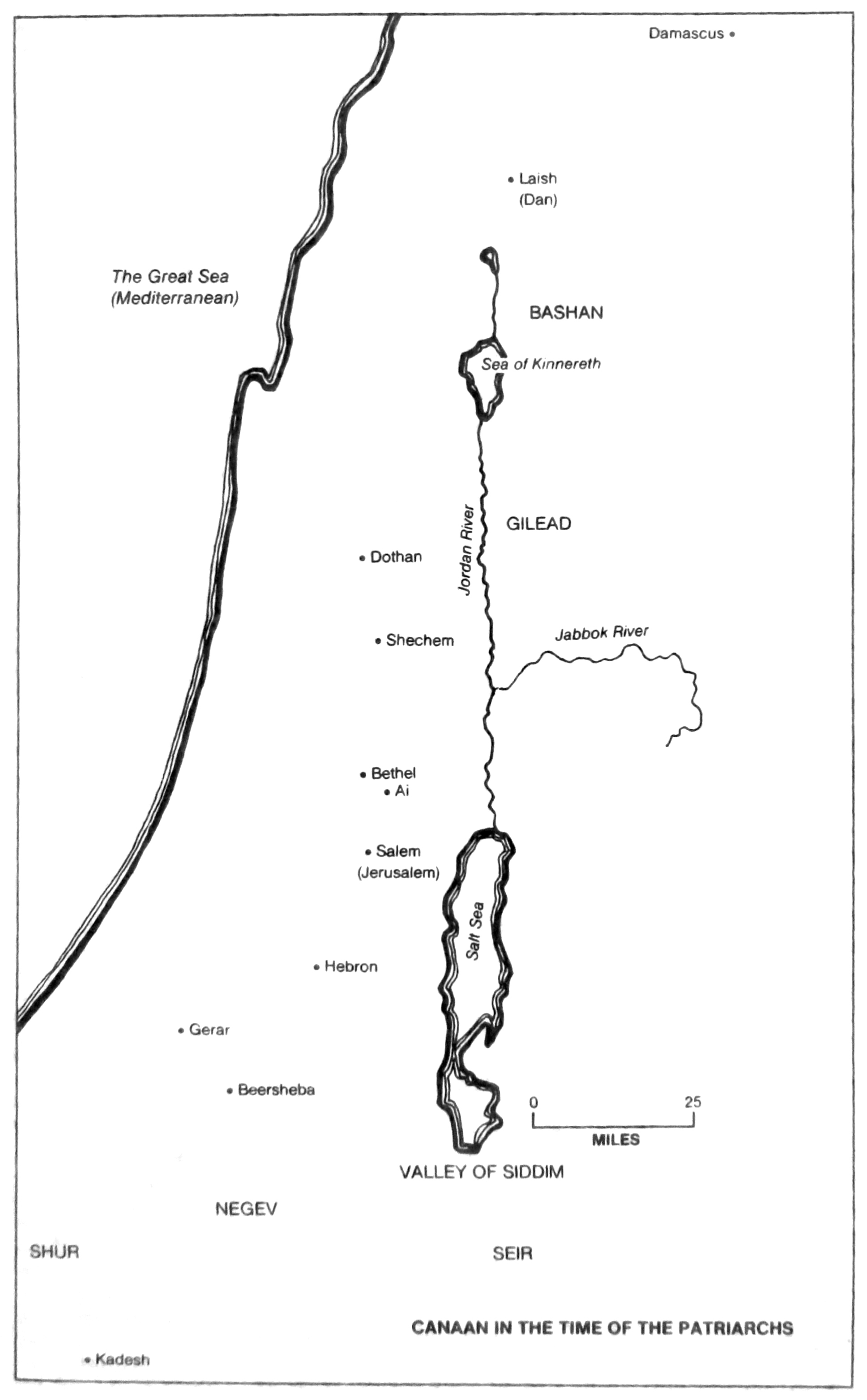
Patriarchal Canaan, from Bible Knowledge Commentary

(Gen 12:1-3 and numerous other references: 17:4-8; 22:15-18; 26:3-4; 28:13-15) With this Covenant, God established Israel as His Holy People. The “contract” was described to Abram (later called Abraham) by God and then was formalized by Him in the manner of ancient treaties (Gen 15). Years later, the terms of the Covenant were repeated and expanded, and Abraham responded by circumcising himself and the male members of his household (Gen 17). Still later, it was ratified with Isaac (Gen 26) and Jacob (Gen 28). One more restatement and clarification of the Abrahamic Covenant was delivered through Moses (Deut 30). In this important passage, God ties the Abrahamic and Mosaic Covenants together and states that Israel’s enjoyment of the Abrahamic promises will ebb and flow insofar as they incur the blessings and curses of the previous chapters of Deuteronomy.

It is important to note that the Abrahamic Covenant did not apply to Isaac’s siblings, nor to Jacob’s, but it did apply to Jacob’s 12 sons and all their physical descendants. There is pretty much unanimous agreement outside of Covenant Theology that this is an unconditional and unilateral Covenant between God and Abraham, Isaac, Jacob, and Jacob’s descendants.

The period from Abraham to the Exodus is said by some to be “The Dispensation of Promise“, in which man’s relationship with God was supposedly governed by man’s faithfulness in living up to God’s behavioral expectations in light of the promises made to the Patriarchs. This is perhaps expressed in Gen 18:19 (CJB) “For I have made myself known to him [Abraham], so that he will give orders to his children and to his household after him to keep the way of ADONAI and to do what is right and just, so that ADONAI may bring about for Avraham what he has promised him.” Yet, I think that this brief parenthetical passage is meant merely to explain God’s rationale for giving Abraham the opportunity to intercede for Lot and his family.

The Mosaic/Sinaitic Covenant

Jebel Musa, the traditional site of Mt. Sinai. ©2017 Oak Tree Software

(Ex 20 and, by extension, most of Exodus through Deuteronomy) This is the most widely known of the Old Testament Covenants, but at the same time it is one of the most misunderstood, for several reasons. In brief:

  • The Covenant was not set up to enslave the Israelites or make their lives difficult, but rather to give them a sense of purpose and unity and to set them apart from other peoples, in a special relationship with God.
  • Christians tend to think of this as a works-based Covenant, and over the ages there have indeed been many Jews who have followed its precepts legalistically, but Scripture does not support that view. Salvation has always been by God’s grace.
  • The Hebrew word Torah means “teachings“. The Greek nomos indicates “that which is assigned or parceled out” What the Covenant dispenses is a fuller understanding of the nature and will of God, and the conduct that He demands from His elect people, Israel to set them apart from other peoples.
  • Orthodox rabbis count 613 commandments in Torah. Observance of these mitzvoth is a response of faith, never a means of salvation.
  • Deuteronomy” is from a Greek term meaning “Second Law”, but that is not what it is. The Hebrew name of the book is D’varim, meaning “words”, or “matters”. As with other books of the Torah, it is derived from the first sentence, in this case, “These are the words that Moses Spoke…Exodus through Numbers provided history about and guidance for the Israelites as pastoral nomads in the period between the Exodus and the Conquest. Deuteronomy is reinforcement, and adjustments for a settled, agrarian lifestyle in the Promised Land.
  • Christian statements like “we were once under Law but are now under Grace” and “we are bound by the moral law, but not the civil or ceremonial” are meaningless, because non-Jews were never bound by the Mosaic Covenant. When Paul said, “you are not under Law but under Grace”, he was speaking to non-Jewish Believers who were never bound by the legalism of Torah observance.
  • Like each of the other Covenants, it is unilateral.
  • Also, like each of the others, it is unconditional. Disobedience forfeits blessings and brings on curses, but it doesn’t cancel promises (see Deut 20 and nearly all of the Prophetic Books)! Like every other Biblical Covenant, the Mosaic is still effective for the people to whom it was addressed.

The period from Moses to Jesus is said by many to be “The Dispensation of Law“. Both classical and modern Dispensationalists—in fact I think most Christian theologians—believe that the Mosaic Covenant was conditional, and that it was cancelled by God because “the Jews refused to recognize their Messiah.” Many Dispensationalists localize this nullification to Mt 12, especially vs 24, where some Pharisees accused Jesus of being Satan, thus committing the “unpardonable sin.” Others place it at Jn 19:30, when Jesus, on the Cross, said, “It is finished.”

The Davidic Covenant

(2Sam 7:11-16) Though at first glance this is a Covenant with the House of David alone, God told David, “Your house and your kingdom will be made secure forever before you” in verse 16. My conclusion is that it therefore falls into line with all the other Covenants I am covering here in being unilateral, unconditional, and unending.

Dispensationalists, in general, don’t see a new dispensation here.

The New Covenant

(Jer 31:31-34 and elsewhere). As stated very clearly in vs 31, this Covenant is with the two kingdoms of Judah and Israel. It is not a Church Covenant, though the Church also benefits.

Note well: The Mosaic Covenant was never a failure! It did no less—and no more—than God intended. Without the internalization of the Holy Spirit there was never a chance that God’s people could live up to His demands and standards, but it taught them His nature, and what those demands and standards look like.

What the New Covenant added for Israel includes an internalized Holy Spirit; national regeneration; universal Jewish salvation ate the end of Tribulation; regathering to the Land; restoration of the Kingdom; and a return of God’s Sh’kinah to a glorious Millennial temple. Plus, a breaking down of barriers between Messianic Jews and non-Jews in the Church.

For Israel, the New Covenant is, like the others, unilateral, unconditional, and unending. For believing non-Jews, the benefit is a grafting into Israel, as part of God’s New Testament Church.

The period between the Acts 2 Pentecost and the Rapture is considered by Dispensationalists to be the Dispensation of Grace. This term is an obsolete holdover from the days when most Christian theologians considered the Church to be “under grace” and pre-Christian believers to be “under law”. Paul did frequently mention being “under law”, but he was most surely not talking about people being saved by keeping “the Law”. Rather, the precepts, or commandments, of the Mosaic Covenant were to be a response of obedience by a righteous Jew. Keeping the Law to appear righteous was, and is, hypocrisy. Some Dispensationalists are now calling the present age the Dispensation of the Church.

The Millennial Reign of Messiah

This period is not defined by another Covenant but is instead the culmination and combination of all the Covenants. Since there will be a new Temple, as described by Ezekiel, and since there will be sacrifices in that Temple, some theologians assume that the Mosaic Covenant will be reinstated during this thousand-year period. My own belief is that the Mosaic Covenant never came to an end and is still in effect today. I believe that ethnic Jews, even as members of Christian churches or Messianic Congregations, should be “observant”, or “keeping the Law.” Few are, and since this doctrine is basically unknown today, I’m not critical of righteous Jews who ignore it.

To Dispensationalists, the seventh and final dispensation is appropriately called, the Kingdom Dispensation, or alternatively, the Messianic Dispensation.


The Transfiguration and “Jewish Law”

Posted on:

Modified on:

  1. First Fallacy: Trichotomous Law
  2. Second Fallacy: Jesus “did away” with the Law by Fulfilling it
  3. Third Fallacy: “It is finished” on the cross referred to the Ceremonial Law
  4. Fourth Fallacy: Jesus literally absorbed Moses and Elijah

Several Sundays ago, my wife and I attended a church in our area that we hadn’t visited in many years. The sermon was delivered by a stand-in—a naïve young associate pastor. He preached on the Transfiguration, Matthew 17:1-13. Being a Baptist, his main point was that salvation is by God’s grace, through faith in Jesus. That much was fine, of course, but at least half of his sermon was designed to show that the purpose of the Transfiguration was to demonstrate that Judaism is dead, not only in the soteriological sense, but in its entirety.

I want here to comment on four points he made that I regard as theologically ridiculous. I’ll spend quite a bit of my space on the first two, because they are common misconceptions in Christianity. The last two, I don’t believe to be commonly held interpretations, so I’ll do little more than mention them.

First Fallacy: Trichotomous Law

The young pastor repeated a theory I have come across many times since I was a young man—that “Jewish Law” is composed of three categories of commandments: “Moral Law“, “Civil Law“, and “Ceremonial Law“. There are hints of this in Augustine of Hippo, but I think the idea was fleshed out mostly by Thomas Aquinas, so it became a Roman Catholic and Orthodox view. It was later bequeathed to Protestant Reformed theology by John Calvin in his Institutes of the Christian Religion; and many subsequent non-Reformed Protestant denominations and individual pastors have adopted the idea as well. The impetus for these teachings was probably an effort to justify claims that Christians are not bound by Civil and ceremonial Law, while at the same time holding that the Moral Law is somehow “still in effect”.

I categorically reject this idea! It is a Christian misinterpretation of Jewish concepts that are difficult to understand without a more than cursory acquaintance with Hebrew cultural nuances. For example, a proof text used relies on the differentiation between terms in Deuteronomy 6:1 and similar verses, which do indicate a threefold differentiation—that is, shades of meaning—within the 613 commandments listed in Scripture; however, these categorizations are not between the moral, the civil and the ceremonial, but rather between what we might term enacted laws, regulations, and court rulings:

Chapter 6 (CJB)
[6:1] “Now this is the mitzvah [commandment; law; ordnance; or precept], the choqim [statutes; enactments; or decrees] and mishpatim [rulings; judgements; sentences; or findings] which ADONAI your God ordered me to teach you for you to obey in the land you are crossing over to possess…

With very few exceptions, Jewish scholarship going back to Talmudic days does not differentiate categories of “Law” in the way this young pastor presented them. The sages did not and do not recognize these categories, only a unified whole of written Biblical Law, plus an entirely separate body of oral tradition.

What does the Bible actually say to us, as Christians? Well, first of all, it never told non-Jews to follow Jewish Law or observe Jewish customs! Torah was given to those under the Abrahamic Covenant in order to set a people, the Jews, apart from non-Covenant peoples. It is said that “we used to be under Law, but now we’re under Grace”, but “we”, the non-Jewish, were never under Law, and salvation has always been by God’s grace, through faith. Law-keeping, even the sacrifices, never saved a Jew from God’s judgement—those were, and in fact were recognized by the Jews as, acts of obedience, and contrition for sin.

So, why do we Christians keep some of these “Laws” but not others? Because we are moral, spirit-directed individuals, and the moral principles we follow are common sense, even to most non-religious folks—”Natural Law”, if you please.

The New Testament halachic (legal—see below) requirement for the Church was decided at the First Church Council, at Jerusalem, as recorded in

Acts 15:19-21 (ESV):
[19] Therefore my [James’] judgment is that we should not trouble those of the Gentiles who turn to God, [20] but should write to them to abstain from the things polluted by idols, and from sexual immorality, and from what has been strangled, and from blood. [21] For from ancient generations Moses has had in every city those who proclaim him, for he is read every Sabbath in the synagogues.

These four prohibitions are similar to, and encompass, the Noachide Laws—six commandments given to Adam in the Garden, plus a seventh added after the flood. The principles given address practices that are abominable to Jews and are regarded by the Rabbis as the minimum prohibitions necessary for Jewish fellowship with non-Jewish believers.

Second Fallacy: Jesus “did away” with the Law by Fulfilling it

He also repeated the interpretation that “The Law” was simply a picture of what Jesus would accomplish on the cross, and that by His crucifixion, He “fulfilled the Law”, and thus did away with it, i.e., “The Law”, having been “fulfilled” has “passed away”; but, just the Civil and Ceremonial portions, not the Moral Law, which is “still in effect, because God, after all, obviously still demands morality.” This, he bases on

Matthew 5:17 (ESV):
[17] “Do not think that I have come to abolish the Law or the Prophets; I have not come to abolish them but to fulfill them.”

“The Greek term translated “abolish” above is kataluo [to demolish, halt, destroy, dissolve, come to naught, overthrow, or throw down]. But isn’t that what the book of Hebrews says happened? No, what it says is that Jesus is an intrinsically better mediator than the High Priest and a better expiation than the sacrifices. Both of these, it says, are “passing away”, and in fact, that is exactly what happened in AD 70 when Titus destroyed the Temple. But Jewish Law is far more than just the high priesthood and the sacrifices.

So how does that differ from “fulfill” if Jesus replaced the whole system of Judaism by “fulfilling the Law”? But that is not what “fulfill” implies here, in Matthew 5:17! The Greek for that concept is pleroo [to satisfy, execute, finish/complete, verify, accomplish, fulfill, carry out to the full, fill up, fully preach, or perfect]. So evidently Jesus did not replace “The Law or the Prophets”, but rather explained and strengthened them.

Nomos vs. “the Law or the Prophets”: Throughout the New Testament, nomos is understood to be a translation of the Hebrew Torah, and most English translations then render nomos as “law”. Vines defines nomos as that which is “divided out”, “distributed”, or (primarily) “assigned”, which is a bit ambiguous. Strong’s generally defines the term based on its prior translations in Scripture, i.e., “the law of Moses”. but he does include “parceled out”, which is closer to Vine.

To understand it more correctly, let’s go right to “the horse’s mouth”: the Hebrew term “Torah“. English translations of this word in Scripture generally depend heavily on the translators’ Hellenized understanding of nomos, so once again, we get “law”. In a very narrow sense, legal principles can be included, but Jewish speakers and Jewish literature render the term as “teachings“; in other words, “principles” in the sense of imparted knowledge about God, His Creation, His Will, and anything else He wishes us to know. Legal tenets, whether Scriptural or traditional, would be distinguished as “halacha“, which translates literally as a “way of walking” (compare Paul’s discussions of our “Christian Walk”).

Torah, like many Hebrew words, can have many shades of meaning, which can only be distinguished by context and customary usage. Sometimes it refers to all of God’s teachings. Often it specifically means the chumash, or Five Books of Moses; often it includes all books of the Tanach (Old Testament), and Messianic Jews often include the Brit Hadasha (New Testament), as well. Indeed, Jesus Himself is the very embodiment of Torah (John 1:1).

Much of the confusion here arises because a large portion of Christianity has arrogantly decided that Judaism failed God, so God took back his Covenant promises to Israel and conferred them on the Church instead; therefore, if the Old Testament has any meaning to us in the Church, it is only metaphorical, or symbolic. For example, to Reformed Christianity, God’s commandment to circumcise male children becomes a commandment to baptize infants!

Here is what Jesus said would result from any attempt to “throw out the Law”:

Matthew 5:18-19 (CJB)
[18] Yes indeed! I tell you that until heaven and earth pass away, not so much as a yud [jot, yodh] or a stroke [serif, tittle] will pass from the Torah—not until everything that must happen has happened. [19] So whoever disobeys the least of these mitzvot and teaches others to do so will be called the least in the Kingdom of Heaven. But whoever obeys them and so teaches will be called great in the Kingdom of Heaven.

 To me, that’s pretty clear!

Third Fallacy: “It is finished” on the cross referred to the Ceremonial Law

Jesus’ last words, “It is finished” referred to the “Ceremonial Law”. Some Dispensationalists believe that these words were spoken by Jesus to pronounce a renunciation of the Mosaic Covenant and the end of the so-called “Dispensation of Law”. What Jesus “finished” (brought to its fullness, not ended!) was His ministry on earth, laying the soteriological foundation for the New Covenant and the Kingdom of God.

Fourth Fallacy: Jesus literally absorbed Moses and Elijah

Bizarrely, he stated that when the three apostles looked back up and saw Jesus alone, He had literally “absorbed” Moses and Elijah, to show that the OT system of Judaism was no more.

Matthew 17:8 (CJB)
[8] So they opened their eyes, looked up and saw only Yeshua by himself.

No. They simply left!