
Posted on:
Modified on:
In Genesis 1:1–5, Day 1 and a number of earlier posts I presented a case for Old Earth Creationism and why I believe that Genesis 1 can only be interpreted as a visionary prophetic revelation, not a literal historical account.
In a follow-up post, Moshe’s Week of Dreams, I presented a hypothesis as to why Genesis 1 reads as it does: My suggestion is that, in a series of six visionary dreams, Moses received revelation of God’s solo role in creation. Not “how I did it”, but “it was I, and I alone, who created everything that is!”
Most recently, in After the Dreams: Day 7 Thru Seth, I did a follow-up expository study on chapters 2 through 4 of Genesis, concentrating on issues that I think are poorly understood—doctrinal fallacy based on traditional assumptions, not on solid Biblical evidence. Some topics discussed:
- The origin of angels.
- The function of the Garden.
- The nature of the Serpent.
- Satan as a name vs satan as a function.
- Were the animal skins a blood sacrifice?
- The closing and fate of the Garden.
- Why Cain’s offering was rejected.
I’m going to continue that survey here, covering the rest of pre-Flood Biblical history.
My plan currently is to finish the series with a post on the recovery from the Flood, the Tower of Babel and its consequences, and the identity and life of Nimrod.
Introduction: extrabiblical sources
The entire subject matter that I want to cover in this post and the next, with the exception of the Flood story, are given very limited coverage in the Bible itself. I believe that a better understanding of these topics can be reached using non-Biblical literature from the Second Temple period through the early Rabbinic period, meaning, for my purposes, primarily the 4th century BC through the 4th century AD.
I have heard Christians at Bible Studies say, “If it isn’t in the Bible, then I’m not interested.” I understand that they are speaking from their love of God and their faith in His Word. For most Christians, that is a commendable attitude. I would suggest, though, that these folks don’t understand how pastors, teachers, and Christian authors, as well as entire local churches and denominations, work.
Not everything in the Bible is crystal clear. Every entity I just listed has an official doctrinal stance and a vast body of tradition, hopefully founded on Scripture, but understood with the help of extrabiblical supplementation.
Every lesson taught, every sermon preached, every book written by even the most devout and Bible-oriented human being expresses the viewpoint of that individual, as formed by the Bible but influenced by other factors in his or her personal environment. Nobody agrees fully with anyone else, and nobody gets everything right.
Concerning written influences:
Those ccepted by most teachers
Most Sunday School classes and Bible studies supplement their Bibles with quarterlies, workbooks, topical books and expository works by popular writers, and so on. Some are quite good, others abysmal. Most good sermons are prepared with the help of Bible commentaries and dictionaries, lexicons, theological guides, and multiple translations of the Scripture itself. Sometimes secular encyclopedias, history books, cultural studies and maps are used.
A lot of the material I just listed is very helpful, but none of it is inerrant!
Most of the time, you don’t know where your pastor, teacher, or your favorite blogger is getting supplemental source material.
Those less accepted by Evangelicals
Other information sources may be far less trusted by Evangelical Christians because of sectarian bias or ignorance of their content, but they are often still useful. The sources from this selection that I am most likely to use on occasion fall into several categories:
Rabbinical writings
This category seems to be anathema to many Evangelicals. Not because they revile Jews, necessarily, but because they view Judaism as something that Jesus rendered obsolete and therefore void of any value to Christians. My view is directly opposite. I don’t think that one can fully understand Christianity without also understanding Judaism. I find the Talmuds and other Jewish theological works, both early and modern, to be incredibly useful.
Apocryphal works
I am using that term here in a general sense to include the books known formally as “the Apocrypha“, many of which are considered canonical to some major denominations, plus other Second Temple writings, many of which are termed “Pseudepigraphal” because they purport to be written by someone other than the true author.
I consider these documents in general to be “historical fiction“, containing important seeds of truth. The dialog in these texts is somewhere between exaggerated and completely fanciful. The plot and historical background originate from, I believe, a combination of (a) canonical Scripture, (b) older written history, and (c) verbally transmitted lore. Use them with caution, but don’t ignore them!
Perhaps the best known of such works are the pseudepigraphal book, 1 Enoch, and The Book of Giants from the Dead Sea Scrolls. These two works, in particular, were accepted as truth, at least in part, by many intelligent and educated wise men of the ancient world, including some of the Church Fathers of the Patristic Age. I am using them extensively for this particular post.
Other ANE sources
Additionally, since the earliest cuneiform and hieroglyphic writings in some of the earliest civilizations, the legends of the Ancient Near East (ANE) have been faithfully recorded. Since they write about some of the same events as are found in the Bible and ancient Jewish extrabiblical texts, they provide outside confirmation and often suggest additional clarifying information.
Creation, “angelic” sin, the Nephilim, the Flood, the Tower, and the confusion of tongues are all topics I’m covering in this series that are both Biblical and widely reported in the greater ANE. Neither the Bible nor the legends are copycats; both reflect a common body of ancient memory.
Patristic work
These are the writings of the so-called Patristic Church Fathers in the early centuries after the dispersal of the Biblical apostles and the destruction of the Temple. These works are revered by Catholics, Orthodox denominations, and some Protestants. Certainly, these men contributed in huge ways to early Church theology. Personally, I find myself often taking sides against their theological conclusions, but I do profit from their thoughts and the history contained in their work.
Seth’s line
Genesis 4:25–5:32
This passage is a somewhat lengthy genealogy of Adam, from Seth through Noah. It serves as a toledah separating the Cain and Abel narrative from the corruption story. Even the genealogies of the bible are interesting to me, and I quote this one in full!
Reminder: A toledah (plural toledoth) is a passage in Genesis that (a) announces itself, when translated, as a “genealogy” or some related noun; and (b) serves as a notice that the subject of the text is changing. Think of them as Noah’s chapter headings.
25 And Adam knew his wife again, and she bore a son and called his name Seth, for she said, “God has appointed for me another offspring instead of Abel, for Cain killed him.” 26 To Seth also a son was born, and he called his name Enosh. At that time people began to call upon the name of the LORD.
1 This is the book of the generations of Adam. When God created man, he made him in the likeness of God. 2 Male and female he created them, and he blessed them and named them Man when they were created. 3 When Adam had lived 130 years, he fathered a son in his own likeness, after his image, and named him Seth. 4 The days of Adam after he fathered Seth were 800 years; and he had other sons and daughters. 5 Thus all the days that Adam lived were 930 years, and he died.
6 When Seth had lived 105 years, he fathered Enosh. 7 Seth lived after he fathered Enosh 807 years and had other sons and daughters. 8 Thus all the days of Seth were 912 years, and he died.
9 When Enosh had lived 90 years, he fathered Kenan. 10 Enosh lived after he fathered Kenan 815 years and had other sons and daughters. 11 Thus all the days of Enosh were 905 years, and he died.
12 When Kenan had lived 70 years, he fathered Mahalalel. 13 Kenan lived after he fathered Mahalalel 840 years and had other sons and daughters. 14 Thus all the days of Kenan were 910 years, and he died.
15 When Mahalalel had lived 65 years, he fathered Jared. 16 Mahalalel lived after he fathered Jared 830 years and had other sons and daughters. 17 Thus all the days of Mahalalel were 895 years, and he died.
18 When Jared had lived 162 years, he fathered Enoch. 19 Jared lived after he fathered Enoch 800 years and had other sons and daughters. 20 Thus all the days of Jared were 962 years, and he died.
21 When Enoch had lived 65 years, he fathered Methuselah. 22 Enoch walked with God after he fathered Methuselah 300 years and had other sons and daughters. 23 Thus all the days of Enoch were 365 years. 24 Enoch walked with God, and he was not, for God took him.
25 When Methuselah had lived 187 years, he fathered Lamech. 26 Methuselah lived after he fathered Lamech 782 years and had other sons and daughters. 27 Thus all the days of Methuselah were 969 years, and he died.
28 When Lamech had lived 182 years, he fathered a son 29 and called his name Noah, saying, “Out of the ground that the LORD has cursed, this one shall bring us relief from our work and from the painful toil of our hands.” 30 Lamech lived after he fathered Noah 595 years and had other sons and daughters. 31 Thus all the days of Lamech were 777 years, and he died.
32 After Noah was 500 years old, Noah fathered Shem, Ham, and Japheth.
—Genesis 4:25-5:32 (ESV)
Terminology
Just a few comments here on the terminology for man, mankind, etc. In the quotations below, I have underlined some that I find especially interesting.
- The first few chapters of Genesis introduce us to the principal Hebrew words for man and mankind.
1 This is the book of the generations of Adam. In the day that God created man, in the likeness of God made he him; 2 Male and female created he them; and blessed them, and called their name Adam, in the day when they were created.
Genesis 5:1-2 (KJV)
What does it mean by “called their name Adam“? The three words underlined above are all the same Hebrew word, אָדָם, transliterated as “adam“, and pronounced “ah-DAHM”. This is a generic term for “man”, “mankind”, or “human.” Though it is the same word exactly, Strong’s has assigned a separate index number for it when it is used as the personal name of the man in the Garden, Adam. Hebrew has no alphabetic case, but later English translations sometimes use a lower-case “a”, “adam”, for the generic “mankind” usage.
“Adam” comes from a Hebrew root meaning “red.” As does the related word אֲדָמָה (adamah), meaning “earth”, referring not to the planet, but rather to the ground, especially (over 200 times in the Old Testament) to tilled land, productive soil, or Israel’s productive land in particular.
Adam was formed from the dust of the adamah. I take this to mean, specifically, from soil in the fertile but arid ground where God subsequently planted the Garden.
- Another term for the “man” concept is used Genesis 3, when Eve is made from Adam’s rib:
23 And Adam (Adam) said, This is now bone of my bones, and flesh of my flesh: she shall be called Woman (ishshah), because she was taken out of Man (ish).
—Genesis 2:23 (KJV)
This time, “man” is אִישׁ (iysh or ish, pronounced eesh). It is a more formal word for a particular man or men, often meaning “husband”, as implied here. It is also used, for example, in Gen 6:4 in reference to “mighty men [הַגִּבֹּרִ֛ים, haggibborim, “the mighty warriors”], which were of old, men [iysh] of renown.”
It makes some kind of linguistic sense that being taken out of “man” makes her “woman”, but how does that work in Hebrew? In Hebrew, “woman” is אִשָּׁה (ishshah, pronounced eesh-SHAH).
- Yet another term related to iysh is found here:
[6] And when the woman saw that the tree was good for food, and that it was pleasant to the eyes, and a tree to be desired to make one wise, she took of the fruit thereof, and did eat, and gave also unto her husband (enowsh) with her; and he did eat.
—Genesis 3:6 (KJV)
In this case, the Hebrew is אֱנוֹשׁ (enowsh, pronounced eh-NOHSH), meaning something more like “mortal man.” A bit derogatory. Think of it as, “Uh, just a guy.”
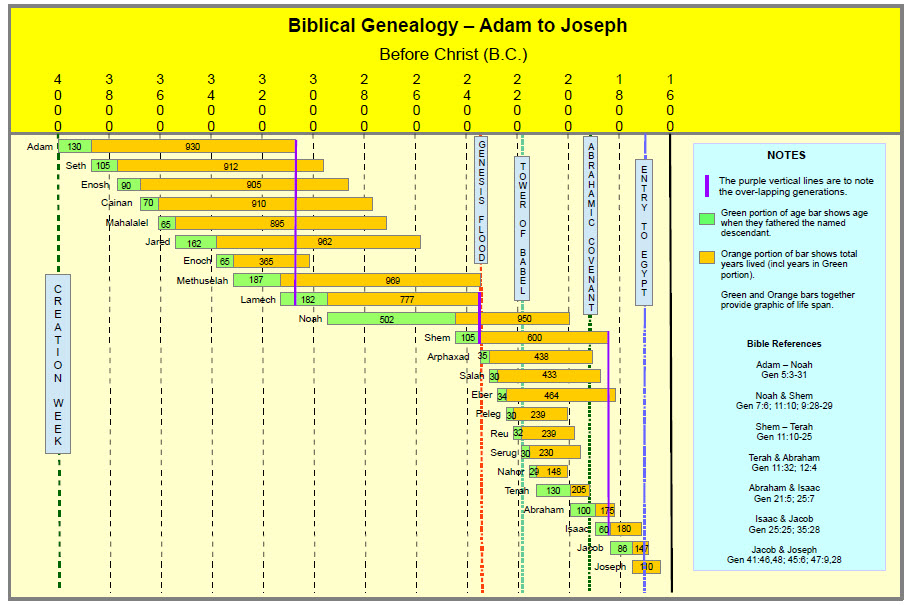
Timeline
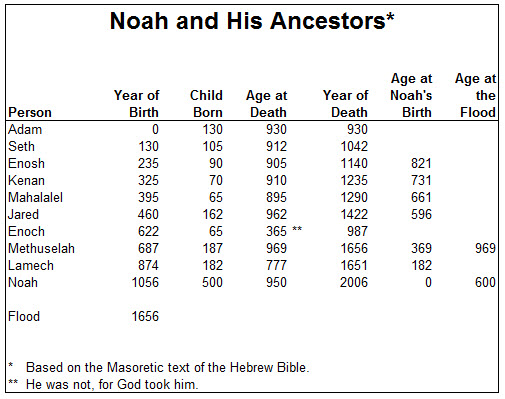
I prepared the above chart many years ago, from one of the many English translations based on the 11th century AD Masoretic Text of Genesis. The Masoretic Text is a compendium of the earliest extant Hebrew manuscripts of the Old Testament and Apocrypha that were available prior to discovery of the Dead Sea Scrolls. English language Bibles from both Christian and Jewish translators are usually based on the Masoretic Text.
The Dead Sea Scrolls, copies penned between roughly the 2nd century BC through the 1st century AD, are more fragmented, but comparisons demonstrate that relatively little corruption has degraded the much later Masoretic source manuscripts.
The chart below shows the principal lines of descent through Adam’s three sons, Cain, Abel and Seth. Note that there were other sons and daughters born at each level of the genealogy (see, for example, Gen 5:4). At least one ancient source suggests that Adam, for example, had 30 sons and 30 daughters, thanks to his long breeding cycle.

I believe that this genealogy is accurate as listed in Genesis, but it is possible that some generations are skipped for one reason or another. In my next article, as part of my discussion of Nimrod, I will provide more context on the flexibility of the Hebrew term translated “begat.” Even theologian John Witcomb, Henry Morris’ coauthor of The Genesis Flood, acknowledged that possibility and mentioned that it could potentially push Ussher’s proposed creation week back in time several thousand years. The wording of the genealogy makes me doubt that but see below for other potential sources of error.
Additionally, as an Old Earth Creationist, I believe that God’s human creations in Genesis 1:26 predated Adam and Eve (see Moshe’s Week of Dreams). When the latter were driven from the Garden, they joined the older races, who had by then spread throughout at least the Eastern Hemisphere. These are the people who Cain thought might kill him, and from whom he obtained a wife.
Intermarriage between Adam’s race and the old races was probably frequent before The Flood, and that would explain why the genome of modern humans, descended from Noah and his wife, still contain traces of even Neanderthal DNA.
Alternate sources
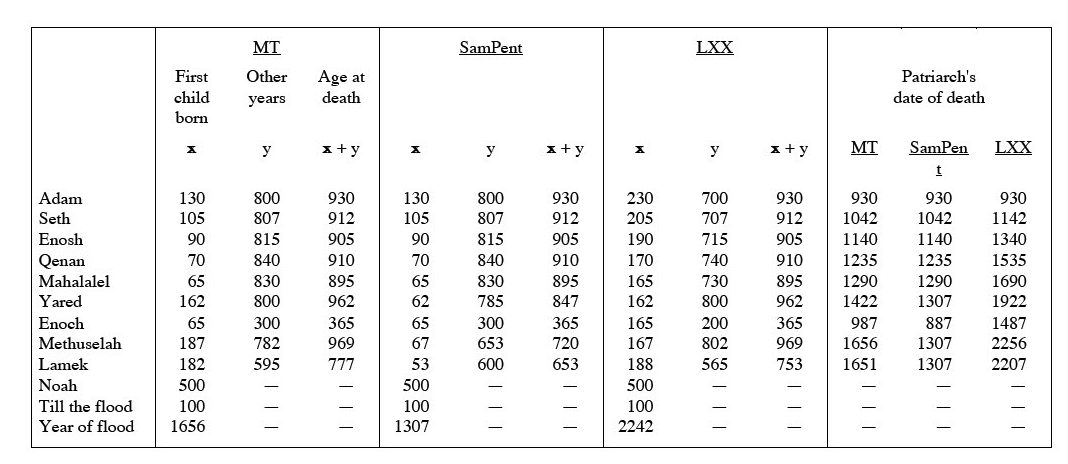
The chart below, from the World Bible Commentary, presents the same information as my chart, but adds columns based on two other important sources, the Samaritan Pentateuch and the Septuagint (LXX).
The Septuagint is a translation of the Hebrew Scriptures into Koine Greek by Jewish scholars living in Alexandria, probably beginning in the early 3rd century BC and completed by 132 BC. The name of the translation derives from traditional belief that there were 70 to 72 translators. The “abbreviation”, LXX, is by convention read like an acronym (“el-ex-ex”), but of course it is actually the Roman numeral 70.
The LXX is an extremely important source because the New Testament writers, including Paul and the Gospel authors, used it almost exclusively when quoting the Tanakh (Old Testament), and because very early copies exist. I don’t often quote from English translations of the LXX (though I do in this article), but I use it extensively for comparative research.
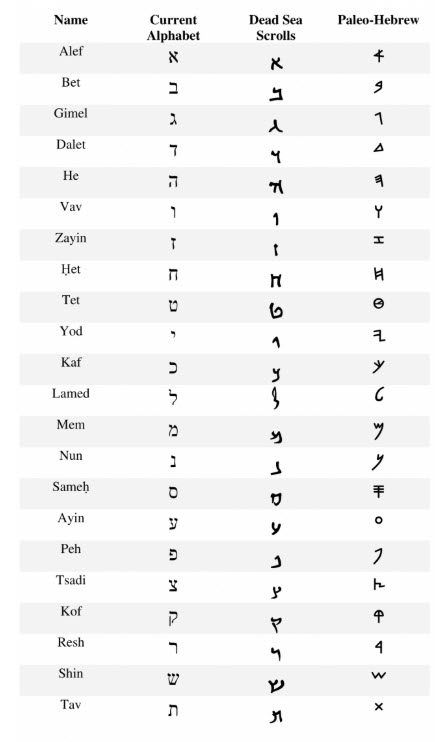
The Samaritan Pentateuch is another widely used early manuscript of the Old Testament. It was written in a Samaritan dialect of Hebrew and Aramaic, using the earlier Proto-Hebrew alphabet. It is dated from as early as the Late Hasmonean or Early Roman period, and as late as the 4th century AD. Most of this document is similar to the Masoretic and LXX, but there are a few important differences where edits were made to justify Samaritan doctrinal variations. I don’t use this at all because I don’t have an English translation. I do have a Hebrew version, but though I can translate Hebrew myself, it is a slow and arduous process at my level of fluency.
It is interesting that the Samaritan numbers show Jared (Yared), Methuselah and Lamek all dying in the year of the flood.
Chronological uncertainties
You will note from the chart above that there are significant differences in the chronologies shown in the various columns. Let’s ask ourselves what the figures in this table tell us about, for example, the accuracy of Archbishop Ussher’s Biblical dating? I am an Old Earth Creationist, but I’m quite willing to put God’s formation of Adam and Eve somewhere around 4004 BC.
Observations:
- Most of the entries from the Masoretic (MT) text are multiples of 5 years. This is too many to be coincidental, suggesting that the figures are rounded off to the nearest five years. Three of the entries for age at first son’s birth and two for years of life after first son’s birth are adjusted to nearest five + seven, for reasons that aren’t known.
- The entries for the Samaritan columns are the same as MT for five generations, rounding included, then deviate for all the rest except Enoch and Noah. In two instances, the seven-year adjustment is a subtraction. In three of the last four generations, total life span is significantly different from other sources, so we now have to ask which text is flat-out wrong.
- The LXX agrees closely with the Samaritan in general. In eight of the first nine generations, it has the age at first son a century later, but in six of those cases the father’s age of death is the same.
Conclusions:
- By definition, there was probably only one original “autograph” of Genesis. Every manuscript after that was a hand copy until Gutenberg’s press. Every copy made introduced the possibility of “scribal error.” Fortunately, comparisons between manuscripts of widely varying age have shown very few and minor discrepancies. Not too surprising because there was always a very rigorous review process because of the theological necessity for accuracy.
- I would suggest that there is far more likelihood of scribal errors in Biblical numbers than in alphabetical text. The reason is that Hebrew does not have numerals! Like so-called “Roman Numerals,” Hebrew “numerals” are composed of alphabetical characters assigned numeric values. Consequently, working with numbers in a Hebrew document is cumbersome. As much or more so, in fact, than Roman Numerals in Latin text.
- Ussher’s calculations were supposedly accurate to year, day and even time of day. Ten generations of round-offs makes a mess of that theory!
Patriarchal longevity
We all know that the life spans of Adam’s descendants were much higher before the flood than after. There was a hyperbolic decline after the flood, rapid at first, then more and more gradual, stabilizing after the Conquest of Canaan.
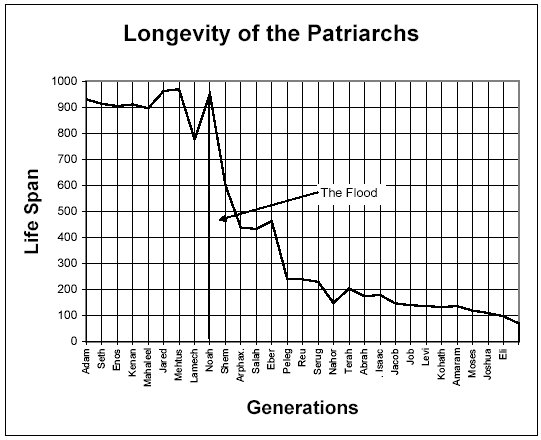
Why? One can only speculate. Most such guesses blame it on decreasing health and increasing pestilence brough on by increasing sin. But the biggest increase in sin came before the flood, and the graph above shows no decrease in that time span. Lamech’s “short” life is an anomaly easily explained by the violence of the age.
The next graph shows the decline from Noah forward:
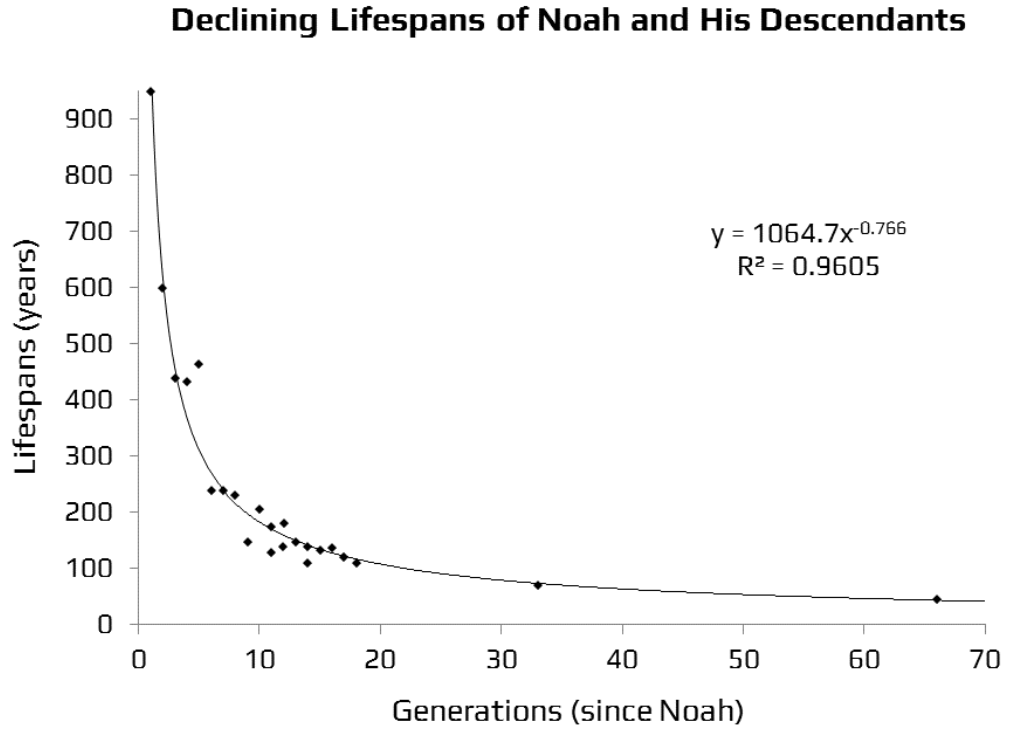
To me, the second graph looks like an equilibrium chart. Here’s another of my totally speculative scenarios:
- Some 5.5 billion years after the formation of the planets from the sun’s accretion disk, earth had more or less stabilized. The last globally catastrophic event was the Chicxulub asteroid impact off Yucatan 66 million years ago. That event caused so much climate disruption and destruction to the global ecosystems that 75% of all plant and animal species on earth at the time went extinct. Including most dinosaurs.
- With God’s nudging, the adaptive capabilities that He had built into His living creations were able to heal the damage caused by the asteroid impact and push the mammals, including ancient mankind, into a position of supremacy.
- God “planted” Adam and Eve in the Garden 6,000+ years ago. Perhaps a bit earlier, depending on translational issues and whether or not generations are skipped in the genealogy for any reason. Clearly (based on the rounded data points), absolute accuracy in the numbers was not attempted by the human authors of the Bible.
- Despite the terrible sinfulness that developed over the course of the antediluvian earth, there appears to have been no consequent reduction in human lifespan during the time.
- The Flood, discussed below and in previous articles, I believe to have been brought about supernaturally when God caused the vast quantities of water known to be contained in the earth’s mantle transition layer to be flushed out into the oceans through volcanos on the midoceanic ridges.
- It is conceivable to me that the unprecedented activity of the submerged volcanoes could have triggered or hastened atmospheric changes that caused lifespans to get shorter and shorter over the succeeding several hundred years.
Alternatively, perhaps around the time of the flood, God simply triggered DNA changes that shortened human lifespans over that time frame.
Note, however, that the extreme longevity recorded for the Biblical patriarchs did not necessarily apply to anyone else during the period! The assumption that all mankind was long-lived has been incorporated into Judeo-Christian tradition without Biblical support.
Corruption
Genesis 6:1–8
[5] The LORD saw that the wickedness of man was great in the earth, and that every intention of the thoughts of his heart was only evil continually.
—Genesis 6:5 (ESV)
The first Period of Corruption, which I’ll cover here, extends from Cain, presumably from some time before his ill-fated offering and subsequent murder of Abel, until the Great Flood, traditionally, per Ussher, around 2348 BC.
Why was there so much corruption on earth during that period? Is it just because of paganism and the brutality of prehistoric times? Perhaps, but prehistoric peoples had to work very hard to survive, so how did they find the time and why would they waste that much energy doing unproductive things?
Logic would seem to dictate that life then, for them, would be somewhat like one typically finds in the modern era when isolated pockets of stone age villages are found in undeveloped areas of the world.
I will attempt below to show that the post-Eden world started out more or less like I would have expected, but probably during the lifespan of Jared, conditions changed radically due to a barely imaginable external stimulus that changed the world in ways that still affect us today.
Most of this will be new to most of you.
Second celestial rebellion
[6:1] In time, when men began to multiply on earth, and daughters were born to them, [2] the sons of God saw that the daughters of men were attractive; and they took wives for themselves, whomever they chose. [3] ADONAI said, “My Spirit will not live in human beings forever, for they too are flesh; therefore their life span is to be 120 years.” [4] The N’filim [Nephilim, giants] were on the earth in those days, and also afterwards, when the sons of God came in to the daughters of men, and they bore children to them; these were the ancient heroes, men of renown.
[5] ADONAI saw that the people on earth were very wicked, that all the imaginings of their hearts were always of evil only. [6] ADONAI regretted that he had made humankind on the earth; it grieved his heart. [7] ADONAI said, “I will wipe out humankind, whom I have created, from the whole earth; and not only human beings, but animals, creeping things and birds in the air; for I regret that I ever made them.” [8] But Noach [Noah] found grace in the sight of ADONAI.
—Genesis 6:1–8 (CJB)
Although rarely taught or preached, I regard these eight verses as one of the most foundational passages in the Bible, because:
- It sets a baseline for human depravity and illustrates the perfidy even of angels.
- It furnishes a rationale for why God determined to bring the Great Flood.
- It provides a background for understanding the important subject of New Testament demonology.
Both humans and angels were created with freewill, and freewill always opens doors to rebellion!
Verse 8 is usually considered to be part of the Flood story in English translations with inserted headings (like ESV), but the two following verses (9 and 10) are a very brief toledah, so Moses considered the contrast of Noah’s righteousness to the evil of that age to be part of this story, separate from God’s announcement of coming destruction and His call for Noah to build an Ark.
If the Serpent’s actions in the Garden were part of his prideful fall from heaven (Isaiah 14:11–15), then that is the first recorded celestial rebellion.
Genesis 6:1–8 is then the second.
The sons of God
the sons of God saw that the daughters of man were attractive. And they took as their wives any they chose.
—Genesis 6:2 (ESV)

Generations of scholars have argued over the identity of the sons of God as referenced in this context, despite the fact that elsewhere in scripture the term transparently refers to angelic beings.
Three theories are popular in Common Era (Anno Domine) churches and synagogues:
- The most popular since the Patristic Age (specifically, beginning with Augustine of Hippo) is the idea that the “sons of God” were the “Godly line of Seth“, and the ladies in question were the “ungodly line of Cain.”
But Scripture nowhere implies that Seth’s descendants were by nature Godly or Cain’s ungodly, or that such unions were forbidden. And this theory fails to account for the Nephilim (see below).
- The second most popular is that the sin was polygamy by evil kings, nobles or aristocrats.
But polygamy was not prohibited, even much later in the Monarchy period, and again, where did the Nephilim come from?
- I’ll discuss the least popular but correct view here. Sure, I’m willing to be dogmatic about this!
The question was a hot topic even in the 1st century, and much of the thinking of that era is reflected in 1 Enoch, and The Book of Giants, discussed above. These and other related texts uniformly identify the “sons of God” as angels, and in fact, the term is often unmistakably used for angels in canonical scripture. Angels are classified according to function, and those in Genesis 6 are called “Watchers” in the extrabiblical literature. In the Bible, that term only appears in Daniel 4. That they are indeed angelic beings is given a stamp of authenticity in Jude and 2 Peter where the book of 1 Enoch is quoted.
The angelic rebellion, the giants, the corruption of humans, the Flood, and the confusion of tongues at Babel were events that effected all peoples of the world, not just the Jews. All of these events show up in some form in the writings of many ancient cultures around the world.
The Mesopotamian Epic of Gilgamesh, for example, famously mentions the Flood. This same tale and other related cuneiform tablets also mention demigods called the Apkallu who are counterparts of the rebellious angels, who corrupt the civilized world and spawn giant offspring. Gilgamesh himself was one of these giants.
As for the Biblical account, the primary source of doubt is that many scholars today question whether an angel even can (a) feel lust for a mortal woman or (b) consummate such lust.
Both of those questions hinge on what you believe about the ontological nature of angels. That’s a tough question, because nothing in the Bible or in any extrabiblical literature that I’m aware of provides a clearcut definition of “angelhood.” Are they corporeal beings, or spirit beings, or both? There is no seminary class on “angelic anatomy and physiology.” My opinion as a student of science is that no corporeal being could survive the rigors of the universe beyond earth without something like a spaceship; however, the following passage seems to be sufficiently clear:
[13] And to which of the angels has he ever said, “Sit at my right hand until I make your enemies a footstool for your feet”? [from Psalm 110:1]
[14] Are they not all ministering spirits sent out to serve for the sake of those who are to inherit salvation?
—Hebrews 1:13–14 (ESV) emphasis mine
Because I’ve already described angelic beings in detail in Gods and Demons, I’m going to state here simply that I believe that they are disembodied spirits created alongside the Universe to be God’s agents for its administration.
I was taught years ago that the “sons of God” in Genesis 6 were angels who had taken possession of human men; but in the article linked here, I wrote, as I now firmly believe,
This unnatural union of Watchers and human women did not require “possession” of human males by the Watchers. The Bible includes a number of examples of angelic beings taking human form and exhibiting human function.
Whenever angels appeared to humans, Biblically, they appeared in human form, probably for the sake of establishing empathy. Whether these were solid human bodies or visual and aural illusions, they usually fooled the human observers.
A few instances are recorded where there was actual physical contact, so I have to think there was indeed a temporary corporeal body. For example, angels ate with Abraham, then with Lot in Sodom; an angel touched Elijah twice as he slept under a broom tree; and an angel struck Paul in prison. And when Jacob wrestled with God, I assume that he was wrestling with a preincarnate Christophany, meaning an appearance of the future messiah, similar in substance to an angel.
So no, I can’t think of any reason to doubt that angels can take on masculine human bodies and mate with fully human women.
Note: In Gen 6:2 where it says the sons of God “took wives for themselves”, most would agree that this is speaking of physically mating, not legally marrying. In any case, the following verse and its parallels is not saying that angels can’t mate, but rather that they have no angelic female counterparts and don’t need to procreate because they don’t die! See,
[35] but those who are considered worthy to attain to that age and to the resurrection from the dead neither marry nor are given in marriage, [36] for they cannot die anymore, because they are equal to angels and are sons of God, being sons of the resurrection.
—Luke 20:35–36 (ESV)
For NT proof that the sons of God are angelic, the passages below are quoting from 1 Enoch, which is explicitly referring to the “sons of God” of Genesis 6.
[6] And the angels who did not stay within their own position of authority, but left their proper dwelling, he has kept in eternal chains under gloomy darkness until the judgment of the great day— [7] just as Sodom and Gomorrah and the surrounding cities, which likewise indulged in sexual immorality and pursued unnatural desire, serve as an example by undergoing a punishment of eternal fire.
…
[14] It was also about these that Enoch, the seventh from Adam, prophesied, saying, “Behold, the Lord comes with ten thousands of his holy ones, [15] to execute judgment…”
—Jude 6–7; 14–15a (ESV)
[4] For if God did not spare angels when they sinned, but cast them into hell and committed them to chains of gloomy darkness to be kept until the judgment; [5] if he did not spare the ancient world, but preserved Noah, a herald of righteousness, with seven others, when he brought a flood upon the world of the ungodly;
—2 Peter 2:4–5 (ESV)
The daughters of men
I don’t see anything abnormal about this group. Human women.
I see no reason to think that Sethite women would have been any less likely than Cainite women to be seduced by the sons of God. Whether the women shared any guilt with the angels is not clear, but certainly the angels in particular were severely punished.
The Nephilim
This is where it gets really interesting. Let’s start by comparing two translations of verse 4.
The Nephilim were on the earth in those days, and also afterward, when the sons of God came in to the daughters of man and they bore children to them. These were the mighty men who were of old, the men of renown.
—Genesis 6:4 (ESV)
Now the giants were upon the earth in those days; and after that when the sons of God were wont to go in to the daughters of men, they bore children to them, those were the giants of old, the men of renown.
—Genesis 6:4 (LXX-B)
The ESV (English Standard Version) is of course one of the most popular English translations among 21st century Protestants. The second version here is an English translation of the LXX (or Septuagint), which itself is a 2nd century BC translation from Hebrew into Greek.
“Nephilim“, הַנְּפִלִ֞ים, pronounced nə-feel-EEM is a transliteration, not a translation, of the plural form of Hebrew נְפִיל, pronounced nə-FEEL.
The first problem here is that some question whether it’s even the right word. The old Hebrew has no vowels (except in this word, the yod, (י) functions like an English “Y” used as a vowel. A similar word, nophilim, pronounced with an “o” would translate to “fallen ones,” which would fit in either case, but the consensus is that “Nephilim” is the correct word where it occurs in the Hebrew Old Testament. This word represents “a bully, a tyrant, or a giant.”
The LXX translators, who were certainly cultural insiders, rendered it as Greek γίγαντες (gigantes), which you probably need no help to translate to English.
Now the canonical Bible, OT and NT, has nothing else to say about the nature of the Nephilim, aside from the observation that they were הַגִּבֹּרִ֛ים (the gibborim), the warriors, heroes, mighty men, or men of renown.
It’s fairly common “church knowledge”, or tradition, that the Nephilim were offspring of the angel males and human females of Gen 6:2. For confirmation you have to go to extrabiblical literature like 1 Enoch. It would take a lot to convince me that this view is wrong.
What else do we know about them? Apparently, they were, indeed, giants. How big? Well, there is a problem with 1 Enoch. It describes them as 300 cubits (about 450 feet) tall! That’s around 3½ blue whale lengths, or 3½ times the size of Patagotitan mayorum, the largest known dinosaur, head to tail. I think that “flesh and blood” that large would not be able to survive in earth’s gravity.
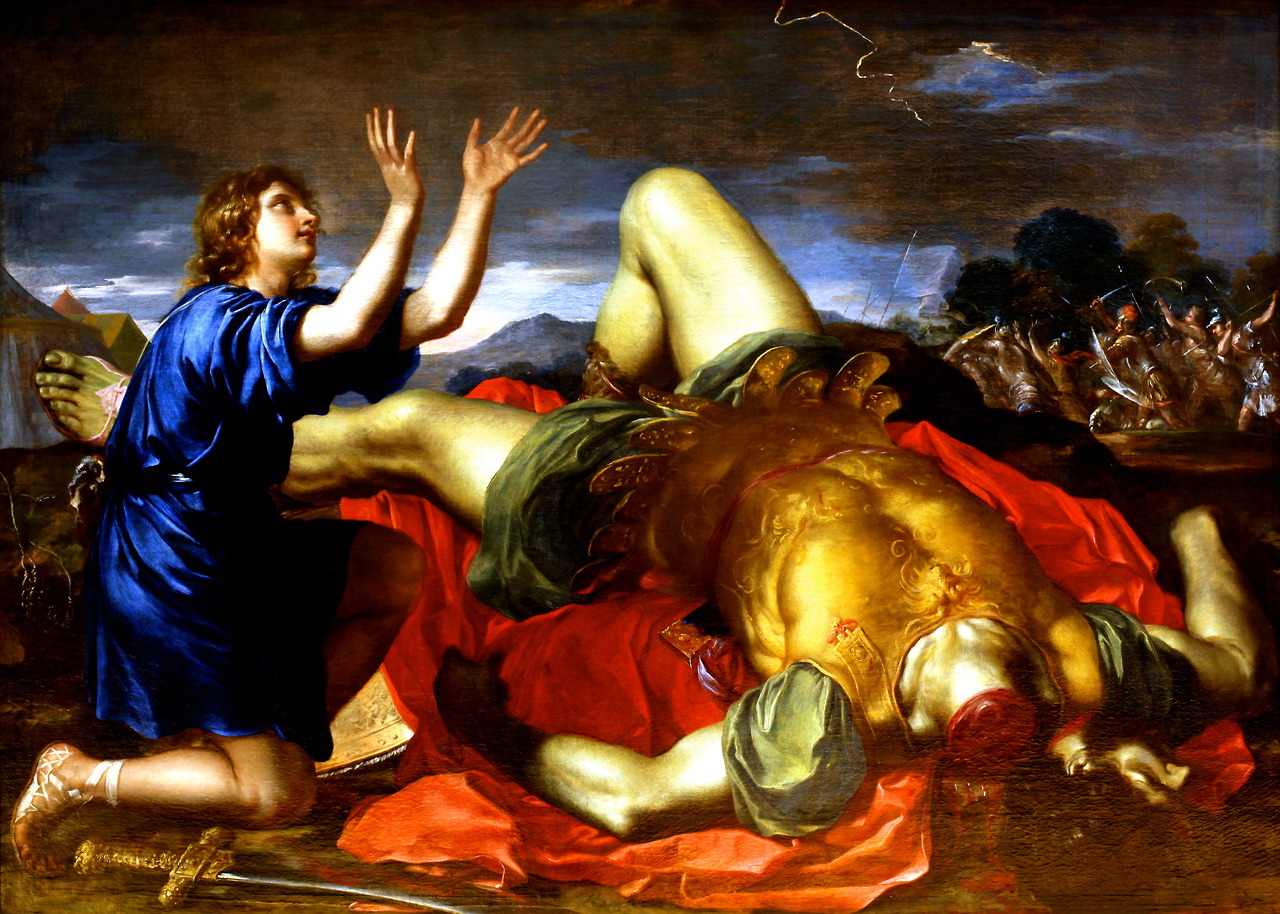
I have that problem with the supergiants, but we do have some examples of Nephilim size from canonical Scripture. The Philistine, Goliath the Gittite (from Gath) was a later descendent of Anak. The Anakim were related to the Nephilim. The Masoretic text has Goliath at “six cubits and a span”, or 9 feet 9 inches. Josephus says, “four cubits and a span”, or 6 feet 9 inches, but Josephus was very fallible in some of his descriptions.
Og, an Amorite king of Bashan (in the Golan Heights area), was also a Nephilim giant. Scripture describes him as “the last survivor of the giant Rephaites.” The Rephaites were a clan of Nephilim. We know that King Og was a giant, but all we know of his particular size is that his bed was “nine cubits long and four cubits wide”, approximately 13½ feet by 6 feet. That is probably not an accurate gauge of Og’s size, because the bed dimensions are most likely ceremonial. They are exactly the same as the reported dimensions of the ceremonial bed at the top of the Ziggurat of Babylon, built for Baal and his consort.
If you are a hyper literalist, you may be inclined to prefer the 450-foot size because the Israelite spies reported that “we are like grasshoppers to them.” To me, that was an obvious exaggeration, but you have to believe that a conservative hermeneutic allows for exaggerations. Which you know by now that I do!
Consequences
Now, here is a big assumption, that I think is probably true…
Shades of the Nephilim
The Nephilim were big, bad, barbaric warriors, but that was far, far from them at their worst!
We’re delving into the extrabiblical for information now, where the Bible itself is silent. The late Michael Heiser, a scholar of ancient Israel and the Ancient Near East, is my principal source on topics like this. He was very confident of what has been unearthed from Apocryphal and Pseudepigraphal literature. The relevant texts are, in some cases, part of church canon for Catholic, Orthodox, and some Protestant denominations. In other cases, the texts may have at one time been considered inspired but were later excluded.
I need to stress here that I do not in any way consider these texts to be inspired or infallible. I use them only to shed light on peripheral issues that are interesting to me, but that God chose not to address more fully in Scripture.
These sources may then explain much that the Bible doesn’t about this subject. For example:
- They explicitly state that the Nephilim were the unnatural offspring of angel/human pairings.
- For this to be even possible, one has to believe that the temporary physical body of a corporeal angel was very similar, not only externally, but also in its internal anatomical and physiological makeup, to a human male.
- Nevertheless, the giantism, muscularity, and otherworldly fierceness of the children of this union is an indication of partial incompatibility between the genomes of the parents.
- Despite their toughness, the Nephilim could die like humans. Remember Goliath.
- Like humans, the “shades”, i.e., spirits, of the Nephilim angel/human hybrids were immortal and residing in Sheol after death.
- However, unlike human spirits, the half-angel spirits aren’t bound to Sheol. Angels in general are spirit beings created for the purpose of managing the cosmos. As such, angels, “good” and “bad”, have full access, even to Sheol, and can enter or exit at will.
- Satan, like most other angels and the Nephilim, can leave Sheol at will, until the eschatological end times. The angels who sinned in Genesis 6, on the other hand, are bound and cannot escape Sheol, according to Peter and Jude.
- Most Christians today and for most of the last two millennia have believed that demons are “fallen angels.” Aside from some prophetic references about “worshipping demons”, which might be a reference to the sons of God assigned to the nations at the Babel “scattering”, there is no Biblical evidence of that.

Demons
According to ancient belief and overwhelming evidence in the Apocrypha, and in the rest of the Ancient Near East, the demons are those very same half breed Nephilim spirits, now free to wander the earth!
They are able to leave Sheol because of their angelic heritage. But because of their human heritage, they want to be embodied. Because, like their angel parent, or perhaps both parents, they are evil, their delight is in causing mischief. A big part of that is “entering” into humans and causing them harm.
Much of Jesus’ healing ministry was clearly healing natural diseases. But often we are told that he “cast out demons.” Some of those may have inflicted their hosts with disease, but some of them evidently caused stress directly.
Post-Flood giants
It is easy to see why OT demons, separated from their physical bodies, could have survived the Great Flood. They were spirits, not confined to the surface of the earth, and immortal, so only God, their creator, could destroy them or bind them in Sheol.
The problem is that there were clearly Nephilim giants in the Near East after the Great Flood. Did they survive the Flood? According to Scripture, only eight people survived the flood—Noah and his family.
Heiser and others provide three possible alternatives to explain their post-flood return:
- Heiser doesn’t commit, but his favorite is that angels continued to violate human women after the Flood. He finds possible support for this view in Genesis 6.4. Let’s look again at the two translations presented above:
The Nephilim were on the earth in those days, and also afterward, when[ever] the sons of God came in to the daughters of man and they bore children to them. These were the mighty men who were of old, the men of renown.
—Genesis 6:4 (ESV) emphasis mine
Now the giants were upon the earth in those days; and after that when[ever] the sons of God were wont to go in to the daughters of men, they bore children to them, those were the giants of old, the men of renown.
—Genesis 6:4 (LXX-B) emphasis mine
Heiser points out that the Hebrew אֲשֶׁר (asher), translated “when” here, has a wide range of meanings and could easily be translated “whenever”, as I have shown in brackets above. He then suggests that “in those days” can only refer back to verse 1:
[6:1] When man began to multiply on the face of the land and daughters were born to them,
—Genesis 6:1 (ESV)
That being the case, then verse 4 is apparently saying that, just as in “those days”, the days under discussion when the angles sinned and the Nephilim were born, it would all happen again. Angels will continue to lust after human women and giants will once again be born. Perhaps even after the flood, with the first crop of giants now dead.
Maybe. If so, then have the angels finally learned their lessons? The giants of the Bible have been eradicated, and it would seem that none have been born in millennia.
- A second possibility is that the giants themselves mated with humans and one or more of the eight people on the ark had some of their DNA. I somewhat favor this explanation myself because it would explain not only the existence of post-flood giants, but also their eventual disappearance.
One would think that giantism would confer a genetic advantage, but perhaps not, for a number of possible reasons. Some were obviously born over the first centuries, but eventually they were hunted to extinction.
- Or perhaps the flood wasn’t universal after all, and some “flesh” outside its boundaries survived. Walton favors a regional flood. My faith wouldn’t be destroyed if he is right, but I’m pretty dogmatic about a global flood.
Timing of the rebellion
The Bible only puts the beginning of the sin of the angels somewhere in the antediluvian (pre-flood) era. Extrabiblical sources say that it started during the lifetime of Jared (roughly halfway between Expulsion and Flood). It no doubt extended up until the flood. As just discussed, if it resumed after the flood, that would explain the Anakim and other tribes of Nephilim giants that existed until the monarchy period in Israel.
A major part of the story in 1 Enoch is that the sinning angels asked Enoch to intercede with God for them when they begin to face punishment. In my view, it seems likely that God “took” Enoch, Jared’s son, precisely to fill that role.
 The Back of My Mind