
Quantum Freewill

Posted on:

Modified on:


  1. A stepwise approach to my thinking
    1. My preconceptions
    2. Creation
    3. Quantum spacetime
    4. Quantum Macrostructure
    5. Predicting the future
    6. A little nudge
    7. Our unique solar system
    8. Procreation
    9. Freewill
    10. Foreknowledge and predestination

Original question, posed on Facebook by a member of the group, Theology for the Thinking Believer:

It seems to me that if God is omniscient, then predestination must be woven into creation. If God knows everything (no exceptions), then he had to know what he was creating when he created, down to the most minuscule detail. And how could he create without creating what he wanted?

So, I believe we have volition; we can choose what we want for breakfast, for instance. But whatever we choose, as trivial as such decision is, is already known by God. So, if God intended Judas to betray Jesus, he would make a person that would do that not out of coercion, but out of the person’s nature. Judas would be created a man who wanted to betray Jesus by his own volition.

I know, it seems kind of contradictory, but how could you come to any other conclusion?

So, this is my question. Is God omniscient? I have always thought that was a fundamental attribute of God. I guess I still do. Do you?

That was a perceptive post and deserves a thoughtful response. The fact is, I’ve been thinking about that general subject of God’s sovereignty since I wrote Implications of God’s Omnipresence and Eternity in Space-Time two years ago, and my opinion has flipped as a result.

God’s absolute sovereignty is a given for me. I was convinced that God not only can, as He wishes, control every last molecular movement in His cosmos. Absolute sovereignty, though, only requires that He can, not that He must. To say that He must contradicts His sovereignty. Therefore, the question is, “Does He, or doesn’t He?” I’m looking at physics for a clue.

A stepwise approach to my thinking

I should warn you that what follows is speculative philosophy. I have no great thinker or book to guide me here, and I’ve never run across these ideas anywhere.

My preconceptions

  1. That the eternal, triune God is the creator of all that exists.
  2. That, as stated above, God is absolutely sovereign over all that exists.
  3. That God has the option to not exert His sovereignty in any particular instance.
  4. That the canonical Scriptures, as originally written, in their original languages, are inerrant and trustworthy, penned by human hands under divine inspiration.
  5. That inerrancy does not preclude normal human literary devices, including symbolic language, figures of speech, numeric approximation, paraphrasing, and poetic exaggeration.
  6. That Creation itself stands beside Scripture to declare God’s glory (Psalm 19:1–4b; Romans 1:19–20).
  7. That God endowed humanity with five senses with which to witness His majesty as revealed in both Scripture and Creation.

Creation

I’m a big-bang creationist. I’ve written several instalments of a series on the subject of creation so far and will probably add to that list.

I believe that God, for His own purposes, formulated a set of goals, determined how He would accomplish them, and then designed the physical laws that would make them happen, and happen with maximum elegance, for His glory. He set the process into motion, ex nihilo, by creating a compact embryo of unimaginably dense energy at a single point within the area now occupied by our universe. As designed, that embryo then began expanding and differentiating into an astoundingly complex array of particles, forces, and time itself that, on His schedule, eventually coalesced into what we see (and don’t see) today. If we extoll the wonder of a human embryo developing into a fully developed human adult, why not the same for our unparalleled universe?

At some time either before or after creating the cosmos, God also created the myriads of celestial beings who He tasked with its administration, just as He later tasked humanity with doing the same thing on earth.

Because God is sovereign over His creation, He transcends both space and time and is unbounded by them. He exists simultaneously in all of space and all of time, so He doesn’t have to “move” to take it all in. Consequently, what appears to us as having taken some 13.8 billion years to develop actually was instantaneous to Him.

Quantum spacetime

Physicists today can look at “large” (as well as utterly humongous) objects and, given enough knowledge about their nature, determine more or less “how they tick”, and from that make reasonably accurate predictions about their future behavior and extrapolate backwards to determine what they have done before we were watching.

Quantum Mechanics tells us, though, that the universe is, at its smallest scale, statistical in nature (because God chose to design it that way). That means that it is fundamentally impossible (again, by God’s design) to predict how a subatomic particle will move or even where it is in the future or to determine what it did in the past.

For example, we know that atoms consist, roughly, of protons and neutrons in a nucleus, with electrons “in orbit” around them. In the recent past, though we couldn’t see electrons, we pictured them as moving in orderly circular orbits. The reasoning was that once we’re able to determine where it is and how fast it is moving, predicting its motion will be simple math. See the schematic drawing of this “Bohr Model”, below.
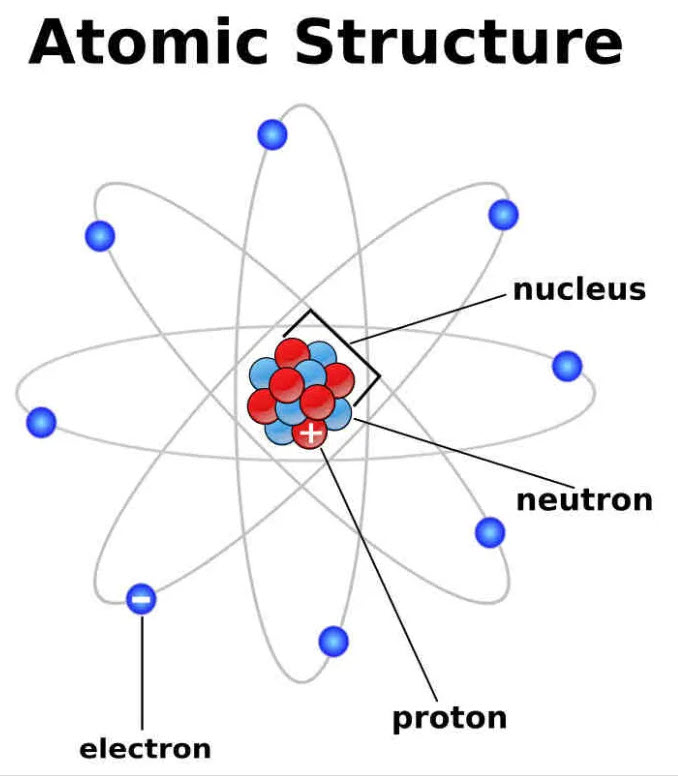
Classic Bohr Model of an atom with electrons in regular circular orbits around the nucleus. Named for Danish physicist Neils Bohr. From HubPages.

Nope. It turns out that no matter how powerful or precise our measuring equipment becomes, it will never be possible to simultaneously measure both the position and speed of a particle. One of God’s physical laws, now called the Heisenberg Uncertainty Principle, after German physicist Werner Heisenberg, utterly precludes that possibility! The best we can possibly do is consider a probability distribution to indicate a range of locations that it might be. The solid shapes in the schematic below represent the most likely position at which to find a given electron.
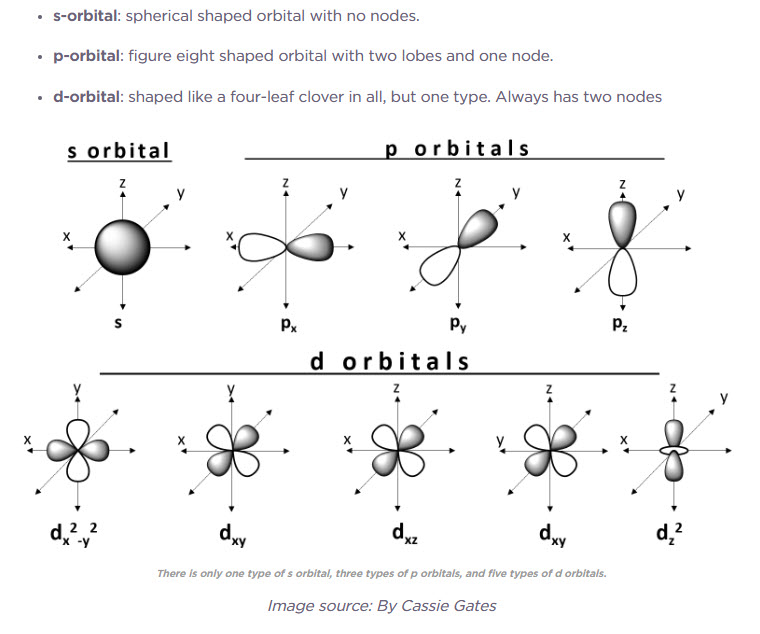
Modern quantum mechanical electron probability distributions, from Expii.

You can’t begin to imagine how spooky that is to scientists. And upsetting! It had long been believed that the universe is deterministic. That means that if you somehow know where every particle in the universe is, and every force acting on them, you can predict the future with absolute certainty. Instead of deterministic, we now know that the universe is probabilistic.

Even Albert Einstein resisted that truth for most of his life. He couldn’t bring himself to believe that “God plays dice with the universe.”

But that is precisely what God does!

Quantum Macrostructure

How does the quantum state of an electron (or any other very small particle) effect the overall universe? The quantum position and energy state of a particle determine many interactive effects.

For example, with respect to an electron, how it reacts with other particles including its own atomic nucleus, the atom’s charge distribution and how it bonds with other atoms to form ions and molecules, how molecules bond to form solids, liquids and gasses, and so on. The end result is that the net effect of the separate states of individual particles combine to define the structure of every object in the universe.

Think of it like the well-known hypothetical “butterfly effect”: A butterfly in South America flaps its wings, setting in motion barely perceptible currents in the air around it. Those currents effect the air around them, and so on, until the end result is a category 5 hurricane in the North Atlantic.

That is the way God designed the universe, and it means that He intended for it to develop spontaneously to produce in the end something that He engineered in the beginning. But with a measure of chance deliberately built in!

Predicting the future

Because the “fine grain” of the universe is statistical, it is only roughly predictable, even by God. I think that was His intention! For one thing, it better illustrates the elegance of what He made. For another, since He is the only truly transcendent being, He is the only being who knows the future. It can’t be predicted; but God doesn’t have to predict it because He can see it!

A little nudge

Implicit in this scenario is an assumption that the development of the universe can’t happen exactly the way God scripted it. Galaxies collide, stars explode or get sucked into black holes, planets get wasted by asteroids, solar winds, and so on.

God is not surprised by any of the myriads of celestial “accidents” that are constantly happening. Most don’t concern Him because they are part of the design and have purpose built into them. If He sees something coming up that He doesn’t want, or if He wants something to happen that isn’t, a mere flick of His pinky sets everything back on course. Or a detachment of angels is sent to handle it.

Our unique solar system

Astronomers used to assume, and some still do, that there are billions of solar systems just like ours in the cosmos. If that’s the case, then “surely there are millions of civilizations out there.” Well, even if science had a clue how non-life can evolve into life (call me a skeptic…), I’m afraid I have bad news.

It turns out that almost all stars have orbiting planets, and to date we have discovered and remotely “explored” over 5,000, but sad to say, not a single one is anything like good old earth, and it’s a stretch to think that any of them could possibly support any kind of life form as advanced as a virus. It looks like our own life-friendly system is far, far from typical.

My guess is that about 4.5 billion years ago, God picked out a young G-type Main Sequence star in the Milky Way Galaxy and molded its accretion disk to His own specifications, placing a rocky planet of suitable mass with a liquid iron core (to provide a protective magnetosphere) at a perfect spot in the planetary “Goldilocks Zone“. When the time was right, He seeded that planet with life, once again to His own specs.

Procreation

The Psalms, of course, are inspired Scripture, and they tell us a huge amount about God, but I don’t think they are necessarily a reliable source of doctrine, because, by nature, ancient Hebrew poetry is flowery and often exaggerated. They are, in fact, songs. Songs of worship are designed to lavishly praise, and even to flatter.

We know that God is imminently invested in each of us individually. Sparrows, too, and by implication all of earth’s fauna. When the psalmist says, “You formed my inward parts; you knitted me together in my mother’s womb” (Psalm 139:13), or when we acknowledge God as “our creator”, does that mean that each child is an original act of creation?

Personally, I don’t think so. God devised the plan. He created the ancestors. I’m certain that He adjusts the genetics from time to time. But procreation is a well-understood biological process. Human procreation is very similar to that in any other mammal. We understand conception, cell division, DNA and genetic inheritance.

If we say that each child is a unique creation, then we’re acknowledging that God is blessing or cursing each child at conception and early gestation, individually. If that’s what He does, then so be it, and I know He has the potter’s right and a good reason for His choices. He can’t be arbitrary or unfair. Still, this plan doesn’t ring true for me. I don’t think that a consistent hermeneutic requires that a song, even an inspired song by a godly man, be theologically meaningful in any deep sense.

If I’m wrong, I’m wrong, and I’m not suggesting that God never intervenes. In fact, I’m certain that He does. When it suits His plan.

Freewill

We’ve arrived!

Quantum theory is not only spooky, but also counterintuitive, and intellectually it seems sloppy and poorly designed. Why would God choose to do things this way?!

Well, for one thing, it assures that only God knows the future! Of course, He has the option of passing that information along to others when He so desires. Which is how prophecy works.

But the key answer, I think, is that quantum uncertainty is what makes freewill work! Not being a neuroscientist, I’m not qualified to work out the mechanism, but it seems to me that by taking deterministic biophysics off the table, God is saying, “Okay, I’m not programming you, you’re free to configure your own path through life.”

Foreknowledge and predestination

Romans 8:29 (ESV)
[29] For those whom he foreknew (προγινώσκω, proginóskó) he also predestined to be conformed to the image of his Son, in order that he might be the firstborn among many brothers.

Teachers who hold to the view that everything is determined by God in advance often interpret proginóskó as “fore-ordained“, as in, “decided in advance.” How does that differ from “predestined“? By dictionary definition, it really doesn’t differ, but the way I’ve heard John MacArthur Jr. explain it is that after God decides something in advance (foreknowledge), He then prepares (predestination) them to actually do it. For example, if He decides to make you a Christian, He sends a soul-winner. Much like He decided to save Jonah, so He “prepared a great fish.”

That makes some logical sense. I accept the Jonah account as is. But I was always bothered by the fact that I could never find any justification for interpreting proginóskó as anything other than plain old passive foreknowledge. Searching for it briefly tonight in several common English translations, every one of them renders it as foreknowledge: in this verse and in Acts 26:5; Romans 11:2; 1 Peter 1:20; and 2 Peter 3:17.

So, I have flipped back to where I was as a much younger man. Based on something that God knew about me from His view across time and space, He drew me to Himself when I was a child of about 8, and then He set about imparting my spiritual gift(s) and guiding my education and experience towards a goal He set for me.

Next in series: Exploring the Garden of Eden

Implications of God’s Omnipresence and Eternity in Space-Time

Posted on:

Modified on:

  1. “Theology Proper”
    1. Trinity
    2. Spirit
    3. Alternative sources
  2. Omnipresence
    1. Classical views
    2. Defining the cosmos
    3. God in the cosmos
    4. Parenthetic: Is God’s omnipotence limited?
  3. Eternity (Timelessness)
    1. Classical views
    2. Defining time
    3. Space and Time: Spacetime
    4. God in time

I have had trouble writing this because God’s Creation is so astoundingly complex that it has taken me over three months to settle on a narrative that avoids rabbit trails that are vitally interesting to me, but probably boringly obtuse to many of my readers.

My intention here is to explore two of God’s divine attributes that I think are very closely related, and to speculate, in the simplest terms I can come up with, how they might have additional implications in the light of modern physics.

“Theology Proper”

Any formal study of God and His creation is going to start with a subject from a textbook categorized as a “systematic theology.” The section of that book concerned with the nature and characteristics of God Himself is called a “theology proper.”

Intelligently discussing God’s Attributes is a tough task, because God Himself told us only what He determined we need to know, and the Bible was written in an age when neither the inspired human writers nor the intended readers could even begin to understand all of what was written, not to mention the vast majority of the topic that remained unwritten. In some cases, it seems to us as if some really important explanation is omitted that we modern humans would very much like to know.

Trinity

For instance, the Trinity of Father, Son and Holy Spirit can only be inferred from “hints” scattered throughout Scripture. Even the term “Godhead,” which at least sounds somewhat Trinitarian, is merely an infrequent translation of the Greek qeoteß, (theotes), which actually means simply “deity.” Paul used the term as a polemic against Colossian, gnostic pantheism, not as a theological description of the Trinity.

Attempts to find hints in the Old Testament mostly fail. The Hebrew אלהים, transliterated as elohim, is a masculine plural noun, usually meaning “gods”, “angels”, or sometimes “judges”, etc. But sometimes it refers to the name of God, Himself, in which the transliteration is capitalized: Elohim. Does the plural ending in this case imply multiples of God, e.g., the Trinity? No, because, while most Hebrew nouns are “regular”, there is a class called “irregular plural nouns” that don’t follow the usual rules. We have those in English, too: the plural of “foot” is not “foots”! However, English does not have singular and plural forms of verbs, and Hebrew does. Elohim, the true God, always appears with singular verbs.

What about the first chapters of Genesis, where Elohim says, “let us…”? Is this the Father speaking to the Son and Spirit? Inconceivable! What one knows and thinks, the others know and think. That’s got to be implicit in the whole concept of “tri-unity.” The only exception would be the “kenosis“, when the Son emptied Himself and became incarnate (Philippians 2:6–7).

Use of the composite plural verb echad in the Shema (Deuteronomy 6:4) can’t be supported from the Hebrew grammar, either (see Monotheism and the Trinity, where I hedge a bit on this).

Why is there no specific Biblical mention of the Trinity? Well, perhaps it is because the ancient writers (and to a lesser extent, even today’s highly educated theologians) had no scientific or linguistic tools sufficient for the task. Explaining the Trinity is beyond the ability of even 21st Century Theologians. There is no known analog to make it clear to us.

Spirit

I suppose, personally, that it has something to do with the nature of sentience (consciousness—having senses and perceptions) without physical substance. “Spirit,” in the Biblical sense, is something that our best modern science can’t detect or explain. It isn’t matter. It isn’t energy. It is independent of either and in God’s case, it is superior to both.

Author and educator John C. Lennox suggests that man’s spirit, which is, in life, associated with his body, is what God means by His “image.” Dictionary definitions of “image” include terms like “reproduction”, “imitation”, “likeness”, etc., most of which imply that an image is in some way inferior to the original. God is spirit, whereas man’s spirit is confined to a physical body now, and even when that body is glorified, will still be constrained to locality.

Alternative sources

Many Christians, if asked, would say that only Scripture is valid truth. I believe that the perceptions of an educated Christian are capable of much understanding, even of issues that aren’t fully addressed in Scripture. To this end, I am going to blend in a little human science.

Scientists do two things, for the most part really well: they collect data; and they propose explanations. In either order; in fact, frequently in iterations. Sometimes the explanations have a devious political or theological aim, but more often than not, it’s just enquiring minds wanting to know. Honest data collection can’t possibly hurt us, because it is our God who provides the data!

I am going to combine the concepts of God’s omnipresence and eternity (or eternality) in following sections, but classically they were considered to be entirely separate Divine Attributes.

Omnipresence

Classical views

God’s omnipresence means that He is present, everywhere in the cosmos, simultaneously and fully. He is here and aware of His surroundings, at this moment, in my home office where I am typing this post. At the exact same instant, He is present and aware of plasma currents in the heart of a star billions of light-years from my office. Not just one star—all of them, everywhere. And then, there are also the falling sparrows…

At the same time, He is present on a throne at a location we call “heaven,” where the Bible pictures Him communicating with angels, prophets and sundry other beings. Where His throne and its setting are described in Isaiah, Ezekiel, Daniel and Revelation, I think that the prophetic visions are not to be interpreted as a specific place, but rather as an interface between God and others, depicted in such a way as to convey glory and holiness to limited ancient understandings.

Of course, the Bible also depicts God as from time to time present at specific localities, for example: in a burning bush; outside a cave on Mt. Horeb; in a pillar of cloud and fire; above the Ark of the Covenant; and in the Holy of Holies in the Tabernacle and later the Temple. These “theophanies” were instances where God chose to show a localized physical manifestation of his presence to reassure His people that He is more than just a disembodied concept.

Defining the cosmos
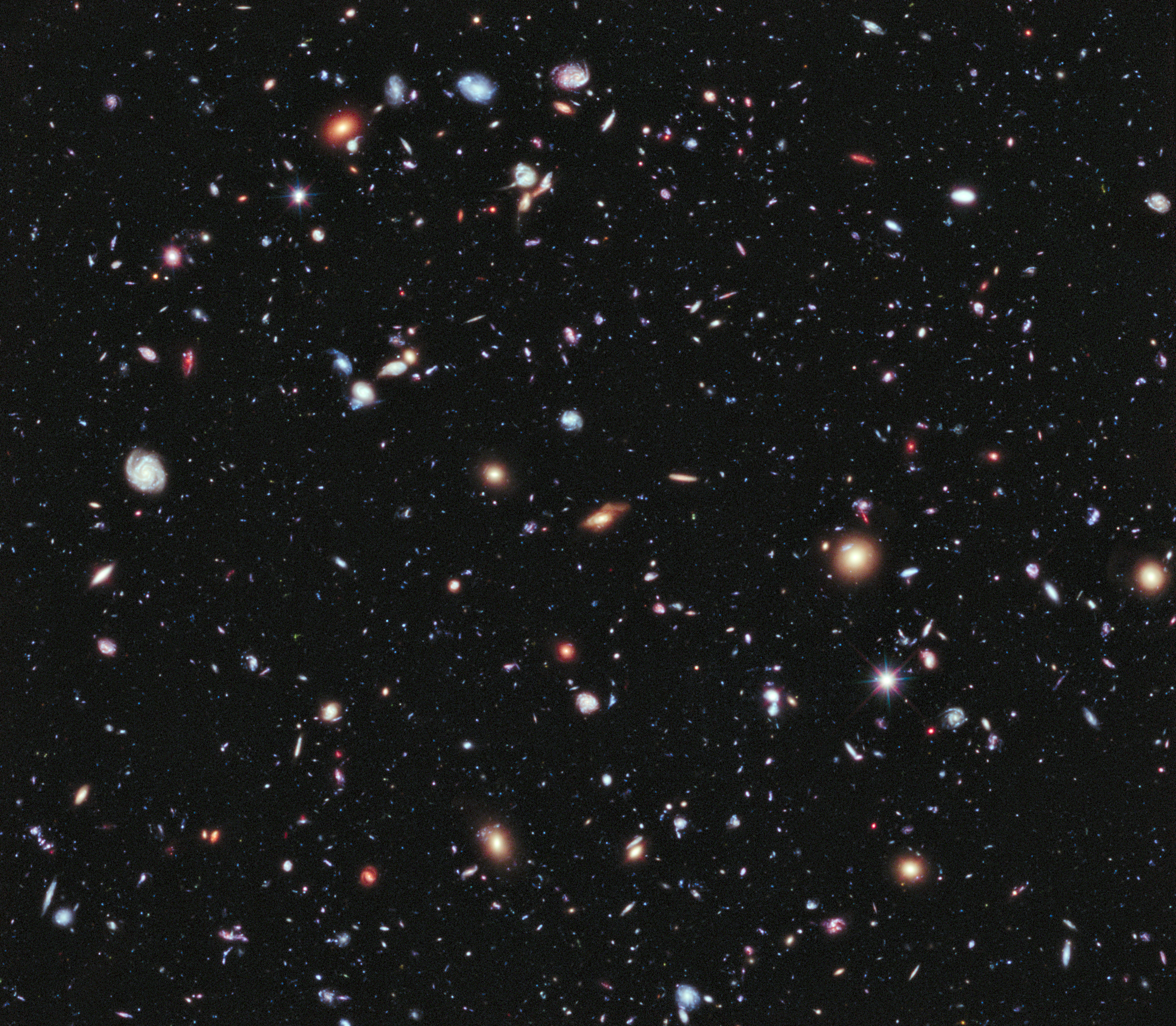
Hubble eXtreme Deep Field (XDF). This is a 2008 long exposure photograph of a very tiny area of the sky, and each item shown is a separate galaxy. From Wikipedia.

The astronomical term “cosmos” is defined by Merriam Webster as “an orderly harmonious systematic universe.” After millennia of honest science by many Christians and non-Christians, the current most popular view is that our universe (in my view, the only universe there is) is about 93 billion lightyears (550,000 billion-billion miles) in diameter—and that’s just the part we can see! A rough estimate that has been cited for years is that there are at least a hundred billion galaxies in the universe, with an average of a hundred billion stars per galaxy. That is probably conservative. It appears that most stars are associated with planetary systems like our Solar System. Most planets probably have one or more moons. But there is so much more out there than stars, planets and moons!

That’s the big stuff. Looking at the small stuff, most of you are somewhat familiar with the concept of atoms and molecules. You know that atoms consist of protons, neutrons and electrons. Actually, there is a whole “zoo” of other particles around us that are less familiar. Stars mostly burn Hydrogen. Our own sun burns around 200 million tons of hydrogen, the lightest of all elements, every second, and has enough left to keep burning for 4.5 billion more years.

God in the cosmos

God’s omnipresence means that He is present throughout the universe, as well as enfolding its entirety within the envelope of His presence. His omniscience (all-knowingness) assures that He is aware of every last particle within that volume, and His omnipotence (all-powerfulness) assures that His control extends to even the smallest sub-atomic particle within the volume. Does this mean that He is constantly propping everything up, or “micro-managing”? Clearly, He can fiddle wherever He wants to, and clearly (from Scripture), He occasionally does, but He is the author of the laws of physics, and I’m quite sure He is more than capable of having designed it to be self-sustaining! An automotive engineer can design and build a car, but he can also drive it without manually spooning gasoline to each cylinder. I trust my God, and I also trust what He has built and what He is continuously supervising.

The late Henry Morris rejected the “uniformitarian” concept that geological processes worked the same way in the past that they do today. But throughout his book, he mischaracterized the concept, as he did the Second Law of Thermodynamics. Both of those principles are valid only in a closed system, meaning no external interference. Both principles would say that an acorn dropping from the oak tree outside my office window will fall to the ground. But if I reach out and catch it, I haven’t violated the principle, I’ve simply violated the explicit assumption that the tree, the acorn and the ground was a closed system. My hand invalidated the assumption by making the system “open“. Was a world-wide flood possible without God’s intervention? Actually, yes, the physical laws make it highly unlikely, but don’t prohibit it. But we know that God intervened, so the laws didn’t apply in that case. (See Fountains of the Deep.)

Parenthetic: Is God’s omnipotence limited?

I think that most conservative theologians would say that it is! For example, Wayne Grudem states:

…it is not entirely accurate to say that God can do anything. Even [Scripture passages] must be understood in their contexts to mean that God can do anything he wills to do or anything that is consistent with his character. Although God’s power is infinite, his use of that power is qualified by his other attributes (just as all God’s attributes qualify all his actions). This is therefore another instance where misunderstanding would result if one attribute were isolated from the rest of God’s character and emphasized in a disproportionate way.

Grudem’s Systematic Theology (2nd ed.)

Many have added what I think should be self-evident, that God can’t violate simple logic. No, He can’t make a rock so heavy that He can’t lift if. That is a paradoxical absurdity. And no, He can’t make 2 plus 2 equal 6 (need I add, “in base 10”?). It is what it is.

Eternity (Timelessness)

Classical views

God’s attribute of eternity is comparable to His omnipresence, in that it defines His all-encompassing span of existence in time, rather than space. He is not only everywhere, but also everywhen. He is Alpha and Omega, Beginning and End. His temporal span is from eternity past through eternity future. When, at the burning bush, Moses asked Him His name, God replied in two ways. First,

God said to Moshe, “Ehyeh Asher Ehyeh [I am/will be what I am/will be],” and added, “Here is what to say to the people of Isra’el: ‘Ehyeh [אֶהְיֶה, I Am or I Will Be] has sent me to you.’”
—Exodus 3:14 CJB

The above is commonly taken to be an expression of God’s timeless existence; effectively, “I am now what I always have been and always will be.” This, however, is not so much a name of God as a statement of His nature. His “covenant name” delivered in the following verse, is a wordplay on the Hebrew ehyeh:

God said further to Moshe, “Say this to the people of Isra’el: ‘Yud-Heh-Vav-Heh [ADONAI], the God of your fathers, the God of Avraham, the God of Yitz’chak and the God of Ya‘akov, has sent me to you.’ This is my name forever; this is how I am to be remembered generation after generation.
—Exodus 3:15 CJB

The 4-letter Hebrew name given here, יהוה, known as the “Tetragrammaton,” is commonly transliterated and pronounced as Yahweh (or, the grammatically corrupt version, Jehovah), but the vowels, and thus the pronunciation, are inferred rather than known. Strong’s defines it as “(the) self-Existent or Eternal“, but again, I think that this is an inferred, not a known, meaning, and based on the wordplay, I prefer to regard it as a proper name.

Defining time
Sorry, but illustrating timelessness isn’t easy. Some of you will recognize this as the BBC version of a time machine. Dr. Who’s disguised TARDIS.

Time, of course, is the concept that you perceive the present, remember (or not) the past, and anticipate (or not) the future. Physicists relate this to entropy, which some define as randomness, but that definition is deceptive. More accurately, a quantity called “degrees of freedom” increases. Newton’s Second Law says that, in a closed system (see above), entropy increases. At the risk of depressing you, an organism eats and assimilates its food, and grows. It may appear to be getting less “random” and more like an “organized” entity, but the fact is that each cell and biochemical molecule is simply part of a cycle of maturation and eventual death and decay. More cells mean more degrees of freedom. More stuff to go wrong. Scattered raw materials can be gathered and processed, and a useful machine can be manufactured, but all such constructs eventually wear out and fail, becoming scrap. “Dust thou art, and to dust thou shalt return.”

Space and Time: Spacetime

Both spacial and temporal location can be specified either relatively (here, there, now, then) or absolutely, using coordinates (for example, with rulers and clocks). But—think about this—are space and time merely abstract concepts, or are they real, tangible, things?

Space is most definitely real. It is not, as once thought, just the vacuum through which the “stuff” of the universe floats and moves. Now, observation and theoretical research suggest that space itself has properties that differentiate it from whatever is outside the universe. Time is evidently one of those properties, so also must be a real thing. Hold on to this concept: In the “old days”, the universe was thought to be an area in space; now we consider the universe to be space, time, and everything else that we know exists. Except, in my Christian “worldview”, for God and His realm, which are both outside the universe and permeating it to the smallest subatomic particle.

In 1905, Albert Einstein’s Special Theory of Relativity provided a theoretical framework for unifying the concepts of space and time. It turns out that there is a physical and geometrical relationship between the two seemingly unrelated concepts. To greatly oversimplify, if an accelerating object passes you at a high velocity, it will appear to you that it is foreshortened in the direction of motion, and that time is passing more slowly on it than on your own platform. The important thing in the present context (this post) is that both space and time appear to be—and in fact are—distorted, and their distortions are mathematically related. These effects are not easily seen except at velocities that are a significant proportion of the speed of light. It certainly does sound counterintuitive, but by now, the physics has long since been proved and integrated into modern technology.

God in time

Apologist author William Lane Craig, in his book Time and Eternity: Exploring God’s Relationship to Time, examines the question of whether God’s Eternality implies that He exists within the framework of time or outside of time, looking in. In rather tedious detail, he approaches the question from the standpoints of theology, physics, and philosophy, and reaches the conclusion that God must exist within time in order to keep His bearings, since there would evidently be no temporal landmarks to go by.

Hmm… Lane is a very smart man who clearly embraces God in all His majesty, and he has obviously devoted a lot of thought and research into the subject. But his logic here, frankly, escapes me. God’s omnipresence means that He both envelopes and inhabits everything outside and inside the universe. His attribute of eternity implies the same with respect to time. The relativistic connection of space and time reinforces that implication. I see no reason that He should ever be disoriented, in any fashion. An expanded definition of “omnipresence”, then would state that

God simultaneously and instantaneously sees and remembers everything that exists and occurs at all locations in both space and time.

Note that I threw in the word “instantaneously” because, while nothing in the universe can travel faster than the constant speed of light, that is a limitation of space itself. Space with its enclosed stuff is expanding faster than the speed of light. There is no speed limit outside the universe.

What does Quantum Physics add to the picture?

A lot, and I only recently began probing the theological implications.

Newton’s First Law of motion states that, An object at rest remains at rest, and an object in motion remains in motion at constant speed and in a straight line unless acted on by an unbalanced force. We call that tendency “inertia.”

It turns out that this law doesn’t hold for extremely small objects. We’ve known for about a hundred years that small objects like electrons and photons move in ways that are fundamentally unpredictable. The best you can ever do is calculate a probability distribution. Which was hard for many physicists, including Einstein, to accept, because they believed in a “deterministic universe“—if you know where everything is now, and the forces on it all, then theoretically you can predict the future. Einstein famously said, “God doesn’t play dice with the universe.” Make no mistake, he wasn’t a theist. What he meant was that he didn’t believe in a future determined by chance.

What does this randomness in nature mean, theologically? Warning: from here on, this is just my own speculation, not something from either science or theology. Take it or leave it. If there is randomness in the universe, then that can only be because God wanted it that way and designed it that way. If the future is truly random, then presumably even He can’t predict the future. <shock!!!> But God needn’t predict the future when He can see it! Remember, He lives in all times simultaneously. God fore-knows because He fore-sees.

Why would God have designed it this way? Perhaps it’s because He wanted to give the denizens of the universe freewill! That does not mean He’s lost control of the universe. Three reasons:

  1. Large objects, like stars, planets and even baseballs and marbles, have enough inertia to obey the First Law.
  2. If you flip a coin once, you’re equally as likely to achieve one result as the other, but if you flip it a thousand times, it’s virtually 100% sure that the total number of heads and tails will be very close to equal.
  3. And, of course, God not only sees the future, but He can nudge it in any way that He sees fit. His sovereignty means He can, not that he necessarily does!