
Pharisees

Posted on:

Modified on:

  1. Pharisee History
  2. Sect, or Order?
  3. Torah
    1. Torah Shebichtav, the Written Torah
    2. Torah Sheba’al Peh, the Oral Torah
  4. The Sanhedrin
  5. Pharisees as Sanhedrin Agents
  6. Core Beliefs of the Pharisees
  7. Jesus’ Debates with Pharisees
  8. How did the Pharisees See Themselves?
  9. My Conclusions

Christianity has traditionally viewed the Pharisees as a uniformly treacherous and hateful group of hypocrites.

There is a marked tendency among some to despise Judaism as a whole for producing such a “reprobate” sect. An Internet search for “Pharisees” turns up almost exclusively sites that range from mildly to bitterly critical. The Merriam-Webster dictionary defines “pharisaical” as an adjective meaning, “marked by hypocritical censorious self-righteousness.” Their Collegiate Thesaurus lists the synonyms, “hypocritical, canting, Pecksniffian [look it up], pharisaic, sanctimonious, [and] self-righteous.” But do they deserve the bad rep?

Personally, I don’t think so!

Pharisee History

According to Josephus, there were only about 6,000 Pharisees during the reign of Herod the Great, and that is unlikely to have changed much during Jesus’ lifetime.

The name “Pharisee” comes from the Hebrew Parush (pl. P’rushim), meaning “separated.” This term refers to their opposition to “the mingling”, that is, the mixing of Greek ideas into Biblical Judaism (which, incidentally, has also been the scourge of Christianity). It is believed by many scholars that the Pharisees were spiritual descendants of the Chasidim (“pious ones”), a devout group of scribes dedicated to the preservation of the written and oral Torah during and after the Babylonian Captivity.

Dura-Europos Synagogue – Dura-Europos, Syria – AD circa 101-300. One of the oldest intact (but inactive) synagogues in the world. Note that the representational art does not break the 2nd Commandment, which is specifically a prohibition against making idols to house the foreign gods prohibited by the 1st Commandment. The structure at the center of the wall is the Holy Ark, the closet for housing the synagogue’s Torah scrolls. The Ark is always on the west wall, opposite the door to the chamber and facing east. Photo from BreakingMatzo.com.

The first clear historical references to the Pharisees occurred in the Intertestamental period (between the Old and New Testament writings), during the reign of John Hyrcanus (134–104 BC). By then, they had formed into an elite religious society, or order, with limited membership and strict rules of conduct. They had gained wide popular support due to their opposition to Hellenism (Greek culture), the rise of the corrupt Sadducees, and the illegal high priesthood of the Hasmonean monarchs. Despite their popularity in the synagogues, their political influence was very limited at first.

Accused of fostering revolt, as many as 800 Pharisees were crucified by Alexander Jannaeus (108–76 BC). During the reign of Queen Alexandra Salome (76–67 BC), whose brother was a Pharisee, they finally gained considerable power. Unlike the Sadducees, they never welcomed Roman rule, but they were able to maintain some influence, only because they were willing to cooperate in order to maintain peace and stability.

During the Roman period, spanning the life of Herod the Great and the 1st Century AD up to the destruction of the Temple in AD 70, the Pharisees were highly influential with the populace as a whole, though it was the Sadducees who controlled the Temple and its ritual.

After the destruction of Jerusalem and the Temple in AD 70, most Jewish sectarian orders disappeared, but many of the Pharisees were allowed to relocate to Jamnia (Yavneh), on the coast west of Jerusalem, where they formed the nucleus of the great Rabbinic movement of the following centuries.

Sect, or Order?

It is common to call the Pharisees a sect, but that term is misleading.

By definition, a sect is an offshoot of a larger religion, or a group sharing distinctive political and/or religious beliefs.

I would term the Pharisees, Sadducees, Essenes, and others as orders. An order is a formal group set apart within their religion by adherence to a particular rule or set of principles. The scribes, on the other hand, were not a religious order. As professionals, they probably belonged to a guild.

1st Century Judaism, as today, was highly sectarian. A majority of the Jewish population of Judea and Galilee probably would have said that they were followers of the Pharisees, that is, adherents of the Pharisee belief system, but to actually be a Pharisee—a member of the Order—required a difficult period of training, and then a formal ordination.
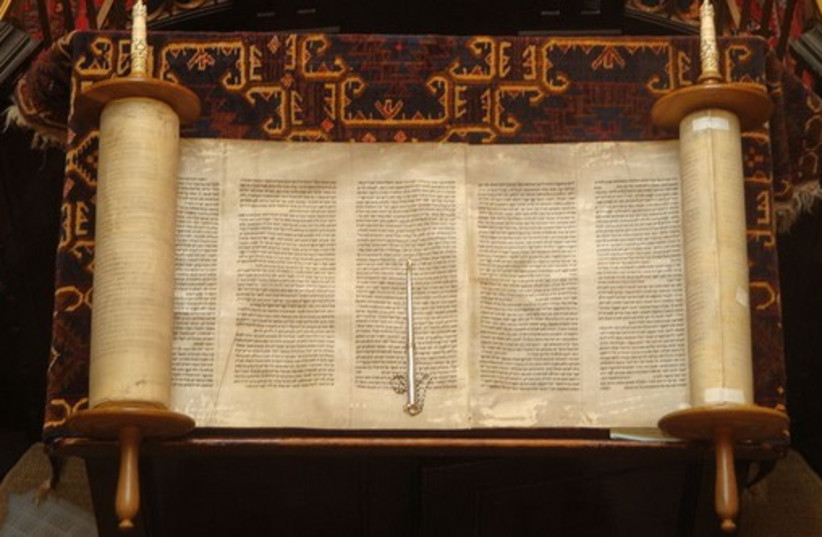
Torah Scroll, Wikimedia Commons
Torah

The Hebrew term Torah rightly translated means, not “law”, but “teachings.” The teachings of Torah do include legal precepts, of course, but those precepts are more about the nature and will of God than about legislation. Even to a Pharisee!

The Pharisees, like Rabbinic Judaism for the last 2,000 years, believed that Torah has two parts: written and oral.

Torah Shebichtav, the Written Torah

The written Torah itself is embodied in books or scrolls. The term primarily applies to the five Books of Moses. These writings individually or collectively are sometimes referred to by Jews as the Chumash (“one fifth”). I personally avoid the Greek term, “Pentateuch.”

To the Sadducees, only the five Books of Moses were Scripture. The Pharisees regarded as holy the entire Tanakh (the OT), consisting of Torah, Nevi’im (the Prophets) and Ketuvim (Writings, sometimes referred to by Jesus simply as the Psalms).

[44] Yeshua said to them, “This is what I meant when I was still with you and told you that everything written about me in the Torah of Moshe, the Prophets and the Psalms had to be fulfilled.” [45] Then he opened their minds, so that they could understand the Tanakh
—Luke 24:44–45 (CJB)

Torah Sheba’al Peh, the Oral Torah

The “Written Torah” was transcribed by Moses “from the mouth of the Almighty” and is contained within the Torah scroll. The “Oral Torah” incorporates the traditions handed down from Sinai but not (initially) put in writing, as well as the interpretations and rulings formulated by the sages of each generation.
—TheRebbe.org

The Pharisees taught that Moses received additional teachings on Mt. Sinai that he was not told to write down. Originally this “Oral Torah” was transmitted from father to son and from teacher to disciple. It consisted of additional instructions and rulings to clarify and quantify the written Torah; principles for exegesis of Torah; and authorization for the rabbis to protect the word of the Torah through making Gezayrot, or edicts, as conditions warrant.

Aside from famously criticizing “traditions of the Elders” that contradicted the letter or the spirit of the Written Torah, Jesus never spoke against the Oral Torah as a whole, and in fact He and His disciples were meticulous about obeying the precepts of both Written and Oral Torah. The formal right of the Scribes and Pharisees to administer Torah through interpretations and edicts (see above) was known as “binding and loosing” (prohibiting and permitting) and was believed to have the blessing of God and His Divine Council in heaven. Shortly before his crucifixion, Jesus endorsed this practice when He extended it to His apostles:

[18] Truly, I say to you, whatever you bind on earth shall be bound in heaven, and whatever you loose on earth shall be loosed in heaven.
—Matthew 18:18 (ESV)

Approximately 1800 years ago, Rabbi Judah the Prince concluded that because of all the “travails of Exile”, the Oral Torah would be forgotten if it was not recorded on paper. He therefore assembled the scholars of his generation and compiled the Mishnah, a written collection of all the oral teachings.

The Sanhedrin

The Biblical basis for the Sanhedrin was:

[18] “You are to appoint judges and officers for all your gates [in the cities ADONAI your God is giving you, tribe by tribe; and they are to judge the people with righteous judgment. [19] You are not to distort justice or show favoritism, and you are not to accept a bribe, for a gift blinds the eyes of the wise and twists the words of even the upright. [20] Justice, only justice, you must pursue; so that you will live and inherit the land ADONAI your God is giving you.
—Deuteronomy 16:18–20 (CJB)

Each major city was ruled by its own political and judicial “Lesser Sanhedrin” of 23 members. Under the monarchy, a “Greater Sanhedrin” was established at Jerusalem to serve as high court of justice and supreme governmental council.

This council at Jerusalem consisted of 71 members, of which the presiding member was the nasi (“prince”, or president), often the High Priest. Membership was appointed, with theological scholarship nominally the basic requirement—but in Roman times, politics effected all major appointments.

During Jesus’ Day, The Sanhedrin met in the “Chamber of Hewn Stone. Later they began meeting in the Royal Portico, which spanned the South side of the Temple Mount above and behind the Double and Triple Gates. Diagram ©Leen Ritmeyer, red box added by me.

According to the synoptic Gospels, Sanhedrin membership consisted of “chief priests, elders, and scribes.” Although there was overlap between those three groups, the chief priests were high ranking Temple priests, mainly members of the Sadducee order; the elders were most likely prestigious Pharisees; and the scribes were respected professionals who might have belonged to any particular order, or to none at all. The Gospel of John mentions only Pharisees and scribes from the Sanhedrin, but when John wrote, probably around AD 80, the Sadducees, the Sanhedrin and the Temple were long gone and a distant memory to his readers.

Pharisees as Sanhedrin Agents

The Pharisees in Jesus’ day were scattered throughout Judea and Galilee, with concentrations in the cities. Many were attached to specific synagogues, while others adopted the life of itinerant teachers, doing much the same things as Jesus. Many of these, perhaps a large majority, were no doubt still Godly men like the first Pharisees, out of the spotlight and unconcerned with politics and wealth. Certainly, when Jesus crossed paths with these men, there were discussions and perhaps even confrontations. I have witnessed brash conversations between Jewish intellectuals in my own day, and I don’t think that it would have been any different then than now.

But what about the Pharisees and scribes that followed Jesus around from town to town? The late David Stern, translator of the Complete Jewish Bible, wrote frequently in his own books and commentaries that these men were probably on assignment from the Sanhedrin. One of the duties of that body was to investigate not only claims of heresy, but also claims of messiahship. Since priests and Levites on the council were mostly Sadducees, who did not believe in a coming messiah, this duty would naturally fall to Pharisees and their scribes. Some would have been belligerent, others merely inquisitive.

Some members of the Sanhedrin were Godly men (e.g., Nicodemus and Gamaliel), but many others were corrupt—collaborators, greedy for wealth and power, and jealous of their position. I believe that the “committee” following Jesus probably consisted of both types. Perhaps it was the same handful of men that we see Jesus arguing with over and over again. Can it be that whenever Jesus blasted the Pharisees, it was “those Pharisees from the Sanhedrin” that He was speaking of—not all Pharisees in General?

Core Beliefs of the Pharisees

Despite the impressions one often receives in reading of Jesus’ frequent confrontations with the Pharisees, He seldom disputed with them on points of doctrine. The Pharisees revered God’s Holy Word and were strongly committed to daily application and observance of its precepts.

They believed in resurrection, immortality, divine judgment, angels, and spirits. They looked for a coming messiah and took responsibility for evaluating claimants. They believed in God’s intervention in human affairs. Many things, they believed, are predestined; human will has only limited freedom within the sovereign will of God.

In Mt 23:1-3 (see below), Jesus is telling the followers of the Pharisees, in effect, “Do what they say, but not what they do.” The reference to “Moses’ seat” speaks literally of the customary seats in the synagogues that were occupied by the teacher during formal Torah studies, but I think it also implies an acknowledgement by Jesus of their historical authority to teach the truths of Torah.

Remains of the Moses Seat in an ancient Persian synagogue.
Jesus’ Debates with Pharisees

I am sure that you have heard it said that Jesus “turned the ancient world upside down with His new commandments and interpretations of scripture.” Certainly, He provided many new insights in the area of prophetic interpretation and fulfillment, but in my opinion He actually presented little or nothing new in the way of doctrine, because the doctrine He taught was already imbedded in the Tanach; rather, He set the record straight on issues that had been clouded by denominationalism, and He turned the clock back on corrupt, or at best legalistic trends that had developed within Jewish society.

Though the great sages of the Pharisees were in substantial agreement with each other on most doctrinal issues, they did, however, often disagree on certain points of interpretation or application. When we see Jesus arguing with a Pharisee, what He is doing most often is simply taking sides in these disagreements. For example, the issues discussed in the so-called “antitheses” of Mt 5:21–48 had been the subject of hot debate among the sages, particularly the rival houses, Beit Hillel and Beit Shammai. Jesus was not presenting new doctrine, but rather pronouncing on these issues from the perspective of His divine authority.

If one can believe the Jewish literature of the Rabbinic age (and I think that most of it is trustworthy), almost everything that Jesus said had been previously said in some form by earlier Jewish sages. Some Christian scholars would claim that the rabbis plagiarized Jesus’ remarks, falsely attributing them to their own heroes. Of course, “critical scholarship” would say it was Jesus who plagiarized. My take is this: God’s truths are timeless and unchanging. God always has a remnant on the scene to expound that truth.

Because of God’s love and grace, He always “prepares the ground” ahead of the sower. Jesus did not arrive on the scene with a Gospel that was radically new and unacceptable to his Father’s chosen people. His path had been prepared in advance by the Pharisees, though ultimately most rejected Him.

As an engineer, I was taught that a good technical paper should have three parts: (a) tell ‘em what you’re going to tell ‘em; (b) tell it to ‘em; and (c) tell ‘em what you told ‘em. In this case, the Pharisees did (a), Jesus did (b) and the New Testament writers did (c).

How did the Pharisees See Themselves?

The Rabbinical descendants of the Pharisees tackled this question in both versions (Babylonian and Jerusalem) of the Talmud. Both list the following Seven Kinds of a Pharisee, in very similar terms:

  1. The “shoulder” Pharisee, who wears his good deeds on his shoulders and obeys the precept of the Law, not from principle, but from expediency.
  2. The “wait-a-little” Pharisee, who begs for time in order to perform a meritorious action.
  3. The “bleeding” Pharisee, who in his eagerness to avoid looking on a woman shuts his eyes and so bruises himself to bleeding by stumbling against a wall.
  4. The “painted” Pharisee, who advertises his holiness lest anyone should touch him so that he should be defiled.
  5. The “reckoning” Pharisee, who is always saying “What duty must I do to balance any unpalatable duty which I have neglected?”
  6. The “fearing” Pharisee, whose relation to God is one merely of trembling awe.
  7. The Pharisee from “love.”
    International Standard Bible Encyclopedia

Certainly, one can find examples of each type of Pharisee in scripture. Note that only the “Pharisee from love” was considered by the later Rabbis to be a truly Godly man.

My Conclusions

Unfortunately, by Jesus’ day, many (but certainly not all, and probably not a majority) of the Pharisees and scribes had in fact succumbed to a legalistic form of worship. Where before they had kept Torah out of a deep zeal to obey God’s commands, now many began to define their spirituality not by their love but by a prideful tally of their good deeds.

[23:1] Then Jesus said to the crowds and to his disciples, [2] “The scribes and the Pharisees sit on Moses’ seat, [3] so do and observe whatever they tell you, but not the works they do. For they preach, but do not practice.
—Matthew 23:1–3 (ESV) emphasis mine

What I am suggesting here is that you reconsider your attitude towards the Pharisees—to see them not as an evil cult that brought on the ruination of the Jewish people, but rather as a powerful spiritual force that bridged the gap between Ezra, Nehemiah and the latter prophets, and the arrival of Messiah.
John 12: Preface to Jesus’ Last Passover

First posted March 2023. Updated June 2024.

Outline:
Prologue
People
Timeline
In Memoriam

Along with many other Southern Baptist churches, the one I now attend is in the middle of a series of Bible Study lessons on the Book of John. We are covering John 12 over a two-week span. It is a particularly important chapter for me because it records the transition from Jesus’ itinerant ministry in and around Judah and Galilee, to His crucifixion and the aftermath.

Prologue

John 10

The events leading up to Jesus’ final Passover began with the previous Hanukkah, as recorded in John 10:22–39. Hanukkah is a Jewish celebration not mentioned in Scripture, but celebrated, nevertheless, by Jesus, His followers, and Jews everywhere. It is an 8-day festival, starting on the Jewish date Kislev 25, which usually corresponds with mid to late December. It is also called the Festival of Lights, or the Feast of Dedication, and it celebrates the Maccabean victory over Syria in 165 BC, and reconsecration of the Temple after its desecration by Antiochus IV and his successors.

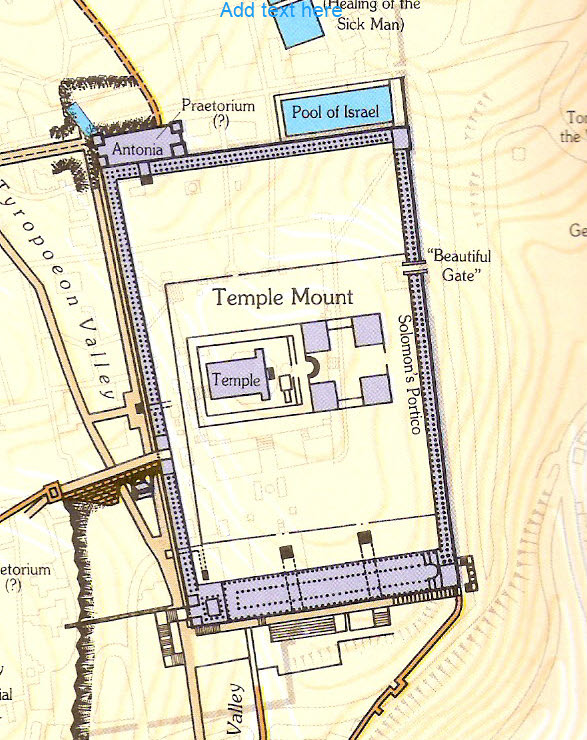
During that Hanukkah, Jesus was confronted in Solomon’s Porch, the Collonade inside the eastern wall of the Temple Mount and challenged to state plainly if He was the expected Messiah. He responded that He had already answered that question and went on to say explicitly that He and [God] the Father are one, and that He, Himself, has power to grant eternal life. His accusers then threatened first to stone Him and then to arrest Him because He, being a man, was making Himself out to be God.

The Temple Mount, cropped from a drawing by Dan Bahat. Solomon’s Porch (or Portico) annotated on the east side of the Mount.

His response to that was to quote from Psalm 82, thereby invoking the entire Psalm and turning the accusations back on His accusers, before slipping away from them supernaturally.

Psalm 82 is difficult to understand today, because modern commentators have almost uniformly ignored what would have been perfectly clear to the average 1st Century Israelite.

[82:1] God [Elohim] has taken his place in the divine council;
in the midst of the gods [elohim] he holds judgment:
[2] “How long will you judge unjustly
and show partiality to the wicked? Selah
[3] [You should] Give justice to the weak and the fatherless;
maintain the right of the afflicted and the destitute.
[4] Rescue the weak and the needy;
deliver them from the hand of the wicked.”
[5] They [those victimized in v. 3–4] have neither knowledge
nor understanding, they walk about in darkness;
all the foundations of the earth are shaken.
—Psalm 82:1–5 ESV

The Hebrew Elohim, meaning God in many contexts, can in other contexts also mean “angels” (in the New Testament, this term refers to all ranks of the Heavenly Host, as explained in Gods and Demons), “judges“, or “masters“. When God scattered the nations from Babel (Gen. 11:8–9), He put those rebellious humans under the supervision of equally rebellious angels (the “Sons of God”, Deut. 32:8–9), who became their capricious gods. This understanding is supported by the verses following:

[6] I said, “You are gods [elohim],
sons of the Most High, all of you;
[7] nevertheless, like men you shall die,
and fall like any prince.”
[8] Arise, O God [Elohim], judge the earth;
for you shall inherit all the nations!
—Psalm 82:6–8 ESV

The Psalm itself is a pun, a play on the word elohim. God is effectively saying that He is the judge of the judges. When Jesus quotes v. 6,

[34] Jesus answered them, “Is it not written in your Law, ‘I said, you are gods’?
—John 10:34 (ESV)

He was making a rabbinic kal v’chomer (lesser to greater) argument: “If the pagan gods, doing evil works and judging unjustly, are elohim, how much more am I, who does good works and judges fairly, Elohim? And if the angelic gods are ‘sons of the Host High’, how much more does the description ‘Son of God’ apply to me”?

After Jesus disappeared from the Temple, He was next seen in Bethany Beyond Jordan, the area where He and John the Baptizer had met earlier in the Book.

John 11

The confrontation in Solomon’s Porch recorded in John 10 occurred in December, and the Crucifixion was in Early April, so the raising of El’azar (Lazarus) had to have occurred in the intervening span of around three months. Many people, both friend and foe of Jesus, witnessed Lazarus’ resurrection. Subsequent plots against Jesus led Him to retreat to the town of Efrayim, in northeast Judah. When He returned to Jerusalem, possibly only weeks later, the miracle was still no doubt fresh in people’s minds.

Since the raising of Lazarus was a completely unprecedented event, it was probably totally shocking to everyone. We know of five resurrections prior to Lazarus: one brought about by Elijah; one by Elisha while he lived; one by contact with Elisha’s corpse; and two previous by Jesus. Lazarus was the only recorded resurrection of someone three or more days after death. A number of commentaries note that three days in the grave were considered to be the maximum time for any hope of an apparently dead body to be capable of resuscitation; for example, The Net Bible Commentary references, “a rabbinic belief that the soul hovered near the body of the deceased for three days, hoping to be able to return to the body.” I think that this was probably a recognition that significant, irreversible signs of decomposition generally appear two to three days after death. Rigor mortis begins within a few hours of death, and fades after two or three days. Lividity becomes quickly evident but does not lock into place for about three days. Putrefaction begins immediately at the cellular level, but dependent on circumstances may not be externally evident for several days.

For a comparison of Lazarus’ resurrection with Jesus’ own, see Biblical Considerations in Is There a Photo of Jesus?

People

Unfortunately, almost nobody understands the various sects of Jesus’ day. The Gospel writers had no need to teach an in-depth course, because everyone in their day knew the players. Since pretty much every contact between Jesus and the sectarians was confrontational, that makes them all look like villains. But that is a skewed generalization! When someone was referred to in Scripture as a Pharisee, that was usually referring to a trained and ordained rabbi, but there weren’t all that many of those. Estimates for 1st Century Judea are about 6,000 Pharisees, 4,000 Essenes, substantially fewer Sadducees, and just pockets of anything else. Here is a very brief summary:

Sanhedrin

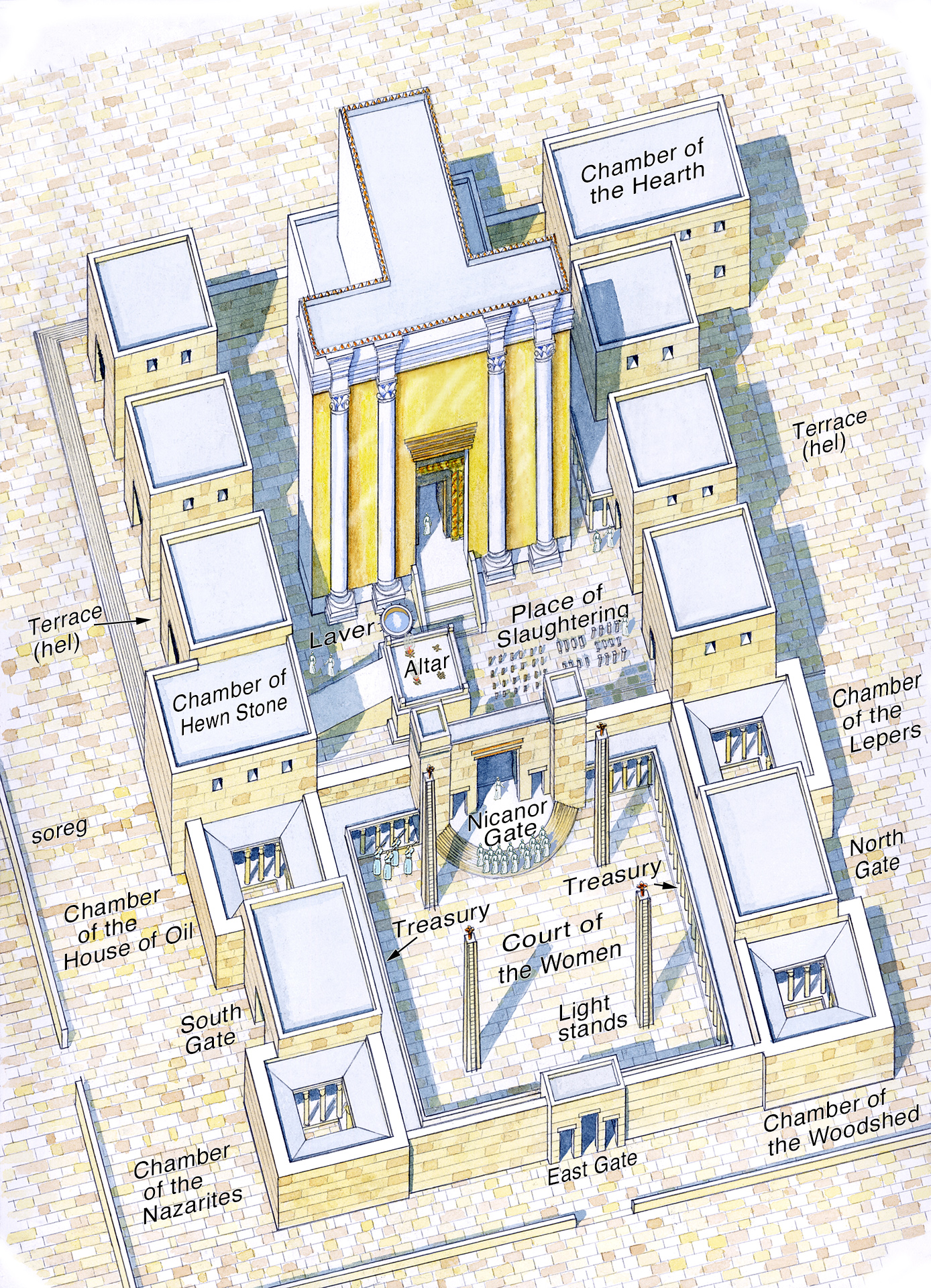
This, of course, was not a sect, but a system of governing courts, or councils. Every city had a Lesser Sanhedrin of 23 members, which answered to the Great Sanhedrin in Jerusalem. The latter consisted of 71 appointed members. The Cohen HaGadol, or High Priest, functioned as the Nasi, (Prince, President, Chief Justice, or Chairman of the Board, so to speak). Ideally around half of the remaining 70 were Pharisees and half Sadducees. In Jesus’ day they met daily in the Chamber of Hewn Stone, in the Temple complex (see diagram). Around the time of the Crucifixion, they moved into the nave of the Royal Portico, which was a grand basilica constructed parallel to the southern wall of the Temple Mount, where the Al Aqsa Mosque presently sits.

The Temple complex in Jesus’ day. The Chamber of Hewn Stone is a large room midway down the left side, adjacent to the ramp of the altar. The terrace above that on the drawing is where young Jeshua (Jesus) spoke to members of the Sanhedrin on His first recorded Passover (Luke 2:41–46). ©Leen Ritmeyer.

One of the official functions of the Sanhedrin was to evaluate anyone who claimed to be the Messiah. In the Synoptic Gospels, when you read of “chief priests and scribes” or “scribes and Pharisees” apparently harassing Jesus, I think that most likely they were officially tasked by the Sanhedrin to follow and question. Given the politicization of the Sanhedrin under Roman rule, some of these were undoubtedly hostile, but others were probably merely conscientiously concerned. Nicodemus and Gamaliel were surely members of the Council and were certainly not evil men. Joseph of Arimathea and Paul were probably both also members. With one exception, the book of John mentions only the Pharisees among those following the crowds with Jesus, but that should not be taken to mean anything other than the normal agents of the Sanhedrin. John wrote probably a decade after the destruction of the Temple and the priesthood. By that time, the Sadducees were a distant memory to his readers, and the Temple had been replaced in their lives by the synagogues. Banishment from the synagogue had become the worst punishment possible, short of death to some and worse than death to others.

High Priest

Under Mosaic Law, the High Priest was required to be a direct descendent of Aaron, as were all priests and Levites. King David replaced a corrupt High Priest with Zadoc, who was himself an Aaronic descendent. Subsequently, all high priests (but not other priests or the Levites) were to be from Zadoc’s lineage. From at least Hasmonean times, the office was corrupt to the extent that many high priests were illegitimate. Under Roman rule, appointments were made by the regent or governor, and the office became more political than religious.

Chief Priests

As the title suggests, these were high ranking priests in the Jerusalem hierarchy. Most, if not all, were probably members of the Sanhedrin. Most were Sadducees.

Sadducees

This is the first actual sect I will discuss. These men were considered the “priestly caste” in Judea. It consisted not only of priests, but also aristocratic “hangers on”. By no means were all priests Sadducees; in fact, many were Pharisees, though most were unaffiliated with either sect. Officially, the Sadducees rejected all scripture but the Five Books of Moses (the Chumash), and in particular, rejected the concept of resurrection. Though only a small sect, the Sadducees were wealthy, and thus powerful. They controlled the priesthood, the Levites, the Temple, and the festivals. After AD 70, they disappeared from history.

Pharisees

This sect had more popular support than any others in Jesus’ day, though they weren’t in control, either of the nation or the Temple. They did lead the synagogues, for the most part. They probably had their origins with holy elders in the Babylonia captivity but evolved into a cohesive sect alongside the Sadducees in the Hasmonean Kingdom of the 1st and 2nd Centuries, BC. The two sects were in open warfare with each other during the reign of Alexander Jannaeus, the second Hasmonean King, and hundreds of Pharisees were killed.

Doctrinally, the Pharisees treasured the entire canon of the Tanach (Old Testament) and believed in resurrection. They were the popularizers of the “Oral Torah“, or so-called “traditions of the elders.” After the destruction of the Temple, only this sect survived, and they are the ones, humanly speaking, who God used to preserve a Jewish remnant for 2,000+ years.

Contrary to the assumptions of most Christians, the Pharisee sect was not monumental. Above, I mentioned four members of the Sanhedrin that we would not call evil. All of those were Pharisees. Paul was a Pharisee both before and after Damascus. In Acts 23:6 (ESV), he declared, “Brothers, I am [present tense] a Pharisee, a son of Pharisees.” It was Pharisees who wrote the Talmud, and I think they accurately analyzed their own shortcomings and eccentricities:

Talmudic Classification of the Pharisees:

(1) the “shoulder” Pharisee, who wears his good deeds on his shoulders and obeys the precept of the Law, not from principle, but from expediency;

(2) the “wait-a-little” Pharisee, who begs for time in order to perform a meritorious action;

(3) the “bleeding” Pharisee, who in his eagerness to avoid looking on a woman shuts his eyes and so bruises himself to bleeding by stumbling against a wall;

(4) the “painted” Pharisee, who advertises his holiness lest any one should touch him so that he should be defiled;

(5) the “reckoning” Pharisee, who is always saying “What duty must I do to balance any unpalatable duty which I have neglected?”;

(6) the “fearing” Pharisee, whose relation to God is one merely of trembling awe;

(7) the Pharisee from “love.”

The International Standard Bible Encyclopedia, 1915 Edition
Scribes

The scribes were not a sect, but rather a profession. They were, as you would expect, the educated readers and writers of Israel. Many of them were Pharisees. Some were Sadducees or members of another sect, or of none at all. Many were members of the Sanhedrin.

Essenes

Little is said about the sect of the Essenes in the Bible, because they were ultrareligious outsiders who pretty much kept to themselves. Claims that John the Baptizer or Jesus were Essenes are completely wrong.

Yahad

The Yahad are the sect of Qumran and the Dead Sea Scrolls. Many think that they were Essenes, but there were radical doctrinal differences between the two groups. My friend, Dr. Randall Price, wrote what I consider the definitive book on the subject, Secrets of the Dead Sea Scrolls.

Am Ha’aretz

These were the common “people of the land”, those without power or wealth. Jesus’ ministry was primarily to this group, who were members of no sect, but mostly listened to the Pharisees.

Herodians

This was a political party, not a true sect. They were supporters of the Herodian Dynasty and were a small minority of the population.

Timeline

Verses 1,2

Jesus returned to Bethany “six days before the Passover”, which by my own calculations (see table, below) was March 30, 0030. The 30th was a Sabbath, so He had to have arrived no later than Friday afternoon. The dinner in His honor was, according to Mark, at the home of Simon the Leper, who we know nothing else about. The meal would have been prepared before sundown, and served after dark, on the new day. The account makes perfect sense, because Sabbath dinners were always festive and joyous occasions. Perfect for welcoming a distinguished friend and guest!

The Gregorian dates shown here are my own calculations based on NOAA lunar tables going back much farther even than that. ©Ron Thompson
Verses 3–8

The text says that Miryam washed Jesus’ feet with spikenard that she had obtained for His burial. (Could it be that she was the only one paying attention to what He had been saying?) We know from previous scripture that her family was important and well off, so her possession of the pure nard oil was not surprising. It was an expensive perfume imported from India in alabaster containers, and a pint of it would have cost about a year’s wages for a common laborer of the am Ha’aretz. The Southern Baptist quarterly mentions that respectable 1st Century Jewish women kept their hair concealed. That was true then, and it’s still true among the pious Orthodox. Using a headscarf like a Muslim woman is acceptable, but in Western cultures it is more common to wear a wig.

Jesus’ comment about the poor should not be taken as insensitive. He was making reference explicitly to Deuteronomy 15:11, and saying, in effect, that this is a drop in the bucket and will make little difference to the poor, who will always be around.

[11] for there will always be poor people in the land. That is why I am giving you this order, ‘You must open your hand to your poor and needy brother in your land.’
Deuteronomy 15:11 (CJB)

Verses 9–11

We see here yet another example of the Sanhedrin plotting against Jesus, and in this case also against Lazarus. I would not wish to paint them as blameless, but I think they weren’t as bad as many believe. Yes, there were corrupt men on the Council, but on balance, I don’t think they were as worried about losing their personal influence as they were of goading the Romans into just what finally did happen in AD 70. Paul himself gives them an excuse of sorts:

1 Brothers, my heart’s desire and prayer to God for them is that they may be saved.
2 For I bear them witness that they have a zeal for God, but not according to knowledge.
3 For, being ignorant of the righteousness of God, and seeking to establish their own, they did not submit to God’s righteousness.
—Romans 10:1–3 ESV

Verses 12–19

The Triumphal Entry. It was the day after the feast at Simon’s house. Sunday, Nisan 10 of the year 3790, or by our reckoning, March 31, 0030. Jesus went from Bethany to Jerusalem. Rather than walk this time, He had to ride a donkey’s colt into the city in order to fulfill the prophecies of Psalm 118:25–26 and Zechariah 9:9. Actually, did you catch the oddity in Matthew 21:2? He actually rode two donkeys—a mare and her colt. Evidently, he rode the mare part way and then transferred to the colt for the last part of the ride. Bible trivia!

Another mistake that many people make is to think that the people glorifying Jesus as He rode into town are the same people that days later insisted that Pilate put Him to death and release Barrabas. The people waving palm fronds on Sunday were home in bed on Friday when Jesus was on trial. The only people present for that were Jesus’ enemies.

Verses 20–26

The quarterly, and some of my favorite commentators as well, interpret “some Greeks” as referring either to Greek nationals or to God-fearing gentiles visiting the city from outside Judea. I disagree. I think that the context here, and more clearly in John 5:35, is the same as that in Acts 6:1. It is referring to Greek-speaking Jews from the Jewish Diaspora.

What did they want? The quarterly is wrong to say that “John gave no indication”, but that it “triggered something in Jesus.” Verse 23 clearly states that what it triggered was a response; evidently what they wanted was to request that He visit their countries next, which would explain why His answer, that He was about to die and couldn’t go, was directly to the point. As was verse 26, where He effectively told them that, instead of Him following them home, they could ultimately follow Him home.

Verses 27–36

My purpose in writing a blog is not to regurgitate things that most of my readers already know, nor is it to find fault with Sunday School quarterlies, though I’m not above doing that from time to time. Though I don’t agree with anybody about everything, I really think that Dr. Howell has done a fine job with his commentary in this quarter’s booklet. The reason for my blog posts in general is that for decades I’ve tried to understand Scripture not only from conventional, traditional, points of view, but from my own historical and cultural perspectives and from observations of God’s design of the universe and its physical laws.

The reason I bring this up now is because, while this whole passage is extremely interesting and vitally important, I have only one thing to add to what Dr. Howell has said. He interprets God’s voice in verse 28 as a “thunderous response.” I’m pretty sure he is picturing an earsplitting clap of thunder from lightning striking a tree in his backyard. On the contrary, my own vision is of a gently rolling murmur of distant thunder, as carried by the wind. The Complete Jewish Bible translates it as,

[28] ‘Father, glorify your name!’” At this a bat-kol came out of heaven, “I have glorified it before, and I will glorify it again!”
—John 12:28 (CJB) Emphasis mine

I’ve written about the bat-kol, or “daughter of a voice”, before. It is the “low whisper”, or “still, small voice” that Elijah heard in I Kings 19:12ff. When God spoke to His prophets audibly, I think that it was in this soothing, intimate fashion, not like a scary Zeus or Thor figure would blare out to his minions. This whisper voice is the way it was depicted in ancient Jewish literature, as described by the 2nd or 3rd Century Rabbis who compiled it:

“After the death of Haggai, Zechariah and Malachi,
the last of the prophets, the Holy Spirit ceased from
Israel; nevertheless they received communications
from God through the medium of the bat-kol.”
—Tosefta Sotah 13:2

Verses 37–50

In the same spirit as with the previous section, I am going to comment on only two thoughts:

First, in verse 38 John quotes Isaiah 53:1. Something that you should remember when reading the New Testament is that most Jews were taught Scripture from a very early age, in their homes and then, in some cases, in a beit midrash (house of study”, an arm of the local synagogue. For this reason, speakers like the rabbis and Jesus referred to entire passages of the Old Testament by merely quoting a key sentence or phrase. Thus, by quoting this one verse, Jesus was effectively applying Isaiah 53, in its entirety, to Himself. I repeat it here:

1 Who believes our report?
To whom is the arm of ADONAI revealed?
2 For before him he grew up like a young plant,
like a root out of dry ground.
He was not well-formed or especially handsome;
we saw him, but his appearance did not attract us.
3 People despised and avoided him,
a man of pains, well acquainted with illness.
Like someone from whom people turn their faces,
he was despised; we did not value him.
4 ¶ In fact, it was our diseases he bore,
our pains from which he suffered;
yet we regarded him as punished,
stricken and afflicted by God.
5 But he was wounded because of our crimes,
crushed because of our sins;
the disciplining that makes us whole fell on him,
and by his bruises* we are healed.
6 ¶ We all, like sheep, went astray;
we turned, each one, to his own way;
yet ADONAI laid on him
the guilt of all of us.
7 ¶ Though mistreated, he was submissive –
he did not open his mouth.
Like a lamb led to be slaughtered,
like a sheep silent before its shearers,
he did not open his mouth.
8 After forcible arrest and sentencing,
he was taken away;
and none of his generation protested
his being cut off from the land of the living
for the crimes of my people,
who deserved the punishment themselves.
9 He was given a grave among the wicked;
in his death he was with a rich man.
¶ Although he had done no violence
and had said nothing deceptive,
10 yet it pleased ADONAI to crush him with illness,
to see if he would present himself as a guilt offering.
If he does, he will see his offspring;
and he will prolong his days;
and at his hand ADONAI’s desire
will be accomplished.
11 After this ordeal, he will see satisfaction.
“By his knowing [pain and sacrifice],
my righteous servant makes many righteous;
it is for their sins that he suffers.
12 Therefore I will assign him a share with the great,
he will divide the spoil with the mighty,
for having exposed himself to death
and being counted among the sinners,
while actually bearing the sin of many
and interceding for the offenders.”
—Isaiah 53:1–12 CJB

Finally, John 12:40 was another Isaiah quote. In its Old Testament context:

8 ¶ Then I heard the voice of Adonai saying,
¶ “Whom should I send?
Who will go for us?”
¶ I answered, “I’m here, send me!”
9 He said, “Go and tell this people:
¶ ‘Yes, you hear, but you don’t understand.
You certainly see, but you don’t get the point!’
10 ¶ “Make the heart of this people [sluggish with] fat,
stop up their ears, and shut their eyes.
Otherwise, seeing with their eyes,
and hearing with their ears,
then understanding with their hearts,
they might repent and be healed!”
11 ¶ I asked, “Adonai, how long?” and he answered,
¶ “Until cities become uninhabited ruins,
houses without human presence,
the land utterly wasted;
12 until ADONAI drives the people far away,
and the land is one vast desolation.
13 If even a tenth [of the people] remain,
it will again be devoured.
¶ “But like a pistachio tree or an oak,
whose trunk remains alive
after its leaves fall off,
the holy seed will be its trunk.”
—Isaiah 6:8–13 CJB

Jesus is explaining, by this reference, why so many of His hearers could not see the truth, despite His signs and wonders. Just as God hardened Pharaoh’s heart after Pharaoh had several times hardened his own heart, He has hardened the hearts of many Jews who have repeatedly rejected Him. That doesn’t mean that Jews can’t be saved, obviously, nor does it mean that God has rejected the people as a whole. They are still “God’s chosen people”, natural branches of the olive tree to which we believers who are not Jews have merely been grafted.

How is this hardening even fair? Because God chose them for His own, revealed Himself to them, in particular, and gave them all the advantages of a special relationship. When the hardening ends, at the close of the Great Tribulation, all that remain alive, and I think their numbers will be vast, will be saved. Every last one of them, I believe!