Summary of Judgement Seat and Crowns in Heaven

Posted on:

Modified on:

  1. The Judgement Seat of Christ
  2. Purpose of the Judgement Seat
  3. Timing of the Judgement Seat
  4. The Bimah Seat
  5. Crowns

“Behold, I am coming soon, bringing my recompense with me, to repay each one for what he has done.
—Revelation 22:12 ESV

This past Sunday, late in Bible class, someone raised the subject of “The Judgement Seat of Christ“, “crowns“, the “Bema” and so on. There was no time for me to put in my own two cents, but it is a subject that touches me personally. I was raised in a very legalistic fundamentalist church, and the whole question troubled me at the time more deeply than any other doctrinal issue. If “Jesus paid it all“, “not of works, lest any should boast“, and heaven is the carefree paradise we’ve been led to believe, then how is it that the first thing that happens after the Rapture is that we face judgement, possible humiliation in front of our peers, and maybe worse still, potential forfeiture of a fancy, jeweled crown to wear in our new mansion over the hilltop? And what’s the point of working hard for a crown if we have to give it right back, by “casting it at Jesus’ feet“?

This is a diversion from what I’ve been working on, a discourse on God’s omnipresence in space and time, and what that implies about creation, so I’m not going to do an exhaustive study of this subject. I’d be reinventing the wheel anyhow, because the late J. Hampton Keathley III, Th.M., did an excellent job of nailing it down in an article, The Doctrine of Rewards: The Judgment Seat (Bema) of Christ. Below is a short summary of aspects that I have pondered over the last few days:

The Judgement Seat of Christ

The term “judgements” is used many times in Scripture, mostly regarding punishment. I am limiting this discussion to the major formal judicial reviews of the End Times recognized by many conservative theologians. There are variations in terminology, and some count three or five but for this purpose, I’m going with the diagram below, which lists four. In general, I think that the source book shown in the caption is pretty good, though I question LaHaye’s own previous judgement, in view of the terrible theology in his Left Behind series.

One view of the end-time major judgements, from Charting the End Times, by Tim LaHaye and Thomas Ice, ®2001.

The “Judgement Seat of Christ” is the most common name used by Christian theologians for the evaluation of Christians that occurs after the Rapture. The diagram shows the Rapture occurring simultaneously with the beginning of the seven-year Tribulation period. I strongly believe in a “Pre-Trib” Rapture, but I don’t think that Scripture requires the Tribulation to happen immediately after the Rapture. I personally think that there will be a time of major geopolitical developments on earth between the removal of the Holy Spirit and all Christian influence, on the one hand, and the beginning of Tribulation on the other. The war of Ezekiel 38 and 39 may be one of them (see The Coming World War: Gog and Magog).

Purpose of the Judgement Seat

This is emphatically not a judgement for sin, because Jesus’ crucifixion paid that cost, but rather an evaluation of the quality of our service. I think for a twofold purpose: (1) for recognition and kudos; and (2) for handing out of assignments. As discussed in Keathley’s article, the Scriptures imply that the Raptured Church will function administratively during the Millennial Kingdom. I don’t know that I can definitively back this up from Scripture, but my personal impression is that our individual responsibilities in the Kingdom will be based on our aptitudes and attitudes shown during our mortal lives. Although without sin, our glorified selves will still be recognizable, both physically and by non-physical personal traits.

Timing of the Judgement Seat

Many scholars (e.g., Keathley) show it at the beginning of Tribulation, others (e.g., LaHaye and Ice) show it as taking place during the entire seven-year span. I would say the beginning, and not the entire span. Why? First, because of its connection with Rosh Ha-Shanna, coming up in late October this year (see below), and also because I think that the Marriage Supper of the Lamb will be the focus in heaven during the period. Christian scholars tend to ignore Jewish cultural analogs when interpreting Jewish Scripture. Even though all Scripture is Jewish! Jesus (Yeshua ben Yosef) and most of the Gospel protagonists were thoroughly Jewish, and all but one of the canonical writers was Jewish. The exception being Luke, who I think was a Jewish convert. Jewish wedding customs in the 1st Century clearly pictured Jesus’ relationship with the Church, His bride (see Jesus and Hebrew Wedding Imagery). The Jewish wedding supper was a seven-day feast, so I think there is ample reason to think that the heavenly marriage supper might span seven prophetic days.

How could all of that “evaluation”, of all the Church saints from two Millenia of Church history, be accomplished virtually instantaneously? That is something I’m already working on for my next post: In God’s “native” realm, there is no such thing as “time”, or even “space”. He is independent of both and unbound by both. He exists simultaneously everywhere and everywhen. In 2 Peter 3:8, the apostle is paraphrasing Psalm 90:4 when he says that, to God, a day is as a thousand years. That is poetic language, not literal. The truth is, he could have said a million, or a billion, or trillions and trillions. Or conversely, a femtosecond (10-15 seconds), for example, is no more obscure to Him as a day.

The Bimah—Jewish, too, not just a Greek concept!

Here is where I depart from Keathley and other Christian scholars.

The Greek term béma (βεμα, pronounced BAY-muh) is defined by Strong’s as “a platform to which someone [ascended] to receive judgment; (figuratively) the administration of justice – literally, given from “a tribunal-chair” (throne) where rewards and punishments are meted out.”

The Hebrew term bimah (מִמַּה, pronounced BEE-muh) is no doubt related, and has a similar meaning in general, but, for our purposes here, there is a much more specific meaning, attested as early as Neamiah’s time, in the Persian era. According to Encyclopaedia Judaica, the word means an “elevated place“, more specifically a “platform in the synagogue on which stands the desk from which the Torah is read. Occasionally the rabbi delivers his sermon from the bimah, and on Rosh Ha-Shanah the shofar [ram’s horn] is blown there.” The reading desk is also often referred to as a bimah. Significantly, I believe that the Rapture will occur on a Rosh Ha-Shanah (also known as Yom Teruah, The Day of Trumpets; see The Jewish Feasts: Part 11, Trumpets)!
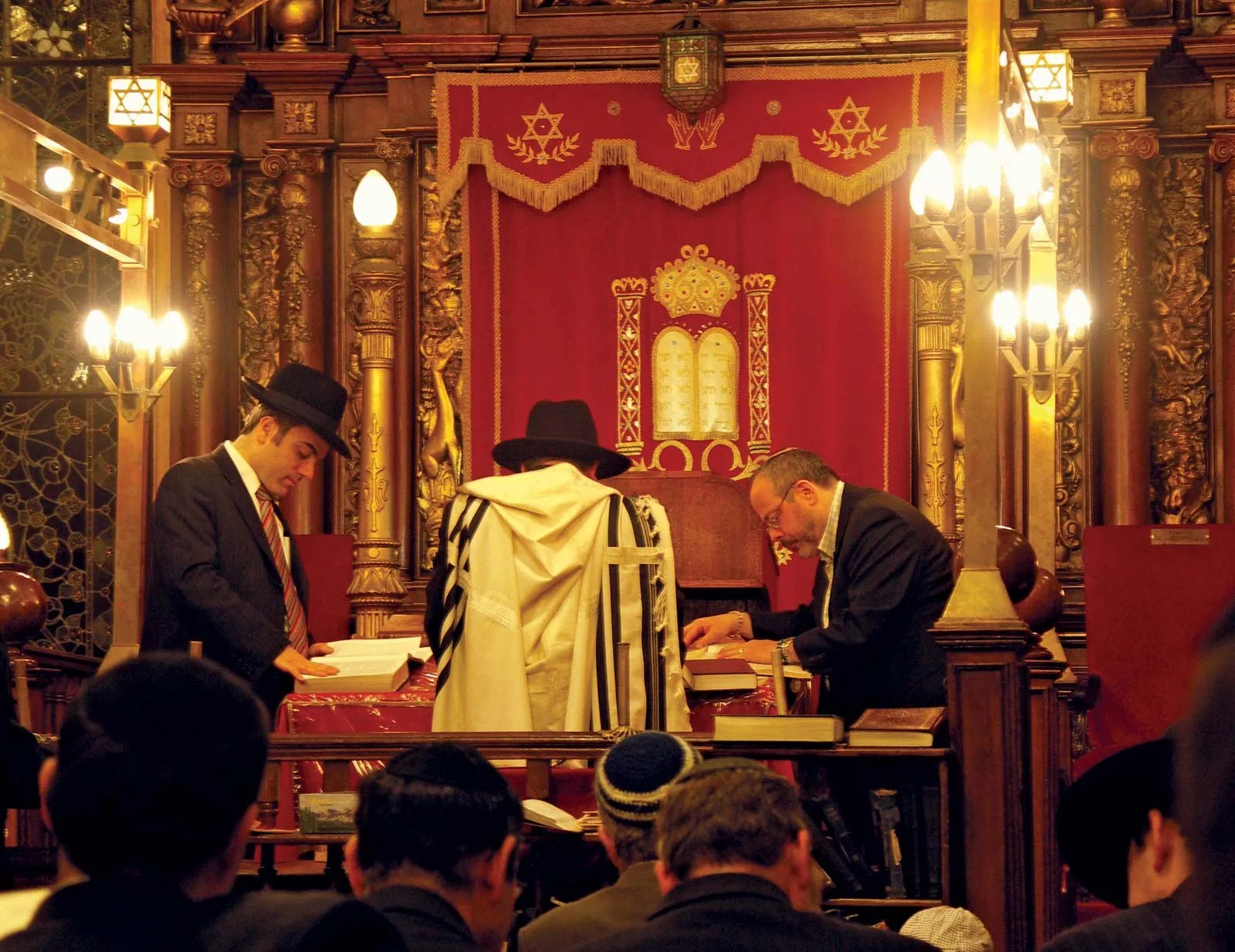
Reading at the bimah, Bialystoker Synagogue, New York, N.Y., U.S.
©Juda S. Engelmayer
Parenthetic notes on the photos...

Above: The photo above shows three men standing at the bimah table in a small synagogue in Lower East-Side Manhattan. The synagogue is never called a "temple" by orthodox Jews, but it nevertheless serves many of the Temple's functions in the post-Temple world. The bimah stands near the center of the room, just as the altar stood in the center of the Court of Priests. The man seen in this photo in his woolen tallit (prayer shawl) is standing at the table with his face to the aron HaKodesh (the Holy Ark, a cabinet in which one or more Torah scrolls is stored. In this synagogue, the Ark is behind the red tapestry. Most likely the reader is not the rabbi, but rather a congregant who has been invited to "make aliya", or "go up" onto the bimah to read assigned passages from the Torah. Typically, when the Torah is taken out to be read before the community, one person reads the Torah, and that person is surrounded on either side with two gabbaim (as here) who ensure that the Torah is being read and treated respectfully and accurately.

Below: The photo below shows another feature of early synagogues, associated with the bimah, that I think is germane to this discussion—the "Seat of Moses". 
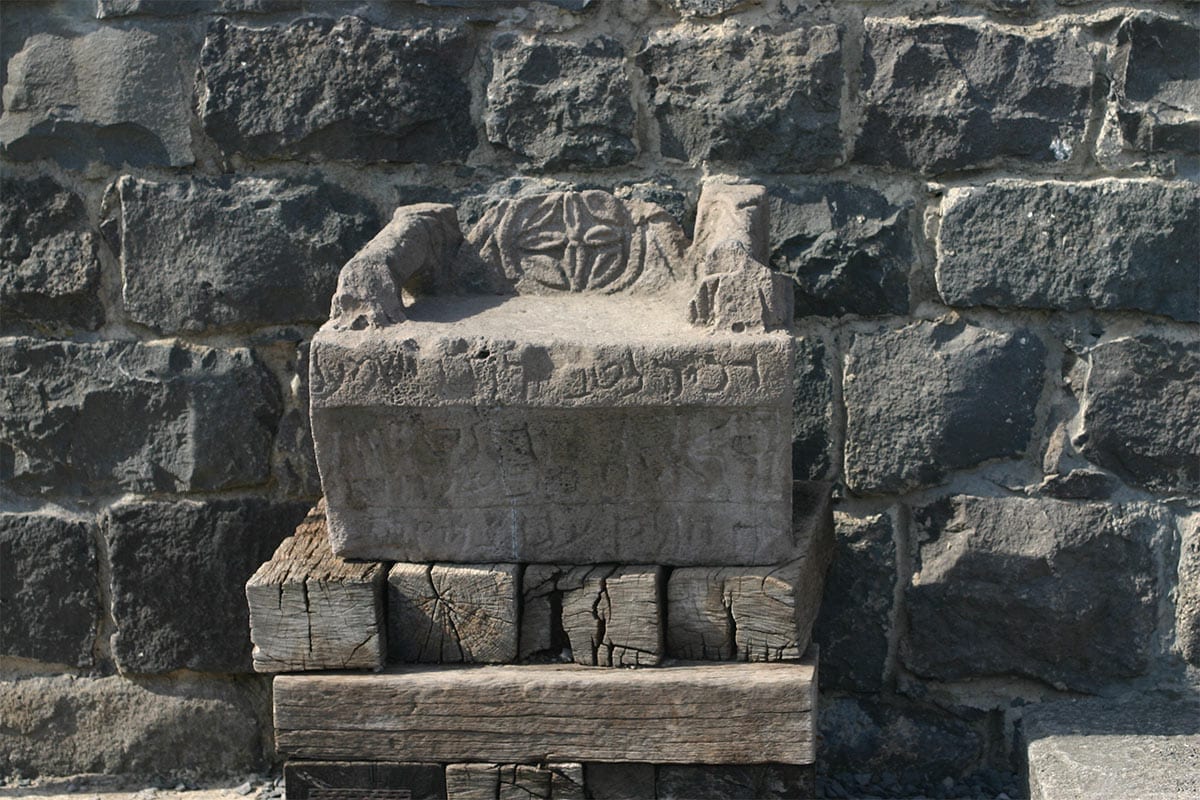
The restored “Moses Seat” in the synagogue of Korazin, in Galilee.

The Bimah Seat

Also associated with the bimah platform was “the seat of Moses”. This seat was used by a scribe or other authoritative interpreter of scripture. Today it would be the rabbi. In Matthew 23, Jesus validated the authority of the interpretations made from the seat of Moses, even though, in the same breath, He said, effectively, “Do as they say, not as they do.”

Then Jesus said to the crowds and to his disciples,
“The scribes and the Pharisees sit on Moses’ seat,
so do and observe whatever they tell you, but not the works they do. For they preach, but do not practice.
—Matthew 23:1–3 ESV

I think that, to understand the concept of the Judgement Seat of Messiah, you have to consider the Jewish concept and not just the Greek. We will be evaluated in the heavenly realm, not for sin, but for our performance in light of God’s expectations for His people as expressed in Scripture. Jesus will be the one, sitting on a heavenly bimah seat of Moses, who will be evaluating us and handing out crowns.

Crowns

Sad to say, even as a young adult, my vision of kingdoms and crowns was informed mostly by Walt Disney. So, I pictured literal golden streets and pearly gates in heaven, my home a palace, and on my head a jewel-encrusted crown. I think now that the glitz and bling is meant to convey a sense of beauty and purity, not to arouse materialistic jealousy and greed. The crowns may not be literal headwear but are certainly meant to convey the Greek and oriental picture of the victor’s laurel wreath.

In every case, the Greek word for these “crowns” is stephanos, for which the proper translation is “wreath”, i.e., a chaplet worn as a badge of royalty, honor or victory. The royal crown is always a diadem. Jesus’ crown of thorns was a stephanos, so it was most likely an ironic insult from the Roman soldiers, not something ordered up by Pilate as a complement to his sign of indictment nailed on the cross.
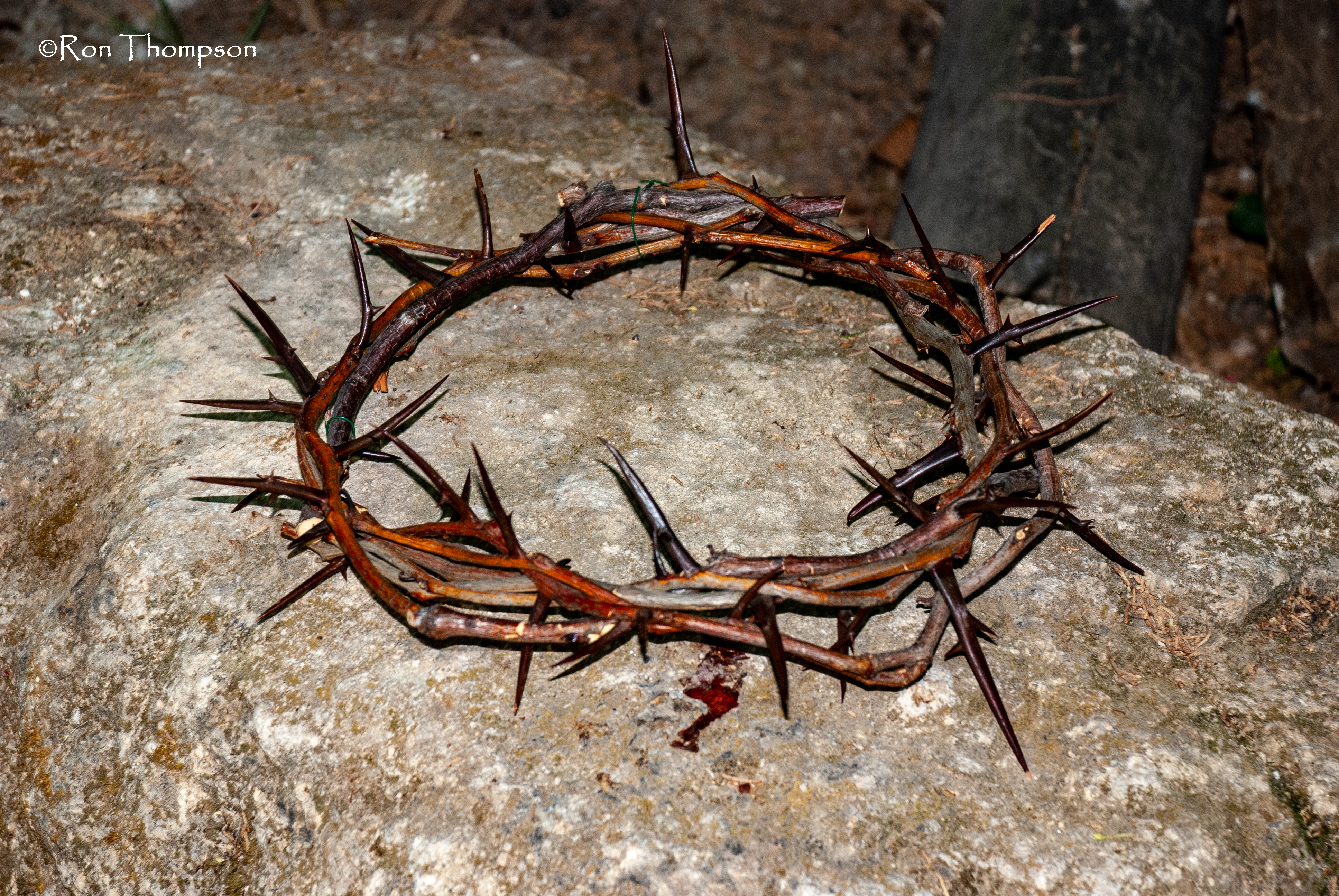
Depiction of Jesus’ crown of thorns, photographed in the back garden of the Bible Times Center, Ein Kerem, Israel. ©Ron Thompson, 2008.

A common Christian tradition says that at some point after receiving crowns at the bimah, we will cast them back at Jesus’ feet in adoration. This appears to be a corruption of Revelation 4:10–11, where 24 elders sitting in a circle of thrones stand and cast their own stephanos in front of the central throne, occupied, apparently, by Yahveh, the Father, not the Son:

10 the 24 elders fall down before the One sitting on the throne, who lives forever and ever, and worship him. They throw their crowns in front of the throne and say,

11 “You are worthy, ADONAI Eloheinu, to have glory, honor and power, because you created all things — yes, because of your will they were created and came into being!”
—Revelation 4:10–11 CJB


The Upper Room and End-Times Nuttiness

I just dug up something that I posted in early June 2014, and took down again when part of it became old news. My original post was in response to an article that was being circulated claiming that Israeli Prime Minister Benjamin Netanyahu was planning to hand control of the traditional “Upper Room” site of Jesus’ Last Supper, on Mt. Zion, to Pope Francis, presumably so that it could be developed into yet another Catholic shrine. The author of the article was enraged because he viewed the Pope to be the False Prophet of Revelation and “giving him an official seat in this most sacred of places … is the Abomination of Desolation spoken of by Daniel.” The question was posed, “Should [the False Prophet] be glorified before the nations on Mount Zion, God’s holy mountain?”

Unfortunately, in my life I have seen no shortage of end-times weirdness, and this certainly qualifies. I would call it “poorly informed pop theology.”

What made me think of this now (April 2023) is that the current Southern Baptist Sunday School quarterly includes several lessons from John’s Gospel covering parts of the Last Supper, and also a back-page map showing the commentator’s interpretation of Jesus’ movements from the Upper Room to the Cross. He shows Jesus’ trek beginning at the traditional site on Mt. Zion. I usually tend to place a lot of stock in early Christian tradition, but I’m very dubious of this one, which I discussed in more detail in my own interpretation (see Jesus’ Last Steps).

The traditional “Upper Room” This is a 12th Century Crusader structure, image downloaded from Vintage Grace, constancedenninger.blogspot.com.

Honestly, I can’t really recall much detail from the article I was responding to, and the link to it is now broken, no doubt because the particular “abomination” it warned of never happened. I am now reposting an updated version of my response, simply because there are still points to be made about the Upper Room, and Eschatology in general. For perspective, I am Premillennial, and my views presuppose a pre-Tribulation Rapture of the Church.

The Abomination of Desolation will be a desecration of the Holy of Holies in the Tribulation Temple; not of the Upper Room, as stated in the article. The majority of today’s Christians belong to denominations that are either Catholic, Orthodox, or Reformed, and most of those teach that God has permanently turned His back on the Hebrew people. This is a characteristic of Covenant Theology in general, which I suspect is the reason the article elevates the Upper Room in significance, at the expense of the Jewish Temple.

Any suggestion that the prophesied Abomination would pertain to any strictly Christian holy site, like the Upper Room, is bogus. The end-time prophesies, and the Tribulation itself, are related wholly to Israel and to Gentile nations, not to the Church and New Testament Christianity. By the time of the Abomination, the Church will have been Raptured. Any believers present on earth as the Tribulation period advances will be worshiping in a totally Jewish context.

The Abomination of Desolation spoken of by Daniel, Jesus, Paul—and of course John in Revelation—referred to end-time events. It was prefigured during Intertestamental times by a similar Abomination perpetrated by the Syrian king Antiochus IV. It is not uncommon in history to see prophesied events prefigured by earlier events. Prefiguration is illustration. Because Antiochus defiled the Most Holy Place in the Jerusalem Temple, we are strengthened in our understanding that it will be the Most Holy Place in the Jerusalem Temple that Antichrist will defile.

To state it again, the Abomination will be perpetrated by Antichristnot the False Prophet. Messiah ritually cleansed the Temple when He drove out the moneychangers. Antimessiah will defile it.

The Upper Room shrine is one of the most poorly attested of the ancient holy sites. The room shown in the photo above is Byzantine, and the most that can be said about it is that it may be built on or near the original site of the actual Upper Room. Even more dubiously, the ground floor of the same building is also said to sit on the tomb of King David. This is way, way down the scale of likelihood!

Mt Zion, where the shrine is located, is not even “God’s holy mountain” at all! In Bible times, “Mt. Zion” referred to Mt. Moriah, where the First and Second Temples stood and where previously God directed Abraham to sacrifice Isaac. All Biblical references to Zion refer to Mt. Moriah. In Byzantine times, probably due to confusion, the name “Zion” became connected instead to the “Western Hill” area (the Upper City) between the Tyropoeon Valley and the Hinnom Valley. This area, as well as the Bezetha Hills to the north, were first built up by King Hezekiah, in order to accommodate a huge immigrant population from the region of Samaria.

Before I leave that subject, the so-called “Ten Lost Tribes” were never totally lost. After the conquest of the Northern tribes by Assyria, hordes of upper- and middle-class Jews were exiled to other Assyrian conquests. Many peasants were left behind to share the land with conquered peoples from elsewhere that were resettled there. Many of those intermarried to produce the mamser (“bastard”) Samaritan population later despised in Judea. But shortly before the Assyrian conquest, many well-to-do northerners fled to Judea. The size of Jerusalem doubled as a result of that influx. In the First Century, this region was populated largely by aristocratic Sadducees and Roman officials—hardly a holy mountain!

Contrary to the famous, controversial claim by the late Jerry Falwell, Antichrist will not be Jewish, in my understanding—but the False Prophet will be. I base this on my strong belief that in prophecy, “the sea” usually, if not always, refers to the masses of non-Jewish people surrounding the Holy lands, and “the Land” refers to the lands given by God to His people. Antichrist is “the beast from the sea”, and the False Prophet is “the beast from the land.” To my knowledge, no Pope has ever been Jewish!

Reading in the Pope as the False Prophet, I’m sure, comes easily because Premillennialists have long assumed that the “Great Whore” of Revelation is the Catholic Church, or some form of apostate Christianity. Catholicism seems to fit the metaphor because to Protestants it incorporates many syncretistic rituals and beliefs. On the other hand, history now suggests another possible identity of the Harlot of Revelation: Islam. Militant Islam is a whorish religion in that it insists on an illicit union between false religion and the state, and I believe it to now be a far more powerful entity than Catholicism or the apostate Church.

That is not to suggest that the False Prophet will be a Muslim. Early in his regime, Antichrist will cozy up to all religions, but his own religion, and later the only one allowed, will be worship of him. The False Prophet will ultimately be a prophet of only that one religion, which will probably have little or no liturgy or theology. He will be more of a chief of staff or press secretary by then.

Finally, I am puzzled by the outrage in the article. Surely God’s plan is the best plan! Why not say, with the Apostle John,

[20] He which testifieth these things saith, “Surely I come quickly. Amen. Even so, come, Lord Jesus.”
—Revelation 22:20 (KJV)

The Fall Feasts and the Rapture

Posted on:

Modified on:

  1. Dating Three Key Events in Jesus’ Life
  2. The Fall Feasts
  3. The Days of Awe
  4. The Day of Trumpets
  5. Extension of the Days of Awe
  6. The Baptism and Temptation of Jesus
  7. The Day of Atonement
  8. Conclusion

This post was first published over 10 years ago but recently got a major overhaul. First, because my own style has changed a bit over the years; but also, because I’ve changed my mind about one related issue, which I’ll discuss below. This is a good time for an update because it is now the middle of the Hebrew month Elul, and that is the temporal setting of my main topic here, the Fall Feasts.

Fig. 1: The Seven Principal Feasts, as outlined in Leviticus 23, ©Ron Thompson

To Top

Dating Three Key Events in Jesus’ Life

I started this edit by setting a time frame for Jesus’ First Advent, which I date in the following short table. Here I have used the Gregorian calendar for the year, because that is more identifiable to most of us, but I’m taking the month and day from the Hebrew calendar, because annual events are Biblically fixed according to that standard and are different every year by the Gregorian and earlier Julian calendars.

EventAgeHebrew DateGregorian Year
BirthTishri 154 BC
Baptismabout 30 yearsElul 1AD 26
Crucifixionabout 33 yrs., 6 mos.Nisan 14AD 30

Here are some of the factors I considered in composing this table:

  • The Biblical feast days commemorate important Jewish historical events, celebrate the annual agricultural cycle, and prophesy about Messiah’s life on earth, in both of His advents.
  • I am convinced that the Jewish principal feasts, as commanded in Leviticus 23, provide a totally reliable outline of important events in Jesus’ life, as shown in the last column of Figure 1, above. Events highlighted there in peach occurred during His first advent, on the actual feast days shown. Events highlighted in blue will occur during His second advent, again on the actual feast days shown.
  • I’m very confident that Jesus’ birth was on Tishri 15, the first day of the Feast of Tabernacles, Sukkoth. Not in December, on a date with absolutely no Scriptural support (but with a pagan connotation!); but rather in a September/October timeframe corresponding to Jewish celebration of the time that God previously “tabernacled” with His people during their 40 years of wilderness wandering. With Jesus’ birth, once again God was living among His people.
  • The year of Jesus’ birth has been disputed during my entire lifetime. There are always unresolved arguments about when Herod died, when Quirinus was governor of Cilicia/Syria, and what year a lunar eclipse hit the region, all of which are applicable. The most commonly cited estimates that I’ve seen place Jesus’ birth in 4 BC, though dates ranging from 1 through 6 BC are also commonly mentioned. I’m sticking with 4 BC here, because it fits well with the other two dates in my table.
  • Luke 3:23 states that Jesus was “about thirty years of age” when He began His ministry. Fall of AD 26 is about thirty years after the autumn of 4 BC. In fact, if His ministry began on Yom Kippur (see below), and that was the last day of His 40-day “wilderness fast and temptation”, then He was just five days shy of 30 years old.
  • His baptism by John was 40 days before Tishri 10, which is the Day of Atonement, Yom Kippur. I’ll explain the 40-day offset below, but it culminates with Jesus on the pinnacle of the Temple, defying Satan, on Yom Kippur, in full view of many thousands of worshippers on the plaza below.
Fig. 2: The late Alec Garrard, facing “south”, posing in his backyard shed model of Herod’s Temple. The parapet in the lower right corner overlooks the Kidron Valley, and as the highest point on the Temple Mount walls, it is thought by many to be the “pinnacle” mentioned in Scripture. I personally suspect that the somewhat lower parapet to the left, more commonly known as the Place of Trumpeting, might be the actual pinnacle of Scripture, since it is far more visible from the streets below. Photo from The Miniature Engineering Craftsmanship Museum.
  • His crucifixion was on Nisan 15, the first day of the Feast of Unleavened Bread, Yom ha-Bikkurim, not on Nisan 14, the day of the sacrifices.
Fig. 3: Jesus’ Crucifixion Timeline, showing in green what I consider to be the correct dates for each phase, on both the Jewish and Gregorian calendars. The vertical gray bars (not to scale) represent the evening twilight periods between Jewish dates (see Fig. 4). ©Ron Thompson
  • The year of Jesus’ crucifixion, shown here as AD 30, was calculated by me, using NOAA (National Oceanic and Atmospheric Association) New Moon Tables, which were prepared with historic ocean tides in mind. Every published Biblical chronology that I’m aware of puts the crucifixion in AD 33, but they are all based on an incorrect interpretation that insists He was crucified on Nisan 14. With a correct understanding of the timings of Passover Week which (thanks to my traditional presuppositions) it frankly took me many years to achieve, it is clear that Jesus was crucified on Nisan 15.

9/5/2023 addition – When I was working on my August update last week, I completely forgot to add one other crucial piece of evidence:

1 In the fifteenth year of the reign of Tiberius Caesar, Pontius Pilate being governor of Judea, and Herod being tetrarch of Galilee, and his brother Philip tetrarch of the region of Ituraea and Trachonitis, and Lysanias tetrarch of Abilene,
2 during the high priesthood of Annas and Caiaphas, the word of God came to John the son of Zechariah in the wilderness.
—Luke 3:1-2 ESV

Leaving Tiberias until last, here are the tenure years of the leaders mentioned (all are 1st Century AD): Pilate, 26–36; Herod (Antipas), 4–39; Philip, 4–34; Lysanius, unknown; and Caiaphas, 18–37. Annas was High Priest during the period 6–15 but was the real power in the Temple during the tenure of Caiaphas, his son-in-law, 18–37.

For the purpose of dating the text, only Tiberias‘ rule is useful. Many historians and Biblical commentators date Tiberias’ accession to the time of Augustus’ death. That puts the timing of Jesus’ baptism in the year AD 29, which would pose a problem for my proposed dating. I don’t think AD 29 is correct, because it was common for many, possibly most, ancient rulers and their chroniclers to ambitiously include years of coregency in citing tenure of rule. Tiberias was coregent with Augustus starting in either AD 11 or 12. AD 11 fits perfectly with my AD 26 date for Jesus’ baptism.

I find that I am not alone in recognizing this discrepancy. The well-respected commentary Jamieson, Faucett & Brown, for example, states that:

the fifteenth year of Tiberius — reckoning from the period when he was admitted, three years before Augustus’ death, to a share of the empire [results in a date for the events of Matthew 3:1 of] about the end of the year of Rome 779, or about four years before the usual reckoning.

“The usual reckoning” is AD 30. The traditional date for the founding of Rome was 753 BC, which makes “the year of Rome 779” equivalent to AD 26.

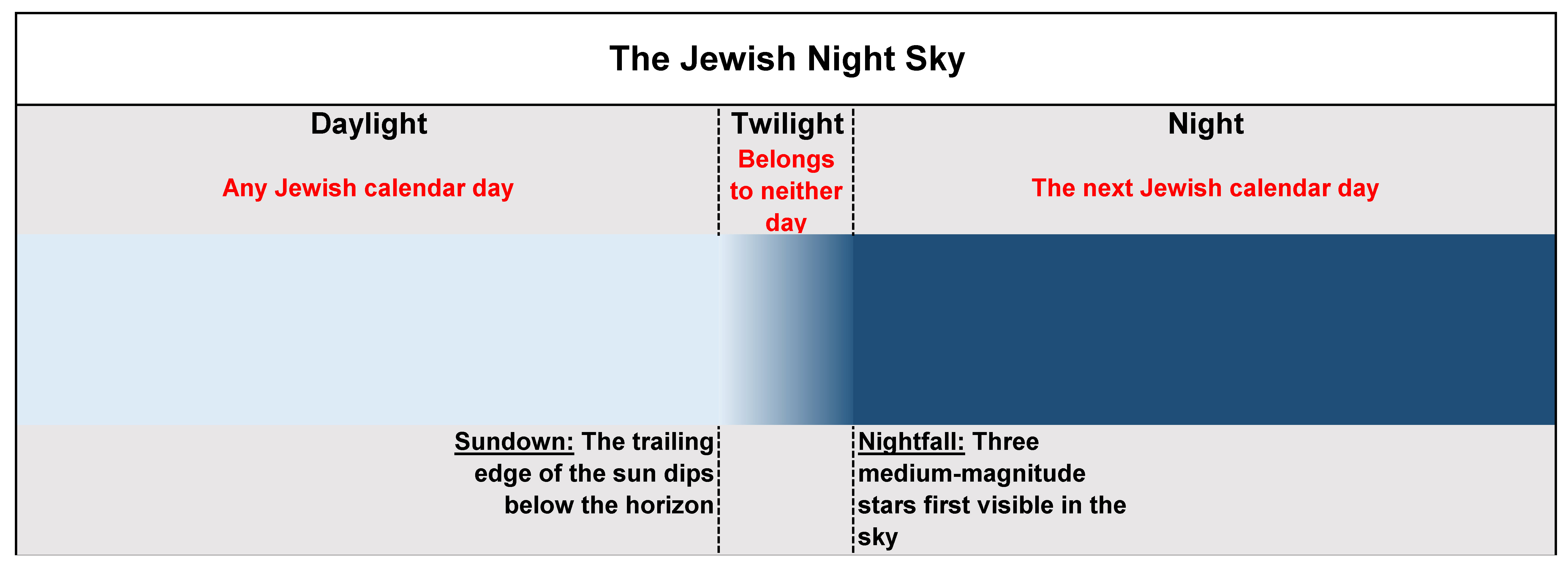
Fig. 4: Explanation of how Jewish days traditionally begin and end. ©Ron Thompson

Please refer to Figures 3 and 4, above. The Passover sacrifices were killed on Nisan 14, then consumed during the Seder, which began that evening at dusk. Jesus and His 12 apostles celebrated the Seder until late, as customary, then joined with the Hallel singing outside at midnight, and afterwards walked to Gethsemane, where Jesus was arrested. His trials were conducted during the early morning of Nisan 15, and He was crucified and buried that day. That was on a Friday, and the only year within a reasonable range with a Friday on Nisan 15 was AD 30. I am very confident that this scenario is correct!

Fig. 5: An April 2024 calendar showing parallel Hebrew dates on the right. This clearly demonstrates that the 8-day Passover celebration (7 days in Israel) begins on Nisan 15. Jewish Time®, by Calendar Maven
  • Most scholars think that Jesus’ ministry lasted around 3½ years, based on the number of Passovers He seems to have attended during that time. I agree.

To Top

The Fall Feasts

This month shall be to you the head of the months; to you it shall be the first of the months of the year.
—Exodus 12:2 (The Complete Jewish Tanach)

Nisan 1, in the Spring, is the Jewish religious New Year. Jews today, though, celebrate the civil new year, Rosh Hashanah, which is six months later, on Tishri 1.

Most of the modern world celebrates the new year with revelry. Not so among devout Jews in 1st Century Judea, because Tishri 1 is also the date of Yom Teruah, the Day of Trumpets. This important feast day heralds God’s judgment of His chosen people for their deeds, both good and bad, committed during the preceding year.

As such, the mood during the entire ten-day period through Yom Kippur, the Day of Atonement, on Tishri 10, is somber and introspective. There is prayer, fasting, ritual immersion (baptism for purification), and general spiritual misery and mourning. No weddings or other celebrations are permitted.

Once Yom Kippur has passed, the mood shifts. There is spiritual relief, and a 5-day period of relaxed preparation, followed by the joyous eight-day celebration of Sukkoth, the Feast of Tabernacles.

To Top

The Days of Awe

In the rest of this post, I will concentrate on two of the fall feasts in particular: The Day of Trumpets and the Day of Atonement. These two feasts, and the 10-day span of time connecting them, is known as Yamim Noraim, the ten “Days of Awe”. This somber period, as described above, is devoted to sincere individual and national confession of sins, and to t’shuvah, or repentance.

Fig. 6: The Days of Awe, Yamim Noraim. ©Ron Thompson

To Top

The Day of Trumpets

Rosh Hashanah, also known as Yom Teruah (The Day of Trumpets), is the Jewish day for regathering. Jews believed that, on this day every year, God divided His people into three groups according to their faithfulness over the preceding year. One group was the “wholly righteous”, whose names would certainly be written in the Book of Life. A second group was the “wholly wicked”, who would be written into the Book of Death. The final group was comprised of “those in between”, whose fate would be sealed by the quality of their t’shuvah over the next ten days, with their final judgment reserved until Yom Kippur.

Fig. 7: My Judaica wall. The small shofar is from a traditional ram’s horn, used mainly in mobile situations. The large one is Yemenite, a Kudu horn. Kudu is a species of antelope found in eastern and southern Africa. Large shofarim like this are favored for fixed locations, like the Temples of Israel, or modern synagogues. The lampstand is a hanukkiah, used ceremonially in Hanukah celebrations, which require 9 candles. If it had only 7 branches, it would be a menorah. Photo ©Ron Thompson

What prompted me to revise this post was that, in the original version, I said of the above viewpoint, “this doctrine is certainly not Biblical”; however, I have mostly changed my mind about the books, though I think that the Jewish perspective on them may be a bit skewed. I have recently been introduced to the works of Michael S. Heiser, and what he called the “Deuteronomy 32 worldview” (see Gods and Demons). He addressed this subject in ways that I had not previously considered.

There are, in fact, eight New Testament references, mostly in Revelation, to the “book of life“, and many Old Testament and intertestamental references to heavenly “books” and “tablets” that are clearly connected. I assume that these conceptual records are metaphorical, considering that God is God, and doesn’t need a physical database to remember what He needs to remember. Heiser makes sense when he suggests that our sins are recorded in one book, and our salvation in another. If (and only if) we are not listed in the second, then we will be judged by what is recorded in the first. There may be a “book of death“, too, that renders some ineligible for salvation. Regarding the latter, see, for example:

[31] Therefore I tell you, every sin and blasphemy will be forgiven people, but the blasphemy against the Spirit will not be forgiven.
—Matthew 12:31 (ESV)

Whether or not the doctrine of these books is valid, the fact that the holiday recognizes a separation of people from people is very significant since it prophetically depicts the regathering of God’s people on the coming day of Rapture:

[16] For the Lord himself shall descend from heaven with a shout, with the voice of the archangel, and with the trump of God: and the dead in Christ shall rise first…
—1 Thessalonians 4:16 (KJV)

In light of 1 Thes 4:16, the blowing of the trumpet (actually, a shofar, or ram’s horn) on Yom Teruah is particularly interesting. The shofar (accompanied by metallic trumpets in Temple days) was blown at mid-morning after the morning (Shacharit) prayers, in three series of four distinctive notes: tekia (“blast”); shevarim (“broken notes”); teruah (“shout”—thought of as “the shout of an archangel”); and tekia gedolah (the “great blast”). The first series is tekia, shevarim, teruah, tekia, repeated three times. The second is tekia, shevarim, tekia, repeated three times. The final series is tekia, teruah, tekia, repeated three times, followed immediately by tekia gedolah, referred to in 1 Cor 15:52 as “the last trumpet”.

[52] in a moment, in the twinkling of an eye, at the last trumpet. For the trumpet will sound, and the dead will be raised imperishable, and we shall be changed.
—1 Corinthians 15:52 (ESV) emphasis mine

To Top

Extension of the Days of Awe

Since long before Jesus’ day, the Days of Awe have, in practice, begun thirty days before Yom Teruah, on the first day of the Jewish month Elul. T’shuvah (repentance) is much too important to put off until the last minute, so the Rabbis decided that forty full days should be devoted to it, rather than the ten required by Torah.

On Elul 1, Jews would flock to the mikvot (baptisteries) of the Temple and synagogues, and to the “living waters” of streams and rivers like the Yarden (Jordan), to immerse themselves for ritual purification. That would then be followed by forty days of prayer, fasting and introspection. In the years preceding AD 30, it seems that many had become preoccupied with the politics and woes of the Roman occupation, and such customs were being neglected. Into this scene stepped Yochanan, who we now call John the Baptizer, calling Jews to baptism and t’shuvah.

To Top

The Baptism and Temptation of Jesus

[13] Then Jesus came from Galilee to the Jordan to John, to be baptized by him. [14] John would have prevented him, saying, “I need to be baptized by you, and do you come to me?” [15] But Jesus answered him, “Let it be so now, for thus it is fitting for us to fulfill all righteousness.” Then he consented. [16] And when Jesus was baptized, immediately he went up from the water, and behold, the heavens were opened to him, and he saw the Spirit of God descending like a dove and coming to rest on him; [17] and behold, a voice from heaven said, “This is my beloved Son, with whom I am well pleased.”
—Matthew 3:13–17 (ESV)

I believe that the events of Mt 3:13-17, describing Jesus’ baptism and anointing by the Holy Spirit, took place on Elul 1, conforming to the current tradition. As to the year, I lean towards AD 26, as stated above. If that year is off, I’m still 100 percent sure of the Hebrew month and day.

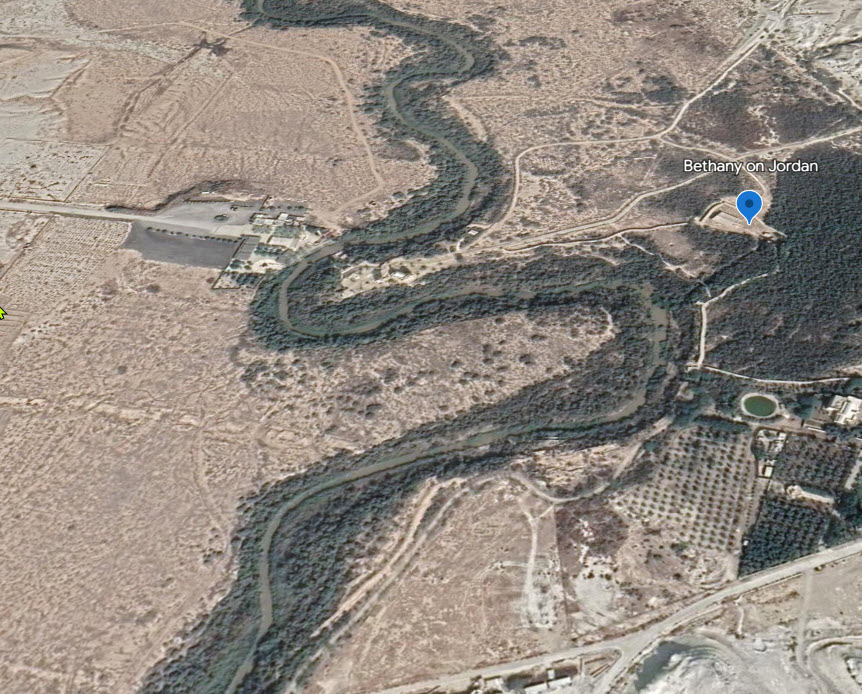
Fig. 8: The Jordan River today, due east of Jerico. Scripture places Jesus’ baptism at Bethany on Jordan, no doubt referring to the east bank of the oxbow, close to the village. From Google Earth.

Though of course He was sinless, His baptism, followed by forty days of prayer and fasting, were consistent with and required by the customs of the season.

More importantly, the temptation and His response were theologically vital. Jesus was “the Second Adam” (see The Two Adams). The first was created sinless, but when tempted by the “lust of the flesh, the lust of the eyes, and the pride of life”, failed and brought sin to the world. The same tempter and same temptations came to Jesus in the wilderness: lust of the flesh (stones to bread); lust of the eyes (the kingdoms of the world); and pride of life (rescue by angels in the sight of all Israel). Jesus did not fail, and brought redemption to the world.

Matthew presents a different order for the temptation, which is not a problem because chronological order was not strictly important in the literature of the day, but I’m certain that “pride” was last in real time, as listed by Luke.

Interestingly, that placed Jesus on the Pinnacle of the Temple on Yom Kippur:

[9] Then he [the devil] took him to Yerushalayim, set him on the highest point [Greek pterugion, literally, a “wing” or “turret”] of the Temple and said to him, “If you are the Son of God, jump from here! [10] For the Tanakh [Old Testament] says [Psalm 91:11–12],

‘He will order his angels
to be responsible for you and to protect you.
[11] They will support you with their hands,
so that you will not hurt your feet on the stones.’”

[12] Yeshua [Jesus] answered him, “It also says, ‘Do not put ADONAI your God to the test.’” [13] When the Adversary [Greek diabolos, literally, “accuser”] had ended all his testings, he let him alone until an opportune time.
—Luke 4:9–13 (CJB)

To Top

The Day of Atonement

While the Temple still stood, on Yom Kippur all the people gathered on the Temple Mount for the ritual sacrifices that would roll the sins of the truly repentant back for another year. Since there is no longer a Temple, and thus no legitimate place for blood sacrifices, the gatherings are now in the synagogues, and what is offered are “sacrifices of prayer.”

Most translations render pterugion as “pinnacle”, following the KJV. This is traditionally interpreted as the highest point on the Temple Mount or its surrounding walls, but I don’t think that this is warranted. It seems to me most likely that this is referring to the “place of trumpeting” (see Figure 2) which, by inference, was probably the parapet, or observation platform, from which the priests monitored the ritually vital sunrise and sunset every day. This high overlook was visible from the exterior streets below. If Jesus had accepted Satan’s temptation to throw Himself off and allow the angels to catch Him, all the Jewish world would have witnessed the destruction of His public ministry on the very day it began! Certainly, this was Satan’s plan!

To Top

Conclusion

I am forever thrilled at the beauty of God’s timing! I believe that many of the events connected with Jesus’ First and Second Advents actually occurred or will occur on the precise day of the Feast that pictures the event. Could it be that He will return for his Church at the exact moment of the “Last Trump” on the Feast of Trumpets (as God indeed said He would!), which is prophetic of the Rapture? Is it possible that He will return in judgment at the end of Tribulation on the Day of Atonement, the very day when God is thought to seal His judgment of His people? I am convinced it is so!

To Top