After the Flood: Globalism and World Conflict

Posted on:

Modified on:

  1. The Flood
  2. After the Flood
    1. Noah’s offerings
      1. How did they know that?
      2. The altar
      3. The sacrificial animals
      4. The offerings
      5. God’s response
      6. The promise
      7. How long will earth exist?
    2. Man’s commission
      1. Version 1.0 (looking back)
      2. Version 2.0 (looking ahead)
      3. Estrangement
      4. “All About that Blood”
    3. The Noahic Covenant
      1. Rainbows
      2. The intoxication of Noah
      3. The curse of Canaan
  3. Return to Shinar
    1. The Toledah
    2. Babel
      1. Migratory beginnings
      2. Babel colonized
      3. The Tower
      4. The scattering
  4. “Prehistoric Genesis” conclusion
    1. Nimrod
      1. The language of sonship
      2. Why ancient Biblical dates are unreliable
      3. Sargon of Akkad
      4. The characters of Nimrod and Sargon
      5. The conquests of Nimrod and Sargon
    2. A final toledah
    3. Abram’s calling
  5. Genesis prehistory and the End Times

Technically, this is the last installment of my “After the Dreams” series.

Mostly, I’m skipping over the Flood, because I’ve already written quite a lot about that. I will spend a bit of time on the aftermath of the Flood, but the main focus of this post is on the first half of Genesis 11, concentrating on the Tower of Babel and Nimrod. Those are two separate stories, but together I believe they present a good picture of the “last days”—globalism and world conflict!

The Flood

Genesis 6:9–8:19

This section of Moses’ narrative is separated from the previous by a very brief toledah.

Reminder–a toledah (pl. toledoth) in Moses’ writings is a short genealogy, introduced by “these are the generations of” and designed to separate two unrelated or loosely related topics.

10 And these are the generations of Noe [Noah]. Noe was a just man; being perfect in his generation, Noe was well-pleasing to God. 11 And Noe begot three sons, Sem, Cham, Japheth.
Genesis 6:10-11 (LXX-B)


I will not cover the flood in much detail here, because I have already written several articles on the subject. Click on the arrows to expand the embedded content:

Young Earth Creationism is currently dominated by followers of the late Henry M. Morris, who visualized the Great Flood as a cataclysmic worldwide flash flood with a supernatural volume of water falling mostly from heaven, and dried up by destructive high winds. This post presents a far more likely scenario for a global flood.
As much as I respect the folks who operate the Ark Encounter site in Kentucky, I disagree with almost every element of their depiction. Beginning with the giant ship model itself, which has anachronistic features; has features that wouldn’t work on a real ship; and by the way is by definition not by any stretch an ark!
From my own professional background, I know that there are a large number of geological features on earth that simply cannot be explained by a flood, whether regional or global in scope. Here I present a short list of examples.
In this post I examine Henry Morris’ lack of credentials for his claims about geology and the flood. I also explain my own background and how it bears on the subject.

We all know that the flood was God’s response to increasing corruption on the earth.

[11] Now the earth was corrupt in God’s sight, and the earth was filled with violence. [12] And God saw the earth, and behold, it was corrupt, for all flesh had corrupted their way on the earth. [13] And God said to Noah, “I have determined to make an end of all flesh, for the earth is filled with violence through them. Behold, I will destroy them with the earth.
—Genesis 6:11–13 (ESV) emphasis mine

That humans are capable of deliberate, rebellious sin is a result of Adam’s sin in the Garden. But the presence of major, outlandish, organized sin around the globe got its start from the example set by the rebellious angels and their offspring, the Nephilim, after which it was promulgated for millennia by the demon spirits of those same Nephilim.

If you think things are bad now, it was much worse in those days! But hang on, it is presently getting worse, not better. History is repeating itself.

This time, God will spare us another flood, just as He promised Noah. Instead, we will go straight to a modern Babel situation, which He will not stop this time. I believe that the new Nimrod, like Satan, is even now alive and well on Planet Earth…

After the Flood

Genesis 8:20–9:29

Noah’s offerings

20 Noach built an altar to ADONAI. Then he took from every clean animal and every clean bird, and he offered burnt offerings on the altar. 21 ADONAI smelled the sweet aroma, and ADONAI said in his heart, “I will never again curse the ground because of humankind, since the imaginings of a person’s heart are evil from his youth; nor will I ever again destroy all living things, as I have done. 22 So long as the earth exists, sowing time and harvest, cold and heat, summer and winter, and day and night will not cease.”
— Genesis 8:20-22 (CJB)

How did they know that?

Immediately after leaving the Ark, Noah and his family gave thanks to God by staging a massive burnt offering. The passage describing it, quoted above, seems entirely anachronistic in that it accords well with parts of the Torah sacrificial system, which was not announced until centuries in the future.

The Bible gives us absolutely no information on how the relevant instructions were delivered to pre-Sinai humanity. We know that God spoke directly to the Patriarchs. We also know that “angels” routinely spoke to humans—the Serpent, a cherub, spoke to Adam and Eve, and these two humans weren’t at all surprised. Evidently, they knew, or as it developed, thought that he was on God’s team.

The Ancient Near East produced a huge amount of lore regarding gods and demigods that frequently communicated with early humanity. In particular, Babylonian legends of the Apkallu imply to scholars like Michael Heiser that one of the pre-Flood sins of the Watchers was that they talked too much! By imparting arcane knowledge that caused civilization to advance at too rapid a pace, human pride became bloated and consciences seared.

Rather than speculate endlessly on how and why, let’s just examine this sacrifice…

The altar

Noah built an altar. (מִזְבֵּחַ mizbēaḥ, pronounced miz-BAY-akh), meaning a “place of sacrifice.” This is the first mention of a sacrificial altar in the Bible, though Abel may have prepared something equivalent for his offering.

The sacrificial animals

He offered every kind of clean land animal and clean bird. Noah had been told before the Flood to take with him seven pairs of each of the clean animals and one pair of each of the unclean. It is assumed, probably correctly, that the six extra pairs of clean beasts were for sacrificial purposes. God most likely did the collecting and herded the animals to the Ark, so how Noah knew which were clean and which were not is immaterial to what was actually done.

The offerings

Moses called them “burnt offerings.” Some scholars argue whether the burnt offering, here and later, was for reconciliation (forgiveness), atonement (temporary pardon) or thanksgiving, but they all miss the point.

In reality, it is none of the above. It was a promise of complete surrender and devotion to God, symbolized by completely burning up the animal sacrificed, except for the hide, which under Torah is donated to the priests.

Under Torah, a number of burnt offerings were offered up by priests for all the people or groups of the people, but individuals or families could provide their own animals and conduct their own sacrifices. Although other symbolism has been rightfully added to Christian baptism (particularly by Paul), I view baptism as preeminently identical in meaning to the individual burnt offerings.

Reformed churches, probably the majority of Protestants, equate baptism with circumcision, which is the reason they practice infant baptism. My soteriology is basically Reformed, but I reject pretty much all other distinctives of their theology, including their baptism.

God’s response

God smelled the “sweet (or pleasing) aroma.” Everyone who, like, me, enjoys a good steak, will agree that nothing smells better than freshly barbecued meat. To say that God “smells the sweet aroma“, or, in KJV, “the sweet savor”, is anthropomorphic. Biblically, it means that He is pleased with the offering and with the offeror.

God rewarded the offeror. Because He smelled the sweet aroma of Noah’s offering, God promised to “never again curse the ground…[or]…destroy all living things” because of the sins of mankind—Noah’s descendants.

Verse 22, in essence, promises that, as long as the earth remains, God will neither repeat nor add to the curse pronounced on the ground in Genesis 3. Specifically, He will not destroy the productivity of the ground.

Does the wording, “since the imaginings of a person’s heart are evil from his youth”, mean that God is excusing our sin? No, never, but it means that He understands that not all sin is committed with “malice aforethought.”

I think He cursed the ground in Genesis 3 because Adam’s sin brought to an end the prospect of spreading the idyllic conditions of the Garden to the outside world, and only a harsh environment would teach mankind skills needed to survive in a sin-cursed environment.

I also think that the rebellion of the Watchers and the spread of the Nephilim in Genesis 6 made a completely fresh start via the Flood unavoidable.

But now God makes allowance for hormones!

Do not confuse this promise with God’s covenant to not repeat the Flood.

The promise

“So long as the earth exists” in this verse implies that it will not always exist. While it does, we are promised that God will maintain for us the basic necessities for life on the planet. Pay attention, Gretta, there will be no more extinction events on earth!

How long will earth exist?

God and His celestial Host have no need of “homes.” In that sense, I don’t believe that “heaven” is a specific place. In 2 Corinthians 5:8, Paul suggest that when we as believers die, we will “be away from the body and at home with the Lord.” So, at that time, we too will be spirits, with no need of a “mansion over the hilltop.”

At the resurrection, though, we will acquire version 2.0 of our corporeal body, which will have physical needs. From that time, I believe that “heaven” for us will be a fully renovated earth with New Jerusalem hovering over it. As described in Revelation.

This will probably not last forever.

At about 4.6 billion years old, the sun is currently, but very slowly, expanding and getting hotter as it burns up the hydrogen fuel in its core, forming helium as a byproduct. Helium, being a heavier ion, migrates toward the center of the sun, gradually quenching the hydrogen reactions there. Through a complicated, but fairly well understood sequence, the helium, too, begins to burn and form still heavier ions. These heavier elements eventually begin burning as well.

About 5 billion years from now, the sun’s core will suddenly collapse, and its outer shells will simultaneously expand. It will become a huge “red giant” star, with Mercury, Venus, and possibly earth all swallowed up inside its volume. In yet another 10 billion years, another collapse will result in the sun becoming a very hot, but gradually dimming, “white dwarf” surrounded by a so-called “planetary nebula.”
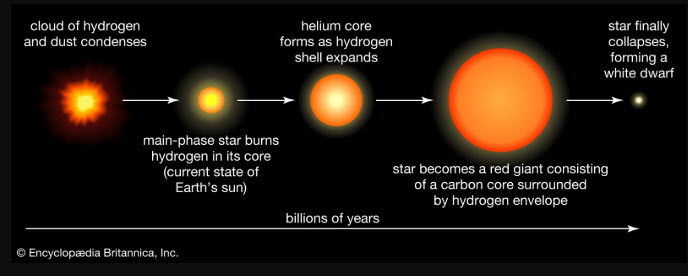
Astrophysical diagram of the life of a “Main Sequence” yellow star like the Sun.

About a billion years from now, long before the red giant phase, earth will become uninhabitable. Never fear, though. God knows all this and has a plan. By that time, I’m sure we’ll all be ready to move to different quarters.

Hubble image of a planetary nebula surrounding a bright central star. ibtimes.co.uk.

Man’s commission

Version 1.0 (looking back)

My readers know that I am an Old Earth Creationist, that I believe Day 6 in Genesis 1 was a prophetic view backwards at ancient animals and hominids that preceded the unique formation “from dust” of Adam in Genesis 2.

In the relevant Genesis 1 passage, God delivered a commission to pre-Adamic mankind:

28 God blessed them: God said to them, “Be fruitful, multiply, fill the earth and subdue it. Rule over the fish in the sea, the birds in the air and every living creature that crawls on the earth.” 29 Then God said, “Here! Throughout the whole earth I am giving you as food every seed-bearing plant and every tree with seed-bearing fruit. 30 And to every wild animal, bird in the air and creature crawling on the earth, in which there is a living soul, I am giving as food every kind of green plant.” And that is how it was. 31 God saw everything that he had made, and indeed it was very good.
— Genesis 1:28-31a (CJB)

Who precisely this commission was delivered to is unstated and irrelevant. It simply tells us the expectations that God had for the ancient peoples. He wanted them to rule and administer the earth, in much the same way that the angelic host rules and administers the rest of the universe.

It is obvious that God’s preference was that neither man nor beast should feast on flesh. But…

Did that have the force of command?

Probably not. God explicitly granted permission for man and beast to eat flora, but I see no actual prohibition against eating flesh. God sometimes allows things that He doesn’t prefer. You might say He’s a realist. Just the fact that He gave angels, men and animals “free will” guarantees the existence of sin. Even the inanimate universe has free will of a sort, in the face of quantum uncertainty.

Did God design animals and hominids as herbivores?

Perhaps He initially designed them to be herbivores, but the fossil record unambiguously shows that adaptation eventually produced meat eaters, and He let it happen. In fact, I believe that there are limits to what adaptation can achieve. Beyond those limits, surely God has to intervene, yet still we see species that can’t survive long on leaves alone.

One more objection has to be addressed:

The final phrase in verse 30 is “And that is how it was”, or “And it was so.” I confess that this reaches the absolute tip of my ability to translate Hebrew, but through research and digging at it, I have come to the conclusion that “and it was” is an incorrect translation of the Hebrew וַֽיְהִי, which better translators than I call a “Conjunctive waw verb of type Qal Consecutive Imperfect, 3rd person masculine singular.”

Very roughly, that means, “Given that A is true, then at some time in the future, B shall also be true.” If I am not precisely correct in phrasing it that way, then at least what I’m saying is that “and it was so” was not intended to present it as a done deal.

Finally,

“It was very good” means that God was happy with the results. Those who insist that “good” precludes death and mortality are engaging in specious arguments that second-guess the Creator!

Version 2.0 (looking ahead)

1 God blessed Noach and his sons and said to them, “Be fruitful, multiply and fill the earth. 2 The fear and dread of you will be upon every wild animal, every bird in the air, every creature populating the ground, and all the fish in the sea; they have been handed over to you. 3 Every moving thing that lives will be food for you; just as I gave you green plants before, so now I give you everything — 4 only flesh with its life, which is its blood, you are not to eat. 5 I will certainly demand an accounting for the blood of your lives: I will demand it from every animal and from every human being. I will demand from every human being an accounting for the life of his fellow human being. 6 Whoever sheds human blood, by a human being will his own blood be shed; for God made human beings in his image. 7 And you people, be fruitful, multiply, swarm on the earth and multiply on it.”
— Genesis 9:1-7 (CJB)

This version of the commission, given specifically through Noah, is a similar commission to “be fruitful, multiply and fill the earth”, but if differs in important respects:

Estrangement

While “subdue and rule” are implicit, this statement introduces an unpleasant, adversarial element that was totally absent before. There is animosity here that didn’t show through in Genesis 1. Instead of a peaceful co-residence on earth (and in Eden), we are now the enemy and enslaver of the animals.

Note that while granting explicit rights to exploit the animals, there is nothing here about “clean” vs. “unclean.” This suggests to me, once again, that God is drawing away from close fellowship with mankind in general. This will come to a head at Babel, where God separates mankind, while making provision for a People of His Own (see below).

The humans who I believe existed before the Garden were omnivorous, as are we, and so consumed meat, but wanton slaughter was probably rare or nonexistent. They were just another set of predatory species, among many.

What God intended for His Adamic line was fellowship between them and at least the animals formed after Adam in the Garden. Those animals were not made to be eaten or exploited!

Life outside the Garden was tough, by design, and I can’t imagine that Adam’s kin were vegetarian for very long. I am pretty sure that the corruption that developed later extended to all sorts of abuse of animals. The animals released from the Ark scattered with a dread of humans that never disappeared.

With the help of the rebellious Watchers and instigation by their demonic offspring, the Nephilim, the world from Jered to the Flood must have been totally dystopian and utterly barbaric.

What I think that God was communicating with Noah and his family here was, “I know that my flood was not the final word. I’ve given you an opportunity to regroup and establish some order, but humanity will always be corruptible. I know that you will continue to eat flesh, and I know I can’t stop that without destroying you, but I’m going to set a limit...

“All About that Blood”

Apologies to Meghan Trainor…

God stated emphatically, “You will not be allowed to consume the blood of animals, and you won’t be allowed to kill other humans at all. This is a symbolic prohibition to emphasize that critters aren’t veggies, and all life including animals, is sacred.

I do not at all agree with the common Dispensational claim that verse 6 is a charter for human government!

Together with verse 5, God is simply pronouncing a curse on any creature, man or beast, that sheds human life. There would be no more “mark of Cain” to protects killers from just vengeance.

God does not like human government! He permits it! Ideally, vengeance belongs to Him. We were created to recognize Him and Him alone as king. When the Israelite inhabitants of Canaan demanded a human king, God warned them that they would regret it.

The Noahic Covenant

8 Then God said to Noah and to his sons with him, 9 “Behold, I establish my covenant with you and your offspring after you, 10 and with every living creature that is with you, the birds, the livestock, and every beast of the earth with you, as many as came out of the ark; it is for every beast of the earth. 11 I establish my covenant with you, that never again shall all flesh be cut off by the waters of the flood, and never again shall there be a flood to destroy the earth.” 12 And God said, “This is the sign of the covenant that I make between me and you and every living creature that is with you, for all future generations: 13 I have set my bow in the cloud, and it shall be a sign of the covenant between me and the earth. 14 When I bring clouds over the earth and the bow is seen in the clouds, 15 I will remember my covenant that is between me and you and every living creature of all flesh. And the waters shall never again become a flood to destroy all flesh. 16 When the bow is in the clouds, I will see it and remember the everlasting covenant between God and every living creature of all flesh that is on the earth.” 17 God said to Noah, “This is the sign of the covenant that I have established between me and all flesh that is on the earth.”
— Genesis 9:8-17 (ESV)

God now established an important covenant, not with Israel, which didn’t yet exist, but with mankind as a whole (represented by Noah and his sons) and with animal life. No more global flooding.

Rainbows

In verses 9:12ff, God appointed the rainbow as a sign of His promise.

“Rainbow flags” don’t represent me or my views, but they also don’t profane God’s covenant with Noah, his family, and “every animal on earth.”

A sequence of colors on cloth is not “the sign of the covenant I am making between myself and you and every living creature with you, for all generations to come.”

Neither is a spectrum refracted from a prism. In fact, we may choose to call that spectrum a “rainbow”, but that isn’t the Biblical definition. Read God’s definition here, and don’t get so bent out of shape over some supposed misappropriation of a physical phenomenon:

13 I am putting my rainbow in the cloud — it will be there as a sign of the covenant between myself and the earth. 14 Whenever I bring clouds over the earth, and the rainbow is seen in the cloud; 15 I will remember my covenant which is between myself and you and every living creature of any kind; and the water will never again become a flood to destroy all living beings. 16 The rainbow will be in the cloud; so that when I look at it, I will remember the everlasting covenant between God and every living creature of any kind on the earth.”
— Genesis 9:13-16 (CJB) emphasis mine

I’ll point out also that God did not create rainbows at this time. He created them at the time He imbedded the laws of physics into the young universe. When a stream of photons is diffracted through a mist, a spectrum is cast. God told Noah, “When you or I see such a spectrum in the clouds under these conditions, from now on it will remind us both of my promise.”

The intoxication of Noah

18 The sons of Noah who went forth from the ark were Shem, Ham, and Japheth. (Ham was the father of Canaan.) 19 These three were the sons of Noah, and from these the people of the whole earth were dispersed.

20 Noah began to be a man of the soil, and he planted a vineyard. 21 He drank of the wine and became drunk and lay uncovered in his tent.
— Genesis 9:18-21 (ESV)

In view of what follows, we have to ask if there was a sin here? Wine consumption? Drunkenness? Nakedness in his tent?

I’ve written about alcohol before but not reached a firm conclusion. I’ve never been drunk, but almost everyone has, and I’m not willing to draw a firm conclusion here, either. Drunkenness obviously contributed to his nakedness, but not knowing what he was thinking of, by himself in his private quarters, I can’t judge that either.

The curse of Canaan

Perhaps the only sin here was in Hamm’s reaction. One has to think he was disrespectful to Noah.

Roughly speaking, after Babel Shem’s descendants spread throughout Mesopotamia, south into Arabia, and southeast into India. Ham’s descendants mostly ended up in northern and eastern Africa, as well as western Arabia and the southern Lavant. Japeth’s descendants tended to migrate westward into modern Europe, and north and northeast into Asia Minor and the Steppes.

Given those movements, how do we interpret the following?

22 And Ham, the father of Canaan, saw the nakedness of his father and told his two brothers outside. 23 Then Shem and Japheth took a garment, laid it on both their shoulders, and walked backward and covered the nakedness of their father. Their faces were turned backward, and they did not see their father’s nakedness. 24 When Noah awoke from his wine and knew what his youngest son had done to him, 25 he said, “Cursed be Canaan; a servant of servants shall he be to his brothers.”

26 He also said,
“Blessed be the LORD, the God of Shem;
and let Canaan be his servant.
27 May God enlarge Japheth,
and let him dwell in the tents of Shem,
and let Canaan be his servant.”
— Genesis 9:22-27 (ESV)

We have all heard of “the curse of Ham”, but it was not Ham who was cursed; it was very plainly Ham’s son, Canaan. Why Canaan and not Ham? It wasn’t God’s curse, it was Noah’s, and I suggest that Noah was thinking, “You disgraced your father, now your son will disgrace his father!”

Protestants in America and elsewhere, early colonial through Civil War, in an effort to make this passage “relevant” to the slavery debate then raging, read all kinds of self-serving nonsense into this passage. Though the racist element is largely gone from most of these churches, shabby theological processing has largely prevented reevaluation of the interpretations.

The three names mentioned in the passage, Canaan, Shem and Japheth, could be a reference to the actual three persons, or to their descendants. The latter is almost universally assumed, and that would probably be my assumption, too, except that I am viscerally opposed to basing doctrine on unproven assumptions. Either way, perhaps at some point Canaan did serve Shem and Japheth. It isn’t clear from history.

Given the preponderance of Hamite tribes in Africa, the temptation for pro-slavery Christians was to ignore the fact that Ham was not the cursed party and to posit that, by golly, Ham is the father of the black Africans, so God destined them to be slaves!

Clearly there is nothing to that interpretation, but honestly, it’s difficult to detect the curse in anything we know from Biblical or secular history. One thing we do know that might be relevant in some way is that God eventually took the land of the Canaanites and gave it to the Hebrews, a Semite tribe.

I’m not sure that it’s important that we even attempt to understand the content of the curse, in any case. It apparently wasn’t God’s curse. It was Noah’s, and I don’t think a curse uttered by a drunk or hungover Noah had any teeth.

Return to Shinar

Genesis 10:1–11:9

This is another section of Scripture that is little understood by Christianity at large but yet is vitally important in world history. It is a picture of human pride and globalist ambition.

The Toledah

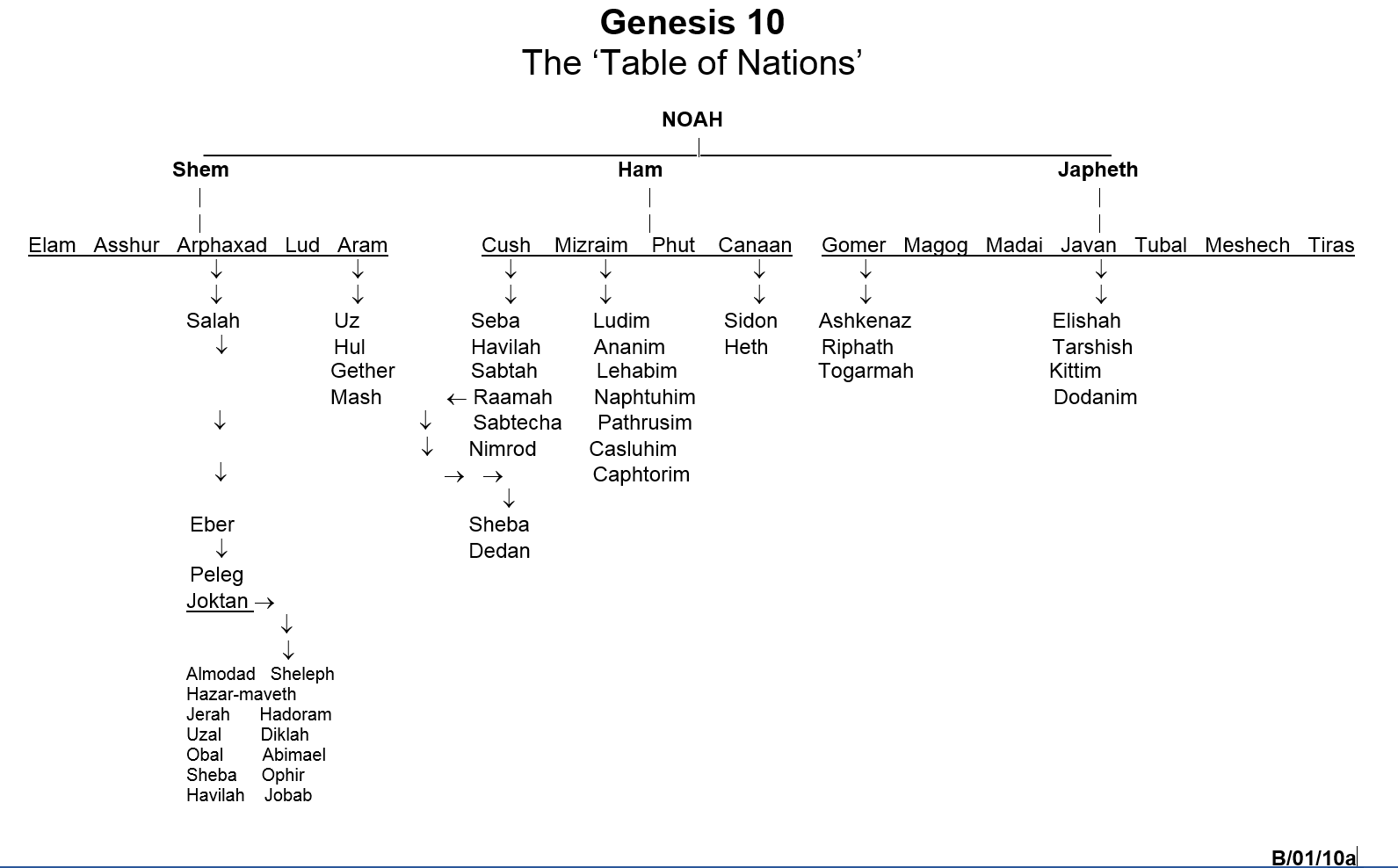
Like all of the toledoth in Genesis, the one written in Genesis 10:1–39 is extremely informative and helpful to the Biblical historian. In my opinion, there is none more important for showing the pivotal role that the people listed played in early civilization and the development of all civilization to the present day.

The chart shown below is one of a large number showing graphically the data of the toledah. I elected to use this one because its columnar format emphasizes the generational development of ancient society. The date ranges at the top put it into a useful perspective, but I’m not at all convinced of their accuracy, as I will discuss below.

Lineage of the Patriarchs, descendants of Noah, and Table of Nations. Per Genesis 10. http://www.cookancestry.com/Biblical%20Genealogy/02.

I’ll make just a few comments on the data as introduction for the final two sections of this post:

  • Note that the first name entry at the top of each column is the direct patriarchal lineage from Noah to Jacob.
  • Verses 4 and 5, concern Japeth’s grandsons via Gomer. The language in verse 5 refers to the dispersion at Babel, which I’ll discuss in some detail below.

From these were the islands of the Gentiles divided in their land, each according to his tongue, in their tribes and in their nations.
— Genesis 10:5 (LXX-B)

  • Verse 6 lists the sons of Ham, “Kush, Mitzrayim, Put and Kena‘an.” Anglicized, those are Cush, Egypt, Put and Canaan. Those names are easily associated with the Nile Valley, the Eastern Sahara, and north into the Lavant.

    Cush, though, is a bit more complicated. Most scholars recognize that name as applying to the region of Somalia, Eretria, and Ethiopia, but I believe that Cush and his offspring also settled a large area of central Mesopotamia and eastward, well into India.
  • According to verse 8, “Kush fathered Nimrod”, the subject of the last major section of this post. Christian tradition credits Nimrod with founding Babel and building the Tower. Verse 10, however, only credits him with being king of Babel early in his life. I think that Nimrod most likely had nothing to do with building the tower. See below.
  • Some translations render verse 11 as, “Ashur went out from that land and built [Nineveh], [et al]”, but in context, a better translation would probably be, “From [Babel] he [Nimrod] went into Assyria and built Nineveh, [et al].”
  • Verses 15–20 list a number Canaan’s sons, some of whom you will recognize as the names of tribes that Joshua fought during the Conquest years.
  • Verses 21ff mention a 3rd-great-grandson of Shem, Peleg, a name that means “to split or divide.” He got that name because, “in his days the earth was divided…”. Again, see below.

    I’ve seen the silly suggestion by a Young Earth Creationist that verse 25 refers to a time after the Flood when God broke up the primordial supercontinent, Pangea, into the present scattered continents. Sorry, no! That statement can only refer to the dividing of the nations’ inheritance at Babel, Moses’ very next topic.
  • Peleg’s father, Eber, is the man from whom the clan-name “Hebrew” is derived.

Babel

Migratory beginnings

I imagine that it probably took many years for the sea level to return to its pre-Flood normal. In that regard, we were told in the Flood story itself:

1 But God remembered Noah and all the beasts and all the livestock that were with him in the ark. And God made a wind blow over the earth, and the waters subsided (שְׁכַךְ, shakak, “were caused to abate”). 2 The fountains of the deep and the windows of the heavens were closed, the rain from the heavens was restrained, 3 and the waters receded (שׁוּב, shub, “to turn back or retreat”) from the earth continually. At the end of 150 days the waters had abated (חָסֵר, chaser, “to decrease or make lower”), 4 and in the seventh month, on the seventeenth day of the month, the ark came to rest on the mountains of Ararat. 5 And the waters continued to abate (chaser again) until the tenth month; in the tenth month, on the first day of the month, the tops of the mountains were seen.

6   At the end of forty days Noah opened the window of the ark that he had made 7 and sent forth a raven. It went to and fro until the waters were dried up from the earth. 8 Then he sent forth a dove from him, to see if the waters had subsided ( קָלַל, qalal, a very linguistically fluid term that here seems to imply that the flooding was a relative trifle compared to what it had been) from the face of the ground. 9 But the dove found no place to set her foot, and she returned to him to the ark, for the waters were still on the face of the whole earth. So he put out his hand and took her and brought her into the ark with him. 10 He waited another seven days, and again he sent forth the dove out of the ark. 11 And the dove came back to him in the evening, and behold, in her mouth was a freshly plucked olive leaf. So Noah knew that the waters had subsided from the earth. 12 Then he waited another seven days and sent forth the dove, and she did not return to him anymore.

13 In the six hundred and first year [of Noah’s life], in the first month, the first day of the month, the waters were dried (חָרַב, charab, “To be dry, to be desolate, to lay waste, to destroy”) from off the earth (הָאָ֑רֶץ, ha-aretz, usually means a portion of the earth or land mass, not the whole). And Noah removed the covering of the ark and looked, and behold, the face of the ground was dry (charab again). 14 In the second month, on the twenty-seventh day of the month, the earth had dried out (יָבֵשׁ, yabesh, “dried up, seared, withered”).

— Genesis 8:1-14 (ESV) emphasis and explanation mine

In that passage, none of the underlined terms for the receding flood imply a completed process.

Because Moses wrote the Flood story in the form of a highly structured symmetrical poem, interpreting the sequence of its phases as described in Genesis 7 and 8 is extremely difficult. The following table from World Bible Commentary does it as well as I think it can be done.
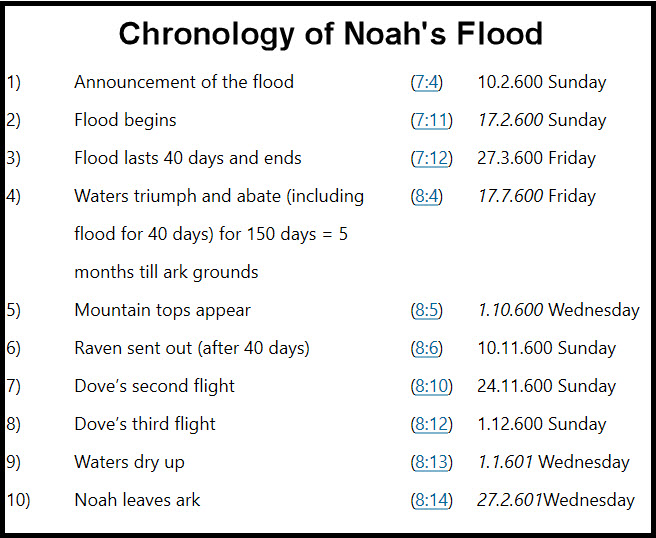
Interpretation of the Chronology of the Flood, per World Bible Commentary.
The column on the right is an attempt at dating the events—format: day.month.ageNoah
Dates in italics are from the text; other dates are interpreted.

From the start of the deluge until Noah left the Ark was a year and 10 days. Apparently, it took only 40 days for the water to rise to its peak, 45 feet above the highest mountain. It then took about 6½ months to drop the flood level by those 45 feet, and nearly 5 more months before they could safely leave the Ark.

What I envision is that at the close of this period, the ground in the highlands of Armenia around the Ark’s resting place had dried out, but the lowland plains and the lower reaches of the mountains were most likely still submerged. Surely God could have removed the excess water instantaneously, but I don’t think it is ever good exegesis to assume more than is stated. See God with the Wind for the significance of God’s wind in Scripture.

I think it likely that Noah’s family hung around the Ark while long distance travel was greatly impeded. Then perhaps years later, as plant life reemerged in the wake of the falling water, it became easier to move, and they began scattering along the highlands and living as nomads over a larger and larger range.

Babel colonized

1 Now the whole earth had one language and the same words. 2 And as people migrated from the east, they found a plain in the land of Shinar and settled there. 3 And they said to one another, “Come, let us make bricks, and burn them thoroughly.” And they had brick for stone, and bitumen for mortar. 4 Then they said, “Come, let us build ourselves a city and a tower with its top in the heavens, and let us make a name for ourselves, lest we be dispersed over the face of the whole earth.”
— Genesis 11:1-4 (ESV)

Note that “everybody speaking the same language” doesn’t necessarily mean that “all the earth (or land)” lived in the same place. That is an assumption from verse 1, but the Hebrew בְּנָסְעָ֣ם in verse 2 translates to “as they (3rd person masculine plural) journeyed, traveled, or moved.” The ESV translators chose not to assume that “everyone” in verse 1 traveled together in verse 2, saying merely that “people migrated.”

Nor does “speaking the same language” imply that dialectical differences had not developed. Only that they could still understand each other. Language drift is normal over long periods of time.

Eventually, at least one group of them made its way down the Zagros Mountains in today’s western Iran and noticed the lush plain below. They had rediscovered Shinar, the ancient region of the Garden. This area is probably the area known to secular history as Sumer, in southern Mesopotamia near the Persian Gulf. The Gulf probably extended farther north then, as shown in gray on the following map.

How you go from Armenia in the far north and enter Shinar “from the east.” You traverse southeastward down the Zagros Mountains, then turn west. Image from Google Earth™, annotated by Ron Thompson.

Sooner or later, some of these hunter-gatherers and nomadic farmers and herdsmen decided to settle down. Settling down involves permanent structures, commerce, and usually religion. Babel was the city they founded. I now think that Babel was the ancient city of Eridu (see below), which is much farther south than I showed it on the migration map.

The Tower

When the Flood survivors left the region of Ararat, they probably did not all travel together. They fanned out. By the time of Peleg, humanity has been “fruitful” for generations. They have become tribal and competitive. When tribes meet, they probably fight. Babel may or may not have been the first city built after the Flood, but by then, mud bricks had clearly been invented and brick structures erected.

By that time Yahweh was once again mostly forgotten. The settlers in Shinar recalled distorted stories of the ancient “gods” who created the world and later destroyed it again in a flood.
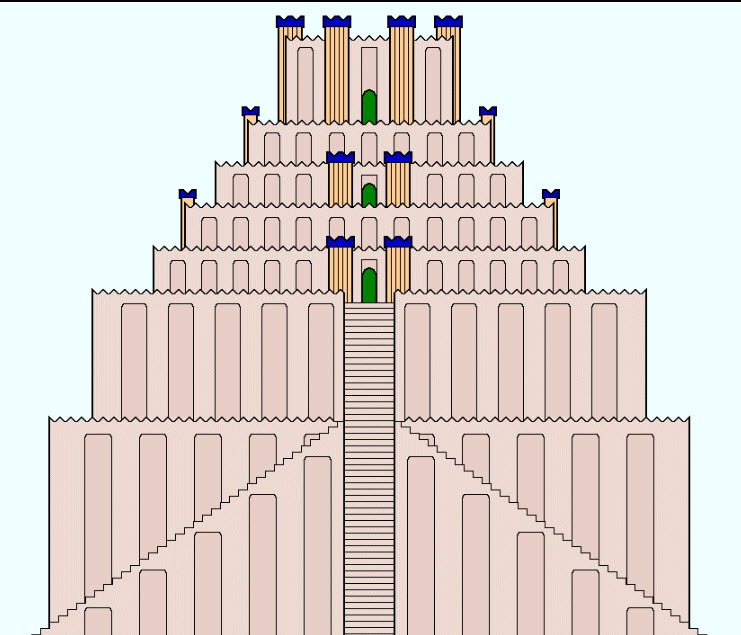
Drawing of the Etemenanki Ziggurat, based on ancient sources.

Many Christian archaeologists believe that the Tower of Babel was the ancient Babylonian Ziggurat of Etemenanki. Babylon is probably way too far north to be ancient Babel, though. According to Dr. Petrovich (see below), Babel was probably the ancient Eridu. However, there were eventually many ziggurats, and each had similar design.

Those who scoff at the “ancient fools who thought they could build a tower all the way to heaven” are overthinking the story. The goal, as stated, was to build, “a city and a tower with its top in the heavens.” To the ancient people, that just means tall! The tower was to be as tall as they could build it, not to leave the planet and reach the god in heaven, but to attract him to a nice penthouse in the city. The top tier of a ziggurat was a small chapel with a bed and other accouterments suitable for a god and his consort to hang out in.

The ultimate goal at Babel was that the city and tower together would be so impressive that they, and the threat of a resident protector god, would discourage marauders (their kin who left Ararat in different directions) from attacking them and driving them out.

Wikipedia, of course, calls the Tower of Babel a myth, but without the mile-high space needle that most people envision, this is just a normal piece of history. The concept of building a tall tower to attract the god and impress enemies made perfect sense. By their perspective, the tower did indeed reach into the heavens.

But what Yahweh saw was arrogance and more rebellion!

In support of Eridu as the city of Babel, a Sumerian myth called Enmerkar and the Lord of Aratta presents a parallel account of Babel. It states that, “Enki … Lord of Eridu, changed the languages in their mouths, as many as he had put there, the languages of mankind, which were one.”

The scattering

Following is an English translation from the Septuagint, the Greek Old Testament that 1st century Jews in Judea used:

6 And the Lord said, Behold, there is one race, and one lip of all, and they have begun to do this, and now nothing shall fail from them of all that they may have undertaken to do. 7 Come, and having gone down let us there confound their tongue, that they may not understand each the voice of his neighbor. 8 And the Lord scattered them thence over the face of all the earth, and they left off building the city and the tower. 9 On this account its name was called Confusion, because there the Lord confounded the languages of all the earth, and thence the Lord scattered them upon the face of all the earth.
— Genesis 11:6-9 (LXX-B)

For the third time in Genesis, we see Yahweh speaking to His angelic Divine Council: “Let us…” This is certainly not the Trinity conferring together. What one thinks, they all know. It is the triune God speaking to His Divine Council.


To review:

The Divine Council is a panel of probably 24 high-ranking angelic spirits, seen in several Biblical prophetic visions on secondary thrones around Yahweh’s throne. As explained in Gods and Demons, the function of this council was to assist Yahweh in administration of the created universe. Not because He needs help, but because He values their fellowship.


As stated above, language drift is ongoing over time, so there were probably dialect differences from place to place, but everyone could understand each other. After God’s action, different peoples in different areas ended up with incompatible languages. Presumably this division was along clan lines.

One takeaway from this story is that God does not value human globalism or multi-culturalism. In a reverse of wedding ritual, one might say, “what God has ripped asunder, let no man join together.”

Another consequence

Aside from confusion of tongues, something else of huge importance happened at the Babel scattering. There are hints throughout Scripture, particularly in Daniel and the writings of Paul, that the nations of the world are supervised in some way by angelic “princes.”

Moses doesn’t mention it here in Genesis, but he does in his final statement, delivered at the foot of Mt. Nebo and known as “The Song of Moses.”

8 When the Most High gave to the nations their inheritance,
when he divided mankind,
he fixed the borders of the peoples
according to the number of the sons of God.
9 But the LORD’S portion is his people,
Jacob his allotted heritage.
— Deuteronomy 32:8-9 (ESV)

“Prehistoric Genesis” conclusion

We have now reached the end of my chronological coverage of what I have dubbed, “Prehistoric Genesis”, which more or less ends with Genesis 11:9. I want to wrap up the series by discussing three additional topics from Genesis 1–11 that rightfully belong to what I call the historical part of Genesis, but that tie the historical to the prehistorical.

Nimrod

The toledah of Genesis 10 served as both:

  1. a “cinematic fadeout” to chronologically separate the Flood story from the Babel story, both of which I view as of essentially equal theological importance; and
  2. a “clan-centric” view of humanity going into Babel and the separating of nations.
The language of sonship

Embedded in that toledah and arguably out of chronological sequence is a brief discussion of Nimrod:

6 The sons (וּבְנֵ֖י, ubəne, literally, “and the sons”) of Ham: Cush, Egypt, Put, and Canaan. 7 The sons of Cush: Seba, Havilah, Sabtah, Raamah, and Sabteca. The sons of Raamah: Sheba and Dedan. 8 Cush fathered (יָלַד, yalad, “begat”) Nimrod; he was the first on earth to be a mighty man. 9 He was a mighty hunter before the LORD. Therefore it is said, “Like Nimrod a mighty hunter before the LORD.” 10 The beginning of his kingdom was Babel, Erech, Accad, and Calneh, in the land of Shinar. 11 From that land he went into Assyria and built Nineveh, Rehoboth-Ir, Calah, and 12 Resen between Nineveh and Calah; that is the great city.
— Genesis 10:6-12 (ESV)
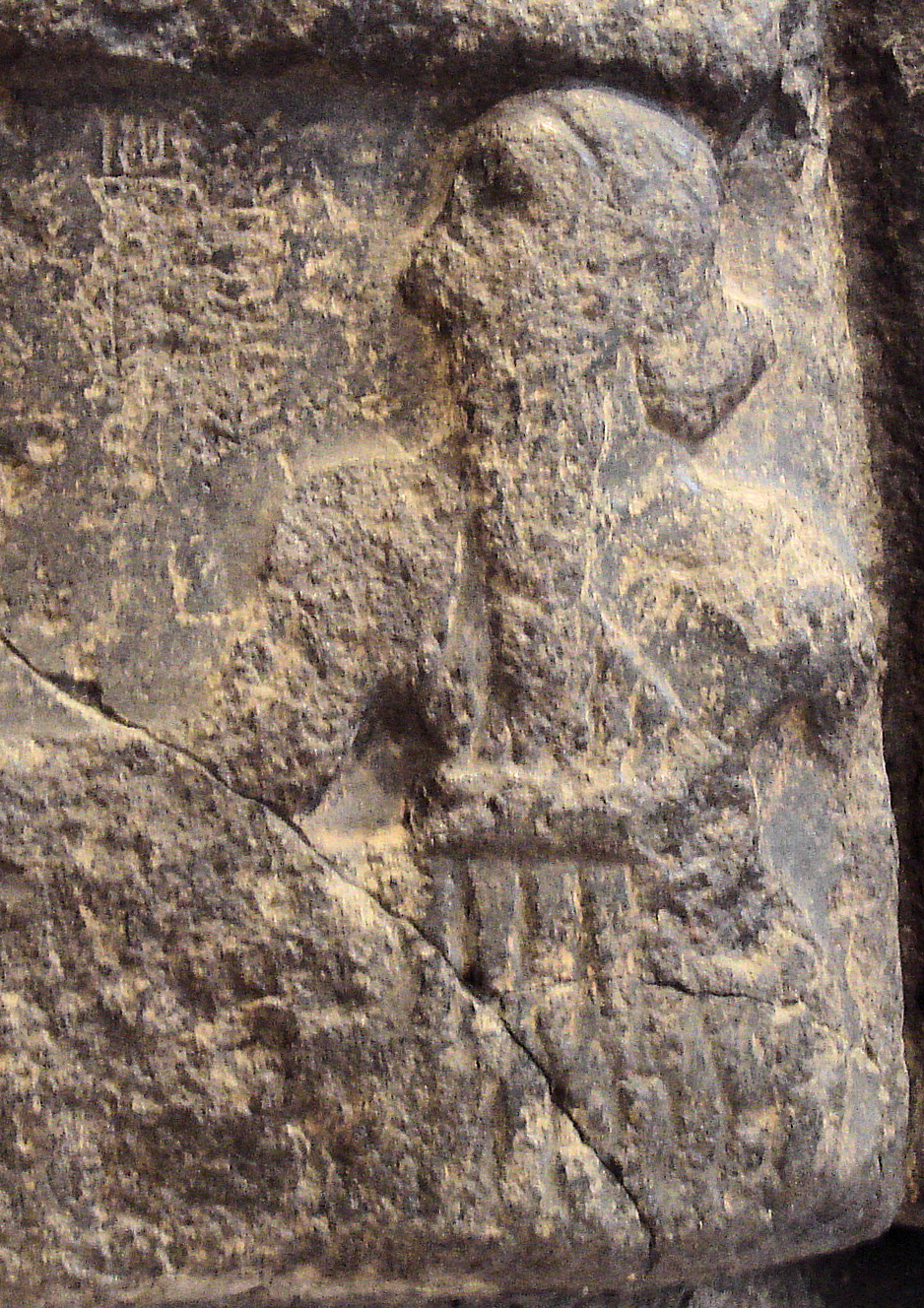
The image of Sargon on his victory stele. Wikipedia Commons

From this genealogy, you see that Cush had five sons (וּבְנֵ֖י, ubene, “and the sons”) and at least a couple grandsons. But then Nimrod is mentioned separately from the other sons, and using a different term: Yalad, the familiar “begat“, or rendered as “fathered” above. Yalad is used around 490 times in the Old Testament, and like many Hebrew words, it has a broad range of related meanings. Here is a sampling:

  • Mostly the word is used to establish a line of descent, as A begat B, who begat C, who begat D, etc.
  • It can also skip generations if those coming in between are irrelevant to the discussion, as A begat D.
  • It can also be said of motherhood, as the wife of A begat B.
  • It can be used of animals, as Cow begat calf.
  • A midwife can be said to beget a child she helps deliver.
  • Godly kings have been said to be begotten of God, a symbolic relationship.
  • God says that He begot Israel, again symbolic.
  • Of course, the Son, Jesus, is begotten of the Father. This is again symbolic, because the eternal Son was never literally born.

Given the above, Nimrod may possibly have been a remote descendant of Cush, not a literal son.

In his 2023 Book, Nimrod the Empire Builder: Architect of Shock and Awe, Dr. Douglas Petrovich of Brookes Bible College has shown, fairly conclusively in my opinion, that Nimrod was none other than Sargon of Akkad, aka, Sargon the Great.

Why ancient Biblical dates are unreliable

Not all of Dr. Petrovich’s arguments are clear. He thinks that Sargon’s reign was generations later than the Scattering, but he doesn’t provide much in the way of date evidence.

The fact is that all dates that far back in time are questionable. Ancient peoples did not have a continuous calendar like our Gregorian. Secular dating is limited to archaeological and philological data that may be very unclear. Biblical dating is better, but subject to misinterpretation of “begats”, for example.

Sargon is a historical figure whose reign is dated roughly to 2334–2279 BC. How does that match with allusions to the Scattering in Genesis 10? Referring to the chart below, Peleg was apparently contemporary with Sargon but died shortly before Sargon’s accession as King of Akkad. But since it seems the Scattering occurred during the time of Peleg, how could Sargon have come decades later as Petrovich contends?
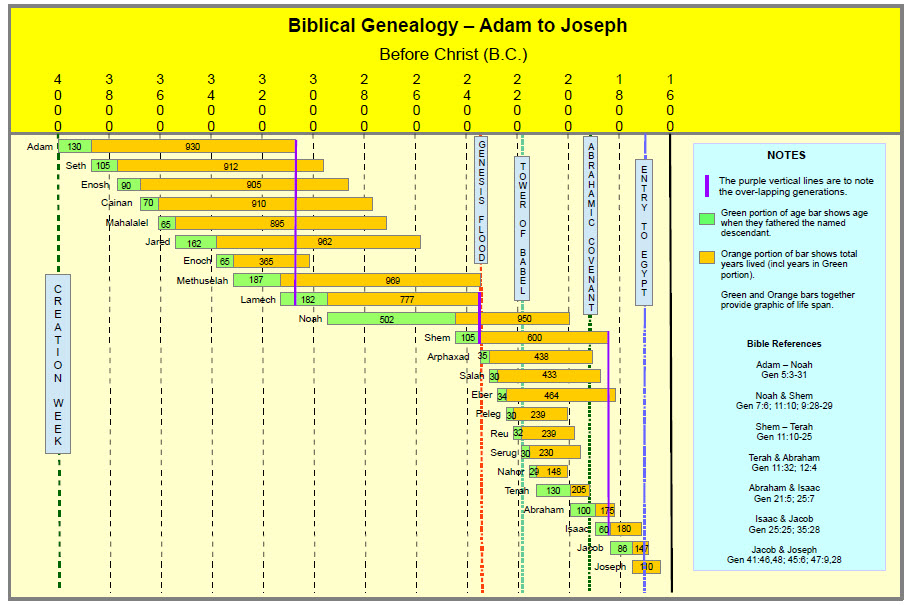
Genealogy, Adam to Joseph, through Shem. Based on Masoretic Text.

To address that question, I decided to do a comparison of the ages of Shem’s descendants in the Masoretic, as compared to the Septuagint (LXX) and the Samaritan Pentateuch (SamPent).
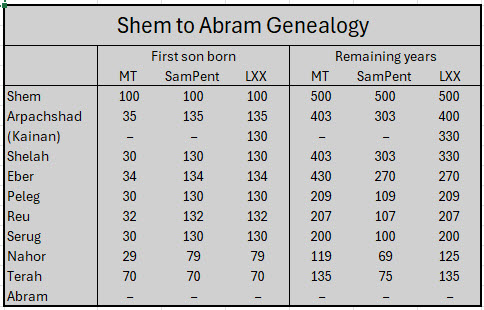
©Ron Thompson

In my last post, I presented a similar chart, from World Bible Commentary, for Seth’s descendants. WBC provided something similar for this period but presented less data, and it contained numerous errors. So, I felt compelled to do my own chart, which meant digging into the Hebrew language source documents.

Sure enough, I find that there are major discrepancies between these source documents, though the differences aren’t quite the same as WBC presented before. If one uses the SamPent and LXX numbers instead of MT, it changes a lot of genealogical charts done over the centuries.

Archbishop Ussher calculated the date of the “creation week” by starting with an assumed known date, say, the approximate date of Joseph’s entry into Egypt when he was sold into slavery at 17 years old; and then, using something like the Adam to Joseph Genealogy, above, to add up the ages of the fathers at first son’s birth to count back to Adam’s creation. When he did this using Masoretic dating, he came up with a creation date of 4004 BC.

But what if the ages recorded in the Masoretic text are wrong? Then the calculation is incorrect. My charted numbers for this period are mostly consistent for SamPent and LXX, but the MT numbers are a hundred years shorter. Also, LXX introduces another generation, Kainan, that the others skip. Using these bigger numbers pushes Adam’s “birth” and the Flood back many centuries.

So, which is true? Christian inerrantists like me would prefer for everything in the Bible to be crystal clear and unambiguous, but that just isn’t the way it is. Consider the following:

  • Aside from the folks who believe that KJV is an inerrant translation, even most Young Earth Creationists understand that the “begats” might skip over some generations.
  • It seems obvious to me that there are numerous roundoffs in the age data, some to the nearest five years, and some to the nearest hundred!
  • In Gen 5:32, Noah was 500 years old when he fathered Shem. In 7:16, he was 600 at the Flood. But in 11:10, Shem fathered Arpachshad when he was 100, two years after the flood. The 2-year discrepancy is simple round-off error, but it really troubles some Christian writers.

And also, regarding the source texts:

  • Most English translations are based on the Masoretic text because it is a compendium of what for centuries were the only available Hebrew manuscripts.
  • In general, older texts and fragments are considered more trustworthy because until Gutenberg, all copies were done by hand and therefore subject to copy errors.
  • The SamPent is a risky source because it was edited for sectarian purposes.
  • The LXX is a Greek translation of one or more older Hebrew texts that are no longer extant. It has to be considered accurate, because it was the Old Testament used by Jesus and the NT writers, but the Greek language obscures some of the Hebrew terminology and nuance.
  • The Hebrew language has no numerals. Instead, like Roman Numerals, Hebrew assigns numeric values to the Hebrew letters. For example, yesterday (as I write) was the Hebrew “New Year of the Trees”, TU B’Shevat. The “T” is Hebrew letter tet, with a value of 9, and the “U” is Vav, with a value of 6.

    9 + 6 = 15, so TU B’Shevat literally refers to the date 16 Shevat.
  • The Masoretic OT text is even more complicated. In Gen 11:12, the number 35 appears in a more primitive form, spelled out, as חָמֵ֥שׁ וּשְׁלֹשִׁ֖ים, which translates as “five and thirty.”
  • The same verse in the SamPent and (presumably) the source for the LXX, reads “five and three and hundred years”. One wonders if some key medieval scribe copyist working on the Masoretic text didn’t think the “and hundred” entry (ומאת) was nonsense, where it appeared, and dropped it.

Whatever the reason(s) for the mismatched age data, in my opinion scholars should abandon attempts to compute accurate dates from it, because quantitative results can only be guesses.

Since Shem and Ham were brothers, Cush was probably in the same generation as Arphaxad. Note that if Nimrod was a direct son of Cush, then he would have been roughly contemporary with Shelach, much too early to have been Sargon.

Sargon of Akkad

Because of age discrepancies in the source texts, it is a step too far for me to say that dates compiled from the toledoth prove that Nimrod lived generations after Peleg. What those discrepancies do allow me to say is that it is possible.
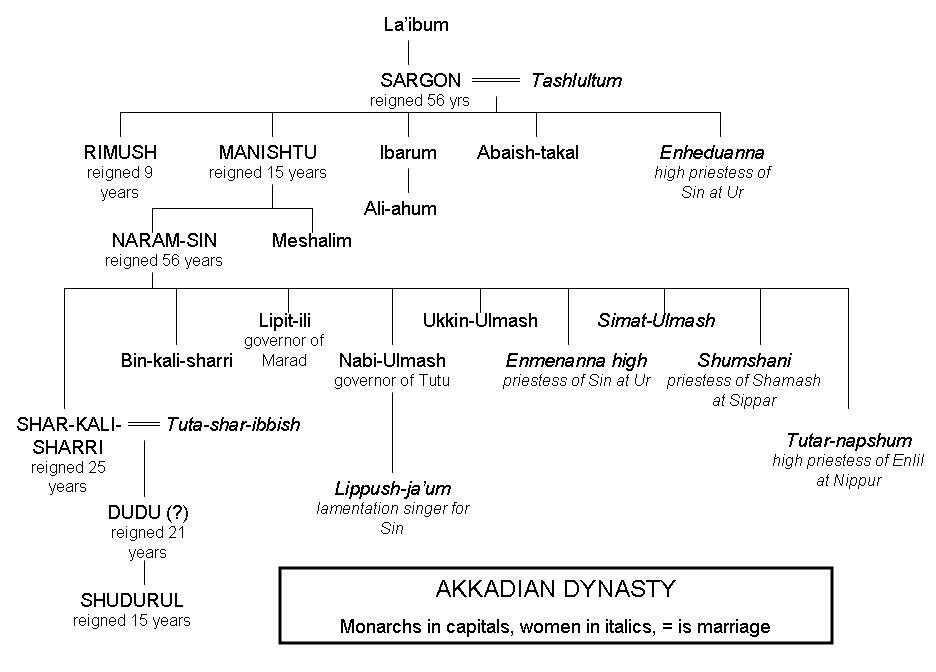
The descendants of Sargon of Akkad (Sargon the Great), ©John D. Croft.

Petrovich offers two other lines of support for Nimrod as Sargon.

The characters of Nimrod and Sargon

Moses wrote, “10:8b [Nimrod] was the first on earth to be a mighty man. 9 He was a mighty hunter before the LORD.” As translated, this sounds like a complimentary description of an admired hunter and hero, but Dr. Petrovich takes issue with a number of choices made in the translation. His reasoning is too complicated to repeat here, but the bottom line is that:

  1. “He was the first on earth to be a mighty man” should be rendered as something akin to “He acted in a profane manner in his quest to become powerful on earth.”
  2. “He was a mighty hunter before the LORD” should be “He was a brutal slaughterer before the LORD.”

In other words, far from being an admired hunter of game, he was a feared and ungodly butcher of men. Like most conquerors. Like Sargon.

The conquests of Nimrod and Sargon

Moses is presenting Nimrod as the first empire-builder in history, which is Sargon’s claim to fame in secular histories. Verses 10:10–11 list cities conquered by Nimrod, beginning at Eridu (Babel?) and moving northwest in Sumer (Shinar?), then north of that into Assyria. This is the basic pattern followed by Sargon. See the two maps that follow.
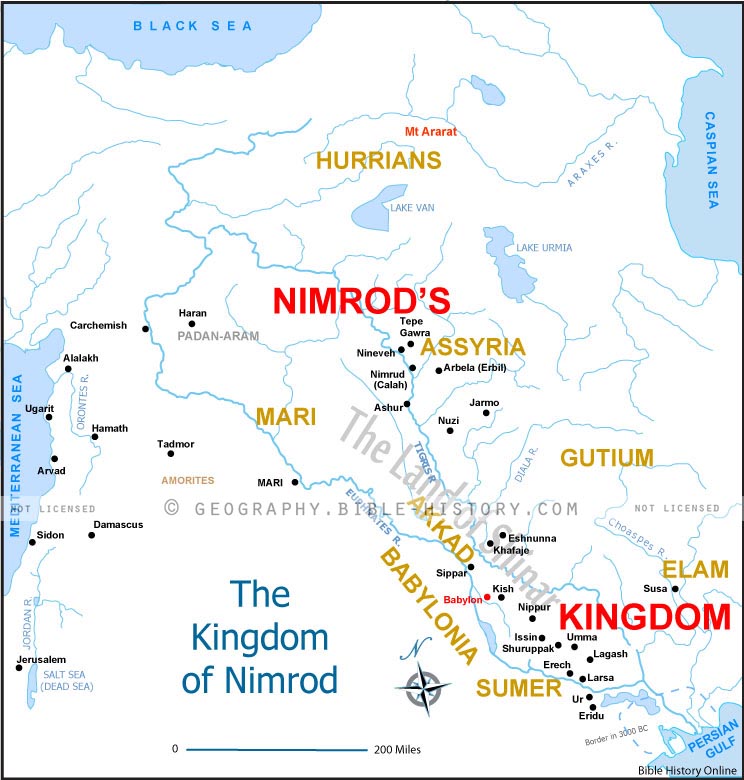
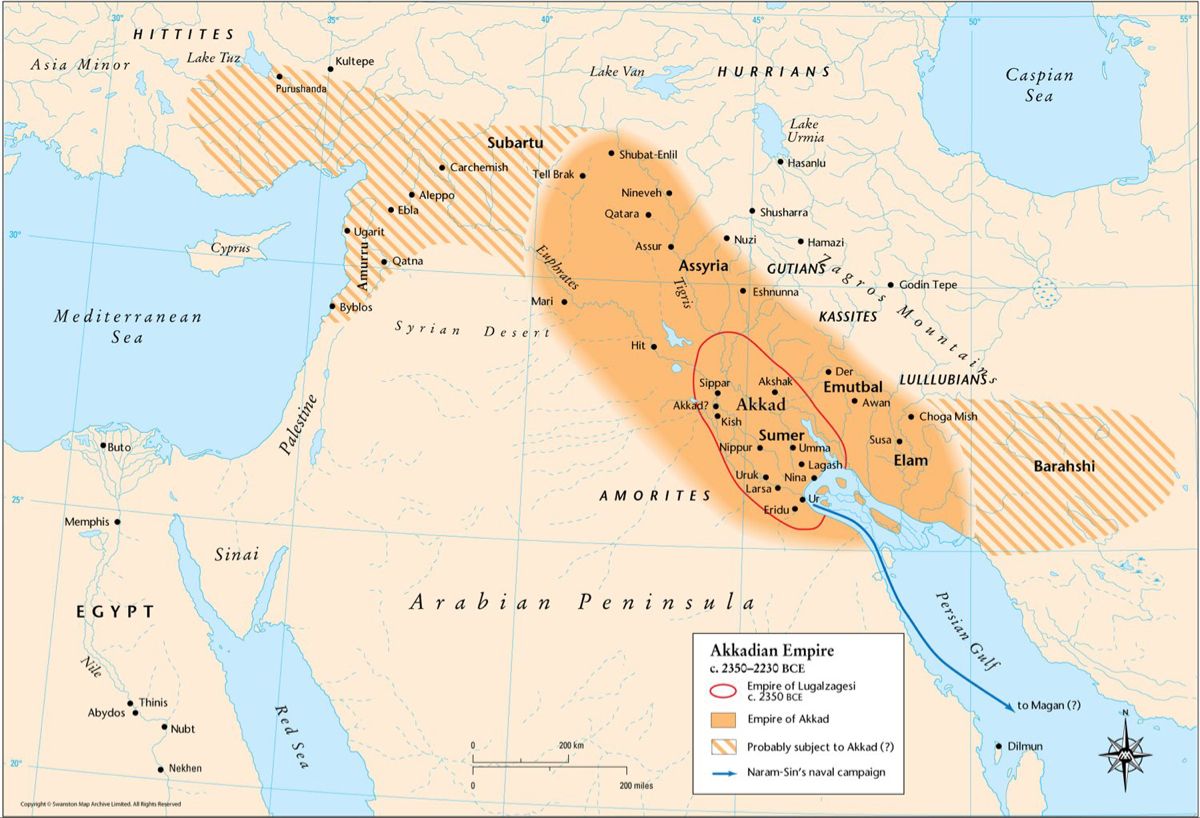
Nimrod’s Empire, ©geography.bible-history.com. Compare with Sargon’s Empire, below.
The Akkadian Empire under Sargon the Great and his successors.

A final toledah

This is the genealogy of Abram/Abraham, covering his patriarchal line up to Shem. I quote it here in full because of its importance.

10 Here is the genealogy of Shem. Shem was 100 years old when he fathered Arpakhshad two years after the flood. 11 After Arpakhshad was born, Shem lived another 500 years and had sons and daughters.

12 Arpakhshad lived thirty-five years and fathered Shelach. 13 After Shelach was born, Arpakhshad lived another 403 years and had sons and daughters.

14 Shelach lived thirty years and fathered ‘Ever. 15 After ‘Ever was born, Shelach lived another 403 years and had sons and daughters.

16 ‘Ever lived thirty-four years and fathered Peleg. 17 After Peleg was born, ‘Ever lived another 430 years and had sons and daughters.

18 Peleg lived thirty years and fathered Re‘u. 19 After Re‘u was born, Peleg lived another 209 years and had sons and daughters.

20 Re‘u lived thirty-two years and fathered S’rug. 21 After S’rug was born, Re’u lived another 207 years and had sons and daughters.

22 S’rug lived thirty years and fathered Nachor. 23 After Nachor was born, S’rug lived another 200 years and had sons and daughters.

24 Nachor lived twenty-nine years and fathered Terach. 25 After Terach was born, Nachor lived another 119 years and had sons and daughters.

26 Terach lived seventy years and fathered Avram, Nachor and Haran. 27 Here is the genealogy of Terach. Terach fathered Avram, Nachor and Haran; and Haran fathered Lot. 28 Haran died before his father Terach in the land where he was born, in Ur of the Kasdim.

— Genesis 11:10-28 (CJB)

We already know that the scattering from Babel happened in the lifetime of Peleg. Since this provides no additional information on that, we still don’t know if Peleg was physically in Babel when it happened, or who the leader or leaders of the city at that time were. Peleg is only a marker for us.

Abram’s calling

29 Then Avram and Nachor took wives for themselves. The name of Avram’s wife was Sarai, and the name of Nachor’s wife was Milkah the daughter of Haran. He was the father of Milkah and of Yiskah. 30 Sarai was barren — she had no child. 31 Terach took his son Avram, his son Haran’s son Lot, and Sarai his daughter-in-law, his son Avram’s wife; and they left Ur of the Kasdim to go to the land of Kena‘an. But when they came to Haran, they stayed there. 32 Terach lived 205 years, and he died in Haran.
— Genesis 11:29-32 (CJB)

The martyred deacon, Steven, gave a more detailed account of Abraham’s early movements than did Moses. This was without doubt from lore passed down verbally.

2 and Stephen said:
“Brothers and fathers, listen to me! The God of glory appeared to Avraham avinu (Abraham our father) in Mesopotamia before he lived in Haran 3 and said to him, ‘Leave your land and your family, and go into the land that I will show you.’ 4 So he left the land of the Chaldeans and lived in Haran. After his father died, God made him move to this land where you are living now.
— Acts 7:2-4 (CJB)

Genesis prehistory and the End Times

Most Christians are interested in Creation, the Garden of Eden and the Flood. Most are not interested, particularly, in the genealogies, the millennium between Cain and Abel and the Flood, or the millennium between the Flood and Abraham. Thinking about these old things to most is like watching old Black and White Japanese Godzilla movies on TV. It’s just the “weird part of the Bible”. Monster stories for kids’ comic books.

Well, what’s it even there for?

First of all, for the ancient Israelites, coming out of the pagan Egyptian culture and preparing to enter the pagan Canaanite lands, it was a polemic against all they had been taught since childhood.

All the stories were familiar, but the heroes weren’t the pagan gods and kings they’d always been taught to revere. Yahweh was infinitely greater, more powerful, and more benevolent than any of them.

For the Israelites about to cross the Jordan, He is the God who can control the most powerful forces of nature, He can wipe out all life on earth if He chooses, and He can scatter and isolate all humanity to quell rebellion.

And while He alone is the personal God of His chosen people, He has placed all other peoples under the rule of angelic overseers that He created. Although they became corrupt over time and presented themselves as gods, they serve His purposes and He can easily control them as He desires.

The same lessons are there for all other peoples of all times, both those among His elect and those who are not.

But there is another layer to this that applies to those of us living in the acharit hyamim, the End of Days..

The Serpent is still the Deceiver and the Accuser. He still has his hordes of rebellious celestial spirits and the temporarily dormant demonic Nephilim spirits.

As it was in the days of Noah, hedonism and rebellion against God are on the rise. Yahweh promised never again to destroy all flesh, but even after the flood, mankind plotted to unite in rebellion. Though He scattered them and divided them, countless Nimrods have attempted to once again unite the world against Him.

Modern rulers, through technology, persuasion, and economic globalism have renewed the effort to build a “tower to heaven”, and it is only a matter of time before a new Nimrod rises to “take control” in the name of peace and prosperity.

After the Dreams: Corruption in Heaven and Earth

Posted on:

Modified on:


  1. Introduction: extrabiblical sources
    1. Those ccepted by most teachers
    2. Those less accepted by Evangelicals
      1. Rabbinical writings
      2. Apocryphal works
      3. Other ANE sources
      4. Patristic work
  2. Seth’s line
    1. Terminology
    2. Timeline
    3. Alternate sources
    4. Chronological uncertainties
      1. Observations:
      2. Conclusions:
    5. Patriarchal longevity
  3. Corruption
    1. Second celestial rebellion
      1. The sons of God
      2. The daughters of men
      3. The Nephilim
    2. Consequences
      1. Shades of the Nephilim
      2. Demons
      3. Post-Flood giants
      4. Timing of the rebellion

In Genesis 1:1–5, Day 1 and a number of earlier posts I presented a case for Old Earth Creationism and why I believe that Genesis 1 can only be interpreted as a visionary prophetic revelation, not a literal historical account.

In a follow-up post, Moshe’s Week of Dreams, I presented a hypothesis as to why Genesis 1 reads as it does: My suggestion is that, in a series of six visionary dreams, Moses received revelation of God’s solo role in creation. Not “how I did it”, but “it was I, and I alone, who created everything that is!”

Most recently, in After the Dreams: Day 7 Thru Seth, I did a follow-up expository study on chapters 2 through 4 of Genesis, concentrating on issues that I think are poorly understood—doctrinal fallacy based on traditional assumptions, not on solid Biblical evidence. Some topics discussed:

  • The origin of angels.
  • The function of the Garden.
  • The nature of the Serpent.
  • Satan as a name vs satan as a function.
  • Were the animal skins a blood sacrifice?
  • The closing and fate of the Garden.
  • Why Cain’s offering was rejected.

I’m going to continue that survey here, covering the rest of pre-Flood Biblical history.

My plan currently is to finish the series with a post on the recovery from the Flood, the Tower of Babel and its consequences, and the identity and life of Nimrod.

Introduction: extrabiblical sources

The entire subject matter that I want to cover in this post and the next, with the exception of the Flood story, are given very limited coverage in the Bible itself. I believe that a better understanding of these topics can be reached using non-Biblical literature from the Second Temple period through the early Rabbinic period, meaning, for my purposes, primarily the 4th century BC through the 4th century AD.

I have heard Christians at Bible Studies say, “If it isn’t in the Bible, then I’m not interested.” I understand that they are speaking from their love of God and their faith in His Word. For most Christians, that is a commendable attitude. I would suggest, though, that these folks don’t understand how pastors, teachers, and Christian authors, as well as entire local churches and denominations, work.

Not everything in the Bible is crystal clear. Every entity I just listed has an official doctrinal stance and a vast body of tradition, hopefully founded on Scripture, but understood with the help of extrabiblical supplementation.

Every lesson taught, every sermon preached, every book written by even the most devout and Bible-oriented human being expresses the viewpoint of that individual, as formed by the Bible but influenced by other factors in his or her personal environment. Nobody agrees fully with anyone else, and nobody gets everything right.

Concerning written influences:

Those ccepted by most teachers

Most Sunday School classes and Bible studies supplement their Bibles with quarterlies, workbooks, topical books and expository works by popular writers, and so on. Some are quite good, others abysmal. Most good sermons are prepared with the help of Bible commentaries and dictionaries, lexicons, theological guides, and multiple translations of the Scripture itself. Sometimes secular encyclopedias, history books, cultural studies and maps are used.

A lot of the material I just listed is very helpful, but none of it is inerrant!

Most of the time, you don’t know where your pastor, teacher, or your favorite blogger is getting supplemental source material.

Those less accepted by Evangelicals

Other information sources may be far less trusted by Evangelical Christians because of sectarian bias or ignorance of their content, but they are often still useful. The sources from this selection that I am most likely to use on occasion fall into several categories:

Rabbinical writings

This category seems to be anathema to many Evangelicals. Not because they revile Jews, necessarily, but because they view Judaism as something that Jesus rendered obsolete and therefore void of any value to Christians. My view is directly opposite. I don’t think that one can fully understand Christianity without also understanding Judaism. I find the Talmuds and other Jewish theological works, both early and modern, to be incredibly useful.

Apocryphal works

I am using that term here in a general sense to include the books known formally as “the Apocrypha“, many of which are considered canonical to some major denominations, plus other Second Temple writings, many of which are termed “Pseudepigraphal” because they purport to be written by someone other than the true author.

I consider these documents in general to be “historical fiction“, containing important seeds of truth. The dialog in these texts is somewhere between exaggerated and completely fanciful. The plot and historical background originate from, I believe, a combination of (a) canonical Scripture, (b) older written history, and (c) verbally transmitted lore. Use them with caution, but don’t ignore them!

Perhaps the best known of such works are the pseudepigraphal book, 1 Enoch, and The Book of Giants from the Dead Sea Scrolls. These two works, in particular, were accepted as truth, at least in part, by many intelligent and educated wise men of the ancient world, including some of the Church Fathers of the Patristic Age. I am using them extensively for this particular post.

Other ANE sources

Additionally, since the earliest cuneiform and hieroglyphic writings in some of the earliest civilizations, the legends of the Ancient Near East (ANE) have been faithfully recorded. Since they write about some of the same events as are found in the Bible and ancient Jewish extrabiblical texts, they provide outside confirmation and often suggest additional clarifying information.

Creation, “angelic” sin, the Nephilim, the Flood, the Tower, and the confusion of tongues are all topics I’m covering in this series that are both Biblical and widely reported in the greater ANE. Neither the Bible nor the legends are copycats; both reflect a common body of ancient memory.

Patristic work

These are the writings of the so-called Patristic Church Fathers in the early centuries after the dispersal of the Biblical apostles and the destruction of the Temple. These works are revered by Catholics, Orthodox denominations, and some Protestants. Certainly, these men contributed in huge ways to early Church theology. Personally, I find myself often taking sides against their theological conclusions, but I do profit from their thoughts and the history contained in their work.

Seth’s line

Genesis 4:25–5:32

This passage is a somewhat lengthy genealogy of Adam, from Seth through Noah. It serves as a toledah separating the Cain and Abel narrative from the corruption story. Even the genealogies of the bible are interesting to me, and I quote this one in full!

Reminder: A toledah (plural toledoth) is a passage in Genesis that (a) announces itself, when translated, as a “genealogy” or some related noun; and (b) serves as a notice that the subject of the text is changing. Think of them as Noah’s chapter headings.

25 And Adam knew his wife again, and she bore a son and called his name Seth, for she said, “God has appointed for me another offspring instead of Abel, for Cain killed him.” 26 To Seth also a son was born, and he called his name Enosh. At that time people began to call upon the name of the LORD.

1 This is the book of the generations of Adam. When God created man, he made him in the likeness of God. 2 Male and female he created them, and he blessed them and named them Man when they were created. 3 When Adam had lived 130 years, he fathered a son in his own likeness, after his image, and named him Seth. 4 The days of Adam after he fathered Seth were 800 years; and he had other sons and daughters. 5 Thus all the days that Adam lived were 930 years, and he died.

6 When Seth had lived 105 years, he fathered Enosh. 7 Seth lived after he fathered Enosh 807 years and had other sons and daughters. 8 Thus all the days of Seth were 912 years, and he died.

9 When Enosh had lived 90 years, he fathered Kenan. 10 Enosh lived after he fathered Kenan 815 years and had other sons and daughters. 11 Thus all the days of Enosh were 905 years, and he died.

12 When Kenan had lived 70 years, he fathered Mahalalel. 13 Kenan lived after he fathered Mahalalel 840 years and had other sons and daughters. 14 Thus all the days of Kenan were 910 years, and he died.

15 When Mahalalel had lived 65 years, he fathered Jared. 16 Mahalalel lived after he fathered Jared 830 years and had other sons and daughters. 17 Thus all the days of Mahalalel were 895 years, and he died.

18 When Jared had lived 162 years, he fathered Enoch. 19 Jared lived after he fathered Enoch 800 years and had other sons and daughters. 20 Thus all the days of Jared were 962 years, and he died.

21 When Enoch had lived 65 years, he fathered Methuselah. 22 Enoch walked with God after he fathered Methuselah 300 years and had other sons and daughters. 23 Thus all the days of Enoch were 365 years. 24 Enoch walked with God, and he was not, for God took him.

25 When Methuselah had lived 187 years, he fathered Lamech. 26 Methuselah lived after he fathered Lamech 782 years and had other sons and daughters. 27 Thus all the days of Methuselah were 969 years, and he died.

28 When Lamech had lived 182 years, he fathered a son 29 and called his name Noah, saying, “Out of the ground that the LORD has cursed, this one shall bring us relief from our work and from the painful toil of our hands.” 30 Lamech lived after he fathered Noah 595 years and had other sons and daughters. 31 Thus all the days of Lamech were 777 years, and he died.

32 After Noah was 500 years old, Noah fathered Shem, Ham, and Japheth.

—Genesis 4:25-5:32 (ESV)

Terminology

Just a few comments here on the terminology for man, mankind, etc. In the quotations below, I have underlined some that I find especially interesting.

  • The first few chapters of Genesis introduce us to the principal Hebrew words for man and mankind.

1 This is the book of the generations of Adam. In the day that God created man, in the likeness of God made he him; 2 Male and female created he them; and blessed them, and called their name Adam, in the day when they were created.
Genesis 5:1-2 (KJV)

What does it mean by “called their name Adam“? The three words underlined above are all the same Hebrew word, אָדָם, transliterated as “adam“, and pronounced “ah-DAHM”. This is a generic term for “man”, “mankind”, or “human.” Though it is the same word exactly, Strong’s has assigned a separate index number for it when it is used as the personal name of the man in the Garden, Adam. Hebrew has no alphabetic case, but later English translations sometimes use a lower-case “a”, “adam”, for the generic “mankind” usage.

Adam” comes from a Hebrew root meaning “red.” As does the related word אֲדָמָה (adamah), meaning “earth”, referring not to the planet, but rather to the ground, especially (over 200 times in the Old Testament) to tilled land, productive soil, or Israel’s productive land in particular.

Adam was formed from the dust of the adamah. I take this to mean, specifically, from soil in the fertile but arid ground where God subsequently planted the Garden.

  • Another term for the “man” concept is used Genesis 3, when Eve is made from Adam’s rib:

23 And Adam (Adam) said, This is now bone of my bones, and flesh of my flesh: she shall be called Woman (ishshah), because she was taken out of Man (ish).
—Genesis 2:23 (KJV)

This time, “man” is אִישׁ (iysh or ish, pronounced eesh). It is a more formal word for a particular man or men, often meaning “husband”, as implied here. It is also used, for example, in Gen 6:4 in reference to “mighty men [הַגִּבֹּרִ֛ים, haggibborim, “the mighty warriors”], which were of old, men [iysh] of renown.”

It makes some kind of linguistic sense that being taken out of “man” makes her “woman”, but how does that work in Hebrew? In Hebrew, “woman” is אִשָּׁה (ishshah, pronounced eesh-SHAH).

  • Yet another term related to iysh is found here:

[6] And when the woman saw that the tree was good for food, and that it was pleasant to the eyes, and a tree to be desired to make one wise, she took of the fruit thereof, and did eat, and gave also unto her husband (enowsh) with her; and he did eat.
—Genesis 3:6 (KJV)

In this case, the Hebrew is אֱנוֹשׁ (enowsh, pronounced eh-NOHSH), meaning something more like “mortal man.” A bit derogatory. Think of it as, “Uh, just a guy.”

Timeline

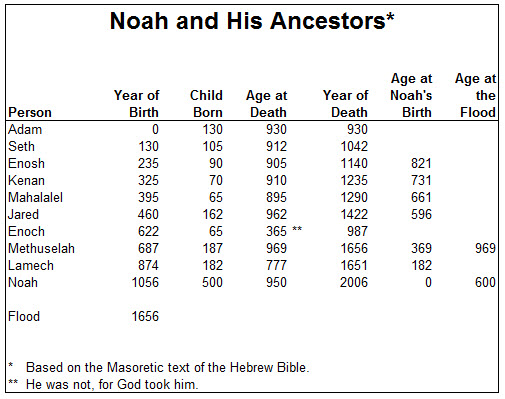
Adam to the Flood, through Seth. Note that Methuselah died in the year of the Flood, suggesting that he may have died in the Flood. ©Ron Thompson

I prepared the above chart many years ago, from one of the many English translations based on the 11th century AD Masoretic Text of Genesis. The Masoretic Text is a compendium of the earliest extant Hebrew manuscripts of the Old Testament and Apocrypha that were available prior to discovery of the Dead Sea Scrolls. English language Bibles from both Christian and Jewish translators are usually based on the Masoretic Text.

The Dead Sea Scrolls, copies penned between roughly the 2nd century BC through the 1st century AD, are more fragmented, but comparisons demonstrate that relatively little corruption has degraded the much later Masoretic source manuscripts.

The chart below shows the principal lines of descent through Adam’s three sons, Cain, Abel and Seth. Note that there were other sons and daughters born at each level of the genealogy (see, for example, Gen 5:4). At least one ancient source suggests that Adam, for example, had 30 sons and 30 daughters, thanks to his long breeding cycle.

A genealogy of Adam and Eve. The similarities between the names of some of Cain’s descendants and some of Seth’s suggest to me that there was renewed contact between the families.

I believe that this genealogy is accurate as listed in Genesis, but it is possible that some generations are skipped for one reason or another. In my next article, as part of my discussion of Nimrod, I will provide more context on the flexibility of the Hebrew term translated “begat.” Even theologian John Witcomb, Henry Morris’ coauthor of The Genesis Flood, acknowledged that possibility and mentioned that it could potentially push Ussher’s proposed creation week back in time several thousand years. The wording of the genealogy makes me doubt that but see below for other potential sources of error.

Additionally, as an Old Earth Creationist, I believe that God’s human creations in Genesis 1:26 predated Adam and Eve (see Moshe’s Week of Dreams). When the latter were driven from the Garden, they joined the older races, who had by then spread throughout at least the Eastern Hemisphere. These are the people who Cain thought might kill him, and from whom he obtained a wife.

Intermarriage between Adam’s race and the old races was probably frequent before The Flood, and that would explain why the genome of modern humans, descended from Noah and his wife, still contain traces of even Neanderthal DNA.

Alternate sources

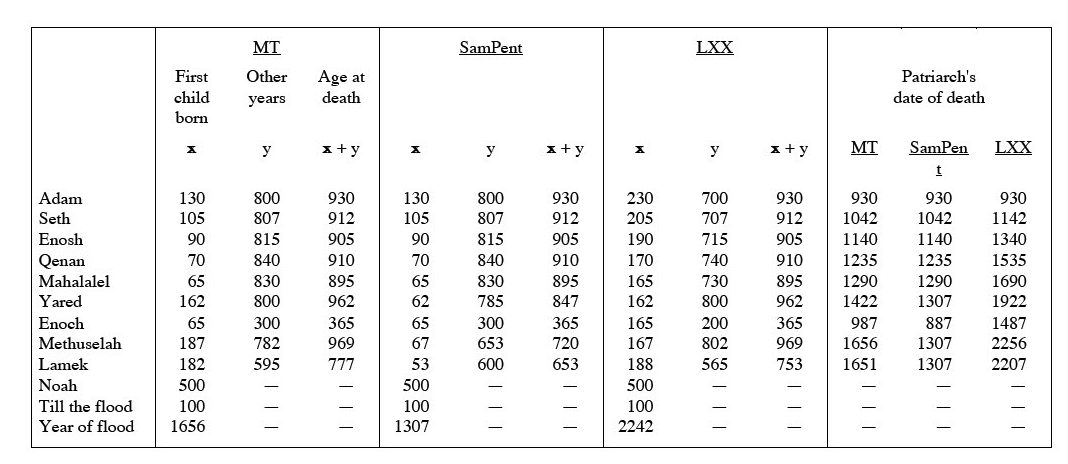
The chart below, from the World Bible Commentary, presents the same information as my chart, but adds columns based on two other important sources, the Samaritan Pentateuch and the Septuagint (LXX).

Wenham, Gordon J. Genesis 1–15. WBC 1. Accordance electronic edition, version 1.9. Grand Rapids: Zondervan, 1987.

The Septuagint is a translation of the Hebrew Scriptures into Koine Greek by Jewish scholars living in Alexandria, probably beginning in the early 3rd century BC and completed by 132 BC. The name of the translation derives from traditional belief that there were 70 to 72 translators. The “abbreviation”, LXX, is by convention read like an acronym (“el-ex-ex”), but of course it is actually the Roman numeral 70.

The LXX is an extremely important source because the New Testament writers, including Paul and the Gospel authors, used it almost exclusively when quoting the Tanakh (Old Testament), and because very early copies exist. I don’t often quote from English translations of the LXX (though I do in this article), but I use it extensively for comparative research.

Evolution of the Hebrew Script

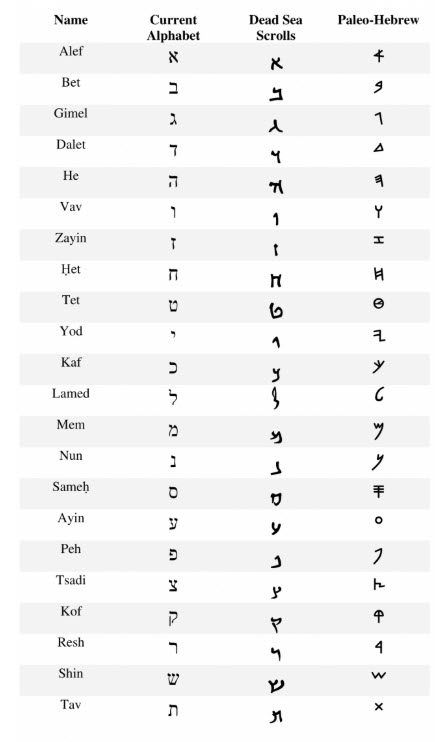
The Samaritan Pentateuch is another widely used early manuscript of the Old Testament. It was written in a Samaritan dialect of Hebrew and Aramaic, using the earlier Proto-Hebrew alphabet. It is dated from as early as the Late Hasmonean or Early Roman period, and as late as the 4th century AD. Most of this document is similar to the Masoretic and LXX, but there are a few important differences where edits were made to justify Samaritan doctrinal variations. I don’t use this at all because I don’t have an English translation. I do have a Hebrew version, but though I can translate Hebrew myself, it is a slow and arduous process at my level of fluency.

It is interesting that the Samaritan numbers show Jared (Yared), Methuselah and Lamek all dying in the year of the flood.

Chronological uncertainties

You will note from the chart above that there are significant differences in the chronologies shown in the various columns. Let’s ask ourselves what the figures in this table tell us about, for example, the accuracy of Archbishop Ussher’s Biblical dating? I am an Old Earth Creationist, but I’m quite willing to put God’s formation of Adam and Eve somewhere around 4004 BC.

Observations:
  • Most of the entries from the Masoretic (MT) text are multiples of 5 years. This is too many to be coincidental, suggesting that the figures are rounded off to the nearest five years. Three of the entries for age at first son’s birth and two for years of life after first son’s birth are adjusted to nearest five + seven, for reasons that aren’t known.
  • The entries for the Samaritan columns are the same as MT for five generations, rounding included, then deviate for all the rest except Enoch and Noah. In two instances, the seven-year adjustment is a subtraction. In three of the last four generations, total life span is significantly different from other sources, so we now have to ask which text is flat-out wrong.
  • The LXX agrees closely with the Samaritan in general. In eight of the first nine generations, it has the age at first son a century later, but in six of those cases the father’s age of death is the same.
Conclusions:
  • By definition, there was probably only one original “autograph” of Genesis. Every manuscript after that was a hand copy until Gutenberg’s press. Every copy made introduced the possibility of “scribal error.” Fortunately, comparisons between manuscripts of widely varying age have shown very few and minor discrepancies. Not too surprising because there was always a very rigorous review process because of the theological necessity for accuracy.
  • I would suggest that there is far more likelihood of scribal errors in Biblical numbers than in alphabetical text. The reason is that Hebrew does not have numerals! Like so-called “Roman Numerals,” Hebrew “numerals” are composed of alphabetical characters assigned numeric values. Consequently, working with numbers in a Hebrew document is cumbersome. As much or more so, in fact, than Roman Numerals in Latin text.
  • Ussher’s calculations were supposedly accurate to year, day and even time of day. Ten generations of round-offs makes a mess of that theory!

Patriarchal longevity

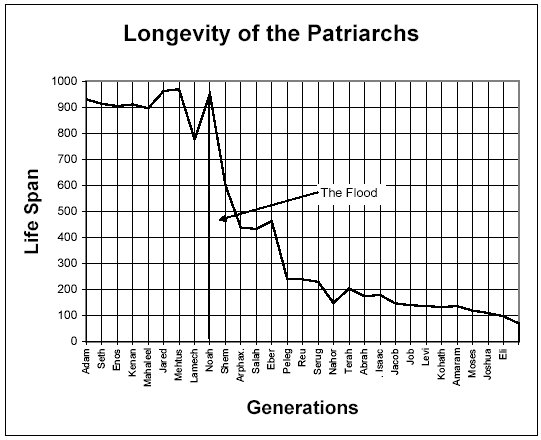
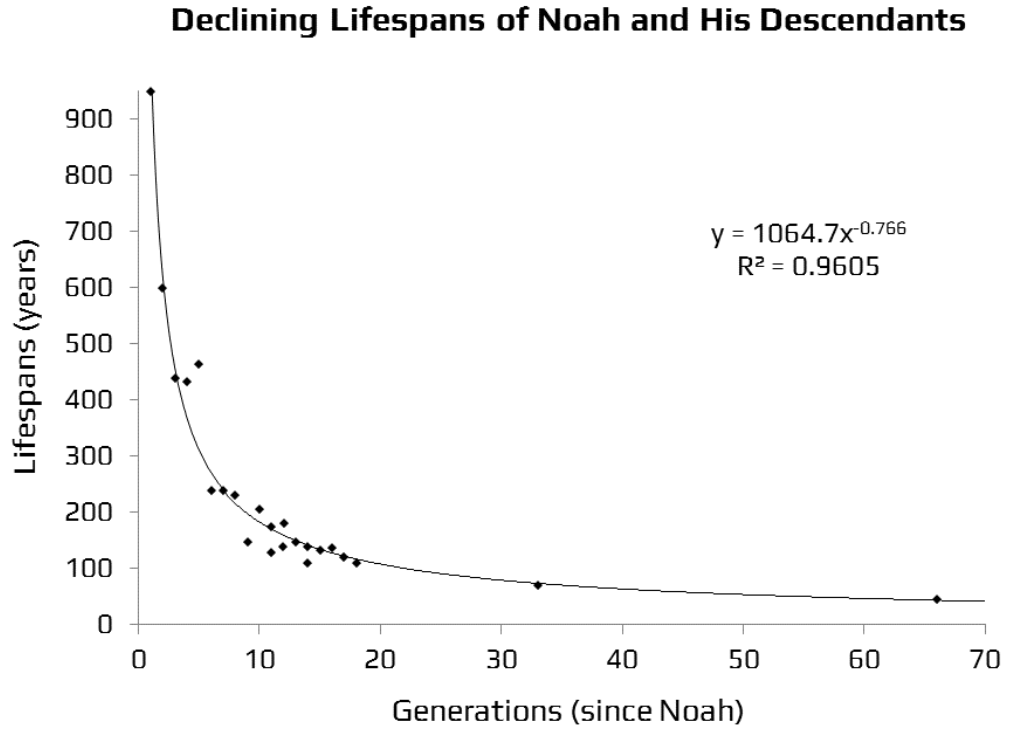
We all know that the life spans of Adam’s descendants were much higher before the flood than after. There was a hyperbolic decline after the flood, rapid at first, then more and more gradual, stabilizing after the Conquest of Canaan.

This graph shows lifespans of the Bible’s patriarchs from Adam through the prophet Eli.

Why? One can only speculate. Most such guesses blame it on decreasing health and increasing pestilence brough on by increasing sin. But the biggest increase in sin came before the flood, and the graph above shows no decrease in that time span. Lamech’s “short” life is an anomaly easily explained by the violence of the age.

The next graph shows the decline from Noah forward:

Lifespans after the flood. A “Least Squares” fit of the data points verifies that ages from that time declined hyperbolically, approaching an asymptote at around 30 years of age. Obviously, the downward trend has reversed somewhat over the last millennia or so due to cultural changes in health and hygiene.

To me, the second graph looks like an equilibrium chart. Here’s another of my totally speculative scenarios:

  1. Some 5.5 billion years after the formation of the planets from the sun’s accretion disk, earth had more or less stabilized. The last globally catastrophic event was the Chicxulub asteroid impact off Yucatan 66 million years ago. That event caused so much climate disruption and destruction to the global ecosystems that 75% of all plant and animal species on earth at the time went extinct. Including most dinosaurs.
  2. With God’s nudging, the adaptive capabilities that He had built into His living creations were able to heal the damage caused by the asteroid impact and push the mammals, including ancient mankind, into a position of supremacy.
  3. God “planted” Adam and Eve in the Garden 6,000+ years ago. Perhaps a bit earlier, depending on translational issues and whether or not generations are skipped in the genealogy for any reason. Clearly (based on the rounded data points), absolute accuracy in the numbers was not attempted by the human authors of the Bible.
  4. Despite the terrible sinfulness that developed over the course of the antediluvian earth, there appears to have been no consequent reduction in human lifespan during the time.
  5. The Flood, discussed below and in previous articles, I believe to have been brought about supernaturally when God caused the vast quantities of water known to be contained in the earth’s mantle transition layer to be flushed out into the oceans through volcanos on the midoceanic ridges.
  6. It is conceivable to me that the unprecedented activity of the submerged volcanoes could have triggered or hastened atmospheric changes that caused lifespans to get shorter and shorter over the succeeding several hundred years.

Alternatively, perhaps around the time of the flood, God simply triggered DNA changes that shortened human lifespans over that time frame.

Note, however, that the extreme longevity recorded for the Biblical patriarchs did not necessarily apply to anyone else during the period! The assumption that all mankind was long-lived has been incorporated into Judeo-Christian tradition without Biblical support.

Corruption

Genesis 6:1–8

[5] The LORD saw that the wickedness of man was great in the earth, and that every intention of the thoughts of his heart was only evil continually.
—Genesis 6:5 (ESV)

The first Period of Corruption, which I’ll cover here, extends from Cain, presumably from some time before his ill-fated offering and subsequent murder of Abel, until the Great Flood, traditionally, per Ussher, around 2348 BC.

One of many preflood timelines on the web. Most, like this one, are based on Ussher’s dating, with Adam’s creation in 4004 BC.

Why was there so much corruption on earth during that period? Is it just because of paganism and the brutality of prehistoric times? Perhaps, but prehistoric peoples had to work very hard to survive, so how did they find the time and why would they waste that much energy doing unproductive things?

Logic would seem to dictate that life then, for them, would be somewhat like one typically finds in the modern era when isolated pockets of stone age villages are found in undeveloped areas of the world.

I will attempt below to show that the post-Eden world started out more or less like I would have expected, but probably during the lifespan of Jared, conditions changed radically due to a barely imaginable external stimulus that changed the world in ways that still affect us today.

Most of this will be new to most of you.

Second celestial rebellion

[6:1] In time, when men began to multiply on earth, and daughters were born to them, [2] the sons of God saw that the daughters of men were attractive; and they took wives for themselves, whomever they chose. [3] ADONAI said, “My Spirit will not live in human beings forever, for they too are flesh; therefore their life span is to be 120 years.” [4] The N’filim [Nephilim, giants] were on the earth in those days, and also afterwards, when the sons of God came in to the daughters of men, and they bore children to them; these were the ancient heroes, men of renown.

[5] ADONAI saw that the people on earth were very wicked, that all the imaginings of their hearts were always of evil only. [6] ADONAI regretted that he had made humankind on the earth; it grieved his heart. [7] ADONAI said, “I will wipe out humankind, whom I have created, from the whole earth; and not only human beings, but animals, creeping things and birds in the air; for I regret that I ever made them.” [8] But Noach [Noah] found grace in the sight of ADONAI.
—Genesis 6:1–8 (CJB)

Although rarely taught or preached, I regard these eight verses as one of the most foundational passages in the Bible, because:

  1. It sets a baseline for human depravity and illustrates the perfidy even of angels.
  2. It furnishes a rationale for why God determined to bring the Great Flood.
  3. It provides a background for understanding the important subject of New Testament demonology.

Both humans and angels were created with freewill, and freewill always opens doors to rebellion!

Verse 8 is usually considered to be part of the Flood story in English translations with inserted headings (like ESV), but the two following verses (9 and 10) are a very brief toledah, so Moses considered the contrast of Noah’s righteousness to the evil of that age to be part of this story, separate from God’s announcement of coming destruction and His call for Noah to build an Ark.

If the Serpent’s actions in the Garden were part of his prideful fall from heaven (Isaiah 14:11–15), then that is the first recorded celestial rebellion.

Genesis 6:1–8 is then the second.

The sons of God

the sons of God saw that the daughters of man were attractive. And they took as their wives any they chose.
—Genesis 6:2 (ESV)

The sons of God and the daughters of men. ©Daniel Chester French, 1923. French is best known as sculptor of the Lincoln Memorial.

Generations of scholars have argued over the identity of the sons of God as referenced in this context, despite the fact that elsewhere in scripture the term transparently refers to angelic beings.

Three theories are popular in Common Era (Anno Domine) churches and synagogues:

  • The most popular since the Patristic Age (specifically, beginning with Augustine of Hippo) is the idea that the “sons of God” were the “Godly line of Seth“, and the ladies in question were the “ungodly line of Cain.”

But Scripture nowhere implies that Seth’s descendants were by nature Godly or Cain’s ungodly, or that such unions were forbidden. And this theory fails to account for the Nephilim (see below).

  • The second most popular is that the sin was polygamy by evil kings, nobles or aristocrats.

But polygamy was not prohibited, even much later in the Monarchy period, and again, where did the Nephilim come from?

  • I’ll discuss the least popular but correct view here. Sure, I’m willing to be dogmatic about this!

The question was a hot topic even in the 1st century, and much of the thinking of that era is reflected in 1 Enoch, and The Book of Giants, discussed above. These and other related texts uniformly identify the “sons of God” as angels, and in fact, the term is often unmistakably used for angels in canonical scripture. Angels are classified according to function, and those in Genesis 6 are called “Watchers” in the extrabiblical literature. In the Bible, that term only appears in Daniel 4. That they are indeed angelic beings is given a stamp of authenticity in Jude and 2 Peter where the book of 1 Enoch is quoted.

The angelic rebellion, the giants, the corruption of humans, the Flood, and the confusion of tongues at Babel were events that effected all peoples of the world, not just the Jews. All of these events show up in some form in the writings of many ancient cultures around the world.

The Mesopotamian Epic of Gilgamesh, for example, famously mentions the Flood. This same tale and other related cuneiform tablets also mention demigods called the Apkallu who are counterparts of the rebellious angels, who corrupt the civilized world and spawn giant offspring. Gilgamesh himself was one of these giants.

As for the Biblical account, the primary source of doubt is that many scholars today question whether an angel even can (a) feel lust for a mortal woman or (b) consummate such lust.

Both of those questions hinge on what you believe about the ontological nature of angels. That’s a tough question, because nothing in the Bible or in any extrabiblical literature that I’m aware of provides a clearcut definition of “angelhood.” Are they corporeal beings, or spirit beings, or both? There is no seminary class on “angelic anatomy and physiology.” My opinion as a student of science is that no corporeal being could survive the rigors of the universe beyond earth without something like a spaceship; however, the following passage seems to be sufficiently clear:

[13] And to which of the angels has he ever said, “Sit at my right hand until I make your enemies a footstool for your feet”? [from Psalm 110:1]
[14] Are they not all ministering spirits sent out to serve for the sake of those who are to inherit salvation?
—Hebrews 1:13–14 (ESV) emphasis mine

Because I’ve already described angelic beings in detail in Gods and Demons, I’m going to state here simply that I believe that they are disembodied spirits created alongside the Universe to be God’s agents for its administration.

I was taught years ago that the “sons of God” in Genesis 6 were angels who had taken possession of human men; but in the article linked here, I wrote, as I now firmly believe,

This unnatural union of Watchers and human women did not require “possession” of human males by the Watchers. The Bible includes a number of examples of angelic beings taking human form and exhibiting human function. 

Whenever angels appeared to humans, Biblically, they appeared in human form, probably for the sake of establishing empathy. Whether these were solid human bodies or visual and aural illusions, they usually fooled the human observers.

A few instances are recorded where there was actual physical contact, so I have to think there was indeed a temporary corporeal body. For example, angels ate with Abraham, then with Lot in Sodom; an angel touched Elijah twice as he slept under a broom tree; and an angel struck Paul in prison. And when Jacob wrestled with God, I assume that he was wrestling with a preincarnate Christophany, meaning an appearance of the future messiah, similar in substance to an angel.

So no, I can’t think of any reason to doubt that angels can take on masculine human bodies and mate with fully human women.

Note: In Gen 6:2 where it says the sons of God “took wives for themselves”, most would agree that this is speaking of physically mating, not legally marrying. In any case, the following verse and its parallels is not saying that angels can’t mate, but rather that they have no angelic female counterparts and don’t need to procreate because they don’t die! See,

[35] but those who are considered worthy to attain to that age and to the resurrection from the dead neither marry nor are given in marriage, [36] for they cannot die anymore, because they are equal to angels and are sons of God, being sons of the resurrection.
—Luke 20:35–36 (ESV)

For NT proof that the sons of God are angelic, the passages below are quoting from 1 Enoch, which is explicitly referring to the “sons of God” of Genesis 6.

[6] And the angels who did not stay within their own position of authority, but left their proper dwelling, he has kept in eternal chains under gloomy darkness until the judgment of the great day— [7] just as Sodom and Gomorrah and the surrounding cities, which likewise indulged in sexual immorality and pursued unnatural desire, serve as an example by undergoing a punishment of eternal fire.

[14] It was also about these that Enoch, the seventh from Adam, prophesied, saying, “Behold, the Lord comes with ten thousands of his holy ones, [15] to execute judgment…”
—Jude 6–7; 14–15a (ESV)

[4] For if God did not spare angels when they sinned, but cast them into hell and committed them to chains of gloomy darkness to be kept until the judgment; [5] if he did not spare the ancient world, but preserved Noah, a herald of righteousness, with seven others, when he brought a flood upon the world of the ungodly;
—2 Peter 2:4–5 (ESV)

The daughters of men

I don’t see anything abnormal about this group. Human women.

I see no reason to think that Sethite women would have been any less likely than Cainite women to be seduced by the sons of God. Whether the women shared any guilt with the angels is not clear, but certainly the angels in particular were severely punished.

The Nephilim

This is where it gets really interesting. Let’s start by comparing two translations of verse 4.

The Nephilim were on the earth in those days, and also afterward, when the sons of God came in to the daughters of man and they bore children to them. These were the mighty men who were of old, the men of renown.
—Genesis 6:4 (ESV)

Now the giants were upon the earth in those days; and after that when the sons of God were wont to go in to the daughters of men, they bore children to them, those were the giants of old, the men of renown.
—Genesis 6:4 (LXX-B)

The ESV (English Standard Version) is of course one of the most popular English translations among 21st century Protestants. The second version here is an English translation of the LXX (or Septuagint), which itself is a 2nd century BC translation from Hebrew into Greek.

Nephilim“, הַנְּפִלִ֞ים, pronounced nə-feel-EEM is a transliteration, not a translation, of the plural form of Hebrew נְפִיל, pronounced nə-FEEL.

The first problem here is that some question whether it’s even the right word. The old Hebrew has no vowels (except in this word, the yod, (י) functions like an English “Y” used as a vowel. A similar word, nophilim, pronounced with an “o” would translate to “fallen ones,” which would fit in either case, but the consensus is that “Nephilim” is the correct word where it occurs in the Hebrew Old Testament. This word represents “a bully, a tyrant, or a giant.”

The LXX translators, who were certainly cultural insiders, rendered it as Greek γίγαντες (gigantes), which you probably need no help to translate to English.

Now the canonical Bible, OT and NT, has nothing else to say about the nature of the Nephilim, aside from the observation that they were הַגִּבֹּרִ֛ים (the gibborim), the warriors, heroes, mighty men, or men of renown.

It’s fairly common “church knowledge”, or tradition, that the Nephilim were offspring of the angel males and human females of Gen 6:2. For confirmation you have to go to extrabiblical literature like 1 Enoch. It would take a lot to convince me that this view is wrong.

What else do we know about them? Apparently, they were, indeed, giants. How big? Well, there is a problem with 1 Enoch. It describes them as 300 cubits (about 450 feet) tall! That’s around 3½ blue whale lengths, or 3½ times the size of Patagotitan mayorum, the largest known dinosaur, head to tail. I think that “flesh and blood” that large would not be able to survive in earth’s gravity.

I have that problem with the supergiants, but we do have some examples of Nephilim size from canonical Scripture. The Philistine, Goliath the Gittite (from Gath) was a later descendent of Anak. The Anakim were related to the Nephilim. The Masoretic text has Goliath at “six cubits and a span”, or 9 feet 9 inches. Josephus says, “four cubits and a span”, or 6 feet 9 inches, but Josephus was very fallible in some of his descriptions.

“David and Goliath”, 18th century painting by Charles Errad.

Og, an Amorite king of Bashan (in the Golan Heights area), was also a Nephilim giant. Scripture describes him as “the last survivor of the giant Rephaites.” The Rephaites were a clan of Nephilim. We know that King Og was a giant, but all we know of his particular size is that his bed was “nine cubits long and four cubits wide”, approximately 13½ feet by 6 feet. That is probably not an accurate gauge of Og’s size, because the bed dimensions are most likely ceremonial. They are exactly the same as the reported dimensions of the ceremonial bed at the top of the Ziggurat of Babylon, built for Baal and his consort.

If you are a hyper literalist, you may be inclined to prefer the 450-foot size because the Israelite spies reported that “we are like grasshoppers to them.” To me, that was an obvious exaggeration, but you have to believe that a conservative hermeneutic allows for exaggerations. Which you know by now that I do!

Consequences

Now, here is a big assumption, that I think is probably true…

Shades of the Nephilim

The Nephilim were big, bad, barbaric warriors, but that was far, far from them at their worst!

We’re delving into the extrabiblical for information now, where the Bible itself is silent. The late Michael Heiser, a scholar of ancient Israel and the Ancient Near East, is my principal source on topics like this. He was very confident of what has been unearthed from Apocryphal and Pseudepigraphal literature. The relevant texts are, in some cases, part of church canon for Catholic, Orthodox, and some Protestant denominations. In other cases, the texts may have at one time been considered inspired but were later excluded.

I need to stress here that I do not in any way consider these texts to be inspired or infallible. I use them only to shed light on peripheral issues that are interesting to me, but that God chose not to address more fully in Scripture.

These sources may then explain much that the Bible doesn’t about this subject. For example:

  • They explicitly state that the Nephilim were the unnatural offspring of angel/human pairings.
  • For this to be even possible, one has to believe that the temporary physical body of a corporeal angel was very similar, not only externally, but also in its internal anatomical and physiological makeup, to a human male.
  • Nevertheless, the giantism, muscularity, and otherworldly fierceness of the children of this union is an indication of partial incompatibility between the genomes of the parents.
  • Despite their toughness, the Nephilim could die like humans. Remember Goliath.
  • Like humans, the “shades”, i.e., spirits, of the Nephilim angel/human hybrids were immortal and residing in Sheol after death.
  • However, unlike human spirits, the half-angel spirits aren’t bound to Sheol. Angels in general are spirit beings created for the purpose of managing the cosmos. As such, angels, “good” and “bad”, have full access, even to Sheol, and can enter or exit at will.
  • Satan, like most other angels and the Nephilim, can leave Sheol at will, until the eschatological end times. The angels who sinned in Genesis 6, on the other hand, are bound and cannot escape Sheol, according to Peter and Jude.
  • Most Christians today and for most of the last two millennia have believed that demons are “fallen angels.” Aside from some prophetic references about “worshipping demons”, which might be a reference to the sons of God assigned to the nations at the Babel “scattering”, there is no Biblical evidence of that.
Ancient Hebrew conception of Sheol, the Underworld. As its name suggests, this region is assumed to lie beneath the surface of earth, but since it is the realm of spirits, it could be an undetectable phantom world, here or anywhere else either within or beyond the cosmos. This illustration, artist unknown, depicts a desert-like half for the ungodly, and an Eden-like half for the Godly, separated by an impassable chasm. Note that the human figure walking on the left bank would actually be a disembodied spirit.
Demons

According to ancient belief and overwhelming evidence in the Apocrypha, and in the rest of the Ancient Near East, the demons are those very same half breed Nephilim spirits, now free to wander the earth!

They are able to leave Sheol because of their angelic heritage. But because of their human heritage, they want to be embodied. Because, like their angel parent, or perhaps both parents, they are evil, their delight is in causing mischief. A big part of that is “entering” into humans and causing them harm.

Much of Jesus’ healing ministry was clearly healing natural diseases. But often we are told that he “cast out demons.” Some of those may have inflicted their hosts with disease, but some of them evidently caused stress directly.

Post-Flood giants

It is easy to see why OT demons, separated from their physical bodies, could have survived the Great Flood. They were spirits, not confined to the surface of the earth, and immortal, so only God, their creator, could destroy them or bind them in Sheol.

The problem is that there were clearly Nephilim giants in the Near East after the Great Flood. Did they survive the Flood? According to Scripture, only eight people survived the flood—Noah and his family.

Heiser and others provide three possible alternatives to explain their post-flood return:

  • Heiser doesn’t commit, but his favorite is that angels continued to violate human women after the Flood. He finds possible support for this view in Genesis 6.4. Let’s look again at the two translations presented above:

The Nephilim were on the earth in those days, and also afterward, when[ever] the sons of God came in to the daughters of man and they bore children to them. These were the mighty men who were of old, the men of renown.
—Genesis 6:4 (ESV) emphasis mine

Now the giants were upon the earth in those days; and after that when[ever] the sons of God were wont to go in to the daughters of men, they bore children to them, those were the giants of old, the men of renown.
—Genesis 6:4 (LXX-B) emphasis mine

Heiser points out that the Hebrew אֲשֶׁר (asher), translated “when” here, has a wide range of meanings and could easily be translated “whenever”, as I have shown in brackets above. He then suggests that “in those days” can only refer back to verse 1:

[6:1] When man began to multiply on the face of the land and daughters were born to them,
—Genesis 6:1 (ESV)

That being the case, then verse 4 is apparently saying that, just as in “those days”, the days under discussion when the angles sinned and the Nephilim were born, it would all happen again. Angels will continue to lust after human women and giants will once again be born. Perhaps even after the flood, with the first crop of giants now dead.

Maybe. If so, then have the angels finally learned their lessons? The giants of the Bible have been eradicated, and it would seem that none have been born in millennia.

  • A second possibility is that the giants themselves mated with humans and one or more of the eight people on the ark had some of their DNA. I somewhat favor this explanation myself because it would explain not only the existence of post-flood giants, but also their eventual disappearance.

One would think that giantism would confer a genetic advantage, but perhaps not, for a number of possible reasons. Some were obviously born over the first centuries, but eventually they were hunted to extinction.

  • Or perhaps the flood wasn’t universal after all, and some “flesh” outside its boundaries survived. Walton favors a regional flood. My faith wouldn’t be destroyed if he is right, but I’m pretty dogmatic about a global flood.
Timing of the rebellion

The Bible only puts the beginning of the sin of the angels somewhere in the antediluvian (pre-flood) era. Extrabiblical sources say that it started during the lifetime of Jared (roughly halfway between Expulsion and Flood). It no doubt extended up until the flood. As just discussed, if it resumed after the flood, that would explain the Anakim and other tribes of Nephilim giants that existed until the monarchy period in Israel.

A major part of the story in 1 Enoch is that the sinning angels asked Enoch to intercede with God for them when they begin to face punishment. In my view, it seems likely that God “took” Enoch, Jared’s son, precisely to fill that role.


Gods and Demons

Posted on:

Modified on:


  1. Personal musings
  2. Heiser
    1. Criticisms of Heiser’s theology by online reviewers
    2. Keys to Heiser’s theology
    3. Source materials
    4. The elohim
    5. God as Elohim
    6. The Angel of God
    7. The heavenly host
    8. The heavenly hierarchy
    9. The Divine Council
    10. Angelic Rebellions
      1. First Rebellion: Genesis 3
      2. Second Rebellion: Genesis 6
      3. Third Rebellion: Genesis 11
    11. Angelic War

Note: When I first published this post back in mid-2023, as explained below I was new to Dr. Heiser’s work and a novice in terms of Ancient Near East scholarship. As of two years later, I have read much more on the subject and am fully convinced. I have written several subsequent posts that reference both this post and the source material.


Heiser’s understanding of God is based on: “The God of the Old Testament was part of an assembly – a pantheon – of other gods” (p. 11 Heiser, The Unseen Realm: Recovering the Supernatural Worldview of the Bible, 2015).

Yep, that is definitely a startling statement coming from a conservative Christian Bible scholar! But completely out of context. Yes, Heiser did say that about a pantheon, but it was in a book introduction, where he was describing his initial knee-jerk reaction to Psalm 82 when he first encountered it as an ignorant student. The mature scholar Dr. Heiser, when he wrote the book, was neither pantheist nor polytheist. He was an unapologetic conservative believer in the one true God, creator not only of the universe, but also of the “angelic host” ruled by that God.

Personal musings

Before I get into that, let me dredge up some related musings from my own distant past:

  • Many years ago, it occurred to me that the pagan “gods” of secular history and of the Old Testament must have been something more than fables. How else can one explain the ability of the Egyptian magicians to duplicate the first three Mosaic plagues?

10 Moshe and Aharon went in to Pharaoh and did this, as ADONAI had ordered — Aharon threw down his staff in front of Pharaoh and his servants, and it turned into a snake.
11 But Pharaoh in turn called for the sages and sorcerers; and they too, the magicians of Egypt, did the same thing, making use of their secret arts.
12 Each one threw his staff down, and they turned into snakes. But Aharon’s staff swallowed up theirs.
—Exodus 7:10–12 CJB

20 Moshe and Aharon did exactly what ADONAI had ordered. He raised the staff and, in the sight of Pharaoh and his servants, struck the water in the river; and all the water in the river was turned into blood.
21 The fish in the river died, and the river stank so badly that the Egyptians couldn’t drink its water. There was blood throughout all the land of Egypt.
22 But the magicians of Egypt did the same with their secret arts, so that Pharaoh was made hardhearted and didn’t listen to them, as ADONAI had said would happen.
—Exodus 7:20–22 CJB

2 Aharon put out his hand over the waters of Egypt, and the frogs came up and covered the land of Egypt.
3 But the magicians did the same with their secret arts and brought up frogs onto the land of Egypt.
—Exodus 8:2–3 CJB

I simply don’t believe in magical arts by humans, unless there is some type of supernatural intervention. Certainly, it wasn’t Israel’s God helping Pharaoh’s magicians. The logical alternative, in my mind, is that it must have been some demonic power. It is a small step for me to conjecture that if there was some supernatural power behind at least some of the Egyptian “gods”, then why could there not be similar power behind other pagan deities? Consider the following:

[17] They sacrificed to demons [shedim], who were not God [eloah],
To gods [elohim] whom they have not known,
New gods [chadashim, literally, to new things] who came lately,
Whom your fathers did not know.
—Deuteronomy 32:17 (NASB)

  • Another thing I’ve been aware of for many years, is that the definition of “monotheism” has changed over the millennia. That change started as a Talmudic “defensive theology” with the rise of Trinitarian Christianity. Today, Merriam-Webster defines monotheism as, “the doctrine or belief that there is but one God.” But in ancient times, it meant, “the worship of but one God.” It is abundantly clear, from Scripture alone, that Israelites before the Babylonian captivity not only believed in other gods, but also were quite willing to worship them, alongside Yahweh. After the return from captivity, most Jews were unwilling to test Yahweh’s patience on that matter, but Second Temple Era (Intertestamental) literature makes it clear that even if the worship of “foreign gods” was rare at that time, belief in their reality was not.
  • Part of Merriam-Webster’s definition of “god” is, “a being or object believed to have more than natural attributes and powers and to require human worship.” I have both heard and read many sermons, lessons, and devotionals that claim anything that a person values more than God is in fact that person’s god. I’m sure there is some truth to that, but I’m also sure that, if so, then all human beings are from time to time guilty of idolatry, and I think that harping on that subject trivializes a much more heinous sin: worshiping demonic beings!
  • Although the prophets sometimes polemicized against “gods made with human hands”, only the most unsophisticated among the ancient peoples believed that idols themselves were divine. Rather, like Yahweh’s Ark of the Covenant, they were the focus of contact between the demons and their worshipers.
  • One final related observation from my own mental data bank is that I long ago read discussions of whether or not the dictionary definition of “god” would also encompass angels. I don’t recall the conclusion reached, but it seems to me that, with respect to having “more than natural attributes and powers“, angels certainly qualify, and if said angels demand worship or are in fact worshiped, then the shoe fits.

To Top

Heiser

In a recent email exchange with an old friend, I was introduced to an author I was unfamiliar with, the late Dr. Michael S. Heiser, and a branch of theology I didn’t even know existed as a separate scholarly specialty. Dr. Heiser, among other places, has been professionally affiliated with Liberty University and Midwestern Baptist Theological Seminary, both of which I believe to be theologically sound on most issues. Wikipedia describes him as an “Old Testament scholar and Christian author with training in ancient history, Semitic languages, and the Hebrew Bible.”

Dr. Michael S. Heiser (February 14, 1963 – February 20, 2023), from Logos.com.

According to my friend, Heiser taught that, when God scattered the people of Babel, He “…created nations for them with separate borders and languages and assigned gods over each.  Israel, his portion, was to be a light unto the Nations.” Honestly, that sounded really hokey to me at first; but not completely, in view of my previous mental ramblings mentioned above.

So, I’ve been cramming on Heiser’s books and videos, and reading the opinions of others on his work. His books are scholarly and heavily footnoted, so they aren’t easy reading. I have been checking all of his Scripture references, which is very time consuming. I’m not close to done with my evaluations, but I’m off to a good start, and I believe that, with respect to his teachings on “the unseen realm” of angels and other spirit beings, his arguments are so far very compelling. As for his theology in general, he was a Presbyterian, and held many Reformed views that I do not accept.

To Top

Criticisms of Heiser’s theology by online reviewers

Critical reviews of Heiser’s theology range from laughable to thoughtful. The quote at the very top of this post comes from theBereanCall.com, among the laughable.

Then there is someone on YouTube going by JackSmack77. According to him, Heiser is “a false prophet, unsaved devil and a liar…an unsaved fool…an unsaved devil who works for Satan”. Okay…

I can’t say that some of the more measured critical comments by more mainstream reviewers didn’t give me pause, but none of them convinced me.

I don’t believe anybody on earth (including Heiser) about everything, and I believe almost nobody about some things. God gave me an analytic brain, an inquisitive mind, an engineer’s insistence on meticulous accuracy, and a reluctance to take any human opinion at face value.

More than once in my blogs I have suggested that there are important interpretive Church traditions that do not in my opinion meet strict Biblical standards, even within Conservative Evangelical academia. Every Christian denomination has at least some beliefs that are based more on tradition than on Scripture. That is why there are “denominations” in the first place! Some of the traditions I question originated in the Hellenism of the 1st Century, some from two millennia of Christian antisemitism, some as a defense against the oft-hated Catholics and of course “Evolutionists”, and some simply from early translational errors.

With regard to translational errors, I don’t think there are any English translations that are free of them. Almost all translations are done by good Christians—with presuppositions. They may be top-notch linguists, but few have a really in-depth historical knowledge, including familiarity with ancient extrabiblical literature, which has long been incorrectly considered too flawed to consider (see below). Hebrew is a difficult language, and too often translators fall back on older translations like the King James.

On account of the constraints of time, Bible translators tend to rely on other people’s studies, which ultimately enter the reference books and standard commentaries.
—Edward L. Greenstein, Bar-Ilan University

This isn’t to say that I endorse all of what I’m describing below. But I’m not dismissing it either.

To Top

Keys to Heiser’s theology

The theology discussed below has come to be called by some, the Deuteronomy 32 Worldview.

8 When the Most High divided the nations, when he separated the sons of Adam, he set the bounds of the nations according to the number of the angels of God.
9 And his people Jacob became the portion of the Lord, Israel was the line of his inheritance.
—Deuteronomy 32:8–9 LXX-B (emphasis mine)

You may recognize this as the “hokey” topic I mentioned above. I’ll mention it again under “Angelic Rebellions.”

The Table of Nations, from Genesis 10. Noah’s descendants.

The Greek term correctly translated “angels of God”, is eggelon theou (ἀγγέλων θεοῦ). The quotation is from the Septuagint, aka, LXX, a 2nd Century BC translation from Hebrew into Greek of the Old Testament and part of the Apocrypha. Since the Apostle Paul was a missionary to the Greek-speaking world, he used and quoted from the LXX. Most English translations follow the KJV and render the original Hebrew text as “children of Israel”. I think that that is an early 17th Century error in interpreting the ancient customary meaning of b’ne Yisra’el. Having not spent enough time in the LXX, I had missed the topic entirely.

There is a lot of material to absorb from Heiser’s work (and the work of other scholars he quotes), so I am just going to comment on some key concepts that fall under this theological umbrella, particularly issues that have aroused the contempt of some of his critics.

Since a lot of what follows is my own analysis of the subject, I am showing what I specifically gleaned from Heiser (whether quoted or paraphrased) in

blue type.

To Top

Source materials

Heiser’s primary, though not sole, source is the Bible. He and a number of like-minded colleagues contend that there are many clear and/or highly suggestive Scriptures, particularly in the OT, that shed light on angels, demons, Satan, the Divine Council (see below), angelic rebellions, and the “spirit world” in general. These are largely unfamiliar topics because translators and scholars for the most part have long been unwilling to consider extrabiblical evidence from Second Temple Judaism (the Second Century BC through the First Century AD) and the later Rabbinical Period.

Even less so are they willing to consider gleaning from pagan texts. Understandably. But the Ancient Near East (ANE) was a dynamically interconnected milieu that, stripped of mythology, shared many memories of their own common histories going back to Babel.

This literary blindness has always puzzled me, because off the top of my head, I think there are some 100 Biblical references to non-canonical sources actually cited by name by the Scriptural writers (see this for examples).

The fact that the large body of pre-Christian Apocryphal and Pseudepigraphal Jewish literature is rightly considered to not be Inspired does not mean that it was written as fiction and has no bearing on Judeo-Christian history. Aside from citations, the writers of the New Testament either quoted or paraphrased from The Wisdom of Sirach (Ecclesiasticus), The Wisdom of Solomon, 1 & 2 Maccabees, Tobit, 2 Esdras, and 1 Enoch.

Theology should not, of course, be gleaned solely from writings that weren’t inspired. But if contemporary non-canonical material can help us understand the material presented only in skeletal form in Scripture, then I think it’s fair to use it non-dogmatically. If that suggestion appalls you, then consider how often you’ve heard Josephus quoted, or Philo, or Eusebius.

The apocryphal book, 1 Enoch is particularly applicable to Heiser’s theology because it mostly discusses “fallen angels” on the antediluvian earth. Though 1 Enoch is included in the canon of a number of Christian denominations, it is clearly not an infallible source. Yet, parts of it have been given a “seal of authenticity” by being directly quoted in Scripture we include in our own canon:

14 It was also about these that Enoch, the seventh from Adam, prophesied, saying, “Behold, the Lord comes with ten thousands of his holy ones,
15 to execute judgment on all and to convict all the ungodly of all their deeds of ungodliness that they have committed in such an ungodly way, and of all the harsh things that ungodly sinners have spoken against him.”
—Jude 1:14–15 ESV

Compare with…

Behold, he will arrive with ten million of the holy ones in order to execute judgment upon all. He will destroy the wicked ones and censure all flesh on account of everything that they have done, that which the sinners and the wicked ones committed against him.”
—1Enoch 1:9 PSEUD-CW

Greek is in some respects a language rich in vocabulary, but it has only one word for “angel”, where Hebrew has many that are more descriptive (compare English “love” with the richer set of choices on that subject in the Greek). Because much of the Bible’s Hebrew material can’t be directly translated into Greek, there is much less clarity on these issues in the NT, in the important Greek Septuagint translation of the OT, and in the Dead Sea Scrolls. The latter are of huge import but have only become available during my lifetime. I personally believe that Greek and Latin cultural influences on the Church have further muddied the water in modern scholarship.

To Top

The elohim

Heiser has made a good case for defining “elohim” as a generic common noun designating all disembodied spiritual beings, from the eternal Triune God at the top, through the created angelic beings (a hierarchy of untold billions of individuals, both loyal and rebellious), and the spirits of the dead. For an example of the latter, read 1 Samuel 28.

Although the elohim are spirits, they can take on form to interact with humans. As such, they can be seen (at least in ancient times), speak audibly (as they did with Abraham, Isaac, Daniel, the women at Jesus’ tomb, and others), touch and be touched (Isaiah’s lips), wrestle (Isaac), and even breed with human women (Genesis 6).

War of the angels, from Revelation 12.

Most Hebrew grammars define elohim as a generic term for “gods“. Strong’s and other grammars also list alternative meanings like “angels”, “magistrates”, or “judges”; but dictionaries derive definitions from actual usage, and I strongly suspect that the last two of those variants are mistranslations that the dictionaries added after the fact (much like English dictionaries now have twice as many definitions for “gay” than they did when I was a schoolboy). Whether we call them “gods”, “angels”, “spirits”, “spiritual beings”, or simply leave it at elohim, is simply a matter of semantics.

[6] Then his master shall bring him unto the judges [elohim]; he shall also bring him to the door, or unto the door post; and his master shall bore his ear through with an aul; and he shall serve him for ever.
—Exodus 21:6 (KJV) Emphasis mine

Consider Exodus 21:6, above. The KJV translation reads in part, “bring him unto the judges [elohim].” ESV, on the other hand, reads, “bring him to God [Elohim].” I would take the latter as the correct translation. But it’s a bit moot in this case, since the “judge” before whom he was to be brought was a priest functioning as God’s agent in the matter. I would consider it to be a valid paraphrase that, unfortunately, obscures the role of Elohim.

To Top

God as Elohim

As I’m sure most of you know, Elohim (capital “E”) is one of the primary terms used for Yahweh in the Bible. But the Hebrew language has no alphabetic “case”, so the capitalization (or not) of elohim is a transliteration device. Elohim is a descriptive common noun, used here (with a capital “E”) as a proper noun, or name, for a particular elohim. When Moses requested an actual name at the burning bush, God did not use Elohim, but rather the term we transliterate to Yahweh.

Chariot Throne? One of many, many failed attempts to depict Ezekiel’s vision.

Elohim (Yahweh) is not just any old elohim, of course. Yahweh is eternal and preexisted all of the Host of Heaven. He created all the other elohim, and He rules all the other elohim. And He is vastly superior, in every respect. Where they have power, it is only because He has granted that power, and when He retracts that gift, they will immediately lose it. These things are non-negotiable to me, and I think they were to Heiser, as well.

The -im suffix on “Elohim” is a confusing issue. It is the Hebrew masculine plural ending for a noun, but it is more complicated than that. According to judaism.stackexchange.com, “both Eloahi and Elohim are the plurals of Eloah, but Eloahi is simple plural ([like] Jurors) while Elohim is a collective plural noun ([like] Jury).” But in practice, the plural forms are interchangeable, and elohim appears in the OT far more frequently than eloahi or eloah. The ambiguity is usually dispelled by the fact that other Hebrew parts of speech also have singular and plural forms. If elohim is grammatically tied to a singular verb or pronoun, then it is singular. If tied to a plural, it is plural. Also, as a common noun, elohim is often prefixed by an article, as haelohim, meaning “the gods.” Finally, according to Heiser, elohim by itself can be used for either singular or plural, like “deer” or “sheep”.

To Top

The Angel of God

The above discussion pretty much puts to rest the theological contention that the collective plural form of elohim is a Trinitarian construct. So, too, claims that the Hebrew adjective echad in Deuteronomy 6:4 (“Hear oh Israel, the LORD our God, the LORD is one [echad]“) is collective and therefore Trinitarian language. This, too, fails. Echad appears with and without modifying prefixes and suffixes 967 times in the OT. Considering just the 471 times that it occurs in lemma form (no attached modifiers, as here), it usually means, simply, “one” or “first“, e.g., “first day”, “one place”, “one flesh”, “one people”, “one of the bushes”, and so on. So, we can’t use these terms to prove the Trinity. We don’t need them to make that case!

Heiser believes in the Trinity, of course, but you really have to dig (in the material I’ve gotten through so far) to find it. He builds up to it, starting with a complicated discussion of “two Yahwehs—one invisible and in heaven, the other manifest on earth in a variety of visible forms, including that of a man.

It was hard for me to grasp his particular point because I’m really quite used to the idea of the Transcendent God in heaven simultaneously present in a Theophany, like the pillars of fire and cloud; and of the Son appearing on earth as a Christophany while the Father remains in heaven. The OT makes frequent reference to “The Angel of God”, Yahweh mal’ak.

What Heiser was concerned with explaining, though, is how an OT Jew processed the concept of a visible manifestation of Yahweh on earth, at the same time knowing that Yahweh was in heaven. He calls this a “two Yahwehs concept“, taking care to distinguish that from the dualist views of Plato and the later Gnostics (urge and demiurge), and the Yahad of Qumran (Man of Righteousness and Man of Unrighteousness).

I recall reading only one mention in Heiser of the Holy Spirit: “I believe that the evidence for a two-person Godhead discussed in those chapters can in places reveal a third person in the Old Testament.”

To Top

The heavenly host

In Heiser’s theology, before The Triune God created the universe (or perhaps, per some ancient sources, on Day 1 of creation), He created an immense number of spirit beings (elohim); like Him, incorporeal, but vastly inferior to Him and only more or less immortal (they have no end, but they did have a definite beginning). They were created, and they will live forever unless God destroys them. These beings were created:

  • To “image” Him—Heiser sees “in His image” as an expression of function, not of attributes. The Host was created to represent Him in the Heavenlies, as man would be to represent Him on earth. Note, though, that man is a soul (nephesh) composed of both body and spirit, while the elohim are spirit with no natural body. Note also that man must procreate, but procreation is not a natural function of the elohim, who have no need of procreation.
  • To administer the coming universe—Again as Adam’s seed was to administer earth.
  • To be family to him—along with, yet again, Adam’s seed.

None of the above because God needed these things, but because He chose to share eternity with a vast family.

Terms that describe the nature of these beings:

  • Like God, they are called elohim.
  • Like God, they are spirit beings (ruachot), without physical substance.
  • Like God, they are “Heavenly Ones” (shamayim), dwelling in heaven, not on earth.
  • Like the stars of the yet-to-be created universe, they are described as “Stars” (kochebim, sometimes boqer kowkbe, “morning stars“), or light bearers.
  • Like God (but imperfectly), they are “Holy Ones” (qedoshim), set aside for God’s purposes.

To Top

The heavenly hierarchy

Heiser describes a hierarchy among the created elohim: “That hierarchy is sometimes difficult for us to discern in the Old Testament, since we aren’t accustomed to viewing the unseen world like a dynastic household… as an Israelite would have processed certain terms used to describe the hierarchy. In the ancient Semitic world, sons of God ([haelohim b’ne]) is a phrase used to identify divine beings with higher-level responsibilities or jurisdictions. The term angel (malʾak) describes an important but still lesser task: delivering messages. In Job 38, the sons of God are referred to as morning stars.”

The Holy Ones are holy only because of their proximity to God. The way I understand it, they sit on the Divine Council (more on that, below), and some are the “princes” spoken of in Daniel, overseeing affairs on earth and in the heavens. These latter are spoken of by the Apostle Paul:

[12] For we wrestle not against flesh and blood, but against principalities, against powers, against the rulers of the darkness of this world, against spiritual wickedness in high places.
—Ephesians 6:12 (KJV)

Note that the “angels” are only a subset of the Heavenly Host. They function as courtiers, or messengers. They answer to the archangels, but both groups, together with the seraphim and cherubim (“throne guardians”) are inferior in function to the Holy Ones. All of them together function sometimes as Heaven’s armies, under the direction of the “Captain of the Host.” This latter figure is a fellow created spirit being.

To Top

The Divine Council

“The term divine council is used by Hebrew and Semitics scholars to refer to [members of] the heavenly host, … divine beings who administer the affairs of the cosmos. All ancient Mediterranean cultures had some conception of a divine council. The divine council of Israelite religion was distinct in important ways.”

I’m not sure what distinguishes the Israelite beliefs from those of other Semitic and non-Semitic cultures, but from a Biblical standpoint, the concept seems to hold water. The idea is that, though God can of course do anything and everything Himself, He chose to share responsibility with His created beings. For a conceptual precedent, consider that God could have chosen to bring salvation to the World by means of divine fiat; instead, He first chose Israel as His “beacon on a hill”, and since the Resurrection, the Church is recipient of the Great Commission.

From time to time, God convenes His Council of upper-echelon Sons of God to discuss the status of events in the created universe, particularly on earth, and to decide on actions to take. For example,

  • A defining Biblical text is found in Psalm 82. This is a Psalm of Asaph, who King David appointed as chief musician to serve “in front of” the Ark of the Covenant after David pitched a tent for it within the City of David (1 Chronicles 16:5–7). According to 2 Chronicles 20:14, Asaph was also a seer, or prophet, as is evident in the Psalms that he wrote.

    In Psalm 82, Asaph is prophetically seeing God convening His Council to criticize those who are unseen princes over worldly realms. Here the word elohim is translated “God” once for Yahweh Himself, and “gods” many times for the corrupt spiritual princes who are “judging unjustly.” Verse 6 defines who they are, the heavenly Sons of God, and verse 7 says that regardless of their status as such, they will still fall like any human prince, and they will die like any mortal human.

1 ¶ God has taken his place in the divine council;
in the midst of the gods he holds judgment:
2 “How long will you judge unjustly
and show partiality to the wicked? Selah
3 Give justice to the weak and the fatherless;
maintain the right of the afflicted and the destitute.
4 Rescue the weak and the needy;
deliver them from the hand of the wicked.”
5 ¶ They have neither knowledge nor understanding,
they walk about in darkness;
all the foundations of the earth are shaken.
6 ¶ I said, “You are gods,
sons of the Most High, all of you;
7 nevertheless, like men you shall die,
and fall like any prince.”
8 ¶ Arise, O God, judge the earth;
for you shall inherit all the nations!
—Psalms 82:1–8 ESV

Note that this, like almost all Hebrew poetry, is structured in parallel lines. The second line of each verse expresses the same thought as the first, but in different, and often expansive, terms. Verse 5 here differs only in that it does the same thing in three parallel lines, each expressing the condition of oppressed humanity in harsher terms than the previous.

  • Psalm 89, a “Maschil [instructional poem] of Ethan the Ezrahite”, contains another clear prophetic view of the Devine Council. Ethan was a priest, and one of four men whose wisdom was compared to Solomon’s in 1 Kings 4:31.

[5] Let the heavens praise your wonders, O LORD,
your faithfulness in the assembly of the holy ones!
[6] For who in the skies can be compared to the LORD?
Who among the heavenly beings is like the LORD,
[7] a God greatly to be feared in the council of the holy ones,
and awesome above all who are around him?
—Psalms 89:5–7 (ESV)

  • The next example is important in that it demonstrates how the Council functions. In 1 Kings 21, Israel’s King Ahab was upset after a harsh prophecy from Elijah, so he repented, and God gave him a “stay of execution”, so to speak. But three years later, in chapter 22, Ahab suggested to King Jehosaphat of Judah that they should unite in war against Syria. Jehosaphat promised to help, but suggested that they consult the prophets first. Ahab brought in 400 prophets to tell him whether or not it was safe to do battle. Being false prophets, they all told him what they thought he wanted to hear, that he would triumph.

    But Jehosaphat wanted to hear from a prophet of Yahweh, so the prophet Micaiah was consulted. Micaiah’s words, quoted below, described God’s approach in the Devine Council. God delegates responsibility and takes suggestions but He reserves the final authority. Much as it would be in a business called “Yahweh and Sons.”

[19] And Micaiah said, “Therefore hear the word of the LORD: I saw the LORD sitting on his throne, and all the host of heaven standing beside him on his right hand and on his left; [20] and the LORD said, ‘Who will entice Ahab, that he may go up and fall at Ramoth-Gilead?’ And one said one thing, and another said another. [21] Then a spirit came forward and stood before the LORD, saying, ‘I will entice him.’ [22] And the LORD said to him, ‘By what means?’ And he said, ‘I will go out, and will be a lying spirit in the mouth of all his prophets.’ And he said, ‘You are to entice him, and you shall succeed; go out and do so.’ [23] Now therefore behold, the LORD has put a lying spirit in the mouth of all these your prophets; the LORD has declared disaster for you.”
—1 Kings 22:19–23 (ESV)

  • I’ll close out this section with Daniel’s vision of God on His “chariot throne”, surrounded by the enumerable Host and His Divine Council. This shows another of the administrative functions of the Host: keeping records, presumably so that the Righteous God can never be accused of unrighteousness in eternity to come.

[9] “As I looked,
thrones were placed [for Yahweh and the Council],
and the Ancient of Days took his seat;
his clothing was white as snow,
and the hair of his head like pure wool;
his throne was fiery flames;
its wheels were burning fire.
[10] A stream of fire issued
and came out from before him;
a thousand thousands served him,
and ten thousand times ten thousand stood before him;
the court sat in judgment,
and the books were opened.
—Daniel 7:9–10 (ESV)

To Top

Angelic Rebellions

The last topic but one I’m going to cover here, but very briefly because the length of this post, is the three “angelic” revolts described in Genesis. You are familiar with all three, but perhaps in a slightly different context.

To Top

First Rebellion: Genesis 3

Heiser connects the Serpent of Genesis 3 with the rebellion of the powerful figure called Satan in the NT, as prophesied in Isaiah 14.

Isaiah 14 is actually a prophecy against Babylon and its king, describing their fall at the hands of Assyria. Hebrew prophetic poetry often layers prophecy within prophecy, and most scholars agree that the verses below are such.

“Lucifer” is a name found only once in scripture. It is a translation of the Hebrew helel, a masculine noun meaning, literally, “a shining one.” The translation I normally prefer, the Complete Jewish Bible (CJB), translates “Lucifer, that rose in the morning” as “morning star, son of the dawn”, but in the Septuagint…

12 How has Lucifer, that rose in the morning, fallen from heaven ! He that sent orders to all the nations is crushed to the earth.
13 But thou saidst in thine heart, I will go up to heaven, I will set my throne above the stars of heaven: I will sit on a lofty mount, on the lofty mountains toward the north:
14 I will go up above the clouds: I will be like the Most High.
15 But now thou shalt go down to hell, even to the foundations of the earth.
—Isaiah 14:12–15 LXX-B

Heiser suggests that perhaps Lucifer’s rebellion was in part precipitated by Yahweh’s decision to create mankind, a lower race of “imagers”. Primordial racism?

To Top

Second Rebellion: Genesis 6

According to Heiser, the Sons of God, below, were “Watchers” (Heb. iyr). These heavenly beings and the incident itself are the subject of a great deal of 1 Enoch, discussed above under “Source Materials“, and widely known to Jewish scholars in Jesus’ day. The function of Watchers is to observe and report to the Devine Council. In the OT, Watchers are mentioned in Daniel 4:13 and 23.

1 And Noe was five hundred years old, and he begot three sons, Sem, Cham, and Japheth.
2 And it came to pass when men began to be numerous upon the earth, and daughters were born to them,
3 that the sons of God having seen the daughters of men that they were beautiful, took to themselves wives of all whom they chose.
4 And the Lord God said, My Spirit shall certainly not remain among these men for ever, because they are flesh, but their days shall be an hundred and twenty years.
—Genesis 6:1–4 LXX-B

This unnatural union of Watchers and human women did not require “possession” of human males by the watchers. The Bible includes a number of examples of angelic beings taking human form and exhibiting human function. The products of the abominable union of angelic males with human females were hybrid Nephilim—giants with spirits that were evidently ineligible for the same fate as humans after death. Heiser equates demons with the spirits of dead Nephilim.

To Top

Third Rebellion: Genesis 11

After the abomination of angel/human coupling, sin on earth multiplied until God put an end to it by means of the Great Flood, an event of such vast consequence that it was recorded in the annals of every great civilization of the ancient world, and in a number of Jewish writings from the intertestamental period. After the flood waters receded enough that Noah and his family could step back onto dry land on the Ararat mountaintop, there must have been a slow drying as the water seeped back into the earth’s mantle (see my 2022 article, Fountains of the Deep). During that time, I think that the newly growing family of humanity migrated slowly southeast along the highlands of the Zagros Mountains and reentered the Shinar region near the confluence of the Tigris and Euphrates rivers, from the east.

Probable migration route of Noah’s descendants after the Great Flood. Google Earth, annotated by Ron Thompson.

1 And all the earth was one lip, and there was one language to all.
2 And it came to pass as they moved from the east, they found a plain in the land of Senaar [Shinar], and they dwelt there.
3 And a man said to his neighbor, Come, let us make bricks and bake them with fire. And the brick was to them for stone, and their mortar was bitumen.
4 And they said, Come, let us build to ourselves a city and tower, whose top shall be to heaven, and let us make to ourselves a name, before we are scattered abroad upon the face of all the earth.
5 And the Lord came down to see the city and the tower, which the sons of men built.
6 And the Lord said, Behold, there is one race, and one lip of all, and they have begun to do this, and now nothing shall fail from them of all that they may have undertaken to do.
7 Come, and having gone down let us there confound their tongue, that they may not understand each the voice of his neighbor.
8 And the Lord scattered them thence over the face of all the earth, and they left off building the city and the tower.
9 On this account its name was called Confusion, because there the Lord confounded the languages of all the earth, and thence the Lord scattered them upon the face of all the earth.
—Genesis 11:1–9 LXX-B

Heiser contends that at this time, at the Tower of Babel, when Yahweh “confound[ed] their tongue” and “scattered them … over the face of the earth”, He divided them into 70 (or 72, depending on the translation elsewhere in scripture) distinct nations throughout Europe and western Asia, and assigned to each one or more “heavenly princes.” These spiritual beings either were or became corrupt and were subsequently worshipped by the people they oversaw.

8 When the Most High divided the nations, when he separated the sons of Adam, he set the bounds of the nations according to the number of the angels of God.
9 And his people Jacob became the portion of the Lord, Israel was the line of his inheritance.
—Deuteronomy 32:8–9 LXX-B (emphasis mine)

Heiser may have made this point in something I have not yet read, but I believe that the nations of Deuteronomy 32:8 are the peoples that Paul referred to in Romans 1:18ff. Note, in particular,

[22] Claiming to be wise [engineering and constructing the Tower!], they became fools, [23] and exchanged the glory of the immortal God for images resembling mortal man and birds and animals and creeping things.
—Romans 1:22–23 (ESV)

I had decided not to lengthen this post further by carrying the discussion of the Genesis 11 rebellion one step further, but perhaps I’ve been overruled… I went to sleep last night thinking about Ephesians 4, and I woke up this morning thinking about Ephesians 4. Then, at church this morning, we had a guest preacher in the pulpit, and his text was, out of all the roughly 1,189 chapters in the Bible, Ephesians 4! So, here are the relevant verses:

[8] Wherefore he saith, When he ascended up on high, he led captivity captive, and gave gifts unto men.
[9] (Now that he ascended, what is it but that he also descended first into the lower parts of the earth [or: lower parts, the earth]?
[10] He that descended is the same also that ascended up far above all heavens, that he might fill all things.)
—Ephesians 4:8–10 (KJV) Emphasis mine

Paul’s message here was actually a midrash, that is, a metaphorical use of text to illustrate a point that is at most loosely connected to the text quoted. The underlined text quoted above refers back to Psalm 68, in particular

15 O mountain of God [har elohim, mountain of the gods], mountain of Bashan;
O many-peaked mountain, mountain of Bashan!

18 You ascended on high,
leading a host of captives in your train
and receiving gifts among men,
even among the rebellious, that the LORD God may dwell there.
—Psalm 68:15,18 ESV

Bashan is the region of the Golan Heights, Mt. Hermon and the surrounding area: Caesaria Phillipi with “The Gates of Hell”, the shrines to Pan, the god of the underworld, and Jeroboam’s calf idol at Dan.

This portion of the Psalm is a prophetic picture of Jesus, at His crucifixion and resurrection defeating the corrupt gentile “gods” and leading them captive to Sheol. These demonic captives were the booty of war. Paul is applying the Scripture metaphorically to say that the victor distributed booty to His subjects. That was an introduction to the subject of “spiritual gifts.” Nevertheless, the backstory in the Psalm is that Jesus has reversed the exclusion of the nations that was affected at Babel!

To Top

Angelic War

The final point I’ll pursue here is this:

The idea that, when Satan rebelled, he was exiled to earth, and 1/3 of the other angels, who were “his team”, were exiled with him. This is one of those Church traditions that occurs nowhere in scripture. It is no doubt based on Revelation 12, which actually describes a war in heaven between Michael and his angels, on one side, and Satan and his angels on the other.

Satan’s team lost. In the context, this happened, not when Lucifer fell, but when Jesus was born!

To Top