Aside from inevitable passing references here and in future posts, I think I’m finally done with banging a drum over Genesis 1. I view verse 1 as the definitive, all-important statement by God that He is the uncreated, everlasting creator of all that exists.(see Gen 1:2 through 2:3), I think, are a polemic against the pervasive pagan claims of the surrounding cultures and of the Israelites, who at the time of writing were migrating from one pagan enclave (Egypt) to another (Canaan). In this post, I want to Move on to chapter 2, verses 4 and following.
I absolutely believe that the Garden of Eden was a real place, Adam and Eve were two real people, and even though there are some language issues to deal with, the story related is real and vital, and the time frame geologically recent, i.e., 6,000 (Ussher) to 10,000 (Whitcomb, if the genealogies skip some generations) years ago.
The first order of business is to tell you where I think the Garden was.
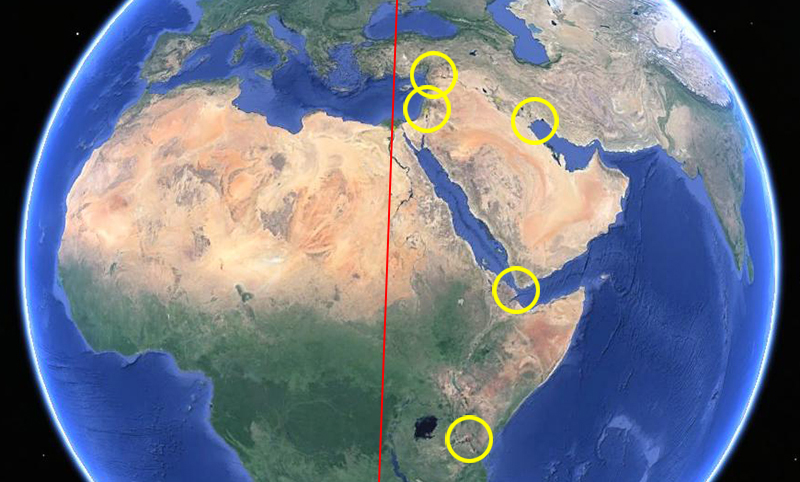
Most commentators seem to favor one of two general regions for the Garden: either northern or southern Mesopotamia, though proposals exist for locations surrounding the Arabian subcontinent and in eastern Africa. I’ve seen one suggestion that Eden lies at the bottom of the Red Sea, and another that puts it in the Indian Ocean.
Some proposed locations for Eden, per Babylon Rising.
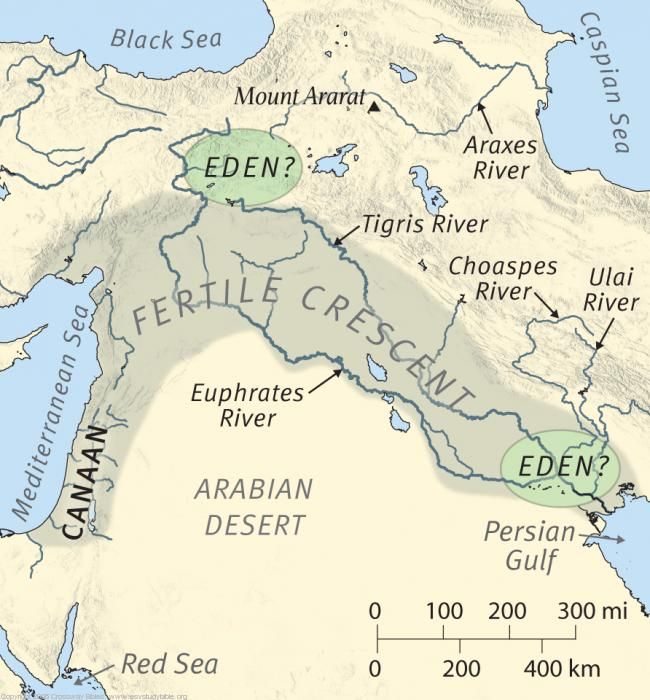
Northern Mesopotamian versions tend to favor Eastern Turkey/Armenia, since (a) there is a perception that Shinar is in that area, based on Genesis 11:2 (ESV): “And as people migrated from the east, they found a plain in the land of Shinar and settled there”; and (b) the headwaters of both the Tigris and Euphrates rivers originate in that general vicinity.
Possible Mesopotamian locations, per Blue Letter Bible.
Personally, I have favored a southern Iraq location for years, since obtaining a copy of an unpublished book titled, simply, Eden, by a late pastor named David J. Gibson, who understood that rivers don’t divide flowing downstream as described in Genesis 2:10 (ESV), “A river flowed out of Eden to water the garden, and there it divided and became four rivers.” Gibson suggested, and I agree with him, that this verse should be interpreted from the perspective of an observer within the Garden gazing out at four rivers converging as they entered the Garden.
This is awkward language for us, but not necessarily for Moses in antiquity, writing in Hebrew. Consider that in Genesis 2:8 (ESV), “the LORD God planted a garden in Eden, in the east”. This implies to me that the four rivers converged in the western part of Eden before flowing through the Garden, which was planted in the eastern part.
This makes sense, and from a hydrodynamics standpoint, it is the only interpretation that makes sense. Tributaries converge, they don’t diverge. If, for some reason, a river splits to flow around an obstruction or a sandbar, it will always come back together downstream nearby. If, for some reason, it splits to flow down two or more separate drainage basins, an unstable pattern results. One path will erode more quickly than the other(s), and eventually that path will “steal” all the flow from the other(s).
The only exception from that rule is the case of delta flow, but deltas aren’t formed by erosion, they’re formed by deposition of silt carried downstream in the water. As a river flows onto a plain and slows down, turbulence decreases, and silt falls out of suspension and stays more or less where it drops. Without sufficient turbulence to pick it up again, there is just enough energy available to keep the channels open.
Large deltas usually form at the mouth of a river where water leaving the delta’s channels flows into the sea or a lake. Sometimes deltas form inland, usually where a mountain stream empties onto a plain. The water from an inland delta will either evaporate, sink into the substrate, or collect into a single stream or a lake. Two examples are shown below.
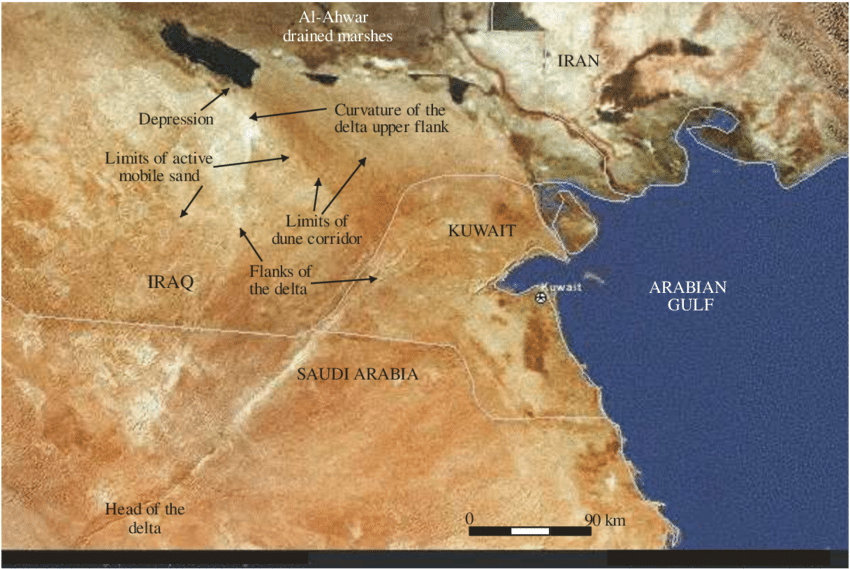
The Inner Niger Delta, in Mali, is a wetland that floods during the rainy season in the Guinean Highlands, to the southwest. The delta formed where the topography flattens for 250 miles before spilling downwards again to the east.The Okavango Delta is formed by seasonal flooding form the Angola Highlands, where the Okavango River course flattens and slows in Botswana. Unlike the Inner Niger, this delta has no outlet.Pishon ? The deltaic terminal of Wadi Al-Batin. From Ali Al-Dousari on Researchgate
Genesis 2:10 would make total sense if the four “rivers” were delta channels, but the naming of those four rivers in verses 11–14 belies that possibility. Indeed, in my opinion the naming of the Tigris and Euphrates rivers conclusively fixes the location of the Garden in southern Iraq.
What about the other two rivers named?
The Pishon is fairly well defined because verse 11 says that it “flowed around the whole land of Havilah.” Havilah was a son of Cush who settled in what today is northwest Arabia. 1 Samuel 15:7 (ESV) defines that location: “And Saul defeated the Amalekites from Havilah as far as Shur, which is east of Egypt.” “Flowed around” could be literal (I found a map showing the Pishon as an ocean current flowing counterclockwise around the entire Arabian subcontinent), but more likely it simply means that it flowed through and provided water for Havilah. Gibson equated the Pishon with Arabia’s Wadi Al-Batin, an ancient and now-dry river and delta system flowing northeast through Saudi Arabia and Kuwait to the Tigris/Euphrates valley. I think he was right.
Gihon? Karun River, Wikipedia
As for the Gihon River that “flowed around the whole land of Cush” (verse 13), I would equate that with the Karun River, flowing out of Iran, through the ancient land of the Elamites.
I think that Christian commentators are thrown off by an assumption that “Cush” refers only to the region around Ethiopia and Somalia. My view is that Cush (a son of Ham) and his descendants settled large regions of Asia, as well as the upper Nile area. They apparently mixed with the Canaanites in the Lavant, and Nimrod, a son of Cush, was described in Genesis 10 as “9a mighty hunter before ADONAI. … 10His kingdom began with Bavel, Erekh, Akkad and Kalneh, in the land of Shin‘ar.” These abodes of Nimrod are all lands of southern Mesopotamia. Nimrod was, I’m convinced, none other than Sargon of Akkad, the world’s first great emperor. Elam and Asshur were Semites, but Cush may have extended into the Steppes alongside Shem (see Nimrod the Empire Builder: Architect of Shock and Awe, 2023, by Douglas Petrovich).
It’s admittedly a stretch, but I have wondered if perhaps the ancient Kushan Empire, spanning the central Asian “stans” might have gotten its name from Cush/Kush. If so, then the influence of Cush stretched all the way to the Xiongnu tribe, north of the Yellow River, because the peoples who started the Kushan Empire, centered around Afghanistan, where refugees from the Xiongnu.
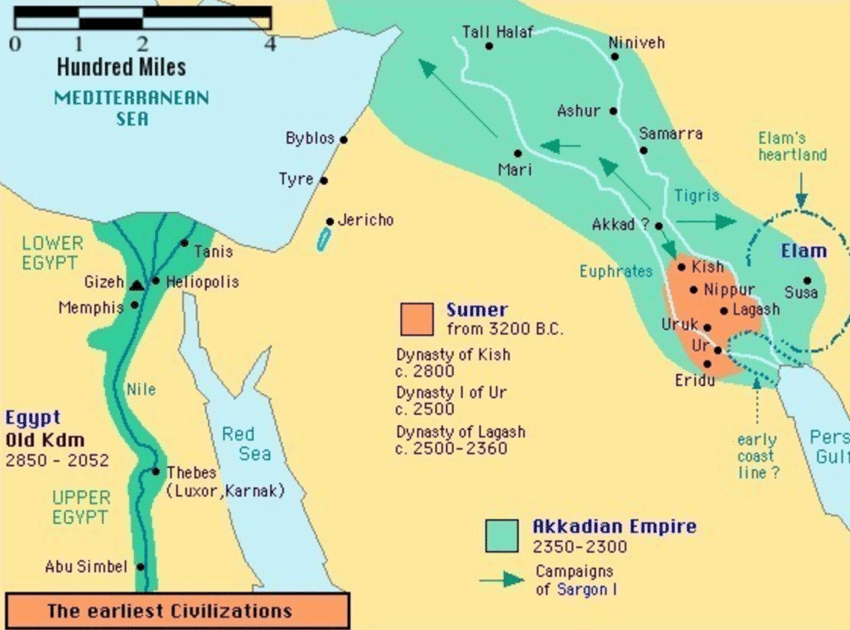
Putting all this together, I think that the following map states the case for Eden in southern Iraq:
What about the placing of Shinar in Turkey? I agree with the predominant view that Shinar is the area once occupied by Sumer, between the Tigris and Euphrates Rivers. It’s not hard to explain away migration “from the east.” I suspect that waters from the Great Flood took years to retreat from low-lying areas, so descendants of Noah returning to their homeland in Shinar would have initially moved southeast along the spine of the Zagros Mountains. Saying that Shinar is west of Ararat because they entered from the east is analogous to assuming I live west of my church because I (sometimes) approach it from the west. The full story on that is that I live to the southeast and occasionally take a circuitous route along the freeway.
Post-flood migrations from Ararat to Shinar. From Google Earth. Annotations by Ron Thompson.
The creation passage and the Garden passage are separated by verse 2:4 (see below).
There seem to be contradictions between Genesis 1 and Genesis 2, as traditionally understood. Because I believe Scripture is inerrant, but tradition is not, I inevitably try to let the former inform the latter.
Here are the relevant passages that I wish to discuss now:
[11] And God said, “Let the earth sprout vegetation, plants yielding seed, and fruit trees bearing fruit in which is their seed, each according to its kind, on the earth.” And it was so. [12] The earth brought forth vegetation, plants yielding seed according to their own kinds, and trees bearing fruit in which is their seed, each according to its kind. And God saw that it was good. [13] And there was evening and there was morning, the third day. …
[26] Then God said, “Let us make man in our image, after our likeness. And let them have dominion over the fish of the sea and over the birds of the heavens and over the livestock and over all the earth and over every creeping thing that creeps on the earth.”
[27] So God created man in his own image, in the image of God he created him; male and female he created them.
[28] And God blessed them. And God said to them, “Be fruitful and multiply and fill the earth and subdue it, and have dominion over the fish of the sea and over the birds of the heavens and over every living thing that moves on the earth.” [29] And God said, “Behold, I have given you every plant yielding seed that is on the face of all the earth, and every tree with seed in its fruit. You shall have them for food.
—Genesis 1:11–13,26–29 (ESV)
and
[4b] …in the day that the LORD God made the earth and the heavens. [5] When no bush of the field was yet in the land and no small plant of the field had yet sprung up—for the LORD God had not caused it to rain on the land, and there was no man to work the ground, [6] and a mist was going up from the land and was watering the whole face of the ground— [7] then the LORD God formed the man of dust from the ground and breathed into his nostrils the breath of life, and the man became a living creature. [8] And the LORD God planted a garden in Eden, in the east, and there he put the man whom he had formed. [9] And out of the ground the LORD God made to spring up every tree that is pleasant to the sight and good for food. The tree of life was in the midst of the garden, and the tree of the knowledge of good and evil. …
[15] The LORD God took the man and put him in the garden of Eden to work it and keep it. …
[18] Then the LORD God said, “It is not good that the man should be alone; I will make him a helper fit for him.” [19] Now out of the ground the LORD God had formed every beast of the field and every bird of the heavens and brought them to the man to see what he would call them. And whatever the man called every living creature, that was its name. [20] The man gave names to all livestock and to the birds of the heavens and to every beast of the field. But for Adam there was not found a helper fit for him. [21] So the LORD God caused a deep sleep to fall upon the man, and while he slept took one of his ribs and closed up its place with flesh. [22] And the rib that the LORD God had taken from the man he made into a woman and brought her to the man. [23] Then the man said,
“This at last is bone of my bones and flesh of my flesh; she shall be called Woman, because she was taken out of Man.”
—Genesis 2:4b–9,15,18–23 (ESV)
Almost all conservative Evangelicals believe that Genesis 1:27 describes the creation of Adam and Eve: “So God created man in his own image, in the image of God he created him; male and female he created them.” But Scripture never actually states that these are Adam and Eve!
I have suggested in past posts that Christians should be willing to consider alternatives where erroneous understandings might exist in uninspired translations and interpretations, but not in inspired autographs(the original manuscripts as prepared by the human authors). When comparing these passages, we must account for apparent contradictions and ambiguities.
John H. Walton, a conservative Old Testament scholar with Moody Bible Institute and later with Wheaton College, has proposed alternative understandings of these passages, suggesting that chapter 1 describes one human creation event, and chapter 2 a separate creation of just Adam and Eve. He bases this idea on several observations, including:
There are obvious contradictions in the reported order of the creation events (see below).
The descriptions of each category of creation in chapter 1, including humankind, gives the impression that a significant population of every species were created. Creation of just 2 humans in Genesis 1 would be a breaking of the pattern.
Verse 4 is a “toledah” (Hebrew for “generations”), which is a fragment of Scripture used to separate two “chapters”, or thematic passages, of Genesis.
These are the generations of the heavens and the earth when they were created, in the day that the LORD God made the earth and the heavens. —Genesis 2:4 (ESV)
Walton presents the following table to show how other toledoth (plural) relate to material preceding and following them:
— Walton, John H. The Lost World of Adam and Eve. Accordance electronic edition, version 1.0. Downers Grove: InterVarsity Press, 2017.
In the table, all of the cases marked as “sequel” separate events in the past from events in the future.
The three labeled “recursive” indicate cases where one individual or family is followed, then the timeline is reset to follow another. In these cases, there may be chronological overlap, but no detail added to the first.
In the single case labeled “parallel/sequel” Cain is followed, then the timeline reset to Adam; then a toledah introduces parallel coverage of Seth.
There is no precedent in the ten cases enumerated for a toledah introducing an expanded account of the same thing previously covered. This is not definitive proof, but it is suggestive.
First, “creation” in verse 27 is the Hebrew word בָּרָא (bara‘, which means ex nihilo creation, or creation from nothing at all). In contrast, the Genesis 2 description is יָצַר (yatsar, which means to form something specifically by molding some constituent material into a shape, i.e., as a potter forming something in clay). The potter imagery is consistent with forming Adam “of dust from the ground”. “Dust”, here is Hebrew עָפָר, (‘afar), meaning things like “dry soil”, “loose earth”, “rubble”, or even “ashes”. None of these is clay, and none of them alone can be worked by a potter, but the intended image is of the detritus of death. More likely, it simply refers to the familiar elements on the periodic table, pasted by God into organic molecules.
Second, and more telling, we appear to have a serious contradiction regarding the creation of beasts of the field and birds of the heavens.
The sequence as written in Genesis 2 is (a) God formed Adam and gave him life; (b) God planted a garden on the east side of Eden; (c) God placed Adam in that garden; (d) God caused plants to grow from the ground; (e) God gave Adam his mission statement; (g) from the ground, God “formed” (yatsar) the land and air creatures; (h) Adam named the creatures; and finally (i) God formed Eve from Adam’s rib.
The serious contradiction here is that:
in chapter 1, air creatures are created on day 5 and land creatures on day 6, both of these prior to the creation of man on day 6.
In chapter 2, Adam (though not Eve) was created on or after day 6 while both the air and land creatures were created later.
The ESV translation above follows NIV in trying to resolve the problem by hedging on the language in 2:19. I can’t find any support for “Now the LORD God had formed“. This translation certainly does leave room for saying, “Oh, this isn’t where he forms them, that was already done.” But the correct translation seems to be “And out of the ground the LORD God formed.” Almost every translation words it this way, and even ESV includes that as a footnote. NIV is notorious for paraphrasing Scripture to make it say what they think it should say. I take this passage to mean that God formed new animals in the garden in addition to those that existed—possibly just new individuals, not new species.
I don’t see a clear, fair, and decisive path to resolving this contradiction.
On the other hand, if Genesis 2 is subsequent to Genesis 1 rather than a retelling, the garden theoretically becomes sacred space—a prototype tabernacle—and Adam’s race a priesthood.
While the concept that Adam and Eve’s creation at a time when earth was already populated by humans may be startling, it answers more questions than it raises. It gives Cain a wife without requiring biologically harmful incest. It reveals who it was who Cain thought might kill him. It answers the question, where did all the people come from to populate the city that Cain founded.
By the way, what was that city? Depending on how you define the term, it may have been Uruk, shown on the map above with the four rivers of Eden. Uruk was founded about 6,000 years ago, which fits very nicely with the picture I’m painting here.
You may say, “But the Bible teaches we’re all descended from Adam!” Yes, it does, and since Noah was descended from Adam, and we’re descended from Noah, then where’s the problem? The other humans all perished in the Flood.
Are we also descended from the pre-Garden people? I don’t know. Perhaps no pre-Garden genes were in the chromosomes of Noah or Mrs. Noah. But would it have mattered if there was some mixing? I don’t think it matters if Noah had non-Adamic genes mixed in, any more than it matters that Jesus had genes not contributed by Judah or King David. Mitochondrial DNA shows that all humans today have a common “mother” and Y-chromosomal analysis shows a common “father”, but both of those are way too late to have been Mr. or Mrs. Noah’s. Due to the nature of genetic inheritance, it will never be possible to trace back that far.
The Genesis 1 creation, whether it was Adam or not, was created in the image of God. They, too, were righteous or sinful, saved or unsaved. The difference is that they had not eaten from the Tree of Knowledge, so they were presumably innocent in the same way as Adam and Eve before the fall.
But wait! you say. That means that they were immortal! No, it doesn’t. Were Adam and Eve immortal before the fall? I think “you will surely die” is talking about spiritual death, not physical. Maybe they were immortal, but if so, why was there a Tree of Life in the Garden?
Was death even possible, theologically, before the fall? That’s way too big a subject to take on here, in this post. I’ll eventually write about it. It’s a key question, since part of the reason some Christians shun fossil evidence is that they think it’s a violation of Scripture for animals to have died pre-fall. Obviously, I believe death was possible before the fall, but I owe you some analysis to justify my belief.
Then, there’s the biggest question of all. I’ve been telling you that the 7-day creation story is a polemic and not literally true as written. What about Adam and Eve, and the Garden? Well, that’s a whole ‘nother story. From Genesis 2 on out, there is way too much specificity for me to doubt. I mean, we have the begats, for crying out loud, and they are way too believable to dismiss.
I want to address just a few issues here that may seem confusing.
On the day that the LORD God made earth and heavens, no shrub of the field being yet on the earth and no plant of the field yet sprouted, for the LORD God had not caused rain to fall on the earth and there was no human to till the soil, and wetness would well from the earth to water all the surface of the soil… —Genesis 2:4b–6 (Alter)
The first phrase above, ending “made earth and heavens”, bookends the Genesis 1 story, which begins with “In the beginning … heavens and earth”. That makes it more likely that the phrase is part of the toledah, packaging the entire process—”the day that the LORD God made the earth and heavens.” Most of you take this “day” as seven literal 24-hour days—I take it to mean the entire 13.8-billion-year period from the Big Bang to the formation of Adam.
The term “LORD God” here is the Hebrew “YHVH Elohim“, the first occurrence in Scripture of God’s covenant name.
In 2:5 we are told that, before God created Adam or planted the Garden, there was as yet no “brush of the field”, i.e., no wild vegetation, in the land (the Garden). Paleontology suggests that Homo sapiens has been around for about 200,000 years, but for most of that time they were strictly hunter-gatherers. Agriculture doesn’t appear until around 10,000 years ago, and it didn’t predominate until around 6,000 years ago. Domestication of livestock began during that same period. Given some flexibility in dating by means of Biblical genealogies, it is entirely realistic to date Genesis 2 somewhere in that 6-to-10,000-year time frame, and thus to consider that Genesis 2:5 implies that both herding (hunting) and farming (gathering) were inaugurated in the Garden.
Before getting into this, I’ve been asked why I keep alienating my friends by harping on a version of Creationism that most of them consider to be unbiblical. I can respond to that in several ways:
First, I’m not really “harping” on it at all. This is a multipart series that I’ve planned for quite a while, to replace something I did years ago. I’ve still got two or three chapters to write before I’m finished with it. I did the same thing with my series on The Jewish Feasts.
I’ve been vitally interested in both theology and astrophysics since, literally, my pre-teen years. I write about what interests me most.
I don’t consider that one’s interpretation of Genesis 1 is a “fundamental of the faith“, but many of my friends do, and I am convinced that the currently mandatory “Genesis Flood Theory” is an unnecessary stumbling block for many lost souls.
Although many wonderful Christians would refuse to fellowship with me because I’m not a Young Earth Creationist, I don’t feel the same about them; but I suppose I’d like to convince them that I’m “righter than they are.”
As stated below, “With respect to the question of Creation, the central, foundational Truth of all Scripture is that the One, True, Eternal, Triune God, by His own power, created and sustains all else that exists in the cosmos.“
Moving on…
My views are driven by several axioms:
God is both omnipotent and sovereign, so He can do whatever He wants to do, however He wants to do it!
The Bible, as originally written, is the inerrant, irrevocable,Word of God.
The Bible we now possess (at least insofar as the accepted canonical books are concerned) is substantially the same holy Word as the originals, but subject to a very limited extent to human error in translation and interpretation.
Correct interpretation (exegesis) of Scripture requires a consistent hermeneutic, which among other factors, includes recognition that some scripture is not meant to be taken literally, as discussed in the next section in relation to The Golden Rule of Biblical Interpretation.
A consistent hermeneutic also must require recognition of the cultural background of both the writer and the ancient reader.
Though Holy Scripture is as valid and vital today as it ever was, correct interpretation demands unequivocally that modern culture and tradition not be anachronistically imposed on the writers and readers of the day in which they were written.
Because God is not a liar or an author of confusion, we must recognize that the testimony of God’s Word cannot conflict with the testimony of His Created World when both are rightly understood.
Hermeneutics and the Golden Rule of Biblical Interpretation
“When the plain sense of Scripture makes common sense, seek no other sense; therefore, take every word at its primary, ordinary, usual, literal meaning unless the facts of the immediate context, studied in the light of related passages and axiomatic and fundamental truths, indicate clearly otherwise.”–Dr. David L. Cooper (1886-1965), founder of The Biblical Research Society
The above quote is known by many expositors as “The Golden Rule of Biblical Interpretation.” I read somewhere that this has often been shortened to “When the plain sense of Scripture makes common sense, seek no other sense, lest it result in nonsense.”
Implicit in the above is the assumption that the “plain sense of Scripture” sometimes does not seem to make sense. Certainly, when that is the case, you must first question your own common sense, but that doesn’t always solve the problem.
Few conservative Bible scholars believe that every word of Scripture is meant to be understood literally.
That is troubling to many, because the alternative opens the door to subjectivism and arbitrary conclusions. Yet almost all the great conservative Bible commentators practice a hermeneutic (a set of formal principles for Biblical interpretation) that allow for non-literal text, including parables, figures of speech, anthropomorphism, poetic exaggeration, and a host of other confusing factors. Not to mention translational difficulties.
None of that subtracts from the central truth that “all Scripture is God-breathed.” It is axiomatic to me that the Bible is inerrant in its original language and the original manuscripts. Yet some folks read my opinions, especially respecting emotional themes like creation, and make snide comments like, “So you believe it’s inerrant except when it isn’t!”
So, to clarify, I don’t think there are any substantive problems with corruption of our Scriptures over the millennia. There are, however, problems with translation, but few of those are impossible to unravel, with sufficient attention to the linguistic and cultural background of the inspired humans who penned the words, and those to whom the words were written.
There are also “mysteries.” Most Evangelicals are happy to admit that Paul revealed things hidden within Scripture that were mysteries with respect to the New Testament Church. The Church itself being one of the chief mysteries! The dual advents of Messiah are another mystery now revealed. Yet many seem unwilling to consider that some things are still mysterious.
What I consider to be the biggest factor of all that contributes to doctrinal confusion and infighting in the Church is that some misinterpretations are imbedded into a nearly impenetrable wall of tradition.
Unfortunately, the reason there are so many Christian denominations in the world, and the reason they often have so much trouble getting along, is that each has its own particular list of what constitutes “axiomatic and fundamental truths.” For example, I was brought up in a “fundamentalist” sub-denomination of Baptists that teaches there is no such thing as a universal Church of all believers; only local churches are Biblical. To them this is an axiomatic and non-negotiable Truth, based in part on the simple fact that the Greek word translated “church” is ecclesia, which literally means “assembly.” After all, how can people scattered across the world and across many ages possibly assemble together?
With respect to the question of Creation, the central, foundational Truth of all Scripture is that the One, True, Eternal, Triune God, by His own power, created and sustains all else that exists in the cosmos.
That fact is stated clearly and concisely in just one verse: Genesis 1:1.
As for what that process looked like and how we should interpret Genesis 1:2–2:3, I regard that as still a mystery.
A 6,000-year-old universe and the Genesis Flood Theory of today’s Young Earth Creationists does not meet the commonsense test, not because God can’t do whatever He wants, but because the clear evidence of centuries of careful observation and analysis by very smart and dedicated professionals, both Christians and otherwise, can’t be ignored. God is not the Author of Confusion. He doesn’t plant lies in front of our face to test our faith.
Moreover, the universe is demonstrably dynamic, changing over time even as we observe. That isn’t “evolution”, it’s simply the application of forces and interactions decreed by God. We understand the physics of supernovae (the implosion of giant stars) and we observe them happening. We understand the process of star formation, and we see examples of every stage of that process. We can’t see the movement of stars and galaxies, but we can measure their movements using Doppler shift, similar to the clocking of a speeding car.
Limitations of Science
When I was young, scientific method was viewed as a simple, 3-step process:
State a hypothesis.
Form a tentative theory.
“Prove” the theory, which then becomes a law.
But so many of the “laws” found under that paradigm have been subsequently found to be limited in scope (for example, Newton’s laws of motion are now known to be invalid for very large and very small masses), that the paradigm has changed:
Now, hypotheses still become tentative theories, but once a theory has become so well proved that it is accepted as true by most authorities on the subject, it still doesn’t get promoted to “law”. That is why it is utterly meaningless to say that “The Big Bang Theory” is just a theory!
Scientists now look for certain characteristics of a theory to judge how “well established” it is:
Obviously, the more evidence supports a theory, and the less that appears to contradict it, the stronger it becomes. This evidence may be experimental, or it may be observational. If it is statistical in nature, then the results must be well within a recognized margin of error.
To be considered a truly “scientific“, a theory must be judged to be “falsifiable.” That means that for all practical purposes, if there is no conceivable way that a theory can ever be proven false, then it must remain speculative in the minds of those who are not predisposed to take it on faith. This principle is the tool of choice for those who wish to exclude all discussion of religion, or “Intelligent Design“, as an alternative explanation.
For a theory to become intrenched as factual, it is also necessary for it to successfully produce demonstrably true predictions, by means either of observation, logical arguments, or mathematics.
The strongest theories are those that can be expressed by mathematics, because mathematics is the only truly “exact science“. Two plus two always equals four in our base 10 number system. The circumference of a circle divided by its diameter always equals pi (3.1415926…) in a Euclidean frame of reference.
Proving the Bible
Something I see online over and over again online is well-meaning Christians exclaiming over interesting archaeological finds that, “They prove that the Bible is correct.” No, they don’t! Science will never prove Scripture, and that is by God’s design, because He wants us to live by faith, not by sight. The most that science can do for us is to confirm the faith that God has already supplied to us.
At the same time, if we are worried that science will contradict our faith, then our faith is weak to begin with!
God has written of Himself in both Scripture and creation. The purpose of science is to help us understand creation. Embrace it!
Moses was a prophet!
According to Scripture, Moses was the greatest prophet of all times, other than Jesus. He didn’t personally see any of the events of Genesis, so how did he know what to write? Both the Old and New Testament contain numerous references to non-canonical source writings. Moses himself references The Book of the Wars of the Lord (no longer extant) in Numbers 21:14, which recorded some contemporary events, but I know of no sources that he could have used for events prior to the invention of writing. He could have gotten his information only from God. After-the-fact prophecy, so to speak.
How was that information communicated to him? Perhaps verbally, because we know that he and God talked to each other directly. Having nothing concrete to go by, I personally assume that from Genesis 11:10 forward, Moses’ inspiration was primarily verbal.
Verses 10–32 of chapter 11 constitute one of eleven so-called toledoth in Genesis. These primarily genealogical blocks of Scripture were included by Moses and are believed to be intended as section dividers.
Because the first 11+ chapters of Genesis consist of abbreviated, flowery accounts of earthshaking historical events, I see them as poetic discourse, a different genre from what follows. For that reason, I suspect that these chapters were conveyed, at least in part, via visions or dreams. There is a theological label for prophetic visions of past events: Preterism. A “full preterist” believes that all prophecy describes the past, in effect dismissing the possibility that prophets could foretell the future. I am far, far from that position! I am a “partial preterist” in that I refuse to dismiss the possibility that God can also reveal the unseen past to his prophets.
Typically, prophets preached and reported the content of visions and dreams, but not necessarily their interpretations.
Previous posts in this series on the topic of creation
In The Hijacking of Creationism, I laid out several of the views that Evangelical scholars have historically held in order to account for the apparent ancient age (13.8 billion years) of the universe. In particular, I focused on The Genesis Flood Theory, and its popularizer, Henry M. Morris. Today, 1/10/2024, I expanded on my bio of Dr. Morris. Yes, I am a little bit brutal with him, but his writings were frequently brutal towards those who disagreed with him.
In Does Science Trump Theology? I explore the intellectual domains covered by the two disciplines, similarities in the two, and how they should work together in Bible interpretation.
In Fountains of the Deep I draw on my own geological engineering background to present what I believe to be the most likely mechanism of the Genesis Flood. This mechanism is unlikely to have caused the distortion of the earth’s surface that followers of Morris demand. Incidentally, the 13.8-billion-year age of the universe is as firmly rooted in astrophysics and cosmology as the 4.54-billion-year age of earth is in geology. One of these days I’d like to hear a Young Earth Creationist explain how the Genesis Flood accounts for the cosmologic appearance of age.
In Geology a Flood Cannot Explain I randomly describe, from my own professional knowledge, a number of well-known geological features on earth that absolutely could not have been affected by a flood of any magnitude.
Fluid Mechanics courses for civil engineers are mostly irrelevant to understanding of the Genesis Flood, because they focus primarily on hydrostatics (forces exerted by water pressure on fixed structures like dams and canal locks), and laminar flow in engineered open channels and pipes. To the extent that they cover turbulent flow in natural channels like riverbeds, the primary interest is erosion of friable soils, sands and gravels. Before erosion can occur in solid rock, weathering must first break the rock down into smaller pieces, which is a process which usually takes years, if not centuries or longer. [I explore this fact in a post, Geology and the Saudi Sinai, part of a series on false evidence for believing that “the real Mt. Sinai” is in Saudi Arabia.]
Revisiting Genesis 1
I would like to take another look at the first few verses of Genesis 1 to present some ideas that you may not have considered before.
Prologue: Gen 1:1–5
Below, I present three very legitimate translations. The first is from an Evangelical favorite, the English Standard Version (ESV). The second is from the Jewish Publication Society (JPS). The third is from a new work, The Hebrew Bible, translated by Robert Alter over a 30-year period. Alter is a modernist, and not someone I would look to for dogma or Christian commentary, but from reading his books, I am convinced that he is, to his core, a top authority on Biblical Hebrew and Ancient Near Eastern literature. I don’t believe that his translations are colored by any sectarian presuppositions, and that makes him my top comparator while trying to separate what the Hebrew Bible says from what tradition claims that it says.
1 In the beginning, God created the heavens and the earth. 2 The earth was without form and void, and darkness was over the face of the deep. And the Spirit of God was hovering over the face of the waters.
3 And God said, “Let there be light,” and there was light. 4 And God saw that the light was good. And God separated the light from the darkness. 5 God called the light Day, and the darkness he called Night. And there was evening and there was morning, the first day. — Genesis 1:1-5 (ESV)
1 When God began to create heaven and earth— 2 the earth being unformed and void, with darkness over the surface of the deep and a wind from God sweeping over the water— 3 God said, “Let there be light”; and there was light. 4 God saw that the light was good, and God separated the light from the darkness. 5 God called the light Day, and the darkness He called Night. And there was evening and there was morning, a first day. — Genesis 1:1-5 (JPS)
1 When God began to create heaven and earth, 2 and the earth then was welter and waste and darkness over the deep and God’s breath hovering over the waters, 3 God said, “Let there be light.” And there was light. 4 And God saw the light, that it was good, and God divided the light from the darkness. 5 And God called the light Day, and the darkness He Called Night. And it was evening and it was morning, first day. — Genesis 1:1-5 (Alter)
Before considering the difficulties posed by creation of light on “Day 1” (verses 3–5), we first need to consider verses 1 and 2.
Verse 1: I think that the ESV Study Bible, with a couple amendments, states the interpretive problem in verse 1 fairly well:
[Verse 1] can be taken as a summary, introducing the whole passage; or it can be read as the first event, the origin of the heavens and the earth (sometime [on or] before the first day), including the creation of matter[, energy], space, and time. This second view (the origin of the heavens and the earth) is confirmed by the NT writers’ affirmation that creation was from nothing (Heb. 11:3; Rev. 4:11). … Heavens and the earth here means “everything.” This means, then, that “In the beginning” refers to the beginning of everything. The text indicates that God created everything in the universe, which thus affirms that he did in fact create it ex nihilo (Latin “out of nothing”). The effect of the opening words of the Bible is to establish that God, in his inscrutable wisdom, sovereign power, and majesty, is the Creator of all things that exist. — Dennis, Lane T. and Wayne Grudem, eds., The ESV Study Bible. Accordance electronic edition, version 2.0. Wheaton: Crossway Bibles, 2008 (emphasis added, my additions are in brackets).
Probably half of the sources I use assume that verse 1 is a summary for what follows, ignoring the fact that none of what follows explicitly mentions the origins of the earth as a rocky planet covered by water. This view necessarily assumes that God created the individual building blocks (sub-atomic particles, atoms and molecules, and the forces that bind them) concurrently with forming them into the finished product. This is not outrageous but leads to a crucial contradiction which I will discuss below—namely that light is produced by matter, and is a manifestation of electromagnetism, which is an essential binding force.
The other half of my sources take the “first event” approach. Most of those place verse 1 on day 1. If you take it prior to day 1, then you more or less put yourself potentially in the “Gap Theory” camp, which I have occupied, but which is anathema to Young Earth Creationists because it can imply death before The Fall. I’ll save my comments on that objection for another post in this series. Unfortunately, this view is subject to the same contradiction regarding electromagnetic binding.
The ESVSB contention that “[the] Heavens and the earth … means ‘everything’” assumes that the wording of the Scripture is a merism, a figure of speech that encompasses the first element, the last element, and everything in between. This assumption is not provable, but rather can only be taken on faith—which I do. It is a figure of speech used frequently in the Bible.
The term “the heavens” is hashamayim in Hebrew. It is a plural form and is usually rendered as such in translations. Up to seven heavens were recognized in ancient literature, but most scholars today differentiate between just three heavens:
The atmosphere around and above us.
The cosmos beyond earth’s atmosphere.
The heavenly realm inhabited by God and his host.
I would rather prefer a more general statement that the term “heavens” means everything above the surface of earth: As explained below, Moses and his readers would have envisioned several elements:
The sky of air and birds.
A solid dome (the “firmament“) from which hang the suspended sun, moon and stars.
An ocean above, connected at the edges to the ocean below, and held up by the dome, (KJV, “firmament”).
The home of God and His Divine Host.
The first event view is supported in particular by the JPS and Alter translations above (“began to create”), which place verse 1 at the beginning of what might be interpreted as a string of creation events, those described in the remainder of the chapter, and anything subsequent.
Verse 2: In verse 2, there are actually four separate interpretive issues, which I will gloss over here:
“Without form (or formless) and void” and other translations, such as Alter’s “welter and waste.” The Hebrew, tohu wabohu, is linguistically of limited use to our understanding, because its usage in literary history is insufficient to allow a definite interpretation. Guesses range from “total chaos” to “undeveloped and unpopulated.” Halter deliberately chose his alliterative nouns to emulate the poetic language of the Hebrew rather than to take a position on precise meaning. Whatever the meaning here, I have generally pictured the state of the planet as an earth totally covered by water and shrouded in mist, which works very well with a Gap Theory and a flooded earth. However, I’ll mention another (better?) view below.
“Darkness.” The Hebrew choshek can mean things like darkness (perhaps because light is absent), or obscurity because light has been masked or reflected away. Again, obscurity works best with Gap Theories, but see below.
“The Deep.” The Hebrew tehom means either the deep sea, or the deep source waters of terrestrial springs which were viewed as interconnected with each other and with the sea (see Fountains of the Deep, where I discuss this in some detail).
“The Spirit of God“, “a wind from God”, or “God’s breath.” The Hebrew ruach, can mean any of these things, and probably means all of them here. See God with the Wind for an in-depth discussion.
The overwhelming problem with Light on Day 1:
The definition of light
Just what is “light”, anyway? If you think of it as simply, “the absence of dark”, then you are way off base—it’s the other way around. As a noun, “dark” denotes a concept (the absence of light), rather than a tangible thing. “Light” is something very real and specific. I suspect that all of my readers have had enough education to realize that light is electromagnetic energy. All of you will no doubt have seen some version of a spectrum diagram:
The problem is that most folks have a tendency to think of visible light as something that is fundamentally different from the rest of the spectrum, because our vision only detects wavelengths in a narrow band between about 400 and 700 nanometers. But the wavelength of electromagnetic energy is really an expression of how energetic the wave is. X-rays and gamma rays are fundamentally the same thing as visible light, just more energetic. Radio waves, radar, and microwaves are fundamentally the same thing as visible light, just less energetic. All of these things are emitted by matter, travel at roughly 186,000 mps as waves, and are detected in the form of massless particles called photons.
So, if God literally created light on a literal Day 1, did He create just visible light, or the entire spectrum? If He just created visible light, then I have to ask, “visible to whom?” Humans all differ slightly in their light sensitivity. Bats, most amphibians, and many fish and insects see well into the infrared. Many species of insects, fish, and even mammals (including dogs and cats) can see into the ultraviolet. Using instrumentation, humans can now “see” all wavelengths of electromagnetism.
And what do we even count as visible to a normal human? Sunlight reaching Earth’s surface on a sunny day is around 52 to 55 percent infrared, 42 to 43 percent visible light, and 3 to 5 percent ultraviolet. A biologist might say that “visible” means detectable using only our eyes, but we also detect longer and shorter wavelengths with other organs.
On the long-wave side of the spectrum, infrared (“below red”) is felt as heat on our skin; microwaves can penetrate skin, and if powerful enough, could even boil the water in blood and cells near the surface; and even longer UHF and VHF radio waves have been documented to set up resonant vibrations in structures like teeth with metallic fillings.
On the short-wave side of the spectrum, ultraviolet (“above violet”), which can cause sunburn and later melanoma; x-rays penetrate completely through our bodies and can cause damage to inner organs over time or can cause or kill cancers; unshielded gamma rays can cause catastrophic damage to human bodies.
Contrary to the diagram above, cosmic rays are not primarily light or even electromagnetic energy in any sense, but rather are characterized by alpha and beta particles (helium nuclei and protons) traveling at close to the speed of light, and thus possessing some of the same quantum properties as light.
The source of light
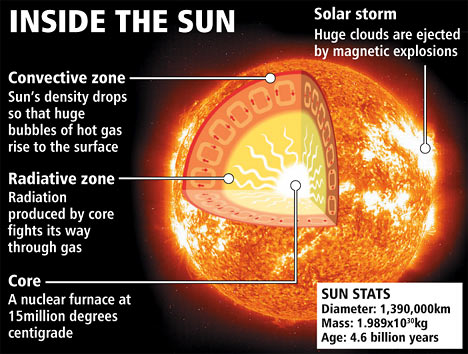
Light that reaches us from the sun is largely in the range of visible and near-visible light, but it starts out in the sun’s reactive core as gamma rays, high energy (short wavelength) byproducts of nuclear fusion. These gamma rays begin a “random walk” out of the sun’s core and through its conduction zone, repeatedly colliding with particles in the dense surrounding soup of hydrogen and helium ions, changing directions randomly, over and over again, and gradually losing energy (thus shifting to more benign longer wavelengths). Eventually, after something like 100,000 to a million years, they reach the sun’s surface and fly off in all directions at the speed of light, 186,282 miles per second.
Structure of the sun, from theuniverse-michael-lawson.weebly.com
An even more important consideration (mentioned above) is that, in the universe God created, electromagnetic energy (let me just call it “light” here, for brevity) is always associated with matter. There are a number of ways that light can be generated, but it always begins with matter. I’ll mention a possible exception below, under the heading “sh’kinah“, but for now, I’m talking about the light that all of us experience.
It is worth mentioning that all light is invisible until it strikes a detector. If you are in an empty, dark place and someone shines a flashlight past you, you may see the glowing source, but you will not see any trace of the beam, which consists only of a jiggling electromagnetic field, unless it strikes an air or dust molecule and reflects into your eye.
Most light in the universe is generated by stars like our sun, but all matter generates light, usually much less energetic than stellar gamma rays but still light, even if it is well below our range of sight. The human retina is populated by several types of light receptor: “cones” for detecting color when the light intensity is strong enough, and “rods” for detecting black and white in low light situations. My cat, Anna, can see me very well in a darkened (but not totally dark) room, because her retinas are mostly populated by “rods”.
Matter that is not heated to a glow, still generates heat, and that heat energy is radiated as light in the infrared region. If raised to a high enough temperature, the energy of the radiated light will eventually climb into the visible region, first red, and when hot enough, all the way to the blue side of the spectrum.
[Note: This is why the red and blue markings on faucets and automobile heater controls are so confusing and counterintuitive to me. To any scientist and most engineers, it should be red for cold and blue for hot, in spectral order.]
I took the photo of Anna, below, using an infrared sensor. The color isn’t real. The sensor’s pixels map the wavelengths of the infrared light in the scene and use an algorithm to determine the temperature that the pixel is “seeing”. False color is then added to encode it, as per the scale on the left. The warmest parts of the photo are her eyes, about 96°F. Next warmest is her face, followed by her tummy and legs. Her cold nose and the thick fur on her back and tail matches the cooler temperatures of the table she’s lounging on and the room to the right. The blue areas, our front door and glazed side panels, are quite cold. It was winter, and the windows here are single-glazed and very poor insulators.
In this photo, the small amount of heat registered from the window is a combination of heat from Anna and the room itself, being reflected back towards my sensor, heat generated by the window glass itself, and heat from outside conducted (see below) through the glass and woodwork.
All matter generates heat provided that its temperature is above absolute zero (−459.67°F). In the presence of any heat at all, the sub-atomic particles in atoms and molecules vibrate. The quantum mechanical mechanism causing this is beyond my scope here, but that vibration causes a release of energy in the form of heat. Heat energy is propagated in one or more of three ways:
Conduction – If two objects are touching each other, then the heat stored in the hotter will flow to the cooler (that’s the “first law of thermodynamics”).
Convection – In a gas or liquid, heat energy from a hot container will flow to the fluid by conduction and then the heated fluid will rise, setting up a convection current in the liquid.
Radiation – Whether or not either of the above occur, there will always be some heat flow in the form of electromagnetic radiation. To me, that is light, whether I can see it or not!
Absolute zero is theoretically unobtainable, because an object at absolute zero would cease all motion, including vibrations within the nucleus and movement of the electrons. All liquids and gasses (including the atmosphere) at this temperature would immediately solidify and collapse to a dense, inert lump, which I don’t believe describes the condition of earth in Genesis 1:2.
This is why I think that it would make no sense for light to have been created subsequent to the creation of matter in Genesis 1:1, whether you interpret that as a summary or a first event.
Since light is so intimately connected with matter, it is unthinkable to me that light would have come first.
Verses 4 and 5 are also difficult for me to accept in a literal sense. “Day and night” are conceptual nouns, and night simply refers to the shadow caused on one side of earth as it rotates away from the sun. But the sun isn’t created until Day 4. Some would say that this verse is where God created time. But time, as now understood by physicists, is part of the fabric of the universe itself (see Implications of God’s Omnipresence and Eternity in Space-Time).
sh’kinah
God’s own sh’kinah is also a light source, and one not connected with matter. It is the light source that led the Israelites out of Egypt, that lit up the top of Mt. Sinai, that resided in the Holy of Holies in the Tabernacle and later the Temple, and that was described in the visions of several of the prophets.
Some commentators have suggested that God’s sh’kinah is the source of the light that God “created” on Day 1. This is absolutely a possibility, but if true, even if it functioned in exactly the same way as the light that we are familiar with, is it meaningful to say that God “created light” on Day 1 if the light he created was fundamentally different from the light that we know? On Day 4, God assigned the responsibility for light-bearing to the sun, moon and stars. In any case, I think the sh’kinah is one of God’s native characteristics, not a later creation.
“Let there be light…”
The Hebrew for this phase is yehi or. With its many linguistic modifiers, Yehi appears 3,561 times in scripture, so it is well understood. To my knowledge, there is complete agreement on the translation here, “let there be“. I am not aware of any context in which it clearly denotes a creative act. It is like saying, “Hey bub, flip on the light, will ya’?”
Interpreting verses 1:3–2:3
As for me, I don’t think that Genesis 1:3–2:3 can be a literal description of how God created the cosmos, because these verses do not describe the immensely complex universe in which we live!
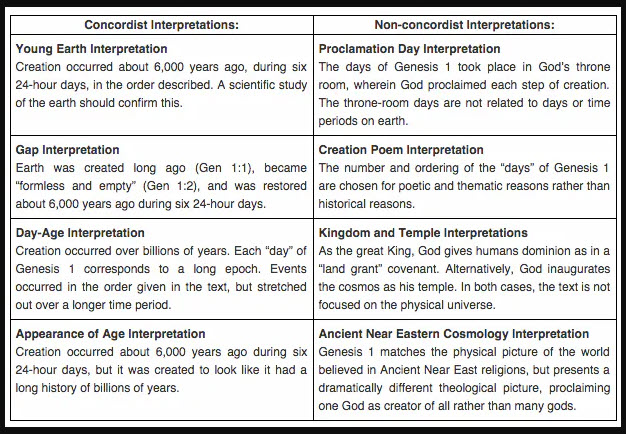
In The Hijacking of Creationism, I mentioned a number of alternative theories proposed by conservatives to explain this passage, as listed in Millard Erickson’sChristian Theology. Another such list is presented below:
Concordist and Non-Concordist Interpretations of Genesis 1, from an article at biologos.com, “Comparing Interpretations of Genesis 1“, by Deborah Haarsma and Loren Haarsma
The authors of the above table define “concordism” as follows:
In concordist interpretations, God made the earth using the sequence of events described in Genesis 1. In non-concordist interpretations, God created the earth using a different timing and order of events than those described Genesis 1.
According to 19th century theologian, minister and writer, C.I. Schofield, Genesis 1 describes God’s miraculous 6-day rebuilding of an ancient earth after a previous judgement (of earlier humans and/or angelic beings) by inundation. This is a Gap interpretation, from the left side of the table.
What has long intrigued me about Schofield’s Gap Theory is that in the sequence listed, Genesis 1 describes precisely how earth would most likely have recovered from a general flood like that of Noah’s day. If that is true, then both floods were miraculous inundations of the entire planet, and the unnaturally rapid recovery in both cases was also miraculous. This is why I have for years called myself a “gap guy“, or more recently, a “two-flood” guy.
Still, I am no longer adamant about Gap Theory, because it can’t be proven one way or the other, and I don’t share Schofield’s opinion that the judgement leading to the earlier flood was connected to angelic corruption on earth. There is no Biblical evidence of angelic rebellion before Satan appears in the Garden of Eden.
More importantly, after doing extensive study during the last several years in the course of thinking about this series on Creation and another post on Gods and Demons, I feel drawn to a different interpretation that would be much more comprehensible to the people in Moses’ day and well beyond.
A better idea
What was the cultural background?
Regarding the culture of Moses’ day, it is inconceivable that he or his readers would have had the intellectual tools needed to process concepts like mass, energy, the nature of light, or even cosmically vast distances and time scales or a spherical earth.
We tend to think of ancient civilization as a scattering of isolated small city states like Sumer, Akkad, Elam, and even Egypt on the far end of the Fertile Crescent, but they all had a common heritage going back to Babel and even to the Flood.
And even in the distant past there were frequent interactions among peoples. Both war and peace brought people together, either in conquest or in trade. Consequently, there were many similarities between regions, in culture and religion. Though the names and functions of the pagan gods differed somewhat from region to region, there was general agreement about the nature of the world and the duties of the godhead in maintaining its order.
The region that became Israel was part of this milieu. The Israelites were descended from Abraham, who was Mesopotamian. Their later heritage was Canaanite and then Egyptian. The Torah (“Teachings“, the “Five Books of Moses”) that God delivered to His people, had the singular purpose of revealing Himself and His Divine Will to humankind.
In Moses’ day, as in Noah’s and even Jesus’ and beyond, the Israelites shared the beliefs of their Ancient Near Eastern (ANE) neighbors about cosmology (the nature of the heavens and the earth). Though their concept was, of course, deeply flawed, it was functionally adequate for millennia, and it diminished God’s role only in that it ascribed His creation to false creators. The following diagram shows the essence of what was universally accepted as true cosmology in the ANE.
Note that this is also clearly the cosmology described in Genesis 1!
Composite artist’s conception of the Ancient Near Eastern view of cosmology. Source unlisted.
The earth was a roughly disk-shaped island floating on the sea (possibly supported on “the pillars of earth”) and covered with a dome, the “firmament” of KJV. The sea was not only below the earth and feeding its springs (the “fountains of the deep”), but also covered the dome above (the “waters above the firmament”). In some versions the dome was supported at its rim by a ring of mountains (the “pillars of heaven”). The sun and moon traveled across the sky below the dome, sinking into the sea or through doors in the west, and traveling back east through the underworld to rise again. The stars and planets followed fixed grooves beneath the dome. Rain occurred when windows in the dome (the “windows of heaven”) were opened by the gods.
No matter how one interprets Genesis 1, the central issue that had to be addressed by God was that each element in the above diagram was believed to either be a god or goddess, or to be governed by one. And, of course, it was believed that all owed its existence to one or more chief creator gods. Rather than “nothingness” before creation, the cosmos existed, but was in a state of chaos (formlessness, or tohu wabohu, as defined above); thus, creation amounted to bringing order out of disorder.
So, what are my views?
A Genesis 1 alternative that makes total sense to me now is related to historical observations that the Israelites shared the culture and cosmology of the surrounding peoples. The Genesis account and the Bible as a whole condemns the pagan polytheistic connection, but does nothing to dispel the cosmological misconceptions, which were still believed by most cultures, including Israel’s, well into the Christian era.
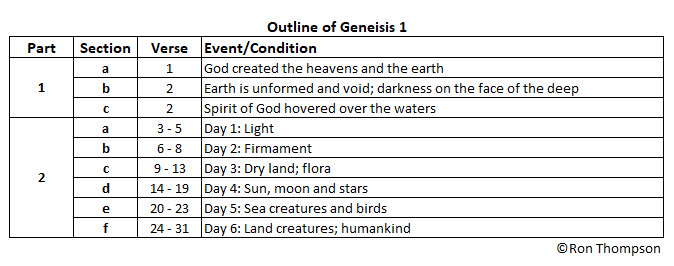
The chart below displays relationships recognized by many conservative theologians who hold to a literal, Concordist, interpretation of Genesis 1; however, rather than interpreting the chart as an account of literally how God created the physical cosmos, I think it is better understood as a very abbreviated poetic description of the finished product.
From Origins: Christian Perspectives on Creation, Evolution, and Intelligent Design, by Deborah B. Haarsma and Loren D. Haarsma
Understood in that way, it becomes one version of a Creation Poem Interpretation of Genesis 1. As such, it is essentially a polemic (a statement argumentatively refuting an opinion or doctrine held by others) against the creation myths of pagan cultures who credit their false gods, who most certainly did not create or rule the cosmos!
The ANE held no conception of infinite time or eternity. They thought no farther back than the initial chaos (compare Genesis 1:2), out of which arose the creator god, who then began to assemble the cosmos from the chaos. Only Yahweh claimed to be eternal and uncreated, and to create ex nihilo.
Whereas modern man sees existence as material in nature, with tangible substance and physical properties, it wasn’t enough for the ancients that something was visible and occupied space—as stated by John H. Walton in Ancient Near Eastern Thought and the Old Testament, it had to first “come into existence” metaphysically by being “separated out as a distinct entity, given a function, and given a name.”
A key insight that I have gleaned from Walton and others who have professionally studied the ANE is that the ancients viewed the ontological nature of the cosmos, i.e., “the nature of that which exists” in terms of function, whereas moderns view it in terms of substance. In other words, when a Big Bang Creationist like me thinks of God’s handiwork, I see mass and energy, bosons and fermions, stars and planets, rocks and trees, etc. A Young Earth Creationist similarly sees a universe of substance. To the ancients, in contrast, the substance of things is only incidental to their functions.
Consequently, I’m beginning to understand that God’s purpose in Genesis 1 was to ignore the misconceptions of the ANE regarding the physical nature of the cosmos, since that was a triviality to pretty much 100% of the population, and to say, in ways they would understand, “I, Yahweh, brought it into being [verse 1] and gave it function [the rest of Genesis 1].”
In this way of thinking,
Days 1 and 4 were about time, seasons, and the cosmic objects that differentiate them;
Days 2 and 5 were about the waters below and above, and about their denizens; and
Days 3 and 6 were about the land and its fecundity.
What point was God then making?
According to Walton, “The records of events in the ancient world were not given so that the reader could reconstruct the event. They were given so that the reader could understand the significance of the past for the present. In that sense, outcomes were more important than the events themselves.”
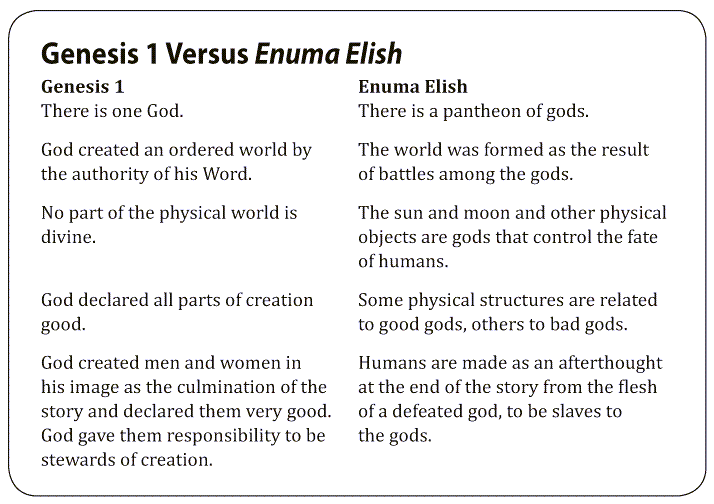
The pagan creation myth most familiar to modern scholars today is the Enuma Elish, from the Assyrian Library of Ashurbanipal at Nineveh. I’ll close this post with a comparison of Genesis 1 with this pagan document, which I think clearly illustrates God’s point:
From Origins: Christian Perspectives on Creation, Evolution, and Intelligent Design, by Deborah B. Haarsma and Loren D. Haarsma
Bibliography
Haarsma, Deborah B., Loren D. Haarsma, Origens: Christian Perspectives on Creation, Evolution, and Intelligent Design,2011, Grand Rapids: Faith Alive Christian Resources.
Walton, John H., Ancient Near Eastern Thought and the Old Testament, 2nd ed., 2018, Grand Rapids: Baker Academic.










 The Back of My Mind