
Son of Man, Son of God

Posted on:

Modified on:

  1. Introduction
  2. “Son of God” in the New Testament
    1. In the Synoptic Gospels
    2. In John’s Gospel
  3. “Sons of God” in the Old Testament
  4. “Son of Man” in the Old Testament
  5. “Son of Man” in the New Testament
  6. The bottom line

Introduction

I love, and have a very large library of, DVD sets from The Great Courses, which I first learned of from their advertisements in World Magazine and other Christian periodicals. I have learned over the years, though, that their many theological courses are useless except as a guide for understanding the modernist opposition. Professor Bart D. Ehrman, a graduate of the Princeton Theological Seminary, has recorded one such course, 24 half-hour lectures titled “How Jesus Became God.” Ehrman is a prolific author, boasting many published books with provocative titles, all based on a common theme, that the Christianity taught by Conservative Evangelicals like me is a lie, based on faulty, unprovable history and a completely unreliable Bible.

Skeptical scholars often make a big deal of the fact that “Jesus never called Himself the Son of God”, only the “Son of Man”, that is, a “human being.” This, they say, means that He never meant to present Himself as such, and it was only later that Christians “deified” Him.

But is that true?

“Son of God” in the New Testament


“Son of God” in Greek is υἱός θεός (huios theos). As a Trinitarian title, I don’t think there is anything about that that I need to explain here.

The term is used freely in reference to Jesus in Acts; in Paul’s letters to Rome, Corinth, Galatia, and Ephesus; in Hebrews; in John’s letters; and in Revelation. The confusion arises from its appearance or absence in the Gospels.

In the Gospels, Jesus is addressed as Son of God by others: the Angel who announced Mary’s pregnancy; John the Baptist at and after Jesus’ baptism; the Tempter in the Wilderness; various demons; His disciples in periods of particular awe; Martha after Lazarus was resurrected; some Sanhedrin members and other witnesses of His crucifixion (mostly in sarcasm); and by Roman soldiers who felt the earthquake as He died.

When appearing in plural form (υἱοὶ θεός), Sons of God in the New Testament always refers to Christians. Galatians 3:26 explains that we are “sons of God through faith.” A clue to why we share the title with the heavenly host (see Gods and Demons) is found in Jesus’ answer to a scribe who tried to trip Him up with a loaded question about marriage in heaven:

Luke 20:35 (CJB) emphasis mine
[35] but those judged worthy of the age to come, and of resurrection from the dead, do not get married, [36] because they can no longer die. Being children of the Resurrection, they are like angels; indeed, they are children of God.

In the Synoptic Gospels

It is certainly true that Jesus Himself avoided the terminology right up until His trial, but there was a practical reason for that. Although there was a strain of Hebrew theology that speculated on the Messiah as deity, that was a minority view. Most of the sages were expecting a human Messiah who would defeat the Roman oppressors and usher in an age of spiritual renewal, prophecy and miracles. To openly claim deity would have, and indeed ultimately did, lead to Jesus’ arrest by the Sanhedrin for blasphemy. Pilate was evidently not overly concerned about a political threat from Jesus and His followers, but to openly claim Messiahship could nevertheless lead to arrest by the Romans as a potential revolutionary. In fact, under duress from the Judeans, that was the charge that Pilate used to justify His execution.

Not only did Jesus avoid using the terminology Himself, He also frequently told others not to speak of it. For example, in Capernaum:

Luke 4:40–41 (CJB)
[40] After sunset, all those who had people sick with various diseases brought them to Yeshua, and he put his hands on each one of them and healed them; [41] also demons came out of many, crying, “You are the Son of God!” But, rebuking them, he did not permit them to say that they knew he was the Messiah.

There were a number of occasions when Jesus’ exhortation for silence was ignored, and there were a few where He commanded someone to go ahead and speak freely. Notably, in Gadara, after chasing the legion of demons into a herd of pigs:

Mark 5:18–20 (ESV)
[18] As he was getting into the boat, the man who had been possessed with demons begged him that he might be with him. [19] And he did not permit him but said to him, “Go home to your friends and tell them how much the Lord has done for you, and how he has had mercy on you.” [20] And he went away and began to proclaim in the Decapolis how much Jesus had done for him, and everyone marveled.
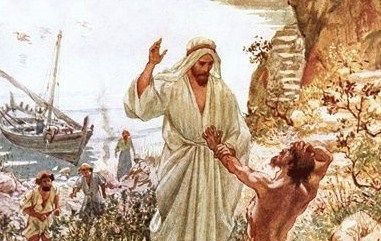
Jesus and the Demoniac, copyright unknown

The difference on this occasion was that the Gadarene people were chasing Him out of the country, but He wanted to come back later. They were scared of the Jew who could heal so effectively and cause the suicidal stampede of their swine herds. And of course, angry at the economic consequences of the latter. But this was Decapolis, a pagan territory outside of Judean jurisdiction where the risk of arrest was low. Since Jesus was planning to return to the region very soon, He wanted the healed “demoniac” to prepare the way for His return. Which the man evidently did very effectively! Attitudes in the Gadarene region had completely changed when He returned. “Multitudes” of the Gadarenes turned out eagerly to hear Him preach. That could only be due to the tireless work of the dedicated new convert.

Note: Parallel versions of this story mention not one, but two possessed Gadarenes healed by Jesus. As is frequently the case in the Gospels, the authors mentioned only what they individually found important in the circumstances. Just as in the story of the ten healed lepers, I think that only one reacted with gratitude. Mark ignored the one who proved inconsequential. In the case of the lepers, both the gratitude of the one and the ingratitude of the nine were integral to the moral lesson.

Despite what I have said above, I think that Jesus most likely did speak freely about His sonship when there were no hostile spies present (see my article about the Pharisees). After the crucifixion, Jesus was “gone”, but His followers were no doubt considered heretics by the Sanhedrin. Since the Synoptic Gospels were written and circulated while the Sanhedrin still existed, I think their authors remained circumspect about reporting His use of the term.

In John’s Gospel

John, however, wrote his Gospel after AD 70. The Temple, the Sadducees, and the Sanhedrin were gone, and the Jewish resistance temporarily suppressed. Jesus was gone and His disciples largely scattered. Caution was no longer necessary. John recorded several instances where Jesus, at least by clear implication, claimed to be the Son of God:

John 3:18 (CJB)
[18] Those who trust in him are not judged; those who do not trust have been judged already, in that they have not trusted in the one who is God’s only and unique Son.

John 5:25–27 (CJB)
[25] Yes, indeed! I tell you that there is coming a time—in fact, it’s already here—when the dead will hear the voice of the Son of God, and those who listen will come to life. [26] For just as the Father has life in himself, so he has given the Son life to have in himself. [27] Also he has given him authority to execute judgment, because he is the Son of Man [the Messiah].

John 10:36–38 (ESV)
[36] do you say of him whom the Father consecrated and sent into the world, ‘You are blaspheming,’ because I said, ‘I am the Son of God’? [37] If I am not doing the works of my Father, then do not believe me; [38] but if I do them, even though you do not believe me, believe the works, that you may know and understand that the Father is in me and I am in the Father.”

John 11:3–4 (ESV)
[3] So the sisters sent to him, saying, “Lord, he whom you love is ill.” [4] But when Jesus heard it he said, “This illness does not lead to death. It is for the glory of God, so that the Son of God may be glorified through it.”

All of the above are “red letter” references. Those who say that Jesus never claimed to be the Son of God are either biblically illiterate, or disingenuous.

“Sons of God” in the Old Testament

This term appears only 6 times in the English Standard version of the Old Testament, and each time as a plural, בְנֵי־הָֽאֱלֹהִים֙ (Bənē hāʾĔlōhīm, “the Sons of God”). In all cases it refers to higher-ranking members of the Heavenly Host (messenger “angels” are the lowest rank):

  • In Genesis 6, two verses refer to “Watchers” (a class named only in Daniel and a number of extrabiblical works), who take on human flesh and rebelliously mate with human women.
  • Deuteronomy 32:8–9 refers to rebellious beings who God exiled to earth and gave oversight of the pagan nations (some English translations incorrectly render the Hebrew, Bene haElohim, as “the sons of Israel”, because their grasp of angelology is deficient).
  • Three passages in Job speak of God’s Divine Council, where The Accuser appears at the throne to report on conditions on earth and is challenged to find fault in Job.

“Son of Man” in the Old Testament

The Hebrew term, בֶּן־אָדָם֙ (ben adam), or its Aramaic equivalent, בַּר־אֱנָשׁ (bar ‘enash), both meaning “son of man”, is used many times in Job, Psalms, Isaiah, Jeremiah, Ezekiel, and in Daniel 8 to mean, simply, a human being. That’s the default meaning, certainly. But in Daniel 7:13, the prophet is given the following vision:

Daniel 7:13–14 (CJB) emphasis mine
[13] “I kept watching the night visions,
when I saw, coming with the clouds of heaven,
someone like a son of man.
He approached the Ancient One
and was led into his presence.
[14] To him was given rulership,
glory and a kingdom,
so that all peoples, nations and languages
should serve him.
His rulership is an eternal rulership
that will not pass away;
and his kingdom is one
that will never be destroyed.

Someone who looks like a human is led into God’s presence and is given an eternal rulership over the entire world. This is the definitive prophecy of the coming Messiah, and it is the reason the Jews were expecting a warrior-Messiah. Other prophetic writings and traditions filled in detail, but this was considered the formal and most clear announcement. For understanding both the Old and New Testaments, I consider this to be perhaps the most important Christological passage in the Bible.

“Son of Man” in the New Testament

In all of human history, I seriously doubt that there are many humans who have gone around referring to themselves as “the son of man” or as “the human” on a regular basis. I, for one, only use the term “human” for myself when speaking to my cat. Jesus spoke frequently of “the Son of Man”, and when He did so, all of His hearers would have immediately realized that He was talking about Daniel’s expected Messiah, even if a few might have been slow to catch on that He was adopting that persona for Himself.

Messiahship claims were frequent in Judea, so one of the tasks that the Sanhedrin took on was to evaluate anyone who seemed to be making the claim or who they thought might eventually do so. That’s why a contingent of scribes and Pharisees were assigned to follow Jesus around. He knew that when He eventually made an explicit claim, He would have to “put up or shut up.” Consequently, He waited until the time of His own choosing and did it in a way as to leave no doubt in anyone’s mind that He was doing so. That was at His trial.

The bottom line

By speaking of the Son of Man in the third person, Jesus avoided unambiguously declaring Himself to be Messiah, but it would have been obvious to any practicing Jew that He was referring to Himself. His signs and miracles reinforced the unspoken claim. Therefore, it is ignorant to say that Jesus never claimed to be God!

Liberal colleges and seminaries teach a simplistic and biased theology that ignores the cultural realities of life in ancient (prehistory through Persian) and classical (Greko-Roman, i.e., Second Temple era through early Rabbinic) Judaism. Unfortunately, the traditions emerging from these institutions are not being adequately debated because, though more benignly biased, conservative educations also tend to be simplistic, and often bound to unwarranted medieval traditions.

The Implication of Genre in Job, Ezekiel and Genesis

Posted on:

Modified on:


  1. Some notes on hermeneutics
  2. The genres of Job
  3. The genres of Ezekiel
  4. the genres of Genesis

Some notes on hermeneutics

“When the plain sense of Scripture makes common sense, seek no other sense; therefore, take every word at its primary, ordinary, usual, literal meaning unless the facts of the immediate context, studied in the light of related passages and axiomatic and fundamental truths, indicate clearly otherwise.”
–Dr. David L. Cooper (1886-1965),
founder of The Biblical Research Society

The above quote is known by many expositors as “The Golden Rule of Biblical Interpretation.” BibleTruths.org states that, “This has often been shortened to ‘When the plain sense of Scripture makes common sense, seek no other sense, lest it result in nonsense.’” An implication of this rule, which I think is inescapable, is that not every word of Scripture is meant to be understood literally. That is troubling to many, because in careless or untrained hands it opens the door to subjectivism and arbitrary conclusions. Yet almost all the great conservative Bible commentators practice a hermeneutic (a set of formal principles for Biblical interpretation) that allows for non-literal text, including parables, figures of speech, anthropomorphism, poetic exaggeration, and a host of other confusing factors. Not to mention translational difficulties. Understanding the “genre” (from the Latin genus), or “literary type” of a Biblical passage is one obvious prerequisite for understanding how literally one should interpret it.

Suggesting that some passages should probably not be understood in a literal sense does not subtract from the central truth that “all Scripture is God-breathed.” It is axiomatic to me that the Bible is inerrant in its original language and the original manuscripts. Yet some folks read my opinions, especially respecting emotional themes like creation, and make snide comments like, “So you believe it’s inerrant except when it isn’t!”

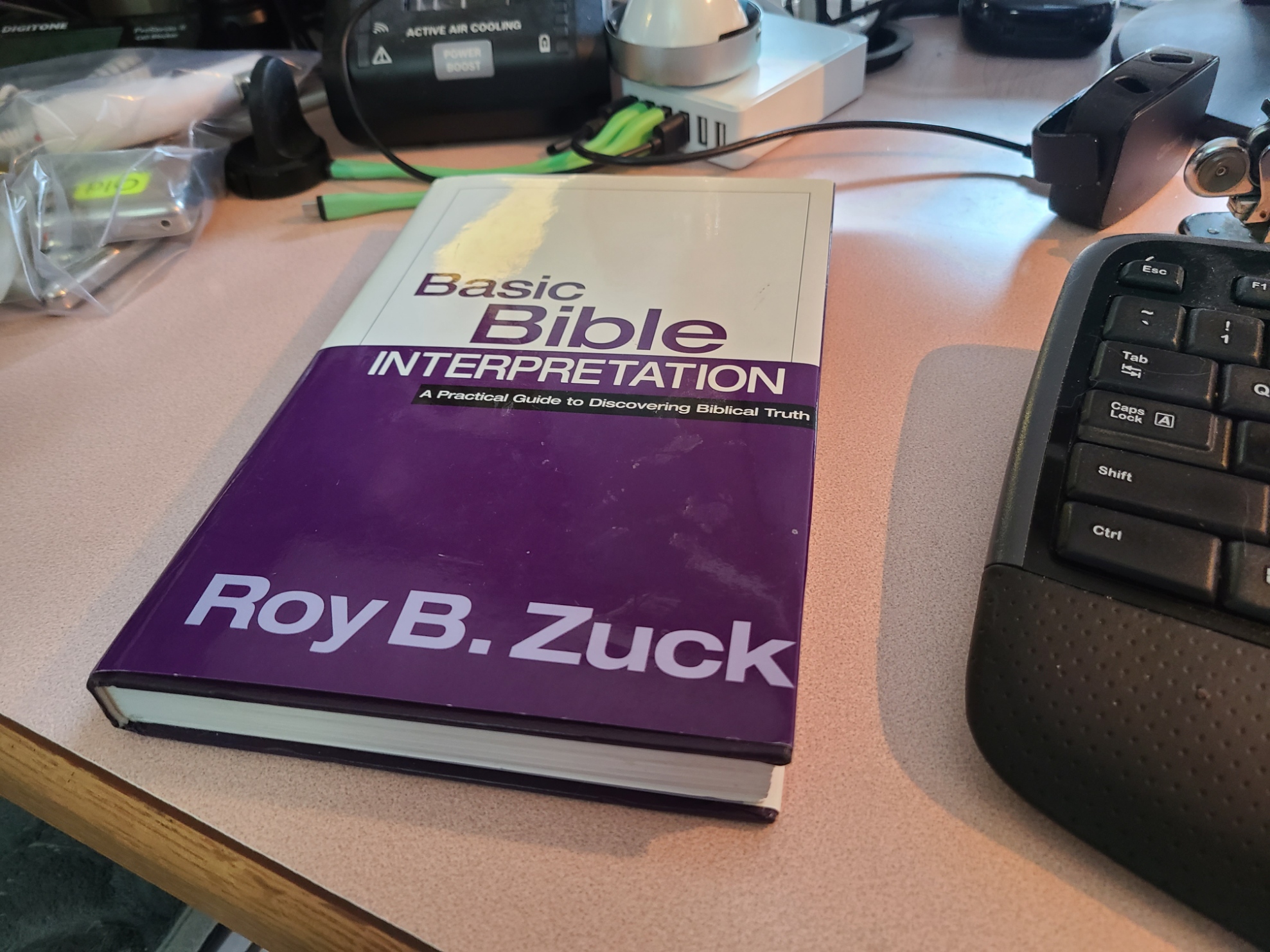
My suggestion for anyone who wants to understand Scripture for himself or herself, or to judge the competence of another commentator, is to read a good book on hermeneutics. One that I recommend is Basic Bible Interpretation: A Practical Guide to Discovering Biblical Truth, ©Roy B. Zuck, 1991. I pretty much agree with all of Dr. Zuck’s stated principles, though I am not in full agreement with some of the applications he makes from his interpretations. For example, he and I are not on the same page with respect to Covenants and Dispensations.

I don’t think there are any substantive problems with corruption of our Scriptures over the millennia. There are a few problems with translation, but none that are impossible to unravel with sufficient attention to the linguistic and cultural background of the humans who penned the words, and those who the words are written to.

What I consider to be the biggest factor of all that contributes to doctrinal confusion and infighting in the Church is that some misinterpretations are enshrined in a nearly impenetrable wall of tradition.

In the remainder of this post, I am going to discuss three books in the Tanach, or Old Testament that I believe contain a mixture of literal and metaphorical text. Some of my readers will disagree with me about Job. Most will agree with me about Ezekiel, at least in general terms. Probably only a few will agree with me about Genesis.

The genres of Job

The book of Job is classified as “reflective wisdom literature” overall, but within the book, scholars recognize two, more specific, genres: Chapters 1, 2, and verses 7–16 of the final chapter, 42, are narrative, while the rest of the book is poetic.

Per Zuck, a Biblical narrative is a “story told for the purpose of conveying a message through people and their problems and situations.” The story is typically selective and illustrative, meaning that it doesn’t necessarily quote conversations verbatim or events in chronological order, and only substantive elements that contribute to the author’s illustration are included. This is why, for example, the narrative content of the different Gospels differs somewhat from book to book when describing the same event. The separate human authors, under the same inspiration, often used different words to stress different aspects. Matthew and Luke report two Gadarene demoniacs, for instance, while Mark mentions only one, and John omits the incident entirely. Why only one in Mark? Because only one of them obeyed Jesus by telling his countrymen about the miracle of his exorcism and preparing the way for Jesus’ return to the region later in the book. The second man was inconsequential to the lesson Mark wished to teach.

Literate readers of our time have hopefully been taught a rigid set of literary rules for grammar and punctuation, but trying to hold ancient writers to the same standards is an anachronism. Thus, we must not be offended when quotations are loose, numbers are approximate, and chronology is fluid. In no ways do these things detract from the authority of Scripture.

When reading the narrative portions at the beginning and end of Job, we can be sure that there is no error in the substance of the story. What the words convey are substantially true, and the lesson they convey is unambiguous.

Leaving the narrative portions, the bulk of Job is poetic. Hebrew poetry has a very recognizable style of its own that some people find hard to follow. Rhyme and meter in the Hebrew originals cannot be transferred intact to English translations, but there is usually recognizable structure. One common element that we frequently see is two or more lines that state the same thing, but in different words. This rephrasing is called parallelism.

Biblical poetry is less exact than Biblical narrative, because the language of poetry is more flowery and sometimes exaggerated or hyperbolic. The narrative within the poem is much less important than the lesson taught by the poem. In my opinion it is dangerous to base dogma on poetic Scripture. Take, for example:

13 to him who split apart the Sea of Suf,
for his grace continues forever;
14 and made Isra’el cross right through it,
for his grace continues forever;
15 but swept Pharaoh and his army into the Sea of Suf,
for his grace continues forever;
—Psalm 136:13–15 CJB

Psalm 136 is an antiphonal song, during which a cantor might have sung or chanted the first line of each verse and a choir of Levites the second. Its intent was to praise Almighty God, and any details included here that were not recorded in the Torah writings could conceivably be embellishment. Exodus does not state that Pharaoh drowned in the Sea (The Reed, or Red Sea), and my analysis (see Historic Anchors for Israel in Egypt) indicates that he did not. Furthermore, “swept Pharaoh and his army into the Sea” clearly contradicts the Exodus account: The Egyptian army followed the Israelites into the sea and the sea swept across them.

In the case of Job’s poetry, the important lessons have to do with God, His power, and His relationship to His creation. The conversations between the actors here (between Job and his wife and friends, or even the conversations between Job and God) were immaterial aside from their message and need not have been quoted exactly as literally spoken. These conversations may not have even taken place at all in reality, but the lessons they teach paint an unambiguous picture of God and His nature.

I view Job as primarily a parable.

The genres of Ezekiel

Ezekiel is probably my favorite book in the Bible. It is a great illustration of the “prophetic” literary genre, and it may be the best example in Scripture of narrative and poetic symbolism.

What is prophecy? I think it is a message about the past, present, or future that is supernaturally delivered by God to His people through the agency of one or more of His people who are commissioned and empowered by Him to act as His intermediary. I don’t think that there are any prophets today, though there will be again as the present age comes to a final end. There were no prophets after Micah until John the Baptizer. There have been none since the death of the Biblical apostles. Some Bible teachers will claim that today’s pastors and evangelists are prophets, by definition, but I don’t believe that the common leading of the Holy Spirit, which is often hard to distinguish from personal volition, counts. For one to feel like he is led by the spirit is nice, but not provable. Fallen humans should not revel in such feelings.

Ezekiel’s prophecies were mostly imparted to him by means of visions, and mostly passed on either through acting out skits (object lessons) or verbally. When verbal, and as recorded in Scripture, some were in narrative form, and some were poetic.

Ezekiel’s vision of God and heaven at the beginning of the book represent his impressions of whatever he actually saw. Efforts to interpret what he described in meaningful visual terms are fruitless. What I think we are supposed to see is that God is holy, majestic, and humanly beyond accurate description.

In chapters 4–32, Ezekiel presents a series of skits and sermons that call out the sins of Israel and other nations of the day and pronounce condemnation and judgement for those sins. Though he uses a mixture of plain language and symbolism, the unity of the message is clear.

Beginning with Chapter 33 we start seeing the beginnings of future restoration, culminating in the defeat of Gog and Magog in Chapters 38 and 39 (see my post, The Coming World War: Gog and Magog).

Finally, chapters 40–48 forecast events and objects in the Messianic age. Some of this material regards the return of God’s sh’kinah “presence” to the Temple Mount in Jerusalem. Previously, in chapters 10 and 11, Ezekiel described the departure of the sh’kinah from Solomon’s Temple immediately prior to its destruction by Nebuchadrezzar in 586 BC. The return of sh’kinah will be specifically to the Holy of Holies in the new Millennial Temple, which will be built on a radically different landscape at the same geographic location. I discuss my own exegesis (interpretation and analysis) of both the departure and return in the question-and-answer section near the end of my post, Opening the Golden Gate. That post also summarizes the history of the Temple in its different phases of construction. Contrary to what is believed by most Christians, both lay and ordained, it was the Father, not Jesus the Son, who will enter the Temple—and not through the Eastern Gate, but over it. The genre of both passages is prophetic narrative, and entirely symbolic, though with important theological meaning and at a location which is certainly literal. In theological terms, God in His immanence may have abandoned the Temple and the people of Israel, but in transcendence, He has always been with them.

the genres of Genesis

The five “Books of Moses“, often called Torah (Hebrew, not for “law”, but rather for “teachings”), or sometimes Chumash (my own default, Heb. “five”) or Pentateuch (Greek “five vessels, or containers”) are attributed by conservative scholars to Moses; a view that I share. They include to some extent, all genres of Hebrew literature.

The water world of Gen. 1:2. “The earth was without form, and void, and darkness was upon the face of the deep.”

Genesis, in particular, is largely narrative in style, as you might guess. It also includes a small amount of poetry. I suggest that all of it, from beginning to end, is also prophetic in nature. Israel has always, since the Exodus from Egypt, considered Moses to be the greatest of the prophets. But I don’t recall ever hearing it suggested explicitly that his knowledge of preexilic history was prophetically derived. Certainly, it was! Recall that I implied above that the prophets, through supernatural means, saw events from their past, present and future, through the eyes of God. In a very real sense, that is what “inspiration by the Holy Spirit” really is.

In Genesis 1:1, Moses declared that, in the beginning (Reꜥshit, “first in time, order or rank”), God created (bara, to create ex nihilo, out of nothing whatsoever, which only God can do) the heavens (shamayim, plural, encompassing the air around us, the atmosphere above us, and the vastness of space) and the earth. The phrase “heavens and earth” in Scripture is a figure of speech called a “merism“, in which the totality of something is implied by substitution of two contrasting or opposite parts.

A more complete description of the genre of this one verse is “polemic prophetic narrative”. Every ancient civilization had a pantheon of pagan “gods”, and with each of those came a “creation myth.” In Genesis 1:1, the one true God said, “I did it—not them! Period!”

Theologically, that is really all we need to know about creation. God had no obligation to tell us exactly how he did it, or in what order, and if He had done so, nobody in the ancient world could have possibly understood it. Sure, I’m curious, but God said it, and I believe it!

To me, the “Plain sense” of Genesis 1:1 makes perfect “common sense” in a book about God: He created the entire universe, which is everything that exists other than Himself, and He had the sovereign right and ability to do it however He chose to.

The plain sense of Genesis 1:3–31 does not make common sense to me, if indeed it describes creation at all. To me, it is strongly reminiscent of visions recorded by a number of prophets, including John. The age of man on earth starts with a vision and ends with a vision! For my perspective on the most probably interpretations of this passage, see The Language of Creation and Genesis 1:1–5, Day 1.