Romans 5:12 and Death Before the Fall


Posted on:

Modified on:

  1. Introduction
  2. Background and grammar
    1. Life
    2. death
    3. Death in antiquity
    4. Death in Hebrew
    5. Death in Greek
  3. Romans 5:12, “death by sin”
    1. The Romans context
      1. Background
      2. Outline
      3. A focus on the theology
        1. Literal death in Romans 1–4
        2. Death and life in Romans 5:1–11
        3. Death and life in Romans 5:13–21
        4. A different metaphor in Romans 6–7
        5. Romans 8
    2. Interpreting Romans 5:10–14
  4. Death in Eden
    1. The sin in Eden
    2. The curses of Eden
      1. The Serpent
      2. The Woman
      3. Adam
  5. Good and Very Good
  6. Philosophical bias
    1. Nature vs Eternity
    2. Fecundity
    3. Natural Life

As an Old Earth Creationist (OEC), Young Earth Creationists (YEC) have frequently asked me about, or scolded me over, the question, “Doesn’t your theology presuppose the unbiblical idea of death before the Fall?”

My response is that, yes indeed, an old earth (4.5 billion years old) and an older universe (13.8 billion years old) does in fact imply that there was life and death on earth long before the creation of Adam, and his subsequent fall.

I will try here to refute the claim that death before the fall is “unbiblical” and to support my opinion that death was an intended part of God’s design that did not begin with Adam’s sin.

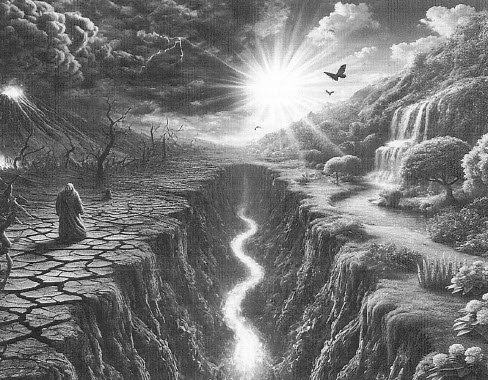
Unknown artist’s conception of Hades as described by the parable of The Rich Man and Lazarus. I presume that’s the Rich Man walking alone on the left bank of the chasm, while Lazarus is off lounging somewhere in Abraham’s Bosom, on the right bank. Remember that this is a parable, so you aren’t expected to take the vision of Hades’ layout or structure too literally.

Introduction

If you subscribe to a YEC interpretation of Scripture (and most of my friends do), then you should believe that all life, human, animal, vegetable, fungi, single-celled and microbial, was created some 6,000 years ago, over a span of only days. Is it conceivable, in that case, that the Fall took place soon enough after creation that no living thing got eaten, stepped on, or fell off a cliff? Was life physically indestructible, as well as immune from natural death? Life is far more complicated than that, but to Henry Morris and his disciples, the question is moot, because to them the Bible prohibits even the possibility of any kind of death before the Fall.

In this post, after first presenting some background and grammar, I’m going to comment on a few of the key YEC arguments for and against pre-fall immortality.

Background and grammar

Life

Not all YEC scholars think that a denial of physical death before the fall applied to plants and microbes, or anything else with no brain. I’m not aware of any scripture that grants this exemption, unless it is implicit from,

29 And God said, “Behold, I have given you every plant yielding seed that is on the face of all the earth, and every tree with seed in its fruit. You shall have them for food. 30 And to every beast of the earth and to every bird of the heavens and to everything that creeps on the earth, everything that has the breath of life, I have given every green plant for food.” And it was so.
— Genesis 1:29-30 (ESV)

Some say that only vertibrate animals were exempt from death. Where is that written?

Some say that anything without blood was never “alive”, in a Biblical sense, because “the life of the flesh is in the blood…” But that isn’t meant to define what “life” is or is not, it’s merely the stated reason that God views the consumption of blood as abominable. There is unfortunately a huge tendency for hyper-literalists (those who won’t let the Bible use figurative language or poetic exaggeration to prove a point) to read theology into every word of every verse, without regard to context.

Far from looking for exemptions, Morris even taught that entropy could not have increased before the fall. Morris was not a scientist and never had a full grasp of what entropy even means until later in his life.

Entropy is a fundamental thermodynamic property of the physical universe. Formally, it is a statistical measure of the number of mathematical “degrees of freedom” in any physical system. The Second Law of Thermodynamics states that the entropy of the universe always increases.

Entropy is often described to novices as “a measure of randomness”, but that is misleading. A common claim is that “shuffling a pack of cards increases its entropy because of the increased randomness of the shuffled deck but sorting it back into its original order decreases its entropy since its randomness is lower.” That isn’t at all true! The increase of entropy is due to the energy expended in shuffling. Reordering requires another expenditure of energy, say from a person or a machine, thus further increasing entropy. The entropy of 52 cards at rest is the same whether they are in an ordered or a shuffled state.

If Morris was right about entropy, cells could not divide, food could not digest, muscles could not contract, balls could not roll downhill and, oh yes, the sun could not shine, and gravity could not work. If so, then after the Fall, God must have completely redesigned the laws of physics, plus the nature of every last object in the universe, from subatomic particles on up to spacetime itself.

But the text of Scripture doesn’t, to my knowledge, hand out exemptions, so who gets to say that any human or nonhuman life was exempt from death? To my way of thinking, it is arbitrary and presumptuous for us mortals to “exempt” anything that is cellular and reproduces in a biological sense or to include anything else. Life is life!

death

For this discussion, we have to be more precise when we talk about “death.” That concept, as used in the Bible, can mean different things in different contexts:

  • Everybody on earth recognizes that anything post-Fall that has physical, tangible, cellular life will ultimately suffer a “physical death,” that is, a termination of all self-powered physical processes. After that, external processes take over to break down the physical components of that once-living carcass and “return it to the dust.”
  • Most contemporary Christian scholars also recognize that the Bible frequently talks about an analogous “spiritual death,” which Thayer describes as “the misery of soul arising from sin, which begins on earth but lasts and increases after the death of the body”; “the miserable state of the wicked dead in hell”; and “all the miseries arising from sin.”
  • Paul also defined death as voluntarily putting away, or killing, the evil inclinations of all humankind. See my recent Yetzer, Yotzer and “The Law” in Romans 7:1–6 for a detailed discussion of this usage.

While “death as separation” is not a highly developed Biblical concept, per se, it is functionally an apt description: separation of the body and spirit; separation of the eternal spirit from God; and separation of man from his own nature, respectively.

Death in antiquity

Human beings have an innate curiosity about their origins, both individually and culturally, and I think that this curiosity is at its strongest when communities are more isolated and less technologically distracted. In prehistoric times—that is, before the development of writing—history was very efficiently retained and spread verbally, both within families and cross-culturally by traveling storytellers. It should come as no surprise that all the ancient civilizations, with their common origins in Babel, would share common “legends” about their pasts and common beliefs about the unseen.

From Greece to Egypt and all across the Fertile Crescent, way over to India and China, and across the pond in the Americas, every culture that left records in early history shared one cosmology and one belief in the afterlife, differing only in small regional details.

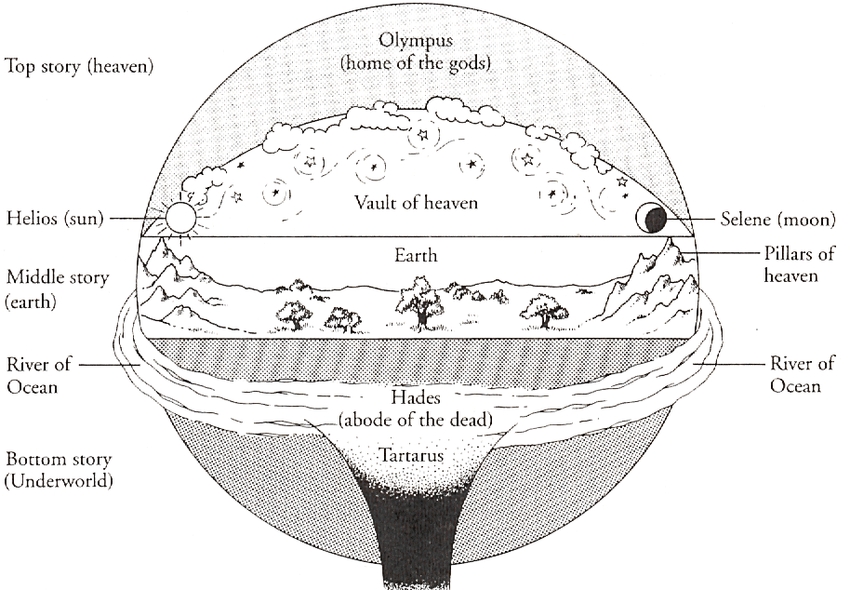
I’ve shared several versions of the universal flat earth model of cosmology in earlier posts. Here I’ll add the Greek view, which is very similar to the others.

Ancient Greek cosmological diagram.

In all cases, the earth is depicted as a flat disk floating on a broad ocean and covered by a dome (the “firmament” in KJV). Beneath the surface of the disk is the underworld, Hades, the abode of the (physically) dead.

As I’ll show in the following two sections, both Hebrew and Greek have terms that refer to death and the remains of the physically dead, but neither language has any term that differentiates between physical and spiritual death. Though “death” can refer to either, only the context can indicate which is being discussed. Unfortunately, very often the context alone is insufficient for total clarity.

Why would that even be?!

I would suggest that, aside from corruptions in the retelling, all early civilizations shared the assumption that physical life was only one phase of personal existence.

Human life on earth is short. Adam’s descendants in the period between the Garden and the Flood lived long lives, as recorded in the Bible, but most cultures in the ancient world had life expectancies of no more than a few decades. Physical death was no shock. It was pretty much universally believed that when a human died, his spirit survived and was relegated to the underworld. The Bible calls that underworld Sh’ol, or Sheol, in Hebrew, Hades in Greek.

Physical death, in other words, was little more than the shedding of a mortal shell not needed by the immortal spirit as it moved into its new abode in the underworld.

There was no concept of death or annihilation of the spirit in the underworld until much later. In fact, there apparently was no real concept of suffering spirits, either. Even in the Old Testament, where the Psalmist said, “The wicked go down to the realm of the dead, all the nations that forget God” (9:17) and “Let me not be put to shame, Lord, for I have cried out to you; but let the wicked be put to shame and be silent in the realm of the dead” (31:17), the sense is, “I’m righteous, so let me live, because when I die, I’ll be relegated to the drab and boring underworld.”

The picture of Sheol/Hades presented in the parable of the Rich Man and Lazarus appears nowhere in the Old Testament. That is a view apparently developed in Second Temple Judaism and propagated in Jewish pseudepigraphal works like The Apocalypse of Zephania and 1 Enoch. In telling this parable, Jesus was using a well-known popular concept to illustrate His teaching.

Death in Hebrew

Biblical Hebrew has several words that are used extensively with respect to death:

פֶגֶר (peger, pronounced peh’-ger) is a noun referring to a corpse, carcass, or dead body, human or animal. It was also used figuratively on occasion to refer to idols.

מוּת (muwth, pronounced mooth) is a verb meaning to die, to kill, or to be dead. The subject could be human, animal, vegetable, or even a nation. It can refer metaphorically to the death of some characteristic, e.g., the death of courage. Manner of death could be natural causes or violence. It could also refer to a death judgement, or to an agent of death.

מָוֶת (maveth, pronounced MAH-veth) is a noun, closely related to muwth, that means death, the dead, the place of the dead or state of being dead, or sometimes pestilence or ruin. Rarely, it can be used metaphorically to indicate spiritual death or separation from God, as perhaps in Hosea 13:14, or divine judgement, as in Ezekiel 18:4.

נֶפֶשׁ (nephesh, pronounced neh’-fesh) is a noun, often translated as soul, but primarily meaning any living and breathing creature, human or animal. It also refers to many of the characteristics of life, including life itself, self, person, desire, passion, appetite, or emotion. To lose one’s nephesh is to die, after which the peger, or remains, decay, while the nephesh (now a disembodied spirit) lives on in Sheol, “the grave”, meaning the underworld.

Note that in the Hebrew Scriptures, there is almost no development of the idea of spiritual death, or of divine retribution in the afterlife.

Whatever your hand finds to do, do it with your might, for there is no work or thought or knowledge or wisdom in Sheol, to which you are going.
— Ecclesiastes 9:10 (ESV) emphasis mine

Death in Greek

There are many similarities, but also significant differences in the Biblical Greek vocabulary of death:

σῶμα (sóma, pronounced SO-mah) is a noun meaning body or flesh. Unlike the Hebrew peger, this word speaks of a body that can be either living or dead, or in some cases metaphorically, of the body of the Church, or the visible aspect of a disembodied spirit, e.g., an angel.

θάνατος (thanatos, pronounced THAH-nah-tos), like the Hebrew maveth, is a noun meaning death. Unlike maveth, where the figurative sense of “spiritual death” is rare, that concept is well developed in the 1st century AD. In biblical Greek, the figurative meaning is present at least as often as the literal. Unfortunately, only the context can reveal which meaning is in play, and even then, it is sometimes not clear.

As a foil for thanatos, I’ll include here its opposite, ζωή (zóé, pronounced dzo-ay’), a noun meaning life. Interestingly, thanatos is a masculine noun, while zóé if feminine. I’ll not suggest any significance to that fact.

νεκρός (nekros, pronounced nek-ros’) is an adjective meaning dead, deceased, or corpse-like. Like thanatos, the New Testament often uses it to refer to spiritual death. Once again, only the context can determine which meaning to attach.

νεκρόω (nekroó, pronounced (nek-ro’-o) is a verb form of νεκρός meaning to put to death, or render powerless or ineffective.

ἀποθνῄσκω (apothnéskó, pronounced ä-po-thnā’-skō) is a verb meaning to die, to lie dying, or to be killed. Similar to Hebrew muwth, but once again, in the NT it often has a strong spiritual, rather than literal, connotation.

κρίμα (krima, pronounced KREE-mah) is a noun meaning a condemnatory sentence, penal judgment, or sentence.

κατάκριμα (katakrima, pronounced kä-tä’-krē-mä) is a noun meaning punishment following condemnation, penal servitude, penalty. Quoting from Bible Hub’s Topical Lexicon: “The word κατάκριμα is used in the New Testament to describe the state of being under condemnation, particularly in a spiritual or moral sense. It is often associated with the consequences of sin and the judgment that follows.”

Romans 5:12, “death by sin”

Therefore, just as sin came into the world through one man, and death through sin, and so death spread to all men because all sinned
— Romans 5:12 (ESV)

To most YECs, Romans 5:12 is the definitive last word on the subject, because it seems to clearly state that no death of any kind, to any created life form (subject to possible exemptions discussed above), was possible before Adam sinned.

But is that so?

“Proof-texting”, i.e., casually picking one verse out of Scripture to prove a theological point of view, is always risky because no single verse, in a vacuum, is likely to reflect the writer’s complete thoughts on the subject of the verse, or on the circumstances under which he is writing. Other factors almost always need to be considered, such as:

  • The grammar, genre, and figures of speech.
  • The issue or issues that prompted the writing.
  • The textual, historical, and cultural context.
  • The identity and background of the writer.
  • The identity and background of the original readers.

The grammar of 5:17 tells us that Paul is combining two thoughts:

  1. Adam’s sin introduced sin and death (thanatos) into the world.
  2. All humans sin, so all humans die.

These two thoughts are conjoined by the Greek phrase kai houtōs, but it is unclear how that should be translated. A quick survey of translations yields “and so”, “in this way”, “this is why”, “and thus”, and the New Century Version (NCV) even puts the second thought into a new sentence. “This is why everyone must die—because everyone sinned.”

Whichever one of those translations you go with, without more context there is a logical disconnect between the two halves of the verse. YECs use Thought 1 to prove that Adam’s sin introduced both physical and spiritual death into the world. Yet they would agree that Thought 2 says that humans die individually because they sin individually. Do animals not die individually because they sin individually?

The Serpent of Genesis 3 sinned, but that was Satan, not a common Garden of Eden Snake. Balaam’s donkey spoke sinful words (Numbers 22:28), but that was spiritual ventriloquism (“The LORD opened [its] mouth”). In Luke 8. 26–39, Jesus was speaking with demons, not with pigs.

I think we can agree that animals aren’t capable of sin, and neither are they subject to spiritual death. Therefore, animals probably have nothing to do with Thought 2 in Paul’s teaching. Given the multiple shades of meaning in thanatos (or the English, “death”) are we as Biblical literalists required to read all possible definitions into that one word here? Not unless we can find something in the context to back it up.

As a matter of fact, the subject in Romans 8, and in fact, the theme of the first 8 chapters, is salvation by faith in the Messiah, for both Jew and gentile. He brings up Adam for two reasons: First, because Jesus provided the means of undoing what the sin of Adam did to humanity; and second, because unlike Abraham, Adam is the father of both Jew and gentile. (Note that the overall theme of the Epistle to the Romans is Paul’s call for unity between Jews and gentiles in the Roman churches.) Among other verses in chapter 8, the following two provide all the explanation needed to understand 5:12:

18 So then, through the transgression of one, condemnation came to all men; likewise, through the righteousness of one came righteousness of life to all men. 19 For just as through the disobedience of one man, many were made sinners, so also through the obedience of one man, many will be set right forever.
— Romans 5:18-19 (TLV)

There is nothing at all in that message that applies to animals (or pre-Adamic hominids if you believe in them). Animals are explicitly mentioned only once in all of Romans:

22 Claiming to be wise, they became fools, 23 and exchanged the glory of the immortal God for images resembling mortal man and birds and animals and creeping things.
— Romans 1:22-23 (ESV)

We’ll approach an understanding of whether Romans 5:12 is speaking of physical death, spiritual death, or a combination of the two in this section. Because the language alone can’t answer that question, we’ll look primarily to the context of Paul’s letter, particularly chapters 1–8, concentrating on chapters 5–8. In the process, we’ll also strengthen our case for human-only death being in view.

The Romans context

In this section, I will now provide a thorough exposition of the topic of death, as it relates to 5:12, in Paul’s theological writings to the churches in Rome.

Background

Though Romans is packed with theology, Paul’s reason for writing the letter was primarily to act as a peacemaker between the Jewish and Gentile believers in the Roman churches.

On his missionary journeys, Paul’s habit was to first approach the Jewish synagogues and preach to their congregations, then to expand his approach to gentiles in the community. Where did the new believers then meet together? The practice of Jewish believers in Jerusalem was to continue their normal Sabbath activities in the synagogues alongside non-Messianic Jews, then at dusk, at the close of Shabbat, the Messianics would adjourn to private homes to meet and fellowship together until well into the night.

This same practice was likely followed in the Diaspora as well, with gentile believers joining at homes after the synagogues closed for the night. This was of course a great demonstration of the intercultural tolerance demanded by Paul.

[Note: Since “the 7th day of the week” gave way to “the 1st day of the week” at dusk, I believe that this evening adjournment is what truly led to the Christian custom of meeting on Sundays.]

In AD 49, Emperor Claudius expelled all Jews from the City of Rome, including Messianic believers. When the expulsion was ended after Claudius’ death in AD 54, two to four years before Paul’s letter, those Jews who returned found that Gentile believers had taken over their synagogues, and the result was bad blood between the returning Messianic Jews and the gentile usurpers.

Outline

That background explains, I think, why the bulk of the letter consisted of round after round of explanation and exhortation to first one, then the other, component of the Church.

In broad strokes, I personally outline Romans as follows:

  1. Greetings and personal notes, 1:1–15.
  2. A unifying theology of righteousness through faith, 1:16–8:39.
  3. Paul’s burden for Israel, 9:1–11:11.
  4. Gentiles and Jews together, 11:12–36.
  5. Christian ethics for all, 12:1–15:13.
  6. Paul’s closing statements, 15:14–16:27.
A focus on the theology

In Romans 1:16–8:39, Paul’s emphasis was on theology, in particular the roles of faith and Torah obedience in the quest for righteousness as required by God in the united Church.

In order to stay within the limited scope of this paper, I will concentrate here on Paul’s discussions of death, in order to set a context for 5:12.

Literal death in Romans 1–4

In the following passage, Paul is speaking of the faith of Abraham who, despite being an old man and “as good as dead”, maintained his strong faith in God, who not only creates the body, but gives it life. Both of these references to death are forms of nekros, and it seems reasonable to assume that they are referring either strictly or primarily to physical death; however, in my judgement they don’t help set the context of 5:12.

17 as it is written, “I have made you the father of many nations”—in the presence of the God in whom he believed, who gives life to the dead [nekros] and calls into existence the things that do not exist. 18 In hope he believed against hope, that he should become the father of many nations, as he had been told, “So shall your offspring be.” 19 He did not weaken in faith when he considered his own body [soma], which was as good as dead [nekroó], (since he was about a hundred years old), or when he considered the barrenness of Sarah’s womb.
— Romans 4:17-19 (ESV) emphasis mine

In 4:24 (“him who raised from the dead [nekros] Jesus our Lord”,) and 5:10 (“we were reconciled to God by the death [thanatos] of his Son”), the subject is the death and resurrection of Jesus, which again I think is not terribly helpful in setting the context for death in the following chapters.

Death and life in Romans 5:1–11

Beginning in chapter 5, the emphasis changes from justification to sanctification and the peace that comes with it.

Therefore, since we have been justified by faith, we have peace with God through our Lord Jesus Christ.
— Romans 5:1 (ESV)

“Death” terms now begin to appear more frequently in the text.

6 For while we were still weak, at the right time Christ died [apothnéskó] for the ungodly. 7 For one will scarcely die [apothnéskó] for a righteous person—though perhaps for a good person one would dare even to die [apothnéskó]— 8 but God shows his love for us in that while we were still sinners, Christ died [apothnéskó] for us.
— Romans 5:6-8 (ESV)

These references to death all speak of Jesus’ crucifixion, which was of course very much a literal death. The same applies in verse 10:

For if while we were enemies we were reconciled to God by the death [thanatos] of his Son, much more, now that we are reconciled, shall we be saved by his life [zóé].
— Romans 5:10 (ESV)

A key question now arises: If thanatos and zóé refer to literal, physical death and life in 5:10, as I think we all would agree, then is this verse speaking of physical salvation of our bodies, or of spiritual “salvation of our souls”?

“Saved” in verse 10 is σῴζω (sózó, pronounced sózó), a verb meaning (per Thayer’s), either (a) to save, to keep safe and sound, to rescue from danger or destruction; or (b) to deliver from the penalties of the Messianic judgment, i.e., to make one a partaker of the salvation by Christ.

Once again, I think that most of my readers would agree that (b) is the sense meant in verse 10.

Up to here in Paul’s theological discourse, the subject has been primarily Jesus’ physical death and subsequent resurrection as the basis for our faith, and thus our spiritual salvation (justification, sanctification, and later glorification).

I would contend, then, that 10 and 11 focus the context for what follows in verse 12:

10 For if while we were enemies we were reconciled to God by the death of his Son, much more, now that we are reconciled, shall we be saved by his life. 11 More than that, we also rejoice in God through our Lord Jesus Christ, through whom we have now received reconciliation.
12 Therefore, …
— Romans 5:10-12a (ESV)

I will show below that the text following 5:12 further solidifies this context.

Death and life in Romans 5:13–21

The remainder of chapter 5 continues the contrast between death through Adam and life through Jesus and returns the emphasis back to the overall theme of the letter: explaining how faith and salvation can function in a Church composed of both Jews and gentiles.

Here, Paul says that, yes, we have been two separate peoples under separate spiritual economies since the time of Abraham, and we will remain so in most respects, but we all have a common ancestor in Adam. Within the Church, we must recognize that both peoples are infected with the sin nature of Adam because of his sin, but now both have been united by our faith in the salvation brought by Jesus.

Key death phrases in this section are:

14 … death [thanatos] reigned from Adam to Moses, even over those whose sinning was not like the transgression of Adam, who was a type of the one who was to come.

15 … if many died [apothnéskó] through one man’s trespass, much more have the grace of God and the free gift by the grace of that one man Jesus Christ abounded for many. 16 … For the judgment [krima] following one trespass brought condemnation [katakrima], but the free gift following many trespasses brought justification. 17 For if, because of one man’s trespass, death [thanatos] reigned through that one man, much more will those who receive the abundance of grace and the free gift of righteousness reign in life [zóé] through the one man Jesus Christ.

18 Therefore, as one trespass led to condemnation [katakrima] for all men, so one act of righteousness leads to justification and life for all men. … 21 so that, as sin reigned in death [thanatos], grace also might reign through righteousness leading to eternal life through Jesus Christ our Lord.
— Romans 5:14-21 (ESV)

Surely all of that death, judgement, redemption and life terminology must be speaking only of the spiritual state!

A different metaphor in Romans 6–7

Here Paul shifts the conversation about death. In this section, “death” is neither physical death nor spiritual death, but rather he uses the metaphor of “putting to death”, or overcoming, the evil inclinations brought on by our sinful natures. I discussed this recently in great detail in Yetzer, Yotzer and “The Law” in Romans 7:1–6

Romans 8

In this chapter, Paul closes out the discussion that fills the first half of the letter.

1 Therefore, there is now no condemnation for those who are in Messiah Yeshua. 2 For the law of the Spirit of life in Messiah Yeshua [the Torah written on our hearts] has set you free from the law of sin and death [the fleshly “evil inclination”].
— Romans 8:1-2 (TLV) comment mine

“Therefore” in 8:1 harks back to all that came before, but in particular to 7:4, discussed in the previous article:

Therefore, my brothers and sisters, you also were made dead to the Torah through the body of Messiah, so that you might be joined to another—the One who was raised from the dead—in order that we might bear fruit for God.
— Romans 7:4 (TLV)

By now, I hope that most of you will agree that Paul’s discussion of theology is primarily about the spiritual results of sin, not about the mortality of the body.

Interpreting Romans 5:10–14

Here, then, is my interpretation of Romans 5:12 in its closest context:

10 For if while we were enemies we were reconciled to God by the death of his Son, much more, now that we are reconciled, shall we be saved by his life. 11 More than that, we also rejoice in God through our Lord Jesus Christ, through whom we have now received reconciliation.

12 Therefore, just as sin came into the world through one man, and death [thanatos] through sin, and so death [thanatos] spread to all men because all sinned …
— Romans 5:10–12 (ESV)

For if while we were enemies — While we, as Jew or gentile, were in opposition to God and Torah.

We were reconciled to God by the death of his Son — We were brought back into a close relationship (which was lost when we first sinned) with God on be basis of Jesus’ crucifixion.

Much more, now that we are reconciled — More importantly, now that that relationship has been restored.

Shall we be saved by his life. — I discussed the meaning of salvation when I analyzed this verse above, taking Thayer’s definition, “to deliver from the penalties of the Messianic judgment, i.e., to make one a partaker of the salvation by Christ.”

More than that, we also rejoice in God through our Lord Jesus Christ, through whom we have now received reconciliation. — We celebrate the fact that we have been brought into fellowship with God, the Father.

Therefore—because of Jesus’ crucifixion and resurrection by which we have been reconciled to God.

Just as—in the same fashion as.

Sin came into the world through one man—Sin came into existence on earth. By disobeying God in the matter of the Tree of Knowledge, Adam and Eve brought the curse on mankind and on the ground that he depends on.

And death through sin—this will require discussion of two issues:

  1. The contextual discussion above addresses the question of whether this “death” (thanatos) is spiritual death only, or whether it includes any physical component at all. Based on we’ve seen in chapters 1–8, and especially 5:10–11, I can only conclude that death here is referring only to spiritual death.
  2. We also have to determine whether the remainder of verse 12 limits this death to mankind only, or if animals and other things are included.

And so death spread to all men because all sinned—to my mind, the grammar here limits death due to sin to the sinners themselves.

But let’s consider the curses themselves…

Death in Eden

The sin in Eden

The word “die” occurs 3 times in the Garden of Eden (Genesis 2:17; 3:3,4). In each case, it is a grammatical variation of the Hebrew muwth. As expected, the Greek Septuagint (LXX, a 2nd century BC Jewish translation of the Old Testament into Greek) translates each of these three occurrences using apothnéskó, which in this case imparts no new information.

What does the text tell us? In Gen 2:17 God’s words were, “in the day that you eat of it you shall surely die.” Eve’s flawed retelling of this to the Serpent was, “‘You shall not eat of the fruit of the tree that is in the midst of the garden, neither shall you touch it, lest you die.'” The Serpent’s response was, “You will not surely die.”

Are we to take this as a discussion of physical death, spiritual death, or perhaps both? That’s a tough question to some since it is not addressed specifically.

If the answer is “physical“, then did God lie and the Serpent tell the truth? That, of course, is not tenable unless the word “day” (from the root, יוֹם, yom) means something other than a literal day. In an Ancient Near East (ANE) context, that is certainly a possibility, but it’s making an unprovable assumption, and it’s a risky interpretation in the context of Genesis 1–3. If you require Genesis 1 to be using the word, day, literally for the creation days, then in Genesis 2–3, the same word should probably have the same meaning.

“Both” might mean that both were telling half-truths, which raises the same troubling issues.

If the answer is “spiritual“, then God was truthful, and the Serpent a liar. I’ll go with this one!

But, for the purpose of this post, I have to ask how Adam and Eve could have had any comprehension of either physical or spiritual death if there had been no death at all on earth up to that point. Any attempts to explain that away can only be speculative. Lacking data, then speculation is fine, but dogmatism is not.

Since Adam’s physical death didn’t come until 930 years later, I feel personally confident in speculating that the death promised to him was spiritual only, though there is no record that either God or the Serpent explained that to him or Eve. I further speculate that he was not created immortal but would have lived forever from the fruit of the Tree of Life, as stated in gen 3:22.

The curses of Eden

The Serpent

According to Genesis 3:14–15, the Serpent was cursed for his own sin.

14 So the LORD God said to the serpent:
Because you have done this,
you are cursed more than any livestock
and more than any wild animal.
You will move on your belly
and eat dust all the days of your life.

15 I will put hostility between you and the woman,
and between your offspring and her offspring.
He will strike your head,
and you will strike his heel.
— Genesis 3:14-15 (CSB17)

Angelic beings were created to oversee the cosmos, much like mankind was created to manage Earth. The Bible reports that angels are rebellious just like humans, but I see nothing in the Bible to indicate that the angels and humankind are judged under the same set of rules, or that other angels were included in the Serpent’s curse.

In fact, it’s unclear just what exactly the serpent was, and what its relation was to Satan. Revelation 12:9 and 20:2 state that it was Satan, but that could mean that Satan “possessed” a member of an animal family. “On your belly you shall go” does indeed sound like snake, but “the serpent was more crafty than any other beast of the field that the LORD God had made” doesn’t sound snakish at all, so who knows?

It’s unclear to me why God would have cursed all snakes because of the perfidy of one, and the part of the curse recorded in verse 15 certainly does not pertain to snakes! Well, I’m satisfied not knowing the unknowable!

The Woman

Eve’s curse is recorded in Genesis 3:16. It mentions only pain in childbearing and relational difficulties between husband and wife. From the wording, it seems that childbearing was already painful, so this just made it more so. If it was painful, could it also have been perilous?

He said to the woman:
I will intensify your labor pains;
you will bear children with painful effort.
Your desire will be for your husband,
yet he will rule over you.
— Genesis 3:16 (CSB17)

Adam

Adam’s curse is found in Genesis 3:17–19. Strictly speaking, Adam wasn’t cursed at all, directly. What the text says is, “cursed is the ground because of you”. What that curse does, though, is to set up an enmity of sorts between Adam and his environment, which certainly would be considered a curse.

17 And he said to the man, “Because you listened to your wife and ate from the tree about which I commanded you, ‘Do not eat from it’:
The ground is cursed because of you.
You will eat from it by means of painful labor
all the days of your life.

18 It will produce thorns and thistles for you,
and you will eat the plants of the field.
19 You will eat bread by the sweat of your brow
until you return to the ground,
since you were taken from it.
For you are dust,
and you will return to dust.”
— Genesis 3:17-19 (CSB17)

Alternatively, it may be that Adam’s own curse is that discussed above, plus

22 The LORD God said, “Since the man has become like one of us, knowing good and evil, he must not reach out, take from the tree of life, eat, and live forever.” 23 So the LORD God sent him away from the garden of Eden to work the ground from which he was taken. 24 He drove the man out and stationed the cherubim and the flaming, whirling sword east of the garden of Eden to guard the way to the tree of life.
— Genesis 3:22-24 (CSB17)

I see no Biblical indication, in Genesis 3 or elsewhere, that animals, plants, or the extraterrestrial cosmos were cursed for man’s sin. Certainly, the flora, fauna and ecology of earth are greatly affected by man’s curse. That doesn’t mean that it had any effect on their mortality, other than to make life harder.“Be fruitful and multiply and fill the earth and subdue it, and have dominion over the fish of the sea and over the birds of the heavens and over every living thing that moves on the earth.”
— Genesis 1:28 (ESV)

Good and Very Good

Many Young Earth Creationists claim that there could not possibly have been death before the fall because during the creation week, at the end of every day God looked at what He had done that day and pronounced it “good.” At the end of the sixth day, as a matter of fact, it was “very good.”

Now how, they ask, can anything be good or very good if it can die? Well, gosh… How does any fallen human being presume to know what God considers to be good? It’s His design, so by definition, it is good!

Let’s check the language:

טוֹב (tov, pronounced tove) This can be adjective, verb, or noun, and it means … hang onto you hats … good, pleasant, agreeable, beneficial, beautiful, best, better, bountiful, cheerful, at ease, fair, favor, fine, glad, goodly, graciously, joyful, kindly, loving, merry, pleasant, precious, prosperity, ready, sweet, wealth, welfare, well-favored. And all of these meanings are subjective! Good luck agreeing on the shading!

מְאֹד (m`od pronounced meh-ODE) This is an adjective meaning very, exceedingly, much, greatly.

Really, there’s not much help there. The word is subjective.

From my engineering perspective, a good design is one that does what the specs required, does what it was designed it to do, and does it elegantly.

Philosophical bias

In my opinion…


The universe is not a static artwork hanging on a wall. It’s a living, dynamic organism, designed by God to mature and blossom with little interference, to showcase His majesty, and to house and employ His angelic host, the first “generation” of His children, the B’nai Elohim, or Sons of God (Genesis 6:2–4).

And later, after reaching a suitable degree of maturity and elegance, a Garden was planted on one planet to house and nurture the second generation of His children, humanity.

Elegantly!


Nature vs Eternity

Development and growth per God’s blueprint demand movement, change, and thermodynamic flow. Exchange and equilibrium. Birth and death. This is true for the universe as a whole, for galaxies, stars and star systems, and for planets.

Angels are like humans in that they image God, they answer to Him, they interact with Him, they have freewill and thus can sin, and God has given them meaningful work to do.

They are unlike humans in that they have no physical bodies that are inherently vulnerable to mishap, wear and tear, and mischief. They don’t give birth, and they don’t die, and they aren’t influenced by hormones. However, when they have temporarily taken on human form, they have sometimes gotten into big trouble.

In the Eternal State, I believe human bodies will be secondary. In the meantime, they are the shell we are confined to. Spirits are immortal, bodies are not. By their nature, bodies are vulnerable. With God’s protection or the Tree of Life, they can be maintained indefinitely, but without it, death is inevitable.

Fecundity

The first commandment given to humans was,

“Be fruitful and multiply and fill the earth and subdue it, and have dominion over the fish of the sea and over the birds of the heavens and over every living thing that moves on the earth.”
— Genesis 1:28 (ESV)

Where there is fecundity, there has to be death. Neither animals nor humans can give birth indefinitely without eventually running out of space and resources. We value ecosystems and our environment. Ecology, God’s creation, demands cycles of life and death to maintain the health and balance of the planet.

Natural Life

I have in front of me paper after paper and article after article featuring Henry Morris’ grandson and many of his colleagues repeating over and over again that “death is an insult”, and “if God designed death into creation, then He is a monster”, and “death is wasteful and cruel.” This is all nonsense to me.

Isaiah described the Olam Haba (world to come) in the imprecise way of prophecy, particularly poetic prophecy. As sometimes happens, he confused the Millennium with the Eternal State, as described in Revelation. Under the topic, “new heavens and new earth” (65:17), the following passage describes what I believe life will be like in the Millennium, and perhaps what it was designed to be like in Eden:

20 No more will babies die in infancy,
no more will an old man die short of his days —
he who dies at a hundred will be thought young,
and at less than a hundred thought cursed.
21 They will build houses and live in them,
they will plant vineyards and eat their fruit.
22 They will not build and others live there,
they will not plant and others eat;
for the days of my people
will be like the days of a tree,
and my chosen will themselves enjoy
the use of what they make.
23 They will not toil in vain
or raise children to be destroyed,
for they are the seed blessed by ADONAI;
and their offspring with them.
24 Before they call, I will answer;
while they are still speaking, I will hear.
25 The wolf and the lamb will feed together,
and the lion eat straw like an ox
(but the serpent — its food will be dust).
They will not hurt or destroy
anywhere on my holy mountain,”
— Isaiah 65:20-25 (CJB)

As for animals, verse 25 doesn’t promise that the wolf and the lamb will be immortal, or even that the lion or wolf will lose its predatory instincts, but only that wild animals will no longer plunder domestic herds.

Humans were created mortal but designed to live long and peaceful lives and to die content, like David in 1 Chronicles 29:28 (CJB), who “died, at a ripe old age, full of years, riches and honor.”

This is my view of Eden, as well…


Genesis 1:1–5, Day 1

Posted on:

Last modified on:

  1. Before I begin…
  2. Moving on…
  3. Hermeneutics and the Golden Rule of Biblical Interpretation
  4. Limitations of Science
  5. Proving the Bible
  6. Moses was a prophet!
  7. Previous posts in this series on the topic of creation
  8. Revisiting Genesis 1
  9. Prologue: Gen 1:1–5
  10. The overwhelming problem with Light on Day 1:
    1. The definition of light
    2. The source of light
    3. sh’kinah
    4. “Let there be light…”
  11. Interpreting verses 1:3–2:3
  12. A better idea
    1. What was the cultural background?
    2. So, what are my views?
    3. What point was God then making?
  13. Bibliography

Before I begin…

Before getting into this, I’ve been asked why I keep alienating my friends by harping on a version of Creationism that most of them consider to be unbiblical. I can respond to that in several ways:

  • First, I’m not really “harping” on it at all. This is a multipart series that I’ve planned for quite a while, to replace something I did years ago. I’ve still got two or three chapters to write before I’m finished with it. I did the same thing with my series on The Jewish Feasts.
  • I’ve been vitally interested in both theology and astrophysics since, literally, my pre-teen years. I write about what interests me most.
  • I don’t consider that one’s interpretation of Genesis 1 is a “fundamental of the faith“, but many of my friends do, and I am convinced that the currently mandatory “Genesis Flood Theory” is an unnecessary stumbling block for many lost souls.
  • Although many wonderful Christians would refuse to fellowship with me because I’m not a Young Earth Creationist, I don’t feel the same about them; but I suppose I’d like to convince them that I’m “righter than they are.”

As stated below, “With respect to the question of Creation, the central, foundational Truth of all Scripture is that the One, True, Eternal, Triune God, by His own power, created and sustains all else that exists in the cosmos.

Moving on…

My views are driven by several axioms:

  • God is both omnipotent and sovereign, so He can do whatever He wants to do, however He wants to do it!
  • The Bible, as originally written, is the inerrant, irrevocable, Word of God.
  • The Bible we now possess (at least insofar as the accepted canonical books are concerned) is substantially the same holy Word as the originals, but subject to a very limited extent to human error in translation and interpretation.
  • Correct interpretation (exegesis) of Scripture requires a consistent hermeneutic, which among other factors, includes recognition that some scripture is not meant to be taken literally, as discussed in the next section in relation to The Golden Rule of Biblical Interpretation.
  • A consistent hermeneutic also must require recognition of the cultural background of both the writer and the ancient reader.
  • Though Holy Scripture is as valid and vital today as it ever was, correct interpretation demands unequivocally that modern culture and tradition not be anachronistically imposed on the writers and readers of the day in which they were written.
  • Because God is not a liar or an author of confusion, we must recognize that the testimony of God’s Word cannot conflict with the testimony of His Created World when both are rightly understood.

Hermeneutics and the Golden Rule of Biblical Interpretation

“When the plain sense of Scripture makes common sense, seek no other sense; therefore, take every word at its primary, ordinary, usual, literal meaning unless the facts of the immediate context, studied in the light of related passages and axiomatic and fundamental truths, indicate clearly otherwise.”–Dr. David L. Cooper (1886-1965),
founder of The Biblical Research Society

The above quote is known by many expositors as “The Golden Rule of Biblical Interpretation.” I read somewhere that this has often been shortened to “When the plain sense of Scripture makes common sense, seek no other sense, lest it result in nonsense.”

Implicit in the above is the assumption that the “plain sense of Scripture” sometimes does not seem to make sense. Certainly, when that is the case, you must first question your own common sense, but that doesn’t always solve the problem.

Few conservative Bible scholars believe that every word of Scripture is meant to be understood literally.

That is troubling to many, because the alternative opens the door to subjectivism and arbitrary conclusions. Yet almost all the great conservative Bible commentators practice a hermeneutic (a set of formal principles for Biblical interpretation) that allow for non-literal text, including parables, figures of speech, anthropomorphism, poetic exaggeration, and a host of other confusing factors. Not to mention translational difficulties.

None of that subtracts from the central truth that “all Scripture is God-breathed.” It is axiomatic to me that the Bible is inerrant in its original language and the original manuscripts. Yet some folks read my opinions, especially respecting emotional themes like creation, and make snide comments like, “So you believe it’s inerrant except when it isn’t!”

So, to clarify, I don’t think there are any substantive problems with corruption of our Scriptures over the millennia. There are, however, problems with translation, but few of those are impossible to unravel, with sufficient attention to the linguistic and cultural background of the inspired humans who penned the words, and those to whom the words were written.

There are also “mysteries.” Most Evangelicals are happy to admit that Paul revealed things hidden within Scripture that were mysteries with respect to the New Testament Church. The Church itself being one of the chief mysteries! The dual advents of Messiah are another mystery now revealed. Yet many seem unwilling to consider that some things are still mysterious.

What I consider to be the biggest factor of all that contributes to doctrinal confusion and infighting in the Church is that some misinterpretations are imbedded into a nearly impenetrable wall of tradition.

Unfortunately, the reason there are so many Christian denominations in the world, and the reason they often have so much trouble getting along, is that each has its own particular list of what constitutes “axiomatic and fundamental truths.” For example, I was brought up in a “fundamentalist” sub-denomination of Baptists that teaches there is no such thing as a universal Church of all believers; only local churches are Biblical. To them this is an axiomatic and non-negotiable Truth, based in part on the simple fact that the Greek word translated “church” is ecclesia, which literally means “assembly.” After all, how can people scattered across the world and across many ages possibly assemble together?

With respect to the question of Creation, the central, foundational Truth of all Scripture is that the One, True, Eternal, Triune God, by His own power, created and sustains all else that exists in the cosmos.

That fact is stated clearly and concisely in just one verse: Genesis 1:1.

As for what that process looked like and how we should interpret Genesis 1:2–2:3, I regard that as still a mystery.

A 6,000-year-old universe and the Genesis Flood Theory of today’s Young Earth Creationists does not meet the commonsense test, not because God can’t do whatever He wants, but because the clear evidence of centuries of careful observation and analysis by very smart and dedicated professionals, both Christians and otherwise, can’t be ignored. God is not the Author of Confusion. He doesn’t plant lies in front of our face to test our faith.

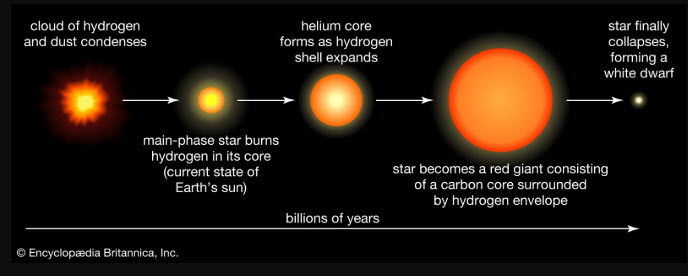
Moreover, the universe is demonstrably dynamic, changing over time even as we observe. That isn’t “evolution”, it’s simply the application of forces and interactions decreed by God. We understand the physics of supernovae (the implosion of giant stars) and we observe them happening. We understand the process of star formation, and we see examples of every stage of that process. We can’t see the movement of stars and galaxies, but we can measure their movements using Doppler shift, similar to the clocking of a speeding car.

Limitations of Science

When I was young, scientific method was viewed as a simple, 3-step process:

  1. State a hypothesis.
  2. Form a tentative theory.
  3. “Prove” the theory, which then becomes a law.

But so many of the “laws” found under that paradigm have been subsequently found to be limited in scope (for example, Newton’s laws of motion are now known to be invalid for very large and very small masses), that the paradigm has changed:

Now, hypotheses still become tentative theories, but once a theory has become so well proved that it is accepted as true by most authorities on the subject, it still doesn’t get promoted to “law”. That is why it is utterly meaningless to say that “The Big Bang Theory” is just a theory!

Scientists now look for certain characteristics of a theory to judge how “well established” it is:

  • Obviously, the more evidence supports a theory, and the less that appears to contradict it, the stronger it becomes. This evidence may be experimental, or it may be observational. If it is statistical in nature, then the results must be well within a recognized margin of error.
  • To be considered a truly “scientific“, a theory must be judged to be “falsifiable.” That means that for all practical purposes, if there is no conceivable way that a theory can ever be proven false, then it must remain speculative in the minds of those who are not predisposed to take it on faith. This principle is the tool of choice for those who wish to exclude all discussion of religion, or “Intelligent Design“, as an alternative explanation.
  • For a theory to become intrenched as factual, it is also necessary for it to successfully produce demonstrably true predictions, by means either of observation, logical arguments, or mathematics.
  • The strongest theories are those that can be expressed by mathematics, because mathematics is the only truly “exact science“. Two plus two always equals four in our base 10 number system. The circumference of a circle divided by its diameter always equals pi (3.1415926…) in a Euclidean frame of reference.

Proving the Bible

Something I see online over and over again online is well-meaning Christians exclaiming over interesting archaeological finds that, “They prove that the Bible is correct.” No, they don’t! Science will never prove Scripture, and that is by God’s design, because He wants us to live by faith, not by sight. The most that science can do for us is to confirm the faith that God has already supplied to us.

At the same time, if we are worried that science will contradict our faith, then our faith is weak to begin with!

God has written of Himself in both Scripture and creation. The purpose of science is to help us understand creation. Embrace it!

Moses was a prophet!

According to Scripture, Moses was the greatest prophet of all times, other than Jesus. He didn’t personally see any of the events of Genesis, so how did he know what to write? Both the Old and New Testament contain numerous references to non-canonical source writings. Moses himself references The Book of the Wars of the Lord (no longer extant) in Numbers 21:14, which recorded some contemporary events, but I know of no sources that he could have used for events prior to the invention of writing. He could have gotten his information only from God. After-the-fact prophecy, so to speak.

How was that information communicated to him? Perhaps verbally, because we know that he and God talked to each other directly. Having nothing concrete to go by, I personally assume that from Genesis 11:10 forward, Moses’ inspiration was primarily verbal.

Verses 10–32 of chapter 11 constitute one of eleven so-called toledoth in Genesis. These primarily genealogical blocks of Scripture were included by Moses and are believed to be intended as section dividers.

Because the first 11+ chapters of Genesis consist of abbreviated, flowery accounts of earthshaking historical events, I see them as poetic discourse, a different genre from what follows. For that reason, I suspect that these chapters were conveyed, at least in part, via visions or dreams. There is a theological label for prophetic visions of past events: Preterism. A “full preterist” believes that all prophecy describes the past, in effect dismissing the possibility that prophets could foretell the future. I am far, far from that position! I am a “partial preterist” in that I refuse to dismiss the possibility that God can also reveal the unseen past to his prophets.

Typically, prophets preached and reported the content of visions and dreams, but not necessarily their interpretations.

Previous posts in this series on the topic of creation

In The Hijacking of Creationism, I laid out several of the views that Evangelical scholars have historically held in order to account for the apparent ancient age (13.8 billion years) of the universe. In particular, I focused on The Genesis Flood Theory, and its popularizer, Henry M. Morris. Today, 1/10/2024, I expanded on my bio of Dr. Morris. Yes, I am a little bit brutal with him, but his writings were frequently brutal towards those who disagreed with him.

In Does Science Trump Theology? I explore the intellectual domains covered by the two disciplines, similarities in the two, and how they should work together in Bible interpretation.

In Fountains of the Deep I draw on my own geological engineering background to present what I believe to be the most likely mechanism of the Genesis Flood. This mechanism is unlikely to have caused the distortion of the earth’s surface that followers of Morris demand. Incidentally, the 13.8-billion-year age of the universe is as firmly rooted in astrophysics and cosmology as the 4.54-billion-year age of earth is in geology. One of these days I’d like to hear a Young Earth Creationist explain how the Genesis Flood accounts for the cosmologic appearance of age.

In Geology a Flood Cannot Explain I randomly describe, from my own professional knowledge, a number of well-known geological features on earth that absolutely could not have been affected by a flood of any magnitude.

Fluid Mechanics courses for civil engineers are mostly irrelevant to understanding of the Genesis Flood, because they focus primarily on hydrostatics (forces exerted by water pressure on fixed structures like dams and canal locks), and laminar flow in engineered open channels and pipes. To the extent that they cover turbulent flow in natural channels like riverbeds, the primary interest is erosion of friable soils, sands and gravels. Before erosion can occur in solid rock, weathering must first break the rock down into smaller pieces, which is a process which usually takes years, if not centuries or longer. [I explore this fact in a post, Geology and the Saudi Sinai, part of a series on false evidence for believing that “the real Mt. Sinai” is in Saudi Arabia.]

Revisiting Genesis 1

I would like to take another look at the first few verses of Genesis 1 to present some ideas that you may not have considered before.

Prologue: Gen 1:1–5

Below, I present three very legitimate translations. The first is from an Evangelical favorite, the English Standard Version (ESV). The second is from the Jewish Publication Society (JPS). The third is from a new work, The Hebrew Bible, translated by Robert Alter over a 30-year period. Alter is a modernist, and not someone I would look to for dogma or Christian commentary, but from reading his books, I am convinced that he is, to his core, a top authority on Biblical Hebrew and Ancient Near Eastern literature. I don’t believe that his translations are colored by any sectarian presuppositions, and that makes him my top comparator while trying to separate what the Hebrew Bible says from what tradition claims that it says.

1 In the beginning, God created the heavens and the earth. 2 The earth was without form and void, and darkness was over the face of the deep. And the Spirit of God was hovering over the face of the waters.

3 And God said, “Let there be light,” and there was light. 4 And God saw that the light was good. And God separated the light from the darkness. 5 God called the light Day, and the darkness he called Night. And there was evening and there was morning, the first day.
— Genesis 1:1-5 (ESV)

1 When God began to create heaven and earth— 2 the earth being unformed and void, with darkness over the surface of the deep and a wind from God sweeping over the water— 3 God said, “Let there be light”; and there was light. 4 God saw that the light was good, and God separated the light from the darkness. 5 God called the light Day, and the darkness He called Night. And there was evening and there was morning, a first day.
— Genesis 1:1-5 (JPS)

1 When God began to create heaven and earth,
2 and the earth then was welter and waste and darkness over the deep and
God’s breath hovering over the waters, 3 God said, “Let there be light.” And
there was light. 4 And God saw the light, that it was good, and God divided
the light from the darkness. 5 And God called the light Day, and the darkness
He Called Night. And it was evening and it was morning, first day.
— Genesis 1:1-5 (Alter)

Before considering the difficulties posed by creation of light on “Day 1” (verses 3–5), we first need to consider verses 1 and 2.

Verse 1: I think that the ESV Study Bible, with a couple amendments, states the interpretive problem in verse 1 fairly well:

[Verse 1] can be taken as a summary, introducing the whole passage; or it can be read as the first event, the origin of the heavens and the earth (sometime [on or] before the first day), including the creation of matter[, energy], space, and time. This second view (the origin of the heavens and the earth) is confirmed by the NT writers’ affirmation that creation was from nothing (Heb. 11:3; Rev. 4:11).

Heavens and the earth here means “everything.” This means, then, that “In the beginning” refers to the beginning of everything. The text indicates that God created everything in the universe, which thus affirms that he did in fact create it ex nihilo (Latin “out of nothing”). The effect of the opening words of the Bible is to establish that God, in his inscrutable wisdom, sovereign power, and majesty, is the Creator of all things that exist.
— Dennis, Lane T. and Wayne Grudem, eds., The ESV Study Bible. Accordance electronic edition, version 2.0. Wheaton: Crossway Bibles, 2008 (emphasis added, my additions are in brackets).

Probably half of the sources I use assume that verse 1 is a summary for what follows, ignoring the fact that none of what follows explicitly mentions the origins of the earth as a rocky planet covered by water. This view necessarily assumes that God created the individual building blocks (sub-atomic particles, atoms and molecules, and the forces that bind them) concurrently with forming them into the finished product. This is not outrageous but leads to a crucial contradiction which I will discuss below—namely that light is produced by matter, and is a manifestation of electromagnetism, which is an essential binding force.

The other half of my sources take the “first event” approach. Most of those place verse 1 on day 1. If you take it prior to day 1, then you more or less put yourself potentially in the “Gap Theory” camp, which I have occupied, but which is anathema to Young Earth Creationists because it can imply death before The Fall. I’ll save my comments on that objection for another post in this series. Unfortunately, this view is subject to the same contradiction regarding electromagnetic binding.

The ESVSB contention that “[the] Heavens and the earth … means ‘everything’” assumes that the wording of the Scripture is a merism, a figure of speech that encompasses the first element, the last element, and everything in between. This assumption is not provable, but rather can only be taken on faith—which I do. It is a figure of speech used frequently in the Bible.

The term “the heavens” is hashamayim in Hebrew. It is a plural form and is usually rendered as such in translations. Up to seven heavens were recognized in ancient literature, but most scholars today differentiate between just three heavens:

  1. The atmosphere around and above us.
  2. The cosmos beyond earth’s atmosphere.
  3. The heavenly realm inhabited by God and his host.

I would rather prefer a more general statement that the term “heavens” means everything above the surface of earth: As explained below, Moses and his readers would have envisioned several elements:

  1. The sky of air and birds.
  2. A solid dome (the “firmament“) from which hang the suspended sun, moon and stars.
  3. An ocean above, connected at the edges to the ocean below, and held up by the dome, (KJV, “firmament”).
  4. The home of God and His Divine Host.

The first event view is supported in particular by the JPS and Alter translations above (“began to create”), which place verse 1 at the beginning of what might be interpreted as a string of creation events, those described in the remainder of the chapter, and anything subsequent.

Verse 2: In verse 2, there are actually four separate interpretive issues, which I will gloss over here:

  1. Without form (or formless) and void” and other translations, such as Alter’s “welter and waste.” The Hebrew, tohu wabohu, is linguistically of limited use to our understanding, because its usage in literary history is insufficient to allow a definite interpretation. Guesses range from “total chaos” to “undeveloped and unpopulated.” Halter deliberately chose his alliterative nouns to emulate the poetic language of the Hebrew rather than to take a position on precise meaning. Whatever the meaning here, I have generally pictured the state of the planet as an earth totally covered by water and shrouded in mist, which works very well with a Gap Theory and a flooded earth. However, I’ll mention another (better?) view below.
  2. Darkness.” The Hebrew choshek can mean things like darkness (perhaps because light is absent), or obscurity because light has been masked or reflected away. Again, obscurity works best with Gap Theories, but see below.
  3. The Deep.” The Hebrew tehom means either the deep sea, or the deep source waters of terrestrial springs which were viewed as interconnected with each other and with the sea (see Fountains of the Deep, where I discuss this in some detail).
  4. The Spirit of God“, “a wind from God”, or “God’s breath.” The Hebrew ruach, can mean any of these things, and probably means all of them here. See God with the Wind for an in-depth discussion.

The overwhelming problem with Light on Day 1:

The definition of light

Just what is “light”, anyway? If you think of it as simply, “the absence of dark”, then you are way off base—it’s the other way around. As a noun, “dark” denotes a concept (the absence of light), rather than a tangible thing. “Light” is something very real and specific. I suspect that all of my readers have had enough education to realize that light is electromagnetic energy. All of you will no doubt have seen some version of a spectrum diagram:

The problem is that most folks have a tendency to think of visible light as something that is fundamentally different from the rest of the spectrum, because our vision only detects wavelengths in a narrow band between about 400 and 700 nanometers. But the wavelength of electromagnetic energy is really an expression of how energetic the wave is. X-rays and gamma rays are fundamentally the same thing as visible light, just more energetic. Radio waves, radar, and microwaves are fundamentally the same thing as visible light, just less energetic. All of these things are emitted by matter, travel at roughly 186,000 mps as waves, and are detected in the form of massless particles called photons.

So, if God literally created light on a literal Day 1, did He create just visible light, or the entire spectrum? If He just created visible light, then I have to ask, “visible to whom?” Humans all differ slightly in their light sensitivity. Bats, most amphibians, and many fish and insects see well into the infrared. Many species of insects, fish, and even mammals (including dogs and cats) can see into the ultraviolet. Using instrumentation, humans can now “see” all wavelengths of electromagnetism.

And what do we even count as visible to a normal human? Sunlight reaching Earth’s surface on a sunny day is around 52 to 55 percent infrared, 42 to 43 percent visible light, and 3 to 5 percent ultraviolet. A biologist might say that “visible” means detectable using only our eyes, but we also detect longer and shorter wavelengths with other organs.

On the long-wave side of the spectrum, infrared (“below red”) is felt as heat on our skin; microwaves can penetrate skin, and if powerful enough, could even boil the water in blood and cells near the surface; and even longer UHF and VHF radio waves have been documented to set up resonant vibrations in structures like teeth with metallic fillings.

On the short-wave side of the spectrum, ultraviolet (“above violet”), which can cause sunburn and later melanoma; x-rays penetrate completely through our bodies and can cause damage to inner organs over time or can cause or kill cancers; unshielded gamma rays can cause catastrophic damage to human bodies.

Contrary to the diagram above, cosmic rays are not primarily light or even electromagnetic energy in any sense, but rather are characterized by alpha and beta particles (helium nuclei and protons) traveling at close to the speed of light, and thus possessing some of the same quantum properties as light.

The source of light

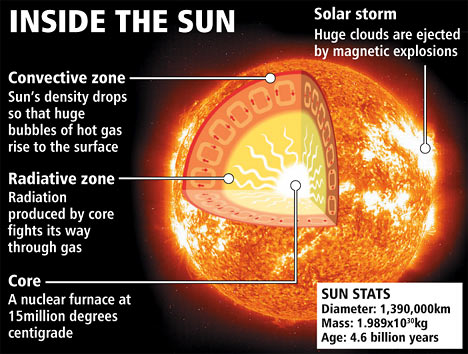
Light that reaches us from the sun is largely in the range of visible and near-visible light, but it starts out in the sun’s reactive core as gamma rays, high energy (short wavelength) byproducts of nuclear fusion. These gamma rays begin a “random walk” out of the sun’s core and through its conduction zone, repeatedly colliding with particles in the dense surrounding soup of hydrogen and helium ions, changing directions randomly, over and over again, and gradually losing energy (thus shifting to more benign longer wavelengths). Eventually, after something like 100,000 to a million years, they reach the sun’s surface and fly off in all directions at the speed of light, 186,282 miles per second.

Structure of the sun, from theuniverse-michael-lawson.weebly.com

An even more important consideration (mentioned above) is that, in the universe God created, electromagnetic energy (let me just call it “light” here, for brevity) is always associated with matter. There are a number of ways that light can be generated, but it always begins with matter. I’ll mention a possible exception below, under the heading “sh’kinah“, but for now, I’m talking about the light that all of us experience.

It is worth mentioning that all light is invisible until it strikes a detector. If you are in an empty, dark place and someone shines a flashlight past you, you may see the glowing source, but you will not see any trace of the beam, which consists only of a jiggling electromagnetic field, unless it strikes an air or dust molecule and reflects into your eye.

Most light in the universe is generated by stars like our sun, but all matter generates light, usually much less energetic than stellar gamma rays but still light, even if it is well below our range of sight. The human retina is populated by several types of light receptor: “cones” for detecting color when the light intensity is strong enough, and “rods” for detecting black and white in low light situations. My cat, Anna, can see me very well in a darkened (but not totally dark) room, because her retinas are mostly populated by “rods”.

Matter that is not heated to a glow, still generates heat, and that heat energy is radiated as light in the infrared region. If raised to a high enough temperature, the energy of the radiated light will eventually climb into the visible region, first red, and when hot enough, all the way to the blue side of the spectrum.

[Note: This is why the red and blue markings on faucets and automobile heater controls are so confusing and counterintuitive to me. To any scientist and most engineers, it should be red for cold and blue for hot, in spectral order.]

I took the photo of Anna, below, using an infrared sensor. The color isn’t real. The sensor’s pixels map the wavelengths of the infrared light in the scene and use an algorithm to determine the temperature that the pixel is “seeing”. False color is then added to encode it, as per the scale on the left. The warmest parts of the photo are her eyes, about 96°F. Next warmest is her face, followed by her tummy and legs. Her cold nose and the thick fur on her back and tail matches the cooler temperatures of the table she’s lounging on and the room to the right. The blue areas, our front door and glazed side panels, are quite cold. It was winter, and the windows here are single-glazed and very poor insulators.


In this photo, the small amount of heat registered from the window is a combination of heat from Anna and the room itself, being reflected back towards my sensor, heat generated by the window glass itself, and heat from outside conducted (see below) through the glass and woodwork.

All matter generates heat provided that its temperature is above absolute zero (−459.67°F). In the presence of any heat at all, the sub-atomic particles in atoms and molecules vibrate. The quantum mechanical mechanism causing this is beyond my scope here, but that vibration causes a release of energy in the form of heat. Heat energy is propagated in one or more of three ways:

  • Conduction – If two objects are touching each other, then the heat stored in the hotter will flow to the cooler (that’s the “first law of thermodynamics”).
  • Convection – In a gas or liquid, heat energy from a hot container will flow to the fluid by conduction and then the heated fluid will rise, setting up a convection current in the liquid.
  • Radiation – Whether or not either of the above occur, there will always be some heat flow in the form of electromagnetic radiation. To me, that is light, whether I can see it or not!

Absolute zero is theoretically unobtainable, because an object at absolute zero would cease all motion, including vibrations within the nucleus and movement of the electrons. All liquids and gasses (including the atmosphere) at this temperature would immediately solidify and collapse to a dense, inert lump, which I don’t believe describes the condition of earth in Genesis 1:2.

This is why I think that it would make no sense for light to have been created subsequent to the creation of matter in Genesis 1:1, whether you interpret that as a summary or a first event.

Since light is so intimately connected with matter, it is unthinkable to me that light would have come first.

Verses 4 and 5 are also difficult for me to accept in a literal sense. “Day and night” are conceptual nouns, and night simply refers to the shadow caused on one side of earth as it rotates away from the sun. But the sun isn’t created until Day 4. Some would say that this verse is where God created time. But time, as now understood by physicists, is part of the fabric of the universe itself (see Implications of God’s Omnipresence and Eternity in Space-Time).

sh’kinah

God’s own sh’kinah is also a light source, and one not connected with matter. It is the light source that led the Israelites out of Egypt, that lit up the top of Mt. Sinai, that resided in the Holy of Holies in the Tabernacle and later the Temple, and that was described in the visions of several of the prophets.

Some commentators have suggested that God’s sh’kinah is the source of the light that God “created” on Day 1. This is absolutely a possibility, but if true, even if it functioned in exactly the same way as the light that we are familiar with, is it meaningful to say that God “created light” on Day 1 if the light he created was fundamentally different from the light that we know? On Day 4, God assigned the responsibility for light-bearing to the sun, moon and stars. In any case, I think the sh’kinah is one of God’s native characteristics, not a later creation.

“Let there be light…”

The Hebrew for this phase is yehi or. With its many linguistic modifiers, Yehi appears 3,561 times in scripture, so it is well understood. To my knowledge, there is complete agreement on the translation here, “let there be“. I am not aware of any context in which it clearly denotes a creative act. It is like saying, “Hey bub, flip on the light, will ya’?”

Interpreting verses 1:3–2:3

As for me, I don’t think that Genesis 1:3–2:3 can be a literal description of how God created the cosmos, because these verses do not describe the immensely complex universe in which we live!

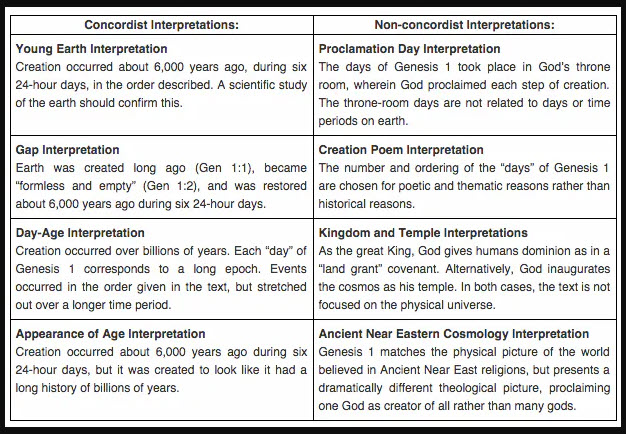
In The Hijacking of Creationism, I mentioned a number of alternative theories proposed by conservatives to explain this passage, as listed in Millard Erickson’s Christian Theology. Another such list is presented below:

Concordist and Non-Concordist Interpretations of Genesis 1, from an article at biologos.com, “Comparing Interpretations of Genesis 1“, by Deborah Haarsma and Loren Haarsma

The authors of the above table define “concordism” as follows:

In concordist interpretations, God made the earth using the sequence of events described in Genesis 1. In non-concordist interpretations, God created the earth using a different timing and order of events than those described Genesis 1.

According to 19th century theologian, minister and writer, C.I. Schofield, Genesis 1 describes God’s miraculous 6-day rebuilding of an ancient earth after a previous judgement (of earlier humans and/or angelic beings) by inundation. This is a Gap interpretation, from the left side of the table.

What has long intrigued me about Schofield’s Gap Theory is that in the sequence listed, Genesis 1 describes precisely how earth would most likely have recovered from a general flood like that of Noah’s day. If that is true, then both floods were miraculous inundations of the entire planet, and the unnaturally rapid recovery in both cases was also miraculous. This is why I have for years called myself a “gap guy“, or more recently, a “two-flood” guy.

Still, I am no longer adamant about Gap Theory, because it can’t be proven one way or the other, and I don’t share Schofield’s opinion that the judgement leading to the earlier flood was connected to angelic corruption on earth. There is no Biblical evidence of angelic rebellion before Satan appears in the Garden of Eden.

More importantly, after doing extensive study during the last several years in the course of thinking about this series on Creation and another post on Gods and Demons, I feel drawn to a different interpretation that would be much more comprehensible to the people in Moses’ day and well beyond.

A better idea

What was the cultural background?

Regarding the culture of Moses’ day, it is inconceivable that he or his readers would have had the intellectual tools needed to process concepts like mass, energy, the nature of light, or even cosmically vast distances and time scales or a spherical earth.

We tend to think of ancient civilization as a scattering of isolated small city states like Sumer, Akkad, Elam, and even Egypt on the far end of the Fertile Crescent, but they all had a common heritage going back to Babel and even to the Flood.

And even in the distant past there were frequent interactions among peoples. Both war and peace brought people together, either in conquest or in trade. Consequently, there were many similarities between regions, in culture and religion. Though the names and functions of the pagan gods differed somewhat from region to region, there was general agreement about the nature of the world and the duties of the godhead in maintaining its order.

Ancient Near East before Moses. http://www.hyperhistory.com 2016

The region that became Israel was part of this milieu. The Israelites were descended from Abraham, who was Mesopotamian. Their later heritage was Canaanite and then Egyptian. The Torah (“Teachings“, the “Five Books of Moses”) that God delivered to His people, had the singular purpose of revealing Himself and His Divine Will to humankind.

In Moses’ day, as in Noah’s and even Jesus’ and beyond, the Israelites shared the beliefs of their Ancient Near Eastern (ANE) neighbors about cosmology (the nature of the heavens and the earth). Though their concept was, of course, deeply flawed, it was functionally adequate for millennia, and it diminished God’s role only in that it ascribed His creation to false creators. The following diagram shows the essence of what was universally accepted as true cosmology in the ANE.

Note that this is also clearly the cosmology described in Genesis 1!

Composite artist’s conception of the Ancient Near Eastern view of cosmology. Source unlisted.

The earth was a roughly disk-shaped island floating on the sea (possibly supported on “the pillars of earth”) and covered with a dome, the “firmament” of KJV. The sea was not only below the earth and feeding its springs (the “fountains of the deep”), but also covered the dome above (the “waters above the firmament”). In some versions the dome was supported at its rim by a ring of mountains (the “pillars of heaven”). The sun and moon traveled across the sky below the dome, sinking into the sea or through doors in the west, and traveling back east through the underworld to rise again. The stars and planets followed fixed grooves beneath the dome. Rain occurred when windows in the dome (the “windows of heaven”) were opened by the gods.

No matter how one interprets Genesis 1, the central issue that had to be addressed by God was that each element in the above diagram was believed to either be a god or goddess, or to be governed by one. And, of course, it was believed that all owed its existence to one or more chief creator gods. Rather than “nothingness” before creation, the cosmos existed, but was in a state of chaos (formlessness, or tohu wabohu, as defined above); thus, creation amounted to bringing order out of disorder.

So, what are my views?

A Genesis 1 alternative that makes total sense to me now is related to historical observations that the Israelites shared the culture and cosmology of the surrounding peoples. The Genesis account and the Bible as a whole condemns the pagan polytheistic connection, but does nothing to dispel the cosmological misconceptions, which were still believed by most cultures, including Israel’s, well into the Christian era.

The chart below displays relationships recognized by many conservative theologians who hold to a literal, Concordist, interpretation of Genesis 1; however, rather than interpreting the chart as an account of literally how God created the physical cosmos, I think it is better understood as a very abbreviated poetic description of the finished product.

From Origins: Christian Perspectives on Creation, Evolution, and Intelligent Design,
by Deborah B. Haarsma and Loren D. Haarsma 

Understood in that way, it becomes one version of a Creation Poem Interpretation of Genesis 1. As such, it is essentially a polemic (a statement argumentatively refuting an opinion or doctrine held by others) against the creation myths of pagan cultures who credit their false gods, who most certainly did not create or rule the cosmos!

The ANE held no conception of infinite time or eternity. They thought no farther back than the initial chaos (compare Genesis 1:2), out of which arose the creator god, who then began to assemble the cosmos from the chaos. Only Yahweh claimed to be eternal and uncreated, and to create ex nihilo.

Whereas modern man sees existence as material in nature, with tangible substance and physical properties, it wasn’t enough for the ancients that something was visible and occupied space—as stated by John H. Walton in Ancient Near Eastern Thought and the Old Testament, it had to first “come into existence” metaphysically by being “separated out as a distinct entity, given a function, and given a name.”

A key insight that I have gleaned from Walton and others who have professionally studied the ANE is that the ancients viewed the ontological nature of the cosmos, i.e., “the nature of that which exists” in terms of function, whereas moderns view it in terms of substance. In other words, when a Big Bang Creationist like me thinks of God’s handiwork, I see mass and energy, bosons and fermions, stars and planets, rocks and trees, etc. A Young Earth Creationist similarly sees a universe of substance. To the ancients, in contrast, the substance of things is only incidental to their functions.

Consequently, I’m beginning to understand that God’s purpose in Genesis 1 was to ignore the misconceptions of the ANE regarding the physical nature of the cosmos, since that was a triviality to pretty much 100% of the population, and to say, in ways they would understand, “I, Yahweh, brought it into being [verse 1] and gave it function [the rest of Genesis 1].”

In this way of thinking,

  • Days 1 and 4 were about time, seasons, and the cosmic objects that differentiate them;
  • Days 2 and 5 were about the waters below and above, and about their denizens; and
  • Days 3 and 6 were about the land and its fecundity.

What point was God then making?

According to Walton, “The records of events in the ancient world were not given so that the reader could reconstruct the event. They were given so that the reader could understand the significance of the past for the present. In that sense, outcomes were more important than the events themselves.”

The pagan creation myth most familiar to modern scholars today is the Enuma Elish, from the Assyrian Library of Ashurbanipal at Nineveh. I’ll close this post with a comparison of Genesis 1 with this pagan document, which I think clearly illustrates God’s point:

From Origins: Christian Perspectives on Creation, Evolution, and Intelligent Design,
by Deborah B. Haarsma and Loren D. Haarsma 

Bibliography

Haarsma, Deborah B., Loren D. Haarsma, Origens: Christian Perspectives on Creation, Evolution, and Intelligent Design,2011, Grand Rapids: Faith Alive Christian Resources.

Walton, John H., Ancient Near Eastern Thought and the Old Testament, 2nd ed., 2018, Grand Rapids: Baker Academic.

Zuck, Roy B., Basic Bible Interpretation, 1991, Colorado Springs: Cook Communications Ministries

Next in series: Quantum Freewill


Implications of God’s Omnipresence and Eternity in Space-Time

Posted on:

Modified on:

  1. “Theology Proper”
    1. Trinity
    2. Spirit
    3. Alternative sources
  2. Omnipresence
    1. Classical views
    2. Defining the cosmos
    3. God in the cosmos
    4. Parenthetic: Is God’s omnipotence limited?
  3. Eternity (Timelessness)
    1. Classical views
    2. Defining time
    3. Space and Time: Spacetime
    4. God in time

I have had trouble writing this because God’s Creation is so astoundingly complex that it has taken me over three months to settle on a narrative that avoids rabbit trails that are vitally interesting to me, but probably boringly obtuse to many of my readers.

My intention here is to explore two of God’s divine attributes that I think are very closely related, and to speculate, in the simplest terms I can come up with, how they might have additional implications in the light of modern physics.

“Theology Proper”

Any formal study of God and His creation is going to start with a subject from a textbook categorized as a “systematic theology.” The section of that book concerned with the nature and characteristics of God Himself is called a “theology proper.”

Intelligently discussing God’s Attributes is a tough task, because God Himself told us only what He determined we need to know, and the Bible was written in an age when neither the inspired human writers nor the intended readers could even begin to understand all of what was written, not to mention the vast majority of the topic that remained unwritten. In some cases, it seems to us as if some really important explanation is omitted that we modern humans would very much like to know.

Trinity

For instance, the Trinity of Father, Son and Holy Spirit can only be inferred from “hints” scattered throughout Scripture. Even the term “Godhead,” which at least sounds somewhat Trinitarian, is merely an infrequent translation of the Greek qeoteß, (theotes), which actually means simply “deity.” Paul used the term as a polemic against Colossian, gnostic pantheism, not as a theological description of the Trinity.

Attempts to find hints in the Old Testament mostly fail. The Hebrew אלהים, transliterated as elohim, is a masculine plural noun, usually meaning “gods”, “angels”, or sometimes “judges”, etc. But sometimes it refers to the name of God, Himself, in which the transliteration is capitalized: Elohim. Does the plural ending in this case imply multiples of God, e.g., the Trinity? No, because, while most Hebrew nouns are “regular”, there is a class called “irregular plural nouns” that don’t follow the usual rules. We have those in English, too: the plural of “foot” is not “foots”! However, English does not have singular and plural forms of verbs, and Hebrew does. Elohim, the true God, always appears with singular verbs.

What about the first chapters of Genesis, where Elohim says, “let us…”? Is this the Father speaking to the Son and Spirit? Inconceivable! What one knows and thinks, the others know and think. That’s got to be implicit in the whole concept of “tri-unity.” The only exception would be the “kenosis“, when the Son emptied Himself and became incarnate (Philippians 2:6–7).

Use of the composite plural verb echad in the Shema (Deuteronomy 6:4) can’t be supported from the Hebrew grammar, either (see Monotheism and the Trinity, where I hedge a bit on this).

Why is there no specific Biblical mention of the Trinity? Well, perhaps it is because the ancient writers (and to a lesser extent, even today’s highly educated theologians) had no scientific or linguistic tools sufficient for the task. Explaining the Trinity is beyond the ability of even 21st Century Theologians. There is no known analog to make it clear to us.

Spirit

I suppose, personally, that it has something to do with the nature of sentience (consciousness—having senses and perceptions) without physical substance. “Spirit,” in the Biblical sense, is something that our best modern science can’t detect or explain. It isn’t matter. It isn’t energy. It is independent of either and in God’s case, it is superior to both.

Author and educator John C. Lennox suggests that man’s spirit, which is, in life, associated with his body, is what God means by His “image.” Dictionary definitions of “image” include terms like “reproduction”, “imitation”, “likeness”, etc., most of which imply that an image is in some way inferior to the original. God is spirit, whereas man’s spirit is confined to a physical body now, and even when that body is glorified, will still be constrained to locality.

Alternative sources

Many Christians, if asked, would say that only Scripture is valid truth. I believe that the perceptions of an educated Christian are capable of much understanding, even of issues that aren’t fully addressed in Scripture. To this end, I am going to blend in a little human science.

Scientists do two things, for the most part really well: they collect data; and they propose explanations. In either order; in fact, frequently in iterations. Sometimes the explanations have a devious political or theological aim, but more often than not, it’s just enquiring minds wanting to know. Honest data collection can’t possibly hurt us, because it is our God who provides the data!

I am going to combine the concepts of God’s omnipresence and eternity (or eternality) in following sections, but classically they were considered to be entirely separate Divine Attributes.

Omnipresence

Classical views

God’s omnipresence means that He is present, everywhere in the cosmos, simultaneously and fully. He is here and aware of His surroundings, at this moment, in my home office where I am typing this post. At the exact same instant, He is present and aware of plasma currents in the heart of a star billions of light-years from my office. Not just one star—all of them, everywhere. And then, there are also the falling sparrows…

At the same time, He is present on a throne at a location we call “heaven,” where the Bible pictures Him communicating with angels, prophets and sundry other beings. Where His throne and its setting are described in Isaiah, Ezekiel, Daniel and Revelation, I think that the prophetic visions are not to be interpreted as a specific place, but rather as an interface between God and others, depicted in such a way as to convey glory and holiness to limited ancient understandings.

Of course, the Bible also depicts God as from time to time present at specific localities, for example: in a burning bush; outside a cave on Mt. Horeb; in a pillar of cloud and fire; above the Ark of the Covenant; and in the Holy of Holies in the Tabernacle and later the Temple. These “theophanies” were instances where God chose to show a localized physical manifestation of his presence to reassure His people that He is more than just a disembodied concept.

Defining the cosmos
Hubble eXtreme Deep Field (XDF). This is a 2008 long exposure photograph of a very tiny area of the sky, and each item shown is a separate galaxy. From Wikipedia.

The astronomical term “cosmos” is defined by Merriam Webster as “an orderly harmonious systematic universe.” After millennia of honest science by many Christians and non-Christians, the current most popular view is that our universe (in my view, the only universe there is) is about 93 billion lightyears (550,000 billion-billion miles) in diameter—and that’s just the part we can see! A rough estimate that has been cited for years is that there are at least a hundred billion galaxies in the universe, with an average of a hundred billion stars per galaxy. That is probably conservative. It appears that most stars are associated with planetary systems like our Solar System. Most planets probably have one or more moons. But there is so much more out there than stars, planets and moons!

That’s the big stuff. Looking at the small stuff, most of you are somewhat familiar with the concept of atoms and molecules. You know that atoms consist of protons, neutrons and electrons. Actually, there is a whole “zoo” of other particles around us that are less familiar. Stars mostly burn Hydrogen. Our own sun burns around 200 million tons of hydrogen, the lightest of all elements, every second, and has enough left to keep burning for 4.5 billion more years.

God in the cosmos

God’s omnipresence means that He is present throughout the universe, as well as enfolding its entirety within the envelope of His presence. His omniscience (all-knowingness) assures that He is aware of every last particle within that volume, and His omnipotence (all-powerfulness) assures that His control extends to even the smallest sub-atomic particle within the volume. Does this mean that He is constantly propping everything up, or “micro-managing”? Clearly, He can fiddle wherever He wants to, and clearly (from Scripture), He occasionally does, but He is the author of the laws of physics, and I’m quite sure He is more than capable of having designed it to be self-sustaining! An automotive engineer can design and build a car, but he can also drive it without manually spooning gasoline to each cylinder. I trust my God, and I also trust what He has built and what He is continuously supervising.

The late Henry Morris rejected the “uniformitarian” concept that geological processes worked the same way in the past that they do today. But throughout his book, he mischaracterized the concept, as he did the Second Law of Thermodynamics. Both of those principles are valid only in a closed system, meaning no external interference. Both principles would say that an acorn dropping from the oak tree outside my office window will fall to the ground. But if I reach out and catch it, I haven’t violated the principle, I’ve simply violated the explicit assumption that the tree, the acorn and the ground was a closed system. My hand invalidated the assumption by making the system “open“. Was a world-wide flood possible without God’s intervention? Actually, yes, the physical laws make it highly unlikely, but don’t prohibit it. But we know that God intervened, so the laws didn’t apply in that case. (See Fountains of the Deep.)

Parenthetic: Is God’s omnipotence limited?

I think that most conservative theologians would say that it is! For example, Wayne Grudem states:

…it is not entirely accurate to say that God can do anything. Even [Scripture passages] must be understood in their contexts to mean that God can do anything he wills to do or anything that is consistent with his character. Although God’s power is infinite, his use of that power is qualified by his other attributes (just as all God’s attributes qualify all his actions). This is therefore another instance where misunderstanding would result if one attribute were isolated from the rest of God’s character and emphasized in a disproportionate way.

Grudem’s Systematic Theology (2nd ed.)

Many have added what I think should be self-evident, that God can’t violate simple logic. No, He can’t make a rock so heavy that He can’t lift if. That is a paradoxical absurdity. And no, He can’t make 2 plus 2 equal 6 (need I add, “in base 10”?). It is what it is.

Eternity (Timelessness)

Classical views

God’s attribute of eternity is comparable to His omnipresence, in that it defines His all-encompassing span of existence in time, rather than space. He is not only everywhere, but also everywhen. He is Alpha and Omega, Beginning and End. His temporal span is from eternity past through eternity future. When, at the burning bush, Moses asked Him His name, God replied in two ways. First,

God said to Moshe, “Ehyeh Asher Ehyeh [I am/will be what I am/will be],” and added, “Here is what to say to the people of Isra’el: ‘Ehyeh [אֶהְיֶה, I Am or I Will Be] has sent me to you.’”
—Exodus 3:14 CJB

The above is commonly taken to be an expression of God’s timeless existence; effectively, “I am now what I always have been and always will be.” This, however, is not so much a name of God as a statement of His nature. His “covenant name” delivered in the following verse, is a wordplay on the Hebrew ehyeh:

God said further to Moshe, “Say this to the people of Isra’el: ‘Yud-Heh-Vav-Heh [ADONAI], the God of your fathers, the God of Avraham, the God of Yitz’chak and the God of Ya‘akov, has sent me to you.’ This is my name forever; this is how I am to be remembered generation after generation.
—Exodus 3:15 CJB

The 4-letter Hebrew name given here, יהוה, known as the “Tetragrammaton,” is commonly transliterated and pronounced as Yahweh (or, the grammatically corrupt version, Jehovah), but the vowels, and thus the pronunciation, are inferred rather than known. Strong’s defines it as “(the) self-Existent or Eternal“, but again, I think that this is an inferred, not a known, meaning, and based on the wordplay, I prefer to regard it as a proper name.

Defining time
Sorry, but illustrating timelessness isn’t easy. Some of you will recognize this as the BBC version of a time machine. Dr. Who’s disguised TARDIS.

Time, of course, is the concept that you perceive the present, remember (or not) the past, and anticipate (or not) the future. Physicists relate this to entropy, which some define as randomness, but that definition is deceptive. More accurately, a quantity called “degrees of freedom” increases. Newton’s Second Law says that, in a closed system (see above), entropy increases. At the risk of depressing you, an organism eats and assimilates its food, and grows. It may appear to be getting less “random” and more like an “organized” entity, but the fact is that each cell and biochemical molecule is simply part of a cycle of maturation and eventual death and decay. More cells mean more degrees of freedom. More stuff to go wrong. Scattered raw materials can be gathered and processed, and a useful machine can be manufactured, but all such constructs eventually wear out and fail, becoming scrap. “Dust thou art, and to dust thou shalt return.”

Space and Time: Spacetime

Both spacial and temporal location can be specified either relatively (here, there, now, then) or absolutely, using coordinates (for example, with rulers and clocks). But—think about this—are space and time merely abstract concepts, or are they real, tangible, things?

Space is most definitely real. It is not, as once thought, just the vacuum through which the “stuff” of the universe floats and moves. Now, observation and theoretical research suggest that space itself has properties that differentiate it from whatever is outside the universe. Time is evidently one of those properties, so also must be a real thing. Hold on to this concept: In the “old days”, the universe was thought to be an area in space; now we consider the universe to be space, time, and everything else that we know exists. Except, in my Christian “worldview”, for God and His realm, which are both outside the universe and permeating it to the smallest subatomic particle.

In 1905, Albert Einstein’s Special Theory of Relativity provided a theoretical framework for unifying the concepts of space and time. It turns out that there is a physical and geometrical relationship between the two seemingly unrelated concepts. To greatly oversimplify, if an accelerating object passes you at a high velocity, it will appear to you that it is foreshortened in the direction of motion, and that time is passing more slowly on it than on your own platform. The important thing in the present context (this post) is that both space and time appear to be—and in fact are—distorted, and their distortions are mathematically related. These effects are not easily seen except at velocities that are a significant proportion of the speed of light. It certainly does sound counterintuitive, but by now, the physics has long since been proved and integrated into modern technology.

God in time

Apologist author William Lane Craig, in his book Time and Eternity: Exploring God’s Relationship to Time, examines the question of whether God’s Eternality implies that He exists within the framework of time or outside of time, looking in. In rather tedious detail, he approaches the question from the standpoints of theology, physics, and philosophy, and reaches the conclusion that God must exist within time in order to keep His bearings, since there would evidently be no temporal landmarks to go by.

Hmm… Lane is a very smart man who clearly embraces God in all His majesty, and he has obviously devoted a lot of thought and research into the subject. But his logic here, frankly, escapes me. God’s omnipresence means that He both envelopes and inhabits everything outside and inside the universe. His attribute of eternity implies the same with respect to time. The relativistic connection of space and time reinforces that implication. I see no reason that He should ever be disoriented, in any fashion. An expanded definition of “omnipresence”, then would state that

God simultaneously and instantaneously sees and remembers everything that exists and occurs at all locations in both space and time.

Note that I threw in the word “instantaneously” because, while nothing in the universe can travel faster than the constant speed of light, that is a limitation of space itself. Space with its enclosed stuff is expanding faster than the speed of light. There is no speed limit outside the universe.

What does Quantum Physics add to the picture?

A lot, and I only recently began probing the theological implications.

Newton’s First Law of motion states that, An object at rest remains at rest, and an object in motion remains in motion at constant speed and in a straight line unless acted on by an unbalanced force. We call that tendency “inertia.”

It turns out that this law doesn’t hold for extremely small objects. We’ve known for about a hundred years that small objects like electrons and photons move in ways that are fundamentally unpredictable. The best you can ever do is calculate a probability distribution. Which was hard for many physicists, including Einstein, to accept, because they believed in a “deterministic universe“—if you know where everything is now, and the forces on it all, then theoretically you can predict the future. Einstein famously said, “God doesn’t play dice with the universe.” Make no mistake, he wasn’t a theist. What he meant was that he didn’t believe in a future determined by chance.

What does this randomness in nature mean, theologically? Warning: from here on, this is just my own speculation, not something from either science or theology. Take it or leave it. If there is randomness in the universe, then that can only be because God wanted it that way and designed it that way. If the future is truly random, then presumably even He can’t predict the future. <shock!!!> But God needn’t predict the future when He can see it! Remember, He lives in all times simultaneously. God fore-knows because He fore-sees.

Why would God have designed it this way? Perhaps it’s because He wanted to give the denizens of the universe freewill! That does not mean He’s lost control of the universe. Three reasons:

  1. Large objects, like stars, planets and even baseballs and marbles, have enough inertia to obey the First Law.
  2. If you flip a coin once, you’re equally as likely to achieve one result as the other, but if you flip it a thousand times, it’s virtually 100% sure that the total number of heads and tails will be very close to equal.
  3. And, of course, God not only sees the future, but He can nudge it in any way that He sees fit. His sovereignty means He can, not that he necessarily does!

The Hijacking of Creationism

Posted on:

Modified on:

  1. John C. Lennox
  2. Henry M. Morris
    1. Book: The Genesis Flood
    2. Morris’ Qualifications
  3. My own background
  4. Alternate theories

John C. Lennox

Over the last several months, I have adopted a new favorite author. His name is John C. Lennox. Among other things, he is a Cambridge-educated Emeritus Professor of Mathematics at the University of Oxford, and he has written a number of books on subjects that have interested me for many years.

Author, Educator, Mathematician and Philosopher, John C Lennox. BBC Photo.

Most of his opinions on the intersection of theology and science seem to match my own very closely. In particular, a point from his book, God’s Undertaker: Has Science Buried God?, particularly resonates with me.

Conservative Christian scholars have mostly agreed that God miraculously created the universe, that humans descended from a real Adam and Eve, that the Genesis Flood was real, and that science does not trump Scripture!

I agree with all that!

But not all of those are “Young Earth” Creationists, and not all believe the theory, stated nowhere in Scripture, that the universe’s appearance of vast age is due to the Genesis Flood. Now, unfortunately, according to Professor Lennox (and my own observation), you are no longer free to reject that view.

Today, if you say you are not specifically a “young earth” creationist, then you will automatically be viewed by most of your Christian peers as a denier of Scriptural inerrancy and an “Evolutionist“.

Henry M. Morris

A large percentage of conservative Christianity, including major influencers like John MacArthur Jr, who I greatly admire, accept Henry Morris’ flood theory more or less uncritically.

Book: The Genesis Flood

The so-called “flood theory” was popularized by Morris in 1961 in a book that he co-authored with theologian John C. Whitcomb Jr, titled The Genesis Flood. I recall first reading the book in the late 70’s or early 80’s. It was formatted into two sections, one being a theological treatment by Whitcomb, and the other a mechanistic approach by Morris, laying out his theory that the apparent age of the earth was caused by rapid erosion and redeposition of silt due to earth-rending, catastrophic flooding, accompanied by massive earthquakes and tsunami surges. After reading Whitcomb’s exposition on the Biblical evidence for a worldwide flood, I was an enthusiastic fan of the book. That enthusiasm faded when I read Morris’ section. I found his grasp of fundamental geology and physics to be highly flawed, and his argumentative style (e.g., “any fool can plainly see…”) to be arrogant and insulting.

1976 edition of The Genesis Flood

The believability of The Genesis Flood was greatly enhanced by a Foreword (not included in the latest edition) written by an eminent geologist, John C. McCampell, PhD, of the University of Southwestern Louisiana. Unfortunately, book Forewords don’t always get read with the same concentration as the body. Dr. McCampbell did not endorse the theory! What he endorsed was Morris’ Christian worldview, fairness and independent thinking! The appliable paragraph read:

"From the [Foreword] writer's viewpoint, as a professional geologist, these explanations and contentions are difficult to accept. For the present at least, although quite ready to recognize the inadequacies of Lyellian uniformitarianism, I would prefer to hope that some other means of harmonization of religion and geology, which retains the essential structure of modern historical geology, could be found."

Morris’ Qualifications

Morris billed himself as a “hydrologist“. To me, the term “hydrology” implies much more than what Morris apparently did in his professional life. The US Geological Survey discusses the field broadly here. Wiktionary provides a more succinct definition, which I think works well:

Hydrology: Noun
1. The science of the properties, distribution, and effects of water on a planet's surface, in the soil and underlying rocks, and in the atmosphere.
2. The properties, distribution, and flows of water in a specific locale; the hydrological characteristics of a particular place or region.

But let’s examine Dr. Morris’ qualifications:
(this section updated on 1/10/2024)

In a 2006 Washington Post obituary, quoted by Wikipedia, Morris was hailed as the “father of modern creation science”, and his book as the “founding document of the creationist movement.” Yet Morris himself had only a dim understanding of the principles he invoked in the book.

His early education was at Rice University, where he earned a BS in Civil Engineering. Undergraduate CE courses focus primarily on basic physics and chemistry, math, engineering economics and design, structural analysis, strength of materials, soil mechanics, environmental issues, engineering computations, and fluid mechanics.

Leaving Rice with his BSCE degree, Morris took a three-year educational gap during which he was employed as a “hydraulic engineer”, apparently in the Rio Grande Valley monitoring sand wash in the border waters. With his rudimentary background, his job would have consisted mainly in recording flood levels and monitoring bank erosion. As far as I can determine, that is the extent of his practical hydrological experience.

After his stint “in the field”, Morris returned to Rice for a few years as, apparently, a graduate teaching assistant in civil engineering. He then moved on to the University of Minnesota, where he earned a master’s degree in hydraulics and a PhD in hydraulic engineering (a sub-field of civil engineering, where the focus is on dams, manufactured waterways, and static forces from groundwater on structural foundations).

The remainder of his career, until he departed to focus on creationism, was spent in academia, as a teacher of civil engineering and applied science. Speaking for myself, after earning an MS in Petroleum Engineering, I enraged my supervising professor by refusing to stay for a doctorate. My reason was that engineering PhDs are geared towards academic careers, not towards real-world experience and productivity. And, frankly, the real world pays way more than academia.

Morris’ career certainly did not qualify him in any way as an expert on the issues he addressed in The Genesis Flood. His theories defy the realities of geological science, and his frequent references to the second law of thermodynamics (entropy) and uniformitarianism demonstrated a poor understanding of both concepts.

My own background

I must now establish my own credentials for entering into this critique of Young Earth Creationism in general, and the Flood Theory in particular.

My undergraduate studies at the University of Texas were in math and physics. My intention was to do my postgraduate studies in astrophysics, but after a 2-year Naval tour, practical considerations induced me to accept a graduate fellowship in Petroleum Engineering at Texas, instead.

Part of the apparatus for my Rock Mechanics thesis, 1975

For many years after college, my professional career was as a petroleum engineer. I started as a field production engineer for a major integrated oil corporation in Oklahoma, absorbing the hands-on, nuts and bolts of equipment and procedure in a very large working oil field. With proficiency came the desire to be more than a small cog in a big, cumbersome, money machine, so I left Big Oil to spend most of my career in more responsible positions with smaller “independent oil and gas companies”.

Typical well log suite, downloaded from USGS

Though I have worked in all phases of the industry (except for refineries) my main specialty was reservoir engineering. I had some of the same civil engineering training as Morris (dams, weirs and channels), but most of my education and years of professional experience were more geological in scope. I dealt with almost anything relating to sedimentary rocks and stratigraphy: where the constituent particles originated; how they were weathered, transported by erosion, deposited, cemented, chemically modified, saturated and disrupted by viscous fluid flow within their pore space or fractures; and how they were subsequently modified by folding, fracturing, compressing, uplifting, and sometimes being exposed at the surface or under the sea, and beginning the cycle all over again. I collected and analyzed cores, drill cuttings, fluid samples, pressure profiles, and electrical resistivity and radiation data. From all that, I had to make reasonable estimates of how much, if any, and what types of hydrocarbons were deep underground, who owned the mineral rights in the drainage area, whether it could be profitably retrieved, by what means and how fast, and ultimately, how much profit was to be expected. I was answerable to my employers, clients, government agencies, royalty owners, and/or financial lenders. Sometimes I worked closely with geologists and legal folks, but mostly I worked for small companies and had to do pretty much all of the geology myself.

Alternate theories

Here I will discuss alternate Christian theories to account for the apparent vast age of the universe.

I will have more to say on Morris, the Genesis Flood, and my own views on creation (both the science and the theology) in future posts. Some I wrote years ago, but I plan to rework and repost them. The rest of this post will be a discussion of the Conservative traditions that current “creation culture” now considers to be unacceptable.

In his book, No Final Conflict, Francis Schaeffer lists several areas where, in his judgment, there is room for disagreement among Christians who believe in Creationism and the total truthfulness of Scripture:

1. There is a possibility that God created a “grown-up” universe.
2. There is a possibility of a break between Genesis 1:1 and 1:2 or between 1:2 and 1:3.
3. There is a possibility of a long day in Genesis 1.
4. There is a possibility that the flood affected the geological data.
5. The use of the word “kinds” in Genesis 1 may be quite broad.
6. There is a possibility of the death of animals before the fall.
7. Where the Hebrew word bārāʾ is not used, there is the possibility of sequence from previously existing things.

Millard Erickson’s Christian Theology (the text used at Calvary Bible College in Belton, MO when I attended classes there) lists the following Conservative theories, which mostly fit into the scope of Schaeffer’s comments, above:

  1. The gap theory holds that there was an original, quite complete creation of the earth perhaps billions of years ago (the creation mentioned in Gen. 1:1). Some sort of catastrophe occurred, however, so that the creation became empty and unformed (1:2). God then re-created the earth a few thousand years ago in a period of six days, populating it with all the species. This creation is described in Genesis 1:3–27. The apparent age of the earth and the fossil records showing development over long periods of time are to be attributed to the first creation. The catastrophe is often linked to the fall of Satan (Lucifer). Creation then lay in ruins for a long period of time before God rehabilitated or restored it.
  2. The flood theory views the earth as only a few thousand years old. At the time of Noah, the earth was covered by a tremendous flood, with huge waves with a velocity of a thousand miles an hour. These waves picked up various forms of life; the mud in which these forms were eventually deposited was solidified into rock under the tremendous pressure of the waves. The various rock strata represent various waves of the flood. These unusual forces accomplished in a short period what geologists believe would ordinarily require three billion years to accomplish.
  3. The ideal-time theory says that God created the world in a six-day period a relatively short time ago, but that he made it as if it were billions of years old. This is a genuinely novel and ingenious view. Adam, of course, did not begin his life as a newborn baby. At any point in his life he must have had an apparent (or ideal) age many years older than his actual age (i.e., the number of years since his creation). The ideal-time theory extends this principle. If God created trees, rather than merely tree seeds, they presumably had rings indicating an ideal age rather than their real age. Thus, each element of creation must have begun somewhere in the life cycle.
  4. The age-day theory is based upon the fact that the Hebrew word יוֹם (yom), while it most frequently means a twenty-four-hour period, is not limited to that meaning. It can also mean epochs or long periods of time, and that is how it should be understood in this context. This view holds that God created in a series of acts over long periods of time. The geological and fossil records correspond to the days of his creative acts.
  5. The pictorial-day (or literary-framework) theory regards the days of creation as more a matter of logical structuring than of chronological order. The author arranged the material in a logical grouping that took the form of six periods. While there may be some chronological dimension to the ordering, it is to be thought of as primarily logical. The account is arranged in two groups of three—days one through three and days four through six. Parallels can be seen between the first and fourth, the second and fifth, and the third and sixth days of creation.
  6. The revelatory-day theory. The days were not successive days on which God did the creation, but days on which the story of creation was revealed. So the truth of the account took place in six twenty-four-hour periods, but the actual creation may have taken much longer than that.

Erickson himself favors the ideal-time theory, as you might guess from the wording of paragraph 3 above. He states that it is “in many ways irrefutable both scientifically and exegetically but presents the theological problem that it makes God an apparent deceiver.” I would agree that any theory that does not incorporate an assumption of vast actual age would have to include this form of apparent age in order to account for function via the known physical laws. In fact, I would compare it to a movie started in the middle. Virtually everything about the universe appears very much to be aged, and in fact would have to do so. I am more concerned with the suggestion of deception than Erickson is, in view of the following, which tells me I should be able to trust my senses:

For his invisible attributes, namely, his eternal power and divine nature, have been clearly perceived, ever since the creation of the world, in the things that have been made.
—Romans 1:20 ESV

Grudem’s Systematic Theology, Wayne Grudem, lists more or less the same group of theories, and goes into much more detail on all questions of creation.

Grudem sums up his opinion as follows: “My strong encouragement to the entire Christian community is that both old earth and young earth viewpoints should be acceptable for leaders in evangelical churches and evangelical parachurch organizations.”

Ryrie’s Basic Theology, Charles Ryrie, presents a subset of the above, but without specific names. He is far more concerned about the creation of Man, specifically, than the Universe in general.

Ryrie is somewhat non-committal regarding the Universe but does seem to favor a young earth. He is staunchly against biological evolution.

Some combination of the pictorial-day and revelatory-day theories seem to be favored by another contrarian, John Walton. I like Walton very much and think that he is on track.

Like many Christians of my age, I grew up with a Schofield Reference Bible, and I liked Schofield’s favorite, the gap theory for many years. I no longer hold that view. Based on extensive reading on Ancient Near East History and Culture, and with a better grasp of Biblical poetry, I now believe…

Next in Series: The Language of Creation


Geology a Flood Cannot Explain

Posted on:

Modified on:

  1. Examples
    1. Fine clastics
    2. Homogeneity and sharp boundaries
    3. Limestone strata
    4. Reversed sequences
    5. Discontinuities and crossbedding
    6. Aeolian deposits
    7. Glaciation
    8. Evaporites
  2. Conclusions

Examples

In a recent post, The Hijacking of Creationism, I discussed the currently obligatory conservative Christian view of why the earth appears to be billions of years old when traditional interpretations of Genesis 1 say it is only about 6,000 years old. I expressed my misgivings about that explanation, which proposes that all or certainly most of the appearance of age is due to damage to the earth’s crust caused by torrential rains and upheavals associated with the Genesis Flood. I also expressed doubts about the qualifications of Henry Morris, popularizer of the Flood Theory.

I do believe in the historicity of the Genesis Flood itself, but I don’t believe that the best explanation of how God brought this judgement about (see Fountains of the Deep, an earlier post) would have caused the level of devastation that Flood Theory requires.

As recapitulation of my own technical and professional qualifications: I am not a geologist, but I am well-trained in relevant aspects of geology. In a long career as a petroleum engineer, I worked extensively with and/or in place of geologists.

There are several sub-fields of petroleum engineering, and I have worked most of them. For most of my tenure with both large and small companies, both as an employee and as a consultant, I served as a petroleum reservoir engineer. As such I have had to be intimately familiar with all aspects of stratigraphy (rock layering), including rock and fluid properties, strata deposition mechanisms and deformations, fluid saturations and flow mechanisms, and, for diagnostic purposes, subsurface electrical and radioactivity profiles. As a well-site drilling engineer, I have examined rock cores and bit cuttings, electrical logs, pressure and flow tests, and more, from the surface to more than a mile deep. As a production engineer, I have observed how both productive and non-productive rock strata behave under a wide variety of external disturbances. In short, I probably know more about rock layers and how they behave than most geologists in non-petroleum fields.

One way to solve the age problem is to simply say, “What’s the problem? God simply spoke everything into existence exactly the way we would have seen it in 4004 BC!” Now, I don’t doubt for an instant that Almighty God is capable of just such a mighty act but just because He can, does that mean that He did? Observation suggests that He did not. To borrow a phrase from 1 Cor. 14:33, God is not the author of confusion, so why would His creation be so complex and appear so tremendously old, if it is not? Just to fool scientists and throw people off the track? I don’t think so!

Several years ago, before the advent of smartphones, I set out to make the 22-minute drive from my home to Belton, Missouri, where I was taking a semester of Theology at a Bible College. The topic of the day was to be Creation, and I knew that my professor was a proponent of Flood Theory. On the way I decided to pull out my microcassette recorder and list as many geological phenomena as I could think of, before I got there, that I know cannot be explained by the flood. I’ve since lost the list, but I recall most of what was on it. Here are some of the key items (in no particular order), with my reasoning added:

To top

Fine clastics

Clastics” are the small, sometimes microscopic, rock fragments formed by “weathering” of larger fragments or massive rock formations. “Erosion” is the process by which clastics are subsequently moved from place to place and deposited in broad areas by the force of moving water, wind, glaciation, volcanic action, or simple gravity. When these clastic “sediments” become fused together over long periods of time by heat, pressure or chemical action, they become the sedimentary rock strata that we see today. My focus here is on the fragments themselves, not the strata.

Weathering of solid, non-sedimentary rocks like granite is generally not due primarily to frictional erosive flow in stream beds as most people think, but rather is caused by expansion/contraction cycles. Perhaps the most important of such processes, often called “frost wedging“, occurs when water enters small cracks and pores in the rock, freezes, expands, and wedges the openings larger. Over many alternate cycles of freezing and thawing, the two sides of the wedged rock can completely separate. Plant growth in these opening can accelerate the wedging. Another very common process that weathers rock is “exfoliation“, which occurs as the surface of a rock heats and cools more rapidly than the interior, causing layers near the surface to flake off.

The so-called “Split Rock of Horeb” is an archaeological fraud, but it illustrates both frost wedging and exfoliation. The large split and the rocks at its base are examples of wedging, and both the Split Rock itself and the foreground rocks show extensive exfoliation. From Google Earth.

Eventually, weathered rock fragments can become small enough to be transported by erosion. As they tumble along, they will be further broken up as they knock into other fragments, a process called “saltation“. Roiling water from the Genesis Flood could have redistributed loose fragments—soil, dirt, pebbles, and even larger rock—and further broken and shaped some of these fragments, but it could not, in a span of only 40 days, have caused any significant erosion of solid rock, even if heavily laden with abrasive silt. Nor could the Flood account for the rounding and blunting that we typically see in sand grains and many other clastics. The Flood, as cataclysmic as it was, simply did not last long enough or provide the temperature swings or friction surfaces needed to account for the clastic structure we see.

Can I prove this? No, but it is my professional opinion, and Scripture has nothing to say on the process. Scientific studies could be done to prove the feasibility (or not!), but I haven’t seen any such research. The relevant discipline to conduct such studies is called “rock mechanics“, and in fact rock mechanics was the focus of my own master’s thesis.

To top

Homogeneity and sharp boundaries

Sedimentary rock strata sometimes extend laterally for long distances—often hundreds, or even thousands, of square miles which, strangely, Flood Theory enthusiasts seem to regard as proof of their point. In general, the strata tend to be mostly homogeneous, with few random impurities indicating uneven mixing with other rock types during deposition. Furthermore, the boundaries between layers tend to be crisp and well-defined. A sandstone, for example, does not normally grade into a shale or a limestone.

These characteristics are the opposite of what one would expect of sediments transported by a violent flood. During the rain, and afterwards as the water receded, any large or dense rocks transported would quickly have sunk to the bottom, followed by smaller and less dense rocks, and finally silt. The final result would be a single, deep, turbidity layer, grading from heavy, dense rock at the bottom, to lighter clastics at the top. Sorting would be by size and weight, not by rock type.

To top

Limestone strata

Limestone is formed from the skeletal material of sea life. A critter dies and sinks to the bottom. Its soft tissues decay, and what remains calcifies. Over time, enough of this material accumulates to form beds that fuse into massive rock strata. In a Flood scenario, we should expect to see calcified remains more or less distributed throughout the single, thick stratum discussed above. Of course, we do see some distribution of calcified fossil remains in all rock types, but additionally we see massive continuous beds of relatively pure limestone interbedded with sandstones and shales and other rock types. I simply don’t see how this can be accounted for without repeated flooding over long intervals of time. Almighty God could have simply spoken it into being in this configuration, or He could have directed the Flood waters and upheavals in such a way as to “stack it” to His own specifications, but why? Only to fool us into discounting our own senses? If I could see anything in Scripture to make me think this way, I would accept it. But I simply don’t!

Let’s say that the cataclysmic geologic activity associated with such a flood caused mountains to cyclically rise and recede in a very short time span and caused rock and debris to wash into the low areas, burying forests and animal life forms. If the up-thrust rock was composed differently from place to place, couldn’t this alternating rise and fall account for the rock strata that we observe? No! Such a violent scenario would cause mixing of the materials, not sorting and stratification, particularly since most of the rock strata are composed of very fine-grained clastics that are themselves a product of weathering and subsequent erosion over long periods of time.

To top

Reversed sequences

Geologists have mapped the “normal sequence” of rock strata—the so-called “geologic column“—at many locations throughout the world. At any particular location, it is not at all uncommon to find that various members of the normal column are missing, since stratum thicknesses vary naturally from place to place, all the way down to zero; but the overall sequence is nevertheless still normally recognizable. It is also not terribly uncommon to find regions where the sequence is exactly reversed; in other words where we find the apparent age of the rocks decreasing with depth. This is evident, for example, in some of the rocks exposed by the Grand Canyon. Genesis Flood theorists are fond of chuckling at the irony they see in this. “Haha, geologists, the joke’s on you! Not only is the sequence wrong, but it is exactly opposite from what you expected!” In reality, this is easy to explain. Tectonic forces cause deformation and bending of entire sequences of strata. In nature we find them tilted to all angles, including completely flipped over. This is the same thing that happens when you use your fingers to push the left and right edges of a newspaper towards each other. The difference is that solid rock is more or less rigid, unlike newsprint. Such deformations over the course of days or even years or decades would cause the rock to crumble and the strata to disintegrate. Over geologic time, however, “solid” rock tends to undergo “plastic” deformation. In geologic (not meteorological) time, it can flow like a viscous fluid—in fact, exactly like a glacier.

To top

Discontinuities and crossbedding

An unconformity in the region of the Chimborazo volcano, Ecuador. The lower strata were deposited horizontally, uplifted to the right, and then after a period of erosion, the upper strata were laid horizontally across the exposed edge. Subsequent uplifting was to the left. From GeologyIn.com.

A related effect that we frequently see over geologic time is that strata get “tilted” to some angle by those same tectonic forces, then the tilting action stops and weathering/erosion cuts horizontally across exposed edges of the strata. Flowing water initially brings debris down from the highlands and cuts river channels in those transported debris fields, but then over time there is a levelling effect, forming the broad, flat plains between mountain ranges and the coastal peneplains. Still later, deposition may form new strata in horizontal beds lying across the eroded edges of the older rock. The interface between the canted strata and the horizontal strata is called a “discontinuity” or “unconformity“. “Crossbedding” usually refers to unconformities in aeolian sands (see below).

To top

Aeolian deposits

Crossbedded aeolian sand deposits at Antelope Canyon, near Page, Arizona. From imgix.net.

Not all rock strata are deposited by water. Sometimes wind blowing over long periods of time can deposit clastic materials and form rock strata. These “aeolian” deposits have a very distinctive structure that is readily recognizable to geologists. Fossilized desert sand dunes are a subset of this group. I see no possible way that the Genesis Flood could account for these.

To top

Glaciation

U-shaped glacier-cut valley.
Bridal Veil Falls, Yosemite National Park. Water spilling from a hanging valley into the glacial valley that cut across it.

Still other features are formed only by glaciers flowing slowly and plastically downhill. Flowing water cuts V-shaped valleys. Glaciers scoop out large and obvious U-shaped valleys, like using a giant spade. “Hanging valleys” are formed when one glacier melts away, leaving behind its characteristic U-shaped valley, and many thousands of years later a new glacier flows by at an angle to the first.

As glaciers flow, the debris that they scoop out of the canyons strings out to the side like snowbanks formed by plows after a storm. The debris itself is called “till” and it is tumbled and polished into a form that is easily recognizable. The so-called Split Rock of Horeb, in the first figure above, is a “glacial erratic” (a large, out of context rock pushed ahead of a glacier) sitting on a till deposited by a glacier during the last ice age, in what is now northwest Saudi Arabia. The ridges of till that I have described are called “lateral moraines.” The Genesis Flood could not in any way account for the effects of glaciation. Glacial ice, like rock strata, would crumble if it were deformed and forced to try and flow over a short time span.

To top

Evaporites

Salt, gypsum and a number of other deposits are laid down as a result of evaporation over long periods of time. Water simply cannot hold enough of these materials to form, in a short time span, the deep beds of such “evaporites” often found.

To top

Conclusions

I don’t think that God set out to destroy or remake the entire planet with the Flood! His purpose was to show fallen mankind after the Flood that He would not tolerate their evil ways forever. He saved Noah and his family. He saved animal species that could not swim. He did not destroy plant species or swimming animals, because they could survive the limited time span of the Flood. There was no reason to break up land masses, nor was there a mechanism for doing so, because “the fountains of the deep“, I believe, were the volcanic vents along the mid-oceanic ridges, and the rains were spawned by out-venting from those. So, far from being smashed by raging torrents and mudslides, the wicked were destroyed by rising waters, like in a huge bathtub. Similarly, the waters receded by means of suction into tectonic plate subduction zones, on a smaller scale, a proven and well-understood process.

Another important question not answered by the Flood Theory is, how would the Flood account for the apparent (and in my opinion, demonstrable) 13.7-billion-year age of the universe?

To top