Malchus’ Ear

Posted April 2023, updated June 2024.

This is a brief and partial commentary on the events of John 18 up to the arrest of Jesus on the Mount of Olives. My focus here is on interpreting the historical and cultural context, not so much on discussing theology. Much of this is copied verbatim from a post I published in April 2013 and updated as late as September 2022 (Easter Myths, part 3). I would suggest you read it both places, for maximum context on Jesus’ arrest.

From the Sacrifices to the Garden

1 After Yeshua had said all this [the prayer of John 17], he went out with his talmidim [disciples] across the stream that flows in winter through the Kidron Valley, to a spot where there was a grove of trees; and he and his talmidim went into it.
—John 18:1 CJB

This is the early morning hours of Friday, Nisan 15.

On the previous day (Nisan 14, before Passover), many thousands of sheep and goats (lambs and kids, in fact) had been sacrificed in the Temple. Two of Jesus’ disciples (probably Peter and John) had been sent into town as representatives of the group. Their first task was to rent a banquet facility (“The Upper Room”). Then they took the lamb that they had selected days earlier to the Temple. When their turn came, they were led to the “Killing floor” in the inner temple court—the “Court of Israel”. After a “laying on of hands”, one of them held the lamb while the other slit its throat and drained its blood into a gold or silver bowl held by a priest who was overseeing them. After the sacrifice was complete, they carried the lamb to an adjacent butchering area north of the altar. It had to be skinned and cut into parts. Certain parts were given to the Priests and Levites. Some waste pieces were thrown onto the altar for burning. The remainder of the good meat was wrapped in the skins and carried off to be cooked for the Seder that evening.

The Passover sacrifices in progress. ©The Temple Institute

The Seder meals began in houses and meeting places all over Jerusalem after the arrival of sundown was announced by a shofar (ram’s horn) blast from the “Place of Trumpeting” on the southwest corner of the Royal Porch, where the Muslim Al-Aqsa Mosque stands today. Many of Jesus’ last words to His disciples were spoken at His final Seder and are recorded in John 13–16. The individual Seders generally lasted until around midnight, when all the celebrants would gather on the streets and rooftops to sing the Hallel psalms (Ps. 113–118) together. Finishing this, Jesus and His disciples walked out of the city gate, crossed the Kidron Valley and gathered on the Mount of Olives, at “a place called Gat-shemanim” (Gethsemane, “pressing of oils”), probably the cave with the olive presses, not the associated garden (or “cultivated area”, see below).

The Place and the Threat

2 Now Y’hudah, who was betraying him, also knew the place; because Yeshua had often met there with his talmidim.
3 So Y’hudah went there, taking with him a detachment of Roman soldiers and some Temple guards provided by the head cohanim and the P’rushim; they carried weapons, lanterns and torches.
4 Yeshua, who knew everything that was going to happen to him, went out and asked them, “Whom do you want?”
5 “Yeshua from Natzeret,” they answered. He said to them, “I AM.” Also standing with them was Y’hudah, the one who was betraying him.
6 When he said, “I AM,” they went backward from him and fell to the ground.
7 So he inquired of them once more, “Whom do you want?” and they said, “Yeshua from Natzeret.”
8 “I told you, ‘I AM,’” answered Yeshua, “so if I’m the one you want, let these others go.”
9 This happened so that what he had said might be fulfilled, “I have not lost one of those you gave me.”
—John 18:2–9 CJB

Many commentators take the term “detachment of Roman Soldiers” to refer to a full cohort of 420 or 600 soldiers. The Greek (σπεῖραν) allows this meaning, but more generally, it can refer to an indeterminately sized band of men organized for some purpose. Given the total situation, it makes no military sense to me to assume that it was more than what we would term a “squad”, a handful of soldiers detailed in support of the Temple guards that the Sanhedrin dispatched to collect Jesus. My reasoning is as follows:

First, it was Passover night! There were as many as a million Jews in Jerusalem for the occasion, they’d just had a long, grueling day of milling around the Temple and getting ready for the week, including the sacrifices earlier in the day, and more sacrifices ahead on each day of the week; family ceremonies such as the formal elimination of hametz (leaven) from all Jewish homes that day; and elaborate preparations for the meals, feasts and ceremonies ahead. The Seders themselves adjourned late at night, and most folks were by then exhausted and anxious to go to bed and be ready for the next day of celebration.

The Roman garrison had been beefed up for the occasion. All hands were on deck, because there had been, in fact, unrest all over Israel, and many men would potentially be drunk and boisterous that night. Jesus was not the only threat. The Roman leaders were concerned about open rebellion, not about Jewish accusations of blasphemy.

Then consider Gat-shemanim (Gethsemane); it wasn’t a forest, it was an olive oil facility, consisting of a cultivated olive garden, a cave with one or possibly two presses, and probably storage areas and paths for moving around on foot or on carts. In the garden, trees were spaced out for sunlight and maintenance, and underbrush kept to a minimum. There is a full moon every Nisan 15, so the garden is well lit, and surely any people in the garden had torches, as well. What went on that night was in full view of the city and Temple walls. A large number of civilians congregating in the garden would have dictated a need for more troops, but the troops were at hand and could be easily summoned. Later that day, Pilate, the Governor, would show little alarm concerning the Nazarene and His band. The Roman military hierarchy there reporting to him would be cautious but would have no reason to make a “show of force”, and reacting to a popular rabbi in such a way would have been an unwise irritant to the people of the city.

Garden of Gethsemane, ©Ron Thompson

No, the show belonged to the Sanhedrin, and between them and Judas, they had a good idea what to expect. The High Priest sent a detachment of Jewish Temple guards, and he himself was probably only represented by his servant, Melekh (Malchus). The Romans were a small but professional escort delegation, probably more concerned with making sure the Temple guards didn’t overstep. It was probably Malchus or a senior guard who spoke to Jesus, and the Romans probably never drew their swords, even after the minor scuffle that followed.

The Scuffle

10 ¶ Then Shim‘on Kefa, who had a sword, drew it and struck the slave of the cohen hagadol, cutting off his right ear; the slave’s name was Melekh.
11 Yeshua said to Kefa, “Put your sword back in its scabbard! This is the cup the Father has given me; am I not to drink it?”
—John 18:10–11 CJB
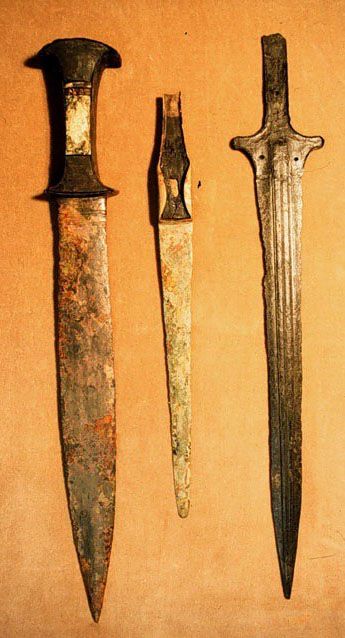
Short sword similar to what Peter would have used to maim Malchus.

According to Luke 22:38, two of the disciples were carrying “swords” that night. One of them obviously was Peter, the other probably his brother Andrew. It is unlikely that either was carrying a military sword; both were fishermen by trade and would be accustomed to carrying knives for tending nets and lines, and for gutting fish. The Greek term used here is machaira, which probably designated a double-edged knife or dirk, a shorter version of a sword design that had been introduced into Israel by the Phoenician Sea Peoples.

Nor do I think Peter was a trained fighter. We know he was impetuous, but was he an idiot? Did he think he could mow down a band of trained Roman soldiers and Temple guards? Was he distraught and attempting to commit “suicide by Roman soldier”? I think that if he had attempted a frontal assault in Jesus’ protection, he would have been reflexively cut to pieces before he drew a drop of blood, and quite likely the slaughter would have extended to the other apostles present, as well. Indeed, there is no textual evidence that any of the soldiers found it expedient to bare their blades.

What I think really happened was that Peter took advantage of the soldiers’ preoccupation with Jesus, slipped around behind Malchus—his intended target—and deliberately sliced off his ear. Why Malchus? Because he was the High Priest’s servant and right-hand man, and the leader of the delegation. The High Priest, if he was even there, was protected by bodyguards, but likely nobody was concerned for Malchus. Harming the High Priest would have resulted in quick execution. By merely defacing Malchus, though, Peter was insulting and effectively crippling the High Priest and, to some extent, the Sanhedrin. Why an ear, of all things? Because Peter wasn’t a killer, and taking an ear did the job! Priests, Levites and all other Temple officials were required to be more or less physically perfect. With a missing ear, he would be considered deformed and unfit for Temple service.

Yes, Peter was impulsive. But he was also smart.

And Finally

So the detachment of Roman soldiers and their captain, together with the Temple Guard of the Judeans, arrested Yeshua, …
—John 18:12 CJB

Jesus’ last steps. ©Leen & Kathleen Ritmeyer, from Jerusalem at the Time of Jesus. Annotated by me.

Jesus’ Last Steps

This past summer, a number of people from my church went on a tour of Israel. On their return, one of the pastors was marveling at the great distance that Jesus was required to walk on the morning of his crucifixion. Of course, it is not possible to say with total certainty what route He took that morning, but I believe with a little research it is possible to make some fairly good guesses. The relevant passages in Scripture are Matthew 26:17-27:45; Mark 14:12-15:37; Luke 22:7-23:51; and John 13:2-19:38.

©Leen & Kathleen Ritmeyer, from Jerusalem at the Time of Jesus. Annotated by me.

The paragraph numbers below correspond to points on the accompanying map.

  1. The Upper Room – The trek, of course, began at the Upper Room. Most of the sites visited can be located today with some degree of confidence. Not so the Upper Room. Church tradition places it at the site of the Church of the Apostles on Mt. Zion, in the southwestern quarter of the city, in an upper story directly above the traditional location of the Tomb of David. I don’t believe that this is the correct location of either shrine. David’s real tomb was probably in a known cave complex on the southeastern slope of the City of David, but the Upper Room could be anywhere in the city. Due to the proximity of the Gihon Spring and given that the host was described as a man carrying a jar of water, some authors tentatively place it on the Ophel, south of the Temple Mount; however, everybody in Jerusalem had to fetch water, and the room was described as “large”, leading me to place it somewhere in the more upscale Upper or Lower City (the Western Hill or the Tyropoeon Valley). After killing the sacrifices on Thursday, Nisan 14 (probably April 4, AD 30), food for the Seder had to be prepared and the Sabbath candles lit before sundown. Then the meal could begin during the twilight period. Most celebrations wrapped up at around midnight and the celebrants went outside, either into the streets or onto the roofs, to join in citywide singing of the Hallel psalms.
  2. The Mount of Olives – After singing the Hallel, Jesus and his party adjourned to the Mount of Olives, presumably leaving the City of David via the Water Gate, above Gihon Spring. There was most likely a switch-back road descending from the gate into the Kidron Valley below, intersecting with a road running along the valley floor. Matthew and Mark describe this stage of the trek similarly: as they arrived at The Mount of Olives, Jesus prophesied that his apostles would lose faith in him that night. He quoted from the apocalyptic 13th chapter of Zechariah which speaks of the End of Days (acharit hyamim). At that time, the people in the Land will be scattered, with 2/3 of them purged and those who remain purified. He then said that after His resurrection He would meet the disciples in Galilee. At this point, we see the exchange with Peter, when his threefold denial is foretold. They then proceeded on to Gethsemane. Luke only says that Jesus told them to pray that they might not be put to the test. He then went “about a stone’s throw away” to pray—presumably the John 17 prayer—and returned to find them sleeping. John’s account is quite different. There is no clear transition from the Upper Room to the Mount of Olives. Chapters 13 through 17 cover in great detail the exhortations and warnings to the disciples, and Jesus’ prayer. Given only this passage, one would conclude that the entire conversation, including the prayer, took place around the Seder table, though that is not actually stated. From this passage it appears that the exchange with Peter occurred near the end of the Seder, in the Upper Room. Conservative hermeneutics, based on examination of ancient literary practices, allows conversations to be paraphrased and chronologies to be out of order, as long as the message is not distorted by doing so, so this part of the conversation could have taken place in either location. Another likely possibility is that Jesus said the same thing twice in order to drive the point home to Peter.
  3. Gethsemane – From the Mount of Olives, the party moved on to the Garden of Gethsemane (Gat-Sh’manim), where Jesus was arrested. Since Gethsemane is an olive grove and olive press on the Mount of Olives, this can of course be interpreted to mean that they simply moved from outside to inside the borders of the grove; however, I have a personal theory based on the passage in John. John records that after the prayer of chapter 17, “He went out with his talmidim (disciples) across the stream that flows in winter through the Vadi (Vale, or Valley) Kidron, to a spot where there was a grove of trees; and He and His talmidim went into it (CJB).” They must at some time have crossed the Brook Kidron, but is this the stream referred to? At that time the Kidron was fed year-round by the seasonally varying Gihon Spring, and by other sources in the mountains to the east and north during the rainy seasons of early and late winter. Since they would have had to cross this stream below Gihon, it would have always held water. I don’t see how it would be described as “the stream that flows in winter.” I am therefore postulating that the stream may have been just a small rill spilling down off of the Mount, to the south of the grove. That would allow the entire conversation of chapters 13 through 17 to have taken place on the Mount close to, but not strictly within, Gethsemane. One possibility is a small stream that separates what we currently think of as the Mount of Olives and the Mount of Offense. In those days these two mountains, along with Mount Scopus to the north were all considered part of the Mount of Olives.
  4. Annas’ House – Only John mentions that after His arrest, Jesus was first taken to the house of Annas, father-in-law of the current High Priest. Annas was an extremely wealthy man who, though no longer High Priest, was still perhaps the most powerful man in the city. Annas was probably the inhabitant of a house in the richest part of the city which has been excavated, partially restored and named the “Palatial Mansion.” The arresting party is likely to have taken one of two routes from Gethsemane: I have drawn them retracing Jesus’ earlier steps to the Water Gate, then taking the most direct route to Annas’ house. As an alternative, they could have entered the city on the north side near the present Lions’ Gate, passing between the Pool of Israel and the Bethesda Pools and rounding north of the Antonia Fortress. The second route is longer, the first more tortuous.
  5. Caiaphas’ House – After briefly questioning Jesus, Annas sent Him to Caiaphas. Matthew and Mark say that “The head cohanim (priests) and the whole Sanhedrin” then put Him on trial. Luke says, “Having seized Him, they led Him away and brought him into the house of the cohen hagadol (High Priest).” Caiaphas’ house has been identified by many with an archaeological site in the southwestern portion of the city, near the traditional site of the Upper Room. Many scholars have long assumed that since the Sanhedrin was involved, Jesus must have then been moved to the Chamber of Hewn Stones in the Temple complex, since that was where they normally met until a few years later when they moved into the Royal Porch. This view is not credible, because (a) they were holding an illegal trial at that time of day (before daybreak); (b) the Temple gates were still locked at that time of day; (c) Peter was described as “outside in the courtyard, (of a residence); and (d) the accompanying Roman soldiers had custody and would not have handed him over to the Jews at this time, which would have been necessary since they could not enter the inner courts of the Temple.
  6. The Praetorium – This was Pilate‘s (the governor’s) headquarters. It has been variously identified as (a) the Antonia Fortress; (b) The Hasmonean Palace, near the Palatial Mansion; and (c) Herod the Great’s Palace, at the site of the later Citadel. It is presently believed that (c) is the correct location. Jesus was taken here “early in the morning”, around daybreak, and questioned by Pilate.
  7. Herod Antipas – This son of Herod the Great normally lived in Caesarea Maritima but was visiting Jerusalem for the Passover. When in Jerusalem, he normally lodged in the Hasmonean Palace (see above). Only Luke mentions this side trip. Herod questioned Jesus and sent Him back to Pilate.
  8. The Praetorium again – When Herod sent Jesus back to the Praetorium, Pilate tried unsuccessfully to release him in order to avoid confrontation with the masses of common people. Instead, he was compelled to kill Jesus instead of Barabbas (Bar-Abba). Jesus was led inside, tortured, and prepared for crucifixion.
  9. Golgotha (Gulgolta) and Joseph of Arimathea’s (Yoseph from Ramatayim’s) Tomb – In a previous blog I explained why Gordon’s Golgotha and the Garden Tomb are not possibly where Jesus’ life was temporarily put to an end. Instead, the crucifixion and burial almost certainly occurred at the traditional Christian site inside the Church of the Resurrection.