
Edited 1/6/2024
I know, this is far from the most important theological question most of us will face in our lives, but I’ll bet that most of us are at least a little bit interested. What Exactly is an “ark”? Answers in Genesis (AiG), parent ministry of the Ark Encounter theme park, who I frequently agree with and frequently disagree with, says, “Noah’s Ark was a ship; therefore, it likely had features that ships would commonly have.” No, and no…
My purpose here is not to question their motives or their overall theological purity, but rather to point out where my opinions and theirs differ on some textual interpretations and scientific/nautical engineering principles.
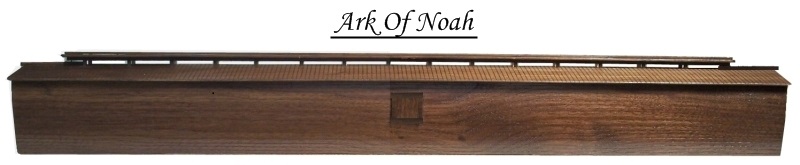
Linguistics
“Ark”
Nowhere does Scripture say the Ark was a ship! All that floats is not a ship. I did a search in several English translations to get a sense of the Biblical usage, concentrating mostly on KJV, NKJV, ESV, NIV and CJB. I found that the Hebrew “Oniy“ or the related “Oniyah” is translated as “ship(s)”, “boat(s)”, “sailing vessel(s)”, or “watercraft” in the Old Testament. The word can also refer to a fleet (of ships), a Navy, or seamen. Another Hebrew term, Tsiy is translated variously as “ships“, “boats” or “vessels (of papyrus reeds)”.
There are three contexts in which the term “ark” occurs in English translations of the OT. When referring to Noah’s Ark and the basket into which Moses was placed to escape Pharaoh’s attack on Israelite children, the Hebrew is “tebah“, which literally means “a box or chest“. When referring to the Ark of the Covenant, the Hebrew is “aron“, meaning “a box, chest or coffin“.
What is the difference in meaning between these words? AiG suggests that tebah is related to the Egyptian word for “coffin”, and comments that being sealed in the Ark would be like “being sealed in a coffin.” Their post says nothing at all about aron.
Ancient Hebrew and Egyptian were both Semitic languages of the Afro-Asiatic language family. It is possible, but not proven, that the Hebrew term is a loan-word from their Egyptian sojourn. The Hebrew alphabet, especially in its ancient form, is an “abjad“, meaning that it contains no vowels. “Tebah“, then, as transliterated to English, becomes “t-b-h“. The Middle Kingdom Egyptian hieroglyphs included a full set of phonetic glyphs. When using only these glyphs for writing, the similar word is transliterated as “t-b-t“, and according to the Brown-Driver-Briggs concordance, which I consider to be better than Strong’s, it does, in fact mean “chest, or coffin”. Nevertheless, the leap to comparing Noah’s Ark to a coffin is a total (and absurd) shot in the dark!
Based on my own survey of Jewish sources, I believe that tebah refers to containers for the “common“, while aron refers to boxes, chests, and cabinets dedicated to sacred objects.
Regarding the latter,
- The Ark of the Testimony (Aron HaEdut) was “home” to God’s Sh’kinah, and contained, for a time, a jar of manna, Aaron’s staff that budded, and the stone tablets of the covenant. All of those are Jewish sacred objects.
- For most of their history, the most sacred object associated with any Jewish synagogue has been their Torah scroll, and the second most sacred has been their Holy ark (aron HaKodesh) in which the scrolls are stored. These arks are cabinets, usually ornate, that stand against the synagogue wall most nearly facing Jerusalem and the Holy Mount (the west wall in Europe and the Americas).
- When the Israelites left Egypt with Moses, they took with them, in an aron, the revered body of Joseph:
Genesis 50:26 (CJB)
[26] So Yosef died at the age of 110, and they embalmed him and put him in a coffin [aron] in Egypt.
“Gopher wood”
Some translations render it as “gofer wood” a direct transliteration from the Hebrew) and many as “cypress wood“. The actual meaning is obscure and may refer to a type of tree or a type of wood, for example.
Calling it “cypress wood” is only a guess, but not unreasonable, since cypress is water and rot resistant, pliable and toolable. Even today it is widely used in outdoor furniture and boat construction. Its growth is fairly ubiquitous in northern temperate regions, especially in warm climates that are periodically dry (for seed germination) and swampy (for subsequent growth). In Iraq, trees of any kind are scarce today, but in Noah’s day cypress was probably plentiful in the lower Tigris and Euphrates region.
Brown-Driver-Briggs suggests that “gofer wood” should be translated as “pitch-wood” since the Hebrew gofrith, meaning “brimstone” is from the same Hebrew root. This may still designate cypress, since it could refer to the oily sap that gives that species its water and rot resistance.
“Roof”
There are a number of ways to interpret Genesis 6:16a. I think JPS says it best:
“Hebrew tsohar is another unique word. It is either the “window” of 8:6, or it means “a roof.” Depending on which meaning is adopted, the unclear directive to “terminate it within a cubit of the top” (lit. “from above”) could variously mean that a space of one cubit is to be left between the top of the window and the roof, that the window itself is to be a cubit in height, or that the slanting roof should project one cubit beyond the side of the ark.
— Sarna, Nahum M. Genesis. The JPS Torah Commentary. Accordance electronic edition, version 3.2. Philadelphia: Jewish Publication Society, 1989.
Perhaps it is important that, in addition to “roof” or “window”, tsohar can also, depending on context, mean “midday” or “noon”. I suspect that this is why some translators render verse 16a as, “Make a skylight in the Ark, within a cubit of the top you shall finish it…” (Alter, The Hebrew Bible); or “You are to make an opening for daylight in the ark eighteen inches below its roof.” (Stern, The Complete Jewish Bible“). Emphasis mine in both cases.
Note that the “window” (Hebrew challon) of Gen 8:6 is capable of being closed, presumably by a shutter or shutters.
Because challon is not used in 6:16, and with an eye towards watertightness, I lean towards the interpretation that it is speaking of a roof with 18-inch eaves, providing shelter for some type of opening or openings for both light and ventilation. This may have been the shuttered window(s) of 8:6.
The high winds and torrential rainfall postulated by AiG would be incompatible with any type of open skylight or window. Even the shutters of 8:6 would be difficult to make watertight in ancient times. It took God, Himself to seal the door. The flood “mechanism” I propose in Fountains of the Deep would produce heavy global rains, but without heavy winds associated with hurricanes or other destructive forces caused by large pressure gradients.
Boat vs. Float
Ships, boats and barges, in all their myriads of varieties, generally have one thing in common: they are designed to transport people and/or other objects from one location to another, on or under the water. By “transport”, I mean to actively move them, using some form of energy, be it wind (in a sail), machine, or muscle. The term “ships” generally refers to relatively large vessels designed to withstand the rigors of navigating the open sea or large rivers and lakes. The term “boats” can include “ships” as a subset, but more commonly it refers to relatively smaller watercraft. A “barge” is usually a box-like vessel designed to be pulled or pushed by some external means, including ships, boats, or even oxen or powered vehicles alongside a river or canal.
By contrast, a vessel or platform, or even an air-filled vest, of any kind that is designed, not to navigate under any kind of propulsion, but simply to float on water and go wherever the forces of nature takes it, is called—well—a “float“! Noah’s Ark was not a ship; it was a float. God said, “Build this, get in it with a herd of critters, and let it float you to wherever I send it by means of the forces at my command.” If it was a float and not a ship or boat, then it doesn’t need to have had “features that ships would commonly have.”
Wind and Waves
The design on AiG’s Ark Encounter, in fact the basis of much of their flood theology, depends on an assumption that the Great Flood would have included catastrophic winds, waves and consequent destruction.
However, I think the argument is faulty. I see nothing in scripture to indicate that wind factored into the Genesis Flood in any significant way, so neither wind nor wave would have been an issue. According to Gen 7:11, “all the fountains of the great deep were broken up, and the windows of the sky were opened.” I don’t believe that this event can be compared in any way to a modern storm. I have discussed a likely mechanism for the flood in Fountains of the Deep. In that post I suggest that the vast majority of the flood water was miraculously brought up from earth’s mantle transition layer, primarily through volcanic eruptions in the mid-oceanic ridges. This would have perhaps generated tsunamis on coastlines, but tsunamis cause very little disturbance in deep water, and even on shore, the damage to the coast itself (as opposed to structures and life) tends to be superficial except for erosion of coastal sands. Widespread volcanism generates huge amounts of ash, as well as CO2 and water vapor that would spawn torrential rain but could quell pressure gradients and suppress the worst of the winds.
The only mention of wind in the Flood text is in Gen 8:1b,”God caused a wind [ruach] to pass over the earth, and the water began to go down.” The Hebrew ruach can mean wind, breath, or any of a number of related English terms, but most often in the Bible, it means “spirit“, as in Gen 1:2b, “and the Spirit [Ruach] of God hovered over the surface of the water.” No amount of physical and literal wind could dry up that much water in the time allowed by Scripture; the waters of the deep were miraculously returned to their home in earth’s mantle through the power of the Ruach HaKodesh (Holy Spirit). I suggest that “wind” in Gen 8:1 is more akin to “God’s breath” than to a meteorological phenomenon. For more on God’s use of wind (see God with the Wind).
Architecture
As a Naval Officer back in the day, I put in a lot of both formal and informal time studying subjects related to my job. Not that I could ever build a ship “from the keel up”, but I do have training in naval architecture, both technical and historic. The small “n” in “naval” means both military and civilian watercraft.
AiG has tried to justify their design of a ship-like Ark at Ark Encounter, as opposed to a parallelepiped (rectilinear solid), box-like float of the same overall dimensions, by appealing to model studies in wave pools. I can tell you from personal experience and my knowledge of physics that because of their inertial characteristics, massive ships won’t perform anything like small models in either wind or waves. Not … even … close!
I have been at sea on a minesweeper (off Alaska), a destroyer (off California), a battleship (off California), and, for long periods, an aircraft carrier (in the North and South Atlantic, the North Sea and the Mediterranean). On all but the battleship, I have served on the “bridge” (a ship’s navigational control center) while under way, and experienced “heavy seas” (storm conditions). On the minesweeper and the carrier, I periodically “had the con“, meaning I had command over the vessel’s engines and rudders, as well as the bridge crew, engine and steerage crews, lookouts and other underway personnel. In Navy parlance, a minesweeper is a boat, and designed for operations in littoral, i.e., coastal, waters, though able to transit oceans if necessary. My other “rides” were smallish, large and very large ships, respectively.
My destroyer, the USS O’Brien, DD-725, was about 80% the size of the Ark, so it gives me a good basis for comparison. We definitely felt the waves, but when under power, it was easy to control our direction of advance. If we cut our speed to “all stop“, or “zero turns on the ship’s screw“, we would fairly quickly lose our forward motion (go “dead-in-the-water“), and eventually the forces on the hull would drag us around until we were parallel to the swells (that’s the proper term for deep-water waves). Once so “broached“, there is a tendency for any vessel to roll side to side. This isn’t comfortable, especially on smaller vessels, but sailors are used to it and prepared for it. Even in rough seas, very few ships will capsize from it, though, because buoyancy and inertia limit the magnitude of the roll. A box with the same dimensions as the ship will have less tendency to roll than a ship with a curved hull, given proper weight distribution aboard the two.
Water Wave Physics
Elsewhere in the AiG documentation, they state that waves would have driven the Ark forward. But that could happen only in near-shore surf where wind shear pushes surface water onto the shallows.
In deep waters, waves are propagated in a horizontal direction, but the only water movement is near the surface where molecules simply bob up and down in tight elliptical cycles. It is the bobbing action that moves along the surface, not the water itself.
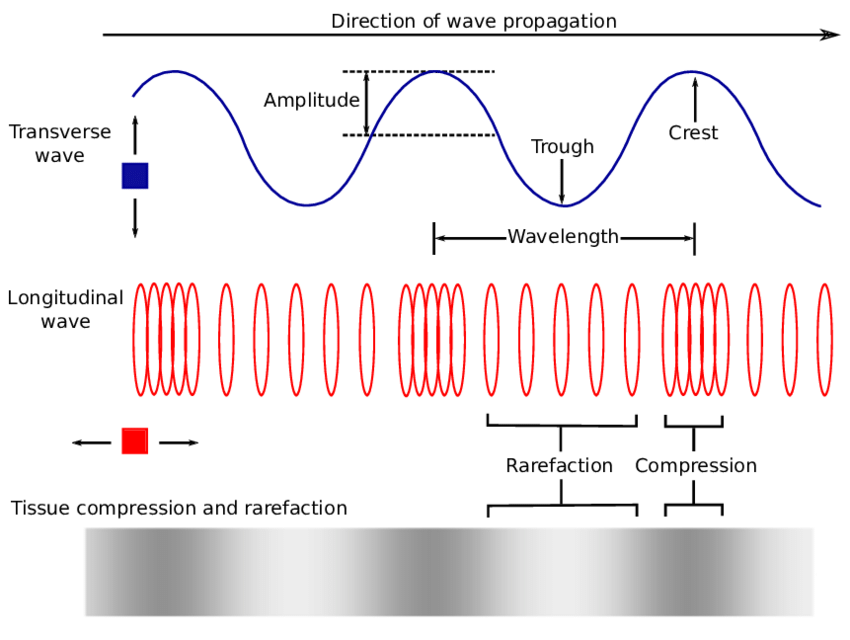
In the diagram above, the motion of individual water molecules is depicted in red. In deep water, waves “propagate” away from their source (wind or a surface disturbance), but the water itself moves mostly in vertical directions. A solid object like a boat or a bottle will bob upwards on wave crests and downwards on wave troughs. As a crest approaches, the object will tend to move forward in the direction of the advancing wave as it slides down the wavefront, but then it will slide in the opposite direction after the crest passes. Winds above the waves or currents below the waves may push the object, but the waves themselves impart little or no net horizontal movement, either longitudinal or lateral.
As waves encroach into shallow water, on the other hand, the solid seafloor begins to disrupt the elliptical motion of the water molecules at the bottom of their cyclic movement. As a result, the peaks tend to overtake the troughs, and the wave tumbles forward. This causes the constituent water molecules to wash towards the shore at and near the surface, but then to rush back towards the open water near the floor. The return part of this cycle is the dreaded “rip tide.”
Features of the AiG Design
In several blog posts, AiG explains why, from a sea-worthiness perspective, they think that the Ark needed to be a ship-like vessel, rather than a box. They use this diagram to illustrate:

- “Noah could have added a fixed ‘sail’ on the upper bow of the Ark so the wind could turn the ship into the rough waves.”
The idea here is that the raised bow fin would act like a weathervane, causing the Ark to pivot and turn end-on to the wind. But, just as a weathervane turns itself so that the “sail” is downwind, the AiG description makes no sense from a mariner’s perspective. Swells propagate in the direction the wind is blowing; that is, a wind blowing towards the east would cause waves that also “move” toward the east. “Into the rough waves” therefore implies that the fin would turn the Ark in such a way that the wind would be blowing bow to stern, but if the fin worked at all, it would cause the bow to turn away from (not “into”) the oncoming waves.
Functionally, the object of either “tuning into” or, the opposite, “following” the waves is to keep the Ark from broaching or turning broadside to the wind and waves. Facing either bow or stern into the waves is very much preferable, but unlike a light model, this fin design would not be workable with a massive ship. It would take a very large force against the fin to overcome the angular momentum of the massive Ark and its contents. Also, enough wind to push on the fin would push even more on the windward hull of the ship, resisting any pivot. A longitudinal sail in the bow of a ship like AiG’s Ark would make steering into the wind very difficult, if it had any effect at all.
- “Noah could have added a fixed ‘rudder’ at the lower stern of the Ark to keep the ship turned into the rough waves.”
This is another statement that makes no sense. A fixed rudder, more commonly known as a “skeg“, is an underwater fin or projection that can be used to stabilize the motion of a powered watercraft. There is no reason to suppose that Noah, or God, provided the Ark with a propulsion mechanism, so the most that a skeg would have accomplished was a slight reduction of rocking. It would have no effect at all on the orientation of the Ark with respect to waves, since ocean swells involve no sideways motion beneath the surface (see above).
- “A ship’s keel is a structure built along the bottom of the ship’s hull to support the main body of the ship. In some cases, the keel is extended downward to function as a stabilizer for the ship. Noah’s Ark, as described in Genesis 6, may have had a keel since it seems to have been an essential piece for the ship to survive the wind and waves.”
If the Ark was a ship, then given its size, a keel might have been necessary to anchor ribs (the curved side-to-side cross-pieces in the Jesus Boat, below, for example) and strakes (the fore to aft planks forming the hull of the Jesus boat). If the Ark was a box, then no such structure would have been necessary, since structural stability would be adequate using only rails (horizontal members of a frame), stiles (vertical member of a frame) and cross-braces (diagonals to prevent torquing of the frame).
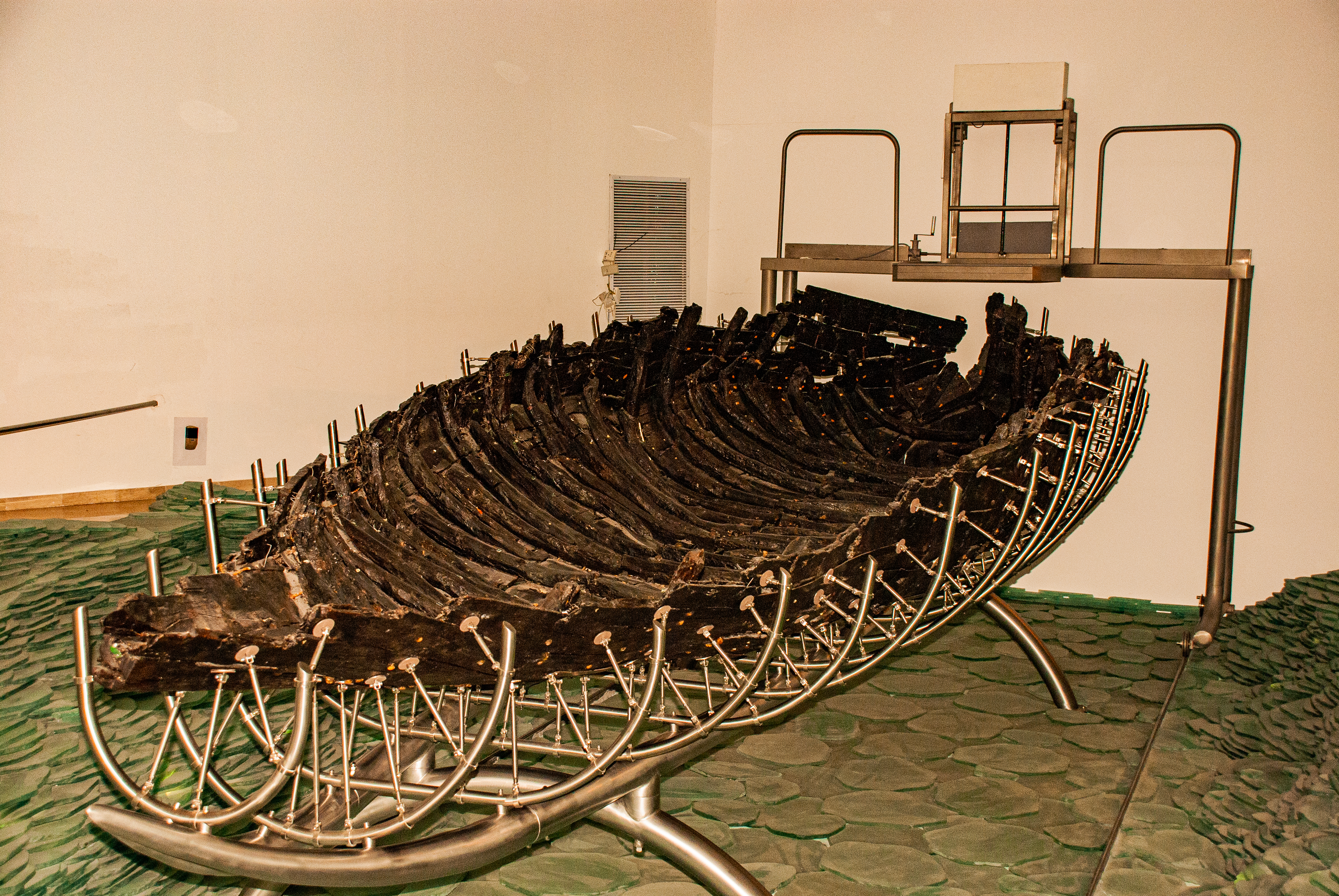

There is no evidence from literature or archaeological findings that keels ever existed before they were invented by the Vikings in the 8th Century AD. Early ships and boats, including those built by the Egyptians and the Phoenician “Sea Peoples” were built by lashing or pegging planking (strakes) to bent or shaped ribs that ran perpendicular to the length of the craft. The 2,000-year-old “Jesus Boat” on display at Kibbutz Ginosar, Israel, was modeled on Phoenician boats from earlier centuries.
Earlier structures positionally related to keels did exist in ancient times. Egyptian vessels, for instance, featured what is now called a “plank-keel.” This was not a true keel, but rather a wide strake (hull plank) at the very bottom of the hull where keels would later be located. The function was primarily to give the boat a stable base while beached.
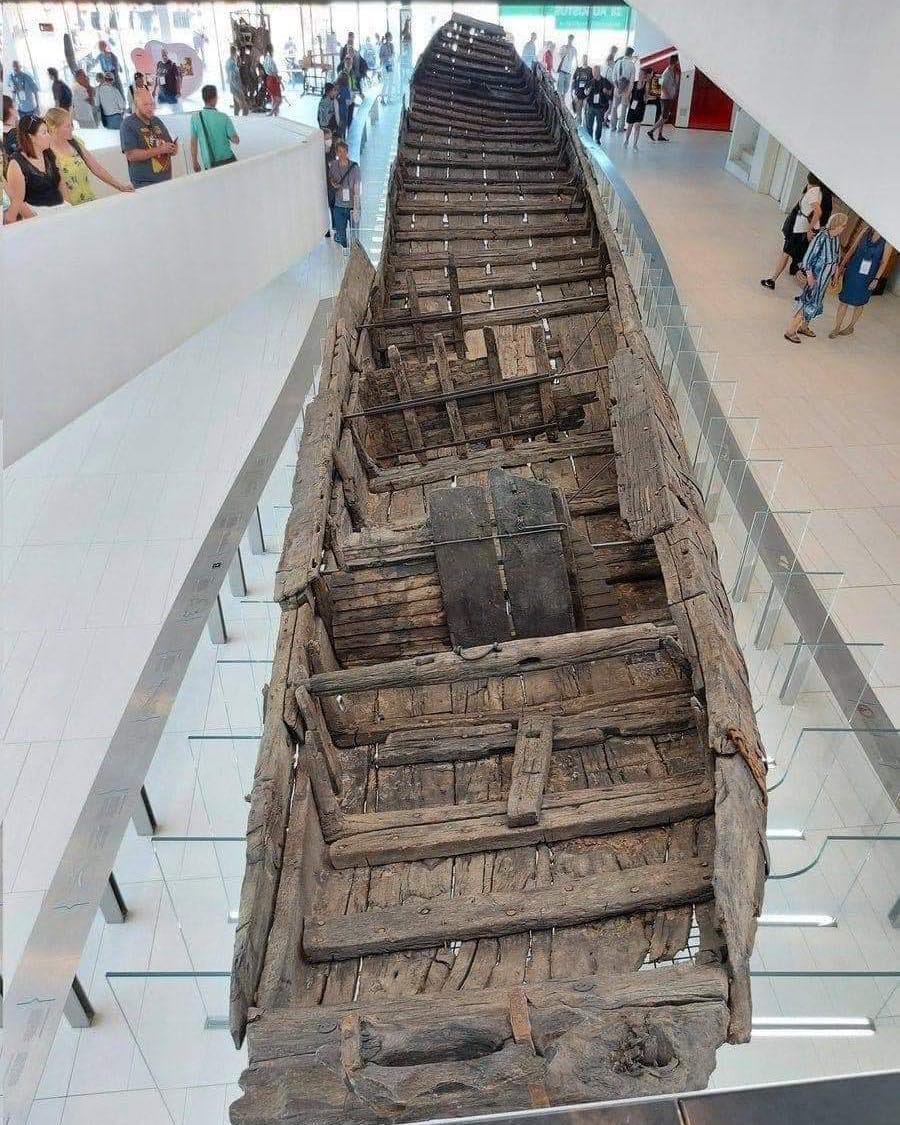
Another device that appeared frequently in ancient ships (and is still often used) is a “keelson“, which is a structural beam or cleat in the bilge area, but not extending outside the hull. It was used mainly to help support masts in sail-powered boats, but often did add strength to the hull. Neither of these features would function on an Ark. The Roman ship shown below, built prior to the invention of a keel, includes a short keelson spanning two ribs. The rectangular hole in the forward part of this keelson is most likely a mortise, made to hold a tenon at the base of a mast. Mortise and tenon joints (as in, “insert tab A into slot B”) have been used by craftsmen from ancient times to join perpendicular wooden or stone structural members.
- “The box-like Ark is not entirely disqualified as a safe option, but sharp edges are more vulnerable to damage during launch and landing.”
Among many avocations, I have been a cabinet maker during my lifetime, and I still have a completely furnished cabinet and general woodworking shop in my basement. My opinion is that square corners (“sharp edges”) are vulnerable to dings and dents but are sturdier and more puncture-proof than a rounded wooden surface.
- “Blunt ends would also produce a rougher ride and allow the vessel to be more easily thrown around”
A minor effect. Most ships and small boats have a “sharp” bow for “cutting through” the water, but the vast majority have a “blunt” stern, and many larger ships have “blunt” vertical sides, as well. How much a vessel is “thrown around” is more a function of its mass and how deep it sits in the water (its “draught“). And, of course, a flat bottom is much less prone to broach or roll than a ship’s curved hull.
“While many designs could work, the possibility shown here reflects the high stems which were a hallmark of ancient ships.”
- Though I couldn’t find more explanation of what precisely this statement means, I assume it is referencing raised prows and sterns on many ancient ships. In the case of Egyptian vessels, these were carved, stylized papyrus umbels (flat-topped or rounded flower clusters). The Egyptians used the stem of papyrus plants to make sails, cloth, mats, cords, and paper, so these plants were appropriate decorative symbols of the realm. Other civilizations decorated their ships in the same manner with religious totems.
- “Noah was 500–600 years old and knew better than to make a simple box that would have had significant issues in a global Flood (e.g., forces on the sharp corners would be too destructive, it could capsize if it is not facing into the wind and waves, and so on).”
This is yet more speculation by a writer with no technical expertise. If Noah had any training in shipbuilding, naval architecture or engineering dynamics, it isn’t mentioned in Scripture, and he sure would not have learned from practical experience. God may have coached him or given him engineering drawings or advanced physics training, but this is also unmentioned.
It is worth mentioning that most large ships today do incorporate a rough box shape, though with rounded corners and keels, because flat bottoms are intrinsically more stable and less prone to grounding, while vertical sides are more efficient for loading capacity. This is true for large military vessels, cargo ships, and even ocean liners. Not to mention…
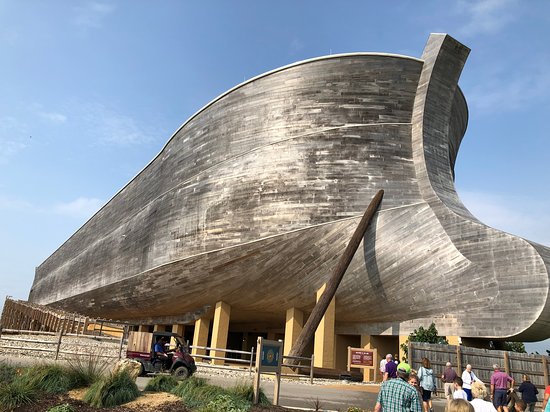
In any case, Noah built an Ark, not a ship!
And yes, I’m quite willing to be dogmatic about this.


 The Back of My Mind