
Posted on:
Modified on:
- Introduction
- Interpretive challenges
- A pair of Dreams
- Conclusions
Introduction
The mirror analogy
Chances are you’re familiar with the following verse:
[12] For now we see through a glass [mirror], darkly; but then face to face: now I know in part; but then shall I know even as also I am known.
—1 Corinthians 13:12 (KJV)
This is part of an extended passage in which Paul is discussing the interrelationships between believers in the church, including the interplay between their various natural abilities and spiritual gifts. He then stresses that what is most important is their mutual love—ἀγάπη (agapé), affection, good-will, benevolence, or (KJV) charity, all in an atmosphere of mutual preference for one another.
The “glass”, or “mirror” of verse 12 is the Greek ἔσοπτρον (esoptron), a noun that technically denotes any smooth, reflective surface that can function as a mirror. Undoubtably, what Paul had in mind was the polished brass, copper, or occasionally iron, silver or gold mirrors used in his time. Back in my camping days, I carried an unbreakable polished aluminum mirror, which works better than brass, but still reflects much less efficiently than a modern silvered glass mirror. These metals are all more or less prone to tarnish, and the polishing technology of the Roman Empire was unable to achieve the fine finish possible now.

By the frequent (but unfortunate) Christian custom of basing doctrine on individual verses pulled out of context, many Christians are taught that Paul is promising here that when we get to heaven, we will all instantly recognize everyone we see. That may or may not be a part of our glorification, but in his analogy, Paul is conveying a more general picture of how weak our knowledge is now compared to what we will know and understand after our imperfect lives end and we come face to face with God.
The same analogy serves well to illustrate how little we can learn from prophecy compared to a face-to-face encounter with the real thing. The point I pursue below is that prophecy should never be dogmatically relied on to tell us, literally, exactly what we can expect in the future.
The purpose of prophecy
It seems to me that Biblical prophecy, in the main, performs three primary functions:
- It warns God’s people of coming judgement, either impending or far in the future. For example, the “blessings and curses” of the Mosaic Covenant (Deut. 28ff) warn of the consequences of disobeying the precepts of the Covenant and contrast those consequences with the blessings they could expect for keeping the Covenant. Virtually all of the prophets predicted Israel’s failure to keep the Covenant and forecast the terrible price they will pay for their disobedience.
- It provides comfort in times of woe. The prophetic books that forecast terrible judgement on Israel almost always end with promises that, despite their failure and subsequent punishment, God will ultimately bring them back to Himself and give them final bliss in their own land.
- It also forecasts events in the future that, though usually at least partly unclear in the telling, will become obvious in the fulfillment. It is this forecasting role that I will emphasize below.
Prophetic Applicability
What most Christians fail to realize is that all of the Old Testament prophesies and promises, beginning with the Abrahamic Covenant, were for Israel—the Jews. Humanity in general was already condemned. Only eight humans escaped The Flood. The descendants of those eight, the second chance for humanity, immediately returned to a state of rebellion that God quickly dealt with in Shinar, at Babel:
since they did not see fit to acknowledge God, God gave them up to a debased mind to do what ought not to be done.
— Romans 1:28 (ESV)
I view the Church as a Jewish “family” with gentile children “fostered in.” Those of us who are gentiles in the Church are excused from most of God’s requirements for genetic Israel (see Acts 15), so shouldn’t expect all of their blessings and promises either. But that doesn’t mean we are second class in God’s eyes, and it doesn’t mean we don’t go along on the ride when God comes for His own.
The role of visions
1 In days gone by, God spoke in many and varied ways to the Fathers through the prophets. 2 But now, in the acharit-hayamim*, he has spoken to us through his Son, to whom he has given ownership of everything and through whom he created the universe.
— Hebrews 1:1-2 (CJB)*[a•cha•rit-ha•ya•mim—Literally, “the end of the days”, i.e., The End Times or “latter days,” when the ‘olam hazeh (the present age) is coming to a close and the ‘olam haba (the age to come) is about to begin.]
While some prophecy was delivered to the prophets verbally by God or angels, and some was no doubt simply an idea placed the prophet’s head or perhaps even a subtle guiding of the pen, the most striking prophecies often came through dreams or visions. Visions were apparently all in the mind of the prophet, while dreams were sometimes imparted to others, to be interpreted by the prophet.
For the purpose of this post, I’m going to lump dreams with visions. Both are highly symbolic—often obscure, surreal, distorted, or iconographic. Both involve subjective imagery that is typically suggestive rather than immediately definitive.
The office of Prophet
The office of Prophet, like that of Apostle, has ceased!
The Apostles were a specific group of twelve men who were individually selected and trained by Jesus and then instructed to act as His official agents to begin the mission of evangelizing the world. Eleven were His closest disciples, who accompanied Him during the 3-1/2 years of His earthly ministry, remained faithful to the end, and were verbally commissioned by Him at His Ascension. The twelfth was Saul of Tarsus, who was selected and commissioned on the road, trained in Damascus and Arabia, and, like the others, served to the end of his life.
The Prophets were also selected by God. I reject the idea that modern preachers are “prophets.” The prophets preached and wrote, but their message was supernaturally imparted to them and therefore infallible, in the same sense that we regard the canonical books of the Bible as infallible.
Literally hundreds of times I’ve heard preachers and evangelists say, “God placed this message in my heart,” or “I was going to teach on … but God told me to do this instead“.
Sorry, no! I don’t for an instant deny that God calls some people into a preaching ministry and gives them appropriate spiritual gifts and a general inclination and wisdom to minister in a Godly fashion. But I have no Biblical or observational reason to believe that God, in this age, speaks directly and with total clarity to any human. No mere preacher, no matter how devout or scripturally knowledgeable, is inspired in the Biblical sense. If that were the case, then the first time he repeats a flawed interpretation he is revealed to be a false prophet. Verses that differentiate between true and false prophets include: 1Ki 22:8; Jer 14:14; 23:16; 28:9; Ez 13:3; Mat 7:15-20; 24:24; 1Jn 4:1; Pet 2:1.
Interpretive challenges
All visionary prophecy is, by its nature, difficult to interpret until its fulfillment, and sometimes even then its fulfillment might be obscure to most. Was it already fulfilled in the past? Is it completely fulfilled now? Is there more fulfillment to come? And if dreamlike imagery isn’t explained, how do we read the mind of the prophet? Did even the prophet himself know the interpretation? I suspect that the answer to that final question was often a negative.
While prophecy derived from visions and dreams is most difficult to interpret, there are challenges in interpreting prophecy derived by other means, too. End-times prophecy, no matter its source, is going to use terminology appropriate to ancient peoples at the time of writing. For example, 21st century vehicles might be described in prophecy as “horses”, aircraft as “clouds” or some flying creature, rifles as “swords”, etc. We can make that interpretation, but we might be completely wrong.
In the rest of this article, I’ll mention some mistakes that I think people—even theologians—make in their attempts to interpret prophecy and prophetic visions. Because some of the passages discussed are lengthy, I’ll usually provide only the Biblical references.
Throne visions
The Bible reports several very explicit prophetic visions of God seated on a throne in heaven: Isaiah 6, Ezekiel 1 and 10, Daniel 7, and Revelation 4 being most striking.

I previously wrote about these visions in Monotheism and the Trinity:
I don’t think that these visions [as described] can be reconciled with God as an omnipresent spirit. Instead, I think that what the prophets are “seeing” are representations of preconceptions popularly held by ancient peoples. [Allegory], not reality! This is more or less how the pagan deities would have been visualized in contemporary surrounding cultures. If 21st century American Christians can’t visualize the Christian Trinity, how much less would primitive denizens of the Ancient Near East be able to set aside their ingrained preconceptions? And how important could it have been to ask them to do so? In my opinion, not very!
In other words, what I believe that these visions have in common is that God is giving each of the prophets a sense of His grandeur in heaven as He rules in and through His Divine Council (see below). But because God and the angels are all spirit beings, they are in reality not visible to a human eye and can’t be described in human terms. For that reason, God left the prophets with mental impressions that could be roughly described in human-like terms, rather than accurate visual representations of something fundamentally alien to human conceptions.
Common elements of the throne visions
What the throne prophecies depict is the presence of the following:
- An omnipresent, invisible, Almighty God. See Implications of God’s Omnipresence and Eternity in Space-Time.
- He is revealing Himself at a specific point in space and time—what physicists call an “event in spacetime”.
- He is metaphorically seated on a grand throne, reminiscent of kings and the pagan gods who rule the kings.
- He is surrounded by “24 elders” (see below).
- They are metaphorically seated on lesser thrones.
- God is metaphorically protected by a few (usually 4) guardian seraphim/cherubim.
Not all of those elements are included in all of the descriptions. The perceptions of the different prophets were similar to each other, but not totally the same.
My advice when reading the throne prophecies and other baffling prophetic descriptions is to forget about the detail, like the “wheels within wheels”, because all of that is just the prophet’s abstract impressions of things that can’t actually be seen with the eye.
The 24 elders
John, in particular, speaks of “24 elders” seated at “lesser thrones.” The identity of these elders is not revealed:
2 At once I was in the Spirit, and behold, a throne stood in heaven, with one seated on the throne. 3 And he who sat there had the appearance of jasper and carnelian, and around the throne was a rainbow that had the appearance of an emerald. 4 Around the throne were twenty-four thrones, and seated on the thrones were twenty-four elders, clothed in white garments, with golden crowns on their heads.
— Revelation 4:2-4 (ESV) emphasis mine
In verse 4, the “twenty-four elders” are usually interpreted to be the twelve sons of Jacob and the twelve apostles. That is flat-out guesswork, because the Bible offers no clarification. Another guess often heard is that they are representatives from the twenty-four divisions of priests who served in the Temple.
A third guess is that they are angels. Since this is a vision, not an absolute reality, any of these guesses is possible, but this one is the one that I would go with, without reservation, because it is what John’s contemporaries would have immediately assumed. Specifically, these elders would be angelic members of God’s Divine Council, discussed in the next section.
This view is borne out by
8 And when he had taken the scroll, the four living creatures and the twenty-four elders fell down before the Lamb, each holding a harp, and golden bowls full of incense, which are the prayers of the saints.
9 And they sang a new song, saying,
“Worthy are you to take the scroll
and to open its seals,
for you were slain, and by your blood you ransomed people for God
from every tribe and language and people and nation,
10 and you have made them a kingdom and priests to our God,
and they shall reign on the earth.”
— Revelation 5:8-10 (ESV)
“They”? If any of the elders are humans, then why are they excluding themselves here?
The Divine Council
Chances are, you’ve never even heard of the Divine Council, but it is well-attested in Scripture. I believe that God created the host of angels when He created the universe. In general, their function was to tend and monitor the cosmos, in much the same way as humans were told to have dominion over the earth. God governs this host by means of a council of senior angels.
God doesn’t need angels or humans to tend earth or the cosmos, but because of His divine love, he chose to share and delegate responsibility. For further explanation of the nature and purpose of angels in general and the Divine Council in particular, see Gods and Demons.
The suffering servant
How you treat Isaiah 53 depends on your presuppositions (as does a lot of Biblical interpretation).
Most Christians reading Isaiah 53 will be astounded that Jews of the Centuries following Jesus‘ life, death and resurrection didn’t immediately recognize that it was speaking of Him. How could they have missed the obvious prophetic connection?
Well, it isn’t that simple. The Jews of those days were looking for the Messiah, most famously predicted by Daniel, and best described by:
13 “I kept watching the night visions,
when I saw, coming with the clouds of heaven,
someone like a son of man.
He approached the Ancient One
and was led into his presence.
14 To him was given rulership,
glory and a kingdom,
so that all peoples, nations and languages
should serve him.
His rulership is an eternal rulership
that will not pass away;
and his kingdom is one
that will never be destroyed.
— Daniel 7:13-14 (CJB) emphasis mine
During His ministry, Jesus consistently spoke of Himself as “the Son of Man,” which under the circumstances was an unmistakable claim to be Daniel’s “someone like a son of man,” that is, someone who appeared to be a human being and who would be given an eternal Kingdom. Most (but not all) of the Jewish Scribes interpreting Daniel missed the implication in verse 13 that “like a human” might mean “more than a mere human,” so what they were looking for then and now was a human Messiah, who in order to become king over “all peoples, nations and languages,” would obviously have to first be a great conqueror.
Therefore, when they looked at Isaiah 53, it wasn’t at all obvious that the Suffering Servant would be that same Son of Man, the Messiah. Because we Christians insist that the two are one and the same, some Rabbis over the last two millennia have chosen to simply remove Isaiah 53 from their scrolls, but for the most part Jews since as early as the Babylonian captivity have speculated that the Servant was either another human (the Yahad peoples of Qumran and the Dead Sea Scrolls, possibly a splinter group of Essenes, took this approach) or, more frequently a symbolic reference to Israel as a whole under the many persecutions they have suffered over the ages.
Acts 1 shows us the “progressive revelation” of the dual advents as the are unfolding:
9 After saying this, he was taken up before their eyes; and a cloud hid him from their sight. 10 As they were staring into the sky after him, suddenly they saw two men dressed in white standing next to them. 11 The men said, “You Galileans! Why are you standing, staring into space? This Yeshua, who has been taken away from you into heaven, will come back to you in just the same way as you saw him go into heaven.”
— Acts 1:9-11 (CJB) emphasis mine
Ezekiel
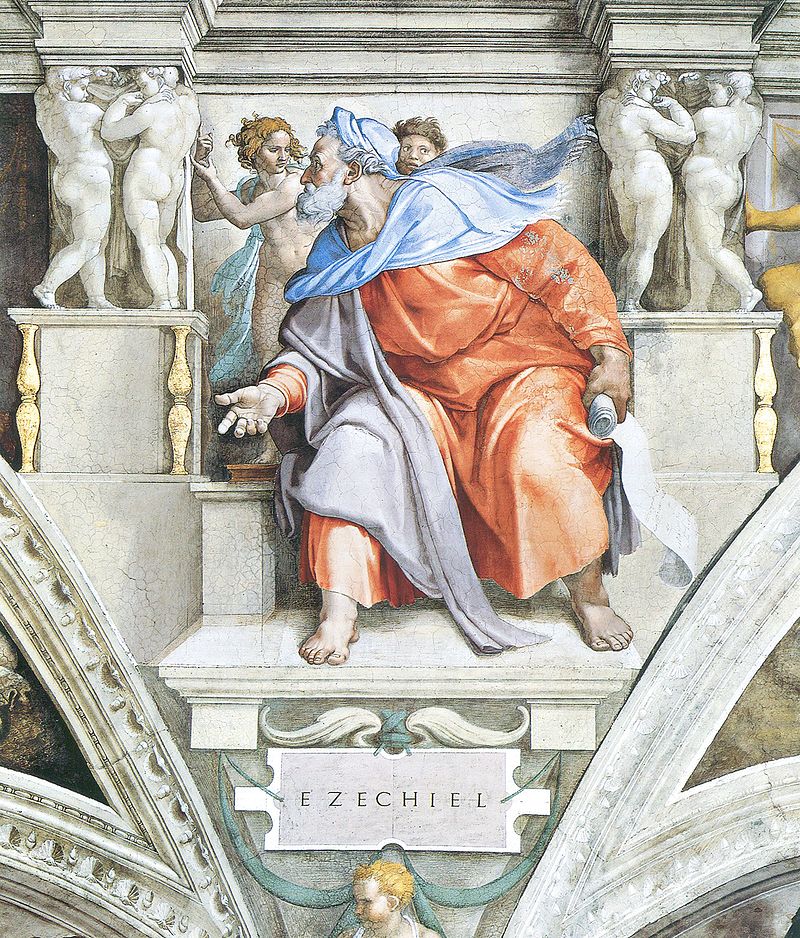
Ezekiel is possibly my favorite book of the Bible because of the richness of the prophecy. Virtually the entire book is prophetic, presented sometimes as poetry, sometimes as prose, and sometimes acted out in front of his audience, at God’s direction.
I have enough of an affinity for Ezekiel’s writing that I feel I have as good an understanding of the man and his prophecy as one can have at this distance. I have already commented on his (and others’) throne visions, above. I have also written about several of his prophecies in previous articles, which I’ll link below.
Ezekiel’s prophecies are apparently written chronologically, in the order of their future fulfillment, though not necessarily in the order he experienced them.
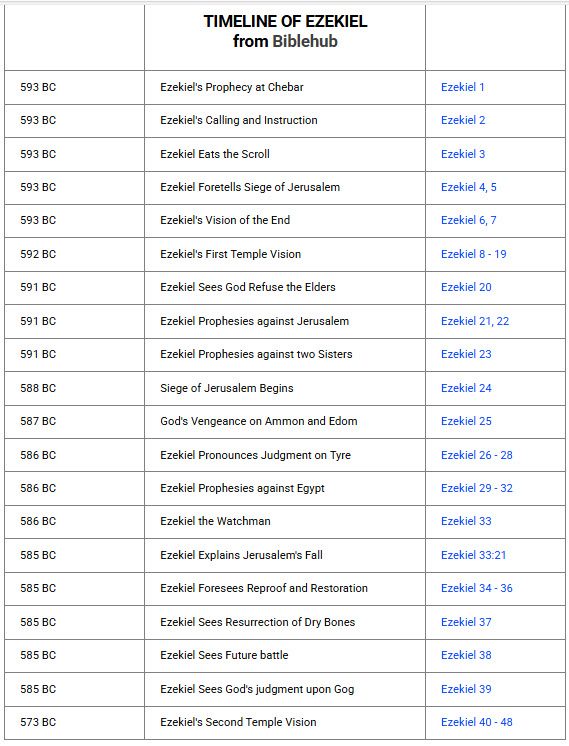
Christian tradition contains a number of misconceptions that are taught by pastors who aren’t necessarily theologians and don’t necessarily have a good grasp on Bible history. Some of those misconceptions are propagated by Israeli tour guides, and the tour sponsors (often pastors) who learn from them. The tour guides are mostly Jewish Israeli citizens, who have learned what they know from manuals prepared and taught at trade schools, not necessarily by folks with religious backgrounds.
Ezekiel 10 – 11 (God Leaves the Most Holy)
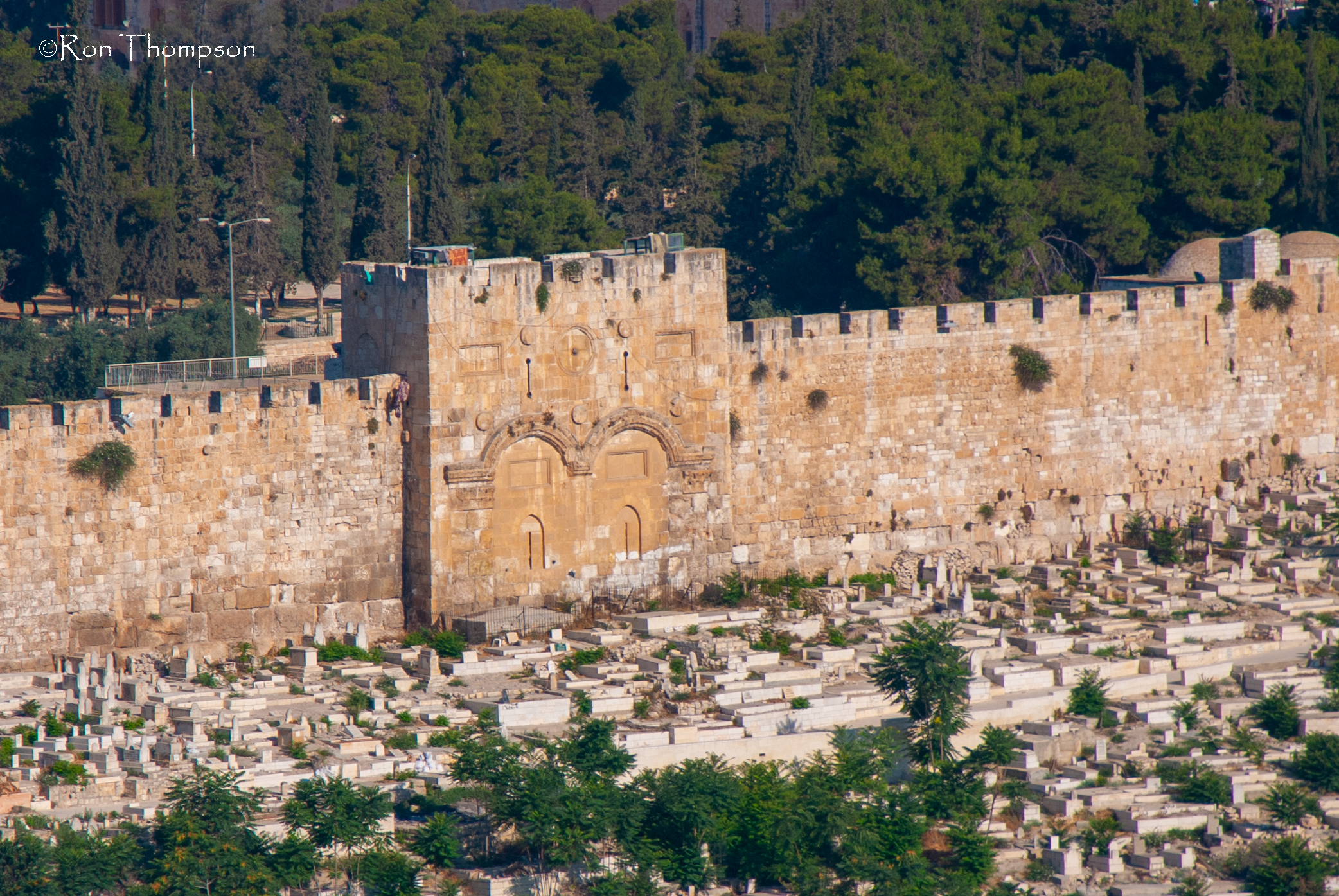
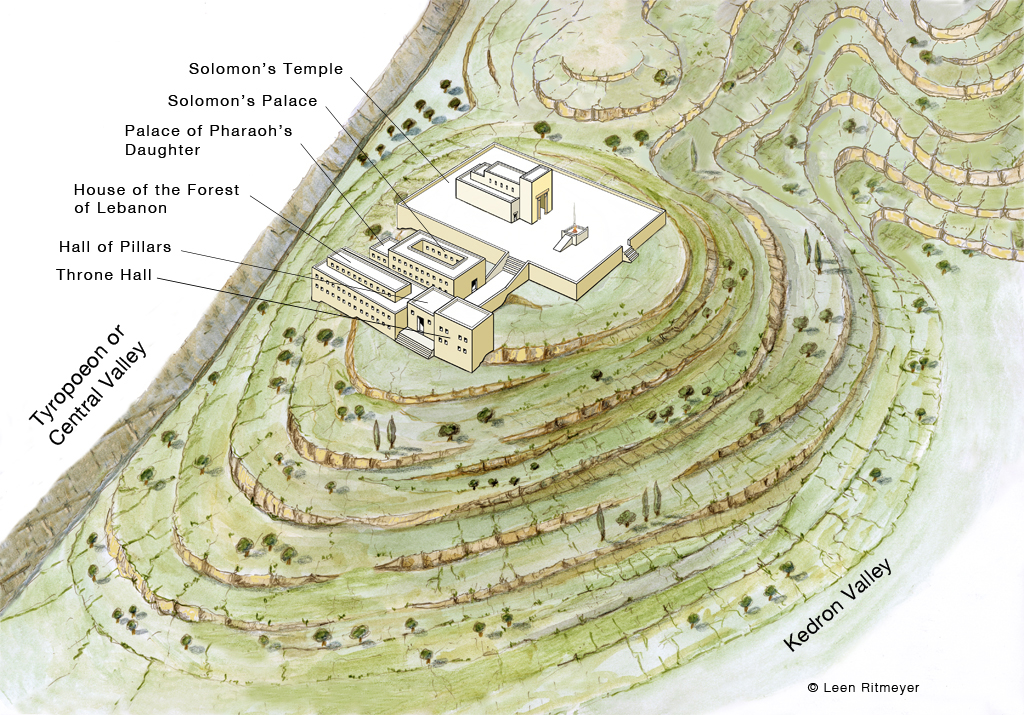
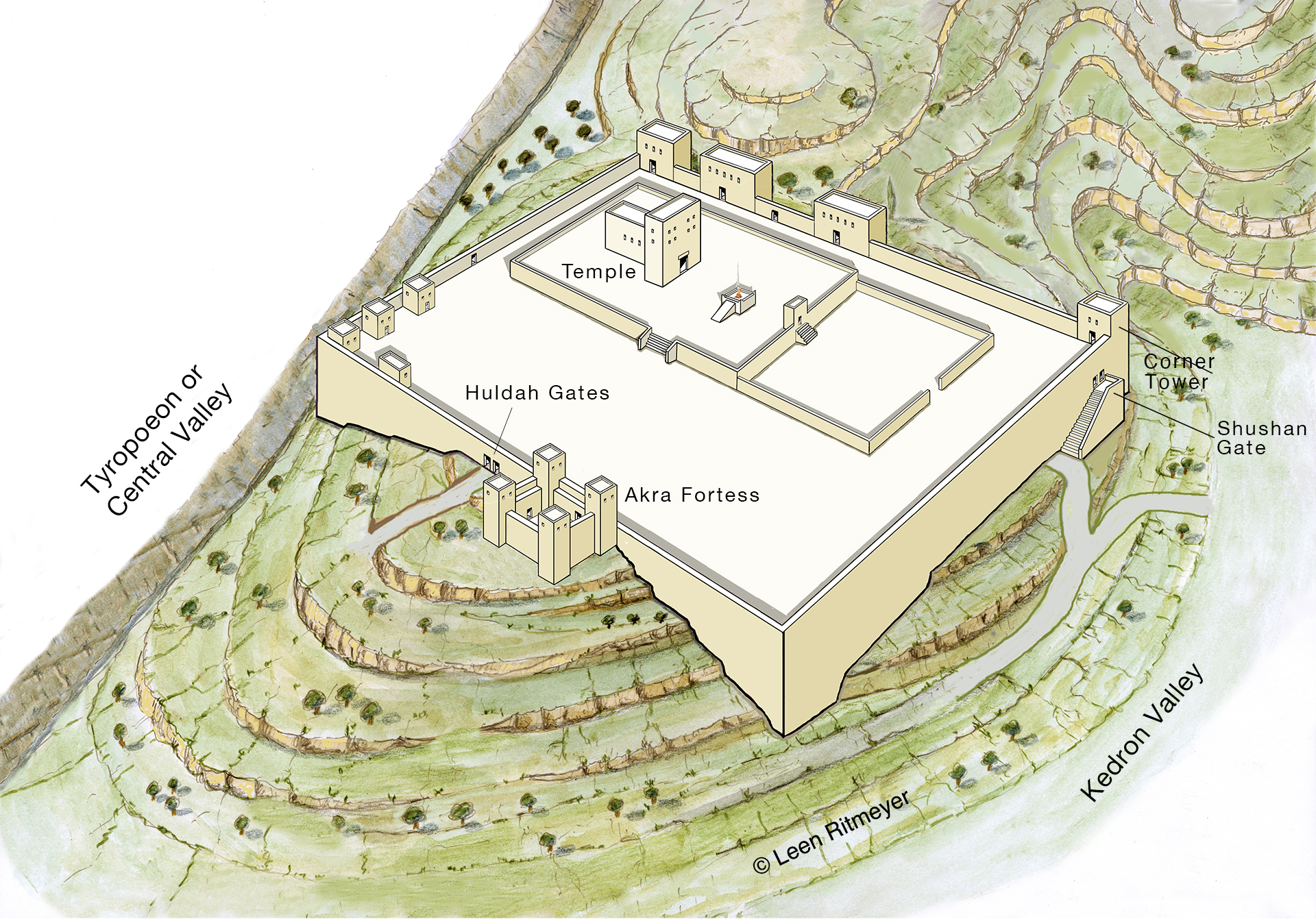
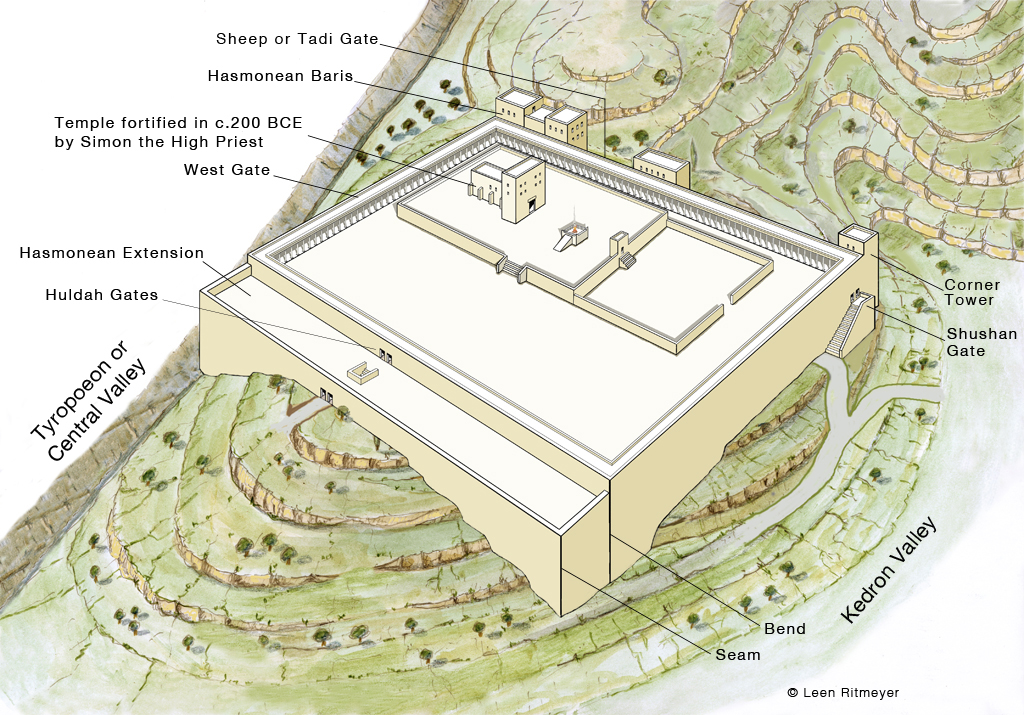
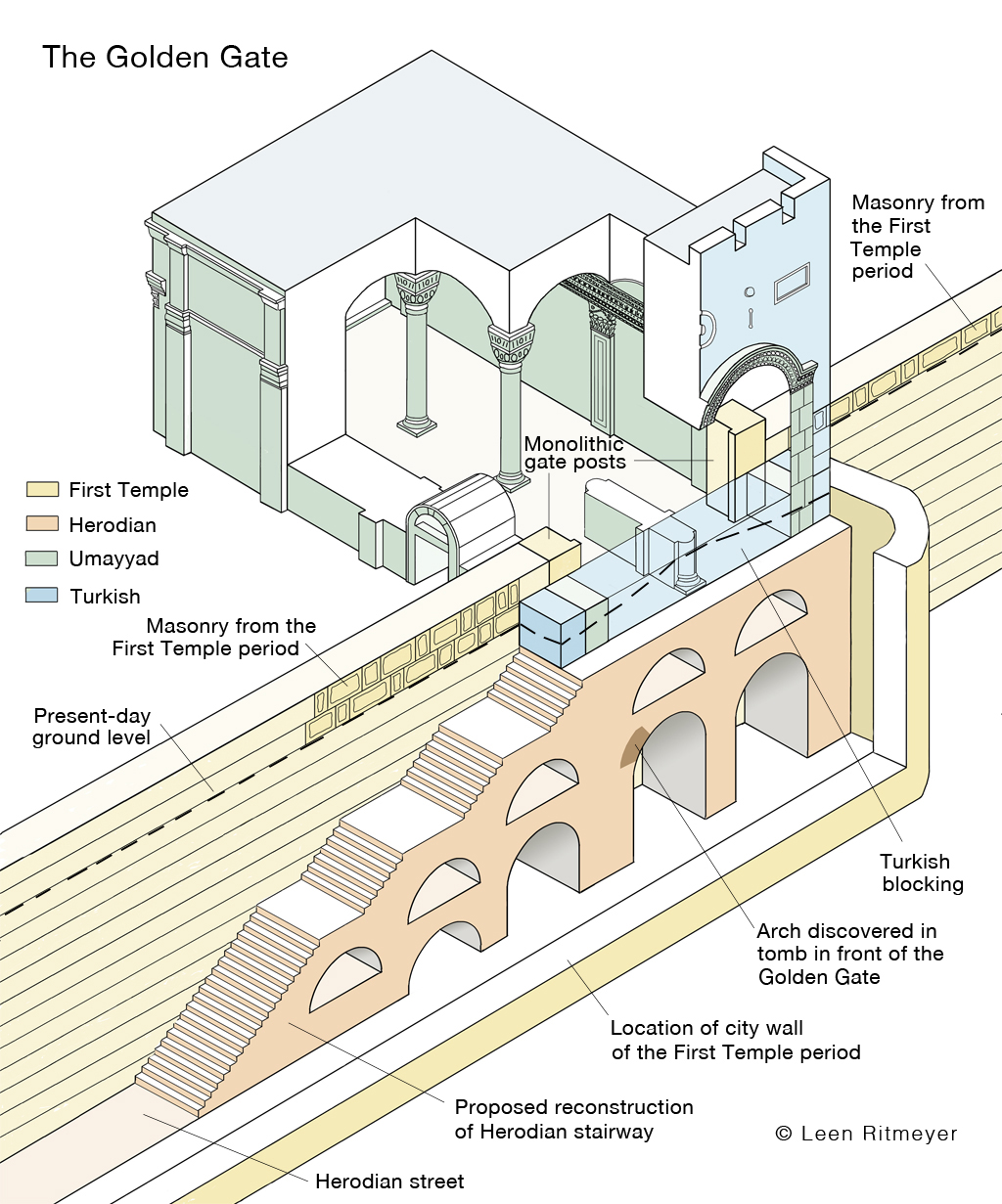
One of the common misconceptions about Ezekiel concerns his prophesies about the Glory of the Lord departing the temple, discussed in this section. Much of the following is reproduced from Opening the Golden Gate, which I first posted on May 12, 2022. In that article I presented a brief history of the Temple and its Eastern Gate and then discussed some of the common misconceptions about that gate.
Then the glory of the LORD went out from the threshold of the house, and stood over the cherubim.
And the cherubim lifted up their wings and mounted up from the earth before my eyes as they went out, with the wheels beside them. And they stood at the entrance of the east gate of the house of the LORD, and the glory of the God of Israel was over them.
—Ezekiel 10:18–19 ESV
Then the cherubim lifted up their wings, with the wheels beside them, and the glory of the God of Israel was over them.
And the glory of the LORD went up from the midst of the city and stood on the mountain that is on the east side of the city.
—Ezekiel 11:22–23 ESV
God is omnipresent, both in space and in time. As our infinite, Almighty God, He can’t be contained in a tent or a building. But because He chose to deal with humanity, as represented by the primitive Israelites, He picked a form in which to appear to them. An “interface”, so to speak. In the desert, it was “a pillar of cloud by day and a pillar of fire by night.” In the Tabernacle, and later the Temple, His “Divine Presence,” in whatever visible form it appeared, was in the Holy of Holies, above the Mercy Seat of the Ark.
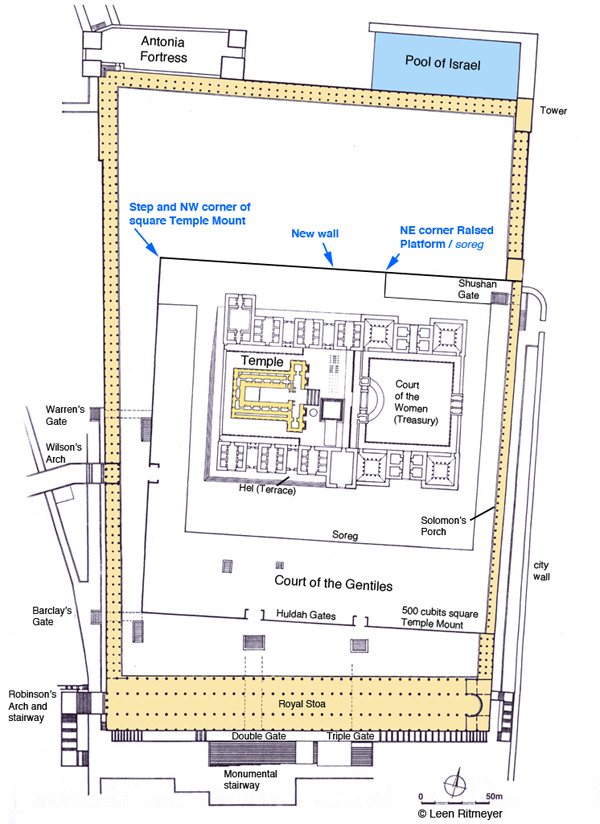
Chapters 8 through 11 of Ezekiel record a vision that came to him while he was sitting in his house with “the leaders of Judah”. In the vision, he was taken to the Temple in Jerusalem and shown men in leadership positions performing “disgusting” idolatrous religious rites in the Temple precincts. God then ordered a scribe to pass through the city and put a seal on the foreheads of innocents, while six other presumably angelic beings followed him and executed anyone not so sealed. The six beings were then told to set fire to the city. After the return of the scribe, God’s Sh’kinah Presence left the Temple, rose above its threshold, paused for a bit over the “east gate of the Lord’s house” (this could be the gate of an interior courtyard, or it could be the Shushan Gate overlooking the Kidron Valley), and then “stood” over the mountain on the east side of the city (no doubt the Mount of Olives).
Most visitors to Jerusalem who have read Ezekiel or have taken the tour guide’s explanation as Gospel truth, are certain that God lived in the Holy of Holies and that He moved out through the Golden Gate. That’s very sloppy theology!
Also, the part about Jerusalemites being “sealed” and those without seals being executed most likely did not happen. I take it as a homiletic description of “sinners in the hands of an angry God,” so to speak.
Ezekiel described an allegory, not reality. Yet it was a prophecy of something that was very real, which came very soon thereafter. Because of corruption reaching even into the Temple, God withdrew His protection from the city and the Temple, and both were sacked and burned by Nebuchadrezzar’s army, with many people killed.
Ezekiel 38 – 39 (Gog and Magog)
Beginning around Ezekiel 34, the prophet begins to shift from prediction of judgement to prediction of restoration. Chapter 37 is the famous “dry bones” prophecy, which I have to think brings us to our own age and the return of Jews to Israel starting in the late 19th century, and culminating with a declaration of independence in May 1947. The next event on Ezekiel’s calendar is the Gog and Magog War, which I believe will occur before the Tribulation period, and possibly before the Rapture.
I wrote a compete article about this prophecy in 2015, in The Coming World War: Gog and Magog. There is no indication whether this prophecy originated from a vision or by some other means, but I think it is appropriate to include it here to demonstrate that even prophecies that were not delivered as visions or dreams can be tricky to understand if you want to insist that every word must be taken in a literal sense.

I stand by that article as amended from time to time, though I may have taken the participant nations too literally. Populations move around over the centuries, and today’s nations may not occupy the same territories as those of Ezekiel’s day.
Also, my view on the motivations for the attack have changed a bit since the October 7 terror attack in Israel. In a November 2023 update, Did Ezekiel Prophesy the October 2023 Israel/Gaza War?, I stated that the Gog/Magog war would “of course” be precipitated by Iran’s proxies. That cause appears to be pretty much off the table for a while, but I went on to speculate that Russia might take the initiative in an effort to bolster Putin’s waning reputation.
And now President Trump, NATO, and new trade and defensive alliances are backing Putin into a very tight and embarrassing corner. Very interesting!
It frequently happens that prophecy has to be reevaluated when conditions change!
Ezekiel 40 – 42 (The Millennial Temple)
In 573 BC, Ezekiel was given a vision of a new Temple to be built in Jerusalem. He records that vision in great detail in chapters 40 and following of his prophetic book. In an excellent 20th century book entitled Messiah’s Coming Temple, John W. Schmitt and J. Carl Laney analyzed both the design of this temple and the use to which it will be put. It bears a superficial resemblance to previous Temples, but is by far the largest, and in even some of the “essential characteristics”, it differs from them in ways that do not correspond to Jewish law. This is because its purpose will be different in many respects, as outlined in the Schmitt/Laney book.
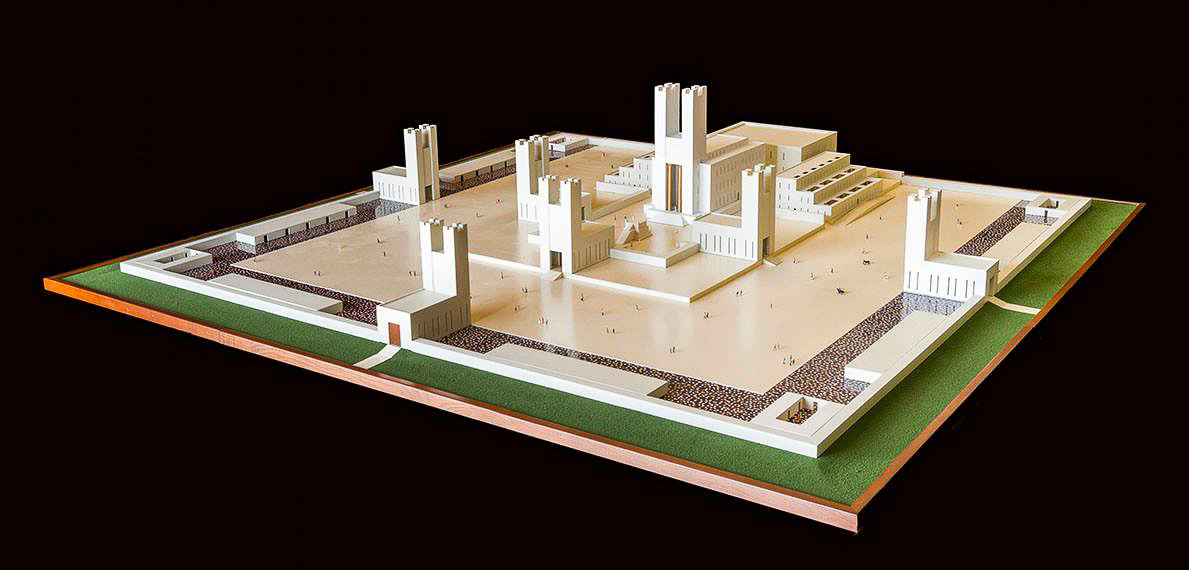
The lesson here is less about sloppy reading than it is about neglect.
Judaism mainly ignores this passage because the design of this Temple differs from the Mosaic instructions in several key elements. They claim it can’t possibly be a legitimate design since it doesn’t match the required specs for the Tabernacle and Solomon’s Temple. Of course, the reason for the differences is that Jesus’ death and resurrection changed significant parts of the cultic practice, as mentioned in the book of Hebrews.
Christians, however, neglect it for the opposite reason: they can’t see any use at all during the Millennium for a Temple with an alter and other features needed for any part of the Mosaic Covenant observance.
Both sides are wrong, but I wonder how many of my readers have been even slightly curious about this portion of Scripture. It is God’s Word, so it is important to me!
Ezekiel 43:1–12 (God Returns to the Most Holy)
Then he led me to the gate, the gate facing east.
And behold, the glory of the God of Israel was coming from the east. And the sound of his coming was like the sound of many waters, and the earth shone with his glory.
And the vision I saw was just like the vision that I had seen when he came to destroy the city, and just like the vision that I had seen by the Chebar canal. And I fell on my face.
As the glory of the LORD entered the temple by the gate facing east,
the Spirit lifted me up and brought me into the inner court; and behold, the glory of the LORD filled the temple.
—Ezekiel 43:1–5 ESV
Again, see Opening the Golden Gate.
Beginning in chapter 40, Ezekiel has been once again taken to Jerusalem in a vision, but this was to show him events far in the future, during the Millennial Reign. The vision shows him a new Temple (see the previous section), to be built presumably at the start of the Reign. In chapter 43, suddenly God’s Glory returns to the Temple, but this time through the gate facing east, not above it. The assumption that many people make is that “God’s Glory” here refers to Jesus. The parallels between this and the earlier vision indicate it is God’s Sh’kinah returning—the Father, not the son.
The sequence in chapter 43 is as follows: God’s Glory returns, through the “gate facing east.” God goes into the Temple itself and fills it with His Glory. Ezekiel is standing outside the Temple with the angel who has been showing him around. God calls out from inside, saying that He will now dwell with His people forever, and never again will they defile His house.
So, if it wasn’t Messiah entering through the eastern gate, is Jesus “the prince“, who is mentioned several times in the prophecy? Clearly, He is not! This prince, whoever he is and whatever his function, has sins to atone for, and evidently, he has children. I surmise that he is to be a senior Zadokite priest, over the other priests but reporting to the new permanent High Priest, Messiah.
We know from other prophecies that Jesus will reign from Zion. But nowhere does scripture say that it was Jesus who entered through the eastern gate! And incidentally, there does not seem to be a throne room in Ezekiel’s Temple.
Once again, sloppy reading makes sloppy theology. It is the visible, localized sh’kinah Glory of God, the Father, entering the Temple. But He is entering through a new Eastern Gate, not the Golden Gate, which will no longer exist.
Jesus does return in clouds to Mt. Olivet, but nowhere does scripture say that He enters the Temple to reign. Most likely He’ll reign from a Palace.
Revelation
Of course, most of Revelation is prophetic imagery. I’m only going to hit some high points here. I need to mention that I am not a Dispensationalist, but I am premillennial, and in general, I pretty much agree with the Dispensational interpretation of Revelation. But not everything…
Chapter 8–9 (trumpets)
First, there are no trumpets in this passage! I plan to show in a future post that shofarim (animal horns used for blowing) are in view here. A shofar is blown like a trumpet, but it is not a trumpet, and the two have different functions in the Bible. In reality, therefore, this chapter is about the Seven Shofar Judgements!

In verse 8:1, the Lamb opens the 7th Seal, which releases “thunder, lightning, [sounds or voices] and an earthquake“, 8:5. The “sounds or voices”, (translated “rumblings” in ESV) are part of the vision, and unexplained. The Seal sets the context for the 8 shofarim to follow, and suggests that the judgements are connected in some way to powerful tectonic and atmospheric forces on earth.
The first shofar judgement is hail and fire, mixed with blood, resulting in “a third of the earth … burned up, and a third of the trees … burned up, and all green grass … burned up” , 8:7. Using the hermeneutic principle of taking the plain sense of the verse if it “makes common sense,” we might then opine that the storms of verse 5 will produce the hail, and the lightning will set the fires. The third of the “earth” burned up might simply be a reference to the location of the burned portion of the vegetation. The blood mixed with the hail is harder to explain.
The second shofar judgement is “something like a great mountain burning with fire” causing the death of sea creatures and destruction of ships. That much is easy to explain as a large asteroid hit, but once again there is unexplained blood that casts doubt on the interpretation.
The third shofar judgement would appear to be a comet rather than another asteroid. Asteroids mostly originate in the Asteroid Belt, between Mars and Jupiter, and have compositions similar to those of the inner planets. Comets usually come from the Keiper Belt outside the orbits of the planets, and some “long-period” comets don’t originate in the solar system at all. A naturalistic explanation of “Wormwood” would be such a comet containing an unfamiliar compound that scatters in the wind and turns water sources bitter.
The fourth shofar judgement would seem to follow naturally from either or both of the “falling stars”.
While the first four shofar judgements, chapter 8, may possibly have a more or less naturalistic mechanism, judgements 5 and 6, chapter 9, are clearly supernatural from start to finish. I won’t attempt to explain them here, except to speculate that they should probably be taken at face value.
Note, however, that the “star” of 8:10 is no doubt an inanimate orbiting body (as opposed to a literal star), but the star of 9:1 is angelic. Angels are frequently referred to metaphorically in Hebrew literature as stars.
The 7th shofar, like the 7th Seal, is introductory for what follows it.
Like the shofar judgements, many Biblical prophecies can be interpreted naturalistically, while others can’t. It’s not always possible to know which is the case. Unfortunately for those of us who crave to understand every word spoken by God, both naturalistic and supernaturalistic prophecies can have an ultimate meaning that is either literal or metaphorical, or even both!
Chapter 10 (the angel with the little scroll)
This angel is also described, in verses 2 and 5 as the angel with his right foot on the sea and his left foot on the land.
Most scholars will tell you that prophetic references to the sea are speaking of chaos. The sea is chaotic. The land is not or is relatively free of chaos. I totally disagree with this interpretation!
All Bible prophecy is at its core Jewish. To the ancient and classical Jews, “the land,” when used metaphorically in prophecy, almost always refers to Eretz-Yisra’el, the Land of Israel, and “the sea” refers to all other lands on earth. Thus, the angel and the little scroll are going to effect both Jews and gentiles in some way.
At least portions of some Biblical prophesies can be interpreted with a high degree (though less than 100%) of certainty if certain key words or phrases are detected. Conversely, missing these keys may lead to completely erroneous conclusions.
Chapter 12 (a woman and a war)
This is a hotly contested passage that I will not say much about here. I believe it is partly a flashback to Jesus’ birth, and partly a discussion of Israel’s disposition going into the second half of the Tribulation.
Verses 1–5 are seen by some of the more radical (in my view) prophecy teachers to be signs that will appear in the zodiac at the close of the Trumpet Judgements. There are whole books written on this interpretation. There have always been Jewish and gentile Christian teachers who dabble in astrology, but that, in my opinion, is a pagan practice that has no place in God’s prophetic scheme.
What the passage is to me, is a highly figurative description of Messiah’s birth, not to Mary, but to Israel in general, and of His death and ascension into heaven.
Verses 7–12 is description of an angel-versus-angel war in heaven following the incarnation of The Son. A large number of disgruntled angels, led by Satan (Lucifer, if you will), enraged by this affront to the power they had gained on earth since the dispersal from Babel, waged war in heaven with the faithful angels, led by Mikha’el (Michael, see Daniel 10:21), the champion of Israel.
Prior to this outright war, the first recorded angelic rebellion was when Satan contradicted Elohim in the Garden. Subsequently, there were several angelic rebellions, but the “bad guys” were still given access to God at His Divine Council in heaven. This war marked the end of that access:
7 Now war arose in heaven, Michael and his angels fighting against the dragon. And the dragon and his angels fought back, 8 but he was defeated, and there was no longer any place for them in heaven.
— Revelation 12:7-8 (ESV) emphasis mine
Chapter 13–14 (the two beasts)
Once again, I will not try to dig for everything in these chapters, but I do want to mention a few points about Antichrist and his realm.
The “Beast from the Sea”
Jerry Falwell, Sr. famously stated that the Antichrist will “definitely be Jewish.” On the contrary, Antichrist’s origin in “the sea” unmistakably marks him as gentile (see the previous section).
Naming the Antichrist can’t be done using only this passage. Other passages in Revelation, Matthew, and elsewhere in the NT must be considered, along with various OT prophecies, especially in Daniel and the Minor Prophets. Still only guesswork is possible.
Counterfeit Christ?
Many commentators and pastors describe Antichrist as “a counterfeit Christ,” and that may be a big part of why Falwell decided he is Jewish. That is a misunderstanding of Antichrist’s role. Without question there are some parallels between the Trinity and the realm that Satan tries to establish here, but I see Antichrist as simply a false God, a pagan deity opposed to Jesus.
“Anti-Christ” means “opposed to the Messiah”, not a fake or a negative image of Messiah.
Antimatter is not counterfeit matter. A positron is an antielectron, meaning it is an electron with a positive, rather than negative, charge. If an electron and a positron come into contact with each other, both are instantly annihilated.
Fatal wound
Verse 13:3, speaking of Antichrist, says:
One of its heads seemed to have a mortal wound, but its mortal wound was healed, and the whole earth marveled as they followed the beast.
— Revelation 13:3 (ESV)
“Seemed to have a mortal wound” translates the Greek phrase, ὡς ἐσφαγμένην ἐσφαγμένην θάνατον, literally, “[was] as having been slain to death.” Similarly, “mortal wound” is πληγὴ τοῦ θανάτου, literally, “wound of death.” The phrasing here convinces me that this is not saying Antichrist was killed, but merely that he had a wound that at least briefly seemed to have been fatal. The timing of the event is also not addressed. He could have survived a wound as a child and the press coverage later flaunted as he gained power. Or he could have survived an assassination attempt during his rise in power.
The “Beast from the Land”
The “Beast from the Land”, aka, the “Second Beast”, aka, the “False Prophet” will more nearly take on the role of a false Messiah. And by the way, his origin in “the Land” identifies him as Jewish.
Horns and Heads
Revelation 13 and Daniel 7 both speak of the Antichrist as having ten horns (each with a diadem) and seven heads. Rev. 12 and 17 also speak of Satan (the Red Dragon, identified as the Serpent) as likewise having 10 horns and seven heads, so the two (Dragon and Satan) are connected in some way, presumably master and servant. No surprise.
Dan. 7:24 and Rev. 17:12 identify the horns as “kingdoms” from which the Antichrist will rise. In Rev. 17:9, the seven heads are identified as “seven mountains on which the woman is seated”, and at the same time, “seven kings.”
Despite numerous attempts that I have personally read going back at least to Hal Lindsey’s Late, Great Planet Earth and Satan is Alive and Well on Planet Earth, nobody has ever done better than guess as to the identities of those 10 “kingdoms.” Back then it was the Common Market, but that quickly outgrew ten nations. Tim LaHaye’s Left Behind books, Biblically dubious in so many ways, picked the United Nations.
My own guess is that the Gog and Magog War, which God Himself will end, will leave both sides hugely weakened but will not quell the centuries of compounded hatred in the region. A powerful world leader will then gather a group of ten heads of state around a table to produce the peace treaty that guarantees Israel’s safety going forward—and sets The Tribulation in motion. More or less in the pattern of President Trump’s August 2025 initiative to stop the Russia/Ukraine War.
In other words, the 10 horns need only be powerful entities. It would make sense to me if they were ten individual members of the larger European Union or NATO, a political or economic cartel, perhaps even huge corporations, or megarich Oligarchs. I suppose we’ll know them when they become obvious.
A Revived Roman Empire?
News Flash: The Roman Empire is dead! It ain’t coming back! I’m not ruling out that Antichrist’s empire could have similar characteristics, similar membership, or even the same general location (which might be around Rome, Istanbul, or Even Aachen, Charlemagne’s medieval capital in the Holy Roman Empire.
The notion of a “Revived Roman Empire” comes from a modern view of Daniel’s interpretation of Nebuchadrezzar’s statue dream in Daniel 2. I agree that we are correct in seeing the gold, silver, bronze and iron segments of the statue as Babylon, Medo-Persia, Greece, and Rome, respectively (many Christians have other views). But where others see a Revived Roman Empire, I see the feet and toes made of iron mixed with clay as merely the fragmented post-Roman world from the Middle Ages on through the present:
Daniel 2:43 (CJB)
[43] You saw the iron mixed with clay; that means that they will cement their alliances by intermarriages; but they won’t stick together any more than iron blends with clay.
A pair of Dreams
Since this post is now becoming insufferably long, I’m going to close with just two more examples…
Joseph and the sheaves
Behold, we were binding sheaves in the field, and behold, my sheaf arose and stood upright. And behold, your sheaves gathered around it and bowed down to my sheaf.”
— Genesis 37:7 (ESV)
Everyone is familiar with Joseph’s older brothers’ hatred for him because of the favoritism shown to him by their father. The intricate (from פַס, pahs, a difficult to pronounce guttural adjective if your language is English) robe given him by Jacob, probably “long-sleeved” rather than “multicolored”, greatly exacerbated the problem. When he then naively repeated his dream to the brothers, it was certainly a (forgive me) last [bundle of] straw.
Nobody needed to interpret that dream! Clearly, they recognized that it was a metaphorical picture of them, bowing down abjectly to their snotty young brother.
There is a tendency among Christian interpreters of Jewish Scripture to read literal meanings into visions and dreams even when it is clearly the symbolism that is vital. In this case, we understand that the brothers are right—the dream is indeed picturing them bowing to their brother.
Because of the absurdity of the dream itself, we understand that it is an allegory for Joseph’s relationship with his brothers, not a prediction that their crops will worship his!
Peter and the sheet
Here is another Biblical dream that uses an allegory to illustrate a Jewish premise. In this case, though, most gentile Christians (which today means most Christians) have a very weak understanding of Judaism and the Mosaic Covenant, so they take both the allegory and its premise literally.
10 [Peter] became hungry and wanted something to eat, but while they were preparing it, he fell into a trance 11 and saw the heavens opened and something like a great sheet descending, being let down by its four corners upon the earth. 12 In it were all kinds of animals and reptiles and birds of the air. 13 And there came a voice to him: “Rise, Peter; kill and eat.” 14 But Peter said, “By no means, Lord; for I have never eaten anything that is common or unclean.” 15 And the voice came to him again a second time, “What God has made clean, do not call common.” 16 This happened three times, and the thing was taken up at once to heaven.
— Acts 10:10-16 (ESV)
When Peter woke from his trance, did he immediately run to the kitchen and shout, “Halleluiah, hold the falafel and hummus on pita and bring me a ham and cheese sandwich!”? No, he “was inwardly perplexed as to what the vision that he had seen might mean.” He knew that his God would not tell him to violate Kashrut (the dietary laws under Covenant), so he thought that it made absolutely no sense.
But by the time he met with Cornelius, he’d figured it out:
And he said to them, “You yourselves know how unlawful it is for a Jew to associate with or to visit anyone of another nation, but God has shown me that I should not call any person common or unclean.
— Acts 10:28 (ESV) emphasis mine
As with Joseph’s sheaves, the sheet here is a picture, not the actual subject under discussion. I’ve stated in other articles that I believe the Mosaic Covenant, including its dietary laws, is still in force for Godly Jews. This passage by itself cannot prove me wrong (or right), because it is not about food, it’s about people.
Conclusions
Dogmatic interpretations of visions and dreams is seldom, if ever, possible unless corroboration is provided elsewhere—by means, for example of:
- Interpretation by the prophet himself, if provided.
- Direct interpretation by statements elsewhere in Scripture.
- Clear fulfillment elsewhere in Scripture.
- Parallelism, where two or more passages each contribute information.
- Ancient Jewish thought from Hebrew literary sources.
- Ancient Near Eastern (ANE) thought from ANE literary sources.
- Ancient history.
- Post-Biblical History.
- Current events.
Prophetic understanding sometimes comes slowly, and sometimes in bits and pieces. The Old Testament alone was not clear on the fact that the Messiah would come twice, with different agendas.
Prophecy has to be reevaluated when conditions change. Which goes along with my main purpose in writing this article—to urge against being too dogmatic about prophetic interpretation.
Over-interpretation by modern-day Christians is risky, though it may be entertaining!



 The Back of My Mind