God with the Wind

  1. Some background before I proceed…
  2. So, here’s where I’m going with this…
    1. God’s wind
    2. East Wind
    3. Conclusion

Recall that in 1Kings 19, the Prophet Elijah has fled from the irate Queen Jezebel and is hiding in a cave near Mt. Horeb (Sinai). He is moaning about his fate, and God drops in to confront him:

And he [God] said, “Go out and stand on the mount before the LORD.” And behold, the LORD passed by, and a great and strong wind tore the mountains and broke in pieces the rocks before the LORD, but the LORD was not in the wind. And after the wind an earthquake, but the LORD was not in the earthquake. And after the earthquake a fire, but the LORD was not in the fire. And after the fire the sound of a low whisper.
—1 Kings 19:11–12 ESV

Two interpretive issues stand out here for me. The first is God’s demonstration for Elijah’s benefit of His power to control events, including even the forces of nature. That will be the subject of most of this post.

The second is an interesting side issue: how does God normally communicate with humans? Over the years I have heard many pastors and teachers refer to the inward prodding and conviction of the Holy Spirit as “God’s still, small voice.” That is a distortion of theology going back, I think, to the early church fathers. The ancient Jewish Rabbis taught that God most often spoke to His people in post-prophetic (intertestamental and following) times audibly but quietly, in a low, soothing whisper. This has been termed, in Aramaic, the bat kol, or “daughter voice”, and you can read one description of that here.

To Top

Some background before I proceed…

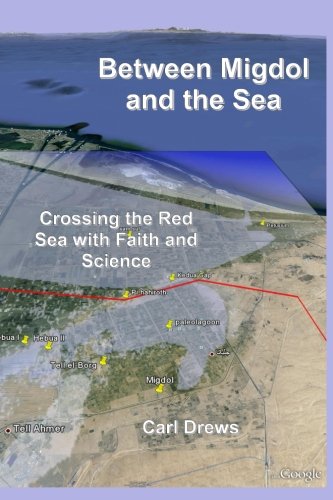
Book cover.

Some time back I read a book titled Between Migdol and the Sea: Crossing the Red Sea with Faith and Science, by Carl Drews. Drews is, like me, a self-taught amateur theologian with a technological background. He is also, again like me, passionately interested in the Egyptian sojourn, the Red Sea Crossing, the years of wandering, and the conquest of Canaan. The main difference between us is that I am a Conservative Evangelical who believes in the Divine inspiration and inerrancy of Scripture, while Drews takes a “Higher Critical” approach to Scripture.

The central reason for Drews’ book is to provide an engineering analysis of the following verse in order to discover the most likely site of the Red Sea (Sea of Suf) crossing:

Then Moses stretched out his hand over the sea, and the LORD drove the sea back by a strong east wind all night and made the sea dry land, and the waters were divided.
—Exodus 14:21 ESV

Drews is an expert on mathematical modeling, i.e., using computers to simulate real-world conditions. For example, meteorologists use mathematical models to provide fairly accurate weather forecasts and to predict storm movements. Astrophysicists use them to study how stars and galaxies form and interact. In my own field of petroleum engineering, I have used (and even designed) them to predict reservoir responses, such as oil and gas flow in rocks and pipelines, and depletion of reservoir pressure.

Drews used computer modeling to study “wind setdown” at various supposed locations of the Israelite crossing of the Red Sea. Setdown is a form of storm surge. Where high winds blow across an expanse of open water, shear forces can move the surface waters, piling them up on beaches and exposing shallow beds that are normally flooded. Drews proved, conclusively I think (but see below), that wind blowing across any body of water in the Egypt/Sinai/Arabia area, with one exception, would have to blow so hard to achieve the necessary setdown effect that no human could survive the crossing. Not the currently favored Bitter Lakes area on the present-day Suez Canal; not the current fad choices, at Nuweiba Beach in the Gulf of Aqaba or the Timor Straits area at the southwest extremity of Aqaba; and not the traditional (my own preferred) area in the northern Gulf of Suez, south of Suez City.

The one exception found by Drews is the shallow Lake of Tanis in the Nile Delta. He states that a strong easterly wind has been historically known to drive the water off the shallows from time to time, and that at those times the lake can be traversed by foot. His premise is that the Exodus miracle is in the timing, not in the actual moving of the water.

But consider that the crossing of the Red Sea, wherever that may have occurred, was the definitive, miraculous demonstration of God’s awesome power, whereby He showed His people, for all time to come, that He is worthy of all praise, glory and undying worship!

We know that God transcends time and place. He sees everything, everywhere and everywhen! So, Drews is asking us to see God checking His Weather Channel listing for the next hundred years or so, finding a convenient windstorm predicted for the time period, and deciding, “Yeah that would be a good time to send Moses to get my folks out of Dodge.”

I don’t buy it! What God came up with was something way, way more spectacular!

To Top

So, here’s where I’m going with this…

If you have heard many sermons on the Ten Plagues of Egypt, then you have probably heard that each plague was a challenge to one or more of Egypt’s pagan gods. In each case, the True God bested the pagan deity at his or her own specialty. Time and time again throughout Scripture, you see God delivering judgement, warnings or promises through or while accompanied by natural forces. This is partly a demonstration of His awesome power, and partly a polemic against the pagan deities that His people tended to fear or follow. Sometimes the accompaniment is a small thing, like a bush that burned without being consumed, or a gourd that withered and died in a hot wind. Sometimes much more, like fire and smoke over Mt. Sinai.

Read again the passage I quoted to start this post. Elijah was waiting to hear from God. When he felt a mighty wind, he thought it was the arrival of God. When he felt an earthquake, he thought, “Surely this is God…”. When he saw a fire, he probably remembered that it was right there on Mt. Sinai where God had appeared to the Israelites in fire and smoke. Surely God brought all of those things along to remind Elijah what He could do, but in this case, Elijah needed also to hear a tender voice.

To Top

God’s wind

Egyptian God of Wind and Air, Amun. ©Richard Maschmeyer—Design Pics/Getty Images

I’m going to concentrate the rest of this discussion on the wind, because this is a particular idea that I have been exploring recently. Pagan wind deities tended to be particularly important in the ancient world because wind is almost always with us, and some of the most powerful natural phenomena are related to wind. In particular, this was true in Egypt, and therefore front and center in Israelite memory and lore. By the time of Moses, Egyptian mythology had merged the Sun God, Ra, with the God of Wind and Air, Amun, to produce the chief deity of that age, Amun-Ra.

Hebrew is a language that is rich in homonyms, or words with multiple meanings. The word רוּחַ, or ruach, is one of these. Depending on the context, ruach can mean “breath“, “spirit“, or “wind“. Sometimes there are specific clues in the context, like in Gen 1:2, where it appears as “the Spirit (Ruach) of God”, evidently referring to the Holy Spirit (Ruach ha-Kodesh). Very often, God’s miraculous works are accompanied by ruach. Bible translators have their reasons for choosing a particular meaning for a Hebrew term, but in some of those cases I have begun to wonder, “Is this interpretation cast in stone, or was it an assumption that has become ingrained as an unquestioned tradition?” Is it Spirit, is it literally wind, or is it perhaps both? I think that, perhaps, the idea of “both” has been underappreciated!

Take, for example, the following:

The festival of Shavu‘ot (Pentecost) arrived, and the believers all gathered together in one place.
Suddenly there came a sound from the sky like the roar of a violent wind, and it filled the whole house where they were sitting.
Then they saw what looked like tongues of fire, which separated and came to rest on each one of them.
—Acts 2:1–3 CJB (emphasis added)

Here we see a great spiritual miracle, the imparting of the indwelling Holy Spirit, accompanied by two physical phenomena: the sound of wind in the sky above them, probably indicating that wind was in fact blowing; and “tongues of fire” over the individual recipients.

What about “the strong east wind” that we observed in Ex 14:21? The verb in the phrase translated as “drove the sea back” (ESV, NIV, et al) or “caused the sea to go back” (CJB, KJV, et al) has the Hebrew root הָלַךְ (halakh, to walk, or go). It is described by Strong’s as having, “a great variety of applications, literal and figurative”. The specific form of the verb appearing here, וַיּ֣וֹלֶךְ, is syntactically a Hiphil, which I’m told makes the passage read more like “caused the sea to go [back]”. What is clear to me is that it was God who moved the waters. I don’t believe that you can say definitively from the Text whether the wind was His agency or was simply an accompanying phenomenon as seen elsewhere in Scripture. Since I am theologically convinced that the event required more than a minor “miracle of timing”, then I believe it is fair to say that Drews’ research proves scientifically that wind could not have been the agency. God miraculously parted the waters, while announcing His presence with a strong but less than lethal wind. For me, that’s a satisfying answer that makes any of the candidate crossing sites tenable!

Though he may flourish among his brothers, the east wind, the wind of the LORD, shall come, rising from the wilderness, and his fountain shall dry up; his spring shall be parched; it shall strip his treasury of every precious thing.
—Hosea 13:15 ESV

To Top

East Wind

Is there any significance to the easterly wind direction? Absolutely! The prevailing wind direction in the northern temperate regions is westerly. In the Eastern Mediterranean region around Anatolia, the Lavant and Egypt, these winds bring ashore relatively cool, moist sea air. But during certain seasons there is sometimes a dry, hot wind blowing out of the deserts to the east and southeast, raising temperatures and withering crops. This is the beruakh qadim (“east wind”), or sometimes for brevity, just the qadim (“easterlies”), of Scripture. A more modern term for these winds is the Hebrew, sharav, or in Arabic hamsin winds. If the rain is God’s blessing on the Land, then the east winds are surely His curse. It is easy to see why the east wind appears over and over in Scripture, especially in prophecy, to symbolize and accompany God’s judgement.
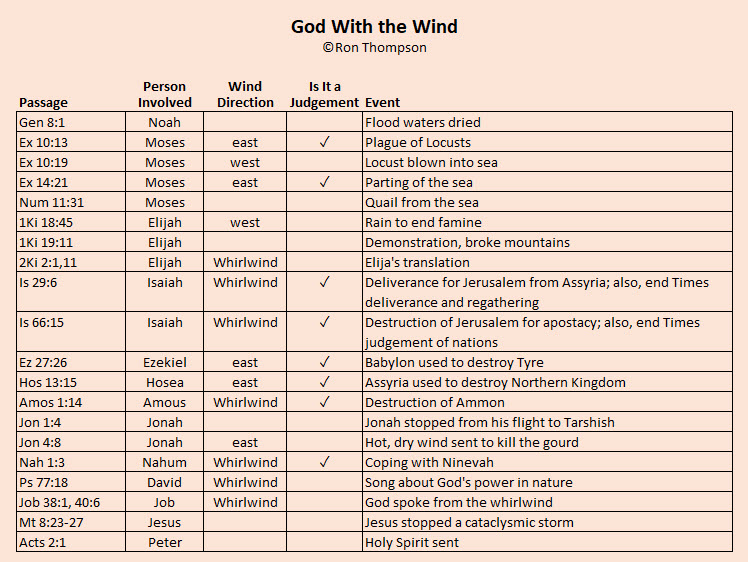
Passages where wind accompanies miracles. “Whirlwind” includes dust devils through tornadoes and typhoons. ©Ron Thompson 2022

To Top

Conclusion

Many creationists believe that Earth’s present topology is mostly the result of upheavals caused by the Flood itself. At the time represented by Genesis 8:1 (after the flood itself, when things had calmed down), one would thus expect that the peak of Mt. Ararat was close to its current height of over 16,000 feet above sea level. Wind alone could not have dropped the water level over 3 miles! Only the power of God could have caused the flood, and only the power of God could have ended it! My conclusion is that either the wind was there as God’s signature, or ruach should have been translated as “Spirit” here, as it was in the similar scenario of Gen 1:2.

God remembered Noach, every living thing and all the livestock with him in the ark; so God caused a wind [ruach] to pass over the earth, and the water began to go down … It was after 150 days that the water went down.
—Genesis 8:1–3 CJB

I opened with Elijah in a cave, expecting God to appear to him in wind, an earthquake, or fire. I’ll close with a parallel text, with another prophet looking to the end times.

But the multitude of your foreign foes shall be like small dust, and the multitude of the ruthless like passing chaff. And in an instant, suddenly,
you will be visited by the LORD of hosts with thunder and with earthquake and great noise, with whirlwind and tempest, and the flame of a devouring fire.
And the multitude of all the nations that fight against Ariel [possibly meaning “altar hearth”, but referring here to Zion], all that fight against her and her stronghold and distress her, shall be like a dream, a vision of the night.
—Isaiah 29:5–7 ESV (emphasis added)

To Top


Historic Anchors for Israel in Egypt

Posted on:

Modified on:


  1. Middle Kingdom, 12th Dynasty
    1. Pharaoh Amenemhat II, 1911-1877/1929-1895 BC
    2. Pharaoh Senusret II, 1877-1870/1897-1878 BC
    3. Pharaoh Senusret III, 1870-1831/1878-1839 BC
    4. Late 12th Dynasty
  2. Hyksos Period
  3. Enslavement
  4. New Kingdom, 18th Dynasty
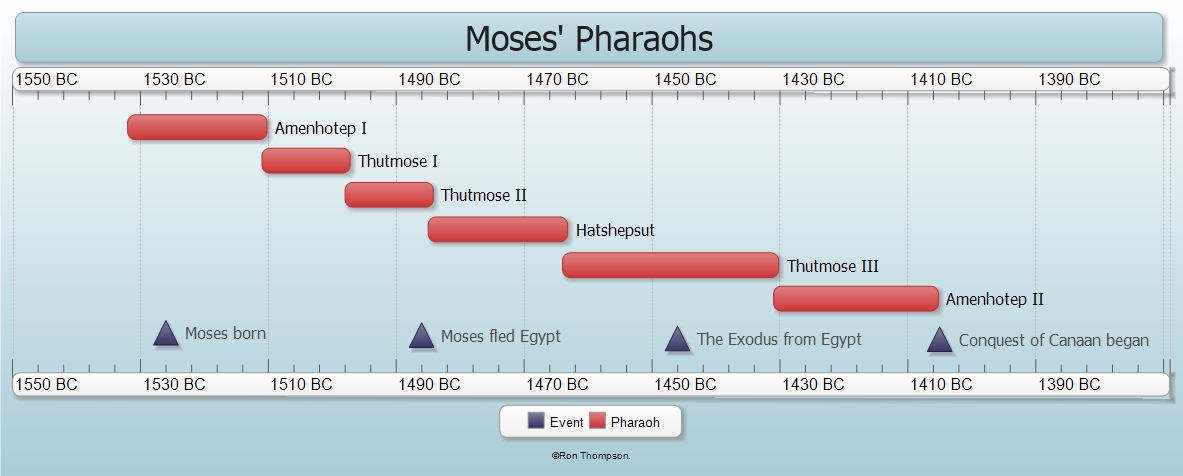
    1. Pharaoh Amenhotep I, 1532-1511 BC
    2. Pharaoh Thutmose I, 1511-1498 BC
    3. Pharaoh Thutmose II, 1498-1485 BC
    4. Pharaoh Hatshepsut, 1485-1464 BC
    5. Pharaoh Thutmose III, 1464-1431 BC
    6. Pharoah Amenhotep II, 1431-1406

I am presenting here a list of dates for key events in Egyptian/Biblical history. Dating of Biblical events during the Egyptian period is very firm, if you believe as I do that the Bible is inerrant and its time references are literal. Dating of the Egyptian King Lists is more problematic, as I will discuss below.

Middle Kingdom, 12th Dynasty

Dating the reigns of Middle Kingdom monarchs is particularly difficult, with a particularly large range of proposed possibilities. I have a fairly large library of Egyptian history. In this post I will list, separated by slashes, two of the newest chronologies that seem reasonable: First is the timeline presented by Van De Mieroop in A History of Ancient Egypt; second, the one I personally prefer, taken from the Wikipedia article, “Twelfth Dynasty of Egypt”, as last edited on 21 December 2021. A radically different chronology by Egyptologist David Rohl, has recently been popularized by the Patterns of Evidence series of videos. I plan to review this series in the near future, but for now, I like most of what is presented in the first two videos, but not so much the second two or the anticipated fifth. Rohl, a self-styled agnostic, follows the lead of various evangelical scholars who shorten the period of the Hebrew “sojourn” in Egypt from the explicitly stated 430 years to 350 years, based on what I believe is a simplistic misunderstanding of the Abrahamic Covenant.


Egypt’s capital throughout the 12th Dynasty period was located in ancient Itj-Tawy, located around 35 miles south of modern Cairo and 21 miles south of ancient Memphis.

Pharaoh Amenemhat II, 1911-1877/1929-1895 BC

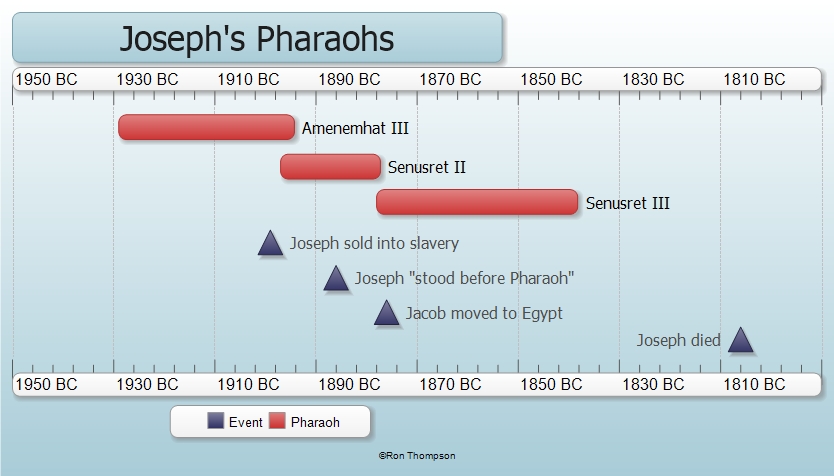
Joseph was sold into slavery in Egypt around 1899 BC, at 17 years old (Gen 37:2-29). Most of my sources would put this event somewhere in Amenemhat’s reign. I would place the timing shortly before a brief coregency of Amenemhat and Senusret II.

Pharaoh Senusret II, 1877-1870/1897-1878 BC

Joseph languished in Egyptian slavery and prison for some 13 years before he “stood before Pharoah” at age 30 (1886 BC) to interpret Pharaoh’s dream and to be elevated to Vizier rank (Gen 41:46). By my accounting, this Pharaoh was Senusret II, who seems to have devoted the final eight years of his reign to promoting Joseph’s recommendations for the productive years. Domestically, he is best known for developing the Fayyum Basin area west of the capital. This is a basin watered by a natural offshoot of the Nile, anachronistically named Bahr Yussef (“the Waterway of Joseph”). Although widening of this waterway was done well before the Middle Kingdom era, Senusret built numerous canals for irrigation and to control the levels of the valley’s Lake Moeris for the purpose of land reclamation. He also built new settlements in the center and around the borders of Egypt and appears to have greatly expanded his bureaucracy in these regions. Regarding foreign affairs, he is known to have fostered a period of peaceful trade with the hated “Asiatics” of the Levant.

Pharaoh Senusret III, 1870-1831/1878-1839 BC

This powerful Pharaoh began his reign about eight years after the elevation of Joseph. I believe that his story is told in

Genesis 41:54-57 (CJB)
[54] and the seven years of famine began to come, just as Yosef had said. There was famine in all lands, but throughout the land of Egypt there was food. [55] When the whole land of Egypt started feeling the famine, the people cried to Pharaoh for food, and Pharaoh said to all the Egyptians, “Go to Yosef, and do what he tells you to do.” [56] The famine was over all the earth, but then Yosef opened all the storehouses and sold food to the Egyptians, since the famine was severe in the land of Egypt. [57] Moreover all countries came to Egypt to Yosef to buy grain, because the famine was severe throughout the earth.

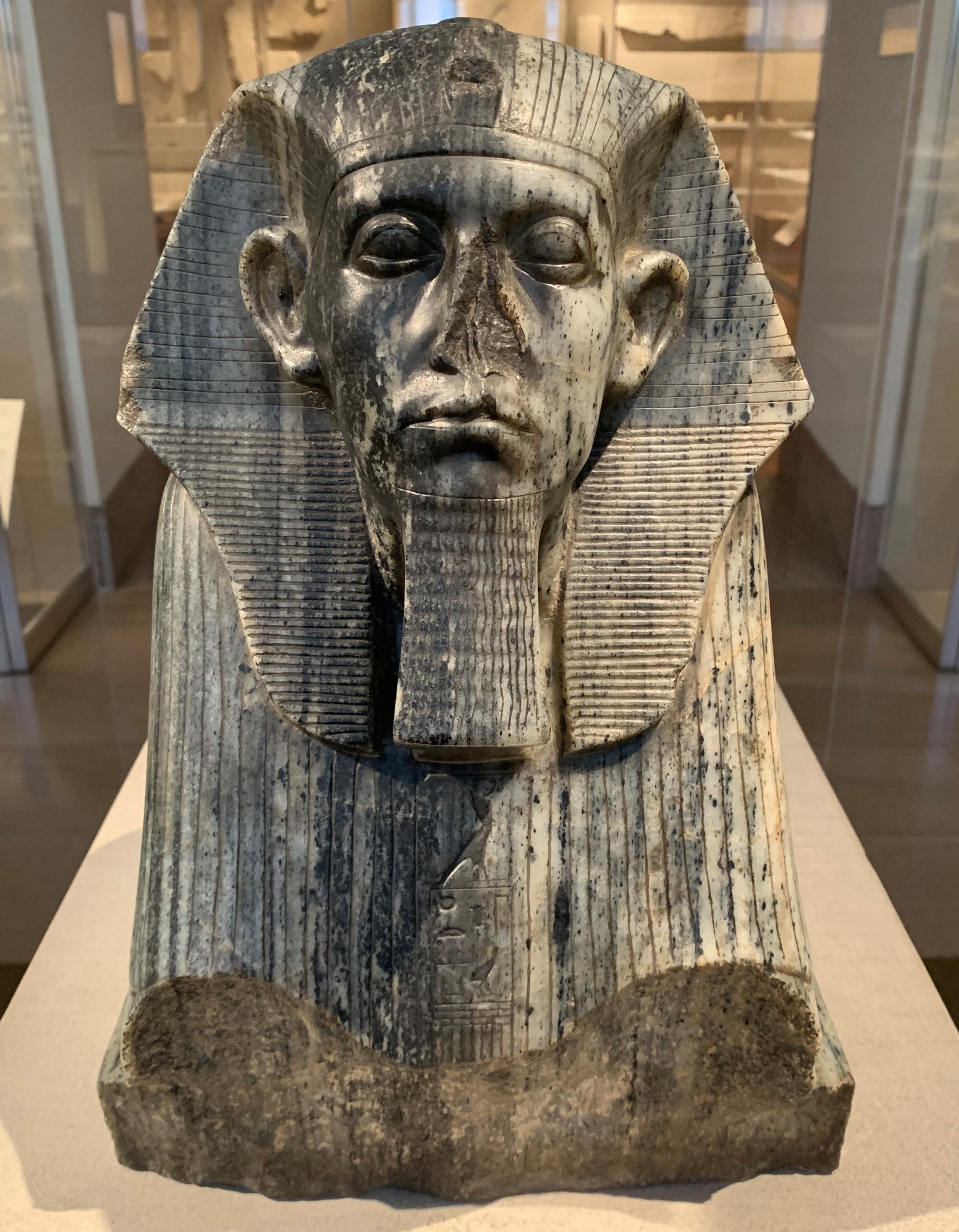
Senusret III, ©MET Museum NYC

Senusret continued the agricultural developments begun by his father and attempted to maintain peace within Egypt and with Egypt’s neighbors, but the balance of power within Egypt changed radically during his reign. Since no later than the 3rd Dynasty, Egypt had been divided into individual districts called “nomes“, each ruled by a hereditary “nomarch“. These powerful nobles had decentralized Egyptian rule and placed limits on the Pharaohs. Senusret III seems to have used the famine years and his monopolistic control of Joseph’s well-stocked granaries to break the economic power of the nomarchs and to recentralize power within his kingdom.

In 1876 BC, near the beginning of the famine years, Jacob and the rest of his family and their retinues moved to Egypt (Gen 46:1-47:9). Why were they offered seemingly prime space in the fertile land of Goshen, the eastern Nile Delta region? Was this land gift purely out of Pharaoh’s love for Joseph? I doubt it. Their “Asiatic” origins were a heavy strike against them. They ignored Joseph’s warning not to mention that they were shepherds. Egypt’s herds were cattle, and sheep tend to overgraze pastures and make them unsuitable for raising cattle.

Late 12th Dynasty

Joseph died at 130 years old, in 1806 BC, having lived in Egypt after the famine during the reigns of Senusret III, Amenemhat III, and Amenemhat IV. Queen Sobekneferu was just coming into power for a brief, 4-year reign.

To Top

Hyksos Period

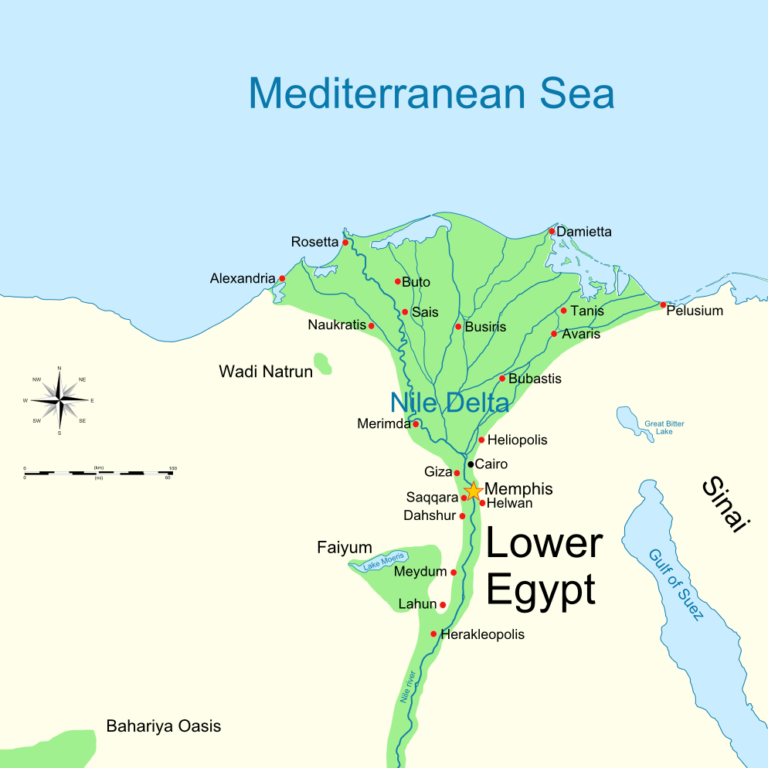
Hyksos Cities in Lower Egypt

While there is no question that the 12th Dynasty Pharaohs recognized Joseph’s wisdom and supported his programs as Vizier, as mentioned above, I personally have reservations about the sincerity of their welcome of his Hebrew family. Senusret III, in particular, hated the Nubians of Africa and was at best ambivalent about “Asiatics”—foreigners from eastern Mediterranean lands, many of whom had been infiltrating Lower Egypt for generations. I suspect that the Pharaohs’ invitation to Jacob and their tolerance of the Hebrews was more to keep Joseph happy and his relatives under observation.

At the close of the chaotic 14th Dynasty, a group of Asiatics, speaking an Aramaic/Canaanite west-Semitic dialect, took control of Egypt. They came to be called “Hyksos“, meaning “the rulers of foreign lands”. They were settled throughout Goshen and along the Lower Nile Valley, with scattered settlements into Upper Egypt. Dynasties 15, 16 and 17 consisted primarily of Hyksos rulers with their capital first in the eastern Nile Delta city of Avaris, and later in Thebes. They were not deposed until Amose I, founder of the 18th Dynasty, unseated them. He and his successors eventually drove them out of Egypt.

To Top

Enslavement

Aside from secular and Deistic theories that equate the Hyksos with the Hebrews, I have never seen or heard a discussion of the inevitable dispersal of the Israelites in Egypt during the Hyksos rule and early 18th Dynastic period. Exodus 1:5-7 implies that the original 70 “sons of Israel” had multiplied until they occupied not just Goshen, but rather “filled” all of the habitable land of Egypt. I imagine that they were displaced completely from Goshen itself, but in any case, as slaves they would have been required to concentrate close to where they worked. By Moses’ time, most of their work would certainly be in Upper Egypt, except at flood times. Travel from the Delta to Thebes by foot would probably have taken them around two weeks, at best. Without any archaeological or written records either way, I am assuming that the bulk of the slaves were sheltering along the Nile wherever they were needed at any given time.

Exodus 1:7-21 covers an undatable period of history after the death of Joseph and before the birth of Moses. A traditional understanding of the chapter assumes that the entire passage describes a single wicked Pharaoh, but I would rather divide it as follows:

  • the Pharaoh who “did not know Joseph”, and who ordered their enslavement—possibly as early as late in the 12th Dynasty (Ex 1:8-11);
  • a long period of increasing oppression and further population expansion (Ex 1:12-14); and
  • the Pharaoh who, during that period, tasked the midwives to kill Israelite boys (Ex 1:15-21).

To Top

New Kingdom, 18th Dynasty

Most scholars today use a Conventional Egyptian Chronology for this period. The currently popular Patterns of Evidence series is pushing David Rohl’s alternative “New Chronology”, which most Egyptologists agree is way off the mark. Within the 18th Dynasty, the Conventional view has two primary variations, due to an ambiguity in tying the ancient Egyptian calendar to our Gregorian calendar. The so-called “Low Chronology“, which is most popular, contains later dating; use of the “High Chronology” results in dates 20 years earlier. Personally, I prefer a variation of the Low Chronology, as presented by Christian Egyptologist, Kenneth Kitchen. Though I don’t agree with his conclusions about Biblical dating, his Egyptian dating seems to me to fit better with the Biblical narrative as I interpret it.

Pharaoh Amenhotep I, 1532-1511 BC

Moses was born in 1526 BC, by Kitchen’s Chronology, during the 6th year of Amenhotep’s reign. The order to throw newborn boys into the Nile was probably issued shortly before that time, so it is safe to say it was Amenhotep’s order (Ex 1:22). There is a problem with this chronology, though: the following passage (Ex 2:1-11) states several times that it was “Pharaoh’s daughter” who rescued Moses and later adopted him, but Amenhotep had no male or female heirs at all except for one son, who died at a very early age. If the dating is correct, then this wording can still be regarded as correct if she was the daughter of either a past or future Pharaoh. There is precedent for this type of royal ambiguity both in scripture and in other ancient writings. If so, there are three possible scenarios:

  • She could have been a daughter of Amenhotep’s father, Pharaoh Ahmose I. Ahmose had 12 children, including several daughters, but those who survived to 1526 would have been fairly old by the standards of the day. I think it would have been unlikely that any of them would be at the river under these circumstances.
  • Amenhotep was succeeded by Thutmose I, who was a military figure and not related to him at all. Thutmose did indeed have a daughter, Hatshepsut, who was 16 years old in 1526, and was suitable for other reasons, as well. See below.
  • Thutmose might have been considered the current Pharaoh if he was coregent with Amenhotep. This would not have been unusual, and there is some evidence of a coregency; but it would have to have lasted at least 15 years, which is very unlikely.
Pharaoh Thutmose I, 1511-1498 BC

Thutmose’ birth date and parentage are unknown. Amenhotep died without an heir, and it is likely that Thutmose, probably close to Amenhotep’s age, was promoted from a senior military position. Thutmose had five children over his lifetime, of which three died before his accession. His daughter, Hatshepsut, was born around 1541 BC, in the 16th year of Ahmose I’s reign. She would have been 16 years old when Moses was born, in the 6th year of Amenhotep’s reign, which certainly would have made her the ideal candidate for the (eventual) “Pharoah’s Daughter”. When Thutmose became Pharaoh, Moses was 15 and Hatshepsut undoubtedly a “headstrong” princess at 31 years old.

Exodus 2:5 (CJB)
[5] The daughter of Pharaoh came down to bathe in the river while her maids-in-attendance walked along the riverside. Spotting the basket among the reeds, she sent her slave-girl to get it. [6] She opened it and looked inside, and there in front of her was a crying baby boy! Moved with pity, she said, “This must be one of the Hebrews’ children.”

Pharaoh Thutmose II, 1498-1485 BC

When Thutmose I died in 1498 BC, he was replaced by his only surviving son, Thutmose II. Egyptian Pharaohs were almost always male, but succession was determined through a matriarchal system which frequently resulted in brother/sister marriages. Thutmose II was the son of Thutmose I by a minor wife, which made his claim to the throne weak. This he remedied by marrying his older half-sister, Hatshepsut, a daughter by Thutmose I’s chief wife.

Based on tradition, and possibly documentation that was available to him at the time, 1st Century Jewish historian Josephus reported that Moses was indeed a “prince of Egypt”, without question receiving the same education that any other Egyptian prince would have received in the eventuality that he might one day inherit the throne of Pharaoh. Josephus reported that Moses led the Egyptian army in at least one successful campaign against the perennial enemy in Nubia.

Although I believe that Hatshepsut was Moses‘ adoptive mother, and I have no doubt that she carefully supervised his education, I think that he later became a liability to her own ambitions. When Moses fled from Egypt in 1486, it was clear (as is evident from the state of his mummy) that Thutmose II was dying. Hatshepsut had her own plans going forward, and there may have been a risk that Moses would be seen as a viable heir. When she heard that Moses had killed an Egyptian, she had an excuse to get rid of him, either in her husband’s name or her own:

Exodus 2:15 (CJB)
[15] When Pharaoh heard of it, he tried to have Moshe put to death. But Moshe fled from Pharaoh to live in the land of Midyan.

I am not ignoring the masculine pronoun in “he tried”. Because Pharaohs were almost always male, Hatshepsut began dressing and acting as a male Pharaoh, and insisted that she was king, not queen, of Egypt. All references to her during much of her reign were masculine.

I think that Moses was savvy enough to recognize his danger. It is also significant to me that he was not sentimental about her at this point, either:

Hebrews 11:24 (CJB)
[24] By [faith], Moshe, after he had grown up, refused to be called the son of Pharaoh’s daughter. [25] He chose being mistreated along with God’s people rather than enjoying the passing pleasures of sin. [26] He had come to regard abuse suffered on behalf of the Messiah as greater riches than the treasures of Egypt, for he kept his eyes fixed on the reward.

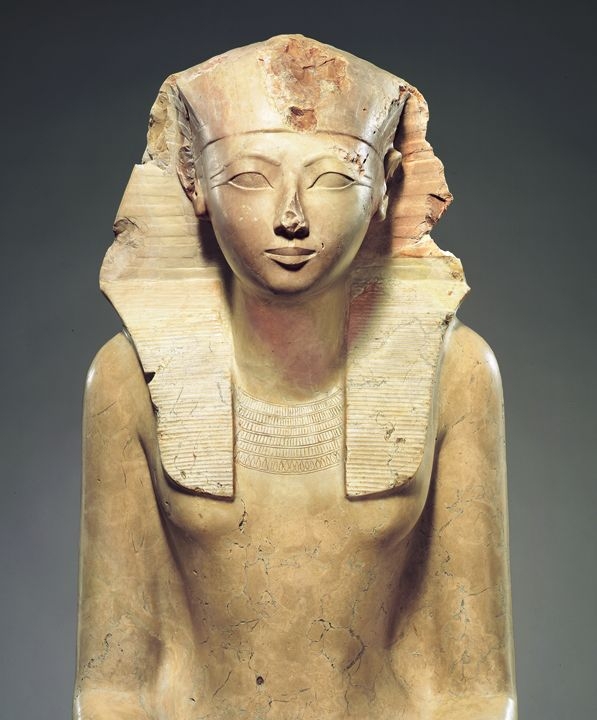
A young Hatshepsut, ©MET Museum NYC
Pharaoh Hatshepsut, 1485-1464 BC

When Thutmose II died in 1485 BC, he was succeeded by his infant son, Thutmose III, so Hatshepsut became queen regent. She reigned as actual Pharaoh for 19 years, until her own death. She is regarded by many as one of the most powerful woman monarchs of history. She died when Moses was 62 years old, roughly the midpoint of his 40 years in Midian.

Pharaoh Thutmose III, 1464-1431 BC

Thutmose III became sole ruler on Hatshepsut’s death. He is known as the “Napoleon of Egypt” for his many military campaigns and is considered to have been a military genius.

Thutmose III, ©MET Museum NYC

The Exodus and the loss of his armies occurred in 1446 BC, in approximately the 18th year of his reign after Hatshepsut’s death. His extreme reluctance to release the Hebrew slaves, despite the severity of the plagues, can probably be explained by Thutmose’s unwillingness to use potential fighting men in their place for common labor. In the few years after the Exodus, he continued his foreign invasions, and claimed great victories, but scholars discount these claims because there was apparently so little booty taken. There is no reason to assume, however, that the loss of so many of his fighting men in the Red Sea would have suppressed his military might for long.

Some commentators object to Thutmose III as the “Pharaoh of the Exodus” because they read some verses elsewhere in the Bible as stating that he had to have drowned with his army—for example:

Psalms 136:13 (CJB)
[13] to him who split apart the Sea of Suf,
for his grace continues forever;
[14] and made Isra’el cross right through it,
for his grace continues forever;
[15] but swept Pharaoh and his army into the Sea of Suf,
for his grace continues forever;

I don’t believe that this poetic description is meant to be precise; just flowery! In any case, the Hebrew text does not support the strength of the “and” interpretation.

Pharoah Amenhotep II, 1431-1406

Amenhotep was Thutmose III’s son by a minor wife. Interestingly, Thutmose’ firstborn son, Amenemhat, son of chief wife Satiah, was the heir-apparent until his death “between years 24 and 35 of Thutmose’ reign.” When accounting for the period of coregency with Hatshepsut, this conforms quite nicely with the Biblical account of the killing of the firstborn!

To Top