Monotheism and the Trinity

Posted on:

Modified on:


  1. Biblical references to the Trinity
    1. Old Testament references
      1. Elohim
      2. “Let us make”
      3. Echad
      4. Other references in the Tanakh (OT)
    2. New Testament references
  2. Characterizing the Trinity
    1. Attempted analogies
      1. Egg
      2. Human as image
      3. Multiprocessor computer
      4. Distributed AI
      5. Light
      6. The electroweak force
      7. Strange physics
    2. Ontology of the Trinity
      1. Spirit
      2. Locality
      3. How important is monotheism?
      4. Eternality
      5. Relationships
      6. Appearance in Heaven
  3. Conclusion

Biblical references to the Trinity

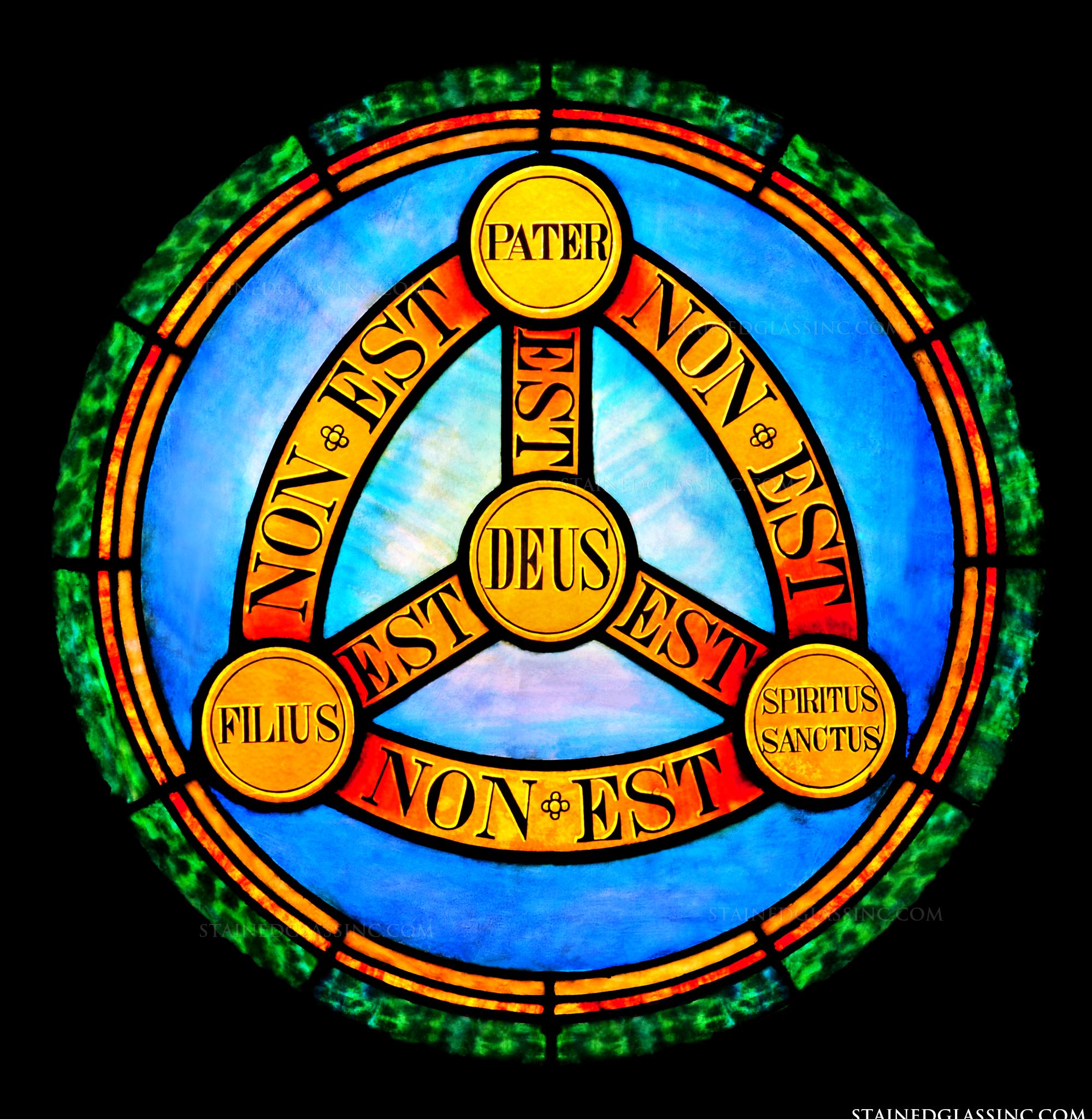
Common illustration of the Trinity relationship. From stainedglassinc.com

Well… there aren’t any instances in the Bible where the Trinity is named as such, which is why some Christians and pretty much everyone else deny its existence.

The Trinity of Father, Son and Holy Spirit can only be inferred from hints scattered throughout Scripture.

Even the term “Godhead” in the KJV, which at least sounds somewhat Trinitarian, is merely an infrequent translation of the Greek θεότης, (theotes), which actually means something like “the essence of being a deity.” In the ancient world, the term was primarily applied to human leaders who claimed for themselves or were proclaimed by others to be divine. In Colossians, Paul used the term as a polemic against gnostic “elementary principles of the world,” probably referring to principles of Greek philosophical argumentation.

Old Testament references

Yet even attempts to find hints of the Trinity in the Old Testament mostly fail.

Elohim

The Hebrew אלהים, transliterated as elohim, is a masculine plural noun, usually meaning “gods,” “angels,” or sometimes “princes” or “judges,” etc. But sometimes it refers to the name of God, Himself, in which case the English transliteration is capitalized: Elohim.

If we are referring to the singular “One True God,” then why retain the plural ending? There definitely is a singular term corresponding to the plural elohim, and that is eloah. But that would be a reference to one of those generic gods, angels, etc. mentioned in the previous paragraph. Deuteronomy 32:17, for example, speaks of “demons [shedim], who were not [a] god [eloah]

Could it be, then, that Elohim is a sneaky way of speaking of the Trinity? No, that would be a blatant admission that He is three separate gods, a polytheism.

The solution to this difficulty is that Hebrew plurals aren’t always well-behaved.

For example, while most Hebrew nouns are “regular,” there is a class called, logically, “irregular plural nouns” that don’t follow the usual rules. We have those in English, too: the plural of “goose” is not “gooses,” and the plural of “foot” is not “foots” (as my petulant spell checker is now informing me)!

More to the point, the way I’ve heard it explained by a Jewish Hebrew scholar is that Elohim is part of a small class of objects that are themselves complex and everchanging. For example,

מים – mayim – ‘water’ (exhibiting tides, waves, ripples, surges, currents, solutes, etc.)
שמים – shamayim – ‘sky, Heaven’ (exhibiting clouds, storms, dust, fog, birds, lights, etc.)
פנים – panim – ‘face’ (exhibiting expression, complexion, hair, health, etc.)
חיים – chayyim – ‘life’ (exhibiting birth, growth, health, age, death, blinks, smiles, etc.)

Just like water, the sky, a face, or our life – God [Elohim] is something which cannot be captured strictly in the singular. Like these other concepts, Hebrew conveys to us that God is not stagnant and not stable, but is a fluid, intangible reality. 
—Adam Zagoria-Moffet, article on stateofformation.org

To me, the bottom line on the question of whether or not the plural ending on Elohim can be used as an argument for the Trinity is this: English does not have singular and plural forms of verbs, but Hebrew does. Elohim, as a name of God, always appears with singular verbs.

Finally, it must be said that the plural ending on Hebrew names is not uncommon, for example, Efrayim (the son of Joseph), Yerushalayim (the holy city) and, from the genealogy in Genesis 10, Kitim, Dodanim, and Mitzrayim.

“Let us make”

What about the first chapters of Genesis, where Elohim says, “let us make…” or “let there be…”? Is this the Father speaking to the Son and Spirit? Inconceivable! If the “one” part of “three-in-one” is literal, then what one knows and thinks, the others know and think. But more fundamental than that is the definition of omniscience. Surely all three are omniscient, not just The Father. What one knows, all three know, instantaneously. That has surely got to be implicit in the whole concept of “tri-unity.” The only exception to this might be with the “kenosis,” when the Son emptied Himself and became incarnate.

Philippians 2:6 (ESV)
[6] who, though he was in the form of God, did not count equality with God a thing to be grasped, [7] but emptied himself, by taking the form of a servant, being born in the likeness of men.

Evidently, taking on flesh meant losing or weakening of some of that intimate connection.

I absolutely don’t believe that this is God talking to Himself. To my mind, the most probable alternative is the following:

In Gods and Demons, I reviewed the theology of the late Michael Heiser, who I was undecided about at the time, but have come to like very much. He presented a great deal of both Biblical and extrabiblical evidence to show that the Heavenly Host, collectively called “angels” (aggelos) in the New Testament, were created to perform the same supervisory functions in the non-living cosmos that mankind was later created to perform with respect to all life-forms on earth.

Genesis 1:26–28 (CJB) emphasis mine
[26] Then God said, “Let us make humankind in our image, in the likeness of ourselves; and let them rule over the fish in the sea, the birds in the air, the animals, and over all the earth, and over every crawling creature that crawls on the earth.
[27] So God created humankind in his own image;
in the image of God he created him:
male and female he created them.
[28] God blessed them: God said to them, “Be fruitful, multiply, fill the earth and subdue it. Rule over the fish in the sea, the birds in the air and every living creature that crawls on the earth.”

In their supervisory role, the angels occupy a heavenly hierarchy, with the highest ranking serving as a council (the “Divine Council”) that serves and reports to Elohim. Heiser makes a very good case that “let us” in the context of creation is the triune God (all three members in accord) speaking to this Divine Council.

Echad

Another claim of linguistic evidence for the Trinity is use of the composite plural verb echad in the Shema, Israel’s most important confession of faith. I view this as more promising, but still not definitive.

Deuteronomy 6:4 (CJB)
[4] “Sh’ma, Yisra’el! ADONAI Eloheinu, ADONAI echad.”
[Hear, Isra’el! ADONAI our God, ADONAI is one]

Or, in our vernacular, “Hey, listen up, people! There is only one God; and He is our God!”

There are basically just two Hebrew words for the number “one”: One of them is yachid, which means just “one.” Only one. One by itself, not part of any composite whole. The other is echad, which means “one, a composite unit, composed of a multiple of something.” One English alphabet composed of 26 letters. One banana bunch composed of a bunch of bananas. One nation composed of 50 states. Or perhaps, one God composed of three Persons.

As important as monotheism came to be, why isn’t the Shema worded as, “Sh’ma, Yisra’el! ADONAI Eloheinu, ADONAI yachid“?

The Shema as written seems to give Trinitarians a bit of breathing room, because instead of clearly saying that there is only one undivided God, it leaves open the door for saying He might be a set of something. A Trinity? To combat that notion, the late head of the worldwide orthodox Lubavitcher movement, himself reputed by some of his followers to be the long-awaited Messiah, had this to say:

G‑d did not have to create a world to be yachid. He was singularly and exclusively one before the world was created, and remains so after the fact. It was to express His echad-ness that He created the world, created man, granted him freedom of choice, and commanded him the Torah. He created existences that, at least in their own perception, are distinct of Him, and gave them the tools to bring their lives into utter harmony with His will. When a diverse and plural world chooses, by its own initiative, to unite with Him, the divine oneness assumes a new, deeper expression: G‑d is echad.”
—Rabbi Menachem Mendel Schneerson

It seems to me that the Rebbe’s argument is grasping at straws. Nevertheless, I’m also not convinced that the Shema is sufficient proof of a Trinity on its own. It depends on what a “Trinity” actually is, which I’ll explore below.

Other references in the Tanakh (OT)

Christian scholars also point to a number of Tanakh (Old Testament) references to “a son of God” and “the Holy Spirit”) as proof of the Trinity. In hindsight, we can certainly look back and legitimately say, “Oh, yes…,” but that’s only in light of New Testament revelation. Since the only revelations God chose to give ancient Israel were the Tanach, His visible creation, and an occasional theophany, I think that the above can only be used as evidence, not as stand-alone proof.

New Testament references

The New Testament doesn’t specifically say, “God is 3-in-1” or “God is a Trinity.” Yet, to me, the evidence is compelling. First, if we believe that Jesus is God, as we surely must, then why did He consistently refer to YHWH as His Father, and who did He pray to? Second, why are there so many references to the Holy Spirit as a living entity?

But we can site other Scripture, as well (emphasis mine):

Matthew 3:16–17 (ESV)
[16] And when Jesus was baptized, immediately he went up from the water, and behold, the heavens were opened to him, and he saw the Spirit of God descending like a dove and coming to rest on him; [17] and behold, a voice from heaven said, “This is my beloved Son, with whom I am well pleased.”

Matthew 28:19 (ESV)
[19] Go therefore and make disciples of all nations, baptizing them in the name of the Father and of the Son and of the Holy Spirit,

John 1:1–2 (ESV)
[Jn 1:1] In the beginning was the Word, and the Word was with God, and the Word was God. [2] He was in the beginning with God.

John 1:14 (ESV)
[14] And the Word became flesh and dwelt among us, and we have seen his glory, glory as of the only Son from the Father, full of grace and truth.

Acts 5:3–4 (ESV)
[3] But Peter said, “Ananias, why has Satan filled your heart to lie to the Holy Spirit … You have not lied to man but to God.”

Romans 9:5 (ESV)
[5] To them belong the patriarchs, and from their race, according to the flesh, is the Christ, who is God over all, blessed forever. Amen.

2 Corinthians 13:14 (ESV)
[14] The grace of the Lord Jesus Christ and the love of God and the fellowship of the Holy Spirit be with you all.

1 Peter 1:2 (ESV)
[2] according to the foreknowledge of God the Father, in the sanctification of the Spirit, for obedience to Jesus Christ and for sprinkling with his blood:

Characterizing the Trinity

Why is there no specific Biblical mention of the Trinity? Well, perhaps it is because the ancient world had no scientific or linguistic tools sufficient for the task. Explaining the Trinity is beyond the ability of even 21st Century Theologians.

Attempted analogies

The Trinity is usually defined as “one God, three Persons.” Essentially, we’re saying, “one equals three,” which is a paradox, a seemingly unexplainable contradiction. Lacking an explanation for the Trinity, most Christians eventually end up seeking an analogy to at least make the concept more palatable. But philosophically, I think that the only analogy to a paradox would have to be another paradox. In this case, it would have to be something like, “TRUE equals FALSE,” or a Boolean “A equals NOT A.” What have we gained? Nothing but more confusion.

God is like nothing else in the entire universe. There is absolutely nothing else in all of creation that is similar in either form or function. He is unique and incomparable!

There is no possible analog that can help us understand the Trinity. Nevertheless, people continue to try:

Egg

The common egg analogy that we’ve all heard is way, way, off base.

For one thing, an egg doesn’t communicate. An egg yolk doesn’t say to its shell, “Okay, you hold things together, I’ve got a chicken embryo that I’m feeding, and we aren’t ready to hatch yet.”

An egg also doesn’t think, plan, design, perceive, or communicate, and it sure doesn’t create!

Human as image

Another very common analogy that many Christians cherish is that of mankind as a “triune body/soul/spirit.”

This one is convincing to many because they see that arrangement as precisely what constitutes “the image of God.” I disagree for several reasons:

  • A body/soul/spirit analogy assumes that we are God’s image ontologically. Ontology is the study of the nature and essential properties of something that exists.

But physically, we bear no resemblance to God whatsoever.

Intellectually, it may appear that we are similar (though inferior) to God, but I would argue that God, being unencumbered by a flesh and blood brain or even a computer chip, is intellectually more alien than anything we could possibly imagine. He is intimately connected to every facet of His creation in ways that are completely incomprehensible to us. That we know and understand an infinitesimal portion of what He does is only because He gave us the ability to observe and learn, using our vastly inferior senses.

Personally, I agree with theologians like Michael S. Heiser and John H. Walton, who understand God’s image to be functional rather than ontological. We were created as human beings in order to represent Him on earth, for purposes set out in

Genesis 1:28 (ESV)
[28] And God blessed them. And God said to them, “Be fruitful and multiply and fill the earth and subdue it, and have dominion over the fish of the sea and over the birds of the heavens and over every living thing that moves on the earth.”

  • Furthermore, the body/soul/spirit analogy breaks down for me because I don’t think there is Scriptural support for this traditional trichotomous view of human ontology.

Yes, trichotomy (“division into three parts”) is suggested by:

1 Thessalonians 5:23 (ESV) emphasis mine
[23] Now may the God of peace himself sanctify you completely, and may your whole spirit and soul and body be kept blameless at the coming of our Lord Jesus Christ.

I don’t think there are any other passages that clearly list all three of these elements (and no others) in one place. There are many references that, taken alone, would support a dichotomous view (body/spirit), and even one that supports a tetrachotom0us view (heart/soul/mind/strength (where strength = body):

Mark 12:30 (KJV)
[30] And thou shalt love the Lord thy God with all thy heart, and with all thy soul, and with all thy mind, and with all thy strength: this is the first commandment.

In view of modern understanding that thoughts, emotions, behaviors, feelings, memory, and so much more are all housed in the brain, it makes most sense to me to believe that man is a soul, composed of a physical part that is fairly well understood and a spiritual part that is beyond our understanding.

Genesis 2:7 (KJV) additions mine
[7] And the LORD God formed man [the body] of the dust of the ground, and breathed into his nostrils the breath of life [spirit]; and man became a living soul.

  • As an analogy for understanding the Trinity, I don’t think the body/soul/spirit view comes close, because the components that make up a human aren’t in any sense at all separate personalities. The body can of course “tell” the “spirit,” “I’m hungry” by growling its stomach, but where is the exchange of conscious intelligence in that?
Multiprocessor computer

My main home office computer is one machine containing eight separate microprocessor cores. Eight “brains,” so to speak. An “octity”? Frankly this analogy isn’t very exciting. Computers don’t think, they compute, by electronically emulating, not neural activity, but mechanical switches.

Distributed AI

This disturbing analogy anticipates the coming future when the Internet will be an autonomous network of interconnected Artificial Intelligence nodes. But no matter how powerful these nodes become, compared to God they will still be hugely limited both in intelligence and in ability to interface with humanity. They will always be machines, with hardware and software, but never with a spirit component.

Light

Although I don’t believe that any analogy can do justice to the Trinity, I suspect that some philosophical paradox might be at least closer to the truth.

Here is a conundrum that consumed the world of physics for a hundred years: is “light” a particle or a wave? If a particle (a “photon”), then you should be able to bounce two photons off each other. If a wave, then when they collide, they don’t bounce, they “interfere,” meaning that their “amplitudes” combine, either constructively or destructively.

Since the particle and wave theories would appear to be mutually exclusive, which one is true? Both of them! Both theories have been individually proven in many different ways. Perhaps what will tie these contradictory theories together will be Quantum Field Theory, which is way beyond the scope of my blog.

The point of mentioning the particle/wave nature of light is only to stress that it is a relationship that for a long time was disbelieved entirely, then was believed by most, but understood by nobody. A paradox not quite solved to this day. The Trinity is at least that counterintuitive!

The electroweak force

Most of you have probably seen a demonstration in school of a magnetic field. The teacher sets a bar magnet on a sheet of white paper, then sprinkles iron filings over that. The filings quickly align with the invisible lines of force associated with the magnet.
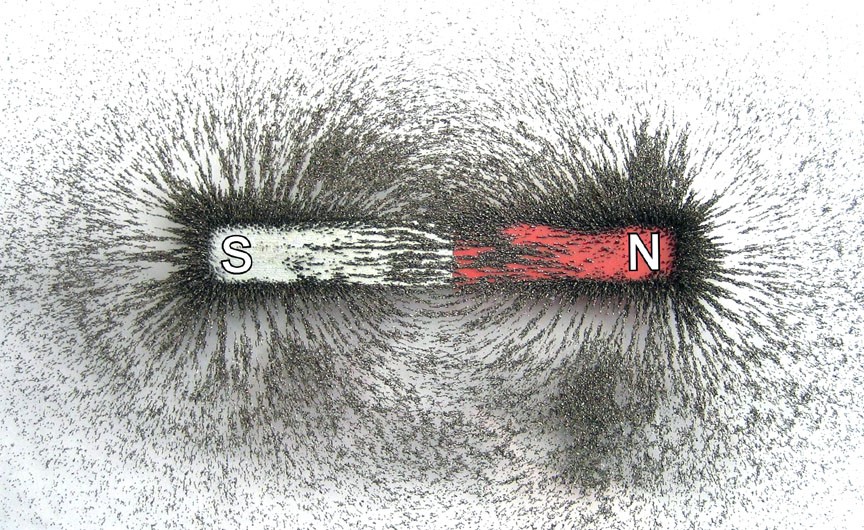
Demonstration of magnetic lines of force around a bar magnet. From etcourse.com

What this demo doesn’t show is that there are also invisible electrical lines of force, oriented orthogonally (at right angles) to the magnetic field lines. Theoretically, the fields generated by any source, in this case a simple bar magnet, extend for an infinite distance, but since their strength attenuates rapidly, it can only be detected for a relatively short distance.

In addition to the combined, two-part “electromagnetic” field, there is a third field connected to the electric field and the magnetic field: this is associated with the so-called “weak force,” which plays a part in nuclear decay.

The three interrelated fields discussed here are collectively called the “electroweak” field. This 3-part unified field might also lend itself to discussions of Trinity analogs, but like all others, it falls short of doing justice to God.

Like other attempted analogies from science, the principal usefulness of this one is to demonstrate, simply, the uselessness of trying to understand one impossible-to-understand phenomenon by comparison with something that is equally impossible to understand.

Strange physics

Physics is full of phenomena that are demonstrable, but definitely “stranger than fiction,” and from which an imaginative Christian physicist might try to come up with a Trinity analog. For example, who would ever have thought that:

  • The faster you move through space, the slower you move through time.
  • The closer you are to massive objects, the slower you move through time.
  • Time and space are completely interdependent.
  • Though we only see three dimensions of space (up/down, right/left, forward/back), there may be many more that we can’t see and that challenge our intuition (see illustration below).
  • The universe is fully digital! Despite what your math teacher taught you about points on a line, there is a very small but finite distance, called the Planck Length which defines a lower limit to size of or distance between objects. There is also a corresponding Planck Interval of time.
  • Despite the proven fact that nothing can travel through space at faster than the speed of light, two particles, even quadrillions of miles apart, can be “coupled” such that each of them instantaneously “knows” if the other changes states. Albert Einstein himself, one of the founders of Quantum Mechanics, never fully believed this well-demonstrated quantum mechanical phenomenon, and called it “spooky action at a distance.”
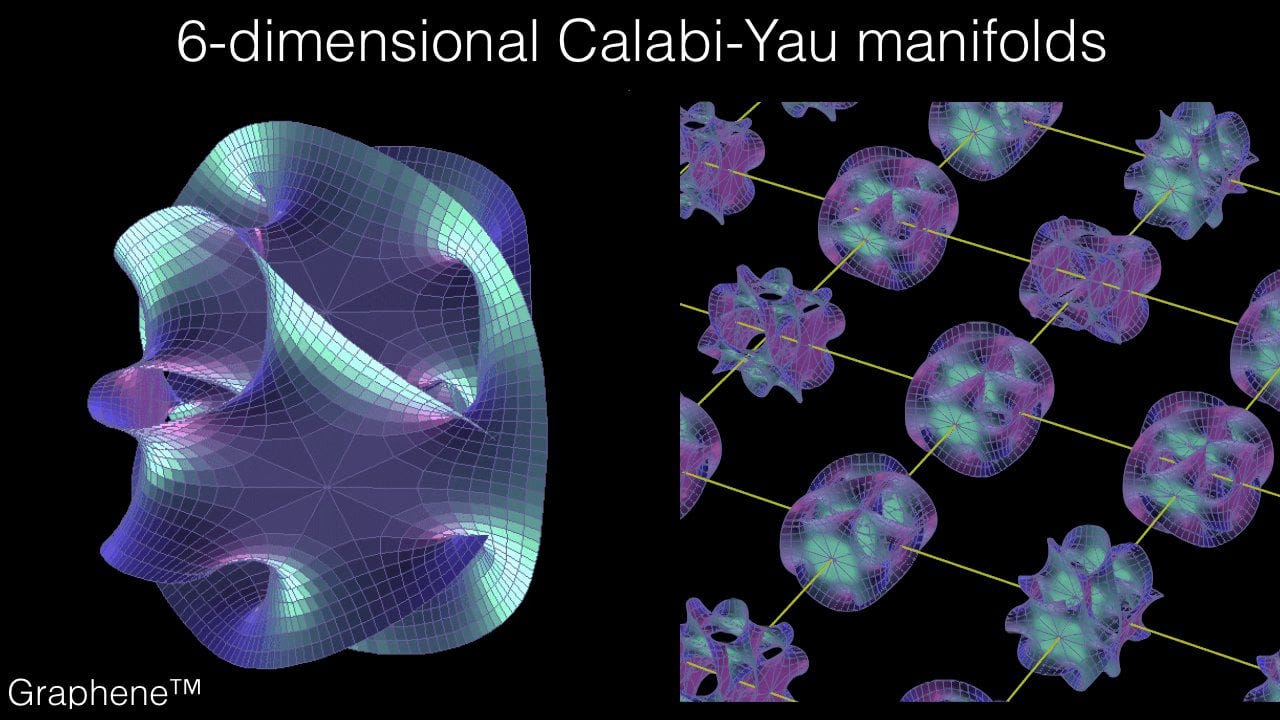
6-dimentional Calabi-Yau manifolds. One of the weird things I’m interested in. The odd structure on the left is one of a great many possible configurations of a mathematical model of what six extra dimensions of space would look like. The grid on the right shows one plane of normal 3-dimensional space, with a Calabi-Yau manifold at each possible location, that is, spaced about 10(-35) meters, the Planck Distance, apart. This is about one ten-trillionth the diameter of an electron. String Theory, the subject of decades of international research, postulates that, though we can only see three of them, there must be a total of at least nine dimensions of space in our universe. From nieuwsgierigheid

Ontology of the Trinity

As much as most Christians crave an analogy to help explain the Trinity, my contention is that the uniqueness of God and the inexplicability of “spirit” and “spirit beings” makes meaningful analogy fundamentally impossible. Furthermore, because God is complex and analogies are by design simple, any attempted analogy can do nothing, in my view, but trivialize God!

Now, abandoning any further attempt to analogize, I’m going to ponder the “ontology,” or metaphysical essence of the Triune God.

Spirit

It seems to me that the tri-unity of God must be viewed in the context of His existence as a disembodied spirit.

There could be no other lifeform in the universe even remotely like God. Even the terminology of biology is meaningless. God’s substance is “spirit.” That is something beyond the realm of science.

“Spirit” is something that science can’t detect or explain, yet if our faith is founded on reality, it exists, since God, His angelic host, and the immaterial part of a human are all composed of spirit. Conscious spirit, unencumbered by the limitations of physical mass and energy, or any other component of the physical universe, is limited only by the will and power of a superior spirit. Created spirits are limited only by the will of their creator.

Scripture seems to say that God is both immanent (fully in touch with all aspects of His creation) and transcendent (in all ways possible, above and beyond His creation). In Implications of God’s Omnipresence and Eternity in Space-Time, I explain that this duality is what we call “omnipresence.” It means that He is constantly present and aware, at all points in both space and time. This implies that He both permeates and envelops the entire universe. Which further implies that His “omniscience” is not limited to seeing all but extends to personally experiencing all.

I have heard it said, many times, that God needed to experience the same temptations as us in order to empathize with us. In view of the above, I think this is a logical fallacy. The senses and consciousness of all creatures are an open book to Him. The incarnation was not for His education, it was for our faith! So that we can empathize with Him! Seeing Him take on flesh and become like one of us, we see His sacrifice and suffering.

When you really think about it, it seems that life as a bodyless spirit would be impossible. With no body to support, I can see where most biological organs would be unnecessary, e.g., entire systems for digestion, respiration, circulation, skin and skeleton, reproduction, etc.

But intelligence, communication, and empathy, for example require some complex cognitive mechanism beyond a computer core in order to function. Since I don’t question the existence of God, or that He indeed is spirit, the only conclusion I can draw is that there is physics that is still beyond our grasp. Big shock, eh?

Think of some of the “higher-level functions” that only God could perform:

  • God alone preexisted everything else that exists.
  • God alone created everything else that exists.
  • God’s intellect and abilities exceed those of all that He created.
  • God commands all the forces of creation.

God created the universe and all of its animate and inanimate contents with an ability to function—in my view independently of His constant oversight and control—in accordance with physical laws of His design, but subject, at His sole discretion, to His override, either in whole or in part.

There is another interesting ability held by spirit beings, including individual members of the Trinity, angels, demons and even humans (like the shade of Samuel at En-Dor 1 Samuel 28): They can take on physical substance. With respect to the Trinity:

  • The Father occasionally manifested Himself at specific locations, e.g., the burning bush, the fire above Mt. Sinai, and the shekinah over the Mercy Seat.
  • The Spirit manifested as tongues of fire at Pentecost.
  • Above all, we note the incarnation of the Son.

For more on this subject, see Gods and Demons.

Locality

Three spirits, or three intellects in one spirit?

My concept of an omnipresent Triune God implies that all three members of the Trinity must occupy the same space, simultaneously. Because I don’t know what “spirit” is, I can’t define what that statement actually means. Does it mean like the smoke of three cigarettes commingling in space, or that literally every infinitesimal iota of space and time contains all three. The first implies tritheism, so I lean towards the second, and indeed, the orthodox definition of the Trinity is “one God, three Persons,” or “personalities.”

Orthodox Christianity has defined the Trinity as three complete personalities within a single entity composed entirely of spirit. In a quantum mechanical sense, that maybe starts to make a little sense, but no physicist really understands the quantum universe, and the Creator is certainly more complex and mysterious than His creation.

How important is monotheism?

So, is the orthodox definition true, and does it even make a difference?

Undoubtedly, monotheism is an important subject in modern religion, but it has not always been that way. Today, “monotheism” means belief in one God. In ancient times, even as late as the 1st century, “monotheism” meant worship of one God.

Christianity claims to be monotheistic, but so do its two biggest rivals, Judaism and Islam, and both of them charge Trinitarians with being blatantly tritheistic, worshipping three separate gods. The Qur’an states over and over again, “There is only one God: He is Allah, and he does not have a son!” The Rabbi at an orthodox Lubavitcher-Chabad Jewish synagogue within walking distance of my house says, “We Jews might have accepted Yeshua as our Messiah if he hadn’t claimed to be God.”

Certainly, Biblical Israel, like the rest of the world, believed in multiple Gods. Whether they were right or not depends on how you define the term, “god.” Merriam Webster today defines “god” as

The supreme or ultimate reality: such as the being perfect in power, wisdom, and goodness who is worshipped (as in Judaism, Christianity, Islam, and Hinduism) as creator and ruler of the universe.

or less commonly a being or object that is worshipped as having more than natural attributes and powers’

While modern Christians and Jews alike would agree on the first definition, the second was not at all “less common” in Biblical times. If an angel, good or bad, is worshipped, then he meets the second definition. Though they were polemicized by the prophets as “gods made by human hands,” inanimate idols were normally worshipped, not for themselves, but rather for the spirit beings who inhabited them. I have long believed that the pagan gods were real, evil, spirit beings—after all, they were able to duplicate for the Egyptian magicians the first miraculous signs that Moses was told to use as proof that his God was present. Human beings, on their own, don’t have magical powers!

It wasn’t until Jesus claimed to be God that the Jewish sages refined their definition of monotheism, changing it from “belief in” to “worship of.”

Thus, while I don’t personally think the Trinity amounts to polytheism, I do think that the question is historically moot. By the time of the Patristic Church fathers, polytheism of any sort was viscerally unacceptable in the Judeo-Christian world. Though I’m not quite 100% convinced, I’m more than willing to stick with a monotheistic definition because, even though I think there is no unambiguous Scriptural proof one way or another, I am well enough accustomed to the paradoxes of physics that the concept “goes down easy.”

Eternality

No part of the Trinity is created. Does that mean that they have always existed, from eternity past? Neither the Hebrew nor the Greek Scriptures actually make that clear, in that they do not unambiguously explain what the term “in the beginning” is referring to, other than that it is when “the heavens and the earth” were created. What is clear is that all three preexisted everything else that exists.

Most cosmologists and astrophysicists are unwilling to believe in an eternal Creator, so they instead believe in an eternal creation. Either alternative is unfathomable to the human mind, but so is the concept of either God or the universe popping up from nothingness.

Relationships

if Jesus is Yahweh’s son in the same sense that I am Harold’s son, then we’re faced with all sorts of unanswerable questions that make no sense at all in the context of a spirit being with no material substance. I can’t fathom a mother-God or spirit-DNA. Obviously to me, the father/son terminology has to be functional, not biological.

Scriptural context indicates that there is a hierarchy between the three. Jesus clearly stated that He always does the will of the Father, and at the same time He implied that the Holy Spirit does His bidding.

Because God is a spirit, not tied to any physical body; because He claims to be omniscient and omnipresent; and because both time and space are a property of the universe He created, I conclude, as mentioned above, that He must both occupy and extend beyond the bounds of the universe and be free from any dependence on them whatsoever.

Appearance in Heaven

The Bible reports several very explicit prophetic visions of God seated on a throne in heaven: Isaiah 6, Ezekiel 1 and 10, Daniel 7, and Revelation 4 being most striking. I don’t think that these visions can be reconciled with God as an omnipresent spirit. Instead, I think that what the prophets are “seeing” are representations of preconceptions popularly held by ancient peoples. Visions, not reality! This is more or less how the pagan deities would have been visualized in contemporary surrounding cultures. If 21st century American Christians can’t visualize the Christian Trinity, how much less would primitive denizens of the Ancient Near East be able to set aside their ingrained preconceptions? And how important could it have been to ask them to do so? In my opinion, not very!

Conclusion

I don’t recommend that anyone try to interpret or understand the visions listed in the previous paragraph. Or, for that matter, other visions described in the Bible, like those interpreted by Joseph or Daniel, or experienced by Peter. Visions spoke truth to those to whom God gave an interpretation. They are not for our interpretation or understanding. Other than as recreational exercises, if that’s what rings your bell.

Similarly, I don’t recommend trying to untangle the ultimate explanation of the Trinity. God has not chosen to clarify it for us yet.

Gods and Demons

Posted on:

Modified on:


  1. Personal musings
  2. Heiser
    1. Criticisms of Heiser’s theology by online reviewers
    2. Keys to Heiser’s theology
    3. Source materials
    4. The elohim
    5. God as Elohim
    6. The Angel of God
    7. The heavenly host
    8. The heavenly hierarchy
    9. The Divine Council
    10. Angelic Rebellions
      1. First Rebellion: Genesis 3
      2. Second Rebellion: Genesis 6
      3. Third Rebellion: Genesis 11
    11. Angelic War

Note: When I first published this post back in mid-2023, as explained below I was new to Dr. Heiser’s work and a novice in terms of Ancient Near East scholarship. As of two years later, I have read much more on the subject and am fully convinced. I have written several subsequent posts that reference both this post and the source material.


Heiser’s understanding of God is based on: “The God of the Old Testament was part of an assembly – a pantheon – of other gods” (p. 11 Heiser, The Unseen Realm: Recovering the Supernatural Worldview of the Bible, 2015).

Yep, that is definitely a startling statement coming from a conservative Christian Bible scholar! But completely out of context. Yes, Heiser did say that about a pantheon, but it was in a book introduction, where he was describing his initial knee-jerk reaction to Psalm 82 when he first encountered it as an ignorant student. The mature scholar Dr. Heiser, when he wrote the book, was neither pantheist nor polytheist. He was an unapologetic conservative believer in the one true God, creator not only of the universe, but also of the “angelic host” ruled by that God.

Personal musings

Before I get into that, let me dredge up some related musings from my own distant past:

  • Many years ago, it occurred to me that the pagan “gods” of secular history and of the Old Testament must have been something more than fables. How else can one explain the ability of the Egyptian magicians to duplicate the first three Mosaic plagues?

10 Moshe and Aharon went in to Pharaoh and did this, as ADONAI had ordered — Aharon threw down his staff in front of Pharaoh and his servants, and it turned into a snake.
11 But Pharaoh in turn called for the sages and sorcerers; and they too, the magicians of Egypt, did the same thing, making use of their secret arts.
12 Each one threw his staff down, and they turned into snakes. But Aharon’s staff swallowed up theirs.
—Exodus 7:10–12 CJB

20 Moshe and Aharon did exactly what ADONAI had ordered. He raised the staff and, in the sight of Pharaoh and his servants, struck the water in the river; and all the water in the river was turned into blood.
21 The fish in the river died, and the river stank so badly that the Egyptians couldn’t drink its water. There was blood throughout all the land of Egypt.
22 But the magicians of Egypt did the same with their secret arts, so that Pharaoh was made hardhearted and didn’t listen to them, as ADONAI had said would happen.
—Exodus 7:20–22 CJB

2 Aharon put out his hand over the waters of Egypt, and the frogs came up and covered the land of Egypt.
3 But the magicians did the same with their secret arts and brought up frogs onto the land of Egypt.
—Exodus 8:2–3 CJB

I simply don’t believe in magical arts by humans, unless there is some type of supernatural intervention. Certainly, it wasn’t Israel’s God helping Pharaoh’s magicians. The logical alternative, in my mind, is that it must have been some demonic power. It is a small step for me to conjecture that if there was some supernatural power behind at least some of the Egyptian “gods”, then why could there not be similar power behind other pagan deities? Consider the following:

[17] They sacrificed to demons [shedim], who were not God [eloah],
To gods [elohim] whom they have not known,
New gods [chadashim, literally, to new things] who came lately,
Whom your fathers did not know.
—Deuteronomy 32:17 (NASB)

  • Another thing I’ve been aware of for many years, is that the definition of “monotheism” has changed over the millennia. That change started as a Talmudic “defensive theology” with the rise of Trinitarian Christianity. Today, Merriam-Webster defines monotheism as, “the doctrine or belief that there is but one God.” But in ancient times, it meant, “the worship of but one God.” It is abundantly clear, from Scripture alone, that Israelites before the Babylonian captivity not only believed in other gods, but also were quite willing to worship them, alongside Yahweh. After the return from captivity, most Jews were unwilling to test Yahweh’s patience on that matter, but Second Temple Era (Intertestamental) literature makes it clear that even if the worship of “foreign gods” was rare at that time, belief in their reality was not.
  • Part of Merriam-Webster’s definition of “god” is, “a being or object believed to have more than natural attributes and powers and to require human worship.” I have both heard and read many sermons, lessons, and devotionals that claim anything that a person values more than God is in fact that person’s god. I’m sure there is some truth to that, but I’m also sure that, if so, then all human beings are from time to time guilty of idolatry, and I think that harping on that subject trivializes a much more heinous sin: worshiping demonic beings!
  • Although the prophets sometimes polemicized against “gods made with human hands”, only the most unsophisticated among the ancient peoples believed that idols themselves were divine. Rather, like Yahweh’s Ark of the Covenant, they were the focus of contact between the demons and their worshipers.
  • One final related observation from my own mental data bank is that I long ago read discussions of whether or not the dictionary definition of “god” would also encompass angels. I don’t recall the conclusion reached, but it seems to me that, with respect to having “more than natural attributes and powers“, angels certainly qualify, and if said angels demand worship or are in fact worshiped, then the shoe fits.

To Top

Heiser

In a recent email exchange with an old friend, I was introduced to an author I was unfamiliar with, the late Dr. Michael S. Heiser, and a branch of theology I didn’t even know existed as a separate scholarly specialty. Dr. Heiser, among other places, has been professionally affiliated with Liberty University and Midwestern Baptist Theological Seminary, both of which I believe to be theologically sound on most issues. Wikipedia describes him as an “Old Testament scholar and Christian author with training in ancient history, Semitic languages, and the Hebrew Bible.”

Dr. Michael S. Heiser (February 14, 1963 – February 20, 2023), from Logos.com.

According to my friend, Heiser taught that, when God scattered the people of Babel, He “…created nations for them with separate borders and languages and assigned gods over each.  Israel, his portion, was to be a light unto the Nations.” Honestly, that sounded really hokey to me at first; but not completely, in view of my previous mental ramblings mentioned above.

So, I’ve been cramming on Heiser’s books and videos, and reading the opinions of others on his work. His books are scholarly and heavily footnoted, so they aren’t easy reading. I have been checking all of his Scripture references, which is very time consuming. I’m not close to done with my evaluations, but I’m off to a good start, and I believe that, with respect to his teachings on “the unseen realm” of angels and other spirit beings, his arguments are so far very compelling. As for his theology in general, he was a Presbyterian, and held many Reformed views that I do not accept.

To Top

Criticisms of Heiser’s theology by online reviewers

Critical reviews of Heiser’s theology range from laughable to thoughtful. The quote at the very top of this post comes from theBereanCall.com, among the laughable.

Then there is someone on YouTube going by JackSmack77. According to him, Heiser is “a false prophet, unsaved devil and a liar…an unsaved fool…an unsaved devil who works for Satan”. Okay…

I can’t say that some of the more measured critical comments by more mainstream reviewers didn’t give me pause, but none of them convinced me.

I don’t believe anybody on earth (including Heiser) about everything, and I believe almost nobody about some things. God gave me an analytic brain, an inquisitive mind, an engineer’s insistence on meticulous accuracy, and a reluctance to take any human opinion at face value.

More than once in my blogs I have suggested that there are important interpretive Church traditions that do not in my opinion meet strict Biblical standards, even within Conservative Evangelical academia. Every Christian denomination has at least some beliefs that are based more on tradition than on Scripture. That is why there are “denominations” in the first place! Some of the traditions I question originated in the Hellenism of the 1st Century, some from two millennia of Christian antisemitism, some as a defense against the oft-hated Catholics and of course “Evolutionists”, and some simply from early translational errors.

With regard to translational errors, I don’t think there are any English translations that are free of them. Almost all translations are done by good Christians—with presuppositions. They may be top-notch linguists, but few have a really in-depth historical knowledge, including familiarity with ancient extrabiblical literature, which has long been incorrectly considered too flawed to consider (see below). Hebrew is a difficult language, and too often translators fall back on older translations like the King James.

On account of the constraints of time, Bible translators tend to rely on other people’s studies, which ultimately enter the reference books and standard commentaries.
—Edward L. Greenstein, Bar-Ilan University

This isn’t to say that I endorse all of what I’m describing below. But I’m not dismissing it either.

To Top

Keys to Heiser’s theology

The theology discussed below has come to be called by some, the Deuteronomy 32 Worldview.

8 When the Most High divided the nations, when he separated the sons of Adam, he set the bounds of the nations according to the number of the angels of God.
9 And his people Jacob became the portion of the Lord, Israel was the line of his inheritance.
—Deuteronomy 32:8–9 LXX-B (emphasis mine)

You may recognize this as the “hokey” topic I mentioned above. I’ll mention it again under “Angelic Rebellions.”

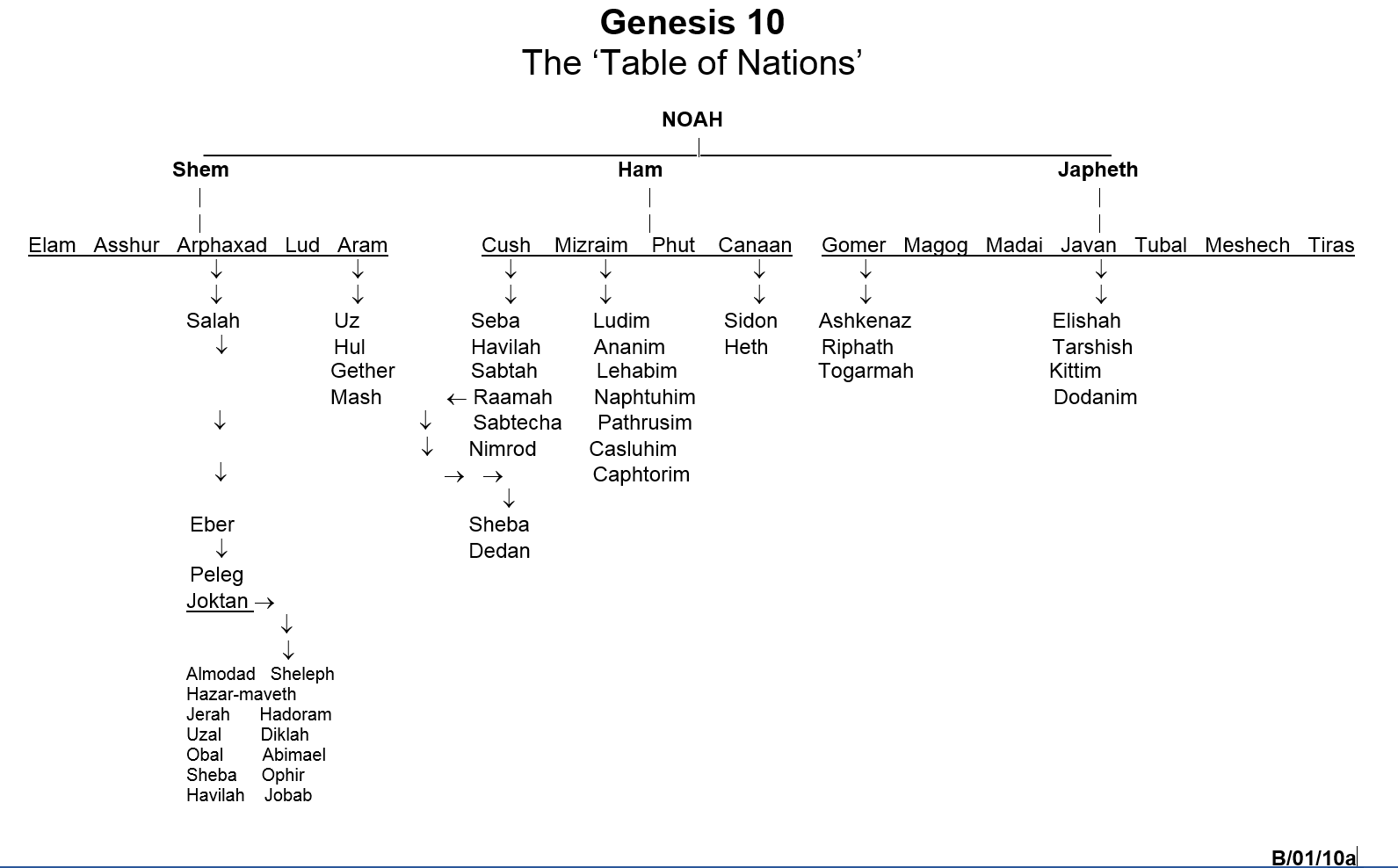
The Table of Nations, from Genesis 10. Noah’s descendants.

The Greek term correctly translated “angels of God”, is eggelon theou (ἀγγέλων θεοῦ). The quotation is from the Septuagint, aka, LXX, a 2nd Century BC translation from Hebrew into Greek of the Old Testament and part of the Apocrypha. Since the Apostle Paul was a missionary to the Greek-speaking world, he used and quoted from the LXX. Most English translations follow the KJV and render the original Hebrew text as “children of Israel”. I think that that is an early 17th Century error in interpreting the ancient customary meaning of b’ne Yisra’el. Having not spent enough time in the LXX, I had missed the topic entirely.

There is a lot of material to absorb from Heiser’s work (and the work of other scholars he quotes), so I am just going to comment on some key concepts that fall under this theological umbrella, particularly issues that have aroused the contempt of some of his critics.

Since a lot of what follows is my own analysis of the subject, I am showing what I specifically gleaned from Heiser (whether quoted or paraphrased) in

blue type.

To Top

Source materials

Heiser’s primary, though not sole, source is the Bible. He and a number of like-minded colleagues contend that there are many clear and/or highly suggestive Scriptures, particularly in the OT, that shed light on angels, demons, Satan, the Divine Council (see below), angelic rebellions, and the “spirit world” in general. These are largely unfamiliar topics because translators and scholars for the most part have long been unwilling to consider extrabiblical evidence from Second Temple Judaism (the Second Century BC through the First Century AD) and the later Rabbinical Period.

Even less so are they willing to consider gleaning from pagan texts. Understandably. But the Ancient Near East (ANE) was a dynamically interconnected milieu that, stripped of mythology, shared many memories of their own common histories going back to Babel.

This literary blindness has always puzzled me, because off the top of my head, I think there are some 100 Biblical references to non-canonical sources actually cited by name by the Scriptural writers (see this for examples).

The fact that the large body of pre-Christian Apocryphal and Pseudepigraphal Jewish literature is rightly considered to not be Inspired does not mean that it was written as fiction and has no bearing on Judeo-Christian history. Aside from citations, the writers of the New Testament either quoted or paraphrased from The Wisdom of Sirach (Ecclesiasticus), The Wisdom of Solomon, 1 & 2 Maccabees, Tobit, 2 Esdras, and 1 Enoch.

Theology should not, of course, be gleaned solely from writings that weren’t inspired. But if contemporary non-canonical material can help us understand the material presented only in skeletal form in Scripture, then I think it’s fair to use it non-dogmatically. If that suggestion appalls you, then consider how often you’ve heard Josephus quoted, or Philo, or Eusebius.

The apocryphal book, 1 Enoch is particularly applicable to Heiser’s theology because it mostly discusses “fallen angels” on the antediluvian earth. Though 1 Enoch is included in the canon of a number of Christian denominations, it is clearly not an infallible source. Yet, parts of it have been given a “seal of authenticity” by being directly quoted in Scripture we include in our own canon:

14 It was also about these that Enoch, the seventh from Adam, prophesied, saying, “Behold, the Lord comes with ten thousands of his holy ones,
15 to execute judgment on all and to convict all the ungodly of all their deeds of ungodliness that they have committed in such an ungodly way, and of all the harsh things that ungodly sinners have spoken against him.”
—Jude 1:14–15 ESV

Compare with…

Behold, he will arrive with ten million of the holy ones in order to execute judgment upon all. He will destroy the wicked ones and censure all flesh on account of everything that they have done, that which the sinners and the wicked ones committed against him.”
—1Enoch 1:9 PSEUD-CW

Greek is in some respects a language rich in vocabulary, but it has only one word for “angel”, where Hebrew has many that are more descriptive (compare English “love” with the richer set of choices on that subject in the Greek). Because much of the Bible’s Hebrew material can’t be directly translated into Greek, there is much less clarity on these issues in the NT, in the important Greek Septuagint translation of the OT, and in the Dead Sea Scrolls. The latter are of huge import but have only become available during my lifetime. I personally believe that Greek and Latin cultural influences on the Church have further muddied the water in modern scholarship.

To Top

The elohim

Heiser has made a good case for defining “elohim” as a generic common noun designating all disembodied spiritual beings, from the eternal Triune God at the top, through the created angelic beings (a hierarchy of untold billions of individuals, both loyal and rebellious), and the spirits of the dead. For an example of the latter, read 1 Samuel 28.

Although the elohim are spirits, they can take on form to interact with humans. As such, they can be seen (at least in ancient times), speak audibly (as they did with Abraham, Isaac, Daniel, the women at Jesus’ tomb, and others), touch and be touched (Isaiah’s lips), wrestle (Isaac), and even breed with human women (Genesis 6).

War of the angels, from Revelation 12.

Most Hebrew grammars define elohim as a generic term for “gods“. Strong’s and other grammars also list alternative meanings like “angels”, “magistrates”, or “judges”; but dictionaries derive definitions from actual usage, and I strongly suspect that the last two of those variants are mistranslations that the dictionaries added after the fact (much like English dictionaries now have twice as many definitions for “gay” than they did when I was a schoolboy). Whether we call them “gods”, “angels”, “spirits”, “spiritual beings”, or simply leave it at elohim, is simply a matter of semantics.

[6] Then his master shall bring him unto the judges [elohim]; he shall also bring him to the door, or unto the door post; and his master shall bore his ear through with an aul; and he shall serve him for ever.
—Exodus 21:6 (KJV) Emphasis mine

Consider Exodus 21:6, above. The KJV translation reads in part, “bring him unto the judges [elohim].” ESV, on the other hand, reads, “bring him to God [Elohim].” I would take the latter as the correct translation. But it’s a bit moot in this case, since the “judge” before whom he was to be brought was a priest functioning as God’s agent in the matter. I would consider it to be a valid paraphrase that, unfortunately, obscures the role of Elohim.

To Top

God as Elohim

As I’m sure most of you know, Elohim (capital “E”) is one of the primary terms used for Yahweh in the Bible. But the Hebrew language has no alphabetic “case”, so the capitalization (or not) of elohim is a transliteration device. Elohim is a descriptive common noun, used here (with a capital “E”) as a proper noun, or name, for a particular elohim. When Moses requested an actual name at the burning bush, God did not use Elohim, but rather the term we transliterate to Yahweh.

Chariot Throne? One of many, many failed attempts to depict Ezekiel’s vision.

Elohim (Yahweh) is not just any old elohim, of course. Yahweh is eternal and preexisted all of the Host of Heaven. He created all the other elohim, and He rules all the other elohim. And He is vastly superior, in every respect. Where they have power, it is only because He has granted that power, and when He retracts that gift, they will immediately lose it. These things are non-negotiable to me, and I think they were to Heiser, as well.

The -im suffix on “Elohim” is a confusing issue. It is the Hebrew masculine plural ending for a noun, but it is more complicated than that. According to judaism.stackexchange.com, “both Eloahi and Elohim are the plurals of Eloah, but Eloahi is simple plural ([like] Jurors) while Elohim is a collective plural noun ([like] Jury).” But in practice, the plural forms are interchangeable, and elohim appears in the OT far more frequently than eloahi or eloah. The ambiguity is usually dispelled by the fact that other Hebrew parts of speech also have singular and plural forms. If elohim is grammatically tied to a singular verb or pronoun, then it is singular. If tied to a plural, it is plural. Also, as a common noun, elohim is often prefixed by an article, as haelohim, meaning “the gods.” Finally, according to Heiser, elohim by itself can be used for either singular or plural, like “deer” or “sheep”.

To Top

The Angel of God

The above discussion pretty much puts to rest the theological contention that the collective plural form of elohim is a Trinitarian construct. So, too, claims that the Hebrew adjective echad in Deuteronomy 6:4 (“Hear oh Israel, the LORD our God, the LORD is one [echad]“) is collective and therefore Trinitarian language. This, too, fails. Echad appears with and without modifying prefixes and suffixes 967 times in the OT. Considering just the 471 times that it occurs in lemma form (no attached modifiers, as here), it usually means, simply, “one” or “first“, e.g., “first day”, “one place”, “one flesh”, “one people”, “one of the bushes”, and so on. So, we can’t use these terms to prove the Trinity. We don’t need them to make that case!

Heiser believes in the Trinity, of course, but you really have to dig (in the material I’ve gotten through so far) to find it. He builds up to it, starting with a complicated discussion of “two Yahwehs—one invisible and in heaven, the other manifest on earth in a variety of visible forms, including that of a man.

It was hard for me to grasp his particular point because I’m really quite used to the idea of the Transcendent God in heaven simultaneously present in a Theophany, like the pillars of fire and cloud; and of the Son appearing on earth as a Christophany while the Father remains in heaven. The OT makes frequent reference to “The Angel of God”, Yahweh mal’ak.

What Heiser was concerned with explaining, though, is how an OT Jew processed the concept of a visible manifestation of Yahweh on earth, at the same time knowing that Yahweh was in heaven. He calls this a “two Yahwehs concept“, taking care to distinguish that from the dualist views of Plato and the later Gnostics (urge and demiurge), and the Yahad of Qumran (Man of Righteousness and Man of Unrighteousness).

I recall reading only one mention in Heiser of the Holy Spirit: “I believe that the evidence for a two-person Godhead discussed in those chapters can in places reveal a third person in the Old Testament.”

To Top

The heavenly host

In Heiser’s theology, before The Triune God created the universe (or perhaps, per some ancient sources, on Day 1 of creation), He created an immense number of spirit beings (elohim); like Him, incorporeal, but vastly inferior to Him and only more or less immortal (they have no end, but they did have a definite beginning). They were created, and they will live forever unless God destroys them. These beings were created:

  • To “image” Him—Heiser sees “in His image” as an expression of function, not of attributes. The Host was created to represent Him in the Heavenlies, as man would be to represent Him on earth. Note, though, that man is a soul (nephesh) composed of both body and spirit, while the elohim are spirit with no natural body. Note also that man must procreate, but procreation is not a natural function of the elohim, who have no need of procreation.
  • To administer the coming universe—Again as Adam’s seed was to administer earth.
  • To be family to him—along with, yet again, Adam’s seed.

None of the above because God needed these things, but because He chose to share eternity with a vast family.

Terms that describe the nature of these beings:

  • Like God, they are called elohim.
  • Like God, they are spirit beings (ruachot), without physical substance.
  • Like God, they are “Heavenly Ones” (shamayim), dwelling in heaven, not on earth.
  • Like the stars of the yet-to-be created universe, they are described as “Stars” (kochebim, sometimes boqer kowkbe, “morning stars“), or light bearers.
  • Like God (but imperfectly), they are “Holy Ones” (qedoshim), set aside for God’s purposes.

To Top

The heavenly hierarchy

Heiser describes a hierarchy among the created elohim: “That hierarchy is sometimes difficult for us to discern in the Old Testament, since we aren’t accustomed to viewing the unseen world like a dynastic household… as an Israelite would have processed certain terms used to describe the hierarchy. In the ancient Semitic world, sons of God ([haelohim b’ne]) is a phrase used to identify divine beings with higher-level responsibilities or jurisdictions. The term angel (malʾak) describes an important but still lesser task: delivering messages. In Job 38, the sons of God are referred to as morning stars.”

The Holy Ones are holy only because of their proximity to God. The way I understand it, they sit on the Divine Council (more on that, below), and some are the “princes” spoken of in Daniel, overseeing affairs on earth and in the heavens. These latter are spoken of by the Apostle Paul:

[12] For we wrestle not against flesh and blood, but against principalities, against powers, against the rulers of the darkness of this world, against spiritual wickedness in high places.
—Ephesians 6:12 (KJV)

Note that the “angels” are only a subset of the Heavenly Host. They function as courtiers, or messengers. They answer to the archangels, but both groups, together with the seraphim and cherubim (“throne guardians”) are inferior in function to the Holy Ones. All of them together function sometimes as Heaven’s armies, under the direction of the “Captain of the Host.” This latter figure is a fellow created spirit being.

To Top

The Divine Council

“The term divine council is used by Hebrew and Semitics scholars to refer to [members of] the heavenly host, … divine beings who administer the affairs of the cosmos. All ancient Mediterranean cultures had some conception of a divine council. The divine council of Israelite religion was distinct in important ways.”

I’m not sure what distinguishes the Israelite beliefs from those of other Semitic and non-Semitic cultures, but from a Biblical standpoint, the concept seems to hold water. The idea is that, though God can of course do anything and everything Himself, He chose to share responsibility with His created beings. For a conceptual precedent, consider that God could have chosen to bring salvation to the World by means of divine fiat; instead, He first chose Israel as His “beacon on a hill”, and since the Resurrection, the Church is recipient of the Great Commission.

From time to time, God convenes His Council of upper-echelon Sons of God to discuss the status of events in the created universe, particularly on earth, and to decide on actions to take. For example,

  • A defining Biblical text is found in Psalm 82. This is a Psalm of Asaph, who King David appointed as chief musician to serve “in front of” the Ark of the Covenant after David pitched a tent for it within the City of David (1 Chronicles 16:5–7). According to 2 Chronicles 20:14, Asaph was also a seer, or prophet, as is evident in the Psalms that he wrote.

    In Psalm 82, Asaph is prophetically seeing God convening His Council to criticize those who are unseen princes over worldly realms. Here the word elohim is translated “God” once for Yahweh Himself, and “gods” many times for the corrupt spiritual princes who are “judging unjustly.” Verse 6 defines who they are, the heavenly Sons of God, and verse 7 says that regardless of their status as such, they will still fall like any human prince, and they will die like any mortal human.

1 ¶ God has taken his place in the divine council;
in the midst of the gods he holds judgment:
2 “How long will you judge unjustly
and show partiality to the wicked? Selah
3 Give justice to the weak and the fatherless;
maintain the right of the afflicted and the destitute.
4 Rescue the weak and the needy;
deliver them from the hand of the wicked.”
5 ¶ They have neither knowledge nor understanding,
they walk about in darkness;
all the foundations of the earth are shaken.
6 ¶ I said, “You are gods,
sons of the Most High, all of you;
7 nevertheless, like men you shall die,
and fall like any prince.”
8 ¶ Arise, O God, judge the earth;
for you shall inherit all the nations!
—Psalms 82:1–8 ESV

Note that this, like almost all Hebrew poetry, is structured in parallel lines. The second line of each verse expresses the same thought as the first, but in different, and often expansive, terms. Verse 5 here differs only in that it does the same thing in three parallel lines, each expressing the condition of oppressed humanity in harsher terms than the previous.

  • Psalm 89, a “Maschil [instructional poem] of Ethan the Ezrahite”, contains another clear prophetic view of the Devine Council. Ethan was a priest, and one of four men whose wisdom was compared to Solomon’s in 1 Kings 4:31.

[5] Let the heavens praise your wonders, O LORD,
your faithfulness in the assembly of the holy ones!
[6] For who in the skies can be compared to the LORD?
Who among the heavenly beings is like the LORD,
[7] a God greatly to be feared in the council of the holy ones,
and awesome above all who are around him?
—Psalms 89:5–7 (ESV)

  • The next example is important in that it demonstrates how the Council functions. In 1 Kings 21, Israel’s King Ahab was upset after a harsh prophecy from Elijah, so he repented, and God gave him a “stay of execution”, so to speak. But three years later, in chapter 22, Ahab suggested to King Jehosaphat of Judah that they should unite in war against Syria. Jehosaphat promised to help, but suggested that they consult the prophets first. Ahab brought in 400 prophets to tell him whether or not it was safe to do battle. Being false prophets, they all told him what they thought he wanted to hear, that he would triumph.

    But Jehosaphat wanted to hear from a prophet of Yahweh, so the prophet Micaiah was consulted. Micaiah’s words, quoted below, described God’s approach in the Devine Council. God delegates responsibility and takes suggestions but He reserves the final authority. Much as it would be in a business called “Yahweh and Sons.”

[19] And Micaiah said, “Therefore hear the word of the LORD: I saw the LORD sitting on his throne, and all the host of heaven standing beside him on his right hand and on his left; [20] and the LORD said, ‘Who will entice Ahab, that he may go up and fall at Ramoth-Gilead?’ And one said one thing, and another said another. [21] Then a spirit came forward and stood before the LORD, saying, ‘I will entice him.’ [22] And the LORD said to him, ‘By what means?’ And he said, ‘I will go out, and will be a lying spirit in the mouth of all his prophets.’ And he said, ‘You are to entice him, and you shall succeed; go out and do so.’ [23] Now therefore behold, the LORD has put a lying spirit in the mouth of all these your prophets; the LORD has declared disaster for you.”
—1 Kings 22:19–23 (ESV)

  • I’ll close out this section with Daniel’s vision of God on His “chariot throne”, surrounded by the enumerable Host and His Divine Council. This shows another of the administrative functions of the Host: keeping records, presumably so that the Righteous God can never be accused of unrighteousness in eternity to come.

[9] “As I looked,
thrones were placed [for Yahweh and the Council],
and the Ancient of Days took his seat;
his clothing was white as snow,
and the hair of his head like pure wool;
his throne was fiery flames;
its wheels were burning fire.
[10] A stream of fire issued
and came out from before him;
a thousand thousands served him,
and ten thousand times ten thousand stood before him;
the court sat in judgment,
and the books were opened.
—Daniel 7:9–10 (ESV)

To Top

Angelic Rebellions

The last topic but one I’m going to cover here, but very briefly because the length of this post, is the three “angelic” revolts described in Genesis. You are familiar with all three, but perhaps in a slightly different context.

To Top

First Rebellion: Genesis 3

Heiser connects the Serpent of Genesis 3 with the rebellion of the powerful figure called Satan in the NT, as prophesied in Isaiah 14.

Isaiah 14 is actually a prophecy against Babylon and its king, describing their fall at the hands of Assyria. Hebrew prophetic poetry often layers prophecy within prophecy, and most scholars agree that the verses below are such.

“Lucifer” is a name found only once in scripture. It is a translation of the Hebrew helel, a masculine noun meaning, literally, “a shining one.” The translation I normally prefer, the Complete Jewish Bible (CJB), translates “Lucifer, that rose in the morning” as “morning star, son of the dawn”, but in the Septuagint…

12 How has Lucifer, that rose in the morning, fallen from heaven ! He that sent orders to all the nations is crushed to the earth.
13 But thou saidst in thine heart, I will go up to heaven, I will set my throne above the stars of heaven: I will sit on a lofty mount, on the lofty mountains toward the north:
14 I will go up above the clouds: I will be like the Most High.
15 But now thou shalt go down to hell, even to the foundations of the earth.
—Isaiah 14:12–15 LXX-B

Heiser suggests that perhaps Lucifer’s rebellion was in part precipitated by Yahweh’s decision to create mankind, a lower race of “imagers”. Primordial racism?

To Top

Second Rebellion: Genesis 6

According to Heiser, the Sons of God, below, were “Watchers” (Heb. iyr). These heavenly beings and the incident itself are the subject of a great deal of 1 Enoch, discussed above under “Source Materials“, and widely known to Jewish scholars in Jesus’ day. The function of Watchers is to observe and report to the Devine Council. In the OT, Watchers are mentioned in Daniel 4:13 and 23.

1 And Noe was five hundred years old, and he begot three sons, Sem, Cham, and Japheth.
2 And it came to pass when men began to be numerous upon the earth, and daughters were born to them,
3 that the sons of God having seen the daughters of men that they were beautiful, took to themselves wives of all whom they chose.
4 And the Lord God said, My Spirit shall certainly not remain among these men for ever, because they are flesh, but their days shall be an hundred and twenty years.
—Genesis 6:1–4 LXX-B

This unnatural union of Watchers and human women did not require “possession” of human males by the watchers. The Bible includes a number of examples of angelic beings taking human form and exhibiting human function. The products of the abominable union of angelic males with human females were hybrid Nephilim—giants with spirits that were evidently ineligible for the same fate as humans after death. Heiser equates demons with the spirits of dead Nephilim.

To Top

Third Rebellion: Genesis 11

After the abomination of angel/human coupling, sin on earth multiplied until God put an end to it by means of the Great Flood, an event of such vast consequence that it was recorded in the annals of every great civilization of the ancient world, and in a number of Jewish writings from the intertestamental period. After the flood waters receded enough that Noah and his family could step back onto dry land on the Ararat mountaintop, there must have been a slow drying as the water seeped back into the earth’s mantle (see my 2022 article, Fountains of the Deep). During that time, I think that the newly growing family of humanity migrated slowly southeast along the highlands of the Zagros Mountains and reentered the Shinar region near the confluence of the Tigris and Euphrates rivers, from the east.

Probable migration route of Noah’s descendants after the Great Flood. Google Earth, annotated by Ron Thompson.

1 And all the earth was one lip, and there was one language to all.
2 And it came to pass as they moved from the east, they found a plain in the land of Senaar [Shinar], and they dwelt there.
3 And a man said to his neighbor, Come, let us make bricks and bake them with fire. And the brick was to them for stone, and their mortar was bitumen.
4 And they said, Come, let us build to ourselves a city and tower, whose top shall be to heaven, and let us make to ourselves a name, before we are scattered abroad upon the face of all the earth.
5 And the Lord came down to see the city and the tower, which the sons of men built.
6 And the Lord said, Behold, there is one race, and one lip of all, and they have begun to do this, and now nothing shall fail from them of all that they may have undertaken to do.
7 Come, and having gone down let us there confound their tongue, that they may not understand each the voice of his neighbor.
8 And the Lord scattered them thence over the face of all the earth, and they left off building the city and the tower.
9 On this account its name was called Confusion, because there the Lord confounded the languages of all the earth, and thence the Lord scattered them upon the face of all the earth.
—Genesis 11:1–9 LXX-B

Heiser contends that at this time, at the Tower of Babel, when Yahweh “confound[ed] their tongue” and “scattered them … over the face of the earth”, He divided them into 70 (or 72, depending on the translation elsewhere in scripture) distinct nations throughout Europe and western Asia, and assigned to each one or more “heavenly princes.” These spiritual beings either were or became corrupt and were subsequently worshipped by the people they oversaw.

8 When the Most High divided the nations, when he separated the sons of Adam, he set the bounds of the nations according to the number of the angels of God.
9 And his people Jacob became the portion of the Lord, Israel was the line of his inheritance.
—Deuteronomy 32:8–9 LXX-B (emphasis mine)

Heiser may have made this point in something I have not yet read, but I believe that the nations of Deuteronomy 32:8 are the peoples that Paul referred to in Romans 1:18ff. Note, in particular,

[22] Claiming to be wise [engineering and constructing the Tower!], they became fools, [23] and exchanged the glory of the immortal God for images resembling mortal man and birds and animals and creeping things.
—Romans 1:22–23 (ESV)

I had decided not to lengthen this post further by carrying the discussion of the Genesis 11 rebellion one step further, but perhaps I’ve been overruled… I went to sleep last night thinking about Ephesians 4, and I woke up this morning thinking about Ephesians 4. Then, at church this morning, we had a guest preacher in the pulpit, and his text was, out of all the roughly 1,189 chapters in the Bible, Ephesians 4! So, here are the relevant verses:

[8] Wherefore he saith, When he ascended up on high, he led captivity captive, and gave gifts unto men.
[9] (Now that he ascended, what is it but that he also descended first into the lower parts of the earth [or: lower parts, the earth]?
[10] He that descended is the same also that ascended up far above all heavens, that he might fill all things.)
—Ephesians 4:8–10 (KJV) Emphasis mine

Paul’s message here was actually a midrash, that is, a metaphorical use of text to illustrate a point that is at most loosely connected to the text quoted. The underlined text quoted above refers back to Psalm 68, in particular

15 O mountain of God [har elohim, mountain of the gods], mountain of Bashan;
O many-peaked mountain, mountain of Bashan!

18 You ascended on high,
leading a host of captives in your train
and receiving gifts among men,
even among the rebellious, that the LORD God may dwell there.
—Psalm 68:15,18 ESV

Bashan is the region of the Golan Heights, Mt. Hermon and the surrounding area: Caesaria Phillipi with “The Gates of Hell”, the shrines to Pan, the god of the underworld, and Jeroboam’s calf idol at Dan.

This portion of the Psalm is a prophetic picture of Jesus, at His crucifixion and resurrection defeating the corrupt gentile “gods” and leading them captive to Sheol. These demonic captives were the booty of war. Paul is applying the Scripture metaphorically to say that the victor distributed booty to His subjects. That was an introduction to the subject of “spiritual gifts.” Nevertheless, the backstory in the Psalm is that Jesus has reversed the exclusion of the nations that was affected at Babel!

To Top

Angelic War

The final point I’ll pursue here is this:

The idea that, when Satan rebelled, he was exiled to earth, and 1/3 of the other angels, who were “his team”, were exiled with him. This is one of those Church traditions that occurs nowhere in scripture. It is no doubt based on Revelation 12, which actually describes a war in heaven between Michael and his angels, on one side, and Satan and his angels on the other.

Satan’s team lost. In the context, this happened, not when Lucifer fell, but when Jesus was born!

To Top


John 12: Preface to Jesus’ Last Passover

First posted March 2023. Updated June 2024.

Outline:
Prologue
People
Timeline
In Memoriam

Along with many other Southern Baptist churches, the one I now attend is in the middle of a series of Bible Study lessons on the Book of John. We are covering John 12 over a two-week span. It is a particularly important chapter for me because it records the transition from Jesus’ itinerant ministry in and around Judah and Galilee, to His crucifixion and the aftermath.

Prologue

John 10

The events leading up to Jesus’ final Passover began with the previous Hanukkah, as recorded in John 10:22–39. Hanukkah is a Jewish celebration not mentioned in Scripture, but celebrated, nevertheless, by Jesus, His followers, and Jews everywhere. It is an 8-day festival, starting on the Jewish date Kislev 25, which usually corresponds with mid to late December. It is also called the Festival of Lights, or the Feast of Dedication, and it celebrates the Maccabean victory over Syria in 165 BC, and reconsecration of the Temple after its desecration by Antiochus IV and his successors.

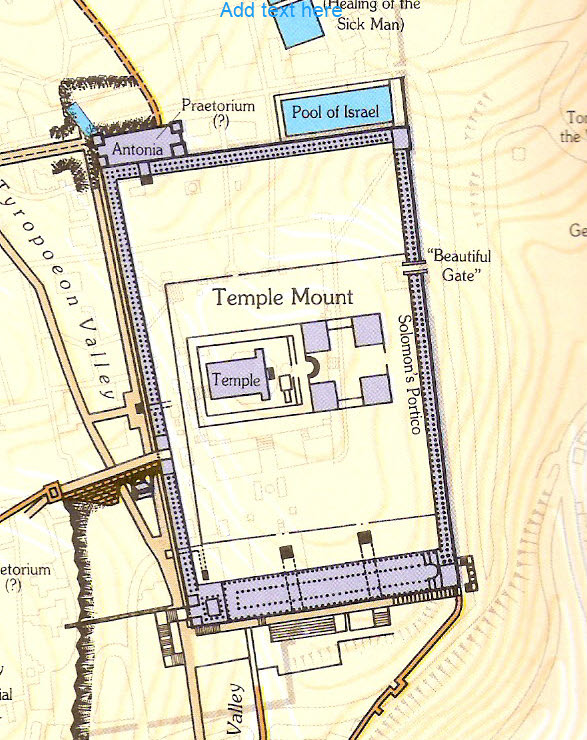
During that Hanukkah, Jesus was confronted in Solomon’s Porch, the Collonade inside the eastern wall of the Temple Mount and challenged to state plainly if He was the expected Messiah. He responded that He had already answered that question and went on to say explicitly that He and [God] the Father are one, and that He, Himself, has power to grant eternal life. His accusers then threatened first to stone Him and then to arrest Him because He, being a man, was making Himself out to be God.

The Temple Mount, cropped from a drawing by Dan Bahat. Solomon’s Porch (or Portico) annotated on the east side of the Mount.

His response to that was to quote from Psalm 82, thereby invoking the entire Psalm and turning the accusations back on His accusers, before slipping away from them supernaturally.

Psalm 82 is difficult to understand today, because modern commentators have almost uniformly ignored what would have been perfectly clear to the average 1st Century Israelite.

[82:1] God [Elohim] has taken his place in the divine council;
in the midst of the gods [elohim] he holds judgment:
[2] “How long will you judge unjustly
and show partiality to the wicked? Selah
[3] [You should] Give justice to the weak and the fatherless;
maintain the right of the afflicted and the destitute.
[4] Rescue the weak and the needy;
deliver them from the hand of the wicked.”
[5] They [those victimized in v. 3–4] have neither knowledge
nor understanding, they walk about in darkness;
all the foundations of the earth are shaken.
—Psalm 82:1–5 ESV

The Hebrew Elohim, meaning God in many contexts, can in other contexts also mean “angels” (in the New Testament, this term refers to all ranks of the Heavenly Host, as explained in Gods and Demons), “judges“, or “masters“. When God scattered the nations from Babel (Gen. 11:8–9), He put those rebellious humans under the supervision of equally rebellious angels (the “Sons of God”, Deut. 32:8–9), who became their capricious gods. This understanding is supported by the verses following:

[6] I said, “You are gods [elohim],
sons of the Most High, all of you;
[7] nevertheless, like men you shall die,
and fall like any prince.”
[8] Arise, O God [Elohim], judge the earth;
for you shall inherit all the nations!
—Psalm 82:6–8 ESV

The Psalm itself is a pun, a play on the word elohim. God is effectively saying that He is the judge of the judges. When Jesus quotes v. 6,

[34] Jesus answered them, “Is it not written in your Law, ‘I said, you are gods’?
—John 10:34 (ESV)

He was making a rabbinic kal v’chomer (lesser to greater) argument: “If the pagan gods, doing evil works and judging unjustly, are elohim, how much more am I, who does good works and judges fairly, Elohim? And if the angelic gods are ‘sons of the Host High’, how much more does the description ‘Son of God’ apply to me”?

After Jesus disappeared from the Temple, He was next seen in Bethany Beyond Jordan, the area where He and John the Baptizer had met earlier in the Book.

John 11

The confrontation in Solomon’s Porch recorded in John 10 occurred in December, and the Crucifixion was in Early April, so the raising of El’azar (Lazarus) had to have occurred in the intervening span of around three months. Many people, both friend and foe of Jesus, witnessed Lazarus’ resurrection. Subsequent plots against Jesus led Him to retreat to the town of Efrayim, in northeast Judah. When He returned to Jerusalem, possibly only weeks later, the miracle was still no doubt fresh in people’s minds.

Since the raising of Lazarus was a completely unprecedented event, it was probably totally shocking to everyone. We know of five resurrections prior to Lazarus: one brought about by Elijah; one by Elisha while he lived; one by contact with Elisha’s corpse; and two previous by Jesus. Lazarus was the only recorded resurrection of someone three or more days after death. A number of commentaries note that three days in the grave were considered to be the maximum time for any hope of an apparently dead body to be capable of resuscitation; for example, The Net Bible Commentary references, “a rabbinic belief that the soul hovered near the body of the deceased for three days, hoping to be able to return to the body.” I think that this was probably a recognition that significant, irreversible signs of decomposition generally appear two to three days after death. Rigor mortis begins within a few hours of death, and fades after two or three days. Lividity becomes quickly evident but does not lock into place for about three days. Putrefaction begins immediately at the cellular level, but dependent on circumstances may not be externally evident for several days.

For a comparison of Lazarus’ resurrection with Jesus’ own, see Biblical Considerations in Is There a Photo of Jesus?

People

Unfortunately, almost nobody understands the various sects of Jesus’ day. The Gospel writers had no need to teach an in-depth course, because everyone in their day knew the players. Since pretty much every contact between Jesus and the sectarians was confrontational, that makes them all look like villains. But that is a skewed generalization! When someone was referred to in Scripture as a Pharisee, that was usually referring to a trained and ordained rabbi, but there weren’t all that many of those. Estimates for 1st Century Judea are about 6,000 Pharisees, 4,000 Essenes, substantially fewer Sadducees, and just pockets of anything else. Here is a very brief summary:

Sanhedrin

This, of course, was not a sect, but a system of governing courts, or councils. Every city had a Lesser Sanhedrin of 23 members, which answered to the Great Sanhedrin in Jerusalem. The latter consisted of 71 appointed members. The Cohen HaGadol, or High Priest, functioned as the Nasi, (Prince, President, Chief Justice, or Chairman of the Board, so to speak). Ideally around half of the remaining 70 were Pharisees and half Sadducees. In Jesus’ day they met daily in the Chamber of Hewn Stone, in the Temple complex (see diagram). Around the time of the Crucifixion, they moved into the nave of the Royal Portico, which was a grand basilica constructed parallel to the southern wall of the Temple Mount, where the Al Aqsa Mosque presently sits.

The Temple complex in Jesus’ day. The Chamber of Hewn Stone is a large room midway down the left side, adjacent to the ramp of the altar. The terrace above that on the drawing is where young Jeshua (Jesus) spoke to members of the Sanhedrin on His first recorded Passover (Luke 2:41–46). ©Leen Ritmeyer.

One of the official functions of the Sanhedrin was to evaluate anyone who claimed to be the Messiah. In the Synoptic Gospels, when you read of “chief priests and scribes” or “scribes and Pharisees” apparently harassing Jesus, I think that most likely they were officially tasked by the Sanhedrin to follow and question. Given the politicization of the Sanhedrin under Roman rule, some of these were undoubtedly hostile, but others were probably merely conscientiously concerned. Nicodemus and Gamaliel were surely members of the Council and were certainly not evil men. Joseph of Arimathea and Paul were probably both also members. With one exception, the book of John mentions only the Pharisees among those following the crowds with Jesus, but that should not be taken to mean anything other than the normal agents of the Sanhedrin. John wrote probably a decade after the destruction of the Temple and the priesthood. By that time, the Sadducees were a distant memory to his readers, and the Temple had been replaced in their lives by the synagogues. Banishment from the synagogue had become the worst punishment possible, short of death to some and worse than death to others.

High Priest

Under Mosaic Law, the High Priest was required to be a direct descendent of Aaron, as were all priests and Levites. King David replaced a corrupt High Priest with Zadoc, who was himself an Aaronic descendent. Subsequently, all high priests (but not other priests or the Levites) were to be from Zadoc’s lineage. From at least Hasmonean times, the office was corrupt to the extent that many high priests were illegitimate. Under Roman rule, appointments were made by the regent or governor, and the office became more political than religious.

Chief Priests

As the title suggests, these were high ranking priests in the Jerusalem hierarchy. Most, if not all, were probably members of the Sanhedrin. Most were Sadducees.

Sadducees

This is the first actual sect I will discuss. These men were considered the “priestly caste” in Judea. It consisted not only of priests, but also aristocratic “hangers on”. By no means were all priests Sadducees; in fact, many were Pharisees, though most were unaffiliated with either sect. Officially, the Sadducees rejected all scripture but the Five Books of Moses (the Chumash), and in particular, rejected the concept of resurrection. Though only a small sect, the Sadducees were wealthy, and thus powerful. They controlled the priesthood, the Levites, the Temple, and the festivals. After AD 70, they disappeared from history.

Pharisees

This sect had more popular support than any others in Jesus’ day, though they weren’t in control, either of the nation or the Temple. They did lead the synagogues, for the most part. They probably had their origins with holy elders in the Babylonia captivity but evolved into a cohesive sect alongside the Sadducees in the Hasmonean Kingdom of the 1st and 2nd Centuries, BC. The two sects were in open warfare with each other during the reign of Alexander Jannaeus, the second Hasmonean King, and hundreds of Pharisees were killed.

Doctrinally, the Pharisees treasured the entire canon of the Tanach (Old Testament) and believed in resurrection. They were the popularizers of the “Oral Torah“, or so-called “traditions of the elders.” After the destruction of the Temple, only this sect survived, and they are the ones, humanly speaking, who God used to preserve a Jewish remnant for 2,000+ years.

Contrary to the assumptions of most Christians, the Pharisee sect was not monumental. Above, I mentioned four members of the Sanhedrin that we would not call evil. All of those were Pharisees. Paul was a Pharisee both before and after Damascus. In Acts 23:6 (ESV), he declared, “Brothers, I am [present tense] a Pharisee, a son of Pharisees.” It was Pharisees who wrote the Talmud, and I think they accurately analyzed their own shortcomings and eccentricities:

Talmudic Classification of the Pharisees:

(1) the “shoulder” Pharisee, who wears his good deeds on his shoulders and obeys the precept of the Law, not from principle, but from expediency;

(2) the “wait-a-little” Pharisee, who begs for time in order to perform a meritorious action;

(3) the “bleeding” Pharisee, who in his eagerness to avoid looking on a woman shuts his eyes and so bruises himself to bleeding by stumbling against a wall;

(4) the “painted” Pharisee, who advertises his holiness lest any one should touch him so that he should be defiled;

(5) the “reckoning” Pharisee, who is always saying “What duty must I do to balance any unpalatable duty which I have neglected?”;

(6) the “fearing” Pharisee, whose relation to God is one merely of trembling awe;

(7) the Pharisee from “love.”

The International Standard Bible Encyclopedia, 1915 Edition
Scribes

The scribes were not a sect, but rather a profession. They were, as you would expect, the educated readers and writers of Israel. Many of them were Pharisees. Some were Sadducees or members of another sect, or of none at all. Many were members of the Sanhedrin.

Essenes

Little is said about the sect of the Essenes in the Bible, because they were ultrareligious outsiders who pretty much kept to themselves. Claims that John the Baptizer or Jesus were Essenes are completely wrong.

Yahad

The Yahad are the sect of Qumran and the Dead Sea Scrolls. Many think that they were Essenes, but there were radical doctrinal differences between the two groups. My friend, Dr. Randall Price, wrote what I consider the definitive book on the subject, Secrets of the Dead Sea Scrolls.

Am Ha’aretz

These were the common “people of the land”, those without power or wealth. Jesus’ ministry was primarily to this group, who were members of no sect, but mostly listened to the Pharisees.

Herodians

This was a political party, not a true sect. They were supporters of the Herodian Dynasty and were a small minority of the population.

Timeline

Verses 1,2

Jesus returned to Bethany “six days before the Passover”, which by my own calculations (see table, below) was March 30, 0030. The 30th was a Sabbath, so He had to have arrived no later than Friday afternoon. The dinner in His honor was, according to Mark, at the home of Simon the Leper, who we know nothing else about. The meal would have been prepared before sundown, and served after dark, on the new day. The account makes perfect sense, because Sabbath dinners were always festive and joyous occasions. Perfect for welcoming a distinguished friend and guest!

The Gregorian dates shown here are my own calculations based on NOAA lunar tables going back much farther even than that. ©Ron Thompson
Verses 3–8

The text says that Miryam washed Jesus’ feet with spikenard that she had obtained for His burial. (Could it be that she was the only one paying attention to what He had been saying?) We know from previous scripture that her family was important and well off, so her possession of the pure nard oil was not surprising. It was an expensive perfume imported from India in alabaster containers, and a pint of it would have cost about a year’s wages for a common laborer of the am Ha’aretz. The Southern Baptist quarterly mentions that respectable 1st Century Jewish women kept their hair concealed. That was true then, and it’s still true among the pious Orthodox. Using a headscarf like a Muslim woman is acceptable, but in Western cultures it is more common to wear a wig.

Jesus’ comment about the poor should not be taken as insensitive. He was making reference explicitly to Deuteronomy 15:11, and saying, in effect, that this is a drop in the bucket and will make little difference to the poor, who will always be around.

[11] for there will always be poor people in the land. That is why I am giving you this order, ‘You must open your hand to your poor and needy brother in your land.’
Deuteronomy 15:11 (CJB)

Verses 9–11

We see here yet another example of the Sanhedrin plotting against Jesus, and in this case also against Lazarus. I would not wish to paint them as blameless, but I think they weren’t as bad as many believe. Yes, there were corrupt men on the Council, but on balance, I don’t think they were as worried about losing their personal influence as they were of goading the Romans into just what finally did happen in AD 70. Paul himself gives them an excuse of sorts:

1 Brothers, my heart’s desire and prayer to God for them is that they may be saved.
2 For I bear them witness that they have a zeal for God, but not according to knowledge.
3 For, being ignorant of the righteousness of God, and seeking to establish their own, they did not submit to God’s righteousness.
—Romans 10:1–3 ESV

Verses 12–19

The Triumphal Entry. It was the day after the feast at Simon’s house. Sunday, Nisan 10 of the year 3790, or by our reckoning, March 31, 0030. Jesus went from Bethany to Jerusalem. Rather than walk this time, He had to ride a donkey’s colt into the city in order to fulfill the prophecies of Psalm 118:25–26 and Zechariah 9:9. Actually, did you catch the oddity in Matthew 21:2? He actually rode two donkeys—a mare and her colt. Evidently, he rode the mare part way and then transferred to the colt for the last part of the ride. Bible trivia!

Another mistake that many people make is to think that the people glorifying Jesus as He rode into town are the same people that days later insisted that Pilate put Him to death and release Barrabas. The people waving palm fronds on Sunday were home in bed on Friday when Jesus was on trial. The only people present for that were Jesus’ enemies.

Verses 20–26

The quarterly, and some of my favorite commentators as well, interpret “some Greeks” as referring either to Greek nationals or to God-fearing gentiles visiting the city from outside Judea. I disagree. I think that the context here, and more clearly in John 5:35, is the same as that in Acts 6:1. It is referring to Greek-speaking Jews from the Jewish Diaspora.

What did they want? The quarterly is wrong to say that “John gave no indication”, but that it “triggered something in Jesus.” Verse 23 clearly states that what it triggered was a response; evidently what they wanted was to request that He visit their countries next, which would explain why His answer, that He was about to die and couldn’t go, was directly to the point. As was verse 26, where He effectively told them that, instead of Him following them home, they could ultimately follow Him home.

Verses 27–36

My purpose in writing a blog is not to regurgitate things that most of my readers already know, nor is it to find fault with Sunday School quarterlies, though I’m not above doing that from time to time. Though I don’t agree with anybody about everything, I really think that Dr. Howell has done a fine job with his commentary in this quarter’s booklet. The reason for my blog posts in general is that for decades I’ve tried to understand Scripture not only from conventional, traditional, points of view, but from my own historical and cultural perspectives and from observations of God’s design of the universe and its physical laws.

The reason I bring this up now is because, while this whole passage is extremely interesting and vitally important, I have only one thing to add to what Dr. Howell has said. He interprets God’s voice in verse 28 as a “thunderous response.” I’m pretty sure he is picturing an earsplitting clap of thunder from lightning striking a tree in his backyard. On the contrary, my own vision is of a gently rolling murmur of distant thunder, as carried by the wind. The Complete Jewish Bible translates it as,

[28] ‘Father, glorify your name!’” At this a bat-kol came out of heaven, “I have glorified it before, and I will glorify it again!”
—John 12:28 (CJB) Emphasis mine

I’ve written about the bat-kol, or “daughter of a voice”, before. It is the “low whisper”, or “still, small voice” that Elijah heard in I Kings 19:12ff. When God spoke to His prophets audibly, I think that it was in this soothing, intimate fashion, not like a scary Zeus or Thor figure would blare out to his minions. This whisper voice is the way it was depicted in ancient Jewish literature, as described by the 2nd or 3rd Century Rabbis who compiled it:

“After the death of Haggai, Zechariah and Malachi,
the last of the prophets, the Holy Spirit ceased from
Israel; nevertheless they received communications
from God through the medium of the bat-kol.”
—Tosefta Sotah 13:2

Verses 37–50

In the same spirit as with the previous section, I am going to comment on only two thoughts:

First, in verse 38 John quotes Isaiah 53:1. Something that you should remember when reading the New Testament is that most Jews were taught Scripture from a very early age, in their homes and then, in some cases, in a beit midrash (house of study”, an arm of the local synagogue. For this reason, speakers like the rabbis and Jesus referred to entire passages of the Old Testament by merely quoting a key sentence or phrase. Thus, by quoting this one verse, Jesus was effectively applying Isaiah 53, in its entirety, to Himself. I repeat it here:

1 Who believes our report?
To whom is the arm of ADONAI revealed?
2 For before him he grew up like a young plant,
like a root out of dry ground.
He was not well-formed or especially handsome;
we saw him, but his appearance did not attract us.
3 People despised and avoided him,
a man of pains, well acquainted with illness.
Like someone from whom people turn their faces,
he was despised; we did not value him.
4 ¶ In fact, it was our diseases he bore,
our pains from which he suffered;
yet we regarded him as punished,
stricken and afflicted by God.
5 But he was wounded because of our crimes,
crushed because of our sins;
the disciplining that makes us whole fell on him,
and by his bruises* we are healed.
6 ¶ We all, like sheep, went astray;
we turned, each one, to his own way;
yet ADONAI laid on him
the guilt of all of us.
7 ¶ Though mistreated, he was submissive –
he did not open his mouth.
Like a lamb led to be slaughtered,
like a sheep silent before its shearers,
he did not open his mouth.
8 After forcible arrest and sentencing,
he was taken away;
and none of his generation protested
his being cut off from the land of the living
for the crimes of my people,
who deserved the punishment themselves.
9 He was given a grave among the wicked;
in his death he was with a rich man.
¶ Although he had done no violence
and had said nothing deceptive,
10 yet it pleased ADONAI to crush him with illness,
to see if he would present himself as a guilt offering.
If he does, he will see his offspring;
and he will prolong his days;
and at his hand ADONAI’s desire
will be accomplished.
11 After this ordeal, he will see satisfaction.
“By his knowing [pain and sacrifice],
my righteous servant makes many righteous;
it is for their sins that he suffers.
12 Therefore I will assign him a share with the great,
he will divide the spoil with the mighty,
for having exposed himself to death
and being counted among the sinners,
while actually bearing the sin of many
and interceding for the offenders.”
—Isaiah 53:1–12 CJB

Finally, John 12:40 was another Isaiah quote. In its Old Testament context:

8 ¶ Then I heard the voice of Adonai saying,
¶ “Whom should I send?
Who will go for us?”
¶ I answered, “I’m here, send me!”
9 He said, “Go and tell this people:
¶ ‘Yes, you hear, but you don’t understand.
You certainly see, but you don’t get the point!’
10 ¶ “Make the heart of this people [sluggish with] fat,
stop up their ears, and shut their eyes.
Otherwise, seeing with their eyes,
and hearing with their ears,
then understanding with their hearts,
they might repent and be healed!”
11 ¶ I asked, “Adonai, how long?” and he answered,
¶ “Until cities become uninhabited ruins,
houses without human presence,
the land utterly wasted;
12 until ADONAI drives the people far away,
and the land is one vast desolation.
13 If even a tenth [of the people] remain,
it will again be devoured.
¶ “But like a pistachio tree or an oak,
whose trunk remains alive
after its leaves fall off,
the holy seed will be its trunk.”
—Isaiah 6:8–13 CJB

Jesus is explaining, by this reference, why so many of His hearers could not see the truth, despite His signs and wonders. Just as God hardened Pharaoh’s heart after Pharaoh had several times hardened his own heart, He has hardened the hearts of many Jews who have repeatedly rejected Him. That doesn’t mean that Jews can’t be saved, obviously, nor does it mean that God has rejected the people as a whole. They are still “God’s chosen people”, natural branches of the olive tree to which we believers who are not Jews have merely been grafted.

How is this hardening even fair? Because God chose them for His own, revealed Himself to them, in particular, and gave them all the advantages of a special relationship. When the hardening ends, at the close of the Great Tribulation, all that remain alive, and I think their numbers will be vast, will be saved. Every last one of them, I believe!