This post is inspired by a recent, very brief, Sunday School discussion of Joseph’s Godly response to Potiphar’s wife, long before Mt. Sinai and “The Law.” The sense that I took from some of the comments was, “Joseph was a very special man to even know that adultery was sinful, since ‘The Law’ had not yet been given to Moses.”
“Joseph Receives His Father and Brothers”, by Jan de Bray, 1627–1697. Bray specialized in painting historical figures dressed as contemporary figures; hence, the Dutch Renaissance attire.
I wholeheartedly agree that Joseph was special, but not for that reason. I would submit that all human beings have an innate understanding of sin. Potiphar’s wife knew that adultery is sinful but tried to force it on Joseph anyway. The fact that she was able to frame him for the crime of attempted rape shows that she, her husband, and other Egyptians in the story all had moral compunctions about it.
“The Law” as teacher
I suspect that confusion about this issue goes back to the King James translation of Galatians 3:24, which most of us seniors raised in church are probably familiar with:
[23] But before faith came, we were kept under the law, shut up unto the faith which should afterwards be revealed. [24] Wherefore the law was our schoolmasterto bring us unto Christ, that we might be justified by faith. [25] But after that faith is come, we are no longer under a schoolmaster. —Galatians 3:22–25 (KJV) emphasis mine
We were traditionally taught that, as a “schoolmaster“, the job of “The Law” was no more than to teach Israel what God required of faithful servants. Under the “Old Covenant”, those teachings were rigorously applied by God and the Jewish authorities, and in fact, according to old-school Dispensationalism, salvation came to those, both Jew and Gentile, who either “kept ‘The Law'” or who made atonement for their failures by making an appropriate blood sacrifice.
…
[Boy… my intention going into this was to keep it brief, but my brain keeps running down all kinds of rabbit trails. There are many directions I could take that last paragraph, but I’m going to back down and stick to “schoolmaster.” Anyhow, see A Perspective on Biblical Covenants and Dispensations, where I’ve already covered part of it]
…
The term that KJV translates as “schoolmaster“, and NAS as “tutor” is the Greek paidagogos (παιδαγωγός), which literally means “boy-leader”. Historically, in ancient Greece, it referred to a slave whose job it was to conduct children to and from school in safety. In other words, a “guardian” (ESV) or “custodian” (CJB), with no teaching function whatsoever.
If you look up paidagogos (G3807) in Strong’s, you’ll see that it does in fact mention “tutor”, “instructor” and “schoolmaster”, but Strong’s doesn’t determine how a word should be translated—it reflects the way its compilers have seen it translated. In this case it is legitimating an erroneous KJV translation. For that reason, I am reticent to use Strong’s on its own, without reference to other, better, resources. See, for instance, from Vine’s:
“Thus understood, paidagogos is appropriately used with ‘kept in ward’ and ‘shut up,’ whereas to understand it as equivalent to ‘teacher’ introduces an idea entirely foreign to the passage, and throws the Apostle’s argument into confusion.” —Vine’s Complete Expository Dictionary of Old and New Testament Words
A better translation of the passage quoted above is therefore,
[23] Now before faith came, we were held captive under the law, imprisoned until the coming faith would be revealed. [24] So then, the law was our guardian until Christ came, in order that we might be justified by faith. [25] But now that faith has come, we are no longer under a guardian, —Galatians 3:23–25 (ESV)
Or the much wordier paraphrase,
[23] Now before the time for this trusting faithfulness came, we were imprisoned in subjection to the system which results from perverting the Torah into legalism, kept under guard until this yet-to-come trusting faithfulness would be revealed. [24] Accordingly, the Torah functioned as a custodian until the Messiah came, so that we might be declared righteous on the ground of trusting and being faithful. [25] But now that the time for this trusting faithfulness has come, we are no longer under a custodian. —Galatians 3:23–25 (CJB)
Three kinds of “Law”?
You may have noted that I put “The Law” in quotes every time I mentioned it above. That is because the term itself is faulty. The Hebrew term “Torah” means “teaching”, not “law”. The Torah does contain many legal precepts (613 by Jewish counting), but that is only part of the whole. The translators of the Hebrew scriptures into the Greek Septuagint (LXX), lacking a better term, rendered Torah as nomos, which correctly translates to “that which is assigned, or distributed”, as, for example, troop rations or animal feed. That’s not a bad way to look at “teaching” (parceling out knowledge), but since the Jews were becoming increasingly legalistic in their worship, it came to take on the meaning, “law.”
Jesus refused to “abolish the [Mosaic] Law”:
[17] “Don’t think that I have come to abolish the Torah or the Prophets. I have come not to abolish but to complete. [18] Yes indeed! I tell you that until heaven and earth pass away, not so much as a yud* or a stroke will pass from the Torah—not until everything that must happen has happened. [19] So whoever disobeys the least of these mitzvot and teaches others to do so will be called the least in the Kingdom of Heaven. But whoever obeys them and so teaches will be called great in the Kingdom of Heaven. —Matthew 5:17–19 (CJB)
Christian theologians have attempted to compromise by downgrading parts of Torah while keeping the parts that they can’t bring themselves to discard. I have written about this before:
[There is] a theory I have come across many times since I was a young man—that “Jewish Law” is composed of three categories of commandments: “Moral Law“, “Civil Law“, and “Ceremonial Law“. There are hints of this in Augustine of Hippo, but I think the idea was fleshed out mostly by Thomas Aquinas, so it became a Roman Catholic and Orthodox view. It was later bequeathed to Protestant Reformed theology by John Calvin in his Institutes of the Christian Religion; and many subsequent non-Reformed Protestant denominations and individual pastors have adopted the idea as well. The impetus for these teachings was probably an effort to justify claims that Christians are not bound by Civil and ceremonial Law, while at the same time holding that the Moral Law is somehow “still in effect”. —Ron Thompson, The Transfiguration and “Jewish Law“
As I mentioned in the above-referenced post, this 3-fold division of Torah is entirely fictitious! I suspect that some would attempt to justify the idea by guessing at the meanings of three technical terms used to categorize the legal precepts in verses such as Deuteronomy 6:1,
Now these are the commandments, the statutes, and the judgments, which the LORD your God commanded to teach you, that ye might do them in the land whither ye go to possess it: —Deuteronomy 6:1 (KJV)
Correctly understood, those terms mean enacted laws, regulations, and court rulings, as shown below,
“Now this is the mitzvah [commandment; law; ordnance; or precept], the choqim [statutes; enactments; or decrees] and mishpatim [rulings; judgements; sentences; or findings] which ADONAI your God ordered me to teach you for you to obey in the land you are crossing over to possess…“ —Deuteronomy 6:1 (CJB, modified by me)
Why we don’t need “moral law” either now
If you think Joseph was anticipating the Mosaic “Law” when he rebuffed Potiphar’s wife, then what was the source of his ethics? I don’t discount that it could have been prophetic forethought, but then why did the Egyptians have the same qualms over adultery? Put another way, what was the source of pagan ethics, and what is the source of atheistic ethics in our own day? Sure, pagan religion was corrupt because the gods were corrupt (see Gods and Demons), but evidently, even in pagan cultures, sleeping with a temple prostitute was not at all the same as sleeping with a neighbor’s spouse. The former was expected, the latter soundly condemned and likely to get you killed.
The answer is that human beings are endowed by God with an innate, though frequently ignored, sense of right and wrong. Those who study it call it “natural law.” We know implicitly, without having to be told, that adultery, murder, theft and such things as those, are wrong.
So, what is the source of that natural law? It is genetic, certainly, so maybe it was part of our original creation as a species. In my own opinion, it was probably the essence of what happened after Adam and Eve ate from that tree.
“Jacob Blessing the Children of Joseph”, by Rembrandt van Rijn, 1606–1669. More strange clothing.
Evangelical Protestant theologians for the most part fall into one of two categories: Covenentalists or Dispensationalists. Both groups talk about “Biblical Covenants”, but they differ sharply on the definitions and theological implications of these covenants, and how Salvation History (Soteriology) should be understood.
Most Christians that run in my circles have at least a passing knowledge of the Biblical “Covenants.” I am not going to go into detail here on the form and function of Ancient Near East (ANE) covenants and treaties. Rather, my limited goal in this post is to briefly discuss Covenant Theology, which I firmly reject, and then list the well-known Covenants between God and Israel and point out their loose relationships with the Dispensations that most of my Evangelical friends hold dear. I must point out that I am closer to the Dispensational Theology camp than to Covenentalists, but I don’t share the Dispensational tent either. Allow me to simply beg off of accepting either of those labels.
Covenant Theology is named for three particular Covenants that they embrace:
A “Covenant of Works“, aka, the Edenic Covenant. God said to Adam (paraphrased), “I’m giving you all this stuff, but if you do this sin, then I’m taking it away again.”
A “Covenant of Redemption“. When Adam sinned and relinquished the benefits of the Edenic Covenant, the three persons of the Trinity, Father, Son and Holy Spirit, established this Covenant among Themselves wherein the Son would come to earth, live a totally sinless life, and then die a substitutionary death. Thus, it was a covenant of Jesus’ works, not of man’s.
A “Covenant of Grace“. All of subsequent human history falls under this Covenant.
So far, that all sounds pretty reasonable, but the devil is in the details, so to speak…
The Covenant of Redemption is a problem for me because Jesus always gave His Father executive credit. Nowhere in Scripture do I see Son or Spirit questioning, disagreeing with, or asking for a say in the Father’s decisions.
I fundamentally agree that all of humanity since the Fall has been dependent on God’s grace, but Covenant Theology goes on to erase the distinction between Israel and the Church, which I will dispute to my dying breath. They claim that the Israel of promise was not the physical “seed of Abraham”, but rather consisted only of elect individuals. They say that this “Spiritual Israel” of the Old Testament Jews and the Church of the New Testament are one and the same entity. The promises of God “to Israel” applied only and always to this entity. Through a process way beyond the scope of this brief study, many Old Testament “laws” and “customs” have been replaced and subsumed by New Testament upgrades (e.g., male circumcision has now become, thanks to interpretive magic, infant baptism), and things that were important to Physical Israel alone have now been abandoned (e.g., a Promised Land in the Lavant, which they insist is no longer relevant). Another consequence, which I will not explain here, is that Covenant Theology is in general amillennial, and rejects the possibility of a future Rapture of the Church, as well as a Millennial Kingdom.
Dispensational Theology rejects the above and originally believed that history is divided into seven periods during which God dispensed salvation according to different sets of standards:
innocence (Gen 1:1–3:7),
conscience (Gen 3:8–8:22),
human government (Gen 9:1–11:32),
promise (Gen 12:1–Ex 19:25),
law (Ex 20:1–Acts 2:4),
grace (Acts 2:4–Rev 20:3), and
the millennial kingdom (Rev 20:4-6)
I don’t think that most Dispensationalists today take those seven Dispensations to outline different requirements for salvation, because most now recognize that salvation is and always has been by grace, through faith. Rather, they view the Dispensations as progressive revelation of God’s will for man’s behavior and for right fellowship with God. Most Dispensationalists believe that Israel and the Church are entirely separate institutions, and most recognize that Israel will once again take center stage after a literal end-times Rapture of the Church—points with which I am in complete agreement.
The Biblical Covenants, and how some think they relate to Dispensations
If one feels the need to categorize history into Dispensations, have at it. Personally, I think that such lists are contrived and artificial. History is already pretty well categorized by Covenants that God made with mankind in general, and then with Israel in particular. I’m going to show below that the list of Dispensations above roughly corresponds to periods punctuated by the Covenants.
Most of these Covenants are clearly defined by one or more passages of Scripture. Bear in mind that any promise made by God has the force of a covenant, because what God promises, He delivers. I’m restricting the conversation below to major Covenants recognized by most theologians.
Unlike most published theologians, I take a contrarian position that all of the Covenants listed below are unilateral, unconditional and unending:
Unilateral, in the sense that God set the terms and laid out the requirements. He didn’t say, “if you want”, He said, “I will”.
Unconditional, in the sense that God knew that His creation is morally incapable of meeting His standards. He set standards and consequences, but no possible failure on the part of His people could permanently cancel the ultimate promises.
Unending, in the sense that early Covenants are not replaced by later ones. Each and every one builds on the previous.
Although salvation has always been by Grace, through Faith, the details of the relationship between saved humanity and God has been governed by the Covenants I will discuss below.
The First Covenant
(Gen 1:26-30) Most would call this the Edenic, or perhaps the Adamic, Covenant, but at this point, Day 6 in Genesis 1, both Eden and Adam have yet to be mentioned. By His one-sided pronouncements, God here gave to man dominion over the earth and its life; and to men and animals, He gave the right to a vegetable diet. He also here gives to man the first commandment mentioned in Scripture, to “be fruitful, multiply, fill the earth and subdue it”. Because it was first, many orthodox rabbis consider this to be the most important of all commandments. Note that God’s pronouncements here are unilateral (no response asked for or given). Some would say they are conditional because Adam was banished from the garden, but what is expressed in Genisis 1 evidently pertains to the earth in general, not to the Garden in particular. Again, neither Adam nor the Garden are mentioned in Gen 1.
Dispensationalists associate the “Dispensation of Innocence” with the period from Adam’s creation on “the sixth day” to his Fall. Some place the Fall on the 33rd year of Adam’s life, in parallel with the start of Jesus’ ministry on the 33rd year of His life. This is possible, but wholly without Biblical evidence. My view is that Adam, with no knowledge of good and evil until the Fall, had no propensity to willfully sin, i.e., he had no “sin nature”; nevertheless, he was “suggestible” because he also had no propensity to take God at His word. Therefore, I conclude that he was not truly an “innocent”!
The Adamic Covenant
(Gen 2:15-17) Here God put Adam in the Garden, gave him permission to eat freely from vegetation specifically in the Garden, but listed one exception and a curse for violation of that one prohibition. This is, again, a unilateral Covenant (no response asked for or given).
Many would insist that the Adamic Covenant is conditional and came to an end with the expulsion from Eden. Not so! In this Covenant, God promised blessings and a provisional curse. Eden is lost, but mankind is still under the curse and will be until we enter The Eternal State. Paradise lost; Paradise regained. Since God’s plan for earth flowed from Adam, through Noah and the patriarchs to Jesus, I consider the Adamic Covenant to be an essential and unconditional early paragraph in all of God’s Covenant history.
Some scholars include Gen 3:14-19 in the Adamic Covenant, but I would say that these verses simply describe the effects that came from imposition of the curse of 2:17. Specifically, the passage contains curses directed at the serpent (14-15), Eve (16), and Adam (17-19), respectively.
On the other hand, the curse on Satan found in 3:15“he will bruise your head and you will bruise his heel”, is also a promise of blessing for God’s elect. I would perhaps regard this as a third, and separate Covenant, but I don’t have a name for it.
The period between the Fall and the Flood are considered by some to be “The Dispensation of Conscience“, but again I find fault with this idea. Human conscience is informed by so-called “natural law“, common-sense principles of morality and interpersonal ethics endowed by our Creator (see Natural Law and Biblical Ethics). Since the non-Jewish Church is not bound by Mosaic Law (see below), and since salvation has always been by God’s grace, we are essentially under the same system now as then, though with more knowledge at our disposal.
(Gen 9:8-17); some would include with this Gen 8:20-9:17). The first use of the Hebrew term for “covenant” (בְּרִית, b’riyt) is in Gen 6:18, where God promises to establish His Covenant with Noah after the flood. In Gen 9:1ff, God blesses Noah’s family and repeats the commandment to “be fruitful, multiply and fill the earth”. He then expands their food supply to include animals, so long as their blood is not consumed, and he cursed those who shed human blood—this is not, in my view, a commandment regarding capital punishment, but merely a promise that God will judge and avenge. Finally, He promised to never again destroy the earth with a flood and designated the rainbow as a reminder of that pledge. This is, again, a unilateral Covenant. Noah was given no choice in the matter. It was also clearly unconditional.
The rules established in verses 1-7 are known to Judaism as the “Noachide Laws“, which govern all of mankind. They have been expressed in slightly different terms over the millennia and were interpreted by James in Acts 15:28-29 as the minimum requirements that Jews in the Church would expect of non-Jews in order for the two groups to have mutual fellowship.
By the way, the sign of this Covenant was not a color pattern; it was a specific class of physical phenomena related to light refraction through mists, so there is really no reason to waste time on anger against “misappropriation of the rainbow sign.” Condemn the sin, but just ignore the flags.
Also, I contend that God did not here create rainbows. Rainbows are a consequence of physical laws that God created along with the universe. Light diffracted through a mist naturally produces rainbows under the right conditions. What God did here is tell mankind that from here on out, every time a rainbow is seen, it should remind us of His promise.
The period from the flood to Abraham is said by some to be “The Dispensation of Human Government“, because they believe that the command to execute killers implies a call to self-government; but as mentioned above, I think that Gen 9:5-6 is a curse, not a command. The scattering from Babel, Gen 11:1-9, is in one sense, an indictment on human government, as is God’s warning to Israel in 1 Sam 8 that they would not be happy if they were ruled by a king. The fact that human government always ends up repressing Godly worship should be a warning against enthusiasm for any human government.
The Abrahamic Covenant
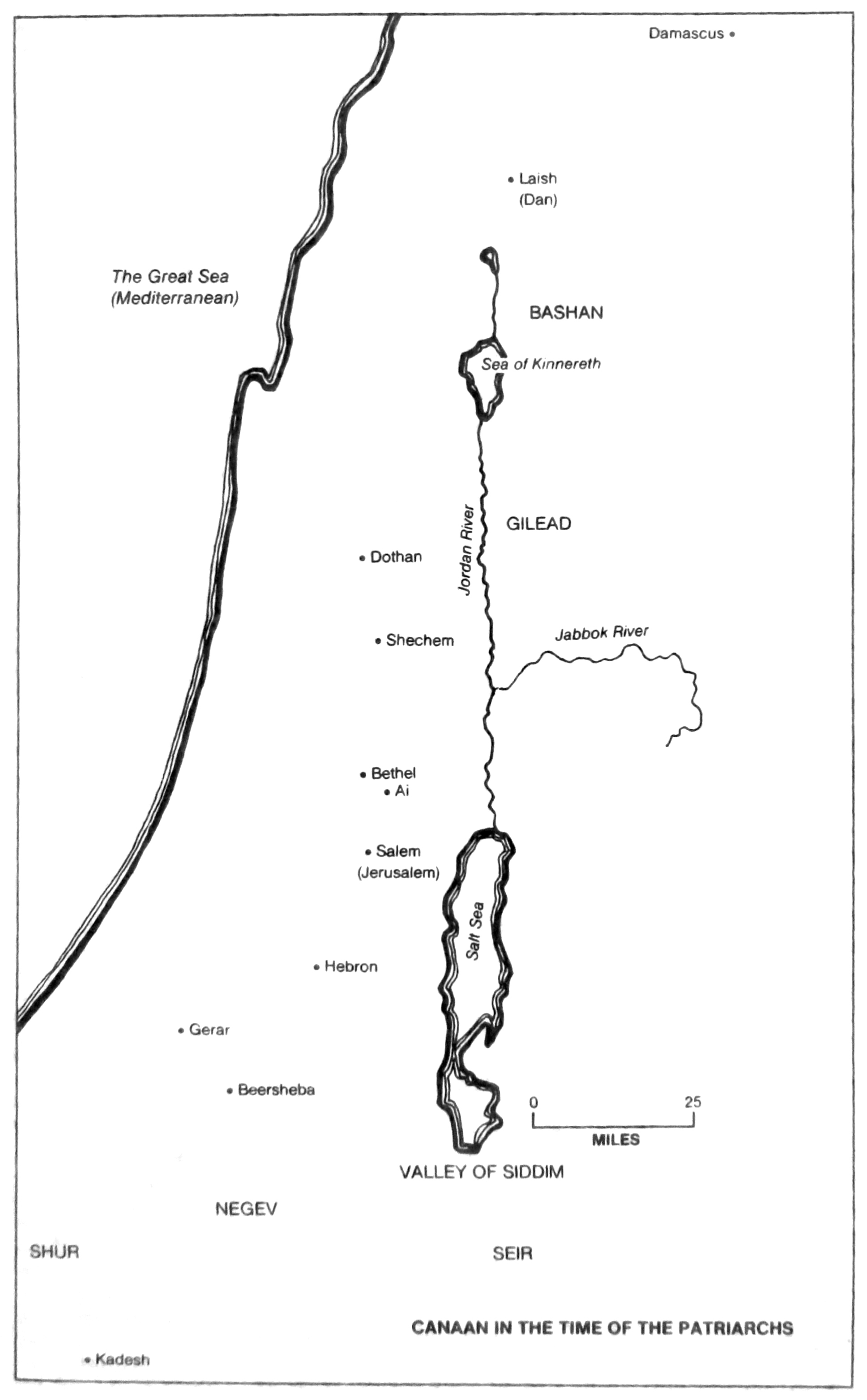
Patriarchal Canaan, from Bible Knowledge Commentary
(Gen 12:1-3 and numerous other references: 17:4-8; 22:15-18; 26:3-4; 28:13-15) With this Covenant, God established Israel as His Holy People. The “contract” was described to Abram (later called Abraham) by God and then was formalized by Him in the manner of ancient treaties (Gen 15). Years later, the terms of the Covenant were repeated and expanded, and Abraham responded by circumcising himself and the male members of his household (Gen 17). Still later, it was ratified with Isaac (Gen 26) and Jacob (Gen 28). One more restatement and clarification of the Abrahamic Covenant was delivered through Moses (Deut 30). In this important passage, God ties the Abrahamic and Mosaic Covenants together and states that Israel’s enjoyment of the Abrahamic promises will ebb and flow insofar as they incur the blessings and curses of the previous chapters of Deuteronomy.
It is important to note that the Abrahamic Covenant did not apply to Isaac’s siblings, nor to Jacob’s, but it did apply to Jacob’s 12 sons and all their physical descendants. There is pretty much unanimous agreement outside of Covenant Theology that this is an unconditional and unilateral Covenant between God and Abraham, Isaac, Jacob, and Jacob’s descendants.
The period from Abraham to the Exodus is said by some to be “The Dispensation of Promise“, in which man’s relationship with God was supposedly governed by man’s faithfulness in living up to God’s behavioral expectations in light of the promises made to the Patriarchs. This is perhaps expressed in Gen 18:19 (CJB) “For I have made myself known to him [Abraham], so that he will give orders to his children and to his household after him to keep the way of ADONAI and to do what is right and just, so that ADONAI may bring about for Avraham what he has promised him.” Yet, I think that this brief parenthetical passage is meant merely to explain God’s rationale for giving Abraham the opportunity to intercede for Lot and his family.
(Ex 20 and, by extension, most of Exodus through Deuteronomy) This is the most widely known of the Old Testament Covenants, but at the same time it is one of the most misunderstood, for several reasons. In brief:
The Covenant was not set up to enslave the Israelites or make their lives difficult, but rather to give them a sense of purpose and unity and to set them apart from other peoples, in a special relationship with God.
Christians tend to think of this as a works-based Covenant, and over the ages there have indeed been many Jews who have followed its precepts legalistically, but Scripture does not support that view. Salvation has always been by God’s grace.
The Hebrew word Torah means “teachings“. The Greek nomos indicates “that which is assigned or parceled out” What the Covenant dispenses is a fuller understanding of the nature and will of God, and the conduct that He demands from His elect people, Israel to set them apart from other peoples.
Orthodox rabbis count 613 commandments in Torah. Observance of these mitzvoth is a response of faith, never a means of salvation.
“Deuteronomy” is from a Greek term meaning “Second Law”, but that is not what it is. The Hebrew name of the book is D’varim, meaning “words”, or “matters”. As with other books of the Torah, it is derived from the first sentence, in this case, “These are the words that Moses Spoke…” Exodus through Numbers provided history about and guidance for the Israelites as pastoral nomads in the period between the Exodus and the Conquest. Deuteronomy is reinforcement, and adjustments for a settled, agrarian lifestyle in the Promised Land.
Christian statements like “we were once under Law but are now under Grace” and “we are bound by the moral law, but not the civil or ceremonial” are meaningless, because non-Jews were never bound by the Mosaic Covenant. When Paul said, “you are not under Law but under Grace”, he was speaking to non-Jewish Believers who were never bound by the legalism of Torah observance.
Like each of the other Covenants, it is unilateral.
Also, like each of the others, it is unconditional. Disobedience forfeits blessings and brings on curses, but it doesn’t cancel promises(see Deut 20 and nearly all of the Prophetic Books)! Like every other Biblical Covenant, the Mosaic is still effective for the people to whom it was addressed.
The period from Moses to Jesus is said by many to be “The Dispensation of Law“. Both classical and modern Dispensationalists—in fact I think most Christian theologians—believe that the Mosaic Covenant was conditional, and that it was cancelled by God because “the Jews refused to recognize their Messiah.” Many Dispensationalists localize this nullification to Mt 12, especially vs 24, where some Pharisees accused Jesus of being Satan, thus committing the “unpardonable sin.” Others place it at Jn 19:30, when Jesus, on the Cross, said, “It is finished.”
The Davidic Covenant
(2Sam 7:11-16) Though at first glance this is a Covenant with the House of David alone, God told David, “Your house and your kingdom will be made secure forever before you” in verse 16. My conclusion is that it therefore falls into line with all the other Covenants I am covering here in being unilateral, unconditional, and unending.
Dispensationalists, in general, don’t see a new dispensation here.
The New Covenant
(Jer 31:31-34 and elsewhere). As stated very clearly in vs 31, this Covenant is with the two kingdoms of Judah and Israel. It is not a Church Covenant, though the Church also benefits.
Note well: The Mosaic Covenant was never a failure! It did no less—and no more—than God intended. Without the internalization of the Holy Spirit there was never a chance that God’s people could live up to His demands and standards, but it taught them His nature, and what those demands and standards look like.
What the New Covenant added for Israel includes an internalized Holy Spirit; national regeneration; universal Jewish salvation ate the end of Tribulation; regathering to the Land; restoration of the Kingdom; and a return of God’s Sh’kinah to a glorious Millennial temple. Plus, a breaking down of barriers between Messianic Jews and non-Jews in the Church.
For Israel, the New Covenant is, like the others, unilateral, unconditional, and unending. For believing non-Jews, the benefit is a grafting into Israel, as part of God’s New Testament Church.
The period between the Acts 2 Pentecost and the Rapture is considered by Dispensationalists to be the Dispensation of Grace. This term is an obsolete holdover from the days when most Christian theologians considered the Church to be “under grace” and pre-Christian believers to be “under law”. Paul did frequently mention being “under law”, but he was most surely not talking about people being saved by keeping “the Law”. Rather, the precepts, or commandments, of the Mosaic Covenant were to be a response of obedience by a righteous Jew. Keeping the Law to appear righteous was, and is, hypocrisy. Some Dispensationalists are now calling the present age the Dispensation of the Church.
The Millennial Reign of Messiah
This period is not defined by another Covenant but is instead the culmination and combination of all the Covenants. Since there will be a new Temple, as described by Ezekiel, and since there will be sacrifices in that Temple, some theologians assume that the Mosaic Covenant will be reinstated during this thousand-year period. My own belief is that the Mosaic Covenant never came to an end and is still in effect today. I believe that ethnic Jews, even as members of Christian churches or Messianic Congregations, should be “observant”, or “keeping the Law.” Few are, and since this doctrine is basically unknown today, I’m not critical of righteous Jews who ignore it.
To Dispensationalists, the seventh and final dispensation is appropriately called, the Kingdom Dispensation, or alternatively, the Messianic Dispensation.




 The Back of My Mind