
Posted on:
Modified on:
Aside from inevitable passing references here and in future posts, I think I’m finally done with banging a drum over Genesis 1. I view verse 1 as the definitive, all-important statement by God that He is the uncreated, everlasting creator of all that exists. (see Gen 1:2 through 2:3), I think, are a polemic against the pervasive pagan claims of the surrounding cultures and of the Israelites, who at the time of writing were migrating from one pagan enclave (Egypt) to another (Canaan). In this post, I want to Move on to chapter 2, verses 4 and following.
I absolutely believe that the Garden of Eden was a real place, Adam and Eve were two real people, and even though there are some language issues to deal with, the story related is real and vital, and the time frame geologically recent, i.e., 6,000 (Ussher) to 10,000 (Whitcomb, if the genealogies skip some generations) years ago.
The first order of business is to tell you where I think the Garden was.
Where was the Garden located?
Most commentators seem to favor one of two general regions for the Garden: either northern or southern Mesopotamia, though proposals exist for locations surrounding the Arabian subcontinent and in eastern Africa. I’ve seen one suggestion that Eden lies at the bottom of the Red Sea, and another that puts it in the Indian Ocean.
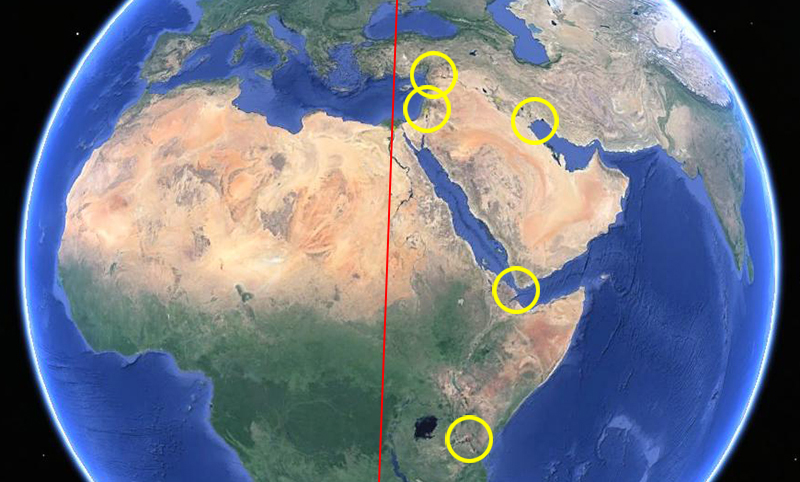
Northern Mesopotamian versions tend to favor Eastern Turkey/Armenia, since (a) there is a perception that Shinar is in that area, based on Genesis 11:2 (ESV): “And as people migrated from the east, they found a plain in the land of Shinar and settled there”; and (b) the headwaters of both the Tigris and Euphrates rivers originate in that general vicinity.
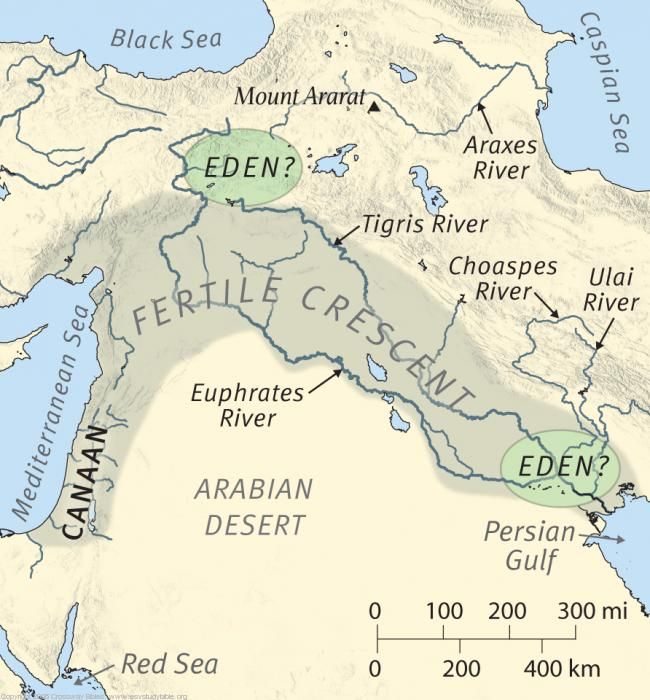
Personally, I have favored a southern Iraq location for years, since obtaining a copy of an unpublished book titled, simply, Eden, by a late pastor named David J. Gibson, who understood that rivers don’t divide flowing downstream as described in Genesis 2:10 (ESV), “A river flowed out of Eden to water the garden, and there it divided and became four rivers.” Gibson suggested, and I agree with him, that this verse should be interpreted from the perspective of an observer within the Garden gazing out at four rivers converging as they entered the Garden.
This is awkward language for us, but not necessarily for Moses in antiquity, writing in Hebrew. Consider that in Genesis 2:8 (ESV), “the LORD God planted a garden in Eden, in the east”. This implies to me that the four rivers converged in the western part of Eden before flowing through the Garden, which was planted in the eastern part.
This makes sense, and from a hydrodynamics standpoint, it is the only interpretation that makes sense. Tributaries converge, they don’t diverge. If, for some reason, a river splits to flow around an obstruction or a sandbar, it will always come back together downstream nearby. If, for some reason, it splits to flow down two or more separate drainage basins, an unstable pattern results. One path will erode more quickly than the other(s), and eventually that path will “steal” all the flow from the other(s).
The only exception from that rule is the case of delta flow, but deltas aren’t formed by erosion, they’re formed by deposition of silt carried downstream in the water. As a river flows onto a plain and slows down, turbulence decreases, and silt falls out of suspension and stays more or less where it drops. Without sufficient turbulence to pick it up again, there is just enough energy available to keep the channels open.
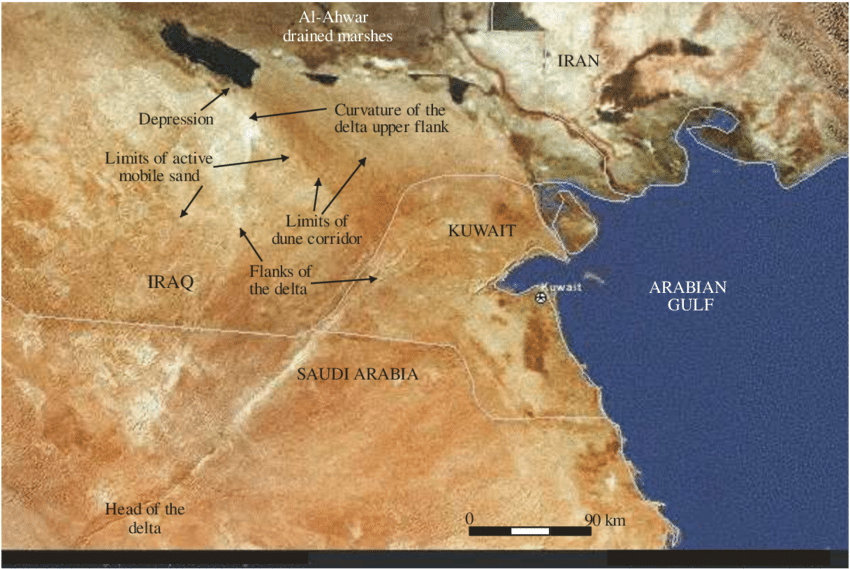
Large deltas usually form at the mouth of a river where water leaving the delta’s channels flows into the sea or a lake. Sometimes deltas form inland, usually where a mountain stream empties onto a plain. The water from an inland delta will either evaporate, sink into the substrate, or collect into a single stream or a lake. Two examples are shown below.


Genesis 2:10 would make total sense if the four “rivers” were delta channels, but the naming of those four rivers in verses 11–14 belies that possibility. Indeed, in my opinion the naming of the Tigris and Euphrates rivers conclusively fixes the location of the Garden in southern Iraq.
What about the other two rivers named?
The Pishon is fairly well defined because verse 11 says that it “flowed around the whole land of Havilah.” Havilah was a son of Cush who settled in what today is northwest Arabia. 1 Samuel 15:7 (ESV) defines that location: “And Saul defeated the Amalekites from Havilah as far as Shur, which is east of Egypt.” “Flowed around” could be literal (I found a map showing the Pishon as an ocean current flowing counterclockwise around the entire Arabian subcontinent), but more likely it simply means that it flowed through and provided water for Havilah. Gibson equated the Pishon with Arabia’s Wadi Al-Batin, an ancient and now-dry river and delta system flowing northeast through Saudi Arabia and Kuwait to the Tigris/Euphrates valley. I think he was right.

As for the Gihon River that “flowed around the whole land of Cush” (verse 13), I would equate that with the Karun River, flowing out of Iran, through the ancient land of the Elamites.
I think that Christian commentators are thrown off by an assumption that “Cush” refers only to the region around Ethiopia and Somalia. My view is that Cush (a son of Ham) and his descendants settled large regions of Asia, as well as the upper Nile area. They apparently mixed with the Canaanites in the Lavant, and Nimrod, a son of Cush, was described in Genesis 10 as “9a mighty hunter before ADONAI. … 10His kingdom began with Bavel, Erekh, Akkad and Kalneh, in the land of Shin‘ar.” These abodes of Nimrod are all lands of southern Mesopotamia. Nimrod was, I’m convinced, none other than Sargon of Akkad, the world’s first great emperor. Elam and Asshur were Semites, but Cush may have extended into the Steppes alongside Shem (see Nimrod the Empire Builder: Architect of Shock and Awe, 2023, by Douglas Petrovich).
It’s admittedly a stretch, but I have wondered if perhaps the ancient Kushan Empire, spanning the central Asian “stans” might have gotten its name from Cush/Kush. If so, then the influence of Cush stretched all the way to the Xiongnu tribe, north of the Yellow River, because the peoples who started the Kushan Empire, centered around Afghanistan, where refugees from the Xiongnu.
Putting all this together, I think that the following map states the case for Eden in southern Iraq:

What about the placing of Shinar in Turkey? I agree with the predominant view that Shinar is the area once occupied by Sumer, between the Tigris and Euphrates Rivers. It’s not hard to explain away migration “from the east.” I suspect that waters from the Great Flood took years to retreat from low-lying areas, so descendants of Noah returning to their homeland in Shinar would have initially moved southeast along the spine of the Zagros Mountains. Saying that Shinar is west of Ararat because they entered from the east is analogous to assuming I live west of my church because I (sometimes) approach it from the west. The full story on that is that I live to the southeast and occasionally take a circuitous route along the freeway.

Comparison of Genesis 1 and 2
The creation passage and the Garden passage are separated by verse 2:4 (see below).
There seem to be contradictions between Genesis 1 and Genesis 2, as traditionally understood. Because I believe Scripture is inerrant, but tradition is not, I inevitably try to let the former inform the latter.
Here are the relevant passages that I wish to discuss now:
[11] And God said, “Let the earth sprout vegetation, plants yielding seed, and fruit trees bearing fruit in which is their seed, each according to its kind, on the earth.” And it was so. [12] The earth brought forth vegetation, plants yielding seed according to their own kinds, and trees bearing fruit in which is their seed, each according to its kind. And God saw that it was good. [13] And there was evening and there was morning, the third day.
…
[26] Then God said, “Let us make man in our image, after our likeness. And let them have dominion over the fish of the sea and over the birds of the heavens and over the livestock and over all the earth and over every creeping thing that creeps on the earth.”
[27] So God created man in his own image,
in the image of God he created him;
male and female he created them.
[28] And God blessed them. And God said to them, “Be fruitful and multiply and fill the earth and subdue it, and have dominion over the fish of the sea and over the birds of the heavens and over every living thing that moves on the earth.” [29] And God said, “Behold, I have given you every plant yielding seed that is on the face of all the earth, and every tree with seed in its fruit. You shall have them for food.
—Genesis 1:11–13,26–29 (ESV)
and
[4b] …in the day that the LORD God made the earth and the heavens. [5] When no bush of the field was yet in the land and no small plant of the field had yet sprung up—for the LORD God had not caused it to rain on the land, and there was no man to work the ground, [6] and a mist was going up from the land and was watering the whole face of the ground— [7] then the LORD God formed the man of dust from the ground and breathed into his nostrils the breath of life, and the man became a living creature. [8] And the LORD God planted a garden in Eden, in the east, and there he put the man whom he had formed. [9] And out of the ground the LORD God made to spring up every tree that is pleasant to the sight and good for food. The tree of life was in the midst of the garden, and the tree of the knowledge of good and evil.
…
[15] The LORD God took the man and put him in the garden of Eden to work it and keep it.
…
[18] Then the LORD God said, “It is not good that the man should be alone; I will make him a helper fit for him.” [19] Now out of the ground the LORD God had formed every beast of the field and every bird of the heavens and brought them to the man to see what he would call them. And whatever the man called every living creature, that was its name. [20] The man gave names to all livestock and to the birds of the heavens and to every beast of the field. But for Adam there was not found a helper fit for him. [21] So the LORD God caused a deep sleep to fall upon the man, and while he slept took one of his ribs and closed up its place with flesh. [22] And the rib that the LORD God had taken from the man he made into a woman and brought her to the man. [23] Then the man said,
“This at last is bone of my bones
and flesh of my flesh;
she shall be called Woman,
because she was taken out of Man.”
—Genesis 2:4b–9,15,18–23 (ESV)
Almost all conservative Evangelicals believe that Genesis 1:27 describes the creation of Adam and Eve: “So God created man in his own image, in the image of God he created him; male and female he created them.” But Scripture never actually states that these are Adam and Eve!
Walton’s proposal of separate events
I have suggested in past posts that Christians should be willing to consider alternatives where erroneous understandings might exist in uninspired translations and interpretations, but not in inspired autographs (the original manuscripts as prepared by the human authors). When comparing these passages, we must account for apparent contradictions and ambiguities.
John H. Walton, a conservative Old Testament scholar with Moody Bible Institute and later with Wheaton College, has proposed alternative understandings of these passages, suggesting that chapter 1 describes one human creation event, and chapter 2 a separate creation of just Adam and Eve. He bases this idea on several observations, including:
- There are obvious contradictions in the reported order of the creation events (see below).
- The descriptions of each category of creation in chapter 1, including humankind, gives the impression that a significant population of every species were created. Creation of just 2 humans in Genesis 1 would be a breaking of the pattern.
- Verse 4 is a “toledah” (Hebrew for “generations”), which is a fragment of Scripture used to separate two “chapters”, or thematic passages, of Genesis.
These are the generations
of the heavens and the earth when they were created,
in the day that the LORD God made the earth and the heavens.
—Genesis 2:4 (ESV)
Walton presents the following table to show how other toledoth (plural) relate to material preceding and following them:

- In the table, all of the cases marked as “sequel” separate events in the past from events in the future.
- The three labeled “recursive” indicate cases where one individual or family is followed, then the timeline is reset to follow another. In these cases, there may be chronological overlap, but no detail added to the first.
- In the single case labeled “parallel/sequel” Cain is followed, then the timeline reset to Adam; then a toledah introduces parallel coverage of Seth.
- There is no precedent in the ten cases enumerated for a toledah introducing an expanded account of the same thing previously covered. This is not definitive proof, but it is suggestive.
The apparent contradictions
First, “creation” in verse 27 is the Hebrew word בָּרָא (bara‘, which means ex nihilo creation, or creation from nothing at all). In contrast, the Genesis 2 description is יָצַר (yatsar, which means to form something specifically by molding some constituent material into a shape, i.e., as a potter forming something in clay). The potter imagery is consistent with forming Adam “of dust from the ground”. “Dust”, here is Hebrew עָפָר, (‘afar), meaning things like “dry soil”, “loose earth”, “rubble”, or even “ashes”. None of these is clay, and none of them alone can be worked by a potter, but the intended image is of the detritus of death. More likely, it simply refers to the familiar elements on the periodic table, pasted by God into organic molecules.
Second, and more telling, we appear to have a serious contradiction regarding the creation of beasts of the field and birds of the heavens.
The sequence as written in Genesis 2 is (a) God formed Adam and gave him life; (b) God planted a garden on the east side of Eden; (c) God placed Adam in that garden; (d) God caused plants to grow from the ground; (e) God gave Adam his mission statement; (g) from the ground, God “formed” (yatsar) the land and air creatures; (h) Adam named the creatures; and finally (i) God formed Eve from Adam’s rib.
The serious contradiction here is that:
- in chapter 1, air creatures are created on day 5 and land creatures on day 6, both of these prior to the creation of man on day 6.
- In chapter 2, Adam (though not Eve) was created on or after day 6 while both the air and land creatures were created later.
The ESV translation above follows NIV in trying to resolve the problem by hedging on the language in 2:19. I can’t find any support for “Now the LORD God had formed“. This translation certainly does leave room for saying, “Oh, this isn’t where he forms them, that was already done.” But the correct translation seems to be “And out of the ground the LORD God formed.” Almost every translation words it this way, and even ESV includes that as a footnote. NIV is notorious for paraphrasing Scripture to make it say what they think it should say. I take this passage to mean that God formed new animals in the garden in addition to those that existed—possibly just new individuals, not new species.
I don’t see a clear, fair, and decisive path to resolving this contradiction.
On the other hand, if Genesis 2 is subsequent to Genesis 1 rather than a retelling, the garden theoretically becomes sacred space—a prototype tabernacle—and Adam’s race a priesthood.
Theological implications
While the concept that Adam and Eve’s creation at a time when earth was already populated by humans may be startling, it answers more questions than it raises. It gives Cain a wife without requiring biologically harmful incest. It reveals who it was who Cain thought might kill him. It answers the question, where did all the people come from to populate the city that Cain founded.
By the way, what was that city? Depending on how you define the term, it may have been Uruk, shown on the map above with the four rivers of Eden. Uruk was founded about 6,000 years ago, which fits very nicely with the picture I’m painting here.
You may say, “But the Bible teaches we’re all descended from Adam!” Yes, it does, and since Noah was descended from Adam, and we’re descended from Noah, then where’s the problem? The other humans all perished in the Flood.
Are we also descended from the pre-Garden people? I don’t know. Perhaps no pre-Garden genes were in the chromosomes of Noah or Mrs. Noah. But would it have mattered if there was some mixing? I don’t think it matters if Noah had non-Adamic genes mixed in, any more than it matters that Jesus had genes not contributed by Judah or King David. Mitochondrial DNA shows that all humans today have a common “mother” and Y-chromosomal analysis shows a common “father”, but both of those are way too late to have been Mr. or Mrs. Noah’s. Due to the nature of genetic inheritance, it will never be possible to trace back that far.
The Genesis 1 creation, whether it was Adam or not, was created in the image of God. They, too, were righteous or sinful, saved or unsaved. The difference is that they had not eaten from the Tree of Knowledge, so they were presumably innocent in the same way as Adam and Eve before the fall.
But wait! you say. That means that they were immortal! No, it doesn’t. Were Adam and Eve immortal before the fall? I think “you will surely die” is talking about spiritual death, not physical. Maybe they were immortal, but if so, why was there a Tree of Life in the Garden?
Was death even possible, theologically, before the fall? That’s way too big a subject to take on here, in this post. I’ll eventually write about it. It’s a key question, since part of the reason some Christians shun fossil evidence is that they think it’s a violation of Scripture for animals to have died pre-fall. Obviously, I believe death was possible before the fall, but I owe you some analysis to justify my belief.
Then, there’s the biggest question of all. I’ve been telling you that the 7-day creation story is a polemic and not literally true as written. What about Adam and Eve, and the Garden? Well, that’s a whole ‘nother story. From Genesis 2 on out, there is way too much specificity for me to doubt. I mean, we have the begats, for crying out loud, and they are way too believable to dismiss.
Exposition
I want to address just a few issues here that may seem confusing.
On the day that the LORD God made earth and heavens, no shrub of the field being yet on the earth and no plant of the field yet sprouted, for the LORD God had not caused rain to fall on the earth and there was no human to till the soil, and wetness would well from the earth to water all the surface of the soil…
—Genesis 2:4b–6 (Alter)
The first phrase above, ending “made earth and heavens”, bookends the Genesis 1 story, which begins with “In the beginning … heavens and earth”. That makes it more likely that the phrase is part of the toledah, packaging the entire process—”the day that the LORD God made the earth and heavens.” Most of you take this “day” as seven literal 24-hour days—I take it to mean the entire 13.8-billion-year period from the Big Bang to the formation of Adam.
The term “LORD God” here is the Hebrew “YHVH Elohim“, the first occurrence in Scripture of God’s covenant name.
In 2:5 we are told that, before God created Adam or planted the Garden, there was as yet no “brush of the field”, i.e., no wild vegetation, in the land (the Garden). Paleontology suggests that Homo sapiens has been around for about 200,000 years, but for most of that time they were strictly hunter-gatherers. Agriculture doesn’t appear until around 10,000 years ago, and it didn’t predominate until around 6,000 years ago. Domestication of livestock began during that same period. Given some flexibility in dating by means of Biblical genealogies, it is entirely realistic to date Genesis 2 somewhere in that 6-to-10,000-year time frame, and thus to consider that Genesis 2:5 implies that both herding (hunting) and farming (gathering) were inaugurated in the Garden.
Next in series: The Ancient of Days


 The Back of My Mind