Moshe’s Week of Dreams

Posted on:

Modified on:

  1. Previous statements of my views
  2. How did Moses know?
    1. Evening and morning
    2. A hypothesis
    3. A speculative scenario
      1. Day 1
      2. Day 2
      3. Day 3
      4. Day 4
      5. Day 5
      6. Day 6
  3. Appendices
    1. Adaptation vs evolution
    2. Birth as analogy

My last published article was Prophetic Visions: Through a Glass Darkly, released on August 25, 2025. Because of the length of that post, I left out a few things that I still want to discuss in more detail, so I have saved outtakes that I will elaborate on in much shorter articles as time permits.

This, the first, is a discussion of Genesis 1 as a prophetic (preterist) snapshot of creation.

Previous statements of my views

As you know if you have followed my series on Creation, I am an Old Earth Creationist and believe that God planned the design of the universe the way He wanted it to exist and develop over all future times.

Obviously, Old Earth Creationists don’t interpret Genesis 1 in a conventional, hyper-literal sense. I see it as prophetic poetry. Conservative Evangelical scholars generally use a hermeneutic (principles for interpreting Scripture) that gives latitude for interpreting some poetry and some prophecy as symbolic. By that I mean symbolic of something that is true and important!

My 2024 post, Genesis 1:1–5, Day 1 is a lengthy article in which:

  1. I discussed the concept of hermeneutics and the hermeneutical principles which I and many other interpreters use to understand Biblical text.
  2. I presented my views on the values and limitations of the scientific process.
  3. I introduced Moses as a prophet and speculated on how he might have received his knowledge of prehistory. This is the subject of the current post.
  4. I then began the interpretation process with a discussion of the first two verses of Genesis 1, and whether they are a summary of the rest of the chapter, or alternatively the first event before the creation of light. Young Earth Creationist are split on this issue.
  5. Next, I explained what “light” is and is not, and why, given the way God created it and it in fact exists, it is paradoxical to think that it was created either before the creation of matter (the summary view of verse 1) or after the creation of matter (the first event view of verse 1). By theological definition, God’s omnipotence excludes the possibility of paradoxical absurdities.
  6. Finally, under the heading, A better idea, I presented my current views on how Genesis 1 should be interpreted. This is a fairly short section, so I suggest reading it now.

I don’t believe I stated it quite this way, but the viewpoint expressed in that post treats Genesis 1, not as a description of how God made the universe, but rather as an organizational description of what He made.

What I did state, however, is that its primary purpose was as a polemic against the pagan cultures of the day. God saying, “Everything you see was created by me, including the gods (elohim, the spirits that rule the world) that you worship.”

I stated it this way earlier in The Implication of Genre in Job, Ezekiel and Genesis:

Every ancient civilization had a pantheon of pagan “gods”, and with each of those came a “creation myth.” In Genesis 1:1, the one true God said, “I did it—not them! Period!”

Theologically, that is really all we need to know about creation. God had no obligation to tell us exactly how he did it, or in what order, and if He had done so, nobody in the ancient world could have possibly understood it. …

To me, the “Plain sense” of Genesis 1:1 makes perfect “common sense” in a book about God: He created the entire universe, which is everything that exists other than Himself, and He had the sovereign right and ability to do it however He chose to.

The plain sense of Genesis 1:3–31 does not make common sense to me, if indeed it describes creation at all. To me, it is strongly reminiscent of visions recorded by a number of prophets, including John. The age of man on earth starts with a vision and ends with a vision!

How did Moses know?

The better idea that I’ve now adopted, I owe primarily to the conservative scholar John H. Walton from Moody Bible Institute and later with Wheaton College, who I greatly admire, but who of course is anathema to Young Earth Creationists.

Attribution of Moses’ knowledge to preterist prophecy is my own slant on the subject. Having now completed a more in-depth study of prophetic dreams and visions, I am ready to go a little deeper here with a theoretical proposal of the form in which Moses may have received his Genesis 1 insights.

Evening and morning

Consider Moses’ demarcation of creation days: “And there was evening and there was morning, the [nth] day.” Exactly what that means has been disputed for centuries.

The phrasing is important within Judaism because it sets the pattern, followed through most of the Bible and apparently most of Jewish history, of the Jewish calendar day beginning and ending in the evenings. As such, it seems to imply that literal calendar days are in view.

But verse 5a raises another issue: “God called the light Day, and the darkness he called Night.” That means that “day” doesn’t by default mean a calendar day!

In fact, Biblically, the term “day”, by itself means specifically the 12-hour period between sunrise and sunset. You say, “But there aren’t ever exactly 12 hours between sunrise and sunset!” For halachic Judaism (think, “for ceremonial purposes”), one would divide the number of standard minutes between sunrise and sunset by 12. As I am writing today, near the Autumnal Equinox, a “proportional hour” (sha’ah zemanit) is 58.78 minutes long. Near the solstices, the discrepancy is much bigger. And of course, that number is dependent on my latitude and my altitude.

By contrast, “night”, the period between sunset and sunrise, is divided into 4 “watches”, not hours.

In practice, the term “day” can mean a number of different things to a Jew: the daylight hours; a calendar day; a recurring day, as the “Day of Atonement”; an extended period in the past, as “in Jesus’ day”; a prophetic period to come, as “the Day of the Lord.”

Many of those usages are obvious from the context, but sometimes, not so much. I can’t document this, but I assume that a need to distinguish calendar days from the others probably led to the development of an idiom that is well known to Jews but denied by some Christians: The term “days and nights” refers to calendar days, in whole or in part. For example, when Jesus’ said, “As Jonah was in the belly of the fish 3 days and 3 nights…”, none of His hearers would have taken this as meaning 72 full hours. It simply meant, “a period spanning parts of three calendar days.

Young Earth Creationists will generally take one of two approaches to understanding the implication of “evening and morning.” Either it is the calendar day idiom, or it is simply stating that God finished His creation act of the day by evening and didn’t start work again until the next morning.

But it isn’t as easy as it sounds. Yes, Genesis 1 records the creation of light on Day 1, and immediately then He “called the light Day, and the darkness he called Night.” But it wasn’t until Day 4 that He created the sun, moon and stars, which, first of all, were to “divide the day from the night.” Which implies that there were no evenings or mornings before Day 4.

As an Old Earth Creationist, the only part of Genesis 1 that I insist is literal is the first one or two verses. But if the rest is symbolic, that does not mean that it is useless, or a lie! Almost all conservative Bible scholars would agree that Biblical symbolism is absolutely allowed, and though the symbolism may be obscure for a time, it will eventually become clear. In God’s own time!

A hypothesis

Now please don’t take the following hypothesis as gospel truth. It makes sense to me, but it is only a suggestion, prompted by my recent concentration on how to interpret prophetic dreams and visions. The “evenings and mornings” formula of Genesis 1 may serve some entirely different symbolic purpose, but what if it sheds some light on how Moses received this information from God?

I firmly believe that Genesis 1 is preterist prophecy, reporting either something that God showed him in one or more dreams or visions, or words that God verbally told him to write. My experience with the Bible leads me to favor the former, rather than the latter.

I’m wondering if perhaps “evenings and mornings” might be a hint that God sent dreams to Moses at night?

Consider then the following scenario, which is perhaps 98% speculative.

A speculative scenario

I’m going to suggest here a pattern to the way God chooses to inform Moses. It should be no surprise; God doesn’t do anything randomly! Here is the pattern I see, arranged only roughly chronologically:

  1. On day 1, God showed Moses very tersely how He built the universe, from nothing down to the foundations of Earth, the home He designed for man, His climactic achievement.
  2. On day 2, God began showing Moses (and us!) His provision of the first environmental factor necessary for our survival, a breathable atmosphere. This is first in mention, not necessarily the first to develop.
  3. On day 3, we see Earth divided into two domains, land and sea. Into both, He then introduced plant life, which was to become the base of the food chain, the ultimate source of nutrition, and the carbon/oxygen cycle, necessary for respiration.
  4. On day 4, He brings our attention back to the “second heaven”, the cosmos beyond the atmosphere. We need to see the source of energy and to have a better idea of the flow of time before the sentient creatures are introduced.
  5. On day 5, we see that introduction of sentience on Earth. Starting with sea creatures and birds.
  6. On day 6, we get to the climax, sentient life on earth, starting with the animals, and then with primitive man.
Day 1

One night while encamped in the Wilderness, during the 40 years of wandering prior to his people crossing the Jordan into the Promised Land, while either dozing by the campfire or asleep in his tent, God sends Moses a dream of what came before. In the dream…

The prophet is floating in empty space, with nothing in sight—just an unlimited, silent, dark, cold void in all directions. There is no sound to be heard in the vacuum other than a sudden command from God. Unseen by Moses, as if a tiny hole had opened in a gigantic dike, vast quantities of invisible energy began pouring into the region in front of him and expanding to immense size.

Very quickly then, with still with no sound whatsoever, but following rules of physics laid down by the Almighty, there is a bright glow as hot, subatomic particles begin condensing out of the energy and radiating light into the surroundings.

“Let there be light!”, ©Vecteezy

Though Moses can’t see much, beyond a blur of motion, and understands very little of what he sees, the gigantic ball of energy rapidly cools, and as it does, more particles are formed. With further cooling, those particles begin to combine to form hydrogen and helium ions, which then pick up electrons and take on the properties of atoms and diatomic molecules.

Still later, electromagnetic and gravitational forces begin collecting the hydrogen and helium into clouds that become denser and denser, until the pressure becomes great enough in many clumps to ignite nuclear fusion—stars are born. The products of fusion are heavier elements, and those also undergo fusion to form still heavier elements. The heaviest that can form this way is iron, but once the larger stars have burned up most of their fuel, they collapse and supernova. The enormous power generated by these colossal implosions forms still heavier elements, and both the heavier and the lighter elements alike are scattered throughout space, forming clouds of dust, and congealing into planets.

After billions of years and still following the instructions build into the universe by God’s design and at His command, the universe is populated by billions of billions of stars, organized into galaxies and clusters of galaxies, with planets and other solid objects orbiting most of the stars.

Because God trusts His design and loves the idea of allowing spontaneity in His universe, He has included quantum mechanical randomness in the blueprints. Randomness means that occasional adjustments have had to be made in order to prepare for the beloved human family He plans to install on one planet. For this He created a race of angelic beings to subdue the Cosmos, as He will task His humans to do on earth.

All of this has been shown to Moses like a movie run at incredible speed, so that before he wakes up in the morning, all but the last few billion years has been viewed. More than ten billion years have been compressed into a single night, so all Moses has is memory of the flood of light followed by a vague impression of expansion and differentiation. God now directs Moses’ to look down. He does so, and right below him is a cold, dark sea with little if anything breaking the surface. He’s too close now to see the curvature of the surface, but he does sense God’s Spirit hovering over the water.

Moses awakes…

This scenario views Genesis 1 from a “first event” perspective (see the 6-point summary of Genesis 1:1–5, Day 1, above. I envision Moses waking up from his dream and musing on the last thing he saw,

1 In the beginning God created the heavens and the earth. 2 The earth was unformed and void, darkness was on the face of the deep, and the Spirit of God hovered over the surface of the water.
—Genesis 1:1-2 (CJB)

Then recalling the bright light that he saw at the beginning of the dream, before the replay of billions of years of cosmic history, he wrote

3 Then God said, “Let there be light”; and there was light. 4 God saw that the light was good, and God divided the light from the darkness. 5 God called the light Day, and the darkness he called Night. So there was evening, and there was morning, one day.
—Genesis 1:3-5 (CJB)

Some research suggests that some 3.2 billion years ago the temperatures in the earth’s mantle transition zone must have precluded retention of the vast quantities of water stored there now. Much like the days of Noah’s flood, this water can only have resided at the surface, resulting in the planet existing as a “water world,” completely inundated.

Day 2

On another night, Moses falls asleep again to find himself in the same place, looking down at the sea and God’s Spirit.

Ancient philosophers and wise men all over the earth looked around them in those early days, and what they all agreed on was that the world they observed is an island submerged in a vast sea and protected from the water above by a gigantic dome, the “firmament” of KJV. The stars moved from east to west through grooves below the dome. The sun and moon, below the stars, were either carried along beneath the stars by gods or were themselves gods.

As for the sea, it was the ultimate source of all water on earth. The “water above” was connected outside the periphery of the dome to the “water below” (the rav tehom, or “great deep“) and spring water also flowed from the sea through underground passageways. Rain fell when gods or angels opened windows, or floodgates, in the dome. The underground passages, “fountains of the deep“, were, like the sea itself, inhabited by demons, and the source of much fear, especially by sailors and fishermen who owed their livelihood to it.
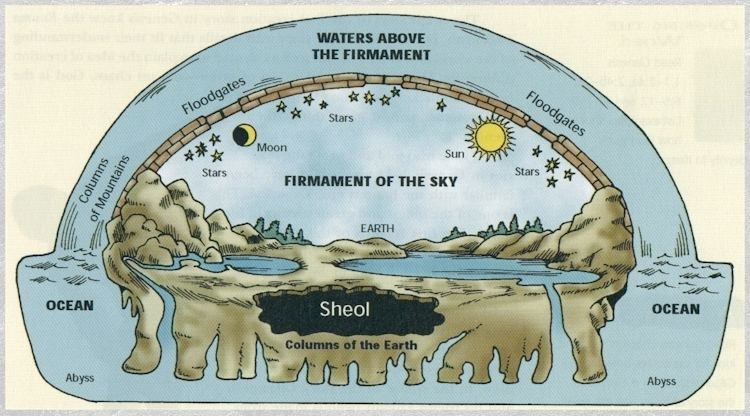
What the ancient world believed.

All of these things were assumed to have been created by one or more of the gods, who themselves were created by a superior god or were magically born from the primordial chaos.

Of course, this ancient model of the cosmos was completely wrong, but it was sufficient for the day, and more detail would only have confused them even more than they were. Even today, thousands of years later, the more we discover about the cosmos, the more we know that we are still missing key details.

So why would our God care if the ancients knew all truth about such a complex structure? It was way too early to ask humanity to grasp the incredible complexity of the universe.

The important thing was that they be taught that He is the true creator and He preexisted all else that exists.

So, God has summoned Moses back to his vantage point above the sea. He tells him to look up this time. When he does, he sees nothing but dark clouds. As he watches, God sends the wind to blow away the lower clouds. Layer after layer, the clouds part until nothing is left but what appears to be the dome, perhaps obscured by high, dark altostratus clouds that allow only a general glow to penetrate.

6 God said, “Let there be a dome in the middle of the water; let it divide the water from the water.” 7 God made the dome and divided the water under the dome from the water above the dome; that is how it was, 8 and God called the dome Sky. So there was evening, and there was morning, a second day.
—Genesis 1:6-8 (CJB)

Day 3

For a third time, Moses falls asleep and is carried in his dream to a vantage point above the primordial sea. Again, God speaks, and another long expanse of years rolls by in the course of the night, as on Day 1.

Moses observes during this dream another compressed passage of a great deal of time. The sea level falls as excess ocean water returns to the earth’s mantle. Land masses emerge and constantly deform and move under the influence of numerous processes, including plate tectonics, vulcanism, tidal forces, weathering, erosion, deposition, and many more, all decreed by God to assure a healthy and dynamic planet.

9 God said, “Let the water under the sky be gathered together into one place, and let dry land appear,” and that is how it was. 10 God called the dry land Earth, the gathering together of the water he called Seas, and God saw that it was good.
—Genesis 1:9-10 (CJB)

Now that God has shown Moses the magnitude of His glory in creation of the greater cosmos and earth, as understood by the ancients, He is ready to begin demonstrating that it was also at His hand that earth was filled with life.

God speaks once again and Moses sees many species of plant life that have begun to develop, spread, and differentiate to fill vast areas of the land and sea, adapting to environmental changes over many generations. From time to time, God or His angels intervene to bridge wider gaps and fill niches that adaptation alone can’t cross. I discuss “adaptation” vs. “evolution” in an appendix below.

11 God said, “Let the earth put forth grass, seed-producing plants, and fruit trees, each yielding its own kind of seed-bearing fruit, on the earth”; and that is how it was. 12 The earth brought forth grass, plants each yielding its own kind of seed, and trees each producing its own kind of seed-bearing fruit; and God saw that it was good. 13 So there was evening, and there was morning, a third day.
—Genesis 1:11-13 (CJB)

Day 4

I don’t believe that God is showing Moses anything new on this night. The sun, moon and stars were in their place in the sky at the close of the first night’s dream, though Moses probably was unaware of them until now. The way I presented this scenario above, billions of years of history scrolled by Moses in one night, which he couldn’t possibly have taken in. Perhaps he was only shown the beginning and end of the process—from the flash of light to the surface of water-world Earth. And perhaps during dreams 2 and 3 the sky has been obscured by clouds. In any case, now God wants to draw his attention to the cosmos above, so we have a clear sky.

Just what did Noah see? Just exactly what he expected to see, and what he had seen every day of his long life, which from his limited perspective was stars rolling by in grooves at the bottom surface of the sky dome, and the sun and moon being carried from east to west by, as he now would have seen it, God’s angels. Once again, the emphasis is on, “I, Yahweh, did it all, Moses!”

14 God said, “Let there be lights in the dome of the sky to divide the day from the night; let them be for signs, seasons, days and years; 15 and let them be for lights in the dome of the sky to give light to the earth”; and that is how it was. 16 God made the two great lights — the larger light to rule the day and the smaller light to rule the night — and the stars. 17 God put them in the dome of the sky to give light to the earth, 18 to rule over the day and over the night, and to divide the light from the darkness; and God saw that it was good. 19 So there was evening, and there was morning, a fourth day.
—Genesis 1:14-19 (CJB)

Day 5

This is where God begins showing Noah the climactic introduction of sentient life (conscious creatures, with sensations and perceptions). Beginning with denizens of the seas and the air.

As with the plants, God has created numerous species, to fill many habitats. They are designed for adaptation to changing conditions, but, like the plants, they need an occasional nudge. Once again, I discuss “adaptation” vs. “evolution” below.

20 God said, “Let the water swarm with swarms of living creatures, and let birds fly above the earth in the open dome of the sky.” 21 God created the great sea creatures and every living thing that creeps, so that the water swarmed with all kinds of them, and there was every kind of winged bird; and God saw that it was good. 22 Then God blessed them, saying, “Be fruitful, multiply and fill the water of the seas, and let birds multiply on the earth.” 23 So there was evening, and there was morning, a fifth day.
—Genesis 1:20-23 (CJB)

Day 6

On day six, God is approaching the climax of the dream series with Moses. Sentient animal species other than sea creatures and birds. Animals first, and then pre-Adamic mankind. Evidence for mankind goes back for some three million years. Evidence for Homo sapiens for 300,000 years. See “adaptation” vs. “evolution” below.

In my opinion, Adam and Eve were not part of general creation as revealed in Genesis 1!

As discussed in Exploring the Garden of Eden, I believe that both scripture and theological logic raise a pretty good case that they were created separately, about 6,000 years ago.

24 God said, “Let the earth bring forth each kind of living creature — each kind of livestock, crawling animal and wild beast”; and that is how it was. 25 God made each kind of wild beast, each kind of livestock and every kind of animal that crawls along the ground; and God saw that it was good.

26 Then God said, “Let us make humankind in our image, in the likeness of ourselves; and let them rule over the fish in the sea, the birds in the air, the animals, and over all the earth, and over every crawling creature that crawls on the earth.”
27 So God created humankind in his own image;
in the image of God he created him:
male and female he created them.
28 God blessed them: God said to them, “Be fruitful, multiply, fill the earth and subdue it. Rule over the fish in the sea, the birds in the air and every living creature that crawls on the earth.” 29 Then God said, “Here! Throughout the whole earth I am giving you as food every seed-bearing plant and every tree with seed-bearing fruit. 30 And to every wild animal, bird in the air and creature crawling on the earth, in which there is a living soul, I am giving as food every kind of green plant.” And that is how it was. 31 God saw everything that he had made, and indeed it was very good. So there was evening, and there was morning, a sixth day.
—Genesis 1:24-31 (CJB)

Appendices

Adaptation vs evolution

For my whole life until lately, I’ve avoided taking a stance on evolution, because biology and genetics aren’t my scientific strong suits. I’ve always been extremely skeptical of biological evolution, but I figured if that’s the way God chose to design life, He is entirely free to have done it. With a little help, I’ve finally decided on the stance I will take going forward.

First, let me point out that, despite usage of the term in both religious and secular circles, “evolution” in this context applies only to the development of living things. In its generic sense, the word simply means change over time, so yes, everything evolves. But “biological evolution” is a specific set of processes that change the ontological properties of living things. The non-living universe does not experience “survival of the fittest”, and it does not rely on mutation and genetic transmission. It simply follows the physical laws that God built into it, including quantum uncertainty, and takes an orderly path of cause and effect. I don’t call this evolution!

As for biological evolution, there are still two things that prevent me from considering myself an evolutionist:

The first is that, though many proposals have been made and many experiments have been conducted, nobody has ever come up with a workable explanation for how non-life becomes life! The latest theory is that life originates at deep-ocean geothermal vents, white or black “smokers.” But there has never been a test conducted or an equation written that can explain a mechanism for going from non-living to living even here. The closest thing is that there is generally a huge abundance of life around these vents. But does a huge crowd at a Kansas City Chiefs Superbowl rally prove that life originated inside Union Station? Probably not.

A competing theory that has been around for ages and has been getting a lot of attention lately is called Panspermia. Life was “seeded” on earth by aliens (other than God) or an impact event—a comet or an asteroid. This idea just shoves the problem off of this planet onto another.

The second problem with biological evolution, “irreducible complexity“, was introduced to the Christian community by Lehigh biochemist Michael Behe in his well-articulated book, Darwin’s Black Box (1966) and two subsequent books, The Edge of Evolution (2007) and Darwin Devolves (2019).

Behe is best known popularly for his support of Intelligent Design, but he is not a Young Earth Creationist. Like me, he believes that God created the universe billions of years ago. He believes that God created life, that He gave it the ability to adapt, and that the new science of genomics proves “line of descent.”

That latter means that the Darwinian Tree of Life is more or less accurate—but irreducible complexity means that God’s intervention is necessary for adaptation to cross certain boundaries.

Creationists in general agree that adaption occurs within species. Behe only disagrees to the extent of saying that it occurs within biological Orders, or perhaps Families.

I find that I can agree with Behe’s approach. It makes logical sense to me and leaves God in control!

I just go one step farther and claim that Adam and Eve were a separate creation, approximately 6,000 years ago. Nowhere does Scripture state that Genesis 2 is a restatement of Day 6. That assumption is Judeo-Christian tradition, and in fact there are discrepancies in the two accounts if they are taken literally.

Birth as analogy

Many of you will still say that creation 13.8 billion years ago at the Big Bang is not as elegant as creation 6,000 years ago as recorded in a literal translation of Genesis 1.

I don’t see it that way at all! Perhaps it is because from an early age I have been fascinated by both the Creator and His creation. Creation is His art, His medium and His signature accomplishment.

Consider the following well-known verse:

For you formed my inward parts;
you knitted me together in my mother’s womb
—Psalm 139:13 (ESV)

If you read this in the exact same way as you read Genesis 1, you can interpret it as saying that God Himself personally assembled all of your component parts in your mother’s womb during those nine months, or even (why not) on the day you were born.

You say, “It couldn’t be on the one day, because she saw me on an ultrasound, and she felt me kick, and besides, we all know how gestation works.”

But wait, did you really see any of that, or are you believing doctors, researchers, and medical equipment. Maybe that kick was actually a gas bubble! You believe them just as I believe my telescope and my astrophysics training in college. My bachelor’s studies were in math and physics, preparing (alas, it didn’t happen) for astrophysics as my graduate field.

Let me now approach this from a different direction. My wife gave birth to both of our children. Not all smooth sailing, but at least she can smell popcorn now without getting sick. Would she trade those 18 difficult and uncomfortable months of pregnancy for an easy adoption? No. Adoption is a good thing, but gestation and birth are transcendent.
Quantum Freewill

Posted on:

Modified on:


  1. A stepwise approach to my thinking
    1. My preconceptions
    2. Creation
    3. Quantum spacetime
    4. Quantum Macrostructure
    5. Predicting the future
    6. A little nudge
    7. Our unique solar system
    8. Procreation
    9. Freewill
    10. Foreknowledge and predestination

Original question, posed on Facebook by a member of the group, Theology for the Thinking Believer:

It seems to me that if God is omniscient, then predestination must be woven into creation. If God knows everything (no exceptions), then he had to know what he was creating when he created, down to the most minuscule detail. And how could he create without creating what he wanted?

So, I believe we have volition; we can choose what we want for breakfast, for instance. But whatever we choose, as trivial as such decision is, is already known by God. So, if God intended Judas to betray Jesus, he would make a person that would do that not out of coercion, but out of the person’s nature. Judas would be created a man who wanted to betray Jesus by his own volition.

I know, it seems kind of contradictory, but how could you come to any other conclusion?

So, this is my question. Is God omniscient? I have always thought that was a fundamental attribute of God. I guess I still do. Do you?

That was a perceptive post and deserves a thoughtful response. The fact is, I’ve been thinking about that general subject of God’s sovereignty since I wrote Implications of God’s Omnipresence and Eternity in Space-Time two years ago, and my opinion has flipped as a result.

God’s absolute sovereignty is a given for me. I was convinced that God not only can, as He wishes, control every last molecular movement in His cosmos. Absolute sovereignty, though, only requires that He can, not that He must. To say that He must contradicts His sovereignty. Therefore, the question is, “Does He, or doesn’t He?” I’m looking at physics for a clue.

A stepwise approach to my thinking

I should warn you that what follows is speculative philosophy. I have no great thinker or book to guide me here, and I’ve never run across these ideas anywhere.

My preconceptions

  1. That the eternal, triune God is the creator of all that exists.
  2. That, as stated above, God is absolutely sovereign over all that exists.
  3. That God has the option to not exert His sovereignty in any particular instance.
  4. That the canonical Scriptures, as originally written, in their original languages, are inerrant and trustworthy, penned by human hands under divine inspiration.
  5. That inerrancy does not preclude normal human literary devices, including symbolic language, figures of speech, numeric approximation, paraphrasing, and poetic exaggeration.
  6. That Creation itself stands beside Scripture to declare God’s glory (Psalm 19:1–4b; Romans 1:19–20).
  7. That God endowed humanity with five senses with which to witness His majesty as revealed in both Scripture and Creation.

Creation

I’m a big-bang creationist. I’ve written several instalments of a series on the subject of creation so far and will probably add to that list.

I believe that God, for His own purposes, formulated a set of goals, determined how He would accomplish them, and then designed the physical laws that would make them happen, and happen with maximum elegance, for His glory. He set the process into motion, ex nihilo, by creating a compact embryo of unimaginably dense energy at a single point within the area now occupied by our universe. As designed, that embryo then began expanding and differentiating into an astoundingly complex array of particles, forces, and time itself that, on His schedule, eventually coalesced into what we see (and don’t see) today. If we extoll the wonder of a human embryo developing into a fully developed human adult, why not the same for our unparalleled universe?

At some time either before or after creating the cosmos, God also created the myriads of celestial beings who He tasked with its administration, just as He later tasked humanity with doing the same thing on earth.

Because God is sovereign over His creation, He transcends both space and time and is unbounded by them. He exists simultaneously in all of space and all of time, so He doesn’t have to “move” to take it all in. Consequently, what appears to us as having taken some 13.8 billion years to develop actually was instantaneous to Him.

Quantum spacetime

Physicists today can look at “large” (as well as utterly humongous) objects and, given enough knowledge about their nature, determine more or less “how they tick”, and from that make reasonably accurate predictions about their future behavior and extrapolate backwards to determine what they have done before we were watching.

Quantum Mechanics tells us, though, that the universe is, at its smallest scale, statistical in nature (because God chose to design it that way). That means that it is fundamentally impossible (again, by God’s design) to predict how a subatomic particle will move or even where it is in the future or to determine what it did in the past.

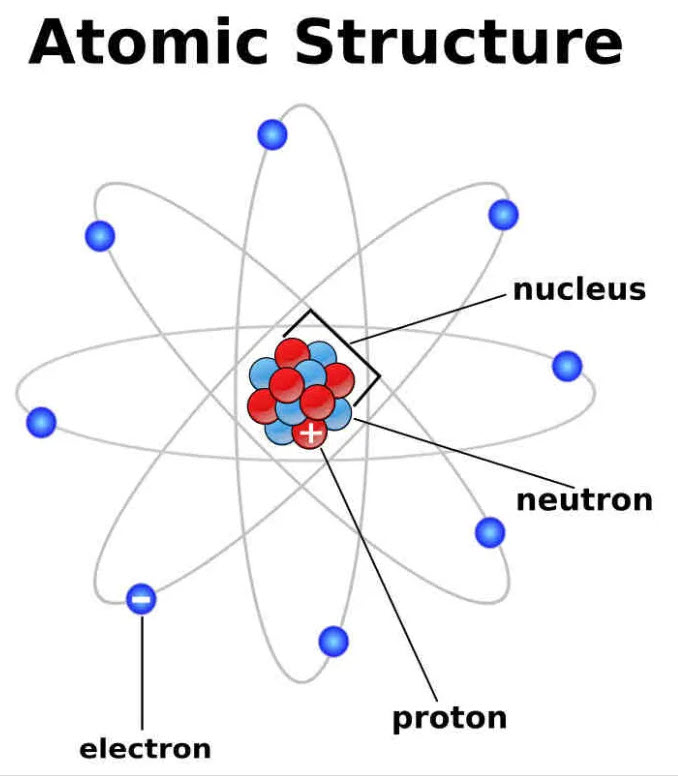
For example, we know that atoms consist, roughly, of protons and neutrons in a nucleus, with electrons “in orbit” around them. In the recent past, though we couldn’t see electrons, we pictured them as moving in orderly circular orbits. The reasoning was that once we’re able to determine where it is and how fast it is moving, predicting its motion will be simple math. See the schematic drawing of this “Bohr Model”, below.

Classic Bohr Model of an atom with electrons in regular circular orbits around the nucleus. Named for Danish physicist Neils Bohr. From HubPages.

Nope. It turns out that no matter how powerful or precise our measuring equipment becomes, it will never be possible to simultaneously measure both the position and speed of a particle. One of God’s physical laws, now called the Heisenberg Uncertainty Principle, after German physicist Werner Heisenberg, utterly precludes that possibility! The best we can possibly do is consider a probability distribution to indicate a range of locations that it might be. The solid shapes in the schematic below represent the most likely position at which to find a given electron.

Modern quantum mechanical electron probability distributions, from Expii.

You can’t begin to imagine how spooky that is to scientists. And upsetting! It had long been believed that the universe is deterministic. That means that if you somehow know where every particle in the universe is, and every force acting on them, you can predict the future with absolute certainty. Instead of deterministic, we now know that the universe is probabilistic.

Even Albert Einstein resisted that truth for most of his life. He couldn’t bring himself to believe that “God plays dice with the universe.”

But that is precisely what God does!

Quantum Macrostructure

How does the quantum state of an electron (or any other very small particle) effect the overall universe? The quantum position and energy state of a particle determine many interactive effects.

For example, with respect to an electron, how it reacts with other particles including its own atomic nucleus, the atom’s charge distribution and how it bonds with other atoms to form ions and molecules, how molecules bond to form solids, liquids and gasses, and so on. The end result is that the net effect of the separate states of individual particles combine to define the structure of every object in the universe.

Think of it like the well-known hypothetical “butterfly effect”: A butterfly in South America flaps its wings, setting in motion barely perceptible currents in the air around it. Those currents effect the air around them, and so on, until the end result is a category 5 hurricane in the North Atlantic.

That is the way God designed the universe, and it means that He intended for it to develop spontaneously to produce in the end something that He engineered in the beginning. But with a measure of chance deliberately built in!

Predicting the future

Because the “fine grain” of the universe is statistical, it is only roughly predictable, even by God. I think that was His intention! For one thing, it better illustrates the elegance of what He made. For another, since He is the only truly transcendent being, He is the only being who knows the future. It can’t be predicted; but God doesn’t have to predict it because He can see it!

A little nudge

Implicit in this scenario is an assumption that the development of the universe can’t happen exactly the way God scripted it. Galaxies collide, stars explode or get sucked into black holes, planets get wasted by asteroids, solar winds, and so on.

God is not surprised by any of the myriads of celestial “accidents” that are constantly happening. Most don’t concern Him because they are part of the design and have purpose built into them. If He sees something coming up that He doesn’t want, or if He wants something to happen that isn’t, a mere flick of His pinky sets everything back on course. Or a detachment of angels is sent to handle it.

Our unique solar system

Astronomers used to assume, and some still do, that there are billions of solar systems just like ours in the cosmos. If that’s the case, then “surely there are millions of civilizations out there.” Well, even if science had a clue how non-life can evolve into life (call me a skeptic…), I’m afraid I have bad news.

It turns out that almost all stars have orbiting planets, and to date we have discovered and remotely “explored” over 5,000, but sad to say, not a single one is anything like good old earth, and it’s a stretch to think that any of them could possibly support any kind of life form as advanced as a virus. It looks like our own life-friendly system is far, far from typical.

My guess is that about 4.5 billion years ago, God picked out a young G-type Main Sequence star in the Milky Way Galaxy and molded its accretion disk to His own specifications, placing a rocky planet of suitable mass with a liquid iron core (to provide a protective magnetosphere) at a perfect spot in the planetary “Goldilocks Zone“. When the time was right, He seeded that planet with life, once again to His own specs.

Procreation

The Psalms, of course, are inspired Scripture, and they tell us a huge amount about God, but I don’t think they are necessarily a reliable source of doctrine, because, by nature, ancient Hebrew poetry is flowery and often exaggerated. They are, in fact, songs. Songs of worship are designed to lavishly praise, and even to flatter.

We know that God is imminently invested in each of us individually. Sparrows, too, and by implication all of earth’s fauna. When the psalmist says, “You formed my inward parts; you knitted me together in my mother’s womb” (Psalm 139:13), or when we acknowledge God as “our creator”, does that mean that each child is an original act of creation?

Personally, I don’t think so. God devised the plan. He created the ancestors. I’m certain that He adjusts the genetics from time to time. But procreation is a well-understood biological process. Human procreation is very similar to that in any other mammal. We understand conception, cell division, DNA and genetic inheritance.

If we say that each child is a unique creation, then we’re acknowledging that God is blessing or cursing each child at conception and early gestation, individually. If that’s what He does, then so be it, and I know He has the potter’s right and a good reason for His choices. He can’t be arbitrary or unfair. Still, this plan doesn’t ring true for me. I don’t think that a consistent hermeneutic requires that a song, even an inspired song by a godly man, be theologically meaningful in any deep sense.

If I’m wrong, I’m wrong, and I’m not suggesting that God never intervenes. In fact, I’m certain that He does. When it suits His plan.

Freewill

We’ve arrived!

Quantum theory is not only spooky, but also counterintuitive, and intellectually it seems sloppy and poorly designed. Why would God choose to do things this way?!

Well, for one thing, it assures that only God knows the future! Of course, He has the option of passing that information along to others when He so desires. Which is how prophecy works.

But the key answer, I think, is that quantum uncertainty is what makes freewill work! Not being a neuroscientist, I’m not qualified to work out the mechanism, but it seems to me that by taking deterministic biophysics off the table, God is saying, “Okay, I’m not programming you, you’re free to configure your own path through life.”

Foreknowledge and predestination

Romans 8:29 (ESV)
[29] For those whom he foreknew (προγινώσκω, proginóskó) he also predestined to be conformed to the image of his Son, in order that he might be the firstborn among many brothers.

Teachers who hold to the view that everything is determined by God in advance often interpret proginóskó as “fore-ordained“, as in, “decided in advance.” How does that differ from “predestined“? By dictionary definition, it really doesn’t differ, but the way I’ve heard John MacArthur Jr. explain it is that after God decides something in advance (foreknowledge), He then prepares (predestination) them to actually do it. For example, if He decides to make you a Christian, He sends a soul-winner. Much like He decided to save Jonah, so He “prepared a great fish.”

That makes some logical sense. I accept the Jonah account as is. But I was always bothered by the fact that I could never find any justification for interpreting proginóskó as anything other than plain old passive foreknowledge. Searching for it briefly tonight in several common English translations, every one of them renders it as foreknowledge: in this verse and in Acts 26:5; Romans 11:2; 1 Peter 1:20; and 2 Peter 3:17.

So, I have flipped back to where I was as a much younger man. Based on something that God knew about me from His view across time and space, He drew me to Himself when I was a child of about 8, and then He set about imparting my spiritual gift(s) and guiding my education and experience towards a goal He set for me.

Next in series: Exploring the Garden of Eden


The Language of Creation

Posted on:

Modified on:


  1. Introduction
  2. Four words for “Create”
    1. The verb bara’
    2. The verb ‘asah
    3. The verb yatsar
    4. The verb kun
  3. “Let there be light!”
  4. Food for thought

As most of my friends know, I am a fervent Creationist, though not a “Young Earth” creationist. I am totally convinced that the universe we live in was created ex nihilo (out of nothing, whatsoever) by the one, true, almighty and utterly magnificent Creator, the God of Israel.

I’ve stated it elsewhere, and I’ll state it again below: Genesis 1:1 tells me all I need to know about the origin of the universe. I can drive a car without understanding how an internal combustion engine or a lithium-ion battery is built. But I’m an academic at heart… so I seek.

The five books of Moses were written during Israel’s 40 years of wandering. He didn’t write for 21st century readers, he wrote for the Israelites, leaving behind one pagan culture and preparing to invade another with similar technologies and traditions.

The first several chapters of Genesis are where God sets the perspective for them: “Your beliefs about the form and function of the cosmos is unimportant—but it’s absolutely vital that you understand that I made everything that exists, it belongs to me, and it is me alone that keeps it running.”

My purpose in writing this particular post is fairly one-dimensional: To discuss the language used by Moses (and other OT writers) to describe God’s actions in the creation process.

One of my favorite Bible dictionaries.

Introduction

To paraphrase Merriam-Webster, to “create” is to “bring something new into existence” or to “design and/or produce something new through imagination and skill.” If, as a woodworker, I build a chair, I’m not doing something earthshattering, though I may earn kudos for my craftsmanship. If I “create” a new chair design, I could become famous. If I create an antigravity chair, I’m more than a designer and craftsman, I’m also an inventor, which is a much bigger deal. If I somehow manage to do any of those things without any raw materials—i.e., if I pop a chair into existence out of complete nothingness—then I have “created ex nihilo“, and I am God. To do so (assuming no trickery) requires a violation of the “conservation of energy”, which only God can do! He can do things like that because He is the creator of the laws of physics that govern the universe and because His existence transcends the universe.

Perhaps I should define the term “universe”. By longstanding convention, that means everything that exists. I would modify that to specify “everything created that exists”. Possibly not the “third heaven”, the divine realm, above the atmosphere (the “first heaven”) and outside the celestial realm (the “second heaven”). Some modern cosmologists are now talking about a “multiverse”, but that is just a theoretical device to explain away the existence of God. A topic for the future, maybe. There is one, and only one, universe!

In this post, I am going to focus on the language of creation, as I personally see it reflected in Hebrew references to the created universe.

I am not a linguist, though I have a working knowledge of Biblical Hebrew, but at this moment, I have at my disposal, either on shelves or on software, 22 commentaries, 7 study Bibles, 5 Hebrew grammars, and 5 other miscellaneous books that are relevant for this discussion. Most of this material is relatively recent; that is, less than 100 or so years. Some older, from as long ago as the Reformation or even the Patristic Age (the age of the “Church Fathers”). Typically, before I post opinions on my blog, I review them against everything I have or can find on the Internet. What is ultimately posted is my own opinion, based as much as possible on research.

The bookshelves in my home office, as of May 6, 2023. Most of these are either theologies or are related to Bible history. ©Ron Thompson

Four words for “Create”

Where the verb “create” appears in the Old Testament, it is almost always one of four Hebrew words:

  • bara’, to create or make. Only this verb includes ex nihilo.
  • ‘asah, to make, build, accomplish, achieve, or simply to do.
  • yatsar, to form or fashion with the hands, as a potter.
  • kun, to establish, appoint, or prepare.

When used in a narrative sense, as in Genesis 1 and 2, I think it is important to view these verbs strictly in accordance with their primary meanings. However, when used in poetic writings where the language is designed to be more flowery and embellished, shades of meaning are not so clear-cut. For that reason, I don’t think it is wise to base any theology solely on poetic passages.

In Isaiah 41 and 43 we see examples of poetic mixing of terms.

In 41:17–20, God is promising through the Prophet that eventually, in the latter days, He will show compassion on His people, who have been scattered across desert regions and who are thirsty, poor and needy. He will gather them back into their land, and that land, even the parched Arabah in the south, will become a garden.

Verse 20, below, consists of a pair of classic Hebrew poetic doublets, where a first line makes a statement, and a second line restates it in alternative and usually exaggerated terms: the people will “see and know”, that is, they will “observe and understand” that God “has done this”, that is, He has “created it.”

Then the people will see and know,
together observe and understand
that the hand of ADONAI has done [asah] this,
that the Holy One of Isra’el created [bara’] it.
— Isaiah 41:20 (CJB)

The creative act in view here may have been ex nihilo, but the poetic usage of bara’ doesn’t require that interpretation. In fact, the process of Israel’s regathering is well underway as I write. It appears that God’s mechanism so far has been in blessing the labor of His people since their regathering began in 1948. In his 1869 travel book, Innocents Abroad, Mark Twain wrote, “Palestine sits in sackcloth and ashes…. desolate and unlovely.” It’s certainly not that way today!

In 43:1b and 7, God is speaking of His creation, Israel. Did God create Israel, the people, ex nihilo? I don’t think so. When I say that “God is my Creator”, I mean that He created the first human beings, and at that time He endowed them with the ability to procreate. Each act of procreation by any creature, human or otherwise, is a biological process that certainly allows, but probably does not require, any further intervention by Him. That doesn’t negate the fact that our creation, ultimately, was at His hand.

But now this is what ADONAI says,
he who created [bara’] you, Ya‘akov,
he who formed [asah] you, Isra’el:

everyone who bears my name,
whom I created [asah] for my glory —
I formed [asah] him, yes, I made him.’”
— Isaiah 43:1b,7 (CJB)

In the following poetic verse all four verbs are used in a single sentence. It happens that in this case the KJV translators realized that Isaiah’s intention was to emphasize how all-encompassing God’s creative act was, and they did an excellent job of parsing the intended meanings of each verb instance.

For thus saith the Lord that created [bara’] the heavens; God himself that formed [yatsar] the earth and made [‘asah] it; he hath established [kun] it, he created [bara’] it not in vain [i.e., not to be in chaos], he formed [yatsar] it to be inhabited:
—Isaiah 45:18 (KJV)

The verb bara’

In the beginning God created [bara’] the heavens and the earth.
—Genesis 1:1 CJB

According to Vine,

bara’ (בָּרָא, 1254), “to create, make.” This verb is of profound theological significance, since it has only God as its subject. Only God can “create” in the sense implied by bara’. The verb expresses creation out of nothing, an idea seen clearly in passages having to do with creation on a cosmic scale: “In the beginning God created the heaven and the earth” (Gen. 1:1; cf. Gen. 2:3; Isa. 40:26; 42:5). All other verbs for “creating” allow a much broader range of meaning; they have both divine and human subjects … and are used in contexts where bringing something or someone into existence is not the issue.
—Vine’s Expository Dictionary (emphasis added)

According to the above, only God can “create” (bara’). The New Testament clarifies that in this case the term, “God” (Elohim), refers to the triune God. For example,

[15] He [Jesus] is the visible image of the invisible God. He is supreme over all creation, [16] because in connection with him were created all things—in heaven and on earth, visible and invisible, whether thrones, lordships, rulers or authorities—they have all been created through him and for him. [17] He existed before all things, and he holds everything together.
—Colossians 1:15–17 (CJB) (emphasis added)

(Note what Paul is stressing: The “invisible” here (thrones, lordships, rulers and authorities) refers to the pagan gods, which were themselves created entities. See Gods and Demons.)

Other Hebrew grammars suggest that bara’ does not always mean ex nihilo creation; however, where it refers to original creation, logic dictates that it must. God preexisted all else that exists, including all the mass and energy building blocks from which everything in the universe was assembled. This is clear from the Colossians quotation above, and

[1] In the beginning was the Word, and the Word was with God, and the Word was God. [2] The same was in the beginning with God. [3] All things were made by him; and without him was not any thing made that was made.
—John 1:1–3 (KJV) (emphasis added)

The Bible, Old Testament and New, is God’s description of Himself and of how He chooses to interact with Adam’s race. The sacred writings of every other religion attempt at length to explain the origins of the gods, the universe, and humanity. The God of Israel is eternal and therefore has no need to explain His own existence.

Photo ©Ron Thompson

As expressed by a leading Jewish commentary:

The traditional English translation reads: “In the beginning God created the heaven and the earth.” This rendering construes the verse as an independent sentence complete in itself [that] makes a momentous assertion about the nature of God: that He is wholly outside of time, just as He is outside of space, both of which He proceeds to create. In other words, for the first time in the religious history of the Near East, God is conceived as being entirely free of temporal and spatial dimensions.

Unlike the pagan cosmologies, Genesis exhibits no interest in the question of God’s origins. His existence prior to the world is taken as axiomatic and does not even require assertion, let alone proof.

The use here of a merism [“heaven and earth”], the combination of opposites, expresses the totality of cosmic phenomena, for which there is no single word in biblical Hebrew.
—The JPS Torah Commentary (emphasis added)

Bara appears in Genesis 1, in verses:

  • 1, where it describes the creation of “the heavens and the earth”;
  • 21, regarding the creation of “sea creatures”, “creeping things” and “winged birds”; and
  • 27, regarding the creation of “humankind”.

In my view, Genesis 1:1 is the defining statement of the origin of the universe and all that it contains. Any other mention of that origin in the Bible is merely a reference back to that single, powerful verse.

The verb ‘asah

6 God said, “Let there be [yə·hî, see below] a dome in the middle of the water; let it divide the water from the water.” 7 God made [‘asah] the dome and divided the water under the dome from the water above the dome; that is how it was, 8 and God called the dome Sky. So there was evening, and there was morning, a second day.
— Genesis 1:6-8 (CJB)

The quote here is from The Complete Jewish Bible (CJB), a Messianic Jewish translation by David H. Stern. His use of the term “dome” may seem strange to you. The Hebrew is  רָקִיעַ (raqia), which Brown-Driver-Briggs (BDB) defines as “an extended, solid surface” or a flat “expanse”, both of which certainly suggest the concept of a dome. Furthermore, raqia is a derivative of the Hebrew verb, רָקַע (raqa), a root which means “to beat, stamp, beat out, spread out” (BDB) or “to expand (by hammering) … to overlay (with thin sheets of metal” (Strong’s).

KJV, of course, uses the term “firmament” here, which is derived from the Vulgate’s Latin, firmāmentum, which indicates a “prop, or support.” The Latin was a direct translation of the Septuagint’s Greek, στερέωμα (stereóma), meaning “a solid body, or support structure” (Strong’s), or “that which furnishes a foundation; on which a thing rests firmly” (Thayer’s Greek Lexicon).

A number of the commentaries in my library, written by thoughtful and devout Christian scholars, define “firmament” as simply a space between the waters below (ocean) and the waters above (vapor). In other words, the sky or atmosphere. There is absolutely no Biblical or linguistic support for this!

The job of a Bible scholar is exegesis. Exegesis is defined as critical analysis and explanation of Scriptural text. What these obviously well-intentioned scholars have done is to look at the passage and say, “Well, I don’t see anywhere else in Scripture or in extrabiblical sources that raqia can mean atmosphere between oceans and clouds, or a space between any two solid or liquid collections, but I know what God created, so that must just be Moses’ odd way of describing it.”

That is absolutely not allowed! That sort of “analysis” has a name: eisegesis. Eisegesis means reading your own ideas, traditions, or prejudices back into Scripture. In other words, instead of letting Scripture inform you, you are informing Scripture! Eisegesis accounts for a ton of bad theology, sectarian error, and downright heresy.

I point out all of the linguistic information on the “dome” in verse 7 to demonstrate that the language of Genesis 1 supports the diagram below, which is a schematic diagram of what in ancient times was universally believed to be the structure of the cosmos. The Babylonians saw it this way, as did the Persians, the Egyptians, the Greeks, the Romans, the Hebrews, and yes, the 1st Century Christians. And that’s the way Moses described it!

Ancient cosmological beliefs

We know that picture is not right, but it does conform with Genesis 1. So, either God is using the description for His own purposes without explicitly endorsing the details, or Genesis 1 is talking about something completely different—for example, Schofield’s famous gap cataclysm. I used to think the latter; now I think the former.

Back on topic…

Though the Hebrew ‘asah in Genesis 1:7 does mean a type of creation, that term, by itself, doesn’t imply ex nihilo creation. Having described how the ancients understood the “dome”, or “firmament”, it makes sense that they would have thought of it not so much as a “creation” as a “construction“, like a dam or a roof. I don’t believe that this picture of the cosmos is even vaguely correct, but generations of belief made it an unbreakable tradition. In Genesis 1:1, God took full credit for creating the entire cosmos. In the rest of the chapter, He said, “this is the way you understand it to be made—that’s fine for now, but give the credit to me, not to Marduk, or Amun, or Baal, or Zeus, or any other regional creator-god.”

Also in Genesis 1, God made (‘asah) the sun and moon in verse 16 and the land-dwelling animals in verse 25. In verse 26 He proposed “make[ing] [‘asah] man in our image”—the image of God, Himself, and the angelic Divine Council, who I believe He was conversing with—which He then did (“So God created [bara’] man in His own image”) in verse 27. In verse 31, He looked on “all that He had made (‘asah)“.

The same term, ‘asah, is used for another form of creation in verses 11 and 12:

11 And God said, “Let the earth sprout vegetation, plants yielding seed, and fruit trees bearing fruit in which is their seed, each according to its kind, on the earth.” And it was so. 12 The earth brought forth vegetation, plants yielding seed according to their own kinds, and trees bearing [‘asah] fruit in which is their seed, each according to its kind…
— Genesis 1:11-12 (ESV)

This makes reproduction a type of “making“. Of the Hebrew terms the Bible uses for creating, only ‘bara is restricted to God alone.

The verb yatsar

The term yatsar is used in chapter 2:

Then ADONAI, God, formed [yatsar] a person [Hebrew: adam] from the dust of the ground [Hebrew: adamah] and breathed into his nostrils the breath of life, so that he became a living being.
—Genesis 2:7 CJB

Adam was evidently not created ex nihilo like the “humankind” of Genesis 1:27, but rather was formed from dust, like a potter’s earthenware, and then endowed with life by God’s breathing into his nostrils. I’ll speak more about this in a future post.

Though it is poetry, and thus a genre that often obscures the precise meanings of some Hebrew terms, Amos 4:13 seems to me to do a good job of illustrating the differences between bara’, ‘asah, and yatsar:

For behold, he who forms [yatsar] the mountains
and creates [bara’] the wind,
and declares to man what is his thought,
who makes [‘asah] the morning darkness,
and treads on the heights of the earth—
the LORD, the God of hosts, is his name!
— Amos 4:13 (ESV)

The verb kun

Kun is not used in the creation account of Genesis, but it occurs elsewhere in Genesis:

Why was the dream doubled for Pharaoh? Because the matter has been fixed [kun, established or assured] by God, and God will shortly cause it to happen.
— Genesis 41:32 (CJB)

God has taken something unsure and made it inevitable.

When Yosef saw Binyamin with them, he said to his household manager, “Take the men inside the house, kill the animals and prepare [kun] the meat. These men will dine with me at noon.”
— Genesis 43:16 (CJB)

Joseph commanded the steward to make ready the meat. I know, that’s a fairly weak form of making something.

“Let there be light!”

The terms “Let there be (yə·hî)”: light, in verse 3, expanse, dome, or firmament in verse 6, and lights in the expanse in verse 14; and “Let it (wî·hî)”: the firmament in verse 6, are forms of “creative command.”

The concept here is a grammatical feature of Hebrew. It’s a device called a Hiphil Stem, and becommingjewish.org expresses it this way: “The Hiphil Stem can be used to express a causative type of action with an active voice.” That’s kind of technical, but what it amounts to is that a prefix “stem” is added to a Hebrew word to change it from a simple active verb form like “he loved” to a causative active form like “he caused to love“.

To make that even simpler by example, in Genesis 1:3, the Hiphil changes “the light is on” to “turn on the light”. It becomes a command, and when God commands, the universe obeys!

Food for thought

Genesis 1 and 2 were written for Moses’ Israelite followers, but there is wisdom in there for us in the 21st century.

The following passage is Wisdom anthropomorphized. All the rules for interpretation of poetry must be observed. It isn’t a real person speaking, but it could surely have been spoken by Solomon himself. For that matter, I can easily read myself into the poem!

I am there. I am speaking. God made me among the “first of his ancient works.” God planned all of it, including me, before He programmed the physical laws of the universe so that they would make it happen, and before He created from nothing the primordial singularity. Before He allowed it to expand and coalesce first into undifferentiated energy, then into forces, then particles, then ions, atoms, stars and galaxies. The atheist Carl Sagan was fond of saying that we are made of “star-stuff.” He thought he was second-guessing God!

22 “ADONAI made me as the beginning of his way,
the first of his ancient works.
23 I was appointed before the world,
before the start, before the earth’s beginnings.
24 When I was brought forth, there were no ocean depths,
no springs brimming with water.
25 I was brought forth before the hills,
before the mountains had settled in place;
26 he had not yet made [‘asah] the earth, the fields,
or even the earth’s first grains of dust.
27 When he established [kun] the heavens, I was there.
When he drew the horizon’s circle on the deep,
28 when he set the skies above in place,
when the fountains of the deep poured forth,
29 when he prescribed boundaries for the sea,
so that its water would not transgress his command,
when he marked out the foundations of the earth,
30 I was with him as someone he could trust.
For me, every day was pure delight,
as I played in his presence all the time,
31 playing everywhere on his earth,
and delighting to be with humankind.
—Proverbs 8:22–31 CJB

Next in series: Genesis 1:1–5, Day 1


Fountains of the Deep

Posted on:

Modified on:

  1. The Deep
  2. The Fountains & Floodgates
  3. Identifying the Fountains of the Deep
  4. Likely Mechanism of the Flood

In ancient times, the peoples of the Middle East held a deep-seated, superstitious awe for the oceans and other large bodies of water. To them, the deep-water basins were abyssal, bottomless pits, full of monsters and evil spirits or demons. The continents floated on the ocean waters, which were also the common source of springs and subterranean rivers, so these source waters, too, were infested with evil spirits. Take, for example, the river Banias, which today flows from between rock strata down-slope from the famous cave at Caesarea Philippi. In Jesus’ day, the river flowed from the mouth of the cave. The pagans of Decapolis named the cave “The Gates of Hell” and surrounded its exterior with shrines to the god Pan.

The same ancient peoples who feared the deep waters also recognized that they were the source of life, providing fresh drinking water for humans and animals alike, water for the fields, and an abundance of fish, the staple of life for many civilizations.

To Top

The Deep

The Hebrew word most often used in the Bible to refer to this interconnected reservoir of water, either in whole or in part, is tehom, usually translated as “the deep.” Exactly what elements are included in any particular reference to tehom must be inferred from the context or modifiers. In Gen 1:2, most would agree that it referred to an all-encompassing ocean, prior to the formation of dry land surfaces. In Gen 49:25, Jacob is giving his deathbed blessing to Joseph, speaking of “the Almighty, who shall bless thee with blessings of heaven above, blessings of the deep [tehom] that lieth under…” (KJV) I believe that he is, here and in the parallel passage, Deut 33:13, referring to the entire, composite water system lying beneath the canopy of “heaven above.” In Job 28:14, in his discourse on Wisdom, Job defines his own usage of the term by means of the poetic doublet, “The deep says, ‘It isn’t in me,’ and the sea says, ‘It isn’t with me.’” (CJB) In Isaiah 63:13, tehom refers to the Red (or Reed) Sea, opened up for Moses and the Israelites.

To Top

The Fountains & Floodgates

This diagram shows the cosmos as visualized by Moses, and by the people of virtually every culture in the Ancient Near East. Oceans, lakes, springs, and even the waters above the firmament were believed to be interconnected and were often collectively referred to as “the Deep.” Terrestrial waters rose to the surface of the land through fountains. Water falling from the sky was released by spirit beings through floodgates in the dome of the firmament.

Gen 7:11“In the six hundredth year of Noah’s life, in the second month, the seventeenth day of the month, the same day were all the fountains of the great deep broken up, and the windows of heaven were opened.” (KJV)

Gen 8:2“The fountains also of the deep and the windows of heaven were stopped, and the rain from heaven was restrained;” (KJV)

What, then, are “the fountains of the deep”, or ma’yenot tehom, as mentioned in the Flood story? Ma’yenow (singular) denotes a spring, fountain, or source. Can this be taken literally, like a spring in the desert, or is it poetically descriptive of the fact that water from “the deep” was gushing freely from some aperture or region? When considered in parallel with “the windows of heaven”, wa’rubot (chimneys or windows) ha-shamayim (the heavens, or elsewhere, “firmament”), my own opinion is that the “fountains” and “windows” must both be poetic terms, whereas the water and the flood were most certainly literal!

To Top

Identifying the Fountains of the Deep

Young Earth Creationists often take the view that “the fountains of the great deep” refers to continental springs, geysers, fissures, Artesian wells, and other surface openings that God miraculously ripped open and caused to spout abnormally great volumes of water from natural aquifers deep in the earth’s crust. This rending and subsequent flow, they say, caused cataclysmic changes in the topography, including newly up-thrust mountain ranges, massive erosion, and even the division of large supercontinents into the smaller continents we know today.

fountains_of_great_deep

A fairly traditional view.

Others take the view that God caused volcanoes to sprout across the continents and spew water and, presumably, lava (since that’s what volcanoes do).

I can’t resist mentioning still another view that I ran across proclaiming, presumably with a straight face, that the unprecedented heavy rain was associated with a drop in barometric pressure so severe that water under the earth’s crust for some unspecified reason “pushed up and out … to come to the surface”, evidently causing the crust to pop like a balloon! Incredible, since the normal barometric pressure at sea level is typically below 15 psi, which is pretty much the same pressure that my own bare feet exert on earth’s crust when I stand on it!

fountainsofdeep1

An incredibly naive view.

My view is that the term “fountains of the deep” describes features of the ocean floor. Opening of these “fountains” may have caused some shifting of the tectonic plates and therefore some near-shore damage on the continents, but the main effect was a sudden simple rising of the sea level. I will discuss a probable mechanism below, but first I would like to present some brief arguments against continental “fountains”:

  • Scripture nowhere states that the flood caused catastrophic changes in Earth’s geology. This isn’t even a long-standing tradition. It is a theory that was proposed in my lifetime, and there is no valid scientific evidence that either the topography or the stratigraphy of the earth was greatly influenced by a single massive flood. The idea that the Genesis Flood accounts for the apparent old age of the earth is simply an assumption made in an effort to explain something that the Bible itself made no effort to explain. It is a defensive theology aimed at those scientists and others who deny scripture. Since it is in no way backed by scripture, it must meet the objections of science and of common observation, and it simply fails to do so. In a separate post, Geology a Flood Cannot Explain, I presented a substantial list of geological phenomena that to my personal knowledge cannot possibly be explained by the Genesis Flood. I also presented my credentials for addressing the various issues discussed.
  • Crustal aquifers exist, not in caverns, but in porous and permeable rock formations. While sometimes quite large, they are limited in their areal extent and thickness. Many thousands of deep oil and gas wells (including a number that I was involved in drilling and evaluating) and countless geophysical studies have shown no evidence of permeable rock formations in continental crust large enough to contain the enormous volumes of water that would be necessary to cover the highest mountains, even if they were much lower than they are today. And were they? Possibly a bit; the Himalayas, for example, are demonstrably rising even now as a result of plate tectonics and the ongoing collision of the Indian Plate with the Eurasian Plate. But consider Mt. Ararat: after God closed the windows of heaven and stopped up the fountains of the deep, Ararat, at Over 16,000 feet above the normal sea level, was still under the receding water!
  • Sufficient quantities of sub-continental water would most certainly have had to come from deep within Earth’s mantle unless they were created by God, on the spot (which I acknowledge to be theologically possible, but not necessary). Any continental aperture of sufficient depth to reach these depths and sufficient width to handle the volume of water necessary would, I think, have to be fairly humongous. Why are there no traces of anything like this?
  • Continental volcanoes might account for a large volume of deep-sourced water, but I don’t think there is evidence of enough continental volcanism to provide that much.
  • Finally, I think that Gen 7:11 provides an important clue. This passage states that it was the “fountains of the Great Deep” (tehom rabaah) that God opened to start the rising flood. That terminology in Scripture normally refers only to the abyssal ocean basins, not to continental features.

To Top

Likely Mechanism of the Flood

There are two likely mechanisms, that I can see, that God might have used to bring that much water up from the deep, and then to store it again once He was done with it:

  1. First, he could have simply created it on the spot, flooded the earth with it, and then de-created it again when he was done with it.
  2. It seems to me, though, that His modus operandi as described in scripture is normally to wrap what He has already created in some sort of miracle when He wants to make a major power statement. I think that He “foreknew” what He was going to do and incorporated that plan into His original design.

Every school child since before my day has known that the earth has an upper “crust”, a central “mantle”, and a lower “core”. Geophysicists now believe that the mantle consists primarily of different forms, or “phases” of the mineral Olivine, which is a “magnesium iron silicate.” The simple Olivine of the upper mantle, under the heat and pressure of lower depths is converted to a phase called Perovskite in the lower mantle. Between the two regions is a transition zone consisting of Olivine phases called Wadsleyite and Ringwoodite. Both of these mineral phases can be very heavily hydrated and are now thought to contain as much as 3.5 times as much water as in all the earth’s oceans. Many young-earth creationists, as well as ancient-earth creationists like me, speculate that this is the primary source of the water that God used to flood the earth in Noah’s day.

mantle_water
Schematic cross-section of earth. The oceanic crust, riding on the plastic mantle rock beneath it, is welling up at the “mid-oceanic ridges” and sliding toward the continents at a rate of 1–2 inches a year. At the continental margin, this migrating crust then sinks back below the surface and circulates back to where it started, moving on great convection currents. Even in normal times, prodigious amounts of water are carried along with this cycle.

Most people probably think of the deep regions of the earth as simply dead, stagnant, unmoving rock. In reality, the earth is a dynamic, “living” system from surface to center. We have all been taught about the “water cycle”, where ocean water evaporates, clouds form, rain falls on the continents, and streams and aquifers return the same water back to the oceans. There is also a water cycle involving the mantle transition zone: ocean water is dragged, in prodigious quantities, into the depths of the mantle by the “subduction” of Earth’s oceanic tectonic plates. This water charges the transition zone, and much later is returned to the ocean through the agency of deep-ocean “smokers” (hydrothermal vents) and volcanism along the Mid-Oceanic Ridges; in the Island-Arc and Continental-Arc volcanoes near subduction zones; and in “hot spot” volcanoes like the Hawaiian volcanos and the Yellowstone super-volcano.

It turns out, paradoxically, that water itself is what spawns volcanic activity, because the melting point of rock is drastically lowered in the presence of water. There is, in fact, an intriguing theory that there should be a sheet of molten rock at the upper surface of the transition zone. From my own knowledge of petrology and fluid flow in rock, that makes me think that conditions in such a region could be right, under certain circumstances (like a gentle push from the Hand of God!) for water-laden, low viscosity, basaltic magma to suddenly channel rapidly through this discontinuity into the Mid-Oceanic ridges, causing a subsequent rise in sea level that could be described poetically as the “fountains of the great deep” opening up.

If this superheated and thus buoyant water were to bubble quickly to the ocean surfaces (or be injected directly into the atmosphere), I would expect it to quickly rise through the cooler air near the surface, and to spread out and rapidly cool near the stratosphere, setting off a global rain event. Since no pressure front would be active in forming this rain, I would not expect serious damaging winds such as are postulated by followers of Henry Morris.

Regarding the return of the flood waters to the transition zone: in my view, the text implies a direct miracle.

Gen 8:1 – “God remembered Noach, every living thing and all the livestock with him in the ark; so God caused a wind [ruach] to pass over the earth, and the water began to go down.” (CJB)

The Hebrew ruach can mean “wind” in scripture, but it often is translated as “spirit”. In Genesis 1:2, the Ruach of God hovered over the surface of the water. In 8:1, God caused His Ruach to hover over the face of the water-covered earth! In both cases, the earth was covered with an unbroken expanse of water, and God sent His Ruach HaKodesh (Holy Spirit) to deal with it! For more on the “wind of God”, see God with the Wind.

To Top