Posted on:
Modified on:
I have previously published two somewhat lengthy articles about Ron Wyatt’s “Mt. Sinai” at Jabal at-Laws in northwest Saudi Arabia. Discussions of Mt. Sinai on Facebook’s popular archaeology sites are often disrupted by people (never archaeologists) stating confidently that “the real Mt. Sinai is in Saudi Arabia, and there is a ton of proof!” Tim Mahoney of Patterns of Evidence, who I admire, has endorsed the Saudi site, though he is skeptical of Wyatt’s honesty.
I personally favor the traditional Jebel Musa (“Mountain of Moses”) site in the southern Sinai Peninsula. I could be wrong, but the evidence I see, while not proof, is compelling. I’m very convinced that it is not in Saudi Arabia!
Ron Wyatt
The late Ron Wyatt (June 2, 1933 – August 4, 1999) was a nurse-anesthetist working in the Nashville, TN area. In 1960, he saw a Life Magazine photo of a geological formation near Turkey’s Mt. Ararat shaped like a large boat. He decided on the spot that he wanted to become an “archaeologist.” He quit his job, traveled to Turkey, found the formation, and claimed that he had just discovered the true Noah’s Ark. He spent much of his remaining life in the Middle East, claiming to have made around a hundred discoveries, many of them of amazing importance.
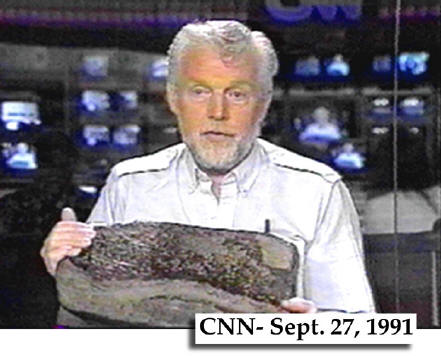
Wyatt has a very wide following around the world among Christians who are enthralled by his astounding claims. I have heard him lovingly described as “God’s own archaeologist.” In his videos, he always appears humble and sincere, and even sheds tears as he talks about being privileged to have literally met with Jesus, face to face, in the flesh. Really?
Unfortunately, his discovery claims are based solely on superficial appearance. If it looks like a duck, then by golly, it must be a duck! Real archaeology, even if it starts with a visual identification, requires extended scientific testing to establish age, provenance, composition, and other applicable characteristics. Data must be carefully collected and evaluated, meticulously documented, and verified by experts in appropriate fields. Though Wyatt usually claimed to have followed these steps, his only witnesses were his own family and associates, and ultimately, he always found excuses for never producing any proof that he actually did so.
Wyatt was a member of the Seventh Day Adventist denomination. That organization is very interested in archaeology but, whatever you think of their theology, they are Christians of integrity, and they were embarrassed by Wyatt’s many deceptive and quite unbelievable claims. Therefore, in the months immediately before his unexpected death from colon cancer, two of the Adventists’ intellectual leaders, the brothers Russell and Colin Standish, researched and wrote a book to quietly, and as respectfully as possible, refute Wyatt’s claims: Holy Relics or Revelation: Recent Astounding Archaeological Claims Evaluated, Hartland Publications, 1999. Even discarding frequent references to the works of Sister Ellen G. White, 1827–1915, founder of the denomination and believed by them to be an inspired prophet, the book does an excellent job of stating the case against Wyatt.
Previous articles in series
As stated above, I have previously published two articles about what I have called, “the Saudi Sinai.”
The first, “Moses, Paul, Sinai, Midian and Arabia“, June 4, 2022, addressed the issue of Paul’s statement in Galatians 4:25 that Mt. Sinai was located in Arabia. Most people anachronistically equate “Arabia” with the current country of Saudi Arabia, which came into existence in the 20th century. My article shows that both Arabia and Midian extended into the Sinai Peninsula in both ancient and classical times.
The second, “Geology and the Saudi Sinai“, December 13,2022, discussed in depth two of the most frequently cited “proofs” for the Saudi Sinai: the so-called “burnt mountain” and the nearby “split rock.”
Additional “evidence” for Saudi Sinai
In the remainder of this article, I will mention, as briefly as I can, other “proofs” of the Saudi Sinai offered by Wyatt.
The Nuweiba crossing
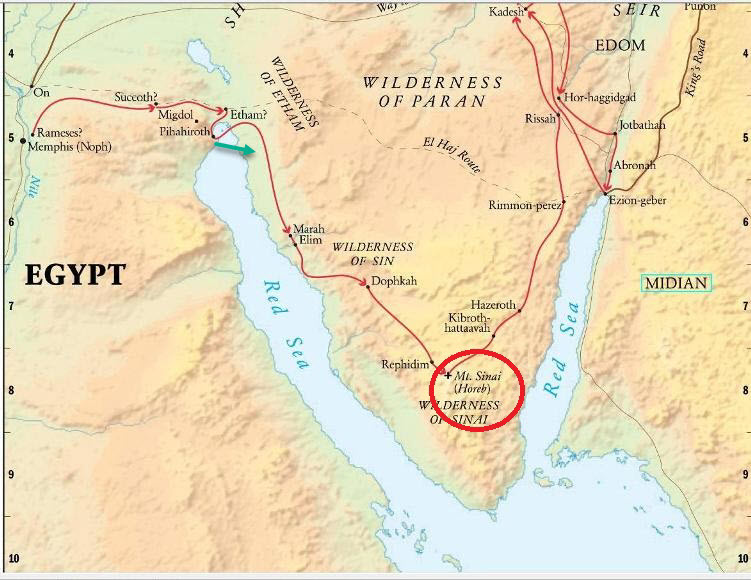
Wyatt and those who follow in his footsteps believe that the Israelites followed the route shown below in Fig. 1 and crossed the Yam Suf (the “Sea of Reeds“, incorrectly translated by KJV as “Red Sea“) at a wadi delta called Nuweiba Beach.

Patterns of Evidence elected to promote this route and an Aqaba crossing largely based on evidence presented by Dr. Glen A. Fritz, holder of a PhD in Environmental Geography from Texas State University. In his 2016 book, The Lost Sea of the Exodus: A Modern Geographical Analysis, Dr. Fritz insisted that the term, Yam Suf, is only known to apply to the gulf of Aqaba, never to any other body of water.
I was skeptical of this claim from the first time I heard it, because it conflicts both with ancient historical naming principles that I’ve long been aware of and with modern oceanic map usage that I learned as a Naval officer. Today, the terms “Gulf of Suez” or, variously “Gulf of Aqaba“, “Gulf of Eilat“, or “Gulf of Elat“, are used, and appear on maps, but these appear as offshoots included as part of the greater Red Sea.
Similarly, the “Great Sea” of antiquity, now known as the “Mediterranean Sea,” is the all-inclusive body of water stretching from the Strait of Gibraltar to the shores of Syria, Lebanon and Israel, and which encompasses and includes a number of named minor seas like the Ionian, the Aegean, the Adriatic, etc.
My own belief has been and still is that the Sea of Suf included the entire Red Sea region and even into and beyond the Gulf of Aden. It seems likely to me that it (the Sea of Reeds, Yam Suf) probably got its name from floating masses of reeds washing in and out of the tidal estuary north of Suez City to and beyond the Bitter Lakes. Near Egypt, the most populous area in the entire vicinity.
A scholarly 2020 book titled, Where Was the Biblical Red Sea: Examining the Ancient Evidence, by Dr. Barry Beitzel, professor emeritus of Old Testament and Semitic Languages at Trinity Evangelical Divinity School, was written primarily to refute both the methodology and the conclusions of Dr. Fritz’ book. It essentially states what I already believed, but with much background and historical support.
Nuweiba alternatives
Several locations have been proposed for the “Red Sea Crossing” site. From north to south:
- The site favored by Tim Mahoney’s sidekick, archaeologist David Rohl, is the shallow Lake Tanis, in the Nile Delta. David got very angry at me for disagreeing on this, so don’t tell him that I later wrote a more formal refutation in God with the Wind.
- The site favored by most scholars from the last century more or less, is the tidal Bitter Lakes region, quiescent since the Suez Canal was opened and disrupted normal tidal flows in the estuary. I think that this location, like Lake Tanis, was originally proposed due to reluctance to believe in a significant miracle. Conservative Evangelicals tend to go along with this choice, hopefully due to ignorance of the argument’s history.
- The traditional site, and my favorite, is the crossing near the northern tip of the Gulf of Suez, shown below in Fig. 2.
A land bridge at Nuweiba?
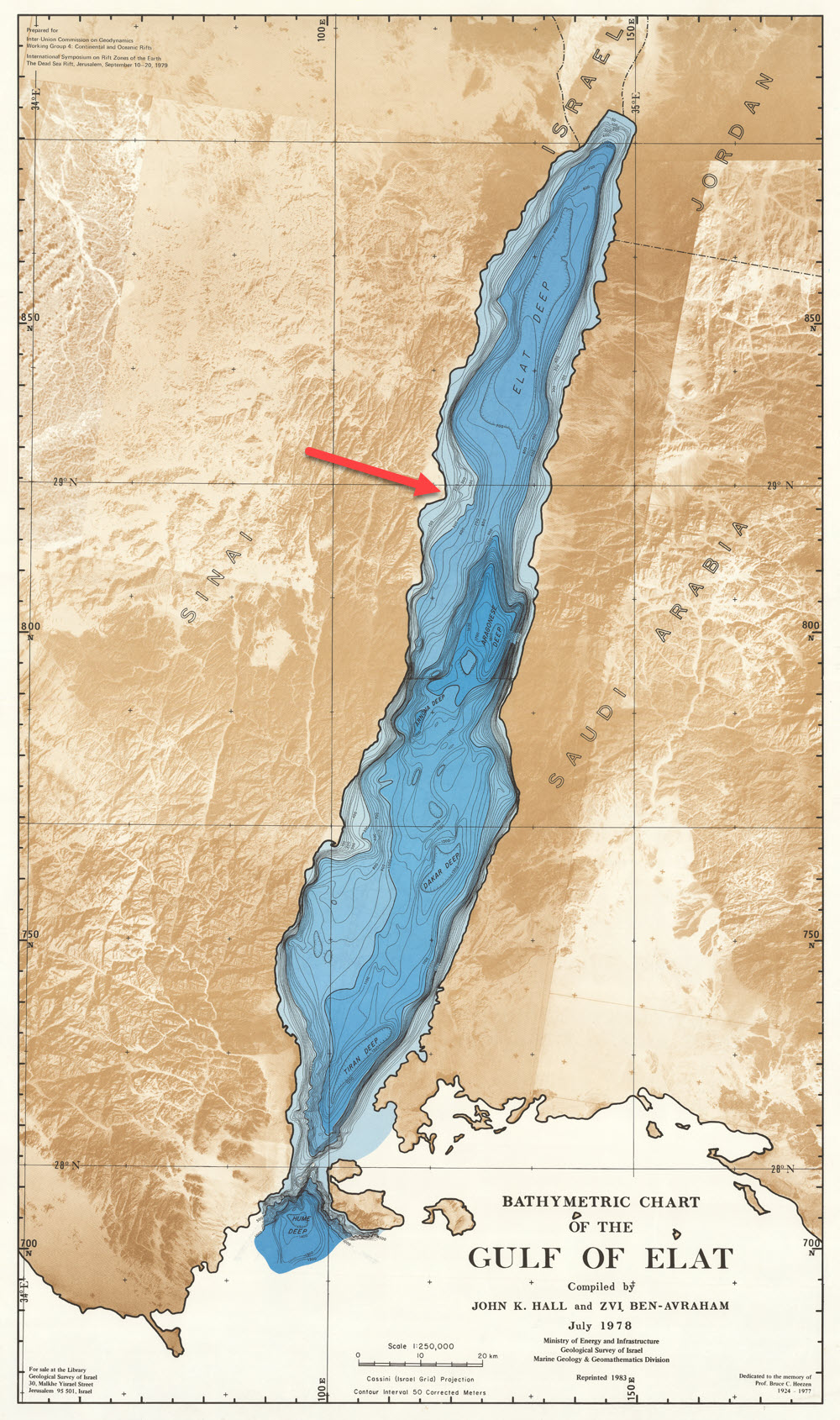
The crossing favored by Wyatt is at Nuweiba Beach, on the Gulf of Aqaba, a.k.a., the Gulf of Elat, or Eilat, Fig. 3.
The annotated red arrow points to this beach, a small delta on the western shore. Though difficult to read at the scale shown, the deepest point in the crossing area is in excess of 900 meters, more than a half mile!
More importantly for the Israelites: Even if God dried a path there for them, they would have had to navigate a steep gradient, almost a foot for every three-foot stride, near the eastern shore. Imagine moving heavily laden wagons and animals up such a steep slope for several miles.
By terming the shallow saddle between opposite banks of the Gulf a “land bridge”, Wyatt prejudiced the argument in his favor. Technically, a land bridge is “a strip of land [above the normal waterline] connecting two landmasses” (per Merriam Webster). Even if one loosens this definition to include land that breaks the surface only at low tide or during a draught, Nuweiba doesn’t even vaguely qualify.
The Nuweiba pillars
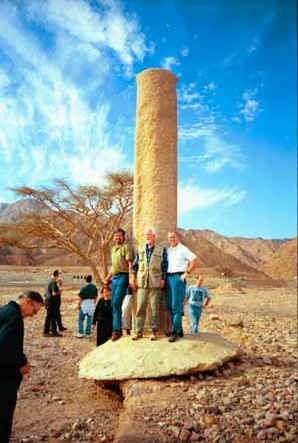
Wyatt claimed to have found a stone pillar on Nuweiba Beach and a second stone pillar on the opposite shore, both erected by King Solomon to memorialize the crossing at that location. The circumstances of this discovery are as follows:
He first discovered the pillar on the Beach (west) side of the gulf in 1978. It was a “Phoenician-style” granite column bearing no markings whatsoever (he said they had either been eroded off or chiseled off by persons unknown), and it was laying on its side next to the road. After mentioning it to the local military officials, they poured a concrete slab and set the pillar upright, Fig. 4.
A Saudi military helicopter later flew Wyatt to the east bank, where he found a matching pillar, but with its markings intact. In Phoenician (Proto-Hebrew) script, it exhibited the words: Egypt, Solomon, Edom, death, Pharaoh, Moses and Yahweh. Of course, there is no substantiation that this pillar ever existed.
According to Wyatt, the Saudi authorities removed it before anyone thought to take photographs. So, what does it prove? Only that Ron Wyatt was never an archaeologist!
Wheels and bones
Ranking the “evidence” for Wyatt’s Saudi Sinai, chariot wheels and bones, human and horse, underwater at the Nuweiba “crossing” site have to be no deeper than third on the “most talked about” list.
Wagon wheels
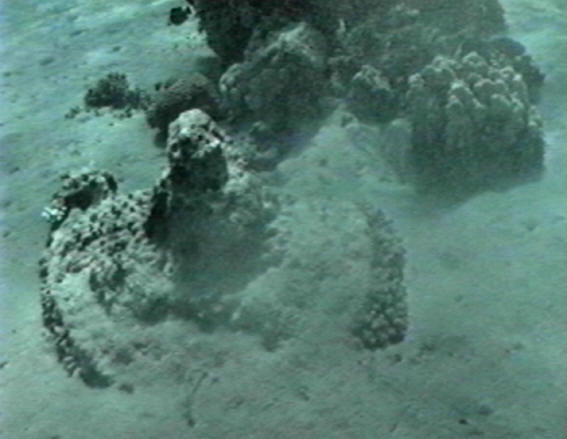
Are they really there? Well, yes, a few of them. That was verified by Patterns of Evidence. Fig. 5 is the best photo I could come up with. Wyatt’s best wheel photos were all invalidated as even potential evidence by being photoshopped. To be considered evidence a wheel would have to be brought to the surface and cleaned off, at minimum. Until then, it can only be assumed that there is a wheel beneath the coral, and until a recovered wheel is C14 dated and otherwise tested at a professional lab, nothing there qualifies as evidence, only as a discussion topic.
But assuming they are wheels (which seems reasonable), are they chariot wheels? War chariots were specifically designed for rapid travel on well-worn or paved roads, and for fighting on more or less level surfaces. They were of no use on rocky, mountainous, or grossly uneven terrain.
Fig. 6 shows a 3D rendering of an “anatomically correct” Egyptian chariot from the 18th dynasty. The components, including the wheels, were kept as slender as possible for the sake of speed and agility. The wheel rims and spokes were laminated for strength and suppleness. Leather “tires” were added for additional strength and to dampen vibrations. Leather sleeves also strengthened the axles. The hubs were reinforced by hammered bronze girdles.
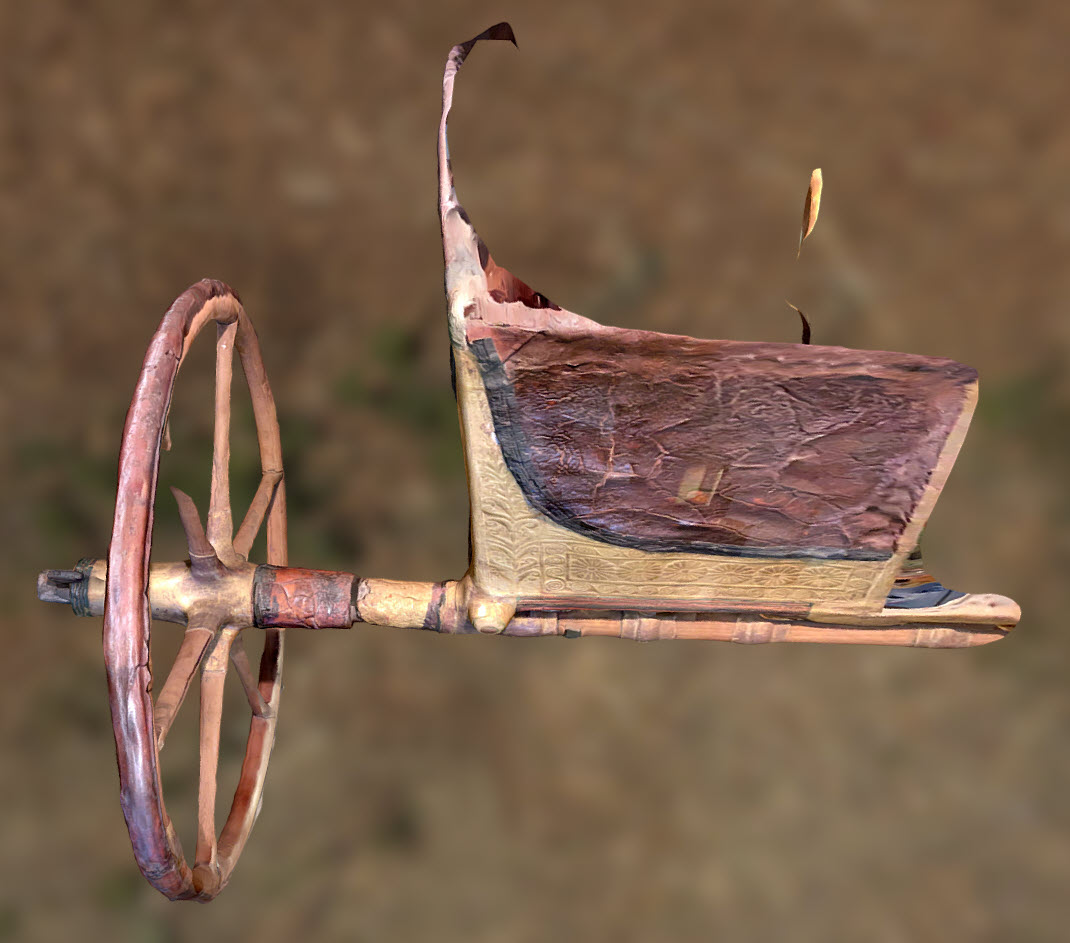
In contrast, the “wheel” in Fig. 5 appears to be too bulky to be anything more warlike than a wheel from a cart or wagon, probably pulled by oxen.
Wagon wheels or hand wheels?
Fig. 7 is another artifact found at offshore Nuweiba. Wyatt supporters claim that it is a golden chariot wheel, presumably off of Pharaoh’s chariot. Coral and other encrustations, they claim, will not stick to gold. These claims are pure amateur foolishness.

Why foolish?
- Coral can surround and ingulf any material that is submerged long enough in its presence.
- Even pure gold will tarnish in salt water.
- In a less than pure state, or when plating another metal, corrosion would quickly occur.
- Pure gold is too malleable for use on chariot wheels.
- Though wheel-shaped, this device is too thin in cross-section to be load-bearing.
- It would require a lab test to be sure, but I’m guessing from the photo that this device was machined and therefore is recent.
- I’d be willing to bet that it is stainless steel, not gold.
- Since there is nothing in the photo to give it scale, it could be much smaller or larger than a chariot wheel.
- My guess is that it is a modern industrial valve wheel handle (Fig. 8), something that I am personally very familiar with. I’ve worked with some that are very similar to what is shown in Fig. 7. Fig. 8 shows one that is powder coated for use indoors or outdoors but not submerged. Stainless handles are made for saltwater and submerged operations and are sometimes easily as large as a chariot wheel.

Bones
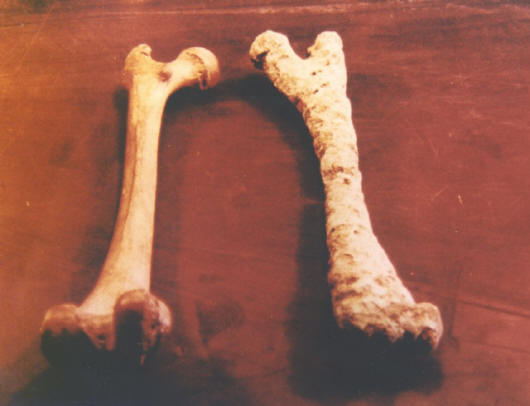
In addition to wheels, it is claimed that human and horse bones have been recovered under the waters at Nuweiba (see Fig. 9). I’m not aware if there has been any independent verification of that claim.
Why at Nuweiba?
The next question to be answered is, why at Nuweiba? Given the paucity of specimens, Nuweiba hardly qualifies as underwater graveyard, but why are they there at all, if they weren’t an Egyptian army “swept under” by God?
This is easy to answer! The Gulf of Aqaba is not an erosion feature, having no major rivers. It is a fault line that is slowly pulling apart due to plate tectonics. Water currents in the Gulf are almost entirely due to tidal flow through the Strait of Tiran (Fig 10:). The result is a gentle north/south wash, peaking at around 7 miles per hour each direction.
The city of Eilat, at the northern tip of the Gulf, has been occupied since prehistoric times, and has been an important seaport for most of that time, exchanging goods with northern regions via the ancient King’s Highway and with southern regions via Red Sea shipping lanes. All busy shipping lanes experience occasional shipwreck due to storms, collisions, groundings, military actions and other mishaps. Since military equipment has always been a frequent trade category, it is inevitable that chariots and wagons, as well as dead humans and horses, ended up in the water.
When boats or other wooden structures are swamped, they float for a time, and then as water soaks into the pores, they eventually tend to lose buoyancy and slowly sink. Freshly dead bodies may float awhile unless they are heavily encumbered, then they, too, begin to sink. As they decompose, gases accumulating in body cavities will cause them to eventually float back to the surface. I’m sure that research would show a tendency for semi-buoyant objects to collect on the undersea shelf at Nuweiba over time.
Additional claims on or near the mountain
In addition to the blackened mountaintop (basaltic lava flows) and the split rock (frost wedging and exfoliation of a glacial “erratic” perched on a glacial moraine), other findings in the area of Jabal al-Lawz have been cited as evidence for Mt. Sinai in Saudi Arabia.
Pictographs
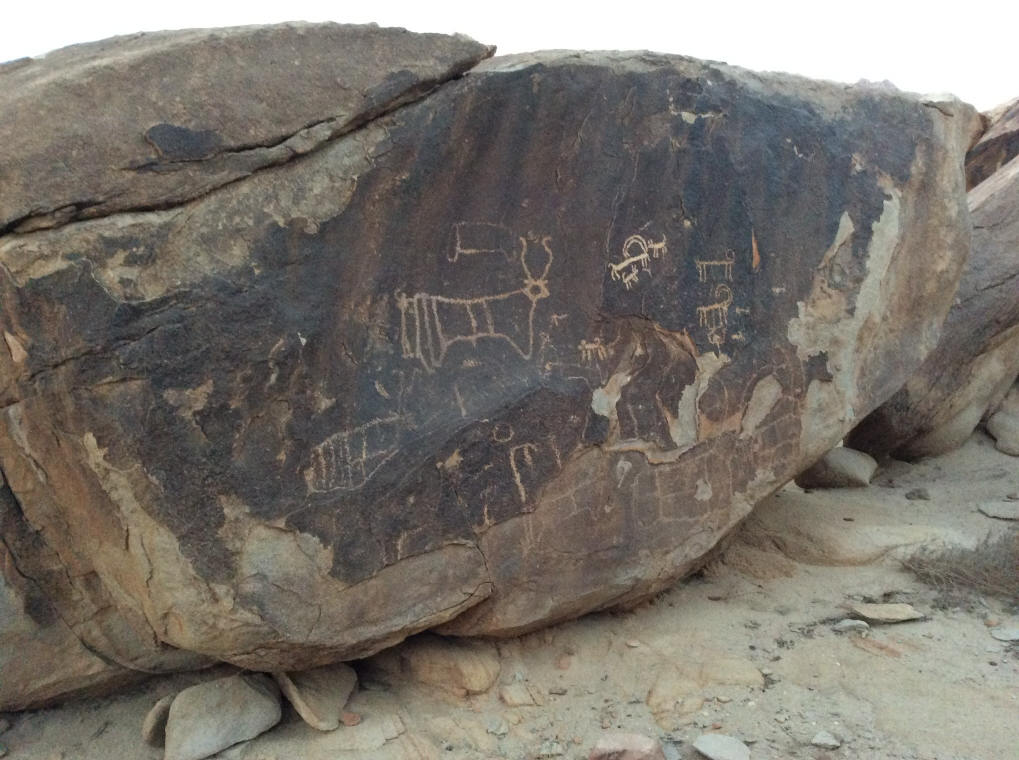
The pictographs near Al-Lawz, Fig. 11, may be associated with ritual, but most likely they are simply graffiti. Possibly ancient, but I doubt that any attempt has ever been made to scientifically date them.
But similar pictographs have been found all over the Arabian subcontinent, not to mention the entire world. I grew up less than an hour’s drive from ancient Anasazi pictographs in New Mexico.
12 pillars
Exodus 24:4 (ESV)
[4] And Moses wrote down all the words of the LORD. He rose early in the morning and built an altar at the foot of the mountain, and twelve pillars, according to the twelve tribes of Israel.
It’s funny how many people read a verse like that and immediately assume that Moses built an elaborate worship area with shaped stones and formal pillars like a Pharaoh, or Herod the Great, would commission. But the verse above sounds like a one-day project to me.
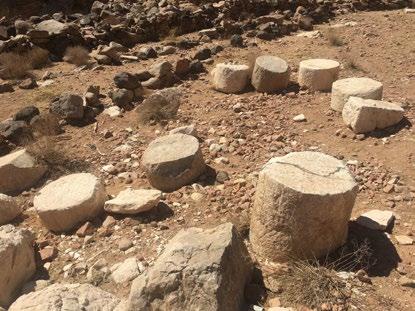
For the previous 40 years of his life, Moses had lived rustically as a nomadic desert herdsman. The way I picture it, he got up in the morning, collected and stacked stones into a rough altar and 12 cairns, or perhaps 12 oblong standing-stones.
There is actually no reason whatsoever to connect these stones (Fig. 12) with Moses and the Exodus. The Saudi government and nearby residents have suggested alternative explanations that are as plausible or more so than Wyatt’s.
Elijah’s Cave
1 Kings 19 describes Elijah’s flight from Queen Jezebel to a cave on Mt. Horeb, a.k.a., Mt. Sinai. And, Glory be, there it is, on the side of the Saudi Sinai (Fig. 13)!
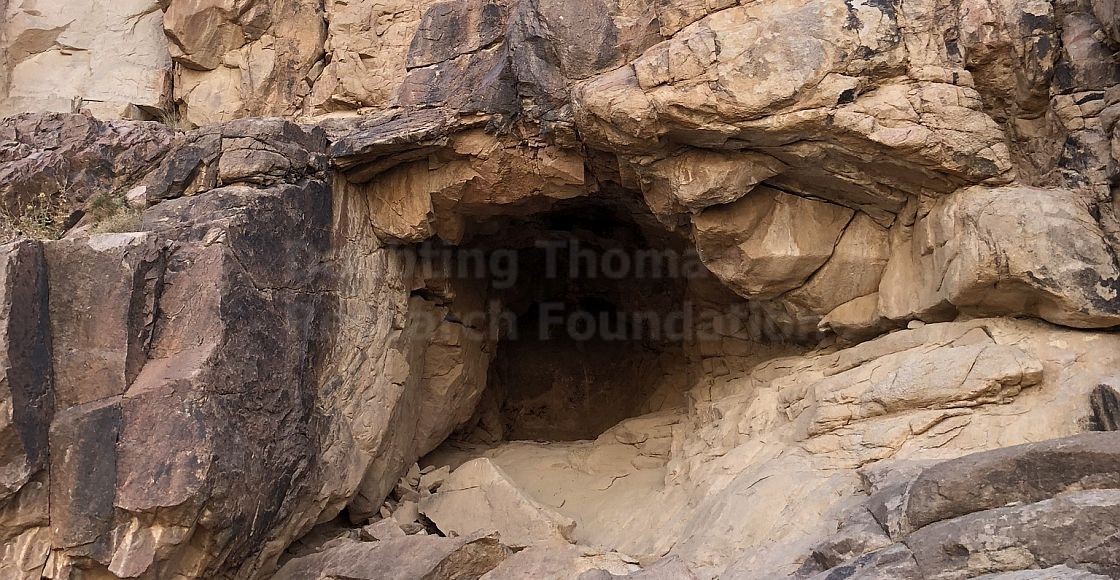
Not so fast! The whole area around the Red Sea, northwest Saudi Arabia, the Sinai Peninsula, up the Jordan Valley, and even into Iraq, Anatolia and Eastern Europe is tectonically active. Fissures and caves come and go with each earthquake, and there have been many of those!
There’s no evidence here!
Wyatt’s museum
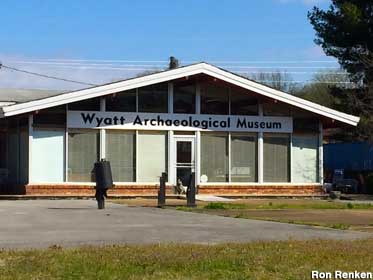
The Wyatt Archaeological Museum in Cornersville, TN (Fig. 14), now permanently closed, was given rave reviews by Ron Wyatt’s fans, but as far as I can tell from many interior photos, the only legitimate archaeological specimens it contained were inexpensive tourist items available from any antiquities shop in the Middle East.
There were several mildly interesting but worthless mockups and scale models. The best of those was a full-scale model of an Egyptian chariot, much like the famous chariot from King Tut’s tomb. Table loads of trivia and trinkets. Every bit of wall space had new clippings, posters, or blowups of snippets from his videos.
Now, it’s closed, and its web site is shut down.
 The Back of My Mind