
Posted on:
Modified on:
My last published article was Prophetic Visions: Through a Glass Darkly, released on August 25, 2025. Because of the length of that post, I left out a few things that I still want to discuss in more detail, so I have saved outtakes that I will elaborate on in much shorter articles as time permits.
This, the first, is a discussion of Genesis 1 as a prophetic (preterist) snapshot of creation.
Previous statements of my views
As you know if you have followed my series on Creation, I am an Old Earth Creationist and believe that God planned the design of the universe the way He wanted it to exist and develop over all future times.
Obviously, Old Earth Creationists don’t interpret Genesis 1 in a conventional, hyper-literal sense. I see it as prophetic poetry. Conservative Evangelical scholars generally use a hermeneutic (principles for interpreting Scripture) that gives latitude for interpreting some poetry and some prophecy as symbolic. By that I mean symbolic of something that is true and important!
My 2024 post, Genesis 1:1–5, Day 1 is a lengthy article in which:
- I discussed the concept of hermeneutics and the hermeneutical principles which I and many other interpreters use to understand Biblical text.
- I presented my views on the values and limitations of the scientific process.
- I introduced Moses as a prophet and speculated on how he might have received his knowledge of prehistory. This is the subject of the current post.
- I then began the interpretation process with a discussion of the first two verses of Genesis 1, and whether they are a summary of the rest of the chapter, or alternatively the first event before the creation of light. Young Earth Creationist are split on this issue.
- Next, I explained what “light” is and is not, and why, given the way God created it and it in fact exists, it is paradoxical to think that it was created either before the creation of matter (the summary view of verse 1) or after the creation of matter (the first event view of verse 1). By theological definition, God’s omnipotence excludes the possibility of paradoxical absurdities.
- Finally, under the heading, A better idea, I presented my current views on how Genesis 1 should be interpreted. This is a fairly short section, so I suggest reading it now.
I don’t believe I stated it quite this way, but the viewpoint expressed in that post treats Genesis 1, not as a description of how God made the universe, but rather as an organizational description of what He made.
What I did state, however, is that its primary purpose was as a polemic against the pagan cultures of the day. God saying, “Everything you see was created by me, including the gods (elohim, the spirits that rule the world) that you worship.”
I stated it this way earlier in The Implication of Genre in Job, Ezekiel and Genesis:
Every ancient civilization had a pantheon of pagan “gods”, and with each of those came a “creation myth.” In Genesis 1:1, the one true God said, “I did it—not them! Period!”
Theologically, that is really all we need to know about creation. God had no obligation to tell us exactly how he did it, or in what order, and if He had done so, nobody in the ancient world could have possibly understood it. …
To me, the “Plain sense” of Genesis 1:1 makes perfect “common sense” in a book about God: He created the entire universe, which is everything that exists other than Himself, and He had the sovereign right and ability to do it however He chose to.
The plain sense of Genesis 1:3–31 does not make common sense to me, if indeed it describes creation at all. To me, it is strongly reminiscent of visions recorded by a number of prophets, including John. The age of man on earth starts with a vision and ends with a vision!
How did Moses know?
The better idea that I’ve now adopted, I owe primarily to the conservative scholar John H. Walton from Moody Bible Institute and later with Wheaton College, who I greatly admire, but who of course is anathema to Young Earth Creationists.
Attribution of Moses’ knowledge to preterist prophecy is my own slant on the subject. Having now completed a more in-depth study of prophetic dreams and visions, I am ready to go a little deeper here with a theoretical proposal of the form in which Moses may have received his Genesis 1 insights.
Evening and morning
Consider Moses’ demarcation of creation days: “And there was evening and there was morning, the [nth] day.” Exactly what that means has been disputed for centuries.
The phrasing is important within Judaism because it sets the pattern, followed through most of the Bible and apparently most of Jewish history, of the Jewish calendar day beginning and ending in the evenings. As such, it seems to imply that literal calendar days are in view.
But verse 5a raises another issue: “God called the light Day, and the darkness he called Night.” That means that “day” doesn’t by default mean a calendar day!
In fact, Biblically, the term “day”, by itself means specifically the 12-hour period between sunrise and sunset. You say, “But there aren’t ever exactly 12 hours between sunrise and sunset!” For halachic Judaism (think, “for ceremonial purposes”), one would divide the number of standard minutes between sunrise and sunset by 12. As I am writing today, near the Autumnal Equinox, a “proportional hour” (sha’ah zemanit) is 58.78 minutes long. Near the solstices, the discrepancy is much bigger. And of course, that number is dependent on my latitude and my altitude.
By contrast, “night”, the period between sunset and sunrise, is divided into 4 “watches”, not hours.
In practice, the term “day” can mean a number of different things to a Jew: the daylight hours; a calendar day; a recurring day, as the “Day of Atonement”; an extended period in the past, as “in Jesus’ day”; a prophetic period to come, as “the Day of the Lord.”
Many of those usages are obvious from the context, but sometimes, not so much. I can’t document this, but I assume that a need to distinguish calendar days from the others probably led to the development of an idiom that is well known to Jews but denied by some Christians: The term “days and nights” refers to calendar days, in whole or in part. For example, when Jesus’ said, “As Jonah was in the belly of the fish 3 days and 3 nights…”, none of His hearers would have taken this as meaning 72 full hours. It simply meant, “a period spanning parts of three calendar days.
Young Earth Creationists will generally take one of two approaches to understanding the implication of “evening and morning.” Either it is the calendar day idiom, or it is simply stating that God finished His creation act of the day by evening and didn’t start work again until the next morning.
But it isn’t as easy as it sounds. Yes, Genesis 1 records the creation of light on Day 1, and immediately then He “called the light Day, and the darkness he called Night.” But it wasn’t until Day 4 that He created the sun, moon and stars, which, first of all, were to “divide the day from the night.” Which implies that there were no evenings or mornings before Day 4.
As an Old Earth Creationist, the only part of Genesis 1 that I insist is literal is the first one or two verses. But if the rest is symbolic, that does not mean that it is useless, or a lie! Almost all conservative Bible scholars would agree that Biblical symbolism is absolutely allowed, and though the symbolism may be obscure for a time, it will eventually become clear. In God’s own time!
A hypothesis
Now please don’t take the following hypothesis as gospel truth. It makes sense to me, but it is only a suggestion, prompted by my recent concentration on how to interpret prophetic dreams and visions. The “evenings and mornings” formula of Genesis 1 may serve some entirely different symbolic purpose, but what if it sheds some light on how Moses received this information from God?
I firmly believe that Genesis 1 is preterist prophecy, reporting either something that God showed him in one or more dreams or visions, or words that God verbally told him to write. My experience with the Bible leads me to favor the former, rather than the latter.
I’m wondering if perhaps “evenings and mornings” might be a hint that God sent dreams to Moses at night?
Consider then the following scenario, which is perhaps 98% speculative.
A speculative scenario
I’m going to suggest here a pattern to the way God chooses to inform Moses. It should be no surprise; God doesn’t do anything randomly! Here is the pattern I see, arranged only roughly chronologically:
- On day 1, God showed Moses very tersely how He built the universe, from nothing down to the foundations of Earth, the home He designed for man, His climactic achievement.
- On day 2, God began showing Moses (and us!) His provision of the first environmental factor necessary for our survival, a breathable atmosphere. This is first in mention, not necessarily the first to develop.
- On day 3, we see Earth divided into two domains, land and sea. Into both, He then introduced plant life, which was to become the base of the food chain, the ultimate source of nutrition, and the carbon/oxygen cycle, necessary for respiration.
- On day 4, He brings our attention back to the “second heaven”, the cosmos beyond the atmosphere. We need to see the source of energy and to have a better idea of the flow of time before the sentient creatures are introduced.
- On day 5, we see that introduction of sentience on Earth. Starting with sea creatures and birds.
- On day 6, we get to the climax, sentient life on earth, starting with the animals, and then with primitive man.
Day 1
One night while encamped in the Wilderness, during the 40 years of wandering prior to his people crossing the Jordan into the Promised Land, while either dozing by the campfire or asleep in his tent, God sends Moses a dream of what came before. In the dream…
The prophet is floating in empty space, with nothing in sight—just an unlimited, silent, dark, cold void in all directions. There is no sound to be heard in the vacuum other than a sudden command from God. Unseen by Moses, as if a tiny hole had opened in a gigantic dike, vast quantities of invisible energy began pouring into the region in front of him and expanding to immense size.
Very quickly then, with still with no sound whatsoever, but following rules of physics laid down by the Almighty, there is a bright glow as hot, subatomic particles begin condensing out of the energy and radiating light into the surroundings.

Though Moses can’t see much, beyond a blur of motion, and understands very little of what he sees, the gigantic ball of energy rapidly cools, and as it does, more particles are formed. With further cooling, those particles begin to combine to form hydrogen and helium ions, which then pick up electrons and take on the properties of atoms and diatomic molecules.
Still later, electromagnetic and gravitational forces begin collecting the hydrogen and helium into clouds that become denser and denser, until the pressure becomes great enough in many clumps to ignite nuclear fusion—stars are born. The products of fusion are heavier elements, and those also undergo fusion to form still heavier elements. The heaviest that can form this way is iron, but once the larger stars have burned up most of their fuel, they collapse and supernova. The enormous power generated by these colossal implosions forms still heavier elements, and both the heavier and the lighter elements alike are scattered throughout space, forming clouds of dust, and congealing into planets.
After billions of years and still following the instructions build into the universe by God’s design and at His command, the universe is populated by billions of billions of stars, organized into galaxies and clusters of galaxies, with planets and other solid objects orbiting most of the stars.
Because God trusts His design and loves the idea of allowing spontaneity in His universe, He has included quantum mechanical randomness in the blueprints. Randomness means that occasional adjustments have had to be made in order to prepare for the beloved human family He plans to install on one planet. For this He created a race of angelic beings to subdue the Cosmos, as He will task His humans to do on earth.
All of this has been shown to Moses like a movie run at incredible speed, so that before he wakes up in the morning, all but the last few billion years has been viewed. More than ten billion years have been compressed into a single night, so all Moses has is memory of the flood of light followed by a vague impression of expansion and differentiation. God now directs Moses’ to look down. He does so, and right below him is a cold, dark sea with little if anything breaking the surface. He’s too close now to see the curvature of the surface, but he does sense God’s Spirit hovering over the water.
Moses awakes…
This scenario views Genesis 1 from a “first event” perspective (see the 6-point summary of Genesis 1:1–5, Day 1, above. I envision Moses waking up from his dream and musing on the last thing he saw,
1 In the beginning God created the heavens and the earth. 2 The earth was unformed and void, darkness was on the face of the deep, and the Spirit of God hovered over the surface of the water.
—Genesis 1:1-2 (CJB)
Then recalling the bright light that he saw at the beginning of the dream, before the replay of billions of years of cosmic history, he wrote
3 Then God said, “Let there be light”; and there was light. 4 God saw that the light was good, and God divided the light from the darkness. 5 God called the light Day, and the darkness he called Night. So there was evening, and there was morning, one day.
—Genesis 1:3-5 (CJB)
Some research suggests that some 3.2 billion years ago the temperatures in the earth’s mantle transition zone must have precluded retention of the vast quantities of water stored there now. Much like the days of Noah’s flood, this water can only have resided at the surface, resulting in the planet existing as a “water world,” completely inundated.
Day 2
On another night, Moses falls asleep again to find himself in the same place, looking down at the sea and God’s Spirit.
Ancient philosophers and wise men all over the earth looked around them in those early days, and what they all agreed on was that the world they observed is an island submerged in a vast sea and protected from the water above by a gigantic dome, the “firmament” of KJV. The stars moved from east to west through grooves below the dome. The sun and moon, below the stars, were either carried along beneath the stars by gods or were themselves gods.
As for the sea, it was the ultimate source of all water on earth. The “water above” was connected outside the periphery of the dome to the “water below” (the rav tehom, or “great deep“) and spring water also flowed from the sea through underground passageways. Rain fell when gods or angels opened windows, or floodgates, in the dome. The underground passages, “fountains of the deep“, were, like the sea itself, inhabited by demons, and the source of much fear, especially by sailors and fishermen who owed their livelihood to it.
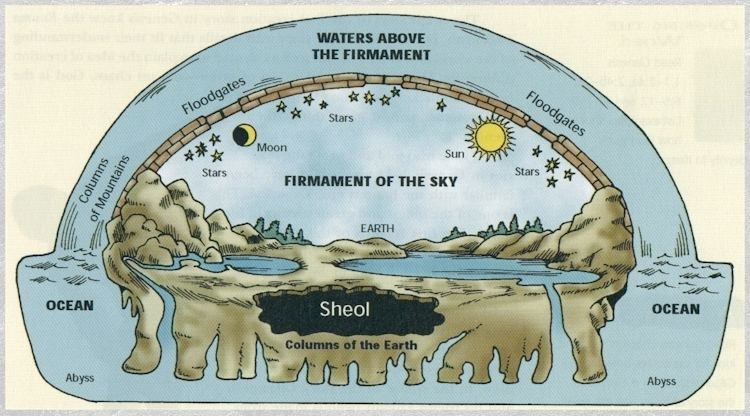
All of these things were assumed to have been created by one or more of the gods, who themselves were created by a superior god or were magically born from the primordial chaos.
Of course, this ancient model of the cosmos was completely wrong, but it was sufficient for the day, and more detail would only have confused them even more than they were. Even today, thousands of years later, the more we discover about the cosmos, the more we know that we are still missing key details.
So why would our God care if the ancients knew all truth about such a complex structure? It was way too early to ask humanity to grasp the incredible complexity of the universe.
The important thing was that they be taught that He is the true creator and He preexisted all else that exists.
So, God has summoned Moses back to his vantage point above the sea. He tells him to look up this time. When he does, he sees nothing but dark clouds. As he watches, God sends the wind to blow away the lower clouds. Layer after layer, the clouds part until nothing is left but what appears to be the dome, perhaps obscured by high, dark altostratus clouds that allow only a general glow to penetrate.
6 God said, “Let there be a dome in the middle of the water; let it divide the water from the water.” 7 God made the dome and divided the water under the dome from the water above the dome; that is how it was, 8 and God called the dome Sky. So there was evening, and there was morning, a second day.
—Genesis 1:6-8 (CJB)
Day 3
For a third time, Moses falls asleep and is carried in his dream to a vantage point above the primordial sea. Again, God speaks, and another long expanse of years rolls by in the course of the night, as on Day 1.
Moses observes during this dream another compressed passage of a great deal of time. The sea level falls as excess ocean water returns to the earth’s mantle. Land masses emerge and constantly deform and move under the influence of numerous processes, including plate tectonics, vulcanism, tidal forces, weathering, erosion, deposition, and many more, all decreed by God to assure a healthy and dynamic planet.
9 God said, “Let the water under the sky be gathered together into one place, and let dry land appear,” and that is how it was. 10 God called the dry land Earth, the gathering together of the water he called Seas, and God saw that it was good.
—Genesis 1:9-10 (CJB)
Now that God has shown Moses the magnitude of His glory in creation of the greater cosmos and earth, as understood by the ancients, He is ready to begin demonstrating that it was also at His hand that earth was filled with life.
God speaks once again and Moses sees many species of plant life that have begun to develop, spread, and differentiate to fill vast areas of the land and sea, adapting to environmental changes over many generations. From time to time, God or His angels intervene to bridge wider gaps and fill niches that adaptation alone can’t cross. I discuss “adaptation” vs. “evolution” in an appendix below.
11 God said, “Let the earth put forth grass, seed-producing plants, and fruit trees, each yielding its own kind of seed-bearing fruit, on the earth”; and that is how it was. 12 The earth brought forth grass, plants each yielding its own kind of seed, and trees each producing its own kind of seed-bearing fruit; and God saw that it was good. 13 So there was evening, and there was morning, a third day.
—Genesis 1:11-13 (CJB)
Day 4
I don’t believe that God is showing Moses anything new on this night. The sun, moon and stars were in their place in the sky at the close of the first night’s dream, though Moses probably was unaware of them until now. The way I presented this scenario above, billions of years of history scrolled by Moses in one night, which he couldn’t possibly have taken in. Perhaps he was only shown the beginning and end of the process—from the flash of light to the surface of water-world Earth. And perhaps during dreams 2 and 3 the sky has been obscured by clouds. In any case, now God wants to draw his attention to the cosmos above, so we have a clear sky.
Just what did Noah see? Just exactly what he expected to see, and what he had seen every day of his long life, which from his limited perspective was stars rolling by in grooves at the bottom surface of the sky dome, and the sun and moon being carried from east to west by, as he now would have seen it, God’s angels. Once again, the emphasis is on, “I, Yahweh, did it all, Moses!”
14 God said, “Let there be lights in the dome of the sky to divide the day from the night; let them be for signs, seasons, days and years; 15 and let them be for lights in the dome of the sky to give light to the earth”; and that is how it was. 16 God made the two great lights — the larger light to rule the day and the smaller light to rule the night — and the stars. 17 God put them in the dome of the sky to give light to the earth, 18 to rule over the day and over the night, and to divide the light from the darkness; and God saw that it was good. 19 So there was evening, and there was morning, a fourth day.
—Genesis 1:14-19 (CJB)
Day 5
This is where God begins showing Noah the climactic introduction of sentient life (conscious creatures, with sensations and perceptions). Beginning with denizens of the seas and the air.
As with the plants, God has created numerous species, to fill many habitats. They are designed for adaptation to changing conditions, but, like the plants, they need an occasional nudge. Once again, I discuss “adaptation” vs. “evolution” below.
20 God said, “Let the water swarm with swarms of living creatures, and let birds fly above the earth in the open dome of the sky.” 21 God created the great sea creatures and every living thing that creeps, so that the water swarmed with all kinds of them, and there was every kind of winged bird; and God saw that it was good. 22 Then God blessed them, saying, “Be fruitful, multiply and fill the water of the seas, and let birds multiply on the earth.” 23 So there was evening, and there was morning, a fifth day.
—Genesis 1:20-23 (CJB)
Day 6
On day six, God is approaching the climax of the dream series with Moses. Sentient animal species other than sea creatures and birds. Animals first, and then pre-Adamic mankind. Evidence for mankind goes back for some three million years. Evidence for Homo sapiens for 300,000 years. See “adaptation” vs. “evolution” below.
In my opinion, Adam and Eve were not part of general creation as revealed in Genesis 1!
As discussed in Exploring the Garden of Eden, I believe that both scripture and theological logic raise a pretty good case that they were created separately, about 6,000 years ago.
24 God said, “Let the earth bring forth each kind of living creature — each kind of livestock, crawling animal and wild beast”; and that is how it was. 25 God made each kind of wild beast, each kind of livestock and every kind of animal that crawls along the ground; and God saw that it was good.
26 Then God said, “Let us make humankind in our image, in the likeness of ourselves; and let them rule over the fish in the sea, the birds in the air, the animals, and over all the earth, and over every crawling creature that crawls on the earth.”
27 So God created humankind in his own image;
in the image of God he created him:
male and female he created them.
28 God blessed them: God said to them, “Be fruitful, multiply, fill the earth and subdue it. Rule over the fish in the sea, the birds in the air and every living creature that crawls on the earth.” 29 Then God said, “Here! Throughout the whole earth I am giving you as food every seed-bearing plant and every tree with seed-bearing fruit. 30 And to every wild animal, bird in the air and creature crawling on the earth, in which there is a living soul, I am giving as food every kind of green plant.” And that is how it was. 31 God saw everything that he had made, and indeed it was very good. So there was evening, and there was morning, a sixth day.
—Genesis 1:24-31 (CJB)
Appendices
Adaptation vs evolution
For my whole life until lately, I’ve avoided taking a stance on evolution, because biology and genetics aren’t my scientific strong suits. I’ve always been extremely skeptical of biological evolution, but I figured if that’s the way God chose to design life, He is entirely free to have done it. With a little help, I’ve finally decided on the stance I will take going forward.
First, let me point out that, despite usage of the term in both religious and secular circles, “evolution” in this context applies only to the development of living things. In its generic sense, the word simply means change over time, so yes, everything evolves. But “biological evolution” is a specific set of processes that change the ontological properties of living things. The non-living universe does not experience “survival of the fittest”, and it does not rely on mutation and genetic transmission. It simply follows the physical laws that God built into it, including quantum uncertainty, and takes an orderly path of cause and effect. I don’t call this evolution!
As for biological evolution, there are still two things that prevent me from considering myself an evolutionist:
The first is that, though many proposals have been made and many experiments have been conducted, nobody has ever come up with a workable explanation for how non-life becomes life! The latest theory is that life originates at deep-ocean geothermal vents, white or black “smokers.” But there has never been a test conducted or an equation written that can explain a mechanism for going from non-living to living even here. The closest thing is that there is generally a huge abundance of life around these vents. But does a huge crowd at a Kansas City Chiefs Superbowl rally prove that life originated inside Union Station? Probably not.
A competing theory that has been around for ages and has been getting a lot of attention lately is called Panspermia. Life was “seeded” on earth by aliens (other than God) or an impact event—a comet or an asteroid. This idea just shoves the problem off of this planet onto another.
The second problem with biological evolution, “irreducible complexity“, was introduced to the Christian community by Lehigh biochemist Michael Behe in his well-articulated book, Darwin’s Black Box (1966) and two subsequent books, The Edge of Evolution (2007) and Darwin Devolves (2019).
Behe is best known popularly for his support of Intelligent Design, but he is not a Young Earth Creationist. Like me, he believes that God created the universe billions of years ago. He believes that God created life, that He gave it the ability to adapt, and that the new science of genomics proves “line of descent.”
That latter means that the Darwinian Tree of Life is more or less accurate—but irreducible complexity means that God’s intervention is necessary for adaptation to cross certain boundaries.
Creationists in general agree that adaption occurs within species. Behe only disagrees to the extent of saying that it occurs within biological Orders, or perhaps Families.
I find that I can agree with Behe’s approach. It makes logical sense to me and leaves God in control!
I just go one step farther and claim that Adam and Eve were a separate creation, approximately 6,000 years ago. Nowhere does Scripture state that Genesis 2 is a restatement of Day 6. That assumption is Judeo-Christian tradition, and in fact there are discrepancies in the two accounts if they are taken literally.
Birth as analogy
Many of you will still say that creation 13.8 billion years ago at the Big Bang is not as elegant as creation 6,000 years ago as recorded in a literal translation of Genesis 1.
I don’t see it that way at all! Perhaps it is because from an early age I have been fascinated by both the Creator and His creation. Creation is His art, His medium and His signature accomplishment.
Consider the following well-known verse:
For you formed my inward parts;
you knitted me together in my mother’s womb
—Psalm 139:13 (ESV)
If you read this in the exact same way as you read Genesis 1, you can interpret it as saying that God Himself personally assembled all of your component parts in your mother’s womb during those nine months, or even (why not) on the day you were born.
You say, “It couldn’t be on the one day, because she saw me on an ultrasound, and she felt me kick, and besides, we all know how gestation works.”
But wait, did you really see any of that, or are you believing doctors, researchers, and medical equipment. Maybe that kick was actually a gas bubble! You believe them just as I believe my telescope and my astrophysics training in college. My bachelor’s studies were in math and physics, preparing (alas, it didn’t happen) for astrophysics as my graduate field.
Let me now approach this from a different direction. My wife gave birth to both of our children. Not all smooth sailing, but at least she can smell popcorn now without getting sick. Would she trade those 18 difficult and uncomfortable months of pregnancy for an easy adoption? No. Adoption is a good thing, but gestation and birth are transcendent.

 The Back of My Mind