After the Dreams: Day 7 Thru Seth

Posted on:

Modified on:

  1. Day 7
    1. The Sabbath
    2. Calendars
    3. The Host
  2. The garden
    1. Chapter 2 outline
    2. The garden’s function
  3. The temptation
    1. The serpent
    2. Satan or satans
    3. The banishment
  4. Adam’s children
    1. Cain and Abel
    2. Cain’s descendants
    3. Seth
  5. Coming next

In Genesis 1:1–5, Day 1 and a number of earlier posts I presented a case for Old Earth Creationism and why I believe that Genesis 1 can only be interpreted as a visionary prophetic revelation, not a historical account.

In my most recent post, Moshe’s Week of Dreams, I presented a hypothesis as to why Genesis 1 reads as it does, presenting a 6-day creation process, beginning with light, and building to a description of the cosmos that matches what ancient peoples imagined it to be, a flat, floating island earth protected from the ocean above by a dome, under which reside the sun, moon and stars. All of us would agree that this description doesn’t match what we observe today.

Yet another ancient cosmos diagram. I have posted at least a half dozen versions of this, because each ancient culture had a similar conception, differing mostly in small detail. This one matches the Genesis 1 description. ©Logos Bible Software

Interpreting Genesis 1 as visionary and not literally descriptive begs the question: What about the rest of prehistoric Genesis, i.e., Genesis 2:1–11:9?

Well, in my view it is all prophetically revealed, but it is not clear to me that any of it is visionary, or that much of it is even non-literal. Prophecy can reveal truth in subtle and symbolic ways, or it can show truth directly.

My own interpretations of prophecy make use of the so-called “Golden Rule of Biblical Interpretation”:

“When the plain sense of Scripture makes common sense, seek no other sense; therefore, take every word at its primary, ordinary, usual, literal meaning unless the facts of the immediate context, studied in the light of related passages and axiomatic and fundamental truths, indicate clearly otherwise.”
–Dr. David L. Cooper (1886-1965),
founder of The Biblical Research Society

If you aren’t a theology buff like me, you may not have heard of this particular Golden Rule outside of my blogs. Something very similar that you probably have heard of in high school science classes is called Occam’s Razor. Its actual wording is, “entities should not be multiplied beyond necessity”, meaning that, if you are faced with several alternative solutions to a problem, always start out with the simplest; or, alternatively, the one requiring the fewest assumptions.

Genesis 1 does not make “common sense” in the context of the universe as we can plainly see it today, so I choose to look for truth revealed more abstractly there.

The rest of the “prehistoric” material, though, is easier for me to accept literally. To a quite large extent, much of it does in fact meet the commonsense test for me. In this post and hopefully the next, I’m going to walk you through that material, starting in Eden and ending in the world after Babel.

There is actually a lot of material here, and since I’m confident that there is a lot of misunderstanding in Christian traditions about the era, I’m going to cover only the things I don’t think you are likely to have been taught… or taught correctly!

In this post, we’ll walk through the next three chapters of Genesis, where I’ll point out some more interpretations that you may not have heard before, regarding creation day 7, the Garden of Eden, the Temptation, and Adam’s most prominent children.

I’m sure you’ve noticed that my writing tends to get a bit deep occasionally, and what follows is no exception.

The reason for that is because I present a lot of interpretations (even occasionally one of my own) that veer from the “strictly orthodox“. When I challenge church traditions that have no, or in my view insufficient, textual backing, then I think I have to provide some solid evidence. If some of it goes over your head, then at least I hope you’ll try to skim through it for the gist. Whether I’m right or wrong, I don’t want you to think I’m making things up!

Day 7

Genesis 2:1–3

This “seventh day of creation” is appropriately split off into Chapter 2 in modern translations of Genesis because it is fundamentally different from the other six days. While this may be a continuation of the dream series I postulated for Genesis 1, the “evening and morning” motif is conspicuously missing.

The Sabbath

No creation is done on this day. Instead, it is used to set a spiritual principle for the importance of rest and renewal. More importantly, it is also a celebration of Creation, in particular for the Creator Himself, Yahweh.

The suggestion that God needed a day to rest from His labors is of course a literary device, not a serious concern. God is a spirit (רוּחַ, ruach), physically encompassing and controlling the entire universe. He has no nutritional requirements, and evidently His activities expend no energy that would require replenishment.

He is, however, the ultimate source of order on earth and in the universe at large! Much of what follows is about God maintaining and, when necessary, reestablishing order in Creation as evil spreads on earth, and even in the celestial realm.

Calendars

The concept of weeks as a calendar-ordering system predates Moses. The earliest archaeological evidence for the grouping of solar days into weeks (usually, but not always, 7-day cycles) appears in the era of Nimrod, about 2300 BC. The practice of assigning ceremonial purpose to one or more days each week may go back almost as far.

The Hebrews were apparently first to sever the cycle of weeks from the monthly and annual cycles—meaning, for example, that a calendar week for most of the modern world is always exactly seven days, irrespective of how many days may constitute a month or a year.

The Host

One very important factor that’s usually missed in studies of these three short verses is the word “host.” Ignoring here the modern “host and hostess” concept, “host” is the Hebrew: צָבָא (tsaba) meaning a large number of something, an army, or war.

[2:1] Thus the heavens and the earth were finished, and all the host of them.
—Genesis 2:1 (ESV)

In modern English, we think of “host” in generic terms, for example, “a host of reasons.” ESV, NKJV and YLT, like KJV, have left further interpretation of the term, as it appears in verse 2:1, up to the reader, but many modern translations go further and assume that it is speaking of a large number of created “things”, like stars, planets, etc. Examples of such translations include:

  • “Everything in them”, CJB, HCSB
  • “All that filled them”, NCV
  • “In all their vast array”, NIV
  • “In all their multitude”, NRSV
  • “All their inhabitants”, AMP
  • “All their heavenly lights”, NASB

A Biblical lexicon or a concordance lists the various ways that a word has been translated, without passing judgement on how it should have been translated. I believe that the term “host” in Genesis 2:1 and other passages with a similar context is speaking not of inanimate or miscellaneous things, but specifically of the angelic armies that God created to manage the cosmos. Translators have mostly missed this connection because angelology is so poorly understood and under-appreciated by most theologians.

Note that God is often referred to in Scripture as Adonai Sabaoth, “The Lord of Hosts/Armies.” Angelic beings are not just an afterthought, pets, slaves, or “gofers” of any kind. They are important residents of the created universe, members of God’s heavenly family.

I believe that this verse sets the time of their creation: At or near the beginning of the 13+ billion-year life of the universe.

Of course, that also fits with the concept that the Host was created to do for the universe what humankind was to do for the inhabitable earth: To subdue it and maintain it.

The garden

Genesis 2:4–24

I discussed Genesis 2 and 3 in detail in Exploring the Garden of Eden. Briefly, I believe that they were real people living in a real Garden of Eden, and their temptation and failure were real events. Beyond that, as explained there I do have some issues with traditional interpretations:

Chapter 2 outline
  1. Gen 2:4 is a toledah, a genealogy marker, separating the previous text from what follows, which I believe is a separate creation story, not a retelling of any part of chapter 1. Gen 1:26 describes the creation of early man, before Adam and Eve were added to their number to perform a specific function.
  2. Gen 2:5–6 describes conditions, not over the entire earth, but just over the land (אֶרֶץ, eretz) that would become the holy Garden. Eden was too arid to support any “bush of the field” (wild vegetation) and it was not as yet inhabited, or under cultivation.
  3. In Gen 2:7, Adam was formed (יָצַר, yatsar) by God, not created ex nihilo (בָּרָא, bara’) as in Gen 1:26. “Dust of the ground” refers simply to the chemical elements occurring on earth, perhaps specifically in the soil of the Garden. The “breath of life” is something that I don’t believe can happen spontaneously through any “Biopoiesis” process, i.e., “a supposed origination of living organisms from lifeless matter” as assumed by all non-theistic evolutionary theories. Note: “Panspermia” theories (life seeded on earth from extraterrestrial sources) don’t solve the ultimate question: How did the first life arise? It has never been shown how non-life can become life, aside from creation.
  4. In Gen 2:8–9, God then (after forming Adam) planted (נָטַע, nata, not a creative act, though no doubt done with a supernatural boost) a garden (גַּן, gan, an enclosed area, normally in those days planted with trees) “eastward in Eden“. This garden was not Eden itself but was an area evidently on the eastern side of a region by that name.
  5. In Gen 2:10–14, “A river flowed out of Eden to water the garden…”. The river flowed out of Eden and into the Garden. “There [presumably in Eden, upstream of the Garden!] it divided and became four…” Not simply “rivers” or “streams” as most translations state, but רֹאשׁ (ro’sh), meaning in this case “headwaters“, that is, the source waters that filled the river running into the Garden. In my Garden of Eden post, I explain why rivers that divide running downstream are unstable and quickly either recombine, divert into a single channel or dissipate altogether. I then use this information to firmly establish the location of the Garden in present-day southern Iraq—from information contained in the Biblical account.
  6. In Gen 2:15–17, there is no prohibition of eating from the Tree of Life. Gen 3:22 implies that it was in the Garden in order to give Adam and Eve a semblance of immortality, which further suggests that they were not created immortal to begin with. See Romans 5:12 and Death Before the Fall.
  7. In Gen 2:18–24, once God announced (surely to His Divine Council) that He intended to make a suitable helper for Adam, He first allowed the man to observe what that concept meant to other creatures. Animals had already been created (bara’, ex nihilo) outside the Garden. Rather than resume the creation (bara’) process discussed in Gen 1, He chose now to form (yatsar) new animals from the elemental “dust”, in the same way He had formed Adam. From the context, these were male/female pairs. Whether they were existing species or freshly designed for the Garden is unspecified. My own assumption is that Adam’s task was to become familiar with them to the extent that he gave them personal names, like Mickie and Minnie, for instance, rather than “male and female deer mouse” (Peromyscus maniculatus). Once Adam understood the picture, God made him an appropriate human companion.
The garden’s function

Over the years I’ve heard several suggestions that the Garden of Eden, in addition to being an idyllic home for Adam and his family, was actually a prototypical tabernacle for worship of Yahweh.

This is fodder for a future full article on its own, but for now I’ll just say that I agree! All of the necessary elements are in place, and the Garden as Temple/Tabernacle fits nicely with my knowledge of the way God typically does business. When you study the history of such facilities, you see that the Temple serves as a “home” for Yahweh in the midst of His people. We know that God is omnipresent in the universe, but as long as His people are obedient, He delights in maintaining an “interface” with them, as for example, His sh’kinah presence hovering over the Ark of the Covenant in the Holy of Holies.

In this verse, the picture is not one of God dwelling in heaven and periodically visiting in the Temple. It is one of God remaining in the Temple where He is accessible. For example, among the blessings of keeping His commandments, God promises:

[11] I will put my tabernacle among you, and I will not reject you, [12] but I will walk among you and be your God, and you will be my people.
—Leviticus 26:11–12 (CJB)

When King David offered to build a permanent Temple in Jerusalem, God replied:

[6] Since the day I brought the people of Isra’el out of Egypt until today, I never lived in a house; rather, I traveled in a tent and a tabernacle. [7] Everywhere I traveled with all the people of Isra’el, did I ever speak a word to any of the tribes of Isra’el, whom I ordered to shepherd my people Isra’el, asking, “Why haven’t you built me a cedar-wood house?”’
—2 Samuel 7:6–7 (CJB)

The concept of God “tabernacling” with His people is so important that, out of the seven feasts that Israel was ordered to observe every year in perpetuity, it is celebrated by the most joyous and anticipated feast of all. The Feast of Tabernacles is celebrated in Jerusalem and around the world beginning on Tishri 15 every year. In fact, it is such an important occasion that Tishri 15 of the Gregorian year 4 BC was the date that Yahweh chose for the Son to be born in Bethlehem (see The Jewish Feasts: Part 14, Tabernacles)!

Jesus’ birth date, the first day of the 8-day Feast of Tabernacles in AD 4. His circumcision was on the final day of the Feast. Among other functions, all the Leviticus 23 feasts prophesied events in Jesus’ two advents. ©Ron Thompson

Given the above, God’s activities in verse 8, below, are explained very well:

[8] They heard the voice of ADONAI, God, walking in the garden at the time of the evening breeze, so the man and his wife hid themselves from the presence of ADONAI, God, among the trees in the garden.
—Genesis 3:8 (CJB) emphasis mine

The temptation

Genesis 3

This is a vitally important passage of Scripture, and I am 100% convinced that the essential lesson—that the very real Satan tempted the very real Adam and Eve and brought about very real and horrendous curses that still afflict this planet—is absolutely true.

I would refer you to Exploring the Garden of Eden for a fairly comprehensive exposition of this chapter. I do, however, have a lot more to say here about one of the principal characters of the story:

The serpent

I have read somewhere that the serpent, prior to its curse, was a quadruped and the most beautiful of all the animals on earth. How could anyone know that? Obviously, the idea is pure fantasy!

As a matter of fact—don’t hang up on me here—by today’s literary standards the serpent story is a fable, along the lines of Rudyard Kipling’s famous tales like How the Camel Got its Hump, or How the Leopard Got its spots. But read on before you judge me too harshly…

In the ancient world of the fertile crescent, the genre of “fable” was a common and respected way of transmitting real history. What made a story a fable was not that it was necessarily fiction, but that it contained a moral lesson. In mid-2024 I wrote a short (believe it or not) article titled Religion vs. Mythology in which I quoted Egyptologist Bob Brier: “Mythology contains stories [set in the primordial past] that are not [necessarily] to be taken literally but answer basic questions about the nature of the universe.”

In other words, mythology usually contains at least some metaphorical historical content but always seeks to teach a useful lesson about reality. The question here becomes, “What part of the Serpent story, if any, is metaphorical? I’ll answer that with a brief analysis framed as a Q&A:

  • First, was the serpent really Satan, as we’ve all been taught?

    Absolutely! That point is clarified several times in Scripture, including:

[20:1] Then I saw an angel coming down from heaven, holding in his hand the key to the bottomless pit and a great chain. [2] And he seized the dragon, that ancient serpent, who is the devil and Satan, and bound him for a thousand years,
—Revelation 20:1 (ESV)

  • Was Satan really a snake?

No, that’s the metaphor part. To unbelievers, everything supernatural in the Bible is by definition metaphorical. That is no reason for believers to dismiss the possibility that God used metaphor at times when the cultural context made metaphor the best way to dramatize a truth.
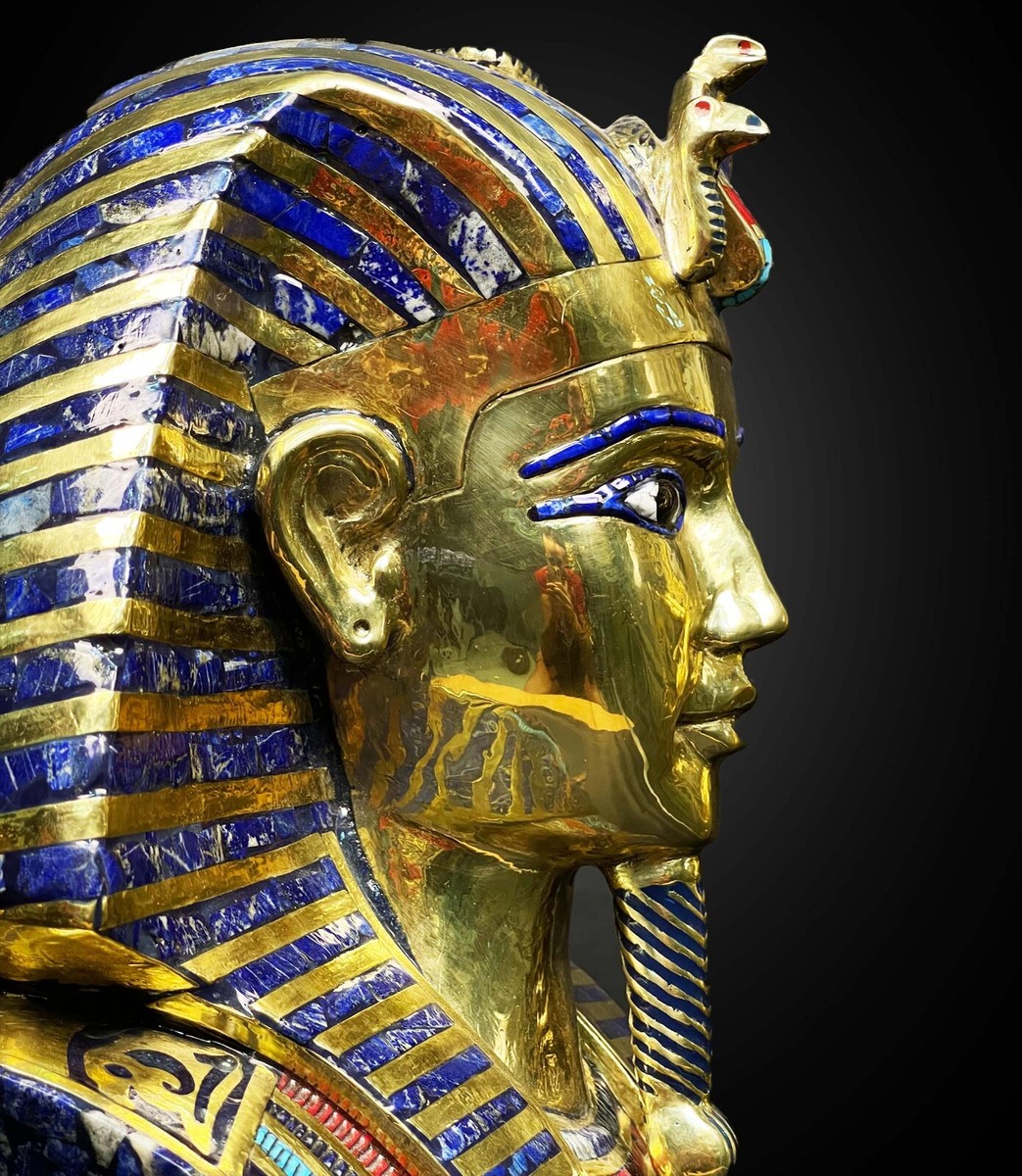
King Tut’s Mask. Note the two snakes, symbolizing the two kingdoms, Upper and Lower Egypt.

If you find slithering snakes to be creepy, well, so did the ancients. Not only are their appearance and habits unsettling and their nests often hidden and/or in the wilderness, which is where all matter of evil spirits were known to reside, but they are of course potentially very deadly.

Snakes were plentiful in the Ancient Near East (ANE), and they were of course the subject of much supernatural dread. Snake images were associated with a number of the pagan gods and were appropriated by pagan human rulers to demonstrate their association with those gods.

  • If Satan wasn’t a snake, what was he?

Satan was a corrupt, high-ranking angelic being, a spirit with the ability to take on corporeal form, like a human or, in this case, a reptile. Specifically, he was a cherub:

[14] You were a keruv [cherub], protecting a large region;
I placed you on God’s holy mountain.
You walked back and forth
among stones of fire.
—Ezekiel 28:14 (CJB)

Cherubim and Seraphim (while not technically “angels”) are spirit beings created to guard God’s throne and other sacred objects. The terms “garden of God” and “mountain of God” refer to any location where Yahweh is “officially” in residence. The “stones of fire” are the spirits present: Yahweh, His guardians, and the “sons of God” on His “Divine Council.

I won’t document those definitions here, except to point out that God didn’t “come down” to visit with Adam and Eve; He was coresident with them in Eden, along with His spirit retinue. Satan was present, as a matter of course. He violated the trust given him by God. The verses following the passage last quoted tell the consequences:

[15] You were perfect in your ways
from the day you were created,
until unrighteousness
was found in you.
[16] “‘When your commerce grew,
you became filled with violence;
and in this way you sinned.
Therefore I have thrown you out, defiled,
from the mountain of God;
I have destroyed you, protecting keruv,
from among the stones of fire.
[17] Your heart grew proud because of your beauty,
you corrupted your wisdom for the sake of your splendor.
But I have thrown you on the ground;
before kings I have made you a spectacle.
—Ezekiel 28:15–17 (CJB)

  • Did Adam and Eve see a snake, or something else?

Yes… Okay, my guess is that they saw a snake, but whatever they saw or sensed, they recognized him as one of the resident cherubim. There is no mention of fear, or of surprise at a talking snake.

  • If Satan wasn’t really a snake, then why did God curse snakes?

Good question! The answer is, He didn’t!

A Coast garter snake. ©Steve Jurvetson

It sounds like He did, but remember that I’m billing this as “mythologized” history. Real history, told in the dramatized way that history was frequently taught in antiquity. Snakes weren’t beautiful quadrupeds before the fall, they were beautiful… snakes! God designed snakes to “crawl on [their] belly” because that is what best suited them for their ecological niche. As for “eating dust”, that isn’t a snake function, but I imagine it does happen from time to time, given their proximity to the ground. I’m confident that snakes are quite happy in their own niche! And many of them are still quite beautiful.

  • But why would a Cherub be given a snake’s punishment?

What God actually cursed was the being that was impersonating a snake: Satan, a.k.a., the Serpent. The persona that Satan chose to adopt, or that Moses chose to assign to him, was that of a Serpent, and Satan’s curse was worded accordingly.

That curse is given in Genesis 3 and is explained in the Ezekiel passage quoted above and in Isaiah:

[11] Your pride has been brought down to Sh’ol
with the music of your lyres,
under you a mattress of maggots,
over you a blanket of worms.’
[12] “How did you come to fall from the heavens,
morning star, son of the dawn [Lucifer, son of the morning in KJV]?
How did you come to be cut to the ground,
conqueror of nations?
[13] You thought to yourself, ‘I will scale the heavens,
I will raise my throne above God’s stars.
I will sit on the Mount of Assembly
far away in the north.
[14] I will rise past the tops of the clouds,
I will make myself like the Most High.’
[15] “Instead you are brought down to Sh’ol,
to the uttermost depths of the pit.
—Isaiah 14:11–15 (CJB)

It takes some context to understand it:

[14] ADONAI, God, said to the serpent, “Because you have done this, you are cursed more than all livestock and wild animals. You will crawl on your belly and eat dust as long as you live.
—Genesis 3:14 (CJB)

  • In Biblical imagery, the celestial “angels” are compared to stars in heaven. The highest ranking of these beings are called the “sons of God,” and are likened to the “morning stars“, stars that are bright enough to shine even as the sky lightens near sunup.
  • Ezekiel says that “When your commerce grew, you became filled with violence”, and Isaiah calls him a “conqueror of nations.”Growth of commerce” means increase in power and renown. Just like humans, spirit beings have free will and thus a propensity for pride, arrogance, and envy. I don’t know what, specifically, the prophets had in mind here, but evidently at some point in his 13-billion-year life, he became involved in battles involving either other angelic beings, or humans, or both.
  • Genesis 3 marks the last straw for God. Satan’s lies to Eve and contradiction of God rose to open rebellion, which the Most High could no longer tolerate. [Note: this is the first of three angelic rebellions in Scripture; the other two will be covered in my next post.]
  • Because of the context in which it was uttered, “You will crawl on your belly and eat dust as long as you live” does indeed sound like perhaps a quadruped is being cursed to lose its four legs and instead slither from place to place. But what are we left with if we remove the mysterious quadruped from the snake story?

In Ezekiel 28:17, we read “But I have thrown you on the ground” and in Isaiah 14:15, we have “Instead you are brought down to Sh’ol, to the uttermost depths of the pit.”

In Ezekiel, the Hebrew word translated ground is אֶרֶץ (eretz). Eretz can, in some instances, be translated country, earth, field, ground, nations, way, and a few more alternatives. In the NAS Exhaustive Concordance, the word is most commonly (1,581 times) translated as “land.” In such cases the application is almost always to holy land, usually to the Land of Israel (eretz Yisrael), but also to the Garden of Eden, Mt. Sinai, the Tabernacle and other places marked for worship of Yahweh.

Key here, though, is that eretz is often used, especially in ancient Hebrew extrabiblical writings, as a euphemism for Sh’ol, a.k.a., the underworld, the pit, or the place of the dead. This immediately brings Ezekiel 28:17 into alignment with Isaiah 14:15, where Sh’ol is mentioned explicitly.

I have no doubt whatsoever that this is the Serpent’s curse, stated pictorially in accordance with the fable genre.

Satan or satans

With Satan kicked out of heaven as early as the Garden of Eden, you may wonder how it is that he is apparently welcomed back to have cordial chit-chats with God over things like Job’s faith…

A lot of my material in this post comes from the books of the late Michael S. Heiser: The Unseen Realm, Demons, Angels, Reversing Herman, etc. Also, books and papers that he cites. Most of what he teaches strikes me as solid exegesis, and makes good, common sense. With respect to his angelology and demonology, and his Old Testament theology and ANE history, I’m pretty much fully onboard with him. But though I am a Trinitarian, his arguments in support of that doctrine seem weak to me, and I leave his train altogether when he talks about the Church now being “the true Israel.”

With respect to this particular section, I’m firmly onboard with him, but many scholars are not. This is perhaps a good place to remind you that, while I think my principal spiritual gift is theological discernment, you are free to disagree. Please remember that I don’t believe that inspired prophets still exist among men, and I have no illusions that my posts are “inspired.” Neither are Heiser’s books.

As with so many other “fringe” doctrines that we’ve grown up believing, the idea that the Serpent of the Garden, the “archenemy“, is the “satan” of Job is an assumption made long ago that can’t be proven from Scripture.

I’m way past caring about “orthodoxy”; my desire is to understand the Person and Word of God to the best of my ability. If I’m wrong, I’m wrong…

Heiser points out that the Hebrew noun, שָׂטָן (satan), occurs only a couple times in the Old Testament without a definite article. Every other occurrence is in the form הַשָּׂטָ֖ן (hasatan), meaning “the satan“, i.e., “the adversary“, or “the accuser.” This is probably not the same guy!

The grammatical rules for Hebrew match English in this respect: When prefixed by an article (“a”, “an”, or “the”), a noun is meant to be used as a common noun. “Satan” is a name for one particular being. “The satan” describes Satan and other beings, presumably of much lower rank than the Serpent.

As Heiser says, you can call him “Mike”, but it isn’t grammatically correct to address him as “the Mike.”

Considering the satan in Job:

[6] It happened one day that the sons of God came to serve ADONAI, and among them came the Adversary [the satan, Hebrew: hasatan]. [7] ADONAI asked the Adversary, “Where are you coming from?” The Adversary answered ADONAI, “From roaming through the earth, wandering here and there.” [8] ADONAI asked the Adversary, “Did you notice my servant Iyov [Job], that there’s no one like him on earth, a blameless and upright man who fears God and shuns evil?” [9] The Adversary answered ADONAI, “Is it for nothing that Iyov fears God? [10] You’ve put a protective hedge around him, his house and everything he has. You’ve prospered his work, and his livestock are spread out all over the land. [11] But if you reach out your hand and touch whatever he has, without doubt he’ll curse you to your face!” [12] ADONAI said to the Adversary, “Here! Everything he has is in your hands, except that you are not to lay a finger on his person.” Then the Adversary went out from the presence of ADONAI.
—Job 1:6–12 (CJB)

The occasion is a standard gathering of the Divine Council. The “sons of God” were created for the purpose of assisting God in the administration and governance of the vast universe. Their duties included advice and council, which was the function of this assembly. Does God need any of this help? I assume not (He’s God!), but they are His created family, and He values their fellowship and assistance. Just as we believe God values the fellowship and assistance of His earthly family—us!

Ranking below the sons of God in the Heavenly Host are a group of “satans”, whose function is to “roam through the earth, wandering here and there” (Job 1:7), keeping tabs and reporting back. Heiser compares them to a prosecutorial staff. Or, as I think of it, a “Heavenly OSHA.” In this passage, the satan is just doing his assigned task. He’s not behaving in an evil fashion at all, and there is no hint of rancor in the conversation.

If you think that is a fanciful interpretation of Job, consider the following Divine Council example from 1 Kings: This is the prophet Micaiah describing his vision of a meeting of the Council in which Yahweh has asked for advice on how best to entice the evil King Ahab into a hopeless battle:

[19] And Micaiah said, “Therefore hear the word of the LORD: I saw the LORD sitting on his throne, and all the host of heaven standing beside him on his right hand and on his left; [20] and the LORD said, ‘Who will entice Ahab, that he may go up and fall at Ramoth-gilead?’ And one said one thing, and another said another. [21] Then a spirit came forward and stood before the LORD, saying, ‘I will entice him.’ [22] And the LORD said to him, ‘By what means?’ And he said, ‘I will go out, and will be a lying spirit in the mouth of all his prophets.’ And he said, ‘You are to entice him, and you shall succeed; go out and do so.’ [23] Now therefore behold, the LORD has put a lying spirit in the mouth of all these your prophets; the LORD has declared disaster for you.”
—1 Kings 22:19–23 (ESV)

One of God’s spirit advisors has suggested a plan. Yahweh approves it, and Yahweh assures that it succeeds.

Don’t misunderstand… Satan, the Serpent, is real and malevolent, the Archfiend. This is Paul’s “roaring lion”, and the Dragon of Revelation.

Nevertheless… I’m saying that not all mentions translated “Satan” in the Old Testament are about Satan, the Serpent of the Garden. Most of them are random satans (small “s”), including the satan of Job. Jesus Himself was functioning as “a satan” (an adversary) when He cleansed the Temple.

The banishment

A few observations from verses 20–24:

  • What Adam actually named his wife, in Hebrew, was חַוָּ֑ה (Chavah). I know, it’s impossibly idealistic, but if someone goes by José, it seems to me to be insulting to call him Joe. Unfortunately, the Hebrew “ch” sound is a very difficult guttural for English speakers to pronounce.
  • I’ve seen many suggestions that the animal-skin garments that God made for Adam and Eve (sorry, Chavah!) were from animals sacrificed as a blood atonement. No. They got what God promised they would get for eating the forbidden fruit! But let’s examine the rationale for the view:

The verse most often quoted is:

[22] And almost all things are by the law purged with blood; and without shedding of blood is no remission.
—Hebrews 9:22 (KJV)

But this is a general statement about the use of blood in cleansing rituals of all kinds, and the immediate context is more about the purification of objects than of people. The Hebrews author is using an Old Testament scripture midrashically.

Midrashically refers to the method of interpreting biblical texts through midrash, which involves exploring deeper meanings, filling in narrative gaps, and providing ethical or theological insights. This approach allows for creative and expansive readings of scripture beyond the literal text. myjewishlearning.com

A midrash is by nature a secondary source that applies the primary source in ways that were not necessarily intended in that original. This is done frequently in the NT, particularly by Paul. It would be much more to the point here to quote the OT text being referenced by the Hebrews passage:

[11] For the life of a creature is in the blood, and I have given it to you on the altar to make atonement for yourselves; for it is the blood that makes atonement because of the life.
—Leviticus 17:11 (CJB)

The context here is that God, through Moses, is giving two reasons that consuming blood, or meat with the blood still in it, is prohibited to Jews under the Covenant: (1) because blood is necessary for life, it is considered to be virtually the same as that life; and (2) God has sanctified blood that is shed on the altar as a means of atonement.

But even that has to be analyzed further:

  1. Some primitive forms of animal life do not in fact, require blood for life, which doesn’t negate the point of the prohibition.
  2. Not all animal blood is efficacious for atonement, only the blood of ritually clean animals. Again, the prohibition stands.
  3. Every sacrifice, to be effective, must be done in accordance with the rules set down in the Covenant.
  4. Though sacrificial offerings were made as early as Cain and Abel, we know of no specific cultus yet available to govern them, nor of any specific rationale for doing them.

I contend that it is a misappropriation to assume from either passage that Yahweh has made a “blood sacrifice” on behalf of Adam and Eve. Animal skins are more durable and provide better insulation and padding than plant leaves. It’s enough for me to know that God was compassionate with respect to the physical and emotional needs of the freshly cursed humans.

  • “Behold, the man…” הָֽאָדָם֙ (haadam). The same interpretive principal applies here as for Satan/hasatan: where the article is absent, a proper noun is intended; where it is present, expect a common noun. Adam (ah DAHM) is a name; haadam (hah ah DAHM) is a noun meaning “man”, “mankind”, or “human.” The latter is in view in verse 22.
  • “…eat, and live for ever.” See above for the implication of the Tree of Life in the Garden.
  • “…to till the ground from whence he was taken.” This is a bit ambiguous on its own and might give you pause. “The ground” is הָ֣אֲדָמָ֔ה (haadama). “Adam” comes from a Hebrew root meaning “red.” As does the related word adamah, meaning “earth” but referring not to the planet, but rather to the ground, especially (over 200 times in the Old Testament) to tilled land, productive soil, or Israel’s productive land in particular. The “ground” here refers not to the acreage within Eden, but rather more specifically to the “dust” from which he was formed.
  • “…the east of the garden…”. Given the presumed nature of the Garden as a tabernacle, it’s no surprise that its access was on the east side. The same is true of all correctly built temples and synagogues. Prayer is directed towards Jerusalem’s Temple Mount, wherever you might be, but access to the “holy space” is always from the east, where the sun rises.
  • “Cherubims” I’ve been quoting KJV in this list, and this word is grammatically incorrect, at least in this century. The Hebrew is הַכְּרֻבִ֗ים (hakerubim). “The cherubim” is plural without a trailing “s.” The singular of “cherubim” is “cherub“, which is an Anglicized transliteration of the Hebrew “kerub.” Cherubim, along with Seraphim, are heavenly “throne guardians.” Satan is a cherub. You probably picture just one cherub guarding the gate with a big sword in his fist, but there is a team of cherubim on hand here.
  • “…a flaming sword…” I don’t know if this is a literal sword or some other device, and whether it is handheld, mechanized, or animated. Evidently there is only one, so if handheld, only one of the cherubim would be armed with one.
  • What finally happened to Eden? My guess is that it was probably guarded until either it was finally destroyed, or until the Tree of Life was moved somewhere else. If it (the Garden) didn’t survive the centuries, it may have been swept away by the receding waters of the Great Flood.

Adam’s children

Genesis 4

Cain and Abel

Why was Cain’s veggie offering unacceptable? Maybe it included cauliflower or beets… That would do it for me!

Many will tell you that Cain’s offering was refused because it was not a blood sacrifice. Maybe, but I seriously doubt that interpretation. The Mosaic Covenant was still well over a thousand years in the future, so there was no standardized command for offerings that we know about. Abraham was over a thousand years in the future, too, so it wasn’t a Jewish thing.

(He did finally make a blood sacrifice, by the way… his brother!… that was refused, too.)

It has been suggested that God gave Adam a sneak preview of what offerings He was going to require in the future. Maybe.

In any case, they both made offerings from their own “sweat of the brow”, which would seem to be a good thing. With no information to the contrary, I would have to think that it had something to do with their respective motivations, or maybe he stole the veggies from Eve.

Other passages shed additional light:

[4] By faith Abel offered to God a more acceptable sacrifice than Cain, through which he was commended as righteous, God commending him by accepting his gifts. And through his faith, though he died, he still speaks.
—Hebrews 11:4 (ESV)

[24] and to Jesus, the mediator of a new covenant, and to the sprinkled blood that speaks a better word than the blood of Abel.
—Hebrews 12:24 (ESV)

[12] We should not be like Cain, who was of the evil one and murdered his brother. And why did he murder him? Because his own deeds were evil and his brother’s righteous.
—1 John 3:12 (ESV)

Aha! That last one is the answer. Cain’s rejection was not because of the form of his offering at all. Any offering he brought would have been rejected because God knew his heart!

Moving on, what was “the mark of Cain?” Don’t know, can’t know, so don’t care.

Where is the Land of Nod, to which Cain fled? The Bible says, “east of Eden,” which makes me think maybe Elam, or farther east than that. “Nod” is from the Hebrew נוּד (nuwd, pronounced “nude”), meaning to move to and fro, wander, flutter, or show grief.

Cain’s descendants

Genesis 4:17–24

As I explained above, I regard Genesis 2:4 as, in essence, a toledah (singular), or genealogical “spacer” to separate the various historical threads that Moses wrote about in the book.

Technically, the toledoth (plural) are genealogies, the “begats” of KJV. The beginning of Gen 2:4 is translated by KJV and ESV as “These are the generations of the heavens and the earth…”, where “generations” is in fact the Hebrew תוֹלְד֧וֹת (toledoth). Other popular translations render it as, for example, “Here is the history…” (CJB) or “This is the account…” (NAS), which are paraphrases and not necessarily incorrect. But presence of the Hebrew term makes it officially a toledah and that strengthens my opinion that the forming of Adam and Eve is a different event than the creation of mankind in general.

Gen 4:17–22 is a genealogy of Cain, and it separates Cain’s part of the history from Seth’s, so technically the passage is a toledah, but because that term doesn’t appear in the text, it isn’t generally included in lists of the toledoth. The reason may be that if you remove verses 23 and 24, the entire passage, Gen 4:17–5:32 is a single long toledah. Alternatively, 4:17–22, are also about Cain’s extended family, so it could perhaps be included as part of the toledah.

©biblestudy.org

My first reaction to verses 23 and 24 was to think, “well, they don’t conform to the way small bits of biographical information are inserted into some genealogies (see Genesis 10, which is itself one long toledah), but that must be what they are”, but looking at it today, it dawns on me that they seem out of place here, but they would fit perfectly in Chapter 6, which I will cover in a sequel to this post, under the heading “Corruption.” If this snippet wasn’t misplaced by scribal error, then it is simply an issue of author’s choice. Not a big deal.

I have just one more observation about Cain, until the next post.

Everyone wants to know… Where did Cain find a wife? Young Earth Creationists would say he took a sister with him to Nod. Possible, but creepy, so I’d rather it not be so. In any case, to me it is more likely that she was a member of one of the pre-Adamic races descended from the humans created in Genesis 1:26.

Seth

Genesis 4:25–26

[25] And Adam knew his wife again, and she bore a son and called his name Seth, for she said, “God has appointed for me another offspring instead of Abel, for Cain killed him.”
—Genesis 4:25–26 (ESV)

Seth’s name in Hebrew is שֵׁ֑ת (Sheth, pronounced “shayth”). It is a play on the similar word שִׁית (shiyth, pronounced “sheeth”), a verb meaning, “to place.” Both of these words appear in verse 25. The latter is translated as “appointed” in the KJV and ESV, and that is close enough. Interestingly, it is the same word as used in Genesis 3:15, “I will place (shiyth) enmity between [Eve’s and the Serpent’s seeds].”

Verse 26 mentions Seth’s son, Enosh, a name which I’ll point out in the next post is a mildly derogatory word denoting a man but connoting one who is not quite top-drawer. Perhaps he is mortal or not a gibbor, or hero.

Not much is reported about Enosh, but the verse states that during his lifetime, “…people began to call on the name of Yahweh.” All that this means to me is that it wasn’t until the time of Adam’s grandchildren that humans from the family of the Garden began to appreciate the power of God and to seek His favor.

Many scholars, though, quote this verse in order to advance the theory that the “sons of God” in Genesis 6 are humans from the “godly lineage of Seth,” which I consider to be a ridiculous interpretation. I will address that issue in that next post.

Coming next

Usually, I don’t pick my next topic until I’ve had a week or two to recover from the last. This time, I’m well into the next one already, because it is third in a sequential trio.

In the third, I am focusing on the last chapters of what I’ve called my survey of Moses’ prehistoric account of the days before Abraham.

I’ll start with a section titled “Corruption“, which covers the period from Cain and Seth until Noah. The core of that material is from the first five verses of Genesis 6. Everyone is familiar with the words of that passage, but because it is so bizarre, it is rarely taught, and from the days of Augustine of Hippo (who was the first patristic father to butcher it), understanding has been almost non-existent.

Yet, despite the intervening flood, its effects reverberate through both the Old and New Testament, to the last verses of Revelation.

I’ll gloss through the Flood story, because I have already covered that thoroughly in several posts.

Then I’ll spend some time with Babel and the scattering. You will probably be surprised at my commentary on Nimrod.

The time span of this triptych of articles covers all three major angelic rebellions, and the three combined (not just the Temptation) account for the horrible state of the current world and the need for Jesus’ hopefully imminent return.


The Two Adams

  1. Adam and Eve Were Literal People
  2. The Theological Proof
    1. Adam
    2. Jesus
  3. Conclusion

Adam and Eve Were Literal People

Having very recently completed a post about the Garden of Eden, I can’t resist the urge to talk briefly about what is, in my view, the central theological importance of Adam. Eve, too, but she’s sort of out of the context of my title.

I had planned for years to write about the location of the Garden. The rest of that previous article was kind of new to my thinking. I am out of step with much of Evangelical Christian tradition with respect to the first two chapters of Genesis but, though I am leaning toward Adam and Eve as a second “crop” of humans, created much later than the Genesis 1 humans, I consider that their literal existence in history is unquestionable, as is their role in salvation history.

Dr. John H. Walton, who I introduced to my readers in the previous post, suggests two key indicators he uses for determining when a Bible character with no historical provenance is most likely literal, rather than a literary device to convey an important lesson, as in a parable, for example. First, if the Scriptures present a genealogy of descendants, then the character is probably real. Second, if the character’s existence is itself essential to establish a theological or exegetical proof, then the character had better be real or your belief system needs to be reexamined. Adam and Eve meet both of those criteria for me.

Obviously, there is a long genealogy, which incidentally fits very well with key dates in history if you accept the long lives attributed to the earliest descendants.

A Genealogy of Adam and Eve, opbm.net.

The Theological Proof

But more importantly, there is a vital soteriological link between Adam and Jesus.

We hear over and over about the temptation of Adam, but the temptation of Jesus is, in my opinion, the most underappreciated and neglected event in the Bible. The Garden is where humanity stumbled. The Wilderness is where Jesus established His credentials to pick us up again.

Adam

In Genesis 3, we’re all familiar with the Temptation:

4 But the serpent said to the woman, “You will not surely die. 5 For God knows that when you eat of it your eyes will be opened, and you will be like God, knowing good and evil.” 6 So when the woman saw that the tree was good for food, and that it was a delight to the eyes, and that the tree was to be desired to make one wise, she took of its fruit and ate, and she also gave some to her husband who was with her, and he ate.
— Genesis 3:4-6 (ESV) emphasis added

The first three underlines above, most of you will recognize, are the three common classes of temptation. In order, “the lust of the flesh”, “the lust of the eyes”, and “the pride of life” as enumerated by John:

[16] For all that is in the world, the lust of the flesh, and the lust of the eyes, and the pride of life, is not of the Father, but is of the world.
— 1 John 2:16 (KJV)

I also underlined the phrase pointing out that it wasn’t just Eve being tempted. Adam was with her. The discussion was between Eve and the Serpent (נָחָשׁ nâchâsh, a snake, from its hiss), but Adam was the senior human present, so I’m sure Eve glanced at him for confirmation before she reached out for the fruit. In the garden as in the military and industry, the buck stops at the top.

So, with the disobedience of one man, Adam, humankind following gained the propensity, and likely the capacity, to deliberately choose rebellion against God.

This is off topic, so it’s free of charge: Contrary to what many believe, I don’t think the “sin nature” is genetic. I think it is imprinted within the human spirit, the incorporeal part of a human. Jesus wasn’t without sin because He had no human father. He was without sin because He had a God nature alongside His human nature. He had no human father because His miraculous conception was a vital demonstration of His uniqueness.

Jesus

In order to qualify as a “the Second Adam”, Jesus had to succeed where the First Adam failed.

Jesus’ temptations almost certainly took place on one day—on Yom Kippur, Tishri 10, AD 26. This was on the final day of the Days of Awe, culminating the annual 40-day period during which Jews around the world fasted, prayed and abstained from Marriage and all other happy events as they considered their sins of the past year. On this day, the same tempter and the same temptations came to Jesus in the wilderness and in Jerusalem.

The lust of the flesh:

3 The Adversary said to him, “If you are the Son of God, order this stone to become bread.” 4 Yeshua answered him, “The Tanakh says, ‘Man does not live on bread alone.’”
— Luke 4:3-4 (CJB)

The lust of the eyes:

5 The Adversary took him up, showed him in an instant all the kingdoms of the world, 6 and said to him, “I will give you all this power and glory. It has been handed over to me, and I can give it to whomever I choose. 7 So if you will worship me, it will all be yours.” 8 Yeshua answered him, “The Tanakh says, ‘Worship ADONAI your God and serve him only.’”
— Luke 4:5-8 (CJB)

The pride of life:

[9] Then he [the devil] took him to Yerushalayim, set him on the highest point [Greek pterugion, literally, a “wing” or “turret”] of the Temple and said to him, “If you are the Son of God, jump from here! [10] For the Tanakh [Old Testament] says [Psalm 91:11–12],

‘He will order his angels
to be responsible for you and to protect you.
[11] They will support you with their hands,
so that you will not hurt your feet on the stones.’”

[12] Yeshua [Jesus] answered him, “It also says, ‘Do not put ADONAI your God to the test.’” [13] When the Adversary [Greek diabolos, literally, “accuser”] had ended all his testings, he let him alone until an opportune time.
—Luke 4:9–13 (CJB)

Matthew presents a different order for the temptation, which is not a problem because chronological order was not strictly important in the literature of the day. I’m certain that “pride” was last in real time, as listed by Luke. Why? Because pride is the deadliest of sins, and because this temptation put Him where failure would have been witnessed by thousands of Jews…

On the Pinnacle of the Temple, on Yom Kippur, the one day when the Plaza below the Temple Mount, the Ophel, and the City of David would be packed with visitors. If Satan, “the Serpent of Old”, had succeeded with this final temptation, all would have seen Jesus’ rescue, and His ministry would have been over with before it started.

Conclusion

All the major events of Jesus’ life, starting with His birth, were tied to the important Feast days. It was no accident that He chose to kick off His earthly ministry with the people He came to save by joining them during the Feast dedicated to prayer and repentance. Everything He did during the 40 days was designed to demonstrate to them and to us that He was, Himself, a righteous Jew and endorsed by the Holy Spirit.

Could His mission have been accomplished without the contrast of a literal Adam in a literal Garden? Well, He’s God, so of course He could, but my observation is that God delights in symmetry and order as well as poetry and symbolism. A metaphorical Adam would not reduce my faith, but I am confident that Genesis 2 and 3 record historical events.

Read more about the start of Jesus’ ministry in The Fall Feasts and the Rapture.


Exploring the Garden of Eden

Posted on:

Modified on:

  1. Where was the Garden located?
  2. Comparison of Genesis 1 and 2
    1. Walton’s proposal of separate events
    2. The apparent contradictions
    3. Theological implications
  3. Exposition

Aside from inevitable passing references here and in future posts, I think I’m finally done with banging a drum over Genesis 1. I view verse 1 as the definitive, all-important statement by God that He is the uncreated, everlasting creator of all that exists. (see Gen 1:2 through 2:3), I think, are a polemic against the pervasive pagan claims of the surrounding cultures and of the Israelites, who at the time of writing were migrating from one pagan enclave (Egypt) to another (Canaan). In this post, I want to Move on to chapter 2, verses 4 and following.

I absolutely believe that the Garden of Eden was a real place, Adam and Eve were two real people, and even though there are some language issues to deal with, the story related is real and vital, and the time frame geologically recent, i.e., 6,000 (Ussher) to 10,000 (Whitcomb, if the genealogies skip some generations) years ago.

The first order of business is to tell you where I think the Garden was.

To Top

Where was the Garden located?

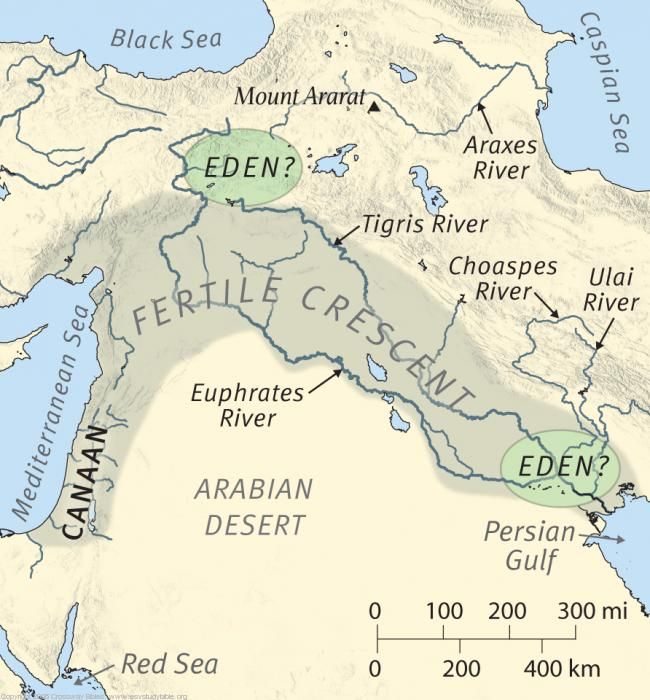
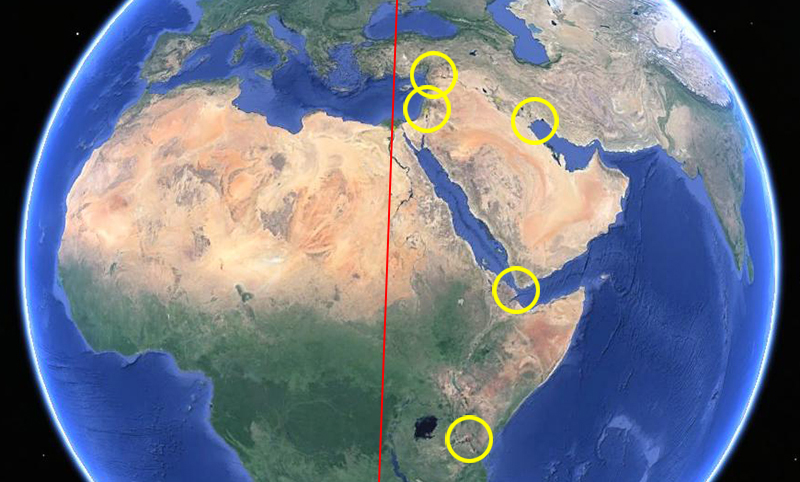
Most commentators seem to favor one of two general regions for the Garden: either northern or southern Mesopotamia, though proposals exist for locations surrounding the Arabian subcontinent and in eastern Africa. I’ve seen one suggestion that Eden lies at the bottom of the Red Sea, and another that puts it in the Indian Ocean.

Some proposed locations for Eden, per Babylon Rising.

Northern Mesopotamian versions tend to favor Eastern Turkey/Armenia, since (a) there is a perception that Shinar is in that area, based on Genesis 11:2 (ESV): “And as people migrated from the east, they found a plain in the land of Shinar and settled there”; and (b) the headwaters of both the Tigris and Euphrates rivers originate in that general vicinity.

Possible Mesopotamian locations, per Blue Letter Bible.

Personally, I have favored a southern Iraq location for years, since obtaining a copy of an unpublished book titled, simply, Eden, by a late pastor named David J. Gibson, who understood that rivers don’t divide flowing downstream as described in Genesis 2:10 (ESV), “A river flowed out of Eden to water the garden, and there it divided and became four rivers.” Gibson suggested, and I agree with him, that this verse should be interpreted from the perspective of an observer within the Garden gazing out at four rivers converging as they entered the Garden.

This is awkward language for us, but not necessarily for Moses in antiquity, writing in Hebrew. Consider that in Genesis 2:8 (ESV), “the LORD God planted a garden in Eden, in the east”. This implies to me that the four rivers converged in the western part of Eden before flowing through the Garden, which was planted in the eastern part.

This makes sense, and from a hydrodynamics standpoint, it is the only interpretation that makes sense. Tributaries converge, they don’t diverge. If, for some reason, a river splits to flow around an obstruction or a sandbar, it will always come back together downstream nearby. If, for some reason, it splits to flow down two or more separate drainage basins, an unstable pattern results. One path will erode more quickly than the other(s), and eventually that path will “steal” all the flow from the other(s).

The only exception from that rule is the case of delta flow, but deltas aren’t formed by erosion, they’re formed by deposition of silt carried downstream in the water. As a river flows onto a plain and slows down, turbulence decreases, and silt falls out of suspension and stays more or less where it drops. Without sufficient turbulence to pick it up again, there is just enough energy available to keep the channels open.

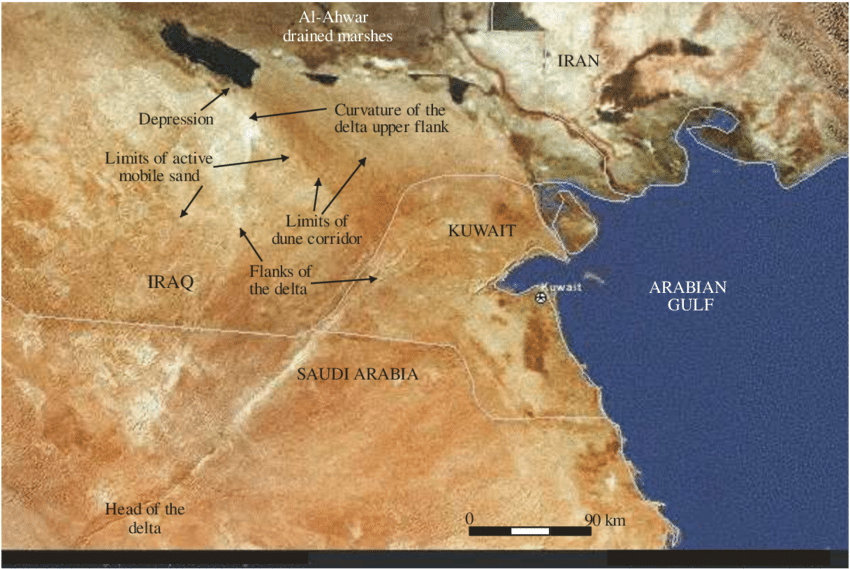
Large deltas usually form at the mouth of a river where water leaving the delta’s channels flows into the sea or a lake. Sometimes deltas form inland, usually where a mountain stream empties onto a plain. The water from an inland delta will either evaporate, sink into the substrate, or collect into a single stream or a lake. Two examples are shown below.


Pishon ? The deltaic terminal of Wadi Al-Batin. From Ali Al-Dousari on Researchgate

Genesis 2:10 would make total sense if the four “rivers” were delta channels, but the naming of those four rivers in verses 11–14 belies that possibility. Indeed, in my opinion the naming of the Tigris and Euphrates rivers conclusively fixes the location of the Garden in southern Iraq.

What about the other two rivers named?

The Pishon is fairly well defined because verse 11 says that it “flowed around the whole land of Havilah.” Havilah was a son of Cush who settled in what today is northwest Arabia. 1 Samuel 15:7 (ESV) defines that location: “And Saul defeated the Amalekites from Havilah as far as Shur, which is east of Egypt.” “Flowed around” could be literal (I found a map showing the Pishon as an ocean current flowing counterclockwise around the entire Arabian subcontinent), but more likely it simply means that it flowed through and provided water for Havilah. Gibson equated the Pishon with Arabia’s Wadi Al-Batin, an ancient and now-dry river and delta system flowing northeast through Saudi Arabia and Kuwait to the Tigris/Euphrates valley. I think he was right.

Gihon? Karun River, Wikipedia

As for the Gihon River that “flowed around the whole land of Cush” (verse 13), I would equate that with the Karun River, flowing out of Iran, through the ancient land of the Elamites.

I think that Christian commentators are thrown off by an assumption that “Cush” refers only to the region around Ethiopia and Somalia. My view is that Cush (a son of Ham) and his descendants settled large regions of Asia, as well as the upper Nile area. They apparently mixed with the Canaanites in the Lavant, and Nimrod, a son of Cush, was described in Genesis 10 as “9a mighty hunter before ADONAI. … 10His kingdom began with Bavel, Erekh, Akkad and Kalneh, in the land of Shin‘ar.” These abodes of Nimrod are all lands of southern Mesopotamia. Nimrod was, I’m convinced, none other than Sargon of Akkad, the world’s first great emperor. Elam and Asshur were Semites, but Cush may have extended into the Steppes alongside Shem (see Nimrod the Empire Builder: Architect of Shock and Awe, 2023, by Douglas Petrovich).

It’s admittedly a stretch, but I have wondered if perhaps the ancient Kushan Empire, spanning the central Asian “stans” might have gotten its name from Cush/Kush. If so, then the influence of Cush stretched all the way to the Xiongnu tribe, north of the Yellow River, because the peoples who started the Kushan Empire, centered around Afghanistan, where refugees from the Xiongnu.

Putting all this together, I think that the following map states the case for Eden in southern Iraq:

My own opinion as evidently shared by someone else. ©Mavink

What about the placing of Shinar in Turkey? I agree with the predominant view that Shinar is the area once occupied by Sumer, between the Tigris and Euphrates Rivers. It’s not hard to explain away migration “from the east.” I suspect that waters from the Great Flood took years to retreat from low-lying areas, so descendants of Noah returning to their homeland in Shinar would have initially moved southeast along the spine of the Zagros Mountains. Saying that Shinar is west of Ararat because they entered from the east is analogous to assuming I live west of my church because I (sometimes) approach it from the west. The full story on that is that I live to the southeast and occasionally take a circuitous route along the freeway.

Post-flood migrations from Ararat to Shinar. From Google Earth. Annotations by Ron Thompson.

To Top

Comparison of Genesis 1 and 2

The creation passage and the Garden passage are separated by verse 2:4 (see below).

There seem to be contradictions between Genesis 1 and Genesis 2, as traditionally understood. Because I believe Scripture is inerrant, but tradition is not, I inevitably try to let the former inform the latter.

Here are the relevant passages that I wish to discuss now:

[11] And God said, “Let the earth sprout vegetation, plants yielding seed, and fruit trees bearing fruit in which is their seed, each according to its kind, on the earth.” And it was so. [12] The earth brought forth vegetation, plants yielding seed according to their own kinds, and trees bearing fruit in which is their seed, each according to its kind. And God saw that it was good. [13] And there was evening and there was morning, the third day.


[26] Then God said, “Let us make man in our image, after our likeness. And let them have dominion over the fish of the sea and over the birds of the heavens and over the livestock and over all the earth and over every creeping thing that creeps on the earth.”

[27] So God created man in his own image,
in the image of God he created him;
male and female he created them.

[28] And God blessed them. And God said to them, “Be fruitful and multiply and fill the earth and subdue it, and have dominion over the fish of the sea and over the birds of the heavens and over every living thing that moves on the earth.” [29] And God said, “Behold, I have given you every plant yielding seed that is on the face of all the earth, and every tree with seed in its fruit. You shall have them for food.

—Genesis 1:11–13,26–29 (ESV)

and

[4b] …in the day that the LORD God made the earth and the heavens. [5] When no bush of the field was yet in the land and no small plant of the field had yet sprung up—for the LORD God had not caused it to rain on the land, and there was no man to work the ground, [6] and a mist was going up from the land and was watering the whole face of the ground— [7] then the LORD God formed the man of dust from the ground and breathed into his nostrils the breath of life, and the man became a living creature. [8] And the LORD God planted a garden in Eden, in the east, and there he put the man whom he had formed. [9] And out of the ground the LORD God made to spring up every tree that is pleasant to the sight and good for food. The tree of life was in the midst of the garden, and the tree of the knowledge of good and evil.


[15] The LORD God took the man and put him in the garden of Eden to work it and keep it.


[18] Then the LORD God said, “It is not good that the man should be alone; I will make him a helper fit for him.” [19] Now out of the ground the LORD God had formed every beast of the field and every bird of the heavens and brought them to the man to see what he would call them. And whatever the man called every living creature, that was its name. [20] The man gave names to all livestock and to the birds of the heavens and to every beast of the field. But for Adam there was not found a helper fit for him. [21] So the LORD God caused a deep sleep to fall upon the man, and while he slept took one of his ribs and closed up its place with flesh. [22] And the rib that the LORD God had taken from the man he made into a woman and brought her to the man. [23] Then the man said,

“This at last is bone of my bones
and flesh of my flesh;
she shall be called Woman,
because she was taken out of Man.”

—Genesis 2:4b–9,15,18–23 (ESV)

Almost all conservative Evangelicals believe that Genesis 1:27 describes the creation of Adam and Eve: “So God created man in his own image, in the image of God he created him; male and female he created them.” But Scripture never actually states that these are Adam and Eve!

To Top

Walton’s proposal of separate events

I have suggested in past posts that Christians should be willing to consider alternatives where erroneous understandings might exist in uninspired translations and interpretations, but not in inspired autographs (the original manuscripts as prepared by the human authors). When comparing these passages, we must account for apparent contradictions and ambiguities.

John H. Walton, a conservative Old Testament scholar with Moody Bible Institute and later with Wheaton College, has proposed alternative understandings of these passages, suggesting that chapter 1 describes one human creation event, and chapter 2 a separate creation of just Adam and Eve. He bases this idea on several observations, including:

  • There are obvious contradictions in the reported order of the creation events (see below).
  • The descriptions of each category of creation in chapter 1, including humankind, gives the impression that a significant population of every species were created. Creation of just 2 humans in Genesis 1 would be a breaking of the pattern.
  • Verse 4 is a “toledah” (Hebrew for “generations”), which is a fragment of Scripture used to separate two “chapters”, or thematic passages, of Genesis.

These are the generations
of the heavens and the earth when they were created,
in the day that the LORD God made the earth and the heavens.
—Genesis 2:4 (ESV)

Walton presents the following table to show how other toledoth (plural) relate to material preceding and following them:

— Walton, John H. The Lost World of Adam and Eve. Accordance electronic edition, version 1.0. Downers Grove: InterVarsity Press, 2017.
  • In the table, all of the cases marked as “sequel” separate events in the past from events in the future.
  • The three labeled “recursive” indicate cases where one individual or family is followed, then the timeline is reset to follow another. In these cases, there may be chronological overlap, but no detail added to the first.
  • In the single case labeled “parallel/sequel” Cain is followed, then the timeline reset to Adam; then a toledah introduces parallel coverage of Seth.
  • There is no precedent in the ten cases enumerated for a toledah introducing an expanded account of the same thing previously covered. This is not definitive proof, but it is suggestive.

To Top

The apparent contradictions

First, “creation” in verse 27 is the Hebrew word בָּרָא (bara‘, which means ex nihilo creation, or creation from nothing at all). In contrast, the Genesis 2 description is יָצַר (yatsar, which means to form something specifically by molding some constituent material into a shape, i.e., as a potter forming something in clay). The potter imagery is consistent with forming Adam “of dust from the ground”. “Dust”, here is Hebrew עָפָר, (‘afar), meaning things like “dry soil”, “loose earth”, “rubble”, or even “ashes”. None of these is clay, and none of them alone can be worked by a potter, but the intended image is of the detritus of death. More likely, it simply refers to the familiar elements on the periodic table, pasted by God into organic molecules.

Second, and more telling, we appear to have a serious contradiction regarding the creation of beasts of the field and birds of the heavens.

The sequence as written in Genesis 2 is (a) God formed Adam and gave him life; (b) God planted a garden on the east side of Eden; (c) God placed Adam in that garden; (d) God caused plants to grow from the ground; (e) God gave Adam his mission statement; (g) from the ground, God “formed” (yatsar) the land and air creatures; (h) Adam named the creatures; and finally (i) God formed Eve from Adam’s rib.

The serious contradiction here is that:

  1. in chapter 1, air creatures are created on day 5 and land creatures on day 6, both of these prior to the creation of man on day 6.
  2. In chapter 2, Adam (though not Eve) was created on or after day 6 while both the air and land creatures were created later.

The ESV translation above follows NIV in trying to resolve the problem by hedging on the language in 2:19. I can’t find any support for “Now the LORD God had formed“. This translation certainly does leave room for saying, “Oh, this isn’t where he forms them, that was already done.” But the correct translation seems to be “And out of the ground the LORD God formed.” Almost every translation words it this way, and even ESV includes that as a footnote. NIV is notorious for paraphrasing Scripture to make it say what they think it should say. I take this passage to mean that God formed new animals in the garden in addition to those that existed—possibly just new individuals, not new species.

I don’t see a clear, fair, and decisive path to resolving this contradiction.

On the other hand, if Genesis 2 is subsequent to Genesis 1 rather than a retelling, the garden theoretically becomes sacred space—a prototype tabernacle—and Adam’s race a priesthood.

To Top

Theological implications

While the concept that Adam and Eve’s creation at a time when earth was already populated by humans may be startling, it answers more questions than it raises. It gives Cain a wife without requiring biologically harmful incest. It reveals who it was who Cain thought might kill him. It answers the question, where did all the people come from to populate the city that Cain founded.

By the way, what was that city? Depending on how you define the term, it may have been Uruk, shown on the map above with the four rivers of Eden. Uruk was founded about 6,000 years ago, which fits very nicely with the picture I’m painting here.

You may say, “But the Bible teaches we’re all descended from Adam!” Yes, it does, and since Noah was descended from Adam, and we’re descended from Noah, then where’s the problem? The other humans all perished in the Flood.

Are we also descended from the pre-Garden people? I don’t know. Perhaps no pre-Garden genes were in the chromosomes of Noah or Mrs. Noah. But would it have mattered if there was some mixing? I don’t think it matters if Noah had non-Adamic genes mixed in, any more than it matters that Jesus had genes not contributed by Judah or King David. Mitochondrial DNA shows that all humans today have a common “mother” and Y-chromosomal analysis shows a common “father”, but both of those are way too late to have been Mr. or Mrs. Noah’s. Due to the nature of genetic inheritance, it will never be possible to trace back that far.

The Genesis 1 creation, whether it was Adam or not, was created in the image of God. They, too, were righteous or sinful, saved or unsaved. The difference is that they had not eaten from the Tree of Knowledge, so they were presumably innocent in the same way as Adam and Eve before the fall.

But wait! you say. That means that they were immortal! No, it doesn’t. Were Adam and Eve immortal before the fall? I think “you will surely die” is talking about spiritual death, not physical. Maybe they were immortal, but if so, why was there a Tree of Life in the Garden?

Was death even possible, theologically, before the fall? That’s way too big a subject to take on here, in this post. I’ll eventually write about it. It’s a key question, since part of the reason some Christians shun fossil evidence is that they think it’s a violation of Scripture for animals to have died pre-fall. Obviously, I believe death was possible before the fall, but I owe you some analysis to justify my belief.

Then, there’s the biggest question of all. I’ve been telling you that the 7-day creation story is a polemic and not literally true as written. What about Adam and Eve, and the Garden? Well, that’s a whole ‘nother story. From Genesis 2 on out, there is way too much specificity for me to doubt. I mean, we have the begats, for crying out loud, and they are way too believable to dismiss.

To Top

Exposition

I want to address just a few issues here that may seem confusing.

On the day that the LORD God made earth and heavens, no shrub of the field being yet on the earth and no plant of the field yet sprouted, for the LORD God had not caused rain to fall on the earth and there was no human to till the soil, and wetness would well from the earth to water all the surface of the soil…
—Genesis 2:4b–6 (Alter)

The first phrase above, ending “made earth and heavens”, bookends the Genesis 1 story, which begins with “In the beginning … heavens and earth”. That makes it more likely that the phrase is part of the toledah, packaging the entire process—”the day that the LORD God made the earth and heavens.” Most of you take this “day” as seven literal 24-hour days—I take it to mean the entire 13.8-billion-year period from the Big Bang to the formation of Adam.

The term “LORD God” here is the Hebrew “YHVH Elohim“, the first occurrence in Scripture of God’s covenant name.

In 2:5 we are told that, before God created Adam or planted the Garden, there was as yet no “brush of the field”, i.e., no wild vegetation, in the land (the Garden). Paleontology suggests that Homo sapiens has been around for about 200,000 years, but for most of that time they were strictly hunter-gatherers. Agriculture doesn’t appear until around 10,000 years ago, and it didn’t predominate until around 6,000 years ago. Domestication of livestock began during that same period. Given some flexibility in dating by means of Biblical genealogies, it is entirely realistic to date Genesis 2 somewhere in that 6-to-10,000-year time frame, and thus to consider that Genesis 2:5 implies that both herding (hunting) and farming (gathering) were inaugurated in the Garden.

To Top

Next in series: The Ancient of Days


The Hijacking of Creationism

Posted on:

Modified on:

  1. John C. Lennox
  2. Henry M. Morris
    1. Book: The Genesis Flood
    2. Morris’ Qualifications
  3. My own background
  4. Alternate theories

John C. Lennox

Over the last several months, I have adopted a new favorite author. His name is John C. Lennox. Among other things, he is a Cambridge-educated Emeritus Professor of Mathematics at the University of Oxford, and he has written a number of books on subjects that have interested me for many years.

Author, Educator, Mathematician and Philosopher, John C Lennox. BBC Photo.

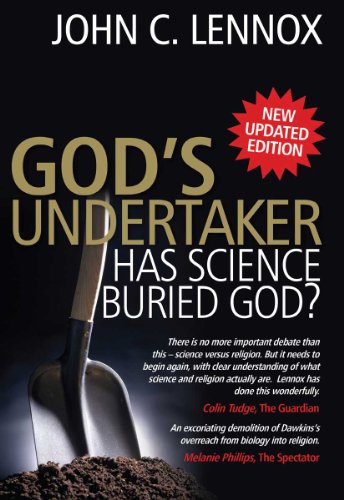
Most of his opinions on the intersection of theology and science seem to match my own very closely. In particular, a point from his book, God’s Undertaker: Has Science Buried God?, particularly resonates with me.

Conservative Christian scholars have mostly agreed that God miraculously created the universe, that humans descended from a real Adam and Eve, that the Genesis Flood was real, and that science does not trump Scripture!

I agree with all that!

But not all of those are “Young Earth” Creationists, and not all believe the theory, stated nowhere in Scripture, that the universe’s appearance of vast age is due to the Genesis Flood. Now, unfortunately, according to Professor Lennox (and my own observation), you are no longer free to reject that view.

Today, if you say you are not specifically a “young earth” creationist, then you will automatically be viewed by most of your Christian peers as a denier of Scriptural inerrancy and an “Evolutionist“.

Henry M. Morris

A large percentage of conservative Christianity, including major influencers like John MacArthur Jr, who I greatly admire, accept Henry Morris’ flood theory more or less uncritically.

Book: The Genesis Flood

The so-called “flood theory” was popularized by Morris in 1961 in a book that he co-authored with theologian John C. Whitcomb Jr, titled The Genesis Flood. I recall first reading the book in the late 70’s or early 80’s. It was formatted into two sections, one being a theological treatment by Whitcomb, and the other a mechanistic approach by Morris, laying out his theory that the apparent age of the earth was caused by rapid erosion and redeposition of silt due to earth-rending, catastrophic flooding, accompanied by massive earthquakes and tsunami surges. After reading Whitcomb’s exposition on the Biblical evidence for a worldwide flood, I was an enthusiastic fan of the book. That enthusiasm faded when I read Morris’ section. I found his grasp of fundamental geology and physics to be highly flawed, and his argumentative style (e.g., “any fool can plainly see…”) to be arrogant and insulting.

1976 edition of The Genesis Flood

The believability of The Genesis Flood was greatly enhanced by a Foreword (not included in the latest edition) written by an eminent geologist, John C. McCampell, PhD, of the University of Southwestern Louisiana. Unfortunately, book Forewords don’t always get read with the same concentration as the body. Dr. McCampbell did not endorse the theory! What he endorsed was Morris’ Christian worldview, fairness and independent thinking! The appliable paragraph read:

"From the [Foreword] writer's viewpoint, as a professional geologist, these explanations and contentions are difficult to accept. For the present at least, although quite ready to recognize the inadequacies of Lyellian uniformitarianism, I would prefer to hope that some other means of harmonization of religion and geology, which retains the essential structure of modern historical geology, could be found."

Morris’ Qualifications

Morris billed himself as a “hydrologist“. To me, the term “hydrology” implies much more than what Morris apparently did in his professional life. The US Geological Survey discusses the field broadly here. Wiktionary provides a more succinct definition, which I think works well:

Hydrology: Noun
1. The science of the properties, distribution, and effects of water on a planet's surface, in the soil and underlying rocks, and in the atmosphere.
2. The properties, distribution, and flows of water in a specific locale; the hydrological characteristics of a particular place or region.

But let’s examine Dr. Morris’ qualifications:
(this section updated on 1/10/2024)

In a 2006 Washington Post obituary, quoted by Wikipedia, Morris was hailed as the “father of modern creation science”, and his book as the “founding document of the creationist movement.” Yet Morris himself had only a dim understanding of the principles he invoked in the book.

His early education was at Rice University, where he earned a BS in Civil Engineering. Undergraduate CE courses focus primarily on basic physics and chemistry, math, engineering economics and design, structural analysis, strength of materials, soil mechanics, environmental issues, engineering computations, and fluid mechanics.

Leaving Rice with his BSCE degree, Morris took a three-year educational gap during which he was employed as a “hydraulic engineer”, apparently in the Rio Grande Valley monitoring sand wash in the border waters. With his rudimentary background, his job would have consisted mainly in recording flood levels and monitoring bank erosion. As far as I can determine, that is the extent of his practical hydrological experience.

After his stint “in the field”, Morris returned to Rice for a few years as, apparently, a graduate teaching assistant in civil engineering. He then moved on to the University of Minnesota, where he earned a master’s degree in hydraulics and a PhD in hydraulic engineering (a sub-field of civil engineering, where the focus is on dams, manufactured waterways, and static forces from groundwater on structural foundations).

The remainder of his career, until he departed to focus on creationism, was spent in academia, as a teacher of civil engineering and applied science. Speaking for myself, after earning an MS in Petroleum Engineering, I enraged my supervising professor by refusing to stay for a doctorate. My reason was that engineering PhDs are geared towards academic careers, not towards real-world experience and productivity. And, frankly, the real world pays way more than academia.

Morris’ career certainly did not qualify him in any way as an expert on the issues he addressed in The Genesis Flood. His theories defy the realities of geological science, and his frequent references to the second law of thermodynamics (entropy) and uniformitarianism demonstrated a poor understanding of both concepts.

My own background

I must now establish my own credentials for entering into this critique of Young Earth Creationism in general, and the Flood Theory in particular.

My undergraduate studies at the University of Texas were in math and physics. My intention was to do my postgraduate studies in astrophysics, but after a 2-year Naval tour, practical considerations induced me to accept a graduate fellowship in Petroleum Engineering at Texas, instead.

Part of the apparatus for my Rock Mechanics thesis, 1975

For many years after college, my professional career was as a petroleum engineer. I started as a field production engineer for a major integrated oil corporation in Oklahoma, absorbing the hands-on, nuts and bolts of equipment and procedure in a very large working oil field. With proficiency came the desire to be more than a small cog in a big, cumbersome, money machine, so I left Big Oil to spend most of my career in more responsible positions with smaller “independent oil and gas companies”.

Typical well log suite, downloaded from USGS

Though I have worked in all phases of the industry (except for refineries) my main specialty was reservoir engineering. I had some of the same civil engineering training as Morris (dams, weirs and channels), but most of my education and years of professional experience were more geological in scope. I dealt with almost anything relating to sedimentary rocks and stratigraphy: where the constituent particles originated; how they were weathered, transported by erosion, deposited, cemented, chemically modified, saturated and disrupted by viscous fluid flow within their pore space or fractures; and how they were subsequently modified by folding, fracturing, compressing, uplifting, and sometimes being exposed at the surface or under the sea, and beginning the cycle all over again. I collected and analyzed cores, drill cuttings, fluid samples, pressure profiles, and electrical resistivity and radiation data. From all that, I had to make reasonable estimates of how much, if any, and what types of hydrocarbons were deep underground, who owned the mineral rights in the drainage area, whether it could be profitably retrieved, by what means and how fast, and ultimately, how much profit was to be expected. I was answerable to my employers, clients, government agencies, royalty owners, and/or financial lenders. Sometimes I worked closely with geologists and legal folks, but mostly I worked for small companies and had to do pretty much all of the geology myself.

Alternate theories

Here I will discuss alternate Christian theories to account for the apparent vast age of the universe.

I will have more to say on Morris, the Genesis Flood, and my own views on creation (both the science and the theology) in future posts. Some I wrote years ago, but I plan to rework and repost them. The rest of this post will be a discussion of the Conservative traditions that current “creation culture” now considers to be unacceptable.

In his book, No Final Conflict, Francis Schaeffer lists several areas where, in his judgment, there is room for disagreement among Christians who believe in Creationism and the total truthfulness of Scripture:

1. There is a possibility that God created a “grown-up” universe.
2. There is a possibility of a break between Genesis 1:1 and 1:2 or between 1:2 and 1:3.
3. There is a possibility of a long day in Genesis 1.
4. There is a possibility that the flood affected the geological data.
5. The use of the word “kinds” in Genesis 1 may be quite broad.
6. There is a possibility of the death of animals before the fall.
7. Where the Hebrew word bārāʾ is not used, there is the possibility of sequence from previously existing things.

Millard Erickson’s Christian Theology (the text used at Calvary Bible College in Belton, MO when I attended classes there) lists the following Conservative theories, which mostly fit into the scope of Schaeffer’s comments, above:

  1. The gap theory holds that there was an original, quite complete creation of the earth perhaps billions of years ago (the creation mentioned in Gen. 1:1). Some sort of catastrophe occurred, however, so that the creation became empty and unformed (1:2). God then re-created the earth a few thousand years ago in a period of six days, populating it with all the species. This creation is described in Genesis 1:3–27. The apparent age of the earth and the fossil records showing development over long periods of time are to be attributed to the first creation. The catastrophe is often linked to the fall of Satan (Lucifer). Creation then lay in ruins for a long period of time before God rehabilitated or restored it.
  2. The flood theory views the earth as only a few thousand years old. At the time of Noah, the earth was covered by a tremendous flood, with huge waves with a velocity of a thousand miles an hour. These waves picked up various forms of life; the mud in which these forms were eventually deposited was solidified into rock under the tremendous pressure of the waves. The various rock strata represent various waves of the flood. These unusual forces accomplished in a short period what geologists believe would ordinarily require three billion years to accomplish.
  3. The ideal-time theory says that God created the world in a six-day period a relatively short time ago, but that he made it as if it were billions of years old. This is a genuinely novel and ingenious view. Adam, of course, did not begin his life as a newborn baby. At any point in his life he must have had an apparent (or ideal) age many years older than his actual age (i.e., the number of years since his creation). The ideal-time theory extends this principle. If God created trees, rather than merely tree seeds, they presumably had rings indicating an ideal age rather than their real age. Thus, each element of creation must have begun somewhere in the life cycle.
  4. The age-day theory is based upon the fact that the Hebrew word יוֹם (yom), while it most frequently means a twenty-four-hour period, is not limited to that meaning. It can also mean epochs or long periods of time, and that is how it should be understood in this context. This view holds that God created in a series of acts over long periods of time. The geological and fossil records correspond to the days of his creative acts.
  5. The pictorial-day (or literary-framework) theory regards the days of creation as more a matter of logical structuring than of chronological order. The author arranged the material in a logical grouping that took the form of six periods. While there may be some chronological dimension to the ordering, it is to be thought of as primarily logical. The account is arranged in two groups of three—days one through three and days four through six. Parallels can be seen between the first and fourth, the second and fifth, and the third and sixth days of creation.
  6. The revelatory-day theory. The days were not successive days on which God did the creation, but days on which the story of creation was revealed. So the truth of the account took place in six twenty-four-hour periods, but the actual creation may have taken much longer than that.

Erickson himself favors the ideal-time theory, as you might guess from the wording of paragraph 3 above. He states that it is “in many ways irrefutable both scientifically and exegetically but presents the theological problem that it makes God an apparent deceiver.” I would agree that any theory that does not incorporate an assumption of vast actual age would have to include this form of apparent age in order to account for function via the known physical laws. In fact, I would compare it to a movie started in the middle. Virtually everything about the universe appears very much to be aged, and in fact would have to do so. I am more concerned with the suggestion of deception than Erickson is, in view of the following, which tells me I should be able to trust my senses:

For his invisible attributes, namely, his eternal power and divine nature, have been clearly perceived, ever since the creation of the world, in the things that have been made.
—Romans 1:20 ESV

Grudem’s Systematic Theology, Wayne Grudem, lists more or less the same group of theories, and goes into much more detail on all questions of creation.

Grudem sums up his opinion as follows: “My strong encouragement to the entire Christian community is that both old earth and young earth viewpoints should be acceptable for leaders in evangelical churches and evangelical parachurch organizations.”

Ryrie’s Basic Theology, Charles Ryrie, presents a subset of the above, but without specific names. He is far more concerned about the creation of Man, specifically, than the Universe in general.

Ryrie is somewhat non-committal regarding the Universe but does seem to favor a young earth. He is staunchly against biological evolution.

Some combination of the pictorial-day and revelatory-day theories seem to be favored by another contrarian, John Walton. I like Walton very much and think that he is on track.

Like many Christians of my age, I grew up with a Schofield Reference Bible, and I liked Schofield’s favorite, the gap theory for many years. I no longer hold that view. Based on extensive reading on Ancient Near East History and Culture, and with a better grasp of Biblical poetry, I now believe…

Next in Series: The Language of Creation