
Posted on:
Modified on:
I am presenting here a list of dates for key events in Egyptian/Biblical history. Dating of Biblical events during the Egyptian period is very firm, if you believe as I do that the Bible is inerrant and its time references are literal. Dating of the Egyptian King Lists is more problematic, as I will discuss below.

Middle Kingdom, 12th Dynasty
Dating the reigns of Middle Kingdom monarchs is particularly difficult, with a particularly large range of proposed possibilities. I have a fairly large library of Egyptian history. In this post I will list, separated by slashes, two of the newest chronologies that seem reasonable: First is the timeline presented by Van De Mieroop in A History of Ancient Egypt; second, the one I personally prefer, taken from the Wikipedia article, “Twelfth Dynasty of Egypt”, as last edited on 21 December 2021. A radically different chronology by Egyptologist David Rohl, has recently been popularized by the Patterns of Evidence series of videos. I plan to review this series in the near future, but for now, I like most of what is presented in the first two videos, but not so much the second two or the anticipated fifth. Rohl, a self-styled agnostic, follows the lead of various evangelical scholars who shorten the period of the Hebrew “sojourn” in Egypt from the explicitly stated 430 years to 350 years, based on what I believe is a simplistic misunderstanding of the Abrahamic Covenant.
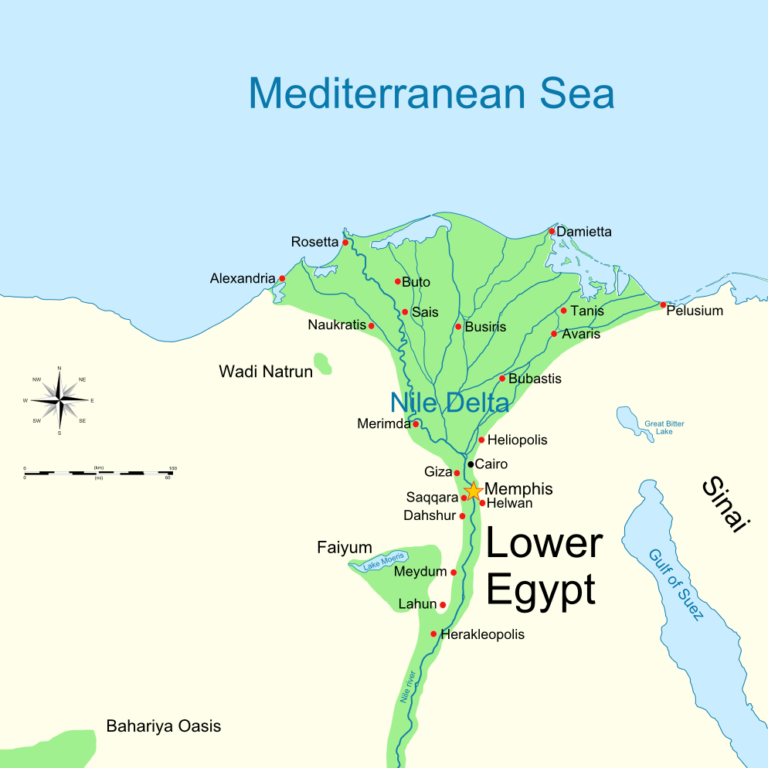
Egypt’s capital throughout the 12th Dynasty period was located in ancient Itj-Tawy, located around 35 miles south of modern Cairo and 21 miles south of ancient Memphis.
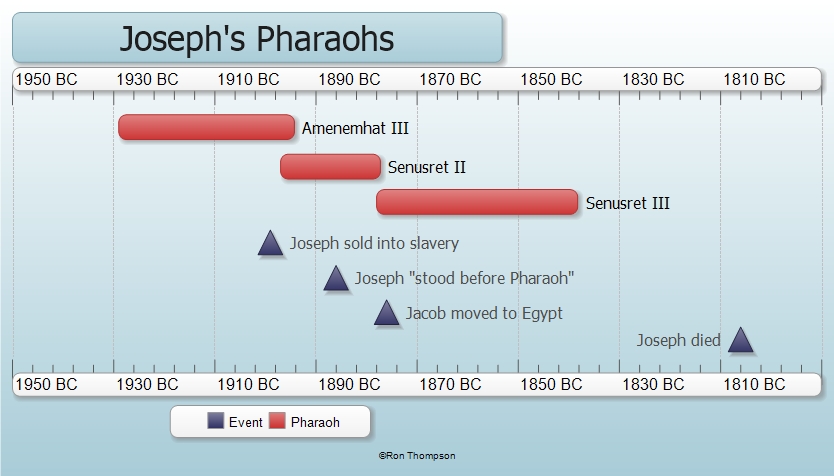
Pharaoh Amenemhat II, 1911-1877/1929-1895 BC
Joseph was sold into slavery in Egypt around 1899 BC, at 17 years old (Gen 37:2-29). Most of my sources would put this event somewhere in Amenemhat’s reign. I would place the timing shortly before a brief coregency of Amenemhat and Senusret II.
Pharaoh Senusret II, 1877-1870/1897-1878 BC
Joseph languished in Egyptian slavery and prison for some 13 years before he “stood before Pharoah” at age 30 (1886 BC) to interpret Pharaoh’s dream and to be elevated to Vizier rank (Gen 41:46). By my accounting, this Pharaoh was Senusret II, who seems to have devoted the final eight years of his reign to promoting Joseph’s recommendations for the productive years. Domestically, he is best known for developing the Fayyum Basin area west of the capital. This is a basin watered by a natural offshoot of the Nile, anachronistically named Bahr Yussef (“the Waterway of Joseph”). Although widening of this waterway was done well before the Middle Kingdom era, Senusret built numerous canals for irrigation and to control the levels of the valley’s Lake Moeris for the purpose of land reclamation. He also built new settlements in the center and around the borders of Egypt and appears to have greatly expanded his bureaucracy in these regions. Regarding foreign affairs, he is known to have fostered a period of peaceful trade with the hated “Asiatics” of the Levant.
Pharaoh Senusret III, 1870-1831/1878-1839 BC
This powerful Pharaoh began his reign about eight years after the elevation of Joseph. I believe that his story is told in
Genesis 41:54-57 (CJB)
[54] and the seven years of famine began to come, just as Yosef had said. There was famine in all lands, but throughout the land of Egypt there was food. [55] When the whole land of Egypt started feeling the famine, the people cried to Pharaoh for food, and Pharaoh said to all the Egyptians, “Go to Yosef, and do what he tells you to do.” [56] The famine was over all the earth, but then Yosef opened all the storehouses and sold food to the Egyptians, since the famine was severe in the land of Egypt. [57] Moreover all countries came to Egypt to Yosef to buy grain, because the famine was severe throughout the earth.
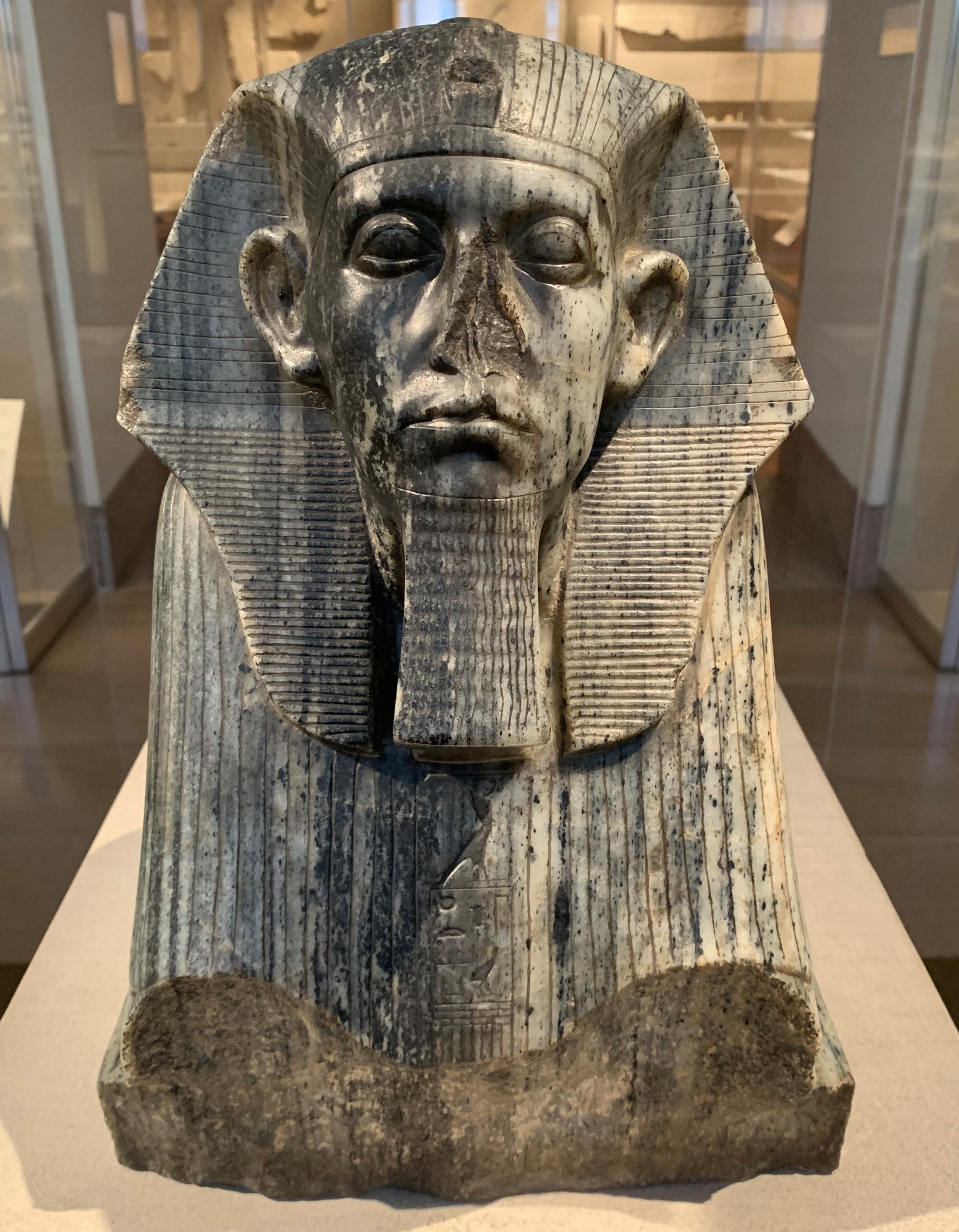
Senusret continued the agricultural developments begun by his father and attempted to maintain peace within Egypt and with Egypt’s neighbors, but the balance of power within Egypt changed radically during his reign. Since no later than the 3rd Dynasty, Egypt had been divided into individual districts called “nomes“, each ruled by a hereditary “nomarch“. These powerful nobles had decentralized Egyptian rule and placed limits on the Pharaohs. Senusret III seems to have used the famine years and his monopolistic control of Joseph’s well-stocked granaries to break the economic power of the nomarchs and to recentralize power within his kingdom.
In 1876 BC, near the beginning of the famine years, Jacob and the rest of his family and their retinues moved to Egypt (Gen 46:1-47:9). Why were they offered seemingly prime space in the fertile land of Goshen, the eastern Nile Delta region? Was this land gift purely out of Pharaoh’s love for Joseph? I doubt it. Their “Asiatic” origins were a heavy strike against them. They ignored Joseph’s warning not to mention that they were shepherds. Egypt’s herds were cattle, and sheep tend to overgraze pastures and make them unsuitable for raising cattle.
Late 12th Dynasty
Joseph died at 130 years old, in 1806 BC, having lived in Egypt after the famine during the reigns of Senusret III, Amenemhat III, and Amenemhat IV. Queen Sobekneferu was just coming into power for a brief, 4-year reign.
Hyksos Period
While there is no question that the 12th Dynasty Pharaohs recognized Joseph’s wisdom and supported his programs as Vizier, as mentioned above, I personally have reservations about the sincerity of their welcome of his Hebrew family. Senusret III, in particular, hated the Nubians of Africa and was at best ambivalent about “Asiatics”—foreigners from eastern Mediterranean lands, many of whom had been infiltrating Lower Egypt for generations. I suspect that the Pharaohs’ invitation to Jacob and their tolerance of the Hebrews was more to keep Joseph happy and his relatives under observation.
At the close of the chaotic 14th Dynasty, a group of Asiatics, speaking an Aramaic/Canaanite west-Semitic dialect, took control of Egypt. They came to be called “Hyksos“, meaning “the rulers of foreign lands”. They were settled throughout Goshen and along the Lower Nile Valley, with scattered settlements into Upper Egypt. Dynasties 15, 16 and 17 consisted primarily of Hyksos rulers with their capital first in the eastern Nile Delta city of Avaris, and later in Thebes. They were not deposed until Amose I, founder of the 18th Dynasty, unseated them. He and his successors eventually drove them out of Egypt.
Enslavement
Aside from secular and Deistic theories that equate the Hyksos with the Hebrews, I have never seen or heard a discussion of the inevitable dispersal of the Israelites in Egypt during the Hyksos rule and early 18th Dynastic period. Exodus 1:5-7 implies that the original 70 “sons of Israel” had multiplied until they occupied not just Goshen, but rather “filled” all of the habitable land of Egypt. I imagine that they were displaced completely from Goshen itself, but in any case, as slaves they would have been required to concentrate close to where they worked. By Moses’ time, most of their work would certainly be in Upper Egypt, except at flood times. Travel from the Delta to Thebes by foot would probably have taken them around two weeks, at best. Without any archaeological or written records either way, I am assuming that the bulk of the slaves were sheltering along the Nile wherever they were needed at any given time.
Exodus 1:7-21 covers an undatable period of history after the death of Joseph and before the birth of Moses. A traditional understanding of the chapter assumes that the entire passage describes a single wicked Pharaoh, but I would rather divide it as follows:
- the Pharaoh who “did not know Joseph”, and who ordered their enslavement—possibly as early as late in the 12th Dynasty (Ex 1:8-11);
- a long period of increasing oppression and further population expansion (Ex 1:12-14); and
- the Pharaoh who, during that period, tasked the midwives to kill Israelite boys (Ex 1:15-21).
New Kingdom, 18th Dynasty
Most scholars today use a Conventional Egyptian Chronology for this period. The currently popular Patterns of Evidence series is pushing David Rohl’s alternative “New Chronology”, which most Egyptologists agree is way off the mark. Within the 18th Dynasty, the Conventional view has two primary variations, due to an ambiguity in tying the ancient Egyptian calendar to our Gregorian calendar. The so-called “Low Chronology“, which is most popular, contains later dating; use of the “High Chronology” results in dates 20 years earlier. Personally, I prefer a variation of the Low Chronology, as presented by Christian Egyptologist, Kenneth Kitchen. Though I don’t agree with his conclusions about Biblical dating, his Egyptian dating seems to me to fit better with the Biblical narrative as I interpret it.
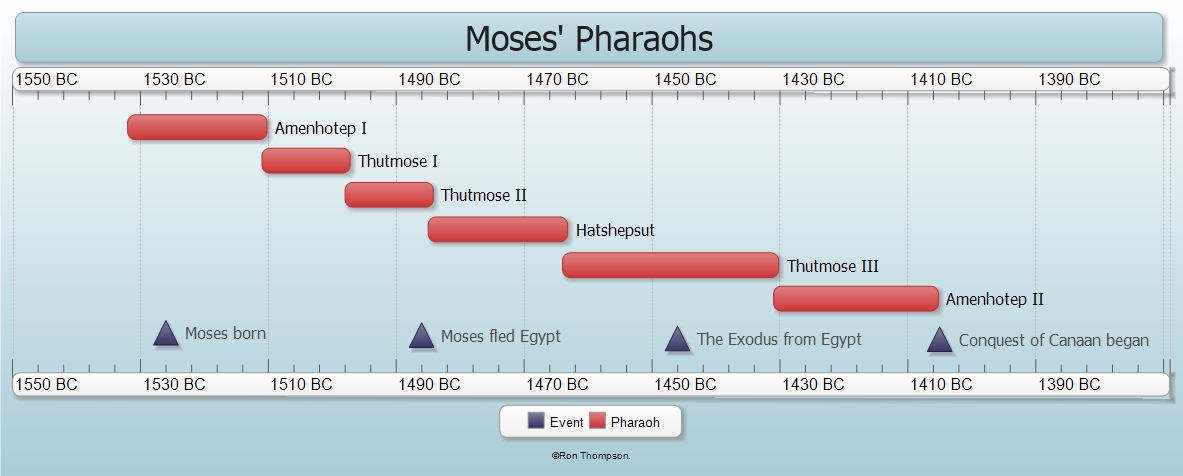
Pharaoh Amenhotep I, 1532-1511 BC
Moses was born in 1526 BC, by Kitchen’s Chronology, during the 6th year of Amenhotep’s reign. The order to throw newborn boys into the Nile was probably issued shortly before that time, so it is safe to say it was Amenhotep’s order (Ex 1:22). There is a problem with this chronology, though: the following passage (Ex 2:1-11) states several times that it was “Pharaoh’s daughter” who rescued Moses and later adopted him, but Amenhotep had no male or female heirs at all except for one son, who died at a very early age. If the dating is correct, then this wording can still be regarded as correct if she was the daughter of either a past or future Pharaoh. There is precedent for this type of royal ambiguity both in scripture and in other ancient writings. If so, there are three possible scenarios:
- She could have been a daughter of Amenhotep’s father, Pharaoh Ahmose I. Ahmose had 12 children, including several daughters, but those who survived to 1526 would have been fairly old by the standards of the day. I think it would have been unlikely that any of them would be at the river under these circumstances.
- Amenhotep was succeeded by Thutmose I, who was a military figure and not related to him at all. Thutmose did indeed have a daughter, Hatshepsut, who was 16 years old in 1526, and was suitable for other reasons, as well. See below.
- Thutmose might have been considered the current Pharaoh if he was coregent with Amenhotep. This would not have been unusual, and there is some evidence of a coregency; but it would have to have lasted at least 15 years, which is very unlikely.
Pharaoh Thutmose I, 1511-1498 BC
Thutmose’ birth date and parentage are unknown. Amenhotep died without an heir, and it is likely that Thutmose, probably close to Amenhotep’s age, was promoted from a senior military position. Thutmose had five children over his lifetime, of which three died before his accession. His daughter, Hatshepsut, was born around 1541 BC, in the 16th year of Ahmose I’s reign. She would have been 16 years old when Moses was born, in the 6th year of Amenhotep’s reign, which certainly would have made her the ideal candidate for the (eventual) “Pharoah’s Daughter”. When Thutmose became Pharaoh, Moses was 15 and Hatshepsut undoubtedly a “headstrong” princess at 31 years old.
Exodus 2:5 (CJB)
[5] The daughter of Pharaoh came down to bathe in the river while her maids-in-attendance walked along the riverside. Spotting the basket among the reeds, she sent her slave-girl to get it. [6] She opened it and looked inside, and there in front of her was a crying baby boy! Moved with pity, she said, “This must be one of the Hebrews’ children.”
Pharaoh Thutmose II, 1498-1485 BC
When Thutmose I died in 1498 BC, he was replaced by his only surviving son, Thutmose II. Egyptian Pharaohs were almost always male, but succession was determined through a matriarchal system which frequently resulted in brother/sister marriages. Thutmose II was the son of Thutmose I by a minor wife, which made his claim to the throne weak. This he remedied by marrying his older half-sister, Hatshepsut, a daughter by Thutmose I’s chief wife.
Based on tradition, and possibly documentation that was available to him at the time, 1st Century Jewish historian Josephus reported that Moses was indeed a “prince of Egypt”, without question receiving the same education that any other Egyptian prince would have received in the eventuality that he might one day inherit the throne of Pharaoh. Josephus reported that Moses led the Egyptian army in at least one successful campaign against the perennial enemy in Nubia.
Although I believe that Hatshepsut was Moses‘ adoptive mother, and I have no doubt that she carefully supervised his education, I think that he later became a liability to her own ambitions. When Moses fled from Egypt in 1486, it was clear (as is evident from the state of his mummy) that Thutmose II was dying. Hatshepsut had her own plans going forward, and there may have been a risk that Moses would be seen as a viable heir. When she heard that Moses had killed an Egyptian, she had an excuse to get rid of him, either in her husband’s name or her own:
Exodus 2:15 (CJB)
[15] When Pharaoh heard of it, he tried to have Moshe put to death. But Moshe fled from Pharaoh to live in the land of Midyan.
I am not ignoring the masculine pronoun in “he tried”. Because Pharaohs were almost always male, Hatshepsut began dressing and acting as a male Pharaoh, and insisted that she was king, not queen, of Egypt. All references to her during much of her reign were masculine.
I think that Moses was savvy enough to recognize his danger. It is also significant to me that he was not sentimental about her at this point, either:
Hebrews 11:24 (CJB)
[24] By [faith], Moshe, after he had grown up, refused to be called the son of Pharaoh’s daughter. [25] He chose being mistreated along with God’s people rather than enjoying the passing pleasures of sin. [26] He had come to regard abuse suffered on behalf of the Messiah as greater riches than the treasures of Egypt, for he kept his eyes fixed on the reward.
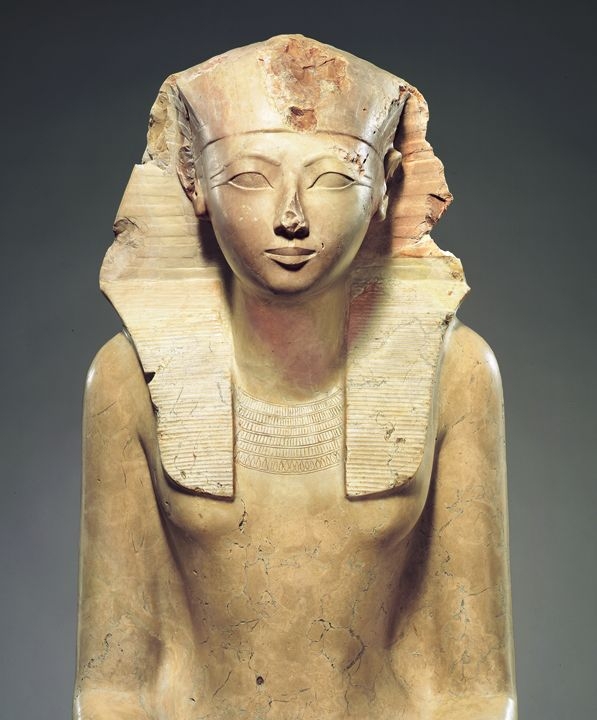
Pharaoh Hatshepsut, 1485-1464 BC
When Thutmose II died in 1485 BC, he was succeeded by his infant son, Thutmose III, so Hatshepsut became queen regent. She reigned as actual Pharaoh for 19 years, until her own death. She is regarded by many as one of the most powerful woman monarchs of history. She died when Moses was 62 years old, roughly the midpoint of his 40 years in Midian.
Pharaoh Thutmose III, 1464-1431 BC
Thutmose III became sole ruler on Hatshepsut’s death. He is known as the “Napoleon of Egypt” for his many military campaigns and is considered to have been a military genius.

The Exodus and the loss of his armies occurred in 1446 BC, in approximately the 18th year of his reign after Hatshepsut’s death. His extreme reluctance to release the Hebrew slaves, despite the severity of the plagues, can probably be explained by Thutmose’s unwillingness to use potential fighting men in their place for common labor. In the few years after the Exodus, he continued his foreign invasions, and claimed great victories, but scholars discount these claims because there was apparently so little booty taken. There is no reason to assume, however, that the loss of so many of his fighting men in the Red Sea would have suppressed his military might for long.
Some commentators object to Thutmose III as the “Pharaoh of the Exodus” because they read some verses elsewhere in the Bible as stating that he had to have drowned with his army—for example:
Psalms 136:13 (CJB)
[13] to him who split apart the Sea of Suf,
for his grace continues forever;
[14] and made Isra’el cross right through it,
for his grace continues forever;
[15] but swept Pharaoh and his army into the Sea of Suf,
for his grace continues forever;
I don’t believe that this poetic description is meant to be precise; just flowery! In any case, the Hebrew text does not support the strength of the “and” interpretation.
Pharoah Amenhotep II, 1431-1406
Amenhotep was Thutmose III’s son by a minor wife. Interestingly, Thutmose’ firstborn son, Amenemhat, son of chief wife Satiah, was the heir-apparent until his death “between years 24 and 35 of Thutmose’ reign.” When accounting for the period of coregency with Hatshepsut, this conforms quite nicely with the Biblical account of the killing of the firstborn!





 The Back of My Mind