Moshe’s Week of Dreams

Posted on:

Modified on:

  1. Previous statements of my views
  2. How did Moses know?
    1. Evening and morning
    2. A hypothesis
    3. A speculative scenario
      1. Day 1
      2. Day 2
      3. Day 3
      4. Day 4
      5. Day 5
      6. Day 6
  3. Appendices
    1. Adaptation vs evolution
    2. Birth as analogy

My last published article was Prophetic Visions: Through a Glass Darkly, released on August 25, 2025. Because of the length of that post, I left out a few things that I still want to discuss in more detail, so I have saved outtakes that I will elaborate on in much shorter articles as time permits.

This, the first, is a discussion of Genesis 1 as a prophetic (preterist) snapshot of creation.

Previous statements of my views

As you know if you have followed my series on Creation, I am an Old Earth Creationist and believe that God planned the design of the universe the way He wanted it to exist and develop over all future times.

Obviously, Old Earth Creationists don’t interpret Genesis 1 in a conventional, hyper-literal sense. I see it as prophetic poetry. Conservative Evangelical scholars generally use a hermeneutic (principles for interpreting Scripture) that gives latitude for interpreting some poetry and some prophecy as symbolic. By that I mean symbolic of something that is true and important!

My 2024 post, Genesis 1:1–5, Day 1 is a lengthy article in which:

  1. I discussed the concept of hermeneutics and the hermeneutical principles which I and many other interpreters use to understand Biblical text.
  2. I presented my views on the values and limitations of the scientific process.
  3. I introduced Moses as a prophet and speculated on how he might have received his knowledge of prehistory. This is the subject of the current post.
  4. I then began the interpretation process with a discussion of the first two verses of Genesis 1, and whether they are a summary of the rest of the chapter, or alternatively the first event before the creation of light. Young Earth Creationist are split on this issue.
  5. Next, I explained what “light” is and is not, and why, given the way God created it and it in fact exists, it is paradoxical to think that it was created either before the creation of matter (the summary view of verse 1) or after the creation of matter (the first event view of verse 1). By theological definition, God’s omnipotence excludes the possibility of paradoxical absurdities.
  6. Finally, under the heading, A better idea, I presented my current views on how Genesis 1 should be interpreted. This is a fairly short section, so I suggest reading it now.

I don’t believe I stated it quite this way, but the viewpoint expressed in that post treats Genesis 1, not as a description of how God made the universe, but rather as an organizational description of what He made.

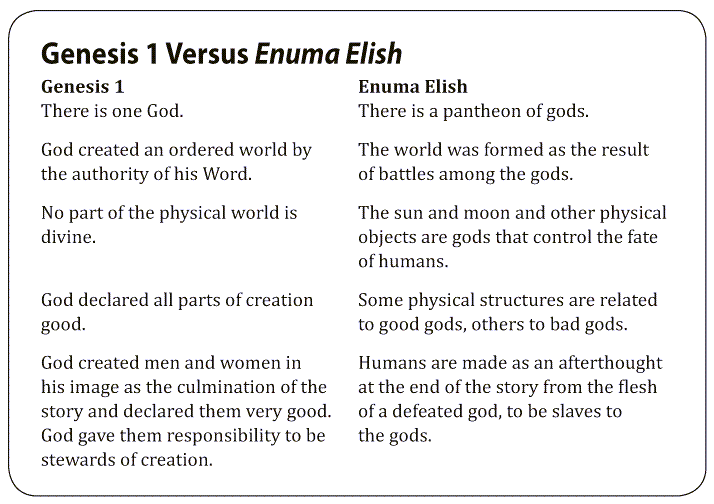
What I did state, however, is that its primary purpose was as a polemic against the pagan cultures of the day. God saying, “Everything you see was created by me, including the gods (elohim, the spirits that rule the world) that you worship.”

I stated it this way earlier in The Implication of Genre in Job, Ezekiel and Genesis:

Every ancient civilization had a pantheon of pagan “gods”, and with each of those came a “creation myth.” In Genesis 1:1, the one true God said, “I did it—not them! Period!”

Theologically, that is really all we need to know about creation. God had no obligation to tell us exactly how he did it, or in what order, and if He had done so, nobody in the ancient world could have possibly understood it. …

To me, the “Plain sense” of Genesis 1:1 makes perfect “common sense” in a book about God: He created the entire universe, which is everything that exists other than Himself, and He had the sovereign right and ability to do it however He chose to.

The plain sense of Genesis 1:3–31 does not make common sense to me, if indeed it describes creation at all. To me, it is strongly reminiscent of visions recorded by a number of prophets, including John. The age of man on earth starts with a vision and ends with a vision!

How did Moses know?

The better idea that I’ve now adopted, I owe primarily to the conservative scholar John H. Walton from Moody Bible Institute and later with Wheaton College, who I greatly admire, but who of course is anathema to Young Earth Creationists.

Attribution of Moses’ knowledge to preterist prophecy is my own slant on the subject. Having now completed a more in-depth study of prophetic dreams and visions, I am ready to go a little deeper here with a theoretical proposal of the form in which Moses may have received his Genesis 1 insights.

Evening and morning

Consider Moses’ demarcation of creation days: “And there was evening and there was morning, the [nth] day.” Exactly what that means has been disputed for centuries.

The phrasing is important within Judaism because it sets the pattern, followed through most of the Bible and apparently most of Jewish history, of the Jewish calendar day beginning and ending in the evenings. As such, it seems to imply that literal calendar days are in view.

But verse 5a raises another issue: “God called the light Day, and the darkness he called Night.” That means that “day” doesn’t by default mean a calendar day!

In fact, Biblically, the term “day”, by itself means specifically the 12-hour period between sunrise and sunset. You say, “But there aren’t ever exactly 12 hours between sunrise and sunset!” For halachic Judaism (think, “for ceremonial purposes”), one would divide the number of standard minutes between sunrise and sunset by 12. As I am writing today, near the Autumnal Equinox, a “proportional hour” (sha’ah zemanit) is 58.78 minutes long. Near the solstices, the discrepancy is much bigger. And of course, that number is dependent on my latitude and my altitude.

By contrast, “night”, the period between sunset and sunrise, is divided into 4 “watches”, not hours.

In practice, the term “day” can mean a number of different things to a Jew: the daylight hours; a calendar day; a recurring day, as the “Day of Atonement”; an extended period in the past, as “in Jesus’ day”; a prophetic period to come, as “the Day of the Lord.”

Many of those usages are obvious from the context, but sometimes, not so much. I can’t document this, but I assume that a need to distinguish calendar days from the others probably led to the development of an idiom that is well known to Jews but denied by some Christians: The term “days and nights” refers to calendar days, in whole or in part. For example, when Jesus’ said, “As Jonah was in the belly of the fish 3 days and 3 nights…”, none of His hearers would have taken this as meaning 72 full hours. It simply meant, “a period spanning parts of three calendar days.

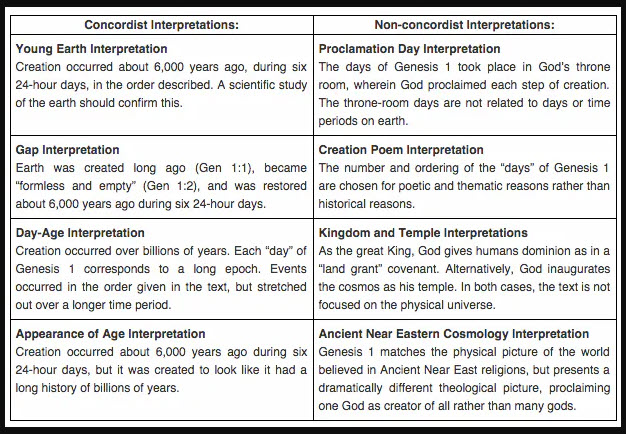
Young Earth Creationists will generally take one of two approaches to understanding the implication of “evening and morning.” Either it is the calendar day idiom, or it is simply stating that God finished His creation act of the day by evening and didn’t start work again until the next morning.

But it isn’t as easy as it sounds. Yes, Genesis 1 records the creation of light on Day 1, and immediately then He “called the light Day, and the darkness he called Night.” But it wasn’t until Day 4 that He created the sun, moon and stars, which, first of all, were to “divide the day from the night.” Which implies that there were no evenings or mornings before Day 4.

As an Old Earth Creationist, the only part of Genesis 1 that I insist is literal is the first one or two verses. But if the rest is symbolic, that does not mean that it is useless, or a lie! Almost all conservative Bible scholars would agree that Biblical symbolism is absolutely allowed, and though the symbolism may be obscure for a time, it will eventually become clear. In God’s own time!

A hypothesis

Now please don’t take the following hypothesis as gospel truth. It makes sense to me, but it is only a suggestion, prompted by my recent concentration on how to interpret prophetic dreams and visions. The “evenings and mornings” formula of Genesis 1 may serve some entirely different symbolic purpose, but what if it sheds some light on how Moses received this information from God?

I firmly believe that Genesis 1 is preterist prophecy, reporting either something that God showed him in one or more dreams or visions, or words that God verbally told him to write. My experience with the Bible leads me to favor the former, rather than the latter.

I’m wondering if perhaps “evenings and mornings” might be a hint that God sent dreams to Moses at night?

Consider then the following scenario, which is perhaps 98% speculative.

A speculative scenario

I’m going to suggest here a pattern to the way God chooses to inform Moses. It should be no surprise; God doesn’t do anything randomly! Here is the pattern I see, arranged only roughly chronologically:

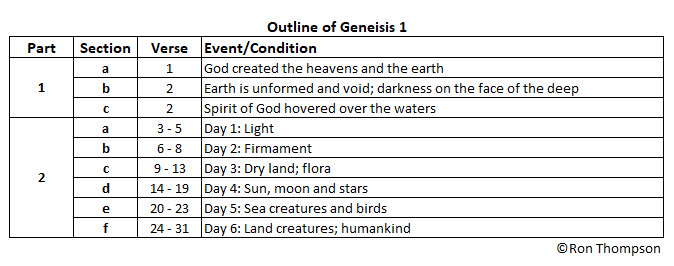
  1. On day 1, God showed Moses very tersely how He built the universe, from nothing down to the foundations of Earth, the home He designed for man, His climactic achievement.
  2. On day 2, God began showing Moses (and us!) His provision of the first environmental factor necessary for our survival, a breathable atmosphere. This is first in mention, not necessarily the first to develop.
  3. On day 3, we see Earth divided into two domains, land and sea. Into both, He then introduced plant life, which was to become the base of the food chain, the ultimate source of nutrition, and the carbon/oxygen cycle, necessary for respiration.
  4. On day 4, He brings our attention back to the “second heaven”, the cosmos beyond the atmosphere. We need to see the source of energy and to have a better idea of the flow of time before the sentient creatures are introduced.
  5. On day 5, we see that introduction of sentience on Earth. Starting with sea creatures and birds.
  6. On day 6, we get to the climax, sentient life on earth, starting with the animals, and then with primitive man.
Day 1

One night while encamped in the Wilderness, during the 40 years of wandering prior to his people crossing the Jordan into the Promised Land, while either dozing by the campfire or asleep in his tent, God sends Moses a dream of what came before. In the dream…

The prophet is floating in empty space, with nothing in sight—just an unlimited, silent, dark, cold void in all directions. There is no sound to be heard in the vacuum other than a sudden command from God. Unseen by Moses, as if a tiny hole had opened in a gigantic dike, vast quantities of invisible energy began pouring into the region in front of him and expanding to immense size.

Very quickly then, with still with no sound whatsoever, but following rules of physics laid down by the Almighty, there is a bright glow as hot, subatomic particles begin condensing out of the energy and radiating light into the surroundings.

“Let there be light!”, ©Vecteezy

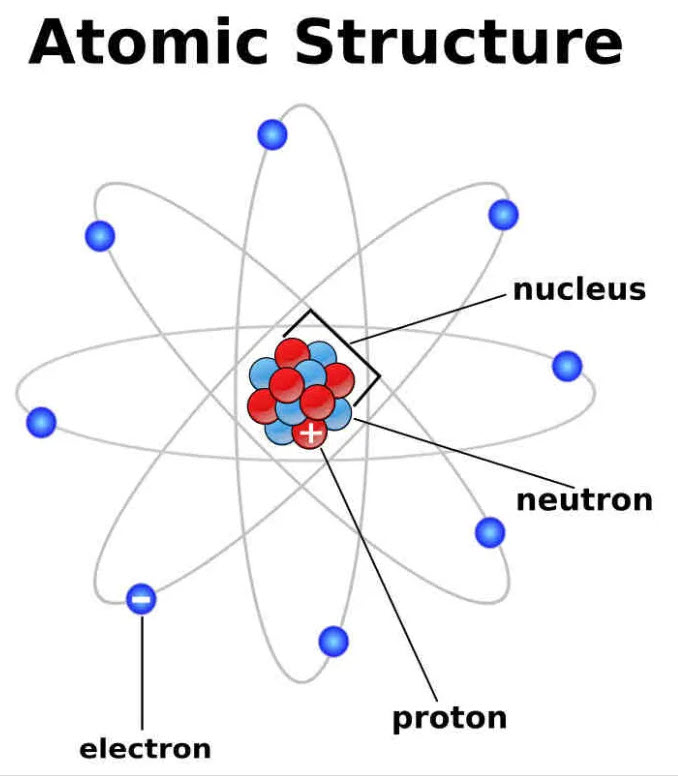
Though Moses can’t see much, beyond a blur of motion, and understands very little of what he sees, the gigantic ball of energy rapidly cools, and as it does, more particles are formed. With further cooling, those particles begin to combine to form hydrogen and helium ions, which then pick up electrons and take on the properties of atoms and diatomic molecules.

Still later, electromagnetic and gravitational forces begin collecting the hydrogen and helium into clouds that become denser and denser, until the pressure becomes great enough in many clumps to ignite nuclear fusion—stars are born. The products of fusion are heavier elements, and those also undergo fusion to form still heavier elements. The heaviest that can form this way is iron, but once the larger stars have burned up most of their fuel, they collapse and supernova. The enormous power generated by these colossal implosions forms still heavier elements, and both the heavier and the lighter elements alike are scattered throughout space, forming clouds of dust, and congealing into planets.

After billions of years and still following the instructions build into the universe by God’s design and at His command, the universe is populated by billions of billions of stars, organized into galaxies and clusters of galaxies, with planets and other solid objects orbiting most of the stars.

Because God trusts His design and loves the idea of allowing spontaneity in His universe, He has included quantum mechanical randomness in the blueprints. Randomness means that occasional adjustments have had to be made in order to prepare for the beloved human family He plans to install on one planet. For this He created a race of angelic beings to subdue the Cosmos, as He will task His humans to do on earth.

All of this has been shown to Moses like a movie run at incredible speed, so that before he wakes up in the morning, all but the last few billion years has been viewed. More than ten billion years have been compressed into a single night, so all Moses has is memory of the flood of light followed by a vague impression of expansion and differentiation. God now directs Moses’ to look down. He does so, and right below him is a cold, dark sea with little if anything breaking the surface. He’s too close now to see the curvature of the surface, but he does sense God’s Spirit hovering over the water.

Moses awakes…

This scenario views Genesis 1 from a “first event” perspective (see the 6-point summary of Genesis 1:1–5, Day 1, above. I envision Moses waking up from his dream and musing on the last thing he saw,

1 In the beginning God created the heavens and the earth. 2 The earth was unformed and void, darkness was on the face of the deep, and the Spirit of God hovered over the surface of the water.
—Genesis 1:1-2 (CJB)

Then recalling the bright light that he saw at the beginning of the dream, before the replay of billions of years of cosmic history, he wrote

3 Then God said, “Let there be light”; and there was light. 4 God saw that the light was good, and God divided the light from the darkness. 5 God called the light Day, and the darkness he called Night. So there was evening, and there was morning, one day.
—Genesis 1:3-5 (CJB)

Some research suggests that some 3.2 billion years ago the temperatures in the earth’s mantle transition zone must have precluded retention of the vast quantities of water stored there now. Much like the days of Noah’s flood, this water can only have resided at the surface, resulting in the planet existing as a “water world,” completely inundated.

Day 2

On another night, Moses falls asleep again to find himself in the same place, looking down at the sea and God’s Spirit.

Ancient philosophers and wise men all over the earth looked around them in those early days, and what they all agreed on was that the world they observed is an island submerged in a vast sea and protected from the water above by a gigantic dome, the “firmament” of KJV. The stars moved from east to west through grooves below the dome. The sun and moon, below the stars, were either carried along beneath the stars by gods or were themselves gods.

As for the sea, it was the ultimate source of all water on earth. The “water above” was connected outside the periphery of the dome to the “water below” (the rav tehom, or “great deep“) and spring water also flowed from the sea through underground passageways. Rain fell when gods or angels opened windows, or floodgates, in the dome. The underground passages, “fountains of the deep“, were, like the sea itself, inhabited by demons, and the source of much fear, especially by sailors and fishermen who owed their livelihood to it.
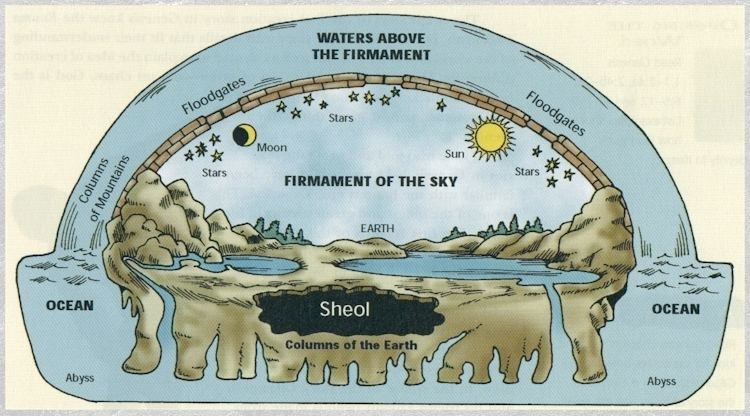
What the ancient world believed.

All of these things were assumed to have been created by one or more of the gods, who themselves were created by a superior god or were magically born from the primordial chaos.

Of course, this ancient model of the cosmos was completely wrong, but it was sufficient for the day, and more detail would only have confused them even more than they were. Even today, thousands of years later, the more we discover about the cosmos, the more we know that we are still missing key details.

So why would our God care if the ancients knew all truth about such a complex structure? It was way too early to ask humanity to grasp the incredible complexity of the universe.

The important thing was that they be taught that He is the true creator and He preexisted all else that exists.

So, God has summoned Moses back to his vantage point above the sea. He tells him to look up this time. When he does, he sees nothing but dark clouds. As he watches, God sends the wind to blow away the lower clouds. Layer after layer, the clouds part until nothing is left but what appears to be the dome, perhaps obscured by high, dark altostratus clouds that allow only a general glow to penetrate.

6 God said, “Let there be a dome in the middle of the water; let it divide the water from the water.” 7 God made the dome and divided the water under the dome from the water above the dome; that is how it was, 8 and God called the dome Sky. So there was evening, and there was morning, a second day.
—Genesis 1:6-8 (CJB)

Day 3

For a third time, Moses falls asleep and is carried in his dream to a vantage point above the primordial sea. Again, God speaks, and another long expanse of years rolls by in the course of the night, as on Day 1.

Moses observes during this dream another compressed passage of a great deal of time. The sea level falls as excess ocean water returns to the earth’s mantle. Land masses emerge and constantly deform and move under the influence of numerous processes, including plate tectonics, vulcanism, tidal forces, weathering, erosion, deposition, and many more, all decreed by God to assure a healthy and dynamic planet.

9 God said, “Let the water under the sky be gathered together into one place, and let dry land appear,” and that is how it was. 10 God called the dry land Earth, the gathering together of the water he called Seas, and God saw that it was good.
—Genesis 1:9-10 (CJB)

Now that God has shown Moses the magnitude of His glory in creation of the greater cosmos and earth, as understood by the ancients, He is ready to begin demonstrating that it was also at His hand that earth was filled with life.

God speaks once again and Moses sees many species of plant life that have begun to develop, spread, and differentiate to fill vast areas of the land and sea, adapting to environmental changes over many generations. From time to time, God or His angels intervene to bridge wider gaps and fill niches that adaptation alone can’t cross. I discuss “adaptation” vs. “evolution” in an appendix below.

11 God said, “Let the earth put forth grass, seed-producing plants, and fruit trees, each yielding its own kind of seed-bearing fruit, on the earth”; and that is how it was. 12 The earth brought forth grass, plants each yielding its own kind of seed, and trees each producing its own kind of seed-bearing fruit; and God saw that it was good. 13 So there was evening, and there was morning, a third day.
—Genesis 1:11-13 (CJB)

Day 4

I don’t believe that God is showing Moses anything new on this night. The sun, moon and stars were in their place in the sky at the close of the first night’s dream, though Moses probably was unaware of them until now. The way I presented this scenario above, billions of years of history scrolled by Moses in one night, which he couldn’t possibly have taken in. Perhaps he was only shown the beginning and end of the process—from the flash of light to the surface of water-world Earth. And perhaps during dreams 2 and 3 the sky has been obscured by clouds. In any case, now God wants to draw his attention to the cosmos above, so we have a clear sky.

Just what did Noah see? Just exactly what he expected to see, and what he had seen every day of his long life, which from his limited perspective was stars rolling by in grooves at the bottom surface of the sky dome, and the sun and moon being carried from east to west by, as he now would have seen it, God’s angels. Once again, the emphasis is on, “I, Yahweh, did it all, Moses!”

14 God said, “Let there be lights in the dome of the sky to divide the day from the night; let them be for signs, seasons, days and years; 15 and let them be for lights in the dome of the sky to give light to the earth”; and that is how it was. 16 God made the two great lights — the larger light to rule the day and the smaller light to rule the night — and the stars. 17 God put them in the dome of the sky to give light to the earth, 18 to rule over the day and over the night, and to divide the light from the darkness; and God saw that it was good. 19 So there was evening, and there was morning, a fourth day.
—Genesis 1:14-19 (CJB)

Day 5

This is where God begins showing Noah the climactic introduction of sentient life (conscious creatures, with sensations and perceptions). Beginning with denizens of the seas and the air.

As with the plants, God has created numerous species, to fill many habitats. They are designed for adaptation to changing conditions, but, like the plants, they need an occasional nudge. Once again, I discuss “adaptation” vs. “evolution” below.

20 God said, “Let the water swarm with swarms of living creatures, and let birds fly above the earth in the open dome of the sky.” 21 God created the great sea creatures and every living thing that creeps, so that the water swarmed with all kinds of them, and there was every kind of winged bird; and God saw that it was good. 22 Then God blessed them, saying, “Be fruitful, multiply and fill the water of the seas, and let birds multiply on the earth.” 23 So there was evening, and there was morning, a fifth day.
—Genesis 1:20-23 (CJB)

Day 6

On day six, God is approaching the climax of the dream series with Moses. Sentient animal species other than sea creatures and birds. Animals first, and then pre-Adamic mankind. Evidence for mankind goes back for some three million years. Evidence for Homo sapiens for 300,000 years. See “adaptation” vs. “evolution” below.

In my opinion, Adam and Eve were not part of general creation as revealed in Genesis 1!

As discussed in Exploring the Garden of Eden, I believe that both scripture and theological logic raise a pretty good case that they were created separately, about 6,000 years ago.

24 God said, “Let the earth bring forth each kind of living creature — each kind of livestock, crawling animal and wild beast”; and that is how it was. 25 God made each kind of wild beast, each kind of livestock and every kind of animal that crawls along the ground; and God saw that it was good.

26 Then God said, “Let us make humankind in our image, in the likeness of ourselves; and let them rule over the fish in the sea, the birds in the air, the animals, and over all the earth, and over every crawling creature that crawls on the earth.”
27 So God created humankind in his own image;
in the image of God he created him:
male and female he created them.
28 God blessed them: God said to them, “Be fruitful, multiply, fill the earth and subdue it. Rule over the fish in the sea, the birds in the air and every living creature that crawls on the earth.” 29 Then God said, “Here! Throughout the whole earth I am giving you as food every seed-bearing plant and every tree with seed-bearing fruit. 30 And to every wild animal, bird in the air and creature crawling on the earth, in which there is a living soul, I am giving as food every kind of green plant.” And that is how it was. 31 God saw everything that he had made, and indeed it was very good. So there was evening, and there was morning, a sixth day.
—Genesis 1:24-31 (CJB)

Appendices

Adaptation vs evolution

For my whole life until lately, I’ve avoided taking a stance on evolution, because biology and genetics aren’t my scientific strong suits. I’ve always been extremely skeptical of biological evolution, but I figured if that’s the way God chose to design life, He is entirely free to have done it. With a little help, I’ve finally decided on the stance I will take going forward.

First, let me point out that, despite usage of the term in both religious and secular circles, “evolution” in this context applies only to the development of living things. In its generic sense, the word simply means change over time, so yes, everything evolves. But “biological evolution” is a specific set of processes that change the ontological properties of living things. The non-living universe does not experience “survival of the fittest”, and it does not rely on mutation and genetic transmission. It simply follows the physical laws that God built into it, including quantum uncertainty, and takes an orderly path of cause and effect. I don’t call this evolution!

As for biological evolution, there are still two things that prevent me from considering myself an evolutionist:

The first is that, though many proposals have been made and many experiments have been conducted, nobody has ever come up with a workable explanation for how non-life becomes life! The latest theory is that life originates at deep-ocean geothermal vents, white or black “smokers.” But there has never been a test conducted or an equation written that can explain a mechanism for going from non-living to living even here. The closest thing is that there is generally a huge abundance of life around these vents. But does a huge crowd at a Kansas City Chiefs Superbowl rally prove that life originated inside Union Station? Probably not.

A competing theory that has been around for ages and has been getting a lot of attention lately is called Panspermia. Life was “seeded” on earth by aliens (other than God) or an impact event—a comet or an asteroid. This idea just shoves the problem off of this planet onto another.

The second problem with biological evolution, “irreducible complexity“, was introduced to the Christian community by Lehigh biochemist Michael Behe in his well-articulated book, Darwin’s Black Box (1966) and two subsequent books, The Edge of Evolution (2007) and Darwin Devolves (2019).

Behe is best known popularly for his support of Intelligent Design, but he is not a Young Earth Creationist. Like me, he believes that God created the universe billions of years ago. He believes that God created life, that He gave it the ability to adapt, and that the new science of genomics proves “line of descent.”

That latter means that the Darwinian Tree of Life is more or less accurate—but irreducible complexity means that God’s intervention is necessary for adaptation to cross certain boundaries.

Creationists in general agree that adaption occurs within species. Behe only disagrees to the extent of saying that it occurs within biological Orders, or perhaps Families.

I find that I can agree with Behe’s approach. It makes logical sense to me and leaves God in control!

I just go one step farther and claim that Adam and Eve were a separate creation, approximately 6,000 years ago. Nowhere does Scripture state that Genesis 2 is a restatement of Day 6. That assumption is Judeo-Christian tradition, and in fact there are discrepancies in the two accounts if they are taken literally.

Birth as analogy

Many of you will still say that creation 13.8 billion years ago at the Big Bang is not as elegant as creation 6,000 years ago as recorded in a literal translation of Genesis 1.

I don’t see it that way at all! Perhaps it is because from an early age I have been fascinated by both the Creator and His creation. Creation is His art, His medium and His signature accomplishment.

Consider the following well-known verse:

For you formed my inward parts;
you knitted me together in my mother’s womb
—Psalm 139:13 (ESV)

If you read this in the exact same way as you read Genesis 1, you can interpret it as saying that God Himself personally assembled all of your component parts in your mother’s womb during those nine months, or even (why not) on the day you were born.

You say, “It couldn’t be on the one day, because she saw me on an ultrasound, and she felt me kick, and besides, we all know how gestation works.”

But wait, did you really see any of that, or are you believing doctors, researchers, and medical equipment. Maybe that kick was actually a gas bubble! You believe them just as I believe my telescope and my astrophysics training in college. My bachelor’s studies were in math and physics, preparing (alas, it didn’t happen) for astrophysics as my graduate field.

Let me now approach this from a different direction. My wife gave birth to both of our children. Not all smooth sailing, but at least she can smell popcorn now without getting sick. Would she trade those 18 difficult and uncomfortable months of pregnancy for an easy adoption? No. Adoption is a good thing, but gestation and birth are transcendent.
The Location of the Garden of Eden

Posted on:

Modified on:


This is an extraction from a larger article entitled, Exploring the Garden of Eden.

I absolutely believe that the Garden of Eden was a real place, Adam and Eve were two real people, and even though there are some language issues to deal with, the story related is real and vital, and the time frame geologically recent, i.e., 6,000 (Ussher) to 10,000 (Whitcomb, if the genealogies skip some generations) years ago.

Where was the Garden located?

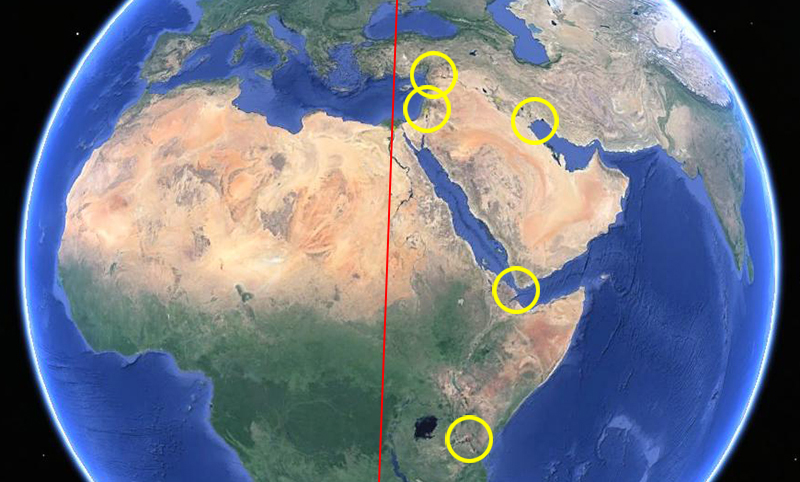
Most commentators seem to favor one of two general regions for the Garden: either northern or southern Mesopotamia, though proposals exist for locations surrounding the Arabian subcontinent and in eastern Africa. I’ve seen one suggestion that Eden lies at the bottom of the Red Sea, and another that puts it in the Indian Ocean.

Some proposed locations for Eden, per Babylon Rising.

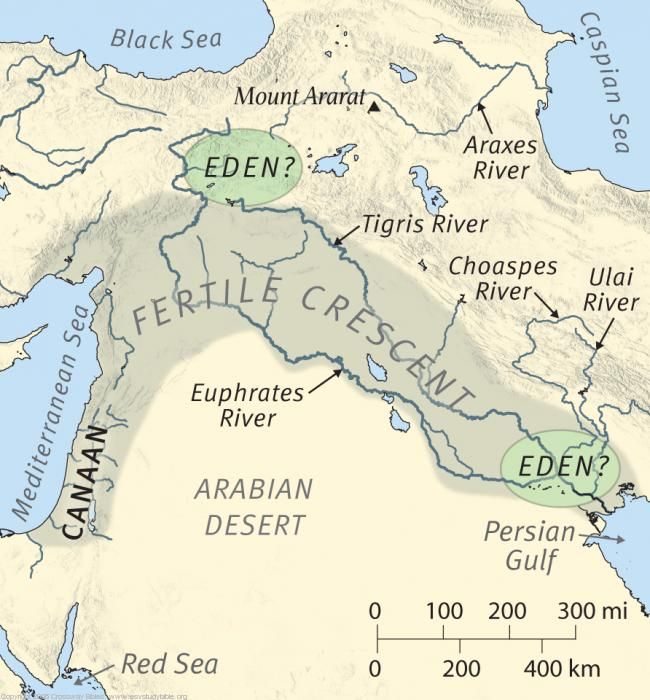
Northern Mesopotamian versions tend to favor Eastern Turkey/Armenia, since (a) there is a perception that Shinar is in that area, based on Genesis 11:2 (ESV): “And as people migrated from the east, they found a plain in the land of Shinar and settled there”; and (b) the headwaters of both the Tigris and Euphrates rivers originate in that general vicinity.

Possible Mesopotamian locations, per Blue Letter Bible.

Personally, I have favored a southern Iraq location for years, since obtaining a copy of an unpublished book titled, simply, Eden, by a late pastor named David J. Gibson, who understood that rivers don’t divide flowing downstream as described in Genesis 2:10 (ESV), “A river flowed out of Eden to water the garden, and there it divided and became four rivers.” Gibson suggested, and I agree with him, that this verse should be interpreted from the perspective of an observer within the Garden gazing out at four rivers converging as they entered the Garden.

This is awkward language for us, but not necessarily for Moses in antiquity, writing in Hebrew. Consider that in Genesis 2:8 (ESV), “the LORD God planted a garden in Eden, in the east”. This implies to me that the four rivers converged in the western part of Eden before flowing through the Garden, which was planted in the eastern part.

This makes sense, and from a hydrodynamics standpoint, it is the only interpretation that makes sense. Tributaries converge, they don’t diverge. If, for some reason, a river splits to flow around an obstruction or a sandbar, it will always come back together downstream nearby. If, for some reason, it splits to flow down two or more separate drainage basins, an unstable pattern results. One path will erode more quickly than the other(s), and eventually that path will “steal” all the flow from the other(s).

The only exception from that rule is the case of delta flow, but deltas aren’t formed by erosion, they’re formed by deposition of silt carried downstream in the water. As a river flows onto a plain and slows down, turbulence decreases, and silt falls out of suspension and stays more or less where it drops. Without sufficient turbulence to pick it up again, there is just enough energy available to keep the channels open.

Large deltas usually form at the mouth of a river where water leaving the delta’s channels flows into the sea or a lake. Sometimes deltas form inland, usually where a mountain stream empties onto a plain. The water from an inland delta will either evaporate, sink into the substrate, or collect into a single stream or a lake. Two examples are shown below.


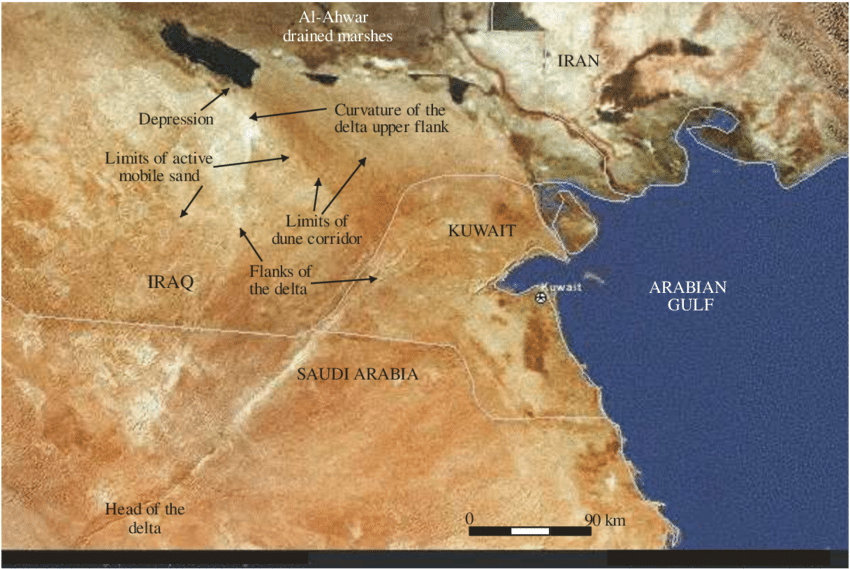
Pishon ? The deltaic terminal of Wadi Al-Batin. From Ali Al-Dousari on Researchgate

Genesis 2:10 would make total sense if the four “rivers” were delta channels, but the naming of those four rivers in verses 11–14 belies that possibility. Indeed, in my opinion the naming of the Tigris and Euphrates rivers conclusively fixes the location of the Garden in southern Iraq.

What about the other two rivers named?

The Pishon is fairly well defined because verse 11 says that it “flowed around the whole land of Havilah.” Havilah was a son of Cush who settled in what today is northwest Arabia. 1 Samuel 15:7 (ESV) defines that location: “And Saul defeated the Amalekites from Havilah as far as Shur, which is east of Egypt.” “Flowed around” could be literal (I found a map showing the Pishon as an ocean current flowing counterclockwise around the entire Arabian subcontinent), but more likely it simply means that it flowed through and provided water for Havilah. Gibson equated the Pishon with Arabia’s Wadi Al-Batin, an ancient and now-dry river and delta system flowing northeast through Saudi Arabia and Kuwait to the Tigris/Euphrates valley. I think he was right.

Gihon? Karun River, Wikipedia

As for the Gihon River that “flowed around the whole land of Cush” (verse 13), I would equate that with the Karun River, flowing out of Iran, through the ancient land of the Elamites.

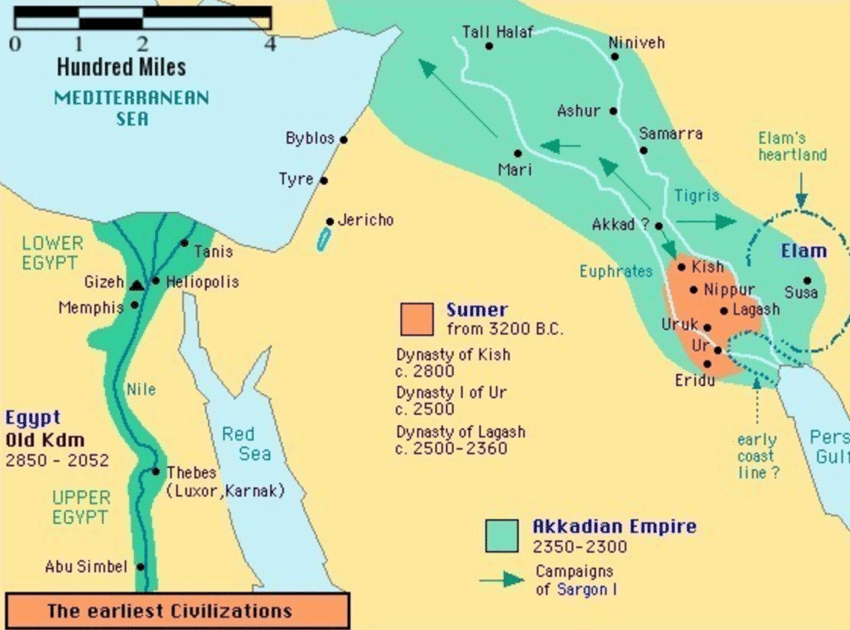
I think that Christian commentators are thrown off by an assumption that “Cush” refers only to the region around Ethiopia and Somalia. My view is that Cush (a son of Ham) and his descendants settled large regions of Asia, as well as the upper Nile area. They apparently mixed with the Canaanites in the Lavant, and Nimrod, a son of Cush, was described in Genesis 10 as “9a mighty hunter before ADONAI. … 10His kingdom began with Bavel, Erekh, Akkad and Kalneh, in the land of Shin‘ar.” These abodes of Nimrod are all lands of southern Mesopotamia. Nimrod was, I’m convinced, none other than Sargon of Akkad, the world’s first great emperor. Elam and Asshur were Semites, but Cush may have extended into the Steppes alongside Shem (see Nimrod the Empire Builder: Architect of Shock and Awe, 2023, by Douglas Petrovich).

It’s admittedly a stretch, but I have wondered if perhaps the ancient Kushan Empire, spanning the central Asian “stans” might have gotten its name from Cush/Kush. If so, then the influence of Cush stretched all the way to the Xiongnu tribe, north of the Yellow River, because the peoples who started the Kushan Empire, centered around Afghanistan, where refugees from the Xiongnu.

Putting all this together, I think that the following map states the case for Eden in southern Iraq:

My own opinion as evidently shared by someone else. ©Mavink

What about the placing of Shinar in Turkey? I agree with the predominant view that Shinar is the area once occupied by Sumer, between the Tigris and Euphrates Rivers. It’s not hard to explain away migration “from the east.” I suspect that waters from the Great Flood took years to retreat from low-lying areas, so descendants of Noah returning to their homeland in Shinar would have initially moved southeast along the spine of the Zagros Mountains. Saying that Shinar is west of Ararat because they entered from the east is analogous to assuming I live west of my church because I (sometimes) approach it from the west. The full story on that is that I live to the southeast and occasionally take a circuitous route along the freeway.

Post-flood migrations from Ararat to Shinar. From Google Earth. Annotations by Ron Thompson.


Romans 5:12 and Death Before the Fall


Posted on:

Modified on:

  1. Introduction
  2. Background and grammar
    1. Life
    2. death
    3. Death in antiquity
    4. Death in Hebrew
    5. Death in Greek
  3. Romans 5:12, “death by sin”
    1. The Romans context
      1. Background
      2. Outline
      3. A focus on the theology
        1. Literal death in Romans 1–4
        2. Death and life in Romans 5:1–11
        3. Death and life in Romans 5:13–21
        4. A different metaphor in Romans 6–7
        5. Romans 8
    2. Interpreting Romans 5:10–14
  4. Death in Eden
    1. The sin in Eden
    2. The curses of Eden
      1. The Serpent
      2. The Woman
      3. Adam
  5. Good and Very Good
  6. Philosophical bias
    1. Nature vs Eternity
    2. Fecundity
    3. Natural Life

As an Old Earth Creationist (OEC), Young Earth Creationists (YEC) have frequently asked me about, or scolded me over, the question, “Doesn’t your theology presuppose the unbiblical idea of death before the Fall?”

My response is that, yes indeed, an old earth (4.5 billion years old) and an older universe (13.8 billion years old) does in fact imply that there was life and death on earth long before the creation of Adam, and his subsequent fall.

I will try here to refute the claim that death before the fall is “unbiblical” and to support my opinion that death was an intended part of God’s design that did not begin with Adam’s sin.

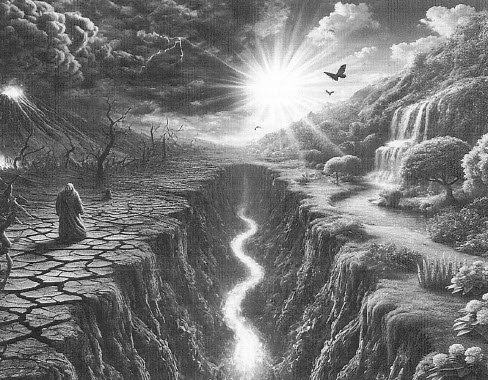
Unknown artist’s conception of Hades as described by the parable of The Rich Man and Lazarus. I presume that’s the Rich Man walking alone on the left bank of the chasm, while Lazarus is off lounging somewhere in Abraham’s Bosom, on the right bank. Remember that this is a parable, so you aren’t expected to take the vision of Hades’ layout or structure too literally.

Introduction

If you subscribe to a YEC interpretation of Scripture (and most of my friends do), then you should believe that all life, human, animal, vegetable, fungi, single-celled and microbial, was created some 6,000 years ago, over a span of only days. Is it conceivable, in that case, that the Fall took place soon enough after creation that no living thing got eaten, stepped on, or fell off a cliff? Was life physically indestructible, as well as immune from natural death? Life is far more complicated than that, but to Henry Morris and his disciples, the question is moot, because to them the Bible prohibits even the possibility of any kind of death before the Fall.

In this post, after first presenting some background and grammar, I’m going to comment on a few of the key YEC arguments for and against pre-fall immortality.

Background and grammar

Life

Not all YEC scholars think that a denial of physical death before the fall applied to plants and microbes, or anything else with no brain. I’m not aware of any scripture that grants this exemption, unless it is implicit from,

29 And God said, “Behold, I have given you every plant yielding seed that is on the face of all the earth, and every tree with seed in its fruit. You shall have them for food. 30 And to every beast of the earth and to every bird of the heavens and to everything that creeps on the earth, everything that has the breath of life, I have given every green plant for food.” And it was so.
— Genesis 1:29-30 (ESV)

Some say that only vertibrate animals were exempt from death. Where is that written?

Some say that anything without blood was never “alive”, in a Biblical sense, because “the life of the flesh is in the blood…” But that isn’t meant to define what “life” is or is not, it’s merely the stated reason that God views the consumption of blood as abominable. There is unfortunately a huge tendency for hyper-literalists (those who won’t let the Bible use figurative language or poetic exaggeration to prove a point) to read theology into every word of every verse, without regard to context.

Far from looking for exemptions, Morris even taught that entropy could not have increased before the fall. Morris was not a scientist and never had a full grasp of what entropy even means until later in his life.

Entropy is a fundamental thermodynamic property of the physical universe. Formally, it is a statistical measure of the number of mathematical “degrees of freedom” in any physical system. The Second Law of Thermodynamics states that the entropy of the universe always increases.

Entropy is often described to novices as “a measure of randomness”, but that is misleading. A common claim is that “shuffling a pack of cards increases its entropy because of the increased randomness of the shuffled deck but sorting it back into its original order decreases its entropy since its randomness is lower.” That isn’t at all true! The increase of entropy is due to the energy expended in shuffling. Reordering requires another expenditure of energy, say from a person or a machine, thus further increasing entropy. The entropy of 52 cards at rest is the same whether they are in an ordered or a shuffled state.

If Morris was right about entropy, cells could not divide, food could not digest, muscles could not contract, balls could not roll downhill and, oh yes, the sun could not shine, and gravity could not work. If so, then after the Fall, God must have completely redesigned the laws of physics, plus the nature of every last object in the universe, from subatomic particles on up to spacetime itself.

But the text of Scripture doesn’t, to my knowledge, hand out exemptions, so who gets to say that any human or nonhuman life was exempt from death? To my way of thinking, it is arbitrary and presumptuous for us mortals to “exempt” anything that is cellular and reproduces in a biological sense or to include anything else. Life is life!

death

For this discussion, we have to be more precise when we talk about “death.” That concept, as used in the Bible, can mean different things in different contexts:

  • Everybody on earth recognizes that anything post-Fall that has physical, tangible, cellular life will ultimately suffer a “physical death,” that is, a termination of all self-powered physical processes. After that, external processes take over to break down the physical components of that once-living carcass and “return it to the dust.”
  • Most contemporary Christian scholars also recognize that the Bible frequently talks about an analogous “spiritual death,” which Thayer describes as “the misery of soul arising from sin, which begins on earth but lasts and increases after the death of the body”; “the miserable state of the wicked dead in hell”; and “all the miseries arising from sin.”
  • Paul also defined death as voluntarily putting away, or killing, the evil inclinations of all humankind. See my recent Yetzer, Yotzer and “The Law” in Romans 7:1–6 for a detailed discussion of this usage.

While “death as separation” is not a highly developed Biblical concept, per se, it is functionally an apt description: separation of the body and spirit; separation of the eternal spirit from God; and separation of man from his own nature, respectively.

Death in antiquity

Human beings have an innate curiosity about their origins, both individually and culturally, and I think that this curiosity is at its strongest when communities are more isolated and less technologically distracted. In prehistoric times—that is, before the development of writing—history was very efficiently retained and spread verbally, both within families and cross-culturally by traveling storytellers. It should come as no surprise that all the ancient civilizations, with their common origins in Babel, would share common “legends” about their pasts and common beliefs about the unseen.

From Greece to Egypt and all across the Fertile Crescent, way over to India and China, and across the pond in the Americas, every culture that left records in early history shared one cosmology and one belief in the afterlife, differing only in small regional details.

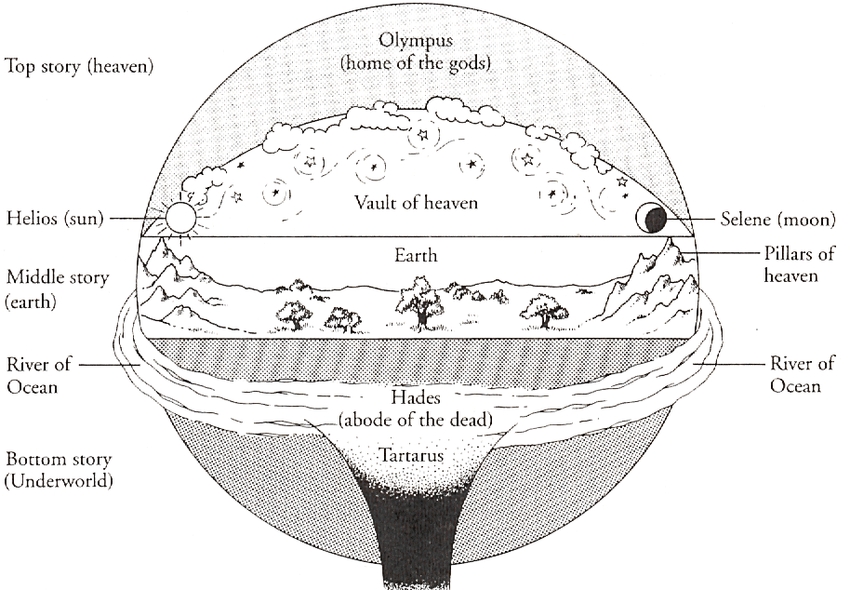
I’ve shared several versions of the universal flat earth model of cosmology in earlier posts. Here I’ll add the Greek view, which is very similar to the others.

Ancient Greek cosmological diagram.

In all cases, the earth is depicted as a flat disk floating on a broad ocean and covered by a dome (the “firmament” in KJV). Beneath the surface of the disk is the underworld, Hades, the abode of the (physically) dead.

As I’ll show in the following two sections, both Hebrew and Greek have terms that refer to death and the remains of the physically dead, but neither language has any term that differentiates between physical and spiritual death. Though “death” can refer to either, only the context can indicate which is being discussed. Unfortunately, very often the context alone is insufficient for total clarity.

Why would that even be?!

I would suggest that, aside from corruptions in the retelling, all early civilizations shared the assumption that physical life was only one phase of personal existence.

Human life on earth is short. Adam’s descendants in the period between the Garden and the Flood lived long lives, as recorded in the Bible, but most cultures in the ancient world had life expectancies of no more than a few decades. Physical death was no shock. It was pretty much universally believed that when a human died, his spirit survived and was relegated to the underworld. The Bible calls that underworld Sh’ol, or Sheol, in Hebrew, Hades in Greek.

Physical death, in other words, was little more than the shedding of a mortal shell not needed by the immortal spirit as it moved into its new abode in the underworld.

There was no concept of death or annihilation of the spirit in the underworld until much later. In fact, there apparently was no real concept of suffering spirits, either. Even in the Old Testament, where the Psalmist said, “The wicked go down to the realm of the dead, all the nations that forget God” (9:17) and “Let me not be put to shame, Lord, for I have cried out to you; but let the wicked be put to shame and be silent in the realm of the dead” (31:17), the sense is, “I’m righteous, so let me live, because when I die, I’ll be relegated to the drab and boring underworld.”

The picture of Sheol/Hades presented in the parable of the Rich Man and Lazarus appears nowhere in the Old Testament. That is a view apparently developed in Second Temple Judaism and propagated in Jewish pseudepigraphal works like The Apocalypse of Zephania and 1 Enoch. In telling this parable, Jesus was using a well-known popular concept to illustrate His teaching.
Death in Hebrew

Biblical Hebrew has several words that are used extensively with respect to death:

פֶגֶר (peger, pronounced peh’-ger) is a noun referring to a corpse, carcass, or dead body, human or animal. It was also used figuratively on occasion to refer to idols.

מוּת (muwth, pronounced mooth) is a verb meaning to die, to kill, or to be dead. The subject could be human, animal, vegetable, or even a nation. It can refer metaphorically to the death of some characteristic, e.g., the death of courage. Manner of death could be natural causes or violence. It could also refer to a death judgement, or to an agent of death.

מָוֶת (maveth, pronounced MAH-veth) is a noun, closely related to muwth, that means death, the dead, the place of the dead or state of being dead, or sometimes pestilence or ruin. Rarely, it can be used metaphorically to indicate spiritual death or separation from God, as perhaps in Hosea 13:14, or divine judgement, as in Ezekiel 18:4.

נֶפֶשׁ (nephesh, pronounced neh’-fesh) is a noun, often translated as soul, but primarily meaning any living and breathing creature, human or animal. It also refers to many of the characteristics of life, including life itself, self, person, desire, passion, appetite, or emotion. To lose one’s nephesh is to die, after which the peger, or remains, decay, while the nephesh (now a disembodied spirit) lives on in Sheol, “the grave”, meaning the underworld.

Note that in the Hebrew Scriptures, there is almost no development of the idea of spiritual death, or of divine retribution in the afterlife.

Whatever your hand finds to do, do it with your might, for there is no work or thought or knowledge or wisdom in Sheol, to which you are going.
— Ecclesiastes 9:10 (ESV) emphasis mine

Death in Greek

There are many similarities, but also significant differences in the Biblical Greek vocabulary of death:

σῶμα (sóma, pronounced SO-mah) is a noun meaning body or flesh. Unlike the Hebrew peger, this word speaks of a body that can be either living or dead, or in some cases metaphorically, of the body of the Church, or the visible aspect of a disembodied spirit, e.g., an angel.

θάνατος (thanatos, pronounced THAH-nah-tos), like the Hebrew maveth, is a noun meaning death. Unlike maveth, where the figurative sense of “spiritual death” is rare, that concept is well developed in the 1st century AD. In biblical Greek, the figurative meaning is present at least as often as the literal. Unfortunately, only the context can reveal which meaning is in play, and even then, it is sometimes not clear.

As a foil for thanatos, I’ll include here its opposite, ζωή (zóé, pronounced dzo-ay’), a noun meaning life. Interestingly, thanatos is a masculine noun, while zóé if feminine. I’ll not suggest any significance to that fact.

νεκρός (nekros, pronounced nek-ros’) is an adjective meaning dead, deceased, or corpse-like. Like thanatos, the New Testament often uses it to refer to spiritual death. Once again, only the context can determine which meaning to attach.

νεκρόω (nekroó, pronounced (nek-ro’-o) is a verb form of νεκρός meaning to put to death, or render powerless or ineffective.

ἀποθνῄσκω (apothnéskó, pronounced ä-po-thnā’-skō) is a verb meaning to die, to lie dying, or to be killed. Similar to Hebrew muwth, but once again, in the NT it often has a strong spiritual, rather than literal, connotation.

κρίμα (krima, pronounced KREE-mah) is a noun meaning a condemnatory sentence, penal judgment, or sentence.

κατάκριμα (katakrima, pronounced kä-tä’-krē-mä) is a noun meaning punishment following condemnation, penal servitude, penalty. Quoting from Bible Hub’s Topical Lexicon: “The word κατάκριμα is used in the New Testament to describe the state of being under condemnation, particularly in a spiritual or moral sense. It is often associated with the consequences of sin and the judgment that follows.”

Romans 5:12, “death by sin”

Therefore, just as sin came into the world through one man, and death through sin, and so death spread to all men because all sinned
— Romans 5:12 (ESV)

To most YECs, Romans 5:12 is the definitive last word on the subject, because it seems to clearly state that no death of any kind, to any created life form (subject to possible exemptions discussed above), was possible before Adam sinned.

But is that so?

“Proof-texting”, i.e., casually picking one verse out of Scripture to prove a theological point of view, is always risky because no single verse, in a vacuum, is likely to reflect the writer’s complete thoughts on the subject of the verse, or on the circumstances under which he is writing. Other factors almost always need to be considered, such as:

  • The grammar, genre, and figures of speech.
  • The issue or issues that prompted the writing.
  • The textual, historical, and cultural context.
  • The identity and background of the writer.
  • The identity and background of the original readers.

The grammar of 5:17 tells us that Paul is combining two thoughts:

  1. Adam’s sin introduced sin and death (thanatos) into the world.
  2. All humans sin, so all humans die.

These two thoughts are conjoined by the Greek phrase kai houtōs, but it is unclear how that should be translated. A quick survey of translations yields “and so”, “in this way”, “this is why”, “and thus”, and the New Century Version (NCV) even puts the second thought into a new sentence. “This is why everyone must die—because everyone sinned.”

Whichever one of those translations you go with, without more context there is a logical disconnect between the two halves of the verse. YECs use Thought 1 to prove that Adam’s sin introduced both physical and spiritual death into the world. Yet they would agree that Thought 2 says that humans die individually because they sin individually. Do animals not die individually because they sin individually?

The Serpent of Genesis 3 sinned, but that was Satan, not a common Garden of Eden Snake. Balaam’s donkey spoke sinful words (Numbers 22:28), but that was spiritual ventriloquism (“The LORD opened [its] mouth”). In Luke 8. 26–39, Jesus was speaking with demons, not with pigs.

I think we can agree that animals aren’t capable of sin, and neither are they subject to spiritual death. Therefore, animals probably have nothing to do with Thought 2 in Paul’s teaching. Given the multiple shades of meaning in thanatos (or the English, “death”) are we as Biblical literalists required to read all possible definitions into that one word here? Not unless we can find something in the context to back it up.

As a matter of fact, the subject in Romans 8, and in fact, the theme of the first 8 chapters, is salvation by faith in the Messiah, for both Jew and gentile. He brings up Adam for two reasons: First, because Jesus provided the means of undoing what the sin of Adam did to humanity; and second, because unlike Abraham, Adam is the father of both Jew and gentile. (Note that the overall theme of the Epistle to the Romans is Paul’s call for unity between Jews and gentiles in the Roman churches.) Among other verses in chapter 8, the following two provide all the explanation needed to understand 5:12:

18 So then, through the transgression of one, condemnation came to all men; likewise, through the righteousness of one came righteousness of life to all men. 19 For just as through the disobedience of one man, many were made sinners, so also through the obedience of one man, many will be set right forever.
— Romans 5:18-19 (TLV)

There is nothing at all in that message that applies to animals (or pre-Adamic hominids if you believe in them). Animals are explicitly mentioned only once in all of Romans:

22 Claiming to be wise, they became fools, 23 and exchanged the glory of the immortal God for images resembling mortal man and birds and animals and creeping things.
— Romans 1:22-23 (ESV)

We’ll approach an understanding of whether Romans 5:12 is speaking of physical death, spiritual death, or a combination of the two in this section. Because the language alone can’t answer that question, we’ll look primarily to the context of Paul’s letter, particularly chapters 1–8, concentrating on chapters 5–8. In the process, we’ll also strengthen our case for human-only death being in view.

The Romans context

In this section, I will now provide a thorough exposition of the topic of death, as it relates to 5:12, in Paul’s theological writings to the churches in Rome.

Background

Though Romans is packed with theology, Paul’s reason for writing the letter was primarily to act as a peacemaker between the Jewish and Gentile believers in the Roman churches.

On his missionary journeys, Paul’s habit was to first approach the Jewish synagogues and preach to their congregations, then to expand his approach to gentiles in the community. Where did the new believers then meet together? The practice of Jewish believers in Jerusalem was to continue their normal Sabbath activities in the synagogues alongside non-Messianic Jews, then at dusk, at the close of Shabbat, the Messianics would adjourn to private homes to meet and fellowship together until well into the night.

This same practice was likely followed in the Diaspora as well, with gentile believers joining at homes after the synagogues closed for the night. This was of course a great demonstration of the intercultural tolerance demanded by Paul.

[Note: Since “the 7th day of the week” gave way to “the 1st day of the week” at dusk, I believe that this evening adjournment is what truly led to the Christian custom of meeting on Sundays.]

In AD 49, Emperor Claudius expelled all Jews from the City of Rome, including Messianic believers. When the expulsion was ended after Claudius’ death in AD 54, two to four years before Paul’s letter, those Jews who returned found that Gentile believers had taken over their synagogues, and the result was bad blood between the returning Messianic Jews and the gentile usurpers.

Outline

That background explains, I think, why the bulk of the letter consisted of round after round of explanation and exhortation to first one, then the other, component of the Church.

In broad strokes, I personally outline Romans as follows:

  1. Greetings and personal notes, 1:1–15.
  2. A unifying theology of righteousness through faith, 1:16–8:39.
  3. Paul’s burden for Israel, 9:1–11:11.
  4. Gentiles and Jews together, 11:12–36.
  5. Christian ethics for all, 12:1–15:13.
  6. Paul’s closing statements, 15:14–16:27.
A focus on the theology

In Romans 1:16–8:39, Paul’s emphasis was on theology, in particular the roles of faith and Torah obedience in the quest for righteousness as required by God in the united Church.

In order to stay within the limited scope of this paper, I will concentrate here on Paul’s discussions of death, in order to set a context for 5:12.

Literal death in Romans 1–4

In the following passage, Paul is speaking of the faith of Abraham who, despite being an old man and “as good as dead”, maintained his strong faith in God, who not only creates the body, but gives it life. Both of these references to death are forms of nekros, and it seems reasonable to assume that they are referring either strictly or primarily to physical death; however, in my judgement they don’t help set the context of 5:12.

17 as it is written, “I have made you the father of many nations”—in the presence of the God in whom he believed, who gives life to the dead [nekros] and calls into existence the things that do not exist. 18 In hope he believed against hope, that he should become the father of many nations, as he had been told, “So shall your offspring be.” 19 He did not weaken in faith when he considered his own body [soma], which was as good as dead [nekroó], (since he was about a hundred years old), or when he considered the barrenness of Sarah’s womb.
— Romans 4:17-19 (ESV) emphasis mine

In 4:24 (“him who raised from the dead [nekros] Jesus our Lord”,) and 5:10 (“we were reconciled to God by the death [thanatos] of his Son”), the subject is the death and resurrection of Jesus, which again I think is not terribly helpful in setting the context for death in the following chapters.

Death and life in Romans 5:1–11

Beginning in chapter 5, the emphasis changes from justification to sanctification and the peace that comes with it.

Therefore, since we have been justified by faith, we have peace with God through our Lord Jesus Christ.
— Romans 5:1 (ESV)

“Death” terms now begin to appear more frequently in the text.

6 For while we were still weak, at the right time Christ died [apothnéskó] for the ungodly. 7 For one will scarcely die [apothnéskó] for a righteous person—though perhaps for a good person one would dare even to die [apothnéskó]— 8 but God shows his love for us in that while we were still sinners, Christ died [apothnéskó] for us.
— Romans 5:6-8 (ESV)

These references to death all speak of Jesus’ crucifixion, which was of course very much a literal death. The same applies in verse 10:

For if while we were enemies we were reconciled to God by the death [thanatos] of his Son, much more, now that we are reconciled, shall we be saved by his life [zóé].
— Romans 5:10 (ESV)

A key question now arises: If thanatos and zóé refer to literal, physical death and life in 5:10, as I think we all would agree, then is this verse speaking of physical salvation of our bodies, or of spiritual “salvation of our souls”?

“Saved” in verse 10 is σῴζω (sózó, pronounced sózó), a verb meaning (per Thayer’s), either (a) to save, to keep safe and sound, to rescue from danger or destruction; or (b) to deliver from the penalties of the Messianic judgment, i.e., to make one a partaker of the salvation by Christ.

Once again, I think that most of my readers would agree that (b) is the sense meant in verse 10.

Up to here in Paul’s theological discourse, the subject has been primarily Jesus’ physical death and subsequent resurrection as the basis for our faith, and thus our spiritual salvation (justification, sanctification, and later glorification).

I would contend, then, that 10 and 11 focus the context for what follows in verse 12:

10 For if while we were enemies we were reconciled to God by the death of his Son, much more, now that we are reconciled, shall we be saved by his life. 11 More than that, we also rejoice in God through our Lord Jesus Christ, through whom we have now received reconciliation.
12 Therefore, …
— Romans 5:10-12a (ESV)

I will show below that the text following 5:12 further solidifies this context.

Death and life in Romans 5:13–21

The remainder of chapter 5 continues the contrast between death through Adam and life through Jesus and returns the emphasis back to the overall theme of the letter: explaining how faith and salvation can function in a Church composed of both Jews and gentiles.

Here, Paul says that, yes, we have been two separate peoples under separate spiritual economies since the time of Abraham, and we will remain so in most respects, but we all have a common ancestor in Adam. Within the Church, we must recognize that both peoples are infected with the sin nature of Adam because of his sin, but now both have been united by our faith in the salvation brought by Jesus.

Key death phrases in this section are:

14 … death [thanatos] reigned from Adam to Moses, even over those whose sinning was not like the transgression of Adam, who was a type of the one who was to come.

15 … if many died [apothnéskó] through one man’s trespass, much more have the grace of God and the free gift by the grace of that one man Jesus Christ abounded for many. 16 … For the judgment [krima] following one trespass brought condemnation [katakrima], but the free gift following many trespasses brought justification. 17 For if, because of one man’s trespass, death [thanatos] reigned through that one man, much more will those who receive the abundance of grace and the free gift of righteousness reign in life [zóé] through the one man Jesus Christ.

18 Therefore, as one trespass led to condemnation [katakrima] for all men, so one act of righteousness leads to justification and life for all men. … 21 so that, as sin reigned in death [thanatos], grace also might reign through righteousness leading to eternal life through Jesus Christ our Lord.
— Romans 5:14-21 (ESV)

Surely all of that death, judgement, redemption and life terminology must be speaking only of the spiritual state!

A different metaphor in Romans 6–7

Here Paul shifts the conversation about death. In this section, “death” is neither physical death nor spiritual death, but rather he uses the metaphor of “putting to death”, or overcoming, the evil inclinations brought on by our sinful natures. I discussed this recently in great detail in Yetzer, Yotzer and “The Law” in Romans 7:1–6

Romans 8

In this chapter, Paul closes out the discussion that fills the first half of the letter.

1 Therefore, there is now no condemnation for those who are in Messiah Yeshua. 2 For the law of the Spirit of life in Messiah Yeshua [the Torah written on our hearts] has set you free from the law of sin and death [the fleshly “evil inclination”].
— Romans 8:1-2 (TLV) comment mine

“Therefore” in 8:1 harks back to all that came before, but in particular to 7:4, discussed in the previous article:

Therefore, my brothers and sisters, you also were made dead to the Torah through the body of Messiah, so that you might be joined to another—the One who was raised from the dead—in order that we might bear fruit for God.
— Romans 7:4 (TLV)

By now, I hope that most of you will agree that Paul’s discussion of theology is primarily about the spiritual results of sin, not about the mortality of the body.

Interpreting Romans 5:10–14

Here, then, is my interpretation of Romans 5:12 in its closest context:

10 For if while we were enemies we were reconciled to God by the death of his Son, much more, now that we are reconciled, shall we be saved by his life. 11 More than that, we also rejoice in God through our Lord Jesus Christ, through whom we have now received reconciliation.

12 Therefore, just as sin came into the world through one man, and death [thanatos] through sin, and so death [thanatos] spread to all men because all sinned …
— Romans 5:10–12 (ESV)

For if while we were enemies — While we, as Jew or gentile, were in opposition to God and Torah.

We were reconciled to God by the death of his Son — We were brought back into a close relationship (which was lost when we first sinned) with God on be basis of Jesus’ crucifixion.

Much more, now that we are reconciled — More importantly, now that that relationship has been restored.

Shall we be saved by his life. — I discussed the meaning of salvation when I analyzed this verse above, taking Thayer’s definition, “to deliver from the penalties of the Messianic judgment, i.e., to make one a partaker of the salvation by Christ.”

More than that, we also rejoice in God through our Lord Jesus Christ, through whom we have now received reconciliation. — We celebrate the fact that we have been brought into fellowship with God, the Father.

Therefore—because of Jesus’ crucifixion and resurrection by which we have been reconciled to God.

Just as—in the same fashion as.

Sin came into the world through one man—Sin came into existence on earth. By disobeying God in the matter of the Tree of Knowledge, Adam and Eve brought the curse on mankind and on the ground that he depends on.

And death through sin—this will require discussion of two issues:

  1. The contextual discussion above addresses the question of whether this “death” (thanatos) is spiritual death only, or whether it includes any physical component at all. Based on we’ve seen in chapters 1–8, and especially 5:10–11, I can only conclude that death here is referring only to spiritual death.
  2. We also have to determine whether the remainder of verse 12 limits this death to mankind only, or if animals and other things are included.

And so death spread to all men because all sinned—to my mind, the grammar here limits death due to sin to the sinners themselves.

But let’s consider the curses themselves…

Death in Eden

The sin in Eden

The word “die” occurs 3 times in the Garden of Eden (Genesis 2:17; 3:3,4). In each case, it is a grammatical variation of the Hebrew muwth. As expected, the Greek Septuagint (LXX, a 2nd century BC Jewish translation of the Old Testament into Greek) translates each of these three occurrences using apothnéskó, which in this case imparts no new information.

What does the text tell us? In Gen 2:17 God’s words were, “in the day that you eat of it you shall surely die.” Eve’s flawed retelling of this to the Serpent was, “‘You shall not eat of the fruit of the tree that is in the midst of the garden, neither shall you touch it, lest you die.'” The Serpent’s response was, “You will not surely die.”

Are we to take this as a discussion of physical death, spiritual death, or perhaps both? That’s a tough question to some since it is not addressed specifically.

If the answer is “physical“, then did God lie and the Serpent tell the truth? That, of course, is not tenable unless the word “day” (from the root, יוֹם, yom) means something other than a literal day. In an Ancient Near East (ANE) context, that is certainly a possibility, but it’s making an unprovable assumption, and it’s a risky interpretation in the context of Genesis 1–3. If you require Genesis 1 to be using the word, day, literally for the creation days, then in Genesis 2–3, the same word should probably have the same meaning.

“Both” might mean that both were telling half-truths, which raises the same troubling issues.

If the answer is “spiritual“, then God was truthful, and the Serpent a liar. I’ll go with this one!

But, for the purpose of this post, I have to ask how Adam and Eve could have had any comprehension of either physical or spiritual death if there had been no death at all on earth up to that point. Any attempts to explain that away can only be speculative. Lacking data, then speculation is fine, but dogmatism is not.

Since Adam’s physical death didn’t come until 930 years later, I feel personally confident in speculating that the death promised to him was spiritual only, though there is no record that either God or the Serpent explained that to him or Eve. I further speculate that he was not created immortal but would have lived forever from the fruit of the Tree of Life, as stated in gen 3:22.
The curses of Eden

The Serpent

According to Genesis 3:14–15, the Serpent was cursed for his own sin.

14 So the LORD God said to the serpent:
Because you have done this,
you are cursed more than any livestock
and more than any wild animal.
You will move on your belly
and eat dust all the days of your life.

15 I will put hostility between you and the woman,
and between your offspring and her offspring.
He will strike your head,
and you will strike his heel.
— Genesis 3:14-15 (CSB17)

Angelic beings were created to oversee the cosmos, much like mankind was created to manage Earth. The Bible reports that angels are rebellious just like humans, but I see nothing in the Bible to indicate that the angels and humankind are judged under the same set of rules, or that other angels were included in the Serpent’s curse.

In fact, it’s unclear just what exactly the serpent was, and what its relation was to Satan. Revelation 12:9 and 20:2 state that it was Satan, but that could mean that Satan “possessed” a member of an animal family. “On your belly you shall go” does indeed sound like snake, but “the serpent was more crafty than any other beast of the field that the LORD God had made” doesn’t sound snakish at all, so who knows?

It’s unclear to me why God would have cursed all snakes because of the perfidy of one, and the part of the curse recorded in verse 15 certainly does not pertain to snakes! Well, I’m satisfied not knowing the unknowable!

The Woman

Eve’s curse is recorded in Genesis 3:16. It mentions only pain in childbearing and relational difficulties between husband and wife. From the wording, it seems that childbearing was already painful, so this just made it more so. If it was painful, could it also have been perilous?

He said to the woman:
I will intensify your labor pains;
you will bear children with painful effort.
Your desire will be for your husband,
yet he will rule over you.
— Genesis 3:16 (CSB17)

Adam

Adam’s curse is found in Genesis 3:17–19. Strictly speaking, Adam wasn’t cursed at all, directly. What the text says is, “cursed is the ground because of you”. What that curse does, though, is to set up an enmity of sorts between Adam and his environment, which certainly would be considered a curse.

17 And he said to the man, “Because you listened to your wife and ate from the tree about which I commanded you, ‘Do not eat from it’:
The ground is cursed because of you.
You will eat from it by means of painful labor
all the days of your life.

18 It will produce thorns and thistles for you,
and you will eat the plants of the field.
19 You will eat bread by the sweat of your brow
until you return to the ground,
since you were taken from it.
For you are dust,
and you will return to dust.”
— Genesis 3:17-19 (CSB17)

Alternatively, it may be that Adam’s own curse is that discussed above, plus

22 The LORD God said, “Since the man has become like one of us, knowing good and evil, he must not reach out, take from the tree of life, eat, and live forever.” 23 So the LORD God sent him away from the garden of Eden to work the ground from which he was taken. 24 He drove the man out and stationed the cherubim and the flaming, whirling sword east of the garden of Eden to guard the way to the tree of life.
— Genesis 3:22-24 (CSB17)

I see no Biblical indication, in Genesis 3 or elsewhere, that animals, plants, or the extraterrestrial cosmos were cursed for man’s sin. Certainly, the flora, fauna and ecology of earth are greatly affected by man’s curse. That doesn’t mean that it had any effect on their mortality, other than to make life harder.“Be fruitful and multiply and fill the earth and subdue it, and have dominion over the fish of the sea and over the birds of the heavens and over every living thing that moves on the earth.”
— Genesis 1:28 (ESV)

Good and Very Good

Many Young Earth Creationists claim that there could not possibly have been death before the fall because during the creation week, at the end of every day God looked at what He had done that day and pronounced it “good.” At the end of the sixth day, as a matter of fact, it was “very good.”

Now how, they ask, can anything be good or very good if it can die? Well, gosh… How does any fallen human being presume to know what God considers to be good? It’s His design, so by definition, it is good!

Let’s check the language:

טוֹב (tov, pronounced tove) This can be adjective, verb, or noun, and it means … hang onto you hats … good, pleasant, agreeable, beneficial, beautiful, best, better, bountiful, cheerful, at ease, fair, favor, fine, glad, goodly, graciously, joyful, kindly, loving, merry, pleasant, precious, prosperity, ready, sweet, wealth, welfare, well-favored. And all of these meanings are subjective! Good luck agreeing on the shading!

מְאֹד (m`od pronounced meh-ODE) This is an adjective meaning very, exceedingly, much, greatly.

Really, there’s not much help there. The word is subjective.

From my engineering perspective, a good design is one that does what the specs required, does what it was designed it to do, and does it elegantly.

Philosophical bias

In my opinion…


The universe is not a static artwork hanging on a wall. It’s a living, dynamic organism, designed by God to mature and blossom with little interference, to showcase His majesty, and to house and employ His angelic host, the first “generation” of His children, the B’nai Elohim, or Sons of God (Genesis 6:2–4).

And later, after reaching a suitable degree of maturity and elegance, a Garden was planted on one planet to house and nurture the second generation of His children, humanity.

Elegantly!


Nature vs Eternity

Development and growth per God’s blueprint demand movement, change, and thermodynamic flow. Exchange and equilibrium. Birth and death. This is true for the universe as a whole, for galaxies, stars and star systems, and for planets.

Angels are like humans in that they image God, they answer to Him, they interact with Him, they have freewill and thus can sin, and God has given them meaningful work to do.

They are unlike humans in that they have no physical bodies that are inherently vulnerable to mishap, wear and tear, and mischief. They don’t give birth, and they don’t die, and they aren’t influenced by hormones. However, when they have temporarily taken on human form, they have sometimes gotten into big trouble.

In the Eternal State, I believe human bodies will be secondary. In the meantime, they are the shell we are confined to. Spirits are immortal, bodies are not. By their nature, bodies are vulnerable. With God’s protection or the Tree of Life, they can be maintained indefinitely, but without it, death is inevitable.

Fecundity

The first commandment given to humans was,

“Be fruitful and multiply and fill the earth and subdue it, and have dominion over the fish of the sea and over the birds of the heavens and over every living thing that moves on the earth.”
— Genesis 1:28 (ESV)

Where there is fecundity, there has to be death. Neither animals nor humans can give birth indefinitely without eventually running out of space and resources. We value ecosystems and our environment. Ecology, God’s creation, demands cycles of life and death to maintain the health and balance of the planet.

Natural Life

I have in front of me paper after paper and article after article featuring Henry Morris’ grandson and many of his colleagues repeating over and over again that “death is an insult”, and “if God designed death into creation, then He is a monster”, and “death is wasteful and cruel.” This is all nonsense to me.

Isaiah described the Olam Haba (world to come) in the imprecise way of prophecy, particularly poetic prophecy. As sometimes happens, he confused the Millennium with the Eternal State, as described in Revelation. Under the topic, “new heavens and new earth” (65:17), the following passage describes what I believe life will be like in the Millennium, and perhaps what it was designed to be like in Eden:

20 No more will babies die in infancy,
no more will an old man die short of his days —
he who dies at a hundred will be thought young,
and at less than a hundred thought cursed.
21 They will build houses and live in them,
they will plant vineyards and eat their fruit.
22 They will not build and others live there,
they will not plant and others eat;
for the days of my people
will be like the days of a tree,
and my chosen will themselves enjoy
the use of what they make.
23 They will not toil in vain
or raise children to be destroyed,
for they are the seed blessed by ADONAI;
and their offspring with them.
24 Before they call, I will answer;
while they are still speaking, I will hear.
25 The wolf and the lamb will feed together,
and the lion eat straw like an ox
(but the serpent — its food will be dust).
They will not hurt or destroy
anywhere on my holy mountain,”
— Isaiah 65:20-25 (CJB)

As for animals, verse 25 doesn’t promise that the wolf and the lamb will be immortal, or even that the lion or wolf will lose its predatory instincts, but only that wild animals will no longer plunder domestic herds.

Humans were created mortal but designed to live long and peaceful lives and to die content, like David in 1 Chronicles 29:28 (CJB), who “died, at a ripe old age, full of years, riches and honor.”

This is my view of Eden, as well…


Gotcha Proofs by Young Earth Creationists, II

Posted on:

Modified on:


Y’all know that I’m an Old Earth Creationist. I make no apologies for rejecting Young Earth interpretations that defy the senses that God gave me. I try to present my opinions respectfully, but sometimes it’s hard in the face of some absurd arguments for that viewpoint.

For several years, I have been “trolling” the Biblical Creation group on Facebook, just for perspective. I rarely comment, or I’d spend all day every day at it. Their stock in trade is supposed “proof” in the form of half-baked misrepresentations of evidence. I did post a detailed response to a post two years ago, which I later transcribed here.

I took on another one today:


This is the original article:

VERY RARE OCTOPUS FOSSIL SHOOTS DOWN EVOLUTION.......

Darwin once said the octopus evolved from starfish. Not only is there no evidence for this, but there are no known ancestors of the octopus. Darwinists have claimed we don't see octopus fossils to prove anything anyway. Not anymore. This supposedly "95 million year old" fossil complete with tentacles and suckers is remarkably preserved and sits in a Paris museum. Normally when an octopus dies, it sinks and gets eaten very quickly, or becomes a blob and decays within days-It's been called a rarer specimen than finding a fossilized sneeze (Science Daily). So a fossil like this does 2 things..1 . It proves that octopuses have always been octopuses as God made them fully complete in the beginning. 2. It shows that something preserved this octopus quickly. According to the Biblical timeframe and Noah's flood, masses of sediment would have created toxic conditions wiping out massive amounts of sea life as we see in the fossil record, quickly preserving specimens as they died on the ocean floor. The Bible trumps evolution..again!

My response:

Please! Things that are true need to be proved by truth, not by uninformed gotchas. My main Facebook presence is in Bible archaeology groups, and the same thing goes on there with supporters of charlatan “Christian archaeologists” like Ron Wyatt and others, whose idea of proof is, “It looks like a duck, so it absolutely IS a duck.”

As a retired petroleum explorationist with decades of practical experience in depositional analysis, I say this story is BUNK! To begin with, fossilization is very commonly found in continental flash flooding, lake beds, aeolian (windblown) sand dunes, and many other situations. In ocean waters, turbidity mud flows are common below silty river mouths; and in deep water, in mud flows due to earthquakes, minor sudden fault shifts, and even when gravity finally tips over mudbanks formed by years of current or tidal action, or even the slow process of continental drift. All those things not only occur but have been observed in action.

As to the specifics here: First, don’t quote Darwin. He authored the theory, but even modern evolutionists who idolize him know that many of the specifics of his views have been superseded or discarded. The theory remains, of course, but please cite newer sources, which posit octopus’ origins in early mollusks (snails and slugs), far removed from starfish.

This particular fossil is similar to modern octopi, but with notable differences in the sucker arrangement and the ink sac, among other factors. This species does NOT exist today.

“It proves that octopuses have always been octopuses”. That’s either an overzealous statement or an outright lie. It proves NOTHING. It does nothing to prove the Bible, which I believe on unwavering faith, and it doesn’t prove anything pro-evolution, either.

As a devout Christian with one foot in theology and the other in science, I wrote the following, for anyone interested (contrary to the link, the actual title is, “Does Science Trump Theology?”, and the short answer is no, but it is valuable):

https://gpront.blog/…/19/theory-in-science-and-theology/


Quantum Freewill

Posted on:

Modified on:


  1. A stepwise approach to my thinking
    1. My preconceptions
    2. Creation
    3. Quantum spacetime
    4. Quantum Macrostructure
    5. Predicting the future
    6. A little nudge
    7. Our unique solar system
    8. Procreation
    9. Freewill
    10. Foreknowledge and predestination

Original question, posed on Facebook by a member of the group, Theology for the Thinking Believer:

It seems to me that if God is omniscient, then predestination must be woven into creation. If God knows everything (no exceptions), then he had to know what he was creating when he created, down to the most minuscule detail. And how could he create without creating what he wanted?

So, I believe we have volition; we can choose what we want for breakfast, for instance. But whatever we choose, as trivial as such decision is, is already known by God. So, if God intended Judas to betray Jesus, he would make a person that would do that not out of coercion, but out of the person’s nature. Judas would be created a man who wanted to betray Jesus by his own volition.

I know, it seems kind of contradictory, but how could you come to any other conclusion?

So, this is my question. Is God omniscient? I have always thought that was a fundamental attribute of God. I guess I still do. Do you?

That was a perceptive post and deserves a thoughtful response. The fact is, I’ve been thinking about that general subject of God’s sovereignty since I wrote Implications of God’s Omnipresence and Eternity in Space-Time two years ago, and my opinion has flipped as a result.

God’s absolute sovereignty is a given for me. I was convinced that God not only can, as He wishes, control every last molecular movement in His cosmos. Absolute sovereignty, though, only requires that He can, not that He must. To say that He must contradicts His sovereignty. Therefore, the question is, “Does He, or doesn’t He?” I’m looking at physics for a clue.

A stepwise approach to my thinking

I should warn you that what follows is speculative philosophy. I have no great thinker or book to guide me here, and I’ve never run across these ideas anywhere.

My preconceptions

  1. That the eternal, triune God is the creator of all that exists.
  2. That, as stated above, God is absolutely sovereign over all that exists.
  3. That God has the option to not exert His sovereignty in any particular instance.
  4. That the canonical Scriptures, as originally written, in their original languages, are inerrant and trustworthy, penned by human hands under divine inspiration.
  5. That inerrancy does not preclude normal human literary devices, including symbolic language, figures of speech, numeric approximation, paraphrasing, and poetic exaggeration.
  6. That Creation itself stands beside Scripture to declare God’s glory (Psalm 19:1–4b; Romans 1:19–20).
  7. That God endowed humanity with five senses with which to witness His majesty as revealed in both Scripture and Creation.

Creation

I’m a big-bang creationist. I’ve written several instalments of a series on the subject of creation so far and will probably add to that list.

I believe that God, for His own purposes, formulated a set of goals, determined how He would accomplish them, and then designed the physical laws that would make them happen, and happen with maximum elegance, for His glory. He set the process into motion, ex nihilo, by creating a compact embryo of unimaginably dense energy at a single point within the area now occupied by our universe. As designed, that embryo then began expanding and differentiating into an astoundingly complex array of particles, forces, and time itself that, on His schedule, eventually coalesced into what we see (and don’t see) today. If we extoll the wonder of a human embryo developing into a fully developed human adult, why not the same for our unparalleled universe?

At some time either before or after creating the cosmos, God also created the myriads of celestial beings who He tasked with its administration, just as He later tasked humanity with doing the same thing on earth.

Because God is sovereign over His creation, He transcends both space and time and is unbounded by them. He exists simultaneously in all of space and all of time, so He doesn’t have to “move” to take it all in. Consequently, what appears to us as having taken some 13.8 billion years to develop actually was instantaneous to Him.

Quantum spacetime

Physicists today can look at “large” (as well as utterly humongous) objects and, given enough knowledge about their nature, determine more or less “how they tick”, and from that make reasonably accurate predictions about their future behavior and extrapolate backwards to determine what they have done before we were watching.

Quantum Mechanics tells us, though, that the universe is, at its smallest scale, statistical in nature (because God chose to design it that way). That means that it is fundamentally impossible (again, by God’s design) to predict how a subatomic particle will move or even where it is in the future or to determine what it did in the past.

For example, we know that atoms consist, roughly, of protons and neutrons in a nucleus, with electrons “in orbit” around them. In the recent past, though we couldn’t see electrons, we pictured them as moving in orderly circular orbits. The reasoning was that once we’re able to determine where it is and how fast it is moving, predicting its motion will be simple math. See the schematic drawing of this “Bohr Model”, below.

Classic Bohr Model of an atom with electrons in regular circular orbits around the nucleus. Named for Danish physicist Neils Bohr. From HubPages.

Nope. It turns out that no matter how powerful or precise our measuring equipment becomes, it will never be possible to simultaneously measure both the position and speed of a particle. One of God’s physical laws, now called the Heisenberg Uncertainty Principle, after German physicist Werner Heisenberg, utterly precludes that possibility! The best we can possibly do is consider a probability distribution to indicate a range of locations that it might be. The solid shapes in the schematic below represent the most likely position at which to find a given electron.

Modern quantum mechanical electron probability distributions, from Expii.

You can’t begin to imagine how spooky that is to scientists. And upsetting! It had long been believed that the universe is deterministic. That means that if you somehow know where every particle in the universe is, and every force acting on them, you can predict the future with absolute certainty. Instead of deterministic, we now know that the universe is probabilistic.

Even Albert Einstein resisted that truth for most of his life. He couldn’t bring himself to believe that “God plays dice with the universe.”

But that is precisely what God does!

Quantum Macrostructure

How does the quantum state of an electron (or any other very small particle) effect the overall universe? The quantum position and energy state of a particle determine many interactive effects.

For example, with respect to an electron, how it reacts with other particles including its own atomic nucleus, the atom’s charge distribution and how it bonds with other atoms to form ions and molecules, how molecules bond to form solids, liquids and gasses, and so on. The end result is that the net effect of the separate states of individual particles combine to define the structure of every object in the universe.

Think of it like the well-known hypothetical “butterfly effect”: A butterfly in South America flaps its wings, setting in motion barely perceptible currents in the air around it. Those currents effect the air around them, and so on, until the end result is a category 5 hurricane in the North Atlantic.

That is the way God designed the universe, and it means that He intended for it to develop spontaneously to produce in the end something that He engineered in the beginning. But with a measure of chance deliberately built in!

Predicting the future

Because the “fine grain” of the universe is statistical, it is only roughly predictable, even by God. I think that was His intention! For one thing, it better illustrates the elegance of what He made. For another, since He is the only truly transcendent being, He is the only being who knows the future. It can’t be predicted; but God doesn’t have to predict it because He can see it!

A little nudge

Implicit in this scenario is an assumption that the development of the universe can’t happen exactly the way God scripted it. Galaxies collide, stars explode or get sucked into black holes, planets get wasted by asteroids, solar winds, and so on.

God is not surprised by any of the myriads of celestial “accidents” that are constantly happening. Most don’t concern Him because they are part of the design and have purpose built into them. If He sees something coming up that He doesn’t want, or if He wants something to happen that isn’t, a mere flick of His pinky sets everything back on course. Or a detachment of angels is sent to handle it.

Our unique solar system

Astronomers used to assume, and some still do, that there are billions of solar systems just like ours in the cosmos. If that’s the case, then “surely there are millions of civilizations out there.” Well, even if science had a clue how non-life can evolve into life (call me a skeptic…), I’m afraid I have bad news.

It turns out that almost all stars have orbiting planets, and to date we have discovered and remotely “explored” over 5,000, but sad to say, not a single one is anything like good old earth, and it’s a stretch to think that any of them could possibly support any kind of life form as advanced as a virus. It looks like our own life-friendly system is far, far from typical.

My guess is that about 4.5 billion years ago, God picked out a young G-type Main Sequence star in the Milky Way Galaxy and molded its accretion disk to His own specifications, placing a rocky planet of suitable mass with a liquid iron core (to provide a protective magnetosphere) at a perfect spot in the planetary “Goldilocks Zone“. When the time was right, He seeded that planet with life, once again to His own specs.

Procreation

The Psalms, of course, are inspired Scripture, and they tell us a huge amount about God, but I don’t think they are necessarily a reliable source of doctrine, because, by nature, ancient Hebrew poetry is flowery and often exaggerated. They are, in fact, songs. Songs of worship are designed to lavishly praise, and even to flatter.

We know that God is imminently invested in each of us individually. Sparrows, too, and by implication all of earth’s fauna. When the psalmist says, “You formed my inward parts; you knitted me together in my mother’s womb” (Psalm 139:13), or when we acknowledge God as “our creator”, does that mean that each child is an original act of creation?

Personally, I don’t think so. God devised the plan. He created the ancestors. I’m certain that He adjusts the genetics from time to time. But procreation is a well-understood biological process. Human procreation is very similar to that in any other mammal. We understand conception, cell division, DNA and genetic inheritance.

If we say that each child is a unique creation, then we’re acknowledging that God is blessing or cursing each child at conception and early gestation, individually. If that’s what He does, then so be it, and I know He has the potter’s right and a good reason for His choices. He can’t be arbitrary or unfair. Still, this plan doesn’t ring true for me. I don’t think that a consistent hermeneutic requires that a song, even an inspired song by a godly man, be theologically meaningful in any deep sense.

If I’m wrong, I’m wrong, and I’m not suggesting that God never intervenes. In fact, I’m certain that He does. When it suits His plan.

Freewill

We’ve arrived!

Quantum theory is not only spooky, but also counterintuitive, and intellectually it seems sloppy and poorly designed. Why would God choose to do things this way?!

Well, for one thing, it assures that only God knows the future! Of course, He has the option of passing that information along to others when He so desires. Which is how prophecy works.

But the key answer, I think, is that quantum uncertainty is what makes freewill work! Not being a neuroscientist, I’m not qualified to work out the mechanism, but it seems to me that by taking deterministic biophysics off the table, God is saying, “Okay, I’m not programming you, you’re free to configure your own path through life.”

Foreknowledge and predestination

Romans 8:29 (ESV)
[29] For those whom he foreknew (προγινώσκω, proginóskó) he also predestined to be conformed to the image of his Son, in order that he might be the firstborn among many brothers.

Teachers who hold to the view that everything is determined by God in advance often interpret proginóskó as “fore-ordained“, as in, “decided in advance.” How does that differ from “predestined“? By dictionary definition, it really doesn’t differ, but the way I’ve heard John MacArthur Jr. explain it is that after God decides something in advance (foreknowledge), He then prepares (predestination) them to actually do it. For example, if He decides to make you a Christian, He sends a soul-winner. Much like He decided to save Jonah, so He “prepared a great fish.”

That makes some logical sense. I accept the Jonah account as is. But I was always bothered by the fact that I could never find any justification for interpreting proginóskó as anything other than plain old passive foreknowledge. Searching for it briefly tonight in several common English translations, every one of them renders it as foreknowledge: in this verse and in Acts 26:5; Romans 11:2; 1 Peter 1:20; and 2 Peter 3:17.

So, I have flipped back to where I was as a much younger man. Based on something that God knew about me from His view across time and space, He drew me to Himself when I was a child of about 8, and then He set about imparting my spiritual gift(s) and guiding my education and experience towards a goal He set for me.

Next in series: Exploring the Garden of Eden


The Two Adams

  1. Adam and Eve Were Literal People
  2. The Theological Proof
    1. Adam
    2. Jesus
  3. Conclusion

Adam and Eve Were Literal People

Having very recently completed a post about the Garden of Eden, I can’t resist the urge to talk briefly about what is, in my view, the central theological importance of Adam. Eve, too, but she’s sort of out of the context of my title.

I had planned for years to write about the location of the Garden. The rest of that previous article was kind of new to my thinking. I am out of step with much of Evangelical Christian tradition with respect to the first two chapters of Genesis but, though I am leaning toward Adam and Eve as a second “crop” of humans, created much later than the Genesis 1 humans, I consider that their literal existence in history is unquestionable, as is their role in salvation history.

Dr. John H. Walton, who I introduced to my readers in the previous post, suggests two key indicators he uses for determining when a Bible character with no historical provenance is most likely literal, rather than a literary device to convey an important lesson, as in a parable, for example. First, if the Scriptures present a genealogy of descendants, then the character is probably real. Second, if the character’s existence is itself essential to establish a theological or exegetical proof, then the character had better be real or your belief system needs to be reexamined. Adam and Eve meet both of those criteria for me.

Obviously, there is a long genealogy, which incidentally fits very well with key dates in history if you accept the long lives attributed to the earliest descendants.

A Genealogy of Adam and Eve, opbm.net.

The Theological Proof

But more importantly, there is a vital soteriological link between Adam and Jesus.

We hear over and over about the temptation of Adam, but the temptation of Jesus is, in my opinion, the most underappreciated and neglected event in the Bible. The Garden is where humanity stumbled. The Wilderness is where Jesus established His credentials to pick us up again.

Adam

In Genesis 3, we’re all familiar with the Temptation:

4 But the serpent said to the woman, “You will not surely die. 5 For God knows that when you eat of it your eyes will be opened, and you will be like God, knowing good and evil.” 6 So when the woman saw that the tree was good for food, and that it was a delight to the eyes, and that the tree was to be desired to make one wise, she took of its fruit and ate, and she also gave some to her husband who was with her, and he ate.
— Genesis 3:4-6 (ESV) emphasis added

The first three underlines above, most of you will recognize, are the three common classes of temptation. In order, “the lust of the flesh”, “the lust of the eyes”, and “the pride of life” as enumerated by John:

[16] For all that is in the world, the lust of the flesh, and the lust of the eyes, and the pride of life, is not of the Father, but is of the world.
— 1 John 2:16 (KJV)

I also underlined the phrase pointing out that it wasn’t just Eve being tempted. Adam was with her. The discussion was between Eve and the Serpent (נָחָשׁ nâchâsh, a snake, from its hiss), but Adam was the senior human present, so I’m sure Eve glanced at him for confirmation before she reached out for the fruit. In the garden as in the military and industry, the buck stops at the top.

So, with the disobedience of one man, Adam, humankind following gained the propensity, and likely the capacity, to deliberately choose rebellion against God.

This is off topic, so it’s free of charge: Contrary to what many believe, I don’t think the “sin nature” is genetic. I think it is imprinted within the human spirit, the incorporeal part of a human. Jesus wasn’t without sin because He had no human father. He was without sin because He had a God nature alongside His human nature. He had no human father because His miraculous conception was a vital demonstration of His uniqueness.

Jesus

In order to qualify as a “the Second Adam”, Jesus had to succeed where the First Adam failed.

Jesus’ temptations almost certainly took place on one day—on Yom Kippur, Tishri 10, AD 26. This was on the final day of the Days of Awe, culminating the annual 40-day period during which Jews around the world fasted, prayed and abstained from Marriage and all other happy events as they considered their sins of the past year. On this day, the same tempter and the same temptations came to Jesus in the wilderness and in Jerusalem.

The lust of the flesh:

3 The Adversary said to him, “If you are the Son of God, order this stone to become bread.” 4 Yeshua answered him, “The Tanakh says, ‘Man does not live on bread alone.’”
— Luke 4:3-4 (CJB)

The lust of the eyes:

5 The Adversary took him up, showed him in an instant all the kingdoms of the world, 6 and said to him, “I will give you all this power and glory. It has been handed over to me, and I can give it to whomever I choose. 7 So if you will worship me, it will all be yours.” 8 Yeshua answered him, “The Tanakh says, ‘Worship ADONAI your God and serve him only.’”
— Luke 4:5-8 (CJB)

The pride of life:

[9] Then he [the devil] took him to Yerushalayim, set him on the highest point [Greek pterugion, literally, a “wing” or “turret”] of the Temple and said to him, “If you are the Son of God, jump from here! [10] For the Tanakh [Old Testament] says [Psalm 91:11–12],

‘He will order his angels
to be responsible for you and to protect you.
[11] They will support you with their hands,
so that you will not hurt your feet on the stones.’”

[12] Yeshua [Jesus] answered him, “It also says, ‘Do not put ADONAI your God to the test.’” [13] When the Adversary [Greek diabolos, literally, “accuser”] had ended all his testings, he let him alone until an opportune time.
—Luke 4:9–13 (CJB)

Matthew presents a different order for the temptation, which is not a problem because chronological order was not strictly important in the literature of the day. I’m certain that “pride” was last in real time, as listed by Luke. Why? Because pride is the deadliest of sins, and because this temptation put Him where failure would have been witnessed by thousands of Jews…

On the Pinnacle of the Temple, on Yom Kippur, the one day when the Plaza below the Temple Mount, the Ophel, and the City of David would be packed with visitors. If Satan, “the Serpent of Old”, had succeeded with this final temptation, all would have seen Jesus’ rescue, and His ministry would have been over with before it started.

Conclusion

All the major events of Jesus’ life, starting with His birth, were tied to the important Feast days. It was no accident that He chose to kick off His earthly ministry with the people He came to save by joining them during the Feast dedicated to prayer and repentance. Everything He did during the 40 days was designed to demonstrate to them and to us that He was, Himself, a righteous Jew and endorsed by the Holy Spirit.

Could His mission have been accomplished without the contrast of a literal Adam in a literal Garden? Well, He’s God, so of course He could, but my observation is that God delights in symmetry and order as well as poetry and symbolism. A metaphorical Adam would not reduce my faith, but I am confident that Genesis 2 and 3 record historical events.

Read more about the start of Jesus’ ministry in The Fall Feasts and the Rapture.


Exploring the Garden of Eden

Posted on:

Modified on:

  1. Where was the Garden located?
  2. Comparison of Genesis 1 and 2
    1. Walton’s proposal of separate events
    2. The apparent contradictions
    3. Theological implications
  3. Exposition

Aside from inevitable passing references here and in future posts, I think I’m finally done with banging a drum over Genesis 1. I view verse 1 as the definitive, all-important statement by God that He is the uncreated, everlasting creator of all that exists. (see Gen 1:2 through 2:3), I think, are a polemic against the pervasive pagan claims of the surrounding cultures and of the Israelites, who at the time of writing were migrating from one pagan enclave (Egypt) to another (Canaan). In this post, I want to Move on to chapter 2, verses 4 and following.

I absolutely believe that the Garden of Eden was a real place, Adam and Eve were two real people, and even though there are some language issues to deal with, the story related is real and vital, and the time frame geologically recent, i.e., 6,000 (Ussher) to 10,000 (Whitcomb, if the genealogies skip some generations) years ago.

The first order of business is to tell you where I think the Garden was.

To Top

Where was the Garden located?

Most commentators seem to favor one of two general regions for the Garden: either northern or southern Mesopotamia, though proposals exist for locations surrounding the Arabian subcontinent and in eastern Africa. I’ve seen one suggestion that Eden lies at the bottom of the Red Sea, and another that puts it in the Indian Ocean.

Some proposed locations for Eden, per Babylon Rising.

Northern Mesopotamian versions tend to favor Eastern Turkey/Armenia, since (a) there is a perception that Shinar is in that area, based on Genesis 11:2 (ESV): “And as people migrated from the east, they found a plain in the land of Shinar and settled there”; and (b) the headwaters of both the Tigris and Euphrates rivers originate in that general vicinity.

Possible Mesopotamian locations, per Blue Letter Bible.

Personally, I have favored a southern Iraq location for years, since obtaining a copy of an unpublished book titled, simply, Eden, by a late pastor named David J. Gibson, who understood that rivers don’t divide flowing downstream as described in Genesis 2:10 (ESV), “A river flowed out of Eden to water the garden, and there it divided and became four rivers.” Gibson suggested, and I agree with him, that this verse should be interpreted from the perspective of an observer within the Garden gazing out at four rivers converging as they entered the Garden.

This is awkward language for us, but not necessarily for Moses in antiquity, writing in Hebrew. Consider that in Genesis 2:8 (ESV), “the LORD God planted a garden in Eden, in the east”. This implies to me that the four rivers converged in the western part of Eden before flowing through the Garden, which was planted in the eastern part.

This makes sense, and from a hydrodynamics standpoint, it is the only interpretation that makes sense. Tributaries converge, they don’t diverge. If, for some reason, a river splits to flow around an obstruction or a sandbar, it will always come back together downstream nearby. If, for some reason, it splits to flow down two or more separate drainage basins, an unstable pattern results. One path will erode more quickly than the other(s), and eventually that path will “steal” all the flow from the other(s).

The only exception from that rule is the case of delta flow, but deltas aren’t formed by erosion, they’re formed by deposition of silt carried downstream in the water. As a river flows onto a plain and slows down, turbulence decreases, and silt falls out of suspension and stays more or less where it drops. Without sufficient turbulence to pick it up again, there is just enough energy available to keep the channels open.

Large deltas usually form at the mouth of a river where water leaving the delta’s channels flows into the sea or a lake. Sometimes deltas form inland, usually where a mountain stream empties onto a plain. The water from an inland delta will either evaporate, sink into the substrate, or collect into a single stream or a lake. Two examples are shown below.


Pishon ? The deltaic terminal of Wadi Al-Batin. From Ali Al-Dousari on Researchgate

Genesis 2:10 would make total sense if the four “rivers” were delta channels, but the naming of those four rivers in verses 11–14 belies that possibility. Indeed, in my opinion the naming of the Tigris and Euphrates rivers conclusively fixes the location of the Garden in southern Iraq.

What about the other two rivers named?

The Pishon is fairly well defined because verse 11 says that it “flowed around the whole land of Havilah.” Havilah was a son of Cush who settled in what today is northwest Arabia. 1 Samuel 15:7 (ESV) defines that location: “And Saul defeated the Amalekites from Havilah as far as Shur, which is east of Egypt.” “Flowed around” could be literal (I found a map showing the Pishon as an ocean current flowing counterclockwise around the entire Arabian subcontinent), but more likely it simply means that it flowed through and provided water for Havilah. Gibson equated the Pishon with Arabia’s Wadi Al-Batin, an ancient and now-dry river and delta system flowing northeast through Saudi Arabia and Kuwait to the Tigris/Euphrates valley. I think he was right.

Gihon? Karun River, Wikipedia

As for the Gihon River that “flowed around the whole land of Cush” (verse 13), I would equate that with the Karun River, flowing out of Iran, through the ancient land of the Elamites.

I think that Christian commentators are thrown off by an assumption that “Cush” refers only to the region around Ethiopia and Somalia. My view is that Cush (a son of Ham) and his descendants settled large regions of Asia, as well as the upper Nile area. They apparently mixed with the Canaanites in the Lavant, and Nimrod, a son of Cush, was described in Genesis 10 as “9a mighty hunter before ADONAI. … 10His kingdom began with Bavel, Erekh, Akkad and Kalneh, in the land of Shin‘ar.” These abodes of Nimrod are all lands of southern Mesopotamia. Nimrod was, I’m convinced, none other than Sargon of Akkad, the world’s first great emperor. Elam and Asshur were Semites, but Cush may have extended into the Steppes alongside Shem (see Nimrod the Empire Builder: Architect of Shock and Awe, 2023, by Douglas Petrovich).

It’s admittedly a stretch, but I have wondered if perhaps the ancient Kushan Empire, spanning the central Asian “stans” might have gotten its name from Cush/Kush. If so, then the influence of Cush stretched all the way to the Xiongnu tribe, north of the Yellow River, because the peoples who started the Kushan Empire, centered around Afghanistan, where refugees from the Xiongnu.

Putting all this together, I think that the following map states the case for Eden in southern Iraq:

My own opinion as evidently shared by someone else. ©Mavink

What about the placing of Shinar in Turkey? I agree with the predominant view that Shinar is the area once occupied by Sumer, between the Tigris and Euphrates Rivers. It’s not hard to explain away migration “from the east.” I suspect that waters from the Great Flood took years to retreat from low-lying areas, so descendants of Noah returning to their homeland in Shinar would have initially moved southeast along the spine of the Zagros Mountains. Saying that Shinar is west of Ararat because they entered from the east is analogous to assuming I live west of my church because I (sometimes) approach it from the west. The full story on that is that I live to the southeast and occasionally take a circuitous route along the freeway.

Post-flood migrations from Ararat to Shinar. From Google Earth. Annotations by Ron Thompson.

To Top

Comparison of Genesis 1 and 2

The creation passage and the Garden passage are separated by verse 2:4 (see below).

There seem to be contradictions between Genesis 1 and Genesis 2, as traditionally understood. Because I believe Scripture is inerrant, but tradition is not, I inevitably try to let the former inform the latter.

Here are the relevant passages that I wish to discuss now:

[11] And God said, “Let the earth sprout vegetation, plants yielding seed, and fruit trees bearing fruit in which is their seed, each according to its kind, on the earth.” And it was so. [12] The earth brought forth vegetation, plants yielding seed according to their own kinds, and trees bearing fruit in which is their seed, each according to its kind. And God saw that it was good. [13] And there was evening and there was morning, the third day.


[26] Then God said, “Let us make man in our image, after our likeness. And let them have dominion over the fish of the sea and over the birds of the heavens and over the livestock and over all the earth and over every creeping thing that creeps on the earth.”

[27] So God created man in his own image,
in the image of God he created him;
male and female he created them.

[28] And God blessed them. And God said to them, “Be fruitful and multiply and fill the earth and subdue it, and have dominion over the fish of the sea and over the birds of the heavens and over every living thing that moves on the earth.” [29] And God said, “Behold, I have given you every plant yielding seed that is on the face of all the earth, and every tree with seed in its fruit. You shall have them for food.

—Genesis 1:11–13,26–29 (ESV)

and

[4b] …in the day that the LORD God made the earth and the heavens. [5] When no bush of the field was yet in the land and no small plant of the field had yet sprung up—for the LORD God had not caused it to rain on the land, and there was no man to work the ground, [6] and a mist was going up from the land and was watering the whole face of the ground— [7] then the LORD God formed the man of dust from the ground and breathed into his nostrils the breath of life, and the man became a living creature. [8] And the LORD God planted a garden in Eden, in the east, and there he put the man whom he had formed. [9] And out of the ground the LORD God made to spring up every tree that is pleasant to the sight and good for food. The tree of life was in the midst of the garden, and the tree of the knowledge of good and evil.


[15] The LORD God took the man and put him in the garden of Eden to work it and keep it.


[18] Then the LORD God said, “It is not good that the man should be alone; I will make him a helper fit for him.” [19] Now out of the ground the LORD God had formed every beast of the field and every bird of the heavens and brought them to the man to see what he would call them. And whatever the man called every living creature, that was its name. [20] The man gave names to all livestock and to the birds of the heavens and to every beast of the field. But for Adam there was not found a helper fit for him. [21] So the LORD God caused a deep sleep to fall upon the man, and while he slept took one of his ribs and closed up its place with flesh. [22] And the rib that the LORD God had taken from the man he made into a woman and brought her to the man. [23] Then the man said,

“This at last is bone of my bones
and flesh of my flesh;
she shall be called Woman,
because she was taken out of Man.”

—Genesis 2:4b–9,15,18–23 (ESV)

Almost all conservative Evangelicals believe that Genesis 1:27 describes the creation of Adam and Eve: “So God created man in his own image, in the image of God he created him; male and female he created them.” But Scripture never actually states that these are Adam and Eve!

To Top

Walton’s proposal of separate events

I have suggested in past posts that Christians should be willing to consider alternatives where erroneous understandings might exist in uninspired translations and interpretations, but not in inspired autographs (the original manuscripts as prepared by the human authors). When comparing these passages, we must account for apparent contradictions and ambiguities.

John H. Walton, a conservative Old Testament scholar with Moody Bible Institute and later with Wheaton College, has proposed alternative understandings of these passages, suggesting that chapter 1 describes one human creation event, and chapter 2 a separate creation of just Adam and Eve. He bases this idea on several observations, including:

  • There are obvious contradictions in the reported order of the creation events (see below).
  • The descriptions of each category of creation in chapter 1, including humankind, gives the impression that a significant population of every species were created. Creation of just 2 humans in Genesis 1 would be a breaking of the pattern.
  • Verse 4 is a “toledah” (Hebrew for “generations”), which is a fragment of Scripture used to separate two “chapters”, or thematic passages, of Genesis.

These are the generations
of the heavens and the earth when they were created,
in the day that the LORD God made the earth and the heavens.
—Genesis 2:4 (ESV)

Walton presents the following table to show how other toledoth (plural) relate to material preceding and following them:

— Walton, John H. The Lost World of Adam and Eve. Accordance electronic edition, version 1.0. Downers Grove: InterVarsity Press, 2017.
  • In the table, all of the cases marked as “sequel” separate events in the past from events in the future.
  • The three labeled “recursive” indicate cases where one individual or family is followed, then the timeline is reset to follow another. In these cases, there may be chronological overlap, but no detail added to the first.
  • In the single case labeled “parallel/sequel” Cain is followed, then the timeline reset to Adam; then a toledah introduces parallel coverage of Seth.
  • There is no precedent in the ten cases enumerated for a toledah introducing an expanded account of the same thing previously covered. This is not definitive proof, but it is suggestive.

To Top

The apparent contradictions

First, “creation” in verse 27 is the Hebrew word בָּרָא (bara‘, which means ex nihilo creation, or creation from nothing at all). In contrast, the Genesis 2 description is יָצַר (yatsar, which means to form something specifically by molding some constituent material into a shape, i.e., as a potter forming something in clay). The potter imagery is consistent with forming Adam “of dust from the ground”. “Dust”, here is Hebrew עָפָר, (‘afar), meaning things like “dry soil”, “loose earth”, “rubble”, or even “ashes”. None of these is clay, and none of them alone can be worked by a potter, but the intended image is of the detritus of death. More likely, it simply refers to the familiar elements on the periodic table, pasted by God into organic molecules.

Second, and more telling, we appear to have a serious contradiction regarding the creation of beasts of the field and birds of the heavens.

The sequence as written in Genesis 2 is (a) God formed Adam and gave him life; (b) God planted a garden on the east side of Eden; (c) God placed Adam in that garden; (d) God caused plants to grow from the ground; (e) God gave Adam his mission statement; (g) from the ground, God “formed” (yatsar) the land and air creatures; (h) Adam named the creatures; and finally (i) God formed Eve from Adam’s rib.

The serious contradiction here is that:

  1. in chapter 1, air creatures are created on day 5 and land creatures on day 6, both of these prior to the creation of man on day 6.
  2. In chapter 2, Adam (though not Eve) was created on or after day 6 while both the air and land creatures were created later.

The ESV translation above follows NIV in trying to resolve the problem by hedging on the language in 2:19. I can’t find any support for “Now the LORD God had formed“. This translation certainly does leave room for saying, “Oh, this isn’t where he forms them, that was already done.” But the correct translation seems to be “And out of the ground the LORD God formed.” Almost every translation words it this way, and even ESV includes that as a footnote. NIV is notorious for paraphrasing Scripture to make it say what they think it should say. I take this passage to mean that God formed new animals in the garden in addition to those that existed—possibly just new individuals, not new species.

I don’t see a clear, fair, and decisive path to resolving this contradiction.

On the other hand, if Genesis 2 is subsequent to Genesis 1 rather than a retelling, the garden theoretically becomes sacred space—a prototype tabernacle—and Adam’s race a priesthood.

To Top

Theological implications

While the concept that Adam and Eve’s creation at a time when earth was already populated by humans may be startling, it answers more questions than it raises. It gives Cain a wife without requiring biologically harmful incest. It reveals who it was who Cain thought might kill him. It answers the question, where did all the people come from to populate the city that Cain founded.

By the way, what was that city? Depending on how you define the term, it may have been Uruk, shown on the map above with the four rivers of Eden. Uruk was founded about 6,000 years ago, which fits very nicely with the picture I’m painting here.

You may say, “But the Bible teaches we’re all descended from Adam!” Yes, it does, and since Noah was descended from Adam, and we’re descended from Noah, then where’s the problem? The other humans all perished in the Flood.

Are we also descended from the pre-Garden people? I don’t know. Perhaps no pre-Garden genes were in the chromosomes of Noah or Mrs. Noah. But would it have mattered if there was some mixing? I don’t think it matters if Noah had non-Adamic genes mixed in, any more than it matters that Jesus had genes not contributed by Judah or King David. Mitochondrial DNA shows that all humans today have a common “mother” and Y-chromosomal analysis shows a common “father”, but both of those are way too late to have been Mr. or Mrs. Noah’s. Due to the nature of genetic inheritance, it will never be possible to trace back that far.

The Genesis 1 creation, whether it was Adam or not, was created in the image of God. They, too, were righteous or sinful, saved or unsaved. The difference is that they had not eaten from the Tree of Knowledge, so they were presumably innocent in the same way as Adam and Eve before the fall.

But wait! you say. That means that they were immortal! No, it doesn’t. Were Adam and Eve immortal before the fall? I think “you will surely die” is talking about spiritual death, not physical. Maybe they were immortal, but if so, why was there a Tree of Life in the Garden?

Was death even possible, theologically, before the fall? That’s way too big a subject to take on here, in this post. I’ll eventually write about it. It’s a key question, since part of the reason some Christians shun fossil evidence is that they think it’s a violation of Scripture for animals to have died pre-fall. Obviously, I believe death was possible before the fall, but I owe you some analysis to justify my belief.

Then, there’s the biggest question of all. I’ve been telling you that the 7-day creation story is a polemic and not literally true as written. What about Adam and Eve, and the Garden? Well, that’s a whole ‘nother story. From Genesis 2 on out, there is way too much specificity for me to doubt. I mean, we have the begats, for crying out loud, and they are way too believable to dismiss.

To Top

Exposition

I want to address just a few issues here that may seem confusing.

On the day that the LORD God made earth and heavens, no shrub of the field being yet on the earth and no plant of the field yet sprouted, for the LORD God had not caused rain to fall on the earth and there was no human to till the soil, and wetness would well from the earth to water all the surface of the soil…
—Genesis 2:4b–6 (Alter)

The first phrase above, ending “made earth and heavens”, bookends the Genesis 1 story, which begins with “In the beginning … heavens and earth”. That makes it more likely that the phrase is part of the toledah, packaging the entire process—”the day that the LORD God made the earth and heavens.” Most of you take this “day” as seven literal 24-hour days—I take it to mean the entire 13.8-billion-year period from the Big Bang to the formation of Adam.

The term “LORD God” here is the Hebrew “YHVH Elohim“, the first occurrence in Scripture of God’s covenant name.

In 2:5 we are told that, before God created Adam or planted the Garden, there was as yet no “brush of the field”, i.e., no wild vegetation, in the land (the Garden). Paleontology suggests that Homo sapiens has been around for about 200,000 years, but for most of that time they were strictly hunter-gatherers. Agriculture doesn’t appear until around 10,000 years ago, and it didn’t predominate until around 6,000 years ago. Domestication of livestock began during that same period. Given some flexibility in dating by means of Biblical genealogies, it is entirely realistic to date Genesis 2 somewhere in that 6-to-10,000-year time frame, and thus to consider that Genesis 2:5 implies that both herding (hunting) and farming (gathering) were inaugurated in the Garden.

To Top

Next in series: The Ancient of Days


Genesis 1:1–5, Day 1

Posted on:

Last modified on:

  1. Before I begin…
  2. Moving on…
  3. Hermeneutics and the Golden Rule of Biblical Interpretation
  4. Limitations of Science
  5. Proving the Bible
  6. Moses was a prophet!
  7. Previous posts in this series on the topic of creation
  8. Revisiting Genesis 1
  9. Prologue: Gen 1:1–5
  10. The overwhelming problem with Light on Day 1:
    1. The definition of light
    2. The source of light
    3. sh’kinah
    4. “Let there be light…”
  11. Interpreting verses 1:3–2:3
  12. A better idea
    1. What was the cultural background?
    2. So, what are my views?
    3. What point was God then making?
  13. Bibliography

Before I begin…

Before getting into this, I’ve been asked why I keep alienating my friends by harping on a version of Creationism that most of them consider to be unbiblical. I can respond to that in several ways:

  • First, I’m not really “harping” on it at all. This is a multipart series that I’ve planned for quite a while, to replace something I did years ago. I’ve still got two or three chapters to write before I’m finished with it. I did the same thing with my series on The Jewish Feasts.
  • I’ve been vitally interested in both theology and astrophysics since, literally, my pre-teen years. I write about what interests me most.
  • I don’t consider that one’s interpretation of Genesis 1 is a “fundamental of the faith“, but many of my friends do, and I am convinced that the currently mandatory “Genesis Flood Theory” is an unnecessary stumbling block for many lost souls.
  • Although many wonderful Christians would refuse to fellowship with me because I’m not a Young Earth Creationist, I don’t feel the same about them; but I suppose I’d like to convince them that I’m “righter than they are.”

As stated below, “With respect to the question of Creation, the central, foundational Truth of all Scripture is that the One, True, Eternal, Triune God, by His own power, created and sustains all else that exists in the cosmos.

Moving on…

My views are driven by several axioms:

  • God is both omnipotent and sovereign, so He can do whatever He wants to do, however He wants to do it!
  • The Bible, as originally written, is the inerrant, irrevocable, Word of God.
  • The Bible we now possess (at least insofar as the accepted canonical books are concerned) is substantially the same holy Word as the originals, but subject to a very limited extent to human error in translation and interpretation.
  • Correct interpretation (exegesis) of Scripture requires a consistent hermeneutic, which among other factors, includes recognition that some scripture is not meant to be taken literally, as discussed in the next section in relation to The Golden Rule of Biblical Interpretation.
  • A consistent hermeneutic also must require recognition of the cultural background of both the writer and the ancient reader.
  • Though Holy Scripture is as valid and vital today as it ever was, correct interpretation demands unequivocally that modern culture and tradition not be anachronistically imposed on the writers and readers of the day in which they were written.
  • Because God is not a liar or an author of confusion, we must recognize that the testimony of God’s Word cannot conflict with the testimony of His Created World when both are rightly understood.

Hermeneutics and the Golden Rule of Biblical Interpretation

“When the plain sense of Scripture makes common sense, seek no other sense; therefore, take every word at its primary, ordinary, usual, literal meaning unless the facts of the immediate context, studied in the light of related passages and axiomatic and fundamental truths, indicate clearly otherwise.”–Dr. David L. Cooper (1886-1965),
founder of The Biblical Research Society

The above quote is known by many expositors as “The Golden Rule of Biblical Interpretation.” I read somewhere that this has often been shortened to “When the plain sense of Scripture makes common sense, seek no other sense, lest it result in nonsense.”

Implicit in the above is the assumption that the “plain sense of Scripture” sometimes does not seem to make sense. Certainly, when that is the case, you must first question your own common sense, but that doesn’t always solve the problem.

Few conservative Bible scholars believe that every word of Scripture is meant to be understood literally.

That is troubling to many, because the alternative opens the door to subjectivism and arbitrary conclusions. Yet almost all the great conservative Bible commentators practice a hermeneutic (a set of formal principles for Biblical interpretation) that allow for non-literal text, including parables, figures of speech, anthropomorphism, poetic exaggeration, and a host of other confusing factors. Not to mention translational difficulties.

None of that subtracts from the central truth that “all Scripture is God-breathed.” It is axiomatic to me that the Bible is inerrant in its original language and the original manuscripts. Yet some folks read my opinions, especially respecting emotional themes like creation, and make snide comments like, “So you believe it’s inerrant except when it isn’t!”

So, to clarify, I don’t think there are any substantive problems with corruption of our Scriptures over the millennia. There are, however, problems with translation, but few of those are impossible to unravel, with sufficient attention to the linguistic and cultural background of the inspired humans who penned the words, and those to whom the words were written.

There are also “mysteries.” Most Evangelicals are happy to admit that Paul revealed things hidden within Scripture that were mysteries with respect to the New Testament Church. The Church itself being one of the chief mysteries! The dual advents of Messiah are another mystery now revealed. Yet many seem unwilling to consider that some things are still mysterious.

What I consider to be the biggest factor of all that contributes to doctrinal confusion and infighting in the Church is that some misinterpretations are imbedded into a nearly impenetrable wall of tradition.

Unfortunately, the reason there are so many Christian denominations in the world, and the reason they often have so much trouble getting along, is that each has its own particular list of what constitutes “axiomatic and fundamental truths.” For example, I was brought up in a “fundamentalist” sub-denomination of Baptists that teaches there is no such thing as a universal Church of all believers; only local churches are Biblical. To them this is an axiomatic and non-negotiable Truth, based in part on the simple fact that the Greek word translated “church” is ecclesia, which literally means “assembly.” After all, how can people scattered across the world and across many ages possibly assemble together?

With respect to the question of Creation, the central, foundational Truth of all Scripture is that the One, True, Eternal, Triune God, by His own power, created and sustains all else that exists in the cosmos.

That fact is stated clearly and concisely in just one verse: Genesis 1:1.

As for what that process looked like and how we should interpret Genesis 1:2–2:3, I regard that as still a mystery.

A 6,000-year-old universe and the Genesis Flood Theory of today’s Young Earth Creationists does not meet the commonsense test, not because God can’t do whatever He wants, but because the clear evidence of centuries of careful observation and analysis by very smart and dedicated professionals, both Christians and otherwise, can’t be ignored. God is not the Author of Confusion. He doesn’t plant lies in front of our face to test our faith.

Moreover, the universe is demonstrably dynamic, changing over time even as we observe. That isn’t “evolution”, it’s simply the application of forces and interactions decreed by God. We understand the physics of supernovae (the implosion of giant stars) and we observe them happening. We understand the process of star formation, and we see examples of every stage of that process. We can’t see the movement of stars and galaxies, but we can measure their movements using Doppler shift, similar to the clocking of a speeding car.

Limitations of Science

When I was young, scientific method was viewed as a simple, 3-step process:

  1. State a hypothesis.
  2. Form a tentative theory.
  3. “Prove” the theory, which then becomes a law.

But so many of the “laws” found under that paradigm have been subsequently found to be limited in scope (for example, Newton’s laws of motion are now known to be invalid for very large and very small masses), that the paradigm has changed:

Now, hypotheses still become tentative theories, but once a theory has become so well proved that it is accepted as true by most authorities on the subject, it still doesn’t get promoted to “law”. That is why it is utterly meaningless to say that “The Big Bang Theory” is just a theory!

Scientists now look for certain characteristics of a theory to judge how “well established” it is:

  • Obviously, the more evidence supports a theory, and the less that appears to contradict it, the stronger it becomes. This evidence may be experimental, or it may be observational. If it is statistical in nature, then the results must be well within a recognized margin of error.
  • To be considered a truly “scientific“, a theory must be judged to be “falsifiable.” That means that for all practical purposes, if there is no conceivable way that a theory can ever be proven false, then it must remain speculative in the minds of those who are not predisposed to take it on faith. This principle is the tool of choice for those who wish to exclude all discussion of religion, or “Intelligent Design“, as an alternative explanation.
  • For a theory to become intrenched as factual, it is also necessary for it to successfully produce demonstrably true predictions, by means either of observation, logical arguments, or mathematics.
  • The strongest theories are those that can be expressed by mathematics, because mathematics is the only truly “exact science“. Two plus two always equals four in our base 10 number system. The circumference of a circle divided by its diameter always equals pi (3.1415926…) in a Euclidean frame of reference.

Proving the Bible

Something I see online over and over again online is well-meaning Christians exclaiming over interesting archaeological finds that, “They prove that the Bible is correct.” No, they don’t! Science will never prove Scripture, and that is by God’s design, because He wants us to live by faith, not by sight. The most that science can do for us is to confirm the faith that God has already supplied to us.

At the same time, if we are worried that science will contradict our faith, then our faith is weak to begin with!

God has written of Himself in both Scripture and creation. The purpose of science is to help us understand creation. Embrace it!

Moses was a prophet!

According to Scripture, Moses was the greatest prophet of all times, other than Jesus. He didn’t personally see any of the events of Genesis, so how did he know what to write? Both the Old and New Testament contain numerous references to non-canonical source writings. Moses himself references The Book of the Wars of the Lord (no longer extant) in Numbers 21:14, which recorded some contemporary events, but I know of no sources that he could have used for events prior to the invention of writing. He could have gotten his information only from God. After-the-fact prophecy, so to speak.

How was that information communicated to him? Perhaps verbally, because we know that he and God talked to each other directly. Having nothing concrete to go by, I personally assume that from Genesis 11:10 forward, Moses’ inspiration was primarily verbal.

Verses 10–32 of chapter 11 constitute one of eleven so-called toledoth in Genesis. These primarily genealogical blocks of Scripture were included by Moses and are believed to be intended as section dividers.

Because the first 11+ chapters of Genesis consist of abbreviated, flowery accounts of earthshaking historical events, I see them as poetic discourse, a different genre from what follows. For that reason, I suspect that these chapters were conveyed, at least in part, via visions or dreams. There is a theological label for prophetic visions of past events: Preterism. A “full preterist” believes that all prophecy describes the past, in effect dismissing the possibility that prophets could foretell the future. I am far, far from that position! I am a “partial preterist” in that I refuse to dismiss the possibility that God can also reveal the unseen past to his prophets.

Typically, prophets preached and reported the content of visions and dreams, but not necessarily their interpretations.

Previous posts in this series on the topic of creation

In The Hijacking of Creationism, I laid out several of the views that Evangelical scholars have historically held in order to account for the apparent ancient age (13.8 billion years) of the universe. In particular, I focused on The Genesis Flood Theory, and its popularizer, Henry M. Morris. Today, 1/10/2024, I expanded on my bio of Dr. Morris. Yes, I am a little bit brutal with him, but his writings were frequently brutal towards those who disagreed with him.

In Does Science Trump Theology? I explore the intellectual domains covered by the two disciplines, similarities in the two, and how they should work together in Bible interpretation.

In Fountains of the Deep I draw on my own geological engineering background to present what I believe to be the most likely mechanism of the Genesis Flood. This mechanism is unlikely to have caused the distortion of the earth’s surface that followers of Morris demand. Incidentally, the 13.8-billion-year age of the universe is as firmly rooted in astrophysics and cosmology as the 4.54-billion-year age of earth is in geology. One of these days I’d like to hear a Young Earth Creationist explain how the Genesis Flood accounts for the cosmologic appearance of age.

In Geology a Flood Cannot Explain I randomly describe, from my own professional knowledge, a number of well-known geological features on earth that absolutely could not have been affected by a flood of any magnitude.

Fluid Mechanics courses for civil engineers are mostly irrelevant to understanding of the Genesis Flood, because they focus primarily on hydrostatics (forces exerted by water pressure on fixed structures like dams and canal locks), and laminar flow in engineered open channels and pipes. To the extent that they cover turbulent flow in natural channels like riverbeds, the primary interest is erosion of friable soils, sands and gravels. Before erosion can occur in solid rock, weathering must first break the rock down into smaller pieces, which is a process which usually takes years, if not centuries or longer. [I explore this fact in a post, Geology and the Saudi Sinai, part of a series on false evidence for believing that “the real Mt. Sinai” is in Saudi Arabia.]

Revisiting Genesis 1

I would like to take another look at the first few verses of Genesis 1 to present some ideas that you may not have considered before.

Prologue: Gen 1:1–5

Below, I present three very legitimate translations. The first is from an Evangelical favorite, the English Standard Version (ESV). The second is from the Jewish Publication Society (JPS). The third is from a new work, The Hebrew Bible, translated by Robert Alter over a 30-year period. Alter is a modernist, and not someone I would look to for dogma or Christian commentary, but from reading his books, I am convinced that he is, to his core, a top authority on Biblical Hebrew and Ancient Near Eastern literature. I don’t believe that his translations are colored by any sectarian presuppositions, and that makes him my top comparator while trying to separate what the Hebrew Bible says from what tradition claims that it says.

1 In the beginning, God created the heavens and the earth. 2 The earth was without form and void, and darkness was over the face of the deep. And the Spirit of God was hovering over the face of the waters.

3 And God said, “Let there be light,” and there was light. 4 And God saw that the light was good. And God separated the light from the darkness. 5 God called the light Day, and the darkness he called Night. And there was evening and there was morning, the first day.
— Genesis 1:1-5 (ESV)

1 When God began to create heaven and earth— 2 the earth being unformed and void, with darkness over the surface of the deep and a wind from God sweeping over the water— 3 God said, “Let there be light”; and there was light. 4 God saw that the light was good, and God separated the light from the darkness. 5 God called the light Day, and the darkness He called Night. And there was evening and there was morning, a first day.
— Genesis 1:1-5 (JPS)

1 When God began to create heaven and earth,
2 and the earth then was welter and waste and darkness over the deep and
God’s breath hovering over the waters, 3 God said, “Let there be light.” And
there was light. 4 And God saw the light, that it was good, and God divided
the light from the darkness. 5 And God called the light Day, and the darkness
He Called Night. And it was evening and it was morning, first day.
— Genesis 1:1-5 (Alter)

Before considering the difficulties posed by creation of light on “Day 1” (verses 3–5), we first need to consider verses 1 and 2.

Verse 1: I think that the ESV Study Bible, with a couple amendments, states the interpretive problem in verse 1 fairly well:

[Verse 1] can be taken as a summary, introducing the whole passage; or it can be read as the first event, the origin of the heavens and the earth (sometime [on or] before the first day), including the creation of matter[, energy], space, and time. This second view (the origin of the heavens and the earth) is confirmed by the NT writers’ affirmation that creation was from nothing (Heb. 11:3; Rev. 4:11).

Heavens and the earth here means “everything.” This means, then, that “In the beginning” refers to the beginning of everything. The text indicates that God created everything in the universe, which thus affirms that he did in fact create it ex nihilo (Latin “out of nothing”). The effect of the opening words of the Bible is to establish that God, in his inscrutable wisdom, sovereign power, and majesty, is the Creator of all things that exist.
— Dennis, Lane T. and Wayne Grudem, eds., The ESV Study Bible. Accordance electronic edition, version 2.0. Wheaton: Crossway Bibles, 2008 (emphasis added, my additions are in brackets).

Probably half of the sources I use assume that verse 1 is a summary for what follows, ignoring the fact that none of what follows explicitly mentions the origins of the earth as a rocky planet covered by water. This view necessarily assumes that God created the individual building blocks (sub-atomic particles, atoms and molecules, and the forces that bind them) concurrently with forming them into the finished product. This is not outrageous but leads to a crucial contradiction which I will discuss below—namely that light is produced by matter, and is a manifestation of electromagnetism, which is an essential binding force.

The other half of my sources take the “first event” approach. Most of those place verse 1 on day 1. If you take it prior to day 1, then you more or less put yourself potentially in the “Gap Theory” camp, which I have occupied, but which is anathema to Young Earth Creationists because it can imply death before The Fall. I’ll save my comments on that objection for another post in this series. Unfortunately, this view is subject to the same contradiction regarding electromagnetic binding.

The ESVSB contention that “[the] Heavens and the earth … means ‘everything’” assumes that the wording of the Scripture is a merism, a figure of speech that encompasses the first element, the last element, and everything in between. This assumption is not provable, but rather can only be taken on faith—which I do. It is a figure of speech used frequently in the Bible.

The term “the heavens” is hashamayim in Hebrew. It is a plural form and is usually rendered as such in translations. Up to seven heavens were recognized in ancient literature, but most scholars today differentiate between just three heavens:

  1. The atmosphere around and above us.
  2. The cosmos beyond earth’s atmosphere.
  3. The heavenly realm inhabited by God and his host.

I would rather prefer a more general statement that the term “heavens” means everything above the surface of earth: As explained below, Moses and his readers would have envisioned several elements:

  1. The sky of air and birds.
  2. A solid dome (the “firmament“) from which hang the suspended sun, moon and stars.
  3. An ocean above, connected at the edges to the ocean below, and held up by the dome, (KJV, “firmament”).
  4. The home of God and His Divine Host.

The first event view is supported in particular by the JPS and Alter translations above (“began to create”), which place verse 1 at the beginning of what might be interpreted as a string of creation events, those described in the remainder of the chapter, and anything subsequent.

Verse 2: In verse 2, there are actually four separate interpretive issues, which I will gloss over here:

  1. Without form (or formless) and void” and other translations, such as Alter’s “welter and waste.” The Hebrew, tohu wabohu, is linguistically of limited use to our understanding, because its usage in literary history is insufficient to allow a definite interpretation. Guesses range from “total chaos” to “undeveloped and unpopulated.” Halter deliberately chose his alliterative nouns to emulate the poetic language of the Hebrew rather than to take a position on precise meaning. Whatever the meaning here, I have generally pictured the state of the planet as an earth totally covered by water and shrouded in mist, which works very well with a Gap Theory and a flooded earth. However, I’ll mention another (better?) view below.
  2. Darkness.” The Hebrew choshek can mean things like darkness (perhaps because light is absent), or obscurity because light has been masked or reflected away. Again, obscurity works best with Gap Theories, but see below.
  3. The Deep.” The Hebrew tehom means either the deep sea, or the deep source waters of terrestrial springs which were viewed as interconnected with each other and with the sea (see Fountains of the Deep, where I discuss this in some detail).
  4. The Spirit of God“, “a wind from God”, or “God’s breath.” The Hebrew ruach, can mean any of these things, and probably means all of them here. See God with the Wind for an in-depth discussion.

The overwhelming problem with Light on Day 1:

The definition of light

Just what is “light”, anyway? If you think of it as simply, “the absence of dark”, then you are way off base—it’s the other way around. As a noun, “dark” denotes a concept (the absence of light), rather than a tangible thing. “Light” is something very real and specific. I suspect that all of my readers have had enough education to realize that light is electromagnetic energy. All of you will no doubt have seen some version of a spectrum diagram:

The problem is that most folks have a tendency to think of visible light as something that is fundamentally different from the rest of the spectrum, because our vision only detects wavelengths in a narrow band between about 400 and 700 nanometers. But the wavelength of electromagnetic energy is really an expression of how energetic the wave is. X-rays and gamma rays are fundamentally the same thing as visible light, just more energetic. Radio waves, radar, and microwaves are fundamentally the same thing as visible light, just less energetic. All of these things are emitted by matter, travel at roughly 186,000 mps as waves, and are detected in the form of massless particles called photons.

So, if God literally created light on a literal Day 1, did He create just visible light, or the entire spectrum? If He just created visible light, then I have to ask, “visible to whom?” Humans all differ slightly in their light sensitivity. Bats, most amphibians, and many fish and insects see well into the infrared. Many species of insects, fish, and even mammals (including dogs and cats) can see into the ultraviolet. Using instrumentation, humans can now “see” all wavelengths of electromagnetism.

And what do we even count as visible to a normal human? Sunlight reaching Earth’s surface on a sunny day is around 52 to 55 percent infrared, 42 to 43 percent visible light, and 3 to 5 percent ultraviolet. A biologist might say that “visible” means detectable using only our eyes, but we also detect longer and shorter wavelengths with other organs.

On the long-wave side of the spectrum, infrared (“below red”) is felt as heat on our skin; microwaves can penetrate skin, and if powerful enough, could even boil the water in blood and cells near the surface; and even longer UHF and VHF radio waves have been documented to set up resonant vibrations in structures like teeth with metallic fillings.

On the short-wave side of the spectrum, ultraviolet (“above violet”), which can cause sunburn and later melanoma; x-rays penetrate completely through our bodies and can cause damage to inner organs over time or can cause or kill cancers; unshielded gamma rays can cause catastrophic damage to human bodies.

Contrary to the diagram above, cosmic rays are not primarily light or even electromagnetic energy in any sense, but rather are characterized by alpha and beta particles (helium nuclei and protons) traveling at close to the speed of light, and thus possessing some of the same quantum properties as light.

The source of light

Light that reaches us from the sun is largely in the range of visible and near-visible light, but it starts out in the sun’s reactive core as gamma rays, high energy (short wavelength) byproducts of nuclear fusion. These gamma rays begin a “random walk” out of the sun’s core and through its conduction zone, repeatedly colliding with particles in the dense surrounding soup of hydrogen and helium ions, changing directions randomly, over and over again, and gradually losing energy (thus shifting to more benign longer wavelengths). Eventually, after something like 100,000 to a million years, they reach the sun’s surface and fly off in all directions at the speed of light, 186,282 miles per second.

Structure of the sun, from theuniverse-michael-lawson.weebly.com

An even more important consideration (mentioned above) is that, in the universe God created, electromagnetic energy (let me just call it “light” here, for brevity) is always associated with matter. There are a number of ways that light can be generated, but it always begins with matter. I’ll mention a possible exception below, under the heading “sh’kinah“, but for now, I’m talking about the light that all of us experience.

It is worth mentioning that all light is invisible until it strikes a detector. If you are in an empty, dark place and someone shines a flashlight past you, you may see the glowing source, but you will not see any trace of the beam, which consists only of a jiggling electromagnetic field, unless it strikes an air or dust molecule and reflects into your eye.

Most light in the universe is generated by stars like our sun, but all matter generates light, usually much less energetic than stellar gamma rays but still light, even if it is well below our range of sight. The human retina is populated by several types of light receptor: “cones” for detecting color when the light intensity is strong enough, and “rods” for detecting black and white in low light situations. My cat, Anna, can see me very well in a darkened (but not totally dark) room, because her retinas are mostly populated by “rods”.

Matter that is not heated to a glow, still generates heat, and that heat energy is radiated as light in the infrared region. If raised to a high enough temperature, the energy of the radiated light will eventually climb into the visible region, first red, and when hot enough, all the way to the blue side of the spectrum.

[Note: This is why the red and blue markings on faucets and automobile heater controls are so confusing and counterintuitive to me. To any scientist and most engineers, it should be red for cold and blue for hot, in spectral order.]

I took the photo of Anna, below, using an infrared sensor. The color isn’t real. The sensor’s pixels map the wavelengths of the infrared light in the scene and use an algorithm to determine the temperature that the pixel is “seeing”. False color is then added to encode it, as per the scale on the left. The warmest parts of the photo are her eyes, about 96°F. Next warmest is her face, followed by her tummy and legs. Her cold nose and the thick fur on her back and tail matches the cooler temperatures of the table she’s lounging on and the room to the right. The blue areas, our front door and glazed side panels, are quite cold. It was winter, and the windows here are single-glazed and very poor insulators.


In this photo, the small amount of heat registered from the window is a combination of heat from Anna and the room itself, being reflected back towards my sensor, heat generated by the window glass itself, and heat from outside conducted (see below) through the glass and woodwork.

All matter generates heat provided that its temperature is above absolute zero (−459.67°F). In the presence of any heat at all, the sub-atomic particles in atoms and molecules vibrate. The quantum mechanical mechanism causing this is beyond my scope here, but that vibration causes a release of energy in the form of heat. Heat energy is propagated in one or more of three ways:

  • Conduction – If two objects are touching each other, then the heat stored in the hotter will flow to the cooler (that’s the “first law of thermodynamics”).
  • Convection – In a gas or liquid, heat energy from a hot container will flow to the fluid by conduction and then the heated fluid will rise, setting up a convection current in the liquid.
  • Radiation – Whether or not either of the above occur, there will always be some heat flow in the form of electromagnetic radiation. To me, that is light, whether I can see it or not!

Absolute zero is theoretically unobtainable, because an object at absolute zero would cease all motion, including vibrations within the nucleus and movement of the electrons. All liquids and gasses (including the atmosphere) at this temperature would immediately solidify and collapse to a dense, inert lump, which I don’t believe describes the condition of earth in Genesis 1:2.

This is why I think that it would make no sense for light to have been created subsequent to the creation of matter in Genesis 1:1, whether you interpret that as a summary or a first event.

Since light is so intimately connected with matter, it is unthinkable to me that light would have come first.

Verses 4 and 5 are also difficult for me to accept in a literal sense. “Day and night” are conceptual nouns, and night simply refers to the shadow caused on one side of earth as it rotates away from the sun. But the sun isn’t created until Day 4. Some would say that this verse is where God created time. But time, as now understood by physicists, is part of the fabric of the universe itself (see Implications of God’s Omnipresence and Eternity in Space-Time).

sh’kinah

God’s own sh’kinah is also a light source, and one not connected with matter. It is the light source that led the Israelites out of Egypt, that lit up the top of Mt. Sinai, that resided in the Holy of Holies in the Tabernacle and later the Temple, and that was described in the visions of several of the prophets.

Some commentators have suggested that God’s sh’kinah is the source of the light that God “created” on Day 1. This is absolutely a possibility, but if true, even if it functioned in exactly the same way as the light that we are familiar with, is it meaningful to say that God “created light” on Day 1 if the light he created was fundamentally different from the light that we know? On Day 4, God assigned the responsibility for light-bearing to the sun, moon and stars. In any case, I think the sh’kinah is one of God’s native characteristics, not a later creation.

“Let there be light…”

The Hebrew for this phase is yehi or. With its many linguistic modifiers, Yehi appears 3,561 times in scripture, so it is well understood. To my knowledge, there is complete agreement on the translation here, “let there be“. I am not aware of any context in which it clearly denotes a creative act. It is like saying, “Hey bub, flip on the light, will ya’?”

Interpreting verses 1:3–2:3

As for me, I don’t think that Genesis 1:3–2:3 can be a literal description of how God created the cosmos, because these verses do not describe the immensely complex universe in which we live!

In The Hijacking of Creationism, I mentioned a number of alternative theories proposed by conservatives to explain this passage, as listed in Millard Erickson’s Christian Theology. Another such list is presented below:

Concordist and Non-Concordist Interpretations of Genesis 1, from an article at biologos.com, “Comparing Interpretations of Genesis 1“, by Deborah Haarsma and Loren Haarsma

The authors of the above table define “concordism” as follows:

In concordist interpretations, God made the earth using the sequence of events described in Genesis 1. In non-concordist interpretations, God created the earth using a different timing and order of events than those described Genesis 1.

According to 19th century theologian, minister and writer, C.I. Schofield, Genesis 1 describes God’s miraculous 6-day rebuilding of an ancient earth after a previous judgement (of earlier humans and/or angelic beings) by inundation. This is a Gap interpretation, from the left side of the table.

What has long intrigued me about Schofield’s Gap Theory is that in the sequence listed, Genesis 1 describes precisely how earth would most likely have recovered from a general flood like that of Noah’s day. If that is true, then both floods were miraculous inundations of the entire planet, and the unnaturally rapid recovery in both cases was also miraculous. This is why I have for years called myself a “gap guy“, or more recently, a “two-flood” guy.

Still, I am no longer adamant about Gap Theory, because it can’t be proven one way or the other, and I don’t share Schofield’s opinion that the judgement leading to the earlier flood was connected to angelic corruption on earth. There is no Biblical evidence of angelic rebellion before Satan appears in the Garden of Eden.

More importantly, after doing extensive study during the last several years in the course of thinking about this series on Creation and another post on Gods and Demons, I feel drawn to a different interpretation that would be much more comprehensible to the people in Moses’ day and well beyond.

A better idea

What was the cultural background?

Regarding the culture of Moses’ day, it is inconceivable that he or his readers would have had the intellectual tools needed to process concepts like mass, energy, the nature of light, or even cosmically vast distances and time scales or a spherical earth.

We tend to think of ancient civilization as a scattering of isolated small city states like Sumer, Akkad, Elam, and even Egypt on the far end of the Fertile Crescent, but they all had a common heritage going back to Babel and even to the Flood.

And even in the distant past there were frequent interactions among peoples. Both war and peace brought people together, either in conquest or in trade. Consequently, there were many similarities between regions, in culture and religion. Though the names and functions of the pagan gods differed somewhat from region to region, there was general agreement about the nature of the world and the duties of the godhead in maintaining its order.

Ancient Near East before Moses. http://www.hyperhistory.com 2016

The region that became Israel was part of this milieu. The Israelites were descended from Abraham, who was Mesopotamian. Their later heritage was Canaanite and then Egyptian. The Torah (“Teachings“, the “Five Books of Moses”) that God delivered to His people, had the singular purpose of revealing Himself and His Divine Will to humankind.

In Moses’ day, as in Noah’s and even Jesus’ and beyond, the Israelites shared the beliefs of their Ancient Near Eastern (ANE) neighbors about cosmology (the nature of the heavens and the earth). Though their concept was, of course, deeply flawed, it was functionally adequate for millennia, and it diminished God’s role only in that it ascribed His creation to false creators. The following diagram shows the essence of what was universally accepted as true cosmology in the ANE.

Note that this is also clearly the cosmology described in Genesis 1!

Composite artist’s conception of the Ancient Near Eastern view of cosmology. Source unlisted.

The earth was a roughly disk-shaped island floating on the sea (possibly supported on “the pillars of earth”) and covered with a dome, the “firmament” of KJV. The sea was not only below the earth and feeding its springs (the “fountains of the deep”), but also covered the dome above (the “waters above the firmament”). In some versions the dome was supported at its rim by a ring of mountains (the “pillars of heaven”). The sun and moon traveled across the sky below the dome, sinking into the sea or through doors in the west, and traveling back east through the underworld to rise again. The stars and planets followed fixed grooves beneath the dome. Rain occurred when windows in the dome (the “windows of heaven”) were opened by the gods.

No matter how one interprets Genesis 1, the central issue that had to be addressed by God was that each element in the above diagram was believed to either be a god or goddess, or to be governed by one. And, of course, it was believed that all owed its existence to one or more chief creator gods. Rather than “nothingness” before creation, the cosmos existed, but was in a state of chaos (formlessness, or tohu wabohu, as defined above); thus, creation amounted to bringing order out of disorder.

So, what are my views?

A Genesis 1 alternative that makes total sense to me now is related to historical observations that the Israelites shared the culture and cosmology of the surrounding peoples. The Genesis account and the Bible as a whole condemns the pagan polytheistic connection, but does nothing to dispel the cosmological misconceptions, which were still believed by most cultures, including Israel’s, well into the Christian era.

The chart below displays relationships recognized by many conservative theologians who hold to a literal, Concordist, interpretation of Genesis 1; however, rather than interpreting the chart as an account of literally how God created the physical cosmos, I think it is better understood as a very abbreviated poetic description of the finished product.

From Origins: Christian Perspectives on Creation, Evolution, and Intelligent Design,
by Deborah B. Haarsma and Loren D. Haarsma 

Understood in that way, it becomes one version of a Creation Poem Interpretation of Genesis 1. As such, it is essentially a polemic (a statement argumentatively refuting an opinion or doctrine held by others) against the creation myths of pagan cultures who credit their false gods, who most certainly did not create or rule the cosmos!

The ANE held no conception of infinite time or eternity. They thought no farther back than the initial chaos (compare Genesis 1:2), out of which arose the creator god, who then began to assemble the cosmos from the chaos. Only Yahweh claimed to be eternal and uncreated, and to create ex nihilo.

Whereas modern man sees existence as material in nature, with tangible substance and physical properties, it wasn’t enough for the ancients that something was visible and occupied space—as stated by John H. Walton in Ancient Near Eastern Thought and the Old Testament, it had to first “come into existence” metaphysically by being “separated out as a distinct entity, given a function, and given a name.”

A key insight that I have gleaned from Walton and others who have professionally studied the ANE is that the ancients viewed the ontological nature of the cosmos, i.e., “the nature of that which exists” in terms of function, whereas moderns view it in terms of substance. In other words, when a Big Bang Creationist like me thinks of God’s handiwork, I see mass and energy, bosons and fermions, stars and planets, rocks and trees, etc. A Young Earth Creationist similarly sees a universe of substance. To the ancients, in contrast, the substance of things is only incidental to their functions.

Consequently, I’m beginning to understand that God’s purpose in Genesis 1 was to ignore the misconceptions of the ANE regarding the physical nature of the cosmos, since that was a triviality to pretty much 100% of the population, and to say, in ways they would understand, “I, Yahweh, brought it into being [verse 1] and gave it function [the rest of Genesis 1].”

In this way of thinking,

  • Days 1 and 4 were about time, seasons, and the cosmic objects that differentiate them;
  • Days 2 and 5 were about the waters below and above, and about their denizens; and
  • Days 3 and 6 were about the land and its fecundity.

What point was God then making?

According to Walton, “The records of events in the ancient world were not given so that the reader could reconstruct the event. They were given so that the reader could understand the significance of the past for the present. In that sense, outcomes were more important than the events themselves.”

The pagan creation myth most familiar to modern scholars today is the Enuma Elish, from the Assyrian Library of Ashurbanipal at Nineveh. I’ll close this post with a comparison of Genesis 1 with this pagan document, which I think clearly illustrates God’s point:

From Origins: Christian Perspectives on Creation, Evolution, and Intelligent Design,
by Deborah B. Haarsma and Loren D. Haarsma 

Bibliography

Haarsma, Deborah B., Loren D. Haarsma, Origens: Christian Perspectives on Creation, Evolution, and Intelligent Design,2011, Grand Rapids: Faith Alive Christian Resources.

Walton, John H., Ancient Near Eastern Thought and the Old Testament, 2nd ed., 2018, Grand Rapids: Baker Academic.

Zuck, Roy B., Basic Bible Interpretation, 1991, Colorado Springs: Cook Communications Ministries

Next in series: Quantum Freewill


The Ancient of Days

Posted on:

Modified on:


  1. Defining the Infinite
  2. God and Infinity
  3. God’s Size
  4. God’s Age
  5. Daniel 7
  6. Is God Ancient, or Just Old?

Between research, and then pushing my aging brain to get things “on paper”, my blog posts generally take a long time to write, and I assume a long time for you to read—sorry. My goal with this one is to just go with what I know (or if you disagree, with what I think I know) and knock out something shorter. With maybe a few slightly off-topic thoughts thrown in. Just my ponderings here…

Mathematical Infinity symbol, Pixabay free image.

Infinity is a concept that most people are familiar with and that I have encountered over and over again during my long life, primarily in three contexts: pure mathematics, physics, and theology. Not so much petroleum engineering, my professional field.

Infinity is a useful conceptessential, in some respects—but it is not a real thing!

Defining the Infinite

Infinity is the concept of the unimaginably and immeasurably


It’s what you get when you disobey your grade school math teacher and divide by zero. It’s so big that when you double it, it’s still infinity. If you double it infinitely many times, it’s still just plain old infinity:

God and Infinity

Theologians like to apply the term infinite to God. All of His attributes are said to be infinite in scope. Well, that may be, but the Bible doesn’t actually make that claim. Infinity was not a known concept in ancient times. If God had claimed it, nobody would have understood it anyway. The most you’re going to read in ancient literature is “a whole big bunch!”

Enormity only gets stated in idiomatic terms. For example, many English translations say that the “army from the east” in Rev. 9:16 will be exactly 200 million strong. The actual Greek says literally “twice ten thousand times ten thousand”, which is way bigger than the record 12 million that the US fielded in 1945, and way, way bigger than the next biggest human army in history. There is no question in my mind that John was speaking merely of a very large army. See also below.

That is not to say that God has no infinite attributes. I’m simply pointing out that, given the Bible’s silence, it’s a philosophical question, not theological.

God’s Size

In Implications of God’s Omnipresence and Eternity in Space-Time, I discussed God’s omnipresence in terms of His spanning, encompassing, infusing, and in fact subsuming all of everything that is—space, the universe, in other words, all matter and energy that exists. The 93 billion lightyears estimate I mentioned for the diameter of the universe is probably a minimum.

Some astronomers still throw around the term infinite for the actual size of the universe. That discussion goes beyond my pay grade. 93 billion lightyears is enough of a living space for me. That’s 550 quadrillion miles, or about 3 million trips to the sun and back. So, God is at least that big! If the universe is infinite, then God is more infinite… Huh?! That doesn’t mean anything quantitative.

God’s Age

In the same previous post, I explained that God’s age, as does His size, spans, encompasses, infuses and subsumes the age of the universe.

Some scientists postulate an infinitely old multiverse; that is, a master universe that grows, “buds off” like a hydra or a nematode, and the “baby universes” each have their own, random sets of physical laws. This theory has very tenuous scientific support and was proposed mainly to explain the mind-boggling (to unbelievers) Anthropic Principle, the unavoidable observation that our universe has a huge set of physical characteristics, many of which are independently necessary to support life in any way that we can envision. The idea is that if the multiverse is infinitely old, then it has spawned an infinite number of buds, and with infinite tries it is statistically likely that at least one of those is anthropically friendly. Hence, they have no need for the God hypothesis.

(Incidentally, they would never admit to this, if they even made the connection, but physicists have a theory that might account for a “god” popping into existence out of nothing. It’s a theoretical consequence of random quantum mechanical fluctuations over an infinite period of time. This is what is called a Boltzmann Brain, and no, I don’t believe that accounts for God! I’m just pointing out that, as much as I love science, it does have its inconsistencies.)

The Spirit Beings I discussed in Gods and Demons are immortal and everlasting, which means that they will survive forever if God lets them, but they have not always existed because God created them to manage the cosmos. Eternality is not the same as everlastingness. Scripture says that God alone is eternal—but what does that mean?

The assumption made by most theologians is that God has existed from the infinite past. There’s that pesky, undefinable infinity again. I don’t deny it, but I can’t comprehend it. There are some respected conservative theologians (don’t ask me who, I think I remember some of them, but I’m taking a vacation from research for this post, and I don’t want to slander anyone if I’m wrong) who acknowledge that God’s existence may define the term, “eternal.” That would be to say that His existence did have a beginning, and that beginning marked the beginning of eternity.

I neither believe nor disbelieve that. Once again, it is philosophy, not theology.

Daniel 7

[9] I beheld till the thrones were cast down [set in place], and the Ancient of days did sit, whose garment was white as snow, and the hair of his head like the pure wool: his throne was like the fiery flame, and his wheels as burning fire.
[10] A fiery stream issued and came forth from before him: thousand thousands ministered unto him, and ten thousand times ten thousand stood before him: the judgment was set, and the books were opened.

[13] I saw in the night visions, and behold, one like the Son of man [Daniel’s conception of the coming Messiah] came with the clouds of heaven and came to [approached] the Ancient of days, and they brought him near before him.

[22] Until the Ancient of days came, and judgment was given to the saints of the most High; and the time came that the saints possessed the kingdom.
—Daniel 7:9–10,13,22 (KJV) the annotations and emphases are mine

Daniel 7 is perhaps the most pivotal chapter in all of prophecy, because it explains so much that we read elsewhere in Scripture.

My emphasis here, though, is on the cast of characters. The stage is a meeting in heaven of God and His Divine Council. Those in attendance are,

  • The Ancient of Days, also called here the most High. The three instances in Daniel 7 are the only occurrences of the term, “the Ancient of Days”, in the Bible.
  • The term “son of man” appears many times in Scripture. At a minimum, it simply means a male human being. It is frequently used in the prophetic books to emphasize that the prophet is merely a human, delivering God’s divine words. Here, though, Daniel has added something important (see Son of Man, Son of God):

    A human being is ushered into the presence of God in heaven. But the phrase, “with the clouds of heaven” is something that appears frequently in Ugaritic and Babylonian literature to signal the movements of Ba’al. The use of a polemic here is Daniel’s (or rather, the dream’s) way of saying that this particular Son of Man is divine!

    Second Temple Era Jewish scholars, the Pharisees and their scribes, were divided on whether Daniel was actually referring to a divine Messiah or something else, but without question, when Jesus quoted this verse in Matthew 26:64 and applied it to Himself, the high priest and Sanhedrin sitting in Judgement of Him took it the only way possible, as an explicit claim not only that He was Messiah, but that He was divine.

[63] Yeshua remained silent. The cohen hagadol [high priest] said to him, “I put you under oath! By the living God, tell us if you are the Mashiach, the Son of God!” [64] Yeshua said to him, “The words are your own. But I tell you that one day you will see the Son of Man sitting at the right hand of HaG’vurah [Lit., ‘the Power’, a euphemism for Yahweh] and coming on the clouds of heaven.” [65] At this, the cohen hagadol tore his robes. “Blasphemy!” he said. “Why do we still need witnesses? You heard him blaspheme! [66] What is your verdict?” “Guilty,” they answered. “He deserves death!”
—Matthew 26:63–66 (CJB) the emphasized text here is the quotation

  • There were also many, many of the Heavenly Host on stage. The “thousand thousands” in verse 10 are members of the Divine Council, while the “ten thousand times then thousand” are additional “angelic” witnesses. Here are two more examples of the idiomatic expression mentioned above. The Council members are the “they” of verse 13, ushering Jesus to God’s throne.
  • The term “saints” that occurs twice in verse 22 is קַדִּישׁ (qaddiysh, pronounced “kad-DEESH”). It means “holy”, “holy one”, or “holy ones”, and it applies both to redeemed humans and to loyal angels. That “judgement was given to the saints” can’t mean that they pronounce judgement, because that is Jesus’ job, specifically. Instead, it has to mean that they administer judgement, which is borne out in the statement that they also “possessed the kingdom.”

(Forgive me, but I’m going to throw in another rabbit trail here. My interpretation regarding “judgement” in verse 22 is an illustration of something that really bugs me: traditional, verses thoughtful, exegesis. I’ve personally read a number of commentaries on Daniel 7 over the years, and as far as I can recall, every single one of them has assumed that pronouncing judgement was in view, leading them to further assume that verse 22 is applying the name “Ancient of Days” to Jesus, rather than to Yahweh. Because we all know that it is Jesus who will pronounce judgement in the eschatological future.

Why? In no particular order, it is because (a) too many commentators lean too heavily on earlier works and forget to think for themselves; (b) too many Christian commentators overemphasize Jesus and relegate Yahweh to the “stale writings” of the Old Testament; (c) too few Christian commentators care enough about the ancient Hebrew and Near East cultural background to provide more that standard “Sunday School” answers to harder interpretive questions; and (d) simple careless thinking.

I’m not a theologian. I’m not a scientist. I’m an engineer, and skeptical of anything I haven’t personally evaluated.)

Is God Ancient, or Just Old?

So, this brings me, ponderously to be sure, to the crux of my ponderings. Which may seem anticlimactic to most of you.

Is God merely old, or is He ancient?

Those are relative terms, of course. Age is a property of “stuff” and stuff didn’t exist until God created it. The Second Law of Thermodynamics, in effect, says that everything ages. But aging, and time itself, are properties of the universe. Isaac Newton notwithstanding, God does not age, because He is not bound by the universe He created.

As most of you know by now, I’m an “Old Earth Creationist.” In my view, God defined the physical laws, and then by His word, He spoke the universe into existence, in all of its building blocks and the forces that drive them. At one point in time and space, about 13.7 billion years ago. He decreed it, and He continues to supervise the orderly processes of birth, growth and maturation. Those processes are ongoing; God does not have to repeat them every week.

I have a different interpretation of the “six days” than those of Young Earth Creationists. To my senses, creation itself tells me that it is way more than 6,000 years old. Given that God doesn’t actually age, I would term Him truly “ancient” based on His resume. In my view, regardless of how long He has existed in currently understood earth-years, His “experience” is some 2.3 million times more impressive than a mere 6,000 years!

Next in series: “Gotcha” Proofs by Young Earth Creationists (The Lincoln Memorial)


The Language of Creation

Posted on:

Modified on:


  1. Introduction
  2. Four words for “Create”
    1. The verb bara’
    2. The verb ‘asah
    3. The verb yatsar
    4. The verb kun
  3. “Let there be light!”
  4. Food for thought

As most of my friends know, I am a fervent Creationist, though not a “Young Earth” creationist. I am totally convinced that the universe we live in was created ex nihilo (out of nothing, whatsoever) by the one, true, almighty and utterly magnificent Creator, the God of Israel.

I’ve stated it elsewhere, and I’ll state it again below: Genesis 1:1 tells me all I need to know about the origin of the universe. I can drive a car without understanding how an internal combustion engine or a lithium-ion battery is built. But I’m an academic at heart… so I seek.

The five books of Moses were written during Israel’s 40 years of wandering. He didn’t write for 21st century readers, he wrote for the Israelites, leaving behind one pagan culture and preparing to invade another with similar technologies and traditions.

The first several chapters of Genesis are where God sets the perspective for them: “Your beliefs about the form and function of the cosmos is unimportant—but it’s absolutely vital that you understand that I made everything that exists, it belongs to me, and it is me alone that keeps it running.”

My purpose in writing this particular post is fairly one-dimensional: To discuss the language used by Moses (and other OT writers) to describe God’s actions in the creation process.

One of my favorite Bible dictionaries.

Introduction

To paraphrase Merriam-Webster, to “create” is to “bring something new into existence” or to “design and/or produce something new through imagination and skill.” If, as a woodworker, I build a chair, I’m not doing something earthshattering, though I may earn kudos for my craftsmanship. If I “create” a new chair design, I could become famous. If I create an antigravity chair, I’m more than a designer and craftsman, I’m also an inventor, which is a much bigger deal. If I somehow manage to do any of those things without any raw materials—i.e., if I pop a chair into existence out of complete nothingness—then I have “created ex nihilo“, and I am God. To do so (assuming no trickery) requires a violation of the “conservation of energy”, which only God can do! He can do things like that because He is the creator of the laws of physics that govern the universe and because His existence transcends the universe.

Perhaps I should define the term “universe”. By longstanding convention, that means everything that exists. I would modify that to specify “everything created that exists”. Possibly not the “third heaven”, the divine realm, above the atmosphere (the “first heaven”) and outside the celestial realm (the “second heaven”). Some modern cosmologists are now talking about a “multiverse”, but that is just a theoretical device to explain away the existence of God. A topic for the future, maybe. There is one, and only one, universe!

In this post, I am going to focus on the language of creation, as I personally see it reflected in Hebrew references to the created universe.

I am not a linguist, though I have a working knowledge of Biblical Hebrew, but at this moment, I have at my disposal, either on shelves or on software, 22 commentaries, 7 study Bibles, 5 Hebrew grammars, and 5 other miscellaneous books that are relevant for this discussion. Most of this material is relatively recent; that is, less than 100 or so years. Some older, from as long ago as the Reformation or even the Patristic Age (the age of the “Church Fathers”). Typically, before I post opinions on my blog, I review them against everything I have or can find on the Internet. What is ultimately posted is my own opinion, based as much as possible on research.

The bookshelves in my home office, as of May 6, 2023. Most of these are either theologies or are related to Bible history. ©Ron Thompson

Four words for “Create”

Where the verb “create” appears in the Old Testament, it is almost always one of four Hebrew words:

  • bara’, to create or make. Only this verb includes ex nihilo.
  • ‘asah, to make, build, accomplish, achieve, or simply to do.
  • yatsar, to form or fashion with the hands, as a potter.
  • kun, to establish, appoint, or prepare.

When used in a narrative sense, as in Genesis 1 and 2, I think it is important to view these verbs strictly in accordance with their primary meanings. However, when used in poetic writings where the language is designed to be more flowery and embellished, shades of meaning are not so clear-cut. For that reason, I don’t think it is wise to base any theology solely on poetic passages.

In Isaiah 41 and 43 we see examples of poetic mixing of terms.

In 41:17–20, God is promising through the Prophet that eventually, in the latter days, He will show compassion on His people, who have been scattered across desert regions and who are thirsty, poor and needy. He will gather them back into their land, and that land, even the parched Arabah in the south, will become a garden.

Verse 20, below, consists of a pair of classic Hebrew poetic doublets, where a first line makes a statement, and a second line restates it in alternative and usually exaggerated terms: the people will “see and know”, that is, they will “observe and understand” that God “has done this”, that is, He has “created it.”

Then the people will see and know,
together observe and understand
that the hand of ADONAI has done [asah] this,
that the Holy One of Isra’el created [bara’] it.
— Isaiah 41:20 (CJB)

The creative act in view here may have been ex nihilo, but the poetic usage of bara’ doesn’t require that interpretation. In fact, the process of Israel’s regathering is well underway as I write. It appears that God’s mechanism so far has been in blessing the labor of His people since their regathering began in 1948. In his 1869 travel book, Innocents Abroad, Mark Twain wrote, “Palestine sits in sackcloth and ashes…. desolate and unlovely.” It’s certainly not that way today!

In 43:1b and 7, God is speaking of His creation, Israel. Did God create Israel, the people, ex nihilo? I don’t think so. When I say that “God is my Creator”, I mean that He created the first human beings, and at that time He endowed them with the ability to procreate. Each act of procreation by any creature, human or otherwise, is a biological process that certainly allows, but probably does not require, any further intervention by Him. That doesn’t negate the fact that our creation, ultimately, was at His hand.

But now this is what ADONAI says,
he who created [bara’] you, Ya‘akov,
he who formed [asah] you, Isra’el:

everyone who bears my name,
whom I created [asah] for my glory —
I formed [asah] him, yes, I made him.’”
— Isaiah 43:1b,7 (CJB)

In the following poetic verse all four verbs are used in a single sentence. It happens that in this case the KJV translators realized that Isaiah’s intention was to emphasize how all-encompassing God’s creative act was, and they did an excellent job of parsing the intended meanings of each verb instance.

For thus saith the Lord that created [bara’] the heavens; God himself that formed [yatsar] the earth and made [‘asah] it; he hath established [kun] it, he created [bara’] it not in vain [i.e., not to be in chaos], he formed [yatsar] it to be inhabited:
—Isaiah 45:18 (KJV)

The verb bara’

In the beginning God created [bara’] the heavens and the earth.
—Genesis 1:1 CJB

According to Vine,

bara’ (בָּרָא, 1254), “to create, make.” This verb is of profound theological significance, since it has only God as its subject. Only God can “create” in the sense implied by bara’. The verb expresses creation out of nothing, an idea seen clearly in passages having to do with creation on a cosmic scale: “In the beginning God created the heaven and the earth” (Gen. 1:1; cf. Gen. 2:3; Isa. 40:26; 42:5). All other verbs for “creating” allow a much broader range of meaning; they have both divine and human subjects … and are used in contexts where bringing something or someone into existence is not the issue.
—Vine’s Expository Dictionary (emphasis added)

According to the above, only God can “create” (bara’). The New Testament clarifies that in this case the term, “God” (Elohim), refers to the triune God. For example,

[15] He [Jesus] is the visible image of the invisible God. He is supreme over all creation, [16] because in connection with him were created all things—in heaven and on earth, visible and invisible, whether thrones, lordships, rulers or authorities—they have all been created through him and for him. [17] He existed before all things, and he holds everything together.
—Colossians 1:15–17 (CJB) (emphasis added)

(Note what Paul is stressing: The “invisible” here (thrones, lordships, rulers and authorities) refers to the pagan gods, which were themselves created entities. See Gods and Demons.)

Other Hebrew grammars suggest that bara’ does not always mean ex nihilo creation; however, where it refers to original creation, logic dictates that it must. God preexisted all else that exists, including all the mass and energy building blocks from which everything in the universe was assembled. This is clear from the Colossians quotation above, and

[1] In the beginning was the Word, and the Word was with God, and the Word was God. [2] The same was in the beginning with God. [3] All things were made by him; and without him was not any thing made that was made.
—John 1:1–3 (KJV) (emphasis added)

The Bible, Old Testament and New, is God’s description of Himself and of how He chooses to interact with Adam’s race. The sacred writings of every other religion attempt at length to explain the origins of the gods, the universe, and humanity. The God of Israel is eternal and therefore has no need to explain His own existence.

Photo ©Ron Thompson

As expressed by a leading Jewish commentary:

The traditional English translation reads: “In the beginning God created the heaven and the earth.” This rendering construes the verse as an independent sentence complete in itself [that] makes a momentous assertion about the nature of God: that He is wholly outside of time, just as He is outside of space, both of which He proceeds to create. In other words, for the first time in the religious history of the Near East, God is conceived as being entirely free of temporal and spatial dimensions.

Unlike the pagan cosmologies, Genesis exhibits no interest in the question of God’s origins. His existence prior to the world is taken as axiomatic and does not even require assertion, let alone proof.

The use here of a merism [“heaven and earth”], the combination of opposites, expresses the totality of cosmic phenomena, for which there is no single word in biblical Hebrew.
—The JPS Torah Commentary (emphasis added)

Bara appears in Genesis 1, in verses:

  • 1, where it describes the creation of “the heavens and the earth”;
  • 21, regarding the creation of “sea creatures”, “creeping things” and “winged birds”; and
  • 27, regarding the creation of “humankind”.

In my view, Genesis 1:1 is the defining statement of the origin of the universe and all that it contains. Any other mention of that origin in the Bible is merely a reference back to that single, powerful verse.

The verb ‘asah

6 God said, “Let there be [yə·hî, see below] a dome in the middle of the water; let it divide the water from the water.” 7 God made [‘asah] the dome and divided the water under the dome from the water above the dome; that is how it was, 8 and God called the dome Sky. So there was evening, and there was morning, a second day.
— Genesis 1:6-8 (CJB)

The quote here is from The Complete Jewish Bible (CJB), a Messianic Jewish translation by David H. Stern. His use of the term “dome” may seem strange to you. The Hebrew is  רָקִיעַ (raqia), which Brown-Driver-Briggs (BDB) defines as “an extended, solid surface” or a flat “expanse”, both of which certainly suggest the concept of a dome. Furthermore, raqia is a derivative of the Hebrew verb, רָקַע (raqa), a root which means “to beat, stamp, beat out, spread out” (BDB) or “to expand (by hammering) … to overlay (with thin sheets of metal” (Strong’s).

KJV, of course, uses the term “firmament” here, which is derived from the Vulgate’s Latin, firmāmentum, which indicates a “prop, or support.” The Latin was a direct translation of the Septuagint’s Greek, στερέωμα (stereóma), meaning “a solid body, or support structure” (Strong’s), or “that which furnishes a foundation; on which a thing rests firmly” (Thayer’s Greek Lexicon).

A number of the commentaries in my library, written by thoughtful and devout Christian scholars, define “firmament” as simply a space between the waters below (ocean) and the waters above (vapor). In other words, the sky or atmosphere. There is absolutely no Biblical or linguistic support for this!

The job of a Bible scholar is exegesis. Exegesis is defined as critical analysis and explanation of Scriptural text. What these obviously well-intentioned scholars have done is to look at the passage and say, “Well, I don’t see anywhere else in Scripture or in extrabiblical sources that raqia can mean atmosphere between oceans and clouds, or a space between any two solid or liquid collections, but I know what God created, so that must just be Moses’ odd way of describing it.”

That is absolutely not allowed! That sort of “analysis” has a name: eisegesis. Eisegesis means reading your own ideas, traditions, or prejudices back into Scripture. In other words, instead of letting Scripture inform you, you are informing Scripture! Eisegesis accounts for a ton of bad theology, sectarian error, and downright heresy.

I point out all of the linguistic information on the “dome” in verse 7 to demonstrate that the language of Genesis 1 supports the diagram below, which is a schematic diagram of what in ancient times was universally believed to be the structure of the cosmos. The Babylonians saw it this way, as did the Persians, the Egyptians, the Greeks, the Romans, the Hebrews, and yes, the 1st Century Christians. And that’s the way Moses described it!

Ancient cosmological beliefs

We know that picture is not right, but it does conform with Genesis 1. So, either God is using the description for His own purposes without explicitly endorsing the details, or Genesis 1 is talking about something completely different—for example, Schofield’s famous gap cataclysm. I used to think the latter; now I think the former.

Back on topic…

Though the Hebrew ‘asah in Genesis 1:7 does mean a type of creation, that term, by itself, doesn’t imply ex nihilo creation. Having described how the ancients understood the “dome”, or “firmament”, it makes sense that they would have thought of it not so much as a “creation” as a “construction“, like a dam or a roof. I don’t believe that this picture of the cosmos is even vaguely correct, but generations of belief made it an unbreakable tradition. In Genesis 1:1, God took full credit for creating the entire cosmos. In the rest of the chapter, He said, “this is the way you understand it to be made—that’s fine for now, but give the credit to me, not to Marduk, or Amun, or Baal, or Zeus, or any other regional creator-god.”

Also in Genesis 1, God made (‘asah) the sun and moon in verse 16 and the land-dwelling animals in verse 25. In verse 26 He proposed “make[ing] [‘asah] man in our image”—the image of God, Himself, and the angelic Divine Council, who I believe He was conversing with—which He then did (“So God created [bara’] man in His own image”) in verse 27. In verse 31, He looked on “all that He had made (‘asah)“.

The same term, ‘asah, is used for another form of creation in verses 11 and 12:

11 And God said, “Let the earth sprout vegetation, plants yielding seed, and fruit trees bearing fruit in which is their seed, each according to its kind, on the earth.” And it was so. 12 The earth brought forth vegetation, plants yielding seed according to their own kinds, and trees bearing [‘asah] fruit in which is their seed, each according to its kind…
— Genesis 1:11-12 (ESV)

This makes reproduction a type of “making“. Of the Hebrew terms the Bible uses for creating, only ‘bara is restricted to God alone.

The verb yatsar

The term yatsar is used in chapter 2:

Then ADONAI, God, formed [yatsar] a person [Hebrew: adam] from the dust of the ground [Hebrew: adamah] and breathed into his nostrils the breath of life, so that he became a living being.
—Genesis 2:7 CJB

Adam was evidently not created ex nihilo like the “humankind” of Genesis 1:27, but rather was formed from dust, like a potter’s earthenware, and then endowed with life by God’s breathing into his nostrils. I’ll speak more about this in a future post.

Though it is poetry, and thus a genre that often obscures the precise meanings of some Hebrew terms, Amos 4:13 seems to me to do a good job of illustrating the differences between bara’, ‘asah, and yatsar:

For behold, he who forms [yatsar] the mountains
and creates [bara’] the wind,
and declares to man what is his thought,
who makes [‘asah] the morning darkness,
and treads on the heights of the earth—
the LORD, the God of hosts, is his name!
— Amos 4:13 (ESV)

The verb kun

Kun is not used in the creation account of Genesis, but it occurs elsewhere in Genesis:

Why was the dream doubled for Pharaoh? Because the matter has been fixed [kun, established or assured] by God, and God will shortly cause it to happen.
— Genesis 41:32 (CJB)

God has taken something unsure and made it inevitable.

When Yosef saw Binyamin with them, he said to his household manager, “Take the men inside the house, kill the animals and prepare [kun] the meat. These men will dine with me at noon.”
— Genesis 43:16 (CJB)

Joseph commanded the steward to make ready the meat. I know, that’s a fairly weak form of making something.

“Let there be light!”

The terms “Let there be (yə·hî)”: light, in verse 3, expanse, dome, or firmament in verse 6, and lights in the expanse in verse 14; and “Let it (wî·hî)”: the firmament in verse 6, are forms of “creative command.”

The concept here is a grammatical feature of Hebrew. It’s a device called a Hiphil Stem, and becommingjewish.org expresses it this way: “The Hiphil Stem can be used to express a causative type of action with an active voice.” That’s kind of technical, but what it amounts to is that a prefix “stem” is added to a Hebrew word to change it from a simple active verb form like “he loved” to a causative active form like “he caused to love“.

To make that even simpler by example, in Genesis 1:3, the Hiphil changes “the light is on” to “turn on the light”. It becomes a command, and when God commands, the universe obeys!

Food for thought

Genesis 1 and 2 were written for Moses’ Israelite followers, but there is wisdom in there for us in the 21st century.

The following passage is Wisdom anthropomorphized. All the rules for interpretation of poetry must be observed. It isn’t a real person speaking, but it could surely have been spoken by Solomon himself. For that matter, I can easily read myself into the poem!

I am there. I am speaking. God made me among the “first of his ancient works.” God planned all of it, including me, before He programmed the physical laws of the universe so that they would make it happen, and before He created from nothing the primordial singularity. Before He allowed it to expand and coalesce first into undifferentiated energy, then into forces, then particles, then ions, atoms, stars and galaxies. The atheist Carl Sagan was fond of saying that we are made of “star-stuff.” He thought he was second-guessing God!

22 “ADONAI made me as the beginning of his way,
the first of his ancient works.
23 I was appointed before the world,
before the start, before the earth’s beginnings.
24 When I was brought forth, there were no ocean depths,
no springs brimming with water.
25 I was brought forth before the hills,
before the mountains had settled in place;
26 he had not yet made [‘asah] the earth, the fields,
or even the earth’s first grains of dust.
27 When he established [kun] the heavens, I was there.
When he drew the horizon’s circle on the deep,
28 when he set the skies above in place,
when the fountains of the deep poured forth,
29 when he prescribed boundaries for the sea,
so that its water would not transgress his command,
when he marked out the foundations of the earth,
30 I was with him as someone he could trust.
For me, every day was pure delight,
as I played in his presence all the time,
31 playing everywhere on his earth,
and delighting to be with humankind.
—Proverbs 8:22–31 CJB

Next in series: Genesis 1:1–5, Day 1


“Gotcha” Proofs by Young Earth Creationists

Posted on:

Modified on:


The following photo of the substructure of the Lincoln Memorial was posted on January 16, 2023, by an Admin on the Facebook page, Biblical Creation:

Fig. 1: The substructure of the Lincoln Memorial, on the National Mall in Washington, D.C. As posted by Biblical Creation.


Here is the text they posted with it:

Anyone who has ever visited a cave has heard the evolutionist claim that stalactites and stalagmites growing in the cave take, on the average, a full century to grow only one inch and grow to be 40 feet or so only after several thousand years. Or so evolutionists once thought. For those who believe this along with millions of cave visitors each year, hundreds of thousands of years of Earth’s history begin to become a reality before their eyes. But the question is, does it really take a century to grow one inch of stalactite?

When the Lincoln Memorial was built during the 1930s, the engineers sank steel cylinders into the bedrock to anchor the monument. The base of the memorial is set high above ground, leaving a cavernous basement beneath the floor. Rainwater seeping through the marble floor has formed stalactites up to five feet long on the basement ceiling! This growth is an inch per year, not per century! The Earth is not millions of years old or even hundreds of thousands of years. We know from Biblical history and geneaologies [sic] that God created the Earth just thousands of years ago. Biblical truth always trumps man’s scientific theories. 

As an old earth creationist, I believe that Genesis 1:1 happened much earlier than 4004 BC, but that God Almighty did, literally, through His awesome and limitless power, create the universe in its entirety. But, according to these people, whether I believe in evolution or not (and I don’t!) I am an “evolutionist”.

According to the above, evolutionists evidently no longer believe that it takes thousands of years, on average, for a stalactite to form, because the Lincoln Memorial proves otherwise. But what does the picture actually show?

To begin with, most of the Memorial, including all of the structure seen here, is concrete. The statue of Lincoln and the surfaces in the chamber surrounding it are in fact marble. Marble is calcium carbonate rock, just like caves with speleothems—stalactites and stalagmites. But the caves and the speleothems are native limestone. Marble is limestone that has been modified (metamorphosed) by the temperatures and pressures caused by thick overburden sediments. Both are water soluble, but the solubility is measurable, and yes, it normally takes a long time. Fig. 2, below, is a photo that I took of a marble and limestone structure that has been standing out in the open for around 2400 years. It has been damaged by human wear and tear, by earthquakes, and even by a 17th Century Venetian bomb, but for the most part, rainwater has had minimal effect on the stone itself.

Fig. 2: The Parthenon, in Athens, Greece. ©Ron Thompson, 1970.

At any rate, seepage between quarried and assembled blocks of marble or limestone can’t in any way be compared to seepage through the pores of native limestone! I can show you buildups of calcium carbonate in the water pipes in my house, too, but that has no bearing on the age of the earth. As usual with young earth creationists, there is no actual scientific analysis presented to back up the claims associated with their photo. My assumption is that the so-called “stalactites” are leeched salt, not calcite at all!

Atheists who attempt to use theology they don’t understand to disprove the Bible are fools. Christian apologists who try to use scientific principles or findings they don’t understand to shame science are also fools, and this “gotcha” post is very foolish.

As a devout Christian engineer retired from a geological field, I have a foot in both camps. I agree that Biblical truth always trumps scientific theory, but when there is a real conflict between the two, one must at least consider the possibility that traditional interpretations of Scripture might be flawed. It has happened before.

Carlsbad Caverns, New Mexico. ©Ron Thompson

For more about my views on Creationism in general, please read https://gpront.blog/2022/08/04/the-hijacking-of-creationism/

Next in series: Gotcha Proofs by Young Earth Creationists, II (Extinct octopus’ species)


The Hijacking of Creationism

Posted on:

Modified on:

  1. John C. Lennox
  2. Henry M. Morris
    1. Book: The Genesis Flood
    2. Morris’ Qualifications
  3. My own background
  4. Alternate theories

John C. Lennox

Over the last several months, I have adopted a new favorite author. His name is John C. Lennox. Among other things, he is a Cambridge-educated Emeritus Professor of Mathematics at the University of Oxford, and he has written a number of books on subjects that have interested me for many years.

Author, Educator, Mathematician and Philosopher, John C Lennox. BBC Photo.

Most of his opinions on the intersection of theology and science seem to match my own very closely. In particular, a point from his book, God’s Undertaker: Has Science Buried God?, particularly resonates with me.

Conservative Christian scholars have mostly agreed that God miraculously created the universe, that humans descended from a real Adam and Eve, that the Genesis Flood was real, and that science does not trump Scripture!

I agree with all that!

But not all of those are “Young Earth” Creationists, and not all believe the theory, stated nowhere in Scripture, that the universe’s appearance of vast age is due to the Genesis Flood. Now, unfortunately, according to Professor Lennox (and my own observation), you are no longer free to reject that view.

Today, if you say you are not specifically a “young earth” creationist, then you will automatically be viewed by most of your Christian peers as a denier of Scriptural inerrancy and an “Evolutionist“.

Henry M. Morris

A large percentage of conservative Christianity, including major influencers like John MacArthur Jr, who I greatly admire, accept Henry Morris’ flood theory more or less uncritically.

Book: The Genesis Flood

The so-called “flood theory” was popularized by Morris in 1961 in a book that he co-authored with theologian John C. Whitcomb Jr, titled The Genesis Flood. I recall first reading the book in the late 70’s or early 80’s. It was formatted into two sections, one being a theological treatment by Whitcomb, and the other a mechanistic approach by Morris, laying out his theory that the apparent age of the earth was caused by rapid erosion and redeposition of silt due to earth-rending, catastrophic flooding, accompanied by massive earthquakes and tsunami surges. After reading Whitcomb’s exposition on the Biblical evidence for a worldwide flood, I was an enthusiastic fan of the book. That enthusiasm faded when I read Morris’ section. I found his grasp of fundamental geology and physics to be highly flawed, and his argumentative style (e.g., “any fool can plainly see…”) to be arrogant and insulting.

1976 edition of The Genesis Flood

The believability of The Genesis Flood was greatly enhanced by a Foreword (not included in the latest edition) written by an eminent geologist, John C. McCampell, PhD, of the University of Southwestern Louisiana. Unfortunately, book Forewords don’t always get read with the same concentration as the body. Dr. McCampbell did not endorse the theory! What he endorsed was Morris’ Christian worldview, fairness and independent thinking! The appliable paragraph read:

"From the [Foreword] writer's viewpoint, as a professional geologist, these explanations and contentions are difficult to accept. For the present at least, although quite ready to recognize the inadequacies of Lyellian uniformitarianism, I would prefer to hope that some other means of harmonization of religion and geology, which retains the essential structure of modern historical geology, could be found."

Morris’ Qualifications

Morris billed himself as a “hydrologist“. To me, the term “hydrology” implies much more than what Morris apparently did in his professional life. The US Geological Survey discusses the field broadly here. Wiktionary provides a more succinct definition, which I think works well:

Hydrology: Noun
1. The science of the properties, distribution, and effects of water on a planet's surface, in the soil and underlying rocks, and in the atmosphere.
2. The properties, distribution, and flows of water in a specific locale; the hydrological characteristics of a particular place or region.

But let’s examine Dr. Morris’ qualifications:
(this section updated on 1/10/2024)

In a 2006 Washington Post obituary, quoted by Wikipedia, Morris was hailed as the “father of modern creation science”, and his book as the “founding document of the creationist movement.” Yet Morris himself had only a dim understanding of the principles he invoked in the book.

His early education was at Rice University, where he earned a BS in Civil Engineering. Undergraduate CE courses focus primarily on basic physics and chemistry, math, engineering economics and design, structural analysis, strength of materials, soil mechanics, environmental issues, engineering computations, and fluid mechanics.

Leaving Rice with his BSCE degree, Morris took a three-year educational gap during which he was employed as a “hydraulic engineer”, apparently in the Rio Grande Valley monitoring sand wash in the border waters. With his rudimentary background, his job would have consisted mainly in recording flood levels and monitoring bank erosion. As far as I can determine, that is the extent of his practical hydrological experience.

After his stint “in the field”, Morris returned to Rice for a few years as, apparently, a graduate teaching assistant in civil engineering. He then moved on to the University of Minnesota, where he earned a master’s degree in hydraulics and a PhD in hydraulic engineering (a sub-field of civil engineering, where the focus is on dams, manufactured waterways, and static forces from groundwater on structural foundations).

The remainder of his career, until he departed to focus on creationism, was spent in academia, as a teacher of civil engineering and applied science. Speaking for myself, after earning an MS in Petroleum Engineering, I enraged my supervising professor by refusing to stay for a doctorate. My reason was that engineering PhDs are geared towards academic careers, not towards real-world experience and productivity. And, frankly, the real world pays way more than academia.

Morris’ career certainly did not qualify him in any way as an expert on the issues he addressed in The Genesis Flood. His theories defy the realities of geological science, and his frequent references to the second law of thermodynamics (entropy) and uniformitarianism demonstrated a poor understanding of both concepts.

My own background

I must now establish my own credentials for entering into this critique of Young Earth Creationism in general, and the Flood Theory in particular.

My undergraduate studies at the University of Texas were in math and physics. My intention was to do my postgraduate studies in astrophysics, but after a 2-year Naval tour, practical considerations induced me to accept a graduate fellowship in Petroleum Engineering at Texas, instead.

Part of the apparatus for my Rock Mechanics thesis, 1975

For many years after college, my professional career was as a petroleum engineer. I started as a field production engineer for a major integrated oil corporation in Oklahoma, absorbing the hands-on, nuts and bolts of equipment and procedure in a very large working oil field. With proficiency came the desire to be more than a small cog in a big, cumbersome, money machine, so I left Big Oil to spend most of my career in more responsible positions with smaller “independent oil and gas companies”.

Typical well log suite, downloaded from USGS

Though I have worked in all phases of the industry (except for refineries) my main specialty was reservoir engineering. I had some of the same civil engineering training as Morris (dams, weirs and channels), but most of my education and years of professional experience were more geological in scope. I dealt with almost anything relating to sedimentary rocks and stratigraphy: where the constituent particles originated; how they were weathered, transported by erosion, deposited, cemented, chemically modified, saturated and disrupted by viscous fluid flow within their pore space or fractures; and how they were subsequently modified by folding, fracturing, compressing, uplifting, and sometimes being exposed at the surface or under the sea, and beginning the cycle all over again. I collected and analyzed cores, drill cuttings, fluid samples, pressure profiles, and electrical resistivity and radiation data. From all that, I had to make reasonable estimates of how much, if any, and what types of hydrocarbons were deep underground, who owned the mineral rights in the drainage area, whether it could be profitably retrieved, by what means and how fast, and ultimately, how much profit was to be expected. I was answerable to my employers, clients, government agencies, royalty owners, and/or financial lenders. Sometimes I worked closely with geologists and legal folks, but mostly I worked for small companies and had to do pretty much all of the geology myself.

Alternate theories

Here I will discuss alternate Christian theories to account for the apparent vast age of the universe.

I will have more to say on Morris, the Genesis Flood, and my own views on creation (both the science and the theology) in future posts. Some I wrote years ago, but I plan to rework and repost them. The rest of this post will be a discussion of the Conservative traditions that current “creation culture” now considers to be unacceptable.

In his book, No Final Conflict, Francis Schaeffer lists several areas where, in his judgment, there is room for disagreement among Christians who believe in Creationism and the total truthfulness of Scripture:

1. There is a possibility that God created a “grown-up” universe.
2. There is a possibility of a break between Genesis 1:1 and 1:2 or between 1:2 and 1:3.
3. There is a possibility of a long day in Genesis 1.
4. There is a possibility that the flood affected the geological data.
5. The use of the word “kinds” in Genesis 1 may be quite broad.
6. There is a possibility of the death of animals before the fall.
7. Where the Hebrew word bārāʾ is not used, there is the possibility of sequence from previously existing things.

Millard Erickson’s Christian Theology (the text used at Calvary Bible College in Belton, MO when I attended classes there) lists the following Conservative theories, which mostly fit into the scope of Schaeffer’s comments, above:

  1. The gap theory holds that there was an original, quite complete creation of the earth perhaps billions of years ago (the creation mentioned in Gen. 1:1). Some sort of catastrophe occurred, however, so that the creation became empty and unformed (1:2). God then re-created the earth a few thousand years ago in a period of six days, populating it with all the species. This creation is described in Genesis 1:3–27. The apparent age of the earth and the fossil records showing development over long periods of time are to be attributed to the first creation. The catastrophe is often linked to the fall of Satan (Lucifer). Creation then lay in ruins for a long period of time before God rehabilitated or restored it.
  2. The flood theory views the earth as only a few thousand years old. At the time of Noah, the earth was covered by a tremendous flood, with huge waves with a velocity of a thousand miles an hour. These waves picked up various forms of life; the mud in which these forms were eventually deposited was solidified into rock under the tremendous pressure of the waves. The various rock strata represent various waves of the flood. These unusual forces accomplished in a short period what geologists believe would ordinarily require three billion years to accomplish.
  3. The ideal-time theory says that God created the world in a six-day period a relatively short time ago, but that he made it as if it were billions of years old. This is a genuinely novel and ingenious view. Adam, of course, did not begin his life as a newborn baby. At any point in his life he must have had an apparent (or ideal) age many years older than his actual age (i.e., the number of years since his creation). The ideal-time theory extends this principle. If God created trees, rather than merely tree seeds, they presumably had rings indicating an ideal age rather than their real age. Thus, each element of creation must have begun somewhere in the life cycle.
  4. The age-day theory is based upon the fact that the Hebrew word יוֹם (yom), while it most frequently means a twenty-four-hour period, is not limited to that meaning. It can also mean epochs or long periods of time, and that is how it should be understood in this context. This view holds that God created in a series of acts over long periods of time. The geological and fossil records correspond to the days of his creative acts.
  5. The pictorial-day (or literary-framework) theory regards the days of creation as more a matter of logical structuring than of chronological order. The author arranged the material in a logical grouping that took the form of six periods. While there may be some chronological dimension to the ordering, it is to be thought of as primarily logical. The account is arranged in two groups of three—days one through three and days four through six. Parallels can be seen between the first and fourth, the second and fifth, and the third and sixth days of creation.
  6. The revelatory-day theory. The days were not successive days on which God did the creation, but days on which the story of creation was revealed. So the truth of the account took place in six twenty-four-hour periods, but the actual creation may have taken much longer than that.

Erickson himself favors the ideal-time theory, as you might guess from the wording of paragraph 3 above. He states that it is “in many ways irrefutable both scientifically and exegetically but presents the theological problem that it makes God an apparent deceiver.” I would agree that any theory that does not incorporate an assumption of vast actual age would have to include this form of apparent age in order to account for function via the known physical laws. In fact, I would compare it to a movie started in the middle. Virtually everything about the universe appears very much to be aged, and in fact would have to do so. I am more concerned with the suggestion of deception than Erickson is, in view of the following, which tells me I should be able to trust my senses:

For his invisible attributes, namely, his eternal power and divine nature, have been clearly perceived, ever since the creation of the world, in the things that have been made.
—Romans 1:20 ESV

Grudem’s Systematic Theology, Wayne Grudem, lists more or less the same group of theories, and goes into much more detail on all questions of creation.

Grudem sums up his opinion as follows: “My strong encouragement to the entire Christian community is that both old earth and young earth viewpoints should be acceptable for leaders in evangelical churches and evangelical parachurch organizations.”

Ryrie’s Basic Theology, Charles Ryrie, presents a subset of the above, but without specific names. He is far more concerned about the creation of Man, specifically, than the Universe in general.

Ryrie is somewhat non-committal regarding the Universe but does seem to favor a young earth. He is staunchly against biological evolution.

Some combination of the pictorial-day and revelatory-day theories seem to be favored by another contrarian, John Walton. I like Walton very much and think that he is on track.

Like many Christians of my age, I grew up with a Schofield Reference Bible, and I liked Schofield’s favorite, the gap theory for many years. I no longer hold that view. Based on extensive reading on Ancient Near East History and Culture, and with a better grasp of Biblical poetry, I now believe…

Next in Series: The Language of Creation


Does Science Trump Theology?

Posted on:

Modified on:


  1. In my view nothing in the Bible is in any way flawed—ever—but the Bible is written to convey facts about God Himself, and about God’s Will as expressed through Theology.
  2. I seriously doubt key claims of theories of biological evolution, for reasons that I may go into in a future post.
  3. Similarities between Science and Theology

Most scientists, certainly, and probably most theologians agree that “theology is about God”, and “science is about purely natural and self-sustaining processes.” As someone who has been passionately interested in both theology and science from an early age, my view is that there is an unavoidable overlap. Both disciplines, in a very real sense, share the same goal—uncovering truth about the universe around us—and both disciplines come from the same source—the God who created and maintains the universe.

you can’t fully understand the universe without understanding the Designer who built it and instituted the natural laws that govern its existence, and you can’t fully understand God without understanding the environment He created for His creatures.

I am contending here that science is worth listening to and not simply dismissing as an enemy of faith. Most of my readers are intelligent Christian Believers but are neither scientists nor theologians. To those, I pose the question:

Can we only believe what our eyes show us if it conforms to what we have been taught? Can we not even consider that there are “mysteries” (Paul’s term) that can only be understood with the passage of time? We even have a theological term for that: “progressive revelation.”

JWST images of two distant spiral galaxies, as they appeared an estimated 10.3 billion light years ago using scales based on current physics. ©ABC NEWS

Romans 1:19-20 (ESV)
19 For what can be known about God is plain to them [the ungodly and unrighteous], because God has shown it to them. 20 For his invisible attributes, namely, his eternal power and divine nature, have been clearly perceived, ever since the creation of the world, in the things that have been made.

If God has revealed Himself in nature to the ungodly, then who are we as believers to say that there is no benefit to us in that same revelation? I live by the principle that God gave me “eyes to see and ears to hear”. If my senses seem to conflict with what I have been taught to believe, then I must question both my senses and my beliefs. That doesn’t happen often, because I’ve had pretty good teachers over the decades. But not everything in the Bible is crystal clear. Most trained pastors and theologians subscribe to a particular “hermeneutic“, or system of principles for exegesis, i.e., interpretation of Scripture. See, for example, the book, Basic Bible Interpretation, by Roy B. Zuck.

I am a Biblical “literalist”, but that doesn’t mean I take every last word as literal. Does anyone believe that Jesus’ parables were literally true stories? A parable, by definition, is a made-up story designed to teach a principle. Did Peter see a real sheet containing real animals? I don’t think so, it was a vision, not reality, and was meant to teach him a lesson about people, not about food. Is “three days and three nights” exactly 72 hours? No, that’s a well-attested Hebrew figure of speech which Biblical Jews would have understood meant part of one day, all of a second, and part of a third—which includes only two nights, by the way. The “evil” or “single” eye of Matthew 6:22, is a figure of speech, an idiom, about stinginess. Did Jesus promise me a mansion in Heaven? No that’s both a translation issue (“mansion” vs. “dwelling place”) and a misapplication of Hebrew wedding imagery, which Jesus’ hearers would have immediately recognized as such and not understood as a real estate promise (see “Jesus and Hebrew Wedding Imagery“). Will the meek inherit the earth? No, that’s a quote of Psalm 37:11 where David was clearly speaking poetically of the prophesied return of Israel (the meek) to the Promised Land. Are there helicopters in Revelation? Maybe so, maybe no, but everyone agrees the wording there could be symbolic.

On the other hand, did Jesus convert water into wine, and did He resurrect from the dead? Emphatically, yes! Science can’t demonstrate the possibility of either, but neither can they be disproved, and the facts are fundamental to my belief system. The same with Adam and Eve, the Genesis Flood, the Sea of Suf (Red/Reed Sea) crossing, manna from heaven, and numerous other phenomena that some folks can’t believe.

On yet another hand, was the Ark a ship, as some would have you believe is unarguable fact? Not in my opinion (see “Ships, Boats, Floats and Arks“), but the story itself is true, nevertheless. Did the Genesis flood change the entire structure of the earth’s crust? Not in my opinion (see “Fountains of the Deep“). There is no scriptural support for this simplistic theory, and there are better explanations for the apparent age of the earth. In my professional opinion, there are a number of geological phenomena, that simply could not have been caused by either a local flood or a general, worldwide flood (see Geology a Flood Cannot Explain). Nor could a flood account for the appearance of age in the extraterrestrial cosmos!

In my view nothing in the Bible is in any way flawed—ever—but the Bible is written to convey facts about God Himself, and about God’s Will as expressed through Theology.

Information the Bible offers about human or natural history, or about scientific principles, is only incidental to the goal of explaining and glorifying God and His Will, and in my opinion is not intended to be exhaustive or fully explained. Furthermore, the human instruments who penned scripture, and the ancient audience for which it was initially penned, were historically and scientifically naïve and would have had absolutely no perspective from which to correctly receive sophisticated explanations about the universe around them (see Genesis 1:1–5, Day 1).

Sometimes science presents us with observations that are very compelling but seemingly out of sync with our assumptions based on traditional interpretations of scripture. For example, the following KJV references are all from poetic scriptures (see how literary genre influences proper interpretation, in The Implication of Genre in Job, Ezekiel and Genesis) praising God for His power and greatness and for the stability and security of the planet He created for us:

  • For he spake, and it was done; he commanded, and it stood fast.
    —Psalm 33:9
  • the world also is stablished, that it cannot be moved.
    —Psalm 93:1c
  • the world also shall be established that it shall not be moved:
    —Psalm 96:10b
  • Who laid the foundations of the earth, that it should not be removed [ESV: “moved”] for ever.
    —Psalm 104:5
  • the world also shall be stable, that it be not moved.
    —1 Chronicles 16:30b
  • and, behold, all the earth sitteth still, and is at rest.
    —Zechariah 1:11

These verses “prove beyond any shadow of doubt” that the earth is totally immobile, and the center around which the universe rotates! But no, thanks to progressive revelation, we now interpret those poetic scriptures figuratively, in ways that conform to observation. At some point in the course of using our God-given senses and intelligence, it may occasionally become necessary to thus reexamine certain scriptures to see if there is something that we may have missed, or a conclusion we reached in error because in the past “it seemed to make more sense” than any alternative view. Certainly, I’m not talking about giving up fundamental faith issues, but I am suggesting that we should be more astute about recognizing what is fundamental and what is merely tradition. To my thinking, scripture is clear that God is the Creator. That is a fundamental of my faith, but the brevity of the Genesis 1 account and its wording in the Hebrew makes me much less confident in the traditional interpretations.

I similarly question whether Genesis 2 is a recapitulation of Day 6 in Genesis 1, or a separate creation event. What is fundamental to me is that Adam and Eve were real people, created directly by God, and placed into a real paradise where they really sinned (see Exploring the Garden of Eden). Noah, too, was a real person and all subsequent humans are descended from him. Without these fundamentals, my whole concept of soteriology is flawed, and my faith is in vain.

The dual advents of Jesus were a mystery to all Believers until Jesus died, and His followers had to reexamine ancient scriptures and develop new interpretations of passages that were not as clear and final as had been thought previously.

I seriously doubt key claims of theories of biological evolution, for reasons that I may go into in a future post.

At the same time, I reject “Young Earth” hypotheses about the way God created the non-organic universe. I believe that Earth is some 4.54 billion years old (give or take a half million), and the universe nearly 13.8 billion. I’ll leave it to future posts to explain how I reconcile this with the “Genesis account”, which I refuse to explain away as mere symbolism. To reiterate, I believe in a literal, worldwide Genesis Flood, but I reject the theory that it accounts for the present geology of the earth. Not just because “scientists say so”, but because I personally understand the scientific principles involved and how they apply. And because God gave me eyes to see!

Please dismiss the idea that “the theory of evolution” has anything to do with the development of the universe. “Evolution”, as I use the term, is about biological processes and “natural selection”, neither of which have anything whatsoever to do with star formation or the origin of the Solar system. If the formation of a star from interstellar gas and dust is “evolution”, then I guess the formation of a sinkhole after a water main break must also be called evolution.

Similarities between Science and Theology

Both disciplines deal in theory. Christians are fond of saying that, “Evolution is just a theory, not an established fact.” Not a “Law.” When I was a kid, the “Scientific Method” recognized three discrete levels of understanding: hypothesis, theory, and law. Many people brought up in that era see the word “theory” and assume that this is something unproven and tentative. That is no longer the case, linguistically. Reality has blurred the boundaries between theory and law. Many things that were once considered “law” are now recognized to have conditions, or limits. “Newton’s Laws”, for example, are now accepted as useful approximations under certain conditions, but under others, they have to be replaced by Relativistic principles, and even Relativity now sometimes must give way to Quantum Mechanics. So, even though biological evolution is still called a “theory”, most biologists are totally convinced of its truth, or at least that it is a valid working principle. Insisting that it is “theory” and not “fact” is, in this era, an empty argument. In the same way, theological principles must be considered theoretical up to a point, because we aren’t God! We simply cannot have a perfect understanding of scripture.

Both disciplines have an infallible basis. What?! Theology is at heart based on the Bible, which we believe to be inerrant and infallible. That is axiomatic to our beliefs. Most sciences, too—not so much biology, but certainly cosmology (the study of how the universe developed from the time of the “Big Bang”)—have a mathematical foundation, and math is an “exact science.” Math is the inerrant “scripture” of science, and it, too, was authored by God. It originated with God, it is absolute, and much of it is very well understood by human mathematicians.

Both disciplines have elements that are subject to interpretation. Some branches of math, like Probability and Statistics, can be erroneously interpreted and wrong conclusions drawn; and proven valid equations can sometimes be applied incorrectly to observation. But the same can be said about scripture. Sometimes scripture can be misinterpreted or misapplied. Again, we are not God!

Next in series: The Hijacking of Creationism