After the Dreams: Day 7 Thru Seth

Posted on:

Modified on:

  1. Day 7
    1. The Sabbath
    2. Calendars
    3. The Host
  2. The garden
    1. Chapter 2 outline
    2. The garden’s function
  3. The temptation
    1. The serpent
    2. Satan or satans
    3. The banishment
  4. Adam’s children
    1. Cain and Abel
    2. Cain’s descendants
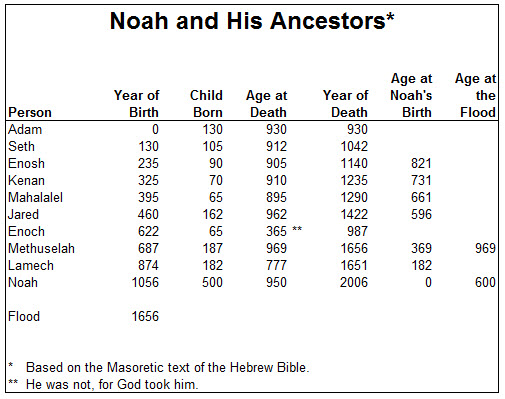
    3. Seth
  5. Coming next

In Genesis 1:1–5, Day 1 and a number of earlier posts I presented a case for Old Earth Creationism and why I believe that Genesis 1 can only be interpreted as a visionary prophetic revelation, not a historical account.

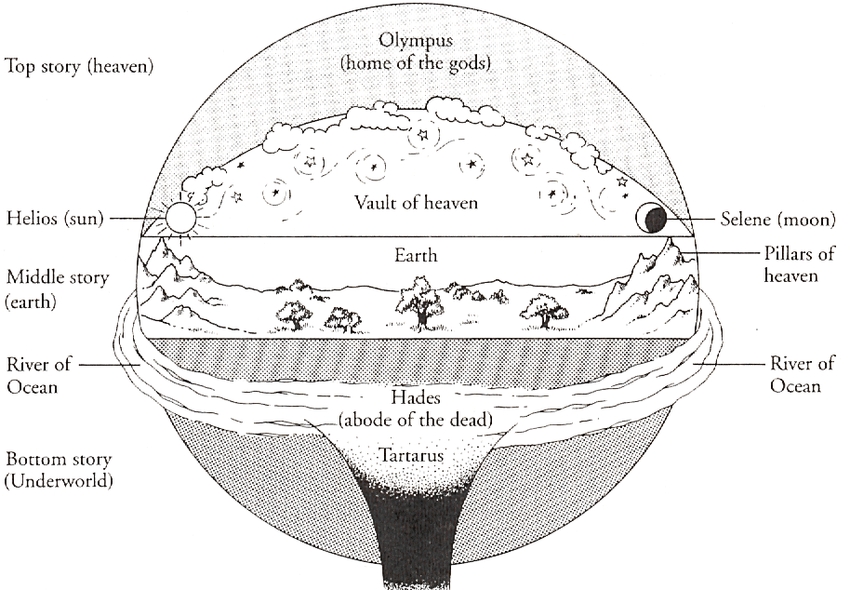
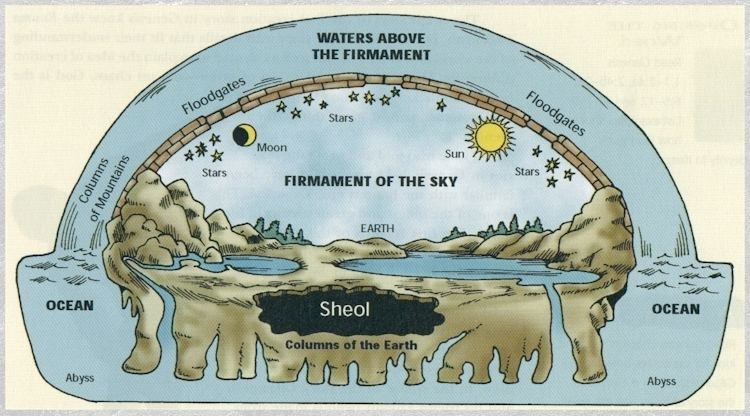
In my most recent post, Moshe’s Week of Dreams, I presented a hypothesis as to why Genesis 1 reads as it does, presenting a 6-day creation process, beginning with light, and building to a description of the cosmos that matches what ancient peoples imagined it to be, a flat, floating island earth protected from the ocean above by a dome, under which reside the sun, moon and stars. All of us would agree that this description doesn’t match what we observe today.

Yet another ancient cosmos diagram. I have posted at least a half dozen versions of this, because each ancient culture had a similar conception, differing mostly in small detail. This one matches the Genesis 1 description. ©Logos Bible Software

Interpreting Genesis 1 as visionary and not literally descriptive begs the question: What about the rest of prehistoric Genesis, i.e., Genesis 2:1–11:9?

Well, in my view it is all prophetically revealed, but it is not clear to me that any of it is visionary, or that much of it is even non-literal. Prophecy can reveal truth in subtle and symbolic ways, or it can show truth directly.

My own interpretations of prophecy make use of the so-called “Golden Rule of Biblical Interpretation”:

“When the plain sense of Scripture makes common sense, seek no other sense; therefore, take every word at its primary, ordinary, usual, literal meaning unless the facts of the immediate context, studied in the light of related passages and axiomatic and fundamental truths, indicate clearly otherwise.”
–Dr. David L. Cooper (1886-1965),
founder of The Biblical Research Society

If you aren’t a theology buff like me, you may not have heard of this particular Golden Rule outside of my blogs. Something very similar that you probably have heard of in high school science classes is called Occam’s Razor. Its actual wording is, “entities should not be multiplied beyond necessity”, meaning that, if you are faced with several alternative solutions to a problem, always start out with the simplest; or, alternatively, the one requiring the fewest assumptions.

Genesis 1 does not make “common sense” in the context of the universe as we can plainly see it today, so I choose to look for truth revealed more abstractly there.

The rest of the “prehistoric” material, though, is easier for me to accept literally. To a quite large extent, much of it does in fact meet the commonsense test for me. In this post and hopefully the next, I’m going to walk you through that material, starting in Eden and ending in the world after Babel.

There is actually a lot of material here, and since I’m confident that there is a lot of misunderstanding in Christian traditions about the era, I’m going to cover only the things I don’t think you are likely to have been taught… or taught correctly!

In this post, we’ll walk through the next three chapters of Genesis, where I’ll point out some more interpretations that you may not have heard before, regarding creation day 7, the Garden of Eden, the Temptation, and Adam’s most prominent children.

I’m sure you’ve noticed that my writing tends to get a bit deep occasionally, and what follows is no exception.

The reason for that is because I present a lot of interpretations (even occasionally one of my own) that veer from the “strictly orthodox“. When I challenge church traditions that have no, or in my view insufficient, textual backing, then I think I have to provide some solid evidence. If some of it goes over your head, then at least I hope you’ll try to skim through it for the gist. Whether I’m right or wrong, I don’t want you to think I’m making things up!

Day 7

Genesis 2:1–3

This “seventh day of creation” is appropriately split off into Chapter 2 in modern translations of Genesis because it is fundamentally different from the other six days. While this may be a continuation of the dream series I postulated for Genesis 1, the “evening and morning” motif is conspicuously missing.

The Sabbath

No creation is done on this day. Instead, it is used to set a spiritual principle for the importance of rest and renewal. More importantly, it is also a celebration of Creation, in particular for the Creator Himself, Yahweh.

The suggestion that God needed a day to rest from His labors is of course a literary device, not a serious concern. God is a spirit (רוּחַ, ruach), physically encompassing and controlling the entire universe. He has no nutritional requirements, and evidently His activities expend no energy that would require replenishment.

He is, however, the ultimate source of order on earth and in the universe at large! Much of what follows is about God maintaining and, when necessary, reestablishing order in Creation as evil spreads on earth, and even in the celestial realm.

Calendars

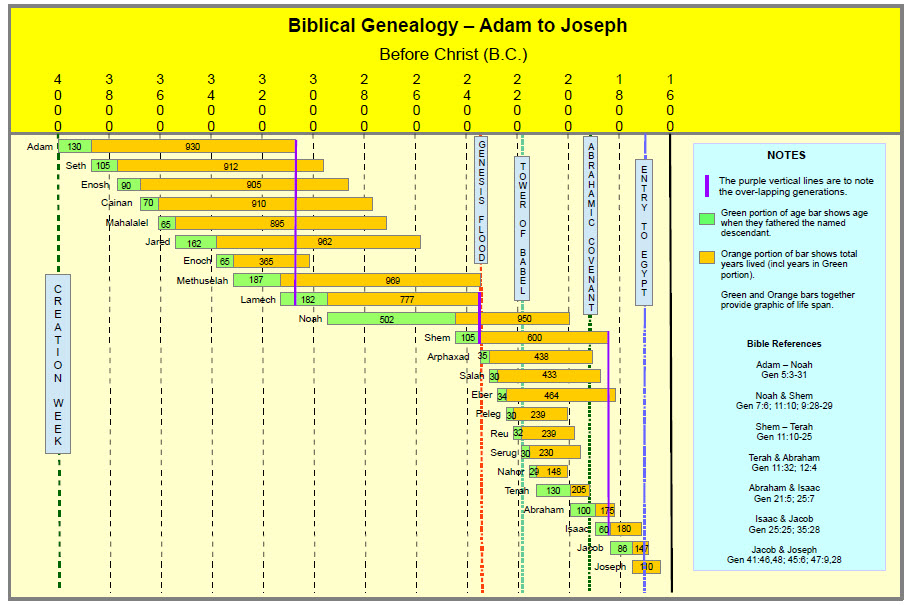
The concept of weeks as a calendar-ordering system predates Moses. The earliest archaeological evidence for the grouping of solar days into weeks (usually, but not always, 7-day cycles) appears in the era of Nimrod, about 2300 BC. The practice of assigning ceremonial purpose to one or more days each week may go back almost as far.

The Hebrews were apparently first to sever the cycle of weeks from the monthly and annual cycles—meaning, for example, that a calendar week for most of the modern world is always exactly seven days, irrespective of how many days may constitute a month or a year.

The Host

One very important factor that’s usually missed in studies of these three short verses is the word “host.” Ignoring here the modern “host and hostess” concept, “host” is the Hebrew: צָבָא (tsaba) meaning a large number of something, an army, or war.

[2:1] Thus the heavens and the earth were finished, and all the host of them.
—Genesis 2:1 (ESV)

In modern English, we think of “host” in generic terms, for example, “a host of reasons.” ESV, NKJV and YLT, like KJV, have left further interpretation of the term, as it appears in verse 2:1, up to the reader, but many modern translations go further and assume that it is speaking of a large number of created “things”, like stars, planets, etc. Examples of such translations include:

  • “Everything in them”, CJB, HCSB
  • “All that filled them”, NCV
  • “In all their vast array”, NIV
  • “In all their multitude”, NRSV
  • “All their inhabitants”, AMP
  • “All their heavenly lights”, NASB

A Biblical lexicon or a concordance lists the various ways that a word has been translated, without passing judgement on how it should have been translated. I believe that the term “host” in Genesis 2:1 and other passages with a similar context is speaking not of inanimate or miscellaneous things, but specifically of the angelic armies that God created to manage the cosmos. Translators have mostly missed this connection because angelology is so poorly understood and under-appreciated by most theologians.

Note that God is often referred to in Scripture as Adonai Sabaoth, “The Lord of Hosts/Armies.” Angelic beings are not just an afterthought, pets, slaves, or “gofers” of any kind. They are important residents of the created universe, members of God’s heavenly family.

I believe that this verse sets the time of their creation: At or near the beginning of the 13+ billion-year life of the universe.

Of course, that also fits with the concept that the Host was created to do for the universe what humankind was to do for the inhabitable earth: To subdue it and maintain it.

The garden

Genesis 2:4–24

I discussed Genesis 2 and 3 in detail in Exploring the Garden of Eden. Briefly, I believe that they were real people living in a real Garden of Eden, and their temptation and failure were real events. Beyond that, as explained there I do have some issues with traditional interpretations:

Chapter 2 outline
  1. Gen 2:4 is a toledah, a genealogy marker, separating the previous text from what follows, which I believe is a separate creation story, not a retelling of any part of chapter 1. Gen 1:26 describes the creation of early man, before Adam and Eve were added to their number to perform a specific function.
  2. Gen 2:5–6 describes conditions, not over the entire earth, but just over the land (אֶרֶץ, eretz) that would become the holy Garden. Eden was too arid to support any “bush of the field” (wild vegetation) and it was not as yet inhabited, or under cultivation.
  3. In Gen 2:7, Adam was formed (יָצַר, yatsar) by God, not created ex nihilo (בָּרָא, bara’) as in Gen 1:26. “Dust of the ground” refers simply to the chemical elements occurring on earth, perhaps specifically in the soil of the Garden. The “breath of life” is something that I don’t believe can happen spontaneously through any “Biopoiesis” process, i.e., “a supposed origination of living organisms from lifeless matter” as assumed by all non-theistic evolutionary theories. Note: “Panspermia” theories (life seeded on earth from extraterrestrial sources) don’t solve the ultimate question: How did the first life arise? It has never been shown how non-life can become life, aside from creation.
  4. In Gen 2:8–9, God then (after forming Adam) planted (נָטַע, nata, not a creative act, though no doubt done with a supernatural boost) a garden (גַּן, gan, an enclosed area, normally in those days planted with trees) “eastward in Eden“. This garden was not Eden itself but was an area evidently on the eastern side of a region by that name.
  5. In Gen 2:10–14, “A river flowed out of Eden to water the garden…”. The river flowed out of Eden and into the Garden. “There [presumably in Eden, upstream of the Garden!] it divided and became four…” Not simply “rivers” or “streams” as most translations state, but רֹאשׁ (ro’sh), meaning in this case “headwaters“, that is, the source waters that filled the river running into the Garden. In my Garden of Eden post, I explain why rivers that divide running downstream are unstable and quickly either recombine, divert into a single channel or dissipate altogether. I then use this information to firmly establish the location of the Garden in present-day southern Iraq—from information contained in the Biblical account.
  6. In Gen 2:15–17, there is no prohibition of eating from the Tree of Life. Gen 3:22 implies that it was in the Garden in order to give Adam and Eve a semblance of immortality, which further suggests that they were not created immortal to begin with. See Romans 5:12 and Death Before the Fall.
  7. In Gen 2:18–24, once God announced (surely to His Divine Council) that He intended to make a suitable helper for Adam, He first allowed the man to observe what that concept meant to other creatures. Animals had already been created (bara’, ex nihilo) outside the Garden. Rather than resume the creation (bara’) process discussed in Gen 1, He chose now to form (yatsar) new animals from the elemental “dust”, in the same way He had formed Adam. From the context, these were male/female pairs. Whether they were existing species or freshly designed for the Garden is unspecified. My own assumption is that Adam’s task was to become familiar with them to the extent that he gave them personal names, like Mickie and Minnie, for instance, rather than “male and female deer mouse” (Peromyscus maniculatus). Once Adam understood the picture, God made him an appropriate human companion.
The garden’s function

Over the years I’ve heard several suggestions that the Garden of Eden, in addition to being an idyllic home for Adam and his family, was actually a prototypical tabernacle for worship of Yahweh.

This is fodder for a future full article on its own, but for now I’ll just say that I agree! All of the necessary elements are in place, and the Garden as Temple/Tabernacle fits nicely with my knowledge of the way God typically does business. When you study the history of such facilities, you see that the Temple serves as a “home” for Yahweh in the midst of His people. We know that God is omnipresent in the universe, but as long as His people are obedient, He delights in maintaining an “interface” with them, as for example, His sh’kinah presence hovering over the Ark of the Covenant in the Holy of Holies.

In this verse, the picture is not one of God dwelling in heaven and periodically visiting in the Temple. It is one of God remaining in the Temple where He is accessible. For example, among the blessings of keeping His commandments, God promises:

[11] I will put my tabernacle among you, and I will not reject you, [12] but I will walk among you and be your God, and you will be my people.
—Leviticus 26:11–12 (CJB)

When King David offered to build a permanent Temple in Jerusalem, God replied:

[6] Since the day I brought the people of Isra’el out of Egypt until today, I never lived in a house; rather, I traveled in a tent and a tabernacle. [7] Everywhere I traveled with all the people of Isra’el, did I ever speak a word to any of the tribes of Isra’el, whom I ordered to shepherd my people Isra’el, asking, “Why haven’t you built me a cedar-wood house?”’
—2 Samuel 7:6–7 (CJB)

The concept of God “tabernacling” with His people is so important that, out of the seven feasts that Israel was ordered to observe every year in perpetuity, it is celebrated by the most joyous and anticipated feast of all. The Feast of Tabernacles is celebrated in Jerusalem and around the world beginning on Tishri 15 every year. In fact, it is such an important occasion that Tishri 15 of the Gregorian year 4 BC was the date that Yahweh chose for the Son to be born in Bethlehem (see The Jewish Feasts: Part 14, Tabernacles)!

Jesus’ birth date, the first day of the 8-day Feast of Tabernacles in AD 4. His circumcision was on the final day of the Feast. Among other functions, all the Leviticus 23 feasts prophesied events in Jesus’ two advents. ©Ron Thompson

Given the above, God’s activities in verse 8, below, are explained very well:

[8] They heard the voice of ADONAI, God, walking in the garden at the time of the evening breeze, so the man and his wife hid themselves from the presence of ADONAI, God, among the trees in the garden.
—Genesis 3:8 (CJB) emphasis mine

The temptation

Genesis 3

This is a vitally important passage of Scripture, and I am 100% convinced that the essential lesson—that the very real Satan tempted the very real Adam and Eve and brought about very real and horrendous curses that still afflict this planet—is absolutely true.

I would refer you to Exploring the Garden of Eden for a fairly comprehensive exposition of this chapter. I do, however, have a lot more to say here about one of the principal characters of the story:

The serpent

I have read somewhere that the serpent, prior to its curse, was a quadruped and the most beautiful of all the animals on earth. How could anyone know that? Obviously, the idea is pure fantasy!

As a matter of fact—don’t hang up on me here—by today’s literary standards the serpent story is a fable, along the lines of Rudyard Kipling’s famous tales like How the Camel Got its Hump, or How the Leopard Got its spots. But read on before you judge me too harshly…

In the ancient world of the fertile crescent, the genre of “fable” was a common and respected way of transmitting real history. What made a story a fable was not that it was necessarily fiction, but that it contained a moral lesson. In mid-2024 I wrote a short (believe it or not) article titled Religion vs. Mythology in which I quoted Egyptologist Bob Brier: “Mythology contains stories [set in the primordial past] that are not [necessarily] to be taken literally but answer basic questions about the nature of the universe.”

In other words, mythology usually contains at least some metaphorical historical content but always seeks to teach a useful lesson about reality. The question here becomes, “What part of the Serpent story, if any, is metaphorical? I’ll answer that with a brief analysis framed as a Q&A:

  • First, was the serpent really Satan, as we’ve all been taught?

    Absolutely! That point is clarified several times in Scripture, including:

[20:1] Then I saw an angel coming down from heaven, holding in his hand the key to the bottomless pit and a great chain. [2] And he seized the dragon, that ancient serpent, who is the devil and Satan, and bound him for a thousand years,
—Revelation 20:1 (ESV)

  • Was Satan really a snake?

No, that’s the metaphor part. To unbelievers, everything supernatural in the Bible is by definition metaphorical. That is no reason for believers to dismiss the possibility that God used metaphor at times when the cultural context made metaphor the best way to dramatize a truth.

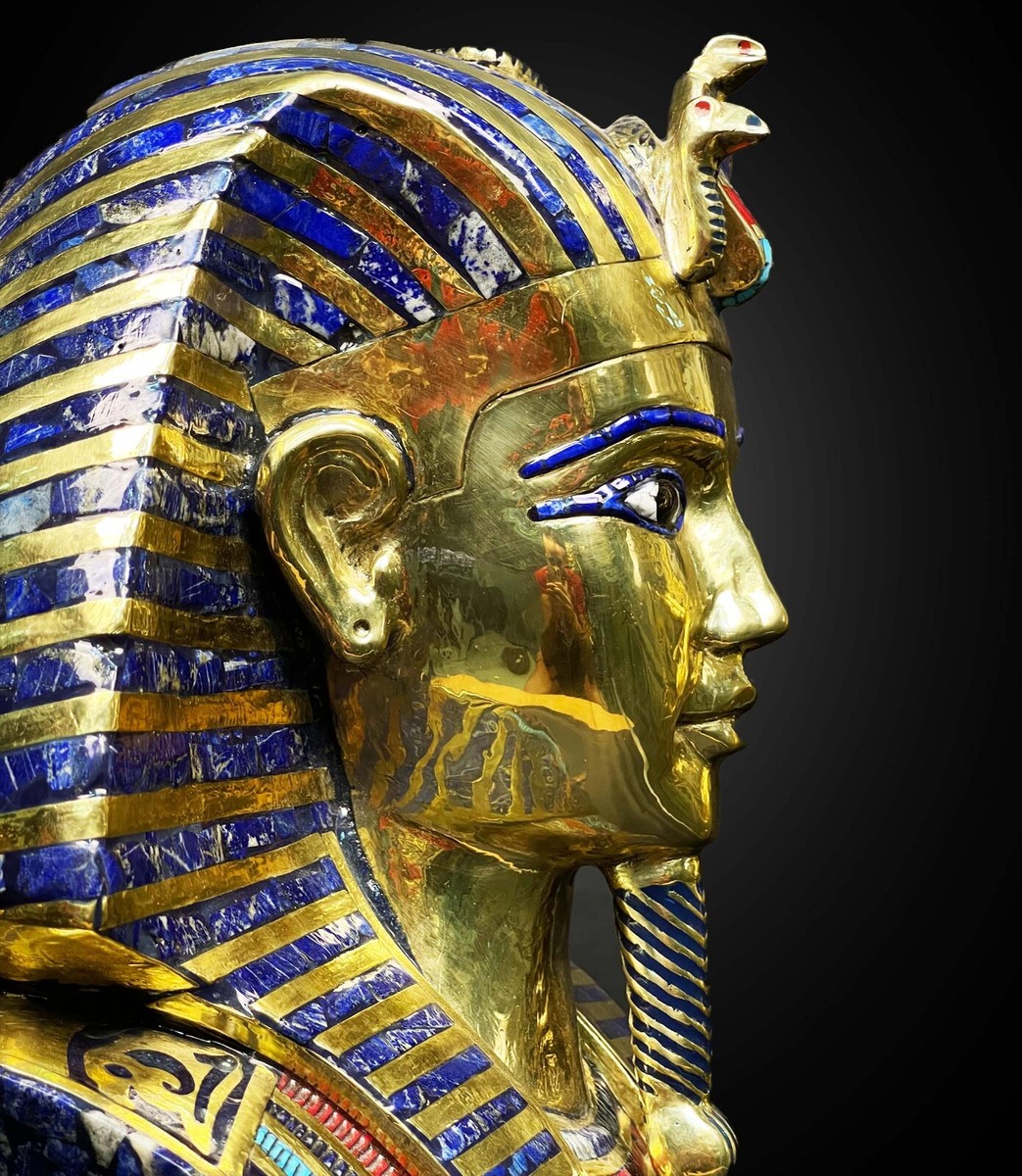
King Tut’s Mask. Note the two snakes, symbolizing the two kingdoms, Upper and Lower Egypt.

If you find slithering snakes to be creepy, well, so did the ancients. Not only are their appearance and habits unsettling and their nests often hidden and/or in the wilderness, which is where all matter of evil spirits were known to reside, but they are of course potentially very deadly.

Snakes were plentiful in the Ancient Near East (ANE), and they were of course the subject of much supernatural dread. Snake images were associated with a number of the pagan gods and were appropriated by pagan human rulers to demonstrate their association with those gods.

  • If Satan wasn’t a snake, what was he?

Satan was a corrupt, high-ranking angelic being, a spirit with the ability to take on corporeal form, like a human or, in this case, a reptile. Specifically, he was a cherub:

[14] You were a keruv [cherub], protecting a large region;
I placed you on God’s holy mountain.
You walked back and forth
among stones of fire.
—Ezekiel 28:14 (CJB)

Cherubim and Seraphim (while not technically “angels”) are spirit beings created to guard God’s throne and other sacred objects. The terms “garden of God” and “mountain of God” refer to any location where Yahweh is “officially” in residence. The “stones of fire” are the spirits present: Yahweh, His guardians, and the “sons of God” on His “Divine Council.

I won’t document those definitions here, except to point out that God didn’t “come down” to visit with Adam and Eve; He was coresident with them in Eden, along with His spirit retinue. Satan was present, as a matter of course. He violated the trust given him by God. The verses following the passage last quoted tell the consequences:

[15] You were perfect in your ways
from the day you were created,
until unrighteousness
was found in you.
[16] “‘When your commerce grew,
you became filled with violence;
and in this way you sinned.
Therefore I have thrown you out, defiled,
from the mountain of God;
I have destroyed you, protecting keruv,
from among the stones of fire.
[17] Your heart grew proud because of your beauty,
you corrupted your wisdom for the sake of your splendor.
But I have thrown you on the ground;
before kings I have made you a spectacle.
—Ezekiel 28:15–17 (CJB)

  • Did Adam and Eve see a snake, or something else?

Yes… Okay, my guess is that they saw a snake, but whatever they saw or sensed, they recognized him as one of the resident cherubim. There is no mention of fear, or of surprise at a talking snake.

  • If Satan wasn’t really a snake, then why did God curse snakes?

Good question! The answer is, He didn’t!

A Coast garter snake. ©Steve Jurvetson

It sounds like He did, but remember that I’m billing this as “mythologized” history. Real history, told in the dramatized way that history was frequently taught in antiquity. Snakes weren’t beautiful quadrupeds before the fall, they were beautiful… snakes! God designed snakes to “crawl on [their] belly” because that is what best suited them for their ecological niche. As for “eating dust”, that isn’t a snake function, but I imagine it does happen from time to time, given their proximity to the ground. I’m confident that snakes are quite happy in their own niche! And many of them are still quite beautiful.

  • But why would a Cherub be given a snake’s punishment?

What God actually cursed was the being that was impersonating a snake: Satan, a.k.a., the Serpent. The persona that Satan chose to adopt, or that Moses chose to assign to him, was that of a Serpent, and Satan’s curse was worded accordingly.

That curse is given in Genesis 3 and is explained in the Ezekiel passage quoted above and in Isaiah:

[11] Your pride has been brought down to Sh’ol
with the music of your lyres,
under you a mattress of maggots,
over you a blanket of worms.’
[12] “How did you come to fall from the heavens,
morning star, son of the dawn [Lucifer, son of the morning in KJV]?
How did you come to be cut to the ground,
conqueror of nations?
[13] You thought to yourself, ‘I will scale the heavens,
I will raise my throne above God’s stars.
I will sit on the Mount of Assembly
far away in the north.
[14] I will rise past the tops of the clouds,
I will make myself like the Most High.’
[15] “Instead you are brought down to Sh’ol,
to the uttermost depths of the pit.
—Isaiah 14:11–15 (CJB)

It takes some context to understand it:

[14] ADONAI, God, said to the serpent, “Because you have done this, you are cursed more than all livestock and wild animals. You will crawl on your belly and eat dust as long as you live.
—Genesis 3:14 (CJB)

  • In Biblical imagery, the celestial “angels” are compared to stars in heaven. The highest ranking of these beings are called the “sons of God,” and are likened to the “morning stars“, stars that are bright enough to shine even as the sky lightens near sunup.
  • Ezekiel says that “When your commerce grew, you became filled with violence”, and Isaiah calls him a “conqueror of nations.”Growth of commerce” means increase in power and renown. Just like humans, spirit beings have free will and thus a propensity for pride, arrogance, and envy. I don’t know what, specifically, the prophets had in mind here, but evidently at some point in his 13-billion-year life, he became involved in battles involving either other angelic beings, or humans, or both.
  • Genesis 3 marks the last straw for God. Satan’s lies to Eve and contradiction of God rose to open rebellion, which the Most High could no longer tolerate. [Note: this is the first of three angelic rebellions in Scripture; the other two will be covered in my next post.]
  • Because of the context in which it was uttered, “You will crawl on your belly and eat dust as long as you live” does indeed sound like perhaps a quadruped is being cursed to lose its four legs and instead slither from place to place. But what are we left with if we remove the mysterious quadruped from the snake story?

In Ezekiel 28:17, we read “But I have thrown you on the ground” and in Isaiah 14:15, we have “Instead you are brought down to Sh’ol, to the uttermost depths of the pit.”

In Ezekiel, the Hebrew word translated ground is אֶרֶץ (eretz). Eretz can, in some instances, be translated country, earth, field, ground, nations, way, and a few more alternatives. In the NAS Exhaustive Concordance, the word is most commonly (1,581 times) translated as “land.” In such cases the application is almost always to holy land, usually to the Land of Israel (eretz Yisrael), but also to the Garden of Eden, Mt. Sinai, the Tabernacle and other places marked for worship of Yahweh.

Key here, though, is that eretz is often used, especially in ancient Hebrew extrabiblical writings, as a euphemism for Sh’ol, a.k.a., the underworld, the pit, or the place of the dead. This immediately brings Ezekiel 28:17 into alignment with Isaiah 14:15, where Sh’ol is mentioned explicitly.

I have no doubt whatsoever that this is the Serpent’s curse, stated pictorially in accordance with the fable genre.

Satan or satans

With Satan kicked out of heaven as early as the Garden of Eden, you may wonder how it is that he is apparently welcomed back to have cordial chit-chats with God over things like Job’s faith…

A lot of my material in this post comes from the books of the late Michael S. Heiser: The Unseen Realm, Demons, Angels, Reversing Herman, etc. Also, books and papers that he cites. Most of what he teaches strikes me as solid exegesis, and makes good, common sense. With respect to his angelology and demonology, and his Old Testament theology and ANE history, I’m pretty much fully onboard with him. But though I am a Trinitarian, his arguments in support of that doctrine seem weak to me, and I leave his train altogether when he talks about the Church now being “the true Israel.”

With respect to this particular section, I’m firmly onboard with him, but many scholars are not. This is perhaps a good place to remind you that, while I think my principal spiritual gift is theological discernment, you are free to disagree. Please remember that I don’t believe that inspired prophets still exist among men, and I have no illusions that my posts are “inspired.” Neither are Heiser’s books.

As with so many other “fringe” doctrines that we’ve grown up believing, the idea that the Serpent of the Garden, the “archenemy“, is the “satan” of Job is an assumption made long ago that can’t be proven from Scripture.

I’m way past caring about “orthodoxy”; my desire is to understand the Person and Word of God to the best of my ability. If I’m wrong, I’m wrong…

Heiser points out that the Hebrew noun, שָׂטָן (satan), occurs only a couple times in the Old Testament without a definite article. Every other occurrence is in the form הַשָּׂטָ֖ן (hasatan), meaning “the satan“, i.e., “the adversary“, or “the accuser.” This is probably not the same guy!

The grammatical rules for Hebrew match English in this respect: When prefixed by an article (“a”, “an”, or “the”), a noun is meant to be used as a common noun. “Satan” is a name for one particular being. “The satan” describes Satan and other beings, presumably of much lower rank than the Serpent.

As Heiser says, you can call him “Mike”, but it isn’t grammatically correct to address him as “the Mike.”

Considering the satan in Job:

[6] It happened one day that the sons of God came to serve ADONAI, and among them came the Adversary [the satan, Hebrew: hasatan]. [7] ADONAI asked the Adversary, “Where are you coming from?” The Adversary answered ADONAI, “From roaming through the earth, wandering here and there.” [8] ADONAI asked the Adversary, “Did you notice my servant Iyov [Job], that there’s no one like him on earth, a blameless and upright man who fears God and shuns evil?” [9] The Adversary answered ADONAI, “Is it for nothing that Iyov fears God? [10] You’ve put a protective hedge around him, his house and everything he has. You’ve prospered his work, and his livestock are spread out all over the land. [11] But if you reach out your hand and touch whatever he has, without doubt he’ll curse you to your face!” [12] ADONAI said to the Adversary, “Here! Everything he has is in your hands, except that you are not to lay a finger on his person.” Then the Adversary went out from the presence of ADONAI.
—Job 1:6–12 (CJB)

The occasion is a standard gathering of the Divine Council. The “sons of God” were created for the purpose of assisting God in the administration and governance of the vast universe. Their duties included advice and council, which was the function of this assembly. Does God need any of this help? I assume not (He’s God!), but they are His created family, and He values their fellowship and assistance. Just as we believe God values the fellowship and assistance of His earthly family—us!

Ranking below the sons of God in the Heavenly Host are a group of “satans”, whose function is to “roam through the earth, wandering here and there” (Job 1:7), keeping tabs and reporting back. Heiser compares them to a prosecutorial staff. Or, as I think of it, a “Heavenly OSHA.” In this passage, the satan is just doing his assigned task. He’s not behaving in an evil fashion at all, and there is no hint of rancor in the conversation.

If you think that is a fanciful interpretation of Job, consider the following Divine Council example from 1 Kings: This is the prophet Micaiah describing his vision of a meeting of the Council in which Yahweh has asked for advice on how best to entice the evil King Ahab into a hopeless battle:

[19] And Micaiah said, “Therefore hear the word of the LORD: I saw the LORD sitting on his throne, and all the host of heaven standing beside him on his right hand and on his left; [20] and the LORD said, ‘Who will entice Ahab, that he may go up and fall at Ramoth-gilead?’ And one said one thing, and another said another. [21] Then a spirit came forward and stood before the LORD, saying, ‘I will entice him.’ [22] And the LORD said to him, ‘By what means?’ And he said, ‘I will go out, and will be a lying spirit in the mouth of all his prophets.’ And he said, ‘You are to entice him, and you shall succeed; go out and do so.’ [23] Now therefore behold, the LORD has put a lying spirit in the mouth of all these your prophets; the LORD has declared disaster for you.”
—1 Kings 22:19–23 (ESV)

One of God’s spirit advisors has suggested a plan. Yahweh approves it, and Yahweh assures that it succeeds.

Don’t misunderstand… Satan, the Serpent, is real and malevolent, the Archfiend. This is Paul’s “roaring lion”, and the Dragon of Revelation.

Nevertheless… I’m saying that not all mentions translated “Satan” in the Old Testament are about Satan, the Serpent of the Garden. Most of them are random satans (small “s”), including the satan of Job. Jesus Himself was functioning as “a satan” (an adversary) when He cleansed the Temple.

The banishment

A few observations from verses 20–24:

  • What Adam actually named his wife, in Hebrew, was חַוָּ֑ה (Chavah). I know, it’s impossibly idealistic, but if someone goes by José, it seems to me to be insulting to call him Joe. Unfortunately, the Hebrew “ch” sound is a very difficult guttural for English speakers to pronounce.
  • I’ve seen many suggestions that the animal-skin garments that God made for Adam and Eve (sorry, Chavah!) were from animals sacrificed as a blood atonement. No. They got what God promised they would get for eating the forbidden fruit! But let’s examine the rationale for the view:

The verse most often quoted is:

[22] And almost all things are by the law purged with blood; and without shedding of blood is no remission.
—Hebrews 9:22 (KJV)

But this is a general statement about the use of blood in cleansing rituals of all kinds, and the immediate context is more about the purification of objects than of people. The Hebrews author is using an Old Testament scripture midrashically.

Midrashically refers to the method of interpreting biblical texts through midrash, which involves exploring deeper meanings, filling in narrative gaps, and providing ethical or theological insights. This approach allows for creative and expansive readings of scripture beyond the literal text. myjewishlearning.com

A midrash is by nature a secondary source that applies the primary source in ways that were not necessarily intended in that original. This is done frequently in the NT, particularly by Paul. It would be much more to the point here to quote the OT text being referenced by the Hebrews passage:

[11] For the life of a creature is in the blood, and I have given it to you on the altar to make atonement for yourselves; for it is the blood that makes atonement because of the life.
—Leviticus 17:11 (CJB)

The context here is that God, through Moses, is giving two reasons that consuming blood, or meat with the blood still in it, is prohibited to Jews under the Covenant: (1) because blood is necessary for life, it is considered to be virtually the same as that life; and (2) God has sanctified blood that is shed on the altar as a means of atonement.

But even that has to be analyzed further:

  1. Some primitive forms of animal life do not in fact, require blood for life, which doesn’t negate the point of the prohibition.
  2. Not all animal blood is efficacious for atonement, only the blood of ritually clean animals. Again, the prohibition stands.
  3. Every sacrifice, to be effective, must be done in accordance with the rules set down in the Covenant.
  4. Though sacrificial offerings were made as early as Cain and Abel, we know of no specific cultus yet available to govern them, nor of any specific rationale for doing them.

I contend that it is a misappropriation to assume from either passage that Yahweh has made a “blood sacrifice” on behalf of Adam and Eve. Animal skins are more durable and provide better insulation and padding than plant leaves. It’s enough for me to know that God was compassionate with respect to the physical and emotional needs of the freshly cursed humans.

  • “Behold, the man…” הָֽאָדָם֙ (haadam). The same interpretive principal applies here as for Satan/hasatan: where the article is absent, a proper noun is intended; where it is present, expect a common noun. Adam (ah DAHM) is a name; haadam (hah ah DAHM) is a noun meaning “man”, “mankind”, or “human.” The latter is in view in verse 22.
  • “…eat, and live for ever.” See above for the implication of the Tree of Life in the Garden.
  • “…to till the ground from whence he was taken.” This is a bit ambiguous on its own and might give you pause. “The ground” is הָ֣אֲדָמָ֔ה (haadama). “Adam” comes from a Hebrew root meaning “red.” As does the related word adamah, meaning “earth” but referring not to the planet, but rather to the ground, especially (over 200 times in the Old Testament) to tilled land, productive soil, or Israel’s productive land in particular. The “ground” here refers not to the acreage within Eden, but rather more specifically to the “dust” from which he was formed.
  • “…the east of the garden…”. Given the presumed nature of the Garden as a tabernacle, it’s no surprise that its access was on the east side. The same is true of all correctly built temples and synagogues. Prayer is directed towards Jerusalem’s Temple Mount, wherever you might be, but access to the “holy space” is always from the east, where the sun rises.
  • “Cherubims” I’ve been quoting KJV in this list, and this word is grammatically incorrect, at least in this century. The Hebrew is הַכְּרֻבִ֗ים (hakerubim). “The cherubim” is plural without a trailing “s.” The singular of “cherubim” is “cherub“, which is an Anglicized transliteration of the Hebrew “kerub.” Cherubim, along with Seraphim, are heavenly “throne guardians.” Satan is a cherub. You probably picture just one cherub guarding the gate with a big sword in his fist, but there is a team of cherubim on hand here.
  • “…a flaming sword…” I don’t know if this is a literal sword or some other device, and whether it is handheld, mechanized, or animated. Evidently there is only one, so if handheld, only one of the cherubim would be armed with one.
  • What finally happened to Eden? My guess is that it was probably guarded until either it was finally destroyed, or until the Tree of Life was moved somewhere else. If it (the Garden) didn’t survive the centuries, it may have been swept away by the receding waters of the Great Flood.

Adam’s children

Genesis 4

Cain and Abel

Why was Cain’s veggie offering unacceptable? Maybe it included cauliflower or beets… That would do it for me!

Many will tell you that Cain’s offering was refused because it was not a blood sacrifice. Maybe, but I seriously doubt that interpretation. The Mosaic Covenant was still well over a thousand years in the future, so there was no standardized command for offerings that we know about. Abraham was over a thousand years in the future, too, so it wasn’t a Jewish thing.

(He did finally make a blood sacrifice, by the way… his brother!… that was refused, too.)

It has been suggested that God gave Adam a sneak preview of what offerings He was going to require in the future. Maybe.

In any case, they both made offerings from their own “sweat of the brow”, which would seem to be a good thing. With no information to the contrary, I would have to think that it had something to do with their respective motivations, or maybe he stole the veggies from Eve.

Other passages shed additional light:

[4] By faith Abel offered to God a more acceptable sacrifice than Cain, through which he was commended as righteous, God commending him by accepting his gifts. And through his faith, though he died, he still speaks.
—Hebrews 11:4 (ESV)

[24] and to Jesus, the mediator of a new covenant, and to the sprinkled blood that speaks a better word than the blood of Abel.
—Hebrews 12:24 (ESV)

[12] We should not be like Cain, who was of the evil one and murdered his brother. And why did he murder him? Because his own deeds were evil and his brother’s righteous.
—1 John 3:12 (ESV)

Aha! That last one is the answer. Cain’s rejection was not because of the form of his offering at all. Any offering he brought would have been rejected because God knew his heart!

Moving on, what was “the mark of Cain?” Don’t know, can’t know, so don’t care.

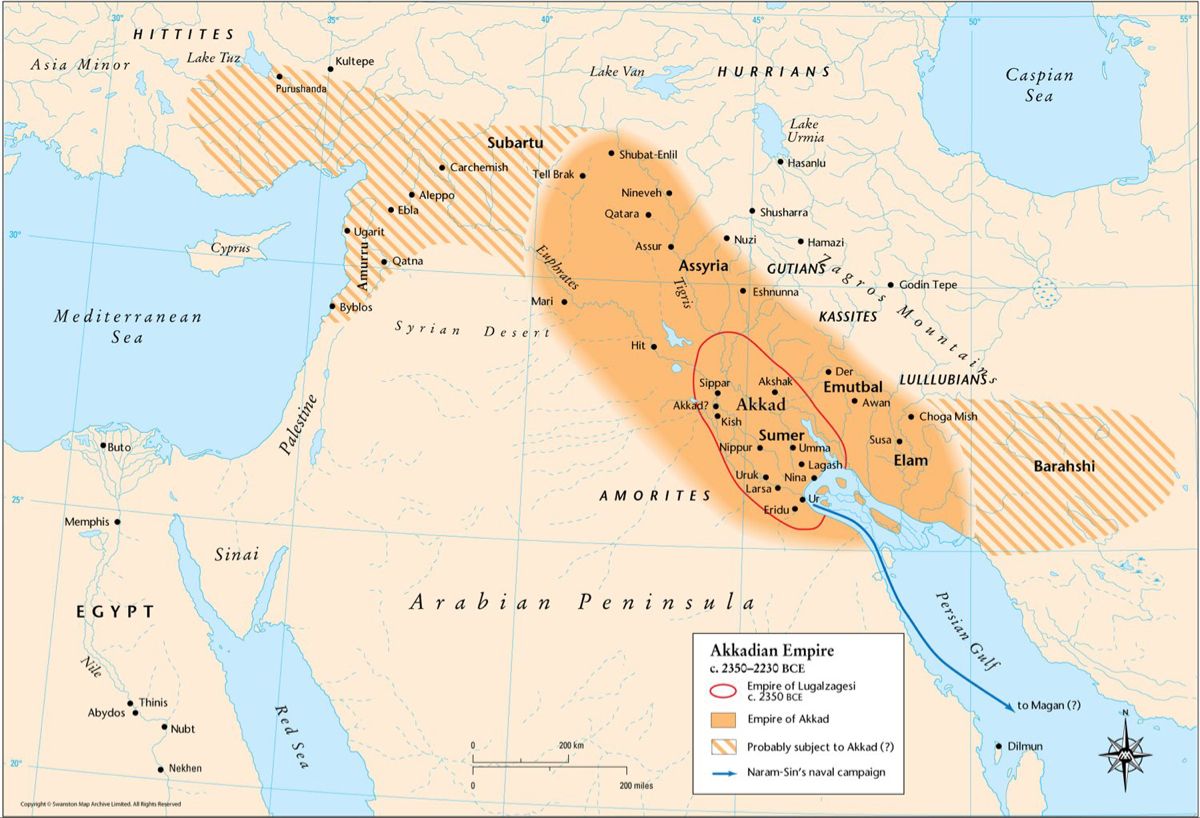
Where is the Land of Nod, to which Cain fled? The Bible says, “east of Eden,” which makes me think maybe Elam, or farther east than that. “Nod” is from the Hebrew נוּד (nuwd, pronounced “nude”), meaning to move to and fro, wander, flutter, or show grief.

Cain’s descendants

Genesis 4:17–24

As I explained above, I regard Genesis 2:4 as, in essence, a toledah (singular), or genealogical “spacer” to separate the various historical threads that Moses wrote about in the book.

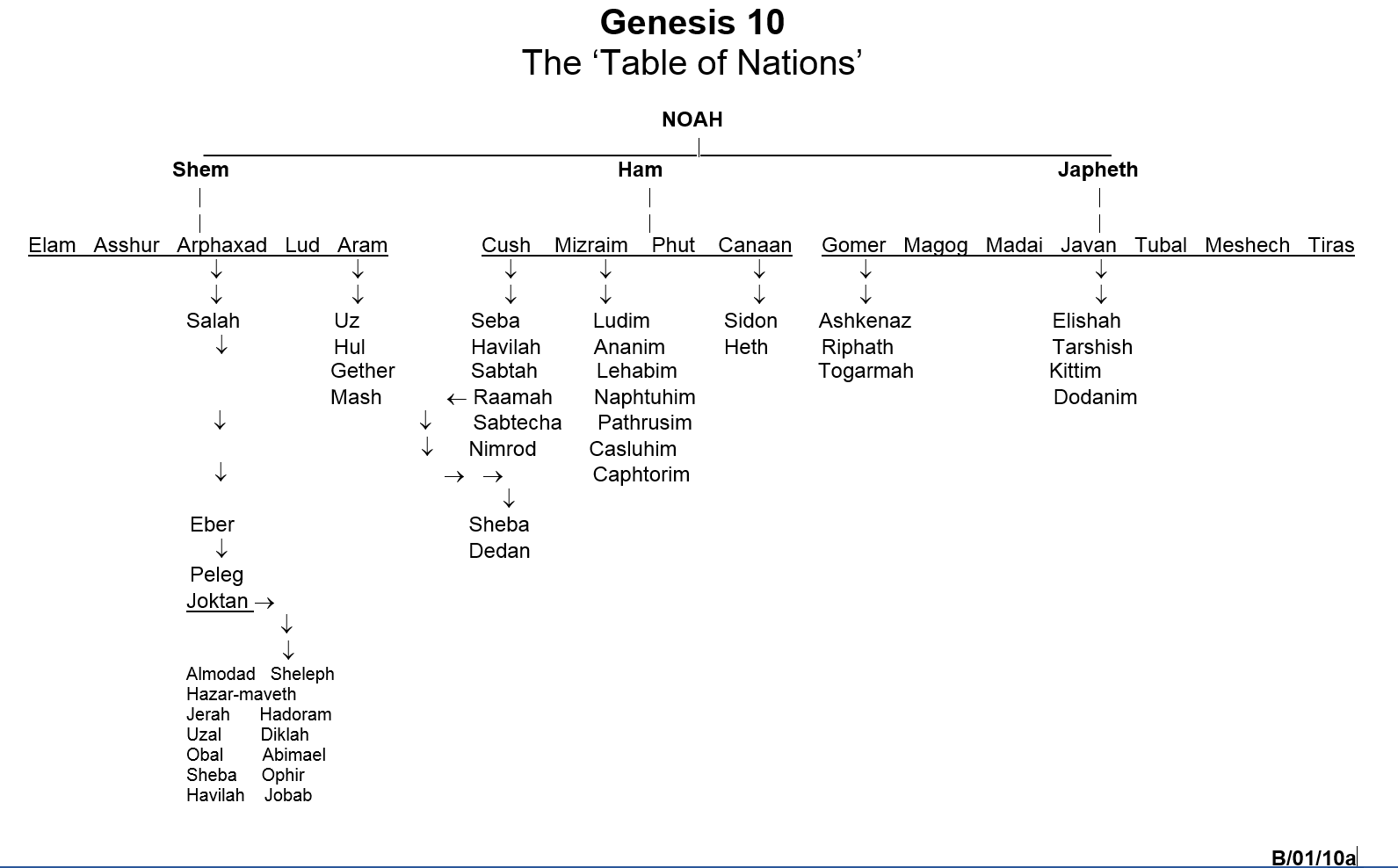
Technically, the toledoth (plural) are genealogies, the “begats” of KJV. The beginning of Gen 2:4 is translated by KJV and ESV as “These are the generations of the heavens and the earth…”, where “generations” is in fact the Hebrew תוֹלְד֧וֹת (toledoth). Other popular translations render it as, for example, “Here is the history…” (CJB) or “This is the account…” (NAS), which are paraphrases and not necessarily incorrect. But presence of the Hebrew term makes it officially a toledah and that strengthens my opinion that the forming of Adam and Eve is a different event than the creation of mankind in general.

Gen 4:17–22 is a genealogy of Cain, and it separates Cain’s part of the history from Seth’s, so technically the passage is a toledah, but because that term doesn’t appear in the text, it isn’t generally included in lists of the toledoth. The reason may be that if you remove verses 23 and 24, the entire passage, Gen 4:17–5:32 is a single long toledah. Alternatively, 4:17–22, are also about Cain’s extended family, so it could perhaps be included as part of the toledah.

©biblestudy.org

My first reaction to verses 23 and 24 was to think, “well, they don’t conform to the way small bits of biographical information are inserted into some genealogies (see Genesis 10, which is itself one long toledah), but that must be what they are”, but looking at it today, it dawns on me that they seem out of place here, but they would fit perfectly in Chapter 6, which I will cover in a sequel to this post, under the heading “Corruption.” If this snippet wasn’t misplaced by scribal error, then it is simply an issue of author’s choice. Not a big deal.

I have just one more observation about Cain, until the next post.

Everyone wants to know… Where did Cain find a wife? Young Earth Creationists would say he took a sister with him to Nod. Possible, but creepy, so I’d rather it not be so. In any case, to me it is more likely that she was a member of one of the pre-Adamic races descended from the humans created in Genesis 1:26.

Seth

Genesis 4:25–26

[25] And Adam knew his wife again, and she bore a son and called his name Seth, for she said, “God has appointed for me another offspring instead of Abel, for Cain killed him.”
—Genesis 4:25–26 (ESV)

Seth’s name in Hebrew is שֵׁ֑ת (Sheth, pronounced “shayth”). It is a play on the similar word שִׁית (shiyth, pronounced “sheeth”), a verb meaning, “to place.” Both of these words appear in verse 25. The latter is translated as “appointed” in the KJV and ESV, and that is close enough. Interestingly, it is the same word as used in Genesis 3:15, “I will place (shiyth) enmity between [Eve’s and the Serpent’s seeds].”

Verse 26 mentions Seth’s son, Enosh, a name which I’ll point out in the next post is a mildly derogatory word denoting a man but connoting one who is not quite top-drawer. Perhaps he is mortal or not a gibbor, or hero.

Not much is reported about Enosh, but the verse states that during his lifetime, “…people began to call on the name of Yahweh.” All that this means to me is that it wasn’t until the time of Adam’s grandchildren that humans from the family of the Garden began to appreciate the power of God and to seek His favor.

Many scholars, though, quote this verse in order to advance the theory that the “sons of God” in Genesis 6 are humans from the “godly lineage of Seth,” which I consider to be a ridiculous interpretation. I will address that issue in that next post.

Coming next

Usually, I don’t pick my next topic until I’ve had a week or two to recover from the last. This time, I’m well into the next one already, because it is third in a sequential trio.

In the third, I am focusing on the last chapters of what I’ve called my survey of Moses’ prehistoric account of the days before Abraham.

I’ll start with a section titled “Corruption“, which covers the period from Cain and Seth until Noah. The core of that material is from the first five verses of Genesis 6. Everyone is familiar with the words of that passage, but because it is so bizarre, it is rarely taught, and from the days of Augustine of Hippo (who was the first patristic father to butcher it), understanding has been almost non-existent.

Yet, despite the intervening flood, its effects reverberate through both the Old and New Testament, to the last verses of Revelation.

I’ll gloss through the Flood story, because I have already covered that thoroughly in several posts.

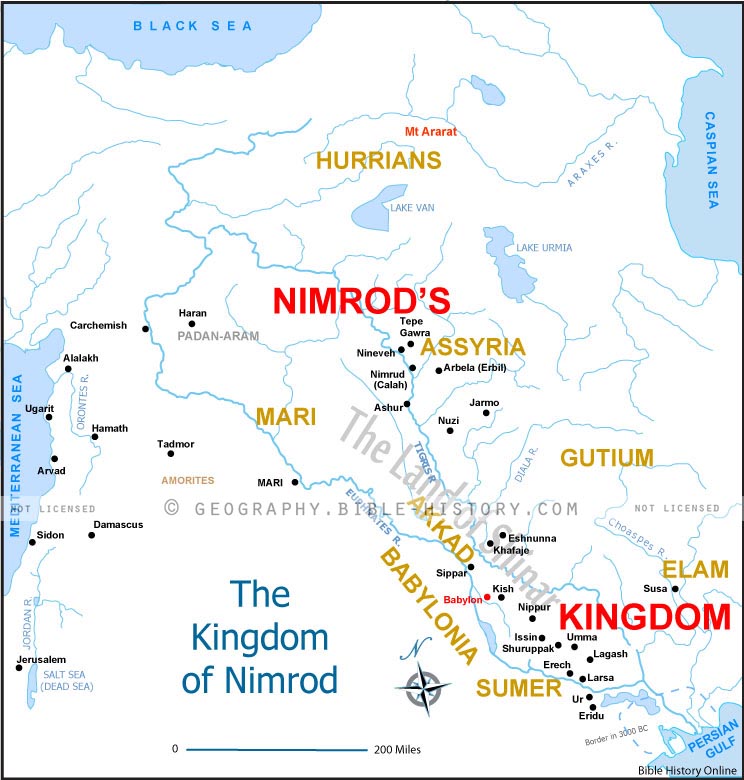
Then I’ll spend some time with Babel and the scattering. You will probably be surprised at my commentary on Nimrod.

The time span of this triptych of articles covers all three major angelic rebellions, and the three combined (not just the Temptation) account for the horrible state of the current world and the need for Jesus’ hopefully imminent return.


Romans 5:12 and Death Before the Fall


Posted on:

Modified on:

  1. Introduction
  2. Background and grammar
    1. Life
    2. death
    3. Death in antiquity
    4. Death in Hebrew
    5. Death in Greek
  3. Romans 5:12, “death by sin”
    1. The Romans context
      1. Background
      2. Outline
      3. A focus on the theology
        1. Literal death in Romans 1–4
        2. Death and life in Romans 5:1–11
        3. Death and life in Romans 5:13–21
        4. A different metaphor in Romans 6–7
        5. Romans 8
    2. Interpreting Romans 5:10–14
  4. Death in Eden
    1. The sin in Eden
    2. The curses of Eden
      1. The Serpent
      2. The Woman
      3. Adam
  5. Good and Very Good
  6. Philosophical bias
    1. Nature vs Eternity
    2. Fecundity
    3. Natural Life

As an Old Earth Creationist (OEC), Young Earth Creationists (YEC) have frequently asked me about, or scolded me over, the question, “Doesn’t your theology presuppose the unbiblical idea of death before the Fall?”

My response is that, yes indeed, an old earth (4.5 billion years old) and an older universe (13.8 billion years old) does in fact imply that there was life and death on earth long before the creation of Adam, and his subsequent fall.

I will try here to refute the claim that death before the fall is “unbiblical” and to support my opinion that death was an intended part of God’s design that did not begin with Adam’s sin.

Unknown artist’s conception of Hades as described by the parable of The Rich Man and Lazarus. I presume that’s the Rich Man walking alone on the left bank of the chasm, while Lazarus is off lounging somewhere in Abraham’s Bosom, on the right bank. Remember that this is a parable, so you aren’t expected to take the vision of Hades’ layout or structure too literally.

Introduction

If you subscribe to a YEC interpretation of Scripture (and most of my friends do), then you should believe that all life, human, animal, vegetable, fungi, single-celled and microbial, was created some 6,000 years ago, over a span of only days. Is it conceivable, in that case, that the Fall took place soon enough after creation that no living thing got eaten, stepped on, or fell off a cliff? Was life physically indestructible, as well as immune from natural death? Life is far more complicated than that, but to Henry Morris and his disciples, the question is moot, because to them the Bible prohibits even the possibility of any kind of death before the Fall.

In this post, after first presenting some background and grammar, I’m going to comment on a few of the key YEC arguments for and against pre-fall immortality.

Background and grammar

Life

Not all YEC scholars think that a denial of physical death before the fall applied to plants and microbes, or anything else with no brain. I’m not aware of any scripture that grants this exemption, unless it is implicit from,

29 And God said, “Behold, I have given you every plant yielding seed that is on the face of all the earth, and every tree with seed in its fruit. You shall have them for food. 30 And to every beast of the earth and to every bird of the heavens and to everything that creeps on the earth, everything that has the breath of life, I have given every green plant for food.” And it was so.
— Genesis 1:29-30 (ESV)

Some say that only vertibrate animals were exempt from death. Where is that written?

Some say that anything without blood was never “alive”, in a Biblical sense, because “the life of the flesh is in the blood…” But that isn’t meant to define what “life” is or is not, it’s merely the stated reason that God views the consumption of blood as abominable. There is unfortunately a huge tendency for hyper-literalists (those who won’t let the Bible use figurative language or poetic exaggeration to prove a point) to read theology into every word of every verse, without regard to context.

Far from looking for exemptions, Morris even taught that entropy could not have increased before the fall. Morris was not a scientist and never had a full grasp of what entropy even means until later in his life.

Entropy is a fundamental thermodynamic property of the physical universe. Formally, it is a statistical measure of the number of mathematical “degrees of freedom” in any physical system. The Second Law of Thermodynamics states that the entropy of the universe always increases.

Entropy is often described to novices as “a measure of randomness”, but that is misleading. A common claim is that “shuffling a pack of cards increases its entropy because of the increased randomness of the shuffled deck but sorting it back into its original order decreases its entropy since its randomness is lower.” That isn’t at all true! The increase of entropy is due to the energy expended in shuffling. Reordering requires another expenditure of energy, say from a person or a machine, thus further increasing entropy. The entropy of 52 cards at rest is the same whether they are in an ordered or a shuffled state.

If Morris was right about entropy, cells could not divide, food could not digest, muscles could not contract, balls could not roll downhill and, oh yes, the sun could not shine, and gravity could not work. If so, then after the Fall, God must have completely redesigned the laws of physics, plus the nature of every last object in the universe, from subatomic particles on up to spacetime itself.

But the text of Scripture doesn’t, to my knowledge, hand out exemptions, so who gets to say that any human or nonhuman life was exempt from death? To my way of thinking, it is arbitrary and presumptuous for us mortals to “exempt” anything that is cellular and reproduces in a biological sense or to include anything else. Life is life!

death

For this discussion, we have to be more precise when we talk about “death.” That concept, as used in the Bible, can mean different things in different contexts:

  • Everybody on earth recognizes that anything post-Fall that has physical, tangible, cellular life will ultimately suffer a “physical death,” that is, a termination of all self-powered physical processes. After that, external processes take over to break down the physical components of that once-living carcass and “return it to the dust.”
  • Most contemporary Christian scholars also recognize that the Bible frequently talks about an analogous “spiritual death,” which Thayer describes as “the misery of soul arising from sin, which begins on earth but lasts and increases after the death of the body”; “the miserable state of the wicked dead in hell”; and “all the miseries arising from sin.”
  • Paul also defined death as voluntarily putting away, or killing, the evil inclinations of all humankind. See my recent Yetzer, Yotzer and “The Law” in Romans 7:1–6 for a detailed discussion of this usage.

While “death as separation” is not a highly developed Biblical concept, per se, it is functionally an apt description: separation of the body and spirit; separation of the eternal spirit from God; and separation of man from his own nature, respectively.

Death in antiquity

Human beings have an innate curiosity about their origins, both individually and culturally, and I think that this curiosity is at its strongest when communities are more isolated and less technologically distracted. In prehistoric times—that is, before the development of writing—history was very efficiently retained and spread verbally, both within families and cross-culturally by traveling storytellers. It should come as no surprise that all the ancient civilizations, with their common origins in Babel, would share common “legends” about their pasts and common beliefs about the unseen.

From Greece to Egypt and all across the Fertile Crescent, way over to India and China, and across the pond in the Americas, every culture that left records in early history shared one cosmology and one belief in the afterlife, differing only in small regional details.

I’ve shared several versions of the universal flat earth model of cosmology in earlier posts. Here I’ll add the Greek view, which is very similar to the others.

Ancient Greek cosmological diagram.

In all cases, the earth is depicted as a flat disk floating on a broad ocean and covered by a dome (the “firmament” in KJV). Beneath the surface of the disk is the underworld, Hades, the abode of the (physically) dead.

As I’ll show in the following two sections, both Hebrew and Greek have terms that refer to death and the remains of the physically dead, but neither language has any term that differentiates between physical and spiritual death. Though “death” can refer to either, only the context can indicate which is being discussed. Unfortunately, very often the context alone is insufficient for total clarity.

Why would that even be?!

I would suggest that, aside from corruptions in the retelling, all early civilizations shared the assumption that physical life was only one phase of personal existence.

Human life on earth is short. Adam’s descendants in the period between the Garden and the Flood lived long lives, as recorded in the Bible, but most cultures in the ancient world had life expectancies of no more than a few decades. Physical death was no shock. It was pretty much universally believed that when a human died, his spirit survived and was relegated to the underworld. The Bible calls that underworld Sh’ol, or Sheol, in Hebrew, Hades in Greek.

Physical death, in other words, was little more than the shedding of a mortal shell not needed by the immortal spirit as it moved into its new abode in the underworld.

There was no concept of death or annihilation of the spirit in the underworld until much later. In fact, there apparently was no real concept of suffering spirits, either. Even in the Old Testament, where the Psalmist said, “The wicked go down to the realm of the dead, all the nations that forget God” (9:17) and “Let me not be put to shame, Lord, for I have cried out to you; but let the wicked be put to shame and be silent in the realm of the dead” (31:17), the sense is, “I’m righteous, so let me live, because when I die, I’ll be relegated to the drab and boring underworld.”

The picture of Sheol/Hades presented in the parable of the Rich Man and Lazarus appears nowhere in the Old Testament. That is a view apparently developed in Second Temple Judaism and propagated in Jewish pseudepigraphal works like The Apocalypse of Zephania and 1 Enoch. In telling this parable, Jesus was using a well-known popular concept to illustrate His teaching.

Death in Hebrew

Biblical Hebrew has several words that are used extensively with respect to death:

פֶגֶר (peger, pronounced peh’-ger) is a noun referring to a corpse, carcass, or dead body, human or animal. It was also used figuratively on occasion to refer to idols.

מוּת (muwth, pronounced mooth) is a verb meaning to die, to kill, or to be dead. The subject could be human, animal, vegetable, or even a nation. It can refer metaphorically to the death of some characteristic, e.g., the death of courage. Manner of death could be natural causes or violence. It could also refer to a death judgement, or to an agent of death.

מָוֶת (maveth, pronounced MAH-veth) is a noun, closely related to muwth, that means death, the dead, the place of the dead or state of being dead, or sometimes pestilence or ruin. Rarely, it can be used metaphorically to indicate spiritual death or separation from God, as perhaps in Hosea 13:14, or divine judgement, as in Ezekiel 18:4.

נֶפֶשׁ (nephesh, pronounced neh’-fesh) is a noun, often translated as soul, but primarily meaning any living and breathing creature, human or animal. It also refers to many of the characteristics of life, including life itself, self, person, desire, passion, appetite, or emotion. To lose one’s nephesh is to die, after which the peger, or remains, decay, while the nephesh (now a disembodied spirit) lives on in Sheol, “the grave”, meaning the underworld.

Note that in the Hebrew Scriptures, there is almost no development of the idea of spiritual death, or of divine retribution in the afterlife.

Whatever your hand finds to do, do it with your might, for there is no work or thought or knowledge or wisdom in Sheol, to which you are going.
— Ecclesiastes 9:10 (ESV) emphasis mine

Death in Greek

There are many similarities, but also significant differences in the Biblical Greek vocabulary of death:

σῶμα (sóma, pronounced SO-mah) is a noun meaning body or flesh. Unlike the Hebrew peger, this word speaks of a body that can be either living or dead, or in some cases metaphorically, of the body of the Church, or the visible aspect of a disembodied spirit, e.g., an angel.

θάνατος (thanatos, pronounced THAH-nah-tos), like the Hebrew maveth, is a noun meaning death. Unlike maveth, where the figurative sense of “spiritual death” is rare, that concept is well developed in the 1st century AD. In biblical Greek, the figurative meaning is present at least as often as the literal. Unfortunately, only the context can reveal which meaning is in play, and even then, it is sometimes not clear.

As a foil for thanatos, I’ll include here its opposite, ζωή (zóé, pronounced dzo-ay’), a noun meaning life. Interestingly, thanatos is a masculine noun, while zóé if feminine. I’ll not suggest any significance to that fact.

νεκρός (nekros, pronounced nek-ros’) is an adjective meaning dead, deceased, or corpse-like. Like thanatos, the New Testament often uses it to refer to spiritual death. Once again, only the context can determine which meaning to attach.

νεκρόω (nekroó, pronounced (nek-ro’-o) is a verb form of νεκρός meaning to put to death, or render powerless or ineffective.

ἀποθνῄσκω (apothnéskó, pronounced ä-po-thnā’-skō) is a verb meaning to die, to lie dying, or to be killed. Similar to Hebrew muwth, but once again, in the NT it often has a strong spiritual, rather than literal, connotation.

κρίμα (krima, pronounced KREE-mah) is a noun meaning a condemnatory sentence, penal judgment, or sentence.

κατάκριμα (katakrima, pronounced kä-tä’-krē-mä) is a noun meaning punishment following condemnation, penal servitude, penalty. Quoting from Bible Hub’s Topical Lexicon: “The word κατάκριμα is used in the New Testament to describe the state of being under condemnation, particularly in a spiritual or moral sense. It is often associated with the consequences of sin and the judgment that follows.”

Romans 5:12, “death by sin”

Therefore, just as sin came into the world through one man, and death through sin, and so death spread to all men because all sinned
— Romans 5:12 (ESV)

To most YECs, Romans 5:12 is the definitive last word on the subject, because it seems to clearly state that no death of any kind, to any created life form (subject to possible exemptions discussed above), was possible before Adam sinned.

But is that so?

“Proof-texting”, i.e., casually picking one verse out of Scripture to prove a theological point of view, is always risky because no single verse, in a vacuum, is likely to reflect the writer’s complete thoughts on the subject of the verse, or on the circumstances under which he is writing. Other factors almost always need to be considered, such as:

  • The grammar, genre, and figures of speech.
  • The issue or issues that prompted the writing.
  • The textual, historical, and cultural context.
  • The identity and background of the writer.
  • The identity and background of the original readers.

The grammar of 5:17 tells us that Paul is combining two thoughts:

  1. Adam’s sin introduced sin and death (thanatos) into the world.
  2. All humans sin, so all humans die.

These two thoughts are conjoined by the Greek phrase kai houtōs, but it is unclear how that should be translated. A quick survey of translations yields “and so”, “in this way”, “this is why”, “and thus”, and the New Century Version (NCV) even puts the second thought into a new sentence. “This is why everyone must die—because everyone sinned.”

Whichever one of those translations you go with, without more context there is a logical disconnect between the two halves of the verse. YECs use Thought 1 to prove that Adam’s sin introduced both physical and spiritual death into the world. Yet they would agree that Thought 2 says that humans die individually because they sin individually. Do animals not die individually because they sin individually?

The Serpent of Genesis 3 sinned, but that was Satan, not a common Garden of Eden Snake. Balaam’s donkey spoke sinful words (Numbers 22:28), but that was spiritual ventriloquism (“The LORD opened [its] mouth”). In Luke 8. 26–39, Jesus was speaking with demons, not with pigs.

I think we can agree that animals aren’t capable of sin, and neither are they subject to spiritual death. Therefore, animals probably have nothing to do with Thought 2 in Paul’s teaching. Given the multiple shades of meaning in thanatos (or the English, “death”) are we as Biblical literalists required to read all possible definitions into that one word here? Not unless we can find something in the context to back it up.

As a matter of fact, the subject in Romans 8, and in fact, the theme of the first 8 chapters, is salvation by faith in the Messiah, for both Jew and gentile. He brings up Adam for two reasons: First, because Jesus provided the means of undoing what the sin of Adam did to humanity; and second, because unlike Abraham, Adam is the father of both Jew and gentile. (Note that the overall theme of the Epistle to the Romans is Paul’s call for unity between Jews and gentiles in the Roman churches.) Among other verses in chapter 8, the following two provide all the explanation needed to understand 5:12:

18 So then, through the transgression of one, condemnation came to all men; likewise, through the righteousness of one came righteousness of life to all men. 19 For just as through the disobedience of one man, many were made sinners, so also through the obedience of one man, many will be set right forever.
— Romans 5:18-19 (TLV)

There is nothing at all in that message that applies to animals (or pre-Adamic hominids if you believe in them). Animals are explicitly mentioned only once in all of Romans:

22 Claiming to be wise, they became fools, 23 and exchanged the glory of the immortal God for images resembling mortal man and birds and animals and creeping things.
— Romans 1:22-23 (ESV)

We’ll approach an understanding of whether Romans 5:12 is speaking of physical death, spiritual death, or a combination of the two in this section. Because the language alone can’t answer that question, we’ll look primarily to the context of Paul’s letter, particularly chapters 1–8, concentrating on chapters 5–8. In the process, we’ll also strengthen our case for human-only death being in view.

The Romans context

In this section, I will now provide a thorough exposition of the topic of death, as it relates to 5:12, in Paul’s theological writings to the churches in Rome.

Background

Though Romans is packed with theology, Paul’s reason for writing the letter was primarily to act as a peacemaker between the Jewish and Gentile believers in the Roman churches.

On his missionary journeys, Paul’s habit was to first approach the Jewish synagogues and preach to their congregations, then to expand his approach to gentiles in the community. Where did the new believers then meet together? The practice of Jewish believers in Jerusalem was to continue their normal Sabbath activities in the synagogues alongside non-Messianic Jews, then at dusk, at the close of Shabbat, the Messianics would adjourn to private homes to meet and fellowship together until well into the night.

This same practice was likely followed in the Diaspora as well, with gentile believers joining at homes after the synagogues closed for the night. This was of course a great demonstration of the intercultural tolerance demanded by Paul.

[Note: Since “the 7th day of the week” gave way to “the 1st day of the week” at dusk, I believe that this evening adjournment is what truly led to the Christian custom of meeting on Sundays.]

In AD 49, Emperor Claudius expelled all Jews from the City of Rome, including Messianic believers. When the expulsion was ended after Claudius’ death in AD 54, two to four years before Paul’s letter, those Jews who returned found that Gentile believers had taken over their synagogues, and the result was bad blood between the returning Messianic Jews and the gentile usurpers.

Outline

That background explains, I think, why the bulk of the letter consisted of round after round of explanation and exhortation to first one, then the other, component of the Church.

In broad strokes, I personally outline Romans as follows:

  1. Greetings and personal notes, 1:1–15.
  2. A unifying theology of righteousness through faith, 1:16–8:39.
  3. Paul’s burden for Israel, 9:1–11:11.
  4. Gentiles and Jews together, 11:12–36.
  5. Christian ethics for all, 12:1–15:13.
  6. Paul’s closing statements, 15:14–16:27.
A focus on the theology

In Romans 1:16–8:39, Paul’s emphasis was on theology, in particular the roles of faith and Torah obedience in the quest for righteousness as required by God in the united Church.

In order to stay within the limited scope of this paper, I will concentrate here on Paul’s discussions of death, in order to set a context for 5:12.

Literal death in Romans 1–4

In the following passage, Paul is speaking of the faith of Abraham who, despite being an old man and “as good as dead”, maintained his strong faith in God, who not only creates the body, but gives it life. Both of these references to death are forms of nekros, and it seems reasonable to assume that they are referring either strictly or primarily to physical death; however, in my judgement they don’t help set the context of 5:12.

17 as it is written, “I have made you the father of many nations”—in the presence of the God in whom he believed, who gives life to the dead [nekros] and calls into existence the things that do not exist. 18 In hope he believed against hope, that he should become the father of many nations, as he had been told, “So shall your offspring be.” 19 He did not weaken in faith when he considered his own body [soma], which was as good as dead [nekroó], (since he was about a hundred years old), or when he considered the barrenness of Sarah’s womb.
— Romans 4:17-19 (ESV) emphasis mine

In 4:24 (“him who raised from the dead [nekros] Jesus our Lord”,) and 5:10 (“we were reconciled to God by the death [thanatos] of his Son”), the subject is the death and resurrection of Jesus, which again I think is not terribly helpful in setting the context for death in the following chapters.

Death and life in Romans 5:1–11

Beginning in chapter 5, the emphasis changes from justification to sanctification and the peace that comes with it.

Therefore, since we have been justified by faith, we have peace with God through our Lord Jesus Christ.
— Romans 5:1 (ESV)

“Death” terms now begin to appear more frequently in the text.

6 For while we were still weak, at the right time Christ died [apothnéskó] for the ungodly. 7 For one will scarcely die [apothnéskó] for a righteous person—though perhaps for a good person one would dare even to die [apothnéskó]— 8 but God shows his love for us in that while we were still sinners, Christ died [apothnéskó] for us.
— Romans 5:6-8 (ESV)

These references to death all speak of Jesus’ crucifixion, which was of course very much a literal death. The same applies in verse 10:

For if while we were enemies we were reconciled to God by the death [thanatos] of his Son, much more, now that we are reconciled, shall we be saved by his life [zóé].
— Romans 5:10 (ESV)

A key question now arises: If thanatos and zóé refer to literal, physical death and life in 5:10, as I think we all would agree, then is this verse speaking of physical salvation of our bodies, or of spiritual “salvation of our souls”?

“Saved” in verse 10 is σῴζω (sózó, pronounced sózó), a verb meaning (per Thayer’s), either (a) to save, to keep safe and sound, to rescue from danger or destruction; or (b) to deliver from the penalties of the Messianic judgment, i.e., to make one a partaker of the salvation by Christ.

Once again, I think that most of my readers would agree that (b) is the sense meant in verse 10.

Up to here in Paul’s theological discourse, the subject has been primarily Jesus’ physical death and subsequent resurrection as the basis for our faith, and thus our spiritual salvation (justification, sanctification, and later glorification).

I would contend, then, that 10 and 11 focus the context for what follows in verse 12:

10 For if while we were enemies we were reconciled to God by the death of his Son, much more, now that we are reconciled, shall we be saved by his life. 11 More than that, we also rejoice in God through our Lord Jesus Christ, through whom we have now received reconciliation.
12 Therefore, …
— Romans 5:10-12a (ESV)

I will show below that the text following 5:12 further solidifies this context.

Death and life in Romans 5:13–21

The remainder of chapter 5 continues the contrast between death through Adam and life through Jesus and returns the emphasis back to the overall theme of the letter: explaining how faith and salvation can function in a Church composed of both Jews and gentiles.

Here, Paul says that, yes, we have been two separate peoples under separate spiritual economies since the time of Abraham, and we will remain so in most respects, but we all have a common ancestor in Adam. Within the Church, we must recognize that both peoples are infected with the sin nature of Adam because of his sin, but now both have been united by our faith in the salvation brought by Jesus.

Key death phrases in this section are:

14 … death [thanatos] reigned from Adam to Moses, even over those whose sinning was not like the transgression of Adam, who was a type of the one who was to come.

15 … if many died [apothnéskó] through one man’s trespass, much more have the grace of God and the free gift by the grace of that one man Jesus Christ abounded for many. 16 … For the judgment [krima] following one trespass brought condemnation [katakrima], but the free gift following many trespasses brought justification. 17 For if, because of one man’s trespass, death [thanatos] reigned through that one man, much more will those who receive the abundance of grace and the free gift of righteousness reign in life [zóé] through the one man Jesus Christ.

18 Therefore, as one trespass led to condemnation [katakrima] for all men, so one act of righteousness leads to justification and life for all men. … 21 so that, as sin reigned in death [thanatos], grace also might reign through righteousness leading to eternal life through Jesus Christ our Lord.
— Romans 5:14-21 (ESV)

Surely all of that death, judgement, redemption and life terminology must be speaking only of the spiritual state!

A different metaphor in Romans 6–7

Here Paul shifts the conversation about death. In this section, “death” is neither physical death nor spiritual death, but rather he uses the metaphor of “putting to death”, or overcoming, the evil inclinations brought on by our sinful natures. I discussed this recently in great detail in Yetzer, Yotzer and “The Law” in Romans 7:1–6

Romans 8

In this chapter, Paul closes out the discussion that fills the first half of the letter.

1 Therefore, there is now no condemnation for those who are in Messiah Yeshua. 2 For the law of the Spirit of life in Messiah Yeshua [the Torah written on our hearts] has set you free from the law of sin and death [the fleshly “evil inclination”].
— Romans 8:1-2 (TLV) comment mine

“Therefore” in 8:1 harks back to all that came before, but in particular to 7:4, discussed in the previous article:

Therefore, my brothers and sisters, you also were made dead to the Torah through the body of Messiah, so that you might be joined to another—the One who was raised from the dead—in order that we might bear fruit for God.
— Romans 7:4 (TLV)

By now, I hope that most of you will agree that Paul’s discussion of theology is primarily about the spiritual results of sin, not about the mortality of the body.

Interpreting Romans 5:10–14

Here, then, is my interpretation of Romans 5:12 in its closest context:

10 For if while we were enemies we were reconciled to God by the death of his Son, much more, now that we are reconciled, shall we be saved by his life. 11 More than that, we also rejoice in God through our Lord Jesus Christ, through whom we have now received reconciliation.

12 Therefore, just as sin came into the world through one man, and death [thanatos] through sin, and so death [thanatos] spread to all men because all sinned …
— Romans 5:10–12 (ESV)

For if while we were enemies — While we, as Jew or gentile, were in opposition to God and Torah.

We were reconciled to God by the death of his Son — We were brought back into a close relationship (which was lost when we first sinned) with God on be basis of Jesus’ crucifixion.

Much more, now that we are reconciled — More importantly, now that that relationship has been restored.

Shall we be saved by his life. — I discussed the meaning of salvation when I analyzed this verse above, taking Thayer’s definition, “to deliver from the penalties of the Messianic judgment, i.e., to make one a partaker of the salvation by Christ.”

More than that, we also rejoice in God through our Lord Jesus Christ, through whom we have now received reconciliation. — We celebrate the fact that we have been brought into fellowship with God, the Father.

Therefore—because of Jesus’ crucifixion and resurrection by which we have been reconciled to God.

Just as—in the same fashion as.

Sin came into the world through one man—Sin came into existence on earth. By disobeying God in the matter of the Tree of Knowledge, Adam and Eve brought the curse on mankind and on the ground that he depends on.

And death through sin—this will require discussion of two issues:

  1. The contextual discussion above addresses the question of whether this “death” (thanatos) is spiritual death only, or whether it includes any physical component at all. Based on we’ve seen in chapters 1–8, and especially 5:10–11, I can only conclude that death here is referring only to spiritual death.
  2. We also have to determine whether the remainder of verse 12 limits this death to mankind only, or if animals and other things are included.

And so death spread to all men because all sinned—to my mind, the grammar here limits death due to sin to the sinners themselves.

But let’s consider the curses themselves…

Death in Eden

The sin in Eden

The word “die” occurs 3 times in the Garden of Eden (Genesis 2:17; 3:3,4). In each case, it is a grammatical variation of the Hebrew muwth. As expected, the Greek Septuagint (LXX, a 2nd century BC Jewish translation of the Old Testament into Greek) translates each of these three occurrences using apothnéskó, which in this case imparts no new information.

What does the text tell us? In Gen 2:17 God’s words were, “in the day that you eat of it you shall surely die.” Eve’s flawed retelling of this to the Serpent was, “‘You shall not eat of the fruit of the tree that is in the midst of the garden, neither shall you touch it, lest you die.'” The Serpent’s response was, “You will not surely die.”

Are we to take this as a discussion of physical death, spiritual death, or perhaps both? That’s a tough question to some since it is not addressed specifically.

If the answer is “physical“, then did God lie and the Serpent tell the truth? That, of course, is not tenable unless the word “day” (from the root, יוֹם, yom) means something other than a literal day. In an Ancient Near East (ANE) context, that is certainly a possibility, but it’s making an unprovable assumption, and it’s a risky interpretation in the context of Genesis 1–3. If you require Genesis 1 to be using the word, day, literally for the creation days, then in Genesis 2–3, the same word should probably have the same meaning.

“Both” might mean that both were telling half-truths, which raises the same troubling issues.

If the answer is “spiritual“, then God was truthful, and the Serpent a liar. I’ll go with this one!

But, for the purpose of this post, I have to ask how Adam and Eve could have had any comprehension of either physical or spiritual death if there had been no death at all on earth up to that point. Any attempts to explain that away can only be speculative. Lacking data, then speculation is fine, but dogmatism is not.

Since Adam’s physical death didn’t come until 930 years later, I feel personally confident in speculating that the death promised to him was spiritual only, though there is no record that either God or the Serpent explained that to him or Eve. I further speculate that he was not created immortal but would have lived forever from the fruit of the Tree of Life, as stated in gen 3:22.

The curses of Eden

The Serpent

According to Genesis 3:14–15, the Serpent was cursed for his own sin.

14 So the LORD God said to the serpent:
Because you have done this,
you are cursed more than any livestock
and more than any wild animal.
You will move on your belly
and eat dust all the days of your life.

15 I will put hostility between you and the woman,
and between your offspring and her offspring.
He will strike your head,
and you will strike his heel.
— Genesis 3:14-15 (CSB17)

Angelic beings were created to oversee the cosmos, much like mankind was created to manage Earth. The Bible reports that angels are rebellious just like humans, but I see nothing in the Bible to indicate that the angels and humankind are judged under the same set of rules, or that other angels were included in the Serpent’s curse.

In fact, it’s unclear just what exactly the serpent was, and what its relation was to Satan. Revelation 12:9 and 20:2 state that it was Satan, but that could mean that Satan “possessed” a member of an animal family. “On your belly you shall go” does indeed sound like snake, but “the serpent was more crafty than any other beast of the field that the LORD God had made” doesn’t sound snakish at all, so who knows?

It’s unclear to me why God would have cursed all snakes because of the perfidy of one, and the part of the curse recorded in verse 15 certainly does not pertain to snakes! Well, I’m satisfied not knowing the unknowable!

The Woman

Eve’s curse is recorded in Genesis 3:16. It mentions only pain in childbearing and relational difficulties between husband and wife. From the wording, it seems that childbearing was already painful, so this just made it more so. If it was painful, could it also have been perilous?

He said to the woman:
I will intensify your labor pains;
you will bear children with painful effort.
Your desire will be for your husband,
yet he will rule over you.
— Genesis 3:16 (CSB17)

Adam

Adam’s curse is found in Genesis 3:17–19. Strictly speaking, Adam wasn’t cursed at all, directly. What the text says is, “cursed is the ground because of you”. What that curse does, though, is to set up an enmity of sorts between Adam and his environment, which certainly would be considered a curse.

17 And he said to the man, “Because you listened to your wife and ate from the tree about which I commanded you, ‘Do not eat from it’:
The ground is cursed because of you.
You will eat from it by means of painful labor
all the days of your life.

18 It will produce thorns and thistles for you,
and you will eat the plants of the field.
19 You will eat bread by the sweat of your brow
until you return to the ground,
since you were taken from it.
For you are dust,
and you will return to dust.”
— Genesis 3:17-19 (CSB17)

Alternatively, it may be that Adam’s own curse is that discussed above, plus

22 The LORD God said, “Since the man has become like one of us, knowing good and evil, he must not reach out, take from the tree of life, eat, and live forever.” 23 So the LORD God sent him away from the garden of Eden to work the ground from which he was taken. 24 He drove the man out and stationed the cherubim and the flaming, whirling sword east of the garden of Eden to guard the way to the tree of life.
— Genesis 3:22-24 (CSB17)

I see no Biblical indication, in Genesis 3 or elsewhere, that animals, plants, or the extraterrestrial cosmos were cursed for man’s sin. Certainly, the flora, fauna and ecology of earth are greatly affected by man’s curse. That doesn’t mean that it had any effect on their mortality, other than to make life harder.“Be fruitful and multiply and fill the earth and subdue it, and have dominion over the fish of the sea and over the birds of the heavens and over every living thing that moves on the earth.”
— Genesis 1:28 (ESV)

Good and Very Good

Many Young Earth Creationists claim that there could not possibly have been death before the fall because during the creation week, at the end of every day God looked at what He had done that day and pronounced it “good.” At the end of the sixth day, as a matter of fact, it was “very good.”

Now how, they ask, can anything be good or very good if it can die? Well, gosh… How does any fallen human being presume to know what God considers to be good? It’s His design, so by definition, it is good!

Let’s check the language:

טוֹב (tov, pronounced tove) This can be adjective, verb, or noun, and it means … hang onto you hats … good, pleasant, agreeable, beneficial, beautiful, best, better, bountiful, cheerful, at ease, fair, favor, fine, glad, goodly, graciously, joyful, kindly, loving, merry, pleasant, precious, prosperity, ready, sweet, wealth, welfare, well-favored. And all of these meanings are subjective! Good luck agreeing on the shading!

מְאֹד (m`od pronounced meh-ODE) This is an adjective meaning very, exceedingly, much, greatly.

Really, there’s not much help there. The word is subjective.

From my engineering perspective, a good design is one that does what the specs required, does what it was designed it to do, and does it elegantly.

Philosophical bias

In my opinion…


The universe is not a static artwork hanging on a wall. It’s a living, dynamic organism, designed by God to mature and blossom with little interference, to showcase His majesty, and to house and employ His angelic host, the first “generation” of His children, the B’nai Elohim, or Sons of God (Genesis 6:2–4).

And later, after reaching a suitable degree of maturity and elegance, a Garden was planted on one planet to house and nurture the second generation of His children, humanity.

Elegantly!


Nature vs Eternity

Development and growth per God’s blueprint demand movement, change, and thermodynamic flow. Exchange and equilibrium. Birth and death. This is true for the universe as a whole, for galaxies, stars and star systems, and for planets.

Angels are like humans in that they image God, they answer to Him, they interact with Him, they have freewill and thus can sin, and God has given them meaningful work to do.

They are unlike humans in that they have no physical bodies that are inherently vulnerable to mishap, wear and tear, and mischief. They don’t give birth, and they don’t die, and they aren’t influenced by hormones. However, when they have temporarily taken on human form, they have sometimes gotten into big trouble.

In the Eternal State, I believe human bodies will be secondary. In the meantime, they are the shell we are confined to. Spirits are immortal, bodies are not. By their nature, bodies are vulnerable. With God’s protection or the Tree of Life, they can be maintained indefinitely, but without it, death is inevitable.

Fecundity

The first commandment given to humans was,

“Be fruitful and multiply and fill the earth and subdue it, and have dominion over the fish of the sea and over the birds of the heavens and over every living thing that moves on the earth.”
— Genesis 1:28 (ESV)

Where there is fecundity, there has to be death. Neither animals nor humans can give birth indefinitely without eventually running out of space and resources. We value ecosystems and our environment. Ecology, God’s creation, demands cycles of life and death to maintain the health and balance of the planet.

Natural Life

I have in front of me paper after paper and article after article featuring Henry Morris’ grandson and many of his colleagues repeating over and over again that “death is an insult”, and “if God designed death into creation, then He is a monster”, and “death is wasteful and cruel.” This is all nonsense to me.

Isaiah described the Olam Haba (world to come) in the imprecise way of prophecy, particularly poetic prophecy. As sometimes happens, he confused the Millennium with the Eternal State, as described in Revelation. Under the topic, “new heavens and new earth” (65:17), the following passage describes what I believe life will be like in the Millennium, and perhaps what it was designed to be like in Eden:

20 No more will babies die in infancy,
no more will an old man die short of his days —
he who dies at a hundred will be thought young,
and at less than a hundred thought cursed.
21 They will build houses and live in them,
they will plant vineyards and eat their fruit.
22 They will not build and others live there,
they will not plant and others eat;
for the days of my people
will be like the days of a tree,
and my chosen will themselves enjoy
the use of what they make.
23 They will not toil in vain
or raise children to be destroyed,
for they are the seed blessed by ADONAI;
and their offspring with them.
24 Before they call, I will answer;
while they are still speaking, I will hear.
25 The wolf and the lamb will feed together,
and the lion eat straw like an ox
(but the serpent — its food will be dust).
They will not hurt or destroy
anywhere on my holy mountain,”
— Isaiah 65:20-25 (CJB)

As for animals, verse 25 doesn’t promise that the wolf and the lamb will be immortal, or even that the lion or wolf will lose its predatory instincts, but only that wild animals will no longer plunder domestic herds.

Humans were created mortal but designed to live long and peaceful lives and to die content, like David in 1 Chronicles 29:28 (CJB), who “died, at a ripe old age, full of years, riches and honor.”

This is my view of Eden, as well…


Religion vs. Mythology

My blogs tend to be longer than many people are comfortable muddling through. I understand that, and expect that many of you will skim, or ignore me entirely. It’s okay, I enjoy digging into subjects and gleaning all I can from them. Even if nobody else profits from my work, I do!

But I’m going to try a new concept with this one. Occasional short articles to introduce ideas and definitions that I will use more than once in longer works. Perhaps to introduce authors or books that I like to quote.

In this case I want to pass on a partial summary of Lesson 3 from a 1999 video course by The Teaching Company® titled The History of Ancient Egypt. The course was taught by Egyptologist and Paleopathologist Dr. Bob Brier.

Egyptologist Bob Brier, at Giza. ©New York Times

In this lesson Dr. Brier distinguished between three different pursuits, or systems of thought, used through the ages in order to find answers to non-empirical questions. That is, questions that can’t currently be definitively answered by actual observations or testing. These three systems are mythology, religion, and philosophy. I am primarily concerned with the first two of these.

Mythology

Brier contends that, “Mythology contains stories [set in the primordial past] that are not to be taken literally but answer basic questions about the nature of the universe.” In other words, it is folklore which you can believe or disbelieve, but which nevertheless influences your personal worldview.

The ancient Egyptians, for example, had an elaborate mythology about the death and resurrection of Osiris which may or may not have been widely believed, but which certainly explained their burial practices and their hope of an afterlife.

Merriam-Webster’s definition is, “a usually traditional story of ostensibly historical events that serves to unfold part of the world view of a people or explain a practice, belief, or natural phenomenon”, which is not exactly what Brier states. Webster goes on to add that a myth is “an unfounded or false notion.” “False” clearly means incorrect, or even deliberately deceptive. “Unfounded” can mean simply unsubstantiated, but additional synonyms include “baseless”, “foundationless”, “invalid”, “unreasonable” and “unwarranted”, all of which are pejorative.

Clearly, Webster’s view, which connotes false history and superstitious belief, is the way most of us think. From here on out, though, I’m going to opt for Brier’s more useful definition, because it equates “mythology” with less negative terms like legends, folklore, parables, and allegory.

Religion

According to Brier, “In religion, by contrast, the concept of belief is essential. Religion includes stories [set in the historical past (that is, at least potentially datable)] believed to be historical.

Brier, I think, would agree that Judeo-Christian views of creation by Yahveh are a matter of religion, but the particulars related in Genesis 1 are mythological.

Philosophy

On this system, Brier states that, “Unlike religion … philosophy requires a proof based on logic. The answers to the great philosophical questions are not matters of opinion but facts that are unknown … [and] we don’t, given our limited perspective, have answers to them.” Philosophy was unknown in ancient Egypt.

Similarity Breeds Contempt

Outline:
Which came first?
Common origin?
What constitutes a myth?
The Egyptian creation myth
The Bible’s use of non-Biblical sources

Yes, indeed it does! Contemporary scholarship is aware of many, many undeniable similarities between historical events, cultural traditions, and even cultic practices (temple construction and ritual) as recorded in the Bible and those recorded in the sometimes-earlier legends of various ancient pagan civilizations. Does this mean that the Biblical material is stolen, copied, or derived from pagan sources? Is the Hebrew Bible copycat literature? If so, should we question the Bible’s inspiration, inerrancy and authority?

The Flood Tablet. This is perhaps the most famous of all cuneiform tablets. It is the eleventh tablet of the Gilgamesh Epic and describes how the gods sent a flood to destroy the world. Like Noah, Utnapishtim was forewarned and built an ark to house and preserve living things. After the flood he sent out birds to look for dry land. Photo by Mike Peel.

Which came first?

There may be copying, but it isn’t always clear who copied whom.

Most of you will have either heard or read somewhere that the Genesis Flood story is similar to pagan legends such as the ancient Gilgamesh Flood Myth. Since “everyone knows” that the pagan work is mythological and came first, then “surely the Biblical record must be mythological as well, and so it should not be believed by intelligent people.” The Hebrew Bible is copycat literature, right? Plagiarized!

Did the Babylonian Flood Myth really precede the writing of Genesis? The pagan myth resides primarily on Tablet 11 (of 12) of the Standard Babylonian Version of the Epic of Gilgamesh, which contains gaps (lacunae) but is the most complete version known. This version is dated to the period 1300–1000 BC. Wikipedia claims that this is hundreds of years before Genesis was written, but by conservative Evangelical dating, Genesis can’t have been written any later than around 1406 BC, 40 years after the Exodus, when Moses died. However, earlier Gilgamesh tablets dated to as early as the Third Dynasty of Ur, 2100–2000 BC seem to contain an abbreviated version of the Flood Myth.

Common Origin?

For me, it isn’t worth quibbling about who scooped the story, because the actual event preceded both the Genesis account and all the flood myths in the world—of which there are a great many. A key reason for the existence of any cultural parallelism was that the different cultures shared a common ancestry.

Although writing began to appear as early as 3200 BC, history and legends were mostly propagated by mouth until well after Ur III. Everyone on earth was descended from Noah, and the story would certainly have spread from Babel along with humanity itself.

According to Ussher, the Flood occurred about (circa) 2350 BC and the Tower of Babel c2200 BC. I think those dates may be just a bit off. History records the 1st Dynasty of Egypt beginning c3100 BC. That had to be years after the Flood, and likely years after the Tower. Sargon the Great (probably Nimrod of the Bible) began ruling from Akkad from c2350 BC, and that would necessarily be some years after the Tower dispersion.

Whatever the dates, knowledge of the Flood would certainly have persisted as cultural lore for hundreds or even thousands of years—dinner-table tales passed from generation to generation.

Perhaps as important is the possibility that the immortal “sons/angels of God” that He placed over the scattered nations would always know of the Flood and would have engineered religious observances that exaggerated their own roles in His cosmos. This is a topic that will be foreign to most of you. I wrote about it in detail in Gods and Demons. Here I will just include one relevant passage:

8 When the Most High divided the nations, when he separated the sons of Adam, he set the bounds of the nations according to the number of the angels of God.
9 And his people Jacob became the portion of the Lord, Israel was the line of his inheritance.
—Deuteronomy 32:8–9 LXX-B

I would suggest that, instead of viewing such parallels as evidence that Scripture is mythical, it is more productive to view them as evidence that there may be more truth in the pagan writings than previously realized.

What constitutes a myth?

In a short blog I just released a day or two ago, titled Religion vs. Mythology, I endorsed an Egyptologist’s definition of “mythology” as allegorical stories about primordial events, which aren’t necessarily meant to be believed, but are rather intended to convey a particular worldview.

The Biblical Flood story, whether myth or history, is clearly a polemic (a “controversial argument, especially one refuting or attacking a specific opinion or doctrine”—Webster) against pagan flood mythologies. The ubiquity of the mythologies supports belief that the Flood was real. I see nothing in the Biblical story to make me think it is not historically accurate. I’ve written a number of articles on the subject (see, for example, Fountains of the Deep and Ships, Boats, Floats and Arks).

What about creation stories? Like the Flood stories, they are ubiquitous in the ancient world. We observe a universe, in which we all reside. Obviously, it exists, so that ubiquity is not surprising. I believe in causality. If something happens, including creation, then it was caused. I have way less confidence in the idea that the universe just popped up spontaneously, or that it has simply always existed, either on its own or as a bud on a multiverse that has always existed, than in the idea that it was created.

The pagan creation stories are clearly mythology. Is Genesis 1?

The Egyptian creation myth

In my article Genesis 1:1–5, Day 1, I presented an artist’s conception of the Mesopotamian version of creation and described how it also seems to picture the Genesis 1 account. One way that historians differentiate between “religion” and “mythology” is that religion is meant to be believed in all its detail, while mythology is intended to impart lessons or principles, without requiring slavish belief in the story itself. Though I didn’t word it quite this way, what I suggested was in a sense that Genesis 1 deliberately presents a mythological picture, obvious to Moses’ audience, in order to teach the superiority of the God of Israel over the gods of the pagans. By definition, that constitutes a polemic.

Here, I will go into a bit more detail on the specifics of the Egyptian version.

Egyptian version of creation. Note the vaguely organic shapes on “earth” and the stars on “sky”, with the sun suspended in “air”.

In the beginning, there was the Ogdoad, a group of eight frog-headed “primordial gods”, in four pairs (both brother/sister and husband/wife):

  1. Hok and Hoket, whose defining attribute was Formlessness.
  2. Amun and Amunet, whose defining attribute was Invisibility.
  3. Kuk and Kuket, whose defining attribute was Darkness.
  4. Nun and Nunet, whose defining attribute was Fluidity.

As a group, the Ogdoad represents a chaotic state, reminiscent of Genesis 1:2 (“without form, and void (or hidden), and darkness on the face of the waters“).

Out of this watery chaos rose a primordial hill, on which stood Atum, from whom all else arose. He created himself and is the father of Shu (air) and Tefnut (moisture).

Shu and Tefnut had two children, Geb (earth) and Nut (sky). This pair is pictured above wearing brown and blue, respectively. In some versions, their father, Shu, is jealous of the incestuous relationship of Geb and Nut and has squeezed himself in between them—”air” between “earth” and “sky.”

Moving beyond the creation of the cosmos, Shu and Tefnut have four children, the pairs Isis and Osiris (the good guys) and Seth (evil) and Nephis (good).

Genesis 1 in the Bible clearly describes the same cosmos as the Egyptian version (and those of other ancient pagan cultures). Clearly, the Bible teaches that the God we worship is Creator of all that exists. To me, that is indisputable. But at the same time, the description presented in Genesis 1 is too much like the pagan myths (but with Yahveh replacing all the pagan gods) and too little like the universe we live in to be taken literally. I would describe it as a polemic against the pagan versions, presented allegorically, like prophetic vision and Jesus’ parables.

The Bible’s use of non-Biblical sources

Still scandalized that the Bible stoops to make use of non-Biblical sources?

In the same way that modern scholarly writers frequently cite earlier sources, so did the Biblical writers. As I mentioned in some detail in Gods and Demons (under “Source Materials”), there are some 100 Biblical references to non-canonical sources actually cited by name by the Scriptural writers. A list can be found on Wikipedia.

Since few of these are now extant, you will often hear them referred to as “lost books of the Bible.” This terminology is unfortunate because it implies that they are inspired works that have somehow slipped through the cracks of history. Not so—I’m pretty sure that if God cared enough to oversee their writing in the first place, He would have protected them from loss.

But what if some of those lost writings were inspired? Then I’m quite comfortable assuming that they were written for a specific time and/or place in history and are no longer relevant. I refuse to waste my energy speculating on possibilities like that since it is all in God’s hand.

Another “but”: If inspired text references other writings, shouldn’t we consider them as inspired as well? Consider the following, for example,

[19] Now the rest of the acts of Jeroboam, how he warred and how he reigned, behold, they are written in the Book of the Chronicles of the Kings of Israel.
—1 Kings 14:19 (ESV)

What this tells me is that the Biblical writers researched their material. It wasn’t merely whispered in their ears by the Holy Spirit. When Christian writers today cite Josephus, they are acknowledging that he was a 1st Century historian who had access to sources that are now unavailable. We believe that Josephus was mostly pretty accurate, so we use what he says where it makes sense, even though we know that (a) he did make occasional demonstrably incorrect statements; and (b) he did write with certain political biases, for a Roman audience. When we cite him without qualification, we are endorsing (at least provisionally) the material applicable to our own work, but not at all the rest of his writings. When a Biblical writer does the same, we aren’t to think that the source material is infallible, just that the Holy Spirit has infallibly endorsed the ideas gleaned from it.

Another use of the term “lost books of the Bible” is in reference to the so-called deuterocanonical (“second canon”) books. These include the apocryphal and pseudepigraphal books found, for example, in Catholic bibles. Also sometimes included are various “gospels” that some folks think should be regarded as canon. They are not “lost” in the sense of being non-extant. All I’ll say about these is that many good books have been written about the selection of Christian canon, and I’m happy to take the position that the Church Fathers did the best possible job in setting the official canon. Though there is much I think can be learned from these sources regarding historical and cultural issues, and common beliefs that were held by ancient peoples, I agree that they cannot be considered inerrant.

Random pages from The Complete 54-Book Apocrypha: 2022 Edition with the Deuterocanon, 1-3 Enoch, Giants, Jasher, Jubilees, Pseudepigrapha & the Apostolic Fathers. ©Covenant Press

The Bible also contains a number of actual quotations from extrabiblical sources like the Book of 1 Enoch. That a non-canonical source was quoted does not mean that the source was Spirit-inspired, only that the Spirit approved the material from that source that was used by the Biblical author. That a passage from 1 Enoch was quoted by Jude and Peter likewise does not imply that the Book of 1 Enoch was inspired; but it does invest the quoted passage with a “seal of authenticity.” In other words, Jude and Peter were inspired in their restating of the quoted words.

I think that we sometimes err in not paying enough attention to such quoted material. Consider, for example,

14 It was also about these that Enoch, the seventh from Adam, prophesied, saying, “Behold, the Lord comes with ten thousands of his holy ones,
15 to execute judgment on all and to convict all the ungodly of all their deeds of ungodliness that they have committed in such an ungodly way, and of all the harsh things that ungodly sinners have spoken against him.”
—Jude 1:14–15 ESV

Jude may be the most underrated book of the Bible. At first glance it seems to have a very simple theme: In times past, and still today, God condemns heresy and wickedness. We are familiar with most of the historical examples of bad behavior given in Jude. Most studies treat them as simple examples of sinful humanity. I think there is way more to it than that. Pending a future blog on the subject, I’m just going to state now that the verses quoted above can’t be understood without also reading the source material, which in this case is still available.

Gods and Demons

Posted on:

Modified on:


  1. Personal musings
  2. Heiser
    1. Criticisms of Heiser’s theology by online reviewers
    2. Keys to Heiser’s theology
    3. Source materials
    4. The elohim
    5. God as Elohim
    6. The Angel of God
    7. The heavenly host
    8. The heavenly hierarchy
    9. The Divine Council
    10. Angelic Rebellions
      1. First Rebellion: Genesis 3
      2. Second Rebellion: Genesis 6
      3. Third Rebellion: Genesis 11
    11. Angelic War

Note: When I first published this post back in mid-2023, as explained below I was new to Dr. Heiser’s work and a novice in terms of Ancient Near East scholarship. As of two years later, I have read much more on the subject and am fully convinced. I have written several subsequent posts that reference both this post and the source material.


Heiser’s understanding of God is based on: “The God of the Old Testament was part of an assembly – a pantheon – of other gods” (p. 11 Heiser, The Unseen Realm: Recovering the Supernatural Worldview of the Bible, 2015).

Yep, that is definitely a startling statement coming from a conservative Christian Bible scholar! But completely out of context. Yes, Heiser did say that about a pantheon, but it was in a book introduction, where he was describing his initial knee-jerk reaction to Psalm 82 when he first encountered it as an ignorant student. The mature scholar Dr. Heiser, when he wrote the book, was neither pantheist nor polytheist. He was an unapologetic conservative believer in the one true God, creator not only of the universe, but also of the “angelic host” ruled by that God.

Personal musings

Before I get into that, let me dredge up some related musings from my own distant past:

  • Many years ago, it occurred to me that the pagan “gods” of secular history and of the Old Testament must have been something more than fables. How else can one explain the ability of the Egyptian magicians to duplicate the first three Mosaic plagues?

10 Moshe and Aharon went in to Pharaoh and did this, as ADONAI had ordered — Aharon threw down his staff in front of Pharaoh and his servants, and it turned into a snake.
11 But Pharaoh in turn called for the sages and sorcerers; and they too, the magicians of Egypt, did the same thing, making use of their secret arts.
12 Each one threw his staff down, and they turned into snakes. But Aharon’s staff swallowed up theirs.
—Exodus 7:10–12 CJB

20 Moshe and Aharon did exactly what ADONAI had ordered. He raised the staff and, in the sight of Pharaoh and his servants, struck the water in the river; and all the water in the river was turned into blood.
21 The fish in the river died, and the river stank so badly that the Egyptians couldn’t drink its water. There was blood throughout all the land of Egypt.
22 But the magicians of Egypt did the same with their secret arts, so that Pharaoh was made hardhearted and didn’t listen to them, as ADONAI had said would happen.
—Exodus 7:20–22 CJB

2 Aharon put out his hand over the waters of Egypt, and the frogs came up and covered the land of Egypt.
3 But the magicians did the same with their secret arts and brought up frogs onto the land of Egypt.
—Exodus 8:2–3 CJB

I simply don’t believe in magical arts by humans, unless there is some type of supernatural intervention. Certainly, it wasn’t Israel’s God helping Pharaoh’s magicians. The logical alternative, in my mind, is that it must have been some demonic power. It is a small step for me to conjecture that if there was some supernatural power behind at least some of the Egyptian “gods”, then why could there not be similar power behind other pagan deities? Consider the following:

[17] They sacrificed to demons [shedim], who were not God [eloah],
To gods [elohim] whom they have not known,
New gods [chadashim, literally, to new things] who came lately,
Whom your fathers did not know.
—Deuteronomy 32:17 (NASB)

  • Another thing I’ve been aware of for many years, is that the definition of “monotheism” has changed over the millennia. That change started as a Talmudic “defensive theology” with the rise of Trinitarian Christianity. Today, Merriam-Webster defines monotheism as, “the doctrine or belief that there is but one God.” But in ancient times, it meant, “the worship of but one God.” It is abundantly clear, from Scripture alone, that Israelites before the Babylonian captivity not only believed in other gods, but also were quite willing to worship them, alongside Yahweh. After the return from captivity, most Jews were unwilling to test Yahweh’s patience on that matter, but Second Temple Era (Intertestamental) literature makes it clear that even if the worship of “foreign gods” was rare at that time, belief in their reality was not.
  • Part of Merriam-Webster’s definition of “god” is, “a being or object believed to have more than natural attributes and powers and to require human worship.” I have both heard and read many sermons, lessons, and devotionals that claim anything that a person values more than God is in fact that person’s god. I’m sure there is some truth to that, but I’m also sure that, if so, then all human beings are from time to time guilty of idolatry, and I think that harping on that subject trivializes a much more heinous sin: worshiping demonic beings!
  • Although the prophets sometimes polemicized against “gods made with human hands”, only the most unsophisticated among the ancient peoples believed that idols themselves were divine. Rather, like Yahweh’s Ark of the Covenant, they were the focus of contact between the demons and their worshipers.
  • One final related observation from my own mental data bank is that I long ago read discussions of whether or not the dictionary definition of “god” would also encompass angels. I don’t recall the conclusion reached, but it seems to me that, with respect to having “more than natural attributes and powers“, angels certainly qualify, and if said angels demand worship or are in fact worshiped, then the shoe fits.

To Top

Heiser

In a recent email exchange with an old friend, I was introduced to an author I was unfamiliar with, the late Dr. Michael S. Heiser, and a branch of theology I didn’t even know existed as a separate scholarly specialty. Dr. Heiser, among other places, has been professionally affiliated with Liberty University and Midwestern Baptist Theological Seminary, both of which I believe to be theologically sound on most issues. Wikipedia describes him as an “Old Testament scholar and Christian author with training in ancient history, Semitic languages, and the Hebrew Bible.”

Dr. Michael S. Heiser (February 14, 1963 – February 20, 2023), from Logos.com.

According to my friend, Heiser taught that, when God scattered the people of Babel, He “…created nations for them with separate borders and languages and assigned gods over each.  Israel, his portion, was to be a light unto the Nations.” Honestly, that sounded really hokey to me at first; but not completely, in view of my previous mental ramblings mentioned above.

So, I’ve been cramming on Heiser’s books and videos, and reading the opinions of others on his work. His books are scholarly and heavily footnoted, so they aren’t easy reading. I have been checking all of his Scripture references, which is very time consuming. I’m not close to done with my evaluations, but I’m off to a good start, and I believe that, with respect to his teachings on “the unseen realm” of angels and other spirit beings, his arguments are so far very compelling. As for his theology in general, he was a Presbyterian, and held many Reformed views that I do not accept.

To Top

Criticisms of Heiser’s theology by online reviewers

Critical reviews of Heiser’s theology range from laughable to thoughtful. The quote at the very top of this post comes from theBereanCall.com, among the laughable.

Then there is someone on YouTube going by JackSmack77. According to him, Heiser is “a false prophet, unsaved devil and a liar…an unsaved fool…an unsaved devil who works for Satan”. Okay…

I can’t say that some of the more measured critical comments by more mainstream reviewers didn’t give me pause, but none of them convinced me.

I don’t believe anybody on earth (including Heiser) about everything, and I believe almost nobody about some things. God gave me an analytic brain, an inquisitive mind, an engineer’s insistence on meticulous accuracy, and a reluctance to take any human opinion at face value.

More than once in my blogs I have suggested that there are important interpretive Church traditions that do not in my opinion meet strict Biblical standards, even within Conservative Evangelical academia. Every Christian denomination has at least some beliefs that are based more on tradition than on Scripture. That is why there are “denominations” in the first place! Some of the traditions I question originated in the Hellenism of the 1st Century, some from two millennia of Christian antisemitism, some as a defense against the oft-hated Catholics and of course “Evolutionists”, and some simply from early translational errors.

With regard to translational errors, I don’t think there are any English translations that are free of them. Almost all translations are done by good Christians—with presuppositions. They may be top-notch linguists, but few have a really in-depth historical knowledge, including familiarity with ancient extrabiblical literature, which has long been incorrectly considered too flawed to consider (see below). Hebrew is a difficult language, and too often translators fall back on older translations like the King James.

On account of the constraints of time, Bible translators tend to rely on other people’s studies, which ultimately enter the reference books and standard commentaries.
—Edward L. Greenstein, Bar-Ilan University

This isn’t to say that I endorse all of what I’m describing below. But I’m not dismissing it either.

To Top

Keys to Heiser’s theology

The theology discussed below has come to be called by some, the Deuteronomy 32 Worldview.

8 When the Most High divided the nations, when he separated the sons of Adam, he set the bounds of the nations according to the number of the angels of God.
9 And his people Jacob became the portion of the Lord, Israel was the line of his inheritance.
—Deuteronomy 32:8–9 LXX-B (emphasis mine)

You may recognize this as the “hokey” topic I mentioned above. I’ll mention it again under “Angelic Rebellions.”

The Table of Nations, from Genesis 10. Noah’s descendants.

The Greek term correctly translated “angels of God”, is eggelon theou (ἀγγέλων θεοῦ). The quotation is from the Septuagint, aka, LXX, a 2nd Century BC translation from Hebrew into Greek of the Old Testament and part of the Apocrypha. Since the Apostle Paul was a missionary to the Greek-speaking world, he used and quoted from the LXX. Most English translations follow the KJV and render the original Hebrew text as “children of Israel”. I think that that is an early 17th Century error in interpreting the ancient customary meaning of b’ne Yisra’el. Having not spent enough time in the LXX, I had missed the topic entirely.

There is a lot of material to absorb from Heiser’s work (and the work of other scholars he quotes), so I am just going to comment on some key concepts that fall under this theological umbrella, particularly issues that have aroused the contempt of some of his critics.

Since a lot of what follows is my own analysis of the subject, I am showing what I specifically gleaned from Heiser (whether quoted or paraphrased) in

blue type.

To Top

Source materials

Heiser’s primary, though not sole, source is the Bible. He and a number of like-minded colleagues contend that there are many clear and/or highly suggestive Scriptures, particularly in the OT, that shed light on angels, demons, Satan, the Divine Council (see below), angelic rebellions, and the “spirit world” in general. These are largely unfamiliar topics because translators and scholars for the most part have long been unwilling to consider extrabiblical evidence from Second Temple Judaism (the Second Century BC through the First Century AD) and the later Rabbinical Period.

Even less so are they willing to consider gleaning from pagan texts. Understandably. But the Ancient Near East (ANE) was a dynamically interconnected milieu that, stripped of mythology, shared many memories of their own common histories going back to Babel.

This literary blindness has always puzzled me, because off the top of my head, I think there are some 100 Biblical references to non-canonical sources actually cited by name by the Scriptural writers (see this for examples).

The fact that the large body of pre-Christian Apocryphal and Pseudepigraphal Jewish literature is rightly considered to not be Inspired does not mean that it was written as fiction and has no bearing on Judeo-Christian history. Aside from citations, the writers of the New Testament either quoted or paraphrased from The Wisdom of Sirach (Ecclesiasticus), The Wisdom of Solomon, 1 & 2 Maccabees, Tobit, 2 Esdras, and 1 Enoch.

Theology should not, of course, be gleaned solely from writings that weren’t inspired. But if contemporary non-canonical material can help us understand the material presented only in skeletal form in Scripture, then I think it’s fair to use it non-dogmatically. If that suggestion appalls you, then consider how often you’ve heard Josephus quoted, or Philo, or Eusebius.

The apocryphal book, 1 Enoch is particularly applicable to Heiser’s theology because it mostly discusses “fallen angels” on the antediluvian earth. Though 1 Enoch is included in the canon of a number of Christian denominations, it is clearly not an infallible source. Yet, parts of it have been given a “seal of authenticity” by being directly quoted in Scripture we include in our own canon:

14 It was also about these that Enoch, the seventh from Adam, prophesied, saying, “Behold, the Lord comes with ten thousands of his holy ones,
15 to execute judgment on all and to convict all the ungodly of all their deeds of ungodliness that they have committed in such an ungodly way, and of all the harsh things that ungodly sinners have spoken against him.”
—Jude 1:14–15 ESV

Compare with…

Behold, he will arrive with ten million of the holy ones in order to execute judgment upon all. He will destroy the wicked ones and censure all flesh on account of everything that they have done, that which the sinners and the wicked ones committed against him.”
—1Enoch 1:9 PSEUD-CW

Greek is in some respects a language rich in vocabulary, but it has only one word for “angel”, where Hebrew has many that are more descriptive (compare English “love” with the richer set of choices on that subject in the Greek). Because much of the Bible’s Hebrew material can’t be directly translated into Greek, there is much less clarity on these issues in the NT, in the important Greek Septuagint translation of the OT, and in the Dead Sea Scrolls. The latter are of huge import but have only become available during my lifetime. I personally believe that Greek and Latin cultural influences on the Church have further muddied the water in modern scholarship.

To Top

The elohim

Heiser has made a good case for defining “elohim” as a generic common noun designating all disembodied spiritual beings, from the eternal Triune God at the top, through the created angelic beings (a hierarchy of untold billions of individuals, both loyal and rebellious), and the spirits of the dead. For an example of the latter, read 1 Samuel 28.

Although the elohim are spirits, they can take on form to interact with humans. As such, they can be seen (at least in ancient times), speak audibly (as they did with Abraham, Isaac, Daniel, the women at Jesus’ tomb, and others), touch and be touched (Isaiah’s lips), wrestle (Isaac), and even breed with human women (Genesis 6).

War of the angels, from Revelation 12.

Most Hebrew grammars define elohim as a generic term for “gods“. Strong’s and other grammars also list alternative meanings like “angels”, “magistrates”, or “judges”; but dictionaries derive definitions from actual usage, and I strongly suspect that the last two of those variants are mistranslations that the dictionaries added after the fact (much like English dictionaries now have twice as many definitions for “gay” than they did when I was a schoolboy). Whether we call them “gods”, “angels”, “spirits”, “spiritual beings”, or simply leave it at elohim, is simply a matter of semantics.

[6] Then his master shall bring him unto the judges [elohim]; he shall also bring him to the door, or unto the door post; and his master shall bore his ear through with an aul; and he shall serve him for ever.
—Exodus 21:6 (KJV) Emphasis mine

Consider Exodus 21:6, above. The KJV translation reads in part, “bring him unto the judges [elohim].” ESV, on the other hand, reads, “bring him to God [Elohim].” I would take the latter as the correct translation. But it’s a bit moot in this case, since the “judge” before whom he was to be brought was a priest functioning as God’s agent in the matter. I would consider it to be a valid paraphrase that, unfortunately, obscures the role of Elohim.

To Top

God as Elohim

As I’m sure most of you know, Elohim (capital “E”) is one of the primary terms used for Yahweh in the Bible. But the Hebrew language has no alphabetic “case”, so the capitalization (or not) of elohim is a transliteration device. Elohim is a descriptive common noun, used here (with a capital “E”) as a proper noun, or name, for a particular elohim. When Moses requested an actual name at the burning bush, God did not use Elohim, but rather the term we transliterate to Yahweh.

Chariot Throne? One of many, many failed attempts to depict Ezekiel’s vision.

Elohim (Yahweh) is not just any old elohim, of course. Yahweh is eternal and preexisted all of the Host of Heaven. He created all the other elohim, and He rules all the other elohim. And He is vastly superior, in every respect. Where they have power, it is only because He has granted that power, and when He retracts that gift, they will immediately lose it. These things are non-negotiable to me, and I think they were to Heiser, as well.

The -im suffix on “Elohim” is a confusing issue. It is the Hebrew masculine plural ending for a noun, but it is more complicated than that. According to judaism.stackexchange.com, “both Eloahi and Elohim are the plurals of Eloah, but Eloahi is simple plural ([like] Jurors) while Elohim is a collective plural noun ([like] Jury).” But in practice, the plural forms are interchangeable, and elohim appears in the OT far more frequently than eloahi or eloah. The ambiguity is usually dispelled by the fact that other Hebrew parts of speech also have singular and plural forms. If elohim is grammatically tied to a singular verb or pronoun, then it is singular. If tied to a plural, it is plural. Also, as a common noun, elohim is often prefixed by an article, as haelohim, meaning “the gods.” Finally, according to Heiser, elohim by itself can be used for either singular or plural, like “deer” or “sheep”.

To Top

The Angel of God

The above discussion pretty much puts to rest the theological contention that the collective plural form of elohim is a Trinitarian construct. So, too, claims that the Hebrew adjective echad in Deuteronomy 6:4 (“Hear oh Israel, the LORD our God, the LORD is one [echad]“) is collective and therefore Trinitarian language. This, too, fails. Echad appears with and without modifying prefixes and suffixes 967 times in the OT. Considering just the 471 times that it occurs in lemma form (no attached modifiers, as here), it usually means, simply, “one” or “first“, e.g., “first day”, “one place”, “one flesh”, “one people”, “one of the bushes”, and so on. So, we can’t use these terms to prove the Trinity. We don’t need them to make that case!

Heiser believes in the Trinity, of course, but you really have to dig (in the material I’ve gotten through so far) to find it. He builds up to it, starting with a complicated discussion of “two Yahwehs—one invisible and in heaven, the other manifest on earth in a variety of visible forms, including that of a man.

It was hard for me to grasp his particular point because I’m really quite used to the idea of the Transcendent God in heaven simultaneously present in a Theophany, like the pillars of fire and cloud; and of the Son appearing on earth as a Christophany while the Father remains in heaven. The OT makes frequent reference to “The Angel of God”, Yahweh mal’ak.

What Heiser was concerned with explaining, though, is how an OT Jew processed the concept of a visible manifestation of Yahweh on earth, at the same time knowing that Yahweh was in heaven. He calls this a “two Yahwehs concept“, taking care to distinguish that from the dualist views of Plato and the later Gnostics (urge and demiurge), and the Yahad of Qumran (Man of Righteousness and Man of Unrighteousness).

I recall reading only one mention in Heiser of the Holy Spirit: “I believe that the evidence for a two-person Godhead discussed in those chapters can in places reveal a third person in the Old Testament.”

To Top

The heavenly host

In Heiser’s theology, before The Triune God created the universe (or perhaps, per some ancient sources, on Day 1 of creation), He created an immense number of spirit beings (elohim); like Him, incorporeal, but vastly inferior to Him and only more or less immortal (they have no end, but they did have a definite beginning). They were created, and they will live forever unless God destroys them. These beings were created:

  • To “image” Him—Heiser sees “in His image” as an expression of function, not of attributes. The Host was created to represent Him in the Heavenlies, as man would be to represent Him on earth. Note, though, that man is a soul (nephesh) composed of both body and spirit, while the elohim are spirit with no natural body. Note also that man must procreate, but procreation is not a natural function of the elohim, who have no need of procreation.
  • To administer the coming universe—Again as Adam’s seed was to administer earth.
  • To be family to him—along with, yet again, Adam’s seed.

None of the above because God needed these things, but because He chose to share eternity with a vast family.

Terms that describe the nature of these beings:

  • Like God, they are called elohim.
  • Like God, they are spirit beings (ruachot), without physical substance.
  • Like God, they are “Heavenly Ones” (shamayim), dwelling in heaven, not on earth.
  • Like the stars of the yet-to-be created universe, they are described as “Stars” (kochebim, sometimes boqer kowkbe, “morning stars“), or light bearers.
  • Like God (but imperfectly), they are “Holy Ones” (qedoshim), set aside for God’s purposes.

To Top

The heavenly hierarchy

Heiser describes a hierarchy among the created elohim: “That hierarchy is sometimes difficult for us to discern in the Old Testament, since we aren’t accustomed to viewing the unseen world like a dynastic household… as an Israelite would have processed certain terms used to describe the hierarchy. In the ancient Semitic world, sons of God ([haelohim b’ne]) is a phrase used to identify divine beings with higher-level responsibilities or jurisdictions. The term angel (malʾak) describes an important but still lesser task: delivering messages. In Job 38, the sons of God are referred to as morning stars.”

The Holy Ones are holy only because of their proximity to God. The way I understand it, they sit on the Divine Council (more on that, below), and some are the “princes” spoken of in Daniel, overseeing affairs on earth and in the heavens. These latter are spoken of by the Apostle Paul:

[12] For we wrestle not against flesh and blood, but against principalities, against powers, against the rulers of the darkness of this world, against spiritual wickedness in high places.
—Ephesians 6:12 (KJV)

Note that the “angels” are only a subset of the Heavenly Host. They function as courtiers, or messengers. They answer to the archangels, but both groups, together with the seraphim and cherubim (“throne guardians”) are inferior in function to the Holy Ones. All of them together function sometimes as Heaven’s armies, under the direction of the “Captain of the Host.” This latter figure is a fellow created spirit being.

To Top

The Divine Council

“The term divine council is used by Hebrew and Semitics scholars to refer to [members of] the heavenly host, … divine beings who administer the affairs of the cosmos. All ancient Mediterranean cultures had some conception of a divine council. The divine council of Israelite religion was distinct in important ways.”

I’m not sure what distinguishes the Israelite beliefs from those of other Semitic and non-Semitic cultures, but from a Biblical standpoint, the concept seems to hold water. The idea is that, though God can of course do anything and everything Himself, He chose to share responsibility with His created beings. For a conceptual precedent, consider that God could have chosen to bring salvation to the World by means of divine fiat; instead, He first chose Israel as His “beacon on a hill”, and since the Resurrection, the Church is recipient of the Great Commission.

From time to time, God convenes His Council of upper-echelon Sons of God to discuss the status of events in the created universe, particularly on earth, and to decide on actions to take. For example,

  • A defining Biblical text is found in Psalm 82. This is a Psalm of Asaph, who King David appointed as chief musician to serve “in front of” the Ark of the Covenant after David pitched a tent for it within the City of David (1 Chronicles 16:5–7). According to 2 Chronicles 20:14, Asaph was also a seer, or prophet, as is evident in the Psalms that he wrote.

    In Psalm 82, Asaph is prophetically seeing God convening His Council to criticize those who are unseen princes over worldly realms. Here the word elohim is translated “God” once for Yahweh Himself, and “gods” many times for the corrupt spiritual princes who are “judging unjustly.” Verse 6 defines who they are, the heavenly Sons of God, and verse 7 says that regardless of their status as such, they will still fall like any human prince, and they will die like any mortal human.

1 ¶ God has taken his place in the divine council;
in the midst of the gods he holds judgment:
2 “How long will you judge unjustly
and show partiality to the wicked? Selah
3 Give justice to the weak and the fatherless;
maintain the right of the afflicted and the destitute.
4 Rescue the weak and the needy;
deliver them from the hand of the wicked.”
5 ¶ They have neither knowledge nor understanding,
they walk about in darkness;
all the foundations of the earth are shaken.
6 ¶ I said, “You are gods,
sons of the Most High, all of you;
7 nevertheless, like men you shall die,
and fall like any prince.”
8 ¶ Arise, O God, judge the earth;
for you shall inherit all the nations!
—Psalms 82:1–8 ESV

Note that this, like almost all Hebrew poetry, is structured in parallel lines. The second line of each verse expresses the same thought as the first, but in different, and often expansive, terms. Verse 5 here differs only in that it does the same thing in three parallel lines, each expressing the condition of oppressed humanity in harsher terms than the previous.

  • Psalm 89, a “Maschil [instructional poem] of Ethan the Ezrahite”, contains another clear prophetic view of the Devine Council. Ethan was a priest, and one of four men whose wisdom was compared to Solomon’s in 1 Kings 4:31.

[5] Let the heavens praise your wonders, O LORD,
your faithfulness in the assembly of the holy ones!
[6] For who in the skies can be compared to the LORD?
Who among the heavenly beings is like the LORD,
[7] a God greatly to be feared in the council of the holy ones,
and awesome above all who are around him?
—Psalms 89:5–7 (ESV)

  • The next example is important in that it demonstrates how the Council functions. In 1 Kings 21, Israel’s King Ahab was upset after a harsh prophecy from Elijah, so he repented, and God gave him a “stay of execution”, so to speak. But three years later, in chapter 22, Ahab suggested to King Jehosaphat of Judah that they should unite in war against Syria. Jehosaphat promised to help, but suggested that they consult the prophets first. Ahab brought in 400 prophets to tell him whether or not it was safe to do battle. Being false prophets, they all told him what they thought he wanted to hear, that he would triumph.

    But Jehosaphat wanted to hear from a prophet of Yahweh, so the prophet Micaiah was consulted. Micaiah’s words, quoted below, described God’s approach in the Devine Council. God delegates responsibility and takes suggestions but He reserves the final authority. Much as it would be in a business called “Yahweh and Sons.”

[19] And Micaiah said, “Therefore hear the word of the LORD: I saw the LORD sitting on his throne, and all the host of heaven standing beside him on his right hand and on his left; [20] and the LORD said, ‘Who will entice Ahab, that he may go up and fall at Ramoth-Gilead?’ And one said one thing, and another said another. [21] Then a spirit came forward and stood before the LORD, saying, ‘I will entice him.’ [22] And the LORD said to him, ‘By what means?’ And he said, ‘I will go out, and will be a lying spirit in the mouth of all his prophets.’ And he said, ‘You are to entice him, and you shall succeed; go out and do so.’ [23] Now therefore behold, the LORD has put a lying spirit in the mouth of all these your prophets; the LORD has declared disaster for you.”
—1 Kings 22:19–23 (ESV)

  • I’ll close out this section with Daniel’s vision of God on His “chariot throne”, surrounded by the enumerable Host and His Divine Council. This shows another of the administrative functions of the Host: keeping records, presumably so that the Righteous God can never be accused of unrighteousness in eternity to come.

[9] “As I looked,
thrones were placed [for Yahweh and the Council],
and the Ancient of Days took his seat;
his clothing was white as snow,
and the hair of his head like pure wool;
his throne was fiery flames;
its wheels were burning fire.
[10] A stream of fire issued
and came out from before him;
a thousand thousands served him,
and ten thousand times ten thousand stood before him;
the court sat in judgment,
and the books were opened.
—Daniel 7:9–10 (ESV)

To Top

Angelic Rebellions

The last topic but one I’m going to cover here, but very briefly because the length of this post, is the three “angelic” revolts described in Genesis. You are familiar with all three, but perhaps in a slightly different context.

To Top

First Rebellion: Genesis 3

Heiser connects the Serpent of Genesis 3 with the rebellion of the powerful figure called Satan in the NT, as prophesied in Isaiah 14.

Isaiah 14 is actually a prophecy against Babylon and its king, describing their fall at the hands of Assyria. Hebrew prophetic poetry often layers prophecy within prophecy, and most scholars agree that the verses below are such.

“Lucifer” is a name found only once in scripture. It is a translation of the Hebrew helel, a masculine noun meaning, literally, “a shining one.” The translation I normally prefer, the Complete Jewish Bible (CJB), translates “Lucifer, that rose in the morning” as “morning star, son of the dawn”, but in the Septuagint…

12 How has Lucifer, that rose in the morning, fallen from heaven ! He that sent orders to all the nations is crushed to the earth.
13 But thou saidst in thine heart, I will go up to heaven, I will set my throne above the stars of heaven: I will sit on a lofty mount, on the lofty mountains toward the north:
14 I will go up above the clouds: I will be like the Most High.
15 But now thou shalt go down to hell, even to the foundations of the earth.
—Isaiah 14:12–15 LXX-B

Heiser suggests that perhaps Lucifer’s rebellion was in part precipitated by Yahweh’s decision to create mankind, a lower race of “imagers”. Primordial racism?

To Top

Second Rebellion: Genesis 6

According to Heiser, the Sons of God, below, were “Watchers” (Heb. iyr). These heavenly beings and the incident itself are the subject of a great deal of 1 Enoch, discussed above under “Source Materials“, and widely known to Jewish scholars in Jesus’ day. The function of Watchers is to observe and report to the Devine Council. In the OT, Watchers are mentioned in Daniel 4:13 and 23.

1 And Noe was five hundred years old, and he begot three sons, Sem, Cham, and Japheth.
2 And it came to pass when men began to be numerous upon the earth, and daughters were born to them,
3 that the sons of God having seen the daughters of men that they were beautiful, took to themselves wives of all whom they chose.
4 And the Lord God said, My Spirit shall certainly not remain among these men for ever, because they are flesh, but their days shall be an hundred and twenty years.
—Genesis 6:1–4 LXX-B

This unnatural union of Watchers and human women did not require “possession” of human males by the watchers. The Bible includes a number of examples of angelic beings taking human form and exhibiting human function. The products of the abominable union of angelic males with human females were hybrid Nephilim—giants with spirits that were evidently ineligible for the same fate as humans after death. Heiser equates demons with the spirits of dead Nephilim.

To Top

Third Rebellion: Genesis 11

After the abomination of angel/human coupling, sin on earth multiplied until God put an end to it by means of the Great Flood, an event of such vast consequence that it was recorded in the annals of every great civilization of the ancient world, and in a number of Jewish writings from the intertestamental period. After the flood waters receded enough that Noah and his family could step back onto dry land on the Ararat mountaintop, there must have been a slow drying as the water seeped back into the earth’s mantle (see my 2022 article, Fountains of the Deep). During that time, I think that the newly growing family of humanity migrated slowly southeast along the highlands of the Zagros Mountains and reentered the Shinar region near the confluence of the Tigris and Euphrates rivers, from the east.

Probable migration route of Noah’s descendants after the Great Flood. Google Earth, annotated by Ron Thompson.

1 And all the earth was one lip, and there was one language to all.
2 And it came to pass as they moved from the east, they found a plain in the land of Senaar [Shinar], and they dwelt there.
3 And a man said to his neighbor, Come, let us make bricks and bake them with fire. And the brick was to them for stone, and their mortar was bitumen.
4 And they said, Come, let us build to ourselves a city and tower, whose top shall be to heaven, and let us make to ourselves a name, before we are scattered abroad upon the face of all the earth.
5 And the Lord came down to see the city and the tower, which the sons of men built.
6 And the Lord said, Behold, there is one race, and one lip of all, and they have begun to do this, and now nothing shall fail from them of all that they may have undertaken to do.
7 Come, and having gone down let us there confound their tongue, that they may not understand each the voice of his neighbor.
8 And the Lord scattered them thence over the face of all the earth, and they left off building the city and the tower.
9 On this account its name was called Confusion, because there the Lord confounded the languages of all the earth, and thence the Lord scattered them upon the face of all the earth.
—Genesis 11:1–9 LXX-B

Heiser contends that at this time, at the Tower of Babel, when Yahweh “confound[ed] their tongue” and “scattered them … over the face of the earth”, He divided them into 70 (or 72, depending on the translation elsewhere in scripture) distinct nations throughout Europe and western Asia, and assigned to each one or more “heavenly princes.” These spiritual beings either were or became corrupt and were subsequently worshipped by the people they oversaw.

8 When the Most High divided the nations, when he separated the sons of Adam, he set the bounds of the nations according to the number of the angels of God.
9 And his people Jacob became the portion of the Lord, Israel was the line of his inheritance.
—Deuteronomy 32:8–9 LXX-B (emphasis mine)

Heiser may have made this point in something I have not yet read, but I believe that the nations of Deuteronomy 32:8 are the peoples that Paul referred to in Romans 1:18ff. Note, in particular,

[22] Claiming to be wise [engineering and constructing the Tower!], they became fools, [23] and exchanged the glory of the immortal God for images resembling mortal man and birds and animals and creeping things.
—Romans 1:22–23 (ESV)

I had decided not to lengthen this post further by carrying the discussion of the Genesis 11 rebellion one step further, but perhaps I’ve been overruled… I went to sleep last night thinking about Ephesians 4, and I woke up this morning thinking about Ephesians 4. Then, at church this morning, we had a guest preacher in the pulpit, and his text was, out of all the roughly 1,189 chapters in the Bible, Ephesians 4! So, here are the relevant verses:

[8] Wherefore he saith, When he ascended up on high, he led captivity captive, and gave gifts unto men.
[9] (Now that he ascended, what is it but that he also descended first into the lower parts of the earth [or: lower parts, the earth]?
[10] He that descended is the same also that ascended up far above all heavens, that he might fill all things.)
—Ephesians 4:8–10 (KJV) Emphasis mine

Paul’s message here was actually a midrash, that is, a metaphorical use of text to illustrate a point that is at most loosely connected to the text quoted. The underlined text quoted above refers back to Psalm 68, in particular

15 O mountain of God [har elohim, mountain of the gods], mountain of Bashan;
O many-peaked mountain, mountain of Bashan!

18 You ascended on high,
leading a host of captives in your train
and receiving gifts among men,
even among the rebellious, that the LORD God may dwell there.
—Psalm 68:15,18 ESV

Bashan is the region of the Golan Heights, Mt. Hermon and the surrounding area: Caesaria Phillipi with “The Gates of Hell”, the shrines to Pan, the god of the underworld, and Jeroboam’s calf idol at Dan.

This portion of the Psalm is a prophetic picture of Jesus, at His crucifixion and resurrection defeating the corrupt gentile “gods” and leading them captive to Sheol. These demonic captives were the booty of war. Paul is applying the Scripture metaphorically to say that the victor distributed booty to His subjects. That was an introduction to the subject of “spiritual gifts.” Nevertheless, the backstory in the Psalm is that Jesus has reversed the exclusion of the nations that was affected at Babel!

To Top

Angelic War

The final point I’ll pursue here is this:

The idea that, when Satan rebelled, he was exiled to earth, and 1/3 of the other angels, who were “his team”, were exiled with him. This is one of those Church traditions that occurs nowhere in scripture. It is no doubt based on Revelation 12, which actually describes a war in heaven between Michael and his angels, on one side, and Satan and his angels on the other.

Satan’s team lost. In the context, this happened, not when Lucifer fell, but when Jesus was born!

To Top


The Language of Creation

Posted on:

Modified on:


  1. Introduction
  2. Four words for “Create”
    1. The verb bara’
    2. The verb ‘asah
    3. The verb yatsar
    4. The verb kun
  3. “Let there be light!”
  4. Food for thought

As most of my friends know, I am a fervent Creationist, though not a “Young Earth” creationist. I am totally convinced that the universe we live in was created ex nihilo (out of nothing, whatsoever) by the one, true, almighty and utterly magnificent Creator, the God of Israel.

I’ve stated it elsewhere, and I’ll state it again below: Genesis 1:1 tells me all I need to know about the origin of the universe. I can drive a car without understanding how an internal combustion engine or a lithium-ion battery is built. But I’m an academic at heart… so I seek.

The five books of Moses were written during Israel’s 40 years of wandering. He didn’t write for 21st century readers, he wrote for the Israelites, leaving behind one pagan culture and preparing to invade another with similar technologies and traditions.

The first several chapters of Genesis are where God sets the perspective for them: “Your beliefs about the form and function of the cosmos is unimportant—but it’s absolutely vital that you understand that I made everything that exists, it belongs to me, and it is me alone that keeps it running.”

My purpose in writing this particular post is fairly one-dimensional: To discuss the language used by Moses (and other OT writers) to describe God’s actions in the creation process.

One of my favorite Bible dictionaries.

Introduction

To paraphrase Merriam-Webster, to “create” is to “bring something new into existence” or to “design and/or produce something new through imagination and skill.” If, as a woodworker, I build a chair, I’m not doing something earthshattering, though I may earn kudos for my craftsmanship. If I “create” a new chair design, I could become famous. If I create an antigravity chair, I’m more than a designer and craftsman, I’m also an inventor, which is a much bigger deal. If I somehow manage to do any of those things without any raw materials—i.e., if I pop a chair into existence out of complete nothingness—then I have “created ex nihilo“, and I am God. To do so (assuming no trickery) requires a violation of the “conservation of energy”, which only God can do! He can do things like that because He is the creator of the laws of physics that govern the universe and because His existence transcends the universe.

Perhaps I should define the term “universe”. By longstanding convention, that means everything that exists. I would modify that to specify “everything created that exists”. Possibly not the “third heaven”, the divine realm, above the atmosphere (the “first heaven”) and outside the celestial realm (the “second heaven”). Some modern cosmologists are now talking about a “multiverse”, but that is just a theoretical device to explain away the existence of God. A topic for the future, maybe. There is one, and only one, universe!

In this post, I am going to focus on the language of creation, as I personally see it reflected in Hebrew references to the created universe.

I am not a linguist, though I have a working knowledge of Biblical Hebrew, but at this moment, I have at my disposal, either on shelves or on software, 22 commentaries, 7 study Bibles, 5 Hebrew grammars, and 5 other miscellaneous books that are relevant for this discussion. Most of this material is relatively recent; that is, less than 100 or so years. Some older, from as long ago as the Reformation or even the Patristic Age (the age of the “Church Fathers”). Typically, before I post opinions on my blog, I review them against everything I have or can find on the Internet. What is ultimately posted is my own opinion, based as much as possible on research.

The bookshelves in my home office, as of May 6, 2023. Most of these are either theologies or are related to Bible history. ©Ron Thompson

Four words for “Create”

Where the verb “create” appears in the Old Testament, it is almost always one of four Hebrew words:

  • bara’, to create or make. Only this verb includes ex nihilo.
  • ‘asah, to make, build, accomplish, achieve, or simply to do.
  • yatsar, to form or fashion with the hands, as a potter.
  • kun, to establish, appoint, or prepare.

When used in a narrative sense, as in Genesis 1 and 2, I think it is important to view these verbs strictly in accordance with their primary meanings. However, when used in poetic writings where the language is designed to be more flowery and embellished, shades of meaning are not so clear-cut. For that reason, I don’t think it is wise to base any theology solely on poetic passages.

In Isaiah 41 and 43 we see examples of poetic mixing of terms.

In 41:17–20, God is promising through the Prophet that eventually, in the latter days, He will show compassion on His people, who have been scattered across desert regions and who are thirsty, poor and needy. He will gather them back into their land, and that land, even the parched Arabah in the south, will become a garden.

Verse 20, below, consists of a pair of classic Hebrew poetic doublets, where a first line makes a statement, and a second line restates it in alternative and usually exaggerated terms: the people will “see and know”, that is, they will “observe and understand” that God “has done this”, that is, He has “created it.”

Then the people will see and know,
together observe and understand
that the hand of ADONAI has done [asah] this,
that the Holy One of Isra’el created [bara’] it.
— Isaiah 41:20 (CJB)

The creative act in view here may have been ex nihilo, but the poetic usage of bara’ doesn’t require that interpretation. In fact, the process of Israel’s regathering is well underway as I write. It appears that God’s mechanism so far has been in blessing the labor of His people since their regathering began in 1948. In his 1869 travel book, Innocents Abroad, Mark Twain wrote, “Palestine sits in sackcloth and ashes…. desolate and unlovely.” It’s certainly not that way today!

In 43:1b and 7, God is speaking of His creation, Israel. Did God create Israel, the people, ex nihilo? I don’t think so. When I say that “God is my Creator”, I mean that He created the first human beings, and at that time He endowed them with the ability to procreate. Each act of procreation by any creature, human or otherwise, is a biological process that certainly allows, but probably does not require, any further intervention by Him. That doesn’t negate the fact that our creation, ultimately, was at His hand.

But now this is what ADONAI says,
he who created [bara’] you, Ya‘akov,
he who formed [asah] you, Isra’el:

everyone who bears my name,
whom I created [asah] for my glory —
I formed [asah] him, yes, I made him.’”
— Isaiah 43:1b,7 (CJB)

In the following poetic verse all four verbs are used in a single sentence. It happens that in this case the KJV translators realized that Isaiah’s intention was to emphasize how all-encompassing God’s creative act was, and they did an excellent job of parsing the intended meanings of each verb instance.

For thus saith the Lord that created [bara’] the heavens; God himself that formed [yatsar] the earth and made [‘asah] it; he hath established [kun] it, he created [bara’] it not in vain [i.e., not to be in chaos], he formed [yatsar] it to be inhabited:
—Isaiah 45:18 (KJV)

The verb bara’

In the beginning God created [bara’] the heavens and the earth.
—Genesis 1:1 CJB

According to Vine,

bara’ (בָּרָא, 1254), “to create, make.” This verb is of profound theological significance, since it has only God as its subject. Only God can “create” in the sense implied by bara’. The verb expresses creation out of nothing, an idea seen clearly in passages having to do with creation on a cosmic scale: “In the beginning God created the heaven and the earth” (Gen. 1:1; cf. Gen. 2:3; Isa. 40:26; 42:5). All other verbs for “creating” allow a much broader range of meaning; they have both divine and human subjects … and are used in contexts where bringing something or someone into existence is not the issue.
—Vine’s Expository Dictionary (emphasis added)

According to the above, only God can “create” (bara’). The New Testament clarifies that in this case the term, “God” (Elohim), refers to the triune God. For example,

[15] He [Jesus] is the visible image of the invisible God. He is supreme over all creation, [16] because in connection with him were created all things—in heaven and on earth, visible and invisible, whether thrones, lordships, rulers or authorities—they have all been created through him and for him. [17] He existed before all things, and he holds everything together.
—Colossians 1:15–17 (CJB) (emphasis added)

(Note what Paul is stressing: The “invisible” here (thrones, lordships, rulers and authorities) refers to the pagan gods, which were themselves created entities. See Gods and Demons.)

Other Hebrew grammars suggest that bara’ does not always mean ex nihilo creation; however, where it refers to original creation, logic dictates that it must. God preexisted all else that exists, including all the mass and energy building blocks from which everything in the universe was assembled. This is clear from the Colossians quotation above, and

[1] In the beginning was the Word, and the Word was with God, and the Word was God. [2] The same was in the beginning with God. [3] All things were made by him; and without him was not any thing made that was made.
—John 1:1–3 (KJV) (emphasis added)

The Bible, Old Testament and New, is God’s description of Himself and of how He chooses to interact with Adam’s race. The sacred writings of every other religion attempt at length to explain the origins of the gods, the universe, and humanity. The God of Israel is eternal and therefore has no need to explain His own existence.

Photo ©Ron Thompson

As expressed by a leading Jewish commentary:

The traditional English translation reads: “In the beginning God created the heaven and the earth.” This rendering construes the verse as an independent sentence complete in itself [that] makes a momentous assertion about the nature of God: that He is wholly outside of time, just as He is outside of space, both of which He proceeds to create. In other words, for the first time in the religious history of the Near East, God is conceived as being entirely free of temporal and spatial dimensions.

Unlike the pagan cosmologies, Genesis exhibits no interest in the question of God’s origins. His existence prior to the world is taken as axiomatic and does not even require assertion, let alone proof.

The use here of a merism [“heaven and earth”], the combination of opposites, expresses the totality of cosmic phenomena, for which there is no single word in biblical Hebrew.
—The JPS Torah Commentary (emphasis added)

Bara appears in Genesis 1, in verses:

  • 1, where it describes the creation of “the heavens and the earth”;
  • 21, regarding the creation of “sea creatures”, “creeping things” and “winged birds”; and
  • 27, regarding the creation of “humankind”.

In my view, Genesis 1:1 is the defining statement of the origin of the universe and all that it contains. Any other mention of that origin in the Bible is merely a reference back to that single, powerful verse.

The verb ‘asah

6 God said, “Let there be [yə·hî, see below] a dome in the middle of the water; let it divide the water from the water.” 7 God made [‘asah] the dome and divided the water under the dome from the water above the dome; that is how it was, 8 and God called the dome Sky. So there was evening, and there was morning, a second day.
— Genesis 1:6-8 (CJB)

The quote here is from The Complete Jewish Bible (CJB), a Messianic Jewish translation by David H. Stern. His use of the term “dome” may seem strange to you. The Hebrew is  רָקִיעַ (raqia), which Brown-Driver-Briggs (BDB) defines as “an extended, solid surface” or a flat “expanse”, both of which certainly suggest the concept of a dome. Furthermore, raqia is a derivative of the Hebrew verb, רָקַע (raqa), a root which means “to beat, stamp, beat out, spread out” (BDB) or “to expand (by hammering) … to overlay (with thin sheets of metal” (Strong’s).

KJV, of course, uses the term “firmament” here, which is derived from the Vulgate’s Latin, firmāmentum, which indicates a “prop, or support.” The Latin was a direct translation of the Septuagint’s Greek, στερέωμα (stereóma), meaning “a solid body, or support structure” (Strong’s), or “that which furnishes a foundation; on which a thing rests firmly” (Thayer’s Greek Lexicon).

A number of the commentaries in my library, written by thoughtful and devout Christian scholars, define “firmament” as simply a space between the waters below (ocean) and the waters above (vapor). In other words, the sky or atmosphere. There is absolutely no Biblical or linguistic support for this!

The job of a Bible scholar is exegesis. Exegesis is defined as critical analysis and explanation of Scriptural text. What these obviously well-intentioned scholars have done is to look at the passage and say, “Well, I don’t see anywhere else in Scripture or in extrabiblical sources that raqia can mean atmosphere between oceans and clouds, or a space between any two solid or liquid collections, but I know what God created, so that must just be Moses’ odd way of describing it.”

That is absolutely not allowed! That sort of “analysis” has a name: eisegesis. Eisegesis means reading your own ideas, traditions, or prejudices back into Scripture. In other words, instead of letting Scripture inform you, you are informing Scripture! Eisegesis accounts for a ton of bad theology, sectarian error, and downright heresy.

I point out all of the linguistic information on the “dome” in verse 7 to demonstrate that the language of Genesis 1 supports the diagram below, which is a schematic diagram of what in ancient times was universally believed to be the structure of the cosmos. The Babylonians saw it this way, as did the Persians, the Egyptians, the Greeks, the Romans, the Hebrews, and yes, the 1st Century Christians. And that’s the way Moses described it!

Ancient cosmological beliefs

We know that picture is not right, but it does conform with Genesis 1. So, either God is using the description for His own purposes without explicitly endorsing the details, or Genesis 1 is talking about something completely different—for example, Schofield’s famous gap cataclysm. I used to think the latter; now I think the former.

Back on topic…

Though the Hebrew ‘asah in Genesis 1:7 does mean a type of creation, that term, by itself, doesn’t imply ex nihilo creation. Having described how the ancients understood the “dome”, or “firmament”, it makes sense that they would have thought of it not so much as a “creation” as a “construction“, like a dam or a roof. I don’t believe that this picture of the cosmos is even vaguely correct, but generations of belief made it an unbreakable tradition. In Genesis 1:1, God took full credit for creating the entire cosmos. In the rest of the chapter, He said, “this is the way you understand it to be made—that’s fine for now, but give the credit to me, not to Marduk, or Amun, or Baal, or Zeus, or any other regional creator-god.”

Also in Genesis 1, God made (‘asah) the sun and moon in verse 16 and the land-dwelling animals in verse 25. In verse 26 He proposed “make[ing] [‘asah] man in our image”—the image of God, Himself, and the angelic Divine Council, who I believe He was conversing with—which He then did (“So God created [bara’] man in His own image”) in verse 27. In verse 31, He looked on “all that He had made (‘asah)“.

The same term, ‘asah, is used for another form of creation in verses 11 and 12:

11 And God said, “Let the earth sprout vegetation, plants yielding seed, and fruit trees bearing fruit in which is their seed, each according to its kind, on the earth.” And it was so. 12 The earth brought forth vegetation, plants yielding seed according to their own kinds, and trees bearing [‘asah] fruit in which is their seed, each according to its kind…
— Genesis 1:11-12 (ESV)

This makes reproduction a type of “making“. Of the Hebrew terms the Bible uses for creating, only ‘bara is restricted to God alone.

The verb yatsar

The term yatsar is used in chapter 2:

Then ADONAI, God, formed [yatsar] a person [Hebrew: adam] from the dust of the ground [Hebrew: adamah] and breathed into his nostrils the breath of life, so that he became a living being.
—Genesis 2:7 CJB

Adam was evidently not created ex nihilo like the “humankind” of Genesis 1:27, but rather was formed from dust, like a potter’s earthenware, and then endowed with life by God’s breathing into his nostrils. I’ll speak more about this in a future post.

Though it is poetry, and thus a genre that often obscures the precise meanings of some Hebrew terms, Amos 4:13 seems to me to do a good job of illustrating the differences between bara’, ‘asah, and yatsar:

For behold, he who forms [yatsar] the mountains
and creates [bara’] the wind,
and declares to man what is his thought,
who makes [‘asah] the morning darkness,
and treads on the heights of the earth—
the LORD, the God of hosts, is his name!
— Amos 4:13 (ESV)

The verb kun

Kun is not used in the creation account of Genesis, but it occurs elsewhere in Genesis:

Why was the dream doubled for Pharaoh? Because the matter has been fixed [kun, established or assured] by God, and God will shortly cause it to happen.
— Genesis 41:32 (CJB)

God has taken something unsure and made it inevitable.

When Yosef saw Binyamin with them, he said to his household manager, “Take the men inside the house, kill the animals and prepare [kun] the meat. These men will dine with me at noon.”
— Genesis 43:16 (CJB)

Joseph commanded the steward to make ready the meat. I know, that’s a fairly weak form of making something.

“Let there be light!”

The terms “Let there be (yə·hî)”: light, in verse 3, expanse, dome, or firmament in verse 6, and lights in the expanse in verse 14; and “Let it (wî·hî)”: the firmament in verse 6, are forms of “creative command.”

The concept here is a grammatical feature of Hebrew. It’s a device called a Hiphil Stem, and becommingjewish.org expresses it this way: “The Hiphil Stem can be used to express a causative type of action with an active voice.” That’s kind of technical, but what it amounts to is that a prefix “stem” is added to a Hebrew word to change it from a simple active verb form like “he loved” to a causative active form like “he caused to love“.

To make that even simpler by example, in Genesis 1:3, the Hiphil changes “the light is on” to “turn on the light”. It becomes a command, and when God commands, the universe obeys!

Food for thought

Genesis 1 and 2 were written for Moses’ Israelite followers, but there is wisdom in there for us in the 21st century.

The following passage is Wisdom anthropomorphized. All the rules for interpretation of poetry must be observed. It isn’t a real person speaking, but it could surely have been spoken by Solomon himself. For that matter, I can easily read myself into the poem!

I am there. I am speaking. God made me among the “first of his ancient works.” God planned all of it, including me, before He programmed the physical laws of the universe so that they would make it happen, and before He created from nothing the primordial singularity. Before He allowed it to expand and coalesce first into undifferentiated energy, then into forces, then particles, then ions, atoms, stars and galaxies. The atheist Carl Sagan was fond of saying that we are made of “star-stuff.” He thought he was second-guessing God!

22 “ADONAI made me as the beginning of his way,
the first of his ancient works.
23 I was appointed before the world,
before the start, before the earth’s beginnings.
24 When I was brought forth, there were no ocean depths,
no springs brimming with water.
25 I was brought forth before the hills,
before the mountains had settled in place;
26 he had not yet made [‘asah] the earth, the fields,
or even the earth’s first grains of dust.
27 When he established [kun] the heavens, I was there.
When he drew the horizon’s circle on the deep,
28 when he set the skies above in place,
when the fountains of the deep poured forth,
29 when he prescribed boundaries for the sea,
so that its water would not transgress his command,
when he marked out the foundations of the earth,
30 I was with him as someone he could trust.
For me, every day was pure delight,
as I played in his presence all the time,
31 playing everywhere on his earth,
and delighting to be with humankind.
—Proverbs 8:22–31 CJB

Next in series: Genesis 1:1–5, Day 1