Survey: The Sermon on the Mount

Posted on:

Modified on:


  1. Introduction
    1. What and where
    2. The audience
  2. Matthew’s Version, 5:3–7:29
    1. The Beatitudes, Mt 5:3-12
    2. Salt and Light, Mt 5:13-16
    3. Endorsement of Torah and the Mosaic Covenant, Mt 5:17-19
    4. Righteousness, Mt 5:20
    5. The Six Antithises, Mt 5:21-48
    6. Ostentatious Giving, Mt 6:1-4
    7. Ostentatious Prayer, Mt 6:5-8
    8. The Lord’s Prayer, Mt 6:9–15
    9. Forgiveness, Mt 6:14–15
    10. Ostentatious Fasting, Mt 6:16-18
    11. Greed, Mt 6:19-24
    12. Anxiety, Mt 6:25-34
    13. Judgementalism, Mt 7:1-5
    14. Dogs and Pigs, Mt 7:6
    15. Prayer and Relationships, Mt 7:7-11
    16. The Golden Rule Mt 7:12
    17. The Narrow Gate, Mt 7:13-14
    18. False Prophets, Mt 7:15-23
    19. Wisdom, Mt 7:24-27
  3. Luke’s Version, 6:20–49
    1. Blessings and curses, Lk 6:20–26
    2. Miscellaneous discourses, Lk 6:27–49
    3. The Lord’s Prayer, Lk 11:1–4

Introduction

Ruins of Capernaum, on the north shore of Lake Kinneret, in Galilee. The black stone used in construction is volcanic basalt. The building on the left is a later synagogue, possibly 4th century, built of imported limestone on top of the original basalt synagogue, mentioned in Mark. ©Ron Thompson 2008

Pretty much everyone who has been attending church for any length of time is at least somewhat familiar with Jesus’ “Sermon on the Mount“, recorded by Matthew in 5:3–7:29, and with His so-called “Sermon on the Plain”, recorded by Luke, mostly in verses 6:20–49. I’ll explain below why I think these are the same event. Much of the two passages is fairly well understood, but at the same time, I think there is a lot of misunderstanding, as well. In this post I want to go through both passages and discuss some things that I think need clarification for modern readers. My concentration will be mostly on the Matthew account, since it is more complete and better organized.

Since this is intended to be a survey, I will try to resist my normal tendency to comment on each verse. Instead, I’ll concentrate on pointing out where I think there may be common misunderstanding.

What and where

The events discussed here occurred very early in Jesus’ public ministry, possibly as early as three or four months after His baptism.

Jesus began His ministry, not at His baptism as is commonly taught, but at Yom Kippur at the conclusion of His Wilderness testing. This event is mostly ignored in Christian churches.

In 2020 rewrites of my early articles on The Jewish Feasts, I was able to date all of the crucial events of Jesus’ first advent. His baptism occurred in the early fall, on the Hebrew Date Elul 1, in the Julian/Gregorian year AD 26. Elul 1 was the day each year when Jews around the world would gather around streams and mikvoth (baptistries) for ritual immersion and cleansing from sin. This prepared them for 40 days of prayer, fasting, introspection, repentance, and restitution where appropriate. It was necessary for the Messiah to demonstrate His Jewishness by participating in this important annual act of faith.

Jesus, of course, spent His own 40 days in the Wilderness. This culminated, I believe, with His testing by Satan on the final day, Tishri 10, which is Yom Kippur. Please read my short post, The Two Adams, where I discuss the background, timing, and crucial theological importance of this testing. Recall that one of the three temptations, probably the final one, took Jesus to the Pinnacle of the Temple, probably the Place of Trumpeting, near the western corner of the southern retaining wall, where thousands of holiday pilgrims would see His failure if He took Satan’s dare and jumped.

Jesus then began His ministry in Jerusalem during Sukkoth, the joyous week of the Feast of Tabernacles. During this time, He began healing and teaching, and He picked up the first few of His twelve closest disciples.

After a short period in Jerusalem, Jesus returned to Nazareth, then lived for a while in Capernaum, on the north shore of Lake Kinneret (the Sea of Galilee). Evidently, the “Sermon on the Mount” was delivered shortly thereafter, and in that region. Given its purpose (see below), I think that an early winter date is likely. The Galilee daily temperature range for December is currently around 50–60 °F (10–16 °C)
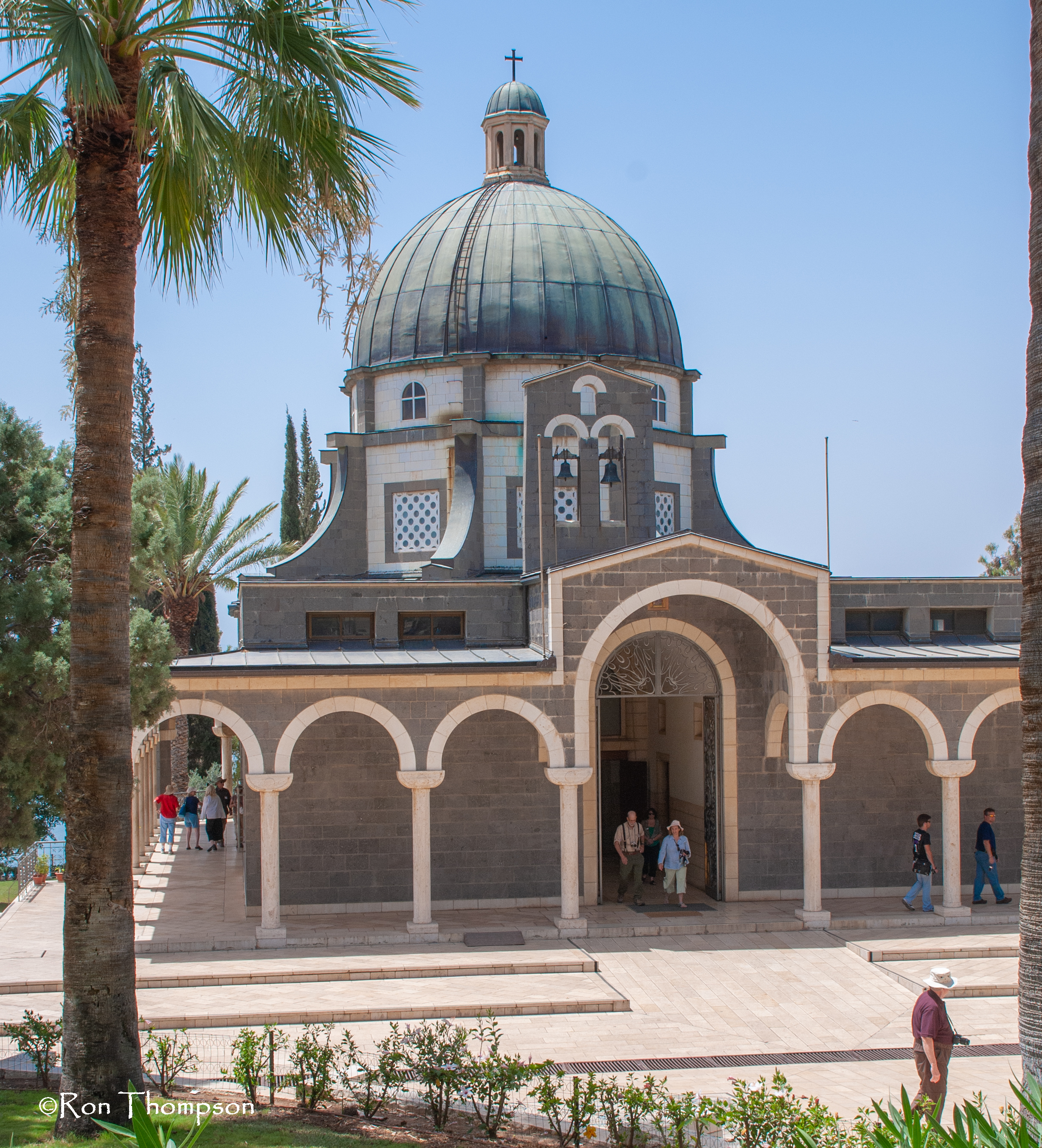
Church of the Beatitudes, part of a sprawling Franciscan monastery complex on the Mount of the Beatitudes. ©Ron Thompson 2008

Luke records a similar “sermon”, but due to differences in the text and to Luke’s apparent description of it as occurring on a “flat place”, most people seem to assume that these were separate events. In my opinion, it’s just one event. In support of that view:

  • Differences in text between gospels is not at all unusual. 1st century literary standards did not require exact quotation—paraphrasing was fine, as long as it did not materially change the argument(s) being made. With the same proviso, even loose chronological ordering was permissible.
  • Matthew was present at the event, and much later (probably 10 to 25 years later) he wrote down his impressions of what he, himself, witnessed. Inerrancy requires only that the substance of his report is correct, not that every word is faithfully repeated, and in the correct order, unless, as stated above, it alters the message intended. Luke, on the other hand, was not present and recorded only what he got, second-hand, from other sources. Of course, he must be held to the same standards of inerrancy, so his report may be assumed to be less accurate in the telling, but just as accurate in substance.
  • Matthew was born a Jew, and though he was first mentioned as a hated tax collector, he was steeped in Jewish tradition and Messianic hopes. His other recorded name, Levi (pronounced Lev-EE), indicates that he was from the tribe of Levi, and therefore even more immersed in Torah training in his home. Jesus’ teaching and miracles were central to Matthew’s gospel. Luke is the only Biblical author thought to be from a gentile heritage, but he is also thought to have legally converted to Judaism. His knowledge of Scripture and Jewish tradition would of course have been less complete than Matthew’s, and his gospel reflects more of Jesus’ humanity and details of His ministerial travels. It’s not surprising that he was silent about some of the more Jewish themes that were important to Matthew.
  • The passage in Luke is called the “Sermon on the Plain” because it mentions a “flat place”. I believe that this discrepancy can be resolved by harmonizing the two passages, thus:
  1. Jesus traveled to Capernaum. Mt 4:12–16; Lk 4:31.
  2. He then began teaching in or around Capernaum. Mt 4:17; Lk 4:32–44.

    Note: The ESV translates Lk 4:44 as, “And he was preaching in the synagogues of Judea.” Other translations say, “He kept on preaching…”, or something similar. The problem I see here is that the previous and following verses all clearly have Jesus in the Capernaum area. But the Greek Ἰουδαίας (Ioudaios) is a tricky word to translate. Very similar forms of the word can mean, “Jews”, “Judeans”, “Judea”, “tribe of Judah”, “land of the Jews”, and so on. Thayer’s Greek Lexicon, which provides a lot of supporting evidence, translates this particular form as “Jewish“, or more precisely, when joined with a noun as “belonging to the Jewish race.” I would comfortably contend, then, that Jesus is not here reported as going back to Judea at this time, but rather, “he was preaching in the synagogues of the Jews.”

  3. He collected a following, the disciples and other groups, some locals, some following from other regions, and of course the ever-present “scribes and Pharisees”, who I believe to have been agents from the Sanhedrin. Mt 4:18–23; Lk 4:45–6:11.
  4. One evening, He “went out to the mountain”, presumably a hill near Capernaum, and spent the night in prayer. In the morning, He called for His new disciples to join Him. Lk 6:12–16.
  5. After they joined for the traditional Shacharit (morning) prayers, the group then went down off the mountain to a “level place”, perhaps a valley floor or the lake shore, and ministered to a very large group of people from all over Galilee and the surrounding regions: from the Mediterranean coast to the west, Jerusalem to the south, and Decapolis and Transjordan to the east. Mt 4:24–25; Lk 6:17–19.
  6. Tiring of dealing with the crowd, Jesus walked back up the hill, with His disciples following Him. He sat down, and the others drew in to listen. He then began teaching, what we now call the “Sermon”. Mt 5:1–2.

The audience

I conclude from the above that Matthew and Luke describe the same event. Aside from that, it also tells me that the event was not a sermon at all, but rather an intimate teaching event, with Jesus sitting on the ground, and his disciples sitting in front of him.

Jesus had begun gathering a group of talmidim (disciples), beginning with a few in Jerusalem after His testing, and adding more in Galilee. It is impossible to say how many there were, and how many stuck with Him, but in Luke 6:13, he selected 12 of them to be ἀποστόλους (apostolous, emissaries, ambassadors). Some of those culled may have continued following Him but were not included in His inner circle.

Though the apostles were with Him during His first forays among the people, I think that the “Sermon” was probably the first formal teaching session they received from Him.

Who was included in the audience? Certainly the 12. Possibly additional, non-apostolic, disciples. Meanwhile, other people may have tagged along from the crowds on the flat area and still more may have come later. By the time He was done speaking, a crown had gathered, Mt 7:28.

Matthew’s Version, 5:3–7:29

View from the so-called “Mount of the Beatitudes”, near Capernaum. This gorgeous flower garden is modern, and courtesy of the Franciscan monks who dominate the hilltop. ©Ron Thompson 2008

What Jesus taught those assembled on the mount was specifically Jewish, and beyond that, specifically for the disciples. If the final audience (including late arrivals) included gentiles, say from Tyre, Sidon or Decapolis, the message was not intended for them.

The Beatitudes, Mt 5:3-12

Whether you’re reading Matthew’s list or Luke’s, the way almost everyone reads the Beatitudes is as cause followed by effect: Because you are poor in spirit—by one interpretation, spiritually depressed, or by another, spiritually bankrupt—the Kingdom of Heaven is yours! The blessing is because of, or in compensation for, the suffering.

Not so! That may fit with the popular (but wrong) idea that people have to be convinced of their sin before they can be saved. Why wrong? Because salvation, throughout all of human history, has been by grace alone through faith alone. By “calling on the name of the Lord”, which is another way of saying, by trusting faith, as illustrated in Hebrews 11 and elsewhere. One may be driven to faith through “conviction of sin”, or through witnessing God’s healing, or something else that has grabbed his or her attention. My own faith dates from my childhood, before I understood the sin concept. I became acquainted with Jesus through the children’s Bible stories, and I’ve never doubted Him since I was around 8 years old.

No, it is the other way around. Those who have been and perhaps still are the poor in spirit are blessed because the Kingdom of Heaven is theirs. Once they arrive, their spirits will certainly no longer be poor. The plain old poor are blessed because the Kingdom of God is theirs, and they will no longer by needy in any way. In fact, this is expressed plainly in Luke 12:22–32.

Because He is talking specifically to His disciples, particularly the 12 who will take the Gospel to the world, I have to believe that each of the Beatitudes expresses either, “this is how you are” or “this is how I expect my apostles to be.”

I have read that each of the Beatitudes is a New Testament expression of an Old Testament promise. For this survey, I’ll not take the time to research that, but I do want to comment on Mt 5:5:

Most translations say that “the meek … will inherit the earth.” This is absolutely a bad translation! The Greek γῆν (gēn) is usually translated as “earth”, meaning specifically the solid part of the entire planet. But it can also be translated as “land”, meaning a region or country. In this case, “land” is the only possible translation, because the verse is a quotation of

Psalms 37:11 (CJB)
[11] But the meek will inherit the land
and delight themselves in abundant peace.

David’s theme in Psalm 37 is, “Don’t be upset by evildoers or envious of those who do wrong”, because they will wither like grass, while those (Jews) who do good will “settle in the [Promised] land, and feed on faithfulness.” Israel’s meek and oppressed Jews will one day experience God’s shalom (peace, wellness, prosperity, etc.) in the Land He has given them to possess.

In Mt 5:9, “those who make peace … will be called sons of God”: “Sons of God“, huios Theos in Greek and bene haElohim in Hebrew, technically refers to the Heavenly Host (angels) who have not rebelled, but it will also refer to those humans who ultimately abide in Heaven with God. Another word for Sons of God is “saints.” Yes, the good angels are saints, too.

Salt and Light, Mt 5:13-16

This and the following section do not appear in Luke’s account because they are of exclusively Jewish application. Even though Luke was a Jewish proselyte, his background was gentile and secular. His two books, Luke and Acts, were written to a man who went by the Greek name, Theophilus, who is thought to have been either a gentile foreigner, maybe in Alexandria, or possibly the Sadducee, High Priest Theophilus ben Ananus, who served from AD 37 to 41. Whoever he was, Pharisaic Jewish detail was probably not among his interests.

In this section of His message, Jesus is commissioning His disciples to first, be a preservative influence on the believing Jews of Israel (salt), and second, lead those Jews into the surrounding world as evangelists to the lost (light). Two completely separate functions. Proper application to the church is (a) discipleship, teaching, fellowship, etc. within the Church (salt), and (b) evangelism of the lost (light). I cringe when I hear Christians say, “We are called to be salt and light to the world.” That’s just not the right concept!

Since I have previously written on this subject in depth, I would ask you to review it in “Light Yes, But Why Salt?“.

Endorsement of Torah and the Mosaic Covenant, Mt 5:17-19

He then reminds them that nothing He will teach or that they are to teach must ever detract from Jewish reverence to “the Law”, which will endure until the end of time. Again, this is Jewish teaching, for Jews!

I have also, more recently, written an in-depth discussion of this subject in, “Fulfilling the Law: Matthew 5:17–19“.

Righteousness, Mt 5:20

English translations like ESV that insert section headings tend to lump Matthew 5:20 with the previous verses, 17–19. This very much serves to reinforce the badly mistaken view, held by a majority of Christians, that because Jesus fulfilled the Law (and the prophets?), they are no longer valid. No, no, a thousand times no!!!

In reality, verse 20 is prologue for what follows! The next 28 verses (see my next section), in particular, discuss legalistic interpretations of Torah, not as taught, but as practiced by many (not all) of the Pharisees.

There is an interesting play on words in this verse—a “Hebraism”. In Hebrew, which was probably the language Jesus was speaking to His disciples, the word for “righteousness” is צֶדֶק (tsedeq; The Greek equivalent is δικαιοσύνη, dikaiosune).

Every Scribe (the academics) and Pharisee (the sectarians) strove to achieve a reputation for tsedeq by living his life as a just, honest, and compassionate man, ethically superior in all respects. Of course, the “easy” way to achieve this was by obedience to the 613 mitzvoth—by checking boxes. One of the most visible acts of righteousness was almsgiving. To say that one was a tsedeq was essentially to say that he was a generous almsgiver.

But Jesus was implying here that almsgiving isn’t enough to be considered truly righteous. True righteousness demands true faith.

Matthew 5:20 (ESV) additions mine
[20] For I tell you, unless your righteousness [your faith] exceeds that of the scribes and Pharisees [their almsgiving], you will never enter the kingdom of heaven.

Every Jew present would immediately have also understood the term tsedeq as an expression of one of God’s primary attributes—none is more important than His righteousness. In fact, one of His many names is Yhvh Tsidqenu: The LORD Our Righteousness.

In His personal life to that point and in His ministry to follow, Jesus faithfully kept the commandments of Torah, but His teachings were primarily about faith and the Kingdom of Heaven. Paul also emphasized the righteousness of faith.

The Six Antithises, Mt 5:21-48

I have heard and read many claims that Jesus was here contradicting the Torah commandments, or else deprecating or radically amending them. I believe that Jesus’ endorsement of Torah, above, was deliberate prologue to this section. There should be no doubt that He was engaging in commentary (Hebrew midrash), not revision!

Some of these are from the “Decalogue“, or 10 Commandments, and some were from other portions of the Levitical commandments dealing with relationships between Jews. The subjects in order, are:

  1. Murder, vs 21–26.
  2. Adultery, vs 27–30.
  3. Divorce, vs 31–32.
  4. Breaking an oath, vs 33–37.
  5. Vengeance, vs 38–42.
  6. Hatred, vs 43–48.

In each case, Jesus did not advocate disobedience to the commandments, but rather He told His followers to take them in the spirit God intended and to apply that same spirit to analogous situations that were more common to most people.

In fact, much of this was not even originally Jesus’ words. In those days, the two most powerful rabbinic schools of interpretation were the House of Hillel and the House of Shammai. Shammai’s interpretations were always harsh and legalistic, while Hillel’s were more nuanced and humanitarian.

Jesus was essentially, as always, taking Hillel’s side in an ongoing argument. It may sound like Jesus was advocating tougher rules. But think about them from a victimhood perspective: The brother who is hated or berated; the sexually harassed woman; the unjustly divorced wife; the person victimized by a broken oath, and so on.

Ostentatious Giving, Mt 6:1-4

Right after His snide comment about the “righteousness of the Pharisees”, Jesus first (by Matthew’s account) listed a number of commandments (the “antitheses”) for which box-checking obedience falls short of spiritual understanding, and then He turned to several very specific examples of ways in which many Pharisees demonstrated a deficiency in their own righteousness.

Verse 1 of this chapter is an introduction to several passages dealing with the hypocrisy of “practicing your righteousness before other people in order to be seen by them”.

First on this list was the propensity of many to turn their almsgiving into bragging rights (as discussed above). Almsgiving for public recognition qualifies as hypocrisy.

Ostentatious Prayer, Mt 6:5-8

Next, Jesus addresses the similar issue of those who pray flowery public prayers in order to impress other humans.

The Bible has a lot to say about prayer—but little about spontaneous prayer, which appears to be what this passage has in view. There is nothing I’m aware of that actually indicates that spontaneous prayer should be verbal. From at least the Babylonian captivity, and most likely as far back as the early Monarchy, until today, most verbalized Jewish prayer has been memorized or later, read from a Siddur (prayer book). For most of the last two millennia, where Jews have prayed spontaneously in group sessions, it has been by “davening” (quietly moving the lips), not by speaking out loud. For way more on this subject, see The Roots of Christian Prayer.

On a personal note: I am a decent writer, but a horrible public speaker. I'm aware that the secret to public prayer is to forget there are humans listening and to direct my words to God. Unfortunately, at 77 years old and having been in church since I was a toddler, awareness and performance have never come together. Every time I have been roped into "leading prayer", I've found myself addressing those around me, not Him within me. So, to avoid feeling like the Pharisee on the street corner, I refuse to be roped in again!

The Lord’s Prayer, Mt 6:9–15

Having condemned self-aggrandizing public prayer, Jesus then digresses to teach his disciples a prayer that I believe was meant to be an anthem to set them apart from other rabbinical schools, not a model form of prayer as most people today assume.

Whether it was meant to be recited in unison, davened, or sung, I can’t say for sure. I’m doubtful that there was unison recitation at all in the synagogues or Temple. Davening was certainly possible, with the leader reciting aloud and the others moving their lips. But Biblical Judaism was full of songs. The Psalms were probably all intended for song. We can only speculate on how singing was done. Most scholars seem to think it was antiphonal, either chant or melody.

The following is how I envision it:

Matthew 6:9b–13 (CJB) with voices added

— Cantor:
[9b] Our Father in heaven!
May your Name be kept holy.
— Congregation:
[10] May your Kingdom come,
your will be done on earth as in heaven.
— Cantor:
[11] Give us the food we need today.
— Congregation:
[12] Forgive us what we have done wrong,
as we too have forgiven those who have wronged us.
— Cantor:
[13] And do not lead us into hard testing,
but keep us safe from the Evil One.
— Congregation:
For kingship, power and glory are yours forever.
Amen.

Forgiveness, Mt 6:14–15

The ESV and CJB, among others, have translated the compound particle that begins verse 14 as if these two verses were a commentary on verse 12, and since ESV has grouped them under the same heading as the prayer, that is obviously the way they view it.

It may be that, or it may be a completely separate brief statement about forgiveness, in which case the particle should probably have been rendered as something like “provided that” or “if” (you forgive).

What is to be forgiven in verse 12 is ὀφείλημα (opheiléma), any kind of debt or obligation, either monetary or otherwise, where something is owed. Verse 14 uses a noun with a narrower scope: παράπτωμα (paraptóma), meaning a fault or offense that has been committed. Though some form of restitution or penalty may be owed, it seems to me a stretch to connect the two terms like this.

Ostentatious Fasting, Mt 6:16-18

Once again, Jesus calls out hypocritical worship. Fasting was a frequent requirement under Oral Torah, i.e., the “traditions of the Jews”, though Scripture only specifies one day a year for fasting (Yom Kippur, on 10 Tishri), and it says nothing about how long one should fast on that day or what, if anything can still be consumed.

Greed, Mt 6:19-24

This section contains the infamous “single eye” reference (verses 21 and 22) that almost nobody in all of Christianity understands. Even the “Cultural and Historical Background” given by Strong’s is inapplicable. That’s because this is a Jewish idiomatic usage of the Greek word.

The simplest way to explain it is to quote it from the one translation I’m aware of that gets it right:

Matthew 6:22 (CJB) the bracketed text is the translator’s
[22] ‘The eye is the lamp of the body.’ So if you have a ‘good eye’ [that is, if you are generous] your whole body will be full of light; [23] but if you have an ‘evil eye’ [if you are stingy] your whole body will be full of darkness. If, then, the light in you is darkness, how great is that darkness!

Anxiety, Mt 6:25-34

This passage on faith in the face of anxiety is about as clear as it gets.

Judgementalism, Mt 7:1-5

Again, I don’t think there is very much to this passage that needs explanation, except to say that it does not, as many think, say that it is never proper to judge the actions of others. Verse 5 makes it clear that judgement is acceptable, provided that one first deals with his or her own sin.

Dogs and Pigs, Mt 7:6

Matthew presents this verse without explanation. It is most likely a proverb that was known and understood by the Jews in attendance. If “dogs” and “pigs” are humans, then Jesus is warning His followers not to entrust that which is holy to people who are unholy. In that case, it is probably connected to the previous passage, since to recognize one requires judgement.

Was Jesus, then, engaging in racism? Please, that concept is anachronistic.

Christianity didn’t yet exist. Biblically, there were two classes of people: Jews and goyim (gentiles). Ideally, Jews worshipped Yahweh. Gentiles mostly worshipped pagan gods. Gentiles living in Israel (the ger, or “stranger”, “sojourner”) could convert to Judaism and worship Yahweh, and Jews were to treat those proselytes as other Jews. Gentiles living in Israel who did not convert were required to live righteously and were to be treated well by Jews if they did so.

Though most Godly Jews did distrust, dislike, or even hate gentiles because of their paganism, calling them dogs or pigs didn’t necessarily carry the same animas as racial epithets today. Uncircumcised gentiles were considered ritually unclean, just like dogs and pigs. It was a description, not an epithet.

Since pigs were commonly used for food in gentile lands, comparing a gentile to a pig was probably an especially poignant image to a Jew.

Dogs were also ritually unclean, but since they weren’t commonly eaten by the gentiles, they weren’t as reviled as pigs. In fact, they were sometimes Jewish pets, especially as puppies.

Saying, “Do not give dogs what is holy” was probably an expression based on:

Exodus 22:31 (ESV) emphasis mine
[31] “You shall be consecrated to me. Therefore you shall not eat any flesh that is torn by beasts in the field; you shall throw it to the dogs.

A number of commentaries speculate that Jesus is saying, “You can throw carrion to the dogs, but not meat sacrificed to God.” My guess is that He was saying that any clean (and therefore holy) object, not just sacrificial meat, should not be offered to unholy gentiles.

Other possible interpretations could be gleaned from the observation that the same Greek word translated as “dogs” was sometimes rendered as “prostitutes”:

Philippians 3:2 (ESV) emphasis mine
[2] Look out for the dogs, look out for the evildoers, look out for those who mutilate the flesh.

Prayer and Relationships, Mt 7:7-11

This passage is, of course, about prayer. From the context, “ask”, “seek”, and “knock” are all talking about prayer. With that in mind, interpretation is fairly easy.

However, caution is in order. Prosperity gospel will say that this is a firm promise, and if you don’t get what nyou ask for it’s because you are somehow at fault. Perhaps there is sin in your life, or maybe you asked in an improper spirit.

I may be accused of heresy for this, but passages like this aren’t promises, they are rules of thumb, so to speak. God is not obligated to give even the Godliest person everything requested every time. God has His own agenda, which is not necessarily for us to know.

There are many examples of these “general principles”. To name just two: “Train up a child in the way he should go; and when he is old, he will not depart from it.” “The days of our years are threescore years and ten.”

The Golden Rule Mt 7:12

I mentioned above that parts of the Sermon on the Mount were Jesus’ restatements of principles already recognized in Judaism. That should not be a surprise. He did not come to overthrow Torah, in any sense. God is the author of Torah, and Israel was His elect people, tasked with transmitting, interpreting and managing Torah. These supervisory functions were, in fact, what Jesus was referring to at Caesaria Phillippi when He later granted the same rights to His apostles:

Matthew 16:19 (ESV)
[19] I will give you the keys of the kingdom of heaven, and whatever you bind on earth shall be bound in heaven, and whatever you loose on earth shall be loosed in heaven.”

What I believe was Jesus’ goal in this first lecture to His new band of apostles was to sort out the good from the bad that had developed in the ranks of the theologians of Israel.

The Golden Rule actually wasn’t even a “Jewish invention.” Every ancient civilization had a similar saying, going back at least as far as early Egypt. In Judaism it appeared as early as the Apocryphal book of Tobit, written in the 3rd century BC:

Tobit 4:15 (NRSV) emphasis mine
[15] And what you hate, do not do to anyone. Do not drink wine to excess or let drunkenness go with you on your way.

In the 1st century it was, once again, couched in terms of the disputes between the humanist, Hillel and the legalist, Shammai:

From Shabbat 31A (emphasis mine):
A. There was another case of a gentile who came before Shammai. He said to him, “Convert me on the stipulation that you teach me the entire Torah while I am standing on one foot.” He drove him off with the building cubit [a measuring rod] that he had in his hand.
B. He came before Hillel: “Convert me.”
C. He said to him, “‘What is hateful to you, to your fellow don’t do.’ That’s the entirety of the Torah; everything else is elaboration. So go, study.
— Neusner, Jacob, ed., The Babylonian Talmud: A Translation and Commentary. Accordance Electronic edition, version 1.6. Peabody: Hendrickson Publishers, 2005.

The Narrow Gate, Mt 7:13-14

This passage is self-explanatory.

Bonus material: Speaking of narrow gates, you’ve probably heard the following explained by reference to an obscure Temple gate called the “Needle’s Eye”:

Matthew 19:24 (ESV), also Mark 10:25; Luke 18:25
[24] Again I tell you, it is easier for a camel to go through the eye of a needle than for a rich person to enter the kingdom of God.”

There is no such gate! But nothing is impossible for God.

False Prophets, Mt 7:15-23

The two passages that ESV titles “A Tree and Its Fruit” (15–20) and “I Never Knew You” (21–23) form a single united theme, in my opinion. That theme is about recognition of false prophets.

I don’t believe that true prophets, in the Biblical sense, still exist today, but application can be found in the evaluation of anyone who claims to have special knowledge imparted by God that is not available to anyone else.

While judgementalism is condemned in some portions of the Bible, that can’t be considered a blanket prohibition. If we are to recognize false teaching and avoid victimization, certainly we must be free to evaluate others on the basis of results, as Jesus warns in verse 15.

Wisdom, Mt 7:24-27

I assume that children today are taught the lesson of the wise man and the foolish man, as I was way back in the day.

Luke’s Version, 6:20–49

The golden plot down the hill is one possible location of the “flat place” of Luke’s report, but of course the area may have been graded for farming in modern times. I took this photo from the Church of the Beatitudes. The field below is an easy hike from the traditional location of the Sermon on the Mount, perhaps 50 yards to my left. At worst, this photo is an illustration of the scenario I’m paining here. ©Ron Thompson 2008.

While Matthew’s version is “very Jewish“, with frequent references to Old Testament theology, Luke’s version includes little, if anything, that is applicable specifically to the Jewish culture, though he is describing the same event.

Also, Luke apparently was not scrupulous about keeping all of his comments about the Sermon grouped in one place.

I’m not going to attempt even a complete survey of Luke’s Sermon on the Plain. Just random comments.

Blessings and curses, Lk 6:20–26

Where Matthew gives a list of blessings (the Beatitudes), Luke lists both blessings and curses.

The blessings are basically a subset of the promises in Matthew’s list.

In verse 20, Luke’s version would seem to be saying that because you are poor (lacking money), the Kingdom of God is yours. I can’t see any interpretation that would rescue that logic! Nor will you be blessed with financial riches once you arrive in the Kingdom of God. There is no “mansion over the hilltop”. If the streets are gold, it won’t belong to you. What you will possess is relief from suffering you may undergo now because you lack resources on earth.

After his abbreviated list of blessings, Luke listed four woes, traits that He won’t tolerate in His disciples: “I don’t want you to be rich, sated, frivolous, or fawning”. Temporal worldly gain may cost you in eternity.

Miscellaneous discourses, Lk 6:27–49

The rest of the chapter could be a continuation of the “Sermon” but could just as well be later lessons. Most of it consists of discourses on confrontational ethics.

This section begins with a discussion of loving one’s enemies 6:27–36, which is analogous to Matthew’s 6th Antithesis. Of the six, this is the only one that is strictly related to an attitude, as opposed to a Torah commandment, though it is mentioned in Leviticus in relation to vengeance. If this is still part of the Sermon, omitting the first five is consistent with Luke speaking to a gentile audience.

Being accepted as a disciple under a respected Rabbi entailed exceptional responsibility and required total obedience to the Master. Without question these were rules that Jesus expected His disciples to obey scrupulously, as they already presumably did with respect to the 613 Torah commandments.

Yet the passage, especially as expressed in Luke 6:27–30, contains exhortations that most of us have a difficult time obeying: “Love your enemies”, “bless those who curse you”, “turn the other cheek”, “let people rip you off”, and “give more than requested”. I don’t want to encourage bad behavior, but I have to put this in perspective, as I see it.

As gentile believers in the New Testament Church, good behavior is expected of us, too, but given our frailty in the face of challenging circumstances, I don’t recommend excessive judgementalism…

And, low and behold, the next topic on Luke’s agenda here is judgementalism, verses 37–42.

In verses 43–45, we see, as in Matthew, that judgement precedes “fruit inspection”, or recognizing false prophets by their fruit.

I suspect that the end of the chapter, verses 46–49 may be for a subsequent discussion with the disciples, because verse 46 implies a longer history together than is likely from this early teaching session, virtually right after Jesus commissioned His apostles.

The Lord’s Prayer, Lk 11:1–4

Luke’s report on the prayer is in chapter 11, and clearly out of chronological order.

Verse 1 adds credence to my contention (not my own idea but garnered from the book Jesus and the Victory of God, by N.T. Wright) that it was a rabbinic anthem, since John the Baptizer had previously taught a similar prayer to his own disciples.

In any case, the suggestion that Jesus’ disciples didn’t know how to pray in general and were asking Him to teach them is ludicrous. They lived in a praying culture and certainly learned how to pray no later than toddling.

Fulfilling the Law: Matthew 5:17–19

Posted on:

Modified on:

  1. Exposition of the text
    1. What is “The Law”?
      1. Using a concordance
      2. Torah to a Jew
      3. Nomos to a Jew
      4. An expanded view of Torah/Nomos
      5. What it isn’t
    2. “The Law and the Prophets”
    3. Other New Testament Uses of “Fulfill”
    4. A warning
    5. What about verse 20?
  2. The conditionality of the Mosaic Covenant?
    1. What triggered the supposed annulment of the Mosaic Covenant?
    2. Old Testament references to the New Covenant

Matthew 5:17 (ESV)
[17] “Do not think that I have come to abolish the Law or the Prophets; I have not come to abolish them but to fulfill them.

Most of us have been taught that “the Law” was a good thing in its time, but by “fulfilling” it, Jesus rendered it obsolete. He didn’t abolish it, but because it was a foreshadowing of His life, death and resurrection, it no longer has any function other than as a tutor, to teach us about sin. To most, more like an artifact in a museum.

But if “the Law” is obsolete, then so are other things based on it.

Judaism as an ethnic group goes back to Abraham, of course, but the one thing God gave them that allowed them to survive 2000 years of Diaspora was their distinctive identity as a people with an elaborate cultural heritage. If “the Law” is obsolete, then so is the heritage, and so, too, is the people. What then, is the purpose of the modern state of Israel? The late R.C. Sproul (who I nevertheless liked) echoed the sentiments of Reformed churches around the world in saying that it has no purpose whatsoever!

Exposition of the text

In this post I’m going to provide exegesis of the following passage, then discuss some of the consequences.

Matthew 5:17–19 (ESV)
[17] “Do not think that I have come to abolish the Law or the Prophets; I have not come to abolish them but to fulfill them. [18] For truly, I say to you, until heaven and earth pass away, not an iota, not a dot, will pass from the Law until all is accomplished. [19] Therefore whoever relaxes one of the least of these commandments and teaches others to do the same will be called least in the kingdom of heaven, but whoever does them and teaches them will be called great in the kingdom of heaven.

Most conservative Evangelical theologians, and almost all Dispensationalists, believe that the Mosaic Covenant, the “Law of Moses”, was conditioned on Israel’s continuous keeping of “the Law“. They say that when Israel rejected their Messiah, they forfeited this particular Covenant. One of the chief passages in the Bible used to support that opinion is Matthew 5:17, taken out of context and carelessly translated. Yet I think that, taken in context, it says the opposite.

In a recent exchange on Facebook with a person who is clearly a sophisticated student of the Bible (and a new friend of mine, as well), I responded to this statement:

In Matthew 5:17, Jesus says, “Do not think that I have come to abolish the Law or the Prophets; I have not come to abolish them but to fulfill them.” This statement indicates that Jesus’ mission was not to discard the Law but to bring it to its intended purpose. The Greek word used for “fulfill” (πληρόω, plēroō) suggests completion or bringing to full expression. Jesus lived in perfect obedience to the Law, thus fulfilling it in a way no one else could.

Mostly, that analysis is on track, but the final sentence reveals a fundamental misunderstanding of Jesus’ mission. It hinges on what is meant by “the Law” and is also a misstatement of what verse 17 actually says.

What is “The Law”?

I recall a weekday Men’s Bible study teacher asking the group what book of the Bible we would like for him to teach through next. I suggested Leviticus and got a kick out of all the dropped jaws and glazed eyes.

To most Christians, the idea of even reading Leviticus is daunting, let alone discussing its content in tedious detail. Leviticus is just… it’s…


…A cumbersome jumble of miscellaneous rules and regulations designed to show us the unmitigated evil of the human heart, and how ungrateful and hypocritical a people can be despite all God does for them.

But before we can “decode” our text, we need to agree on what “the Law” really is. When you see that term in the Old Testament, it is a translation of the Hebrew “Torah.” In the New Testament, it is a translation of the Greek “nomos.” Both words refer to the same thing. the problem is that the English word “law” doesn’t fit either of these foreign words very well.

Using a concordance

If you don’t speak Hebrew or Greek and you run across a word in one of these languages in the Bible, then the chances are you might look it up in a concordance. In the modern age, the best known and most used of these, for both languages, is Strong’s Exhaustive Concordance, but there are a number of others available. Strong’s introduced index numbers for the root form of each word found in the King James version. Newer concordances mostly use Strong’s index numbers, though there are additional numbering systems available.

Most concordances list English translations of the original word. In doing so, they may purport to serve the purpose of a dictionary, but it is important to realize that they are not dictionaries—they are indices! So, if Strong’s lists, for example, 25 uses of a single root word, it will generally break those down by the different ways that word has been translated. It isn’t telling you how it should be translated, but rather how it has been translated.

Fortunately, there are a number of actual translational dictionaries available, and many of those cross-reference the Strong’s index numbers.

Torah to a Jew

The Strong’s entry for Torah, H8451 on Biblehub.com, says “direction, instruction, or law.” A different edition of Strong’s, incorporated with the PocketBible Bible Study App, lists: “a precept or statute, especially, the Decalogue or Pentateuch—law.”

But to the faithful Jew, the “law” part of it is just a to-do list for living an orderly and God-pleasing life. “The 613 Habits of Highly Effective People“, so to speak. Torah to a Hebrew-speaking Jew means “teaching“—Instruction about who God is and what God does; and direction for how to lead family and community in the path God has paved.

But what specifically is “The Torah?”

That question has a lot of answers to a Jew, depending on context:

  • First of all, it is of course the Five Books of Moses, called the Chumash (the five) by Jews and the Pentateuch by Hellenized Christianity.
  • Oral Torah” refers to a body of tradition handed down from generation to generation, beginning ostensibly with Moses. These are the “traditions of the elders” which Jesus condemned, but only to the extent that they occasionally conflicted with written Torah. Without question, Jesus and His disciples kept most of these customs themselves. These include ways of celebrating the Biblical feasts, celebration of additional, extrabiblical feast days, ritual washing customs, the entire body of blessings before meals and other activities, and much, much more. After AD 70, Pharisees and scribes assembled at Jamnia (Yavneh, modern Rehovot, between Tel Aviv and Ashdod) began the arduous task of writing down these previously oral-only traditions. The result is the Mishnah, and later two competing versions (“Babylonian” and “Jerusalem”) of the Talmud.
  • In a much broader sense, anything that records the Word of God is also considered Torah. This includes the rest of the canonical Tanakh, or Old Testament. Messianic Jews, believers in Messiah Jesus, also include the New Testament in Torah.

But regardless of the dictionary definition, to a devout Jew, Torah reflects the way things are, not the way things are supposed to be.

Nomos to a Jew

Regarding the term “Law”, the New Testament uses the Greek nomos, following the lead of the Septuagint (LXX), the 2nd century BC Greek translation of the Old Testament that Paul used when taking his ministry to the Greek world. The LXX uses nomos for the Hebrew Torah because that was as close as the translators could come, grammatically.

Strong’s and NAS both define nomos as, “that which is assigned, hence usage, law.”

Thayer’s, as usual, gives a much more complete analysis:

(νέμω, nemo, to divide, distribute, apportion), in secular authors from Hesiod down, anything established, anything received by usage, a custom, usage, law.

Vine’s, my favorite language resource, says,

(νόμος, nomos), akin to nemo, “to divide out, distribute,” primarily meant “that which is assigned”; hence, “usage, custom,” and then, “law, law as prescribed by custom, or by statute.

An expanded view of Torah/Nomos

There is no denying that a significant part of Torah consists of legal precepts. In fact, by official Jewish count, there are 613 separate mitzvoth, or commandments, in the Five Books of Moses. These are contained in portions of Torah that are called Halachah, or “the way of walking.” As Paul would describe it, the part defining the proper “walk” of a Godly Jew.

The rest of Torah is called Aggadah, and it is the narrative part of Scripture. If Halachah is about expected behavior, Aggadah provides the rationale and motivation for that expectation. As expressed very eloquently by myjewishlearning.com, Jewish life is defined, not by “Law” or Halachah, but by the interplay between Halachah and Aggadah. “The interrelationship of Halakhah and Aggadah is the very heart of Judaism. Halakhah without Aggadah is dead, Aggadah without Halakhah is wild.”

My conclusion is that it’s only because of the legalism of 2nd Temple and Rabbinic Judaism and defensive translation/commentary by mostly antipathetic gentile scholars that both the Hebrew and Greek terms became associated exclusively with the strictly legal term, “law.”

What it isn’t

Starting probably with Augustine of Hippo, the Church developed a theory, now firmly entrenched in both Catholic and Protestant tradition, that “the Law” was composed of three parts: Moral Law, Civil Law, and Ceremonial Law. Supposedly, the Moral Law is still in force, but the Civil and Ceremonial Law have been annulled.

That tradition has absolutely no Biblical support and was never a part of prior Jewish belief. Furthermore, the view is theologically untenable, on several important levels. The Torah, or more accurately, Halachah, is a unified whole. To fail with respect to a single minor mitzvah is to fail with respect to all of Torah, no matter how you parse it. For more on this subject, see The Transfiguration and “Jewish Law”.

“The Law and the Prophets”

But Matthew 5:17 isn’t speaking about Torah alone, and certainly not Halachah alone. It mentions not just “the Law”, but rather, “the Law or the Prophets”, which was a common shorthand expression indicating the entire, Tanakh, or Old Testament. The Prophets didn’t establish any law. They proclaimed God’s judgements and revealed His plans for Israel and the World.

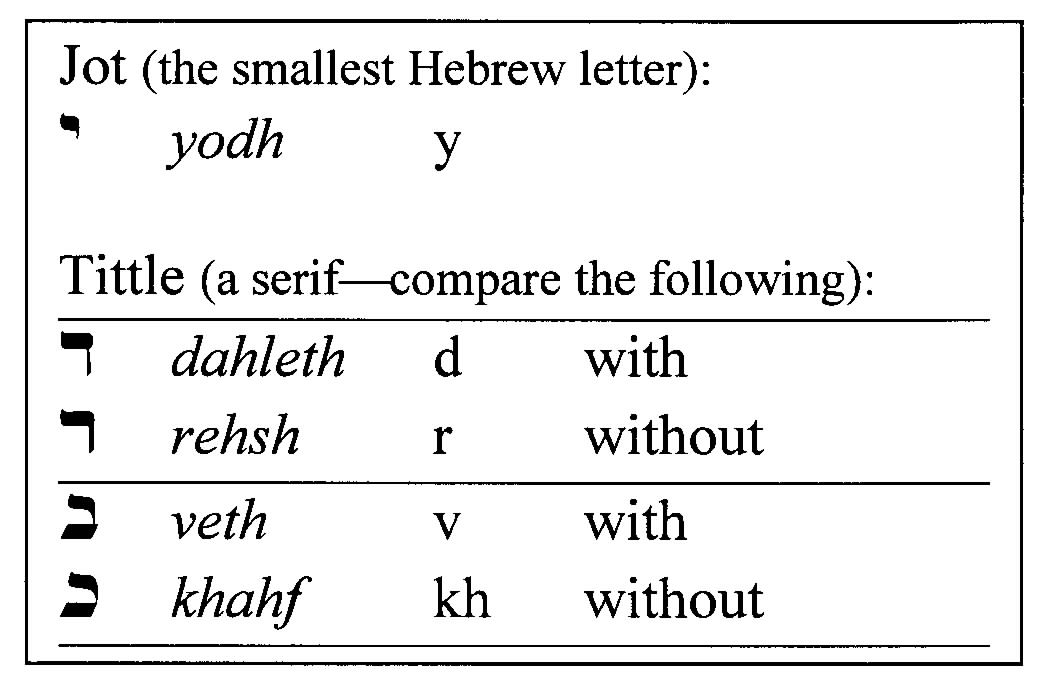
So, fully understood, verse 17 could not possibly be saying that Jesus “fulfilled the Law and the Prophets” merely by living in complete obedience to Halachah. Indeed, Jesus’ meaning is made perfectly clear by the very next verse: “[18] For truly, I say to you, until heaven and earth pass away, not an iota, not a dot [“jot and tittle” in KJV; “yodh or stroke” in the Hebrew alphabet], will pass from the Law until all is accomplished.

The “jot and tittle”, ©Ron Thompson

As I sit here and gaze out my office window, I can clearly see that heaven and earth have not yet passed away. So, is God’s “Law” of less effect today than when Jesus spoke His Sermon on the Mount?

It happens to be Thursday as I start this paragraph, but I was sitting here typing last Saturday, too. I was violating the Jewish Sabbath in a number of ways. But I’m not Jewish, and I’m not bound by Jewish law. The Mosaic Covenant was between God and Israel, not between God and the Church (sorry, Reformed friends, they’re not the same), not between God and goyische God-Fearers (I just added a stub for a future post on non-Jewish pre-Christian believers), and not between God and all humanity. Has it passed away for Israel (whether they realize it or not)? I just checked again: the sun is still shining, the wind is still blowing, and squirrels are still running up and down the oak tree.

In case verse 18a was not enough, 18b adds even more punch: not the tiniest portion of “the Law” will pass until “all is accomplished“! All of what? All that is written in “the Law and the Prophets”. Aggadah as well as Halachah. All of God’s plans as revealed in the Old Testament. Some have, some have not. Jesus’ first advent has come and gone, but there is still a lot of prophecy unfulfilled. Some of my readers don’t believe in a Millennial Reign, but most believe in a coming final judgement. That is surely yet to come. Unfulfilled! The Law. The Covenants. None of that has passed away!

Other New Testament Uses of “Fulfill”

About the same time that I was participating in this discussion of Matthew 5:17–19 on Facebook, another man was independently taking the same stance as mine on another thread about the same subject. This man’s name is Dalton Mauldin, and he is the author of a book titled Finding the Way: A Scripture-Guided Journey to Break through Tradition to Find Truth, Faith, and a Closer Walk with God.

I am reading the book, and while Dalton and I aren’t on the same page on everything, we’re close enough to be Christian friends. In order not to reinvent the wheel, I have obtained his permission to quote him here as he discusses other instances of the term “fulfill” in the New Testament. This is an excerpt from his Chapter VIII:

“Then Jesus came from Galilee to the Jordan to be baptized by John. But John tried to deter him, saying, “I need to be baptized by you, and do you come to me?” Jesus replied, “Let it be so now; it is proper for us to do this to fulfill all righteousness.” Then John consented. (NIV)”

Did Jesus mean to “put an end to all righteousness”? Of course not! In this instance, “fulfill” was a translation of the same Greek word “pleroo.” It is clear in this usage that it does not mean “to put an end to” all righteousness, but more likely to demonstrate righteousness. It should also be noted that this is the same author, Matthew, who would likely use the word fulfill in the same way two chapters later. 

In Romans 15:13, it says: “May the God of hope fill you with all joy and peace as you trust in him, so that you may overflow with hope by the power of the Holy Spirit. (NIV)”

In this instance, “fill” was translated from “pleroo” as well. It is clear in this usage that it does not mean “to put an end to”, but “to make full.”

In Colossians 1:25, Paul states: “I have become its servant by the commission God gave me to present to you the word of God in its fullness. (NIV)”

In this instance, “fullness” was translated from “pleroo” as well. It is clear in this usage that it does not mean “to put an end to” but means “in its entirety.”

In James 2:23 it says: “And the scripture was fulfilled that says, ‘Abraham believed God, and it was credited to him as righteousness,’ and he was called God’s friend. (NIV)”

In this instance, “fulfilled” was translated in the past tense of the word – you guessed it – “pleroo”. It is clear in this usage that it does not mean “to put an end to”, but to mean “brought into reality”.

In fact, there is no instance of “pleroo” translated as “to put an end to” or any similar meaning. Thus, “fulfill” cannot possibly mean anything that might resemble “put an end to.”  Having eliminated the possibility of any meaning of “pleroo” that indicates an “end”, let’s look at the others: “to complete, to make full, to verify, to accomplish, to satisfy, and to preach fully”

A warning

If there is still any doubt about the permanence of “the Law”, Jesus then adds a stern warning for those who in any way would relax their observance of Torah:

Matthew 5:19 (CJB)
[19] So whoever disobeys [λύω, loo’-o, to relax, loosen, untie, break up, destroy, dissolve, melt, put off, contravene, annul] the least of these mitzvot and teaches others to do so will be called the least in the Kingdom of Heaven. But whoever obeys them and so teaches will be called great in the Kingdom of Heaven.

What about verse 20?

Matthew 5:20 (ESV)
[20] For I tell you, unless your righteousness exceeds that of the scribes and Pharisees, you will never enter the kingdom of heaven.

The ESV, NIV, NCV, NKJV and some other translations lump Matthew 5:17–20 under one subheading, such as “Christ Came to Fulfill the Law” in ESV. Others include the Salt and Light verses, 13–16 under the same subhead.

I think that it is bad exegesis to include verse 20 with the preceding verses, because rightfully verse 20 is an introductory verse to what follows, specifically Jesus’ discourse on the spirit of the 10 Commandments.

Regarding “the righteousness of the scribes and Pharisees,” this is a Hebrew play on words. צִדְקָה (tsidqah) is a noun that means “righteousness.” Jesus is teaching that righteousness means both the letter and spirit of Torah. Many scribes and Pharisees, though, had cheapened the term by using it to indicate simply “almsgiving alone.”

“Look at how righteous I am—I faithfully donate a shekel or two to widows and orphans.”

The conditionality of the Mosaic Covenant?

In my post, A Perspective on Biblical Covenants and Dispensations, I state my opinion that, despite contrary views, none of the Covenants with Israel were conditional—that each new Covenant built onto all of the previous Covenants. The Mosaic Covenant is still operative!

Matthew 5:17, is part of the justification for the disastrously mistaken idea that God is “done with the Jews”, either forever or until the Tribulation period. Do you think that’s a minority view among Christians? Wrong! It is a prominent teaching of the Catholic and Orthodox churches which dominate most of the world, as well as Reformed Protestant denominations, including Anglican, Presbyterian (my dad’s heritage), Lutheran (my mom’s heritage), and many denominations around the globe, many of which have the word “Reformed” in their name.

But even Dispensational denominations, which refuse to permanently write off Israel’s place in God’s plans for the last days, uniformly hold that the Mosaic Covenant is dead, because it was conditional.

There are two ways one can think of covenant “conditionality”:

  • First, one can call a covenant “unconditional” if it makes promises (positive and/or negative) that one party is bound to keep no matter what the other party does or does not do, and “conditional” if the promises it makes are contingent on the actions of the other. In that sense, yes, the Mosaic Covenant is indeed conditional.
  • But that is not what most Bible teachers mean when they say the Mosaic Covenant is conditional. They mean that its validity is conditional. “If you obey, I’ll bless you, if you disobey, I’ll curse you…” [That much is true—Deuteronomy 28 says it in no uncertain terms!] “…and if you keep disobeying, I’ll take my ball and go home!”

What triggered the supposed annulment of the Mosaic Covenant?

Many Dispensationalists will say that God cancelled the Mosaic Covenant when Israel, in the person of the Pharisees harassing Jesus (no doubt at the instigation of leadership in the Great Sanhedrin) rejected Jesus as messiah and blasphemed the Holy Spirit by attributing His miracles to Satan. This rejection, they say, is recorded in Matthew 12:

Matthew 12:22–25,30–32 (ESV)
[22] Then a demon-oppressed man who was blind and mute was brought to him, and he healed him, so that the man spoke and saw. [23] And all the people were amazed, and said, “Can this be the Son of David?” [24] But when the Pharisees heard it, they said, “It is only by Beelzebul, the prince of demons, that this man casts out demons.” [25] Knowing their thoughts, he said to them, “Every kingdom divided against itself is laid waste, and no city or house divided against itself will stand.

[30] Whoever is not with me is against me, and whoever does not gather with me scatters. [31] Therefore I tell you, every sin and blasphemy will be forgiven people, but the blasphemy against the Spirit will not be forgiven. [32] And whoever speaks a word against the Son of Man will be forgiven, but whoever speaks against the Holy Spirit will not be forgiven, either in this age or in the age to come.

The Dispensational scenario suggests that Jesus, at the beginning of his ministry, was actively preaching, demonstrating His power, and proclaiming his Messiahship, with the ultimate intention to rally the Land and establish the prophesied Messianic Kingdom. Paradoxically, the same people who teach this are also prone to teach that Jesus’ first advent was specifically intended to present Him as a suffering servant, not a military leader. As a result of the Pharisees’ rejection in Matthew 12, Jesus, in verse 32, (again in this scenario) announced that the scribes and Pharisees as representatives of Israel had committed an unpardonable national sin, so the Kingdom would be indefinitely delayed. From that day on, Jesus would no longer seek to win over the current generation but rather would concentrate on training His disciples and by extension their successors to carry His message to a far future generation. As a result, His miracles were henceforth done in relative privacy, His messages were delivered in parables that could only be understood by His “insiders”, and on His death, the Mosaic Covenant was cancelled and replaced by the New Covenant. Some say that “it is finished” uttered on the cross marks the instant of replacement.

I find that scenario to be deeply flawed and insupportable.

In my Covenants and Dispensations post, I point out that Christianity is more or less divided into two camps:

  • The Covenantalists, who believe that Jewish Old Testament Israel was the original “Church”, and that the mostly gentile New Testament Church is the current and forevermore “Spiritual Israel”, and that there will be no Rapture or Millennial Reign.
  • The Dispensationalists, who believe that Israel and the Church are distinct entities, and that the Church will be Raptured followed by a Millennial Reign during which Israel will finally accept their Messiah.

Almost all Christian denominations and local churches fall into one of those two camps. You can more or less recognize them by whether they practice infant baptism (Covenant), or believer’s baptism (Dispensational). Personally, I totally reject the majority Covenantal viewpoint. I do hold to the Dispensational views as shown by the bullet above, but I reject the concept of “dispensations” and the Dispensational belief that the Mosaic Covenant is dead.

Old Testament references to the New Covenant

That the New Covenant would replace the Old is not stated anywhere in the Old Testament. Several references do indeed predict that the “New Covenant” will be better than the “Old Covenant”, i.e., the Mosaic:

  • Moses himself, in Deuteronomy 29:[4] (CJB), said, “to this day ADONAI has not given you a heart to understand, eyes to see or ears to hear!”. Though he does not mention a New Covenant, he goes on, in chapter 30, to describe times of apostacy and exile for Israel, followed by, in chapter 31, promises of restoration. Notable in this passage is,

Deuteronomy 30:5–8 (ESV) emphasis mine
[5] And the LORD your God will bring you into the land that your fathers possessed, that you may possess it. And he will make you more prosperous and numerous than your fathers. [6] And the LORD your God will circumcise your heart and the heart of your offspring, so that you will love the LORD your God with all your heart and with all your soul, that you may live. [7] And the LORD your God will put all these curses on your foes and enemies who persecuted you. [8] And you shall again obey the voice of the LORD and keep all his commandments that I command you today.

Only verse 5 here yet been fulfilled for the nation of Israel. Note that verse 6 concerning Israel’s heart is language characteristic of the New Covenant, but if the New cancels the Old, then why is it that that Israel will still “keep all His commandments that I command you today”—clearly speaking of “the Law of Moses.”

I have written a post recently dealing with Paul’s writings on this subject, in his epistle to the Romans: Yetzer, Yotzer and “The Law” in Romans 7:1–6.

  • The best known of the New Covenant prophecies is found in,

Jeremiah 31:31–34 (ESV) emphasis mine
[31] “Behold, the days are coming, declares the LORD, when I will make a new covenant with the house of Israel and the house of Judah, [32] not like the covenant that I made with their fathers on the day when I took them by the hand to bring them out of the land of Egypt, my covenant that they broke, though I was their husband, declares the LORD. [33] For this is the covenant that I will make with the house of Israel after those days, declares the LORD: I will put my law within them, and I will write it on their hearts. And I will be their God, and they shall be my people. [34] And no longer shall each one teach his neighbor and each his brother, saying, ‘Know the LORD,’ for they shall all know me, from the least of them to the greatest, declares the LORD. For I will forgive their iniquity, and I will remember their sin no more.”

But this also is a Covenant with “the house of Israel and the house of Judah” and it too, in its context (read the entire chapter!), speaks of the acharit hayamim, the “end of days.” At least as it applies to national Israel.

  • Ezekiel also repeats the prophecy, and once again the context places it firmly in the future, yet to be fulfilled.

Ezekiel 36:24–28 (ESV)
[24] I will take you from the nations and gather you from all the countries and bring you into your own land. [25] I will sprinkle clean water on you, and you shall be clean from all your uncleannesses, and from all your idols I will cleanse you. [26] And I will give you a new heart, and a new spirit I will put within you. And I will remove the heart of stone from your flesh and give you a heart of flesh. [27] And I will put my Spirit within you, and cause you to walk in my statutes [בְּחֻקַּי֙, bə·ḥuq·qay, “in my statutes”] and be careful to obey my rules [וּמִשְׁפָּטַ֥י, ū·miš·pā·ṭay, “and my ordinances/judgements”]. [28] You shall dwell in the land that I gave to your fathers, and you shall be my people, and I will be your God.

Once again, the New Covenant will ultimately renew Israel’s faithfulness to the Old Covenant, not replace it.


Son of Man, Son of God

Posted on:

Modified on:

  1. Introduction
  2. “Son of God” in the New Testament
    1. In the Synoptic Gospels
    2. In John’s Gospel
  3. “Sons of God” in the Old Testament
  4. “Son of Man” in the Old Testament
  5. “Son of Man” in the New Testament
  6. The bottom line

Introduction

I love, and have a very large library of, DVD sets from The Great Courses, which I first learned of from their advertisements in World Magazine and other Christian periodicals. I have learned over the years, though, that their many theological courses are useless except as a guide for understanding the modernist opposition. Professor Bart D. Ehrman, a graduate of the Princeton Theological Seminary, has recorded one such course, 24 half-hour lectures titled “How Jesus Became God.” Ehrman is a prolific author, boasting many published books with provocative titles, all based on a common theme, that the Christianity taught by Conservative Evangelicals like me is a lie, based on faulty, unprovable history and a completely unreliable Bible.

Skeptical scholars often make a big deal of the fact that “Jesus never called Himself the Son of God”, only the “Son of Man”, that is, a “human being.” This, they say, means that He never meant to present Himself as such, and it was only later that Christians “deified” Him.

But is that true?

“Son of God” in the New Testament


“Son of God” in Greek is υἱός θεός (huios theos). As a Trinitarian title, I don’t think there is anything about that that I need to explain here.

The term is used freely in reference to Jesus in Acts; in Paul’s letters to Rome, Corinth, Galatia, and Ephesus; in Hebrews; in John’s letters; and in Revelation. The confusion arises from its appearance or absence in the Gospels.

In the Gospels, Jesus is addressed as Son of God by others: the Angel who announced Mary’s pregnancy; John the Baptist at and after Jesus’ baptism; the Tempter in the Wilderness; various demons; His disciples in periods of particular awe; Martha after Lazarus was resurrected; some Sanhedrin members and other witnesses of His crucifixion (mostly in sarcasm); and by Roman soldiers who felt the earthquake as He died.

When appearing in plural form (υἱοὶ θεός), Sons of God in the New Testament always refers to Christians. Galatians 3:26 explains that we are “sons of God through faith.” A clue to why we share the title with the heavenly host (see Gods and Demons) is found in Jesus’ answer to a scribe who tried to trip Him up with a loaded question about marriage in heaven:

Luke 20:35 (CJB) emphasis mine
[35] but those judged worthy of the age to come, and of resurrection from the dead, do not get married, [36] because they can no longer die. Being children of the Resurrection, they are like angels; indeed, they are children of God.

In the Synoptic Gospels

It is certainly true that Jesus Himself avoided the terminology right up until His trial, but there was a practical reason for that. Although there was a strain of Hebrew theology that speculated on the Messiah as deity, that was a minority view. Most of the sages were expecting a human Messiah who would defeat the Roman oppressors and usher in an age of spiritual renewal, prophecy and miracles. To openly claim deity would have, and indeed ultimately did, lead to Jesus’ arrest by the Sanhedrin for blasphemy. Pilate was evidently not overly concerned about a political threat from Jesus and His followers, but to openly claim Messiahship could nevertheless lead to arrest by the Romans as a potential revolutionary. In fact, under duress from the Judeans, that was the charge that Pilate used to justify His execution.

Not only did Jesus avoid using the terminology Himself, He also frequently told others not to speak of it. For example, in Capernaum:

Luke 4:40–41 (CJB)
[40] After sunset, all those who had people sick with various diseases brought them to Yeshua, and he put his hands on each one of them and healed them; [41] also demons came out of many, crying, “You are the Son of God!” But, rebuking them, he did not permit them to say that they knew he was the Messiah.

There were a number of occasions when Jesus’ exhortation for silence was ignored, and there were a few where He commanded someone to go ahead and speak freely. Notably, in Gadara, after chasing the legion of demons into a herd of pigs:

Mark 5:18–20 (ESV)
[18] As he was getting into the boat, the man who had been possessed with demons begged him that he might be with him. [19] And he did not permit him but said to him, “Go home to your friends and tell them how much the Lord has done for you, and how he has had mercy on you.” [20] And he went away and began to proclaim in the Decapolis how much Jesus had done for him, and everyone marveled.

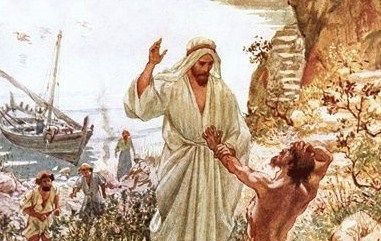
Jesus and the Demoniac, copyright unknown

The difference on this occasion was that the Gadarene people were chasing Him out of the country, but He wanted to come back later. They were scared of the Jew who could heal so effectively and cause the suicidal stampede of their swine herds. And of course, angry at the economic consequences of the latter. But this was Decapolis, a pagan territory outside of Judean jurisdiction where the risk of arrest was low. Since Jesus was planning to return to the region very soon, He wanted the healed “demoniac” to prepare the way for His return. Which the man evidently did very effectively! Attitudes in the Gadarene region had completely changed when He returned. “Multitudes” of the Gadarenes turned out eagerly to hear Him preach. That could only be due to the tireless work of the dedicated new convert.

Note: Parallel versions of this story mention not one, but two possessed Gadarenes healed by Jesus. As is frequently the case in the Gospels, the authors mentioned only what they individually found important in the circumstances. Just as in the story of the ten healed lepers, I think that only one reacted with gratitude. Mark ignored the one who proved inconsequential. In the case of the lepers, both the gratitude of the one and the ingratitude of the nine were integral to the moral lesson.

Despite what I have said above, I think that Jesus most likely did speak freely about His sonship when there were no hostile spies present (see my article about the Pharisees). After the crucifixion, Jesus was “gone”, but His followers were no doubt considered heretics by the Sanhedrin. Since the Synoptic Gospels were written and circulated while the Sanhedrin still existed, I think their authors remained circumspect about reporting His use of the term.

In John’s Gospel

John, however, wrote his Gospel after AD 70. The Temple, the Sadducees, and the Sanhedrin were gone, and the Jewish resistance temporarily suppressed. Jesus was gone and His disciples largely scattered. Caution was no longer necessary. John recorded several instances where Jesus, at least by clear implication, claimed to be the Son of God:

John 3:18 (CJB)
[18] Those who trust in him are not judged; those who do not trust have been judged already, in that they have not trusted in the one who is God’s only and unique Son.

John 5:25–27 (CJB)
[25] Yes, indeed! I tell you that there is coming a time—in fact, it’s already here—when the dead will hear the voice of the Son of God, and those who listen will come to life. [26] For just as the Father has life in himself, so he has given the Son life to have in himself. [27] Also he has given him authority to execute judgment, because he is the Son of Man [the Messiah].

John 10:36–38 (ESV)
[36] do you say of him whom the Father consecrated and sent into the world, ‘You are blaspheming,’ because I said, ‘I am the Son of God’? [37] If I am not doing the works of my Father, then do not believe me; [38] but if I do them, even though you do not believe me, believe the works, that you may know and understand that the Father is in me and I am in the Father.”

John 11:3–4 (ESV)
[3] So the sisters sent to him, saying, “Lord, he whom you love is ill.” [4] But when Jesus heard it he said, “This illness does not lead to death. It is for the glory of God, so that the Son of God may be glorified through it.”

All of the above are “red letter” references. Those who say that Jesus never claimed to be the Son of God are either biblically illiterate, or disingenuous.

“Sons of God” in the Old Testament

This term appears only 6 times in the English Standard version of the Old Testament, and each time as a plural, בְנֵי־הָֽאֱלֹהִים֙ (Bənē hāʾĔlōhīm, “the Sons of God”). In all cases it refers to higher-ranking members of the Heavenly Host (messenger “angels” are the lowest rank):

  • In Genesis 6, two verses refer to “Watchers” (a class named only in Daniel and a number of extrabiblical works), who take on human flesh and rebelliously mate with human women.
  • Deuteronomy 32:8–9 refers to rebellious beings who God exiled to earth and gave oversight of the pagan nations (some English translations incorrectly render the Hebrew, Bene haElohim, as “the sons of Israel”, because their grasp of angelology is deficient).
  • Three passages in Job speak of God’s Divine Council, where The Accuser appears at the throne to report on conditions on earth and is challenged to find fault in Job.

“Son of Man” in the Old Testament

The Hebrew term, בֶּן־אָדָם֙ (ben adam), or its Aramaic equivalent, בַּר־אֱנָשׁ (bar ‘enash), both meaning “son of man”, is used many times in Job, Psalms, Isaiah, Jeremiah, Ezekiel, and in Daniel 8 to mean, simply, a human being. That’s the default meaning, certainly. But in Daniel 7:13, the prophet is given the following vision:

Daniel 7:13–14 (CJB) emphasis mine
[13] “I kept watching the night visions,
when I saw, coming with the clouds of heaven,
someone like a son of man.
He approached the Ancient One
and was led into his presence.
[14] To him was given rulership,
glory and a kingdom,
so that all peoples, nations and languages
should serve him.
His rulership is an eternal rulership
that will not pass away;
and his kingdom is one
that will never be destroyed.

Someone who looks like a human is led into God’s presence and is given an eternal rulership over the entire world. This is the definitive prophecy of the coming Messiah, and it is the reason the Jews were expecting a warrior-Messiah. Other prophetic writings and traditions filled in detail, but this was considered the formal and most clear announcement. For understanding both the Old and New Testaments, I consider this to be perhaps the most important Christological passage in the Bible.

“Son of Man” in the New Testament

In all of human history, I seriously doubt that there are many humans who have gone around referring to themselves as “the son of man” or as “the human” on a regular basis. I, for one, only use the term “human” for myself when speaking to my cat. Jesus spoke frequently of “the Son of Man”, and when He did so, all of His hearers would have immediately realized that He was talking about Daniel’s expected Messiah, even if a few might have been slow to catch on that He was adopting that persona for Himself.

Messiahship claims were frequent in Judea, so one of the tasks that the Sanhedrin took on was to evaluate anyone who seemed to be making the claim or who they thought might eventually do so. That’s why a contingent of scribes and Pharisees were assigned to follow Jesus around. He knew that when He eventually made an explicit claim, He would have to “put up or shut up.” Consequently, He waited until the time of His own choosing and did it in a way as to leave no doubt in anyone’s mind that He was doing so. That was at His trial.

The bottom line

By speaking of the Son of Man in the third person, Jesus avoided unambiguously declaring Himself to be Messiah, but it would have been obvious to any practicing Jew that He was referring to Himself. His signs and miracles reinforced the unspoken claim. Therefore, it is ignorant to say that Jesus never claimed to be God!

Liberal colleges and seminaries teach a simplistic and biased theology that ignores the cultural realities of life in ancient (prehistory through Persian) and classical (Greko-Roman, i.e., Second Temple era through early Rabbinic) Judaism. Unfortunately, the traditions emerging from these institutions are not being adequately debated because, though more benignly biased, conservative educations also tend to be simplistic, and often bound to unwarranted medieval traditions.


Is There a Photo of Jesus?

Posted on:

Modified on:

  1. Description of the Shroud
  2. A murky provenance
    1. The Sudarium of Oviedo
  3. Forensics—findings and objections
  4. Biblical Considerations
    1. “Linen wrappings”, or a shroud?
    2. Is there any other Scripture that might verify my interpretation?
    3. In conclusion

Maybe.

Of course, I’m talking about the Shroud of Turin here—this “Catholic relic” appears to some to be the burial shroud of Jesus, and as such it seems made to order for Protestant scorn, and it is so startling that even the Vatican has been reluctant to display it over the centuries. But frankly, it’s been subjected to every kind of scientific test you can imagine over the last 45 years or so, and, despite occasional claims to the contrary, nobody has yet proved it a hoax. Personally, I am not a dogmatic supporter of the Shroud’s authenticity, but I find it intriguing, and I don’t believe that the Bible rules it out.

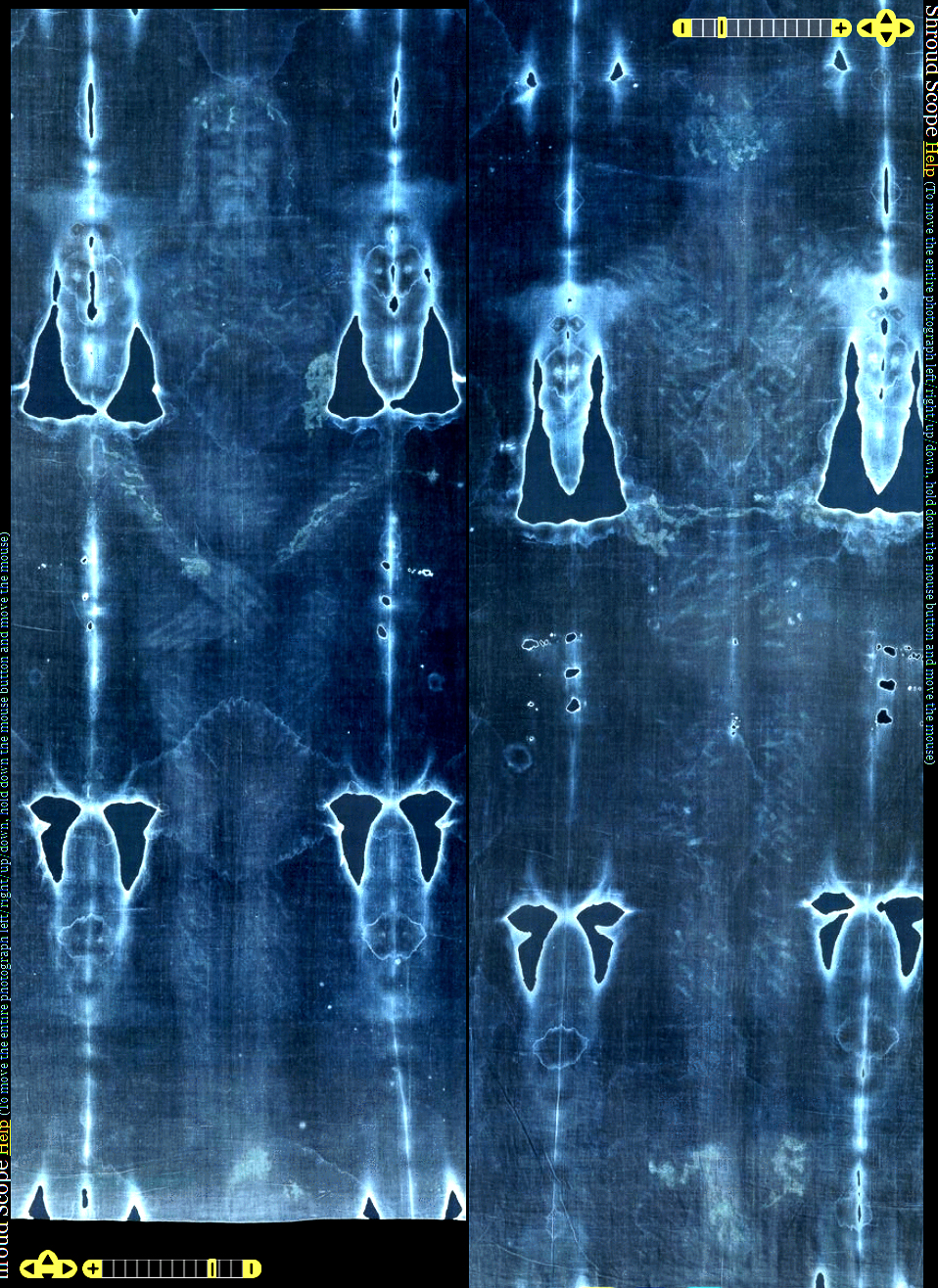
Enhanced photo of the Shroud of Turin.

There are a number of good (and quite a few bad) books on the subject, so I haven’t been tempted to take it up myself before now. I finally decided to write about it in response to a negative article on creation.com that I just ran across. I will describe the Shroud and its history below, discuss the forensic evidence in its favor, then propose a scenario for its authenticity that I think accurately accounts for the culture of Jesus’ day without breaking Scripture.

Description of the Shroud

The Shroud of Turin is a single, fire-damaged sheet of linen about 14 feet long and 3.5 feet wide (more precisely, 8 x 2 Royal Cubits, where the Royal, or Long, Cubit is 20.67 inches). On one face of the sheet is a faint image of the ventral and dorsal (front and back) sides of a dead, naked, adult male, lying flat and with hands covering groin. It appears that the cloth was laid flat, and a body laid on it with the feet close to one end. Then the other end of the cloth was folded in half lengthwise over the top of the head and down to cover the feet, staining the cloth with blood. The image, apparently that of a crucifixion victim, appeared on, or was applied to, the cloth at some time after the blood staining.

Contrary to this paining, the image is on the inside of the fold. Illustration from history.com, “The Shroud of Turin: 7 Intriguing Facts”.

To the naked eye, the Shroud is a faint yellow monochrome, with the image appearing as a photographic negative. Enhanced photos of the Shroud are printed as photo negatives of the negative image that is on the cloth itself.

On top, the Shroud as photographed. On the bottom, a photonegative of the top image. From pensarte-asanchezgil.blogspot.com, UNA NAVE ESPACIAL LLAMADA TIERRA Capitulo XXXVIII Sindone 5

The intensity range of the image, rather than representing color as in a black and white photograph, records the varying distance between the draped cloth and the surface of the body.

3-dimensional cardboard carving of the head imaged on the Shroud, using relief data generated by a BK VP-8 Image Analyzer™. From National Geographic Magazine, June 1980.
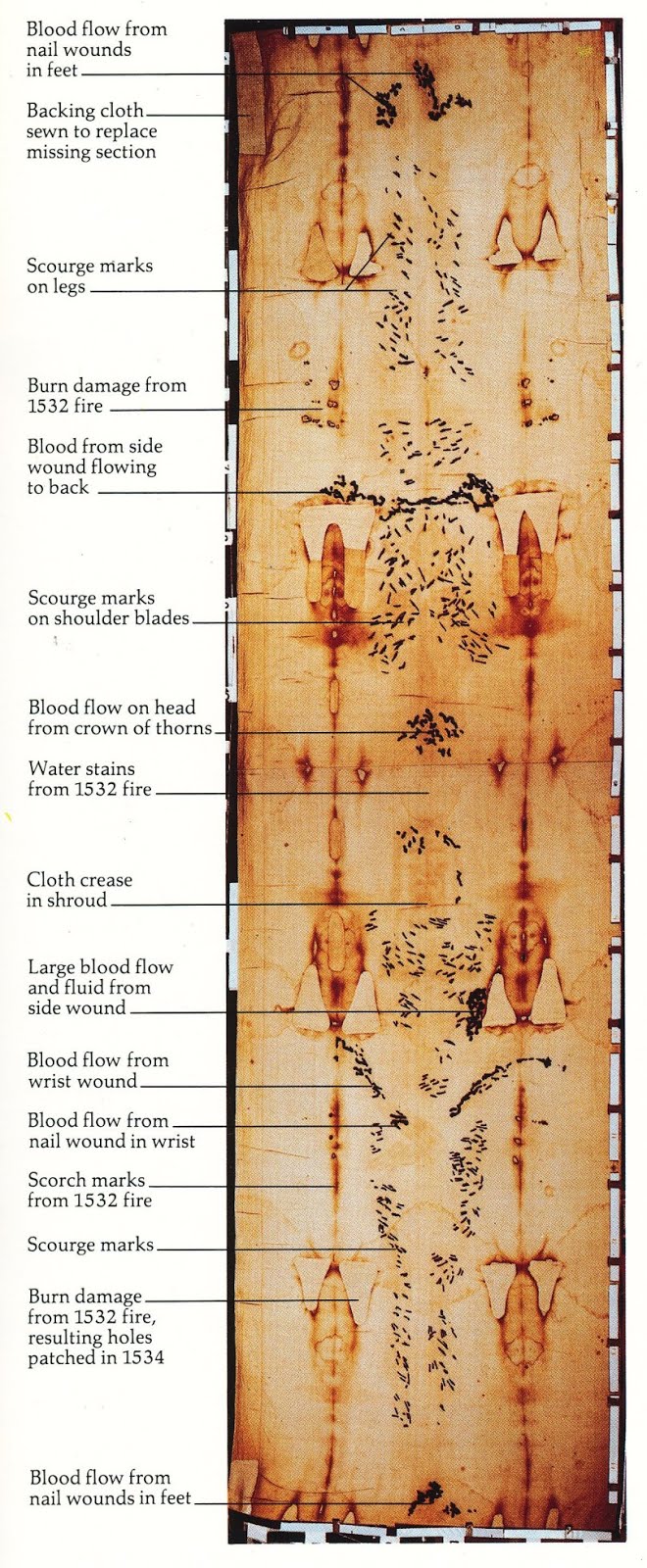
The wounds, bloodstains and other marks on the Shroud of Turin, theshroudofturin.blogspot.com, “The Shroud of Turin: 2.4. The wounds”

In contrast to the human image, which is confined to an extremely thin layer on one side of the cloth, blood residue deposited on and within the weave of the cloth formed a fluid stain penetrating into the fibers. These stains are consistent with contact between the wounded body and the cloth, and between corresponding locations on the two lengthwise halves of the cloth.

I first learned about the Shroud when National Geographic published an article about it in their June 1980 issue. The thrust of that article was that a large team of American Scientists of various specialties, with lots of expensive equipment, had travelled to Turin, Italy, where the Shroud is kept, and done a lot of very intricate testing. They found a great deal of evidence supporting its validity, and none proving it a hoax. Nobody has ever been able to figure out how in the world it was made. The one hope of the research team was that a carbon 14 (C14) test would either prove it genuine or show that it is a recent forgery, but since the test sample is always destroyed during carbon dating, the church at that time would not let them damage the cloth to test it. By 1988, the Vatican did give permission to test a small sample, and the carbon test was finally done. With a big sigh of relief by doubters, the date obtained was 14th Century, AD. Case closed, right?

A murky provenance

Not so fast! The indisputable chain of custody only goes back to the 1350’s, more or less matching the carbon date, but there is also anecdotal evidence that it might have been around much longer.

Supposed travels of the Shroud. This is from a PowerPoint slide presented by The Shroud Center of Southern California. The appearance of the annotated dates were edited by me here for clarity.

Earlier provenance is based on sketchy data from sources that cannot be verified with certainty. Purportedly, a disciple of Jesus’ (not one of the 12) named Thaddaeus salvaged the cloth and took it to Edessa (the site now known as Urfa, Turkey). Edessa was Seleucid originally but became a Roman vassal city in the early 3rd Century. In the early 7th Century, it passed to Persian (Sassanian), and shortly thereafter, Muslim control.

Medieval legend holds that the Shroud remained in that city and was secreted behind a tile inside a city gate during parts of those years of conquest. The image on the cloth was mentioned in several apocryphal documents, and the cloth itself came to be called the Mandylion. That term is from a Greek word meaning a towel or tablecloth, and it referred to a loose military garment, open at the sides, that was draped over Medieval armor, more or less resembling a serape). In AD 943, the Byzantine Emperor (presumably Constantine VII) ransomed the Mandylion from the emir of Edessa and took it to Constantinople, where it was kept in the Blachernae Church. In AD 1204, it disappeared after Constantinople was sacked by Christian crusaders during the 4th Crusade. Legend holds that it was thereafter in the custody of the Knights Templar until the 1350’s, when it is known to have been exhibited a number of times in Lirey, France.

Pilgrim badge commemorating the so-called “Shroud of Lirey”. Drawn by Arthur Forgeais, 1865, from an original artifact. The heads of the two pilgrims are missing from the artifact.

Archaeological evidence is scant. The coin shown below is from the 7th Century and seems to me to tie the Mandylion to the Shroud of Turin fairly convincingly.

Byzantine coin, minted AD 692. The image stamped on this coin seems to me to be indisputably based on the Shroud image, unless somehow the Shroud was based on the coin!
The Sudarium of Oviedo

There is a funerary face cloth called the Sudarium of Oviedo that is believed by many to be the cloth mentioned in John 20:7 “also the cloth that had been around his head, lying not with the sheets but in a separate place and still folded up.” This is an ancient linen cloth with bloodstains, but no mysterious image. Documentation for this cloth goes back to at least the 7th Century, since it has remained in one place for all that time. According to photoofjesus.com,

A 1999 study by the Spanish Center for Sindonology, investigated the relationship between the two cloths. Based on history, forensic pathology, blood chemistry (both the Shroud and the Sudarium have type AB blood stains), and the blood stain patterns being exactly similar and congruent on both cloths, they concluded that the two cloths covered the same head at two distinct, but nearly contemporaneous, moments of time.

If the Shroud is genuine, then I think it probable that the Sudarium is, as well, but that isn’t my subject here. What is germane to this discussion will be mentioned below.

The Sudarium should not be confused with another legendary cloth allegedly connected with the crucifixion, the Veil of Saint Veronica (Berenike).

The Sudarium of Oviedo, from mysticsofthechurch.com, “THE SUDARIUM OF OVIEDO AND THE SHROUD OF TURIN

Forensics—findings and objections

Carbon 14 dating is known to be very accurate, to within a predictable range, so the stories from before the 14th Century can’t be true, can they? Well, unfortunately, in this case there are a couple serious problems with the dating. One is that the Shroud has allegedly been exposed to centuries of contamination by extraneous carbon from multiple surroundings, making it virtually impossible to accurately calibrate the test. Another is that repairs have been made to the Shroud on at least two occasions. One was after it was damaged by molten silver during a fire in 1532, but the patches sewn on in that case were sufficiently clumsy that it was easy to avoid them. An earlier repair, though, was so skillfully patched, by expert interweaving of threads, that the newer linen of the patch was undetected until years after the 1988 carbon testing—and of course it turned out that it was apparently the fabric of that patch that was tested, not the original fabric which theoretically still could date to the 1st Century. Subsequent non-radiometric dating methods have reportedly raised the probability of an early origin.

The image on the cloth is not painted, nor is it dyed, or inked or otherwise applied. It has the appearance of the cloth itself being scorched, but not at high temperatures. Modern science cannot say with certainty how this scorching occurred, though some sort of radiation is probably the cause. Neutron radiation has been proposed, but since the image penetrates the cloth only to a very small percentage of its thickness, then anything more energetic than an alpha particle beam (Helium-4 nuclei) makes no sense to me.

From kennedy-science.weebly.com


The effects of various electromagnetic radiation types (light wavelengths less energetic than those on the chart) on textiles have been studied. From a layman’s point of view, I think that what makes the most sense is a pulse in the ultraviolet range, which is known to cause cellular damage to the surface layers in fabric. Shroud researcher John P. Jackson proposed that vertical exposure to UV as the Shroud collapsed into a vacuum after Jesus “dematerialized” beneath it, could account for the image, in all respects. I’m not qualified to critique his work other than to say, “It makes sense to me”, in a general fashion. To be clear, if He dematerialized, then He immediately rematerialized at some other location. Biblical precedent for this is seen in Philip’s departure from the Ethiopian road and materialization in Azotus , on the way to Antioch, and in Jesus’ appearance before “Doubting Thomas” after His resurrection.

The blood stains on the cloth have an unnatural appearance, particularly on the enhanced views, because they penetrate the weave and are not part of the “scorched” image. Furthermore, they fluoresce in views like the right pane of the following photo. Creation.com is confused by these views, thinking that the blood is floating above the skin and hair, where it should be a crust or pool on the skin and should be beneath the outer layers of hair. In reality, what we see here is a contact transfer of blood to the cloth. Forensics show that the blood was on the cloth before the image was deposited. If this is Jesus’ authentic funeral shroud, then the blood on the cloth is from shortly after His death, when it was only partly coagulated. The image, on the other hand, is from a later time, presumably at the instant of His resurrection.

Positive (left) and negative of the face on the Shroud. Free image from metapicture.blogspot.com

Creation.com also questions the drooping hair on the image, thinking that it should be collapsed to the surface Jesus was lying on, not hanging as if He were standing up. I don’t agree. Scripture says that He was beat over the head with a stick while wearing the crown of thorns:

17 They dressed him in purple and wove thorn branches into a crown, which they put on him.
18 Then they began to salute him, “Hail to the King of the Jews!”
19 They hit him on the head with a stick, spat on him and kneeled in mock worship of him.
—Mark 15:17–19 CJB

As I can personally attest, head wounds bleed profusely. Jesus was savagely beaten over the head while wearing a crown of thorns, so he bled heavily through His hair before even going to the cross. By the time He came down from the cross, some 9 hours later, most of that blood would have hardened like hair spray.

Bloodstained forehead. Cropped photograph of the Shroud, from Stephen E. Jones, “My position on the Shroud: The Shroud of Turin: The Burial Sheet of Jesus! #7”

The cloth of the Shroud is not the cheap material used for menstrual rags, burial wrappings, or even middle-class clothing, but rather a high-grade cloth used for upper-class clothing and tapestries, very rare and expensive at the time. The weave was a herringbone twill, with threads composed of 70 to 120 fibrils of flax. Expert examination indicates that it was hand-spun, bleached, woven by hand, then washed with soapweed. These were characteristics of 1st Century linen weaving (in Medieval times, bleaching was commonly done after weaving of the cloth). This weaving technique was practiced by Syrian weavers, and remnants of such cloth were found at Masada, dating from no later than AD 70. Some folks object that this cloth isn’t really a luxury product because better fabrics from the time were composed of linen/wool blends. That was not an option in Judea, because:

¶ “‘Observe my regulations.
“‘Don’t let your livestock mate with those of another kind, don’t sow your field with two different kinds of grain, and don’t wear a garment of cloth made with two different kinds of thread.
—Leviticus 19:19 CJB

The blood-like deposits on the Shroud have been verified to be aged blood. It is red, more like fresh blood, because it contains high concentrations of bilirubin, along with creatinine, ferritin and myoglobulin, all of which, in the concentrations found, are proteins characteristic of blood shed under tremendous physical trauma, like that of torture. Washing with soapweed also helps to preserve the hemoglobin color.

Blood-stained cloth from the Shroud., from Stephen E. Jones, “The Shroud of Turin: 2.5. The bloodstains”.
Fossilized heel bone of a crucifixion victim, with spike. The heels were nailed into the sides of the upright.
Roman flagrum from Herculaneum (modern Ercolano) near Pompeii, from Stephen E. Jones, “The Shroud of Turin: 2.4. The wounds”.

Blood staining of the cloth and bruising on the image is consistent in all respects with the testimony of Scripture. There is blood on the wrists and feet, from the nails. The Greek allows for extension of “hand” to include the wrists, as would be anatomically required to hold a grown man to a cross with nails. There is blood on the side, from the Roman spear. UV studies reveal a halo of fluorescence around this blood. Serum separated from the blood accounts for that and matches scripture describing “blood and water” from the wound. There is blood on the head from the crown of thorns and the beatings. There are bloody, dumbbell-shaped marks all over the body due to 130 lashes with a Roman flagrum. There are swollen cheeks and a broken nose from beatings. There are abrasions on knees and shoulders from stumbling from the Praetorium to Golgotha (Gulgolta).

Creation.com criticized what they considered to be blood flow patterns inconsistent with gravity, but my own examination of photo evidence doesn’t bear that out.

Various types of pollen were found on the Shroud. Concentrated around the head region, in particular, there is a large amount of pollen from the thistle Gundelia tournefortii, a spiny plant common in the Jerusalem area that blooms (and pollinates) in the spring. The “crown of thorns?”

Crown of Thorns exhibit, “Helmet” of thorns in the permanent exhibition of the Shroud of Turin in the Pontifical Institute Notre Dame of Jerusalem Center. Contrary to popular images, a “helmet” style of crown was more appropriate than a Greek “wreath” for a Middle Eastern king. Blood patterns on the Shroud suggest a helmet.

Creation.com also criticizes the proportions of the body on the Shroud. First, they are concerned that the image shows a man about 5 ft. 10 in. in height, which they think, probably correctly, is taller than most 1st Century Jews. Yet, people of all ethnicities vary in height, and that would not make Him a freak among His own people. Perhaps they were obliquely referring to Isaiah’s prophecy:

He was not well-formed or especially handsome;
we saw him, but his appearance did not attract us.
—Isaiah 53:2 CJB

I think that is saying that Messiah will not be a heartthrob who attracts people by His physical charisma. Other detractors have claimed that it also implies that He will not stand out in a crowd because of His height. I am not convinced. Being a bit taller than average would help Him speak to crowds.

Creation.com also sees distortions in the lengths of the image’s limbs, the thickness of one leg and the size of the head. Once again, I’m not convinced. The image appears to be a vertical projection onto a cloth that is draped over a real three-dimensional person, and thus not perpendicular to the cloth at all locations. This would be expected to cause apparent foreshortening of perspective in places.

Is the head disproportionately small for the body? Perhaps. That has been explained by some as rigor mortis, freezing the head in a downward tilt from hanging on the cross (but see my next paragraph). I think it is more likely that His Head was resting on something in the tomb; perhaps he was still wearing the crown of thorns.

Creation.com thinks it is ridiculous to believe that Jesus’ hands could be over His groin, because they believe He would have gone into rigor mortis on the cross, with His arms frozen at an upwards slant. But that is a ridiculous suggestion, and they should know better—rigor mortis is part of the decay process, and Jesus didn’t decay! Acts 13:37 (ESV) ” but he whom God raised up did not see corruption.”

Many detractors are convinced that the image should not show a beard, because:

I offered my back to those who struck me,
my cheeks to those who plucked out my beard;
I did not hide my face
from insult and spitting.
—Isaiah 50:6 CJB

I wear a beard. I don’t think it could be plucked out aside from small amounts at a time. They tried. This is Hebrew poetic hyperbole. It emphasizes a point using exaggeration. Not uncommon in the Psalms and Prophets. Looking at the Shroud image, it appears that the beard is forked, and in fact, that was noticed and incorporated into the commemorative coin shown above. That was either His style, or the plucking was partially successful.

Others don’t think that there is enough damage to Jesus, per:

Just as many were appalled at him,
because he was so disfigured
that he didn’t even seem human
and simply no longer looked like a man,
—Isaiah 52:14 CJB

Again, this is poetic hyperbole. I’ll bet that if you were to find even just a severed and mangled human hand on the ground, you would recognize it as human remains!

Biblical Considerations

Okay, here’s where I start the fun part.


The writers on creation.com are, I’m sure, good Christian folks, but I often disagree with their interpretations of Scripture, and more often with their analyses of science and history. Regarding their treatment of the Shroud of Turin, I certainly do agree, unequivocally, that the Shroud is completely unnecessary as proof of Jesus’ existence, His crucifixion, His resurrection, or His deity. However, I don’t think they have a good understanding of 1st Century Jewish burial practices. Here I will challenge their perceptions of how the Shroud appears to contradict Scripture.

The primary objection of creation.com was that the person in the Shroud evidently was not given the entire customary treatment. They suggest, in part, that Jesus could not have been entombed in a one-piece linen shroud because Lazarus was not—Lazarus’ body was washed, then slathered with aloe and wrapped with aloe-impregnated linen strips (plural) before entombment:

44 The man who had died came out, his hands and feet bound with linen strips, and his face wrapped with a cloth. Jesus said to them, “Unbind him, and let him go.”
—John 11:44 ESV

The truth is that even in Judea, with all its customs, there wasn’t just one way to be buried, because the legal precepts of Torah didn’t speak about it all that much. If you were rich or a king, you got the plush treatment, coffin and all. The indigent sometimes got tossed out the Dung Gate and put in a pauper’s grave. That’s evidently how landowners Chananyah and Shappira (Ananias and Sapphira) ended up.

1 But a man named Ananias, with his wife Sapphira, sold a piece of property,
2 and with his wife’s knowledge he kept back for himself some of the proceeds and brought only a part of it and laid it at the apostles’ feet.

5 When Ananias heard these words, he fell down and breathed his last. And great fear came upon all who heard of it.
6 The young men rose and wrapped him up and carried him out and buried him.
7 ¶ After an interval of about three hours his wife came in, not knowing what had happened.

10 Immediately she fell down at his feet and breathed her last. When the young men came in they found her dead, and they carried her out and buried her beside her husband.
—Acts 5:1–10 ESV

I submit here that Jesus and Lazarus were handled in different manners because the circumstances of their deaths were different. Jesus’ was as a convicted felon. Lazarus died at his home at a time more suitable for “standard practice.” Because Lazarus was in good legal standing, there was not a hard and fast requirement for him to be buried the same day, though that was the ideal. He would have been taken to his family tomb as soon as practical, dressed in normal clothes. Then, at some time during the days of mourning, probably soon after rigor mortis broke some 36 hours after death, he would be prepped for his long sleep. This included wrapping him in multiple strips of linen that were smeared in spices (usually myrrh and sticky aloe) in order both to bind the cloths to each other and to the body, and to mask odor. A separate small piece of linen (a facecloth) was also provided to cover or wrap the head.

When Jesus was brought down from the cross, burial on the same day as death was required from:

22 “And if a man has committed a crime punishable by death and he is put to death, and you hang him on a tree,
23 his body shall not remain all night on the tree, but you shall bury him the same day, for a hanged man is cursed by God. You shall not defile your land that the LORD your God is giving you for an inheritance.
—Deuteronomy 21:22–23 ESV

But clearly there was simply no time for the normal burial customs to take place before the sun set. I think that Joseph or one of the others climbed up and wrapped the facecloth around His face and the crown of thorns. Jesus was then taken down and laid on a bier, most likely on top of the shroud brought by Joseph, so that His shame could be covered. His clothes had been plundered by the Roman soldiers, so he was naked.

The evidence of the Shroud shows Jesus’ torture and death just as described in Scripture, when understood in its cultural context. The events surrounding His final words and His death are described plainly in Matthew 27:45–56 and the parallels. His crucifixion began at around 9:00 am (e.g., Mark 15:25 “It was nine in the morning when they nailed him to the stake.”), and the darkness began around noon. He died at “about the ninth hour” which, by Jewish counting, was somewhere around 3:00 pm. Evidently His dead body remained on the cross for most of the rest of the afternoon because, while Luke is silent on the timing, the other three Gospels are united in placing the approach of Joseph of Arimathea to Pilate at “around evening.”

Nisan 14–17 timeline, simplified, ©Ron Thompson. The Gregorian dates presented here are my own calculations, from NOAA lunar phase charts.

I will propose a likely scenario for what followed, harmonized with John 19:38–42, since that is the version stressed by creation.com and others:

38 After these things Joseph of Arimathea, who was a disciple of Jesus, but secretly for fear of the Jews, asked Pilate that he might take away the body of Jesus, and Pilate gave him permission. So he came and took away his body.
39 Nicodemus also, who earlier had come to Jesus by night, came bringing a mixture of myrrh and aloes, about seventy-five pounds in weight.
40 So they took the body of Jesus and bound it in linen cloths with the spices, as is the burial custom of the Jews.
41 Now in the place where he was crucified there was a garden, and in the garden a new tomb in which no one had yet been laid.
42 So because of the Jewish day of Preparation, since the tomb was close at hand, they laid Jesus there.
—John 19:38–42 ESV emphasis added; see below for discussion

The crucifixion was on Friday, Nisan 15. Jesus had celebrated His last Passover Seder the night before, and it was now the 1st day of the Feast of Unleavened Bread, which was, in Jewish law, a Sabbath (Heb. Shabbat). The next day was to be the 7th day weekly Shabbat. Restrictions for the two days were similar, except that the mid-Passover weekly Shabbat was always considered to be particularly important. In the case of consecutive Shabbatot, it was permissible to prepare for the second one on the day of the first one.

So, when Joseph spoke to Pilate, dusk and the start of the Saturday Shabbat were rapidly approaching, as emphasized in Mark, using a Jewish English translation:

42 Since it was Preparation Day (that is, the day before a Shabbat), as evening approached,
43 Yosef of Ramatayim, a prominent member of the Sanhedrin who himself was also looking forward to the Kingdom of God, went boldly to Pilate and asked for Yeshua’s body.
—Mark 15:42–43 CJB emphasis added

There was a delay, because Pilate needed to check precedent, then once Joseph had permission, he barely had time to do what absolutely had to be done before the Temple shofarim (ram’s horn trumpets) signaled that the sun had sunk below the horizon and Shabbat had begun. First, he must walk quickly from the Praetorium (probably Herod the Great’s palace) to the nearby crucifixion site at Gulgolta (I believe that to be the site under the Church of the Holy Sepulcher, just outside the city wall of that day). Then with the help of Nicodemus and the Disciples, he had to lower Jesus to the ground, remove the nails from His wrists and heels, place Him on the bier, and carry Him the short distance to the tomb.

“Linen wrappings”, or a shroud?

John 19:40 says “wrappings”, plural othonion (Gr. ὀθονίοις), which may refer to the customary saturated linen strips, but I think it meant, simply, the Shroud and the headcloth. Since Biblical Greek has no punctuation, I suggest that for comparison with the synoptics, vs 40b should be translated “bound it in linen cloths, with the spices”. In other words, the binding strips and the spices were stored in the tomb for later processing, as soon as ritually permitted. There simply could not have been enough time that day!

The three synoptic Gospels all refer to “a linen sheet”, singular sindoni (Gr. σινδόνι a different Greek term probably referring to the fineness of the cloth).

Mark 15:46 says “Yosef purchased a linen sheet; and after taking Yeshua down, he wrapped him in the linen sheet (σινδόνι), laid him in a tomb which had been cut out of the rock, and rolled a stone against the entrance to the tomb.

Matthew 27:59 uses the same singular, sindoni, as Mark, “Yosef took the body, wrapped it in a clean linen sheet, (σινδόνι) 60 and laid it in his own tomb, which he had recently had cut out of the rock.”

Likewise, Luke 23:53 “He took it down, wrapped it in a linen sheet (σινδόνι), and placed it in a tomb cut into the rock, that had never been used.”

Is there any other Scripture that might verify my interpretation?

Yes!

The Jewish custom was to seal a tomb, then come back in a year to pick up the dry bones and put them in an ossuary or a family niche. I can think of no reason why it would be necessary to open up a tomb two days later to renew spices already applied, yet that is what creation.com suggests was going on early that Sunday morning:

1 When the Sabbath was past, Mary Magdalene, Mary the mother of James, and Salome bought spices, so that they might go and anoint him.
2 And very early on the first day of the week, when the sun had risen, they went to the tomb.
3 And they were saying to one another, “Who will roll away the stone for us from the entrance of the tomb?”
—Mark 16:1–3 ESV

Joseph was not able to complete the customary preparation of the body because it was the Sabbath, and an even more important Sabbath was about to start. He did what could be done quickly, then he left Jesus wrapped in the shroud he had brought, rolled the stone into place, and notified Jesus’ mother that she would need to complete the process—which was really the family’s job in the first place. Washing the body, then applying the cloth strips and spices was a job that it would have probably taken them at least two or three hours to complete.

In conclusion

Creation.com approached this subject much as they do in their creation articles. They started out their story the way I do, by reading key books and articles on the subject. But they were looking for talking points, not for real issues. Their minds were made up going in. This shows up in several places. For one, they were quick to comment on the “floating blood” on the image’s head. Yes, that’s what it looks like, but “looks like” isn’t always enough. If they had read in depth, they would have learned that those big blobs were contact stains in the cloth, not part of the image on the cloth. In the picture, those stains fluoresced, like white teeth under black light at a party.

Another very major fault with the creation.com approach is that most Hermeneutics don’t allow you to make theological decisions based on a single passage. The creation.com article shows why. Their case was built on John’s account of the burial, but John contradicts all three of the synoptic gospels. By “contradictions”, I’m not implying error. The four Gospel writers viewed events from four different directions, and each had a point he was trying to make. Think about the old saw about the blind men and the elephant. The exegete’s responsibility is to study the Scriptures together to find the harmony that is there!

A third fault in the post is that they were so sure of the end result they were going to get that they rushed into the fight with wild punches. Rigor mortis is part of the decay process. Do they really think that Jesus began to decay? I don’t think so!

A fourth, and the last I will mention, is that they wrote from a shallow understanding of 1st Century Jewish culture. The Bible is God’s autobiography. It touches on other things, but it’s not a self-help book, it’s not a science text, it’s not a history, and it’s not a civics book. To fully understand the cultural context of Judea, you have to go beyond Scripture and examine extra-Biblical sources. Creation.com’s understanding of 1st Century burial practices is superficial.

Nobody will ever be able to prove that the Shroud is authentic. Some folks think that an artistic genius like Leonardo DaVinci could have pulled off a hoax like this, but why would he? Besides, yes, he did conceive of helicopters back in his day, but he didn’t build one! To successfully produce what the technology of his day could not allow him even to see boggles my mind.

Frankly, I would like for the Shroud to be genuine. Prior to the incarnation, God in all three persons was spirit. Whenever he materialized to a physical form, it was transient. Until Jesus took on flesh. I’d like to think that there is a commemoration of that flesh, here on earth!


Jesus and Hebrew Wedding Imagery

Posted on:

Modified on:

This is a February 2022 rewrite and expansion of a post I wrote in January 2013, entitled “The Bride of Messiah”.

  1. Symbolism as Illustration
  2. Symbolism in Marriage Customs

Symbolism as Illustration

I grew up in a fundamentalist, “King James only”, Baptist denomination, in churches in New Mexico, Texas and Florida. I love my old pastors and my fellow church members, and I still agree with them on most fundamental issues. Not everything, but I’m not going to mention their name and insult them. These days I rarely use the King James, because I think there are more reliable translations, but that’s not the question here, and I will use it for this post.

I’m going to concentrate here on one particular issue. I consider myself to be a Biblical literalist, but I think that there are many places in scripture that aren’t meant to be read literally. Hebrew writers often used poetic imagery and symbolism to convey truth about God: His attributes, His will, His promises (positive and negative) and yes, His wrath. A consistent and realistic Hermeneutic (principles of Biblical interpretation) must be used to differentiate between the literal and the figurative. Most conservative Biblical scholars and knowledgeable students of Scripture understand this, but few over the last 2,000 years are really equipped to apply the understanding. This is largely due to the way Jews and their writings have been marginalized in the Church.

As a somewhat trivial example of this lack of understanding, many years ago when I was a young associate pastor at a church in Texas, my Senior Pastor and I had an ongoing, friendly argument about Biblical anthropopathism. His view was that, despite the fact that God is a Spirit, “Scripture clearly states that God has hands…

Luke 23:46 (KJV)
[46] And when Jesus had cried with a loud voice, he said, Father, into thy hands I commend my spirit: and having said thus, he gave up the ghost.

…and wings.”

Ruth 2:12 (KJV)
[12] The LORD recompense thy work, and a full reward be given thee of the LORD God of Israel, under whose wings thou art come to trust.

My own view is that God and His angels have no bodily form at all, and that such scriptures are illustrations of God’s loving and tender care for His people. When they heard these sayings, ancient Jews, immersed in the cultural milieu of their society, would not misunderstand the symbolic content. For 21st Century Christians, misled by centuries of antipathy towards Judaism, it’s not so simple!

Another example of Biblical symbolism is found in the parables (sing. mashal, Heb. and parabole, Gr.) told by Old Testament prophets, by New Testament-era sages, and by Jesus Himself. These stories were not themselves true but were illustrations of truth told in ways that could not be misunderstood by the hearers—or, in many cases could be understood only by “insiders” in the audience.

Symbolism in Marriage Customs

A form of implicit (not explained, but obvious to the hearers) symbolism that I want to discuss here was used by Jesus over and over again in His discussions with His Disciples about what we today refer to as the Rapture, and the Marriage Supper of the Lamb: Jewish wedding imagery.

The Old Testament often depicts God as the husband of His wife, Israel. Similarly, the New Testament depicts Jesus as a groom, and the Church as His betrothed bride. Betrothal was much different among 1st Century and earlier Jews than it is among American Christians. To us it is a proposal to enter into a contract at a later date. To them, it was the contract itself. What we today call a “wedding ceremony” was to them simply the last stage of a process that often lasted for months. Jesus often referred to steps in this process to symbolically illustrate His mystical relationship with the Church:

Shopping for a bride. Today in The West, we regard an ideal marriage as an emotional union between a mutually attracted couple. In traditional Judaism, and in most of the non-Jewish Eastern world, even today, it was a financial transaction between families, often made when the couple were small children. In some cultures, a dowery was paid by the bride’s family. Sometimes this amounted to, “I’ll pay you to take this useless female off my hands”, but mostly it was a realistic understanding that a healthy adult female was of more practical value to a good husband than to her birth family. In the Jewish culture, wives were highly valued, and money or goods flowed the other way. A “bride price” was paid by the groom’s family to acquire a coveted prize for their son and to compensate her family for the loss of a valuable and beloved asset. I have read many Christian opinions that Jewish men despise their women, but that is not and never was a true generalization, despite suggestions of “proof” to the contrary. Perhaps a subject for a future post…

A Jewish man’s marriage was usually arranged by his father, in negotiation (called the shidduch) with the prospective bride’s father. Sometimes other family members, including the subject children themselves, were included. In later history, a professional matchmaker (a shadchan) was sometimes employed as a go-between, as illustrated in the movie Fiddler on the Roof. Usually, both fathers wanted nothing as much as the happiness of their children. After the exchange of a generous bride price, the families would cooperate, sometimes for years, in preparing the two young people for their eventual life together.

Jesus’ father arranged His marriage in eternity past. He paid a heavy bride price for us—we were bought with the most precious coin on earth, the groom’s own blood. Having been chosen, our entire lives from the time we were formed in our mothers’ wombs has been preparation for our marriage to the Lamb of God.

The betrothal, or erusin. When the time came for betrothal, the two families would gather in the house of the bride’s father. The groom would bring the ketubah, an ornate written marriage contract, and his father would bring a flask of wine. The father would pour a cup and hand it to his son. The son would then hold it out to the bride, saying, “By offering this cup, I vow that I am willing to give my life for you.” Then, it was up to the bride. She could refuse the cup, and if so, the wedding agreement was canceled, and the bride price refunded. If she took the cup and drank, she was signifying that she in turn was willing to give her life for him. The betrothal was thus sealed. Once sealed, the two lived apart for a time, but were considered to be legally married and only a death or legal divorce could dissolve the ketubah. When Mary was “found to be with child”, it was grounds for divorce. Joseph’s thought to “put her away privily” (Mt 1:19, KJV) simply meant that he planned to divorce her privately, rather than to denounce her and shame her in public.

When Yeshua offered the cup of redemption at His final Passover Seder, He was telling us that He was willing to give His life for us. We who have accepted that cup have said in return that we are willing to give our own lives for Him. Our betrothal has been sealed, and God’s Torah is our ketubah.

Building the bridal suite. A Jewish house was often a large compound built around a central courtyard. This housing compound, called in Greek an insula, was home to the patriarchal extended family, often with several generations of sons in residence. The central living area was the quarters of the family patriarch and his wife. As each young man of the household was betrothed, he would simply build another room on to the house for his own new family. Once the betrothal cup was accepted, the groom would recite to his newly betrothed traditional words to the effect that

John 14:2-3 (KJV)
[2] In my Father’s house are many mansions [Gr. mone: more often rooms, abodes, or dwelling places]… I go to prepare a place for you.
[3] And if I go and prepare a place for you, I will come again, and receive you unto myself; that where I am, there ye may be also.

Upper class Judean family homes, or insulae, as depicted in a model of First Century Jerusalem, on Mt. Hertzl, Jerusalem. Photo ©2008, Ron Thompson.

It is an interpretive mistake to picture Jesus as honing up His carpentry skills in heaven and building a physical house, let alone a mansion, for each of His followers. He was simply using the poetic beauty of the ritual to stress the surety that He will return for His bride, the Church!

Progress on the new home. Each day between the betrothal and the marriage supper, the groom’s father would inspect his progress on the dwelling, and eventually he, not his son, would set a date for the wedding. If you were to ask the toiling groom when his wedding was scheduled to occur, he could not give you an answer.

Matthew 24:3-4,36 (KJV)
[3] And as he sat upon the mount of Olives, the disciples came unto him privately, saying, Tell us, when shall these things be? and what shall be the sign of thy coming, and of the end of the world? [4] And Jesus answered and said unto them, Take heed that no man deceive you…
[36] But of that day and hour knoweth no man, no, not the angels of heaven, but my Father only.

Each of Jesus’ hearers, being well-schooled in the important customs of the day, would have recognized the symbolism in verse 36. Once again this is ritual language, and therefore not necessarily a literal warning that it is completely useless to propose a date for the Rapture. I don’t know the year of the Rapture, but I firmly believe it will take place on some not-too-distant Day of Trumpets! (See also The Fall Feasts and the Rapture.)

Waiting for a summons by the groom. Meanwhile, the bride would wait expectantly, always prepared for the groom’s return, but not knowing on what day to expect him. Her attendants would stay with her each night, for weeks or even months. When the groom came with his own attendants to “kidnap” the bride and her attendants and take them from her home to his, he would arrive around midnight, with no advance warning. It would be a major scandal if the bride or any of her attendants were caught unprepared. This is what we see depicted in Jesus’ Parable of the Ten Virgins:

Matthew 25:1-13 (KJV)
[25:1] Then shall the kingdom of heaven be likened unto ten virgins, which took their lamps, and went forth to meet the bridegroom.
[2] And five of them were wise, and five were foolish.
[3] They that were foolish took their lamps, and took no oil with them:
[4] But the wise took oil in their vessels with their lamps.
[5] While the bridegroom tarried, they all slumbered and slept.
[6] And at midnight there was a cry made, Behold, the bridegroom cometh; go ye out to meet him.
[7] Then all those virgins arose, and trimmed their lamps.
[8] And the foolish said unto the wise, Give us of your oil; for our lamps are gone out.
[9] But the wise answered, saying, Not so; lest there be not enough for us and you: but go ye rather to them that sell, and buy for yourselves.
[10] And while they went to buy, the bridegroom came; and they that were ready went in with him to the marriage: and the door was shut.
[11] Afterward came also the other virgins, saying, Lord, Lord, open to us.
[12] But he answered and said, Verily I say unto you, I know you not.
[13] Watch therefore, for ye know neither the day nor the hour wherein the Son of man cometh.

The bridal procession and the consummation. As soon as the procession reached the groom’s home that night, the bride and groom would retreat immediately to the privacy of their new quarters. The guests would wait expectantly while the groom’s chief attendant stood outside the door and listened for the voice of the groom, announcing consummation of the marriage. This would signal the beginning of the week-long “marriage supper.” Jesus referred to this celebration of great joy in

John 3:29 (KJV)
[29] He that hath the bride is the bridegroom: but the friend of the bridegroom, which standeth and heareth him, rejoiceth greatly because of the bridegroom’s voice: this my joy therefore is fulfilled.

The wedding supper, or nissuin. This joyous, but to us uncomfortable, custom of celebrating a consummated marriage by pigging out at a 7-day party—was exemplified in the Gospels by the wedding feast in Cana, where Jesus turned water into wine. It also symbolically represents the 7-year Wedding Supper of the Lamb, a celebration to be held in heaven while on earth the Tribulation is in progress.

Revelation 19:7-9 (KJV)
[7] Let us be glad and rejoice, and give honour to him: for the marriage of the Lamb is come, and his wife hath made herself ready.
[8] And to her was granted that she should be arrayed in fine linen, clean and white: for the fine linen is the righteousness of saints.
[9] And he saith unto me, Write, Blessed are they which are called unto the marriage supper of the Lamb. And he saith unto me, These are the true sayings of God.


Sometimes traditional Christian interpretations of scripture suffer from an ignorance of the customs that underlie them. Honest theology requires an attempt to understand the Jewish origins of our faith. Many times, those seemingly ambiguous or “strange” references in the Biblical narrative become clear once the culture is understood.


Paul to Colossae, on Syncretism


Colosse in Asia Minor, in relation to Laodicea and Hierapolis.

In his letter to the Colossian Assembly, Paul addressed three types of “Gnostic” heresy that were evidently being taught there:

  1. Greek Dualism, which cast doubts on Jesus because of claims that he was fully human as well as divine. Plato, whose philosophy was revered in much of the Greek world, held that the spiritual realm was “good”, but anything physical, including any human, was intrinsically evil.
  2. Pagan Pantheism, which held that all physical objects were inhabited by so-called “elemental sprits” that were either good or evil.
  3. Judaistic practices being urged on non-Jews in the Church.

It is the last issue, above, that I wish to address here. I believe that it included two main sub-issues:

  • Either requiring or suggesting conversion to Judaism was viewed by some as a precursor to possession of the “secret things” of Christianity.
  • Urging participation in celebrations of Jewish tradition for possession of that Gnostic “knowledge”.

The first of these sub-issues was dealt with primarily in

Colossians 2:11-14 (ESV)
[11] In him also you were circumcised with a circumcision made without hands, by putting off the body of the flesh, by the circumcision of Christ, [12]  having been buried with him in baptism, in which you were also raised with him through faith in the powerful working of God, who raised him from the dead. [13]  And you, who were dead in your trespasses and the uncircumcision of your flesh, God made alive together with him, having forgiven us all our trespasses, [14] by canceling the record of debt that stood against us with its legal demands. This he set aside, nailing it to the cross.

Prior to AD 70, conversion to Judaism was a threefold process requiring circumcision; ritual cleansing (immersion, i.e., baptism, in either open water or in one of the thousands of mikvot, or baptisteries, in Israel and the Diaspora); and an atoning sacrifice in the Temple.

In verse 11, above, Paul explains that circumcision is not required of non-Jewish believers, because our circumcision is a spiritual “circumcision of the heart“, a “stripping away [of the] old nature’s control over the body” (CJB translation).

In verse 12, he identifies baptism as a symbolic death, burial and resurrection along with Messiah.

And in verse 14, he states that our sin-debt is cancelled by the cross. Without digging too deeply into Old and New Testament theology, Jesus’ death cancelled all our sins, past present and future, whereas the Old Testament sin offerings were merely a symbolic atonement, or “covering over“, for specific infractions over specific time frames.

Regarding the Jewish Traditions, refer to

Colossians 2:16-17 (CJB)
[16] So don’t let anyone pass judgment on you in connection with eating and drinking, or in regard to a Jewish festival or Rosh-Hodesh or Shabbat. [17] These are a shadow of things that are coming, but the body is of the Messiah.

Rosh-Hodesh (“head of the month”) was the lunar new moon celebration held each month to recognize the coming civil, agricultural and religious cycle. Shabbat, of course, is the Jewish “day of rest”, either the weekly Sabbath or a Sabbath associated with another Jewish festival.

Note that Paul is not condemning these traditional celebrations, which have tremendous prophetic and memorial significance to Christians and Jews alike; rather, he is condemning those who shame others in the church who choose to either celebrate them or to not celebrate them.


Jesus’ Last Steps

This past summer, a number of people from my church went on a tour of Israel. On their return, one of the pastors was marveling at the great distance that Jesus was required to walk on the morning of his crucifixion. Of course, it is not possible to say with total certainty what route He took that morning, but I believe with a little research it is possible to make some fairly good guesses. The relevant passages in Scripture are Matthew 26:17-27:45; Mark 14:12-15:37; Luke 22:7-23:51; and John 13:2-19:38.

©Leen & Kathleen Ritmeyer, from Jerusalem at the Time of Jesus. Annotated by me.

The paragraph numbers below correspond to points on the accompanying map.

  1. The Upper Room – The trek, of course, began at the Upper Room. Most of the sites visited can be located today with some degree of confidence. Not so the Upper Room. Church tradition places it at the site of the Church of the Apostles on Mt. Zion, in the southwestern quarter of the city, in an upper story directly above the traditional location of the Tomb of David. I don’t believe that this is the correct location of either shrine. David’s real tomb was probably in a known cave complex on the southeastern slope of the City of David, but the Upper Room could be anywhere in the city. Due to the proximity of the Gihon Spring and given that the host was described as a man carrying a jar of water, some authors tentatively place it on the Ophel, south of the Temple Mount; however, everybody in Jerusalem had to fetch water, and the room was described as “large”, leading me to place it somewhere in the more upscale Upper or Lower City (the Western Hill or the Tyropoeon Valley). After killing the sacrifices on Thursday, Nisan 14 (probably April 4, AD 30), food for the Seder had to be prepared and the Sabbath candles lit before sundown. Then the meal could begin during the twilight period. Most celebrations wrapped up at around midnight and the celebrants went outside, either into the streets or onto the roofs, to join in citywide singing of the Hallel psalms.
  2. The Mount of Olives – After singing the Hallel, Jesus and his party adjourned to the Mount of Olives, presumably leaving the City of David via the Water Gate, above Gihon Spring. There was most likely a switch-back road descending from the gate into the Kidron Valley below, intersecting with a road running along the valley floor. Matthew and Mark describe this stage of the trek similarly: as they arrived at The Mount of Olives, Jesus prophesied that his apostles would lose faith in him that night. He quoted from the apocalyptic 13th chapter of Zechariah which speaks of the End of Days (acharit hyamim). At that time, the people in the Land will be scattered, with 2/3 of them purged and those who remain purified. He then said that after His resurrection He would meet the disciples in Galilee. At this point, we see the exchange with Peter, when his threefold denial is foretold. They then proceeded on to Gethsemane. Luke only says that Jesus told them to pray that they might not be put to the test. He then went “about a stone’s throw away” to pray—presumably the John 17 prayer—and returned to find them sleeping. John’s account is quite different. There is no clear transition from the Upper Room to the Mount of Olives. Chapters 13 through 17 cover in great detail the exhortations and warnings to the disciples, and Jesus’ prayer. Given only this passage, one would conclude that the entire conversation, including the prayer, took place around the Seder table, though that is not actually stated. From this passage it appears that the exchange with Peter occurred near the end of the Seder, in the Upper Room. Conservative hermeneutics, based on examination of ancient literary practices, allows conversations to be paraphrased and chronologies to be out of order, as long as the message is not distorted by doing so, so this part of the conversation could have taken place in either location. Another likely possibility is that Jesus said the same thing twice in order to drive the point home to Peter.
  3. Gethsemane – From the Mount of Olives, the party moved on to the Garden of Gethsemane (Gat-Sh’manim), where Jesus was arrested. Since Gethsemane is an olive grove and olive press on the Mount of Olives, this can of course be interpreted to mean that they simply moved from outside to inside the borders of the grove; however, I have a personal theory based on the passage in John. John records that after the prayer of chapter 17, “He went out with his talmidim (disciples) across the stream that flows in winter through the Vadi (Vale, or Valley) Kidron, to a spot where there was a grove of trees; and He and His talmidim went into it (CJB).” They must at some time have crossed the Brook Kidron, but is this the stream referred to? At that time the Kidron was fed year-round by the seasonally varying Gihon Spring, and by other sources in the mountains to the east and north during the rainy seasons of early and late winter. Since they would have had to cross this stream below Gihon, it would have always held water. I don’t see how it would be described as “the stream that flows in winter.” I am therefore postulating that the stream may have been just a small rill spilling down off of the Mount, to the south of the grove. That would allow the entire conversation of chapters 13 through 17 to have taken place on the Mount close to, but not strictly within, Gethsemane. One possibility is a small stream that separates what we currently think of as the Mount of Olives and the Mount of Offense. In those days these two mountains, along with Mount Scopus to the north were all considered part of the Mount of Olives.
  4. Annas’ House – Only John mentions that after His arrest, Jesus was first taken to the house of Annas, father-in-law of the current High Priest. Annas was an extremely wealthy man who, though no longer High Priest, was still perhaps the most powerful man in the city. Annas was probably the inhabitant of a house in the richest part of the city which has been excavated, partially restored and named the “Palatial Mansion.” The arresting party is likely to have taken one of two routes from Gethsemane: I have drawn them retracing Jesus’ earlier steps to the Water Gate, then taking the most direct route to Annas’ house. As an alternative, they could have entered the city on the north side near the present Lions’ Gate, passing between the Pool of Israel and the Bethesda Pools and rounding north of the Antonia Fortress. The second route is longer, the first more tortuous.
  5. Caiaphas’ House – After briefly questioning Jesus, Annas sent Him to Caiaphas. Matthew and Mark say that “The head cohanim (priests) and the whole Sanhedrin” then put Him on trial. Luke says, “Having seized Him, they led Him away and brought him into the house of the cohen hagadol (High Priest).” Caiaphas’ house has been identified by many with an archaeological site in the southwestern portion of the city, near the traditional site of the Upper Room. Many scholars have long assumed that since the Sanhedrin was involved, Jesus must have then been moved to the Chamber of Hewn Stones in the Temple complex, since that was where they normally met until a few years later when they moved into the Royal Porch. This view is not credible, because (a) they were holding an illegal trial at that time of day (before daybreak); (b) the Temple gates were still locked at that time of day; (c) Peter was described as “outside in the courtyard, (of a residence); and (d) the accompanying Roman soldiers had custody and would not have handed him over to the Jews at this time, which would have been necessary since they could not enter the inner courts of the Temple.
  6. The Praetorium – This was Pilate‘s (the governor’s) headquarters. It has been variously identified as (a) the Antonia Fortress; (b) The Hasmonean Palace, near the Palatial Mansion; and (c) Herod the Great’s Palace, at the site of the later Citadel. It is presently believed that (c) is the correct location. Jesus was taken here “early in the morning”, around daybreak, and questioned by Pilate.
  7. Herod Antipas – This son of Herod the Great normally lived in Caesarea Maritima but was visiting Jerusalem for the Passover. When in Jerusalem, he normally lodged in the Hasmonean Palace (see above). Only Luke mentions this side trip. Herod questioned Jesus and sent Him back to Pilate.
  8. The Praetorium again – When Herod sent Jesus back to the Praetorium, Pilate tried unsuccessfully to release him in order to avoid confrontation with the masses of common people. Instead, he was compelled to kill Jesus instead of Barabbas (Bar-Abba). Jesus was led inside, tortured, and prepared for crucifixion.
  9. Golgotha (Gulgolta) and Joseph of Arimathea’s (Yoseph from Ramatayim’s) Tomb – In a previous blog I explained why Gordon’s Golgotha and the Garden Tomb are not possibly where Jesus’ life was temporarily put to an end. Instead, the crucifixion and burial almost certainly occurred at the traditional Christian site inside the Church of the Resurrection.

HE IS RISEN; But Not from the Garden Tomb!

golgotha

Recent scholarship recognizes two main possibilities for the site of Jesus’ crucifixion and burial: Gordon’s Calvary and the Garden Tomb; and inside the bounds of the Church of the Resurrection (hereinafter, “the church”). The current scholarly view is that the latter is the correct choice. I am personally 98% sure that the former is not correct and 85% sure that the latter is. Here are some arguments:

Gordon's Calvary Typology (2)

Gen. Charles Gordon popularized the notion that the northern site is correct, based not on archaeological evidence but on a strongly anti-Semitic typology which I will describe below. The church location was given official status by Emperor Constantine in the 4th century based on local Christian tradition. An apparently unbroken chain of succession of bishops in Jerusalem, and the importance of the death and burial, make it quite easy for me to believe that the tradition is valid.

In Gordon’s thinking, the skull-shaped outcropping represents the skull of Jesus; the Antonia Ridge, which arcs from northwest to southeast between his Golgotha and the Antonia Fortress outside the northwest corner of the Temple Mount is Jesus’ spine and torso; the Mount itself is the pelvis; the ridge on which the City of David rests represents the legs; and the Siloam pool, the feet. According to this imagery, that made the Jewish Temple an anus!

Gordon, like many people since, was impressed by the skull shape itself. After all, “Golgotha” does translate to “skull hill.” The problem with this is that with 2,000 years of weathering, the probability that the outcropping looked at all the same in Jesus’ day as it does now is virtually zero. The traditional site of Golgotha may be aptly named for either of two reasons: first, another Christian tradition, not so easy to believe, is that the skull of Adam was buried beneath the cross; the more plausible explanation is simply that this was a common execution site.

John 19 Inset

Both sites are likely execution places in that both are located at rock quarries close to a major road and a populated area. These conditions were ideal for Roman crucifixions, which were designed to be seen and to provide a deterrent to future malfeasance. Additionally, Jewish stoning was done by placing the guilty party at the bottom of a cliff or in a pit and rolling large stones on top of him or her.

Jewish law forbade executions inside the city. It was long thought that because the church location was inside the Third Wall of Jerusalem, it could not be the legitimate site of an execution. Gordon’s Calvary, on the other hand, was about a hundred yards outside the Third Wall, just off the Damascus Road. We now know, however, that the Third Wall was built later during the regency of Herod Agrippa I and later rulers, so both sites were appropriately outside the city at that time.

Both sites meet the criteria of a tomb in a garden located near the execution site. Gordon preferred the tranquil setting of the northern site as compared to the pomp and bustle of the church. This is merely an emotional preference, not any kind of proof, since in Jesus’ day the site of the garden at the church would have been just as tranquil.

Another “proof” used to champion the northern site was the discovery of two early tomb inscriptions found nearby. These have since been discredited.

The most telling argument of all is that it has become apparent from subsequent archaeological studies in Israel that the burial grounds around the church contain Second Temple era tombs, while the Garden Tomb and all those around it are from the Iron Age, in particular around the 7th and 6th centuries BC. Since John’s gospel describes Jesus’ tomb as “new”, it almost certainly wouldn’t have been built to specifications that had gone out of style centuries earlier. Though the two styles were somewhat similar at first glance, they were actually very much different.

I would suggest one more argument of my own to support the church as the authentic burial site: during the Roman period, Emperor Hadrian built a temple to Jupiter, not on the Temple Mount as used to be thought, but in the present Christian Quarter, adjacent to the eventual site of the Church of the Resurrection. Outside his temple, and squarely on top of the traditional site of Jesus’ tomb, he leveled the terrain and erected a statue of Aphrodite! Perhaps this was a response to the Christian traditions. My thinking is that, because the 10th Roman Legion was still quartered in the city, there would still, just a century later, be a great deal of institutional embarrassment over the “losing” of Jesus’ body and the subsequent development of a major and very troublesome new religion around the claims of His resurrection at that spot. I think that the inevitable Roman military traditions alone would constitute a very powerful argument in favor of that location.