
Created in God’s Image


Posted on:

Modified on:

  1. The language of Image and Likeness
    1. Image
    2. Likeness
  2. The nature and attributes of God
    1. Does God have a body?
    2. God as a spirit
    3. God’s attributes
  3. Defining “God’s Image and Likeness”
    1. Attributes as image
      1. Physical attributes
      2. Intellectual attributes
      3. Family resemblance
      4. Body/Spirit
      5. Trinity vs body/soul/spirit
    2. Image as function
      1. Analysis of Genesis 1:26–28
      2. Evidence from the Hebrew
      3. The commission
    3. Another functional Model

So, what does that term, image, even mean? Here’s a paraphrase of Merriam-Webster® as it applies to an image of a person (or a being like a god or angel):

  1. A reproduction or imitation of the form of a person; especially, an imitation in solid form (a statue).
  2. A visual representation of someone captured by an optical or photographic device of some sort.
  3. A person that is an exact likeness or close duplicate of someone else.
  4. An incarnation or apparition of someone.
  5. A mental picture, impression, or conception of a person held in common by members of a group.
  6. A vivid or graphic representation or description of a person.
  7. A popular conception or caricature of a person.

Well, that’s a start, but we have to be careful when we impose English translations on another language, especially a language as spoken 2,000 years ago and before.

The language of Image and Likeness

The Bible claims that man was created in the image and likeness of God. We are all aware of that, but there is wide disagreement about what it means. Here are the relevant Scriptures:

26 Then God said, “Let us make man in our image, after our likeness. And let them have dominion over the fish of the sea and over the birds of the heavens and over the livestock and over all the earth and over every creeping thing that creeps on the earth.”

27 So God created man in his own image,
in the image of God
he created him;
male and female he created them.
— Genesis 1:26-27 (ESV)

1 This is the book of the generations of Adam. When God created man, he made him in the likeness of God. 2 Male and female he created them, and he blessed them and named them Man when they were created.
— Genesis 5:1-2 (ESV)

6 Whoever sheds the blood of man,
by man shall his blood be shed,
for God made man in his own image.
— Genesis 9:6 (ESV)

Image

I found 15 Hebrew words in the Old Testament (OT), categorized by 15 different Strong’s numbers, that are sometimes or always translated as “image.” Almost all of those refer specifically to idols, either in general or by category, or sometimes descriptively, as “abomination.”

However, I will concentrate here on the one word for “image” that appears in the above verses:

צֶלֶם, tselem (H6454), per Strong’s Exhaustive Concordance, “From an unused root meaning to shade; a phantom, i.e. (figuratively) illusion, resemblance; hence, a representative figure, especially an idol — image, vain show.”

Elsewhere, this particular word is used:

  • In Genesis 5:3, to describe Seth as a son of Adam.
  • In Numbers, 1 Samuel, 2 Kings, Ezekiel, and Amos, in reference to various types of idol.
  • In Psalms, to refer to a man’s shadow or his phantom.

Likeness

“Likeness” is a translation of the Hebrew,

דְּמוּת, dmuwth, per Strong’s Lexicon, “Likeness, resemblance, similitude.” Note that “likeness” and “resemblance” refer to similarities in appearance or other traits. “Similitude” includes the above meanings, but also more general comparisons, like similes, analogies, caricatures, patterns, correspondences between abstractions, or modern concepts like photographs.

In Genesis 1:26, it refers to Seth’s likeness to Adam, but elsewhere in the OT it usually refers to prophetic visions, as in Ezekiel 8:2, “Then I looked, and behold, a form that had the appearance of a man.”

The nature and attributes of God

When reading in the Bible that God created humankind in His image, there is an almost overwhelming tendency to assume something from the list of 7 definitions for “image” at the top of this article. But what all seven of those definitions have in common is that they all pertain to the physical substance of a person or being. But does God have any physical features that can be visualized, i.e., “imaged?”

Does God have a body?

When many unsophisticated people, Christian or not, visualize God, they probably see something like this digital artwork:

Artist’s conception of God. ©Gabriel Magalhães

It’s true that the Bible does sometimes speak of God in human terms, describing Him as having eyes, ears, mouth, hands and arms. But almost all theologians recognize these as anthropomorphisms, which are common in the literature of Israel and the Ancient Near East in general.

According to literarydevices.net anthropomorphism is “a technique in which a writer ascribes human traits, ambitions, emotions, or entire behaviors to animals, non-human beings, natural phenomena, or objects.”

©Bill Watterson

The Bible also describes God as having wings and feathers:

He will cover you with His feathers,
and under His wings you will find refuge.
His faithfulness is body armor and shield.
— Psalm 91:4 (TLV)

As a young man, one of my most cherished pastors fervently believed that God has a humanoid body. He took the position on all things Biblical that, “The Bible says it, I believe it, and it’s so!” Well, in general that’s a good approach, but the Psalms are poetry and songs, and that genre of Scripture in particular (along with prophecy) contains a lot of figurative language. No, God is not a bird. Or even an angel.

God as a spirit

The overwhelming evidence of Scripture is that God is a spirit.

Be careful here. When we read about “the spirit of God” or the “Holy Spirit“, that is a different subject, which you can read about in Monotheism and the Trinity. I won’t get into that here.

One verse makes the spiritual essence of God more or less explicit:

23 But the hour is coming, and is now here, when the true worshipers will worship the Father in spirit and truth, for the Father is seeking such people to worship him. 24 God is spirit, and those who worship him must worship in spirit and truth.”
— John 4:23-24 (ESV)

Once again, caution is necessary. Nobody with a theological background ever said the Bible is crystal clear from cover to cover. The subject of this verse is, “those who worship him must worship in spirit and truth.” The independent clause, “God is spirit”, is a little ambiguous without further definition.

Other verses imply the same thing by pointing out that He is immortal and invisible, both of which are not characteristics of corporeal beings. For example:

To the King of the ages, immortal, invisible, the only God, be honor and glory forever and ever. Amen.
— 1 Timothy 1:17 (ESV)

15 He [Jesus] is the image of the invisible God, the firstborn of all creation.
— Colossians 1:15 (ESV)

The contrast drawn in the poetic doublet that starts Isaiah 31:3 suggests the same:

Now Egyptians are men and not God,
and their horses are flesh, not spirit.
— Isaiah 31:3a (TLV)

But above all, to my mind, God’s omnipresence and eternality necessitate His incorporeal nature. You can’t span all of the universe and all of time if you are encumbered by a physical body. Please read about this in detail in another previous post, Implications of God’s Omnipresence and Eternity in Space-Time.

God’s attributes

Theologians recognize a number of characteristics, or attributes, of God. Some of these, called the noncommunicable attributes of God, are characteristics of God and God alone. No other creature in the universe, including mankind or the Heavenly Host, can possess these attributes. We will never be omniscient or omnipotent, for example. Even our eternal life is not quite the same. God is “from everlasting to everlasting.” The best we can be is “from now to everlasting.” And even that is not ours by default; it is ours at God’s direction and at His pleasure.

By contrast, God’s so-called communicable attributes are shared to a lesser degree with angels, humans, and to a very small degree, animals. These attributes include:

  • Sentience
  • Consciousness
  • Intelligence
  • Ability to communicate
  • Rationality
  • Curiosity
  • Emotionality
  • Willfulness
  • Conscience
  • Religiosity

Defining “God’s Image and Likeness”

The Bible doesn’t explicitly state, in terms that are clear to the modern world, what it means to be “created in God’s image and likeness“, which is why there are so many opinions on the subject. We’ll examine some of these opinions, simplifying somewhat by treating image and likeness as nearly synonymous.

Attributes as image

Most proposals for understanding how mankind is an image of God hold that man is somehow a copy, though necessarily inferior, of some aspect of God Himself. Stated another way, that mankind has inherited from God, via creation, some arbitrary set of His attributes.

But if that is the case, we have to consider what particular aspect or aspects of God we could possibly possess that might in any way correspond to any part of Him.

Which of our human attributes, in other words, clearly mark us as an image Almighty God?

Physical attributes

I’ve already expressed the view that God has no physical body. That seems obvious to me, but it isn’t to everyone, and possibly not to anyone at all in the ancient world. Let’s examine here,


Why humans are or have been presumed by some to “look like God”

Because of common origins in the pagan culture of Babel, Biblical Israel and the surrounding nations shared many customs and conceptions. Their understanding of the nature of the universe is one example.

The Genesis 1 version of our universe. Obviously, this is very similar to diagrams I’ve previously posted of the cosmos as visualized by other Ancient Near East Cultures.

Another commonality you will see in pagan literature is that almost all peoples visualized the gods as having humanoid bodies, with perhaps animalistic features thrown onto some. I suggest that there is good reason for this:

8 And they heard the sound of the LORD God walking in the garden in the cool of the day, and the man and his wife hid themselves from the presence of the LORD God among the trees of the garden. 9 But the LORD God called to the man and said to him, “Where are you?” 10 And he said, “I heard the sound of you in the garden, and I was afraid, because I was naked, and I hid myself.”
— Genesis 3:8-10 (ESV)

The wording of this passage implies that the LORD God was walking in the garden in some tangible form, perhaps rustling leaves, disturbing stones and breaking twigs in passing. The fact that they recognized the sound indicates that He had probably done so in the past. In other Biblical theophanies, the form was apparently always humanoid, so as to soothe the fears of those He confronted. Angels who materialized in front of humans at God’s behest also did so in human form.

I would suggest (you’ll need to read on for an explanation of this startling idea) that the pagan gods (bad angels) on occasion did the same, often with some sort of “enhancement” to their form for the purpose of conveying the image, fierce, soothing, or whatever else that they wished for their people to see.

Bible readers often form the impression that the pagan peoples of the ANE (Ancient Near East) worshipped lifeless idols, and in fact that was a charge frequently leveled by the prophets to insult the worshippers. The fact is, though, that the idols were constructed as a “housing”, or focal point, for an invisible God or goddess who inhabited it. Who were those “gods”, and were they real?

According to the following passage, when God scattered the nations from Babel and “confounded their languages,” He assigned angelic overseers to each nation that resulted. Perhaps these particular angels were already corrupt, but if not, they eventually became corrupt and claimed to be gods.

8 When the Most High divided the nations, when he separated the sons of Adam, he set the bounds of the nations according to the number of the angels of God.
9 And his people Jacob became the portion of the Lord, Israel was the line of his inheritance.
—Deuteronomy 32:8–9 LXX-B (emphasis mine)

Ur, from which Abraham emerged, was probably inhabited by descendants of Shem’s son, Arphaxad. Verse 9, above, refers to the time when God, Himself, selected Abram/Abraham from the Ur2 culture and claimed His own portion, the family of Abraham’s grandson, Jacob.

The Table of Nations, per GotQuestions.org

For confirmation of this theory, read Daniel 10, where an angel sent to aid Daniel stated that he was delayed because “the prince of the kingdom of Persia” resisted him for 21 days until the angel Michael came to his rescue. Also, consider:

For we do not wrestle against flesh and blood, but against the rulers, against the authorities, against the cosmic powers over this present darkness, against the spiritual forces of evil in the heavenly places.
— Ephesians 6:12 (ESV)


Since God is clearly, in my view, a disembodied spirit, it is just as clear to me that we can’t look to His physical attributes to understand how we are His image.

He did not create us to look like Him!

Intellectual attributes

The communicable attributes of God are listed above, in part. I think of them primarily as intellectual attributes, because all of them involve mental capacity on some level. All originate in the brain.

Many folks think that we are God’s intellectual image and likeness. The following quotation, plus an evening spent reading through Job, should put that idea to rest!

8 “For my thoughts are not your thoughts,
and my ways are not your ways,” says ADONAI.
9 “As high as the sky is above the earth
are my ways higher than your ways,
and my thoughts than your thoughts.
— Isaiah 55:8-9 (CJB)

But in case it doesn’t, consider that virtually all animals think, on some level. Some species have less intelligence than others, but that doesn’t mean they have no intelligence at all. Yet, animals are nowhere said to be created in God’s image.

Furthermore, God’s image is a property imparted to all humans at creation. The corollary is that any child of a human that doesn’t possess all, or is missing even some, of the characteristics of God’s image, whatever it is, is not in fact human. If the intellectual attributes are what define God’s image, then unborn human babies, some of the disabled, or the comatose, would be excluded. On the flip side, my cat possesses all of those characteristics to some small degree. She thinks she’s human, but most of you would disagree with her self-assessment.

Family resemblance

Another view is that we are God’s image in the sense that a son is his father’s image. This view comes from,

1 This is the book of the generations of Adam. When God created man, he made him in the likeness of God.

3 When Adam had lived 130 years, he fathered a son in his own likeness, after his image, and named him Seth.
— Genesis 5:1, 3 (ESV)

While this doesn’t constitute proof, I first want to point out that while verse 3 uses the term “image” (tselem), verse 1 does not. The term “likeness” (dmuwth) is used in both verses and precedes “image” in verse 3. Recall that both terms can be used metaphorically, but that is much more frequently the case with “likeness” than with “image.”

I would suggest that the reason this argument from the wording is pertinent is the following:

The “family resemblance” argument for image is invoked, at least where I have heard it, because elsewhere in Scripture, redeemed humans are called “Sons of God” (Mt 5:9; Lk 20:36; Rom 8:14,19; Gal 3:26), just as the Heavenly Host (“angels”, aggelos in the NT) are called “Sons of God” throughout the Bible. But that is a statement of our standing before God, and our heavenly inheritance—not a claim that we are literally, genetically, sons!

The “likeness” here is a general similitude, an analogy of sorts. The father/son relationship is not in itself what constitutes the image of God. Yet the child does image the parent in many attributes, because of genetics.

Body/Spirit

Some see the image of God in the fact that we have a spirit like His. This is a confusing argument. It can be viewed in two ways:

First, if it is talking about the Holy Spirit, then that is no comparison at all. Yes, we have a spirit, but in no sense is it a separate entity. It is part of us, and inseparable from our body until death. The Holy Spirit on the other hand is an individual intellect, part of the Trinity, but with its own existence in some fashion not clear to mere humans.

On the other hand, if the argument is that we as humans have a spirit of our own, just like God does, then that is a fallacy because we have a spirit where God is a spirit. We could turn that around and say that we are a spirit with a body, where God is a spirit without a body.

Yet somatically (if that tangible terminology can be used intangibly), our spirit can be viewed (another misnomer) as similar in some ways to God Himself. That is a very rough similarity, though. The spirits of a human will always be bounded in space and limited to the current time in its “inertial frame of reference” (this is physics, don’t worry about it—just think of your current time as “now”), whereas God is infinite in scope and knows no boundaries in either space or time.

Trinity vs body/soul/spirit

This is a very popular choice with many, who argue that we are created in God’s image and likeness in that we, too, are a trinity—of body, soul and spirit! It boggles my mind that proponents of this view are often so dogmatic about it.

The only similitude between those two things is that they both can be said to be three-in-ones. But so is my house, which is two stories plus a basement.

I’ve already written about this comparison. Recently. It is one section of my post titled Monotheism and the Trinity, where I argue that a “trichotomous” human is not even a good analogy for the Holy Trinity. Because of its importance in this discussion, I repeat most of that section here:


Human as image

Another very common analogy that many Christians cherish is that of mankind as a “triune body/soul/spirit.”

This one is convincing to many because they see that arrangement as precisely what constitutes “the image of God.” I disagree for several reasons:

  • A body/soul/spirit analogy assumes that we are God’s image ontologically. Ontology is the study of the nature and essential properties of something that exists.

But physically, we bear no resemblance to God whatsoever.

Intellectually, it may appear that we are similar (though inferior) to God, but I would argue that God, being unencumbered by a flesh and blood brain or even a computer chip, is intellectually more alien than anything we could possibly imagine. He is intimately connected to every facet of His creation in ways that are completely incomprehensible to us. That we know and understand an infinitesimal portion of what He does is only because He gave us the ability to observe and learn, using our vastly inferior senses.

  • Furthermore, the body/soul/spirit analogy breaks down for me because I don’t think there is Scriptural support for this traditional trichotomous view of human ontology.

Yes, trichotomy (“division into three parts”) is suggested by:

1 Thessalonians 5:23 (ESV) emphasis mine
[23] Now may the God of peace himself sanctify you completely, and may your whole spirit and soul and body be kept blameless at the coming of our Lord Jesus Christ.

I don’t think there are any other passages that clearly list all three of these elements (and no others) in one place. There are many references that, taken alone, would support a dichotomous view (body/spirit), and even one that supports a tetrachotom0us view (heart/soul/mind/strength (where strength = body):

Mark 12:30 (KJV)
[30] And thou shalt love the Lord thy God with all thy heart, and with all thy soul, and with all thy mind, and with all thy strength: this is the first commandment.

In view of modern understanding that thoughts, emotions, behaviors, feelings, memory, and so much more are all housed in the brain, it makes most sense to me to believe that man is a soul, composed of a physical part that is fairly well understood and a spiritual part that is beyond our understanding.

Genesis 2:7 (KJV) additions mine
[7] And the LORD God formed man [the body] of the dust of the ground, and breathed into his nostrils the breath of life [spirit]; and man became a living soul.

  • As an analogy for understanding the Trinity, I don’t think the body/soul/spirit view comes close, because the components that make up a human aren’t in any sense at all separate personalities. The body can of course “tell” the “spirit,” “I’m hungry” by growling its stomach, but where is the exchange of conscious intelligence in that?

Image as function

Personally, I agree with theologians like Michael S. Heiser and John H. Walton, who understand God’s image to be functional rather than ontological. We were created to function as His representatives, administrators of Earth.

Analysis of Genesis 1:26–28

We were created as human beings in order to represent Him on earth, for purposes set out in:

26 Then God said, “Let us make man [as] our image [agent; representative], after our likeness. And [as such] let them have dominion over the fish of the sea and over the birds of the heavens and over the livestock and over all the earth and over every creeping thing that creeps on the earth.”

27 So God created man [as] his own image,
[As] the image of God
he created him;
male and female he created them.

[28] And God blessed them. And God said to them, “Be fruitful and multiply and fill the earth and subdue it, and have dominion over the fish of the sea and over the birds of the heavens and over every living thing that moves on the earth.”

— Genesis 1:26–28 (ESV) paraphrasing mine; see below for “as” in place of “in”

Genesis 1 was most likely, in my view, delivered to Moses as a prophetic (preterist) vision.

Verse 26 is written as prose and when shown as I have paraphrased it above, tells us what we are (26a) and what our function as “Imagers”, representatives, or administrators, is to be (26b). It is a stewardship over animal life on Earth.

In contrast, verse 27 is written as poetry. In the manner of most Hebrew poetry, the first two lines are a couplet, with the second line restating and thus amplifying the first. The added third line obviously isn’t telling us that our “image-ness” is in our being male and female—that surely in no way is a “likeness of God.” Rather, it seems to me, it is emphasizing something about the way we are created that enables us to accomplish our function as Imagers.

Verse 27 is a return to prose, that then tells us something more about our function as imagers: In order to take dominion over the living things of earth, we must use that male/female relationship to populate the planet with more of our kind.

Evidence from the Hebrew

When one looks up a Strong’s number for a Hebrew or Greek meaning, the entry found is not usually for the exact word found in the text. What is given is the “lemma”, or “uninflected” form of the word. The word found in the text itself is comprised of the lemma, modified by various prefixes and/or suffixes that define its actual intended usage in that particular location.

In Genesis 1:26–27, “image” is Strong’s H6754. The “H” stands for “Hebrew”, in case the same number, 6754 is also used for a Greek word in the NT. That entry in the Lexicon, whether Strong’s or another one that uses Strong’s numbers, shows meanings for the lemma, צֶלֶם, tselem (H6454), which I gave above.

But in the verse itself, the actual Hebrew is בְּצַלְמֵ֖נוּ, bə·ṣal·mê·nū represents the entire translated prepositional phrase, “in our image.” The prefix (Hebrew, including individual words, is written right to left, so a prefix is on the right side of the word) is בְּ, pronounced “bə.”

According to Hebrew and ANE scholar Heiser:

The preposition “in” should be understood as meaning “as” or “in the capacity of.” Humanity was created “as” the image of God. The concept can be conveyed if we think of “image” as a verb: Humans
are created as God’s imagers—they function in the capacity of God’s representatives. The image of God is not a quality within human beings; it is what humans are. Clines summarizes: “What makes man the image of God is not that corporeal man stands as an analogy of a corporeal God; for the image does not primarily mean similarity, but the representation of the one who is imaged in a place where he is not.… According to Gen 1:26ff, man is set on earth in order to be the representative there of the absent God who is nevertheless present by His image (Clines, ‘The Image of God in Man’)”
—Michael S. Heiser, The Lexham Bible Dictionary, “IMAGE OF GOD”

By this definition, which I find compelling, every Human is created to be an imager (representative) of God and the Eternal Realm on earth and eventually beyond, and that is not dependent on his or her stage of development, race, health, financial resources, location, or any other circumstance.

The commission

The first commission God gave to his Imagers was:

And God blessed them. And God said to them, “Be fruitful and multiply and fill the earth and subdue it, and have dominion over the fish of the sea and over the birds of the heavens and over every living thing that moves on the earth.”
— Genesis 1:28 (ESV)

He repeated this commission to Noah, on debarkation from the Ark:

And you, be fruitful and multiply, increase greatly on the earth and multiply in it.”
— Genesis 9:7 (ESV)

Again, to Jacob:

11 And God said to him [Jacob], “I am God Almighty: be fruitful and multiply. A nation and a company of nations shall come from you, and kings shall come from your own body.
— Genesis 35:11 (ESV)

Jeremiah predicted its eventual accomplishment:

3 Then I will gather the remnant of my flock out of all the countries where I have driven them, and I will bring them back to their fold, and they shall be fruitful and multiply.
— Jeremiah 23:3 (ESV)

And yet again: The “Great Commission.”

Another functional Model

I have been convinced for some time that our Image-hood is unlikely to be attribute-based. If God created us to resemble Him in any way, I can’t see it. Humans fall too short, in all ways that I can think of and in all ways I’ve heard suggested. We are commanded to try and be “Christlike”, but even that is a goal that I think nobody has ever achieved. Jesus is one of a kind!

Up until I undertook this project, I was considering another functional model: that perhaps we were created to be an analog of the pagan stone, wood or clay idols, a visible, external housing for God within.

On reflection, that seems to me now to be a very bad idea.

An idol supposedly concentrates attention on the location where “god” can be approached. The closest the One True God has come to that is designating one, and only one, Temple for that purpose. Inside the Temple, attention was in times past further drawn to the Holy of Holies, and within that to the Ark of the Covenant. But never was God said to inhabit the Ark. Instead, He was standing above it, using it as a “footstool.” With no question of God inhabiting the Ark, it could never become an idol.

The golden cherubim flanking the Ark were never going to be worshipped. Cherubim and Seraphim are angelic orders created for the express purpose of symbolic guarding of God’s throne. Occasionally their guardian roles are more than symbolic. Recall that cherubim (that’s a plural noun, so there was no doubt more than one) were stationed to guard the Garden after the Fall.
Romans 5:12 and Death Before the Fall


Posted on:

Modified on:

  1. Introduction
  2. Background and grammar
    1. Life
    2. death
    3. Death in antiquity
    4. Death in Hebrew
    5. Death in Greek
  3. Romans 5:12, “death by sin”
    1. The Romans context
      1. Background
      2. Outline
      3. A focus on the theology
        1. Literal death in Romans 1–4
        2. Death and life in Romans 5:1–11
        3. Death and life in Romans 5:13–21
        4. A different metaphor in Romans 6–7
        5. Romans 8
    2. Interpreting Romans 5:10–14
  4. Death in Eden
    1. The sin in Eden
    2. The curses of Eden
      1. The Serpent
      2. The Woman
      3. Adam
  5. Good and Very Good
  6. Philosophical bias
    1. Nature vs Eternity
    2. Fecundity
    3. Natural Life

As an Old Earth Creationist (OEC), Young Earth Creationists (YEC) have frequently asked me about, or scolded me over, the question, “Doesn’t your theology presuppose the unbiblical idea of death before the Fall?”

My response is that, yes indeed, an old earth (4.5 billion years old) and an older universe (13.8 billion years old) does in fact imply that there was life and death on earth long before the creation of Adam, and his subsequent fall.

I will try here to refute the claim that death before the fall is “unbiblical” and to support my opinion that death was an intended part of God’s design that did not begin with Adam’s sin.

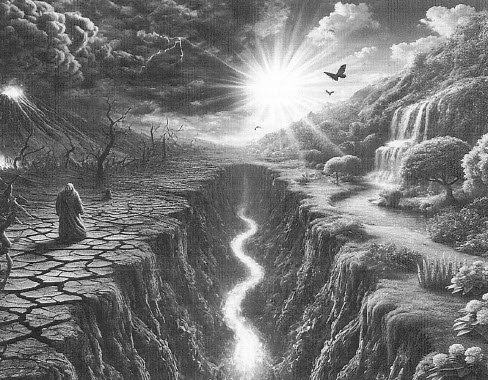
Unknown artist’s conception of Hades as described by the parable of The Rich Man and Lazarus. I presume that’s the Rich Man walking alone on the left bank of the chasm, while Lazarus is off lounging somewhere in Abraham’s Bosom, on the right bank. Remember that this is a parable, so you aren’t expected to take the vision of Hades’ layout or structure too literally.

Introduction

If you subscribe to a YEC interpretation of Scripture (and most of my friends do), then you should believe that all life, human, animal, vegetable, fungi, single-celled and microbial, was created some 6,000 years ago, over a span of only days. Is it conceivable, in that case, that the Fall took place soon enough after creation that no living thing got eaten, stepped on, or fell off a cliff? Was life physically indestructible, as well as immune from natural death? Life is far more complicated than that, but to Henry Morris and his disciples, the question is moot, because to them the Bible prohibits even the possibility of any kind of death before the Fall.

In this post, after first presenting some background and grammar, I’m going to comment on a few of the key YEC arguments for and against pre-fall immortality.

Background and grammar

Life

Not all YEC scholars think that a denial of physical death before the fall applied to plants and microbes, or anything else with no brain. I’m not aware of any scripture that grants this exemption, unless it is implicit from,

29 And God said, “Behold, I have given you every plant yielding seed that is on the face of all the earth, and every tree with seed in its fruit. You shall have them for food. 30 And to every beast of the earth and to every bird of the heavens and to everything that creeps on the earth, everything that has the breath of life, I have given every green plant for food.” And it was so.
— Genesis 1:29-30 (ESV)

Some say that only vertibrate animals were exempt from death. Where is that written?

Some say that anything without blood was never “alive”, in a Biblical sense, because “the life of the flesh is in the blood…” But that isn’t meant to define what “life” is or is not, it’s merely the stated reason that God views the consumption of blood as abominable. There is unfortunately a huge tendency for hyper-literalists (those who won’t let the Bible use figurative language or poetic exaggeration to prove a point) to read theology into every word of every verse, without regard to context.

Far from looking for exemptions, Morris even taught that entropy could not have increased before the fall. Morris was not a scientist and never had a full grasp of what entropy even means until later in his life.

Entropy is a fundamental thermodynamic property of the physical universe. Formally, it is a statistical measure of the number of mathematical “degrees of freedom” in any physical system. The Second Law of Thermodynamics states that the entropy of the universe always increases.

Entropy is often described to novices as “a measure of randomness”, but that is misleading. A common claim is that “shuffling a pack of cards increases its entropy because of the increased randomness of the shuffled deck but sorting it back into its original order decreases its entropy since its randomness is lower.” That isn’t at all true! The increase of entropy is due to the energy expended in shuffling. Reordering requires another expenditure of energy, say from a person or a machine, thus further increasing entropy. The entropy of 52 cards at rest is the same whether they are in an ordered or a shuffled state.

If Morris was right about entropy, cells could not divide, food could not digest, muscles could not contract, balls could not roll downhill and, oh yes, the sun could not shine, and gravity could not work. If so, then after the Fall, God must have completely redesigned the laws of physics, plus the nature of every last object in the universe, from subatomic particles on up to spacetime itself.

But the text of Scripture doesn’t, to my knowledge, hand out exemptions, so who gets to say that any human or nonhuman life was exempt from death? To my way of thinking, it is arbitrary and presumptuous for us mortals to “exempt” anything that is cellular and reproduces in a biological sense or to include anything else. Life is life!

death

For this discussion, we have to be more precise when we talk about “death.” That concept, as used in the Bible, can mean different things in different contexts:

  • Everybody on earth recognizes that anything post-Fall that has physical, tangible, cellular life will ultimately suffer a “physical death,” that is, a termination of all self-powered physical processes. After that, external processes take over to break down the physical components of that once-living carcass and “return it to the dust.”
  • Most contemporary Christian scholars also recognize that the Bible frequently talks about an analogous “spiritual death,” which Thayer describes as “the misery of soul arising from sin, which begins on earth but lasts and increases after the death of the body”; “the miserable state of the wicked dead in hell”; and “all the miseries arising from sin.”
  • Paul also defined death as voluntarily putting away, or killing, the evil inclinations of all humankind. See my recent Yetzer, Yotzer and “The Law” in Romans 7:1–6 for a detailed discussion of this usage.

While “death as separation” is not a highly developed Biblical concept, per se, it is functionally an apt description: separation of the body and spirit; separation of the eternal spirit from God; and separation of man from his own nature, respectively.

Death in antiquity

Human beings have an innate curiosity about their origins, both individually and culturally, and I think that this curiosity is at its strongest when communities are more isolated and less technologically distracted. In prehistoric times—that is, before the development of writing—history was very efficiently retained and spread verbally, both within families and cross-culturally by traveling storytellers. It should come as no surprise that all the ancient civilizations, with their common origins in Babel, would share common “legends” about their pasts and common beliefs about the unseen.

From Greece to Egypt and all across the Fertile Crescent, way over to India and China, and across the pond in the Americas, every culture that left records in early history shared one cosmology and one belief in the afterlife, differing only in small regional details.

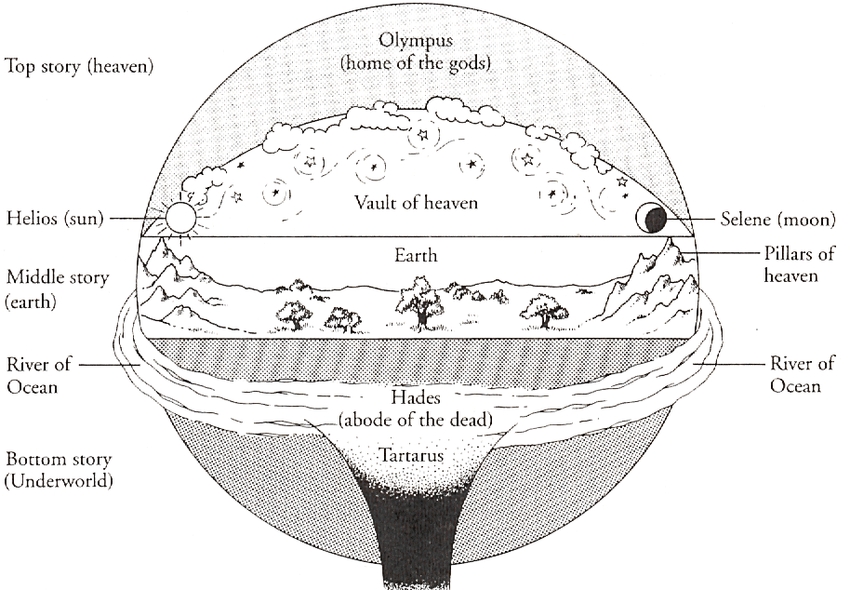
I’ve shared several versions of the universal flat earth model of cosmology in earlier posts. Here I’ll add the Greek view, which is very similar to the others.

Ancient Greek cosmological diagram.

In all cases, the earth is depicted as a flat disk floating on a broad ocean and covered by a dome (the “firmament” in KJV). Beneath the surface of the disk is the underworld, Hades, the abode of the (physically) dead.

As I’ll show in the following two sections, both Hebrew and Greek have terms that refer to death and the remains of the physically dead, but neither language has any term that differentiates between physical and spiritual death. Though “death” can refer to either, only the context can indicate which is being discussed. Unfortunately, very often the context alone is insufficient for total clarity.

Why would that even be?!

I would suggest that, aside from corruptions in the retelling, all early civilizations shared the assumption that physical life was only one phase of personal existence.

Human life on earth is short. Adam’s descendants in the period between the Garden and the Flood lived long lives, as recorded in the Bible, but most cultures in the ancient world had life expectancies of no more than a few decades. Physical death was no shock. It was pretty much universally believed that when a human died, his spirit survived and was relegated to the underworld. The Bible calls that underworld Sh’ol, or Sheol, in Hebrew, Hades in Greek.

Physical death, in other words, was little more than the shedding of a mortal shell not needed by the immortal spirit as it moved into its new abode in the underworld.

There was no concept of death or annihilation of the spirit in the underworld until much later. In fact, there apparently was no real concept of suffering spirits, either. Even in the Old Testament, where the Psalmist said, “The wicked go down to the realm of the dead, all the nations that forget God” (9:17) and “Let me not be put to shame, Lord, for I have cried out to you; but let the wicked be put to shame and be silent in the realm of the dead” (31:17), the sense is, “I’m righteous, so let me live, because when I die, I’ll be relegated to the drab and boring underworld.”

The picture of Sheol/Hades presented in the parable of the Rich Man and Lazarus appears nowhere in the Old Testament. That is a view apparently developed in Second Temple Judaism and propagated in Jewish pseudepigraphal works like The Apocalypse of Zephania and 1 Enoch. In telling this parable, Jesus was using a well-known popular concept to illustrate His teaching.

Death in Hebrew

Biblical Hebrew has several words that are used extensively with respect to death:

פֶגֶר (peger, pronounced peh’-ger) is a noun referring to a corpse, carcass, or dead body, human or animal. It was also used figuratively on occasion to refer to idols.

מוּת (muwth, pronounced mooth) is a verb meaning to die, to kill, or to be dead. The subject could be human, animal, vegetable, or even a nation. It can refer metaphorically to the death of some characteristic, e.g., the death of courage. Manner of death could be natural causes or violence. It could also refer to a death judgement, or to an agent of death.

מָוֶת (maveth, pronounced MAH-veth) is a noun, closely related to muwth, that means death, the dead, the place of the dead or state of being dead, or sometimes pestilence or ruin. Rarely, it can be used metaphorically to indicate spiritual death or separation from God, as perhaps in Hosea 13:14, or divine judgement, as in Ezekiel 18:4.

נֶפֶשׁ (nephesh, pronounced neh’-fesh) is a noun, often translated as soul, but primarily meaning any living and breathing creature, human or animal. It also refers to many of the characteristics of life, including life itself, self, person, desire, passion, appetite, or emotion. To lose one’s nephesh is to die, after which the peger, or remains, decay, while the nephesh (now a disembodied spirit) lives on in Sheol, “the grave”, meaning the underworld.

Note that in the Hebrew Scriptures, there is almost no development of the idea of spiritual death, or of divine retribution in the afterlife.

Whatever your hand finds to do, do it with your might, for there is no work or thought or knowledge or wisdom in Sheol, to which you are going.
— Ecclesiastes 9:10 (ESV) emphasis mine

Death in Greek

There are many similarities, but also significant differences in the Biblical Greek vocabulary of death:

σῶμα (sóma, pronounced SO-mah) is a noun meaning body or flesh. Unlike the Hebrew peger, this word speaks of a body that can be either living or dead, or in some cases metaphorically, of the body of the Church, or the visible aspect of a disembodied spirit, e.g., an angel.

θάνατος (thanatos, pronounced THAH-nah-tos), like the Hebrew maveth, is a noun meaning death. Unlike maveth, where the figurative sense of “spiritual death” is rare, that concept is well developed in the 1st century AD. In biblical Greek, the figurative meaning is present at least as often as the literal. Unfortunately, only the context can reveal which meaning is in play, and even then, it is sometimes not clear.

As a foil for thanatos, I’ll include here its opposite, ζωή (zóé, pronounced dzo-ay’), a noun meaning life. Interestingly, thanatos is a masculine noun, while zóé if feminine. I’ll not suggest any significance to that fact.

νεκρός (nekros, pronounced nek-ros’) is an adjective meaning dead, deceased, or corpse-like. Like thanatos, the New Testament often uses it to refer to spiritual death. Once again, only the context can determine which meaning to attach.

νεκρόω (nekroó, pronounced (nek-ro’-o) is a verb form of νεκρός meaning to put to death, or render powerless or ineffective.

ἀποθνῄσκω (apothnéskó, pronounced ä-po-thnā’-skō) is a verb meaning to die, to lie dying, or to be killed. Similar to Hebrew muwth, but once again, in the NT it often has a strong spiritual, rather than literal, connotation.

κρίμα (krima, pronounced KREE-mah) is a noun meaning a condemnatory sentence, penal judgment, or sentence.

κατάκριμα (katakrima, pronounced kä-tä’-krē-mä) is a noun meaning punishment following condemnation, penal servitude, penalty. Quoting from Bible Hub’s Topical Lexicon: “The word κατάκριμα is used in the New Testament to describe the state of being under condemnation, particularly in a spiritual or moral sense. It is often associated with the consequences of sin and the judgment that follows.”

Romans 5:12, “death by sin”

Therefore, just as sin came into the world through one man, and death through sin, and so death spread to all men because all sinned
— Romans 5:12 (ESV)

To most YECs, Romans 5:12 is the definitive last word on the subject, because it seems to clearly state that no death of any kind, to any created life form (subject to possible exemptions discussed above), was possible before Adam sinned.

But is that so?

“Proof-texting”, i.e., casually picking one verse out of Scripture to prove a theological point of view, is always risky because no single verse, in a vacuum, is likely to reflect the writer’s complete thoughts on the subject of the verse, or on the circumstances under which he is writing. Other factors almost always need to be considered, such as:

  • The grammar, genre, and figures of speech.
  • The issue or issues that prompted the writing.
  • The textual, historical, and cultural context.
  • The identity and background of the writer.
  • The identity and background of the original readers.

The grammar of 5:17 tells us that Paul is combining two thoughts:

  1. Adam’s sin introduced sin and death (thanatos) into the world.
  2. All humans sin, so all humans die.

These two thoughts are conjoined by the Greek phrase kai houtōs, but it is unclear how that should be translated. A quick survey of translations yields “and so”, “in this way”, “this is why”, “and thus”, and the New Century Version (NCV) even puts the second thought into a new sentence. “This is why everyone must die—because everyone sinned.”

Whichever one of those translations you go with, without more context there is a logical disconnect between the two halves of the verse. YECs use Thought 1 to prove that Adam’s sin introduced both physical and spiritual death into the world. Yet they would agree that Thought 2 says that humans die individually because they sin individually. Do animals not die individually because they sin individually?

The Serpent of Genesis 3 sinned, but that was Satan, not a common Garden of Eden Snake. Balaam’s donkey spoke sinful words (Numbers 22:28), but that was spiritual ventriloquism (“The LORD opened [its] mouth”). In Luke 8. 26–39, Jesus was speaking with demons, not with pigs.

I think we can agree that animals aren’t capable of sin, and neither are they subject to spiritual death. Therefore, animals probably have nothing to do with Thought 2 in Paul’s teaching. Given the multiple shades of meaning in thanatos (or the English, “death”) are we as Biblical literalists required to read all possible definitions into that one word here? Not unless we can find something in the context to back it up.

As a matter of fact, the subject in Romans 8, and in fact, the theme of the first 8 chapters, is salvation by faith in the Messiah, for both Jew and gentile. He brings up Adam for two reasons: First, because Jesus provided the means of undoing what the sin of Adam did to humanity; and second, because unlike Abraham, Adam is the father of both Jew and gentile. (Note that the overall theme of the Epistle to the Romans is Paul’s call for unity between Jews and gentiles in the Roman churches.) Among other verses in chapter 8, the following two provide all the explanation needed to understand 5:12:

18 So then, through the transgression of one, condemnation came to all men; likewise, through the righteousness of one came righteousness of life to all men. 19 For just as through the disobedience of one man, many were made sinners, so also through the obedience of one man, many will be set right forever.
— Romans 5:18-19 (TLV)

There is nothing at all in that message that applies to animals (or pre-Adamic hominids if you believe in them). Animals are explicitly mentioned only once in all of Romans:

22 Claiming to be wise, they became fools, 23 and exchanged the glory of the immortal God for images resembling mortal man and birds and animals and creeping things.
— Romans 1:22-23 (ESV)

We’ll approach an understanding of whether Romans 5:12 is speaking of physical death, spiritual death, or a combination of the two in this section. Because the language alone can’t answer that question, we’ll look primarily to the context of Paul’s letter, particularly chapters 1–8, concentrating on chapters 5–8. In the process, we’ll also strengthen our case for human-only death being in view.

The Romans context

In this section, I will now provide a thorough exposition of the topic of death, as it relates to 5:12, in Paul’s theological writings to the churches in Rome.

Background

Though Romans is packed with theology, Paul’s reason for writing the letter was primarily to act as a peacemaker between the Jewish and Gentile believers in the Roman churches.

On his missionary journeys, Paul’s habit was to first approach the Jewish synagogues and preach to their congregations, then to expand his approach to gentiles in the community. Where did the new believers then meet together? The practice of Jewish believers in Jerusalem was to continue their normal Sabbath activities in the synagogues alongside non-Messianic Jews, then at dusk, at the close of Shabbat, the Messianics would adjourn to private homes to meet and fellowship together until well into the night.

This same practice was likely followed in the Diaspora as well, with gentile believers joining at homes after the synagogues closed for the night. This was of course a great demonstration of the intercultural tolerance demanded by Paul.

[Note: Since “the 7th day of the week” gave way to “the 1st day of the week” at dusk, I believe that this evening adjournment is what truly led to the Christian custom of meeting on Sundays.]

In AD 49, Emperor Claudius expelled all Jews from the City of Rome, including Messianic believers. When the expulsion was ended after Claudius’ death in AD 54, two to four years before Paul’s letter, those Jews who returned found that Gentile believers had taken over their synagogues, and the result was bad blood between the returning Messianic Jews and the gentile usurpers.

Outline

That background explains, I think, why the bulk of the letter consisted of round after round of explanation and exhortation to first one, then the other, component of the Church.

In broad strokes, I personally outline Romans as follows:

  1. Greetings and personal notes, 1:1–15.
  2. A unifying theology of righteousness through faith, 1:16–8:39.
  3. Paul’s burden for Israel, 9:1–11:11.
  4. Gentiles and Jews together, 11:12–36.
  5. Christian ethics for all, 12:1–15:13.
  6. Paul’s closing statements, 15:14–16:27.
A focus on the theology

In Romans 1:16–8:39, Paul’s emphasis was on theology, in particular the roles of faith and Torah obedience in the quest for righteousness as required by God in the united Church.

In order to stay within the limited scope of this paper, I will concentrate here on Paul’s discussions of death, in order to set a context for 5:12.

Literal death in Romans 1–4

In the following passage, Paul is speaking of the faith of Abraham who, despite being an old man and “as good as dead”, maintained his strong faith in God, who not only creates the body, but gives it life. Both of these references to death are forms of nekros, and it seems reasonable to assume that they are referring either strictly or primarily to physical death; however, in my judgement they don’t help set the context of 5:12.

17 as it is written, “I have made you the father of many nations”—in the presence of the God in whom he believed, who gives life to the dead [nekros] and calls into existence the things that do not exist. 18 In hope he believed against hope, that he should become the father of many nations, as he had been told, “So shall your offspring be.” 19 He did not weaken in faith when he considered his own body [soma], which was as good as dead [nekroó], (since he was about a hundred years old), or when he considered the barrenness of Sarah’s womb.
— Romans 4:17-19 (ESV) emphasis mine

In 4:24 (“him who raised from the dead [nekros] Jesus our Lord”,) and 5:10 (“we were reconciled to God by the death [thanatos] of his Son”), the subject is the death and resurrection of Jesus, which again I think is not terribly helpful in setting the context for death in the following chapters.

Death and life in Romans 5:1–11

Beginning in chapter 5, the emphasis changes from justification to sanctification and the peace that comes with it.

Therefore, since we have been justified by faith, we have peace with God through our Lord Jesus Christ.
— Romans 5:1 (ESV)

“Death” terms now begin to appear more frequently in the text.

6 For while we were still weak, at the right time Christ died [apothnéskó] for the ungodly. 7 For one will scarcely die [apothnéskó] for a righteous person—though perhaps for a good person one would dare even to die [apothnéskó]— 8 but God shows his love for us in that while we were still sinners, Christ died [apothnéskó] for us.
— Romans 5:6-8 (ESV)

These references to death all speak of Jesus’ crucifixion, which was of course very much a literal death. The same applies in verse 10:

For if while we were enemies we were reconciled to God by the death [thanatos] of his Son, much more, now that we are reconciled, shall we be saved by his life [zóé].
— Romans 5:10 (ESV)

A key question now arises: If thanatos and zóé refer to literal, physical death and life in 5:10, as I think we all would agree, then is this verse speaking of physical salvation of our bodies, or of spiritual “salvation of our souls”?

“Saved” in verse 10 is σῴζω (sózó, pronounced sózó), a verb meaning (per Thayer’s), either (a) to save, to keep safe and sound, to rescue from danger or destruction; or (b) to deliver from the penalties of the Messianic judgment, i.e., to make one a partaker of the salvation by Christ.

Once again, I think that most of my readers would agree that (b) is the sense meant in verse 10.

Up to here in Paul’s theological discourse, the subject has been primarily Jesus’ physical death and subsequent resurrection as the basis for our faith, and thus our spiritual salvation (justification, sanctification, and later glorification).

I would contend, then, that 10 and 11 focus the context for what follows in verse 12:

10 For if while we were enemies we were reconciled to God by the death of his Son, much more, now that we are reconciled, shall we be saved by his life. 11 More than that, we also rejoice in God through our Lord Jesus Christ, through whom we have now received reconciliation.
12 Therefore, …
— Romans 5:10-12a (ESV)

I will show below that the text following 5:12 further solidifies this context.

Death and life in Romans 5:13–21

The remainder of chapter 5 continues the contrast between death through Adam and life through Jesus and returns the emphasis back to the overall theme of the letter: explaining how faith and salvation can function in a Church composed of both Jews and gentiles.

Here, Paul says that, yes, we have been two separate peoples under separate spiritual economies since the time of Abraham, and we will remain so in most respects, but we all have a common ancestor in Adam. Within the Church, we must recognize that both peoples are infected with the sin nature of Adam because of his sin, but now both have been united by our faith in the salvation brought by Jesus.

Key death phrases in this section are:

14 … death [thanatos] reigned from Adam to Moses, even over those whose sinning was not like the transgression of Adam, who was a type of the one who was to come.

15 … if many died [apothnéskó] through one man’s trespass, much more have the grace of God and the free gift by the grace of that one man Jesus Christ abounded for many. 16 … For the judgment [krima] following one trespass brought condemnation [katakrima], but the free gift following many trespasses brought justification. 17 For if, because of one man’s trespass, death [thanatos] reigned through that one man, much more will those who receive the abundance of grace and the free gift of righteousness reign in life [zóé] through the one man Jesus Christ.

18 Therefore, as one trespass led to condemnation [katakrima] for all men, so one act of righteousness leads to justification and life for all men. … 21 so that, as sin reigned in death [thanatos], grace also might reign through righteousness leading to eternal life through Jesus Christ our Lord.
— Romans 5:14-21 (ESV)

Surely all of that death, judgement, redemption and life terminology must be speaking only of the spiritual state!

A different metaphor in Romans 6–7

Here Paul shifts the conversation about death. In this section, “death” is neither physical death nor spiritual death, but rather he uses the metaphor of “putting to death”, or overcoming, the evil inclinations brought on by our sinful natures. I discussed this recently in great detail in Yetzer, Yotzer and “The Law” in Romans 7:1–6

Romans 8

In this chapter, Paul closes out the discussion that fills the first half of the letter.

1 Therefore, there is now no condemnation for those who are in Messiah Yeshua. 2 For the law of the Spirit of life in Messiah Yeshua [the Torah written on our hearts] has set you free from the law of sin and death [the fleshly “evil inclination”].
— Romans 8:1-2 (TLV) comment mine

“Therefore” in 8:1 harks back to all that came before, but in particular to 7:4, discussed in the previous article:

Therefore, my brothers and sisters, you also were made dead to the Torah through the body of Messiah, so that you might be joined to another—the One who was raised from the dead—in order that we might bear fruit for God.
— Romans 7:4 (TLV)

By now, I hope that most of you will agree that Paul’s discussion of theology is primarily about the spiritual results of sin, not about the mortality of the body.

Interpreting Romans 5:10–14

Here, then, is my interpretation of Romans 5:12 in its closest context:

10 For if while we were enemies we were reconciled to God by the death of his Son, much more, now that we are reconciled, shall we be saved by his life. 11 More than that, we also rejoice in God through our Lord Jesus Christ, through whom we have now received reconciliation.

12 Therefore, just as sin came into the world through one man, and death [thanatos] through sin, and so death [thanatos] spread to all men because all sinned …
— Romans 5:10–12 (ESV)

For if while we were enemies — While we, as Jew or gentile, were in opposition to God and Torah.

We were reconciled to God by the death of his Son — We were brought back into a close relationship (which was lost when we first sinned) with God on be basis of Jesus’ crucifixion.

Much more, now that we are reconciled — More importantly, now that that relationship has been restored.

Shall we be saved by his life. — I discussed the meaning of salvation when I analyzed this verse above, taking Thayer’s definition, “to deliver from the penalties of the Messianic judgment, i.e., to make one a partaker of the salvation by Christ.”

More than that, we also rejoice in God through our Lord Jesus Christ, through whom we have now received reconciliation. — We celebrate the fact that we have been brought into fellowship with God, the Father.

Therefore—because of Jesus’ crucifixion and resurrection by which we have been reconciled to God.

Just as—in the same fashion as.

Sin came into the world through one man—Sin came into existence on earth. By disobeying God in the matter of the Tree of Knowledge, Adam and Eve brought the curse on mankind and on the ground that he depends on.

And death through sin—this will require discussion of two issues:

  1. The contextual discussion above addresses the question of whether this “death” (thanatos) is spiritual death only, or whether it includes any physical component at all. Based on we’ve seen in chapters 1–8, and especially 5:10–11, I can only conclude that death here is referring only to spiritual death.
  2. We also have to determine whether the remainder of verse 12 limits this death to mankind only, or if animals and other things are included.

And so death spread to all men because all sinned—to my mind, the grammar here limits death due to sin to the sinners themselves.

But let’s consider the curses themselves…

Death in Eden

The sin in Eden

The word “die” occurs 3 times in the Garden of Eden (Genesis 2:17; 3:3,4). In each case, it is a grammatical variation of the Hebrew muwth. As expected, the Greek Septuagint (LXX, a 2nd century BC Jewish translation of the Old Testament into Greek) translates each of these three occurrences using apothnéskó, which in this case imparts no new information.

What does the text tell us? In Gen 2:17 God’s words were, “in the day that you eat of it you shall surely die.” Eve’s flawed retelling of this to the Serpent was, “‘You shall not eat of the fruit of the tree that is in the midst of the garden, neither shall you touch it, lest you die.'” The Serpent’s response was, “You will not surely die.”

Are we to take this as a discussion of physical death, spiritual death, or perhaps both? That’s a tough question to some since it is not addressed specifically.

If the answer is “physical“, then did God lie and the Serpent tell the truth? That, of course, is not tenable unless the word “day” (from the root, יוֹם, yom) means something other than a literal day. In an Ancient Near East (ANE) context, that is certainly a possibility, but it’s making an unprovable assumption, and it’s a risky interpretation in the context of Genesis 1–3. If you require Genesis 1 to be using the word, day, literally for the creation days, then in Genesis 2–3, the same word should probably have the same meaning.

“Both” might mean that both were telling half-truths, which raises the same troubling issues.

If the answer is “spiritual“, then God was truthful, and the Serpent a liar. I’ll go with this one!

But, for the purpose of this post, I have to ask how Adam and Eve could have had any comprehension of either physical or spiritual death if there had been no death at all on earth up to that point. Any attempts to explain that away can only be speculative. Lacking data, then speculation is fine, but dogmatism is not.

Since Adam’s physical death didn’t come until 930 years later, I feel personally confident in speculating that the death promised to him was spiritual only, though there is no record that either God or the Serpent explained that to him or Eve. I further speculate that he was not created immortal but would have lived forever from the fruit of the Tree of Life, as stated in gen 3:22.

The curses of Eden

The Serpent

According to Genesis 3:14–15, the Serpent was cursed for his own sin.

14 So the LORD God said to the serpent:
Because you have done this,
you are cursed more than any livestock
and more than any wild animal.
You will move on your belly
and eat dust all the days of your life.

15 I will put hostility between you and the woman,
and between your offspring and her offspring.
He will strike your head,
and you will strike his heel.
— Genesis 3:14-15 (CSB17)

Angelic beings were created to oversee the cosmos, much like mankind was created to manage Earth. The Bible reports that angels are rebellious just like humans, but I see nothing in the Bible to indicate that the angels and humankind are judged under the same set of rules, or that other angels were included in the Serpent’s curse.

In fact, it’s unclear just what exactly the serpent was, and what its relation was to Satan. Revelation 12:9 and 20:2 state that it was Satan, but that could mean that Satan “possessed” a member of an animal family. “On your belly you shall go” does indeed sound like snake, but “the serpent was more crafty than any other beast of the field that the LORD God had made” doesn’t sound snakish at all, so who knows?

It’s unclear to me why God would have cursed all snakes because of the perfidy of one, and the part of the curse recorded in verse 15 certainly does not pertain to snakes! Well, I’m satisfied not knowing the unknowable!

The Woman

Eve’s curse is recorded in Genesis 3:16. It mentions only pain in childbearing and relational difficulties between husband and wife. From the wording, it seems that childbearing was already painful, so this just made it more so. If it was painful, could it also have been perilous?

He said to the woman:
I will intensify your labor pains;
you will bear children with painful effort.
Your desire will be for your husband,
yet he will rule over you.
— Genesis 3:16 (CSB17)

Adam

Adam’s curse is found in Genesis 3:17–19. Strictly speaking, Adam wasn’t cursed at all, directly. What the text says is, “cursed is the ground because of you”. What that curse does, though, is to set up an enmity of sorts between Adam and his environment, which certainly would be considered a curse.

17 And he said to the man, “Because you listened to your wife and ate from the tree about which I commanded you, ‘Do not eat from it’:
The ground is cursed because of you.
You will eat from it by means of painful labor
all the days of your life.

18 It will produce thorns and thistles for you,
and you will eat the plants of the field.
19 You will eat bread by the sweat of your brow
until you return to the ground,
since you were taken from it.
For you are dust,
and you will return to dust.”
— Genesis 3:17-19 (CSB17)

Alternatively, it may be that Adam’s own curse is that discussed above, plus

22 The LORD God said, “Since the man has become like one of us, knowing good and evil, he must not reach out, take from the tree of life, eat, and live forever.” 23 So the LORD God sent him away from the garden of Eden to work the ground from which he was taken. 24 He drove the man out and stationed the cherubim and the flaming, whirling sword east of the garden of Eden to guard the way to the tree of life.
— Genesis 3:22-24 (CSB17)

I see no Biblical indication, in Genesis 3 or elsewhere, that animals, plants, or the extraterrestrial cosmos were cursed for man’s sin. Certainly, the flora, fauna and ecology of earth are greatly affected by man’s curse. That doesn’t mean that it had any effect on their mortality, other than to make life harder.“Be fruitful and multiply and fill the earth and subdue it, and have dominion over the fish of the sea and over the birds of the heavens and over every living thing that moves on the earth.”
— Genesis 1:28 (ESV)

Good and Very Good

Many Young Earth Creationists claim that there could not possibly have been death before the fall because during the creation week, at the end of every day God looked at what He had done that day and pronounced it “good.” At the end of the sixth day, as a matter of fact, it was “very good.”

Now how, they ask, can anything be good or very good if it can die? Well, gosh… How does any fallen human being presume to know what God considers to be good? It’s His design, so by definition, it is good!

Let’s check the language:

טוֹב (tov, pronounced tove) This can be adjective, verb, or noun, and it means … hang onto you hats … good, pleasant, agreeable, beneficial, beautiful, best, better, bountiful, cheerful, at ease, fair, favor, fine, glad, goodly, graciously, joyful, kindly, loving, merry, pleasant, precious, prosperity, ready, sweet, wealth, welfare, well-favored. And all of these meanings are subjective! Good luck agreeing on the shading!

מְאֹד (m`od pronounced meh-ODE) This is an adjective meaning very, exceedingly, much, greatly.

Really, there’s not much help there. The word is subjective.

From my engineering perspective, a good design is one that does what the specs required, does what it was designed it to do, and does it elegantly.

Philosophical bias

In my opinion…


The universe is not a static artwork hanging on a wall. It’s a living, dynamic organism, designed by God to mature and blossom with little interference, to showcase His majesty, and to house and employ His angelic host, the first “generation” of His children, the B’nai Elohim, or Sons of God (Genesis 6:2–4).

And later, after reaching a suitable degree of maturity and elegance, a Garden was planted on one planet to house and nurture the second generation of His children, humanity.

Elegantly!


Nature vs Eternity

Development and growth per God’s blueprint demand movement, change, and thermodynamic flow. Exchange and equilibrium. Birth and death. This is true for the universe as a whole, for galaxies, stars and star systems, and for planets.

Angels are like humans in that they image God, they answer to Him, they interact with Him, they have freewill and thus can sin, and God has given them meaningful work to do.

They are unlike humans in that they have no physical bodies that are inherently vulnerable to mishap, wear and tear, and mischief. They don’t give birth, and they don’t die, and they aren’t influenced by hormones. However, when they have temporarily taken on human form, they have sometimes gotten into big trouble.

In the Eternal State, I believe human bodies will be secondary. In the meantime, they are the shell we are confined to. Spirits are immortal, bodies are not. By their nature, bodies are vulnerable. With God’s protection or the Tree of Life, they can be maintained indefinitely, but without it, death is inevitable.

Fecundity

The first commandment given to humans was,

“Be fruitful and multiply and fill the earth and subdue it, and have dominion over the fish of the sea and over the birds of the heavens and over every living thing that moves on the earth.”
— Genesis 1:28 (ESV)

Where there is fecundity, there has to be death. Neither animals nor humans can give birth indefinitely without eventually running out of space and resources. We value ecosystems and our environment. Ecology, God’s creation, demands cycles of life and death to maintain the health and balance of the planet.

Natural Life

I have in front of me paper after paper and article after article featuring Henry Morris’ grandson and many of his colleagues repeating over and over again that “death is an insult”, and “if God designed death into creation, then He is a monster”, and “death is wasteful and cruel.” This is all nonsense to me.

Isaiah described the Olam Haba (world to come) in the imprecise way of prophecy, particularly poetic prophecy. As sometimes happens, he confused the Millennium with the Eternal State, as described in Revelation. Under the topic, “new heavens and new earth” (65:17), the following passage describes what I believe life will be like in the Millennium, and perhaps what it was designed to be like in Eden:

20 No more will babies die in infancy,
no more will an old man die short of his days —
he who dies at a hundred will be thought young,
and at less than a hundred thought cursed.
21 They will build houses and live in them,
they will plant vineyards and eat their fruit.
22 They will not build and others live there,
they will not plant and others eat;
for the days of my people
will be like the days of a tree,
and my chosen will themselves enjoy
the use of what they make.
23 They will not toil in vain
or raise children to be destroyed,
for they are the seed blessed by ADONAI;
and their offspring with them.
24 Before they call, I will answer;
while they are still speaking, I will hear.
25 The wolf and the lamb will feed together,
and the lion eat straw like an ox
(but the serpent — its food will be dust).
They will not hurt or destroy
anywhere on my holy mountain,”
— Isaiah 65:20-25 (CJB)

As for animals, verse 25 doesn’t promise that the wolf and the lamb will be immortal, or even that the lion or wolf will lose its predatory instincts, but only that wild animals will no longer plunder domestic herds.

Humans were created mortal but designed to live long and peaceful lives and to die content, like David in 1 Chronicles 29:28 (CJB), who “died, at a ripe old age, full of years, riches and honor.”

This is my view of Eden, as well…