Prophetic Visions: Through a Glass Darkly

Posted on:

Modified on:

  1. Introduction
    1. The mirror analogy
    2. The purpose of prophecy
    3. Prophetic Applicability
    4. The role of visions
    5. The office of Prophet
  2. Interpretive challenges
    1. Throne visions
      1. Common elements of the throne visions
      2. The 24 elders
      3. The Divine Council
    2. The suffering servant
    3. Ezekiel
      1. Ezekiel 10 – 11 (God Leaves the Most Holy)
      2. Ezekiel 38 – 39 (Gog and Magog)
      3. Ezekiel 40 – 42 (The Millennial Temple)
      4. Ezekiel 43:1–12 (God Returns to the Most Holy)
    4. Revelation
      1. Chapter 8–9 (trumpets)
      2. Chapter 10 (the angel with the little scroll)
      3. Chapter 12 (a woman and a war)
      4. Chapter 13–14 (the two beasts)
  3. A pair of Dreams
    1. Joseph and the sheaves
    2. Peter and the sheet
  4. Conclusions

Introduction

The mirror analogy

Chances are you’re familiar with the following verse:

[12] For now we see through a glass [mirror], darkly; but then face to face: now I know in part; but then shall I know even as also I am known.
—1 Corinthians 13:12 (KJV)

This is part of an extended passage in which Paul is discussing the interrelationships between believers in the church, including the interplay between their various natural abilities and spiritual gifts. He then stresses that what is most important is their mutual love—ἀγάπη (agapé), affection, good-will, benevolence, or (KJV) charity, all in an atmosphere of mutual preference for one another.

The “glass”, or “mirror” of verse 12 is the Greek ἔσοπτρον (esoptron), a noun that technically denotes any smooth, reflective surface that can function as a mirror. Undoubtably, what Paul had in mind was the polished brass, copper, or occasionally iron, silver or gold mirrors used in his time. Back in my camping days, I carried an unbreakable polished aluminum mirror, which works better than brass, but still reflects much less efficiently than a modern silvered glass mirror. These metals are all more or less prone to tarnish, and the polishing technology of the Roman Empire was unable to achieve the fine finish possible now.

Roman silver mirror, 1st century. Public domain. This, of course, is the back side of the mirror. The front is polished smooth, and this particular specimen has a maker’s mark etched at the bottom front.

By the frequent (but unfortunate) Christian custom of basing doctrine on individual verses pulled out of context, many Christians are taught that Paul is promising here that when we get to heaven, we will all instantly recognize everyone we see. That may or may not be a part of our glorification, but in his analogy, Paul is conveying a more general picture of how weak our knowledge is now compared to what we will know and understand after our imperfect lives end and we come face to face with God.

The same analogy serves well to illustrate how little we can learn from prophecy compared to a face-to-face encounter with the real thing. The point I pursue below is that prophecy should never be dogmatically relied on to tell us, literally, exactly what we can expect in the future.

The purpose of prophecy

It seems to me that Biblical prophecy, in the main, performs three primary functions:

  1. It warns God’s people of coming judgement, either impending or far in the future. For example, the “blessings and curses” of the Mosaic Covenant (Deut. 28ff) warn of the consequences of disobeying the precepts of the Covenant and contrast those consequences with the blessings they could expect for keeping the Covenant. Virtually all of the prophets predicted Israel’s failure to keep the Covenant and forecast the terrible price they will pay for their disobedience.
  2. It provides comfort in times of woe. The prophetic books that forecast terrible judgement on Israel almost always end with promises that, despite their failure and subsequent punishment, God will ultimately bring them back to Himself and give them final bliss in their own land.
  3. It also forecasts events in the future that, though usually at least partly unclear in the telling, will become obvious in the fulfillment. It is this forecasting role that I will emphasize below.

Prophetic Applicability

What most Christians fail to realize is that all of the Old Testament prophesies and promises, beginning with the Abrahamic Covenant, were for Israel—the Jews. Humanity in general was already condemned. Only eight humans escaped The Flood. The descendants of those eight, the second chance for humanity, immediately returned to a state of rebellion that God quickly dealt with in Shinar, at Babel:

since they did not see fit to acknowledge God, God gave them up to a debased mind to do what ought not to be done.
— Romans 1:28 (ESV)

I view the Church as a Jewish “family” with gentile children “fostered in.” Those of us who are gentiles in the Church are excused from most of God’s requirements for genetic Israel (see Acts 15), so shouldn’t expect all of their blessings and promises either. But that doesn’t mean we are second class in God’s eyes, and it doesn’t mean we don’t go along on the ride when God comes for His own.

The role of visions

1 In days gone by, God spoke in many and varied ways to the Fathers through the prophets. 2 But now, in the acharit-hayamim*, he has spoken to us through his Son, to whom he has given ownership of everything and through whom he created the universe.
— Hebrews 1:1-2 (CJB)

*[a•cha•rit-ha•ya•mim—Literally, “the end of the days”, i.e., The End Times or “latter days,” when the ‘olam hazeh (the present age) is coming to a close and the ‘olam haba (the age to come) is about to begin.]

While some prophecy was delivered to the prophets verbally by God or angels, and some was no doubt simply an idea placed the prophet’s head or perhaps even a subtle guiding of the pen, the most striking prophecies often came through dreams or visions. Visions were apparently all in the mind of the prophet, while dreams were sometimes imparted to others, to be interpreted by the prophet.

For the purpose of this post, I’m going to lump dreams with visions. Both are highly symbolic—often obscure, surreal, distorted, or iconographic. Both involve subjective imagery that is typically suggestive rather than immediately definitive.

The office of Prophet

The office of Prophet, like that of Apostle, has ceased!

The Apostles were a specific group of twelve men who were individually selected and trained by Jesus and then instructed to act as His official agents to begin the mission of evangelizing the world. Eleven were His closest disciples, who accompanied Him during the 3-1/2 years of His earthly ministry, remained faithful to the end, and were verbally commissioned by Him at His Ascension. The twelfth was Saul of Tarsus, who was selected and commissioned on the road, trained in Damascus and Arabia, and, like the others, served to the end of his life.

The Prophets were also selected by God. I reject the idea that modern preachers are “prophets.” The prophets preached and wrote, but their message was supernaturally imparted to them and therefore infallible, in the same sense that we regard the canonical books of the Bible as infallible.

Literally hundreds of times I’ve heard preachers and evangelists say, “God placed this message in my heart,” or “I was going to teach on … but God told me to do this instead“.

Sorry, no! I don’t for an instant deny that God calls some people into a preaching ministry and gives them appropriate spiritual gifts and a general inclination and wisdom to minister in a Godly fashion. But I have no Biblical or observational reason to believe that God, in this age, speaks directly and with total clarity to any human. No mere preacher, no matter how devout or scripturally knowledgeable, is inspired in the Biblical sense. If that were the case, then the first time he repeats a flawed interpretation he is revealed to be a false prophet. Verses that differentiate between true and false prophets include: 1Ki 22:8; Jer 14:14; 23:16; 28:9; Ez 13:3; Mat 7:15-20; 24:24; 1Jn 4:1; Pet 2:1.

Interpretive challenges

All visionary prophecy is, by its nature, difficult to interpret until its fulfillment, and sometimes even then its fulfillment might be obscure to most. Was it already fulfilled in the past? Is it completely fulfilled now? Is there more fulfillment to come? And if dreamlike imagery isn’t explained, how do we read the mind of the prophet? Did even the prophet himself know the interpretation? I suspect that the answer to that final question was often a negative.

While prophecy derived from visions and dreams is most difficult to interpret, there are challenges in interpreting prophecy derived by other means, too. End-times prophecy, no matter its source, is going to use terminology appropriate to ancient peoples at the time of writing. For example, 21st century vehicles might be described in prophecy as “horses”, aircraft as “clouds” or some flying creature, rifles as “swords”, etc. We can make that interpretation, but we might be completely wrong.

In the rest of this article, I’ll mention some mistakes that I think people—even theologians—make in their attempts to interpret prophecy and prophetic visions. Because some of the passages discussed are lengthy, I’ll usually provide only the Biblical references.

Throne visions

The Bible reports several very explicit prophetic visions of God seated on a throne in heaven: Isaiah 6, Ezekiel 1 and 10, Daniel 7, and Revelation 4 being most striking.

Ezekiel 1 vision of God’s heavenly throne, aka, His Chariot Throne. By rive6-d7dtasm1. This is one of many hundreds of attempts by various artists to depict Ezekiel’s vision.

I previously wrote about these visions in Monotheism and the Trinity:

don’t think that these visions [as described] can be reconciled with God as an omnipresent spirit. Instead, I think that what the prophets are “seeing” are representations of preconceptions popularly held by ancient peoples. [Allegory], not reality! This is more or less how the pagan deities would have been visualized in contemporary surrounding cultures. If 21st century American Christians can’t visualize the Christian Trinity, how much less would primitive denizens of the Ancient Near East be able to set aside their ingrained preconceptions? And how important could it have been to ask them to do so? In my opinion, not very!

In other words, what I believe that these visions have in common is that God is giving each of the prophets a sense of His grandeur in heaven as He rules in and through His Divine Council (see below). But because God and the angels are all spirit beings, they are in reality not visible to a human eye and can’t be described in human terms. For that reason, God left the prophets with mental impressions that could be roughly described in human-like terms, rather than accurate visual representations of something fundamentally alien to human conceptions.

Common elements of the throne visions

What the throne prophecies depict is the presence of the following:

  • An omnipresent, invisible, Almighty God. See Implications of God’s Omnipresence and Eternity in Space-Time.
  • He is revealing Himself at a specific point in space and time—what physicists call an “event in spacetime”.
  • He is metaphorically seated on a grand throne, reminiscent of kings and the pagan gods who rule the kings.
  • He is surrounded by “24 elders” (see below).
  • They are metaphorically seated on lesser thrones.
  • God is metaphorically protected by a few (usually 4) guardian seraphim/cherubim.

Not all of those elements are included in all of the descriptions. The perceptions of the different prophets were similar to each other, but not totally the same.

My advice when reading the throne prophecies and other baffling prophetic descriptions is to forget about the detail, like the “wheels within wheels”, because all of that is just the prophet’s abstract impressions of things that can’t actually be seen with the eye.

The 24 elders

John, in particular, speaks of “24 elders” seated at “lesser thrones.” The identity of these elders is not revealed:

2 At once I was in the Spirit, and behold, a throne stood in heaven, with one seated on the throne. 3 And he who sat there had the appearance of jasper and carnelian, and around the throne was a rainbow that had the appearance of an emerald. 4 Around the throne were twenty-four thrones, and seated on the thrones were twenty-four elders, clothed in white garments, with golden crowns on their heads.
— Revelation 4:2-4 (ESV) emphasis mine

In verse 4, the “twenty-four elders” are usually interpreted to be the twelve sons of Jacob and the twelve apostles. That is flat-out guesswork, because the Bible offers no clarification. Another guess often heard is that they are representatives from the twenty-four divisions of priests who served in the Temple.

A third guess is that they are angels. Since this is a vision, not an absolute reality, any of these guesses is possible, but this one is the one that I would go with, without reservation, because it is what John’s contemporaries would have immediately assumed. Specifically, these elders would be angelic members of God’s Divine Council, discussed in the next section.

This view is borne out by

8 And when he had taken the scroll, the four living creatures and the twenty-four elders fell down before the Lamb, each holding a harp, and golden bowls full of incense, which are the prayers of the saints.
9 And they sang a new song, saying,
“Worthy are you to take the scroll
and to open its seals,
for you were slain, and by your blood you ransomed people for God
from every tribe and language and people and nation,
10 and you have made them a kingdom and priests to our God,
and they shall reign on the earth.

— Revelation 5:8-10 (ESV)

“They”? If any of the elders are humans, then why are they excluding themselves here?

The Divine Council

Chances are, you’ve never even heard of the Divine Council, but it is well-attested in Scripture. I believe that God created the host of angels when He created the universe. In general, their function was to tend and monitor the cosmos, in much the same way as humans were told to have dominion over the earth. God governs this host by means of a council of senior angels.

God doesn’t need angels or humans to tend earth or the cosmos, but because of His divine love, he chose to share and delegate responsibility. For further explanation of the nature and purpose of angels in general and the Divine Council in particular, see Gods and Demons.

The suffering servant

How you treat Isaiah 53 depends on your presuppositions (as does a lot of Biblical interpretation).

Most Christians reading Isaiah 53 will be astounded that Jews of the Centuries following Jesus‘ life, death and resurrection didn’t immediately recognize that it was speaking of Him. How could they have missed the obvious prophetic connection?

Well, it isn’t that simple. The Jews of those days were looking for the Messiah, most famously predicted by Daniel, and best described by:

13 “I kept watching the night visions,
when I saw, coming with the clouds of heaven,
someone like a son of man.
He approached the Ancient One
and was led into his presence.
14 To him was given rulership,
glory and a kingdom,
so that all peoples, nations and languages
should serve him.

His rulership is an eternal rulership
that will not pass away;
and his kingdom is one
that will never be destroyed.

— Daniel 7:13-14 (CJB) emphasis mine

During His ministry, Jesus consistently spoke of Himself as “the Son of Man,” which under the circumstances was an unmistakable claim to be Daniel’s “someone like a son of man,” that is, someone who appeared to be a human being and who would be given an eternal Kingdom. Most (but not all) of the Jewish Scribes interpreting Daniel missed the implication in verse 13 that “like a human” might mean “more than a mere human,” so what they were looking for then and now was a human Messiah, who in order to become king over “all peoples, nations and languages,” would obviously have to first be a great conqueror.

Therefore, when they looked at Isaiah 53, it wasn’t at all obvious that the Suffering Servant would be that same Son of Man, the Messiah. Because we Christians insist that the two are one and the same, some Rabbis over the last two millennia have chosen to simply remove Isaiah 53 from their scrolls, but for the most part Jews since as early as the Babylonian captivity have speculated that the Servant was either another human (the Yahad peoples of Qumran and the Dead Sea Scrolls, possibly a splinter group of Essenes, took this approach) or, more frequently a symbolic reference to Israel as a whole under the many persecutions they have suffered over the ages.

Acts 1 shows us the “progressive revelation” of the dual advents as the are unfolding:

9 After saying this, he was taken up before their eyes; and a cloud hid him from their sight. 10 As they were staring into the sky after him, suddenly they saw two men dressed in white standing next to them. 11 The men said, “You Galileans! Why are you standing, staring into space? This Yeshua, who has been taken away from you into heaven, will come back to you in just the same way as you saw him go into heaven.”
— Acts 1:9-11 (CJB) emphasis mine

Ezekiel
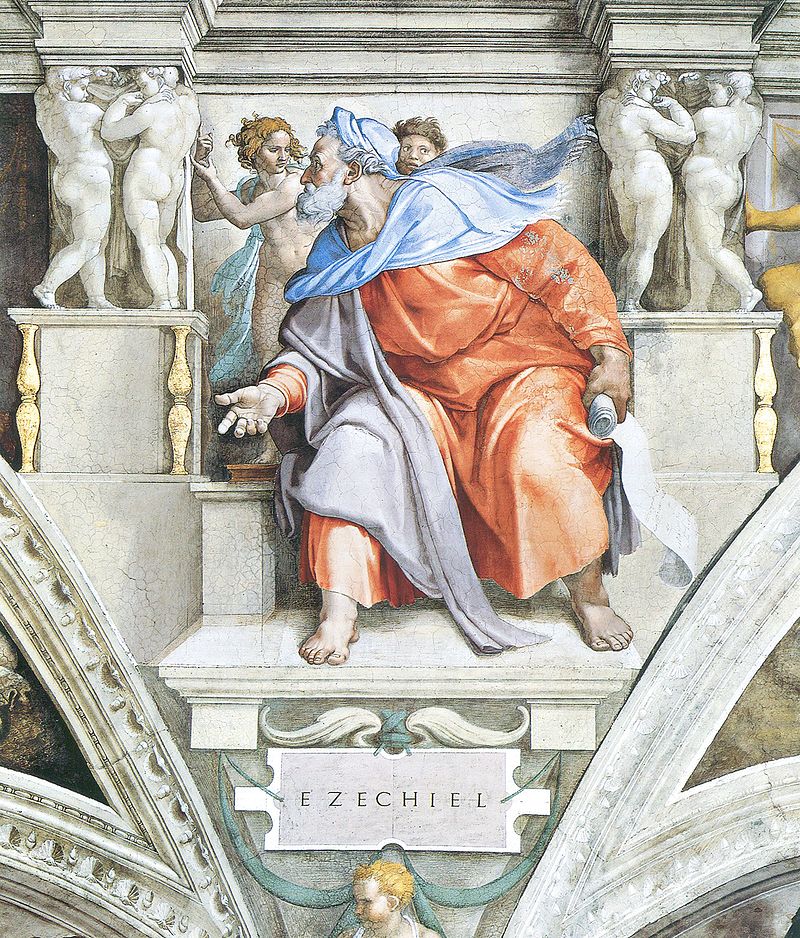
Ezekiel, Michelangelo painting in the Sistine Chapel

Ezekiel is possibly my favorite book of the Bible because of the richness of the prophecy. Virtually the entire book is prophetic, presented sometimes as poetry, sometimes as prose, and sometimes acted out in front of his audience, at God’s direction.

I have enough of an affinity for Ezekiel’s writing that I feel I have as good an understanding of the man and his prophecy as one can have at this distance. I have already commented on his (and others’) throne visions, above. I have also written about several of his prophecies in previous articles, which I’ll link below.

Ezekiel’s prophecies are apparently written chronologically, in the order of their future fulfillment, though not necessarily in the order he experienced them.
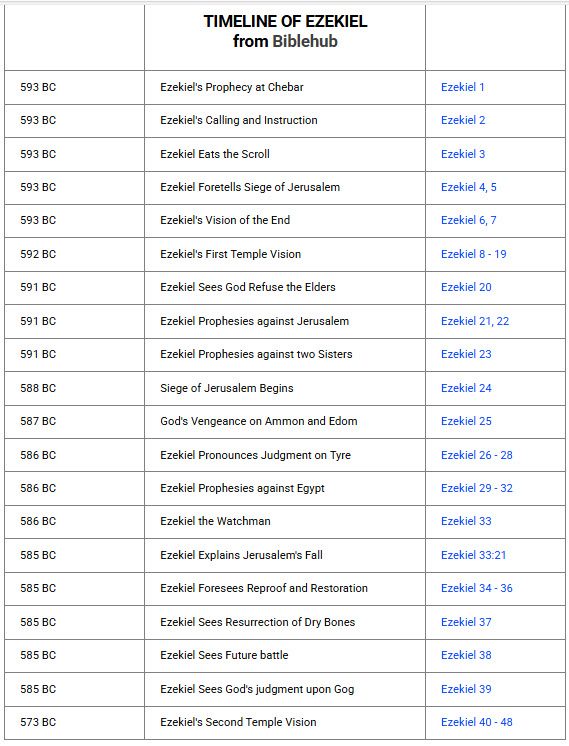
Timeline of Ezekiel, showing the date of the prophecy, not the fulfillment. ©Biblehub

Christian tradition contains a number of misconceptions that are taught by pastors who aren’t necessarily theologians and don’t necessarily have a good grasp on Bible history. Some of those misconceptions are propagated by Israeli tour guides, and the tour sponsors (often pastors) who learn from them. The tour guides are mostly Jewish Israeli citizens, who have learned what they know from manuals prepared and taught at trade schools, not necessarily by folks with religious backgrounds.

Ezekiel 10 – 11 (God Leaves the Most Holy)

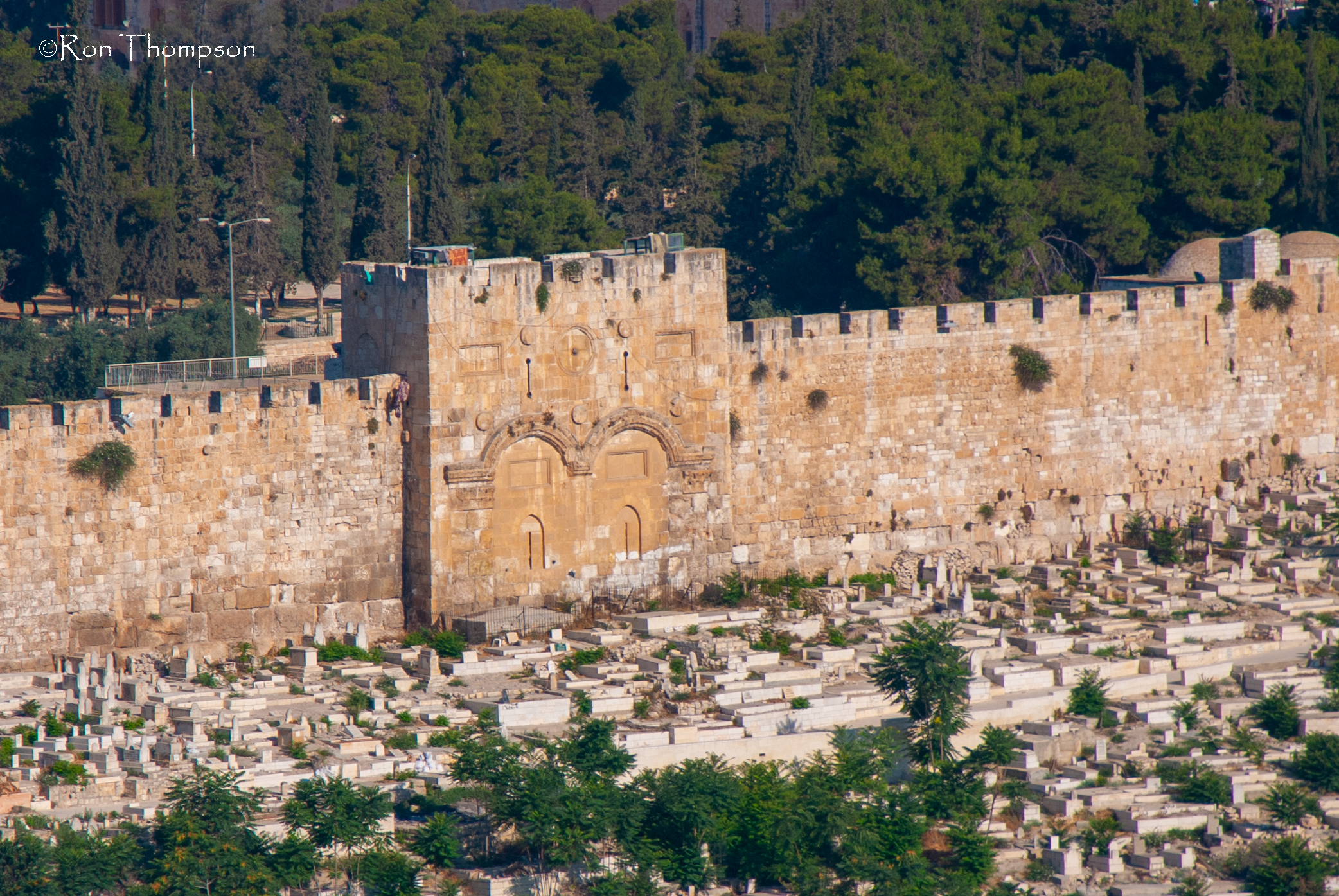
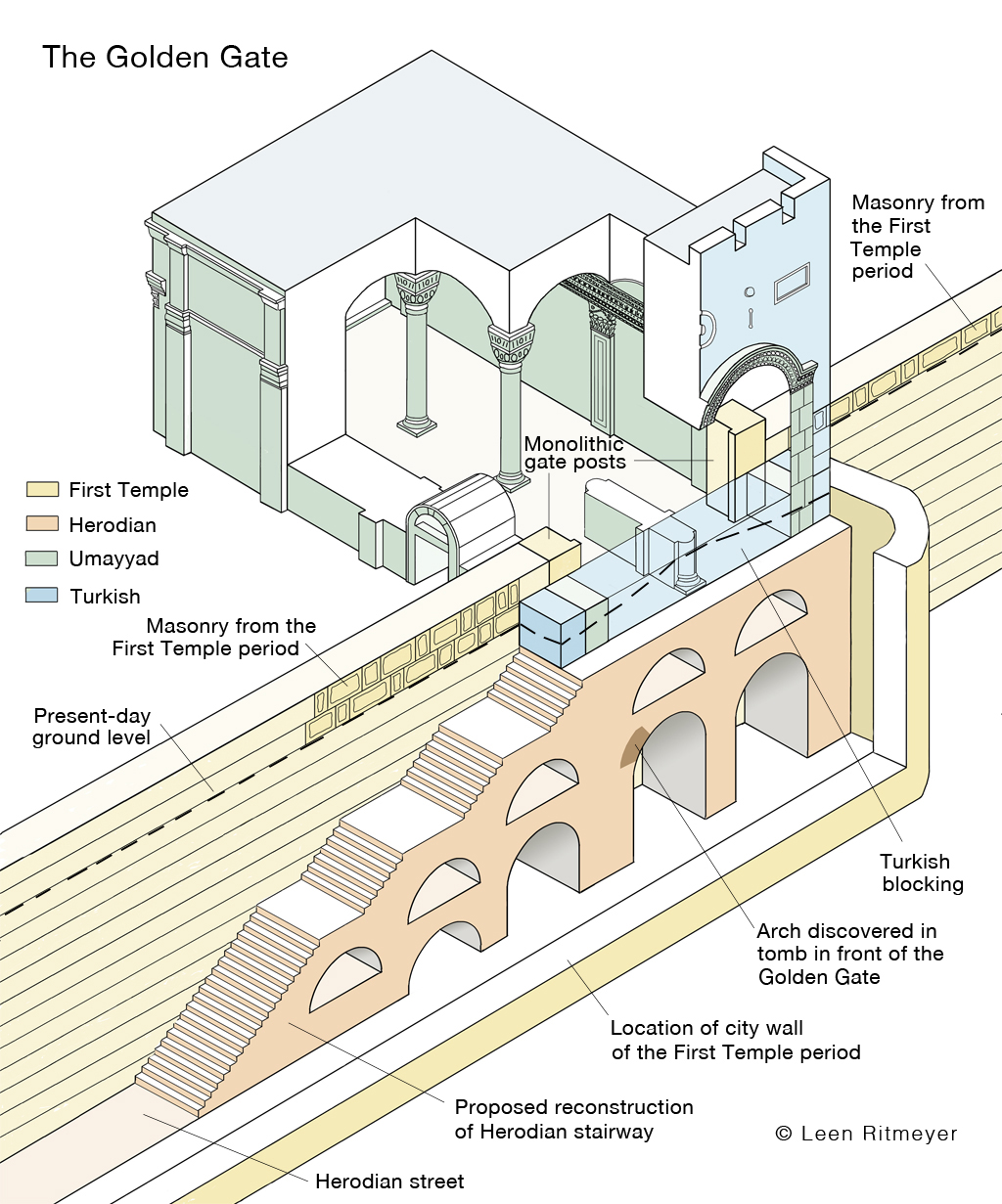
One of the common misconceptions about Ezekiel concerns his prophesies about the Glory of the Lord departing the temple, discussed in this section. Much of the following is reproduced from Opening the Golden Gate, which I first posted on May 12, 2022. In that article I presented a brief history of the Temple and its Eastern Gate and then discussed some of the common misconceptions about that gate.

Then the glory of the LORD went out from the threshold of the house, and stood over the cherubim.
And the cherubim lifted up their wings and mounted up from the earth before my eyes as they went out, with the wheels beside them. And they stood at the entrance of the east gate of the house of the LORD, and the glory of the God of Israel was over them.
—Ezekiel 10:18–19 ESV

Then the cherubim lifted up their wings, with the wheels beside them, and the glory of the God of Israel was over them.
And the glory of the LORD went up from the midst of the city and stood on the mountain that is on the east side of the city.
—Ezekiel 11:22–23 ESV

God is omnipresent, both in space and in time. As our infinite, Almighty God, He can’t be contained in a tent or a building. But because He chose to deal with humanity, as represented by the primitive Israelites, He picked a form in which to appear to them. An “interface”, so to speak. In the desert, it was “a pillar of cloud by day and a pillar of fire by night.” In the Tabernacle, and later the Temple, His “Divine Presence,” in whatever visible form it appeared, was in the Holy of Holies, above the Mercy Seat of the Ark.

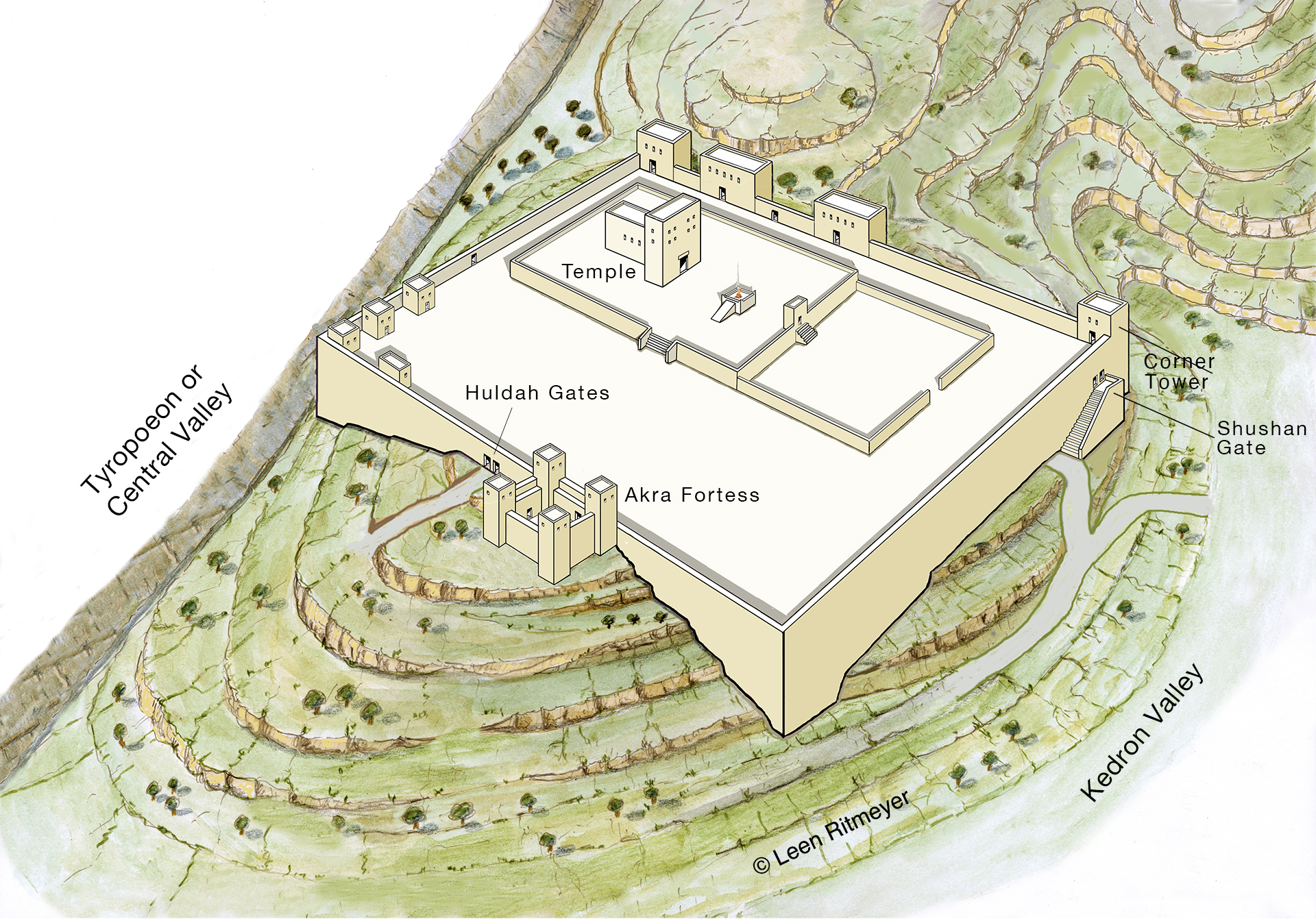
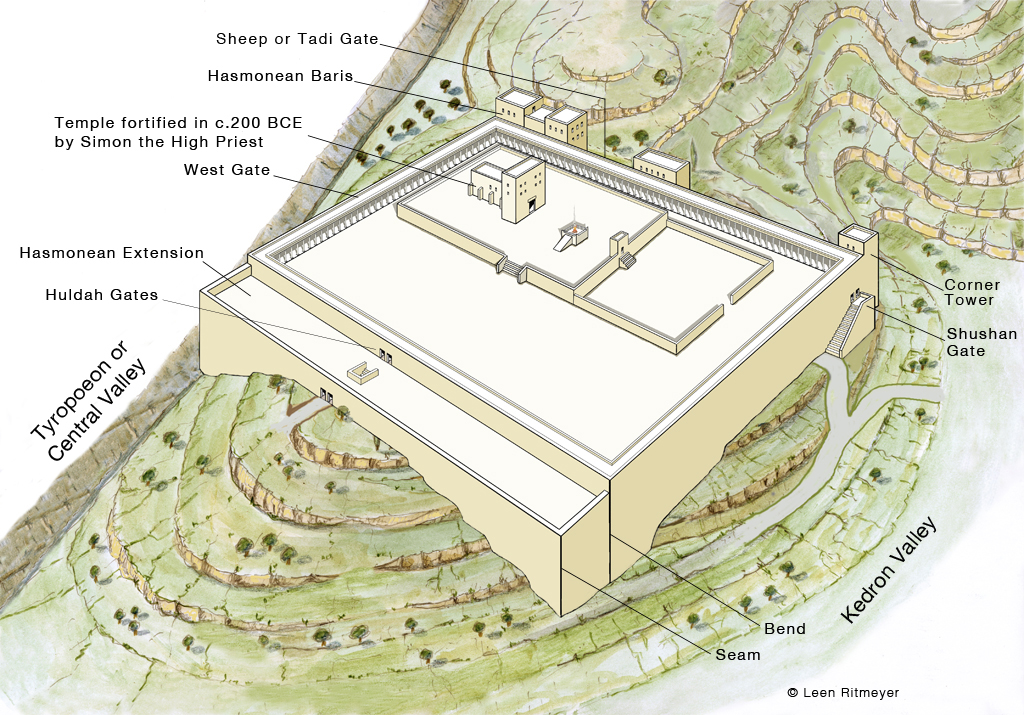
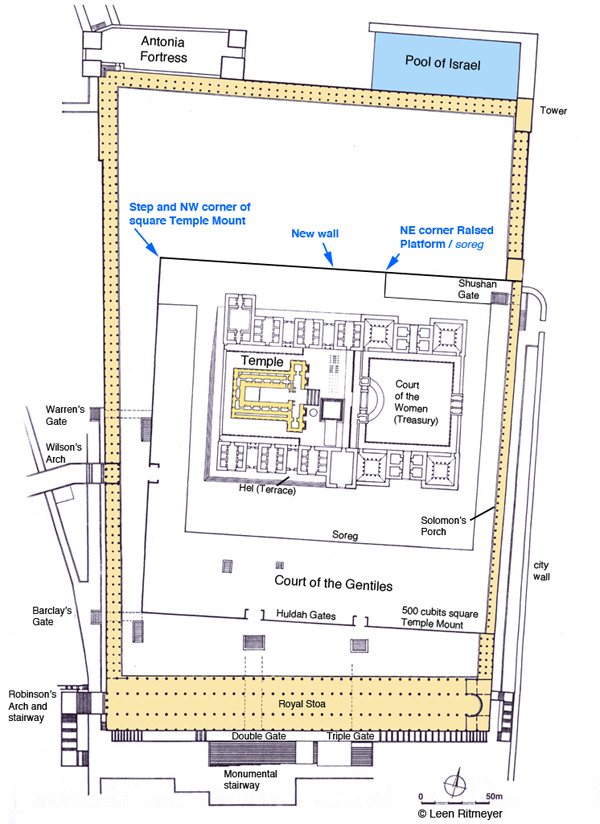
Chapters 8 through 11 of Ezekiel record a vision that came to him while he was sitting in his house with “the leaders of Judah”. In the vision, he was taken to the Temple in Jerusalem and shown men in leadership positions performing “disgusting” idolatrous religious rites in the Temple precincts. God then ordered a scribe to pass through the city and put a seal on the foreheads of innocents, while six other presumably angelic beings followed him and executed anyone not so sealed. The six beings were then told to set fire to the city. After the return of the scribe, God’s Sh’kinah Presence left the Temple, rose above its threshold, paused for a bit over the “east gate of the Lord’s house” (this could be the gate of an interior courtyard, or it could be the Shushan Gate overlooking the Kidron Valley), and then “stood” over the mountain on the east side of the city (no doubt the Mount of Olives).

Most visitors to Jerusalem who have read Ezekiel or have taken the tour guide’s explanation as Gospel truth, are certain that God lived in the Holy of Holies and that He moved out through the Golden Gate. That’s very sloppy theology!

Also, the part about Jerusalemites being “sealed” and those without seals being executed most likely did not happen. I take it as a homiletic description of “sinners in the hands of an angry God,” so to speak.

Ezekiel described an allegory, not reality. Yet it was a prophecy of something that was very real, which came very soon thereafter. Because of corruption reaching even into the Temple, God withdrew His protection from the city and the Temple, and both were sacked and burned by Nebuchadrezzar’s army, with many people killed.

Ezekiel 38 – 39 (Gog and Magog)

Beginning around Ezekiel 34, the prophet begins to shift from prediction of judgement to prediction of restoration. Chapter 37 is the famous “dry bones” prophecy, which I have to think brings us to our own age and the return of Jews to Israel starting in the late 19th century, and culminating with a declaration of independence in May 1947. The next event on Ezekiel’s calendar is the Gog and Magog War, which I believe will occur before the Tribulation period, and possibly before the Rapture.

I wrote a compete article about this prophecy in 2015, in The Coming World War: Gog and Magog. There is no indication whether this prophecy originated from a vision or by some other means, but I think it is appropriate to include it here to demonstrate that even prophecies that were not delivered as visions or dreams can be tricky to understand if you want to insist that every word must be taken in a literal sense.

Players in the Gog & Magog War. Base map annotated by Ron Thompson

I stand by that article as amended from time to time, though I may have taken the participant nations too literally. Populations move around over the centuries, and today’s nations may not occupy the same territories as those of Ezekiel’s day.

Also, my view on the motivations for the attack have changed a bit since the October 7 terror attack in Israel. In a November 2023 update, Did Ezekiel Prophesy the October 2023 Israel/Gaza War?, I stated that the Gog/Magog war would “of course” be precipitated by Iran’s proxies. That cause appears to be pretty much off the table for a while, but I went on to speculate that Russia might take the initiative in an effort to bolster Putin’s waning reputation.

And now President Trump, NATO, and new trade and defensive alliances are backing Putin into a very tight and embarrassing corner. Very interesting!

It frequently happens that prophecy has to be reevaluated when conditions change!

Ezekiel 40 – 42 (The Millennial Temple)

In 573 BC, Ezekiel was given a vision of a new Temple to be built in Jerusalem. He records that vision in great detail in chapters 40 and following of his prophetic book. In an excellent 20th century book entitled Messiah’s Coming Temple, John W. Schmitt and J. Carl Laney analyzed both the design of this temple and the use to which it will be put. It bears a superficial resemblance to previous Temples, but is by far the largest, and in even some of the “essential characteristics”, it differs from them in ways that do not correspond to Jewish law. This is because its purpose will be different in many respects, as outlined in the Schmitt/Laney book.
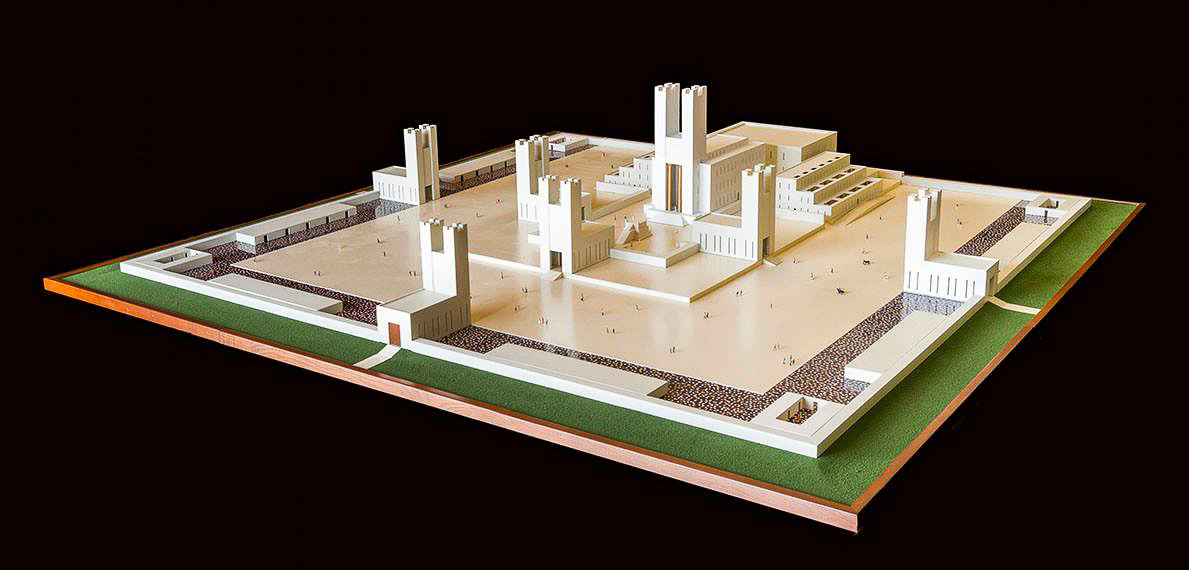
Model of the Millennial Temple, ©John W. Schmitt

The lesson here is less about sloppy reading than it is about neglect.

Judaism mainly ignores this passage because the design of this Temple differs from the Mosaic instructions in several key elements. They claim it can’t possibly be a legitimate design since it doesn’t match the required specs for the Tabernacle and Solomon’s Temple. Of course, the reason for the differences is that Jesus’ death and resurrection changed significant parts of the cultic practice, as mentioned in the book of Hebrews.

Christians, however, neglect it for the opposite reason: they can’t see any use at all during the Millennium for a Temple with an alter and other features needed for any part of the Mosaic Covenant observance.

Both sides are wrong, but I wonder how many of my readers have been even slightly curious about this portion of Scripture. It is God’s Word, so it is important to me!

Ezekiel 43:1–12 (God Returns to the Most Holy)

Then he led me to the gate, the gate facing east.
And behold, the glory of the God of Israel was coming from the east. And the sound of his coming was like the sound of many waters, and the earth shone with his glory.
And the vision I saw was just like the vision that I had seen when he came to destroy the city, and just like the vision that I had seen by the Chebar canal. And I fell on my face.
As the glory of the LORD entered the temple by the gate facing east,
the Spirit lifted me up and brought me into the inner court; and behold, the glory of the LORD filled the temple.
—Ezekiel 43:1–5 ESV

Again, see Opening the Golden Gate.

Beginning in chapter 40, Ezekiel has been once again taken to Jerusalem in a vision, but this was to show him events far in the future, during the Millennial Reign. The vision shows him a new Temple (see the previous section), to be built presumably at the start of the Reign. In chapter 43, suddenly God’s Glory returns to the Temple, but this time through the gate facing east, not above it. The assumption that many people make is that “God’s Glory” here refers to Jesus. The parallels between this and the earlier vision indicate it is God’s Sh’kinah returning—the Father, not the son.

The sequence in chapter 43 is as follows: God’s Glory returns, through the “gate facing east.” God goes into the Temple itself and fills it with His Glory. Ezekiel is standing outside the Temple with the angel who has been showing him around. God calls out from inside, saying that He will now dwell with His people forever, and never again will they defile His house.

So, if it wasn’t Messiah entering through the eastern gate, is Jesus “the prince“, who is mentioned several times in the prophecy? Clearly, He is not! This prince, whoever he is and whatever his function, has sins to atone for, and evidently, he has children. I surmise that he is to be a senior Zadokite priest, over the other priests but reporting to the new permanent High Priest, Messiah.

We know from other prophecies that Jesus will reign from Zion. But nowhere does scripture say that it was Jesus who entered through the eastern gate! And incidentally, there does not seem to be a throne room in Ezekiel’s Temple.

Once again, sloppy reading makes sloppy theology. It is the visible, localized sh’kinah Glory of God, the Father, entering the Temple. But He is entering through a new Eastern Gate, not the Golden Gate, which will no longer exist.

Jesus does return in clouds to Mt. Olivet, but nowhere does scripture say that He enters the Temple to reign. Most likely He’ll reign from a Palace.

Revelation

Of course, most of Revelation is prophetic imagery. I’m only going to hit some high points here. I need to mention that I am not a Dispensationalist, but I am premillennial, and in general, I pretty much agree with the Dispensational interpretation of Revelation. But not everything…

Chapter 8–9 (trumpets)

First, there are no trumpets in this passage! I plan to show in a future post that shofarim (animal horns used for blowing) are in view here. A shofar is blown like a trumpet, but it is not a trumpet, and the two have different functions in the Bible. In reality, therefore, this chapter is about the Seven Shofar Judgements!

Two shofarim. The large one on the top shelf is a traditional Yemenite shofar, made from a Kudu horn. The small shofar on the lower left is made from a ram’s horn. ©Ron Thompson

In verse 8:1, the Lamb opens the 7th Seal, which releases “thunder, lightning, [sounds or voices] and an earthquake“, 8:5. The “sounds or voices”, (translated “rumblings” in ESV) are part of the vision, and unexplained. The Seal sets the context for the 8 shofarim to follow, and suggests that the judgements are connected in some way to powerful tectonic and atmospheric forces on earth.

The first shofar judgement is hail and fire, mixed with blood, resulting in “a third of the earth … burned up, and a third of the trees … burned up, and all green grass … burned up” , 8:7. Using the hermeneutic principle of taking the plain sense of the verse if it “makes common sense,” we might then opine that the storms of verse 5 will produce the hail, and the lightning will set the fires. The third of the “earth” burned up might simply be a reference to the location of the burned portion of the vegetation. The blood mixed with the hail is harder to explain.

The second shofar judgement is “something like a great mountain burning with fire” causing the death of sea creatures and destruction of ships. That much is easy to explain as a large asteroid hit, but once again there is unexplained blood that casts doubt on the interpretation.

The third shofar judgement would appear to be a comet rather than another asteroid. Asteroids mostly originate in the Asteroid Belt, between Mars and Jupiter, and have compositions similar to those of the inner planets. Comets usually come from the Keiper Belt outside the orbits of the planets, and some “long-period” comets don’t originate in the solar system at all. A naturalistic explanation of “Wormwood” would be such a comet containing an unfamiliar compound that scatters in the wind and turns water sources bitter.

The fourth shofar judgement would seem to follow naturally from either or both of the “falling stars”.

While the first four shofar judgements, chapter 8, may possibly have a more or less naturalistic mechanism, judgements 5 and 6, chapter 9, are clearly supernatural from start to finish. I won’t attempt to explain them here, except to speculate that they should probably be taken at face value.

Note, however, that the “star” of 8:10 is no doubt an inanimate orbiting body (as opposed to a literal star), but the star of 9:1 is angelic. Angels are frequently referred to metaphorically in Hebrew literature as stars.

The 7th shofar, like the 7th Seal, is introductory for what follows it.

Like the shofar judgements, many Biblical prophecies can be interpreted naturalistically, while others can’t. It’s not always possible to know which is the case. Unfortunately for those of us who crave to understand every word spoken by God, both naturalistic and supernaturalistic prophecies can have an ultimate meaning that is either literal or metaphorical, or even both!

Chapter 10 (the angel with the little scroll)

This angel is also described, in verses 2 and 5 as the angel with his right foot on the sea and his left foot on the land.

Most scholars will tell you that prophetic references to the sea are speaking of chaos. The sea is chaotic. The land is not or is relatively free of chaos. I totally disagree with this interpretation!

All Bible prophecy is at its core Jewish. To the ancient and classical Jews, “the land,” when used metaphorically in prophecy, almost always refers to Eretz-Yisra’el, the Land of Israel, and “the sea” refers to all other lands on earth. Thus, the angel and the little scroll are going to effect both Jews and gentiles in some way.

At least portions of some Biblical prophesies can be interpreted with a high degree (though less than 100%) of certainty if certain key words or phrases are detected. Conversely, missing these keys may lead to completely erroneous conclusions.

Chapter 12 (a woman and a war)

This is a hotly contested passage that I will not say much about here. I believe it is partly a flashback to Jesus’ birth, and partly a discussion of Israel’s disposition going into the second half of the Tribulation.

Verses 1–5 are seen by some of the more radical (in my view) prophecy teachers to be signs that will appear in the zodiac at the close of the Trumpet Judgements. There are whole books written on this interpretation. There have always been Jewish and gentile Christian teachers who dabble in astrology, but that, in my opinion, is a pagan practice that has no place in God’s prophetic scheme.

What the passage is to me, is a highly figurative description of Messiah’s birth, not to Mary, but to Israel in general, and of His death and ascension into heaven.

Verses 7–12 is description of an angel-versus-angel war in heaven following the incarnation of The Son. A large number of disgruntled angels, led by Satan (Lucifer, if you will), enraged by this affront to the power they had gained on earth since the dispersal from Babel, waged war in heaven with the faithful angels, led by Mikha’el (Michael, see Daniel 10:21), the champion of Israel.

Prior to this outright war, the first recorded angelic rebellion was when Satan contradicted Elohim in the Garden. Subsequently, there were several angelic rebellions, but the “bad guys” were still given access to God at His Divine Council in heaven. This war marked the end of that access:

7 Now war arose in heaven, Michael and his angels fighting against the dragon. And the dragon and his angels fought back, 8 but he was defeated, and there was no longer any place for them in heaven.
— Revelation 12:7-8 (ESV) emphasis mine

Chapter 13–14 (the two beasts)

Once again, I will not try to dig for everything in these chapters, but I do want to mention a few points about Antichrist and his realm.

The “Beast from the Sea”

Jerry Falwell, Sr. famously stated that the Antichrist will “definitely be Jewish.” On the contrary, Antichrist’s origin in “the sea” unmistakably marks him as gentile (see the previous section).

Naming the Antichrist can’t be done using only this passage. Other passages in Revelation, Matthew, and elsewhere in the NT must be considered, along with various OT prophecies, especially in Daniel and the Minor Prophets. Still only guesswork is possible.

Counterfeit Christ?

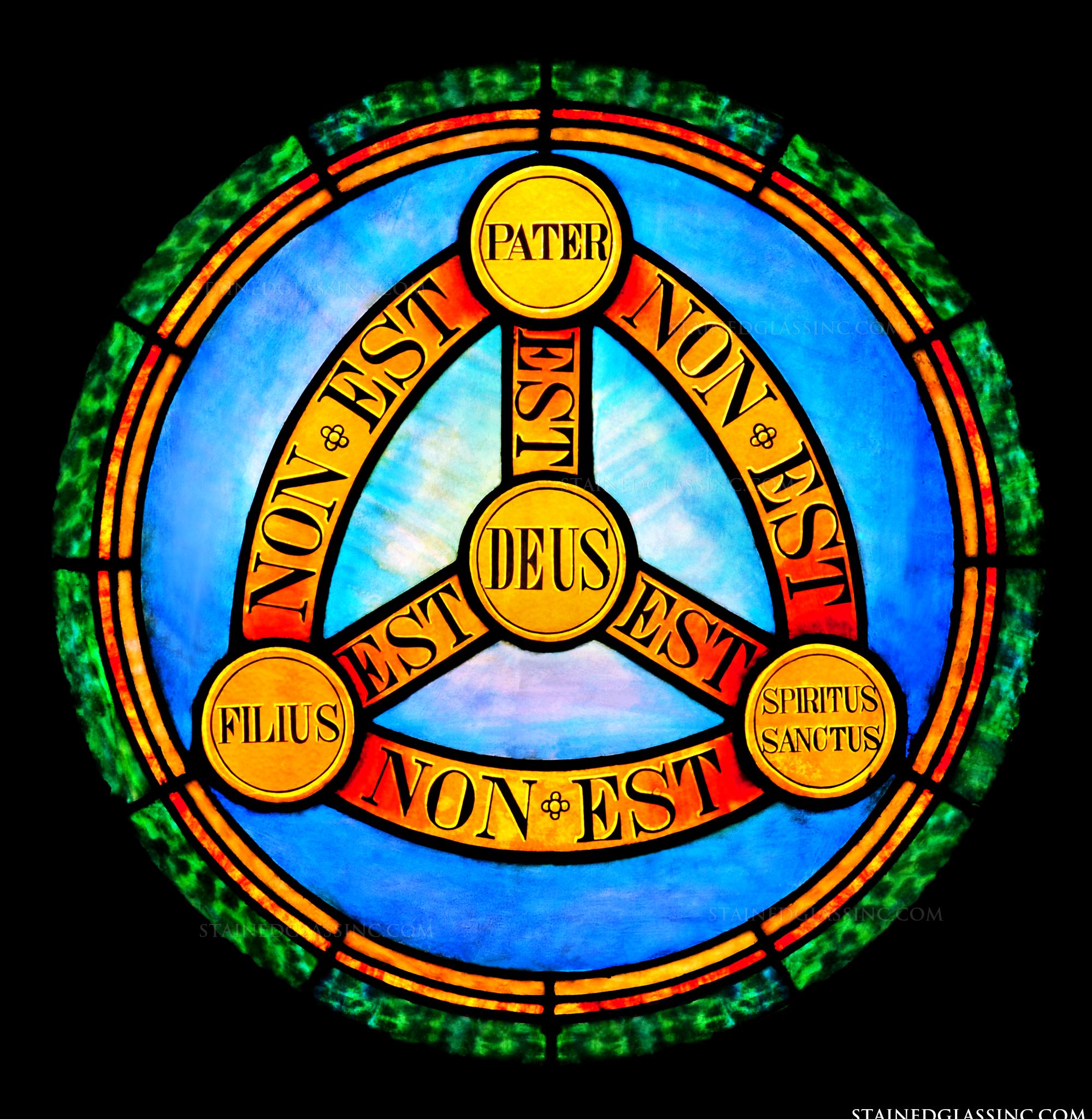
Many commentators and pastors describe Antichrist as “a counterfeit Christ,” and that may be a big part of why Falwell decided he is Jewish. That is a misunderstanding of Antichrist’s role. Without question there are some parallels between the Trinity and the realm that Satan tries to establish here, but I see Antichrist as simply a false God, a pagan deity opposed to Jesus.

“Anti-Christ” means “opposed to the Messiah”, not a fake or a negative image of Messiah.

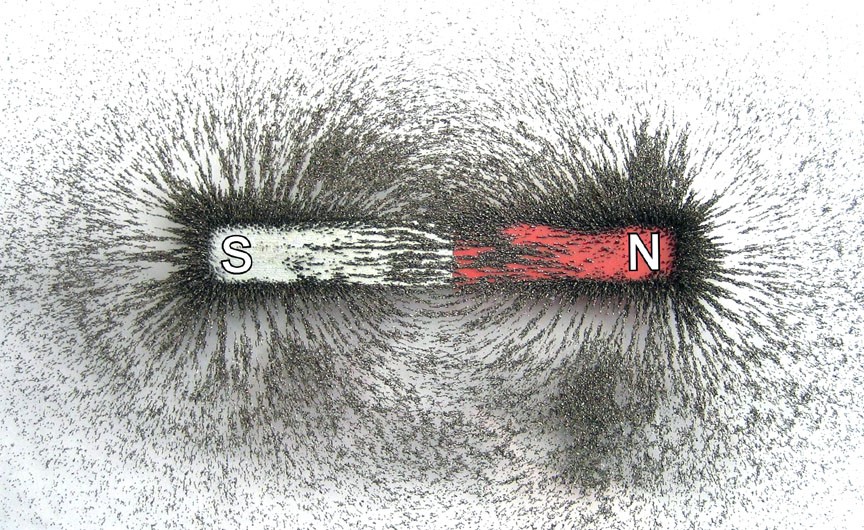
Antimatter is not counterfeit matter. A positron is an antielectron, meaning it is an electron with a positive, rather than negative, charge. If an electron and a positron come into contact with each other, both are instantly annihilated.

Fatal wound

Verse 13:3, speaking of Antichrist, says:

One of its heads seemed to have a mortal wound, but its mortal wound was healed, and the whole earth marveled as they followed the beast.
— Revelation 13:3 (ESV)

“Seemed to have a mortal wound” translates the Greek phrase, ὡς ἐσφαγμένην ἐσφαγμένην θάνατον, literally, “[was] as having been slain to death.” Similarly, “mortal wound” is πληγὴ τοῦ θανάτου, literally, “wound of death.” The phrasing here convinces me that this is not saying Antichrist was killed, but merely that he had a wound that at least briefly seemed to have been fatal. The timing of the event is also not addressed. He could have survived a wound as a child and the press coverage later flaunted as he gained power. Or he could have survived an assassination attempt during his rise in power.

The “Beast from the Land”

The “Beast from the Land”, aka, the “Second Beast”, aka, the “False Prophet” will more nearly take on the role of a false Messiah. And by the way, his origin in “the Land” identifies him as Jewish.

Horns and Heads

Revelation 13 and Daniel 7 both speak of the Antichrist as having ten horns (each with a diadem) and seven heads. Rev. 12 and 17 also speak of Satan (the Red Dragon, identified as the Serpent) as likewise having 10 horns and seven heads, so the two (Dragon and Satan) are connected in some way, presumably master and servant. No surprise.

Dan. 7:24 and Rev. 17:12 identify the horns as “kingdoms” from which the Antichrist will rise. In Rev. 17:9, the seven heads are identified as “seven mountains on which the woman is seated”, and at the same time, “seven kings.”

Despite numerous attempts that I have personally read going back at least to Hal Lindsey’s Late, Great Planet Earth and Satan is Alive and Well on Planet Earth, nobody has ever done better than guess as to the identities of those 10 “kingdoms.” Back then it was the Common Market, but that quickly outgrew ten nations. Tim LaHaye’s Left Behind books, Biblically dubious in so many ways, picked the United Nations.

My own guess is that the Gog and Magog War, which God Himself will end, will leave both sides hugely weakened but will not quell the centuries of compounded hatred in the region. A powerful world leader will then gather a group of ten heads of state around a table to produce the peace treaty that guarantees Israel’s safety going forward—and sets The Tribulation in motion. More or less in the pattern of President Trump’s August 2025 initiative to stop the Russia/Ukraine War.

In other words, the 10 horns need only be powerful entities. It would make sense to me if they were ten individual members of the larger European Union or NATO, a political or economic cartel, perhaps even huge corporations, or megarich Oligarchs. I suppose we’ll know them when they become obvious.

A Revived Roman Empire?

News Flash: The Roman Empire is dead! It ain’t coming back! I’m not ruling out that Antichrist’s empire could have similar characteristics, similar membership, or even the same general location (which might be around Rome, Istanbul, or Even Aachen, Charlemagne’s medieval capital in the Holy Roman Empire.

The notion of a “Revived Roman Empire” comes from a modern view of Daniel’s interpretation of Nebuchadrezzar’s statue dream in Daniel 2. I agree that we are correct in seeing the gold, silver, bronze and iron segments of the statue as Babylon, Medo-Persia, Greece, and Rome, respectively (many Christians have other views). But where others see a Revived Roman Empire, I see the feet and toes made of iron mixed with clay as merely the fragmented post-Roman world from the Middle Ages on through the present:

Daniel 2:43 (CJB)
[43] You saw the iron mixed with clay; that means that they will cement their alliances by intermarriages; but they won’t stick together any more than iron blends with clay.

A pair of Dreams

Since this post is now becoming insufferably long, I’m going to close with just two more examples…

Joseph and the sheaves

Behold, we were binding sheaves in the field, and behold, my sheaf arose and stood upright. And behold, your sheaves gathered around it and bowed down to my sheaf.”
— Genesis 37:7 (ESV)

Everyone is familiar with Joseph’s older brothers’ hatred for him because of the favoritism shown to him by their father. The intricate (from פַס, pahs, a difficult to pronounce guttural adjective if your language is English) robe given him by Jacob, probably “long-sleeved” rather than “multicolored”, greatly exacerbated the problem. When he then naively repeated his dream to the brothers, it was certainly a (forgive me) last [bundle of] straw.

Nobody needed to interpret that dream! Clearly, they recognized that it was a metaphorical picture of them, bowing down abjectly to their snotty young brother.

There is a tendency among Christian interpreters of Jewish Scripture to read literal meanings into visions and dreams even when it is clearly the symbolism that is vital. In this case, we understand that the brothers are right—the dream is indeed picturing them bowing to their brother.

Because of the absurdity of the dream itself, we understand that it is an allegory for Joseph’s relationship with his brothers, not a prediction that their crops will worship his!

Peter and the sheet

Here is another Biblical dream that uses an allegory to illustrate a Jewish premise. In this case, though, most gentile Christians (which today means most Christians) have a very weak understanding of Judaism and the Mosaic Covenant, so they take both the allegory and its premise literally.

10 [Peter] became hungry and wanted something to eat, but while they were preparing it, he fell into a trance 11 and saw the heavens opened and something like a great sheet descending, being let down by its four corners upon the earth. 12 In it were all kinds of animals and reptiles and birds of the air. 13 And there came a voice to him: “Rise, Peter; kill and eat.” 14 But Peter said, “By no means, Lord; for I have never eaten anything that is common or unclean.” 15 And the voice came to him again a second time, “What God has made clean, do not call common.” 16 This happened three times, and the thing was taken up at once to heaven.
— Acts 10:10-16 (ESV)

When Peter woke from his trance, did he immediately run to the kitchen and shout, “Halleluiah, hold the falafel and hummus on pita and bring me a ham and cheese sandwich!”? No, he “was inwardly perplexed as to what the vision that he had seen might mean.” He knew that his God would not tell him to violate Kashrut (the dietary laws under Covenant), so he thought that it made absolutely no sense.

But by the time he met with Cornelius, he’d figured it out:

And he said to them, “You yourselves know how unlawful it is for a Jew to associate with or to visit anyone of another nation, but God has shown me that I should not call any person common or unclean.
— Acts 10:28 (ESV) emphasis mine

As with Joseph’s sheaves, the sheet here is a picture, not the actual subject under discussion. I’ve stated in other articles that I believe the Mosaic Covenant, including its dietary laws, is still in force for Godly Jews. This passage by itself cannot prove me wrong (or right), because it is not about food, it’s about people.

Conclusions

Dogmatic interpretations of visions and dreams is seldom, if ever, possible unless corroboration is provided elsewhere—by means, for example of:

  1. Interpretation by the prophet himself, if provided.
  2. Direct interpretation by statements elsewhere in Scripture.
  3. Clear fulfillment elsewhere in Scripture.
  4. Parallelism, where two or more passages each contribute information.
  5. Ancient Jewish thought from Hebrew literary sources.
  6. Ancient Near Eastern (ANE) thought from ANE literary sources.
  7. Ancient history.
  8. Post-Biblical History.
  9. Current events.

Prophetic understanding sometimes comes slowly, and sometimes in bits and pieces. The Old Testament alone was not clear on the fact that the Messiah would come twice, with different agendas.

Prophecy has to be reevaluated when conditions change. Which goes along with my main purpose in writing this article—to urge against being too dogmatic about prophetic interpretation.

Over-interpretation by modern-day Christians is risky, though it may be entertaining!


Created in God’s Image


Posted on:

Modified on:

  1. The language of Image and Likeness
    1. Image
    2. Likeness
  2. The nature and attributes of God
    1. Does God have a body?
    2. God as a spirit
    3. God’s attributes
  3. Defining “God’s Image and Likeness”
    1. Attributes as image
      1. Physical attributes
      2. Intellectual attributes
      3. Family resemblance
      4. Body/Spirit
      5. Trinity vs body/soul/spirit
    2. Image as function
      1. Analysis of Genesis 1:26–28
      2. Evidence from the Hebrew
      3. The commission
    3. Another functional Model

So, what does that term, image, even mean? Here’s a paraphrase of Merriam-Webster® as it applies to an image of a person (or a being like a god or angel):

  1. A reproduction or imitation of the form of a person; especially, an imitation in solid form (a statue).
  2. A visual representation of someone captured by an optical or photographic device of some sort.
  3. A person that is an exact likeness or close duplicate of someone else.
  4. An incarnation or apparition of someone.
  5. A mental picture, impression, or conception of a person held in common by members of a group.
  6. A vivid or graphic representation or description of a person.
  7. A popular conception or caricature of a person.

Well, that’s a start, but we have to be careful when we impose English translations on another language, especially a language as spoken 2,000 years ago and before.

The language of Image and Likeness

The Bible claims that man was created in the image and likeness of God. We are all aware of that, but there is wide disagreement about what it means. Here are the relevant Scriptures:

26 Then God said, “Let us make man in our image, after our likeness. And let them have dominion over the fish of the sea and over the birds of the heavens and over the livestock and over all the earth and over every creeping thing that creeps on the earth.”

27 So God created man in his own image,
in the image of God
he created him;
male and female he created them.
— Genesis 1:26-27 (ESV)

1 This is the book of the generations of Adam. When God created man, he made him in the likeness of God. 2 Male and female he created them, and he blessed them and named them Man when they were created.
— Genesis 5:1-2 (ESV)

6 Whoever sheds the blood of man,
by man shall his blood be shed,
for God made man in his own image.
— Genesis 9:6 (ESV)

Image

I found 15 Hebrew words in the Old Testament (OT), categorized by 15 different Strong’s numbers, that are sometimes or always translated as “image.” Almost all of those refer specifically to idols, either in general or by category, or sometimes descriptively, as “abomination.”

However, I will concentrate here on the one word for “image” that appears in the above verses:

צֶלֶם, tselem (H6454), per Strong’s Exhaustive Concordance, “From an unused root meaning to shade; a phantom, i.e. (figuratively) illusion, resemblance; hence, a representative figure, especially an idol — image, vain show.”

Elsewhere, this particular word is used:

  • In Genesis 5:3, to describe Seth as a son of Adam.
  • In Numbers, 1 Samuel, 2 Kings, Ezekiel, and Amos, in reference to various types of idol.
  • In Psalms, to refer to a man’s shadow or his phantom.

Likeness

“Likeness” is a translation of the Hebrew,

דְּמוּת, dmuwth, per Strong’s Lexicon, “Likeness, resemblance, similitude.” Note that “likeness” and “resemblance” refer to similarities in appearance or other traits. “Similitude” includes the above meanings, but also more general comparisons, like similes, analogies, caricatures, patterns, correspondences between abstractions, or modern concepts like photographs.

In Genesis 1:26, it refers to Seth’s likeness to Adam, but elsewhere in the OT it usually refers to prophetic visions, as in Ezekiel 8:2, “Then I looked, and behold, a form that had the appearance of a man.”

The nature and attributes of God

When reading in the Bible that God created humankind in His image, there is an almost overwhelming tendency to assume something from the list of 7 definitions for “image” at the top of this article. But what all seven of those definitions have in common is that they all pertain to the physical substance of a person or being. But does God have any physical features that can be visualized, i.e., “imaged?”

Does God have a body?

When many unsophisticated people, Christian or not, visualize God, they probably see something like this digital artwork:

Artist’s conception of God. ©Gabriel Magalhães

It’s true that the Bible does sometimes speak of God in human terms, describing Him as having eyes, ears, mouth, hands and arms. But almost all theologians recognize these as anthropomorphisms, which are common in the literature of Israel and the Ancient Near East in general.

According to literarydevices.net anthropomorphism is “a technique in which a writer ascribes human traits, ambitions, emotions, or entire behaviors to animals, non-human beings, natural phenomena, or objects.”

©Bill Watterson

The Bible also describes God as having wings and feathers:

He will cover you with His feathers,
and under His wings you will find refuge.
His faithfulness is body armor and shield.
— Psalm 91:4 (TLV)

As a young man, one of my most cherished pastors fervently believed that God has a humanoid body. He took the position on all things Biblical that, “The Bible says it, I believe it, and it’s so!” Well, in general that’s a good approach, but the Psalms are poetry and songs, and that genre of Scripture in particular (along with prophecy) contains a lot of figurative language. No, God is not a bird. Or even an angel.

God as a spirit

The overwhelming evidence of Scripture is that God is a spirit.

Be careful here. When we read about “the spirit of God” or the “Holy Spirit“, that is a different subject, which you can read about in Monotheism and the Trinity. I won’t get into that here.

One verse makes the spiritual essence of God more or less explicit:

23 But the hour is coming, and is now here, when the true worshipers will worship the Father in spirit and truth, for the Father is seeking such people to worship him. 24 God is spirit, and those who worship him must worship in spirit and truth.”
— John 4:23-24 (ESV)

Once again, caution is necessary. Nobody with a theological background ever said the Bible is crystal clear from cover to cover. The subject of this verse is, “those who worship him must worship in spirit and truth.” The independent clause, “God is spirit”, is a little ambiguous without further definition.

Other verses imply the same thing by pointing out that He is immortal and invisible, both of which are not characteristics of corporeal beings. For example:

To the King of the ages, immortal, invisible, the only God, be honor and glory forever and ever. Amen.
— 1 Timothy 1:17 (ESV)

15 He [Jesus] is the image of the invisible God, the firstborn of all creation.
— Colossians 1:15 (ESV)

The contrast drawn in the poetic doublet that starts Isaiah 31:3 suggests the same:

Now Egyptians are men and not God,
and their horses are flesh, not spirit.
— Isaiah 31:3a (TLV)

But above all, to my mind, God’s omnipresence and eternality necessitate His incorporeal nature. You can’t span all of the universe and all of time if you are encumbered by a physical body. Please read about this in detail in another previous post, Implications of God’s Omnipresence and Eternity in Space-Time.

God’s attributes

Theologians recognize a number of characteristics, or attributes, of God. Some of these, called the noncommunicable attributes of God, are characteristics of God and God alone. No other creature in the universe, including mankind or the Heavenly Host, can possess these attributes. We will never be omniscient or omnipotent, for example. Even our eternal life is not quite the same. God is “from everlasting to everlasting.” The best we can be is “from now to everlasting.” And even that is not ours by default; it is ours at God’s direction and at His pleasure.

By contrast, God’s so-called communicable attributes are shared to a lesser degree with angels, humans, and to a very small degree, animals. These attributes include:

  • Sentience
  • Consciousness
  • Intelligence
  • Ability to communicate
  • Rationality
  • Curiosity
  • Emotionality
  • Willfulness
  • Conscience
  • Religiosity

Defining “God’s Image and Likeness”

The Bible doesn’t explicitly state, in terms that are clear to the modern world, what it means to be “created in God’s image and likeness“, which is why there are so many opinions on the subject. We’ll examine some of these opinions, simplifying somewhat by treating image and likeness as nearly synonymous.

Attributes as image

Most proposals for understanding how mankind is an image of God hold that man is somehow a copy, though necessarily inferior, of some aspect of God Himself. Stated another way, that mankind has inherited from God, via creation, some arbitrary set of His attributes.

But if that is the case, we have to consider what particular aspect or aspects of God we could possibly possess that might in any way correspond to any part of Him.

Which of our human attributes, in other words, clearly mark us as an image Almighty God?

Physical attributes

I’ve already expressed the view that God has no physical body. That seems obvious to me, but it isn’t to everyone, and possibly not to anyone at all in the ancient world. Let’s examine here,


Why humans are or have been presumed by some to “look like God”

Because of common origins in the pagan culture of Babel, Biblical Israel and the surrounding nations shared many customs and conceptions. Their understanding of the nature of the universe is one example.

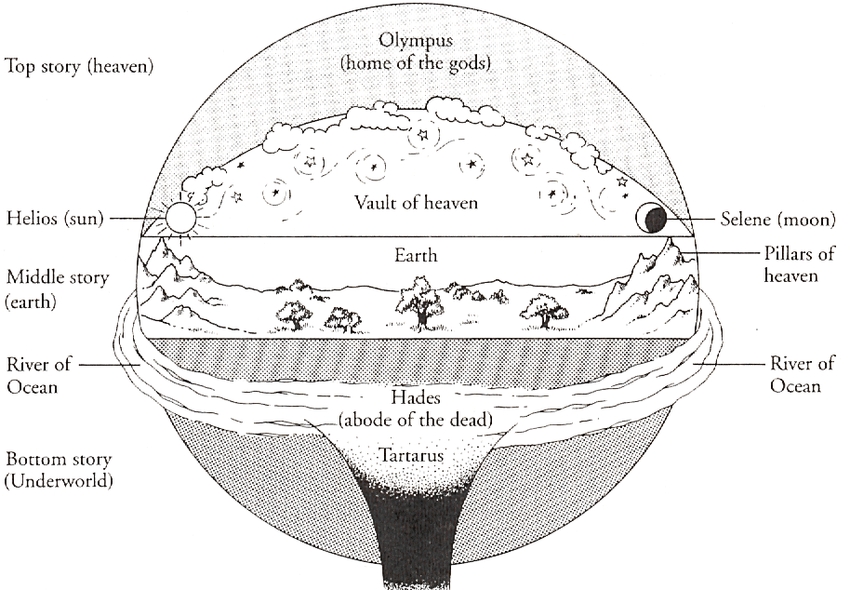
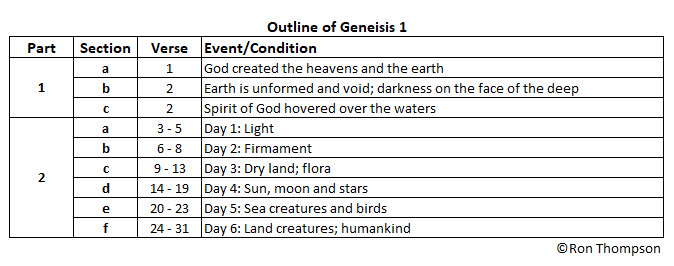
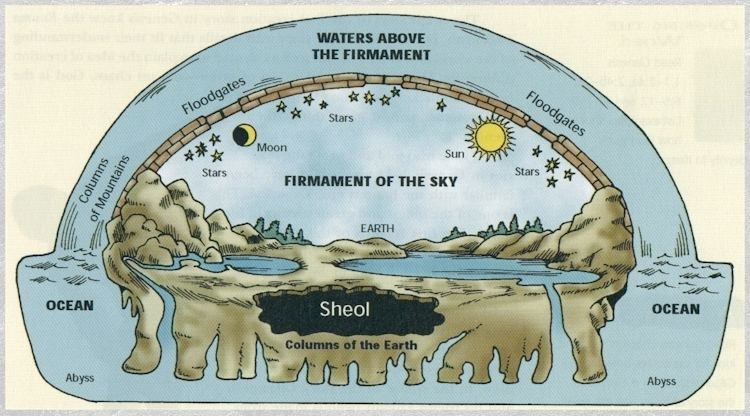
The Genesis 1 version of our universe. Obviously, this is very similar to diagrams I’ve previously posted of the cosmos as visualized by other Ancient Near East Cultures.

Another commonality you will see in pagan literature is that almost all peoples visualized the gods as having humanoid bodies, with perhaps animalistic features thrown onto some. I suggest that there is good reason for this:

8 And they heard the sound of the LORD God walking in the garden in the cool of the day, and the man and his wife hid themselves from the presence of the LORD God among the trees of the garden. 9 But the LORD God called to the man and said to him, “Where are you?” 10 And he said, “I heard the sound of you in the garden, and I was afraid, because I was naked, and I hid myself.”
— Genesis 3:8-10 (ESV)

The wording of this passage implies that the LORD God was walking in the garden in some tangible form, perhaps rustling leaves, disturbing stones and breaking twigs in passing. The fact that they recognized the sound indicates that He had probably done so in the past. In other Biblical theophanies, the form was apparently always humanoid, so as to soothe the fears of those He confronted. Angels who materialized in front of humans at God’s behest also did so in human form.

I would suggest (you’ll need to read on for an explanation of this startling idea) that the pagan gods (bad angels) on occasion did the same, often with some sort of “enhancement” to their form for the purpose of conveying the image, fierce, soothing, or whatever else that they wished for their people to see.

Bible readers often form the impression that the pagan peoples of the ANE (Ancient Near East) worshipped lifeless idols, and in fact that was a charge frequently leveled by the prophets to insult the worshippers. The fact is, though, that the idols were constructed as a “housing”, or focal point, for an invisible God or goddess who inhabited it. Who were those “gods”, and were they real?

According to the following passage, when God scattered the nations from Babel and “confounded their languages,” He assigned angelic overseers to each nation that resulted. Perhaps these particular angels were already corrupt, but if not, they eventually became corrupt and claimed to be gods.

8 When the Most High divided the nations, when he separated the sons of Adam, he set the bounds of the nations according to the number of the angels of God.
9 And his people Jacob became the portion of the Lord, Israel was the line of his inheritance.
—Deuteronomy 32:8–9 LXX-B (emphasis mine)

Ur, from which Abraham emerged, was probably inhabited by descendants of Shem’s son, Arphaxad. Verse 9, above, refers to the time when God, Himself, selected Abram/Abraham from the Ur2 culture and claimed His own portion, the family of Abraham’s grandson, Jacob.

The Table of Nations, per GotQuestions.org

For confirmation of this theory, read Daniel 10, where an angel sent to aid Daniel stated that he was delayed because “the prince of the kingdom of Persia” resisted him for 21 days until the angel Michael came to his rescue. Also, consider:

For we do not wrestle against flesh and blood, but against the rulers, against the authorities, against the cosmic powers over this present darkness, against the spiritual forces of evil in the heavenly places.
— Ephesians 6:12 (ESV)


Since God is clearly, in my view, a disembodied spirit, it is just as clear to me that we can’t look to His physical attributes to understand how we are His image.

He did not create us to look like Him!

Intellectual attributes

The communicable attributes of God are listed above, in part. I think of them primarily as intellectual attributes, because all of them involve mental capacity on some level. All originate in the brain.

Many folks think that we are God’s intellectual image and likeness. The following quotation, plus an evening spent reading through Job, should put that idea to rest!

8 “For my thoughts are not your thoughts,
and my ways are not your ways,” says ADONAI.
9 “As high as the sky is above the earth
are my ways higher than your ways,
and my thoughts than your thoughts.
— Isaiah 55:8-9 (CJB)

But in case it doesn’t, consider that virtually all animals think, on some level. Some species have less intelligence than others, but that doesn’t mean they have no intelligence at all. Yet, animals are nowhere said to be created in God’s image.

Furthermore, God’s image is a property imparted to all humans at creation. The corollary is that any child of a human that doesn’t possess all, or is missing even some, of the characteristics of God’s image, whatever it is, is not in fact human. If the intellectual attributes are what define God’s image, then unborn human babies, some of the disabled, or the comatose, would be excluded. On the flip side, my cat possesses all of those characteristics to some small degree. She thinks she’s human, but most of you would disagree with her self-assessment.

Family resemblance

Another view is that we are God’s image in the sense that a son is his father’s image. This view comes from,

1 This is the book of the generations of Adam. When God created man, he made him in the likeness of God.

3 When Adam had lived 130 years, he fathered a son in his own likeness, after his image, and named him Seth.
— Genesis 5:1, 3 (ESV)

While this doesn’t constitute proof, I first want to point out that while verse 3 uses the term “image” (tselem), verse 1 does not. The term “likeness” (dmuwth) is used in both verses and precedes “image” in verse 3. Recall that both terms can be used metaphorically, but that is much more frequently the case with “likeness” than with “image.”

I would suggest that the reason this argument from the wording is pertinent is the following:

The “family resemblance” argument for image is invoked, at least where I have heard it, because elsewhere in Scripture, redeemed humans are called “Sons of God” (Mt 5:9; Lk 20:36; Rom 8:14,19; Gal 3:26), just as the Heavenly Host (“angels”, aggelos in the NT) are called “Sons of God” throughout the Bible. But that is a statement of our standing before God, and our heavenly inheritance—not a claim that we are literally, genetically, sons!

The “likeness” here is a general similitude, an analogy of sorts. The father/son relationship is not in itself what constitutes the image of God. Yet the child does image the parent in many attributes, because of genetics.

Body/Spirit

Some see the image of God in the fact that we have a spirit like His. This is a confusing argument. It can be viewed in two ways:

First, if it is talking about the Holy Spirit, then that is no comparison at all. Yes, we have a spirit, but in no sense is it a separate entity. It is part of us, and inseparable from our body until death. The Holy Spirit on the other hand is an individual intellect, part of the Trinity, but with its own existence in some fashion not clear to mere humans.

On the other hand, if the argument is that we as humans have a spirit of our own, just like God does, then that is a fallacy because we have a spirit where God is a spirit. We could turn that around and say that we are a spirit with a body, where God is a spirit without a body.

Yet somatically (if that tangible terminology can be used intangibly), our spirit can be viewed (another misnomer) as similar in some ways to God Himself. That is a very rough similarity, though. The spirits of a human will always be bounded in space and limited to the current time in its “inertial frame of reference” (this is physics, don’t worry about it—just think of your current time as “now”), whereas God is infinite in scope and knows no boundaries in either space or time.

Trinity vs body/soul/spirit

This is a very popular choice with many, who argue that we are created in God’s image and likeness in that we, too, are a trinity—of body, soul and spirit! It boggles my mind that proponents of this view are often so dogmatic about it.

The only similitude between those two things is that they both can be said to be three-in-ones. But so is my house, which is two stories plus a basement.

I’ve already written about this comparison. Recently. It is one section of my post titled Monotheism and the Trinity, where I argue that a “trichotomous” human is not even a good analogy for the Holy Trinity. Because of its importance in this discussion, I repeat most of that section here:


Human as image

Another very common analogy that many Christians cherish is that of mankind as a “triune body/soul/spirit.”

This one is convincing to many because they see that arrangement as precisely what constitutes “the image of God.” I disagree for several reasons:

  • A body/soul/spirit analogy assumes that we are God’s image ontologically. Ontology is the study of the nature and essential properties of something that exists.

But physically, we bear no resemblance to God whatsoever.

Intellectually, it may appear that we are similar (though inferior) to God, but I would argue that God, being unencumbered by a flesh and blood brain or even a computer chip, is intellectually more alien than anything we could possibly imagine. He is intimately connected to every facet of His creation in ways that are completely incomprehensible to us. That we know and understand an infinitesimal portion of what He does is only because He gave us the ability to observe and learn, using our vastly inferior senses.

  • Furthermore, the body/soul/spirit analogy breaks down for me because I don’t think there is Scriptural support for this traditional trichotomous view of human ontology.

Yes, trichotomy (“division into three parts”) is suggested by:

1 Thessalonians 5:23 (ESV) emphasis mine
[23] Now may the God of peace himself sanctify you completely, and may your whole spirit and soul and body be kept blameless at the coming of our Lord Jesus Christ.

I don’t think there are any other passages that clearly list all three of these elements (and no others) in one place. There are many references that, taken alone, would support a dichotomous view (body/spirit), and even one that supports a tetrachotom0us view (heart/soul/mind/strength (where strength = body):

Mark 12:30 (KJV)
[30] And thou shalt love the Lord thy God with all thy heart, and with all thy soul, and with all thy mind, and with all thy strength: this is the first commandment.

In view of modern understanding that thoughts, emotions, behaviors, feelings, memory, and so much more are all housed in the brain, it makes most sense to me to believe that man is a soul, composed of a physical part that is fairly well understood and a spiritual part that is beyond our understanding.

Genesis 2:7 (KJV) additions mine
[7] And the LORD God formed man [the body] of the dust of the ground, and breathed into his nostrils the breath of life [spirit]; and man became a living soul.

  • As an analogy for understanding the Trinity, I don’t think the body/soul/spirit view comes close, because the components that make up a human aren’t in any sense at all separate personalities. The body can of course “tell” the “spirit,” “I’m hungry” by growling its stomach, but where is the exchange of conscious intelligence in that?

Image as function

Personally, I agree with theologians like Michael S. Heiser and John H. Walton, who understand God’s image to be functional rather than ontological. We were created to function as His representatives, administrators of Earth.

Analysis of Genesis 1:26–28

We were created as human beings in order to represent Him on earth, for purposes set out in:

26 Then God said, “Let us make man [as] our image [agent; representative], after our likeness. And [as such] let them have dominion over the fish of the sea and over the birds of the heavens and over the livestock and over all the earth and over every creeping thing that creeps on the earth.”

27 So God created man [as] his own image,
[As] the image of God
he created him;
male and female he created them.

[28] And God blessed them. And God said to them, “Be fruitful and multiply and fill the earth and subdue it, and have dominion over the fish of the sea and over the birds of the heavens and over every living thing that moves on the earth.”

— Genesis 1:26–28 (ESV) paraphrasing mine; see below for “as” in place of “in”

Genesis 1 was most likely, in my view, delivered to Moses as a prophetic (preterist) vision.

Verse 26 is written as prose and when shown as I have paraphrased it above, tells us what we are (26a) and what our function as “Imagers”, representatives, or administrators, is to be (26b). It is a stewardship over animal life on Earth.

In contrast, verse 27 is written as poetry. In the manner of most Hebrew poetry, the first two lines are a couplet, with the second line restating and thus amplifying the first. The added third line obviously isn’t telling us that our “image-ness” is in our being male and female—that surely in no way is a “likeness of God.” Rather, it seems to me, it is emphasizing something about the way we are created that enables us to accomplish our function as Imagers.

Verse 27 is a return to prose, that then tells us something more about our function as imagers: In order to take dominion over the living things of earth, we must use that male/female relationship to populate the planet with more of our kind.

Evidence from the Hebrew

When one looks up a Strong’s number for a Hebrew or Greek meaning, the entry found is not usually for the exact word found in the text. What is given is the “lemma”, or “uninflected” form of the word. The word found in the text itself is comprised of the lemma, modified by various prefixes and/or suffixes that define its actual intended usage in that particular location.

In Genesis 1:26–27, “image” is Strong’s H6754. The “H” stands for “Hebrew”, in case the same number, 6754 is also used for a Greek word in the NT. That entry in the Lexicon, whether Strong’s or another one that uses Strong’s numbers, shows meanings for the lemma, צֶלֶם, tselem (H6454), which I gave above.

But in the verse itself, the actual Hebrew is בְּצַלְמֵ֖נוּ, bə·ṣal·mê·nū represents the entire translated prepositional phrase, “in our image.” The prefix (Hebrew, including individual words, is written right to left, so a prefix is on the right side of the word) is בְּ, pronounced “bə.”

According to Hebrew and ANE scholar Heiser:

The preposition “in” should be understood as meaning “as” or “in the capacity of.” Humanity was created “as” the image of God. The concept can be conveyed if we think of “image” as a verb: Humans
are created as God’s imagers—they function in the capacity of God’s representatives. The image of God is not a quality within human beings; it is what humans are. Clines summarizes: “What makes man the image of God is not that corporeal man stands as an analogy of a corporeal God; for the image does not primarily mean similarity, but the representation of the one who is imaged in a place where he is not.… According to Gen 1:26ff, man is set on earth in order to be the representative there of the absent God who is nevertheless present by His image (Clines, ‘The Image of God in Man’)”
—Michael S. Heiser, The Lexham Bible Dictionary, “IMAGE OF GOD”

By this definition, which I find compelling, every Human is created to be an imager (representative) of God and the Eternal Realm on earth and eventually beyond, and that is not dependent on his or her stage of development, race, health, financial resources, location, or any other circumstance.

The commission

The first commission God gave to his Imagers was:

And God blessed them. And God said to them, “Be fruitful and multiply and fill the earth and subdue it, and have dominion over the fish of the sea and over the birds of the heavens and over every living thing that moves on the earth.”
— Genesis 1:28 (ESV)

He repeated this commission to Noah, on debarkation from the Ark:

And you, be fruitful and multiply, increase greatly on the earth and multiply in it.”
— Genesis 9:7 (ESV)

Again, to Jacob:

11 And God said to him [Jacob], “I am God Almighty: be fruitful and multiply. A nation and a company of nations shall come from you, and kings shall come from your own body.
— Genesis 35:11 (ESV)

Jeremiah predicted its eventual accomplishment:

3 Then I will gather the remnant of my flock out of all the countries where I have driven them, and I will bring them back to their fold, and they shall be fruitful and multiply.
— Jeremiah 23:3 (ESV)

And yet again: The “Great Commission.”

Another functional Model

I have been convinced for some time that our Image-hood is unlikely to be attribute-based. If God created us to resemble Him in any way, I can’t see it. Humans fall too short, in all ways that I can think of and in all ways I’ve heard suggested. We are commanded to try and be “Christlike”, but even that is a goal that I think nobody has ever achieved. Jesus is one of a kind!

Up until I undertook this project, I was considering another functional model: that perhaps we were created to be an analog of the pagan stone, wood or clay idols, a visible, external housing for God within.

On reflection, that seems to me now to be a very bad idea.

An idol supposedly concentrates attention on the location where “god” can be approached. The closest the One True God has come to that is designating one, and only one, Temple for that purpose. Inside the Temple, attention was in times past further drawn to the Holy of Holies, and within that to the Ark of the Covenant. But never was God said to inhabit the Ark. Instead, He was standing above it, using it as a “footstool.” With no question of God inhabiting the Ark, it could never become an idol.

The golden cherubim flanking the Ark were never going to be worshipped. Cherubim and Seraphim are angelic orders created for the express purpose of symbolic guarding of God’s throne. Occasionally their guardian roles are more than symbolic. Recall that cherubim (that’s a plural noun, so there was no doubt more than one) were stationed to guard the Garden after the Fall.


Romans 5:12 and Death Before the Fall


Posted on:

Modified on:

  1. Introduction
  2. Background and grammar
    1. Life
    2. death
    3. Death in antiquity
    4. Death in Hebrew
    5. Death in Greek
  3. Romans 5:12, “death by sin”
    1. The Romans context
      1. Background
      2. Outline
      3. A focus on the theology
        1. Literal death in Romans 1–4
        2. Death and life in Romans 5:1–11
        3. Death and life in Romans 5:13–21
        4. A different metaphor in Romans 6–7
        5. Romans 8
    2. Interpreting Romans 5:10–14
  4. Death in Eden
    1. The sin in Eden
    2. The curses of Eden
      1. The Serpent
      2. The Woman
      3. Adam
  5. Good and Very Good
  6. Philosophical bias
    1. Nature vs Eternity
    2. Fecundity
    3. Natural Life

As an Old Earth Creationist (OEC), Young Earth Creationists (YEC) have frequently asked me about, or scolded me over, the question, “Doesn’t your theology presuppose the unbiblical idea of death before the Fall?”

My response is that, yes indeed, an old earth (4.5 billion years old) and an older universe (13.8 billion years old) does in fact imply that there was life and death on earth long before the creation of Adam, and his subsequent fall.

I will try here to refute the claim that death before the fall is “unbiblical” and to support my opinion that death was an intended part of God’s design that did not begin with Adam’s sin.

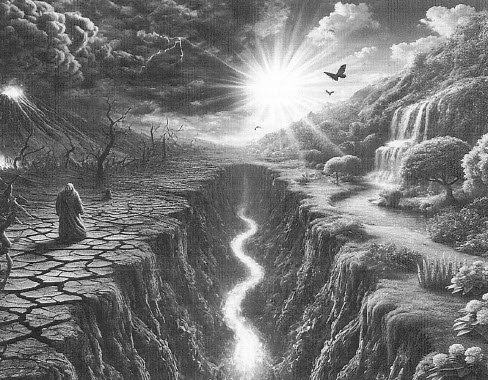
Unknown artist’s conception of Hades as described by the parable of The Rich Man and Lazarus. I presume that’s the Rich Man walking alone on the left bank of the chasm, while Lazarus is off lounging somewhere in Abraham’s Bosom, on the right bank. Remember that this is a parable, so you aren’t expected to take the vision of Hades’ layout or structure too literally.

Introduction

If you subscribe to a YEC interpretation of Scripture (and most of my friends do), then you should believe that all life, human, animal, vegetable, fungi, single-celled and microbial, was created some 6,000 years ago, over a span of only days. Is it conceivable, in that case, that the Fall took place soon enough after creation that no living thing got eaten, stepped on, or fell off a cliff? Was life physically indestructible, as well as immune from natural death? Life is far more complicated than that, but to Henry Morris and his disciples, the question is moot, because to them the Bible prohibits even the possibility of any kind of death before the Fall.

In this post, after first presenting some background and grammar, I’m going to comment on a few of the key YEC arguments for and against pre-fall immortality.

Background and grammar

Life

Not all YEC scholars think that a denial of physical death before the fall applied to plants and microbes, or anything else with no brain. I’m not aware of any scripture that grants this exemption, unless it is implicit from,

29 And God said, “Behold, I have given you every plant yielding seed that is on the face of all the earth, and every tree with seed in its fruit. You shall have them for food. 30 And to every beast of the earth and to every bird of the heavens and to everything that creeps on the earth, everything that has the breath of life, I have given every green plant for food.” And it was so.
— Genesis 1:29-30 (ESV)

Some say that only vertibrate animals were exempt from death. Where is that written?

Some say that anything without blood was never “alive”, in a Biblical sense, because “the life of the flesh is in the blood…” But that isn’t meant to define what “life” is or is not, it’s merely the stated reason that God views the consumption of blood as abominable. There is unfortunately a huge tendency for hyper-literalists (those who won’t let the Bible use figurative language or poetic exaggeration to prove a point) to read theology into every word of every verse, without regard to context.

Far from looking for exemptions, Morris even taught that entropy could not have increased before the fall. Morris was not a scientist and never had a full grasp of what entropy even means until later in his life.

Entropy is a fundamental thermodynamic property of the physical universe. Formally, it is a statistical measure of the number of mathematical “degrees of freedom” in any physical system. The Second Law of Thermodynamics states that the entropy of the universe always increases.

Entropy is often described to novices as “a measure of randomness”, but that is misleading. A common claim is that “shuffling a pack of cards increases its entropy because of the increased randomness of the shuffled deck but sorting it back into its original order decreases its entropy since its randomness is lower.” That isn’t at all true! The increase of entropy is due to the energy expended in shuffling. Reordering requires another expenditure of energy, say from a person or a machine, thus further increasing entropy. The entropy of 52 cards at rest is the same whether they are in an ordered or a shuffled state.

If Morris was right about entropy, cells could not divide, food could not digest, muscles could not contract, balls could not roll downhill and, oh yes, the sun could not shine, and gravity could not work. If so, then after the Fall, God must have completely redesigned the laws of physics, plus the nature of every last object in the universe, from subatomic particles on up to spacetime itself.

But the text of Scripture doesn’t, to my knowledge, hand out exemptions, so who gets to say that any human or nonhuman life was exempt from death? To my way of thinking, it is arbitrary and presumptuous for us mortals to “exempt” anything that is cellular and reproduces in a biological sense or to include anything else. Life is life!

death

For this discussion, we have to be more precise when we talk about “death.” That concept, as used in the Bible, can mean different things in different contexts:

  • Everybody on earth recognizes that anything post-Fall that has physical, tangible, cellular life will ultimately suffer a “physical death,” that is, a termination of all self-powered physical processes. After that, external processes take over to break down the physical components of that once-living carcass and “return it to the dust.”
  • Most contemporary Christian scholars also recognize that the Bible frequently talks about an analogous “spiritual death,” which Thayer describes as “the misery of soul arising from sin, which begins on earth but lasts and increases after the death of the body”; “the miserable state of the wicked dead in hell”; and “all the miseries arising from sin.”
  • Paul also defined death as voluntarily putting away, or killing, the evil inclinations of all humankind. See my recent Yetzer, Yotzer and “The Law” in Romans 7:1–6 for a detailed discussion of this usage.

While “death as separation” is not a highly developed Biblical concept, per se, it is functionally an apt description: separation of the body and spirit; separation of the eternal spirit from God; and separation of man from his own nature, respectively.

Death in antiquity

Human beings have an innate curiosity about their origins, both individually and culturally, and I think that this curiosity is at its strongest when communities are more isolated and less technologically distracted. In prehistoric times—that is, before the development of writing—history was very efficiently retained and spread verbally, both within families and cross-culturally by traveling storytellers. It should come as no surprise that all the ancient civilizations, with their common origins in Babel, would share common “legends” about their pasts and common beliefs about the unseen.

From Greece to Egypt and all across the Fertile Crescent, way over to India and China, and across the pond in the Americas, every culture that left records in early history shared one cosmology and one belief in the afterlife, differing only in small regional details.

I’ve shared several versions of the universal flat earth model of cosmology in earlier posts. Here I’ll add the Greek view, which is very similar to the others.

Ancient Greek cosmological diagram.

In all cases, the earth is depicted as a flat disk floating on a broad ocean and covered by a dome (the “firmament” in KJV). Beneath the surface of the disk is the underworld, Hades, the abode of the (physically) dead.

As I’ll show in the following two sections, both Hebrew and Greek have terms that refer to death and the remains of the physically dead, but neither language has any term that differentiates between physical and spiritual death. Though “death” can refer to either, only the context can indicate which is being discussed. Unfortunately, very often the context alone is insufficient for total clarity.

Why would that even be?!

I would suggest that, aside from corruptions in the retelling, all early civilizations shared the assumption that physical life was only one phase of personal existence.

Human life on earth is short. Adam’s descendants in the period between the Garden and the Flood lived long lives, as recorded in the Bible, but most cultures in the ancient world had life expectancies of no more than a few decades. Physical death was no shock. It was pretty much universally believed that when a human died, his spirit survived and was relegated to the underworld. The Bible calls that underworld Sh’ol, or Sheol, in Hebrew, Hades in Greek.

Physical death, in other words, was little more than the shedding of a mortal shell not needed by the immortal spirit as it moved into its new abode in the underworld.

There was no concept of death or annihilation of the spirit in the underworld until much later. In fact, there apparently was no real concept of suffering spirits, either. Even in the Old Testament, where the Psalmist said, “The wicked go down to the realm of the dead, all the nations that forget God” (9:17) and “Let me not be put to shame, Lord, for I have cried out to you; but let the wicked be put to shame and be silent in the realm of the dead” (31:17), the sense is, “I’m righteous, so let me live, because when I die, I’ll be relegated to the drab and boring underworld.”

The picture of Sheol/Hades presented in the parable of the Rich Man and Lazarus appears nowhere in the Old Testament. That is a view apparently developed in Second Temple Judaism and propagated in Jewish pseudepigraphal works like The Apocalypse of Zephania and 1 Enoch. In telling this parable, Jesus was using a well-known popular concept to illustrate His teaching.

Death in Hebrew

Biblical Hebrew has several words that are used extensively with respect to death:

פֶגֶר (peger, pronounced peh’-ger) is a noun referring to a corpse, carcass, or dead body, human or animal. It was also used figuratively on occasion to refer to idols.

מוּת (muwth, pronounced mooth) is a verb meaning to die, to kill, or to be dead. The subject could be human, animal, vegetable, or even a nation. It can refer metaphorically to the death of some characteristic, e.g., the death of courage. Manner of death could be natural causes or violence. It could also refer to a death judgement, or to an agent of death.

מָוֶת (maveth, pronounced MAH-veth) is a noun, closely related to muwth, that means death, the dead, the place of the dead or state of being dead, or sometimes pestilence or ruin. Rarely, it can be used metaphorically to indicate spiritual death or separation from God, as perhaps in Hosea 13:14, or divine judgement, as in Ezekiel 18:4.

נֶפֶשׁ (nephesh, pronounced neh’-fesh) is a noun, often translated as soul, but primarily meaning any living and breathing creature, human or animal. It also refers to many of the characteristics of life, including life itself, self, person, desire, passion, appetite, or emotion. To lose one’s nephesh is to die, after which the peger, or remains, decay, while the nephesh (now a disembodied spirit) lives on in Sheol, “the grave”, meaning the underworld.

Note that in the Hebrew Scriptures, there is almost no development of the idea of spiritual death, or of divine retribution in the afterlife.

Whatever your hand finds to do, do it with your might, for there is no work or thought or knowledge or wisdom in Sheol, to which you are going.
— Ecclesiastes 9:10 (ESV) emphasis mine

Death in Greek

There are many similarities, but also significant differences in the Biblical Greek vocabulary of death:

σῶμα (sóma, pronounced SO-mah) is a noun meaning body or flesh. Unlike the Hebrew peger, this word speaks of a body that can be either living or dead, or in some cases metaphorically, of the body of the Church, or the visible aspect of a disembodied spirit, e.g., an angel.

θάνατος (thanatos, pronounced THAH-nah-tos), like the Hebrew maveth, is a noun meaning death. Unlike maveth, where the figurative sense of “spiritual death” is rare, that concept is well developed in the 1st century AD. In biblical Greek, the figurative meaning is present at least as often as the literal. Unfortunately, only the context can reveal which meaning is in play, and even then, it is sometimes not clear.

As a foil for thanatos, I’ll include here its opposite, ζωή (zóé, pronounced dzo-ay’), a noun meaning life. Interestingly, thanatos is a masculine noun, while zóé if feminine. I’ll not suggest any significance to that fact.

νεκρός (nekros, pronounced nek-ros’) is an adjective meaning dead, deceased, or corpse-like. Like thanatos, the New Testament often uses it to refer to spiritual death. Once again, only the context can determine which meaning to attach.

νεκρόω (nekroó, pronounced (nek-ro’-o) is a verb form of νεκρός meaning to put to death, or render powerless or ineffective.

ἀποθνῄσκω (apothnéskó, pronounced ä-po-thnā’-skō) is a verb meaning to die, to lie dying, or to be killed. Similar to Hebrew muwth, but once again, in the NT it often has a strong spiritual, rather than literal, connotation.

κρίμα (krima, pronounced KREE-mah) is a noun meaning a condemnatory sentence, penal judgment, or sentence.

κατάκριμα (katakrima, pronounced kä-tä’-krē-mä) is a noun meaning punishment following condemnation, penal servitude, penalty. Quoting from Bible Hub’s Topical Lexicon: “The word κατάκριμα is used in the New Testament to describe the state of being under condemnation, particularly in a spiritual or moral sense. It is often associated with the consequences of sin and the judgment that follows.”

Romans 5:12, “death by sin”

Therefore, just as sin came into the world through one man, and death through sin, and so death spread to all men because all sinned
— Romans 5:12 (ESV)

To most YECs, Romans 5:12 is the definitive last word on the subject, because it seems to clearly state that no death of any kind, to any created life form (subject to possible exemptions discussed above), was possible before Adam sinned.

But is that so?

“Proof-texting”, i.e., casually picking one verse out of Scripture to prove a theological point of view, is always risky because no single verse, in a vacuum, is likely to reflect the writer’s complete thoughts on the subject of the verse, or on the circumstances under which he is writing. Other factors almost always need to be considered, such as:

  • The grammar, genre, and figures of speech.
  • The issue or issues that prompted the writing.
  • The textual, historical, and cultural context.
  • The identity and background of the writer.
  • The identity and background of the original readers.

The grammar of 5:17 tells us that Paul is combining two thoughts:

  1. Adam’s sin introduced sin and death (thanatos) into the world.
  2. All humans sin, so all humans die.

These two thoughts are conjoined by the Greek phrase kai houtōs, but it is unclear how that should be translated. A quick survey of translations yields “and so”, “in this way”, “this is why”, “and thus”, and the New Century Version (NCV) even puts the second thought into a new sentence. “This is why everyone must die—because everyone sinned.”

Whichever one of those translations you go with, without more context there is a logical disconnect between the two halves of the verse. YECs use Thought 1 to prove that Adam’s sin introduced both physical and spiritual death into the world. Yet they would agree that Thought 2 says that humans die individually because they sin individually. Do animals not die individually because they sin individually?

The Serpent of Genesis 3 sinned, but that was Satan, not a common Garden of Eden Snake. Balaam’s donkey spoke sinful words (Numbers 22:28), but that was spiritual ventriloquism (“The LORD opened [its] mouth”). In Luke 8. 26–39, Jesus was speaking with demons, not with pigs.

I think we can agree that animals aren’t capable of sin, and neither are they subject to spiritual death. Therefore, animals probably have nothing to do with Thought 2 in Paul’s teaching. Given the multiple shades of meaning in thanatos (or the English, “death”) are we as Biblical literalists required to read all possible definitions into that one word here? Not unless we can find something in the context to back it up.

As a matter of fact, the subject in Romans 8, and in fact, the theme of the first 8 chapters, is salvation by faith in the Messiah, for both Jew and gentile. He brings up Adam for two reasons: First, because Jesus provided the means of undoing what the sin of Adam did to humanity; and second, because unlike Abraham, Adam is the father of both Jew and gentile. (Note that the overall theme of the Epistle to the Romans is Paul’s call for unity between Jews and gentiles in the Roman churches.) Among other verses in chapter 8, the following two provide all the explanation needed to understand 5:12:

18 So then, through the transgression of one, condemnation came to all men; likewise, through the righteousness of one came righteousness of life to all men. 19 For just as through the disobedience of one man, many were made sinners, so also through the obedience of one man, many will be set right forever.
— Romans 5:18-19 (TLV)

There is nothing at all in that message that applies to animals (or pre-Adamic hominids if you believe in them). Animals are explicitly mentioned only once in all of Romans:

22 Claiming to be wise, they became fools, 23 and exchanged the glory of the immortal God for images resembling mortal man and birds and animals and creeping things.
— Romans 1:22-23 (ESV)

We’ll approach an understanding of whether Romans 5:12 is speaking of physical death, spiritual death, or a combination of the two in this section. Because the language alone can’t answer that question, we’ll look primarily to the context of Paul’s letter, particularly chapters 1–8, concentrating on chapters 5–8. In the process, we’ll also strengthen our case for human-only death being in view.

The Romans context

In this section, I will now provide a thorough exposition of the topic of death, as it relates to 5:12, in Paul’s theological writings to the churches in Rome.

Background

Though Romans is packed with theology, Paul’s reason for writing the letter was primarily to act as a peacemaker between the Jewish and Gentile believers in the Roman churches.

On his missionary journeys, Paul’s habit was to first approach the Jewish synagogues and preach to their congregations, then to expand his approach to gentiles in the community. Where did the new believers then meet together? The practice of Jewish believers in Jerusalem was to continue their normal Sabbath activities in the synagogues alongside non-Messianic Jews, then at dusk, at the close of Shabbat, the Messianics would adjourn to private homes to meet and fellowship together until well into the night.

This same practice was likely followed in the Diaspora as well, with gentile believers joining at homes after the synagogues closed for the night. This was of course a great demonstration of the intercultural tolerance demanded by Paul.

[Note: Since “the 7th day of the week” gave way to “the 1st day of the week” at dusk, I believe that this evening adjournment is what truly led to the Christian custom of meeting on Sundays.]

In AD 49, Emperor Claudius expelled all Jews from the City of Rome, including Messianic believers. When the expulsion was ended after Claudius’ death in AD 54, two to four years before Paul’s letter, those Jews who returned found that Gentile believers had taken over their synagogues, and the result was bad blood between the returning Messianic Jews and the gentile usurpers.

Outline

That background explains, I think, why the bulk of the letter consisted of round after round of explanation and exhortation to first one, then the other, component of the Church.

In broad strokes, I personally outline Romans as follows:

  1. Greetings and personal notes, 1:1–15.
  2. A unifying theology of righteousness through faith, 1:16–8:39.
  3. Paul’s burden for Israel, 9:1–11:11.
  4. Gentiles and Jews together, 11:12–36.
  5. Christian ethics for all, 12:1–15:13.
  6. Paul’s closing statements, 15:14–16:27.
A focus on the theology

In Romans 1:16–8:39, Paul’s emphasis was on theology, in particular the roles of faith and Torah obedience in the quest for righteousness as required by God in the united Church.

In order to stay within the limited scope of this paper, I will concentrate here on Paul’s discussions of death, in order to set a context for 5:12.

Literal death in Romans 1–4

In the following passage, Paul is speaking of the faith of Abraham who, despite being an old man and “as good as dead”, maintained his strong faith in God, who not only creates the body, but gives it life. Both of these references to death are forms of nekros, and it seems reasonable to assume that they are referring either strictly or primarily to physical death; however, in my judgement they don’t help set the context of 5:12.

17 as it is written, “I have made you the father of many nations”—in the presence of the God in whom he believed, who gives life to the dead [nekros] and calls into existence the things that do not exist. 18 In hope he believed against hope, that he should become the father of many nations, as he had been told, “So shall your offspring be.” 19 He did not weaken in faith when he considered his own body [soma], which was as good as dead [nekroó], (since he was about a hundred years old), or when he considered the barrenness of Sarah’s womb.
— Romans 4:17-19 (ESV) emphasis mine

In 4:24 (“him who raised from the dead [nekros] Jesus our Lord”,) and 5:10 (“we were reconciled to God by the death [thanatos] of his Son”), the subject is the death and resurrection of Jesus, which again I think is not terribly helpful in setting the context for death in the following chapters.

Death and life in Romans 5:1–11

Beginning in chapter 5, the emphasis changes from justification to sanctification and the peace that comes with it.

Therefore, since we have been justified by faith, we have peace with God through our Lord Jesus Christ.
— Romans 5:1 (ESV)

“Death” terms now begin to appear more frequently in the text.

6 For while we were still weak, at the right time Christ died [apothnéskó] for the ungodly. 7 For one will scarcely die [apothnéskó] for a righteous person—though perhaps for a good person one would dare even to die [apothnéskó]— 8 but God shows his love for us in that while we were still sinners, Christ died [apothnéskó] for us.
— Romans 5:6-8 (ESV)

These references to death all speak of Jesus’ crucifixion, which was of course very much a literal death. The same applies in verse 10:

For if while we were enemies we were reconciled to God by the death [thanatos] of his Son, much more, now that we are reconciled, shall we be saved by his life [zóé].
— Romans 5:10 (ESV)

A key question now arises: If thanatos and zóé refer to literal, physical death and life in 5:10, as I think we all would agree, then is this verse speaking of physical salvation of our bodies, or of spiritual “salvation of our souls”?

“Saved” in verse 10 is σῴζω (sózó, pronounced sózó), a verb meaning (per Thayer’s), either (a) to save, to keep safe and sound, to rescue from danger or destruction; or (b) to deliver from the penalties of the Messianic judgment, i.e., to make one a partaker of the salvation by Christ.

Once again, I think that most of my readers would agree that (b) is the sense meant in verse 10.

Up to here in Paul’s theological discourse, the subject has been primarily Jesus’ physical death and subsequent resurrection as the basis for our faith, and thus our spiritual salvation (justification, sanctification, and later glorification).

I would contend, then, that 10 and 11 focus the context for what follows in verse 12:

10 For if while we were enemies we were reconciled to God by the death of his Son, much more, now that we are reconciled, shall we be saved by his life. 11 More than that, we also rejoice in God through our Lord Jesus Christ, through whom we have now received reconciliation.
12 Therefore, …
— Romans 5:10-12a (ESV)

I will show below that the text following 5:12 further solidifies this context.

Death and life in Romans 5:13–21

The remainder of chapter 5 continues the contrast between death through Adam and life through Jesus and returns the emphasis back to the overall theme of the letter: explaining how faith and salvation can function in a Church composed of both Jews and gentiles.

Here, Paul says that, yes, we have been two separate peoples under separate spiritual economies since the time of Abraham, and we will remain so in most respects, but we all have a common ancestor in Adam. Within the Church, we must recognize that both peoples are infected with the sin nature of Adam because of his sin, but now both have been united by our faith in the salvation brought by Jesus.

Key death phrases in this section are:

14 … death [thanatos] reigned from Adam to Moses, even over those whose sinning was not like the transgression of Adam, who was a type of the one who was to come.

15 … if many died [apothnéskó] through one man’s trespass, much more have the grace of God and the free gift by the grace of that one man Jesus Christ abounded for many. 16 … For the judgment [krima] following one trespass brought condemnation [katakrima], but the free gift following many trespasses brought justification. 17 For if, because of one man’s trespass, death [thanatos] reigned through that one man, much more will those who receive the abundance of grace and the free gift of righteousness reign in life [zóé] through the one man Jesus Christ.

18 Therefore, as one trespass led to condemnation [katakrima] for all men, so one act of righteousness leads to justification and life for all men. … 21 so that, as sin reigned in death [thanatos], grace also might reign through righteousness leading to eternal life through Jesus Christ our Lord.
— Romans 5:14-21 (ESV)

Surely all of that death, judgement, redemption and life terminology must be speaking only of the spiritual state!

A different metaphor in Romans 6–7

Here Paul shifts the conversation about death. In this section, “death” is neither physical death nor spiritual death, but rather he uses the metaphor of “putting to death”, or overcoming, the evil inclinations brought on by our sinful natures. I discussed this recently in great detail in Yetzer, Yotzer and “The Law” in Romans 7:1–6

Romans 8

In this chapter, Paul closes out the discussion that fills the first half of the letter.

1 Therefore, there is now no condemnation for those who are in Messiah Yeshua. 2 For the law of the Spirit of life in Messiah Yeshua [the Torah written on our hearts] has set you free from the law of sin and death [the fleshly “evil inclination”].
— Romans 8:1-2 (TLV) comment mine

“Therefore” in 8:1 harks back to all that came before, but in particular to 7:4, discussed in the previous article:

Therefore, my brothers and sisters, you also were made dead to the Torah through the body of Messiah, so that you might be joined to another—the One who was raised from the dead—in order that we might bear fruit for God.
— Romans 7:4 (TLV)

By now, I hope that most of you will agree that Paul’s discussion of theology is primarily about the spiritual results of sin, not about the mortality of the body.

Interpreting Romans 5:10–14

Here, then, is my interpretation of Romans 5:12 in its closest context:

10 For if while we were enemies we were reconciled to God by the death of his Son, much more, now that we are reconciled, shall we be saved by his life. 11 More than that, we also rejoice in God through our Lord Jesus Christ, through whom we have now received reconciliation.

12 Therefore, just as sin came into the world through one man, and death [thanatos] through sin, and so death [thanatos] spread to all men because all sinned …
— Romans 5:10–12 (ESV)

For if while we were enemies — While we, as Jew or gentile, were in opposition to God and Torah.

We were reconciled to God by the death of his Son — We were brought back into a close relationship (which was lost when we first sinned) with God on be basis of Jesus’ crucifixion.

Much more, now that we are reconciled — More importantly, now that that relationship has been restored.

Shall we be saved by his life. — I discussed the meaning of salvation when I analyzed this verse above, taking Thayer’s definition, “to deliver from the penalties of the Messianic judgment, i.e., to make one a partaker of the salvation by Christ.”

More than that, we also rejoice in God through our Lord Jesus Christ, through whom we have now received reconciliation. — We celebrate the fact that we have been brought into fellowship with God, the Father.

Therefore—because of Jesus’ crucifixion and resurrection by which we have been reconciled to God.

Just as—in the same fashion as.

Sin came into the world through one man—Sin came into existence on earth. By disobeying God in the matter of the Tree of Knowledge, Adam and Eve brought the curse on mankind and on the ground that he depends on.

And death through sin—this will require discussion of two issues:

  1. The contextual discussion above addresses the question of whether this “death” (thanatos) is spiritual death only, or whether it includes any physical component at all. Based on we’ve seen in chapters 1–8, and especially 5:10–11, I can only conclude that death here is referring only to spiritual death.
  2. We also have to determine whether the remainder of verse 12 limits this death to mankind only, or if animals and other things are included.

And so death spread to all men because all sinned—to my mind, the grammar here limits death due to sin to the sinners themselves.

But let’s consider the curses themselves…

Death in Eden

The sin in Eden

The word “die” occurs 3 times in the Garden of Eden (Genesis 2:17; 3:3,4). In each case, it is a grammatical variation of the Hebrew muwth. As expected, the Greek Septuagint (LXX, a 2nd century BC Jewish translation of the Old Testament into Greek) translates each of these three occurrences using apothnéskó, which in this case imparts no new information.

What does the text tell us? In Gen 2:17 God’s words were, “in the day that you eat of it you shall surely die.” Eve’s flawed retelling of this to the Serpent was, “‘You shall not eat of the fruit of the tree that is in the midst of the garden, neither shall you touch it, lest you die.'” The Serpent’s response was, “You will not surely die.”

Are we to take this as a discussion of physical death, spiritual death, or perhaps both? That’s a tough question to some since it is not addressed specifically.

If the answer is “physical“, then did God lie and the Serpent tell the truth? That, of course, is not tenable unless the word “day” (from the root, יוֹם, yom) means something other than a literal day. In an Ancient Near East (ANE) context, that is certainly a possibility, but it’s making an unprovable assumption, and it’s a risky interpretation in the context of Genesis 1–3. If you require Genesis 1 to be using the word, day, literally for the creation days, then in Genesis 2–3, the same word should probably have the same meaning.

“Both” might mean that both were telling half-truths, which raises the same troubling issues.

If the answer is “spiritual“, then God was truthful, and the Serpent a liar. I’ll go with this one!

But, for the purpose of this post, I have to ask how Adam and Eve could have had any comprehension of either physical or spiritual death if there had been no death at all on earth up to that point. Any attempts to explain that away can only be speculative. Lacking data, then speculation is fine, but dogmatism is not.

Since Adam’s physical death didn’t come until 930 years later, I feel personally confident in speculating that the death promised to him was spiritual only, though there is no record that either God or the Serpent explained that to him or Eve. I further speculate that he was not created immortal but would have lived forever from the fruit of the Tree of Life, as stated in gen 3:22.

The curses of Eden

The Serpent

According to Genesis 3:14–15, the Serpent was cursed for his own sin.

14 So the LORD God said to the serpent:
Because you have done this,
you are cursed more than any livestock
and more than any wild animal.
You will move on your belly
and eat dust all the days of your life.

15 I will put hostility between you and the woman,
and between your offspring and her offspring.
He will strike your head,
and you will strike his heel.
— Genesis 3:14-15 (CSB17)

Angelic beings were created to oversee the cosmos, much like mankind was created to manage Earth. The Bible reports that angels are rebellious just like humans, but I see nothing in the Bible to indicate that the angels and humankind are judged under the same set of rules, or that other angels were included in the Serpent’s curse.

In fact, it’s unclear just what exactly the serpent was, and what its relation was to Satan. Revelation 12:9 and 20:2 state that it was Satan, but that could mean that Satan “possessed” a member of an animal family. “On your belly you shall go” does indeed sound like snake, but “the serpent was more crafty than any other beast of the field that the LORD God had made” doesn’t sound snakish at all, so who knows?

It’s unclear to me why God would have cursed all snakes because of the perfidy of one, and the part of the curse recorded in verse 15 certainly does not pertain to snakes! Well, I’m satisfied not knowing the unknowable!

The Woman

Eve’s curse is recorded in Genesis 3:16. It mentions only pain in childbearing and relational difficulties between husband and wife. From the wording, it seems that childbearing was already painful, so this just made it more so. If it was painful, could it also have been perilous?

He said to the woman:
I will intensify your labor pains;
you will bear children with painful effort.
Your desire will be for your husband,
yet he will rule over you.
— Genesis 3:16 (CSB17)

Adam

Adam’s curse is found in Genesis 3:17–19. Strictly speaking, Adam wasn’t cursed at all, directly. What the text says is, “cursed is the ground because of you”. What that curse does, though, is to set up an enmity of sorts between Adam and his environment, which certainly would be considered a curse.

17 And he said to the man, “Because you listened to your wife and ate from the tree about which I commanded you, ‘Do not eat from it’:
The ground is cursed because of you.
You will eat from it by means of painful labor
all the days of your life.

18 It will produce thorns and thistles for you,
and you will eat the plants of the field.
19 You will eat bread by the sweat of your brow
until you return to the ground,
since you were taken from it.
For you are dust,
and you will return to dust.”
— Genesis 3:17-19 (CSB17)

Alternatively, it may be that Adam’s own curse is that discussed above, plus

22 The LORD God said, “Since the man has become like one of us, knowing good and evil, he must not reach out, take from the tree of life, eat, and live forever.” 23 So the LORD God sent him away from the garden of Eden to work the ground from which he was taken. 24 He drove the man out and stationed the cherubim and the flaming, whirling sword east of the garden of Eden to guard the way to the tree of life.
— Genesis 3:22-24 (CSB17)

I see no Biblical indication, in Genesis 3 or elsewhere, that animals, plants, or the extraterrestrial cosmos were cursed for man’s sin. Certainly, the flora, fauna and ecology of earth are greatly affected by man’s curse. That doesn’t mean that it had any effect on their mortality, other than to make life harder.“Be fruitful and multiply and fill the earth and subdue it, and have dominion over the fish of the sea and over the birds of the heavens and over every living thing that moves on the earth.”
— Genesis 1:28 (ESV)

Good and Very Good

Many Young Earth Creationists claim that there could not possibly have been death before the fall because during the creation week, at the end of every day God looked at what He had done that day and pronounced it “good.” At the end of the sixth day, as a matter of fact, it was “very good.”

Now how, they ask, can anything be good or very good if it can die? Well, gosh… How does any fallen human being presume to know what God considers to be good? It’s His design, so by definition, it is good!

Let’s check the language:

טוֹב (tov, pronounced tove) This can be adjective, verb, or noun, and it means … hang onto you hats … good, pleasant, agreeable, beneficial, beautiful, best, better, bountiful, cheerful, at ease, fair, favor, fine, glad, goodly, graciously, joyful, kindly, loving, merry, pleasant, precious, prosperity, ready, sweet, wealth, welfare, well-favored. And all of these meanings are subjective! Good luck agreeing on the shading!

מְאֹד (m`od pronounced meh-ODE) This is an adjective meaning very, exceedingly, much, greatly.

Really, there’s not much help there. The word is subjective.

From my engineering perspective, a good design is one that does what the specs required, does what it was designed it to do, and does it elegantly.

Philosophical bias

In my opinion…


The universe is not a static artwork hanging on a wall. It’s a living, dynamic organism, designed by God to mature and blossom with little interference, to showcase His majesty, and to house and employ His angelic host, the first “generation” of His children, the B’nai Elohim, or Sons of God (Genesis 6:2–4).

And later, after reaching a suitable degree of maturity and elegance, a Garden was planted on one planet to house and nurture the second generation of His children, humanity.

Elegantly!


Nature vs Eternity

Development and growth per God’s blueprint demand movement, change, and thermodynamic flow. Exchange and equilibrium. Birth and death. This is true for the universe as a whole, for galaxies, stars and star systems, and for planets.

Angels are like humans in that they image God, they answer to Him, they interact with Him, they have freewill and thus can sin, and God has given them meaningful work to do.

They are unlike humans in that they have no physical bodies that are inherently vulnerable to mishap, wear and tear, and mischief. They don’t give birth, and they don’t die, and they aren’t influenced by hormones. However, when they have temporarily taken on human form, they have sometimes gotten into big trouble.

In the Eternal State, I believe human bodies will be secondary. In the meantime, they are the shell we are confined to. Spirits are immortal, bodies are not. By their nature, bodies are vulnerable. With God’s protection or the Tree of Life, they can be maintained indefinitely, but without it, death is inevitable.

Fecundity

The first commandment given to humans was,

“Be fruitful and multiply and fill the earth and subdue it, and have dominion over the fish of the sea and over the birds of the heavens and over every living thing that moves on the earth.”
— Genesis 1:28 (ESV)

Where there is fecundity, there has to be death. Neither animals nor humans can give birth indefinitely without eventually running out of space and resources. We value ecosystems and our environment. Ecology, God’s creation, demands cycles of life and death to maintain the health and balance of the planet.

Natural Life

I have in front of me paper after paper and article after article featuring Henry Morris’ grandson and many of his colleagues repeating over and over again that “death is an insult”, and “if God designed death into creation, then He is a monster”, and “death is wasteful and cruel.” This is all nonsense to me.

Isaiah described the Olam Haba (world to come) in the imprecise way of prophecy, particularly poetic prophecy. As sometimes happens, he confused the Millennium with the Eternal State, as described in Revelation. Under the topic, “new heavens and new earth” (65:17), the following passage describes what I believe life will be like in the Millennium, and perhaps what it was designed to be like in Eden:

20 No more will babies die in infancy,
no more will an old man die short of his days —
he who dies at a hundred will be thought young,
and at less than a hundred thought cursed.
21 They will build houses and live in them,
they will plant vineyards and eat their fruit.
22 They will not build and others live there,
they will not plant and others eat;
for the days of my people
will be like the days of a tree,
and my chosen will themselves enjoy
the use of what they make.
23 They will not toil in vain
or raise children to be destroyed,
for they are the seed blessed by ADONAI;
and their offspring with them.
24 Before they call, I will answer;
while they are still speaking, I will hear.
25 The wolf and the lamb will feed together,
and the lion eat straw like an ox
(but the serpent — its food will be dust).
They will not hurt or destroy
anywhere on my holy mountain,”
— Isaiah 65:20-25 (CJB)

As for animals, verse 25 doesn’t promise that the wolf and the lamb will be immortal, or even that the lion or wolf will lose its predatory instincts, but only that wild animals will no longer plunder domestic herds.

Humans were created mortal but designed to live long and peaceful lives and to die content, like David in 1 Chronicles 29:28 (CJB), who “died, at a ripe old age, full of years, riches and honor.”

This is my view of Eden, as well…


Monotheism and the Trinity

Posted on:

Modified on:


  1. Biblical references to the Trinity
    1. Old Testament references
      1. Elohim
      2. “Let us make”
      3. Echad
      4. Other references in the Tanakh (OT)
    2. New Testament references
  2. Characterizing the Trinity
    1. Attempted analogies
      1. Egg
      2. Human as image
      3. Multiprocessor computer
      4. Distributed AI
      5. Light
      6. The electroweak force
      7. Strange physics
    2. Ontology of the Trinity
      1. Spirit
      2. Locality
      3. How important is monotheism?
      4. Eternality
      5. Relationships
      6. Appearance in Heaven
  3. Conclusion

Biblical references to the Trinity

Common illustration of the Trinity relationship. From stainedglassinc.com

Well… there aren’t any instances in the Bible where the Trinity is named as such, which is why some Christians and pretty much everyone else deny its existence.

The Trinity of Father, Son and Holy Spirit can only be inferred from hints scattered throughout Scripture.

Even the term “Godhead” in the KJV, which at least sounds somewhat Trinitarian, is merely an infrequent translation of the Greek θεότης, (theotes), which actually means something like “the essence of being a deity.” In the ancient world, the term was primarily applied to human leaders who claimed for themselves or were proclaimed by others to be divine. In Colossians, Paul used the term as a polemic against gnostic “elementary principles of the world,” probably referring to principles of Greek philosophical argumentation.

Old Testament references

Yet even attempts to find hints of the Trinity in the Old Testament mostly fail.

Elohim

The Hebrew אלהים, transliterated as elohim, is a masculine plural noun, usually meaning “gods,” “angels,” or sometimes “princes” or “judges,” etc. But sometimes it refers to the name of God, Himself, in which case the English transliteration is capitalized: Elohim.

If we are referring to the singular “One True God,” then why retain the plural ending? There definitely is a singular term corresponding to the plural elohim, and that is eloah. But that would be a reference to one of those generic gods, angels, etc. mentioned in the previous paragraph. Deuteronomy 32:17, for example, speaks of “demons [shedim], who were not [a] god [eloah]

Could it be, then, that Elohim is a sneaky way of speaking of the Trinity? No, that would be a blatant admission that He is three separate gods, a polytheism.

The solution to this difficulty is that Hebrew plurals aren’t always well-behaved.

For example, while most Hebrew nouns are “regular,” there is a class called, logically, “irregular plural nouns” that don’t follow the usual rules. We have those in English, too: the plural of “goose” is not “gooses,” and the plural of “foot” is not “foots” (as my petulant spell checker is now informing me)!

More to the point, the way I’ve heard it explained by a Jewish Hebrew scholar is that Elohim is part of a small class of objects that are themselves complex and everchanging. For example,

מים – mayim – ‘water’ (exhibiting tides, waves, ripples, surges, currents, solutes, etc.)
שמים – shamayim – ‘sky, Heaven’ (exhibiting clouds, storms, dust, fog, birds, lights, etc.)
פנים – panim – ‘face’ (exhibiting expression, complexion, hair, health, etc.)
חיים – chayyim – ‘life’ (exhibiting birth, growth, health, age, death, blinks, smiles, etc.)

Just like water, the sky, a face, or our life – God [Elohim] is something which cannot be captured strictly in the singular. Like these other concepts, Hebrew conveys to us that God is not stagnant and not stable, but is a fluid, intangible reality. 
—Adam Zagoria-Moffet, article on stateofformation.org

To me, the bottom line on the question of whether or not the plural ending on Elohim can be used as an argument for the Trinity is this: English does not have singular and plural forms of verbs, but Hebrew does. Elohim, as a name of God, always appears with singular verbs.

Finally, it must be said that the plural ending on Hebrew names is not uncommon, for example, Efrayim (the son of Joseph), Yerushalayim (the holy city) and, from the genealogy in Genesis 10, Kitim, Dodanim, and Mitzrayim.

“Let us make”

What about the first chapters of Genesis, where Elohim says, “let us make…” or “let there be…”? Is this the Father speaking to the Son and Spirit? Inconceivable! If the “one” part of “three-in-one” is literal, then what one knows and thinks, the others know and think. But more fundamental than that is the definition of omniscience. Surely all three are omniscient, not just The Father. What one knows, all three know, instantaneously. That has surely got to be implicit in the whole concept of “tri-unity.” The only exception to this might be with the “kenosis,” when the Son emptied Himself and became incarnate.

Philippians 2:6 (ESV)
[6] who, though he was in the form of God, did not count equality with God a thing to be grasped, [7] but emptied himself, by taking the form of a servant, being born in the likeness of men.

Evidently, taking on flesh meant losing or weakening of some of that intimate connection.

I absolutely don’t believe that this is God talking to Himself. To my mind, the most probable alternative is the following:

In Gods and Demons, I reviewed the theology of the late Michael Heiser, who I was undecided about at the time, but have come to like very much. He presented a great deal of both Biblical and extrabiblical evidence to show that the Heavenly Host, collectively called “angels” (aggelos) in the New Testament, were created to perform the same supervisory functions in the non-living cosmos that mankind was later created to perform with respect to all life-forms on earth.

Genesis 1:26–28 (CJB) emphasis mine
[26] Then God said, “Let us make humankind in our image, in the likeness of ourselves; and let them rule over the fish in the sea, the birds in the air, the animals, and over all the earth, and over every crawling creature that crawls on the earth.
[27] So God created humankind in his own image;
in the image of God he created him:
male and female he created them.
[28] God blessed them: God said to them, “Be fruitful, multiply, fill the earth and subdue it. Rule over the fish in the sea, the birds in the air and every living creature that crawls on the earth.”

In their supervisory role, the angels occupy a heavenly hierarchy, with the highest ranking serving as a council (the “Divine Council”) that serves and reports to Elohim. Heiser makes a very good case that “let us” in the context of creation is the triune God (all three members in accord) speaking to this Divine Council.

Echad

Another claim of linguistic evidence for the Trinity is use of the composite plural verb echad in the Shema, Israel’s most important confession of faith. I view this as more promising, but still not definitive.

Deuteronomy 6:4 (CJB)
[4] “Sh’ma, Yisra’el! ADONAI Eloheinu, ADONAI echad.”
[Hear, Isra’el! ADONAI our God, ADONAI is one]

Or, in our vernacular, “Hey, listen up, people! There is only one God; and He is our God!”

There are basically just two Hebrew words for the number “one”: One of them is yachid, which means just “one.” Only one. One by itself, not part of any composite whole. The other is echad, which means “one, a composite unit, composed of a multiple of something.” One English alphabet composed of 26 letters. One banana bunch composed of a bunch of bananas. One nation composed of 50 states. Or perhaps, one God composed of three Persons.

As important as monotheism came to be, why isn’t the Shema worded as, “Sh’ma, Yisra’el! ADONAI Eloheinu, ADONAI yachid“?

The Shema as written seems to give Trinitarians a bit of breathing room, because instead of clearly saying that there is only one undivided God, it leaves open the door for saying He might be a set of something. A Trinity? To combat that notion, the late head of the worldwide orthodox Lubavitcher movement, himself reputed by some of his followers to be the long-awaited Messiah, had this to say:

G‑d did not have to create a world to be yachid. He was singularly and exclusively one before the world was created, and remains so after the fact. It was to express His echad-ness that He created the world, created man, granted him freedom of choice, and commanded him the Torah. He created existences that, at least in their own perception, are distinct of Him, and gave them the tools to bring their lives into utter harmony with His will. When a diverse and plural world chooses, by its own initiative, to unite with Him, the divine oneness assumes a new, deeper expression: G‑d is echad.”
—Rabbi Menachem Mendel Schneerson

It seems to me that the Rebbe’s argument is grasping at straws. Nevertheless, I’m also not convinced that the Shema is sufficient proof of a Trinity on its own. It depends on what a “Trinity” actually is, which I’ll explore below.

Other references in the Tanakh (OT)

Christian scholars also point to a number of Tanakh (Old Testament) references to “a son of God” and “the Holy Spirit”) as proof of the Trinity. In hindsight, we can certainly look back and legitimately say, “Oh, yes…,” but that’s only in light of New Testament revelation. Since the only revelations God chose to give ancient Israel were the Tanach, His visible creation, and an occasional theophany, I think that the above can only be used as evidence, not as stand-alone proof.

New Testament references

The New Testament doesn’t specifically say, “God is 3-in-1” or “God is a Trinity.” Yet, to me, the evidence is compelling. First, if we believe that Jesus is God, as we surely must, then why did He consistently refer to YHWH as His Father, and who did He pray to? Second, why are there so many references to the Holy Spirit as a living entity?

But we can site other Scripture, as well (emphasis mine):

Matthew 3:16–17 (ESV)
[16] And when Jesus was baptized, immediately he went up from the water, and behold, the heavens were opened to him, and he saw the Spirit of God descending like a dove and coming to rest on him; [17] and behold, a voice from heaven said, “This is my beloved Son, with whom I am well pleased.”

Matthew 28:19 (ESV)
[19] Go therefore and make disciples of all nations, baptizing them in the name of the Father and of the Son and of the Holy Spirit,

John 1:1–2 (ESV)
[Jn 1:1] In the beginning was the Word, and the Word was with God, and the Word was God. [2] He was in the beginning with God.

John 1:14 (ESV)
[14] And the Word became flesh and dwelt among us, and we have seen his glory, glory as of the only Son from the Father, full of grace and truth.

Acts 5:3–4 (ESV)
[3] But Peter said, “Ananias, why has Satan filled your heart to lie to the Holy Spirit … You have not lied to man but to God.”

Romans 9:5 (ESV)
[5] To them belong the patriarchs, and from their race, according to the flesh, is the Christ, who is God over all, blessed forever. Amen.

2 Corinthians 13:14 (ESV)
[14] The grace of the Lord Jesus Christ and the love of God and the fellowship of the Holy Spirit be with you all.

1 Peter 1:2 (ESV)
[2] according to the foreknowledge of God the Father, in the sanctification of the Spirit, for obedience to Jesus Christ and for sprinkling with his blood:

Characterizing the Trinity

Why is there no specific Biblical mention of the Trinity? Well, perhaps it is because the ancient world had no scientific or linguistic tools sufficient for the task. Explaining the Trinity is beyond the ability of even 21st Century Theologians.

Attempted analogies

The Trinity is usually defined as “one God, three Persons.” Essentially, we’re saying, “one equals three,” which is a paradox, a seemingly unexplainable contradiction. Lacking an explanation for the Trinity, most Christians eventually end up seeking an analogy to at least make the concept more palatable. But philosophically, I think that the only analogy to a paradox would have to be another paradox. In this case, it would have to be something like, “TRUE equals FALSE,” or a Boolean “A equals NOT A.” What have we gained? Nothing but more confusion.

God is like nothing else in the entire universe. There is absolutely nothing else in all of creation that is similar in either form or function. He is unique and incomparable!

There is no possible analog that can help us understand the Trinity. Nevertheless, people continue to try:

Egg

The common egg analogy that we’ve all heard is way, way, off base.

For one thing, an egg doesn’t communicate. An egg yolk doesn’t say to its shell, “Okay, you hold things together, I’ve got a chicken embryo that I’m feeding, and we aren’t ready to hatch yet.”

An egg also doesn’t think, plan, design, perceive, or communicate, and it sure doesn’t create!

Human as image

Another very common analogy that many Christians cherish is that of mankind as a “triune body/soul/spirit.”

This one is convincing to many because they see that arrangement as precisely what constitutes “the image of God.” I disagree for several reasons:

  • A body/soul/spirit analogy assumes that we are God’s image ontologically. Ontology is the study of the nature and essential properties of something that exists.

But physically, we bear no resemblance to God whatsoever.

Intellectually, it may appear that we are similar (though inferior) to God, but I would argue that God, being unencumbered by a flesh and blood brain or even a computer chip, is intellectually more alien than anything we could possibly imagine. He is intimately connected to every facet of His creation in ways that are completely incomprehensible to us. That we know and understand an infinitesimal portion of what He does is only because He gave us the ability to observe and learn, using our vastly inferior senses.

Personally, I agree with theologians like Michael S. Heiser and John H. Walton, who understand God’s image to be functional rather than ontological. We were created as human beings in order to represent Him on earth, for purposes set out in

Genesis 1:28 (ESV)
[28] And God blessed them. And God said to them, “Be fruitful and multiply and fill the earth and subdue it, and have dominion over the fish of the sea and over the birds of the heavens and over every living thing that moves on the earth.”

  • Furthermore, the body/soul/spirit analogy breaks down for me because I don’t think there is Scriptural support for this traditional trichotomous view of human ontology.

Yes, trichotomy (“division into three parts”) is suggested by:

1 Thessalonians 5:23 (ESV) emphasis mine
[23] Now may the God of peace himself sanctify you completely, and may your whole spirit and soul and body be kept blameless at the coming of our Lord Jesus Christ.

I don’t think there are any other passages that clearly list all three of these elements (and no others) in one place. There are many references that, taken alone, would support a dichotomous view (body/spirit), and even one that supports a tetrachotom0us view (heart/soul/mind/strength (where strength = body):

Mark 12:30 (KJV)
[30] And thou shalt love the Lord thy God with all thy heart, and with all thy soul, and with all thy mind, and with all thy strength: this is the first commandment.

In view of modern understanding that thoughts, emotions, behaviors, feelings, memory, and so much more are all housed in the brain, it makes most sense to me to believe that man is a soul, composed of a physical part that is fairly well understood and a spiritual part that is beyond our understanding.

Genesis 2:7 (KJV) additions mine
[7] And the LORD God formed man [the body] of the dust of the ground, and breathed into his nostrils the breath of life [spirit]; and man became a living soul.

  • As an analogy for understanding the Trinity, I don’t think the body/soul/spirit view comes close, because the components that make up a human aren’t in any sense at all separate personalities. The body can of course “tell” the “spirit,” “I’m hungry” by growling its stomach, but where is the exchange of conscious intelligence in that?
Multiprocessor computer

My main home office computer is one machine containing eight separate microprocessor cores. Eight “brains,” so to speak. An “octity”? Frankly this analogy isn’t very exciting. Computers don’t think, they compute, by electronically emulating, not neural activity, but mechanical switches.

Distributed AI

This disturbing analogy anticipates the coming future when the Internet will be an autonomous network of interconnected Artificial Intelligence nodes. But no matter how powerful these nodes become, compared to God they will still be hugely limited both in intelligence and in ability to interface with humanity. They will always be machines, with hardware and software, but never with a spirit component.

Light

Although I don’t believe that any analogy can do justice to the Trinity, I suspect that some philosophical paradox might be at least closer to the truth.

Here is a conundrum that consumed the world of physics for a hundred years: is “light” a particle or a wave? If a particle (a “photon”), then you should be able to bounce two photons off each other. If a wave, then when they collide, they don’t bounce, they “interfere,” meaning that their “amplitudes” combine, either constructively or destructively.

Since the particle and wave theories would appear to be mutually exclusive, which one is true? Both of them! Both theories have been individually proven in many different ways. Perhaps what will tie these contradictory theories together will be Quantum Field Theory, which is way beyond the scope of my blog.

The point of mentioning the particle/wave nature of light is only to stress that it is a relationship that for a long time was disbelieved entirely, then was believed by most, but understood by nobody. A paradox not quite solved to this day. The Trinity is at least that counterintuitive!

The electroweak force

Most of you have probably seen a demonstration in school of a magnetic field. The teacher sets a bar magnet on a sheet of white paper, then sprinkles iron filings over that. The filings quickly align with the invisible lines of force associated with the magnet.

Demonstration of magnetic lines of force around a bar magnet. From etcourse.com

What this demo doesn’t show is that there are also invisible electrical lines of force, oriented orthogonally (at right angles) to the magnetic field lines. Theoretically, the fields generated by any source, in this case a simple bar magnet, extend for an infinite distance, but since their strength attenuates rapidly, it can only be detected for a relatively short distance.

In addition to the combined, two-part “electromagnetic” field, there is a third field connected to the electric field and the magnetic field: this is associated with the so-called “weak force,” which plays a part in nuclear decay.

The three interrelated fields discussed here are collectively called the “electroweak” field. This 3-part unified field might also lend itself to discussions of Trinity analogs, but like all others, it falls short of doing justice to God.

Like other attempted analogies from science, the principal usefulness of this one is to demonstrate, simply, the uselessness of trying to understand one impossible-to-understand phenomenon by comparison with something that is equally impossible to understand.

Strange physics

Physics is full of phenomena that are demonstrable, but definitely “stranger than fiction,” and from which an imaginative Christian physicist might try to come up with a Trinity analog. For example, who would ever have thought that:

  • The faster you move through space, the slower you move through time.
  • The closer you are to massive objects, the slower you move through time.
  • Time and space are completely interdependent.
  • Though we only see three dimensions of space (up/down, right/left, forward/back), there may be many more that we can’t see and that challenge our intuition (see illustration below).
  • The universe is fully digital! Despite what your math teacher taught you about points on a line, there is a very small but finite distance, called the Planck Length which defines a lower limit to size of or distance between objects. There is also a corresponding Planck Interval of time.
  • Despite the proven fact that nothing can travel through space at faster than the speed of light, two particles, even quadrillions of miles apart, can be “coupled” such that each of them instantaneously “knows” if the other changes states. Albert Einstein himself, one of the founders of Quantum Mechanics, never fully believed this well-demonstrated quantum mechanical phenomenon, and called it “spooky action at a distance.”
6-dimentional Calabi-Yau manifolds. One of the weird things I’m interested in. The odd structure on the left is one of a great many possible configurations of a mathematical model of what six extra dimensions of space would look like. The grid on the right shows one plane of normal 3-dimensional space, with a Calabi-Yau manifold at each possible location, that is, spaced about 10(-35) meters, the Planck Distance, apart. This is about one ten-trillionth the diameter of an electron. String Theory, the subject of decades of international research, postulates that, though we can only see three of them, there must be a total of at least nine dimensions of space in our universe. From nieuwsgierigheid

Ontology of the Trinity

As much as most Christians crave an analogy to help explain the Trinity, my contention is that the uniqueness of God and the inexplicability of “spirit” and “spirit beings” makes meaningful analogy fundamentally impossible. Furthermore, because God is complex and analogies are by design simple, any attempted analogy can do nothing, in my view, but trivialize God!

Now, abandoning any further attempt to analogize, I’m going to ponder the “ontology,” or metaphysical essence of the Triune God.

Spirit

It seems to me that the tri-unity of God must be viewed in the context of His existence as a disembodied spirit.

There could be no other lifeform in the universe even remotely like God. Even the terminology of biology is meaningless. God’s substance is “spirit.” That is something beyond the realm of science.

“Spirit” is something that science can’t detect or explain, yet if our faith is founded on reality, it exists, since God, His angelic host, and the immaterial part of a human are all composed of spirit. Conscious spirit, unencumbered by the limitations of physical mass and energy, or any other component of the physical universe, is limited only by the will and power of a superior spirit. Created spirits are limited only by the will of their creator.

Scripture seems to say that God is both immanent (fully in touch with all aspects of His creation) and transcendent (in all ways possible, above and beyond His creation). In Implications of God’s Omnipresence and Eternity in Space-Time, I explain that this duality is what we call “omnipresence.” It means that He is constantly present and aware, at all points in both space and time. This implies that He both permeates and envelops the entire universe. Which further implies that His “omniscience” is not limited to seeing all but extends to personally experiencing all.

I have heard it said, many times, that God needed to experience the same temptations as us in order to empathize with us. In view of the above, I think this is a logical fallacy. The senses and consciousness of all creatures are an open book to Him. The incarnation was not for His education, it was for our faith! So that we can empathize with Him! Seeing Him take on flesh and become like one of us, we see His sacrifice and suffering.

When you really think about it, it seems that life as a bodyless spirit would be impossible. With no body to support, I can see where most biological organs would be unnecessary, e.g., entire systems for digestion, respiration, circulation, skin and skeleton, reproduction, etc.

But intelligence, communication, and empathy, for example require some complex cognitive mechanism beyond a computer core in order to function. Since I don’t question the existence of God, or that He indeed is spirit, the only conclusion I can draw is that there is physics that is still beyond our grasp. Big shock, eh?

Think of some of the “higher-level functions” that only God could perform:

  • God alone preexisted everything else that exists.
  • God alone created everything else that exists.
  • God’s intellect and abilities exceed those of all that He created.
  • God commands all the forces of creation.

God created the universe and all of its animate and inanimate contents with an ability to function—in my view independently of His constant oversight and control—in accordance with physical laws of His design, but subject, at His sole discretion, to His override, either in whole or in part.

There is another interesting ability held by spirit beings, including individual members of the Trinity, angels, demons and even humans (like the shade of Samuel at En-Dor 1 Samuel 28): They can take on physical substance. With respect to the Trinity:

  • The Father occasionally manifested Himself at specific locations, e.g., the burning bush, the fire above Mt. Sinai, and the shekinah over the Mercy Seat.
  • The Spirit manifested as tongues of fire at Pentecost.
  • Above all, we note the incarnation of the Son.

For more on this subject, see Gods and Demons.

Locality

Three spirits, or three intellects in one spirit?

My concept of an omnipresent Triune God implies that all three members of the Trinity must occupy the same space, simultaneously. Because I don’t know what “spirit” is, I can’t define what that statement actually means. Does it mean like the smoke of three cigarettes commingling in space, or that literally every infinitesimal iota of space and time contains all three. The first implies tritheism, so I lean towards the second, and indeed, the orthodox definition of the Trinity is “one God, three Persons,” or “personalities.”

Orthodox Christianity has defined the Trinity as three complete personalities within a single entity composed entirely of spirit. In a quantum mechanical sense, that maybe starts to make a little sense, but no physicist really understands the quantum universe, and the Creator is certainly more complex and mysterious than His creation.

How important is monotheism?

So, is the orthodox definition true, and does it even make a difference?

Undoubtedly, monotheism is an important subject in modern religion, but it has not always been that way. Today, “monotheism” means belief in one God. In ancient times, even as late as the 1st century, “monotheism” meant worship of one God.

Christianity claims to be monotheistic, but so do its two biggest rivals, Judaism and Islam, and both of them charge Trinitarians with being blatantly tritheistic, worshipping three separate gods. The Qur’an states over and over again, “There is only one God: He is Allah, and he does not have a son!” The Rabbi at an orthodox Lubavitcher-Chabad Jewish synagogue within walking distance of my house says, “We Jews might have accepted Yeshua as our Messiah if he hadn’t claimed to be God.”

Certainly, Biblical Israel, like the rest of the world, believed in multiple Gods. Whether they were right or not depends on how you define the term, “god.” Merriam Webster today defines “god” as

The supreme or ultimate reality: such as the being perfect in power, wisdom, and goodness who is worshipped (as in Judaism, Christianity, Islam, and Hinduism) as creator and ruler of the universe.

or less commonly a being or object that is worshipped as having more than natural attributes and powers’

While modern Christians and Jews alike would agree on the first definition, the second was not at all “less common” in Biblical times. If an angel, good or bad, is worshipped, then he meets the second definition. Though they were polemicized by the prophets as “gods made by human hands,” inanimate idols were normally worshipped, not for themselves, but rather for the spirit beings who inhabited them. I have long believed that the pagan gods were real, evil, spirit beings—after all, they were able to duplicate for the Egyptian magicians the first miraculous signs that Moses was told to use as proof that his God was present. Human beings, on their own, don’t have magical powers!

It wasn’t until Jesus claimed to be God that the Jewish sages refined their definition of monotheism, changing it from “belief in” to “worship of.”

Thus, while I don’t personally think the Trinity amounts to polytheism, I do think that the question is historically moot. By the time of the Patristic Church fathers, polytheism of any sort was viscerally unacceptable in the Judeo-Christian world. Though I’m not quite 100% convinced, I’m more than willing to stick with a monotheistic definition because, even though I think there is no unambiguous Scriptural proof one way or another, I am well enough accustomed to the paradoxes of physics that the concept “goes down easy.”

Eternality

No part of the Trinity is created. Does that mean that they have always existed, from eternity past? Neither the Hebrew nor the Greek Scriptures actually make that clear, in that they do not unambiguously explain what the term “in the beginning” is referring to, other than that it is when “the heavens and the earth” were created. What is clear is that all three preexisted everything else that exists.

Most cosmologists and astrophysicists are unwilling to believe in an eternal Creator, so they instead believe in an eternal creation. Either alternative is unfathomable to the human mind, but so is the concept of either God or the universe popping up from nothingness.

Relationships

if Jesus is Yahweh’s son in the same sense that I am Harold’s son, then we’re faced with all sorts of unanswerable questions that make no sense at all in the context of a spirit being with no material substance. I can’t fathom a mother-God or spirit-DNA. Obviously to me, the father/son terminology has to be functional, not biological.

Scriptural context indicates that there is a hierarchy between the three. Jesus clearly stated that He always does the will of the Father, and at the same time He implied that the Holy Spirit does His bidding.

Because God is a spirit, not tied to any physical body; because He claims to be omniscient and omnipresent; and because both time and space are a property of the universe He created, I conclude, as mentioned above, that He must both occupy and extend beyond the bounds of the universe and be free from any dependence on them whatsoever.

Appearance in Heaven

The Bible reports several very explicit prophetic visions of God seated on a throne in heaven: Isaiah 6, Ezekiel 1 and 10, Daniel 7, and Revelation 4 being most striking. I don’t think that these visions can be reconciled with God as an omnipresent spirit. Instead, I think that what the prophets are “seeing” are representations of preconceptions popularly held by ancient peoples. Visions, not reality! This is more or less how the pagan deities would have been visualized in contemporary surrounding cultures. If 21st century American Christians can’t visualize the Christian Trinity, how much less would primitive denizens of the Ancient Near East be able to set aside their ingrained preconceptions? And how important could it have been to ask them to do so? In my opinion, not very!

Conclusion

I don’t recommend that anyone try to interpret or understand the visions listed in the previous paragraph. Or, for that matter, other visions described in the Bible, like those interpreted by Joseph or Daniel, or experienced by Peter. Visions spoke truth to those to whom God gave an interpretation. They are not for our interpretation or understanding. Other than as recreational exercises, if that’s what rings your bell.

Similarly, I don’t recommend trying to untangle the ultimate explanation of the Trinity. God has not chosen to clarify it for us yet.


Survey: The Sermon on the Mount

Posted on:

Modified on:


  1. Introduction
    1. What and where
    2. The audience
  2. Matthew’s Version, 5:3–7:29
    1. The Beatitudes, Mt 5:3-12
    2. Salt and Light, Mt 5:13-16
    3. Endorsement of Torah and the Mosaic Covenant, Mt 5:17-19
    4. Righteousness, Mt 5:20
    5. The Six Antithises, Mt 5:21-48
    6. Ostentatious Giving, Mt 6:1-4
    7. Ostentatious Prayer, Mt 6:5-8
    8. The Lord’s Prayer, Mt 6:9–15
    9. Forgiveness, Mt 6:14–15
    10. Ostentatious Fasting, Mt 6:16-18
    11. Greed, Mt 6:19-24
    12. Anxiety, Mt 6:25-34
    13. Judgementalism, Mt 7:1-5
    14. Dogs and Pigs, Mt 7:6
    15. Prayer and Relationships, Mt 7:7-11
    16. The Golden Rule Mt 7:12
    17. The Narrow Gate, Mt 7:13-14
    18. False Prophets, Mt 7:15-23
    19. Wisdom, Mt 7:24-27
  3. Luke’s Version, 6:20–49
    1. Blessings and curses, Lk 6:20–26
    2. Miscellaneous discourses, Lk 6:27–49
    3. The Lord’s Prayer, Lk 11:1–4

Introduction

Ruins of Capernaum, on the north shore of Lake Kinneret, in Galilee. The black stone used in construction is volcanic basalt. The building on the left is a later synagogue, possibly 4th century, built of imported limestone on top of the original basalt synagogue, mentioned in Mark. ©Ron Thompson 2008

Pretty much everyone who has been attending church for any length of time is at least somewhat familiar with Jesus’ “Sermon on the Mount“, recorded by Matthew in 5:3–7:29, and with His so-called “Sermon on the Plain”, recorded by Luke, mostly in verses 6:20–49. I’ll explain below why I think these are the same event. Much of the two passages is fairly well understood, but at the same time, I think there is a lot of misunderstanding, as well. In this post I want to go through both passages and discuss some things that I think need clarification for modern readers. My concentration will be mostly on the Matthew account, since it is more complete and better organized.

Since this is intended to be a survey, I will try to resist my normal tendency to comment on each verse. Instead, I’ll concentrate on pointing out where I think there may be common misunderstanding.

What and where

The events discussed here occurred very early in Jesus’ public ministry, possibly as early as three or four months after His baptism.

Jesus began His ministry, not at His baptism as is commonly taught, but at Yom Kippur at the conclusion of His Wilderness testing. This event is mostly ignored in Christian churches.

In 2020 rewrites of my early articles on The Jewish Feasts, I was able to date all of the crucial events of Jesus’ first advent. His baptism occurred in the early fall, on the Hebrew Date Elul 1, in the Julian/Gregorian year AD 26. Elul 1 was the day each year when Jews around the world would gather around streams and mikvoth (baptistries) for ritual immersion and cleansing from sin. This prepared them for 40 days of prayer, fasting, introspection, repentance, and restitution where appropriate. It was necessary for the Messiah to demonstrate His Jewishness by participating in this important annual act of faith.

Jesus, of course, spent His own 40 days in the Wilderness. This culminated, I believe, with His testing by Satan on the final day, Tishri 10, which is Yom Kippur. Please read my short post, The Two Adams, where I discuss the background, timing, and crucial theological importance of this testing. Recall that one of the three temptations, probably the final one, took Jesus to the Pinnacle of the Temple, probably the Place of Trumpeting, near the western corner of the southern retaining wall, where thousands of holiday pilgrims would see His failure if He took Satan’s dare and jumped.

Jesus then began His ministry in Jerusalem during Sukkoth, the joyous week of the Feast of Tabernacles. During this time, He began healing and teaching, and He picked up the first few of His twelve closest disciples.

After a short period in Jerusalem, Jesus returned to Nazareth, then lived for a while in Capernaum, on the north shore of Lake Kinneret (the Sea of Galilee). Evidently, the “Sermon on the Mount” was delivered shortly thereafter, and in that region. Given its purpose (see below), I think that an early winter date is likely. The Galilee daily temperature range for December is currently around 50–60 °F (10–16 °C)

Church of the Beatitudes, part of a sprawling Franciscan monastery complex on the Mount of the Beatitudes. ©Ron Thompson 2008

Luke records a similar “sermon”, but due to differences in the text and to Luke’s apparent description of it as occurring on a “flat place”, most people seem to assume that these were separate events. In my opinion, it’s just one event. In support of that view:

  • Differences in text between gospels is not at all unusual. 1st century literary standards did not require exact quotation—paraphrasing was fine, as long as it did not materially change the argument(s) being made. With the same proviso, even loose chronological ordering was permissible.
  • Matthew was present at the event, and much later (probably 10 to 25 years later) he wrote down his impressions of what he, himself, witnessed. Inerrancy requires only that the substance of his report is correct, not that every word is faithfully repeated, and in the correct order, unless, as stated above, it alters the message intended. Luke, on the other hand, was not present and recorded only what he got, second-hand, from other sources. Of course, he must be held to the same standards of inerrancy, so his report may be assumed to be less accurate in the telling, but just as accurate in substance.
  • Matthew was born a Jew, and though he was first mentioned as a hated tax collector, he was steeped in Jewish tradition and Messianic hopes. His other recorded name, Levi (pronounced Lev-EE), indicates that he was from the tribe of Levi, and therefore even more immersed in Torah training in his home. Jesus’ teaching and miracles were central to Matthew’s gospel. Luke is the only Biblical author thought to be from a gentile heritage, but he is also thought to have legally converted to Judaism. His knowledge of Scripture and Jewish tradition would of course have been less complete than Matthew’s, and his gospel reflects more of Jesus’ humanity and details of His ministerial travels. It’s not surprising that he was silent about some of the more Jewish themes that were important to Matthew.
  • The passage in Luke is called the “Sermon on the Plain” because it mentions a “flat place”. I believe that this discrepancy can be resolved by harmonizing the two passages, thus:
  1. Jesus traveled to Capernaum. Mt 4:12–16; Lk 4:31.
  2. He then began teaching in or around Capernaum. Mt 4:17; Lk 4:32–44.

    Note: The ESV translates Lk 4:44 as, “And he was preaching in the synagogues of Judea.” Other translations say, “He kept on preaching…”, or something similar. The problem I see here is that the previous and following verses all clearly have Jesus in the Capernaum area. But the Greek Ἰουδαίας (Ioudaios) is a tricky word to translate. Very similar forms of the word can mean, “Jews”, “Judeans”, “Judea”, “tribe of Judah”, “land of the Jews”, and so on. Thayer’s Greek Lexicon, which provides a lot of supporting evidence, translates this particular form as “Jewish“, or more precisely, when joined with a noun as “belonging to the Jewish race.” I would comfortably contend, then, that Jesus is not here reported as going back to Judea at this time, but rather, “he was preaching in the synagogues of the Jews.”

  3. He collected a following, the disciples and other groups, some locals, some following from other regions, and of course the ever-present “scribes and Pharisees”, who I believe to have been agents from the Sanhedrin. Mt 4:18–23; Lk 4:45–6:11.
  4. One evening, He “went out to the mountain”, presumably a hill near Capernaum, and spent the night in prayer. In the morning, He called for His new disciples to join Him. Lk 6:12–16.
  5. After they joined for the traditional Shacharit (morning) prayers, the group then went down off the mountain to a “level place”, perhaps a valley floor or the lake shore, and ministered to a very large group of people from all over Galilee and the surrounding regions: from the Mediterranean coast to the west, Jerusalem to the south, and Decapolis and Transjordan to the east. Mt 4:24–25; Lk 6:17–19.
  6. Tiring of dealing with the crowd, Jesus walked back up the hill, with His disciples following Him. He sat down, and the others drew in to listen. He then began teaching, what we now call the “Sermon”. Mt 5:1–2.

The audience

I conclude from the above that Matthew and Luke describe the same event. Aside from that, it also tells me that the event was not a sermon at all, but rather an intimate teaching event, with Jesus sitting on the ground, and his disciples sitting in front of him.

Jesus had begun gathering a group of talmidim (disciples), beginning with a few in Jerusalem after His testing, and adding more in Galilee. It is impossible to say how many there were, and how many stuck with Him, but in Luke 6:13, he selected 12 of them to be ἀποστόλους (apostolous, emissaries, ambassadors). Some of those culled may have continued following Him but were not included in His inner circle.

Though the apostles were with Him during His first forays among the people, I think that the “Sermon” was probably the first formal teaching session they received from Him.

Who was included in the audience? Certainly the 12. Possibly additional, non-apostolic, disciples. Meanwhile, other people may have tagged along from the crowds on the flat area and still more may have come later. By the time He was done speaking, a crown had gathered, Mt 7:28.

Matthew’s Version, 5:3–7:29

View from the so-called “Mount of the Beatitudes”, near Capernaum. This gorgeous flower garden is modern, and courtesy of the Franciscan monks who dominate the hilltop. ©Ron Thompson 2008

What Jesus taught those assembled on the mount was specifically Jewish, and beyond that, specifically for the disciples. If the final audience (including late arrivals) included gentiles, say from Tyre, Sidon or Decapolis, the message was not intended for them.

The Beatitudes, Mt 5:3-12

Whether you’re reading Matthew’s list or Luke’s, the way almost everyone reads the Beatitudes is as cause followed by effect: Because you are poor in spirit—by one interpretation, spiritually depressed, or by another, spiritually bankrupt—the Kingdom of Heaven is yours! The blessing is because of, or in compensation for, the suffering.

Not so! That may fit with the popular (but wrong) idea that people have to be convinced of their sin before they can be saved. Why wrong? Because salvation, throughout all of human history, has been by grace alone through faith alone. By “calling on the name of the Lord”, which is another way of saying, by trusting faith, as illustrated in Hebrews 11 and elsewhere. One may be driven to faith through “conviction of sin”, or through witnessing God’s healing, or something else that has grabbed his or her attention. My own faith dates from my childhood, before I understood the sin concept. I became acquainted with Jesus through the children’s Bible stories, and I’ve never doubted Him since I was around 8 years old.

No, it is the other way around. Those who have been and perhaps still are the poor in spirit are blessed because the Kingdom of Heaven is theirs. Once they arrive, their spirits will certainly no longer be poor. The plain old poor are blessed because the Kingdom of God is theirs, and they will no longer by needy in any way. In fact, this is expressed plainly in Luke 12:22–32.

Because He is talking specifically to His disciples, particularly the 12 who will take the Gospel to the world, I have to believe that each of the Beatitudes expresses either, “this is how you are” or “this is how I expect my apostles to be.”

I have read that each of the Beatitudes is a New Testament expression of an Old Testament promise. For this survey, I’ll not take the time to research that, but I do want to comment on Mt 5:5:

Most translations say that “the meek … will inherit the earth.” This is absolutely a bad translation! The Greek γῆν (gēn) is usually translated as “earth”, meaning specifically the solid part of the entire planet. But it can also be translated as “land”, meaning a region or country. In this case, “land” is the only possible translation, because the verse is a quotation of

Psalms 37:11 (CJB)
[11] But the meek will inherit the land
and delight themselves in abundant peace.

David’s theme in Psalm 37 is, “Don’t be upset by evildoers or envious of those who do wrong”, because they will wither like grass, while those (Jews) who do good will “settle in the [Promised] land, and feed on faithfulness.” Israel’s meek and oppressed Jews will one day experience God’s shalom (peace, wellness, prosperity, etc.) in the Land He has given them to possess.

In Mt 5:9, “those who make peace … will be called sons of God”: “Sons of God“, huios Theos in Greek and bene haElohim in Hebrew, technically refers to the Heavenly Host (angels) who have not rebelled, but it will also refer to those humans who ultimately abide in Heaven with God. Another word for Sons of God is “saints.” Yes, the good angels are saints, too.

Salt and Light, Mt 5:13-16

This and the following section do not appear in Luke’s account because they are of exclusively Jewish application. Even though Luke was a Jewish proselyte, his background was gentile and secular. His two books, Luke and Acts, were written to a man who went by the Greek name, Theophilus, who is thought to have been either a gentile foreigner, maybe in Alexandria, or possibly the Sadducee, High Priest Theophilus ben Ananus, who served from AD 37 to 41. Whoever he was, Pharisaic Jewish detail was probably not among his interests.

In this section of His message, Jesus is commissioning His disciples to first, be a preservative influence on the believing Jews of Israel (salt), and second, lead those Jews into the surrounding world as evangelists to the lost (light). Two completely separate functions. Proper application to the church is (a) discipleship, teaching, fellowship, etc. within the Church (salt), and (b) evangelism of the lost (light). I cringe when I hear Christians say, “We are called to be salt and light to the world.” That’s just not the right concept!

Since I have previously written on this subject in depth, I would ask you to review it in “Light Yes, But Why Salt?“.

Endorsement of Torah and the Mosaic Covenant, Mt 5:17-19

He then reminds them that nothing He will teach or that they are to teach must ever detract from Jewish reverence to “the Law”, which will endure until the end of time. Again, this is Jewish teaching, for Jews!

I have also, more recently, written an in-depth discussion of this subject in, “Fulfilling the Law: Matthew 5:17–19“.

Righteousness, Mt 5:20

English translations like ESV that insert section headings tend to lump Matthew 5:20 with the previous verses, 17–19. This very much serves to reinforce the badly mistaken view, held by a majority of Christians, that because Jesus fulfilled the Law (and the prophets?), they are no longer valid. No, no, a thousand times no!!!

In reality, verse 20 is prologue for what follows! The next 28 verses (see my next section), in particular, discuss legalistic interpretations of Torah, not as taught, but as practiced by many (not all) of the Pharisees.

There is an interesting play on words in this verse—a “Hebraism”. In Hebrew, which was probably the language Jesus was speaking to His disciples, the word for “righteousness” is צֶדֶק (tsedeq; The Greek equivalent is δικαιοσύνη, dikaiosune).

Every Scribe (the academics) and Pharisee (the sectarians) strove to achieve a reputation for tsedeq by living his life as a just, honest, and compassionate man, ethically superior in all respects. Of course, the “easy” way to achieve this was by obedience to the 613 mitzvoth—by checking boxes. One of the most visible acts of righteousness was almsgiving. To say that one was a tsedeq was essentially to say that he was a generous almsgiver.

But Jesus was implying here that almsgiving isn’t enough to be considered truly righteous. True righteousness demands true faith.

Matthew 5:20 (ESV) additions mine
[20] For I tell you, unless your righteousness [your faith] exceeds that of the scribes and Pharisees [their almsgiving], you will never enter the kingdom of heaven.

Every Jew present would immediately have also understood the term tsedeq as an expression of one of God’s primary attributes—none is more important than His righteousness. In fact, one of His many names is Yhvh Tsidqenu: The LORD Our Righteousness.

In His personal life to that point and in His ministry to follow, Jesus faithfully kept the commandments of Torah, but His teachings were primarily about faith and the Kingdom of Heaven. Paul also emphasized the righteousness of faith.

The Six Antithises, Mt 5:21-48

I have heard and read many claims that Jesus was here contradicting the Torah commandments, or else deprecating or radically amending them. I believe that Jesus’ endorsement of Torah, above, was deliberate prologue to this section. There should be no doubt that He was engaging in commentary (Hebrew midrash), not revision!

Some of these are from the “Decalogue“, or 10 Commandments, and some were from other portions of the Levitical commandments dealing with relationships between Jews. The subjects in order, are:

  1. Murder, vs 21–26.
  2. Adultery, vs 27–30.
  3. Divorce, vs 31–32.
  4. Breaking an oath, vs 33–37.
  5. Vengeance, vs 38–42.
  6. Hatred, vs 43–48.

In each case, Jesus did not advocate disobedience to the commandments, but rather He told His followers to take them in the spirit God intended and to apply that same spirit to analogous situations that were more common to most people.

In fact, much of this was not even originally Jesus’ words. In those days, the two most powerful rabbinic schools of interpretation were the House of Hillel and the House of Shammai. Shammai’s interpretations were always harsh and legalistic, while Hillel’s were more nuanced and humanitarian.

Jesus was essentially, as always, taking Hillel’s side in an ongoing argument. It may sound like Jesus was advocating tougher rules. But think about them from a victimhood perspective: The brother who is hated or berated; the sexually harassed woman; the unjustly divorced wife; the person victimized by a broken oath, and so on.

Ostentatious Giving, Mt 6:1-4

Right after His snide comment about the “righteousness of the Pharisees”, Jesus first (by Matthew’s account) listed a number of commandments (the “antitheses”) for which box-checking obedience falls short of spiritual understanding, and then He turned to several very specific examples of ways in which many Pharisees demonstrated a deficiency in their own righteousness.

Verse 1 of this chapter is an introduction to several passages dealing with the hypocrisy of “practicing your righteousness before other people in order to be seen by them”.

First on this list was the propensity of many to turn their almsgiving into bragging rights (as discussed above). Almsgiving for public recognition qualifies as hypocrisy.

Ostentatious Prayer, Mt 6:5-8

Next, Jesus addresses the similar issue of those who pray flowery public prayers in order to impress other humans.

The Bible has a lot to say about prayer—but little about spontaneous prayer, which appears to be what this passage has in view. There is nothing I’m aware of that actually indicates that spontaneous prayer should be verbal. From at least the Babylonian captivity, and most likely as far back as the early Monarchy, until today, most verbalized Jewish prayer has been memorized or later, read from a Siddur (prayer book). For most of the last two millennia, where Jews have prayed spontaneously in group sessions, it has been by “davening” (quietly moving the lips), not by speaking out loud. For way more on this subject, see The Roots of Christian Prayer.

On a personal note: I am a decent writer, but a horrible public speaker. I'm aware that the secret to public prayer is to forget there are humans listening and to direct my words to God. Unfortunately, at 77 years old and having been in church since I was a toddler, awareness and performance have never come together. Every time I have been roped into "leading prayer", I've found myself addressing those around me, not Him within me. So, to avoid feeling like the Pharisee on the street corner, I refuse to be roped in again!

The Lord’s Prayer, Mt 6:9–15

Having condemned self-aggrandizing public prayer, Jesus then digresses to teach his disciples a prayer that I believe was meant to be an anthem to set them apart from other rabbinical schools, not a model form of prayer as most people today assume.

Whether it was meant to be recited in unison, davened, or sung, I can’t say for sure. I’m doubtful that there was unison recitation at all in the synagogues or Temple. Davening was certainly possible, with the leader reciting aloud and the others moving their lips. But Biblical Judaism was full of songs. The Psalms were probably all intended for song. We can only speculate on how singing was done. Most scholars seem to think it was antiphonal, either chant or melody.

The following is how I envision it:

Matthew 6:9b–13 (CJB) with voices added

— Cantor:
[9b] Our Father in heaven!
May your Name be kept holy.
— Congregation:
[10] May your Kingdom come,
your will be done on earth as in heaven.
— Cantor:
[11] Give us the food we need today.
— Congregation:
[12] Forgive us what we have done wrong,
as we too have forgiven those who have wronged us.
— Cantor:
[13] And do not lead us into hard testing,
but keep us safe from the Evil One.
— Congregation:
For kingship, power and glory are yours forever.
Amen.

Forgiveness, Mt 6:14–15

The ESV and CJB, among others, have translated the compound particle that begins verse 14 as if these two verses were a commentary on verse 12, and since ESV has grouped them under the same heading as the prayer, that is obviously the way they view it.

It may be that, or it may be a completely separate brief statement about forgiveness, in which case the particle should probably have been rendered as something like “provided that” or “if” (you forgive).

What is to be forgiven in verse 12 is ὀφείλημα (opheiléma), any kind of debt or obligation, either monetary or otherwise, where something is owed. Verse 14 uses a noun with a narrower scope: παράπτωμα (paraptóma), meaning a fault or offense that has been committed. Though some form of restitution or penalty may be owed, it seems to me a stretch to connect the two terms like this.

Ostentatious Fasting, Mt 6:16-18

Once again, Jesus calls out hypocritical worship. Fasting was a frequent requirement under Oral Torah, i.e., the “traditions of the Jews”, though Scripture only specifies one day a year for fasting (Yom Kippur, on 10 Tishri), and it says nothing about how long one should fast on that day or what, if anything can still be consumed.

Greed, Mt 6:19-24

This section contains the infamous “single eye” reference (verses 21 and 22) that almost nobody in all of Christianity understands. Even the “Cultural and Historical Background” given by Strong’s is inapplicable. That’s because this is a Jewish idiomatic usage of the Greek word.

The simplest way to explain it is to quote it from the one translation I’m aware of that gets it right:

Matthew 6:22 (CJB) the bracketed text is the translator’s
[22] ‘The eye is the lamp of the body.’ So if you have a ‘good eye’ [that is, if you are generous] your whole body will be full of light; [23] but if you have an ‘evil eye’ [if you are stingy] your whole body will be full of darkness. If, then, the light in you is darkness, how great is that darkness!

Anxiety, Mt 6:25-34

This passage on faith in the face of anxiety is about as clear as it gets.

Judgementalism, Mt 7:1-5

Again, I don’t think there is very much to this passage that needs explanation, except to say that it does not, as many think, say that it is never proper to judge the actions of others. Verse 5 makes it clear that judgement is acceptable, provided that one first deals with his or her own sin.

Dogs and Pigs, Mt 7:6

Matthew presents this verse without explanation. It is most likely a proverb that was known and understood by the Jews in attendance. If “dogs” and “pigs” are humans, then Jesus is warning His followers not to entrust that which is holy to people who are unholy. In that case, it is probably connected to the previous passage, since to recognize one requires judgement.

Was Jesus, then, engaging in racism? Please, that concept is anachronistic.

Christianity didn’t yet exist. Biblically, there were two classes of people: Jews and goyim (gentiles). Ideally, Jews worshipped Yahweh. Gentiles mostly worshipped pagan gods. Gentiles living in Israel (the ger, or “stranger”, “sojourner”) could convert to Judaism and worship Yahweh, and Jews were to treat those proselytes as other Jews. Gentiles living in Israel who did not convert were required to live righteously and were to be treated well by Jews if they did so.

Though most Godly Jews did distrust, dislike, or even hate gentiles because of their paganism, calling them dogs or pigs didn’t necessarily carry the same animas as racial epithets today. Uncircumcised gentiles were considered ritually unclean, just like dogs and pigs. It was a description, not an epithet.

Since pigs were commonly used for food in gentile lands, comparing a gentile to a pig was probably an especially poignant image to a Jew.

Dogs were also ritually unclean, but since they weren’t commonly eaten by the gentiles, they weren’t as reviled as pigs. In fact, they were sometimes Jewish pets, especially as puppies.

Saying, “Do not give dogs what is holy” was probably an expression based on:

Exodus 22:31 (ESV) emphasis mine
[31] “You shall be consecrated to me. Therefore you shall not eat any flesh that is torn by beasts in the field; you shall throw it to the dogs.

A number of commentaries speculate that Jesus is saying, “You can throw carrion to the dogs, but not meat sacrificed to God.” My guess is that He was saying that any clean (and therefore holy) object, not just sacrificial meat, should not be offered to unholy gentiles.

Other possible interpretations could be gleaned from the observation that the same Greek word translated as “dogs” was sometimes rendered as “prostitutes”:

Philippians 3:2 (ESV) emphasis mine
[2] Look out for the dogs, look out for the evildoers, look out for those who mutilate the flesh.

Prayer and Relationships, Mt 7:7-11

This passage is, of course, about prayer. From the context, “ask”, “seek”, and “knock” are all talking about prayer. With that in mind, interpretation is fairly easy.

However, caution is in order. Prosperity gospel will say that this is a firm promise, and if you don’t get what nyou ask for it’s because you are somehow at fault. Perhaps there is sin in your life, or maybe you asked in an improper spirit.

I may be accused of heresy for this, but passages like this aren’t promises, they are rules of thumb, so to speak. God is not obligated to give even the Godliest person everything requested every time. God has His own agenda, which is not necessarily for us to know.

There are many examples of these “general principles”. To name just two: “Train up a child in the way he should go; and when he is old, he will not depart from it.” “The days of our years are threescore years and ten.”

The Golden Rule Mt 7:12

I mentioned above that parts of the Sermon on the Mount were Jesus’ restatements of principles already recognized in Judaism. That should not be a surprise. He did not come to overthrow Torah, in any sense. God is the author of Torah, and Israel was His elect people, tasked with transmitting, interpreting and managing Torah. These supervisory functions were, in fact, what Jesus was referring to at Caesaria Phillippi when He later granted the same rights to His apostles:

Matthew 16:19 (ESV)
[19] I will give you the keys of the kingdom of heaven, and whatever you bind on earth shall be bound in heaven, and whatever you loose on earth shall be loosed in heaven.”

What I believe was Jesus’ goal in this first lecture to His new band of apostles was to sort out the good from the bad that had developed in the ranks of the theologians of Israel.

The Golden Rule actually wasn’t even a “Jewish invention.” Every ancient civilization had a similar saying, going back at least as far as early Egypt. In Judaism it appeared as early as the Apocryphal book of Tobit, written in the 3rd century BC:

Tobit 4:15 (NRSV) emphasis mine
[15] And what you hate, do not do to anyone. Do not drink wine to excess or let drunkenness go with you on your way.

In the 1st century it was, once again, couched in terms of the disputes between the humanist, Hillel and the legalist, Shammai:

From Shabbat 31A (emphasis mine):
A. There was another case of a gentile who came before Shammai. He said to him, “Convert me on the stipulation that you teach me the entire Torah while I am standing on one foot.” He drove him off with the building cubit [a measuring rod] that he had in his hand.
B. He came before Hillel: “Convert me.”
C. He said to him, “‘What is hateful to you, to your fellow don’t do.’ That’s the entirety of the Torah; everything else is elaboration. So go, study.
— Neusner, Jacob, ed., The Babylonian Talmud: A Translation and Commentary. Accordance Electronic edition, version 1.6. Peabody: Hendrickson Publishers, 2005.

The Narrow Gate, Mt 7:13-14

This passage is self-explanatory.

Bonus material: Speaking of narrow gates, you’ve probably heard the following explained by reference to an obscure Temple gate called the “Needle’s Eye”:

Matthew 19:24 (ESV), also Mark 10:25; Luke 18:25
[24] Again I tell you, it is easier for a camel to go through the eye of a needle than for a rich person to enter the kingdom of God.”

There is no such gate! But nothing is impossible for God.

False Prophets, Mt 7:15-23

The two passages that ESV titles “A Tree and Its Fruit” (15–20) and “I Never Knew You” (21–23) form a single united theme, in my opinion. That theme is about recognition of false prophets.

I don’t believe that true prophets, in the Biblical sense, still exist today, but application can be found in the evaluation of anyone who claims to have special knowledge imparted by God that is not available to anyone else.

While judgementalism is condemned in some portions of the Bible, that can’t be considered a blanket prohibition. If we are to recognize false teaching and avoid victimization, certainly we must be free to evaluate others on the basis of results, as Jesus warns in verse 15.

Wisdom, Mt 7:24-27

I assume that children today are taught the lesson of the wise man and the foolish man, as I was way back in the day.

Luke’s Version, 6:20–49

The golden plot down the hill is one possible location of the “flat place” of Luke’s report, but of course the area may have been graded for farming in modern times. I took this photo from the Church of the Beatitudes. The field below is an easy hike from the traditional location of the Sermon on the Mount, perhaps 50 yards to my left. At worst, this photo is an illustration of the scenario I’m paining here. ©Ron Thompson 2008.

While Matthew’s version is “very Jewish“, with frequent references to Old Testament theology, Luke’s version includes little, if anything, that is applicable specifically to the Jewish culture, though he is describing the same event.

Also, Luke apparently was not scrupulous about keeping all of his comments about the Sermon grouped in one place.

I’m not going to attempt even a complete survey of Luke’s Sermon on the Plain. Just random comments.

Blessings and curses, Lk 6:20–26

Where Matthew gives a list of blessings (the Beatitudes), Luke lists both blessings and curses.

The blessings are basically a subset of the promises in Matthew’s list.

In verse 20, Luke’s version would seem to be saying that because you are poor (lacking money), the Kingdom of God is yours. I can’t see any interpretation that would rescue that logic! Nor will you be blessed with financial riches once you arrive in the Kingdom of God. There is no “mansion over the hilltop”. If the streets are gold, it won’t belong to you. What you will possess is relief from suffering you may undergo now because you lack resources on earth.

After his abbreviated list of blessings, Luke listed four woes, traits that He won’t tolerate in His disciples: “I don’t want you to be rich, sated, frivolous, or fawning”. Temporal worldly gain may cost you in eternity.

Miscellaneous discourses, Lk 6:27–49

The rest of the chapter could be a continuation of the “Sermon” but could just as well be later lessons. Most of it consists of discourses on confrontational ethics.

This section begins with a discussion of loving one’s enemies 6:27–36, which is analogous to Matthew’s 6th Antithesis. Of the six, this is the only one that is strictly related to an attitude, as opposed to a Torah commandment, though it is mentioned in Leviticus in relation to vengeance. If this is still part of the Sermon, omitting the first five is consistent with Luke speaking to a gentile audience.

Being accepted as a disciple under a respected Rabbi entailed exceptional responsibility and required total obedience to the Master. Without question these were rules that Jesus expected His disciples to obey scrupulously, as they already presumably did with respect to the 613 Torah commandments.

Yet the passage, especially as expressed in Luke 6:27–30, contains exhortations that most of us have a difficult time obeying: “Love your enemies”, “bless those who curse you”, “turn the other cheek”, “let people rip you off”, and “give more than requested”. I don’t want to encourage bad behavior, but I have to put this in perspective, as I see it.

As gentile believers in the New Testament Church, good behavior is expected of us, too, but given our frailty in the face of challenging circumstances, I don’t recommend excessive judgementalism…

And, low and behold, the next topic on Luke’s agenda here is judgementalism, verses 37–42.

In verses 43–45, we see, as in Matthew, that judgement precedes “fruit inspection”, or recognizing false prophets by their fruit.

I suspect that the end of the chapter, verses 46–49 may be for a subsequent discussion with the disciples, because verse 46 implies a longer history together than is likely from this early teaching session, virtually right after Jesus commissioned His apostles.

The Lord’s Prayer, Lk 11:1–4

Luke’s report on the prayer is in chapter 11, and clearly out of chronological order.

Verse 1 adds credence to my contention (not my own idea but garnered from the book Jesus and the Victory of God, by N.T. Wright) that it was a rabbinic anthem, since John the Baptizer had previously taught a similar prayer to his own disciples.

In any case, the suggestion that Jesus’ disciples didn’t know how to pray in general and were asking Him to teach them is ludicrous. They lived in a praying culture and certainly learned how to pray no later than toddling.


Yetzer, Yotzer and “The Law” in Romans 7:1–6

Posted on:

Modified on:


  1. Jewish sin nature concepts
    1. Yetzer and the “Old Man”
    2. Yotzer and the “new Man”
    3. Yetzer vs. Yotzer
  2. Background
    1. The Epistle addressees
    2. The roots of gentile unrighteousness
    3. The Value of the Law to gentiles
    4. Exposition of Romans 7:1–6
      1. Verse 1:
      2. Verse 2:
      3. Verse 3:
      4. Verse 4:
      5. Précis of Chapter 6:
      6. Verse 4 continued:
      7. Verse 5:
      8. Verse 6:
  3. Law and Grace summarized
  4. Torah observance in the Church

This post has a dual purpose:

  1. To discuss the Jewish concepts of yetzer (human inclinations) and their antagonist, Yotzer (Godly influence), which Paul alluded to over and over again in his epistles.
  2. To examine the use of those concepts in Paul’s defense of “the Law” in Romans 7. I chose this example as a follow-up to my last post, Fulfilling the Law: Matthew 5:17–19.

In his important book, Israelology, the Missing Link in Systematic Theology, Messianic scholar Dr. Arnold G. Fruchtenbaum takes the position that, “The Law of Moses has indeed been rendered inoperative.” In Appendix II, on page 908 of the 2001 edition, he cites a number of passages to prove his point—to which I disagree!

Books in my library written by Dr. Arnold G. Fruchtenbaum. The one on the left is one of my resources for this post.

I want to be clear that on most issues I like Dr. Fruchtenbaum very much. In particular, his Israelology is easily the best source I have found describing the ubiquitous Dispensational and Covenant theologies. I also thoroughly enjoyed his book, The Footsteps of the Messiah: A Study of the Sequence of Prophetic Events.

Jewish sin nature concepts

Contrary to the myths of liberal Christianity, Paul did not invent the New Testament Church. But neither did he learn it from Jesus’ disciples, who he initially avoided. Instead, I believe his training came directly at the hands of God (ala Moses) and/or angels (ala Daniel), during his post-Damascus sojourn in Arabia (discussed here).

But his ministry was also heavily informed by his extensive knowledge of Jewish theology, gained as a Pharisee and a student of the great rabbi, Gamaliel the Elder, who was himself a Nasi (President) of the Great Sanhedrin and the grandson of Hillel the Elder, one of the era’s three greatest Jewish sages. These facts are pertinent to this topic.

Yetzer and the “Old Man”

The concept of human “inclination of mind” is well established in ancient Judaism. The Hebrew term is יֵצֶר, transliterated as yetzer, yetser, yatsar, or something similar. Since Hebrew uses an alphabet (actually, an aleph-bet) without vowels, the spellings of transliterated words are mostly unimportant.

Pronunciation is determined by local custom, especially with respect to whether one’s Diaspora heritage is Ashkenazi (European) or Sephardi (Middle Eastern). I’ll go with Strong’s phonetic spelling of yay’-tser, here.

In Jewish thinking, every child, male or female, is conceived with an inclination to do evil, yetzer hara (“the evil inclination”), and an inclination to do good, yetzer hatov (“the good inclination”). The evil inclination is “born” with the child, but the good inclination is not born until adolescence. Both persist for the remainder of life. Note that both of these inclinations are innate characteristics, and common to all humans.

Prior to the birth of yetzer hatov, it is the parents’ responsibility to teach the child right and wrong and to maintain discipline. As the child enters adolescence, around the age of 13 (boys) or 12 (girls), yetzer hatov is born and begins to grow and combat yetzer hara. The adolescent thus gains an internal maturity and sense of responsibility that begins to replace childish self-absorption and expedience.

Note that yetzer hatov has no influence on the child prior to its birth at the child’s puberty. At its birth in the young adolescent, being itself some 13 years “younger” than yetzer hara, it is always at a disadvantage, which explains why even mature adults continue to struggle with sin.

Paul, in his writings, apparently considers this unbalanced set of hypothetical inclinations to be what he calls the “old man” or the “old nature.” We would call it “the conscience.”

Yotzer and the “new Man”

Another Jewish concept that is applicable here is that of God as the Yotzer Ohr (“Creator of light”). This title, of course, reflects His first creative act in Genesis 1. Each day, during the morning (shacharit) prayers, before reciting the Shema, two blessings are said. One of those is the Birkat Yotzer Ohr, “Blessed are you, LORD our God, King of the universe, who forms light and creates darkness, who makes peace and creates all things… Blessed are you, LORD, who forms light.”

Paul, as we all know, presents the New Covenant believer, indwelled by the Holy Spirit, as having a new, Godly inclination, which he calls the “new man” or the “new nature.” He is clearly equating this godly inclination with the Yotzer Ohr concept.

Yetzer vs. Yotzer

Thus, the continual struggle between the old nature and the new nature. In good Hebrew fashion, many Messianic Jewish believers have latched onto the poetic similarity in the two words, yetzer and Yotzer, to describe that tension as yetzer verses Yotzer. I like that!

In the remainder of this post, I will be illustrating Paul’s application of yetzer vs Yotzer in his discourse on the Law and the continuity of the Mosaic Covenant in Romans 7:1–6.

Background

The Epistle addressees

Who was Romans written to? Unlike most of the epistles, Romans was not written to “the church [at Rome].” Romans 1:7a tells us that he addressed it to “all those in Rome who are loved by God and called to be saints.” Rome was a big city and probably had several local churches. We know from later chapters that some of the Roman believers were Jewish, but since the city was overwhelmingly Gentile, it’s likely that most of the believers there were Gentile.

That likelihood is reinforced by a look at the date of writing. Estimates mostly place it in the range of AD 56–58. Although the earliest Christians in Rome were probably Jewish, Emperor Claudius expelled all Jews from the City in AD 49. When the expulsion was ended after Claudius’ death in AD 54, those Jews who returned found that Gentile Christians had taken over their synagogues.

When Paul wrote his epistle, I think that the Jewish minority in the churches of Rome was small, and resentment was high.

That gentiles were intended to be Paul’s primary recipients is plainly stated in the letter’s opening:

Romans 1:13 (CJB)
[13] Brothers, I want you to know that although I have been prevented from visiting you until now, I have often planned to do so, in order that I might have some fruit among you, just as I have among the other [λοιπός, loipos, other, remaining, rest of the] Gentiles.

Nevertheless, some passages in the epistle were clearly intended for Jewish believers, as he implied in verse 7:1a (CJB): “Surely you know, brothers—for I am speaking to those who understand the Torah…”

The roots of gentile unrighteousness

In Romans 1:18–32, Paul sets the stage by explaining the reasons for, and the results of, Gentile unrighteousness. In the ancient, postdiluvian world, all humans were descended from four men and four women. All eight had seen the flood, which I believe was global, and all of them had seen the evil that led to the flood. The Tower of Babel was built just four generations later, and in those days before writing was invented, when troubadours abounded and stories were spread verbally, you can bet that tales of creation, flood and tower were still fresh.

The fact that every culture ended up with creation stories and flood stories proves that knowledge persisted, and Romans 1:20 bears that out:

Romans 1:20 (ESV)
[20] For his invisible attributes, namely, his eternal power and divine nature, have been clearly perceived, ever since the creation of the world, in the things that have been made. So they are without excuse.

From verse 24, the rest of Romans 1 reveals the final result of the Tower of Babel incident, which I will discuss more fully in a future post. Briefly, God gave them up to “the lusts of their hearts”, verse 24. That is yet another name for yetser hara, the evil inclination.

Out of this milieu, God chose one man, Abram of Ur, to father a people that He would call His own, Israel.

The Value of the Law to gentiles

Romans 2 continues the theme of unrighteousness, particularly as it relates to Gentiles, and begins a discussion on the value (or not) of Gentiles adopting Torah.

Romans 2:12,14–15 (ESV) alterations mine
[12] For all who have sinned without the law will also perish without the law, and all who have sinned under the law will be judged by the law.

[14] For when Gentiles … who do not have the law, by nature do what the law requires, they are a law to themselves, even though they do not have the law. [15] They show that the work of the law is written on their hearts, while their conscience also bears witness, and their conflicting thoughts accuse or even excuse them[.]

In the above quotation, I removed a comma after the word “Gentiles” in verse 14. Biblical Greek was written without punctuation, so the comma is interpretive and not part of the inspired text. Inclusion of the comma implies that what follows is comparing gentiles with Jews, but verse 12 sets the correct context, gentiles who have not chosen circumcision. This chapter is contrasting Gentiles who adopt Torah (the Law) with those who don’t. I think the comma is in error.

Gentiles without the Law (i.e., those who have not officially become Jewish proselytes) who are living righteously, as if they are Jews, demonstrate that indeed, the New Covenant is written on the heart. Also, like righteous Jews, their balance of yetser hara and yetser hatov either condemns or excuses them. But unrighteousness dulls the conscience.

Verse 25 is an important statement regarding the value of Gentile conversion to Judaism:

Romans 2:25 (ESV)
[25] For circumcision indeed is of value if you obey the law, but if you break the law, your circumcision becomes uncircumcision.

Quite simply, if Gentile proselytes to Judaism obey the precepts of Torah, then yes, it is a tremendous spiritual and social value to them, as it is to obedient ethnic Jews; otherwise, they have only joined a club with stringent requirements and no lasting benefits. Not to mention significant physical pain for males.

Although this chapter (Romans 2) applies only to Gentiles, it is worth noting that Paul in other places makes a similar point to Jews: if you don’t obey the dictates of your own Jewish laws, then you might as well not be Jews.

Exposition of Romans 7:1–6

Since this is the heart of my argument in this post, I have been researching it carefully. As I’ve mentioned elsewhere, I have an extensive library of Bible texts, commentaries, language resources and other materials. For Romans, in particular, I have a favorite commentary: A commentary on the Jewish Roots of Romans, by Joseph Baruch Shulam, Director of Netivyah Bible Instruction Ministry in Jerusalem.

Recommended commentary on the book of Romans.

Here is the text we will be analyzing, with a goal of understanding, in particular, the meaning of verse 6:

Romans 7:1–6 (ESV) emphasis mine
[7:1] Or do you not know, brothers —for I am speaking to those who know the law—that the law is binding on a person only as long as he lives? [2] For a married woman is bound by law to her husband while he lives, but if her husband dies she is released from the law of marriage. [3] Accordingly, she will be called an adulteress if she lives with another man while her husband is alive. But if her husband dies, she is free from that law, and if she marries another man she is not an adulteress.

[4] Likewise, my brothers, you also have died to the law through the body of Christ, so that you may belong to another, to him who has been raised from the dead, in order that we may bear fruit for God. [5] For while we were living in the flesh, our sinful passions, aroused by the law, were at work in our members to bear fruit for death. [6] But now we are released from the law, having died to that which held us captive, so that we serve in the new way of the Spirit and not in the old way of the written code.

Verse 1:

First, note that that this section is addressed specifically to Jews in the Roman churches: brothers … those who know the law. What Paul is doing here is reminding them of something that they are already well aware of, that the law is binding on a person only as long as he lives.

That’s pretty logical—you can’t sacrifice, recite the Shema, attend prayers, teach your children to be Torah observant, or do anything else, once you have died!

Why do I spend time here on something so obvious? Because it was a matter of formal consideration by the scholars of the day, who wanted to understand the reason for everything that God had to say. In considering

Psalms 115:17 (ESV)
[17] The dead do not praise the LORD,
nor do any who go down into silence.

The Babylonian Talmud records the words of Rabbi Yohanan, an ancient sage:

Talmud Shabbat 30a
That which David said: “The dead praise not the Lord,” this is what he is saying: A person should always engage in Torah and mitzvot before he dies, as once he is dead he is idle from Torah and mitzvot and there is no praise for the Holy One, Blessed be He, from him. And that is what Rabbi Yohanan said: What is the meaning of that which is written: “Set free among the dead, like the slain that lie in the grave, whom You remember no more” (Psalms 88:6)? When a person dies he then becomes free of Torah and mitzvot.

Verse 2:

Paul then draws an analogy from common Jewish case law to support the point he is about to make, that the Law ceases to rule not only the obligations of the dead, but also obligations towards the dead. Verse 1 made the obvious point that once a person is dead, he or she is no longer obligated to observe, i.e., to keep or obey, the tenets of Torah. Certainly, a dead husband is no longer required to meet the terms of the ketubah, or marriage contract. Likewise, the living wife of the dead husband is released from her obligations under the ketubah.

This is not a trivial point. She could of course remain celibate for the rest of her life, and some might say that she should. Why? Because Torah is silent on the issue. It mentions only divorce as freeing the wife.

What the Old Testament says on the subject of divorce (aside from prophetic texts concerning Israel as God’s wife) is found only in Deuteronomy 24:1–4. What is pertinent for this discussion is:

Deuteronomy 24:1 (CJB)
[24:1] “Suppose a man marries a woman and consummates the marriage but later finds her displeasing, because he has found her offensive in some respect. He writes her a divorce document [called a “Get“], gives it to her and sends her away from his house.

On what authority, then, can a woman be freed by the death of her husband? Talmud Kiddushin 13a records:

A woman is acquired by, i.e., becomes betrothed to, a man to be his wife in three ways, and she acquires herself, i.e., she terminates her marriage, in two ways. The Mishna elaborates: She is acquired through money, through a document, and through sexual intercourse.

A woman acquires herself through a bill of divorce or through the death of the husband. The Gemara [a collection of rabbinical analyses and commentaries on the Mishnah] asks: Granted, this is the halakha with regard to a bill of divorce, as it is written explicitly in the Torah: “And he writes for her a scroll of severance, and gives it in her hand, and sends her out of his house; and she departs out of his house and she goes and becomes another man’s wife” (Deuteronomy 24:1–2). This indicates that a bill of divorce enables a woman to marry whomever she wishes after the divorce.

But from where do we derive that the death of the husband also enables a woman to remarry? The Gemara answers: This is based on logical reasoning: He, the husband, rendered her forbidden to every man, and he has permitted her [implicitly, by his death]. Since the husband is no longer alive, there is no one who renders her forbidden.

Verse 3:

In verse 3a, “Accordingly, she will be called an adulteress if she lives with another man while her husband is alive”, Paul sums up the Torah’s indictment of an adulterous woman, from:

Leviticus 18:20 (CJB)
[20] You are not to go to bed with your neighbor’s wife and thus become unclean with her.

Leviticus 20:10 (CJB)
[10] “‘If a man commits adultery with another man’s wife, that is, with the wife of a fellow countryman, both the adulterer and the adulteress must be put to death.

Deuteronomy 22:22 (CJB)
[22] “If a man is found sleeping with a woman who has a husband, both of them must die—the man who went to bed with the woman and the woman too. In this way you will expel such wickedness from Isra’el.

In 3b, “But if her husband dies, she is free from that law, and if she marries another man she is not an adulteress”, Paul is reminding the Roman Jews again of the case law (Oral Torah) extension of “release by divorce” to “release by death”, and applying that extension to contemporary interpretations of Deuteronomy 24:2, “She leaves his house [after receiving the divorce decree and being sent away], goes and becomes another man’s wife”, which held that this implies the right of a divorced wife to remarry without prejudice.

Verse 4:

We now come to a key crossroads for our understanding. Verse 7:4 begins with the Greek “consecutive particle”, ὥστε (hōste), which has a wide range of translations in the Bible. In this verse, many versions render it as “therefore”, which is one of those ubiquitous words that make Bible teachers say you should ask yourselves, “what is it there for?”.

The ESV has it as “likewise”, which I think makes better sense in the context. In this case, though, you still have to ask, “like what?” Most commentators, including Shulam, tie it to 7:1–3, but that raises a conundrum: in that passage, Paul has reminded his Jewish readers that, with respect to marriage commitments, the Law is “dead” to the Jewish widow. But in verse 4, it’s the other way around: you also have died to the law through the body of [Messiah]”. Shulam says, “[Paul] then conflates the position of the married woman and her husband.”

That may be a fair statement, but whether “we Jews” are dead to the Law, or the Law is dead to “us”, we still don’t know what that means. In the case of the widow, clearly it is only that one provision of Torah that is “dead”, and it is “dead” only to her and other Jewish widows. Is verse 4 making a blanket statement that the Law is completely abrogated for Jews, or that Jews are no longer bound by the Law in any fashion?

If that’s what Paul is saying, then he is contradicting Jesus’ clear statement in Matthew 5:17–19. That, He would not and could not do! To borrow one of Paul’s favorite phrases, “μή γένοιτο (mé genoito, may it never be!)”

I am proposing that “likewise” in verse 4 refers, not to the parenthetic analogy in verses 1–3, but rather to the parallel discussion in the previous chapter, addressed to gentile believers.

Not only does that make more sense from a contextual standpoint, but it can be demonstrated from a translational standpoint, as well. I pointed out above that Biblical Greek had no punctuation, and I then removed a comma in the English to clarify the translation of Romans 2:14. In the same way, Paul’s epistles were not divided into chapters and verses, so those, too, are uninspired.

I believe that verses 7:1–3 are a deliberate segue between the chapter 6 discussion of gentiles and the Law, and the chapter 7 parallel discussion of Jews and the Law.

Précis of Chapter 6:

Exegesis of chapter 6 is not my task here, but we clearly need at least a summary…

In Romans 6, Paul presented to gentile believers the concept of salvation as a state of being “dead to sin.

He introduced this idea in verse 2 by asking the question, “How can we who died to sin still live in it?”

The answer began in verse 3 with another question, “Don’t you know that all of us who have been baptized into [Messiah] Jesus were baptized into his death?” He then amplified in the following two verses:

Romans 6:4 (ESV)
[4] We were buried therefore with him by baptism into death, in order that, just as [Messiah] was raised from the dead by the glory of the Father, we too might walk in newness of life.
[5] For if we have been united with him in a death like his, we shall certainly be united with him in a resurrection like his.

Literally dead? Of course not. In the next verse, he makes that explicit by introducing them to the Jewish concept of yetzer hara, the evil inclination:

Romans 6:6 (ESV) emphasis mine
[6] We know that our old self [yetzer hara] was crucified with him in order that the body of sin might be brought to nothing, so that we would no longer be enslaved to sin.

It’s not that their hearts, lungs and nervous systems had ceased functioning, but rather that their evil inclinations had been freed from slavery to sin, just as the Jewish widow in the illustration of 7:1–3 was free from bondage to her deceased husband under Jewish case law.

In the remainder of chapter 6, Paul explained the spiritual consequences of this death to sin, and their obligation to rein in their mortal bodies and not obey the carnal passions.

In verse 14, Paul closes his discussion with the Roman gentile believers by telling them that, “…sin will have no dominion over you, since you are not under law but under grace.” I’ll have more to say about that at the end of this post!

Verse 4 continued:

If one understands that Romans 6 is about the disempowerment of the gentile evil inclination and new life in Jesus, and Romans 7 is about the disempowerment of the Jewish evil inclination and new life in Jesus, then the “likewise” of 7:4 is explained. The parallelism in the two passages can be plainly seen in the following, for example:

Romans 6:4–5, 7:4 (ESV)
[6:4] We were buried therefore with him by baptism into death, in order that, just as Christ was raised from the dead by the glory of the Father, we too might walk in newness of life. [5] For if we have been united with him in a death like his, we shall certainly be united with him in a resurrection like his.

[7:4] Likewise, my brothers, you also have died to the law through the body of Christ, so that you may belong to another, to him who has been raised from the dead, in order that we may bear fruit for God.

On “we may bear fruit for God”, Shulam writes, “Having put his evil inclination to death and died to sin, the believer is enabled to perform God’s will in keeping his commandments, and so to serve God in the ‘newness of (eternal) life.'”

Verse 5:

In contrast to the Godly life lived in conformance to Yotzer, or Godly inclinations, the fleshly life lived in conformance to yetzer hara, or evil inclinations, results in “our members” bearing “fruit for death.”

The effect of Torah, the Law, on unbelieving Jews who have not been freed from bondage to yetzer hara is to arouse the sinful passions by its provocative prohibitions.

Verse 6:

The statement, “…now we are released from the Law” is problematic because most Christians who read it conclude that it is clearly pronouncing an end to, at least, the Mosaic Covenant.

That’s not the way I read it!

That interpretation ignores the conjunctive phrase, “But now”, at the beginning of the verse. The Greek νυνί δέ (nyni de) translates more directly as “Now, however.”

Given the conjunction, I would paraphrase verses 5 and 6, combined, to “While we were living in the flesh and controlled by yetzer hara, our sinful passions were aroused by the Law; but now however, with yetzer hara subdued by Yotzer Ohr, the Law no longer has that power over us.”

Law and Grace summarized

In times past, yetzer hara (the evil inclination) dominated yetzer hatov (the good inclination). The contest was so unequal that God first brought the Flood, then after Babel, He “deglobalized” the earth and “gave them [the new nations] up in the lusts of their hearts to impurity, to the dishonoring of their bodies among themselves…”, Romans 1:24. Then, He called Abram out of Ur…

The Mosaic Covenant reveals God’s will for Abraham, Isaac, Jacob, and all of Jacob’s descendants, to mark them as a special people set apart (that is, “holy”) for Him in the face of gentile hostility. Torah is a huge blessing for Jews because of the rewards it offers, but “to whom much was given, of him much will be required”, Luke 12:48. God’s requirements for Old Testament gentiles were far less stringent, and based mostly on “natural law“, i.e., the conscience. Because human conscience (good inclinations, yetzer hatov) is much weaker than human rebellion (evil inclinations, yetzer hara), sin proliferated among the gentiles.

The Covenant codified a set of 613 inspired commandments for Jewish observance (never for the gentiles!), and Oral Torah (later recorded in the Mishna, then the Talmuds), though not inspired and thus not always strictly in accordance with God’s will, provided for administration, interpretation and case law. The Prophetic books and Wisdom literature (inspired but sometimes theologically obscure) provided more content to educate and motivate Israel and to warn her enemies.

I believe that the inspired New Covenant works in concert with the Mosaic Covenant, rather than replacing it. The Church, “the Jew first and also … the Greek [gentile]”, Romans 1:16, is blessed by the indwelling Holy Spirit, and thus the Yotzer Ohr (I call it the Godly inclination), which supplements the innate yetzer hatov (the good inclination, or conscience).

Together (but primarily by the power of the Yotzer Ohr), these two now dominate yetzer hara. That is not to say the yetzer hara is now absent, but its power to dominate has been put to death.

As a result of the indwelling Spirit, gentiles now partake in the blessings of the Jews, though not in God’s promises to them. As coparticipants with Israel in the New Covenant, what are the provisions of the Law “written in our hearts?”

I believe that the New Covenant Halakhah (“way of walking”, see “An Expanded View of Torah/Nomos“) consists in a Spirit-guided obedience to Godly principles, not in the legalistic observance of mitzvoth (Torah commandments).

This was clearly stated early in the epistle:

Romans 3:9a (ESV)
[9b] … we have already charged that all, both Jews and Greeks [gentiles], are under [controlled by] sin…

Romans 3:20 (ESV)
[20] For by works of the law no human being will be justified in his sight, since through the law comes knowledge of sin.

Romans 3:28–31(ESV)
[28] For we hold that one is justified by faith apart from works of the law. [29] Or is God the God of Jews only? Is he not the God of Gentiles also? Yes, of Gentiles also, [30] since God is one—who will justify the circumcised by faith and the uncircumcised through faith. [31] Do we then overthrow the law by this faith? By no means! On the contrary, we uphold the law.

According to verse 31, even though salvation is by faith, not works, Paul is making it clear that the Law is still alive and fully valid!

I’m now going to quote that last passage and a few others in a Jewish translation that paraphrases a few things with a bit more clarity:

Romans 3:28–31 (CJB)
[28] Therefore, we hold the view that a person comes to be considered righteous by God on the ground of [faith], which has nothing to do with legalistic observance of Torah commands.
[29] Or is God the God of the Jews only? Isn’t he also the God of the Gentiles? Yes, he is indeed the God of the Gentiles; [30] because, as you will admit, God is one. Therefore, he will consider righteous the circumcised on the ground of [faith] and the uncircumcised through that same [faith]. [31] Does it follow that we abolish Torah by this [faith]? Heaven forbid! On the contrary, we confirm Torah.

The following passages make it clear that “salvation by grace through faith” is not a New Testament invention—that has always been the way of salvation!

Romans 4:3 (CJB)
[3] For what does the Tanakh [Old Testament] say? “Avraham put his trust in God, and it was credited to his account as righteousness.” (Genesis 15:6) [4] Now the account of someone who is working is credited not on the ground of grace but on the ground of what is owed him. [5] However, in the case of one who is not working but rather is trusting in him who makes ungodly people righteous, his [faith] is credited to him as righteousness.

Romans 4:11–12 (CJB)
[11] In fact, he [Abraham] received circumcision as a sign, as a seal of the righteousness he had been credited with on the ground of the [faith] he had while he was still uncircumcised. This happened so that he could be the father of every uncircumcised person who trusts and thus has righteousness credited to him, [12] and at the same time be the father of every circumcised person who not only has had a b’rit-milah [the rite of circumcision], but also follows in the footsteps of the [faith] which Avraham avinu [Abraham our father] had when he was still uncircumcised.

Torah observance in the Church

The first church council, at Jerusalem, recorded in Acts 15, settled the issue of whether or not gentiles in the church need to become Jewish proselytes and obey the dictates of Torah’s commandments. The answer is “No”, except for a few key issues necessary for fellowship with their Jewish brethren.

Neither the council, nor anything else in scripture, absolved Jews from Torah faithfulness! Does that mean that Jewish Christians in non-Jewish churches or Messianic synagogues are required to be “observant”? Perhaps not, but I think that at the very least, a nonobservant Jew forfeits Jewish promises in the present and coming age.


Fulfilling the Law: Matthew 5:17–19

Posted on:

Modified on:

  1. Exposition of the text
    1. What is “The Law”?
      1. Using a concordance
      2. Torah to a Jew
      3. Nomos to a Jew
      4. An expanded view of Torah/Nomos
      5. What it isn’t
    2. “The Law and the Prophets”
    3. Other New Testament Uses of “Fulfill”
    4. A warning
    5. What about verse 20?
  2. The conditionality of the Mosaic Covenant?
    1. What triggered the supposed annulment of the Mosaic Covenant?
    2. Old Testament references to the New Covenant

Matthew 5:17 (ESV)
[17] “Do not think that I have come to abolish the Law or the Prophets; I have not come to abolish them but to fulfill them.

Most of us have been taught that “the Law” was a good thing in its time, but by “fulfilling” it, Jesus rendered it obsolete. He didn’t abolish it, but because it was a foreshadowing of His life, death and resurrection, it no longer has any function other than as a tutor, to teach us about sin. To most, more like an artifact in a museum.

But if “the Law” is obsolete, then so are other things based on it.

Judaism as an ethnic group goes back to Abraham, of course, but the one thing God gave them that allowed them to survive 2000 years of Diaspora was their distinctive identity as a people with an elaborate cultural heritage. If “the Law” is obsolete, then so is the heritage, and so, too, is the people. What then, is the purpose of the modern state of Israel? The late R.C. Sproul (who I nevertheless liked) echoed the sentiments of Reformed churches around the world in saying that it has no purpose whatsoever!

Exposition of the text

In this post I’m going to provide exegesis of the following passage, then discuss some of the consequences.

Matthew 5:17–19 (ESV)
[17] “Do not think that I have come to abolish the Law or the Prophets; I have not come to abolish them but to fulfill them. [18] For truly, I say to you, until heaven and earth pass away, not an iota, not a dot, will pass from the Law until all is accomplished. [19] Therefore whoever relaxes one of the least of these commandments and teaches others to do the same will be called least in the kingdom of heaven, but whoever does them and teaches them will be called great in the kingdom of heaven.

Most conservative Evangelical theologians, and almost all Dispensationalists, believe that the Mosaic Covenant, the “Law of Moses”, was conditioned on Israel’s continuous keeping of “the Law“. They say that when Israel rejected their Messiah, they forfeited this particular Covenant. One of the chief passages in the Bible used to support that opinion is Matthew 5:17, taken out of context and carelessly translated. Yet I think that, taken in context, it says the opposite.

In a recent exchange on Facebook with a person who is clearly a sophisticated student of the Bible (and a new friend of mine, as well), I responded to this statement:

In Matthew 5:17, Jesus says, “Do not think that I have come to abolish the Law or the Prophets; I have not come to abolish them but to fulfill them.” This statement indicates that Jesus’ mission was not to discard the Law but to bring it to its intended purpose. The Greek word used for “fulfill” (πληρόω, plēroō) suggests completion or bringing to full expression. Jesus lived in perfect obedience to the Law, thus fulfilling it in a way no one else could.

Mostly, that analysis is on track, but the final sentence reveals a fundamental misunderstanding of Jesus’ mission. It hinges on what is meant by “the Law” and is also a misstatement of what verse 17 actually says.

What is “The Law”?

I recall a weekday Men’s Bible study teacher asking the group what book of the Bible we would like for him to teach through next. I suggested Leviticus and got a kick out of all the dropped jaws and glazed eyes.

To most Christians, the idea of even reading Leviticus is daunting, let alone discussing its content in tedious detail. Leviticus is just… it’s…


…A cumbersome jumble of miscellaneous rules and regulations designed to show us the unmitigated evil of the human heart, and how ungrateful and hypocritical a people can be despite all God does for them.

But before we can “decode” our text, we need to agree on what “the Law” really is. When you see that term in the Old Testament, it is a translation of the Hebrew “Torah.” In the New Testament, it is a translation of the Greek “nomos.” Both words refer to the same thing. the problem is that the English word “law” doesn’t fit either of these foreign words very well.

Using a concordance

If you don’t speak Hebrew or Greek and you run across a word in one of these languages in the Bible, then the chances are you might look it up in a concordance. In the modern age, the best known and most used of these, for both languages, is Strong’s Exhaustive Concordance, but there are a number of others available. Strong’s introduced index numbers for the root form of each word found in the King James version. Newer concordances mostly use Strong’s index numbers, though there are additional numbering systems available.

Most concordances list English translations of the original word. In doing so, they may purport to serve the purpose of a dictionary, but it is important to realize that they are not dictionaries—they are indices! So, if Strong’s lists, for example, 25 uses of a single root word, it will generally break those down by the different ways that word has been translated. It isn’t telling you how it should be translated, but rather how it has been translated.

Fortunately, there are a number of actual translational dictionaries available, and many of those cross-reference the Strong’s index numbers.

Torah to a Jew

The Strong’s entry for Torah, H8451 on Biblehub.com, says “direction, instruction, or law.” A different edition of Strong’s, incorporated with the PocketBible Bible Study App, lists: “a precept or statute, especially, the Decalogue or Pentateuch—law.”

But to the faithful Jew, the “law” part of it is just a to-do list for living an orderly and God-pleasing life. “The 613 Habits of Highly Effective People“, so to speak. Torah to a Hebrew-speaking Jew means “teaching“—Instruction about who God is and what God does; and direction for how to lead family and community in the path God has paved.

But what specifically is “The Torah?”

That question has a lot of answers to a Jew, depending on context:

  • First of all, it is of course the Five Books of Moses, called the Chumash (the five) by Jews and the Pentateuch by Hellenized Christianity.
  • Oral Torah” refers to a body of tradition handed down from generation to generation, beginning ostensibly with Moses. These are the “traditions of the elders” which Jesus condemned, but only to the extent that they occasionally conflicted with written Torah. Without question, Jesus and His disciples kept most of these customs themselves. These include ways of celebrating the Biblical feasts, celebration of additional, extrabiblical feast days, ritual washing customs, the entire body of blessings before meals and other activities, and much, much more. After AD 70, Pharisees and scribes assembled at Jamnia (Yavneh, modern Rehovot, between Tel Aviv and Ashdod) began the arduous task of writing down these previously oral-only traditions. The result is the Mishnah, and later two competing versions (“Babylonian” and “Jerusalem”) of the Talmud.
  • In a much broader sense, anything that records the Word of God is also considered Torah. This includes the rest of the canonical Tanakh, or Old Testament. Messianic Jews, believers in Messiah Jesus, also include the New Testament in Torah.

But regardless of the dictionary definition, to a devout Jew, Torah reflects the way things are, not the way things are supposed to be.

Nomos to a Jew

Regarding the term “Law”, the New Testament uses the Greek nomos, following the lead of the Septuagint (LXX), the 2nd century BC Greek translation of the Old Testament that Paul used when taking his ministry to the Greek world. The LXX uses nomos for the Hebrew Torah because that was as close as the translators could come, grammatically.

Strong’s and NAS both define nomos as, “that which is assigned, hence usage, law.”

Thayer’s, as usual, gives a much more complete analysis:

(νέμω, nemo, to divide, distribute, apportion), in secular authors from Hesiod down, anything established, anything received by usage, a custom, usage, law.

Vine’s, my favorite language resource, says,

(νόμος, nomos), akin to nemo, “to divide out, distribute,” primarily meant “that which is assigned”; hence, “usage, custom,” and then, “law, law as prescribed by custom, or by statute.

An expanded view of Torah/Nomos

There is no denying that a significant part of Torah consists of legal precepts. In fact, by official Jewish count, there are 613 separate mitzvoth, or commandments, in the Five Books of Moses. These are contained in portions of Torah that are called Halachah, or “the way of walking.” As Paul would describe it, the part defining the proper “walk” of a Godly Jew.

The rest of Torah is called Aggadah, and it is the narrative part of Scripture. If Halachah is about expected behavior, Aggadah provides the rationale and motivation for that expectation. As expressed very eloquently by myjewishlearning.com, Jewish life is defined, not by “Law” or Halachah, but by the interplay between Halachah and Aggadah. “The interrelationship of Halakhah and Aggadah is the very heart of Judaism. Halakhah without Aggadah is dead, Aggadah without Halakhah is wild.”

My conclusion is that it’s only because of the legalism of 2nd Temple and Rabbinic Judaism and defensive translation/commentary by mostly antipathetic gentile scholars that both the Hebrew and Greek terms became associated exclusively with the strictly legal term, “law.”

What it isn’t

Starting probably with Augustine of Hippo, the Church developed a theory, now firmly entrenched in both Catholic and Protestant tradition, that “the Law” was composed of three parts: Moral Law, Civil Law, and Ceremonial Law. Supposedly, the Moral Law is still in force, but the Civil and Ceremonial Law have been annulled.

That tradition has absolutely no Biblical support and was never a part of prior Jewish belief. Furthermore, the view is theologically untenable, on several important levels. The Torah, or more accurately, Halachah, is a unified whole. To fail with respect to a single minor mitzvah is to fail with respect to all of Torah, no matter how you parse it. For more on this subject, see The Transfiguration and “Jewish Law”.

“The Law and the Prophets”

But Matthew 5:17 isn’t speaking about Torah alone, and certainly not Halachah alone. It mentions not just “the Law”, but rather, “the Law or the Prophets”, which was a common shorthand expression indicating the entire, Tanakh, or Old Testament. The Prophets didn’t establish any law. They proclaimed God’s judgements and revealed His plans for Israel and the World.

So, fully understood, verse 17 could not possibly be saying that Jesus “fulfilled the Law and the Prophets” merely by living in complete obedience to Halachah. Indeed, Jesus’ meaning is made perfectly clear by the very next verse: “[18] For truly, I say to you, until heaven and earth pass away, not an iota, not a dot [“jot and tittle” in KJV; “yodh or stroke” in the Hebrew alphabet], will pass from the Law until all is accomplished.

The “jot and tittle”, ©Ron Thompson

As I sit here and gaze out my office window, I can clearly see that heaven and earth have not yet passed away. So, is God’s “Law” of less effect today than when Jesus spoke His Sermon on the Mount?

It happens to be Thursday as I start this paragraph, but I was sitting here typing last Saturday, too. I was violating the Jewish Sabbath in a number of ways. But I’m not Jewish, and I’m not bound by Jewish law. The Mosaic Covenant was between God and Israel, not between God and the Church (sorry, Reformed friends, they’re not the same), not between God and goyische God-Fearers (I just added a stub for a future post on non-Jewish pre-Christian believers), and not between God and all humanity. Has it passed away for Israel (whether they realize it or not)? I just checked again: the sun is still shining, the wind is still blowing, and squirrels are still running up and down the oak tree.

In case verse 18a was not enough, 18b adds even more punch: not the tiniest portion of “the Law” will pass until “all is accomplished“! All of what? All that is written in “the Law and the Prophets”. Aggadah as well as Halachah. All of God’s plans as revealed in the Old Testament. Some have, some have not. Jesus’ first advent has come and gone, but there is still a lot of prophecy unfulfilled. Some of my readers don’t believe in a Millennial Reign, but most believe in a coming final judgement. That is surely yet to come. Unfulfilled! The Law. The Covenants. None of that has passed away!

Other New Testament Uses of “Fulfill”

About the same time that I was participating in this discussion of Matthew 5:17–19 on Facebook, another man was independently taking the same stance as mine on another thread about the same subject. This man’s name is Dalton Mauldin, and he is the author of a book titled Finding the Way: A Scripture-Guided Journey to Break through Tradition to Find Truth, Faith, and a Closer Walk with God.

I am reading the book, and while Dalton and I aren’t on the same page on everything, we’re close enough to be Christian friends. In order not to reinvent the wheel, I have obtained his permission to quote him here as he discusses other instances of the term “fulfill” in the New Testament. This is an excerpt from his Chapter VIII:

“Then Jesus came from Galilee to the Jordan to be baptized by John. But John tried to deter him, saying, “I need to be baptized by you, and do you come to me?” Jesus replied, “Let it be so now; it is proper for us to do this to fulfill all righteousness.” Then John consented. (NIV)”

Did Jesus mean to “put an end to all righteousness”? Of course not! In this instance, “fulfill” was a translation of the same Greek word “pleroo.” It is clear in this usage that it does not mean “to put an end to” all righteousness, but more likely to demonstrate righteousness. It should also be noted that this is the same author, Matthew, who would likely use the word fulfill in the same way two chapters later. 

In Romans 15:13, it says: “May the God of hope fill you with all joy and peace as you trust in him, so that you may overflow with hope by the power of the Holy Spirit. (NIV)”

In this instance, “fill” was translated from “pleroo” as well. It is clear in this usage that it does not mean “to put an end to”, but “to make full.”

In Colossians 1:25, Paul states: “I have become its servant by the commission God gave me to present to you the word of God in its fullness. (NIV)”

In this instance, “fullness” was translated from “pleroo” as well. It is clear in this usage that it does not mean “to put an end to” but means “in its entirety.”

In James 2:23 it says: “And the scripture was fulfilled that says, ‘Abraham believed God, and it was credited to him as righteousness,’ and he was called God’s friend. (NIV)”

In this instance, “fulfilled” was translated in the past tense of the word – you guessed it – “pleroo”. It is clear in this usage that it does not mean “to put an end to”, but to mean “brought into reality”.

In fact, there is no instance of “pleroo” translated as “to put an end to” or any similar meaning. Thus, “fulfill” cannot possibly mean anything that might resemble “put an end to.”  Having eliminated the possibility of any meaning of “pleroo” that indicates an “end”, let’s look at the others: “to complete, to make full, to verify, to accomplish, to satisfy, and to preach fully”

A warning

If there is still any doubt about the permanence of “the Law”, Jesus then adds a stern warning for those who in any way would relax their observance of Torah:

Matthew 5:19 (CJB)
[19] So whoever disobeys [λύω, loo’-o, to relax, loosen, untie, break up, destroy, dissolve, melt, put off, contravene, annul] the least of these mitzvot and teaches others to do so will be called the least in the Kingdom of Heaven. But whoever obeys them and so teaches will be called great in the Kingdom of Heaven.

What about verse 20?

Matthew 5:20 (ESV)
[20] For I tell you, unless your righteousness exceeds that of the scribes and Pharisees, you will never enter the kingdom of heaven.

The ESV, NIV, NCV, NKJV and some other translations lump Matthew 5:17–20 under one subheading, such as “Christ Came to Fulfill the Law” in ESV. Others include the Salt and Light verses, 13–16 under the same subhead.

I think that it is bad exegesis to include verse 20 with the preceding verses, because rightfully verse 20 is an introductory verse to what follows, specifically Jesus’ discourse on the spirit of the 10 Commandments.

Regarding “the righteousness of the scribes and Pharisees,” this is a Hebrew play on words. צִדְקָה (tsidqah) is a noun that means “righteousness.” Jesus is teaching that righteousness means both the letter and spirit of Torah. Many scribes and Pharisees, though, had cheapened the term by using it to indicate simply “almsgiving alone.”

“Look at how righteous I am—I faithfully donate a shekel or two to widows and orphans.”

The conditionality of the Mosaic Covenant?

In my post, A Perspective on Biblical Covenants and Dispensations, I state my opinion that, despite contrary views, none of the Covenants with Israel were conditional—that each new Covenant built onto all of the previous Covenants. The Mosaic Covenant is still operative!

Matthew 5:17, is part of the justification for the disastrously mistaken idea that God is “done with the Jews”, either forever or until the Tribulation period. Do you think that’s a minority view among Christians? Wrong! It is a prominent teaching of the Catholic and Orthodox churches which dominate most of the world, as well as Reformed Protestant denominations, including Anglican, Presbyterian (my dad’s heritage), Lutheran (my mom’s heritage), and many denominations around the globe, many of which have the word “Reformed” in their name.

But even Dispensational denominations, which refuse to permanently write off Israel’s place in God’s plans for the last days, uniformly hold that the Mosaic Covenant is dead, because it was conditional.

There are two ways one can think of covenant “conditionality”:

  • First, one can call a covenant “unconditional” if it makes promises (positive and/or negative) that one party is bound to keep no matter what the other party does or does not do, and “conditional” if the promises it makes are contingent on the actions of the other. In that sense, yes, the Mosaic Covenant is indeed conditional.
  • But that is not what most Bible teachers mean when they say the Mosaic Covenant is conditional. They mean that its validity is conditional. “If you obey, I’ll bless you, if you disobey, I’ll curse you…” [That much is true—Deuteronomy 28 says it in no uncertain terms!] “…and if you keep disobeying, I’ll take my ball and go home!”

What triggered the supposed annulment of the Mosaic Covenant?

Many Dispensationalists will say that God cancelled the Mosaic Covenant when Israel, in the person of the Pharisees harassing Jesus (no doubt at the instigation of leadership in the Great Sanhedrin) rejected Jesus as messiah and blasphemed the Holy Spirit by attributing His miracles to Satan. This rejection, they say, is recorded in Matthew 12:

Matthew 12:22–25,30–32 (ESV)
[22] Then a demon-oppressed man who was blind and mute was brought to him, and he healed him, so that the man spoke and saw. [23] And all the people were amazed, and said, “Can this be the Son of David?” [24] But when the Pharisees heard it, they said, “It is only by Beelzebul, the prince of demons, that this man casts out demons.” [25] Knowing their thoughts, he said to them, “Every kingdom divided against itself is laid waste, and no city or house divided against itself will stand.

[30] Whoever is not with me is against me, and whoever does not gather with me scatters. [31] Therefore I tell you, every sin and blasphemy will be forgiven people, but the blasphemy against the Spirit will not be forgiven. [32] And whoever speaks a word against the Son of Man will be forgiven, but whoever speaks against the Holy Spirit will not be forgiven, either in this age or in the age to come.

The Dispensational scenario suggests that Jesus, at the beginning of his ministry, was actively preaching, demonstrating His power, and proclaiming his Messiahship, with the ultimate intention to rally the Land and establish the prophesied Messianic Kingdom. Paradoxically, the same people who teach this are also prone to teach that Jesus’ first advent was specifically intended to present Him as a suffering servant, not a military leader. As a result of the Pharisees’ rejection in Matthew 12, Jesus, in verse 32, (again in this scenario) announced that the scribes and Pharisees as representatives of Israel had committed an unpardonable national sin, so the Kingdom would be indefinitely delayed. From that day on, Jesus would no longer seek to win over the current generation but rather would concentrate on training His disciples and by extension their successors to carry His message to a far future generation. As a result, His miracles were henceforth done in relative privacy, His messages were delivered in parables that could only be understood by His “insiders”, and on His death, the Mosaic Covenant was cancelled and replaced by the New Covenant. Some say that “it is finished” uttered on the cross marks the instant of replacement.

I find that scenario to be deeply flawed and insupportable.

In my Covenants and Dispensations post, I point out that Christianity is more or less divided into two camps:

  • The Covenantalists, who believe that Jewish Old Testament Israel was the original “Church”, and that the mostly gentile New Testament Church is the current and forevermore “Spiritual Israel”, and that there will be no Rapture or Millennial Reign.
  • The Dispensationalists, who believe that Israel and the Church are distinct entities, and that the Church will be Raptured followed by a Millennial Reign during which Israel will finally accept their Messiah.

Almost all Christian denominations and local churches fall into one of those two camps. You can more or less recognize them by whether they practice infant baptism (Covenant), or believer’s baptism (Dispensational). Personally, I totally reject the majority Covenantal viewpoint. I do hold to the Dispensational views as shown by the bullet above, but I reject the concept of “dispensations” and the Dispensational belief that the Mosaic Covenant is dead.

Old Testament references to the New Covenant

That the New Covenant would replace the Old is not stated anywhere in the Old Testament. Several references do indeed predict that the “New Covenant” will be better than the “Old Covenant”, i.e., the Mosaic:

  • Moses himself, in Deuteronomy 29:[4] (CJB), said, “to this day ADONAI has not given you a heart to understand, eyes to see or ears to hear!”. Though he does not mention a New Covenant, he goes on, in chapter 30, to describe times of apostacy and exile for Israel, followed by, in chapter 31, promises of restoration. Notable in this passage is,

Deuteronomy 30:5–8 (ESV) emphasis mine
[5] And the LORD your God will bring you into the land that your fathers possessed, that you may possess it. And he will make you more prosperous and numerous than your fathers. [6] And the LORD your God will circumcise your heart and the heart of your offspring, so that you will love the LORD your God with all your heart and with all your soul, that you may live. [7] And the LORD your God will put all these curses on your foes and enemies who persecuted you. [8] And you shall again obey the voice of the LORD and keep all his commandments that I command you today.

Only verse 5 here yet been fulfilled for the nation of Israel. Note that verse 6 concerning Israel’s heart is language characteristic of the New Covenant, but if the New cancels the Old, then why is it that that Israel will still “keep all His commandments that I command you today”—clearly speaking of “the Law of Moses.”

I have written a post recently dealing with Paul’s writings on this subject, in his epistle to the Romans: Yetzer, Yotzer and “The Law” in Romans 7:1–6.

  • The best known of the New Covenant prophecies is found in,

Jeremiah 31:31–34 (ESV) emphasis mine
[31] “Behold, the days are coming, declares the LORD, when I will make a new covenant with the house of Israel and the house of Judah, [32] not like the covenant that I made with their fathers on the day when I took them by the hand to bring them out of the land of Egypt, my covenant that they broke, though I was their husband, declares the LORD. [33] For this is the covenant that I will make with the house of Israel after those days, declares the LORD: I will put my law within them, and I will write it on their hearts. And I will be their God, and they shall be my people. [34] And no longer shall each one teach his neighbor and each his brother, saying, ‘Know the LORD,’ for they shall all know me, from the least of them to the greatest, declares the LORD. For I will forgive their iniquity, and I will remember their sin no more.”

But this also is a Covenant with “the house of Israel and the house of Judah” and it too, in its context (read the entire chapter!), speaks of the acharit hayamim, the “end of days.” At least as it applies to national Israel.

  • Ezekiel also repeats the prophecy, and once again the context places it firmly in the future, yet to be fulfilled.

Ezekiel 36:24–28 (ESV)
[24] I will take you from the nations and gather you from all the countries and bring you into your own land. [25] I will sprinkle clean water on you, and you shall be clean from all your uncleannesses, and from all your idols I will cleanse you. [26] And I will give you a new heart, and a new spirit I will put within you. And I will remove the heart of stone from your flesh and give you a heart of flesh. [27] And I will put my Spirit within you, and cause you to walk in my statutes [בְּחֻקַּי֙, bə·ḥuq·qay, “in my statutes”] and be careful to obey my rules [וּמִשְׁפָּטַ֥י, ū·miš·pā·ṭay, “and my ordinances/judgements”]. [28] You shall dwell in the land that I gave to your fathers, and you shall be my people, and I will be your God.

Once again, the New Covenant will ultimately renew Israel’s faithfulness to the Old Covenant, not replace it.


Son of Man, Son of God

Posted on:

Modified on:

  1. Introduction
  2. “Son of God” in the New Testament
    1. In the Synoptic Gospels
    2. In John’s Gospel
  3. “Sons of God” in the Old Testament
  4. “Son of Man” in the Old Testament
  5. “Son of Man” in the New Testament
  6. The bottom line

Introduction

I love, and have a very large library of, DVD sets from The Great Courses, which I first learned of from their advertisements in World Magazine and other Christian periodicals. I have learned over the years, though, that their many theological courses are useless except as a guide for understanding the modernist opposition. Professor Bart D. Ehrman, a graduate of the Princeton Theological Seminary, has recorded one such course, 24 half-hour lectures titled “How Jesus Became God.” Ehrman is a prolific author, boasting many published books with provocative titles, all based on a common theme, that the Christianity taught by Conservative Evangelicals like me is a lie, based on faulty, unprovable history and a completely unreliable Bible.

Skeptical scholars often make a big deal of the fact that “Jesus never called Himself the Son of God”, only the “Son of Man”, that is, a “human being.” This, they say, means that He never meant to present Himself as such, and it was only later that Christians “deified” Him.

But is that true?

“Son of God” in the New Testament


“Son of God” in Greek is υἱός θεός (huios theos). As a Trinitarian title, I don’t think there is anything about that that I need to explain here.

The term is used freely in reference to Jesus in Acts; in Paul’s letters to Rome, Corinth, Galatia, and Ephesus; in Hebrews; in John’s letters; and in Revelation. The confusion arises from its appearance or absence in the Gospels.

In the Gospels, Jesus is addressed as Son of God by others: the Angel who announced Mary’s pregnancy; John the Baptist at and after Jesus’ baptism; the Tempter in the Wilderness; various demons; His disciples in periods of particular awe; Martha after Lazarus was resurrected; some Sanhedrin members and other witnesses of His crucifixion (mostly in sarcasm); and by Roman soldiers who felt the earthquake as He died.

When appearing in plural form (υἱοὶ θεός), Sons of God in the New Testament always refers to Christians. Galatians 3:26 explains that we are “sons of God through faith.” A clue to why we share the title with the heavenly host (see Gods and Demons) is found in Jesus’ answer to a scribe who tried to trip Him up with a loaded question about marriage in heaven:

Luke 20:35 (CJB) emphasis mine
[35] but those judged worthy of the age to come, and of resurrection from the dead, do not get married, [36] because they can no longer die. Being children of the Resurrection, they are like angels; indeed, they are children of God.

In the Synoptic Gospels

It is certainly true that Jesus Himself avoided the terminology right up until His trial, but there was a practical reason for that. Although there was a strain of Hebrew theology that speculated on the Messiah as deity, that was a minority view. Most of the sages were expecting a human Messiah who would defeat the Roman oppressors and usher in an age of spiritual renewal, prophecy and miracles. To openly claim deity would have, and indeed ultimately did, lead to Jesus’ arrest by the Sanhedrin for blasphemy. Pilate was evidently not overly concerned about a political threat from Jesus and His followers, but to openly claim Messiahship could nevertheless lead to arrest by the Romans as a potential revolutionary. In fact, under duress from the Judeans, that was the charge that Pilate used to justify His execution.

Not only did Jesus avoid using the terminology Himself, He also frequently told others not to speak of it. For example, in Capernaum:

Luke 4:40–41 (CJB)
[40] After sunset, all those who had people sick with various diseases brought them to Yeshua, and he put his hands on each one of them and healed them; [41] also demons came out of many, crying, “You are the Son of God!” But, rebuking them, he did not permit them to say that they knew he was the Messiah.

There were a number of occasions when Jesus’ exhortation for silence was ignored, and there were a few where He commanded someone to go ahead and speak freely. Notably, in Gadara, after chasing the legion of demons into a herd of pigs:

Mark 5:18–20 (ESV)
[18] As he was getting into the boat, the man who had been possessed with demons begged him that he might be with him. [19] And he did not permit him but said to him, “Go home to your friends and tell them how much the Lord has done for you, and how he has had mercy on you.” [20] And he went away and began to proclaim in the Decapolis how much Jesus had done for him, and everyone marveled.

Jesus and the Demoniac, copyright unknown

The difference on this occasion was that the Gadarene people were chasing Him out of the country, but He wanted to come back later. They were scared of the Jew who could heal so effectively and cause the suicidal stampede of their swine herds. And of course, angry at the economic consequences of the latter. But this was Decapolis, a pagan territory outside of Judean jurisdiction where the risk of arrest was low. Since Jesus was planning to return to the region very soon, He wanted the healed “demoniac” to prepare the way for His return. Which the man evidently did very effectively! Attitudes in the Gadarene region had completely changed when He returned. “Multitudes” of the Gadarenes turned out eagerly to hear Him preach. That could only be due to the tireless work of the dedicated new convert.

Note: Parallel versions of this story mention not one, but two possessed Gadarenes healed by Jesus. As is frequently the case in the Gospels, the authors mentioned only what they individually found important in the circumstances. Just as in the story of the ten healed lepers, I think that only one reacted with gratitude. Mark ignored the one who proved inconsequential. In the case of the lepers, both the gratitude of the one and the ingratitude of the nine were integral to the moral lesson.

Despite what I have said above, I think that Jesus most likely did speak freely about His sonship when there were no hostile spies present (see my article about the Pharisees). After the crucifixion, Jesus was “gone”, but His followers were no doubt considered heretics by the Sanhedrin. Since the Synoptic Gospels were written and circulated while the Sanhedrin still existed, I think their authors remained circumspect about reporting His use of the term.

In John’s Gospel

John, however, wrote his Gospel after AD 70. The Temple, the Sadducees, and the Sanhedrin were gone, and the Jewish resistance temporarily suppressed. Jesus was gone and His disciples largely scattered. Caution was no longer necessary. John recorded several instances where Jesus, at least by clear implication, claimed to be the Son of God:

John 3:18 (CJB)
[18] Those who trust in him are not judged; those who do not trust have been judged already, in that they have not trusted in the one who is God’s only and unique Son.

John 5:25–27 (CJB)
[25] Yes, indeed! I tell you that there is coming a time—in fact, it’s already here—when the dead will hear the voice of the Son of God, and those who listen will come to life. [26] For just as the Father has life in himself, so he has given the Son life to have in himself. [27] Also he has given him authority to execute judgment, because he is the Son of Man [the Messiah].

John 10:36–38 (ESV)
[36] do you say of him whom the Father consecrated and sent into the world, ‘You are blaspheming,’ because I said, ‘I am the Son of God’? [37] If I am not doing the works of my Father, then do not believe me; [38] but if I do them, even though you do not believe me, believe the works, that you may know and understand that the Father is in me and I am in the Father.”

John 11:3–4 (ESV)
[3] So the sisters sent to him, saying, “Lord, he whom you love is ill.” [4] But when Jesus heard it he said, “This illness does not lead to death. It is for the glory of God, so that the Son of God may be glorified through it.”

All of the above are “red letter” references. Those who say that Jesus never claimed to be the Son of God are either biblically illiterate, or disingenuous.

“Sons of God” in the Old Testament

This term appears only 6 times in the English Standard version of the Old Testament, and each time as a plural, בְנֵי־הָֽאֱלֹהִים֙ (Bənē hāʾĔlōhīm, “the Sons of God”). In all cases it refers to higher-ranking members of the Heavenly Host (messenger “angels” are the lowest rank):

  • In Genesis 6, two verses refer to “Watchers” (a class named only in Daniel and a number of extrabiblical works), who take on human flesh and rebelliously mate with human women.
  • Deuteronomy 32:8–9 refers to rebellious beings who God exiled to earth and gave oversight of the pagan nations (some English translations incorrectly render the Hebrew, Bene haElohim, as “the sons of Israel”, because their grasp of angelology is deficient).
  • Three passages in Job speak of God’s Divine Council, where The Accuser appears at the throne to report on conditions on earth and is challenged to find fault in Job.

“Son of Man” in the Old Testament

The Hebrew term, בֶּן־אָדָם֙ (ben adam), or its Aramaic equivalent, בַּר־אֱנָשׁ (bar ‘enash), both meaning “son of man”, is used many times in Job, Psalms, Isaiah, Jeremiah, Ezekiel, and in Daniel 8 to mean, simply, a human being. That’s the default meaning, certainly. But in Daniel 7:13, the prophet is given the following vision:

Daniel 7:13–14 (CJB) emphasis mine
[13] “I kept watching the night visions,
when I saw, coming with the clouds of heaven,
someone like a son of man.
He approached the Ancient One
and was led into his presence.
[14] To him was given rulership,
glory and a kingdom,
so that all peoples, nations and languages
should serve him.
His rulership is an eternal rulership
that will not pass away;
and his kingdom is one
that will never be destroyed.

Someone who looks like a human is led into God’s presence and is given an eternal rulership over the entire world. This is the definitive prophecy of the coming Messiah, and it is the reason the Jews were expecting a warrior-Messiah. Other prophetic writings and traditions filled in detail, but this was considered the formal and most clear announcement. For understanding both the Old and New Testaments, I consider this to be perhaps the most important Christological passage in the Bible.

“Son of Man” in the New Testament

In all of human history, I seriously doubt that there are many humans who have gone around referring to themselves as “the son of man” or as “the human” on a regular basis. I, for one, only use the term “human” for myself when speaking to my cat. Jesus spoke frequently of “the Son of Man”, and when He did so, all of His hearers would have immediately realized that He was talking about Daniel’s expected Messiah, even if a few might have been slow to catch on that He was adopting that persona for Himself.

Messiahship claims were frequent in Judea, so one of the tasks that the Sanhedrin took on was to evaluate anyone who seemed to be making the claim or who they thought might eventually do so. That’s why a contingent of scribes and Pharisees were assigned to follow Jesus around. He knew that when He eventually made an explicit claim, He would have to “put up or shut up.” Consequently, He waited until the time of His own choosing and did it in a way as to leave no doubt in anyone’s mind that He was doing so. That was at His trial.

The bottom line

By speaking of the Son of Man in the third person, Jesus avoided unambiguously declaring Himself to be Messiah, but it would have been obvious to any practicing Jew that He was referring to Himself. His signs and miracles reinforced the unspoken claim. Therefore, it is ignorant to say that Jesus never claimed to be God!

Liberal colleges and seminaries teach a simplistic and biased theology that ignores the cultural realities of life in ancient (prehistory through Persian) and classical (Greko-Roman, i.e., Second Temple era through early Rabbinic) Judaism. Unfortunately, the traditions emerging from these institutions are not being adequately debated because, though more benignly biased, conservative educations also tend to be simplistic, and often bound to unwarranted medieval traditions.


The Two Adams

  1. Adam and Eve Were Literal People
  2. The Theological Proof
    1. Adam
    2. Jesus
  3. Conclusion

Adam and Eve Were Literal People

Having very recently completed a post about the Garden of Eden, I can’t resist the urge to talk briefly about what is, in my view, the central theological importance of Adam. Eve, too, but she’s sort of out of the context of my title.

I had planned for years to write about the location of the Garden. The rest of that previous article was kind of new to my thinking. I am out of step with much of Evangelical Christian tradition with respect to the first two chapters of Genesis but, though I am leaning toward Adam and Eve as a second “crop” of humans, created much later than the Genesis 1 humans, I consider that their literal existence in history is unquestionable, as is their role in salvation history.

Dr. John H. Walton, who I introduced to my readers in the previous post, suggests two key indicators he uses for determining when a Bible character with no historical provenance is most likely literal, rather than a literary device to convey an important lesson, as in a parable, for example. First, if the Scriptures present a genealogy of descendants, then the character is probably real. Second, if the character’s existence is itself essential to establish a theological or exegetical proof, then the character had better be real or your belief system needs to be reexamined. Adam and Eve meet both of those criteria for me.

Obviously, there is a long genealogy, which incidentally fits very well with key dates in history if you accept the long lives attributed to the earliest descendants.

A Genealogy of Adam and Eve, opbm.net.

The Theological Proof

But more importantly, there is a vital soteriological link between Adam and Jesus.

We hear over and over about the temptation of Adam, but the temptation of Jesus is, in my opinion, the most underappreciated and neglected event in the Bible. The Garden is where humanity stumbled. The Wilderness is where Jesus established His credentials to pick us up again.

Adam

In Genesis 3, we’re all familiar with the Temptation:

4 But the serpent said to the woman, “You will not surely die. 5 For God knows that when you eat of it your eyes will be opened, and you will be like God, knowing good and evil.” 6 So when the woman saw that the tree was good for food, and that it was a delight to the eyes, and that the tree was to be desired to make one wise, she took of its fruit and ate, and she also gave some to her husband who was with her, and he ate.
— Genesis 3:4-6 (ESV) emphasis added

The first three underlines above, most of you will recognize, are the three common classes of temptation. In order, “the lust of the flesh”, “the lust of the eyes”, and “the pride of life” as enumerated by John:

[16] For all that is in the world, the lust of the flesh, and the lust of the eyes, and the pride of life, is not of the Father, but is of the world.
— 1 John 2:16 (KJV)

I also underlined the phrase pointing out that it wasn’t just Eve being tempted. Adam was with her. The discussion was between Eve and the Serpent (נָחָשׁ nâchâsh, a snake, from its hiss), but Adam was the senior human present, so I’m sure Eve glanced at him for confirmation before she reached out for the fruit. In the garden as in the military and industry, the buck stops at the top.

So, with the disobedience of one man, Adam, humankind following gained the propensity, and likely the capacity, to deliberately choose rebellion against God.

This is off topic, so it’s free of charge: Contrary to what many believe, I don’t think the “sin nature” is genetic. I think it is imprinted within the human spirit, the incorporeal part of a human. Jesus wasn’t without sin because He had no human father. He was without sin because He had a God nature alongside His human nature. He had no human father because His miraculous conception was a vital demonstration of His uniqueness.

Jesus

In order to qualify as a “the Second Adam”, Jesus had to succeed where the First Adam failed.

Jesus’ temptations almost certainly took place on one day—on Yom Kippur, Tishri 10, AD 26. This was on the final day of the Days of Awe, culminating the annual 40-day period during which Jews around the world fasted, prayed and abstained from Marriage and all other happy events as they considered their sins of the past year. On this day, the same tempter and the same temptations came to Jesus in the wilderness and in Jerusalem.

The lust of the flesh:

3 The Adversary said to him, “If you are the Son of God, order this stone to become bread.” 4 Yeshua answered him, “The Tanakh says, ‘Man does not live on bread alone.’”
— Luke 4:3-4 (CJB)

The lust of the eyes:

5 The Adversary took him up, showed him in an instant all the kingdoms of the world, 6 and said to him, “I will give you all this power and glory. It has been handed over to me, and I can give it to whomever I choose. 7 So if you will worship me, it will all be yours.” 8 Yeshua answered him, “The Tanakh says, ‘Worship ADONAI your God and serve him only.’”
— Luke 4:5-8 (CJB)

The pride of life:

[9] Then he [the devil] took him to Yerushalayim, set him on the highest point [Greek pterugion, literally, a “wing” or “turret”] of the Temple and said to him, “If you are the Son of God, jump from here! [10] For the Tanakh [Old Testament] says [Psalm 91:11–12],

‘He will order his angels
to be responsible for you and to protect you.
[11] They will support you with their hands,
so that you will not hurt your feet on the stones.’”

[12] Yeshua [Jesus] answered him, “It also says, ‘Do not put ADONAI your God to the test.’” [13] When the Adversary [Greek diabolos, literally, “accuser”] had ended all his testings, he let him alone until an opportune time.
—Luke 4:9–13 (CJB)

Matthew presents a different order for the temptation, which is not a problem because chronological order was not strictly important in the literature of the day. I’m certain that “pride” was last in real time, as listed by Luke. Why? Because pride is the deadliest of sins, and because this temptation put Him where failure would have been witnessed by thousands of Jews…

On the Pinnacle of the Temple, on Yom Kippur, the one day when the Plaza below the Temple Mount, the Ophel, and the City of David would be packed with visitors. If Satan, “the Serpent of Old”, had succeeded with this final temptation, all would have seen Jesus’ rescue, and His ministry would have been over with before it started.

Conclusion

All the major events of Jesus’ life, starting with His birth, were tied to the important Feast days. It was no accident that He chose to kick off His earthly ministry with the people He came to save by joining them during the Feast dedicated to prayer and repentance. Everything He did during the 40 days was designed to demonstrate to them and to us that He was, Himself, a righteous Jew and endorsed by the Holy Spirit.

Could His mission have been accomplished without the contrast of a literal Adam in a literal Garden? Well, He’s God, so of course He could, but my observation is that God delights in symmetry and order as well as poetry and symbolism. A metaphorical Adam would not reduce my faith, but I am confident that Genesis 2 and 3 record historical events.

Read more about the start of Jesus’ ministry in The Fall Feasts and the Rapture.


Genesis 1:1–5, Day 1

Posted on:

Last modified on:

  1. Before I begin…
  2. Moving on…
  3. Hermeneutics and the Golden Rule of Biblical Interpretation
  4. Limitations of Science
  5. Proving the Bible
  6. Moses was a prophet!
  7. Previous posts in this series on the topic of creation
  8. Revisiting Genesis 1
  9. Prologue: Gen 1:1–5
  10. The overwhelming problem with Light on Day 1:
    1. The definition of light
    2. The source of light
    3. sh’kinah
    4. “Let there be light…”
  11. Interpreting verses 1:3–2:3
  12. A better idea
    1. What was the cultural background?
    2. So, what are my views?
    3. What point was God then making?
  13. Bibliography

Before I begin…

Before getting into this, I’ve been asked why I keep alienating my friends by harping on a version of Creationism that most of them consider to be unbiblical. I can respond to that in several ways:

  • First, I’m not really “harping” on it at all. This is a multipart series that I’ve planned for quite a while, to replace something I did years ago. I’ve still got two or three chapters to write before I’m finished with it. I did the same thing with my series on The Jewish Feasts.
  • I’ve been vitally interested in both theology and astrophysics since, literally, my pre-teen years. I write about what interests me most.
  • I don’t consider that one’s interpretation of Genesis 1 is a “fundamental of the faith“, but many of my friends do, and I am convinced that the currently mandatory “Genesis Flood Theory” is an unnecessary stumbling block for many lost souls.
  • Although many wonderful Christians would refuse to fellowship with me because I’m not a Young Earth Creationist, I don’t feel the same about them; but I suppose I’d like to convince them that I’m “righter than they are.”

As stated below, “With respect to the question of Creation, the central, foundational Truth of all Scripture is that the One, True, Eternal, Triune God, by His own power, created and sustains all else that exists in the cosmos.

Moving on…

My views are driven by several axioms:

  • God is both omnipotent and sovereign, so He can do whatever He wants to do, however He wants to do it!
  • The Bible, as originally written, is the inerrant, irrevocable, Word of God.
  • The Bible we now possess (at least insofar as the accepted canonical books are concerned) is substantially the same holy Word as the originals, but subject to a very limited extent to human error in translation and interpretation.
  • Correct interpretation (exegesis) of Scripture requires a consistent hermeneutic, which among other factors, includes recognition that some scripture is not meant to be taken literally, as discussed in the next section in relation to The Golden Rule of Biblical Interpretation.
  • A consistent hermeneutic also must require recognition of the cultural background of both the writer and the ancient reader.
  • Though Holy Scripture is as valid and vital today as it ever was, correct interpretation demands unequivocally that modern culture and tradition not be anachronistically imposed on the writers and readers of the day in which they were written.
  • Because God is not a liar or an author of confusion, we must recognize that the testimony of God’s Word cannot conflict with the testimony of His Created World when both are rightly understood.

Hermeneutics and the Golden Rule of Biblical Interpretation

“When the plain sense of Scripture makes common sense, seek no other sense; therefore, take every word at its primary, ordinary, usual, literal meaning unless the facts of the immediate context, studied in the light of related passages and axiomatic and fundamental truths, indicate clearly otherwise.”–Dr. David L. Cooper (1886-1965),
founder of The Biblical Research Society

The above quote is known by many expositors as “The Golden Rule of Biblical Interpretation.” I read somewhere that this has often been shortened to “When the plain sense of Scripture makes common sense, seek no other sense, lest it result in nonsense.”

Implicit in the above is the assumption that the “plain sense of Scripture” sometimes does not seem to make sense. Certainly, when that is the case, you must first question your own common sense, but that doesn’t always solve the problem.

Few conservative Bible scholars believe that every word of Scripture is meant to be understood literally.

That is troubling to many, because the alternative opens the door to subjectivism and arbitrary conclusions. Yet almost all the great conservative Bible commentators practice a hermeneutic (a set of formal principles for Biblical interpretation) that allow for non-literal text, including parables, figures of speech, anthropomorphism, poetic exaggeration, and a host of other confusing factors. Not to mention translational difficulties.

None of that subtracts from the central truth that “all Scripture is God-breathed.” It is axiomatic to me that the Bible is inerrant in its original language and the original manuscripts. Yet some folks read my opinions, especially respecting emotional themes like creation, and make snide comments like, “So you believe it’s inerrant except when it isn’t!”

So, to clarify, I don’t think there are any substantive problems with corruption of our Scriptures over the millennia. There are, however, problems with translation, but few of those are impossible to unravel, with sufficient attention to the linguistic and cultural background of the inspired humans who penned the words, and those to whom the words were written.

There are also “mysteries.” Most Evangelicals are happy to admit that Paul revealed things hidden within Scripture that were mysteries with respect to the New Testament Church. The Church itself being one of the chief mysteries! The dual advents of Messiah are another mystery now revealed. Yet many seem unwilling to consider that some things are still mysterious.

What I consider to be the biggest factor of all that contributes to doctrinal confusion and infighting in the Church is that some misinterpretations are imbedded into a nearly impenetrable wall of tradition.

Unfortunately, the reason there are so many Christian denominations in the world, and the reason they often have so much trouble getting along, is that each has its own particular list of what constitutes “axiomatic and fundamental truths.” For example, I was brought up in a “fundamentalist” sub-denomination of Baptists that teaches there is no such thing as a universal Church of all believers; only local churches are Biblical. To them this is an axiomatic and non-negotiable Truth, based in part on the simple fact that the Greek word translated “church” is ecclesia, which literally means “assembly.” After all, how can people scattered across the world and across many ages possibly assemble together?

With respect to the question of Creation, the central, foundational Truth of all Scripture is that the One, True, Eternal, Triune God, by His own power, created and sustains all else that exists in the cosmos.

That fact is stated clearly and concisely in just one verse: Genesis 1:1.

As for what that process looked like and how we should interpret Genesis 1:2–2:3, I regard that as still a mystery.

A 6,000-year-old universe and the Genesis Flood Theory of today’s Young Earth Creationists does not meet the commonsense test, not because God can’t do whatever He wants, but because the clear evidence of centuries of careful observation and analysis by very smart and dedicated professionals, both Christians and otherwise, can’t be ignored. God is not the Author of Confusion. He doesn’t plant lies in front of our face to test our faith.

Moreover, the universe is demonstrably dynamic, changing over time even as we observe. That isn’t “evolution”, it’s simply the application of forces and interactions decreed by God. We understand the physics of supernovae (the implosion of giant stars) and we observe them happening. We understand the process of star formation, and we see examples of every stage of that process. We can’t see the movement of stars and galaxies, but we can measure their movements using Doppler shift, similar to the clocking of a speeding car.

Limitations of Science

When I was young, scientific method was viewed as a simple, 3-step process:

  1. State a hypothesis.
  2. Form a tentative theory.
  3. “Prove” the theory, which then becomes a law.

But so many of the “laws” found under that paradigm have been subsequently found to be limited in scope (for example, Newton’s laws of motion are now known to be invalid for very large and very small masses), that the paradigm has changed:

Now, hypotheses still become tentative theories, but once a theory has become so well proved that it is accepted as true by most authorities on the subject, it still doesn’t get promoted to “law”. That is why it is utterly meaningless to say that “The Big Bang Theory” is just a theory!

Scientists now look for certain characteristics of a theory to judge how “well established” it is:

  • Obviously, the more evidence supports a theory, and the less that appears to contradict it, the stronger it becomes. This evidence may be experimental, or it may be observational. If it is statistical in nature, then the results must be well within a recognized margin of error.
  • To be considered a truly “scientific“, a theory must be judged to be “falsifiable.” That means that for all practical purposes, if there is no conceivable way that a theory can ever be proven false, then it must remain speculative in the minds of those who are not predisposed to take it on faith. This principle is the tool of choice for those who wish to exclude all discussion of religion, or “Intelligent Design“, as an alternative explanation.
  • For a theory to become intrenched as factual, it is also necessary for it to successfully produce demonstrably true predictions, by means either of observation, logical arguments, or mathematics.
  • The strongest theories are those that can be expressed by mathematics, because mathematics is the only truly “exact science“. Two plus two always equals four in our base 10 number system. The circumference of a circle divided by its diameter always equals pi (3.1415926…) in a Euclidean frame of reference.

Proving the Bible

Something I see online over and over again online is well-meaning Christians exclaiming over interesting archaeological finds that, “They prove that the Bible is correct.” No, they don’t! Science will never prove Scripture, and that is by God’s design, because He wants us to live by faith, not by sight. The most that science can do for us is to confirm the faith that God has already supplied to us.

At the same time, if we are worried that science will contradict our faith, then our faith is weak to begin with!

God has written of Himself in both Scripture and creation. The purpose of science is to help us understand creation. Embrace it!

Moses was a prophet!

According to Scripture, Moses was the greatest prophet of all times, other than Jesus. He didn’t personally see any of the events of Genesis, so how did he know what to write? Both the Old and New Testament contain numerous references to non-canonical source writings. Moses himself references The Book of the Wars of the Lord (no longer extant) in Numbers 21:14, which recorded some contemporary events, but I know of no sources that he could have used for events prior to the invention of writing. He could have gotten his information only from God. After-the-fact prophecy, so to speak.

How was that information communicated to him? Perhaps verbally, because we know that he and God talked to each other directly. Having nothing concrete to go by, I personally assume that from Genesis 11:10 forward, Moses’ inspiration was primarily verbal.

Verses 10–32 of chapter 11 constitute one of eleven so-called toledoth in Genesis. These primarily genealogical blocks of Scripture were included by Moses and are believed to be intended as section dividers.

Because the first 11+ chapters of Genesis consist of abbreviated, flowery accounts of earthshaking historical events, I see them as poetic discourse, a different genre from what follows. For that reason, I suspect that these chapters were conveyed, at least in part, via visions or dreams. There is a theological label for prophetic visions of past events: Preterism. A “full preterist” believes that all prophecy describes the past, in effect dismissing the possibility that prophets could foretell the future. I am far, far from that position! I am a “partial preterist” in that I refuse to dismiss the possibility that God can also reveal the unseen past to his prophets.

Typically, prophets preached and reported the content of visions and dreams, but not necessarily their interpretations.

Previous posts in this series on the topic of creation

In The Hijacking of Creationism, I laid out several of the views that Evangelical scholars have historically held in order to account for the apparent ancient age (13.8 billion years) of the universe. In particular, I focused on The Genesis Flood Theory, and its popularizer, Henry M. Morris. Today, 1/10/2024, I expanded on my bio of Dr. Morris. Yes, I am a little bit brutal with him, but his writings were frequently brutal towards those who disagreed with him.

In Does Science Trump Theology? I explore the intellectual domains covered by the two disciplines, similarities in the two, and how they should work together in Bible interpretation.

In Fountains of the Deep I draw on my own geological engineering background to present what I believe to be the most likely mechanism of the Genesis Flood. This mechanism is unlikely to have caused the distortion of the earth’s surface that followers of Morris demand. Incidentally, the 13.8-billion-year age of the universe is as firmly rooted in astrophysics and cosmology as the 4.54-billion-year age of earth is in geology. One of these days I’d like to hear a Young Earth Creationist explain how the Genesis Flood accounts for the cosmologic appearance of age.

In Geology a Flood Cannot Explain I randomly describe, from my own professional knowledge, a number of well-known geological features on earth that absolutely could not have been affected by a flood of any magnitude.

Fluid Mechanics courses for civil engineers are mostly irrelevant to understanding of the Genesis Flood, because they focus primarily on hydrostatics (forces exerted by water pressure on fixed structures like dams and canal locks), and laminar flow in engineered open channels and pipes. To the extent that they cover turbulent flow in natural channels like riverbeds, the primary interest is erosion of friable soils, sands and gravels. Before erosion can occur in solid rock, weathering must first break the rock down into smaller pieces, which is a process which usually takes years, if not centuries or longer. [I explore this fact in a post, Geology and the Saudi Sinai, part of a series on false evidence for believing that “the real Mt. Sinai” is in Saudi Arabia.]

Revisiting Genesis 1

I would like to take another look at the first few verses of Genesis 1 to present some ideas that you may not have considered before.

Prologue: Gen 1:1–5

Below, I present three very legitimate translations. The first is from an Evangelical favorite, the English Standard Version (ESV). The second is from the Jewish Publication Society (JPS). The third is from a new work, The Hebrew Bible, translated by Robert Alter over a 30-year period. Alter is a modernist, and not someone I would look to for dogma or Christian commentary, but from reading his books, I am convinced that he is, to his core, a top authority on Biblical Hebrew and Ancient Near Eastern literature. I don’t believe that his translations are colored by any sectarian presuppositions, and that makes him my top comparator while trying to separate what the Hebrew Bible says from what tradition claims that it says.

1 In the beginning, God created the heavens and the earth. 2 The earth was without form and void, and darkness was over the face of the deep. And the Spirit of God was hovering over the face of the waters.

3 And God said, “Let there be light,” and there was light. 4 And God saw that the light was good. And God separated the light from the darkness. 5 God called the light Day, and the darkness he called Night. And there was evening and there was morning, the first day.
— Genesis 1:1-5 (ESV)

1 When God began to create heaven and earth— 2 the earth being unformed and void, with darkness over the surface of the deep and a wind from God sweeping over the water— 3 God said, “Let there be light”; and there was light. 4 God saw that the light was good, and God separated the light from the darkness. 5 God called the light Day, and the darkness He called Night. And there was evening and there was morning, a first day.
— Genesis 1:1-5 (JPS)

1 When God began to create heaven and earth,
2 and the earth then was welter and waste and darkness over the deep and
God’s breath hovering over the waters, 3 God said, “Let there be light.” And
there was light. 4 And God saw the light, that it was good, and God divided
the light from the darkness. 5 And God called the light Day, and the darkness
He Called Night. And it was evening and it was morning, first day.
— Genesis 1:1-5 (Alter)

Before considering the difficulties posed by creation of light on “Day 1” (verses 3–5), we first need to consider verses 1 and 2.

Verse 1: I think that the ESV Study Bible, with a couple amendments, states the interpretive problem in verse 1 fairly well:

[Verse 1] can be taken as a summary, introducing the whole passage; or it can be read as the first event, the origin of the heavens and the earth (sometime [on or] before the first day), including the creation of matter[, energy], space, and time. This second view (the origin of the heavens and the earth) is confirmed by the NT writers’ affirmation that creation was from nothing (Heb. 11:3; Rev. 4:11).

Heavens and the earth here means “everything.” This means, then, that “In the beginning” refers to the beginning of everything. The text indicates that God created everything in the universe, which thus affirms that he did in fact create it ex nihilo (Latin “out of nothing”). The effect of the opening words of the Bible is to establish that God, in his inscrutable wisdom, sovereign power, and majesty, is the Creator of all things that exist.
— Dennis, Lane T. and Wayne Grudem, eds., The ESV Study Bible. Accordance electronic edition, version 2.0. Wheaton: Crossway Bibles, 2008 (emphasis added, my additions are in brackets).

Probably half of the sources I use assume that verse 1 is a summary for what follows, ignoring the fact that none of what follows explicitly mentions the origins of the earth as a rocky planet covered by water. This view necessarily assumes that God created the individual building blocks (sub-atomic particles, atoms and molecules, and the forces that bind them) concurrently with forming them into the finished product. This is not outrageous but leads to a crucial contradiction which I will discuss below—namely that light is produced by matter, and is a manifestation of electromagnetism, which is an essential binding force.

The other half of my sources take the “first event” approach. Most of those place verse 1 on day 1. If you take it prior to day 1, then you more or less put yourself potentially in the “Gap Theory” camp, which I have occupied, but which is anathema to Young Earth Creationists because it can imply death before The Fall. I’ll save my comments on that objection for another post in this series. Unfortunately, this view is subject to the same contradiction regarding electromagnetic binding.

The ESVSB contention that “[the] Heavens and the earth … means ‘everything’” assumes that the wording of the Scripture is a merism, a figure of speech that encompasses the first element, the last element, and everything in between. This assumption is not provable, but rather can only be taken on faith—which I do. It is a figure of speech used frequently in the Bible.

The term “the heavens” is hashamayim in Hebrew. It is a plural form and is usually rendered as such in translations. Up to seven heavens were recognized in ancient literature, but most scholars today differentiate between just three heavens:

  1. The atmosphere around and above us.
  2. The cosmos beyond earth’s atmosphere.
  3. The heavenly realm inhabited by God and his host.

I would rather prefer a more general statement that the term “heavens” means everything above the surface of earth: As explained below, Moses and his readers would have envisioned several elements:

  1. The sky of air and birds.
  2. A solid dome (the “firmament“) from which hang the suspended sun, moon and stars.
  3. An ocean above, connected at the edges to the ocean below, and held up by the dome, (KJV, “firmament”).
  4. The home of God and His Divine Host.

The first event view is supported in particular by the JPS and Alter translations above (“began to create”), which place verse 1 at the beginning of what might be interpreted as a string of creation events, those described in the remainder of the chapter, and anything subsequent.

Verse 2: In verse 2, there are actually four separate interpretive issues, which I will gloss over here:

  1. Without form (or formless) and void” and other translations, such as Alter’s “welter and waste.” The Hebrew, tohu wabohu, is linguistically of limited use to our understanding, because its usage in literary history is insufficient to allow a definite interpretation. Guesses range from “total chaos” to “undeveloped and unpopulated.” Halter deliberately chose his alliterative nouns to emulate the poetic language of the Hebrew rather than to take a position on precise meaning. Whatever the meaning here, I have generally pictured the state of the planet as an earth totally covered by water and shrouded in mist, which works very well with a Gap Theory and a flooded earth. However, I’ll mention another (better?) view below.
  2. Darkness.” The Hebrew choshek can mean things like darkness (perhaps because light is absent), or obscurity because light has been masked or reflected away. Again, obscurity works best with Gap Theories, but see below.
  3. The Deep.” The Hebrew tehom means either the deep sea, or the deep source waters of terrestrial springs which were viewed as interconnected with each other and with the sea (see Fountains of the Deep, where I discuss this in some detail).
  4. The Spirit of God“, “a wind from God”, or “God’s breath.” The Hebrew ruach, can mean any of these things, and probably means all of them here. See God with the Wind for an in-depth discussion.

The overwhelming problem with Light on Day 1:

The definition of light

Just what is “light”, anyway? If you think of it as simply, “the absence of dark”, then you are way off base—it’s the other way around. As a noun, “dark” denotes a concept (the absence of light), rather than a tangible thing. “Light” is something very real and specific. I suspect that all of my readers have had enough education to realize that light is electromagnetic energy. All of you will no doubt have seen some version of a spectrum diagram:

The problem is that most folks have a tendency to think of visible light as something that is fundamentally different from the rest of the spectrum, because our vision only detects wavelengths in a narrow band between about 400 and 700 nanometers. But the wavelength of electromagnetic energy is really an expression of how energetic the wave is. X-rays and gamma rays are fundamentally the same thing as visible light, just more energetic. Radio waves, radar, and microwaves are fundamentally the same thing as visible light, just less energetic. All of these things are emitted by matter, travel at roughly 186,000 mps as waves, and are detected in the form of massless particles called photons.

So, if God literally created light on a literal Day 1, did He create just visible light, or the entire spectrum? If He just created visible light, then I have to ask, “visible to whom?” Humans all differ slightly in their light sensitivity. Bats, most amphibians, and many fish and insects see well into the infrared. Many species of insects, fish, and even mammals (including dogs and cats) can see into the ultraviolet. Using instrumentation, humans can now “see” all wavelengths of electromagnetism.

And what do we even count as visible to a normal human? Sunlight reaching Earth’s surface on a sunny day is around 52 to 55 percent infrared, 42 to 43 percent visible light, and 3 to 5 percent ultraviolet. A biologist might say that “visible” means detectable using only our eyes, but we also detect longer and shorter wavelengths with other organs.

On the long-wave side of the spectrum, infrared (“below red”) is felt as heat on our skin; microwaves can penetrate skin, and if powerful enough, could even boil the water in blood and cells near the surface; and even longer UHF and VHF radio waves have been documented to set up resonant vibrations in structures like teeth with metallic fillings.

On the short-wave side of the spectrum, ultraviolet (“above violet”), which can cause sunburn and later melanoma; x-rays penetrate completely through our bodies and can cause damage to inner organs over time or can cause or kill cancers; unshielded gamma rays can cause catastrophic damage to human bodies.

Contrary to the diagram above, cosmic rays are not primarily light or even electromagnetic energy in any sense, but rather are characterized by alpha and beta particles (helium nuclei and protons) traveling at close to the speed of light, and thus possessing some of the same quantum properties as light.

The source of light

Light that reaches us from the sun is largely in the range of visible and near-visible light, but it starts out in the sun’s reactive core as gamma rays, high energy (short wavelength) byproducts of nuclear fusion. These gamma rays begin a “random walk” out of the sun’s core and through its conduction zone, repeatedly colliding with particles in the dense surrounding soup of hydrogen and helium ions, changing directions randomly, over and over again, and gradually losing energy (thus shifting to more benign longer wavelengths). Eventually, after something like 100,000 to a million years, they reach the sun’s surface and fly off in all directions at the speed of light, 186,282 miles per second.

Structure of the sun, from theuniverse-michael-lawson.weebly.com

An even more important consideration (mentioned above) is that, in the universe God created, electromagnetic energy (let me just call it “light” here, for brevity) is always associated with matter. There are a number of ways that light can be generated, but it always begins with matter. I’ll mention a possible exception below, under the heading “sh’kinah“, but for now, I’m talking about the light that all of us experience.

It is worth mentioning that all light is invisible until it strikes a detector. If you are in an empty, dark place and someone shines a flashlight past you, you may see the glowing source, but you will not see any trace of the beam, which consists only of a jiggling electromagnetic field, unless it strikes an air or dust molecule and reflects into your eye.

Most light in the universe is generated by stars like our sun, but all matter generates light, usually much less energetic than stellar gamma rays but still light, even if it is well below our range of sight. The human retina is populated by several types of light receptor: “cones” for detecting color when the light intensity is strong enough, and “rods” for detecting black and white in low light situations. My cat, Anna, can see me very well in a darkened (but not totally dark) room, because her retinas are mostly populated by “rods”.

Matter that is not heated to a glow, still generates heat, and that heat energy is radiated as light in the infrared region. If raised to a high enough temperature, the energy of the radiated light will eventually climb into the visible region, first red, and when hot enough, all the way to the blue side of the spectrum.

[Note: This is why the red and blue markings on faucets and automobile heater controls are so confusing and counterintuitive to me. To any scientist and most engineers, it should be red for cold and blue for hot, in spectral order.]

I took the photo of Anna, below, using an infrared sensor. The color isn’t real. The sensor’s pixels map the wavelengths of the infrared light in the scene and use an algorithm to determine the temperature that the pixel is “seeing”. False color is then added to encode it, as per the scale on the left. The warmest parts of the photo are her eyes, about 96°F. Next warmest is her face, followed by her tummy and legs. Her cold nose and the thick fur on her back and tail matches the cooler temperatures of the table she’s lounging on and the room to the right. The blue areas, our front door and glazed side panels, are quite cold. It was winter, and the windows here are single-glazed and very poor insulators.


In this photo, the small amount of heat registered from the window is a combination of heat from Anna and the room itself, being reflected back towards my sensor, heat generated by the window glass itself, and heat from outside conducted (see below) through the glass and woodwork.

All matter generates heat provided that its temperature is above absolute zero (−459.67°F). In the presence of any heat at all, the sub-atomic particles in atoms and molecules vibrate. The quantum mechanical mechanism causing this is beyond my scope here, but that vibration causes a release of energy in the form of heat. Heat energy is propagated in one or more of three ways:

  • Conduction – If two objects are touching each other, then the heat stored in the hotter will flow to the cooler (that’s the “first law of thermodynamics”).
  • Convection – In a gas or liquid, heat energy from a hot container will flow to the fluid by conduction and then the heated fluid will rise, setting up a convection current in the liquid.
  • Radiation – Whether or not either of the above occur, there will always be some heat flow in the form of electromagnetic radiation. To me, that is light, whether I can see it or not!

Absolute zero is theoretically unobtainable, because an object at absolute zero would cease all motion, including vibrations within the nucleus and movement of the electrons. All liquids and gasses (including the atmosphere) at this temperature would immediately solidify and collapse to a dense, inert lump, which I don’t believe describes the condition of earth in Genesis 1:2.

This is why I think that it would make no sense for light to have been created subsequent to the creation of matter in Genesis 1:1, whether you interpret that as a summary or a first event.

Since light is so intimately connected with matter, it is unthinkable to me that light would have come first.

Verses 4 and 5 are also difficult for me to accept in a literal sense. “Day and night” are conceptual nouns, and night simply refers to the shadow caused on one side of earth as it rotates away from the sun. But the sun isn’t created until Day 4. Some would say that this verse is where God created time. But time, as now understood by physicists, is part of the fabric of the universe itself (see Implications of God’s Omnipresence and Eternity in Space-Time).

sh’kinah

God’s own sh’kinah is also a light source, and one not connected with matter. It is the light source that led the Israelites out of Egypt, that lit up the top of Mt. Sinai, that resided in the Holy of Holies in the Tabernacle and later the Temple, and that was described in the visions of several of the prophets.

Some commentators have suggested that God’s sh’kinah is the source of the light that God “created” on Day 1. This is absolutely a possibility, but if true, even if it functioned in exactly the same way as the light that we are familiar with, is it meaningful to say that God “created light” on Day 1 if the light he created was fundamentally different from the light that we know? On Day 4, God assigned the responsibility for light-bearing to the sun, moon and stars. In any case, I think the sh’kinah is one of God’s native characteristics, not a later creation.

“Let there be light…”

The Hebrew for this phase is yehi or. With its many linguistic modifiers, Yehi appears 3,561 times in scripture, so it is well understood. To my knowledge, there is complete agreement on the translation here, “let there be“. I am not aware of any context in which it clearly denotes a creative act. It is like saying, “Hey bub, flip on the light, will ya’?”

Interpreting verses 1:3–2:3

As for me, I don’t think that Genesis 1:3–2:3 can be a literal description of how God created the cosmos, because these verses do not describe the immensely complex universe in which we live!

In The Hijacking of Creationism, I mentioned a number of alternative theories proposed by conservatives to explain this passage, as listed in Millard Erickson’s Christian Theology. Another such list is presented below:

Concordist and Non-Concordist Interpretations of Genesis 1, from an article at biologos.com, “Comparing Interpretations of Genesis 1“, by Deborah Haarsma and Loren Haarsma

The authors of the above table define “concordism” as follows:

In concordist interpretations, God made the earth using the sequence of events described in Genesis 1. In non-concordist interpretations, God created the earth using a different timing and order of events than those described Genesis 1.

According to 19th century theologian, minister and writer, C.I. Schofield, Genesis 1 describes God’s miraculous 6-day rebuilding of an ancient earth after a previous judgement (of earlier humans and/or angelic beings) by inundation. This is a Gap interpretation, from the left side of the table.

What has long intrigued me about Schofield’s Gap Theory is that in the sequence listed, Genesis 1 describes precisely how earth would most likely have recovered from a general flood like that of Noah’s day. If that is true, then both floods were miraculous inundations of the entire planet, and the unnaturally rapid recovery in both cases was also miraculous. This is why I have for years called myself a “gap guy“, or more recently, a “two-flood” guy.

Still, I am no longer adamant about Gap Theory, because it can’t be proven one way or the other, and I don’t share Schofield’s opinion that the judgement leading to the earlier flood was connected to angelic corruption on earth. There is no Biblical evidence of angelic rebellion before Satan appears in the Garden of Eden.

More importantly, after doing extensive study during the last several years in the course of thinking about this series on Creation and another post on Gods and Demons, I feel drawn to a different interpretation that would be much more comprehensible to the people in Moses’ day and well beyond.

A better idea

What was the cultural background?

Regarding the culture of Moses’ day, it is inconceivable that he or his readers would have had the intellectual tools needed to process concepts like mass, energy, the nature of light, or even cosmically vast distances and time scales or a spherical earth.

We tend to think of ancient civilization as a scattering of isolated small city states like Sumer, Akkad, Elam, and even Egypt on the far end of the Fertile Crescent, but they all had a common heritage going back to Babel and even to the Flood.

And even in the distant past there were frequent interactions among peoples. Both war and peace brought people together, either in conquest or in trade. Consequently, there were many similarities between regions, in culture and religion. Though the names and functions of the pagan gods differed somewhat from region to region, there was general agreement about the nature of the world and the duties of the godhead in maintaining its order.

Ancient Near East before Moses. http://www.hyperhistory.com 2016

The region that became Israel was part of this milieu. The Israelites were descended from Abraham, who was Mesopotamian. Their later heritage was Canaanite and then Egyptian. The Torah (“Teachings“, the “Five Books of Moses”) that God delivered to His people, had the singular purpose of revealing Himself and His Divine Will to humankind.

In Moses’ day, as in Noah’s and even Jesus’ and beyond, the Israelites shared the beliefs of their Ancient Near Eastern (ANE) neighbors about cosmology (the nature of the heavens and the earth). Though their concept was, of course, deeply flawed, it was functionally adequate for millennia, and it diminished God’s role only in that it ascribed His creation to false creators. The following diagram shows the essence of what was universally accepted as true cosmology in the ANE.

Note that this is also clearly the cosmology described in Genesis 1!

Composite artist’s conception of the Ancient Near Eastern view of cosmology. Source unlisted.

The earth was a roughly disk-shaped island floating on the sea (possibly supported on “the pillars of earth”) and covered with a dome, the “firmament” of KJV. The sea was not only below the earth and feeding its springs (the “fountains of the deep”), but also covered the dome above (the “waters above the firmament”). In some versions the dome was supported at its rim by a ring of mountains (the “pillars of heaven”). The sun and moon traveled across the sky below the dome, sinking into the sea or through doors in the west, and traveling back east through the underworld to rise again. The stars and planets followed fixed grooves beneath the dome. Rain occurred when windows in the dome (the “windows of heaven”) were opened by the gods.

No matter how one interprets Genesis 1, the central issue that had to be addressed by God was that each element in the above diagram was believed to either be a god or goddess, or to be governed by one. And, of course, it was believed that all owed its existence to one or more chief creator gods. Rather than “nothingness” before creation, the cosmos existed, but was in a state of chaos (formlessness, or tohu wabohu, as defined above); thus, creation amounted to bringing order out of disorder.

So, what are my views?

A Genesis 1 alternative that makes total sense to me now is related to historical observations that the Israelites shared the culture and cosmology of the surrounding peoples. The Genesis account and the Bible as a whole condemns the pagan polytheistic connection, but does nothing to dispel the cosmological misconceptions, which were still believed by most cultures, including Israel’s, well into the Christian era.

The chart below displays relationships recognized by many conservative theologians who hold to a literal, Concordist, interpretation of Genesis 1; however, rather than interpreting the chart as an account of literally how God created the physical cosmos, I think it is better understood as a very abbreviated poetic description of the finished product.

From Origins: Christian Perspectives on Creation, Evolution, and Intelligent Design,
by Deborah B. Haarsma and Loren D. Haarsma 

Understood in that way, it becomes one version of a Creation Poem Interpretation of Genesis 1. As such, it is essentially a polemic (a statement argumentatively refuting an opinion or doctrine held by others) against the creation myths of pagan cultures who credit their false gods, who most certainly did not create or rule the cosmos!

The ANE held no conception of infinite time or eternity. They thought no farther back than the initial chaos (compare Genesis 1:2), out of which arose the creator god, who then began to assemble the cosmos from the chaos. Only Yahweh claimed to be eternal and uncreated, and to create ex nihilo.

Whereas modern man sees existence as material in nature, with tangible substance and physical properties, it wasn’t enough for the ancients that something was visible and occupied space—as stated by John H. Walton in Ancient Near Eastern Thought and the Old Testament, it had to first “come into existence” metaphysically by being “separated out as a distinct entity, given a function, and given a name.”

A key insight that I have gleaned from Walton and others who have professionally studied the ANE is that the ancients viewed the ontological nature of the cosmos, i.e., “the nature of that which exists” in terms of function, whereas moderns view it in terms of substance. In other words, when a Big Bang Creationist like me thinks of God’s handiwork, I see mass and energy, bosons and fermions, stars and planets, rocks and trees, etc. A Young Earth Creationist similarly sees a universe of substance. To the ancients, in contrast, the substance of things is only incidental to their functions.

Consequently, I’m beginning to understand that God’s purpose in Genesis 1 was to ignore the misconceptions of the ANE regarding the physical nature of the cosmos, since that was a triviality to pretty much 100% of the population, and to say, in ways they would understand, “I, Yahweh, brought it into being [verse 1] and gave it function [the rest of Genesis 1].”

In this way of thinking,

  • Days 1 and 4 were about time, seasons, and the cosmic objects that differentiate them;
  • Days 2 and 5 were about the waters below and above, and about their denizens; and
  • Days 3 and 6 were about the land and its fecundity.

What point was God then making?

According to Walton, “The records of events in the ancient world were not given so that the reader could reconstruct the event. They were given so that the reader could understand the significance of the past for the present. In that sense, outcomes were more important than the events themselves.”

The pagan creation myth most familiar to modern scholars today is the Enuma Elish, from the Assyrian Library of Ashurbanipal at Nineveh. I’ll close this post with a comparison of Genesis 1 with this pagan document, which I think clearly illustrates God’s point:

From Origins: Christian Perspectives on Creation, Evolution, and Intelligent Design,
by Deborah B. Haarsma and Loren D. Haarsma 

Bibliography

Haarsma, Deborah B., Loren D. Haarsma, Origens: Christian Perspectives on Creation, Evolution, and Intelligent Design,2011, Grand Rapids: Faith Alive Christian Resources.

Walton, John H., Ancient Near Eastern Thought and the Old Testament, 2nd ed., 2018, Grand Rapids: Baker Academic.

Zuck, Roy B., Basic Bible Interpretation, 1991, Colorado Springs: Cook Communications Ministries

Next in series: Quantum Freewill


Did Ezekiel Prophesy the October 2023 Israel/Gaza War?

It’s way too early to say, but personally, I would rate the odds at about 50/50 right now. It all depends on what Russia does (see below).

What I’m referring to is an important prophecy delivered to Israel over 2-1/2 millennia ago, in Ezekiel 38–39. I wrote The Coming World War: Gog and Magog about that prophecy in 2015 and updated it in 2022. From what I have seen, the early stages of this war are checking the boxes, with no contraindications.

Of course, any war involving Israel is going to start with Hamas and Islamic Jihad in Gaza and Hezbollah in Lebanon. Shots have also been fired on Israel and its allies by Iran, Syria, Iraq, Islamic Houthi rebels in Yemen, and Fatah-led Palestinians in Judea and Samaria. All are equipped by Iran directly and Russia directly or indirectly. Saudi Arabia, expected to be more or less on Israel’s side, has already intercepted and destroyed a suicide drone launched by the Houthis against Eilat, an important Israeli port on the Red Sea.

The key question going forward is, “What will Russia do?” If Russia enters the war, it will substantially increase the strength and mobility of the anti-Israel forces, and it will embolden other actors who are for now holding back.

But isn’t Russia debilitated by its failing war against Ukraine? No, I don’t think it is! I don’t think that official Russian military action in Ukraine has been very substantial. Most of that operation has been handled by the Wagner Group, a paramilitary force trained and supplied by the Russian Defense department, but with separate staffing and command structure. This arrangement allows Putin and the Russian military to say, “Hey, it isn’t our fault.”

I believe that the Russian Army, Navy and Air Force are all at nearly full strength. What is not strong is Putin’s reputation around the world and with his own people. What would help him to put that behind him is to direct a “can’t-fail” operation to destroy Israel, right now, while there is so much antisemitism and pro-Palestinian sentiment in the news. America doesn’t have the will to do more than spend money and send armaments, and no other country is likely to go out on a limb for Jews.

Comparing Russia and Iran with Israel, the 2023 Global Firepower assessments for the three as of October 28 show Russia as still the second most powerful country in the world out of 145 ranked (though China is rapidly closing the gap), Israel 18th and Iran 17th. With respect to individual firepower categories that I judge to be most applicable to the present situation, the numbers stack up as follows:

RussiaIranIsrael
Active & Reserve Troops1,080,900925,000638,000
Paramilitary*250,00090,0008,000
Tanks12,5664,0712,200
Armored Vehicles151,64169,6856,290
Artillery10,9112,630950
Rocket Launchers3,8871,085300
Total Aircraft4,182541601
Fighter Aircraft773196241
Transport Aircraft4448637
Attack Helicopters5371248
Fleet Strength59810167
Aircraft Carriers100
Submarines70195
Large Combat Ships86107
Mine Warfare4910
*Although Paramilitary forces might be a huge military disadvantage to Israel, the quarter million on paper for Russia may not be available due to ongoing warfare in Ukraine.

As you can see, Iran’s strength is comparable to Israel’s, but with Russia in the fray, Israel is completely overmatched. Make no mistake, Russia will go all-out if their regular military is engaged. It has already been reported that Russia’s Wagner Group is supplementing Hezbollah in Lebanon.

The US currently has one carrier battle group in the Mediterranean, and another in the Red Sea. Additionally, a nuclear submarine is on the way to station in the Red Sea. These are a powerful deterrent, but only if Biden decides to go all-out, too. It won’t happen, and congress would balk if he did.

How it plays out if this is the Gog/Magog War

Referring to Ezekiel 38 and 39, it begins in earnest when an array of hostile, mostly Muslim nations in the Middle East, Africa and Eastern Europe unite under the leadership of Russia to attack Israel and attempt to destroy her and to annihilate God’s Holy People. Geopolitical realities have prevented this from happening up until now, but Satan is no doubt aware of the growth of worldwide antisemitism since 1948, the general decline in human values and the lack of moral strength among Israel’s allies.

The prophecy passes over the events we are seeing now leading up to the attack, but they reveal the shocking truth that, though Satan may see it as his own initiative, it is God who is initiating the conflict to bring both Israel and her enemies to their knees in advance of the coming Tribulation. In vv 3–4, God says,

[3] ‘I am against you, Gog, chief prince of Meshekh and Tuval. [4] I will turn you around, put hooks in your jaws and bring you out with all your army, horses and horsemen, all completely equipped, a great horde with breastplates and shields, all wielding swords.
—Ezekiel 37:3b–4 (CJB)

Putin and his allies act because God ordained it. Don’t be concerned with the prophetic imagery here of ancient armies and armaments. This war will not be about horses and swords, but about air and sea power, tank battles and explosions.

[8] After many days have passed, you will be mustered for service; in later years you will invade the land which has been brought back from the sword, gathered out of many peoples, the mountains of Isra’el. They had been lying in ruins for a long time, but now Isra’el has been extracted from the peoples and all of them are living there securely.
—Ezekiel 38:8 (CJB)

We are indeed in the “latter days“. Israel was “brought back” and “extracted from the peoples” some 75 years ago, and though surrounded by mortal enemies and subjected by daily rocket attacks, they have been lulled to sleep once again by a period of relative peace and security.

[14] “Therefore, human being, prophesy! Tell Gog that Adonai ELOHIM says this: ‘Won’t you be aware of it when my people Isra’el are living in security? [15] You will choose just that time to come from your place in the far reaches of the north, you and many peoples with you, all of them on horseback, a huge horde, a mighty army;
—Ezekiel 38:14–15 (CJB)

Given the ways that prophecy works, this surprise attack could be speaking of the brutal proxy attack by Hamas that we’ve already seen, on October 7, or it could be referring to a main wave attack during a lull at or near the close of Israel’s reduction of Gaza.

If God Himself is the instigator of this war, then what could be His purpose?

[16] and you will invade my people Isra’el like a cloud covering the land. This will be in the acharit-hayamim [the “latter days”]; and I will bring you against my land, so that the Goyim [non-Jewish nations] will know me when, before their eyes, I am set apart as holy through you, Gog.’
—Ezekiel 38:16 (CJB)

And how will He accomplish that purpose?

[18] When that day comes, when Gog invades the land of Isra’el,’ says Adonai ELOHIM, ‘my furious anger will boil up. [19] In my jealousy, in my heated fury I speak: when that day comes there will be a great earthquake in the land of Isra’el; [20] so that the fish in the sea, the birds in the air, the wild beasts, all the reptiles creeping on the ground and every human being there in the land will tremble before me. Mountains will fall, cliffs crumble and every wall crash to the ground. [21] I will summon a sword against him throughout all my mountains,’ says Adonai ELOHIM; ‘every man will wield his sword against his brother. [22] I will judge him with plague and with blood. I will cause torrential rain to fall on him, his troops and the many peoples with him, along with huge hailstones, fire and sulfur. [23] I will show my greatness and holiness, making myself known in the sight of many nations; then they will know that I am ADONAI.’
—Ezekiel 38:18–23 (CJB)

This is essentially a repeat of what He did in Egypt to free His people, but this time, the whole world will be watching!

[3] But then I will knock your bow out of your left hand and make your arrows drop from your right hand. [4] You will fall on the mountains of Isra’el, you, your troops and all the peoples with you; I will give you to be eaten up by all kinds of birds of prey and by wild animals. [5] You will fall in the open field, for I have spoken,’ says Adonai ELOHIM.
—Ezekiel 39:3–5 (CJB)

The remainder of Ezekiel 39 deals with the aftermath. God will take the destruction to at least the homeland of Gog (though Ezekiel elsewhere uses the term “coastlands” to designate a much larger area, so this probably means all of the invading nations will be crushed), vv 6-8. Israel, meanwhile, will begin cleaning up the mess. Combustible military equipment, which I take to be fuel, camp equipment, rifle stocks and so on, will provide fuel for seven years of burning, vv 9-10.

The dead invaders will be gathered and buried in mass graves in an unknown area called the Travelers’ Valley, east of the Dead Sea, in Jordan (or possibly east of the Sea of Galilee, in Syria), vv 11-16. This operation will take seven months and will block the valley, which evidently is a major east/west route for commerce. Those who remain will provide a feast for wild animals, vv 17-20.

As a result of the Gog and Magog War, if that is what this is:

[21] “‘Thus will I display my glory among the nations, so that all the nations will see my judgment when I execute it and my hand when I lay it on them. [22] From that day on, the house of Isra’el will know that I am ADONAI their God; [23] while the Goyim will know that the house of Isra’el went into exile because of their guilt, because they broke faith with me; so that I hid my face from them and handed them over to their adversaries; and they fell by the sword, all of them. [24] Yes, I treated them as their uncleanness and crimes deserved; and I hid my face from them.’
—Ezekiel 39:21–24 (CJB)

Final thoughts

I did an Internet search this morning trying to find other commentators who are attempting to match the current war with Bible prophecy. I did find one who pretty much agrees with me, but mostly what I found was ridicule and very poor, if any, textual analysis. My wife told me she listened to a couple videos by respected eschatologists who seemed to think that America’s support for Israel negates the possibility that this is Ezekiel’s war. I don’t follow that logic at all. If America is mentioned anywhere in Scripture, it is buried very deep! Ezekiel 38:13 does mention three nations that will support Israel. I see no reason to require that list to be exhaustive. But, if you insist, I think that a loose interpretation of v 13 could equate Tarshish with America, in either of two ways: (1) Tarshish is thought by most to have been a city on the Bay of Cadiz in southwestern Spain. Since that was just about as far west as Ancient Near East scholarship stretched, Ezekiel may have made that connection. (2) I was very briefly stationed at the US Naval Base, Rota, Spain in 1970, while awaiting air transportation to Naples. Rota is a relatively large base just across Cadiz Bay from the city of Cadiz and could be considered an American outpost. These two speculations are flimsy, and I think unnecessary.

Second, if you read many of my posts, I’m sure you’re aware that I firmly believe that God chooses important prophetic dates on the Hebrew calendar to accomplish His important purposes. October 7 this year (the date of the terror attack) fell on Tishri 22, the day following the 7-day Feast of Tabernacles, the last of the principal feasts commanded in Leviticus 23. This day is also known as Simchat Torah, and that is the first day of the annual Torah reading cycle in Jewish synagogues everywhere. One way or another, this war is bound to change the dynamics in the Middle East. Does a new cycle of Scripture reading correspond to a new cycle of Middle East relationships?

Will the Gog/Magog War do what God intends it to do? Of course! When I wrote the original post on this subject, I was thinking that the obvious outpouring of God’s power would bring many secular Jews around the world to a new measure of faith, and many Gentile atheists and agnostics would turn to God in faith. While there is bound to be some of this, I no longer think it will be widespread.

Today I think of Gog/Magog more as God shaking His fist and saying, “Enough! Israel is mine, and off-limits!” The blatant, in-your-face, unmistakable demonstration of His power will be viewed by most of deluded humanity as an afront, and they will hate Him more personally than ever before.

One effect almost sure to come out of Gog/Magog, I think, is that both the Iraeli and Arab militaries will be depleted to the extent that Antichrist will be able to entice them into a mutually binding peace treaty. You know the rest of this story!

Implications

If the Israel/Hamas war being fought now in the Gaza Strip is indeed the opening action in the Gog/Magog war prophesied by Ezekiel, then we are without question living in the “Last Days!” Given the rapid increase in evil in America and around the world, I can only hope and pray that it is so!

The Ancient of Days

Posted on:

Modified on:


  1. Defining the Infinite
  2. God and Infinity
  3. God’s Size
  4. God’s Age
  5. Daniel 7
  6. Is God Ancient, or Just Old?

Between research, and then pushing my aging brain to get things “on paper”, my blog posts generally take a long time to write, and I assume a long time for you to read—sorry. My goal with this one is to just go with what I know (or if you disagree, with what I think I know) and knock out something shorter. With maybe a few slightly off-topic thoughts thrown in. Just my ponderings here…

Mathematical Infinity symbol, Pixabay free image.

Infinity is a concept that most people are familiar with and that I have encountered over and over again during my long life, primarily in three contexts: pure mathematics, physics, and theology. Not so much petroleum engineering, my professional field.

Infinity is a useful conceptessential, in some respects—but it is not a real thing!

Defining the Infinite

Infinity is the concept of the unimaginably and immeasurably


It’s what you get when you disobey your grade school math teacher and divide by zero. It’s so big that when you double it, it’s still infinity. If you double it infinitely many times, it’s still just plain old infinity:

God and Infinity

Theologians like to apply the term infinite to God. All of His attributes are said to be infinite in scope. Well, that may be, but the Bible doesn’t actually make that claim. Infinity was not a known concept in ancient times. If God had claimed it, nobody would have understood it anyway. The most you’re going to read in ancient literature is “a whole big bunch!”

Enormity only gets stated in idiomatic terms. For example, many English translations say that the “army from the east” in Rev. 9:16 will be exactly 200 million strong. The actual Greek says literally “twice ten thousand times ten thousand”, which is way bigger than the record 12 million that the US fielded in 1945, and way, way bigger than the next biggest human army in history. There is no question in my mind that John was speaking merely of a very large army. See also below.

That is not to say that God has no infinite attributes. I’m simply pointing out that, given the Bible’s silence, it’s a philosophical question, not theological.

God’s Size

In Implications of God’s Omnipresence and Eternity in Space-Time, I discussed God’s omnipresence in terms of His spanning, encompassing, infusing, and in fact subsuming all of everything that is—space, the universe, in other words, all matter and energy that exists. The 93 billion lightyears estimate I mentioned for the diameter of the universe is probably a minimum.

Some astronomers still throw around the term infinite for the actual size of the universe. That discussion goes beyond my pay grade. 93 billion lightyears is enough of a living space for me. That’s 550 quadrillion miles, or about 3 million trips to the sun and back. So, God is at least that big! If the universe is infinite, then God is more infinite… Huh?! That doesn’t mean anything quantitative.

God’s Age

In the same previous post, I explained that God’s age, as does His size, spans, encompasses, infuses and subsumes the age of the universe.

Some scientists postulate an infinitely old multiverse; that is, a master universe that grows, “buds off” like a hydra or a nematode, and the “baby universes” each have their own, random sets of physical laws. This theory has very tenuous scientific support and was proposed mainly to explain the mind-boggling (to unbelievers) Anthropic Principle, the unavoidable observation that our universe has a huge set of physical characteristics, many of which are independently necessary to support life in any way that we can envision. The idea is that if the multiverse is infinitely old, then it has spawned an infinite number of buds, and with infinite tries it is statistically likely that at least one of those is anthropically friendly. Hence, they have no need for the God hypothesis.

(Incidentally, they would never admit to this, if they even made the connection, but physicists have a theory that might account for a “god” popping into existence out of nothing. It’s a theoretical consequence of random quantum mechanical fluctuations over an infinite period of time. This is what is called a Boltzmann Brain, and no, I don’t believe that accounts for God! I’m just pointing out that, as much as I love science, it does have its inconsistencies.)

The Spirit Beings I discussed in Gods and Demons are immortal and everlasting, which means that they will survive forever if God lets them, but they have not always existed because God created them to manage the cosmos. Eternality is not the same as everlastingness. Scripture says that God alone is eternal—but what does that mean?

The assumption made by most theologians is that God has existed from the infinite past. There’s that pesky, undefinable infinity again. I don’t deny it, but I can’t comprehend it. There are some respected conservative theologians (don’t ask me who, I think I remember some of them, but I’m taking a vacation from research for this post, and I don’t want to slander anyone if I’m wrong) who acknowledge that God’s existence may define the term, “eternal.” That would be to say that His existence did have a beginning, and that beginning marked the beginning of eternity.

I neither believe nor disbelieve that. Once again, it is philosophy, not theology.

Daniel 7

[9] I beheld till the thrones were cast down [set in place], and the Ancient of days did sit, whose garment was white as snow, and the hair of his head like the pure wool: his throne was like the fiery flame, and his wheels as burning fire.
[10] A fiery stream issued and came forth from before him: thousand thousands ministered unto him, and ten thousand times ten thousand stood before him: the judgment was set, and the books were opened.

[13] I saw in the night visions, and behold, one like the Son of man [Daniel’s conception of the coming Messiah] came with the clouds of heaven and came to [approached] the Ancient of days, and they brought him near before him.

[22] Until the Ancient of days came, and judgment was given to the saints of the most High; and the time came that the saints possessed the kingdom.
—Daniel 7:9–10,13,22 (KJV) the annotations and emphases are mine

Daniel 7 is perhaps the most pivotal chapter in all of prophecy, because it explains so much that we read elsewhere in Scripture.

My emphasis here, though, is on the cast of characters. The stage is a meeting in heaven of God and His Divine Council. Those in attendance are,

  • The Ancient of Days, also called here the most High. The three instances in Daniel 7 are the only occurrences of the term, “the Ancient of Days”, in the Bible.
  • The term “son of man” appears many times in Scripture. At a minimum, it simply means a male human being. It is frequently used in the prophetic books to emphasize that the prophet is merely a human, delivering God’s divine words. Here, though, Daniel has added something important (see Son of Man, Son of God):

    A human being is ushered into the presence of God in heaven. But the phrase, “with the clouds of heaven” is something that appears frequently in Ugaritic and Babylonian literature to signal the movements of Ba’al. The use of a polemic here is Daniel’s (or rather, the dream’s) way of saying that this particular Son of Man is divine!

    Second Temple Era Jewish scholars, the Pharisees and their scribes, were divided on whether Daniel was actually referring to a divine Messiah or something else, but without question, when Jesus quoted this verse in Matthew 26:64 and applied it to Himself, the high priest and Sanhedrin sitting in Judgement of Him took it the only way possible, as an explicit claim not only that He was Messiah, but that He was divine.

[63] Yeshua remained silent. The cohen hagadol [high priest] said to him, “I put you under oath! By the living God, tell us if you are the Mashiach, the Son of God!” [64] Yeshua said to him, “The words are your own. But I tell you that one day you will see the Son of Man sitting at the right hand of HaG’vurah [Lit., ‘the Power’, a euphemism for Yahweh] and coming on the clouds of heaven.” [65] At this, the cohen hagadol tore his robes. “Blasphemy!” he said. “Why do we still need witnesses? You heard him blaspheme! [66] What is your verdict?” “Guilty,” they answered. “He deserves death!”
—Matthew 26:63–66 (CJB) the emphasized text here is the quotation

  • There were also many, many of the Heavenly Host on stage. The “thousand thousands” in verse 10 are members of the Divine Council, while the “ten thousand times then thousand” are additional “angelic” witnesses. Here are two more examples of the idiomatic expression mentioned above. The Council members are the “they” of verse 13, ushering Jesus to God’s throne.
  • The term “saints” that occurs twice in verse 22 is קַדִּישׁ (qaddiysh, pronounced “kad-DEESH”). It means “holy”, “holy one”, or “holy ones”, and it applies both to redeemed humans and to loyal angels. That “judgement was given to the saints” can’t mean that they pronounce judgement, because that is Jesus’ job, specifically. Instead, it has to mean that they administer judgement, which is borne out in the statement that they also “possessed the kingdom.”

(Forgive me, but I’m going to throw in another rabbit trail here. My interpretation regarding “judgement” in verse 22 is an illustration of something that really bugs me: traditional, verses thoughtful, exegesis. I’ve personally read a number of commentaries on Daniel 7 over the years, and as far as I can recall, every single one of them has assumed that pronouncing judgement was in view, leading them to further assume that verse 22 is applying the name “Ancient of Days” to Jesus, rather than to Yahweh. Because we all know that it is Jesus who will pronounce judgement in the eschatological future.

Why? In no particular order, it is because (a) too many commentators lean too heavily on earlier works and forget to think for themselves; (b) too many Christian commentators overemphasize Jesus and relegate Yahweh to the “stale writings” of the Old Testament; (c) too few Christian commentators care enough about the ancient Hebrew and Near East cultural background to provide more that standard “Sunday School” answers to harder interpretive questions; and (d) simple careless thinking.

I’m not a theologian. I’m not a scientist. I’m an engineer, and skeptical of anything I haven’t personally evaluated.)

Is God Ancient, or Just Old?

So, this brings me, ponderously to be sure, to the crux of my ponderings. Which may seem anticlimactic to most of you.

Is God merely old, or is He ancient?

Those are relative terms, of course. Age is a property of “stuff” and stuff didn’t exist until God created it. The Second Law of Thermodynamics, in effect, says that everything ages. But aging, and time itself, are properties of the universe. Isaac Newton notwithstanding, God does not age, because He is not bound by the universe He created.

As most of you know by now, I’m an “Old Earth Creationist.” In my view, God defined the physical laws, and then by His word, He spoke the universe into existence, in all of its building blocks and the forces that drive them. At one point in time and space, about 13.7 billion years ago. He decreed it, and He continues to supervise the orderly processes of birth, growth and maturation. Those processes are ongoing; God does not have to repeat them every week.

I have a different interpretation of the “six days” than those of Young Earth Creationists. To my senses, creation itself tells me that it is way more than 6,000 years old. Given that God doesn’t actually age, I would term Him truly “ancient” based on His resume. In my view, regardless of how long He has existed in currently understood earth-years, His “experience” is some 2.3 million times more impressive than a mere 6,000 years!

Next in series: “Gotcha” Proofs by Young Earth Creationists (The Lincoln Memorial)


The Language of Creation

Posted on:

Modified on:


  1. Introduction
  2. Four words for “Create”
    1. The verb bara’
    2. The verb ‘asah
    3. The verb yatsar
    4. The verb kun
  3. “Let there be light!”
  4. Food for thought

As most of my friends know, I am a fervent Creationist, though not a “Young Earth” creationist. I am totally convinced that the universe we live in was created ex nihilo (out of nothing, whatsoever) by the one, true, almighty and utterly magnificent Creator, the God of Israel.

I’ve stated it elsewhere, and I’ll state it again below: Genesis 1:1 tells me all I need to know about the origin of the universe. I can drive a car without understanding how an internal combustion engine or a lithium-ion battery is built. But I’m an academic at heart… so I seek.

The five books of Moses were written during Israel’s 40 years of wandering. He didn’t write for 21st century readers, he wrote for the Israelites, leaving behind one pagan culture and preparing to invade another with similar technologies and traditions.

The first several chapters of Genesis are where God sets the perspective for them: “Your beliefs about the form and function of the cosmos is unimportant—but it’s absolutely vital that you understand that I made everything that exists, it belongs to me, and it is me alone that keeps it running.”

My purpose in writing this particular post is fairly one-dimensional: To discuss the language used by Moses (and other OT writers) to describe God’s actions in the creation process.

One of my favorite Bible dictionaries.

Introduction

To paraphrase Merriam-Webster, to “create” is to “bring something new into existence” or to “design and/or produce something new through imagination and skill.” If, as a woodworker, I build a chair, I’m not doing something earthshattering, though I may earn kudos for my craftsmanship. If I “create” a new chair design, I could become famous. If I create an antigravity chair, I’m more than a designer and craftsman, I’m also an inventor, which is a much bigger deal. If I somehow manage to do any of those things without any raw materials—i.e., if I pop a chair into existence out of complete nothingness—then I have “created ex nihilo“, and I am God. To do so (assuming no trickery) requires a violation of the “conservation of energy”, which only God can do! He can do things like that because He is the creator of the laws of physics that govern the universe and because His existence transcends the universe.

Perhaps I should define the term “universe”. By longstanding convention, that means everything that exists. I would modify that to specify “everything created that exists”. Possibly not the “third heaven”, the divine realm, above the atmosphere (the “first heaven”) and outside the celestial realm (the “second heaven”). Some modern cosmologists are now talking about a “multiverse”, but that is just a theoretical device to explain away the existence of God. A topic for the future, maybe. There is one, and only one, universe!

In this post, I am going to focus on the language of creation, as I personally see it reflected in Hebrew references to the created universe.

I am not a linguist, though I have a working knowledge of Biblical Hebrew, but at this moment, I have at my disposal, either on shelves or on software, 22 commentaries, 7 study Bibles, 5 Hebrew grammars, and 5 other miscellaneous books that are relevant for this discussion. Most of this material is relatively recent; that is, less than 100 or so years. Some older, from as long ago as the Reformation or even the Patristic Age (the age of the “Church Fathers”). Typically, before I post opinions on my blog, I review them against everything I have or can find on the Internet. What is ultimately posted is my own opinion, based as much as possible on research.

The bookshelves in my home office, as of May 6, 2023. Most of these are either theologies or are related to Bible history. ©Ron Thompson

Four words for “Create”

Where the verb “create” appears in the Old Testament, it is almost always one of four Hebrew words:

  • bara’, to create or make. Only this verb includes ex nihilo.
  • ‘asah, to make, build, accomplish, achieve, or simply to do.
  • yatsar, to form or fashion with the hands, as a potter.
  • kun, to establish, appoint, or prepare.

When used in a narrative sense, as in Genesis 1 and 2, I think it is important to view these verbs strictly in accordance with their primary meanings. However, when used in poetic writings where the language is designed to be more flowery and embellished, shades of meaning are not so clear-cut. For that reason, I don’t think it is wise to base any theology solely on poetic passages.

In Isaiah 41 and 43 we see examples of poetic mixing of terms.

In 41:17–20, God is promising through the Prophet that eventually, in the latter days, He will show compassion on His people, who have been scattered across desert regions and who are thirsty, poor and needy. He will gather them back into their land, and that land, even the parched Arabah in the south, will become a garden.

Verse 20, below, consists of a pair of classic Hebrew poetic doublets, where a first line makes a statement, and a second line restates it in alternative and usually exaggerated terms: the people will “see and know”, that is, they will “observe and understand” that God “has done this”, that is, He has “created it.”

Then the people will see and know,
together observe and understand
that the hand of ADONAI has done [asah] this,
that the Holy One of Isra’el created [bara’] it.
— Isaiah 41:20 (CJB)

The creative act in view here may have been ex nihilo, but the poetic usage of bara’ doesn’t require that interpretation. In fact, the process of Israel’s regathering is well underway as I write. It appears that God’s mechanism so far has been in blessing the labor of His people since their regathering began in 1948. In his 1869 travel book, Innocents Abroad, Mark Twain wrote, “Palestine sits in sackcloth and ashes…. desolate and unlovely.” It’s certainly not that way today!

In 43:1b and 7, God is speaking of His creation, Israel. Did God create Israel, the people, ex nihilo? I don’t think so. When I say that “God is my Creator”, I mean that He created the first human beings, and at that time He endowed them with the ability to procreate. Each act of procreation by any creature, human or otherwise, is a biological process that certainly allows, but probably does not require, any further intervention by Him. That doesn’t negate the fact that our creation, ultimately, was at His hand.

But now this is what ADONAI says,
he who created [bara’] you, Ya‘akov,
he who formed [asah] you, Isra’el:

everyone who bears my name,
whom I created [asah] for my glory —
I formed [asah] him, yes, I made him.’”
— Isaiah 43:1b,7 (CJB)

In the following poetic verse all four verbs are used in a single sentence. It happens that in this case the KJV translators realized that Isaiah’s intention was to emphasize how all-encompassing God’s creative act was, and they did an excellent job of parsing the intended meanings of each verb instance.

For thus saith the Lord that created [bara’] the heavens; God himself that formed [yatsar] the earth and made [‘asah] it; he hath established [kun] it, he created [bara’] it not in vain [i.e., not to be in chaos], he formed [yatsar] it to be inhabited:
—Isaiah 45:18 (KJV)

The verb bara’

In the beginning God created [bara’] the heavens and the earth.
—Genesis 1:1 CJB

According to Vine,

bara’ (בָּרָא, 1254), “to create, make.” This verb is of profound theological significance, since it has only God as its subject. Only God can “create” in the sense implied by bara’. The verb expresses creation out of nothing, an idea seen clearly in passages having to do with creation on a cosmic scale: “In the beginning God created the heaven and the earth” (Gen. 1:1; cf. Gen. 2:3; Isa. 40:26; 42:5). All other verbs for “creating” allow a much broader range of meaning; they have both divine and human subjects … and are used in contexts where bringing something or someone into existence is not the issue.
—Vine’s Expository Dictionary (emphasis added)

According to the above, only God can “create” (bara’). The New Testament clarifies that in this case the term, “God” (Elohim), refers to the triune God. For example,

[15] He [Jesus] is the visible image of the invisible God. He is supreme over all creation, [16] because in connection with him were created all things—in heaven and on earth, visible and invisible, whether thrones, lordships, rulers or authorities—they have all been created through him and for him. [17] He existed before all things, and he holds everything together.
—Colossians 1:15–17 (CJB) (emphasis added)

(Note what Paul is stressing: The “invisible” here (thrones, lordships, rulers and authorities) refers to the pagan gods, which were themselves created entities. See Gods and Demons.)

Other Hebrew grammars suggest that bara’ does not always mean ex nihilo creation; however, where it refers to original creation, logic dictates that it must. God preexisted all else that exists, including all the mass and energy building blocks from which everything in the universe was assembled. This is clear from the Colossians quotation above, and

[1] In the beginning was the Word, and the Word was with God, and the Word was God. [2] The same was in the beginning with God. [3] All things were made by him; and without him was not any thing made that was made.
—John 1:1–3 (KJV) (emphasis added)

The Bible, Old Testament and New, is God’s description of Himself and of how He chooses to interact with Adam’s race. The sacred writings of every other religion attempt at length to explain the origins of the gods, the universe, and humanity. The God of Israel is eternal and therefore has no need to explain His own existence.

Photo ©Ron Thompson

As expressed by a leading Jewish commentary:

The traditional English translation reads: “In the beginning God created the heaven and the earth.” This rendering construes the verse as an independent sentence complete in itself [that] makes a momentous assertion about the nature of God: that He is wholly outside of time, just as He is outside of space, both of which He proceeds to create. In other words, for the first time in the religious history of the Near East, God is conceived as being entirely free of temporal and spatial dimensions.

Unlike the pagan cosmologies, Genesis exhibits no interest in the question of God’s origins. His existence prior to the world is taken as axiomatic and does not even require assertion, let alone proof.

The use here of a merism [“heaven and earth”], the combination of opposites, expresses the totality of cosmic phenomena, for which there is no single word in biblical Hebrew.
—The JPS Torah Commentary (emphasis added)

Bara appears in Genesis 1, in verses:

  • 1, where it describes the creation of “the heavens and the earth”;
  • 21, regarding the creation of “sea creatures”, “creeping things” and “winged birds”; and
  • 27, regarding the creation of “humankind”.

In my view, Genesis 1:1 is the defining statement of the origin of the universe and all that it contains. Any other mention of that origin in the Bible is merely a reference back to that single, powerful verse.

The verb ‘asah

6 God said, “Let there be [yə·hî, see below] a dome in the middle of the water; let it divide the water from the water.” 7 God made [‘asah] the dome and divided the water under the dome from the water above the dome; that is how it was, 8 and God called the dome Sky. So there was evening, and there was morning, a second day.
— Genesis 1:6-8 (CJB)

The quote here is from The Complete Jewish Bible (CJB), a Messianic Jewish translation by David H. Stern. His use of the term “dome” may seem strange to you. The Hebrew is  רָקִיעַ (raqia), which Brown-Driver-Briggs (BDB) defines as “an extended, solid surface” or a flat “expanse”, both of which certainly suggest the concept of a dome. Furthermore, raqia is a derivative of the Hebrew verb, רָקַע (raqa), a root which means “to beat, stamp, beat out, spread out” (BDB) or “to expand (by hammering) … to overlay (with thin sheets of metal” (Strong’s).

KJV, of course, uses the term “firmament” here, which is derived from the Vulgate’s Latin, firmāmentum, which indicates a “prop, or support.” The Latin was a direct translation of the Septuagint’s Greek, στερέωμα (stereóma), meaning “a solid body, or support structure” (Strong’s), or “that which furnishes a foundation; on which a thing rests firmly” (Thayer’s Greek Lexicon).

A number of the commentaries in my library, written by thoughtful and devout Christian scholars, define “firmament” as simply a space between the waters below (ocean) and the waters above (vapor). In other words, the sky or atmosphere. There is absolutely no Biblical or linguistic support for this!

The job of a Bible scholar is exegesis. Exegesis is defined as critical analysis and explanation of Scriptural text. What these obviously well-intentioned scholars have done is to look at the passage and say, “Well, I don’t see anywhere else in Scripture or in extrabiblical sources that raqia can mean atmosphere between oceans and clouds, or a space between any two solid or liquid collections, but I know what God created, so that must just be Moses’ odd way of describing it.”

That is absolutely not allowed! That sort of “analysis” has a name: eisegesis. Eisegesis means reading your own ideas, traditions, or prejudices back into Scripture. In other words, instead of letting Scripture inform you, you are informing Scripture! Eisegesis accounts for a ton of bad theology, sectarian error, and downright heresy.

I point out all of the linguistic information on the “dome” in verse 7 to demonstrate that the language of Genesis 1 supports the diagram below, which is a schematic diagram of what in ancient times was universally believed to be the structure of the cosmos. The Babylonians saw it this way, as did the Persians, the Egyptians, the Greeks, the Romans, the Hebrews, and yes, the 1st Century Christians. And that’s the way Moses described it!

Ancient cosmological beliefs

We know that picture is not right, but it does conform with Genesis 1. So, either God is using the description for His own purposes without explicitly endorsing the details, or Genesis 1 is talking about something completely different—for example, Schofield’s famous gap cataclysm. I used to think the latter; now I think the former.

Back on topic…

Though the Hebrew ‘asah in Genesis 1:7 does mean a type of creation, that term, by itself, doesn’t imply ex nihilo creation. Having described how the ancients understood the “dome”, or “firmament”, it makes sense that they would have thought of it not so much as a “creation” as a “construction“, like a dam or a roof. I don’t believe that this picture of the cosmos is even vaguely correct, but generations of belief made it an unbreakable tradition. In Genesis 1:1, God took full credit for creating the entire cosmos. In the rest of the chapter, He said, “this is the way you understand it to be made—that’s fine for now, but give the credit to me, not to Marduk, or Amun, or Baal, or Zeus, or any other regional creator-god.”

Also in Genesis 1, God made (‘asah) the sun and moon in verse 16 and the land-dwelling animals in verse 25. In verse 26 He proposed “make[ing] [‘asah] man in our image”—the image of God, Himself, and the angelic Divine Council, who I believe He was conversing with—which He then did (“So God created [bara’] man in His own image”) in verse 27. In verse 31, He looked on “all that He had made (‘asah)“.

The same term, ‘asah, is used for another form of creation in verses 11 and 12:

11 And God said, “Let the earth sprout vegetation, plants yielding seed, and fruit trees bearing fruit in which is their seed, each according to its kind, on the earth.” And it was so. 12 The earth brought forth vegetation, plants yielding seed according to their own kinds, and trees bearing [‘asah] fruit in which is their seed, each according to its kind…
— Genesis 1:11-12 (ESV)

This makes reproduction a type of “making“. Of the Hebrew terms the Bible uses for creating, only ‘bara is restricted to God alone.

The verb yatsar

The term yatsar is used in chapter 2:

Then ADONAI, God, formed [yatsar] a person [Hebrew: adam] from the dust of the ground [Hebrew: adamah] and breathed into his nostrils the breath of life, so that he became a living being.
—Genesis 2:7 CJB

Adam was evidently not created ex nihilo like the “humankind” of Genesis 1:27, but rather was formed from dust, like a potter’s earthenware, and then endowed with life by God’s breathing into his nostrils. I’ll speak more about this in a future post.

Though it is poetry, and thus a genre that often obscures the precise meanings of some Hebrew terms, Amos 4:13 seems to me to do a good job of illustrating the differences between bara’, ‘asah, and yatsar:

For behold, he who forms [yatsar] the mountains
and creates [bara’] the wind,
and declares to man what is his thought,
who makes [‘asah] the morning darkness,
and treads on the heights of the earth—
the LORD, the God of hosts, is his name!
— Amos 4:13 (ESV)

The verb kun

Kun is not used in the creation account of Genesis, but it occurs elsewhere in Genesis:

Why was the dream doubled for Pharaoh? Because the matter has been fixed [kun, established or assured] by God, and God will shortly cause it to happen.
— Genesis 41:32 (CJB)

God has taken something unsure and made it inevitable.

When Yosef saw Binyamin with them, he said to his household manager, “Take the men inside the house, kill the animals and prepare [kun] the meat. These men will dine with me at noon.”
— Genesis 43:16 (CJB)

Joseph commanded the steward to make ready the meat. I know, that’s a fairly weak form of making something.

“Let there be light!”

The terms “Let there be (yə·hî)”: light, in verse 3, expanse, dome, or firmament in verse 6, and lights in the expanse in verse 14; and “Let it (wî·hî)”: the firmament in verse 6, are forms of “creative command.”

The concept here is a grammatical feature of Hebrew. It’s a device called a Hiphil Stem, and becommingjewish.org expresses it this way: “The Hiphil Stem can be used to express a causative type of action with an active voice.” That’s kind of technical, but what it amounts to is that a prefix “stem” is added to a Hebrew word to change it from a simple active verb form like “he loved” to a causative active form like “he caused to love“.

To make that even simpler by example, in Genesis 1:3, the Hiphil changes “the light is on” to “turn on the light”. It becomes a command, and when God commands, the universe obeys!

Food for thought

Genesis 1 and 2 were written for Moses’ Israelite followers, but there is wisdom in there for us in the 21st century.

The following passage is Wisdom anthropomorphized. All the rules for interpretation of poetry must be observed. It isn’t a real person speaking, but it could surely have been spoken by Solomon himself. For that matter, I can easily read myself into the poem!

I am there. I am speaking. God made me among the “first of his ancient works.” God planned all of it, including me, before He programmed the physical laws of the universe so that they would make it happen, and before He created from nothing the primordial singularity. Before He allowed it to expand and coalesce first into undifferentiated energy, then into forces, then particles, then ions, atoms, stars and galaxies. The atheist Carl Sagan was fond of saying that we are made of “star-stuff.” He thought he was second-guessing God!

22 “ADONAI made me as the beginning of his way,
the first of his ancient works.
23 I was appointed before the world,
before the start, before the earth’s beginnings.
24 When I was brought forth, there were no ocean depths,
no springs brimming with water.
25 I was brought forth before the hills,
before the mountains had settled in place;
26 he had not yet made [‘asah] the earth, the fields,
or even the earth’s first grains of dust.
27 When he established [kun] the heavens, I was there.
When he drew the horizon’s circle on the deep,
28 when he set the skies above in place,
when the fountains of the deep poured forth,
29 when he prescribed boundaries for the sea,
so that its water would not transgress his command,
when he marked out the foundations of the earth,
30 I was with him as someone he could trust.
For me, every day was pure delight,
as I played in his presence all the time,
31 playing everywhere on his earth,
and delighting to be with humankind.
—Proverbs 8:22–31 CJB

Next in series: Genesis 1:1–5, Day 1


The Implication of Genre in Job, Ezekiel and Genesis

Posted on:

Modified on:


  1. Some notes on hermeneutics
  2. The genres of Job
  3. The genres of Ezekiel
  4. the genres of Genesis

Some notes on hermeneutics

“When the plain sense of Scripture makes common sense, seek no other sense; therefore, take every word at its primary, ordinary, usual, literal meaning unless the facts of the immediate context, studied in the light of related passages and axiomatic and fundamental truths, indicate clearly otherwise.”
–Dr. David L. Cooper (1886-1965),
founder of The Biblical Research Society

The above quote is known by many expositors as “The Golden Rule of Biblical Interpretation.” BibleTruths.org states that, “This has often been shortened to ‘When the plain sense of Scripture makes common sense, seek no other sense, lest it result in nonsense.’” An implication of this rule, which I think is inescapable, is that not every word of Scripture is meant to be understood literally. That is troubling to many, because in careless or untrained hands it opens the door to subjectivism and arbitrary conclusions. Yet almost all the great conservative Bible commentators practice a hermeneutic (a set of formal principles for Biblical interpretation) that allows for non-literal text, including parables, figures of speech, anthropomorphism, poetic exaggeration, and a host of other confusing factors. Not to mention translational difficulties. Understanding the “genre” (from the Latin genus), or “literary type” of a Biblical passage is one obvious prerequisite for understanding how literally one should interpret it.

Suggesting that some passages should probably not be understood in a literal sense does not subtract from the central truth that “all Scripture is God-breathed.” It is axiomatic to me that the Bible is inerrant in its original language and the original manuscripts. Yet some folks read my opinions, especially respecting emotional themes like creation, and make snide comments like, “So you believe it’s inerrant except when it isn’t!”

My suggestion for anyone who wants to understand Scripture for himself or herself, or to judge the competence of another commentator, is to read a good book on hermeneutics. One that I recommend is Basic Bible Interpretation: A Practical Guide to Discovering Biblical Truth, ©Roy B. Zuck, 1991. I pretty much agree with all of Dr. Zuck’s stated principles, though I am not in full agreement with some of the applications he makes from his interpretations. For example, he and I are not on the same page with respect to Covenants and Dispensations.

I don’t think there are any substantive problems with corruption of our Scriptures over the millennia. There are a few problems with translation, but none that are impossible to unravel with sufficient attention to the linguistic and cultural background of the humans who penned the words, and those who the words are written to.

What I consider to be the biggest factor of all that contributes to doctrinal confusion and infighting in the Church is that some misinterpretations are enshrined in a nearly impenetrable wall of tradition.

In the remainder of this post, I am going to discuss three books in the Tanach, or Old Testament that I believe contain a mixture of literal and metaphorical text. Some of my readers will disagree with me about Job. Most will agree with me about Ezekiel, at least in general terms. Probably only a few will agree with me about Genesis.

The genres of Job

The book of Job is classified as “reflective wisdom literature” overall, but within the book, scholars recognize two, more specific, genres: Chapters 1, 2, and verses 7–16 of the final chapter, 42, are narrative, while the rest of the book is poetic.

Per Zuck, a Biblical narrative is a “story told for the purpose of conveying a message through people and their problems and situations.” The story is typically selective and illustrative, meaning that it doesn’t necessarily quote conversations verbatim or events in chronological order, and only substantive elements that contribute to the author’s illustration are included. This is why, for example, the narrative content of the different Gospels differs somewhat from book to book when describing the same event. The separate human authors, under the same inspiration, often used different words to stress different aspects. Matthew and Luke report two Gadarene demoniacs, for instance, while Mark mentions only one, and John omits the incident entirely. Why only one in Mark? Because only one of them obeyed Jesus by telling his countrymen about the miracle of his exorcism and preparing the way for Jesus’ return to the region later in the book. The second man was inconsequential to the lesson Mark wished to teach.

Literate readers of our time have hopefully been taught a rigid set of literary rules for grammar and punctuation, but trying to hold ancient writers to the same standards is an anachronism. Thus, we must not be offended when quotations are loose, numbers are approximate, and chronology is fluid. In no ways do these things detract from the authority of Scripture.

When reading the narrative portions at the beginning and end of Job, we can be sure that there is no error in the substance of the story. What the words convey are substantially true, and the lesson they convey is unambiguous.

Leaving the narrative portions, the bulk of Job is poetic. Hebrew poetry has a very recognizable style of its own that some people find hard to follow. Rhyme and meter in the Hebrew originals cannot be transferred intact to English translations, but there is usually recognizable structure. One common element that we frequently see is two or more lines that state the same thing, but in different words. This rephrasing is called parallelism.

Biblical poetry is less exact than Biblical narrative, because the language of poetry is more flowery and sometimes exaggerated or hyperbolic. The narrative within the poem is much less important than the lesson taught by the poem. In my opinion it is dangerous to base dogma on poetic Scripture. Take, for example:

13 to him who split apart the Sea of Suf,
for his grace continues forever;
14 and made Isra’el cross right through it,
for his grace continues forever;
15 but swept Pharaoh and his army into the Sea of Suf,
for his grace continues forever;
—Psalm 136:13–15 CJB

Psalm 136 is an antiphonal song, during which a cantor might have sung or chanted the first line of each verse and a choir of Levites the second. Its intent was to praise Almighty God, and any details included here that were not recorded in the Torah writings could conceivably be embellishment. Exodus does not state that Pharaoh drowned in the Sea (The Reed, or Red Sea), and my analysis (see Historic Anchors for Israel in Egypt) indicates that he did not. Furthermore, “swept Pharaoh and his army into the Sea” clearly contradicts the Exodus account: The Egyptian army followed the Israelites into the sea and the sea swept across them.

In the case of Job’s poetry, the important lessons have to do with God, His power, and His relationship to His creation. The conversations between the actors here (between Job and his wife and friends, or even the conversations between Job and God) were immaterial aside from their message and need not have been quoted exactly as literally spoken. These conversations may not have even taken place at all in reality, but the lessons they teach paint an unambiguous picture of God and His nature.

I view Job as primarily a parable.

The genres of Ezekiel

Ezekiel is probably my favorite book in the Bible. It is a great illustration of the “prophetic” literary genre, and it may be the best example in Scripture of narrative and poetic symbolism.

What is prophecy? I think it is a message about the past, present, or future that is supernaturally delivered by God to His people through the agency of one or more of His people who are commissioned and empowered by Him to act as His intermediary. I don’t think that there are any prophets today, though there will be again as the present age comes to a final end. There were no prophets after Micah until John the Baptizer. There have been none since the death of the Biblical apostles. Some Bible teachers will claim that today’s pastors and evangelists are prophets, by definition, but I don’t believe that the common leading of the Holy Spirit, which is often hard to distinguish from personal volition, counts. For one to feel like he is led by the spirit is nice, but not provable. Fallen humans should not revel in such feelings.

Ezekiel’s prophecies were mostly imparted to him by means of visions, and mostly passed on either through acting out skits (object lessons) or verbally. When verbal, and as recorded in Scripture, some were in narrative form, and some were poetic.

Ezekiel’s vision of God and heaven at the beginning of the book represent his impressions of whatever he actually saw. Efforts to interpret what he described in meaningful visual terms are fruitless. What I think we are supposed to see is that God is holy, majestic, and humanly beyond accurate description.

In chapters 4–32, Ezekiel presents a series of skits and sermons that call out the sins of Israel and other nations of the day and pronounce condemnation and judgement for those sins. Though he uses a mixture of plain language and symbolism, the unity of the message is clear.

Beginning with Chapter 33 we start seeing the beginnings of future restoration, culminating in the defeat of Gog and Magog in Chapters 38 and 39 (see my post, The Coming World War: Gog and Magog).

Finally, chapters 40–48 forecast events and objects in the Messianic age. Some of this material regards the return of God’s sh’kinah “presence” to the Temple Mount in Jerusalem. Previously, in chapters 10 and 11, Ezekiel described the departure of the sh’kinah from Solomon’s Temple immediately prior to its destruction by Nebuchadrezzar in 586 BC. The return of sh’kinah will be specifically to the Holy of Holies in the new Millennial Temple, which will be built on a radically different landscape at the same geographic location. I discuss my own exegesis (interpretation and analysis) of both the departure and return in the question-and-answer section near the end of my post, Opening the Golden Gate. That post also summarizes the history of the Temple in its different phases of construction. Contrary to what is believed by most Christians, both lay and ordained, it was the Father, not Jesus the Son, who will enter the Temple—and not through the Eastern Gate, but over it. The genre of both passages is prophetic narrative, and entirely symbolic, though with important theological meaning and at a location which is certainly literal. In theological terms, God in His immanence may have abandoned the Temple and the people of Israel, but in transcendence, He has always been with them.

the genres of Genesis

The five “Books of Moses“, often called Torah (Hebrew, not for “law”, but rather for “teachings”), or sometimes Chumash (my own default, Heb. “five”) or Pentateuch (Greek “five vessels, or containers”) are attributed by conservative scholars to Moses; a view that I share. They include to some extent, all genres of Hebrew literature.

The water world of Gen. 1:2. “The earth was without form, and void, and darkness was upon the face of the deep.”

Genesis, in particular, is largely narrative in style, as you might guess. It also includes a small amount of poetry. I suggest that all of it, from beginning to end, is also prophetic in nature. Israel has always, since the Exodus from Egypt, considered Moses to be the greatest of the prophets. But I don’t recall ever hearing it suggested explicitly that his knowledge of preexilic history was prophetically derived. Certainly, it was! Recall that I implied above that the prophets, through supernatural means, saw events from their past, present and future, through the eyes of God. In a very real sense, that is what “inspiration by the Holy Spirit” really is.

In Genesis 1:1, Moses declared that, in the beginning (Reꜥshit, “first in time, order or rank”), God created (bara, to create ex nihilo, out of nothing whatsoever, which only God can do) the heavens (shamayim, plural, encompassing the air around us, the atmosphere above us, and the vastness of space) and the earth. The phrase “heavens and earth” in Scripture is a figure of speech called a “merism“, in which the totality of something is implied by substitution of two contrasting or opposite parts.

A more complete description of the genre of this one verse is “polemic prophetic narrative”. Every ancient civilization had a pantheon of pagan “gods”, and with each of those came a “creation myth.” In Genesis 1:1, the one true God said, “I did it—not them! Period!”

Theologically, that is really all we need to know about creation. God had no obligation to tell us exactly how he did it, or in what order, and if He had done so, nobody in the ancient world could have possibly understood it. Sure, I’m curious, but God said it, and I believe it!

To me, the “Plain sense” of Genesis 1:1 makes perfect “common sense” in a book about God: He created the entire universe, which is everything that exists other than Himself, and He had the sovereign right and ability to do it however He chose to.

The plain sense of Genesis 1:3–31 does not make common sense to me, if indeed it describes creation at all. To me, it is strongly reminiscent of visions recorded by a number of prophets, including John. The age of man on earth starts with a vision and ends with a vision! For my perspective on the most probably interpretations of this passage, see The Language of Creation and Genesis 1:1–5, Day 1.


Is There a Photo of Jesus?

Posted on:

Modified on:

  1. Description of the Shroud
  2. A murky provenance
    1. The Sudarium of Oviedo
  3. Forensics—findings and objections
  4. Biblical Considerations
    1. “Linen wrappings”, or a shroud?
    2. Is there any other Scripture that might verify my interpretation?
    3. In conclusion

Maybe.

Of course, I’m talking about the Shroud of Turin here—this “Catholic relic” appears to some to be the burial shroud of Jesus, and as such it seems made to order for Protestant scorn, and it is so startling that even the Vatican has been reluctant to display it over the centuries. But frankly, it’s been subjected to every kind of scientific test you can imagine over the last 45 years or so, and, despite occasional claims to the contrary, nobody has yet proved it a hoax. Personally, I am not a dogmatic supporter of the Shroud’s authenticity, but I find it intriguing, and I don’t believe that the Bible rules it out.

Enhanced photo of the Shroud of Turin.

There are a number of good (and quite a few bad) books on the subject, so I haven’t been tempted to take it up myself before now. I finally decided to write about it in response to a negative article on creation.com that I just ran across. I will describe the Shroud and its history below, discuss the forensic evidence in its favor, then propose a scenario for its authenticity that I think accurately accounts for the culture of Jesus’ day without breaking Scripture.

Description of the Shroud

The Shroud of Turin is a single, fire-damaged sheet of linen about 14 feet long and 3.5 feet wide (more precisely, 8 x 2 Royal Cubits, where the Royal, or Long, Cubit is 20.67 inches). On one face of the sheet is a faint image of the ventral and dorsal (front and back) sides of a dead, naked, adult male, lying flat and with hands covering groin. It appears that the cloth was laid flat, and a body laid on it with the feet close to one end. Then the other end of the cloth was folded in half lengthwise over the top of the head and down to cover the feet, staining the cloth with blood. The image, apparently that of a crucifixion victim, appeared on, or was applied to, the cloth at some time after the blood staining.

Contrary to this paining, the image is on the inside of the fold. Illustration from history.com, “The Shroud of Turin: 7 Intriguing Facts”.

To the naked eye, the Shroud is a faint yellow monochrome, with the image appearing as a photographic negative. Enhanced photos of the Shroud are printed as photo negatives of the negative image that is on the cloth itself.

On top, the Shroud as photographed. On the bottom, a photonegative of the top image. From pensarte-asanchezgil.blogspot.com, UNA NAVE ESPACIAL LLAMADA TIERRA Capitulo XXXVIII Sindone 5

The intensity range of the image, rather than representing color as in a black and white photograph, records the varying distance between the draped cloth and the surface of the body.

3-dimensional cardboard carving of the head imaged on the Shroud, using relief data generated by a BK VP-8 Image Analyzer™. From National Geographic Magazine, June 1980.
The wounds, bloodstains and other marks on the Shroud of Turin, theshroudofturin.blogspot.com, “The Shroud of Turin: 2.4. The wounds”

In contrast to the human image, which is confined to an extremely thin layer on one side of the cloth, blood residue deposited on and within the weave of the cloth formed a fluid stain penetrating into the fibers. These stains are consistent with contact between the wounded body and the cloth, and between corresponding locations on the two lengthwise halves of the cloth.

I first learned about the Shroud when National Geographic published an article about it in their June 1980 issue. The thrust of that article was that a large team of American Scientists of various specialties, with lots of expensive equipment, had travelled to Turin, Italy, where the Shroud is kept, and done a lot of very intricate testing. They found a great deal of evidence supporting its validity, and none proving it a hoax. Nobody has ever been able to figure out how in the world it was made. The one hope of the research team was that a carbon 14 (C14) test would either prove it genuine or show that it is a recent forgery, but since the test sample is always destroyed during carbon dating, the church at that time would not let them damage the cloth to test it. By 1988, the Vatican did give permission to test a small sample, and the carbon test was finally done. With a big sigh of relief by doubters, the date obtained was 14th Century, AD. Case closed, right?

A murky provenance

Not so fast! The indisputable chain of custody only goes back to the 1350’s, more or less matching the carbon date, but there is also anecdotal evidence that it might have been around much longer.

Supposed travels of the Shroud. This is from a PowerPoint slide presented by The Shroud Center of Southern California. The appearance of the annotated dates were edited by me here for clarity.

Earlier provenance is based on sketchy data from sources that cannot be verified with certainty. Purportedly, a disciple of Jesus’ (not one of the 12) named Thaddaeus salvaged the cloth and took it to Edessa (the site now known as Urfa, Turkey). Edessa was Seleucid originally but became a Roman vassal city in the early 3rd Century. In the early 7th Century, it passed to Persian (Sassanian), and shortly thereafter, Muslim control.

Medieval legend holds that the Shroud remained in that city and was secreted behind a tile inside a city gate during parts of those years of conquest. The image on the cloth was mentioned in several apocryphal documents, and the cloth itself came to be called the Mandylion. That term is from a Greek word meaning a towel or tablecloth, and it referred to a loose military garment, open at the sides, that was draped over Medieval armor, more or less resembling a serape). In AD 943, the Byzantine Emperor (presumably Constantine VII) ransomed the Mandylion from the emir of Edessa and took it to Constantinople, where it was kept in the Blachernae Church. In AD 1204, it disappeared after Constantinople was sacked by Christian crusaders during the 4th Crusade. Legend holds that it was thereafter in the custody of the Knights Templar until the 1350’s, when it is known to have been exhibited a number of times in Lirey, France.

Pilgrim badge commemorating the so-called “Shroud of Lirey”. Drawn by Arthur Forgeais, 1865, from an original artifact. The heads of the two pilgrims are missing from the artifact.

Archaeological evidence is scant. The coin shown below is from the 7th Century and seems to me to tie the Mandylion to the Shroud of Turin fairly convincingly.

Byzantine coin, minted AD 692. The image stamped on this coin seems to me to be indisputably based on the Shroud image, unless somehow the Shroud was based on the coin!
The Sudarium of Oviedo

There is a funerary face cloth called the Sudarium of Oviedo that is believed by many to be the cloth mentioned in John 20:7 “also the cloth that had been around his head, lying not with the sheets but in a separate place and still folded up.” This is an ancient linen cloth with bloodstains, but no mysterious image. Documentation for this cloth goes back to at least the 7th Century, since it has remained in one place for all that time. According to photoofjesus.com,

A 1999 study by the Spanish Center for Sindonology, investigated the relationship between the two cloths. Based on history, forensic pathology, blood chemistry (both the Shroud and the Sudarium have type AB blood stains), and the blood stain patterns being exactly similar and congruent on both cloths, they concluded that the two cloths covered the same head at two distinct, but nearly contemporaneous, moments of time.

If the Shroud is genuine, then I think it probable that the Sudarium is, as well, but that isn’t my subject here. What is germane to this discussion will be mentioned below.

The Sudarium should not be confused with another legendary cloth allegedly connected with the crucifixion, the Veil of Saint Veronica (Berenike).

The Sudarium of Oviedo, from mysticsofthechurch.com, “THE SUDARIUM OF OVIEDO AND THE SHROUD OF TURIN

Forensics—findings and objections

Carbon 14 dating is known to be very accurate, to within a predictable range, so the stories from before the 14th Century can’t be true, can they? Well, unfortunately, in this case there are a couple serious problems with the dating. One is that the Shroud has allegedly been exposed to centuries of contamination by extraneous carbon from multiple surroundings, making it virtually impossible to accurately calibrate the test. Another is that repairs have been made to the Shroud on at least two occasions. One was after it was damaged by molten silver during a fire in 1532, but the patches sewn on in that case were sufficiently clumsy that it was easy to avoid them. An earlier repair, though, was so skillfully patched, by expert interweaving of threads, that the newer linen of the patch was undetected until years after the 1988 carbon testing—and of course it turned out that it was apparently the fabric of that patch that was tested, not the original fabric which theoretically still could date to the 1st Century. Subsequent non-radiometric dating methods have reportedly raised the probability of an early origin.

The image on the cloth is not painted, nor is it dyed, or inked or otherwise applied. It has the appearance of the cloth itself being scorched, but not at high temperatures. Modern science cannot say with certainty how this scorching occurred, though some sort of radiation is probably the cause. Neutron radiation has been proposed, but since the image penetrates the cloth only to a very small percentage of its thickness, then anything more energetic than an alpha particle beam (Helium-4 nuclei) makes no sense to me.

From kennedy-science.weebly.com


The effects of various electromagnetic radiation types (light wavelengths less energetic than those on the chart) on textiles have been studied. From a layman’s point of view, I think that what makes the most sense is a pulse in the ultraviolet range, which is known to cause cellular damage to the surface layers in fabric. Shroud researcher John P. Jackson proposed that vertical exposure to UV as the Shroud collapsed into a vacuum after Jesus “dematerialized” beneath it, could account for the image, in all respects. I’m not qualified to critique his work other than to say, “It makes sense to me”, in a general fashion. To be clear, if He dematerialized, then He immediately rematerialized at some other location. Biblical precedent for this is seen in Philip’s departure from the Ethiopian road and materialization in Azotus , on the way to Antioch, and in Jesus’ appearance before “Doubting Thomas” after His resurrection.

The blood stains on the cloth have an unnatural appearance, particularly on the enhanced views, because they penetrate the weave and are not part of the “scorched” image. Furthermore, they fluoresce in views like the right pane of the following photo. Creation.com is confused by these views, thinking that the blood is floating above the skin and hair, where it should be a crust or pool on the skin and should be beneath the outer layers of hair. In reality, what we see here is a contact transfer of blood to the cloth. Forensics show that the blood was on the cloth before the image was deposited. If this is Jesus’ authentic funeral shroud, then the blood on the cloth is from shortly after His death, when it was only partly coagulated. The image, on the other hand, is from a later time, presumably at the instant of His resurrection.

Positive (left) and negative of the face on the Shroud. Free image from metapicture.blogspot.com

Creation.com also questions the drooping hair on the image, thinking that it should be collapsed to the surface Jesus was lying on, not hanging as if He were standing up. I don’t agree. Scripture says that He was beat over the head with a stick while wearing the crown of thorns:

17 They dressed him in purple and wove thorn branches into a crown, which they put on him.
18 Then they began to salute him, “Hail to the King of the Jews!”
19 They hit him on the head with a stick, spat on him and kneeled in mock worship of him.
—Mark 15:17–19 CJB

As I can personally attest, head wounds bleed profusely. Jesus was savagely beaten over the head while wearing a crown of thorns, so he bled heavily through His hair before even going to the cross. By the time He came down from the cross, some 9 hours later, most of that blood would have hardened like hair spray.

Bloodstained forehead. Cropped photograph of the Shroud, from Stephen E. Jones, “My position on the Shroud: The Shroud of Turin: The Burial Sheet of Jesus! #7”

The cloth of the Shroud is not the cheap material used for menstrual rags, burial wrappings, or even middle-class clothing, but rather a high-grade cloth used for upper-class clothing and tapestries, very rare and expensive at the time. The weave was a herringbone twill, with threads composed of 70 to 120 fibrils of flax. Expert examination indicates that it was hand-spun, bleached, woven by hand, then washed with soapweed. These were characteristics of 1st Century linen weaving (in Medieval times, bleaching was commonly done after weaving of the cloth). This weaving technique was practiced by Syrian weavers, and remnants of such cloth were found at Masada, dating from no later than AD 70. Some folks object that this cloth isn’t really a luxury product because better fabrics from the time were composed of linen/wool blends. That was not an option in Judea, because:

¶ “‘Observe my regulations.
“‘Don’t let your livestock mate with those of another kind, don’t sow your field with two different kinds of grain, and don’t wear a garment of cloth made with two different kinds of thread.
—Leviticus 19:19 CJB

The blood-like deposits on the Shroud have been verified to be aged blood. It is red, more like fresh blood, because it contains high concentrations of bilirubin, along with creatinine, ferritin and myoglobulin, all of which, in the concentrations found, are proteins characteristic of blood shed under tremendous physical trauma, like that of torture. Washing with soapweed also helps to preserve the hemoglobin color.

Blood-stained cloth from the Shroud., from Stephen E. Jones, “The Shroud of Turin: 2.5. The bloodstains”.
Fossilized heel bone of a crucifixion victim, with spike. The heels were nailed into the sides of the upright.
Roman flagrum from Herculaneum (modern Ercolano) near Pompeii, from Stephen E. Jones, “The Shroud of Turin: 2.4. The wounds”.

Blood staining of the cloth and bruising on the image is consistent in all respects with the testimony of Scripture. There is blood on the wrists and feet, from the nails. The Greek allows for extension of “hand” to include the wrists, as would be anatomically required to hold a grown man to a cross with nails. There is blood on the side, from the Roman spear. UV studies reveal a halo of fluorescence around this blood. Serum separated from the blood accounts for that and matches scripture describing “blood and water” from the wound. There is blood on the head from the crown of thorns and the beatings. There are bloody, dumbbell-shaped marks all over the body due to 130 lashes with a Roman flagrum. There are swollen cheeks and a broken nose from beatings. There are abrasions on knees and shoulders from stumbling from the Praetorium to Golgotha (Gulgolta).

Creation.com criticized what they considered to be blood flow patterns inconsistent with gravity, but my own examination of photo evidence doesn’t bear that out.

Various types of pollen were found on the Shroud. Concentrated around the head region, in particular, there is a large amount of pollen from the thistle Gundelia tournefortii, a spiny plant common in the Jerusalem area that blooms (and pollinates) in the spring. The “crown of thorns?”

Crown of Thorns exhibit, “Helmet” of thorns in the permanent exhibition of the Shroud of Turin in the Pontifical Institute Notre Dame of Jerusalem Center. Contrary to popular images, a “helmet” style of crown was more appropriate than a Greek “wreath” for a Middle Eastern king. Blood patterns on the Shroud suggest a helmet.

Creation.com also criticizes the proportions of the body on the Shroud. First, they are concerned that the image shows a man about 5 ft. 10 in. in height, which they think, probably correctly, is taller than most 1st Century Jews. Yet, people of all ethnicities vary in height, and that would not make Him a freak among His own people. Perhaps they were obliquely referring to Isaiah’s prophecy:

He was not well-formed or especially handsome;
we saw him, but his appearance did not attract us.
—Isaiah 53:2 CJB

I think that is saying that Messiah will not be a heartthrob who attracts people by His physical charisma. Other detractors have claimed that it also implies that He will not stand out in a crowd because of His height. I am not convinced. Being a bit taller than average would help Him speak to crowds.

Creation.com also sees distortions in the lengths of the image’s limbs, the thickness of one leg and the size of the head. Once again, I’m not convinced. The image appears to be a vertical projection onto a cloth that is draped over a real three-dimensional person, and thus not perpendicular to the cloth at all locations. This would be expected to cause apparent foreshortening of perspective in places.

Is the head disproportionately small for the body? Perhaps. That has been explained by some as rigor mortis, freezing the head in a downward tilt from hanging on the cross (but see my next paragraph). I think it is more likely that His Head was resting on something in the tomb; perhaps he was still wearing the crown of thorns.

Creation.com thinks it is ridiculous to believe that Jesus’ hands could be over His groin, because they believe He would have gone into rigor mortis on the cross, with His arms frozen at an upwards slant. But that is a ridiculous suggestion, and they should know better—rigor mortis is part of the decay process, and Jesus didn’t decay! Acts 13:37 (ESV) ” but he whom God raised up did not see corruption.”

Many detractors are convinced that the image should not show a beard, because:

I offered my back to those who struck me,
my cheeks to those who plucked out my beard;
I did not hide my face
from insult and spitting.
—Isaiah 50:6 CJB

I wear a beard. I don’t think it could be plucked out aside from small amounts at a time. They tried. This is Hebrew poetic hyperbole. It emphasizes a point using exaggeration. Not uncommon in the Psalms and Prophets. Looking at the Shroud image, it appears that the beard is forked, and in fact, that was noticed and incorporated into the commemorative coin shown above. That was either His style, or the plucking was partially successful.

Others don’t think that there is enough damage to Jesus, per:

Just as many were appalled at him,
because he was so disfigured
that he didn’t even seem human
and simply no longer looked like a man,
—Isaiah 52:14 CJB

Again, this is poetic hyperbole. I’ll bet that if you were to find even just a severed and mangled human hand on the ground, you would recognize it as human remains!

Biblical Considerations

Okay, here’s where I start the fun part.


The writers on creation.com are, I’m sure, good Christian folks, but I often disagree with their interpretations of Scripture, and more often with their analyses of science and history. Regarding their treatment of the Shroud of Turin, I certainly do agree, unequivocally, that the Shroud is completely unnecessary as proof of Jesus’ existence, His crucifixion, His resurrection, or His deity. However, I don’t think they have a good understanding of 1st Century Jewish burial practices. Here I will challenge their perceptions of how the Shroud appears to contradict Scripture.

The primary objection of creation.com was that the person in the Shroud evidently was not given the entire customary treatment. They suggest, in part, that Jesus could not have been entombed in a one-piece linen shroud because Lazarus was not—Lazarus’ body was washed, then slathered with aloe and wrapped with aloe-impregnated linen strips (plural) before entombment:

44 The man who had died came out, his hands and feet bound with linen strips, and his face wrapped with a cloth. Jesus said to them, “Unbind him, and let him go.”
—John 11:44 ESV

The truth is that even in Judea, with all its customs, there wasn’t just one way to be buried, because the legal precepts of Torah didn’t speak about it all that much. If you were rich or a king, you got the plush treatment, coffin and all. The indigent sometimes got tossed out the Dung Gate and put in a pauper’s grave. That’s evidently how landowners Chananyah and Shappira (Ananias and Sapphira) ended up.

1 But a man named Ananias, with his wife Sapphira, sold a piece of property,
2 and with his wife’s knowledge he kept back for himself some of the proceeds and brought only a part of it and laid it at the apostles’ feet.

5 When Ananias heard these words, he fell down and breathed his last. And great fear came upon all who heard of it.
6 The young men rose and wrapped him up and carried him out and buried him.
7 ¶ After an interval of about three hours his wife came in, not knowing what had happened.

10 Immediately she fell down at his feet and breathed her last. When the young men came in they found her dead, and they carried her out and buried her beside her husband.
—Acts 5:1–10 ESV

I submit here that Jesus and Lazarus were handled in different manners because the circumstances of their deaths were different. Jesus’ was as a convicted felon. Lazarus died at his home at a time more suitable for “standard practice.” Because Lazarus was in good legal standing, there was not a hard and fast requirement for him to be buried the same day, though that was the ideal. He would have been taken to his family tomb as soon as practical, dressed in normal clothes. Then, at some time during the days of mourning, probably soon after rigor mortis broke some 36 hours after death, he would be prepped for his long sleep. This included wrapping him in multiple strips of linen that were smeared in spices (usually myrrh and sticky aloe) in order both to bind the cloths to each other and to the body, and to mask odor. A separate small piece of linen (a facecloth) was also provided to cover or wrap the head.

When Jesus was brought down from the cross, burial on the same day as death was required from:

22 “And if a man has committed a crime punishable by death and he is put to death, and you hang him on a tree,
23 his body shall not remain all night on the tree, but you shall bury him the same day, for a hanged man is cursed by God. You shall not defile your land that the LORD your God is giving you for an inheritance.
—Deuteronomy 21:22–23 ESV

But clearly there was simply no time for the normal burial customs to take place before the sun set. I think that Joseph or one of the others climbed up and wrapped the facecloth around His face and the crown of thorns. Jesus was then taken down and laid on a bier, most likely on top of the shroud brought by Joseph, so that His shame could be covered. His clothes had been plundered by the Roman soldiers, so he was naked.

The evidence of the Shroud shows Jesus’ torture and death just as described in Scripture, when understood in its cultural context. The events surrounding His final words and His death are described plainly in Matthew 27:45–56 and the parallels. His crucifixion began at around 9:00 am (e.g., Mark 15:25 “It was nine in the morning when they nailed him to the stake.”), and the darkness began around noon. He died at “about the ninth hour” which, by Jewish counting, was somewhere around 3:00 pm. Evidently His dead body remained on the cross for most of the rest of the afternoon because, while Luke is silent on the timing, the other three Gospels are united in placing the approach of Joseph of Arimathea to Pilate at “around evening.”

Nisan 14–17 timeline, simplified, ©Ron Thompson. The Gregorian dates presented here are my own calculations, from NOAA lunar phase charts.

I will propose a likely scenario for what followed, harmonized with John 19:38–42, since that is the version stressed by creation.com and others:

38 After these things Joseph of Arimathea, who was a disciple of Jesus, but secretly for fear of the Jews, asked Pilate that he might take away the body of Jesus, and Pilate gave him permission. So he came and took away his body.
39 Nicodemus also, who earlier had come to Jesus by night, came bringing a mixture of myrrh and aloes, about seventy-five pounds in weight.
40 So they took the body of Jesus and bound it in linen cloths with the spices, as is the burial custom of the Jews.
41 Now in the place where he was crucified there was a garden, and in the garden a new tomb in which no one had yet been laid.
42 So because of the Jewish day of Preparation, since the tomb was close at hand, they laid Jesus there.
—John 19:38–42 ESV emphasis added; see below for discussion

The crucifixion was on Friday, Nisan 15. Jesus had celebrated His last Passover Seder the night before, and it was now the 1st day of the Feast of Unleavened Bread, which was, in Jewish law, a Sabbath (Heb. Shabbat). The next day was to be the 7th day weekly Shabbat. Restrictions for the two days were similar, except that the mid-Passover weekly Shabbat was always considered to be particularly important. In the case of consecutive Shabbatot, it was permissible to prepare for the second one on the day of the first one.

So, when Joseph spoke to Pilate, dusk and the start of the Saturday Shabbat were rapidly approaching, as emphasized in Mark, using a Jewish English translation:

42 Since it was Preparation Day (that is, the day before a Shabbat), as evening approached,
43 Yosef of Ramatayim, a prominent member of the Sanhedrin who himself was also looking forward to the Kingdom of God, went boldly to Pilate and asked for Yeshua’s body.
—Mark 15:42–43 CJB emphasis added

There was a delay, because Pilate needed to check precedent, then once Joseph had permission, he barely had time to do what absolutely had to be done before the Temple shofarim (ram’s horn trumpets) signaled that the sun had sunk below the horizon and Shabbat had begun. First, he must walk quickly from the Praetorium (probably Herod the Great’s palace) to the nearby crucifixion site at Gulgolta (I believe that to be the site under the Church of the Holy Sepulcher, just outside the city wall of that day). Then with the help of Nicodemus and the Disciples, he had to lower Jesus to the ground, remove the nails from His wrists and heels, place Him on the bier, and carry Him the short distance to the tomb.

“Linen wrappings”, or a shroud?

John 19:40 says “wrappings”, plural othonion (Gr. ὀθονίοις), which may refer to the customary saturated linen strips, but I think it meant, simply, the Shroud and the headcloth. Since Biblical Greek has no punctuation, I suggest that for comparison with the synoptics, vs 40b should be translated “bound it in linen cloths, with the spices”. In other words, the binding strips and the spices were stored in the tomb for later processing, as soon as ritually permitted. There simply could not have been enough time that day!

The three synoptic Gospels all refer to “a linen sheet”, singular sindoni (Gr. σινδόνι a different Greek term probably referring to the fineness of the cloth).

Mark 15:46 says “Yosef purchased a linen sheet; and after taking Yeshua down, he wrapped him in the linen sheet (σινδόνι), laid him in a tomb which had been cut out of the rock, and rolled a stone against the entrance to the tomb.

Matthew 27:59 uses the same singular, sindoni, as Mark, “Yosef took the body, wrapped it in a clean linen sheet, (σινδόνι) 60 and laid it in his own tomb, which he had recently had cut out of the rock.”

Likewise, Luke 23:53 “He took it down, wrapped it in a linen sheet (σινδόνι), and placed it in a tomb cut into the rock, that had never been used.”

Is there any other Scripture that might verify my interpretation?

Yes!

The Jewish custom was to seal a tomb, then come back in a year to pick up the dry bones and put them in an ossuary or a family niche. I can think of no reason why it would be necessary to open up a tomb two days later to renew spices already applied, yet that is what creation.com suggests was going on early that Sunday morning:

1 When the Sabbath was past, Mary Magdalene, Mary the mother of James, and Salome bought spices, so that they might go and anoint him.
2 And very early on the first day of the week, when the sun had risen, they went to the tomb.
3 And they were saying to one another, “Who will roll away the stone for us from the entrance of the tomb?”
—Mark 16:1–3 ESV

Joseph was not able to complete the customary preparation of the body because it was the Sabbath, and an even more important Sabbath was about to start. He did what could be done quickly, then he left Jesus wrapped in the shroud he had brought, rolled the stone into place, and notified Jesus’ mother that she would need to complete the process—which was really the family’s job in the first place. Washing the body, then applying the cloth strips and spices was a job that it would have probably taken them at least two or three hours to complete.

In conclusion

Creation.com approached this subject much as they do in their creation articles. They started out their story the way I do, by reading key books and articles on the subject. But they were looking for talking points, not for real issues. Their minds were made up going in. This shows up in several places. For one, they were quick to comment on the “floating blood” on the image’s head. Yes, that’s what it looks like, but “looks like” isn’t always enough. If they had read in depth, they would have learned that those big blobs were contact stains in the cloth, not part of the image on the cloth. In the picture, those stains fluoresced, like white teeth under black light at a party.

Another very major fault with the creation.com approach is that most Hermeneutics don’t allow you to make theological decisions based on a single passage. The creation.com article shows why. Their case was built on John’s account of the burial, but John contradicts all three of the synoptic gospels. By “contradictions”, I’m not implying error. The four Gospel writers viewed events from four different directions, and each had a point he was trying to make. Think about the old saw about the blind men and the elephant. The exegete’s responsibility is to study the Scriptures together to find the harmony that is there!

A third fault in the post is that they were so sure of the end result they were going to get that they rushed into the fight with wild punches. Rigor mortis is part of the decay process. Do they really think that Jesus began to decay? I don’t think so!

A fourth, and the last I will mention, is that they wrote from a shallow understanding of 1st Century Jewish culture. The Bible is God’s autobiography. It touches on other things, but it’s not a self-help book, it’s not a science text, it’s not a history, and it’s not a civics book. To fully understand the cultural context of Judea, you have to go beyond Scripture and examine extra-Biblical sources. Creation.com’s understanding of 1st Century burial practices is superficial.

Nobody will ever be able to prove that the Shroud is authentic. Some folks think that an artistic genius like Leonardo DaVinci could have pulled off a hoax like this, but why would he? Besides, yes, he did conceive of helicopters back in his day, but he didn’t build one! To successfully produce what the technology of his day could not allow him even to see boggles my mind.

Frankly, I would like for the Shroud to be genuine. Prior to the incarnation, God in all three persons was spirit. Whenever he materialized to a physical form, it was transient. Until Jesus took on flesh. I’d like to think that there is a commemoration of that flesh, here on earth!


Implications of God’s Omnipresence and Eternity in Space-Time

Posted on:

Modified on:

  1. “Theology Proper”
    1. Trinity
    2. Spirit
    3. Alternative sources
  2. Omnipresence
    1. Classical views
    2. Defining the cosmos
    3. God in the cosmos
    4. Parenthetic: Is God’s omnipotence limited?
  3. Eternity (Timelessness)
    1. Classical views
    2. Defining time
    3. Space and Time: Spacetime
    4. God in time

I have had trouble writing this because God’s Creation is so astoundingly complex that it has taken me over three months to settle on a narrative that avoids rabbit trails that are vitally interesting to me, but probably boringly obtuse to many of my readers.

My intention here is to explore two of God’s divine attributes that I think are very closely related, and to speculate, in the simplest terms I can come up with, how they might have additional implications in the light of modern physics.

“Theology Proper”

Any formal study of God and His creation is going to start with a subject from a textbook categorized as a “systematic theology.” The section of that book concerned with the nature and characteristics of God Himself is called a “theology proper.”

Intelligently discussing God’s Attributes is a tough task, because God Himself told us only what He determined we need to know, and the Bible was written in an age when neither the inspired human writers nor the intended readers could even begin to understand all of what was written, not to mention the vast majority of the topic that remained unwritten. In some cases, it seems to us as if some really important explanation is omitted that we modern humans would very much like to know.

Trinity

For instance, the Trinity of Father, Son and Holy Spirit can only be inferred from “hints” scattered throughout Scripture. Even the term “Godhead,” which at least sounds somewhat Trinitarian, is merely an infrequent translation of the Greek qeoteß, (theotes), which actually means simply “deity.” Paul used the term as a polemic against Colossian, gnostic pantheism, not as a theological description of the Trinity.

Attempts to find hints in the Old Testament mostly fail. The Hebrew אלהים, transliterated as elohim, is a masculine plural noun, usually meaning “gods”, “angels”, or sometimes “judges”, etc. But sometimes it refers to the name of God, Himself, in which the transliteration is capitalized: Elohim. Does the plural ending in this case imply multiples of God, e.g., the Trinity? No, because, while most Hebrew nouns are “regular”, there is a class called “irregular plural nouns” that don’t follow the usual rules. We have those in English, too: the plural of “foot” is not “foots”! However, English does not have singular and plural forms of verbs, and Hebrew does. Elohim, the true God, always appears with singular verbs.

What about the first chapters of Genesis, where Elohim says, “let us…”? Is this the Father speaking to the Son and Spirit? Inconceivable! What one knows and thinks, the others know and think. That’s got to be implicit in the whole concept of “tri-unity.” The only exception would be the “kenosis“, when the Son emptied Himself and became incarnate (Philippians 2:6–7).

Use of the composite plural verb echad in the Shema (Deuteronomy 6:4) can’t be supported from the Hebrew grammar, either (see Monotheism and the Trinity, where I hedge a bit on this).

Why is there no specific Biblical mention of the Trinity? Well, perhaps it is because the ancient writers (and to a lesser extent, even today’s highly educated theologians) had no scientific or linguistic tools sufficient for the task. Explaining the Trinity is beyond the ability of even 21st Century Theologians. There is no known analog to make it clear to us.

Spirit

I suppose, personally, that it has something to do with the nature of sentience (consciousness—having senses and perceptions) without physical substance. “Spirit,” in the Biblical sense, is something that our best modern science can’t detect or explain. It isn’t matter. It isn’t energy. It is independent of either and in God’s case, it is superior to both.

Author and educator John C. Lennox suggests that man’s spirit, which is, in life, associated with his body, is what God means by His “image.” Dictionary definitions of “image” include terms like “reproduction”, “imitation”, “likeness”, etc., most of which imply that an image is in some way inferior to the original. God is spirit, whereas man’s spirit is confined to a physical body now, and even when that body is glorified, will still be constrained to locality.

Alternative sources

Many Christians, if asked, would say that only Scripture is valid truth. I believe that the perceptions of an educated Christian are capable of much understanding, even of issues that aren’t fully addressed in Scripture. To this end, I am going to blend in a little human science.

Scientists do two things, for the most part really well: they collect data; and they propose explanations. In either order; in fact, frequently in iterations. Sometimes the explanations have a devious political or theological aim, but more often than not, it’s just enquiring minds wanting to know. Honest data collection can’t possibly hurt us, because it is our God who provides the data!

I am going to combine the concepts of God’s omnipresence and eternity (or eternality) in following sections, but classically they were considered to be entirely separate Divine Attributes.

Omnipresence

Classical views

God’s omnipresence means that He is present, everywhere in the cosmos, simultaneously and fully. He is here and aware of His surroundings, at this moment, in my home office where I am typing this post. At the exact same instant, He is present and aware of plasma currents in the heart of a star billions of light-years from my office. Not just one star—all of them, everywhere. And then, there are also the falling sparrows…

At the same time, He is present on a throne at a location we call “heaven,” where the Bible pictures Him communicating with angels, prophets and sundry other beings. Where His throne and its setting are described in Isaiah, Ezekiel, Daniel and Revelation, I think that the prophetic visions are not to be interpreted as a specific place, but rather as an interface between God and others, depicted in such a way as to convey glory and holiness to limited ancient understandings.

Of course, the Bible also depicts God as from time to time present at specific localities, for example: in a burning bush; outside a cave on Mt. Horeb; in a pillar of cloud and fire; above the Ark of the Covenant; and in the Holy of Holies in the Tabernacle and later the Temple. These “theophanies” were instances where God chose to show a localized physical manifestation of his presence to reassure His people that He is more than just a disembodied concept.

Defining the cosmos
Hubble eXtreme Deep Field (XDF). This is a 2008 long exposure photograph of a very tiny area of the sky, and each item shown is a separate galaxy. From Wikipedia.

The astronomical term “cosmos” is defined by Merriam Webster as “an orderly harmonious systematic universe.” After millennia of honest science by many Christians and non-Christians, the current most popular view is that our universe (in my view, the only universe there is) is about 93 billion lightyears (550,000 billion-billion miles) in diameter—and that’s just the part we can see! A rough estimate that has been cited for years is that there are at least a hundred billion galaxies in the universe, with an average of a hundred billion stars per galaxy. That is probably conservative. It appears that most stars are associated with planetary systems like our Solar System. Most planets probably have one or more moons. But there is so much more out there than stars, planets and moons!

That’s the big stuff. Looking at the small stuff, most of you are somewhat familiar with the concept of atoms and molecules. You know that atoms consist of protons, neutrons and electrons. Actually, there is a whole “zoo” of other particles around us that are less familiar. Stars mostly burn Hydrogen. Our own sun burns around 200 million tons of hydrogen, the lightest of all elements, every second, and has enough left to keep burning for 4.5 billion more years.

God in the cosmos

God’s omnipresence means that He is present throughout the universe, as well as enfolding its entirety within the envelope of His presence. His omniscience (all-knowingness) assures that He is aware of every last particle within that volume, and His omnipotence (all-powerfulness) assures that His control extends to even the smallest sub-atomic particle within the volume. Does this mean that He is constantly propping everything up, or “micro-managing”? Clearly, He can fiddle wherever He wants to, and clearly (from Scripture), He occasionally does, but He is the author of the laws of physics, and I’m quite sure He is more than capable of having designed it to be self-sustaining! An automotive engineer can design and build a car, but he can also drive it without manually spooning gasoline to each cylinder. I trust my God, and I also trust what He has built and what He is continuously supervising.

The late Henry Morris rejected the “uniformitarian” concept that geological processes worked the same way in the past that they do today. But throughout his book, he mischaracterized the concept, as he did the Second Law of Thermodynamics. Both of those principles are valid only in a closed system, meaning no external interference. Both principles would say that an acorn dropping from the oak tree outside my office window will fall to the ground. But if I reach out and catch it, I haven’t violated the principle, I’ve simply violated the explicit assumption that the tree, the acorn and the ground was a closed system. My hand invalidated the assumption by making the system “open“. Was a world-wide flood possible without God’s intervention? Actually, yes, the physical laws make it highly unlikely, but don’t prohibit it. But we know that God intervened, so the laws didn’t apply in that case. (See Fountains of the Deep.)

Parenthetic: Is God’s omnipotence limited?

I think that most conservative theologians would say that it is! For example, Wayne Grudem states:

…it is not entirely accurate to say that God can do anything. Even [Scripture passages] must be understood in their contexts to mean that God can do anything he wills to do or anything that is consistent with his character. Although God’s power is infinite, his use of that power is qualified by his other attributes (just as all God’s attributes qualify all his actions). This is therefore another instance where misunderstanding would result if one attribute were isolated from the rest of God’s character and emphasized in a disproportionate way.

Grudem’s Systematic Theology (2nd ed.)

Many have added what I think should be self-evident, that God can’t violate simple logic. No, He can’t make a rock so heavy that He can’t lift if. That is a paradoxical absurdity. And no, He can’t make 2 plus 2 equal 6 (need I add, “in base 10”?). It is what it is.

Eternity (Timelessness)

Classical views

God’s attribute of eternity is comparable to His omnipresence, in that it defines His all-encompassing span of existence in time, rather than space. He is not only everywhere, but also everywhen. He is Alpha and Omega, Beginning and End. His temporal span is from eternity past through eternity future. When, at the burning bush, Moses asked Him His name, God replied in two ways. First,

God said to Moshe, “Ehyeh Asher Ehyeh [I am/will be what I am/will be],” and added, “Here is what to say to the people of Isra’el: ‘Ehyeh [אֶהְיֶה, I Am or I Will Be] has sent me to you.’”
—Exodus 3:14 CJB

The above is commonly taken to be an expression of God’s timeless existence; effectively, “I am now what I always have been and always will be.” This, however, is not so much a name of God as a statement of His nature. His “covenant name” delivered in the following verse, is a wordplay on the Hebrew ehyeh:

God said further to Moshe, “Say this to the people of Isra’el: ‘Yud-Heh-Vav-Heh [ADONAI], the God of your fathers, the God of Avraham, the God of Yitz’chak and the God of Ya‘akov, has sent me to you.’ This is my name forever; this is how I am to be remembered generation after generation.
—Exodus 3:15 CJB

The 4-letter Hebrew name given here, יהוה, known as the “Tetragrammaton,” is commonly transliterated and pronounced as Yahweh (or, the grammatically corrupt version, Jehovah), but the vowels, and thus the pronunciation, are inferred rather than known. Strong’s defines it as “(the) self-Existent or Eternal“, but again, I think that this is an inferred, not a known, meaning, and based on the wordplay, I prefer to regard it as a proper name.

Defining time
Sorry, but illustrating timelessness isn’t easy. Some of you will recognize this as the BBC version of a time machine. Dr. Who’s disguised TARDIS.

Time, of course, is the concept that you perceive the present, remember (or not) the past, and anticipate (or not) the future. Physicists relate this to entropy, which some define as randomness, but that definition is deceptive. More accurately, a quantity called “degrees of freedom” increases. Newton’s Second Law says that, in a closed system (see above), entropy increases. At the risk of depressing you, an organism eats and assimilates its food, and grows. It may appear to be getting less “random” and more like an “organized” entity, but the fact is that each cell and biochemical molecule is simply part of a cycle of maturation and eventual death and decay. More cells mean more degrees of freedom. More stuff to go wrong. Scattered raw materials can be gathered and processed, and a useful machine can be manufactured, but all such constructs eventually wear out and fail, becoming scrap. “Dust thou art, and to dust thou shalt return.”

Space and Time: Spacetime

Both spacial and temporal location can be specified either relatively (here, there, now, then) or absolutely, using coordinates (for example, with rulers and clocks). But—think about this—are space and time merely abstract concepts, or are they real, tangible, things?

Space is most definitely real. It is not, as once thought, just the vacuum through which the “stuff” of the universe floats and moves. Now, observation and theoretical research suggest that space itself has properties that differentiate it from whatever is outside the universe. Time is evidently one of those properties, so also must be a real thing. Hold on to this concept: In the “old days”, the universe was thought to be an area in space; now we consider the universe to be space, time, and everything else that we know exists. Except, in my Christian “worldview”, for God and His realm, which are both outside the universe and permeating it to the smallest subatomic particle.

In 1905, Albert Einstein’s Special Theory of Relativity provided a theoretical framework for unifying the concepts of space and time. It turns out that there is a physical and geometrical relationship between the two seemingly unrelated concepts. To greatly oversimplify, if an accelerating object passes you at a high velocity, it will appear to you that it is foreshortened in the direction of motion, and that time is passing more slowly on it than on your own platform. The important thing in the present context (this post) is that both space and time appear to be—and in fact are—distorted, and their distortions are mathematically related. These effects are not easily seen except at velocities that are a significant proportion of the speed of light. It certainly does sound counterintuitive, but by now, the physics has long since been proved and integrated into modern technology.

God in time

Apologist author William Lane Craig, in his book Time and Eternity: Exploring God’s Relationship to Time, examines the question of whether God’s Eternality implies that He exists within the framework of time or outside of time, looking in. In rather tedious detail, he approaches the question from the standpoints of theology, physics, and philosophy, and reaches the conclusion that God must exist within time in order to keep His bearings, since there would evidently be no temporal landmarks to go by.

Hmm… Lane is a very smart man who clearly embraces God in all His majesty, and he has obviously devoted a lot of thought and research into the subject. But his logic here, frankly, escapes me. God’s omnipresence means that He both envelopes and inhabits everything outside and inside the universe. His attribute of eternity implies the same with respect to time. The relativistic connection of space and time reinforces that implication. I see no reason that He should ever be disoriented, in any fashion. An expanded definition of “omnipresence”, then would state that

God simultaneously and instantaneously sees and remembers everything that exists and occurs at all locations in both space and time.

Note that I threw in the word “instantaneously” because, while nothing in the universe can travel faster than the constant speed of light, that is a limitation of space itself. Space with its enclosed stuff is expanding faster than the speed of light. There is no speed limit outside the universe.

What does Quantum Physics add to the picture?

A lot, and I only recently began probing the theological implications.

Newton’s First Law of motion states that, An object at rest remains at rest, and an object in motion remains in motion at constant speed and in a straight line unless acted on by an unbalanced force. We call that tendency “inertia.”

It turns out that this law doesn’t hold for extremely small objects. We’ve known for about a hundred years that small objects like electrons and photons move in ways that are fundamentally unpredictable. The best you can ever do is calculate a probability distribution. Which was hard for many physicists, including Einstein, to accept, because they believed in a “deterministic universe“—if you know where everything is now, and the forces on it all, then theoretically you can predict the future. Einstein famously said, “God doesn’t play dice with the universe.” Make no mistake, he wasn’t a theist. What he meant was that he didn’t believe in a future determined by chance.

What does this randomness in nature mean, theologically? Warning: from here on, this is just my own speculation, not something from either science or theology. Take it or leave it. If there is randomness in the universe, then that can only be because God wanted it that way and designed it that way. If the future is truly random, then presumably even He can’t predict the future. <shock!!!> But God needn’t predict the future when He can see it! Remember, He lives in all times simultaneously. God fore-knows because He fore-sees.

Why would God have designed it this way? Perhaps it’s because He wanted to give the denizens of the universe freewill! That does not mean He’s lost control of the universe. Three reasons:

  1. Large objects, like stars, planets and even baseballs and marbles, have enough inertia to obey the First Law.
  2. If you flip a coin once, you’re equally as likely to achieve one result as the other, but if you flip it a thousand times, it’s virtually 100% sure that the total number of heads and tails will be very close to equal.
  3. And, of course, God not only sees the future, but He can nudge it in any way that He sees fit. His sovereignty means He can, not that he necessarily does!

Opening the Golden Gate

Posted on:

Modified on:

  1. A brief overview of the Temple, past and future
    1. The “First Temple”
    2. The “Second Temple”
    3. The “Tribulation Temple”?
    4. Ezekiel’s “Millennial Temple”
    5. The “Golden Gate”
  2. Questions and answers about the Golden Gate
    1. Is the Eastern Gate the same as the Beautiful Gate of the Gospels?
    2. Is it true that Muslims sealed the gate and established the cemetery in front of it in order to prevent the Jewish Messiah from entering through it?
    3. Is it true that Jesus entered Jerusalem through this gate on the first Palm Sunday?
    4. Is it true that this is the “Eastern Gate” through which the Divine Presence left the Temple, as prophesied in Ezekiel chapters 10 and 11?
    5. Is it true that Jesus will one day enter the Temple through this same Eastern Gate, per Ezekiel chapters 43 and 44?

In the various Facebook Archaeological groups that I frequent, there are often discussions about the Eastern, or “Golden Gate”, on the Temple Mount in Jerusalem. Most tourists are probably introduced to the Mount by way of the overlook on the Mount of Olives. From that viewpoint, you get a wonderful, panoramic view of the eastern wall. The first three features of that wall that you notice are the Dome of the Rock and the Al Aqsa Mosque on top and the grand gate in the wall—The Golden Gate. Oddly, it turns out that almost everybody is hugely impressed by the gate, but almost nobody comes away from Jerusalem understanding its history or its prophesied future.

Golden Gate, eastern wall of the Temple Mount, Jerusalem. ©Ron Thompson 2008

The mythology of the Golden Gate has several common features that I think are confusing to some people:

  • Some equate the Golden Gate with the Beautiful Gate of the Gospels.
  • It is said that Muslims sealed the gate and established the cemetery in front of it in order to prevent the Jewish Messiah from entering through it.
  • Many people believe that Jesus entered Jerusalem through this gate on the first Palm Sunday.
  • It is commonly believed that this is the “Eastern Gate” through which the Divine Presence left the Temple before the Exile
  • It is further believed that Jesus will one day triumphantly enter the Temple through this same Eastern Gate.

I will discuss these issues in detail below.

To top

A brief overview of the Temple, past and future

By one way of thinking, there have been four Jewish Temples on Mt. Moriah, with two more coming in the future. Two of the historical Temples have simply been extensive upgrades due to declining physical condition, so they aren’t considered to be separate new Temples.

Although there are important variations in the construction from one Temple to the next, many important details are the same for all, because the specifications for those are either Biblical or were unalterably decided by the rabbis and codified in Jewish law.

To top

The “First Temple”

Solomon’s original Temple complex, shown below, was ornate, but relatively small. The Temple itself was built on a small platform erected on the threshing floor purchased by King David from Araunah the Jebusite. Solomon built a large palace for himself adjacent to the Temple platform and connected to it by a stairway.

First Temple, and Palace of King Solomon, Jerusalem. ©Leen Ritmeyer

Over the following 400 years, both edifices crumbled from age. Various kings made repairs and upgrades. Hezekiah in particular, demolished much of what remained and built a new Temple on the site, much as Herod did in Second Temple days. Hezekiah’s Temple, shown in the next diagram, was built on a much larger platform, a square, 500 cubits (around 875′) on each side. As with all renditions of the Temple, the doors leading to the Temple porch and antechambers faced east towards the Mount of Olives. A separate eastern gate named, appropriately, the East Gate was set into the eastern retaining wall, near the northeast corner and recessed below the level of the platform.

First Temple as Rebuilt by King Hezekiah, Jerusalem. ©Leen Ritmeyer

To top

The “Second Temple”

In 586 BC, Hezekiah’s Temple was destroyed by the Babylonian army, and the 3rd and final deportation of Judeans into captivity began. The retaining walls were damaged, but not totally destroyed. When Jews returned decades later under King Zerubbabel to rebuild the temple, the surviving 500-cubit by 500-cubit platform was reused. The East Gate was repaired. It was renamed the Shushan Gate, because a memorial picture of the Palace of Shushan (Susa) was portrayed on it.

As for Zerubbabel’s Temple itself, it was built along similar lines as before, but was a pale imitation of what Solomon’s craftsmen had produced.

In 168 BC, under Seleucid rule, a fortress called the Akra was built adjacent to the south wall for the purpose of controlling the Hulda Gates, where most Jews entered and left the Temple Mount.

Zerubbabel’s Temple, with the adjacent Seleucid Akra Fortress added. ©Leen Ritmeyer

In 141 BC, Simon Maccabaeus expelled the Seleucids and demolished the Akra. He leveled the hill on which it stood and upgraded the platform, extending it to the south.

Simon’s Hasmonaean extension of the Temple Mount. ©Leen Ritmeyer

After the Romans conquered Judea, their appointed puppet ruler, King Herod, gutted the entire edifice, rebuilt the structures (but again based on the same general plan), and again extended the platform, this time to the north, south and west. The Shushan Gate remained in its previous location.

Herod’s Temple, in Jesus’ time. ©Leen Ritmeyer. Mr. Ritmeyer is widely regarded as the ultimate authority on the architecture of everything associated with the Temple Mount, and I believe that he has definitively established that the Dome of the Rock is sitting where the Holy of Holies should be.

To top

The “Tribulation Temple”?

Of course, there has been no Jewish Temple in Jerusalem since Herod’s Temple was destroyed by the Romans in AD 70. I believe that some time before the Tribulation period, the Gog and Magog war prophesied in Ezek 38 and 39 will result in the complete incapacitation of the Israeli and Arab militaries, setting the stage for a peace agreement to be administered by the Antichrist. I believe that part of the agreement will enable Israel to hastily build a very short-lived Temple that will function during the first half of the Tribulation; but this is only my opinion, and beyond the scope of this post. [Autor’s note, 8/16/2024: As the October 7 War continues to escalate and with Iran on the verge of completing their first nuclear bomb, I think there is an excellent chance that this is the early stage of God and Magog. “Even so, Lord Jesus…”]

To top

Ezekiel’s “Millennial Temple”

In 573 BC, Ezekiel was given a vision of a new Temple to be built in Jerusalem. He records that vision in great detail in chapters 40 and following of his prophetic book. In an excellent 20th century book entitled Messiah’s Coming Temple, John W. Schmitt and J. Carl Laney, analyze both the design of this temple and the use to which it will be put. It bears a superficial resemblance to previous Temples, but is by far the largest, and in even some of the “essential characteristics”, it differs from them in ways that do not correspond to Jewish law. This is because its purpose will be different in many respects, as outlined in the Schmitt/Laney book. The three outer gates on the model pictured below are, from the right, the north, east and south gates. By the time this Temple is built, I believe there will be no trace left of the present Temple platform or the Golden Gate.

Model of the Millennial Temple, ©John W. Schmitt

To top

The “Golden Gate”

All versions of the Temple faced east, with an eastern door, or gate. All were surrounded by one or more courtyards, and each of those had an east-facing gate. The preexilic East Gate, the postexilic Shushan Gate, and the present Golden Gate are all apparently at the same location in the eastern wall. The “monolithic gate posts” shown in Ritmeyer’s diagram, below, were most likely the lentils of the Shushan Gate so, though somewhat elevated, the Golden Gate, probably built in the 7th Century under Umayyad rule, incorporates the earlier gates. An arch covering a mass grave was discovered below the gate in 1969, and for a time it was thought to be the actual Shushan Gate arch. Instead, it appears that it was part of a staircase connecting the elevated gate with the ground level below.

The Golden Gate, architectural drawing. ©Leen Ritmeyer
The back side of the Golden Gate, from the Temple Mount platform. The doors lead into a quadruple-domed chamber. ©Ron Thompson 2008

To top

Questions and answers about the Golden Gate

To the best of my ability, I will now respond to the list of questions mentioned at the top of this post.

Is the Eastern Gate the same as the Beautiful Gate of the Gospels?

And a man lame from birth was being carried, whom they laid daily at the gate of the temple that is called the Beautiful Gate to ask alms of those entering the temple.
—Acts 3:2 ESV

It is not credible that beggars would seek alms at a gate that was used only by priests, and that only rarely. Nor is it likely that the Beautiful Gate was the ornate, nearby Gate of the Pure and Just, the eastern gate of the Court of Women; that gate was only for VIPs, and we know that they tended to be stingy. I believe, along with many, that it is the Double Gate on the south side of the Mount, with its beautiful domed passage through to the interior Hulda Gate. That gate would see not only the largest crowd, but probably the most generous.

View through the Double Gate from the porch on the south side of the Temple Mount. The Gate is now sealed and the interior is part of the al Aqsa Mosque complex, off limits to non-Muslims. ©Leen Ritmeyer.

To top

Is it true that Muslims sealed the gate and established the cemetery in front of it in order to prevent the Jewish Messiah from entering through it?

More or less. When the Ottoman Sultan, Suleiman I, learned that Jews and Christians expected the Jewish Messiah to be led onto the Temple Mount by the Prophet Elijah, he ordered that it be permanently sealed, in AD 1541. Knowing that Elijah would not defile himself by passing through a cemetery, he ordered that one be established outside the Gate. Later, plague victims were buried in a mass grave at the foot of the Gate.

To top

Is it true that Jesus entered Jerusalem through this gate on the first Palm Sunday?

The answer is, no, in part because the Shushan (Susa) Gate was never open to the general public. The sages of the Mishnah pretty much ignored Herod’s extensions to the Temple Mount, so when they wrote about the gates, they were referring only to the gates giving access to the 500-cubit square platform. According to them, the Temple Mount gates were used as follows:

A. Five gates were in the [wall of the] Temple mount:
B. two Hulda gates at the south, serving for entry and exit;
C. Qiponos [Kiponus] gate on the west, serving for entry and exit;
D. Tadi gate on the north, serving no purpose at all;
E. the Eastern Gate—
F. on it is a picture of the Walled City of Shushan—
G. through which the high priest who burns the red cow, and the cow, and all who assist in its rite, go forth to the Mount of Olives
[M. Par. 4:11.]
—Middot 1:3 MISH-N

Another Mishnah tractate indicates that the scapegoat, (the goat for Azazel, the devil), was also led through this gate each year, on Yom Kippur.

Most Internet maps showing Jerusalem in Jesus’ day indicate a switchback road from the Kidron Wadi, ascending to the eastern gate. If that road existed at all, I think it would have been for ceremonial or maintenance use only. Yet another tractate indicates that an arched causeway crossed the Kidron between the gate and the Mount of Olives where the red heifer ceremony was conducted. In any case, the Shushan Gate would have been inappropriate for access to the city, because pack animals and ridden animals would have to be led up the stairway to the gate, and once on the Temple Mount, they would have to pass through the outer courts and exit through another Temple gate to get to the city.

This is unthinkable! First, neither human nor animal could enter the outer gates in an unclean state. Humans had a choice of numerous mikvoth, or ritual baths, on all but the east side. Second, animals entering the court for sacrifice also needed cleansing in water, and that was done in the Sheep Pool, also known as the Pool of Israel, outside the northern wall, with no access to the Eastern Gate. Finally, the common pack and ridden animals were donkey, horse, camel, ox, and occasionally cow. Of those, only the ox and cow could even be cleansed. Donkeys, horses and camels are Biblically unclean, irrespective of washing. They could never be allowed on the Temple Mount.

How, then, did Jesus enter the city? There were probably two routes in from Bethany. The map below shows the dubious switchback road, and a road to Jericho that may or may not be correct. Other maps say that Jericho travelers came in through Bethany on the road shown here. The exact location of Bethphage is unknown, but it was probably somewhere on the east slope of the Mount of Olives, roughly east of Gethsemane. I believe that another, more tortuous road, probably came around the south slope of the Mount of Offense, at the southeast corner of the map (not shown), and divided, with a branch going up the Kidron Valley to connect with the other road, and other branches leading to the southern gates to the city. If Jesus came in past Gethsemane, He would have most likely entered through the gate north of the Temple mount and passed the Pool of Bethesda and the Antonia Fortress. City streets are not shown on this map, so He would have had multiple choices once in the city. When He entered the Temple, He could have gone through the Sheep Gate on the north side or used the more traditional route of the Double Gate on the south side of the Mount.

First Century roads and gates around Jerusalem. I don’t know the source of this map, but I have little confidence in the accuracy of the roads on any similar map that I have. However, other features on this map correspond well with my understanding of the city at that time.

Whichever road He took from Bethany to Jerusalem, I think He was expected by the populace, and the crowd was alerted and waiting for Him on the west slope of the Olivet chain of hills.

Many prophecy enthusiasts point to the sealed Golden Gate as proof that Jesus entered the city by that route:

Then he brought me back to the outer gate of the sanctuary, which faces east. And it was shut.
And the LORD said to me, “This gate shall remain shut; it shall not be opened, and no one shall enter by it, for the LORD, the God of Israel, has entered by it.
—Ezekiel 44:1–2 ESV

But this prophesy refers to the eastern gate of Ezekiel’s Temple, described in Ezek 40 and following. That Temple has not been built yet and will not be built until the Millennium. More to the point, that prophecy does not point to Jesus (see below). Also, the Shushan Gate was destroyed or at least damaged in AD 70, and the Golden Gate not built on top of it until hundreds of years later. Once built, it was later sealed, then opened, then sealed permanently, but not until AD 1541!

To top

Is it true that this is the “Eastern Gate” through which the Divine Presence left the Temple, as prophesied in Ezekiel chapters 10 and 11?

Then the glory of the LORD went out from the threshold of the house, and stood over the cherubim.
And the cherubim lifted up their wings and mounted up from the earth before my eyes as they went out, with the wheels beside them. And they stood at the entrance of the east gate of the house of the LORD, and the glory of the God of Israel was over them.
—Ezekiel 10:18–19 ESV

Then the cherubim lifted up their wings, with the wheels beside them, and the glory of the God of Israel was over them.
And the glory of the LORD went up from the midst of the city and stood on the mountain that is on the east side of the city.
—Ezekiel 11:22–23 ESV

God is omnipresent, both in space and in time. As our infinite, Almighty God, He can’t be contained in a tent or a building. But because He chose to deal with humanity, as represented by the primitive Israelites, He picked a form in which to appear to them. An “interface”, so to speak. In the desert, it was “a pillar of cloud by day and a pillar of fire by night.” In the Tabernacle, and later the Temple, His “Divine Presence” was in the Holy of Holies, above the Mercy Seat of the Ark.

Chapters 8 through 11 of Ezekiel record a vision that came to him while he was sitting in his house with “the leaders of Judah”. In the vision, he was taken to the Temple in Jerusalem and shown men in leadership positions performing “disgusting” idolatrous religious rites in the Temple precincts. God then ordered a scribe to pass through the city and put a seal on the foreheads of innocents, while six other presumably angelic beings followed him and executed anyone not so sealed. The six beings were then told to set fire to the city. After the return of the scribe, God’s Sh’kinah Presence left the Temple, rose above its threshold, paused for a bit over the “east gate of the Lord’s house” (this could be the gate of an interior courtyard, or it could be the Shushan Gate), and then “stood” over the mountain on the east side of the city (no doubt the Mount of Olives).

It doesn’t matter what gate, or what mountain, because it was a vision. It was not real, and the Divine Presence left by air, not through any gate. Yet it was prophecy of something that was real, which came very soon thereafter. God withdrew His protection from the city and the Temple, and both were sacked and burned by Nebuchadrezzar’s army.

To top

Is it true that Jesus will one day enter the Temple through this same Eastern Gate, per Ezekiel chapters 43 and 44?

Then he led me to the gate, the gate facing east.
And behold, the glory of the God of Israel was coming from the east. And the sound of his coming was like the sound of many waters, and the earth shone with his glory.
And the vision I saw was just like the vision that I had seen when he came to destroy the city, and just like the vision that I had seen by the Chebar canal. And I fell on my face.
As the glory of the LORD entered the temple by the gate facing east,
the Spirit lifted me up and brought me into the inner court; and behold, the glory of the LORD filled the temple.
—Ezekiel 43:1–5 ESV

Beginning in chapter 40, Ezekiel has been once again taken to Jerusalem in a vision, but this was to show him events far in the future, at the start of the Millennial Reign. The vision shows him a new Temple, to be built presumably at the start of the Reign. In chapter 43, suddenly God’s Glory returns to the Temple, but this time through the gate facing east, not above it. The assumption that many people make is that “God’s Glory” here refers to Jesus. That is possible, but the parallels between this and the earlier vision indicate it is God’s Sh’kinah returning. The Father, not the son.

The sequence in chapter 43 is as follows: God’s Glory returns, through the “gate facing east.” God goes into the Temple itself and fills it with His Glory. Ezekiel is standing outside the Temple with the angel who has been showing him around. God calls out from inside, saying that He will now dwell with His people forever, and never again will they defile His house.

So, if it wasn’t Messiah entering through the eastern gate, is Jesus “the prince“, who is mentioned several times in the prophecy? Clearly, He is not! The prince, whoever he is and whatever his function, has sins to atone for, and evidently, he has children.

We know from other prophecies that Jesus will reign from Zion. But nowhere does scripture clearly say that He entered through the eastern gate. And incidentally, there does not seem to be a throne room in Ezekiel’s Temple.

To top


Jesus and Hebrew Wedding Imagery

Posted on:

Modified on:

This is a February 2022 rewrite and expansion of a post I wrote in January 2013, entitled “The Bride of Messiah”.

  1. Symbolism as Illustration
  2. Symbolism in Marriage Customs

Symbolism as Illustration

I grew up in a fundamentalist, “King James only”, Baptist denomination, in churches in New Mexico, Texas and Florida. I love my old pastors and my fellow church members, and I still agree with them on most fundamental issues. Not everything, but I’m not going to mention their name and insult them. These days I rarely use the King James, because I think there are more reliable translations, but that’s not the question here, and I will use it for this post.

I’m going to concentrate here on one particular issue. I consider myself to be a Biblical literalist, but I think that there are many places in scripture that aren’t meant to be read literally. Hebrew writers often used poetic imagery and symbolism to convey truth about God: His attributes, His will, His promises (positive and negative) and yes, His wrath. A consistent and realistic Hermeneutic (principles of Biblical interpretation) must be used to differentiate between the literal and the figurative. Most conservative Biblical scholars and knowledgeable students of Scripture understand this, but few over the last 2,000 years are really equipped to apply the understanding. This is largely due to the way Jews and their writings have been marginalized in the Church.

As a somewhat trivial example of this lack of understanding, many years ago when I was a young associate pastor at a church in Texas, my Senior Pastor and I had an ongoing, friendly argument about Biblical anthropopathism. His view was that, despite the fact that God is a Spirit, “Scripture clearly states that God has hands…

Luke 23:46 (KJV)
[46] And when Jesus had cried with a loud voice, he said, Father, into thy hands I commend my spirit: and having said thus, he gave up the ghost.

…and wings.”

Ruth 2:12 (KJV)
[12] The LORD recompense thy work, and a full reward be given thee of the LORD God of Israel, under whose wings thou art come to trust.

My own view is that God and His angels have no bodily form at all, and that such scriptures are illustrations of God’s loving and tender care for His people. When they heard these sayings, ancient Jews, immersed in the cultural milieu of their society, would not misunderstand the symbolic content. For 21st Century Christians, misled by centuries of antipathy towards Judaism, it’s not so simple!

Another example of Biblical symbolism is found in the parables (sing. mashal, Heb. and parabole, Gr.) told by Old Testament prophets, by New Testament-era sages, and by Jesus Himself. These stories were not themselves true but were illustrations of truth told in ways that could not be misunderstood by the hearers—or, in many cases could be understood only by “insiders” in the audience.

Symbolism in Marriage Customs

A form of implicit (not explained, but obvious to the hearers) symbolism that I want to discuss here was used by Jesus over and over again in His discussions with His Disciples about what we today refer to as the Rapture, and the Marriage Supper of the Lamb: Jewish wedding imagery.

The Old Testament often depicts God as the husband of His wife, Israel. Similarly, the New Testament depicts Jesus as a groom, and the Church as His betrothed bride. Betrothal was much different among 1st Century and earlier Jews than it is among American Christians. To us it is a proposal to enter into a contract at a later date. To them, it was the contract itself. What we today call a “wedding ceremony” was to them simply the last stage of a process that often lasted for months. Jesus often referred to steps in this process to symbolically illustrate His mystical relationship with the Church:

Shopping for a bride. Today in The West, we regard an ideal marriage as an emotional union between a mutually attracted couple. In traditional Judaism, and in most of the non-Jewish Eastern world, even today, it was a financial transaction between families, often made when the couple were small children. In some cultures, a dowery was paid by the bride’s family. Sometimes this amounted to, “I’ll pay you to take this useless female off my hands”, but mostly it was a realistic understanding that a healthy adult female was of more practical value to a good husband than to her birth family. In the Jewish culture, wives were highly valued, and money or goods flowed the other way. A “bride price” was paid by the groom’s family to acquire a coveted prize for their son and to compensate her family for the loss of a valuable and beloved asset. I have read many Christian opinions that Jewish men despise their women, but that is not and never was a true generalization, despite suggestions of “proof” to the contrary. Perhaps a subject for a future post…

A Jewish man’s marriage was usually arranged by his father, in negotiation (called the shidduch) with the prospective bride’s father. Sometimes other family members, including the subject children themselves, were included. In later history, a professional matchmaker (a shadchan) was sometimes employed as a go-between, as illustrated in the movie Fiddler on the Roof. Usually, both fathers wanted nothing as much as the happiness of their children. After the exchange of a generous bride price, the families would cooperate, sometimes for years, in preparing the two young people for their eventual life together.

Jesus’ father arranged His marriage in eternity past. He paid a heavy bride price for us—we were bought with the most precious coin on earth, the groom’s own blood. Having been chosen, our entire lives from the time we were formed in our mothers’ wombs has been preparation for our marriage to the Lamb of God.

The betrothal, or erusin. When the time came for betrothal, the two families would gather in the house of the bride’s father. The groom would bring the ketubah, an ornate written marriage contract, and his father would bring a flask of wine. The father would pour a cup and hand it to his son. The son would then hold it out to the bride, saying, “By offering this cup, I vow that I am willing to give my life for you.” Then, it was up to the bride. She could refuse the cup, and if so, the wedding agreement was canceled, and the bride price refunded. If she took the cup and drank, she was signifying that she in turn was willing to give her life for him. The betrothal was thus sealed. Once sealed, the two lived apart for a time, but were considered to be legally married and only a death or legal divorce could dissolve the ketubah. When Mary was “found to be with child”, it was grounds for divorce. Joseph’s thought to “put her away privily” (Mt 1:19, KJV) simply meant that he planned to divorce her privately, rather than to denounce her and shame her in public.

When Yeshua offered the cup of redemption at His final Passover Seder, He was telling us that He was willing to give His life for us. We who have accepted that cup have said in return that we are willing to give our own lives for Him. Our betrothal has been sealed, and God’s Torah is our ketubah.

Building the bridal suite. A Jewish house was often a large compound built around a central courtyard. This housing compound, called in Greek an insula, was home to the patriarchal extended family, often with several generations of sons in residence. The central living area was the quarters of the family patriarch and his wife. As each young man of the household was betrothed, he would simply build another room on to the house for his own new family. Once the betrothal cup was accepted, the groom would recite to his newly betrothed traditional words to the effect that

John 14:2-3 (KJV)
[2] In my Father’s house are many mansions [Gr. mone: more often rooms, abodes, or dwelling places]… I go to prepare a place for you.
[3] And if I go and prepare a place for you, I will come again, and receive you unto myself; that where I am, there ye may be also.

Upper class Judean family homes, or insulae, as depicted in a model of First Century Jerusalem, on Mt. Hertzl, Jerusalem. Photo ©2008, Ron Thompson.

It is an interpretive mistake to picture Jesus as honing up His carpentry skills in heaven and building a physical house, let alone a mansion, for each of His followers. He was simply using the poetic beauty of the ritual to stress the surety that He will return for His bride, the Church!

Progress on the new home. Each day between the betrothal and the marriage supper, the groom’s father would inspect his progress on the dwelling, and eventually he, not his son, would set a date for the wedding. If you were to ask the toiling groom when his wedding was scheduled to occur, he could not give you an answer.

Matthew 24:3-4,36 (KJV)
[3] And as he sat upon the mount of Olives, the disciples came unto him privately, saying, Tell us, when shall these things be? and what shall be the sign of thy coming, and of the end of the world? [4] And Jesus answered and said unto them, Take heed that no man deceive you…
[36] But of that day and hour knoweth no man, no, not the angels of heaven, but my Father only.

Each of Jesus’ hearers, being well-schooled in the important customs of the day, would have recognized the symbolism in verse 36. Once again this is ritual language, and therefore not necessarily a literal warning that it is completely useless to propose a date for the Rapture. I don’t know the year of the Rapture, but I firmly believe it will take place on some not-too-distant Day of Trumpets! (See also The Fall Feasts and the Rapture.)

Waiting for a summons by the groom. Meanwhile, the bride would wait expectantly, always prepared for the groom’s return, but not knowing on what day to expect him. Her attendants would stay with her each night, for weeks or even months. When the groom came with his own attendants to “kidnap” the bride and her attendants and take them from her home to his, he would arrive around midnight, with no advance warning. It would be a major scandal if the bride or any of her attendants were caught unprepared. This is what we see depicted in Jesus’ Parable of the Ten Virgins:

Matthew 25:1-13 (KJV)
[25:1] Then shall the kingdom of heaven be likened unto ten virgins, which took their lamps, and went forth to meet the bridegroom.
[2] And five of them were wise, and five were foolish.
[3] They that were foolish took their lamps, and took no oil with them:
[4] But the wise took oil in their vessels with their lamps.
[5] While the bridegroom tarried, they all slumbered and slept.
[6] And at midnight there was a cry made, Behold, the bridegroom cometh; go ye out to meet him.
[7] Then all those virgins arose, and trimmed their lamps.
[8] And the foolish said unto the wise, Give us of your oil; for our lamps are gone out.
[9] But the wise answered, saying, Not so; lest there be not enough for us and you: but go ye rather to them that sell, and buy for yourselves.
[10] And while they went to buy, the bridegroom came; and they that were ready went in with him to the marriage: and the door was shut.
[11] Afterward came also the other virgins, saying, Lord, Lord, open to us.
[12] But he answered and said, Verily I say unto you, I know you not.
[13] Watch therefore, for ye know neither the day nor the hour wherein the Son of man cometh.

The bridal procession and the consummation. As soon as the procession reached the groom’s home that night, the bride and groom would retreat immediately to the privacy of their new quarters. The guests would wait expectantly while the groom’s chief attendant stood outside the door and listened for the voice of the groom, announcing consummation of the marriage. This would signal the beginning of the week-long “marriage supper.” Jesus referred to this celebration of great joy in

John 3:29 (KJV)
[29] He that hath the bride is the bridegroom: but the friend of the bridegroom, which standeth and heareth him, rejoiceth greatly because of the bridegroom’s voice: this my joy therefore is fulfilled.

The wedding supper, or nissuin. This joyous, but to us uncomfortable, custom of celebrating a consummated marriage by pigging out at a 7-day party—was exemplified in the Gospels by the wedding feast in Cana, where Jesus turned water into wine. It also symbolically represents the 7-year Wedding Supper of the Lamb, a celebration to be held in heaven while on earth the Tribulation is in progress.

Revelation 19:7-9 (KJV)
[7] Let us be glad and rejoice, and give honour to him: for the marriage of the Lamb is come, and his wife hath made herself ready.
[8] And to her was granted that she should be arrayed in fine linen, clean and white: for the fine linen is the righteousness of saints.
[9] And he saith unto me, Write, Blessed are they which are called unto the marriage supper of the Lamb. And he saith unto me, These are the true sayings of God.


Sometimes traditional Christian interpretations of scripture suffer from an ignorance of the customs that underlie them. Honest theology requires an attempt to understand the Jewish origins of our faith. Many times, those seemingly ambiguous or “strange” references in the Biblical narrative become clear once the culture is understood.


Paul to Colossae, on Syncretism


Colosse in Asia Minor, in relation to Laodicea and Hierapolis.

In his letter to the Colossian Assembly, Paul addressed three types of “Gnostic” heresy that were evidently being taught there:

  1. Greek Dualism, which cast doubts on Jesus because of claims that he was fully human as well as divine. Plato, whose philosophy was revered in much of the Greek world, held that the spiritual realm was “good”, but anything physical, including any human, was intrinsically evil.
  2. Pagan Pantheism, which held that all physical objects were inhabited by so-called “elemental sprits” that were either good or evil.
  3. Judaistic practices being urged on non-Jews in the Church.

It is the last issue, above, that I wish to address here. I believe that it included two main sub-issues:

  • Either requiring or suggesting conversion to Judaism was viewed by some as a precursor to possession of the “secret things” of Christianity.
  • Urging participation in celebrations of Jewish tradition for possession of that Gnostic “knowledge”.

The first of these sub-issues was dealt with primarily in

Colossians 2:11-14 (ESV)
[11] In him also you were circumcised with a circumcision made without hands, by putting off the body of the flesh, by the circumcision of Christ, [12]  having been buried with him in baptism, in which you were also raised with him through faith in the powerful working of God, who raised him from the dead. [13]  And you, who were dead in your trespasses and the uncircumcision of your flesh, God made alive together with him, having forgiven us all our trespasses, [14] by canceling the record of debt that stood against us with its legal demands. This he set aside, nailing it to the cross.

Prior to AD 70, conversion to Judaism was a threefold process requiring circumcision; ritual cleansing (immersion, i.e., baptism, in either open water or in one of the thousands of mikvot, or baptisteries, in Israel and the Diaspora); and an atoning sacrifice in the Temple.

In verse 11, above, Paul explains that circumcision is not required of non-Jewish believers, because our circumcision is a spiritual “circumcision of the heart“, a “stripping away [of the] old nature’s control over the body” (CJB translation).

In verse 12, he identifies baptism as a symbolic death, burial and resurrection along with Messiah.

And in verse 14, he states that our sin-debt is cancelled by the cross. Without digging too deeply into Old and New Testament theology, Jesus’ death cancelled all our sins, past present and future, whereas the Old Testament sin offerings were merely a symbolic atonement, or “covering over“, for specific infractions over specific time frames.

Regarding the Jewish Traditions, refer to

Colossians 2:16-17 (CJB)
[16] So don’t let anyone pass judgment on you in connection with eating and drinking, or in regard to a Jewish festival or Rosh-Hodesh or Shabbat. [17] These are a shadow of things that are coming, but the body is of the Messiah.

Rosh-Hodesh (“head of the month”) was the lunar new moon celebration held each month to recognize the coming civil, agricultural and religious cycle. Shabbat, of course, is the Jewish “day of rest”, either the weekly Sabbath or a Sabbath associated with another Jewish festival.

Note that Paul is not condemning these traditional celebrations, which have tremendous prophetic and memorial significance to Christians and Jews alike; rather, he is condemning those who shame others in the church who choose to either celebrate them or to not celebrate them.


The Coming World War: Gog and Magog

Updated January 2022; original May 2015

  1. The Triggers
  2. The Deterrent
  3. The Players
  4. The Protest
  5. The War
  6. The Outcome
  7. The Timing

There are two major events on God’s prophetic calendar which could occur at any time, now or years from now. One, of course, is the Rapture. There are no other prophetic events which have to occur before the Rapture. The same can be said for the other imminent event, the War of Gog and Magog, described in Ezekiel chapters 38 and 39. It is this war that I want to discuss here, because it seems to me that all of the pieces for it are in place.

Gog and Magog, which I will refer to hereafter as, simply, The War, may happen either before or after the Rapture, but must precede Antichrist’s treaty and the Tribulation period. Why? A number of compelling reasons are proposed by Arnold Fruchtenbaum in his book, The Footsteps of the Messiah: The Sequence of Pretribulational Events. I may reprise additional reasons in a future posting, but for now I will simply say that the prophesied seven years of cleanup after the war seems to preclude any other possibility.

There are numerous geopolitical events and conditions that I saw as lining up or lined up when I first wrote this post in 2015. Now, in late 2021, not much has changed to alter my views.

To Top

The Triggers

The War will be an invasion of Israel by Russia, Iran, and a number of additional players. As most news-savvy Americans know, Iran is allied with Russia, which sends them military technology, including advanced offensive and defensive armaments.

The West has long been worried about Iran’s nuclear missile development program. Over the last decade or so, Israel has launched several limited strikes against Iranian facilities in Iran itself and in their client state, Syria. Unfortunately, serious physical and political risks prohibit them from attacking in a more decisive manner.

With all the talk about Iran’s nuclear development, relatively little has been said about their build-up of conventional forces and armaments. According to GlobalFirepower.com, as of April 1, 2015, Iran had at that time over a half million active front-line military personnel, with 1.8 million reserves and almost 40 million citizens fit to serve. They were and surely are very highly trained and well equipped. The result is that their level of aggression against other Arab states was high. They continue to flex their military muscles, with two primary ends in view: (1) hegemony in the Middle East and ultimately the world; and (2) the total destruction of Israel in the short term, and the United States eventually.

To Top

The Deterrent

The reason that The War has not yet begun is simply Eastern fear of Israel’s might, particularly with the US as her ally, along with a perennial inability of the Muslim faction in the Middle East to unite effectively in a common cause.

Clearly, the US alone is no longer a viable deterrent. Anti-Israel sentiment in our political and educational institutions and even in some American Jewish circles, has grown too strong. America is not mentioned in Biblical prophecy because we will voluntarily take no part in the defense of our allies. The EU and the United Nations will also certainly not side with Israel. I don’t believe that Iran would risk an attack on Israel on its own without first completing its nuclear program, but with Russia’s help and additional Shiite allies, there simply is no longer a viable deterrent. As for the lack of Muslim commonality, I believe that with powerful non-Muslim allies, the potential reward to Islam as a whole could at any time prove to be an overriding factor.

Players in the Gog & Magog War. Base map annotated by Ron Thompson

To Top

The Players

Ezekiel 38:2-6 lists the participants we can expect to see coming against Israel in The War:

38 Now the word of the Lord came to me, saying, 2 “Son of man, set your face against Gog, of the land of Magog, the prince of Rosh, Meshech, and Tubal, and prophesy against him, 3 and say, ‘Thus says the Lord God: “Behold, I am against you, O Gog, the prince of Rosh, Meshech, and Tubal. 4 I will turn you around, put hooks into your jaws, and lead you out, with all your army, horses, and horsemen, all splendidly clothed, a great company with bucklers and shields, all of them handling swords. 5 Persia, Ethiopia, and Libya are with them, all of them with shield and helmet; 6 Gomer and all its troops; the house of Togarmah from the far north and all its troops — many people are with you. NKJV

Nations are defined Biblically by their peoples, not necessarily by the lands that they occupy; furthermore, they are named as they were in the day of writing, and boundaries occupied by the lands and peoples must be understood to be fluid over time. One would like to say, “Magog is Russia”, and “Gomer is Germany”, as was common in the early days of American “popular prophecy”, but it just is not that simple. Modern Eurasian civilization is an incredibly complex mixture of peoples who often can only roughly be identified, based largely on archaeological and linguistic evidence. With the exception of Gomer and Rosh (see below), I am more or less inclined to stick with my conclusions from some seven years ago when I prepared the attached map.

Gog and Magog: The invading forces will be led by “Gog, of the land of Magog” (v2a). Magog corresponds roughly to the area of modern European Russia, particularly the southwest region, between the Caspian and Black Seas, including Georgia and Azerbaijan. Of course, we won’t see a war launched by “Southwest European Russia.” My assumption is that the entire Russian Federation will be involved. Gog is not a name, but rather a leadership title, like “Pharaoh.” Presumably, then, this refers to Vladimir Putin or a successor. Russia is closely allied to Iran. With extensive natural resources of its own, Russia still desires to control Middle Eastern oil and natural gas, for strategic purposes.

Rosh, Meshech and Tubal: Gog is also the “prince of Rosh, Meshech, and Tubal (v2b)”. These three names, and most of the others, can most likely be equated with some of the many nomadic tribes that over centuries swept west and south from Mongolia and the Russian Steppe regions. Meshech and Tubal constitute most of modern Turkey and are probably Scythian in origin. Though I seem to have omitted it from my map, I think that Rosh refers to the well-attested Rus people, namesakes of modern Russia, who migrated from western Russia and Belarus, southward into the Baltic regions. The peoples of the coastal areas west of the Black Sea are largely of Rus (again, Scythian) origin. European Turkey and parts of modern Bulgaria, Romania and Macedonia were known as Rus until after the fall of the Byzantine Empire to the Ottomans. From the time of the Ottoman conquests, the area has been largely Muslim.

Persia: Persia (v5a) of course refers to Iran, probably along with her client states of loyalist Syria; Hezbollah-controlled Lebanon, eastern Iraq and perhaps Yemen.

Cush: Ethiopia (or Cush, v5b) may refer to the upper Nile regions of modern Sudan, Ethiopia and Somalia, or it may refer to parts of Iraq. Or both. I believe that Cush, as referred to in Genesis 2:13, refers to the upper Mesopotamia region around the Diyala River, and that river is, in fact the Gichon, or Gihon, River of the same verse. Cush, a son of Ham, is thought to have populated a wide region of the ancient Middle East and Africa. The ancient empire of Babel, in modern Iraq, was founded by Nimrod, a Cushite.

Put: The KJV and most modern translations equate Put (v5c) with Libya; however, some authors including Fruchtenbaum claim that Libya is equivalent to “Lud”, and Somalia corresponds to “Put.” My own opinion is that Libya is primarily Put, and Somalia is part of the general region of Cush. I would place Lud in Tunisia and far western Libya.

S1cyythian Gomer?

Gomer: According to Josephus and some other early sources, Gomer (v6a), corresponds to Anatolian Galatia, in central Turkey; however, many conservative scholars have identified it with Germany, and that was the view taken by Hal Lindsey and Herbert W. Armstrong. I went with that in the original writing of this post, but I am now convinced that Gomer refers instead to the ancient Scythians, who were once united in a nomadic empire that covered much of the Steppe region north of the Black and Caspian Seas, eastwards into Mongolia, and westwards into Eastern Europe. I would surmise that the region in view here is the Islamic regions of Eastern Europe.

Beth Togarmah: The “House of Togarmah” (v6b) is located around present-day Armenia.

As you can see from this listing, all these pieces of the puzzle make total sense today, in the context of current geopolitical alignments. In fact, I would not hesitate to say that all or most of the colored regions on the map above will be included in the alliance.

To Top

The Protest

I don’t believe that the US, the EU or the UN will lift a hand to help Israel. At most, there might be a weak diplomatic protest from these entities. They are becoming more and more anti-Semitic and anti-Israel. The Bible mentions no allies for Israel, aside from Almighty God Himself! Ezekiel 38:13 hints at the only protest from Israel’s neighbors:

13 Sheba, Dedan, the merchants of Tarshish, and all their young lions will say to you, ‘Have you come to take plunder? Have you gathered your army to take booty, to carry away silver and gold, to take away livestock and goods, to take great plunder?'”‘ NKJV

Sheba was located around modern northern Yemen, and Dedan is the present Al Ula in northwestern Saudi Arabia. Tarshish, mentioned in a number of Biblical passages, is known only to be someplace in the ancient Mediterranean area “far away” from Israel. Possibly the site of Carthage, or as usually cited, Spain. The reference to its “young lions” is an idiomatic expression indicating colonies or an empire; I would speculate that it actually has in mind the Emirates of Arabia, which are Saudi and American allies, and lean towards friendship with Israel.

To Top

The War

Ezekiel 38:8-17 describes the setting and prosecution of the war:

8 After many days you will be visited. In the latter years you will come into the land of those brought back from the sword and gathered from many people on the mountains of Israel, which had long been desolate; they were brought out of the nations, and now all of them dwell safely. 9 You will ascend, coming like a storm, covering the land like a cloud, you and all your troops and many peoples with you.”

10 ‘Thus says the Lord God: “On that day it shall come to pass that thoughts will arise in your mind, and you will make an evil plan: 11 You will say, ‘I will go up against a land of unwalled villages; I will go to a peaceful people, who dwell safely, all of them dwelling without walls, and having neither bars nor gates’ — 12 to take plunder and to take booty, to stretch out your hand against the waste places that are again inhabited, and against a people gathered from the nations, who have acquired livestock and goods, who dwell in the midst of the land. 13 Sheba, Dedan, the merchants of Tarshish, and all their young lions will say to you, ‘Have you come to take plunder? Have you gathered your army to take booty, to carry away silver and gold, to take away livestock and goods, to take great plunder?'”‘

14 “Therefore, son of man, prophesy and say to Gog, ‘Thus says the Lord God: “On that day when My people Israel dwell safely, will you not know it? 15 Then you will come from your place out of the far north, you and many peoples with you, all of them riding on horses, a great company and a mighty army. 16 You will come up against My people Israel like a cloud, to cover the land. It will be in the latter days that I will bring you against My land, so that the nations may know Me, when I am hallowed in you, O Gog, before their eyes.” 17 Thus says the Lord God: “Are you he of whom I have spoken in former days by My servants the prophets of Israel, who prophesied for years in those days that I would bring you against them? NKJV

This passage describes Israel today, a peaceful nation though not at peace, alive again after nearly 2,000 years, and dwelling in their own land, in relative safety, comfort and confidence. The invasion will come from the north, up into the mountains of Israel (and Jerusalem is always considered “up”, no matter where you come from). Russia, at least, is seeking booty: oil and gas, the mineral riches of the Dead Sea, and above all, the strategic positioning of the nation at the “crossroads of the world.” The booty listed here, as well as the weapons used, are metaphorical because Ezekiel could know nothing of today’s riches and weaponry.

To Top

The Outcome

As described in Ezekiel 38:18-23

18 “And it will come to pass at the same time, when Gog comes against the land of Israel,” says the Lord God, “that My fury will show in My face. 19 For in My jealousy and in the fire of My wrath I have spoken: ‘Surely in that day there shall be a great earthquake in the land of Israel, 20 so that the fish of the sea, the birds of the heavens, the beasts of the field, all creeping things that creep on the earth, and all men who are on the face of the earth shall shake at My presence. The mountains shall be thrown down, the steep places shall fall, and every wall shall fall to the ground.’ 21 I will call for a sword against Gog throughout all My mountains,” says the Lord God. “Every man’s sword will be against his brother. 22 And I will bring him to judgment with pestilence and bloodshed; I will rain down on him, on his troops, and on the many peoples who are with him, flooding rain, great hailstones, fire, and brimstone. 23 Thus I will magnify Myself and sanctify Myself, and I will be known in the eyes of many nations. Then they shall know that I am the Lord.”‘ NKJV

God will overtly and miraculously intervene, and the invading armies will be totally destroyed. The effects of God’s wrath will be felt and recognized around the world, with Russia’s homeland itself leveled. Reading on, the mountains of Israel will be literally covered with the dead and their armaments. Seven months will be required to bury the dead and seven years to dispose of the armaments.

I believe that tremendous damage will have been done to Israel and its armed forces, but at the close of this war, the power and might of Russia and the militant Muslim countries will be at a complete end. Into this milieu, I see the rise of a world leader, the Antichrist, who will take advantage of the chaos, offering to guarantee peace to all sides. Neither the Muslims nor the Anti-Semitic West will have power to prevent him from granting Israel the right to rebuild the Temple; thus will begin the Tribulation.

To Top

The Timing

I have shown that The War could happen at any time. It may follow the Rapture, but I would not be at all surprised if it happened first, in order to give the world, and especially Israel, one final glimpse of God’s awesome power, and to give them one final chance to repent–or more likely, to demonstrate how utterly blind humanity can be!

Ezekiel 39:6b-8:
6b Then they shall know that I am the Lord. 7 So I will make My holy name known in the midst of My people Israel, and I will not let them profane My holy name anymore. Then the nations shall know that I am the Lord, the Holy One in Israel. 8 Surely it is coming, and it shall be done,” says the Lord God. “This is the day of which I have spoken.” NKJV

To Top