Historic Anchors for Israel in Egypt

Posted on:

Modified on:


  1. Middle Kingdom, 12th Dynasty
    1. Pharaoh Amenemhat II, 1911-1877/1929-1895 BC
    2. Pharaoh Senusret II, 1877-1870/1897-1878 BC
    3. Pharaoh Senusret III, 1870-1831/1878-1839 BC
    4. Late 12th Dynasty
  2. Hyksos Period
  3. Enslavement
  4. New Kingdom, 18th Dynasty
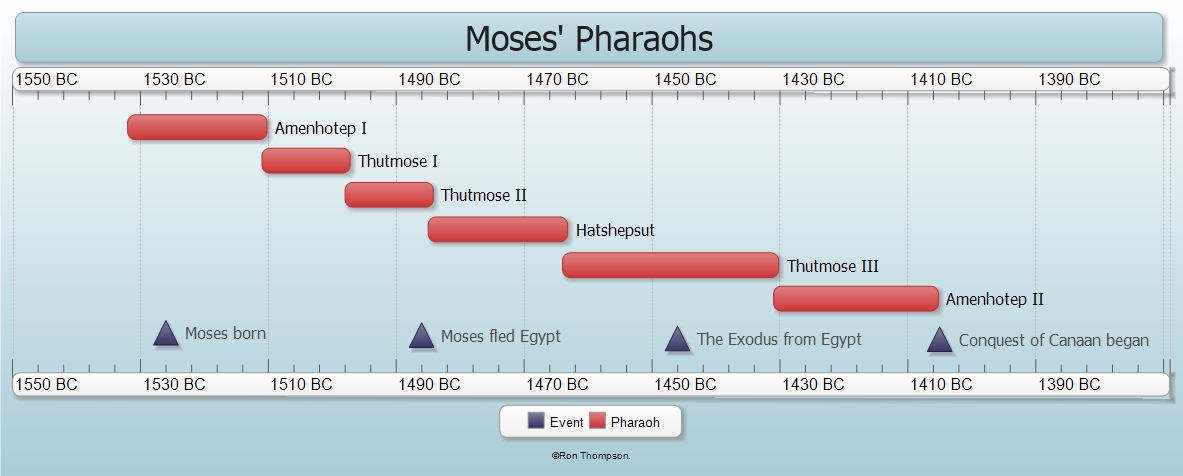
    1. Pharaoh Amenhotep I, 1532-1511 BC
    2. Pharaoh Thutmose I, 1511-1498 BC
    3. Pharaoh Thutmose II, 1498-1485 BC
    4. Pharaoh Hatshepsut, 1485-1464 BC
    5. Pharaoh Thutmose III, 1464-1431 BC
    6. Pharoah Amenhotep II, 1431-1406

I am presenting here a list of dates for key events in Egyptian/Biblical history. Dating of Biblical events during the Egyptian period is very firm, if you believe as I do that the Bible is inerrant and its time references are literal. Dating of the Egyptian King Lists is more problematic, as I will discuss below.

Middle Kingdom, 12th Dynasty

Dating the reigns of Middle Kingdom monarchs is particularly difficult, with a particularly large range of proposed possibilities. I have a fairly large library of Egyptian history. In this post I will list, separated by slashes, two of the newest chronologies that seem reasonable: First is the timeline presented by Van De Mieroop in A History of Ancient Egypt; second, the one I personally prefer, taken from the Wikipedia article, “Twelfth Dynasty of Egypt”, as last edited on 21 December 2021. A radically different chronology by Egyptologist David Rohl, has recently been popularized by the Patterns of Evidence series of videos. I plan to review this series in the near future, but for now, I like most of what is presented in the first two videos, but not so much the second two or the anticipated fifth. Rohl, a self-styled agnostic, follows the lead of various evangelical scholars who shorten the period of the Hebrew “sojourn” in Egypt from the explicitly stated 430 years to 350 years, based on what I believe is a simplistic misunderstanding of the Abrahamic Covenant.


Egypt’s capital throughout the 12th Dynasty period was located in ancient Itj-Tawy, located around 35 miles south of modern Cairo and 21 miles south of ancient Memphis.

Pharaoh Amenemhat II, 1911-1877/1929-1895 BC

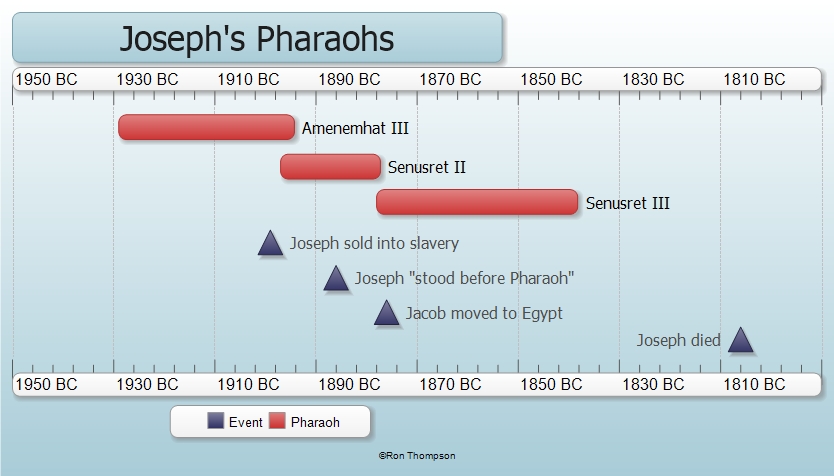
Joseph was sold into slavery in Egypt around 1899 BC, at 17 years old (Gen 37:2-29). Most of my sources would put this event somewhere in Amenemhat’s reign. I would place the timing shortly before a brief coregency of Amenemhat and Senusret II.

Pharaoh Senusret II, 1877-1870/1897-1878 BC

Joseph languished in Egyptian slavery and prison for some 13 years before he “stood before Pharoah” at age 30 (1886 BC) to interpret Pharaoh’s dream and to be elevated to Vizier rank (Gen 41:46). By my accounting, this Pharaoh was Senusret II, who seems to have devoted the final eight years of his reign to promoting Joseph’s recommendations for the productive years. Domestically, he is best known for developing the Fayyum Basin area west of the capital. This is a basin watered by a natural offshoot of the Nile, anachronistically named Bahr Yussef (“the Waterway of Joseph”). Although widening of this waterway was done well before the Middle Kingdom era, Senusret built numerous canals for irrigation and to control the levels of the valley’s Lake Moeris for the purpose of land reclamation. He also built new settlements in the center and around the borders of Egypt and appears to have greatly expanded his bureaucracy in these regions. Regarding foreign affairs, he is known to have fostered a period of peaceful trade with the hated “Asiatics” of the Levant.

Pharaoh Senusret III, 1870-1831/1878-1839 BC

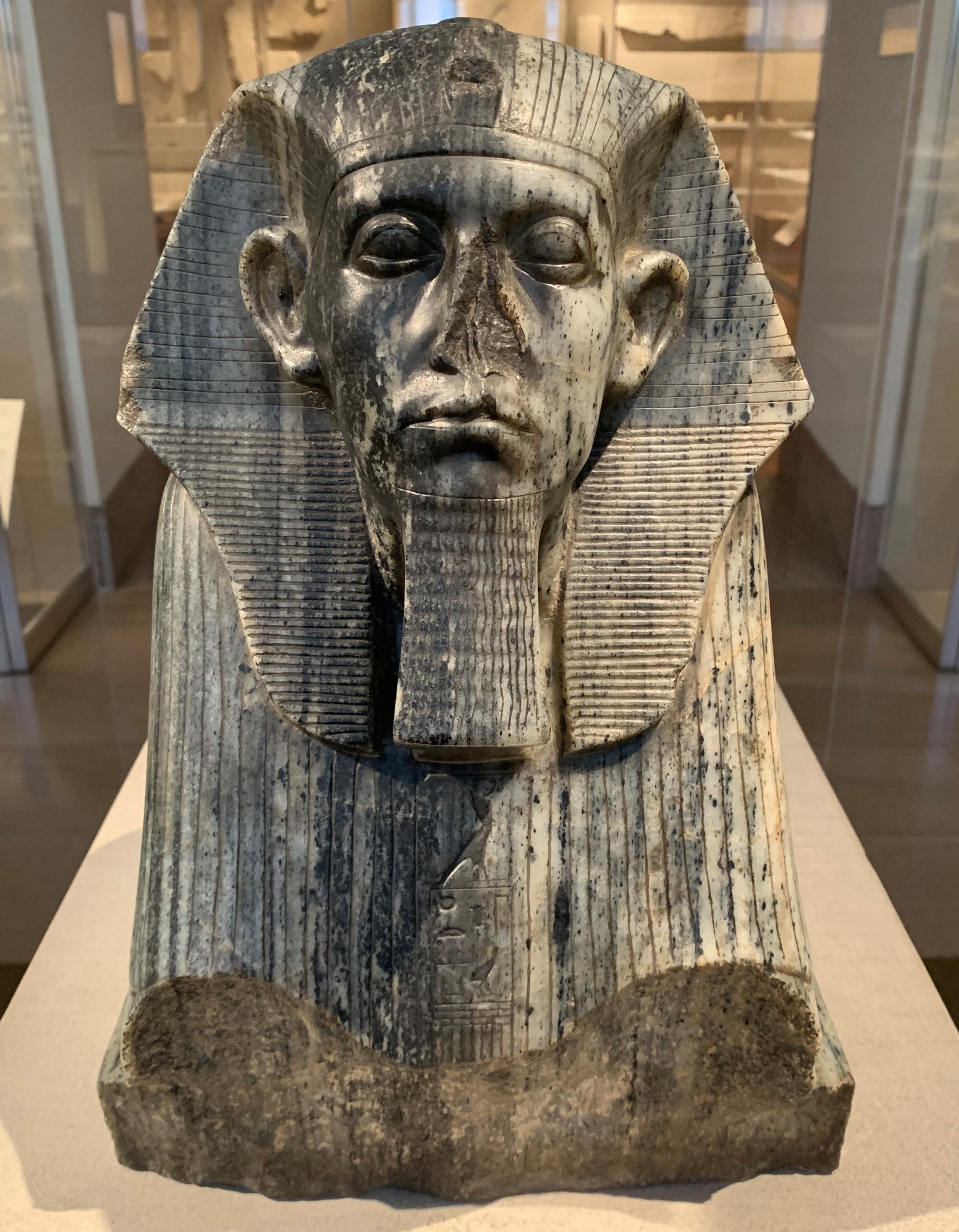
This powerful Pharaoh began his reign about eight years after the elevation of Joseph. I believe that his story is told in

Genesis 41:54-57 (CJB)
[54] and the seven years of famine began to come, just as Yosef had said. There was famine in all lands, but throughout the land of Egypt there was food. [55] When the whole land of Egypt started feeling the famine, the people cried to Pharaoh for food, and Pharaoh said to all the Egyptians, “Go to Yosef, and do what he tells you to do.” [56] The famine was over all the earth, but then Yosef opened all the storehouses and sold food to the Egyptians, since the famine was severe in the land of Egypt. [57] Moreover all countries came to Egypt to Yosef to buy grain, because the famine was severe throughout the earth.

Senusret III, ©MET Museum NYC

Senusret continued the agricultural developments begun by his father and attempted to maintain peace within Egypt and with Egypt’s neighbors, but the balance of power within Egypt changed radically during his reign. Since no later than the 3rd Dynasty, Egypt had been divided into individual districts called “nomes“, each ruled by a hereditary “nomarch“. These powerful nobles had decentralized Egyptian rule and placed limits on the Pharaohs. Senusret III seems to have used the famine years and his monopolistic control of Joseph’s well-stocked granaries to break the economic power of the nomarchs and to recentralize power within his kingdom.

In 1876 BC, near the beginning of the famine years, Jacob and the rest of his family and their retinues moved to Egypt (Gen 46:1-47:9). Why were they offered seemingly prime space in the fertile land of Goshen, the eastern Nile Delta region? Was this land gift purely out of Pharaoh’s love for Joseph? I doubt it. Their “Asiatic” origins were a heavy strike against them. They ignored Joseph’s warning not to mention that they were shepherds. Egypt’s herds were cattle, and sheep tend to overgraze pastures and make them unsuitable for raising cattle.

Late 12th Dynasty

Joseph died at 130 years old, in 1806 BC, having lived in Egypt after the famine during the reigns of Senusret III, Amenemhat III, and Amenemhat IV. Queen Sobekneferu was just coming into power for a brief, 4-year reign.

To Top

Hyksos Period

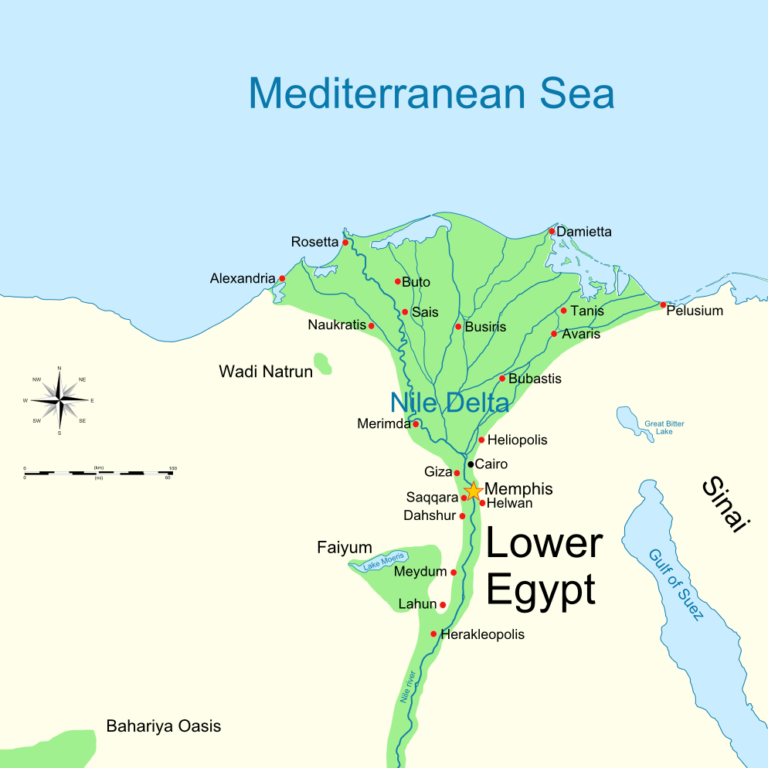
Hyksos Cities in Lower Egypt

While there is no question that the 12th Dynasty Pharaohs recognized Joseph’s wisdom and supported his programs as Vizier, as mentioned above, I personally have reservations about the sincerity of their welcome of his Hebrew family. Senusret III, in particular, hated the Nubians of Africa and was at best ambivalent about “Asiatics”—foreigners from eastern Mediterranean lands, many of whom had been infiltrating Lower Egypt for generations. I suspect that the Pharaohs’ invitation to Jacob and their tolerance of the Hebrews was more to keep Joseph happy and his relatives under observation.

At the close of the chaotic 14th Dynasty, a group of Asiatics, speaking an Aramaic/Canaanite west-Semitic dialect, took control of Egypt. They came to be called “Hyksos“, meaning “the rulers of foreign lands”. They were settled throughout Goshen and along the Lower Nile Valley, with scattered settlements into Upper Egypt. Dynasties 15, 16 and 17 consisted primarily of Hyksos rulers with their capital first in the eastern Nile Delta city of Avaris, and later in Thebes. They were not deposed until Amose I, founder of the 18th Dynasty, unseated them. He and his successors eventually drove them out of Egypt.

To Top

Enslavement

Aside from secular and Deistic theories that equate the Hyksos with the Hebrews, I have never seen or heard a discussion of the inevitable dispersal of the Israelites in Egypt during the Hyksos rule and early 18th Dynastic period. Exodus 1:5-7 implies that the original 70 “sons of Israel” had multiplied until they occupied not just Goshen, but rather “filled” all of the habitable land of Egypt. I imagine that they were displaced completely from Goshen itself, but in any case, as slaves they would have been required to concentrate close to where they worked. By Moses’ time, most of their work would certainly be in Upper Egypt, except at flood times. Travel from the Delta to Thebes by foot would probably have taken them around two weeks, at best. Without any archaeological or written records either way, I am assuming that the bulk of the slaves were sheltering along the Nile wherever they were needed at any given time.

Exodus 1:7-21 covers an undatable period of history after the death of Joseph and before the birth of Moses. A traditional understanding of the chapter assumes that the entire passage describes a single wicked Pharaoh, but I would rather divide it as follows:

  • the Pharaoh who “did not know Joseph”, and who ordered their enslavement—possibly as early as late in the 12th Dynasty (Ex 1:8-11);
  • a long period of increasing oppression and further population expansion (Ex 1:12-14); and
  • the Pharaoh who, during that period, tasked the midwives to kill Israelite boys (Ex 1:15-21).

To Top

New Kingdom, 18th Dynasty

Most scholars today use a Conventional Egyptian Chronology for this period. The currently popular Patterns of Evidence series is pushing David Rohl’s alternative “New Chronology”, which most Egyptologists agree is way off the mark. Within the 18th Dynasty, the Conventional view has two primary variations, due to an ambiguity in tying the ancient Egyptian calendar to our Gregorian calendar. The so-called “Low Chronology“, which is most popular, contains later dating; use of the “High Chronology” results in dates 20 years earlier. Personally, I prefer a variation of the Low Chronology, as presented by Christian Egyptologist, Kenneth Kitchen. Though I don’t agree with his conclusions about Biblical dating, his Egyptian dating seems to me to fit better with the Biblical narrative as I interpret it.

Pharaoh Amenhotep I, 1532-1511 BC

Moses was born in 1526 BC, by Kitchen’s Chronology, during the 6th year of Amenhotep’s reign. The order to throw newborn boys into the Nile was probably issued shortly before that time, so it is safe to say it was Amenhotep’s order (Ex 1:22). There is a problem with this chronology, though: the following passage (Ex 2:1-11) states several times that it was “Pharaoh’s daughter” who rescued Moses and later adopted him, but Amenhotep had no male or female heirs at all except for one son, who died at a very early age. If the dating is correct, then this wording can still be regarded as correct if she was the daughter of either a past or future Pharaoh. There is precedent for this type of royal ambiguity both in scripture and in other ancient writings. If so, there are three possible scenarios:

  • She could have been a daughter of Amenhotep’s father, Pharaoh Ahmose I. Ahmose had 12 children, including several daughters, but those who survived to 1526 would have been fairly old by the standards of the day. I think it would have been unlikely that any of them would be at the river under these circumstances.
  • Amenhotep was succeeded by Thutmose I, who was a military figure and not related to him at all. Thutmose did indeed have a daughter, Hatshepsut, who was 16 years old in 1526, and was suitable for other reasons, as well. See below.
  • Thutmose might have been considered the current Pharaoh if he was coregent with Amenhotep. This would not have been unusual, and there is some evidence of a coregency; but it would have to have lasted at least 15 years, which is very unlikely.
Pharaoh Thutmose I, 1511-1498 BC

Thutmose’ birth date and parentage are unknown. Amenhotep died without an heir, and it is likely that Thutmose, probably close to Amenhotep’s age, was promoted from a senior military position. Thutmose had five children over his lifetime, of which three died before his accession. His daughter, Hatshepsut, was born around 1541 BC, in the 16th year of Ahmose I’s reign. She would have been 16 years old when Moses was born, in the 6th year of Amenhotep’s reign, which certainly would have made her the ideal candidate for the (eventual) “Pharoah’s Daughter”. When Thutmose became Pharaoh, Moses was 15 and Hatshepsut undoubtedly a “headstrong” princess at 31 years old.

Exodus 2:5 (CJB)
[5] The daughter of Pharaoh came down to bathe in the river while her maids-in-attendance walked along the riverside. Spotting the basket among the reeds, she sent her slave-girl to get it. [6] She opened it and looked inside, and there in front of her was a crying baby boy! Moved with pity, she said, “This must be one of the Hebrews’ children.”

Pharaoh Thutmose II, 1498-1485 BC

When Thutmose I died in 1498 BC, he was replaced by his only surviving son, Thutmose II. Egyptian Pharaohs were almost always male, but succession was determined through a matriarchal system which frequently resulted in brother/sister marriages. Thutmose II was the son of Thutmose I by a minor wife, which made his claim to the throne weak. This he remedied by marrying his older half-sister, Hatshepsut, a daughter by Thutmose I’s chief wife.

Based on tradition, and possibly documentation that was available to him at the time, 1st Century Jewish historian Josephus reported that Moses was indeed a “prince of Egypt”, without question receiving the same education that any other Egyptian prince would have received in the eventuality that he might one day inherit the throne of Pharaoh. Josephus reported that Moses led the Egyptian army in at least one successful campaign against the perennial enemy in Nubia.

Although I believe that Hatshepsut was Moses‘ adoptive mother, and I have no doubt that she carefully supervised his education, I think that he later became a liability to her own ambitions. When Moses fled from Egypt in 1486, it was clear (as is evident from the state of his mummy) that Thutmose II was dying. Hatshepsut had her own plans going forward, and there may have been a risk that Moses would be seen as a viable heir. When she heard that Moses had killed an Egyptian, she had an excuse to get rid of him, either in her husband’s name or her own:

Exodus 2:15 (CJB)
[15] When Pharaoh heard of it, he tried to have Moshe put to death. But Moshe fled from Pharaoh to live in the land of Midyan.

I am not ignoring the masculine pronoun in “he tried”. Because Pharaohs were almost always male, Hatshepsut began dressing and acting as a male Pharaoh, and insisted that she was king, not queen, of Egypt. All references to her during much of her reign were masculine.

I think that Moses was savvy enough to recognize his danger. It is also significant to me that he was not sentimental about her at this point, either:

Hebrews 11:24 (CJB)
[24] By [faith], Moshe, after he had grown up, refused to be called the son of Pharaoh’s daughter. [25] He chose being mistreated along with God’s people rather than enjoying the passing pleasures of sin. [26] He had come to regard abuse suffered on behalf of the Messiah as greater riches than the treasures of Egypt, for he kept his eyes fixed on the reward.

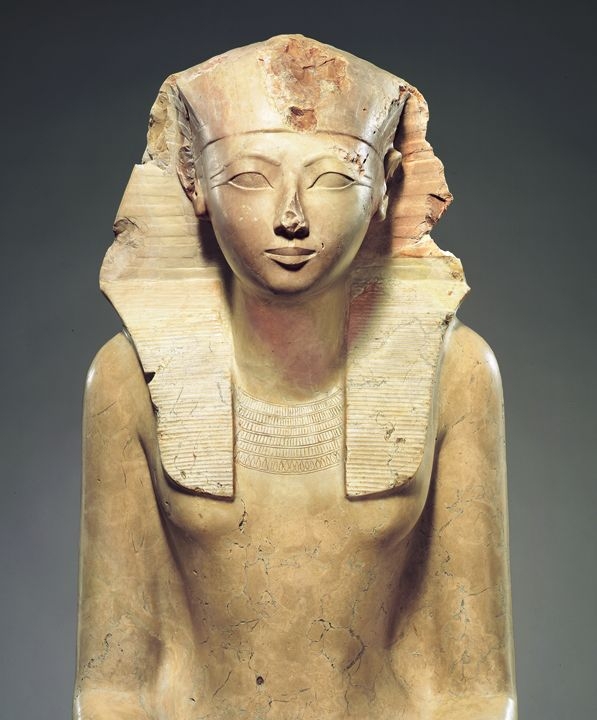
A young Hatshepsut, ©MET Museum NYC
Pharaoh Hatshepsut, 1485-1464 BC

When Thutmose II died in 1485 BC, he was succeeded by his infant son, Thutmose III, so Hatshepsut became queen regent. She reigned as actual Pharaoh for 19 years, until her own death. She is regarded by many as one of the most powerful woman monarchs of history. She died when Moses was 62 years old, roughly the midpoint of his 40 years in Midian.

Pharaoh Thutmose III, 1464-1431 BC

Thutmose III became sole ruler on Hatshepsut’s death. He is known as the “Napoleon of Egypt” for his many military campaigns and is considered to have been a military genius.

Thutmose III, ©MET Museum NYC

The Exodus and the loss of his armies occurred in 1446 BC, in approximately the 18th year of his reign after Hatshepsut’s death. His extreme reluctance to release the Hebrew slaves, despite the severity of the plagues, can probably be explained by Thutmose’s unwillingness to use potential fighting men in their place for common labor. In the few years after the Exodus, he continued his foreign invasions, and claimed great victories, but scholars discount these claims because there was apparently so little booty taken. There is no reason to assume, however, that the loss of so many of his fighting men in the Red Sea would have suppressed his military might for long.

Some commentators object to Thutmose III as the “Pharaoh of the Exodus” because they read some verses elsewhere in the Bible as stating that he had to have drowned with his army—for example:

Psalms 136:13 (CJB)
[13] to him who split apart the Sea of Suf,
for his grace continues forever;
[14] and made Isra’el cross right through it,
for his grace continues forever;
[15] but swept Pharaoh and his army into the Sea of Suf,
for his grace continues forever;

I don’t believe that this poetic description is meant to be precise; just flowery! In any case, the Hebrew text does not support the strength of the “and” interpretation.

Pharoah Amenhotep II, 1431-1406

Amenhotep was Thutmose III’s son by a minor wife. Interestingly, Thutmose’ firstborn son, Amenemhat, son of chief wife Satiah, was the heir-apparent until his death “between years 24 and 35 of Thutmose’ reign.” When accounting for the period of coregency with Hatshepsut, this conforms quite nicely with the Biblical account of the killing of the firstborn!

To Top


Fountains of the Deep

Posted on:

Modified on:

  1. The Deep
  2. The Fountains & Floodgates
  3. Identifying the Fountains of the Deep
  4. Likely Mechanism of the Flood

In ancient times, the peoples of the Middle East held a deep-seated, superstitious awe for the oceans and other large bodies of water. To them, the deep-water basins were abyssal, bottomless pits, full of monsters and evil spirits or demons. The continents floated on the ocean waters, which were also the common source of springs and subterranean rivers, so these source waters, too, were infested with evil spirits. Take, for example, the river Banias, which today flows from between rock strata down-slope from the famous cave at Caesarea Philippi. In Jesus’ day, the river flowed from the mouth of the cave. The pagans of Decapolis named the cave “The Gates of Hell” and surrounded its exterior with shrines to the god Pan.

The same ancient peoples who feared the deep waters also recognized that they were the source of life, providing fresh drinking water for humans and animals alike, water for the fields, and an abundance of fish, the staple of life for many civilizations.

To Top

The Deep

The Hebrew word most often used in the Bible to refer to this interconnected reservoir of water, either in whole or in part, is tehom, usually translated as “the deep.” Exactly what elements are included in any particular reference to tehom must be inferred from the context or modifiers. In Gen 1:2, most would agree that it referred to an all-encompassing ocean, prior to the formation of dry land surfaces. In Gen 49:25, Jacob is giving his deathbed blessing to Joseph, speaking of “the Almighty, who shall bless thee with blessings of heaven above, blessings of the deep [tehom] that lieth under…” (KJV) I believe that he is, here and in the parallel passage, Deut 33:13, referring to the entire, composite water system lying beneath the canopy of “heaven above.” In Job 28:14, in his discourse on Wisdom, Job defines his own usage of the term by means of the poetic doublet, “The deep says, ‘It isn’t in me,’ and the sea says, ‘It isn’t with me.’” (CJB) In Isaiah 63:13, tehom refers to the Red (or Reed) Sea, opened up for Moses and the Israelites.

To Top

The Fountains & Floodgates

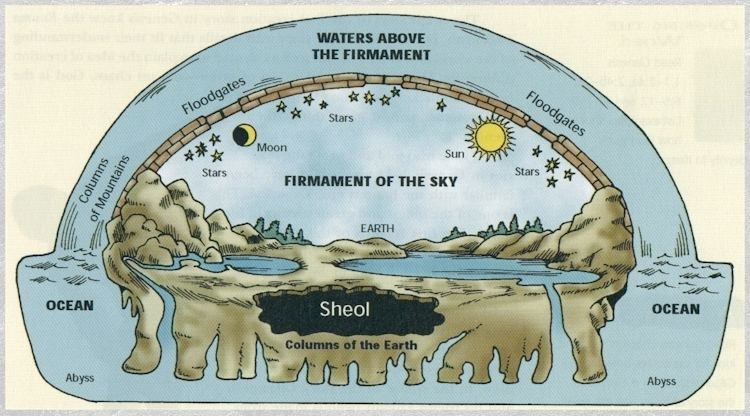
This diagram shows the cosmos as visualized by Moses, and by the people of virtually every culture in the Ancient Near East. Oceans, lakes, springs, and even the waters above the firmament were believed to be interconnected and were often collectively referred to as “the Deep.” Terrestrial waters rose to the surface of the land through fountains. Water falling from the sky was released by spirit beings through floodgates in the dome of the firmament.

Gen 7:11“In the six hundredth year of Noah’s life, in the second month, the seventeenth day of the month, the same day were all the fountains of the great deep broken up, and the windows of heaven were opened.” (KJV)

Gen 8:2“The fountains also of the deep and the windows of heaven were stopped, and the rain from heaven was restrained;” (KJV)

What, then, are “the fountains of the deep”, or ma’yenot tehom, as mentioned in the Flood story? Ma’yenow (singular) denotes a spring, fountain, or source. Can this be taken literally, like a spring in the desert, or is it poetically descriptive of the fact that water from “the deep” was gushing freely from some aperture or region? When considered in parallel with “the windows of heaven”, wa’rubot (chimneys or windows) ha-shamayim (the heavens, or elsewhere, “firmament”), my own opinion is that the “fountains” and “windows” must both be poetic terms, whereas the water and the flood were most certainly literal!

To Top

Identifying the Fountains of the Deep

Young Earth Creationists often take the view that “the fountains of the great deep” refers to continental springs, geysers, fissures, Artesian wells, and other surface openings that God miraculously ripped open and caused to spout abnormally great volumes of water from natural aquifers deep in the earth’s crust. This rending and subsequent flow, they say, caused cataclysmic changes in the topography, including newly up-thrust mountain ranges, massive erosion, and even the division of large supercontinents into the smaller continents we know today.

fountains_of_great_deep

A fairly traditional view.

Others take the view that God caused volcanoes to sprout across the continents and spew water and, presumably, lava (since that’s what volcanoes do).

I can’t resist mentioning still another view that I ran across proclaiming, presumably with a straight face, that the unprecedented heavy rain was associated with a drop in barometric pressure so severe that water under the earth’s crust for some unspecified reason “pushed up and out … to come to the surface”, evidently causing the crust to pop like a balloon! Incredible, since the normal barometric pressure at sea level is typically below 15 psi, which is pretty much the same pressure that my own bare feet exert on earth’s crust when I stand on it!

fountainsofdeep1

An incredibly naive view.

My view is that the term “fountains of the deep” describes features of the ocean floor. Opening of these “fountains” may have caused some shifting of the tectonic plates and therefore some near-shore damage on the continents, but the main effect was a sudden simple rising of the sea level. I will discuss a probable mechanism below, but first I would like to present some brief arguments against continental “fountains”:

  • Scripture nowhere states that the flood caused catastrophic changes in Earth’s geology. This isn’t even a long-standing tradition. It is a theory that was proposed in my lifetime, and there is no valid scientific evidence that either the topography or the stratigraphy of the earth was greatly influenced by a single massive flood. The idea that the Genesis Flood accounts for the apparent old age of the earth is simply an assumption made in an effort to explain something that the Bible itself made no effort to explain. It is a defensive theology aimed at those scientists and others who deny scripture. Since it is in no way backed by scripture, it must meet the objections of science and of common observation, and it simply fails to do so. In a separate post, Geology a Flood Cannot Explain, I presented a substantial list of geological phenomena that to my personal knowledge cannot possibly be explained by the Genesis Flood. I also presented my credentials for addressing the various issues discussed.
  • Crustal aquifers exist, not in caverns, but in porous and permeable rock formations. While sometimes quite large, they are limited in their areal extent and thickness. Many thousands of deep oil and gas wells (including a number that I was involved in drilling and evaluating) and countless geophysical studies have shown no evidence of permeable rock formations in continental crust large enough to contain the enormous volumes of water that would be necessary to cover the highest mountains, even if they were much lower than they are today. And were they? Possibly a bit; the Himalayas, for example, are demonstrably rising even now as a result of plate tectonics and the ongoing collision of the Indian Plate with the Eurasian Plate. But consider Mt. Ararat: after God closed the windows of heaven and stopped up the fountains of the deep, Ararat, at Over 16,000 feet above the normal sea level, was still under the receding water!
  • Sufficient quantities of sub-continental water would most certainly have had to come from deep within Earth’s mantle unless they were created by God, on the spot (which I acknowledge to be theologically possible, but not necessary). Any continental aperture of sufficient depth to reach these depths and sufficient width to handle the volume of water necessary would, I think, have to be fairly humongous. Why are there no traces of anything like this?
  • Continental volcanoes might account for a large volume of deep-sourced water, but I don’t think there is evidence of enough continental volcanism to provide that much.
  • Finally, I think that Gen 7:11 provides an important clue. This passage states that it was the “fountains of the Great Deep” (tehom rabaah) that God opened to start the rising flood. That terminology in Scripture normally refers only to the abyssal ocean basins, not to continental features.

To Top

Likely Mechanism of the Flood

There are two likely mechanisms, that I can see, that God might have used to bring that much water up from the deep, and then to store it again once He was done with it:

  1. First, he could have simply created it on the spot, flooded the earth with it, and then de-created it again when he was done with it.
  2. It seems to me, though, that His modus operandi as described in scripture is normally to wrap what He has already created in some sort of miracle when He wants to make a major power statement. I think that He “foreknew” what He was going to do and incorporated that plan into His original design.

Every school child since before my day has known that the earth has an upper “crust”, a central “mantle”, and a lower “core”. Geophysicists now believe that the mantle consists primarily of different forms, or “phases” of the mineral Olivine, which is a “magnesium iron silicate.” The simple Olivine of the upper mantle, under the heat and pressure of lower depths is converted to a phase called Perovskite in the lower mantle. Between the two regions is a transition zone consisting of Olivine phases called Wadsleyite and Ringwoodite. Both of these mineral phases can be very heavily hydrated and are now thought to contain as much as 3.5 times as much water as in all the earth’s oceans. Many young-earth creationists, as well as ancient-earth creationists like me, speculate that this is the primary source of the water that God used to flood the earth in Noah’s day.

mantle_water
Schematic cross-section of earth. The oceanic crust, riding on the plastic mantle rock beneath it, is welling up at the “mid-oceanic ridges” and sliding toward the continents at a rate of 1–2 inches a year. At the continental margin, this migrating crust then sinks back below the surface and circulates back to where it started, moving on great convection currents. Even in normal times, prodigious amounts of water are carried along with this cycle.

Most people probably think of the deep regions of the earth as simply dead, stagnant, unmoving rock. In reality, the earth is a dynamic, “living” system from surface to center. We have all been taught about the “water cycle”, where ocean water evaporates, clouds form, rain falls on the continents, and streams and aquifers return the same water back to the oceans. There is also a water cycle involving the mantle transition zone: ocean water is dragged, in prodigious quantities, into the depths of the mantle by the “subduction” of Earth’s oceanic tectonic plates. This water charges the transition zone, and much later is returned to the ocean through the agency of deep-ocean “smokers” (hydrothermal vents) and volcanism along the Mid-Oceanic Ridges; in the Island-Arc and Continental-Arc volcanoes near subduction zones; and in “hot spot” volcanoes like the Hawaiian volcanos and the Yellowstone super-volcano.

It turns out, paradoxically, that water itself is what spawns volcanic activity, because the melting point of rock is drastically lowered in the presence of water. There is, in fact, an intriguing theory that there should be a sheet of molten rock at the upper surface of the transition zone. From my own knowledge of petrology and fluid flow in rock, that makes me think that conditions in such a region could be right, under certain circumstances (like a gentle push from the Hand of God!) for water-laden, low viscosity, basaltic magma to suddenly channel rapidly through this discontinuity into the Mid-Oceanic ridges, causing a subsequent rise in sea level that could be described poetically as the “fountains of the great deep” opening up.

If this superheated and thus buoyant water were to bubble quickly to the ocean surfaces (or be injected directly into the atmosphere), I would expect it to quickly rise through the cooler air near the surface, and to spread out and rapidly cool near the stratosphere, setting off a global rain event. Since no pressure front would be active in forming this rain, I would not expect serious damaging winds such as are postulated by followers of Henry Morris.

Regarding the return of the flood waters to the transition zone: in my view, the text implies a direct miracle.

Gen 8:1 – “God remembered Noach, every living thing and all the livestock with him in the ark; so God caused a wind [ruach] to pass over the earth, and the water began to go down.” (CJB)

The Hebrew ruach can mean “wind” in scripture, but it often is translated as “spirit”. In Genesis 1:2, the Ruach of God hovered over the surface of the water. In 8:1, God caused His Ruach to hover over the face of the water-covered earth! In both cases, the earth was covered with an unbroken expanse of water, and God sent His Ruach HaKodesh (Holy Spirit) to deal with it! For more on the “wind of God”, see God with the Wind.

To Top


The Coming World War: Gog and Magog

Updated January 2022; original May 2015

  1. The Triggers
  2. The Deterrent
  3. The Players
  4. The Protest
  5. The War
  6. The Outcome
  7. The Timing

There are two major events on God’s prophetic calendar which could occur at any time, now or years from now. One, of course, is the Rapture. There are no other prophetic events which have to occur before the Rapture. The same can be said for the other imminent event, the War of Gog and Magog, described in Ezekiel chapters 38 and 39. It is this war that I want to discuss here, because it seems to me that all of the pieces for it are in place.

Gog and Magog, which I will refer to hereafter as, simply, The War, may happen either before or after the Rapture, but must precede Antichrist’s treaty and the Tribulation period. Why? A number of compelling reasons are proposed by Arnold Fruchtenbaum in his book, The Footsteps of the Messiah: The Sequence of Pretribulational Events. I may reprise additional reasons in a future posting, but for now I will simply say that the prophesied seven years of cleanup after the war seems to preclude any other possibility.

There are numerous geopolitical events and conditions that I saw as lining up or lined up when I first wrote this post in 2015. Now, in late 2021, not much has changed to alter my views.

To Top

The Triggers

The War will be an invasion of Israel by Russia, Iran, and a number of additional players. As most news-savvy Americans know, Iran is allied with Russia, which sends them military technology, including advanced offensive and defensive armaments.

The West has long been worried about Iran’s nuclear missile development program. Over the last decade or so, Israel has launched several limited strikes against Iranian facilities in Iran itself and in their client state, Syria. Unfortunately, serious physical and political risks prohibit them from attacking in a more decisive manner.

With all the talk about Iran’s nuclear development, relatively little has been said about their build-up of conventional forces and armaments. According to GlobalFirepower.com, as of April 1, 2015, Iran had at that time over a half million active front-line military personnel, with 1.8 million reserves and almost 40 million citizens fit to serve. They were and surely are very highly trained and well equipped. The result is that their level of aggression against other Arab states was high. They continue to flex their military muscles, with two primary ends in view: (1) hegemony in the Middle East and ultimately the world; and (2) the total destruction of Israel in the short term, and the United States eventually.

To Top

The Deterrent

The reason that The War has not yet begun is simply Eastern fear of Israel’s might, particularly with the US as her ally, along with a perennial inability of the Muslim faction in the Middle East to unite effectively in a common cause.

Clearly, the US alone is no longer a viable deterrent. Anti-Israel sentiment in our political and educational institutions and even in some American Jewish circles, has grown too strong. America is not mentioned in Biblical prophecy because we will voluntarily take no part in the defense of our allies. The EU and the United Nations will also certainly not side with Israel. I don’t believe that Iran would risk an attack on Israel on its own without first completing its nuclear program, but with Russia’s help and additional Shiite allies, there simply is no longer a viable deterrent. As for the lack of Muslim commonality, I believe that with powerful non-Muslim allies, the potential reward to Islam as a whole could at any time prove to be an overriding factor.

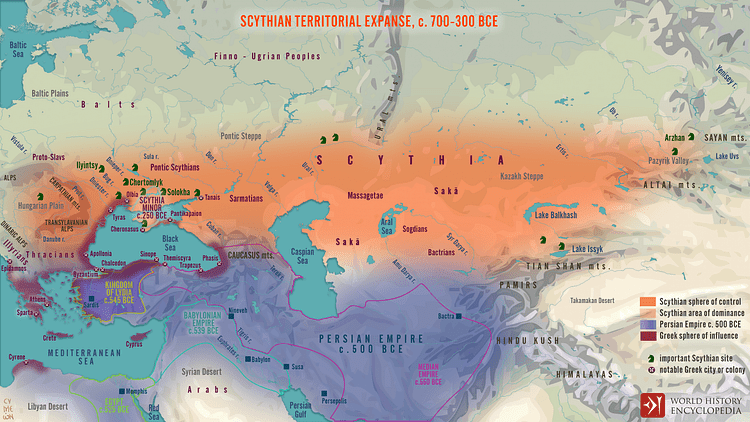
Players in the Gog & Magog War. Base map annotated by Ron Thompson

To Top

The Players

Ezekiel 38:2-6 lists the participants we can expect to see coming against Israel in The War:

38 Now the word of the Lord came to me, saying, 2 “Son of man, set your face against Gog, of the land of Magog, the prince of Rosh, Meshech, and Tubal, and prophesy against him, 3 and say, ‘Thus says the Lord God: “Behold, I am against you, O Gog, the prince of Rosh, Meshech, and Tubal. 4 I will turn you around, put hooks into your jaws, and lead you out, with all your army, horses, and horsemen, all splendidly clothed, a great company with bucklers and shields, all of them handling swords. 5 Persia, Ethiopia, and Libya are with them, all of them with shield and helmet; 6 Gomer and all its troops; the house of Togarmah from the far north and all its troops — many people are with you. NKJV

Nations are defined Biblically by their peoples, not necessarily by the lands that they occupy; furthermore, they are named as they were in the day of writing, and boundaries occupied by the lands and peoples must be understood to be fluid over time. One would like to say, “Magog is Russia”, and “Gomer is Germany”, as was common in the early days of American “popular prophecy”, but it just is not that simple. Modern Eurasian civilization is an incredibly complex mixture of peoples who often can only roughly be identified, based largely on archaeological and linguistic evidence. With the exception of Gomer and Rosh (see below), I am more or less inclined to stick with my conclusions from some seven years ago when I prepared the attached map.

Gog and Magog: The invading forces will be led by “Gog, of the land of Magog” (v2a). Magog corresponds roughly to the area of modern European Russia, particularly the southwest region, between the Caspian and Black Seas, including Georgia and Azerbaijan. Of course, we won’t see a war launched by “Southwest European Russia.” My assumption is that the entire Russian Federation will be involved. Gog is not a name, but rather a leadership title, like “Pharaoh.” Presumably, then, this refers to Vladimir Putin or a successor. Russia is closely allied to Iran. With extensive natural resources of its own, Russia still desires to control Middle Eastern oil and natural gas, for strategic purposes.

Rosh, Meshech and Tubal: Gog is also the “prince of Rosh, Meshech, and Tubal (v2b)”. These three names, and most of the others, can most likely be equated with some of the many nomadic tribes that over centuries swept west and south from Mongolia and the Russian Steppe regions. Meshech and Tubal constitute most of modern Turkey and are probably Scythian in origin. Though I seem to have omitted it from my map, I think that Rosh refers to the well-attested Rus people, namesakes of modern Russia, who migrated from western Russia and Belarus, southward into the Baltic regions. The peoples of the coastal areas west of the Black Sea are largely of Rus (again, Scythian) origin. European Turkey and parts of modern Bulgaria, Romania and Macedonia were known as Rus until after the fall of the Byzantine Empire to the Ottomans. From the time of the Ottoman conquests, the area has been largely Muslim.

Persia: Persia (v5a) of course refers to Iran, probably along with her client states of loyalist Syria; Hezbollah-controlled Lebanon, eastern Iraq and perhaps Yemen.

Cush: Ethiopia (or Cush, v5b) may refer to the upper Nile regions of modern Sudan, Ethiopia and Somalia, or it may refer to parts of Iraq. Or both. I believe that Cush, as referred to in Genesis 2:13, refers to the upper Mesopotamia region around the Diyala River, and that river is, in fact the Gichon, or Gihon, River of the same verse. Cush, a son of Ham, is thought to have populated a wide region of the ancient Middle East and Africa. The ancient empire of Babel, in modern Iraq, was founded by Nimrod, a Cushite.

Put: The KJV and most modern translations equate Put (v5c) with Libya; however, some authors including Fruchtenbaum claim that Libya is equivalent to “Lud”, and Somalia corresponds to “Put.” My own opinion is that Libya is primarily Put, and Somalia is part of the general region of Cush. I would place Lud in Tunisia and far western Libya.

S1cyythian Gomer?

Gomer: According to Josephus and some other early sources, Gomer (v6a), corresponds to Anatolian Galatia, in central Turkey; however, many conservative scholars have identified it with Germany, and that was the view taken by Hal Lindsey and Herbert W. Armstrong. I went with that in the original writing of this post, but I am now convinced that Gomer refers instead to the ancient Scythians, who were once united in a nomadic empire that covered much of the Steppe region north of the Black and Caspian Seas, eastwards into Mongolia, and westwards into Eastern Europe. I would surmise that the region in view here is the Islamic regions of Eastern Europe.

Beth Togarmah: The “House of Togarmah” (v6b) is located around present-day Armenia.

As you can see from this listing, all these pieces of the puzzle make total sense today, in the context of current geopolitical alignments. In fact, I would not hesitate to say that all or most of the colored regions on the map above will be included in the alliance.

To Top

The Protest

I don’t believe that the US, the EU or the UN will lift a hand to help Israel. At most, there might be a weak diplomatic protest from these entities. They are becoming more and more anti-Semitic and anti-Israel. The Bible mentions no allies for Israel, aside from Almighty God Himself! Ezekiel 38:13 hints at the only protest from Israel’s neighbors:

13 Sheba, Dedan, the merchants of Tarshish, and all their young lions will say to you, ‘Have you come to take plunder? Have you gathered your army to take booty, to carry away silver and gold, to take away livestock and goods, to take great plunder?'”‘ NKJV

Sheba was located around modern northern Yemen, and Dedan is the present Al Ula in northwestern Saudi Arabia. Tarshish, mentioned in a number of Biblical passages, is known only to be someplace in the ancient Mediterranean area “far away” from Israel. Possibly the site of Carthage, or as usually cited, Spain. The reference to its “young lions” is an idiomatic expression indicating colonies or an empire; I would speculate that it actually has in mind the Emirates of Arabia, which are Saudi and American allies, and lean towards friendship with Israel.

To Top

The War

Ezekiel 38:8-17 describes the setting and prosecution of the war:

8 After many days you will be visited. In the latter years you will come into the land of those brought back from the sword and gathered from many people on the mountains of Israel, which had long been desolate; they were brought out of the nations, and now all of them dwell safely. 9 You will ascend, coming like a storm, covering the land like a cloud, you and all your troops and many peoples with you.”

10 ‘Thus says the Lord God: “On that day it shall come to pass that thoughts will arise in your mind, and you will make an evil plan: 11 You will say, ‘I will go up against a land of unwalled villages; I will go to a peaceful people, who dwell safely, all of them dwelling without walls, and having neither bars nor gates’ — 12 to take plunder and to take booty, to stretch out your hand against the waste places that are again inhabited, and against a people gathered from the nations, who have acquired livestock and goods, who dwell in the midst of the land. 13 Sheba, Dedan, the merchants of Tarshish, and all their young lions will say to you, ‘Have you come to take plunder? Have you gathered your army to take booty, to carry away silver and gold, to take away livestock and goods, to take great plunder?'”‘

14 “Therefore, son of man, prophesy and say to Gog, ‘Thus says the Lord God: “On that day when My people Israel dwell safely, will you not know it? 15 Then you will come from your place out of the far north, you and many peoples with you, all of them riding on horses, a great company and a mighty army. 16 You will come up against My people Israel like a cloud, to cover the land. It will be in the latter days that I will bring you against My land, so that the nations may know Me, when I am hallowed in you, O Gog, before their eyes.” 17 Thus says the Lord God: “Are you he of whom I have spoken in former days by My servants the prophets of Israel, who prophesied for years in those days that I would bring you against them? NKJV

This passage describes Israel today, a peaceful nation though not at peace, alive again after nearly 2,000 years, and dwelling in their own land, in relative safety, comfort and confidence. The invasion will come from the north, up into the mountains of Israel (and Jerusalem is always considered “up”, no matter where you come from). Russia, at least, is seeking booty: oil and gas, the mineral riches of the Dead Sea, and above all, the strategic positioning of the nation at the “crossroads of the world.” The booty listed here, as well as the weapons used, are metaphorical because Ezekiel could know nothing of today’s riches and weaponry.

To Top

The Outcome

As described in Ezekiel 38:18-23

18 “And it will come to pass at the same time, when Gog comes against the land of Israel,” says the Lord God, “that My fury will show in My face. 19 For in My jealousy and in the fire of My wrath I have spoken: ‘Surely in that day there shall be a great earthquake in the land of Israel, 20 so that the fish of the sea, the birds of the heavens, the beasts of the field, all creeping things that creep on the earth, and all men who are on the face of the earth shall shake at My presence. The mountains shall be thrown down, the steep places shall fall, and every wall shall fall to the ground.’ 21 I will call for a sword against Gog throughout all My mountains,” says the Lord God. “Every man’s sword will be against his brother. 22 And I will bring him to judgment with pestilence and bloodshed; I will rain down on him, on his troops, and on the many peoples who are with him, flooding rain, great hailstones, fire, and brimstone. 23 Thus I will magnify Myself and sanctify Myself, and I will be known in the eyes of many nations. Then they shall know that I am the Lord.”‘ NKJV

God will overtly and miraculously intervene, and the invading armies will be totally destroyed. The effects of God’s wrath will be felt and recognized around the world, with Russia’s homeland itself leveled. Reading on, the mountains of Israel will be literally covered with the dead and their armaments. Seven months will be required to bury the dead and seven years to dispose of the armaments.

I believe that tremendous damage will have been done to Israel and its armed forces, but at the close of this war, the power and might of Russia and the militant Muslim countries will be at a complete end. Into this milieu, I see the rise of a world leader, the Antichrist, who will take advantage of the chaos, offering to guarantee peace to all sides. Neither the Muslims nor the Anti-Semitic West will have power to prevent him from granting Israel the right to rebuild the Temple; thus will begin the Tribulation.

To Top

The Timing

I have shown that The War could happen at any time. It may follow the Rapture, but I would not be at all surprised if it happened first, in order to give the world, and especially Israel, one final glimpse of God’s awesome power, and to give them one final chance to repent–or more likely, to demonstrate how utterly blind humanity can be!

Ezekiel 39:6b-8:
6b Then they shall know that I am the Lord. 7 So I will make My holy name known in the midst of My people Israel, and I will not let them profane My holy name anymore. Then the nations shall know that I am the Lord, the Holy One in Israel. 8 Surely it is coming, and it shall be done,” says the Lord God. “This is the day of which I have spoken.” NKJV

To Top


Jesus’ Last Steps

This past summer, a number of people from my church went on a tour of Israel. On their return, one of the pastors was marveling at the great distance that Jesus was required to walk on the morning of his crucifixion. Of course, it is not possible to say with total certainty what route He took that morning, but I believe with a little research it is possible to make some fairly good guesses. The relevant passages in Scripture are Matthew 26:17-27:45; Mark 14:12-15:37; Luke 22:7-23:51; and John 13:2-19:38.

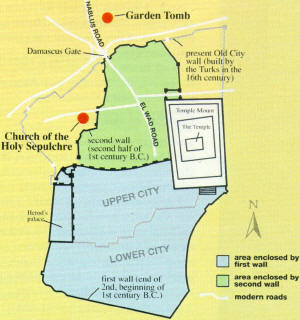
©Leen & Kathleen Ritmeyer, from Jerusalem at the Time of Jesus. Annotated by me.

The paragraph numbers below correspond to points on the accompanying map.

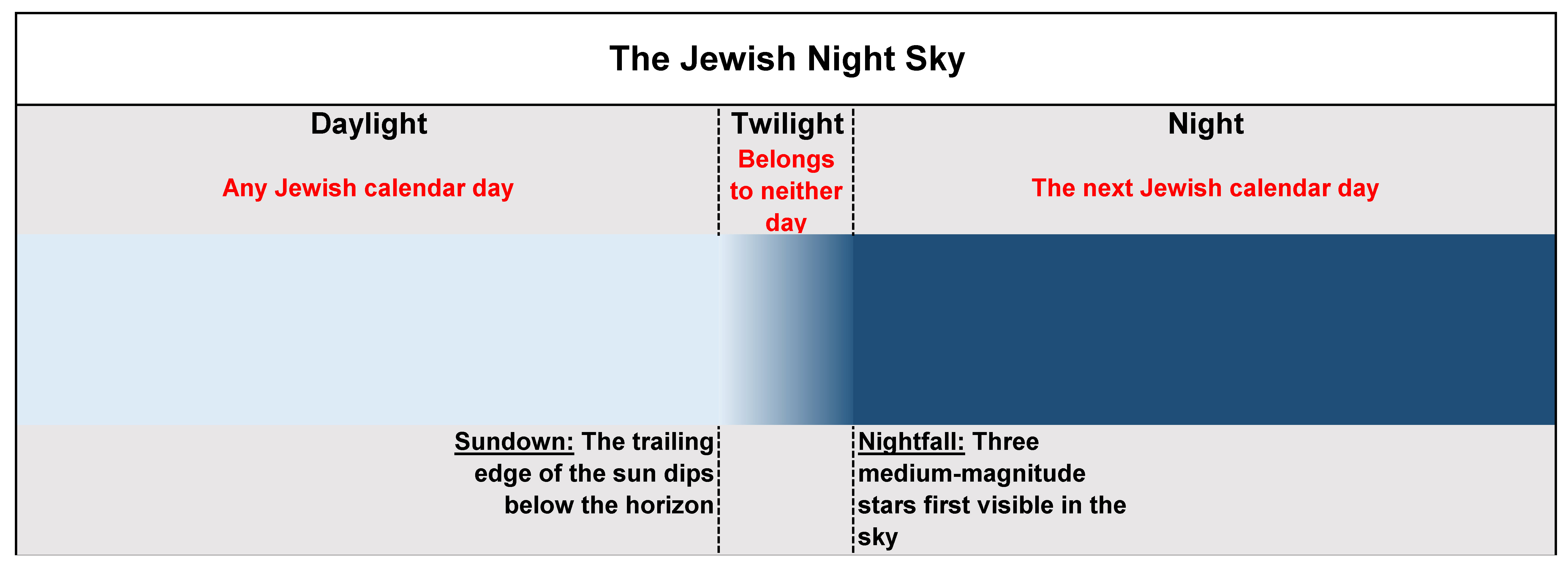
  1. The Upper Room – The trek, of course, began at the Upper Room. Most of the sites visited can be located today with some degree of confidence. Not so the Upper Room. Church tradition places it at the site of the Church of the Apostles on Mt. Zion, in the southwestern quarter of the city, in an upper story directly above the traditional location of the Tomb of David. I don’t believe that this is the correct location of either shrine. David’s real tomb was probably in a known cave complex on the southeastern slope of the City of David, but the Upper Room could be anywhere in the city. Due to the proximity of the Gihon Spring and given that the host was described as a man carrying a jar of water, some authors tentatively place it on the Ophel, south of the Temple Mount; however, everybody in Jerusalem had to fetch water, and the room was described as “large”, leading me to place it somewhere in the more upscale Upper or Lower City (the Western Hill or the Tyropoeon Valley). After killing the sacrifices on Thursday, Nisan 14 (probably April 4, AD 30), food for the Seder had to be prepared and the Sabbath candles lit before sundown. Then the meal could begin during the twilight period. Most celebrations wrapped up at around midnight and the celebrants went outside, either into the streets or onto the roofs, to join in citywide singing of the Hallel psalms.
  2. The Mount of Olives – After singing the Hallel, Jesus and his party adjourned to the Mount of Olives, presumably leaving the City of David via the Water Gate, above Gihon Spring. There was most likely a switch-back road descending from the gate into the Kidron Valley below, intersecting with a road running along the valley floor. Matthew and Mark describe this stage of the trek similarly: as they arrived at The Mount of Olives, Jesus prophesied that his apostles would lose faith in him that night. He quoted from the apocalyptic 13th chapter of Zechariah which speaks of the End of Days (acharit hyamim). At that time, the people in the Land will be scattered, with 2/3 of them purged and those who remain purified. He then said that after His resurrection He would meet the disciples in Galilee. At this point, we see the exchange with Peter, when his threefold denial is foretold. They then proceeded on to Gethsemane. Luke only says that Jesus told them to pray that they might not be put to the test. He then went “about a stone’s throw away” to pray—presumably the John 17 prayer—and returned to find them sleeping. John’s account is quite different. There is no clear transition from the Upper Room to the Mount of Olives. Chapters 13 through 17 cover in great detail the exhortations and warnings to the disciples, and Jesus’ prayer. Given only this passage, one would conclude that the entire conversation, including the prayer, took place around the Seder table, though that is not actually stated. From this passage it appears that the exchange with Peter occurred near the end of the Seder, in the Upper Room. Conservative hermeneutics, based on examination of ancient literary practices, allows conversations to be paraphrased and chronologies to be out of order, as long as the message is not distorted by doing so, so this part of the conversation could have taken place in either location. Another likely possibility is that Jesus said the same thing twice in order to drive the point home to Peter.
  3. Gethsemane – From the Mount of Olives, the party moved on to the Garden of Gethsemane (Gat-Sh’manim), where Jesus was arrested. Since Gethsemane is an olive grove and olive press on the Mount of Olives, this can of course be interpreted to mean that they simply moved from outside to inside the borders of the grove; however, I have a personal theory based on the passage in John. John records that after the prayer of chapter 17, “He went out with his talmidim (disciples) across the stream that flows in winter through the Vadi (Vale, or Valley) Kidron, to a spot where there was a grove of trees; and He and His talmidim went into it (CJB).” They must at some time have crossed the Brook Kidron, but is this the stream referred to? At that time the Kidron was fed year-round by the seasonally varying Gihon Spring, and by other sources in the mountains to the east and north during the rainy seasons of early and late winter. Since they would have had to cross this stream below Gihon, it would have always held water. I don’t see how it would be described as “the stream that flows in winter.” I am therefore postulating that the stream may have been just a small rill spilling down off of the Mount, to the south of the grove. That would allow the entire conversation of chapters 13 through 17 to have taken place on the Mount close to, but not strictly within, Gethsemane. One possibility is a small stream that separates what we currently think of as the Mount of Olives and the Mount of Offense. In those days these two mountains, along with Mount Scopus to the north were all considered part of the Mount of Olives.
  4. Annas’ House – Only John mentions that after His arrest, Jesus was first taken to the house of Annas, father-in-law of the current High Priest. Annas was an extremely wealthy man who, though no longer High Priest, was still perhaps the most powerful man in the city. Annas was probably the inhabitant of a house in the richest part of the city which has been excavated, partially restored and named the “Palatial Mansion.” The arresting party is likely to have taken one of two routes from Gethsemane: I have drawn them retracing Jesus’ earlier steps to the Water Gate, then taking the most direct route to Annas’ house. As an alternative, they could have entered the city on the north side near the present Lions’ Gate, passing between the Pool of Israel and the Bethesda Pools and rounding north of the Antonia Fortress. The second route is longer, the first more tortuous.
  5. Caiaphas’ House – After briefly questioning Jesus, Annas sent Him to Caiaphas. Matthew and Mark say that “The head cohanim (priests) and the whole Sanhedrin” then put Him on trial. Luke says, “Having seized Him, they led Him away and brought him into the house of the cohen hagadol (High Priest).” Caiaphas’ house has been identified by many with an archaeological site in the southwestern portion of the city, near the traditional site of the Upper Room. Many scholars have long assumed that since the Sanhedrin was involved, Jesus must have then been moved to the Chamber of Hewn Stones in the Temple complex, since that was where they normally met until a few years later when they moved into the Royal Porch. This view is not credible, because (a) they were holding an illegal trial at that time of day (before daybreak); (b) the Temple gates were still locked at that time of day; (c) Peter was described as “outside in the courtyard, (of a residence); and (d) the accompanying Roman soldiers had custody and would not have handed him over to the Jews at this time, which would have been necessary since they could not enter the inner courts of the Temple.
  6. The Praetorium – This was Pilate‘s (the governor’s) headquarters. It has been variously identified as (a) the Antonia Fortress; (b) The Hasmonean Palace, near the Palatial Mansion; and (c) Herod the Great’s Palace, at the site of the later Citadel. It is presently believed that (c) is the correct location. Jesus was taken here “early in the morning”, around daybreak, and questioned by Pilate.
  7. Herod Antipas – This son of Herod the Great normally lived in Caesarea Maritima but was visiting Jerusalem for the Passover. When in Jerusalem, he normally lodged in the Hasmonean Palace (see above). Only Luke mentions this side trip. Herod questioned Jesus and sent Him back to Pilate.
  8. The Praetorium again – When Herod sent Jesus back to the Praetorium, Pilate tried unsuccessfully to release him in order to avoid confrontation with the masses of common people. Instead, he was compelled to kill Jesus instead of Barabbas (Bar-Abba). Jesus was led inside, tortured, and prepared for crucifixion.
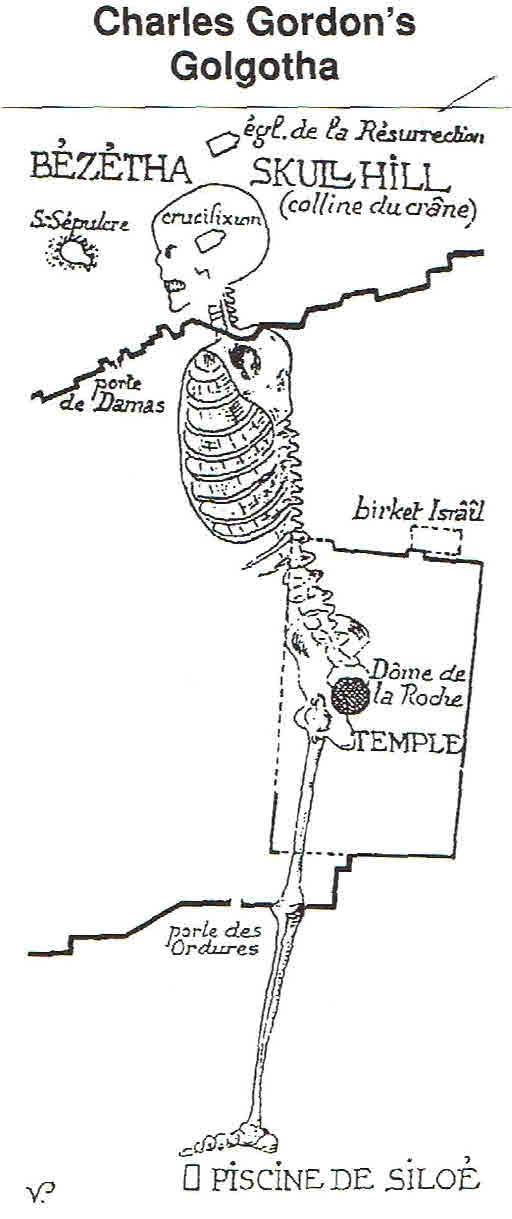
  9. Golgotha (Gulgolta) and Joseph of Arimathea’s (Yoseph from Ramatayim’s) Tomb – In a previous blog I explained why Gordon’s Golgotha and the Garden Tomb are not possibly where Jesus’ life was temporarily put to an end. Instead, the crucifixion and burial almost certainly occurred at the traditional Christian site inside the Church of the Resurrection.

HE IS RISEN; But Not from the Garden Tomb!

golgotha

Recent scholarship recognizes two main possibilities for the site of Jesus’ crucifixion and burial: Gordon’s Calvary and the Garden Tomb; and inside the bounds of the Church of the Resurrection (hereinafter, “the church”). The current scholarly view is that the latter is the correct choice. I am personally 98% sure that the former is not correct and 85% sure that the latter is. Here are some arguments:

Gordon's Calvary Typology (2)

Gen. Charles Gordon popularized the notion that the northern site is correct, based not on archaeological evidence but on a strongly anti-Semitic typology which I will describe below. The church location was given official status by Emperor Constantine in the 4th century based on local Christian tradition. An apparently unbroken chain of succession of bishops in Jerusalem, and the importance of the death and burial, make it quite easy for me to believe that the tradition is valid.

In Gordon’s thinking, the skull-shaped outcropping represents the skull of Jesus; the Antonia Ridge, which arcs from northwest to southeast between his Golgotha and the Antonia Fortress outside the northwest corner of the Temple Mount is Jesus’ spine and torso; the Mount itself is the pelvis; the ridge on which the City of David rests represents the legs; and the Siloam pool, the feet. According to this imagery, that made the Jewish Temple an anus!

Gordon, like many people since, was impressed by the skull shape itself. After all, “Golgotha” does translate to “skull hill.” The problem with this is that with 2,000 years of weathering, the probability that the outcropping looked at all the same in Jesus’ day as it does now is virtually zero. The traditional site of Golgotha may be aptly named for either of two reasons: first, another Christian tradition, not so easy to believe, is that the skull of Adam was buried beneath the cross; the more plausible explanation is simply that this was a common execution site.

John 19 Inset

Both sites are likely execution places in that both are located at rock quarries close to a major road and a populated area. These conditions were ideal for Roman crucifixions, which were designed to be seen and to provide a deterrent to future malfeasance. Additionally, Jewish stoning was done by placing the guilty party at the bottom of a cliff or in a pit and rolling large stones on top of him or her.

Jewish law forbade executions inside the city. It was long thought that because the church location was inside the Third Wall of Jerusalem, it could not be the legitimate site of an execution. Gordon’s Calvary, on the other hand, was about a hundred yards outside the Third Wall, just off the Damascus Road. We now know, however, that the Third Wall was built later during the regency of Herod Agrippa I and later rulers, so both sites were appropriately outside the city at that time.

Both sites meet the criteria of a tomb in a garden located near the execution site. Gordon preferred the tranquil setting of the northern site as compared to the pomp and bustle of the church. This is merely an emotional preference, not any kind of proof, since in Jesus’ day the site of the garden at the church would have been just as tranquil.

Another “proof” used to champion the northern site was the discovery of two early tomb inscriptions found nearby. These have since been discredited.

The most telling argument of all is that it has become apparent from subsequent archaeological studies in Israel that the burial grounds around the church contain Second Temple era tombs, while the Garden Tomb and all those around it are from the Iron Age, in particular around the 7th and 6th centuries BC. Since John’s gospel describes Jesus’ tomb as “new”, it almost certainly wouldn’t have been built to specifications that had gone out of style centuries earlier. Though the two styles were somewhat similar at first glance, they were actually very much different.

I would suggest one more argument of my own to support the church as the authentic burial site: during the Roman period, Emperor Hadrian built a temple to Jupiter, not on the Temple Mount as used to be thought, but in the present Christian Quarter, adjacent to the eventual site of the Church of the Resurrection. Outside his temple, and squarely on top of the traditional site of Jesus’ tomb, he leveled the terrain and erected a statue of Aphrodite! Perhaps this was a response to the Christian traditions. My thinking is that, because the 10th Roman Legion was still quartered in the city, there would still, just a century later, be a great deal of institutional embarrassment over the “losing” of Jesus’ body and the subsequent development of a major and very troublesome new religion around the claims of His resurrection at that spot. I think that the inevitable Roman military traditions alone would constitute a very powerful argument in favor of that location.

The Upper Room and End-Times Nuttiness

I just dug up something that I posted in early June 2014, and took down again when part of it became old news. My original post was in response to an article that was being circulated claiming that Israeli Prime Minister Benjamin Netanyahu was planning to hand control of the traditional “Upper Room” site of Jesus’ Last Supper, on Mt. Zion, to Pope Francis, presumably so that it could be developed into yet another Catholic shrine. The author of the article was enraged because he viewed the Pope to be the False Prophet of Revelation and “giving him an official seat in this most sacred of places … is the Abomination of Desolation spoken of by Daniel.” The question was posed, “Should [the False Prophet] be glorified before the nations on Mount Zion, God’s holy mountain?”

Unfortunately, in my life I have seen no shortage of end-times weirdness, and this certainly qualifies. I would call it “poorly informed pop theology.”

What made me think of this now (April 2023) is that the current Southern Baptist Sunday School quarterly includes several lessons from John’s Gospel covering parts of the Last Supper, and also a back-page map showing the commentator’s interpretation of Jesus’ movements from the Upper Room to the Cross. He shows Jesus’ trek beginning at the traditional site on Mt. Zion. I usually tend to place a lot of stock in early Christian tradition, but I’m very dubious of this one, which I discussed in more detail in my own interpretation (see Jesus’ Last Steps).

The traditional “Upper Room” This is a 12th Century Crusader structure, image downloaded from Vintage Grace, constancedenninger.blogspot.com.

Honestly, I can’t really recall much detail from the article I was responding to, and the link to it is now broken, no doubt because the particular “abomination” it warned of never happened. I am now reposting an updated version of my response, simply because there are still points to be made about the Upper Room, and Eschatology in general. For perspective, I am Premillennial, and my views presuppose a pre-Tribulation Rapture of the Church.

The Abomination of Desolation will be a desecration of the Holy of Holies in the Tribulation Temple; not of the Upper Room, as stated in the article. The majority of today’s Christians belong to denominations that are either Catholic, Orthodox, or Reformed, and most of those teach that God has permanently turned His back on the Hebrew people. This is a characteristic of Covenant Theology in general, which I suspect is the reason the article elevates the Upper Room in significance, at the expense of the Jewish Temple.

Any suggestion that the prophesied Abomination would pertain to any strictly Christian holy site, like the Upper Room, is bogus. The end-time prophesies, and the Tribulation itself, are related wholly to Israel and to Gentile nations, not to the Church and New Testament Christianity. By the time of the Abomination, the Church will have been Raptured. Any believers present on earth as the Tribulation period advances will be worshiping in a totally Jewish context.

The Abomination of Desolation spoken of by Daniel, Jesus, Paul—and of course John in Revelation—referred to end-time events. It was prefigured during Intertestamental times by a similar Abomination perpetrated by the Syrian king Antiochus IV. It is not uncommon in history to see prophesied events prefigured by earlier events. Prefiguration is illustration. Because Antiochus defiled the Most Holy Place in the Jerusalem Temple, we are strengthened in our understanding that it will be the Most Holy Place in the Jerusalem Temple that Antichrist will defile.

To state it again, the Abomination will be perpetrated by Antichristnot the False Prophet. Messiah ritually cleansed the Temple when He drove out the moneychangers. Antimessiah will defile it.

The Upper Room shrine is one of the most poorly attested of the ancient holy sites. The room shown in the photo above is Byzantine, and the most that can be said about it is that it may be built on or near the original site of the actual Upper Room. Even more dubiously, the ground floor of the same building is also said to sit on the tomb of King David. This is way, way down the scale of likelihood!

Mt Zion, where the shrine is located, is not even “God’s holy mountain” at all! In Bible times, “Mt. Zion” referred to Mt. Moriah, where the First and Second Temples stood and where previously God directed Abraham to sacrifice Isaac. All Biblical references to Zion refer to Mt. Moriah. In Byzantine times, probably due to confusion, the name “Zion” became connected instead to the “Western Hill” area (the Upper City) between the Tyropoeon Valley and the Hinnom Valley. This area, as well as the Bezetha Hills to the north, were first built up by King Hezekiah, in order to accommodate a huge immigrant population from the region of Samaria.

Before I leave that subject, the so-called “Ten Lost Tribes” were never totally lost. After the conquest of the Northern tribes by Assyria, hordes of upper- and middle-class Jews were exiled to other Assyrian conquests. Many peasants were left behind to share the land with conquered peoples from elsewhere that were resettled there. Many of those intermarried to produce the mamser (“bastard”) Samaritan population later despised in Judea. But shortly before the Assyrian conquest, many well-to-do northerners fled to Judea. The size of Jerusalem doubled as a result of that influx. In the First Century, this region was populated largely by aristocratic Sadducees and Roman officials—hardly a holy mountain!

Contrary to the famous, controversial claim by the late Jerry Falwell, Antichrist will not be Jewish, in my understanding—but the False Prophet will be. I base this on my strong belief that in prophecy, “the sea” usually, if not always, refers to the masses of non-Jewish people surrounding the Holy lands, and “the Land” refers to the lands given by God to His people. Antichrist is “the beast from the sea”, and the False Prophet is “the beast from the land.” To my knowledge, no Pope has ever been Jewish!

Reading in the Pope as the False Prophet, I’m sure, comes easily because Premillennialists have long assumed that the “Great Whore” of Revelation is the Catholic Church, or some form of apostate Christianity. Catholicism seems to fit the metaphor because to Protestants it incorporates many syncretistic rituals and beliefs. On the other hand, history now suggests another possible identity of the Harlot of Revelation: Islam. Militant Islam is a whorish religion in that it insists on an illicit union between false religion and the state, and I believe it to now be a far more powerful entity than Catholicism or the apostate Church.

That is not to suggest that the False Prophet will be a Muslim. Early in his regime, Antichrist will cozy up to all religions, but his own religion, and later the only one allowed, will be worship of him. The False Prophet will ultimately be a prophet of only that one religion, which will probably have little or no liturgy or theology. He will be more of a chief of staff or press secretary by then.

Finally, I am puzzled by the outrage in the article. Surely God’s plan is the best plan! Why not say, with the Apostle John,

[20] He which testifieth these things saith, “Surely I come quickly. Amen. Even so, come, Lord Jesus.”
—Revelation 22:20 (KJV)

Geology a Flood Cannot Explain

Posted on:

Modified on:

  1. Examples
    1. Fine clastics
    2. Homogeneity and sharp boundaries
    3. Limestone strata
    4. Reversed sequences
    5. Discontinuities and crossbedding
    6. Aeolian deposits
    7. Glaciation
    8. Evaporites
  2. Conclusions

Examples

In a recent post, The Hijacking of Creationism, I discussed the currently obligatory conservative Christian view of why the earth appears to be billions of years old when traditional interpretations of Genesis 1 say it is only about 6,000 years old. I expressed my misgivings about that explanation, which proposes that all or certainly most of the appearance of age is due to damage to the earth’s crust caused by torrential rains and upheavals associated with the Genesis Flood. I also expressed doubts about the qualifications of Henry Morris, popularizer of the Flood Theory.

I do believe in the historicity of the Genesis Flood itself, but I don’t believe that the best explanation of how God brought this judgement about (see Fountains of the Deep, an earlier post) would have caused the level of devastation that Flood Theory requires.

As recapitulation of my own technical and professional qualifications: I am not a geologist, but I am well-trained in relevant aspects of geology. In a long career as a petroleum engineer, I worked extensively with and/or in place of geologists.

There are several sub-fields of petroleum engineering, and I have worked most of them. For most of my tenure with both large and small companies, both as an employee and as a consultant, I served as a petroleum reservoir engineer. As such I have had to be intimately familiar with all aspects of stratigraphy (rock layering), including rock and fluid properties, strata deposition mechanisms and deformations, fluid saturations and flow mechanisms, and, for diagnostic purposes, subsurface electrical and radioactivity profiles. As a well-site drilling engineer, I have examined rock cores and bit cuttings, electrical logs, pressure and flow tests, and more, from the surface to more than a mile deep. As a production engineer, I have observed how both productive and non-productive rock strata behave under a wide variety of external disturbances. In short, I probably know more about rock layers and how they behave than most geologists in non-petroleum fields.

One way to solve the age problem is to simply say, “What’s the problem? God simply spoke everything into existence exactly the way we would have seen it in 4004 BC!” Now, I don’t doubt for an instant that Almighty God is capable of just such a mighty act but just because He can, does that mean that He did? Observation suggests that He did not. To borrow a phrase from 1 Cor. 14:33, God is not the author of confusion, so why would His creation be so complex and appear so tremendously old, if it is not? Just to fool scientists and throw people off the track? I don’t think so!

Several years ago, before the advent of smartphones, I set out to make the 22-minute drive from my home to Belton, Missouri, where I was taking a semester of Theology at a Bible College. The topic of the day was to be Creation, and I knew that my professor was a proponent of Flood Theory. On the way I decided to pull out my microcassette recorder and list as many geological phenomena as I could think of, before I got there, that I know cannot be explained by the flood. I’ve since lost the list, but I recall most of what was on it. Here are some of the key items (in no particular order), with my reasoning added:

To top

Fine clastics

Clastics” are the small, sometimes microscopic, rock fragments formed by “weathering” of larger fragments or massive rock formations. “Erosion” is the process by which clastics are subsequently moved from place to place and deposited in broad areas by the force of moving water, wind, glaciation, volcanic action, or simple gravity. When these clastic “sediments” become fused together over long periods of time by heat, pressure or chemical action, they become the sedimentary rock strata that we see today. My focus here is on the fragments themselves, not the strata.

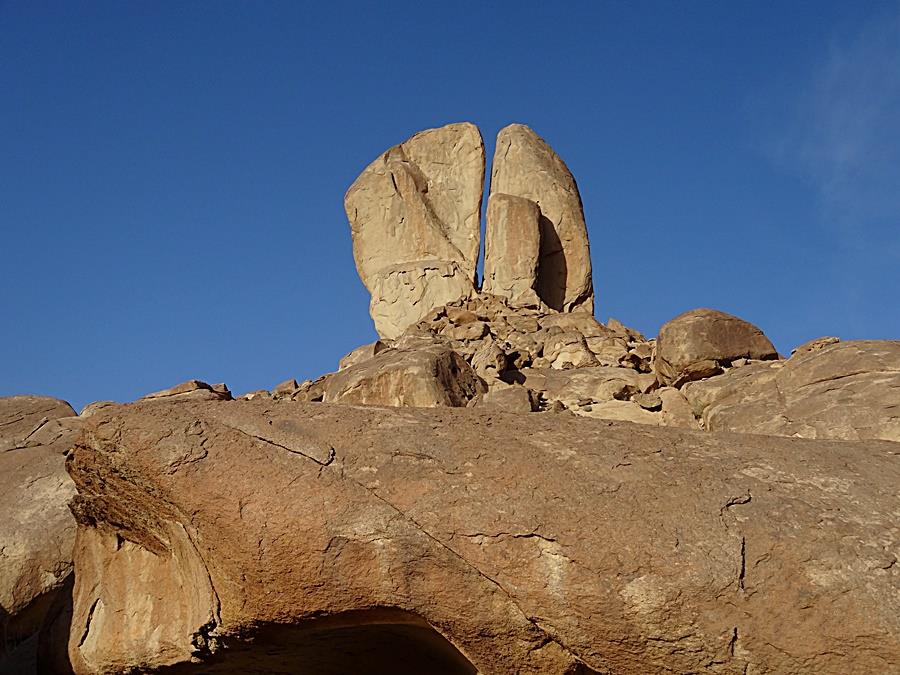
Weathering of solid, non-sedimentary rocks like granite is generally not due primarily to frictional erosive flow in stream beds as most people think, but rather is caused by expansion/contraction cycles. Perhaps the most important of such processes, often called “frost wedging“, occurs when water enters small cracks and pores in the rock, freezes, expands, and wedges the openings larger. Over many alternate cycles of freezing and thawing, the two sides of the wedged rock can completely separate. Plant growth in these opening can accelerate the wedging. Another very common process that weathers rock is “exfoliation“, which occurs as the surface of a rock heats and cools more rapidly than the interior, causing layers near the surface to flake off.

The so-called “Split Rock of Horeb” is an archaeological fraud, but it illustrates both frost wedging and exfoliation. The large split and the rocks at its base are examples of wedging, and both the Split Rock itself and the foreground rocks show extensive exfoliation. From Google Earth.

Eventually, weathered rock fragments can become small enough to be transported by erosion. As they tumble along, they will be further broken up as they knock into other fragments, a process called “saltation“. Roiling water from the Genesis Flood could have redistributed loose fragments—soil, dirt, pebbles, and even larger rock—and further broken and shaped some of these fragments, but it could not, in a span of only 40 days, have caused any significant erosion of solid rock, even if heavily laden with abrasive silt. Nor could the Flood account for the rounding and blunting that we typically see in sand grains and many other clastics. The Flood, as cataclysmic as it was, simply did not last long enough or provide the temperature swings or friction surfaces needed to account for the clastic structure we see.

Can I prove this? No, but it is my professional opinion, and Scripture has nothing to say on the process. Scientific studies could be done to prove the feasibility (or not!), but I haven’t seen any such research. The relevant discipline to conduct such studies is called “rock mechanics“, and in fact rock mechanics was the focus of my own master’s thesis.

To top

Homogeneity and sharp boundaries

Sedimentary rock strata sometimes extend laterally for long distances—often hundreds, or even thousands, of square miles which, strangely, Flood Theory enthusiasts seem to regard as proof of their point. In general, the strata tend to be mostly homogeneous, with few random impurities indicating uneven mixing with other rock types during deposition. Furthermore, the boundaries between layers tend to be crisp and well-defined. A sandstone, for example, does not normally grade into a shale or a limestone.

These characteristics are the opposite of what one would expect of sediments transported by a violent flood. During the rain, and afterwards as the water receded, any large or dense rocks transported would quickly have sunk to the bottom, followed by smaller and less dense rocks, and finally silt. The final result would be a single, deep, turbidity layer, grading from heavy, dense rock at the bottom, to lighter clastics at the top. Sorting would be by size and weight, not by rock type.

To top

Limestone strata

Limestone is formed from the skeletal material of sea life. A critter dies and sinks to the bottom. Its soft tissues decay, and what remains calcifies. Over time, enough of this material accumulates to form beds that fuse into massive rock strata. In a Flood scenario, we should expect to see calcified remains more or less distributed throughout the single, thick stratum discussed above. Of course, we do see some distribution of calcified fossil remains in all rock types, but additionally we see massive continuous beds of relatively pure limestone interbedded with sandstones and shales and other rock types. I simply don’t see how this can be accounted for without repeated flooding over long intervals of time. Almighty God could have simply spoken it into being in this configuration, or He could have directed the Flood waters and upheavals in such a way as to “stack it” to His own specifications, but why? Only to fool us into discounting our own senses? If I could see anything in Scripture to make me think this way, I would accept it. But I simply don’t!

Let’s say that the cataclysmic geologic activity associated with such a flood caused mountains to cyclically rise and recede in a very short time span and caused rock and debris to wash into the low areas, burying forests and animal life forms. If the up-thrust rock was composed differently from place to place, couldn’t this alternating rise and fall account for the rock strata that we observe? No! Such a violent scenario would cause mixing of the materials, not sorting and stratification, particularly since most of the rock strata are composed of very fine-grained clastics that are themselves a product of weathering and subsequent erosion over long periods of time.

To top

Reversed sequences

Geologists have mapped the “normal sequence” of rock strata—the so-called “geologic column“—at many locations throughout the world. At any particular location, it is not at all uncommon to find that various members of the normal column are missing, since stratum thicknesses vary naturally from place to place, all the way down to zero; but the overall sequence is nevertheless still normally recognizable. It is also not terribly uncommon to find regions where the sequence is exactly reversed; in other words where we find the apparent age of the rocks decreasing with depth. This is evident, for example, in some of the rocks exposed by the Grand Canyon. Genesis Flood theorists are fond of chuckling at the irony they see in this. “Haha, geologists, the joke’s on you! Not only is the sequence wrong, but it is exactly opposite from what you expected!” In reality, this is easy to explain. Tectonic forces cause deformation and bending of entire sequences of strata. In nature we find them tilted to all angles, including completely flipped over. This is the same thing that happens when you use your fingers to push the left and right edges of a newspaper towards each other. The difference is that solid rock is more or less rigid, unlike newsprint. Such deformations over the course of days or even years or decades would cause the rock to crumble and the strata to disintegrate. Over geologic time, however, “solid” rock tends to undergo “plastic” deformation. In geologic (not meteorological) time, it can flow like a viscous fluid—in fact, exactly like a glacier.

To top

Discontinuities and crossbedding

An unconformity in the region of the Chimborazo volcano, Ecuador. The lower strata were deposited horizontally, uplifted to the right, and then after a period of erosion, the upper strata were laid horizontally across the exposed edge. Subsequent uplifting was to the left. From GeologyIn.com.

A related effect that we frequently see over geologic time is that strata get “tilted” to some angle by those same tectonic forces, then the tilting action stops and weathering/erosion cuts horizontally across exposed edges of the strata. Flowing water initially brings debris down from the highlands and cuts river channels in those transported debris fields, but then over time there is a levelling effect, forming the broad, flat plains between mountain ranges and the coastal peneplains. Still later, deposition may form new strata in horizontal beds lying across the eroded edges of the older rock. The interface between the canted strata and the horizontal strata is called a “discontinuity” or “unconformity“. “Crossbedding” usually refers to unconformities in aeolian sands (see below).

To top

Aeolian deposits

Crossbedded aeolian sand deposits at Antelope Canyon, near Page, Arizona. From imgix.net.

Not all rock strata are deposited by water. Sometimes wind blowing over long periods of time can deposit clastic materials and form rock strata. These “aeolian” deposits have a very distinctive structure that is readily recognizable to geologists. Fossilized desert sand dunes are a subset of this group. I see no possible way that the Genesis Flood could account for these.

To top

Glaciation

U-shaped glacier-cut valley.
Bridal Veil Falls, Yosemite National Park. Water spilling from a hanging valley into the glacial valley that cut across it.

Still other features are formed only by glaciers flowing slowly and plastically downhill. Flowing water cuts V-shaped valleys. Glaciers scoop out large and obvious U-shaped valleys, like using a giant spade. “Hanging valleys” are formed when one glacier melts away, leaving behind its characteristic U-shaped valley, and many thousands of years later a new glacier flows by at an angle to the first.

As glaciers flow, the debris that they scoop out of the canyons strings out to the side like snowbanks formed by plows after a storm. The debris itself is called “till” and it is tumbled and polished into a form that is easily recognizable. The so-called Split Rock of Horeb, in the first figure above, is a “glacial erratic” (a large, out of context rock pushed ahead of a glacier) sitting on a till deposited by a glacier during the last ice age, in what is now northwest Saudi Arabia. The ridges of till that I have described are called “lateral moraines.” The Genesis Flood could not in any way account for the effects of glaciation. Glacial ice, like rock strata, would crumble if it were deformed and forced to try and flow over a short time span.

To top

Evaporites

Salt, gypsum and a number of other deposits are laid down as a result of evaporation over long periods of time. Water simply cannot hold enough of these materials to form, in a short time span, the deep beds of such “evaporites” often found.

To top

Conclusions

I don’t think that God set out to destroy or remake the entire planet with the Flood! His purpose was to show fallen mankind after the Flood that He would not tolerate their evil ways forever. He saved Noah and his family. He saved animal species that could not swim. He did not destroy plant species or swimming animals, because they could survive the limited time span of the Flood. There was no reason to break up land masses, nor was there a mechanism for doing so, because “the fountains of the deep“, I believe, were the volcanic vents along the mid-oceanic ridges, and the rains were spawned by out-venting from those. So, far from being smashed by raging torrents and mudslides, the wicked were destroyed by rising waters, like in a huge bathtub. Similarly, the waters receded by means of suction into tectonic plate subduction zones, on a smaller scale, a proven and well-understood process.

Another important question not answered by the Flood Theory is, how would the Flood account for the apparent (and in my opinion, demonstrable) 13.7-billion-year age of the universe?

To top


Does Science Trump Theology?

Posted on:

Modified on:


  1. In my view nothing in the Bible is in any way flawed—ever—but the Bible is written to convey facts about God Himself, and about God’s Will as expressed through Theology.
  2. I seriously doubt key claims of theories of biological evolution, for reasons that I may go into in a future post.
  3. Similarities between Science and Theology

Most scientists, certainly, and probably most theologians agree that “theology is about God”, and “science is about purely natural and self-sustaining processes.” As someone who has been passionately interested in both theology and science from an early age, my view is that there is an unavoidable overlap. Both disciplines, in a very real sense, share the same goal—uncovering truth about the universe around us—and both disciplines come from the same source—the God who created and maintains the universe.

you can’t fully understand the universe without understanding the Designer who built it and instituted the natural laws that govern its existence, and you can’t fully understand God without understanding the environment He created for His creatures.

I am contending here that science is worth listening to and not simply dismissing as an enemy of faith. Most of my readers are intelligent Christian Believers but are neither scientists nor theologians. To those, I pose the question:

Can we only believe what our eyes show us if it conforms to what we have been taught? Can we not even consider that there are “mysteries” (Paul’s term) that can only be understood with the passage of time? We even have a theological term for that: “progressive revelation.”

JWST images of two distant spiral galaxies, as they appeared an estimated 10.3 billion light years ago using scales based on current physics. ©ABC NEWS

Romans 1:19-20 (ESV)
19 For what can be known about God is plain to them [the ungodly and unrighteous], because God has shown it to them. 20 For his invisible attributes, namely, his eternal power and divine nature, have been clearly perceived, ever since the creation of the world, in the things that have been made.

If God has revealed Himself in nature to the ungodly, then who are we as believers to say that there is no benefit to us in that same revelation? I live by the principle that God gave me “eyes to see and ears to hear”. If my senses seem to conflict with what I have been taught to believe, then I must question both my senses and my beliefs. That doesn’t happen often, because I’ve had pretty good teachers over the decades. But not everything in the Bible is crystal clear. Most trained pastors and theologians subscribe to a particular “hermeneutic“, or system of principles for exegesis, i.e., interpretation of Scripture. See, for example, the book, Basic Bible Interpretation, by Roy B. Zuck.

I am a Biblical “literalist”, but that doesn’t mean I take every last word as literal. Does anyone believe that Jesus’ parables were literally true stories? A parable, by definition, is a made-up story designed to teach a principle. Did Peter see a real sheet containing real animals? I don’t think so, it was a vision, not reality, and was meant to teach him a lesson about people, not about food. Is “three days and three nights” exactly 72 hours? No, that’s a well-attested Hebrew figure of speech which Biblical Jews would have understood meant part of one day, all of a second, and part of a third—which includes only two nights, by the way. The “evil” or “single” eye of Matthew 6:22, is a figure of speech, an idiom, about stinginess. Did Jesus promise me a mansion in Heaven? No that’s both a translation issue (“mansion” vs. “dwelling place”) and a misapplication of Hebrew wedding imagery, which Jesus’ hearers would have immediately recognized as such and not understood as a real estate promise (see “Jesus and Hebrew Wedding Imagery“). Will the meek inherit the earth? No, that’s a quote of Psalm 37:11 where David was clearly speaking poetically of the prophesied return of Israel (the meek) to the Promised Land. Are there helicopters in Revelation? Maybe so, maybe no, but everyone agrees the wording there could be symbolic.

On the other hand, did Jesus convert water into wine, and did He resurrect from the dead? Emphatically, yes! Science can’t demonstrate the possibility of either, but neither can they be disproved, and the facts are fundamental to my belief system. The same with Adam and Eve, the Genesis Flood, the Sea of Suf (Red/Reed Sea) crossing, manna from heaven, and numerous other phenomena that some folks can’t believe.

On yet another hand, was the Ark a ship, as some would have you believe is unarguable fact? Not in my opinion (see “Ships, Boats, Floats and Arks“), but the story itself is true, nevertheless. Did the Genesis flood change the entire structure of the earth’s crust? Not in my opinion (see “Fountains of the Deep“). There is no scriptural support for this simplistic theory, and there are better explanations for the apparent age of the earth. In my professional opinion, there are a number of geological phenomena, that simply could not have been caused by either a local flood or a general, worldwide flood (see Geology a Flood Cannot Explain). Nor could a flood account for the appearance of age in the extraterrestrial cosmos!

In my view nothing in the Bible is in any way flawed—ever—but the Bible is written to convey facts about God Himself, and about God’s Will as expressed through Theology.

Information the Bible offers about human or natural history, or about scientific principles, is only incidental to the goal of explaining and glorifying God and His Will, and in my opinion is not intended to be exhaustive or fully explained. Furthermore, the human instruments who penned scripture, and the ancient audience for which it was initially penned, were historically and scientifically naïve and would have had absolutely no perspective from which to correctly receive sophisticated explanations about the universe around them (see Genesis 1:1–5, Day 1).

Sometimes science presents us with observations that are very compelling but seemingly out of sync with our assumptions based on traditional interpretations of scripture. For example, the following KJV references are all from poetic scriptures (see how literary genre influences proper interpretation, in The Implication of Genre in Job, Ezekiel and Genesis) praising God for His power and greatness and for the stability and security of the planet He created for us:

  • For he spake, and it was done; he commanded, and it stood fast.
    —Psalm 33:9
  • the world also is stablished, that it cannot be moved.
    —Psalm 93:1c
  • the world also shall be established that it shall not be moved:
    —Psalm 96:10b
  • Who laid the foundations of the earth, that it should not be removed [ESV: “moved”] for ever.
    —Psalm 104:5
  • the world also shall be stable, that it be not moved.
    —1 Chronicles 16:30b
  • and, behold, all the earth sitteth still, and is at rest.
    —Zechariah 1:11

These verses “prove beyond any shadow of doubt” that the earth is totally immobile, and the center around which the universe rotates! But no, thanks to progressive revelation, we now interpret those poetic scriptures figuratively, in ways that conform to observation. At some point in the course of using our God-given senses and intelligence, it may occasionally become necessary to thus reexamine certain scriptures to see if there is something that we may have missed, or a conclusion we reached in error because in the past “it seemed to make more sense” than any alternative view. Certainly, I’m not talking about giving up fundamental faith issues, but I am suggesting that we should be more astute about recognizing what is fundamental and what is merely tradition. To my thinking, scripture is clear that God is the Creator. That is a fundamental of my faith, but the brevity of the Genesis 1 account and its wording in the Hebrew makes me much less confident in the traditional interpretations.

I similarly question whether Genesis 2 is a recapitulation of Day 6 in Genesis 1, or a separate creation event. What is fundamental to me is that Adam and Eve were real people, created directly by God, and placed into a real paradise where they really sinned (see Exploring the Garden of Eden). Noah, too, was a real person and all subsequent humans are descended from him. Without these fundamentals, my whole concept of soteriology is flawed, and my faith is in vain.

The dual advents of Jesus were a mystery to all Believers until Jesus died, and His followers had to reexamine ancient scriptures and develop new interpretations of passages that were not as clear and final as had been thought previously.

I seriously doubt key claims of theories of biological evolution, for reasons that I may go into in a future post.

At the same time, I reject “Young Earth” hypotheses about the way God created the non-organic universe. I believe that Earth is some 4.54 billion years old (give or take a half million), and the universe nearly 13.8 billion. I’ll leave it to future posts to explain how I reconcile this with the “Genesis account”, which I refuse to explain away as mere symbolism. To reiterate, I believe in a literal, worldwide Genesis Flood, but I reject the theory that it accounts for the present geology of the earth. Not just because “scientists say so”, but because I personally understand the scientific principles involved and how they apply. And because God gave me eyes to see!

Please dismiss the idea that “the theory of evolution” has anything to do with the development of the universe. “Evolution”, as I use the term, is about biological processes and “natural selection”, neither of which have anything whatsoever to do with star formation or the origin of the Solar system. If the formation of a star from interstellar gas and dust is “evolution”, then I guess the formation of a sinkhole after a water main break must also be called evolution.

Similarities between Science and Theology

Both disciplines deal in theory. Christians are fond of saying that, “Evolution is just a theory, not an established fact.” Not a “Law.” When I was a kid, the “Scientific Method” recognized three discrete levels of understanding: hypothesis, theory, and law. Many people brought up in that era see the word “theory” and assume that this is something unproven and tentative. That is no longer the case, linguistically. Reality has blurred the boundaries between theory and law. Many things that were once considered “law” are now recognized to have conditions, or limits. “Newton’s Laws”, for example, are now accepted as useful approximations under certain conditions, but under others, they have to be replaced by Relativistic principles, and even Relativity now sometimes must give way to Quantum Mechanics. So, even though biological evolution is still called a “theory”, most biologists are totally convinced of its truth, or at least that it is a valid working principle. Insisting that it is “theory” and not “fact” is, in this era, an empty argument. In the same way, theological principles must be considered theoretical up to a point, because we aren’t God! We simply cannot have a perfect understanding of scripture.

Both disciplines have an infallible basis. What?! Theology is at heart based on the Bible, which we believe to be inerrant and infallible. That is axiomatic to our beliefs. Most sciences, too—not so much biology, but certainly cosmology (the study of how the universe developed from the time of the “Big Bang”)—have a mathematical foundation, and math is an “exact science.” Math is the inerrant “scripture” of science, and it, too, was authored by God. It originated with God, it is absolute, and much of it is very well understood by human mathematicians.

Both disciplines have elements that are subject to interpretation. Some branches of math, like Probability and Statistics, can be erroneously interpreted and wrong conclusions drawn; and proven valid equations can sometimes be applied incorrectly to observation. But the same can be said about scripture. Sometimes scripture can be misinterpreted or misapplied. Again, we are not God!

Next in series: The Hijacking of Creationism


Atonement vs Expiation

Posted on:

Modified on:


The term “atonement” is used over and over in the Old Testament to describe the purpose for and result of the Sinaitic (or Mosaic) sacrificial system. Many Christian theologians extrapolate the Old Testament concept into the New Testament setting and speak of the “atoning work of Christ on the cross.” This usage, however, obscures the very real difference between Old Testament atonement and New Testament expiation, propitiation and reconciliation. Atonement, in the Biblical sense, is a temporary covering up of sin, or guilt. A “stay of execution”, so to speak. Expiation means “to extinguish guilt incurred.” Propitiation is roughly the same, but with the additional dimension of appeasement of anger. Reconciliation means to “reestablish a close relationship” between two entities or concepts. Expiation and propitiation accurately describe what the death of Messiah did, while reconciliation, an accounting term, describes the result: our relationship with God is brought into balance. Cause and effect. Sin is paid for in full and permanently expunged from the record, God is appeased, and our relationship with Him is restored.

Model of the Ark of the Covenant. ©Leen Ritmeyer

The Hebrew terms for “atonement” are variations from the root kaphar, which all carry the idea of “covering”; for example, covering a ship’s hull with bitumen to prevent leakage, or covering a stain in a hardwood floor with a rug. Orthodox Jewish males today cover their heads with kippot, the skullcaps or yarmulkes (Yiddish) that we have all seen. The “lid” of the Arc of the Covenant was called the kapporah, and it, too, is a covering. Atonement for sin, then, becomes a means of covering, or obscuring, it from sight, without actually expunging or removing it. The guilt remains, but God has provided a means of temporarily “sweeping it under the rug” pending permanent expungement by means of Messiah’s crucifixion.

Aside from references to the Jewish feast, the Day of Atonement, the words atone, or atonement appear seldom or not at all in most translations of the New Testament. In the Septuagint (LXX, the Greek translation of the Old Testament used by Paul, translated, apparently, by 70 Jewish scholars in Elephantine, Egypt in the 2nd Century, BC), the word “atonement” is rendered as hilasterion, because there apparently was not a Greek equivalent for “atonement”. Where the feast day is intended, the Greek hilasterion is thus also used in the New Testament for “atonement”, or even for “Mercy Seat”, referring to the covering of the Ark of the Covenant; otherwise, hilasterion is correctly translated as expiation or propitiation. Where the Greek katallagē is used, the proper translation is reconciliation.

Though most New Testament translations are generally okay in this respect, Christian writers and speakers continue to refer to phrases like, “the atoning blood of Christ”, which is a theological non-sequitur. Atonement is decidedly not what His crucifixion accomplished! The confusion arises because most Christians believe that the sacrifices were means of salvation under the Jewish Torah. But this is taught nowhere in scripture. Atonement by means of the sacrificial system is never said to make anybody “at one with Christ” or with God. Atonement is not “at-one-ment” as many have claimed. Salvation is permanent, whereas atonement is only temporary.

In discussing the superior sacrifice of Jesus, Heb 10:4 states that

Hebrews 10:4 (CJB)
[4] …it is impossible that the blood of bulls and goats should take away sins.

Many passages in the Tanach (Old Testament) also discuss the inadequacy of sacrifice in the presence of a sinful heart. For example

1 Samuel 15:22 (CJB)
[22] Sh’mu’el [Samuel]said,
“Does ADONAI take as much pleasure
in burnt offerings and sacrifices
as in obeying what ADONAI says?
Surely obeying is better than sacrifice,
and heeding orders than the fat of rams.

Psalms 40:7 (CJB)
7 Sacrifices and grain offerings you don’t want;
burnt offerings and sin offerings you don’t demand.
Instead, you have given me open ears;

Psalms 51:18 (CJB)
18 For you don’t want sacrifices, or I would give them;
you don’t take pleasure in burnt offerings.

Proverbs 15:8 (CJB)
[8] ADONAI detests the sacrifices of the wicked
but delights in the prayers of the upright.

Isaiah 1:11 (CJB)
[11] “Why are all those sacrifices
offered to me?” asks ADONAI.
“I’m fed up with burnt offerings of rams
and the fat of fattened animals!
I get no pleasure from the blood of bulls,
lambs and goats!

Jeremiah 6:20 (CJB)
[20] What do I care about incense from Sh’va [Sheba]
or sweet cane from a distant land?
Your burnt offerings are unacceptable,
your sacrifices don’t please me.”

Hosea 6:6 (CJB)
[6] For what I desire is mercy, not sacrifices,
knowledge of God more than burnt offerings.

Hosea 8:13 (CJB)
[13] They offer me sacrifices of flesh and eat them,
but ADONAI does not accept them.
Now he will recall their crimes and punish their sins—
they will return to Egypt.

Hosea 9:4 (CJB)
[4] They will not pour out wine offerings to ADONAI;
they will not be pleasing to him.
Their sacrifices will be for them like mourners’ food—
everyone eating it will be polluted.
For their food will be merely to satisfy their appetite;
it will not come into the house of ADONAI.

Why did God not want the sacrifices that He, Himself, had demanded? Just as we believe that baptism and the Lord’s Supper are a response of obedience by someone already saved, and useless to the unsaved, so were the sacrifices a response of obedience. Salvation then, as now, was “by grace through faith.” Sacrifice had no efficacy except to those who were already the recipients of God’s saving grace. The purpose of the sacrifices was to ritually “cover”, or hide from God’s eyes, the guilt of the sinner who, by his obedient sacrifice, was “making amends.”

But notice this:

Every single one of the atoning sacrifices was for incidental, or unintentional, sin; in other words, for sins committed in ignorance, accidentally, or under duress. There was absolutely no means of sacrificial atonement for willful sin—except for God’s grace! On Yom Kippur, the “Day of Atonement” the Cohen HaGadol (high priest) would sacrifice a bull for his own incidental sin and a goat for the incidental sin of the people. Once the problem of incidental sin had been covered up, he would then lay his hands on the forehead of another goat, the scapegoat, symbolically transferring to it all further, willful, sin. The scapegoat would be led “outside the camp”, i.e., away from the people and out of God’s presence. Thus, the nation’s sin was allegorically returned to Azazel, the chief of demons.


The Fall Feasts and the Rapture

Posted on:

Modified on:

  1. Dating Three Key Events in Jesus’ Life
  2. The Fall Feasts
  3. The Days of Awe
  4. The Day of Trumpets
  5. Extension of the Days of Awe
  6. The Baptism and Temptation of Jesus
  7. The Day of Atonement
  8. Conclusion

This post was first published over 10 years ago but recently got a major overhaul. First, because my own style has changed a bit over the years; but also, because I’ve changed my mind about one related issue, which I’ll discuss below. This is a good time for an update because it is now the middle of the Hebrew month Elul, and that is the temporal setting of my main topic here, the Fall Feasts.

Fig. 1: The Seven Principal Feasts, as outlined in Leviticus 23, ©Ron Thompson

To Top

Dating Three Key Events in Jesus’ Life

I started this edit by setting a time frame for Jesus’ First Advent, which I date in the following short table. Here I have used the Gregorian calendar for the year, because that is more identifiable to most of us, but I’m taking the month and day from the Hebrew calendar, because annual events are Biblically fixed according to that standard and are different every year by the Gregorian and earlier Julian calendars.

EventAgeHebrew DateGregorian Year
BirthTishri 154 BC
Baptismabout 30 yearsElul 1AD 26
Crucifixionabout 33 yrs., 6 mos.Nisan 14AD 30

Here are some of the factors I considered in composing this table:

  • The Biblical feast days commemorate important Jewish historical events, celebrate the annual agricultural cycle, and prophesy about Messiah’s life on earth, in both of His advents.
  • I am convinced that the Jewish principal feasts, as commanded in Leviticus 23, provide a totally reliable outline of important events in Jesus’ life, as shown in the last column of Figure 1, above. Events highlighted there in peach occurred during His first advent, on the actual feast days shown. Events highlighted in blue will occur during His second advent, again on the actual feast days shown.
  • I’m very confident that Jesus’ birth was on Tishri 15, the first day of the Feast of Tabernacles, Sukkoth. Not in December, on a date with absolutely no Scriptural support (but with a pagan connotation!); but rather in a September/October timeframe corresponding to Jewish celebration of the time that God previously “tabernacled” with His people during their 40 years of wilderness wandering. With Jesus’ birth, once again God was living among His people.
  • The year of Jesus’ birth has been disputed during my entire lifetime. There are always unresolved arguments about when Herod died, when Quirinus was governor of Cilicia/Syria, and what year a lunar eclipse hit the region, all of which are applicable. The most commonly cited estimates that I’ve seen place Jesus’ birth in 4 BC, though dates ranging from 1 through 6 BC are also commonly mentioned. I’m sticking with 4 BC here, because it fits well with the other two dates in my table.
  • Luke 3:23 states that Jesus was “about thirty years of age” when He began His ministry. Fall of AD 26 is about thirty years after the autumn of 4 BC. In fact, if His ministry began on Yom Kippur (see below), and that was the last day of His 40-day “wilderness fast and temptation”, then He was just five days shy of 30 years old.
  • His baptism by John was 40 days before Tishri 10, which is the Day of Atonement, Yom Kippur. I’ll explain the 40-day offset below, but it culminates with Jesus on the pinnacle of the Temple, defying Satan, on Yom Kippur, in full view of many thousands of worshippers on the plaza below.
Fig. 2: The late Alec Garrard, facing “south”, posing in his backyard shed model of Herod’s Temple. The parapet in the lower right corner overlooks the Kidron Valley, and as the highest point on the Temple Mount walls, it is thought by many to be the “pinnacle” mentioned in Scripture. I personally suspect that the somewhat lower parapet to the left, more commonly known as the Place of Trumpeting, might be the actual pinnacle of Scripture, since it is far more visible from the streets below. Photo from The Miniature Engineering Craftsmanship Museum.
  • His crucifixion was on Nisan 15, the first day of the Feast of Unleavened Bread, Yom ha-Bikkurim, not on Nisan 14, the day of the sacrifices.
Fig. 3: Jesus’ Crucifixion Timeline, showing in green what I consider to be the correct dates for each phase, on both the Jewish and Gregorian calendars. The vertical gray bars (not to scale) represent the evening twilight periods between Jewish dates (see Fig. 4). ©Ron Thompson
  • The year of Jesus’ crucifixion, shown here as AD 30, was calculated by me, using NOAA (National Oceanic and Atmospheric Association) New Moon Tables, which were prepared with historic ocean tides in mind. Every published Biblical chronology that I’m aware of puts the crucifixion in AD 33, but they are all based on an incorrect interpretation that insists He was crucified on Nisan 14. With a correct understanding of the timings of Passover Week which (thanks to my traditional presuppositions) it frankly took me many years to achieve, it is clear that Jesus was crucified on Nisan 15.

9/5/2023 addition – When I was working on my August update last week, I completely forgot to add one other crucial piece of evidence:

1 In the fifteenth year of the reign of Tiberius Caesar, Pontius Pilate being governor of Judea, and Herod being tetrarch of Galilee, and his brother Philip tetrarch of the region of Ituraea and Trachonitis, and Lysanias tetrarch of Abilene,
2 during the high priesthood of Annas and Caiaphas, the word of God came to John the son of Zechariah in the wilderness.
—Luke 3:1-2 ESV

Leaving Tiberias until last, here are the tenure years of the leaders mentioned (all are 1st Century AD): Pilate, 26–36; Herod (Antipas), 4–39; Philip, 4–34; Lysanius, unknown; and Caiaphas, 18–37. Annas was High Priest during the period 6–15 but was the real power in the Temple during the tenure of Caiaphas, his son-in-law, 18–37.

For the purpose of dating the text, only Tiberias‘ rule is useful. Many historians and Biblical commentators date Tiberias’ accession to the time of Augustus’ death. That puts the timing of Jesus’ baptism in the year AD 29, which would pose a problem for my proposed dating. I don’t think AD 29 is correct, because it was common for many, possibly most, ancient rulers and their chroniclers to ambitiously include years of coregency in citing tenure of rule. Tiberias was coregent with Augustus starting in either AD 11 or 12. AD 11 fits perfectly with my AD 26 date for Jesus’ baptism.

I find that I am not alone in recognizing this discrepancy. The well-respected commentary Jamieson, Faucett & Brown, for example, states that:

the fifteenth year of Tiberius — reckoning from the period when he was admitted, three years before Augustus’ death, to a share of the empire [results in a date for the events of Matthew 3:1 of] about the end of the year of Rome 779, or about four years before the usual reckoning.

“The usual reckoning” is AD 30. The traditional date for the founding of Rome was 753 BC, which makes “the year of Rome 779” equivalent to AD 26.

Fig. 4: Explanation of how Jewish days traditionally begin and end. ©Ron Thompson

Please refer to Figures 3 and 4, above. The Passover sacrifices were killed on Nisan 14, then consumed during the Seder, which began that evening at dusk. Jesus and His 12 apostles celebrated the Seder until late, as customary, then joined with the Hallel singing outside at midnight, and afterwards walked to Gethsemane, where Jesus was arrested. His trials were conducted during the early morning of Nisan 15, and He was crucified and buried that day. That was on a Friday, and the only year within a reasonable range with a Friday on Nisan 15 was AD 30. I am very confident that this scenario is correct!

Fig. 5: An April 2024 calendar showing parallel Hebrew dates on the right. This clearly demonstrates that the 8-day Passover celebration (7 days in Israel) begins on Nisan 15. Jewish Time®, by Calendar Maven
  • Most scholars think that Jesus’ ministry lasted around 3½ years, based on the number of Passovers He seems to have attended during that time. I agree.

To Top

The Fall Feasts

This month shall be to you the head of the months; to you it shall be the first of the months of the year.
—Exodus 12:2 (The Complete Jewish Tanach)

Nisan 1, in the Spring, is the Jewish religious New Year. Jews today, though, celebrate the civil new year, Rosh Hashanah, which is six months later, on Tishri 1.

Most of the modern world celebrates the new year with revelry. Not so among devout Jews in 1st Century Judea, because Tishri 1 is also the date of Yom Teruah, the Day of Trumpets. This important feast day heralds God’s judgment of His chosen people for their deeds, both good and bad, committed during the preceding year.

As such, the mood during the entire ten-day period through Yom Kippur, the Day of Atonement, on Tishri 10, is somber and introspective. There is prayer, fasting, ritual immersion (baptism for purification), and general spiritual misery and mourning. No weddings or other celebrations are permitted.

Once Yom Kippur has passed, the mood shifts. There is spiritual relief, and a 5-day period of relaxed preparation, followed by the joyous eight-day celebration of Sukkoth, the Feast of Tabernacles.

To Top

The Days of Awe

In the rest of this post, I will concentrate on two of the fall feasts in particular: The Day of Trumpets and the Day of Atonement. These two feasts, and the 10-day span of time connecting them, is known as Yamim Noraim, the ten “Days of Awe”. This somber period, as described above, is devoted to sincere individual and national confession of sins, and to t’shuvah, or repentance.

Fig. 6: The Days of Awe, Yamim Noraim. ©Ron Thompson

To Top

The Day of Trumpets

Rosh Hashanah, also known as Yom Teruah (The Day of Trumpets), is the Jewish day for regathering. Jews believed that, on this day every year, God divided His people into three groups according to their faithfulness over the preceding year. One group was the “wholly righteous”, whose names would certainly be written in the Book of Life. A second group was the “wholly wicked”, who would be written into the Book of Death. The final group was comprised of “those in between”, whose fate would be sealed by the quality of their t’shuvah over the next ten days, with their final judgment reserved until Yom Kippur.

Fig. 7: My Judaica wall. The small shofar is from a traditional ram’s horn, used mainly in mobile situations. The large one is Yemenite, a Kudu horn. Kudu is a species of antelope found in eastern and southern Africa. Large shofarim like this are favored for fixed locations, like the Temples of Israel, or modern synagogues. The lampstand is a hanukkiah, used ceremonially in Hanukah celebrations, which require 9 candles. If it had only 7 branches, it would be a menorah. Photo ©Ron Thompson

What prompted me to revise this post was that, in the original version, I said of the above viewpoint, “this doctrine is certainly not Biblical”; however, I have mostly changed my mind about the books, though I think that the Jewish perspective on them may be a bit skewed. I have recently been introduced to the works of Michael S. Heiser, and what he called the “Deuteronomy 32 worldview” (see Gods and Demons). He addressed this subject in ways that I had not previously considered.

There are, in fact, eight New Testament references, mostly in Revelation, to the “book of life“, and many Old Testament and intertestamental references to heavenly “books” and “tablets” that are clearly connected. I assume that these conceptual records are metaphorical, considering that God is God, and doesn’t need a physical database to remember what He needs to remember. Heiser makes sense when he suggests that our sins are recorded in one book, and our salvation in another. If (and only if) we are not listed in the second, then we will be judged by what is recorded in the first. There may be a “book of death“, too, that renders some ineligible for salvation. Regarding the latter, see, for example:

[31] Therefore I tell you, every sin and blasphemy will be forgiven people, but the blasphemy against the Spirit will not be forgiven.
—Matthew 12:31 (ESV)

Whether or not the doctrine of these books is valid, the fact that the holiday recognizes a separation of people from people is very significant since it prophetically depicts the regathering of God’s people on the coming day of Rapture:

[16] For the Lord himself shall descend from heaven with a shout, with the voice of the archangel, and with the trump of God: and the dead in Christ shall rise first…
—1 Thessalonians 4:16 (KJV)

In light of 1 Thes 4:16, the blowing of the trumpet (actually, a shofar, or ram’s horn) on Yom Teruah is particularly interesting. The shofar (accompanied by metallic trumpets in Temple days) was blown at mid-morning after the morning (Shacharit) prayers, in three series of four distinctive notes: tekia (“blast”); shevarim (“broken notes”); teruah (“shout”—thought of as “the shout of an archangel”); and tekia gedolah (the “great blast”). The first series is tekia, shevarim, teruah, tekia, repeated three times. The second is tekia, shevarim, tekia, repeated three times. The final series is tekia, teruah, tekia, repeated three times, followed immediately by tekia gedolah, referred to in 1 Cor 15:52 as “the last trumpet”.

[52] in a moment, in the twinkling of an eye, at the last trumpet. For the trumpet will sound, and the dead will be raised imperishable, and we shall be changed.
—1 Corinthians 15:52 (ESV) emphasis mine

To Top

Extension of the Days of Awe

Since long before Jesus’ day, the Days of Awe have, in practice, begun thirty days before Yom Teruah, on the first day of the Jewish month Elul. T’shuvah (repentance) is much too important to put off until the last minute, so the Rabbis decided that forty full days should be devoted to it, rather than the ten required by Torah.

On Elul 1, Jews would flock to the mikvot (baptisteries) of the Temple and synagogues, and to the “living waters” of streams and rivers like the Yarden (Jordan), to immerse themselves for ritual purification. That would then be followed by forty days of prayer, fasting and introspection. In the years preceding AD 30, it seems that many had become preoccupied with the politics and woes of the Roman occupation, and such customs were being neglected. Into this scene stepped Yochanan, who we now call John the Baptizer, calling Jews to baptism and t’shuvah.

To Top

The Baptism and Temptation of Jesus

[13] Then Jesus came from Galilee to the Jordan to John, to be baptized by him. [14] John would have prevented him, saying, “I need to be baptized by you, and do you come to me?” [15] But Jesus answered him, “Let it be so now, for thus it is fitting for us to fulfill all righteousness.” Then he consented. [16] And when Jesus was baptized, immediately he went up from the water, and behold, the heavens were opened to him, and he saw the Spirit of God descending like a dove and coming to rest on him; [17] and behold, a voice from heaven said, “This is my beloved Son, with whom I am well pleased.”
—Matthew 3:13–17 (ESV)

I believe that the events of Mt 3:13-17, describing Jesus’ baptism and anointing by the Holy Spirit, took place on Elul 1, conforming to the current tradition. As to the year, I lean towards AD 26, as stated above. If that year is off, I’m still 100 percent sure of the Hebrew month and day.

Fig. 8: The Jordan River today, due east of Jerico. Scripture places Jesus’ baptism at Bethany on Jordan, no doubt referring to the east bank of the oxbow, close to the village. From Google Earth.

Though of course He was sinless, His baptism, followed by forty days of prayer and fasting, were consistent with and required by the customs of the season.

More importantly, the temptation and His response were theologically vital. Jesus was “the Second Adam” (see The Two Adams). The first was created sinless, but when tempted by the “lust of the flesh, the lust of the eyes, and the pride of life”, failed and brought sin to the world. The same tempter and same temptations came to Jesus in the wilderness: lust of the flesh (stones to bread); lust of the eyes (the kingdoms of the world); and pride of life (rescue by angels in the sight of all Israel). Jesus did not fail, and brought redemption to the world.

Matthew presents a different order for the temptation, which is not a problem because chronological order was not strictly important in the literature of the day, but I’m certain that “pride” was last in real time, as listed by Luke.

Interestingly, that placed Jesus on the Pinnacle of the Temple on Yom Kippur:

[9] Then he [the devil] took him to Yerushalayim, set him on the highest point [Greek pterugion, literally, a “wing” or “turret”] of the Temple and said to him, “If you are the Son of God, jump from here! [10] For the Tanakh [Old Testament] says [Psalm 91:11–12],

‘He will order his angels
to be responsible for you and to protect you.
[11] They will support you with their hands,
so that you will not hurt your feet on the stones.’”

[12] Yeshua [Jesus] answered him, “It also says, ‘Do not put ADONAI your God to the test.’” [13] When the Adversary [Greek diabolos, literally, “accuser”] had ended all his testings, he let him alone until an opportune time.
—Luke 4:9–13 (CJB)

To Top

The Day of Atonement

While the Temple still stood, on Yom Kippur all the people gathered on the Temple Mount for the ritual sacrifices that would roll the sins of the truly repentant back for another year. Since there is no longer a Temple, and thus no legitimate place for blood sacrifices, the gatherings are now in the synagogues, and what is offered are “sacrifices of prayer.”

Most translations render pterugion as “pinnacle”, following the KJV. This is traditionally interpreted as the highest point on the Temple Mount or its surrounding walls, but I don’t think that this is warranted. It seems to me most likely that this is referring to the “place of trumpeting” (see Figure 2) which, by inference, was probably the parapet, or observation platform, from which the priests monitored the ritually vital sunrise and sunset every day. This high overlook was visible from the exterior streets below. If Jesus had accepted Satan’s temptation to throw Himself off and allow the angels to catch Him, all the Jewish world would have witnessed the destruction of His public ministry on the very day it began! Certainly, this was Satan’s plan!

To Top

Conclusion

I am forever thrilled at the beauty of God’s timing! I believe that many of the events connected with Jesus’ First and Second Advents actually occurred or will occur on the precise day of the Feast that pictures the event. Could it be that He will return for his Church at the exact moment of the “Last Trump” on the Feast of Trumpets (as God indeed said He would!), which is prophetic of the Rapture? Is it possible that He will return in judgment at the end of Tribulation on the Day of Atonement, the very day when God is thought to seal His judgment of His people? I am convinced it is so!

To Top