Today I learned that David H. Stern, PhD died late last year, at the age of 87. I’ve never met Dr. Stern, but between his books and his English translation, The Complete Jewish Bible, with a commentary on the New Testament, he, more than anyone else, influenced my interest in Jewish life and culture and the Jewish foundations of Christianity. He was born, educated and married in America, but as a devout Messianic Jew, he emigrated to Israel in 1979.
Dr. David H. and Martha Stern, courtesy All Israel News.
Life isn’t always easy for Messianic Jews in Israel. They are regarded by both secular and ultraorthodox Israeli Jews as “missionaries”, a term used in scorn, and are often denied Israeli citizenship. At the same time, I have known many non-Jewish Christians around the world, particularly those in Reformed denominations, to strenuously object to non-assimilated Jews, and to resist any recognition of the debt Christianity owes to its Jewish origins. And given the argumentative nature of many religious, ethnic Jews, I’m sure that even they could be a challenge to Dr. Stern. Many years ago, I had lunch at a Shoney’s Restaurant in Shawnee, Kansas, with Moishe Rosen, the founder of Jews for Jesus. Not to be too hard on a great man, but Rabbi Rosen was intensely critical of Dr. Stern, for reasons that I could not and still do not at all agree with.
Rest in peace, Dr. Stern. נוח על משכבך בשלום דוקטור שטרן
Yesterday I was watching the re-airing of a 2020 episode of Impossible Engineering on the Science Channel. The episode, titled Spy Plane Declassified, was about the reconfiguration of a Boeing E-3 Century airplane as an AWACS (Airborne Early Warning and Control System) aircraft.
Midway into the program, I was thrilled to see a segment featuring a man who, though I knew him for only a few months, was probably, after my father, the first man who significantly influenced the future course of my professional life.
Dr. Carl E. Baum
During my mid to late teens, I took two summer jobs with Federal agencies. The first was on a Forest Service surveying crew, working on a road project on the fringes of the Navajo Reservation near Bluewater Lake, New Mexico. The second was a civilian job at the Air Force Special Weapons Center at Kirtland Air Force Base in Albuquerque. This job was in 1965 right after my graduation from high school.
At AFSWC, I reported directly to a young Air Force Captain, Carl Baum, now deceased, who was directing the Center’s research on EMP (Electromagnetic Pulse) defense strategies. EMP was then (at the height of the Cold War), and still should be, a grave national security concern. Strong pulses of high frequency electromagnetic energy such as those generated during air detonation of a nuclear bomb can disable and even destroy electronic equipment of all types within a huge radius. A few bombs detonated over America could potentially shut down our civilian infrastructure for decades, because even the facilities and equipment needed for repair and replacement would be crippled. But our focus at Kirtland was on finding means to improve the “radiation hardening” of military equipment against such an attack.
Of course I was a “gofer” in that facility, but Captain Baum and his staff all took an interest in me as a budding scientist. My principal duty was to run “IBM cards” and printouts back and forth between Carl’s desk, his programmers and keyboarders, and the Control Data CDC 6600 supercomputer down the hall.
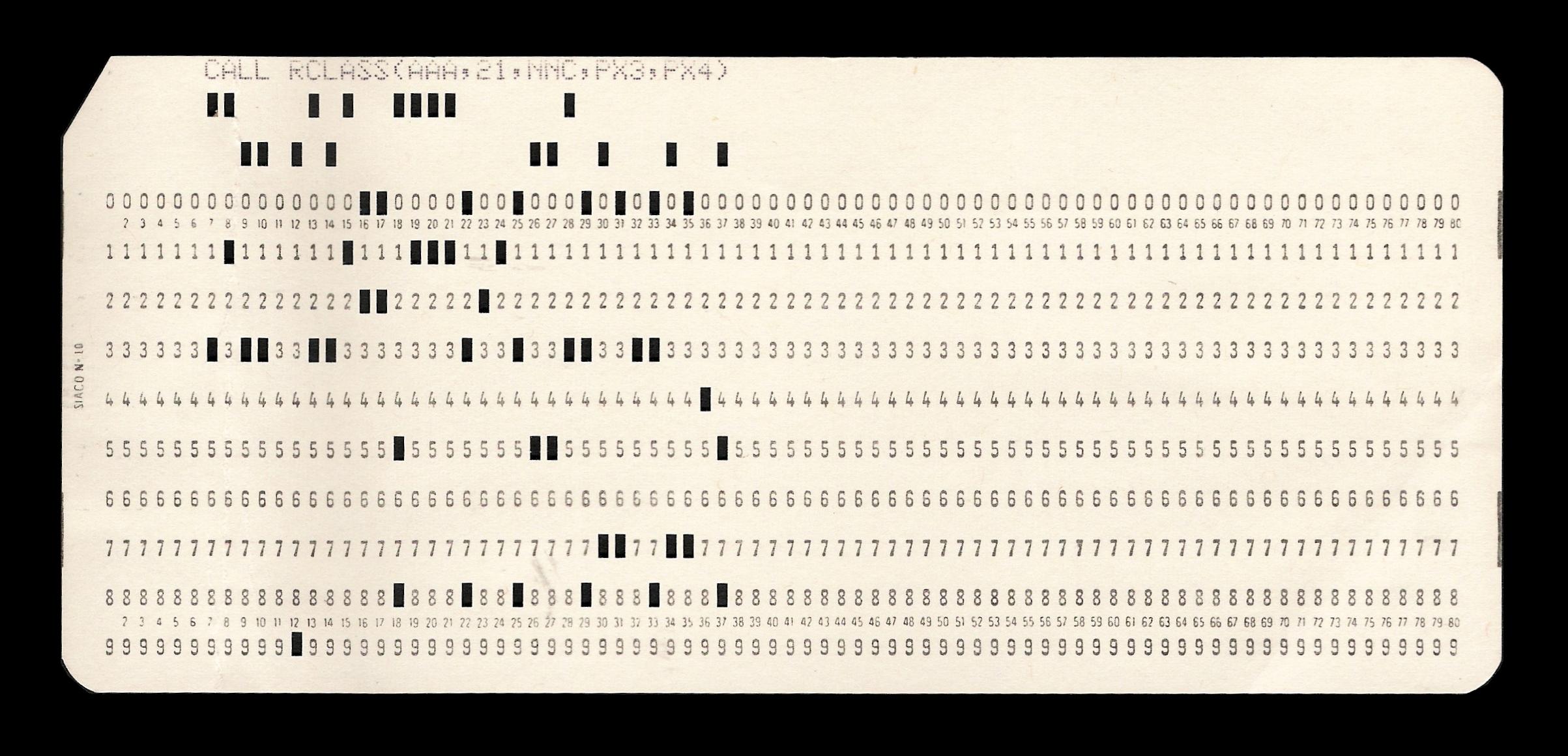
Old-timers will recognize this punch card from the infancy of computers. This one sports a single line of code: a subroutine call, passing five separate parameters. A complex program might require a stack of hundreds of cards, all of which had to be “read” in the correct order. Holes were punched using a device with a keyboard resembling a typewriter—remember those? “Keypunch Operator” was a career description in those days. I still have boxes of blank cards down in my basement, which I’ve used for bookmarks and note cards. And, of course, coasters.
In practice, I was present for many conversations between the scientists. A simulation run or test results would come back, Carl would examine the data and graphs, and out of his genius brain would pop a new complex wave equation to model what changes might happen to the EMP field if we do such and such or change so and so. Off would go the programmer to plug the new equation into a new simulation, then I’d take it to the keypunch operators, prepare the program deck, and haul it off to the input desk.
But I still ended up with a lot of free time. Carl was at heart an academic. Over the years he did frequent guest lectures around the world, and he ended his career as a professor at the University of New Mexico. He asked me if I’d like to learn FORTRAN, the computer language of choice for research back then. Sure! So, he assigned a Staff Seargent to teach me, and in just a couple months I became proficient enough at it that two years later I was able to land a job at the University of Texas Computation Center as a consultant tasked with helping professors and students debug and improve their faulty FORTRAN programs.
I never saw Carl again after that summer, but I never forgot him, or heard of him again until now. As a kid, I always loved astronomy and physics, but for reasons beyond the scope of this post, I had decided to pursue a career in marine biology, instead. Because of Carl’s influence and the computer training he gave me (long before the days of personal computers), my interests swerved back onto their original path. My father insisted that I start with general studies at a small college for two years. I ended up as the only physics major at Eastern New Mexico University, and from there went on to double major in math and physics at Texas.
ATLAS-I EMP test platform at Sandia Laboratories, now part of Kirtland AFB, New Mexico. This huge, 180-meter-tall facility, nicknamed “The Trestle“, was designed by Dr. Baum several years after I was there. Aside from the wedge-shaped steel structure on the left which acted as a ground plane for the horizontally polarized pulses, it is constructed entirely of non-conductive laminated wood beams, held together by wooden nuts and bolts. EMP is provided by means of two huge Marx generators flanking the wedge. For an idea of the Trestle’s size, that’s a B-52 bomber being tested!



 The Back of My Mind