The Vision of Lincoln

  1. Just what was Lincoln’s vision?
    1. On Slavery
    2. On Secession
    3. On Economics
  2. Lincoln as a Republican?
  3. What is my vision?

I just read an AMAC (Association of Mature American Citizens) article about pragmatic Democrats who are now acknowledging that memes about a Trump victory leading to the “end of Democracy in America” are merely a political “talking point” and that America will do just fine under a Trump Presidency. That’s not the subject of this post, though…

One of the reader comments made me cringe: “I’m a registered Republican … I keep hoping that the Republicans can find a candidate as charismatic as Ronald Reagan [who has] the vision of Abraham Lincoln.”

Just what was Lincoln’s vision?

On Slavery

Of course he’s most revered for “freeing the slaves”, but is that what Lincoln was all about?

It’s true that he was against slavery, particularly in 1858 when he was debating Stephen A. Douglas. But like other Whigs turned Republican, he was far from being an Abolitionist. The debates weren’t about ending slavery, they were about preventing its spread into new territories. Lincoln had spoken out against the Kansas-Nebraska Act of 1854, which Douglas supported (in fact sponsored), so that topic became the principal focus of the debates when Lincoln was asked to run against Douglas in a US Senate race in Illinois. Having read transcripts of all seven lengthy debates, I can’t pick a clear winner of those, but Lincoln ended up losing the election.

During the run-up to the 1860 presidential election, he repeatedly declined to speak in favor of Abolition. His position was that if the slaves ever were emancipated, they should be deported to Africa or South America. Early in the War, he stated that the only reason he would consider emancipation would be for strategic purposes—to help win the War.

Ultimately, on January 1, 1863, he did sign the Emancipation Proclamation, which clearly was motivated by purely strategic considerations. It applied only to states and portions of states that were “still under rebellion”, and it specified that freed “persons of suitable condition, will be received into the armed service of the United States.”

So, to me it seems specious to laud Lincoln as “The Great Emancipator.”

On Secession

A right of secession is not addressed by the Constitution, so legally it comes under the category of rights reserved to the states. The Declaration of Independence, though not a legal document, clearly implies that the Founding Fathers considered secession a proper course when the people governed want a change of government. Both southern and northern states frequently threatened secession, beginning as early as the John Adams administration, and one frequently hears such threats even today.

Though he used the Ft. Sumter bombardment as justification for declaring war, Lincoln’s only stated reason for doing so was to “save the Union.” But was the Union in danger? Certainly not the northern half!

The southern states wanted out of the Union, but they absolutely had no desire to go to war. They posed no threat to the North.
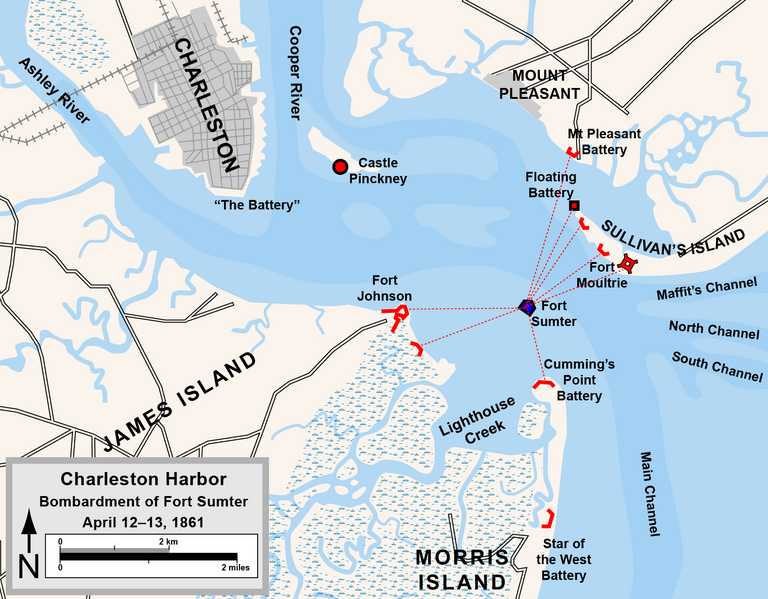
Charleston Harbor in 1861, ©Hal Jesperson

Fort Sumter at the time was unfinished and unmanned but was strategically important to South Carolina for the defense of Charleston Harbor. After Secession, Union troops stationed at nearby Fort Moultrie secretly moved into the new fort. Bombardment began only after repeated attempts to peacefully buy it from the Union and only after Lincoln tried to provision it despite warnings that doing so without a suitable treaty would violate South Carolina’s sovereign borders.

The bottom line is that Lincoln, not South Carolina or the Confederacy, deliberately provoked the deadliest war in US history!

As to whether the Union needed saving, almost all of the nation’s manufacturing and war-making capabilities were in the north. The South was eager to establish trade relations with the North, so the availability of food, cotton and tobacco weren’t issues.

On Economics

Lincoln was a dedicated disciple of Henry Clay and his so-called “American System” of economics. Three aspects of the American System were particularly damaging to and hated in the South:

Protective Tariffs, benefitting the North and penalizing the South:

Tariffs are taxes on imports. One benefit of tariffs is that they raise revenue for the entity imposing them, and in fact, for many years that was the only source of funding for the federal government. “Protective” tariffs are further designed to promote domestic manufacturing and production by making imported goods less competitive than domestic goods. Since the southern states had very little manufacturing capacity, protective tariffs raised consumer prices for them while providing no meaningful protection.

The southern economy, however, depended on exports of agricultural products, particularly cotton. US trade partners that lost revenue to US tariffs responded by raising tariffs on southern exports.

National Banks, benefitting the North and penalizing the South:

The Constitution neither created nor authorized federal banks or a Federal Reserve. Alexander Hamilton, the first Secretary of the Treasury, pushed for creation of a federal banking system, and that eventually happened despite heavy opposition from Constitutional purists like Thomas Jefferson and James Madison. Hamilton believed that a federal bank was necessary to “stabilize and improve the nation’s credit, and to improve handling of the financial business of the United States government.” Subsequently, the First Bank of the United States was chartered in 1791, and lasted until it was privatized in 1811 (at the expiration of its charter). Federal banking was reintroduced in 1816 under a charter that created the Second Bank of the United States and allowed a large number of regional branches. Banks, by virtue of their power to choose who is or is not able to borrow money, and the terms of such loans, wield enormous power.

The Southern States rightly feared that a bank with national scope would favor the economic interests of the industrialized northern states over those of the agrarian southern states.

Internal Improvements, benefitting the North and penalizing the South:

Today this topic is called “infrastructure“. In Lincoln’s day, it referred primarily to construction of roads and rails. Article 1, Section 8 of the Constitution grants to congress the power “to regulate Commerce with foreign Nations, and among the several States, and with the Indian Tribes”. To a Constitutional Conservative, “regulation” means oversight and minimal rulemaking. To Henry Clay and Supreme Court Chief Justice John Marshall, and then to mid-century liberals like Abraham Lincoln, it meant far more.

The southern states realized that most such projects would be built in and mainly benefit the northern states, with much of the financing at the expense of the South.

Lincoln as a Republican?

Be not deceived!

Although Republicans like to boast that Lincoln was a Republican, the Republican party of the 19th century bore little resemblance to the GOP of the 21st Century. In essence, the Republicans and Democrats have to a great extent swapped ideologies.

The Republican Party was established in 1854 in response to the Kansas-Nebraska Act, drafted by Lincoln’s old nemesis, Steven A. Douglas. This act created the two territories, primarily with railroads in mind. In the process, though, it also repealed the Missouri Compromise of 1820, which prohibited slavery in new territories north of a certain latitude. The Republican party consisted largely of Whigs, who were disappointed with that party’s lukewarm opposition to the expansion of slavery. In terms of policy, it essentially was Whig.

In an online article describing the Whigs, the History Channel states that they were “vocal opponents of [President Andrew] Jackson’s propensity for ignoring Supreme Court decisions and challenging the Constitution.”

There is irony in that statement. The United States of America came into existence when nine of the original thirteen colonies signed the Constitution. The Constitution, as amended under its own terms, is the supreme law in America, and even the Supreme Court has no power to violate it. “Ignoring Supreme Court Decisions” is not only okay but is required when the Court itself is “challenging the Constitution.” That was precisely Jackson’s stance. The “separation of powers” doctrine does not establish a hierarchy among branches of the federal government. It means rather that the Legislative, Executive and Judicial branches each exerts an equal check on the others.

In the mid-19th century, the Republicans were the party of big government, heavy taxation, burdensome laws and weak Constitutionalism. The Democrats, North and South, were the party of Constitutional limits.

That all began to change between WWI and WWII. By now, it has not only reversed, but has gone to absurd extremes on the Left.

I would place Lincoln on today’s scale as a moderate Democrat, and the Southern Democrats of his day as right-of-center Republicans.

What is my vision?

I’m sure you’ve figured out that I consider myself a Constitutional Conservative. Most of you would probably consider me extreme.

  • I pay my taxes because they are legal under the Constitution, as amended. Well, I no longer pay income tax because I’m retired and in the exempt bracket.
  • I do not say the Pledge of Allegiance because it was devised after the Civil War to coerce “rebels” into abandoning their principles. It’s the “one nation” part that sticks in my craw. We are, Constitutionally, a union of truly sovereign states, not one nation. I would pledge conditional allegiance to Texas, as a sovereign state, for sure, and probably some other states, including Kansas, where I live now. Mostly, I pledge allegiance to the Kingdom of God. I would (I do!) pledge allegiance to the US Constitution. I make no promise to object to secession of some state or states in the future.
  • I do fly the Stars and Stripes, stand for the National Anthem, support the military, and of course vote, because I appreciate the benefits I do receive from the Union.
  • I do forswear and even despise slavery because my ancestors, like yours, were at some time in history enslaved (where is my reparation check?), and because in this day and age, it is a practice with no moral justification. Not because of the 13th and 14 Amendments to the Constitution, which were passed illegally, under coercion.
  • I do not recognize West Virginia, the state of my birth as a member of the Union, because it was formed illegally during the Civil War and is still, under the Constitution, part of the state of Virginia. If the legalities were correctly followed today, I think there would be no problem achieving Constitutional statehood.
  • As a pragmatist I do, by and large, obey the laws of the United States, because of benefits I receive.

I guess you get the picture…


David H. Stern: A Hero of Messianic Judaism

Today I learned that David H. Stern, PhD died late last year, at the age of 87. I’ve never met Dr. Stern, but between his books and his English translation, The Complete Jewish Bible, with a commentary on the New Testament, he, more than anyone else, influenced my interest in Jewish life and culture and the Jewish foundations of Christianity. He was born, educated and married in America, but as a devout Messianic Jew, he emigrated to Israel in 1979.

Dr. David H. and Martha Stern, courtesy All Israel News.

Life isn’t always easy for Messianic Jews in Israel. They are regarded by both secular and ultraorthodox Israeli Jews as “missionaries”, a term used in scorn, and are often denied Israeli citizenship. At the same time, I have known many non-Jewish Christians around the world, particularly those in Reformed denominations, to strenuously object to non-assimilated Jews, and to resist any recognition of the debt Christianity owes to its Jewish origins. And given the argumentative nature of many religious, ethnic Jews, I’m sure that even they could be a challenge to Dr. Stern. Many years ago, I had lunch at a Shoney’s Restaurant in Shawnee, Kansas, with Moishe Rosen, the founder of Jews for Jesus. Not to be too hard on a great man, but Rabbi Rosen was intensely critical of Dr. Stern, for reasons that I could not and still do not at all agree with.

Rest in peace, Dr. Stern.
נוח על משכבך בשלום דוקטור שטרן


Dr. Carl E. Baum: Tribute to an Early Mentor

Yesterday I was watching the re-airing of a 2020 episode of Impossible Engineering on the Science Channel. The episode, titled Spy Plane Declassified, was about the reconfiguration of a Boeing E-3 Century airplane as an AWACS (Airborne Early Warning and Control System) aircraft.

Midway into the program, I was thrilled to see a segment featuring a man who, though I knew him for only a few months, was probably, after my father, the first man who significantly influenced the future course of my professional life.

Dr. Carl E. Baum

During my mid to late teens, I took two summer jobs with Federal agencies. The first was on a Forest Service surveying crew, working on a road project on the fringes of the Navajo Reservation near Bluewater Lake, New Mexico. The second was a civilian job at the Air Force Special Weapons Center at Kirtland Air Force Base in Albuquerque. This job was in 1965 right after my graduation from high school.

At AFSWC, I reported directly to a young Air Force Captain, Carl Baum, now deceased, who was directing the Center’s research on EMP (Electromagnetic Pulse) defense strategies. EMP was then (at the height of the Cold War), and still should be, a grave national security concern. Strong pulses of high frequency electromagnetic energy such as those generated during air detonation of a nuclear bomb can disable and even destroy electronic equipment of all types within a huge radius. A few bombs detonated over America could potentially shut down our civilian infrastructure for decades, because even the facilities and equipment needed for repair and replacement would be crippled. But our focus at Kirtland was on finding means to improve the “radiation hardening” of military equipment against such an attack.

Of course I was a “gofer” in that facility, but Captain Baum and his staff all took an interest in me as a budding scientist. My principal duty was to run “IBM cards” and printouts back and forth between Carl’s desk, his programmers and keyboarders, and the Control Data CDC 6600 supercomputer down the hall.

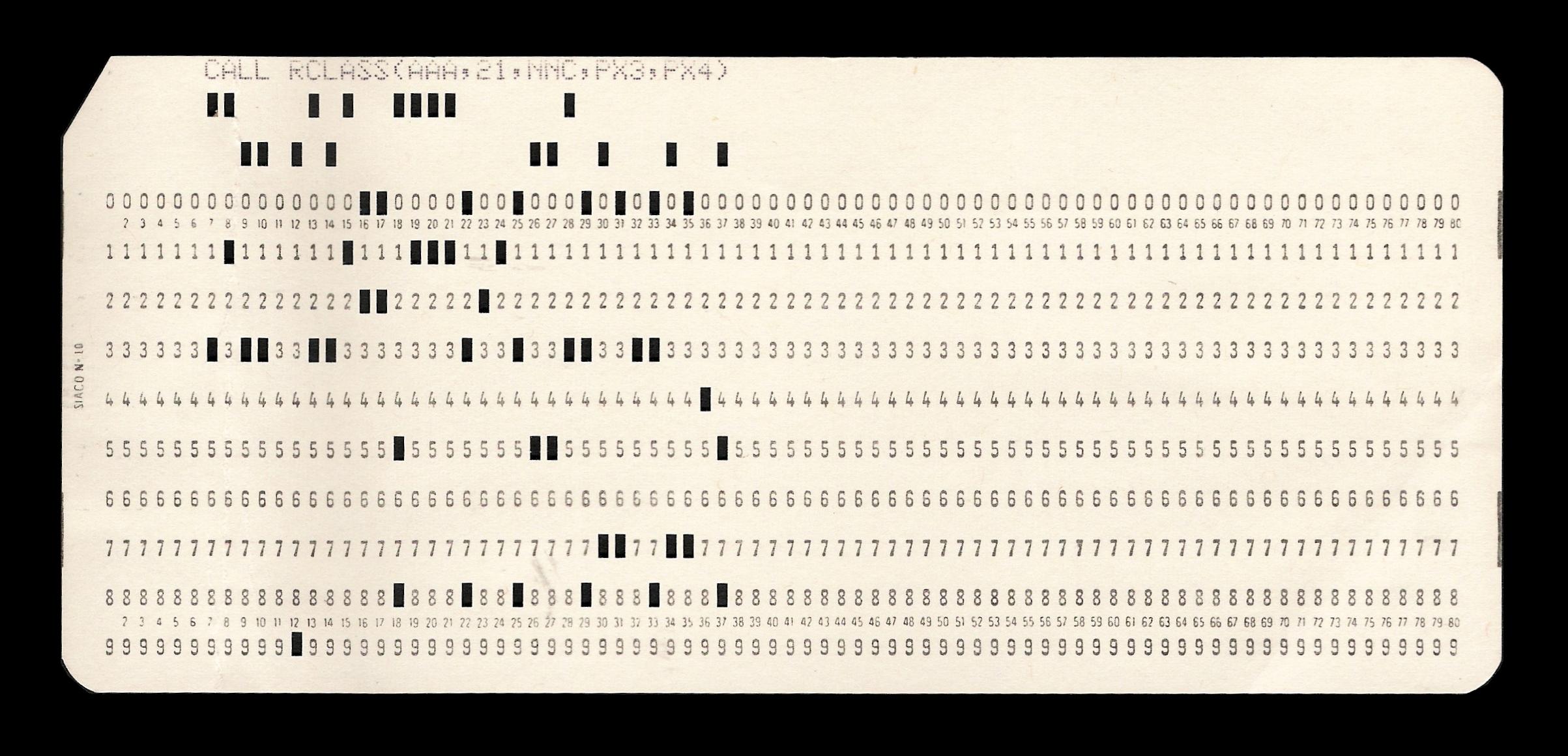
Old-timers will recognize this punch card from the infancy of computers. This one sports a single line of code: a subroutine call, passing five separate parameters. A complex program might require a stack of hundreds of cards, all of which had to be “read” in the correct order. Holes were punched using a device with a keyboard resembling a typewriter—remember those? “Keypunch Operator” was a career description in those days. I still have boxes of blank cards down in my basement, which I’ve used for bookmarks and note cards. And, of course, coasters.

In practice, I was present for many conversations between the scientists. A simulation run or test results would come back, Carl would examine the data and graphs, and out of his genius brain would pop a new complex wave equation to model what changes might happen to the EMP field if we do such and such or change so and so. Off would go the programmer to plug the new equation into a new simulation, then I’d take it to the keypunch operators, prepare the program deck, and haul it off to the input desk.

But I still ended up with a lot of free time. Carl was at heart an academic. Over the years he did frequent guest lectures around the world, and he ended his career as a professor at the University of New Mexico. He asked me if I’d like to learn FORTRAN, the computer language of choice for research back then. Sure! So, he assigned a Staff Seargent to teach me, and in just a couple months I became proficient enough at it that two years later I was able to land a job at the University of Texas Computation Center as a consultant tasked with helping professors and students debug and improve their faulty FORTRAN programs.

I never saw Carl again after that summer, but I never forgot him, or heard of him again until now. As a kid, I always loved astronomy and physics, but for reasons beyond the scope of this post, I had decided to pursue a career in marine biology, instead. Because of Carl’s influence and the computer training he gave me (long before the days of personal computers), my interests swerved back onto their original path. My father insisted that I start with general studies at a small college for two years. I ended up as the only physics major at Eastern New Mexico University, and from there went on to double major in math and physics at Texas.

ATLAS-I EMP test platform at Sandia Laboratories, now part of Kirtland AFB, New Mexico. This huge, 180-meter-tall facility, nicknamed “The Trestle“, was designed by Dr. Baum several years after I was there. Aside from the wedge-shaped steel structure on the left which acted as a ground plane for the horizontally polarized pulses, it is constructed entirely of non-conductive laminated wood beams, held together by wooden nuts and bolts. EMP is provided by means of two huge Marx generators flanking the wedge. For an idea of the Trestle’s size, that’s a B-52 bomber being tested!

Full tribute online, by Frank Sabath, W.D. Prather and D.V. Giri.

Constitutional Supremacy


I lived in Oklahoma for a while, and I don’t love the state. My antipathy has nothing to do with politics, though. I don’t know if it will stand, but I fully support this effort:

Oklahoma House Passed Bill to Let State Declare Biden Executive Orders Unconstitutional (newsweek.com)

On the whole I think this Newsweek article is balanced and fair. I do take issue with their wording of one particular paragraph:

“The 10th Amendment says powers not delegated to the federal government are reserved to the states. However, the U.S. Constitution’s Supremacy Clause also states that federal law generally takes precedence over state laws and even state constitutions.” What they are saying, is, in effect, “The states reserve all rights that are not granted in Article I, Section 8 (The Enumerated Powers), unless the Federal Government passes a law usurping that right! But the 10th Amendment expressly prohibits such Federal laws!

Contrary to what you may have heard, the Constitution of the United States is clear and simple. You may have to look up a word or phrase here and there (e.g., habeas corpus, or Bill of Attainder), but once you’ve done that, you don’t have to have a Harvard law degree to know what it means! The Constitution is the supreme law of our land. If Congress passes a law that violates the 10th Amendment, then that law is by definition invalid! If the President attempts to enforce that law, then he is in violation of the Constitution, and the states can and should defend their Constitutional rights! If the courts, including the Supreme Court, uphold such a law, it is still unconstitutional, because it is absurd to think that an office created by the Constitution can userp the Constitution!

What Oklahoma is trying to do is yet another of many historical attempts by states to nullify unconstitutional Federal laws and actions. Yes, it has been tried before, with little or no success. The concept goes back at least to Thomas Jefferson. In 1791, as Secretary of State, he wrote an opinion letter to President George Washington regarding proper remedies for an unconstitutional law coming out of the US Congress:

“The … shield provided by the Constitution to protect against the invasions of the legislature: 1. The right of the Executive. 2. Of the Judiciary. 3. Of the States and State legislatures. The present is the case of a right remaining exclusively with the States, and consequently one of those intended by the Constitution to be placed under its protection.”

In other words Jefferson defends nullification by means of: (1) Presidential Veto; (2) Judicial Review; and, if all else fails, (3) Nullification by the states.

The Oklahoma House Minority Leader says, “It’s interesting to me that the States’ Rights Committee only seems to exist when there’s a Democrat in the White House, and that these issues only come up when there’s a Democrat in the White House”. She’s right, of course. Unfortunately, that is the way American politics functions these days. We don’t tend to do what is correct and just, we do what is expedient, and only argue when it suits our particular ends. Sad.

Oklahoma is right in this instance, and yes, it is right no matter which party is in power!


Striker Fun in the Navy


Sailors preparing for an “exercise” on USS O’Brien, DD-725. ©1969, Ron Thompson

Everyone has heard the jokes about an apprentice mechanic being sent to fetch a “left-handed monkey wrench”. I’m sure that has happened many times in the military, in real life. I saw my share of such practical jokes when I was in the Navy. Some were way crueler than the monkey wrench standby. Most were pretty harmless.

One that I personally observed comes to mind from a 1969 Naval cruise. I was a midshipman (an officer recruit) at the time, doing a 2-week cruise on a destroyer, the USS O’Brien, DD-725, which was based in Long Beach at the time.

A typical small Combat Information Center.

Late one night I was in CIC (the Combat Information Center where all the radar and sonar operators worked), and we were just transiting from one place to another, with nothing else going on. That’s when a lot of the housekeeping chores are done. The guys that do most of that are new enlisted recruits—and “strikers“. Strikers are the guys who have started training for a specialty, or “rating“. Some recruits strike right out of boot camp; others go to the fleet for a while as “unrated seamen” (or “airmen” in the flying Navy).

That night a radarman striker was put to work cleaning the faces of radar scopes. Well, there happened to be a Chief Petty Officer on duty, and he says, “Hey, striker, if you’re going to do that, do it right. Tonight, give them a good steam cleaning.”

“Sure, Chief. Where do I get steam?”

The Chief, looking totally disgusted, says “How long have you been in the Navy, striker? Where do you think you get steam on a Navy ship? The boiler room!”

Big, non-nuclear ships burn NSFO (Naval Special Fuel Oil, which is barely refined crude oil) which heats the boilers, to make steam, to turn the turbines, to spin the propellers and the power generators. So, the striker goes down to the boiler room in the depths of the ship. Meanwhile, the Chief calls his counterpart in the boiler room, on the ship’s telephone, and tells him what’s going down. When the striker gets below, the boiler crew gives him a hard time about not bringing a container to put the steam in; then they find an old bucket, open a steam cock and blow steam into the open bucket.

The guy comes back up to CIC carrying this open bucket, which of course is empty, steam being a gas. The Chief puts his hand in, then pulls it out, with nothing in it. He gives the striker a cold stare and says, “It all leaked out, idiot; don’t you know enough to put a lid on it?”

The striker goes back below with the bucket, and a boilerman looks around, can’t find a lid, but comes back with an old pair of dungarees they’ve been using for a rag. He fills the bucket, this time with hot water that hasn’t yet boiled away, as well as steam, and he wraps the dungarees around it to “close the bucket.”

The guy comes back up to CIC, where the Chief takes the bucket, carefully peeks under the wrapping, then peels it off and thrusts the bucket back to the striker. Poking his fingers into the now warm water and rubbing them together under his nose. “That’s DEAD steam! Finish the job the way you were doing it, and we’ll find someone with a brain to do the steam cleaning next time.”

True story, the way things were when I was Navy.


Honoring Caesar

Regarding Paul’s instructions for submitting to authority:


[13] For the sake of the Lord, submit yourselves to every human authority—whether to the emperor as being supreme, [14] or to governors as being sent by him to punish wrongdoers and praise those who do what is good. [15] For it is God’s will that your doing good should silence the ignorant talk of foolish people. [16] Submit as people who are free, but not letting your freedom serve as an excuse for evil; rather, submit as God’s slaves. [17] Be respectful to all—keep loving the brotherhood, fearing God and honoring the emperor.
—1 Peter 2:13–17 (CJB)

Realizing that God is “the same yesterday, today, and always”, I think we have to recognize that it is sometimes difficult to apply scriptural concepts written 2,000 years ago to the context of 21st Century America. In Peter’s time, the civilized world was ruled by one man, the Roman Emperor, whose rulings were enforced by a network of sub-rulers throughout the Empire. It was easy for Peter, under Divine inspiration, to say, “honor the emperor” and all those under him who are set over us. To follow that precept today, we have to wade through a morass of ambiguous, and mostly conflicting, levels of authority.

The implication of the message I just watched on TV is that we should be in submission to all levels of our American government, even if the Constitution is being blatantly undermined by those leaders.

So, who is this emperor we are to honor?  The President? Congress? The Federal Courts? The Washington bureaucracy? How about State government? Or, going the other way, the Secretary General of the United Nations, or the Security Council?

My personal opinion, based on many, many years of reflection, is that what God Himself has ordained for America is that we are a government “of the People, by the People and for the People”, with none other than the US Constitution at our top. The Constitution is our one and only emperor in America! Below that we have—deliberately—established competing layers of government that we, the voting citizens of Kansas first, and the US second (except where the Constitution dictates otherwise) must hold accountable.

Under the 10th Amendment, the Constitution reserves to the states and to the people of those states, all powers not specifically granted to the federal government. The list of federal powers is very small but starting mostly with Chief Justice John Marshall in the early 19th century our rights have been siphoned away until we have relatively few remaining.

If this means sitting at my computer and posting memes and dissenting comments on Facebook, then I feel that I am within my spiritual authority to do so. In America, under the auspices of the First Amendment, we who are the informed are encouraged to voice our opinions yea or nay so that those who are less informed can vote effectively.

So, if “the government” tells me I can’t speak my mind on a political issue, or I can’t arm myself for any reason whatsoever, I must not submit, irrespective of the courts, because even they cannot violate the essential rights granted by the US Constitution! In a sermon several years ago, one of my pastors, evidently directing his comments specifically to me and perhaps a few others, said that we were “disgusting” and out of God’s Will for presuming to complain about our duly elected leaders.

I don’t accept that characterization!


A Perspective on Computer Modeling and COVID-19

First posted April 2020

  1. Introduction
  2. My own use of models
  3. How models work
  4. Using model results
  5. Modeling COVID-19

Introduction

I’ve been watching the President’s daily press briefings about the COVID-19 pandemic, and pretty much laughing at discussions of “the model.” The press asks almost totally ignorant questions, and frankly, the answers are almost equally ignorant. The people at the podium almost certainly don’t design or code pandemic models themselves, and they don’t seem to be very adept at explaining what they do know to the reporters.

Perhaps I can give my readers a bit of a perspective on the issue.

My own use of models

As a professional petroleum reservoir engineer, my job was to estimate how much oil and/or natural gas was underground in new or old fields and to predict if, how much, and how fast it could be “recovered” under different drilling and production plans and economic scenarios. Sometimes millions of dollars were ultimately at stake. During much of my career, I acted as a professional consultant. Sometimes my client was trying to attract investors, and sometimes I was representing investors trying to decide whether or not to join a venture. I even appeared in court hearings from time to time as an expert witness.

Whichever side of the table I was on, the core of my work was specifying, collecting and analyzing data, making calculations, and assigning risk factors; and then submitting my results and recommendations, usually in a written report.

One of the analysis tools at my disposal was mathematical modeling, otherwise known as computer modeling. Later in my career, there were some very sophisticated 3-dimensional models available, but models always have limitations, and the more complex they are, the more data and assumptions they require, and often the more likely they are to be wrong! I rarely referred to complex reservoir models except to dispute their results. On the other hand I, myself, wrote and frequently used a simpler  2-dimensional model that proved very accurate when used properly.

How models work

If you’re as old as I am, you no doubt recall that weather forecasters used to be the butt of jokes, because they were almost always wrong. Now they use computer models, and the forecast for “tomorrow” is almost always pretty close to right on the money. This is because the weather is subject to known physical laws; if you know, for a given point and many other points around it, the direction and magnitude of the barometric pressure gradient, the temperature and the humidity, and other factors like the ground topography and stored ground temperatures, and you have a good idea of how those conditions vary above you, then you can plug all that data into a proven model running on a fast computer, and you can be pretty confident of its predictions over a short period of time. Unfortunately, the accuracy of any model’s predictions declines exponentially as you “look” farther into the future. That is why the prediction for Saturday’s weather changes by the day, and even by the hour, as you watch from Sunday through Friday.

All models incorporate more than just data. They also require assumptions to be made, and they are subject to data errors and varying conditions at the data points and boundaries. Also, no two modelers will incorporate exactly the same data points, assumptions, boundary conditions, or even mathematical algorithms. Sometimes one particular model will come up with more accurate predictions than others, but other times a different model excels. Your local meteorologist will subscribe to as many models as he or she can, reject some he doesn’t trust, and either use the one he likes best or average the results from several.

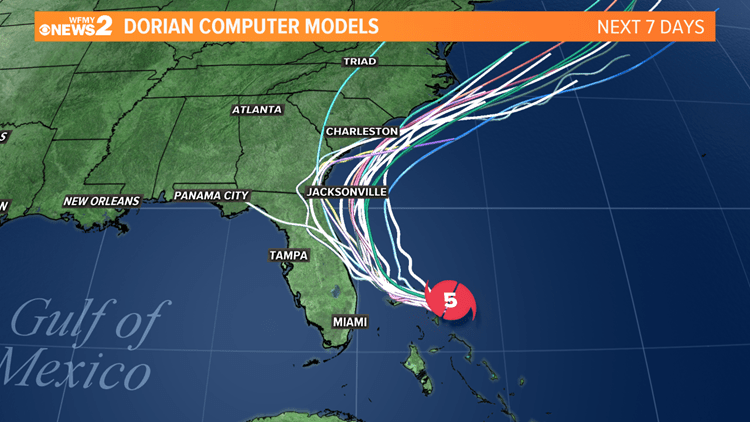
An example demonstrates how models vary from each other, and over time: last fall, Hurricane Dorian was threatening the eastern and gulf coasts of America. Storm model data is frequently presented in the form of “spaghetti charts”, showing the predictions of multiple models, as shown below. By comparing all the models, the familiar composite “cone of probability” map can be constructed. Early modeling indicated that the storm would most likely cross over Florida and hit the gulf coast. Later models showed, correctly, that it would instead turn north and threaten the Atlantic coast. Models are only an educated “best guess” about the future. The earlier models weren’t “wrong” as much as they were lacking in data.


Using model results

As an engineer, I normally had only a single model to work with. The data going into a model is factual, and can usually only be updated for new readings and corrections. Assumptions, though, are subjective and therefor imprecise. Proper use of a model requires plugging in a range of reasonable values for the parameters (assumptions) and constructing “best case”, “worst case”, and “most likely” conclusions.

Which of these conclusions I stress to a client depends on my own experience and instincts, and whether my client is a buyer or a seller.

Modeling COVID-19

One reporter at the President’s press conference yesterday asked why, given how good the death prediction seems now, does the number of total cases predicted seem to be so far off? He never really got an answer to that question. The correct answer is that the model is simply not that good for this disease. There are, and always will be, too many unknowns and assumptions for a model like this. If CDC understood the disease better, as they eventually will, they could improve on the results, but they will never be able to account for all the social distance cheating, accidental contacts, boundary violations, and unexpected cures and exacerbations. A model like this can show qualitatively what to expect, but quantitatively, the best that can be expected is a ballpark cone of possibilities.

Ideally, the government should release all of the results from all models. That is probably never going to happen, because governments realistically have to consider not only facts, but also security, morale, and even political fallout. That is perfectly legitimate when the actual truth is not even known with reasonable certainty. A President, if he’s not a complete political hack, has to strike a balance between urging caution and causing panic, while operating behind the scenes to achieve the best results, however the disease progresses. The CDC, by its nature, is always going to present a pessimistic worst case.


Bye, Bye, Dell…

I have been updating posts from several years ago so that they work with new blog templates. I’ve deleted several old posts, and was going to do away with this one, too. But although my exasperation has dissolved by now, I decided instead to just reclassify it as “humor”…

Man, what an experience… I’ve gotta’ vent!

My long association with Dell computers may be coming to an end! I never buy off-the-shelf computers because I use proprietary, resource-guzzling software that has special requirements. I’ve always found it easy to call Dell, order a customized machine, at a reasonable price and quick turn-around. They put it on my tab, and in a few days I’m off and running. Besides, Dell is good-old Austin homeboys!

So, a couple weeks ago, I call, place my order, and in decent time it comes to my door—with a monitor that doesn’t work with the dual-monitor stand that they suggested I add to the order to reduce the footprint of two big 24″ monitors. Used to be, you could get right to an American customer service rep who would go out of his/her way to keep you happy. Now, as with most American companies, thanks to government taxes and regulations, you have to wade through an annoying phone-maze to get to an understaffed office in India with under-trained staffers you can barely understand. Sure enough, the lady I drew after a long hold and much frustration, was totally undecipherable to my aging and ringing ears. I finally asked her to transfer me to someone who speaks English. After holding for 20 more minutes, the line drops.

So, I start over from scratch, and eventually get a guy who I actually can mostly understand. I said I just wanted to swap the monitor they sent for one like I already had, which works fine with the stand. Lengthy hold while he considers this. “No, you don’ wanna’ do that, it would be too expensive! Here, I’m gonna’ send you a link to an adapter you can get on eBay, and I’ll reimburse you for it.” Stupid me, I agreed, and a week later, the adapter finally comes, and doesn’t work out well at all. Meanwhile he’s been pestering me three times a day because he wants to be able to close the case file and get an attaboy from his boss.

Meanwhile, too, I’m looking more closely at the new monitor, and I finally notice that they sent me a cheapo that in no way was designed to work with a power-user machine like I’ve always bought from them. That explains the comment about the price. So I email him and say, “This monitor and the bracket you browbeat me into buying are both a pile of trash. I’ve got 10 grand of available credit in my dell business account. Swap me out this pathetic excuse for a monitor and send me a U2413, which I know is more expensive, but it presently has a $150 instant rebate, and it has the features I want.”

“yes sir, right away!” So, two business days later, here comes a new monitor–a P2414, which not only has zero features, but has an undersized screen, which causes a side to side mismatch with the other monitor. I call him up and point out that I expanded, bolded, red-lettered and italicized the model number I wanted, did I need to translate it into his native tongue, too?! By now there is no question that he could hear me speak.

“But sir, I sent you that one because it was the same price as the original purchase and it does have the correct mounting system for the stand!”

But it ain’t the one I wanted, and I’m not asking for a gift! Let’s do it this way–either send me the one I specifically asked for, or send me an RMA for the whole stinkin’ system!”

Well, that wasn’t the end of the drama. I have what I want finally, but I had to take a refund on the original monitor and call in an entirely new order (again to India) for the correct monitor. And because the instant rebate had expired, I had to repeat my RMA threat. After another long hold, “Good news! I got you an even better deal! Instead of a $150 rebate, we’re giving you $153! And a gift card on top of that!”

The gift card is for a whopping 9 cents, provided I use it all at dell.com!