Romans 5:12 and Death Before the Fall


Posted on:

Modified on:

  1. Introduction
  2. Background and grammar
    1. Life
    2. death
    3. Death in antiquity
    4. Death in Hebrew
    5. Death in Greek
  3. Romans 5:12, “death by sin”
    1. The Romans context
      1. Background
      2. Outline
      3. A focus on the theology
        1. Literal death in Romans 1–4
        2. Death and life in Romans 5:1–11
        3. Death and life in Romans 5:13–21
        4. A different metaphor in Romans 6–7
        5. Romans 8
    2. Interpreting Romans 5:10–14
  4. Death in Eden
    1. The sin in Eden
    2. The curses of Eden
      1. The Serpent
      2. The Woman
      3. Adam
  5. Good and Very Good
  6. Philosophical bias
    1. Nature vs Eternity
    2. Fecundity
    3. Natural Life

As an Old Earth Creationist (OEC), Young Earth Creationists (YEC) have frequently asked me about, or scolded me over, the question, “Doesn’t your theology presuppose the unbiblical idea of death before the Fall?”

My response is that, yes indeed, an old earth (4.5 billion years old) and an older universe (13.8 billion years old) does in fact imply that there was life and death on earth long before the creation of Adam, and his subsequent fall.

I will try here to refute the claim that death before the fall is “unbiblical” and to support my opinion that death was an intended part of God’s design that did not begin with Adam’s sin.

Unknown artist’s conception of Hades as described by the parable of The Rich Man and Lazarus. I presume that’s the Rich Man walking alone on the left bank of the chasm, while Lazarus is off lounging somewhere in Abraham’s Bosom, on the right bank. Remember that this is a parable, so you aren’t expected to take the vision of Hades’ layout or structure too literally.

Introduction

If you subscribe to a YEC interpretation of Scripture (and most of my friends do), then you should believe that all life, human, animal, vegetable, fungi, single-celled and microbial, was created some 6,000 years ago, over a span of only days. Is it conceivable, in that case, that the Fall took place soon enough after creation that no living thing got eaten, stepped on, or fell off a cliff? Was life physically indestructible, as well as immune from natural death? Life is far more complicated than that, but to Henry Morris and his disciples, the question is moot, because to them the Bible prohibits even the possibility of any kind of death before the Fall.

In this post, after first presenting some background and grammar, I’m going to comment on a few of the key YEC arguments for and against pre-fall immortality.

Background and grammar

Life

Not all YEC scholars think that a denial of physical death before the fall applied to plants and microbes, or anything else with no brain. I’m not aware of any scripture that grants this exemption, unless it is implicit from,

29 And God said, “Behold, I have given you every plant yielding seed that is on the face of all the earth, and every tree with seed in its fruit. You shall have them for food. 30 And to every beast of the earth and to every bird of the heavens and to everything that creeps on the earth, everything that has the breath of life, I have given every green plant for food.” And it was so.
— Genesis 1:29-30 (ESV)

Some say that only vertibrate animals were exempt from death. Where is that written?

Some say that anything without blood was never “alive”, in a Biblical sense, because “the life of the flesh is in the blood…” But that isn’t meant to define what “life” is or is not, it’s merely the stated reason that God views the consumption of blood as abominable. There is unfortunately a huge tendency for hyper-literalists (those who won’t let the Bible use figurative language or poetic exaggeration to prove a point) to read theology into every word of every verse, without regard to context.

Far from looking for exemptions, Morris even taught that entropy could not have increased before the fall. Morris was not a scientist and never had a full grasp of what entropy even means until later in his life.

Entropy is a fundamental thermodynamic property of the physical universe. Formally, it is a statistical measure of the number of mathematical “degrees of freedom” in any physical system. The Second Law of Thermodynamics states that the entropy of the universe always increases.

Entropy is often described to novices as “a measure of randomness”, but that is misleading. A common claim is that “shuffling a pack of cards increases its entropy because of the increased randomness of the shuffled deck but sorting it back into its original order decreases its entropy since its randomness is lower.” That isn’t at all true! The increase of entropy is due to the energy expended in shuffling. Reordering requires another expenditure of energy, say from a person or a machine, thus further increasing entropy. The entropy of 52 cards at rest is the same whether they are in an ordered or a shuffled state.

If Morris was right about entropy, cells could not divide, food could not digest, muscles could not contract, balls could not roll downhill and, oh yes, the sun could not shine, and gravity could not work. If so, then after the Fall, God must have completely redesigned the laws of physics, plus the nature of every last object in the universe, from subatomic particles on up to spacetime itself.

But the text of Scripture doesn’t, to my knowledge, hand out exemptions, so who gets to say that any human or nonhuman life was exempt from death? To my way of thinking, it is arbitrary and presumptuous for us mortals to “exempt” anything that is cellular and reproduces in a biological sense or to include anything else. Life is life!

death

For this discussion, we have to be more precise when we talk about “death.” That concept, as used in the Bible, can mean different things in different contexts:

  • Everybody on earth recognizes that anything post-Fall that has physical, tangible, cellular life will ultimately suffer a “physical death,” that is, a termination of all self-powered physical processes. After that, external processes take over to break down the physical components of that once-living carcass and “return it to the dust.”
  • Most contemporary Christian scholars also recognize that the Bible frequently talks about an analogous “spiritual death,” which Thayer describes as “the misery of soul arising from sin, which begins on earth but lasts and increases after the death of the body”; “the miserable state of the wicked dead in hell”; and “all the miseries arising from sin.”
  • Paul also defined death as voluntarily putting away, or killing, the evil inclinations of all humankind. See my recent Yetzer, Yotzer and “The Law” in Romans 7:1–6 for a detailed discussion of this usage.

While “death as separation” is not a highly developed Biblical concept, per se, it is functionally an apt description: separation of the body and spirit; separation of the eternal spirit from God; and separation of man from his own nature, respectively.

Death in antiquity

Human beings have an innate curiosity about their origins, both individually and culturally, and I think that this curiosity is at its strongest when communities are more isolated and less technologically distracted. In prehistoric times—that is, before the development of writing—history was very efficiently retained and spread verbally, both within families and cross-culturally by traveling storytellers. It should come as no surprise that all the ancient civilizations, with their common origins in Babel, would share common “legends” about their pasts and common beliefs about the unseen.

From Greece to Egypt and all across the Fertile Crescent, way over to India and China, and across the pond in the Americas, every culture that left records in early history shared one cosmology and one belief in the afterlife, differing only in small regional details.

I’ve shared several versions of the universal flat earth model of cosmology in earlier posts. Here I’ll add the Greek view, which is very similar to the others.
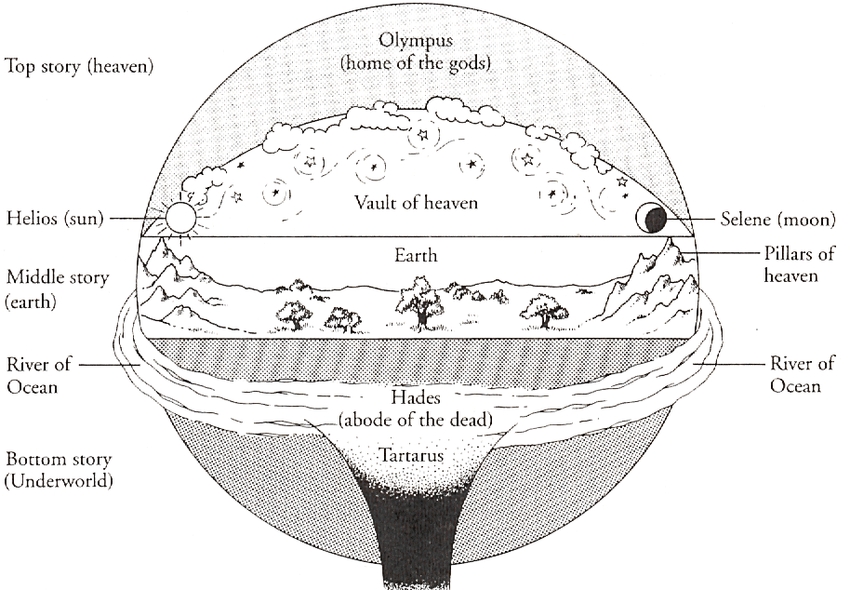
Ancient Greek cosmological diagram.

In all cases, the earth is depicted as a flat disk floating on a broad ocean and covered by a dome (the “firmament” in KJV). Beneath the surface of the disk is the underworld, Hades, the abode of the (physically) dead.

As I’ll show in the following two sections, both Hebrew and Greek have terms that refer to death and the remains of the physically dead, but neither language has any term that differentiates between physical and spiritual death. Though “death” can refer to either, only the context can indicate which is being discussed. Unfortunately, very often the context alone is insufficient for total clarity.

Why would that even be?!

I would suggest that, aside from corruptions in the retelling, all early civilizations shared the assumption that physical life was only one phase of personal existence.

Human life on earth is short. Adam’s descendants in the period between the Garden and the Flood lived long lives, as recorded in the Bible, but most cultures in the ancient world had life expectancies of no more than a few decades. Physical death was no shock. It was pretty much universally believed that when a human died, his spirit survived and was relegated to the underworld. The Bible calls that underworld Sh’ol, or Sheol, in Hebrew, Hades in Greek.

Physical death, in other words, was little more than the shedding of a mortal shell not needed by the immortal spirit as it moved into its new abode in the underworld.

There was no concept of death or annihilation of the spirit in the underworld until much later. In fact, there apparently was no real concept of suffering spirits, either. Even in the Old Testament, where the Psalmist said, “The wicked go down to the realm of the dead, all the nations that forget God” (9:17) and “Let me not be put to shame, Lord, for I have cried out to you; but let the wicked be put to shame and be silent in the realm of the dead” (31:17), the sense is, “I’m righteous, so let me live, because when I die, I’ll be relegated to the drab and boring underworld.”

The picture of Sheol/Hades presented in the parable of the Rich Man and Lazarus appears nowhere in the Old Testament. That is a view apparently developed in Second Temple Judaism and propagated in Jewish pseudepigraphal works like The Apocalypse of Zephania and 1 Enoch. In telling this parable, Jesus was using a well-known popular concept to illustrate His teaching.

Death in Hebrew

Biblical Hebrew has several words that are used extensively with respect to death:

פֶגֶר (peger, pronounced peh’-ger) is a noun referring to a corpse, carcass, or dead body, human or animal. It was also used figuratively on occasion to refer to idols.

מוּת (muwth, pronounced mooth) is a verb meaning to die, to kill, or to be dead. The subject could be human, animal, vegetable, or even a nation. It can refer metaphorically to the death of some characteristic, e.g., the death of courage. Manner of death could be natural causes or violence. It could also refer to a death judgement, or to an agent of death.

מָוֶת (maveth, pronounced MAH-veth) is a noun, closely related to muwth, that means death, the dead, the place of the dead or state of being dead, or sometimes pestilence or ruin. Rarely, it can be used metaphorically to indicate spiritual death or separation from God, as perhaps in Hosea 13:14, or divine judgement, as in Ezekiel 18:4.

נֶפֶשׁ (nephesh, pronounced neh’-fesh) is a noun, often translated as soul, but primarily meaning any living and breathing creature, human or animal. It also refers to many of the characteristics of life, including life itself, self, person, desire, passion, appetite, or emotion. To lose one’s nephesh is to die, after which the peger, or remains, decay, while the nephesh (now a disembodied spirit) lives on in Sheol, “the grave”, meaning the underworld.

Note that in the Hebrew Scriptures, there is almost no development of the idea of spiritual death, or of divine retribution in the afterlife.

Whatever your hand finds to do, do it with your might, for there is no work or thought or knowledge or wisdom in Sheol, to which you are going.
— Ecclesiastes 9:10 (ESV) emphasis mine

Death in Greek

There are many similarities, but also significant differences in the Biblical Greek vocabulary of death:

σῶμα (sóma, pronounced SO-mah) is a noun meaning body or flesh. Unlike the Hebrew peger, this word speaks of a body that can be either living or dead, or in some cases metaphorically, of the body of the Church, or the visible aspect of a disembodied spirit, e.g., an angel.

θάνατος (thanatos, pronounced THAH-nah-tos), like the Hebrew maveth, is a noun meaning death. Unlike maveth, where the figurative sense of “spiritual death” is rare, that concept is well developed in the 1st century AD. In biblical Greek, the figurative meaning is present at least as often as the literal. Unfortunately, only the context can reveal which meaning is in play, and even then, it is sometimes not clear.

As a foil for thanatos, I’ll include here its opposite, ζωή (zóé, pronounced dzo-ay’), a noun meaning life. Interestingly, thanatos is a masculine noun, while zóé if feminine. I’ll not suggest any significance to that fact.

νεκρός (nekros, pronounced nek-ros’) is an adjective meaning dead, deceased, or corpse-like. Like thanatos, the New Testament often uses it to refer to spiritual death. Once again, only the context can determine which meaning to attach.

νεκρόω (nekroó, pronounced (nek-ro’-o) is a verb form of νεκρός meaning to put to death, or render powerless or ineffective.

ἀποθνῄσκω (apothnéskó, pronounced ä-po-thnā’-skō) is a verb meaning to die, to lie dying, or to be killed. Similar to Hebrew muwth, but once again, in the NT it often has a strong spiritual, rather than literal, connotation.

κρίμα (krima, pronounced KREE-mah) is a noun meaning a condemnatory sentence, penal judgment, or sentence.

κατάκριμα (katakrima, pronounced kä-tä’-krē-mä) is a noun meaning punishment following condemnation, penal servitude, penalty. Quoting from Bible Hub’s Topical Lexicon: “The word κατάκριμα is used in the New Testament to describe the state of being under condemnation, particularly in a spiritual or moral sense. It is often associated with the consequences of sin and the judgment that follows.”

Romans 5:12, “death by sin”

Therefore, just as sin came into the world through one man, and death through sin, and so death spread to all men because all sinned
— Romans 5:12 (ESV)

To most YECs, Romans 5:12 is the definitive last word on the subject, because it seems to clearly state that no death of any kind, to any created life form (subject to possible exemptions discussed above), was possible before Adam sinned.

But is that so?

“Proof-texting”, i.e., casually picking one verse out of Scripture to prove a theological point of view, is always risky because no single verse, in a vacuum, is likely to reflect the writer’s complete thoughts on the subject of the verse, or on the circumstances under which he is writing. Other factors almost always need to be considered, such as:

  • The grammar, genre, and figures of speech.
  • The issue or issues that prompted the writing.
  • The textual, historical, and cultural context.
  • The identity and background of the writer.
  • The identity and background of the original readers.

The grammar of 5:17 tells us that Paul is combining two thoughts:

  1. Adam’s sin introduced sin and death (thanatos) into the world.
  2. All humans sin, so all humans die.

These two thoughts are conjoined by the Greek phrase kai houtōs, but it is unclear how that should be translated. A quick survey of translations yields “and so”, “in this way”, “this is why”, “and thus”, and the New Century Version (NCV) even puts the second thought into a new sentence. “This is why everyone must die—because everyone sinned.”

Whichever one of those translations you go with, without more context there is a logical disconnect between the two halves of the verse. YECs use Thought 1 to prove that Adam’s sin introduced both physical and spiritual death into the world. Yet they would agree that Thought 2 says that humans die individually because they sin individually. Do animals not die individually because they sin individually?

The Serpent of Genesis 3 sinned, but that was Satan, not a common Garden of Eden Snake. Balaam’s donkey spoke sinful words (Numbers 22:28), but that was spiritual ventriloquism (“The LORD opened [its] mouth”). In Luke 8. 26–39, Jesus was speaking with demons, not with pigs.

I think we can agree that animals aren’t capable of sin, and neither are they subject to spiritual death. Therefore, animals probably have nothing to do with Thought 2 in Paul’s teaching. Given the multiple shades of meaning in thanatos (or the English, “death”) are we as Biblical literalists required to read all possible definitions into that one word here? Not unless we can find something in the context to back it up.

As a matter of fact, the subject in Romans 8, and in fact, the theme of the first 8 chapters, is salvation by faith in the Messiah, for both Jew and gentile. He brings up Adam for two reasons: First, because Jesus provided the means of undoing what the sin of Adam did to humanity; and second, because unlike Abraham, Adam is the father of both Jew and gentile. (Note that the overall theme of the Epistle to the Romans is Paul’s call for unity between Jews and gentiles in the Roman churches.) Among other verses in chapter 8, the following two provide all the explanation needed to understand 5:12:

18 So then, through the transgression of one, condemnation came to all men; likewise, through the righteousness of one came righteousness of life to all men. 19 For just as through the disobedience of one man, many were made sinners, so also through the obedience of one man, many will be set right forever.
— Romans 5:18-19 (TLV)

There is nothing at all in that message that applies to animals (or pre-Adamic hominids if you believe in them). Animals are explicitly mentioned only once in all of Romans:

22 Claiming to be wise, they became fools, 23 and exchanged the glory of the immortal God for images resembling mortal man and birds and animals and creeping things.
— Romans 1:22-23 (ESV)

We’ll approach an understanding of whether Romans 5:12 is speaking of physical death, spiritual death, or a combination of the two in this section. Because the language alone can’t answer that question, we’ll look primarily to the context of Paul’s letter, particularly chapters 1–8, concentrating on chapters 5–8. In the process, we’ll also strengthen our case for human-only death being in view.

The Romans context

In this section, I will now provide a thorough exposition of the topic of death, as it relates to 5:12, in Paul’s theological writings to the churches in Rome.

Background

Though Romans is packed with theology, Paul’s reason for writing the letter was primarily to act as a peacemaker between the Jewish and Gentile believers in the Roman churches.

On his missionary journeys, Paul’s habit was to first approach the Jewish synagogues and preach to their congregations, then to expand his approach to gentiles in the community. Where did the new believers then meet together? The practice of Jewish believers in Jerusalem was to continue their normal Sabbath activities in the synagogues alongside non-Messianic Jews, then at dusk, at the close of Shabbat, the Messianics would adjourn to private homes to meet and fellowship together until well into the night.

This same practice was likely followed in the Diaspora as well, with gentile believers joining at homes after the synagogues closed for the night. This was of course a great demonstration of the intercultural tolerance demanded by Paul.

[Note: Since “the 7th day of the week” gave way to “the 1st day of the week” at dusk, I believe that this evening adjournment is what truly led to the Christian custom of meeting on Sundays.]

In AD 49, Emperor Claudius expelled all Jews from the City of Rome, including Messianic believers. When the expulsion was ended after Claudius’ death in AD 54, two to four years before Paul’s letter, those Jews who returned found that Gentile believers had taken over their synagogues, and the result was bad blood between the returning Messianic Jews and the gentile usurpers.

Outline

That background explains, I think, why the bulk of the letter consisted of round after round of explanation and exhortation to first one, then the other, component of the Church.

In broad strokes, I personally outline Romans as follows:

  1. Greetings and personal notes, 1:1–15.
  2. A unifying theology of righteousness through faith, 1:16–8:39.
  3. Paul’s burden for Israel, 9:1–11:11.
  4. Gentiles and Jews together, 11:12–36.
  5. Christian ethics for all, 12:1–15:13.
  6. Paul’s closing statements, 15:14–16:27.
A focus on the theology

In Romans 1:16–8:39, Paul’s emphasis was on theology, in particular the roles of faith and Torah obedience in the quest for righteousness as required by God in the united Church.

In order to stay within the limited scope of this paper, I will concentrate here on Paul’s discussions of death, in order to set a context for 5:12.

Literal death in Romans 1–4

In the following passage, Paul is speaking of the faith of Abraham who, despite being an old man and “as good as dead”, maintained his strong faith in God, who not only creates the body, but gives it life. Both of these references to death are forms of nekros, and it seems reasonable to assume that they are referring either strictly or primarily to physical death; however, in my judgement they don’t help set the context of 5:12.

17 as it is written, “I have made you the father of many nations”—in the presence of the God in whom he believed, who gives life to the dead [nekros] and calls into existence the things that do not exist. 18 In hope he believed against hope, that he should become the father of many nations, as he had been told, “So shall your offspring be.” 19 He did not weaken in faith when he considered his own body [soma], which was as good as dead [nekroó], (since he was about a hundred years old), or when he considered the barrenness of Sarah’s womb.
— Romans 4:17-19 (ESV) emphasis mine

In 4:24 (“him who raised from the dead [nekros] Jesus our Lord”,) and 5:10 (“we were reconciled to God by the death [thanatos] of his Son”), the subject is the death and resurrection of Jesus, which again I think is not terribly helpful in setting the context for death in the following chapters.

Death and life in Romans 5:1–11

Beginning in chapter 5, the emphasis changes from justification to sanctification and the peace that comes with it.

Therefore, since we have been justified by faith, we have peace with God through our Lord Jesus Christ.
— Romans 5:1 (ESV)

“Death” terms now begin to appear more frequently in the text.

6 For while we were still weak, at the right time Christ died [apothnéskó] for the ungodly. 7 For one will scarcely die [apothnéskó] for a righteous person—though perhaps for a good person one would dare even to die [apothnéskó]— 8 but God shows his love for us in that while we were still sinners, Christ died [apothnéskó] for us.
— Romans 5:6-8 (ESV)

These references to death all speak of Jesus’ crucifixion, which was of course very much a literal death. The same applies in verse 10:

For if while we were enemies we were reconciled to God by the death [thanatos] of his Son, much more, now that we are reconciled, shall we be saved by his life [zóé].
— Romans 5:10 (ESV)

A key question now arises: If thanatos and zóé refer to literal, physical death and life in 5:10, as I think we all would agree, then is this verse speaking of physical salvation of our bodies, or of spiritual “salvation of our souls”?

“Saved” in verse 10 is σῴζω (sózó, pronounced sózó), a verb meaning (per Thayer’s), either (a) to save, to keep safe and sound, to rescue from danger or destruction; or (b) to deliver from the penalties of the Messianic judgment, i.e., to make one a partaker of the salvation by Christ.

Once again, I think that most of my readers would agree that (b) is the sense meant in verse 10.

Up to here in Paul’s theological discourse, the subject has been primarily Jesus’ physical death and subsequent resurrection as the basis for our faith, and thus our spiritual salvation (justification, sanctification, and later glorification).

I would contend, then, that 10 and 11 focus the context for what follows in verse 12:

10 For if while we were enemies we were reconciled to God by the death of his Son, much more, now that we are reconciled, shall we be saved by his life. 11 More than that, we also rejoice in God through our Lord Jesus Christ, through whom we have now received reconciliation.
12 Therefore, …
— Romans 5:10-12a (ESV)

I will show below that the text following 5:12 further solidifies this context.

Death and life in Romans 5:13–21

The remainder of chapter 5 continues the contrast between death through Adam and life through Jesus and returns the emphasis back to the overall theme of the letter: explaining how faith and salvation can function in a Church composed of both Jews and gentiles.

Here, Paul says that, yes, we have been two separate peoples under separate spiritual economies since the time of Abraham, and we will remain so in most respects, but we all have a common ancestor in Adam. Within the Church, we must recognize that both peoples are infected with the sin nature of Adam because of his sin, but now both have been united by our faith in the salvation brought by Jesus.

Key death phrases in this section are:

14 … death [thanatos] reigned from Adam to Moses, even over those whose sinning was not like the transgression of Adam, who was a type of the one who was to come.

15 … if many died [apothnéskó] through one man’s trespass, much more have the grace of God and the free gift by the grace of that one man Jesus Christ abounded for many. 16 … For the judgment [krima] following one trespass brought condemnation [katakrima], but the free gift following many trespasses brought justification. 17 For if, because of one man’s trespass, death [thanatos] reigned through that one man, much more will those who receive the abundance of grace and the free gift of righteousness reign in life [zóé] through the one man Jesus Christ.

18 Therefore, as one trespass led to condemnation [katakrima] for all men, so one act of righteousness leads to justification and life for all men. … 21 so that, as sin reigned in death [thanatos], grace also might reign through righteousness leading to eternal life through Jesus Christ our Lord.
— Romans 5:14-21 (ESV)

Surely all of that death, judgement, redemption and life terminology must be speaking only of the spiritual state!

A different metaphor in Romans 6–7

Here Paul shifts the conversation about death. In this section, “death” is neither physical death nor spiritual death, but rather he uses the metaphor of “putting to death”, or overcoming, the evil inclinations brought on by our sinful natures. I discussed this recently in great detail in Yetzer, Yotzer and “The Law” in Romans 7:1–6

Romans 8

In this chapter, Paul closes out the discussion that fills the first half of the letter.

1 Therefore, there is now no condemnation for those who are in Messiah Yeshua. 2 For the law of the Spirit of life in Messiah Yeshua [the Torah written on our hearts] has set you free from the law of sin and death [the fleshly “evil inclination”].
— Romans 8:1-2 (TLV) comment mine

“Therefore” in 8:1 harks back to all that came before, but in particular to 7:4, discussed in the previous article:

Therefore, my brothers and sisters, you also were made dead to the Torah through the body of Messiah, so that you might be joined to another—the One who was raised from the dead—in order that we might bear fruit for God.
— Romans 7:4 (TLV)

By now, I hope that most of you will agree that Paul’s discussion of theology is primarily about the spiritual results of sin, not about the mortality of the body.

Interpreting Romans 5:10–14

Here, then, is my interpretation of Romans 5:12 in its closest context:

10 For if while we were enemies we were reconciled to God by the death of his Son, much more, now that we are reconciled, shall we be saved by his life. 11 More than that, we also rejoice in God through our Lord Jesus Christ, through whom we have now received reconciliation.

12 Therefore, just as sin came into the world through one man, and death [thanatos] through sin, and so death [thanatos] spread to all men because all sinned …
— Romans 5:10–12 (ESV)

For if while we were enemies — While we, as Jew or gentile, were in opposition to God and Torah.

We were reconciled to God by the death of his Son — We were brought back into a close relationship (which was lost when we first sinned) with God on be basis of Jesus’ crucifixion.

Much more, now that we are reconciled — More importantly, now that that relationship has been restored.

Shall we be saved by his life. — I discussed the meaning of salvation when I analyzed this verse above, taking Thayer’s definition, “to deliver from the penalties of the Messianic judgment, i.e., to make one a partaker of the salvation by Christ.”

More than that, we also rejoice in God through our Lord Jesus Christ, through whom we have now received reconciliation. — We celebrate the fact that we have been brought into fellowship with God, the Father.

Therefore—because of Jesus’ crucifixion and resurrection by which we have been reconciled to God.

Just as—in the same fashion as.

Sin came into the world through one man—Sin came into existence on earth. By disobeying God in the matter of the Tree of Knowledge, Adam and Eve brought the curse on mankind and on the ground that he depends on.

And death through sin—this will require discussion of two issues:

  1. The contextual discussion above addresses the question of whether this “death” (thanatos) is spiritual death only, or whether it includes any physical component at all. Based on we’ve seen in chapters 1–8, and especially 5:10–11, I can only conclude that death here is referring only to spiritual death.
  2. We also have to determine whether the remainder of verse 12 limits this death to mankind only, or if animals and other things are included.

And so death spread to all men because all sinned—to my mind, the grammar here limits death due to sin to the sinners themselves.

But let’s consider the curses themselves…

Death in Eden

The sin in Eden

The word “die” occurs 3 times in the Garden of Eden (Genesis 2:17; 3:3,4). In each case, it is a grammatical variation of the Hebrew muwth. As expected, the Greek Septuagint (LXX, a 2nd century BC Jewish translation of the Old Testament into Greek) translates each of these three occurrences using apothnéskó, which in this case imparts no new information.

What does the text tell us? In Gen 2:17 God’s words were, “in the day that you eat of it you shall surely die.” Eve’s flawed retelling of this to the Serpent was, “‘You shall not eat of the fruit of the tree that is in the midst of the garden, neither shall you touch it, lest you die.'” The Serpent’s response was, “You will not surely die.”

Are we to take this as a discussion of physical death, spiritual death, or perhaps both? That’s a tough question to some since it is not addressed specifically.

If the answer is “physical“, then did God lie and the Serpent tell the truth? That, of course, is not tenable unless the word “day” (from the root, יוֹם, yom) means something other than a literal day. In an Ancient Near East (ANE) context, that is certainly a possibility, but it’s making an unprovable assumption, and it’s a risky interpretation in the context of Genesis 1–3. If you require Genesis 1 to be using the word, day, literally for the creation days, then in Genesis 2–3, the same word should probably have the same meaning.

“Both” might mean that both were telling half-truths, which raises the same troubling issues.

If the answer is “spiritual“, then God was truthful, and the Serpent a liar. I’ll go with this one!

But, for the purpose of this post, I have to ask how Adam and Eve could have had any comprehension of either physical or spiritual death if there had been no death at all on earth up to that point. Any attempts to explain that away can only be speculative. Lacking data, then speculation is fine, but dogmatism is not.

Since Adam’s physical death didn’t come until 930 years later, I feel personally confident in speculating that the death promised to him was spiritual only, though there is no record that either God or the Serpent explained that to him or Eve. I further speculate that he was not created immortal but would have lived forever from the fruit of the Tree of Life, as stated in gen 3:22.

The curses of Eden

The Serpent

According to Genesis 3:14–15, the Serpent was cursed for his own sin.

14 So the LORD God said to the serpent:
Because you have done this,
you are cursed more than any livestock
and more than any wild animal.
You will move on your belly
and eat dust all the days of your life.

15 I will put hostility between you and the woman,
and between your offspring and her offspring.
He will strike your head,
and you will strike his heel.
— Genesis 3:14-15 (CSB17)

Angelic beings were created to oversee the cosmos, much like mankind was created to manage Earth. The Bible reports that angels are rebellious just like humans, but I see nothing in the Bible to indicate that the angels and humankind are judged under the same set of rules, or that other angels were included in the Serpent’s curse.

In fact, it’s unclear just what exactly the serpent was, and what its relation was to Satan. Revelation 12:9 and 20:2 state that it was Satan, but that could mean that Satan “possessed” a member of an animal family. “On your belly you shall go” does indeed sound like snake, but “the serpent was more crafty than any other beast of the field that the LORD God had made” doesn’t sound snakish at all, so who knows?

It’s unclear to me why God would have cursed all snakes because of the perfidy of one, and the part of the curse recorded in verse 15 certainly does not pertain to snakes! Well, I’m satisfied not knowing the unknowable!

The Woman

Eve’s curse is recorded in Genesis 3:16. It mentions only pain in childbearing and relational difficulties between husband and wife. From the wording, it seems that childbearing was already painful, so this just made it more so. If it was painful, could it also have been perilous?

He said to the woman:
I will intensify your labor pains;
you will bear children with painful effort.
Your desire will be for your husband,
yet he will rule over you.
— Genesis 3:16 (CSB17)

Adam

Adam’s curse is found in Genesis 3:17–19. Strictly speaking, Adam wasn’t cursed at all, directly. What the text says is, “cursed is the ground because of you”. What that curse does, though, is to set up an enmity of sorts between Adam and his environment, which certainly would be considered a curse.

17 And he said to the man, “Because you listened to your wife and ate from the tree about which I commanded you, ‘Do not eat from it’:
The ground is cursed because of you.
You will eat from it by means of painful labor
all the days of your life.

18 It will produce thorns and thistles for you,
and you will eat the plants of the field.
19 You will eat bread by the sweat of your brow
until you return to the ground,
since you were taken from it.
For you are dust,
and you will return to dust.”
— Genesis 3:17-19 (CSB17)

Alternatively, it may be that Adam’s own curse is that discussed above, plus

22 The LORD God said, “Since the man has become like one of us, knowing good and evil, he must not reach out, take from the tree of life, eat, and live forever.” 23 So the LORD God sent him away from the garden of Eden to work the ground from which he was taken. 24 He drove the man out and stationed the cherubim and the flaming, whirling sword east of the garden of Eden to guard the way to the tree of life.
— Genesis 3:22-24 (CSB17)

I see no Biblical indication, in Genesis 3 or elsewhere, that animals, plants, or the extraterrestrial cosmos were cursed for man’s sin. Certainly, the flora, fauna and ecology of earth are greatly affected by man’s curse. That doesn’t mean that it had any effect on their mortality, other than to make life harder.“Be fruitful and multiply and fill the earth and subdue it, and have dominion over the fish of the sea and over the birds of the heavens and over every living thing that moves on the earth.”
— Genesis 1:28 (ESV)

Good and Very Good

Many Young Earth Creationists claim that there could not possibly have been death before the fall because during the creation week, at the end of every day God looked at what He had done that day and pronounced it “good.” At the end of the sixth day, as a matter of fact, it was “very good.”

Now how, they ask, can anything be good or very good if it can die? Well, gosh… How does any fallen human being presume to know what God considers to be good? It’s His design, so by definition, it is good!

Let’s check the language:

טוֹב (tov, pronounced tove) This can be adjective, verb, or noun, and it means … hang onto you hats … good, pleasant, agreeable, beneficial, beautiful, best, better, bountiful, cheerful, at ease, fair, favor, fine, glad, goodly, graciously, joyful, kindly, loving, merry, pleasant, precious, prosperity, ready, sweet, wealth, welfare, well-favored. And all of these meanings are subjective! Good luck agreeing on the shading!

מְאֹד (m`od pronounced meh-ODE) This is an adjective meaning very, exceedingly, much, greatly.

Really, there’s not much help there. The word is subjective.

From my engineering perspective, a good design is one that does what the specs required, does what it was designed it to do, and does it elegantly.

Philosophical bias

In my opinion…


The universe is not a static artwork hanging on a wall. It’s a living, dynamic organism, designed by God to mature and blossom with little interference, to showcase His majesty, and to house and employ His angelic host, the first “generation” of His children, the B’nai Elohim, or Sons of God (Genesis 6:2–4).

And later, after reaching a suitable degree of maturity and elegance, a Garden was planted on one planet to house and nurture the second generation of His children, humanity.

Elegantly!


Nature vs Eternity

Development and growth per God’s blueprint demand movement, change, and thermodynamic flow. Exchange and equilibrium. Birth and death. This is true for the universe as a whole, for galaxies, stars and star systems, and for planets.

Angels are like humans in that they image God, they answer to Him, they interact with Him, they have freewill and thus can sin, and God has given them meaningful work to do.

They are unlike humans in that they have no physical bodies that are inherently vulnerable to mishap, wear and tear, and mischief. They don’t give birth, and they don’t die, and they aren’t influenced by hormones. However, when they have temporarily taken on human form, they have sometimes gotten into big trouble.

In the Eternal State, I believe human bodies will be secondary. In the meantime, they are the shell we are confined to. Spirits are immortal, bodies are not. By their nature, bodies are vulnerable. With God’s protection or the Tree of Life, they can be maintained indefinitely, but without it, death is inevitable.

Fecundity

The first commandment given to humans was,

“Be fruitful and multiply and fill the earth and subdue it, and have dominion over the fish of the sea and over the birds of the heavens and over every living thing that moves on the earth.”
— Genesis 1:28 (ESV)

Where there is fecundity, there has to be death. Neither animals nor humans can give birth indefinitely without eventually running out of space and resources. We value ecosystems and our environment. Ecology, God’s creation, demands cycles of life and death to maintain the health and balance of the planet.

Natural Life

I have in front of me paper after paper and article after article featuring Henry Morris’ grandson and many of his colleagues repeating over and over again that “death is an insult”, and “if God designed death into creation, then He is a monster”, and “death is wasteful and cruel.” This is all nonsense to me.

Isaiah described the Olam Haba (world to come) in the imprecise way of prophecy, particularly poetic prophecy. As sometimes happens, he confused the Millennium with the Eternal State, as described in Revelation. Under the topic, “new heavens and new earth” (65:17), the following passage describes what I believe life will be like in the Millennium, and perhaps what it was designed to be like in Eden:

20 No more will babies die in infancy,
no more will an old man die short of his days —
he who dies at a hundred will be thought young,
and at less than a hundred thought cursed.
21 They will build houses and live in them,
they will plant vineyards and eat their fruit.
22 They will not build and others live there,
they will not plant and others eat;
for the days of my people
will be like the days of a tree,
and my chosen will themselves enjoy
the use of what they make.
23 They will not toil in vain
or raise children to be destroyed,
for they are the seed blessed by ADONAI;
and their offspring with them.
24 Before they call, I will answer;
while they are still speaking, I will hear.
25 The wolf and the lamb will feed together,
and the lion eat straw like an ox
(but the serpent — its food will be dust).
They will not hurt or destroy
anywhere on my holy mountain,”
— Isaiah 65:20-25 (CJB)

As for animals, verse 25 doesn’t promise that the wolf and the lamb will be immortal, or even that the lion or wolf will lose its predatory instincts, but only that wild animals will no longer plunder domestic herds.

Humans were created mortal but designed to live long and peaceful lives and to die content, like David in 1 Chronicles 29:28 (CJB), who “died, at a ripe old age, full of years, riches and honor.”

This is my view of Eden, as well…


Heart, Mouth, and the Sinner’s Prayer

Posted on:

Modified on:

  1. An arbiter of truth?
  2. The Sinner’s Prayer
    1. Arguments for
    2. Arguments against
      1. The Prayers of the wicked
  3. Romans 10:9 heart and mouth
    1. Confession as profession
      1. A formula for salvation?
    2. Confession as proclamation
      1. The Romans 10 context
      2. Proclamation as prerequisite
  4. Diligently Seeking God
    1. Response AFTER Salvation
      1. Repentance
      2. Baptism
      3. Almsgiving
  5. Practical Soulwinning

I’ve been very busy on other things for the last couple months. What little time I’ve had for my blog, I’ve been concentrating mostly on something most of you would consider non-controversial. But I ran into something on Facebook recently that I can’t resist responding to.

An arbiter of truth?

A friend, who I really like, recently suggested that I’m setting myself up as the arbiter of truth. Honestly, that’s not my purpose.

I was saved at a very young age. I’m now 77, and for most of those years, I have been, and still am, a convinced Baptist. Not that I agree with every tenet of the Baptist Church, and in reality, Baptist sub-denominations are not in anything close to agreement on a great many doctrinal issues. For example:

  • Most are premillennial (so am I), but many aren’t.
  • Most are “pretrib” (so am I), but many aren’t.
  • Many are Calvinist (so am I), but most probably aren’t.
  • Most are Dispensational (I’m not, but I’m closer to that than the main alternative), but many aren’t.
  • Most are young earth creationists (I’m not), but many aren’t.

There are many more examples. For many of my first 30 years, I was a member of churches in the Baptist Bible Fellowship, a split from the Southern Baptists, but they shared Landmark Baptist ideas that I eventually rejected.

Well, maybe I do consider myself to have a gift of discernment. I try not to write stuff without caveat that I’m not personally convinced about.

Yes, most of you will probably be offended, but what I consider to be God’s will for my last years is (a) expanding on or correcting what I think is bad exegesis, and (b) spawning discussion of Christian tradition that I don’t think is supported by Scripture. Little if any of what I decide to write against would I consider heresy, and whether you agree with me or not doesn’t make either of us a “bad Christian.” I just don’t think that bad interpretation or bad tradition are good for the Church. And there is a lot of it.

Here’s the meme that got my attention:

Meme circulated on Facebook.

Sounds pretty good, doesn’t it? For most of my life I would have agreed with it completely. But now, I’ve come to see some problems. If any of this sounds familiar, I’ve approached the same subject before, from a different perspective.

In the paragraphs below, I’m going to discuss why I’m personally skeptical about asking someone to repeat a “Sinner’s Prayer”, and I don’t think we’re interpreting Romans 10:9 the way Paul wrote it in Greek.

The Sinner’s Prayer

Most people who think that a Sinner’s Prayer is mandatory believe it simply because they’ve always been told that it is.

Arguments for

I’m aware of absolutely no Scripture that explicitly mentions a Sinner’s Prayer. I am aware of two passages that are used by some to support the concept:

One is Romans 10:9, mentioned on the photo shown above. The assumption is that to “confess with your mouth” is to verbally recite a Sinner’s Prayer. I’ll have much more to say about this below.

The other is David’s prayer of contrition:

Psalms 51:1–19 (ESV)
Create in Me a Clean Heart, O God
To the choirmaster. A Psalm of David, when Nathan the prophet went to him, after he had gone in to Bathsheba.

[51:1] Have mercy on me, O God,
according to your steadfast love;
according to your abundant mercy
blot out my transgressions.
[2] Wash me thoroughly from my iniquity,
and cleanse me from my sin!
[3] For I know my transgressions,
and my sin is ever before me.
[4] Against you, you only, have I sinned
and done what is evil in your sight,
so that you may be justified in your words
and blameless in your judgment.
[5] Behold, I was brought forth in iniquity,
and in sin did my mother conceive me.
[6] Behold, you delight in truth in the inward being,
and you teach me wisdom in the secret heart.
[7] Purge me with hyssop, and I shall be clean;
wash me, and I shall be whiter than snow.
[8] Let me hear joy and gladness;
let the bones that you have broken rejoice.
[9] Hide your face from my sins,
and blot out all my iniquities.
[10] Create in me a clean heart, O God,
and renew a right spirit within me.
[11] Cast me not away from your presence,
and take not your Holy Spirit from me.
[12] Restore to me the joy of your salvation,
and uphold me with a willing spirit.
[13] Then I will teach transgressors your ways,
and sinners will return to you.
[14] Deliver me from bloodguiltiness, O God,
O God of my salvation,
and my tongue will sing aloud of your righteousness.
[15] O Lord, open my lips,
and my mouth will declare your praise.
[16] For you will not delight in sacrifice, or I would give it;
you will not be pleased with a burnt offering.
[17] The sacrifices of God are a broken spirit;
a broken and contrite heart, O God, you will not despise.
[18] Do good to Zion in your good pleasure;
build up the walls of Jerusalem;
[19] then will you delight in right sacrifices,
in burnt offerings and whole burnt offerings;
then bulls will be offered on your altar.

This could easily be taken as an example of a sinner’s prayer, except it doesn’t mention Jesus by name or in any other obvious fashion (e.g., Messiah, anointed one, or even Daniel’s “Son of Man”).

David is not asking for salvation here—for all his faults, he was already “a man after God’s own heart”! He was just expressing his guilt and his sorrow.

Arguments against

As a child and for most of my life I was taught that “God doesn’t even hear the prayers of the wicked, except for the Sinner’s Prayer, which is a prerequisite for salvation.”

I don’t believe that such a prerequisite exists, though of course any God-honoring prayer by a Godly person is always a good thing. However, I believe that God never honors the prayers of the wicked! No exceptions.

The Prayers of the wicked

Here is a sampling of texts mentioning God’s disdain for the prayers of the unsaved, and neither here, nor anywhere else that I’m aware of, is a sinner’s prayer loophole mentioned. I’m using King James, because the tradition that one needs to say a Sinner’s Prayer” to be saved began no later than the KJV age. Underlined phrases are my own emphasis.

Psalms 66:18
If I regard iniquity in my heart, the Lord will not hear me:

Proverbs 15:29
The LORD is far from the wicked: but he heareth the prayer of the righteous.

Isaiah 59:2
But your iniquities have separated between you and your God, and your sins have hid his face from you, that he will not hear.

1 Peter 3:12
For the eyes of the Lord are over the righteous, and his ears are open unto their prayers: but the face of the Lord is against them that do evil.

James 5:16
Confess your faults one to another, and pray one for another, that ye may be healed. The effectual fervent prayer of a righteous man availeth much.

John 9:31 (KJV)
Now we know that God heareth not sinners: but if any man be a worshipper of God, and doeth his will, him he heareth.

My conclusion from these is that you are free to ask God’s forgiveness and declare your devotion to Messiah Jesus any time you want—after you have been granted Salvation. Not before.

Romans 10:9 heart and mouth

The photo above presents two verses that introduce the prayer. John 3:16 is familiar to everyone and speaks of what God has done for mankind. Differences of opinion about that verse are scarce and irrelevant to this conversation, so I’ll leave it alone here.

As noted above, “confess with your mouth” in Romans 10:9 has been interpreted by some denominations and/or local churches as praying a Sinner’s Prayer—confessing one’s sins and verbally asking Jesus to “come into his heart.” For reasons explained above, I don’t think that view is tenable.

Confession as profession

Others interpret the phrase as a necessary public profession of faith to be made at some time after salvation. This is the view I grew up with.

Verses 9 and 10 are usually quoted together, because 10 continues the thought expressed in 9. Because so many Evangelicals use the English Standard Version now, I’ll quote that here:

Romans 10:9–10 (ESV) emphasis mine
[9] because, if you confess with your mouth that Jesus is Lord and believe in your heart that God raised him from the dead, you will be saved. [10] For with the heart one believes and is justified, and with the mouth one confesses and is saved.

Unfortunately, as much as I like ESV, the underlined portion is a bad translation. Here is what verse 10 looks like in a Greek New Testament, with a word-for-word translation underneath:

Romans 10:10 (SBLGNT)
[10] καρδίᾳ γὰρ πιστεύεται εἰς δικαιοσύνην, στόματι δὲ ὁμολογεῖται εἰς σωτηρίαν·
In the heart/for/is belief/unto/righteousness/in the mouth/now/is confession/unto/salvation

The word translated twice here as “unto” indicates a purpose or result being sought. In the first case it is righteousness (imputed sinlessness and right-standing before God) being sought. In the second case it is salvation (from some besetting condition or enemy) that is being sought.

With the above in mind, I’ll requote the verses in another translation:

Romans 10:9 (NKJV)
[9] that if you confess with your mouth the Lord Jesus and believe in your heart that God has raised Him from the dead, you will be saved. [10] For with the heart one believes unto righteousness, and with the mouth confession is made unto salvation.

A formula for salvation?

It is common to interpret these verses as the definitive formula for salvation, often as part of a walk through the “Romans Road of Salvation” (see Roads to Salvation).

For those using this method of personal evangelism, there is a defined order of presentation that should be followed:

  1. Show them that all humans sin and fall short of God’s glory.
  2. Show them that this means they are sinners.
  3. Show them that the wage for sin is death.
  4. Show them that the gift of God is eternal life.
  5. Show them that Jesus loved them and died for them.
  6. Now read them Romans 10:9, usually with verses 10 and 13.
  7. Next is the Sinner’s Prayer, never in their own words, but as guided by you or written in a script.
  8. Finally explain, as if you really know the state of their spirit, that they are now saved!

The first six of those things are of course absolutely true statements of fact. The seventh is problematic for me, because as stated above and discussed at length below, I can find no Scriptural support for the concept. The eighth is, in my opinion, forcing a false sense of security on them.

This is basically a scavenger hunt through one of 66 books of the Bible to find hidden clues leading to the most valuable prize we could ever obtain. It is artificial and fragmented, and way more complicated than it needs to be. And neither Paul nor anyone else we read about in the Bible had access to any of the New Testament books, including Romans, when NT evangelization work commenced.

In my opinion, folks who have latched onto Romans 10:9–10 as the ultimate endpoint for leading someone to faith are probably themselves saved, but don’t really understand how they, themselves, got there. As I’ll show below, I don’t think Paul’s purpose in the chapter was to tell us how to be saved, but rather to explain why his countrymen, the Jews, had not been evangelized fully. He later extended the idea to the gentiles.

Although a case can perhaps be made for the public profession point of view, it seems to me that there are an infinite number of ways to accomplish that in a New Testament context without standing in front of a Church congregation and proclaiming, “I hereby profess that I have just put my faith in Jesus Christ as my personal Lord and Savior.” For example:

James 2:18 (NKJV) emphasis mine
[18] But someone will say, “You have faith, and I have works.” Show me your faith without your works, and I will show you my faith by my works.

What about me? When I was a child in Albuquerque, my parents were deists, my father a Scottish Presbyterian and my mother a Danish Lutheran, going to separate churches. God drew my mom to a Billy Graham meeting in a building about the size of a Walgreen’s drug store, and she then insisted that all of us go to church together. She found us a non-denomination church that did a good job of teaching my sister and me all the Gospel Bible stories. I recall that my belief and trust in Jesus was fully implanted by the time I was around eight years old, lying in bed at night and thinking about what I had been learning.

I never heard any of those 8 points of the Romans Road back then, but my belief has never wavered over the next nearly 70 years. My public profession didn’t come until months later, standing in a baptistry in front of a full congregation. What if I’d died in the interim, as I fully expected when my swimming instructor forced me to dive off the high board at the Albuquerque “A-Pool”, before I made that first profession?

But is that even what Paul had in mind here?

Confession as proclamation

I see confession, as discussed here, as not profession of faith, but rather as a proclamation of faith with a view to winning the lost. To explain my thinking on this, I need to present the verse in its context. Romans 10:9 has contextual ties throughout the Old and New Testaments, but most directly, it ties to Paul’s discussion of Jewish salvation, in Romans 10–11. The first of the two chapters is most relevant to the discussion.

The Romans 10 context

Romans 10:1–21 (NKJV)

Israel Needs the Gospel
[10:1] Brethren, my heart’s desire and prayer to God for Israel is that they may be saved. [2] For I bear them witness that they have a zeal for God, but not according to knowledge. [3] For they being ignorant of God’s righteousness, and seeking to establish their own righteousness, have not submitted to the righteousness of God. [4] For Christ is the end [goal] of the law for righteousness to everyone who believes. [5] For Moses writes about the righteousness which is of the law, “The man who does those things shall [attain life] by them.” [6] But the righteousness of faith speaks in this way, “Do not say in your heart, ‘Who will ascend into heaven?’” (that is, to bring [Messiah] down from above) [7] or, “‘Who will descend into the abyss?’” (that is, to bring [Messiah] up from the dead). [8] But what does it say? “The word is near you, in your mouth and in your heart” (that is, the word of faith which we preach): [9] that if you confess with your mouth the Lord Jesus and believe in your heart that God has raised Him from the dead, you will be saved. [10] For with the heart one believes unto righteousness, and with the mouth confession is made unto salvation. [11] For the Scripture says, “Whoever believes on Him will not be put to shame.” [12] For there is no distinction between Jew and Greek, for the same Lord over all is rich to all who call upon Him. [13] For “whoever calls on the name of the LORD shall be saved.”

Israel Rejects the Gospel
[14] How then shall they call on Him in whom they have not believed? And how shall they believe in Him of whom they have not heard? And how shall they hear without a preacher? [15] And how shall they preach unless they are sent? As it is written:
“How beautiful are the feet of those who preach the gospel of peace,
Who bring glad tidings of good things!”
[16] But they have not all obeyed the gospel. For Isaiah says, “LORD, who has believed our report?” [17] So then faith comes by hearing, and hearing by the word of God. [18] But I say, have they not heard? Yes indeed:
“Their sound has gone out to all the earth,
And their words to the ends of the world.”
[19] But I say, did Israel not know? First Moses says:
“I will provoke you to jealousy by those who are not a nation,
I will move you to anger by a foolish nation.”
[20] But Isaiah is very bold and says:
“I was found by those who did not seek Me;
I was made manifest to those who did not ask for Me.”
[21] But to Israel he says:
“All day long I have stretched out My hands
To a disobedient and contrary people.”

Romans 10 begins with Paul discussing the legalistic box-checking that had become for many Jews in Rome and elsewhere the way of achieving righteousness before God. These people were certainly zealous for God, and given the Jewish emphasis on Torah education, they were very knowledgeable—up to a point.

But in ignoring the teachings and miracles, and most importantly the prophetic signs, of the Man claiming to be their Messiah, they also rejected His sacrifice on their behalf. The righteous God, through Jesus’ sinless death, was able to do what their sacrifices could not. The sacrifices stipulated under Torah could only sweep sin under the rug (atonement), not forever cancel it (expiation—for more on this important topic, see Atonement vs Expiation).

In verse 5, Paul quotes a passage from Torah which his hearers would all be familiar with and understand completely:

[5] You are to observe my laws and rulings; if a person does them, he will have life through them; I am ADONAI.
—Leviticus 18:5 (CJB)

He then paraphrases another familiar passage:

[11] For this mitzvah [commandment] which I am giving you today is not too hard for you, it is not beyond your reach. [12] It isn’t in the sky, so that you need to ask, ‘Who will go up into the sky for us, bring it to us and make us hear it, so that we can obey it?’ [13] Likewise, it isn’t beyond the sea, so that you need to ask, ‘Who will cross the sea for us, bring it to us and make us hear it, so that we can obey it?’ [14] On the contrary, the word is very close to you—in your mouth, even in your heart; therefore, you can do it!
Deuteronomy 30:11–14 (CJB)

The point of the Deuteronomy passage is that Torah observance, the ritual obedience required for atonement, is not hard to understand or difficult to obey. They know it in their hearts and can speak it with their mouths. Likewise, Paul says, the “word of faith” that he is preaching is as simple as believing the truth of Jesus’ miraculous virgin birth and resurrection: “If you confess with your mouth the Lord Jesus and believe in your heart that God has raised Him from the dead, you will be saved.”

But, if “confess” means either to “profess” or “proclaim”, doesn’t the order seem odd here? How can you make the profession before you believe? How can you proclaim that which you haven’t experienced? Let’s not be slavish here. Paul merely wants to maintain the order of the Deuteronomy 30:14 text. He corrects the Romans 10:9 order in 10:10—“For with the heart one believes unto righteousness, and with the mouth confession is made unto salvation.”

Moving forward in Romans 10, the conversation in verses 14–21 is about Israel having been given the Gospel and having rejected it. How was it given to them? Through the evangelism of Jesus, the apostles, others like the deacons Stephen and Philip, and in the Diaspora, the preaching of Paul, Barnabas and others like them who have been sent into the world as missionaries. The progression of Paul’s message in Romans 10 leads me to the inescapable conclusion that confession with the mouth, as he described it, is nothing other than spreading the faith—believe, then pass it on.

Romans 10:10 is thus saying, in my opinion, that you are righteous (in modern terms, “saved”) if and only if you are personally convinced that Jesus was miraculously sent by God (whether or not you thoroughly understand concepts like His sonship and are doctrinally sound in all of His teachings). Only then are you expected to proclaim that salvation to others.

The Greek translated above as “confess” is ὁμολογέω (homologeó), which literally means to agree with, or say the same thing as, someone else. It is used in Scripture to denote confessing as opposed to denying, admitting to, declaring a belief, promising with an oath, acknowledging, assuring, professing, or even giving thanks for something. None of those meanings necessarily requires vocalization.

Adding to the confusion, we move on to the next three verses in Romans 10 and see, “Whoever believes on Him will not be put to shame” and “whoever calls on the name of the LORD shall be saved.” The first statement says nothing about confession, but in so many words promises salvation. The second is used by some to support the Sinner’s Prayer.

Both are quotes from the Prophets:

[16] Therefore thus says the Lord GOD:
“Behold, I lay in Zion a stone for a foundation,
A tried stone, a precious cornerstone, a sure foundation;
Whoever believes will not act hastily.
Isaiah 28:16 (NKJV)

[32] And it shall come to pass that everyone who calls on the name of the LORD shall be saved.
Joel 2:32a (ESV)

Peter has also previously quoted the same verse from Joel:

[21] And it shall come to pass that everyone who calls upon the name of the Lord shall be saved.’
Acts 2:21 (ESV)

Proclamation as prerequisite

So, still digging away at it, is proclamation then a prerequisite for salvation?

If so, isn’t this still just more box-checking?

🗹 Believe
🗹 Confess

Perhaps it is!

We all agree that salvation is “by grace, through faith”, and I assume that many of you would agree with me that it is God who implants that faith. Those of you who reject the doctrine of Total Depravity and think that your faith was of your own volition, without God previously drawing you to Himself, then for the purpose of this post we’ll have to agree to disagree. It doesn’t impact the theme of this post.

Verses 9 and 10 may look like they are requiring a verbal statement, with open mouth and audible words. Are they?

Diligently Seeking God

What does it mean to “call on the name of the Lord”?

I don’t think that there is a cookbook approach to answering this question. As a Calvinist, I believe that God invites everyone, without exception, to His salvation, but because we are all sinful and rebellious, not a single person accepts that invitation on his own. Yet God, in His wisdom and sovereignty, chooses whosoever He wills for salvation and draws them to Himself. We can guess, but He doesn’t reveal His selection criteria.

I have come to think that the best verse to describe my own salvation and the model that I would hold up for anyone is found in the great “Hall of Faith” chapter:

[6] But without faith it is impossible to please Him, for he who comes to God must believe that He is, and that He is a rewarder of those who diligently seek Him.
Hebrews 11:6 (NKJV)

If this is a prayer, it comes from the heart and not from a script! And I think it requires no verbalization.

Response AFTER Salvation

Ephesians 2:8 (ESV)
[8] For by grace you have been saved through faith. And this is not your own doing; it is the gift of God,

When the Almighty, Loving God draws a sinful human to Himself, then the only response possible is faith. The faith described in Scripture is always active, meaning that the one so called, though he or she may resist in part, is compelled to action of some sort. That action doesn’t bring salvation, it only demonstrates it.

What might that action be? In addition to evangelism, I will mention several others that might at first appear to be mandatory, but need further analysis to understand better.

Repentance

There are so many verses in the Bible that speak of repentance that I’m pretty sure it must be a part of the same call from God that leads you to reach out or call to Him for salvation.

The Hebrew תְּשׁוּבָה, teshubah, means to “return” or “answer.” As stated by myjewishlearning.com:

According to Jewish tradition, only sins against God can be atoned for through confession, regret and promising not to repeat the action. Sins against other people can be atoned for only once the wrong has been made right — restitution has been paid for a financial crime, for example, and forgiveness received from the victim.

The online Jewish library, sefaria.org, quotes the sage, Rambam:

What constitutes Teshuvah? That a sinner should abandon his sins and remove them from his thoughts, resolving in his heart, never to commit them again as [Isaiah 55:7] states “May the wicked abandon his ways….” Similarly, he must regret the past as [Jeremiah 31:18] states: “After I returned, I regretted.”
[He must reach the level where] He who knows the hidden will testify concerning him that he will never return to this sin again as [Hoshea 14:4] states: “We will no longer say to the work of our hands: `You are our gods…

The Greek μετανοέω, metanoeó, is defined by Strong’s as “to change one’s mind or purpose.” Vine’s, which I consider to be generally more accurate, specifies that metanoeó more precisely means a change of mind after the fact, in contrast to pronoeó meaning to change one’s mind before, in this case, committing a sin.

Baptism

The following verse seems to require baptism for salvation, but as evidenced by the immediately following clause, omitting to do so does not result in condemnation:

Mark 16:16 (NKJV) emphasis mine
[16] “He who believes and is baptized will be saved; but he who does not believe will be condemned.

At the close of his sermon in Acts 2, Peter instructs his hearers to repent and be baptized:

Acts 2:38 (NKJV)
[38] Then Peter said to them, [Repent [turn from sin and return to God, CJB], and let every one of you be baptized in the name of Jesus Christ for the remission of sins; and you shall receive the gift of the Holy Spirit.

There are few “non-sacramental” denominations aside from Church of Christ that would say you’re lost if you haven’t been baptized. This is another instance where context is vital to understanding. Immediately after delivering his sermon, the baptisms began.

Acts 2:40–41 (NKJV)
[40] And with many other words he testified and exhorted them, saying, “Be saved from this perverse generation.” [41] Then those who gladly received his word were baptized; and that day about three thousand souls were added to them.

What did baptism mean to the people hearing Peter’s sermon? The time frame is shortly after Jesus’ ascension, before the dust had settled, before Paul’s enlightenment and his letters establishing Church customs. Peter’s audience was Jewish, used to Jewish customs. Baptism and table fellowship were important to them. Paul would incorporate both of those into Church custom as what we call “ordinances”.

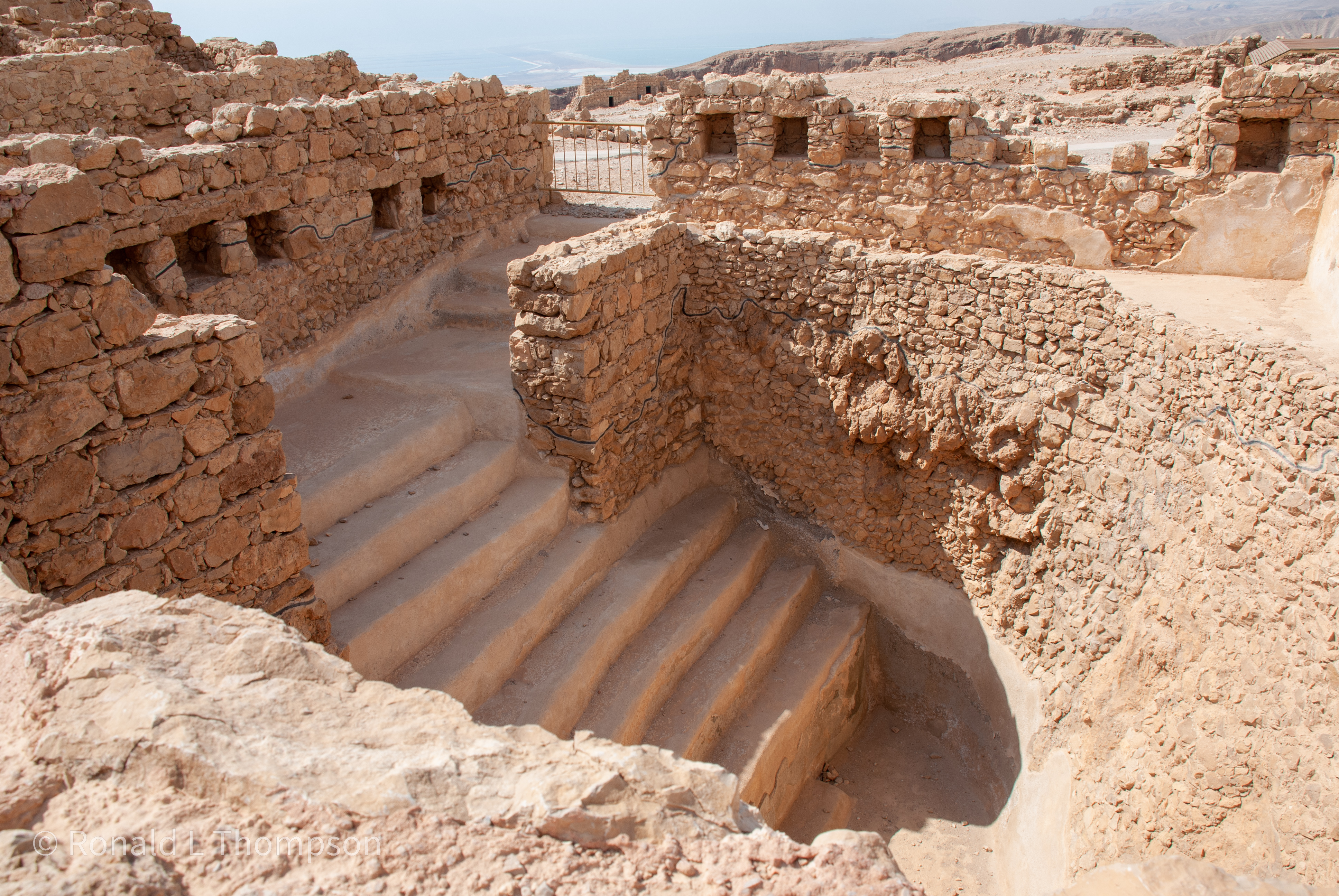
To the Jewish faithful, baptism was required for ritual purity after almost any infraction of Torah observance, in order to make one again acceptable for worship or fellowship. By totally immersing oneself in one of the many mikvoth in Judea or Galilee, he or she would be symbolically washing away the sin or defilement. But immersion had no effect for the unrepentant.

This was the spirit of John’s baptism:

Matthew 3:11a (CJB)
[11] It’s true that I am immersing you in water so that you might turn from sin to God;

We see later that Paul, under inspiration, added additional meaning to baptism by using it to picture Jesus’ death, burial and resurrection.

Almsgiving

Many would say that in Matthew 19:21, Jesus tells the “rich young ruler” that giving his riches to the poor is necessary for salvation, but what He’s really telling him is that if he wants to be perfect in obedience to Torah, then that is what he must do. If he were perfect, he never would have required salvation in the first place! But Jesus had anticipated the question, in verse 17, by stating that nobody but God is perfect.

Practical Soulwinning

Unfortunately, I have to admit that soulwinning is not, apparently, my strong suit. As an ex-Minister of Visitation and ex-Youth Pastor when I was a young man, I have a lot of experience going to the homes of visitors and known prospects and using the Romans Road method for evangelization. I led a number of people in the Sinner’s Prayer, and I assisted more experienced pastors do the same. A few that said the prayer came back to our church, but I can’t recall even a single one being baptized or sticking around for long, and our membership didn’t show any signs of growth over the years I was there.

As a church bus driver, though, I know that Theo, my then-girlfriend and now-wife, and I brought in a horde of kids whose parents had no interest in church. Some of those kids kept coming back on their own for years after we were long gone. That was a much more informal sort of evangelism, without pressure, and with a lot more sharing and ongoing personal interaction.

The Sinner’s Prayer concept was, I’m fairly certain, an innovation of Billy Graham. His “Crusades” brought in many thousands of “seekers” and curious folks who sat through great preaching, followed by an emotional invitation. Those who went forward were motivated in advance, and then “the deal was closed” using a Sinner’s Prayer. Whether or not it has Scriptural precedent, it was undoubtedly successful in those conditions. My entire family got their introduction to the Gospel from my mom’s visit to that Albuquerque Crusade back in the mid-20th century.


Christians and Alcohol

  1. Generalities
  2. Analogs
  3. The Matter at Hand
  4. Language Issues
  5. Conclusion

Okay, I haven’t planned this one, and I’ll try to keep it short. The question was asked this week in a Sunday morning senior adult Bible class: is drinking alcoholic beverages permitted for Christians? This was way off-topic. The teacher gave a fairly non-committal answer and pulled us back to the subject of the lesson. I fully agree with what little response was given, but I’ll go into a bit more depth here, from my own perspective.

Grape arbor over Bible Times house in Ein Kerem, near Jerusalem. Photo ©Ron Thompson 2008.

First, though, some generalities and some analogs …

Generalities

I think Paul summed up the general principle in two passages of his letter to Corinth:

1Cor. 6:9   Know ye not that the unrighteous shall not inherit the kingdom of God? Be not deceived: neither fornicators, nor idolaters, nor adulterers, nor effeminate, nor abusers of themselves with mankind, 10 Nor thieves, nor covetous, nor drunkards, nor revilers, nor extortioners, shall inherit the kingdom of God. 11 And such were some of you: but ye are washed, but ye are sanctified, but ye are justified in the name of the Lord Jesus, and by the Spirit of our God.

¶ All things are lawful unto me, but all things are not expedient: all things are lawful for me, but I will not be brought under the power of any.
—1 Corinthians 6:9–12 KJV

Because of our sin nature, we all sin, and sometimes we do even the things listed in verses 9 and 10. But as redeemed people, we can’t be characterized by those sins, because we have been washed, sanctified and justified. We don’t have a list of things we can or can’t do, yet the desire of our spirit must surely be to honor God in whatever we do or don’t do.

1Cor. 10:20 But I say, that the things which the Gentiles sacrifice, they sacrifice to devils, and not to God: and I would not that ye should have fellowship with devils. 21 Ye cannot drink the cup of the Lord, and the cup of devils: ye cannot be partakers of the Lord’s table, and of the table of devils. 22 Do we provoke the Lord to jealousy? are we stronger than he?

¶ All things are lawful for me, but all things are not expedient: all things are lawful for me, but all things edify not.
—1 Corinthians 10:20–23 KJV

The emphasis here is not on sin, but on worship. Greek ethnos, here translated as “Gentiles”, does not mean non-Jews specifically; rather, it refers to “pagans“, who by definition worship the fallen angels who rule much of the world as “gods” (see my recent post, Gods and Demons).

In both passages, Paul is saying that our salvation comes from Jesus, not from legalistic adherence to rules of conduct.

Analogs

Local churches or associations of local churches traditionally (and with Biblical license) set rules for the conduct of their membership. Some of these rules may be related to doctrine, but others may be more an emphasis on maintaining fellowship with folks you might otherwise get crossways to.

An example of the latter is found in Acts 15, where James, the Nasi (president, so to speak) of the Jerusalem congregation, ruled that only a minimal list of standards should be demanded of non-Jews for fellowship with Jewish brothers in Messiah:

[19] “Therefore, my opinion is that we should not put obstacles in the way of the Goyim [non-Jews] who are turning to God. [20] Instead, we should write them a letter telling them to abstain from things polluted by idols, from fornication, from what is strangled and from blood.
—Acts 15:19–20 (CJB)

Note that Jews in the Jerusalem church and elsewhere were still Jews and required to be “Torah Observant.”

Some modern churches are very legalistic, others not so much. The churches I grew up in were, and prohibited, for example,

  • Consumption of alcohol;
  • Shorts;
  • Pants of any kind on females;
  • Skirts above the shin for females;
  • Hair over the top of the ears for males;
  • Handholding (or worse, kissing!) for unmarried couples;
  • Mixed bathing;
  • “Picture shows”;
  • In one church, makeup on ladies.

Scripture doesn’t specifically prohibit any of those things, though many would have been unthinkable in the culture of the day.

There are some things that most Christians today, and many non-Christians, would consider bad that are not condemned in the Bible. The list below shows things that we might like to see addressed more forcefully, but alas, because of “the hardness of men’s hearts“, God saw fit to merely limit, regulate and discourage them—not to prohibit them in all circumstances.

  • Slavery;
  • Slaughter, including genocide;
  • Polygamy;
  • Divorce;
  • Incestuous marriage;
  • (Should I add alcohol consumption here? See below).
The Matter at Hand

In the case of alcohol consumption, there is no direct prohibition, but there are certainly warnings. I’ll mostly limit this discussion to wine, because most relevant references in scripture are to wine in particular. The problem is that the English “wine“, and for that matter the Latin “vinum“, both translate several different words found in the original manuscripts. Some references speak positively of wine, some negatively, and some are neutral. We must here consider what exactly constitutes “wine”, and what is conveyed by the respective terms in the Hebrew and Greek originals.

Merriam Webster’s 11th Collegiate Dictionary defines the English “wine” as,

1 a : the alcoholic fermented juice of fresh grapes used as a beverage b : wine or a substitute used in Christian communion services
2 : the alcoholic usually fermented juice of a plant product (as a fruit) used as a beverage <blackberry wine>
3 : something that invigorates or intoxicates
4 : a dark red

Samuel Bacchiocchi’s book, Wine and the Bible: A Biblical Study on the Use of Alcoholic Beverages, surveyed English dictionaries going back around two centuries, and other secular works going back to Aristotle. He found numerous instances throughout with wording clearly implying that wine has always been a general term referring to both “must” (Lat. vinum mustum, freshly pressed grapes) and fully fermented wine, and all steps in between.

A 1st Century winepress near (but not part of) the Garden Tomb complex in Jerusalem. From MadainProject.
Language Issues

Bacchiocchi presents a case that the original languages of the Biblical manuscripts require that we regard all favorable mentions of wine as referring to unfermented must. Dr. Jim Anderson, past president of Kansas City’s Calvary Bible College, in his book, The Life of Christ, doesn’t present the case as forcefully, but his approach to the language issues is more straightforward.

I have the resources, but neither the time nor the will, to examine all 215 occurrences of “wine” in the English Standard Version. As a lifelong teetotaler, I have no axe to grind, so I’ll go with easy here and mostly paraphrase Dr. Anderson.

  • Heb. yayin — Most common OT term for wine. Per Anderson, the word only refers to the fermented product, and all references to it as a beverage (as opposed to medical usage) are negative. This can certainly be said of its use by Noah in Gen. 9, and by Lot in Gen. 19 before his seduction by his daughters. The Strong’s and Brown-Driver-Briggs (BDB) dictionaries also equate yayin with intoxicating wine; however, Vine’s Expository Dictionary, which I like a lot, says the yayin refers to juice in any stage of fermentation. Given that Melchizedek is a clear type of Messiah, his presentation of yayin to Abram is hard for me to see as negative in Gen. 14. The alcoholic content in this case is indeterminate from context.
  • Heb. tirosh — Apparently always refers to “new wine”, i.e., must, with little or no fermentation. In Gen. 27, Isaac was drinking yayin, which may have contributed to the sheepskin deception. In return, Isaac’s blessing of Jacob included a prayer for grain and tirosh.
  • Heb. shekar — This always refers to “strong drink“, fermented from grains. This type of beverage is never viewed as positive. It isn’t wine, of course, but I include it here as a related subject. Both yayin and shekar are prohibited to priests serving in the Tabernacle. However, in Num. 28, shekar is specified for drink offerings, which are “poured out”, not drunk.
  • Heb. chomets — Must, when it has fermented, becomes wine, in the familiar sense. Eventually, further fermentation turns yayin into vinegar, also known as “sour wine“, or chomets, which I’m told is bitter, but no longer intoxicating. Chomets was used as a condiment. In Rut. 2:14, Boaz invited Ruth to sit and dip bread into a bowl of vinegar (chomets) for seasoning.
  • Gr. oinos — Every source that I’ve looked at seems to agree that oinos refers to wine in any stage of fermentation. Only the context can show if the term is used positively or negatively. Not always easy! When Jesus was offered oinos mixed with myrrh at His crucifixion, He turned it down after tasting it (Mk. 15:23). Was that because of fermentation, or because of the myrrh (“gall” in Matthew), which when ingested is a bitter narcotic? In 1Tim. 3:8, “not addicted to much [oinos]” would seem to be speaking of an intoxicant. I’m not sure you can stretch that to be speaking of simple gluttony for grape juice, but again, to make this a negative, you have to assume what you are trying to prove. In 1Tim. 5:23, “a little wine for the sake of your stomach” is clearly speaking of medicinal use, which few would fault.
  • Gr. ochos — Low grade, sour wine, or vinegar. In Mk. 15:36, Just before His death, Jesus was offered ochos. In the earlier Cana miracle, only the word oinos is used. One would suppose that three levels of fermentation are in view here. The “master of the feast” said that usually “good wine” was served first and poor later. I would assume that “good” meant fresher, so the poor may have been approaching the over-fermenting of vinegar. Jesus’ wine would then be still fresher wine, perhaps not yet fermented at all. Where do we draw the line between good, bad and ugly here? We have only relative taste to go by.
Conclusion

The bottom line here is that I can’t take a final position on the question of whether or not Christians should feel free to drink, in moderation.

I was taught from childhood that “Christians don’t drink”, and I never have. Aside from flavoring agents in steak sauce and French fry batter, I’ve never tasted wine or beer, or anything else intoxicating, and I have absolutely no desire to do so. I would rather that Christians abstained entirely, because I can see absolutely no benefit to it. But having known many obviously good Christians who do occasionally partake, I simply can’t condemn in others what I’m not able to show conclusively that God has condemned.

That said, knowing the dangers and the destruction caused by substance abuse, I must personally believe that, as to my own life and family, consumption of recreational intoxicants and drugs is another of those things that God has declined to prohibit because of the hardness of men’s hearts.


Light Yes, But Why Salt?

Posted on:

Modified on:

  1. The context of the message
  2. Salt and Light to whom?
  3. Light for the world
  4. Salt for the Land
  5. Application to the Church

13 “You are salt for the Land. But if salt becomes tasteless, how can it be made salty again? It is no longer good for anything except being thrown out for people to trample on.
14 ¶ “You are light for the world. A town built on a hill cannot be hidden.
15 Likewise, when people light a lamp, they don’t cover it with a bowl, but put it on a lampstand, so that it shines for everyone in the house.
16 In the same way, let your light shine before people, so that they may see the good things you do and praise your Father in heaven.
—Matthew 5:13–16 CJB

Christian theology often tends to forget that the Church did not yet exist when Jesus spoke these words. In fact, it did not exist until believing Jews and non-Jews had both been given the indwelling Holy Spirit, and that did not happen until after Jesus’ Ascension. His earthly ministry throughout His First Advent was specifically to Jews, not to the unborn Church, and not to non-Jews in general. In Matthew 10:5b–6 (ESV), He told his 12 apostles-in-training, “Go nowhere among the Gentiles and enter no town of the Samaritans but go rather to the lost sheep of the house of Israel.” In Matthew 15:24 (ESV), when he was asked by a Canaanite woman to rid her daughter of a demon, He responded by telling her that He “was sent only to the lost sheep of the house of Israel.”

That is certainly not to say that He rejected overtures of faith by non-Jews. He ultimately granted the request of the Canaanite woman, and in Matthew 8:10b (ESV), He granted the petition of a Roman centurion and told His followers, “With no one [else] in Israel have I found such faith.”

But the fact remains that Jesus’ ministry, and in fact the whole of the four written Gospels, were directed to Israel. When we fail to recognize that fact, we open ourselves to the heresy of misappropriating Scripture. In this post, I am addressing one example of such error in discussing the concepts (plural) of “salt and light“, which Christians almost always discuss as if it were a “Church thing”, and just one thing. I do believe there is an important Church application, and I’ll address that near the end.

Please read this post as an academic exercise for improving our understanding of Scripture, not as criticism of any well-meaning individual or organization.

The context of the message

Matthew 5–7 is commonly called the Sermon on the Mount. “Sermon” may be too strong a term, because in reality, this was an “apostolic training session” delivered to His core of 12 disciples while sitting on a hillside near Lake Kinneret (the Sea of Gallilee).

1 Seeing the crowds, Yeshua walked up the hill. After he sat down, his talmidim [disciples] came to him,
2 and he began to speak. This is what he taught them:
—Matthew 5:1–2 CJB

The fact that Jesus was sitting, which limits voice projection, and that only the talmidim are mentioned as following Him up the hill, raises the question: was it an oration to all the people milling around, or just those gathered around closest to Him?

View from the possible location of the Mt of Beatitudes. The hillside is now the home of an ornate monastery, with immaculate gardens overlooking Lake Kinneret (the Sea of Galilee). Photo ©Ron Thompson

The term ὄχλουςα (ochlousa) is translated crowds, above, or multitudes in the KJV. This is an odd plural, sort of like “infinities“. Two infinities are still just infinity. Two crowds are still a crowd. I suppose it could be like “the crowd on His left and the crowd on His right”, but the term is always used for the group of people following Him, so that is unlikely. Roy Blizzard and David Bivin, in their book Understanding the Difficult Words of Jesus, suggest that ὄχλουςα is a technical term referring to “the inhabitants of the surrounding area”, which might be an actual “multitude”, or might be just a few people.

Drones like the religious leaders that the Sanhedrin sent to follow Him from place to place would be a separate group mingled in and on the fringes of any gathered locals who followed Him up the hill. Thir function was much like the Soviet trawler back in my Navy days that always trailed along behind my ship, an aircraft carrier, in the Mediterranean. When they had opportunity, they steamed in among the destroyers and frigates of our task force, spying and occasionally harassing. And once, when we lost an airman overboard, they pitched in and helped search for his body.

There were usually at least some underemployed “seekers” in the mix, as well, following Jesus from place to place hoping for some sort of healing or salvation. Many probably finding what they sought, on the plain below.

The folks gathered more closely around Jesus and probably sitting near Him on the hill were His talmidim, or disciples, and verse 13, about salt would have applied more to them than to the larger group (see below). Whichever it is, Matthew 5:11–16 was clearly applicable only to Godly Jews when it was spoken.

Salt and Light to whom?

Before addressing the meanings of “salt” and “light” in Matthew 5, I think it important also to answer the question, who were to be the recipients of the salt and the light? I used the Complete Jewish Bible to quote Jesus’ words in the opening text, because I think it correctly differentiates the two Greek words that the English Standard Version renders as “world”.

St. Augustine Lighthouse, ©Ron Thompson

In verse 14, “world” is a translation of the Greek κόσμος (Kosmos). In the modern world, the term “cosmos” refers to the universe as a whole, but in ancient times, the heavens above were thought to be merely a dome, or a sheet draped above the earth we inhabit. So, in effect, κόσμος referred to the world as a whole, consisting of all nations. Israel was, indeed, understood to be commissioned as God’s evangelist nation to the rest of humanity.

In verse 13, a different word, γῆ, or Ge, is used. In general, γῆ can, in fact, be translated as “world”, but I think that when connecting the word to Israel, it is almost always proper to default the translation to “land“, meaning specifically, Eretz Yisrael, the Land of Israel. Jesus’ listeners here were being told to be “salt for the Land”, i.e., a preservative for the people, or Covenants, of Israel. Not for the greater earth. Similarly, in verse 5, we are told that the meek will “inherit the land”. This is certainly true. It is a direct quotation from Psalm 37:11, which taken in context is clearly referring to Israel’s eventual peaceful habitation in the Land of Israel.

Light for the world

I will discuss the question of light before salt, because Christian usage of this term is more straightforward than that of salt.

As is expressed many times in the Tanakh, or “Old Testament”, particularly in the poetic Psalms and Prophets, the concept of “light“, where physical light is obviously not meant, primarily pertains to knowledge of truth. To shine a light, in this respect, is to bring the knowledge of salvation. It is clearly this idea that Jesus had in mind in the Matthew 5 text. This, I think (and most would agree), is borne out by his quotation of Isaiah 8:23–9:1 in the preceding chapter, Matthew 4:

12 ¶ Now when he heard that John had been arrested, he withdrew into Galilee.
13 And leaving Nazareth he went and lived in Capernaum by the sea, in the territory of Zebulun and Naphtali,
14 so that what was spoken by the prophet Isaiah might be fulfilled:
15 ¶ “The land of Zebulun and the land of Naphtali,
the way of the sea, beyond the Jordan, Galilee of the Gentiles—
16 the people dwelling in darkness
have seen a great light,
and for those dwelling in the region and shadow of death,
on them a light has dawned.”
—Matthew 4:12–16 ESV, emphasis added

However, there are a number of other symbolic usages of the term in the Tanakh, and I think that in some sense, all of these can be read into Jesus’ words. I will list some of these, with examples from the ESV:

To lead people forward—as God’s sh’kinah leading the Israelites through the darkness of the Wilderness:

Neh. 9:19 You in your great mercies did not forsake them in the wilderness. The pillar of cloud to lead them in the way did not depart from them by day, nor the pillar of fire by night to light for them the way by which they should go.

To lift the hearts of people—as God’s protection of the people menaced by Haman:

Esth. 8:15–17 Then Mordecai went out from the presence of the king in royal robes of blue and white, with a great golden crown and a robe of fine linen and purple, and the city of Susa shouted and rejoiced. 16 The Jews had light and gladness and joy and honor. 17 And in every province and in every city, wherever the king’s command and his edict reached, there was gladness and joy among the Jews, a feast and a holiday.

To expose sin—as God’s exposure of evil nations and rulers:

Job 12:21–25 He pours contempt on princes
and loosens the belt of the strong.
22 He uncovers the deeps out of darkness
and brings deep darkness to light.
23 He makes nations great, and he destroys them;
he enlarges nations, and leads them away.
24 He takes away understanding from the chiefs of the people of the earth
and makes them wander in a trackless waste.
25 They grope in the dark without light,
and he makes them stagger like a drunken man.

To bring health and life from illness and death—as suggested by Elihu’s reproof of Job:

Job 33:28–29 He has redeemed my soul from going down into the pit,
and my life shall look upon the light.’
29 “Behold, God does all these things,
twice, three times, with a man,
30 to bring back his soul from the pit,
that he may be lighted with the light of life.

To bring confidence—as expressed by David after his deliverance from Saul:

Psa. 27:1 The LORD is my light and my salvation;
whom shall I fear?

Salt for the Land
Sea Salt. Photo from myactivenutrition.com

While the Jewish concept of spreading “light to the world” represents God’s entire reason for Israel’s election as His chosen people—the total evangelization of all peoples on earth—

the “salt” concept has nothing to do with evangelization and is much more limited in scope.

From the example references to “salt”, below; from the record of history; and from a correct translation of γῆ (see above), it is clear to me that by exhorting His listeners to be “salt“, He was commanding them to function as His Covenant people, and by their words and actions, to be a preservative for the Godly remnant in Israel. Only such a Godly remnant could possibly function as light-bearers, or evangelists to the world at large.

In the Ancient Near East (ANE) before written records were as ubiquitous as they later became, contracts and treaties were often “sealed” by ceremony. Salt, because of its preservative qualities and its flavor, was often part of such ceremonies. That practice was so prevalent that it was incorporated into Biblical covenants and covenant-related practice without explanation. The first mention in scripture is the instruction for preparation of incense to be burned in the Tabernacle:

34 The LORD said to Moses, “Take sweet spices, stacte, and onycha, and galbanum, sweet spices with pure frankincense (of each shall there be an equal part),
35 and make an incense blended as by the perfumer, seasoned with salt, pure and holy.
—Exodus 30:34–35 ESV

Grain offerings were also to be seasoned with salt:

You shall season all your grain offerings with salt. You shall not let the salt of the covenant with your God be missing from your grain offering; with all your offerings you shall offer salt.
—Leviticus 2:13 ESV

Contributions to the priesthood from consecrated meat offerings were to be salted:

All the holy contributions that the people of Israel present to the LORD I give to you, and to your sons and daughters with you, as a perpetual due. It is a covenant of salt forever before the LORD for you and for your offspring with you.”
—Numbers 18:19 ESV

The public water supply of the city of Jericho was miraculously purified through application of salt by the prophet Elisha:

19 Now the men of the city said to Elisha, “Behold, the situation of this city is pleasant, as my lord sees, but the water is bad, and the land is unfruitful.”
20 He said, “Bring me a new bowl, and put salt in it.” So they brought it to him.
21 Then he went to the spring of water and threw salt in it and said, “Thus says the LORD, I have healed this water; from now on neither death nor miscarriage shall come from it.”
22 So the water has been healed to this day, according to the word that Elisha spoke.
—2 Kings 2:19–22 ESV

When confronting Jeroboam’s army, Judah’s King Abijah invoked the eternality of the Davidic Covenant by pointing out that it was regarded as a covenant of salt:

Ought you not to know that the LORD God of Israel gave the kingship over Israel forever to David and his sons by a covenant of salt?
—2 Chronicles 13:5 ESV

Application to the Church

The Church consists of two groups which, together, Scripture refers to as “the Commonwealth of Israel” (Eph 2:12–13): (a) a Godly remnant of physical Israel; and (b) Godly non-Jews grafted into the first group. A full discussion of this doctrine (see Romans 9–11, for example) is beyond my scope here, but both of these peoples, in unity, clearly bear the responsibility to bring light to the world. It is less clear but probably equally valid to assert that both peoples share a responsibility to bring a preservatory ministry to each other and to the converts attracted to the light.

I am not pronouncing anything earthshaking in this post. I am pointing out a technical inconsistency in Christian teaching, but not suggesting that we are grossly misdirecting our efforts. I simply think that it is better to correctly understand the Jewish foundations of the Church.


Summary of Judgement Seat and Crowns in Heaven

Posted on:

Modified on:

  1. The Judgement Seat of Christ
  2. Purpose of the Judgement Seat
  3. Timing of the Judgement Seat
  4. The Bimah Seat
  5. Crowns

“Behold, I am coming soon, bringing my recompense with me, to repay each one for what he has done.
—Revelation 22:12 ESV

This past Sunday, late in Bible class, someone raised the subject of “The Judgement Seat of Christ“, “crowns“, the “Bema” and so on. There was no time for me to put in my own two cents, but it is a subject that touches me personally. I was raised in a very legalistic fundamentalist church, and the whole question troubled me at the time more deeply than any other doctrinal issue. If “Jesus paid it all“, “not of works, lest any should boast“, and heaven is the carefree paradise we’ve been led to believe, then how is it that the first thing that happens after the Rapture is that we face judgement, possible humiliation in front of our peers, and maybe worse still, potential forfeiture of a fancy, jeweled crown to wear in our new mansion over the hilltop? And what’s the point of working hard for a crown if we have to give it right back, by “casting it at Jesus’ feet“?

This is a diversion from what I’ve been working on, a discourse on God’s omnipresence in space and time, and what that implies about creation, so I’m not going to do an exhaustive study of this subject. I’d be reinventing the wheel anyhow, because the late J. Hampton Keathley III, Th.M., did an excellent job of nailing it down in an article, The Doctrine of Rewards: The Judgment Seat (Bema) of Christ. Below is a short summary of aspects that I have pondered over the last few days:

The Judgement Seat of Christ

The term “judgements” is used many times in Scripture, mostly regarding punishment. I am limiting this discussion to the major formal judicial reviews of the End Times recognized by many conservative theologians. There are variations in terminology, and some count three or five but for this purpose, I’m going with the diagram below, which lists four. In general, I think that the source book shown in the caption is pretty good, though I question LaHaye’s own previous judgement, in view of the terrible theology in his Left Behind series.

One view of the end-time major judgements, from Charting the End Times, by Tim LaHaye and Thomas Ice, ®2001.

The “Judgement Seat of Christ” is the most common name used by Christian theologians for the evaluation of Christians that occurs after the Rapture. The diagram shows the Rapture occurring simultaneously with the beginning of the seven-year Tribulation period. I strongly believe in a “Pre-Trib” Rapture, but I don’t think that Scripture requires the Tribulation to happen immediately after the Rapture. I personally think that there will be a time of major geopolitical developments on earth between the removal of the Holy Spirit and all Christian influence, on the one hand, and the beginning of Tribulation on the other. The war of Ezekiel 38 and 39 may be one of them (see The Coming World War: Gog and Magog).

Purpose of the Judgement Seat

This is emphatically not a judgement for sin, because Jesus’ crucifixion paid that cost, but rather an evaluation of the quality of our service. I think for a twofold purpose: (1) for recognition and kudos; and (2) for handing out of assignments. As discussed in Keathley’s article, the Scriptures imply that the Raptured Church will function administratively during the Millennial Kingdom. I don’t know that I can definitively back this up from Scripture, but my personal impression is that our individual responsibilities in the Kingdom will be based on our aptitudes and attitudes shown during our mortal lives. Although without sin, our glorified selves will still be recognizable, both physically and by non-physical personal traits.

Timing of the Judgement Seat

Many scholars (e.g., Keathley) show it at the beginning of Tribulation, others (e.g., LaHaye and Ice) show it as taking place during the entire seven-year span. I would say the beginning, and not the entire span. Why? First, because of its connection with Rosh Ha-Shanna, coming up in late October this year (see below), and also because I think that the Marriage Supper of the Lamb will be the focus in heaven during the period. Christian scholars tend to ignore Jewish cultural analogs when interpreting Jewish Scripture. Even though all Scripture is Jewish! Jesus (Yeshua ben Yosef) and most of the Gospel protagonists were thoroughly Jewish, and all but one of the canonical writers was Jewish. The exception being Luke, who I think was a Jewish convert. Jewish wedding customs in the 1st Century clearly pictured Jesus’ relationship with the Church, His bride (see Jesus and Hebrew Wedding Imagery). The Jewish wedding supper was a seven-day feast, so I think there is ample reason to think that the heavenly marriage supper might span seven prophetic days.

How could all of that “evaluation”, of all the Church saints from two Millenia of Church history, be accomplished virtually instantaneously? That is something I’m already working on for my next post: In God’s “native” realm, there is no such thing as “time”, or even “space”. He is independent of both and unbound by both. He exists simultaneously everywhere and everywhen. In 2 Peter 3:8, the apostle is paraphrasing Psalm 90:4 when he says that, to God, a day is as a thousand years. That is poetic language, not literal. The truth is, he could have said a million, or a billion, or trillions and trillions. Or conversely, a femtosecond (10-15 seconds), for example, is no more obscure to Him as a day.

The Bimah—Jewish, too, not just a Greek concept!

Here is where I depart from Keathley and other Christian scholars.

The Greek term béma (βεμα, pronounced BAY-muh) is defined by Strong’s as “a platform to which someone [ascended] to receive judgment; (figuratively) the administration of justice – literally, given from “a tribunal-chair” (throne) where rewards and punishments are meted out.”

The Hebrew term bimah (מִמַּה, pronounced BEE-muh) is no doubt related, and has a similar meaning in general, but, for our purposes here, there is a much more specific meaning, attested as early as Neamiah’s time, in the Persian era. According to Encyclopaedia Judaica, the word means an “elevated place“, more specifically a “platform in the synagogue on which stands the desk from which the Torah is read. Occasionally the rabbi delivers his sermon from the bimah, and on Rosh Ha-Shanah the shofar [ram’s horn] is blown there.” The reading desk is also often referred to as a bimah. Significantly, I believe that the Rapture will occur on a Rosh Ha-Shanah (also known as Yom Teruah, The Day of Trumpets; see The Jewish Feasts: Part 11, Trumpets)!

Reading at the bimah, Bialystoker Synagogue, New York, N.Y., U.S.
©Juda S. Engelmayer
Parenthetic notes on the photos...

Above: The photo above shows three men standing at the bimah table in a small synagogue in Lower East-Side Manhattan. The synagogue is never called a "temple" by orthodox Jews, but it nevertheless serves many of the Temple's functions in the post-Temple world. The bimah stands near the center of the room, just as the altar stood in the center of the Court of Priests. The man seen in this photo in his woolen tallit (prayer shawl) is standing at the table with his face to the aron HaKodesh (the Holy Ark, a cabinet in which one or more Torah scrolls is stored. In this synagogue, the Ark is behind the red tapestry. Most likely the reader is not the rabbi, but rather a congregant who has been invited to "make aliya", or "go up" onto the bimah to read assigned passages from the Torah. Typically, when the Torah is taken out to be read before the community, one person reads the Torah, and that person is surrounded on either side with two gabbaim (as here) who ensure that the Torah is being read and treated respectfully and accurately.

Below: The photo below shows another feature of early synagogues, associated with the bimah, that I think is germane to this discussion—the "Seat of Moses". 
The restored “Moses Seat” in the synagogue of Korazin, in Galilee.

The Bimah Seat

Also associated with the bimah platform was “the seat of Moses”. This seat was used by a scribe or other authoritative interpreter of scripture. Today it would be the rabbi. In Matthew 23, Jesus validated the authority of the interpretations made from the seat of Moses, even though, in the same breath, He said, effectively, “Do as they say, not as they do.”

Then Jesus said to the crowds and to his disciples,
“The scribes and the Pharisees sit on Moses’ seat,
so do and observe whatever they tell you, but not the works they do. For they preach, but do not practice.
—Matthew 23:1–3 ESV

I think that, to understand the concept of the Judgement Seat of Messiah, you have to consider the Jewish concept and not just the Greek. We will be evaluated in the heavenly realm, not for sin, but for our performance in light of God’s expectations for His people as expressed in Scripture. Jesus will be the one, sitting on a heavenly bimah seat of Moses, who will be evaluating us and handing out crowns.

Crowns

Sad to say, even as a young adult, my vision of kingdoms and crowns was informed mostly by Walt Disney. So, I pictured literal golden streets and pearly gates in heaven, my home a palace, and on my head a jewel-encrusted crown. I think now that the glitz and bling is meant to convey a sense of beauty and purity, not to arouse materialistic jealousy and greed. The crowns may not be literal headwear but are certainly meant to convey the Greek and oriental picture of the victor’s laurel wreath.

In every case, the Greek word for these “crowns” is stephanos, for which the proper translation is “wreath”, i.e., a chaplet worn as a badge of royalty, honor or victory. The royal crown is always a diadem. Jesus’ crown of thorns was a stephanos, so it was most likely an ironic insult from the Roman soldiers, not something ordered up by Pilate as a complement to his sign of indictment nailed on the cross.

Depiction of Jesus’ crown of thorns, photographed in the back garden of the Bible Times Center, Ein Kerem, Israel. ©Ron Thompson, 2008.

A common Christian tradition says that at some point after receiving crowns at the bimah, we will cast them back at Jesus’ feet in adoration. This appears to be a corruption of Revelation 4:10–11, where 24 elders sitting in a circle of thrones stand and cast their own stephanos in front of the central throne, occupied, apparently, by Yahveh, the Father, not the Son:

10 the 24 elders fall down before the One sitting on the throne, who lives forever and ever, and worship him. They throw their crowns in front of the throne and say,

11 “You are worthy, ADONAI Eloheinu, to have glory, honor and power, because you created all things — yes, because of your will they were created and came into being!”
—Revelation 4:10–11 CJB


Roads to Salvation?

What is the best way to lead people to salvation in this modern age? I don’t want to offend folks in the churches I attended for years, but my opinion has changed as I’ve aged. I have come to agree with those who say that a scripted approach, using a recipe of verses pulled out of context and a magic, “follow after me” prayer, is not the most effective solution.

When I was in college, some of my Christian friends were handing out “Four Spiritual Laws” tracts and using those as talking points during personal evangelism.

Before that, as a teen, and for many years thereafter, I was taught to “witness” using the “Romans Road to Salvation“.

There is nothing wrong with these tracts or using them for talking points. They are certainly well-intentioned, and they present legitimate Scripture. But I’m an old guy now, and looking back on my life, I don’t know for sure if I ever won a single convert with these methods. I heard professions of faith, certainly, but my efforts to disciple these people were always rebuffed. I don’t think I can name or even picture a single one who demonstrated Biblical salvation afterwards.

What did show positive results was driving busloads of kids to church every week and simply chatting with them about Jesus. That makes sense in light of my own experience as a child. I was taught all the “Bible stories” by Godly parents and teachers, and I have never doubted them. By the time I was eight I belonged to God.

Even as a youth, though, I often wondered why God, in His infinite wisdom, would hide the recipe for salvation by scattering it around Romans like that. Why not just come out and say it? Well, He did, actually! For example, from the “faith” chapter:

“And without faith it is impossible to please him, for whoever would draw near to God must believe that he exists and that he rewards those who seek him.”
(Hebrews 11:6 ESV)

I didn’t need a cookbook to find Jesus. God drew me to Himself and put me in an environment where I would learn about right and wrong, repentance, and Jesus.

The Jordan River in Galilee. ©Ron Thompson

A Theology of Baptism


Baptists, unlike many other denominations, believe in baptism by immersion rather than by “sprinkling” or “pouring.” Three reasons that I know of are commonly cited:

  • The Greek word baptizo literally means to “immerse” or “submerge.”
  • The symbology of baptism as generally recognized is burial and resurrection, which is not adequately pictured by sprinkling or pouring.
  • The oldest known paintings of baptisms seem to depict immersions.

For me, personally, I must go by what I know from many years of studying the rich Jewish background of Christianity. If Scripture isn’t explicit about how to do something it commands us to do, then that is usually because when the Scripture was written, there was no ambiguity. The church started out 100% Jewish, and in fact “The Way”, as we were often called in the 1st Century, was regarded within and without as a Jewish sect. Another common name was “The Sect of the Nazarene”. Ritual purification by total immersion in “living waters” (a natural stream or one of thousands of constructed Jewish mikvot, or baptisteries), was required as a personal response to sin, and to prepare for almost any ritual event. I believe that Christian baptism following salvation and prior to admission to membership in a local assembly mirrors the Jewish practice of requiring a person to be ritually submerged prior to recognition of his or her conversion to Judaism.

Several years ago, one of my granddaughters was dating a boy who was a member of a Reformed congregation. She wanted to attend catechism classes with him. I agreed, with the stipulation that I would read a copy of the text for myself and review it with her. On at least two occasions I had lunch with the pastor of that church. He was teaching the classes, and we had some very friendly, but of course inconclusive, conversations about the doctrine he was teaching.

The text was Louis Berkhof, Manual of Christian Doctrine. Here are my responses to specific statements made in the chapter on Christian Baptism:

  1. Berkhof said, “We maintain that the mode is quite immaterial, as long as the fundamental idea of purification finds expression in the rite…It is perfectly evident from several passages that baptism symbolizes spiritual cleansing or purification” as opposed to death, burial and resurrection. We’ll start this list with a point of agreement. Berkhof lists a number of Scriptural references, but I will stick with just one of those here:

    1Pet 3:20-21. (CJB) [20] to those who were disobedient long ago, in the days of Noach, when God waited patiently during the building of the ark, in which a few people—to be specific, eight—were delivered by means of water. [21] This also prefigures what delivers us now, the water of immersion, which is not the removal of dirt from the body, but one’s pledge to keep a good conscience toward God, through the resurrection of Yeshua the Messiah.

    The concept that Christian baptism represents Jesus’ death, burial and resurrection came into use early, and was supported by Paul, himself, in Col 2:12, but that was not the original intent of the rite.
  2. “Jesus did not prescribe a certain mode of baptism, and the Bible never stresses any particular mode.” That is true precisely because it was not a new concept that needed to be explained. Christian baptism is patterned on the Jewish rites for ritual purification of new converts. The original writers of the Bible and their audiences, both in Israel and the Diaspora, were all intimately familiar with the Jewish purification rites, and there could have been no ambiguity on the forms required.
  3. “The word employed by [Greek translations of Jesus’ words] does not necessarily mean ‘to immerse,’ but may also mean ‘to purify by washing’.” To purify by washing is one application of the term. So is the process of dying a cloth. But both practically and linguistically, the method of doing either was by dipping something completely. Strong defines the root, bapto, as a verb meaning “to overwhelm, i.e., cover wholly with a fluid”, “to moisten” or “to dip”, and baptizo as “to make overwhelmed, or fully wet.” Thayer adds, “submerge” and “immerge” (immerse) and Vine illustrates all of these meanings. Linguistically, it is possible to derive a translation that includes something less than total submergence, but to do so in this instance ignores the cultural context under which the word was written and how it would have been understood by the two imminent Jewish theologians, Jesus and Paul.
  4. “From earliest times it was customary to baptize by sprinkling and pouring as well as by immersion. Purification was frequently, if not generally, effected by sprinkling during Old Testament times” (emphasis added). This is a true statement about ritual cleansing, but inapplicable to the subject of Christian baptism or the Jewish customs at its root. Berkhof is referring here to the purification of objects, and rituals like the washing of hands. There were many different types of purification rite specified in the Old Testament. Each type of purification had its own specified mode. Berkhof gives numerous scriptural examples, but in each case, the mode demonstrated was as commanded by God for the specific situation. Purification for the purpose of human conversion and for many types of personal defilement required complete submersion, down to the last hair on the head. In particular, purification by complete submersion was required for conversion to Judaism, so I’m very sure that for “conversion” to Christianity, that is what they, too, did.
  5. “The baptism with the Spirit certainly did not take place by immersion…” That’s a weak argument for the question of water baptism, and I don’t even think it’s true for spiritual! I’m very sure that Holy Spirit baptism requires metaphorically complete immersion in the Holy Spirit. If sprinkling with “tongues of fire” on the head (“sprinkling of the Holy Spirit”?) is what Berkhof had in mind, then where is my tongue of fire? I think I really have been “immersed” in the Spirit!
  6. “…nor did other baptisms mentioned in Scripture.” He gave three examples here that I think are instructive:

    (a) Lk 11:37-38, (CJB) [37] As Yeshua spoke, a Parush [Pharisee] asked him to eat dinner with him; so he went in and took his place at the table; [38] and the Parush was surprised that he didn’t begin by doing n’tilat yadayim [ritual handwashing] before the meal.

    (b) Lk 12:49-51, (CJB) [49] “I have come to set fire to the earth! And how I wish it were already kindled! [50] I have an immersion to undergo—how pressured I feel till it’s over! [51] Do you think that I have come to bring peace in the Land? Not peace, I tell you, but division! Jesus is speaking here of His coming ordeal, His crucifixion and the ultimate division that that will cause in the final judgement. His “baptism of fire”, so to speak.

    And (c) 1Cor 10:1-2 (CJB) [1] For, brothers, I don’t want you to miss the significance of what happened to our fathers. All of them were guided by the pillar of cloud, and they all passed through the sea, [2] and in connection with the cloud and with the sea they all immersed themselves into Moshe [Moses]. Jesus is speaking metaphorically about the Reed Sea crossing by the Israelites. Of course, they, unlike the Egyptians behind them, were not literally immersed.
  7. “Neither does it seem that this mode was followed in the cases mentioned in Acts.” Berkhof here provides several references: Saul’s immersion after his road to Damascus encounter; the Gentile conversions at the house of Cornelius; and the Philippian jailer and his family. Nowhere do these verses mention the mode followed. They just say, in effect, “they were baptized.” I think that Berkhof is here assuming that there simply was no place handy for a complete immersion. He’s wrong. Every synagogue in every town with 10 or more male Jews had its own mikvah. Where there was no mikvah, there was a river or stream that could be used as it was or dredged or dammed to form a deep enough pool.


    A Jewish mikvah at Qumran, ©2008, Ron Thompson
  8. “Spiritual renewal is sometimes said to have been effected by sprinkling.” Where sprinkling is mentioned in the Old Testament, it is usually blood or oil, sprinkled in specific places for specific reasons. Water is sprinkled, literally, in only two contexts, where the vast amounts of water that would be required for full immersion were impractical: (a) The initial consecration of the Levites—all of them—at the “commissioning” of the tabernacle. And (b) at red heifer ceremonies, when many objects and people were to be cleansed more or less simultaneously. The one Old Testament example given by Berkhof was

    Ez 36:24-26 (CJB)
    [24] For I will take you from among the nations,
    gather you from all the countries,
    and return you to your own soil.
    [25] Then I will sprinkle clean water on you,
    and you will be clean;
    I will cleanse you from all your uncleanness
    and from all your idols.
    [26] I will give you a new heart
    and put a new spirit inside you;
    I will take the stony heart out of your flesh
    and give you a heart of flesh.


    This was, of course, poetic language referring to the New Covenant and to the Olam HaBa (the end-time world to come), and not at all meant to be taken literally. God was speaking, through Ezekiel, about what He will do, not to an individual, but to the entire Nation of Israel. If it was meant to be taken literally, God is also promising to rip out their old hearts and spirits and replace them with new!

    Berkhof also inserts a New Testament example here:

    Heb 10:22 (CJB)
    [22] Therefore, let us approach the Holiest Place with a sincere heart, in the full assurance that comes from [faith]—with our hearts sprinkled clean from a bad conscience and our bodies washed with pure water.


    In this event, hearts are metaphorically sprinkled (since you can’t do that literally, let alone completely immerse it), but bodies are literally immersed.

Note the important point that salvation was never a result of ritual. Even in Temple days, Jewish salvation was by God’s grace, as a result of the individual’s faith in God. All ritual was an obedient response by a believing heart. Inevitably, many Church customs have evolved over the millennia. God’s grace will not condemn a “sprinkler”, but I prefer to do it right.


The Transfiguration and “Jewish Law”

Posted on:

Modified on:

  1. First Fallacy: Trichotomous Law
  2. Second Fallacy: Jesus “did away” with the Law by Fulfilling it
  3. Third Fallacy: “It is finished” on the cross referred to the Ceremonial Law
  4. Fourth Fallacy: Jesus literally absorbed Moses and Elijah

Several Sundays ago, my wife and I attended a church in our area that we hadn’t visited in many years. The sermon was delivered by a stand-in—a naïve young associate pastor. He preached on the Transfiguration, Matthew 17:1-13. Being a Baptist, his main point was that salvation is by God’s grace, through faith in Jesus. That much was fine, of course, but at least half of his sermon was designed to show that the purpose of the Transfiguration was to demonstrate that Judaism is dead, not only in the soteriological sense, but in its entirety.

I want here to comment on four points he made that I regard as theologically ridiculous. I’ll spend quite a bit of my space on the first two, because they are common misconceptions in Christianity. The last two, I don’t believe to be commonly held interpretations, so I’ll do little more than mention them.

First Fallacy: Trichotomous Law

The young pastor repeated a theory I have come across many times since I was a young man—that “Jewish Law” is composed of three categories of commandments: “Moral Law“, “Civil Law“, and “Ceremonial Law“. There are hints of this in Augustine of Hippo, but I think the idea was fleshed out mostly by Thomas Aquinas, so it became a Roman Catholic and Orthodox view. It was later bequeathed to Protestant Reformed theology by John Calvin in his Institutes of the Christian Religion; and many subsequent non-Reformed Protestant denominations and individual pastors have adopted the idea as well. The impetus for these teachings was probably an effort to justify claims that Christians are not bound by Civil and ceremonial Law, while at the same time holding that the Moral Law is somehow “still in effect”.

I categorically reject this idea! It is a Christian misinterpretation of Jewish concepts that are difficult to understand without a more than cursory acquaintance with Hebrew cultural nuances. For example, a proof text used relies on the differentiation between terms in Deuteronomy 6:1 and similar verses, which do indicate a threefold differentiation—that is, shades of meaning—within the 613 commandments listed in Scripture; however, these categorizations are not between the moral, the civil and the ceremonial, but rather between what we might term enacted laws, regulations, and court rulings:

Chapter 6 (CJB)
[6:1] “Now this is the mitzvah [commandment; law; ordnance; or precept], the choqim [statutes; enactments; or decrees] and mishpatim [rulings; judgements; sentences; or findings] which ADONAI your God ordered me to teach you for you to obey in the land you are crossing over to possess…

With very few exceptions, Jewish scholarship going back to Talmudic days does not differentiate categories of “Law” in the way this young pastor presented them. The sages did not and do not recognize these categories, only a unified whole of written Biblical Law, plus an entirely separate body of oral tradition.

What does the Bible actually say to us, as Christians? Well, first of all, it never told non-Jews to follow Jewish Law or observe Jewish customs! Torah was given to those under the Abrahamic Covenant in order to set a people, the Jews, apart from non-Covenant peoples. It is said that “we used to be under Law, but now we’re under Grace”, but “we”, the non-Jewish, were never under Law, and salvation has always been by God’s grace, through faith. Law-keeping, even the sacrifices, never saved a Jew from God’s judgement—those were, and in fact were recognized by the Jews as, acts of obedience, and contrition for sin.

So, why do we Christians keep some of these “Laws” but not others? Because we are moral, spirit-directed individuals, and the moral principles we follow are common sense, even to most non-religious folks—”Natural Law”, if you please.

The New Testament halachic (legal—see below) requirement for the Church was decided at the First Church Council, at Jerusalem, as recorded in

Acts 15:19-21 (ESV):
[19] Therefore my [James’] judgment is that we should not trouble those of the Gentiles who turn to God, [20] but should write to them to abstain from the things polluted by idols, and from sexual immorality, and from what has been strangled, and from blood. [21] For from ancient generations Moses has had in every city those who proclaim him, for he is read every Sabbath in the synagogues.

These four prohibitions are similar to, and encompass, the Noachide Laws—six commandments given to Adam in the Garden, plus a seventh added after the flood. The principles given address practices that are abominable to Jews and are regarded by the Rabbis as the minimum prohibitions necessary for Jewish fellowship with non-Jewish believers.

Second Fallacy: Jesus “did away” with the Law by Fulfilling it

He also repeated the interpretation that “The Law” was simply a picture of what Jesus would accomplish on the cross, and that by His crucifixion, He “fulfilled the Law”, and thus did away with it, i.e., “The Law”, having been “fulfilled” has “passed away”; but, just the Civil and Ceremonial portions, not the Moral Law, which is “still in effect, because God, after all, obviously still demands morality.” This, he bases on

Matthew 5:17 (ESV):
[17] “Do not think that I have come to abolish the Law or the Prophets; I have not come to abolish them but to fulfill them.”

“The Greek term translated “abolish” above is kataluo [to demolish, halt, destroy, dissolve, come to naught, overthrow, or throw down]. But isn’t that what the book of Hebrews says happened? No, what it says is that Jesus is an intrinsically better mediator than the High Priest and a better expiation than the sacrifices. Both of these, it says, are “passing away”, and in fact, that is exactly what happened in AD 70 when Titus destroyed the Temple. But Jewish Law is far more than just the high priesthood and the sacrifices.

So how does that differ from “fulfill” if Jesus replaced the whole system of Judaism by “fulfilling the Law”? But that is not what “fulfill” implies here, in Matthew 5:17! The Greek for that concept is pleroo [to satisfy, execute, finish/complete, verify, accomplish, fulfill, carry out to the full, fill up, fully preach, or perfect]. So evidently Jesus did not replace “The Law or the Prophets”, but rather explained and strengthened them.

Nomos vs. “the Law or the Prophets”: Throughout the New Testament, nomos is understood to be a translation of the Hebrew Torah, and most English translations then render nomos as “law”. Vines defines nomos as that which is “divided out”, “distributed”, or (primarily) “assigned”, which is a bit ambiguous. Strong’s generally defines the term based on its prior translations in Scripture, i.e., “the law of Moses”. but he does include “parceled out”, which is closer to Vine.

To understand it more correctly, let’s go right to “the horse’s mouth”: the Hebrew term “Torah“. English translations of this word in Scripture generally depend heavily on the translators’ Hellenized understanding of nomos, so once again, we get “law”. In a very narrow sense, legal principles can be included, but Jewish speakers and Jewish literature render the term as “teachings“; in other words, “principles” in the sense of imparted knowledge about God, His Creation, His Will, and anything else He wishes us to know. Legal tenets, whether Scriptural or traditional, would be distinguished as “halacha“, which translates literally as a “way of walking” (compare Paul’s discussions of our “Christian Walk”).

Torah, like many Hebrew words, can have many shades of meaning, which can only be distinguished by context and customary usage. Sometimes it refers to all of God’s teachings. Often it specifically means the chumash, or Five Books of Moses; often it includes all books of the Tanach (Old Testament), and Messianic Jews often include the Brit Hadasha (New Testament), as well. Indeed, Jesus Himself is the very embodiment of Torah (John 1:1).

Much of the confusion here arises because a large portion of Christianity has arrogantly decided that Judaism failed God, so God took back his Covenant promises to Israel and conferred them on the Church instead; therefore, if the Old Testament has any meaning to us in the Church, it is only metaphorical, or symbolic. For example, to Reformed Christianity, God’s commandment to circumcise male children becomes a commandment to baptize infants!

Here is what Jesus said would result from any attempt to “throw out the Law”:

Matthew 5:18-19 (CJB)
[18] Yes indeed! I tell you that until heaven and earth pass away, not so much as a yud [jot, yodh] or a stroke [serif, tittle] will pass from the Torah—not until everything that must happen has happened. [19] So whoever disobeys the least of these mitzvot and teaches others to do so will be called the least in the Kingdom of Heaven. But whoever obeys them and so teaches will be called great in the Kingdom of Heaven.

 To me, that’s pretty clear!

Third Fallacy: “It is finished” on the cross referred to the Ceremonial Law

Jesus’ last words, “It is finished” referred to the “Ceremonial Law”. Some Dispensationalists believe that these words were spoken by Jesus to pronounce a renunciation of the Mosaic Covenant and the end of the so-called “Dispensation of Law”. What Jesus “finished” (brought to its fullness, not ended!) was His ministry on earth, laying the soteriological foundation for the New Covenant and the Kingdom of God.

Fourth Fallacy: Jesus literally absorbed Moses and Elijah

Bizarrely, he stated that when the three apostles looked back up and saw Jesus alone, He had literally “absorbed” Moses and Elijah, to show that the OT system of Judaism was no more.

Matthew 17:8 (CJB)
[8] So they opened their eyes, looked up and saw only Yeshua by himself.

No. They simply left!


Honoring Caesar

Regarding Paul’s instructions for submitting to authority:


[13] For the sake of the Lord, submit yourselves to every human authority—whether to the emperor as being supreme, [14] or to governors as being sent by him to punish wrongdoers and praise those who do what is good. [15] For it is God’s will that your doing good should silence the ignorant talk of foolish people. [16] Submit as people who are free, but not letting your freedom serve as an excuse for evil; rather, submit as God’s slaves. [17] Be respectful to all—keep loving the brotherhood, fearing God and honoring the emperor.
—1 Peter 2:13–17 (CJB)

Realizing that God is “the same yesterday, today, and always”, I think we have to recognize that it is sometimes difficult to apply scriptural concepts written 2,000 years ago to the context of 21st Century America. In Peter’s time, the civilized world was ruled by one man, the Roman Emperor, whose rulings were enforced by a network of sub-rulers throughout the Empire. It was easy for Peter, under Divine inspiration, to say, “honor the emperor” and all those under him who are set over us. To follow that precept today, we have to wade through a morass of ambiguous, and mostly conflicting, levels of authority.

The implication of the message I just watched on TV is that we should be in submission to all levels of our American government, even if the Constitution is being blatantly undermined by those leaders.

So, who is this emperor we are to honor?  The President? Congress? The Federal Courts? The Washington bureaucracy? How about State government? Or, going the other way, the Secretary General of the United Nations, or the Security Council?

My personal opinion, based on many, many years of reflection, is that what God Himself has ordained for America is that we are a government “of the People, by the People and for the People”, with none other than the US Constitution at our top. The Constitution is our one and only emperor in America! Below that we have—deliberately—established competing layers of government that we, the voting citizens of Kansas first, and the US second (except where the Constitution dictates otherwise) must hold accountable.

Under the 10th Amendment, the Constitution reserves to the states and to the people of those states, all powers not specifically granted to the federal government. The list of federal powers is very small but starting mostly with Chief Justice John Marshall in the early 19th century our rights have been siphoned away until we have relatively few remaining.

If this means sitting at my computer and posting memes and dissenting comments on Facebook, then I feel that I am within my spiritual authority to do so. In America, under the auspices of the First Amendment, we who are the informed are encouraged to voice our opinions yea or nay so that those who are less informed can vote effectively.

So, if “the government” tells me I can’t speak my mind on a political issue, or I can’t arm myself for any reason whatsoever, I must not submit, irrespective of the courts, because even they cannot violate the essential rights granted by the US Constitution! In a sermon several years ago, one of my pastors, evidently directing his comments specifically to me and perhaps a few others, said that we were “disgusting” and out of God’s Will for presuming to complain about our duly elected leaders.

I don’t accept that characterization!


God Is Not Our “Daddy”!

I’m sorry, but God is not our “daddy”!

To call the Almighty God “Daddy” is misguided at best, and disrespectful (in Biblical terms, profane) at worst!

I have never believed the claim that “Abba” is a term of childish endearment reserved for New Testament Christians. Going back to prophetic times or farther, it has been common for orthodox Jews of all ages, to refer to their parents as Abba and Eema. It is simply a respectful term for “father”, or the more Middle Eastern form, “my father.”

The word, Abba, is found three times in the ESV New Testament:

[36] And he [Jesus, in the Garden of Gethsemane] said, “Abba, Father, all things are possible for you. Remove this cup from me. Yet not what I will, but what you will.”
—Mark 14:36 (ESV)


[15] For you did not receive the spirit of slavery to fall back into fear, but you have received the Spirit of adoption as sons, by whom we cry, “Abba! Father!”
—Romans 8:15 (ESV)


[6] And because you are sons, God has sent the Spirit of his Son into our hearts, crying, “Abba! Father!”
—Galatians 4:6 (ESV)

So, what is the significance of this twofold representation, if both words are equivalent? Abba was originally an Aramaic term, which was “borrowed” by Hebrew. It is the respectful way the children in Israel would have addressed their fathers. I believe that the Greek language of the 1st century Scriptures was simply repeating it the way it was spoken by Jews, and then translating it into Greek for those not understanding it.

By the way, an Old Testament example of the same term, used by Jews long before the incarnation, is found in:

3 And I went to the prophetess, and she conceived and bore a son. Then the LORD said to me, “Call his name Maher-shalal-hash-baz; 4 for before the boy knows how to cry ‘My father’ [אָבִ֣י, ’ă·ḇî, ‘aba’ with syntax, one of 196 occurrences] or ‘My mother,’ [וְאִמִּ֑י, ’im·mî, ‘eema’ with syntax, one of 23 occurrences] the wealth of Damascus and the spoil of Samaria will be carried away before the king of Assyria.”
— Isaiah 8:3-4 (ESV)


Biblical Tithing

The purpose of any study of biblical tithing should never be to justify stinginess, because this is clearly not the heart of God! Even if we find that the principle of tithing has no direct applicability to the Church, the study will nevertheless show that God surely desires a spirit of generosity and sacrificial giving.

widowsmitegroup_reg01

That being said, I will show that if you wish to dogmatically insist on tithing Biblically, then you have quite a chore in front of you. During two out of every seven years, you must give 22.5% of gross. During roughly four years of every seven, you only owe 12.5%, but you must take another 10% with you to Jerusalem and consume it there. During the sabbatical and Jubilee years, you don’t owe any tithes or offerings at all, but you also can’t earn any money!

Tithing, as taught by scripture, may be summarized as follows:

  • Technically speaking, tithing applies only to agricultural increase, because virtually all the people of ancient Israel depended on agriculture for their living. In practice, Judaism has always applied the principles to any form of personal increase. Of course, this broadening of application, though done in a spirit of Godly generosity, can be categorized as a “tradition of man.”
  • The central understanding of tithing is that God is the real owner of everything; therefore, tithes and offerings are not ours to give! When a Jew “brings his tithes to the storehouse”, he is to do so humbly, realizing that he is merely conveying to God that which belongs to Him. Of course, there is always some ritual involved, but the ritual comes, not with the giving, but with the separating. In recognition of Gods bounty, blessings are always said at the time that the tithe is separated from the portion that God has graciously allowed the “giver” to keep for his own sustenance.
  • Scripture does not demand just one tithe; rather, there are at least two separate tithes, and a smaller preliminary offering. We will not consider here the complex system of offerings (most of which were scripturally obligatory in Temple days) or taxes for the upkeep of the Temple itself.
  • Before the larger tithes were given, one was to separate out the terumah gedolah, 1/40 of all his increase. This was not a “tithe” (ma’aser, or tenth), but a mandatory “offering” (terumah). Like the tithes, this was required from the “firstfruits”; in other words, “gross”, not “net.” The terumah gedolah was given to the cohanim (priests).
  • After setting aside the terumah gedolah, one must then set aside the ma’aser rishon, or “first tithe.” This amount is a full ten percent of the gross, which in ancient days was given to the l’vi’im (Levites). Ten percent of this amount, the terumas ma’aser, was in turn parceled out to the cohanim.
  • After setting aside the terumah gedolah and the ma’aser rishon, a “second tithe” was required. This tithe was a full ten percent of the firstfruits. Its disposition depended on the year. The produce of the third and sixth year of the shemittah cycle (the seven-year sabbatical cycle) was to be given to the poor. This was known as the ma’aser sheni. The produce of the first, second, fourth and fifth years was separated out and blessed, but was not to be given away—rather, it was to be brought to Yerushalayim (Jerusalem) and consumed there. This was the ma’aser ani.
  • During every seventh year of the shemittah cycle, and during every 49th and 50th year of the Jubilee cycle, no tithes or offerings whatsoever were required. This is of course because no work was allowed during those years.

As gentile Christians, we should realize that every mention of tithing in the Bible refers to practices mandated specifically by what we call the Mosaic Law—that is, the system of legal principles contained within the structure of the Mosaic, or Sinaiatic, Covenant. The covenants of the Tanakh (Old Testament scriptures), including the Mosaic Covenant, were covenants between God and Israel. The Mosaic Law was intended to set Israel apart from other nations and was never meant to be applied to believers of other nations.

The New Testament principle is that God’s people of the gentile nations should give cheerfully as God has prospered them. Though no amount can be legalistically demanded of others, I believe personally that if you don’t set a personal standard for giving that is sacrificial, you are in violation of God’s trust, just as much as if you were a Jew who withheld his tithes and offerings.

So, then, what is the “storehouse” to which tithes were to be brought?

Malachi 3:10 (ESV)
[10] Bring the full tithe into the storehouse, that there may be food in my house. And thereby put me to the test, says the LORD of hosts, if I will not open the windows of heaven for you and pour down for you a blessing until there is no more need

The storehouse is technically the Temple Treasury, more commonly known as the Court of Prayer, and more commonly still as the Court of Women. I don’t like the final term, because it is not true that women were never allowed to go farther into the Temple compound, and in point of fact, non-Levitical men rarely went beyond this court, either. The passage directly separating the Court of Prayer from the Court of Israel and the Court of Priests, where sacrifices were offered, was called the Nicanor Gate. Women were not allowed to pass through this gate, but when it was appropriate for them to move within, there was a separate door, the Gate of Offering Women, in the north wall of the inner Temple court.


Within the Court of Prayer, there were thirteen offering boxes, designated for contributions towards different tithes and offerings. It was into one of these that Jesus observed a widow dropping two small coins, Mk 12:42.


Atonement vs Expiation

Posted on:

Modified on:


The term “atonement” is used over and over in the Old Testament to describe the purpose for and result of the Sinaitic (or Mosaic) sacrificial system. Many Christian theologians extrapolate the Old Testament concept into the New Testament setting and speak of the “atoning work of Christ on the cross.” This usage, however, obscures the very real difference between Old Testament atonement and New Testament expiation, propitiation and reconciliation. Atonement, in the Biblical sense, is a temporary covering up of sin, or guilt. A “stay of execution”, so to speak. Expiation means “to extinguish guilt incurred.” Propitiation is roughly the same, but with the additional dimension of appeasement of anger. Reconciliation means to “reestablish a close relationship” between two entities or concepts. Expiation and propitiation accurately describe what the death of Messiah did, while reconciliation, an accounting term, describes the result: our relationship with God is brought into balance. Cause and effect. Sin is paid for in full and permanently expunged from the record, God is appeased, and our relationship with Him is restored.

Model of the Ark of the Covenant. ©Leen Ritmeyer

The Hebrew terms for “atonement” are variations from the root kaphar, which all carry the idea of “covering”; for example, covering a ship’s hull with bitumen to prevent leakage, or covering a stain in a hardwood floor with a rug. Orthodox Jewish males today cover their heads with kippot, the skullcaps or yarmulkes (Yiddish) that we have all seen. The “lid” of the Arc of the Covenant was called the kapporah, and it, too, is a covering. Atonement for sin, then, becomes a means of covering, or obscuring, it from sight, without actually expunging or removing it. The guilt remains, but God has provided a means of temporarily “sweeping it under the rug” pending permanent expungement by means of Messiah’s crucifixion.

Aside from references to the Jewish feast, the Day of Atonement, the words atone, or atonement appear seldom or not at all in most translations of the New Testament. In the Septuagint (LXX, the Greek translation of the Old Testament used by Paul, translated, apparently, by 70 Jewish scholars in Elephantine, Egypt in the 2nd Century, BC), the word “atonement” is rendered as hilasterion, because there apparently was not a Greek equivalent for “atonement”. Where the feast day is intended, the Greek hilasterion is thus also used in the New Testament for “atonement”, or even for “Mercy Seat”, referring to the covering of the Ark of the Covenant; otherwise, hilasterion is correctly translated as expiation or propitiation. Where the Greek katallagē is used, the proper translation is reconciliation.

Though most New Testament translations are generally okay in this respect, Christian writers and speakers continue to refer to phrases like, “the atoning blood of Christ”, which is a theological non-sequitur. Atonement is decidedly not what His crucifixion accomplished! The confusion arises because most Christians believe that the sacrifices were means of salvation under the Jewish Torah. But this is taught nowhere in scripture. Atonement by means of the sacrificial system is never said to make anybody “at one with Christ” or with God. Atonement is not “at-one-ment” as many have claimed. Salvation is permanent, whereas atonement is only temporary.

In discussing the superior sacrifice of Jesus, Heb 10:4 states that

Hebrews 10:4 (CJB)
[4] …it is impossible that the blood of bulls and goats should take away sins.

Many passages in the Tanach (Old Testament) also discuss the inadequacy of sacrifice in the presence of a sinful heart. For example

1 Samuel 15:22 (CJB)
[22] Sh’mu’el [Samuel]said,
“Does ADONAI take as much pleasure
in burnt offerings and sacrifices
as in obeying what ADONAI says?
Surely obeying is better than sacrifice,
and heeding orders than the fat of rams.

Psalms 40:7 (CJB)
7 Sacrifices and grain offerings you don’t want;
burnt offerings and sin offerings you don’t demand.
Instead, you have given me open ears;

Psalms 51:18 (CJB)
18 For you don’t want sacrifices, or I would give them;
you don’t take pleasure in burnt offerings.

Proverbs 15:8 (CJB)
[8] ADONAI detests the sacrifices of the wicked
but delights in the prayers of the upright.

Isaiah 1:11 (CJB)
[11] “Why are all those sacrifices
offered to me?” asks ADONAI.
“I’m fed up with burnt offerings of rams
and the fat of fattened animals!
I get no pleasure from the blood of bulls,
lambs and goats!

Jeremiah 6:20 (CJB)
[20] What do I care about incense from Sh’va [Sheba]
or sweet cane from a distant land?
Your burnt offerings are unacceptable,
your sacrifices don’t please me.”

Hosea 6:6 (CJB)
[6] For what I desire is mercy, not sacrifices,
knowledge of God more than burnt offerings.

Hosea 8:13 (CJB)
[13] They offer me sacrifices of flesh and eat them,
but ADONAI does not accept them.
Now he will recall their crimes and punish their sins—
they will return to Egypt.

Hosea 9:4 (CJB)
[4] They will not pour out wine offerings to ADONAI;
they will not be pleasing to him.
Their sacrifices will be for them like mourners’ food—
everyone eating it will be polluted.
For their food will be merely to satisfy their appetite;
it will not come into the house of ADONAI.

Why did God not want the sacrifices that He, Himself, had demanded? Just as we believe that baptism and the Lord’s Supper are a response of obedience by someone already saved, and useless to the unsaved, so were the sacrifices a response of obedience. Salvation then, as now, was “by grace through faith.” Sacrifice had no efficacy except to those who were already the recipients of God’s saving grace. The purpose of the sacrifices was to ritually “cover”, or hide from God’s eyes, the guilt of the sinner who, by his obedient sacrifice, was “making amends.”

But notice this:

Every single one of the atoning sacrifices was for incidental, or unintentional, sin; in other words, for sins committed in ignorance, accidentally, or under duress. There was absolutely no means of sacrificial atonement for willful sin—except for God’s grace! On Yom Kippur, the “Day of Atonement” the Cohen HaGadol (high priest) would sacrifice a bull for his own incidental sin and a goat for the incidental sin of the people. Once the problem of incidental sin had been covered up, he would then lay his hands on the forehead of another goat, the scapegoat, symbolically transferring to it all further, willful, sin. The scapegoat would be led “outside the camp”, i.e., away from the people and out of God’s presence. Thus, the nation’s sin was allegorically returned to Azazel, the chief of demons.