Posted on:
Modified on:
This is an extraction from a larger article entitled, Exploring the Garden of Eden.
I absolutely believe that the Garden of Eden was a real place, Adam and Eve were two real people, and even though there are some language issues to deal with, the story related is real and vital, and the time frame geologically recent, i.e., 6,000 (Ussher) to 10,000 (Whitcomb, if the genealogies skip some generations) years ago.
Where was the Garden located?
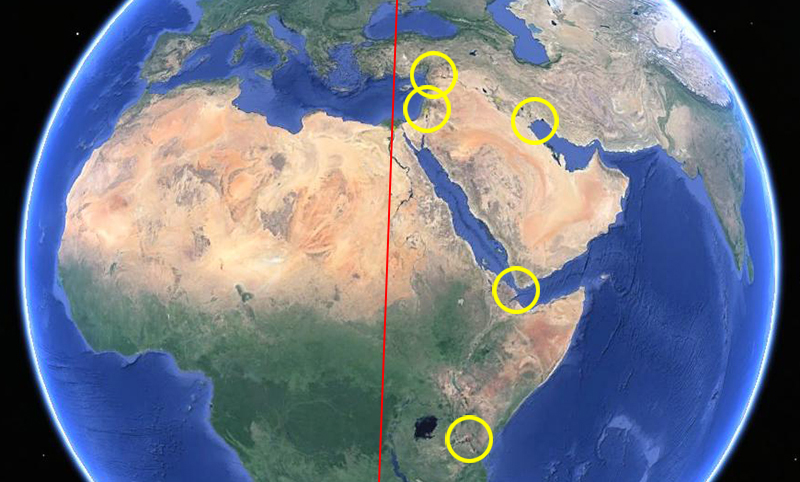
Most commentators seem to favor one of two general regions for the Garden: either northern or southern Mesopotamia, though proposals exist for locations surrounding the Arabian subcontinent and in eastern Africa. I’ve seen one suggestion that Eden lies at the bottom of the Red Sea, and another that puts it in the Indian Ocean.
Northern Mesopotamian versions tend to favor Eastern Turkey/Armenia, since (a) there is a perception that Shinar is in that area, based on Genesis 11:2 (ESV): “And as people migrated from the east, they found a plain in the land of Shinar and settled there”; and (b) the headwaters of both the Tigris and Euphrates rivers originate in that general vicinity.
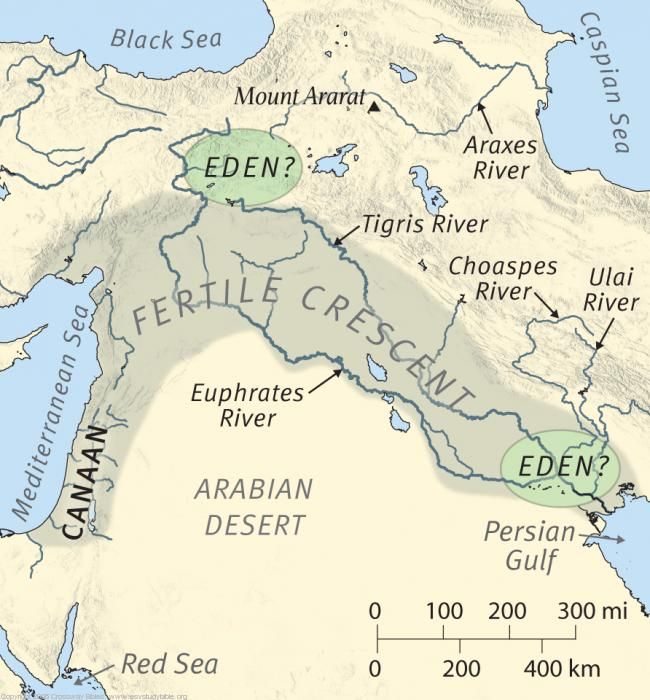
Personally, I have favored a southern Iraq location for years, since obtaining a copy of an unpublished book titled, simply, Eden, by a late pastor named David J. Gibson, who understood that rivers don’t divide flowing downstream as described in Genesis 2:10 (ESV), “A river flowed out of Eden to water the garden, and there it divided and became four rivers.” Gibson suggested, and I agree with him, that this verse should be interpreted from the perspective of an observer within the Garden gazing out at four rivers converging as they entered the Garden.
This is awkward language for us, but not necessarily for Moses in antiquity, writing in Hebrew. Consider that in Genesis 2:8 (ESV), “the LORD God planted a garden in Eden, in the east”. This implies to me that the four rivers converged in the western part of Eden before flowing through the Garden, which was planted in the eastern part.
This makes sense, and from a hydrodynamics standpoint, it is the only interpretation that makes sense. Tributaries converge, they don’t diverge. If, for some reason, a river splits to flow around an obstruction or a sandbar, it will always come back together downstream nearby. If, for some reason, it splits to flow down two or more separate drainage basins, an unstable pattern results. One path will erode more quickly than the other(s), and eventually that path will “steal” all the flow from the other(s).
The only exception from that rule is the case of delta flow, but deltas aren’t formed by erosion, they’re formed by deposition of silt carried downstream in the water. As a river flows onto a plain and slows down, turbulence decreases, and silt falls out of suspension and stays more or less where it drops. Without sufficient turbulence to pick it up again, there is just enough energy available to keep the channels open.
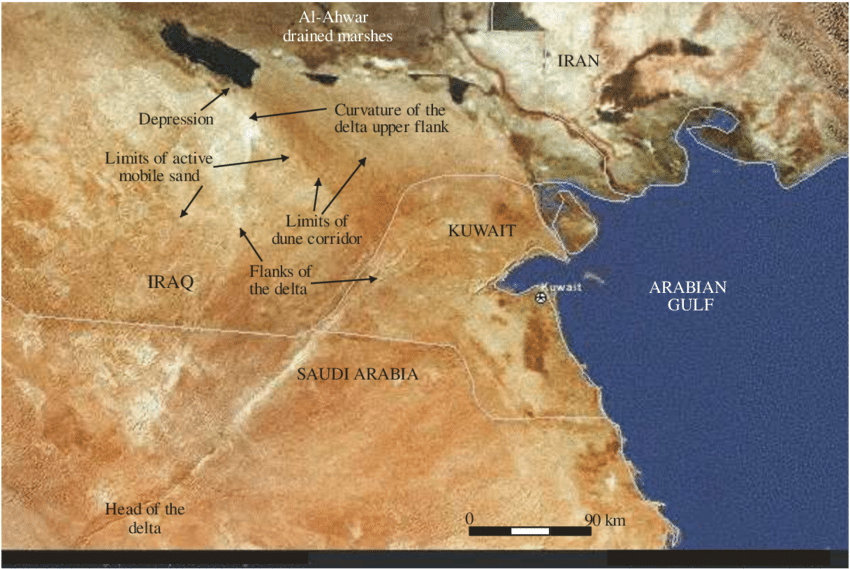
Large deltas usually form at the mouth of a river where water leaving the delta’s channels flows into the sea or a lake. Sometimes deltas form inland, usually where a mountain stream empties onto a plain. The water from an inland delta will either evaporate, sink into the substrate, or collect into a single stream or a lake. Two examples are shown below.


Genesis 2:10 would make total sense if the four “rivers” were delta channels, but the naming of those four rivers in verses 11–14 belies that possibility. Indeed, in my opinion the naming of the Tigris and Euphrates rivers conclusively fixes the location of the Garden in southern Iraq.
What about the other two rivers named?
The Pishon is fairly well defined because verse 11 says that it “flowed around the whole land of Havilah.” Havilah was a son of Cush who settled in what today is northwest Arabia. 1 Samuel 15:7 (ESV) defines that location: “And Saul defeated the Amalekites from Havilah as far as Shur, which is east of Egypt.” “Flowed around” could be literal (I found a map showing the Pishon as an ocean current flowing counterclockwise around the entire Arabian subcontinent), but more likely it simply means that it flowed through and provided water for Havilah. Gibson equated the Pishon with Arabia’s Wadi Al-Batin, an ancient and now-dry river and delta system flowing northeast through Saudi Arabia and Kuwait to the Tigris/Euphrates valley. I think he was right.

As for the Gihon River that “flowed around the whole land of Cush” (verse 13), I would equate that with the Karun River, flowing out of Iran, through the ancient land of the Elamites.
I think that Christian commentators are thrown off by an assumption that “Cush” refers only to the region around Ethiopia and Somalia. My view is that Cush (a son of Ham) and his descendants settled large regions of Asia, as well as the upper Nile area. They apparently mixed with the Canaanites in the Lavant, and Nimrod, a son of Cush, was described in Genesis 10 as “9a mighty hunter before ADONAI. … 10His kingdom began with Bavel, Erekh, Akkad and Kalneh, in the land of Shin‘ar.” These abodes of Nimrod are all lands of southern Mesopotamia. Nimrod was, I’m convinced, none other than Sargon of Akkad, the world’s first great emperor. Elam and Asshur were Semites, but Cush may have extended into the Steppes alongside Shem (see Nimrod the Empire Builder: Architect of Shock and Awe, 2023, by Douglas Petrovich).
It’s admittedly a stretch, but I have wondered if perhaps the ancient Kushan Empire, spanning the central Asian “stans” might have gotten its name from Cush/Kush. If so, then the influence of Cush stretched all the way to the Xiongnu tribe, north of the Yellow River, because the peoples who started the Kushan Empire, centered around Afghanistan, where refugees from the Xiongnu.
Putting all this together, I think that the following map states the case for Eden in southern Iraq:

What about the placing of Shinar in Turkey? I agree with the predominant view that Shinar is the area once occupied by Sumer, between the Tigris and Euphrates Rivers. It’s not hard to explain away migration “from the east.” I suspect that waters from the Great Flood took years to retreat from low-lying areas, so descendants of Noah returning to their homeland in Shinar would have initially moved southeast along the spine of the Zagros Mountains. Saying that Shinar is west of Ararat because they entered from the east is analogous to assuming I live west of my church because I (sometimes) approach it from the west. The full story on that is that I live to the southeast and occasionally take a circuitous route along the freeway.


 The Back of My Mind
If one believes that the garden of Eve did exist and its location can be figured out, then what does that say about what came before the garden and what came after its creation, is all of that true?
James, this is the only comment from you I can find that I neglected to reply to. That may have been intentional, simply because I do a lot of research and thinking before I post, and I hate to go on a limb without that process. I haven’t written much about biological creationism because that isn’t my field. My field of interest and experience is physical and geological science, not biology.
This article is actually pulled out of a longer one, Exploring the Garden of Eden, in which I did briefly discuss what came before and after Adam and Eve.
Ron, I read my comment and it does not seem to make much sense. I think I may have meant that the rest of the Bible, besides the Genesis account of Eden, should be believed. In other words all scripture is beneficial. Jim
Where The Bible tells us where the Garden Of Eden was in the Bible.