
I just read an AMAC (Association of Mature American Citizens) article about pragmatic Democrats who are now acknowledging that memes about a Trump victory leading to the “end of Democracy in America” are merely a political “talking point” and that America will do just fine under a Trump Presidency. That’s not the subject of this post, though…
One of the reader comments made me cringe: “I’m a registered Republican … I keep hoping that the Republicans can find a candidate as charismatic as Ronald Reagan [who has] the vision of Abraham Lincoln.”
Just what was Lincoln’s vision?
On Slavery
Of course he’s most revered for “freeing the slaves”, but is that what Lincoln was all about?
It’s true that he was against slavery, particularly in 1858 when he was debating Stephen A. Douglas. But like other Whigs turned Republican, he was far from being an Abolitionist. The debates weren’t about ending slavery, they were about preventing its spread into new territories. Lincoln had spoken out against the Kansas-Nebraska Act of 1854, which Douglas supported (in fact sponsored), so that topic became the principal focus of the debates when Lincoln was asked to run against Douglas in a US Senate race in Illinois. Having read transcripts of all seven lengthy debates, I can’t pick a clear winner of those, but Lincoln ended up losing the election.
During the run-up to the 1860 presidential election, he repeatedly declined to speak in favor of Abolition. His position was that if the slaves ever were emancipated, they should be deported to Africa or South America. Early in the War, he stated that the only reason he would consider emancipation would be for strategic purposes—to help win the War.
Ultimately, on January 1, 1863, he did sign the Emancipation Proclamation, which clearly was motivated by purely strategic considerations. It applied only to states and portions of states that were “still under rebellion”, and it specified that freed “persons of suitable condition, will be received into the armed service of the United States.”
So, to me it seems specious to laud Lincoln as “The Great Emancipator.”
On Secession
A right of secession is not addressed by the Constitution, so legally it comes under the category of rights reserved to the states. The Declaration of Independence, though not a legal document, clearly implies that the Founding Fathers considered secession a proper course when the people governed want a change of government. Both southern and northern states frequently threatened secession, beginning as early as the John Adams administration, and one frequently hears such threats even today.
Though he used the Ft. Sumter bombardment as justification for declaring war, Lincoln’s only stated reason for doing so was to “save the Union.” But was the Union in danger? Certainly not the northern half!
The southern states wanted out of the Union, but they absolutely had no desire to go to war. They posed no threat to the North.
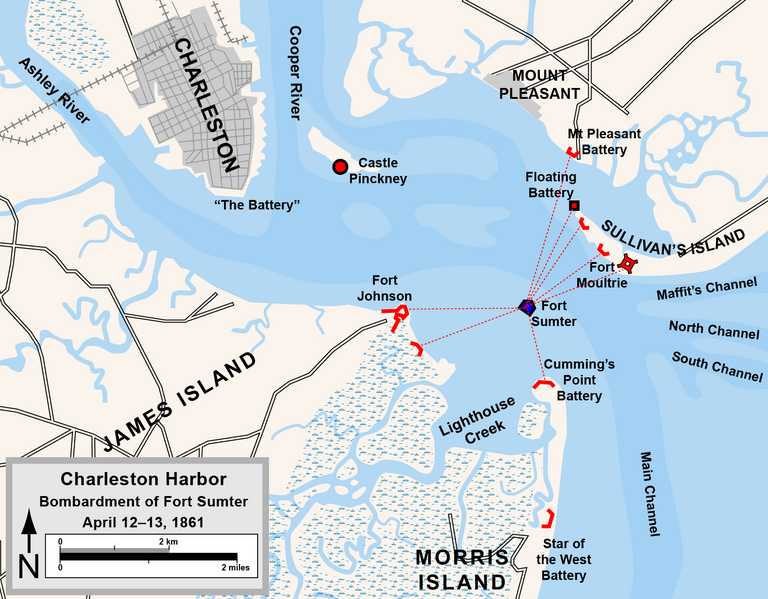
Fort Sumter at the time was unfinished and unmanned but was strategically important to South Carolina for the defense of Charleston Harbor. After Secession, Union troops stationed at nearby Fort Moultrie secretly moved into the new fort. Bombardment began only after repeated attempts to peacefully buy it from the Union and only after Lincoln tried to provision it despite warnings that doing so without a suitable treaty would violate South Carolina’s sovereign borders.
The bottom line is that Lincoln, not South Carolina or the Confederacy, deliberately provoked the deadliest war in US history!
As to whether the Union needed saving, almost all of the nation’s manufacturing and war-making capabilities were in the north. The South was eager to establish trade relations with the North, so the availability of food, cotton and tobacco weren’t issues.
On Economics
Lincoln was a dedicated disciple of Henry Clay and his so-called “American System” of economics. Three aspects of the American System were particularly damaging to and hated in the South:
Protective Tariffs, benefitting the North and penalizing the South:
Tariffs are taxes on imports. One benefit of tariffs is that they raise revenue for the entity imposing them, and in fact, for many years that was the only source of funding for the federal government. “Protective” tariffs are further designed to promote domestic manufacturing and production by making imported goods less competitive than domestic goods. Since the southern states had very little manufacturing capacity, protective tariffs raised consumer prices for them while providing no meaningful protection.
The southern economy, however, depended on exports of agricultural products, particularly cotton. US trade partners that lost revenue to US tariffs responded by raising tariffs on southern exports.
National Banks, benefitting the North and penalizing the South:
The Constitution neither created nor authorized federal banks or a Federal Reserve. Alexander Hamilton, the first Secretary of the Treasury, pushed for creation of a federal banking system, and that eventually happened despite heavy opposition from Constitutional purists like Thomas Jefferson and James Madison. Hamilton believed that a federal bank was necessary to “stabilize and improve the nation’s credit, and to improve handling of the financial business of the United States government.” Subsequently, the First Bank of the United States was chartered in 1791, and lasted until it was privatized in 1811 (at the expiration of its charter). Federal banking was reintroduced in 1816 under a charter that created the Second Bank of the United States and allowed a large number of regional branches. Banks, by virtue of their power to choose who is or is not able to borrow money, and the terms of such loans, wield enormous power.
The Southern States rightly feared that a bank with national scope would favor the economic interests of the industrialized northern states over those of the agrarian southern states.
Internal Improvements, benefitting the North and penalizing the South:
Today this topic is called “infrastructure“. In Lincoln’s day, it referred primarily to construction of roads and rails. Article 1, Section 8 of the Constitution grants to congress the power “to regulate Commerce with foreign Nations, and among the several States, and with the Indian Tribes”. To a Constitutional Conservative, “regulation” means oversight and minimal rulemaking. To Henry Clay and Supreme Court Chief Justice John Marshall, and then to mid-century liberals like Abraham Lincoln, it meant far more.
The southern states realized that most such projects would be built in and mainly benefit the northern states, with much of the financing at the expense of the South.
Lincoln as a Republican?
Be not deceived!
Although Republicans like to boast that Lincoln was a Republican, the Republican party of the 19th century bore little resemblance to the GOP of the 21st Century. In essence, the Republicans and Democrats have to a great extent swapped ideologies.
The Republican Party was established in 1854 in response to the Kansas-Nebraska Act, drafted by Lincoln’s old nemesis, Steven A. Douglas. This act created the two territories, primarily with railroads in mind. In the process, though, it also repealed the Missouri Compromise of 1820, which prohibited slavery in new territories north of a certain latitude. The Republican party consisted largely of Whigs, who were disappointed with that party’s lukewarm opposition to the expansion of slavery. In terms of policy, it essentially was Whig.
In an online article describing the Whigs, the History Channel states that they were “vocal opponents of [President Andrew] Jackson’s propensity for ignoring Supreme Court decisions and challenging the Constitution.”
There is irony in that statement. The United States of America came into existence when nine of the original thirteen colonies signed the Constitution. The Constitution, as amended under its own terms, is the supreme law in America, and even the Supreme Court has no power to violate it. “Ignoring Supreme Court Decisions” is not only okay but is required when the Court itself is “challenging the Constitution.” That was precisely Jackson’s stance. The “separation of powers” doctrine does not establish a hierarchy among branches of the federal government. It means rather that the Legislative, Executive and Judicial branches each exerts an equal check on the others.
In the mid-19th century, the Republicans were the party of big government, heavy taxation, burdensome laws and weak Constitutionalism. The Democrats, North and South, were the party of Constitutional limits.
That all began to change between WWI and WWII. By now, it has not only reversed, but has gone to absurd extremes on the Left.
I would place Lincoln on today’s scale as a moderate Democrat, and the Southern Democrats of his day as right-of-center Republicans.
What is my vision?
I’m sure you’ve figured out that I consider myself a Constitutional Conservative. Most of you would probably consider me extreme.
- I pay my taxes because they are legal under the Constitution, as amended. Well, I no longer pay income tax because I’m retired and in the exempt bracket.
- I do not say the Pledge of Allegiance because it was devised after the Civil War to coerce “rebels” into abandoning their principles. It’s the “one nation” part that sticks in my craw. We are, Constitutionally, a union of truly sovereign states, not one nation. I would pledge conditional allegiance to Texas, as a sovereign state, for sure, and probably some other states, including Kansas, where I live now. Mostly, I pledge allegiance to the Kingdom of God. I would (I do!) pledge allegiance to the US Constitution. I make no promise to object to secession of some state or states in the future.
- I do fly the Stars and Stripes, stand for the National Anthem, support the military, and of course vote, because I appreciate the benefits I do receive from the Union.
- I do forswear and even despise slavery because my ancestors, like yours, were at some time in history enslaved (where is my reparation check?), and because in this day and age, it is a practice with no moral justification. Not because of the 13th and 14 Amendments to the Constitution, which were passed illegally, under coercion.
- I do not recognize West Virginia, the state of my birth as a member of the Union, because it was formed illegally during the Civil War and is still, under the Constitution, part of the state of Virginia. If the legalities were correctly followed today, I think there would be no problem achieving Constitutional statehood.
- As a pragmatist I do, by and large, obey the laws of the United States, because of benefits I receive.
I guess you get the picture…
 The Back of My Mind