My blogs tend to be longer than many people are comfortable muddling through. I understand that, and expect that many of you will skim, or ignore me entirely. It’s okay, I enjoy digging into subjects and gleaning all I can from them. Even if nobody else profits from my work, I do!
But I’m going to try a new concept with this one. Occasional short articles to introduce ideas and definitions that I will use more than once in longer works. Perhaps to introduce authors or books that I like to quote.
In this case I want to pass on a partial summary of Lesson 3 from a 1999 video course by The Teaching Company® titled The History of Ancient Egypt. The course was taught by Egyptologist and Paleopathologist Dr. Bob Brier.
In this lesson Dr. Brier distinguished between three different pursuits, or systems of thought, used through the ages in order to find answers to non-empirical questions. That is, questions that can’t currently be definitively answered by actual observations or testing. These three systems are mythology, religion, and philosophy. I am primarily concerned with the first two of these.
Mythology
Brier contends that, “Mythology contains stories [set in the primordial past] that are not to be taken literally but answer basic questions about the nature of the universe.” In other words, it is folklore which you can believe or disbelieve, but which nevertheless influences your personal worldview.
The ancient Egyptians, for example, had an elaborate mythology about the death and resurrection of Osiris which may or may not have been widely believed, but which certainly explained their burial practices and their hope of an afterlife.
Merriam-Webster’s definition is, “a usually traditional story of ostensibly historical events that serves to unfold part of the world view of a people or explain a practice, belief, or natural phenomenon”, which is not exactly what Brier states. Webster goes on to add that a myth is “an unfounded or false notion.” “False” clearly means incorrect, or even deliberately deceptive. “Unfounded” can mean simply unsubstantiated, but additional synonyms include “baseless”, “foundationless”, “invalid”, “unreasonable” and “unwarranted”, all of which are pejorative.
Clearly, Webster’s view, which connotes false history and superstitious belief, is the way most of us think. From here on out, though, I’m going to opt for Brier’s more useful definition, because it equates “mythology” with less negative terms like legends, folklore, parables, and allegory.
Religion
According to Brier, “In religion, by contrast, the concept of belief is essential. Religion includes stories [set in the historical past (that is, at least potentially datable)] believed to be historical.“
Brier, I think, would agree that Judeo-Christian views of creation by Yahveh are a matter of religion, but the particulars related in Genesis 1 are mythological.
Philosophy
On this system, Brier states that, “Unlike religion … philosophy requires a proof based on logic. The answers to the great philosophical questions are not matters of opinion but facts that are unknown … [and] we don’t, given our limited perspective, have answers to them.” Philosophy was unknown in ancient Egypt.
Yesterday I was watching the re-airing of a 2020 episode of Impossible Engineering on the Science Channel. The episode, titled Spy Plane Declassified, was about the reconfiguration of a Boeing E-3 Century airplane as an AWACS (Airborne Early Warning and Control System) aircraft.
Midway into the program, I was thrilled to see a segment featuring a man who, though I knew him for only a few months, was probably, after my father, the first man who significantly influenced the future course of my professional life.
Dr. Carl E. Baum
During my mid to late teens, I took two summer jobs with Federal agencies. The first was on a Forest Service surveying crew, working on a road project on the fringes of the Navajo Reservation near Bluewater Lake, New Mexico. The second was a civilian job at the Air Force Special Weapons Center at Kirtland Air Force Base in Albuquerque. This job was in 1965 right after my graduation from high school.
At AFSWC, I reported directly to a young Air Force Captain, Carl Baum, now deceased, who was directing the Center’s research on EMP (Electromagnetic Pulse) defense strategies. EMP was then (at the height of the Cold War), and still should be, a grave national security concern. Strong pulses of high frequency electromagnetic energy such as those generated during air detonation of a nuclear bomb can disable and even destroy electronic equipment of all types within a huge radius. A few bombs detonated over America could potentially shut down our civilian infrastructure for decades, because even the facilities and equipment needed for repair and replacement would be crippled. But our focus at Kirtland was on finding means to improve the “radiation hardening” of military equipment against such an attack.
Of course I was a “gofer” in that facility, but Captain Baum and his staff all took an interest in me as a budding scientist. My principal duty was to run “IBM cards” and printouts back and forth between Carl’s desk, his programmers and keyboarders, and the Control Data CDC 6600 supercomputer down the hall.
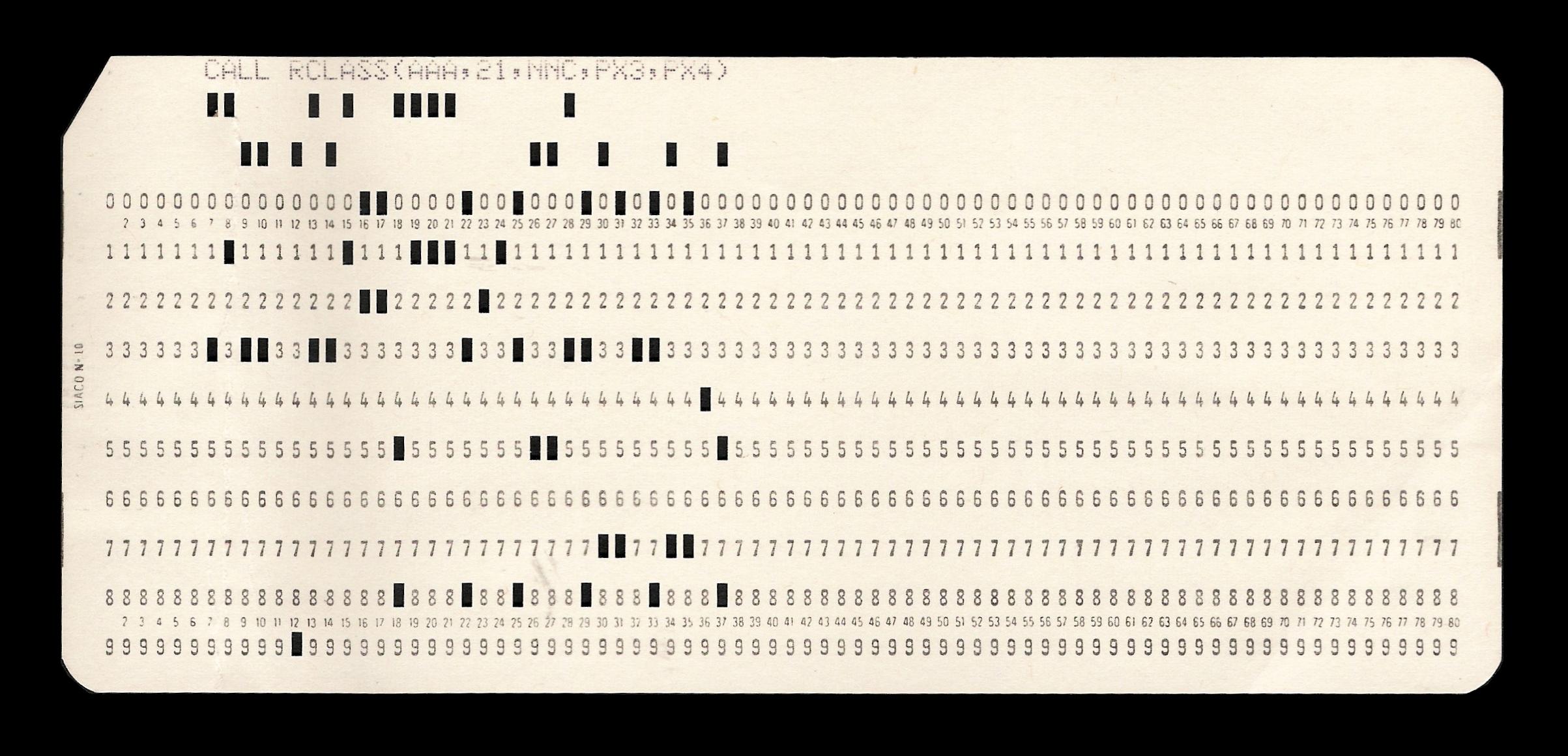
Old-timers will recognize this punch card from the infancy of computers. This one sports a single line of code: a subroutine call, passing five separate parameters. A complex program might require a stack of hundreds of cards, all of which had to be “read” in the correct order. Holes were punched using a device with a keyboard resembling a typewriter—remember those? “Keypunch Operator” was a career description in those days. I still have boxes of blank cards down in my basement, which I’ve used for bookmarks and note cards. And, of course, coasters.
In practice, I was present for many conversations between the scientists. A simulation run or test results would come back, Carl would examine the data and graphs, and out of his genius brain would pop a new complex wave equation to model what changes might happen to the EMP field if we do such and such or change so and so. Off would go the programmer to plug the new equation into a new simulation, then I’d take it to the keypunch operators, prepare the program deck, and haul it off to the input desk.
But I still ended up with a lot of free time. Carl was at heart an academic. Over the years he did frequent guest lectures around the world, and he ended his career as a professor at the University of New Mexico. He asked me if I’d like to learn FORTRAN, the computer language of choice for research back then. Sure! So, he assigned a Staff Seargent to teach me, and in just a couple months I became proficient enough at it that two years later I was able to land a job at the University of Texas Computation Center as a consultant tasked with helping professors and students debug and improve their faulty FORTRAN programs.
I never saw Carl again after that summer, but I never forgot him, or heard of him again until now. As a kid, I always loved astronomy and physics, but for reasons beyond the scope of this post, I had decided to pursue a career in marine biology, instead. Because of Carl’s influence and the computer training he gave me (long before the days of personal computers), my interests swerved back onto their original path. My father insisted that I start with general studies at a small college for two years. I ended up as the only physics major at Eastern New Mexico University, and from there went on to double major in math and physics at Texas.
ATLAS-I EMP test platform at Sandia Laboratories, now part of Kirtland AFB, New Mexico. This huge, 180-meter-tall facility, nicknamed “The Trestle“, was designed by Dr. Baum several years after I was there. Aside from the wedge-shaped steel structure on the left which acted as a ground plane for the horizontally polarized pulses, it is constructed entirely of non-conductive laminated wood beams, held together by wooden nuts and bolts. EMP is provided by means of two huge Marx generators flanking the wedge. For an idea of the Trestle’s size, that’s a B-52 bomber being tested!
This post is inspired by a recent, very brief, Sunday School discussion of Joseph’s Godly response to Potiphar’s wife, long before Mt. Sinai and “The Law.” The sense that I took from some of the comments was, “Joseph was a very special man to even know that adultery was sinful, since ‘The Law’ had not yet been given to Moses.”
“Joseph Receives His Father and Brothers”, by Jan de Bray, 1627–1697. Bray specialized in painting historical figures dressed as contemporary figures; hence, the Dutch Renaissance attire.
I wholeheartedly agree that Joseph was special, but not for that reason. I would submit that all human beings have an innate understanding of sin. Potiphar’s wife knew that adultery is sinful but tried to force it on Joseph anyway. The fact that she was able to frame him for the crime of attempted rape shows that she, her husband, and other Egyptians in the story all had moral compunctions about it.
“The Law” as teacher
I suspect that confusion about this issue goes back to the King James translation of Galatians 3:24, which most of us seniors raised in church are probably familiar with:
[23] But before faith came, we were kept under the law, shut up unto the faith which should afterwards be revealed. [24] Wherefore the law was our schoolmasterto bring us unto Christ, that we might be justified by faith. [25] But after that faith is come, we are no longer under a schoolmaster. —Galatians 3:22–25 (KJV) emphasis mine
We were traditionally taught that, as a “schoolmaster“, the job of “The Law” was no more than to teach Israel what God required of faithful servants. Under the “Old Covenant”, those teachings were rigorously applied by God and the Jewish authorities, and in fact, according to old-school Dispensationalism, salvation came to those, both Jew and Gentile, who either “kept ‘The Law'” or who made atonement for their failures by making an appropriate blood sacrifice.
…
[Boy… my intention going into this was to keep it brief, but my brain keeps running down all kinds of rabbit trails. There are many directions I could take that last paragraph, but I’m going to back down and stick to “schoolmaster.” Anyhow, see A Perspective on Biblical Covenants and Dispensations, where I’ve already covered part of it]
…
The term that KJV translates as “schoolmaster“, and NAS as “tutor” is the Greek paidagogos (παιδαγωγός), which literally means “boy-leader”. Historically, in ancient Greece, it referred to a slave whose job it was to conduct children to and from school in safety. In other words, a “guardian” (ESV) or “custodian” (CJB), with no teaching function whatsoever.
If you look up paidagogos (G3807) in Strong’s, you’ll see that it does in fact mention “tutor”, “instructor” and “schoolmaster”, but Strong’s doesn’t determine how a word should be translated—it reflects the way its compilers have seen it translated. In this case it is legitimating an erroneous KJV translation. For that reason, I am reticent to use Strong’s on its own, without reference to other, better, resources. See, for instance, from Vine’s:
“Thus understood, paidagogos is appropriately used with ‘kept in ward’ and ‘shut up,’ whereas to understand it as equivalent to ‘teacher’ introduces an idea entirely foreign to the passage, and throws the Apostle’s argument into confusion.” —Vine’s Complete Expository Dictionary of Old and New Testament Words
A better translation of the passage quoted above is therefore,
[23] Now before faith came, we were held captive under the law, imprisoned until the coming faith would be revealed. [24] So then, the law was our guardian until Christ came, in order that we might be justified by faith. [25] But now that faith has come, we are no longer under a guardian, —Galatians 3:23–25 (ESV)
Or the much wordier paraphrase,
[23] Now before the time for this trusting faithfulness came, we were imprisoned in subjection to the system which results from perverting the Torah into legalism, kept under guard until this yet-to-come trusting faithfulness would be revealed. [24] Accordingly, the Torah functioned as a custodian until the Messiah came, so that we might be declared righteous on the ground of trusting and being faithful. [25] But now that the time for this trusting faithfulness has come, we are no longer under a custodian. —Galatians 3:23–25 (CJB)
Three kinds of “Law”?
You may have noted that I put “The Law” in quotes every time I mentioned it above. That is because the term itself is faulty. The Hebrew term “Torah” means “teaching”, not “law”. The Torah does contain many legal precepts (613 by Jewish counting), but that is only part of the whole. The translators of the Hebrew scriptures into the Greek Septuagint (LXX), lacking a better term, rendered Torah as nomos, which correctly translates to “that which is assigned, or distributed”, as, for example, troop rations or animal feed. That’s not a bad way to look at “teaching” (parceling out knowledge), but since the Jews were becoming increasingly legalistic in their worship, it came to take on the meaning, “law.”
Jesus refused to “abolish the [Mosaic] Law”:
[17] “Don’t think that I have come to abolish the Torah or the Prophets. I have come not to abolish but to complete. [18] Yes indeed! I tell you that until heaven and earth pass away, not so much as a yud* or a stroke will pass from the Torah—not until everything that must happen has happened. [19] So whoever disobeys the least of these mitzvot and teaches others to do so will be called the least in the Kingdom of Heaven. But whoever obeys them and so teaches will be called great in the Kingdom of Heaven. —Matthew 5:17–19 (CJB)
Christian theologians have attempted to compromise by downgrading parts of Torah while keeping the parts that they can’t bring themselves to discard. I have written about this before:
[There is] a theory I have come across many times since I was a young man—that “Jewish Law” is composed of three categories of commandments: “Moral Law“, “Civil Law“, and “Ceremonial Law“. There are hints of this in Augustine of Hippo, but I think the idea was fleshed out mostly by Thomas Aquinas, so it became a Roman Catholic and Orthodox view. It was later bequeathed to Protestant Reformed theology by John Calvin in his Institutes of the Christian Religion; and many subsequent non-Reformed Protestant denominations and individual pastors have adopted the idea as well. The impetus for these teachings was probably an effort to justify claims that Christians are not bound by Civil and ceremonial Law, while at the same time holding that the Moral Law is somehow “still in effect”. —Ron Thompson, The Transfiguration and “Jewish Law“
As I mentioned in the above-referenced post, this 3-fold division of Torah is entirely fictitious! I suspect that some would attempt to justify the idea by guessing at the meanings of three technical terms used to categorize the legal precepts in verses such as Deuteronomy 6:1,
Now these are the commandments, the statutes, and the judgments, which the LORD your God commanded to teach you, that ye might do them in the land whither ye go to possess it: —Deuteronomy 6:1 (KJV)
Correctly understood, those terms mean enacted laws, regulations, and court rulings, as shown below,
“Now this is the mitzvah [commandment; law; ordnance; or precept], the choqim [statutes; enactments; or decrees] and mishpatim [rulings; judgements; sentences; or findings] which ADONAI your God ordered me to teach you for you to obey in the land you are crossing over to possess…“ —Deuteronomy 6:1 (CJB, modified by me)
Why we don’t need “moral law” either now
If you think Joseph was anticipating the Mosaic “Law” when he rebuffed Potiphar’s wife, then what was the source of his ethics? I don’t discount that it could have been prophetic forethought, but then why did the Egyptians have the same qualms over adultery? Put another way, what was the source of pagan ethics, and what is the source of atheistic ethics in our own day? Sure, pagan religion was corrupt because the gods were corrupt (see Gods and Demons), but evidently, even in pagan cultures, sleeping with a temple prostitute was not at all the same as sleeping with a neighbor’s spouse. The former was expected, the latter soundly condemned and likely to get you killed.
The answer is that human beings are endowed by God with an innate, though frequently ignored, sense of right and wrong. Those who study it call it “natural law.” We know implicitly, without having to be told, that adultery, murder, theft and such things as those, are wrong.
So, what is the source of that natural law? It is genetic, certainly, so maybe it was part of our original creation as a species. In my own opinion, it was probably the essence of what happened after Adam and Eve ate from that tree.
“Jacob Blessing the Children of Joseph”, by Rembrandt van Rijn, 1606–1669. More strange clothing.




 The Back of My Mind