The Ancient of Days

Posted on:

Modified on:


  1. Defining the Infinite
  2. God and Infinity
  3. God’s Size
  4. God’s Age
  5. Daniel 7
  6. Is God Ancient, or Just Old?

Between research, and then pushing my aging brain to get things “on paper”, my blog posts generally take a long time to write, and I assume a long time for you to read—sorry. My goal with this one is to just go with what I know (or if you disagree, with what I think I know) and knock out something shorter. With maybe a few slightly off-topic thoughts thrown in. Just my ponderings here…

Mathematical Infinity symbol, Pixabay free image.

Infinity is a concept that most people are familiar with and that I have encountered over and over again during my long life, primarily in three contexts: pure mathematics, physics, and theology. Not so much petroleum engineering, my professional field.

Infinity is a useful conceptessential, in some respects—but it is not a real thing!

Defining the Infinite

Infinity is the concept of the unimaginably and immeasurably


It’s what you get when you disobey your grade school math teacher and divide by zero. It’s so big that when you double it, it’s still infinity. If you double it infinitely many times, it’s still just plain old infinity:

God and Infinity

Theologians like to apply the term infinite to God. All of His attributes are said to be infinite in scope. Well, that may be, but the Bible doesn’t actually make that claim. Infinity was not a known concept in ancient times. If God had claimed it, nobody would have understood it anyway. The most you’re going to read in ancient literature is “a whole big bunch!”

Enormity only gets stated in idiomatic terms. For example, many English translations say that the “army from the east” in Rev. 9:16 will be exactly 200 million strong. The actual Greek says literally “twice ten thousand times ten thousand”, which is way bigger than the record 12 million that the US fielded in 1945, and way, way bigger than the next biggest human army in history. There is no question in my mind that John was speaking merely of a very large army. See also below.

That is not to say that God has no infinite attributes. I’m simply pointing out that, given the Bible’s silence, it’s a philosophical question, not theological.

God’s Size

In Implications of God’s Omnipresence and Eternity in Space-Time, I discussed God’s omnipresence in terms of His spanning, encompassing, infusing, and in fact subsuming all of everything that is—space, the universe, in other words, all matter and energy that exists. The 93 billion lightyears estimate I mentioned for the diameter of the universe is probably a minimum.

Some astronomers still throw around the term infinite for the actual size of the universe. That discussion goes beyond my pay grade. 93 billion lightyears is enough of a living space for me. That’s 550 quadrillion miles, or about 3 million trips to the sun and back. So, God is at least that big! If the universe is infinite, then God is more infinite… Huh?! That doesn’t mean anything quantitative.

God’s Age

In the same previous post, I explained that God’s age, as does His size, spans, encompasses, infuses and subsumes the age of the universe.

Some scientists postulate an infinitely old multiverse; that is, a master universe that grows, “buds off” like a hydra or a nematode, and the “baby universes” each have their own, random sets of physical laws. This theory has very tenuous scientific support and was proposed mainly to explain the mind-boggling (to unbelievers) Anthropic Principle, the unavoidable observation that our universe has a huge set of physical characteristics, many of which are independently necessary to support life in any way that we can envision. The idea is that if the multiverse is infinitely old, then it has spawned an infinite number of buds, and with infinite tries it is statistically likely that at least one of those is anthropically friendly. Hence, they have no need for the God hypothesis.

(Incidentally, they would never admit to this, if they even made the connection, but physicists have a theory that might account for a “god” popping into existence out of nothing. It’s a theoretical consequence of random quantum mechanical fluctuations over an infinite period of time. This is what is called a Boltzmann Brain, and no, I don’t believe that accounts for God! I’m just pointing out that, as much as I love science, it does have its inconsistencies.)

The Spirit Beings I discussed in Gods and Demons are immortal and everlasting, which means that they will survive forever if God lets them, but they have not always existed because God created them to manage the cosmos. Eternality is not the same as everlastingness. Scripture says that God alone is eternal—but what does that mean?

The assumption made by most theologians is that God has existed from the infinite past. There’s that pesky, undefinable infinity again. I don’t deny it, but I can’t comprehend it. There are some respected conservative theologians (don’t ask me who, I think I remember some of them, but I’m taking a vacation from research for this post, and I don’t want to slander anyone if I’m wrong) who acknowledge that God’s existence may define the term, “eternal.” That would be to say that His existence did have a beginning, and that beginning marked the beginning of eternity.

I neither believe nor disbelieve that. Once again, it is philosophy, not theology.

Daniel 7

[9] I beheld till the thrones were cast down [set in place], and the Ancient of days did sit, whose garment was white as snow, and the hair of his head like the pure wool: his throne was like the fiery flame, and his wheels as burning fire.
[10] A fiery stream issued and came forth from before him: thousand thousands ministered unto him, and ten thousand times ten thousand stood before him: the judgment was set, and the books were opened.

[13] I saw in the night visions, and behold, one like the Son of man [Daniel’s conception of the coming Messiah] came with the clouds of heaven and came to [approached] the Ancient of days, and they brought him near before him.

[22] Until the Ancient of days came, and judgment was given to the saints of the most High; and the time came that the saints possessed the kingdom.
—Daniel 7:9–10,13,22 (KJV) the annotations and emphases are mine

Daniel 7 is perhaps the most pivotal chapter in all of prophecy, because it explains so much that we read elsewhere in Scripture.

My emphasis here, though, is on the cast of characters. The stage is a meeting in heaven of God and His Divine Council. Those in attendance are,

  • The Ancient of Days, also called here the most High. The three instances in Daniel 7 are the only occurrences of the term, “the Ancient of Days”, in the Bible.
  • The term “son of man” appears many times in Scripture. At a minimum, it simply means a male human being. It is frequently used in the prophetic books to emphasize that the prophet is merely a human, delivering God’s divine words. Here, though, Daniel has added something important (see Son of Man, Son of God):

    A human being is ushered into the presence of God in heaven. But the phrase, “with the clouds of heaven” is something that appears frequently in Ugaritic and Babylonian literature to signal the movements of Ba’al. The use of a polemic here is Daniel’s (or rather, the dream’s) way of saying that this particular Son of Man is divine!

    Second Temple Era Jewish scholars, the Pharisees and their scribes, were divided on whether Daniel was actually referring to a divine Messiah or something else, but without question, when Jesus quoted this verse in Matthew 26:64 and applied it to Himself, the high priest and Sanhedrin sitting in Judgement of Him took it the only way possible, as an explicit claim not only that He was Messiah, but that He was divine.

[63] Yeshua remained silent. The cohen hagadol [high priest] said to him, “I put you under oath! By the living God, tell us if you are the Mashiach, the Son of God!” [64] Yeshua said to him, “The words are your own. But I tell you that one day you will see the Son of Man sitting at the right hand of HaG’vurah [Lit., ‘the Power’, a euphemism for Yahweh] and coming on the clouds of heaven.” [65] At this, the cohen hagadol tore his robes. “Blasphemy!” he said. “Why do we still need witnesses? You heard him blaspheme! [66] What is your verdict?” “Guilty,” they answered. “He deserves death!”
—Matthew 26:63–66 (CJB) the emphasized text here is the quotation

  • There were also many, many of the Heavenly Host on stage. The “thousand thousands” in verse 10 are members of the Divine Council, while the “ten thousand times then thousand” are additional “angelic” witnesses. Here are two more examples of the idiomatic expression mentioned above. The Council members are the “they” of verse 13, ushering Jesus to God’s throne.
  • The term “saints” that occurs twice in verse 22 is קַדִּישׁ (qaddiysh, pronounced “kad-DEESH”). It means “holy”, “holy one”, or “holy ones”, and it applies both to redeemed humans and to loyal angels. That “judgement was given to the saints” can’t mean that they pronounce judgement, because that is Jesus’ job, specifically. Instead, it has to mean that they administer judgement, which is borne out in the statement that they also “possessed the kingdom.”

(Forgive me, but I’m going to throw in another rabbit trail here. My interpretation regarding “judgement” in verse 22 is an illustration of something that really bugs me: traditional, verses thoughtful, exegesis. I’ve personally read a number of commentaries on Daniel 7 over the years, and as far as I can recall, every single one of them has assumed that pronouncing judgement was in view, leading them to further assume that verse 22 is applying the name “Ancient of Days” to Jesus, rather than to Yahweh. Because we all know that it is Jesus who will pronounce judgement in the eschatological future.

Why? In no particular order, it is because (a) too many commentators lean too heavily on earlier works and forget to think for themselves; (b) too many Christian commentators overemphasize Jesus and relegate Yahweh to the “stale writings” of the Old Testament; (c) too few Christian commentators care enough about the ancient Hebrew and Near East cultural background to provide more that standard “Sunday School” answers to harder interpretive questions; and (d) simple careless thinking.

I’m not a theologian. I’m not a scientist. I’m an engineer, and skeptical of anything I haven’t personally evaluated.)

Is God Ancient, or Just Old?

So, this brings me, ponderously to be sure, to the crux of my ponderings. Which may seem anticlimactic to most of you.

Is God merely old, or is He ancient?

Those are relative terms, of course. Age is a property of “stuff” and stuff didn’t exist until God created it. The Second Law of Thermodynamics, in effect, says that everything ages. But aging, and time itself, are properties of the universe. Isaac Newton notwithstanding, God does not age, because He is not bound by the universe He created.

As most of you know by now, I’m an “Old Earth Creationist.” In my view, God defined the physical laws, and then by His word, He spoke the universe into existence, in all of its building blocks and the forces that drive them. At one point in time and space, about 13.7 billion years ago. He decreed it, and He continues to supervise the orderly processes of birth, growth and maturation. Those processes are ongoing; God does not have to repeat them every week.

I have a different interpretation of the “six days” than those of Young Earth Creationists. To my senses, creation itself tells me that it is way more than 6,000 years old. Given that God doesn’t actually age, I would term Him truly “ancient” based on His resume. In my view, regardless of how long He has existed in currently understood earth-years, His “experience” is some 2.3 million times more impressive than a mere 6,000 years!

Next in series: “Gotcha” Proofs by Young Earth Creationists (The Lincoln Memorial)


Pharisees

Posted on:

Modified on:

  1. Pharisee History
  2. Sect, or Order?
  3. Torah
    1. Torah Shebichtav, the Written Torah
    2. Torah Sheba’al Peh, the Oral Torah
  4. The Sanhedrin
  5. Pharisees as Sanhedrin Agents
  6. Core Beliefs of the Pharisees
  7. Jesus’ Debates with Pharisees
  8. How did the Pharisees See Themselves?
  9. My Conclusions

Christianity has traditionally viewed the Pharisees as a uniformly treacherous and hateful group of hypocrites.

There is a marked tendency among some to despise Judaism as a whole for producing such a “reprobate” sect. An Internet search for “Pharisees” turns up almost exclusively sites that range from mildly to bitterly critical. The Merriam-Webster dictionary defines “pharisaical” as an adjective meaning, “marked by hypocritical censorious self-righteousness.” Their Collegiate Thesaurus lists the synonyms, “hypocritical, canting, Pecksniffian [look it up], pharisaic, sanctimonious, [and] self-righteous.” But do they deserve the bad rep?

Personally, I don’t think so!

Pharisee History

According to Josephus, there were only about 6,000 Pharisees during the reign of Herod the Great, and that is unlikely to have changed much during Jesus’ lifetime.

The name “Pharisee” comes from the Hebrew Parush (pl. P’rushim), meaning “separated.” This term refers to their opposition to “the mingling”, that is, the mixing of Greek ideas into Biblical Judaism (which, incidentally, has also been the scourge of Christianity). It is believed by many scholars that the Pharisees were spiritual descendants of the Chasidim (“pious ones”), a devout group of scribes dedicated to the preservation of the written and oral Torah during and after the Babylonian Captivity.

Dura-Europos Synagogue – Dura-Europos, Syria – AD circa 101-300. One of the oldest intact (but inactive) synagogues in the world. Note that the representational art does not break the 2nd Commandment, which is specifically a prohibition against making idols to house the foreign gods prohibited by the 1st Commandment. The structure at the center of the wall is the Holy Ark, the closet for housing the synagogue’s Torah scrolls. The Ark is always on the west wall, opposite the door to the chamber and facing east. Photo from BreakingMatzo.com.

The first clear historical references to the Pharisees occurred in the Intertestamental period (between the Old and New Testament writings), during the reign of John Hyrcanus (134–104 BC). By then, they had formed into an elite religious society, or order, with limited membership and strict rules of conduct. They had gained wide popular support due to their opposition to Hellenism (Greek culture), the rise of the corrupt Sadducees, and the illegal high priesthood of the Hasmonean monarchs. Despite their popularity in the synagogues, their political influence was very limited at first.

Accused of fostering revolt, as many as 800 Pharisees were crucified by Alexander Jannaeus (108–76 BC). During the reign of Queen Alexandra Salome (76–67 BC), whose brother was a Pharisee, they finally gained considerable power. Unlike the Sadducees, they never welcomed Roman rule, but they were able to maintain some influence, only because they were willing to cooperate in order to maintain peace and stability.

During the Roman period, spanning the life of Herod the Great and the 1st Century AD up to the destruction of the Temple in AD 70, the Pharisees were highly influential with the populace as a whole, though it was the Sadducees who controlled the Temple and its ritual.

After the destruction of Jerusalem and the Temple in AD 70, most Jewish sectarian orders disappeared, but many of the Pharisees were allowed to relocate to Jamnia (Yavneh), on the coast west of Jerusalem, where they formed the nucleus of the great Rabbinic movement of the following centuries.

Sect, or Order?

It is common to call the Pharisees a sect, but that term is misleading.

By definition, a sect is an offshoot of a larger religion, or a group sharing distinctive political and/or religious beliefs.

I would term the Pharisees, Sadducees, Essenes, and others as orders. An order is a formal group set apart within their religion by adherence to a particular rule or set of principles. The scribes, on the other hand, were not a religious order. As professionals, they probably belonged to a guild.

1st Century Judaism, as today, was highly sectarian. A majority of the Jewish population of Judea and Galilee probably would have said that they were followers of the Pharisees, that is, adherents of the Pharisee belief system, but to actually be a Pharisee—a member of the Order—required a difficult period of training, and then a formal ordination.

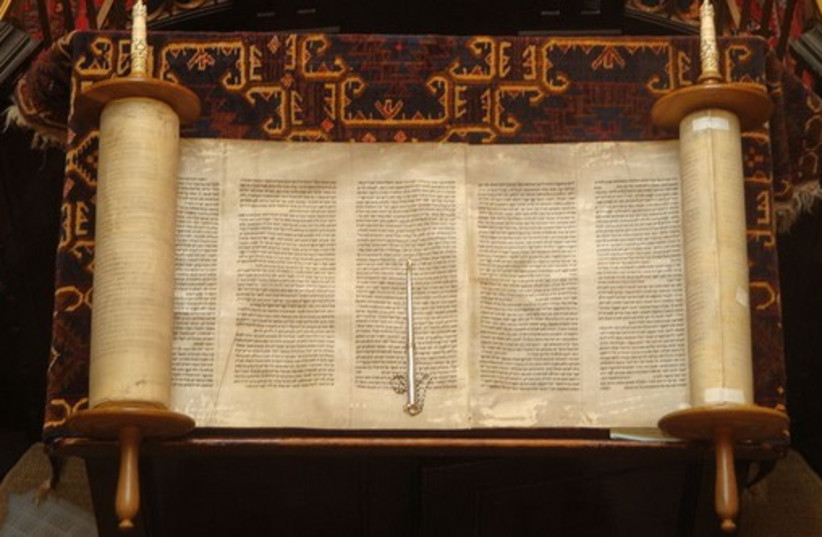
Torah Scroll, Wikimedia Commons
Torah

The Hebrew term Torah rightly translated means, not “law”, but “teachings.” The teachings of Torah do include legal precepts, of course, but those precepts are more about the nature and will of God than about legislation. Even to a Pharisee!

The Pharisees, like Rabbinic Judaism for the last 2,000 years, believed that Torah has two parts: written and oral.

Torah Shebichtav, the Written Torah

The written Torah itself is embodied in books or scrolls. The term primarily applies to the five Books of Moses. These writings individually or collectively are sometimes referred to by Jews as the Chumash (“one fifth”). I personally avoid the Greek term, “Pentateuch.”

To the Sadducees, only the five Books of Moses were Scripture. The Pharisees regarded as holy the entire Tanakh (the OT), consisting of Torah, Nevi’im (the Prophets) and Ketuvim (Writings, sometimes referred to by Jesus simply as the Psalms).

[44] Yeshua said to them, “This is what I meant when I was still with you and told you that everything written about me in the Torah of Moshe, the Prophets and the Psalms had to be fulfilled.” [45] Then he opened their minds, so that they could understand the Tanakh
—Luke 24:44–45 (CJB)

Torah Sheba’al Peh, the Oral Torah

The “Written Torah” was transcribed by Moses “from the mouth of the Almighty” and is contained within the Torah scroll. The “Oral Torah” incorporates the traditions handed down from Sinai but not (initially) put in writing, as well as the interpretations and rulings formulated by the sages of each generation.
—TheRebbe.org

The Pharisees taught that Moses received additional teachings on Mt. Sinai that he was not told to write down. Originally this “Oral Torah” was transmitted from father to son and from teacher to disciple. It consisted of additional instructions and rulings to clarify and quantify the written Torah; principles for exegesis of Torah; and authorization for the rabbis to protect the word of the Torah through making Gezayrot, or edicts, as conditions warrant.

Aside from famously criticizing “traditions of the Elders” that contradicted the letter or the spirit of the Written Torah, Jesus never spoke against the Oral Torah as a whole, and in fact He and His disciples were meticulous about obeying the precepts of both Written and Oral Torah. The formal right of the Scribes and Pharisees to administer Torah through interpretations and edicts (see above) was known as “binding and loosing” (prohibiting and permitting) and was believed to have the blessing of God and His Divine Council in heaven. Shortly before his crucifixion, Jesus endorsed this practice when He extended it to His apostles:

[18] Truly, I say to you, whatever you bind on earth shall be bound in heaven, and whatever you loose on earth shall be loosed in heaven.
—Matthew 18:18 (ESV)

Approximately 1800 years ago, Rabbi Judah the Prince concluded that because of all the “travails of Exile”, the Oral Torah would be forgotten if it was not recorded on paper. He therefore assembled the scholars of his generation and compiled the Mishnah, a written collection of all the oral teachings.

The Sanhedrin

The Biblical basis for the Sanhedrin was:

[18] “You are to appoint judges and officers for all your gates [in the cities ADONAI your God is giving you, tribe by tribe; and they are to judge the people with righteous judgment. [19] You are not to distort justice or show favoritism, and you are not to accept a bribe, for a gift blinds the eyes of the wise and twists the words of even the upright. [20] Justice, only justice, you must pursue; so that you will live and inherit the land ADONAI your God is giving you.
—Deuteronomy 16:18–20 (CJB)

Each major city was ruled by its own political and judicial “Lesser Sanhedrin” of 23 members. Under the monarchy, a “Greater Sanhedrin” was established at Jerusalem to serve as high court of justice and supreme governmental council.

This council at Jerusalem consisted of 71 members, of which the presiding member was the nasi (“prince”, or president), often the High Priest. Membership was appointed, with theological scholarship nominally the basic requirement—but in Roman times, politics effected all major appointments.

During Jesus’ Day, The Sanhedrin met in the “Chamber of Hewn Stone. Later they began meeting in the Royal Portico, which spanned the South side of the Temple Mount above and behind the Double and Triple Gates. Diagram ©Leen Ritmeyer, red box added by me.

According to the synoptic Gospels, Sanhedrin membership consisted of “chief priests, elders, and scribes.” Although there was overlap between those three groups, the chief priests were high ranking Temple priests, mainly members of the Sadducee order; the elders were most likely prestigious Pharisees; and the scribes were respected professionals who might have belonged to any particular order, or to none at all. The Gospel of John mentions only Pharisees and scribes from the Sanhedrin, but when John wrote, probably around AD 80, the Sadducees, the Sanhedrin and the Temple were long gone and a distant memory to his readers.

Pharisees as Sanhedrin Agents

The Pharisees in Jesus’ day were scattered throughout Judea and Galilee, with concentrations in the cities. Many were attached to specific synagogues, while others adopted the life of itinerant teachers, doing much the same things as Jesus. Many of these, perhaps a large majority, were no doubt still Godly men like the first Pharisees, out of the spotlight and unconcerned with politics and wealth. Certainly, when Jesus crossed paths with these men, there were discussions and perhaps even confrontations. I have witnessed brash conversations between Jewish intellectuals in my own day, and I don’t think that it would have been any different then than now.

But what about the Pharisees and scribes that followed Jesus around from town to town? The late David Stern, translator of the Complete Jewish Bible, wrote frequently in his own books and commentaries that these men were probably on assignment from the Sanhedrin. One of the duties of that body was to investigate not only claims of heresy, but also claims of messiahship. Since priests and Levites on the council were mostly Sadducees, who did not believe in a coming messiah, this duty would naturally fall to Pharisees and their scribes. Some would have been belligerent, others merely inquisitive.

Some members of the Sanhedrin were Godly men (e.g., Nicodemus and Gamaliel), but many others were corrupt—collaborators, greedy for wealth and power, and jealous of their position. I believe that the “committee” following Jesus probably consisted of both types. Perhaps it was the same handful of men that we see Jesus arguing with over and over again. Can it be that whenever Jesus blasted the Pharisees, it was “those Pharisees from the Sanhedrin” that He was speaking of—not all Pharisees in General?

Core Beliefs of the Pharisees

Despite the impressions one often receives in reading of Jesus’ frequent confrontations with the Pharisees, He seldom disputed with them on points of doctrine. The Pharisees revered God’s Holy Word and were strongly committed to daily application and observance of its precepts.

They believed in resurrection, immortality, divine judgment, angels, and spirits. They looked for a coming messiah and took responsibility for evaluating claimants. They believed in God’s intervention in human affairs. Many things, they believed, are predestined; human will has only limited freedom within the sovereign will of God.

In Mt 23:1-3 (see below), Jesus is telling the followers of the Pharisees, in effect, “Do what they say, but not what they do.” The reference to “Moses’ seat” speaks literally of the customary seats in the synagogues that were occupied by the teacher during formal Torah studies, but I think it also implies an acknowledgement by Jesus of their historical authority to teach the truths of Torah.

Remains of the Moses Seat in an ancient Persian synagogue.
Jesus’ Debates with Pharisees

I am sure that you have heard it said that Jesus “turned the ancient world upside down with His new commandments and interpretations of scripture.” Certainly, He provided many new insights in the area of prophetic interpretation and fulfillment, but in my opinion He actually presented little or nothing new in the way of doctrine, because the doctrine He taught was already imbedded in the Tanach; rather, He set the record straight on issues that had been clouded by denominationalism, and He turned the clock back on corrupt, or at best legalistic trends that had developed within Jewish society.

Though the great sages of the Pharisees were in substantial agreement with each other on most doctrinal issues, they did, however, often disagree on certain points of interpretation or application. When we see Jesus arguing with a Pharisee, what He is doing most often is simply taking sides in these disagreements. For example, the issues discussed in the so-called “antitheses” of Mt 5:21–48 had been the subject of hot debate among the sages, particularly the rival houses, Beit Hillel and Beit Shammai. Jesus was not presenting new doctrine, but rather pronouncing on these issues from the perspective of His divine authority.

If one can believe the Jewish literature of the Rabbinic age (and I think that most of it is trustworthy), almost everything that Jesus said had been previously said in some form by earlier Jewish sages. Some Christian scholars would claim that the rabbis plagiarized Jesus’ remarks, falsely attributing them to their own heroes. Of course, “critical scholarship” would say it was Jesus who plagiarized. My take is this: God’s truths are timeless and unchanging. God always has a remnant on the scene to expound that truth.

Because of God’s love and grace, He always “prepares the ground” ahead of the sower. Jesus did not arrive on the scene with a Gospel that was radically new and unacceptable to his Father’s chosen people. His path had been prepared in advance by the Pharisees, though ultimately most rejected Him.

As an engineer, I was taught that a good technical paper should have three parts: (a) tell ‘em what you’re going to tell ‘em; (b) tell it to ‘em; and (c) tell ‘em what you told ‘em. In this case, the Pharisees did (a), Jesus did (b) and the New Testament writers did (c).

How did the Pharisees See Themselves?

The Rabbinical descendants of the Pharisees tackled this question in both versions (Babylonian and Jerusalem) of the Talmud. Both list the following Seven Kinds of a Pharisee, in very similar terms:

  1. The “shoulder” Pharisee, who wears his good deeds on his shoulders and obeys the precept of the Law, not from principle, but from expediency.
  2. The “wait-a-little” Pharisee, who begs for time in order to perform a meritorious action.
  3. The “bleeding” Pharisee, who in his eagerness to avoid looking on a woman shuts his eyes and so bruises himself to bleeding by stumbling against a wall.
  4. The “painted” Pharisee, who advertises his holiness lest anyone should touch him so that he should be defiled.
  5. The “reckoning” Pharisee, who is always saying “What duty must I do to balance any unpalatable duty which I have neglected?”
  6. The “fearing” Pharisee, whose relation to God is one merely of trembling awe.
  7. The Pharisee from “love.”
    International Standard Bible Encyclopedia

Certainly, one can find examples of each type of Pharisee in scripture. Note that only the “Pharisee from love” was considered by the later Rabbis to be a truly Godly man.

My Conclusions

Unfortunately, by Jesus’ day, many (but certainly not all, and probably not a majority) of the Pharisees and scribes had in fact succumbed to a legalistic form of worship. Where before they had kept Torah out of a deep zeal to obey God’s commands, now many began to define their spirituality not by their love but by a prideful tally of their good deeds.

[23:1] Then Jesus said to the crowds and to his disciples, [2] “The scribes and the Pharisees sit on Moses’ seat, [3] so do and observe whatever they tell you, but not the works they do. For they preach, but do not practice.
—Matthew 23:1–3 (ESV) emphasis mine

What I am suggesting here is that you reconsider your attitude towards the Pharisees—to see them not as an evil cult that brought on the ruination of the Jewish people, but rather as a powerful spiritual force that bridged the gap between Ezra, Nehemiah and the latter prophets, and the arrival of Messiah.


Christians and Alcohol

  1. Generalities
  2. Analogs
  3. The Matter at Hand
  4. Language Issues
  5. Conclusion

Okay, I haven’t planned this one, and I’ll try to keep it short. The question was asked this week in a Sunday morning senior adult Bible class: is drinking alcoholic beverages permitted for Christians? This was way off-topic. The teacher gave a fairly non-committal answer and pulled us back to the subject of the lesson. I fully agree with what little response was given, but I’ll go into a bit more depth here, from my own perspective.

Grape arbor over Bible Times house in Ein Kerem, near Jerusalem. Photo ©Ron Thompson 2008.

First, though, some generalities and some analogs …

Generalities

I think Paul summed up the general principle in two passages of his letter to Corinth:

1Cor. 6:9   Know ye not that the unrighteous shall not inherit the kingdom of God? Be not deceived: neither fornicators, nor idolaters, nor adulterers, nor effeminate, nor abusers of themselves with mankind, 10 Nor thieves, nor covetous, nor drunkards, nor revilers, nor extortioners, shall inherit the kingdom of God. 11 And such were some of you: but ye are washed, but ye are sanctified, but ye are justified in the name of the Lord Jesus, and by the Spirit of our God.

¶ All things are lawful unto me, but all things are not expedient: all things are lawful for me, but I will not be brought under the power of any.
—1 Corinthians 6:9–12 KJV

Because of our sin nature, we all sin, and sometimes we do even the things listed in verses 9 and 10. But as redeemed people, we can’t be characterized by those sins, because we have been washed, sanctified and justified. We don’t have a list of things we can or can’t do, yet the desire of our spirit must surely be to honor God in whatever we do or don’t do.

1Cor. 10:20 But I say, that the things which the Gentiles sacrifice, they sacrifice to devils, and not to God: and I would not that ye should have fellowship with devils. 21 Ye cannot drink the cup of the Lord, and the cup of devils: ye cannot be partakers of the Lord’s table, and of the table of devils. 22 Do we provoke the Lord to jealousy? are we stronger than he?

¶ All things are lawful for me, but all things are not expedient: all things are lawful for me, but all things edify not.
—1 Corinthians 10:20–23 KJV

The emphasis here is not on sin, but on worship. Greek ethnos, here translated as “Gentiles”, does not mean non-Jews specifically; rather, it refers to “pagans“, who by definition worship the fallen angels who rule much of the world as “gods” (see my recent post, Gods and Demons).

In both passages, Paul is saying that our salvation comes from Jesus, not from legalistic adherence to rules of conduct.

Analogs

Local churches or associations of local churches traditionally (and with Biblical license) set rules for the conduct of their membership. Some of these rules may be related to doctrine, but others may be more an emphasis on maintaining fellowship with folks you might otherwise get crossways to.

An example of the latter is found in Acts 15, where James, the Nasi (president, so to speak) of the Jerusalem congregation, ruled that only a minimal list of standards should be demanded of non-Jews for fellowship with Jewish brothers in Messiah:

[19] “Therefore, my opinion is that we should not put obstacles in the way of the Goyim [non-Jews] who are turning to God. [20] Instead, we should write them a letter telling them to abstain from things polluted by idols, from fornication, from what is strangled and from blood.
—Acts 15:19–20 (CJB)

Note that Jews in the Jerusalem church and elsewhere were still Jews and required to be “Torah Observant.”

Some modern churches are very legalistic, others not so much. The churches I grew up in were, and prohibited, for example,

  • Consumption of alcohol;
  • Shorts;
  • Pants of any kind on females;
  • Skirts above the shin for females;
  • Hair over the top of the ears for males;
  • Handholding (or worse, kissing!) for unmarried couples;
  • Mixed bathing;
  • “Picture shows”;
  • In one church, makeup on ladies.

Scripture doesn’t specifically prohibit any of those things, though many would have been unthinkable in the culture of the day.

There are some things that most Christians today, and many non-Christians, would consider bad that are not condemned in the Bible. The list below shows things that we might like to see addressed more forcefully, but alas, because of “the hardness of men’s hearts“, God saw fit to merely limit, regulate and discourage them—not to prohibit them in all circumstances.

  • Slavery;
  • Slaughter, including genocide;
  • Polygamy;
  • Divorce;
  • Incestuous marriage;
  • (Should I add alcohol consumption here? See below).
The Matter at Hand

In the case of alcohol consumption, there is no direct prohibition, but there are certainly warnings. I’ll mostly limit this discussion to wine, because most relevant references in scripture are to wine in particular. The problem is that the English “wine“, and for that matter the Latin “vinum“, both translate several different words found in the original manuscripts. Some references speak positively of wine, some negatively, and some are neutral. We must here consider what exactly constitutes “wine”, and what is conveyed by the respective terms in the Hebrew and Greek originals.

Merriam Webster’s 11th Collegiate Dictionary defines the English “wine” as,

1 a : the alcoholic fermented juice of fresh grapes used as a beverage b : wine or a substitute used in Christian communion services
2 : the alcoholic usually fermented juice of a plant product (as a fruit) used as a beverage <blackberry wine>
3 : something that invigorates or intoxicates
4 : a dark red

Samuel Bacchiocchi’s book, Wine and the Bible: A Biblical Study on the Use of Alcoholic Beverages, surveyed English dictionaries going back around two centuries, and other secular works going back to Aristotle. He found numerous instances throughout with wording clearly implying that wine has always been a general term referring to both “must” (Lat. vinum mustum, freshly pressed grapes) and fully fermented wine, and all steps in between.

A 1st Century winepress near (but not part of) the Garden Tomb complex in Jerusalem. From MadainProject.
Language Issues

Bacchiocchi presents a case that the original languages of the Biblical manuscripts require that we regard all favorable mentions of wine as referring to unfermented must. Dr. Jim Anderson, past president of Kansas City’s Calvary Bible College, in his book, The Life of Christ, doesn’t present the case as forcefully, but his approach to the language issues is more straightforward.

I have the resources, but neither the time nor the will, to examine all 215 occurrences of “wine” in the English Standard Version. As a lifelong teetotaler, I have no axe to grind, so I’ll go with easy here and mostly paraphrase Dr. Anderson.

  • Heb. yayin — Most common OT term for wine. Per Anderson, the word only refers to the fermented product, and all references to it as a beverage (as opposed to medical usage) are negative. This can certainly be said of its use by Noah in Gen. 9, and by Lot in Gen. 19 before his seduction by his daughters. The Strong’s and Brown-Driver-Briggs (BDB) dictionaries also equate yayin with intoxicating wine; however, Vine’s Expository Dictionary, which I like a lot, says the yayin refers to juice in any stage of fermentation. Given that Melchizedek is a clear type of Messiah, his presentation of yayin to Abram is hard for me to see as negative in Gen. 14. The alcoholic content in this case is indeterminate from context.
  • Heb. tirosh — Apparently always refers to “new wine”, i.e., must, with little or no fermentation. In Gen. 27, Isaac was drinking yayin, which may have contributed to the sheepskin deception. In return, Isaac’s blessing of Jacob included a prayer for grain and tirosh.
  • Heb. shekar — This always refers to “strong drink“, fermented from grains. This type of beverage is never viewed as positive. It isn’t wine, of course, but I include it here as a related subject. Both yayin and shekar are prohibited to priests serving in the Tabernacle. However, in Num. 28, shekar is specified for drink offerings, which are “poured out”, not drunk.
  • Heb. chomets — Must, when it has fermented, becomes wine, in the familiar sense. Eventually, further fermentation turns yayin into vinegar, also known as “sour wine“, or chomets, which I’m told is bitter, but no longer intoxicating. Chomets was used as a condiment. In Rut. 2:14, Boaz invited Ruth to sit and dip bread into a bowl of vinegar (chomets) for seasoning.
  • Gr. oinos — Every source that I’ve looked at seems to agree that oinos refers to wine in any stage of fermentation. Only the context can show if the term is used positively or negatively. Not always easy! When Jesus was offered oinos mixed with myrrh at His crucifixion, He turned it down after tasting it (Mk. 15:23). Was that because of fermentation, or because of the myrrh (“gall” in Matthew), which when ingested is a bitter narcotic? In 1Tim. 3:8, “not addicted to much [oinos]” would seem to be speaking of an intoxicant. I’m not sure you can stretch that to be speaking of simple gluttony for grape juice, but again, to make this a negative, you have to assume what you are trying to prove. In 1Tim. 5:23, “a little wine for the sake of your stomach” is clearly speaking of medicinal use, which few would fault.
  • Gr. ochos — Low grade, sour wine, or vinegar. In Mk. 15:36, Just before His death, Jesus was offered ochos. In the earlier Cana miracle, only the word oinos is used. One would suppose that three levels of fermentation are in view here. The “master of the feast” said that usually “good wine” was served first and poor later. I would assume that “good” meant fresher, so the poor may have been approaching the over-fermenting of vinegar. Jesus’ wine would then be still fresher wine, perhaps not yet fermented at all. Where do we draw the line between good, bad and ugly here? We have only relative taste to go by.
Conclusion

The bottom line here is that I can’t take a final position on the question of whether or not Christians should feel free to drink, in moderation.

I was taught from childhood that “Christians don’t drink”, and I never have. Aside from flavoring agents in steak sauce and French fry batter, I’ve never tasted wine or beer, or anything else intoxicating, and I have absolutely no desire to do so. I would rather that Christians abstained entirely, because I can see absolutely no benefit to it. But having known many obviously good Christians who do occasionally partake, I simply can’t condemn in others what I’m not able to show conclusively that God has condemned.

That said, knowing the dangers and the destruction caused by substance abuse, I must personally believe that, as to my own life and family, consumption of recreational intoxicants and drugs is another of those things that God has declined to prohibit because of the hardness of men’s hearts.