The term “atonement” is used over and over in the Old Testament to describe the purpose for and result of the Sinaitic (or Mosaic) sacrificial system. Many Christian theologians extrapolate the Old Testament concept into the New Testament setting and speak of the “atoning work of Christ on the cross.” This usage, however, obscures the very real difference between Old Testament atonement and New Testament expiation, propitiation and reconciliation. Atonement, in the Biblical sense, is a temporary covering up of sin, or guilt. A “stay of execution”, so to speak. Expiation means “to extinguish guilt incurred.” Propitiation is roughly the same, but with the additional dimension of appeasement of anger. Reconciliation means to “reestablish a close relationship” between two entities or concepts. Expiation and propitiation accurately describe what the death of Messiah did, while reconciliation, an accounting term, describes the result: our relationship with God is brought into balance. Cause and effect. Sin is paid for in full and permanently expunged from the record, God is appeased, and our relationship with Him is restored.
The Hebrew terms for “atonement” are variations from the root kaphar, which all carry the idea of “covering”; for example, covering a ship’s hull with bitumen to prevent leakage, or covering a stain in a hardwood floor with a rug. Orthodox Jewish males today cover their heads with kippot, the skullcaps or yarmulkes (Yiddish) that we have all seen. The “lid” of the Arc of the Covenant was called the kapporah, and it, too, is a covering. Atonement for sin, then, becomes a means of covering, or obscuring, it from sight, without actually expunging or removing it. The guilt remains, but God has provided a means of temporarily “sweeping it under the rug” pending permanent expungement by means of Messiah’s crucifixion.
Aside from references to the Jewish feast, the Day of Atonement, the words atone, or atonement appear seldom or not at all in most translations of the New Testament. In the Septuagint (LXX, the Greek translation of the Old Testament used by Paul, translated, apparently, by 70 Jewish scholars in Elephantine, Egypt in the 2nd Century, BC), the word “atonement” is rendered as hilasterion, because there apparently was not a Greek equivalent for “atonement”. Where the feast day is intended, the Greek hilasterion is thus also used in the New Testament for “atonement”, or even for “Mercy Seat”, referring to the covering of the Ark of the Covenant; otherwise, hilasterion is correctly translated as expiation or propitiation. Where the Greek katallagē is used, the proper translation is reconciliation.
Though most New Testament translations are generally okay in this respect, Christian writers and speakers continue to refer to phrases like, “the atoning blood of Christ”, which is a theological non-sequitur. Atonement is decidedly not what His crucifixion accomplished! The confusion arises because most Christians believe that the sacrifices were means of salvation under the Jewish Torah. But this is taught nowhere in scripture. Atonement by means of the sacrificial system is never said to make anybody “at one with Christ” or with God. Atonement is not “at-one-ment” as many have claimed. Salvation is permanent, whereas atonement is only temporary.
In discussing the superior sacrifice of Jesus, Heb 10:4 states that
Hebrews 10:4 (CJB) [4] …it is impossible that the blood of bulls and goats should take away sins.
Many passages in the Tanach (Old Testament) also discuss the inadequacy of sacrifice in the presence of a sinful heart. For example
1 Samuel 15:22 (CJB) [22] Sh’mu’el [Samuel]said, “Does ADONAI take as much pleasure in burnt offerings and sacrifices as in obeying what ADONAI says? Surely obeying is better than sacrifice, and heeding orders than the fat of rams.
Psalms 40:7 (CJB) 7 Sacrifices and grain offerings you don’t want; burnt offerings and sin offerings you don’t demand. Instead, you have given me open ears;
Psalms 51:18 (CJB) 18 For you don’t want sacrifices, or I would give them; you don’t take pleasure in burnt offerings.
Proverbs 15:8 (CJB) [8] ADONAI detests the sacrifices of the wicked but delights in the prayers of the upright.
Isaiah 1:11 (CJB) [11] “Why are all those sacrifices offered to me?” asks ADONAI. “I’m fed up with burnt offerings of rams and the fat of fattened animals! I get no pleasure from the blood of bulls, lambs and goats!
Jeremiah 6:20 (CJB) [20] What do I care about incense from Sh’va [Sheba] or sweet cane from a distant land? Your burnt offerings are unacceptable, your sacrifices don’t please me.”
Hosea 6:6 (CJB) [6] For what I desire is mercy, not sacrifices, knowledge of God more than burnt offerings.
Hosea 8:13 (CJB) [13] They offer me sacrifices of flesh and eat them, but ADONAI does not accept them. Now he will recall their crimes and punish their sins— they will return to Egypt.
Hosea 9:4 (CJB) [4] They will not pour out wine offerings to ADONAI; they will not be pleasing to him. Their sacrifices will be for them like mourners’ food— everyone eating it will be polluted. For their food will be merely to satisfy their appetite; it will not come into the house of ADONAI.
Why did God not want the sacrifices that He, Himself, had demanded? Just as we believe that baptism and the Lord’s Supper are a response of obedienceby someone already saved, and useless to the unsaved, so were the sacrifices a response of obedience. Salvation then, as now, was “by grace through faith.” Sacrifice had no efficacy except to those who were already the recipients of God’s saving grace. The purpose of the sacrifices was to ritually “cover”, or hide from God’s eyes, the guilt of the sinner who, by his obedient sacrifice, was “making amends.”
But notice this:
Every single one of the atoning sacrifices was for incidental, or unintentional, sin; in other words, for sins committed in ignorance, accidentally, or under duress. There was absolutely no means of sacrificial atonement for willful sin—except for God’s grace! On Yom Kippur, the “Day of Atonement” the Cohen HaGadol (high priest) would sacrifice a bull for his own incidental sin and a goat for the incidental sin of the people. Once the problem of incidental sin had been covered up, he would then lay his hands on the forehead of another goat, the scapegoat, symbolically transferring to it all further, willful, sin. The scapegoat would be led “outside the camp”, i.e., away from the people and out of God’s presence. Thus, the nation’s sin was allegorically returned to Azazel, the chief of demons.
This post was first published over 10 years ago but recently got a major overhaul. First, because my own style has changed a bit over the years; but also, because I’ve changed my mind about one related issue, which I’ll discuss below. This is a good time for an update because it is now the middle of the Hebrew month Elul, and that is the temporal setting of my main topic here, the Fall Feasts.
I started this edit by setting a time frame for Jesus’ First Advent, which I date in the following short table. Here I have used the Gregorian calendar for the year, because that is more identifiable to most of us, but I’m taking the month and day from the Hebrew calendar, because annual events are Biblically fixed according to that standard and are different every year by the Gregorian and earlier Julian calendars.
Event
Age
Hebrew Date
Gregorian Year
Birth
–
Tishri 15
4 BC
Baptism
about 30 years
Elul 1
AD 26
Crucifixion
about 33 yrs., 6 mos.
Nisan 14
AD 30
Here are some of the factors I considered in composing this table:
The Biblical feast days commemorate important Jewish historical events, celebrate the annual agricultural cycle, and prophesy about Messiah’s life on earth, in both of His advents.
I am convinced that the Jewish principal feasts, as commanded in Leviticus 23, provide a totally reliable outline of important events in Jesus’ life, as shown in the last column of Figure 1, above. Events highlighted there in peach occurred during His first advent, on the actual feast days shown. Events highlighted in blue will occur during His second advent, again on the actual feast days shown.
I’m very confident that Jesus’ birth was on Tishri 15, the first day of the Feast of Tabernacles, Sukkoth. Not in December, on a date with absolutely no Scriptural support (but with a pagan connotation!); but rather in a September/October timeframe corresponding to Jewish celebration of the time that God previously “tabernacled” with His people during their 40 years of wilderness wandering. With Jesus’ birth, once again God was living among His people.
The year of Jesus’ birth has been disputed during my entire lifetime. There are always unresolved arguments about when Herod died, when Quirinus was governor of Cilicia/Syria, and what year a lunar eclipse hit the region, all of which are applicable. The most commonly cited estimates that I’ve seen place Jesus’ birth in 4 BC, though dates ranging from 1 through 6 BC are also commonly mentioned. I’m sticking with 4 BC here, because it fits well with the other two dates in my table.
Luke 3:23 states that Jesus was “about thirty years of age” when He began His ministry. Fall of AD 26 is about thirty years after the autumn of 4 BC. In fact, if His ministry began on Yom Kippur (see below), and that was the last day of His 40-day “wilderness fast and temptation”, then He was just five days shy of 30 years old.
His baptism by John was 40 days before Tishri 10, which is the Day of Atonement, Yom Kippur. I’ll explain the 40-day offset below, but it culminates with Jesus on the pinnacle of the Temple, defying Satan, on Yom Kippur, in full view of many thousands of worshippers on the plaza below.
Fig. 2: The late Alec Garrard, facing “south”, posing in his backyard shed model of Herod’s Temple. The parapet in the lower right corner overlooks the Kidron Valley, and as the highest point on the Temple Mount walls, it is thought by many to be the “pinnacle” mentioned in Scripture. I personally suspect that the somewhat lower parapet to the left, more commonly known as the Place of Trumpeting, might be the actual pinnacle of Scripture, since it is far more visible from the streets below. Photo from The Miniature Engineering Craftsmanship Museum.
His crucifixion was on Nisan 15, the first day of the Feast of Unleavened Bread, Yom ha-Bikkurim, not on Nisan 14, the day of the sacrifices.
The year of Jesus’ crucifixion, shown here as AD 30, was calculated by me, using NOAA (National Oceanic and Atmospheric Association) New Moon Tables, which were prepared with historic ocean tides in mind. Every published Biblical chronology that I’m aware of puts the crucifixion in AD 33, but they are all based on an incorrect interpretation that insists He was crucified on Nisan 14. With a correct understanding of the timings of Passover Week which (thanks to my traditional presuppositions) it frankly took me many years to achieve, it is clear that Jesus was crucified on Nisan 15.
9/5/2023 addition:
1 In the fifteenth year of the reign of Tiberius Caesar, Pontius Pilate being governor of Judea, and Herod being tetrarch of Galilee, and his brother Philip tetrarch of the region of Ituraea and Trachonitis, and Lysanias tetrarch of Abilene, 2 during the high priesthood of Annas and Caiaphas, the word of God came to John the son of Zechariah in the wilderness. —Luke 3:1-2 ESV
Leaving Tiberias until last, here are the tenure years of the leaders mentioned (all are 1st Century AD): Pilate, 26–36; Herod (Antipas), 4–39; Philip, 4–34; Lysanius, unknown; and Caiaphas, 18–37. Annas was High Priest during the period 6–15 but was the real power in the Temple during the tenure of Caiaphas, his son-in-law, 18–37.
For the purpose of dating the text, only Tiberias‘ rule is useful. Many historians and Biblical commentators date Tiberias’ accession to the time of Augustus’ death. That puts the timing of Jesus’ baptism in the year AD 29, which would pose a problem for my proposed dating. I don’t think AD 29 is correct, because it was common for many, possibly most, ancient rulers and their chroniclers to ambitiously include years of coregency in citing tenure of rule. Tiberias was coregent with Augustus starting in either AD 11 or 12. AD 11 fits perfectly with my AD 26 date for Jesus’ baptism.
I find that I am not alone in recognizing this discrepancy. The well-respected commentary Jamieson, Faucett & Brown, for example, states that:
the fifteenth year of Tiberius — reckoning from the period when he was admitted, three years before Augustus’ death, to a share of the empire [results in a date for the events of Matthew 3:1 of] about the end of the year of Rome 779, or about four years before the usual reckoning.
“The usual reckoning” is AD 30. The traditional date for the founding of Rome was 753 BC, which makes “the year of Rome 779” equivalent to AD 26.
Please refer to Figures 3 and 4, above. The Passover sacrifices were killed on Nisan 14, then consumed during the Seder, which began that evening at dusk. Jesus and His 12 apostles celebrated the Seder until late, as customary, then joined with the Hallel singing outside at midnight. Following that, they walked to Gethsemane, where Jesus was arrested. His trials were conducted during the early morning of Nisan 15, and He was crucified and buried that day. That was on a Friday, and the only year within a reasonable range with a Friday on Nisan 15 was AD 30. I am very confident that this scenario is correct!
Fig. 5: An April 2024 calendar showing parallel Hebrew dates on the right. This clearly demonstrates that the 8-day Passover celebration (7 days in Israel) begins on Nisan 15. Jewish Time®, by Calendar Maven
Most scholars think that Jesus’ ministry lasted around 3½ years, based on the number of Passovers He seems to have attended during that time. I agree.
This month shall be to you the head of the months; to you it shall be the first of the months of the year. —Exodus 12:2 (The Complete Jewish Tanach)
Nisan 1, in the Spring, is the Jewish religious New Year. Jews today, though, celebrate the civil new year, Rosh Hashanah, which is six months later, on Tishri 1.
Most of the modern world celebrates the new year with revelry. Not so among devout Jews in 1st Century Judea, because Tishri 1 is also the date of Yom Teruah, the Day of Trumpets. This important feast day heralds God’s judgment of His chosen people for their deeds, both good and bad, committed during the preceding year.
As such, the mood during the entire ten-day period through Yom Kippur, the Day of Atonement, on Tishri 10, is somber and introspective. There is prayer, fasting, ritual immersion (baptism for purification), and general spiritual misery and mourning. No weddings or other celebrations are permitted.
Once Yom Kippur has passed, the mood shifts. There is spiritual relief, and a 5-day period of relaxed preparation, followed by the joyous eight-day celebration of Sukkoth, the Feast of Tabernacles.
In the rest of this post, I will concentrate on two of the fall feasts in particular: The Day of Trumpets and the Day of Atonement. These two feasts, and the 10-day span of time connecting them, is known as Yamim Noraim, the ten “Days of Awe”. This somber period, as described above, is devoted to sincere individual and national confession of sins, and to t’shuvah, or repentance.
Rosh Hashanah, also known as Yom Teruah (The Day of Trumpets), is the Jewish day for regathering. Jews believed that, on this day every year, God divided His people into three groups according to their faithfulness over the preceding year. One group was the “wholly righteous”, whose names would certainly be written in the Book of Life. A second group was the “wholly wicked”, who would be written into the Book of Death. The final group was comprised of “those in between”, whose fate would be sealed by the quality of their t’shuvah over the next ten days, with their final judgment reserved until Yom Kippur.
In the original version of this post, I said of the above viewpoint, “this doctrine is certainly not Biblical”; however, I have mostly changed my mind about the books, though I think that the Jewish perspective on them may be a bit skewed. I have recently been introduced to the works of Michael S. Heiser, and what he called the “Deuteronomy 32 worldview” (see Gods and Demons). He addressed this subject in ways that I had not previously considered.
There are, in fact, eight New Testament references, mostly in Revelation, to the “book of life“, and many Old Testament and intertestamental references to heavenly “books” and “tablets” that are clearly connected. I assume that these conceptual records are metaphorical, considering that God is God, and doesn’t need a physical database to remember what He needs to remember. Heiser makes sense when he suggests that our sins are recorded in one book, and our salvation in another. If (and only if) we are not listed in the second, then we will be judged by what is recorded in the first. There may be a “book of death“, too, that renders some ineligible for salvation. Regarding the latter, see, for example:
[31] Therefore I tell you, every sin and blasphemy will be forgiven people, but the blasphemy against the Spirit will not be forgiven. —Matthew 12:31 (ESV)
Whether or not the doctrine of these books is valid, the fact that the holiday recognizes a separation of people from people is very significant since it prophetically depicts the regathering of God’s people on the coming day of Rapture:
[16] For the Lord himself shall descend from heaven with a shout, with the voice of the archangel, and with the trump of God: and the dead in Christ shall rise first… —1 Thessalonians 4:16 (KJV)
In light of 1 Thes 4:16, the blowing of the trumpet (actually, a shofar, or ram’s horn) on Yom Teruah is particularly interesting. The shofar (accompanied by metallic trumpets in Temple days) was blown at mid-morning after the morning (Shacharit) prayers, in three series of four distinctive notes: tekia (“blast”); shevarim (“broken notes”); teruah (“shout”—thought of as “the shout of an archangel”); and tekia gedolah (the “great blast”). The first series is tekia, shevarim, teruah, tekia, repeated three times. The second is tekia, shevarim, tekia, repeated three times. The final series is tekia, teruah, tekia, repeated three times, followed immediately by tekia gedolah, referred to in 1 Cor 15:52 as “the last trumpet”.
[52] in a moment, in the twinkling of an eye, at the last trumpet. For the trumpet will sound, and the dead will be raised imperishable, and we shall be changed. —1 Corinthians 15:52 (ESV) emphasis mine
Since long before Jesus’ day, the Days of Awe have, in practice, begun thirty days beforeYom Teruah, on the first day of the Jewish month Elul. T’shuvah (repentance) is much too important to put off until the last minute, so the Rabbis decided that forty full days should be devoted to it, rather than the ten required by Torah.
On Elul 1, Jews would flock to the mikvot (baptisteries) of the Temple and synagogues, and to the “living waters” of streams and rivers like the Yarden (Jordan), to immerse themselves for ritual purification. That would then be followed by forty days of prayer, fasting and introspection. In the years preceding AD 30, it seems that many had become preoccupied with the politics and woes of the Roman occupation, and such customs were being neglected. Into this scene stepped Yochanan, who we now call John the Baptizer, calling Jews to baptism and t’shuvah.
[13] Then Jesus came from Galilee to the Jordan to John, to be baptized by him. [14] John would have prevented him, saying, “I need to be baptized by you, and do you come to me?” [15] But Jesus answered him, “Let it be so now, for thus it is fitting for us to fulfill all righteousness.” Then he consented. [16] And when Jesus was baptized, immediately he went up from the water, and behold, the heavens were opened to him, and he saw the Spirit of God descending like a dove and coming to rest on him; [17] and behold, a voice from heaven said, “This is my beloved Son, with whom I am well pleased.” —Matthew 3:13–17 (ESV)
I believe that the events of Mt 3:13-17, describing Jesus’ baptism and anointing by the Holy Spirit, took place on Elul 1, conforming to the current tradition. As to the year, I lean towards AD 26, as stated above. If that year is off, I’m still 100 percent sure of the Hebrew month and day.
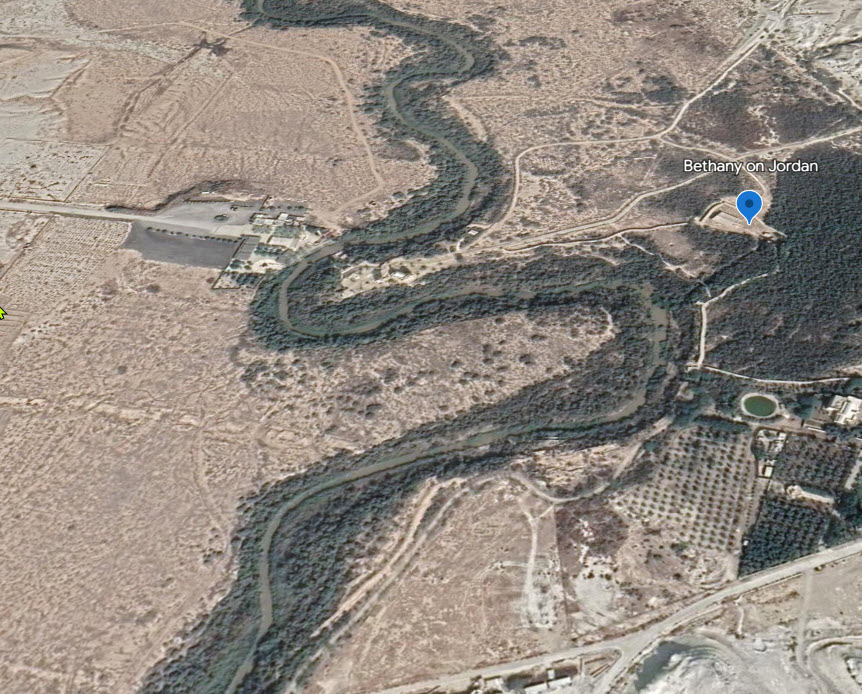
Fig. 8: The Jordan River today, due east of Jerico. Scripture places Jesus’ baptism at Bethany on Jordan, no doubt referring to the east bank of the oxbow, close to the village. From Google Earth.
Though of course He was sinless, His baptism, followed by forty days of prayer and fasting, were consistent with and required by the customs of the season.
More importantly, the temptation and His response were theologically vital. Jesus was “the Second Adam” (see The Two Adams). The first was created sinless, but when tempted by the “lust of the flesh, the lust of the eyes, and the pride of life”, failed and brought sin to the world. The same tempter and same temptations came to Jesus in the wilderness: lust of the flesh (stones to bread); lust of the eyes (the kingdoms of the world); and pride of life (rescue by angels in the sight of all Israel). Jesus did not fail, and brought redemption to the world.
Matthew presents a different order for the temptation, which is not a problem because chronological order was not strictly important in the literature of the day. In any case, all three temptations most likely occurred on the same day.
Interestingly, that placed Jesus on the Pinnacle of the Temple on Yom Kippur:
[9] Then he [the devil] took him to Yerushalayim, set him on the highest point [Greek pterugion, literally, a “wing” or “turret”] of the Temple and said to him, “If you are the Son of God, jump from here! [10] For the Tanakh [Old Testament] says [Psalm 91:11–12],
‘He will order his angels to be responsible for you and to protect you. [11] They will support you with their hands, so that you will not hurt your feet on the stones.’”
[12] Yeshua [Jesus] answered him, “It also says, ‘Do not put ADONAI your God to the test.’” [13] When the Adversary [Greek diabolos, literally, “accuser”] had ended all his testings, he let him alone until an opportune time. —Luke 4:9–13 (CJB)
While the Temple still stood, on Yom Kippurall the people gathered on the Temple Mount for the ritual sacrifices that would roll the sins of the truly repentant back for another year. Since there is no longer a Temple, and thus no legitimate place for blood sacrifices, the gatherings are now in the synagogues, and what is offered are “sacrifices of prayer.”
Most translations render pterugion as “pinnacle”, following the KJV. This is traditionally interpreted as the highest point on the Temple Mount or its surrounding walls, but I don’t think that this is warranted. It seems to me most likely that this is referring to the “place of trumpeting” (see Figure 2) which, by inference, was probably the parapet, or observation platform, from which the priests monitored the ritually vital sunrise and sunset every day. This high overlook was visible from the exterior streets below. If Jesus had accepted Satan’s temptation to throw Himself off and allow the angels to catch Him, all the Jewish world would have witnessed the destruction of His public ministry on the very day it began! Certainly, this was Satan’s plan!
I am forever thrilled at the beauty of God’s timing! I believe that many of the events connected with Jesus’ First and Second Advents actually occurred or will occur on the precise day of the Feast that pictures the event. Could it be that He will return for his Church at the exact moment of the “Last Trump” on the Feast of Trumpets (as God indeed said He would!), which is prophetic of the Rapture? Is it possible that He will return in judgment at the end of Tribulation on the Day of Atonement, the very day when God is thought to seal His judgment of His people? I am convinced it is so!





 The Back of My Mind